Online Groups
       Experience from an eTwinning Learning Event


                         March 2013
                 eTwinning conference, Lisbon

           Brian Holmes, Lancaster University &
The Executive Agency for Education, Audiovisual and Culture
                         with the support of
           Tiina Sarisalmi, Municipality of Orivesi, Finland
                  & European Schoolnet, Belgium
How active were the participants?

      Plot showing participant messages over time


Frequency of
messages
related closely
to activities
and to the
messages
from the
moderator

Participants
less
dependent on
moderator
towards the
end

                                                                  2
                  http://www.slideshare.net/holmebn
How active were the participants?

                  What the results suggest

•  Participants were very much focused on the activities:
    –  They posted messages when needed to achieve the goal of a shared
       activity
    –  Little interaction when the online activity was finished or when they were
       busy with activities in their own teaching practice

•  Participants’ initial interaction followed closely that of the moderator
    –  They responded to prompts from the moderator
    –  They responded to feedback


•  Participants became more autonomous over time
    –  Less influenced by messages from the moderator towards the end
    –  They seemed to be more proactive, supporting one another towards the
       end
                                                                                    3
Leading to autonomy

                     What about ‘lurkers’?

A ‘lurker’ is someone who passively participates in the online
discussion forums, perhaps reading the messages of others, but not
actively contributing themselves.

Is lurking necessarily a bad thing?


Let’s look at the example of Lantha ...


                                                                     4
Leading to autonomy

                  The example of Lantha

•  Lantha is a teacher from Greece
•  In the Learning Event, she posted very few messages
•  When interviewed about her experience she said:

   ‘I made a seminar with my partners here in Greece and I transferred
   these tools to them, the main idea about them. It was very useful,
   I said that everyday that I am really grateful that I learned so much
   things.’

•  This suggests that Lantha may have been a lurker, however she
   was far from passive
•  She was using what she was learning from the online discussions to
   apply this with her colleagues in her school

                                                                           5
Leading to autonomy

          Legitimate Peripheral Participation

Lurking in an online group may be a good thing.

Lave and Wenger (1991) call this ‘legitimate peripheral participation’.
They argue that participants often start at the edge of a community and
gradual move to the centre as they become more confident and
experienced.

This may be the case for Lantha: in future Learning Events, she may be
more active in her participation.

The lurkers of today are the active participants of the future!


                                                                          6
Leading to autonomy

Critical thinking and competence development

Critical thinking is about
   ‘reasonable reflective thinking focused on deciding what to believe
   or do’ (Ennis, 2002)
   ‘purposeful, self-regulatory judgment which results in interpretation,
   analysis, evaluation … as well as explanation of the …
   considerations upon which that judgment is based’ (Facione, 2013)


Critical thinking is important for competence development;
it and helps teachers to prepare for the ill-defined problems of the future.


                                                                            7
Leading to autonomy

            Critical thinking: a theoretical model

Linking private thoughts                                           Constructing meaning,
to real world, as ideas                                         moving between reflection
are explored: adding to                                         and discourse: integrating
what has been said                                            ideas from different sources


Cognition                                                                Critical
                                                                         thinking


                                                               Direct or vicarious action as
Initial phase, issues and                                   solutions are implemented and
problems emerge:                                              assessed: evaluating results,
asking questions                                                    linking to wider context

                            (Garrison et al., 2001, p.99)                               8
Leading to autonomy

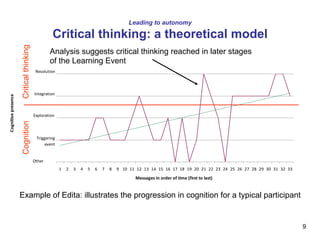
                                                      Critical thinking: a theoretical model
                        Critical thinking


                                                    Analysis suggests critical thinking reached in later stages
                                                    of the Learning Event
                                             Resolution


                                            Integration
Cognitive	
  presence


                                            Exploration
                        Cognition


                                             Triggering
                                                  event


                                            Other
                                                          1   2   3   4   5   6   7   8   9 10 11 12 13 14 15 16 17 18 19 20 21 22 23 24 25 26 27 28 29 30 31 32 33
                                                                                                 Messages	
  in	
  order	
  of	
  time	
  (first	
  to	
  last)


                        Example of Edita: illustrates the progression in cognition for a typical participant


                                                                                                                                                                      9
Leading to autonomy

                  Reflective practitioners

As a participant …
ü  Give examples of what happened to you in practice, why you think it
    happened and what you would recommend to others.
ü  Encourage your colleagues to go into more detail, to explain their
    reasoning.
ü  Make suggestions to help colleagues express themselves.
ü  Be critical but supportive of others.
ü  Be sociable and share your feelings.
ü  Be creative; sharing is fun J.


                                                                          10
Leading to autonomy

              Encouraging critical thinking

As a moderator …
ü  Ask participants to try things out in their teaching practice
ü  Allow time for reflection and get them to share their experience with
    others in the forums
ü  Encourage expressions of feeling: joy, pride, fear, confidence, etc
ü  Prompt others to build upon this experience with other examples
ü  Get them to suggest alternatives and talk about what might happen
    in different contexts
ü  Encourage participants to draw conclusions
ü  Use creative forms of expression such as images


                                                                            11
Thank you

                                      Brian.Holmes@skynet.be

                                      http://holmesbrian.blogspot.com/


References

ENNIS, R. (2002). A Super-Streamlined Conception of Critical Thinking.
http://faculty.education.illinois.edu/rhennis/index.html
GARRISON, D. R., ANDERSON, T. & ARCHER, W. (2001) ‘Critical thinking, cognitive presence, and computer
conferencing in distance education’, American Journal of Distance Education, 15 (1), pp.7-23.
FACIONE, P.A. (2013) Critical Thinking: What It is and Why It Counts, p. 26,
http://www.insightassessment.com/content/download/1176/7580/file/What%26why2013.pdf
LAVE, J. & WENGER, E. (1991) Situated Learning: Legitimate Peripheral Participation. Cambridge, Cambridge
University Press.
                                                                                                            12

Holmes online groups

  • 1.
    Online Groups Experience from an eTwinning Learning Event March 2013 eTwinning conference, Lisbon Brian Holmes, Lancaster University & The Executive Agency for Education, Audiovisual and Culture with the support of Tiina Sarisalmi, Municipality of Orivesi, Finland & European Schoolnet, Belgium
  • 2.
    How active werethe participants? Plot showing participant messages over time Frequency of messages related closely to activities and to the messages from the moderator Participants less dependent on moderator towards the end 2 http://www.slideshare.net/holmebn
  • 3.
    How active werethe participants? What the results suggest •  Participants were very much focused on the activities: –  They posted messages when needed to achieve the goal of a shared activity –  Little interaction when the online activity was finished or when they were busy with activities in their own teaching practice •  Participants’ initial interaction followed closely that of the moderator –  They responded to prompts from the moderator –  They responded to feedback •  Participants became more autonomous over time –  Less influenced by messages from the moderator towards the end –  They seemed to be more proactive, supporting one another towards the end 3
  • 4.
    Leading to autonomy What about ‘lurkers’? A ‘lurker’ is someone who passively participates in the online discussion forums, perhaps reading the messages of others, but not actively contributing themselves. Is lurking necessarily a bad thing? Let’s look at the example of Lantha ... 4
  • 5.
    Leading to autonomy The example of Lantha •  Lantha is a teacher from Greece •  In the Learning Event, she posted very few messages •  When interviewed about her experience she said: ‘I made a seminar with my partners here in Greece and I transferred these tools to them, the main idea about them. It was very useful, I said that everyday that I am really grateful that I learned so much things.’ •  This suggests that Lantha may have been a lurker, however she was far from passive •  She was using what she was learning from the online discussions to apply this with her colleagues in her school 5
  • 6.
    Leading to autonomy Legitimate Peripheral Participation Lurking in an online group may be a good thing. Lave and Wenger (1991) call this ‘legitimate peripheral participation’. They argue that participants often start at the edge of a community and gradual move to the centre as they become more confident and experienced. This may be the case for Lantha: in future Learning Events, she may be more active in her participation. The lurkers of today are the active participants of the future! 6
  • 7.
    Leading to autonomy Criticalthinking and competence development Critical thinking is about ‘reasonable reflective thinking focused on deciding what to believe or do’ (Ennis, 2002) ‘purposeful, self-regulatory judgment which results in interpretation, analysis, evaluation … as well as explanation of the … considerations upon which that judgment is based’ (Facione, 2013) Critical thinking is important for competence development; it and helps teachers to prepare for the ill-defined problems of the future. 7
  • 8.
    Leading to autonomy Critical thinking: a theoretical model Linking private thoughts Constructing meaning, to real world, as ideas moving between reflection are explored: adding to and discourse: integrating what has been said ideas from different sources Cognition Critical thinking Direct or vicarious action as Initial phase, issues and solutions are implemented and problems emerge: assessed: evaluating results, asking questions linking to wider context (Garrison et al., 2001, p.99) 8
  • 9.
    Leading to autonomy Critical thinking: a theoretical model Critical thinking Analysis suggests critical thinking reached in later stages of the Learning Event Resolution Integration Cognitive  presence Exploration Cognition Triggering event Other 1 2 3 4 5 6 7 8 9 10 11 12 13 14 15 16 17 18 19 20 21 22 23 24 25 26 27 28 29 30 31 32 33 Messages  in  order  of  time  (first  to  last) Example of Edita: illustrates the progression in cognition for a typical participant 9
  • 10.
    Leading to autonomy Reflective practitioners As a participant … ü  Give examples of what happened to you in practice, why you think it happened and what you would recommend to others. ü  Encourage your colleagues to go into more detail, to explain their reasoning. ü  Make suggestions to help colleagues express themselves. ü  Be critical but supportive of others. ü  Be sociable and share your feelings. ü  Be creative; sharing is fun J. 10
  • 11.
    Leading to autonomy Encouraging critical thinking As a moderator … ü  Ask participants to try things out in their teaching practice ü  Allow time for reflection and get them to share their experience with others in the forums ü  Encourage expressions of feeling: joy, pride, fear, confidence, etc ü  Prompt others to build upon this experience with other examples ü  Get them to suggest alternatives and talk about what might happen in different contexts ü  Encourage participants to draw conclusions ü  Use creative forms of expression such as images 11
  • 12.
    Thank you Brian.Holmes@skynet.be http://holmesbrian.blogspot.com/ References ENNIS, R. (2002). A Super-Streamlined Conception of Critical Thinking. http://faculty.education.illinois.edu/rhennis/index.html GARRISON, D. R., ANDERSON, T. & ARCHER, W. (2001) ‘Critical thinking, cognitive presence, and computer conferencing in distance education’, American Journal of Distance Education, 15 (1), pp.7-23. FACIONE, P.A. (2013) Critical Thinking: What It is and Why It Counts, p. 26, http://www.insightassessment.com/content/download/1176/7580/file/What%26why2013.pdf LAVE, J. & WENGER, E. (1991) Situated Learning: Legitimate Peripheral Participation. Cambridge, Cambridge University Press. 12