CHAPTER THREE
ADVERTISING
Advertising is the nonpersonal
communication of information
usually paid for and usually
persuasive in nature about
products, services or ideas by
identified sponsors through the
various media.
Bovee/Arens, 1992
Advertising is the nonpersonal
communication of information
usually paid for and usually
persuasive in nature about
products, services or ideas by
identified sponsors through the
various media.
Advertising is the nonpersonal
communication of information
usually paid for and usually
persuasive in nature about
products, services or ideas by
identified sponsors through the
various media.
Advertising is the nonpersonal
communication of information
usually paid for and usually
persuasive in nature about
products, services or ideas by
identified sponsors through the
various media.
Advertising is the nonpersonal
communication of information
usually paid for and usually
persuasive in nature about
products, services or ideas by
identified sponsors through the
various media.
Advertising is the nonpersonal
communication of information
usually paid for and usually
persuasive in nature about
products, services or ideas by
identified sponsors through the
various media.
Advertising is the nonpersonal
communication of information
usually paid for and usually
persuasive in nature about
products, services or ideas by
identified sponsors through the
various media.
Advertising is the nonpersonal
communication of information
usually paid for and usually
persuasive in nature about
products, services or ideas by
identified sponsors through the
various media.
Advertising is the nonpersonal
communication of information,
usually paid for and usually
persuasive in nature about
products, services or ideas by
identified sponsors through the
various media
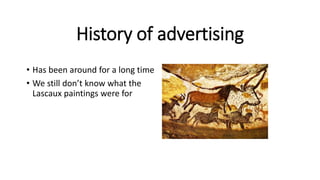
History of advertising
• Has been around for a long time
• We still don’t know what the
Lascaux paintings were for
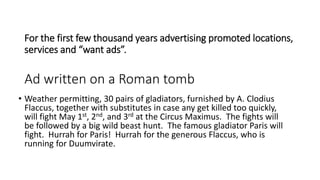
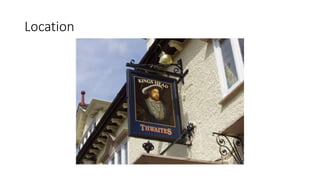
For the first few thousand years advertising promoted locations,
services and “want ads”.
Ad written on a Roman tomb
• Weather permitting, 30 pairs of gladiators, furnished by A. Clodius
Flaccus, together with substitutes in case any get killed too quickly,
will fight May 1st, 2nd, and 3rd at the Circus Maximus. The fights will
be followed by a big wild beast hunt. The famous gladiator Paris will
fight. Hurrah for Paris! Hurrah for the generous Flaccus, who is
running for Duumvirate.
Location
Handbills and fliers to promote
events or to recruit for the military
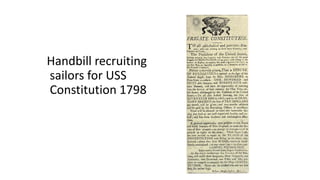
Handbill recruiting
sailors for USS
Constitution 1798
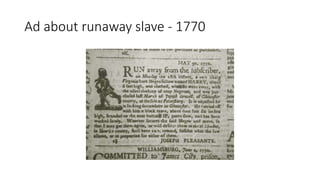
Ad about runaway slave - 1770
Industrial Revolution
• Early 19th Century
• Mass production of products
• Led to three stages of marketing:
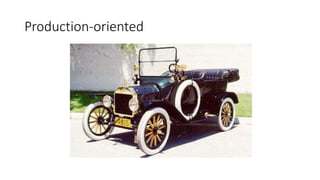
Production-oriented
• Demand far outstripped supply
• Could just advertise the existence of the product and where to get it
• Whatever was made was sold
• Example: People wanted cars, so car companies made whatever they
wanted and the cars were sold before they were built
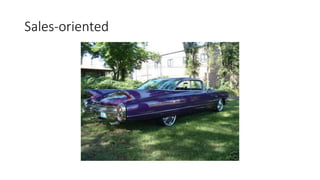
Sales-oriented
• Supply exceeded demand
• Companies tried to convince consumers to buy their products rather
than their competitors’
• Companies still made whatever they wanted, counting on their ability
to peddle their products
• Example: supply of cars went up, so the companies made whatever
they wanted and convinced people they wanted that
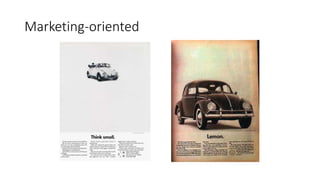
Marketing-oriented
• Supply of products far exceeded demand
• More choices than any promotion could overcome
• Resistance to “hard-sell”
• Companies tried to discover what products consumers wanted before
making them, then advertise they had it
• Non-American companies (e.g., VW) found out what people wanted,
then built cars that had it (e.g., a gas gauge)
Let’s take a example
The American auto industry
Production-oriented
Sales-oriented
Marketing-oriented
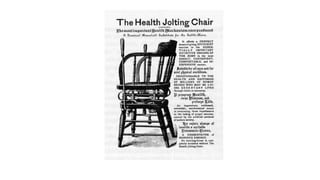
• Early sales-oriented ads were basically “caveat emptor” (let the buyer
beware)
• Producers said whatever they wanted and thought they could get away with
• For example, the “Health Jolting Chair”
• Led to consumer and competitor anger
• 1938 – Federal Trade Commission given power to regulate deceptive
and unfair advertising
• Advertising could no longer lie, so new approaches were tried
40s and 50s
• Era of the hard-sell
• Relied on brain-numbing repetition and treating the consumer as an idiot
• The USP – Unique Selling Proposition
• It was jack-hammered into consumers’ skulls
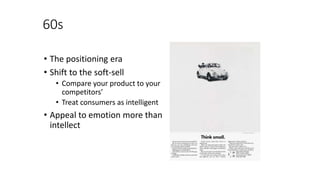
60s
• The positioning era
• Shift to the soft-sell
• Compare your product to your
competitors’
• Treat consumers as intelligent
• Appeal to emotion more than
intellect
Types of advertising
1. Promotional Advertising
• Promotional advertising is advertising that is designed to increase sales by
• creating an interest in products
• introducing new products and businesses
• explaining a product
• supporting personal selling efforts
• creating new markets
2. Institutional advertising
• attempts to create a favorable impression (image) and goodwill for a
business or an organization
• Purpose is to develop a positive image by presenting information about a company’s
role in the community, important public issues and topics of general interest.
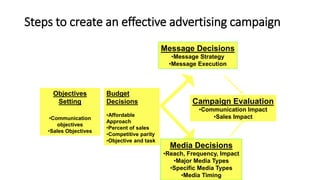
Objectives
Setting
•Communication
objectives
•Sales Objectives
Budget
Decisions
•Affordable
Approach
•Percent of sales
•Competitive parity
•Objective and task
Message Decisions
•Message Strategy
•Message Execution
Media Decisions
•Reach, Frequency, Impact
•Major Media Types
•Specific Media Types
•Media Timing
Campaign Evaluation
•Communication Impact
•Sales Impact
Steps to create an effective advertising campaign
Step 1: Advertising Objective
Informative Advertising
Persuasive Advertising
Reminding Advertising
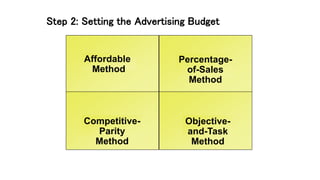
Step 2: Setting the Advertising Budget
Percentage-
of-Sales
Method
Affordable
Method
Competitive-
Parity
Method
Objective-
and-Task
Method
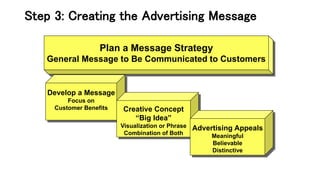
Plan a Message Strategy
General Message to Be Communicated to Customers
Develop a Message
Focus on
Customer Benefits Creative Concept
“Big Idea”
Visualization or Phrase
Combination of Both
Advertising Appeals
Meaningful
Believable
Distinctive
Step 3: Creating the Advertising Message
• Message Execution
• Slice of Life
• Lifestyle
• Fantasy
• Mood or image
• Musical
• Personality symbol
• Technical expertise
• Scientific evidence
• Testimonial evidence
The increasing problem of ad. Clutter?
Advertising or marketing clutter refers to
the large volume of advertising messages
that the average consumer is exposed to on
a daily basis. This phenomenon results from
a marketplace that is overcrowded with
products leading to huge competition for
customers
Step 4: Media decisions
• Media are the agencies, means or instruments used to convey
messages
• Three Categories of Advertising Media
• Print media
• Broadcast media
• Specialty media
Print Media
• Print media can include any of the following:
• Newspapers
• Direct Mail
• Magazine
• Outdoor Advertising
• Directory Advertising
• Transit Advertising
Broadcast Media
• Radio
• Television
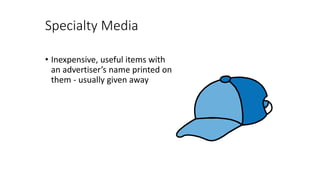
Specialty Media
• Inexpensive, useful items with
an advertiser’s name printed on
them - usually given away
Other Types of Advertising Media
• Sports Arena Billboards
• Movie theater commercials
• Hot air balloons, blimps, skywriting, banners
• shelf ads, shopping cart ads, coupon machines, receipt ads
Step 5: Evaluating Advertising Effectiveness
• According to Philip Kotler and Armstrong, the Gurus Of Marketing,
there are two most popular areas which need to be measured for
knowing the effectiveness of advertisement and they are:
• Communication Effect
• Sales Effect
ADVERTISING APPEALS
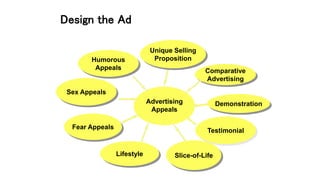
Unique Selling
PropositionHumorous
Appeals
Fear Appeals
Comparative
Advertising
Demonstration
Testimonial
Design the Ad
Advertising
Appeals
Slice-of-LifeLifestyle
Sex Appeals
Two basic ways of presenting a
sales message
• Intellectually
• Usually about the product’s function
• Usually copy heavy and line drawings
• Emotionally
• Usually not about the product’s function
• Usually copy is light with high connotative content
• Uses photographs or video
• Advertising aims at consumers’ subconscious
minds much more than their conscious minds
• It’s all about getting the consumer to react on
a basic, instinctive level, and not think at all
• It’s about “act now” on your basic desires –
think only of yourself
•It’s usually selfish and anti-social
Psychological Appeals
• Self-preservation
• Sex
• Greed
• Self-esteem
• Personal enjoyment
•Constructiveness
•Destructiveness
•Curiosity
•Imitation
•Altruism
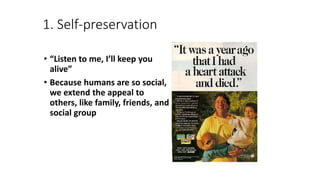
1. Self-preservation
• “Listen to me, I’ll keep you
alive”
• Because humans are so social,
we extend the appeal to
others, like family, friends, and
social group
2. Sex Appeal
• “Listen to me, I’ll get you laid”
• Gender linked because of different goals:
• For men it’s sex with ease and no complications
• In other words, attract more women that want to have sex with you
• For women it’s attract more men from which to choose
• Select the best among the possible choices, and the greater the selection, the better
the choice
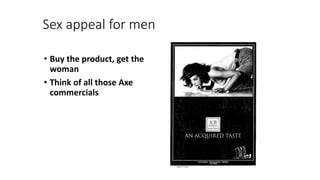
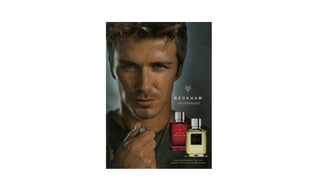
Sex appeal for men
• Buy the product, get the
woman
• Think of all those Axe
commercials
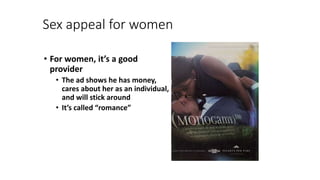
Sex appeal for women
• For women, it’s a good
provider
• The ad shows he has money,
cares about her as an individual,
and will stick around
• It’s called “romance”
3. Self-esteem
• Requires a social group
• Requires the individual to be able to make a comparison with other
individuals in the group
• Thus, requires a sense of self as a separate entity from others
Self-esteem
• Again, there’s an instinctive gender link
• For men, it’s competitive
• Demonstrate he’s the best male around
• Self-esteem comes from a sense of superiority
• For women, it’s cooperative
• Make and maintain as many connections as possible
• Self-esteem comes from a sense of connection
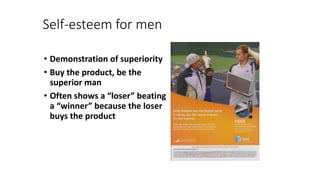
Self-esteem for men
• Demonstration of superiority
• Buy the product, be the
superior man
• Often shows a “loser” beating
a “winner” because the loser
buys the product
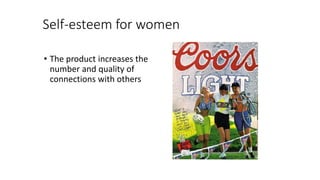
Self-esteem for women
• The product increases the
number and quality of
connections with others
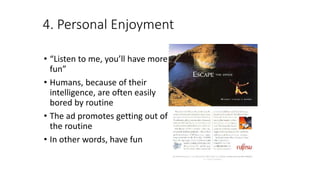
4. Personal Enjoyment
• “Listen to me, you’ll have more
fun”
• Humans, because of their
intelligence, are often easily
bored by routine
• The ad promotes getting out of
the routine
• In other words, have fun
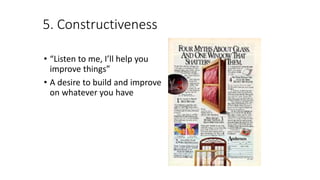
5. Constructiveness
• “Listen to me, I’ll help you
improve things”
• A desire to build and improve
on whatever you have
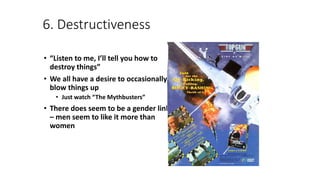
6. Destructiveness
• “Listen to me, I’ll tell you how to
destroy things”
• We all have a desire to occasionally
blow things up
• Just watch “The Mythbusters”
• There does seem to be a gender link
– men seem to like it more than
women
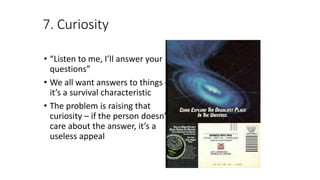
7. Curiosity
• “Listen to me, I’ll answer your
questions”
• We all want answers to things –
it’s a survival characteristic
• The problem is raising that
curiosity – if the person doesn’t
care about the answer, it’s a
useless appeal
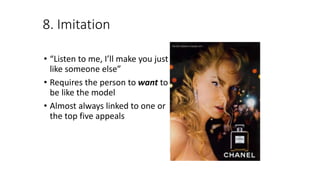
8. Imitation
• “Listen to me, I’ll make you just
like someone else”
• Requires the person to want to
be like the model
• Almost always linked to one or
the top five appeals
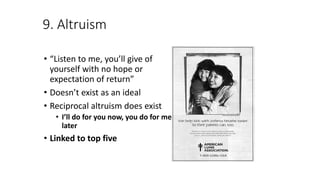
9. Altruism
• “Listen to me, you’ll give of
yourself with no hope or
expectation of return”
• Doesn’t exist as an ideal
• Reciprocal altruism does exist
• I’ll do for you now, you do for me
later
• Linked to top five
Tricks of the Trade
• Advertising often uses logical fallacies rather than giving logical
reasons to buy the product advertised.
• You think the ad is saying one thing when it fact it’s saying something
else, or saying nothing at all
Black/White
• “You want it [whatever it is],
you can only get it from us.”
• It leaves out any other options,
e.g., “love it or leave it.”
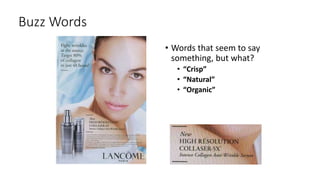
Buzz Words
• Words that seem to say
something, but what?
• “Crisp”
• “Natural”
• “Organic”
Weasel Words
• Words tossed into a sentence that changes the meaning while leaving
an impression that’s different
• Examples:
“Our dog food contains as much meat
protein as 10 pounds of sirloin steak.
Alpo dog food
• Targets people who love their dogs
• Doesn’t contain sirloin steak, only as much meat
protein as sirloin steak
• That could be any kind of meat – it’s sure not sirloin, and
may not even come from a cow
Three out of four doctors recommend
the major ingredient in Excedrin.
“Some studies seem to suggest that
eating the major ingredient in our
cereal may have an effect on certain
kinds of cancer.”
“If . . .”
The ultimate weasel word
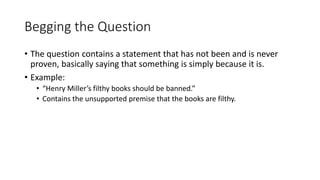
Begging the Question
• The question contains a statement that has not been and is never
proven, basically saying that something is simply because it is.
• Example:
• “Henry Miller’s filthy books should be banned.”
• Contains the unsupported premise that the books are filthy.
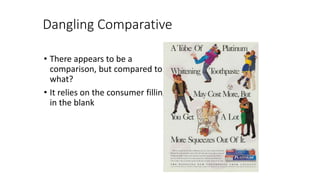
Dangling Comparative
• There appears to be a
comparison, but compared to
what?
• It relies on the consumer filling
in the blank
Complaints about advertising
• It perpetuates stereotypes
• Absolutely true
• It has to
• Makes people buy things they don’t need
• Not true
• Advertising can’t make anybody do anything
• Puffery vs. deception
• The legitimate exaggeration of advertising claims to overcome natural
consumer skepticism
Activity 3.1.
Selecting the Message Appeal
•‘How’ to communicate the desired message is an
important aspect in the overall effectiveness of a
promotion. The message appeal also plays a part
in communicating the overall positioning for the
brand/product. In this activity, you need to select
the most appropriate type of ‘appeal’ (refer list
below) for each challenge listed.
• You want to help raise money for a local charity (a special school for kids).
You plan to use local newspaper ads, letterbox drops, and posters in local
shops – to encourage people to donate items for a future charity auction.
• Your cosmetics firm is introducing a new perfume range that will be
primarily targeted at older teenage girls. It will be a little more expensive
than most competitive products targeted at that segment and will be
positioned as the ‘best’ for that market segment.
• A wine company is introducing ‘light wine’ (a low-alcohol wine that tastes
similar to normal wine). Its prime target will be people who drink wine
when they eat out at restaurants (and need to drive home).
• You are responsible for a new TV campaign, organized by the government,
which is designed to encourage young drivers to be more cautious when
driving late at night.
• You work for a large firm that is just about to introduce a new MP3 player,
which is technologically superior to the range of Apple iPod’s.
• Your firm’s new range of washing powder has been dramatically improved
and will be re-launched (that is, ‘new and improved’). Previously, your
firm’s research showed that the old product was often perceived as fairly
ineffective. Therefore, a new formula was designed to ensure a highly
effective new product.
• Your friend wants to start a small business as a ‘dog walker’. (That is,
someone who walks dogs everyday if their owners are too busy). She wants
to know the best way to promote her new service.
QUESTIONS
1. Determine what would be the best message appeal structure to use, choosing from the following
list:
A = Rational, one-sided, information
B = Rational, two-sided, information
C = Direct comparison to a competitor
D = Humor-based appeal
E = Emotionally-based appeal
F = Sexually-based appeal
G = Fear-based appeal
2. Compare your selection to your fellow students. Does this indicate that there is usually one best
approach, or are there a range of suitable appeal options?
3. How important is to consider the firm’s/brand’s overall market positioning when selecting
the type of message appeal to use in marketing communications?
Activity 3.2.
Perception – Which Ad is Best?
• Your task in this exercise is to select the best radio commercial from
the three presented below. You will need to consider the model of
perception (which is how consumers’ process information). As a quick
recap, this model suggests that consumers often learn about
products/brands in a passive/disinterested manner (requiring the ad
to get attention). And consumer’s short-term memory is also quite
limited (requiring the ad to beware of ‘information overload’).
Proposed radio ad 1
• Introducing another great product from Burgers Galore – but what
else would you expect!
• It’s the ‘For Everyone’ burger. It’s designed to meet everyone’s taste.
• No matter what meat you like – it’s automatically included in our new
combination meat patty. No matter what sauce or salad you like – it’s
automatically included in our new combination salad/sauce mixture.
• It tastes like no burger you’ve tasted before and no matter what your
tastes are – your tastes will like the ‘For Everyone’ burger!
• It’s reasonably priced and available at our stores after 10.30am.
Proposed radio ad 2
• “I feel like steak” (first friend)
• “But I feel like chicken” (second friend)
• “But I feel like seafood” (third friend)
• No matter what you like the new ‘For Everyone’ burger is designed
for everyone’s taste.
• Now available at Burgers Galore
Proposed radio ad 3
• I want everyone to listen because the new ‘For Everyone’ burger is
for everyone and that’s why it’s called the ‘For Everyone’ burger.
• So if you’re anyone, then get the new ‘For Everyone’ burger today –
before everyone else.
• Now available at Burgers Galore – for everyone!
QUESTIONS
• What are the benefits/concerns with each of the ads?
• Therefore, which of the three proposed radio ads go you think that
the firm should use? Why?
• How important is it to have an understanding of the perceptual
process when designing marketing communications?
End of chapter three

advertising

  • 1.
  • 2.
    Advertising is thenonpersonal communication of information usually paid for and usually persuasive in nature about products, services or ideas by identified sponsors through the various media. Bovee/Arens, 1992
  • 3.
    Advertising is thenonpersonal communication of information usually paid for and usually persuasive in nature about products, services or ideas by identified sponsors through the various media.
  • 4.
    Advertising is thenonpersonal communication of information usually paid for and usually persuasive in nature about products, services or ideas by identified sponsors through the various media.
  • 5.
    Advertising is thenonpersonal communication of information usually paid for and usually persuasive in nature about products, services or ideas by identified sponsors through the various media.
  • 6.
    Advertising is thenonpersonal communication of information usually paid for and usually persuasive in nature about products, services or ideas by identified sponsors through the various media.
  • 7.
    Advertising is thenonpersonal communication of information usually paid for and usually persuasive in nature about products, services or ideas by identified sponsors through the various media.
  • 8.
    Advertising is thenonpersonal communication of information usually paid for and usually persuasive in nature about products, services or ideas by identified sponsors through the various media.
  • 9.
    Advertising is thenonpersonal communication of information usually paid for and usually persuasive in nature about products, services or ideas by identified sponsors through the various media.
  • 10.
    Advertising is thenonpersonal communication of information, usually paid for and usually persuasive in nature about products, services or ideas by identified sponsors through the various media
  • 11.
    History of advertising •Has been around for a long time • We still don’t know what the Lascaux paintings were for
  • 12.
    For the firstfew thousand years advertising promoted locations, services and “want ads”. Ad written on a Roman tomb • Weather permitting, 30 pairs of gladiators, furnished by A. Clodius Flaccus, together with substitutes in case any get killed too quickly, will fight May 1st, 2nd, and 3rd at the Circus Maximus. The fights will be followed by a big wild beast hunt. The famous gladiator Paris will fight. Hurrah for Paris! Hurrah for the generous Flaccus, who is running for Duumvirate.
  • 13.
  • 14.
    Handbills and fliersto promote events or to recruit for the military
  • 15.
    Handbill recruiting sailors forUSS Constitution 1798
  • 16.
    Ad about runawayslave - 1770
  • 17.
    Industrial Revolution • Early19th Century • Mass production of products • Led to three stages of marketing:
  • 18.
    Production-oriented • Demand faroutstripped supply • Could just advertise the existence of the product and where to get it • Whatever was made was sold • Example: People wanted cars, so car companies made whatever they wanted and the cars were sold before they were built
  • 19.
    Sales-oriented • Supply exceededdemand • Companies tried to convince consumers to buy their products rather than their competitors’ • Companies still made whatever they wanted, counting on their ability to peddle their products • Example: supply of cars went up, so the companies made whatever they wanted and convinced people they wanted that
  • 20.
    Marketing-oriented • Supply ofproducts far exceeded demand • More choices than any promotion could overcome • Resistance to “hard-sell” • Companies tried to discover what products consumers wanted before making them, then advertise they had it • Non-American companies (e.g., VW) found out what people wanted, then built cars that had it (e.g., a gas gauge)
  • 21.
    Let’s take aexample The American auto industry
  • 22.
  • 23.
  • 24.
  • 25.
    • Early sales-orientedads were basically “caveat emptor” (let the buyer beware) • Producers said whatever they wanted and thought they could get away with • For example, the “Health Jolting Chair”
  • 27.
    • Led toconsumer and competitor anger • 1938 – Federal Trade Commission given power to regulate deceptive and unfair advertising • Advertising could no longer lie, so new approaches were tried
  • 28.
    40s and 50s •Era of the hard-sell • Relied on brain-numbing repetition and treating the consumer as an idiot • The USP – Unique Selling Proposition • It was jack-hammered into consumers’ skulls
  • 29.
    60s • The positioningera • Shift to the soft-sell • Compare your product to your competitors’ • Treat consumers as intelligent • Appeal to emotion more than intellect
  • 30.
    Types of advertising 1.Promotional Advertising • Promotional advertising is advertising that is designed to increase sales by • creating an interest in products • introducing new products and businesses • explaining a product • supporting personal selling efforts • creating new markets 2. Institutional advertising • attempts to create a favorable impression (image) and goodwill for a business or an organization • Purpose is to develop a positive image by presenting information about a company’s role in the community, important public issues and topics of general interest.
  • 31.
    Objectives Setting •Communication objectives •Sales Objectives Budget Decisions •Affordable Approach •Percent ofsales •Competitive parity •Objective and task Message Decisions •Message Strategy •Message Execution Media Decisions •Reach, Frequency, Impact •Major Media Types •Specific Media Types •Media Timing Campaign Evaluation •Communication Impact •Sales Impact Steps to create an effective advertising campaign
  • 32.
    Step 1: AdvertisingObjective Informative Advertising Persuasive Advertising Reminding Advertising
  • 33.
    Step 2: Settingthe Advertising Budget Percentage- of-Sales Method Affordable Method Competitive- Parity Method Objective- and-Task Method
  • 34.
    Plan a MessageStrategy General Message to Be Communicated to Customers Develop a Message Focus on Customer Benefits Creative Concept “Big Idea” Visualization or Phrase Combination of Both Advertising Appeals Meaningful Believable Distinctive Step 3: Creating the Advertising Message
  • 35.
    • Message Execution •Slice of Life • Lifestyle • Fantasy • Mood or image • Musical • Personality symbol • Technical expertise • Scientific evidence • Testimonial evidence
  • 36.
    The increasing problemof ad. Clutter? Advertising or marketing clutter refers to the large volume of advertising messages that the average consumer is exposed to on a daily basis. This phenomenon results from a marketplace that is overcrowded with products leading to huge competition for customers
  • 37.
    Step 4: Mediadecisions • Media are the agencies, means or instruments used to convey messages • Three Categories of Advertising Media • Print media • Broadcast media • Specialty media
  • 38.
    Print Media • Printmedia can include any of the following: • Newspapers • Direct Mail • Magazine • Outdoor Advertising • Directory Advertising • Transit Advertising
  • 39.
  • 40.
    Specialty Media • Inexpensive,useful items with an advertiser’s name printed on them - usually given away
  • 41.
    Other Types ofAdvertising Media • Sports Arena Billboards • Movie theater commercials • Hot air balloons, blimps, skywriting, banners • shelf ads, shopping cart ads, coupon machines, receipt ads
  • 42.
    Step 5: EvaluatingAdvertising Effectiveness • According to Philip Kotler and Armstrong, the Gurus Of Marketing, there are two most popular areas which need to be measured for knowing the effectiveness of advertisement and they are: • Communication Effect • Sales Effect
  • 43.
  • 44.
  • 45.
    Two basic waysof presenting a sales message • Intellectually • Usually about the product’s function • Usually copy heavy and line drawings • Emotionally • Usually not about the product’s function • Usually copy is light with high connotative content • Uses photographs or video
  • 46.
    • Advertising aimsat consumers’ subconscious minds much more than their conscious minds • It’s all about getting the consumer to react on a basic, instinctive level, and not think at all • It’s about “act now” on your basic desires – think only of yourself •It’s usually selfish and anti-social
  • 47.
    Psychological Appeals • Self-preservation •Sex • Greed • Self-esteem • Personal enjoyment •Constructiveness •Destructiveness •Curiosity •Imitation •Altruism
  • 48.
    1. Self-preservation • “Listento me, I’ll keep you alive” • Because humans are so social, we extend the appeal to others, like family, friends, and social group
  • 49.
    2. Sex Appeal •“Listen to me, I’ll get you laid” • Gender linked because of different goals: • For men it’s sex with ease and no complications • In other words, attract more women that want to have sex with you • For women it’s attract more men from which to choose • Select the best among the possible choices, and the greater the selection, the better the choice
  • 50.
    Sex appeal formen • Buy the product, get the woman • Think of all those Axe commercials
  • 51.
    Sex appeal forwomen • For women, it’s a good provider • The ad shows he has money, cares about her as an individual, and will stick around • It’s called “romance”
  • 52.
    3. Self-esteem • Requiresa social group • Requires the individual to be able to make a comparison with other individuals in the group • Thus, requires a sense of self as a separate entity from others
  • 53.
    Self-esteem • Again, there’san instinctive gender link • For men, it’s competitive • Demonstrate he’s the best male around • Self-esteem comes from a sense of superiority • For women, it’s cooperative • Make and maintain as many connections as possible • Self-esteem comes from a sense of connection
  • 54.
    Self-esteem for men •Demonstration of superiority • Buy the product, be the superior man • Often shows a “loser” beating a “winner” because the loser buys the product
  • 55.
    Self-esteem for women •The product increases the number and quality of connections with others
  • 57.
    4. Personal Enjoyment •“Listen to me, you’ll have more fun” • Humans, because of their intelligence, are often easily bored by routine • The ad promotes getting out of the routine • In other words, have fun
  • 58.
    5. Constructiveness • “Listento me, I’ll help you improve things” • A desire to build and improve on whatever you have
  • 59.
    6. Destructiveness • “Listento me, I’ll tell you how to destroy things” • We all have a desire to occasionally blow things up • Just watch “The Mythbusters” • There does seem to be a gender link – men seem to like it more than women
  • 60.
    7. Curiosity • “Listento me, I’ll answer your questions” • We all want answers to things – it’s a survival characteristic • The problem is raising that curiosity – if the person doesn’t care about the answer, it’s a useless appeal
  • 61.
    8. Imitation • “Listento me, I’ll make you just like someone else” • Requires the person to want to be like the model • Almost always linked to one or the top five appeals
  • 63.
    9. Altruism • “Listento me, you’ll give of yourself with no hope or expectation of return” • Doesn’t exist as an ideal • Reciprocal altruism does exist • I’ll do for you now, you do for me later • Linked to top five
  • 64.
    Tricks of theTrade • Advertising often uses logical fallacies rather than giving logical reasons to buy the product advertised. • You think the ad is saying one thing when it fact it’s saying something else, or saying nothing at all
  • 65.
    Black/White • “You wantit [whatever it is], you can only get it from us.” • It leaves out any other options, e.g., “love it or leave it.”
  • 66.
    Buzz Words • Wordsthat seem to say something, but what? • “Crisp” • “Natural” • “Organic”
  • 67.
    Weasel Words • Wordstossed into a sentence that changes the meaning while leaving an impression that’s different • Examples:
  • 68.
    “Our dog foodcontains as much meat protein as 10 pounds of sirloin steak. Alpo dog food • Targets people who love their dogs • Doesn’t contain sirloin steak, only as much meat protein as sirloin steak • That could be any kind of meat – it’s sure not sirloin, and may not even come from a cow
  • 69.
    Three out offour doctors recommend the major ingredient in Excedrin. “Some studies seem to suggest that eating the major ingredient in our cereal may have an effect on certain kinds of cancer.”
  • 70.
    “If . ..” The ultimate weasel word
  • 71.
    Begging the Question •The question contains a statement that has not been and is never proven, basically saying that something is simply because it is. • Example: • “Henry Miller’s filthy books should be banned.” • Contains the unsupported premise that the books are filthy.
  • 72.
    Dangling Comparative • Thereappears to be a comparison, but compared to what? • It relies on the consumer filling in the blank
  • 73.
    Complaints about advertising •It perpetuates stereotypes • Absolutely true • It has to • Makes people buy things they don’t need • Not true • Advertising can’t make anybody do anything • Puffery vs. deception • The legitimate exaggeration of advertising claims to overcome natural consumer skepticism
  • 74.
    Activity 3.1. Selecting theMessage Appeal •‘How’ to communicate the desired message is an important aspect in the overall effectiveness of a promotion. The message appeal also plays a part in communicating the overall positioning for the brand/product. In this activity, you need to select the most appropriate type of ‘appeal’ (refer list below) for each challenge listed.
  • 75.
    • You wantto help raise money for a local charity (a special school for kids). You plan to use local newspaper ads, letterbox drops, and posters in local shops – to encourage people to donate items for a future charity auction. • Your cosmetics firm is introducing a new perfume range that will be primarily targeted at older teenage girls. It will be a little more expensive than most competitive products targeted at that segment and will be positioned as the ‘best’ for that market segment. • A wine company is introducing ‘light wine’ (a low-alcohol wine that tastes similar to normal wine). Its prime target will be people who drink wine when they eat out at restaurants (and need to drive home).
  • 76.
    • You areresponsible for a new TV campaign, organized by the government, which is designed to encourage young drivers to be more cautious when driving late at night. • You work for a large firm that is just about to introduce a new MP3 player, which is technologically superior to the range of Apple iPod’s. • Your firm’s new range of washing powder has been dramatically improved and will be re-launched (that is, ‘new and improved’). Previously, your firm’s research showed that the old product was often perceived as fairly ineffective. Therefore, a new formula was designed to ensure a highly effective new product. • Your friend wants to start a small business as a ‘dog walker’. (That is, someone who walks dogs everyday if their owners are too busy). She wants to know the best way to promote her new service.
  • 77.
    QUESTIONS 1. Determine whatwould be the best message appeal structure to use, choosing from the following list: A = Rational, one-sided, information B = Rational, two-sided, information C = Direct comparison to a competitor D = Humor-based appeal E = Emotionally-based appeal F = Sexually-based appeal G = Fear-based appeal 2. Compare your selection to your fellow students. Does this indicate that there is usually one best approach, or are there a range of suitable appeal options? 3. How important is to consider the firm’s/brand’s overall market positioning when selecting the type of message appeal to use in marketing communications?
  • 78.
    Activity 3.2. Perception –Which Ad is Best? • Your task in this exercise is to select the best radio commercial from the three presented below. You will need to consider the model of perception (which is how consumers’ process information). As a quick recap, this model suggests that consumers often learn about products/brands in a passive/disinterested manner (requiring the ad to get attention). And consumer’s short-term memory is also quite limited (requiring the ad to beware of ‘information overload’).
  • 79.
    Proposed radio ad1 • Introducing another great product from Burgers Galore – but what else would you expect! • It’s the ‘For Everyone’ burger. It’s designed to meet everyone’s taste. • No matter what meat you like – it’s automatically included in our new combination meat patty. No matter what sauce or salad you like – it’s automatically included in our new combination salad/sauce mixture. • It tastes like no burger you’ve tasted before and no matter what your tastes are – your tastes will like the ‘For Everyone’ burger! • It’s reasonably priced and available at our stores after 10.30am.
  • 80.
    Proposed radio ad2 • “I feel like steak” (first friend) • “But I feel like chicken” (second friend) • “But I feel like seafood” (third friend) • No matter what you like the new ‘For Everyone’ burger is designed for everyone’s taste. • Now available at Burgers Galore
  • 81.
    Proposed radio ad3 • I want everyone to listen because the new ‘For Everyone’ burger is for everyone and that’s why it’s called the ‘For Everyone’ burger. • So if you’re anyone, then get the new ‘For Everyone’ burger today – before everyone else. • Now available at Burgers Galore – for everyone!
  • 82.
    QUESTIONS • What arethe benefits/concerns with each of the ads? • Therefore, which of the three proposed radio ads go you think that the firm should use? Why? • How important is it to have an understanding of the perceptual process when designing marketing communications?
  • 83.