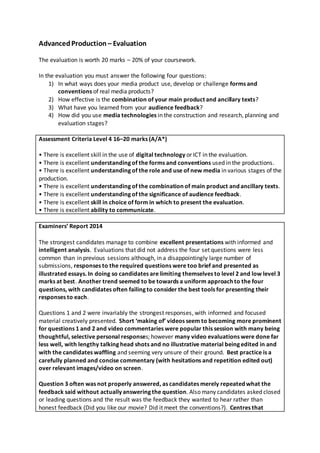
Advanced Production – Evaluation 
The evaluation is worth 20 marks – 20% of your coursework. 
In the evaluation you must answer the following four questions: 
1) In what ways does your media product use, develop or challenge forms and 
conventions of real media products? 
2) How effective is the combination of your main product and ancillary texts? 
3) What have you learned from your audience feedback? 
4) How did you use media technologies in the construction and research, planning and 
evaluation stages? 
Assessment Criteria Level 4 16–20 marks (A/A*) 
• There is excellent skill in the use of digital technology or ICT in the evaluation. 
• There is excellent understanding of the forms and conventions used in the productions. 
• There is excellent understanding of the role and use of new media in various stages of the 
production. 
• There is excellent understanding of the combination of main product and ancillary texts. 
• There is excellent understanding of the significance of audience feedback. 
• There is excellent skill in choice of form in which to present the evaluation. 
• There is excellent ability to communicate. 
Examiners’ Report 2014 
The strongest candidates manage to combine excellent presentations with informed and 
intelligent analysis. Evaluations that did not address the four set questions were less 
common than in previous sessions although, in a disappointingly large number of 
submissions, responses to the required questions were too brief and presented as 
illustrated essays. In doing so candidates are limiting themselves to level 2 and low level 3 
marks at best. Another trend seemed to be towards a uniform approach to the four 
questions, with candidates often failing to consider the best tools for presenting their 
responses to each. 
Questions 1 and 2 were invariably the strongest responses, with informed and focused 
material creatively presented. Short ‘making of’ videos seem to becoming more prominent 
for questions 1 and 2 and video commentaries were popular this session with many being 
thoughtful, selective personal responses; however many video evaluations were done far 
less well, with lengthy talking head shots and no illustrative material being edited in and 
with the candidates waffling and seeming very unsure of their ground. Best practice is a 
carefully planned and concise commentary (with hesitations and repetition edited out) 
over relevant images/video on screen. 
Question 3 often was not properly answered, as candidates merely repeated what the 
feedback said without actually answering the question. Also many candidates asked closed 
or leading questions and the result was the feedback they wanted to hear rather than 
honest feedback (Did you like our movie? Did it meet the conventions?). Centres that
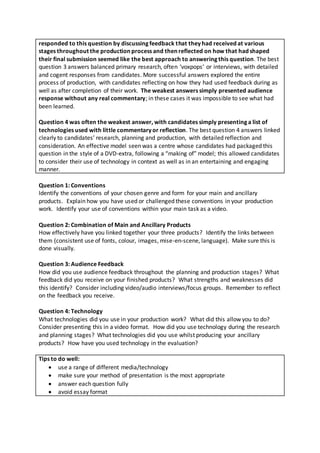
responded to this question by discussing feedback that they had received at various 
stages throughout the production process and then reflected on how that had shaped 
their final submission seemed like the best approach to answering this question. The best 
question 3 answers balanced primary research, often ‘voxpops’ or interviews, with detailed 
and cogent responses from candidates. More successful answers explored the entire 
process of production, with candidates reflecting on how they had used feedback during as 
well as after completion of their work. The weakest answers simply presented audience 
response without any real commentary; in these cases it was impossible to see what had 
been learned. 
Question 4 was often the weakest answer, with candidates simply presenting a list of 
technologies used with little commentary or reflection. The best question 4 answers linked 
clearly to candidates’ research, planning and production, with detailed reflection and 
consideration. An effective model seen was a centre whose candidates had packaged this 
question in the style of a DVD-extra, following a “making of” model; this allowed candidates 
to consider their use of technology in context as well as in an entertaining and engaging 
manner. 
Question 1: Conventions 
Identify the conventions of your chosen genre and form for your main and ancillary 
products. Explain how you have used or challenged these conventions in your production 
work. Identify your use of conventions within your main task as a video. 
Question 2: Combination of Main and Ancillary Products 
How effectively have you linked together your three products? Identify the links between 
them (consistent use of fonts, colour, images, mise-en-scene, language). Make sure this is 
done visually. 
Question 3: Audience Feedback 
How did you use audience feedback throughout the planning and production stages? What 
feedback did you receive on your finished products? What strengths and weaknesses did 
this identify? Consider including video/audio interviews/focus groups. Remember to reflect 
on the feedback you receive. 
Question 4: Technology 
What technologies did you use in your production work? What did this allow you to do? 
Consider presenting this in a video format. How did you use technology during the research 
and planning stages? What technologies did you use whilst producing your ancillary 
products? How have you used technology in the evaluation? 
Tips to do well: 
 use a range of different media/technology 
 make sure your method of presentation is the most appropriate 
 answer each question fully 
 avoid essay format

Advanced production evaluation

  • 1.
    Advanced Production –Evaluation The evaluation is worth 20 marks – 20% of your coursework. In the evaluation you must answer the following four questions: 1) In what ways does your media product use, develop or challenge forms and conventions of real media products? 2) How effective is the combination of your main product and ancillary texts? 3) What have you learned from your audience feedback? 4) How did you use media technologies in the construction and research, planning and evaluation stages? Assessment Criteria Level 4 16–20 marks (A/A*) • There is excellent skill in the use of digital technology or ICT in the evaluation. • There is excellent understanding of the forms and conventions used in the productions. • There is excellent understanding of the role and use of new media in various stages of the production. • There is excellent understanding of the combination of main product and ancillary texts. • There is excellent understanding of the significance of audience feedback. • There is excellent skill in choice of form in which to present the evaluation. • There is excellent ability to communicate. Examiners’ Report 2014 The strongest candidates manage to combine excellent presentations with informed and intelligent analysis. Evaluations that did not address the four set questions were less common than in previous sessions although, in a disappointingly large number of submissions, responses to the required questions were too brief and presented as illustrated essays. In doing so candidates are limiting themselves to level 2 and low level 3 marks at best. Another trend seemed to be towards a uniform approach to the four questions, with candidates often failing to consider the best tools for presenting their responses to each. Questions 1 and 2 were invariably the strongest responses, with informed and focused material creatively presented. Short ‘making of’ videos seem to becoming more prominent for questions 1 and 2 and video commentaries were popular this session with many being thoughtful, selective personal responses; however many video evaluations were done far less well, with lengthy talking head shots and no illustrative material being edited in and with the candidates waffling and seeming very unsure of their ground. Best practice is a carefully planned and concise commentary (with hesitations and repetition edited out) over relevant images/video on screen. Question 3 often was not properly answered, as candidates merely repeated what the feedback said without actually answering the question. Also many candidates asked closed or leading questions and the result was the feedback they wanted to hear rather than honest feedback (Did you like our movie? Did it meet the conventions?). Centres that
  • 2.
    responded to thisquestion by discussing feedback that they had received at various stages throughout the production process and then reflected on how that had shaped their final submission seemed like the best approach to answering this question. The best question 3 answers balanced primary research, often ‘voxpops’ or interviews, with detailed and cogent responses from candidates. More successful answers explored the entire process of production, with candidates reflecting on how they had used feedback during as well as after completion of their work. The weakest answers simply presented audience response without any real commentary; in these cases it was impossible to see what had been learned. Question 4 was often the weakest answer, with candidates simply presenting a list of technologies used with little commentary or reflection. The best question 4 answers linked clearly to candidates’ research, planning and production, with detailed reflection and consideration. An effective model seen was a centre whose candidates had packaged this question in the style of a DVD-extra, following a “making of” model; this allowed candidates to consider their use of technology in context as well as in an entertaining and engaging manner. Question 1: Conventions Identify the conventions of your chosen genre and form for your main and ancillary products. Explain how you have used or challenged these conventions in your production work. Identify your use of conventions within your main task as a video. Question 2: Combination of Main and Ancillary Products How effectively have you linked together your three products? Identify the links between them (consistent use of fonts, colour, images, mise-en-scene, language). Make sure this is done visually. Question 3: Audience Feedback How did you use audience feedback throughout the planning and production stages? What feedback did you receive on your finished products? What strengths and weaknesses did this identify? Consider including video/audio interviews/focus groups. Remember to reflect on the feedback you receive. Question 4: Technology What technologies did you use in your production work? What did this allow you to do? Consider presenting this in a video format. How did you use technology during the research and planning stages? What technologies did you use whilst producing your ancillary products? How have you used technology in the evaluation? Tips to do well:  use a range of different media/technology  make sure your method of presentation is the most appropriate  answer each question fully  avoid essay format