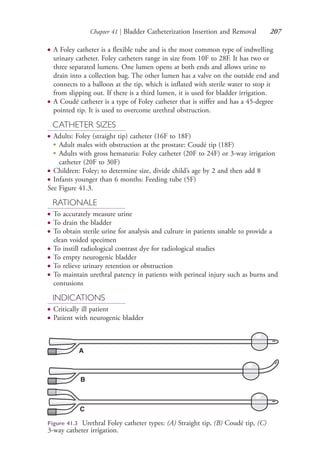
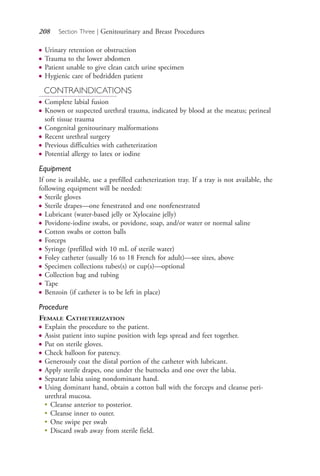
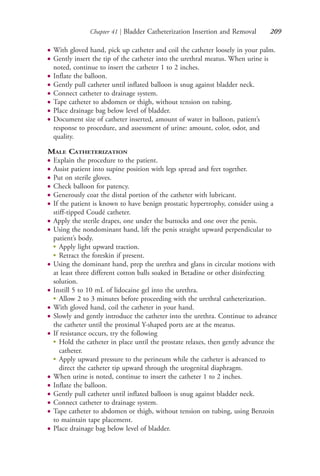
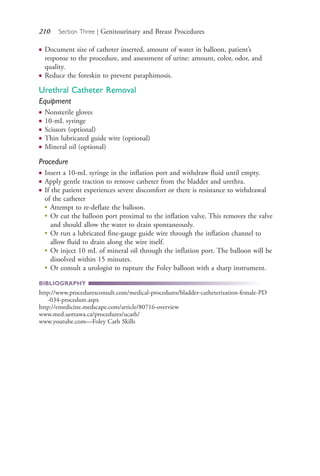
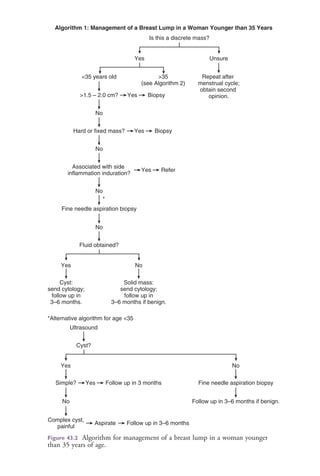
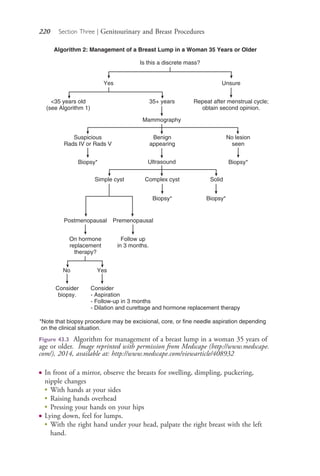
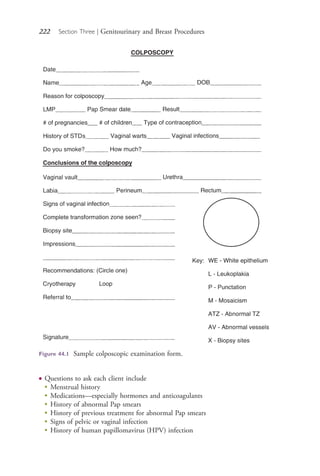
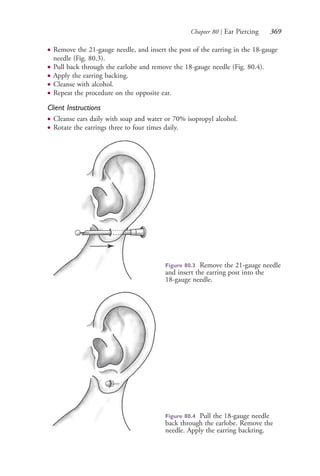
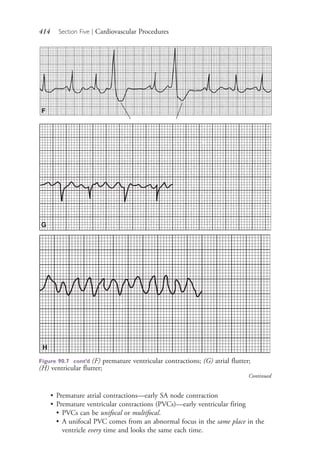
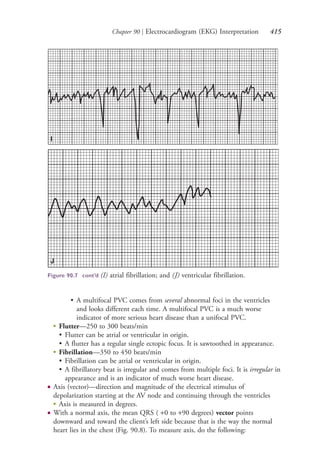
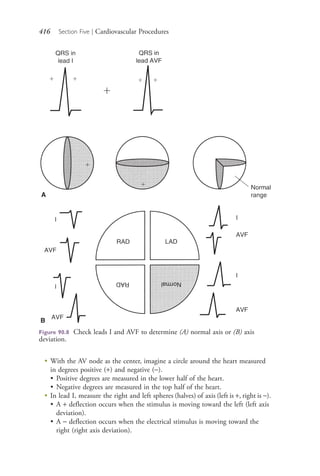
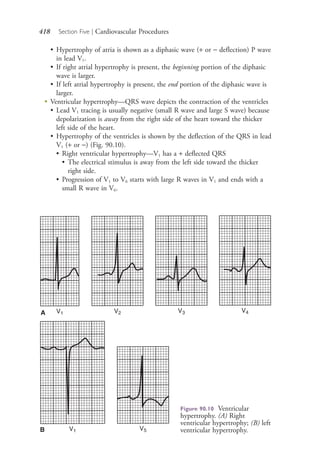
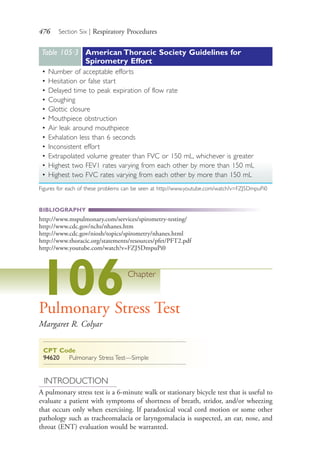
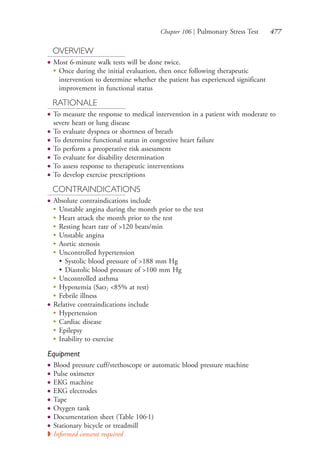
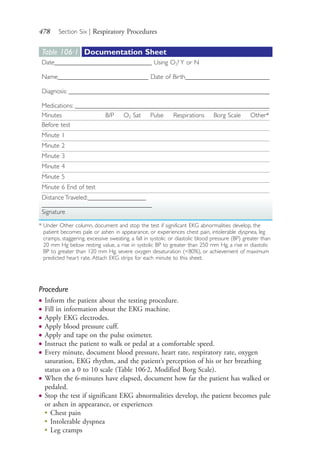
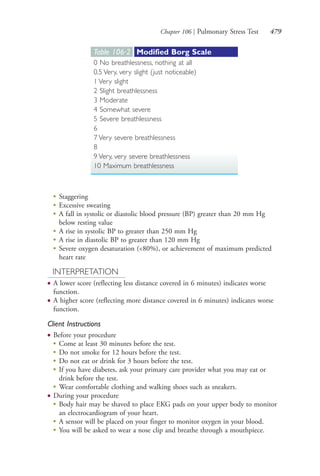
~
A vance
Practice
Nursing Procedures
Margaret R. Colyar
Advanced
Practice
Nursing Procedures
Margaret R. Colyar, DSN, APRN, C-FNP
Family Nurse Practitioner
Hannibal Clinic
Hannibal, Missouri
4206_FM_i-xiv.indd i4206_FM_i-xiv.indd i 12/30/2014 10:56:42 AM12/30/2014 10:56:42 AM
Process CyanProcess CyanProcess MagentaProcess MagentaProcess YellowProcess YellowProcess BlackProcess Black
F. A. Davis Company
1915 Arch Street
Philadelphia, PA 19103
www.fadavis.com
Copyright © 2015 by F. A. Davis Company
Copyright © 2015 by F. A. Davis Company. All rights reserved. This book is protected by copyright.
No part of it may be reproduced, stored in a retrieval system, or transmitted in any form or by any
means, electronic, mechanical, photocopying, recording, or otherwise, without written permission from
the publisher.
Printed in the United States of America
Last digit indicates print number: 10 9 8 7 6 5 4 3 2 1
Publisher, Nursing: Joanne Patzek DaCunha, RN, MSN
Senior Acquisitions Editor: Susan R. Rhyner
Content Development Manager: Darlene Pedersen
Content Project Manager: Christina L. Snyder
Design and Illustration Manager: Carolyn O’Brien
As new scientific information becomes available through basic and clinical research, recommended
treatments and drug therapies undergo changes. The author(s) and publisher have done everything
possible to make this book accurate, up to date, and in accord with accepted standards at the time of
publication. The author(s), editors, and publisher are not responsible for errors or omissions or for
consequences from application of the book, and make no warranty, expressed or implied, in regard to
the contents of the book. Any practice described in this book should be applied by the reader in
accordance with professional standards of care used in regard to the unique circumstances that may
apply in each situation. The reader is advised always to check product information (package inserts) for
changes and new information regarding dose and contraindications before administering any drug.
Caution is especially urged when using new or infrequently ordered drugs.
Library of Congress Control Number 2014959076
Authorization to photocopy items for internal or personal use, or the internal or personal use of
specific clients, is granted by F. A. Davis Company for users registered with the Copyright Clearance
Center (CCC) Transactional Reporting Service, provided that the fee of $.25 per copy is paid directly
to CCC, 222 Rosewood Drive, Danvers, MA 01923. For those organizations that have been granted a
photocopy license by CCC, a separate system of payment has been arranged. The fee code for users of
the Transactional Reporting Service is: 978-0-8036-4206-5/15 0 + $.25.
4206_FM_i-xiv.indd ii4206_FM_i-xiv.indd ii 12/30/2014 10:56:42 AM12/30/2014 10:56:42 AM
Process CyanProcess CyanProcess MagentaProcess MagentaProcess YellowProcess YellowProcess BlackProcess Black
Proudly sourced and uploaded by [StormRG]
Kickass Torrents | TPB | ET | h33t
This book is lovingly dedicated to Stephen Colyar, Andrea Brown,
Michelle Bailey, and Courtney Kaul.
4206_FM_i-xiv.indd iii4206_FM_i-xiv.indd iii 12/30/2014 10:56:42 AM12/30/2014 10:56:42 AM
Process CyanProcess CyanProcess MagentaProcess MagentaProcess YellowProcess YellowProcess BlackProcess Black
GREAT NURSING CARE BEGINS WITH
GREAT RESOURCES
now and throughout your career!
Fitzgerald
1XUVH 3UDFWLWLRQHU &HUWLĆFDWLRQ
Examination and Practice Preparation
Winland-Brown & Dunphy
Adult-Gerontology and Family Nurse
3UDFWLWLRQHU &HUWLĆFDWLRQ ([DPLQDWLRQ
Review Questions and Strategies
Goolsby
Advanced Assessment
Interpreting Findings and
Formulating Differential Diagnoses
Kennedy-Malone
Advanced Practice Nursing in the Care of Older Adults
Perese
Psychiatric Advanced Practice Nursing
A Biopsychosocial Foundation for Practice
McCaffrey & Youngkin
NP Notes
Nurse Practitioner’s Clinical Pocket Guide
www.FADavis.com
BUY YOURS TODAY!
4206_FM_i-xiv.indd iv4206_FM_i-xiv.indd iv 12/30/2014 10:56:42 AM12/30/2014 10:56:42 AM
Process CyanProcess CyanProcess MagentaProcess MagentaProcess YellowProcess YellowProcess BlackProcess Black
v
Preface
The new nurse practitioner and the practicing nurse practitioner in the ambulatory
care setting must be prepared to perform an increasing array of skills competently
to meet patient care needs. The inspiration for this book came when, on graduating
from a nurse practitioner program, I found no procedural resources directed toward
the needs of the nurse practitioner in ambulatory care. The need to perform many
procedures—those not taught in my nurse practitioner program—was apparent. The
physician I practiced with required a knowledge base in procedural skills greater than
the one I possessed. Fortunately, this physician was willing to teach me the necessary
procedures. This improved care to our patients and decreased the necessity to refer
many patients for procedures easily performed in the ambulatory care (outpatient)
setting.
This text was developed to assist in the many demands on the newly graduated
nurse practitioner and the nurse practitioner currently in practice. We believe the
procedures outlined will improve the marketability of the nurse practitioner and
serve as a good reference tool for family and/or adult nurse practitioners in an
ambulatory care setting. Prerequisites for this book are basic anatomy and physiology,
microbiology, pharmacology, principles of aseptic technique, and basic nursing skills.
This book would be an appropriate text for incorporation of procedural techniques
throughout a family or an adult nurse practitioner curriculum. It also would be
appropriate for an elective on minor surgery and diagnostic procedures and inter-
pretation. Another potential use for this book would be as part of the protocol/
guidelines in the nurse practitioner’s practice.
Many procedures performed by primary care physicians are not currently appro-
priate for the nurse practitioner to perform. The procedures in this book were chosen
based on a comprehensive study of types of procedures currently used in the nurse
practitioner’s practice. Many of the procedures can be used in any ambulatory
setting. Twenty-eight new procedures have been added to this edition: Suture selec-
tion, ulcer debridement, compartment syndrome and pressure testing, bladder cath-
eterization, breast examination, administration of vaginal medications and condoms,
Nexplanon insertion and removal, vaginal examination, fetal assessment, Leopold’s
maneuver, fundal assessment, obstetric ultrasound, emergency delivery, teaching
breast feeding, eye drop insertion, laryngoscopy, nasal lavage, cardiac stress testing,
type of pacemakers, defibrillation, assessing for respiratory distress, pulmonary stress
test, hemoccult, urea breath test, perianal skin tags and external hemorrhoidal skin
tabs, pilonidal cyst, prostate massage, and rectal prolapsed reduction.
Some of the procedures need specialized equipment, and some use equip-
ment commonly found in any office. A few of the procedures—flexible chest tube
insertion, circumcision, colposcopy, endometrial biopsy, IUD insertion and re-
moval, lumbar puncture, occipital nerve block, paracentesis, sigmoidoscopy, and
4206_FM_i-xiv.indd v4206_FM_i-xiv.indd v 12/30/2014 10:56:42 AM12/30/2014 10:56:42 AM
Process CyanProcess CyanProcess MagentaProcess MagentaProcess YellowProcess YellowProcess BlackProcess Black
vi Preface
thrombosed hemorrhoid removal—require additional training. They are included
for reference only. Check with your State Board of Nursing if you are unsure whether
or not a certain procedure may be performed by nurse practitioners in the state in
which you practice.
The major theme of this book is clinical application of knowledge and clinical
skills. There are seven sections in the book. These sections are based on body systems
for ease of classification. Each major section begins with diagnostic procedures the
nurse practitioner performs with the basis for their interpretation. Next in each
section, listed in alphabetical order, are procedures performed in an ambulatory care
setting.
Each procedure contains seven parts. First, an Overview is presented, outlining
causes, incidence, and other specific information intrinsic to each procedure. The
Health Promotion/Prevention section gives tips to the nurse practitioner to pass on to
the client to help promote health or prevent the need for the procedure in the future.
Options lists one to four methods of performing the procedure and gives a choice of
how to perform the procedure. The Rationale section gives reasons to perform the
procedure. Indications tell the nurse practitioner when the procedure should be
performed, and Contraindications tells the nurse practitioner when not to perform
the procedure. The Procedure section lists the necessary equipment and gives step-
by-step instructions for performing each procedure listed under Options. Client
Instructions assist the nurse practitioner with postprocedure instructions, listing what
the client must and must not do to have an optimal recovery period. At the end of
each is the Bibliography for further information gathering.
We hope you will find this text to be a good learning tool and a great resource
in your practice.
4206_FM_i-xiv.indd vi4206_FM_i-xiv.indd vi 12/30/2014 10:56:42 AM12/30/2014 10:56:42 AM
Process CyanProcess CyanProcess MagentaProcess MagentaProcess YellowProcess YellowProcess BlackProcess Black
vii
Acknowledgments
We acknowledge the following people for their contributions, assistance, and patience
while compiling this book: Joanne DaCunha, RN, MSN, Nursing Acquisitions
Editor at F.A. Davis, for believing in the merits of this book, and Denise Melomo,
artist, for her expertise in sketching the line drawings from which the illustrations
in this book were made.
Many colleagues at Tri County Family Health Care in Madison, Florida, and
Family Health Service in Ocala, Florida, were instrumental in this book. Colleagues
at Rapides Regional Medical Center, Alexandria, Louisiana; Jackson Parish Hospital,
Jonesboro, Louisiana; and Stansbury Medical Center, Stansbury Park, Utah, posed
for the photographs in the book. These models include Linda Alby, Steve Colyar,
Hugh Gentry, Cindy Grappe, Aleene Hale, Lane Helm, Debra Lefler, Anne Martin,
and Shaneal Wright.
4206_FM_i-xiv.indd vii4206_FM_i-xiv.indd vii 12/30/2014 10:56:42 AM12/30/2014 10:56:42 AM
Process CyanProcess CyanProcess MagentaProcess MagentaProcess YellowProcess YellowProcess BlackProcess Black
viii
Contributors
Tracy Call-Schmidt, MS, C-FNP
Pain Management Specialist
Salt Lake City, Utah
Margaret Colyar, DSN, APRN, C-FNP
Hannibal Clinic
Hannibal, Missouri
Cynthia Ehrhardt, RN, ARNP, MSN,
FNP-CS
Adjunct Faculty
University of Central Florida
Ocala, Florida
4206_FM_i-xiv.indd viii4206_FM_i-xiv.indd viii 12/30/2014 10:56:42 AM12/30/2014 10:56:42 AM
Process CyanProcess CyanProcess MagentaProcess MagentaProcess YellowProcess YellowProcess BlackProcess Black
ix
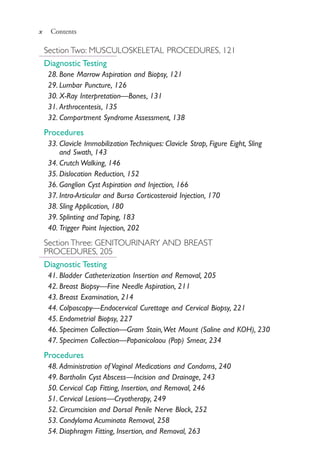
Contents
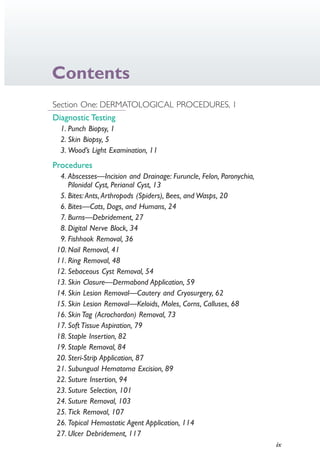
Section One: DERMATOLOGICAL PROCEDURES, 1
Diagnostic Testing
1. Punch Biopsy, 1
2. Skin Biopsy, 5
3. Wood’s Light Examination, 11
Procedures
4. Abscesses—Incision and Drainage: Furuncle, Felon, Paronychia,
Pilonidal Cyst, Perianal Cyst, 13
5. Bites: Ants, Arthropods (Spiders), Bees, and Wasps, 20
6. Bites—Cats, Dogs, and Humans, 24
7. Burns—Debridement, 27
8. Digital Nerve Block, 34
9. Fishhook Removal, 36
10. Nail Removal, 41
11. Ring Removal, 48
12. Sebaceous Cyst Removal, 54
13. Skin Closure—Dermabond Application, 59
14. Skin Lesion Removal—Cautery and Cryosurgery, 62
15. Skin Lesion Removal—Keloids, Moles, Corns, Calluses, 68
16. Skin Tag (Acrochordon) Removal, 73
17. Soft Tissue Aspiration, 79
18. Staple Insertion, 82
19. Staple Removal, 84
20. Steri-Strip Application, 87
21. Subungual Hematoma Excision, 89
22. Suture Insertion, 94
23. Suture Selection, 101
24. Suture Removal, 103
25. Tick Removal, 107
26. Topical Hemostatic Agent Application, 114
27. Ulcer Debridement, 117
4206_FM_i-xiv.indd ix4206_FM_i-xiv.indd ix 12/30/2014 10:56:42 AM12/30/2014 10:56:42 AM
Process CyanProcess CyanProcess MagentaProcess MagentaProcess YellowProcess YellowProcess BlackProcess Black
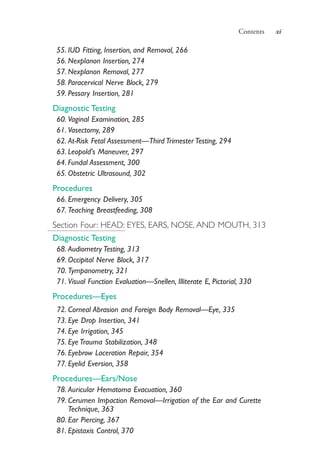
x Contents
Section Two: MUSCULOSKELETAL PROCEDURES, 121
Diagnostic Testing
28. Bone Marrow Aspiration and Biopsy, 121
29. Lumbar Puncture, 126
30. X-Ray Interpretation—Bones, 131
31. Arthrocentesis, 135
32. Compartment Syndrome Assessment, 138
Procedures
33. Clavicle Immobilization Techniques: Clavicle Strap, Figure Eight, Sling
and Swath, 143
34. Crutch Walking, 146
35. Dislocation Reduction, 152
36. Ganglion Cyst Aspiration and Injection, 166
37. Intra-Articular and Bursa Corticosteroid Injection, 170
38. Sling Application, 180
39. Splinting and Taping, 183
40. Trigger Point Injection, 202
Section Three: GENITOURINARY AND BREAST
PROCEDURES, 205
Diagnostic Testing
41. Bladder Catheterization Insertion and Removal, 205
42. Breast Biopsy—Fine Needle Aspiration, 211
43. Breast Examination, 214
44. Colposcopy—Endocervical Curettage and Cervical Biopsy, 221
45. Endometrial Biopsy, 227
46. Specimen Collection—Gram Stain,Wet Mount (Saline and KOH), 230
47. Specimen Collection—Papanicolaou (Pap) Smear, 234
Procedures
48. Administration of Vaginal Medications and Condoms, 240
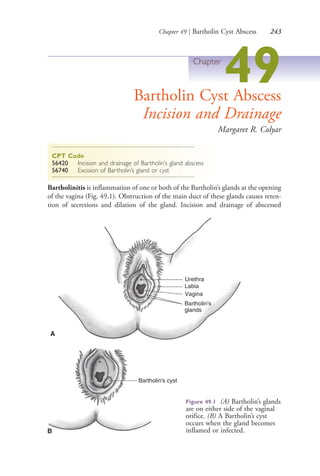
49. Bartholin Cyst Abscess—Incision and Drainage, 243
50. Cervical Cap Fitting, Insertion, and Removal, 246
51. Cervical Lesions—Cryotherapy, 249
52. Circumcision and Dorsal Penile Nerve Block, 252
53. Condyloma Acuminata Removal, 258
54. Diaphragm Fitting, Insertion, and Removal, 263
4206_FM_i-xiv.indd x4206_FM_i-xiv.indd x 12/30/2014 10:56:42 AM12/30/2014 10:56:42 AM
Process CyanProcess CyanProcess MagentaProcess MagentaProcess YellowProcess YellowProcess BlackProcess Black
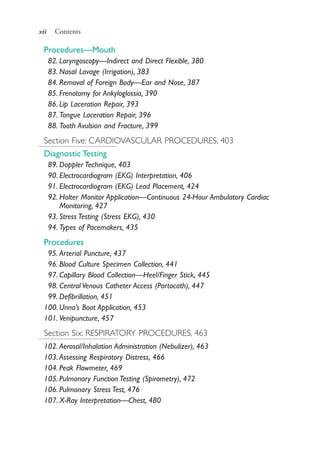
Contents xi
55. IUD Fitting, Insertion, and Removal, 266
56. Nexplanon Insertion, 274
57. Nexplanon Removal, 277
58. Paracervical Nerve Block, 279
59. Pessary Insertion, 281
Diagnostic Testing
60. Vaginal Examination, 285
61. Vasectomy, 289
62. At-Risk Fetal Assessment—Third Trimester Testing, 294
63. Leopold's Maneuver, 297
64. Fundal Assessment, 300
65. Obstetric Ultrasound, 302
Procedures
66. Emergency Delivery, 305
67. Teaching Breastfeeding, 308
Section Four: HEAD: EYES, EARS, NOSE, AND MOUTH, 313
Diagnostic Testing
68. Audiometry Testing, 313
69. Occipital Nerve Block, 317
70. Tympanometry, 321
71. Visual Function Evaluation—Snellen, Illiterate E, Pictorial, 330
Procedures—Eyes
72. Corneal Abrasion and Foreign Body Removal—Eye, 335
73. Eye Drop Insertion, 341
74. Eye Irrigation, 345
75. Eye Trauma Stabilization, 348
76. Eyebrow Laceration Repair, 354
77. Eyelid Eversion, 358
Procedures—Ears/Nose
78. Auricular Hematoma Evacuation, 360
79. Cerumen Impaction Removal—Irrigation of the Ear and Curette
Technique, 363
80. Ear Piercing, 367
81. Epistaxis Control, 370
4206_FM_i-xiv.indd xi4206_FM_i-xiv.indd xi 12/30/2014 10:56:42 AM12/30/2014 10:56:42 AM
Process CyanProcess CyanProcess MagentaProcess MagentaProcess YellowProcess YellowProcess BlackProcess Black
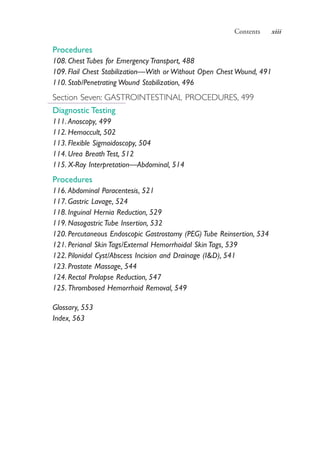
xii Contents
Procedures—Mouth
82. Laryngoscopy—Indirect and Direct Flexible, 380
83. Nasal Lavage (Irrigation), 383
84. Removal of Foreign Body—Ear and Nose, 387
85. Frenotomy for Ankyloglossia, 390
86. Lip Laceration Repair, 393
87. Tongue Laceration Repair, 396
88. Tooth Avulsion and Fracture, 399
Section Five: CARDIOVASCULAR PROCEDURES, 403
Diagnostic Testing
89. Doppler Technique, 403
90. Electrocardiogram (EKG) Interpretation, 406
91. Electrocardiogram (EKG) Lead Placement, 424
92. Holter Monitor Application—Continuous 24-Hour Ambulatory Cardiac
Monitoring, 427
93. Stress Testing (Stress EKG), 430
94. Types of Pacemakers, 435
Procedures
95. Arterial Puncture, 437
96. Blood Culture Specimen Collection, 441
97. Capillary Blood Collection—Heel/Finger Stick, 445
98. Central Venous Catheter Access (Portacath), 447
99. Defibrillation, 451
100. Unna’s Boot Application, 453
101. Venipuncture, 457
Section Six: RESPIRATORY PROCEDURES, 463
102. Aerosol/Inhalation Administration (Nebulizer), 463
103. Assessing Respiratory Distress, 466
104. Peak Flowmeter, 469
105. Pulmonary Function Testing (Spirometry), 472
106. Pulmonary Stress Test, 476
107. X-Ray Interpretation—Chest, 480
4206_FM_i-xiv.indd xii4206_FM_i-xiv.indd xii 12/30/2014 10:56:42 AM12/30/2014 10:56:42 AM
Process CyanProcess CyanProcess MagentaProcess MagentaProcess YellowProcess YellowProcess BlackProcess Black
Contents xiii
Procedures
108. Chest Tubes for Emergency Transport, 488
109. Flail Chest Stabilization—With or Without Open Chest Wound, 491
110. Stab/Penetrating Wound Stabilization, 496
Section Seven: GASTROINTESTINAL PROCEDURES, 499
Diagnostic Testing
111. Anoscopy, 499
112. Hemoccult, 502
113. Flexible Sigmoidoscopy, 504
114. Urea Breath Test, 512
115. X-Ray Interpretation—Abdominal, 514
Procedures
116. Abdominal Paracentesis, 521
117. Gastric Lavage, 524
118. Inguinal Hernia Reduction, 529
119. Nasogastric Tube Insertion, 532
120. Percutaneous Endoscopic Gastrostomy (PEG) Tube Reinsertion, 534
121. Perianal Skin Tags/External Hemorrhoidal Skin Tags, 539
122. Pilonidal Cyst/Abscess Incision and Drainage (I&D), 541
123. Prostate Massage, 544
124. Rectal Prolapse Reduction, 547
125. Thrombosed Hemorrhoid Removal, 549
Glossary, 553
Index, 563
4206_FM_i-xiv.indd xiii4206_FM_i-xiv.indd xiii 12/30/2014 10:56:42 AM12/30/2014 10:56:42 AM
Process CyanProcess CyanProcess MagentaProcess MagentaProcess YellowProcess YellowProcess BlackProcess Black
CarryTaber’s today and SAVE 20%
Use promo code:
CARRYTABERS
www.FADavis.com
KEEP
CALM
AND
CARRY
www.Tabers.com
4206_FM_i-xiv.indd xiv4206_FM_i-xiv.indd xiv 12/30/2014 10:56:42 AM12/30/2014 10:56:42 AM
Process CyanProcess CyanProcess MagentaProcess MagentaProcess YellowProcess YellowProcess BlackProcess Black
1
Section One
DermatologicalProcedures
Chapter
1Punch Biopsy
Margaret R. Colyar
CPT Code
21550 Biopsy of soft tissue of neck or thorax
21920 Biopsy of soft tissue of back or flank, superficial
23066 Biopsy of soft tissue of shoulder, superficial
24065 Biopsy of upper arm and elbow area
23066 Biopsy of soft tissue of forearm or wrist, superficial
27040 Biopsy of soft tissue of pelvis and hip area
27323 Biopsy of soft tissue of pelvis and hip area
27613 Biopsy of soft tissue of leg and ankle area
11100 Skin lesion—Depends on the site, technique, and if benign
or malignant lesions
Biopsy is the removal of a small piece of tissue from the skin for microscopic exami-
nation. Partial or full thickness of skin over the lesion is removed for evaluation.
OVERVIEW
Punch biopsy is used for full and partial dermal lesions such as
● Basal cell carcinoma
● Squamous cell carcinoma
● Actinic keratoses
● Seborrheic keratoses
● Lentigo (freckles)
● Lipomas
● Melanomas
● Nevi
● Warts—verruca vulgaris
RATIONALE
● To confirm etiology of lesion for treatment
● To establish or confirm a diagnosis for treatment and/or intervention
4206_Chapter 1_0001-0120.indd 14206_Chapter 1_0001-0120.indd 1 12/24/2014 2:01:14 PM12/24/2014 2:01:14 PM
Process CyanProcess CyanProcess MagentaProcess MagentaProcess YellowProcess YellowProcess BlackProcess Black
2 Section One | Dermatological Procedures
INDICATIONS
● Partial- or full-dermal-thickness lesion not on the face, eye, lip, or penis
CONTRAINDICATIONS
● Lesion on eyelid, lip, or penis, REFER to a physician.
● Infection at the site of the biopsy
● Bleeding disorder
● Lesions that are deep or on the face, REFER to a physician.
◗ Informed consent required
PROCEDURE
Punch Biopsy
Equipment
● Antiseptic skin cleanser
● Drape—sterile
● Gloves—sterile
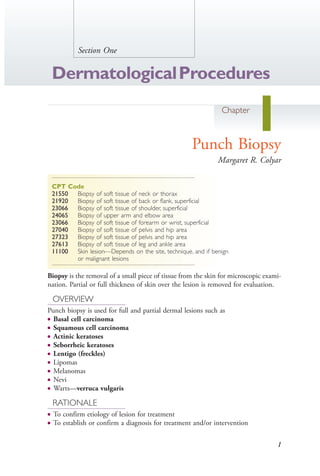
● Disposable biopsy punch (Fig. 1.1)
● Pickups—sterile
● Scissors—sharp for the fine tissue—sterile
● 3-mL syringe
● 27- to 30-gauge, ½-inch needle
● 1% lidocaine
● Container with 10% formalin
● 4 × 4 gauze
Figure 1.1 Disposable biopsy
punches.
4206_Chapter 1_0001-0120.indd 24206_Chapter 1_0001-0120.indd 2 12/24/2014 2:01:14 PM12/24/2014 2:01:14 PM
Process CyanProcess CyanProcess MagentaProcess MagentaProcess YellowProcess YellowProcess BlackProcess Black
Chapter 1 | Punch Biopsy 3
● Nonstick dressing (Adaptic or Telfa)
● Kling
● Tape
● Steri-Strips (if biopsy will be greater than 4 mm) or one suture
Procedure
● Position the client so that the area to be biopsied is easily accessible.
● Cleanse the skin with antiseptic skin cleanser.
● Put on gloves.
● Drape the area to be biopsied.
● Anesthetize with 1% lidocaine.
● With the thumb and index finger, spread the skin to apply tension opposite
natural skin tension lines. This allows a more elliptical-shaped wound for easy
closure.
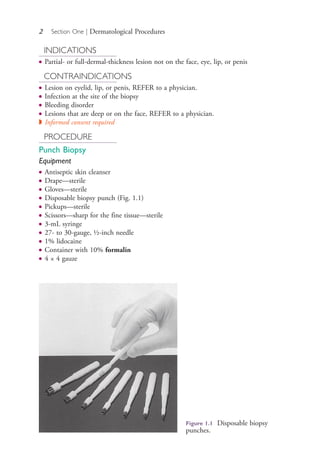
● Apply biopsy punch to skin, rotate per manufacturer’s directions, and remove
the punch (Fig. 1.2).
● With pickups, pull up loosened skin.
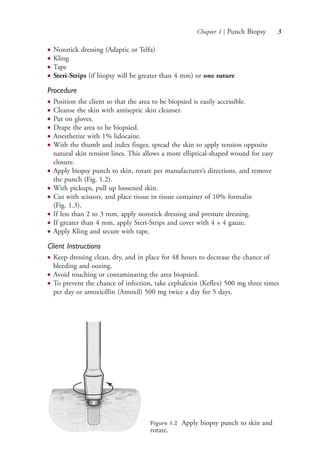
● Cut with scissors, and place tissue in tissue container of 10% formalin
(Fig. 1.3).
● If less than 2 to 3 mm, apply nonstick dressing and pressure dressing.
● If greater than 4 mm, apply Steri-Strips and cover with 4 × 4 gauze.
● Apply Kling and secure with tape.
Client Instructions
● Keep dressing clean, dry, and in place for 48 hours to decrease the chance of
bleeding and oozing.
● Avoid touching or contaminating the area biopsied.
● To prevent the chance of infection, take cephalexin (Keflex) 500 mg three times
per day or amoxicillin (Amoxil) 500 mg twice a day for 5 days.
Figure 1.2 Apply biopsy punch to skin and
rotate.
4206_Chapter 1_0001-0120.indd 34206_Chapter 1_0001-0120.indd 3 12/24/2014 2:01:14 PM12/24/2014 2:01:14 PM
Process CyanProcess CyanProcess MagentaProcess MagentaProcess YellowProcess YellowProcess BlackProcess Black
4 Section One | Dermatological Procedures
● Some redness, swelling, and heat are normal. Return to the office if symptoms
of infection occur, such as
●
Yellow or green drainage
●
Red streaks
●
Pain
●
Elevated temperature
● Take acetaminophen (Tylenol) or ibuprofen (Motrin) every 4 to 6 hours as
needed for pain.
BIBLIOGRAPHY
De Vries HJ, Zeegelaar JE, Middelkoop E, et al. Reduced wound contraction and scar
formation in punch biopsy wounds. Native collagen dermal substitutes. A clinical study.
Br J Dermatol. 1995;132(5):690–697.
Zuber TJ. Ingrown toenail removal. Am Fam Physician. 2002;65(12):2547–2550.
Figure 1.3 Cut with scissors.
4206_Chapter 1_0001-0120.indd 44206_Chapter 1_0001-0120.indd 4 12/24/2014 2:01:14 PM12/24/2014 2:01:14 PM
Process CyanProcess CyanProcess MagentaProcess MagentaProcess YellowProcess YellowProcess BlackProcess Black
Chapter 2 | Skin Biopsy 5
Chapter
2Skin Biopsy
Margaret R. Colyar
CPT Code
11300–03 Shaving of epidermal or dermal lesion; single lesion—
trunk, arms, or legs
11305–08 Shaving of epidermal or dermal lesion; single lesion—
scalp, neck, hands, feet, or genitalia
11400–06 Excision benign lesions—trunk, arms, or legs
11420–26 Excision benign lesions—scalp, neck, hands, feet, or
genitalia
11600–06 Excision malignant lesions—trunk, arms, or legs
11620–26 Excision malignant lesions—scalp, neck, hands, feet, or
genitalia
Skin biopsy is the excision of a small piece of living tissue for microscopic examina-
tion. The two major categories of skin biopsy are
● Partial dermal thickness—shave and curettage
● Full dermal thickness—punch and elliptical excision
HEALTH PROMOTION/PREVENTION
● Inspect the skin periodically for lesions.
● Note lesions that change size or color, are irregular, or are painful.
OPTIONS
● Method 1—Shave biopsy
●
Use for elevated skin lesions such as
• Skin tags
• Benign nevi (interdermal)
• Epithelial tags
• Small basal cell carcinomas
• Condyloma acuminatum
• Cherry angiomas
• Actinic keratoses
• Seborrheic keratoses
• Lentigo (freckles)
• Verruca vulgaris (warts)
4206_Chapter 1_0001-0120.indd 54206_Chapter 1_0001-0120.indd 5 12/24/2014 2:01:14 PM12/24/2014 2:01:14 PM
Process CyanProcess CyanProcess MagentaProcess MagentaProcess YellowProcess YellowProcess BlackProcess Black
6 Section One | Dermatological Procedures
● Method 2—Curettage biopsy
●
Use for
• Seborrheic keratoses
• Superficial basal cell carcinomas
• Crusting actinic keratoses
● Method 3—Elliptical excisional biopsy
●
Use for full-dermal-thickness lesions such as
• Basal cell carcinoma
• Squamous cell carcinoma
• Actinic keratoses
• Seborrheic keratoses
• Lentigo
• Lipomas
• Melanomas
• Nevi
• Verruca vulgaris (warts)
RATIONALE
● To confirm or make a diagnosis of a skin lesion
● To determine definitive treatment of a skin lesion
● To remove a disfiguring or painful lesion
INDICATIONS
● Nonmalignant skin lesions not on the eyelid, lip, face, or penis
● Superficial skin lesions
CONTRAINDICATIONS
● Infection is suspected at biopsy site
● Bleeding disorder
● If melanoma is suspected, do not use shave or curettage. Elliptical excision is
preferred.
● If on eyelid, lip, face, or penis, REFER to a physician.
● If deep lesions, REFER to a physician.
◗ Informed consent required
PROCEDURE
Skin Biopsy
Equipment
● Methods 1, 2, and 3
●
Antiseptic skin cleanser
●
Drape—sterile
●
Gloves—nonsterile
●
3-mL syringe
●
27- to 30-gauge, ½-inch needle
4206_Chapter 1_0001-0120.indd 64206_Chapter 1_0001-0120.indd 6 12/24/2014 2:01:14 PM12/24/2014 2:01:14 PM
Process CyanProcess CyanProcess MagentaProcess MagentaProcess YellowProcess YellowProcess BlackProcess Black
Chapter 2 | Skin Biopsy 7
●
1% lidocaine
●
Container of 10% formalin
●
Cautery or Monsel’s solution
●
Pickups—sterile (optional)
● Method 1 only
●
No. 15 scalpel or sterile scissors
● Method 2 only
●
Dermal curette
● Method 3 only
●
Needle driver with scissors—sterile
●
Suture (see Chapter 23 for information on choosing the appropriate type and
size of suture)
●
Tape
●
Nonstick dressing (Adaptic or Telfa)
●
4 × 4 gauze
●
Topical antibiotic (Bactroban, Bacitracin, or Polysporin)
Procedure
METHOD 1—SHAVE BIOPSY
● Position the client for comfort with the area of the skin lesion easily accessible.
● Cleanse the skin lesion and a 3-inch-diameter circle around the lesion.
● Drape the area.
● Put on gloves.
● Inject 1% lidocaine under the lesion using a 27- to 30-gauge needle to create a
wheal.
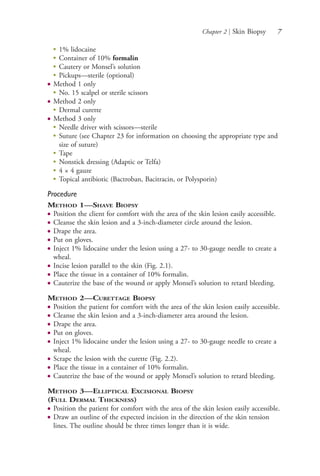
● Incise lesion parallel to the skin (Fig. 2.1).
● Place the tissue in a container of 10% formalin.
● Cauterize the base of the wound or apply Monsel’s solution to retard bleeding.
METHOD 2—CURETTAGE BIOPSY
● Position the patient for comfort with the area of the skin lesion easily accessible.
● Cleanse the skin lesion and a 3-inch-diameter area around the lesion.
● Drape the area.
● Put on gloves.
● Inject 1% lidocaine under the lesion using a 27- to 30-gauge needle to create a
wheal.
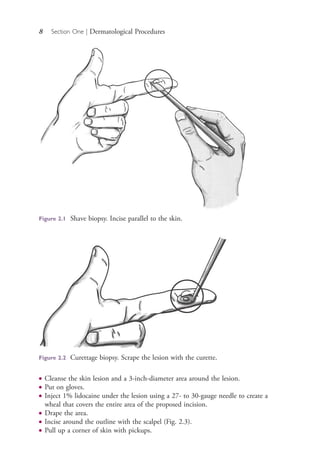
● Scrape the lesion with the curette (Fig. 2.2).
● Place the tissue in a container of 10% formalin.
● Cauterize the base of the wound or apply Monsel’s solution to retard bleeding.
METHOD 3—ELLIPTICAL EXCISIONAL BIOPSY
(FULL DERMAL THICKNESS)
● Position the patient for comfort with the area of the skin lesion easily accessible.
● Draw an outline of the expected incision in the direction of the skin tension
lines. The outline should be three times longer than it is wide.
4206_Chapter 1_0001-0120.indd 74206_Chapter 1_0001-0120.indd 7 12/24/2014 2:01:14 PM12/24/2014 2:01:14 PM
Process CyanProcess CyanProcess MagentaProcess MagentaProcess YellowProcess YellowProcess BlackProcess Black
8 Section One | Dermatological Procedures
● Cleanse the skin lesion and a 3-inch-diameter area around the lesion.
● Put on gloves.
● Inject 1% lidocaine under the lesion using a 27- to 30-gauge needle to create a
wheal that covers the entire area of the proposed incision.
● Drape the area.
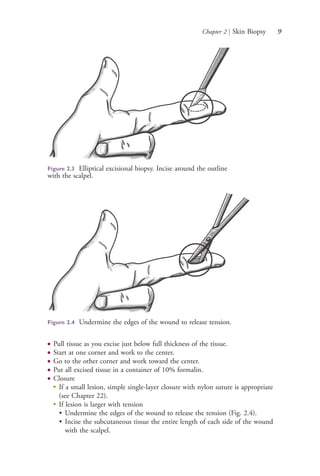
● Incise around the outline with the scalpel (Fig. 2.3).
● Pull up a corner of skin with pickups.
Figure 2.1 Shave biopsy. Incise parallel to the skin.
Figure 2.2 Curettage biopsy. Scrape the lesion with the curette.
4206_Chapter 1_0001-0120.indd 84206_Chapter 1_0001-0120.indd 8 12/24/2014 2:01:14 PM12/24/2014 2:01:14 PM
Process CyanProcess CyanProcess MagentaProcess MagentaProcess YellowProcess YellowProcess BlackProcess Black
Chapter 2 | Skin Biopsy 9
● Pull tissue as you excise just below full thickness of the tissue.
● Start at one corner and work to the center.
● Go to the other corner and work toward the center.
● Put all excised tissue in a container of 10% formalin.
● Closure
●
If a small lesion, simple single-layer closure with nylon suture is appropriate
(see Chapter 22).
●
If lesion is larger with tension
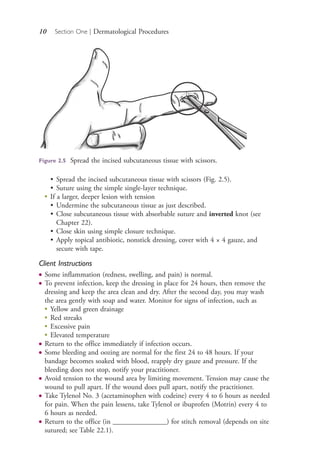
• Undermine the edges of the wound to release the tension (Fig. 2.4).
• Incise the subcutaneous tissue the entire length of each side of the wound
with the scalpel.
Figure 2.3 Elliptical excisional biopsy. Incise around the outline
with the scalpel.
Figure 2.4 Undermine the edges of the wound to release tension.
4206_Chapter 1_0001-0120.indd 94206_Chapter 1_0001-0120.indd 9 12/24/2014 2:01:14 PM12/24/2014 2:01:14 PM
Process CyanProcess CyanProcess MagentaProcess MagentaProcess YellowProcess YellowProcess BlackProcess Black
10 Section One | Dermatological Procedures
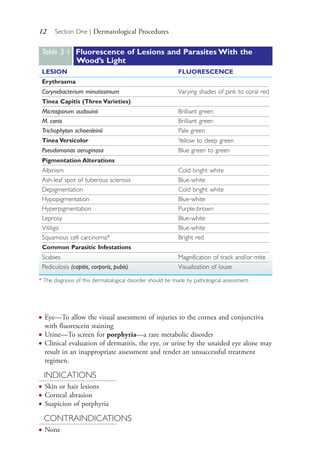
• Spread the incised subcutaneous tissue with scissors (Fig. 2.5).
• Suture using the simple single-layer technique.
●
If a larger, deeper lesion with tension
• Undermine the subcutaneous tissue as just described.
• Close subcutaneous tissue with absorbable suture and inverted knot (see
Chapter 22).
• Close skin using simple closure technique.
• Apply topical antibiotic, nonstick dressing, cover with 4 × 4 gauze, and
secure with tape.
Client Instructions
● Some inflammation (redness, swelling, and pain) is normal.
● To prevent infection, keep the dressing in place for 24 hours, then remove the
dressing and keep the area clean and dry. After the second day, you may wash
the area gently with soap and water. Monitor for signs of infection, such as
●
Yellow and green drainage
●
Red streaks
●
Excessive pain
●
Elevated temperature
● Return to the office immediately if infection occurs.
● Some bleeding and oozing are normal for the first 24 to 48 hours. If your
bandage becomes soaked with blood, reapply dry gauze and pressure. If the
bleeding does not stop, notify your practitioner.
● Avoid tension to the wound area by limiting movement. Tension may cause the
wound to pull apart. If the wound does pull apart, notify the practitioner.
● Take Tylenol No. 3 (acetaminophen with codeine) every 4 to 6 hours as needed
for pain. When the pain lessens, take Tylenol or ibuprofen (Motrin) every 4 to
6 hours as needed.
● Return to the office (in _______________) for stitch removal (depends on site
sutured; see Table 22.1).
Figure 2.5 Spread the incised subcutaneous tissue with scissors.
4206_Chapter 1_0001-0120.indd 104206_Chapter 1_0001-0120.indd 10 12/24/2014 2:01:15 PM12/24/2014 2:01:15 PM
Process CyanProcess CyanProcess MagentaProcess MagentaProcess YellowProcess YellowProcess BlackProcess Black
Chapter 3 | Wood’s Light Examination 11
BIBLIOGRAPHY
Pfenninger JL, Fowler GC. Procedures for Primary Care Physicians. St. Louis, MO: Mosby;
2011.
Surajachar MD. Principles of skin biopsies for the family physician. Am Fam Physician,
1996;54(8):2411–2418.
Walters GK. Managing soft tissue wounds. Adv Nurse Pract. 1996;4(3):37–40, 54.
Zuber TJ, Dewitt DE. The fusiform excision. Am Fam Physician. 1994;49(2):371–376.
Chapter
3Wood’s Light Examination
Margaret R. Colyar
CPT Code
None
The Wood’s light is a useful and inexpensive tool in clinical practice. It is powered
by alternating or direct current that converts ultraviolet light into visible light, and
it usually has an accompanying magnification lens. It provides a simple diagnostic
method in the evaluation of
● Many dermatological problems
● Fluorescein-staining evaluation of eye injuries
OVERVIEW
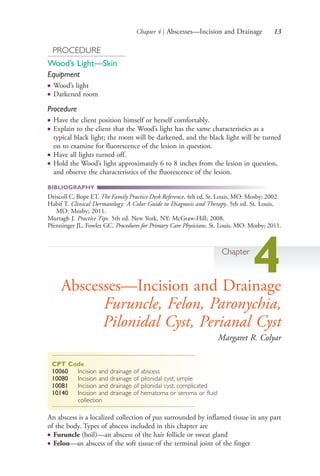
● Most common dermatological lesions that fluoresce are listed in Table 3.1.
● Detection of chemicals applied to the skin. Affected areas are a different color
from that of the surrounding skin.
●
Prior cleansing of the area to be examined causes false-negative result.
●
Certain skin lesions do not fluoresce.
●
Systemic antibiotic therapy, such as with tetracyclines, can cause fluorescence
in some lesions.
●
Cosmetics present on the skin interfere with fluorescence.
● Detection of eye injuries with fluorescein. When applied to the eye, fluorescein
has a higher concentration of uptake in areas in which there has been disruption
of the cornea or sclera. Under a Wood’s light, the injured area fluoresces as a
bright yellow-green.
● Detection of porphyrins in the urine. These appear bright red.
RATIONALE
● Skin—To allow the clinician to differentiate dermatological presentation of
types of bacterial, fungal, and pigmented lesions found on the skin
4206_Chapter 1_0001-0120.indd 114206_Chapter 1_0001-0120.indd 11 12/24/2014 2:01:15 PM12/24/2014 2:01:15 PM
Process CyanProcess CyanProcess MagentaProcess MagentaProcess YellowProcess YellowProcess BlackProcess Black
12 Section One | Dermatological Procedures
● Eye—To allow the visual assessment of injuries to the cornea and conjunctiva
with fluorescein staining
● Urine—To screen for porphyria—a rare metabolic disorder
● Clinical evaluation of dermatitis, the eye, or urine by the unaided eye alone may
result in an inappropriate assessment and render an unsuccessful treatment
regimen.
INDICATIONS
● Skin or hair lesions
● Corneal abrasion
● Suspicion of porphyria
CONTRAINDICATIONS
● None
Table 3∙1 Fluorescence of Lesions and Parasites With the
Wood’s Light
LESION FLUORESCENCE
Erythrasma
Corynebacterium minutissimum Varying shades of pink to coral red
Tinea Capitis (Three Varieties)
Microsporum audouinii Brilliant green
M. canis Brilliant green
Trichophyton schoenleinii Pale green
Tinea Versicolor Yellow to deep green
Pseudomonas aeruginosa Blue green to green
Pigmentation Alterations
Albinism Cold bright white
Ash-leaf spot of tuberous sclerosis Blue-white
Depigmentation Cold bright white
Hypopigmentation Blue-white
Hyperpigmentation Purple-brown
Leprosy Blue-white
Vitiligo Blue-white
Squamous cell carcinoma* Bright red
Common Parasitic Infestations
Scabies Magnification of track and/or mite
Pediculosis (capitis, corporis, pubis) Visualization of louse
* The diagnosis of this dermatological disorder should be made by pathological assessment.
4206_Chapter 1_0001-0120.indd 124206_Chapter 1_0001-0120.indd 12 12/24/2014 2:01:15 PM12/24/2014 2:01:15 PM
Process CyanProcess CyanProcess MagentaProcess MagentaProcess YellowProcess YellowProcess BlackProcess Black
Chapter 4 | Abscesses—Incision and Drainage 13
PROCEDURE
Wood’s Light—Skin
Equipment
● Wood’s light
● Darkened room
Procedure
● Have the client position himself or herself comfortably.
● Explain to the client that the Wood’s light has the same characteristics as a
typical black light; the room will be darkened, and the black light will be turned
on to examine for fluorescence of the lesion in question.
● Have all lights turned off.
● Hold the Wood’s light approximately 6 to 8 inches from the lesion in question,
and observe the characteristics of the fluorescence of the lesion.
BIBLIOGRAPHY
Driscoll C, Bope ET. The Family Practice Desk Reference. 4th ed. St. Louis, MO: Mosby; 2002.
Habif T. Clinical Dermatology: A Color Guide to Diagnosis and Therapy. 5th ed. St. Louis,
MO: Mosby; 2011.
Murtagh J. Practice Tips. 5th ed. New York, NY: McGraw-Hill; 2008.
Pfenninger JL, Fowler GC. Procedures for Primary Care Physicians. St. Louis, MO: Mosby; 2011.
Chapter
4Abscesses—Incision and Drainage
Furuncle, Felon, Paronychia,
Pilonidal Cyst, Perianal Cyst
Margaret R. Colyar
CPT Code
10060 Incision and drainage of abscess
10080 Incision and drainage of pilonidal cyst; simple
10081 Incision and drainage of pilonidal cyst; complicated
10140 Incision and drainage of hematoma or seroma or fluid
collection
An abscess is a localized collection of pus surrounded by inflamed tissue in any part
of the body. Types of abscess included in this chapter are
● Furuncle (boil)—an abscess of the hair follicle or sweat gland
● Felon—an abscess of the soft tissue of the terminal joint of the finger
4206_Chapter 1_0001-0120.indd 134206_Chapter 1_0001-0120.indd 13 12/24/2014 2:01:15 PM12/24/2014 2:01:15 PM
Process CyanProcess CyanProcess MagentaProcess MagentaProcess YellowProcess YellowProcess BlackProcess Black
14 Section One | Dermatological Procedures
● Paronychia—an abscess or cellulitis of the nail folds, usually the proximal and
lateral edges
● Pilonidal cyst—an abscess located in the gluteal fold close to the anus, caused
by an ingrown hair. One or more sinus openings may exist. Males are more
prone than females to develop pilonidal cysts. Younger people have pilonidal
cysts more often than do the elderly.
● Perianal cyst—an abscess around or close to the anus
OVERVIEW
● Causative organisms of most abscesses
●
Staphylococcus aureus
●
Streptococcus species
● Areas of most frequent occurrence of abscesses
●
Extremities
●
Under the breasts
●
Axillae
●
Buttocks
●
Hair follicles
HEALTH PROMOTION/PREVENTION
● Cleanse skin daily with an antiseptic soap such as unscented Dial soap.
● Do not squeeze face lesions.
● Do not shave closely.
● Discourage nail biting and finger sucking.
RATIONALE
● To diminish pain
● To promote healing
INDICATIONS
● Collection of pus causing pain and/or not resolved by use of an antibiotic
● Small abscesses
● Small abscesses that enlarge
● Large abscesses
CONTRAINDICATIONS
● Abscesses on the face in the triangle of the bridge of the nose and corners of the
mouth.
●
Use conservative measures to decrease or prevent the chances for septic
phlebitis and intracranial extension.
● Observe carefully and obtain a culture of the abscess from people with
●
Debilitating disease
●
Compromised immune system
◗ Informed consent required
4206_Chapter 1_0001-0120.indd 144206_Chapter 1_0001-0120.indd 14 12/24/2014 2:01:15 PM12/24/2014 2:01:15 PM
Process CyanProcess CyanProcess MagentaProcess MagentaProcess YellowProcess YellowProcess BlackProcess Black
Chapter 4 | Abscesses—Incision and Drainage 15
PROCEDURE
Incision and Drainage—Furuncle
Equipment
● Antiseptic skin cleanser
● Topical anesthetic—ethyl chloride or verruca freeze kit
● 1% to 2% lidocaine with or without epinephrine
● 3- to 10-mL syringe
● 27- to 30-gauge, ½-inch needle
● 4 × 4 gauze—sterile
● Tube gauze—optional for use on fingers
● No. 11 scalpel
● Drape—sterile
● Gloves—sterile
● Curved hemostats—sterile
● Iodoform gauze—¼ to ½ inch
● Culture swab
● Scissors—sterile
● Tape
Procedure
● Position the client with the abscess easily accessible.
● Cleanse the abscess and a 3-inch-diameter area surrounding the abscess with
antiseptic skin cleanser.
● Drape the abscess with a sterile drape.
● Put on gloves.
● Perform a field block by anesthetizing the perimeter around the abscess with 1%
or 2% lidocaine with or without epinephrine. Do not inject lidocaine into the
abscess because it does not work well in an acidic medium. If the client cannot
tolerate a field block, topical anesthesia can be used to freeze the top of the
abscess if desired.
● Using the No. 11 scalpel, incise the abscess deeply enough and long enough to
allow easy drainage of the purulent material and to prevent premature closure of
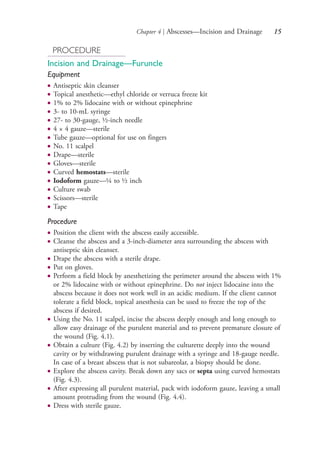
the wound (Fig. 4.1).
● Obtain a culture (Fig. 4.2) by inserting the culturette deeply into the wound
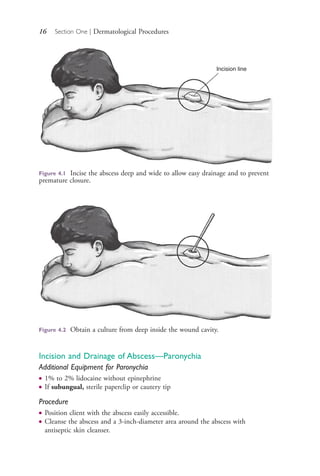
cavity or by withdrawing purulent drainage with a syringe and 18-gauge needle.
In case of a breast abscess that is not subareolar, a biopsy should be done.
● Explore the abscess cavity. Break down any sacs or septa using curved hemostats
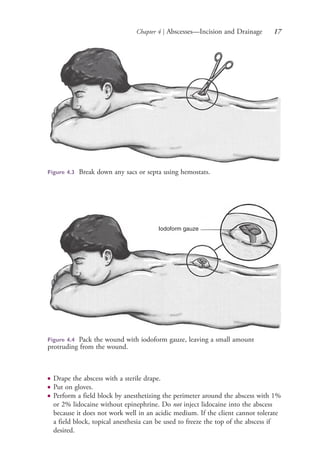
(Fig. 4.3).
● After expressing all purulent material, pack with iodoform gauze, leaving a small
amount protruding from the wound (Fig. 4.4).
● Dress with sterile gauze.
4206_Chapter 1_0001-0120.indd 154206_Chapter 1_0001-0120.indd 15 12/24/2014 2:01:15 PM12/24/2014 2:01:15 PM
Process CyanProcess CyanProcess MagentaProcess MagentaProcess YellowProcess YellowProcess BlackProcess Black
16 Section One | Dermatological Procedures
Incision and Drainage of Abscess—Paronychia
Additional Equipment for Paronychia
● 1% to 2% lidocaine without epinephrine
● If subungual, sterile paperclip or cautery tip
Procedure
● Position client with the abscess easily accessible.
● Cleanse the abscess and a 3-inch-diameter area around the abscess with
antiseptic skin cleanser.
Figure 4.1 Incise the abscess deep and wide to allow easy drainage and to prevent
premature closure.
Incision line
Figure 4.2 Obtain a culture from deep inside the wound cavity.
4206_Chapter 1_0001-0120.indd 164206_Chapter 1_0001-0120.indd 16 12/24/2014 2:01:15 PM12/24/2014 2:01:15 PM
Process CyanProcess CyanProcess MagentaProcess MagentaProcess YellowProcess YellowProcess BlackProcess Black
Chapter 4 | Abscesses—Incision and Drainage 17
● Drape the abscess with a sterile drape.
● Put on gloves.
● Perform a field block by anesthetizing the perimeter around the abscess with 1%
or 2% lidocaine without epinephrine. Do not inject lidocaine into the abscess
because it does not work well in an acidic medium. If the client cannot tolerate
a field block, topical anesthesia can be used to freeze the top of the abscess if
desired.
Figure 4.3 Break down any sacs or septa using hemostats.
Iodoform gauze
Figure 4.4 Pack the wound with iodoform gauze, leaving a small amount
protruding from the wound.
4206_Chapter 1_0001-0120.indd 174206_Chapter 1_0001-0120.indd 17 12/24/2014 2:01:15 PM12/24/2014 2:01:15 PM
Process CyanProcess CyanProcess MagentaProcess MagentaProcess YellowProcess YellowProcess BlackProcess Black
18 Section One | Dermatological Procedures
● If the matrix is involved and an abscess has formed a subungual (under the
fingernail) tract, use a hot paperclip or cautery tip to bore through the nail to
drain pus and blood.
●
Partial removal of nail plate may be needed (see Chapter 10).
● Lift the proximal nail fold. If purulent material is not released freely, incise the
skin at the point of highest tension using the No. 11 scalpel.
● Obtain a culture by inserting the culturette deeply into the wound cavity or by
withdrawing purulent drainage with a syringe and 18-gauge needle.
● Explore the abscess cavity. Break down any sacs or septa using curved hemostats.
● After expressing all purulent material, pack with iodoform gauze, leaving a small
amount protruding from the wound.
● Dress with sterile gauze.
● Cover with tube gauze.
Incision and Drainage—Pilonidal Cyst
Additional Equipment for Pilonidal Cyst
● Cotton-tipped applicator
Procedure
● Same as incision and drainage of furuncle except
●
Position patient in left lateral or lithotomy position.
●
Leave wound open to drain and heal by secondary intention (delayed closure
8 to 12 weeks).
●
Probe sinus tracts with cotton-tipped applicator. If deep, REFER to a surgeon.
●
If superficial (less than 5 mm), perform elliptical excision for pilonidal sinus.
Incision and Drainage—Perianal Abscess
Can be done if perianal or ischiorectal; if supralevator or intersphincteric, REFER
to a surgeon.
Additional Equipment for Perianal Abscess
● 0.9% sodium chloride
● Peripads
Procedure
● Position patient in left lateral or lithotomy position.
● Perform a digital examination and/or anoscopy (see Chapter 89) to look for
internal opening (i.e., fistula; usually 50% incidence).
● If a fistula is not present
●
Drape the abscess with sterile drapes.
●
Cleanse the area with an antiseptic skin cleanser.
●
Use topical anesthetic to freeze the top of the abscess. Local anesthetic is not
practical because an acidic environment does not respond well to anesthesia.
●
Using the No. 11 scalpel, incise over the area of greatest tension.
4206_Chapter 1_0001-0120.indd 184206_Chapter 1_0001-0120.indd 18 12/24/2014 2:01:15 PM12/24/2014 2:01:15 PM
Process CyanProcess CyanProcess MagentaProcess MagentaProcess YellowProcess YellowProcess BlackProcess Black
Chapter 4 | Abscesses—Incision and Drainage 19
●
Obtain a culture by inserting the culturette deeply into the wound cavity or
by withdrawing purulent drainage with a syringe and 18-gauge needle.
●
After expressing all purulent material, irrigate with 0.9% sodium chloride.
●
Pack with iodoform gauze, leaving a small amount hanging from the wound.
●
Dress with sterile gauze or peripad.
● To relieve pain when fistula is present, insert a 16- to 18-gauge needle into the
abscess and withdraw purulent material. REFER to a surgeon.
Client Instructions
● Return to the office in 2 days to have dressing changed.
● Observe for signs and symptoms of infection, such as
●
Yellow or green drainage
●
Red streaks
●
Increasing pain
●
Elevated temperature
● If symptoms of infection occur, return to the office.
● Prevent recurrence of the abscess by taking an antibiotic—dicloxacillin 250 mg
four times a day, cefadroxil 500 mg twice a day, or cephalexin 500 mg three
times a day.
● Contrary to popular belief, incised abscesses are painful and usually require
narcotic analgesia for the first 24 hours. For pain relief, take Tylenol No. 3 every
4 to 6 hours for the first 24 hours; then take ibuprofen.
● If you had a pilonidal or perianal cyst drained, take a sitz bath with warm water
three or four times per day. You may cleanse the area by using the shower or
irrigating the area with a squeeze bottle.
● If the abscess recurs, return to the office for evaluation.
● If the abscess was in an extremity, observe for cellulitis and/or gangrene.
BIBLIOGRAPHY
Armstrong JH, Barcia PJ. Pilonidal sinus disease. The conservative approach. Arch Surg.
1994;129:914–917.
Johnson RA. Cyst removal. Punch, push, pull. Skin. 1995;1(1):14–15.
Pfenninger JL, Fowler GC. Procedures for Primary Care Physicians. St. Louis, MO: Mosby;
2011.
4206_Chapter 1_0001-0120.indd 194206_Chapter 1_0001-0120.indd 19 12/24/2014 2:01:15 PM12/24/2014 2:01:15 PM
Process CyanProcess CyanProcess MagentaProcess MagentaProcess YellowProcess YellowProcess BlackProcess Black
20 Section One | Dermatological Procedures
5Chapter
Bites
Ants, Arthropods (Spiders), Bees,
and Wasps
Cynthia Ehrhardt
CPT Code
989.5 Fire ant bite
919.4 Superficial bite without mention of infection (includes
nonvenomous spider bites, non–fire ant bites, bee bites, and
wasp bites)
919.5 Superficial nonvenomous infected bite
989.5 Bee sting (allergic or shock)
989.5 Spider bite, venomous
Bites are puncture wounds and tears in the skin, with injection of a proteolytic,
venomous chemical, by an insect. Treatment of a bite depends on the type of offend-
ing organism, depth of the puncture, and extent of the tear in the skin.
OVERVIEW
● Incidence—In the southeastern United States, at least 60% of the population
has been stung by these insects.
● Hemolysis and cutaneous infarct lead to necrosis of tissue at the site over a
period of hours to days. Extent of the hemolysis and cutaneous infarct
determines treatment regimen.
● Severe reactions present with symptoms such as
●
Generalized urticaria
●
Angioedema
●
Respiratory difficulty
● Change in level of consciousness
● Clinical manifestations of insect bites (Table 5.1)
● Identification of type of spider (Table 5.2)
● Medications used with insect bites (Table 5.3)
HEALTH PROMOTION/PREVENTION
● Use natural organic and pesticide chemical controls.
● Observe for and avoid anthills.
● Avoid going barefoot in grassy areas.
4206_Chapter 1_0001-0120.indd 204206_Chapter 1_0001-0120.indd 20 12/24/2014 2:01:15 PM12/24/2014 2:01:15 PM
Process CyanProcess CyanProcess MagentaProcess MagentaProcess YellowProcess YellowProcess BlackProcess Black
Chapter 5 | Bites 21
● Thoroughly check all stored clothing for spiders.
● Before entering bed, inspect bedding for spiders.
● Avoid bright colors, perfumes, and scented products that can attract and agitate
bees and wasps.
● Carry “bee-sting kit” if there is a known history of moderate-to-severe reaction
to bee and wasp stings when out in known environmental habitat of these
insects.
RATIONALE
● To prevent infection
● To diminish inflammation
● To diminish discomfort
Table 5∙1 Clinical Manifestations of Insect Bites
Fire Ant and Harvester Ant Bite
• Reactions of a mild to moderate nature will present as a localized response
(urticaria wheal, localized induration, and erythema) and initially be painful,
but decrease over time.
• Have small whitish pustule, central core with minimal erythema after the first
24 hr. After 48 hr, the white pustule remains but erythema subsides.
Brown Recluse and Black Widow
• Brown recluse bites
• Painful
• Blue cyanotic center surrounded by pallor and erythema
• Necrotic ulcers within hours to days
• Black widow bites
• Sharp stinging
• Easy to overlook—white center with trace erythema
• Necrotic ulcers within hours to days
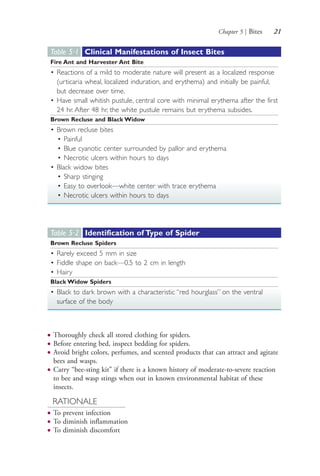
Table 5∙2 Identification of Type of Spider
Brown Recluse Spiders
• Rarely exceed 5 mm in size
• Fiddle shape on back—0.5 to 2 cm in length
• Hairy
Black Widow Spiders
• Black to dark brown with a characteristic “red hourglass” on the ventral
surface of the body
4206_Chapter 1_0001-0120.indd 214206_Chapter 1_0001-0120.indd 21 12/24/2014 2:01:15 PM12/24/2014 2:01:15 PM
Process CyanProcess CyanProcess MagentaProcess MagentaProcess YellowProcess YellowProcess BlackProcess Black
22 Section One | Dermatological Procedures
INDICATIONS
● Bite by ant, spider, bee, or wasp
CONTRAINDICATIONS
● None
PROCEDURE
Bites
Equipment
● Basin—sterile
● Povidone-iodine (Betadine) soak or antibacterial soap
● Gloves—sterile
● Meat tenderizer paste—1 part water mixed with 1 part meat tenderizer
● Epinephrine 1:1,000 vial(s)
● 1-mL syringe (tuberculin) with needle
● Ice pack
● Magnifying lens—optional
● Adhesive bandage (Band-Aid) or dressing if indicated
Procedure
● Inspect area for puncture wound. (In early spider bites, it is possible to visualize
the two-fang puncture bite.)
● Avoid warm compresses to the bite area. Heat causes vasodilation, allowing bite
venom to be circulated more quickly.
BEE OR WASP STINGS
● If bite has occurred within 5 minutes, apply a paste of meat tenderizer (which is
a proteolytic agent).
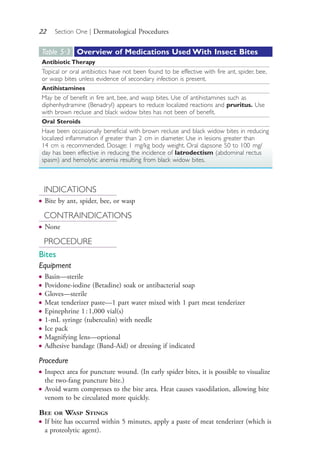
Table 5∙3 Overview of Medications Used With Insect Bites
Antibiotic Therapy
Topical or oral antibiotics have not been found to be effective with fire ant, spider, bee,
or wasp bites unless evidence of secondary infection is present.
Antihistamines
May be of benefit in fire ant, bee, and wasp bites. Use of antihistamines such as
diphenhydramine (Benadryl) appears to reduce localized reactions and pruritus. Use
with brown recluse and black widow bites has not been of benefit.
Oral Steroids
Have been occasionally beneficial with brown recluse and black widow bites in reducing
localized inflammation if greater than 2 cm in diameter. Use in lesions greater than
14 cm is recommended. Dosage: 1 mg/kg body weight. Oral dapsone 50 to 100 mg/
day has been effective in reducing the incidence of latrodectism (abdominal rectus
spasm) and hemolytic anemia resulting from black widow bites.
4206_Chapter 1_0001-0120.indd 224206_Chapter 1_0001-0120.indd 22 12/24/2014 2:01:15 PM12/24/2014 2:01:15 PM
Process CyanProcess CyanProcess MagentaProcess MagentaProcess YellowProcess YellowProcess BlackProcess Black
Chapter 5 | Bites 23
FIRE ANT AND SPIDER BITES
● Gently clean the bite area and soak in cool, soapy water for 10 to 15 minutes.
● Dry gently.
● No dressing is required unless open, exudative, and gaping wound.
● Apply an ice pack for 12 to 24 hours.
Client Instructions
● Keep the wound clean and dry.
● Apply cool compresses to the bite for 12 to 24 hours to lessen localized
inflammation.
● Antibiotics are not required.
● Observe for signs and symptoms of infection, such as
●
Increase in pain after 24 hours
●
Increase in temperature
●
Redness or swelling
●
Yellow or greenish drainage
●
Foul odor
● If any of the signs and symptoms of infection are found, return to the office.
● To relieve pain
●
Acetaminophen may be taken every 4 to 6 hours as needed for mild pain for
first 24 hours.
●
Ibuprofen or other NSAIDs should be avoided for the first 24 hours to lessen
bleeding.
●
After 24 hours, alternating NSAIDs with acetaminophen may be beneficial.
●
Tylenol No. 3 may be used for severe pain.
● Wound cleaning—The primary goal is to prevent secondary infection. Topical
antibiotic ointment has not shown benefit or harm when applied to the bite.
●
Use hydrogen peroxide to remove any crusts.
●
Wash gently with soapy water and blot area dry.
●
Unless the wound is oozing, do not cover.
●
Return to the office in 2 days for moderately severe brown recluse and black
widow spider bites. If mild bite, return to the office in 5 to 7 days.
BIBLIOGRAPHY
Habif T. Clinical Dermatology: A Color Guide to Diagnosis and Therapy. 5th ed. St. Louis,
MO: Mosby; 2009.
Matzen R, Lang R. (1993). Clinical Preventive Medicine. St. Louis, MO: Mosby; 1993.
Miller T. (1992). Latrodectism. Bite of black widow spider. Am Fam Physician.
1992;45(1):45–56.
Murtagh J. Practice Tips. 5th ed. New York, NY: McGraw-Hill; 2011.
Pfenninger JL, Fowler GC. Procedures for Primary Care Physicians. St. Louis, MO: Mosby;
2011.
4206_Chapter 1_0001-0120.indd 234206_Chapter 1_0001-0120.indd 23 12/24/2014 2:01:15 PM12/24/2014 2:01:15 PM
Process CyanProcess CyanProcess MagentaProcess MagentaProcess YellowProcess YellowProcess BlackProcess Black
24 Section One | Dermatological Procedures
6Chapter
Bites
Cats, Dogs, and Humans
Margaret R. Colyar
CPT Code
12001–07 Simple repair of superficial wounds of scalp, neck, axillae,
external genitalia, trunk, or extremities
12031–37 Layer closure of wounds of scalp, axillae, trunk, or
extremities (not hands or feet)
12041–47 Layer closure of wounds of neck, hands, feet, or external
genitalia
Bites include punctures, tearing wounds, crush injuries, or lacerations into the skin
caused by the teeth of animals or humans. Children aged 5 to 14 years account for
30% to 50% of victims of all mammalian bites.
OVERVIEW
● Incidence—1% of all emergency department visits
●
Cat and dog bites—0.5 to 1 million per year
●
Human bites—incidence unknown
● Complicating factors
●
Cat and dog bites—Saliva contains gram-negative bacteria—Pasteurella
multocida.
●
Human bites—Saliva contains 10 bacteria per milliliter, including the gram-
positive bacteria Staphylococcus aureus (3% are resistant to antibiotics) and
streptococci and the gram-negative bacteria Proteus species, Escherichia coli,
Pseudomonas species, Neisseria species, and Klebsiella species.
HEALTH PROMOTION/PREVENTION
● Teach appropriate behavior around animals.
● Do not provoke attacks.
RATIONALE
● To prevent bacterial infection in the wound
● To promote wound healing
INDICATIONS
● Necrosis
4206_Chapter 1_0001-0120.indd 244206_Chapter 1_0001-0120.indd 24 12/24/2014 2:01:15 PM12/24/2014 2:01:15 PM
Process CyanProcess CyanProcess MagentaProcess MagentaProcess YellowProcess YellowProcess BlackProcess Black
Chapter 6 | Bites 25
CONTRAINDICATIONS
● Bite on the face, REFER to plastic surgeon or emergency department.
● Blood supply has been disrupted, REFER to emergency department.
◗ Informed consent required
Determine the following
● Origin of the bite
● Patient (if younger than 4 years old and older than 50 years, there is a greater
risk of infection)
● Severity
● Location
● Size
● Depth
● Amount of contamination (puncture wound has greatest risk of infection) and
amount of time that has elapsed between the bite and treatment. Keep in mind
that an area of poor vascularity is at greater risk for infection and poor healing.
Do a culture and Gram stain of the wound.
PROCEDURE
Bites
Equipment
● Basin—sterile
● Povidone-iodine (Betadine) soak—povidone-iodine solution and 0.9% sterile
sodium chloride mixed 50/50
● Gloves—sterile
● Syringe—20 to 60 mL
● 2 needles—27 to 30 gauge and 18 to 20 gauge
● 1% lidocaine
● Scissors—sterile
● Curved hemostats—sterile
● Forceps—sterile
● Suture—No. 3-0 to 5-0 nylon
● 4 × 4 gauze—sterile
● Culture swab
● Topical antibiotic—Bactroban or Polysporin
● Iodoform gauze—¼ to ½ inch
Procedure
● Culture the wound if the bite is 72 hours old. If the client has an elevated
temperature, get a complete blood count, erythrocyte sedimentation rate, and
possibly blood cultures.
● If area of bite was on hands or feet, soak in povidone-iodine soak (50%
povidone-iodine and 50% 0.9% sodium chloride) for 10 to 15 minutes. If
unable to soak, irrigate with 250 to 500 mL of povidone-iodine/sodium
chloride solution.
4206_Chapter 1_0001-0120.indd 254206_Chapter 1_0001-0120.indd 25 12/24/2014 2:01:15 PM12/24/2014 2:01:15 PM
Process CyanProcess CyanProcess MagentaProcess MagentaProcess YellowProcess YellowProcess BlackProcess Black
26 Section One | Dermatological Procedures
● Anesthetize wound with 1% lidocaine.
● Position the patient for comfort with the injured part easily accessible.
● Cleanse the skin with antiseptic skin cleanser.
● Irrigate the wound with 100 to 500 mL of sterile sodium chloride vigorously,
using the syringe and 18-gauge needle.
● Put on gloves.
● Remove any devitalized tissue or foreign objects.
● Insert iodoform gauze snugly with a ½ inch protruding from the wound.
● Suture if the wound is clean and not a puncture.
● Apply topical antibiotic.
● Apply gauze dressing.
Client Instructions
● To prevent infection, abscess, cellulitis, septicemia, or osteomyelitis, take oral
antibiotics (penicillin, amoxicillin/clavulanate [Augmentin], or erythromycin as
prescribed) for 5 to 7 days.
● Observe for signs and symptoms of infection, such as
●
Increase in pain after 24 hours
●
Increase in temperature
●
Redness or swelling
●
Yellow or greenish drainage
●
Foul odor
● If any of these symptoms develop, return to the office immediately.
● To relieve pain
●
Take Tylenol No. 3 every 4 to 6 hours for 24 hours, then acetaminophen or
ibuprofen every 4 to 6 hours for mild pain relief.
●
If fingers or toes are involved, exercise (wiggle) them frequently.
●
Elevate the wounded part above the heart for 48 hours or as long as possible.
●
Immobilize the wounded part for 48 hours.
●
Apply ice pack intermittently for the first 24 hours.
● Rabies—Consider rabies prophylaxis if the bite was from an animal.
● Tetanus—Tetanus prophylaxis (Tdap) is needed if not received within 10 years.
● Return to the office in 2 days for a recheck.
BIBLIOGRAPHY
Brandenberg MA, Quick G, et al. (1995). Hand injuries: assessing the damage, closing the
wound, preventing infection. Consultant. December 1995:1777–1786.
Lewis KT, Stiles M. Management of cat and dog bites. Am Fam Physician.
1995;52(2):479–485.
4206_Chapter 1_0001-0120.indd 264206_Chapter 1_0001-0120.indd 26 12/24/2014 2:01:15 PM12/24/2014 2:01:15 PM
Process CyanProcess CyanProcess MagentaProcess MagentaProcess YellowProcess YellowProcess BlackProcess Black
Chapter 7 | Burns 27
Chapter
7Burns
Debridement
Cynthia R. Ehrhardt
CPT Code
16000 Initial treatment of first-degree burn when no more than
local treatment is required
16010 Dressing and/or debridement, initial or subsequent, under
anesthesia
16015 Dressing and/or major debridement, initial or subsequent,
under anesthesia—medium or large area
16020 Dressing and/or debridement, without anesthesia, of a small area
16025 Dressing and/or debridement, without anesthesia, of a
medium area (whole extremity)
16030 Dressing and/or debridement, without anesthesia, of a large
area (more than one extremity)
Document percentage of body surface area and depth of burn.
A burn is trauma to skin from exposure to heat, flame, radiation, chemicals (acid
or alkali), or other agent that results in a loss of skin integrity. Burns can be described
in two ways:
● The extent of body surface area (BSA) involved (Fig. 7.1)
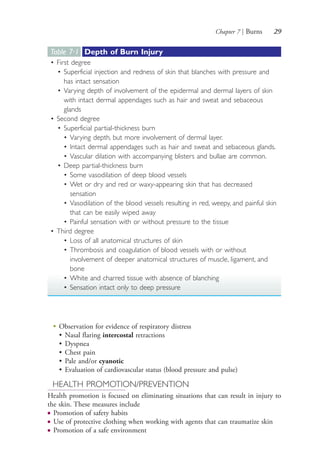
● The depth or amount of tissue destroyed (Table 7.1)
OVERVIEW
● Incidence
●
An estimated 2 million burns occur per year, with 25% of these requiring
medical attention.
●
An estimated 100,000 burn patients require hospitalization, and 10,000 die of
their burn injuries each year.
● Complications
●
Death
●
Temporary or permanent disfigurement
●
Temporary or permanent loss of function
●
Temporary or permanent disability
●
Psychosocial trauma
● Common causes are exposure to
●
Hot liquids
●
Steam
4206_Chapter 1_0001-0120.indd 274206_Chapter 1_0001-0120.indd 27 12/24/2014 2:01:15 PM12/24/2014 2:01:15 PM
Process CyanProcess CyanProcess MagentaProcess MagentaProcess YellowProcess YellowProcess BlackProcess Black
28 Section One | Dermatological Procedures
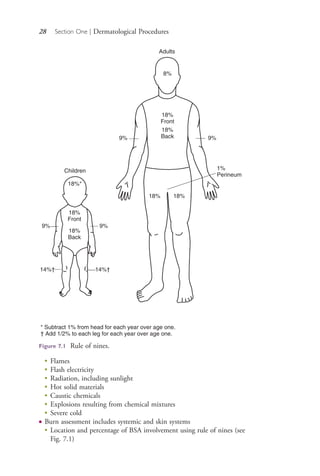
Figure 7.1 Rule of nines.
Adults
Children
* Subtract 1% from head for each year over age one.
† Add 1/2% to each leg for each year over age one.
8%
18%
Front
18%
Front
18%
Back
18%
Back
9%
9%9%
14%† 14%†
18%*
9%
18% 18%
1%
Perineum
●
Flames
●
Flash electricity
●
Radiation, including sunlight
●
Hot solid materials
●
Caustic chemicals
●
Explosions resulting from chemical mixtures
●
Severe cold
● Burn assessment includes systemic and skin systems
●
Location and percentage of BSA involvement using rule of nines (see
Fig. 7.1)
4206_Chapter 1_0001-0120.indd 284206_Chapter 1_0001-0120.indd 28 12/24/2014 2:01:15 PM12/24/2014 2:01:15 PM
Process CyanProcess CyanProcess MagentaProcess MagentaProcess YellowProcess YellowProcess BlackProcess Black
Chapter 7 | Burns 29
●
Observation for evidence of respiratory distress
• Nasal flaring intercostal retractions
• Dyspnea
• Chest pain
• Pale and/or cyanotic
• Evaluation of cardiovascular status (blood pressure and pulse)
HEALTH PROMOTION/PREVENTION
Health promotion is focused on eliminating situations that can result in injury to
the skin. These measures include
● Promotion of safety habits
● Use of protective clothing when working with agents that can traumatize skin
● Promotion of a safe environment
Table 7∙1 Depth of Burn Injury
• First degree
• Superficial injection and redness of skin that blanches with pressure and
has intact sensation
• Varying depth of involvement of the epidermal and dermal layers of skin
with intact dermal appendages such as hair and sweat and sebaceous
glands
• Second degree
• Superficial partial-thickness burn
• Varying depth, but more involvement of dermal layer.
• Intact dermal appendages such as hair and sweat and sebaceous glands.
• Vascular dilation with accompanying blisters and bullae are common.
• Deep partial-thickness burn
• Some vasodilation of deep blood vessels
• Wet or dry and red or waxy-appearing skin that has decreased
sensation
• Vasodilation of the blood vessels resulting in red, weepy, and painful skin
that can be easily wiped away
• Painful sensation with or without pressure to the tissue
• Third degree
• Loss of all anatomical structures of skin
• Thrombosis and coagulation of blood vessels with or without
involvement of deeper anatomical structures of muscle, ligament, and
bone
• White and charred tissue with absence of blanching
• Sensation intact only to deep pressure
4206_Chapter 1_0001-0120.indd 294206_Chapter 1_0001-0120.indd 29 12/24/2014 2:01:15 PM12/24/2014 2:01:15 PM
Process CyanProcess CyanProcess MagentaProcess MagentaProcess YellowProcess YellowProcess BlackProcess Black
30 Section One | Dermatological Procedures
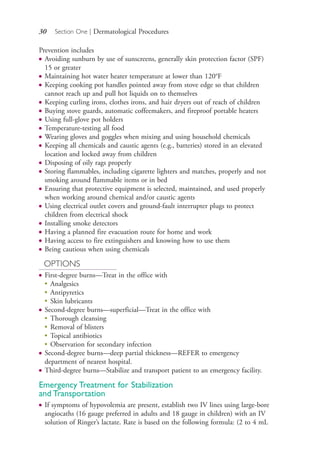
Prevention includes
● Avoiding sunburn by use of sunscreens, generally skin protection factor (SPF)
15 or greater
● Maintaining hot water heater temperature at lower than 120°F
● Keeping cooking pot handles pointed away from stove edge so that children
cannot reach up and pull hot liquids on to themselves
● Keeping curling irons, clothes irons, and hair dryers out of reach of children
● Buying stove guards, automatic coffeemakers, and fireproof portable heaters
● Using full-glove pot holders
● Temperature-testing all food
● Wearing gloves and goggles when mixing and using household chemicals
● Keeping all chemicals and caustic agents (e.g., batteries) stored in an elevated
location and locked away from children
● Disposing of oily rags properly
● Storing flammables, including cigarette lighters and matches, properly and not
smoking around flammable items or in bed
● Ensuring that protective equipment is selected, maintained, and used properly
when working around chemical and/or caustic agents
● Using electrical outlet covers and ground-fault interrupter plugs to protect
children from electrical shock
● Installing smoke detectors
● Having a planned fire evacuation route for home and work
● Having access to fire extinguishers and knowing how to use them
● Being cautious when using chemicals
OPTIONS
● First-degree burns—Treat in the office with
●
Analgesics
●
Antipyretics
●
Skin lubricants
● Second-degree burns—superficial—Treat in the office with
●
Thorough cleansing
●
Removal of blisters
●
Topical antibiotics
●
Observation for secondary infection
● Second-degree burns—deep partial thickness—REFER to emergency
department of nearest hospital.
● Third-degree burns—Stabilize and transport patient to an emergency facility.
Emergency Treatment for Stabilization
and Transportation
● If symptoms of hypovolemia are present, establish two IV lines using large-bore
angiocaths (16 gauge preferred in adults and 18 gauge in children) with an IV
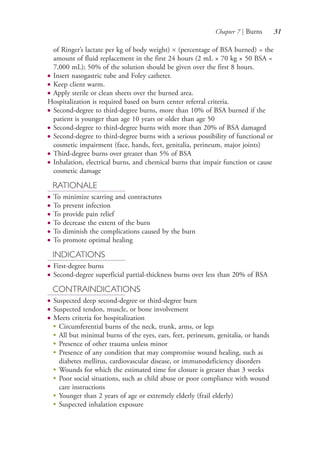
solution of Ringer’s lactate. Rate is based on the following formula: (2 to 4 mL
4206_Chapter 1_0001-0120.indd 304206_Chapter 1_0001-0120.indd 30 12/24/2014 2:01:15 PM12/24/2014 2:01:15 PM
Process CyanProcess CyanProcess MagentaProcess MagentaProcess YellowProcess YellowProcess BlackProcess Black
Chapter 7 | Burns 31
of Ringer’s lactate per kg of body weight) × (percentage of BSA burned) = the
amount of fluid replacement in the first 24 hours (2 mL × 70 kg × 50 BSA =
7,000 mL); 50% of the solution should be given over the first 8 hours.
● Insert nasogastric tube and Foley catheter.
● Keep client warm.
● Apply sterile or clean sheets over the burned area.
Hospitalization is required based on burn center referral criteria.
● Second-degree to third-degree burns, more than 10% of BSA burned if the
patient is younger than age 10 years or older than age 50
● Second-degree to third-degree burns with more than 20% of BSA damaged
● Second-degree to third-degree burns with a serious possibility of functional or
cosmetic impairment (face, hands, feet, genitalia, perineum, major joints)
● Third-degree burns over greater than 5% of BSA
● Inhalation, electrical burns, and chemical burns that impair function or cause
cosmetic damage
RATIONALE
● To minimize scarring and contractures
● To prevent infection
● To provide pain relief
● To decrease the extent of the burn
● To diminish the complications caused by the burn
● To promote optimal healing
INDICATIONS
● First-degree burns
● Second-degree superficial partial-thickness burns over less than 20% of BSA
CONTRAINDICATIONS
● Suspected deep second-degree or third-degree burn
● Suspected tendon, muscle, or bone involvement
● Meets criteria for hospitalization
●
Circumferential burns of the neck, trunk, arms, or legs
●
All but minimal burns of the eyes, ears, feet, perineum, genitalia, or hands
●
Presence of other trauma unless minor
●
Presence of any condition that may compromise wound healing, such as
diabetes mellitus, cardiovascular disease, or immunodeficiency disorders
●
Wounds for which the estimated time for closure is greater than 3 weeks
●
Poor social situations, such as child abuse or poor compliance with wound
care instructions
●
Younger than 2 years of age or extremely elderly (frail elderly)
●
Suspected inhalation exposure
4206_Chapter 1_0001-0120.indd 314206_Chapter 1_0001-0120.indd 31 12/24/2014 2:01:15 PM12/24/2014 2:01:15 PM
Process CyanProcess CyanProcess MagentaProcess MagentaProcess YellowProcess YellowProcess BlackProcess Black
32 Section One | Dermatological Procedures
PROCEDURE
Burn—Debridement
Equipment
● Towels or sheets—sterile
● Gloves—sterile
● 3-mL syringe
● 25- or 27-gauge, ½-inch needle
● 30- to 60-mL irrigation syringe
● 1% or 2% lidocaine without epinephrine
● 0.09% sodium chloride—sterile
● 4 × 4 gauze—sterile
● Gauze wrap—sterile
● Tape
● Topical antimicrobial cream, ointment, or medicated gauze (Table 7.2)
● Sterile suture set (prepackaged or self-made) should include
●
Curved and straight hemostats
●
Needle holders (4½ and 6 inch)
●
Forceps with teeth
● Scalpel (No. 11 or 15 blade)
● Iris scissors
● Cup to hold sterile sodium chloride solution
Procedure
● Put on gloves.
● Anesthetize the wound by local or digital block.
● Irrigate the wound sufficiently with 0.09% sodium chloride (usually 150 mL) to
clean any cellular debris or residue.
● Blot the wound dry with sterile 4 × 4 gauze.
● Remove excess tissue, and drain any bullae or blisters present using iris scissors
or scalpel blade.
Table 7∙2 Topical Antimicrobials
NAME SPECTRUM COST
Silver sulfadiazine
(Silvadene)
Good broad spectrum; covers
Staphylococcus
Expensive
Furacin Good broad bactericidal; covers
Pseudomonas and Enterobacteriaceae
Expensive
Povidone-iodine
(Betadine)
Superficial; can easily become skin irritant;
cannot be mixed with silver sulfadiazine
Reasonable
Silver nitrate Poor penetration; used primarily when
sensitive to other therapy agents; prone
to stain skin
Reasonable
4206_Chapter 1_0001-0120.indd 324206_Chapter 1_0001-0120.indd 32 12/24/2014 2:01:16 PM12/24/2014 2:01:16 PM
Process CyanProcess CyanProcess MagentaProcess MagentaProcess YellowProcess YellowProcess BlackProcess Black
Chapter 7 | Burns 33
● Apply liberal amount of antimicrobial ointment to the wound.
● Cover with 4 × 4 and dressing gauze wrap without restriction of range of
motion or function.
Client Instructions
● Observe for signs of infection including
●
Increased redness and warmth at the site
●
Red streaks
●
Swelling with yellow or green drainage
● Keep the area as clean as possible.
● Topical antimicrobials, cream or ointment, usually are recommended for the
first 7 days of treatment. Oral antibiotic therapy is required if secondary
infection has occurred.
● Change the dressing twice a day for the first 7 days, then every 24 hours.
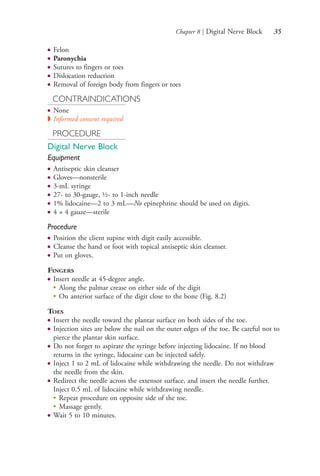
●
When redressing the wound, if the dressing adheres to the wound, saturate
the dressing with 0.09% sodium chloride and remove.
● If an arm, leg, hand, or foot is involved
●
Keep elevated above the heart for 24 to 48 hours to reduce swelling
●
Perform range of motion exercises three to four times per day
● Pain medication
●
Avoid nonsteroidal drug usage because these drugs tend to retard healing.
●
Take Tylenol No. 3 every 4 hours as needed initially, then acetaminophen.
● The deeper the burn, the greater the risk of permanent skin color changes.
● Receive a tetanus injection if none has been given in the past 5 years.
● Avoid sunburn to the burned area for 6 months to 1 year because of increased
risk of reinjury.
● Return to the office in 2 days for recheck; then weekly.
BIBLIOGRAPHY
Pfenninger JL, Fowler GC. Procedures for Primary Care Physicians. St. Louis, MO: Mosby;
2011.
Trott A. Wounds and Lacerations: Emergency Care and Closure. St. Louis, MO: Mosby; 2012.
4206_Chapter 1_0001-0120.indd 334206_Chapter 1_0001-0120.indd 33 12/24/2014 2:01:16 PM12/24/2014 2:01:16 PM
Process CyanProcess CyanProcess MagentaProcess MagentaProcess YellowProcess YellowProcess BlackProcess Black
34 Section One | Dermatological Procedures
8Chapter
Digital Nerve Block
Margaret R. Colyar
CPT Code
01460 Anesthesia for all procedures on integumentary system of
lower leg, ankle, and foot
01800 Anesthesia for all procedures on integumentary system of the
forearm, wrist, and hand
Digital nerve blocks produce sensory anesthesia to selected toes and fingers before
surgical repair, suture application, dislocation reduction, and nail procedures.
OVERVIEW
● Understanding of the neuroanatomy of the digit is necessary to perform the
digital block correctly (Fig. 8.1).
RATIONALE
● To diminish pain during invasive procedures
INDICATIONS
● Nail removal
● Ingrown toenail procedures
Figure 8.1 Neuroanatomy of
the toe (A) and finger (B).
A
B
4206_Chapter 1_0001-0120.indd 344206_Chapter 1_0001-0120.indd 34 12/24/2014 2:01:16 PM12/24/2014 2:01:16 PM
Process CyanProcess CyanProcess MagentaProcess MagentaProcess YellowProcess YellowProcess BlackProcess Black
Chapter 8 | Digital Nerve Block 35
● Felon
● Paronychia
● Sutures to fingers or toes
● Dislocation reduction
● Removal of foreign body from fingers or toes
CONTRAINDICATIONS
● None
◗ Informed consent required
PROCEDURE
Digital Nerve Block
Equipment
● Antiseptic skin cleanser
● Gloves—nonsterile
● 3-mL syringe
● 27- to 30-gauge, ½- to 1-inch needle
● 1% lidocaine—2 to 3 mL—No epinephrine should be used on digits.
● 4 × 4 gauze—sterile
Procedure
● Position the client supine with digit easily accessible.
● Cleanse the hand or foot with topical antiseptic skin cleanser.
● Put on gloves.
FINGERS
● Insert needle at 45-degree angle.
●
Along the palmar crease on either side of the digit
●
On anterior surface of the digit close to the bone (Fig. 8.2)
TOES
● Insert the needle toward the plantar surface on both sides of the toe.
● Injection sites are below the nail on the outer edges of the toe. Be careful not to
pierce the plantar skin surface.
● Do not forget to aspirate the syringe before injecting lidocaine. If no blood
returns in the syringe, lidocaine can be injected safely.
● Inject 1 to 2 mL of lidocaine while withdrawing the needle. Do not withdraw
the needle from the skin.
● Redirect the needle across the extensor surface, and insert the needle further.
Inject 0.5 mL of lidocaine while withdrawing needle.
●
Repeat procedure on opposite side of the toe.
●
Massage gently.
● Wait 5 to 10 minutes.
4206_Chapter 1_0001-0120.indd 354206_Chapter 1_0001-0120.indd 35 12/24/2014 2:01:16 PM12/24/2014 2:01:16 PM
Process CyanProcess CyanProcess MagentaProcess MagentaProcess YellowProcess YellowProcess BlackProcess Black
36 Section One | Dermatological Procedures
Client Instructions
● Sensation to the finger or toe should return within 1 to 2 hours. If this does not
occur, call the practitioner’s office.
BIBLIOGRAPHY
Brandenberg MA, Hawkins L, Quick G. Hand injuries: assessing the damage, closing the
wound, preventing infection. Consultant. December 1995:1777–1786.
Kroop K, Trott A, Syverud S. Comparison of digital versus metacarpal blocks for repair of
finger injuries. Ann Emerg Med. 1994;23(6):1296–1300.
9Chapter
Fishhook Removal
Margaret R. Colyar
CPT Code
10120 Incision and removal of foreign body, subcutaneous tissues;
simple
10121 Incision and removal of foreign body, subcutaneous tissues;
complicated
The removal of a fishhook from subcutaneous tissue can be accomplished using one
of three common methods or the angiocath method. The common methods include
(1) pull-through, (2) barb sheath, and (3) angler’s string-yank.
Figure 8.2 Injection sites.
4206_Chapter 1_0001-0120.indd 364206_Chapter 1_0001-0120.indd 36 12/24/2014 2:01:16 PM12/24/2014 2:01:16 PM
Process CyanProcess CyanProcess MagentaProcess MagentaProcess YellowProcess YellowProcess BlackProcess Black
Chapter 9 | Fishhook Removal 37
OVERVIEW
● Incidence
●
Dependent on geographical location and season
●
Estimated at approximately 0.5 million to 1 million incidents per year
● Most common organisms found with secondary infection
●
Gram-positive: Staphylococcus aureus, streptococci
●
Gram-negative: Klebsiella, Proteus, Pseudomonas (salt water)
HEALTH PROMOTION/PREVENTION
● Use good fishing technique.
● Handle all fishhooks carefully.
● Store all fishhooks properly.
● Do not reach blindly into poorly lighted tackle boxes.
● Do not fish close to another person casting a line.
OPTIONS
To remove fishhook with minimal local trauma
● Method 1—Pull-through technique
●
Use with a single- or a multiple-barbed fishhook when the angle of
penetration is such that the hook can be pushed through the skin.
● Method 2—Barb sheath method
●
Use with a single-barbed fishhook that is large but not too deep in the skin.
● Method 3—Angler’s string-yank method
●
Use with a single-barbed fishhook that is embedded in such a way that it
cannot be removed with the pull-through method.
RATIONALE
● To relieve pain and anxiety
● To diminish bacterial infection
● To promote healing
INDICATIONS
● Fishhook lodged in any subcutaneous tissue
● Fishhook in or close to the eyes, REFER to a physician.
● Suspected ligament involvement, REFER to an orthopedic physician.
● Penetration into a large-bore artery, REFER to a surgeon.
◗ Informed consent required
PROCEDURE
Fishhook Removal
Equipment
● Methods 1, 2, and 3
●
Antiseptic skin cleanser
●
Gloves—nonsterile
4206_Chapter 1_0001-0120.indd 374206_Chapter 1_0001-0120.indd 37 12/24/2014 2:01:16 PM12/24/2014 2:01:16 PM
Process CyanProcess CyanProcess MagentaProcess MagentaProcess YellowProcess YellowProcess BlackProcess Black
38 Section One | Dermatological Procedures
●
3-mL syringe
●
27- to 30-gauge, ½-inch needle
●
1% lidocaine
● Method 1 only
●
Wire cutter—from a hardware store
●
Pliers or hemostats—nonsterile
● Method 2 only
●
18-gauge, 1½-inch needle
● Method 3 only
●
Silk suture or 2 to 3 feet of strong string or fishing line
Procedure
METHOD 1—PULL-THROUGH TECHNIQUE
● Position the client with fishhook easily accessible.
● Put on gloves.
● Cleanse skin around the fishhook with antiseptic.
● Inject 1% lidocaine using the 27- to 30-gauge needle at the point of the hook.
● Using pliers or hemostats, force the fishhook tip through the skin.
● Cut off the eye of the fishhook close to the skin with wire cutters.
● Attach pliers or hemostats to the sharp end of the hook and pull the hook out
(Fig. 9.1).
Figure 9.1 After cutting off the eye of the fishhook close to
the skin, attach pliers or hemostats to the sharp end of the
hook and pull the hook out.
4206_Chapter 1_0001-0120.indd 384206_Chapter 1_0001-0120.indd 38 12/24/2014 2:01:16 PM12/24/2014 2:01:16 PM
Process CyanProcess CyanProcess MagentaProcess MagentaProcess YellowProcess YellowProcess BlackProcess Black
Chapter 9 | Fishhook Removal 39
METHOD 2—BARB SHEATH METHOD
● Position the client with fishhook easily accessible.
● Put on gloves.
● Cleanse the skin around the fishhook with antiseptic skin cleanser.
● Inject 1% lidocaine using the 27- to 30-gauge needle at the point of the hook.
● Insert the 18-gauge needle parallel to the hook with bevel toward the inside
curve of the hook (Fig. 9.2). Attempt to cover the barb with the bevel of the
needle.
● Back the hook and needle out as a unit.
METHOD 3—ANGLER’S STRING-YANK METHOD
● Position the client with fishhook easily accessible.
● Put on gloves.
● Cleanse the skin around the fishhook with antiseptic skin cleanser.
● Inject 1% lidocaine using the 27- to 30-gauge needle at the point of the hook.
● Tie the string or suture around the hook where it enters the skin.
● With your finger, push the hook further into the skin, then lift the shank of the
hook parallel to the skin (Fig. 9.3). The barb should be disengaged.
● Using the string or suture, quickly jerk the hook out.
Client Instructions
● Tetanus prophylaxis is necessary if last tetanus injection was more than 5 years
before the current incident.
● Observe for signs and symptoms of infection, such as
●
Increase in pain after 24 hours
●
Redness or swelling
●
Yellow or greenish drainage
●
Foul odor
Figure 9.2 Cover the sharp end of the hook with an 18-gauge needle. Back the
hook and needle out as a unit.
4206_Chapter 1_0001-0120.indd 394206_Chapter 1_0001-0120.indd 39 12/24/2014 2:01:16 PM12/24/2014 2:01:16 PM
Process CyanProcess CyanProcess MagentaProcess MagentaProcess YellowProcess YellowProcess BlackProcess Black
40 Section One | Dermatological Procedures
● If any signs and symptoms of infection are found, return to the office.
● Take antibiotics as ordered for 5 days—cephalexin 500 mg three times per day
or cefadroxil 500 mg twice per day—if infection is probable.
● Use pain medications as ordered. Take acetaminophen or ibuprofen every 4 to 6
hours as needed.
● Soak the affected part three times per day in warm salt water (1 teaspoon salt
per 1 quart of water) for 2 days.
● Return to the office for a follow-up visit in 48 hours, then as needed.
BIBLIOGRAPHY
Brandenberg MA, Hawkins L, Quick GG. Hand injuries: assessing the damage, closing the
wound, preventing infection. Consultant. December 1995:1777–1786.
Pfenninger JL, Fowler GC. Procedures for Primary Care Physicians. St. Louis, MO: Mosby;
2011.
Terrill P. Fishhook removal. Am Fam Physician. 1993;47(6):1372.
Figure 9.3 Push the fishhook downward with your finger. Using string or suture,
quickly jerk the hook out.
4206_Chapter 1_0001-0120.indd 404206_Chapter 1_0001-0120.indd 40 12/24/2014 2:01:16 PM12/24/2014 2:01:16 PM
Process CyanProcess CyanProcess MagentaProcess MagentaProcess YellowProcess YellowProcess BlackProcess Black
Chapter 10 | Nail Removal 41
Chapter
10Nail Removal
Margaret R. Colyar
CPT Code
11730–32 Nail removal, partial or complete
11750 Permanent nail removal, partial or complete
No code for cotton wick insertion—Use 11730–32 if part of the nail was removed.
An ingrown toenail occurs when the nail edge grows into the soft tissues, causing
inflammation, erythema, pain, and, possibly, abscess formation (Fig. 10.1). Many
times there is an offending nail spicule (small needle-shaped body) that must be
removed.
OVERVIEW
● Causes
●
Curved nails
●
Congenital malformation of the great toenail, an autosomal dominant trait
●
Nails cut too short
●
Nail trimmed round edges
●
Poorly fitting or too-tight shoes
●
High-heeled shoes
●
Accumulation of debris under nail
●
Poorly ventilated shoes
●
Chronically wet feet
HEALTH PROMOTION/PREVENTION
● Cut nails straight across.
● Notch center of nail with a V.
● Wear absorbent socks.
● Wear shoes that allow proper ventilation.
● Wear shoes that fit properly.
● Avoid high-heeled shoes.
● Use good foot hygiene.
4206_Chapter 1_0001-0120.indd 414206_Chapter 1_0001-0120.indd 41 12/24/2014 2:01:16 PM12/24/2014 2:01:16 PM
Process CyanProcess CyanProcess MagentaProcess MagentaProcess YellowProcess YellowProcess BlackProcess Black
42 Section One | Dermatological Procedures
OPTIONS
● Method 1—Cotton wick insertion
●
A noninvasive technique to be used as the initial treatment. Six treatments
may be required.
● Method 2—Partial avulsion with phenolization
● For lesions lasting more than 2 months with significant infection and
development of granulomatous tissue
RATIONALE
● To diminish pain
● To prevent or relieve abscess formation
Nail plate
Hyponychium
Sulcus
Lunula
Eponychium
(cuticle)
Nail
base
Dorsal cutaneous
nerves
Dorsal deep
nerves
Bone
Figure 10.1 Toenail anatomy.
4206_Chapter 1_0001-0120.indd 424206_Chapter 1_0001-0120.indd 42 12/24/2014 2:01:16 PM12/24/2014 2:01:16 PM
Process CyanProcess CyanProcess MagentaProcess MagentaProcess YellowProcess YellowProcess BlackProcess Black
Chapter 10 | Nail Removal 43
● To promote healing
● To prevent toenail regrowth
INDICATIONS
● Ingrown toenail without complicating medical history (onychocryptosis)
● Chronic, recurrent inflammation of the nail fold (paronychia)
CONTRAINDICATIONS
● Diabetes mellitus
● Peripheral vascular disease
● Peripheral neuropathy
● Anticoagulant therapy
● Bleeding abnormalities
● Immunocompromised state
● Pregnancy because of need to use phenol
● Allergy to local anesthetics
PROCEDURE
Nail Removal
Equipment
● Method 1 only
●
Antiseptic skin cleanser
●
Nail file or emery board
●
Cotton: 3 mm (1⁄8-inch) thick by 2.5 cm (1 inch) long
●
Gloves—nonsterile
●
Splinter forceps—sterile
●
Tincture of iodine
●
Silver nitrate stick
●
4 × 4 gauze—sterile
●
Tape
● Method 2 only—Digital nerve block
●
5-mL syringe
●
25- to 27-gauge, ½- to 1-inch needle
●
1% lidocaine without epinephrine
● Method 2—Avulsion
●
Tourniquet
●
Gloves—sterile
●
Drape—sterile
●
Hemostat—sterile
●
Surgical scissors—sterile
●
Small straight hemostat—sterile
●
Cotton swabs—sterile
●
Silver nitrate stick
●
80% or 88% phenol
4206_Chapter 1_0001-0120.indd 434206_Chapter 1_0001-0120.indd 43 12/24/2014 2:01:16 PM12/24/2014 2:01:16 PM
Process CyanProcess CyanProcess MagentaProcess MagentaProcess YellowProcess YellowProcess BlackProcess Black
44 Section One | Dermatological Procedures
●
Alcohol swabs
●
Alcohol
●
Antibiotic ointment (Bactroban, Bacitracin, or Polysporin)
●
Nonadherent dressing—Telfa or Adaptic
●
Bandage roll (tube gauze)
Procedure
METHOD 1—COTTON WICK INSERTION
● Have the client lie supine with knees flexed and feet flat.
● Cleanse affected toe with antiseptic cleanser.
● File middle third of nail on the affected side with a nail file or emery board as
illustrated (Fig. 10.2).
● Roll cotton to form a wick.
● Gently push the cotton wick under the distal portion of the lateral nail groove
on the affected side using splinter forceps (Fig. 10.3).
● Identify the offending spicule and remove it.
● Continue to insert cotton wick to separate the nail from the nail groove (1 cm
of cotton wick should remain free).
● Apply tincture of iodine to the cotton wick.
● Cauterize granulomatous tissue with silver nitrate stick.
● Bandage the toe.
Client Instructions
● Change bandage daily, and apply tincture of iodine every other day.
● Return to the office weekly for cotton wick replacement.
METHOD 2—PARTIAL AVULSION WITH PHENOLIZATION
◗ Informed consent required
● Have the client lie supine with knees flexed and feet flat.
● For digital nerve block, prepare 3 to 5 mL of lidocaine without epinephrine to
anesthetize the affected area.
Figure 10.2 File the middle third of the nail.
4206_Chapter 1_0001-0120.indd 444206_Chapter 1_0001-0120.indd 44 12/24/2014 2:01:16 PM12/24/2014 2:01:16 PM
Process CyanProcess CyanProcess MagentaProcess MagentaProcess YellowProcess YellowProcess BlackProcess Black
Chapter 10 | Nail Removal 45
● To anesthetize the nerves innervating the proximal phalanx on the extensor
surface, insert the needle toward the plantar surface on the affected side.
● Injection sites are below the nail on the outer edges of the toe (Fig. 10.4). Be
careful not to pierce the plantar skin surface.
● Inject 1 to 2 mL of lidocaine while withdrawing the needle. Do not withdraw
the needle from the skin.
● Redirect the needle across the extensor surface, and insert the needle further.
Inject 1 mL of lidocaine while withdrawing needle.
● Repeat procedure on opposite side of the digit.
● Allow 5 minutes for lidocaine to take effect before beginning procedure.
● Scrub the toe with antiseptic, rinse, dry, and drape with sterile drapes.
● Place the tourniquet around the base of the toe. Perform procedure in 15
minutes or less to avoid ischemia.
● Insert a single blade of a small hemostat between the nailbed and the toe to
open a tract (Fig. 10.5). Remove hemostat.
● Place the blade of the scissors in the tract, and cut the nail plate from distal
edge to the proximal nail base (Fig. 10.6).
● Remove the nail with a small hemostat, using gentle rotation toward the
affected nail (Fig. 10.7).
● Using a hemostat, inspect the nail groove for spicules.
● Dry the newly exposed nailbed.
Cotton wick
Figure 10.3 Gently push a cotton wick
under the lateral nail groove.
4206_Chapter 1_0001-0120.indd 454206_Chapter 1_0001-0120.indd 45 12/24/2014 2:01:16 PM12/24/2014 2:01:16 PM
Process CyanProcess CyanProcess MagentaProcess MagentaProcess YellowProcess YellowProcess BlackProcess Black
46 Section One | Dermatological Procedures
Bone
Nerve
Figure 10.4 Anesthetize the nerve innervating the proximal
phalanx. Inject the toe on the outer edges just below the
nail.
Hemostat
Figure 10.5 Insert a single blade of a
hemostat between the nailbed and the toe
to open a tract.
● Rub cotton swab saturated with phenol on germinal matrix beneath the cuticle
for 2 minutes.
● Cauterize granulomas with silver nitrate stick.
● Remove tourniquet and elevate foot for 15 minutes.
● Place a dressing in the toe.
4206_Chapter 1_0001-0120.indd 464206_Chapter 1_0001-0120.indd 46 12/24/2014 2:01:16 PM12/24/2014 2:01:16 PM
Process CyanProcess CyanProcess MagentaProcess MagentaProcess YellowProcess YellowProcess BlackProcess Black
Chapter 10 | Nail Removal 47
Client Instructions
● Avoid ischemia of toe by loosening the bandage and hanging foot down.
● Notify the practitioner if pain or swelling increases or green or yellow discharge
is present.
Figure 10.6 Cut the nail plate from distal edge to
proximal nail base.
Figure 10.7 Remove the nail using gentle outward
rotation toward the affected nail.
4206_Chapter 1_0001-0120.indd 474206_Chapter 1_0001-0120.indd 47 12/24/2014 2:01:16 PM12/24/2014 2:01:16 PM
Process CyanProcess CyanProcess MagentaProcess MagentaProcess YellowProcess YellowProcess BlackProcess Black
48 Section One | Dermatological Procedures
● If toes become cold and pale
●
Elevate foot above heart level
●
Flex the toes
●
Check circulation by pressing on the toe and watching for return of redness
when pressure is released
●
Call the practitioner if symptoms do not subside within 2 hours
● Use pain medications as ordered. Take Tylenol No. 3 every 4 to 6 hours for the
first 24 hours; then take an NSAID such as ibuprofen.
● Take ordered antibiotics for 5 days (cephalexin, tetracycline, trimethoprim-
sulfamethoxazole, amoxicillin).
● Return to the office for follow-up visit in 2 days.
BIBLIOGRAPHY
Heidelbaugh JJ, Lee H. Management of the ingrown toenail. Am Fam Physician.
2009;79(4):303–308.
Pfenninger JL, Fowler GC. Procedures for Primary Care Physicians. St. Louis, MO: Mosby;
2011.
Zuber TJ. Ingrown toenail removal. Am Fam Physician. 2002;65(12):2547–2550.
11Chapter
Ring Removal
Cynthia R. Ehrhardt
CPT Code
20670 Superficial removal of constricting metal band
20680 Deep removal of constricting metal band
Occasionally, a ring must be removed from a digit. Whenever possible, a nondestruc-
tive method is preferred. Only when conservative methods have been exhausted
should a ring cutter be used.
OVERVIEW
● Complicating factors
●
Swelling or edema to the digit
●
Increased pain and sensitivity to area
●
Embedding of metal filings into digit
General Principles
● Minimize the amount of pain.
● Smooth technique minimizes further trauma to area.
4206_Chapter 1_0001-0120.indd 484206_Chapter 1_0001-0120.indd 48 12/24/2014 2:01:16 PM12/24/2014 2:01:16 PM
Process CyanProcess CyanProcess MagentaProcess MagentaProcess YellowProcess YellowProcess BlackProcess Black
Chapter 11 | Ring Removal 49
● Anesthesia may be necessary with severe pain.
● If skin integrity is compromised, treat as a puncture wound.
● Verify no ligamentous involvement.
● After ring is removed, reevaluate vascular and motor functions.
HEALTH PROMOTION/PREVENTION
● Removal on a regular basis allows the wearer to be aware of ring size changes.
● Routinely remove the ring from the digit when working with hands.
● When trauma has occurred and the ring does not appear embedded, attempt to
remove the ring immediately.
● If swelling has occurred, do not attempt removal without proper equipment.
OPTIONS
● Method 1—Lubricant removal method
●
Used if
• No skin breakdown
• Minimal edema to digit
• No history of peripheral vascular disease
● Method 2—String-wrap method without tape anchor
●
Used if
• No skin breakdown
• Minimal edema to digit
• No suspected fracture or ligament damage
● Method 3—Circular-blade ring cutter method
●
Used if
• Suspected fracture or ligament injury
• Ring embedded in the digit
• Moderate-to-severe edema
• Preservation of the ring not necessary
RATIONALE
● To prevent circulatory and nerve impairment to the digit
INDICATIONS
● Voluntary request for removal of the constricting ring
● Involuntary removal required because of circulatory compromise
CONTRAINDICATIONS
● Lack of patient cooperation
● Suspected open or closed fracture of the digit, REFER to orthopedic surgeon.
● Deep laceration with potential ligament involvement, REFER to orthopedic
surgeon.
● Deeply embedded ring, REFER to orthopedic hand surgeon.
4206_Chapter 1_0001-0120.indd 494206_Chapter 1_0001-0120.indd 49 12/24/2014 2:01:16 PM12/24/2014 2:01:16 PM
Process CyanProcess CyanProcess MagentaProcess MagentaProcess YellowProcess YellowProcess BlackProcess Black
50 Section One | Dermatological Procedures
PROCEDURE
Ring Removal
Equipment
● Method 1 only
●
Liquid dishwashing soap or lubricant jelly
●
Windex—optional
●
Gloves—nonsterile
● Methods 2 and 3
●
Paper clips
●
Tape
●
Dental floss or 4–0 silk suture material
●
1% lidocaine (no epinephrine)
●
3-mL syringe
●
27-gauge, ½-inch needle
●
Needle-nose forceps or Kelly clamps—nonsterile
●
Topical antibiotic (Bactroban, Bacitracin, or Polysporin)
●
Band-Aids or suitable dressing material
●
Gloves—nonsterile
● Method 3 only
● Antiseptic skin cleanser
● 0.9% sodium chloride
● 20- to 30-mL syringe
● Circular-blade ring cutter
● Cool water
Procedure
METHOD 1—LUBRICANT REMOVAL METHOD
● Position the client comfortably.
● Soak affected digit in cool water for approximately 5 minutes with extremity
elevated above the heart to decrease swelling.
● Apply a liberal coating of dishwashing liquid or lubricant jelly over the affected
digit. If this fails, try spraying ring and finger with Windex.
● Rotate ring until ring slides off.
METHOD 2—STRING-WRAP METHOD WITHOUT
TAPE ANCHOR
● Position the patient comfortably.
● If the patient is in moderate pain, consider anesthesia with lidocaine to the
affected digit.
● Advance the ring to the narrowest part of the digit.
● Insert the thread (dental floss or 4–0 suture) under the ring using one of the
following methods:
●
Straight thread technique—Using forceps, slide the thread under the ring and
pull through (Fig. 11.1).
●
Paper-clip technique—Bend paper clip to an approximately 45-degree angle.
4206_Chapter 1_0001-0120.indd 504206_Chapter 1_0001-0120.indd 50 12/24/2014 2:01:16 PM12/24/2014 2:01:16 PM
Process CyanProcess CyanProcess MagentaProcess MagentaProcess YellowProcess YellowProcess BlackProcess Black
Chapter 11 | Ring Removal 51
● Insert the threaded paper clip between ring and digit; gently pull through with
fingers or forceps and remove the paper clip (Fig. 11.2A).
● Apply a liberal coat of lubricant to distal part of digit.
● Wind thread with some tension around finger, beginning close to ring and
continuing distally until six or eight single-layer wraps have been made
(Fig. 11.2B).
● Holding distal part of thread firmly, begin pulling proximal end parallel to digit,
causing the thread to unwind and removing the ring successfully (Fig. 11.2C).
METHOD 3—CIRCULAR-BLADE RING CUTTER METHOD
● Position the client comfortably, palm up.
● If the client is in moderate pain, consider the use of digital block anesthesia
with lidocaine.
● If possible, advance the ring to the narrowest part of the digit.
● Cleanse the area with antiseptic skin cleanser.
● Slip the small hook guide of the ring cutter.
● Position the ring cutter beneath the ring.
● When it is positioned, grip the saw handle and begin to apply a squeezing
pressure to the ring while turning the circular blade until the cut is complete
(Fig. 11.3).
● Release pressure, and remove the circular saw.
● Use needle-nose forceps or Kelly clamps to pull ring apart and remove ring.
● Use large syringe and flush area vigorously with 50 to 100 mL of 0.9% sodium
chloride to remove any metal filings.
● Apply dressing as needed.
Figure 11.1 Method 2—
String wrap method.
4206_Chapter 1_0001-0120.indd 514206_Chapter 1_0001-0120.indd 51 12/24/2014 2:01:16 PM12/24/2014 2:01:16 PM
Process CyanProcess CyanProcess MagentaProcess MagentaProcess YellowProcess YellowProcess BlackProcess Black
52 Section One | Dermatological Procedures
Figure 11.2 Method 2. (A) Insert the
threaded paper clip between the finger
and the ring. (B) Wind the thread
around the finger. (C) Pull the proximal
end of the thread parallel to the digit.
A B
C
Client Instructions
● Observe for signs and symptoms of infection, such as
●
Increase in pain after 24 hours
●
Increase in temperature
●
Redness or swelling
●
Yellow or greenish drainage
●
Foul odor
● If any signs and symptoms of infection are found, return to the office.
● Superficial skin abrasions—Cleanse the abrasions with soapy water three times a
day. Optional use of topical triple antibiotic (if no allergy).
● To prevent infection—Take oral antibiotics as prescribed for 7 to 10 days
(cephalexin).
4206_Chapter 1_0001-0120.indd 524206_Chapter 1_0001-0120.indd 52 12/24/2014 2:01:17 PM12/24/2014 2:01:17 PM
Process CyanProcess CyanProcess MagentaProcess MagentaProcess YellowProcess YellowProcess BlackProcess Black
Chapter 11 | Ring Removal 53
● Pain and swelling—Cool compresses to area for 5 to 10 min/hr for the first 24
hours. After 24 hours, apply heat for 5 to 10 minutes four to six times per day
for 2 to 3 days.
●
Tylenol No. 3 one or two tablets every 4 to 6 hours for 24 hours for severe
pain; then use plain or extra-strength acetaminophen.
● Tetanus—Tetanus prophylaxis is needed if skin is broken and the patient has not
had a booster in the past 5 years.
● Return to the office in 48 hours for recheck if there was a break in the skin,
difficult removal, or moderate amount of edema to the finger; then return as
needed.
BIBLIOGRAPHY
Huss CD. Removing a ring from a swollen finger. In: Driscoll CE, Rakel RE, eds. Patient
Care: Procedures for Your Practice. Oradell, NJ: Medical Economics; 1988.
Murtagh J. Practice Tips. 5th ed. New York, NY: McGraw-Hill; 2011.
Pfenninger JL, Fowler GC. (2011). Procedures for primary care physicians. St. Louis, MO:
Mosby; 2011. http://handcare.assh.org/Hand-Safety/Removing-a-Ring.aspx.
Figure 11.3 Method 3—
Circular-blade ring cutter
method.
4206_Chapter 1_0001-0120.indd 534206_Chapter 1_0001-0120.indd 53 12/24/2014 2:01:17 PM12/24/2014 2:01:17 PM
Process CyanProcess CyanProcess MagentaProcess MagentaProcess YellowProcess YellowProcess BlackProcess Black
54 Section One | Dermatological Procedures
12Chapter
Sebaceous Cyst Removal
Margaret R. Colyar
CPT Code
11400 Excision, benign lesion except skin tag, trunk, arms, or legs;
lesion diameter 0.5 cm or less
11401–06 Differing lesion diameters
11420 Excision, benign lesion except skin tag, scalp, neck, hands,
feet, genitalia; lesion diameter 0.5 cm or less
11421–26 Differing lesion diameters
A sebaceous cyst is not really an abscess by definition. A sebaceous cyst is a small,
mobile, superficial sac containing sebum or keratin. Sebaceous cysts are found fre-
quently on the scalp, back, neck, or face. Other names commonly used to describe
a sebaceous cyst are wen and epidermal cyst.
OVERVIEW
● Areas of most frequent occurrence
●
Hair follicles
●
Back
OPTIONS
● Method 1
●
Used when the cyst sac is identified and pulled easily through the incision
● Method 2
●
Used when the cyst sac is not identified or pulled easily through the incision
RATIONALE
● To diminish pain
● To remove unsightly masses
● To prevent secondary infection
INDICATIONS
● Cosmetic
● Recurrent infection
CONTRAINDICATIONS
● Cyst is on the face.
● Client has bleeding disorder.
4206_Chapter 1_0001-0120.indd 544206_Chapter 1_0001-0120.indd 54 12/24/2014 2:01:17 PM12/24/2014 2:01:17 PM
Process CyanProcess CyanProcess MagentaProcess MagentaProcess YellowProcess YellowProcess BlackProcess Black
Chapter 12 | Sebaceous Cyst Removal 55
● Proceed cautiously with clients who are diabetic or immunocompromised.
● Cyst is currently infected.
◗ Informed consent required
PROCEDURE
Sebaceous Cyst Removal
Equipment
● Methods 1 and 2
●
Antiseptic skin cleanser
●
Gloves—sterile
●
Drape—sterile
●
1% to 2% lidocaine
●
2 syringes—3 and 10 mL
●
27- to 30-gauge, ½-inch needle—for anesthesia
●
18-gauge, 1½-inch needle—for irrigation
●
No. 11 scalpel
●
Curved hemostats—sterile
●
0.9% sodium chloride—sterile
●
Iodoform gauze ¼- to ½-inch
●
Container with 10% formalin
●
4 4 gauze—sterile
●
Scissors—sterile
●
Tape
Procedure
METHOD 1—SEBACEOUS CYST REMOVAL
● Position the client with the cyst easily accessible.
● Cleanse the area and 3 inches surrounding with antiseptic skin cleanser.
● Drape the cyst with the sterile drape.
● Put on gloves.
● Perform a field block by anesthetizing the perimeter around the abscess with
1% or 2% lidocaine without epinephrine. Do not inject lidocaine into the
abscess because it does not work well in an acidic medium.
● Using the No. 11 scalpel, incise the cyst lengthwise to allow easy extraction of
the cyst material and sac.
● With curved hemostats, pull sac out onto the surface of the skin (Fig. 12.1).
● Using the No. 11 scalpel, cut the elastic tissue around the outer edges of the sac
until released.
● Irrigate with 0.9% sodium chloride.
● Close wound with sutures.
● Apply a pressure dressing.
4206_Chapter 1_0001-0120.indd 554206_Chapter 1_0001-0120.indd 55 12/24/2014 2:01:17 PM12/24/2014 2:01:17 PM
Process CyanProcess CyanProcess MagentaProcess MagentaProcess YellowProcess YellowProcess BlackProcess Black
56 Section One | Dermatological Procedures
METHOD 2—SEBACEOUS CYST REMOVAL
● Position the client with the cyst easily accessible.
● Cleanse the area and 3 inches surrounding with antiseptic skin cleanser.
● Drape the cyst with the sterile drape.
● Put on gloves.
● Perform a field block by anesthetizing the perimeter around the abscess with 1%
or 2% lidocaine without epinephrine. Do not inject lidocaine into the abscess
because it does not work well in an acidic medium.
● Using the No. 11 scalpel, incise the cyst lengthwise to allow easy extraction of
the cyst material and sac.
● Express cyst contents and put into a jar containing 10% formalin, and send to
the pathology laboratory.
● Explore the cavity with curved hemostats (Fig. 12.2).
● Break down any sacs or septa using curved hemostats.
● After expressing all purulent material, pack the wound with iodoform gauze,
leaving a small amount protruding from the wound. Advance the iodoform
gauze daily for approximately 10 to 14 days until all is removed (Fig. 12.3).
● Cover with 4 × 4 gauze and tape. If the cyst is on the head, do not pack with
iodoform gauze. Instead, roll 4 × 4 gauze into a gauze roll. Suture incision in
two places, leaving room for drainage (Fig. 12.4). Leave ends of sutures 2 to
3 inches long. Place gauze roll on top of the incision, and tie tightly in place
with the ends of the suture to form a pressure dressing. Remove the gauze roll
in 7 days.
Figure 12.1 Cut the elastic tissue around the outer edges of
the sac until released.
4206_Chapter 1_0001-0120.indd 564206_Chapter 1_0001-0120.indd 56 12/24/2014 2:01:17 PM12/24/2014 2:01:17 PM
Process CyanProcess CyanProcess MagentaProcess MagentaProcess YellowProcess YellowProcess BlackProcess Black
Chapter 12 | Sebaceous Cyst Removal 57
Figure 12.2 After expressing the contents of the cyst, explore
the cavity with hemostats.
Iodoform gauze
Figure 12.3 Pack the wound with iodoform gauze, leaving a small amount
protruding from the wound.
4206_Chapter 1_0001-0120.indd 574206_Chapter 1_0001-0120.indd 57 12/24/2014 2:01:17 PM12/24/2014 2:01:17 PM
Process CyanProcess CyanProcess MagentaProcess MagentaProcess YellowProcess YellowProcess BlackProcess Black
58 Section One | Dermatological Procedures
Client Instructions
● Observe for signs and symptoms of infection, such as
●
Increase in pain after 24 hours
●
Increase in temperature
●
Redness or swelling
●
Yellow or greenish drainage
●
Foul odor
● If any signs and symptoms of infection are found, return to the office.
● Pain and swelling—Apply cool compresses to the area for 5 to 10 min/hr for the
first 24 hours. After 24 hours, apply heat for 5 to 10 minutes four to six times
per day for 2 to 3 days.
A
B
Figure 12.4 Head wounds. (A) Suture the incision in two
places, leaving the ends of the suture long. (B) Place a
gauze roll on top of the incision and tie tightly in place
with the long ends of the suture.
4206_Chapter 1_0001-0120.indd 584206_Chapter 1_0001-0120.indd 58 12/24/2014 2:01:17 PM12/24/2014 2:01:17 PM
Process CyanProcess CyanProcess MagentaProcess MagentaProcess YellowProcess YellowProcess BlackProcess Black
Chapter 13 | Skin Closure 59
● Take Tylenol No. 3 one or two tablets every 4 to 6 hours for 24 hours for severe
pain, then use plain or extra-strength acetaminophen.
● Return to the office in 48 hours for recheck.
BIBLIOGRAPHY
Pfenninger JL, Fowler GC. Procedures for Primary Care Physicians. St. Louis, MO: Mosby;
2011.
Zuber TJ. (2002). Minimal excision technique for epidermoid (sebaceous) cysts. Am Fam
Physician. 2002;65(7):1409–1412.
Chapter
13Skin Closure
Dermabond Application
Cynthia R. Ehrhardt
CPT Code
12001–07 Simple repair of wounds
Skin closure using Dermabond (tissue adhesive) in combination with Steri-Strips is
less invasive than, has a shorter time of application than, and results in similar
outcome as suturing for smaller lacerations that do not have jagged edges and
approximate well. Only about one-third of wounds meet criteria for tissue adhesive
closure.
OVERVIEW
● Complicating factors of secondary infection similar to suturing
General Principles
● More efficient and less invasive method of wound repair
● Generally does not require anesthesia
● Lower incidence of irritation than with traditional suturing
● Equal to or better than cosmetic response with traditional suturing
● Within 2.5 minutes, bonding strength equivalent to 7 days of tissue healing by
traditional suture closure
● Torso and extremity applications do better with subcutaneous suturing before
application.
● High-tension locations and joints require splinting.
4206_Chapter 1_0001-0120.indd 594206_Chapter 1_0001-0120.indd 59 12/24/2014 2:01:17 PM12/24/2014 2:01:17 PM
Process CyanProcess CyanProcess MagentaProcess MagentaProcess YellowProcess YellowProcess BlackProcess Black
60 Section One | Dermatological Procedures
INDICATIONS
● Tissue adhesives such as Dermabond should be considered in place of 5–0 or
smaller diameter sutures.
● Small wound repair
● Facial wounds
CONTRAINDICATIONS
● Adhesive sensitivity
● Jagged or irregular lacerations
● Mucosa or moist surface
● Contaminated wounds
● Bites or punctured wounds
● Highly movable sites of hands and feet that cannot be splinted
● Crushed wounds
● Axillae and perineum areas
● Evidence of or potential for purulent exudate from the wound
● Wound greater than 5 cm
PROCEDURE
Skin Closure—Dermabond Application
Equipment
● Dermabond
● Povidone-iodine
● Alcohol prep pads
● Petroleum jelly
● Gloves—nonsterile
● Optional—topical anesthetic
● Optional—Steri-Strips
Procedure
● Assess the wound and irrigate with saline as needed.
● Apply povidone-iodine to the wound beginning at the wound edges and
expanding out in a circular pattern.
●
Allow to dry.
●
Remove with alcohol prep pad before application of Dermabond.
●
Put on gloves.
● If needed, apply topical anesthetic.
● Oppose the wound edges with good approximation.
● Crush the Dermabond vial and invert. You have only a few minutes to use this
vial before polymerization results in sealing of the applicator orifice. Excessive
pressure to the vial results in dripping.
● When the adhesive is at the tip of the applicator, apply to the approximated
wound edges with a gentle brushing motion to the edges. This method of
application avoids tissue adhesive from oozing into the wound.
4206_Chapter 1_0001-0120.indd 604206_Chapter 1_0001-0120.indd 60 12/24/2014 2:01:17 PM12/24/2014 2:01:17 PM
Process CyanProcess CyanProcess MagentaProcess MagentaProcess YellowProcess YellowProcess BlackProcess Black
Chapter 13 | Skin Closure 61
● Hold wound edges in place for 30 seconds.
● If edges are not approximated, you have 10 seconds to make any corrections
before the wound is “glued.” If an error is made, wipe as much of the adhesive
off and apply liberal petroleum jelly to the exterior site for 30 minutes to
neutralize the adhesive.
● Apply a total of three layers of adhesive. The layer must be dry before the next
can be applied. Blowing on or fanning the area does not accelerate drying time.
● Optional—Steri-Strips may be applied only if over high-tension areas.
Client Instructions
● No bandage is required for adults. In active children, a bandage may be used to
prevent the child from picking at the wound.
● You may shower within 6 hours after the application.
●
Avoid prolonged water exposure.
●
Dry area immediately after showering.
● Do not use topical antibiotics. They weaken the glue.
● Adhesive spontaneously peels in 5 to 10 days.
● Observe for signs and symptoms of infection, such as
●
Increase in pain after 24 hours
●
Increase in temperature
●
Redness or swelling
●
Yellow or greenish drainage
●
Foul odor
● If any signs and symptoms of infection are found, return to the office.
● Return to the office in 48 hours for wound recheck.
BIBLIOGRAPHY
Bruns T, Worthington J. Using tissue adhesive for wound repair: a practical guide to
Dermabond. Am Fam Physician. 2000;61(5):1382–1388.
Forsch RT. Essentials of skin laceration repair. Am Fam Physician. 2008;78(8):945–951.
King M, Kinney A. (1999). Tissue adhesives: a new method of wound repair. Nurse Pract.
1999;24(10):66, 69–70, 73–74.
Knott PD, Zins JE, Banbury J, Djohan R, Yetman RJ, Papay F. A comparison of
dermabond tissue adhesive and sutures in the primary repair of the congenital cleft lip.
Ann Plast Surg. 2007; 58(2):121–125.
Quinn J, Wells G, Sutcliffe T, et al. A randomized trial comparing octylcyanoacrylate tissue
adhesive and sutures in the management of lacerations. JAMA. 1997;277(19):1559–
1560. http://www.accessdata.fda.gov/cdrh_docs/pdf/P960052c.pdf.
4206_Chapter 1_0001-0120.indd 614206_Chapter 1_0001-0120.indd 61 12/24/2014 2:01:17 PM12/24/2014 2:01:17 PM
Process CyanProcess CyanProcess MagentaProcess MagentaProcess YellowProcess YellowProcess BlackProcess Black
62 Section One | Dermatological Procedures
Chapter
14Skin Lesion Removal
Cautery and Cryosurgery
Margaret R. Colyar
CPT Code
17000 Destruction, any method, including laser, with or without
surgical curettement, all benign lesions/premalignant
lesions any location or benign lesions other than
cutaneous vascular proliferative lesions, including local
anesthesia; one lesion.
17003 Multiple lesions
17110 Destruction, any method, flat warts or molluscum
contagiosum, milia; up to 14
17260 Destruction, malignant lesion, any method, trunk, arms, or
legs; lesion diameter 0.5 cm or less
17261–66 Differing lesion diameters
17270 Destruction, malignant lesion, any method, scalp, neck,
hands, feet, genitalia; 0.5 cm or less
17271–76 Differing lesion diameters
Two methods of removing skin lesions are cautery and cryosurgery. Another
method, minor surgery (elliptical excision biopsy), is discussed in Chapter 2. Cautery
is the destruction of tissue by the use of electricity, freezing, heat, or corrosive materi-
als. Thermocautery is the process of tissue removal or destruction by the use of
red-hot or white-hot heat.
Cryosurgery is a technique of exposing tissues to extreme cold to produce cell
injury and destruction. This technique is safe and easy. Lesions heal with minimal
or no scarring. No injections of local anesthetics or sutures are involved. Cryosurgery
feels like an ice cube stuck to the skin. Temperatures that destroy tissues
● −10°C to −20°C
● Temperatures to −50°C ensures malignant cells are completely destroyed
OVERVIEW
● Freeze time guidelines for cryosurgery are recommended for different types of
lesions (Table 14.1).
OPTIONS
● Method 1—Cautery
● Method 2—Cryosurgery
●
Superficial lesions—seborrheic keratoses
4206_Chapter 1_0001-0120.indd 624206_Chapter 1_0001-0120.indd 62 12/24/2014 2:01:17 PM12/24/2014 2:01:17 PM
Process CyanProcess CyanProcess MagentaProcess MagentaProcess YellowProcess YellowProcess BlackProcess Black
Chapter 14 | Skin Lesion Removal 63
Table 14·1 Freeze Time Guidelines for Skin Lesions
TYPE OF SKIN LESION FREEZE TIME, SEC
Full thickness (benign) 60–90
Plantar warts (after debridement) 30–40
Condylomata 45
Verrucae 60–90
Seborrheic keratoses (2 mm) 30
Actinic keratoses (c mm) 90
● Freeze for 30 to 40 seconds or until a 2- to 3-mm ice ball forms beyond the
lesion.
● −89°C
●
Benign or premalignant lesions—actinic keratoses
● Freeze 1 to 1.5 minutes or until a greater-than-3-mm ice ball forms beyond the
lesion (freeze, thaw, refreeze).
● −89°C
●
Malignant lesions—basal cell carcinoma
● Freeze for 1.5 minutes or until a greater-than-5- to 8-mm ice ball forms beyond
the lesion (freeze, thaw, refreeze).
● Activate rapid thaw.
●
Large or irregular lesions
● Same as malignant lesions except
● Start on one side and progress to the opposite side.
● Refreeze overlapping first freeze zone by 50% (Fig. 14.1).
●
Keloids or hypertrophic scars
● See Chapter 15.
RATIONALE
● To remove lesions for cosmetic reasons
● To remove cancerous lesions
● To prevent further tissue destruction caused by spread of malignant lesions
INDICATIONS
● Skin tags
● Basal cell carcinoma
● Condyloma acuminatum
● Actinic keratoses
● Seborrheic keratoses
● Lentigo (freckles)
● Benign nevi—papular or acquired
● Telangiectasias—small
● Warts—verruca vulgaris and plantaris
4206_Chapter 1_0001-0120.indd 634206_Chapter 1_0001-0120.indd 63 12/24/2014 2:01:17 PM12/24/2014 2:01:17 PM
Process CyanProcess CyanProcess MagentaProcess MagentaProcess YellowProcess YellowProcess BlackProcess Black
64 Section One | Dermatological Procedures
CONTRAINDICATIONS
● Face lesions
● Dark skin due to pigment changes
● Area that is hairy because freezing destroys hair follicles
● Melanoma
● Compromised circulation
● Areas in which biopsy is required
● Clients with high levels of cryoglobulins (abnormal proteins that precipitate
when cooled and dissolve when reheated to body temperature)
●
Endocarditis
●
Syphilis
●
Epstein-Barr virus
●
Cytomegalovirus
●
Hepatitis B—chronic
●
On high-dose steroid treatment
● Collagen disease
● Active ulcerative colitis
● Glomerulonephritis
● Recurrent basal cell carcinoma
◗ Informed consent required
Figure 14.1 For large or irregular lesions—refreeze,
overlapping first freeze zone by 50%.
Cryoprobe
Ice ball
Freeze line
4206_Chapter 1_0001-0120.indd 644206_Chapter 1_0001-0120.indd 64 12/24/2014 2:01:17 PM12/24/2014 2:01:17 PM
Process CyanProcess CyanProcess MagentaProcess MagentaProcess YellowProcess YellowProcess BlackProcess Black
Chapter 14 | Skin Lesion Removal 65
PROCEDURE
Skin Lesion Removal
Equipment
● Methods 1 and 2
●
Antiseptic skin cleanser
●
Gloves—nonsterile
●
Tape
●
Topical antibiotic (Bactroban, Bacitracin, or Polysporin)
● Method 1 only
●
Drape—sterile
●
3-mL syringe
●
27- to 30-gauge, ½-inch needle
●
1% lidocaine
●
4 × 4 gauze—sterile
●
Disposable cautery pen
● Method 2 only
●
Verruca Freeze Kit or nitrous oxide cryosurgery unit (Fig. 14.2)
●
Cotton-tipped applicators
● Water-soluble lubricant (K-Y jelly)
● 4 × 4 gauze soaked with water
Figure 14.2 Veruca Freeze Kit. (From CryoSurgery, Inc., Nashville, TN).
4206_Chapter 1_0001-0120.indd 654206_Chapter 1_0001-0120.indd 65 12/24/2014 2:01:17 PM12/24/2014 2:01:17 PM
Process CyanProcess CyanProcess MagentaProcess MagentaProcess YellowProcess YellowProcess BlackProcess Black
66 Section One | Dermatological Procedures
Procedure
METHOD 1—CAUTERY
● Position the client so that the lesion is easily accessible.
● Cleanse the area and a 3-inch-diameter space around the lesion with antiseptic
skin cleanser.
● Inject the tissue under the lesion with 1% lidocaine. If a large lesion (greater
than 3 mm), perform a field block.
● Drape the lesion.
● Put on gloves.
● Cauterize the lesion with the disposable cautery pen.
● Wipe off the burned area.
● Apply topical antibiotic.
● Cover with 4 × 4 gauze and tape.
METHOD 2—CRYOSURGERY
● Position the client so that the lesion is easily accessible.
● Cleanse the area and a 3-inch-diameter space around the lesion with antiseptic
skin cleanser.
● Apply water-soaked gauze for 5 to 10 minutes.
● Drape the lesion.
● Put on gloves.
● Apply K-Y jelly with a cotton-tipped applicator to the lesion.
● Choose the tip desired (Fig. 14.3).
Figure 14.3 The shape of the cryoprobe affects depth and extent of the freeze. By
applying pressure, a deeper freeze can be achieved.
4206_Chapter 1_0001-0120.indd 664206_Chapter 1_0001-0120.indd 66 12/24/2014 2:01:17 PM12/24/2014 2:01:17 PM
Process CyanProcess CyanProcess MagentaProcess MagentaProcess YellowProcess YellowProcess BlackProcess Black
Chapter 14 | Skin Lesion Removal 67
● Freeze the lesion for the appropriate amount of time (see Options).
● Apply topical antibiotic.
● Cover with 4 × 4 gauze and tape.
Client Instructions—Methods 1 and 2
● Although infection is unlikely, observe for signs and symptoms of infection,
such as
●
Increase in pain after 24 hours
●
Increase in temperature
●
Redness or swelling
●
Yellow or greenish drainage
●
Foul odor
● If any signs and symptoms of infection are found, return to the office.
● The following are considered normal reactions:
●
Redness—immediate response
●
Swelling and blisters form—within 24 to 48 hours—and decrease within 72
hours
●
Within 72 hours, crusts form and slowly wither over 1 week
●
Heals from outer margin toward the center
●
Skin may be lighter color and less hair may be present at the site.
●
Not much scar formation
●
Wound weeping up to 8 weeks
●
Sensitive skin—wear sunscreen
● Return to the office in 1 week for recheck.
BIBLIOGRAPHY
Andrews MD. Cryosurgery for common skin conditions. Am Fam Physician.
2004;69(10):2365–2372.
Habif T. Clinical Dermatology: A Color Guide to Diagnosis and Therapy. 5th ed. St. Louis,
MO: Mosby; 2009.
Hocutt J. Skin cryosurgery for the family practice physician. Am Fam Physician.
1993;48(3):445–447.
Pfenninger JL, Fowler GC. Procedures for Primary Care Physicians. St. Louis, MO: Mosby;
2011.
4206_Chapter 1_0001-0120.indd 674206_Chapter 1_0001-0120.indd 67 12/24/2014 2:01:18 PM12/24/2014 2:01:18 PM
Process CyanProcess CyanProcess MagentaProcess MagentaProcess YellowProcess YellowProcess BlackProcess Black
68 Section One | Dermatological Procedures
15Chapter
Skin Lesion Removal
Keloids, Moles, Corns, Calluses
Margaret R. Colyar
CPT Code
11050 Paring or curettement of benign hyperkeratotic skin
lesion with or without chemical cauterization (verrucae,
callus, corns), single lesion
11056 Two to four lesions
11057 Greater than four lesions
11300–33 Shaving of epidermal or dermal lesion, single lesion; trunk,
arms, or legs
11305–38 Shaving of epidermal or dermal lesion, single lesion; scalp,
neck, hands, feet, genitalia
Skin lesions such as keloids, moles, corns, and calluses are removed easily. Keloids
are benign, hard, fibrous proliferations of collagen that expand beyond the original
size and shape of the wound, sometimes 20 times normal size. They invade sur-
rounding soft tissue in a clawlike fashion. Moles, or nevi, are discolorations of cir-
cumscribed areas of the skin resulting from pigmentation. They can be congenital
or acquired. Acquired nevi usually appear first in childhood and in sun-exposed areas.
These nevi extend into the dermis and epidermis (Fig. 15.1) by late adolescence and
intradermis by late adulthood. Nevi always should be assessed for
● Asymmetry
● Border irregularities
● Color variation
● Diameter greater than 6 mm
● Elevation above the skin surface
Corns, or keratomas, are hyperkeratotic lesions or horny indurations with thick-
ening and nucleation of the skin, usually on the toes. Hard corns are located on the
dorsal aspect of the toes. Soft corns are located between the digits, usually the fourth
interdigital space.
Calluses are hypertrophied, hyperkeratotic thickenings of the stratum corneum,
usually located around the heel of the foot, great toe, metatarsal heel, and distal
aspect of the first three digits of the dominant hand or palmar aspect of the meta-
carpal head. There is no underlying nucleus (core).
4206_Chapter 1_0001-0120.indd 684206_Chapter 1_0001-0120.indd 68 12/24/2014 2:01:18 PM12/24/2014 2:01:18 PM
Process CyanProcess CyanProcess MagentaProcess MagentaProcess YellowProcess YellowProcess BlackProcess Black
Chapter 15 | Skin Lesion Removal 69
OVERVIEW
● Incidence—keloids
●
15 to 20 times greater in dark-skinned people. They develop more frequently
in areas of motion or high skin tension, such as
• Shoulders
• Back
• Presternum
• Earlobe
• Face
● Incidence—moles, corns, and calluses—unknown
● Causes
●
Moles
●
Congenital
• Acquired
• Corns
• Pressure from poorly fitting shoes
●
Calluses
• Continuous friction
• Pressure from poorly fitting shoes
• Pencil and pen use
• Physical labor using the unprotected hand
Figure 15.1 Anatomy and layers of skin.
Sweat
gland
Epidermis
Dermis
Subcutaneous
tissue
Sebaceous
gland
Hair follicle
Fat
Derma
papilla
4206_Chapter 1_0001-0120.indd 694206_Chapter 1_0001-0120.indd 69 12/24/2014 2:01:18 PM12/24/2014 2:01:18 PM
Process CyanProcess CyanProcess MagentaProcess MagentaProcess YellowProcess YellowProcess BlackProcess Black
70 Section One | Dermatological Procedures
HEALTH PROMOTION/PREVENTION
Corns
● Wear properly fitting shoes.
● Use moleskin or felt spacer to relieve pressure of bony prominences.
OPTIONS
Keloids
● Method 1—Cryotherapy—earlobe and all areas
● Method 2—Corticosteroid injection—early, small, narrow, or softened lesions or
to soften and/or flatten
● Method 3—Surgical excision—any keloid
RATIONALE
● To remove unsightly skin lesions
● To relieve pain
INDICATIONS
● Cosmetic
● Pressure and pain
● Limitation of use
● Suspicion of malignancy
CONTRAINDICATIONS
● Poor circulation to the area
● Diabetic
● Immunocompromised
◗ Informed consent required
PROCEDURE
Keloid Removal
Equipment
● Methods 1, 2, and 3
●
Antiseptic skin cleanser
●
Gloves—nonsterile
● Methods 2 and 3
●
10-mL syringe
●
25- to 27-gauge, 1½-inch needle (very small needles usually are unable to
penetrate the lesions adequately)
●
1% lidocaine
●
Corticosteroid of choice
● Method 1 only
●
Water-soluble lubricant (K-Y jelly)
●
Cotton-tipped applicators
●
Liquid nitrogen (−89°C, −129.2°F)
4206_Chapter 1_0001-0120.indd 704206_Chapter 1_0001-0120.indd 70 12/24/2014 2:01:18 PM12/24/2014 2:01:18 PM
Process CyanProcess CyanProcess MagentaProcess MagentaProcess YellowProcess YellowProcess BlackProcess Black
Chapter 15 | Skin Lesion Removal 71
● Method 3 only
●
6–0 nylon suture
●
Needle driver—sterile
●
Scissors—sterile
●
No. 15 scalpel
Procedure
METHOD 1—CRYOTHERAPY
● Position the client with the lesion easily accessible.
● Cleanse the area and a 3-inch-diameter space around the keloid with antiseptic
skin cleanser.
● Apply water-soaked gauze for 5 to 10 minutes to soften the lesion.
● Apply K-Y jelly for 5 to 10 minutes.
● Using a cryotip narrower than the lesion
●
Freeze for 10 to 15 seconds at −189°C (−308°F), then
●
Freeze for 30 to 45 seconds at −89°C (−129.2°F).
● Wait 15 to 30 minutes for tissue edema to develop.
● Inject the keloid with corticosteroids (see Corticosteroid Injection, following).
METHOD 2—CORTICOSTEROID INJECTION
● Position the client with the keloid easily accessible.
● Cleanse the area and a 3-inch-diameter space around the keloid with antiseptic
skin cleanser.
● Draw 2.5 mL of 1% lidocaine and 0.5 mL of corticosteroid into the syringe.
● Inject the medication into the lesion. The keloid will blanche. Do not inject the
medication under or around the lesion.
METHOD 3—SURGICAL EXCISION
● See Chapter 2 (Method 3—Elliptical Excisional Biopsy).
Mole Removal
Equipment
● Antiseptic skin cleanser
● Gloves—sterile
● 10-mL syringe
● 25- to 27-gauge, 1½-inch needle (very small needles usually are unable to
penetrate the lesions adequately)
● 1% lidocaine
● Corticosteroid of choice
● 6–0 nylon suture
● Needle driver—sterile
● Scissors—sterile
● No. 15 scalpel
Procedure
Same as for cryosurgery, surgical excision, punch biopsy, and shave biopsy.
4206_Chapter 1_0001-0120.indd 714206_Chapter 1_0001-0120.indd 71 12/24/2014 2:01:18 PM12/24/2014 2:01:18 PM
Process CyanProcess CyanProcess MagentaProcess MagentaProcess YellowProcess YellowProcess BlackProcess Black
72 Section One | Dermatological Procedures
Corn Removal
Equipment
● Wash basin—nonsterile
● Warm water—tap
● Antiseptic skin cleanser
● Drape—nonsterile
● Gloves—nonsterile
● No. 15 scalpel
● 1% lidocaine
● 3-mL syringe
● 27- to 30-gauge needle
● Self-adherent web spacer
● Topical antibiotic (Bactroban, Bacitracin, or Polysporin)
● 4 × 4 gauze—sterile
● Tape
Procedure
● Soak the foot for 15 to 20 minutes in warm water.
● Cleanse the skin around the corn with antiseptic skin cleanser.
● Anesthetize under the corn with 1% lidocaine.
● Drape the area.
● Put on gloves.
● Pare with No. 15 scalpel and remove core.
● Apply antibiotic, cover with 4 × 4 gauze, and tape.
Callus Removal
Equipment
● Pumice stone or file
● Wash basin—nonsterile
● Warm water
● Antiseptic skin cleanser
● Gloves—nonsterile
● No. 15 scalpel
Procedure
● Soak the foot for 15 to 20 minutes in warm water.
● Cleanse the foot with antiseptic skin cleanser.
● Put on gloves.
● Pare thick callous layers with No. 15 scalpel.
● File down with file or pumice stone.
Client Instructions
KELOIDS, MOLES, AND CORNS
● Apply antibiotic ointment, cover with 4 × 4 gauze, and tape or apply Band-Aid
for 2 days; then leave open to air.
4206_Chapter 1_0001-0120.indd 724206_Chapter 1_0001-0120.indd 72 12/24/2014 2:01:18 PM12/24/2014 2:01:18 PM
Process CyanProcess CyanProcess MagentaProcess MagentaProcess YellowProcess YellowProcess BlackProcess Black
Chapter 16 | Skin Tag (Acrochordon) Removal 73
● Observe for signs of infections, such as
●
Green or yellow drainage
●
Red streaks
●
Increase in pain after 24 hours
●
Elevated temperature
●
Foul odor from wound
● If infection occurs, return to the office.
● Take acetaminophen or ibuprofen every 4 to 6 hours as needed for pain.
● Return to the office in 1 week for recheck.
CALLUSES
● Perform the following procedure weekly after bathing
●
Pare thick callous layers.
● File down with file or pumice stone.
● Apply felt spacers or moleskin.
● Take acetaminophen or ibuprofen every 4 to 6 hours as needed for pain.
● Return to the office in 1 month, unless condition worsens.
BIBLIOGRAPHY
Berman B, Bieley HC. Adjunct therapies to surgical management of keloids. Dermatol Surg.
1996;22(79):126–130.
Juckett G. Management of keloids and hypertrophic scars. Am Fam Physician.
2009;80(3):253–260.
Pfenninger JL, Fowler GC. Procedures for Primary Care Physicians. St. Louis, MO: Mosby;
2011.
Chapter
16Skin Tag (Acrochordon) Removal
Margaret R. Colyar
CPT Code
11200 Removal of skin tags, multiple fibrocutaneous tags any area;
up to and including 15 lesions
11201 Removal of skin tags, multiple fibrocutaneous tags any area;
each additional 10 lesions
Skin tags, or acrochordons, are benign skin lesions that can be removed by scissor-
ing, any sharp method, or chemical or electrocauterization of the wound. Local
anesthesia may or may not be used. Removal usually is done because of irritation of
the lesion or for cosmetic reasons.
4206_Chapter 1_0001-0120.indd 734206_Chapter 1_0001-0120.indd 73 12/24/2014 2:01:18 PM12/24/2014 2:01:18 PM
Process CyanProcess CyanProcess MagentaProcess MagentaProcess YellowProcess YellowProcess BlackProcess Black
74 Section One | Dermatological Procedures
HEALTH PROMOTION/PREVENTION
● Avoid chronic irritation to the skinfolds of the body.
● Examine the body regularly for changes in color and size of skin lesions.
OPTIONS
● Method 1—Snips technique
●
Use with small skin tags.
● Method 2—Cryogenic technique
●
Use with large skin tags.
RATIONALE
● To reduce the possibility of inflammation and infection caused by local
irritation
● To promote cosmetic enhancement
INDICATIONS
● Unsightly skin tags
● Skin tags irritated by clothing
CONTRAINDICATIONS
● Any lesion that is suspect for malignancy
● High-dose steroid therapy
● Individuals with underlying medical diseases, such as
● Active severe collagen vascular diseases
● Acute poststreptococcal glomerulonephritis
● Acute severe subacute bacterial endocarditis
● Acute cytomegalovirus infection
● Acute Epstein-Barr virus infection
● Acute syphilis infection
● Chronic severe hepatitis B
● Cryoglobulinemia
● Diabetes with history of poor healing
◗ Informed consent required
PROCEDURE
Skin Tag Removal
Equipment
● Methods 1 and 2
●
Antiseptic skin cleanser
●
Water-soluble lubricant (K-Y jelly)
●
Cotton-tipped applicators—sterile
●
Topical antibiotic (Bactroban, Bacitracin, or Polysporin)—optional
●
Band-Aids
●
Drape—sterile
4206_Chapter 1_0001-0120.indd 744206_Chapter 1_0001-0120.indd 74 12/24/2014 2:01:18 PM12/24/2014 2:01:18 PM
Process CyanProcess CyanProcess MagentaProcess MagentaProcess YellowProcess YellowProcess BlackProcess Black
Chapter 16 | Skin Tag (Acrochordon) Removal 75
●
Goggles—optional
● Tape—optional
● Method 1 only
●
Gloves—sterile
●
Sterile surgical kit that includes
• 2 × 2 or 4 × 4 gauze
• Forceps with teeth
• Iris scissors
• No. 11 or 15 scalpel
●
1% lidocaine
●
5-mL syringe
●
27-gauge, ½- to 1-inch needle
●
Hemostatic agent—aluminum chloride or ferrous subsulfate
●
Container with 10% formalin
● Method 2 only
●
Nitrous oxide cryosurgery unit or cryogun
●
Timer
●
Gloves—nonsterile
Procedure
METHOD 1—SNIPS TECHNIQUE
● Position the client for comfort.
● Put on gloves.
● Apply antiseptic skin cleanser to the skin tag and surrounding area.
● Infiltrate the base of the skin tag with 1% lidocaine (Fig. 16.1).
● Grasp the skin tag at the largest part (Fig. 16.2).
● Gently pull the skin tag until the stalk base is visible (Fig. 16.3).
Figure 16.1 Infiltrate the base of the skin tag
with lidocaine.
Skin tag
4206_Chapter 1_0001-0120.indd 754206_Chapter 1_0001-0120.indd 75 12/24/2014 2:01:18 PM12/24/2014 2:01:18 PM
Process CyanProcess CyanProcess MagentaProcess MagentaProcess YellowProcess YellowProcess BlackProcess Black
76 Section One | Dermatological Procedures
Skin tag
Figure 16.2 Grasp the skin tag at the largest
part with hemostats.
Skin tag
Figure 16.3 Pull the skin tag until the stalk
base is visible.
● Using the iris scissors or scalpel, cut or slice the stalk as close to the base of the
stalk as possible (Fig. 16.4).
● Apply a hemostatic agent (ferrous subsulfate or aluminum chloride) with
cotton-tipped applicator. Hold on the area until the bleeding stops.
● Place the skin tags in the container with 10% formalin for laboratory pathology.
● Apply topical antibiotic—optional.
● Apply a Band-Aid.
4206_Chapter 1_0001-0120.indd 764206_Chapter 1_0001-0120.indd 76 12/24/2014 2:01:18 PM12/24/2014 2:01:18 PM
Process CyanProcess CyanProcess MagentaProcess MagentaProcess YellowProcess YellowProcess BlackProcess Black
Chapter 16 | Skin Tag (Acrochordon) Removal 77
METHOD 2—CRYOGENIC TECHNIQUE
See Chapter 14.
● Position the client so that the lesion is easily accessible.
● Cleanse the area and a 3-inch-diameter space surrounding with antiseptic skin
cleanser.
● Drape the lesion.
● Put on gloves.
● Prepare equipment as manufacturer recommends.
● Select the appropriate-size device to match the size of the lesion.
● Anesthetize the site—optional.
● Use a cotton-tipped applicator to apply enough K-Y jelly to cover the skin tag
but not beyond the tag.
● Apply the selected probe to the site and penetrate approximately halfway into
the jelly.
● Squeeze the cryogun trigger to release the nitrogen oxide. The jelly is
transformed into an ice ball.
● If area of skin is thin, when the jelly is frozen, pull up slightly on the skin to
lessen depth of the tissue freezing.
● Application time is usually 30 seconds. Larger skin tags may require 45 seconds.
● Release the trigger.
● Allow the jelly to thaw before removing the probe from the site of the
cryosurgery.
● Depending on the response of the lesion, a repeat freeze-thaw may be required
for an additional 30 seconds.
● Do not apply any dressing until lesion becomes irritated and/or is bleeding.
Skin tag
Figure 16.4 Cut the stalk of the skin tag
as close as possible to the base of the
stalk.
4206_Chapter 1_0001-0120.indd 774206_Chapter 1_0001-0120.indd 77 12/24/2014 2:01:18 PM12/24/2014 2:01:18 PM
Process CyanProcess CyanProcess MagentaProcess MagentaProcess YellowProcess YellowProcess BlackProcess Black
78 Section One | Dermatological Procedures
● Topical antibiotic ointment is not recommended.
● Apply a Band-Aid to be removed when the client gets home.
Client Instructions
● On completion of treatment of the skin tag, the area appears erythematous and
indurated (hard). A red ring may be visible around the site 2 weeks after
removal. This is a normal response.
● Retreatment may be required if the entire lesion does not slough off.
● Keep the wound clean and dry.
● A Band-Aid is not required usually after 1 hour.
● Antibiotics are not required.
● Observe for signs and symptoms of infection, such as
●
Increase in pain after 24 hours
●
Increase in temperature
●
Redness or swelling
●
Yellow or greenish drainage
●
Foul odor
● If any signs and symptoms of infection are found, return to the office.
● Pain—acetaminophen every 4 hours as needed for mild pain for the first 24
hours. After 24 hours, ibuprofen or naproxen may be used.
●
Acetaminophen with codeine rarely is used for severe pain because most skin
lesions have few nerve endings. If discomfort continues and infection has been
excluded, use Tylenol No. 3 every 4 to 6 hours as needed.
●
Bathing is permitted 48 hours after the procedure.
● If the cryogenic technique was used
●
First 24 to 48 hours, a blister may form; if it does, apply a small, non-stick
Band-Aid until the weeping has stopped.
● Ideally, leave the wound exposed for more rapid healing.
● Redness to the site is common and lessens with time.
● The pain should lessen within 24 hours.
● A cotton swab with hydrogen peroxide may be used if the site becomes crusty.
● No topical antibiotic should be applied.
● Nonaspirin pain reliever is suggested.
● Rarely, painful and large blisters can occur. If they do, contact the practitioner
to determine course of management. (Usually, these blisters are drained.)
● If infection is suspected, contact health-care provider.
● Within 7 to 10 days, a scab should form. Do not pick it. Let it fall off naturally.
●
Most redness and decreased skin coloration resolve within 3 to 6 months.
●
Some lesions may require retreatment.
● Remove the Band-Aid. Keep the area covered only if it is being irritated
constantly. Continuous covering of the wound increases risk of infection.
BIBLIOGRAPHY
Habif T. Clinical Dermatology: A Color Guide to Diagnosis and Therapy. 5th ed. St. Louis,
MO: Mosby; 2011.
4206_Chapter 1_0001-0120.indd 784206_Chapter 1_0001-0120.indd 78 12/24/2014 2:01:18 PM12/24/2014 2:01:18 PM
Process CyanProcess CyanProcess MagentaProcess MagentaProcess YellowProcess YellowProcess BlackProcess Black
Chapter 17 | Soft Tissue Aspiration 79
Matzen R, Lang R. Clinical Preventive Medicine. St. Louis, MO: Mosby; 1993.
Murtagh J. Practice Tips. 5th ed. New York, NY: McGraw-Hill; 2011.
Pfenninger JL, Fowler GC. Procedures for Primary Care Physicians. St. Louis, MO: Mosby;
2011.
Chapter
17Soft Tissue Aspiration
Margaret R. Colyar
CPT Code
20600 Arthrocentesis, aspiration, or injection: small joint, bursa, or
ganglionic cyst (e.g., fingers or toes)
20605 Arthrocentesis, aspiration, or injection: intermediate joint,
bursa, or ganglionic cyst (e.g., temporomandibular;
acromioclavicular; wrist, elbow, or ankle; olecranon bursa)
20610 Arthrocentesis, aspiration, or injection: major joint or bursa
(e.g., shoulder, hip, knee joint, subacromial bursa)
Soft tissue aspiration is the removal of fluid or exudate in an area of soft tissue for
comfort and evaluation.
RATIONALE
● To diagnose
●
Infection
●
Rheumatoid disease
●
Crystals
●
Bursitis
●
Chondritis
● To provide symptomatic relief
INDICATIONS
● Pain and/or swelling in soft tissue
● Hematoma from trauma
CONTRAINDICATIONS
● Severe coagulation problems
● Swelling on the face
● Cellulitis or broken skin at the site
● Joint prosthesis
◗ Informed consent required
4206_Chapter 1_0001-0120.indd 794206_Chapter 1_0001-0120.indd 79 12/24/2014 2:01:18 PM12/24/2014 2:01:18 PM
Process CyanProcess CyanProcess MagentaProcess MagentaProcess YellowProcess YellowProcess BlackProcess Black
80 Section One | Dermatological Procedures
PROCEDURE
Soft Tissue Aspiration
Equipment
● Antiseptic skin cleanser
● Drape—sterile
● Gloves—sterile
● Hemostats—sterile
● 6- to 10-mL syringe
● 18- to 20-gauge, 1-inch needle
● Container with 10% formalin, specimen tube, or microscope slide
● Ace wrap
● 4 × 4 gauze—sterile
● Tape
Procedure
● Position the client for comfort with the affected area easily accessible.
● Cleanse the area with antiseptic skin cleanser.
● Drape the area.
● Put on gloves.
● Insert 18- to 20-gauge needle into the area of soft tissue swelling and withdraw
fluid.
● If the syringe becomes full (Fig. 17.1)
● Stabilize the needle with hemostats.
● Remove the full syringe.
● Attach a new syringe.
● Withdraw the remaining fluid.
Figure 17.1 When the syringe
becomes full, stabilize the needle
with hemostats. (A) Remove the
full syringe.A
Continued
4206_Chapter 1_0001-0120.indd 804206_Chapter 1_0001-0120.indd 80 12/24/2014 2:01:18 PM12/24/2014 2:01:18 PM
Process CyanProcess CyanProcess MagentaProcess MagentaProcess YellowProcess YellowProcess BlackProcess Black
Chapter 17 | Soft Tissue Aspiration 81
● Inject the specimen into a tube or on a slide, and send to the laboratory for
evaluation.
● Apply a pressure dressing and tape.
● Apply the Ace wrap.
Client Instructions
● Keep the pressure dressing in place for 24 hours; then remove it.
● Observe for signs of infection, such as
●
Increase in pain and heat at the site
●
Red streaks
B
C
Figure 17.1 cont’d (B) Attach a
new syringe. (C) Withdraw the
remaining fluid.
4206_Chapter 1_0001-0120.indd 814206_Chapter 1_0001-0120.indd 81 12/24/2014 2:01:18 PM12/24/2014 2:01:18 PM
Process CyanProcess CyanProcess MagentaProcess MagentaProcess YellowProcess YellowProcess BlackProcess Black
82 Section One | Dermatological Procedures
●
Yellow or green drainage
●
Chills and fever
●
Foul odor from wound
● Soft tissue swelling may recur. If this happens, return to the office.
BIBLIOGRAPHY
Cardone DA, Tallia AF. Joint and soft tissue injection. Am Fam Physician.
2002;66(2):283–289.
Pfenninger JL, Fowler GC. Procedures for Primary Care Physicians. St. Louis, MO: Mosby;
2011.
18Chapter
Staple Insertion
Margaret R. Colyar
CPT Code
12001–07 Simple repair of superficial wounds of scalp, neck, axillae,
external genitalia, trunk, or extremities (including hands
and feet); based on length
Simple wound closure with the use of stapling devices can be done easily by the
nurse practitioner.
OVERVIEW
● Types of staple material available
●
Ethicon
●
3M
●
Deknatel
RATIONALE
● For rapid insertion
● To reduce skin allergies
● To prevent unsightly wound healing
● To promote accelerated wound healing
INDICATIONS
● Long, linear lacerations
● Scalp wounds
● Wounds in area of less cosmetic importance
4206_Chapter 1_0001-0120.indd 824206_Chapter 1_0001-0120.indd 82 12/24/2014 2:01:18 PM12/24/2014 2:01:18 PM
Process CyanProcess CyanProcess MagentaProcess MagentaProcess YellowProcess YellowProcess BlackProcess Black
Chapter 18 | Staple Insertion 83
CONTRAINDICATIONS
● Crush wounds
● Ischemic wounds
● Highly contaminated wounds
◗ Informed consent required
PROCEDURE
Staple Insertion
Equipment
● Antiseptic skin cleanser
● 0.9% sodium chloride—250 to 500 mL
● Drape—sterile
● Gloves—nonsterile
● Stapling device
● Staples
● 1% or 2% lidocaine with epinephrine if the area to be anesthetized is not on a
digit, nose, ear, or penis
● 3-mL syringe
● 27- to 30-gauge, 1-inch needle
● 18-gauge, 1½-inch needle
● Cotton-tipped applicator—sterile
● Topical antibiotic ointment (Bactroban, Bacitracin, or Polysporin)
● Nonstick dressing such as Telfa
● 4 × 4 gauze—sterile
● Tape
Procedure
● Position the client for comfort with laceration easily accessible.
● Irrigate vigorously with 0.9% sodium chloride using 10-mL syringe and
18-gauge needle.
● Cleanse a 3-inch-diameter area around the laceration with antiseptic skin
cleanser.
● Put on gloves.
● Infiltrate wound with 1% or 2% lidocaine. Epinephrine may be used if the
wound is not on a digit, ear, nose, or penis.
● Approximate the skin edges.
● Start in the center of the laceration and work outward to prevent puckering.
● Place the stapling device perpendicular to the skin and depress the top handle.
● Insert staples perpendicular to the skin at ¼-inch intervals.
● Apply topical antibiotic ointment.
● Apply nonstick dressing.
● Cover with 4 × 4 gauze.
● Secure with tape.
4206_Chapter 1_0001-0120.indd 834206_Chapter 1_0001-0120.indd 83 12/24/2014 2:01:18 PM12/24/2014 2:01:18 PM
Process CyanProcess CyanProcess MagentaProcess MagentaProcess YellowProcess YellowProcess BlackProcess Black
84 Section One | Dermatological Procedures
Client Instructions
● You may remove the dressing in 48 hours.
● Keep the wound clean and dry.
● Observe for signs and symptoms of infection, such as
●
Increase in pain after 24 hours
●
Increase in temperature
●
Redness or swelling
●
Yellow or greenish drainage
●
Foul odor
● If any of the signs and symptoms of infection are found, return to the office.
● Return to the office in _______________ days for staple removal.
BIBLIOGRAPHY
Forsch RT. Essentials of skin laceration repair. Am Fam Physician. 2008;78(8):945–951.
19Chapter
Staple Removal
Margaret R. Colyar
CPT Code
None. Included as part of staple insertion.
Removal of staples after initial healing has occurred should be done within a specified
time frame. The suggested times for removing staples are
● Face, neck—3 to 5 days
● Ear, scalp—5 to 7 days
● Arm, leg, hand, foot—7 to 10 or more days
● Chest, back, abdomen—7 to 10 or more days
OVERVIEW
● Incidence unknown
OPTIONS
● Method 1—Staple removal (complete)
●
Used for wounds that are
• Small
• Well approximated
• Not oozing
4206_Chapter 1_0001-0120.indd 844206_Chapter 1_0001-0120.indd 84 12/24/2014 2:01:18 PM12/24/2014 2:01:18 PM
Process CyanProcess CyanProcess MagentaProcess MagentaProcess YellowProcess YellowProcess BlackProcess Black
Chapter 19 | Staple Removal 85
● Method 2—Staple removal (partial)
●
Used for wounds that are
• Large
• Healing poorly
• Have a possibility of evisceration
RATIONALE
● To prevent scarring and infection from retained staples
INDICATIONS
● Staples in place for appropriate healing period
● Wound does not need extra stability of staples.
● Allergic reaction to staples
CONTRAINDICATIONS
● Wound has not healed well.
PROCEDURE
Method 1—Staple Removal (Complete)
Equipment
● Alcohol
● Staple remover—sterile
● Gloves—nonsterile
● Steri-Strips (method 2)
● Benzoin (method 2)
● Cotton-tipped applicators (method 2)
● Alcohol prep pads (method 2)
Procedure
● Position the client for comfort with laceration easily accessible.
● Put on gloves.
● Insert the bottom prongs of staple remover under a staple and depress the top
handle.
●
Edges of the staple will rise (Fig. 19.1).
● Rock the staple gently from side to side, if needed, to remove edges of the staple
from the skin.
● Continue with each staple until all staples are removed.
● Cleanse incision with alcohol prep pads.
Method 2—Staple Removal (Partial)
Procedure
● Position the client for comfort with laceration easily accessible.
● Put on gloves.
4206_Chapter 1_0001-0120.indd 854206_Chapter 1_0001-0120.indd 85 12/24/2014 2:01:18 PM12/24/2014 2:01:18 PM
Process CyanProcess CyanProcess MagentaProcess MagentaProcess YellowProcess YellowProcess BlackProcess Black
86 Section One | Dermatological Procedures
● Insert the bottom prongs of staple remover under a staple and depress the top
handle.
●
Edges of the staple will rise.
● Rock the staple gently from side to side, if needed, to remove edges from skin.
● Continue with alternate staples until all staples are removed.
● Apply benzoin in spaces where staples have been removed. Start at wound
edge and spread benzoin away from wound approximately 1½ inches (see
Chapter 20).
● When benzoin is tacky, apply Steri-Strips between every remaining staple.
● Cleanse the incision with alcohol prep pads.
Client Instructions
● Observe for signs and symptoms of infection, such as
●
Increase in pain after 24 hours
●
Increase in temperature
●
Redness or swelling
●
Yellow or greenish drainage
●
Foul odor
●
Wound separation
● If any signs and symptoms of infection are found, return to the office.
BIBLIOGRAPHY
Forsch RT. Essentials of skin laceration repair. Am Fam Physician. 2008;78(8):945–951.
Figure 19.1 Insert the bottom
prongs of the staple remover
under a staple and depress the
top handle. (Used with
permission from Nursing
Procedures, © 1996,
Springhouse Corporation, all
rights reserved.)
4206_Chapter 1_0001-0120.indd 864206_Chapter 1_0001-0120.indd 86 12/24/2014 2:01:18 PM12/24/2014 2:01:18 PM
Process CyanProcess CyanProcess MagentaProcess MagentaProcess YellowProcess YellowProcess BlackProcess Black
Chapter 20 | Steri-Strip Application 87
Chapter
20Steri-Strip Application
Margaret R. Colyar
CPT Code
None. Included in evaluation and management charge (office
visit charge).
Steri-Strips are noninvasive skin closure devices. They are used when sutures are not
necessary but approximation of the wound is needed to promote healing. Steri-Strips
should be used with minimal wound trauma. Advantages include more resistance to
wound infections. Disadvantages include poor wound eversion and more difficult
wound edge approximation.
RATIONALE
● To provide wound stability while healing process takes place
INDICATIONS
● Small, superficial wounds
● Wounds under little tension
● Stapled or sutured wounds that need extra support
CONTRAINDICATIONS
● Large, deep wounds
● Wounds that are under tension
PROCEDURE
Steri-Strip Application
Equipment
● Antiseptic skin cleanser
● Skin adhesive, such as benzoin
● Steri-Strips—1⁄8 to ½ inch
● Cotton-tipped applicators—sterile
● 4 × 4 gauze—sterile
● Tape
Procedure
● Position the client with area to be Steri-Stripped easily accessible.
● Cleanse skin 3 inches around the wound with antiseptic skin cleanser.
● Using cotton-tipped applicators, apply benzoin or other skin adhesive.
4206_Chapter 1_0001-0120.indd 874206_Chapter 1_0001-0120.indd 87 12/24/2014 2:01:18 PM12/24/2014 2:01:18 PM
Process CyanProcess CyanProcess MagentaProcess MagentaProcess YellowProcess YellowProcess BlackProcess Black
88 Section One | Dermatological Procedures
● Start next to the wound edges and extend outward approximately 1½ inches
(Fig. 20.1).
● Allow the skin adhesive to become tacky.
● Apply Steri-Strips toward the wound, pulling one skin edge to the other(Fig.20.2).
● Apply a sufficient number of Steri-Strips to ensure wound closure.
● A nonocclusive dressing using 4 × 4 gauze may be applied to keep the wound
clean and dry and to absorb drainage that oozes from the wound for the first
24 hours.
Client Instructions
● If you had a dressing applied over the Steri-Stripped area, remove it in 24 hours
and leave the area open to air.
● Keep Steri-Strips clean and dry.
● If Steri-Strips become dislodged and the wound separates, return to clinic for
reapplication of Steri-Strips.
● A small amount of redness around the wound is normal.
● Observe for signs and symptoms of infection, such as
● Increase in pain after 24 hours
● Increase in temperature
● Redness or swelling
● Yellow or greenish drainage
● Foul odor
● If any signs and symptoms of infection are found, return to the office.
● Return to the office in 1 week for recheck and removal of the Steri-Strips.
Figure 20.1 Apply skin adhesive next to the wound edges.
4206_Chapter 1_0001-0120.indd 884206_Chapter 1_0001-0120.indd 88 12/24/2014 2:01:18 PM12/24/2014 2:01:18 PM
Process CyanProcess CyanProcess MagentaProcess MagentaProcess YellowProcess YellowProcess BlackProcess Black
Chapter 21 | Subungual Hematoma Excision 89
BIBLIOGRAPHY
Smeltzer S, Bare BG. Brunner and Suddarth’s Textbook of Medical-Surgical Nursing.
Philadelphia, PA: Lippincott-Raven; 2010.
Chapter
21Subungual Hematoma Excision
Margaret R. Colyar
CPT Code
11740 Subungual hematoma evacuation
OVERVIEW
● Complicating factors
●
Temporary or permanent disfigurement to the nail
●
Temporary or permanent loss of the nail
●
Infection arising from the trauma or treatment
● Consider an x-ray if the subungual hematoma is greater than 25% of the nail.
Figure 20.2 Apply Steri-Strips toward the wound.
4206_Chapter 1_0001-0120.indd 894206_Chapter 1_0001-0120.indd 89 12/24/2014 2:01:19 PM12/24/2014 2:01:19 PM
Process CyanProcess CyanProcess MagentaProcess MagentaProcess YellowProcess YellowProcess BlackProcess Black
90 Section One | Dermatological Procedures
General Principles
● Inspect the area for contraindications to the procedure.
● Palpate for tenderness beyond the nailbed.
● Determine the vascular and neurological status of the digit.
● Perform active and passive range of motion of the distal joint.
● Test for instability of the digit’s joint.
HEALTH PROMOTION/PREVENTION
● Follow safety measures around all machinery.
● Avoid placing digits in the path of closing doors.
● Use hammers carefully.
● Do not use unfamiliar machinery without proper instruction.
OPTIONS
● Method 1—Cautery technique
● Method 2—Paper clip technique
RATIONALE
● To relieve pain
● To prevent possible infection
INDICATIONS
● Complaint of digit pain following trauma with the presence of a subungual
hematoma less than 4 hours old
CONTRAINDICATIONS
● Presence of hematoma greater than 50% of the nail surface
● Crushed or fractured nail
● Known history of poor healing (physician referral)
● Suspected distal phalanx fracture
◗ Informed consent required
PROCEDURES
Subungual Hematoma Excision
Equipment
● Method 1 only
●
Battery-powered cautery device
●
Basin—sterile
●
Povidone-iodine soak or antibacterial soap
●
Gloves—sterile
●
0.9% sodium chloride—sterile
●
4 × 4 gauze—sterile
4206_Chapter 1_0001-0120.indd 904206_Chapter 1_0001-0120.indd 90 12/24/2014 2:01:19 PM12/24/2014 2:01:19 PM
Process CyanProcess CyanProcess MagentaProcess MagentaProcess YellowProcess YellowProcess BlackProcess Black
Chapter 21 | Subungual Hematoma Excision 91
● Method 2 only
●
Alcohol lamp, Bunsen burner, or cigarette lighter
●
Paper clip—medium or large
●
Hemostat—sterile
●
Safety goggles and mask—optional
●
Magnifying lens—optional
●
Finger protector—nonsterile
Procedure
METHOD 1—CAUTERY TECHNIQUE
● Soak the affected digit in lukewarm povidone-iodine or antibacterial soapy water
for 5 to 10 minutes.
● Position the client for comfort.
● Drape the digit with the sterile 4 × 4 gauze to absorb the blood.
● If necessary, have someone hold the digit securely to prevent movement during
the procedure.
● Put on gloves.
● Activate the cautery.
● When the cautery needle becomes red hot, apply the needle directly over the
middle of the subungual hematoma at a 90-degree angle with firm, gentle
pressure (Fig. 21.1).
● Be sure not to stand in the direct line of the hole because the release of the
hematoma can result in the forceful splattering of blood.
● As the needle burns a hole (approximately 1 to 2 mm) through the nail,
resistance can be felt.
● When resistance ceases, this indicates full penetration through the nail.
● Proceed to lift the cautery probe away from the nail, and allow blood to drain if
clotting has not occurred (Fig. 21.2).
● Dab with the 4 × 4 gauze to facilitate drainage.
● Administer tetanus-diphtheria booster (Tdap) if immunization was more than 5
years ago.
Figure 21.1 Apply the heated cautery needle over the middle of the
hematoma at a 90-degree angle.
Cautery
needle
Hematoma
4206_Chapter 1_0001-0120.indd 914206_Chapter 1_0001-0120.indd 91 12/24/2014 2:01:19 PM12/24/2014 2:01:19 PM
Process CyanProcess CyanProcess MagentaProcess MagentaProcess YellowProcess YellowProcess BlackProcess Black
92 Section One | Dermatological Procedures
METHOD 2—PAPER CLIP TECHNIQUE
● Soak the affected digit in lukewarm povidone-iodine or antibacterial soapy water
for 5 to 10 minutes.
● Position the client for comfort.
● Drape the digit with the sterile 4 × 4 gauze to absorb the blood.
● If necessary, have someone hold the digit securely to prevent movement during
the procedure.
● Straighten one end of a medium or large paper clip and clamp a hemostat to
the opposite end.
● Light the alcohol lamp, Bunsen burner, or cigarette lighter.
● Put on gloves.
● Place the tip of the paper clip into the hottest part of the flame and heat until
red hot.
● Using firm, gentle pressure, apply the paper clip to the nail surface at a
90-degree angle (Fig. 21.3).
Cautery
needle
Hematoma
Blood
Figure 21.2 Remove the cautery probe and allow the blood to
drain.
Hematoma
Figure 21.3 Apply the heated paper clip to the nail surface at a 90-degree
angle.
4206_Chapter 1_0001-0120.indd 924206_Chapter 1_0001-0120.indd 92 12/24/2014 2:01:19 PM12/24/2014 2:01:19 PM
Process CyanProcess CyanProcess MagentaProcess MagentaProcess YellowProcess YellowProcess BlackProcess Black
Chapter 21 | Subungual Hematoma Excision 93
● As the nail burns a hole (approximately 1 to 2 mm) through the nail, resistance
can be felt.
● Resistance ceases with full penetration through the nail.
● Lift the paper clip away from the nail, and allow blood to drain if clotting has
not occurred.
● Dab with the 4 × 4 gauze to facilitate drainage.
● Administer tetanus-diphtheria (Tdap) booster if immunization was more than 5
years ago.
Client Instructions
● Keep wound clean and dry.
● To lessen pain, apply cool compresses and elevate the hand above the heart.
● Antibiotics are not required.
● Observe for signs and symptoms of infection, such as
●
Increase in pain after 24 hours
●
Increase in temperature
●
Redness or swelling
●
Yellow or greenish drainage
●
Foul odor
● If any signs and symptoms of infection are found, return to the office.
● To relieve pain
●
Take acetaminophen every 4 to 6 hours as needed for mild pain for first 24
hours.
●
Ibuprofen, naproxen, and other NSAIDs should be avoided for the first 24
hours to lessen the risk of increased bleeding.
●
After 24 hours, alternating NSAIDs with acetaminophen may be beneficial.
●
Tylenol No. 3 is used rarely for severe pain.
● Return to the office if the nail appears to need removal.
BIBLIOGRAPHY
Habif T. Clinical Dermatology: A Color Guide To Diagnosis and therapy. 5th ed. St. Louis,
MO: Mosby; 2011.
Hoffman D, Schaffer T. (1991). Management of common finger injuries. Am Fam
Physician. 1991;43(5):850–862.
Pfenninger JL, Fowler GC. Procedures for Primary Care Physicians. St. Louis, MO: Mosby;
2011.
Wang QC, Johnson BA. (2001). Fingertip injuries. Am Fam Physician.
2001;63(10):1961–1966.
4206_Chapter 1_0001-0120.indd 934206_Chapter 1_0001-0120.indd 93 12/24/2014 2:01:19 PM12/24/2014 2:01:19 PM
Process CyanProcess CyanProcess MagentaProcess MagentaProcess YellowProcess YellowProcess BlackProcess Black
94 Section One | Dermatological Procedures
22Chapter
Suture Insertion
Cynthia Ehrhardt
CPT Code
12001–07 Simple repair, superficial wounds; scalp, neck, axillae,
external genitalia, trunk, or extremities
12011–18 Simple repair, superficial wounds; face, ears, eyelids, nose,
lips, or mucous membranes
12020 Superficial dehiscence, simple
12031–37 Intermediate repair with layer closure; scalp, axillae, trunk,
or extremities (not hands and feet)
12041–47 Intermediate repair with layer closure; neck, hands, feet, or
external genitalia
12051–57 Intermediate repair with layer closure; face, ears, eyelids,
nose, lips, or mucous membranes
Suturing is a procedure used to repair lacerations of the skin. The length of time
sutures are left in depends on location. Leaving sutures in too long or removing them
too soon increases the risk of unnecessary scarring (Table 22.1). Do not close grossly
contaminated wounds, bites, gunshot or fragmentation wounds, or wounds >12
hours old. If delayed primary closure is necessary, it should be done at day 5 postin-
jury and after debridement of dead tissue. Delayed closure allows for the wound to
pass the period of greatest risk of infection and will heal equally fast as normal
primary closure.
Table 22·1 Suggested Length of Time Sutures Should Be Left
in Place
BODY PART LENGTH OF TIME (DAYS)
Face 3–4
Neck 5
Scalp 6–7
Arms and back of hands 7
Chest and abdomen 7–10
Legs and top of feet 10
Back 10–12
Palms of hands, soles of feet 14
4206_Chapter 1_0001-0120.indd 944206_Chapter 1_0001-0120.indd 94 12/24/2014 2:01:19 PM12/24/2014 2:01:19 PM
Process CyanProcess CyanProcess MagentaProcess MagentaProcess YellowProcess YellowProcess BlackProcess Black
Chapter 22 | Suture Insertion 95
OVERVIEW
● Complicating factors of secondary infection are usually the result of
●
Gram-positive bacteria
• Staphylococcus aureus (3% resistance)
• Streptococci
●
Gram-negative bacteria
• Proteus
• Klebsiella
• Pseudomonas
General Principles
● Minimize the amount of pain to the site with anesthesia.
● Irrigate all wounds with sterile 0.9% sodium chloride (60 to 120 mL) to ensure
removal of foreign matter and to improve clean closure.
● Avoid infection and poor wound healing, minimize scarring, and obtain good
cosmetic results by
●
Maintaining uniform tensile strength
●
Making precise approximation of skin edges
●
Closing all dead space in wound
●
Avoiding excessive suturing
● If laceration is located over a joint, it is recommended after suturing that the
joint be splinted for the length the sutures are in place to prevent rupture of the
suture line. It is permitted to remove the splint a minimum of four times a day
for gentle active range of motion to prevent loss of joint mobility.
● If sutures are needed in a hairy area of the body, use a different color of suture
material (e.g., blue filament in a person with black hair).
● Prophylactic antibiotic therapy no longer is recommended.
● Oral antibiotic therapy should be considered when the risk for infection is
greater than side effects of medication.
●
Guidelines include
• Wounds more than 6 hours old
• Wounds caused by crushing mechanism with tissue compromise
• Contaminated or soiled wounds that require extensive cleansing and/or
debridement
• Extensive lacerations to the hand
• Immunocompromised and diabetic clients
Commonly Used Anesthetic Agents
● Lidocaine (Xylocaine) 1% to 2.5%—1 to 2 hours of relief
● Bupivacaine (Marcaine) 0.25% to 1.5%—6 to 8 hours of relief
RATIONALE
● To avoid infection
● To promote good wound healing
4206_Chapter 1_0001-0120.indd 954206_Chapter 1_0001-0120.indd 95 12/24/2014 2:01:19 PM12/24/2014 2:01:19 PM
Process CyanProcess CyanProcess MagentaProcess MagentaProcess YellowProcess YellowProcess BlackProcess Black
96 Section One | Dermatological Procedures
● To minimize scarring
● To obtain good cosmetic results
● To repair the loss of tissue integrity because of trauma
INDICATIONS
● Superficial or intermediate laceration to the skin without artery, bone, ligament,
nerve, or tendon involvement
CONTRAINDICATIONS
● Complex laceration, REFER to a physician.
● Involvement of artery, bone, ligament, nerve, or tendon, REFER to a physician.
● More than 6 hours after the occurrence. (Consultation with collaborative
physician is strongly advised with delayed treatment of lacerations.)
◗ Informed consent required
PROCEDURE
Suture Insertion
Equipment
● Povidone-iodine solution or swabs
● 1% lidocaine with or without epinephrine
●
Lidocaine with epinephrine generally is reserved for wounds that have
considerable bleeding characteristics, such as wounds in the scalp and eyebrow
areas.
●
Lidocaine with epinephrine should never be used in digits and appendages of the
body because of vasoconstriction.
● Two syringes—5 mL and 30 mL
● Angiocath—16 or 18 gauge
● 25- to 27-gauge, 1- to 1½-inch needle
● Appropriately selected suturing material for the laceration
● Gloves—sterile
● 0.9% sodium chloride—sterile
● Sterile towels (fenestrated and nonfenestrated)
● Sterile suture kit (prepackaged or self-made) should include
●
Curved and straight hemostats
●
Needle holders (4½ and 6 inch)
●
Skin hooks
●
Forceps with teeth
●
Iris scissors
●
Knife handle and blades (usually No. 11 blade)
●
Cup to hold povidone-iodine and sterile normal saline solution
●
4 × 4 sterile gauze
4206_Chapter 1_0001-0120.indd 964206_Chapter 1_0001-0120.indd 96 12/24/2014 2:01:19 PM12/24/2014 2:01:19 PM
Process CyanProcess CyanProcess MagentaProcess MagentaProcess YellowProcess YellowProcess BlackProcess Black
Chapter 22 | Suture Insertion 97
Procedure
● Position client comfortably with area of laceration easily accessible.
● Apply povidone-iodine to the wound beginning at the wound edges and
expanding out in a circular pattern.
● Put on gloves.
● Infiltrate wound with 1% lidocaine (5-mL syringe with 25- to 27-gauge needle).
● Insert the needle parallel along each side of the edge of the laceration to the
farthest point, and begin to infiltrate the wound while slowly withdrawing the
needle (Fig. 22.1). This procedure results in a more uniform anesthesia with
fewer injections.
● Carefully explore the wound for foreign bodies and involvement of the joint
capsule, tendons, and other related anatomical structures.
● If there are no anatomical contraindications to suturing, irrigate the wound with
60 to 100 mL of sterile normal saline. (Be sure to document this in your
procedure note.)
● If wound edges are ragged, trim with iris scissors. Minimize the amount of
debridement of epidermis (Fig. 22.2). Occasionally, undermining may be
required to give good approximation of the edges (Fig. 22.3).
● Place suture needle in needle holder, using proper hand position.
Figure 22.1 Insert the needle parallel to the edge of the laceration,
and begin to infiltrate with lidocaine while withdrawing the needle.
4206_Chapter 1_0001-0120.indd 974206_Chapter 1_0001-0120.indd 97 12/24/2014 2:01:19 PM12/24/2014 2:01:19 PM
Process CyanProcess CyanProcess MagentaProcess MagentaProcess YellowProcess YellowProcess BlackProcess Black
98 Section One | Dermatological Procedures
Cutting line
Figure 22.2 Trim ragged edges with scissors.
● With the opposite hand, use forceps with teeth to grasp wound edge and evert
the edges. Penetrate the wound edge with the suture needle (Fig. 22.4), ensuring
the suture is far enough from the wound edge to prevent tearing (generally
0.5 cm, but no greater than 1 cm from wound edge).
● Tie suture off as determined by chosen technique.
● Trim leftover suture to a length suitable for grasping with forceps for easy
removal.
● When wound is completely sutured, cleanse area with 0.9% sodium chloride.
● Pat dry.
● Apply dressing. (If highly vascular, consider a pressure dressing for several
hours.)
● Be precise and descriptive when documenting the procedure performed in the
medical record. Include
●
Anesthetic used
●
Cleansing preparation performed
●
Whether irrigation occurred (amount of irrigation)
●
Type of suture material
●
Number of sutures
●
Outcome of the suturing
●
How the procedure was tolerated
4206_Chapter 1_0001-0120.indd 984206_Chapter 1_0001-0120.indd 98 12/24/2014 2:01:19 PM12/24/2014 2:01:19 PM
Process CyanProcess CyanProcess MagentaProcess MagentaProcess YellowProcess YellowProcess BlackProcess Black
Chapter 22 | Suture Insertion 99
Client Instructions
● Keep wound clean and dry.
● Do not wash area for 24 hours after the procedure. After 24 hours, dressing
may be removed, and site may be left open to air.
●
Continuous covering of wound increases risk of infection.
● Bathing 48 hours after the procedure is permitted.
● If crust develops over the sutured site
●
Cleanse with a cotton-tipped swab saturated with hydrogen peroxide.
●
Take the swab and gently roll over the wound site.
●
Gently rinse the area with warm water.
●
Blot dry with clean towel or cotton gauze.
● To decrease pain
●
Use Tylenol No. 3 for severe pain every 4 to 6 hours as needed for the first
24 hours.
●
Then use acetaminophen, ibuprofen, or naproxen every 4 hours for mild
pain.
Figure 22.3 Undermine the edge of the wound to ensure
good approximation of the wound.
4206_Chapter 1_0001-0120.indd 994206_Chapter 1_0001-0120.indd 99 12/24/2014 2:01:19 PM12/24/2014 2:01:19 PM
Process CyanProcess CyanProcess MagentaProcess MagentaProcess YellowProcess YellowProcess BlackProcess Black
100 Section One | Dermatological Procedures
● Observe for signs and symptoms of infection, such as
● Increase in pain after 24 hours
● Increase in temperature
● Redness or swelling
● Yellow or greenish drainage
●
Foul odor
● If any of the signs and symptoms of infection are found, return to the office.
● Apply antibiotic ointment to the wound to lessen the development of scab
formation.
● Return to the office in 48 hours for wound recheck.
BIBLIOGRAPHY
Edlich R, Thacker E. A Manual for Wound Closure. 4th ed. St. Paul, MN: 3-M Medical-
Surgical Division; 1990.
Forsch RT. Essentials of skin laceration repair. Am Fam Physician. 2008;78(8):945–951.
Pfenninger J, Fowler G. Procedures for Primary Care Physicians. St. Louis, MO: Mosby;
2011.
Trott A. Wounds and Lacerations: Emergency Care and Closure. St. Louis, MO: Mosby; 2012.
Figure 22.4 Penetrate the edge of the wound with the suture
needle approximately 0.5 cm from the wound edge.
4206_Chapter 1_0001-0120.indd 1004206_Chapter 1_0001-0120.indd 100 12/24/2014 2:01:19 PM12/24/2014 2:01:19 PM
Process CyanProcess CyanProcess MagentaProcess MagentaProcess YellowProcess YellowProcess BlackProcess Black
Chapter 23 | Suture Selection 101
Chapter
23Suture Selection
Margaret R. Colyar
The ideal suture needle should be inexpensive, appropriate to the type of wound
repair, and of maximum sharpness and strength to complete the task with the least
amount of tissue injury. The ideal suture material should be inexpensive, strong,
form secure knots, handle easily, stretch and recoil easily during wound healing, and
cause minimal tissue inflammation. In order to reduce tissue trauma, sutures now
come with the needles firmly attached.
SELECTION OF SUTURE NEEDLES
● Point types include
●
Cutting (conventional, reverse, or side [spatula])
●
Taper-point (round)
●
Beveled, conventional cutting edge
● For most superficial and intermediate suture repair, use a P-1 to P-3 (Ethicon)
3⁄8- to ½-inch cutting circle.
● Deep suturing or buried sutures may require PS-1 or PS-2 (Ethicon) needle.
SELECTION OF SUTURE MATERIAL
● The advantages and disadvantages of each suture material should be taken into
consideration (Table 23.1).
GENERAL RECOMMENDATIONS FOR
SUTURE USE
● The larger the number of the suture is (e.g., 3-0 vs. 5-0), the smaller the
filament thickness will be.
● Absorbable sutures elicit more inflammatory reactions than do nonabsorbable
sutures.
● Monofilaments usually require more knots to prevent slippage.
● Braided sutures handle easily and knot easily, but may harbor bacteria.
● Fascia heals slowly—use bigger, stronger suture.
● Mucosa heals quickly—use small suture.
For Extremities
● External—4-0 or 5-0 polypropylene (Prolene) nonabsorbable
● Buried—3-0 or 4-0 mild chromic gut (Vicryl)
4206_Chapter 1_0001-0120.indd 1014206_Chapter 1_0001-0120.indd 101 12/24/2014 2:01:19 PM12/24/2014 2:01:19 PM
Process CyanProcess CyanProcess MagentaProcess MagentaProcess YellowProcess YellowProcess BlackProcess Black
102 Section One | Dermatological Procedures
For Trunk
● External—4-0 or 5-0 polypropylene nonabsorbable
● Buried—3-0 or 4-0 mild chromic gut
For Face
● External—5-0 to 6-0 nylon (Ethilon)
● Buried—4-0 or 5-0 absorbable
BIBLIOGRAPHY
Edlich R, Thrasher E. A Manual for Wound Closure. 4th ed. St. Paul, MN: 3-M Medical-
Surgical Division; 1990.
Table 23·1 Suture Material
SUTURE
MATERIAL ADVANTAGES DISADVANTAGES
Silk (nonabsorbable) Natural product; easiest to
handle of all suture materials;
produces least amount of
wound irritation
Lowest in tensile strength
and breaks easily; high
absorption capacity
increases wound infections
Polypropylene
(nonabsorbable)
(Prolene, Surgilene)
Synthetic product; hydrolyzes
slowly; high elasticity and
tensile strength; minimal
tissue reaction; inexpensive
Stiff; difficult to knot
Braided polyester
(nonabsorbable)
(Ethibond, Dacron)
Synthetic; low tissue
adherence; stretches
Knots poorly; loose after
tissue edema resolves;
expensive
Nylon (nonabsorbable) Synthetic; handles easily;
good knot control
Uncoated—leads to
increased tissue friction and
drag; increases incidence of
wound infection; expensive
Polybutester
(nonabsorbable)
(Novafil)
Elastic; accommodates
change in wound edema;
less stiffness and tissue drag
Moderately expensive
Treated catgut
(absorbable) (Mild
chromic gut)
Natural product; inexpensive;
good tensile strength for
4–5 days
Poor knot handling;
moderate tissue
inflammation
Polyglycolic
(absorbable) (Dexon)
Synthetic; less tissue
reactivity; prolonged tensile
strength
Poor knot tying; stiff
Polyglactic acid
(absorbable) (Vicryl)
Synthetic; easy to handle;
prolonged tensile strength;
decreased tissue reactivity
Dyed for visibility
Polyglyconate
(absorbable) (Maxon)
Extended duration of tensile
strength—80% after 2
weeks; easy to handle
Expensive; recent market
introduction
4206_Chapter 1_0001-0120.indd 1024206_Chapter 1_0001-0120.indd 102 12/24/2014 2:01:19 PM12/24/2014 2:01:19 PM
Process CyanProcess CyanProcess MagentaProcess MagentaProcess YellowProcess YellowProcess BlackProcess Black
Chapter 24 | Suture Removal 103
Forsch RT. Essentials of skin laceration repair. Am Fam Physician. 2008;78(8):945–951.
Pfenninger J, Fowler G. Procedures for Primary Care Physicians. St. Louis, MO: Mosby;
2011.
Trott A. Wounds and Lacerations: Emergency Care and Closure. St. Louis, MO: Mosby; 2012.
http://emedicine.medscape.com/article/884838-overview.
Chapter
24Suture Removal
Margaret R. Colyar
CPT Code
V 058.3 Simple removal
Suture removal is the withdrawal of artificially inserted polyfilament thread used to
repair a laceration. Leaving foreign material in the body after healing increases
inflammation and scarring to the site.
OVERVIEW
● Sutures should be removed in a timely manner to prevent scarring and
inflammation (see Table 22.1).
OPTIONS
● Method 1—Standard suture removal technique
● Method 2—Running suture line technique
● Method 3—Small loop sutures, closed sutures, and difficult anatomical position
sutures technique
RATIONALE
● To diminish the occurrence of inflammation and scarring
INDICATIONS
● Presence of suture material in superficial layers of the skin
CONTRAINDICATIONS
● Removal before recommended length of time for healing of the laceration
4206_Chapter 1_0001-0120.indd 1034206_Chapter 1_0001-0120.indd 103 12/24/2014 2:01:19 PM12/24/2014 2:01:19 PM
Process CyanProcess CyanProcess MagentaProcess MagentaProcess YellowProcess YellowProcess BlackProcess Black
104 Section One | Dermatological Procedures
PROCEDURE
Suture Removal
Equipment
● Methods 1 and 2 only
●
Scissors—sterile
● Forceps without teeth—sterile
● Methods 1, 2, and 3
●
Gloves—sterile
●
Hydrogen peroxide
●
Cotton-tipped applicators—clean or sterile
●
4 × 4 gauze—clean or sterile
●
Steri-Strips or butterfly Band-Aids—optional
● Method 3 only
●
No. 11 scalpel
Procedure
METHOD 1—STANDARD SUTURE REMOVAL TECHNIQUE
● Position the client comfortably with sutured area easily accessible.
● Examine sutures to determine the type of suture technique that was used.
● Locate the end tie knot(s).
● If crust is present over suture site
● Gently roll a cotton-tipped applicator saturated with hydrogen peroxide over
the site to remove crust.
● Rinse with cotton-tipped applicator saturated with 0.9% sodium chloride.
● Blot the site dry.
● Grasp the tip of the suture (tail) with forceps and gently lift upward on the
suture.
● Slide scissors under the suture (Fig. 24.1).
● Cut the suture.
● Gently remove the suture.
● Repeat this procedure until all sutures are removed.
● Blot the area dry as needed with 4 × 4 gauze.
●
If the suture line appears slightly unstable, a Steri-Strip or butterfly Band-Aid
may be used (see Chapter 20).
METHOD 2—RUNNING SUTURE LINE TECHNIQUE
● Position the client comfortably with sutured area easily accessible.
● Examine sutures to determine the type of suture technique that was used.
● Locate the end tie knot(s).
● If crust is present over suture site
●
Gently roll a cotton-tipped applicator saturated with hydrogen peroxide over
the site to remove crust.
●
Rinse with cotton-tipped applicator saturated with 0.9% sodium chloride.
4206_Chapter 1_0001-0120.indd 1044206_Chapter 1_0001-0120.indd 104 12/24/2014 2:01:19 PM12/24/2014 2:01:19 PM
Process CyanProcess CyanProcess MagentaProcess MagentaProcess YellowProcess YellowProcess BlackProcess Black
Chapter 24 | Suture Removal 105
●
Blot the site dry.
●
Cut the knot at the distal end of the suture line (Fig. 24.2).
●
Grasp the opposite knot with forceps.
●
Pull gently with a continuous steady motion until suture is removed.
●
Blot the area dry as needed with 4 × 4 gauze.
● If the suture line appears slightly unstable, a Steri-Strip or butterfly Band-Aid
may be used (see Chapter 20).
Figure 24.1 Pull the suture tail upward with forceps, slide the scissors
under the suture, and cut.
Figure 24.2 Cut the knot at the distal end of the running suture line,
grasp the knot at the opposite end with forceps, and gently pull.
4206_Chapter 1_0001-0120.indd 1054206_Chapter 1_0001-0120.indd 105 12/24/2014 2:01:19 PM12/24/2014 2:01:19 PM
Process CyanProcess CyanProcess MagentaProcess MagentaProcess YellowProcess YellowProcess BlackProcess Black
106 Section One | Dermatological Procedures
METHOD 3—SMALL LOOP SUTURES, CLOSED SUTURES,
AND DIFFICULT ANATOMICAL
Position Sutures Technique
● Position the client comfortably with sutured area easily accessible.
● Examine sutures to determine the type of suture technique that was used.
● Locate the end tie knot(s).
● If crust is present over suture site
●
Gently roll a cotton-tipped applicator saturated with hydrogen peroxide over
the site to remove crust.
●
Rinse with cotton-tipped applicator saturated with 0.9% sodium chloride.
●
Blot the site dry.
● Take No. 11 scalpel and place flat on skin (Fig. 24.3).
● Slide the scalpel under the suture, and exert the sharp edge against suture.
● Use forceps to remove the suture.
● Blot the area dry as needed with 4 × 4 gauze.
● If the suture line appears slightly unstable, a Steri-Strip or butterfly Band-Aid
may be used (see Chapter 20).
BIBLIOGRAPHY
Forsch RT. Essentials of skin laceration repair. Am Fam Physician. 2008;78(8):945–951.
Pfenninger J, Fowler G. Procedures for Primary Care Physicians. St. Louis, MO: Mosby;
2011.
Trott A. Wounds and Lacerations: Emergency Care and Closure. St. Louis, MO: Mosby; 2012.
Figure 24.3 Pull the suture tail upward with forceps, slide the No. 11
scalpel under the suture, and cut.
4206_Chapter 1_0001-0120.indd 1064206_Chapter 1_0001-0120.indd 106 12/24/2014 2:01:19 PM12/24/2014 2:01:19 PM
Process CyanProcess CyanProcess MagentaProcess MagentaProcess YellowProcess YellowProcess BlackProcess Black
Chapter 25 | Tick Removal 107
Chapter
25Tick Removal
Margaret R. Colyar
CPT Code
10120 Removal of superficial foreign body, skin
10121 Removal of foreign body, complex
Ticks are small, blood-sucking ectoparasites. Ticks burrow into the skin and may
become buried, resulting in pain and infection.
OVERVIEW
● Incidence unknown.
● Ascertain the following
●
Length of time the tick has been embedded
●
What attempts have been made to remove it
●
Locale (camping, woods, contact with animals) where the tick may have been
picked up
● Presence or absence of erythema migrans.
● If possible, attempt to identify the tick (dog tick versus deer tick).
●
If the tick has been removed, did the individual bring the tick to the office?
●
Is the tick intact (no missing parts)?
●
Knowledge of ticks indigenous to the geographical location where the
individual had spent time
●
Allergies to medication.
●
History of immunosuppressive disorders or poor wound healing.
General Principles
● Avoid use of finger to “pull tick out.”
● Use gloves to protect self from contamination.
● Avoid manipulating the tick because this increases the release of more irritant
juices into the tissue.
● Avoid crushing the tick.
● Avoid tearing tissue on removal of the tick.
● Prevent residual parts of the tick from being left in tissue.
● Alcohol, nail polish, and burning tick off no longer are considered appropriate
intervention therapies because these techniques increase the chance of the tick
releasing juices and leaving body parts embedded in the skin.
4206_Chapter 1_0001-0120.indd 1074206_Chapter 1_0001-0120.indd 107 12/24/2014 2:01:20 PM12/24/2014 2:01:20 PM
Process CyanProcess CyanProcess MagentaProcess MagentaProcess YellowProcess YellowProcess BlackProcess Black
108 Section One | Dermatological Procedures
Different types of ticks cause different diseases that are endemic to different areas
(Table 25.1). Ticks are known vectors of the following diseases:
● Babesiosis
● Colorado tick fever
● Ehrlichiosis
● Lyme disease
● Q fever
● Relapsing fever
● Rocky Mountain spotted fever
● Tick fever
● Tularemia
● Typhus
Antibiotic therapy for tick infestations (especially Lyme disease) should not be initi-
ated unless the clinical presentation includes erythema migrans and/or bacterial
cellulitis.
HEALTH PROMOTION/PREVENTION
Environmental
● Avoid areas that support tick populations.
● Avoid direct contact with mammals with a high population of ticks (especially
deer and rodents).
Table 25·1 Types of Ticks
TYPE AND
SUBTYPE DISEASE CAUSES ENDEMIC AREA
Hard-Shelled Tick (Ixodidae)
Highest frequency in causing
localized reaction; highest percentage
vector of disease
Northeast United States,
Wisconsin, Minnesota,
California
Spirochete Lyme disease (Borrelia burgdorferi) Western United States
Soft-Shelled Ticks (Ornithodoros, Dermacentor,Amblyomma)
Spirochete Relapsing fever (Borrelia spp.) Southeastern United States
Rickettsia Q fever Western United States
Rocky mountain spotted fever
(Rickettsia rickettsii); Ehrlichiosis
(Ehrlichia chaffeensis)
South-central United States
Typhus (Rickettsia spp.) South-central and southern
Atlantic United States
Bacteria Tularemia (Francisella tularensis) Arkansas, Missouri, Oklahoma
Protozoa Babesiosis (Babesia spp.) Northeastern United States
Virus Colorado tick fever (Coltivirus spp.) Western United States
Toxin Neurotoxin Northwestern and southern
United States
4206_Chapter 1_0001-0120.indd 1084206_Chapter 1_0001-0120.indd 108 12/24/2014 2:01:20 PM12/24/2014 2:01:20 PM
Process CyanProcess CyanProcess MagentaProcess MagentaProcess YellowProcess YellowProcess BlackProcess Black
Chapter 25 | Tick Removal 109
● Avoid wooded areas and activities such as
●
Camping
●
Hunting
Physical
● When out in the woods, wear the following
●
Light-colored clothing, which allows ticks to be spotted before they become
embedded in the skin
●
Tight-fitting clothes around the wrists, neck, and ankles
●
Closed-toe shoes
● Inspect for tick infestations.
●
All sleeping bags
●
Tents
●
Body, especially crevices during and after outdoor exposure
● Prompt and proper technique in removal of the tick lessens the risk of
transmission of the disease. Most disease transmission (including Lyme disease)
requires 24 to 48 hours of contact for vector transmission.
Chemical
● Wear insect repellents such as
●
Natural repellents, including oil of citronella (Treo and Avon’s Skin-So-Soft)
●
DEET (N,N-diethyl-meta-toluamide) on body and clothing to retard tick
infestations
●
Permethrins in aerosols for clothing to retard tick infestations
Tetanus (Tdap)
● Give prophylactic injection if not received within the past 5 years.
OPTIONS
● Method 1—Forceps/tweezers technique
● Method 2—Thread technique
● Method 3—Punch biopsy technique
●
Use if the other two methods are unsuccessful.
RATIONALE
● Prompt and proper removal of an embedded tick reduces the incidence of
disease transmission to the individual.
INDICATIONS
● Presence of embedded tick
CONTRAINDICATIONS
● Near eye
● Near artery
◗ Informed consent required
4206_Chapter 1_0001-0120.indd 1094206_Chapter 1_0001-0120.indd 109 12/24/2014 2:01:20 PM12/24/2014 2:01:20 PM
Process CyanProcess CyanProcess MagentaProcess MagentaProcess YellowProcess YellowProcess BlackProcess Black
110 Section One | Dermatological Procedures
PROCEDURE
Tick Removal
Equipment
● Methods 1, 2, and 3
●
Antiseptic skin cleanser
●
Gloves—nonsterile
●
1% lidocaine
●
3-mL syringe
●
25- to 27-gauge, ½- to 1-inch needle
●
Magnifying lens—optional
●
Blunted curved forceps or tweezers—sterile
●
4 × 4 gauze—sterile
●
Band-Aids
●
0.9% sodium chloride—sterile
● Method 2 only
●
Suture material (nylon), 4-0 or 5-0
● Method 3 only
●
Iris scissors—sterile
● Punch biopsy
Procedure
METHOD 1—FORCEPS/TWEEZERS TECHNIQUE
● Position client comfortably with tick site easily accessible. Cleanse area with
topical antiseptic cleanser.
● Put on gloves.
● Inject 1 mL of 1% lidocaine at the base of the embedded tick until a small
wheal has formed, being careful not to inject the tick until the wheal has
formed (Fig. 25.1).
● Grasp tick as close to the skin as possible (Fig. 25.2).
● Use extra caution if the tick is buried in areas where there is hair.
● Pull on the tick using gentle and steady upward pressure for 2 to 4 minutes.
This should permit the tick to back out of the site.
●
Do not twist or jerk the tick out because this may result in incomplete
removal of the tick and tearing of the skin.
● Dispose of tick in a container to prevent reinfestation.
● Wash area gently with topical antiseptic cleanser.
● Rinse with 0.9% sodium chloride.
● Topical antibiotic ointment is not recommended.
● Apply a Band-Aid. Instruct the client to remove the Band-Aid as soon as he or
she arrives home. Exposure to air lessens risk of secondary infection.
METHOD 2—THREAD TECHNIQUE
● Position client comfortably with tick site easily accessible. Cleanse area with
topical antiseptic cleanser.
4206_Chapter 1_0001-0120.indd 1104206_Chapter 1_0001-0120.indd 110 12/24/2014 2:01:20 PM12/24/2014 2:01:20 PM
Process CyanProcess CyanProcess MagentaProcess MagentaProcess YellowProcess YellowProcess BlackProcess Black
Chapter 25 | Tick Removal 111
Figure 25.1 Inject lidocaine at the base of the embedded tick, but do not inject
the tick.
Figure 25.2 Method 1—Grasp the tick as close to the skin as possible, and pull
gently, allowing the tick to back out of the site.
● Put on gloves.
● Inject 1 mL of 1% lidocaine at the base of the embedded tick until a small
wheal has formed, being careful not to inject the tick until the wheal has
formed.
4206_Chapter 1_0001-0120.indd 1114206_Chapter 1_0001-0120.indd 111 12/24/2014 2:01:20 PM12/24/2014 2:01:20 PM
Process CyanProcess CyanProcess MagentaProcess MagentaProcess YellowProcess YellowProcess BlackProcess Black
112 Section One | Dermatological Procedures
● Cut a 6-inch length of 4-0 or 5-0 polyfilament suture.
● Make a loop knot.
● Slide it over the embedded tick.
● Gently draw it tight over the smallest part of the tick as close to the skin as
possible.
● Pull both ends of the suture firmly upward until the skin is lifted (Fig. 25.3).
● Hold tension on the tick for 3 to 4 minutes to allow the tick to back out.
● Dispose of the tick in a container to prevent reinfestation.
● Wash the area gently with antiseptic skin cleanser.
● Rinse with 0.9% sodium chloride.
● Topical antibiotic ointment is not recommended.
● Apply Band-Aid. Instruct the client to remove the Band-Aid as soon as he or
she gets home. Exposure to air lessens risk of secondary infection.
METHOD 3—PUNCH BIOPSY TECHNIQUE
Used in situations in which other techniques have not been successful or body parts
of the tick have been retained in the skin.
● Position client comfortably with tick site easily accessible. Cleanse area with
topical antiseptic cleanser.
● Put on gloves.
● Inject 1 mL of 1% lidocaine at the base of the embedded tick until a small
wheal has formed, being careful not to inject the tick until the wheal has
formed.
● Follow the steps for punch biopsy technique in Chapter 1.
● Dispose of the tissue in a container to prevent reinfestation.
Figure 25.3 Method 2—Slide a loop of suture over the tick, and pull gently,
allowing the tick to back out of the site.
4206_Chapter 1_0001-0120.indd 1124206_Chapter 1_0001-0120.indd 112 12/24/2014 2:01:20 PM12/24/2014 2:01:20 PM
Process CyanProcess CyanProcess MagentaProcess MagentaProcess YellowProcess YellowProcess BlackProcess Black
Chapter 25 | Tick Removal 113
● Consider sending tissue for pathology to ensure all tick body parts have been
removed.
● Irrigate wound with 0.9% sodium chloride (approximately 30 to 60 mL).
● Apply pressure to the site for 2 minutes.
● If persistent bleeding occurs despite pressure to site, use of coagulant agent
(aluminum chloride, Gelfoam) or suture may be required.
● Apply 4 × 4 gauze dressing and tape in place.
Client Instructions
METHODS 1 AND 2
● Keep the wound clean and dry.
● After 24 hours, the dressing may be removed, and the site may be left open to
air. Continuous covering of wounds increases the risk of infection.
● If crust develops over the bite site
●
Cleanse by gently rolling a cotton-tipped swab saturated with hydrogen
peroxide over the wound site.
●
Gently rinse the area with warm water.
●
Blot dry with clean towel or cotton gauze.
● Observe for signs and symptoms of infection, such as
●
Elevated temperature
●
Yellow or greenish drainage
●
Redness or swelling
●
Foul odor
●
Increase in pain after 24 hours
● If any signs and symptoms of infection are found, return to the office.
● Return to the office in 48 hours for wound recheck.
METHOD 3 ONLY
● Keep dressing clean, dry, and in place for 48 hours to decrease the chance of
bleeding and oozing.
● Avoid touching or contaminating the area biopsied.
● To prevent the chance of infection, take cephalexin 500 mg three times per day
or cefadroxil 500 mg twice per day for 5 days.
● Some redness, swelling, and heat are normal.
● Return to the office if symptoms of infection occur, such as
●
Elevated temperature
● Yellow or greenish drainage
● Redness or swelling
● Foul odor
● Increase in pain after 24 hours
● To decrease pain, use Tylenol No. 3 for severe pain every 4 to 6 hours as
needed. After 24 hours, use acetaminophen, ibuprofen, or naproxen every 4 to 6
hours as needed for mild pain.
4206_Chapter 1_0001-0120.indd 1134206_Chapter 1_0001-0120.indd 113 12/24/2014 2:01:20 PM12/24/2014 2:01:20 PM
Process CyanProcess CyanProcess MagentaProcess MagentaProcess YellowProcess YellowProcess BlackProcess Black
114 Section One | Dermatological Procedures
BIBLIOGRAPHY
Habif T. Clinical Dermatology: A Color Guide to Diagnosis and Therapy. 5th ed. St. Louis,
MO: Mosby; 2011.
Murtagh J. Practice Tips. 5th ed. New York, NY: McGraw-Hill; 2011.
Pfenninger JL, Fowler GC. Procedures for Primary Care Physicians. St. Louis, MO: Mosby;
2011.
Pickering LK, Kimberlin DW, Long SS, eds. Red Book: 2012 Report of the Committee on
Infectious Disease. Elk Grove Village, IL: American Academy of Pediatrics; 2012.
26Chapter
Topical Hemostatic
Agent Application
Margaret R. Colyar
CPT Code
None.
Application of a chemical agent ensures rapid hemostasis of capillaries and small
blood vessels and is used frequently as an initial agent in situations in which rapid
hemostasis or vasoconstriction to small areas of tissue is required and/or in which
there is the lack of available electrocautery. It also commonly is used in dermatologi-
cal situations.
OVERVIEW
● Complications
●
Rare hypopigmentation or hyperpigmentation of skin
●
Rare localized inflammation and scarring of skin
● Obtain the following information
●
Sensitivity to the agent being used
●
Medical contraindications to use of epinephrine (if used)
● History of poor healing characteristics
● History of exaggerated hypopigmentation or hyperpigmentation of the skin
caused by chemical agents
RATIONALE
● To promote hemostasis without the use of electrocautery
INDICATIONS
● Skin lesions
4206_Chapter 1_0001-0120.indd 1144206_Chapter 1_0001-0120.indd 114 12/24/2014 2:01:20 PM12/24/2014 2:01:20 PM
Process CyanProcess CyanProcess MagentaProcess MagentaProcess YellowProcess YellowProcess BlackProcess Black
Chapter 26 | Topical Hemostatic Agent Application 115
CONTRAINDICATIONS
● With a distal digit or skin appendage, may cause ischemia and necrosis
● Cardiovascular diseases
PROCEDURE
Topical Hemostatic Agent Application
Equipment
● Gloves—nonsterile
● Cotton-tipped applicators—sterile
● Fenestrated drape—sterile
● 4 × 4 gauze—sterile
● Topical hemostatic agent of choice (Table 26.1)
Procedure
● Position the client with the area easily accessible.
● Put on gloves.
● Establish a clean field around lesion using fenestrated drape.
● Choose topical hemostatic agent.
Table 26·1 Types of Common Topical Hemostatic Agents
Monsel’s Solution (Ferric Subsulfate)
• Allows rapid hemolysis
• Good agent with seborrheic keratoses and basal cell carcinoma
• Disadvantage: Can cause pigment changes and staining
Aluminum Chloride 30% (Drysol)
• Fast hemolysis, but not as fast as Monsel’s solution
• Not as irritating to the skin
• Liquid application or cotton applicator
• Less incidence of pigment changes and staining
Silver Nitrate
• Fast hemolysis, equal to aluminum chloride
• Least expensive of topical hemostatic agents
• Usually in the form of impregnated cotton applicators
• Disadvantage: Sensitive to moisture exposure
• High incidence of pigment changes and staining
Epinephrine (Topical or Injectable Application). Never use in digit applications.
• Extremely potent vasoconstriction agent
• May be applied topically, intradermally, or subcutaneously
• Disadvantage: Use of large amount can result in tissue necrosis and sloughing
4206_Chapter 1_0001-0120.indd 1154206_Chapter 1_0001-0120.indd 115 12/24/2014 2:01:20 PM12/24/2014 2:01:20 PM
Process CyanProcess CyanProcess MagentaProcess MagentaProcess YellowProcess YellowProcess BlackProcess Black
116 Section One | Dermatological Procedures
● Prepare the topical applicator.
●
If solution, dip the cotton-tipped applicator to impregnate it with the
solution. Caution should be taken not to spill or splash the solution.
● Using two digits, apply tension to the skin surrounding the lesion.
● Wipe excess blood off with sterile gauze.
● Apply the chemically impregnated cotton-tipped applicator to the desired site
for approximately 15 seconds.
● Remove the cotton-tipped applicator and release the skin.
● Observe to determine whether successful hemolysis has occurred.
● May need to repeat the procedure twice for successful hemolysis.
Client Instructions
● Infection rarely is associated with this procedure. Observe for signs and
symptoms of infection, such as
●
Increased redness and warmth at the site
●
Red streaks
●
Swelling with green or yellow drainage
● Skin may appear inflamed and reddened for 24 to 48 hours from normal
chemical irritation of the hemostatic agent.
● Hyperpigmentation and hypopigmentation changes can occur and usually do
not resolve.
● Pain is usually minimal and may be relieved with acetaminophen taken every
4 hours as needed.
● Tetanus injection is not indicated if the wound was surgically induced.
● Return to the office if rebleeding occurs.
BIBLIOGRAPHY
Habif T. Clinical Dermatology: A Color Guide to Diagnosis and Therapy. 5th ed. St. Louis,
MO: Mosby; 2011.
Pfenninger JL, Fowler GC. Procedures for Primary Care Physicians. St. Louis, MO: Mosby;
2011.
Trott A. Wounds and Lacerations: Emergency Care and Closure. St. Louis, MO: Mosby; 2012.
4206_Chapter 1_0001-0120.indd 1164206_Chapter 1_0001-0120.indd 116 12/24/2014 2:01:20 PM12/24/2014 2:01:20 PM
Process CyanProcess CyanProcess MagentaProcess MagentaProcess YellowProcess YellowProcess BlackProcess Black
Chapter 27 | Ulcer Debridement 117
Chapter
27Ulcer Debridement
Margaret R. Colyar
CPT Code
11040 Debridement: Skin, partial thickness
11041 Debridement: Skin, full thickness
11042 Debridement: Skin, and subcutaneous tissue
Debridement is the process of removing nonliving (necrotic) tissue from pressure
ulcers, burns, and other wounds. There are four types of debridement: surgical
(sharp), mechanical, autolytic, and enzymatic debridement. Sharp debridement uses
scalpels, scissors, or other instruments to cut dead tissue from a wound and is
the quickest and most efficient method. Mechanical debridement uses a saline-
moistened dressing applied to the dead tissue; it is allowed to dry overnight and
adhere to the dead tissue. It can be very painful. Autolytic and enzymatic debride-
ment use synthetic dressings (see Table 27.1).
Table 27·1 Types of Debridement Materials
TYPE OF DRESSING USED FOR
Alginates (Kaltostat, Sorbsan) Prevents maceration of surrounding skin from
excess fluid.
Hydrogels (IntraSite, Elasto-Gel,
ClearSite, Aquasorb)
Wounds with larger volumes of exudate.
Hydrocolloid wafers (DuoDerm,
Comfeel,Tegasorb, Restore)
• Promote autolysis,
angiogenesis, and granulation.
To “seal” a wound that is otherwise clean in
order to promote healing.
Self-adhesive.
Remain in place for 5–7 days.
Can also be used to seal an underlying
dressing in order to maintain a moist
environment in which the wound can heal.
Thin films (OpSite,Tegaderm) For skin at risk or Stage I pressure ulcers.
Can also hold another type of absorbent dressing
in place.
Cotton gauze Covering the primary dressing.
Rarely an appropriate dressing for a significant
skin ulcer.
4206_Chapter 1_0001-0120.indd 1174206_Chapter 1_0001-0120.indd 117 12/24/2014 2:01:20 PM12/24/2014 2:01:20 PM
Process CyanProcess CyanProcess MagentaProcess MagentaProcess YellowProcess YellowProcess BlackProcess Black
118 Section One | Dermatological Procedures
OVERVIEW—DOCUMENTATION REQUIREMENTS
● Indications for debridement
● Size
● Location
● Observed depth of ulcer(s)
● Specific depth/level of debridement
RATIONALE
● To remove necrotic tissue
● To preserve granulation tissue
● To speed the healing of pressure ulcers, burns, and other wounds
INDICATIONS
● Dry ulcers need moisture added through a hypotonic gel (donates water).
● Wet exudates require a hypertonic gel or foam to remove water.
CONTRAINDICATIONS
● Significant vascular compromise
● No healing potential
● Deep structures involve tendons, bones
● Clean, granulating wounds
Before performing debridement, consider the following:
● Inadequate blood flow
● Immunosuppressive therapies
● Poor nutrition
● Inadequate diabetes control
● High levels of anticoagulants
Complications
● Do not use cytotoxic fluids (Betadine) to cleanse area; it will kill granulation
tissue.
◗ Informed consent required
PROCEDURE
Debridement of Ulcers
Equipment
● Method 1—Surgical (sharp) debridement
●
Scalpel
●
Scissors
●
Forceps
●
4 × 4 gauze
●
Gloves
●
Saline solution for flushing
4206_Chapter 1_0001-0120.indd 1184206_Chapter 1_0001-0120.indd 118 12/24/2014 2:01:20 PM12/24/2014 2:01:20 PM
Process CyanProcess CyanProcess MagentaProcess MagentaProcess YellowProcess YellowProcess BlackProcess Black
Chapter 27 | Ulcer Debridement 119
●
Topical anesthetic gel
●
Topical antibiotic
●
Non-adherent dressing material (Telfa)
●
Tape
● Method 2—Mechanical debridement
●
Gloves
●
Saline-moistened dressing
●
Dry topical dressing
●
Tape
● Method 3—Autolytic debridement
●
Gloves
●
Synthetic dressing such as hydrogel or hydrocolloid for mildly draining
wounds
●
Synthetic dressing such as alginate for moderately to strongly draining wounds
●
Duoderm
● Method 4—Enzymatic debridement (chemical debridement)
●
Gloves
●
Accuzyme, Panafil, Xenaderm, or Santyl
●
Duoderm
Procedure
METHOD 1—SURGICAL DEBRIDEMENT
● Put on gloves.
● Cleanse area to be debrided with saline and 4 × 4 gauze.
● Apply topical anesthetic gel to edges of the wound.
● Using forceps, grip the necrotic tissue.
● Cut away the necrotic tissue bit by bit with scalpel or scissors.
● Apply topical antibiotic.
● Cover with nonadherent dressing (Telfa).
● Secure with tape.
METHOD 2—MECHANICAL DEBRIDEMENT
*Note: Mechanical debridement cannot select between good and bad tissue; there-
fore, it is an unacceptable debridement method for clean wounds in which a new
layer of healing cells is already developing.
● Put on gloves.
● Cleanse area to be debrided with saline and 4 × 4 gauze.
● Saturate dressing for saline.
● Express excess water.
● Apply dressing to necrotic tissue only.
● Cover with dry dressing.
● Apply tape.
● Allow dressing to dry for 24 hours; then pull the dressing from the wound.
4206_Chapter 1_0001-0120.indd 1194206_Chapter 1_0001-0120.indd 119 12/24/2014 2:01:20 PM12/24/2014 2:01:20 PM
Process CyanProcess CyanProcess MagentaProcess MagentaProcess YellowProcess YellowProcess BlackProcess Black
120 Section One | Dermatological Procedures
METHOD 3—AUTOLYTIC DEBRIDEMENT—
CONTRAINDICATED WITH INFECTED WOUNDS
● Put on gloves.
● Cleanse area to be debrided with saline and 4 × 4 gauze.
● Apply dressing to necrotic tissue.
● Cover with DuoDerm.
METHOD 4—ENZYMATIC DEBRIDEMENT
Use when surgical debridement is not possible and wound is infected.
● Put on gloves.
● Cleanse area to be debrided with saline and 4 × 4 gauze.
● Apply dressing to necrotic tissue.
● Cover with Duoderm.
Client Instructions
● Tylenol or Ibuprofen for pain
● Monitor for
●
Yellow or greenish drainage
●
Red streaks
●
Elevated temperature
● Keep follow-up appointment.
BIBLIOGRAPHY
von Gunten CF, Ferris F. Pressure ulcers: debridement and dressings. 2nd ed. Fast Facts and
Concepts. August 2005;41. http://www.eperc.mcw.edu/EPERC/FastFactsIndex/ff_041
.htm.
Walker P. Update on pressure ulcers. Principles & Pract Supportive Oncol Updates.
2003;3(6):1–11.
4206_Chapter 1_0001-0120.indd 1204206_Chapter 1_0001-0120.indd 120 12/24/2014 2:01:20 PM12/24/2014 2:01:20 PM
Process CyanProcess CyanProcess MagentaProcess MagentaProcess YellowProcess YellowProcess BlackProcess Black
121
Section Two
Musculoskeletal
Procedures
Chapter
28Bone Marrow Aspiration
and Biopsy
Cynthia R. Ehrhardt
CPT Code
85095 Bone marrow aspiration
85102 Bone marrow biopsy, needle or trocar
Bone marrow aspiration is one of the diagnostic tools used to assess the status of the
hematopoietic system. It involves extracting small amounts of myeloid tissue from
a bony cavity (e.g., the sternum or iliac crest). The posterior-superior spine portion
of the iliac crest is considered the first choice site because there is a higher percentage
of success in obtaining quantities of bone marrow sufficient for diagnostic testing.
Bone marrow aspiration provides accurate information on the relative number of
stem cells and their development and morphological structure. A follow-up tech-
nique, bone marrow biopsy, provides a more specific morphology of the bone.
OVERVIEW
● Complications
●
Potentially painful
●
Potential hemorrhage at the site
●
Risk of introducing infection to the bone, which can lead to osteomyelitis
●
Retroperitoneal hemorrhage caused by penetration into the bowel cavity by
too deep a penetration of the iliac crest
●
Unsuccessful biopsy (known as dry tap)
OPTIONS
● Bone marrow aspiration
● Bone marrow biopsy
4206_Chapter 2_0121-0204.indd 1214206_Chapter 2_0121-0204.indd 121 12/24/2014 2:01:26 PM12/24/2014 2:01:26 PM
Process CyanProcess CyanProcess MagentaProcess MagentaProcess YellowProcess YellowProcess BlackProcess Black
122 Section Two | Musculoskeletal Procedures
RATIONALE
● To assess the hematopoietic system
● To evaluate hematopoietic abnormalities
INDICATIONS
● Unexplained anemia
● Unresolved neutropenia after withdrawal from antibiotic therapy
● Suspected metastatic disease
● Abnormal hematopoietic disorder (leukemia, idiopathic thrombocytopenia,
pancytopenia)
● Lymphoproliferative disorders, including lymphoma
● Immunodeficiency disorders, including HIV
● Fever of unknown etiology
● Suspected unusual presentation of an infectious disorder (fungal, tuberculosis)
● Chromosomal analysis
● Bone marrow transplantation
CONTRAINDICATIONS
● Severe osteoporosis
● Hemophilia
● Known radiation to bone site
◗ Informed consent required
PROCEDURE
Bone Marrow Aspiration and Biopsy
Equipment
Prepackaged disposable kits are available.
● Gloves—sterile
● Povidone-iodine (Betadine)
● Fenestrated drape—sterile
● 3-mL syringe
● Two needles—21 gauge and 25 gauge, 1½ inch
● 1% or 2% lidocaine without epinephrine
● 10-mL syringe prepared with ethylenediamine tetra-acetic acid (EDTA) solution
rinse
● Complete blood count purple-top (EDTA) laboratory test tube
● No. 11 scalpel
● Bone marrow aspiration needle
● Jamshidi bone marrow biopsy needles (optional)
● Microscope glass slides
● Fixative specimen container
● 4 × 4 gauze—sterile
● Tape
4206_Chapter 2_0121-0204.indd 1224206_Chapter 2_0121-0204.indd 122 12/24/2014 2:01:27 PM12/24/2014 2:01:27 PM
Process CyanProcess CyanProcess MagentaProcess MagentaProcess YellowProcess YellowProcess BlackProcess Black
Chapter 28 | Bone Marrow Aspiration and Biopsy 123
Procedure
BONE MARROW ASPIRATION—ILIAC CREST
● Position the client comfortably on abdomen. A pillow under the area of the
procedure may relax the individual.
● Identify the posterior-superior landmarks.
● Cleanse the area of the aspiration and 3 inches surrounding with
povidone-iodine.
● Open the bone marrow kit.
● Put on sterile gloves.
● Draw up lidocaine in the 3-mL syringe with the 25-gauge needle.
● Insert the needle intradermally at the site, and inject a small amount of
lidocaine until a wheal has formed.
● Replace the 25-gauge needle with the 21-gauge needle, and penetrate deeper
into the tissue until the periosteum of the site is felt. Inject approximately 1 mL
into the area; then slowly withdraw while infiltrating the needle tract with the
remaining solution.
● While waiting for local anesthetic to work (5 to 10 minutes), confirm
that the obdurator of the biopsy needle is locked in place and the cap is
secured.
● When the skin is anesthetized, use the No. 11 scalpel and make a small
(0.25 cm or less) stab wound.
● Insert the biopsy needle at a 90-degree angle into the incision with the capped
end in the palm of hand and the shaft between two fingers (usually index and
middle fingers) until resistance of the periosteum is felt.
● Instruct the client that the next part of the procedure may cause a pressure
sensation.
● Simultaneously begin to apply downward pressure and alternate
clockwise and counterclockwise motions to penetrate the cortex of the
bone.
● Continue this until penetration for approximately 1 cm until the “give” of the
cortex is felt. Halt downward pressure, and advance approximately 1 to 2 mm
farther to ensure placement in the marrow. The biopsy needle should be held in
place by the skin and bone.
● Unlock the cap of the syringe, withdraw the obturator, and attach the EDTA-
prepared 10-mL syringe.
● Counsel client that pain may be felt at this time and to remain as still as
possible.
● Pull up on the plunger of syringe. This creates a vacuum, allowing bone marrow
contents to be aspirated. If no material is withdrawn, advance the needle an
additional 1 to 2 mm, and repeat aspiration.
● If still no response, withdraw the needle from that periosteum site, and try
another site within the incision.
● Withdraw a minimum of 5 mL of marrow. A good specimen shows grossly
visible bone spicules.
4206_Chapter 2_0121-0204.indd 1234206_Chapter 2_0121-0204.indd 123 12/24/2014 2:01:27 PM12/24/2014 2:01:27 PM
Process CyanProcess CyanProcess MagentaProcess MagentaProcess YellowProcess YellowProcess BlackProcess Black
124 Section Two | Musculoskeletal Procedures
● Prepare the smears (may be performed by nonsterile assistant) in the following
manner
●
Thinly spread the bone marrow aspiration material over one glass specimen
slide and cover with second slide.
● Gently squeeze the two slides together, and allow any excess blood to drain off
the slides.
● After excess blood is removed, roll the slides apart lengthwise.
• This allows thinning of any layering of the specimen.
● On successful aspiration, remove the needle, and apply pressure over the area
using a quarter-folded 4 × 4 gauze and tape as a pressure dressing.
● Have the client remain supine for 1 hour with pressure dressing in place.
● After 1 hour, the client may get up and leave.
BONEMARROWBIOPSY—USUALLYPERFORMEDONTHE
ILIAC CREST
● Position the client comfortably on abdomen. A pillow under the area of the
procedure may relax the individual.
● Identify the posterior-superior landmarks.
● Cleanse the area of the aspiration and 3 inches surrounding with
povidone-iodine.
● Open the bone marrow kit.
● Put on sterile gloves.
● Draw up lidocaine in the 3-mL syringe with the 25-gauge needle.
● Insert the needle intradermally at the site and inject a small amount of lidocaine
until a wheal has formed.
● Replace the 25-gauge needle with the 21-gauge needle, and penetrate deeper
into the tissue until the periosteum of the site is felt. Inject approximately 1 mL
into the area; then slowly withdraw while infiltrating the needle tract with the
remaining solution.
● While waiting for local anesthesia to work (5 to 10 minutes), confirm that the
obdurator of the biopsy needle is locked in place and cap is secured.
● When the skin is anesthetized, use the No. 11 scalpel and make a small
(0.25 cm or less) stab wound.
● Insert the biopsy needle at a 90-degree angle into the incision with the capped
end in the palm of hand and the shaft between two fingers (usually index and
middle fingers) until resistance of the periosteum is felt.
● Instruct patient that he or she may feel pain and pressure.
● Simultaneously begin to apply downward pressure and alternate clockwise and
counterclockwise motions to penetrate the cortex of the bone.
● Continue this until penetration for approximately 1 cm until the “give” of the
cortex is felt. Halt downward pressure, and advance approximately 1 to 2 mm
farther to ensure placement in the marrow. The biopsy needle should be held in
place by the skin and bone.
● When the biopsy syringe has been placed in the marrow, withdraw the needle
3 mm to have it placed in the cortex.
4206_Chapter 2_0121-0204.indd 1244206_Chapter 2_0121-0204.indd 124 12/24/2014 2:01:27 PM12/24/2014 2:01:27 PM
Process CyanProcess CyanProcess MagentaProcess MagentaProcess YellowProcess YellowProcess BlackProcess Black
Chapter 28 | Bone Marrow Aspiration and Biopsy 125
● Redirect the angle of the needle toward the anterior iliac spine, and advance it
into the cortex until resistance decreases.
● Remove the obdurator and perform an alternate clockwise and counterclockwise
motion for a distance of 2 cm.
● Proceed to rock the needle clockwise five times and then counterclockwise five
times to ensure a good specimen.
● Change the angle approximately 15 degrees, and repeat previous step. This
allows the specimen to be severed from the marrow.
● Cover the opening of bone marrow needle with your thumb and withdraw it.
● Insert the obturator and allow the specimen to be pushed out onto sterile 4 × 4
gauze.
● Prepare the smears (may be performed by nonsterile assistant) in the following
manner
●
Using a light touch, gently touch four glass slides to the specimen on the gauze.
● Place the specimen in a container with the fixative agent.
● On completion, remove needle, and apply pressure over the area using a
quarter-folded sterile 4 × 4 gauze and tape as a pressure dressing.
● Have the client remain supine for 1 hour with pressure dressing in place.
● After 1 hour, client may get up and leave.
Client Instructions
● Infection rarely is associated with this procedure. Observe for signs and
symptoms of infection, however, such as
●
Increased redness and warmth at the site
●
Red streaks
●
Swelling with drainage
●
Pus from site
● Contact your health-care provider if any of the following symptoms occur
within 48 hours
●
Fever
●
Abdominal pain
●
Unrelieved site pain
● Leave the pressure dressing on for 12 hours. After that time, the dressing may
be removed and a standard dressing applied.
● Keep the site clean and dry for 24 hours.
● Avoid strenuous exercise for 48 hours.
● Pain is usually minimal and may be relieved with acetaminophen (Tylenol) or
acetaminophen with codeine (Tylenol No. 3).
● Return to the office in 48 hours for recheck.
BIBLIOGRAPHY
McCance K, Huether S. Pathophysiology: The Biological Basis for Disease in Adults and
Children. St. Louis, MO: Mosby; 1996.
Paulman P. Marrow sampling. Am Fam Physician. 1989;40(6):85–87.
Pfenninger JL, Fowler GC. Procedures for Primary Care Physicians. St. Louis, MO: Mosby;
2011.
4206_Chapter 2_0121-0204.indd 1254206_Chapter 2_0121-0204.indd 125 12/24/2014 2:01:27 PM12/24/2014 2:01:27 PM
Process CyanProcess CyanProcess MagentaProcess MagentaProcess YellowProcess YellowProcess BlackProcess Black
126 Section Two | Musculoskeletal Procedures
29Chapter
Lumbar Puncture
Margaret R. Colyar
CPT Code
62270 Spinal puncture, lumbar, diagnostic
Lumbar puncture is the introduction of a hollow needle into the subarachnoid space
of the lumbar portion of the spinal column to diagnose suspected infection and
remove blood or pus. Cerebrospinal fluid (CSF) is completely replaced about three
times a day. Although about 500 mL of CSF is formed every day, much of it is
reabsorbed into the blood. There are about 120 to 150 mL of CSF in the system at
any one time.
RATIONALE
● To determine or to rule out central nervous system infection
● To determine the level of pressure in spinal column
INDICATIONS
● Symptoms of fever, malaise, and central nervous system irritability
CONTRAINDICATIONS
● Lumbar skin infection
● Platelet count less than 50,000/μL
● Degenerative joint disease
● Increased intracranial pressure
COMPLICATIONS
● Severe headache
● Meningitis from introducing bacteria into CSF
● Back or leg pain/paresthesia
● Accidental puncture of spinal cord
● Accidental puncture of aorta or vena cava
● Herniation of brain due to sudden decrease in pressure
4206_Chapter 2_0121-0204.indd 1264206_Chapter 2_0121-0204.indd 126 12/24/2014 2:01:27 PM12/24/2014 2:01:27 PM
Process CyanProcess CyanProcess MagentaProcess MagentaProcess YellowProcess YellowProcess BlackProcess Black
Chapter 29 | Lumbar Puncture 127
PROCEDURE
Lumbar Puncture
Equipment
● Spinal tap tray
●
Mask
●
22- to 23-gauge needle
●
Syringe
●
Manometer
●
CSF specimen collection bottles
●
Skin spray
●
1% lidocaine
●
Povidone-iodine
●
22-gauge spinal needle
●
Sterile gloves
●
Fenestrated drape
●
2 × 2 gauze
●
Tape
Procedure
● Position client in tripod (fetal) or lateral recumbent (fetal/child/adult) position.
● Have client clasp hands on the knees.
● Draw a line across the back between the top of the iliac crests. Locate the
interspace between either L4-5 or L5-S1 (preferred) (Fig. 29.1). Mark with
barrel of syringe.
● Open the spinal tray.
● Apply mask.
● Put on sterile gloves.
● Cleanse the skin 6 inches around the interspace with povidone-iodine in a
circular motion.
● Cleanse the same area with 70% alcohol.
● Draw up 3 mL of 1% lidocaine.
● Assemble the manometer with the three-way stopcock.
● Inject the lidocaine at the site, raising a wheal in the skin. Inject 0.5 mL of
lidocaine into the posterior spinous region.
Figure 29.1 Draw a line across back
between top of iliac crests.
4206_Chapter 2_0121-0204.indd 1274206_Chapter 2_0121-0204.indd 127 12/24/2014 2:01:27 PM12/24/2014 2:01:27 PM
Process CyanProcess CyanProcess MagentaProcess MagentaProcess YellowProcess YellowProcess BlackProcess Black
128 Section Two | Musculoskeletal Procedures
● Insert the spinal needle with stylet in place through the skin just below the
palpated spinous process. Angle about 15 degrees cephalad.
● If you hit bone or the needle meets with resistance, withdraw the needle slightly
and redirect.
● Advance the needle slowly.
● After the needle is inserted a few millimeters, withdraw the stylet to see whether
CSF is present. You may hear a popping sound when the needle penetrates the
dura.
● Advance the needle 1 to 2 mm farther.
● Remove the stylet.
● Attach the manometer to the hub of the inserted needle. Note the level of
pressure on the manometer.
● Open the stopcock to allow the CSF to flow into the test tubes. CSF collection
usually takes 5 to 10 seconds. Do not attempt to aspirate CSF with a syringe.
● If blood returns, remove needle and discard.
● Repeat procedure with fresh needle.
● Remeasure level of pressure. Do not withdraw CSF if pressure is significantly
different.
● Label the tubes (Table 29.1).
● When enough CSF has been obtained, replace the stylet and remove the needle.
● Spray the skin.
● Cover the insertion site with a 2 × 2 pressure dressing and leave in place for
2 hours.
● Send tubes to laboratory within 2 hours for analysis (Tables 29.2 and 29.3). Do
not refrigerate the tubes.
Table 29·1 Labeling Tubes
TUBE NO. PURPOSE OF TEST
1. Biochemistry Glucose, protein
2. Bacteriology Varying shades of pink to coral red
Gram stain, culture (bacterial)
Indicate whether the following are needed
• Fungal culture
• TB culture
• Viral culture
3. Hematology Cell count, differential
4. Optional VDRL
India ink (fungal)
Cytology
Myelin basic protein
Oligoclonal bands
TB, tuberculosis;VDRL,Venereal Disease Research Laboratory.
4206_Chapter 2_0121-0204.indd 1284206_Chapter 2_0121-0204.indd 128 12/24/2014 2:01:27 PM12/24/2014 2:01:27 PM
Process CyanProcess CyanProcess MagentaProcess MagentaProcess YellowProcess YellowProcess BlackProcess Black
Chapter 29 | Lumbar Puncture 129
Table 29·2 Normal Cerebrospinal Fluid
TEST NORMAL VALUE INDICATION
Opening pressure 50 to 200 mm H2O No intracranial pressure
No obstruction
WBC glucose <5/mm3
50% to 80% of
serum glucose
No infection
No hypoglycemia or
hyperglycemia
Protein 15 to 45 mg/dL No hemorrhage
No tumors
Nontraumatic tap
Color Clear and colorless No bacteria, WBCs, or
bleeding
RBC <20 Nontraumatic tap
WBC, white blood cell; RBC, red blood cell.
Table 29·3 Abnormal Cerebrospinal Fluid Values
TEST NORMAL ABNORMAL INDICATION
Appearance Clear Cloudy
Bloody
Brown, yellow,
orange
Infection
Hemorrhage,
obstruction, or
traumatic tap
Elevated protein, RBC
hemolysis present
for ≥3 days
Protein 15 to 45 mg/dL Increase
Decrease
Tumors, trauma,
hemorrhage,
diabetes mellitus,
polyneuritis, blood
in CSF
Rapid CSF production
Gamma
globulin
3% to 12% Increase Multiple sclerosis,
neurosyphilis,
Guillain-Barré
syndrome
Continued
4206_Chapter 2_0121-0204.indd 1294206_Chapter 2_0121-0204.indd 129 12/24/2014 2:01:27 PM12/24/2014 2:01:27 PM
Process CyanProcess CyanProcess MagentaProcess MagentaProcess YellowProcess YellowProcess BlackProcess Black
130 Section Two | Musculoskeletal Procedures
Client Instructions
● To prevent a headache
●
Have the client lie still for 4 to 8 hours after the procedure.
● Encourage fluids by offering at least one to two 8-oz glasses of water. Popsicles
are often a great substitute.
● Ask the caregiver to assist the client with activities and have the client rest while
lying down over the following 4 to 8 hours.
● Have the client avoid strenuous activity for first 24 hours after procedure.
BIBLIOGRAPHY
American Thoracic Society. Lumbar puncture; 2000. www.thoracic.org.
Fischbach F. A manual of Laboratory and Diagnostic Tests. 6th ed. Philadelphia, PA:
Lippincott; 2001.
Intermed Communications, Inc. Diagnostics: An A-Z Guide to Laboratory Tests. Springhouse,
PA: Intermed Communications, Inc; 2000.
Neurology. Protocol for lumbar puncture; 2002. http://www.neuro.nwu.edu.
Table 29·3 Abnormal Cerebrospinal Fluid Values—cont’d
TEST NORMAL ABNORMAL INDICATION
Glucose 50% to 80% Increase
Decrease
Systemic
hyperglycemia
Systemic hypoglycemia
Bacterial or fungal
infection, meningitis,
mumps
Cell count 0 to 5 WBCs
No RBCs
Increase
RBCs present
Active disease,
meningitis, tumor,
abscess, infarction,
multiple sclerosis
Hemorrhage,
traumatic tap
VRDL Nonreactive Positive Neurosyphilis
Chloride 118 to 130 mEq Decrease Meningitis,TB
Gram stain Negative Gram-positive or
-negative
organisms
Bacterial meningitis
RBC, red blood cell; CSF, cerebrospinal fluid; WBC, white blood cell;VDRL,Venereal Disease Research
Laboratory;TB, tuberculosis.
4206_Chapter 2_0121-0204.indd 1304206_Chapter 2_0121-0204.indd 130 12/24/2014 2:01:27 PM12/24/2014 2:01:27 PM
Process CyanProcess CyanProcess MagentaProcess MagentaProcess YellowProcess YellowProcess BlackProcess Black
Chapter 30 | X-Ray Interpretation 131
Chapter
30X-Ray Interpretation
Bones
Margaret R. Colyar
CPT Code
Multiple listings based on area of body being x-rayed
INTRODUCTION
X-rays of the musculoskeletal system are taken to determine the presence of disease,
including arthritis, spondylitis, bone lesions, and fractures. The bone x-ray should
be correlated with clinical history, physical examination, and additional diagnostic
tool results.
OVERVIEW
● Densities
●
Air—DARK
●
Muscles—GRAY
●
Fat—Light GRAY
●
Muscle—Very light GRAY
●
Bones—WHITE
●
Foreign body—Varies based on density
• Coin—DARK
• Wood splinter—Difficult to see
● Inspect the PA view to determine whether the x-ray is adequate using RIPE.
●
Rotation—Do the clavicles and vertebrae form a cross?
●
Inspiration—Is there a minimum of eight ribs visible?
●
Penetration—Are the interspaces visible and the thoracic vertebral bodies well
defined?
●
Exposure—Too much or too little?
● Approach must be systematic.
● Food and drinks are not restricted before musculoskeletal x-rays.
● Clothing, jewelry, hairpins, and dentures should be removed, depending on the
area of the body being x-rayed.
● The genital area should be shielded unless the area to be x-rayed is the pelvis.
● In children or adolescents, the contralateral side always should be x-rayed for
comparison purposes.
4206_Chapter 2_0121-0204.indd 1314206_Chapter 2_0121-0204.indd 131 12/24/2014 2:01:27 PM12/24/2014 2:01:27 PM
Process CyanProcess CyanProcess MagentaProcess MagentaProcess YellowProcess YellowProcess BlackProcess Black
132 Section Two | Musculoskeletal Procedures
● Long bones should not be x-rayed without the joint.
● Always view a chest x-ray as if you are facing the client. The client’s right will be
on your left.
RATIONALE
● To determine the presence of
●
Fractures
●
Dislocations
●
Soft tissue injury
●
Disease processes
INDICATIONS
● Clinical suspicion of disease, injury, or deformity
● Pain of unknown origin
CONTRAINDICATIONS
● Pregnancy (unless shielded)
PROCEDURE
Interpretation of Musculoskeletal X-Rays
Equipment
● X-ray view box or digital viewing program
Procedure
Systematic approach to bone x-ray interpretation includes (Fig. 30.1)
● Anatomical alignment and position
● Bone age—Check epiphyseal growth plates. Epiphyses begin to appear at birth.
Ossification usually is completed by age 20 in females and age 23 in males.
● Bone density—Density should be consistent over the entire bone. Changes in
density indicate fractures, tumors, and sclerosis.
● Continuity—Check for fractures in bones and joint capsules (Fig. 30.2).
● Cortex thickness—As an adult ages, the cortex thins. If greater than 50% of the
cortex is gone, REFER to an orthopedic surgeon.
● Lucency—Spotted lucency and dense sclerosis indicate
●
Bone metastases—spine and skull usually involved
●
Congenital diseases
●
Infectious diseases
●
Neoplastic diseases
●
Metabolical diseases—hyperparathyroidism or nutritional deficits—
osteoporosis, malformation, and others
● Periosteum—Thickening indicates stress fractures or inflammation.
● Size and shape of the bone—Check for abnormalities in contour or excess
calcification.
● Soft tissue inflammation—Inflammation indicates osteomyelitis.
4206_Chapter 2_0121-0204.indd 1324206_Chapter 2_0121-0204.indd 132 12/24/2014 2:01:27 PM12/24/2014 2:01:27 PM
Process CyanProcess CyanProcess MagentaProcess MagentaProcess YellowProcess YellowProcess BlackProcess Black
Chapter 30 | X-Ray Interpretation 133
Figure 30.1 Inspect bones for (A) bone age, (B) bone density, (C) cortex thickness,
and (D) lucency.
Adult Child
Epiphysis
Growth
plate
Diaphysis
A
Abnormal,
chalky, white
lacy pattern
Abnormal,
Swiss cheese
effect—Osteoporosis
B
Abnormal,
cortex
thickness
Normal
cortex
thickness
C
Abnormal,
darkened
area—tumor
D
4206_Chapter 2_0121-0204.indd 1334206_Chapter 2_0121-0204.indd 133 12/24/2014 2:01:27 PM12/24/2014 2:01:27 PM
Process CyanProcess CyanProcess MagentaProcess MagentaProcess YellowProcess YellowProcess BlackProcess Black
134 Section Two | Musculoskeletal Procedures
Figure 30.2 Inspect bones for (A) continuity, (B) size and shape, and (C) soft
tissue inflammation.
BIBLIOGRAPHY
Edmunds MW, Mayhew MS. Procedures for Primary Care Practice. St. Louis, MO: Mosby;
2002.
Mercier LR. Practical Orthopedics. St. Louis, MO: Mosby; 2008.
Greenstick Transverse Oblique Spiral Comminuted Avulsion
A
Abnormal NormalB
Abnormal
outpouching
C
4206_Chapter 2_0121-0204.indd 1344206_Chapter 2_0121-0204.indd 134 12/24/2014 2:01:27 PM12/24/2014 2:01:27 PM
Process CyanProcess CyanProcess MagentaProcess MagentaProcess YellowProcess YellowProcess BlackProcess Black
Chapter 31 | Arthrocentesis 135
Chapter
31Arthrocentesis
Margaret R. Colyar
CPT Code
20600 Arthrocentesis, aspiration, or injection; small joint, bursa
20605 Arthrocentesis, intermediate joint or bursa
20610 Arthrocentesis, major joint or bursa
Arthrocentesis is the aspiration of fluid from a joint space. It is performed to
decrease inflammation or differentiate the diagnosis between intra-articular and
extra-articular origin. Knowledge of the injection site anatomy is crucial.
OPTIONS
● Method 1—Arthrocentesis only
●
Used to remove fluid for diagnostic purposes
● Method 2—Arthrocentesis with intra-articular corticosteroid injection
●
Used to remove fluid and inject corticosteroid to decrease inflammation and
pain
RATIONALE
● To diminish inflammation of the joint
● To differentiate the diagnosis between intra-articular and extra-articular origin
INDICATIONS
● Remove joint fluid
● Decrease pain in a joint
● Diagnose the cause of joint inflammation
CONTRAINDICATIONS
● Anticoagulation therapy
● Presence of joint prosthesis
● Recent joint injury
◗ Informed consent required
PROCEDURE
Sites for arthrocentesis (see Chapter 37)
4206_Chapter 2_0121-0204.indd 1354206_Chapter 2_0121-0204.indd 135 12/25/2014 4:46:43 PM12/25/2014 4:46:43 PM
Process CyanProcess CyanProcess MagentaProcess MagentaProcess YellowProcess YellowProcess BlackProcess Black
136 Section Two | Musculoskeletal Procedures
Arthrocentesis
Equipment
● Methods 1 and 2
●
Alcohol prep pads
●
Povidone-iodine prep pads
●
Gloves—nonsterile
●
One or two syringes—10 to 20 mL
●
18- to 20-gauge, 1½-inch needle
● 4 × 4 gauze—sterile
● Tape
● Elastic bandage—3 or 4 inches
● Culture tubes
● Hemostats—sterile
● Method 2 only
●
1% lidocaine (single-dose vial)
●
Corticosteroid of choice
Procedure
METHOD 1—ARTHROCENTESIS ONLY
● Position the client with the affected joint slightly flexed.
● Mark the injection site with your thumbnail.
● Cleanse the injection site with alcohol first, then with povidone-iodine.
● Let povidone-iodine air-dry.
● Put on gloves.
● Insert the syringe with the 18-gauge needle at a 90-degree angle, and aspirate
the fluid.
● If blood is aspirated and a hematoma is not suspected, withdraw the needle.
● If more fluid needs to be removed (Fig. 31.1)
● Stabilize the needle with the hemostats.
● Remove the filled syringe and replace with an empty syringe.
● Reaspirate.
● Withdraw the fluid, and inject into the culture tubes.
●
Apply a pressure dressing with the 4 × 4 gauze and tape securely.
●
Apply an elastic bandage.
METHOD 2—ARTHROCENTESIS WITH INTRA-
ARTICULAR CORTICOSTEROID INJECTION
● Position the client with the affected joint slightly flexed.
● Mark the injection site with your thumbnail.
● Cleanse the injection site with alcohol first, then with povidone-iodine.
● Let povidone-iodine air-dry.
● Put on gloves.
● Insert the syringe with the 18-gauge needle at a 90-degree angle, and aspirate
the fluid.
4206_Chapter 2_0121-0204.indd 1364206_Chapter 2_0121-0204.indd 136 12/24/2014 2:01:28 PM12/24/2014 2:01:28 PM
Process CyanProcess CyanProcess MagentaProcess MagentaProcess YellowProcess YellowProcess BlackProcess Black
Chapter 31 | Arthrocentesis 137
● If blood is aspirated and a hematoma is not suspected, withdraw the needle.
● If more fluid needs to be removed
●
Stabilize the needle with the hemostats.
●
Remove the filled syringe and replace with an empty syringe.
●
Reaspirate.
● Withdraw the fluid, and inject into the culture tubes.
● If you are planning to inject the joint with a steroid and lidocaine mixture after
the aspiration
●
Stabilize the needle with the hemostat.
●
Remove the filled syringe and inject fluid into the culture tubes.
●
Replace the first syringe with the second syringe, holding the lidocaine and
steroid mixture.
●
Inject the mixture steadily into the joint.
●
Remove the syringe from the joint.
Figure 31.1 Arthrocentesis. (A) Aspirate fluid from the joint. (B) If more fluid
needs to be removed, stabilize the needle with hemostats, remove the filled
syringe, and (C) replace with an empty syringe.
A
B
C
4206_Chapter 2_0121-0204.indd 1374206_Chapter 2_0121-0204.indd 137 12/25/2014 4:46:43 PM12/25/2014 4:46:43 PM
Process CyanProcess CyanProcess MagentaProcess MagentaProcess YellowProcess YellowProcess BlackProcess Black
138 Section Two | Musculoskeletal Procedures
●
Apply a pressure dressing with 4 × 4 gauze and tape securely.
●
Apply an elastic bandage.
Client Instructions
● Rest the joint for the next 24 hours.
● Remove the dressing and elastic bandage in 24 hours.
● Observe for signs of infection, such as
●
Increase in pain
●
Fever
●
Yellow or greenish discharge
●
Red streaks
● Sometimes fluid recollects in the joint. If this occurs, return to the office.
● Your culture should be back by ______________. We will call you with the
results.
BIBLIOGRAPHY
Pfenninger JL, Fowler GC. Procedures for Primary Care Physicians. St. Louis, MO: Mosby;
2011.
Stitik TP. Practical pointers. Consultant. December 1995.
32Chapter
Compartment Syndrome
Assessment
Margaret R. Colyar
CPT Code
None
INTRODUCTION
Compartment syndrome is more common in the lower leg (Fig. 32.1) and forearm
(Fig. 32.2), but it can occur in the hand, foot, thigh, and upper arm. Thick layers
of tissue, fascia, separate groups of muscles in the arms and legs from each other.
Inside each layer of fascia is a confined space called a compartment that includes the
muscle tissue, nerves, and blood vessels. Fascia surrounds these structures and does
not expand. Any swelling of a compartment will lead to increased pressure, which
will press on the muscles, blood vessels, and nerves.
If the pressure to the compartment is high enough, blood flow and oxygen will
be blocked, leading to permanent injury to the muscle and nerves. As the muscle
4206_Chapter 2_0121-0204.indd 1384206_Chapter 2_0121-0204.indd 138 12/24/2014 2:01:28 PM12/24/2014 2:01:28 PM
Process CyanProcess CyanProcess MagentaProcess MagentaProcess YellowProcess YellowProcess BlackProcess Black
Chapter 32 | Compartment Syndrome Assessment 139
Deep (crural)
fascia
Fibula
Anterior
intermuscular
septum
Interosseous
membrane
Posterior
intermuscular
septum
Skin
Subcutaneous
tissue
Tibia
Transverse
intermuscular
septum
Anterior
Lateral
Posterior deep
Posterior superficial
Figure 32.1 Anatomy of the compartments of the legs.
Supinator
Superficial volar compartment
Deep volar compartment
Dorsal compartment
Mobile wad compartment
Ulna
Radius
Figure 32.2 Anatomy of the
compartments of the forearm.
4206_Chapter 2_0121-0204.indd 1394206_Chapter 2_0121-0204.indd 139 12/24/2014 2:01:28 PM12/24/2014 2:01:28 PM
Process CyanProcess CyanProcess MagentaProcess MagentaProcess YellowProcess YellowProcess BlackProcess Black
140 Section Two | Musculoskeletal Procedures
cells lose their blood and oxygen supply, they use anaerobic metabolism and begin
to die. If the pressure lasts long enough, the arm or leg will no longer function.
When infection or necrosis develops, the limb may need to be amputated to prevent
death.
OVERVIEW
Symptoms of compartment syndrome include
● Decreased sensation
● Numbness and tingling
● Paleness of skin
● Severe pain that gets worse
● Weakness
On physical examination, suspect compartment if
● Pain occurs when the area is squeezed
●
Pain that is dramatically out of proportion for the severity of the mechanism
of injury
●
Usually described as dull, deep aching
●
Increases upon manipulation of the muscle and passive stretching
● Paresthesia, tingling (pins and needles), is the hallmark sign of compartment
syndrome. Numbness not typically associated with limb injuries may indicate
nerve damage.
● Paleness, a late sign, caused by vascular compromise—check distal to the injury
● Paralysis, a late sign, common in crush injuries—may imply significant muscle
necrosis
● Pulselessness, a late sign—check distal to the extremity. However, a strong pulse
and capillary refill do not rule out compartment syndrome, as the artery being
palpated may bypass the affected compartment.
● Poikliothermia—the affected limb is cooler than the uninjured limb
Causes can be acute or chronic (Table 32.1).
RATIONALE
To prevent injury and death to the muscles and nerves
Tests
See Table 32.2.
Client Instructions
● Follow up with your provider if you experience
●
Pain that is not corrected with pain medication
●
Pain with stretching the affected limb
●
Numbness/tingling
●
Paleness of the skin over the area of pain
●
Paralysis—loss of motion of the affected limb
●
Affected limb cooler than unaffected limb
4206_Chapter 2_0121-0204.indd 1404206_Chapter 2_0121-0204.indd 140 12/24/2014 2:01:28 PM12/24/2014 2:01:28 PM
Process CyanProcess CyanProcess MagentaProcess MagentaProcess YellowProcess YellowProcess BlackProcess Black
Chapter 32 | Compartment Syndrome Assessment 141
Table 32·1 Causes of Compartment Syndrome
Acute Causes
Traumatic injury
Crush injury
Fracture
Vein obstructions
Burns
Hemorrhage
Edema
Complication of surgery
Bandages—too tight
Casts—too tight
Snake envenomation
Anabolic steroid use
Venous obstruction
Extravasation of IV infusion
Aggressive fluid resuscitation
Chronic Causes
Repetitive activities such as running, bicycling, swimming
Immobility/compression can cause rhabdomyolysis (muscle breakdown).
Table 32·2 Tests to Determine Compartment Syndrome
Compartment pressure measurement (Fig. 32.3) is the Gold Standard. It measures
pressure within the compartments of the affected limb. A difference of less than or
equal to 20 mm Hg between diastolic BP minus compartment pressure is a strong
indicator for a fasciotomy.
Lab
• Elevation of serum creatine kinase
• Elevation of urine myoglobin
• Basic metabolical panel (BMP)
• Comprehensive metabolical panel (CMP)—to evaluate organ functions
• Complete blood count (CBC)—to analyze the presence of various cells and
substances found in the blood
Testing for Chronic Compartment Syndrome
• Near infrared spectroscopy (NIRS)—uses light wavelengths to measure
tissue oxygen saturation in the blood to determine whether the muscle
compartment has decreased blood flow
Continued
4206_Chapter 2_0121-0204.indd 1414206_Chapter 2_0121-0204.indd 141 12/24/2014 2:01:28 PM12/24/2014 2:01:28 PM
Process CyanProcess CyanProcess MagentaProcess MagentaProcess YellowProcess YellowProcess BlackProcess Black
142 Section Two | Musculoskeletal Procedures
BIBLIOGRAPHY
http://www.medicinenet.com/compartment_syndrome/page2.htm#
http://www.drrun.com/docs/surgicalpearls_extertionalsyndrome_may02.pdf
http://www.mayoclinic.com/health/chronic-exertional-compartment-syndrome/DS00789/
DSECTION=tests-and-diagnosis
http://www.ncbi.nlm.gov/pubmedhealth/PMH0002204/
Rakel RE. Textbook of Family Medicine. Philadelphia, PA: Saunders Elsevier; 2011.
Table 32·2 Tests to Determine Compartment
Syndrome—cont’d
• MRI scan—can evaluate the structure of the muscles in the compartments
and rule out other possible causes of the symptoms
• CT scan—combines a series of x-ray views taken from many different angles
and computer processing to create cross-sectional images of the bones and
soft tissues inside the body
Physical Testing
• Reflex testing
• Range-of-motion testing
O
FF
O
N
Figure 32.3 Compartment pressure testing device—slit catheter, tonometer.
4206_Chapter 2_0121-0204.indd 1424206_Chapter 2_0121-0204.indd 142 12/24/2014 2:01:28 PM12/24/2014 2:01:28 PM
Process CyanProcess CyanProcess MagentaProcess MagentaProcess YellowProcess YellowProcess BlackProcess Black
Chapter 33 | Clavicle Immobilization Techniques 143
Chapter
33Clavicle Immobilization Techniques
Clavicle Strap, Figure Eight,
Sling and Swath
Margaret R. Colyar
CPT Code
23500 Closed treatment without manipulation
23505 Closed treatment with manipulation
Clavicle fractures usually result from a fall on the extended arm or a direct blow to
the shoulder. Fractures of the clavicle require immobilization for proper healing to
occur. Three types of immobilization are clavicle strap, figure eight, and sling and
swath. The clavicle strap technique holds the shoulder upward, outward, and away
from the thorax, as does the figure eight technique. The sling and swath technique
restricts the use of the arm on the side of the clavicle fracture.
OVERVIEW
● Clavicle fractures—80% occur in the middle or inner two-thirds of the clavicle
OPTIONS
● Method 1—Clavicle strap technique
●
For fracture at the middle or inner two-thirds of the clavicle
●
Used to pull the shoulder back and hold the clavicle in alignment
● Method 2—Figure eight technique
●
For fracture at the middle or inner two-thirds of the clavicle
●
Used to pull the shoulder back and hold the clavicle in alignment
● Method 3—Sling and swath technique
●
For fracture at the distal third without displacement or ligament disruptions
●
Used to restrict use of the arm
RATIONALE
● To provide proper alignment
● To immobilize
● To promote proper healing
4206_Chapter 2_0121-0204.indd 1434206_Chapter 2_0121-0204.indd 143 12/24/2014 2:01:28 PM12/24/2014 2:01:28 PM
Process CyanProcess CyanProcess MagentaProcess MagentaProcess YellowProcess YellowProcess BlackProcess Black
144 Section Two | Musculoskeletal Procedures
INDICATIONS
● Fracture of middle clavicle
● Fracture of inner two-thirds of the clavicle
CONTRAINDICATIONS
● Fracture of distal third of the clavicle with disruption and
displacement—REFER
PROCEDURE
Clavicle Immobilization Techniques
Equipment
● Method 1
●
Clavicle strap
● Methods 2 and 3
●
Long (approximately 4 to 6 feet), 6-inch-wide bandage
●
2 to 4 safety pins—nonsterile
Procedure
METHOD 1—CLAVICLE STRAP TECHNIQUE
See Figure 33.1.
● Place the straps over the client’s shoulders, one strap over each shoulder.
● Pull straps gently toward the middle of the back and fasten.
● Palpate the fractured clavicle, checking that the displaced clavicle is pulled into
alignment.
● Obtain an x-ray of the chest after placement of the clavicle strap to check for
alignment. Tighten strap if needed.
METHOD 2—FIGURE EIGHT TECHNIQUE
See Figure 33.2.
● Starting at midback, go over, around, and under the right shoulder.
● Pull the end of the bandage across the back diagonally.
A B
Figure 33.1 Clavicle strap. (A) Front. (B) Back.
4206_Chapter 2_0121-0204.indd 1444206_Chapter 2_0121-0204.indd 144 12/24/2014 2:01:28 PM12/24/2014 2:01:28 PM
Process CyanProcess CyanProcess MagentaProcess MagentaProcess YellowProcess YellowProcess BlackProcess Black
Chapter 33 | Clavicle Immobilization Techniques 145
● Place the bandage over, around, and under the left shoulder.
● Pull across the back.
● Tie or pin in place.
METHOD 3—SLING AND SWATH TECHNIQUE
See Figure 33.3.
● Apply the sling.
● Wrap the 6-inch bandage around the torso and upper arm on the affected side.
Client Instructions
● Do not raise the arm above the shoulder for 6 weeks.
● Flex wrist, elbow, and fingers daily.
● Perform the following shoulder exercises after 6 weeks
● Pendulum—bend over and gently swing arm to and fro
● External rotation—lying down and using unaffected arm, push affected arm
to lateral side
Figure 33.2 Figure eight clavicle strap. (A) Front. (B) Back.
A B
A B
Figure 33.3 Sling and swath. (A) Front. (B) Back.
4206_Chapter 2_0121-0204.indd 1454206_Chapter 2_0121-0204.indd 145 12/24/2014 2:01:28 PM12/24/2014 2:01:28 PM
Process CyanProcess CyanProcess MagentaProcess MagentaProcess YellowProcess YellowProcess BlackProcess Black
146 Section Two | Musculoskeletal Procedures
●
Elevation—pull affected arm up in front of chest
● Internal rotation—lying down and using unaffected arm, pull affected arm
across chest
●
Wall climbing—walk fingers up a wall as far as possible
● Heavy activity usually may be initiated after 3 months.
BIBLIOGRAPHY
Hinkle JL, Cheever KH. Brunner and Suddarth’s Textbook of Medical-Surgical Nursing.
Philadelphia, PA: Lippincott-Raven; 2013. http://www.orthoinfo.aaos.org.
Pecci M, Kreher JB. Management of clavicle fractures. Am Fam Physician.
2008;55(1):121–128.
34Chapter
Crutch Walking
Margaret R. Colyar
CPT Code
None
Crutch walking is a method of support and balance for transferring or walking
employed by a person who is lame, weak, or injured. Instruction in proper crutch-
walking technique is essential in many orthopedic disorders.
OVERVIEW
● Incidence unknown
RATIONALE
● To ensure proper support and balance
● To prevent injury
INDICATIONS
● Fractured leg, knee, ankle, or foot
● Ankle sprain
● Postsurgical procedures of lower extremities
CONTRAINDICATIONS
● Client unable to balance well
● Elderly
4206_Chapter 2_0121-0204.indd 1464206_Chapter 2_0121-0204.indd 146 12/24/2014 2:01:28 PM12/24/2014 2:01:28 PM
Process CyanProcess CyanProcess MagentaProcess MagentaProcess YellowProcess YellowProcess BlackProcess Black
Chapter 34 | Crutch Walking 147
PROCEDURE
Crutch Walking
Equipment
● Crutches—adjustable with rubber suction tips
● Measuring tape
Procedure
Measure the client for crutches using the following technique.
MEASUREMENTS—CRUTCH LENGTH
● Have client stand if possible.
● Measure from anterior axillary fold to sole of foot, then add 2 inches, or
measure from 2 inches below the axilla to 6 inches in front of the client.
● Adjust crutches based on measurements.
MEASUREMENTS—HAND PIECE
● Have client position crutch under axilla and grasp hand piece. Armrest should
be 1 to 2 inches below the axilla. Elbow should be flexed 20 to 30 degrees.
● Axilla should not rest on the crutch armrest because of the possibility of damage
to the brachial plexus.
● Adjust crutches to fit the client’s measurements.
● Demonstrate the following
● Tripod stance
● Crutches 10 to 12 inches in front and to the side of the client. Weight is
supported on hands, not axilla (Fig. 34.1).
● Crutch gaits
• Weight-bearing on both legs—use four-point gait (Fig. 34.2).
• Advance in the following sequence: right crutch, left foot, left crutch, right
foot.
● Weight-bearing on one leg only—use three-point gait (Fig. 34.3).
• Advance both crutches and swing the non–weight-bearing leg through while
standing on the weight-bearing leg.
• When the crutches are securely in place, put weight on the hand pieces and
advance the weight-bearing leg.
●
To sit down (Fig. 34.4)
• Grasp both crutch hand pieces in one hand on the side of the weaker leg.
• Grasp the hand rail of the chair.
• Lower self into chair by bending the knee of the weight-bearing leg while
lifting the weaker leg out in front.
●
To stand up (Fig. 34.5)
• Move forward to edge of the chair.
• Grasp the hand pieces of both crutches in one hand on the side of the
weaker leg.
• Grasp the hand rail of the chair.
4206_Chapter 2_0121-0204.indd 1474206_Chapter 2_0121-0204.indd 147 12/24/2014 2:01:28 PM12/24/2014 2:01:28 PM
Process CyanProcess CyanProcess MagentaProcess MagentaProcess YellowProcess YellowProcess BlackProcess Black
148 Section Two | Musculoskeletal Procedures
Figure 34.1 Tripod stance.
• Use the weight-bearing leg to lift while pushing down on the hand pieces of
crutches.
●
To go down stairs (down with the weaker leg) (Fig. 34.6)
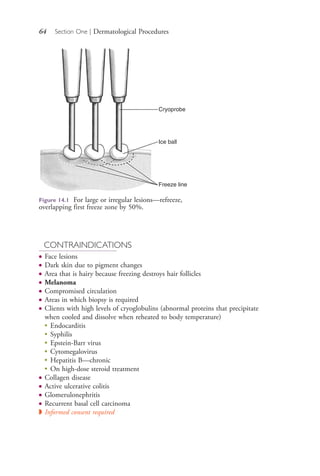
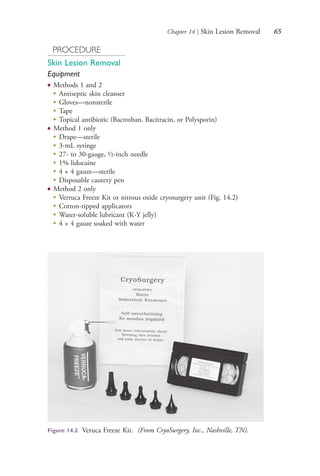
• Stand on the weight-bearing leg.
• Advance both crutches to the next step and advance the weaker leg.
• Advance weight-bearing leg.
●
To go up stairs (up with the weight-bearing leg) (Fig. 34.7)
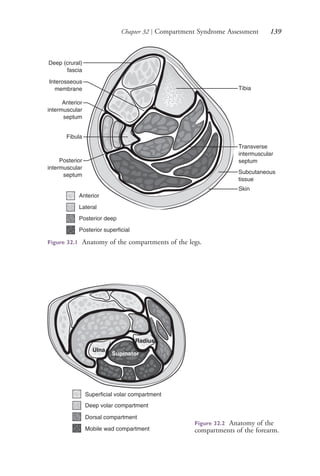
• While stabilizing self with hands on the hand pieces, advance the weight-
bearing leg up to the next step.
• Next, advance crutches and weaker leg up to the step.
● Have the client give a repeat demonstration.
4206_Chapter 2_0121-0204.indd 1484206_Chapter 2_0121-0204.indd 148 12/24/2014 2:01:28 PM12/24/2014 2:01:28 PM
Process CyanProcess CyanProcess MagentaProcess MagentaProcess YellowProcess YellowProcess BlackProcess Black
Chapter 34 | Crutch Walking 149
Figure 34.2 Four-point gait.
Figure 34.3 Three-point gait.
4206_Chapter 2_0121-0204.indd 1494206_Chapter 2_0121-0204.indd 149 12/24/2014 2:01:28 PM12/24/2014 2:01:28 PM
Process CyanProcess CyanProcess MagentaProcess MagentaProcess YellowProcess YellowProcess BlackProcess Black
150 Section Two | Musculoskeletal Procedures
Figure 34.5 Standing up with
crutches.
Figure 34.4 Sitting down with
crutches.
4206_Chapter 2_0121-0204.indd 1504206_Chapter 2_0121-0204.indd 150 12/24/2014 2:01:28 PM12/24/2014 2:01:28 PM
Process CyanProcess CyanProcess MagentaProcess MagentaProcess YellowProcess YellowProcess BlackProcess Black
Chapter 34 | Crutch Walking 151
Figure 34.6 Going down stairs with crutches. (A) Stand on weight-bearing leg.
(B) Advance both crutches to next step, then advance weaker leg, followed by
weight-bearing leg.
A B
Figure 34.7 Going up stairs with crutches. (A) Stabilize self with hands on hand
pieces. (B) Advance weight-bearing leg up to next step.
A B
BIBLIOGRAPHY
Hinkle JL, Cheever KH. Brunner and Suddarth’s Textbook of Medical-Surgical Nursing.
Philadelphia, PA: Lippincott-Raven; 2013.
4206_Chapter 2_0121-0204.indd 1514206_Chapter 2_0121-0204.indd 151 12/24/2014 2:01:29 PM12/24/2014 2:01:29 PM
Process CyanProcess CyanProcess MagentaProcess MagentaProcess YellowProcess YellowProcess BlackProcess Black
152 Section Two | Musculoskeletal Procedures
35Chapter
Dislocation Reduction
Margaret R. Colyar
CPT Code
21480 Closed treatment of temporomandibular joint (TMJ)
dislocation
23650–55 Closed treatment of shoulder dislocation, with
manipulation
24600–05 Treatment of closed elbow dislocation
26700–05 Closed treatment of metacarpophalangeal (MCP)
dislocation, single, with manipulation
26770–75 Closed treatment of interphalangeal joint dislocation,
single, with manipulation
Dislocation indicates the partial or complete displacement of one bone from another
bone. Displacement can occur spontaneously as a result of a structural defect, trau-
matic injury, or joint disease. A dislocated joint is reduced when it is restored to
normal position. Reduction of a joint facilitates proper healing.
OVERVIEW
● Incidence
●
TMJ dislocations
• 5% to 6% of the population. Dislocation is usually anterior but can be
posterior, lateral, and superior.
●
Shoulder dislocation
• 90% to 95% anterior
• 5% posterior
• 2% to 3% acromioclavicular (AC)
●
Recurrence of shoulder dislocations
• Younger than 20 years of age—90% to 95%
• Older than 40 years of age—10% to 15%
● Elbow dislocations
• Greater incidence than shoulder dislocations
●
Hand dislocations
• Proximal interphalangeal (PIP) joint—most common dislocation in the
body
• MCP joint—index finger most common dislocation, then thumb and fifth
digit
4206_Chapter 2_0121-0204.indd 1524206_Chapter 2_0121-0204.indd 152 12/24/2014 2:01:29 PM12/24/2014 2:01:29 PM
Process CyanProcess CyanProcess MagentaProcess MagentaProcess YellowProcess YellowProcess BlackProcess Black
Chapter 35 | Dislocation Reduction 153
● Causes
●
TMJ dislocations
• Spontaneous—eating, talking, yawning, or rinsing mouth
• Traumatic—blow to mandible
●
Shoulder dislocations
• Anterior shoulder dislocation—trauma with arm abducted, extended, and
externally rotated
• Posterior shoulder dislocation—direct force to the shoulder while flexed,
adducted, and internally rotated
• AC shoulder dislocation—persistent upward displacement of lateral end of
the clavicle
●
Elbow dislocations
• Posterior dislocations—direct trauma on outstretched forearm held in
extension; also may have wrist injury
●
Hand dislocations
• MCP joint dislocations—hyperextension of finger at the MCP joint
• PIP joint dislocations—hyperextension or “jamming” injury
OPTIONS
● TMJ dislocation reduction
●
Method 1—Passive reduction
• Requires no anesthesia and can be done easily without force
• Method 2—Manual reduction
• Use if method 1 fails
● Shoulder dislocation reduction
●
Anterior shoulder dislocation
• Method 1—Passive reduction
• Requires no anesthesia and can be done easily without force
• Method 2—Manual reduction
• Use if method 1 fails
●
Posterior shoulder dislocation reduction
●
AC shoulder dislocation reduction
● Elbow dislocation reduction
● Hand dislocation reduction
● MCP joint dislocation reduction
● Dorsal PIP joint dislocation reduction
● Volar PIP joint dislocation reduction
● Thumb dislocation reduction
RATIONALE
● To diminish pain
● To prevent loss or decreased use of a joint
● To prevent structural defects
4206_Chapter 2_0121-0204.indd 1534206_Chapter 2_0121-0204.indd 153 12/24/2014 2:01:29 PM12/24/2014 2:01:29 PM
Process CyanProcess CyanProcess MagentaProcess MagentaProcess YellowProcess YellowProcess BlackProcess Black
154 Section Two | Musculoskeletal Procedures
INDICATIONS
● Dislocation of mandible, shoulder, elbow, or finger
CONTRAINDICTIONS
● Dislocation with fracture of the mandible, shoulder, elbow, or finger
● Separation of the AC joint
● Fracture of the joint capsule
● Abnormal neurovascular status of the extremity
● Dislocation of the hip or knee
◗ Informed consent required
PROCEDURE
Dislocation Reduction
Equipment
TMJ DISLOCATION REDUCTION
● Methods 1 and 2
●
Gloves—nonsterile
●
Gauze—nonsterile
● Tongue blade—nonsterile
Procedure
METHOD 1—PASSIVE REDUCTION—TMJ
● Examine the client. Your examination should show
● Malocclusion
● Mandibular fossa empty
● Moderate pain
● Mouth held open
● X-ray the TMJ if traumatic injury or if diagnosis of dislocation is in doubt.
● Lateral view—check for fracture
● Towne’s view—shows medial or lateral offset (dislocation)
● Induce the gag reflex by probing the soft palate with tongue blade (Fig. 35.1).
METHOD 2—MANUAL REDUCTION—TMJ
● Position the client sitting on the floor with head stabilized by an assistant.
● Put on gloves.
● Stand above and in front of the client.
● Place your thumbs in the client’s mouth on the bottom molars (Fig. 35.2). Place
digits 3, 4, and 5 of each hand submentally.
● Place second digits of each hand at the mandibular angle.
● Ask the client to yawn.
● Apply your body weight downward on the mandible.
● Elevate the chin.
● Slide the mandible backward into position.
● Obtain an x-ray to determine whether the mandible is in the correct position.
4206_Chapter 2_0121-0204.indd 1544206_Chapter 2_0121-0204.indd 154 12/24/2014 2:01:29 PM12/24/2014 2:01:29 PM
Process CyanProcess CyanProcess MagentaProcess MagentaProcess YellowProcess YellowProcess BlackProcess Black
Chapter 35 | Dislocation Reduction 155
Figure 35.1 Passive reduction
of TMJ. Probe the soft palate
with a tongue blade to induce
the gag reflex.
Figure 35.2 Manual reduction
of TMJ. Place your thumbs on
the bottom molars and fingers
sub mentally. Ask the client to
yawn.
Client Instructions
TMJ DISLOCATION REDUCTION
● Eat soft food for several days.
● Avoid opening the mouth wide for 3 to 4 weeks.
● Place your hand under your chin when yawning.
● Take acetaminophen every 4 hours as needed for pain.
● Perform jaw muscle–strengthening exercises.
4206_Chapter 2_0121-0204.indd 1554206_Chapter 2_0121-0204.indd 155 12/24/2014 2:01:29 PM12/24/2014 2:01:29 PM
Process CyanProcess CyanProcess MagentaProcess MagentaProcess YellowProcess YellowProcess BlackProcess Black
156 Section Two | Musculoskeletal Procedures
Shoulder Dislocation Reduction
Equipment
● Method 1 only
●
Weights—5- to 10-lb free weights or sandbag
●
Towel—nonsterile
●
Roll of gauze
● Methods 1 and 2
●
1% lidocaine, 20 mL, or muscle relaxer
●
Syringe—20 mL
●
25-gauge, 1½-inch needle
Procedure
ANTERIOR SHOULDER DISLOCATION REDUCTION
● Method 1—passive reduction (Fig. 35.3)
●
Examine the client. You should find
• Fullness in the anterior capsule
• Sulcus sign (space under the acromion)
Figure 35.3 Passive reduction.
4206_Chapter 2_0121-0204.indd 1564206_Chapter 2_0121-0204.indd 156 12/24/2014 2:01:29 PM12/24/2014 2:01:29 PM
Process CyanProcess CyanProcess MagentaProcess MagentaProcess YellowProcess YellowProcess BlackProcess Black
Chapter 35 | Dislocation Reduction 157
• Severe pain
• Limited range of motion
• Arm held slightly abducted and externally rotated
• Shoulder contour flattened with protruding acromion
●
Examine the client’s neurovascular status and document.
●
Give a muscle relaxer or inject 20 mL of 1% lidocaine inferiorly off the tip of
the acromion (Fig. 35.4).
●
X-ray the shoulder (three views) to determine dislocation and whether a
fracture is present. X-ray should show anterior and slight inferior displacement
of the humerus out of the glenoid fossa. If a fracture is present, REFER.
• Anteroposterior view—shows internal and external rotation of the shoulder,
upper humerus, AC joint, and clavicle
• Y view—needed to verify a dislocation
• Load-bearing view—to differentiate an AC joint separation from a
dislocation
• Position the client prone on an examination table with the affected arm
hanging downward.
• Place a folded towel under the shoulder.
• Wrap gauze snugly around the wrist of the affected arm.
• Hook weights into the gauze.
Acromion
Figure 35.4 Passive reduction of anterior shoulder dislocation. Inject lidocaine
inferiorly off the tip of the acromion.
4206_Chapter 2_0121-0204.indd 1574206_Chapter 2_0121-0204.indd 157 12/24/2014 2:01:29 PM12/24/2014 2:01:29 PM
Process CyanProcess CyanProcess MagentaProcess MagentaProcess YellowProcess YellowProcess BlackProcess Black
158 Section Two | Musculoskeletal Procedures
• If weights are not available, a sandbag may be used.
• Allow weights to pull on arm for 15 to 20 minutes.
• If no progress after 15 to 20 minutes, apply a sling and REFER to an
orthopedic surgeon.
• If successful, immobilize the affected arm in a sling and swath to immobilize
the shoulder.
● Method 2—Manual reduction (Fig. 35.5)
●
Position the client in a sitting position.
●
Grasp the wrist and elbow of the affected arm.
Figure 35.5 Manual reduction
of anterior shoulder
dislocation. (A) Flex the elbow
90 degrees, externally rotating
the arm 70 to 85 degrees until
resistance is felt; (B) lift the
elbow in the sagittal plane
while (C) internally rotating
the arm.
A
B
C
4206_Chapter 2_0121-0204.indd 1584206_Chapter 2_0121-0204.indd 158 12/24/2014 2:01:29 PM12/24/2014 2:01:29 PM
Process CyanProcess CyanProcess MagentaProcess MagentaProcess YellowProcess YellowProcess BlackProcess Black
Chapter 35 | Dislocation Reduction 159
●
With the arm against the body
• Flex the elbow 90 degrees.
• Externally rotate the arm to approximately 70 to 85 degrees or until
resistance is felt.
• Lift the elbow in the sagittal plane as far as possible.
●
Internally rotate the arm. The head of the joint should slip into place; the
pain immediately decreases.
● Obtain an x-ray of the shoulder to determine whether reduction was successful.
● Check neurovascular status and document.
POSTERIOR SHOULDER DISLOCATION REDUCTION
● Examine the client. You should find
●
Minimal posterior swelling
●
Severe pain with any motion
● Do not attempt to reduce; REFER to an orthopedic surgeon.
AC SHOULDER DISLOCATION REDUCTION
● Examine the client. You should find
●
Slight pain—worse on elevation of the arm
●
Lateral end of the clavicle prominent
●
Distinct step palpable between the clavicle and the acromion
● No active reduction is needed.
● Apply sling for 1 week or until the pain subsides.
● Instruct the client to avoid overhead work.
Client Instructions
SHOULDER DISLOCATION REDUCTION
● Apply an ice pack for the first 24 hours.
● Give acetaminophen every 4 hours as needed for pain.
● Start deltoid isometric exercises immediately.
● In 3 weeks, start the following exercises (Fig. 35.6)
●
Lean over with affected arm hanging, and make increasingly larger circles
clockwise and counterclockwise.
●
Standing upright with affected arm flexed 90 degrees at the elbow, make a fist
with the thumb up. Move the forearm and hand rotating at the elbow to and
away from the body.
●
Standing upright with affected arm flexed 90 degrees at the elbow, make a fist
with the thumb up; raise the arm at the shoulder in abduction.
●
Return to the office in one (1) week for recheck.
Elbow Dislocation Reduction
Equipment
● Metal splint with foam on one side
● Gauze—nonsterile
● Tape
4206_Chapter 2_0121-0204.indd 1594206_Chapter 2_0121-0204.indd 159 12/24/2014 2:01:29 PM12/24/2014 2:01:29 PM
Process CyanProcess CyanProcess MagentaProcess MagentaProcess YellowProcess YellowProcess BlackProcess Black
160 Section Two | Musculoskeletal Procedures
Procedure
● Examine the client. You should find
●
Pain
●
Limited range of motion
● Assess and document neurovascular status.
●
Radial and brachial pulses
●
Capillary refill of the fingers
●
Nerve function of the median, ulnar, and radial nerves (Fig. 35.7)
●
Muscle function (Fig. 35.8)
● X-ray both arms for comparison—check for fat pad sign.
●
Anteroposterior, lateral, and oblique views
●
If fracture is present, REFER.
● Apply countertraction on the distal humeral shaft and continuous gentle
downward traction to proximal portion of the forearm and bring the elbow into
flexion (Fig. 35.9).
Figure 35.6 Shoulder exercises. (A) While leaning over, make hanging circles
(clockwise/counterclockwise). (B) Flex the arm 90 degrees at the elbow, make a
fist with the thumb up, and move the forearm and hand rotating at the elbow.
(C) Flex the arm 90 degrees at the elbow, make a fist with the thumb up, and
raise the arm at the shoulder in abduction.
B
C
AA
4206_Chapter 2_0121-0204.indd 1604206_Chapter 2_0121-0204.indd 160 12/24/2014 2:01:29 PM12/24/2014 2:01:29 PM
Process CyanProcess CyanProcess MagentaProcess MagentaProcess YellowProcess YellowProcess BlackProcess Black
Chapter 35 | Dislocation Reduction 161
Figure 35.7 (A) Median, (B) ulnar,
and (C) radial nerves.
A
B
C
4206_Chapter 2_0121-0204.indd 1614206_Chapter 2_0121-0204.indd 161 12/24/2014 2:01:30 PM12/24/2014 2:01:30 PM
Process CyanProcess CyanProcess MagentaProcess MagentaProcess YellowProcess YellowProcess BlackProcess Black
162 Section Two | Musculoskeletal Procedures
Figure 35.8 Muscle function.
● X-ray the dislocated elbow to ensure that it is reduced.
● Repeat the neurovascular assessment and document.
● Apply a posterior splint (see Chapter 39) with the elbow at 100 to 110 degrees
of flexion.
Client Instructions
ELBOW DISLOCATION REDUCTION
● Take acetaminophen every 4 hours as needed for pain.
● Return to the office in 1 week.
● Start range-of-motion exercises in 1 week if the elbow is stable. Gradually
increase range-of-motion exercises (Fig. 35.10) after 10 to 14 days.
● Keep the splint in place until full extension is achieved.
● A follow-up x-ray must be taken in 2 to 3 weeks to determine stability of the
elbow.
Hand Dislocation Reduction
Equipment
● Splint
● Syringe—5 mL
● 25-gauge, 1½-inch needle
● 1% lidocaine—5 mL
4206_Chapter 2_0121-0204.indd 1624206_Chapter 2_0121-0204.indd 162 12/24/2014 2:01:30 PM12/24/2014 2:01:30 PM
Process CyanProcess CyanProcess MagentaProcess MagentaProcess YellowProcess YellowProcess BlackProcess Black
Chapter 35 | Dislocation Reduction 163
Figure 35.9 Elbow dislocation reduction. Pull down on the proximal portion of
the forearm and bring the elbow into flexion.
Figure 35.10 Elbow exercises.
4206_Chapter 2_0121-0204.indd 1634206_Chapter 2_0121-0204.indd 163 12/24/2014 2:01:30 PM12/24/2014 2:01:30 PM
Process CyanProcess CyanProcess MagentaProcess MagentaProcess YellowProcess YellowProcess BlackProcess Black
164 Section Two | Musculoskeletal Procedures
● Gauze—nonsterile
● Tape
Procedure
MCP JOINT DISLOCATION REDUCTION
● Examine the client. You should find
●
Digit held in extension or hyperextension
●
Dimpling of the palmar skin over the protruding metacarpal head
● Assess neurovascular status and document.
● X-ray the affected hand.
● Anteroposterior view shows obliteration of normal joint space.
● Lateral view shows proximal phalanx is dorsal to the metacarpal head.
● If a fracture is found, immobilize the joint and REFER to an orthopedic
surgeon.
● Hyperextend the finger at the MCP joint.
● Apply traction by pulling the finger in an outward and upward direction.
● Apply pressure of the dorsal aspect of the base of the proximal phalanx
(Fig. 35.11).
● Remove traction.
● Flex the finger.
● Obtain another x-ray of the hand to determine successful reduction.
● Assess neurovascular status and range of motion.
● Apply a posterior splint (see Chapter 39) with MCP flexed 70 degrees. Keep the
posterior splint in place for 3 to 4 weeks.
DORSAL PIP JOINT DISLOCATION REDUCTION
● Examine the client. You should find
●
Finger swollen and malformed
●
Limited range of motion
● Assess neurovascular status and document.
● X-ray the hand.
● Anteroposterior view shows obliteration of joint space.
●
Lateral view shows dorsal dislocation of middle phalanx.
● If a fracture is present, immobilize, and REFER to an orthopedic surgeon.
● Perform a digital nerve block (see Chapter 8).
● Apply direct longitudinal traction.
● Obtain another x-ray of the hand to determine whether the PIP joint has been
reduced.
● Reassess neurovascular status and document.
● Apply a dorsal extension block splint (see Chapter 39), blocking the last 15
degrees of extension. Keep splint in place for 3 to 4 weeks.
VOLAR PIP JOINT DISLOCATION REDUCTION
● Examine the client. You should find
●
Finger swollen and malformed
●
Limited range of motion
4206_Chapter 2_0121-0204.indd 1644206_Chapter 2_0121-0204.indd 164 12/24/2014 2:01:30 PM12/24/2014 2:01:30 PM
Process CyanProcess CyanProcess MagentaProcess MagentaProcess YellowProcess YellowProcess BlackProcess Black
Chapter 35 | Dislocation Reduction 165
Figure 35.11 MCP joint dislocation reduction. (A) Hyperextend the MCP joint
while pulling the finger outward and upward. (B) Apply pressure on the dorsal
aspect of the proximal phalanx.
A
B
● Assess neurovascular status and document.
● X-ray the hand.
●
Lateral view shows base of middle phalanx is palmar to head of proximal
phalanx.
●
If a fracture is present, immobilize, and REFER to an orthopedic surgeon.
●
No active reduction is required.
●
Splint in full extension of PIP joint on the volar side. Keep splint in place for
4 to 6 weeks.
THUMB DISLOCATION REDUCTION
● Usually a ligament tear is involved. REFER to an orthopedic surgeon.
Client Instructions
HAND DISLOCATION—MCP AND PIP—DORSAL
● Take acetaminophen every 4 hours as needed for pain.
● Return to the office in 1 week.
4206_Chapter 2_0121-0204.indd 1654206_Chapter 2_0121-0204.indd 165 12/24/2014 2:01:30 PM12/24/2014 2:01:30 PM
Process CyanProcess CyanProcess MagentaProcess MagentaProcess YellowProcess YellowProcess BlackProcess Black
166 Section Two | Musculoskeletal Procedures
● Start flexion and extension exercises in 1 week.
● The splint can be removed in 3 to 4 weeks.
HAND DISLOCATION—PIP—VOLAR
● Take acetaminophen every 4 hours as needed for pain.
● Return to the office in 1 week.
● Keep the splint in place for 4 to 6 weeks.
● After 4 to 6 weeks, start flexion and extension exercises.
BIBLIOGRAPHY
Diamond S. (1996). The mechanism and management of shoulder pain. Adv Nurse Pract.
March 1996:16, 18, 20–21, 50.
Madden C, Putukian M, McCarty E, Young CMD. Netter’s Sports Medicine. Philadelphia,
PA: Saunders-Elsevier; 2010.
Pfenninger JL, Fowler GC. Procedures for Primary Care Physicians. St. Louis, MO: Mosby;
2011.
Thakur AJ, Narayan R. Painless reduction of shoulder dislocation by Kocher’s method.
J Bone Joint Surg Am. 1990;72(3):524.
36Chapter
Ganglion Cyst Aspiration
and Injection
Margaret R. Colyar
CPT Code
20600 Arthrocentesis, aspiration, or injection; small joint, bursa, or
ganglion cyst (leg, fingers, toes)
20605 Arthrocentesis, aspiration, or injection; intermediate joint,
bursa, or ganglion cyst (e.g.,TMJ, acromioclavicular, wrist,
elbow, ankle, olecranon bursa)
25111 Excision of ganglion, wrist; primary
25112 Excision of ganglion, wrist; recurrent
26160 Excision of lesion of tendon sheath or capsule (e.g., cyst,
mucous cyst, or ganglion); hand or finger
A simple ganglion cyst is a cystic tumor that develops on or in a tendon sheath
containing a thick, gel-like material. This gel-like material leaks from the joint into
the weakened tendon sheath and forms a cyst sac (Fig. 36.1). The ganglion cyst
usually is caused by frequent strains and contusions.
4206_Chapter 2_0121-0204.indd 1664206_Chapter 2_0121-0204.indd 166 12/24/2014 2:01:30 PM12/24/2014 2:01:30 PM
Process CyanProcess CyanProcess MagentaProcess MagentaProcess YellowProcess YellowProcess BlackProcess Black
Chapter 36 | Ganglion Cyst Aspiration and Injection 167
Figure 36.1 Ganglion cyst.
OVERVIEW
● Cause—joint inflammation
● Usual location—back of the wrist
RATIONALE
● To diminish pain
● To promote joint mobility
INDICATIONS
● Pain over a joint
● Limitation of joint movement
CONTRAINDICATIONS
● On anticoagulant therapy
● Problems with clotting
● Lack of response to previous injections
● Sepsis
● Recent joint fractures
● Inform the client of the following
●
Chance of infection and recurrence
●
Chance of steroid flare 24 to 36 hours after injury
●
Chance of subcutaneous atrophy
◗ Informed consent required
4206_Chapter 2_0121-0204.indd 1674206_Chapter 2_0121-0204.indd 167 12/24/2014 2:01:30 PM12/24/2014 2:01:30 PM
Process CyanProcess CyanProcess MagentaProcess MagentaProcess YellowProcess YellowProcess BlackProcess Black
168 Section Two | Musculoskeletal Procedures
PROCEDURE
Ganglion Cyst Aspiration and Injection
Equipment
● Antiseptic skin cleanser
● Gloves—sterile
● Drape—sterile
● 2 syringes—10 mL and 3 mL
● 18-gauge, 1½-inch needle
● 22- to 25-gauge, 1½-inch needle
● 1% lidocaine
●
Use single-dose vials because they do not contain preservatives that are likely
to cause allergic reactions.
● Culture tubes
● Corticosteroid (Table 36.1)
● 4 × 4 gauze—sterile
● Tape
Procedure
● Position the client with the ganglion cyst easily accessible.
● Cleanse the skin in a 3-inch-diameter area around the ganglion cyst with
antiseptic skin cleanser.
● Drape the ganglion cyst.
● Put on gloves.
Table 36·1 Commonly Used Corticosteroids
TYPE USE DOSE
Short-Acting
Hydrocortisone
Quick relief in self-
limiting disorders,
such as bursitis
20
Intermediate-Acting
Methylprednisone
Prednisolone (Depo-Medrol) 20 mg/mL
Triamcinolone acetonide (Kenalog)
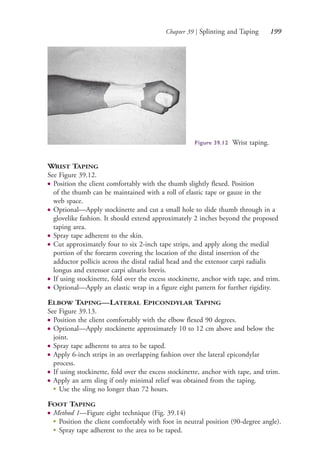
10 mg/mL
Triamcinolone diacetate (Aristocort)
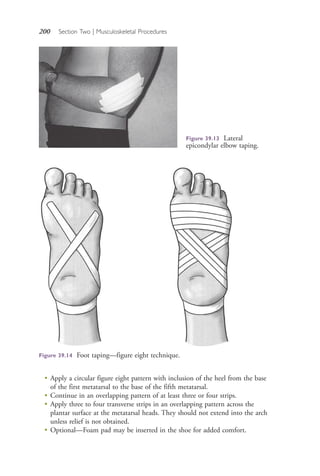
25 mg/mL
4
5–10
5–10
12.5–25
Long-Acting
Dexamethasone (Decadron) 4 mg/ml or
10 mg/mL
Betamethasone (Celestone) 6 mg/mL
Chronic conditions
such as tendinitis
0.6
0.6
4206_Chapter 2_0121-0204.indd 1684206_Chapter 2_0121-0204.indd 168 12/24/2014 2:01:30 PM12/24/2014 2:01:30 PM
Process CyanProcess CyanProcess MagentaProcess MagentaProcess YellowProcess YellowProcess BlackProcess Black
Chapter 36 | Ganglion Cyst Aspiration and Injection 169
● Using the 22- to 25-gauge needle on 3-mL syringe, draw up 2.5 mL of 1%
lidocaine and 0.5 mL of corticosteroid. Mix well by gently rotating syringe back
and forth.
● Insert the 10-mL syringe with the 18-gauge needle into the ganglion cyst (for
aspiration) (Fig. 36.2).
● Insert the syringe with the medication into the ganglion cyst, and aspirate for
blood.
● If no blood, aspirate the fluid from cyst. If the aspirate is cloudy, send it to the
pathology laboratory for culture and sensitivity.
●
If blood is aspirated, remove the needle and dress the wound.
● Inject the medication.
● Remove both needles.
● Apply a pressure dressing.
Client Instructions
● Keep the wound covered for 8 to 12 hours.
● Some redness, swelling, and heat are normal. If you notice yellow or green
drainage from wound or red streaks, return to the office.
● Take acetaminophen or ibuprofen every 4 to 6 hours as needed for pain.
● Rest the joint for 24 hours.
● Elevate the joint above the heart as much as possible for 24 hours.
● Return to the office in 1 week for recheck.
● If the cyst recurs, removal may be indicated.
BIBLIOGRAPHY
Hashimoto BE, Hayes AS, Ager JD. Sonographic diagnosis and treatment of ganglion cysts
causing suprascapular nerve entrapment. J Ultrasound Med. 1994;13(9):671–674.
Pfenninger JL, Fowler GC. Procedures for Primary Care Physicians. St. Louis, MO: Mosby;
2011.
Figure 36.2 Aspirate the ganglion cyst with an 18-gauge needle. Then inject the
medication into the cyst with the second needle.
4206_Chapter 2_0121-0204.indd 1694206_Chapter 2_0121-0204.indd 169 12/24/2014 2:01:30 PM12/24/2014 2:01:30 PM
Process CyanProcess CyanProcess MagentaProcess MagentaProcess YellowProcess YellowProcess BlackProcess Black
170 Section Two | Musculoskeletal Procedures
37Chapter
Intra-Articular and Bursa
Corticosteroid Injection
Margaret R. Colyar
CPT Code
20550 Injection; tendon sheath, ligaments, trigger points
20600 Arthrocentesis, aspiration, or injection; small joint, bursa
20605 Arthrocentesis, aspiration, or injection; intermediate joint,
bursa
20610 Arthrocentesis, aspiration, or injection; major joint or bursa
Injection of corticosteroids into a joint space or bursa is done to decrease pain in
overuse injury and to improve function. Injection of corticosteroids may be done
immediately after joint aspiration. Anesthetic agents are used in conjunction with
corticosteroid injection to decrease injection pain. For overuse injuries, a general rule
of thumb is that two injections can be done over 2 weeks and then in 3 to 4 months,
if necessary. No more than three injections within a 12-month period are
recommended.
OVERVIEW
● Familiarity with the anatomy of the injection site is crucial to effective intra-
articular injection. Common conditions for which intra-articular injection is
indicated are
●
Tendinitis
• de Quervain’s tendonitis
• Tennis elbow
• Plantar fasciitis
• Trigger finger
● Bursitis
● Neuritis
• Carpal or tarsal tunnel syndrome
• Costochondritis
• Tietze’s syndrome
• Postherpetic neuralgia
●
Myofascial pain syndrome
●
Arthritis
• Osteoarthritis (degenerative)
• Rheumatoid arthritis
4206_Chapter 2_0121-0204.indd 1704206_Chapter 2_0121-0204.indd 170 12/24/2014 2:01:30 PM12/24/2014 2:01:30 PM
Process CyanProcess CyanProcess MagentaProcess MagentaProcess YellowProcess YellowProcess BlackProcess Black
Chapter 37 | Intra-Articular and Bursa Corticosteroid Injection 171
Complications
● Tendon rupture
● Joint injection
● Postinjection flare (pain)
● Injection into a blood vessel
● Tissue atrophy
Commonly Used Corticosteroids
See Table 36.1.
Commonly Used Anesthetic Agents
● Lidocaine (Xylocaine) 1%—1 to 2 hours of relief
● Bupivacaine (Marcaine) 0.25%—6 to 8 hours of relief
RATIONALE
● To diminish pain
● To promote joint function
INDICATIONS
● Painful joint
● Inflamed joint
CONTRAINDICATIONS
● Infected joint
● Cellulitis over the joint
● More than three injections in a 12-month period
● Joint instability
● Joint surgery or prosthesis
● Fracture
● Sickle cell anemia
● Coagulation disorders
● Diabetes
● Children or adolescents
◗ Informed consent required
PROCEDURE
Intra-Articular and Bursa Corticosteroid Injection
Equipment
● Alcohol prep pads
● Povidone-iodine prep pads
● Gloves—nonsterile
● Syringe—3 to 10 mL
● 22-gauge, 1½-inch needle
4206_Chapter 2_0121-0204.indd 1714206_Chapter 2_0121-0204.indd 171 12/24/2014 2:01:30 PM12/24/2014 2:01:30 PM
Process CyanProcess CyanProcess MagentaProcess MagentaProcess YellowProcess YellowProcess BlackProcess Black
172 Section Two | Musculoskeletal Procedures
● 1% lidocaine—single-dose vial (5 to 10 times the amount of steroid to be
used—e.g., 2.5 mL of lidocaine to 0.5 mL of steroid)
● Corticosteroid of choice (see Table 36.1)
● Adhesive bandage (Band-Aid)
Procedure
● Draw lidocaine and corticosteroid into the syringe.
● Mix by rolling or gently rocking the syringe back and forth.
● Mark the injection site with your thumbnail.
● Position the client with the joint slightly flexed to open the joint space
(Fig. 37.1).
● Put on gloves.
● Cleanse the site with alcohol and then povidone-iodine.
●
Allow the povidone-iodine to air dry.
● Insert the needle at the thumbnail mark at 45- to 90-degree angle, depending
on the site of injection.
● Aspirate.
●
If blood is obtained, remove the needle.
●
If using injection for a bursa, aspirate for cloudy bursal fluid. This indicates
the appropriate site.
● Inject the corticosteroid mixture steadily and gently into the area.
● Remove the needle.
● Apply pressure for 1 minute.
● Cover with Band-Aid.
Client Instructions
● Rest the joint for the next 24 hours.
● You may remove the dressing and bandage in 24 hours.
● Observe for signs and symptoms of infection, such as
●
Increase in pain after 24 hours
●
Increase in temperature
●
Redness or swelling
●
Yellow or greenish drainage
●
Foul odor
● If any signs or symptoms of infection are found, return to the office.
● Steroid flare or postinjection pain lasting 36 hours may occur. If this does occur,
do the following
●
Apply an ice pack.
●
Take ibuprofen (Motrin) every 6 hours as needed.
●
Call the office if the pain does not subside within 36 hours.
● Sometimes fluid recollects in the joint. If this occurs, return to the office.
● Your culture should be back by _________________. We will call you with the
results.
4206_Chapter 2_0121-0204.indd 1724206_Chapter 2_0121-0204.indd 172 12/24/2014 2:01:30 PM12/24/2014 2:01:30 PM
Process CyanProcess CyanProcess MagentaProcess MagentaProcess YellowProcess YellowProcess BlackProcess Black
Chapter 37 | Intra-Articular and Bursa Corticosteroid Injection 173
Finger and toe joints —
• Flex the finger or toes to open the joint.
• Inject corticosteroid medial or lateral to the extensor tendon.
Figure 37.1 Injection sites.
Continued
4206_Chapter 2_0121-0204.indd 1734206_Chapter 2_0121-0204.indd 173 12/24/2014 2:01:30 PM12/24/2014 2:01:30 PM
Process CyanProcess CyanProcess MagentaProcess MagentaProcess YellowProcess YellowProcess BlackProcess Black
174 Section Two | Musculoskeletal Procedures
Carpal Tunnel Syndrome —
• Dorsiflex the wrist.
• Insert the needle at the distal crease of the wrist lateral to the tendon toward the middle
finger.
• 45-degree angle.
• 1–2 cm in depth.
de Quervains Disease —
• Abduct the thumb.
• Inject parallel to the tendon at the point of tenderness.
Abductor
pollicis
longus
Median nerve
Palmar longus
aponeurosis
Figure 37.1, cont’d
Continued
4206_Chapter 2_0121-0204.indd 1744206_Chapter 2_0121-0204.indd 174 12/24/2014 2:01:30 PM12/24/2014 2:01:30 PM
Process CyanProcess CyanProcess MagentaProcess MagentaProcess YellowProcess YellowProcess BlackProcess Black
Chapter 37 | Intra-Articular and Bursa Corticosteroid Injection 175
Tennis Elbow —
• Flex the elbow 45 degrees.
• Inject the corticosteroid in the joint
space inferior to the lateral epicondoyle.
• Inject superior to the olecranon process.
Shoulder (Acromioclavicular Joint) —
• Palpate distal clavicle until a moveable prominence is felt.
• Insert the needle anteriorally at a 90-degree angle.
• Inject the corticosteroid into the joint.
Olecranon
process
Acromion
Subacromial
space
Clavicle
Coracoid
process
Scapula
Subacromial
bursa
Humerus
Synovium
Lateral
epicondyle
Radial
head
Figure 37.1, cont’d
Continued
4206_Chapter 2_0121-0204.indd 1754206_Chapter 2_0121-0204.indd 175 12/24/2014 2:01:30 PM12/24/2014 2:01:30 PM
Process CyanProcess CyanProcess MagentaProcess MagentaProcess YellowProcess YellowProcess BlackProcess Black
176 Section Two | Musculoskeletal Procedures
Shoulder (Subacromial Bursa) —
• Palpate the lateral edge of the acromion.
• The soft spot just below the acromion is the subacromial bursa.
• Insert the needle at a 90-degree angle into the bursa which should feel soft.
• Be careful not to inject in the supraspinatus tendon or the deltoid.
Shoulder (Rotator Cuff — supraspinatus tendonitis) —
• Use the same technique as for the subacromial bursa.
• Insert the needle farther into the area to the point of tenderness.
• Withdraw the needle slightly and inject the corticosteroid.
Coracoid
process
Supraspinatus
tendon
Acromion
Acromion
Subacromial
bursa
Subacromial
bursa
Glenhumeral
joint capsule
Supraspinatus
tendon
Coracoid
process
Clavicle
Scapula
Biceps
short head
Biceps
long head
Figure 37.1, cont’d
Continued
4206_Chapter 2_0121-0204.indd 1764206_Chapter 2_0121-0204.indd 176 12/24/2014 2:01:30 PM12/24/2014 2:01:30 PM
Process CyanProcess CyanProcess MagentaProcess MagentaProcess YellowProcess YellowProcess BlackProcess Black
Chapter 37 | Intra-Articular and Bursa Corticosteroid Injection 177
Shoulder (Short head of the biceps) —
• Identify the anterior coracoid bony process.
• Inferior to the clavicle.
• Medial to the humerus.
• Insert needle at the point of tenderness at a 90-degree angle until the bone is reached.
• Withdraw the needle 1–2 mm.
• Inject the corticosteroid.
Shoulder (Glenohumeral or Scapulohumeral Joint) —
• Anterior (Glenohumeral) —
• Rotate the shoulder joint toward the back and identify the joint space.
• Insert the needle at a 90-degree angle into the glenohumeral joint.
• No bone should be encountered.
• Inject the corticosteroid.
• Posterior (Scapulohumeral) —
• Rotate the shoulder anteriorally and identify the joint space.
• Insert the needle at a 90-degree angle into the scapulohumeral joint.
• No bone should be encountered.
• Inject the corticosteroid.
Coracoid
Coracoid Acromion
Glenohumeral
joint capsule
Acromion
Humerus
Subacromial
space
Figure 37.1, cont’d
Continued
4206_Chapter 2_0121-0204.indd 1774206_Chapter 2_0121-0204.indd 177 12/24/2014 2:01:31 PM12/24/2014 2:01:31 PM
Process CyanProcess CyanProcess MagentaProcess MagentaProcess YellowProcess YellowProcess BlackProcess Black
178 Section Two | Musculoskeletal Procedures
Hip Bursa —
• Identify the hip joint by having the client flex the joint.
• Insert the needle until you hit the bone.
• Withdraw 2–3 mm and inject the corticosteroid.
Knee Bursa (Prepatellar) —
• Inject above the patella.
• 90-degree angle.
Hip joint
Greater
trochanter
Bursa
Femoral neck
Quadriceps
muscle
Tendon
Lesser
trochanter
Femur
Prepatellar
bursa
Infrapatellar
bursa
Fibula
Tibia
Figure 37.1, cont’d
Continued
4206_Chapter 2_0121-0204.indd 1784206_Chapter 2_0121-0204.indd 178 12/24/2014 2:01:31 PM12/24/2014 2:01:31 PM
Process CyanProcess CyanProcess MagentaProcess MagentaProcess YellowProcess YellowProcess BlackProcess Black
Chapter 37 | Intra-Articular and Bursa Corticosteroid Injection 179
Knee-Anserine Bursa —
• Below patella find the lateral concavity.
• Inject the needle at 90-degree angle.
• Inject until you hit bone, then withdraw 2–3 mm.
• Inject the corticosteroid.
• Redirect the needle several times and inject in several areas.
Ankle —
• Dorsiflex the ankle.
• Inject at the medial malleolous and tibia.
Heel Spur (Calcaneal) —
• Insert the needle on the lateral side of the foot at the heel at the point of maximal tenderness.
• Inject the corticosteroid.
Sartorius
Gracilis
Semitendinous
Pes anserinus
Anserine
bursa
Medial
maleolus
Figure 37.1, cont’d
4206_Chapter 2_0121-0204.indd 1794206_Chapter 2_0121-0204.indd 179 12/24/2014 2:01:31 PM12/24/2014 2:01:31 PM
Process CyanProcess CyanProcess MagentaProcess MagentaProcess YellowProcess YellowProcess BlackProcess Black
180 Section Two | Musculoskeletal Procedures
BIBLIOGRAPHY
Cardone DA. Diagnostic and therapeutic injection of the elbow region. Am Fam Physician.
2002;66(11):2097–2101.
Cardone DA. Diagnostic and therapeutic injection of the hip and knee. Am Fam Physician.
2003;67(10):2147–2152.
Tallia AF. Diagnostic and therapeutic injection of the shoulder region. Am Fam Physician.
2003;67(6):1271–1278.
Tallia AF. Diagnostic and therapeutic injection of the wrist and hand region. Am Fam
Physician. 2003;67(6):745–750.
38Chapter
Sling Application
Margaret R. Colyar
CPT Code
None
Slings are devices used to immobilize, support, and elevate the shoulder, arm, and
hand. A sling can be used by itself or in combination with other immobilization
devices.
OVERVIEW
● Before sling application, always assess the extremity for and document
●
Pulse
●
Paresthesias
●
Paralysis
●
Pallor
●
Pain
●
Edema
OPTIONS
Sling Application
● Method 1—Manufactured sling application
● Method 2—Triangular sling application
RATIONALE
● To immobilize a joint
● To support and elevate the shoulder, arm, and hand
4206_Chapter 2_0121-0204.indd 1804206_Chapter 2_0121-0204.indd 180 12/24/2014 2:01:31 PM12/24/2014 2:01:31 PM
Process CyanProcess CyanProcess MagentaProcess MagentaProcess YellowProcess YellowProcess BlackProcess Black
Chapter 38 | Sling Application 181
INDICATIONS
● Strain or sprain of the shoulder, elbow, or arm
CONTRAINDICATIONS
● Unstable fracture
● Loss of pulse
● Signs or symptoms of compartment syndrome
PROCEDURE
Sling Application
Equipment
● Method 1
●
Sling
● Method 2
●
Triangular piece of cloth 16 to 20 inches on each side
●
Two large safety pins—nonsterile
Procedure
METHOD 1—MANUFACTURED SLING APPLICATION
● Position the client sitting or supine with
● Injured arm across the chest in 90-degree angle
● Forearm slightly above the level of the elbow
● Thumb pointed upward and toward the body
● With the sling outside the clothing
● Using manufactured sling
● Secure the elbow snugly in the sling.
● Extend the sling to include the hand to the MCP joints.
• This prevents ulnar deviation and supports the wrist.
● Cross the strap over the unaffected shoulder and around the back of the neck
(Fig. 38.1).
● Buckle or tie the strap. Do not allow the buckle or knot to rest on a bony
prominence or put pressure on the neck.
●
Tighten the strap so that the arm is supported.
METHOD 2—TRIANGULAR SLING APPLICATION
● Fasten corner of cloth at elbow with safety pins (Fig. 38.2) with arm at a
45-degree angle across the chest.
● Tie ends around the neck.
METHODS 1 AND 2
● After application of the sling, assess the extremity for and document
●
Pulse
●
Grasp strength
4206_Chapter 2_0121-0204.indd 1814206_Chapter 2_0121-0204.indd 181 12/24/2014 2:01:31 PM12/24/2014 2:01:31 PM
Process CyanProcess CyanProcess MagentaProcess MagentaProcess YellowProcess YellowProcess BlackProcess Black
182 Section Two | Musculoskeletal Procedures
Figure 38.2 Triangular sling application.
●
Paresthesias
●
Warmth of hand
●
Color of hand
●
Presence of edema
Client Instructions
● You must keep the sling in place for _________________.
● If the hand becomes cold, pale in color, numb, or tingly, contact the nurse
practitioner.
Figure 38.1 Manufactured sling application.
A B
A B
4206_Chapter 2_0121-0204.indd 1824206_Chapter 2_0121-0204.indd 182 12/24/2014 2:01:31 PM12/24/2014 2:01:31 PM
Process CyanProcess CyanProcess MagentaProcess MagentaProcess YellowProcess YellowProcess BlackProcess Black
Chapter 39 | Splinting and Taping 183
● Observe for signs of skin irritation around the neck. If skin irritation occurs,
pad the strap with a soft cloth.
● Do the following exercises while the sling is in place
●
Isometrics of the deltoid—flex and relax.
●
Wiggle the fingers.
●
Return to the office for recheck on _________________.
BIBLIOGRAPHY
Kenney DE, Klima RR. Modified armsling for soft-tissue injuries of the shoulder and
glenohumeral subluxation. J Hand Ther. 1993;6(3):215–216.
McConnell EA. Correctly positioning an arm sling. Nursing. 91. 1991;21(7):70.
Potter PA, Perry AG. Basic Nursing. St. Louis, MO: Mosby; 2010.
Chapter
39Splinting and Taping
Cynthia R. Ehrhardt
CPT Code
29260–80 Strapping; elbow or wrist, hand or finger
29530–50 Strapping; ankle, knee, toes
99070 Splinting
Splinting and taping provide effective temporary methods of immobilizing a joint
after a mild-to-moderate musculoskeletal joint inflammation or injury. Splinting
frequently is used in place of casting.
OVERVIEW
● The most common musculoskeletal injuries involve the ankle joint following
the mechanism of inversion and plantar flexion stretching of the lateral
ligaments.
● The second most common musculoskeletal injury involves overuse syndrome of
the wrist and thumb.
● General principles include the following
● During application, frequently reassess neurovascular status.
● Apply material firmly but not tightly.
● Avoid skin irritation wherever possible.
● Instruct on precautions of skin irritation if stockinette is not used.
● Remove splint at least four times a day for gentle range-of-motion exercises to
reduce the incidence of “frozen joint syndrome.”
4206_Chapter 2_0121-0204.indd 1834206_Chapter 2_0121-0204.indd 183 12/24/2014 2:01:31 PM12/24/2014 2:01:31 PM
Process CyanProcess CyanProcess MagentaProcess MagentaProcess YellowProcess YellowProcess BlackProcess Black
184 Section Two | Musculoskeletal Procedures
●
Do not discharge client until 30 minutes after completion of the procedure,
to ensure satisfactory application without compromise of neurovascular
system.
● Determination of the appropriate appliance to use (taping versus splinting)
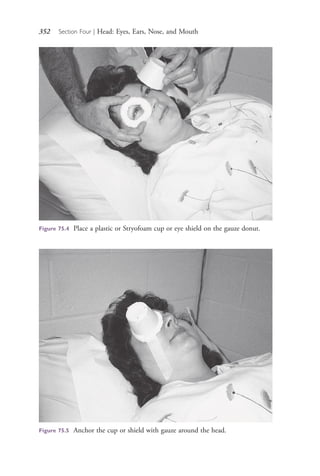
depends on
●
Joint injured
●
Nature of joint injury and ligaments involved
●
Mechanism of joint injury
●
Time of injury
• Immediate
• Acute (within 24 hours without onset of swelling)
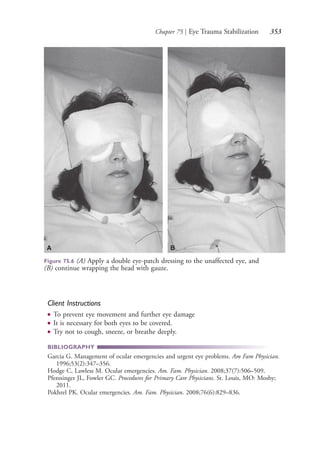
• Intermediate acute (within 24 hours with onset of swelling)
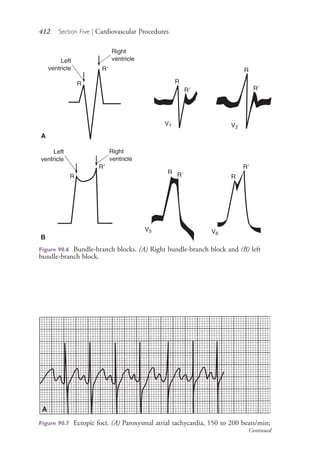
• Delayed acute (beyond 48 hours)
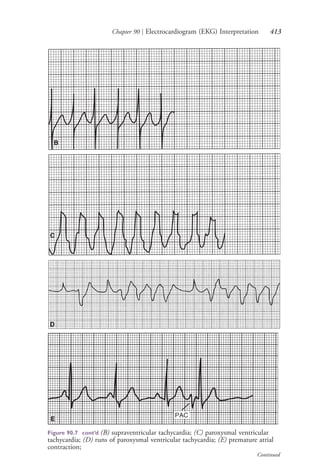
●
Previous history of injury to the joint
●
Severity of injury
●
Most grade II and III ligamental and musculoskeletal injuries respond well
with splinting or immobilization.
●
Physical examination findings
●
Requirement to return to activity
HEALTH PROMOTION/PREVENTION
● Use of
●
Properly fitting athletic equipment
●
Appropriate footwear for participation in the sport
●
Proper stretching and warm-up exercises before sports participation
●
Proper conditioning to play the sport
●
Prophylactic use of taping of chronic joint injuries before sports participation
OPTIONS
See Table 39.1.
Splinting
● Ankle splinting
●
Method 1—Posterior splint
●
Method 2—Aircast technique
● Knee immobilization
●
Use with grade II and III knee strains
● Wrist splinting
●
Method 1—Premade wrist splint
●
Method 2—Volar splinting
● Thumb splinting
●
Use for adductor pollicis tendinitis
• Method 1—Premade wrist splint with thumb support
• Method 2—Aluminum thumb splint
• Method 3—Thumb spica
4206_Chapter 2_0121-0204.indd 1844206_Chapter 2_0121-0204.indd 184 12/24/2014 2:01:31 PM12/24/2014 2:01:31 PM
Process CyanProcess CyanProcess MagentaProcess MagentaProcess YellowProcess YellowProcess BlackProcess Black
Chapter 39 | Splinting and Taping 185
Table 39·1 Procedure Options
Splinting
Advantages
• Restricts movement 100%
• Allows stabilization of suspected joint fractures
• Prevents further trauma to the joint and skeletal structure
• Allows adjustment of the orthopedic device in the presence of soft tissue
edema and its resolution
• Can replace bulky casting
Disadvantages
• Bulky prosthetic device
• Cannot be used as a prophylactic measure
• Can be overused and misused by client
• Can cause skin irritation
• More expensive than taping
Taping
Advantages
• Facilitates to limit movement
• Does not restrict movement 100%
• May immediately return to activity without an obtrusive prosthetic
device
• Not as bulky as a prosthetic device
• Prophylactic use prevents further aggravation of a chronic injury
Disadvantages
• 50% of taping loosens within 10 minutes of application
• Requires some skill in application
• Can cause skin irritation
• Not as effective if joint immobilization is required
Taping
● Ankle taping
●
Method 1—Louisiana ankle wrap technique
●
Method 2—Open Gibney technique with heel lock
●
Method 3—Open Gibney technique without heel lock
●
Method 4—Basket-weave technique with heel lock
● Knee taping
● Wrist taping
● Elbow taping
●
Lateral epicondylar taping
4206_Chapter 2_0121-0204.indd 1854206_Chapter 2_0121-0204.indd 185 12/24/2014 2:01:31 PM12/24/2014 2:01:31 PM
Process CyanProcess CyanProcess MagentaProcess MagentaProcess YellowProcess YellowProcess BlackProcess Black
186 Section Two | Musculoskeletal Procedures
● Foot taping
●
For plantar fasciitis, overuse, and blunt injury
• Method 1—Figure eight technique
• Method 2—Full plantar taping technique
RATIONALE
● To protect ligaments from abnormal stress
● To diminish muscle spasms
● To maintain range of motion
INDICATIONS
● Splinting and taping
●
Mild grade II or III ankle strains (Table 39.2)
●
Tenosynovitis from overuse syndrome, such as
• Carpal tunnel syndrome
• Abductor pollicis tendon inflammation (computer game syndrome)
• Extensor retinaculum inflammation
●
Suspected peroneal tendon dislocation
●
Suspected fracture
●
Suspected unstable joint structure
● Taping only
●
Grade I and II strains (see Table 39.2)
●
Tenosynovitis from overuse syndromes, such as
• Epicondylitis
• Chondromalacia patellae
• Iliotibial band tendinitis, also known as runner’s knee
• Osgood-Schlatter syndrome—occasionally beneficial
●
Plantar fasciitis
CONTRAINDICATIONS
● Sprains accompanied by soft tissue compression or open injury
● Neurovascular compromise
● Emergency department or orthopedic referral should be considered if
●
Injury is suspicious for fracture
●
Joint is unstable
●
Injury represents potential loss of limb or function
●
Internal derangement of ligamental structure is suspected
●
Pain persists
●
Injury is not resolved
●
Joint instability persists
4206_Chapter 2_0121-0204.indd 1864206_Chapter 2_0121-0204.indd 186 12/24/2014 2:01:31 PM12/24/2014 2:01:31 PM
Process CyanProcess CyanProcess MagentaProcess MagentaProcess YellowProcess YellowProcess BlackProcess Black
Chapter 39 | Splinting and Taping 187
Table 39·2 Grading of Injured Ligaments
Grade I
• Injury history
• Short-lived or minimal experience of pain. Joint was forced beyond normal
range of motion
• Pain
• Momentary
• May proceed with activity but without significant interference of activity
• Physical examination
• Abnormal laxity of ligament present
• Localized tenderness at the insertion points of the ligament
• Minimal soft tissue edema
Grade II
• Injury history
• Sharp initial sensation with or without a “popping” or “snapping” sensation
• Joint is forced beyond normal range of motion
• Pain
• Generally progressive with continued stress to joint
• Eventually action must be halted
• Pathology
• Incomplete disruption of the musculotendinous unit
• Lengthening or partial tearing of the ligament
• Physical examination
• Laxity of the joint
• Soft tissue edema with obliteration of landmarks
• Possible ecchymosis
Grade III
• Injury history
• Sharp initial sensation with or without a “popping” or “snapping” sensation
• Joint was forced beyond normal range of motion
• Pain
• Short-lived and disappears within a few minutes
• Pathology
• Complete tearing of the ligament
• Complete disruption of the musculotendinous unit
• Physical examination
• Marked laxity
• Presence of drawer sign
4206_Chapter 2_0121-0204.indd 1874206_Chapter 2_0121-0204.indd 187 12/24/2014 2:01:31 PM12/24/2014 2:01:31 PM
Process CyanProcess CyanProcess MagentaProcess MagentaProcess YellowProcess YellowProcess BlackProcess Black
188 Section Two | Musculoskeletal Procedures
PROCEDURE
Splinting
Equipment
● Tube stockinettes in various diameters
● Precast casting material or casting material of various widths (4 and 6 inches are
used most often)
● Elastic wrap tape (2-, 4-, or 6-inch widths)
● Adhesive tape in various widths (1- or 2-inch widths)
● Bucket with water
● Soft padding material—optional
● Lubricated foam padding—optional
● Scissors—nonsterile
● Sling—for upper extremity injuries
● Aluminum splits (1- or 2-inch widths)
● Wrist splints
● Knee immobilizer
● Arm sling
Procedure
ANKLE SPLINTING
● Method 1—Posterior splint (Fig. 39.1)
● Position the client onto the abdomen with knee flexed at 90 degrees.
● Have the ankle in a neutral position ensuring adequate stretching of the
Achilles tendon.
● Apply stockinette distal to proximal approximately 2 to 3 inches above and
below the projected splint area.
● Optional—Apply cotton web padding from distal to proximal until a 2-inch
thickness is obtained.
• Extra cushion and thickness may be necessary around the bony prominences
of the ankle.
● Select appropriate width of casting material (usually 6-inch width).
● Cut casting material to the length needed.
• If not precast with preset thickness, fold in 10 to 12 overlapping layers
equaling the length plus 4 cm of the projected splint.
●
Moisten plaster (fiberglass, plaster, or precast) material by dipping in a bucket
of cool water.
●
Apply casting material to the posterior portion of the leg and ankle.
●
Mold the casting material to the shape and angle of the limb ensuring a
90-degree flexion of the ankle.
●
Wrap with elastic wrap proximally to distally. Sufficient elastic wrap should be
used to hold the posterior splint snugly.
●
Fold over the edge of stockinette and complete the elastic tape wrap. Secure
end with tape.
●
Allow casting material to dry.
4206_Chapter 2_0121-0204.indd 1884206_Chapter 2_0121-0204.indd 188 12/24/2014 2:01:31 PM12/24/2014 2:01:31 PM
Process CyanProcess CyanProcess MagentaProcess MagentaProcess YellowProcess YellowProcess BlackProcess Black
Chapter 39 | Splinting and Taping 189
Casting
material
Stockinette
Figure 39.1 Posterior ankle splint.
● Method 2—Aircast technique
●
Position the ankle in neutral position ensuring adequate stretching of the
Achilles tendon (90-degree angle).
●
Apply stockinette or cotton sock.
●
Apply Aircast splint and secure straps.
●
Inflate as directed.
KNEE IMMOBILIZATION
See Figure 39.2
● Position the client comfortably, and place a rolled towel underneath the knee
sufficient to flex it 15 to 20 degrees.
● Optional—Apply stockinette extending to approximately 4 to 6 cm below the
groin to midcalf (i.e., greater than the length of the immobilizer).
● Support pantyhose can be used in place of stockinette.
● Open the knee immobilizer and center the patellar notch of fabric.
● Close and secure the knee immobilizer with self-adhering straps.
WRIST SPLINTING
● Method 1—Premade wrist splint (Fig. 39.3)
●
Position the client comfortably with wrist in neutral position.
●
Optional—Apply stockinette and cut a small hole to slide the thumb through
in a glovelike fashion. It should extend to a length approximately equal to the
splint itself.
4206_Chapter 2_0121-0204.indd 1894206_Chapter 2_0121-0204.indd 189 12/24/2014 2:01:31 PM12/24/2014 2:01:31 PM
Process CyanProcess CyanProcess MagentaProcess MagentaProcess YellowProcess YellowProcess BlackProcess Black
190 Section Two | Musculoskeletal Procedures
Figure 39.2 Knee
immobilization.
Figure 39.3 Premade wrist
splint.
●
Position the splint to ensure adequate support of the joint structure.
●
Secure with self-adhering straps.
● Method 2—Volar splinting (Fig. 39.4)
●
Position the wrist slightly hyperextended (5 to 10 degrees).
●
Apply stockinette at least 6 to 8 cm longer than intended casting material,
being sure to cut a hole to allow thumb through.
4206_Chapter 2_0121-0204.indd 1904206_Chapter 2_0121-0204.indd 190 12/24/2014 2:01:31 PM12/24/2014 2:01:31 PM
Process CyanProcess CyanProcess MagentaProcess MagentaProcess YellowProcess YellowProcess BlackProcess Black
Chapter 39 | Splinting and Taping 191
Stockinette
Casting
material
Figure 39.4 Volar wrist splint.
●
Optional—Apply cotton web padding to a thickness of at least 2 inches.
●
Select appropriate width of casting material (usually a 6-inch width).
●
Cut the casting material to the length needed.
• If not precast with preset thickness, fold in 10 to 12 overlapping layers
equaling the length plus 4 cm of the projected splint.
●
Moisten the plaster (fiberglass, plaster, or precast) material by dipping in a
bucket of cool water.
●
Apply the casting material to the forearm, wrist, and palm of hand.
●
Apply casting material and mold it to the shape of the wrist.
●
If necessary, trim the distal edge of the casting material to the middle
interphalangeal joint.
●
Fold excess stockinette over plaster.
●
Using elastic wrap, wrap from distal to proximal. Ensure secure fit with the
use of two or three layers of elastic wrap.
●
Secure end with tape.
●
Apply sling until dry.
4206_Chapter 2_0121-0204.indd 1914206_Chapter 2_0121-0204.indd 191 12/24/2014 2:01:31 PM12/24/2014 2:01:31 PM
Process CyanProcess CyanProcess MagentaProcess MagentaProcess YellowProcess YellowProcess BlackProcess Black
192 Section Two | Musculoskeletal Procedures
THUMB SPLINTING
● Method 1—Premade wrist splint
●
See method 1, premade wrist splint application.
● Method 2—Aluminum thumb splint (Fig. 39.5)
●
Position the wrist and hand comfortably, the thumb slightly flexed at the
distal interphalangeal (DIP) joint. Have the client grasp an elastic wrap or
3-inch gauze roll in the web space of the hand.
• Hyperflex the wrist approximately 5 to 10 degrees and in neutral radioulnar
deviation position.
●
Measure the aluminum splint from the end of the thumb and 6 to 10 cm to
the anatomic snuffbox of the forearm. Be sure to trim any sharp edges.
●
Optional—Apply stockinette to the thumb and forearm in the same length as
the splint. Cut a hole in the stockinette to allow the thumb to slide through.
●
Optional—Apply cotton padding in 1- to 2-inch thickness.
●
Bend the aluminum splint to the position of the thumb and wrist.
●
Apply the splint to either the dorsal (most commonly performed) or the
palmar side of the thumb.
●
Optional—Apply a single strip of tape to the aluminum splint at the DIP.
●
Remove webbing used to maintain proper position.
Figure 39.5 Aluminum thumb
splint.
4206_Chapter 2_0121-0204.indd 1924206_Chapter 2_0121-0204.indd 192 12/24/2014 2:01:32 PM12/24/2014 2:01:32 PM
Process CyanProcess CyanProcess MagentaProcess MagentaProcess YellowProcess YellowProcess BlackProcess Black
Chapter 39 | Splinting and Taping 193
Figure 39.6 Thumb spica splint.
●
Wrap the aluminum splint distally to proximally with the elastic wrap
including the thumb. A modified figure eight pattern of thumb, wrist, and
metacarpals can be used.
●
Secure with tape.
● Method 3—Thumb spica (Fig. 39.6)
●
Position the wrist and hand comfortably, the thumb slightly flexed at the DIP
joint. Have the client grasp an elastic wrap or 3-inch gauze roll in the web
space of the hand.
• Hyperflex the wrist approximately 5 to 10 degrees and in neutral radioulnar
deviation position.
●
Measure the casting strips from just proximal to the distal palmar crease to
mid forearm. Use narrower width of casting material for the thumb, with the
length being measured from the tip of the thumb to mid forearm.
● Apply stockinette to the thumb and forearm.
●
Optional—Apply cotton padding in 2-inch thickness, including the thumb.
●
Moisten all casting material by dipping in a bucket of cool water.
●
Apply wider casting material to the underside of the forearm.
● Take narrower thumb strips and apply on lateral surface of thumb, molding
them to the anatomic placement of the thumb.
● Apply elastic wrap distally to proximally, including the thumb. A modified
figure eight pattern of thumb, wrist, and metacarpals can be used.
● Apply a sling until dry.
Taping
Equipment
● Soft padding material
● Elastic wrap tape (2-, 4-, or 6-inch widths)
4206_Chapter 2_0121-0204.indd 1934206_Chapter 2_0121-0204.indd 193 12/24/2014 2:01:32 PM12/24/2014 2:01:32 PM
Process CyanProcess CyanProcess MagentaProcess MagentaProcess YellowProcess YellowProcess BlackProcess Black
194 Section Two | Musculoskeletal Procedures
● Tape adherent spray (e.g., tincture of benzoin)
● Zinc white (cotton) tape in various widths (1-, 2-, 3-, or 4-inch widths)
● Scissors—nonsterile
● Arm sling
● Foam-cushion foot insert
Procedure
ANKLE TAPING
● Method 1—Louisiana ankle wrap technique (Fig. 39.7)
●
Position the ankle in a neutral position ensuring adequate stretching of the
Achilles tendon (90-degree angle).
Figure 39.7 Louisiana ankle wrap technique.
4206_Chapter 2_0121-0204.indd 1944206_Chapter 2_0121-0204.indd 194 12/24/2014 2:01:32 PM12/24/2014 2:01:32 PM
Process CyanProcess CyanProcess MagentaProcess MagentaProcess YellowProcess YellowProcess BlackProcess Black
Chapter 39 | Splinting and Taping 195
●
Optional—Apply stockinette to the ankle with it extending approximately 2
to 3 inches above and below the projected wrap area.
●
Spray tape adherent to the proposed taping site.
●
Begin wrap by anchoring across the top of the foot.
●
Continue wrap around instep, then proceed to around heel.
●
Continue wrapping in a layer format until satisfactory reduction of movement
has been achieved.
●
Secure end of wrap with tape.
● Method 2—Open Gibney technique with heel lock (Fig. 39.8)
●
Position the ankle in neutral position, ensuring adequate stretching of the
Achilles tendon (90-degree angle).
●
Optional—Apply stockinette to ankle, with it extending approximately 2 to 3
inches above and below the projected wrap area.
●
Spray tape adherent to the proposed taping site.
●
Using zinc (cotton) tape 1 or 2 inches wide (depending on ankle size), apply a
tape anchor approximately 10 to 12 cm above the lateral and medial malleolus
encircling the leg.
Anchor
Stirrup
tapes
Circular
tapes
Heel
lock
tapes
Arch
tapes
Figure 39.8 Open Gibney technique with heel lock.
4206_Chapter 2_0121-0204.indd 1954206_Chapter 2_0121-0204.indd 195 12/24/2014 2:01:32 PM12/24/2014 2:01:32 PM
Process CyanProcess CyanProcess MagentaProcess MagentaProcess YellowProcess YellowProcess BlackProcess Black
196 Section Two | Musculoskeletal Procedures
●
Apply five to six overlapping circular tape layers over the stirrup strips.
●
Apply two to three diagonal overlapping circular tape layers to the arch
region.
●
Apply two to three overlapping diagonal tape layers to the heel.
●
If using stockinette, fold the excess stockinette over the tape, anchor with
tape, and trim.
●
Apply two to three overlapping stirrup strips in a continuous fashion medially
and laterally. These stirrup strips should extend from the anchor tape on the
lateral side of the ankle under the bottom of the foot and back up to the
anchor tape on the medial side of the ankle.
● Method 3—Open Gibney technique without heel lock (Fig. 39.9)
●
Position the ankle in neutral position, ensuring adequate stretching of the
Achilles tendon (90-degree angle).
●
Optional—Apply stockinette to ankle with it extending approximately 2 to 3
inches above and below the projected wrap area.
●
Spray tape adherent to the proposed taping site.
●
Apply 6 to 10 overlapping semicircular tape strips to cover 50% of the
posterior lower leg to approximately 1 to 2 cm above and 10 to 12 cm below
the lateral and medial malleolus.
● Apply four to six longer semicircular strips in an overlapping pattern to the
long axis of the foot. Start at 2 cm proximal of the medial distal metatarsal
head around the posterior heel extending to 2 cm proximal of the lateral distal
metatarsal heads.
● Apply four to six semicircular strips in an overlapping pattern in the arch
region of the foot extending from the distal calcaneus to mid metatarsal
region.
● If using stockinette, fold over the excess stockinette, anchor with tape, and
trim.
Overlapping
semicircular
tape strips
Malleolus
Long axis
Overlapping
semicircular
tape strips—Arch
Figure 39.9 Open Gibney technique without heel lock.
4206_Chapter 2_0121-0204.indd 1964206_Chapter 2_0121-0204.indd 196 12/24/2014 2:01:32 PM12/24/2014 2:01:32 PM
Process CyanProcess CyanProcess MagentaProcess MagentaProcess YellowProcess YellowProcess BlackProcess Black
Chapter 39 | Splinting and Taping 197
● Method 4—Basket-weave technique with heel lock (Fig. 39.10)
●
Position the ankle in neutral position ensuring adequate stretching of the
Achilles tendon (90-degree angle).
●
Optional—Apply stockinette to ankle with it extending approximately 2 to 3
inches above and below the projected wrap area.
●
Spray tape adherent to the proposed taping site.
●
Apply two circular tape strips as follows
• One strip at the top of the projected area of taping approximately 10 to
12 cm above the lateral and medial malleolus
• One strip at the bottom of the projected area of taping approximately 2 cm
above the distal metatarsal head
●
Apply longitudinal and vertical tape strips in an overlapping pattern.
●
Apply a layer of circular tape strips covering the vertical tape strips.
Anchor
tapes
Overlapping
longitudinal
and vertical
tape strips
Circular tape
strips across
the arch
Circular tape strips
across longitudinal
tape strips
Figure 39.10 Basket-weave technique with heel lock.
4206_Chapter 2_0121-0204.indd 1974206_Chapter 2_0121-0204.indd 197 12/24/2014 2:01:32 PM12/24/2014 2:01:32 PM
Process CyanProcess CyanProcess MagentaProcess MagentaProcess YellowProcess YellowProcess BlackProcess Black
198 Section Two | Musculoskeletal Procedures
●
Apply five to six circular strips across the arch region to approximately
midmetatarsal.
●
If using stockinette, fold over the excess stockinette, anchor with tape, and
trim.
KNEE TAPING
See Figure 39.11.
● Position the client comfortably, and place a rolled towel underneath the knee
sufficient to flex it 15 to 20 degrees.
● Optional—Apply foam pad over the popliteal space to reduce chafing.
● Optional—Apply stockinette extending to approximately 4 to 6 cm below the
groin to midcalf.
● Spray tape adherent to the proposed taping site.
● Apply overlapping circular strips of tape (2- or 3-inch tape suggested) beginning
either proximally or distally depending on personal preference in a basket-weave
pattern.
● Apply 3- to 4-inch elastic tape (4-inch tape recommended) in a larger figure
eight pattern, crossing over the medial and lateral collateral ligaments. This may
be repeated in a layered fashion for three to four layers.
● If using stockinette, fold over the excess stockinette, anchor with tape, and trim.
Figure 39.11 Knee taping.
4206_Chapter 2_0121-0204.indd 1984206_Chapter 2_0121-0204.indd 198 12/24/2014 2:01:32 PM12/24/2014 2:01:32 PM
Process CyanProcess CyanProcess MagentaProcess MagentaProcess YellowProcess YellowProcess BlackProcess Black
Chapter 39 | Splinting and Taping 199
WRIST TAPING
See Figure 39.12.
● Position the client comfortably with the thumb slightly flexed. Position
of the thumb can be maintained with a roll of elastic tape or gauze in the
web space.
● Optional—Apply stockinette and cut a small hole to slide thumb through in a
glovelike fashion. It should extend approximately 2 inches beyond the proposed
taping area.
● Spray tape adherent to the skin.
● Cut approximately four to six 2-inch tape strips, and apply along the medial
portion of the forearm covering the location of the distal insertion of the
adductor pollicis across the distal radial head and the extensor carpi radialis
longus and extensor carpi ulnaris brevis.
● If using stockinette, fold over the excess stockinette, anchor with tape, and trim.
● Optional—Apply an elastic wrap in a figure eight pattern for further rigidity.
ELBOW TAPING—LATERAL EPICONDYLAR TAPING
See Figure 39.13.
● Position the client comfortably with the elbow flexed 90 degrees.
● Optional—Apply stockinette approximately 10 to 12 cm above and below the
joint.
● Spray tape adherent to area to be taped.
● Apply 6-inch strips in an overlapping fashion over the lateral epicondylar
process.
● If using stockinette, fold over the excess stockinette, anchor with tape, and trim.
● Apply an arm sling if only minimal relief was obtained from the taping.
●
Use the sling no longer than 72 hours.
FOOT TAPING
● Method 1—Figure eight technique (Fig. 39.14)
●
Position the client comfortably with foot in neutral position (90-degree angle).
●
Spray tape adherent to the area to be taped.
Figure 39.12 Wrist taping.
4206_Chapter 2_0121-0204.indd 1994206_Chapter 2_0121-0204.indd 199 12/24/2014 2:01:33 PM12/24/2014 2:01:33 PM
Process CyanProcess CyanProcess MagentaProcess MagentaProcess YellowProcess YellowProcess BlackProcess Black
200 Section Two | Musculoskeletal Procedures
●
Apply a circular figure eight pattern with inclusion of the heel from the base
of the first metatarsal to the base of the fifth metatarsal.
●
Continue in an overlapping pattern of at least three or four strips.
●
Apply three to four transverse strips in an overlapping pattern across the
plantar surface at the metatarsal heads. They should not extend into the arch
unless relief is not obtained.
●
Optional—Foam pad may be inserted in the shoe for added comfort.
Figure 39.13 Lateral
epicondylar elbow taping.
Figure 39.14 Foot taping—figure eight technique.
4206_Chapter 2_0121-0204.indd 2004206_Chapter 2_0121-0204.indd 200 12/24/2014 2:01:33 PM12/24/2014 2:01:33 PM
Process CyanProcess CyanProcess MagentaProcess MagentaProcess YellowProcess YellowProcess BlackProcess Black
Chapter 39 | Splinting and Taping 201
● Method 2—Full plantar taping technique (Fig. 39.15)
● Position the client comfortably with foot in neutral position (90-degree
angle).
● Spray tape adherent to the area to be taped.
● Apply tape along the longitudinal axis of the plantar surface.
• If necessary, reapply tape adherent spray if tape does not hold when using
layering technique.
● Apply overlapping tape transversely.
● Apply overlapping tape longitudinally.
●
If no improvement of the plantar fasciitis in 7 to 10 days, reevaluation of the
diagnosis should be considered.
Client Instructions
SPLINTING AND TAPING
● RICE—Rest, Ice, Compression (splinting or taping as indicated by injury),
and Elevate the injured joint for at least 48 hours to minimize further
trauma.
● Avoid weight-bearing; use crutches for injuries of the knees or ankles.
● After 24 hours
●
Remove splint at least four times a day and begin gentle range of motion.
●
Remove taping once per day and begin gentle range of motion.
Figure 39.15 Foot taping—full plantar taping technique.
4206_Chapter 2_0121-0204.indd 2014206_Chapter 2_0121-0204.indd 201 12/24/2014 2:01:33 PM12/24/2014 2:01:33 PM
Process CyanProcess CyanProcess MagentaProcess MagentaProcess YellowProcess YellowProcess BlackProcess Black
202 Section Two | Musculoskeletal Procedures
●
If pain occurs when range of motion is attempted, delay for an additional 24
hours.
●
If unable to resume gentle range of motion after 48 hours, return to the office
for further evaluation of the injury.
● Observe for signs of neurovascular compromise, including
●
Pallor or decreased color of the fingers or toes
●
Decreased sensation or numbness in the fingers or toes
●
Increased pain
●
If any signs of neurovascular compromise occur, remove the tape, and call
health-care provider.
● To relieve pain and inflammation
●
Use acetaminophen every 4 to 6 hours.
●
NSAIDs, such as ibuprofen, may be initiated 12 to 24 hours after injury.
●
Elevate and rest the injured joint. This facilitates the effectiveness of
medication.
BIBLIOGRAPHY
Birrer R, Poole B. Athletic taping part 3: the knee. J Musculoskeletal Med. July 1995:43–45.
Garrick J, Webb D. Sports Injuries: Diagnosis and Management. Philadelphia, PA: Saunders;
1999.
Mercier L. Practical Orthopedics. St. Louis, MO: Mosby; 2008.
Murtagh J. Practice Tips. New York, NY: McGraw-Hall; 2012.
Pfenniger JL, Fowler GC. Procedures for Primary Care Physicians. St. Louis, MO: Mosby;
2011.
Ryan J. Use of posterior night splints in the treatment of plantar fasciitis. Am Fam
Physician. 1995;52(3):891–898.
40Chapter
Trigger Point Injection
Margaret Colyar
CPT Code
20550 Injection; tendon sheath, ligament, trigger points, or ganglion
cyst
Trigger points are areas of localized pain in various muscle groups, often near bony
attachments. Focal tender areas are located by palpating the various muscle groups
to determine the trigger point and the corresponding area of pain. Common points
of maximum tenderness often are located at moving parts and sliding surfaces.
Although exacerbations are not predictable, avoiding repetitive overuse of muscle
groups might prevent occurrence.
4206_Chapter 2_0121-0204.indd 2024206_Chapter 2_0121-0204.indd 202 12/24/2014 2:01:33 PM12/24/2014 2:01:33 PM
Process CyanProcess CyanProcess MagentaProcess MagentaProcess YellowProcess YellowProcess BlackProcess Black
Chapter 40 | Trigger Point Injection 203
OVERVIEW
● More common with myofascial pain syndromes and fibromyalgia
RATIONALE
● To interrupt the pain cycle and provide immediate relief
INDICATIONS
● Areas of localized tenderness without other pathology
CONTRAINDICATIONS
● Irritation or infection at injection site
● Anticoagulant therapy or increased bleeding tendency
● Septicemia
● Acute musculoskeletal trauma
◗ Informed consent required
PROCEDURE
Trigger Point Injection
Equipment
● Alcohol wipes
● Gloves—sterile
● 4 × 4 gauze pads
● Skin-marking pencil
● Topical skin cleanser
● 0.25% to 1% lidocaine without epinephrine (single-dose vials, if possible)
● Choice of steroid (0.5 to 1 mL of selected steroid, such as methylprednisolone
acetate if used with lidocaine)
● 25- to 27-gauge needle of length appropriate for site injected
● 3-, 5-, or 10-mL syringe
Procedure
● Position patient in comfortable, safe position in the event of a syncopal reaction.
● Mark the point of maximal tenderness with a marking pencil.
● Cleanse the skin with topical antiseptic.
● Identify the trigger point (maximal area of tenderness) with sterile gloved finger
using sterile technique.
● Using the 25- or 27-gauge needle, draw 3 to 5 mL of lidocaine (if using only
lidocaine, begin with 5 mL of 0.25% to 1% lidocaine).
● If using the additional steroid, draw 3 to 4 mL of the lidocaine first; then draw
1 mL of the steroid into the same syringe.
●
Note—Change needles if drawing from both solutions because of dulling of
the needle and contamination of multidose vials.
● Slowly advance the needle perpendicular to the skin until the point of
tenderness is located.
4206_Chapter 2_0121-0204.indd 2034206_Chapter 2_0121-0204.indd 203 12/24/2014 2:01:34 PM12/24/2014 2:01:34 PM
Process CyanProcess CyanProcess MagentaProcess MagentaProcess YellowProcess YellowProcess BlackProcess Black
204 Section Two | Musculoskeletal Procedures
● Aspirate for a blood return (relocate if identified).
● Inject 0.5 to 2 mL of the medication (the patient should have instant pain relief
if properly located).
● Withdraw the needle slightly and inject the site two to four times at 30-degree
angles from the first perpendicular injection (north, south, east, west).
● Remove the needle and wipe the skin with the disinfectant.
● Place an adhesive bandage over the injection site.
● Observe for immediate decrease in pain.
● Observe for light-headedness, tinnitus, peripheral numbness, slurring of speech,
drowsiness, or seizures (may indicate reaction to the local anesthetic).
Client Instructions
● Observe for signs and symptoms of infection, such as
●
Increase in pain after 24 hours
●
Increase in temperature
●
Redness or swelling
●
Yellow or greenish drainage
●
Foul odor
● If any signs or symptoms of infection are found, return to the office.
● Observe for the following problems
●
Hematoma formation
●
Reaction to local anesthetic
●
Rebound pain
●
Neuritis
● Trigger point injection may be repeated as needed if no steroids are used.
If steroids are used, injections should be given at least 6 weeks apart.
BIBLIOGRAPHY
Alverez DJ, Rockwell DO. Trigger points: management and diagnosis. Am Fam Physician.
2002;65(4):653–661.
Pando JA, Klippel JH. Arthrocentesis and corticosteroid injections: an illustrated guide to
technique. Consultant. 1996;10:2137–2148.
Pfenninger JL, Fowler GC, eds. Procedures for Primary Care Physicians. St. Louis, MO:
Mosby; 2011.
4206_Chapter 2_0121-0204.indd 2044206_Chapter 2_0121-0204.indd 204 12/24/2014 2:01:34 PM12/24/2014 2:01:34 PM
Process CyanProcess CyanProcess MagentaProcess MagentaProcess YellowProcess YellowProcess BlackProcess Black
205
Section Three
Genitourinary and
Breast Procedures
Chapter
41Bladder Catheterization
Insertion and Removal
Margaret R. Colyar
CPT Code
51701 Insertion of non-indwelling bladder catheter
51702 Insertion of temporary indwelling catheter, simple
57103 Insertion of temporary indwelling catheter, complicated
INTRODUCTION
Bladder catheterization is a routine medical procedure to facilitate drainage of the
urinary bladder for diagnostic or therapeutic purposes. Diagnostically, the catheter-
ization helps determine etiology of various genitourinary conditions. Therapeutically,
it is used to relieve urinary retention, instill medication, or provide irrigation. The
procedure may be used for an in-and-out immediate urinary drainage, left in for
short-term drainage such as during surgery, or left indwelling for long-term drainage
for patients with chronic urinary retention.
OVERVIEW
● Prophylactic antibiotics are recommended for patients with prosthetic heart
valves, artificial urethral sphincters, or penile implants.
COMPLICATIONS
● Vaginal catheterization
● Urethral irritation
● Urethral or bladder trauma
● Catheter-associated urinary tract infection
● Knotting of the catheter within the bladder
● Urethral stricture
4206_Chapter 3_0205-0312.indd 2054206_Chapter 3_0205-0312.indd 205 12/24/2014 2:01:39 PM12/24/2014 2:01:39 PM
Process CyanProcess CyanProcess MagentaProcess MagentaProcess YellowProcess YellowProcess BlackProcess Black
206 Section Three | Genitourinary and Breast Procedures
ANATOMY—FEMALE
The pediatric female urethra is short—approximately 2 cm in length at birth, 3 cm
by age 5 years, and 4 to 5 cm by adulthood. The meatus is immediately superior to
the vaginal introitus and inferior to the clitoral hood.
Hypospadias in females can occur and the meatal opening can be found anywhere
in the superior anterior vaginal wall. In this case, a vaginal speculum may be used
to open the vagina for visualization of the meatus. A curved-tipped Coudé catheter
would be appropriate for catheterization in this circumstance. (Fig. 41.1.)
ANATOMY—MALE
The pediatric male urethra is short—approximately 3 to 5 cm in length at birth, 6
to 9 cm by age 5 years, and 20 cm by adulthood. Hypospadias in males can occur
anywhere along the underside of the penis. Epispadias can occur anywhere along the
top side of the penis. (See Fig. 41.2.)
CATHETER TYPES
● A straight catheter is a flexible tube inserted into the urinary bladder to drain
the urine; it is then removed immediately. It is used when the bladder is
distended and also to obtain specimens. It has only one lumen.
Figure 41.1 Female anatomy.
Clitoris
Urethra
Vagina
Anus
Labia
majora
Labia
minora
Penis
Scrotum
Bladder
Prostate
Urethra
Rectum
Anus
Vas
deferens
Epididymis
Testicle
Seminal
vesicle
Figure 41.2 Male anatomy.
4206_Chapter 3_0205-0312.indd 2064206_Chapter 3_0205-0312.indd 206 12/24/2014 2:01:40 PM12/24/2014 2:01:40 PM
Process CyanProcess CyanProcess MagentaProcess MagentaProcess YellowProcess YellowProcess BlackProcess Black
Chapter 41 | Bladder Catheterization Insertion and Removal 207
● A Foley catheter is a flexible tube and is the most common type of indwelling
urinary catheter. Foley catheters range in size from 10F to 28F. It has two or
three separated lumens. One lumen opens at both ends and allows urine to
drain into a collection bag. The other lumen has a valve on the outside end and
connects to a balloon at the tip, which is inflated with sterile water to stop it
from slipping out. If there is a third lumen, it is used for bladder irrigation.
● A Coudé catheter is a type of Foley catheter that is stiffer and has a 45-degree
pointed tip. It is used to overcome urethral obstruction.
CATHETER SIZES
● Adults: Foley (straight tip) catheter (16F to 18F)
●
Adult males with obstruction at the prostate: Coudé tip (18F)
●
Adults with gross hematuria: Foley catheter (20F to 24F) or 3-way irrigation
catheter (20F to 30F)
● Children: Foley; to determine size, divide child’s age by 2 and then add 8
● Infants younger than 6 months: Feeding tube (5F)
See Figure 41.3.
RATIONALE
● To accurately measure urine
● To drain the bladder
● To obtain sterile urine for analysis and culture in patients unable to provide a
clean voided specimen
● To instill radiological contrast dye for radiological studies
● To empty neurogenic bladder
● To relieve urinary retention or obstruction
● To maintain urethral patency in patients with perineal injury such as burns and
contusions
INDICATIONS
● Critically ill patient
● Patient with neurogenic bladder
Figure 41.3 Urethral Foley catheter types: (A) Straight tip, (B) Coudé tip, (C)
3-way catheter irrigation.
A
B
C
4206_Chapter 3_0205-0312.indd 2074206_Chapter 3_0205-0312.indd 207 12/24/2014 2:01:40 PM12/24/2014 2:01:40 PM
Process CyanProcess CyanProcess MagentaProcess MagentaProcess YellowProcess YellowProcess BlackProcess Black
208 Section Three | Genitourinary and Breast Procedures
● Urinary retention or obstruction
● Trauma to the lower abdomen
● Patient unable to give clean catch urine specimen
● Hygienic care of bedridden patient
CONTRAINDICATIONS
● Complete labial fusion
● Known or suspected urethral trauma, indicated by blood at the meatus; perineal
soft tissue trauma
● Congenital genitourinary malformations
● Recent urethral surgery
● Previous difficulties with catheterization
● Potential allergy to latex or iodine
Equipment
If one is available, use a prefilled catheterization tray. If a tray is not available, the
following equipment will be needed:
● Sterile gloves
● Sterile drapes—one fenestrated and one nonfenestrated
● Lubricant (water-based jelly or Xylocaine jelly)
● Povidone-iodine swabs, or povidone, soap, and/or water or normal saline
● Cotton swabs or cotton balls
● Forceps
● Syringe (prefilled with 10 mL of sterile water)
● Foley catheter (usually 16 to 18 French for adult)—see sizes, above
● Specimen collections tubes(s) or cup(s)—optional
● Collection bag and tubing
● Tape
● Benzoin (if catheter is to be left in place)
Procedure
FEMALE CATHETERIZATION
● Explain the procedure to the patient.
● Assist patient into supine position with legs spread and feet together.
● Put on sterile gloves.
● Check balloon for patency.
● Generously coat the distal portion of the catheter with lubricant.
● Apply sterile drapes, one under the buttocks and one over the labia.
● Separate labia using nondominant hand.
● Using dominant hand, obtain a cotton ball with the forceps and cleanse peri-
urethral mucosa.
●
Cleanse anterior to posterior.
●
Cleanse inner to outer.
●
One swipe per swab
●
Discard swab away from sterile field.
4206_Chapter 3_0205-0312.indd 2084206_Chapter 3_0205-0312.indd 208 12/24/2014 2:01:40 PM12/24/2014 2:01:40 PM
Process CyanProcess CyanProcess MagentaProcess MagentaProcess YellowProcess YellowProcess BlackProcess Black
Chapter 41 | Bladder Catheterization Insertion and Removal 209
● With gloved hand, pick up catheter and coil the catheter loosely in your palm.
● Gently insert the tip of the catheter into the urethral meatus. When urine is
noted, continue to insert the catheter 1 to 2 inches.
● Inflate the balloon.
● Gently pull catheter until inflated balloon is snug against bladder neck.
● Connect catheter to drainage system.
● Tape catheter to abdomen or thigh, without tension on tubing.
● Place drainage bag below level of bladder.
● Document size of catheter inserted, amount of water in balloon, patient’s
response to procedure, and assessment of urine: amount, color, odor, and
quality.
MALE CATHETERIZATION
● Explain the procedure to the patient.
● Assist patient into supine position with legs spread and feet together.
● Put on sterile gloves.
● Check balloon for patency.
● Generously coat the distal portion of the catheter with lubricant.
● If the patient is known to have benign prostatic hypertrophy, consider using a
stiff-tipped Coudé catheter.
● Apply the sterile drapes, one under the buttocks and one over the penis.
● Using the nondominant hand, lift the penis straight upward perpendicular to
patient’s body.
●
Apply light upward traction.
●
Retract the foreskin if present.
● Using the dominant hand, prep the urethra and glans in circular motions with
at least three different cotton balls soaked in Betadine or other disinfecting
solution.
● Instill 5 to 10 mL of lidocaine gel into the urethra.
●
Allow 2 to 3 minutes before proceeding with the urethral catheterization.
● With gloved hand, coil the catheter in your hand.
● Slowly and gently introduce the catheter into the urethra. Continue to advance
the catheter until the proximal Y-shaped ports are at the meatus.
● If resistance occurs, try the following
●
Hold the catheter in place until the prostate relaxes, then gently advance the
catheter.
●
Apply upward pressure to the perineum while the catheter is advanced to
direct the catheter tip upward through the urogenital diaphragm.
● When urine is noted, continue to insert the catheter 1 to 2 inches.
● Inflate the balloon.
● Gently pull catheter until inflated balloon is snug against bladder neck.
● Connect catheter to drainage system.
● Tape catheter to abdomen or thigh, without tension on tubing, using Benzoin
to maintain tape placement.
● Place drainage bag below level of bladder.
4206_Chapter 3_0205-0312.indd 2094206_Chapter 3_0205-0312.indd 209 12/24/2014 2:01:40 PM12/24/2014 2:01:40 PM
Process CyanProcess CyanProcess MagentaProcess MagentaProcess YellowProcess YellowProcess BlackProcess Black
210 Section Three | Genitourinary and Breast Procedures
● Document size of catheter inserted, amount of water in balloon, patient’s
response to the procedure, and assessment of urine: amount, color, odor, and
quality.
● Reduce the foreskin to prevent paraphimosis.
Urethral Catheter Removal
Equipment
● Nonsterile gloves
● 10-mL syringe
● Scissors (optional)
● Thin lubricated guide wire (optional)
● Mineral oil (optional)
Procedure
● Insert a 10-mL syringe in the inflation port and withdraw fluid until empty.
● Apply gentle traction to remove catheter from the bladder and urethra.
● If the patient experiences severe discomfort or there is resistance to withdrawal
of the catheter
●
Attempt to re-deflate the balloon.
●
Or cut the balloon port proximal to the inflation valve. This removes the valve
and should allow the water to drain spontaneously.
●
Or run a lubricated fine-gauge guide wire through the inflation channel to
allow fluid to drain along the wire itself.
●
Or inject 10 mL of mineral oil through the inflation port. The balloon will be
dissolved within 15 minutes.
●
Or consult a urologist to rupture the Foley balloon with a sharp instrument.
BIBLIOGRAPHY
http://www.proceduresconsult.com/medical-procedures/bladder-catheterization-female-PD
-034-procedure.aspx
http://emedicine.medscape.com/article/80716-overview
www.med.uottawa.ca/procedures/ucath/
www.youtube.com—Foley Cath Skills
4206_Chapter 3_0205-0312.indd 2104206_Chapter 3_0205-0312.indd 210 12/24/2014 2:01:40 PM12/24/2014 2:01:40 PM
Process CyanProcess CyanProcess MagentaProcess MagentaProcess YellowProcess YellowProcess BlackProcess Black
Chapter 42 | Breast Biopsy 211
Chapter
42Breast Biopsy
Fine Needle Aspiration
Margaret R. Colyar
CPT Code
10021 Fine needle aspiration without imaging guidance
19000 Puncture aspiration of cyst of breast
19001 Puncture aspiration, each additional cyst
19100 Biopsy of breast, needle core, without imaging guidance
Fine needle aspiration is a method of obtaining samples of a solid or cystic mass
for laboratory evaluation. Tissues commonly obtained by this method are
● Breast
● Thyroid
● Lymph node
Thyroid masses and lymph node biopsies are not currently within the scope
of practice for nurse practitioners and should be referred to a physician for
aspiration.
OVERVIEW
● There are four common types of breast masses
●
Fibroadenomas—solid benign tumors usually found in younger women
●
Cysts—fluid-filled and usually seen during midlife
●
Benign masses—feel smooth, round, and freely moveable
●
Breast carcinomas—solid masses that increase in frequency with age and
usually not seen in women younger than 30 years old
• Usually feel solid and unmovable with poorly defined or irregular edges
RATIONALE
● To confirm etiology of a lesion for treatment
● To establish or confirm a diagnosis for treatment and/or intervention
INDICATIONS
● Palpable solitary breast mass
● Recurrent breast mass
● Anxiety concerning a mass
4206_Chapter 3_0205-0312.indd 2114206_Chapter 3_0205-0312.indd 211 12/24/2014 2:01:40 PM12/24/2014 2:01:40 PM
Process CyanProcess CyanProcess MagentaProcess MagentaProcess YellowProcess YellowProcess BlackProcess Black
212 Section Three | Genitourinary and Breast Procedures
CONTRAINDICATIONS
● Coagulation disorder—REFER
● On anticoagulant therapy—REFER
● Bloody discharge from a nipple—REFER
● Definite cancerous breast—REFER
◗ Informed consent required
PROCEDURE
Biopsy—Fine Needle Aspiration
Equipment
● Antiseptic skin cleanser
● 1% lidocaine
● 3-mL syringe
● 21-, 22-, or 23-gauge, 1½-inch needle
● 12-mL syringe
● 4 × 4 gauze—sterile
● Gloves—sterile
● 27- to 30-gauge, ½-inch needle
● Optional—EURO-Med FNA 21 for fine needle aspiration
●
For solid core masses only
● Specimen jar with 10% formalin
●
For fluid-filled cyst only
● Two sterile plain evacuated blood tubes
● Four microscope slides
● Fixative for slides
● Coverslips
Procedure
● Position the client with the mass easily accessible.
● Cleanse the mass and surrounding tissues with antiseptic skin cleanser.
● Inject 1% lidocaine around the mass, if desired (Fig. 42.1).
● If using a 12-mL syringe, aspirate one-fifth of syringe full of air.
●
Hold the mass immobile with nondominant hand.
●
Using dominant hand with syringe held like a pen, insert the 12-mL syringe
with 21- to 23-gauge needle into the mass and aspirate.
●
Move needle around into all areas of the mass. Aspirate in each area.
●
Before withdrawing the syringe, return the plunger to the position before
aspiration to prevent withdrawal of sample while leaving the mass. This
prevents seeding the needle tract with malignant cells.
● Eject cell material onto slides (if fluid) or into specimen jar containing 10%
formalin (if solid core).
● To decrease the chance of hematoma formation, either apply pressure with 4 × 4
gauze for 5 to 15 minutes or apply an ice pack for 15 to 60 minutes.
4206_Chapter 3_0205-0312.indd 2124206_Chapter 3_0205-0312.indd 212 12/24/2014 2:01:40 PM12/24/2014 2:01:40 PM
Process CyanProcess CyanProcess MagentaProcess MagentaProcess YellowProcess YellowProcess BlackProcess Black
Chapter 42 | Breast Biopsy 213
Client Instructions
● To prevent hematoma formation
●
Apply a pressure dressing and an ice pack for 24 hours.
● A moderate amount of pain, redness, and swelling is expected. Take
acetaminophen (Tylenol) every 4 hours as needed.
● Observe for signs and symptoms of infection, such as
●
Increase in pain after 24 hours
● Increase in temperature
●
Redness or swelling
●
Yellow or greenish drainage
●
Foul odor
● If any signs or symptoms of infection are found, return to the office.
BIBLIOGRAPHY
Kline TS. Fine-needle aspiration biopsy of the breast. Am Fam Physician.
1995;52(7):2021–2025.
Layfield LJ, Chrischilles EA, Cohen MB, Bottles K. The palpable breast nodule: a cost-
effectiveness analysis of alternate diagnostic approaches. Cancer. 1993;72(5):1642–1651.
Pfenninger JL, Fowler GC. Procedures for Primary Care Physicians. St. Louis, MO: Mosby;
2011.
Figure 42.1 Fine needle aspiration.
4206_Chapter 3_0205-0312.indd 2134206_Chapter 3_0205-0312.indd 213 12/24/2014 2:01:40 PM12/24/2014 2:01:40 PM
Process CyanProcess CyanProcess MagentaProcess MagentaProcess YellowProcess YellowProcess BlackProcess Black
214 Section Three | Genitourinary and Breast Procedures
43Chapter
Breast Examination
Margaret R. Colyar
CPT Code
V7610 Breast screening, unspecified
INTRODUCTION
Clinical breast examination is a screening exam done to differentiate normal physi-
ological nodularity from a discrete breast mass. Using a systematic search pattern
that ensures all breast tissue is examined increases the sensitivity of the clinical breast
examination. Most breast cancers are found in the upper outer quadrant and under
the areola and nipple.
OVERVIEW
● Breasts are least tender and least lumpy in the week following menses.
● Percentages of breast tissue are found
●
50%—in the upper outer quadrant of the breast
●
15%—in the upper medial quadrant
●
11%—in the lower outer quadrant
●
6%—lower medial quadrant
●
18%—under the areola
● Malignancies usually originate in either the glandular tissues that secrete milk or
in the ductal structures that transport the milk to the nipple.
● Major breast cancer risk factors are shown in Table 43.1.
● Use the acronym BREAST for an easy way to evaluate for physical signs
associated with advanced breast cancer
●
B—Breast mass
●
R—Retraction
●
E—Edema
●
A—Axillary mass
●
S—Scaly nipple
●
T—Tender breast
● Use the 5 P’s to guide breast tissue examination:
●
Position
• Sitting—Evaluate axillary, supraclavicular, and infraclavicular lymph nodes
• Lying—Breast palpation
4206_Chapter 3_0205-0312.indd 2144206_Chapter 3_0205-0312.indd 214 12/24/2014 2:01:40 PM12/24/2014 2:01:40 PM
Process CyanProcess CyanProcess MagentaProcess MagentaProcess YellowProcess YellowProcess BlackProcess Black
Chapter 43 | Breast Examination 215
●
Perimeter
• Down the midaxillary line
• Across the inframammary ridge at the 5th/6th rib
• Up the lateral edge of the sternum
• Across the clavicle, back to the midaxilla
●
Pattern of search—circular, wedge, or vertical strip
●
Palpation—Use three middle fingers to palpate overlapping dime-sized circular
motions.
●
Pressure—light, medium, and deep
● Type of nodularity is described in Table 43.2.
● Other exams and tests are shown in Table 43.3.
Table 43·1 Major Breast Cancer Risk Factors
• Prior history of breast cancer
• Family history of first-degree relative with breast cancer
• Defective genetic mutations in the family—BRCA1 and BRCA2
• Prolonged/uninterrupted exposure to estrogen
• Took diethylstilbestrol (DES) to prevent miscarriage
• Early age at onset of menstruation (before 12 y.o.)
• Never pregnant
• Increasing patient age
• Older age at first pregnancy
• Older age at menopause (after 55 y.o.)
• Obesity—more estrogen produced
Table 43·2 Types of Breast Nodularity
TYPE HOW IT FEELS
Physiological nodularity
(fibrocystic breast)
• Common in childbearing
years
Dense with an irregular area of thicker tissue
with a lumpy ridgelike surface OR
Tiny beadlike masses scattered throughout the
breast but most often found in the upper
outer quadrant and under the areola
Mass—cyst
• Increases before menses
and decreases after menses
Fluid-filled
Moveable; no dimpling/skin puckering
Softer
Round and smooth
Mass—malignant Fixed, causes dimpling/skin puckering
Hard
Oddly shaped
4206_Chapter 3_0205-0312.indd 2154206_Chapter 3_0205-0312.indd 215 12/24/2014 2:01:40 PM12/24/2014 2:01:40 PM
Process CyanProcess CyanProcess MagentaProcess MagentaProcess YellowProcess YellowProcess BlackProcess Black
216 Section Three | Genitourinary and Breast Procedures
RATIONALE
● To evaluate the breasts for masses
CONTRAINDICATIONS
● None
◗ Informed consent required
PROCEDURE
Clinical Breast Examination
● Explain the procedure to the patient.
●
Discuss the monthly breast self-exam as you do the exam.
● Have the patient sit upright and open the gown.
● Instruct the patient to
●
Raise arms over the head
●
Press hands together just above the breasts
●
Press hands firmly on the hips—contracts pectoralis major muscles
● Observe for
●
Dimpling
●
Nipple asymmetry
●
Redness
●
Retraction
●
Skin changes/puckering
● Palpate the axillary, supraclavicular, and infraclavicular lymph nodes.
● Instruct the patient to lie down flat and place her right hand under the head.
● Uncover the right breast only.
● Examine the perimeter of the breast tissue from
●
The clavicle to the inferior portion of the breast
●
Medially to the midsternum
Table 43·3 Exams and Tests
TEST REASON
Breast MRI Better identify a breast lump
An abnormal change on a mammogram
Breast ultrasound Shows whether a lump is solid or fluid-filled
Breast biopsy Aspirate nodule for testing
CT scan To check if the cancer has spread
Mammography To screen for breast cancer
To help identify a breast lump
PET scan To determine whether a breast cancer has spread
Sentinel lymph node
biopsy
To check if the breast cancer has spread to the lymph
nodes
4206_Chapter 3_0205-0312.indd 2164206_Chapter 3_0205-0312.indd 216 12/24/2014 2:01:40 PM12/24/2014 2:01:40 PM
Process CyanProcess CyanProcess MagentaProcess MagentaProcess YellowProcess YellowProcess BlackProcess Black
Chapter 43 | Breast Examination 217
●
Laterally to the midaxillary line
●
The axillary tail of the breast tissue
●
The axilla for lymphadenopathy
● Use one of three techniques moving the three middle fingers in dime-sized
circles, first with light pressure, then medium pressure, and then deep pressure
(Fig. 43-1A, B, C)
●
Circular
●
Wedge
●
Vertical strip
● Using the thumb and index finger, express the nipple.
Figure 43.1 Three techniques for
palpating breasts. (A) Vertical,
(B) circular, (C) wedge.
A
C
B
4206_Chapter 3_0205-0312.indd 2174206_Chapter 3_0205-0312.indd 217 12/24/2014 2:01:40 PM12/24/2014 2:01:40 PM
Process CyanProcess CyanProcess MagentaProcess MagentaProcess YellowProcess YellowProcess BlackProcess Black
218 Section Three | Genitourinary and Breast Procedures
Table 43·4 Medications That Increase Prolactin Levels
DRUG CLASS DRUG
Antihypertensives Beta blockers, methyldopa, verapamil
Tricyclic antipsychotics Phenothiazines, Haloperidol
Atypical neuroleptics Risperidone, olanzapine
Antidepressants, SSRIs Paroxetine, escitalopram, sertraline, fluoxetine
H2
antagonists Cimetidine
Contraceptives Combined oral contraceptive, Depo-Provera
Illicit drugs Cannabis, opiates, amphetamines
Herbal remedies Anise, blessed thistle, fennel, fenugreek seed, marshmallow,
nettle, red clover, red raspberry
Others Digoxin, spironolactone, danazol, sumatriptan, isoniazid,
valproate, Buspar, alprazolam
● Then, using the same technique, examine the left breast.
● Describe any nodule in terms of
●
Location—more masses found in
• Upper outer quadrant
• Areola
●
Size—usually pea-sized before a mass can be detected
●
Mobility
• Fixed—concerning for malignancy
• Moveable—most likely benign
●
Texture
●
Color
• Redness—infection or inflammation
• “Peau d’orange”—aggressive inflammatory malignancy
●
Presence of nipple discharge
• Blood—concerning for malignancy
• Milk when not pregnant
• Possible prolaction secretion from the pituitary
• Possible side effect from some medications (Table 43.4).
Use the algorithms in Figures 43.2 and 43.3 as guides for further testing.
Client Instructions
Teach the following breast self-exam.
● Examine the breast one time each month, usually the week following menses as
the breasts are least tender and least lumpy.
● In the shower, feel for lumps.
●
Fingers are flat.
●
Move gently over each breast.
●
Use the right hand to examine the left breast.
●
Use the left hand to examine the right breast.
4206_Chapter 3_0205-0312.indd 2184206_Chapter 3_0205-0312.indd 218 12/24/2014 2:01:40 PM12/24/2014 2:01:40 PM
Process CyanProcess CyanProcess MagentaProcess MagentaProcess YellowProcess YellowProcess BlackProcess Black
Algorithm 1: Management of a Breast Lump in a Woman Younger than 35 Years
Is this a discrete mass?
Yes Unsure
Yes No
Repeat after
menstrual cycle;
obtain second
opinion.>1.5 – 2.0 cm?
No
Yes Biopsy
Hard or fixed mass? Yes Biopsy
Yes Follow up in 3 months
Aspirate Follow up in 3–6 months
No
Associated with side
inflammation induration?
No
*Alternative algorithm for age <35
Fine needle aspiration biopsy
Cyst:
send cytology;
follow up in
3–6 months.
Solid mass:
send cytology;
follow up in
3–6 months if benign.
No
Fluid obtained?
Yes No
Simple?
No
Complex cyst,
painful
Fine needle aspiration biopsy
Follow up in 3–6 months if benign.
Ultrasound
Cyst?
Yes Refer
<35 years old >35
(see Algorithm 2)
*
Figure 43.2 Algorithm for management of a breast lump in a woman younger
than 35 years of age.
4206_Chapter 3_0205-0312.indd 2194206_Chapter 3_0205-0312.indd 219 12/24/2014 2:01:40 PM12/24/2014 2:01:40 PM
Process CyanProcess CyanProcess MagentaProcess MagentaProcess YellowProcess YellowProcess BlackProcess Black
220 Section Three | Genitourinary and Breast Procedures
Algorithm 2: Management of a Breast Lump in a Woman 35 Years or Older
Is this a discrete mass?
Yes Unsure
Repeat after menstrual cycle;
obtain second opinion.
Mammography
Suspicious
Rads IV or Rads V
Benign
appearing
Biopsy*
Consider
biopsy.
Consider
- Aspiration
- Follow-up in 3 months
- Dilation and curettage and hormone replacement therapy
*Note that biopsy procedure may be excisional, core, or fine needle aspiration depending
on the clinical situation.
Biopsy* Biopsy*
Follow up
in 3 months.
On hormone
replacement
therapy?
No lesion
seen
Ultrasound
Simple cyst
Postmenopausal Premenopausal
Complex cyst Solid
Biopsy*
<35 years old
(see Algorithm 1)
35+ years
No Yes
Figure 43.3 Algorithm for management of a breast lump in a woman 35 years of
age or older. Image reprinted with permission from Medscape (http://www.medscape.
com/), 2014, available at: http://www.medscape.com/viewarticle/408932
● In front of a mirror, observe the breasts for swelling, dimpling, puckering,
nipple changes
●
With hands at your sides
●
Raising hands overhead
●
Pressing your hands on your hips
● Lying down, feel for lumps.
●
With the right hand under your head, palpate the right breast with the left
hand.
4206_Chapter 3_0205-0312.indd 2204206_Chapter 3_0205-0312.indd 220 12/24/2014 2:01:40 PM12/24/2014 2:01:40 PM
Process CyanProcess CyanProcess MagentaProcess MagentaProcess YellowProcess YellowProcess BlackProcess Black
Chapter 44 | Colposcopy 221
●
With the left hand under your head, palpate the left breast with the right hand.
●
Fingers flat, press in small circular motions around the breast. Then move in
1 inch and press around the breast. Follow this procedure until you complete
the entire breast including the areola and nipple.
●
Squeeze the nipple of each breast between the thumb and index finger gently
to check for discharge.
Lumps and discharge should be reported to your primary care provider
immediately.
BIBLIOGRAPHY
Freund KM. Rationale and technique of clinical breast examination, Medscape Gen Med.
2000;2(4):1–9.
http://www.breastcancer.org/symptoms/testing/types/self_exam/bse_steps?gclid=CKOjzJnm5
b4CFXQiMgodLD8AQA
http://www.chiro.org/LINKS/FULL/Fibrocystic_Breast_Changes.shtml
http://www.nationalbreastcancer.org/clinical-breast-exam
Torre DL, Falorni A. Pharmacological causes of hyperprolactenemia. Ther Clin Risk Manag.
2007;3(5):929–951.
Chapter
44Colposcopy
Endocervical Curettage and
Cervical Biopsy
Margaret R. Colyar
CPT Code
57452 Colposcopy
57454 Colposcopy with biopsy, single or multiple, of the cervix and/
or endocervical curettage
57500 Biopsy, single or multiple, or local excision of lesion, with or
without fulguration
57505 Endocervical curettage
A colposcopic examination is necessary after receiving an abnormal Papanicolaou
(Pap) smear. Endocervical curettage and cervical biopsy are done when abnormali-
ties are found on the colposcopic examination.
OVERVIEW
● The use of a colposcopic examination form is helpful in documenting findings
(Fig. 44.1).
4206_Chapter 3_0205-0312.indd 2214206_Chapter 3_0205-0312.indd 221 12/24/2014 2:01:40 PM12/24/2014 2:01:40 PM
Process CyanProcess CyanProcess MagentaProcess MagentaProcess YellowProcess YellowProcess BlackProcess Black
222 Section Three | Genitourinary and Breast Procedures
Figure 44.1 Sample colposcopic examination form.
● Questions to ask each client include
●
Menstrual history
●
Medications—especially hormones and anticoagulants
●
History of abnormal Pap smears
●
History of previous treatment for abnormal Pap smears
●
Signs of pelvic or vaginal infection
●
History of human papillomavirus (HPV) infection
4206_Chapter 3_0205-0312.indd 2224206_Chapter 3_0205-0312.indd 222 12/24/2014 2:01:40 PM12/24/2014 2:01:40 PM
Process CyanProcess CyanProcess MagentaProcess MagentaProcess YellowProcess YellowProcess BlackProcess Black
Chapter 44 | Colposcopy 223
●
History of diethylstilbestrol (DES) exposure
●
History of sexually transmitted diseases, sexual abuse, or partner with genital
condyloma acuminatum
●
History of cervical, vaginal, or vulval cancer
RATIONALE
● To evaluate cervical abnormalities
INDICATIONS
● Abnormal Pap smear
● Observed cervical lesion
● HPV infection
● Unexplained vaginal bleeding
● History of DES exposure in utero
CONTRAINDICATIONS
● Pregnancy—REFER to gynecologist for testing.
● Current heavy menses
◗ Informed consent required
Ask client to take 600 mg of ibuprofen 1 hour before the testing time to decrease
uterine discomfort.
PROCEDURE
Colposcopy, Endocervical Curettage, Cervical Biopsy
Equipment
● Drape—sterile
● Gloves—nonsterile
● Syringe—3 mL
● Vaginal speculum—large
● Colposcope with
● 3× to 20× power
●
Green light filter
● Ring forceps—sterile
● Cotton balls—sterile
● 0.9% sodium chloride—sterile
● Cotton-tipped applicators—small and large—sterile
● White vinegar—5% acetic acid solution
● Containers with 10% formalin
● Cervical biopsy punch forceps—sterile
● Cervical brush or broom
● Monsel’s solution
4206_Chapter 3_0205-0312.indd 2234206_Chapter 3_0205-0312.indd 223 12/24/2014 2:01:41 PM12/24/2014 2:01:41 PM
Process CyanProcess CyanProcess MagentaProcess MagentaProcess YellowProcess YellowProcess BlackProcess Black
224 Section Three | Genitourinary and Breast Procedures
Procedure
COLPOSCOPY
● Have the client void immediately before the procedure.
● Position the client in the lithotomy position.
● Drape the perineum.
● Put on gloves.
● Insert the warmed speculum into the vagina and bring the cervix into view.
● Inspect the cervix with the naked eye.
● Wash the cervix and vagina gently with large cotton-tipped swab or cotton balls
soaked in sterile saline.
● Remove mucus with ring forceps and cotton balls.
● Position the colposcope. Visualize the cervix and vaginal walls using the 5×
setting.
● Switch to green filter light (enhances visibility of blood vessels) and visualize.
● Using cotton balls soaked in vinegar for 3 to 5 minutes, wash the cervix with
warm vinegar.
●
Note—Vinegar dissolves mucus, constricts blood vessels, and allows better
visualization of the cervix.
●
Reapply vinegar every 5 minutes to maintain acetowhiteness during the
procedure.
● Systematically examine the cervix for the squamocolumnar junction,
transformation zone, and abnormalities using
●
Low power and white light
●
Higher power and white light
●
Lower power and green filter light
●
Higher power and green filter light
● Document findings.
CERVICAL BIOPSY
● Biopsy areas that show (Fig. 44.2)
●
Acetowhite after application of vinegar
• Shiny white indicates a low-grade lesion.
• Dull grayish white indicates a high-grade lesion.
●
Mosaicism—abnormal chicken wire, cobblestone, or tile-floor pattern
●
Punctation—abnormal stippled appearance
● To biopsy
●
Using the cervical biopsy punch forceps, start at the bottom of the cervix and
work upward, taking 3-mm specimens (Fig. 44.3).
● Apply Monsel’s solution to areas of bleeding.
● Put each specimen in a different specimen jar and label with location.
ENDOCERVICAL CURETTAGE
● After the cervical biopsies are completed, take a specimen from the endocervical
canal.
● Insert the cervical brush or broom into the cervical os, and make a complete
360-degree turn.
4206_Chapter 3_0205-0312.indd 2244206_Chapter 3_0205-0312.indd 224 12/24/2014 2:01:41 PM12/24/2014 2:01:41 PM
Process CyanProcess CyanProcess MagentaProcess MagentaProcess YellowProcess YellowProcess BlackProcess Black
Chapter 44 | Colposcopy 225
● Remove and place scrapings into a container with 10% formalin and label.
● Remove the speculum.
● After examination of the cervix, apply vinegar to the vagina and external
genitalia. Take biopsy specimens as necessary, when acetowhiteness appears.
Client Instructions
● You may have dark or black vaginal discharge for 2 days after the procedure.
● Observe for and report the following
●
Heavy vaginal bleeding (greater than one sanitary pad change per hour)
●
Low abdominal pain
●
Fever, chills, or foul-smelling vaginal odor
● Do not use tampons for at least 1 week.
● Do not have sexual intercourse for 1 week.
● Do not douche for 3 weeks.
Cervical os
Acetowhite
lesion
Cervical os
Mosaicism
Cervical os
Punctation
Figure 44.2 Abnormalities found on cervical biopsy that must be biopsied.
4206_Chapter 3_0205-0312.indd 2254206_Chapter 3_0205-0312.indd 225 12/24/2014 2:01:41 PM12/24/2014 2:01:41 PM
Process CyanProcess CyanProcess MagentaProcess MagentaProcess YellowProcess YellowProcess BlackProcess Black
226 Section Three | Genitourinary and Breast Procedures
Figure 44.3 (A) Cervical biopsy forceps. (Reproduced with permission
from Miltex Instrument Company, Inc.) (B) The forceps are used to biopsy
all abnormal cervical lesions.
FULL
SIZE
A
Cervical os
Acetowhite
lesion
B
BIBLIOGRAPHY
Barbara SA, Kaufman AJ, Bettcher C, Parker-Featherstone E. Gynecologic procedures:
colposcopy treatment, cervical intraepithelial neoplasia, and endometrial assessment. Am
Fam Physician. 2013;87(12):836–843.
Colodny CS. Procedures for your practice: colposcopy and cervical biopsy. Patient Care.
June 1995:66–71.
4206_Chapter 3_0205-0312.indd 2264206_Chapter 3_0205-0312.indd 226 12/24/2014 2:01:41 PM12/24/2014 2:01:41 PM
Process CyanProcess CyanProcess MagentaProcess MagentaProcess YellowProcess YellowProcess BlackProcess Black
Chapter 45 | Endometrial Biopsy 227
Frisch LE, Milner F, Ferris D. Naked-eye inspection of the cervix after acetic acid
application may improve the predictive value of negative cytologic screening. J Fam
Pract. 1994;39(5):457–460.
Johnson BA. The colposcopic examination. Am Fam Physician. 1996;53(8):2473–2482.
Chapter
45Endometrial Biopsy
Margaret R. Colyar
CPT Code
58100 Endometrial sampling
Endometrial biopsy is a procedure used to obtain cells directly from the lining of
the uterus to evaluate dysfunctional uterine bleeding. If endometrial cancer is sus-
pected, refer for diagnostic curettage.
OVERVIEW
Factors that may interfere with an endometrial biopsy are
● Acute vaginal or cervical infections
● Acute pelvic inflammatory disease
● Cervical cancer
RATIONALE
● To diagnose
●
Cancer
• Take the specimen any time.
●
Infertility (to determine corpus luteum function)
• Take the specimen during the last half of the menstrual cycle (days 21
or 22).
●
Menstrual disturbances (especially anovulatory bleeding)
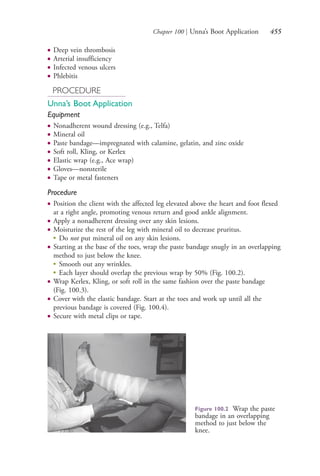
• Take the specimen immediately before menstruation. Get index of
progesterone influence and ovulation.
INDICATIONS
● Suspicion of endometrial cancer
● Infertility
● Amenorrhea
CONTRAINDICATIONS
● Pregnancy
4206_Chapter 3_0205-0312.indd 2274206_Chapter 3_0205-0312.indd 227 12/24/2014 2:01:41 PM12/24/2014 2:01:41 PM
Process CyanProcess CyanProcess MagentaProcess MagentaProcess YellowProcess YellowProcess BlackProcess Black
228 Section Three | Genitourinary and Breast Procedures
PROCEDURE
Endometrial Biopsy
Equipment
● Antiseptic skin cleanser
● Drape—sterile
● Light source
● Endometrial suction curette
● Vaginal speculum
● Water-soluble lubricant—K-Y jelly
● Gloves—sterile
● Ring forceps or tenaculum
● 4 × 4 gauze—sterile
● Container with 10% formalin
Cervical os
Pipelle
curette
Uterus
Figure 45.1 Insert curette into cervical os.
4206_Chapter 3_0205-0312.indd 2284206_Chapter 3_0205-0312.indd 228 12/24/2014 2:01:41 PM12/24/2014 2:01:41 PM
Process CyanProcess CyanProcess MagentaProcess MagentaProcess YellowProcess YellowProcess BlackProcess Black
Chapter 45 | Endometrial Biopsy 229
Procedure
● Have the client void immediately before the examination.
● In women of childbearing age, perform a urine pregnancy test.
● Place the client in the lithotomy position.
● Cleanse the perineum.
● Drape the perineum.
● Lubricate the vaginal speculum.
● Put on gloves.
● Insert the speculum into the vagina, and lock in place with the cervix and os in
view.
● Using ring forceps or the tenaculum, cleanse the vagina and cervix with sterile
gauze.
● Insert the endometrial suction curette into the cervical os 3 to 4 inches (7 to
10 cm) (Fig. 45.1).
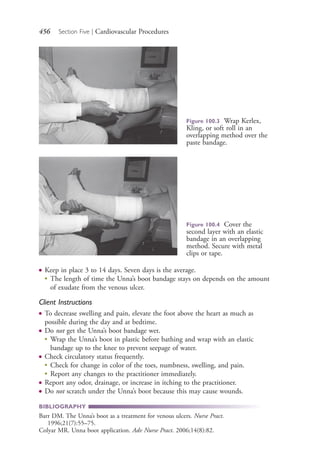
● If entry is difficult, use the tenaculum to pull the bottom of the os gently down
to increase the opening size (Fig. 45.2). The cervix has little nervous innervation
up to the transformation zone. The client should feel no pain if you are careful
not to grasp the os into the transformation zone.
● Pull back on the inner cannula of the suction curette to aspirate cells from the
uterine lining.
Tenaculum site
3
6
9
12
Figure 45.2 Pull the os down to increase the opening.
4206_Chapter 3_0205-0312.indd 2294206_Chapter 3_0205-0312.indd 229 12/24/2014 2:01:41 PM12/24/2014 2:01:41 PM
Process CyanProcess CyanProcess MagentaProcess MagentaProcess YellowProcess YellowProcess BlackProcess Black
230 Section Three | Genitourinary and Breast Procedures
● Withdraw the entire curette.
● Expel the specimen from the curette into the container with formalin.
● Label and send the specimen to the laboratory.
Client Instructions
● You may experience some cramping and bleeding after the procedure. If this
occurs, take 400 to 600 mg of ibuprofen every 6 hours as needed.
● Observe for signs and symptoms of infection, such as
●
Increase in pain after 24 hours
●
Increase in temperature
●
Foul odor
● If any signs or symptoms of infection are found, return to the office.
BIBLIOGRAPHY
Guido RS, Kanbor A, Ruhlin M, Christopherson WA. Pipelle endometrial sampling:
sensitivity in the detection of endometrial cancer. J Reprod Med. 1995;40(8):553–555.
Ignatavicius DD, Workman ML. Medical-Surgical Nursing: Patient-Centered Collaborative
Care. 7th ed. Philadelphia, PA: Saunders; 2012.
Youssif SN, McMellan DL. Outpatient endometrial biopsy: the pipelle. Br J Hosp Med.
1995;54(23):198–201.
46Chapter
Specimen Collection
Gram Stain, Wet Mount (Saline
and KOH)
Margaret R. Colyar
CPT Code
87205 Gram stain
87210 Wet smear
87220 KOH prep
Gram stain technique is a procedure used to differentiate gram-positive and gram-
negative organisms. The technique was named after Christian Gram, who developed
it in 1884. Knowing if an organism is gram-positive or gram-negative helps the nurse
practitioner determine the etiology of the infection and determine appropriate
treatment.
The wet mount (wet prep, wet smear) is a tool used to evaluate the etiology of
abnormal vaginal secretions. Saline and 10% potassium hydroxide (KOH) prepara-
tions are used. With the saline preparation, white blood cells, bacteria, trichomonads,
4206_Chapter 3_0205-0312.indd 2304206_Chapter 3_0205-0312.indd 230 12/24/2014 2:01:41 PM12/24/2014 2:01:41 PM
Process CyanProcess CyanProcess MagentaProcess MagentaProcess YellowProcess YellowProcess BlackProcess Black
Chapter 46 | Specimen Collection 231
and clue cells can be detected. With the 10% KOH preparation, hyphae and buds
can be detected.
OVERVIEW
● Potentially reportable vaginal infections include gonorrhea, syphilis, Chlamydia
trachomatis, herpes genitalis, condyloma acuminatum, pelvic inflammatory
disease, and nonspecific urethritis (male). Check the regulations for reporting
sexually transmitted diseases in the state in which you practice.
HEALTH PROMOTION/PREVENTION
● To prevent vaginal, uterine, tubal, and ovarian infections, the use of condoms
during intercourse is suggested.
RATIONALE
● To aid in assessment of all suspected vaginal infections
● To assist in determination of disease etiology
INDICATIONS
● Unusual foul-smelling vaginal discharge
● Lower abdominal pain
● Vaginal itching
● Dysuria
CONTRAINDICATIONS
● Recent douching
● Menses
● Intravaginal medications
PROCEDURE
Wet Smear (Saline and KOH)
Equipment
● Vaginal speculum—small, medium, or large
● Drape—nonsterile
● Two pairs of gloves—nonsterile
● Test tube with 1 mL 0.9% sodium chloride
● Cotton-tipped applicators—sterile
● 0.9% sodium chloride
● 10% KOH solution—two drops
● Two microscope slides
● Two coverslips
● Microscope
Procedure
● Place the client in the lithotomy position and drape.
● Insert the vaginal speculum and observe the vaginal wall and cervix for
inflammation and/or infections, cysts, lesions, and bleeding.
4206_Chapter 3_0205-0312.indd 2314206_Chapter 3_0205-0312.indd 231 12/24/2014 2:01:41 PM12/24/2014 2:01:41 PM
Process CyanProcess CyanProcess MagentaProcess MagentaProcess YellowProcess YellowProcess BlackProcess Black
232 Section Three | Genitourinary and Breast Procedures
● Using cotton-tipped applicators, collect specimen of vaginal secretions.
● Place one cotton-tipped applicator in the test tube with 1 mL 0.9% sodium
chloride and mix well.
● Remove the speculum.
● With the cotton-tipped applicator, place a smear on each slide.
●
On one slide, add one or two drops of saline and cover with the coverslip.
●
On the second slide, add one or two drops of 10% KOH and cover with the
coverslip.
• Gently heat the KOH slide for 2 to 3 seconds.
• Allow the KOH slide to sit for 15 to 20 minutes at room temperature.
● Place the saline slide (Fig. 46.1) on the microscope at 10× (low power) and
focus. Change to 40× (high power) and focus. Look for the following in five
different fields
●
White blood cells
●
Trichomonads
●
Clue cells (large epithelial cells with indistinct borders with multiple cocci
clinging to them)
• Clue cells often are described as appearing like “pepper on a fried egg”; they
indicate bacterial vaginosis.
● Place the KOH slide (Fig. 46.2) on the microscope at 10× and 40×. Look for
the following in five different fields
●
Hyphae
●
Spores (buds, candidiasis)
Trichomonad
Leukocyte
Clue cell
Figure 46.1 Saline preparation.
4206_Chapter 3_0205-0312.indd 2324206_Chapter 3_0205-0312.indd 232 12/24/2014 2:01:41 PM12/24/2014 2:01:41 PM
Process CyanProcess CyanProcess MagentaProcess MagentaProcess YellowProcess YellowProcess BlackProcess Black
Chapter 46 | Specimen Collection 233
Client Instructions
● Based on the results of your vaginal smears, you have _______________.
● You will need to take ________________ for __________________ days.
● Return to the office 1 week after you finish your medications for recheck or
sooner if your symptoms worsen.
Gram Stain
Equipment
● Vaginal speculum
● Drape—nonsterile
● Cotton-tipped applicators—sterile
● One microscope slide
● Gram stain kit
● Microscope
● Gloves—nonsterile
Procedure
● Place client in lithotomy position and drape.
● Insert vaginal speculum, and observe vaginal wall and cervix (see Chapter 47).
● Using cotton-tipped applicators, collect specimen of vaginal secretions.
● Remove speculum.
● With cotton-tipped applicator, place drop of secretions on the slide, and follow
the directions in the Gram stain kit.
Leukocyte
Vaginal
epithelial
cell
Spores
Pseudo-
hyphae
Figure 46.2 KOH preparation.
4206_Chapter 3_0205-0312.indd 2334206_Chapter 3_0205-0312.indd 233 12/24/2014 2:01:41 PM12/24/2014 2:01:41 PM
Process CyanProcess CyanProcess MagentaProcess MagentaProcess YellowProcess YellowProcess BlackProcess Black
234 Section Three | Genitourinary and Breast Procedures
●
Let specimen air-dry.
●
Apply solutions from the Gram stain kit in the following manner
• Stain with crystal violet and Gram iodine solution.
• All bacteria become blue-purple.
• Rinse with a decolorizer (usually a 95% alcohol or alcohol-acetone mixture).
• Gram-negative bacteria become transparent and lose their color.
• Gram-positive bacteria retain the blue-purple color.
• Apply safranin (a red dye) to the slide.
• Gram-negative bacteria become red.
• Gonorrhea bacteria are gram-negative.
• Gram-positive bacteria remain blue-purple.
Client Instructions
● Based on the results of your vaginal smears, you have ________________.
● You will need to take ________________ for __________________ days.
● Return to the office 1 week after you finish your medications for recheck, or
sooner if your symptoms worsen.
BIBLIOGRAPHY
Difco Laboratories. Gram Stain Sets and Reagents. Detroit, MI: Difco Laboratories; 1994.
Ferris DG, Hendrich J, Payne PM, et al. Office laboratory diagnosis of vaginitis. J Fam
Pract. 1995;46(6):575–581.
Heimbrook ME, Wang WL, Campbell G. Staining bacterial flagella easily. J Clin Micro.
1989;27(11):2612–2615.
47Chapter
Specimen Collection
Papanicolaou (Pap) Smear
Margaret R. Colyar
CPT Code
18811 Sure Path with reflex
88150 Pap smear interpretation
Not used by the clinician; used by the pathologist who interprets the
specimen.
The Pap smear is a tool for screening of cervical cancer. Appropriate smear col-
lection is paramount to detection of cancer cells. In addition, if a lesion is seen or
palpated, other tests, such as ultrasound examination of the pelvis or colposcopy,
should be performed in conjunction with the Pap smear.
4206_Chapter 3_0205-0312.indd 2344206_Chapter 3_0205-0312.indd 234 12/24/2014 2:01:41 PM12/24/2014 2:01:41 PM
Process CyanProcess CyanProcess MagentaProcess MagentaProcess YellowProcess YellowProcess BlackProcess Black
Chapter 47 | Specimen Collection 235
OVERVIEW
● Adequacy of the specimen is shown by the presence of
●
Endocervical cells
●
Squamous metaplasia (found in the transformation zone) (Fig. 47.1)
• The transformation zone is found inside the cervical os; this is an area of
replacement of endocervical columnar cells by squamous cells and varies
with age. In perimenopausal women, the transformation zone is found high
in the endocervical canal (Fig. 47.2).
● The nurse practitioner should be familiar with the classification of cervical
smears (Table 47.1).
Table 47·1 Cervical Smear Classifications
CLASS DESCRIPTIVE BETHESDA CIN
Class I Negative WNL Negative
Class II Inflammatory, squamous,
koilocytotic atypia
Reactive, reparative changes,
ASCUs, LSIL (HPV)
Class III Mild dysplasia
Moderate dysplasia
Severe dysplasia
LSIL (HPV)
HSIL
HSIL
CIN1
CIN2
CIN3
Class IV Ca In Situ HSIL CIN3
Class V Invasive Invasive Invasive
Uterus
Squamocolumnar
transformation
zone
Cervical os
Figure 47.1 Premenopausal squamocolumnar junction transformation
zone.
4206_Chapter 3_0205-0312.indd 2354206_Chapter 3_0205-0312.indd 235 12/24/2014 2:01:41 PM12/24/2014 2:01:41 PM
Process CyanProcess CyanProcess MagentaProcess MagentaProcess YellowProcess YellowProcess BlackProcess Black
236 Section Three | Genitourinary and Breast Procedures
RATIONALE
● To detect cervical carcinoma
● To detect early cervical dysplasia related to infection with HPV
INDICATIONS
● Abnormal vaginal bleeding or discharge
● Lower abdominal pain
● Yearly screening
● Visible or palpable cervical lesions
● Report of cervical dysplasia or malignancy on previous Pap smear
● DES-exposed female—REFER to gynecologist for treatment.
● History of sexually transmitted disease
● History of multiple sexual partners
CONTRAINDICTIONS
● Pelvic inflammatory disease
● Active vaginitis
● Active cervicitis
Uterus
Squamocolumnar
transformation
zone
Cervical os
Figure 47.2 Perimenopausal squamocolumnar junction transformation
zone.
4206_Chapter 3_0205-0312.indd 2364206_Chapter 3_0205-0312.indd 236 12/24/2014 2:01:41 PM12/24/2014 2:01:41 PM
Process CyanProcess CyanProcess MagentaProcess MagentaProcess YellowProcess YellowProcess BlackProcess Black
Chapter 47 | Specimen Collection 237
PROCEDURE
Pap Smear
Equipment
● Vaginal speculum—small, medium, or large
● Drape—nonsterile
● Gloves—nonsterile
● Light source
● Pap smear kit or liquid-based kit (usually provided by the reference laboratory)
●
Wooden paddle and cotton-tipped applicator
●
Optional—cytobrush (decreases the chance of a false-negative result)
●
Cervical broom (Fig. 47.3)
●
Microscope slides
●
Fixative
● Water-soluble lubricant—K-Y jelly
● Large cotton-tipped swabs
Procedure
● Place the client in the lithotomy position and drape.
● Put on gloves.
● Examine the vulva and Bartholin’s and Skene’s glands.
● Warm the speculum with water or lubricate with water-soluble lubricant.
● Ask the client to relax and breathe deeply (this may help the client to relax).
Figure 47-3 Four types of
specimen collection tools.
From left to right: Cervical
broom, cytobrush, cotton-
tipped applicator, and wooden
paddle.
4206_Chapter 3_0205-0312.indd 2374206_Chapter 3_0205-0312.indd 237 12/24/2014 2:01:41 PM12/24/2014 2:01:41 PM
Process CyanProcess CyanProcess MagentaProcess MagentaProcess YellowProcess YellowProcess BlackProcess Black
238 Section Three | Genitourinary and Breast Procedures
● Insert the speculum at a slight diagonal angle and rotate to a horizontal angle as
inserting. Direct the speculum in a downward posterior direction, applying
gentle pressure (Fig. 47.4).
● Open the speculum and adjust the position until the cervix is easily visible.
● Observe the cervix and vaginal wall for inflammation and/or infection, cysts,
lesions, or bleeding.
● If necessary, absorb discharge or blood with large cotton-tipped swab.
● Pap smear kit:
●
Insert the wooden paddle into the cervix and rotate 360 degrees.
●
Place the smear on the slide indicated in the Pap smear kit.
●
Insert other end of the wooden paddle and brush the ectocervix and vaginal
wall.
●
Apply this specimen to the slide indicated in the Pap smear kit.
●
Next, insert the cytobrush, broom, or cotton-tipped applicator in the cervical
os and rotate 360 degrees.
●
Apply this specimen to the slide indicated in the Pap smear kit.
●
Apply fixative provided to the slides.
●
Label and send to reference laboratory.
● Liquid based kit:
●
Insert the cytobrush in the cervix and rotate 360 degrees.
●
Insert the paddle into the cervix and rotate 360 degrees.
●
Put both specimens in the specimen bottle.
Figure 47-4 Direct the vaginal speculum in a downward posterior
direction.
4206_Chapter 3_0205-0312.indd 2384206_Chapter 3_0205-0312.indd 238 12/24/2014 2:01:41 PM12/24/2014 2:01:41 PM
Process CyanProcess CyanProcess MagentaProcess MagentaProcess YellowProcess YellowProcess BlackProcess Black
Chapter 47 | Specimen Collection 239
●
Snap off the handles and apply the lid.
●
Label and send to reference laboratory.
● Hint—With postmenopausal and obese clients, the vaginal walls may prolapse
into the open speculum, occluding your view of the cervix. To prevent this
complication, a special splint (Fig. 47.5) using a glove and the speculum can be
used. You can make this splint by
●
Inserting the speculum into the finger of a nonsterile glove
●
Removing the excess glove
●
Cutting off the fingertip
● The glove provides a splintlike effect when the speculum is opened in the
vagina.
Client Instructions
● There may be minor bleeding after the examination. This is normal.
● If your Pap smear is class II through V, further testing is necessary.
● The nurse from the office will call you in 5 to 10 days with the results of your
Pap smear.
BIBLIOGRAPHY
Helderman G, Graham L, Cannon D, Waters K, Feller D. Comparing two sampling
techniques of endocervical cell recovery on Papanicolaou smears. Nurse Pract.
1990;15(11):30–32.
Lieu D. The Papanicolaou smear: its value and limitations. J Fam Pract.
1996;47(4):391–399.
Figure 47-5 Speculum splint.
4206_Chapter 3_0205-0312.indd 2394206_Chapter 3_0205-0312.indd 239 12/24/2014 2:01:41 PM12/24/2014 2:01:41 PM
Process CyanProcess CyanProcess MagentaProcess MagentaProcess YellowProcess YellowProcess BlackProcess Black
240 Section Three | Genitourinary and Breast Procedures
48Chapter
Administration of Vaginal
Medications and Condoms
Margaret R. Colyar
CPT Code
None
INTRODUCTION
Vaginal medications come in the form of creams, suppositories, and inserts. Creams
and suppositories are inserted with a plastic applicator that accompanies the medica-
tion. Inserts are applied manually.
There are two types of condoms: male and female. Either may be made of latex,
lamb intestines, or polyurethane. As a method of contraception, male condoms are
inexpensive, easy to use, and have few side effects. Latex/polyurethane condoms offer
protection against sexually transmitted diseases. Lamb intestine condoms do not
protect against sexually transmitted diseases.
OVERVIEW
● Effectiveness
●
Male condom users experience a 2% per-year pregnancy rate.
●
Female condom users experience a 5% per-year pregnancy rate.
● Use only water-based lubricants such as K-Y jelly or AstroGlide with latex
condoms.
● Oil-based lubricants (petroleum jelly, butter, cold cream, mineral or vegetable
oils) can damage latex.
RATIONALE
● To prevent pregnancy
● To prevent sexually transmitted diseases
CONTRAINDICATIONS
● Latex allergy
4206_Chapter 3_0205-0312.indd 2404206_Chapter 3_0205-0312.indd 240 12/24/2014 2:01:41 PM12/24/2014 2:01:41 PM
Process CyanProcess CyanProcess MagentaProcess MagentaProcess YellowProcess YellowProcess BlackProcess Black
Chapter 48 | Administration of Vaginal Medications and Condoms 241
PROCEDURE
Vaginal Creams and Suppositories
Equipment
● Vaginal cream
● Vaginal suppository
● Applicator
● Gloves—nonsterile
Procedure
● Fill the applicator
●
For cream dosage forms
• Screw the applicator onto the tube.
• Squeeze the medicine into the applicator slowly until it is measured
properly.
• Remove the applicator from the tube. Replace the cap on the tube.
●
For suppository dosage form
• Place the suppository into the applicator.
● Position the patient on her back with knees bent.
● Put on gloves.
● Slide the applicator slowly into the vagina until resistance is met.
● Slowly press the plunger until it stops.
● Withdraw the applicator.
● Clean the applicator after use by pulling the plunger out of the applicator and
washing both parts completely in warm, soapy water.
● Rinse well.
● After drying the applicator, replace the plunger.
PROCEDURE
Vaginal Inserts
Equipment
● Vaginal insert
● Gloves—nonsterile
Procedure
● Insertion of the vaginal insert
●
Position the patient on her back with knees bent.
●
Pinch or press the sides of the vaginal insert between your forefinger and
middle finger.
●
With one hand, part the folds of skin around the vagina.
●
Slide the vaginal insert slowly into the upper third of the vagina.
● Removal of the vaginal insert
●
Position the patient on her back with knees bent.
●
Slide one finger into the vagina and hook it around the closest part of the
vaginal insert.
4206_Chapter 3_0205-0312.indd 2414206_Chapter 3_0205-0312.indd 241 12/24/2014 2:01:41 PM12/24/2014 2:01:41 PM
Process CyanProcess CyanProcess MagentaProcess MagentaProcess YellowProcess YellowProcess BlackProcess Black
242 Section Three | Genitourinary and Breast Procedures
●
Slowly pull the vaginal insert out.
●
Wrap the vaginal insert and dispose in the trash.
PROCEDURE
Appling Male Condoms
● Put a drop or two of spermicide or lubricant inside the condom.
● Pull back the foreskin, unless circumcised, before rolling on the condom.
● Place the rolled condom over the tip of the hard penis.
●
Leave a half an inch of space at the tip to collect semen.
● Pinch the air out of the tip while placing it on the penis.
● Unroll the condom over the penis all the way down to the base of the penis.
● Smooth out any air bubbles gently.
● Lubricate the outside of the condom.
● To remove the condom, hold it around the base of the penis when you pull out
to prevent any sperm transfer into the vagina and dispose in the trash.
PROCEDURE
Applying Female Condoms
● Put spermicide or lubricant on the outside of the closed end of the condom.
● Have the patient stand with one foot on a chair, sit on the edge of a chair, lie
down, or squat.
● Have the patient squeeze together the sides of the inner ring at the closed end
of the condom like a pencil and insert it into the vagina like a tampon.
● After the inner ring is inserted, the patient should place two fingers inside the
condom and push the inner ring into the vagina until it reaches the cervix. She
will feel the inner ring open up.
● Have her pull out her fingers and let the outer ring hang about an inch outside
the vagina.
● To remove the female condom, twist it around a finger and pull it out.
● Dispose in the trash.
Client Instructions
● Use a condom only one time.
● Check expiration date.
● Be careful while unwrapping a condom. If it is torn, brittle, stiff, or sticky,
throw it away and use another.
BIBLIOGRAPHY
http://www.plannedparenthood.org/health-topics/birth-control/female-condom-4223
.htm—Video
http://www.plannedparenthood.org/health-topics/birth-control/condom-10187.htm—Video
4206_Chapter 3_0205-0312.indd 2424206_Chapter 3_0205-0312.indd 242 12/24/2014 2:01:41 PM12/24/2014 2:01:41 PM
Process CyanProcess CyanProcess MagentaProcess MagentaProcess YellowProcess YellowProcess BlackProcess Black
Chapter 49 | Bartholin Cyst Abscess 243
Chapter
49Bartholin Cyst Abscess
Incision and Drainage
Margaret R. Colyar
CPT Code
56420 Incision and drainage of Bartholin’s gland abscess
56740 Excision of Bartholin’s gland or cyst
Bartholinitis is inflammation of one or both of the Bartholin’s glands at the opening
of the vagina (Fig. 49.1). Obstruction of the main duct of these glands causes reten-
tion of secretions and dilation of the gland. Incision and drainage of abscessed
Figure 49.1 (A) Bartholin’s glands
are on either side of the vaginal
orifice. (B) A Bartholin’s cyst
occurs when the gland becomes
inflamed or infected.
Bartholin's
glands
Vagina
Labia
Urethra
A
Bartholin's cyst
B
4206_Chapter 3_0205-0312.indd 2434206_Chapter 3_0205-0312.indd 243 12/24/2014 2:01:42 PM12/24/2014 2:01:42 PM
Process CyanProcess CyanProcess MagentaProcess MagentaProcess YellowProcess YellowProcess BlackProcess Black
244 Section Three | Genitourinary and Breast Procedures
Bartholin’s glands are needed if the gland is swollen and painful. A culture of the
abscess material should be taken to determine the etiology of the abscess and to
provide treatment guidance.
OVERVIEW
● Approximately 2% of adult women develop an abscess of the Bartholin’s glands.
● Recurrence rate is high.
● Most common causes are
●
Inspissated mucus
●
Congenital narrowing of the gland
●
Neisseria gonorrhoeae
●
Staphylococcus
●
Streptococcus
●
Escherichia coli
●
Trichomonas
●
Bacteroides
● Symptoms of bartholinitis include
●
Swelling of the labia
●
Tenderness/pain in the labia when walking and/or sitting
●
Enlarged inguinal nodes
●
Dyspareunia
●
Palpable mass
● Prevention includes
●
Protected sexual intercourse
●
Meticulous cleansing of the perineum
RATIONALE
● To relieve pain
● To determine the etiology and provide treatment guidance
INDICATIONS
● Infected Bartholin’s glands
CONTRAINDICATIONS
● Pregnancy—REFER to a gynecologist.
◗ Informed consent required
PROCEDURE
Bartholin’s Cyst Abscess—Incision and Drainage
Equipment
● Antiseptic skin cleanser
● Drape—sterile
● Gloves—sterile
● 1% lidocaine—5 to 10 mL
● Two syringes—10 and 20 mL
4206_Chapter 3_0205-0312.indd 2444206_Chapter 3_0205-0312.indd 244 12/24/2014 2:01:42 PM12/24/2014 2:01:42 PM
Process CyanProcess CyanProcess MagentaProcess MagentaProcess YellowProcess YellowProcess BlackProcess Black
Chapter 49 | Bartholin Cyst Abscess 245
● Two needles—18- and 25-gauge, ½-inch needle
● 0.9% sodium chloride—250 mL
● No. 11 scalpel
● 4 × 4 gauze—sterile
● Iodoform gauze—¼- or ½-inch wide
● Scissors—sterile
● Curved hemostats—sterile
● Pickups—sterile
● Vaginal culture swab
● Peri pads—nonsterile
Procedure
● Instruct the client to empty her bladder.
● Position the client in the lithotomy position.
● Cleanse perineum with antiseptic skin cleanser.
● Open gauze, scalpel, needle, and syringes onto a sterile field.
● Put on gloves.
● Inject 5 to 10 mL of 1% lidocaine along the top of the abscessed Bartholin’s
gland using the 10-mL syringe with the 25-gauge needle.
● Incise the cyst along the top. Make the incision deep enough and long enough
to allow drainage.
●
A longer incision is considered better than a smaller incision.
● Culture the drainage.
● Insert a gloved finger into the vaginal orifice, and apply gentle pressure toward
the abscess to express the exudate.
● After all exudate is expressed, inspect the wound with curved hemostats and
break up any loculations (small cavities).
● Irrigate with 0.9% sodium chloride using the 20-mL syringe with the 18-gauge
needle.
● Insert iodoform gauze into the wound, leaving approximately ½ inch protruding
from the wound.
● Cover with 4 × 4 gauze sponges and apply a peri pad.
Client Instructions
● To prevent further infection, the following antibiotic has been ordered:
(doxycycline, erythromycin, or a cephalosporin) _________________.
● Remove half of the gauze in 24 hours. Remove the remaining gauze in 48 hours.
● Change the 4 × 4 sponges and peri pad every 4 to 6 hours.
● Soak in a basin or tub of warm water four times per day for 1 week.
● Return to the office in 1 week for recheck, or sooner if your symptoms worsen.
BIBLIOGRAPHY
Pfenninger JL, Fowler GC. Procedures for Primary Care Physicians. St. Louis, MO: Mosby;
2011.
Rakel RE, Bope ET. Conn’s Current Therapy. Philadelphia, PA: Saunders; 2006.
Youngkin EQ, Davis MS. Women’s Health: A Primary Care Clinical Guide. Norwalk, CT:
Appleton & Lange; 2012.
4206_Chapter 3_0205-0312.indd 2454206_Chapter 3_0205-0312.indd 245 12/24/2014 2:01:42 PM12/24/2014 2:01:42 PM
Process CyanProcess CyanProcess MagentaProcess MagentaProcess YellowProcess YellowProcess BlackProcess Black
246 Section Three | Genitourinary and Breast Procedures
50Chapter
Cervical Cap Fitting, Insertion,
and Removal
Margaret R. Colyar
CPT Code
57170 Diaphragm/cervical cap fitting with instructions
A cervical cap is a helmet-shaped, rubber device that fits over the cervix. It is much
smaller than a diaphragm. When used with spermicide, the cervical cap acts as a
physical and chemical barrier to sperm. Cervical caps come in several sizes and must
be fitted by a professional. It is a nonsystemic, nonhormonal, and reversible method
of contraception.
OVERVIEW
● Prevention of pregnancy—sources differ
●
Among nulliparous women, cervical caps are 80% to 91% effective; 9% to
20% become pregnant within the first year.
● Among parous women, cervical caps are 60% to 74% effective; 26% to 40%
become pregnant within the first year.
Potential Complications
● Pregnancy
● Conversion from normal to abnormal cervical cytology
● Urinary tract infections
● Cervical or vaginal lesions with prolonged use
● Toxic shock syndrome
● Allergy to latex rubber or spermicide
● Sexually transmitted disease transmission
Assess
● Comfort with and ability (woman/partner) to insert, check placement, and
remove cap
● Ability to understand instructions for proper use
● Length of cervix—a long or short cervix can compromise fit of cap
● Willingness to return after pregnancy or weight change of more than 10 lb
4206_Chapter 3_0205-0312.indd 2464206_Chapter 3_0205-0312.indd 246 12/24/2014 2:01:42 PM12/24/2014 2:01:42 PM
Process CyanProcess CyanProcess MagentaProcess MagentaProcess YellowProcess YellowProcess BlackProcess Black
Chapter 50 | Cervical Cap Fitting, Insertion, and Removal 247
RATIONALE
● To provide a reliable, nonhormonal, nonsystemic, and reversible form of
contraception
INDICATIONS
● Contraception
● Patient choice
● Contraindications to other methods of contraception
CONTRAINDICATIONS
● History of toxic shock syndrome
● Allergy to latex, rubber, or spermicide
● Suspected or known cervical or uterine malignancy
● Unusually long or short cervix
● Extensive cervical scarring or lacerations
● Unresolved abnormal Pap smear
● Inability to learn proper use
◗ Informed consent required
PROCEDURE
Cervical Cap Fitting, Insertion, and Removal
Equipment
● Cervical cap
●
The clinician must order a set of cervical caps to use in the office for fitting
the client. The caps are available in various internal rim diameter sizes.
● Speculum
● Water-soluble lubricant—K-Y jelly
● Gloves—nonsterile
Procedure
CERVICAL CAP FITTING AND INSERTION
● Have client empty her bladder before fitting and insertion.
● Position the client in the lithotomy position.
● With a gloved hand, perform a bimanual examination to evaluate the size and
position of the uterus and cervix.
● Apply K-Y jelly to a speculum.
● Insert the speculum to visualize the cervix to estimate the cap size, and note any
scarring, lacerations, and length of the cervix. The cervix must be symmetrical,
be long enough to apply the cap, and have a proper seal.
● Fold the rim of the cap and compress the cap dome to insert it into the vagina,
and place it over the cervix. Unfolding the dome creates suction between the
rim of the cap and the cervix.
● After applying the cap to the cervix, run a finger around the entire rim to check
for gaps. Note the stability of the cap by determining how easily it is displaced
4206_Chapter 3_0205-0312.indd 2474206_Chapter 3_0205-0312.indd 247 12/24/2014 2:01:42 PM12/24/2014 2:01:42 PM
Process CyanProcess CyanProcess MagentaProcess MagentaProcess YellowProcess YellowProcess BlackProcess Black
248 Section Three | Genitourinary and Breast Procedures
with your finger. There should not be any gaps, and the cap must cover the
cervix completely and fit snugly, but not tightly.
● After 1 to 2 minutes, check again for fit and suction. Try to rotate the cap; it
should rotate with slight resistance and not come off the cervix.
● Try at least one other cap size, either smaller or larger, to determine which one
fits best.
● Have the client feel the cap in place and give her instructions for use.
● Provide a written prescription for the patient to fill at a pharmacy that carries
cervical caps.
CERVICAL CAP REMOVAL
● To remove the cap, insert one finger between the rim of the cap and the cervix
to break the suction, then gently pull the cap down and out. Have the client
practice putting the cap on and off in the office.
Client Instructions
● Check cap for holes, tears, and cracks by holding the cervical cap up to a light.
● Apply a teaspoon of spermicidal cream to the dome of the cap before inserting.
● Empty bladder before insertion.
● Insert the cap in a squatting position.
● Do not remove the cap for at least 8 hours after last coitus.
● To reduce risk of toxic shock syndrome, the cap must be removed within 48
hours after use.
● To remove, push the rim away from the cervix to break the suction and pull the
cap out.
● Use of additional spermicide with repeated intercourse is optional. Do not
remove cap. Use a plastic introducer to insert fresh spermicide.
● Do not use during vaginal bleeding.
● After removal, clean the cervical cap with soapy water, rinse thoroughly in plain
water, and air dry. Do not use powders, oils, or petroleum jelly (Vaseline) with
the cap.
● Check fit yearly with annual examination and refit if client has had a pregnancy
or gained or lost more than 10 lb.
BIBLIOGRAPHY
Hatcher R. Contraceptive Technology. 20th ed. New York, NY: Ardent Media; 2011. (2013).
http://www.femcap.com/advantag.htm—The Fem Cap
http://www.plannedparenthood.org—Planned Parenthood
4206_Chapter 3_0205-0312.indd 2484206_Chapter 3_0205-0312.indd 248 12/24/2014 2:01:42 PM12/24/2014 2:01:42 PM
Process CyanProcess CyanProcess MagentaProcess MagentaProcess YellowProcess YellowProcess BlackProcess Black
Chapter 51 | Cervical Lesions 249
Chapter
51Cervical Lesions
Cryotherapy
Margaret R. Colyar
CPT Code
57511 Cryocautery of cervix, initial or repeat
Cryotherapy is a technique in which the outermost layer of cervical cells is frozen.
The transformation zone is destroyed. If the lesion is confined to the exocervix,
cryotherapy is appropriate.
OVERVIEW
● Depth of tissue destruction is 3 to 4 mm.
● Cryosurgery is not recommended if
●
It is 5 to 7 days before menses. Edema of cervical tissue may occur.
●
The lesion cannot be entirely visualized.
●
There is greater than grade II cervical dysplasia. Appropriate depth of tissue
will not be able to be removed.
●
The patient is immunocompromised or on high-dose steroids. Patient may
develop secondary infection.
OPTIONS
● Method 1—Freeze, thaw, freeze
● Method 2—Freeze, thaw
RATIONALE
● To diminish pain
● To prevent further tissue destruction
● To prevent spread of lesion
INDICATIONS
● Cervical dysplasia—grade I or II—if lesion can be covered by the cryoprobe
● Precancerous cervical lesions
● Carcinoma in situ
CONTRAINDICATIONS
● Pregnancy
● Cervical cancer
4206_Chapter 3_0205-0312.indd 2494206_Chapter 3_0205-0312.indd 249 12/24/2014 2:01:42 PM12/24/2014 2:01:42 PM
Process CyanProcess CyanProcess MagentaProcess MagentaProcess YellowProcess YellowProcess BlackProcess Black
250 Section Three | Genitourinary and Breast Procedures
● Cervical dysplasia—greater than grade II
● Positive endocervical curettage
● Entire lesion cannot be seen
● Positive for sexually transmitted disease
● 5 to 7 days before menses
● Immunocompromised
● On high-dose steroids
◗ Informed consent required
PROCEDURE
Cervical Lesions—Cryotherapy
Equipment
● Methods 1 and 2
●
Nitrous oxide cryoprobe unit
●
Cryoprobes—flat or cone
●
Water-soluble lubricant (K-Y jelly, Cryogel, lidocaine jelly)
●
Drape—nonsterile
●
Cotton-tipped applicators
●
Vaginal speculum with retraction device (see Chapter 47)
●
Light source
●
Gloves—nonsterile
●
NSAIDs
Procedure
METHOD 1—FREEZE, THAW, FREEZE
● Have the client take a dose of an NSAID 0.5 to 1 hour prior to the procedure.
● Position the client in the lithotomy position.
● Drape the client.
● Put on gloves.
● Select the appropriate cryoprobe (Fig. 51.1).
●
Must cover the entire lesion
●
Must be flat or slightly conical
● Apply a water-soluble lubricant to the cryoprobe tip.
● Activate the nitrous oxide unit according to the manufacturer’s directions.
● Insert the vaginal speculum in the vaginal vault.
● Position the probe over the area to be treated and start the freeze (Fig. 51.2).
●
Be sure the probe does not touch the vaginal wall (very sensitive).
●
Freeze for 3 minutes or until a 5-mm ice ball is beyond the lesion.
● Thaw. Wait 5 minutes.
● Refreeze for 3 minutes or until a 5-mm ice ball is beyond the lesion.
METHOD 2—FREEZE, THAW
● Have the client take a dose of an NSAID 0.5 to 1 hour before the procedure.
● Position the client in the lithotomy position.
● Drape the client.
4206_Chapter 3_0205-0312.indd 2504206_Chapter 3_0205-0312.indd 250 12/24/2014 2:01:42 PM12/24/2014 2:01:42 PM
Process CyanProcess CyanProcess MagentaProcess MagentaProcess YellowProcess YellowProcess BlackProcess Black
Chapter 51 | Cervical Lesions 251
● Put on gloves.
● Select the appropriate cryoprobe (Fig. 51.1).
●
Must cover the entire lesion
●
Must be flat or slightly conical
● Apply a water-soluble lubricant to the cryoprobe tip.
● Activate the nitrous oxide unit according to the manufacturer’s directions.
● Insert the vaginal speculum in the vaginal vault.
●
Position the probe over the area to be treated and start the freeze (Fig. 51.2).
●
Be sure the probe does not touch the vaginal wall (very sensitive).
Figure 51.1 Cryoprobes.
Cryoprobe
Ice ball
Cervical os
Figure 51.2 Cervical lesions. Freeze for 3 minutes or until a 5-mm ice
ball surrounds the lesion. Thaw for 5 minutes; then refreeze.
4206_Chapter 3_0205-0312.indd 2514206_Chapter 3_0205-0312.indd 251 12/24/2014 2:01:42 PM12/24/2014 2:01:42 PM
Process CyanProcess CyanProcess MagentaProcess MagentaProcess YellowProcess YellowProcess BlackProcess Black
252 Section Three | Genitourinary and Breast Procedures
● Freeze for 3 minutes or until a 5-mm ice ball is beyond the lesion.
● Thaw.
Client Instructions
● Expect some mild cramping and watery, foul-smelling discharge for 3 weeks.
● Take acetaminophen or ibuprofen as directed for abdominal cramping.
● Do not put anything inside the vagina for 3 weeks, such as
●
Tampons
●
Douching solutions
● Do not engage in vaginal intercourse for 3 weeks.
● A follow-up Pap smear in 6 months will be needed. Your next appointment is
______________.
BIBLIOGRAPHY
Beckman CRB, Herbert W, Laube D, Ling F, Smith R. Obstetrics and Gynecology. 7th ed.
Philadelphia, PA: Lippincott Williams Wilkins; 2013.
E. A. Conway Charity Hospital. Outpatient Information—Cryotherapy of the Cervix. Patient
instruction sheet. Monroe, LA: E. A. Conway Charity Hospital; 1996.
Pfenniger JL, Fowler GC. Procedures for Primary Care Physicians. St. Louis, MO: Mosby;
2011.
Younghkin EQ, Davis MS. Women’s Health: A Primary Care Clinical Guide. Norwalk, CT:
Appleton & Lange; 2012.
52Chapter
Circumcision and Dorsal Penile
Nerve Block
Margaret R. Colyar
CPT Code
54150 Circumcision (clamp); newborn
54152 Circumcision (clamp); child
54160 Circumcision, other (Plastibell); newborn
54161 Circumcision, other (Plastibell); child
Circumcision is a surgical procedure in which the prepuce of the penis is excised.
Uncircumcised boys and men may require the procedure in treatment of phimosis
and balanitis. For newborns, the American Academy of Pediatrics does not recom-
mend circumcision as a routine procedure based on research published in the past
10 years concerning urinary tract infections, penile cancer, sexually transmitted
diseases, analgesia, and complications of circumcision. They do note that parents
4206_Chapter 3_0205-0312.indd 2524206_Chapter 3_0205-0312.indd 252 12/24/2014 2:01:42 PM12/24/2014 2:01:42 PM
Process CyanProcess CyanProcess MagentaProcess MagentaProcess YellowProcess YellowProcess BlackProcess Black
Chapter 52 | Circumcision and Dorsal Penile Nerve Block 253
should be allowed to make an informed choice taking into account cultural, religious,
and ethnic traditions.
OVERVIEW
● The two methods most often used to circumcise the penis of the newborn are
●
Gomco clamp—produce crushing of the nerve endings and blood vessels to
promote hemostasis, while protecting the glans.
●
Plastibell—causes necrosis of the remaining foreskin by strangulation.
● The newborn to be circumcised should be at least 1 hour postprandial due to
regurgitation and have had one documented void.
● Neonates who receive dorsal penile nerve block (DPNB) or local anesthesia cry
less, have less tachycardia, are less irritable, and have fewer behavioral changes in
the 24 hours after the circumcision procedure.
INDICATIONS
● Cultural, religious, and ethnic traditions
● Phimosis
● Balanitis
● Condyloma
● Redundant foreskin
CONTRAINDICATIONS (CIRCUMCISION
AND DPNB)
● Hypospadius
● Unusual-appearing genitalia (chordae, hypospadius, epispadius)
● Ambiguous genitalia, severe illness/infection
● Less than 12 hours old
● Prematurity
◗ Informed consent required
PROCEDURE
Dorsal Penile Nerve Block
See Figure 52.1.
Figure 52.1 Dorsal penile nerve block
injection sites.
4206_Chapter 3_0205-0312.indd 2534206_Chapter 3_0205-0312.indd 253 12/24/2014 2:01:42 PM12/24/2014 2:01:42 PM
Process CyanProcess CyanProcess MagentaProcess MagentaProcess YellowProcess YellowProcess BlackProcess Black
254 Section Three | Genitourinary and Breast Procedures
Equipment
● Restrainer board with padding
● 1% lidocaine without epinephrine
● 1-mL tuberculin syringe
● 27-gauge needle, 1 inch
● Gloves—nonsterile
● Alcohol
Procedure
● Restrain child.
● Inspect genitalia.
● Cleanse with antiseptic solution.
● Insert needle at 2:00 position 0.3 to 0.5 cm at base of penis beneath the skin
surface.
● Aspirate. If no blood return, inject 0.2 to 0.4 mL of lidocaine without
epinephrine.
● Repeat at 10:00 position.
● Wait 4 minutes.
● Proceed with circumcision.
Circumcision—Three Methods
● Newborn—Gomco clamp
● Newborn—Plastibell
● Older boys and men
●
Forceps-guided freehand method
Equipment
● Gomco clamp and Plastibell methods
●
Restrainer board with padding
●
Gloves—sterile
●
Fenestrated drape
●
Povidone-iodine (Betadine)
●
Gauze pads
●
Hemostats (two curved/one straight)
●
Scissors
●
Gomco clamp or Plastibell
●
No. 11 scalpel
●
Vaseline
Procedure
GOMCO CLAMP METHOD
See Figure 52.2.
● Restrain child.
● Inspect genitalia.
4206_Chapter 3_0205-0312.indd 2544206_Chapter 3_0205-0312.indd 254 12/24/2014 2:01:42 PM12/24/2014 2:01:42 PM
Process CyanProcess CyanProcess MagentaProcess MagentaProcess YellowProcess YellowProcess BlackProcess Black
Chapter 52 | Circumcision and Dorsal Penile Nerve Block 255
● Cleanse with antiseptic solution.
● Grasp foreskin with two hemostats at 10:00 and 2:00 positions.
● Gently probe and lyse adhesions underneath the foreskin with a curved
hemostat.
●
Do not extend beyond the corona.
● Place the straight hemostat approximately two thirds of the distance from the
foreskin to the opening of the corona.
●
Keep in place for 1 minute.
●
This crushes the skin and marks the area for placing the dorsal slit.
● Remove the hemostat.
● Cut through the middle of the crushed area.
● Peel the foreskin back with gauze, and remove any additional adhesions.
● Place the Gomco bell over the penis with the dorsal slit secured over the bell.
● Pull the foreskin over the bell.
● Bring the bell and foreskin through the Gomco clamp ring.
● Tighten the thumbscrew until snug.
● Remove visible foreskin with a No. 11 scalpel distal to the junction of the bell
and clamp device.
● Keep the Gomco clamp in place for 5 minutes to allow for hemostasis, which
decreases the incidence of bleeding.
● Loosen the thumbscrew, and gently loosen the foreskin.
Figure 52.2 Steps of Gomco clamp method of
circumcision. (A) After incising the dorsal slit,
retract the foreskin, and place the Gomco bell.
(B) Bring the bell, safety pin, and foreskin
through the Gomco ring. Tighten the screw.
(C) Trim the excess foreskin with a No. 11
scalpel.
A
B
C
4206_Chapter 3_0205-0312.indd 2554206_Chapter 3_0205-0312.indd 255 12/24/2014 2:01:42 PM12/24/2014 2:01:42 PM
Process CyanProcess CyanProcess MagentaProcess MagentaProcess YellowProcess YellowProcess BlackProcess Black
256 Section Three | Genitourinary and Breast Procedures
● Wrap the penis in Vaseline gauze.
● First void after the procedure should be documented.
PLASTIBELL METHOD
See Figure 52.3.
● Restrain child.
● Inspect genitalia.
● Cleanse with antiseptic solution.
● Grasp foreskin with two hemostats at 10:00 and 2:00 positions.
● Gently probe and lyse adhesions underneath the foreskin with a curved
hemostat.
●
Do not extend beyond the corona.
● Place the straight hemostat approximately two-thirds of the distance from the
foreskin to the opening of the corona.
●
Keep in place for 1 minute.
●
This crushes the skin and marks the area for placing the dorsal slit.
● Remove the hemostat.
● Cut through the middle of the crushed area.
● Peel the foreskin back with gauze, and remove any additional adhesions.
● Place Plastibell over the glans.
● Pull foreskin over the Plastibell.
● Place Plastibell so that indentation is below the apex of the incision.
● Place 2-inch string over indention of the Plastibell and tighten until in place but
not firm.
● Check placement of the string and bell.
●
Make sure Plastibell moves freely over the glans.
● Tighten the string and hold tension for 30 seconds.
● Tie a square knot (right over left; left over right).
● Remove hemostats.
● Cut foreskin using scissors 1⁄8 to 3⁄16 inch distal to the string.
Figure 52.3 Steps of Plastibell method of circumcision.
(A) Place the Plastibell over the glans, and place the string
over the Plastibell indention. (B) Trim the foreskin.
(C) Break off the Plastibell shaft, leaving the bell in place.
A
C B
4206_Chapter 3_0205-0312.indd 2564206_Chapter 3_0205-0312.indd 256 12/24/2014 2:01:42 PM12/24/2014 2:01:42 PM
Process CyanProcess CyanProcess MagentaProcess MagentaProcess YellowProcess YellowProcess BlackProcess Black
Chapter 52 | Circumcision and Dorsal Penile Nerve Block 257
● Hold the Plastibell and gently snap the shaft off.
● Wrap the penis in Vaseline gauze.
● First void after the procedure should be documented.
Parent Instructions
● Yellow film will develop on the glans in the next few days. This is normal
granulation tissue and disappears in the next few days.
● Keep penis clean and dry.
● Apply Vaseline on circumcised area after each diaper change until healed.
● Plastibell should fall off in 10 to 14 days. If it does not, call the health-care
provider.
Circumcision—Older Boys and Men
Equipment
● 1% lidocaine without epinephrine
● 1-mL tuberculin syringe
● 27-gauge needle, 1 inch
● Locking forceps
● Scalpel
● Scissors
● Antiseptic skin cleanser
● Gloves—nonsterile
● Alcohol
● Silver nitrate sticks
● Vaseline gauze
● Kling
Procedure
● Consider giving preprocedure medication to decrease anxiety.
● Inspect genitalia.
● Cleanse with antiseptic skin cleanser.
● Perform DPNB. Inject 0.5 to 1 mL of lidocaine without epinephrine.
● Wait 4 to 5 minutes.
● Grasp across foreskin with locking forceps parallel to corona of the glans. Pull
out in front of the glans.
● Gently probe and lyse adhesions underneath the foreskin with a curved
hemostat.
●
Do not extend beyond the corona.
● Cut across the forceps farthest from the glans.
● Remove the excised foreskin.
● Snip frenulum.
● Unclamp foreskin.
● Cauterize with silver nitrate as necessary.
● Wrap with Vaseline gauze and Kling.
4206_Chapter 3_0205-0312.indd 2574206_Chapter 3_0205-0312.indd 257 12/24/2014 2:01:42 PM12/24/2014 2:01:42 PM
Process CyanProcess CyanProcess MagentaProcess MagentaProcess YellowProcess YellowProcess BlackProcess Black
258 Section Three | Genitourinary and Breast Procedures
Client Instructions
● Monitor signs of infection, such as
●
Red streaks
●
Yellow-green drainage
●
Foul odor from wound
●
Elevated temperature
● If bleeding occurs, apply pressure dressing.
● If swelling occurs and unable to urinate within 8 hours, return to clinic or go to
emergency department at local hospital for urinary catheterization.
● Give acetaminophen with codeine (Tylenol No. 3) every 6 hours as needed for
severe pain; give ibuprofen 600 mg orally every 6 hours as needed for moderate-
to-mild pain.
● Return to clinic in 1 week for recheck.
BIBLIOGRAPHY
American Academy of Pediatrics. Policy Statement—Circumcision. AAP.org; 2012.
Holman JR, et al. Neonatal circumcision techniques. Am Fam Physician. 1995;52:
511–517.
Holman JR, Stuessi KA. Adult circumcision. Am Fam Physician. 1999;59(6):1514–1518.
McMillian JA, Feigin RD, DeAngelis C, Jones MD Jr. Oski’s Pediatrics: Principles and
Practice. 4th ed. Philadelphia, PA: Lippincott Williams & Wilkins; 2006.
Pfenninger JL, Fowler GC. Procedures for Primary Care Physicians. St. Louis, MO: Mosby;
2011.
53Chapter
Condyloma Acuminata Removal
Cynthia Ehrhardt
CPT Code
54050 Destruction of lesion(s), penis; simple, chemical
54054 Destruction of lesion(s), penis; simple, cryosurgery
54065 Destruction of lesion(s), penis; extensive, any method
56501 Destruction of lesion(s), vulva; simple, any method
56515 Destruction of lesion(s), vulva; extensive, any method
Condyloma acuminatum (or HPV genital infection) is a viral infection of the
human host that is responsible for causing genital warts. These warts usually are
located in the dermal layers of the body. Currently, 60 types of HPV have been
identified. These viruses can be classified in three categories
4206_Chapter 3_0205-0312.indd 2584206_Chapter 3_0205-0312.indd 258 12/24/2014 2:01:42 PM12/24/2014 2:01:42 PM
Process CyanProcess CyanProcess MagentaProcess MagentaProcess YellowProcess YellowProcess BlackProcess Black
Chapter 53 | Condyloma Acuminata Removal 259
● Viruses causing benign and low-risk lesions
● Viruses causing lesions with a moderate oncogenic risk
● Viruses causing lesions with a high oncogenic risk
Genital warts typically have a hypertrophic or cauliflower-type appearance.
In the male, most of the lesions are located on the prepuce, glans, urethra, penile
shaft, and scrotum. In the female, most lesions are found on the vulva, perianal area,
vagina, and cervix.
OVERVIEW
● Incidence
●
It is estimated that 1 million individuals are newly diagnosed with condyloma
acuminatum in the United States each year.
●
Incidence of success of treatment modalities is broken down into several
categories (Table 53.1).
Table 53∙1 Incidence of Success of Treatment Modalities for
Condyloma Acuminatum
CATEGORY OF
TREATMENT
MODALITY TREATMENT MODALITY
PERCENTAGE OF
SUCCESS (WHERE
KNOWN)
Destruction of lesion Cryosurgical techniques 83
Surgical techniques Electrocautery
CO2
laser ablation
Excision
Cutterage by loop
electrosurgical excision
procedure (LEEP)
93
89
93
90
Immunotherapy with
local intralesional
injection
Interferon 52
Antiviral agents* Cimetidine (Tagamet)
Acyclovir (Zovirax)
Famciclovir (Famvir)
Zidovudine (Retrovir)
Chemotherapy
techniques
Acid treatment (trichloroacetic
and dichloroacetic)
Podophyllin
Podofilox (Condylox)
5-Fluorouracil
Silver nitrate
81
65
61
71
60
4206_Chapter 3_0205-0312.indd 2594206_Chapter 3_0205-0312.indd 259 12/24/2014 2:01:43 PM12/24/2014 2:01:43 PM
Process CyanProcess CyanProcess MagentaProcess MagentaProcess YellowProcess YellowProcess BlackProcess Black
260 Section Three | Genitourinary and Breast Procedures
Table 53∙2 Treatment Options
METHOD OF
TREATMENT ADVANTAGES DISADVANTAGES
Intralesional
injection
None Painful, expensive, limited
effectiveness
Topical agents
Fluorouracil
Can be done at
home
Relatively inexpensive
Not FDA approved
High risk of skin irritation and
ulceration
Podophyllin and
podofilox
Inexpensive
Low systemic
absorption rate
Skin irritation
Must abstain from sexual activity
during treatment
Cannot use during pregnancy
Trichloroacetic and
dichloroacetic acid
Relatively inexpensive
Shorter treatment
period
Difficult to control skin
penetration rate
Skin irritation
Requires special kit for treatment*
Requires special membership
from pharmacy to purchase†
* Professional Compounding Pharmacies of America, Houston; 800-331-2498. www.pccarx.com
† Glenwood, Inc, 83 N Summit St.,Tenafly, NJ 07670; 800-542-0772. www.glenwood-llc.com
● Complications of condyloma acuminatum include
●
Increased risk for skin, cervical, and urethral cancers
●
Bladder, testicular, and prostate cancers in men
● General principles
●
Universal precautions should be followed.
●
If uncertain about the malignancy of the lesion, perform a biopsy before
attempting a treatment modality.
HEALTH PROMOTION/PREVENTION
● Regular self-examination of the genital and perianal region
● Regular Pap smear examinations by all sexually active women and women with
a history of HPV
● Prevention of the contraction of the infection by
●
Avoidance of multiple sexual partners
●
Use of condoms with new sexual partners to reduce the likelihood of disease
transmission
●
Regular use of condoms during intercourse
OPTIONS
● Method 1—Intralesional injection (Table 53.2)
● Method 2—Topical agent administration
● Method 3—Cryosurgery
4206_Chapter 3_0205-0312.indd 2604206_Chapter 3_0205-0312.indd 260 12/24/2014 2:01:43 PM12/24/2014 2:01:43 PM
Process CyanProcess CyanProcess MagentaProcess MagentaProcess YellowProcess YellowProcess BlackProcess Black
Chapter 53 | Condyloma Acuminata Removal 261
RATIONALE
● To reduce the risk of the occurrence of oncogenic changes in tissue
● To promote cosmetic improvement
INDICATIONS
● All visible condyloma acuminatum
● Symptomatic condyloma acuminatum
● Documented abnormal Pap smear with or without suggestion of HPV infection
CONTRAINDICATIONS
● Lesions treated by ablation, which require biopsy to determine malignancy
● Prior history of adverse reaction to treatment regimen
● Pregnancy
◗ Informed consent required
PROCEDURE
Condyloma Acuminatum Removal
Equipment
● Methods 1 and 2
●
Povidone antiseptic or antiseptic skin cleanser
●
Gloves—sterile
●
Cotton-tipped applicators—sterile
●
4 × 4 gauze—sterile
● Method 1 only
●
Tuberculin syringes
●
Interferon
● Method 2 only
●
Silver nitrate sticks
● Method 3 only (see Chapter 14)
Procedure
METHOD 1—INTRALESIONAL INJECTION
● Position the client in a comfortable position with lesions easily accessible.
● Cleanse the lesions with povidone antiseptic or other antiseptic skin cleanser.
● Put on gloves.
● Draw up 0.05 mL of interferon in a tuberculin syringe for each lesion.
● Insert the needle into the wart, and inject the solution. A wheal should be noted
in the lesion.
● Repeat the procedure for each lesion treated.
● Repeat intralesional injection twice a week for 8 weeks.
METHOD 2—TOPICAL AGENT ADMINISTRATION
● Position the client in a comfortable position with lesions easily accessible.
● Cleanse the lesions with povidone antiseptic or other antiseptic skin cleanser.
4206_Chapter 3_0205-0312.indd 2614206_Chapter 3_0205-0312.indd 261 12/24/2014 2:01:43 PM12/24/2014 2:01:43 PM
Process CyanProcess CyanProcess MagentaProcess MagentaProcess YellowProcess YellowProcess BlackProcess Black
262 Section Three | Genitourinary and Breast Procedures
● Put on gloves.
● Apply the fenestrated drape.
● Using two digits, apply tension to the skin surrounding the lesion.
● Apply the chemically impregnated silver nitrate stick to the desired site for
approximately 15 seconds.
● Remove the silver nitrate stick, and release the skin.
● Repeat this procedure to each wart.
METHOD 3—CRYOSURGERY
See Chapter 14.
Client Instructions
● Use “safe sex” behaviors to reduce the risk of disease transmission.
● Observe for signs and symptoms of infection. If any of the following signs and
symptoms of infection are found, return to the office.
●
Increase in pain after 24 hours
●
Increase in temperature
●
Redness or swelling
●
Yellow or greenish drainage
●
Foul odor
● Keep follow-up treatment appointments.
● Closely follow instructions on self-administered medication.
●
Fluorouracil (topical 5-FU, Efudex, Fluoroplex)
• Apply a thin coat of 5% cream to the lesion at bedtime once or twice a
week for up to 10 weeks.
• Leave on overnight.
• For penile lesions, apply thin film over the lesion and wrap penis in gauze
or condom three times a week for 3 to 4 weeks.
• Rinse off in 3 hours.
●
Podophyllum and podofilox agent
• Apply petroleum jelly approximately 3 to 5 mm away from the lesion to
reduce irritation of normal tissue and prevent running of the liquid.
• Do not get any petroleum jelly on the lesion because it reduces the
effectiveness of treatment.
• Apply the liquid drop in sufficient quantity to cover the entire lesion.
• Leave the chemical on for 4 to 6 hours.
• Rinse off agent gently with soapy water.
• Repeat the procedure twice a week until full resolution has occurred (usually
4 to 8 weeks).
• Treat promptly if warts recur.
●
Trichloroacetic acid (Tri-Chlor) and dichloroacetic acid (bichloroacetic acid)
agents
• Apply petroleum jelly approximately 3 to 5 mm away from the lesion to
reduce irritation of normal tissue and prevent running of the liquid.
• Apply to the affected lesion three times per week with maximum treatment
of 4 weeks.
4206_Chapter 3_0205-0312.indd 2624206_Chapter 3_0205-0312.indd 262 12/24/2014 2:01:43 PM12/24/2014 2:01:43 PM
Process CyanProcess CyanProcess MagentaProcess MagentaProcess YellowProcess YellowProcess BlackProcess Black
Chapter 54 | Diaphragm Fitting, Insertion, and Removal 263
• Optional—Apply once or twice daily for 3 consecutive days per week for a
maximum of 4 weeks.
BIBLIOGRAPHY
Carson S. Human papillomatous virus infection update: impact on women’s health. Nurse
Practitioner. 1997;22(4):24–27.
Habif T. Clinical Dermatology: A Color Guide to Diagnosis and Therapy. St. Louis, MO:
Mosby; 2009.
Miller D, Brodell R. Human papillomavirus infection treatment options for warts. Am Fam
Physician. 1996;53(1):68–74.
Pfenninger JL, Fowler GC. Procedures for Primary Care Physicians. St. Louis, MO: Mosby;
2011.
Chapter
54Diaphragm Fitting, Insertion,
and Removal
Margaret R. Colyar
CPT Code
57170 Diaphragm/cervical cap fitting with instructions
A diaphragm is a soft latex rubber dome contraceptive barrier device that is sup-
ported by a round metal spring on the outside. Diaphragms come in various sizes
and must be fitted to each individual. A diaphragm is a nonsystemic and reversible
method of contraception and is not a 100% effective method of contraception. It
does not protect against sexually transmitted diseases.
OVERVIEW
● Prevention of pregnancy
●
Among first-year users: 2.2 pregnancies per 100 women
●
Among established users: 1.9 to 2.4 pregnancies per 100 women per year
●
Among women older than age 35: Fewer than 1.9 pregnancies per 100
women per year
● Potential complications include
●
Pregnancy
●
Increased risk of urinary tract infections
●
Increased risk of cervicitis and vaginal infections
●
Increased incidence of toxic shock syndrome
●
Associated with a slightly increased risk of abnormal Pap smears
4206_Chapter 3_0205-0312.indd 2634206_Chapter 3_0205-0312.indd 263 12/24/2014 2:01:43 PM12/24/2014 2:01:43 PM
Process CyanProcess CyanProcess MagentaProcess MagentaProcess YellowProcess YellowProcess BlackProcess Black
264 Section Three | Genitourinary and Breast Procedures
● Types of diaphragm kits
●
Arching spring (most common)
●
Coil spring
●
Flat spring
●
Wide spring
RATIONALE
● To provide a reversible form of contraception
INDICATIONS
● Contraception protection during sexual intercourse
● Other methods of contraception ruled out
CONTRAINDICATIONS
● Allergy to latex rubber products
● Allergy to spermicide gel
● Prior history of toxic shock syndrome
● Cystocele
● Rectocele
● Uterine retroversion
● Uterine prolapse
● History of frequent lower urinary tract infections
PROCEDURE
Diaphragm Fitting, Insertion, and Removal
Equipment
● Diaphragm kit with sizes ranging from 50 to 105 mm
● Lubricant (diaphragm gel or K-Y jelly)
● Gloves—nonsterile
● Light source
● Mirror for patient to watch—optional
Procedure
DIAPHRAGM FITTING
● Have the client empty her bladder before fitting.
● Place the client in the lithotomy position with feet in stirrups.
● Put on gloves and lubricate finger with gel.
● Insert a finger (usually middle) into the vaginal vault until it is deep in the
posterior fornix.
● Using the thumb tip of the inserted hand, mark where the pubic bone touches
the middle finger.
● Remove and match the width of the diaphragm to the distance measured on the
middle finger.
●
This is the approximate width of the diaphragm.
4206_Chapter 3_0205-0312.indd 2644206_Chapter 3_0205-0312.indd 264 12/24/2014 2:01:43 PM12/24/2014 2:01:43 PM
Process CyanProcess CyanProcess MagentaProcess MagentaProcess YellowProcess YellowProcess BlackProcess Black
Chapter 54 | Diaphragm Fitting, Insertion, and Removal 265
DIAPHRAGM INSERTION
● After lubricating the chosen diaphragm, hold it between the thumb and finger
and gently squeeze the rim together.
● Separate the labia with the opposite hand, and use the free hand to insert a
finger at the base of the vaginal os and apply pressure downward to open the os
wider.
● Gently insert the diaphragm into the vagina with the diaphragm dome facing
downward until it reaches the posterior fornix behind the cervix.
●
A finger may need to be used to guide the diaphragm in place.
● As the diaphragm expands, feel that it fits snugly against the vaginal walls. The
finger may be used as a guide.
● When fully in place, use the inserted finger to follow the edges of the
diaphragm ring, feeling for gaps; if none are felt, remove finger.
● Several insertions and removals of different ring sizes may be required until the
proper size is found.
● Have the client try the size larger and smaller before making a final selection.
● The diaphragm should be posterior to the symphysis pubis if inserted properly.
● Use the largest size that is comfortable for the client because the vaginal vault
enlarges during sexual arousal.
●
Too small a diaphragm may not cover the cervix properly and may increase
the risk of trauma to the cervix and vaginal vault.
●
Too large a diaphragm may cause vaginal pressure, abdominal pain and/or
cramping, ulceration of the vaginal wall, and increased risk of urinary tract
infections.
● With the diaphragm inserted, have the client squat and move around to ensure
a proper fit.
● The client should not be able to feel the diaphragm.
DIAPHRAGM REMOVAL
● Place a finger behind the front rim of the diaphragm near the symphysis pubis,
and pull it down and out.
● Have the client demonstrate the correct insertion, placement, and removal of
the diaphragm at least three times in the office.
Client Instructions
● Preinsertion checklist includes
●
Check diaphragm for holes, tears, and cracks by holding it up against a light.
●
Apply a teaspoon of spermicidal gel or cream to the dome of the diaphragm.
●
Apply additional spermicidal gel or cream to the ring of the diaphragm.
●
If the diaphragm has been in place for 2 hours or more before intercourse,
add spermicidal gel or cream into the vaginal vault.
●
Check for proper placement before coitus.
● During coitus
●
Use of condom increases contraceptive protection.
●
Without removing the diaphragm, apply additional spermicidal gel or cream
into the vaginal vault after each episode.
4206_Chapter 3_0205-0312.indd 2654206_Chapter 3_0205-0312.indd 265 12/24/2014 2:01:43 PM12/24/2014 2:01:43 PM
Process CyanProcess CyanProcess MagentaProcess MagentaProcess YellowProcess YellowProcess BlackProcess Black
266 Section Three | Genitourinary and Breast Procedures
● Postcoitus care
●
Do not remove for at least 6 hours after last coitus.
●
Do not douche with diaphragm in place because it will wash away the
spermicidal gel or cream barrier. Recheck for proper placement between acts
of coitus.
●
After removal, clean the diaphragm with soapy water, rinse thoroughly in
plain water, and air dry. Avoid oil-based products because they can weaken the
latex and accelerate deterioration.
●
Avoid douching after removal of the diaphragm.
●
Avoid wearing the diaphragm for 2 to 3 days before Pap smear testing.
●
Refit
• At annual visit
• If increase or decrease in weight of 5 lb or more
• After full-term pregnancy and delivery
• After an abortion
• If complaining of dyspareunia, cramping, bladder pain, or rectal pain or
partner complains of penile pain
• After pelvic surgery
BIBLIOGRAPHY
Hatcher R, Trussell J, Nelson A, Cates W. Contraceptive Technology. 20th ed. New York,
NY, PA: Ardent Media, 2011.
Pernoll ML, DeCherney A. Current Obstetric & Gynecologic Diagnosis & Treatment. Los
Altos, CA: Lange Medical Publications; 2006.
Pfenninger JL, Fowler GC. Procedures for Primary Care Physicians. St. Louis, MO: Mosby;
2011.
55Chapter
IUD Fitting, Insertion,
and Removal
Margaret R. Colyar
CPT Code
58300 Insertion of intrauterine device (IUD)
58301 Removal of intrauterine device (IUD)
An IUD is a small plastic device that is inserted through the cervix and is retained
in the uterus to prevent pregnancy. A string or strings hang from the IUD through
the cervix and into the vagina to ensure the presence of the IUD and for removal.
4206_Chapter 3_0205-0312.indd 2664206_Chapter 3_0205-0312.indd 266 12/24/2014 2:01:43 PM12/24/2014 2:01:43 PM
Process CyanProcess CyanProcess MagentaProcess MagentaProcess YellowProcess YellowProcess BlackProcess Black
Chapter 55 | IUD Fitting, Insertion, and Removal 267
The IUD is a reversible form of contraception that does not offer protection against
and may increase the risk of sexually transmitted diseases.
Types of IUDs include ParaGard Copper T (wrapped with copper wire and
hormone-free) and Mirena. The Mirena IUD has a levonorgestrel-releasing system
that thickens cervical mucus and alters the endometrial lining and decreases the
ability of sperm to enter the uterus and implant.
Use a medical checklist to determine eligibility for IUD placement (Table 55.1).
OVERVIEW
● Perform the following laboratory tests before insertion
●
Urine pregnancy test
●
Chlamydia and gonorrhea culture
●
Offer HIV screening
●
Pap smear
Potential Complications
● Increased risk of pelvic inflammatory disease
● Increased risk of infertility
● Increased risk of menorrhagia and dysmenorrhea with Copper-T-380/ParaGard
RATIONALE
● To provide a reliable and reversible form of contraception
● To treat menorrhagia (Mirena) due to progesterone effect
Table 55∙1 Medical Eligibility Checklist for IUDs
• Ask the client the following questions, before inserting an IUD:
• Do you think you are pregnant, or have you had a recent pregnancy?
• When was your last menstrual period, and was it normal?
• Are your periods unusually heavy, or do you experience severe cramping?
• Do you have any abnormalities of the uterus?
• What contraception have you been using?
• Are you having any unusual bleeding between periods?
• Do you have multiple sexual partners, or does your partner have multiple
partners?
• Have you ever had a sexually transmitted disease? If yes, which ones?
• Do you think you have HIV?
• Have you ever had pelvic inflammatory disease?
• Have you ever had cancer of the reproductive organs?
• Do you have any other medical conditions (i.e., bleeding disorders, anemia,
steroid therapy, heart disease or murmur, hepatitis, leukemia)?
4206_Chapter 3_0205-0312.indd 2674206_Chapter 3_0205-0312.indd 267 12/24/2014 2:01:43 PM12/24/2014 2:01:43 PM
Process CyanProcess CyanProcess MagentaProcess MagentaProcess YellowProcess YellowProcess BlackProcess Black
268 Section Three | Genitourinary and Breast Procedures
INDICATIONS
● Contraception
● Patient choice
● Menorrhagia (Mirena)
● Contraindications to other forms of contraception
● Emergency contraception (ParaGard Copper T insertion within 5 days of
unprotected intercourse)
CONTRAINDICATIONS
● Pelvic inflammatory disease within the past 12 months or recurrent pelvic
inflammatory disease (more than one episode in the past 2 years)
● Postabortal or postpartum endometritis or septic abortion in the past 3 months
● Known or suspected untreated endocervical gonorrhea, chlamydia, or
mucopurulent cervicitis
● Undiagnosed abnormal vaginal bleeding
● Pregnancy or suspicion of established pregnancy
● Small uterine cavity with sounding less than 6.5 cm
●
A sound is a long narrow plastic disposable or metal calibrated rod that
measures the internal length of the uterine cavity, including the length of the
cervix.
● Suspected or known uterine perforation occurring with the placement of a
uterine sound during the current insertion procedure
● History of ectopic pregnancy
● HIV/AIDS
● History of symptomatic pelvic actinomycosis confirmed by a culture (not
asymptomatic colonization)
● Known or suspected allergy to copper or history of Wilson’s disease (for copper
IUD only)
● Acute liver disease or tumor—benign or malignant (levonorgestrel IUD only)
● Known or suspected breast cancer (levonorgestrel IUD only)
● Known or suspected cervical and uterine cancer
◗ Informed consent required
PROCEDURE
IUD Insertion
Equipment
● IUD
● Stabilizing rod (Mirena only)
● Insertion tube
● Gloves—nonsterile
● Gloves—sterile
● Speculum—sterile
● Uterine sound
● Light source
4206_Chapter 3_0205-0312.indd 2684206_Chapter 3_0205-0312.indd 268 12/24/2014 2:01:43 PM12/24/2014 2:01:43 PM
Process CyanProcess CyanProcess MagentaProcess MagentaProcess YellowProcess YellowProcess BlackProcess Black
Chapter 55 | IUD Fitting, Insertion, and Removal 269
● K-Y jelly
● Povidone-iodine swabs
● Large cotton-tipped applicator
● Tenaculum
● 1% lidocaine—optional
● Silver nitrate—optional
Procedure—Both ParaGard Copper T and Mirena
See Figure 55.1.
● Screen client for copper sensitivity, if using the ParaGard Copper T IUD.
● Determine if the client is menstruating or in the follicular phase of the cycle.
● Advise client to take 400 to 800 mg of ibuprofen 1 to 2 hours before
appointment.
● Have client read the medical checklist and sign consent form.
● Put on nonsterile gloves.
● Apply K-Y jelly to second and third digits.
● Place client in the lithotomy position with feet in stirrups, and perform a
bimanual examination to determine the size and position of the cervix and
uterus.
● Change into sterile gloves.
● Using a sterile speculum, visualize the cervix.
● Wash the cervix three times with povidone-iodine swabs.
Figure 55.1 IUD insertion. (A) System being drawn in insertion
tube.
Continued
A
4206_Chapter 3_0205-0312.indd 2694206_Chapter 3_0205-0312.indd 269 12/24/2014 2:01:43 PM12/24/2014 2:01:43 PM
Process CyanProcess CyanProcess MagentaProcess MagentaProcess YellowProcess YellowProcess BlackProcess Black
270 Section Three | Genitourinary and Breast Procedures
● Consider using a paracervical block (see Chapter 58) if the patient has never
had a full-term pregnancy, has cervical stenosis, or has a history of vasovagal
reactions.
● Sound the uterus prior to insertion of the IUD.
●
Insert a speculum into the vagina.
●
Cleanse the cervix and vagina with an antiseptic (povidone-iodine or
chlohexidine).
B
Sound Measure
1.5 – 2 cm
C
D E
Figure 55.1 cont’d (B) Pull threads into the cleft tightly. (C) Insert into the cervix.
(D) Release the arms of the IUD. (E) Release and withdraw the inserter.
4206_Chapter 3_0205-0312.indd 2704206_Chapter 3_0205-0312.indd 270 12/24/2014 2:01:43 PM12/24/2014 2:01:43 PM
Process CyanProcess CyanProcess MagentaProcess MagentaProcess YellowProcess YellowProcess BlackProcess Black
Chapter 55 | IUD Fitting, Insertion, and Removal 271
●
Place a tenaculum at the 2:00 and 10:00 position.
• If you have not used a paracervical block, alert the patient that she will feel
a sharp cramp with the placement of the tenaculum. The cramping subsides
within 1 minute.
●
With gentle traction on the tenaculum, pull the uterus to align the uterus,
cervical opening, and vaginal canal.
●
Insert the sound into the vagina and through the cervical opening.
●
Advance the sound into the uterine cavity until a slight resistance is felt.
• Alert the client she will feel another cramp when the sound reaches the
uterine fundus.
●
Remove the sound and assess the level of mucus/blood to determine the depth
of the uterus.
• Most uteri sound between 7 and 9 cm. Do not insert the IUD if the uterus
sounds only to 6.5 cm or less, owing to increased expulsion rates.
Procedure
PARAGARD COPPER T
● Using sterile technique, load the IUD into insertion tube, by bending the T
arms of the device downward. The positioning rod is pushed back into the
insertion tube when the IUD is loaded. The device has an approximate
5-minute memory to spring back into the T shape.
● Adjust the flange on the insertion tube to the depth measured by the sound.
The flange is oval shaped, and the flattest part of the flange should be lined up
with the T arms of the IUD to ensure proper positioning inside of the uterus.
● With gentle traction on the tenaculum, alert the client she will feel another
uterine cramp as the IUD is being placed. Insert the IUD and insertion device
into the cervix to the level of the flange, making sure the flange is in a
horizontal orientation to the cervix.
● Holding the stabilizing rod in one hand and the insertion tube in the other,
withdraw the insertion tube toward you.
●
Never push the stabilizing rod deeper into the uterus; this would increase the
possibility of uterine perforation.
● Withdraw the stabilizing rod with the insertion tube.
● Cut the string of the IUD to approximately 3 cm from the cervical os.
● Remove the tenaculum, and observe for bleeding at the tenaculum site on the
cervix.
● Apply pressure to the site with a large cotton swab. If bleeding does not cease
within 1 to 2 minutes, dab the site gently with silver nitrate or Monsel’s
solution.
● Give a piece of the IUD string to the client for her to feel and have her check
her own cervix to feel the protruding IUD string.
Client Instructions—ParaGard Copper T
● Give client the card to have ParaGard Copper T removed after 10 years.
● Take 400 to 800 mg of ibuprofen for several days if needed for cramping.
4206_Chapter 3_0205-0312.indd 2714206_Chapter 3_0205-0312.indd 271 12/24/2014 2:01:43 PM12/24/2014 2:01:43 PM
Process CyanProcess CyanProcess MagentaProcess MagentaProcess YellowProcess YellowProcess BlackProcess Black
272 Section Three | Genitourinary and Breast Procedures
● Your menstrual periods may be heavier, or you may experience severe cramping.
● Return to the clinic in 6 weeks for a follow-up visit to check string length and
side effects.
● Check strings after each menstrual period and call immediately if unable to
locate the strings.
● If you miss a menstrual period, perform a pregnancy test and come into the
clinic immediately for removal of the IUD if you are pregnant.
Procedure
LEVONORGESTREL-RELEASING IUD (MIRENA)
● Carefully release the threads from behind the slider so that they hang freely.
● The slider should be in the farthest position away from you (positioned at the
top of the handle nearest the IUD).
● The arms of the system must be horizontal, before loading the system.
● Without touching the IUD arms, load the IUD by pulling on both strings. This
draws the IUD into the insertion tube, with the arms in an upward extended
position.
● When the IUD is fully loaded, the end of the rounded knobs of the arms
protrude from the end of the insertion tube.
● Fix the strings tightly in the cleft at the end of the handle.
● Set the flange to the depth measured by the sound.
● Advise the client she will feel a cramping sensation with the insertion of the IUD.
● Insert the IUD by using gentle traction on the tenaculum. Stop advancing the
IUD insertion tube when the flange is within 1.5 to 2 cm of the cervix.
● While holding the inserter steady, release the arms of the IUD by pulling the
slider back until it reaches the horizontal line on the handle. You will feel a
popping sensation as the IUD is released.
● Push the inserter gently into the uterine cavity until the flange touches the
cervix. The IUD now should be in the fundal position of the uterus.
● Holding the inserter firmly in position, release the IUD by pulling the slider
down all the way. The strings release automatically.
● Remove the inserter from the uterus.
● Remove the tenaculum from the cervix.
●
Observe for bleeding, and apply pressure at the tenaculum site with a large
cotton swab.
●
If the bleeding does not cease within 1 to 2 minutes, dab the site with silver
nitrate.
● Cut the string to approximately 3 cm from the cervical os.
● Give a piece of the IUD string to the client for her to feel, and have her check
her own cervix to feel the protruding IUD string.
Client Instructions—Levonorgestrel-Releasing IUD (Mirena)
● Give client the card to have Mirena IUD removed after 5 years.
● Return to the clinic in 6 weeks for a follow-up visit to check string length and
side effects.
4206_Chapter 3_0205-0312.indd 2724206_Chapter 3_0205-0312.indd 272 12/24/2014 2:01:43 PM12/24/2014 2:01:43 PM
Process CyanProcess CyanProcess MagentaProcess MagentaProcess YellowProcess YellowProcess BlackProcess Black
Chapter 55 | IUD Fitting, Insertion, and Removal 273
● Check strings after each menstrual period and call immediately if you are unable
to locate the strings.
● You may have some irregular menstrual bleeding for the first 3 to 6 months
after insertion.
●
These symptoms decrease over time; 90% of women have lighter periods in
the future, and 20% will stop menstruating altogether.
● If you do become pregnant on the IUD, you need to have it removed as soon as
possible.
Removal of an IUD
Equipment
● Gloves—nonsterile
● Speculum
● Light source
● K-Y jelly
● Pelvic ultrasound—optional
Procedure
● Put on gloves.
● With the patient in the lithotomy position, insert a speculum into the vagina.
● Grasp the IUD strings with a ring forcep, and with gentle traction withdraw the
IUD from the uterus.
● If the strings are not present, obtain a pelvic ultrasound to determine the
location of the IUD.
Client Instructions
● Client will feel slight cramping when the IUD is pulled. This should quickly
abate.
●
Only minimal bleeding should be experienced.
●
If bleeding does not stop, contact health-care provider immediately.
● Fertility status returns immediately on removal of the IUD.
BIBLIOGRAPHY
Hatcher R, Trussell J, Nelson A, Cates W. Contraceptive Technology. 20th ed. New York,
NY: Ardent Media; 2011.
Johnson BA. Insertion and removal of IUD. Am Fam Physician. 2005;71(1):95–102.
Zieman M. Managing Contraception. Tiger, GA: Bridging the Gap Foundation; 2012.
4206_Chapter 3_0205-0312.indd 2734206_Chapter 3_0205-0312.indd 273 12/24/2014 2:01:43 PM12/24/2014 2:01:43 PM
Process CyanProcess CyanProcess MagentaProcess MagentaProcess YellowProcess YellowProcess BlackProcess Black
274 Section Three | Genitourinary and Breast Procedures
56Chapter
Nexplanon Insertion
Margaret R. Colyar
CPT Code
11975 Insertion, implantable contraceptive capsules
Nexplanon, a radiopaque implant, is a mode of contraception that is reversible.
Nexplanon is implanted under the skin of the upper arm, using daily release of
etonogestrol to prevent pregnancy by stopping the release of the egg from the ovary
and thickening cervical mucus to prevent sperm from reaching the egg.
OVERVIEW
● It is necessary to ensure that a woman who is to receive a Nexplanon implant
is not pregnant at the time of implantation. The Nexplanon should be
implanted in the first few days after the menstrual cycle begins or right after
an abortion.
RATIONALE
● To initiate the contraception process
● To prevent pregnancy
CONTRAINDICATIONS
● Active or history of thrombophlebitis
● Thromboembolic disorder
● Undiagnosed genital bleeding
● Known or suspected pregnancy
● Acute liver disease and/or benign or malignant liver tumors
● Known or suspected breast carcinoma
● Allergy to progesterone or etonogestrol
● Nursing mother—4 weeks after birth
● History of coronary artery disease
Client teaching includes advising of potential side effects such as
● Acne
● Bleeding irregularities
● Breast carcinoma
● Ovarian cysts
● Dizziness
● Ectopic pregnancy
4206_Chapter 3_0205-0312.indd 2744206_Chapter 3_0205-0312.indd 274 12/24/2014 2:01:43 PM12/24/2014 2:01:43 PM
Process CyanProcess CyanProcess MagentaProcess MagentaProcess YellowProcess YellowProcess BlackProcess Black
Chapter 56 | Nexplanon Insertion 275
● Foreign-body carcinogenesis
● Gallbladder problems
● Headache
● Hirsutism
● Hypertension
● Increase in thromboembolic disorder and other vascular problems if the client
smokes
● Liver tumors
● Mood swings
● Nervousness, depression, and anxiety
● Nausea and vomiting
● Pain in breasts
● Rash
● Vaginitis
● Weight gain
● Scalp hair loss
Decreased efficacy of Nexplanon occurs with
● Phenobarbital
● Carbamazepine
● Rifampicin
● Griseofulvin
● Oxcarbazepine
● Phenytoin
● St. John’s wort
● Topiramate
◗ Informed consent required
PROCEDURE
Nexplanon Insertion
Equipment
The following equipment comes in package with Nexplanon
● Trochar for Nexplanon system
● Scalpel
● Forceps
● Syringe
● Two syringe needles
● Steri-Strips
● Gauze sponges
● Stretch bandage
● One surgical drape (fenestrated)
● Two surgical drapes
● Antiseptic skin cleanser
● Gloves—sterile
● Drape—sterile
● 1% lidocaine—2 ml
4206_Chapter 3_0205-0312.indd 2754206_Chapter 3_0205-0312.indd 275 12/24/2014 2:01:43 PM12/24/2014 2:01:43 PM
Process CyanProcess CyanProcess MagentaProcess MagentaProcess YellowProcess YellowProcess BlackProcess Black
276 Section Three | Genitourinary and Breast Procedures
Procedure
● Position the client on her back with the nondominant arm flexed at elbow and
externally rotated parallel to the ear.
● Identify the insertion site.
● Cleanse the insertion site with antiseptic skin cleanser.
● Drape the arm above and below the insertion site.
● Fill a syringe with 2 mL 1% lidocaine.
●
Inject lidocaine into insertion site.
● Remove the sterile preloaded disposable Nexplanon applicator carrying the
implant from its blister pack. The applicator should not be used if sterility is in
question.
● Hold the applicator just above the needle at the textured surface area.
● Remove the transparent protection cap by sliding it horizontally in the direction
of the arrow away from the needle. If the cap does not come off easily, the
applicator should not be used.
● Stretch the skin around the insertion site with thumb and index finger.
● Puncture the skin with the tip of the needle angled about 30 degrees.
● Lower the applicator to a horizontal position. While lifting the skin with the tip
of the needle, slide the needle to its full length. You may feel slight resistance,
but do not exert excessive force.
● Keeping the applicator in the same position, unlock the purple slider by pushing
it slightly down. Move the slider fully back until it stops.
● Remove the applicator.
● Verify the presence of the implant in the upper arm by palpation.
● Place a small adhesive bandage over the insertion site.
● Apply a pressure bandage with sterile gauze to minimize bruising and secure
with a stretch bandage.
Client Instructions
● Remove the pressure bandage in 24 hours.
● You can expect some pain at the incision site.
●
Take acetaminophen or ibuprofen every 4 to 6 hours as needed.
● To limit bruising
●
Avoid heavy lifting for 2 to 3 days.
●
Keep the incision covered with a small bandage over the insertion site for 3 to
5 days.
● Observe for signs and symptoms of infection, such as
●
Increase in pain after 24 hours
●
Increase in temperature
●
Redness or swelling
●
Yellow or greenish drainage
●
Foul odor
● If any of the signs and symptoms of infection are found, return to the office.
4206_Chapter 3_0205-0312.indd 2764206_Chapter 3_0205-0312.indd 276 12/24/2014 2:01:43 PM12/24/2014 2:01:43 PM
Process CyanProcess CyanProcess MagentaProcess MagentaProcess YellowProcess YellowProcess BlackProcess Black
Chapter 57 | Nexplanon Removal 277
BIBLIOGRAPHY
http://www.drugs.com/pro/nexplanon.html
Guillebaud J. Contraceptive Implants. Informa Healthcare; 2011.
Palomba, S, Fallbo A, Cello AD, et al. Nexplanon: the new implant for long-term
contraception. Gynecol Endo. 2012;28(9):710–721.
Chapter
57Nexplanon Removal
Margaret R. Colyar
CPT Code
11976 Removal, implantable contraceptive capsules
11977 Removal with reinsertion, implantable contraceptive capsules
Nexplanon removal consists of removing an implanted contraceptive capsule that is
used to prevent pregnancy. After removal of the implanted contraceptive capsule,
fertility is returned immediately.
RATIONALE
● To reverse the contraception process
● To diminish unwanted side effects
INDICATIONS
● Request of the client
● Five years elapsed since insertion
● Prolonged vaginal bleeding
● Pain at the implant site
CONTRAINDICATIONS
● None
◗ Informed consent required
PROCEDURE
Nexplanon Removal
Equipment
● Antiseptic skin cleanser
● Two drapes—sterile
● Gloves—sterile
● 1% lidocaine
● 2-mL syringe
4206_Chapter 3_0205-0312.indd 2774206_Chapter 3_0205-0312.indd 277 12/24/2014 2:01:43 PM12/24/2014 2:01:43 PM
Process CyanProcess CyanProcess MagentaProcess MagentaProcess YellowProcess YellowProcess BlackProcess Black
278 Section Three | Genitourinary and Breast Procedures
● 25- to 27-gauge, 1½-inch needle
● No. 11 scalpel
● Hemostats—sterile
● Topical antibiotic ointment (Bactroban or Polysporin)
● Steri-Strips—1⁄8 to ¼ inch
● Tape adhesive (benzoin)
● Cotton-tipped applicators—nonsterile
● 4 × 4 gauze—sterile
● Kerlix or stretch bandage
Procedure
REMOVAL OF NEXPLANON
● Verify the location of the implant.
● Cleanse the site where the incision will be made with antiseptic skin cleanser.
● Mark the site.
● Drape above and below the Nexplanon implant.
● Anesthetize the arm with 2 mL 1% lidocaine at the marked site where the
incision will be made under the implant.
● Push down the proximal end of the implant and a bulge may appear indicating
the distal end of the implant. Make a 2-mm incision at the distal end of the
implant.
● Gently push the implant toward the incision until the tip is visible.
● Grasp the implant with forceps and gently remove the implant.
● If you have difficulty withdrawing the capsule, gently break away the tissue
around the capsule; then pull it out.
● Apply topical antibiotic.
● Close the incision with a Steri-Strip (see Chapter 20) and apply an adhesive
bandage.
● Apply a pressure dressing and secure with Kerlix or a stretch bandage.
Client Instructions
● Bruising may occur.
●
To avoid bruising, avoid heavy lifting for 2 to 3 days.
●
Keep the dressing in place for 24 hours.
● Watch for signs and symptoms of infection.
●
Keep incision clean and dry.
●
Return to the clinic if any yellow or greenish drainage occurs.
● You can expect some pain at the incision site.
●
Take acetaminophen every 4 hours or nonsteroidal anti-inflammatory drug as
needed.
BIBLIOGRAPHY
http://www.drugs.com/pro/nexplanon.html
Guillebaud J. Contraceptive Implants. Informa Healthcare; 2011.
Palomba S, Fallbo A, Cello AD, et al. Nexplanon: the new implant for long-term
contraception. Gynecol Endo. 2012;28(9):710–721.
4206_Chapter 3_0205-0312.indd 2784206_Chapter 3_0205-0312.indd 278 12/24/2014 2:01:43 PM12/24/2014 2:01:43 PM
Process CyanProcess CyanProcess MagentaProcess MagentaProcess YellowProcess YellowProcess BlackProcess Black
Chapter 58 | Paracervical Nerve Block 279
Chapter
58Paracervical Nerve Block
Margaret R. Colyar
CPT Code
64435 Injection, anesthetic agent; paracervical (uterine) nerve
The paracervical nerve block is a technique used to anesthetize the uterus, cervix,
and upper vagina during cervical conization. The cervical block is of short duration
(30 to 60 minutes). This procedure previously was used in the first stage of labor,
but it no longer is considered safe during labor.
RATIONALE
● To anesthetize the uterus, cervix, and upper vagina
● To diminish pain
INDICATIONS
● Cervical conization
● Cervical biopsy
CONTRAINDICATIONS
● Presence of infection or inflammation
● Pregnancy
◗ Informed consent required
PROCEDURE
Paracervical Block
Equipment
● Topical antiseptic cleanser
● Syringe with ring plunger—10 mL
● Iowa trumpet
● 22-gauge, 1½-inch needle
● 1% lidocaine—10 mL
● Gloves—sterile
● 4 × 4 gauge—sterile
● K-Y jelly
4206_Chapter 3_0205-0312.indd 2794206_Chapter 3_0205-0312.indd 279 12/24/2014 2:01:43 PM12/24/2014 2:01:43 PM
Process CyanProcess CyanProcess MagentaProcess MagentaProcess YellowProcess YellowProcess BlackProcess Black
280 Section Three | Genitourinary and Breast Procedures
Procedure
● Position the client in the lithotomy position.
● Cleanse the perineum with antiseptic skin cleanser.
● Put on gloves.
● Lubricate fingers and insert into the vagina.
● Locate the cervicovaginal junction.
● Insert the Iowa trumpet into the vagina at the cervicovaginal junction (Fig. 58.1).
Cervical os
39
6
Paracervical
block sites
Uterus
Paracervical
block sites
Cervical os
Iowa trumpet
Figure 58.1 Insert the Iowa trumpet into the vagina at the
cervicovaginal junction, and inject 1% lidocaine at the
paracervical block sites.
4206_Chapter 3_0205-0312.indd 2804206_Chapter 3_0205-0312.indd 280 12/24/2014 2:01:43 PM12/24/2014 2:01:43 PM
Process CyanProcess CyanProcess MagentaProcess MagentaProcess YellowProcess YellowProcess BlackProcess Black
Chapter 59 | Pessary Insertion 281
● Insert the needle and syringe in the end of the trumpet outside the vagina.
● Insert the needle 0.5 cm into the tissue.
● Aspirate for the presence of blood.
● Inject 5 to 10 mL of 1% lidocaine.
● Repeat the procedure on the opposite side of the cervix.
BIBLIOGRAPHY
Beckmann CRB, Herbert H, Laube D, Ling F, Smith R. Obstetrics and Gynecology.
Philadelphia, PA: Lippincott, Williams & Wilkins; 2013.
Chapter
59Pessary Insertion
Margaret R. Colyar
CPT Code
57160 Pessary insertion
A pessary is a hard rubber or plastic prosthetic device that serves to elevate the uterus
in the vaginal vault. Pessaries are indicated for women who have uterine prolapse
or cystocele. Elderly women most commonly use pessary devices, especially if
surgery is contraindicated or undesirable.
OVERVIEW
● Used to maintain
●
Uterine position
• Prevention of uterine prolapse
• Alleviation of menorrhagia, dysmenorrhea, or dyspareunia
●
Bladder and rectum position
• Prevention of incontinence
●
Support of the pelvic floor in genital hernias because pessaries increase the
tension of the pelvic floor
● Frequent complications
●
Vaginal infection
• Urinary tract infections
● Symptoms associated with pessary use
●
Vaginal burning
●
Vaginal itching
●
Urinary retention
●
Urinary frequency
4206_Chapter 3_0205-0312.indd 2814206_Chapter 3_0205-0312.indd 281 12/24/2014 2:01:43 PM12/24/2014 2:01:43 PM
Process CyanProcess CyanProcess MagentaProcess MagentaProcess YellowProcess YellowProcess BlackProcess Black
282 Section Three | Genitourinary and Breast Procedures
●
Urinary urgency
●
Dysuria
OPTIONS
There are several types of pessaries to choose from (Fig. 59.1).
● For cystocele only
●
Gehrung
● For cystocele and/or rectocele
●
Ring
●
Doughnut
●
Ball
●
Bee cell
●
Inflatable
Figure 59.1 Types of pessaries. (A) Smith (silicone, folding). (B) Hodge without
support (silicone, folding). (C) Hodge with support (silicone, folding).
(D) Gehrung with support (silicone, folding). (E) Risser (silicone, folding).
(F) Incontinence dish without support (silicone, folding). (G) Incontinence dish
with support (silicone, folding). (H) Incontinence ring (silicone). (I) Ring with
support (silicone, folding). (J) Ring without support (silicone, folding). (K) Cube
(silicone, flexible). (L) Tandem cube (silicone, flexible). (M) Shaatz (silicone,
folding). (N) Gellhorn (silicone, flexible, multidrain). (O) Gillhorn (acrylic, rigid,
multidrain). (P) Gillhorn (95% rigid silicone, multidrain). (Q) Inflatoball (latex).
(R) Donut (silicone). (Reprinted with permission from Milex Products, Inc, Chicago,
IL.)
4206_Chapter 3_0205-0312.indd 2824206_Chapter 3_0205-0312.indd 282 12/24/2014 2:01:43 PM12/24/2014 2:01:43 PM
Process CyanProcess CyanProcess MagentaProcess MagentaProcess YellowProcess YellowProcess BlackProcess Black
Chapter 59 | Pessary Insertion 283
● For uterine prolapse
●
Gellhorn
●
Hodge
●
Napier
RATIONALE
● To elevate the uterus in the vaginal vault
● To provide relief with cystocele, rectocele, and uterine prolapse
● To assist in fertility
INDICATIONS
● For women who have one of the following problems but are unable or do not
wish to have surgery
●
Uterine prolapse
●
Menorrhagia, dysmenorrhea, or dyspareunia caused by retroposition of the
uterus or adnexa prolapse
●
Cystocele
●
Rectocele
●
Bladder or rectal incontinence
●
Hernia of the pelvic floor
●
Obstetric reasons
• To tilt the cervix into the midline if indicated in infertility
CONTRAINDICATIONS
● Acute genital tract infection
● Adherent retroposition of the uterus
PROCEDURE
Pessary Insertion
Equipment
● Pessary—sterile
● Drape—nonsterile
● Gloves—nonsterile
● Povidone-iodine solution
● Basin—sterile
● Ring forceps or claw forceps—sterile
● Light source
● K-Y jelly
Procedure
● K-Y jelly
● Position the client in the lithotomy position.
● Drape the lower half of the client’s torso.
● Put on gloves.
4206_Chapter 3_0205-0312.indd 2834206_Chapter 3_0205-0312.indd 283 12/24/2014 2:01:44 PM12/24/2014 2:01:44 PM
Process CyanProcess CyanProcess MagentaProcess MagentaProcess YellowProcess YellowProcess BlackProcess Black
284 Section Three | Genitourinary and Breast Procedures
● Measure the client for a pessary by
●
Length—measure from the introitus to the top of the posterior vaginal vault
and subtract 1 cm.
●
Width—insert ring forceps into the vagina to the level of the cervix, and open
until the blades touch the walls of the vagina.
• Note the distance between the handles of the forceps.
• Remove the forceps and open again the same distance.
• Measure between the tips of the blades.
●
Average the two measurements. This is the diameter of the pessary.
● Soak the pessary in a sterile basin filled with povidone-iodine before insertion.
● Lubricate the pessary with K-Y jelly.
● Depress the perineum with the opposite hand to widen the introitus.
● Grasp the pessary with the forceps and squeeze together (Fig. 59.2).
● Insert the pessary toward the posterior of the vagina.
● When resistance is met, remove forceps.
● Using gloved finger, push the pessary into place behind the suprapubic bone.
● Have the client urinate to determine adequacy of placement.
● Have the client ambulate and squat to evaluate if the client has pain or
discomfort or if the pessary gets displaced with position changes.
Client Instructions
● You have a _________________ type of pessary inserted to maintain the position
of the uterus bladder rectum pelvic floor. Your pessary should be removed
________daily ______weekly ______monthly and cleaned with soap and water.
Uterus
Vagina
Anus
Figure 59.2 Squeeze the pessary with forceps, and insert toward the posterior vagina.
4206_Chapter 3_0205-0312.indd 2844206_Chapter 3_0205-0312.indd 284 12/24/2014 2:01:44 PM12/24/2014 2:01:44 PM
Process CyanProcess CyanProcess MagentaProcess MagentaProcess YellowProcess YellowProcess BlackProcess Black
Chapter 60 | Vaginal Examination 285
● Vaginal douching with half water and half vinegar is suggested to decrease the
chance of infection and vaginal odor.
● Report the following symptoms as soon as possible
●
Urinary retention
●
Urinary frequency
●
Urinary urgency
●
Difficulty urinating
●
Foul vaginal odor
●
Vaginal discharge
● Your next appointment to check your pessary placement is ___________
BIBLIOGRAPHY
Davila GW. Vaginal prolapse: management with nonsurgical techniques. Postgrad Med.
1996;99(4):171–176, 181, 184–185.
Beckmann CRB, Herbert H, Laube D, Ling F, Smith R. Obstetrics and Gynecology.
Philadelphia, PA: Lippincott, Williams & Wilkins; 2013.
Youngkin EQ, Davis MS. Women’s Health: A Primary Care Clinical Guide. Norwalk, CT:
Appleton & Lange; 2012.
Zeitlin MP, Lobherz TB. Pessaries in the geriatric patient. J Am Geriatr Soc. 1992;40(6),
635–639.
Chapter
60Vaginal Examination
Margaret R. Colyar
CPT Code
V72.31 Routine gynecologic exam
INTRODUCTION
The routine vaginal examination consists of a visual external inspection and biman-
ual examination of the lower and upper soft tissue of the genital tract. Insertion of
a speculum is done to perform a Pap smear (see Chapter 47). Vaginal examinations
may sometimes be done during pregnancy. Table 60.1 reviews the physical signs that
should be observed. See Figure 60.1.
OVERVIEW
● Bimanual examinations are performed for a number of clinical reasons
●
Problems relating to menstruation
●
Irregular bleeding
●
Dyspareunia
4206_Chapter 3_0205-0312.indd 2854206_Chapter 3_0205-0312.indd 285 12/24/2014 2:01:44 PM12/24/2014 2:01:44 PM
Process CyanProcess CyanProcess MagentaProcess MagentaProcess YellowProcess YellowProcess BlackProcess Black
286 Section Three | Genitourinary and Breast Procedures
Table 60∙1 Physical Signs During Pregnancy Seen on
Vaginal Examination
SIGN
WHEN DURING
PREGNANCY CHANGE
Jacquemier’s By the 8th week Color of cervix is more purplish/blue
Hegar’s Between 6 and 12 weeks Uterus is usually enlarged and softer,
pear shaped
Oslander’s By the 8th week Feeling of blood pulsing through the
uterus
Softening of the
cervix
By the 10th week Cervix feels softer, more like touching
the lips rather than the tip of the nose
Figure 60.1 Female anatomy.
Clitoris
Urethra
Vagina
Anus
Labia
majora
Labia
minora
●
Abnormal vaginal discharge
●
Pelvic pain
●
Check for infection
●
Making decisions about induction methods
RATIONALE
● To assess gynecological health
● To diagnose a medical condition
CONTRAINDICATIONS
None
◗ Informed consent required
PROCEDURE
Bimanual Vaginal Examination
Equipment
● Gloves—nonsterile
● K-Y jelly
● Hemoccult card (optional)
4206_Chapter 3_0205-0312.indd 2864206_Chapter 3_0205-0312.indd 286 12/24/2014 2:01:44 PM12/24/2014 2:01:44 PM
Process CyanProcess CyanProcess MagentaProcess MagentaProcess YellowProcess YellowProcess BlackProcess Black
Chapter 60 | Vaginal Examination 287
Procedure
● Explain the procedure to the patient.
● Position the patient supine with knees bent, ankles together, and legs apart.
● Put on gloves.
● Observe the external genitalia (Table 60.2).
● Apply K-Y jelly to index and middle fingers of the dominant hand.
● Palpate the external genitalia for any lumps or bumps.
● Separate the labia with your nondominant hand.
● Instruct the patient to cough so that the vaginal orifice opens.
● Insert the lubricated fingers into the vaginal orifice.
●
Palpate the Bartholin’s glands at 5:00 and 7:00.
●
Palpate the Skene’s glands anterior to the vagina.
●
Palpate the vaginal walls.
●
Palpate the cervix, feeling for size, shape, mobility, and tenderness.
●
Place your nondominant hand on the patient’s abdomen just above the
symphysis pubis and push downward while pushing upward on the cervix
with your dominant hand (Fig. 60.2).
●
Palpate the top of the uterus.
Table 60∙2 Basic Evaluation of the External Genitalia Area
Evaluate the external genitalia for
• Developmental assessment
• Symmetry
• Hair quality
• Hair growth distribution
• Skin abnormalities
• Labial fusion of the majora and minora
• Swelling
• Varicosities
• Ulcerations
• Cystocele
• Rectocele
• Growths
• Genital warts
• Nevi
• Tumors
• Rashes
• Lacerations
• Piercings
• Bruising
• Discharge
4206_Chapter 3_0205-0312.indd 2874206_Chapter 3_0205-0312.indd 287 12/24/2014 2:01:44 PM12/24/2014 2:01:44 PM
Process CyanProcess CyanProcess MagentaProcess MagentaProcess YellowProcess YellowProcess BlackProcess Black
288 Section Three | Genitourinary and Breast Procedures
Pubic bone
Bladder
Uterus
Cervix
Anus
Rectum
Figure 60.2 Bimanual
examination of the uterus.
●
Direct your fingers inside the vagina to the left fornix and place your
nondominant hand outside on the left iliac fossa. Ask the patient to exhale as
you compress to facilitate muscle relaxation while palpating the ovaries.
●
Repeat for the right ovary.
●
Remove your fingers.
●
Inform the patient of the rectal/vaginal examination.
●
Insert the gloved index finger into the vagina and the middle finger into the
rectum and palpate for lumps and bumps.
●
Remove your fingers and check for any blood or discharge,
●
If there is stool on the middle finger, do a hemoccult test (see Chapter 112).
●
Cover the patient.
●
Hand the patient a tissue.
Client Instructions
● During examination, always inform the patient of what will be done before it is
done.
BIBLIOGRAPHY
http://emedicine.medscape.com/article/1947956-technique#showall
http://www.osceskills.com/e-learning/subjects/bimanual-vaginal-examination/
http://www.birth.com.au/tests-offered-during-pregnancy/vaginal-examinations?view=full#
.U5H8MvldV8F
4206_Chapter 3_0205-0312.indd 2884206_Chapter 3_0205-0312.indd 288 12/24/2014 2:01:44 PM12/24/2014 2:01:44 PM
Process CyanProcess CyanProcess MagentaProcess MagentaProcess YellowProcess YellowProcess BlackProcess Black
Chapter 61 | Vasectomy 289
Chapter
61Vasectomy
Margaret R. Colyar
CPT Code
55250 Vasectomy
Vasectomy is a one-time sterilization technique. It is simple and safe. Vasectomy
closes the tubes in the scrotum so that sperm cannot be transported to the penis. It
does not interfere with sexual relations or impair sexual functioning. Vasectomy is
considered a permanent procedure and is not easily reversible. Approximately a 50%
rate of pregnancy occurs after reversal of a vasectomy.
OVERVIEW
● Incidence
●
More than 500,000 men have a vasectomy performed in the United States
each year.
● Cost-effective method of contraception
● Procedure takes approximately 20 to 30 minutes to perform.
RATIONALE
● To prevent transportation of sperm from the testes through the penis.
INDICATIONS
● Desire to prevent pregnancy
● Have all children that are desired
● Cannot or does not want to use other methods of contraception
CONTRAINDICATIONS
● Infection in the genital area
● Coagulation disorder
◗ Informed consent required
PROCEDURE
Vasectomy
Equipment
● Towel—nonsterile
● Warm water—tap
4206_Chapter 3_0205-0312.indd 2894206_Chapter 3_0205-0312.indd 289 12/24/2014 2:01:44 PM12/24/2014 2:01:44 PM
Process CyanProcess CyanProcess MagentaProcess MagentaProcess YellowProcess YellowProcess BlackProcess Black
290 Section Three | Genitourinary and Breast Procedures
● Antiseptic skin cleanser
● Fenestrated drape—sterile
● Nonfenestrated drape—sterile
● Gloves—sterile
● 10-mL syringe
● 27-gauge, 1½-inch needle
● 1% lidocaine without epinephrine (10 mL)
● Battery-powered cautery pen
● Three hemostats—sterile
● Forceps—sterile
● Scissors—sterile
● Two vascular clamps or towel clamps—sterile
● No. 15 scalpel
● Needle holder—sterile
● 4-0 chromic suture
● Steri-Strips
● Container with 10% formalin
● Topical antibiotic ointment (Bactroban, Bacitracin, or Polysporin)
● 4 × 4 gauze—sterile
● Tape
Procedure
● Position the client on his abdomen or on his side with knees drawn up to
abdomen.
● Warm the scrotum with a warm, moist towel to promote relaxation of the
scrotum.
● Clip scrotal hair.
● Cleanse the scrotum with antiseptic skin cleanser.
● Place the nonfenestrated drape underneath the scrotum.
● Place the fenestrated drape over the scrotum.
● Put on gloves.
● Locate and hold in place the vas deferens with three fingers and push it toward
the top of the scrotum (Fig. 61.1).
● Anesthetize along both sides of the vas deferens using 3 to 5 mL of 1%
lidocaine on each side.
● Incise the scrotum over the vas deferens—approximately 1 to 2 cm with the No.
15 scalpel (Fig. 61.2).
● Pull the vas deferens through the incision site with the vas clamp or towel
clamp.
● Remove all the fascia from around the vas deferens using hemostats. You should
have a loop of vas deferens held by the clamp (Fig. 61.3).
● Attach two curved hemostats to the vas deferens approximately 2 cm apart
(Fig. 61.4).
● Clip the center of the vas deferens (Fig. 61.5).
● Cauterize each end of the partially clipped vas deferens.
● Apply Steri-Strips to the skin of the scrotum (see Chapter 20).
4206_Chapter 3_0205-0312.indd 2904206_Chapter 3_0205-0312.indd 290 12/24/2014 2:01:44 PM12/24/2014 2:01:44 PM
Process CyanProcess CyanProcess MagentaProcess MagentaProcess YellowProcess YellowProcess BlackProcess Black
Chapter 61 | Vasectomy 291
Figure 61.1 Locate and hold the vas deferens in place, and push it
toward the scrotum.
Figure 61.2 (A) Anesthetize
along both sides of the vas
deferens. (B) Incise the scrotum
over the vas deferens.
Vas deferens
A
Incision
line
B
4206_Chapter 3_0205-0312.indd 2914206_Chapter 3_0205-0312.indd 291 12/24/2014 2:01:44 PM12/24/2014 2:01:44 PM
Process CyanProcess CyanProcess MagentaProcess MagentaProcess YellowProcess YellowProcess BlackProcess Black
292 Section Three | Genitourinary and Breast Procedures
Figure 61.3 After removing all fascia from
the vas deferens, pull it into view with a
clamp.
Figure 61.4 Attach two curved hemostats to the vas deferens approximately 2 cm
apart.
4206_Chapter 3_0205-0312.indd 2924206_Chapter 3_0205-0312.indd 292 12/24/2014 2:01:44 PM12/24/2014 2:01:44 PM
Process CyanProcess CyanProcess MagentaProcess MagentaProcess YellowProcess YellowProcess BlackProcess Black
Chapter 61 | Vasectomy 293
Figure 61.5 (A) Clip the center of the vas deferens halfway through in two areas 1 cm apart.
(B) Cauterize the ends and complete the transection.
A
B
Client Instructions
● You may resume sexual intercourse as desired or wait 7 days.
● Another method of birth control must be used until the sperm are out of your
system.
●
You must flush the sperm out of the system. This takes approximately 20
ejaculations.
● Use condoms. A vasectomy does not protect against sexually transmitted
diseases.
● Apply ice to the scrotum to prevent swelling.
● You may shower in 24 hours.
● Keep the area clean and dry.
● Return to the office in 6 weeks with a sample of semen taken within 12 hours
of ejaculation.
●
This sample is tested to ensure that there are no live sperm.
● Another sample of semen is required in 3 months to ensure the lack of sperm.
BIBLIOGRAPHY
Greenberg MJ. Vasectomy technique. Am Fam Physician. 1989;39(1):131.
Reynolds RD. Vas deferens occlusion during no scapel vasectomy. J Family Practice.
1995:40(4):328, 330.
www.vasectomymedical.com
4206_Chapter 3_0205-0312.indd 2934206_Chapter 3_0205-0312.indd 293 12/24/2014 2:01:44 PM12/24/2014 2:01:44 PM
Process CyanProcess CyanProcess MagentaProcess MagentaProcess YellowProcess YellowProcess BlackProcess Black
294 Section Three | Genitourinary and Breast Procedures
62Chapter
At-Risk Fetal Assessment
Third Trimester Testing
Margaret R. Colyar
CPT Code
76818 Fetal biophysical profile with non-stress testing
76819 Fetal biophysical profile without non-stress testing
INTRODUCTION
Non-stress testing (NST), biophysical profile (amniotic fluid index [AFI], fetal
breathing movements, fetal movement, and fetal tone), and Doppler evaluation of
fetal circulation are all assessment tools used when a pregnancy is considered to be
at risk.
Non-stress testing is usually done during the third trimester to check for fetal
well-being. It is performed using an external fetal heart rate monitor to assess the
fetal heart rate response to fetal movements. NST is conducted when the baby is
overdue, the baby appears to be small or growing slowly, the baby is more or less
active than usual, there is a small or a large amount of fluid around the baby, or the
mother has a condition such as high blood pressure or diabetes or has abdominal
pain.
Amniotic fluid is the clear or slightly yellowish liquid surrounding the fetus in
the uterus and contains water, fetal wastes (mainly urine), and fetal skin cells. The
AFI is an ultrasound procedure used to assess the amount of amniotic fluid by divid-
ing the uterus into four imaginary quadrants using the linea nigra to divide the
uterus into right and left halves and the umbilicus as the dividing point for the upper
and lower halves.
OVERVIEW
● Other fetal assessment is done by
●
Assessing fundal height (see Chapter 64)
●
Assessing fetal lie (see Chapter 63, Leopold’s Maneuver)
• Longitudinal (normal)
• Transverse
• Oblique
●
Assessing fetal presentation
• Breech presentation
• Cephalic presentation
4206_Chapter 3_0205-0312.indd 2944206_Chapter 3_0205-0312.indd 294 12/24/2014 2:01:44 PM12/24/2014 2:01:44 PM
Process CyanProcess CyanProcess MagentaProcess MagentaProcess YellowProcess YellowProcess BlackProcess Black
Chapter 62 | At-Risk Fetal Assessment 295
• Vertex presentation (normal attitude: full flexion)
• Face presentation (abnormal attitude: head extends)
RATIONALE
To evaluate fetal circulation.
INDICATIONS
● Protocols for maternal complications (Table 62.1)
● Protocols for fetal complications (Table 62.2)
CONTRAINDICATIONS
None
PROCEDURE
Obstetric Ultrasound (see Chapter 65)
Non-Stress Test
● Place the mother in a supine position.
● Using elastic bands, place the sensors over the abdomen—one above and one
below the umbilicus.
● Attach the sensors to the monitor.
● Turn on the monitor to record the fetal heart rate and movement.
●
One sensor records the baby’s movements or any contractions the mother is
having.
●
The other sensor measures how fast the baby’s heart is beating.
● Interpretation of results
●
Reactive (normal)—presence of two or more fetal heart rate accelerations
within a 20-minute period, with or without fetal movement
• Accelerations = 15 beats per minute (bpm) above baselines for at least 15
seconds if beyond 32 weeks’ gestation, or 10 bpm for at least 10 seconds if
at or below 32 weeks
●
Nonreactive—less than two fetal heart rate accelerations within a 20-minute
period over a 40-minute testing period
Amniotic Fluid Index
● Apply gel over the umbilicus.
● Place the ultrasound transducer parallel over the umbilicus.
●
The linea nigra divides the uterus into right and left halves.
●
The umbilicus divides the uterus into upper and lower halves.
● Measure the amniotic fluid in the four quadrants at the deepest, unobstructed,
vertical pocket of fluid.
● Add the results from each quadrant together.
● Interpretation of results:
●
Normal—8 to 18 cm
●
<5 to 6 cm is considered oligohydramnios.
●
>20 to 24 cm is considered polyhydramnios.
4206_Chapter 3_0205-0312.indd 2954206_Chapter 3_0205-0312.indd 295 12/24/2014 2:01:44 PM12/24/2014 2:01:44 PM
Process CyanProcess CyanProcess MagentaProcess MagentaProcess YellowProcess YellowProcess BlackProcess Black
296 Section Three | Genitourinary and Breast Procedures
Table 62·1 Protocols for Various Maternal Complications
MATERNAL
COMPLICATION
NON-STRESS
TESTING
AMNIOTIC
FLUID INDEX ULTRASOUND
Gestational Diabetes
Diet controlled, no
complications
Biweekly starting at
40 weeks
Biweekly starting
at 40 weeks
Insulin controlled, no
complications
Biweekly starting at
32 weeks
Biweekly starting
at 32 weeks
Monthly starting at
36 weeks
Diet or insulin
controlled, poor control
Biweekly starting at
32 weeks
Biweekly starting
at 32 weeks
Monthly starting at
32 weeks
Hypertension
Chronic, low risk Weekly starting at
34 weeks
Weekly starting at
34 weeks
Monthly starting at
32 weeks
Chronic, high risk Weekly starting at
32 weeks
Weekly starting at
32 weeks
Monthly starting at
28 weeks
Pregnancy induced
hypertension
Biweekly starting at
time of diagnosis
Biweekly starting
at time of
diagnosis
Other Problems
Anemia, sickle cell
disease (hematocrit
<28%)
Weekly starting at
34 weeks
Weekly starting at
34 weeks
Seizure disorder Weekly starting at
34 weeks
Weekly starting at
34 weeks
Hyperthyroidism Weekly starting at
34 weeks
Weekly starting at
34 weeks
Heart disease Weekly starting at
34 weeks
Weekly starting at
34 weeks
Monthly starting at
28 weeks
Renal disease Weekly starting at
28 to 30 weeks
Weekly starting at
28 to 30 weeks
Monthly starting at
28 weeks
Collagen vascular
disease
Weekly starting at
28 to 30 weeks
Weekly starting at
28 to 30 weeks
Monthly starting at
28 weeks
Advanced maternal age
>34 y.o.
Weekly starting at
36 weeks
Weekly starting at
36 weeks
Asthma (symptomatic) Weekly starting at
34 weeks
Weekly starting at
34 weeks
Third trimester
abdominal surgery (e.g.,
appendectomy)
Weekly starting at
date of surgery
Weekly starting at
date of surgery
Post-term (>41 weeks) Biweekly starting at
41 weeks
Biweekly starting
at 41 weeks
Previous fetal demise
or stillbirth
Weekly starting at
time of intrauterine
fetal death (IUFD)
or 32 weeks
Weekly starting at
time of IUFD or
32 weeks
Placenta previa Weekly starting at
34 weeks
Weekly starting at
34 weeks
4206_Chapter 3_0205-0312.indd 2964206_Chapter 3_0205-0312.indd 296 12/24/2014 2:01:44 PM12/24/2014 2:01:44 PM
Process CyanProcess CyanProcess MagentaProcess MagentaProcess YellowProcess YellowProcess BlackProcess Black
Chapter 63 | Leopold’s Maneuver 297
Client Instructions
No prior preparation is needed.
BIBLIOGRAPHY
http://www.fpnotebook.com/legacy/OB/Fetus/FtlTstngIndctns.htm
http://www.ncbi.nlm.nih.gov/pubmed/8572030
http://www.pregmed.org/amniotic-fluid.htm
http://www.unmc.edu/obgyn/docs/FetalHeartRateMonitoring72011.pdf
Chapter
63Leopold’s Maneuver
Margaret R. Colyar
CPT Code
None
INTRODUCTION
Leopold’s maneuver is performed starting at approximately 24 weeks by palpating
the uterus through the abdomen in order to determine the lie and presentation of
the fetus.
Table 62·2 Protocols for Various Fetal Complications
FETAL
COMPLICATION
NON-STRESS
TESTING
AMNIOTIC
FLUID INDEX ULTRASOUND
Intrauterine growth
retardation (IUGR)
Biweekly from
time of diagnosis
(>28 weeks)
Biweekly from
time of diagnosis
(>28 weeks)
Monthly from
time of diagnosis
Multiple gestation Weekly starting
at 28–32 weeks
Weekly starting
at 28–32 weeks
Monthly starting
at 28 weeks
Rh isoimmunization Weekly starting
at 28 weeks
Weekly starting
at 28 weeks
Monthly starting
at 28 weeks
Polyhydramnios
(amniotic fluid index
>20)
Weekly starting
at 32 weeks
Weekly starting
at 32 weeks
Oligohydramnios
(Amniotic fluid index
<5)
Biweekly starting
at 28 weeks
Biweekly starting
at 28 weeks
4206_Chapter 3_0205-0312.indd 2974206_Chapter 3_0205-0312.indd 297 12/24/2014 2:01:44 PM12/24/2014 2:01:44 PM
Process CyanProcess CyanProcess MagentaProcess MagentaProcess YellowProcess YellowProcess BlackProcess Black
298 Section Three | Genitourinary and Breast Procedures
OVERVIEW
● Usually performed with all pregnancies
● Assess fundal height (see Chapter 64)
● Assess fetal lie
●
Longitudinal (normal)
●
Transverse
●
Oblique
● Assess fetal presentation
●
Breech presentation
● Cephalic presentation
RATIONALE
● To evaluate fetal lie and fetal presentation
CONTRAINDICATIONS
None
EQUIPMENT
None
PROCEDURE
● See Figure 63.1.
● Have the patient empty her bladder.
● Position the woman in the supine position, knees flexed with pillow under head.
● Warm hands to avoid contraction of abdominal muscles.
● Use a gentle but firm touch.
● Step 1: Fundal grip—Face the woman’s head.
●
Used to determine lie or presenting part of the fetus
• Using the palms of both hands, palpate the top of the fundus.
• Head or buttocks palpated = vertical lie
• No head or buttocks palpated = transverse lie
Figure 63.1 Leopold’s maneuver.
4206_Chapter 3_0205-0312.indd 2984206_Chapter 3_0205-0312.indd 298 12/24/2014 2:01:44 PM12/24/2014 2:01:44 PM
Process CyanProcess CyanProcess MagentaProcess MagentaProcess YellowProcess YellowProcess BlackProcess Black
Chapter 63 | Leopold’s Maneuver 299
● Step 2: Umbilical grip—Face the woman’s head.
●
Used to establish the location of the spine and extremities
• Using the palm of one hand, apply firm pressure to the right side of the
abdomen and palpate the left side with the palm of the other hand.
• Next, firm pressure is applied to the left side of the abdomen and the right
side is palpated.
● Step 3: Pawlick’s grip—Face the woman’s feet.
●
Used to establish whether the presenting part is engaged
●
Use the thumb and fingers of one hand to grasp the lower abdomen just
above the pubic symphysis.
• If not engaged
• A movable body part will be felt or
• The presenting part moves upward so the examiner’s hands can be pressed
together
● Step 4: Pelvic grip—Face the maternal feet.
●
Used to determine fetal descent.
●
Slide the tips of the fingers of each hand toward the pubis over the side of the
pregnant woman’s fundus.
• If the head presents, one hand is arrested sooner than the other by a
rounded cephalic prominence while the other hand descends deeply into the
pelvis.
• Vertex presentation (normal—full flexion)—The cephalic prominence is
on the same side as the small parts.
• Face presentation (abnormal—head extends)—The cephalic prominence is
on the same side as the back.
Client Instructions
● Explain to the mother the lie and presentation of her fetus.
BIBLIOGRAPHY
http://www.registerednursern.com/leopold-maneuvers-how-to-correctly-perform-leopold
-maneuvers-clinical-nursing-skills/
http://www.fpnotebook.com/legacy/OB/Exam/LpldsMnvrs.htm
4206_Chapter 3_0205-0312.indd 2994206_Chapter 3_0205-0312.indd 299 12/24/2014 2:01:44 PM12/24/2014 2:01:44 PM
Process CyanProcess CyanProcess MagentaProcess MagentaProcess YellowProcess YellowProcess BlackProcess Black
300 Section Three | Genitourinary and Breast Procedures
64Chapter
Fundal Assessment
Margaret R. Colyar
CPT Code
None
INTRODUCTION
Fundal height assessment, also known as McDonald’s rule, is measured starting at
approximately 12 to 16 weeks’ gestation to evaluate the fetus’s gestational age. Fundal
height measurements offer reassurance of a baby’s steady growth and is fairly accurate
for singleton births, but is not accurate for multiple births. It is measured in cen-
timeters from the top of the symphysis pubis to the top of the fundus (Table 64.1
and Fig. 64.1). Shorter or longer measurements than expected can be due to a
number of issues (Table 64.2).
RATIONALE
● To evaluate the growth of the fetus and amniotic fluid development
● To determine steady fetal growth
Table 64·1 Fundal Height Measurement
WEEKS EXPECTED MEASUREMENT OF FUNDUS
16 Fundus is halfway between the symphysis pubis and the umbilicus
20–22 Fundus will be at the umbilicus
36 Fundus is at the xyphoid process
Note: Between weeks 18 and 30, fundal height in centimeters approximates the fetus’s age in weeks
plus or minus 2 centimeters.
Table 64·2 Unexpected Measurements
SHORTER THAN EXPECTED LONGER THAN EXPECTED
2–4 weeks before delivery Twins or other multiple births
Error in estimated date of pregnancy Error in the date of conception
Fetus is healthy, but physically small Fetus is healthy, but physically large—
gestational diabetes, causing a larger baby
Oligohydramnios Polyhydramnios
Small for gestational age Large for gestational age
4206_Chapter 3_0205-0312.indd 3004206_Chapter 3_0205-0312.indd 300 12/24/2014 2:01:44 PM12/24/2014 2:01:44 PM
Process CyanProcess CyanProcess MagentaProcess MagentaProcess YellowProcess YellowProcess BlackProcess Black
Chapter 64 | Fundal Assessment 301
CONTRAINDICATIONS
None
PROCEDURE
Fundal Assessment
Equipment
● Cloth tape or plastic tape that measures in centimeters
Procedure
● Have pregnant woman empty the bladder.
● Place the pregnant woman in the supine position.
● Place the end of the tape measure at the level of the symphysis pubis.
● Stretch the tape to the top of the uterine fundus.
● Record the measurement.
Client Instructions
● Inform mother of the measurement results and what it indicates.
BIBLIOGRAPHY
Morse K, Williams A, Gardosi J. Fetal growth screening by fundal height measurement.
Best Pract Res Clin Obstet Gynaecol. December 2009;23(6):809–818.
White LJ, Lee SJ, Stepniewska K, et al. Estimation of gestational age from fundal height: a
solution for resource-poor settings. J R Soc Interface. 2012;9(68):503–510.
http://www.mayoclinic.com/health/fundal-height/AN01628
http://en.wikipedia.org/wiki/Fundal_height
Weeks
38
40
36
32
28
22
16
12
Figure 64.1 Measure from the
symphysis pubic to the top of the
fundus.
4206_Chapter 3_0205-0312.indd 3014206_Chapter 3_0205-0312.indd 301 12/24/2014 2:01:44 PM12/24/2014 2:01:44 PM
Process CyanProcess CyanProcess MagentaProcess MagentaProcess YellowProcess YellowProcess BlackProcess Black
302 Section Three | Genitourinary and Breast Procedures
65Chapter
Obstetric Ultrasound
Margaret R. Colyar
CPT Code
76801–16 Supply definition
INTRODUCTION
Obstetric ultrasound uses a small transducer or probe and ultrasound gel to produce
pictures of the inside of the body with the use of high-frequency sound waves. The
ultrasound images are captured in real time and show structure and movement inside
the body in addition to blood flow within blood vessels.
OVERVIEW
● There are four distinct gestational zones during pregnancy in which obstetric
ultrasound scans are performed based on different objectives (Table 65.1).
● Benefits of the obstetric ultrasound (Table 65.2)
RATIONALE
To diagnose and confirm pregnancy/multiple pregnancies
● To evaluate vaginal bleeding in early pregnancy
● To determine gestational age
● To assess fetal size
● To assess fetal viability
● To determine placental placement
● To determine hydramnios and oligohydramnios
● To determine chromosomal anomalies (Table 65.3)
Table 65·1 Ultrasound Scans Based on Gestational Ages
SCANS DONE INDICATION
Before 11 weeks To verify maternal health, site and number of gestational sac(s), and
viability of the pregnancy
11–14 weeks To screen for chromosomal anomalies—mainly Down syndrome
18–24 weeks To screen for structural anomalies and fetal well-being
After 28 weeks
until term
To determine fetal presentation, position, and fetal well-being/distress
(hypoxia and/or acidosis)
4206_Chapter 3_0205-0312.indd 3024206_Chapter 3_0205-0312.indd 302 12/24/2014 2:01:45 PM12/24/2014 2:01:45 PM
Process CyanProcess CyanProcess MagentaProcess MagentaProcess YellowProcess YellowProcess BlackProcess Black
Chapter 65 | Obstetric Ultrasound 303
Table 65·2 Benefits of the Obstetric Ultrasound
• Noninvasive
• Extremely safe
• No ionizing radiation such as x-ray used
• Widely available
• Easy to use
• Less expensive than other imaging methods
• Not harmful to the patient, embryo, or fetus
• Clear picture of soft tissues not well shown on x-ray
• Provides much information about the pregnancy
• Temporary discomfort only; almost never painful
Table 65·3 Chromosomal Abnormalities Seen on Obstetric
Ultrasound
WHEN TYPE
By 20 weeks • Hydrocephalus
• Anencephaly
• Myelomeningocele
• Achondroplasia and other dwarfism
• Spina bifida
• Exomphalos
• Gastroschisis
• Duodenal atresia
• Fetal hydrops
• Cleft lip/palate
• Congenital cardiac abnormalities
By 11–14 weeks—seen in Down
syndrome
• Absence of fetal nasal bone
• Increased fetal nuchal skinfold
• Tricuspid regurgitation
LIMITATIONS
● Cannot identify all fetal abnormalities
CONTRAINDICATIONS
● Allergy to transducer gel
◗ Informed consent required
4206_Chapter 3_0205-0312.indd 3034206_Chapter 3_0205-0312.indd 303 12/24/2014 2:01:45 PM12/24/2014 2:01:45 PM
Process CyanProcess CyanProcess MagentaProcess MagentaProcess YellowProcess YellowProcess BlackProcess Black
304 Section Three | Genitourinary and Breast Procedures
Table 65·4 Areas to Be Evaluated During Obstetric
Ultrasound
AREA TO BE
EVALUATED WHEN/WHAT
Always Measure
• Crown–rump length 7 to 13 weeks:Very accurate estimation of the gestational
age.
• Biparietal diameter—
diameter between the
sides of the head
After 13 weeks: Increases from about 2.4 cm at 13 weeks
to about 9.5 cm at term. Dating in later part of
pregnancy is considered unreliable.
• Femur length 14 weeks: Increases from about 1.5 cm at 14 weeks to
about 7.8 cm at term. Dating in later part of pregnancy
is considered unreliable.
Other
• Abdominal
circumference
Late in pregnancy: Reflects fetal size and weight rather than
age.
• Gestational sac By 4.5 weeks: Increases by about 1 mm per day; not
accurate for dating a pregnancy.
• Yolk sac diameter Between 7 and 11 weeks: Reaches a diameter of up to
7 mm, then decreases in size. If greater than 5.6 mm
before 10 weeks, abnormal fetal outcome. Absence of
the yolk sac in the presence of an embryo is abnormal
and is associated with fetal demise.
• Nuchal skinfold Between 10 and 13 weeks:The fold is less than 3 mm
normally. After 16 weeks, should not exceed 6 to 7 mm.
Increased nuchal fold occurs in Turner’s syndrome,
Down syndrome, and other chromosomal abnormalities.
PROCEDURE
Abdominal Obstetric Ultrasound
Equipment
● Gloves—nonsterile
● Transducer gel
● Ultrasound equipment
Procedure
● Instruct the patient to have a full bladder prior to the procedure.
● Place the patient in a supine position with the abdomen exposed.
● Apply the transducer gel.
● Put on gloves.
● Move the transducer over the area of interest.
● The image of the amniotic sac, the fetus, and the cord can be seen on screen.
● See Table 65.4 for areas to be evaluated during obstetric ultrasound.
4206_Chapter 3_0205-0312.indd 3044206_Chapter 3_0205-0312.indd 304 12/24/2014 2:01:45 PM12/24/2014 2:01:45 PM
Process CyanProcess CyanProcess MagentaProcess MagentaProcess YellowProcess YellowProcess BlackProcess Black
Chapter 66 | Emergency Delivery 305
Transvaginal Obstetric Ultrasound
Procedure
● Have patient empty bladder prior to the procedure.
● Position the patient supine with feet in stirrups.
● Insert a small amount of gel inside the latex sheath of the transducer.
● Apply the cover to the transducer and remove air.
● Apply gel on the outside of the cover.
● Insert the transducer straight into the vagina.
● Tilt clockwise, counterclockwise, upward, and downward to visualize all the
structures and bring the fetus into focus.
● Remove the transducer and dispose of the sheath.
Client Instructions
● Full bladder with abdominal ultrasound
● Empty bladder with transvaginal ultrasound
BIBLIOGRAPHY
http://www.radiologyinfo.org/en/info.cfm?pg=obstetricus
http://www.ob-ultrasound.net/
http://www.hopkinsmedicine.org/healthlibrary/test_procedures/gynecology/pelvic
_ultrasound_92,P07784/
http://www.youtube.com/watch?v=OCqicU10hw8/
www.obstetric-ultrasound.com/
Chapter
66Emergency Delivery
Margaret R. Colyar
CPT Code
59409 Vaginal delivery only
59414 Delivery of placenta
INTRODUCTION
If upon evaluation of a pregnant female the cervix is dilated (to 10 cm) and/or
effaced (thinned to about 1 mm) and the baby is crowning, an emergency delivery
will need to be performed.
4206_Chapter 3_0205-0312.indd 3054206_Chapter 3_0205-0312.indd 305 12/24/2014 2:01:45 PM12/24/2014 2:01:45 PM
Process CyanProcess CyanProcess MagentaProcess MagentaProcess YellowProcess YellowProcess BlackProcess Black
306 Section Three | Genitourinary and Breast Procedures
INDICATIONS
● Cervix is dilated to 10 cm.
● Cervix is effaced to about 1 mm.
● Presenting part of fetus is crowning.
● Mother insists she needs to push.
● There is no time to transport the mother to the labor and delivery area.
● Face, foot or feet, hand or arm, and breech presentations are obvious on
palpation.
Document the Apgar score (Table 66.1) to provide a rough estimate of the baby’s
immediate adaption to extrauterine life at 1, 5, and 10 minutes. If the 5-minute
score is less than 7, continue scoring every 5 minutes for 20 minutes.
RATIONALE
● To control the eminent delivery of a fetus
CONTRAINDICATIONS
● None
PROCEDURE
Emergency Delivery
Equipment
● Povidone-iodine or antiseptic soap
● 4 × 4 gauze or washcloth
● Towels
● Sheet
● Gloves
● Blanket
Procedure
The general procedure for delivery when infant is in the caudal position is as follows
● Put on gloves.
● Position the patient supine with knees bent and outward.
● Drape with a sheet.
● Swab the perineum with povidone-iodine or antiseptic soap.
Table 66·1 Apgar Scoring
ITEM TO SCORE 0 1 2
Appearance Blue or pale Pink body, limbs blue Pink all over
Pulse Absent Less than 100/min Greater than 100/min
Grimace No response Some motion Crying
Activity Limp Weak motion Active
4206_Chapter 3_0205-0312.indd 3064206_Chapter 3_0205-0312.indd 306 12/24/2014 2:01:45 PM12/24/2014 2:01:45 PM
Process CyanProcess CyanProcess MagentaProcess MagentaProcess YellowProcess YellowProcess BlackProcess Black
Chapter 66 | Emergency Delivery 307
● Drape the perineum with towels.
● Usually, the amniotic sac has broken; if not, break the sac with your finger.
●
Note the color and consistency of the amniotic fluid.
● Gently stretch the vaginal opening by pushing outward with your fingers. This
will help to widen the opening.
● Once the head emerges, suction the mouth and nose. Control the baby’s head
with the nondominant hand.
● Check the neonate’s neck for the umbilical cord.
● If it is wrapped around the neck, pull it gently over the head.
●
If this is not possible (either it is too tight or has too many loops), double
clamp the cord and divide the cord between the clamps.
● To assist delivery of the anterior shoulder, apply gentle traction toward the
mother’s posterior.
●
If this is unsuccessful, try pressing down over the mother’s bladder to move
the anterior shoulder posteriorly.
●
If this is unsuccessful, deliver the posterior shoulder, rotating the anterior
shoulder posteriorly, and then deliver that shoulder.
● Once the shoulders are out, the rest of the baby slips out quickly.
● Keep the nondominant hand in place, control the baby’s head, and slide the
dominant hand under and along the baby as it emerges.
● Once the feet are out, rotate the baby 180 degrees into a football hold.
● Suction the nose and mouth.
● Double clamp the cord 7 to 10 cm from the baby, and cut the cord between the
clamps.
● If the child starts breathing and moving and appears to be in good health, turn
the baby over to nursing personnel.
● If the birth is complicated by thick meconium (amniotic fluid that is thick and
pea green), do not stimulate the baby to cry.
●
Use a 3.0 endotracheal tube, intubate the trachea, and suction it; then
stimulate the baby’s breathing.
● Do not unclamp the mother’s side of the placenta until it is clear that only one
fetus is present.
● Palpate the uterus. If it is almost in the pelvis, probably only one fetus exists.
● Let the cord drain, collecting a clot tube for laboratory studies.
●
Feel gently for a pulse. After about 10 minutes, the cord will stop pulsing. Do
not cut it before then.
● Allow the third stage of labor, delivery of the placenta, to proceed slowly.
●
Do not pull on the cord.
●
Guide the placenta out as it is expelled.
●
Inspect the placenta to ensure that it is entirely expelled.
● Massage the woman’s uterus just below the umbilicus until the uterus feels like a
grapefruit low in the abdomen.
● Perform any vaginal or perineal repairs.
4206_Chapter 3_0205-0312.indd 3074206_Chapter 3_0205-0312.indd 307 12/24/2014 2:01:45 PM12/24/2014 2:01:45 PM
Process CyanProcess CyanProcess MagentaProcess MagentaProcess YellowProcess YellowProcess BlackProcess Black
308 Section Three | Genitourinary and Breast Procedures
Breech Presentation
● Have the mother sit at the edge of a bed and pull her legs to her chest.
● Place pillows or blankets where the baby is likely to fall.
● Do not touch the baby until the head is delivered because your touch could
stimulate the baby to gasp while the head is still submerged in amniotic fluid.
● The infant’s back and bottom will hang down.
● Once the head is delivered, grab the baby under the arms and bring it up to the
mother.
● If the head doesn’t come out in the push after the arms come out, have the
mother squat and push.
Client Instructions
● Keep the mother and baby warm and comfortable. Cover them both in blankets
when they’re cold, and encourage the mother to keep the baby on her chest.
Replace any wet or dirty bedding, and move them to a clean, dry area.
● Keep an ice pack on the vaginal area for the first 24 hours to ease soreness and
pain.
● Take Tylenol or Ibuprofen as needed.
● Pour warm water over the vaginal area every time you go to the bathroom to
keep clean and prevent infection.
● Have a light meal (crackers and cheese, or peanut butter and jelly sandwich)
and a drink.
BIBLIOGRAPHY
http://emedicine.medscape.com/article/796379-treatment#a1126
67Chapter
Teaching Breastfeeding
Margaret R. Colyar
CPT Code
V24.1 Postpartem Care and Examination of Lactating Mother
INTRODUCTION
The first year of an infant’s nutrition is critical to future health. The American
Academy of Pediatrics recommends that all infants should be breastfed exclusively
for the first 6 months of life and that feeding with breast milk continue until 12
months of age. Benefits include lower rate of mortality and sudden infant death
4206_Chapter 3_0205-0312.indd 3084206_Chapter 3_0205-0312.indd 308 12/24/2014 2:01:45 PM12/24/2014 2:01:45 PM
Process CyanProcess CyanProcess MagentaProcess MagentaProcess YellowProcess YellowProcess BlackProcess Black
Chapter 67 | Teaching Breastfeeding 309
syndrome in infants and toddlers, along with lower incidence of type 1 and type 2
diabetes, hematological cancers, overweight and obesity, hypercholesterolemia, and
asthma as older children and adults.
OVERVIEW
● All healthy full-term infants are born with reflexes that enable them to obtain
milk from the mother’s breasts (see Table 67.1).
● Breastfeeding is a learned art. Important elements include
●
Facilitating proper latch
●
Facilitating proper positioning
●
Teaching breast massage
●
Teaching hand milk expression
●
Dealing with engorgement
●
Dealing with sore nipples
●
Alleviating concerns about low milk supply
●
Instructions on how to handle a fussy baby
● Realize the child will have growth spurts and will need an increase in feeding.
These occur at ages
●
8 to 12 days
●
3 to 4 weeks
●
3 months
● Guidelines for safe handling, storage, and thawing of expressed breast milk are
shown in Table 67.2.
RATIONALE
● To facilitate proper techniques of breastfeeding
● To identify problems with breastfeeding usually encountered in the first 6 weeks
postpartum.
CONTRAINDICATIONS
● Serious illness of mother
● Mother taking medications that will affect the infant negatively
Table 67·1 Reflexes Infants Are Born With
REFLEX HOW IT HELPS BREASTFEEDING
Rooting Touching the nipple to the infant’s mouth causes the mouth to open wide
and take in the nipple. Helps with attachment to the breast.
Suckling The infant’s mouth rhythmically compresses the nipple and part of the
areola between the tongue and hard palate.
Swallowing Milk is passed along the esophagus in a wave of peristalsis and into the
stomach.
4206_Chapter 3_0205-0312.indd 3094206_Chapter 3_0205-0312.indd 309 12/24/2014 2:01:45 PM12/24/2014 2:01:45 PM
Process CyanProcess CyanProcess MagentaProcess MagentaProcess YellowProcess YellowProcess BlackProcess Black
310 Section Three | Genitourinary and Breast Procedures
Table 67·2 Guidelines for Safe Handling and Storage of
Expressed Breast Milk
Safe Handling
• Practice good hand washing technique.
• Wash containers and breast-pump equipment in hot, soapy water and rinse
well,
• Wash in dishwasher or boil
• Chill same day milk for 1 hour in a refrigerator then add to previously
chilled milk expressed that same day.
• Do not add fresh milk to previously frozen milk.
Storage
• Label the container with date.
• Store in 2-oz to 4-oz portions. Avoid ordinary plastic storage bags or
formula bottle bags.
• Can remain in the following conditions for the times designated
• Table or countertop (covered): Less than 77°F for 6 to 8 hours
• Insulated cooler bag with ice packs in contact with milk: 5°F to 39°F for
24 hours
• Refrigerator : 39°F for 5 days
• Freezer
• 5°F for 2 weeks
• 0°F for 3 to 6 months
• –4°F for 6 to 12 months
Thawing
• Transfer milk from freezer to refrigerator OR
• Swirl container of milk in a bowl of warm water.
• Do NOT thaw in a microwave.
• Destroys nutrient quality
• Does not heat liquids evenly
• Do NOT heat bottles of breast milk.
• Do NOT refreeze.
PROCEDURE
Teaching Breastfeeding
Facilitate Proper Latch and Positioning
● Mother should sit up straight in a chair and cradle the baby in the curve of the
upper arm.
4206_Chapter 3_0205-0312.indd 3104206_Chapter 3_0205-0312.indd 310 12/24/2014 2:01:45 PM12/24/2014 2:01:45 PM
Process CyanProcess CyanProcess MagentaProcess MagentaProcess YellowProcess YellowProcess BlackProcess Black
Chapter 67 | Teaching Breastfeeding 311
● Align the infant. Infant should be on his side with tummy and knees touching
the opposite breast. Infant’s ear, shoulder, and hip should be aligned. Infant’s
head shouldn’t be tilted up or to the side.
● Cup the hand in the shape of the letter C and place it under the breast for
support. Fingers are under the breast, thumb on top.
● Gently massage the nipple with the thumb to express a small amount of milk.
● Tickle or gently rub the infant’s lips with the breast to stimulate the rooting
reflex.
●
The baby should root toward the nipple and open his mouth wide.
● Aim the nipple at the baby’s nose.
● Once the infant’s mouth is open, place the nipple on the infant’s tongue with as
much areola in his mouth as possible.
●
Lips should curl outward.
● If you hear a sucking sound, the baby’s mouth is not correctly positioned and is
sucking air between the breast and their mouth. Reposition.
● If the infant seems nervous or excessively sleepy, strip the infant down to his
diaper and place him against the mother’s skin. This is calming, but also keeps
the infant more alert.
●
Drape a light blanket on the mother and infant to prevent chilling.
Teach Massage—Stimulate the Let-Down Reflex
● Start with the palm of hand on the upper chest near the collar bone.
● Begin a downward massage toward the nipple with firm gentle strokes.
● Divide the breast into quadrants and repeat the massage going around breast.
● At the armpit quadrant, place your opposite hand over the hand doing the
massage and continue toward the nipple in a firm and gentle manner.
● Repeat the procedure on the other breast.
Teach Hand Expression—Stimulate the Let-Down Reflex
● Without touching the nipple or areola, press the fingers together gently over the
breast in a milking motion.
● Let the fingers slide toward the nipple.
● Be careful not to touch the nipple or the areola; this will give the mother sore
nipples.
Teach How to Deal With Engorgement
● Usually occurs 2 to 7 days posthospital because of milk coming in and vascular
congestion in the breast.
● Instruct the mother to place warm compresses on the breast or take warm
showers for 10 minutes before nursing.
● Then use hand expression to initiate the let-down reflex.
● Feed the infant every 2 to 2.5 hours for 10 to 15 minutes on each breast.
● If still uncomfortable after feeding infant, hand express or pump enough milk
to relieve pressure.
● Ice packs between feedings help reduce swelling.
4206_Chapter 3_0205-0312.indd 3114206_Chapter 3_0205-0312.indd 311 12/24/2014 2:01:45 PM12/24/2014 2:01:45 PM
Process CyanProcess CyanProcess MagentaProcess MagentaProcess YellowProcess YellowProcess BlackProcess Black
312 Section Three | Genitourinary and Breast Procedures
Teach How to Deal With Sore Nipples
● Reinforce correct positioning and latch.
● Warm soaks to the breast
● Hand expression to initiate let-down reflex
● Air-dry the nipples.
●
Wear a soft shirt or pajama top and leave bra flaps down on a nursing bra.
● Apply pure lanolin on the nipple after nursing. There is no need to remove it
for the next feeding. It absorbs into the skin.
● Change infant’s position for nursing. Try the football hold.
●
Cradle infant under the arm with the hand behind his head. His legs will be
around the mother’s back.
●
Place the free hand under the breast for support.
Alleviate Concerns About Low Milk Supply—Usually Perceived,
NOT Actual
● Encourage the mother to nurse frequently every 2 to 2.5 hours for 10 to 15
minutes on each breast to increase milk supply.
● Encourage an 8-ounce glass of water every time the child is picked up to feed.
●
Encourage extra juice, milk, herbal tea, and ginger ale in addition to water.
●
Avoid too many caffeinated beverages.
● Encourage warm compresses and hand expression to help initiate the let-down
reflex.
● Check the infant’s diaper—should have 6 to 8 wet diapers in 24 hours.
● Infant should regain his birth weight by his 2-week checkup.
● Infant should gain 2 pounds by the 2-month checkup.
Instruct on How to Handle a Fussy Baby
● Try changing the diaper.
● Try burping.
● Try repositioning the infant in his crib.
● Try rocking the child.
● Limit overstimulation.
●
Too much handling
●
Too much noise
● When in doubt, nurse.
BIBLIOGRAPHY
http://www.oxfordjournals.org/our_journals/tropej/online/chapter8.pdf
http://www.breastfeeding.com/breastfeeding-questions/breastfeeding-positions-latch/qa/
teaching-baby-to-latch.aspx
www.clinicaladvisor.com
Murry N. Safety first in infant feeding: counseling parents on the avoidance of feeding-
associated infections. Clin Advisor. September 2013.
http://mydoctor.kaiserpermanente.org/ncal/Images/Breastfeeding-English_tcm28-12743.pdf
http://mydoctor.kaiserpermanente.org/ncal/Images/OB_GYN_Breast%20Feeding%20
Teaching%20Guide%20(R)_tcm28-480331.pdf
http://www.llli.org/nb.html?gclid=CITk2vXe_r4CFYU7Mgodek4ACw
4206_Chapter 3_0205-0312.indd 3124206_Chapter 3_0205-0312.indd 312 12/24/2014 2:01:45 PM12/24/2014 2:01:45 PM
Process CyanProcess CyanProcess MagentaProcess MagentaProcess YellowProcess YellowProcess BlackProcess Black
313
Section Four
Head: Eyes, Ears, Nose,
and Mouth
Chapter
68Audiometry Testing
Margaret Colyar
CPT Code
92551 Screening examination, pure-tone only
The audiogram is an objective assessment tool for the detection of hearing problems
or loss in most age groups older than 6 months. The audiogram is not effective with
children younger than 4 months of age. Hearing loss results in delayed speech and
language development in infants and toddlers and poor academic progress in pre-
school-age and school-age children. Hearing loss in adults can be the cause of dete-
rioration in interpersonal behaviors and social interactions.
OVERVIEW
● Incidence of hearing loss
●
Approximately 1 in every 15 (16 million) Americans
●
Infants—1 in 1,000
● Average age of onset of hearing loss
●
55 to 75 years
● Suggested topics to discuss with the client
●
Epidemiology of the cause of the dysfunction or hearing loss
● Environmental variables that contribute to the dysfunction (including allergies
and smoking)
● Intervention variables that can improve the outcome of the problem
4206_Chapter 4_0313-0402.indd 3134206_Chapter 4_0313-0402.indd 313 12/24/2014 2:01:50 PM12/24/2014 2:01:50 PM
Process CyanProcess CyanProcess MagentaProcess MagentaProcess YellowProcess YellowProcess BlackProcess Black
314 Section Four | Head: Eyes, Ears, Nose, and Mouth
HEALTH PROMOTION/PREVENTION
Adults, Children, and Adolescents
● Avoid potential environmental circumstances that would produce severe loud
sounds such as
●
High-volume music with or without earphones
●
Explosions
●
Loud machinery
● Restrict agents that have ototoxic effects.
● Use decibel-reducing earplugs.
Infants and Toddlers
●
Prevent factors such as
• Prenatal infections (cytomegalovirus, rubella, syphilis, human
immunodeficiency virus [HIV], herpes)
• Maternal drug and alcohol abuse
• Low birth weight
• Newborn jaundice
• Meningitis
• Head trauma
• Exposure to loud noises
RATIONALE
● To detect hearing problems or loss
● To prevent delayed speech and language development
INDICATIONS
● Evaluation of hearing loss
● Routine screening for infants and children
● Routine adult well-care screening
● Occupational screening for individuals in noisy work settings
● Speech and language development delays in infants and children
● Poor academic progress in school-age children
● High-risk infants for preexisting hearing deficit
● Deterioration in interpersonal skills in home or work environment for the adult
● Unexplained behavior changes in the geriatric individual
● Complaints of tinnitus (ringing in the ears)
CONTRAINDICATIONS
● Cerumen obstruction
● Otitis externa
● Younger than 6 months (inaccurate readings)
4206_Chapter 4_0313-0402.indd 3144206_Chapter 4_0313-0402.indd 314 12/24/2014 2:01:51 PM12/24/2014 2:01:51 PM
Process CyanProcess CyanProcess MagentaProcess MagentaProcess YellowProcess YellowProcess BlackProcess Black
Chapter 68 | Audiometry Testing 315
PROCEDURE
Audiometry Testing
Equipment
● Audiometry tool with the recommended features (Fig. 68.1)
● Decibel frequencies 500 to 4,000 Hz
● Correct size earpiece to ensure a good seal over the external canal opening
● Quiet room
Procedure
● Position the client in a comfortable sitting position.
● Ask the client to indicate hearing a tone by raising his or her hand.
● Inspect the ear canal for infection or cerumen obstruction.
● If using a handheld model, select the proper ear probe for good seal of external
canal.
●
Activate probe.
● If using a handheld model, gently grasp the pinna and pull back (for children)
or up and back (for adults) to obtain a good seal.
● If using an earphone or earplug model, position the equipment so that it covers
the entire external os with a good seal.
● Begin testing as directed by the instrument manual.
● Record the results.
● Interpret the results (examples in Fig. 68.2 are from the AudioScope 3 by Welch
Allyn).
●
Note normal hearing screening range.
Figure 68.1 AudioScope 3. (Photo courtesy of
Welch Allyn, Inc.)
4206_Chapter 4_0313-0402.indd 3154206_Chapter 4_0313-0402.indd 315 12/24/2014 2:01:51 PM12/24/2014 2:01:51 PM
Process CyanProcess CyanProcess MagentaProcess MagentaProcess YellowProcess YellowProcess BlackProcess Black
316 Section Four | Head: Eyes, Ears, Nose, and Mouth
● If not within normal limits, suggest repeating at another time.
● If results are persistently not in normal range of screening (two or three
testings), REFER to an audiologist for further testing.
● Review the results and implications of their interpretation in the management of
the client’s health problems with the client and/or parents. Suggested topics
include
●
Epidemiology of the cause of the dysfunction
●
Environmental variables that contribute to the dysfunction (including allergies
and smoking)
●
Intervention variables that can improve outcome of the problem
●
Referral to certified audiologist who can perform more detailed evaluation of
hearing loss and recommend appropriate devices that can amplify sound and
reduce hearing loss
Client Instructions
● Your hearing loss is caused by _________________
● Some environmental variables that contribute to your hearing loss include
●
Allergies
●
Smoking
●
Loud music
● To improve the outcome of your problem, do not allow smoking in the house.
MILD
Ϫ10–26 dB
20–40 dB
41–55 dB
56–70 dB
71–90 dB
91ϩ dB
Hearing
level (HL)
in dB
ANSI 1969
110
100
90
80
70
60
50
40
30
20
10
125
250 750 1500 3000 6000
500 1000 2000 4000 8000
0
Ϫ10
MODERATELY SEVERE
PROFOUND
Figure 68.2 Normal hearing screening range. (Courtesy of Welch Allyn, Inc.)
4206_Chapter 4_0313-0402.indd 3164206_Chapter 4_0313-0402.indd 316 12/24/2014 2:01:51 PM12/24/2014 2:01:51 PM
Process CyanProcess CyanProcess MagentaProcess MagentaProcess YellowProcess YellowProcess BlackProcess Black
Chapter 69 | Occipital Nerve Block 317
● You should see a certified audiologist who can perform more detailed evaluation
of hearing loss and recommend appropriate devices to amplify sound and reduce
hearing loss.
MANUFACTURING COMPANIES
Micro Audiometrics
3749-B South Nova Road
Port Orange, FL 32019
Maico Hearing Instruments
7375 Bush Lane Road
Minneapolis, MN 55435
Aussco-Vasc
3421 North Lincoln Avenue
Chicago, IL 60657
Welch Allyn, Inc
4341 State Street Road
PO Box 220
Skaneateles Falls, NY 13153
BIBLIOGRAPHY
Buttross SL, Gearhart JG, Peck JE, et al. Early identification and management of hearing
impairment. Am Fam Physician, 1995;51(6);1437–1446, 1451–1452.
Pfenninger JL, Fowler GC. Procedures for Primary Care Physicians. St. Louis, MO: Mosby,
2011.
Welch Allyn. AudioScope 3: Instructions Manual for Portable Audiometer Instrument.
Skaneateles Falls, NY: Welch Allyn; 2007.
Chapter
69Occipital Nerve Block
Tracy Call-Schmidt
CPT Code
64405 Occipital nerve block, unilateral
64405–50 Occipital nerve block, bilateral
64640 Occipital nerve block, neurolytic
Occipital blocks are helpful in the treatment of occipital neuralgia and associated
headaches. This type of nerve block is diagnostic and therapeutic. In general, injec-
tions can be provided with or without steroid. Without a steroid, a block may be
performed when acute headaches occur, taking into account risk-to-benefit ratios. A
4206_Chapter 4_0313-0402.indd 3174206_Chapter 4_0313-0402.indd 317 12/24/2014 2:01:51 PM12/24/2014 2:01:51 PM
Process CyanProcess CyanProcess MagentaProcess MagentaProcess YellowProcess YellowProcess BlackProcess Black
318 Section Four | Head: Eyes, Ears, Nose, and Mouth
general rule of thumb is that two injections using a steroid can be done over 2 weeks,
then in 3 to 4 months, if necessary. The addition of steroid decreases inflammation
at the nerve site. Magnetic resonance imaging and possibly radiographs of the cervi-
cal spine to rule out intracranial pathology or congenital abnormalities should be
done unless a chronic intractable condition is present. Other treatment of this dis-
order includes massage, rest, and antidepressants.
OVERVIEW
● It is crucial to be familiar with the anatomy at the injection site.
●
Peripheral nerves can be located by anatomy related to structures they are next
to or by nerve stimulators.
● Conditions that indicate injection include
●
Occipital neuralgia of the lesser and/or greater occipital nerve. This can be
caused by repetitive hyperextension or repeated muscle contraction of the neck
or neck injury. These simple sensory nerves supply vascular sensation to the
base of the neck resulting in headaches.
● Pain usually is described as a sudden-onset, sharp nervelike persistent pain at the
skull base. Tension-type headaches can mimic occipital neuralgia pain and are
more common in occurrence.
COMPLICATIONS
● Postblock ecchymosis
● Hematoma
● Pain increased
● Bleeding
● Immediate total spinal anesthesia (if needle enters the foramen magnum)—can
lead to death
● Infection
● Nerve damage/paralysis
RATIONALE
● To decrease occipital neuralgia pain
● To restore function
INDICATIONS
● Occipital neuralgia
CONTRAINDICATIONS
● Infection at the site
● Hypersensitivity to the medications to be injected
Use caution if on anticoagulation therapy (use a 27-gauge needle to avoid
bleeding).
◗ Informed consent required
4206_Chapter 4_0313-0402.indd 3184206_Chapter 4_0313-0402.indd 318 12/24/2014 2:01:51 PM12/24/2014 2:01:51 PM
Process CyanProcess CyanProcess MagentaProcess MagentaProcess YellowProcess YellowProcess BlackProcess Black
Chapter 69 | Occipital Nerve Block 319
PROCEDURE
Occipital Nerve Block—Greater and Lesser
Occipital Nerves
Equipment
● Alcohol prep pads
● Povidone-iodine prep pads
● Gloves—nonsterile
● Syringe—10- to 12-mL sterile syringes—one for unilateral/two for bilateral
● Needles—22 gauge 1½ inch
● 10 to 20 mL of occipital block anesthetic of choice (amount used depends on
unilateral or bilateral injection) (Table 69.1)
● Corticosteroid of choice—40 to 80 mg of methylprednisolone (80 mg if first
block and 40 mg for subsequent blocks)—optional
● One 4 × 4 gauze—sterile
● Ice pack—optional
Procedure
● Draw 10 mL of anesthetic agent into the syringe (two 10-mL syringes if
planning to do bilateral injections).
●
Add corticosteroid dose based on first block or subsequent blocks (see earlier).
● If both agents are used, mix by rolling the syringe back and forth.
● Place the patient in a sitting position leaning forward over the examination table
with chin to chest (can use a pillow for comfort).
● Identify anatomical landmarks by palpation. Identify the occipital artery; then
palpate the superior nuchal ridge.
●
Mark this area either unilateral or bilateral.
Table 69·1 Common Occipital Nerve Block Agents
TYPE/PACKAGING DOSE
Anesthetics
Bupivacaine (Marcaine) 0.25% 10 mL
6 to 8 hours of relief or headache resolution
Lidocaine 1% or 2% (Xylocaine) 10 mL
1½ hours of relief or headache resolution
Corticosteroids
Methylprednisolone 40 mg
Methylprednisolone 80 mg can be…administered during first
block and 40 mg…to blocks thereafter
Triamicinolone acetonide (Kenalog) 10 mg/mL 5 to 10 mg
Triamicinolone diacetate (Aristocort) 25 mg/mL 12.5 to 25 mg
4206_Chapter 4_0313-0402.indd 3194206_Chapter 4_0313-0402.indd 319 12/24/2014 2:01:51 PM12/24/2014 2:01:51 PM
Process CyanProcess CyanProcess MagentaProcess MagentaProcess YellowProcess YellowProcess BlackProcess Black
320 Section Four | Head: Eyes, Ears, Nose, and Mouth
● Put on gloves.
● Cleanse the site with alcohol followed by povidone-iodine (allow to air-dry).
● Insert needle medial to the occipital artery, advancing the needle in a
perpendicular approach.
●
Do not inject facing toward the spinal cord.
●
Advance the needle to the periosteum of the occipital bone.
●
The patient should be warned that he/she might experience paresthesia at
the needle insertion site.
● Gently aspirate. If blood is obtained, remove the needle and apply pressure.
● Inject 4 to 5 mL of solution in a fanlike distribution (Fig. 69.1), being sure to
avoid the foramen magnum.
●
Next, turn the needle laterally.
●
Aspirate and inject up to 4 mL to cover the lesser and superficial branches of
the occipital nerve. You may be able to palpate a lump at the site of injection,
which is normal.
● Remove needle, and apply pressure for at least 1 minute with sterile 4 × 4 gauze.
● Apply an ice pack to the area of injection, and monitor patient for swelling and
immediate pain control at site.
● Monitor client for adverse reaction to medication procedure for approximately
20 minutes.
Greater
occipital
protuberance
Superior
nuchal line
Lesser
occipital
nerve
Greater
occipital
nerve
Great
auricular
nerve
Figure 69.1 Anatomical landmarks for occipital nerve block insertion and
fanlike distribution of medication.
4206_Chapter 4_0313-0402.indd 3204206_Chapter 4_0313-0402.indd 320 12/24/2014 2:01:51 PM12/24/2014 2:01:51 PM
Process CyanProcess CyanProcess MagentaProcess MagentaProcess YellowProcess YellowProcess BlackProcess Black
Chapter 70 | Tympanometry 321
Client Instructions
● Apply ice to area if pain persists after procedure.
● Report any signs or symptoms of infection such as
●
Red streaks
●
Yellow-green drainage
●
Fever
● No bandage is necessary because the area is in the scalp/hair.
● Postprocedure pain may occur 36 hours after injection.
● Take ibuprofen 600 to 800 mg every 6 hours if needed.
● Call office if pain becomes severe or does not resolve in 36 hours.
BIBLIOGRAPHY
Brown DL. Atlas of Regional Anesthesia. Philadelphia, PA: Saunders Elsevier; 2010.
National Institute of Neurological Disorders and Stroke, National Institutes of Health.
Bethesda, MD. http://www..ninds.nih.gov/disorders/occipitalneuralgia.
Waldman SD. Atlas of Interventional Pain Management. Philadelphia, PA: Saunders, 2009.
Waldman SD. Atlas of Pain Management Injection Techniques. Philadelphia, PA: Saunders,
2012.
Chapter
70Tympanometry
Cynthia R. Ehrhardt
CPT Code
92567 Tympanometry (impedance testing)
92568 Tympanometry with acoustic reflex
Tympanometry is an objective assessment tool for the mobility of the tympanic
membrane, pressure within the middle ear, and volume of the external canal. This
tool is used to measure resolution of otitis media and serous otitis media, determine
the presence of eustachian tube dysfunction problems, and screen for causes of
developmental delays.
RATIONALE
● To assess mobility of the tympanic membrane, pressure in the middle ear, and
eustachian tube dysfunction
● To determine causes of developmental delay
INDICATIONS
● Evaluation of hearing loss
● Evaluation of ear pain
4206_Chapter 4_0313-0402.indd 3214206_Chapter 4_0313-0402.indd 321 12/24/2014 2:01:51 PM12/24/2014 2:01:51 PM
Process CyanProcess CyanProcess MagentaProcess MagentaProcess YellowProcess YellowProcess BlackProcess Black
322 Section Four | Head: Eyes, Ears, Nose, and Mouth
● Establishing mobility of the tympanic membrane
● Detection of tympanic membrane perforation
● Assessment of middle ear function when audiometry is not possible
● Documentation of absence or presence of effusions of the middle ear
● Monitoring of effusions of the middle ear
● Evaluation of the effectiveness of pressure-equalization tubes
● Unexplained developmental delays in infants and children
CONTRAINDICATIONS
● Cerumen obstruction
● Otitis externa
● Younger than 4 months—leads to inaccurate readings
PROCEDURE
Tympanometry
Equipment
● Tympanometry tool with the recommended features (Fig. 70.1)
● 226-Hz probe tone
Figure 70.1 MicroTymp 2, portable tympanometric
instrument. (Photo courtesy of Welch Allyn, Inc.)
4206_Chapter 4_0313-0402.indd 3224206_Chapter 4_0313-0402.indd 322 12/24/2014 2:01:51 PM12/24/2014 2:01:51 PM
Process CyanProcess CyanProcess MagentaProcess MagentaProcess YellowProcess YellowProcess BlackProcess Black
Chapter 70 | Tympanometry 323
● Ear tips of various sizes that ensure a good seal over the external canal opening
● Air pressure range of 400 daPa (decaPascals) to +200 daPa (1.02 mm H2O
equals 1.0 daPa)
● Easy-to-use buttons to activate tool
● Readable numbers
● Printable results—optional
Procedure
● Inspect the ear canal for infection or cerumen obstruction.
● Adjust tympanometer device for altitude (usually not needed below 1,280 feet)
(Table 70.1).
● Position the client in a comfortable sitting position.
● Explain the procedure, including how the client will indicate hearing the tone.
● Select the proper ear tip for good seal of external canal.
● Activate.
● Gently grasp the pinna and pull back (for children) or up and back (for adults)
to obtain a good seal.
● Apply the probe to the external canal with a good seal.
● When a good seal is achieved (machine indicates this), activate the test switch.
● Record the reading as directed by the instrument manual.
● Print out the results.
● Interpret the tympanogram results (examples are from the MicroTymp 2 by
Welch Allyn).
●
Normal tympanogram (Fig. 70.2)
●
Too much artifact (Fig. 70.3)
●
Ear canal occlusion (Fig. 70.4)
●
Otitis media with effusion (Fig. 70.5)
●
Oncoming or resolving otitis media with effusion (Fig. 70.6)
●
Tympanic membrane abnormalities or ossicular disruption (Fig. 70.7)
●
Negative middle ear pressure (Fig. 70.8)
●
Patent tympanostomy tube or perforated tympanic membrane (Fig. 70.9)
● Review the results and their interpretation in the management of the client’s
health problems with the client and/or parents. Suggested topics include
●
Epidemiology of the cause of the dysfunction
●
Environmental variables that contribute to the dysfunction (including
allergies, smoking, loud noises)
●
Intervention variables that can improve outcome of the problem
Client Instructions
● You have the following problems: ________________.
● Stay away from factors in the environment that cause your allergies to flare.
● No smoking is permitted in the house.
4206_Chapter 4_0313-0402.indd 3234206_Chapter 4_0313-0402.indd 323 12/24/2014 2:01:51 PM12/24/2014 2:01:51 PM
Process CyanProcess CyanProcess MagentaProcess MagentaProcess YellowProcess YellowProcess BlackProcess Black
324 Section Four | Head: Eyes, Ears, Nose, and Mouth
Table70·1AltitudeAdjustments
ALTITUDE,
ft
ADJUSTMENTFOR
0.5mL(mL)
ADJUSTMENTFOR
1.0mL(mL)
ADJUSTMENTFOR
1.5mL(mL)
ADJUSTMENTFOR
2.0mL(mL)
1,2800.00.00.00.0
2,5300.00.10.10.2
3,2200.00.10.20.3
4,7700.10.20.30.4
4206_Chapter 4_0313-0402.indd 3244206_Chapter 4_0313-0402.indd 324 12/24/2014 2:01:51 PM12/24/2014 2:01:51 PM
Process CyanProcess CyanProcess MagentaProcess MagentaProcess YellowProcess YellowProcess BlackProcess Black
Chapter 70 | Tympanometry 325
Figure 70.2 The normal ear. (A) Tympanogram from a normal ear. (B)
Normative tympanometric data. (Photo courtesy of Welch Allyn, Inc.)
A
B
MANUFACTURING COMPANIES
Grason-Stadler, Inc
1 Westchester Drive
Milford, NH 03055–3056
Maico Hearing Instruments
7375 Bush Lane Road
Minneapolis, MN 55435
4206_Chapter 4_0313-0402.indd 3254206_Chapter 4_0313-0402.indd 325 12/24/2014 2:01:51 PM12/24/2014 2:01:51 PM
Process CyanProcess CyanProcess MagentaProcess MagentaProcess YellowProcess YellowProcess BlackProcess Black
326 Section Four | Head: Eyes, Ears, Nose, and Mouth
Tympanogram with
Too Much Artifact
• Caused by patient or practitioner movement
• Requires repeating measurement
Figure 70.3 Conditions that
cause too much artifact.
(Photo courtesy of Welch
Allyn, Inc.)
Ear Canal Occlusion
• Can produce flat tympanogram with ear canal
volume lower than expected
• May also produce BLOCK message
• Requires repeating measurement
Figure 70.4 Conditions that
artificially flatten the
tympanogram. (Photo courtesy
of Welch Allyn, Inc.)
4206_Chapter 4_0313-0402.indd 3264206_Chapter 4_0313-0402.indd 326 12/24/2014 2:01:51 PM12/24/2014 2:01:51 PM
Process CyanProcess CyanProcess MagentaProcess MagentaProcess YellowProcess YellowProcess BlackProcess Black
Chapter 70 | Tympanometry 327
• Produces low static admittance
(low peak height) tympanogram
• Tympanogram is also typical of tympanoscle-
rosis, cholesteatoma, and middle ear tumor
Figure 70.5 Otitis media with
effusion. (Photo courtesy of
Welch Allyn, Inc.)
• Produces normal peak height, but tympanogram
that is too wide
• Tympanogram is also typical of tympanosclerosis
Figure 70.6 Oncoming or
resolving otitis media with
effusion. (Photo courtesy of
Welch Allyn, Inc.)
4206_Chapter 4_0313-0402.indd 3274206_Chapter 4_0313-0402.indd 327 12/24/2014 2:01:51 PM12/24/2014 2:01:51 PM
Process CyanProcess CyanProcess MagentaProcess MagentaProcess YellowProcess YellowProcess BlackProcess Black
328 Section Four | Head: Eyes, Ears, Nose, and Mouth
• Produces high static admittance
(high peak height) tympanogram
Figure 70.7 Tympanic
membrane abnormalities or
ossicular disruption. (Photo
courtesy of Welch Allyn, Inc.)
• Produces negative Tympanometric Peak
Pressure (TPP) tympanogram
• Usually not associated with effusion when
Peak Ya is normal
• Also associated with eustachian tube
dysfunction, cold, or allergies
Figure 70.8 Negative middle
ear pressure. (Photo courtesy
of Welch Allyn, Inc.)
4206_Chapter 4_0313-0402.indd 3284206_Chapter 4_0313-0402.indd 328 12/24/2014 2:01:51 PM12/24/2014 2:01:51 PM
Process CyanProcess CyanProcess MagentaProcess MagentaProcess YellowProcess YellowProcess BlackProcess Black
Chapter 70 | Tympanometry 329
• Can produce flat tympanogram with ear canal
volume higher than expected
• May also produce OPEN message
Figure 70.9 Patent
tympanotomy tube or
perforated tympanic
membrane. (Photo courtesy
of Welch Allyn, Inc.)
Micro Audiometrics
3749-B South Nova Road
Port Orange, FL 32019
American Electromedics Corporation
13 Columbia Drive
Amherst, NH 03031
Welch Allyn, Inc
4341 State Street Road
PO Box 220
Skaneateles Falls, NY 13153
BIBLIOGRAPHY
Bredfeldt R. An introduction to tympanometry. Am Fam Physician. 1991;44(6):
2113–2117.
Buttross SL, Gearhart JG, Peck JE. Early identification and management of hearing
impairment. Am Fam Physician. 1995;51(6):1437–1446, 1451–1452.
Isaacson JE, Vora NM. Differential diagnosis and treatment of hearing loss. Am. Fam.
Physician. 2003;68(6):1125–1132.
Pfenninger JL, Fowler GC. Procedures for Primary Care Physicians. St. Louis, MO: Mosby;
2011.
Robb P, Watson A. ENT in Primary Care. London, England: Rila Publication LTD; 2007.
Welch Allyn. AudioScope 3: Instructions Manual for Portable Audiometer Instrument.
Skaneateles Falls, NY: Welch Allyn; 2007.
4206_Chapter 4_0313-0402.indd 3294206_Chapter 4_0313-0402.indd 329 12/24/2014 2:01:52 PM12/24/2014 2:01:52 PM
Process CyanProcess CyanProcess MagentaProcess MagentaProcess YellowProcess YellowProcess BlackProcess Black
330 Section Four | Head: Eyes, Ears, Nose, and Mouth
71Chapter
Visual Function Evaluation
Snellen, Illiterate E, Pictorial
Margaret R. Colyar
CPT Code
Included in the office visit
Evaluation of visual function includes the testing of visual acuity, visual field defects,
strabismus, and color vision. Visual acuity is tested using the Snellen eye chart. If
the client is young or unable to read, the Illiterate E or the Pictorial chart should be
used. Visual field defects are tested by performing confrontation. Strabismus (squint,
crossed eye) is tested in the ambulatory care setting using the cover/uncover test,
corneal light reflex, and extraocular muscle movement tests. Color vision is tested
using the Ishihara’s or Hardy Rand Rittler’s polychromatic cards.
OVERVIEW
● Incidence
●
All yearly examinations and if an eye disorder is suspected
● The main causes of decreased visual acuity
●
Diabetes mellitus
●
Hypertension
●
Cataracts
●
Glaucoma
●
Retinal detachment
● The main causes of visual field defects
●
Glaucoma
●
Retinitis
●
Intracerebral tumors
●
Detached retina
● The main causes of strabismus
●
Hyperthyroidism
●
Myasthenia gravis
●
Cranial artery aneurysms
●
Multiple sclerosis
●
Neurological disease
●
Orbital disease
●
Amblyopia
4206_Chapter 4_0313-0402.indd 3304206_Chapter 4_0313-0402.indd 330 12/24/2014 2:01:52 PM12/24/2014 2:01:52 PM
Process CyanProcess CyanProcess MagentaProcess MagentaProcess YellowProcess YellowProcess BlackProcess Black
Chapter 71 | Visual Function Evaluation 331
Eight percent of white males and 4% of black males inherit the recessive X-linked
trait for color blindness. Although not disabling, a deficit in color vision may cause
problems in learning and the ability to assess traffic lights.
RATIONALE
● To evaluate visual function
● To determine the presence of visual defects
INDICATIONS
● Children
● Clients with visual complaints
● Ocular trauma
● Screening for school and employment
● Headache
CONTRAINDICATIONS
● None
PROCEDURE
Visual Examination
Equipment
● Penlight
● Snellen, Illiterate E, or Pictorial eye chart (Fig. 71.1)
● 20-foot hall
● Color vision book—Ishihara or Hardy Rand Rittler set
● Near-vision chart or newspaper
Procedure
VISUAL ACUITY
● Have the client stand 20 feet from the chart.
●
Use the Snellen letter test, Illiterate E, or Pictorial test.
●
Cover one of the client’s eyes and have the client read the smallest line. Do
the same with the alternate eye. Then test with both eyes open.
●
If there is a difference of two or more levels between the eyes, suspect
ambylopia. REFER to an ophthalmologist.
● Record the results.
●
The first number indicates how far the client was standing from the eye chart.
The second number indicates how far the person with normal sight could
read the letters of a particular height.
●
A measurement of 20/40 means the client can read at 20 feet what a normally
sighted person can read at 40 feet.
●
Always indicate if this measurement is with or without glasses.
●
If the client is aged 40 or older, check near vision by having the client read at
a distance of 14 inches.
4206_Chapter 4_0313-0402.indd 3314206_Chapter 4_0313-0402.indd 331 12/24/2014 2:01:52 PM12/24/2014 2:01:52 PM
Process CyanProcess CyanProcess MagentaProcess MagentaProcess YellowProcess YellowProcess BlackProcess Black
332 Section Four | Head: Eyes, Ears, Nose, and Mouth
Figure 71.1 (A) Snellen and
(B) Illiterate E eye charts.
A
B
4206_Chapter 4_0313-0402.indd 3324206_Chapter 4_0313-0402.indd 332 12/24/2014 2:01:52 PM12/24/2014 2:01:52 PM
Process CyanProcess CyanProcess MagentaProcess MagentaProcess YellowProcess YellowProcess BlackProcess Black
Chapter 71 | Visual Function Evaluation 333
VISUAL FIELDS—CONFRONTATION
● Stand 2 feet from the client.
●
Have the client cover one eye with his or her hand and stare into your eye.
The examiner also must cover the same eye.
●
Hold an object (pencil, penlight) in each of the visual fields.
●
Have the client indicate when he or she can see the object in each of the
visual fields.
●
The client’s peripheral vision should match the vision of the examiner.
● Record the results.
●
Document where a deficit occurs by using time on a clock or blackened circles
(Fig. 71.2).
STRABISMUS
If discovered, REFER to an ophthalmologist.
● Observe both eyes to detect the deviation of one eye.
●
Exotropia—lateral deviation
●
Esotropia—nasal deviation
● To differentiate between paralytic and nonparalytic strabismus, check extraocular
movement 2 to 3 feet away. Document deviation of the eyes.
Left Right
Bitemporal
hemianopsia
Left homonymous
hemianopsia
Left upper
quadrant defect
Blind left eye
Horizontal
defect
Figure 71.2 One method to
document where a deficit occurs is
to use blackened circles.
4206_Chapter 4_0313-0402.indd 3334206_Chapter 4_0313-0402.indd 333 12/25/2014 4:46:54 PM12/25/2014 4:46:54 PM
Process CyanProcess CyanProcess MagentaProcess MagentaProcess YellowProcess YellowProcess BlackProcess Black
334 Section Four | Head: Eyes, Ears, Nose, and Mouth
● Perform corneal light reflex test.
●
Have the person look at a light.
●
Observe where light falls on the cornea.
● With strabismus, the light falls on different parts of the cornea.
● Perform cover/uncover test.
●
Cover one of the person’s eyes.
●
Have the person stare straight ahead.
●
Uncover the eye and observe.
●
With strabismus, the covered eye wanders and may or may not return to its
position when uncovered.
COLOR VISION
● Using a color vision book, have the client read the numbers on each page of the
book.
● Record on the chart the numbers that the client cannot read.
● Use the interpretive guidelines provided by the color vision book.
Client Instructions
● Based on the tests done in the office/clinic today, we observed the following
problems:
●
An examination by an ophthalmologist is needed/not needed.
●
Please make an appointment with your ophthalmologist within the next day/
week/month for evaluation.
BIBLIOGRAPHY
Bickley LS. Bates’ Guide to Physical Examination and History-Taking. 11th ed. Philadelphia,
PA: Lippincott-Raven; 2012.
Jarvis C. Physical Examination and Health Assessment. Philadelphia, PA: Saunders; 2011.
4206_Chapter 4_0313-0402.indd 3344206_Chapter 4_0313-0402.indd 334 12/24/2014 2:01:52 PM12/24/2014 2:01:52 PM
Process CyanProcess CyanProcess MagentaProcess MagentaProcess YellowProcess YellowProcess BlackProcess Black
Chapter 72 | Corneal Abrasion and Foreign Body Removal 335
Chapter
72Corneal Abrasion and Foreign
Body Removal
Eye
Margaret R. Colyar
CPT Code
65205 Removal of foreign body; external eye, conjunctival, superficial
65210 Removal of foreign body; external eye, conjunctival,
embedded
65220 Removal of foreign body; external eye, corneal without slit
lamp
99070 Eye tray: Supplies and material provided by physician over
and above what usually is included in office visit
Corneal abrasions occur because of trauma to the anterior globe of the eye with or
without penetration by a foreign object. Corneal foreign bodies result from superfi-
cial penetration by a foreign object to the anterior globe of the eye. The nurse
practitioner should attempt to remove only foreign bodies that are superficial.
Protective eyewear is recommended for all ages while participating in sports, when
working around any machinery, and to protect the eye against excessive and pro-
longed light exposure.
OVERVIEW
● Incidence
●
93% of injuries to the eye are nonperforating in nature.
●
72% involve the anterior chamber.
●
65% of injuries in children result from falls or sports.
●
5% of injuries to the eye are superficially perforating in nature.
● Always perform an eye examination prior to any eye procedure.
●
Document visual acuity with the use of the Snellen chart or eye card.
●
Visually inspect the eye and orbit region.
●
Inspect and palpate orbit rim for instability.
●
Verify equivocal sensation to orbit rim.
●
Verify presence or absence of corneal reflex (cotton wisp test).
●
Verify pupillary response.
4206_Chapter 4_0313-0402.indd 3354206_Chapter 4_0313-0402.indd 335 12/24/2014 2:01:52 PM12/24/2014 2:01:52 PM
Process CyanProcess CyanProcess MagentaProcess MagentaProcess YellowProcess YellowProcess BlackProcess Black
336 Section Four | Head: Eyes, Ears, Nose, and Mouth
●
Verify conjunctival status.
• Absence or presence of subconjunctival hemorrhage
• Injection
• Chemosis
●
Note the location of any visible foreign body.
●
Note whether the foreign body is superficially embedded or not.
● Perform an ophthalmic examination.
●
Inspect anterior globe for
• Clarity
• Presence or absence of hyphema
• Red reflex
• Lens opacities
• Vitreous appearance
• Optic disc appearance
• Retinal abnormalities (papilledema, vessel occlusion)
OPTIONS
● Corneal abrasion
● Removal of foreign body—eye
RATIONALE
● To diminish discomfort
● To promote healing
● To prevent loss of vision
INDICATIONS
● Onset of irritation and/or pain to the eye with a history of trauma
● Unilateral sensation of a foreign body present in the eye
● History of exposure to ultraviolet light, prolonged sunlight, or tanning bed use
● History of wearing contact lens
● Mild chemical exposure
● Red eye
● In neonates and infants with unexplained crying, photosensitivity, unilateral
tearing, and conjunctival inflammation
CONTRAINDICATIONS
● Emergent—REFER immediately to an ophthalmologist.
●
Chemical acid or alkali exposure
• If not in the office—Instruct the client to wash the eyes out immediately
with water for a full 15 minutes, then go to the nearest emergency
department for further treatment. Alkali chemicals have a more delayed
presentation than acid chemicals.
• If in the office—Apply ophthalmic anesthetic, and begin vigorous irrigation
with the use of standard intravenous tubing and 0.9% sodium chloride
solution or lactated Ringer’s solution for 15 minutes or 2 L, whichever
comes first.
4206_Chapter 4_0313-0402.indd 3364206_Chapter 4_0313-0402.indd 336 12/24/2014 2:01:52 PM12/24/2014 2:01:52 PM
Process CyanProcess CyanProcess MagentaProcess MagentaProcess YellowProcess YellowProcess BlackProcess Black
Chapter 72 | Corneal Abrasion and Foreign Body Removal 337
●
History of high-velocity injury
• If not in office—Close the eyelid, and apply a nonpressure clean dressing to
the eye and place sunglasses on.
• If in the office—Apply a nonpressure eye patch and shield.
●
Ruptured globe
●
Corneal or sclera lacerations
●
Lid lacerations
●
Conjunctival lacerations
●
Corneal ulceration
●
Deeply embedded foreign object
●
Unsuccessful removal of foreign body
●
Uncooperative patient (adult, child, or infant) who requires sedation
● Urgent—REFER within 48 hours to an ophthalmologist.
●
Onset of corneal opacities
●
Presence of a “rust ring” at the former location of embedded foreign body
●
Increasing pain
●
Loss of vision
●
Nonresolution of corneal abrasion
●
Onset of preseptal cellulitis with periorbital cellulitis
●
All children
◗ Informed consent required
PROCEDURE
Corneal Abrasion and Foreign Body Removal—Eye
Equipment
CORNEAL ABRASION AND FOREIGN BODY
REMOVAL—EYE
● Penlight
● Direct ophthalmoscope
● Gloves—nonsterile
● Fluorescein strips
●
Use individually packaged strips—multivial drops increase the risk of
infection.
● Cobalt blue light (Wood’s light)
● Eye patches
● Adhesive tape
● Intravenous tubing with sterile 0.9% sodium chloride or lactated Ringer’s
solution
● Tissue or 4 × 4 gauze—nonsterile
● Ophthalmic medication (Table 72.1)
FOREIGN BODY REMOVAL—EYE ONLY
● Cotton-tipped applicators—nonsterile
● 27- or 25-gauge, ½- or 1-inch needle
4206_Chapter 4_0313-0402.indd 3374206_Chapter 4_0313-0402.indd 337 12/24/2014 2:01:52 PM12/24/2014 2:01:52 PM
Process CyanProcess CyanProcess MagentaProcess MagentaProcess YellowProcess YellowProcess BlackProcess Black
338 Section Four | Head: Eyes, Ears, Nose, and Mouth
Procedure
CORNEAL ABRASION
● Cover the lateral corner of the face with a drape or facial tissue to prevent
drainage of dye onto another area of the face because dye can cause permanent
stain to clothing.
● Provide tissue for client to wipe drips.
● Instill one to two drops of ophthalmic anesthetic or cycloplegic if no
contraindications.
● Moisten strips with two to three drops of sterile 0.9% sodium chloride.
● Retract the lower lid and touch the moistened strip to the base of the globe
until there is good fill.
● Allow the client to blink several times to disperse the dye.
● Turn off the overhead light and turn on cobalt blue light (Wood’s light).
●
Abrasions to the cornea are seen as bright yellow or yellow-green.
● Note the size, shape, and location of the abrasion.
● If close to the central line of vision, consider REFERRING to an ophthalmologist
because of a high incidence of permanent scarring in this area.
Table 72∙1 Ophthalmic Drops That Can Be Used to Treat
Corneal Abrasion and Foreign Body Removal
TYPE OF MEDICATION ONSET/DURATION
Anesthetic Ophthalmic Drops
Tetracaine (Pontocaine) 0.5%
Proparacaine (Ophthaine) 0.5%
25 sec/15 min or longer
20 sec/10–15 min
Mydriatics
Phenylephrine (Neo-Synephrine)
2.5% and 10% drops
5 min/2–3 hr
Cycloplegics/Mydriatics
Cyclopentolate (Cyclogyl) 1%
Tropicamide (Tropicacyl) 0.5% and 1%
Homatropine (Homatrine) 2% and 5%
Scopolamine (Isopto Hyoscine) 0.25%
5 min/24 hr
5 min/6 hr
5 min/10–48 hr
5 min/3–5 days
Ophthalmic Antibiotics
Erythromycin ophthalmic ointment
Gentamicin (Garamycin) 3 mg/mL solution
Tobramycin (Tobrex) 3 mg/mL solution or 3 mg/g
ointment
Sulfacetamide (Sodium Sulamyd)
10% and 30% solution or 10% ointment
4206_Chapter 4_0313-0402.indd 3384206_Chapter 4_0313-0402.indd 338 12/24/2014 2:01:52 PM12/24/2014 2:01:52 PM
Process CyanProcess CyanProcess MagentaProcess MagentaProcess YellowProcess YellowProcess BlackProcess Black
Chapter 72 | Corneal Abrasion and Foreign Body Removal 339
● When completed, initiate a vigorous irrigation with 0.9% sodium chloride to
remove all dye from the eye to lessen any further irritation. Always apply topical
ophthalmic antibiotic of choice if an abrasion is found because of the avascular
character of the cornea.
● Document—may be pictorial or description of location of abrasion.
● Apply a single or double eye patch (Fig. 72.1).
● Use of a patch should be considered in children older than age 5 years.
● The use of a single or double eye patch for all adults with corneal abrasion
depends on the comfort of the client.
●
Contraindicated in cases of conjunctivitis
REMOVAL OF FOREIGN BODY—EYE
● Have the client lie in a comfortable supine position.
● Put on gloves.
● Instill one to two drops of ophthalmic anesthetic.
● Spread the eyelids apart with the thumb and index finger.
● Have head positioned so that the foreign body is at the highest point on eye
globe.
● Instruct the client to fix a gaze toward a certain point.
● If not embedded, use moistened sterile cotton-tipped applicator with gentle
rolling motion to remove.
Figure 72.1 Apply an eye
patch after the antibiotic is
instilled in the eye.
4206_Chapter 4_0313-0402.indd 3394206_Chapter 4_0313-0402.indd 339 12/24/2014 2:01:52 PM12/24/2014 2:01:52 PM
Process CyanProcess CyanProcess MagentaProcess MagentaProcess YellowProcess YellowProcess BlackProcess Black
340 Section Four | Head: Eyes, Ears, Nose, and Mouth
● If embedded, use a 27- or 25-gauge needle bevel side up (Fig. 72.2) with pencil
grip.
●
Rest your lateral hand on side of the client’s cheek for more stability in
movement.
● Approach at a 90-degree angle to eye globe.
● Gently apply pressure across the surface to dislodge foreign body.
● After several unsuccessful attempts, apply antibiotic ointment, apply nonpressure
patch, and REFER to an ophthalmologist.
● After removal of the foreign body, proceed to check for a corneal abrasion with
fluorescein stain and patching.
Client Instructions
● Do not drive yourself home.
● Prolonged use of an eye patch greater than 48 hours increases the risk of
amblyopia for the client (especially children).
● Tetanus booster: Needed if not received within 5 years.
● To relieve pain—use acetaminophen with codeine (Tylenol No. 3) every 4 to 6
hours as needed for the first 24 hours. Then use plain or extra-strength
acetaminophen (Tylenol) every 4 hours as needed.
●
If the pain persists, call the office.
● Avoid all topical ophthalmic anesthetics because retardation in healing can occur.
● Avoid nonsteroidal therapy for 48 hours because retardation in healing can
occur.
● Avoid removing the eye patch and rubbing the eye because this can slow the
healing process.
● Return to the office in 24 and 48 hours to affirm that the healing process is
occurring.
●
The absence of pain does not guarantee complete resolution of the corneal
injury.
Figure 72.2 Remove the
embedded foreign body using
a 25- to 27-gauge needle.
4206_Chapter 4_0313-0402.indd 3404206_Chapter 4_0313-0402.indd 340 12/24/2014 2:01:52 PM12/24/2014 2:01:52 PM
Process CyanProcess CyanProcess MagentaProcess MagentaProcess YellowProcess YellowProcess BlackProcess Black
Chapter 73 | Eye Drop Insertion 341
● Return to the office sooner if
●
Increasing pain without relief with medication
●
Purulent (yellow or green) drainage from eye
●
Loss of vision
BIBLIOGRAPHY
Porte RS. The Merck Manual. Rahway, NJ: Merck; 2011.
Jones N. Eye injury in sport. Sports Med. 1989;7:163–181.
Murtagh J. Practice Tips. 2nd ed. New York, NY: McGraw-Hill; 2009.
Pfenninger JL, Fowler GC. Procedures for Primary Care Physicians. St. Louis, MO: Mosby;
2011.
Silverman H, Nunez L, Feller DB. Treatment of common eye injuries. Am Fam Physician.
1992;45(5):449–456.
Chapter
73Eye Drop Insertion
Margaret R. Colyar
CPT Code
None
INTRODUCTION
Eye medications are administered for various medical problems. It is necessary to
understand the actions of the medication and how to avoid and identify possible
adverse effects (Table 73.1).
OVERVIEW
● If both eye drops and ointment are ordered, instill the eye drops first and then
the ointment.
RATIONALE
● To treatment infection and inflammation
● To treat allergy symptoms
● To treat glaucoma
CONTRAINDICATIONS
● If acute angle-closure glaucoma is suspected, this is a medical emergency. Refer
to an ophthalmologist immediately.
4206_Chapter 4_0313-0402.indd 3414206_Chapter 4_0313-0402.indd 341 12/24/2014 2:01:52 PM12/24/2014 2:01:52 PM
Process CyanProcess CyanProcess MagentaProcess MagentaProcess YellowProcess YellowProcess BlackProcess Black
342 Section Four | Head: Eyes, Ears, Nose, and Mouth
Table 73∙1 Eye Medication
TYPE DOSAGE DISEASE PROCESS
Antiviral
Acyclovir 3% ointment
(Zovirax)
1 cm ribbon 5 ×
per day for 3 days
Herpes simplex
Antibacterial
Ciprofloxacin 0.3% drops
(Ciloxan)
• Don’t use in children
under 1 y.o.
1 gtt tid for 3 to
5 days
Keratitis (corneal ulcers)
Conjunctivitis
Blepharitis
Gentamicin 0.3% drops
(Genoptic)
• Use with caution in
pregnancy
1 to 2 gtt tid for
3 to 5 days
Keratitis (corneal ulcers)
Conjunctivitis
Blepharitis
Tobramycin 0.3% drops
(Tobrex)
1 gtt tid for 3 to
5 days
Keratitis (corneal ulcers)
Conjunctivitis
Blepharitis
Corticosteroid Drops & Ointment
Dexamethasone 0.1%
(Maxidex)
1 gtt 4 to 6× per
day prn
Allergic conditions
Noninfectious inflammation
Fluorometholone 0.1% drops
(Flucon)
1 gtt 2 to 4× per
day prn
Inflammation
Prednisolone drops 1.0%,
0.12%, or 0.5% (Pred
Forte)
1 gtt 2 to 4× per
day prn
Inflammation
NSAID Drops
Diclofenac sodium 0.1%
(Voltaren)
• Do not use in third
trimester because of
premature closure of
ductus arteriosus
1 gtt 4 to 6 hours Decreases inflammatory
response in cataracts,
squint, and trabecular
surgeries
Relieves pain and
photophobia after
corneal surgery or
trauma
Intraocular Pressure Reducers
Topical beta blockers
• Betaxolol
• Levobunolol
• Timolol
1 to 2 gtts bid Decreases intraocular
HTN and chronic
open-angle glaucoma
4206_Chapter 4_0313-0402.indd 3424206_Chapter 4_0313-0402.indd 342 12/24/2014 2:01:52 PM12/24/2014 2:01:52 PM
Process CyanProcess CyanProcess MagentaProcess MagentaProcess YellowProcess YellowProcess BlackProcess Black
Chapter 73 | Eye Drop Insertion 343
Table 73∙1 Eye Medication—cont’d
TYPE DOSAGE DISEASE PROCESS
Use with caution in patients
with bradycardia, heart
block, cardiac failure,
airways disease, or history
of anaphylaxis.
Can mask hypoglycemia in
diabetes and symptoms of
thyrotoxicosis.
Avoid in pregnancy near
delivery because of fetal/
neonatal bradycardia
1 to 2 gtts bid Decreases intraocular
HTN and chronic
open-angle glaucoma
Betaxolol (Betopic 0.5% &
0.25%)
1 gtt bid Lowers intraocular pressure
within 30 minutes
Levobunolol (Betagan 0.5% &
0.25%)
1 gtt bid Lowers intraocular pressure
within 1 hour
Timolol (Timpotic 0.1%,
0.25%)
1 gtt daily Lowers intraocular pressure
within 20 minutes
Carbonic Anhydrase Inhibitors
Dorzolamide 2% (Trusopt) 1 gtt bid–tid Lowers intraocular pressure
by reducing aqueous
production in the ciliary
body
Alpha-2 Agonists
Brimonidine 0.2% (Alphagan)
Use with caution with severe
cardiovascular or
cerebrovascular disease,
pregnancy, and lactation.
1 gtt tid Decreases production of
aqueous in ciliary body
by vasoconstriction of
afferent ciliary blood
vessels
Direct-Acting Parasympathomimetics
Pilocarpine 2%
Use with caution with
asthma, pregnancy, and
lactation.
1 to 2 gtts 2 to 4
per day
Contraction of the ciliary
muscle stretches the
trabecular meshwork and
improves the outflow of
aqueous
4206_Chapter 4_0313-0402.indd 3434206_Chapter 4_0313-0402.indd 343 12/24/2014 2:01:52 PM12/24/2014 2:01:52 PM
Process CyanProcess CyanProcess MagentaProcess MagentaProcess YellowProcess YellowProcess BlackProcess Black
344 Section Four | Head: Eyes, Ears, Nose, and Mouth
PROCEDURE
Eye Drop Insertion
Equipment
● Bottle of eye drops or ointment
● Gloves—nonsterile
● Tissue
Procedure
EYE DROPS
● Wash your hands with soap and water and dry.
● Put on gloves.
● Remove any crusting or drainage with a wet cotton ball.
● Shake the eye drops container gently.
● Remove the cap of the bottle and place it on its side on a clean tissue.
● Do not touch the medication bottle tip with your hand or any object.
● Turn the bottle upside down.
● Have patient open both eyes and tilt his or her head backward.
● Pull the lower lid down gently to form a pocket for the drop.
● Position the tip of the eye drop bottle so that it does not come closer than ¾
inch above the lower lid.
● Squeeze the bottle lightly to allow the drop to fall into the pocket.
● Have the patient close his or her eyes without squeezing them.
● Gently blot the eyes with a clean tissue.
● Gently press on the inner part of the eye for 30 seconds.
Note: If the patient blinks too much, use the thumb of one hand to hold the upper
lid lashes against the eyebrow and a finger from the other hand to simultaneously
hold the lower lid while instilling the drops.
EYE OINTMENT
● Wash your hands with soap and water and dry.
● Put on gloves.
● Remove any crusting or drainage with a wet cotton ball.
● Have patient open both eyes and tilt his or her head backward.
● Pull the lower lid down gently to form a pocket for the ointment.
● Position the tip of the eye ointment tube so that it does not come closer than ¾
inch above the lower lid.
● Squeeze the tube lightly to allow the ointment to fall into the pocket.
● Have the patient close his or her eyes without squeezing them.
● Gently remove excess ointment from the eyes with a clean tissue.
Client Instructions
● Do not put any medication into your eyes unless the label says “ophthalmic.”
● Do not wear contacts while using eye medication.
● If you have both eye drops and ointment to put in the eye:
●
Instill the eye drops first, then apply the ointment.
4206_Chapter 4_0313-0402.indd 3444206_Chapter 4_0313-0402.indd 344 12/25/2014 4:46:54 PM12/25/2014 4:46:54 PM
Process CyanProcess CyanProcess MagentaProcess MagentaProcess YellowProcess YellowProcess BlackProcess Black
Chapter 74 | Eye Irrigation 345
● Avoid touching the eye dropper with your fingers, your eye, lashes, or eyelid.
● Point your fingernail away from your eye to avoid accidentally scratching your
eye.
● Open both eyes, tilt your head back, and focus on the ceiling to avoid blinking.
● Avoid squeezing or blinking your eyes after putting in drops.
● To blot excess eye drops from the eyes, use a clean, separate tissue for each eye.
● Wait at least 5 minutes between putting in each drop.
● Check the bottle’s expiration date—throw it away if it is outdated.
● Do not leave eye drops in direct sunlight.
BIBLIOGRAPHY
www.atitesting.com/ati_next_gen/skillsm
http://www.cc.hib.gov/patient_education/pepubs/eyedrops.pdf
http://www.avclinic.com/drop_insertion.htm
http://www.bpac.org.nz/BPJ/2007/December/eye.aspx—GPs guide to some topical eye
medications
Chapter
74Eye Irrigation
Cynthia R. Ehrhardt
CPT Code
None—Billed as part of the office visit
Irrigation of the eye is a procedure done to rid the eye of irritants from chemical
exposure. Strong precautions should be taken when working with acid and alkali
chemicals because they are strong chemical irritants. Exposure to alkali chemicals,
such as lye, lime, mortar, cement, plaster, and liquid ammonia, is highly damaging
to the eye and constitutes an ocular emergency. Seek immediate emergency care.
Prevention is focused on eliminating situations that can result in the incidence
of chemical splashing. Use of safety glasses is recommended.
OVERVIEW
● Causes
●
Accidental exposure by splashing of alkali or acid liquids into the eye
● Complicating factors
●
Corneal injury
●
Temporary or permanent loss of vision
●
Delayed irrigation of alkali chemicals has a higher incidence of permanent
vision loss.
4206_Chapter 4_0313-0402.indd 3454206_Chapter 4_0313-0402.indd 345 12/25/2014 4:46:54 PM12/25/2014 4:46:54 PM
Process CyanProcess CyanProcess MagentaProcess MagentaProcess YellowProcess YellowProcess BlackProcess Black
346 Section Four | Head: Eyes, Ears, Nose, and Mouth
●
All alkali burns should be followed up by an ophthalmologist because of the
high incidence of permanent injury to the cornea.
●
A signed statement by the client indicating understanding of the importance
of follow-up should be obtained because a high percentage of injuries caused
by alkali burns have a delayed presentation.
RATIONALE
● To preserve vision
INDICATIONS
● Reported history of chemical splash injury to the eye
CONTRAINDICATIONS
● Suspected globe penetration or rupture injury
PROCEDURE
Eye Irrigation
Equipment
● Snellen chart
● Penlight
● Ophthalmoscope
● 9% sodium chloride, lactated Ringer’s, or water—2 L
● Intravenous tubing
● Gloves—sterile
● 4 × 4 gauze—sterile
● Towels or absorbent pads
● Catch basin
● Eye irrigation kit—optional
●
Several companies offer an apparatus to insert into the eye for irrigation in
place of intravenous tubing
●
Intravenous stand or hook to hang intravenous fluids
●
Ophthalmic anesthesia/antibiotics (Table 74.1)
Procedure
● Secure the client in a comfortable position.
● Perform an ophthalmic examination to ensure no globe perforation.
●
Although a thorough examination of the eye for defects should be undertaken,
this should not unnecessarily delay the implementation of eye irrigation.
●
Do not perform fluorescein examination until eye irrigation has been completed.
● Administer ophthalmic anesthesia to the affected eye.
● Prepare the irrigation solution and hang the bag from the intravenous stand
approximately 3 feet above the head of the client.
● Wrap protective garb (towels or absorbent pads) around the client.
● Position the catch basin to capture the used irrigation solution.
4206_Chapter 4_0313-0402.indd 3464206_Chapter 4_0313-0402.indd 346 12/24/2014 2:01:52 PM12/24/2014 2:01:52 PM
Process CyanProcess CyanProcess MagentaProcess MagentaProcess YellowProcess YellowProcess BlackProcess Black
Chapter 74 | Eye Irrigation 347
● Put on gloves.
● Gently retract the upper eyelid, and insert the tip of the irrigation tube into eye
space (Fig. 74.1). Allow the eyelid to hold the intravenous tubing tip in place.
● Turn on the solution and administer at a rate of continuous flow for the
irrigation to be completed in 15 to 20 minutes.
Table 74∙1 Ophthalmic Anesthesia and Antibiotics
Ophthalmic Anesthesia*
• Tetracaine (Pontocaine) 0.5%
• Onset of action within 25 sec
• Duration 15 min or longer
• Proparacaine (Ophthaine) 0.5%
• Onset of action within 20 sec
• Duration of 10 to 15 min
Ophthalmic Antibiotics*
• Erythromycin ophthalmic ointment
• Gentamicin (Garamycin) 3 mg/mL solution
• Tobramycin (Tobrex) 3 mg/mL solution or 3 mg/g ointment
• Sulfacetamide (Sodium Sulamyd) 10% and 30% solution or 10% ointment
To avoid allergic conjunctivitis, single-agent drops are suggested.
Figure 74.1 Insert the tip of the irrigation tube into the
eye space, and allow the eyelid to hold the intravenous
tubing tip in place.
4206_Chapter 4_0313-0402.indd 3474206_Chapter 4_0313-0402.indd 347 12/24/2014 2:01:52 PM12/24/2014 2:01:52 PM
Process CyanProcess CyanProcess MagentaProcess MagentaProcess YellowProcess YellowProcess BlackProcess Black
348 Section Four | Head: Eyes, Ears, Nose, and Mouth
● Remove the irrigation tip on completion of irrigation.
● Perform a fluorescein stain examination (see Chapter 72).
Client Instructions
● Do not drive yourself home.
● Take acetaminophen or Tylenol No. 3 every 4 to 6 hours as needed for pain.
● Avoid topical ophthalmic anesthetics because they retard healing.
● Avoid nonsteroidal therapy for 48 hours because retardation in healing can
occur.
● Antibiotics usually are not required. They may be used in the presence of
corneal abrasion.
● Follow-up care
●
In alkali splashes, a follow-up appointment with the ophthalmologist is
scheduled for ________________.
●
If corneal abrasion is present and eye patch applied, avoid removing the eye
patch and rubbing eye because this can slow the healing process.
● Must keep follow-up appointments at 24 and 48 hours to affirm the healing
process is occurring; if not, referred to ophthalmologist.
● Return to the office sooner if
●
Eye pain increasing without medication relief
●
Purulent drainage from eye
●
Loss of vision
BIBLIOGRAPHY
Garcia G. Management of ocular emergencies and urgent eye problems. Am Fam Physician,
1996:53(2):347–356.
Hodge C, Lawless M. Ocular emergencies. Am Fam Physician, 2008;37(7):506–509.
Silverman H, Nunez L, Feller DB. Treatment of common eye injuries. Am Fam Physician.
1992;45(5):449–456.
75Chapter
Eye Trauma Stabilization
Cynthia R. Ehrhardt
CPT Code
None specific—part of the office visit
Eye trauma includes blunt or penetration injuries to the globe of the eye and is
usually associated with blunt trauma, such as physical assault, or with situations that
precipitate objects becoming projectiles, such as archery arrows and BB-gun pellets.
4206_Chapter 4_0313-0402.indd 3484206_Chapter 4_0313-0402.indd 348 12/24/2014 2:01:53 PM12/24/2014 2:01:53 PM
Process CyanProcess CyanProcess MagentaProcess MagentaProcess YellowProcess YellowProcess BlackProcess Black
Chapter 75 | Eye Trauma Stabilization 349
Prevention is focused on eliminating situations that can result in the incidence
of blunt trauma and penetration wounds. Prevention includes the promotion of
safety awareness habits, safety habits in gun and hunting situations, protection
against projectile objects with the use of safety glasses, and avoidance of situations
that produce projectile objects.
OVERVIEW
● Complications
●
Fractures of the facial bones
●
Loss of sight in the affected eye
● Thoroughly examine the region for anatomical defects.
●
If possible, establish visual acuity.
●
Avoid any pressure to the eyelid and the globe of the eye because it may precipitate
a spontaneous and premature rupture and loss of the vitreous humor. Loss of
vitreous humor results in permanent blindness.
●
Inspect for disruption in the sclera.
• Rotate the globe in an upward and downward motion.
• This is important because when the eyelid closes, the globe automatically
rotates upward.
●
Funduscopic examination
• Note any iritis injection.
• Note the absence of the anterior chamber.
• Note wrinkling of anterior chamber (represents rupture of the chamber).
• Note the presence or absence of macular edema.
• Check the vitreous humor for clouding (represents hemorrhage).
• Note the presence or absence of retinal detachment (i.e., changes in the
color and shape of the retinal eye backgrounds compared with the
uninjured eye).
●
Inspect the maxillary structures for loss of integrity.
●
Inspect the orbit structures for loss of integrity.
●
Perform a neurological examination to exclude accompanying head injury.
RATIONALE
● To preserve eye function
INDICATIONS
● Visual inspection of the globe of the eye reveals laceration
● Projectile object embedded in the globe of the eye
● History of the injury suggests potential for eye globe injury
CONTRAINDICATIONS
● None
4206_Chapter 4_0313-0402.indd 3494206_Chapter 4_0313-0402.indd 349 12/24/2014 2:01:53 PM12/24/2014 2:01:53 PM
Process CyanProcess CyanProcess MagentaProcess MagentaProcess YellowProcess YellowProcess BlackProcess Black
350 Section Four | Head: Eyes, Ears, Nose, and Mouth
PROCEDURE
Eye Trauma Stabilization
Equipment
● Snellen or other visual acuity chart
● Ophthalmoscope
● Slit lamp—optional
● Plastic or Styrofoam cup or large eye shield
● Two rolls—4-inch gauze wrap
● Ophthalmic antibiotic ointment
● Eye patch
● Adhesive tape (1 or 2 inches)
Procedure
Do not perform the procedure for corneal abrasion (fluorescein stain) if a globe injury is
suspected.
● Position the client in a comfortable position with the eye easily accessible.
● Make a donut ring using the 4-inch gauze wrap.
●
Wrap loosely around the hand six to eight times in the approximate diameter
to cover the eye (Fig. 75.1).
●
Then, in a continuous motion, wrap the other 4-inch gauze wrap in a circular
fashion around the loose gauze until a firm donut forms (Fig. 75.2).
●
Cut and use tape to anchor edge of the gauze.
● Apply ophthalmic antibiotic ointment to the injured eye.
● Apply the gauze donut over the orbit of the eye without coming in contact with
the globe (Fig. 75.3).
● Place the plastic or Styrofoam cup or eye shield on the gauze donut (Fig. 75.4).
● Anchor the cup or shield with 4-inch gauze around the head with several wraps
(Fig. 75.5).
Figure 75.1 Wrap gauze loosely around the hand six
to eight times.
4206_Chapter 4_0313-0402.indd 3504206_Chapter 4_0313-0402.indd 350 12/24/2014 2:01:53 PM12/24/2014 2:01:53 PM
Process CyanProcess CyanProcess MagentaProcess MagentaProcess YellowProcess YellowProcess BlackProcess Black
Chapter 75 | Eye Trauma Stabilization 351
Figure 75.2 Wrap gauze in a circular fashion
around the loose gauze until a firm donut forms.
Figure 75.3 Apply the gauze donut over the orbit of the eye.
● Apply a double eye-patch dressing to the unaffected eye, and continue wrapping
the head to anchor both of the eye dressings (Fig. 75.6).
● Transport to the nearest emergency department in a slightly upright position for
further evaluation by an ophthalmologist.
4206_Chapter 4_0313-0402.indd 3514206_Chapter 4_0313-0402.indd 351 12/24/2014 2:01:53 PM12/24/2014 2:01:53 PM
Process CyanProcess CyanProcess MagentaProcess MagentaProcess YellowProcess YellowProcess BlackProcess Black
352 Section Four | Head: Eyes, Ears, Nose, and Mouth
Figure 75.4 Place a plastic or Stryofoam cup or eye shield on the gauze donut.
Figure 75.5 Anchor the cup or shield with gauze around the head.
4206_Chapter 4_0313-0402.indd 3524206_Chapter 4_0313-0402.indd 352 12/24/2014 2:01:53 PM12/24/2014 2:01:53 PM
Process CyanProcess CyanProcess MagentaProcess MagentaProcess YellowProcess YellowProcess BlackProcess Black
Chapter 75 | Eye Trauma Stabilization 353
Client Instructions
● To prevent eye movement and further eye damage
● It is necessary for both eyes to be covered.
● Try not to cough, sneeze, or breathe deeply.
BIBLIOGRAPHY
Garcia G. Management of ocular emergencies and urgent eye problems. Am Fam Physician.
1996;53(2):347–356.
Hodge C, Lawless M. Ocular emergencies. Am. Fam. Physician. 2008;37(7):506–509.
Pfenninger JL, Fowler GC. Procedures for Primary Care Physicians. St. Louis, MO: Mosby;
2011.
Pokhrel PK. Ocular emergencies. Am. Fam. Physician. 2008;76(6):829–836.
Figure 75.6 (A) Apply a double eye-patch dressing to the unaffected eye, and
(B) continue wrapping the head with gauze.
A B
4206_Chapter 4_0313-0402.indd 3534206_Chapter 4_0313-0402.indd 353 12/24/2014 2:01:53 PM12/24/2014 2:01:53 PM
Process CyanProcess CyanProcess MagentaProcess MagentaProcess YellowProcess YellowProcess BlackProcess Black
354 Section Four | Head: Eyes, Ears, Nose, and Mouth
76Chapter
Eyebrow Laceration Repair
Cynthia R. Ehrhardt
CPT Code
12011 Simple repair of superficial wounds of face, ears, eyelids,
nose, lips, or mucous membranes—2.5 cm or less
12013–18 Simple repair of superficial wounds of face, ears, eyelids,
nose, lips, or mucous membranes—2.5 cm or greater
Eyebrow laceration repair may be required when there is trauma to the eyebrow.
These lacerations most commonly are caused by blunt injury to the supraorbital
area.
Prevention includes elimination of situations that can result in laceration of the
eyebrow, promoting safety habits when playing organized contact sports, use of safety
devices such as protective headgear, and prevention of falls.
OVERVIEW
● Incidence
●
Usually associated with falls, contact sports, and other trauma
● Complications
●
Fractures of the orbit and facial bones
●
Globe injuries to the eye
● General principles
●
Use contrasting suture material to allow easier removal of the sutures.
●
Suturing beyond the ideal time of 6 hours postlaceration is considered because
of cosmetic implications.
●
Lacerations above and below the eyebrow may be closed with Steri-strips if
the wound is less than 0.25 cm in length and there is enough room to anchor
the tape. This is generally not recommended, however, because of poorer
cosmetic healing.
● Never shave the eyebrow.
RATIONALE
● To promote healing of the laceration and prevent cosmetic complications
INDICATIONS
● Eyebrow laceration of greater than 0.25 cm
● Gaping eyebrow laceration
4206_Chapter 4_0313-0402.indd 3544206_Chapter 4_0313-0402.indd 354 12/24/2014 2:01:53 PM12/24/2014 2:01:53 PM
Process CyanProcess CyanProcess MagentaProcess MagentaProcess YellowProcess YellowProcess BlackProcess Black
Chapter 76 | Eyebrow Laceration Repair 355
CONTRAINDICATIONS
● Multiple lacerations with involvement of the intramarginal lid of the eye
● Greater than 12 hours since the laceration occurred
● Suspected serious injuries, such as globe penetration and orbit fractures
◗ Informed consent required
PROCEDURE
Eyebrow Laceration Repair
Equipment
● Antiseptic skin cleanser
● Towels (fenestrated and nonfenestrated)—sterile
● Gloves—sterile
● 0.9% sodium chloride—sterile 3-mL syringe
● 25- to 27-gauge, ½- to 1½-inch needle for anesthesia administration
● Syringe—30- or 60-mL without needle for irrigation
● Lidocaine 1% or 2% with or without epinephrine
● 5-0 or 6-0 Ethicon suture material—contrasting color
● Topical antibiotic ointment (Bactroban, Neosporin, or Polysporin)
● Sterile suture kit (prepackaged or self-made) should include
●
Curved and straight hemostats
●
Needle holders (4½ and 6 inch)
●
Forceps with teeth
●
Iris scissors
●
Cup to hold sterile 0.9% sodium chloride solution
●
Cup to hold povidone-iodine (Betadine) solution
●
4 × 4 in sterile gauze
Procedure
● Thoroughly inspect the region.
●
Anatomical defects to nasolacrimal duct and lacrimal canaliculus region
●
Extraocular movements
●
Orbit rim
●
Eye for foreign bodies (see Chapter 72), hyphema, and globe injuries
● Drape the area to prevent any solution from draining into the eye.
● Infiltrate the borders of the laceration without accentuation of the margins
(Fig. 76.1).
● Gently cleanse the skin around the wound with antiseptic skin cleanser, being
careful to avoid getting the solution into the eye.
● Gently irrigate the wound with 30 to 60 mL of sterile 0.9% sodium chloride
solution, being careful to avoid getting the solution into the eye.
● Carefully align the eyebrow margins (Fig. 76.2).
● If moderate maceration of the laceration, excise tissue in a parallel fashion to
attain better margin alignment (Fig. 76.3).
4206_Chapter 4_0313-0402.indd 3554206_Chapter 4_0313-0402.indd 355 12/24/2014 2:01:53 PM12/24/2014 2:01:53 PM
Process CyanProcess CyanProcess MagentaProcess MagentaProcess YellowProcess YellowProcess BlackProcess Black
356 Section Four | Head: Eyes, Ears, Nose, and Mouth
Figure 76.1 Infiltrate the borders of the
laceration without accentuation of the
margins.
Figure 76.2 Align the eyebrow margins carefully.
(A) Incorrect alignment; (B) correct alignment.
A
B
4206_Chapter 4_0313-0402.indd 3564206_Chapter 4_0313-0402.indd 356 12/24/2014 2:01:53 PM12/24/2014 2:01:53 PM
Process CyanProcess CyanProcess MagentaProcess MagentaProcess YellowProcess YellowProcess BlackProcess Black
Chapter 76 | Eyebrow Laceration Repair 357
● Use the suture technique of your choice (usually simple or running suture) (see
Chapter 22).
● Apply topical antibiotic.
● Apply light pressure dressing for 1 to 2 hours.
Client Instructions
● Apply an ice pack to decrease pain and swelling to the area.
● Keep the area clean and dry for 24 hours.
● Take the dressing off in 24 hours.
●
Continuous covering of wound increases risk of infection.
● If a crust develops over the site, cleanse by gently rolling a cotton-tipped
applicator saturated with hydrogen peroxide over the site. Gently rinse the area
with warm water, and blot dry with clean towel or cotton gauze.
● Observe for signs and symptoms of infection, such as
●
Increase in pain after 24 hours
●
Increase in temperature
●
Redness or swelling
●
Yellow or greenish drainage
●
Foul odor
● If any signs or symptoms of infection are found, return to the office.
● Bruising below the eye may occur in 24 to 48 hours.
● Optional—Return to the office in 48 hours for wound recheck.
● Return to the office in 3 to 5 days for removal of sutures (children and adults).
● Take acetaminophen every 4 to 6 hours as needed for pain.
●
Tylenol No. 3 for pain is rarely needed.
● Antibiotics generally are not recommended. Topical antibiotic ointment may
be applied to the wound, however, to lessen scab formation.
Figure 76.3 (A) Excise macerated tissue in a parallel fashion to (B) attain better
margin alignment.
Cutting line
A
B
4206_Chapter 4_0313-0402.indd 3574206_Chapter 4_0313-0402.indd 357 12/24/2014 2:01:53 PM12/24/2014 2:01:53 PM
Process CyanProcess CyanProcess MagentaProcess MagentaProcess YellowProcess YellowProcess BlackProcess Black
358 Section Four | Head: Eyes, Ears, Nose, and Mouth
BIBLIOGRAPHY
Pfenninger JL, Fowler GC. Procedures for Primary Care Physicians. St. Louis, MO: Mosby;
2011.
Trott A. Wounds and Lacerations: Emergency Care and Closure. St. Louis, MO: Mosby;
2012.
77Chapter
Eyelid Eversion
Margaret R. Colyar
CPT Code
None
Eversion of the eyelid is a technique used to inspect the conjunctiva of the upper
eyelid.
OVERVIEW
● Used to check for foreign bodies in the eye
RATIONALE
● To inspect the upper palpebral conjunctiva for
●
Change in color
●
Swelling
●
Lesion
●
Foreign body
INDICATIONS
● Eye trauma
● Complaints of eye irritation
CONTRAINDICATIONS
● Foreign body protruding through the eyelid
● Eyelid laceration
● Uncooperative client
PROCEDURE
Eyelid Eversion
Equipment
● Cotton-tipped applicator—nonsterile
4206_Chapter 4_0313-0402.indd 3584206_Chapter 4_0313-0402.indd 358 12/24/2014 2:01:53 PM12/24/2014 2:01:53 PM
Process CyanProcess CyanProcess MagentaProcess MagentaProcess YellowProcess YellowProcess BlackProcess Black
Chapter 77 | Eyelid Eversion 359
Procedure
● Instruct the client to look downward.
● Get the client to relax the eye.
● Grasp the upper eyelashes between the thumb and forefinger and pull down and
forward gently (Fig. 77.1).
● With the other hand, place the tip of the cotton-tipped applicator on the upper
lid approximately 1 cm above the lid margin.
● Push down with the cotton-tipped applicator, and lift the lashes up gently. The
lid turns inside out. Do not put pressure on the eyeball (Fig. 77.2).
● After inspection, gently pull the lashes outward as the client looks up. Eyelid
returns to normal position.
Figure 77.1 Place the tip of a cotton-tipped applicator on the
upper eyelid. Grasp the upper eyelashes between the thumb and
forefinger. Pull down and forward gently.
Figure 77.2 Push downward with the cotton-tipped applicator.
Lift the lashes upward gently. The lid turns inside out.
4206_Chapter 4_0313-0402.indd 3594206_Chapter 4_0313-0402.indd 359 12/24/2014 2:01:53 PM12/24/2014 2:01:53 PM
Process CyanProcess CyanProcess MagentaProcess MagentaProcess YellowProcess YellowProcess BlackProcess Black
360 Section Four | Head: Eyes, Ears, Nose, and Mouth
BIBLIOGRAPHY
Bickley L. Bates’ Guide to Physical Examination and History-Taking. 11th ed. Philadelphia,
PA: Lippincott-Raven; 2012.
Edmunds MW, Mayhew MS. Procedures for Primary Care Practitioners. St. Louis, MO:
Mosby; 2002.
Jarvis C. Physical Examination and Health Assessment. Philadelphia, PA: Saunders; 2011.
78Chapter
Auricular Hematoma Evacuation
Margaret R. Colyar
CPT Code
69000 Draining external ear; abscess or hematoma, simple
69005 Draining external ear; abscess or hematoma, complicated
An auricular hematoma is the accumulation of blood and serum between auricular
cartilage and perichondrium (Fig. 78.1). Application of ice to ear after trauma helps
decrease the chance of hematoma formation intermittently for 24 hours.
OVERVIEW
● Causes
●
Direct blow to the external ear
●
Indirect blow to the external ear
Figure 78.1 Anatomy of the
external ear.
Helix
Mastoid
processLobule
External
auditory
meatus
Tragus
4206_Chapter 4_0313-0402.indd 3604206_Chapter 4_0313-0402.indd 360 12/24/2014 2:01:54 PM12/24/2014 2:01:54 PM
Process CyanProcess CyanProcess MagentaProcess MagentaProcess YellowProcess YellowProcess BlackProcess Black
Chapter 78 | Auricular Hematoma Evacuation 361
RATIONALE
● To prevent
●
Aseptic necrosis
●
Loss of cartilage
●
Secondary infection
●
Perichondritis
●
Cauliflower ear
INDICATIONS
● Local pressure
● Blood supply to ear decreased
CONTRAINDICATIONS
● Auricular laceration producing a hematoma
◗ Informed consent required
PROCEDURE
Auricular Hematoma Evacuation
Equipment
● Antiseptic skin cleanser
● Drape—sterile
● Gloves—sterile
● Two syringes, 3 mL
● Two needles—27 to 30 gauge, 1½ inch and 18 to 20 gauge, 1½ inch
● 1% lidocaine
● No. 15 scalpel or scissors—sterile
● Curved hemostat—sterile
● Forceps—sterile
● Goggles
● 4 × 4 gauze—sterile
● Topical antibiotic ointment (Bactroban, Bacitracin, or Polysporin)
● 2-inch gauze roll
● Suture—4-0 or 5-0 nylon
● Position the client for comfort with the injured ear easily accessible.
● Cleanse the ear with topical skin cleanser.
● Drape the patient with the ear exposed.
● Put on gloves.
● Inject anterior and posterior to the hematoma using 1% lidocaine and a 27- to
30-gauge needle.
● Insert the syringe with an 18- to 20-gauge needle into the hematoma.
● Aspirate the hematoma.
● If the hematoma cannot be aspirated, incise the hematoma with the No. 15
scalpel.
4206_Chapter 4_0313-0402.indd 3614206_Chapter 4_0313-0402.indd 361 12/24/2014 2:01:54 PM12/24/2014 2:01:54 PM
Process CyanProcess CyanProcess MagentaProcess MagentaProcess YellowProcess YellowProcess BlackProcess Black
362 Section Four | Head: Eyes, Ears, Nose, and Mouth
● Using curved hemostats and digital pressure, explore the wound to remove
remaining clots.
● Apply topical antibiotic.
● Roll 2-inch gauze into 1½-inch-diameter pressure rolls.
● Apply a pressure roll over incision on each side of the ear and tape securely.
● If you cannot apply the pressure roll as described, using 4-0 or 5-0 nylon suture,
insert the suture through one end of the roll, through the ear, into gauze roll
on the posterior side of the ear, and back through the ear and anterior gauze
(Fig. 78.2). Tie securely.
Client Instructions
● Take cephalexin (Keflex), 500 mg twice a day for 5 to 7 days.
● Observe for signs and symptoms of infection and perichondritis, such as
●
Increase in pain after 24 hours
●
Increase in temperature
●
Redness or swelling
●
Yellow or greenish drainage
●
Foul odor
● If any signs or symptoms of infection are found, return to the office.
● To relieve pain
●
Take Tylenol No. 3 every 4 to 6 hours for 24 hours.
●
Take acetaminophen or ibuprofen every 4 to 6 hours for mild pain relief.
● Bleeding and oozing are normal for the first 24 hours. Apply an ice pack
intermittently to the ear for 24 hours.
● Return to the office in 1 week for dressing removal.
Figure 78.2 (A) Roll 2-inch gauze into ½-inch-diameter
pressure rolls; (B) apply the pressure rolls on both sides of
the ear directly over the expressed hematoma, and suture
in place.
A
B
4206_Chapter 4_0313-0402.indd 3624206_Chapter 4_0313-0402.indd 362 12/24/2014 2:01:54 PM12/24/2014 2:01:54 PM
Process CyanProcess CyanProcess MagentaProcess MagentaProcess YellowProcess YellowProcess BlackProcess Black
Chapter 79 | Cerumen Impaction Removal 363
BIBLIOGRAPHY
Bope E, Kellerman RD. Conn’s Current Therapy. Philadelphia, PA: Saunders; 2014.
Pfenninger JL, Fowler GC. Procedures for Primary Care Physicians. St. Louis, MO: Mosby;
2011.
Saunders CE, Ho MT. Current Emergency Diagnosis and Treatment. Norwalk, CT: Appleton
& Lange; 1995.
Chapter
79Cerumen Impaction Removal
Irrigation of the Ear and
Curette Technique
Margaret R. Colyar
CPT Code
69210 Removal impacted cerumen, one or both ears
Cerumen impaction is the buildup of earwax in the auditory canal. Normal cerumen
is sticky and honey-colored, hard and brown, or dry and scaly. Accumulation of
cerumen can lead to pain and hearing difficulties. Irrigation of the ear is a technique
used to cleanse the ear of large amounts of excess cerumen. To remove small amounts
of cerumen, the curette technique can be used.
OVERVIEW
● Need for removal of cerumen must be weighed against possible complications of
● Tympanic membrane perforation
● Vertigo
●
Tinnitus
●
Abrasions of the external canal
●
Decreased or loss of hearing
HEALTH PROMOTION/PREVENTION
● Use earwax softeners periodically.
OPTIONS
● Method 1—Curette technique
●
Used for small amounts of cerumen that are easily visible
4206_Chapter 4_0313-0402.indd 3634206_Chapter 4_0313-0402.indd 363 12/24/2014 2:01:54 PM12/24/2014 2:01:54 PM
Process CyanProcess CyanProcess MagentaProcess MagentaProcess YellowProcess YellowProcess BlackProcess Black
364 Section Four | Head: Eyes, Ears, Nose, and Mouth
● Method 2—Irrigation of the ear canal
●
Used for cerumen impactions that occlude visualization of the tympanic
membrane
RATIONALE
● To remove wax buildup
● To remove foreign bodies from the ear
● To reduce hearing impairment from occlusion of the ear canal
● To diminish pain
INDICATIONS
● Otalgia
● Hearing difficulty
● Unable to visualize the tympanic membrane
CONTRAINDICATIONS
● Drainage from the ear—yellow, green, or bloody exudate
● Tympanic membrane disrupted
PROCEDURE
Cerumen Impaction Removal
Equipment
● Methods 1 and 2
●
Gloves—nonsterile
●
Basin—nonsterile
●
Absorbent drapes or towels
●
Cotton-tipped applicators—nonsterile
●
Alcohol
● Method 1 only
●
Ear curette
● Method 2 only
●
60-mL syringe or Waterpik
●
Hydrogen peroxide OR vinegar and water mixture 1:1
Procedure
METHOD 1—CURETTE TECHNIQUE
● Position the client sitting or lying with ear exposed.
● Drape client with absorbent pad or towels to protect clothing.
● Put on gloves.
● Grasp the pinna and straighten the ear canal.
●
Down and back for children younger than 6 years old
●
Up and back for individuals older than 6 years old
● Using an otoscope, visualize the position of the cerumen.
● Carefully insert the curette through the otoscope, and gently dislodge and
remove the cerumen (Fig. 79.1).
4206_Chapter 4_0313-0402.indd 3644206_Chapter 4_0313-0402.indd 364 12/24/2014 2:01:54 PM12/24/2014 2:01:54 PM
Process CyanProcess CyanProcess MagentaProcess MagentaProcess YellowProcess YellowProcess BlackProcess Black
Chapter 79 | Cerumen Impaction Removal 365
● After the cerumen is dislodged, there may be slight bleeding in the ear canal.
Cleanse the ear canal with alcohol applied to a cotton-tipped applicator.
METHOD 2—IRRIGATION OF THE EAR CANAL
● Position the client sitting up with ear to be irrigated tilted slightly downward.
● Mix hydrogen peroxide or vinegar and water in basin or Waterpik basin at room
temperature. Cold or excessively warm fluid may cause vertigo.
● Drape the client with absorbent pad or towels to protect clothing.
● Put on gloves.
● Hold basin snugly under the ear to be irrigated.
● Grasp the pinna and straighten the ear canal.
●
Down and back for children younger than 6 years old
●
Up and back for individuals older than 6 years old
● If using the 60-mL syringe to irrigate
●
Aspirate the hydrogen peroxide or vinegar and water mixture into the syringe,
and inject the mixture into the ear. The stream should be directed toward the
ear canal not the tympanic membrane.
●
Gentle but vigorous irrigation may be necessary.
● Attaching a short section of intravenous tubing to the syringe allows you to
reach farther into the ear to irrigate (Fig. 79.2).
Figure 79.1 Curette technique.
Figure 79.2 Irrigation with a
60-mL syringe.
4206_Chapter 4_0313-0402.indd 3654206_Chapter 4_0313-0402.indd 365 12/24/2014 2:01:54 PM12/24/2014 2:01:54 PM
Process CyanProcess CyanProcess MagentaProcess MagentaProcess YellowProcess YellowProcess BlackProcess Black
366 Section Four | Head: Eyes, Ears, Nose, and Mouth
● If you are using the Waterpik for irrigation (Fig. 79.3)
●
Insert the irrigation wand into the ear.
● Start the Waterpik using low pressure.
●
Increase the water pressure as tolerated.
●
Direct the water stream into the ear canal but not directly at the tympanic
membrane.
● After the cerumen is dislodged, dry the ear canal with alcohol applied to a
cotton-tipped applicator.
Client Instructions
● If cerumen was not dislodged, instill two drops of warmed glycerin, mineral oil,
0.5% acetic acid, or over-the-counter preparation four times per day for 4 days
to soften the cerumen, then return to the office for a repeat irrigation.
● If dizziness, pain in the ear, or drainage from the ear occurs, return to the office
for evaluation.
BIBLIOGRAPHY
Cheever KK, Hinkle JL. Brunner and Suddarth’s Textbook of Medical-Surgical Nursing.
Philadelphia, PA: Lippincott-Raven; 2013.
Ignatavicius DD, Workman ML. Medical-Surgical Nursing: Patient-Centered Collaborative
Care. 7th ed. Philadelphia, PA: Saunders; 2012.
Figure 79.3 Irrigation with a
Waterpik.
4206_Chapter 4_0313-0402.indd 3664206_Chapter 4_0313-0402.indd 366 12/24/2014 2:01:54 PM12/24/2014 2:01:54 PM
Process CyanProcess CyanProcess MagentaProcess MagentaProcess YellowProcess YellowProcess BlackProcess Black
Chapter 80 | Ear Piercing 367
Chapter
80Ear Piercing
Margaret R. Colyar
CPT Code
69090 Ear piercing
Ear piercing is a voluntary procedure that can be performed in the office on request.
RATIONALE
● To promote esthetics as requested by the client
INDICATIONS
● Cosmetic desire of client
CONTRAINDICATIONS
● Diabetes mellitus
● Skin disorders
● Keloid prone
● Immunocompromised
● Coagulation problems
PROCEDURE
Ear Piercing
Equipment
● Antiseptic skin cleanser
● Surgical marking pencil
● Two 18-gauge, 1½-inch needles
● Two 21-gauge, 1½-inch needles
● Topical antiseptic skin cleanser
● 1% lidocaine or ice
● Gloves—nonsterile
● 14K gold or stainless steel post earrings
● Basin—sterile
● Cotton-tipped applicator
● Alcohol
4206_Chapter 4_0313-0402.indd 3674206_Chapter 4_0313-0402.indd 367 12/24/2014 2:01:54 PM12/24/2014 2:01:54 PM
Process CyanProcess CyanProcess MagentaProcess MagentaProcess YellowProcess YellowProcess BlackProcess Black
368 Section Four | Head: Eyes, Ears, Nose, and Mouth
Procedure
● Position the client lying on his or her side.
● Cleanse the ear and surrounding tissue with topical antiseptic skin cleanser.
● Determine where the ears will be pierced, marking with the surgical pencil, and
have the client approve of placement.
● Put on gloves.
● Anesthetize with 1% lidocaine or ice.
● Pierce the earlobe anterior to posterior with a 21-gauge needle (Fig. 80.1).
● Put an 18-gauge needle over the tip of the 21-gauge needle and pass back
through the earlobe (Fig. 80.2).
Figure 80.1 Pierce the earlobe with a
21-gauge needle.
A B
Figure 80.2 (A) Cover the point of the 21-gauge needle with an 18-gauge
needle. (B) Pass the needles back through the earlobe.
4206_Chapter 4_0313-0402.indd 3684206_Chapter 4_0313-0402.indd 368 12/24/2014 2:01:54 PM12/24/2014 2:01:54 PM
Process CyanProcess CyanProcess MagentaProcess MagentaProcess YellowProcess YellowProcess BlackProcess Black
Chapter 80 | Ear Piercing 369
● Remove the 21-gauge needle, and insert the post of the earring in the 18-gauge
needle (Fig. 80.3).
● Pull back through the earlobe and remove the 18-gauge needle (Fig. 80.4).
● Apply the earring backing.
● Cleanse with alcohol.
● Repeat the procedure on the opposite ear.
Client Instructions
● Cleanse ears daily with soap and water or 70% isopropyl alcohol.
● Rotate the earrings three to four times daily.
Figure 80.3 Remove the 21-gauge needle
and insert the earring post into the
18-gauge needle.
Figure 80.4 Pull the 18-gauge needle
back through the earlobe. Remove the
needle. Apply the earring backring.
4206_Chapter 4_0313-0402.indd 3694206_Chapter 4_0313-0402.indd 369 12/24/2014 2:01:54 PM12/24/2014 2:01:54 PM
Process CyanProcess CyanProcess MagentaProcess MagentaProcess YellowProcess YellowProcess BlackProcess Black
370 Section Four | Head: Eyes, Ears, Nose, and Mouth
● Apply mild antiseptic ointment around the earring posts daily.
● Leave the earring posts in place for 6 weeks or until healed.
● Avoid swimming.
● Complications are rare. Observe closely for the following
●
Secondary infection—yellow or green drainage from the puncture site
• Return to the office immediately.
●
Premature closure
• Return to the office if you desire to have the ear repierced.
●
Keloid formation
• Return to the office for evaluation.
●
Hematoma (accumulation of blood at the site of the piercing)
• Return to the office immediately.
●
Cyst
• Return to the office for evaluation.
BIBLIOGRAPHY
Edmunds MW, Mayhew MS. Procedure for Primary Care Practitioners. St. Louis, MO:
Mosby; 2002.
Forzley GJ. Ear piercing. In Pfenniger JL, Fowler GC, eds. Procedures for Primary Care
Physicians. St. Louis, MO: Mosby; 1994:202–205.
81Chapter
Epistaxis Control
Cynthia R. Ehrhardt
CPT Code
30901 Control nasal hemorrhage, anterior, simple (limited cautery
and/or packing); any method
30903 Control nasal hemorrhage, anterior, complex (extensive
cautery and/or packing); any method. Control nasal
hemorrhage, posterior, single; any method
Epistaxis is the onset of nasal hemorrhage with or without trauma. Because of
potential complications, any client older than 40 years with a positive history of
cardiovascular, pulmonary, hepatic, or renal disorder may receive anterior packing as
a temporary stabilizing measure but should be referred to an emergency department
as soon as possible.
Prevention of epistaxis is focused on the causes. Minimizing exposure to known
allergens and increasing humidity through the use of humidifiers and normal saline
nose drops applied to each nostril on a regular basis are very helpful. Also treating
4206_Chapter 4_0313-0402.indd 3704206_Chapter 4_0313-0402.indd 370 12/24/2014 2:01:54 PM12/24/2014 2:01:54 PM
Process CyanProcess CyanProcess MagentaProcess MagentaProcess YellowProcess YellowProcess BlackProcess Black
Chapter 81 | Epistaxis Control 371
all nasal and sinus bacterial infections, minimizing the use of nasally administered
chemicals, and avoiding the use of medicines that produce coagulopathies, such as
aspirin and nonsteroidal medications along with avoidance of tobacco and second-
hand smoke, can cut down on incidence of epistaxis. Lastly, limit children from
having unsupervised contact with small items such as beads, round seeds, and
marbles.
OVERVIEW
● Causes
●
Physical trauma to the nose
●
Nasal mucosal irritation
• Allergic rhinitis irritations
• Bacterial infections
• Chemical irritation
• Climate (low humidity)
• Drug induced (legal or illegal)
• Foreign bodies (mostly with children)
• Coagulopathies (aspirin, nonsteroidal drugs, warfarin)
• Rhinoviruses
• Tobacco smoking
●
Disease pathology
• Hypertension
• Non–drug-induced coagulation disorders
• Liver disorders (including alcohol abuse)
• Cardiovascular disorders
• Diabetes
● Location
●
Anterior epistaxis
• 90% frequency
• Most common between 3 and 40 years of age
• Low incidence of underlying abnormal pathology
• Rarely require REFERRAL to ears, nose, and throat (ENT) specialist for
consultation
• Hospitalization rarely required
●
Posterior epistaxis
• 10% frequency
• If in individuals older than age 40, must consider evaluation of local or
systemic disease process
• More difficult to control bleeding with packing
• Usually requires ENT consultation
• Higher incidence of hospitalization
● Complications include
●
Rhinitis
●
Sinusitis
●
Otitis media
4206_Chapter 4_0313-0402.indd 3714206_Chapter 4_0313-0402.indd 371 12/24/2014 2:01:54 PM12/24/2014 2:01:54 PM
Process CyanProcess CyanProcess MagentaProcess MagentaProcess YellowProcess YellowProcess BlackProcess Black
372 Section Four | Head: Eyes, Ears, Nose, and Mouth
●
Pressure necrosis of the nasal membranes from the packing
●
Iatrogenic sleep apnea
●
Hemotympanum
●
Bacteremia with possible toxic shock presentation
●
Respiratory distress
●
Cardiac arrhythmia
●
Rupture of the balloon with aspiration of saline if posterior packing is used
OPTIONS
● Method 1—Cotton applicator technique
●
Used for superficial anterior bleed
● Method 2—Dental/tonsillar packing technique
●
Used for superficial anterior bleed
● Method 3—Anterior nasal packing technique
●
Used for heavy anterior hemorrhaging
● Method 4—Posterior nasal packing technique
●
Used for heavy posterior hemorrhaging
RATIONALE
● To control nasal hemorrhage
● To prevent hypovolemia
INDICATIONS
● Nontraumatic expistaxis not controlled by simple pressure to the nostril for 5 to
10 minutes
CONTRAINDICATIONS
● History of clotting disorder
● History of chronic obstructive pulmonary disease
● Suspected trauma
● Suspected foreign body
● Positive cardiovascular history
◗ Informed consent required
PROCEDURE
Epistaxis Control
Equipment
● Methods 1, 2, 3, and 4
●
Good light source (head lamp with magnifying lens is ideal)
●
Gloves—nonsterile
●
Pharyngeal mirror
●
Nasal speculums (small, medium, large)—sterile
●
Cotton applicators—sterile
●
Suction machine with No. 5 Fraser tip
4206_Chapter 4_0313-0402.indd 3724206_Chapter 4_0313-0402.indd 372 12/24/2014 2:01:54 PM12/24/2014 2:01:54 PM
Process CyanProcess CyanProcess MagentaProcess MagentaProcess YellowProcess YellowProcess BlackProcess Black
Chapter 81 | Epistaxis Control 373
● Methods 2, 3, and 4 only
●
Bayonet forceps—sterile
●
Emesis basin—sterile
●
Tongue blades
●
Topical vasoconstrictor agent
● Methods 3 and 4 only
●
Gloves—sterile
●
Fenestrated sheets—sterile
● Method 2 only
●
Dental/tonsil packing and expandable nasal packing—sterile
● Method 3 only
●
Impregnated petrolatum and antibiotic (usually triple antibiotic ointment)
gauze packings (prepackaged as ½ inch × 72 inches)
● Method 4 only
●
Iris scissors—sterile
●
No. 14 Fr catheter (with 10- to 30-mL bulb)—sterile
●
30-mL syringe—sterile
●
0.9% sodium chloride—sterile
●
Triple antibiotic ointment
●
Portable pulse oximeter
Procedure
METHOD 1—COTTON APPLICATOR TECHNIQUE
● Secure the client in a comfortable position.
● Put on gloves.
● Locate the source of the bleed by using a nasal speculum to expand the nare.
● Gently suction the site clean.
● Dry the site with a cotton-tipped applicator.
● Select a vasoconstrictive agent.
● Saturate a cotton-tipped applicator with the vasoconstriction agent.
●
In the case of silver nitrate, applicators are prepackaged.
● Place the applicator gently on the bleeding site for 5 minutes (Fig. 81.1).
●
Caution should be taken not to damage any of the surrounding tissue;
otherwise there is an increase in tissue necrosis. This is especially common
with the use of silver nitrate sticks.
● Keep the client upright for an additional 5 minutes.
● Inspect the site to ensure bleeding has halted.
METHOD 2—DENTAL/TONSILLAR
PACKING TECHNIQUE
● Secure the client in a comfortable position.
● Put on gloves.
● Locate the source of the bleed by using a nasal speculum to expand the nare.
● Gently suction the site clean.
● Dry the site with a cotton-tipped applicator.
4206_Chapter 4_0313-0402.indd 3734206_Chapter 4_0313-0402.indd 373 12/24/2014 2:01:54 PM12/24/2014 2:01:54 PM
Process CyanProcess CyanProcess MagentaProcess MagentaProcess YellowProcess YellowProcess BlackProcess Black
374 Section Four | Head: Eyes, Ears, Nose, and Mouth
● Select a vasoconstrictive agent (Table 81.1).
● Saturate the packing with the vasoconstriction agent of choice.
●
Silver nitrate cannot be used with this technique.
● Insert the packing into nostril using the bayonet forceps through the nasal
speculum.
● Have the client pinch his or her nose and hold for 5 to 10 minutes.
● Remove the packing, and inspect site to verify bleeding has halted.
● Dry the site with a cotton-tipped applicator.
● Select a vasoconstrictive agent (see Table 81.1).
● Saturate the packing with the vasoconstriction agent of choice.
●
Silver nitrate cannot be used with this technique.
● Insert the packing into nostril using the bayonet forceps through the nasal
speculum.
● Have the client pinch his or her nose and hold for 5 to 10 minutes.
● Remove the packing, and inspect site to verify bleeding has halted.
METHOD 3—ANTERIOR NASAL PACKING TECHNIQUE
● Secure the client in a comfortable position.
● Put on nonsterile gloves.
● Locate the source of the bleed using a nasal speculum to expand the nare.
● Gently suction the site clean.
Figure 81.1 Method 1. Place
the vasoconstriction agent
gently on the bleeding site for
5 minutes.
Table 81·1 Topical Vasoconstrictor Agents
• Topical 4% lidocaine mixed with 1:1000 epinephrine in a 1:1 ratio
• Topical tetracaine
• Topical phenylephrine hydrochloride (Neo-Synephrine) 0.05 to 1%
• Benzocaine spray
• Silver nitrate sticks
• Petrolatum jelly
4206_Chapter 4_0313-0402.indd 3744206_Chapter 4_0313-0402.indd 374 12/24/2014 2:01:54 PM12/24/2014 2:01:54 PM
Process CyanProcess CyanProcess MagentaProcess MagentaProcess YellowProcess YellowProcess BlackProcess Black
Chapter 81 | Epistaxis Control 375
● Dry the site with cotton-tipped applicator.
● Select a vasoconstrictive agent.
● Apply the fenestrated drape.
● Put on sterile gloves.
● Prepare nasal packing by removing the ½-inch impregnated petrolatum and
antibiotic from packaging and folding it in half.
● Stabilize the nasal speculum with one hand resting on cheek, and expand the
nare to visualize site (Fig. 81.2).
● Take the packing at the folded end and insert as far into the anterior chamber
floor as possible using bayonet forceps (Fig. 81.3).
●
Repeat the procedure in a layered fashion until no further packing can be
inserted.
● Tie a large knot in the packing protruding from the nare to prevent a
dislocation of the anterior packing (Fig. 81.4).
● Recheck vital signs after 5 to 10 minutes (especially pulse oximetry).
● Remove packing after 48 hours.
Figure 81.2 Expand the nares
with the nasal speculum.
Figure 81.3 Insert the
impregnated packing as far as
possible into the anterior
chamber.
4206_Chapter 4_0313-0402.indd 3754206_Chapter 4_0313-0402.indd 375 12/24/2014 2:01:54 PM12/24/2014 2:01:54 PM
Process CyanProcess CyanProcess MagentaProcess MagentaProcess YellowProcess YellowProcess BlackProcess Black
376 Section Four | Head: Eyes, Ears, Nose, and Mouth
METHOD 4—POSTERIOR NASAL PACKING TECHNIQUE
● Secure the client in a comfortable position.
● Monitor with pulse oximetry if available.
● Put on nonsterile gloves.
● Locate the source of the bleed using a nasal speculum to expand the nare.
● Identify the presence of posterior hemorrhage using the pharyngeal mirror.
● Gently suction the site clean.
● Spray the postpharyngeal wall with benzocaine.
●
Advise the client about possible choking sensation and hoarseness from the
medication.
● Apply the fenestrated drape.
● Put on sterile gloves.
● Verify an intact bulb of the No. 14 Fr catheter by expanding the balloon, then
deflating it.
● Sever the tip distal of the No. 14 Fr catheter without losing balloon function
(Fig. 81.5).
● Lubricate the catheter liberally with antibiotic ointment.
● Introduce the catheter until it contacts the choana (Fig. 81.6).
●
Ask the client to open his or her mouth; visualize the catheter with a
pharyngeal mirror.
● Inflate the balloon gently with 5 mL 0.9% sodium chloride.
● Inflate the balloon with a total of 10 to 15 mL 0.9% sodium chloride once
proper position has been verified (Fig. 81.7).
● Stabilize the catheter with tape.
● Begin insertion of anterior packing to stabilize the catheter.
● Recheck in 5 to 10 minutes with the pharyngeal mirror to verify cessation of
bleeding.
● Deflate the balloon, and reverify absence of bleeding.
● Leave catheter in place for 12 hours in case of recurrence of hemorrhage.
● Transport to ENT physician or emergency department for follow-up care and
possible hospitalization.
Figure 81.4 Tie a large knot in
the packing to prevent
dislocation.
4206_Chapter 4_0313-0402.indd 3764206_Chapter 4_0313-0402.indd 376 12/24/2014 2:01:55 PM12/24/2014 2:01:55 PM
Process CyanProcess CyanProcess MagentaProcess MagentaProcess YellowProcess YellowProcess BlackProcess Black
Chapter 81 | Epistaxis Control 377
Cutting line
Inflated balloon
Figure 81.5 Verify an intact bulb of the No. 14 Fr catheter. Sever the distal tip
without losing balloon function.
Choana
Uvula
Figure 81.6 Insert the catheter into the nares until the choana is
reached.
4206_Chapter 4_0313-0402.indd 3774206_Chapter 4_0313-0402.indd 377 12/24/2014 2:01:55 PM12/24/2014 2:01:55 PM
Process CyanProcess CyanProcess MagentaProcess MagentaProcess YellowProcess YellowProcess BlackProcess Black
378 Section Four | Head: Eyes, Ears, Nose, and Mouth
Choana
Inflated
balloon
Uvula
Figure 81.7 Inflate the balloon with 5 mL of 0.9% sodium chloride.
Client Instructions
● Activities
●
Avoid strenuous exercise and bending and lifting for 5 days.
● Hygiene
●
Avoid sneezing, blowing nose, and rubbing nose.
●
Do not insert anything into nose.
●
Humidification may be used in low-humidity environments.
● Drugs to be avoided include aspirin, alcohol, and nonsteroidals for 5 days.
●
Minimal amount of decongestant or antihistamines may be used to control
severe nasal drainage.
● Avoid factors that led to the hemorrhage.
●
Use either normal saline drops (three drops each nostril three to four times a
day) or petroleum jelly to nares (three to four times a day) to decrease friable
nasal mucosa.
●
If hemorrhage should recur, initiate pressure to the nares.
● If no relief has occurred, return for more aggressive treatment.
● Anterior nasal packing—as above except avoid sneezing or pulling packing out.
● Observe for signs and symptoms of infection and complications including
●
Fever greater than 99.5°F
●
Increased frequency of headaches
4206_Chapter 4_0313-0402.indd 3784206_Chapter 4_0313-0402.indd 378 12/24/2014 2:01:55 PM12/24/2014 2:01:55 PM
Process CyanProcess CyanProcess MagentaProcess MagentaProcess YellowProcess YellowProcess BlackProcess Black
Chapter 81 | Epistaxis Control 379
●
Facial pain (especially below the eye)
●
Malodorous breath or nasal discharge
●
Change in level of consciousness (especially children)
●
Increasing breathing difficulty
●
Unexplained bleeding and/or bruising
●
Recurrence of nasal bleeding
● Antibiotics
●
Required with nasal packing to prevent stasis sinusitis.
●
Drug of choice should be a broad-spectrum antibiotic that covers the flora
normally found in the nasopharyngeal chamber.
●
Frequently used are amoxicillin, amoxicillin with clavulanic acid (Augmentin),
erythromycin, or second generation cephalosporins.
●
Give acetaminophen for appropriate age and/or weight for pain.
●
Occasional use of Tylenol No. 3 can be considered in moderate and severe
pain.
● Avoid nonsteroidal medication for 5 days.
● Children should not take ibuprofen.
● Decongestants and antihistamines may be used sparingly if excessive nasal
drainage occurs.
● Return to the office before scheduled visit if bleeding recurs.
● Return to the office
●
Anterior packing—in 48 hours and recheck in 5 days
●
Posterior packing—requires immediate transport to hospital or ENT office for
further evaluation and may be followed up if further diagnostic work-up is
required
BIBLIOGRAPHY
Kucik CJ, Clenney T. Management of epistaxis. Am Fam Physician. 2005;71(2):305–311.
Pfenninger JL, Fowler GC. Procedures for Primary Care Physicians. St. Louis, MO: Mosby;
2011.
Randall D, Freema S. Management of anterior and posterior epistaxis. Am Fam Physician.
1991;43(6):214–221.
4206_Chapter 4_0313-0402.indd 3794206_Chapter 4_0313-0402.indd 379 12/24/2014 2:01:55 PM12/24/2014 2:01:55 PM
Process CyanProcess CyanProcess MagentaProcess MagentaProcess YellowProcess YellowProcess BlackProcess Black
380 Section Four | Head: Eyes, Ears, Nose, and Mouth
82Chapter
Laryngoscopy
Indirect and Direct Flexible
Margaret R. Colyar
CPT Code
31575 Laryngoscopy—Fexible fiberoptic, diagnostic
31576 Laryngoscopy—Fexible fiberoptic, with biopsy
31577 Laryngoscopy—Fexible fiberoptic, with removal of foreign
body
31578 Laryngoscopy—Fexible fiberoptic, with removal of lesion
INTRODUCTION
Laryngoscopy is an examination performed at the back of the throat, the larynx, and
vocal cords to determine the cause of voice problems, throat and ear pain, and trouble
swallowing. It can also be used to check for injuries to the throat, narrowing of the
throat, or blockages in the airway.
OVERVIEW
● There are two types of laryngoscopy
●
Indirect: done in the physician’s office
●
Direct (transnasal flexible and rigid).
• Direct transnasal flexible laryngoscopy: done in the office
• Rigid laryngoscopy: done in surgery
● Table 82.1 summarizes common reasons for performing laryngoscopy.
RATIONALE
● To diagnose different conditions involving the throat, larynx, and vocal cords
CONTRAINDICATIONS
● Partially blocked airway
● Tumors, polyps, or severe inflammation of the tissues at the back of the throat
◗ Informed consent required
4206_Chapter 4_0313-0402.indd 3804206_Chapter 4_0313-0402.indd 380 12/24/2014 2:01:55 PM12/24/2014 2:01:55 PM
Process CyanProcess CyanProcess MagentaProcess MagentaProcess YellowProcess YellowProcess BlackProcess Black
Chapter 82 | Laryngoscopy 381
Table 82·1 Common Reasons for Performing Laryngoscopy
Use indirect and flexible laryngoscopy for
• Chronic bad breath
• Chronic cough
• Chronic shortness of breath
• Chronic throat pain
• Chronic voice problems lasting more than 3 weeks
• Hoarseness
• Weak voice
• Raspy voice
• No voice
• Coughing up blood
• Difficulty or inability swallowing
• Ear pain that does not go away
• Feeling that something is stuck in the throat
• Long-term smoker
• Noisy breathing (stridor)
• Mass in the head or neck area with signs of cancer
Use direct rigid laryngoscopy for
• Biopsy
• Foreign body removal
PROCEDURE
Laryngoscopy—Indirect and Direct Flexible
Equipment
BOTH METHODS
● Topical anesthesia spray
●
Lidocaine with phenylephrine—0.5 mL for each nostril
● Chair
● Gloves—nonsterile
INDIRECT LARYNGOSCOPY
● Gauze
● Head mirror
● Light
DIRECT—FLEXIBLE METHOD
● Flexible laryngoscopy insrument
4206_Chapter 4_0313-0402.indd 3814206_Chapter 4_0313-0402.indd 381 12/24/2014 2:01:55 PM12/24/2014 2:01:55 PM
Process CyanProcess CyanProcess MagentaProcess MagentaProcess YellowProcess YellowProcess BlackProcess Black
382 Section Four | Head: Eyes, Ears, Nose, and Mouth
Procedure
INDIRECT LARYNGOSCOPY
● Position the patient upright in a chair.
● Instruct the patient to stick out the tongue as far as he or she can.
● Put on gloves.
● Hold the tongue down with gauze.
● Spray throat with anesthesia spray.
● Hold a mirror at the back of the throat and shine a light into the mouth.
● Instruct the patient to say “e-e-e-e” sound or “a-a-a-a” to visualize the vocal cord
mobility.
DIRECT—FLEXIBLE
● Position patient upright in a chair.
● Inform the patient that there will be a gagging sensation but it will pass.
● Spray nostrils and back of throat with anesthesia, if needed (optional).
● Put on gloves.
● Stand behind the patient.
● Insert the tube in the patient’s nose, avoiding the septum.
● Instruct the patient to breathe through the nose. Ask the patient to keep the lips
together.
● Gently advance the laryngoscope downward into the throat.
● When the laryngoscope is past the soft palate, instruct the patient to stick out
his or her tongue to better visualize the base of the tongue and vallecula
(depression just behind the root of the tongue between the folds in the throat).
● Instruct the patient to say “e-e-e-e” or “a-a-a-a” to visualize the vocal cord
mobility.
● Instruct the patient to sniff to visualize the subglottis.
BOTH METHODS—RESULTS
● Normal
●
Larynx does not have swelling, masses, leukoplakia, polyps, erythema, edema,
injury, narrowing, or foreign bodies.
●
Vocal cords do not have scar tissue, growths (tumors), or signs of not moving
correctly (paralysis).
● Abnormal
●
Larynx has inflammation, injury, strictures, tumors, or foreign bodies.
●
Vocal cords have scar tissue or signs of paralysis.
Client Instructions
● 1 to 2 hours postprocedure—Nasal and throat spray wears off.
● 2 hours postprocedure—Do not eat or drink anything until you are able to
swallow without choking.
●
Start with sips of water; then proceed to a normal diet.
● Do not clear your throat or cough hard for several hours.
4206_Chapter 4_0313-0402.indd 3824206_Chapter 4_0313-0402.indd 382 12/24/2014 2:01:55 PM12/24/2014 2:01:55 PM
Process CyanProcess CyanProcess MagentaProcess MagentaProcess YellowProcess YellowProcess BlackProcess Black
Chapter 83 | Nasal Lavage (Irrigation) 383
● Speak in your normal tone of voice.
●
Do not talk for very long.
●
Whispering or shouting can strain your vocal cords.
● If your vocal cords were affected during the procedure, rest your voice
completely for 3 days.
BIBLIOGRAPHY
http://www.cigna.com/individualandfamilies/health-and-well-being/hw/medical-tests/
laryngoscopy-hw232056.html
http://wiki.uiowa.edu/pages/viewpage.action?pageId=74620003
Pfenninger JL, ed. Pfenninger and Fowler’s Procedures for Primary Care. Philadelphia, PA:
Mosby Elsevier; 2011.
Chapter
83Nasal Lavage (Irrigation)
Margaret R. Colyar
CPT Code
None
INTRODUCTION
In the bones of the skull there are four pairs of air-filled mucus-lined passages
(sinuses) that drain the two nasal passages that filter air. When the nasal passages
become inflamed, they swell and block the sinuses from draining. When the mem-
branes swell, the cilia cannot do their job. Nasal lavage or irrigation uses an isotonic
or hypertonic saline solution (Table 83.1) to loosen, thin, and flush out excess mucus
and debris from the nose and sinuses and functions as an antibacterial irrigant.
OVERVIEW
● Three methods of nasal lavage/irrigation are:
●
Squeeze bottle
●
Neti pot
●
Syringe
RATIONALE
● To relieve the nasal cavity and sinuses of irritation and infectious agents
● To relieve sinus symptoms
● To relieve allergy symptoms
● To ease inflammation and swelling in the sinuses and nasal passages
4206_Chapter 4_0313-0402.indd 3834206_Chapter 4_0313-0402.indd 383 12/24/2014 2:01:55 PM12/24/2014 2:01:55 PM
Process CyanProcess CyanProcess MagentaProcess MagentaProcess YellowProcess YellowProcess BlackProcess Black
384 Section Four | Head: Eyes, Ears, Nose, and Mouth
INDICATIONS
● Done for chronic sinus symptoms, nasal allergies, acute sinusitis, and colds
CONTRAINDICATIONS
● Tap water may be contaminated with amoeba (Naegleria fowleri), which could
cause meningoencephalitis.
● Ear infection
● Nostril is plugged and hard to breathe through
● Incompletely healed facial trauma
PROCEDURE
Nasal Lavage (Irrigation)
Equipment
● Methods 1, 2, and 3
● Hypertonic saline solution with buffering
● A small basin or sink
● Method 1
●
Squeeze bottle
● Method 2
●
Neti pot
● Method 3
●
A bulb syringe
Table 83·1 Irrigation Solutions
Do not use:Tap water is not isotonic or hypertonic
• Causes irritation of mucous membranes
Use: Isotonic/hypertonic solution with buffering (baking soda)
• Decreases pH of the irrigation solution to that of the body so there is no
irritation of the mucous membranes
Recipe: 1 Quart
Mix together
1 to 2 tsp pickling, canning, or kosher salt
½ to 1 tsp baking soda
1 quart distilled, sterile, or boiled water
Recipe: 1 Cup
Mix together
3 tsp salt
1 tsp baking soda
Then add 1 tsp of dry ingredients to 1 cup distilled, sterile, or boiled water
4206_Chapter 4_0313-0402.indd 3844206_Chapter 4_0313-0402.indd 384 12/24/2014 2:01:55 PM12/24/2014 2:01:55 PM
Process CyanProcess CyanProcess MagentaProcess MagentaProcess YellowProcess YellowProcess BlackProcess Black
Chapter 83 | Nasal Lavage (Irrigation) 385
Procedure
METHOD 1—SQUEEZE BOTTLE (Fig. 83.1A)
● Fill the squeeze bottle with isotonic/hypertonic solution.
● Have the patient bend over the sink, leaning head at a 45-degree angle.
● Instruct the patient to breathe through the mouth.
● Gently insert the tip of the squeeze bottle snuggly into the nose.
● Slowly squeeze the bottle so that the liquid gently squirts into the nose.
● Let the solution drain from the nostril. It may exit from the other nostril or
from the mouth.
● When the squeeze bottle is empty, have the patient exhale gently through both
nostrils to clear excess solution and mucus.
● Repeat in the other nostril.
● Use one full bottle in each nostril.
METHOD 2—NETI POT (Fig. 83.1B)
● Fill the neti pot with the isotonic/hypertonic solution.
● Have the patient lean over the sink (about 45 degrees), so that one nostril is
above the other.
● Gently insert the spout of the neti pot into the uppermost nostril to form a
comfortable seal. Do not press the spout against the septum of the nose.
● Instruct the patient to breathe through the mouth.
● Raise the handle of the filled neti pot so that the solution enters the upper
nostril.
● The solution will begin to drain from the lower nostril.
Figure 83.1 (A) Irrigation with squeeze bottle; (B) irrigation with neti
pot; (C) irrigation with syringe.
A
B
C
4206_Chapter 4_0313-0402.indd 3854206_Chapter 4_0313-0402.indd 385 12/24/2014 2:01:55 PM12/24/2014 2:01:55 PM
Process CyanProcess CyanProcess MagentaProcess MagentaProcess YellowProcess YellowProcess BlackProcess Black
386 Section Four | Head: Eyes, Ears, Nose, and Mouth
● When the neti pot is empty, have the patient exhale gently through both nostrils
to clear excess solution and mucus.
● Repeat in the other nostril.
METHOD 3—SYRINGE (Fig. 83.1C)
● Squeeze the air from the syringe and draw as much saline as possible from the
basin.
● Turn the syringe upright, squeeze to remove any remaining air, and again draw
the saline to completely fill the syringe.
● Have the patient bend over the sink, leaning head at a 45-degree angle.
● Instruct the patient to breathe through the mouth.
● Gently insert the tip of the syringe into the nose the width of the fingertip.
● Angle the tip of the syringe toward the outer corner of the eye; then slowly
squeeze the bulb so that the liquid gently squirts into the nose.
● Let the solution drain from the nostril. It may exit from the other nostril or
from the mouth.
● When the syringe is empty, have the patient exhale gently through both nostrils
to clear excess solution and mucus.
● Repeat in the other nostril.
● Use two full syringes in each nostril.
Client Instructions
● Teach patient to irrigate three times per week to prevent symptoms.
● Teach patient to irrigate three times per day when sinus symptoms are present.
● If solution is irritating to the nostrils, decrease the salt by one-half teaspoon.
BIBLIOGRAPHY
Rabago D, Zgierska A, Mundt M, Barrett B, Bobula J, Maberry R. Efficacy of daily
hypertonic nasal irrigation among patients with sinusitis: a randomized controlled trial.
J Fam Pract. 2002:51(12):1049–1055.
Rabago D, Zgierska A. Saline nasal irrigation for upper respiratory infections. Am Fam
Physician. 2009;80(10):1117–1119.
UWHealth. Org
4206_Chapter 4_0313-0402.indd 3864206_Chapter 4_0313-0402.indd 386 12/24/2014 2:01:55 PM12/24/2014 2:01:55 PM
Process CyanProcess CyanProcess MagentaProcess MagentaProcess YellowProcess YellowProcess BlackProcess Black
Chapter 84 | Removal of Foreign Body 387
Chapter
84Removal of Foreign Body
Ear and Nose
Margaret R. Colyar
CPT Code
69200 Removal of foreign body from external auditory canal
without general anesthesia
30300 Removal of foreign body, intranasal; office-type procedure
Foreign bodies, such as vegetation, small solid objects, and insects, are found com-
monly in the external auditory canal and nose in young children.
OVERVIEW
● Objects commonly found in ears and nose include
●
Vegetation—beans, nuts, seeds, popcorn, paper balls, fabric, modeling clay
●
Solid objects—beads, small toys, money, watch batteries, rocks
●
Insects—roaches, flies, ticks, spiders
OPTIONS
● Method 1—Irrigation technique
●
Used for small solid objects, vegetation, and dead insects
● Method 2—Light technique
●
Used for live insects
RATIONALE
● To relieve pain
● To remove foreign bodies from the ears and nose
● To prevent infection
INDICATIONS
● Foreign body seen in ear or nose
CONTRAINDICATIONS
● Hard vegetation that has become swollen
● Foreign body in inner third of auditory canal in which easy access is occluded—
REFER to a pediatrician or ENT specialist
● Child uncooperative—REFER to a pediatrician
4206_Chapter 4_0313-0402.indd 3874206_Chapter 4_0313-0402.indd 387 12/24/2014 2:01:55 PM12/24/2014 2:01:55 PM
Process CyanProcess CyanProcess MagentaProcess MagentaProcess YellowProcess YellowProcess BlackProcess Black
388 Section Four | Head: Eyes, Ears, Nose, and Mouth
PROCEDURE
Removal of Foreign Body—Ear and Nose
Equipment
● Methods 1 and 2
●
Ear and nasal speculum
●
Topical ear anesthetic (Auralgan or Otocain)
●
0.9% sodium chloride for irrigation
●
Gloves—nonsterile
●
Drape or towel—nonsterile
●
Cotton-tipped applicator—nonsterile
●
Alcohol
● Method 1 only
●
Foreign body extraction tools (Fig. 84.1)
• Nasal forceps
• Alligator forceps
• Ear curettes with hook
● Method 2 only
• Flashlight or penlight
Procedure
METHOD 1—IRRIGATION TECHNIQUE
● Position the client for comfort.
● Apply a drape or towel to protect clothing.
● Put on gloves.
● Instill topical anesthesia into the ear canal or nose.
● Insert the speculum.
● Insert the appropriate tool through the speculum, grasp the object, and gently
remove.
●
If the auditory canal or nasal passage is only partially occluded, try the hooked
curette.
●
If the object is hard, try alligator forceps or nasal forceps.
Figure 84.1 Foreign body
extraction tools include (A)
nasal forceps, (B) alligator
forceps, and (C) ear curettes.
A B C
4206_Chapter 4_0313-0402.indd 3884206_Chapter 4_0313-0402.indd 388 12/24/2014 2:01:55 PM12/24/2014 2:01:55 PM
Process CyanProcess CyanProcess MagentaProcess MagentaProcess YellowProcess YellowProcess BlackProcess Black
Chapter 84 | Removal of Foreign Body 389
● Irrigate the orifice with 0.9% sodium chloride to remove remaining debris.
● If there is bleeding present, cleanse the orifice with a cotton-tipped applicator
saturated with alcohol.
METHOD 2—LIGHT TECHNIQUE
● Position the client for comfort.
● Apply a drape or towel to protect clothing.
● Put on gloves.
● Instill topical anesthesia into the ear canal or nose.
● Insert the speculum.
● Turn on flashlight or penlight, and shine the light into the ear canal or nasal
passage.
●
Many times the insect follows the light source and walks out of the orifice.
● Irrigate the orifice with 0.9% sodium chloride to remove remaining debris.
● If there is bleeding present, cleanse the orifice with a cotton-tipped applicator
saturated with alcohol.
Client Instructions
● Take acetaminophen or ibuprofen every 4 to 6 hours for pain.
●
If pain continues after 24 hours, notify the practitioner.
●
Although slight, there is a chance of infection. Observe for signs and
symptoms of infection, such as
• Increase in pain after 24 hours
• Increase in temperature
• Yellow or greenish drainage
• Foul odor
● If any of the signs and symptoms of infection are found, return to the office.
BIBLIOGRAPHY
Cheever KJ, Hinkle JL. Brunner and Suddarth’s Textbook of Medical-Surgical Nursing.
Philadelphia, PA: Lippincott-Raven; 2013.
Ignatavicius DD, Workman ML. Medical-Surgical Nursing: Patient-Centered Collaborative
Care. 7th ed. Philadelphia, PA: Saunders; 2012.
4206_Chapter 4_0313-0402.indd 3894206_Chapter 4_0313-0402.indd 389 12/24/2014 2:01:55 PM12/24/2014 2:01:55 PM
Process CyanProcess CyanProcess MagentaProcess MagentaProcess YellowProcess YellowProcess BlackProcess Black
390 Section Four | Head: Eyes, Ears, Nose, and Mouth
85Chapter
Frenotomy for Ankyloglossia
Cynthia R. Ehrhardt
CPT Code
41010 Incision of a lingual frenulum
Frenotomy is a procedure used to release an abnormal attachment of frenulum to
the tongue. This abnormal attachment is known as ankyloglossia. It can lead to
poor feeding in infants and speech impairment in older children.
OVERVIEW
● Causes unknown
●
Hereditary predisposition suggested
RATIONALE
● To release the tongue and provide full range of motion for essential growth and
development
INDICATIONS
● Difficulty sucking
● Difficulty breast-feeding
● Difficulty chewing
● Inhibits tongue protrusion
● Abnormal dentofacial growth and development
● Speech impairment
CONTRAINDICATIONS
● Severe ankyloglossia that interferes with lingual function should be REFERRED
to a surgeon, dentist, or otolaryngologist.
PROCEDURE
Frenotomy
Equipment
● 3-mL syringe
● 25- to 27-gauge, ½-inch needle
● 1% lidocaine with epinephrine
● Topical 20% benzocaine
4206_Chapter 4_0313-0402.indd 3904206_Chapter 4_0313-0402.indd 390 12/24/2014 2:01:55 PM12/24/2014 2:01:55 PM
Process CyanProcess CyanProcess MagentaProcess MagentaProcess YellowProcess YellowProcess BlackProcess Black
Chapter 85 | Frenotomy for Ankyloglossia 391
● Tongue retractor
● Hemostat—sterile
● Gloves—sterile
● Iris scissors—sterile
● 4 × 4 gauze—nonsterile
● Cotton-tipped applicators—nonsterile
● Adequate light source
Procedure
● Position the client in a comfortable position with easy access to the mouth.
● Locate the frenulum.
● Apply a cotton-tipped applicator saturated with benzocaine to the lingual
frenulum (Fig. 85.1).
● Retract and stabilize the tongue (Fig. 85.2).
● Using the tip of the hemostat, grasp the area of the frenulum that is to be
ligated, then clamp and crush to the depth required (Fig. 85.3).
●
After a few seconds, release and remove the hemostat.
● Using the iris scissors, snip the tissue crushed by the hemostat.
Figure 85.1 Anesthetize the
lingual frenulum with
benzocaine.
Figure 85.2 Retract and
stabilize the tongue.
4206_Chapter 4_0313-0402.indd 3914206_Chapter 4_0313-0402.indd 391 12/24/2014 2:01:55 PM12/24/2014 2:01:55 PM
Process CyanProcess CyanProcess MagentaProcess MagentaProcess YellowProcess YellowProcess BlackProcess Black
392 Section Four | Head: Eyes, Ears, Nose, and Mouth
● Apply pressure with a clean cotton-tipped applicator.
●
If bleeding continues, apply a cotton-tipped applicator saturated with 1%
lidocaine with epinephrine until bleeding is halted.
Client Instructions
● Infant may begin feeding immediately.
● Observe for signs and symptoms of infection, such as
●
Increase in pain after 24 hours
●
Increase in temperature
●
Redness or swelling
●
Yellow or greenish drainage
●
Foul odor
●
Decreased feeding
● If any signs or symptoms of infection are found, return to the office.
● Antibiotics generally are not required unless secondary infection occurs.
● To relieve pain
●
Take acetaminophen every 4 to 6 hours as needed.
●
No children’s ibuprofen should be used.
● Return to the office in 2 weeks for recheck.
BIBLIOGRAPHY
Paradise J.—Evaluation and treatment of ankyloglossia. JAMA. 1990;263:2371–2374.
Pfenninger JL, Fowler GC. Procedures for Primary Care Physicians. St. Louis, MO: Mosby;
2011.
Figure 85.3 Clamp and crush
the frenulum to the depth
planned for ligation.
4206_Chapter 4_0313-0402.indd 3924206_Chapter 4_0313-0402.indd 392 12/24/2014 2:01:55 PM12/24/2014 2:01:55 PM
Process CyanProcess CyanProcess MagentaProcess MagentaProcess YellowProcess YellowProcess BlackProcess Black
Chapter 86 | Lip Laceration Repair 393
Chapter
86Lip Laceration Repair
Cynthia R. Ehrhardt
CPT Code
40650 Repair lip, full thickness; vermilion only
40652 Repair lip, full thickness; vermilion only—up to half vertical
height
40654 Repair lip, full thickness; vermilion only—over one half vertical
height, or complex
Lip lacerations usually are caused by trauma to the perioral area of the face resulting
from blunt injury or falls. Suturing beyond the ideal time of 6 hours after laceration
is considered because of the cosmetic implications.
Prevention includes elimination of situations that can result in laceration of the
lip and promotion of safety habits and use of protective mouth gear when playing
organized contact sports.
OVERVIEW
● Incidence unknown; usually associated with falls and contact sports
● Complications
●
Fractures of the facial bones
RATIONALE
● To promote healing
● To promote esthetics
INDICATIONS
● Lip laceration of greater than 0.25 cm
● Gaping lacerations
CONTRAINDICATIONS
● Suspected injury of the orbicularis oris muscle
● Suspected facial bone fracture
● Need for extensive revision and/or debridement to the lip
● Laceration through the margin of the lip
● Vertical through-and-through laceration
● If more than 12 hours since the laceration has occurred, the patient should be
referred to a plastic surgeon for evaluation.
4206_Chapter 4_0313-0402.indd 3934206_Chapter 4_0313-0402.indd 393 12/24/2014 2:01:55 PM12/24/2014 2:01:55 PM
Process CyanProcess CyanProcess MagentaProcess MagentaProcess YellowProcess YellowProcess BlackProcess Black
394 Section Four | Head: Eyes, Ears, Nose, and Mouth
PROCEDURE
Lip Laceration Repair
Equipment
● Gloves—sterile
● Towels (fenestrated and nonfenestrated)—sterile
● 3-mL syringe
● 25- to 27-gauge, ½-inch needle for anesthesia administration
● Syringes—30 or 60 mL without needle for irrigation
● 1% or 2% lidocaine without epinephrine
● No. 6-0 Ethicon suture material
● 0.9% sodium chloride—sterile
● Topical antibiotic ointment (Bactroban, Bacitracin, or Polysporin)
● Cotton-tipped applicators—nonsterile
● Sterile suture kit (prepackaged or self-made) should include
●
Curved and straight hemostats
●
Needle holders (4½ inch and 6 inch)
●
Forceps with teeth
●
Iris scissors
●
Cup to hold sterile normal saline solution
●
4 × 4 sterile gauze
Procedure
● Thorough inspection for anatomical defects to the following areas
●
Lip region to determine whether the laceration is through the margin
●
Structural defect in the musculature, including injury to the orbicularis oris
muscle, by examination of the symmetry of the smile
●
Maxillary structures for loss of integrity
●
Mandible structure for loss of integrity and range of motion of the
temporomandibular joint
●
Teeth for stability
● Drape the area to prevent any solution from draining into mouth.
● Infiltrate the borders of the laceration, but avoid as much as possible distortion
of the lip margins.
● Do not clean the wound with povidone-iodine.
● Gently irrigate the wound with 30 to 60 mL of sterile normal saline solution,
being careful to avoid getting the solution into the mouth.
● Carefully align the lip margins (Fig. 86.1).
● Suture the wound.
● Apply topical antibiotic.
Client Instructions
● Apply an ice pack to decrease pain and swelling to the area.
● Keep the area as clean as possible.
4206_Chapter 4_0313-0402.indd 3944206_Chapter 4_0313-0402.indd 394 12/24/2014 2:01:55 PM12/24/2014 2:01:55 PM
Process CyanProcess CyanProcess MagentaProcess MagentaProcess YellowProcess YellowProcess BlackProcess Black
Chapter 86 | Lip Laceration Repair 395
● If a crust develops over the site, cleanse by gently rolling a cotton-tipped
applicator saturated with hydrogen peroxide over the site. Then gently rinse the
area with warm water and blot dry with clean towel or cotton gauze.
● Eat a clear liquid diet for the first 24 hours, then soft diet for 3 to 4 days.
● No sucking or straw usage until sutures are removed.
● To lessen the discomfort, avoid citrus or acidic foods.
● Observe for signs and symptoms of infection, such as
●
Increase in pain after 24 hours
●
Increase in temperature
●
Redness or swelling
●
Yellow or greenish drainage
●
Foul odor
● If any signs or symptoms of infection are found, return to the office.
● Return to the office in 3 to 5 days (children and adults) for suture removal.
● To relieve pain, take acetaminophen every 4 to 6 hours as needed.
●
Tylenol No. 3 is rarely needed.
● Antibiotics generally are not recommended.
BIBLIOGRAPHY
Pfenninger JL, Fowler GC. Procedures for Primary Care Physicians. St. Louis, MO: Mosby;
2011.
Trott A. Wounds and Lacerations: Emergency Care and Closure. St. Louis, MO: Mosby; 2012.
A B
Figure 86.1 Align lip margins. (A) Incorrect alignment; (B) correct alignment.
4206_Chapter 4_0313-0402.indd 3954206_Chapter 4_0313-0402.indd 395 12/24/2014 2:01:56 PM12/24/2014 2:01:56 PM
Process CyanProcess CyanProcess MagentaProcess MagentaProcess YellowProcess YellowProcess BlackProcess Black
396 Section Four | Head: Eyes, Ears, Nose, and Mouth
87Chapter
Tongue Laceration Repair
Cynthia R. Ehrhardt
CPT Code
41250 Repair of laceration 2.5 cm or less; floor of mouth and/or
anterior two thirds of tongue
41251 Repair of laceration 2.5 cm or less; posterior one third of
tongue
Tongue laceration most commonly is caused by biting. Trauma to the face rarely
involves fractured teeth except in instances of blunt trauma to the face.
OVERVIEW
● Usually associated with falls and contact sports
HEALTH PROMOTION/PREVENTION
● Eliminate situations that can result in laceration of the tongue.
● Promote safety habits when playing organized contact sports, such as
●
Use of tooth guards
●
Prevention of falls
RATIONALE
● To promote healing
INDICATIONS
● Tongue laceration of greater than 1 cm
● Gaping tongue lacerations
CONTRAINDICATIONS
● If laceration is less than 1 cm and/or not gaping, suturing is not recommended.
● Through-and-through laceration should be sutured only on dorsal surface.
PROCEDURE
Tongue Laceration Repair
Equipment
● Gloves—sterile
● Towels (fenestrated and nonfenestrated)—sterile
4206_Chapter 4_0313-0402.indd 3964206_Chapter 4_0313-0402.indd 396 12/24/2014 2:01:56 PM12/24/2014 2:01:56 PM
Process CyanProcess CyanProcess MagentaProcess MagentaProcess YellowProcess YellowProcess BlackProcess Black
Chapter 87 | Tongue Laceration Repair 397
● 3-mL syringe
● 25-gauge, 1½-inch needle
● 30- or 60-mL syringe without needle for irrigation
● 1% or 2% lidocaine
● No. 5-0 chromic (Vicryl) suture
● No. 2-0 Ethicon suture—optional
● 0.9% sodium chloride—sterile
● Two bite blocks
● Sterile suture kit (prepackaged or self-made) should include
●
Curved and straight hemostats
●
Needle holders (4½- and 6-inch)
●
Forceps with teeth
●
Iris scissors
●
Cup to hold sterile 0.9% sodium chloride solution
●
4 × 4 sterile gauze
Procedure
● Insert bite blocks on each side of mouth to prevent accidental biting by the
client during the procedure.
● Stabilization of the tongue by either of the following methods is necessary for
proper suturing of the tongue
●
Have the assistant grasp the distal one-third of the tongue with 4 × 4 gauze
and extend until the laceration can be easily accessed.
●
Locally anesthetize with lidocaine the area of the tongue where two No. 2-0
Ethicon sutures can be placed temporarily to facilitate extension of the tongue
by the assistant to expose the laceration (Fig. 87.1).
● Anesthetize the area by local infiltration of the laceration borders.
● Avoid vigorous irrigation of the laceration. Use gentle irrigation with 30 to
60 mL of 0.9% sodium chloride.
● Insert chromic (Vicryl) sutures for good approximation of the lacerated edges
using a simple suture (see Chapter 22).
● Avoid long suture tails because they create increased irritation.
Client Instructions
● Do not eat or drink until the anesthetic has worn off (usually about 1 hour).
● Apply cool compresses (e.g., ice or Popsicle) to the tongue to decrease pain and
swelling.
● Eat a clear liquid diet for the first meal after the suturing, then soft diet for 3 to
4 days.
● Use a mixture of one-half hydrogen peroxide and one-half water as a mouth
rinse as needed for 3 to 4 days (swish and spit).
● To relieve pain, take acetaminophen or Tylenol No. 3 every 4 to 6 hours as
needed for pain.
● Antibiotics generally are not recommended.
4206_Chapter 4_0313-0402.indd 3974206_Chapter 4_0313-0402.indd 397 12/24/2014 2:01:56 PM12/24/2014 2:01:56 PM
Process CyanProcess CyanProcess MagentaProcess MagentaProcess YellowProcess YellowProcess BlackProcess Black
398 Section Four | Head: Eyes, Ears, Nose, and Mouth
● Observe for signs and symptoms of infection, such as
●
Increase in pain after 24 hours
●
Increase in temperature
●
Redness or swelling
●
Yellow or greenish drainage
●
Foul odor
● If any signs or symptoms of infection are found, return to the office.
● Suture removal is not required because the sutures are absorbable.
BIBLIOGRAPHY
Pfenninger JL, Fowler GC. Procedures for Primary Care Physicians. St. Louis, MO: Mosby;
2011.
Trott A. Wounds and Lacerations: Emergency Care and Closure. St. Louis: Mosby; 2012.
Figure 87.1 Insert two sutures for an assistant to expose the
laceration.
4206_Chapter 4_0313-0402.indd 3984206_Chapter 4_0313-0402.indd 398 12/24/2014 2:01:56 PM12/24/2014 2:01:56 PM
Process CyanProcess CyanProcess MagentaProcess MagentaProcess YellowProcess YellowProcess BlackProcess Black
Chapter 88 | Tooth Avulsion and Fracture 399
Chapter
88Tooth Avulsion and Fracture
Cynthia Ehrhardt
CPT Code
873.63 Tooth injury
873.73 Complicated tooth injury
Tooth fracture is caused by trauma to the tooth with or without avulsion or exar-
ticulation from the socket. Tooth avulsion is caused by trauma to a tooth resulting
in complete displacement (avulsion or exarticulation) from the socket.
Promotion of safety habits when playing organized contact sports and use of tooth
guards are good methods of prevention.
OVERVIEW
● Causes
●
Contact sports
●
Blows to the face
●
Poor dental hygiene
●
Chewing hard objects (e.g., ice, hard candy, hard-shelled food, inanimate
objects)
● Complications
●
Laceration of the gum
●
Partial or complete avulsion of the tooth
●
Trauma and/or fracture of the facial bones
● General principles
●
Key to successful preservation and restoration of the tooth is REFERRAL to
the dentist for evaluation of the extent of the injury.
●
If the fractured or avulsed tooth is found, preservation in transport medium
should be undertaken.
●
Time is the major factor in tooth preservation.
RATIONALE
● To preserve the tooth and its function
INDICATIONS
● Presence of abnormal-appearing tooth after an incident, with or without pain
● Visualization of the fracture with or without partial displacement of tooth
(permanent or immature) from the socket
● Total displacement of an intact tooth (permanent or immature) from the socket
4206_Chapter 4_0313-0402.indd 3994206_Chapter 4_0313-0402.indd 399 12/24/2014 2:01:56 PM12/24/2014 2:01:56 PM
Process CyanProcess CyanProcess MagentaProcess MagentaProcess YellowProcess YellowProcess BlackProcess Black
400 Section Four | Head: Eyes, Ears, Nose, and Mouth
CONTRAINDICATIONS
● Suspected facial fractures
● Laceration to the socket
PROCEDURE
Tooth Avulsion and Fracture
Equipment
● Transfer medium if unable to reinsert tooth (order of preference)
●
Hank’s balanced salt solution (from local pharmacy)
●
Milk
●
0.9% sodium chloride—sterile
●
Saliva
●
Water
● Do not transport in tissue or towel because it will dry out the tooth cells.
Procedure
● For fractured tooth with avulsion and less than 1 hour after injury
●
Locate the tooth and its fragments.
●
Inspect the tooth.
●
If tooth pulpal (root) appears totally intact and is not contaminated
• Irrigate the tooth socket with 0.9% sodium chloride or water to ensure that
any clot has been removed.
• Grasp tooth at distal tip.
• Gently rinse with 10 to 30 mL of 0.9% sodium chloride.
• Gently set the tooth back into socket.
●
If tooth pulpal (root) has been contaminated
• Irrigate the tooth socket with 0.9% sodium chloride or water to ensure that
any clot has been removed.
• Grasp tooth at distal tip.
●
Gently rinse with 10 to 30 mL of 0.9% sodium chloride or water.
●
Gently set tooth back into socket.
●
Consult with a dentist.
● For fractured tooth with avulsion and more than 1 hour after injury
●
Locate tooth and its fragments.
●
Inspect tooth.
●
Follow reimplantation instructions as given for injuries less than 1 hour old.
●
If not possible to reimplant, place the fractured tooth in the transport
medium.
●
Contact dentist or endodontist as soon as possible for treatment.
Client Instructions
● If reimplantation is successful, do not dislodge the tooth from the socket.
● Gently clench the teeth. This may allow support of the tooth.
4206_Chapter 4_0313-0402.indd 4004206_Chapter 4_0313-0402.indd 400 12/24/2014 2:01:56 PM12/24/2014 2:01:56 PM
Process CyanProcess CyanProcess MagentaProcess MagentaProcess YellowProcess YellowProcess BlackProcess Black
Chapter 88 | Tooth Avulsion and Fracture 401
● Minimize activities such as talking, drinking, or chewing to prevent further
trauma to the injured tooth and decrease the risk of dislodging from the socket.
● Seek dental attention (dentist or endodontist) as soon as possible. Delay in
restoration can result in complete loss of the tooth.
BIBLIOGRAPHY
www.aapd.org—Decision trees for management of an avulsed permanent tooth.
Pfenninger JL, Fowler GC. Procedures for Primary Care Physicians. St. Louis: Mosby; 2011.
4206_Chapter 4_0313-0402.indd 4014206_Chapter 4_0313-0402.indd 401 12/24/2014 2:01:56 PM12/24/2014 2:01:56 PM
Process CyanProcess CyanProcess MagentaProcess MagentaProcess YellowProcess YellowProcess BlackProcess Black
4206_Chapter 4_0313-0402.indd 4024206_Chapter 4_0313-0402.indd 402 12/24/2014 2:37:47 PM12/24/2014 2:37:47 PM
403
Section Five
Cardiovascular
Procedures
Chapter
89Doppler Technique
Margaret R. Colyar
CPT Code
93922 Noninvasive physiologic studies of upper or lower extremity
arteries, single-level, bilateral (e.g., ankle/brachial indices,
Doppler waveform analysis, volume plethysmography,
transcutaneous oxygen tension measurement)
Doppler technique is the examination of artery function with an instrument that
ultrasonically detects arterial blood flow. A good understanding of the anatomy of
the arterial system is necessary (Fig. 89.1).
RATIONALE
● To examine arterial function
INDICATIONS
● Extremity cool, edematous, pale, or cyanotic
● Arterial pulsation cannot be palpated in the extremity
● Determine placement for an arterial stick
● Assist in Allen’s test
CONTRAINDICATIONS
● None
PROCEDURE
Doppler Technique
Equipment
● Ultrasound lubricant
● Doppler (Fig. 89.2)
● Marking pen
4206_Chapter 5_.indd 4034206_Chapter 5_.indd 403 12/24/2014 2:30:58 PM12/24/2014 2:30:58 PM
Process CyanProcess CyanProcess MagentaProcess MagentaProcess YellowProcess YellowProcess BlackProcess Black
404 Section Five | Cardiovascular Procedures
Brachial
artery
Radial artery
Ulnar artery
Arterial
arches
Femoral
artery
Popliteal
artery
Posterior
tibial artery
Dorsalis
pedis artery
Figure 89.1 Anatomy of the arterial system in the extremities.
Figure 89.2 Doppler.
4206_Chapter 5_.indd 4044206_Chapter 5_.indd 404 12/24/2014 2:30:59 PM12/24/2014 2:30:59 PM
Process CyanProcess CyanProcess MagentaProcess MagentaProcess YellowProcess YellowProcess BlackProcess Black
Chapter 89 | Doppler Technique 405
Procedure
● Position the client with the area to be assessed easily accessible.
● Apply ultrasound lubricant.
● Turn Doppler on.
● Apply Doppler probe to the area of expected arterial pulse (Fig. 89.3).
● Gently move the Doppler probe until the pulse is detected.
● Mark the area of pulse with a marking pen.
BIBLIOGRAPHY
Pfenninger JL, Fowler GC. Procedures for Primary Care Physicians. St. Louis, MO: Mosby;
2011.
Potter PA, Perry AG. Clinical Nursing Skills and Techniques. St. Louis, MO: Mosby; 2013.
Figure 89.3 (A) Apply the
Doppler probe to the
lubricated area of expected
arterial pulse. (B) Move the
probe until the pulse is
detected.
A
B
4206_Chapter 5_.indd 4054206_Chapter 5_.indd 405 12/24/2014 2:30:59 PM12/24/2014 2:30:59 PM
Process CyanProcess CyanProcess MagentaProcess MagentaProcess YellowProcess YellowProcess BlackProcess Black
406 Section Five | Cardiovascular Procedures
90Chapter
Electrocardiogram (EKG)
Interpretation
Margaret R. Colyar
CPT Code
93000 Electrocardiogram (EKG) complete
93005 ECG technical component
The EKG is a unique tool used to assist the clinician in diagnosing or ruling out
myocardial infarction (MI); potential life-threatening arrhythmias; and many
cardiac problems caused by medications, electrolyte imbalance, or disease processes.
Interpreting an EKG is not difficult. After learning the basic rules, you can under-
stand and apply them easily.
OVERVIEW
● Performed on almost every client presenting to the emergency department or
ambulatory health-care facility with chest pain
RATIONALE
● To diagnose and rule out cardiac problems
INDICATIONS
● Chest pain
● Recent or remote MI follow-up
● Differential diagnosis of cardiac problems
● Baseline data if client is at risk for cardiac problems
● Preoperative work-up
● Client starting an exercise program
CONTRAINDICATIONS
● None
4206_Chapter 5_.indd 4064206_Chapter 5_.indd 406 12/24/2014 2:30:59 PM12/24/2014 2:30:59 PM
Process CyanProcess CyanProcess MagentaProcess MagentaProcess YellowProcess YellowProcess BlackProcess Black
Chapter 90 | Electrocardiogram (EKG) Interpretation 407
PROCEDURE
EKG Interpretation
Basic Cardiac Information Needed
● Depolarization—electrical stimulation of the heart muscle causing the heart
cells to contract
● Repolarization—resting or relaxation phase of the heart muscle
● EKG components
●
P wave—depicts atrial stimulation or depolarization
●
P-R interval—depicts the time it takes atrial stimulation to reach the
atrioventricular (AV) node
• During this time, blood flows from the atria through the AV valves into the
ventricles. Normal time for this to occur is less than 0.2 second (Fig. 90.1).
●
QRS complex—depicts the beginning of ventricular contraction or
depolarization; normal time for this to occur is less than 0.12 second
• Q wave—the first downward deflection of the QRS complex.
• You may notice that sometimes the Q wave is absent from the QRS
complex. Don’t be alarmed. This is a physiological variation and may
happen occasionally.
• R wave—the first upward deflection of the QRS complex
• S wave—any downward deflection that first is preceded by an upward
deflection of the QRS complex
• ST segment—the pause after the QRS complex
• The line should be flat. If it is elevated or depressed, there is a major
problem.
• T wave—depicts ventricular repolarization or relaxation
● EKG paper
●
One small square is 1 mm long and wide (0.04 second)
●
One large square (from one heavy line to the next heavy line) is 5 mm long
and wide (0.2 second)
Figure 90.1 EKG components.
4206_Chapter 5_.indd 4074206_Chapter 5_.indd 407 12/24/2014 2:30:59 PM12/24/2014 2:30:59 PM
Process CyanProcess CyanProcess MagentaProcess MagentaProcess YellowProcess YellowProcess BlackProcess Black
408 Section Five | Cardiovascular Procedures
● Baseline EKG tracing—first tracing done on which further EKG changes are
based
● Limb leads are measured in the frontal plane (Table 90.1). A pair of electrodes
(one is _ and one is −) forms a limb lead.
● Chest leads are measured in the horizontal plane (Fig. 90.2). The chest leads
normally produce a positive deflection in a progressive manner. The placement
of the chest leads correlates with what area of the heart is measured.
METHODOLOGICAL INTERPRETATION
There are five general areas—rate, rhythm, axis, hypertrophy, and infarction.
● Rate—The following is the best method for measuring rate or beats per
minute (beats/min) on the 12-lead EKG because it is based on 3 seconds.
Table 90·1 Lead EKG Tracing: Limb Lead Titles, Location,
and Normal
LEAD PLACEMENT WHAT IS MEASURED?
V1 Fourth intercostal space (ICS) right of sterna
border (RSB)
Right side of the heart
V2 Fourth ICS left of sterna border (LSB) Right side of the heart
V3 Halfway between V2 and V4 Intraventricular septum
V4 Fifth ICS midclavicular line Intraventricular septum
V5 Anterior axillary line lateral to V4 Left side of the heart
V6 Midaxillary line lateral to V5 Left side of the heart
Figure 90.2 Normal chestleads.
4206_Chapter 5_0403-0462.indd 4084206_Chapter 5_0403-0462.indd 408 12/25/2014 4:47:03 PM12/25/2014 4:47:03 PM
Process CyanProcess CyanProcess MagentaProcess MagentaProcess YellowProcess YellowProcess BlackProcess Black
Chapter 90 | Electrocardiogram (EKG) Interpretation 409
of tracing (Fig. 90.3). Other methods are easier for measuring rate on a
rhythm strip.
●
Look at the EKG paper and measure from one R wave to the next R wave.
• First heavy black line to the next heavy black line (1/300 minute) =
300 beats/min
• Then = 150 beats/min (2 heavy lines = 2/300 or 1/150)
• Then = 100 beats/min (3 heavy lines = 3/300 or 1/100)
• Then = 75 beats/min (4 heavy lines = 4/300 or 1/75)
• Then = 60 beats/min (5 heavy lines = 5/300 or 1/60)
• Then = 50 beats/min (6 heavy lines = 6/300 or 1/50)
●
Within a 6-second strip, count cycles from R wave to R wave and multiply by
10 (the number of 6-second intervals in 1 minute = cycles/min).
• Bradycardia (slow)—less than 60 cycles/min
• Tachycardia (fast)—greater than 100 cycles/min
● Rhythm—The pattern of electrical conduction phenomena of the heart as the
electrical current passes from the sinoatrial node (SA) through the AV node
through the bundle of His, bundle branches, and the Purkinje fibers.
●
Regular—distance between R waves is always equal.
• Normal sinus rhythm (60 to 100 beats/min) (Fig. 90.4)
●
Irregular—distance between R waves is not always equal.
• AV blocks (Fig. 90.5)
• First-degree AV block—P-R interval greater than 0.2 second on each cycle
• Second-degree Wenckebach (type I)—P-R interval gets progressively
longer until one P-R interval is finally dropped (not life threatening)
• Second-degree Mobitz II (type II)—a QRS complex is dropped with no
lengthening of P-R interval (can lead to complete heart block)
• Third-degree AV block (complete heart block)—none of the P-R intervals
is related to a QRS complex
• The rate lets you know the focus from which it originates.
• Ventricle focus is at a rate of 20 to 40 beats/min.
• A junctional focus is at a rate of 40 to 60 beats/min.
Figure 90.3 Measure rate.
4206_Chapter 5_.indd 4094206_Chapter 5_.indd 409 12/24/2014 2:30:59 PM12/24/2014 2:30:59 PM
Process CyanProcess CyanProcess MagentaProcess MagentaProcess YellowProcess YellowProcess BlackProcess Black
410 Section Five | Cardiovascular Procedures
Figure 90.4 Normal sinus rhythm.
Figure 90.5 AV blocks. (A) First-degree AV block, (B) second-degree Wenckebach
(type I),
A
B
Continued
4206_Chapter 5_.indd 4104206_Chapter 5_.indd 410 12/24/2014 2:30:59 PM12/24/2014 2:30:59 PM
Process CyanProcess CyanProcess MagentaProcess MagentaProcess YellowProcess YellowProcess BlackProcess Black
Chapter 90 | Electrocardiogram (EKG) Interpretation 411
• Bundle-branch block (BBB) (Fig. 90.6)—usually the bundle branches are
depolarized simultaneously.
• A delay of electrical impulse to either the right or the left bundle branches
results in one ventricular depolarization slightly later than the other.
• On the EKG, a “double-peaked” or “joined” widened QRS complex
appears.
• For a right BBB, check chest leads V1 and V2 for double-peaked QRS
complexes.
• For a left BBB, check chest leads V5 and V6 for double-peaked QRS
complexes. These also are known as hemiblocks and commonly are
associated with MI. MI is hard to diagnose, however, in the presence of a
left BBB.
• Ectopic foci—stimulus from an ectopic focus (Fig. 90.7); results in
premature beats (short beats) or escape beats (prolonged beats). Included are
• Paroxysmal atrial tachycardia—150 to 250 beats/min
• Supraventricular tachycardia—150 to 250 beats/min
• Ventricular tachycardia—150 to 250 beats/min
C
D
Figure 90.5 cont’d (C) second-degree Mobitz II (type II), and (D) third-degree
(complete heart block).
4206_Chapter 5_.indd 4114206_Chapter 5_.indd 411 12/24/2014 2:30:59 PM12/24/2014 2:30:59 PM
Process CyanProcess CyanProcess MagentaProcess MagentaProcess YellowProcess YellowProcess BlackProcess Black
412 Section Five | Cardiovascular Procedures
Figure 90.6 Bundle-branch blocks. (A) Right bundle-branch block and (B) left
bundle-branch block.
A
B
A
Figure 90.7 Ectopic foci. (A) Paroxysmal atrial tachycardia, 150 to 200 beats/min;
Continued
4206_Chapter 5_.indd 4124206_Chapter 5_.indd 412 12/24/2014 2:30:59 PM12/24/2014 2:30:59 PM
Process CyanProcess CyanProcess MagentaProcess MagentaProcess YellowProcess YellowProcess BlackProcess Black
Chapter 90 | Electrocardiogram (EKG) Interpretation 413
B
C
D
E
Figure 90.7 cont’d (B) supraventricular tachycardia; (C) paroxysmal ventricular
tachycardia; (D) runs of paroxysmal ventricular tachycardia; (E) premature atrial
contraction;
Continued
4206_Chapter 5_.indd 4134206_Chapter 5_.indd 413 12/24/2014 2:30:59 PM12/24/2014 2:30:59 PM
Process CyanProcess CyanProcess MagentaProcess MagentaProcess YellowProcess YellowProcess BlackProcess Black
414 Section Five | Cardiovascular Procedures
F
G
• Premature atrial contractions—early SA node contraction
• Premature ventricular contractions (PVCs)—early ventricular firing
• PVCs can be unifocal or multifocal.
• A unifocal PVC comes from an abnormal focus in the same place in the
ventricle every time and looks the same each time.
H
Figure 90.7 cont’d (F) premature ventricular contractions; (G) atrial flutter;
(H) ventricular flutter;
Continued
4206_Chapter 5_.indd 4144206_Chapter 5_.indd 414 12/24/2014 2:31:00 PM12/24/2014 2:31:00 PM
Process CyanProcess CyanProcess MagentaProcess MagentaProcess YellowProcess YellowProcess BlackProcess Black
Chapter 90 | Electrocardiogram (EKG) Interpretation 415
I
J
Figure 90.7 cont’d (I) atrial fibrillation; and (J) ventricular fibrillation.
• A multifocal PVC comes from several abnormal foci in the ventricles
and looks different each time. A multifocal PVC is a much worse
indicator of more serious heart disease than a unifocal PVC.
●
Flutter—250 to 300 beats/min
• Flutter can be atrial or ventricular in origin.
• A flutter has a regular single ectopic focus. It is sawtoothed in appearance.
●
Fibrillation—350 to 450 beats/min
• Fibrillation can be atrial or ventricular in origin.
• A fibrillatory beat is irregular and comes from multiple foci. It is irregular in
appearance and is an indicator of much worse heart disease.
● Axis (vector)—direction and magnitude of the electrical stimulus of
depolarization starting at the AV node and continuing through the ventricles
●
Axis is measured in degrees.
● With a normal axis, the mean QRS ( +0 to +90 degrees) vector points
downward and toward the client’s left side because that is the way the normal
heart lies in the chest (Fig. 90.8). To measure axis, do the following:
4206_Chapter 5_.indd 4154206_Chapter 5_.indd 415 12/24/2014 2:31:00 PM12/24/2014 2:31:00 PM
Process CyanProcess CyanProcess MagentaProcess MagentaProcess YellowProcess YellowProcess BlackProcess Black
416 Section Five | Cardiovascular Procedures
●
With the AV node as the center, imagine a circle around the heart measured
in degrees positive (+) and negative (−).
• Positive degrees are measured in the lower half of the heart.
• Negative degrees are measured in the top half of the heart.
●
In lead I, measure the right and left spheres (halves) of axis (left is +, right is −).
• A + deflection occurs when the stimulus is moving toward the left (left axis
deviation).
• A − deflection occurs when the electrical stimulus is moving toward the
right (right axis deviation).
Figure 90.8 Check leads I and AVF to determine (A) normal axis or (B) axis
deviation.
A
B
4206_Chapter 5_.indd 4164206_Chapter 5_.indd 416 12/24/2014 2:31:00 PM12/24/2014 2:31:00 PM
Process CyanProcess CyanProcess MagentaProcess MagentaProcess YellowProcess YellowProcess BlackProcess Black
Chapter 90 | Electrocardiogram (EKG) Interpretation 417
●
aVF measures the upper and lower spheres (halves) of axis (upper is −, lower is +).
• If the deflection is mainly +, the mean QRS vector is downward.
• If the deflection is mainly −, the mean QRS vector is upward.
●
Chest leads record axis on a horizontal plane.
• They should be − in leads V1 and V2 and + in leads V5 and V6.
• A progression from − in V1 to + in V6 is normal.
●
Lead V2, because of its position, projects through the anterior wall of the heart
to the posterior wall of the heart and gives the best information on anterior
and posterior wall MIs.
Things That Affect Axis
● Obesity—pushes the heart up, and the mean QRS vector is directed to the left
of +0 degrees
● Infarction—no electrical stimulus goes through dead tissue, and the mean QRS
vector turns away from the infarcted area of tissue
● Ventricular hypertrophy—has electrical activity, and the mean QRS vector
deviates toward the enlarged ventricle
● Hypertrophy—increase in heart size or wall thickness because of an increased
volume in the chambers of the heart (Fig. 90.9)
●
Atrial hypertrophy
• P wave depicts contraction of the atria.
• Lead V1 is placed directly over the atria (fourth intercostal space [ICS], right
sternal border).
Figure 90.9 Atrial hypertrophy.
4206_Chapter 5_.indd 4174206_Chapter 5_.indd 417 12/24/2014 2:31:00 PM12/24/2014 2:31:00 PM
Process CyanProcess CyanProcess MagentaProcess MagentaProcess YellowProcess YellowProcess BlackProcess Black
418 Section Five | Cardiovascular Procedures
• Hypertrophy of atria is shown as a diphasic wave (+ or − deflection) P wave
in lead V1.
• If right atrial hypertrophy is present, the beginning portion of the diphasic
wave is larger.
• If left atrial hypertrophy is present, the end portion of the diphasic wave is
larger.
●
Ventricular hypertrophy—QRS wave depicts the contraction of the ventricles
• Lead V1 tracing is usually negative (small R wave and large S wave) because
depolarization is away from the right side of the heart toward the thicker
left side of the heart.
• Hypertrophy of the ventricles is shown by the deflection of the QRS in lead
V1 (+ or −) (Fig. 90.10).
• Right ventricular hypertrophy—V1 has a + deflected QRS
• The electrical stimulus is away from the left side toward the thicker
right side.
• Progression of V1 to V6 starts with large R waves in V1 and ends with a
small R wave in V6.
Figure 90.10 Ventricular
hypertrophy. (A) Right
ventricular hypertrophy; (B) left
ventricular hypertrophy.
A
B
4206_Chapter 5_.indd 4184206_Chapter 5_.indd 418 12/24/2014 2:31:00 PM12/24/2014 2:31:00 PM
Process CyanProcess CyanProcess MagentaProcess MagentaProcess YellowProcess YellowProcess BlackProcess Black
Chapter 90 | Electrocardiogram (EKG) Interpretation 419
• V2 is directly over the right ventricle and is the best place to look for right
ventricular strain.
• Left ventricular hypertrophy—more depolarization toward the left than usual
• A small R wave and deep S wave in V1.
• Lead V5 is directly over the left ventricle, so if the left ventricle is
enlarged, V5 has a more + deflection resulting in a tall R wave.
• You must add the S wave in V1 and the R wave in V5 together in
millimeters. If these add up to greater than 35 mm, left ventricular
hypertrophy is present.
• T waves also indicate ventricular hypertrophy.
• V5 and V6 are directly over the left ventricle and are the best place to look
for left ventricular strain.
• The wave is inverted and asymmetric.
● Hypoxia—occlusion of a coronary artery (by thrombus or arteriosclerotic
plaques) producing lack of blood supply to the heart, resulting in decreased
oxygenation to the cells
●
Usually only the left ventricle suffers an MI.
●
On the EKG, you can determine if the heart has suffered ischemia, injury, or
infarction.
• Ischemia (decreased blood supply)—“smiley” face (Fig. 90.11)
• Shown as a T-wave inversion and symmetry
• In V2 to V6, this indicates pathology.
• In limb leads, this is a normal variation.
• Injury (acuteness of infarct)— “frowny” face (Fig. 90.12)
• Shown as elevated ST segment
• Elevation of ST segment indicates only a small acute infarct, pericarditis,
or ventricular aneurysm (T wave does not return to baseline).
Figure 90.11 Myocardial ischemia.
4206_Chapter 5_.indd 4194206_Chapter 5_.indd 419 12/24/2014 2:31:00 PM12/24/2014 2:31:00 PM
Process CyanProcess CyanProcess MagentaProcess MagentaProcess YellowProcess YellowProcess BlackProcess Black
420 Section Five | Cardiovascular Procedures
• Depressed ST segment may indicate a partial-thickness (subendocardial)
infarct or digitalis effect.
• Infarction (Fig. 90.13)—not diagnosable if left BBB is present
• Check all leads for significant Q waves. Q waves that are significant are 0.04
second (one small square) wide or one-third amplitude of the entire QRS
complex.
• Q waves (first downward deflection of the QRS) are usually absent in the
normal person.
• Tiny Q waves are insignificant in leads I, II, V5, and V6.
• Anterior infarction (V1 to V4)
• Check all chest leads (V1 to V4) for the presence of significant Q waves
(0.04 second) and for elevated ST segment. Because all chest leads are
anteriorly placed, it makes sense to check these leads.
• Lateral infarction (aVL, lead I)
• Check aVL and lead I for significant Q waves and elevated ST segment.
• Inferior infarction (aVF, leads II and III)
• Check aVF and leads II and III for significant Q waves or elevated or
depressed ST segments.
• Posterior infarction (V1 to V2)
• Opposite picture from anterior MI. There is a larger R wave and
obviously depressed ST segment.
• Do the mirror test. Turn the EKG upside down and look at it in a mirror.
It should look like the classic acute infarct.
QUICK AND EASY INTERPRETATION
● Rate—300, 150, 100, 75, 60, 50
●
If bradycardia, check 6-second strip and multiply by 10.
Figure 90.12 Myocardial injury.
4206_Chapter 5_.indd 4204206_Chapter 5_.indd 420 12/24/2014 2:31:00 PM12/24/2014 2:31:00 PM
Process CyanProcess CyanProcess MagentaProcess MagentaProcess YellowProcess YellowProcess BlackProcess Black
Chapter 90 | Electrocardiogram (EKG) Interpretation 421
● Rhythm—regular or irregular? AV block or BBB?
● Axis—Right or left? Positive or negative? If present, think hypertrophy and
infarction.
● Hypertrophy
●
Atrial—V1—diphasic P wave
• Large initial positive deflection—right atrial hypertrophy
• Large ending negative deflection—left atrial hypertrophy
●
Ventricular
• V1—positive deflection of QRS—right ventricular hypertrophy
• V2—inverted and asymmetric T—right ventricular hypertrophy
A
B
C
D
Figure 90.13 Myocardial infarction. (A) Anterior infarction, (B) lateral infarction,
(C) inferior infarction, and (D) posterior infarction.
4206_Chapter 5_.indd 4214206_Chapter 5_.indd 421 12/24/2014 2:31:00 PM12/24/2014 2:31:00 PM
Process CyanProcess CyanProcess MagentaProcess MagentaProcess YellowProcess YellowProcess BlackProcess Black
422 Section Five | Cardiovascular Procedures
• Check V1—if deep S wave, measure
• Check V5—if large R wave, measure
• Add V1 and V5 together; if greater than 35 mm—left ventricular
hypertrophy
• Check V5 and V6—if inverted and asymmetric T wave = left ventricular
hypertrophy
● Hypoxia
●
Ischemia—smiley face—T wave inverted and symmetric in V1 to V6 only
• Injury—frowny face—ST segment elevated—acute full-thickness MI
• Depressed ST segment = partial-thickness MI
●
Infarction
• Q wave present
• ST elevation
• Anterior MI—Q in V1 to V4 and ST wave elevation
• Lateral MI—aVL and lead I—Q wave and ST wave elevation
• Inferior MI—aVF, leads II and III—Q wave and ST wave elevation
• Posterior MI—opposite of anterior MI; larger R wave with ST wave
depression
A
B
C
D
E
Figure 90.14 Other heart problems. (A) Digitalis
effect, (B) digitalis toxicity, (C) emphysema,
(D) hypercalcemia, and (E) hypocalcemia.
4206_Chapter 5_.indd 4224206_Chapter 5_.indd 422 12/24/2014 2:31:00 PM12/24/2014 2:31:00 PM
Process CyanProcess CyanProcess MagentaProcess MagentaProcess YellowProcess YellowProcess BlackProcess Black
Chapter 90 | Electrocardiogram (EKG) Interpretation 423
Figure 90.15 Other heart problems. (A) Hyperkalemia, (B) hypokalemia,
(C) pulmonary embolus, (D) quinidine effect, and (E) quinidine toxicity.
A B
C
D
E
OTHER HEART PROBLEMS
See Figures 90.14 and 90.15.
● Digitalis effect—downsloping QT segment
● Digitalis toxicity—PVCs (bigeminy or trigeminy), ventricular tachycardia,
ventricular fibrillation, atrial fibrillation
● Emphysema—low voltage in leads I, II, and III and right axis deviation (lead I
negative, aVF positive)
● Hypercalcemia—short QT segment
● Hypocalcemia—long QT segment
● Hyperkalemia—peaked T wave, flattened P wave, widened QRS
● Hypokalemia
●
Moderate—flat T wave
●
Extreme—prominent U wave (wave sometimes appearing immediately after
the T wave)
● Pulmonary embolus
●
Large S wave in lead I
●
ST segment depression in lead II
●
Large Q wave in lead III with T wave inversion
●
Right BBB and T wave inversion in V1 to V4
● Quinidine effect—notched P wave, widened QRS, ST segment depressed,
prolonged QT segment, U waves
● Quinidine toxicity—ventricular tachycardia
4206_Chapter 5_.indd 4234206_Chapter 5_.indd 423 12/24/2014 2:31:01 PM12/24/2014 2:31:01 PM
Process CyanProcess CyanProcess MagentaProcess MagentaProcess YellowProcess YellowProcess BlackProcess Black
424 Section Five | Cardiovascular Procedures
91Chapter
Electrocardiogram (EKG)
Lead Placement
Margaret R. Colyar
CPT Code
93000 EKG, routine; with at least 12 leads; with interpretation and
report
93005 EKG tracing only; with interpretation and report
93010 EKG interpretation and report only
To ensure an accurate EKG, correct lead placement is vital. Leads that are misplaced
can cause potentially dangerous interpretation errors.
OVERVIEW
● Common errors include
●
Placement of leads in wrong anatomical locations
• Switching one lead with another lead in a comparable area
• Inaccurate positioning, especially precordial, can create the impression of
mirror-image dextrocardia or possible lateral MI.
●
Exchange of two or more precordial leads can produce misleading patterns.
●
Exchange of right and left leg leads—no significant change
● Exchange of left leg and left arm leads—insignificant Q wave in lead III
● Exchange of left arm and right leg leads—low voltage in lead III
● Leg leads placed on abdomen or arm leads placed on upper chest—distortion of
pattern
● Exchange of right and left arm leads—misinterpretation of pattern—lateral MI
● Exchange of right arm and right or left leg leads—misinterpretation of
pattern—inferior wall MI or previous MI, pericardial effusion, emphysema, or
thyroid problem
● When placing electrodes on a female client, always place the electrodes under
the breast rather than on the breast.
RATIONALE
● To ensure satisfactory EKG tracings
● To promote pertinent EKG readings
4206_Chapter 5_.indd 4244206_Chapter 5_.indd 424 12/24/2014 2:31:01 PM12/24/2014 2:31:01 PM
Process CyanProcess CyanProcess MagentaProcess MagentaProcess YellowProcess YellowProcess BlackProcess Black
Chapter 91 | Electrocardiogram (EKG) Lead Placement 425
INDICATIONS
● Chest pain
● Rule out cardiac involvement
CONTRAINDICATIONS
● None
PROCEDURE
EKG Lead Placement
Equipment
● EKG machine with limb leads, chest leads, and cable
● EKG paper
● Electrodes
● Grounded safe electrical outlet
Procedure
● Position the client supine.
● Plug in machine.
● Enter client identification data into the machine, if required.
● Set speed at 25 mm/sec and size sensitivity at 10 mm/sec.
● Cleanse skin with alcohol if dirty or oily.
● Apply electrodes in proper configuration.
●
Limb leads (Fig. 91.1)
• Legs—distal third of lower leg on anterior medial surface
• Arms—volar surface of distal third of forearms
●
Chest leads (Fig. 91.2)
• V1—fourth ICS right sternal border
• V2—fourth ICS left sternal border
• V3—halfway between V2 and V4
• V4—fifth ICS midclavicular line
• V5—anterior axillary line lateral to V4
• V6—midaxillary line lateral to V5
● Attach cable to the electrodes.
● Push the record button.
● If an arrhythmia is seen, obtain a rhythm strip (long lead II).
● Remove the electrodes and cleanse the skin if needed.
Client Instructions
● Lie still while the EKG machine is running.
● There will be no electrical shock.
4206_Chapter 5_.indd 4254206_Chapter 5_.indd 425 12/24/2014 2:31:01 PM12/24/2014 2:31:01 PM
Process CyanProcess CyanProcess MagentaProcess MagentaProcess YellowProcess YellowProcess BlackProcess Black
426 Section Five | Cardiovascular Procedures
Figure 91.1 Limb lead placement.
Body of sternum
V1
V2
V3
V4
V5
V6
V2
V3 V4
V5
V6
Figure 91.2 Chest lead placement.
4206_Chapter 5_.indd 4264206_Chapter 5_.indd 426 12/24/2014 2:31:01 PM12/24/2014 2:31:01 PM
Process CyanProcess CyanProcess MagentaProcess MagentaProcess YellowProcess YellowProcess BlackProcess Black
Chapter 92 | Holter Monitor Application 427
BIBLIOGRAPHY
Batchvarov VN, Malik M, Camm AJ. Incorrect electrode cable connection during
electrocardiographic recording. Europace. 2007;9:1081–1090 recording. http://europace
.oxfordjournals.org/content/9/11/1081.full.pdf.
Edmunds MW, Mayhew MS. Procedures for Primary Care Practitioners. St. Louis, MO:
Mosby; 2002.
Peberdy MA, Ornato JP. ECG leads: misplacement and misdiagnosis. Emerg Med. October
1994:37–38.
Chapter
92Holter Monitor Application
Continuous 24-Hour Ambulatory
Cardiac Monitoring
Margaret R. Colyar
CPT Code
93230–37 EKG monitoring for 24 hours
A Holter monitor is a portable EKG machine with memory. A Holter monitor
oversees cardiac activity for 24 hours, usually to detect and evaluate cardiac disease,
drug effects, and pacemakers.
OVERVIEW
● During the 24-hour period, the heart has approximately 100,000 cardiac cycles.
● Used to evaluate
●
Arrhythmias
●
Chest pain
●
Poor blood flow (ischemia)
●
Cause of fainting and/or dizziness
●
Effect of antiarrhythmic drug therapy
●
Client status after an acute MI
●
Client status after the implantation of a pacemaker
RATIONALE
● To detect and evaluate cardiac disease, drug effects, and operation of pacemakers
INDICATIONS
● MI
● Pacemaker
4206_Chapter 5_.indd 4274206_Chapter 5_.indd 427 12/24/2014 2:31:01 PM12/24/2014 2:31:01 PM
Process CyanProcess CyanProcess MagentaProcess MagentaProcess YellowProcess YellowProcess BlackProcess Black
428 Section Five | Cardiovascular Procedures
● Chest pain
● Cardiac symptoms
● Unexplained fainting
CONTRAINDICATIONS
● None
PROCEDURE
Holter Monitoring
Equipment
● Monitor with new battery
● Case with strap
● Cassette tape
● Electrodes
● Electrode gel
● Cable and lead wires
● Alcohol or acetone
● 4 × 4 gauze—nonsterile
● Disposable razor
● Tape
● Diary
Procedure
● Position the client in a seated, upright position.
● Shave the electrode-placement sites.
● Cleanse the electrode sites with alcohol or acetone to remove body oils.
● Apply electrodes. Follow directions for unit being used.
●
Remove paper backing.
●
Press firmly in position.
●
Attach the cables to the electrodes.
● Attach the cables to the monitor.
● Place the monitor strap around the client’s neck.
● Place the monitor in the monitor case.
● Run the monitor cables through the front of the client’s shirt or blouse and
button.
● Ground wire—Place over the left midclavicular line at the first ICS.
DIARY
Log all daily activities (Fig. 92.1). Compare with the Holter recording to determine
a correlation between the client’s symptoms and cardiac arrhythmias.
● Fill the diary with time and activity whenever you change activity, such as
●
Stair climbing
●
Running
●
Walking
●
Sleeping
4206_Chapter 5_.indd 4284206_Chapter 5_.indd 428 12/24/2014 2:31:01 PM12/24/2014 2:31:01 PM
Process CyanProcess CyanProcess MagentaProcess MagentaProcess YellowProcess YellowProcess BlackProcess Black
Chapter 92 | Holter Monitor Application 429
●
Elimination
●
Intercourse
●
Emotional upset
●
Physical symptoms such as
• Dizziness
• Palpitations
• Chest pain
• Any pain
• Fatigue
• Shortness of breath
Time
9 AM
11:30 AM
1PM
2PM
3:30 PM
5 PM
7 PM
9:30 PM
6 AM
7 AM
Watching TV
Eating lunch
Reading
Taking a walk
Went to pick up children
Eating supper
Watching TV
To bed
Getting ready for work
At computer at work
Short of breath
Dizzy, short of breath
Dizzy, chest pain, sweaty
Short of breath
Weak
Short of breath, chest pain
Dizzy, weak
Activity Symptoms
Figure 92.1 Example of a daily diary.
4206_Chapter 5_.indd 4294206_Chapter 5_.indd 429 12/24/2014 2:31:01 PM12/24/2014 2:31:01 PM
Process CyanProcess CyanProcess MagentaProcess MagentaProcess YellowProcess YellowProcess BlackProcess Black
430 Section Five | Cardiovascular Procedures
●
Ingestion of medications
●
Eating
Client Instructions
● Wear loose-fitting clothes.
● Wear a watch so that you can complete accurately the activity and symptom
diary.
● You may take a sponge bath, but avoid wetting the equipment and dislodging
the electrodes. If the electrodes become dislodged, do the following:
●
Partially dislodged—Depress the center to reattach.
●
Fully dislodged—Return to the office for lead placement.
● Avoid magnets, metal detectors (e.g., at airports), high-voltage areas, and electric
blankets.
BIBLIOGRAPHY
Grauer K, Leytem B. A systemic approach to Holter monitor interpretation. Am Fam
Physician. 1992;45:1641–1645.
Pfenninger JL, Fowler GC. Procedures for Primary Care Physicians. St. Louis, MO: Mosby;
2011.
Thaler MS. The Only EKG Book You’ll Ever Need. Philadelphia, PA: Lippincott; 2012.
93Chapter
Stress Testing (Stress EKG)
Margaret R. Colyar
CPT Code
93015 Is there an explanation fill in
INTRODUCTION
Stress testing shows how the heart works during physical stress and is a useful screen-
ing tool for the detection of significant coronary artery disease. It is designed to
determine whether one or more of the coronary arteries feeding the heart contains
fatty deposits that block a blood vessel by 70% or more. Stress testing is needed for
many reasons (Table 93.1).
OVERVIEW
● Two types of stress tests
● Standard stress test—shows changes in the heart’s electrical activity during
exercise
4206_Chapter 5_.indd 4304206_Chapter 5_.indd 430 12/24/2014 2:31:01 PM12/24/2014 2:31:01 PM
Process CyanProcess CyanProcess MagentaProcess MagentaProcess YellowProcess YellowProcess BlackProcess Black
Chapter 93 | Stress Testing (Stress EKG) 431
Table 93·1 Reasons for Stress Testing
To determine whether a person can handle an exercise program after
• Coronary heart disease
• Myocardial infarction
To determine how well treatment relieves symptoms
• Angioplasty—with or without stent placement
• Coronary artery bypass grafting
Other signs of heart problems
• Chest pain
• Rapid heartbeat
• Fluttering in chest
• Feeling faint
• Shortness of breath
●
Imaging stress test—shows blood flow throughout the heart, heart valve
action, and movement of the heart muscle. Imaging stress tests include
• Stress echo—uses ultrasound
• Positron emission tomography (PET)—uses radioactive dye injected
intravenously
• Thallium stress test—uses radioactive dye injected intravenously
● Risks linked with stress testing
●
Irregular heartbeat
●
Low blood pressure
●
Dizziness
●
Fainting
●
Jitteriness
●
Chest pain
●
Wheezing
●
Shortness of breath
● Areas to be evaluated prior to stress testing are shown in Table 93.2.
RATIONALE
● To detect significant coronary artery disease
● To evaluate medical therapy
● To evaluate cardiac rehabilitation following myocardial infarction
CONTRAINDICATIONS
● See absolute and relative contraindications in Table 93.3.
Procedure
STANDARD EXERCISE STRESS TEST
● Explain the procedure to the patient.
● Apply EKG electrodes and connect to EKG monitor.
4206_Chapter 5_.indd 4314206_Chapter 5_.indd 431 12/24/2014 2:31:01 PM12/24/2014 2:31:01 PM
Process CyanProcess CyanProcess MagentaProcess MagentaProcess YellowProcess YellowProcess BlackProcess Black
432 Section Five | Cardiovascular Procedures
Table 93·2 Pertinent Data Needed Before Exercise Stress
Testing
History
• Type, character, direction, and radiation of symptoms
• Medications
Physical Examination
• Cardiac
• Pulmonary
• Vascular
• Musculoskeletal
Lab Values
• Complete blood count
• Comprehensive metabolic panel
• Thyroid-stimulating hormone (TSH)
• Free T4
• Cardiac enzymes
• Prothrombin time/international normalized ration (PT/INR)
• Lipids
Resting EKG
● Apply a blood pressure cuff.
● Record baseline EKG and vital signs—blood pressure, respiratory rate, and heart
rate.
● Have the patient get on the treadmill and starting walking.
● Inform the patient that the rate will increase and the incline will increase every
3 minutes until the patient reaches his or her target heart rate (220 – patient’s
age × 0.85 beats/min).
● Monitor and record EKG and vital signs every 3 minutes.
● Stop the test if
●
The patient feels chest pain
●
The patient becomes short of breath
●
The patient becomes dizzy
●
EKG shows ischemia
●
The patient exhibits excessive tiredness
●
The patient experiences leg pain
●
The patient’s blood pressure becomes abnormally high or low
● When patient reaches the target heart rate, stop the test and continue
monitoring for at least 10 to 15 minutes or until the heart rate returns to
baseline.
Interpretation—See Table 93.4 for items included in stress testing interpretation.
4206_Chapter 5_.indd 4324206_Chapter 5_.indd 432 12/24/2014 2:31:01 PM12/24/2014 2:31:01 PM
Process CyanProcess CyanProcess MagentaProcess MagentaProcess YellowProcess YellowProcess BlackProcess Black
Chapter 93 | Stress Testing (Stress EKG) 433
Table 93·3 Contraindications for Exercise Stress Testing
• Acute cardiac problems
• Myocardial infarction
• Unstable angina
• Pericarditis
• Endocarditis
• Myocarditis
• Congestive heart failure—severe
• Ventricular arrhythmias—uncontrolled sustained
• Supraventricular arrhythmias—symptomatic
• High-grade AV block
• Significant aortic stenosis
• Other cardiac conditions
• Mitral valve prolapse
• Wolff-Parkinson-White syndrome
• Malignant hypertension (systolic >200 mm Hg or diastolic >110 mm Hg)
• Severe acute medical illness
• Anemia
• Hepatic disorder
• Renal disorder
• Metabolic disorder
• Thyroid disorder
• Electrolyte abnormalities
• Calcium
• Magnesium
• Potassium
• Thromboembolic processes
• Pulmonary embolism
• Deep vein thrombosis
• Poor candidate for exercise
• Physical disability
• Crippling arthritis
• Extreme obesity, >350 lb
• Medications
• Digoxin
• Type I antiarrhythmic agents
• Tricyclic antidepressants
• Vasodilators
• Beta-adrenergic blockers
4206_Chapter 5_.indd 4334206_Chapter 5_.indd 433 12/24/2014 2:31:01 PM12/24/2014 2:31:01 PM
Process CyanProcess CyanProcess MagentaProcess MagentaProcess YellowProcess YellowProcess BlackProcess Black
434 Section Five | Cardiovascular Procedures
Table 93·4 Items Included in Interpretation of Exercise Stress
Test
• EKG interpretation
• Symptoms reported during testing
• Reason for ending exercise
• Estimate of exercise capacity in METS
• Blood pressure response
• Presence and frequency of arrhythmias
• Conclusions
• Positive—development of
• Exercise-induced hypotension
• Exercise-induced angina
• Appearance of S3, S4, or heart murmur during exercise
• Negative
• No exercise-induced hypotension
• No exercise-induced angina
• No appearance of S3, S4, or heart murmur during exercise
• Equivocal—development of
• Premature ventricular contractions
• Atrial or junctional tachyarrhythmias
• Uninterpretable—development of
• Primary or secondary atrioventricular blocks
• Bundle-branch blocks
• Hemiblocks
• Changing atrioventricular conduction
• Goal achieved
• Maximal—achieves the target heart rate, exercise level, or time limit
established for the patient
• Submaximal—does not achieve the target heart rate, exercise level, or
time limit established for the patient
Client Instructions
● No caffeinated beverages 24 hours before the test.
● No eating or smoking for 3 hours prior to the test.
● Wear comfortable shoes and loose clothing.
● Check with primary care provider regarding medications to be taken or
excluded prior to the test.
● Diabetics may be asked to adjust their medications the day of the test—usually
no insulin and only a half dosage of oral hypoglycemic agents the day of the
test.
4206_Chapter 5_.indd 4344206_Chapter 5_.indd 434 12/24/2014 2:31:01 PM12/24/2014 2:31:01 PM
Process CyanProcess CyanProcess MagentaProcess MagentaProcess YellowProcess YellowProcess BlackProcess Black
Chapter 94 | Types of Pacemakers 435
BIBLIOGRAPHY
Chaitman BR. Exercise stress testing. In: Bonow RO. Mann DL, Zipes DP, Libby P, eds.
Braunwald's Heart Disease: A Textbook of Cardiovascular Medicine. 9th ed. Philadelphia,
PA: Saunders Elsevier; 2011:chap 14.
Darrow MD. Ordering and understanding the exercise stress test. Am Fam Physician.
1999;59(2):401–410.
http://www.nhlbi.nih.gov/health/health-topics/topics/stress/show.html
Chapter
94Types of Pacemakers
Margaret R. Colyar
CPT Code
None
INTRODUCTION
A pacemaker is a small, battery-operated device that senses the beating of the heart
and sends an electrical stimulus to the heart to beat at the correct pace.
OVERVIEW
● Pacemakers can have one, two, or three wires.
●
Single-chamber—one wire to right ventricle
●
Dual-chamber—two wires; one to the right atrium and one to the right
ventricle to help coordinate timing of the two chambers’ contractions
●
Biventricular—three wires; one to the atrium and two to the ventricles (one to
each ventricle)
• Used in severe heart failure and match up the beating of both sides of the
heart
• Also used as an implantable cardiac resynchronization therapy (CRT) and
cardiac defibrillator (ICD)
● There are two types of pacemaker programming
●
Demand—Sends electrical impulse if the heart is slow or misses a beat.
●
Rate-responsive—Speeds up or slows down the heart rate based on activity.
Monitors sinus node rate, breathing, and blood temperature.
RATIONALE
● To correctly pace the heart
● To slow the heart
● To correct abnormal rhythm
● To coordinate electrical signaling between the ventricles
4206_Chapter 5_.indd 4354206_Chapter 5_.indd 435 12/24/2014 2:31:01 PM12/24/2014 2:31:01 PM
Process CyanProcess CyanProcess MagentaProcess MagentaProcess YellowProcess YellowProcess BlackProcess Black
436 Section Five | Cardiovascular Procedures
● To coordinate electrical signaling between the upper and lower chambers of the
heart
INDICATIONS
● Arrhythmias—atrial fibrillation
● Bradycardia
● Certain congenital heart disorders
● Heart failure with ejection fraction less than 35%
● Heart transplants
● History of cardiac arrest
● Long QT syndrome
● Syncope
● Tachycardia
COMPLICATIONS
● Dislodgment of lead—occurs in 2.5% of patients
● Malposition—usually occurs with patients with atrial or ventricular septal
defects
● Venous thrombosis—occurs in up to 40% of patients; symptoms include neck
discomfort, swelling of the arms, face, and head
● Device problems—conductor failure, insulator failure
● Abnormal heart rhythms
● Bleeding
● Punctured lung
● Infection
● Puncture of the heart
Client Instructions
● Have pacemaker checked every 3 months.
● Battery replacement should occur between 5 and 15 years (average is 6 to 7 years).
● Avoid prolonged contact/exposure with electrical devices or devices with strong
magnetic fields such as
●
Cell phones—may have in shirt pocket if cell phone is turned off
●
MP3 players—wear on right arm
●
Microwaves
●
High-tension wires
●
Metal detectors
● Stay 2 feet away from industrial welders and electrical generators.
● No MRI, shock-wave lithotripsy, electrocauterization to stop bleeding during
surgery.
● Wear a medical identification tag.
● Avoid full-contact sports.
BIBLIOGRAPHY
http://www.nlm.hih.gov
http://www.livestrong.com/article/26476-pacemaker-lead-complications
4206_Chapter 5_.indd 4364206_Chapter 5_.indd 436 12/24/2014 2:31:01 PM12/24/2014 2:31:01 PM
Process CyanProcess CyanProcess MagentaProcess MagentaProcess YellowProcess YellowProcess BlackProcess Black
Chapter 95 | Arterial Puncture 437
Chapter
95Arterial Puncture
Margaret R. Colyar
CPT Code
82803 Gases, blood, any combination of pH, PCO2, PO2, CO2, HCO3
(including calculated O2 saturation)
Arterial puncture is performed to determine the client’s acid-base balance, oxygen-
ation, and ventilation. Arterial blood gases (ABGs) are a mixture of measured and
calculated values. The pH, Po2, Pco2, and HCO3 measurements are used to interpret
the meaning of the ABGs. Analysis of ABGs is usually a two-step process. First, the
acid-base balance is determined. Second, the oxygenation status is determined.
Normal ABG values are given in Table 95.1. Abnormal ABG values with interpreta-
tion are given in Table 95.2.
Table 95·1 Normal Values for Arterial Blood Gases
PH PCO2 HCO3 PO2
7.35–7.45 35–45 mm Hg 24–28 mEq/L 75–100 mm Hg
Table 95·2 Abnormal (Arterial Blood Gas) Values With
Interpretation
PH PCO2 HCO3 INTERPRETATION
<7.35 >45 Normal Respiratory acidosis
<7.35 >45 >28 Respiratory acidosis with metabolic compensation
>7.45 <35 Normal Respiratory alkalosis
>7.45 <35 <24 Respiratory alkalosis with metabolic compensation
<7.35 Normal <24 Metabolic acidosis
<7.35 <35 <24 Metabolic acidosis with respiratory compensation
>7.45 Normal >28 Metabolic alkalosis
>7.45 >45 >28 Metabolic alkalosis with respiratory compensation
4206_Chapter 5_.indd 4374206_Chapter 5_.indd 437 12/24/2014 2:31:01 PM12/24/2014 2:31:01 PM
Process CyanProcess CyanProcess MagentaProcess MagentaProcess YellowProcess YellowProcess BlackProcess Black
438 Section Five | Cardiovascular Procedures
OVERVIEW
● Site selection (Fig. 95.1)
●
First choice—radial artery
• Less chance of hematoma because of the ease of compression over bones
and ligaments of wrist.
• Do Allen’s test to check for collateral circulation through the ulnar artery
before the stick (Fig. 95.2).
Figure 95.1 Site selection for arterial puncture.
Ulnar
artery
Radial artery
puncture site
Palmar
arch
Brachial
artery
puncture
site
Femoral
artery
puncture
site
4206_Chapter 5_.indd 4384206_Chapter 5_.indd 438 12/24/2014 2:31:01 PM12/24/2014 2:31:01 PM
Process CyanProcess CyanProcess MagentaProcess MagentaProcess YellowProcess YellowProcess BlackProcess Black
Chapter 95 | Arterial Puncture 439
●
Second choice—brachial artery
• Larger artery but deeper and close to a vein and nerve
●
Third choice—femoral artery
• Large artery
• Easily palpated and punctured but poor collateral circulation
• Increased risk of infection because of the location of the site
• Palpate just below inguinal ligament
• From lateral to medial, structures are
• Nerve
• Artery
• Vein
RATIONALE
● To determine acid-base balance, oxygenation, and ventilation
INDICATIONS
● Respiratory disorder
● Cardiac failure
● Renal disease
● Drug overdose
● Uncontrolled diabetes mellitus
● Metabolical disorder
A B
C
Figure 95.2 Check for collateral
circulation using the Allen’s test. The
client makes a fist while the radial and
ulnar arteries are occluded. (A) The
thenar surface of the palm becomes
pale. (B) The client opens the palm
and the pallor remains while the arteries
are occluded. (C) When the ulnar
occlusion is removed, the palm should
return to pink.
4206_Chapter 5_.indd 4394206_Chapter 5_.indd 439 12/24/2014 2:31:01 PM12/24/2014 2:31:01 PM
Process CyanProcess CyanProcess MagentaProcess MagentaProcess YellowProcess YellowProcess BlackProcess Black
440 Section Five | Cardiovascular Procedures
CONTRAINDICATIONS
● No collateral circulation
PROCEDURE
Arterial Puncture
Equipment
● Gloves—nonsterile
● Syringe—3 to 5 mL
● 23- to 25-gauge, 1-inch needle
● Heparin (1,000 U/mL), 1 mL
● Alcohol swabs
● Povidone-iodine (Betadine) swabs
● Cup of ice
● Small block of rubber or latex
● 2 × 2 gauze
● Tape
Procedure
● Select the site.
● Position the client with the site easily accessible. If using the radial artery, the
wrist should be hyperextended.
● Put on gloves.
● Draw up 1 mL of 1:1,000 heparin into the syringe.
●
Pull the plunger all the way back.
●
Expel all the heparin. The syringe is now coated with heparin.
● Palpate the artery proximally and distally (Fig. 95.3).
● Cleanse the site with alcohol.
● Apply povidone-iodine to the area in a circular motion, starting where you plan
to puncture and working outward.
● Trap the artery between two fingers placed on each side.
● Hold the syringe like a pencil, with the bevel up.
Figure 95.3 Trap the artery
between two fingers. After
preparing the site, insert the
needle at a 90-degree angle
into the artery.
4206_Chapter 5_.indd 4404206_Chapter 5_.indd 440 12/24/2014 2:31:01 PM12/24/2014 2:31:01 PM
Process CyanProcess CyanProcess MagentaProcess MagentaProcess YellowProcess YellowProcess BlackProcess Black
Chapter 96 | Blood Culture Specimen Collection 441
● Using a 90-degree angle, insert the needle.
● The syringe usually fills spontaneously. If it does not fill spontaneously, aspirate
gently.
●
If you do not get blood, pull back the needle without coming out of the skin
and redirect toward the artery.
● When the specimen is obtained, withdraw the needle.
●
Apply firm pressure to the site for 5 minutes; apply pressure for 10 minutes if
the client is on anticoagulants.
●
Expel the air from the syringe.
●
Rotate the syringe to mix the contents.
●
Place the needle tip into a rubber block.
●
Place the syringe into a cup of ice.
● Check the site for bleeding.
● Cleanse the site with alcohol, and apply a 2 × 2 pressure dressing.
Client Instructions
● Keep pressure dressing in place for 30 minutes, then remove.
● Observe for signs and symptoms of infection, such as
●
Increase in pain after 24 hours
●
Increase in temperature
●
Redness or swelling
●
Yellow or greenish drainage
●
Foul odor
● If any signs or symptoms of infection are found, return to the office.
BIBLIOGRAPHY
Gomella LG. Clinician’s Pocket Reference. Norwalk, CT: Appleton & Lange; 2006.
McCall RE, Tankersley CM. Phlebotomy Essentials. Philadelphia, PA: Lippincott; 2011.
Chapter
96Blood Culture Specimen Collection
Margaret R. Colyar
CPT Code
36415 Blood specimen collection
87040 Blood culture collection
Blood culture specimen collection requires a precise specimen collection proce-
dure to obtain, store, and transport correctly. Culture medium is inoculated with a
blood sample and incubated for isolation and identification of pathogens. Many
4206_Chapter 5_.indd 4414206_Chapter 5_.indd 441 12/24/2014 2:31:02 PM12/24/2014 2:31:02 PM
Process CyanProcess CyanProcess MagentaProcess MagentaProcess YellowProcess YellowProcess BlackProcess Black
442 Section Five | Cardiovascular Procedures
laboratories have their own policy for blood culture specimen collection. Check with
the laboratory to determine any special requirements.
OVERVIEW
● Assists in
●
Identification of approximately 70% of pathogens within 24 hours
●
Identification of approximately 90% of pathogens with 72 hours
● Sample collection
●
Types of blood cultures (Table 96.1)
●
Number and timing of blood cultures (Table 96.2)
• Microorganisms enter bloodstream 30 to 90 minutes before fever spikes.
●
Amount of blood needed (Table 96.3)
● Do not use vacutainer needle to draw cultures.
Table 96·1 Types of Blood Cultures
Aerobic
Anaerobic
Fungal
Myobacterial
Viral
Table 96·2 Blood Cultures—Number and Timing
DISEASE PROCESS NUMBER/TIMING
Acute sepsis Two or three sets from separate sites
Endocarditis
Acute
Subacute
Three sets from three separate sites over 1 to 2 hr
Three sets on day 1 (15 min apart)
Fever of unknown origin Three separate sets 1 hr apart. If negative, redraw in 36 hr
On antimicrobial
treatment for 1 to 2 wk
Two separate sets on three successive days
Table 96·3 Blood Cultures—Amount
of Blood to Obtain
AGE AMOUNT OF BLOOD
Neonate 1 mL
Small child 4 mL
Adult Bacterial—20 mL
Fungal—30 mL
4206_Chapter 5_.indd 4424206_Chapter 5_.indd 442 12/24/2014 2:31:02 PM12/24/2014 2:31:02 PM
Process CyanProcess CyanProcess MagentaProcess MagentaProcess YellowProcess YellowProcess BlackProcess Black
Chapter 96 | Blood Culture Specimen Collection 443
● Do not change needle between blood draw and transfer to culture medium
(chance of contamination). Some laboratories require change of needle at
this step.
RATIONALE
● To confirm bacteremia or septicemia
● To identify causative organisms
INDICATIONS
● Fever/chills
● Sepsis
● Prostration
● Pain/headache
● Nausea/vomiting
● Diarrhea—unexplained
● Signs of shock—drop in blood pressure, increased respirations, tachycardia
● Coma
● Mental confusion/anxiety
● Bacterial pneumonia
● Infectious endocarditis
CONTRAINDICATIONS
● Surveillance of infection before the clinical suspicion of infection exists
PROCEDURE
Blood Culture Specimen Collection
Equipment
● Two innoculated culture media—in bottles (Fig. 96.1)
● Three alcohol swabs
● Three povidone-iodine swabs
● Gloves—nonsterile
● Tourniquet
● Syringes—two to three each—20 mL
● Needles—20 gauge
Figure 96.1 Blood culture medium bottle.
4206_Chapter 5_.indd 4434206_Chapter 5_.indd 443 12/24/2014 2:31:02 PM12/24/2014 2:31:02 PM
Process CyanProcess CyanProcess MagentaProcess MagentaProcess YellowProcess YellowProcess BlackProcess Black
444 Section Five | Cardiovascular Procedures
● 2 × 2 gauze or cotton balls
● Two adhesive bandages (Band-Aids) or tape
● One 4 × 4 gauze
Procedure
● Put on gloves.
● Remove outer cap from blood culture medium bottles.
● Cleanse top of bottles with alcohol.
● Vigorously cleanse site with alcohol swab for 1 minute.
● Allow to air-dry.
● Cleanse site with 10% iodine/povidone-iodine swab in circular motion from
center outward in concentric circles.
● Let dry for 1 minute.
● Cleanse top of culture medium bottles with povidone-iodine.
● Apply tourniquet to client’s arm.
● Do not palpate vein after prepared.
● Draw blood specimen.
● Remove the tourniquet from the arm.
● Remove the needle from the arm.
● Apply pressure to the puncture site with a cotton ball or 2 × 2 gauze.
●
Keep pressure to site for 1 minute (if client is on anticoagulant therapy, apply
pressure to 3 to 5 minutes).
●
Wipe residual povidone-iodine from site with alcohol prep pads.
● Apply a Band-Aid or tape to secure.
● Inject appropriate amount of blood in each of two inoculated culture medium
bottles.
● Invert bottles four to five times.
● Deposit the needles in a puncture-proof container.
● Label the culture medium bottles with the appropriate information (i.e., client’s
name, date, time, ID number, and your initials).
● Transport to the laboratory.
●
Do not refrigerate.
Client Instructions
● Band-Aid may be removed in 15 minutes.
● Do not rub the site because rubbing increases risk of oozing and results in a
bruised appearance.
BIBLIOGRAPHY
Colyar MR. Well Child Assessment for Health Care Providers. Philadelphia, PA: F.A. Davis;
2002.
McCall RE, Tankersley CM. Phlebotomy Essentials. Philadelphia, PA: Lippincott Williams
& Wilkins, 2011.
Springhouse. Diagnostics, Nurse’s Reference Library. Springhouse, PA: Springhouse; 2000.
4206_Chapter 5_.indd 4444206_Chapter 5_.indd 444 12/24/2014 2:31:02 PM12/24/2014 2:31:02 PM
Process CyanProcess CyanProcess MagentaProcess MagentaProcess YellowProcess YellowProcess BlackProcess Black
Chapter 97 | Capillary Blood Collection 445
Chapter
97Capillary Blood Collection
Heel/Finger Stick
Margaret R. Colyar
CPT Code
36415 Routine venipuncture of finger, heel, or ear stick for collection
of specimens
Capillary blood collection is a method used to obtain blood specimens from the
finger, heel, or in some cases the ear. This procedure is used when only a few drops
of blood are required for performance of the test; when venous access fails; or when
blood is required from small children, infants, or neonates.
OVERVIEW
● Heel stick performed frequently on neonates and young infants
● Finger stick performed frequently on older children, adolescents, and adults
● General principles
●
Collect enough blood to perform the required test.
●
Collect specimen in proper container.
• Capillary tube
• Filter testing paper
●
Minimize discomfort.
• Use the side of fingertip.
●
Maintain sterile technique.
RATIONALE
● To obtain information about biochemical and biophysical status of the human
organism
INDICATIONS
● Specific testing ordered to determine biochemical and biophysical information:
hemoglobin, hematocrit, glucose, lead, platelets, lipids
CONTRAINDICATIONS
● Necrosis at the site
● Poor circulation at the site
4206_Chapter 5_.indd 4454206_Chapter 5_.indd 445 12/24/2014 2:31:02 PM12/24/2014 2:31:02 PM
Process CyanProcess CyanProcess MagentaProcess MagentaProcess YellowProcess YellowProcess BlackProcess Black
446 Section Five | Cardiovascular Procedures
PROCEDURE
Capillary Blood Collection—Heel/Finger Stick
Equipment
● Capillary specimen tube or filter paper for required test
● Lancet—2.4 mm or smaller
● Alcohol swabs
● Povidone-iodine swabs
● Cotton balls or 2 × 2 gauze
● Band-Aids
● Gloves—nonsterile
● Puncture-resistant sharps box container (biohazard approval and markings)
Procedure
See Figure 97.1.
● Warm heel or finger to increase blood flow.
● Cleanse area with alcohol.
● Dry with sterile gauze or cotton ball.
Figure 97.1 Capillary blood collection—finger
stick on an adult.
4206_Chapter 5_.indd 4464206_Chapter 5_.indd 446 12/24/2014 2:31:02 PM12/24/2014 2:31:02 PM
Process CyanProcess CyanProcess MagentaProcess MagentaProcess YellowProcess YellowProcess BlackProcess Black
Chapter 98 | Central Venous Catheter Access (Portacath) 447
● Put on gloves.
● Using a 2.4-mm or smaller lancet, perform a swift, clean puncture on plantar
surface of heel or side of distal finger tip.
● Wipe away first drop of blood.
● Allow large blood drop to form.
● Gently milk the heel or finger and use gravity to produce enough blood for the
test.
●
Capillary tube—Fill tube to specified line.
●
Filter paper—Completely cover the required space with blood.
● Cover the puncture site with a Band-Aid.
● Send specimen to laboratory for evaluation.
●
Filter test paper
• Dry the specimen in a horizontal position and mail within 24 hours.
• Do not transport in plastic bag owing to condensation.
Client Instructions
● Keep site clean and dry until healed.
● If bleeding reoccurs, apply a pressure dressing.
● Monitor for signs of infections (red streaks, yellow-green drainage).
BIBLIOGRAPHY
Edmunds MW, Mayhew MS. Procedures for Primary Care Practitioners. St. Louis, MO:
Mosby; 2011.
McCall RE, Tankersley CM. Phlebotomy Essentials. Philadelphia, PA: Lippincott; 2011.
http://www.upstate.edu
Chapter
98Central Venous Catheter Access
(Portacath)
Margaret R. Colyar
CPT Code
36540 Collection of blood specimen from
90798 Intravenous infusion for therapy/diagnosis
Portacaths (ports) or Mediports are central vascular access devices, fully implanted
under the skin, usually on the patient’s chest under general anesthesia. Ports consist
of a metal or plastic housing attached to a silicone catheter with a self-sealing silicone
4206_Chapter 5_.indd 4474206_Chapter 5_.indd 447 12/24/2014 2:31:02 PM12/24/2014 2:31:02 PM
Process CyanProcess CyanProcess MagentaProcess MagentaProcess YellowProcess YellowProcess BlackProcess Black
448 Section Five | Cardiovascular Procedures
gel inside the housing. The tip of the catheter is inserted in the subclavian vein and
advanced to the superior vena cava.
OVERVIEW
● When accessing, using, and maintaining the port, the risk of life-threatening
complications, such as infection, makes it important to use correct and sterile
technique.
● Advantages of the portacath include
●
Nothing external when the port is not in use
●
Little maintenance when the port is not accessed
●
Quick needle-stick venous access versus repeated venipunctures
●
Irritating medicines infused into larger veins without discomfort owing to
dilution by rapid blood flow
● Disadvantages of the portacath include
●
Surgical implantation needed
●
Painful access unless topical anesthetic cream used
●
Frequent access may lead to increased infection risk
●
Catheter thrombosis
●
Mechanical problems, such as leaking around the diaphragm
● To be used for continuous infusions, bolus injections, cyclic therapies such as
chemotherapy, hypertransfusion with blood products for patients with
hemoglobinopathies, and primary/secondary prophylaxis in children with
hemophilia
RATIONALE
● To allow irritating medicines to be infused without discomfort
● To provide easy venous access for adults and children with chronic problems
who need continuous infusion, bolus injections, cyclic therapies,
hypertransfusion, or primary/secondary prophylaxis
INDICATIONS
● Cancer
● Hemophilia
● Sickle cell disease
● Cystic fibrosis
● Other chronic illness with poor intravenous access
● Infections requiring long-term antibiotics
CONTRAINDICATIONS
● Redness, swelling, or tenderness over or around the site of the port
● Unable to get a free-flowing blood return from the port
● Pain or a stinging sensation during infusion
4206_Chapter 5_.indd 4484206_Chapter 5_.indd 448 12/24/2014 2:31:02 PM12/24/2014 2:31:02 PM
Process CyanProcess CyanProcess MagentaProcess MagentaProcess YellowProcess YellowProcess BlackProcess Black
Chapter 98 | Central Venous Catheter Access (Portacath) 449
PROCEDURE
Central Venous Access (Portacath)
Equipment
● Topical anesthetic cream (Emla)
● Tegaderm to cover (Emla)
● Alcohol wipes
● Povidone-iodine wipes
● Gloves—sterile
● Huber noncoring needle
● Semipermeable transparent dressing to cover Huber needle
● 2 × 2 sterile gauze
● 0.9% normal saline—10 mL
● Syringe—10 mL
● Heparin 100 U/mL or 10 U/mL/kg
Procedure
● Palpate upper chest to locate port.
● Observe site for redness, swelling, or tenderness.
● To numb the skin, apply Emla cream over port and cover with Tegaderm. Leave
Emla on for 30 minutes.
● Remove Tegaderm and wipe off anesthetic cream.
● Set up sterile field.
● Put on sterile gloves.
● Do not touch anything outside the field until the procedure is done.
● Using sterile technique, cleanse the area over the port with alcohol, then with
povidone-iodine.
●
Start cleansing in the center of the port, and wipe outward in a circular
pattern with a 2-inch radius.
● Leave povidone-iodine to dry for 30 seconds.
● Using your nondominant hand, locate the edge of the port housing, and
stabilize with the thumb and index finger.
● Insert the Huber needle through the skin and silicone gel until the port’s rigid
housing is felt (Fig. 98.1).
● Aspirate for blood return, to confirm the needle is in the port.
● Flush with 10 mL of 0.9% saline.
● Place sterile gauze under the wings of the Huber needle.
● Cover Huber needle with semipermeable transparent dressing.
● Start infusion.
● Change Huber needle and transparent dressing every 7 days using sterile
technique.
● Change administration set using sterile technique every 72 hours if medications
or fluids infusing and every 24 hours if total parental nutrition or blood
products are infusing.
4206_Chapter 5_.indd 4494206_Chapter 5_.indd 449 12/24/2014 2:31:02 PM12/24/2014 2:31:02 PM
Process CyanProcess CyanProcess MagentaProcess MagentaProcess YellowProcess YellowProcess BlackProcess Black
450 Section Five | Cardiovascular Procedures
● To discontinue the Huber needle, first flush with 20 mL of 0.9% saline and
5 mL of heparin. Then remove the transparent dressing and needle, and cover
the Portacath with sterile gauze and tape.
● Heparin lock (Heplock) the central venous access port if it is not being used for
infusion using sterile technique.
● When port is accessed and not being used for infusion, flush daily with 5 mL of
heparin (patients weighing more than 10 kg, use 100 U/mL of heparin; patients
weighing less than 10 kg, use 10 U/mL of heparin).
Client Instructions
● After portacath needle is removed, sterile gauze is taped to cover the portacath.
●
Gauze and tape should be removed by the next day.
● No dressing is needed when the port is not accessed.
● If the access site becomes red, becomes painful, or has yellow-green drainage,
contact your health-care provider immediately.
BIBLIOGRAPHY
Graham AS. Central venous catheterization. N Eng J Med. 2007;357:943–945.
Figure 98.1 Positioning of Huber needle.
4206_Chapter 5_.indd 4504206_Chapter 5_.indd 450 12/24/2014 2:31:02 PM12/24/2014 2:31:02 PM
Process CyanProcess CyanProcess MagentaProcess MagentaProcess YellowProcess YellowProcess BlackProcess Black
Chapter 99 | Defibrillation 451
Chapter
99Defibrillation
Margaret R. Colyar
CPT Code
92950 CPR in emergency situation
93651 Ablate heart dysrhythm focus
INTRODUCTION
Defibrillation is a process in which an electrical device is used to send an electric
shock to the heart to stop an arrhythmia resulting in the return of a productive heart
rhythm. Defibrillation is performed to correct life-threatening arrhythmias of ven-
tricular fibrillation, pulseless ventricular tachycardia, and cardiac arrest. In cardiac
emergencies, it should be performed immediately after identifying that the patient
is experiencing an arrhythmia with lack of pulse and unresponsiveness. It is also used
to ablate atrial fibrillation and atrial flutter. After defibrillation, the patient’s cardiac
status, breathing, and vital signs are monitored with a cardiac monitor. Additional
tests to measure cardiac damage should be performed, such as a 12-lead electrocar-
diogram, a chest x-ray, and cardiac catheterization.
OVERVIEW
● Two methods defibrillation
●
Defibrillator pads
●
Defibrillator paddles
● Different energy settings are required for the two types of defibrillators
(Table 99.1)
●
Monophasic—a type of defibrillation waveform in which a shock is delivered
to the heart from one direction from one pad or paddle to the other. Does
not take into account impedence (patient resistance to flow).
●
Biphasic—a type of defibrillation waveform in which a shock is delivered to
the heart via two pads or paddles. Takes into account impedence (patient
resistance to flow).
RATIONALE
● To reestablish a perfusing cardiac rhythm
4206_Chapter 5_.indd 4514206_Chapter 5_.indd 451 12/24/2014 2:31:02 PM12/24/2014 2:31:02 PM
Process CyanProcess CyanProcess MagentaProcess MagentaProcess YellowProcess YellowProcess BlackProcess Black
452 Section Five | Cardiovascular Procedures
INDICATIONS
● Cardiac arrest
● Ventricular fibrillation
● Pulseless ventricular tachycardia
CONTRAINDICATIONS
● Patient has a pulse.
● Patient is alert.
● Defibrillator should not be placed over an implanted pacemaker.
● Patient is in asystole.
PROCEDURE
● Check for pulselessness.
● Begin cardiac pulmonary resuscitation (CPR).
● Establish an airway.
● Place pads
●
One laterally in left midaxillary line at the fourth intercostal space
●
One anteriorly just right of midsternal margin at the second or third
intercostal space
● Attach the cables and turn the monitor on.
● Confirm the rhythm.
● Select the appropriate energy level; usually, this is 200 joules.
● Announce, “Charging defibrillator; everybody clear.”
● Push the CHARGE button.
● Check to ensure that everyone is clear.
● Push the SHOCK button.
● Resume CPR.
● Wait 2 minutes to evaluate rhythm.
● If the person is still in ventricular fibrillation or pulseless ventricular tachycardia,
repeat the procedures using the same energy level.
Table 99·1 Monophasic Versus Biphasic Energy Settings
MONOPHASIC
FIRST
ATTEMPT
SECOND
ATTEMPT
THIRD
ATTEMPT
FOURTH
ATTEMPT
Adult 200 J 300 J 360 J 360 J
Pediatric 2 J/kg 2 J/kg 2 J/kg 2 J/kg
Biphasic
Adult 120 J 150 J 200 J 200 J
Pediatric 2 J/kg 2 J/kg 2 J/kg 2 J/kg
Note: J = joules
4206_Chapter 5_.indd 4524206_Chapter 5_.indd 452 12/24/2014 2:31:02 PM12/24/2014 2:31:02 PM
Process CyanProcess CyanProcess MagentaProcess MagentaProcess YellowProcess YellowProcess BlackProcess Black
Chapter 100 | Unna’s Boot Application 453
Using Defibrillator Paddles
Procedure
● Apply electrode gel.
● Place paddles on the patient’s chest.
●
One laterally in left midaxillary line at the fourth intercostal space
●
One anteriorly just right of midsternal margin at the second or third
intercostal space
● Press downward with 25 pounds of pressure.
● Announce, “Charging defibrillator; everybody clear.”
● Use the buttons of the paddles to CHARGE and SHOCK.
Atrial Fibrillation and Atrial Flutter Ablation
Procedure
● Place paddles on the patient’s chest.
●
One laterally in left midaxillary line at the fourth intercostal space
●
One anteriorly just right of midsternal margin at the second or third
intercostal space
● Announce, “Charging defibrillator; everybody clear.”
● Program the defibrillator to recognize distinct components of the
electrocardiogram.
● Defibrillator will only fire the electrical shock at the correct time.
Treatment options will be determined from the outcome of these procedures. The
patient’s skin is cleansed to remove gel and, if necessary, electrical burns are treated.
BIBLIOGRAPHY
http://www.resuscitationcentral.com/defibrillation/biphasic-waveform/
Chapter
100Unna’s Boot Application
Margaret R. Colyar
CPT Code
29580 Unna’s paste boot application
29405 Ankle immobilization
The Unna’s boot is a compression paste and dressing bandage used mainly for treat-
ment of ulcers arising from venous insufficiency. The Unna’s boot is a moist dressing
that works to decrease venous hypertension and so diminish the movement of fluids
into the interstitium. Moist wound healing prevents the release of moisture, allowing
4206_Chapter 5_.indd 4534206_Chapter 5_.indd 453 12/24/2014 2:31:02 PM12/24/2014 2:31:02 PM
Process CyanProcess CyanProcess MagentaProcess MagentaProcess YellowProcess YellowProcess BlackProcess Black
454 Section Five | Cardiovascular Procedures
higher collagen production, less eschar formation (eschar can diminish wound
healing), and an increased rate of epithelialization.
OVERVIEW
● Venous ulcers constitute 67% to 90% of all leg ulcers (usually in elderly
women).
● The Unna’s boot is used to
●
Decrease pain
●
Assist venous return
●
Decrease superficial venous distention
● Venous insufficiency symptoms include
●
Pitting edema in lower legs that responds poorly to diuretics
●
Tenderness
●
Hemosiderin—reddish-brown discoloration of lower calf
●
Scaling
●
Pruritus
●
Erythema
● Venous ulceration usually occurs at the medial aspect of the lower leg, especially
at the medial malleolus (Fig. 100.1).
RATIONALE
● To increase wound healing in patients with venous insufficiency and venous
stasis ulcers
● To promote ankle stabilization
INDICATIONS
● Venous ulcers
● Ankle sprain with severe swelling
CONTRAINDICATIONS
● Acute pulmonary edema
● Cellulitis
Figure 100.1 Venous
ulceration on the medial
aspect of the lower leg.
4206_Chapter 5_.indd 4544206_Chapter 5_.indd 454 12/24/2014 2:31:02 PM12/24/2014 2:31:02 PM
Process CyanProcess CyanProcess MagentaProcess MagentaProcess YellowProcess YellowProcess BlackProcess Black
Chapter 100 | Unna’s Boot Application 455
● Deep vein thrombosis
● Arterial insufficiency
● Infected venous ulcers
● Phlebitis
PROCEDURE
Unna’s Boot Application
Equipment
● Nonadherent wound dressing (e.g., Telfa)
● Mineral oil
● Paste bandage—impregnated with calamine, gelatin, and zinc oxide
● Soft roll, Kling, or Kerlex
● Elastic wrap (e.g., Ace wrap)
● Gloves—nonsterile
● Tape or metal fasteners
Procedure
● Position the client with the affected leg elevated above the heart and foot flexed
at a right angle, promoting venous return and good ankle alignment.
● Apply a nonadherent dressing over any skin lesions.
● Moisturize the rest of the leg with mineral oil to decrease pruritus.
●
Do not put mineral oil on any skin lesions.
● Starting at the base of the toes, wrap the paste bandage snugly in an overlapping
method to just below the knee.
●
Smooth out any wrinkles.
●
Each layer should overlap the previous wrap by 50% (Fig. 100.2).
● Wrap Kerlex, Kling, or soft roll in the same fashion over the paste bandage
(Fig. 100.3).
● Cover with the elastic bandage. Start at the toes and work up until all the
previous bandage is covered (Fig. 100.4).
● Secure with metal clips or tape.
Figure 100.2 Wrap the paste
bandage in an overlapping
method to just below the
knee.
4206_Chapter 5_.indd 4554206_Chapter 5_.indd 455 12/24/2014 2:31:02 PM12/24/2014 2:31:02 PM
Process CyanProcess CyanProcess MagentaProcess MagentaProcess YellowProcess YellowProcess BlackProcess Black
456 Section Five | Cardiovascular Procedures
● Keep in place 3 to 14 days. Seven days is the average.
●
The length of time the Unna’s boot bandage stays on depends on the amount
of exudate from the venous ulcer.
Client Instructions
● To decrease swelling and pain, elevate the foot above the heart as much as
possible during the day and at bedtime.
● Do not get the Unna’s boot bandage wet.
●
Wrap the Unna’s boot in plastic before bathing and wrap with an elastic
bandage up to the knee to prevent seepage of water.
● Check circulatory status frequently.
●
Check for change in color of the toes, numbness, swelling, and pain.
●
Report any changes to the practitioner immediately.
● Report any odor, drainage, or increase in itching to the practitioner.
● Do not scratch under the Unna’s boot because this may cause wounds.
BIBLIOGRAPHY
Barr DM. The Unna’s boot as a treatment for venous ulcers. Nurse Pract.
1996;21(7):55–75.
Colyar MR. Unna boot application. Adv Nurse Pract. 2006;14(8):82.
Figure 100.3 Wrap Kerlex,
Kling, or soft roll in an
overlapping method over the
paste bandage.
Figure 100.4 Cover the
second layer with an elastic
bandage in an overlapping
method. Secure with metal
clips or tape.
4206_Chapter 5_.indd 4564206_Chapter 5_.indd 456 12/24/2014 2:31:02 PM12/24/2014 2:31:02 PM
Process CyanProcess CyanProcess MagentaProcess MagentaProcess YellowProcess YellowProcess BlackProcess Black
Chapter 101 | Venipuncture 457
Chapter
101Venipuncture
Margaret R. Colyar
CPT Code
36415 Routine venipuncture or finger, heel, or ear stick for collection
of specimens
Venipuncture is a method used to obtain blood specimens from a vein.
OVERVIEW
● General principles
●
Collect enough of blood specimen to perform the required test.
●
Collect specimen in proper container.
●
Minimize discomfort as much as possible.
●
Minimize inconvenience to client as much as possible.
●
Know proper techniques to obtain specimen.
●
Maintain sterile technique when drawing blood specimen.
●
Be aware of state law for informed consent in obtaining blood specimens (i.e.,
alcohol, HIV, drug screening).
●
Know specific requirements for informed consent (i.e., chain-of-command
documentation).
RATIONALE
● To obtain information about biochemical and biophysical status of the human
organism
INDICATIONS
● Need to obtain biochemical and biophysical information concerning the
physiology of a client
CONTRAINDICATIONS
● Inability to stabilize the vein site as required for successful blood drawing
PROCEDURE
Venipuncture
Equipment
● Blood specimen tube (Table 101.1)
● Plastic needle holder
4206_Chapter 5_.indd 4574206_Chapter 5_.indd 457 12/24/2014 2:31:02 PM12/24/2014 2:31:02 PM
Process CyanProcess CyanProcess MagentaProcess MagentaProcess YellowProcess YellowProcess BlackProcess Black
458 Section Five | Cardiovascular Procedures
● Needles for plastic needle holder (16, 18, 21 gauge)
● Vacuum butterfly adapters
● Alcohol swabs
● Povidone-iodine swabs
● Cotton balls
● Adhesive tape
● Band-Aids
● Timer
● Blood specimen stacking tray
● Centrifuge
● Blood collection tray
● Transport container
● Labels
● Laboratory order sheets
● Gloves—nonsterile
● 2 × 2 gauze
● Indelible marking pen
● Needle holders
● Tourniquets
● Puncture-resistant sharps box container (biohazard approval and markings)
Procedure
● Equipment preparation
●
Determine the type of needle or butterfly infusion needle required.
●
Attach the unused needle to the plastic needle holder.
Table 101∙1 Color of Blood Specimen Tubes and Common
Uses
COLOR OF SPECIMEN
CONTAINER USE
Red (no coagulation chemicals)
Speckled or marbled (serum
separator)
Purple (EDTA)
Blue (citrate)
Green (heparin)*
Gray (fluoride-oxalate)
Depakene, digoxin, phenytoin (Dilantin) levels
Chemistry profiles, Helicobacter pylori titer,
lipid survey, thyroid profile
Complete blood count, alcohol level,
hemoglobin and hematocrit measurements,
sedimentation rate
Partial thromboplastin time (INR)
Ammonia, troponin levels
Glucose, lactic acid levels
Note: A catalog of laboratory tests usually is provided by the laboratory facility to assist in choosing
the appropriate blood specimen tube for the test ordered.
* Not commonly used.
4206_Chapter 5_.indd 4584206_Chapter 5_.indd 458 12/24/2014 2:31:02 PM12/24/2014 2:31:02 PM
Process CyanProcess CyanProcess MagentaProcess MagentaProcess YellowProcess YellowProcess BlackProcess Black
Chapter 101 | Venipuncture 459
●
Select the appropriate blood specimen tube for test.
●
Determine whether the blood sample will need special preparation after
collection. Refer to the laboratory catalog of tests provided in your laboratory.
● Position the client in comfortable position.
● Position yourself in a comfortable position with all required equipment within
reach.
● Site location
●
Usually the median vein of the antecubital space of the arms is the best site in
adults and children older than age 1 year (Fig. 101.1).
●
Avoid thrombosed veins.
●
If no viable antecubital veins, inspect sites distally.
●
Choose a distal site before a proximal site.
● Put on gloves.
● Cleanse the site with antiseptic (povidone-iodine or alcohol prep pads) in a
circular pattern beginning at the center and expanding outward.
●
Alcohol is avoided in cases in which drug and alcohol levels are to be measured.
(This should be documented on the record.)
● Apply a tourniquet approximately 4 to 6 inches above the vein selected firmly
enough to obstruct venous flow without obstruction to arterial flow.
Brachial
artery
Basilic vein
Anterior
ulnar vein
Cephalic
vein
Median vein
Figure 101.1 Locate the median vein in the antecubital
space of the arm.
4206_Chapter 5_.indd 4594206_Chapter 5_.indd 459 12/24/2014 2:31:03 PM12/24/2014 2:31:03 PM
Process CyanProcess CyanProcess MagentaProcess MagentaProcess YellowProcess YellowProcess BlackProcess Black
460 Section Five | Cardiovascular Procedures
● Do not leave the tourniquet on longer than 1 minute.
● When a suitable vein is located, have the client make a fist.
● Palpate the vein. It should be an elastic sensation without pulsation.
● Uncap the needle.
● Stabilize the site.
● Insert the needle bevel side up at a 15-degree angle (Fig. 101.2) in line with the
vein in a smooth, clean motion.
● When the needle penetrates the vein, a “give” will be felt.
● Decrease the angle and slowly insert the needle approximately ⅛ inch more or
until the blood flow is adequate.
●
Push blood specimen tube onto the needle.
● Allow the blood to flow until the tube is filled.
● Pull back on the blood specimen tube to dislodge it from the needle in the
plastic needle holder. This releases the pressure.
● Release the tourniquet.
● Remove the needle.
● Apply pressure to the puncture site with a cotton ball in a smooth motion.
●
Great care should be taken during this part of the procedure because this has the
highest incidence of accidental needle sticks.
● Have the client apply pressure to the site.
●
Keep pressure to site for 1 minute (if client is on anticoagulant therapy, apply
pressure for 3 to 5 minutes).
● Deposit the needle in a puncture-proof container.
● Apply a Band-Aid or cover the cotton ball with tape at the venipuncture site.
● Label the specimen with the appropriate information (i.e., client’s name, date,
time, ID number, and your initials).
● If the specimen tube containing blood needs to be centrifuged, consult the
laboratory manual for time duration.
● Fill out the appropriate laboratory form, and specify what test is to be done.
● On completion, package as directed by the laboratory for transport.
Figure 101.2 Insert the needle
bevel up at a 15-degree angle
in line with the vein.
4206_Chapter 5_.indd 4604206_Chapter 5_.indd 460 12/24/2014 2:31:03 PM12/24/2014 2:31:03 PM
Process CyanProcess CyanProcess MagentaProcess MagentaProcess YellowProcess YellowProcess BlackProcess Black
Chapter 101 | Venipuncture 461
Client Instructions
● You may remove the Band-Aid in 15 minutes.
● Do not rub site because rubbing increases risk of oozing and results in a bruised
appearance.
BIBLIOGRAPHY
McCall RE, Tankersley CM. Phlebotomy Essentials. Philadelphia, PA: Lippincott; 2011.
4206_Chapter 5_.indd 4614206_Chapter 5_.indd 461 12/24/2014 2:31:03 PM12/24/2014 2:31:03 PM
Process CyanProcess CyanProcess MagentaProcess MagentaProcess YellowProcess YellowProcess BlackProcess Black
4206_Chapter 4_0313-0402.indd 4024206_Chapter 4_0313-0402.indd 402 12/24/2014 2:37:47 PM12/24/2014 2:37:47 PM
463
Section Six
Respiratory Procedures
Chapter
102Aerosol/Inhalation Administration
(Nebulizer)
Cynthia R. Ehrhardt
CPT Code
94664 Aerosol inhalation—initial
94665 Aerosol inhalation—subsequent
Inhalation via aerosol administration of medication is used commonly in medical
conditions of airflow obstruction, such as bronchospasm and airway hyperrespon-
siveness. This is considered an effective method of medication administration of drug
therapy for the treatment of bronchioli pathway disorders with fewer side effects.
Aerosol inhalation is extremely effective in the administration of medication in
children younger than age 5 years. Fewer drug interactions and side effects have been
associated with aerosol administration. Aerosol inhalation may be used as an episodic
or long-term therapy.
OVERVIEW
• Incidence
●
Usage in episodic illnesses is unknown.
●
Use in chronic obstructive disorders, such as asthma and chronic pulmonary
obstructive disease, is estimated at 5 million individuals.
RATIONALE
● To facilitate oxygenation in diseases affecting airflow
INDICATIONS
● Presence of medical conditions associated with bronchospasm (airflow obstruction)
and hyperresponsiveness that result in compromise of the client’s health status
4206_Chapter 6_.indd 4634206_Chapter 6_.indd 463 12/24/2014 2:30:43 PM12/24/2014 2:30:43 PM
Process CyanProcess CyanProcess MagentaProcess MagentaProcess YellowProcess YellowProcess BlackProcess Black
464 Section Six | Respiratory Procedures
CONTRAINDICATIONS
● None
PROCEDURE
Aerosol/Inhalation Administration
See Figure 102.1.
Equipment
● Pulse oximeter
● Peak flowmeter
● Oxygen with tubing and nebulizer mask
● Aerosol administration kit
● Air compressor (such as Pulmo-aide or Invacare Passport)
● 0.9% sodium chloride—3 mL
● Medication (commonly used) (Table 102.1)
Procedure
● Position the client in a comfortable upright position.
● Apply the pulse oximeter, and monitor continuously throughout the procedure.
● Perform a peak flow reading and record (see Chapter 104).
● Plug the air compressor in, and open the aerosol administration kit.
● Insert the aerosol medication into the aerosol administration kit at an
appropriate dosage and mixture.
● Determine the best method of administration (mask versus mouthpiece). This
depends on the age of the client and ability to handle the mouthpiece versus the
mask.
● Turn on the machine; a fine mist should form.
● Instruct the client to breathe in until the mist disappears, then slowly exhale.
●
Slow inhalation and exhalation should allow effective administration of
medication with fewer side effects.
Figure 102.1 Aerosol or
inhalation administration.
4206_Chapter 6_.indd 4644206_Chapter 6_.indd 464 12/24/2014 2:30:44 PM12/24/2014 2:30:44 PM
Process CyanProcess CyanProcess MagentaProcess MagentaProcess YellowProcess YellowProcess BlackProcess Black
Chapter 102 | Aerosol/Inhalation Administration (Nebulizer) 465
Table 102∙1 Medications Commonly Used in Aerosol
Inhalation Administration
β2-Agonists—Short-Acting Bronchodilators
Albuterol 2.5 mg/mL
• Dosage: 0.2–0.3 mg/3 mL 0.9% sodium chloride every 4 hours
• Precautions with children less than 2 years of age and preexisting cardiac
conditions
Anti-Inflammatories
• Corticosteroids
• Methylprednisolone (Decadron) 0.5 mg
• 1 mg mixed in 3 mL 0.9% sodium chloride with or without
administration of albuterol
• One-time dosage administration
• Rapid and direct administration of corticosteroids to the lining of the
bronchioles
• Cromoglycates
• Cromolyn sodium—20 mg per 2-mL ampule
• Dosage: 1 ampule every 6 hours
• May be mixed with albuterol and administered simultaneously
• Slow onset of action; may be several days before significant reduction of
airway obstruction occurs
• Anticholinergics
• Ipratroprium bromide 0.02% (500 mcg/vial)
• Dosage: 1 vial q 4 hours
• Use with albuterol to decrease bronchospasm.
• Atropine 0.1 mg/mL—Rarely used because of potential side effects
• Use only when reduction in bronchospasm has not occurred with
conventional therapy and potential life-threatening situation is occurring.
●
Continue the treatment until all the medication is depleted. This is indicated
by no further production of aerosol mist.
●
Perform posttreatment peak flow and record.
Client Instructions
● Perform home treatments four times a day using medications ordered. Do not
perform treatments more than four times a day unless instructed by a health-
care provider.
● Breathe slowly in and out to maximize the effectiveness of medication.
● Side effects of the medication may include
●
Nervousness or jittery feeling
●
Fast heart rate or palpitations
4206_Chapter 6_.indd 4654206_Chapter 6_.indd 465 12/24/2014 2:30:44 PM12/24/2014 2:30:44 PM
Process CyanProcess CyanProcess MagentaProcess MagentaProcess YellowProcess YellowProcess BlackProcess Black
466 Section Six | Respiratory Procedures
● Seek emergency treatment if any of the following occur
●
Nasal flaring
●
Intercostal retractions
●
Blueness of fingertips, nailbeds, or around the mouth
BIBLIOGRAPHY
Katzung B, ed. Basic and Clinical Pharmacology. Norwalk, CT: Appleton & Lange; 2011.
Smyth HDC, Hickey AJ. Controlled Pulmonary Drug Delivery. New York, NY: Springer;
2011.
103Chapter
Assessing Respiratory Distress
Margaret R. Colyar
CPT Code
None
INTRODUCTION
When a patient reports shortness of breath, you must be diligent and pay close
attention to detail to determine the etiology of the problem and facilitate the right
treatment plan. Assessing ventilation, oxygenation, work of breathing, airway resis-
tance, and air flow are all part of assessing respiratory distress.
OVERVIEW
● Shortness of breath can be primary (something wrong with the lungs) or
secondary (something wrong elsewhere) (Table 103.1).
● Red flags of imminent respiratory arrest are
●
Decreased level of consciousness
●
Inability to maintain respiratory effort
●
Cyanosis
●
Bradycardia
RATIONALE
● To determine whether the respiratory problem is primary or secondary
● To evaluate the patient in imminent respiratory arrest
CONTRAINDICATIONS
● None
4206_Chapter 6_.indd 4664206_Chapter 6_.indd 466 12/24/2014 2:30:44 PM12/24/2014 2:30:44 PM
Process CyanProcess CyanProcess MagentaProcess MagentaProcess YellowProcess YellowProcess BlackProcess Black
Chapter 103 | Assessing Respiratory Distress 467
Table 103∙1 Respiratory Distress—Primary or Secondary?
PRIMARY PROBLEMS SECONDARY REASONS
Asthma Metabolic acidosis
COPD Stroke
Pulmonary edema Head trauma
Anaphylaxis Toxicological overdose
Pneumonia Sepsis
Pleural effusion Diabetic ketoacidosis
Pneumothorax Emphysema
PROCEDURE
Assessing for Respiratory Distress (Table 103·2)
Table 103∙2 Assessing for Respiratory Distress
AREA OF
ASSESSMENT KEY SIGNS
Ventilation—CO2
excess or deficit
Anxiety
Hyperventilation—fast and deeper breaths
Oxygenation—check
for hypoxemia
O2 saturation: <92% on room air
Red Flag—cyanosis: CO2 saturation <67%
Work of breathing Retractions and use of accessory muscles
• Marked chest/abdominal movement
• Use of accessory muscles
• Intercostal retraction
• Sternal retraction
• Tracheal tug
Inability to speak full sentences
Difficulty speaking between breaths
Inability to lie flat
Extreme diaphoresis
Flushed skin
Restlessness
Agitation
Red Flag—inability to maintain respiratory effort
Red Flag—declining level of consciousness
Continued
4206_Chapter 6_.indd 4674206_Chapter 6_.indd 467 12/24/2014 2:30:44 PM12/24/2014 2:30:44 PM
Process CyanProcess CyanProcess MagentaProcess MagentaProcess YellowProcess YellowProcess BlackProcess Black
468 Section Six | Respiratory Procedures
Table 103∙2 Assessing for Respiratory Distress—cont’d
AREA OF
ASSESSMENT KEY SIGNS
Vital signs Respiratory rate—tachypnea
• Adults: >25 breaths/min
• Children: >35 breaths/min
• Babies: >50 breaths/min
Heart rate—tachycardia
• Adults: >100/min
• Children: >130/min
• Babies: >150/min
Red Flag—bradycardia
• Adults: <60/min
• Children: <70/min
• Babies: <80/min
Airway resistance Coughing
Coarse breath sounds (rhonchi)—secretions in the airway
Wheezing—flow restriction below the trachea
Crackles (rales)—presence of fluid or atelectasis at the
alveolar level
Air flow Snoring—obstruction by the tongue
Inspiratory stridor—obstruction above the vocal cords
(foreign body or epiglotitis)
Expiratory stridor—obstruction below the vocal cords
(croup, deep foreign body)
Other Jugular venous distention
Ascites
Peripheral edema
BIBLIOGRAPHY
http:/www.emsworld.com/article/10319478/respiratory-distress
http://www.jems.com/article/patient-care/how-assess- and-treat-acute-respiratory-distress
4206_Chapter 6_.indd 4684206_Chapter 6_.indd 468 12/24/2014 2:30:44 PM12/24/2014 2:30:44 PM
Process CyanProcess CyanProcess MagentaProcess MagentaProcess YellowProcess YellowProcess BlackProcess Black
Chapter 104 | Peak Flowmeter 469
Chapter
104Peak Flowmeter
Cynthia R. Ehrhardt
CPT Code
94160 Vital capacity screening tests; total capacity, with timed forced
expiratory volume
The peak flowmeter is a handheld device that provides an objective assessment of
dynamic pulmonary function and response to clinical therapy of pulmonary diseases.
This is particularly beneficial for asthmatics because it has been shown that regular
monitoring has reduced the frequency, duration, and severity of attacks. Peak flow-
meters are relatively inexpensive and easily transported apparatus (Fig. 104.1). The
result of the peak flowmeter evaluation is expressed as the peak flow rate.
OVERVIEW
● Limitations of the peak flowmeter
●
Poor user skills
●
Lack of motivation and individual effort
●
Younger than age 5 years
Figure 104.1 Peak flowmeter. (Courtesy of Healthscan
Products, Inc., Cedar Grove, NJ.)
4206_Chapter 6_.indd 4694206_Chapter 6_.indd 469 12/24/2014 2:30:44 PM12/24/2014 2:30:44 PM
Process CyanProcess CyanProcess MagentaProcess MagentaProcess YellowProcess YellowProcess BlackProcess Black
470 Section Six | Respiratory Procedures
● The normal predicted average peak expiratory flow for males and females is
shown in Table 104.1.
● The normal predicted average peak expiratory flow for children and adolescents
is shown in Table 104.2.
RATIONALE
● Allows asthmatics to self-monitor their respiratory status objectively
● Permits clinicians treating asthmatics to intervene earlier in therapy
● Reduces the frequency of emergency department visits and/or hospitalizations
Table 104∙1 Normal Predicted Average Peak Expiratory Flow
Rate—Adults*
AGE
(YEARS) MALE HEIGHT (INCHES) FEMALE HEIGHT (INCHES)
60 65 70 75 90 55 60 65 70 75
20 554 602 649 693 740 390 423 460 496 529
25 543 590 636 679 725 385 418 454 490 523
30 532 577 622 664 710 380 413 448 483 516
35 521 565 609 651 695 375 408 442 476 509
40 509 552 596 636 680 370 402 436 470 502
45 498 540 583 622 665 365 397 430 464 595
50 486 527 569 607 649 360 391 424 457 488
55 475 515 556 593 634 355 386 418 451 482
60 463 502 542 578 618 350 380 412 445 475
65 452 490 529 564 603 345 375 406 439 468
70 440 477 515 550 587 340 369 432 432 461
* This table shows values at sea level; these are considered averages and may vary widely from
individual to individual.
Table 104∙2 Normal Predicted Average Peak Expiratory Flow
Rate (PFR)—Children and Adolescents*
HEIGHT
(INCHES)
AVERAGE
PFR
HEIGHT
(INCHES)
AVERAGE
PFR
HEIGHT
(INCHES)
AVERAGE
PFR
43 147 51 254 59 360
44 160 52 267 60 373
45 173 53 280 61 387
46 187 54 293 62 400
47 200 55 307 63 413
48 214 56 320 64 427
49 227 57 334 65 440
50 240 58 347 66 454
* This table shows values at sea level; these are considered averages and may vary widely from
individual to individual.
4206_Chapter 6_.indd 4704206_Chapter 6_.indd 470 12/24/2014 2:30:44 PM12/24/2014 2:30:44 PM
Process CyanProcess CyanProcess MagentaProcess MagentaProcess YellowProcess YellowProcess BlackProcess Black
Chapter 104 | Peak Flowmeter 471
INDICATIONS
● Asthma
● Monitor respiratory status
CONTRAINDICATIONS
● None
PROCEDURE
Peak Flowmeter
Equipment
● Peak flowmeter
● Mouthpiece
Procedure
● Place the appropriate-size mouthpiece over the peak flowmeter.
● Check that the indicator is at the bottom of the chamber.
● Hold the peak flowmeter in the proper direction (as recommended by the
manufacturer).
● Ask the client to take as deep a breath as possible.
● Ask the client to seal his or her lips over the mouthpiece and blow out as
quickly as possible (like blowing candles out) (Fig. 104.2).
Figure 104.2 Seal lips over the mouthpiece, and blow out as quickly as possible.
4206_Chapter 6_.indd 4714206_Chapter 6_.indd 471 12/24/2014 2:30:44 PM12/24/2014 2:30:44 PM
Process CyanProcess CyanProcess MagentaProcess MagentaProcess YellowProcess YellowProcess BlackProcess Black
472 Section Six | Respiratory Procedures
● Note the reading on the dial.
● Repeat the procedure three times, and record the highest reading.
BIBLIOGRAPHY
Hinkle JL, Cheever KH. Brunner & Suddarth’s Textbook of Medication-Surgical Nursing.
Philadelphia, PA: Lippincott Williams & Wilkins; 2012.
Hyatt RE. Interpretation of Pulmonary Function Tests. Philadelphia, PA: Lippincott Williams
& Wilkins; 2012.
Pfenninger JL, Fowler GC. Procedures of Primary Care Physicians. St. Louis, MO: Mosby;
2011.
105Chapter
Pulmonary Function Testing
(Spirometry)
Margaret R. Colyar
CPT Code
94010 Spirometry
INTRODUCTION
Pulmonary function testing is a physiological test that measures how well a person
inhales and exhales volumes of air based on time. Spirometry is a simple test to
measure how much (volume) and how fast (flow) air moves into and out of the
lungs. Through routine spirometry, lung diseases can often be diagnosed in the early
stages when treatment is most effective. Spirometry is used to establish baseline lung
function, evaluate dyspnea, detect pulmonary disease, monitor effects of therapies
used to treat respiratory disease, evaluate respiratory impairment, evaluate operative
risk, and perform surveillance for occupational-related lung disease.
OVERVIEW
● The National Health and Nutrition Examination Survey [NHANES] III
predicted set is used to provide specific equations for whites, African Americans,
and Mexican Americans (see http://www.cdc.gov/niosh/topics/spirometry/
nhanes.html).
● If the patient belongs to another ethnic group, the predicted values and lower
limits of what is considered normal provided for whites should be reduced by
12% by multiplying the predicted value by 0.88 before comparison with the
patient’s results.
4206_Chapter 6_.indd 4724206_Chapter 6_.indd 472 12/24/2014 2:30:44 PM12/24/2014 2:30:44 PM
Process CyanProcess CyanProcess MagentaProcess MagentaProcess YellowProcess YellowProcess BlackProcess Black
Chapter 105 | Pulmonary Function Testing (Spirometry) 473
● The spirometer calculates and records three results:
●
Forced expiratory volume (FEV1)—a person’s air flow rates or the volume
exhaled out within the first second after full inspiration
• This indicates whether or not there is airway obstruction.
• Normal—3 to 5 L or 80% to 120%
●
Forced vital capacity (FVC)—the total volume of air forced out of the lungs
●
FEV1/FVC—a calculated ratio used to diagnose obstructive versus restrictive
lung disease
• Normal values are approximately 80%.
●
Defects in lung capacity include
• Restrictive defects (Table 105.1)
• Obstructive defects (Table 105.2)
• Variable intrathoracic upper airway obstruction
• Variable extrathoracic upper airway obstruction
• Fixed upper airway obstruction
● The severity of reductions in the FVC and/or the FEV1 can be characterized by
the following scale
●
Mild—70% to 79% of predicted
●
Moderate—60% to 69% of predicted
●
Moderately severe—50% to 59% of predicted
●
Severe—35% to 49% of predicted
●
Very severe—less than 35% of predicted
Table 105∙1 Interpretation of Obstructive/Restrictive Lung
Disease
TYPE FEV1 FVC FEV1/FVC CAUSES
Obstructive Low Normal Low Bronchial spasm, airway inflammation,
increased intraluminal secretions, and/or
reduction in parenchymal support of the
airways due to loss of lung elastic recoil
Asthma, acute and chronic bronchitis,
emphysema, bronchiectasis, cystic fibrosis,
pneumonia, alpha-1 antitrypsin deficiency,
and bronchiolitis
Restrictive Low Low Normal/high Obesity, cardiomegaly, ascites, pregnancy,
pleural effusion, pleural tumors,
kyphoscoliosis, pulmonary fibrosis,
neuromuscular disease, diaphragm
weakness or paralysis, space-occupying
lesions, lung resection, congestive heart
failure, inadequate inspiration or
expiration secondary to pain, and severe
obstructive lung disease
4206_Chapter 6_.indd 4734206_Chapter 6_.indd 473 12/24/2014 2:30:44 PM12/24/2014 2:30:44 PM
Process CyanProcess CyanProcess MagentaProcess MagentaProcess YellowProcess YellowProcess BlackProcess Black
474 Section Six | Respiratory Procedures
Table 105∙2 Configuation of the Flow-Volume Curve for
Different Upper Airway Obstructions
TYPE CAUSES FIGURE
Variable
Intrathoracic
Obstructions
Reduction of air flow
during forced
expirations with
preservation of a
normal inspiratory
flow configuration
Localized tumors of
the lower trachea or
mainstem bronchus,
tracheomalacia, and
airway changes
associated with
polychondritis
Fixed Obstruction
Exhalation
TLC RV
Inspiration
Flow
Variable
Extrathoracic
Obstructions
Narrowing of the
airway inside the
thorax, in part
because of a
narrowing or collapse
of the airway
secondary to
extraluminal pressures
exceeding intraluminal
pressures during
expiration
Unilateral and
bilateral vocal cord
paralysis, vocal cord
adhesions, vocal
cord constriction,
laryngeal edema,
and upper airway
narrowing associated
with obstructive
sleep apnea
Variable Intrathoracic
Volume
Flow
Fixed Upper Airway
Obstructions
Reduction of inspired
flows during forced
inspirations with
preservation of
expiratory flows
Goiters, endotracheal
neoplasms, stenosis
of both main bronchi,
postintubation
stenosis, and
performance of the
test through a
tracheostomy tube
or other fixed orifice
device
Variable Extrathoracic
Volume
Flow
Note: Upper airway obstructions include various abnormalities of the larger central airways (larynx,
trachea, right and left mainstem bronchi).
4206_Chapter 6_.indd 4744206_Chapter 6_.indd 474 12/24/2014 2:30:44 PM12/24/2014 2:30:44 PM
Process CyanProcess CyanProcess MagentaProcess MagentaProcess YellowProcess YellowProcess BlackProcess Black
Chapter 105 | Pulmonary Function Testing (Spirometry) 475
RATIONALE
● To determine lung function
CONTRAINDICATIONS
● Relative contraindications for spirometry include
●
Hemoptysis of unknown origin
●
Pneumothorax
●
Unstable angina pectoris
●
Recent myocardial infarction
● Thoracic aneurysms
●
Abdominal aneurysms
●
Cerebral aneurysms
●
Recent eye surgery (increased intraocular pressure during forced expiration)
●
Recent abdominal or thoracic surgical procedures
●
History of syncope associated with forced exhalation
◗ Informed consent required
PROCEDURE
Spirometry
Equipment
● Computer
● Spirometry device
● Mouthpiece
● Nose clips
● Tissues
● Chair
Procedure
● Calibrate the spirometry device based on the manufacturer’s instructions.
● Explain the test to the patient.
● Attach the mouthpiece to the spirometry device.
● Instruct the patient to
●
Loosen any restrictive clothing.
●
Sit up straight.
●
Place feet flat on the floor.
●
Apply the nose clip.
●
Take a big deep breath in.
●
Place his or her mouth around the mouthpiece and blow out as hard and fast,
as the patient can for as long as possible—6 seconds are needed for a good
effort.
●
Remove the nose clip.
● Repeat the test at least twice.
●
Two consistent blows are needed.
● Evaluate the person’s effort based on the American Thoracic Society’s guidelines
(see Table 105.3).
4206_Chapter 6_.indd 4754206_Chapter 6_.indd 475 12/24/2014 2:30:44 PM12/24/2014 2:30:44 PM
Process CyanProcess CyanProcess MagentaProcess MagentaProcess YellowProcess YellowProcess BlackProcess Black
476 Section Six | Respiratory Procedures
Table 105∙3 American Thoracic Society Guidelines for
Spirometry Effort
• Number of acceptable efforts
• Hesitation or false start
• Delayed time to peak expiration of flow rate
• Coughing
• Glottic closure
• Mouthpiece obstruction
• Air leak around mouthpiece
• Exhalation less than 6 seconds
• Inconsistent effort
• Extrapolated volume greater than FVC or 150 mL, whichever is greater
• Highest two FEV1 rates varying from each other by more than 150 mL
• Highest two FVC rates varying from each other by more than 150 mL
Figures for each of these problems can be seen at http://www.youtube.com/watch?v=FZJ5DmpuPi0
BIBLIOGRAPHY
http://www.mspulmonary.com/services/spirometry-testing/
http://www.cdc.gov/nchs/nhanes.htm
http://www.cdc.gov/niosh/topics/spirometry/nhanes.html
http://www.thoracic.org/statements/resources/pfet/PFT2.pdf
http://www.youtube.com/watch?v=FZJ5DmpuPi0
106Chapter
Pulmonary Stress Test
Margaret R. Colyar
CPT Code
94620 Pulmonary Stress Test—Simple
INTRODUCTION
A pulmonary stress test is a 6-minute walk or stationary bicycle test that is useful to
evaluate a patient with symptoms of shortness of breath, stridor, and/or wheezing
that occurs only when exercising. If paradoxical vocal cord motion or some other
pathology such as tracheomalacia or laryngomalacia is suspected, an ear, nose, and
throat (ENT) evaluation would be warranted.
4206_Chapter 6_.indd 4764206_Chapter 6_.indd 476 12/24/2014 2:30:44 PM12/24/2014 2:30:44 PM
Process CyanProcess CyanProcess MagentaProcess MagentaProcess YellowProcess YellowProcess BlackProcess Black
Chapter 106 | Pulmonary Stress Test 477
OVERVIEW
● Most 6-minute walk tests will be done twice.
●
Once during the initial evaluation, then once following therapeutic
intervention to determine whether the patient has experienced significant
improvement in functional status
RATIONALE
● To measure the response to medical intervention in a patient with moderate to
severe heart or lung disease
● To evaluate dyspnea or shortness of breath
● To determine functional status in congestive heart failure
● To perform a preoperative risk assessment
● To evaluate for disability determination
● To assess response to therapeutic interventions
● To develop exercise prescriptions
CONTRAINDICATIONS
● Absolute contraindications include
●
Unstable angina during the month prior to the test
●
Heart attack the month prior to the test
●
Resting heart rate of >120 beats/min
●
Unstable angina
●
Aortic stenosis
●
Uncontrolled hypertension
• Systolic blood pressure of >188 mm Hg
• Diastolic blood pressure of >100 mm Hg
●
Uncontrolled asthma
●
Hypoxemia (Sao2 <85% at rest)
●
Febrile illness
● Relative contraindications include
●
Hypertension
●
Cardiac disease
●
Epilepsy
●
Inability to exercise
Equipment
● Blood pressure cuff/stethoscope or automatic blood pressure machine
● Pulse oximeter
● EKG machine
● EKG electrodes
● Tape
● Oxygen tank
● Documentation sheet (Table 106.1)
● Stationary bicycle or treadmill
◗ Informed consent required
4206_Chapter 6_.indd 4774206_Chapter 6_.indd 477 12/24/2014 2:30:44 PM12/24/2014 2:30:44 PM
Process CyanProcess CyanProcess MagentaProcess MagentaProcess YellowProcess YellowProcess BlackProcess Black
478 Section Six | Respiratory Procedures
Procedure
● Inform the patient about the testing procedure.
● Fill in information about the EKG machine.
● Apply EKG electrodes.
● Apply blood pressure cuff.
● Apply and tape on the pulse oximeter.
● Instruct the patient to walk or pedal at a comfortable speed.
● Every minute, document blood pressure, heart rate, respiratory rate, oxygen
saturation, EKG rhythm, and the patient’s perception of his or her breathing
status on a 0 to 10 scale (Table 106.2, Modified Borg Scale).
● When the 6-minutes have elapsed, document how far the patient has walked or
pedaled.
● Stop the test if significant EKG abnormalities develop, the patient becomes pale
or ashen in appearance, or experiences
●
Chest pain
●
Intolerable dyspnea
●
Leg cramps
Table 106∙1 Documentation Sheet
Date______________________________ Using O2? Y or N
Name____________________________ Date of Birth__________________________
Diagnosis: ______________________________________________________________
Medications: ____________________________________________________________
Minutes B/P O2 Sat Pulse Respirations Borg Scale Other*
Before test
Minute 1
Minute 2
Minute 3
Minute 4
Minute 5
Minute 6 End of test
Distance Traveled:__________________
__________________________________
Signature
* Under Other column, document and stop the test if significant EKG abnormalities develop, the
patient becomes pale or ashen in appearance, or experiences chest pain, intolerable dyspnea, leg
cramps, staggering, excessive sweating, a fall in systolic or diastolic blood pressure (BP) greater than
20 mm Hg below resting value, a rise in systolic BP to greater than 250 mm Hg, a rise in diastolic
BP to greater than 120 mm Hg, severe oxygen desaturation (<80%), or achievement of maximum
predicted heart rate. Attach EKG strips for each minute to this sheet.
4206_Chapter 6_.indd 4784206_Chapter 6_.indd 478 12/24/2014 2:30:45 PM12/24/2014 2:30:45 PM
Process CyanProcess CyanProcess MagentaProcess MagentaProcess YellowProcess YellowProcess BlackProcess Black
Chapter 106 | Pulmonary Stress Test 479
●
Staggering
●
Excessive sweating
●
A fall in systolic or diastolic blood pressure (BP) greater than 20 mm Hg
below resting value
●
A rise in systolic BP to greater than 250 mm Hg
●
A rise in diastolic BP to greater than 120 mm Hg
●
Severe oxygen desaturation (<80%), or achievement of maximum predicted
heart rate
INTERPRETATION
● A lower score (reflecting less distance covered in 6 minutes) indicates worse
function.
● A higher score (reflecting more distance covered in 6 minutes) indicates worse
function.
Client Instructions
● Before your procedure
●
Come at least 30 minutes before the test.
●
Do not smoke for 12 hours before the test.
●
Do not eat or drink for 3 hours before the test.
●
If you have diabetes, ask your primary care provider what you may eat or
drink before the test.
●
Wear comfortable clothing and walking shoes such as sneakers.
● During your procedure
●
Body hair may be shaved to place EKG pads on your upper body to monitor
an electrocardiogram of your heart.
●
A sensor will be placed on your finger to monitor oxygen in your blood.
●
You will be asked to wear a nose clip and breathe through a mouthpiece.
Table 106∙2 Modified Borg Scale
0 No breathlessness, nothing at all
0.5 Very, very slight (just noticeable)
1 Very slight
2 Slight breathlessness
3 Moderate
4 Somewhat severe
5 Severe breathlessness
6
7 Very severe breathlessness
8
9 Very, very severe breathlessness
10 Maximum breathlessness
4206_Chapter 6_.indd 4794206_Chapter 6_.indd 479 12/24/2014 2:30:45 PM12/24/2014 2:30:45 PM
Process CyanProcess CyanProcess MagentaProcess MagentaProcess YellowProcess YellowProcess BlackProcess Black
480 Section Six | Respiratory Procedures
● During the exercise
●
Your blood pressure, breathing, and heart rate will be monitored several times
during the test.
●
You will be asked to exercise as long as you can.
●
You will be asked to rate your breathing during the test on a scale of 0 to 10,
with 0 being no breathlessness and 10 being maximum breathlessness.
●
Blood samples may be taken to measure oxygen and carbon dioxide during
the exercise.
● After the procedure
●
You can resume your normal activity.
●
You can resume your normal medications.
BIBLIOGRAPHY
http://www.mspulmonary.com/services/pulmonary-stress-test/
http://omlcc.com/CPST.html
http://hcamidwest.com/cpm/pulm-exercise-stress-test.pdf
107Chapter
X-Ray Interpretation
Chest
Margaret R. Colyar
CPT Code
Usually included as part of the office visit charge. Actual x-ray
films are billed according to the views taken.The chest x-ray
should be correlated with clinical history, physical examination,
and additional diagnostic tool results.
INTRODUCTION
A chest x-ray (radiograph) is considered the best radiological screening and diagnostic
tool of most lung disease because of its ability to generate high spatial resolution and
to visualize various densities within the thoracic cavity.
OVERVIEW
● Densities
●
Air—DARK
●
Muscles—GRAY
●
Fat—Light GRAY
4206_Chapter 6_.indd 4804206_Chapter 6_.indd 480 12/24/2014 2:30:45 PM12/24/2014 2:30:45 PM
Process CyanProcess CyanProcess MagentaProcess MagentaProcess YellowProcess YellowProcess BlackProcess Black
Chapter 107 | X-Ray Interpretation 481
●
Muscle—Very light GRAY
●
Bones—WHITE
●
Foreign body—varies based on density—Coin—DARK
• Wood splinter—difficult to see
● Inspect the posteroanterior (PA) view to determine whether the x-ray is
adequate using RIPE
●
Rotation—Do the clavicles and vertebrae form a cross?
●
Inspiration—Are there a minimum of eight ribs visible?
●
Penetration—Are the interspaces visible and the thoracic vertebral bodies well
defined?
●
Exposure—Too much or too little?
● General principles
●
Use an orderly and systematic approach to interpret the chest film.
●
Order PA and lateral views. When a portable chest x-ray is taken, you get an
anteroposterior (AP) view, which makes the heart look artificially large.
●
Order an expiratory view if a pneumothorax is suspected.
RATIONALE
● To diagnose diseases and disorders of the chest
INDICATIONS
● Trauma to the chest area
● Chronic cough
● Chest pain
● Suspicion of lung infection
● Suspicion of lung carcinoma
CONTRAINDICATION
● Pregnancy (unless shielded)
PROCEDURE
X-Ray Interpretation—Chest
Equipment
● X-ray view box or digital viewing program
Procedure
● Inspect for the presence of any foreign bodies in the thoracic cavity.
● Systematically inspect the skeletal system of the thoracic region.
●
Identify anatomical skeletal landmarks within the thoracic cavity and
occurrence of any aberration (Figs. 107.1 and 107.2).
●
Identify any demineralization in the skeleton structure.
●
Determine the lack of continuity and symmetry of skeletal structure
(including clavicles, scapulae, humeri, and sternum).
4206_Chapter 6_.indd 4814206_Chapter 6_.indd 481 12/24/2014 2:30:45 PM12/24/2014 2:30:45 PM
Process CyanProcess CyanProcess MagentaProcess MagentaProcess YellowProcess YellowProcess BlackProcess Black
482 Section Six | Respiratory Procedures
Clavicle
Scapula
Vertebral
bodies
Ribs
Figure 107.1 Anatomical skeletal landmarks as seen on the
posteroanterior view of the chest.
Trachea
Esophagus
Ribs
Vertebral
bodies
Diaphragms
Sternum
Heart
Figure 107.2 Anatomical skeletal landmarks as seen on the lateral
view of the chest.
4206_Chapter 6_.indd 4824206_Chapter 6_.indd 482 12/24/2014 2:30:45 PM12/24/2014 2:30:45 PM
Process CyanProcess CyanProcess MagentaProcess MagentaProcess YellowProcess YellowProcess BlackProcess Black
Chapter 107 | X-Ray Interpretation 483
●
Note the appearance of the ribs, beginning with identification of the posterior
segments of the first rib on the right and proceeding through the 12th rib.
Repeat this process on the opposite side of the thoracic cavity.
●
Note any widening of the rib spaces.
● Systematically inspect for the presence of soft tissue masses.
●
Note the contour of the neck.
●
Look for asymmetry and shadow density changes in
• Breast shadows
• Hepatic and splenic shadows
●
Check for the presence of a gas bubble in the stomach shadow (Fig. 107.3).
●
Note any evidence of changes in or shifting of the mediastinal shadows.
● Systematically inspect cardiac system.
●
Note the shape of the cardiac silhouette, which is easily visible.
●
Measure the intrathoracic diameter. Note the width of inside of the rib cage at
level of the diaphragm’s right side plus the left side.
●
Divide the width of the rib cage by one-half. This should equal the cardiac
size. Normal cardiac size is less than half the thoracic size (Fig. 107.4).
●
Note the clarity of the cardiac borders. The cardiac borders should be well
defined.
●
Note increased calcification of silhouette of the heart.
●
Calcifications within the silhouette represent the valvular structures of the
heart (Fig. 107.5).
Trachea
Diaphragm
Gas bubble
Figure 107.3 Check for the presence of a gas bubble in the stomach.
4206_Chapter 6_.indd 4834206_Chapter 6_.indd 483 12/24/2014 2:30:45 PM12/24/2014 2:30:45 PM
Process CyanProcess CyanProcess MagentaProcess MagentaProcess YellowProcess YellowProcess BlackProcess Black
484 Section Six | Respiratory Procedures
PA view
Aorta
Lung
Cardiac width
Diaphragm
Intrathoracic diameter
Figure 107.4 Inspect the cardiac system. Measure the intrathoracic diameter.
Divide the intrathoracic diameter by 2. Measure the cardiac width. Normal
cardiac size is less than half the intrathoracic diameter.
Aorta
Pulmonary
artery
Pulmonic
valve
Aortic valve
Left ventricle
Mitral valve
Tricuspid
valve
Right ventricle
Figure 107.5 Calcifications within the cardiac silhouette represent the valves of the
heart.
4206_Chapter 6_.indd 4844206_Chapter 6_.indd 484 12/24/2014 2:30:45 PM12/24/2014 2:30:45 PM
Process CyanProcess CyanProcess MagentaProcess MagentaProcess YellowProcess YellowProcess BlackProcess Black
Chapter 107 | X-Ray Interpretation 485
● Systematically inspect the presentation of the vascular system.
● Note any anatomical shift or calcifications in the pulmonary arteries and
aorta.
• The main pulmonary arterial branches should be equal in size, shape, and
contour.
●
Inspect the size and shape of thoracic aorta.
●
Locate the base of aorta as it extends from cardiac silhouette.
●
Note the presence of
• Aortic dilation
• Straightening or coarctation of the aortic arch
• Aortic calcifications
● Systematically inspect the diaphragm—should be slightly higher on the right
than on the left.
●
Note the presence or absence of flattening.
●
Note the integrity and symmetry of the anatomical location.
●
Note the absence or presence of ipsilateral hemidiaphragm (abnormal
elevation).
● Systematically inspect the lung silhouette for
●
Cohesiveness to the pleural borders
●
Lucency of air within the lungs
●
Presence of pleural lines within the confines of the ribs
●
Calcifications or densities within the lung field—appear whiter
●
Accentuated areas of white within the pulmonary black background. This
represents pleural thickening or pleural fluid and can prevent clear
demarcation of the anatomical borders.
●
Blunting of the costophrenic borders
● Some common abnormalities include
●
Abscesses, fungus, and lymphomas
• Appearance of “balls” in the chest
• Diaphragm may be pulled up
●
Acute asthma flair
• Hyperinflated lungs
• Flat diaphragm
●
COPD
• Blunting of the costophrenic angles
• Increases AP diameter
●
Congestive heart failure
• Presence of Kerley B lines (small horizontal lines found in the very
periphery of the lung near the rib cage). Kerley B lines represent fluid in the
interlobular septa.
●
Cystic fibrosis
• Low, flat diaphragm
• Small heart
• Large lungs
4206_Chapter 6_.indd 4854206_Chapter 6_.indd 485 12/24/2014 2:30:45 PM12/24/2014 2:30:45 PM
Process CyanProcess CyanProcess MagentaProcess MagentaProcess YellowProcess YellowProcess BlackProcess Black
486 Section Six | Respiratory Procedures
Figure 107.6 Pneumonia—more white and less black in whichever lobe is affected.
(A) Right upper lobe pneumonia; (B) right middle lobe pneumonia; (C) right
lower lobe pneumonia;
A
B
C
Continued
4206_Chapter 6_.indd 4864206_Chapter 6_.indd 486 12/24/2014 2:30:45 PM12/24/2014 2:30:45 PM
Process CyanProcess CyanProcess MagentaProcess MagentaProcess YellowProcess YellowProcess BlackProcess Black
Chapter 107 | X-Ray Interpretation 487
●
Infiltrates
• Patchy areas
●
Pneumonia
• More white and less black in whichever lobe is affected (Fig. 107.6).
●
Pneumothorax
• Lobe of lung is decreased in size or absent.
●
Sarcoidosis
• Masses in hylar area
●
Tuberculosis
• Infiltrates and ball-like scarring in apices
BIBLIOGRAPHY
Longo D, Fauci A, Kasper D, Hauser S, Jameson J, Loscalzo J. Harrison’s Principles of
Internal Medicine. 12th ed. New York, NY: McGraw-Hill; 2012.
Stimac G. Introduction to Diagnostic Imaging. Philadelphia, PA: Saunders; 1992.
Vine D. Congestive heart failure. Am Fam Physician. 1990;42(3):739.
D
Figure 107.6 cont’d and (D) left upper lobe pneumonia.
D
4206_Chapter 6_.indd 4874206_Chapter 6_.indd 487 12/24/2014 2:30:45 PM12/24/2014 2:30:45 PM
Process CyanProcess CyanProcess MagentaProcess MagentaProcess YellowProcess YellowProcess BlackProcess Black
488 Section Six | Respiratory Procedures
108Chapter
Chest Tubes for
Emergency Transport
Margaret R. Colyar
CPT Code
32020 Chest tubes (thoracotomy)
The Heimlich valve, a plastic portable one-way valve used for chest drainage, allows
evacuation of the lung during coughing and breathing, while preventing return of
secretions to the lung. It was introduced in the late 1960s to drain the pleural space,
avoiding the need for an underwater seal during wartime. Insertion of a portable
one-way chest tube is an important procedure for managing life-threatening respira-
tory situations and to stabilize the patient for emergency transport.
OVERVIEW
● Allows freedom of movement
● Used to drain blood, fluid, or air from the space between inner and outerlinings
of the lung
● Placement for different types of chest trauma (Table 108.1)
RATIONALE
● To relieve pain due to pressure exerted by excess fluid in the chest cavity
● To drain excess air and fluid from the chest cavity
● To prevent collapse of the lung caused by increased pressure
● To allow lungs to reinflate
INDICATIONS
● Pleural effusion
● Empyema
Table 108∙1 Placement of Chest Tubes
TYPE OF CHEST TRAUMA PLACEMENT OF CHEST TUBES
Hemothorax 4th–5th intercostal spaces midaxillary line
Pneumothorax 2nd–3rd intercostal spaces anterior chest at
midclavicular line
4206_Chapter 6_.indd 4884206_Chapter 6_.indd 488 12/24/2014 2:30:45 PM12/24/2014 2:30:45 PM
Process CyanProcess CyanProcess MagentaProcess MagentaProcess YellowProcess YellowProcess BlackProcess Black
Chapter 108 | Chest Tubes for Emergency Transport 489
● Spontaneous pneumothorax
● Sucking chest wound from penetrating trauma
● Hemothorax
CONTRAINDICATIONS
● Clinically stable patients with a small pneumothorax
◗ Informed consent required
PROCEDURE
Chest Tube Insertion for Emergency Transport
Equipment
● Heimlich valve (Fig. 108.1)
● Vented drainage bag—urinary or ostomy bag
● Mask
● Scalpel
● Kelly clamp—two, rubber tipped
● Forceps—sterile
● Syringe—10 mL
● Needle—22 gauge, 1 inch
● Local anesthetic—10 mL
● Tape—2-inch cloth/elastic
● Scissors
● Gloves—nonsterile
● Gloves—sterile
● Povidone-iodine (Betadine)
● Drape—fenestrated
● Alcohol swabs
● 4 × 4 gauze—sterile
● Vaseline gauze or clear plastic that clings (i.e., Saran Wrap)
● Suture—large filament—optional
Procedure
● Position client according to type of chest tube placement needed (Table 108.2;
Fig. 108.2).
●
Put on nonsterile gloves.
●
Place rubber-tipped Kelly clamps in opposite directions on proximal end of
the urinary/ostomy bag tube.
Figure 108.1 Heimlich valve.
4206_Chapter 6_.indd 4894206_Chapter 6_.indd 489 12/24/2014 2:30:45 PM12/24/2014 2:30:45 PM
Process CyanProcess CyanProcess MagentaProcess MagentaProcess YellowProcess YellowProcess BlackProcess Black
490 Section Six | Respiratory Procedures
Table 108∙2 Positioning of Client for Chest Tube Placement
TYPE OF CHEST TRAUMA
POSITION FOR CHEST TUBE
PLACEMENT
Hemothorax Orthopneic
Pneumothorax Supine, high Fowler’s, semi-Fowler’s
Figure 108.2 Positioning of client for chest tube
placement. (A) Supine; (B) orthopneic.
A
B
●
Attach the urinary/ostomy bag tube to blue end of the Heimlich valve.
●
Attach the Heimlich valve connecting tube to other end of Heimlich valve.
●
Tape connection site at both ends of the valve.
●
Cleanse site with povidone-iodine starting at insertion site in concentric circles
three times in outward motion.
●
Administer local anesthetic to skin between ribs identified as insertion site.
●
Drape the chest tube insertion site.
4206_Chapter 6_.indd 4904206_Chapter 6_.indd 490 12/24/2014 2:30:45 PM12/24/2014 2:30:45 PM
Process CyanProcess CyanProcess MagentaProcess MagentaProcess YellowProcess YellowProcess BlackProcess Black
Chapter 109 | Flail Chest Stabilization 491
●
Remove nonsterile gloves and put on sterile gloves.
●
Palpate intercostal space.
●
Stabilize surrounding tissue with nondominant hand.
●
Make a small incision where the catheter is to be inserted.
●
Insert catheter through the skin, intercostal space, and parietal pleura and into
pleural space. A “pop” may be heard or felt.
●
Remove the inner blunt-tipped obturator and advance the catheter.
●
Attach the radiopaque catheter to the Heimlich valve connecting tube.
●
Suture tube to skin or tape securely.
●
Place Vaseline gauze or cling film over chest tube insertion site.
●
Apply sterile 4 × 4 gauze on top of Vaseline gauze.
●
Tape with 2-inch cloth or elastic tape making an occlusive dressing.
●
If available, obtain chest radiograph to ensure proper placement.
Client Instructions
● Transport to emergency department.
● Chest tube is removed when lung has reinflated.
BIBLIOGRAPHY
American College of Chest Physicians. Consensus Panel on the Management of Spontaneous
Pneumothorax: Management of Spontaneous Pneumothorax: Quick Reference Guide. 2002.
http://www.chestnet.org/education/physician/statements,pneumothorax/.
Procedure for Proper Usage of the Heimlich Valve. http://www.uams.edu.
McDuff A, Arnold A, Harvey J. Management of spontaneous pneumothorax. Thorax.
2010;65(10):18–31.
Chapter
109Flail Chest Stabilization
With or Without Open Chest Wound
Cynthia R. Ehrhardt
CPT Code
None specific.
Flail chest is the consequence of blunt or penetrating (open chest wound) trauma
in which there are multiple fractures to the ribs (usually more than three conse-
cutive ribs on the same side), resulting in instability to the chest wall. Flail chest
with or without open chest wounds is a potentially life-threatening situation. In an
4206_Chapter 6_.indd 4914206_Chapter 6_.indd 491 12/24/2014 2:30:46 PM12/24/2014 2:30:46 PM
Process CyanProcess CyanProcess MagentaProcess MagentaProcess YellowProcess YellowProcess BlackProcess Black
492 Section Six | Respiratory Procedures
ambulatory setting, the focus is on stabilizing the injury, providing adequate ventila-
tion, and transporting to an appropriately equipped emergency department.
Prevention is focused on eliminating situations that can result in the incidence
of blunt trauma and penetration wounds. This includes properly worn seat belts in
automobiles with or without airbags, gun and hunting safety, high-rise safety (ladders
and roofs), and protection against and avoidance of situations that produce projectile
objects.
OVERVIEW
● Incidence
●
Accounts for 25% to 30% of the automobile deaths in the United States each
year
●
Three times as likely to occur in individuals not wearing seat belts
● Complications
●
Pneumothorax
●
Hemothorax
●
Hemopneumothorax
●
Cardiac contusions, including cardiac tamponade and thoracic aortic trauma
●
Cardiac arrhythmias
●
Systemic/cardiogenic shock
●
Death
● General principles
●
Activate emergency medical system (EMS).
●
Maintain ABCs (airway, breathing, circulation) of basic life support.
●
Apply oxygen in as high a concentration as possible.
●
Establish monitoring with pulse oximetry and cardiac monitoring.
●
Seal as quickly as possible if an open chest wound.
●
Establish intravenous lines (two) as quickly as permitted.
●
Treat for cardiogenic shock.
●
Transport as quickly as possible.
● Physical examination
●
Observe for signs and symptoms of systemic cardiogenic shock.
●
Inspection
• Presence or absence of chest wall motion
• Paradoxical chest wall motion
• Presence or absence of air-movement noise
• Cyanosis of the face and neck
• Subcutaneous emphysema (crepitus skin)
• Excessive abdominal muscular movement
●
Palpation
• Crepitus anywhere in the chest wall region with particular attention at the
location of blunt trauma
• Palpable rib or sternal fractures
• Movable sternum
4206_Chapter 6_.indd 4924206_Chapter 6_.indd 492 12/24/2014 2:30:46 PM12/24/2014 2:30:46 PM
Process CyanProcess CyanProcess MagentaProcess MagentaProcess YellowProcess YellowProcess BlackProcess Black
Chapter 109 | Flail Chest Stabilization 493
• Decrease in intensity of point of maximal impulse, which can be associated
with cardiac tamponade, or shift in point of maximal impulse if mediastinal
shift occurs and congestive heart failure can be excluded
●
Percussion
• Dullness suggests hemothorax or pneumothorax
• Hyperresonance suggests pneumothorax
●
Auscultation
• Unilateral decreased breath sounds
OPTIONS
● Method 1—Flail chest stabilization without open chest wound
● Method 2—Flail chest stabilization with open chest wound
RATIONALE
● To prevent life-threatening complications
INDICATIONS
● Blunt trauma
● Penetrating chest wound
● Rib injuries
CONTRAINDICATIONS
● None
PROCEDURE
Flail Chest Stabilization
Equipment
● Pulse oximeter
● Oxygen with nasal cannula, mask, or rebreather mask
● Cardiac monitoring if available
● Intravenous solution kits of Ringer’s lactate or 0.9% sodium chloride
● Large-bore intravenous catheters (16- to 18-gauge for adults; 18- to 21-gauge
for children)
● 0.9% sodium chloride irrigation solution—500 mL—sterile
● Abdominal dressings (6 inch to 12 inch or larger)—sterile
● Gloves—sterile
● 4 × 4 gauze—sterile
● Occlusive dressing (petroleum or polytetrafluoroethylene [Teflon] base)—sterile
● 4-0 Ethicon suture material
● Adhesive tape rolls (1, 2, 4, or 6 inch)
● Pillow or sandbag
● Sterile dressing or suture tray including
●
Straight and curved hemostats
●
Needle holder
4206_Chapter 6_.indd 4934206_Chapter 6_.indd 493 12/24/2014 2:30:46 PM12/24/2014 2:30:46 PM
Process CyanProcess CyanProcess MagentaProcess MagentaProcess YellowProcess YellowProcess BlackProcess Black
494 Section Six | Respiratory Procedures
●
Forceps with teeth
●
Iris scissors
●
Emesis basin
●
Sterile towels (fenestrated and nonfenestrated)
● 1% or 2% lidocaine without epinephrine
● 5-mL syringe—sterile
● 22-gauge, 1½-inch needle—sterile
● Intubation tray—optional
Procedure
METHOD 1—FLAIL CHEST STABILIZATION WITHOUT
OPEN CHEST WOUND
● Activate the EMS system.
● Maintain ABCs of basic life support.
● Apply oxygen in as high a concentration as possible.
● Establish monitoring with pulse oximetry and cardiac monitoring.
● Locate the edges of the flail section with gentle palpation.
● When located, establish that there is no evidence of open chest injury.
● Apply a thick dressing of at least 3 inches over the site. A small pillow or small
sandbag (5 lb or less) can be used.
● Use large strips of tape across the dressing or pad to secure (Fig. 109.1)
Figure 109.1 Secure the
dressing with tape, and
stabilize with a pillow or
sandbag.
4206_Chapter 6_.indd 4944206_Chapter 6_.indd 494 12/24/2014 2:30:46 PM12/24/2014 2:30:46 PM
Process CyanProcess CyanProcess MagentaProcess MagentaProcess YellowProcess YellowProcess BlackProcess Black
Chapter 109 | Flail Chest Stabilization 495
● Ensure that the tape tension causes the dressing to support the flail region.
● Strips of cloth may be used to anchor if tape is not available.
● Initiate two intravenous sites and run intravenous solution (if stable) to keep
patent.
Monitor and transport to the nearest emergency department equipped to handle the
potential secondary complications that can occur with flail chest.
METHOD 2—FLAIL CHEST STABILIZATION WITH OPEN
CHEST WOUND
● Activate the EMS system.
● Maintain ABCs of basic life support.
● Apply oxygen in as high a concentration as possible.
● Establish monitoring with pulse oximetry and cardiac monitoring.
● With gentle palpation, locate the edges of the flail section.
● Note the presence or absence of sucking sound of air movement each time the
individual inhales.
● Locate the open chest wound.
● Put on gloves.
● Seal the open chest wound as quickly as possible.
●
Clean the area around the wound with sterile 0.9% sodium chloride, ensuring
that none of the solution enters the wound.
●
Dry with sterile 4 × 4 gauze.
●
Apply petroleum-impregnated dressing or occlusive dressing over the open
wound and extending 2 to 3 inches beyond the site.
●
Anchor securely with tape, then proceed with method 1—flail chest
stabilization without chest wound dressing.
● If wound is gaping, or dressing does not hold well, apply temporary sutures (see
Chapter 22) to the wound, then reapply the occlusive dressing.
Monitor and transport to the nearest emergency department equipped to handle the
potential secondary complications that can occur with flail chest.
Client Instructions
● Transport to appropriately staffed emergency department.
BIBLIOGRAPHY
Limmer DJ, O’Keefe MF, Grant HT, Murray B, Bergeron JD, Dickinson ET. Emergency
Care. 12th ed. Englewood Cliffs, NJ: Prentice-Hall; 2011.
Marx J, Hockberger R, Walls R. Rosen’s Emergency Medicine: Concepts and Clinical Practice.
13th ed. St. Louis, MO: Mosby.
4206_Chapter 6_.indd 4954206_Chapter 6_.indd 495 12/24/2014 2:30:46 PM12/24/2014 2:30:46 PM
Process CyanProcess CyanProcess MagentaProcess MagentaProcess YellowProcess YellowProcess BlackProcess Black
496 Section Six | Respiratory Procedures
110Chapter
Stab/Penetrating
Wound Stabilization
Margaret R. Colyar
CPT Code
20100 Exploration—neck
20101 Exploration—chest
20102 Exploration—abdomen, flank, or back
20103 Exploration—extremity
All stab/penetrating wounds (large or small) have the potential to precipitate a life-
threatening situation. The size of the wound does not reflect proportionally the
severity of the wound. Small penetrations sometimes are more lethal than are large
penetrations. In an ambulatory setting, the focus is on evaluation and stabilization
of the injury, providing adequate ventilation if required, and transporting to an
appropriately equipped emergency department as quickly as possible when deep
injuries and/or involvement of body structures beyond basic lacerations are
suspected.
Prevention is focused on eliminating situations that can result in the incidence
of penetration wounds. This includes properly worn seat belts in automobiles with
or without airbags, gun and hunting safety, avoidance of situations that produce
projectile objects, and knowledge of personal safety rules to avoid assault
situations.
OVERVIEW
● Incidence
●
Accounts for 35% of injuries seen in the emergency department
●
Estimated to cause permanent disability in 500,000 individuals in the United
States each year
● Complications
●
Severance of ligaments, tendons, nerves, muscles, or blood vessels can lead to
loss of function.
●
Penetrating trauma in thoracic and abdominal cavities can increase risk of
trauma and temporary and/or permanent loss of an organ or its function.
●
Cardiogenic shock
●
Death
4206_Chapter 6_.indd 4964206_Chapter 6_.indd 496 12/24/2014 2:30:46 PM12/24/2014 2:30:46 PM
Process CyanProcess CyanProcess MagentaProcess MagentaProcess YellowProcess YellowProcess BlackProcess Black
Chapter 110 | Stab/Penetrating Wound Stabilization 497
OPTIONS
● Method 1—Penetrating wound without involvement of major body organ
● Method 2—Penetrating wound with involvement of major body organ
RATIONALE
● To stabilize the client
● To prevent life-threatening complications
INDICATIONS
● Penetrating trauma not involving major body organs
CONTRAINDICATIONS
● Penetration of major internal organ is suspected. Stabilize and transfer to the
emergency department.
PROCEDURE
Stab/Penetrating Wound Stabilization
Equipment
● Method 1 only
●
Basin—sterile
●
Povidone-iodine soak—povidone-iodine solution and 0.9% sterile saline
mixed 50/50
●
Syringe—20 to 60 mL
●
Two needles—27 to 30 gauge and 18 to 20 gauge
●
1% lidocaine
●
Scissors—sterile
●
Curved hemostats—sterile
●
Forceps—sterile
●
Suture—3-0 to 5-0 nylon
●
Culture swab
●
Topical antibiotic—Bactroban or Polysporin
●
Iodoform gauze—¼ to 1 inch
● Method 2 only
●
Pulse oximeter
●
Oxygen with nasal cannula, mask, or rebreather mask
●
Cardiac monitoring, if available
●
Intravenous solution kits of Ringer’s lactate or 0.9% sodium chloride
●
Large-bore intravenous catheters (16 to 18 gauge for adults and 18 to 21
gauge for children)
●
0.9% sodium chloride irrigation solution—500 mL—sterile
●
Large abdominal dressings (6 inch to 12 inch or larger)—sterile
●
Intubation tray—optional but highly recommended
4206_Chapter 6_.indd 4974206_Chapter 6_.indd 497 12/24/2014 2:30:46 PM12/24/2014 2:30:46 PM
Process CyanProcess CyanProcess MagentaProcess MagentaProcess YellowProcess YellowProcess BlackProcess Black
498 Section Six | Respiratory Procedures
● Methods 1 and 2
● Gloves—sterile
●
4 × 4 gauze—sterile
●
Adhesive tape rolls (1-, 2-, 4-, and/or 6-inch)
Procedure
METHOD 1—PENETRATING WOUND WITHOUT
INVOLVEMENT OF MAJOR BODY ORGANS
● If the penetrating wound appears not to involve major organ structures, nerves,
tendons, or major blood vessels and appears to meet criteria of deep puncture
wound, see Chapters 6 and 22.
METHOD 2—PENETRATING WOUND WITH
INVOLVEMENT OF MAJOR BODY ORGANS
● Activate the EMS system.
● Maintain ABCs of basic life support.
● Apply oxygen in as high a concentration as possible.
● Monitor oxygen saturation with pulse oximetry and cardiac monitoring.
● Establish intravenous lines (two) as quickly as permitted.
● If open chest wound
●
Seal as quickly as possible (see Chapter 109).
● If abdominal injuries
●
Cover the wound with sterile dressings to prevent further contamination of
the wound.
● If an extremity wound with suspected derangement of ligaments, tendons, and/or
severed nerves
●
Cover the wound with a sterile dressing.
●
Splint in functional position.
● If time allows and major organ trauma is suspected, insert a nasogastric tube
and Foley urinary catheter.
● Transport as soon as possible.
Client Instructions
● Transport to appropriately staffed emergency department as indicated.
BIBLIOGRAPHY
Marx J, Hockberger R, Walls R. Rosen’s Emergency Medicine: Concepts and Clinical Practice.
13th ed. St. Louis, MO: Mosby; 2013.
4206_Chapter 6_.indd 4984206_Chapter 6_.indd 498 12/24/2014 2:30:46 PM12/24/2014 2:30:46 PM
Process CyanProcess CyanProcess MagentaProcess MagentaProcess YellowProcess YellowProcess BlackProcess Black
499
Section Seven
Gastrointestinal
Procedures
Chapter
111Anoscopy
Margaret R. Colyar
CPT Code
46600 Anoscopy, diagnostic with or without collection of specimen
46606 Anoscopy with biopsy, single or multiple
46608 Anoscopy with removal of foreign body
46614 Anoscopy with control of bleeding, any method
Anoscopy is the direct visualization of the anus using a speculum. It is used to screen,
diagnose, and evaluate perianal and anal problems.
OVERVIEW
● Used in
●
Emergency departments
●
Primary care settings
RATIONALE
● To screen, diagnose, and evaluate perianal and anal problems
INDICATIONS
● Rectal or anal bleeding or unusual discharge
● Perianal or anal pain
● Hemorrhoids
● Rectal prolapse
● Digital examination that reveals a mass
● Perianal abscess and condyloma
CONTRAINDICATIONS
● Acute cardiovascular problems—may stimulate the vasovagal reaction
● Acute abdominal problems
4206_Chapter 7_.indd 4994206_Chapter 7_.indd 499 12/24/2014 2:30:30 PM12/24/2014 2:30:30 PM
Process CyanProcess CyanProcess MagentaProcess MagentaProcess YellowProcess YellowProcess BlackProcess Black
500 Section Seven | Gastrointestinal Procedures
● Unwilling patient
● Stenosis of the anal canal
◗ Informed consent required
PROCEDURE
Anoscopy
Equipment
● Anoscope (Fig. 111.1)
● Light source
● Gloves—nonsterile
● Drape—nonsterile
● Water-soluble lubricant (K-Y jelly)
● Large cotton-tipped applicators—nonsterile
● Monsel’s solution—to control bleeding (ferric subsulfate)
● 4 × 4 gauze—nonsterile
● Biopsy forceps
● Container with 10% formalin
Procedure
● Position the client in the left lateral decubitus position.
● Drape the client.
● Put on gloves.
● Tell the client you are going to touch him or her by the rectum.
● Spread the gluteal fold and examine visually.
● Have the client bear down and observe for hemorrhoids or prolapse.
● Lubricate your second digit with K-Y jelly and perform a digital examination.
● Lubricate the anoscope with K-Y jelly.
Figure 111.1 Anoscopes.
4206_Chapter 7_.indd 5004206_Chapter 7_.indd 500 12/24/2014 2:30:30 PM12/24/2014 2:30:30 PM
Process CyanProcess CyanProcess MagentaProcess MagentaProcess YellowProcess YellowProcess BlackProcess Black
Chapter 111 | Anoscopy 501
● Have the client take slow, deep breaths to relax the sphincter.
● Insert the anoscope slowly and gently into the anus toward the umbilicus.
● Remove the obturator.
● Visualize the rectal mucosa, noting the vasculature, pectinate line, transitional
zone (Fig. 111.2), and drainage.
● Remove fecal matter and drainage with a large cotton swab if necessary.
● Obtain a biopsy specimen if needed using the biopsy forceps. Place the tissue
specimen in a container with 10% formalin.
● If bleeding is present, apply Monsel’s solution and pressure.
● Remove anoscope gently, and observe the mucosa for any injury.
Client Instructions
● Slight bleeding is normal after this procedure because of the possibility of an
abrasion, tearing of the mucosa or anus, or hemorrhoids.
●
If slight bleeding persists for more than 2 days, notify your health-care
provider.
●
To decrease pain and swelling, sit in a tub of warm water for 10 to 15
minutes three times per day.
BIBLIOGRAPHY
Pfenninger JL, Fowler GC. Procedures for Primary Care Physicians. St. Louis, MO: Mosby;
2011.
Anoscopy. http://youtu.be/PfHTm88DMGU
Rectum
Transitional
zone
Dentate
line
Anus
External
anal
sphincter
Internal anal
sphincter
Levator
ani muscle
Valve of
Houston
Figure 111.2 Anatomy of the anus and rectum.
4206_Chapter 7_.indd 5014206_Chapter 7_.indd 501 12/24/2014 2:30:30 PM12/24/2014 2:30:30 PM
Process CyanProcess CyanProcess MagentaProcess MagentaProcess YellowProcess YellowProcess BlackProcess Black
502 Section Seven | Gastrointestinal Procedures
112Chapter
Hemoccult
Margaret R. Colyar
CPT Code
82270 Blood, occult, by peroxidase activity (e.g., guaiac), qualitative;
feces, consecutive collected specimens with single
determination, for colorectal neoplasm screening
INTRODUCTION
The fecal occult blood test (Hemoccult; guaiac) is a very sensitive test and can detect
a small trace of blood in the patient’s stool even before it is visible to the naked eye.
The Hemoccult test can detect bleeding from almost anywhere along the length of
the digestive tract. Several conditions can cause the result to be positive: esophagitis,
gastritis, peptic ulcer disease, stomach cancer, ulcerative colitis, colorectal cancer or
polyps, and hemorrhoids. The result also can be positive when someone has been
taking aspirin or other medications that irritate the digestive tract.
The Hemoccult test is part of colon cancer prevention, but must be supplemented
with more accurate examinations of the colon, such as a screening sigmoidoscopy, a
screening colonoscopy, or a barium enema.
OVERVIEW
● Using Hemoccult annual screening tests, you can reduce the risk of death from
cancer-related causes by up to 33%.
● Most colon cancers and polyps bleed intermittently. Some don’t bleed at all—
especially in early curable stages. Therefore, a negative stool Hemoccult test
misses about 60% of colon polyps and 40% of colon cancers.
● False-positive results can occur after ingestion of
●
Vitamin C
● Aspirin
● Digestive-irritating medications such as NSAIDs
●
Iron supplements
●
Red meat (the blood it contains can turn the test positive)
●
Cucumber, cauliflower, turnips, broccoli, cantaloupe, artichokes, mushrooms,
and horseradish
RATIONALE
● To detect blood in the feces
● To detect colorectal cancer symptoms
4206_Chapter 7_.indd 5024206_Chapter 7_.indd 502 12/24/2014 2:30:30 PM12/24/2014 2:30:30 PM
Process CyanProcess CyanProcess MagentaProcess MagentaProcess YellowProcess YellowProcess BlackProcess Black
Chapter 112 | Hemoccult 503
CONTRAINDICATIONS
● None
PROCEDURE
Hemoccult
Equipment
● Gloves
● Hemoccult card
Procedure
SINGLE HEMOCCULT SAMPLE
● Put on gloves.
● Using a tongue blade, scoop a small portion of stool onto the indented boxes on
the Hemoccult card and close the flap.
● Turn the card over and instill one drop of developer onto each area and the two
circles at the bottom of the card.
● Compare the results of the stool samples with the circles at the bottom.
● If the sample turns blue, then the test is positive for blood in the stool sample.
● If the sample does not turn blue, then the test is negative for blood in the stool
sample.
Procedure
SERIAL/CONSECUTIVE HEMOCCULT SAMPLES
● Collect stool specimens from three consecutive bowel movements on three
different days.
●
Place a collection container under the seat of the toilet to collect the stool.
●
Fill in the information on the front cover of each slide.
●
Open the first flap (with the information area toward you) and proceed as
follows
• Collect a small amount of stool specimen on applicator.
• Apply a very thin smear inside box A.
• Use the other end of the applicator to obtain another sample from a
different part of the stool and apply to box B.
• Close cover and label slide with date and time collected.
• Repeat all the above steps on the two remaining slides for your next two
bowel movements.
●
Keep slide away from heat and light.
●
Return slides to the lab by mailing them or dropping them off in person.
Client Instructions
● For 3 days before and during collection, avoid
●
Red or rare meats (beef, lamb, and liver)
●
Vitamin C in excess of 250 mg a day
4206_Chapter 7_.indd 5034206_Chapter 7_.indd 503 12/24/2014 2:30:30 PM12/24/2014 2:30:30 PM
Process CyanProcess CyanProcess MagentaProcess MagentaProcess YellowProcess YellowProcess BlackProcess Black
504 Section Seven | Gastrointestinal Procedures
● Eliminate 2 days before the test
● Horseradish, turnips, cauliflower, broccoli, cantaloupe, artichokes, and
mushrooms
●
Iron supplements
● For 48 hours before and during collection
●
Have high fiber and roughage in your diet
● For 7 days before and during collection, avoid
●
NSAIDs such as ibuprofen (Motrin, Advil), naproxen (Aleve), or aspirin
(more than one adult aspirin a day)
● Do not take the test during a menstrual cycle, or if hemorrhoidal bleeding is
occurring.
BIBLIOGRAPHY
http://www.nlm.nih.gov/medlineplus/ency/article/003393.htm
http://www.poct.co.uk/products/pdfs/070124a%20interpreting%20hemoccult.pdf
113Chapter
Flexible Sigmoidoscopy
Margaret R. Colyar
CPT Code
45330 Sigmoidoscopy, flexible; diagnostic, with or without collection
of specimens by brushing or washing
45331 Sigmoidoscopy, flexible; with biopsy, single or multiple
45332 Sigmoidoscopy, flexible; with removal of foreign body
Flexible sigmoidoscopy is a colorectal cancer screening technique that detects 50%
to 60% of colon cancers. With flexible sigmoidoscopy, the inner lining of the rectum
and the last 2 feet of the distal colon can be visualized; 60-cm sigmoidoscopy is
preferred.
OVERVIEW
● Screening indications
●
Normal clients age older than 50—every 3 to 5 years
●
Annually
• High-risk clients—age older than 35
• History of polyps
• Inflammatory bowel disease
• Rectal bleeding
• Constipation or diarrhea—change in bowel habits
• Abdominal pain
4206_Chapter 7_.indd 5044206_Chapter 7_.indd 504 12/24/2014 2:30:30 PM12/24/2014 2:30:30 PM
Process CyanProcess CyanProcess MagentaProcess MagentaProcess YellowProcess YellowProcess BlackProcess Black
Chapter 113 | Flexible Sigmoidoscopy 505
Table 113∙1 Normal Versus Abnormal Findings and When to
Perform a Biopsy
DESCRIPTION NORMAL ABNORMAL YES NO
Adenocarcinoma X X
Crohn’s colitis X X
Diverticula X X
Diverticulitis X X
Hyperplastic polyp, rectum X X
Lipoma X X
Melanosis coli X X
Multiple colonic polyps X X
Proctitis X X
Pseudomembranous colitis X X
Rectum, first valve of Houston X X
Rectum, dentate line X X
Sigmoid colon, valves of Houston X X
Transverse colon X X
Tubulovillose adenoma X X
Tubular adenoma X X
Ulcerative colitis X X
Vascular ectasia X X
Villose adenoma X X
• Unexplained weight loss
• Anemia
• Family history
● Colorectal cancer
●
Second most common cause of cancer death in the United States
●
Appears to be age related
●
50% survival rate
●
Causes
• Inherited
• Environmental factors (i.e., diet high in fats and low in fiber)
• Suspicious symptoms
• Persistent abdominal pain
• Change in bowel habits
• Rectal bleeding
• Positive Hemoccult test
• Unexplained weight loss or fevers
• Anemia
● Normal versus abnormal findings and when to biopsy (Table 113.1)
4206_Chapter 7_.indd 5054206_Chapter 7_.indd 505 12/24/2014 2:30:30 PM12/24/2014 2:30:30 PM
Process CyanProcess CyanProcess MagentaProcess MagentaProcess YellowProcess YellowProcess BlackProcess Black
506 Section Seven | Gastrointestinal Procedures
HEALTH PROMOTION/PREVENTION
● Healthy diet—high fiber—20 to 35 g per day
● Aspirin 325 mg every day if in high-risk group
●
Contraindicated with aspirin gastritis and gastric ulcers
RATIONALE
● To screen for colorectal cancer
INDICATIONS
● Rectal bleeding
● Positive Hemoccult test
● Mass on digital examination
● Lower abdominal pain and cramping
● Change in bowel habits
● Foreign body in the rectum
● Itching—anal or perianal
● Pain—anal or perianal
CONTRAINDICATIONS
● Acute abdomen
● Diverticulitis
● Cardiovascular or pulmonary disease
● Ileus
● Suspected perforation
● Megacolon
● Pregnancy
● Recent pelvic or abdominal surgery
● Coagulation disorders
◗ Informed consent required
● Bowel preparation needed
●
Clear liquid diet the night before the procedure
• May take medications
●
Fleet enemas until clear 30 to 60 minutes before the procedure
●
Laxative (bisacodyl) the evening before the procedure
PROCEDURE
Flexible Sigmoidoscopy
Equipment
● Flexible sigmoidoscope—60 cm (Fig. 113.1)
● Light source
● Two pairs of gloves—nonsterile
● Suction
● K-Y jelly or 2% lidocaine jelly
● 4 × 4 gauze—nonsterile
4206_Chapter 7_.indd 5064206_Chapter 7_.indd 506 12/24/2014 2:30:30 PM12/24/2014 2:30:30 PM
Process CyanProcess CyanProcess MagentaProcess MagentaProcess YellowProcess YellowProcess BlackProcess Black
Chapter 113 | Flexible Sigmoidoscopy 507
● Absorbent pads—nonsterile
● Drape—nonsterile
● Culture tubes
● Emesis basin
● Sigmoidoscopy report sheet (Fig. 113.2)
Procedure
● Position the client in the left lateral decubitus position.
●
Right leg flexed at the hip and knee
● Put on two pairs of gloves.
● Lubricate the second or third digit of the dominant hand.
● Perform a digital examination to dilate the sphincter.
● Lubricate the anus and the tip of the sigmoidoscope.
● Lubricate the distal half of the sigmoidoscope but not the lens.
● Remove the top pair of gloves and dispose of them.
● Separate the gluteal folds.
● Insert the scope gently 8 to 10 cm.
● Activate the light, suction, and air.
● With the right hand—Advance the scope.
● With the left hand—Work the controls on the scope.
● Open the colon by insufflating with a small amount of air, and advance the
scope gently.
● Do not use too much air—this causes discomfort.
● Advance the scope using one of the following techniques
●
Hook and pullout—used to straighten the colon (Fig. 113.3)
• Hook mucosal fold, and pull back to straighten the colon.
●
Dither and torque—used to shorten the colon (Fig. 113.4)
• Alternate insertion with slow partial withdrawal to pleat the colon.
• Twist the sigmoid shaft clockwise or counterclockwise with a forward and/
or backward motion.
• Observe for natural landmarks (Fig. 113.5) and abnormalities (Fig. 113.6).
Figure 113.1 Flexible sigmoidoscope. (Reproduced with permission of Glaxo
Wellcome Inc. and the University of Arizona School of Medicine.)
4206_Chapter 7_.indd 5074206_Chapter 7_.indd 507 12/24/2014 2:30:30 PM12/24/2014 2:30:30 PM
Process CyanProcess CyanProcess MagentaProcess MagentaProcess YellowProcess YellowProcess BlackProcess Black
508 Section Seven | Gastrointestinal Procedures
Figure 113.2 Sigmoidoscopy report sheet.
4206_Chapter 7_.indd 5084206_Chapter 7_.indd 508 12/24/2014 2:30:30 PM12/24/2014 2:30:30 PM
Process CyanProcess CyanProcess MagentaProcess MagentaProcess YellowProcess YellowProcess BlackProcess Black
Chapter 113 | Flexible Sigmoidoscopy 509
Figure 113.3 Hook and
pullout. Hook the mucosal
fold, and pull back to
straighten the colon.
●
Take a biopsy specimen of all abnormal areas and put in culture tube for
biopsy.
●
Withdraw the sigmoidoscope slowly, reinspecting the mucosa.
●
When in the rectal vault, retroflex the tip of the scope to visualize the distal
rectum.
●
Straighten the tip, and gently withdraw the scope.
●
Cleanse, sterilize, and store per manufacturer’s instructions.
Client Instructions
● The following may be expected but will resolve quickly.
●
Abdominal cramping if a biopsy specimen was obtained
●
Feeling of fullness, distention, or flatus
●
No bowel movement for several days
●
Minor bleeding
4206_Chapter 7_.indd 5094206_Chapter 7_.indd 509 12/24/2014 2:30:30 PM12/24/2014 2:30:30 PM
Process CyanProcess CyanProcess MagentaProcess MagentaProcess YellowProcess YellowProcess BlackProcess Black
510 Section Seven | Gastrointestinal Procedures
Figure 113.4 Dither and
torque. (A) Pleat the colon by
alternating insertion with slow
partial withdrawal of the
sigmoidoscope. (B) Next,
twist the sigmoid shaft
clockwise or counterclockwise
with a forward and/or
backward motion.
A
B
Figure 113.5 Normal rectal findings. (Reproduced with
permission of Glaxo Wellcome Inc. and the University of Arizona
School of Medicine.)
4206_Chapter 7_.indd 5104206_Chapter 7_.indd 510 12/24/2014 2:30:30 PM12/24/2014 2:30:30 PM
Process CyanProcess CyanProcess MagentaProcess MagentaProcess YellowProcess YellowProcess BlackProcess Black
Chapter 113 | Flexible Sigmoidoscopy 511
A B
C D
Figure 113.6 Abnormal rectal findings. (A) Cancer of the rectum. (B) Cancer of
the sigmoid colon. (C) Diverticulosis of the sigmoid colon. (D) Crohn’s disease
of the sigmoid colon. (Reproduced with permission of Glaxo Wellcome Inc. and
the University of Arizona School of Medicine.)
● No special diet is recommended after the procedure.
● Watch for signs of infections, such as
●
Elevated temperature
●
Increased or prolonged rectal pain
●
Green or yellow drainage
BIBLIOGRAPHY
Colodny CS. Procedures for your practice. Patient Care, April 1996:151–157.
Dominitz JA, McCormick LH, Rex DK. Latest approaches to prevention and screening.
Patient Care, April 1996:124–142.
National Cancer Institute. Fact Sheet—Tests to Detect Colorectal Cancer and Polyps. Date
unknown. http://www.cancer.gov/cancertopics/factsheet/detection/colorectal-screening.
Reilly HF. Primary care use of the flexible sigmoidoscope to detect colorectal cancer and its
precursors. Primary Care Cancer, 1994;14(5):41–45.
Flexible sigmoidoscopy. YouTube.
4206_Chapter 7_.indd 5114206_Chapter 7_.indd 511 12/24/2014 2:30:31 PM12/24/2014 2:30:31 PM
Process CyanProcess CyanProcess MagentaProcess MagentaProcess YellowProcess YellowProcess BlackProcess Black
512 Section Seven | Gastrointestinal Procedures
114Chapter
Urea Breath Test
Margaret R. Colyar
CPT Code
83014 Test administration
83013 Test analysis
INTRODUCTION
Helicobacter pylori (H. pylori) is a type of bacterium commonly associated with dys-
pepsia, gastritis, gastric ulcers, duodenal ulcers, and peptic ulcers. It colonizes the
stomach and this indirectly leads to gastric inflammation, which if left untreated will
lead to chronic gastritis and ulceration. The urea breath test (UBT) is based on the
H. pylori bacteria’s ability to break down urea into carbon dioxide. This carbon
dioxide then is absorbed by the stomach’s lining and passes into the blood. From the
blood, it passes into the lungs and is eliminated in the breath.
The UBT method is recommended by the American College of Gastroenterology
as an appropriate test for both initial diagnosis and post-treatment testing for active
H. pylori infection. Patients prefer to be tested for H. pylori using a UBT rather than
a stool sample. The UBT has excellent sensitivity (95.5%) and specificity (96.0%)
for confirming eradication.
OVERVIEW
● Urea breath test (UBT):
●
Most reliable nonendoscopic test to confirm eradication
●
Accurately detects active gastrointestinal colonization by H. pylori
●
Preferred alternative when endoscopic follow-up is unnecessary
●
May avoid multiple gastric biopsies due to the variable prevalence and density
of the infection throughout the stomach
PATIENT PREPARATION
● Two weeks before the test, stop any antibiotics, proton pump inhibitors, or
bismuth.
●
May continue on H2 blocker therapy
●
Fast at least 1 hour before samples are collected.
4206_Chapter 7_.indd 5124206_Chapter 7_.indd 512 12/24/2014 2:30:31 PM12/24/2014 2:30:31 PM
Process CyanProcess CyanProcess MagentaProcess MagentaProcess YellowProcess YellowProcess BlackProcess Black
Chapter 114 | Urea Breath Test 513
RATIONALE
● To detect the presence of H. pylori in the GI system
● To test for eradication of H. pylori post-treatment
INDICATIONS
● Avoids unnecessary treatments that could make the bacteria resistant to
antibiotics
● Best test to confirm that the treatment was successful
CONTRAINDICATIONS
● Use of bismuth preparations within 2 weeks of testing, such as Maalox,
Mylanta, Gaviscon
● Use of proton pump inhibitors within 2 weeks of testing
● Use of antimicrobials within 2 weeks of testing
Procedure
● Have the patient collect a sample of his or her breath before the test starts by
blowing into a balloon or by blowing bubbles into a bottle containing liquid.
● Give the patient a dose of urea labeled with either radioactive carbon-14 or
nonradioactive carbon-13.
● Collect samples after administering the urea.
● Compare samples before and after the urea dosage to determine the presence of
the bacteria. This difference is compared with the cutoff value to check for
infection. Samples are collected at different times and the test itself takes about
1.5 hours to complete.
● The ratio of 13
CO2 to 12
CO2 in breath samples is determined by infrared
spectrophotometry.
Note: A positive result is associated with the presence of H. pylori infection.
Client Instructions
● Post-therapeutic testing should be done 4 weeks after H. pylori treatment to
determine whether eradication has been completed and to avoid false-negative
results.
BIBLIOGRAPHY
Chey WD, Wong BCY; Practice Parameters Committee of the American College of
Gastroenterology. American College of Gastroenterology guideline on the management
of Helicobacter pylori infection. Am J Gastroenterol. 2007;102:1808–1825.
Talley NJ, Vakil NB, Moayyedi P. American Gastroenterological Association technical
review on the evaluation of dyspepsia. Gastroenterology. 2005;129:1756–1780.
http://www.metsol.com/urea-breath-test/results.
4206_Chapter 7_.indd 5134206_Chapter 7_.indd 513 12/24/2014 2:30:31 PM12/24/2014 2:30:31 PM
Process CyanProcess CyanProcess MagentaProcess MagentaProcess YellowProcess YellowProcess BlackProcess Black
514 Section Seven | Gastrointestinal Procedures
115Chapter
X-Ray Interpretation
Abdominal
Margaret R. Colyar
CPT Code
Multiple listings based on view ordered
INTRODUCTION
An abdominal x-ray (radiograph) is considered a basic radiological screening tool
when evaluating abdominal disorders. It can be ordered as a KUB, flat plate, or
1-view abdomen. If suspicious for free air, order a left lateral decubitus view and
chest posteroanterior view. Other, higher technology tools used to evaluate abdomi-
nal disorders include computed tomography and magnetic resonance imaging. The
ability of the abdominal x-ray to generate high spatial resolution and to visualize
various densities within the abdominal cavity can aid in diagnostic evaluation of
abdominal disorders but should not be the sole basis for diagnosis. The abdominal
x-ray should be correlated with clinical history, physical examination, and additional
diagnostic tool results.
OVERVIEW
● Densities
●
Air—DARK
●
Muscles—GRAY
●
Fat—Light GRAY
●
Muscle—Very light GRAY
●
Bones—WHITE
●
Foreign Body—Varies based on density—Coin—DARK
• Wood splinter—difficult to see
● Inspect the PA view to determine if the x-ray is adequate using RIPE
●
Rotation—Do the clavicles and vertebrae form a cross?
●
Inspiration—Are there a minimum of eight ribs visible?
●
Penetration—Are the interspaces visible and the thoracic vertebral bodies well
defined?
●
Exposure—Too much or too little?
● General principles
●
Adequate knowledge of basic anatomy and physiology is necessary for proper
interpretation of the abdominal film.
4206_Chapter 7_.indd 5144206_Chapter 7_.indd 514 12/24/2014 2:30:31 PM12/24/2014 2:30:31 PM
Process CyanProcess CyanProcess MagentaProcess MagentaProcess YellowProcess YellowProcess BlackProcess Black
Chapter 115 | X-Ray Interpretation 515
●
An orderly and systematic approach to interpretation of the abdominal film
should be used.
●
Small bowel looks like stacked coins and is typically NOT visible on a normal
film.
●
Abdominal x-ray red flags (Table 115.1)
RATIONALE
● To obtain visual information about physical anatomy of the abdominal region
● To obtain a visual overview of basic pathophysiology of gastrointestinal, vascular,
renal, and skeletal systems of the human organism
INDICATIONS
● Abdominal trauma
● Abdominal pain
● Suspicion of abdominal pathophysiology
● Ingested foreign body
CONTRAINDICATIONS
● Pregnancy (unless shielded)
PROCEDURE
X-Ray Interpretation—Abdominal
Equipment
● X-ray view box or digital viewing program
Procedure
● Place the flat and upright films and left lateral decubitus and chest film (if
ordered) on the view box with adequate illumination.
● Inspect for the presence of any foreign bodies in the abdominal cavity.
● Systematically inspect the abdominal region skeletal system.
● Identify anatomical skeletal landmarks within the abdominal cavity (lumbar,
sacrum, and pelvis) (Fig. 115.1).
• Determine any aberration.
● Note the absence or presence of demineralization.
●
Note the lack of continuity or symmetry of skeletal structures that may
represent fracture, dislocation, metastases (lytic—low density; sclerotic—high
Table 115∙1 Abdominal X-ray Red
Flags
Free air under the diaphragm
Free air on supine films
Small focal bubbles may be abscess
4206_Chapter 7_.indd 5154206_Chapter 7_.indd 515 12/24/2014 2:30:31 PM12/24/2014 2:30:31 PM
Process CyanProcess CyanProcess MagentaProcess MagentaProcess YellowProcess YellowProcess BlackProcess Black
516 Section Seven | Gastrointestinal Procedures
density; and mixed), and calcifications of the lumbosacral spine, illiosacral
region, pelvis, acetabulum, and femur region.
●
Note the presence of pathological calcifications.
● Systematically inspect the soft tissues (Fig. 115.2).
●
Note the presence or absence of the psoas sign.
●
Diaphragm—Note the presence or absence of an air and/or fluid pattern
under the diaphragm; may indicate abscess.
●
Liver
• Note the homogeneous uniform density of the hepatic shadow.
• Note the presence or absence of full visualization of hepatic edge.
●
Spleen—The splenic shadow generally is hidden by the gastric bubble and
splenic flexure of the colon unless splenomegaly is present.
●
Pancreas—Usually not visible
●
Renal—The entire renal shadow outlines generally are not clearly demarcated.
It may be difficult to estimate the overall size of the organs.
●
Bladder—If filled, appears as a round homogeneous mass
Ribs
Vertebral bodies
Pelvis
Acetabulum
Femur
Figure 115.1 Identify anatomical skeletal landmarks of the abdomen.
4206_Chapter 7_.indd 5164206_Chapter 7_.indd 516 12/24/2014 2:30:31 PM12/24/2014 2:30:31 PM
Process CyanProcess CyanProcess MagentaProcess MagentaProcess YellowProcess YellowProcess BlackProcess Black
Chapter 115 | X-Ray Interpretation 517
●
Uterus—Usually not visible; however, can present as an irregular mass if
fibroids are present.
●
Vascular—Note the presence of any calcifications, widening, or tortuosity of
the aorta or renal arteries.
●
Gastrointestinal evaluation
• Stomach—Note that the gastric shadow with presence of gastric bubble
usually is located midline to left upper quadrant region (Fig. 115.3).
• Intestines—Air shadow location is scattered in a random, nonspecific pattern
throughout the abdominal cavity.
• Variables, such as age, amount of air ingested, length of small or large
intestine, stool concentration, and pathology can cause normal
presentations to appear abnormal and vice versa.
• Abdominal gas pattern location is generally nonspecific (Fig. 115.4).
• Abnormal concentration of abdominal gas in one location and/or
unilateral appearance of the air gas pattern on one side with the absence
of any air on the opposite side may suggest bowel displacement.
Liver
shadow
Kidney
Diaphragm
Gastric bubble
Stomach
Colon
Psoas sign
Bladder
Figure 115.2 Inspect the soft tissues of the abdomen.
4206_Chapter 7_.indd 5174206_Chapter 7_.indd 517 12/24/2014 2:30:31 PM12/24/2014 2:30:31 PM
Process CyanProcess CyanProcess MagentaProcess MagentaProcess YellowProcess YellowProcess BlackProcess Black
Colon
Figure 115.4 The abdominal gas pattern is usually
nonspecific in distribution.
Liver
shadow
Symmetry of
diaphragm
Gastric bubble
Figure 115.3 Inspect the stomach for location and presence of gastric bubble.
4206_Chapter 7_.indd 5184206_Chapter 7_.indd 518 12/24/2014 2:30:31 PM12/24/2014 2:30:31 PM
Process CyanProcess CyanProcess MagentaProcess MagentaProcess YellowProcess YellowProcess BlackProcess Black
Chapter 115 | X-Ray Interpretation 519
Distended
bowel
Elevated
diaphragm
Normal
bowel
Figure 115.5 Paralytic ileus.
• Location and concentration of air with accompanying dilated bowel
proximally and decreased air shadows distally suggest paralytic ileus
(Fig. 115.5).
• Localization with the presence of dilated bowel with or without air and/or
fluid levels proximally and absence of air shadows distally suggests local
obstruction.
• Peritoneum
• Note free air in the peritoneal cavity (pneumoperitoneum) (Fig. 115.6).
This is usually caused by the disruption of the abdominal wall.
• Usually seen with left lateral decubitus and chest posteroanterior views;
dark air shadows can be visualized in the diaphragm and against the
inferior hepatic margin.
• Inspect for intraperitoneal fluid.
• Usually obscures hepatic edges.
• Displaces abdominal gas pattern.
4206_Chapter 7_.indd 5194206_Chapter 7_.indd 519 12/24/2014 2:30:31 PM12/24/2014 2:30:31 PM
Process CyanProcess CyanProcess MagentaProcess MagentaProcess YellowProcess YellowProcess BlackProcess Black
520 Section Seven | Gastrointestinal Procedures
BIBLIOGRAPHY
Barloon T, Weissman A. Diagnostic imaging in the evaluation of blunt abdominal trauma.
Am Fam Physician. 1996;54(1):205–211.
William EE, Smith WL. Radiology 101: The Basics and Fundamentals of Imaging.
Philadelphia, PA: Lippincott Williams & Wilkins; 2012.
Liver
shadow
Large amount
of free air
Stomach
Displaced
bowel
A
Free air
Colon
Liver
Ribs
B
Figure 115.6 Pneumoperitoneum. (A) Upright view; (B) left lateral
decubitus view.
4206_Chapter 7_.indd 5204206_Chapter 7_.indd 520 12/24/2014 2:30:31 PM12/24/2014 2:30:31 PM
Process CyanProcess CyanProcess MagentaProcess MagentaProcess YellowProcess YellowProcess BlackProcess Black
Chapter 116 | Abdominal Paracentesis 521
Chapter
116Abdominal Paracentesis
Margaret R. Colyar
CPT Code
49080 Peritoneocentesis, abdominal paracentesis, or peritoneal
lavage (diagnostic or therapeutic); initial
49081 Peritoneocentesis, abdominal paracentesis, or peritoneal
lavage (diagnostic or therapeutic); subsequent
Paracentesis is a procedure in which the abdominal cavity is punctured, using sterile
technique. This procedure is not useful with mechanical obstructions or localized
abscesses.
OVERVIEW
● Before the procedure
●
Explain the procedure to the client.
●
Measure abdominal girth.
●
Measure vital signs and weight.
●
Have the client void to decompress the bladder.
RATIONALE
● To remove excess fluid from the peritoneal cavity for testing
● To diminish discomfort caused by ascites
INDICATIONS
● Suspected intra-abdominal hemorrhage
● Peritonitis
● Ascites
● To lower intra-abdominal pressure
CONTRAINDICATIONS
● Massive bowel dilation—correct with a nasogastric tube (NGT) first.
● Widespread adhesions
● Bleeding disorders
● Previous abdominal surgery
◗ Informed consent required
4206_Chapter 7_.indd 5214206_Chapter 7_.indd 521 12/24/2014 2:30:31 PM12/24/2014 2:30:31 PM
Process CyanProcess CyanProcess MagentaProcess MagentaProcess YellowProcess YellowProcess BlackProcess Black
522 Section Seven | Gastrointestinal Procedures
PROCEDURE
Abdominal Paracentesis
Equipment
● Antiseptic skin cleanser
● 18- or 20-gauge, 1½-inch needle
● Spinal needle—if client is obese
● 25- to 27-gauge, 1-inch needle
● Two syringes—10 and 60 mL
● 2% lidocaine with epinephrine—epinephrine decreases bleeding and chance of
false-positive result
● Culture tubes, specimen tubes with and without anticoagulant, blood culture
bottles
● Microscope slides
● Suction bottle—1,000 mL
● Connector tubing
● Three-way stopcock
● Drape—sterile
● Gloves—sterile
● Mask—optional
● Gown—optional
● Topical antibiotic ointment (Bactroban, Bacitracin, or Polysporin)
● 4 × 4 gauze—sterile
● Tape
Procedure
● Ask the client to void.
● Cleanse the entire abdomen with antiseptic skin cleanser.
● Position the client in an upright position with feet supported on a stool.
● Anesthetize the insertion area with 2% lidocaine with epinephrine.
● Attach the connecting tubing, stopcock, 60-mL syringe, suction bottle, and 18-
or 20-gauge needle (Fig. 116.1).
● Insert the needle at a right angle to the skin in the quadrant most likely to yield
fluid.
●
If the puncture site is in the upper quadrant, insert the needle lateral to the
rectus muscle to prevent organ damage (Fig. 116.2).
●
The most common site is halfway between the symphysis pubis and umbilicus
at midline.
●
You will feel the following
• Firm resistance
• Then a “give” sensation
● If using a spinal needle, remove the obturator and be prepared for drainage.
● If no drainage, apply gentle suction with the 60-mL syringe, and advance the
needle tip.
4206_Chapter 7_.indd 5224206_Chapter 7_.indd 522 12/24/2014 2:30:32 PM12/24/2014 2:30:32 PM
Process CyanProcess CyanProcess MagentaProcess MagentaProcess YellowProcess YellowProcess BlackProcess Black
Chapter 116 | Abdominal Paracentesis 523
● Put the specimen in culture tubes and on slides. You should obtain the
following
● Gram stain
● Cell count
● Culture
● If the bowel is obviously perforated, remove the needle and apply pressure for
approximately 5 minutes. The perforation should seal spontaneously.
● Apply an absorbent dressing of 4 × 4 gauze covered with tape.
● Measure the drainage, describe, and record.
Figure 116.1 Assemble the
connecting tubing, stopcock,
60-mL syringe, suction bottle,
and 18- to 20-gauge needle.
Figure 116.2 Insert the needle at a
90-degree angle. Use the
appropriate puncture sites to
prevent organ damage.
4206_Chapter 7_.indd 5234206_Chapter 7_.indd 523 12/24/2014 2:30:32 PM12/24/2014 2:30:32 PM
Process CyanProcess CyanProcess MagentaProcess MagentaProcess YellowProcess YellowProcess BlackProcess Black
524 Section Seven | Gastrointestinal Procedures
● Send specimens to the laboratory.
● Monitor vital signs every 15 minutes for 1 hour.
Client Instructions
● The puncture site may leak slightly for the next 24 hours. Keep it covered with
a clean absorbent dressing.
● Slight bleeding is expected. Bleeding should stop within 12 to 24 hours.
● Because ________________ mL of fluid was removed today, there is a chance
of low blood pressure and shock. Return to the office immediately if you
experience the following
●
Weakness
●
Dizziness or fainting
●
Desire to sleep all the time
● Depending on the reason for the fluid developing in your abdomen, it may
recur. Notify the office if this happens.
● Observe for the following signs and symptoms of infection and return to the
office if these occur
●
Fever or chills
●
Increase in pain at the puncture site
●
Nausea and/or vomiting
●
Yellow or green drainage from the puncture site
• Your next appointment is ________________.
BIBLIOGRAPHY
Mattox KL, Moore EE, Feliciano DV. Trauma. 7th ed. New York, NY: McGraw-Hill;
2012.
Stone K, Humphries R. Current Diagnosis and Treatment Emergency Medicine. 7th ed. New
York, NY: McGraw-Hill Professional; 2011.
117Chapter
Gastric Lavage
Margaret R. Colyar
CPT Code
91105 Gastric Lavage
Gastric lavage is a procedure used to aspirate gastric contents and irrigate the
stomach. Gastric lavage also is used to assist in the evacuation of toxic substances
that are only partially digested. Toxic substances usually are ingested in suicide
attempts or accidents (children).
4206_Chapter 7_.indd 5244206_Chapter 7_.indd 524 12/24/2014 2:30:32 PM12/24/2014 2:30:32 PM
Process CyanProcess CyanProcess MagentaProcess MagentaProcess YellowProcess YellowProcess BlackProcess Black
Chapter 117 | Gastric Lavage 525
OVERVIEW
● Use small-gauge tube (nasogastric route) if
●
The tube will be left in place after gastric lavage
● Use large-gauge Ewald tube (orogastric route) to
●
Evacuate large particles, such as partially digested pills
OPTIONS
● Method 1—Gastric lavage for specimen collection
● Method 2—Gastric lavage for hemorrhage
● Method 3—Gastric lavage for overdose
RATIONALE
● To aspirate gastric contents
● To collect specimens
● To irrigate the stomach
● To evacuate toxic substances
● To stop gastric hemorrhage
INDICATIONS
● Ingested poisons—liquid or solid
● Drug overdose
● Gastric bleeding
● Stomach cleansing before endoscopic testing
● Gastric washings for cytology
CONTRAINDICATIONS
● Alkali or acids ingested that may perforate the stomach
● Convulsions
● Ingestion of petroleum products
● Cardiac dysrhythmias
PROCEDURE
Gastric Lavage
Equipment
● Method 1 only
●
No. 16 Salem sump nasal gastric tube (NGT)
● Methods 1, 2, and 3
●
60-mL syringe with catheter tip
●
Water-soluble lubricant
●
Gloves—nonsterile
●
Towels or absorbent drapes
●
Wash basin—to empty gastric contents into
●
Emesis basin
●
Ice water
4206_Chapter 7_.indd 5254206_Chapter 7_.indd 525 12/24/2014 2:30:32 PM12/24/2014 2:30:32 PM
Process CyanProcess CyanProcess MagentaProcess MagentaProcess YellowProcess YellowProcess BlackProcess Black
526 Section Seven | Gastrointestinal Procedures
●
0.9% sodium chloride
●
Containers for specimens
● Methods 2 and 3
●
Large-bore Ewald orogastric tube
●
Suction machine—optional
● Method 3 only
●
Antidote—if needed
●
Call poison control center for appropriate antidote.
Procedure
METHOD 1—GASTRIC LAVAGE FOR
SPECIMEN COLLECTION
● Position the client in a Fowler’s position (if alert) or left lateral position (if
comatose).
● Remove dentures.
● Measure from the bridge of the nose to earlobe to xiphoid process and mark
with tape (see Chapter 119).
● Drape the client.
● Put on gloves.
● Lubricate the tip of the tube.
● Instruct the client to tilt the head back when the tube is introduced into the
nose.
●
Optional—Place the NGT in a basin of ice water to stiffen it so that it is
easier to insert and does not get coiled on its way to the stomach.
●
Optional—If there is a problem inserting because of nose sensitivity, use a
topical anesthetic in the nostril.
● Pass the tube through the mouth (Ewald tube) or nose (smaller NGT) into the
stomach.
● Have the client sip water through the straw to facilitate passage of the NGT.
●
If drinking water is contraindicated, instruct the client to swallow as the tube
is advanced.
● Insert the tube slowly and gently.
●
If any symptoms of respiratory difficulty are observed (cough, dyspnea,
cyanosis), the NGT is probably being inserted into the lung. Withdraw
immediately and reinsert.
● Tape the tube in place.
● Check position of the tube with an air bubble and aspiration of gastric contents.
● Obtain a specimen of the gastric contents.
METHOD 2—GASTRIC LAVAGE FOR HEMORRHAGE
● Position the client in a Fowler’s position (if alert) or left lateral position (if
comatose).
● Remove dentures.
● Measure from the bridge of the nose to earlobe to xiphoid process and mark
with tape (see Chapter 119).
4206_Chapter 7_.indd 5264206_Chapter 7_.indd 526 12/24/2014 2:30:32 PM12/24/2014 2:30:32 PM
Process CyanProcess CyanProcess MagentaProcess MagentaProcess YellowProcess YellowProcess BlackProcess Black
Chapter 117 | Gastric Lavage 527
● Drape the client.
● Put on gloves.
● Lubricate the tip of the tube.
● Instruct the client to tilt the head back when the tube is introduced into the
nose.
●
Optional—Place the NGT in a basin of ice water to stiffen it so that it is
easier to insert and does not get coiled on its way to the stomach.
●
Optional—If there is a problem inserting because of nose sensitivity, use a
topical anesthetic in the nostril.
● Pass the tube through the mouth (Ewald tube) or nose (smaller NGT) into the
stomach.
● Have the client sip water through the straw to facilitate passage of the NGT.
●
If drinking water is contraindicated, instruct the client to swallow as the tube
is advanced.
● Insert the tube slowly and gently.
●
If any symptoms of respiratory difficulty are observed (cough, dyspnea,
cyanosis), the NGT is probably being inserted into the lung. Withdraw
immediately and reinsert.
● Tape the tube in place.
● Check position of the tube with an air bubble and aspiration of gastric contents.
● Raise the tube above the client’s head.
● Take the plunger out of the 60-mL syringe, and use the syringe as a funnel.
● Attach the syringe funnel to the tubing and instill 100 to 200 mL 0.9% sodium
chloride (Fig. 117.1).
Figure 117.1 Attach the
syringe funnel to the tubing
and instill the sodium
chloride.
4206_Chapter 7_.indd 5274206_Chapter 7_.indd 527 12/24/2014 2:30:32 PM12/24/2014 2:30:32 PM
Process CyanProcess CyanProcess MagentaProcess MagentaProcess YellowProcess YellowProcess BlackProcess Black
528 Section Seven | Gastrointestinal Procedures
● Lower the funnel and allow the sodium chloride to flow out into the washbasin,
or detach the funnel and attach the tubing to low suction.
● Continue this procedure of irrigation and suction until the gastric contents
change from red to clear.
● Remove the tube if indicated.
METHOD 3—GASTRIC LAVAGE FOR OVERDOSE
● Position the client in a Fowler’s position (if alert) or left lateral position (if
comatose).
● Remove dentures.
● Measure from the bridge of the nose to earlobe to xiphoid process and mark
with tape (see Chapter 119).
● Drape the client.
● Put on gloves.
● Lubricate the tip of the tube.
● Instruct the client to tilt the head back when the tube is introduced into the
nose.
●
Optional—Place the NGT in a basin of ice water to stiffen it so that it is
easier to insert and does not get coiled on its way to the stomach.
●
Optional—If there is a problem inserting because of nose sensitivity, use a
topical anesthetic in the nostril.
● Pass the tube through the mouth (Ewald tube).
● Have the client sip water through the straw to facilitate passage of the NGT.
● If drinking water is contraindicated, instruct the client to swallow as the tube is
advanced.
● Insert the tube slowly and gently.
●
If any symptoms of respiratory difficulty are observed (cough, dyspnea,
cyanosis), the NGT is probably being inserted into the lung. Withdraw
immediately and reinsert.
● Tape the tube in place.
● Check position of the tube with an air bubble and aspiration of gastric contents.
● Raise the tube above the client’s head.
● Take the plunger out of the 60-mL syringe and use the syringe as a funnel.
● Attach the syringe funnel to the tubing.
●
If the poison ingested was liquid, follow the directions of the poison control
center for irrigation and instillation of antidote.
●
If the poison ingested was solid, instill 100 to 200 mL 0.9% sodium chloride
unless contraindicated.
• Lower the funnel and allow the sodium chloride to flow out into the
washbasin, or detach the funnel and attach the tubing to low suction.
• Irrigate with sodium chloride until the gastric contents change are clear and
no particles are seen.
● Instill the appropriate antidote and follow instructions of poison control center.
● Obtain several specimens of gastric contents throughout this procedure.
● Remove the tube if indicated.
4206_Chapter 7_.indd 5284206_Chapter 7_.indd 528 12/24/2014 2:30:32 PM12/24/2014 2:30:32 PM
Process CyanProcess CyanProcess MagentaProcess MagentaProcess YellowProcess YellowProcess BlackProcess Black
Chapter 118 | Inguinal Hernia Reduction 529
Client Instructions
● Throat may be sore for 1 to 3 days. Suck on ice chips or throat lozenges.
● If the procedure was done to treat overdose or poison ingestion, return to the
office in 24 hours for recheck.
BIBLIOGRAPHY
Bope ET, Kellerman RD. Conn’s Current Therapy. Philadelphia, PA: Saunders; 2014.
Smeltzer SC, Bare BG, Hinkle JL, Cheever KH. Brunner and Suddarth’s Textbook of
Medical-Surgical Nursing. 12th ed. Philadelphia, PA: Lippincott Williams & Wilkins;
2012.
Chapter
118Inguinal Hernia Reduction
Margaret R. Colyar
CPT Code
411895 Repair initial inguinal hernia, age younger than 6 months with
or without hydrocelectomy; reducible
49500 Repair initial inguinal hernia, age 6 months to 5 years;
reducible
49505 Repair initial inguinal hernia, age older than 5 years; reducible
49505 Repair recurrent inguinal hernia, any age; reducible
A hernia is a result of weakness in the abdominal muscle wall through which a bowel
segment or peritoneal structure protrudes. Types of hernias include (Fig. 118.1)
● Indirect—protrusion of a bowel segment or peritoneal contents through the
inguinal ring and down the spermatic cord through the inguinal canal
●
Often descend into the scrotal area
●
Most common; usually found in men and children
●
Usually incarcerated and require surgery
● Direct—protrusion of a bowel segment or peritoneal contents through the
abdominal wall in an area of muscle weakness
●
More common in elderly
OVERVIEW
● Causes
●
Intra-abdominal pressure, such as
• Pregnancy
• Obesity
• Ascites
4206_Chapter 7_.indd 5294206_Chapter 7_.indd 529 12/24/2014 2:30:32 PM12/24/2014 2:30:32 PM
Process CyanProcess CyanProcess MagentaProcess MagentaProcess YellowProcess YellowProcess BlackProcess Black
530 Section Seven | Gastrointestinal Procedures
• Heavy lifting
• Coughing
●
Abdominal wall weakness, such as
• Inherited
• Acquired
● Terminology
●
Reducible—can be replaced into the abdominal wall with gentle pressure
●
Incarcerated or irreducible—trapped bowel that cannot be replaced into the
abdominal wall with gentle pressure
●
Strangulated—blood supply to herniated bowel is cut off. Signs and symptoms
include
• Abdominal distention
• Pain
A B
C D
Figure 118.1 Types of hernias. (A) Indirect inguinal hernia;
(B) direct inguinal hernia; (C) direct abdominal hernia; and
(D) femoral hernia.
4206_Chapter 7_.indd 5304206_Chapter 7_.indd 530 12/24/2014 2:30:32 PM12/24/2014 2:30:32 PM
Process CyanProcess CyanProcess MagentaProcess MagentaProcess YellowProcess YellowProcess BlackProcess Black
Chapter 118 | Inguinal Hernia Reduction 531
• Nausea
• Vomiting
• Tachycardia
HEALTH PROMOTION/PREVENTION
● Maintain normal body weight.
● Maintain good physical fitness.
● Use proper lifting techniques.
● Avoid straining and lifting.
● Wear a truss to hold the organs in place if the abdominal wall is sagging.
RATIONALE
● To prevent strangulation and incarceration of the hernia
INDICATIONS
● Palpable bulging in the abdomen or groin
● Discomfort
CONTRAINDICATIONS
● If strangulation is suspected, REFER to a surgeon immediately.
PROCEDURE
Abdominal Hernia Reduction
Equipment
● Gloves—nonsterile
Procedure
● Position the client in a recumbent position or Trendelenburg position with
knees flexed to decrease intra-abdominal pressure.
● Wait 30 minutes to see whether passive reduction occurs.
● If passive reduction does not occur, guide the herniated bowel gently through
the opening, using fingers flat on the abdomen.
● If the client is a child, follow-up with a surgeon is necessary for surgical repair.
Client Instructions
● If protrusion recurs, lie down on your back to allow passive reduction to occur.
If the hernia does not reduce, return to the office.
● Bowel obstruction is a possibility with any hernia and can be life threatening.
Symptoms are
●
Abdominal distention
●
Pain
●
Nausea
●
Vomiting
●
Tachycardia
4206_Chapter 7_.indd 5314206_Chapter 7_.indd 531 12/24/2014 2:30:32 PM12/24/2014 2:30:32 PM
Process CyanProcess CyanProcess MagentaProcess MagentaProcess YellowProcess YellowProcess BlackProcess Black
532 Section Seven | Gastrointestinal Procedures
● If any of these symptoms occur, return to the office or go to the emergency
department immediately.
BIBLIOGRAPHY
Ignatavicius DD, Workman ML. Medical-Surgical Nursing. 7th ed. Philadelphia, PA:
Saunders; 2012.
119Chapter
Nasogastric Tube Insertion
Margaret R. Colyar
CPT Code
91105 Gastric intubation and aspiration or lavage for treatment
The NGT is a short, flexible tube inserted through the nose or mouth into the
stomach. The NGT is used to remove fluid and gas from the upper gastrointestinal
tract. Specimens of stomach contents can be obtained for laboratory analysis. The
NGT also can be used to administer medications and feedings.
OVERVIEW
● The two most commonly used NGTs are
●
The Levin tube—a single-lumen, clear plastic tube
●
The Salem sump tube—a double-lumen, clear plastic tube with a blue pigtail
RATIONALE
● To promote healing of the stomach and intestines
● To prevent complications postoperatively
● To obtain specimens
INDICATIONS
● After gastric or abdominal surgery
● Abdominal distention
● Bowel obstruction
● Temporary need for tube feeding
● Obtain specimen of gastric contents
● Medication overdose
CONTRAINDICATIONS
● Seizure activity
● Ingestion of corrosive substances—acids or alkali
● Head or facial trauma
4206_Chapter 7_.indd 5324206_Chapter 7_.indd 532 12/24/2014 2:30:32 PM12/24/2014 2:30:32 PM
Process CyanProcess CyanProcess MagentaProcess MagentaProcess YellowProcess YellowProcess BlackProcess Black
Chapter 119 | Nasogastric Tube Insertion 533
PROCEDURE
NGT Insertion
Equipment
● Glass of water
● Straw
● Towel—nonsterile
● NGT
● K-Y jelly
● Emesis basin
● Ice water
● Gloves—nonsterile
● Tape
● Suction machine
● Syringe
● Stethoscope
● Safety pin—optional
Procedure
● Position the client in a Fowler’s position.
● Spread a towel under the chin and down the front of the client.
● Measure the distance the tube is to be passed using the following procedure
●
Place the tip of the tube on the bridge of the nose and stretch the tube to the
ear lobe and from the ear lobe to the bottom of the xiphoid process.
●
Mark the tube with a piece of tape.
● Lubricate the first 4 inches of the NGT with K-Y jelly.
● Occlude the client’s nostrils one at a time to determine patency.
● Instruct the client to tilt the head back when the tube is introduced into the nose.
●
Optional—Place the NGT in a basin of ice water to stiffen it so that it is
easier to insert and does not get coiled on its way to the stomach.
●
Optional—If there is a problem inserting because of nose sensitivity, use a
topical anesthetic in the nostril.
● Have the client sip water through the straw to facilitate passage of the NGT.
●
If drinking water is contraindicated, instruct the client to swallow as the tube
is advanced.
● Insert the tube slowly and gently.
●
If any symptoms of respiratory difficulty are observed (cough, dyspnea,
cyanosis), the NGT probably is being inserted into the lung. Withdraw
immediately and reinsert.
● When the tube is inserted to the area marked on the tape, stop.
● Fasten the tube to the client’s nose (Fig. 119.1).
● Position the blue pigtail above the stomach to avoid siphoning of gastric contents.
● Check placement by aspiration of gastric contents and instilling 10 to 20 mL of
air into the tube.
●
Listen with a stethoscope for the air bubble (gurgle) just below the xiphoid
process and in the left upper quadrant of the abdomen.
4206_Chapter 7_.indd 5334206_Chapter 7_.indd 533 12/24/2014 2:30:32 PM12/24/2014 2:30:32 PM
Process CyanProcess CyanProcess MagentaProcess MagentaProcess YellowProcess YellowProcess BlackProcess Black
534 Section Seven | Gastrointestinal Procedures
Figure 119.1 After insertion
of the NGT, fasten the tube
to the client’s nose securely
with tape.
● Obtain a specimen if needed, or attach the tube to low intermittent suction (80
to 120 mL) as necessary.
Client Instructions
● Take nothing by mouth while the NGT is in place.
BIBLIOGRAPHY
Ignatavicius DD, Workman ML. Brunner and Suddarth’s Medical-Surgical Nursing. 7th ed.
Philadelphia, PA: Saunders; 2012.
120Chapter
Percutaneous Endoscopic
Gastrostomy (PEG)
Tube Reinsertion
Margaret R. Colyar
CPT Code
43750 Percutaneous placement of gastrostomy tube
43760 Change of gastrostomy tube
A percutaneous endoscopic gastrostomy (PEG) tube usually is used to administer
feedings and medications and extends from the external abdomen directly into the
stomach. Reinsertion of the tube is necessary when the client or caregiver inadver-
tently dislodges it.
4206_Chapter 7_.indd 5344206_Chapter 7_.indd 534 12/24/2014 2:30:32 PM12/24/2014 2:30:32 PM
Process CyanProcess CyanProcess MagentaProcess MagentaProcess YellowProcess YellowProcess BlackProcess Black
Chapter 120 | Percutaneous Endoscopic Gastrostomy (PEG) Tube Reinsertion 535
OVERVIEW
● Two types of surgery are used (Fig. 120.1).
●
Permanent gastrostomy with stoma
●
Percutaneous endoscopic gastrostomy
RATIONALE
● To promote continuous nutrition and medication to the client
INDICATIONS
● PEG tube is dislodged.
Figure 120.1 Two types of surgery for PEG tube insertion
are permanent gastrostomy with (A) stoma and (B)
percutaneous endoscopic gastrostomy.
Stoma
Stomach
A
Stomach
Sutures
B
4206_Chapter 7_.indd 5354206_Chapter 7_.indd 535 12/24/2014 2:30:32 PM12/24/2014 2:30:32 PM
Process CyanProcess CyanProcess MagentaProcess MagentaProcess YellowProcess YellowProcess BlackProcess Black
536 Section Seven | Gastrointestinal Procedures
CONTRAINDICATIONS
● Newly inserted tube—within 4 to 5 days
● No obvious fistula opening
◗ Informed consent required
PROCEDURE
PEG Tube Reinsertion
Equipment
● Foley catheter tube—same size as tube dislodged with one size larger balloon
● Topical skin cleanser
● Drape—sterile
● K-Y jelly
● Gloves—sterile
● Scissors—sterile
● 10-mL syringe with Luer-Lok
● 50- to 60-mL syringe with catheter tip
● 0.9% sodium chloride—enough to fill the balloon
● 4 × 4 gauze—sterile
● Tape catheter plug
Procedure
● Position the client in the supine position.
● Cleanse the stoma or insertion site with topical skin cleanser.
● Open the Foley catheter on the sterile drape.
● Put on gloves.
● Check the balloon by inflating with the Luer-Lok syringe filled with sterile
saline; then deflate.
● Lubricate the tip of the catheter tube with K-Y jelly.
● Insert the tube 3 to 6 inches into the previous tube site (Fig. 120.2), using
sterile technique.
●
Watch the client’s face for signs of pain.
●
Stop if unable to advance the tube or the client is in pain.
● Aspirate stomach contents with 60-mL catheter-tipped syringe through big port
of the tube (Fig. 120.3)
● If gastric contents are obtained, inflate the balloon with the appropriate amount
of sterile saline.
● Pull back the tube gently until resistance is met (Fig. 120.4).
● Insert a catheter plug into the large port of the PEG tube.
● Cut a slit halfway through the 4 × 4 gauze.
● Apply the slit 4 × 4 gauze dressing around the newly inserted tube (Fig. 120.5).
● Tape the tube securely to the abdomen.
Client Instructions
● Keep the tube taped securely to the abdomen to prevent the tube from
becoming dislodged.
4206_Chapter 7_.indd 5364206_Chapter 7_.indd 536 12/24/2014 2:30:32 PM12/24/2014 2:30:32 PM
Process CyanProcess CyanProcess MagentaProcess MagentaProcess YellowProcess YellowProcess BlackProcess Black
Chapter 120 | Percutaneous Endoscopic Gastrostomy (PEG) Tube Reinsertion 537
Figure 120.2 Insert 3 to 6 inches of the catheter into the
old PEG tube site.
Figure 120.3 Aspirate stomach contents with a 60-mL
catheter-tipped syringe to ensure proper placement.
● Observe for signs and symptoms of infection, such as
●
Increase in pain after 24 hours
●
Increase in temperature
●
Redness or swelling
●
Yellow or greenish drainage
●
Foul odor
4206_Chapter 7_.indd 5374206_Chapter 7_.indd 537 12/24/2014 2:30:32 PM12/24/2014 2:30:32 PM
Process CyanProcess CyanProcess MagentaProcess MagentaProcess YellowProcess YellowProcess BlackProcess Black
538 Section Seven | Gastrointestinal Procedures
Tube feeding
and medication
administration
port
Balloon
inflation
port
Catheter
plug
Figure 120.4 Inflate the balloon and gently pull back on
the PEG tube until resistance is met. Plug the large port
with a catheter plug.
A
B
Figure 120.5 (A) Cut a slit in the 4 × 4 gauze and (B) secure it
around the PEG tube.
4206_Chapter 7_.indd 5384206_Chapter 7_.indd 538 12/24/2014 2:30:32 PM12/24/2014 2:30:32 PM
Process CyanProcess CyanProcess MagentaProcess MagentaProcess YellowProcess YellowProcess BlackProcess Black
Chapter 121 | Perianal Skin Tags/External Hemorrhoidal Skin Tags 539
● If any signs or symptoms of infection are found, return to the office.
● Take acetaminophen (Tylenol) every 4 to 6 hours as needed for pain.
● Return to the office if complications occur.
BIBLIOGRAPHY
Gutt CN, Held S, Paolucci V, Encke A. Experiences with percutaneous endoscopic
gastrostomy. World J Surg. 1996:8:1006–1008, 1108–1109.
Taheri MR, Singh H, Duerksen DR. Peritonitis after gastrostomy tube replacement: a case
series and review of literature. J Parenter Enteral Nutr. 2011:35(1):56–60.
Zacherl A, Love B, McCorvey R. Office laparoscopy under local anesthesia. Minim Invasive
Surg Nurs. 1997;11(2):73–78.
Chapter
121Perianal Skin Tags/External
Hemorrhoidal Skin Tags
Margaret R. Colyar
CPT Code
11200 Removal of skin tags, any area, up to and including 15 lesions
11201 Removal of skin tags, any area, each additional 10 lesions
46220 Excision of single external papilla or tag, anus
46230 Excision of multiple external papilla or tag, anus
INTRODUCTION
A skin tag is a tiny, benign, out-pouching of the skin that is typically connected to
the underlying skin by a thin stalk. They may be skin left behind after treatment for
hemorrhoids. They develop because of friction between clothing and skin or friction
between adjacent areas of skin. Perianal skin tags are commonly seen in overweight
or obese patients and in those with Crohn’s disease.
OVERVIEW
● Perianal skin tags are not contagious or cancerous.
● Perinanal skin tags may pose a problem maintaining cleanliness because of
trapped moisture and irritation.
RATIONALE
● To remove unsightly skin tags
● To remove skin tags that pose a cleanliness problem
● To prevent infections from skin tags irritated by clothing
4206_Chapter 7_.indd 5394206_Chapter 7_.indd 539 12/24/2014 2:30:33 PM12/24/2014 2:30:33 PM
Process CyanProcess CyanProcess MagentaProcess MagentaProcess YellowProcess YellowProcess BlackProcess Black
540 Section Seven | Gastrointestinal Procedures
INDICATIONS
● Clothing rubbing on skin tags
● Tags that are hard to keep clean
CONTRAINDICATIONS
● On blood thinners
PROCEDURE
Perianal Skin Tag Removal/External Hemorrhoidal
Skin Tag Removal
Equipment
● Antiseptic skin cleanser
● Cotton-tipped applicators—sterile
● Topical antibiotic (Bactroban, Bacitracin, or Polysporin)—optional
● Band-Aids
● Drape—sterile
● Tape—optional
● Gloves—sterile
● Sterile surgical kit that includes
●
2 × 2 or 4 × 4 gauze
●
Forceps with teeth
●
Iris scissors
●
No. 11 or 15 scalpel
● 1% lidocaine
● 5-mL syringe
● 27-gauge, ½- to 1-inch needle
● Hemostatic agent—aluminum chloride, ferrous subsulfate, or silver nitrate
● Container with 10% formalin
Procedure
● Position the client for comfort.
● Put on gloves.
● Apply antiseptic skin cleanser to the skin tag and surrounding area.
● Infiltrate the base of the skin tag with 1% lidocaine.
● Grasp the skin tag at the largest part.
● Gently pull the skin tag until the stalk base is visible.
● Using the iris scissors or scalpel, cut or slice the stalk as close to the base of the
stalk as possible.
● Apply a hemostatic agent with cotton-tipped applicator. Hold to the area until
the bleeding stops.
● Place the skin tags in the container with 10% formalin for laboratory pathology.
● Apply topical antibiotic—optional.
● Apply a Band-Aid or dressing.
4206_Chapter 7_.indd 5404206_Chapter 7_.indd 540 12/24/2014 2:30:33 PM12/24/2014 2:30:33 PM
Process CyanProcess CyanProcess MagentaProcess MagentaProcess YellowProcess YellowProcess BlackProcess Black
Chapter 122 | Pilonidal Cyst/Abscess Incision and Drainage (I&D) 541
Client Instructions
● Keep the wound clean and dry.
● Antibiotics are usually not required.
● Observe for signs and symptoms of infection, such as
●
Increase in pain after 24 hours
●
Increase in temperature
●
Redness or swelling
●
Yellow or greenish drainage
●
Foul odor
● If any signs and symptoms of infection are found, return to the office.
● For pain, take acetaminophen with codeine (Tylenol No. 3) every 4 hours as
needed for mild pain for the first 24 to 48 hours. After 24 hours, ibuprofen or
naproxen may be used.
● Take sitz baths in warm water for 10 to 15 minutes three times a day or as needed.
● Take laxatives or stool softeners for 2 weeks post-treatment.
● Increase fiber in your diet and increase fluid intake.
● Redness to the site is common and lessens with time.
BIBLIOGRAPHY
Habif T. Clinical Dermatology: A Color Guide to Diagnosis and Therapy. 5th ed. St. Louis,
MO: Mosby; 2009.
Matzen R, Lang R. Clinical Preventive Medicine. St. Louis, MO: Mosby; 1993.
Murtagh J. Practice Tips. 5th ed. New York, NY: McGraw-Hill; 2011.
Pfenninger JL, Fowler GC. Procedures for Primary Care Physicians. St. Louis, MO: Mosby; 2011.
Chapter
122Pilonidal Cyst/Abscess Incision and
Drainage (I&D)
Margaret R. Colyar
CPT Code
11770 Excision of pilonidal cyst or sinus, simple
11771 Excision of pilonidal cyst or sinus, extensive
11772 Excision of pilonidal cyst or sinus, complicated
INTRODUCTION
A pilonidal cyst is a closed sac or capsule, usually filled with fluid, semisolid material,
hair, and skin debris near the natal cleft of the buttocks. It is also referred to as a
pilonidal abscess, pilonidal sinus, or sacrococcygeal fistula.
4206_Chapter 7_.indd 5414206_Chapter 7_.indd 541 12/24/2014 2:30:33 PM12/24/2014 2:30:33 PM
Process CyanProcess CyanProcess MagentaProcess MagentaProcess YellowProcess YellowProcess BlackProcess Black
542 Section Seven | Gastrointestinal Procedures
Table 122∙1 Causes of Pilonical Cysts
• Ingrown hair
• Occupation that requires prolonged sitting
• Hirsutism
• Deep cleft between buttocks
Table 122∙2 Signs and Symptoms of
Pilonidal Cysts
Over the lower spine
• Pain
• Redness of skin
• Warmth of skin
• Localized swelling
• Drainage of pus from an opening in the skin
• Fever (uncommon)
Table 122∙3 Suggested Prevention of Pilonidal Cyst
Formation
• Good hygiene in the sacrococcygeal area
• Shave or remove hair with depilatory cream
• Avoid prolonged sitting
• Avoid excessive pressure to the area of the tailbone
• Weight loss if obese
OVERVIEW
● Incidence—26 per 100,000 people
● More common in Caucasians
● More common in men than in women
● Usually occurs between 15 and 24 years of age and is rare after 40 years of age.
● Causes (Table 122.1)
● Signs and symptoms can be found in Table 122.2.
● Prevention (Table 122.3)
COMPLICATIONS
● Abscess formation
● Recurrence—40% to 50%
● Systemic infection
● Development of squamous cell carcinoma (rare)
CONTRAINDICATIONS
● If the patient is taking blood thinners, REFER to a surgeon.
4206_Chapter 7_.indd 5424206_Chapter 7_.indd 542 12/24/2014 2:30:33 PM12/24/2014 2:30:33 PM
Process CyanProcess CyanProcess MagentaProcess MagentaProcess YellowProcess YellowProcess BlackProcess Black
Chapter 122 | Pilonidal Cyst/Abscess Incision and Drainage (I&D) 543
PROCEDURE
Pilonidal Cyst/Abscess Incision and Drainage (I&D)
Equipment
● Antiseptic skin cleanser
● 1% to 2% lidocaine with or without epinephrine
● 3- to 10-mL syringe
● 27- to 30-gauge, ½-inch needle
● 4 × 4 gauze—sterile
● No. 11 scalpel
● Drape—sterile
● Gloves—sterile
● Curved hemostats—sterile
● Iodoform gauze—¼- to ½-inch
● Culture swab
● Scissors—sterile
● Tape
Procedure
● Position the client with the pilonidal cyst prone.
● Cleanse the cyst and a 3-inch-diameter area surrounding the cyst with antiseptic
skin cleanser.
●
Drape the cyst with a sterile drape.
●
Put on gloves.
●
Perform a field block by anesthetizing the perimeter around the cyst with 1%
or 2% lidocaine with or without epinephrine. Do not inject lidocaine into the
abscess because it does not work well in an acidic medium. If the client
cannot tolerate a field block, topical anesthesia can be used to freeze the top
of the abscess if desired.
● Using the No. 11 scalpel, incise the cyst deeply enough and long enough to
allow easy drainage of the purulent material and to prevent premature closure of
the wound.
● Obtain a culture by inserting the culturette deeply into the wound cavity or by
withdrawing purulent drainage with a syringe and 18-gauge needle.
●
Probe sinus tracts with curved hemostats and break up any septa. If deep,
REFER to a surgeon.
●
If superficial (less than 5 mm), perform an elliptical excision to remove the
pilonidal sinus.
● After expressing all purulent material, pack with iodoform gauze, leaving a small
amount protruding from the wound.
●
Leaving the wound open lowers the risk of a recurring pilonidal cyst infection.
●
You could also close the wound with stitches. While the healing time is
shorter, there is a greater incidence of recurrence.
● Dress with sterile gauze.
4206_Chapter 7_.indd 5434206_Chapter 7_.indd 543 12/24/2014 2:30:33 PM12/24/2014 2:30:33 PM
Process CyanProcess CyanProcess MagentaProcess MagentaProcess YellowProcess YellowProcess BlackProcess Black
544 Section Seven | Gastrointestinal Procedures
Client Instructions
● Return to the office in 2 days to have dressing changed.
● Observe for signs and symptoms of infection, such as
●
Yellow or green drainage
●
Red streaks
●
Increasing pain
●
Elevated temperature
● If symptoms of infection occur, return to the office.
● Prevent recurrence of the abscess by taking an antibiotic—dicloxacillin 250 mg
four times a day or cephalexin 500 mg three times a day.
● For pain relief, take Tylenol No. 3 every 4 to 6 hours for the first 24 hours;
then take ibuprofen.
● If the abscess recurs, return to the office for evaluation.
BIBLIOGRAPHY
Armstrong JH, Barcia PJ. Pilonidal sinus disease: the conservative approach. Arch Surg.
1994;129:914–917.
Johnson RA. Cyst removal: punch, push, pull. Skin, 1995;1(1):14–15.
Pfenninger JL, Fowler GC. Procedures for Primary Care Physicians. St. Louis, MO: Mosby;
2011.
123Chapter
Prostate Massage
Margaret R. Colyar
CPT Code
None
INTRODUCTION
Prostate massage is a technique used to extract prostatic secretions as a screening for
prostatitis and is part of the digital rectal examination routinely performed on men
to check for nodules of prostate cancer.
OVERVIEW
● Prostrate massage increases PSA levels immediately after the procedure. Wait 2
weeks to draw a PSA.
● Symptoms of prostatitis are found in Table 123.1.
● The differential diagnosis of prostatitis is found in Table 123.2.
4206_Chapter 7_.indd 5444206_Chapter 7_.indd 544 12/24/2014 2:30:33 PM12/24/2014 2:30:33 PM
Process CyanProcess CyanProcess MagentaProcess MagentaProcess YellowProcess YellowProcess BlackProcess Black
Chapter 123 | Prostate Massage 545
Table 123∙1 Symptoms of Prostatitis
Pain
• Back
• Genitourinary
• Ejaculation
• Suprapubic
UTI symptoms
• Dysuria
• Frequency
• Urgency
Erectile dysfunction
Table 123∙2 Differential Diagnoses of
Prostatitis
• Cystitis/urethritis
• Hematuria
• Inflammatory bowel disease
• Inflammation—perirectal
• Inflammation—perivesical
• Interstitial cystitis
• Stone—bladder
• Tumor—genitourinary
• Stricture—urethral
RATIONALE
● To express prostatic secretions
● To diagnose prostatitis
● To aid in diagnosis of prostatic cancer
● To aid in increasing the amount of PCA-3 in urine—specific for prostate cancer
CONTRAINDICATIONS
● None
◗ Informed consent required
PROCEDURE
Prostatic Massage
Equipment
● Gloves—nonsterile
● Lubricant—K-Y jelly
● Sterile specimen bottle
4206_Chapter 7_.indd 5454206_Chapter 7_.indd 545 12/24/2014 2:30:33 PM12/24/2014 2:30:33 PM
Process CyanProcess CyanProcess MagentaProcess MagentaProcess YellowProcess YellowProcess BlackProcess Black
546 Section Seven | Gastrointestinal Procedures
Procedure
● Position the patient forward over the examining table or in the knee-chest
position.
● Put on gloves.
● Apply lubricant to the examining finger.
● Spread the patient’s buttocks.
● Advance the index finger into the anus.
● Palpate the prostate for lumps.
● Stroke the prostate from the periphery toward the midline several times on each
side.
● Collect expressed prostate secretions in a sterile bottle and send to the lab for
evaluation.
*Interpretation—usually 4 drops to 1 teaspoon of expressed prostate secretions
● Normal—Clear as water
● Infected—opaque, milky, or yellowish purulent fluid with jelly, wormlike
material and precipitates (calculi)
● No drainage—obstructed ducts
Client Instructions
● You may have the urge to urinate and feel rectal pressure for 15 to 60 minutes
after prostatic massage.
● Notify primary care provided if you experience
●
Chills
●
Myalgia
●
Rigors
●
Temperature greater than 101°F
BIBLIOGRAPHY
http://curezone.com/art/read.asp?ID=61&db=5&CO=74
Ateya A, Fayez A, Hani R, Zohdy W, Gabbar MA, Shamloul R. Evaluation of prostatic
massage in treatment of chronic prostatitis. Urology. 2006;67(4):674–678.
Pfenninger JL, Fowler GC. Procedures for Primary Care Physicians. St. Louis, MO: Mosby;
2011.
4206_Chapter 7_.indd 5464206_Chapter 7_.indd 546 12/24/2014 2:30:33 PM12/24/2014 2:30:33 PM
Process CyanProcess CyanProcess MagentaProcess MagentaProcess YellowProcess YellowProcess BlackProcess Black
Chapter 124 | Rectal Prolapse Reduction 547
Chapter
124Rectal Prolapse Reduction
Margaret R. Colyar
CPT Code
45900 Reduction of rectal prolapse
INTRODUCTION
Rectal prolapse is an uncommon condition and usually occurs in children younger
than 1 year and most commonly in older adults, predominantly female. It happens
when part or the entire rectum slides out of place.
OVERVIEW
● There are two types
●
Full-thickness—has circular folds in the prolapsed mucosa. All three layers of
the rectum are prolapsed.
●
Mucosal—mucous membrane alone is prolapsed and may look like
hemorrhoids.
● Predisposing factors for rectal prolapse are listed in Table 124.1.
RATIONALE
● To return prolapsed rectum internally
● To restore bowel function
CONTRAINDICATIONS
● Strangulated rectal prolapse
● Perforation
PROCEDURE
Manual Reduction of a Rectal Prolapse
Equipment
● Gloves—nonsterile
● 1% or 2% lidocaine
● 3-mL syringe
● 25-gauge needle
● Antiseptic soap
● 4 × 4 gauze
4206_Chapter 7_.indd 5474206_Chapter 7_.indd 547 12/24/2014 2:30:33 PM12/24/2014 2:30:33 PM
Process CyanProcess CyanProcess MagentaProcess MagentaProcess YellowProcess YellowProcess BlackProcess Black
548 Section Seven | Gastrointestinal Procedures
Procedure
● Place patient in the dorsal lithotomy or knee-chest position.
● Put on gloves.
● Cleanse external anal sphincter with antiseptic soap.
● Inject external anal sphincter with lidocaine.
● Using two fingers, gently, slowly, and with steady pressure push the distal end of
the prolapse into the lumen and through the anal sphincter.
● If you experience excessive mucosal edema, sprinkle the prolapsed rectum with
table sugar or table salt to osmotically reduce the swelling.
Client Instructions
● Avoid straining to have a bowel movement.
● Keep bowel movements soft—eat a high-fiber diet and consider stool softeners.
● Consider physical therapy to strengthen muscles.
BIBLIOGRAPHY
http://emedicine.medscape.com/article/80982-Overview#a30
http://www.med.umich.edu/1libr/MBCP/ReduceYourRectalProlapse.pdf—University of
Michigan Bowel Control Program
Table 124∙1 Predisposing Factors for
Rectal Prolapse
• Pressure
• Benign prostatic hypertrophy
• Diarrhea
• Stool withholding
• Pregnancy
• Previous abdominal or rectal surgery
• Weakened muscles
• Weakened ligaments
• Excessive coughing
• Pertussis
• COPD
• Neurological disorders
• Pelvic/lumbar trauma
• Lumbar disk disease
• Cauda equina syndrome
• Spinal tumors
• Multiple sclerosis
4206_Chapter 7_.indd 5484206_Chapter 7_.indd 548 12/24/2014 2:30:33 PM12/24/2014 2:30:33 PM
Process CyanProcess CyanProcess MagentaProcess MagentaProcess YellowProcess YellowProcess BlackProcess Black
Chapter 125 | Thrombosed Hemorrhoid Removal 549
Chapter
125Thrombosed Hemorrhoid Removal
Margaret R. Colyar
CPT Code
46221 Hemorrhoidectomy, by simple ligature
46230 Excision of external hemorrhoid tags and/or multiple papillae
46320 Enucleation or excision of external thrombotic hemorrhoid
46935 Anoscopy destruction of hemorrhoids; any method, external
External hemorrhoids that have thrombosed (formed a clot), usually after defecatory
straining, may or may not need removal. If pain is not severe and the clot is small,
removal is not necessary.
OVERVIEW
● Recurrence rate—2% to 5%
● Signs and symptoms include
●
Constant anal pain
●
Sensation of sitting on a marble
●
Itching
●
Purple mass at the anus (Fig. 125.1)
RATIONALE
● To prevent necrosis, pain, and infection
INDICATIONS
● Thrombosed hemorrhoid that is painful
CONTRAINDICATIONS
● Small thrombosed hemorrhoid that is not causing pain
● Immunocompromised client
● Bleeding disorders
● Pregnancy
● Rectal prolapse
◗ Informed consent required
4206_Chapter 7_.indd 5494206_Chapter 7_.indd 549 12/24/2014 2:30:33 PM12/24/2014 2:30:33 PM
Process CyanProcess CyanProcess MagentaProcess MagentaProcess YellowProcess YellowProcess BlackProcess Black
550 Section Seven | Gastrointestinal Procedures
PROCEDURE
Removal of Thrombosed Hemorrhoid
Equipment
● Antiseptic skin cleanser
● Gloves—sterile
● 27-gauge, 1½-inch needle
● 1% or 2% lidocaine with epinephrine
● No. 11 scalpel
● Curved scissors—sterile
● Hemostats—sterile
● Cautery, silver nitrate sticks, or Monsel’s solution
● 4 × 4 gauze—sterile
● Tape—3 inch
● Tape—1 inch
Procedure
● Position the client side lying with thrombosed side down.
● Separate buttocks, and tape (using 3-inch tape) to side of table to keep area
exposed.
● Cleanse the area with antiseptic skin cleanser.
Thrombosed
hemorrhoid
Figure 125.1 Thrombosed hemorrhoid. Infiltrate with
lidocaine around the hemorrhoid.
4206_Chapter 7_.indd 5504206_Chapter 7_.indd 550 12/24/2014 2:30:33 PM12/24/2014 2:30:33 PM
Process CyanProcess CyanProcess MagentaProcess MagentaProcess YellowProcess YellowProcess BlackProcess Black
Chapter 125 | Thrombosed Hemorrhoid Removal 551
● Drape the client.
● Put on gloves.
● Infiltrate around the hemorrhoid with 1% or 2% lidocaine with epinephrine.
● Using the No. 11 scalpel, make an elliptical incision around the vein
(Fig. 125.2).
● Evacuate all of the clot.
● Explore the cavity for clots, and break down any septa (pockets) with the
hemostats.
● Leave the cavity open.
● Pack with dry gauze and secure with 1-inch tape.
Client Instructions
● To decrease pain, do the following
●
Apply ice packs to wound intermittently for 24 hours.
●
Take acetaminophen every 4 to 6 hours as needed.
● Leave packing in for 24 hours, then remove gently.
●
Minor bleeding is expected.
● To promote healing
●
Soak wound in pan or tub of warm water for 20 to 30 minutes three to four
times per day for 1 week.
● To prevent recurrence
●
Avoid prolonged sitting and straining to stool.
●
Include in your daily diet
• Fruits, vegetables, and bran
• Four to five glasses of water
● Return to the office in 4 weeks.
A
B
Figure 125.2 (A) Make an elliptical incision around the thrombosed hemorrhoid
and (B) remove.
4206_Chapter 7_.indd 5514206_Chapter 7_.indd 551 12/24/2014 2:30:33 PM12/24/2014 2:30:33 PM
Process CyanProcess CyanProcess MagentaProcess MagentaProcess YellowProcess YellowProcess BlackProcess Black
552 Section Seven | Gastrointestinal Procedures
BIBLIOGRAPHY
Bope ET, Kellerman RD. Conn’s Current Therapy. Philadelphia, PA: Saunders; 2014.
Pfenninger JL, Fowler GC. Procedures for Primary Care Physicians. St. Louis, MO: Mosby;
2011.
4206_Chapter 7_.indd 5524206_Chapter 7_.indd 552 12/24/2014 2:30:33 PM12/24/2014 2:30:33 PM
Process CyanProcess CyanProcess MagentaProcess MagentaProcess YellowProcess YellowProcess BlackProcess Black
553
Glossary
A
Acetone A colorless, volatile, inflammable liquid, miscible in water, useful as a
solvent, and having a characteristic sweet, fruity, ethereal odor.
Acrochordon A small outgrowth of epidermal and dermal tissue. SYN: skin tag.
Actinic keratoses Horny, keratotic, premalignant lesions of the skin caused by
excess exposure to sunlight.
Alignment To put in a straight line.
Allen’s test Objective test to assure patency of the ulnar artery.
Amblyopia Reduction or dimness of vision, especially where there is no
apparent pathological condition of the eye.
Angioma Form of tumor, usually benign, consisting principally of blood vessels
or lymph vessels.
Ankyloglossia Abnormal shortness of the frenulum of the tongue. SYN:
tongue-tie.
Anoscope Tool used to directly visualize the anus.
Antecubital In front of the elbow; at the bend of the elbow.
Antidote A substance that neutralizes poisons or their effects.
Approximate To place or bring objects close together.
Arrhythmia Irregularity or loss of rhythm, especially of the heartbeat. SYN:
dysrhythmia.
Arthrocentesis Puncture of a joint space by using a needle.
Arthropods Crustaceans, insects, myriapods, arachnids.
Asymmetrical Lack of symmetry.
Atrioventricular (AV) node A tangled mass of Purkinje fibers located in the
lower part of the interatrial septum from which the AV bundle (bundle of His)
arises.
Atrophy A decrease in size of an organ or tissue.
Audiogram An objective measuring tool for the detection of hearing problems
or hearing loss.
Auricular Relating to the auricle of the ear.
Avulsion A tearing away forcibly of a part or structure.
4206_Glossary_0553-0562.indd 5534206_Glossary_0553-0562.indd 553 12/30/2014 10:57:01 AM12/30/2014 10:57:01 AM
Process CyanProcess CyanProcess MagentaProcess MagentaProcess YellowProcess YellowProcess BlackProcess Black
554 Glossary
B
Bartholinitis Inflammation of one or both of the Bartholin’s glands at the
opening to the vagina.
Basal cell carcinoma A malignancy of the skin that rarely metastasizes. A lesion
with whitish borders around a central depression.
Benzoin A solution applied to the skin to prepare the site for application of
adhesives.
Biochemical Chemical changes accompanying the vital functions of plants and
animals.
Biopsy Excision of a lesion or small piece of living tissue for microscopic
evaluation by punch, shave, curettage, or elliptical excision.
Bradycardia Slow heartbeat less than 60 beats per minute.
Bronchospasm Abnormal narrowing with obstruction of the lumen of the
bronchi due to spasm of the peribronchial smooth muscle.
Bundle branches Part of the ventricular conducting system that carries current
down the right and left sides of the interventricular septum.
Bundle of His The uppermost portion of the ventricular conducting system. It
emerges from the AV node and divides into the right and left bundle branches.
C
Cautery A means of destroying tissue by electricity, freezing, heat, or corrosive
chemicals.
Cellulitis A spreading inflammation of cellular or connective tissue.
Cervical cap Helmet-shaped rubber device that fits over the cervix to provide
nonsystemic, nonhormonal, and reversible method of contraception.
Cervicovaginal Pertaining to the cervix and the vagina.
Chemosis Edema of the conjunctiva about the cornea.
Circumcision Surgical procedure in which the prepuce of the penis is excised.
Coagulopathies A defect in the blood-clotting mechanisms.
Collateral circulation Circulation of small anastomosing vessels, especially when
a main artery is obstructed.
Colposcopy Examination of the vaginal and cervical tissues by using a
colposcope.
Condyloma acuminatum Wart in the genital and perianal areas. The virus that
causes the wart is usually sexually transmitted.
Confrontation A method employed in determining the extent of visual fields in
which the patient is compared with that of the examiner.
Costophrenic Pertaining to the ribs and diaphragm.
Crepitus/Crepitation A crackling sound heard in certain diseases.
Cryogenic Producing or pertaining to low temperatures.
Cryoglobulinemia Presence in the blood of an abnormal protein that forms gels
with low temperatures. Found in association with pathological conditions such
as multiple myeloma, leukemia, and certain forms of pneumonia.
Cryoprobe Device for applying cold to a tissue.
4206_Glossary_0553-0562.indd 5544206_Glossary_0553-0562.indd 554 12/30/2014 10:57:01 AM12/30/2014 10:57:01 AM
Process CyanProcess CyanProcess MagentaProcess MagentaProcess YellowProcess YellowProcess BlackProcess Black
Glossary 555
Cryosurgery Technique of exposing tissues to extreme cold in order to produce
well-demarcated areas of cell injury and destruction. The tissue is usually
cooled to below 20°C.
Curettage Scraping of a cavity.
Curette A spoon-shaped scooping and scraping instrument for removing foreign
matter from a cavity.
Cutaneous Pertaining to the skin.
Cyanosis Slightly bluish, grayish, slatelike, or dark purple discoloration of the
skin caused by the presence of abnormal amounts of reduced hemoglobin in
the blood.
Cycloplegics Medium that produces paralysis of the ciliary muscles.
Cystocele A bladder hernia that protrudes into the vagina.
D
Decubitus view Lying down, flat.
Defecatory Evacuation of the bowels.
Deflection The deviation from zero shown by the indicator of a measuring
instrument.
Depolarization Electrical stimulus of the heart muscle causing heart cells to
contract.
Dermabond Skin closure adhesives used over flat areas of the body that do not
require increase potential for tension to the repair site (i.e., over joints).
Dermatofibroma A nonmalignant skin fibroma (a fibrous, encapsulated,
connective tissue tumor).
Dermis The skin.
Desiccation The process of drying up.
Diaphragm Contraceptive barrier device of various sizes that consists of a soft
latex rubber dome supported by a round metal spring on the outside.
Digital block Nerve block accomplished by injecting anesthetic agents between
the web of the fingers or toes.
Diphasic Having two phases.
Disseminate Scatter or distribute over a considerable area.
Dither A technique during the sigmoidoscopy procedure.
Doppler Ultrasound instrument used to detect arterial blood flow.
Dorsal Pertaining to the back.
Dysmenorrhea Pain in association with menstruation.
Dyspareunia Occurrence of pain in the labial, vaginal, or pelvic areas during or
after sexual intercourse.
Dysplasia Abnormal development of tissue.
Dysrhythmias Abnormal, disordered, or disturbed cardiac rhythms.
E
Edema A local or generalized condition in which the body tissues contain an
excessive amount of tissue fluid.
Effusion Escape of fluid into a part.
4206_Glossary_0553-0562.indd 5554206_Glossary_0553-0562.indd 555 12/30/2014 10:57:01 AM12/30/2014 10:57:01 AM
Process CyanProcess CyanProcess MagentaProcess MagentaProcess YellowProcess YellowProcess BlackProcess Black
556 Glossary
Electrocardiogram (EKG) Tool to assist with diagnosis or ruling out a
myocardial infarction, potentially life-threatening arrhythmias, and many other
heart problems.
Electrode A medium intervening between an electric conductor and the object
to which the current is to be applied.
Endocervix The lining of the canal of the cervix uteri.
Endoscopy Inspection of the body organs or cavity by use of the endoscope.
Enucleation To remove the eyeball surgically.
Epistaxis Onset of nasal hemorrhage with or without trauma.
Epithelialization The growth of skin over a wound.
Erythema migrans An annular erythema following an insect bite, especially that
of the tick infected with the spirochete that causes Lyme disease.
Eschar A slough, especially one following a cauterization or burn.
Exarticulation Amputation of a limb through a joint; excision of a part of a
joint.
Exocervix Outside the cervix.
Extra-articular Outside a joint.
F
Fascia A fibrous membrane covering, supporting, and separating muscles.
Fasciitis Inflammation of any fascia.
Felon Infection or abscess of soft tissue of the terminal joint of a finger.
Fenestrated Having openings.
Fibrillation Irregular heartbeat from multiple foci.
Field block Method of anesthetizing a small area by injecting anesthetic solution
around the lesion to block the nerves supplying the operative field.
Fistula An abnormal tubelike passage from a normal cavity or tube to a free
surface or to another cavity.
Flail chest A condition of the chest wall resulting from two or more fractures
on each affected rib resulting in a segment of ribs that is not attached on either
end; the flail segment moves paradoxically in with inspiration and out during
expiration.
Fluoresce To emit light when exposed to ultraviolet rays.
Fluorescein A red, crystalline powder, used for diagnostic purposes and for
detecting foreign bodies in or lesions of the cornea of the eye.
Fluorescence The emission of light of one wavelength, usually ultraviolet.
Flutter Regular saw-toothed beat from single ectopic focus.
Foci Locations.
Forceps Pincers for holding, seizing, or extracting.
Formalin Aqueous solution of 37% formaldehyde.
Fornix Any body with vaultlike or arched shape.
Fossa A furrow or shallow depression.
Frenotomy Division of any frenum, especially for tongue-tie.
Frenulum A small fold of tissue that limits the movement of an organ or part.
4206_Glossary_0553-0562.indd 5564206_Glossary_0553-0562.indd 556 12/30/2014 10:57:01 AM12/30/2014 10:57:01 AM
Process CyanProcess CyanProcess MagentaProcess MagentaProcess YellowProcess YellowProcess BlackProcess Black
Glossary 557
Frenulum linguae Fold of mucous membrane that extends from the floor of the
mouth to the inferior surface of the tongue along its midline.
Furuncle Abscess of hair follicle or sweat gland; a boil.
G
Ganglion cyst Cystic tumor developing on a tendon or aponeurosis; sometimes
occurs on the back of the wrist.
Gastrostomy Surgical creation of a gastric fistula through the abdominal wall.
Gluteal Pertaining to the buttocks.
Granuloma A granular tumor or growth, usually of lymphoid and epithelial
cells.
H
Heimlich valve Plastic one-way valve used for chest drainage.
Hemoccult Hidden blood.
Hemolysis The destruction of red blood cells with the liberation of hemoglobin,
which diffuses into the surrounding fluid.
Hemolytic Pertaining to the breaking down of red blood cells.
Hemopneumothorax Blood and air in the pleural cavity.
Hemosiderin An iron-containing pigment derived from hemoglobin from
disintegration of red blood cells.
Hemostatic agent Any drug, medication, or blood component that serves to
stop bleeding, for example, ferrous subsulfate or aluminum chloride.
Hemostats Devices that arrest the flow of blood.
Hemothorax Blood or bloody fluid in the pleural cavity caused by rupture of
blood vessels as a result of inflammation of the lungs in pneumonia or
pulmonary tuberculosis, malignant growth, or trauma.
Hemotympanum Blood in the middle ear.
Herniated Having a protrusion or projection of an organ or a part of an organ
through the wall of the cavity that normally contains it.
Hidradenitis Inflammation of a sweat gland.
Holter monitor Portable EKG machine with a memory.
Hyperpnea An increased respiratory rate or breathing that is deeper than that
usually experienced during normal activity.
Hyperresonance Increased resonance produced when the area is percussed.
Hypertrophy Increase in size of an organ or structure that does not involve
tumor formation.
Hypospadius Placement of the penile os on the underside of the penis.
I
Iatrogenic Caused by treatment or diagnostic procedures.
Impregnated Saturated.
Incarcerated Imprisoned, confined, constricted, as an irreducible hernia.
Indurated Hardened.
4206_Glossary_0553-0562.indd 5574206_Glossary_0553-0562.indd 557 12/30/2014 10:57:01 AM12/30/2014 10:57:01 AM
Process CyanProcess CyanProcess MagentaProcess MagentaProcess YellowProcess YellowProcess BlackProcess Black
558 Glossary
Infarction Formation of an area of tissue in an organ or part that undergoes
necrosis following cessation of blood supply.
Infiltrate To pass into or through a substance or a space.
Inspissated Thickened by evaporation or absorption of fluid.
Intercostal Between the ribs.
Interphalangeal In a joint between two phalanges (bones of the toes or fingers).
Introitus An opening or entrance into a canal or cavity, as the vagina.
Inverted Turned inside out or upside down.
Iodoform Gauze.
Irreducible Not capable of being reduced or made smaller, as a fracture or
dislocation.
Ischemic Local and temporary deficiency of blood supply arising from
obstruction of the circulation to a part.
Ischiorectal Pertaining to the ischium and rectum.
IUD Intrauterine device. Inserted through the cervix and retained in the uterus
to prevent pregnancy.
K
Keloid Scar formation in the skin following trauma or surgical incision.
Keratoacanthoma A papular lesion filled with a keratin plug that can resemble
squamous cell carcinoma.
L
Laceration An injury to the integument system usually associated with trauma
and resulting in the disruption of integrity.
Latrodecism Abdominal rectus muscle spasm.
Latrodectism The toxic reaction to the bite of spiders of the genus Latrodectus,
i.e., black widows.
Lavage Washing out of a cavity.
Lentigo Small, brown macules or yellow-brown pigmented areas on the skin
sometimes caused by exposure to sun and weather.
Leukoplakia Formation of white spots or patches on the tongue or cheek. May
become malignant.
Ligament A band or sheet of strong fibrous connective tissue connecting the
articular ends of bones, serving to bind them together to facilitate or limit
motion.
Limb leads On EKG, these measure electrical waves of depolarization and
repolarization, moving up and down and left and right in a vertical or frontal
plane. The electrodes for these measurements are placed on the arms and legs.
Loculated Divided into cavities.
Lordotic Abnormal anterior convexity of the spine.
Lumbar puncture Diagnostic procedure involving introduction of a hollow
needle in the subarachnoid space of the lumbar portion of the spinal column.
4206_Glossary_0553-0562.indd 5584206_Glossary_0553-0562.indd 558 12/30/2014 10:57:01 AM12/30/2014 10:57:01 AM
Process CyanProcess CyanProcess MagentaProcess MagentaProcess YellowProcess YellowProcess BlackProcess Black
Glossary 559
M
Maceration Process of softening a solid by steeping in a fluid.
Macroglobulinemia Presence of globulins of high molecular weight in serum.
Manubrium (sterni) The upper segment of the sternum articulating with the
clavicle and first pair of costal cartilages.
Melanoma A malignant, darkly pigmented mole or tumor of the skin.
Menorrhagia Excessive bleeding at the time of a menstrual period, in number
of days, amount of blood, or both.
Metacarpophalangeal Concerning the metacarpus and the phalanges.
Metaplasia Conversion of one kind of tissue into a form that is not normal for
the tissue, characterized by small, waxy, globular epithelial tumors that are
umbilicated and contain semifluid caseous matter or solid masses.
Midclavicular line Vertical line extending from the midpoint of the clavicle.
Molloscum contagiosum The usual mildly contagious form of molloscum that
affects mainly children and younger adults.
Mosaicism Abnormal chicken wire, cobblestone, or tile floor pattern.
Multifocal Concerning many foci.
Mydriatic Any drug that dilates the pupil.
N
Nasogastric Concerning the nose and stomach.
Nebulizer An apparatus for producing a fine spray or mist.
Necrotic Pertaining to death of areas of tissue or bone surrounded by healthy
parts.
Neuralgia Pain along a nerve pathway.
Nevi Congenital discoloration of circumscribed areas of the skin from
pigmentation.
Nulliparous Woman who has never been pregnant.
O
Oblique view Slanting, diagonal.
Obturator Anything that obstructs or closes a cavity or opening; two muscles
on each side of the pelvic region that rotate the thighs outward.
Occipital nerve block Diagnostic and therapeutic injection with or without
steroid along the occipital nerve of the posterior skull.
Orbiculus oris Circular muscle surrounding the mouth.
Organomegaly Enlargement of visceral organs.
Orogastric Concerning the mouth and stomach.
Orthopnea Respiration condition in which there is discomfort in breathing in
any but erect sitting or standing position.
Ossicular Pertaining to one of the bones of the inner ear.
Osteomyelitis Inflammation of bones, especially the marrow, caused by a
pathogenic organism.
Oximetry Method of determining the amount of oxygen in the blood.
4206_Glossary_0553-0562.indd 5594206_Glossary_0553-0562.indd 559 12/30/2014 10:57:01 AM12/30/2014 10:57:01 AM
Process CyanProcess CyanProcess MagentaProcess MagentaProcess YellowProcess YellowProcess BlackProcess Black
560 Glossary
P
P wave On EKG, represents atrial depolarization and contraction. Usually
occurs prior to the QRS complex.
PMI Point of maximal impulse.
PR interval On EKG, includes the P wave and the straight line connecting it to
the QRS complex. It measures the time from the beginning of atrial
depolarization to the start of ventricular depolarization.
Papanicolaou (Pap) smear A study for early detection of cancer cells.
Paracervical Pertaining to tissues adjacent to the cervix.
Paronychia Acute or chronic infection of marginal structures about the nail.
Parous Woman who has been pregnant.
Patency The state of being freely open.
Percutaneous Effected through the skin.
Perforate To puncture or to make holes.
Perforation The act of making a hole, such as that caused by ulceration.
Perianal cyst A cyst located around or close to the anus.
Perichondrium Membranes of fibrous connective tissue around the surface of
cartilage.
Peritoneal Concerning the peritoneum.
Phalanx Any one of the bones of the fingers or toes.
Pilonidal cyst A cyst in the sacrococcygeal region, usually at the upper end of
the intergluteal cleft.
Pneumothorax Collapsed lung.
Polychromatic Multicolored.
Porokeratosis plantaris discreta A rare skin disease marked by thickening of
the stratum corneum in linear arrangement, followed by its atrophy.
Porphyria A group of disorders that result from a disturbance in porphyrin
metabolism, causing increased formation and excretion of porphyrin or its
precursors.
Prolapse A falling or dropping down of an organ or internal part, such as the
uterus or rectum.
Properitoneal In front of the peritoneum.
Proteolytic Hastening the hydrolysis of proteins.
Pruritus Severe itching.
Punctation Abnormal stippled appearance.
Purkinje fibers Atypical muscle fibers lying beneath the endocardium. They
form the electrical impulse–conducting system of the heart.
Pyoderma gangrenosum A purulent skin disease.
Q
Q wave On EKG, first downward stroke of the QRS complex.
QRS complex On EKG, represents beginning of ventricular contraction; usually
lasts less than 0.12 sec.
4206_Glossary_0553-0562.indd 5604206_Glossary_0553-0562.indd 560 12/30/2014 10:57:01 AM12/30/2014 10:57:01 AM
Process CyanProcess CyanProcess MagentaProcess MagentaProcess YellowProcess YellowProcess BlackProcess Black
Glossary 561
R
R wave On EKG, first upward stroke of the QRS complex.
Reducible Able to be restored to the original position.
Repolarization Resting or relaxation phase of the heart muscle.
S
S wave On EKG, downward deflection of the QRS complex after the R wave.
ST segment On EKG, flat piece of baseline between the QRS complex and the
beginning of the T wave. It measures the time from the end of ventricular
depolarization to the start of ventricular repolarization.
Sebaceous cyst A cyst filled with sebum from a distended oil-secreting gland.
Seborrheic keratoses Pigmented, raised, warty, and slightly greasy lesions,
usually on the trunk, hands, and face.
Septa Tissue pockets.
Septicemia Presence of pathogenic bacteria in the blood.
Sigmoidoscopy Colorectal anal screening technique using lighted tube to
visualize the inner lining of the rectum and the distal colon.
Sinoatrial nodes Dominant pacemaker cells in the heart located high up in the
right atrium.
Slough To shed or cast off dead tissue cells.
Speculum A retractor used to separate the walls of a cavity to allow for visual
examination.
Spicule A sharp body with a needlelike point.
Squamous cell carcinoma A form of epidermoid carcinoma, principally of
squamous cells.
Stenosis Constriction or narrowing of a passage or orifice.
Steri-Strip Noninvasive skin closure device.
Stoma A mouth, small opening, or pore.
Strabismus Disorder of the eye in which the optic axes cannot be directed to
the same object.
Strangulated Constricted so that air or blood supply is cut off, as a strangulated
hernia.
Subcutaneous emphysema Pathological distention by gas or air beneath the
skin.
Subungual Situated beneath the nail of the finger or toe.
Suturing A procedure used to repair lacerations of the skin. Suturing may
involve the use of suturing material or use of Dermabond.
Syncope A transient loss of consciousness caused by inadequate blood flow to
the brain.
T
T wave On EKG, repolarization of the ventricles.
Tachycardia Abnormal rapidity of heart action, usually defined as a heart rate
more than 100 beats per minute in adults.
4206_Glossary_0553-0562.indd 5614206_Glossary_0553-0562.indd 561 12/30/2014 10:57:01 AM12/30/2014 10:57:01 AM
Process CyanProcess CyanProcess MagentaProcess MagentaProcess YellowProcess YellowProcess BlackProcess Black
562 Glossary
Tamponade Pathological condition resulting from accumulation of excess fluid
in the pericardium.
Telangiectasia A vascular lesion formed by dilation of a group of small blood
vessels.
Tenaculum Sharp, hooklike pointed instrument with slender shank for grasping
and holding a part, as an artery.
Tendon Fibrous connective tissue serving for the attachment of muscles to
bones and other parts.
Tensile Strong.
Thrombosed Coagulated; clotted.
Torque A force producing rotary motion.
Transformation zone Area of columnar epithelium and squamous metaplasia in
the vagina or on the cervix.
Tympanometry Procedure for objective evaluation of the mobility and patency
of the eardrum and for detection of middle ear disorders and patency of the
eustachian tubes.
Tympanostomy Incision of the tympanic membrane.
U
Ulceration Suppuration occurring on a free surface, as on the skin or on a
mucous membrane, to form an ulcer.
Unifocal Having one focus.
Unna’s boot Compression and paste bandage used to treat ulcers caused by
venous insufficiency.
V
Vasectomy Sterilization technique for the male.
Vasovagal Concerning the action of stimuli from the vagus nerve on blood
vessels.
Vector On EKG, the average direction of electrical flow within the heart.
Venipuncture Puncture of a vein for any purpose.
Venous insufficiency An abnormal circulatory condition characterized by
decreased return of the venous blood to the trunk of the body.
Verruca vulgaris Common wart, usually on the back of hands and fingers, but
may occur anywhere on the skin.
Vitreous humor Clear, watery gel filling the cavity behind the lens of the eye.
Volar Palm of the hand or sole of the foot.
W
Wood’s light Tool that emits ultraviolet rays used to detect fluorescent materials
in skin and hair diseases.
X
Xiphoid process Lowest portion of the sternum.
4206_Glossary_0553-0562.indd 5624206_Glossary_0553-0562.indd 562 12/30/2014 10:57:01 AM12/30/2014 10:57:01 AM
Process CyanProcess CyanProcess MagentaProcess MagentaProcess YellowProcess YellowProcess BlackProcess Black
563
INDEX
Page numbers of figures are in italics. Page numbers of tables are followed by t.
A
Abdomen. See also X-ray(s), abdominal
gas pattern in, 517, 518, 519
skeletal landmarks of, 515, 516
soft tissues in, 517
Abdominal paracentesis, 521–524
client instructions in, 524
contraindications to, 521
CPT Code, 521
equipment and procedure for, 522–524, 523
indications and rationale for, 521
Abnormal cerebrospinal fluid, 129t–130t
Abscess(es)
incision and drainage of, 13–19
client instructions in, 19
contraindications to, 14
CPT Code, 13
equipment and procedure for, 15–19, 16, 17
indications and rationale for, 14
prevention of, 14
Acetone, 426
Acrochordon. See Skin tag (acrochordon) removal
Actinic keratoses, 1, 5
Aerosol/inhalation administration (Nebulizer), 463–466
client instructions in, 465–466
CPT Code, 463
equipment and procedure for, 464, 464–465
indications and rationale for, 463
medications used in, 465t
overview of, 463
Alignment, 143
Allen’s test, 403, 438, 439
Alpha-2 agonists, for eyes, 343
Aluminum chloride 30% (Drysol), 115t
Amblyopia, 330, 340
Amniotic fluid index (AFI), 294
Anesthesia, ophthalmic, 347t
Anesthetic ophthalmic drops, to treat corneal abrasion and
foreign body removal, 338t
Anesthetics
for intra-articular and bursa injection, 170, 171
for occipital nerve block, 319t
for sutures insertion, 97, 97
Angiomas, 5
Angler’s string-yank method, 37, 39–40, 40
Ankle
corticosteroid injection in, 179, 179
procedure for ankle splinting, 188–189, 189
splinting of, 184, 189
taping of, 185
basket-weave technique with heel lock, 197–198,
198
Louisiana ankle wrap technique, 194, 194–195
Open Gibney technique with heel lock, 195,
195–196, 196
Open Gibney technique without heel lock, 196,
197
Ankyloglossia, 390
Anoscopy, 499–501
client instructions in, 501
contraindications to, 499–500
CPT Code, 499
equipment and procedure for, 500, 500–501,
501
indications and rationale for, 499
Anthropods/spiders bites. See Bites (ants, anthropods/
spiders, bees, and wasps)
Antibacterial medication, for eyes, 342t
Antibiotics
for insect bites, 22t
ophthalmic, 347t
Antibiotic therapy, for insect bites, 22t
Antidote, 526, 528
Antihistamines, for insect bites, 22t
Anti-inflammatories, for aerosol/inhalation administration,
465t
Antimircobials, topical, for burns, 32t
Antivirals, for eyes, 342t
Ants bites. See Bites (ants, anthropods/spiders, bees, and
wasps)
Anus, anatomy of, 501
Arm, arterial system of, anatomy of, 404
Arterial puncture, 437–441
abnormal values for arterial blood gases, 437t
client instructions in, 441
CPT Code, 437
equipment and procedure for, 440, 440–441
indications and rationale for, 439
normal values for arterial blood gases, 437t
overview of, 438, 438–439, 439
Arterial system, of extremities, anatomy of, 404
Arthrocentesis, 135–138
client instructions for, 138
contraindications to, 135
CPT Code, 135
description of, 135
equipment and procedures for, 136–138, 137
arthrocentesis only, 136, 137
arthrocentesis with intra-articular corticosteroids
injection, 136–138
indications and rationale for, 135
Arthropods (spiders) bites. See Bites, ants, anthropods
(spiders), bees, and wasps
Aspiration, bone marrow, 121–125
Atrial fibrillation, 415, 423, 436, 451, 453
Atrial flutter ablation, 453
Atrial hypertrophy, 417, 417, 418, 421
At-risk fetal assessment, 294–297
amniotic fluid index (AFI), 294, 295
CPT Code, 294
indications and rationale for, 295
Non-stress test (NST), 294, 295
overview of, 294–295
protocols for various maternal complications,
296t–297t
Audiogram, 313
Audiometers, manufacturers of, 317
4206_Index_0563-0574.indd 5634206_Index_0563-0574.indd 563 1/7/2015 3:13:30 PM1/7/2015 3:13:30 PM
Process CyanProcess CyanProcess MagentaProcess MagentaProcess YellowProcess YellowProcess BlackProcess Black
564 Index
Audiometry testing, 313–317
client instructions in, 316–317
contraindications to, 314
CPT Code, 313
health promotion/prevention of, 314
indications and rationale for, 314
procedure for, 315, 315–316, 316
Auricular hematoma
evacuation of, 360–363
client instructions in, 362
CPT Code, 360
equipment and procedure for, 361–362, 362
indications and rationale for, 361
Autolytic debridement, 116, 119, 120
B
Barb sheath method, 37, 39, 39
Bartholin cyst/abscess
incision and drainage of, 243–245
client instructions in, 245
CPT Code, 243
equipment and procedure for, 244–245
indications and rationale for, 244
overview of, 244
Bartholinitis, 243, 243–244
Bartholin’s glands, 237, 244, 287
Basal cell carcinoma, 1, 5, 115
Bees bites. See Bites (ants, anthropods/spiders, bees, and
wasps)
Bee stings, management of, 22
Benzoin, 85
Biceps, short head of, corticosteroid injection in, 177,
177
Biopsy, 505t. See also Bone marrow aspiration and biopsy;
Breast biopsy (fine needle aspiration); Cervical biopsy;
Elliptical excisional biopsy; Endometrial biopsy
curettage, 5, 7, 8, 221–227
description of, 1
elliptical excisional, 7–10, 9
punch, 1–4
shave, 5, 7, 8
skin, 5–11
Bites, cats, dogs, and humans, 24–26
client instructions in, 26
contraindications to, 25
CPT Code, 24
equipment and procedure for, 25–26
health promotion/prevention of, 24
indications and rationale for, 24
Bites (ants, anthropods/spiders, bees, and wasps),
20–23
client instructions in, 23
CPT Code, 20
equipment and procedure for, 22–23
health promotion/prevention of, 20
overview of, 20, 21t, 22t
rationale for, 22
Black widow spiders, 21t
Bladder catheterization
complications of, 205
description of, 205
insertion and removal of, 205–210
catheter sizes, 207, 207
contraindications to, 208
CPT Code, 205
equipment for, 208
female anatomy and, 206, 206
female catheterization, 208–209
indications and rationale for, 207–208
male anatomy and, 206, 206
male catheterization, 209–210
types of catheter, 206–207
urethral catheter removal, 210
Blood collection, capillary. See Capillary blood collection
Blood culture(s)
amount of blood to obtain for, 442t
number and timing, 442t
specimen collection, 441–444
client instructions in, 444
CPT Code, 441
equipment and procedure of, 443, 443–444
indications and rationale for, 443
types of, 442t
Body surface area (BSA), 27, 28
Bone marrow aspiration and biopsy, 121–125
client instructions in, 125
contraindications to, 122
CPT Code, 121
equipment and procedure for, 122, 123–125
indications and rationale for, 122
overview of, 121
Bones. See also X-ray(s), musculoskeletal system
age, 133
density, 133
Borg scale, modified, 479t
Braided polyester (nonabsorbable) (Ethibond, Dacron)
sutures, advantages and disadvantages of, 102t
Breast. See Breast biopsy (fine needle aspiration); Breast
examination
Breast biopsy (fine needle aspiration), 211–213
client instructions in, 213
contraindications to, 212
CPT Code, 211
cysts of, 211
fibroadenomas of, 211
fine needle aspiration method, 211
indications and rationale for, 211
masses of, types of, 211
procedure for, 212, 213
Breast examination, 214–221
client instructions for, 218, 220–221
CPT Code, 214
overview of, 214–215, 215t, 216t
procedures for, 216–218, 217, 218t, 219, 220
Breastfeeding, teaching, 308–312
guidelines for safe handling, storage, and thawing of
breast milk, 310t
handling fussy baby, 312
infants reflexes, 309t
overview and rationale of, 309
procedure for, 310–312
Breast procedures, genitourinary procedures and, 205–312
Brown recluse spiders, 21t
Bundle branches, 409
Bundle of His, 409
Burn injury, third degree, 29t
Burns, 27–33
assessment of, 28
causes of, 27
client instructions in, 33
complications of, 27
contraindications to, 31
CPT Code, 27
debridement of, equipment for, 32, 32t
depth of, 29t
emergency treatment of, 30–31
extent of body surface area involved in, 28
health promotion/prevention, 29–30
indications and rationale for, 31
procedure for, 32
rule of nines and, 28
treatment options in, 30
Bursitis, 170
4206_Index_0563-0574.indd 5644206_Index_0563-0574.indd 564 1/7/2015 3:13:30 PM1/7/2015 3:13:30 PM
Process CyanProcess CyanProcess MagentaProcess MagentaProcess YellowProcess YellowProcess BlackProcess Black
Index 565
C
Calluses, 68–73
description of, 68
overview of, 69
removal of
client instructions in, 73
equipment and procedure for, 72
Capillary blood collection, 445–447
client instructions in, 447
contraindications to, 445
CPT Code, 445
heel/finger stick procedure, 446, 446–447
indications and rationale for, 445
overview of, 445
Carbonic anhydrase inhibitors, for eyes, 343t
Cardiovascular procedures. See specific procedures
Carpal Tunnel Syndrome, corticosteroid injection in, 174,
174
Cat bites. See Bites, cats, dogs, and humans
Catheterization, bladder. See Bladder catheterization,
insertion and removal
Catheters
Coudé, 207
Foley, 207
sizes of, 207, 207
straight, 206
urethral, removal of, 210
Caudal position, 306
Cautery
pen, 289
for removing skin lesions, 62, 66
technique, for subungual hematoma excision, 91–92
Cellulitis, 108
Center venous catheter access (Portacath), 447–450
advantages and disadvantages of, 448
client instructions in, 450
contraindications to, 448
CPT Code, 445
equipment and procedure for, 449–450, 450
indications and rationale for, 448
Cerebrospinal fluid, 126
abnormal values, 129t–130t
labeling tubes in, 128t
normal values, 129t
Cerumen impaction removal, 363–366
client instructions in, 366
contraindications to, 364
CPT Code, 363
curette technique, 363, 364, 365
equipment for, 364
indications and rationale for, 364
irrigation of ear canal for
using syringe, 365, 365
using Waterpik, 366, 366
overview of, 366
Cervical biopsy, 221–227
abnormalities found on, 223, 224, 225
client instructions in, 225
equipment and procedure for, 223, 224, 225, 226
Cervical cap(s), 246–248
assessment of, 246
client instructions in, 248
contraindications to, 247
CPT Code, 246
fitting, insertion, and removal
equipment and procedure for, 247–248
indications and rationale for, 247
potential complications of, 246
Cervical lesions, 249–252
client instructions in, 252
contraindications to, 249–250
CPT Code, 249
equipment and procedure for, 250
freeze, thaw, freeze method of, 250 , 251
freeze, thaw method of, 250–252, 251
indications and rationale for, 249
overview of, 249
Chest lead placement, in electrocardiogram, 425, 426
Chest tubes for emergency transport, 488–491
client instructions in, 491
contraindications to, 489
CPT Code, 488
equipment and procedure for, 489, 489–491
indications and rationale for, 488–489
placement of chest tubes, 488t
positioning of client for chest tube placement, 490, 490t
Chest x-rays. See X-ray(s), chest
Circular-blade ring cutter method, for ring removal, 49,
51, 53
Circumcision, 252–258
contraindications to, 253
CPT Code, 252
description of, 252–253
dorsal penile nerve block and
contraindications to, 253
equipment and procedure for, 253, 253–254
Gomco clamp method, 253
equipment and procedure of, 254–256, 255
indications for, 253
of new born, 253
of older boys and men, 254
client instructions in, 258
equipment and procedure for, 257
Plastibell method of, 256, 256–257
parent instructions in, 257
Clavicle immobilization techniques, 143–146
clavicle strap, 144, 144
client instructions for, 145–146
contraindications to, 144
CPT Code for, 143
equipment for, 144
figure eight, 144–145, 145
indications and rationale for, 144
options for, 143
sling and swath, 145, 145
Closed sutures, 106
Colorectal cancer, 504–505
Colposcopy (endocervical curettage and cervical biopsy),
221–227, 234
client instructions in, 225
contraindications to, 223
CPT Code, 221
equipment and procedures for, 223–225, 225, 226
indications and rationale for, 223
overview of, 221–223, 222
Compartment syndrome, 138
causes of, 141t
client instructions in, 140
introduction to, 138, 139, 140
overview of, 140
tests determining, 141–142, 142t
Condoms. See Vaginal medications and condoms
Condyloma acuminatum, 5, 63, 223, 231, 258–263
contraindications to, 261
CPT Code, 258
description of, 258–259
health promotion/prevention of, 260
incidence of success of treatment modalities for, 259t
indications and rationale for, 261
overview of, 259–260
removal of
client instructions in, 262–263
cryosurgery, 260
equipment and procedures of, 261–262
4206_Index_0563-0574.indd 5654206_Index_0563-0574.indd 565 1/7/2015 3:13:30 PM1/7/2015 3:13:30 PM
Process CyanProcess CyanProcess MagentaProcess MagentaProcess YellowProcess YellowProcess BlackProcess Black
566 Index
intralesional injection for, 260, 260t, 261
topical agent administration, 260, 260t, 261–262
treatment options for, 260, 260t
Confrontation, 330
Corneal abrasion and foreign body removal, 335–341
client instructions in, 340–341
contraindications to, 336–337
CPT Code, 335
equipment and procedure for, 337–340
indications and rationale for, 336
ophthalmic drops to treat, 338t
overview of, 335–336
Corns removal, 68–73
client instructions in, 72–73
equipment and procedure for, 72
health promotion/prevention, 70
overview of, 69
Cortex thickness, 133f
Corticosteroids
drops and ointment, for eyes, 342t
injection of
into joint space or bursa, 170
in keloids, 70, 71
for injection of ganglion cyst, 168t
intra-articular and bursa injection of, 170–180
client instructions in, 172
complications of, 171
contraindications to, 171
CPT Code, 170
equipment and procedure for, 171–172, 173–179
indications and rationale for, 171
for occipital nerve block, 319t
Cotton wick insertion, for nail removal, 41, 44
Coudé catheter, 207
Crutch walking, 146–151
contraindications to, 146
indications and rationale for, 146
procedure for, 147–148, 148, 149, 150, 151
Cryogenic technique, for skin tag removal, 74
Cryoglobulinemia, 74
Cryosurgery
freeze time guidelines, 62, 63t
for removing Condyloma acuminatum, 260
for removing skin lesions, 65, 66, 66–67
technique of, 62
Cryotherapy. See also Cervical lesions
description of, 249
in keloids, 70, 71
Curettage, 5, 221
biopsy, 5, 7, 8, 221–227
endocervical, 221–227
Curette, ear, 388
Cutaneous infarct, 20
Cycloplegics/mydriatics, to treat corneal abrasion and
foreign body removal, 338t
Cystocele, 264, 281
Cysts. See specific types
D
Debridement
description of, 117
types of debridement materials, 117t
Defibrillation, 451–453
contraindications to, 452
CPT Code, 451
monophasic vs. biphasic energy settings, 452t
overview of, 451
procedure for, 450–451
atrial fibrillation and atrial flutter ablation, 453
using defibrillator paddles, 453
rationale and indications for, 452
Delivery, emergency. See Emergency delivery
Depolarization, 407
de Quervains disease, corticosteroid injection and, 174,
174
Dermatologic procedures. See specific types
Diaphragm, 263–266
contraindications to, 264
CPT Code, 263
description of, 263
fitting, insertion, and removal of
client instructions in, 265–266
equipment and procedure for, 264–265
indications and rationale for, 264
potential complications of, 263
pregnancy prevention and, 263
types of, 263
Difficult anatomical, 106
Digitalis effect, on EKG, 421, 422
Digitalis toxicity, 422, 423
Digital nerve block, 34–36, 43
client instructions in, 36
CPT Code, 34
equipment and procedure for, 35–36
of finger, 34, 35, 36
indications and rationale for, 34–35
of toe, 34, 35
Direct-Acting Parasympathomimetics, for eyes, 343t
Dislocation reduction, 152–166
contraindications to, 154
CPT Code, 152
dorsal PIP joint, 164
elbow, 159–160, 160, 161, 162, 162
client instructions in, 162
hand, 162, 163, 165–166
indications and rationale for, 154
MCP joint, 164
options for, 153
overview of, 152–153
shoulder, 156, 156–159, 157, 158
client instructions, 159
thumb, 165
TMJ, 154, 155
client instruction in, 155
volar PIP joint, 164–165, 165
Dither, 507, 510
Dog bites. See Bites, cats, dogs, and humans
Doppler technique, 403
CPT Code, 403
equipment and procedure for, 403, 404, 405, 405
indications and rationale for, 403
Dysmenorrhea, 281
Dyspareunia, 244, 281
E
Ear
foreign body in
removal from, 387–389
client instructions in, 389
contraindications for, 387
CPT Code, 387
equipment for, 388, 388
indications and rationale for, 387
irrigation technique for, 388, 388–389
light technique for, 389
overview of, 387
Ear piercing, 367–370
client instructions in, 369–370
contraindications to, 367
CPT Code, 367
equipment for, 367
procedure for, 367–369, 368, 369
4206_Index_0563-0574.indd 5664206_Index_0563-0574.indd 566 1/7/2015 3:13:30 PM1/7/2015 3:13:30 PM
Process CyanProcess CyanProcess MagentaProcess MagentaProcess YellowProcess YellowProcess BlackProcess Black
Index 567
Elbow
dislocation of, 163
causes of, 153
client instructions in, 162, 163
equipment and procedure for, 160, 161, 162, 163
incidence of, 152
taping of, 185, 199, 200
lateral epicondylar, 199, 200
Electrocardiogram (EKG), 406–423
atrial and ventricular fibrillation, 415, 415
bundle branch block on, 411, 412
chest leads, normal, 408
components of, 407, 407
CPT Code, 424
ectopic foci on, 411, 412
indications and rationale for, 406
interpretation of, 406–408
cardiac information for, 405, 405–406, 406,
406t
factors affecting axis, 415, 416, 417, 417–420, 418,
419, 420, 421, 422
methodologic, 408–409, 409, 410, 411, 411, 412,
413, 414, 414–417, 415, 416
quick and easy, 420–422
lead placement, 424–427
client instructions in, 425
CPT Code, 424
equipment and procedure for, 425, 426
errors in, 424
indications and rationale for, 424–425
limb lead on, 408, 408t, 419 425, 426
measure rate of, 409
normal sinus rhythm on, 409, 410
Electrodes, 408
Elevated skin lesions, shave biopsy for, 5
Elliptical excisional biopsy, 7–10, 9
Emergency delivery, 305–308
Apgar scoring, 306t
breech presentation, 308
client instructions in, 308
CPT Code, 305
equipment procedure for, 306–307
indications and rationale for, 306
Emphysema, on EKG, 422, 423, 424
Endocervical curettage, 221–227
Endometrial biopsy, 227–230
client instructions in, 230
contraindications to, 227
CPT Code, 227
indications and rationale for, 227
procedures for, 227–230, 228, 229
Enzymatic debridement, 116, 119, 120
Epinephrine (Topical or injectable application), 115t
Epistaxis, 370–379
causes of, 371
control of
anterior nasal packing technique, 372, 374–375, 375,
376
client instructions in, 378–379
complications of, 371–372
contraindications to, 372
cotton applicator technique, 372, 373, 374
CPT Code, 370
dental/tonsillar packing technique, 372, 373–374
equipment for, 372–373
indications and rationale for, 372
posterior nasal packing technique, 372, 376, 377,
378
topical vasoconstrictor agents for, 374t
location of, 371
Epithelialization, 454
Erythema, 454
Erythema migrans, 107–108, 108t
Eschar, 454
Extremities
anatomy of arterial system in, 404
sutures for, 102
Eye
foreign body in
removal from
client instructions in, 340–341
contraindications to, 336–337
CPT Code, 335
incidence of, 335
indications and rationale for, 336
performing ophthalmic and eye examination, 335,
336
procedure for, 337, 338t, 339–340, 340
irrigation of, 345–348
client instructions in, 348
contraindications to, 346–348
equipment and procedure for, 346–348, 347t
indications and rationale for, 346
trauma to, 348–353
equipment and procedure for, 350, 350–351, 351,
352, 353
indications and rationale for, 349
overview of, 348
Eyebrow laceration repair, 353–358
client instructions in, 357
contraindications to, 355
CPT Code, 353
equipment and procedure for, 355, 356, 357
indications and rationale for, 354
overview of, 353
Eye drop insertion, 341–345
client instructions in, 344–345, 348
contraindications to, 341
equipment and procedure for, 344
eye medication, 342t–343t
rationale for, 341
Eyelid eversion, 358–359
contraindications to, 358
equipment and procedure for, 358, 359, 359
indications and rationale for, 358
F
Face, sutures for, 102
Fasciitis, 186
Felon, 13
Fetal biophysical profile, 294
Fibrillation, 415
Fibroadenomas, 211
Field block, 55, 66
Fine needle aspiration, of breast. See Breast biopsy (fine
needle aspiration)
Finger
digital nerve block of, 34, 35, 36
joint of, corticosteroid injection of, 173, 173
neuroanatomy of, 34
Fire ant bites, management of, 23
First degree burn injury, 29t
Fishhook removal, 36–40
Angler’s string-Yank method in, 39
Barb sheath method in, 39, 39
CPT Code, 36
equipment for, 37–38
health promotion/prevention, 37
indications and options for, 37
options for, 37
overview of, 37
pull through technique in, 38, 38
Fistula, 532
4206_Index_0563-0574.indd 5674206_Index_0563-0574.indd 567 1/7/2015 3:13:30 PM1/7/2015 3:13:30 PM
Process CyanProcess CyanProcess MagentaProcess MagentaProcess YellowProcess YellowProcess BlackProcess Black
568 Index
Flail chest, 491–495
auscultation in, 492
description of, 491–492
general principles of, 491
incidence and complications of, 491
palpation in, 491–492
percussion in, 492
physical examination in, 491
stabilization of, 491–495
client instructions in, 495
equipment for, 493–494
with open chest wound method, 495
without open chest wound, 494, 494–495
Flexible sigmoidoscopy. See Sigmoidoscopy, flexible
Fluorescein-staining evaluation of eye injuries, 11
Fluorescence of lesions and parasites with the Wood’s
light, 12t
Flutter, 415
Foley catheter, 207
Foot taping, 186
figure eight technique, 199–200, 200
Full plantar taping technique, 201, 201
Forceps, 275, 290, 355, 361, 394, 397
bayonet, 373
nasal, 388
ring, 223, 228, 283
Forceps/tweezers technique, for tick removal, 110
Foreign body. See Ear, foreign body in; Eye, foreign body
in; Nose, foreign body in
Frenotomy for ankyloglossia, 390–392
client instructions in, 392
contraindications to, 390
CPT Code, 390
equipment and procedure for, 390–392, 391, 392
indications and rationale for, 390
overview of, 390
Frenulum, 390
Fundal assessment, 300–301
client instruction in, 301
equipment and procedure for, 301
fundal height measurement, 300, 300t, 301
fundal unexpected measurement, 300t
Furacin, for burn debridement, 32t
Furuncle (boil), 13, 15
G
Ganglion cyst
aspiration and injection of, 166–169
client instructions in, 169
contraindications to, 167
CPT Code, 166
equipment and procedure for, 168–169, 168t, 169
indications and rationale for, 167
overview of, 167
description of, 166, 167
Gastric lavage, 524–529
client instructions in, 529
contraindications to, 524
CPT Code, 524
description of, 524
equipment and procedures for, 525–528, 527
for hemorrhage, 526–528, 527
indications and rationale for, 525
for overdose, 528
for specimen collection, 522
Gastrointestinal evaluation, 517
Gastrointestinal procedures. See also specific procedures
Genitourinary procedures, breast procedures and,
205–312
Glenohumeral joint, corticosteroid injection in, 177,
177
H
Hand
dislocation of
incidence and causes of, 152, 153
dislocation reduction of
client instructions in, 165–166
Dorsal PIP joint procedure for, 164
equipment for, 162, 164
indications and rationale for, 153
MCP joint procedure for, 164, 165
options for, 153
thumb procedure for, 165
Volar PIP joint procedure for, 164–165
Head: eyes, ears, nose, and mouth, 313–329
Heel spur (calceneal), corticosteroid injection in, 179,
179
Heimlich valve, 488, 489, 489, 490, 491
Helicobacter pylori (H. pylori), 512
Hematoma auricular. See Auricular hematoma
Hemoccult, 502–504
client instructions in, 503–504
CPT Code, 502
equipment and procedure for
serial/consecutive hemoccult samples, 503
single hemoccult sample, 503
rationale for, 502
Hemolysis, 20
Hemorrhoid, thrombosed, 549–552
contraindications to, 549
indications and rationale for, 549
removal of, 545–548
client instructions in, 551
CPT Code, 549
equipment and procedure for, 550, 550–551, 551
signs and symptoms of, 545, 546
Hemorrhoidal skin tags (external). See Perianal skin tags
Hemostatic agent application, topical, 114–116
client instructions in, 116
contraindications to, 115
equipment and procedures for, 115–116, 115t
indications and rationale for, 114
overview of, 114
Hemostats, 15, 38, 43, 55, 80, 96, 136, 245, 278, 290,
355, 361, 391, 394, 397, 543
Hemtoma subungual. See Subungual hematoma
Hernia(s), inguinal, 529–532
causes of, 529–530
client instructions in, 531–532
contraindications to, 531
CPT Code, 529
health promotion/prevention of, 531
indications and rationale for, 531
procedure for, 531
types of, 529, 530
Hip bursa, corticosteroid injection in, 178, 178
Holter monitor application, 427
client instructions in, 430
CPT Code, 427
daily diary and, 428–430, 429
equipment for, 428
indications and rationale for, 427–428
overview of, 427
Human bites. See Bites, cats, dogs, and humans
Hypercalcemia, 422, 423
Hyperkalemia, 423
Hypertrophy, 408, 419–420
atrial, 417, 418
ventricular, 418, 418, 419
Hypocalcemia, 422, 423
Hypokalemia, 423
Hypoxia, 419
4206_Index_0563-0574.indd 5684206_Index_0563-0574.indd 568 1/7/2015 3:13:30 PM1/7/2015 3:13:30 PM
Process CyanProcess CyanProcess MagentaProcess MagentaProcess YellowProcess YellowProcess BlackProcess Black
Index 569
I
Illiterate E eye chart, 332
Incarcerated hernia, 529
Inguinal hernia. See Hernia(s), inguinal
Insect bites
clinical manifestations of, 21t
health promotion/prevention of, 20
incidence of, 20
medications used with, 22t
Inspissated mucus, 244
Intra-articular and bursa injection
client instructions in, 172
complications of, 171
contraindications to, 171
CPT Code, 170
equipment and procedures for, 171–172, 173– 179
indications and rationale for, 170
Intraocular pressure reducers, for eyes, 342t–343t
Intrauterine device(s) (IUD)
contraindications to, 268
CPT Code, 266
description of, 266–267
indications and rationale for, 267, 268
insertion of
equipment and procedure for, 268–269
levonorgestrel-releasing method (Mirena)
client instructions for, 272–273
procedure for, 269, 269–271, 270, 272
medical eligibility checklist for, 267t
Mirena, 267
ParaGard Copper T, 267
client instructions in, 271–272
procedure of, 269, 269–271, 270
potential complications of, 267
removal of
client instructions in, 273
equipment and procedure of, 273
types of, 267
Iodoform gauze, 543
Ischemia, 419, 419
IUD. See Intrauterine device(s) (IUD)
K
Keloids, 68–73
description of, 68
removal of
client instructions in, 72–73
corticosteroid injection in, 71
cryotherapy in, 71
equipment and procedures for, 70–71
options for, 70
overview of, 69
surgical excision in, 71
Keratomas. See Corns
Knee
immobilization of, 184, 189, 190
taping of, 198, 198
Knee-anserine bursa, corticosteroid injection in, 179,
179
Knee bursa (prepatellar), corticosteroids injection in, 178,
178
L
Labeling tubes, 128t
Laryngoscopy, 380–383
client instructions in, 382–383
contraindications to, 381
CPT Code, 380
direct, flexible method, 381, 382
equipment for, 381
indirect, 381, 382
rationale and reasons for performing, 380, 381,
381t
Latrodectism, 22t
Leg, arterial system of, anatomy of, 402
Lentigo (freckles), 1, 5, 63
Leopold’s maneuver, 297–299
client instructions in, 299
overview of, 298
procedure for, 298, 298–299
Ligaments, injured, caring for, 187t
Limb lead, 408
Lip laceration repair, 393–395
client instructions in, 394–395
contraindications to, 393
CPT Code, 393
equipment and procedure for, 394, 395
indications and rationale for, 393
Loculations, 245
Lubricant removal method, for ring removal, 49, 50
Lucency, bone, 133f
Lumbar puncture, 126–130
client instruction in, 130
complications of, 126
contraindications to, 126
CPT Code, 126
description of, 126
equipment and procedure for, 127, 127–128, 128t,
129t–130t
indications and rationale for, 126
Lung silhouette, 485
M
McDonald’s rule. See Fundal assessment
Mechanical debridement, 116, 119
Mediport. See Center venous catheter access (Portacath)
Melanoma(s), 6, 64
Menorrhagia, 281
Moles. See also Nevi
causes of, 69
removal of
client instructions in, 72–73
equipment and procedure for, 71
indications and rationale of, 70
Monsel’s solution (Ferric subsulfate), 115t
Mosaicism, 224
Musculoskeletal procedures. See specific procedures
Mydriatics, to treat corneal abrasion and foreign body
removal, 338t
Myocardial infarction (MI), 406, 421, 431, 433
Myocardial injury, 420
Myocardial ischemia, 419
N
Nail. See also Toenail
removal of, 41–48
causes of, 41
contraindications to, 43
Cotton wick insertion for, 44, 44, 45
CPT Code, 41
health promotion/prevention, 41
indications and rationale for, 43
Partial avulsion with phenolization for, 44–48, 46,
47
Nasal lavage (irrigation), 383–386
client instructions in, 386
contraindications to, 384
equipment for, 384
indications and rationale for, 383, 384
4206_Index_0563-0574.indd 5694206_Index_0563-0574.indd 569 1/7/2015 3:13:31 PM1/7/2015 3:13:31 PM
Process CyanProcess CyanProcess MagentaProcess MagentaProcess YellowProcess YellowProcess BlackProcess Black
570 Index
irrigation solutions, 384t
neti pot method, 385, 385–386
overview of, 383
squeeze bottle method, 385, 385
syringe method, 385, 386
Nasogastric tube insertion, 532–534
client instructions to, 534
contraindications to, 532
CPT Code, 528
equipment for procedure for, 533–534, 534
indications and rationale for, 532
Nebulizer. See Aerosol/inhalation administration
(Nebulizer)
Neuritis, 170
Nevi
anatomy of skin layers, 69
assessment of, 68
benign, 5, 63
description of, 68
Nexplanon insertion, 274–277
client instructions in, 276
contraindications to, 274–275
CPT Code, 274
equipment for procedure for, 275–276
overview of, 274
rationale for, 274
Nexplanon removal, 277–278
client instructions in, 278
CPT Code, 277
equipment and procedure of, 278
indications and rationale for, 277
Non-stress testing (NST), 294
Normal cerebrospinal fluid, 129t
Nose
foreign body in
removal from, 387–389
client instructions in, 389
contraindications for, 387
CPT Code, 387
equipment for, 388
indications and rationale for, 387
irrigation technique for, 388, 388–389
light technique for, 389
overview of, 387
NSAID drops, for eyes, 342t
NST. See Non-stress testing (NST)
Nylon (nonabsorbable) sutures, advantages and
disadvantages of, 102t
O
Obstetric ultrasound, 302
abdominal, equipment and procedure for, 304 ,
304t
chromosomal abnormalities seen on, 303t
CPT Code, 302
instructions in, 305
limitations of, 303
overview of, 302, 302t, 303t
rationale for, 302
transvaginal, procedure for, 305
Occipital nerve block, 317–321
agents for, 319t
client instructions in, 321
complications of, 318
contraindications to, 318
CPT Code, 317
equipment and procedure for, 319–321, 320
indications and rationale for, 318
Ophthalmic anesthesia/antibiotics, 347t
Ophthalmic antibiotics, 338t, 347t
Osteomyelitis, 121, 132
P
Pacemakers, 435–436
client instructions in, 436
complications of, 436
indications and rationale for, 435–436
overview of, 435
Papanicolaou (Pap) smear, 221, 260, 263
client instructions in, 239
contraindications to, 236
CPT Code, 234
description of, 234
equipment and procedures for, 237, 237–239, 238, 239
indications and rationale for, 236
overview of, 235, 235, 235t, 236
Paper clip technique, for subungual hematoma excision,
92–93
Pap smear. See Papanicolaou (Pap smear)
Paracentesis. See Abdominal paracentesis
Paracervical nerve block, 270, 279–281
contraindications to, 279
CPT Code, 279
equipment and procedure for, 279–281, 280
indications and rationale for, 279
Paronychia, 14, 35, 43
incision and drainage of, 16–18
Partial avulsion with phenolization, 42, 43, 44–46
Partial dermal lesions, punch biopsy for, 1
Partial dermal thickness, 5
Peak flowmeter, 469–472
CPT Code, 469
equipment and procedure for, 469, 471, 471–472
indications and rationale for, 470–471
limitations of, 469–470
normal predicted average expiratory rate
in adults, 470t
in children and adolescents, 470t
Percutaneous endoscopic gastrostomy (PEG) tube
reinsertion of, 534–539
client instructions in, 536–537, 539
contraindications to, 536
CPT Code, 534
equipment and procedure for, 536, 537, 538
indications and rationale for, 535
surgeries for, 535, 535
Perianal abscess, incision and drainage of, 14, 18–19
Perianal skin tags
client instructions in, 541
removal of, 539–541
contraindications to, 536
CPT Code, 539
equipment and procedure for removal, 540
indications and rationale for, 539–540
Perichondrium, 360, 360
Peritoneum, 519
Pessary(ies)
insertion of, 281–285
client instruction in, 284–285
contraindications to, 283
CPT Code, 281
equipment and procedure of, 283–284, 284
indications and rationale for, 283
types of, 282, 282–283
Pilonidal cyst/abscess
causes of, 542t
description of, 14
incision and drainage, 18, 541–544
client instructions in, 544
complications of, 542
contraindications to, 542
CPT Code, 13, 541
equipment and procedure for, 543
4206_Index_0563-0574.indd 5704206_Index_0563-0574.indd 570 1/7/2015 3:13:31 PM1/7/2015 3:13:31 PM
Process CyanProcess CyanProcess MagentaProcess MagentaProcess YellowProcess YellowProcess BlackProcess Black
Index 571
signs and symptoms of, 542t
suggested prevention formation of, 542t
Polybutester (nonabsorbable) (Novafil) sutures, advantages
and disadvantages of, 102t
Polychromatic, 330
Polyglactic acid (absorbable) (Vicryl) sutures, advantages
and disadvantages of, 102t
Polyglycolic (absorbable) (Dexon) sutures, advantages and
disadvantages of, 102t
Polyglyconate (absorbable) (Maxon) sutures, advantages
and disadvantages of, 102t
Polypropylene (nonabsorbable) (Prolene, Surgilene)
sutures, advantages and disadvantages of, 102t
Porphyria, screening for, 12
Povidone-iodine, 32t, 60
P-R interval, 407
Prostate massage, 544–546
client instructions in, 546
equipment and procedure for, 545–546
rationale for, 545
Prostatitis
differential diagnoses of, 545t
symptoms of, 545t
Pruritus, 22t, 454
Pull-through technique, in fishhook removal, 37, 38, 38
Pulmonary embolus, 423
Pulmonary function testing (Spirometry), 472–476
American thoracic society guidelines for spirometry
effort, 476t
contraindications to, 475
CPT Code, 472
equipment and procedure for, 475
overview of, 472–473, 473t, 474t
rationale for, 475
Pulmonary stress test, 476–479
client instructions in, 479
contraindications to, 477
CPT Code, 472
documentation sheet, 478t
equipment and procedure for, 477–479
interpretation of, 475
modified Borg scale, 475t
overview of, 477
rationale for, 477
Punch biopsy, 1–4
client instructions in, 3–4
contraindications to, 2
CPT Code, 1
indications and rationale for, 1
procedure for, 2, 2–3, 3, 4
technique, for tick removal, 112–113
Punctation, 224
Purkinje fibers, 409
P wave, 417, 418
Q
Quinidine effect, 421, 423
Quinidine toxicity, 421, 423
Q waves, 407, 420, 422, 424
R
Radiograph. See X-ray(s)
Rectal prolapse
reduction of, 547–548
client instructions in, 548
contraindications to, 547
CPT Code, 547
equipment and procedure for, 547–548
predisposing factors for, 548t
rationale for, 547
Rectum
anatomy of, 501
cancer of, 511
Repolarization, 407
Respiratory distress, 466–468
assessment of, 467t–468t
overview of, 466
primary or secondary problems, 467t
rationale for, 466
Respiratory procedures. See specific procedures
RICE (Rest, Ice, Compression, Elevation), 201–202
Ring removal, 48–53
client instructions in, 52–53
contraindications to, 49
CPT Code, 48
equipment for
general principles of, 48–49
health promotion/Prevention, 49
lubricant method of, 49, 50
methods of, 50
string-wrap method without tape anchor, 49, 50–51,
51, 52
using circular-blade ring cutter, 49, 51, 53
RIPE (Rotation, Inspiration, Penetration, Exposure), 131,
481, 514
Rotator cuff, corticosteroids injection in, 176
Rule of nines, 28
Running suture line technique, 104–106
R wave, 407
S
Scapulohumeral joint, corticosteroids in, 177
Sebaceous cyst
description of, 54
removal of, 54–59
client instructions in, 58–59
contraindications to, 54–55
CPT Code, 54
equipment and procedure for, 55, 56, 56, 57, 58
indications and rationale for, 54
methods of, 55–56
Seborrheic keratoses, 1, 5, 115
Second degree burn injury, 29t
Septa, 15
Shave biopsy, 5, 7, 8
Shoulder, corticosteroid injection in
acromiclavicular joint, 175, 175
glenohumeral or scapulohumeral joint, 177
rotator cuff, supraspinatus tendonitis, 176, 176
short head of the biceps, 177, 177
subacromial bursa, 176, 176
Sigmoid colon
cancer of, 511
Crohn’s disease of, 511
diverticulosis of, 511
Sigmoidoscopy, flexible, 504–511
bowel preparation for, 506
client instructions in, 509, 511
contraindications to, 506
CPT Code, 504
equipment and procedure for, 506–507, 507, 508, 509,
509, 510, 511
findings in, performance of biopsy and, 505t
indications and rationale for, 506
report sheet, 508
screening indications for, 504–505
Silk (nonabsorbable) sutures, advantages and disadvantages
of, 102t
Silver nitrate, 32t, 115t
Silver sulfadiazine (Silvadene), 32t
Sinoatrial node (SA), 409
4206_Index_0563-0574.indd 5714206_Index_0563-0574.indd 571 1/7/2015 3:13:31 PM1/7/2015 3:13:31 PM
Process CyanProcess CyanProcess MagentaProcess MagentaProcess YellowProcess YellowProcess BlackProcess Black
572 Index
Skene glands, 237
Skin, anatomy and layers of, 69f
Skin biopsy
client instructions in, 10
contraindications to, 6
CPT Code, 5
description of, 5
equipment and procedure for, 6–10
health promotion/prevention and, 5
indications for, 6
options for, 5–6
Skin closure, using Dermabond application, 59–61
client instructions in, 61
contraindications to, 60
CPT Code, 59
equipment and procedure for, 60–61
general principles of, 59
indications for, 60
Skin lesions
removal of (keloids, moles, corns, calluses), 68–73
client instructions in, 72–73
CPT Code, 68
equipment and procedure for, 70–72
health promotion/prevention, 70
indications and rationale for, 70
overview of, 69
removal using cautery and cryosurgery method,
62–67
client instructions in, 67
contraindications to, 64
CPT Code, 62
equipment and procedure for, 65–67
indications and rationale for, 63
options for, 62–63, 64
types of lesions, 62, 63t
Skin tag (acrochordon)
removal of, 73–79
client instructions in, 78
contraindications to, 74
CPT Code, 73
cryogenic technique for, 77–78
equipment and procedure for, 74–75
health promotion/prevention of, 74
indications and rationale for, 74
snips technique for, 75, 75–76, 76, 77
Sling application, 180–183
client instructions in, 182–183
contraindications to, 181
equipment and procedure for, 181–182
indications and rationale for, 180–181
manufactured sling application method, 181, 182
overview of, 180
triangular sling application method, 181, 182
Small loop sutures, 106
Snellen eye chart, 332
Snips technique, for skin tag removal, 74
Soft tissue aspiration, 79–82
client instructions in, 81–82
contraindications to, 79
CPT Code, 79
equipment and procedure for, 80, 80–82, 81
indications and rationale for, 79
Specimen collection, 230–234. See also Papanicolaou (Pap
smear)
CPT Code, 230
description of, 230–231
grain stain
client instructions in, 234
equipment and procedures for, 233–234
health promotion/prevention of, 231
indications and rationale for, 231
sexually transmitted diseases and, 231
wet smear (saline and KOH)
client instructions in, 233
equipment for, 231
procedure for, 231–232, 232, 233
Speculum, 499
nasal, 372, 388
Spicules, 41, 123
Spider(s)
bites, management of, 23
identification of type of, 21t
Spirometry. See Pulmonary function testing (Spirometry)
Splinting
equipment for, 188
procedure options for, 184–186, 185t
procedures for, 187–193, 189, 190, 191, 192, 193
and taping, 183–202
client instructions in, 201
contraindications for, 186
CPT Code, 183
equipment for, 193–194
health promotion/prevention of, 184
indications and rationale for, 186, 187
overview of, 183–184
Squamous cell carcinoma, 1, 6
Stab/penetrating wound, 496–498
contraindications to, 497
CPT Code, 496
incidence and complications of, 496
rationale and indications for, 497
stabilization of
client instructions in, 498
equipment and procedure in, 497–498
with major body organ involvement, 498
without major body organ involvement, 498
Standard suture removal technique, 104
Staple insertion, 82–84
client instructions in, 84
contraindications to, 83
CPT Code, 82
equipment and procedure for, 83
indications and rationale for, 82
overview of, 82
Staple removal, 84–86
client instructions in, 86
indications for, 85
options for, 84–85
procedures for, 85–86, 86
Steri-strip(s), 3, 275, 278, 290, 353
application of, 87–89
client instructions in, 88
contraindications to, 87
equipment and procedure for, 87–88, 88, 89
indications and rationale for, 87
description of, 87
Steroids, oral, for insect bites, 22t
Stomach, gastric bubble in, location of, 517, 518
Strabismus, 330, 333–334
Straight catheter, 206
Stress testing (stress EKG), 430–435
client instructions in, 434
CPT Code, 430
data needed before, 432t
overview of, 430–431
reasons for, 431t
standard exercise stress test, 431–432, 433t, 434t
String-wrap method without tape anchor, for ring
removal, 49, 50–51, 51, 52
ST segment, 407, 419–420
Subungual hematoma
excision of, 89–93
cautery technique method in, 91, 91, 92
client instructions in, 93
4206_Index_0563-0574.indd 5724206_Index_0563-0574.indd 572 1/7/2015 3:13:31 PM1/7/2015 3:13:31 PM
Process CyanProcess CyanProcess MagentaProcess MagentaProcess YellowProcess YellowProcess BlackProcess Black
Index 573
contraindications to, 90
CPT Code, 89
equipment and procedures for, 90–93
health promotion/prevention, 90
indications and rationale for, 90
paper clip technique method in, 92, 92–93
overview of, 89
Surgical excision, for keloids, 70, 71
Surgical (sharp) debridement, 116–119
Sutures
insertion of, 94–100
client instructions in, 99
contraindications to, 96
CPT Code, 94
equipment and procedure for, 96–100, 97, 98, 99,
100
indications and rationale for, 95–96
overview of, 95
in place, length of time for, 94t
material, selection of, 101, 102t
needles, selection of, 101
recommendations for suture use, 101
removal of, 103
contraindications to, 103
CPT Code, 103
running suture line technique for, 104–105, 105
small loop sutures, closed sutures, and difficult
anatomical, 106, 106
standard suture removal technique for, 104, 105
S wave, 407
T
Taping
equipment and procedures for, 193–201
procedure options for, 185, 185t
splinting and, 183–201
client instructions in, 201–202
contraindications to, 186
general principles of, 183–184
indications and rationale for, 186
prevention of, 184
Telangiectasias, 63
Tenaculum, 228
Tendinitis, 170
Tennis elbow, corticosteroid injection in, 175, 175
Tetanus prophylactic injection, 109
Third degree burn injury, 29t
Third trimester testing. See At-risk fetal assessment
Thread technique, for tick removal, 110–112
Thumb spica, 193, 193
Thumb splinting
option procedures for, 184
procedure for, 192, 192–193, 193
Ticks
removal of, 107–114
client instructions for, 113
contraindications in, 109
CPT Code, 107
equipment for, 110
forceps/tweezers technique for, 110, 111
health promotion/prevention of, 108–109
overview of, 107
punch biopsy technique for, 112–113
thread technique for, 110–112, 112
Toe
corticosteroid injection in joint, 173, 173
digital nerve block of, 35, 36
neuroanatomy of, 34
Toenail
anatomy of, 42
removal of
contraindications to, 43
cotton wick insertion for, 44, 44, 45
indications and rationale for, 42
ingrown, causes of, 41
options for, 41–42
partial avulsion with phenolization, 44, 44, 45, 46,
47
prevention of, 41
Tongue
laceration of, repair of, 396–398
clinical instructions in, 397–398
contraindications to, 396
CPT Code, 396
equipment and procedure for, 396–397, 398
indications and rationale for, 396
Tooth avulsion and fracture, 399–401
causes of, 399
client instructions in, 400–401
complications of, 399
contraindications to, 400
equipment and procedure for, 400
general principles of, 399
indications and rationale for, 399
Torque, 507, 510
Transformation zone, 224, 235
Treated catgut (absorbable) (mild chromic gut) sutures,
advantages and disadvantages of, 102t
Trigger point injection, 202–204
client instructions in, 204
contraindications to, 203
CPT Code, 202
equipment and procedure for, 203–204
indications and rationale for, 203
Trunk, sutures for, 102
T waves, 407, 419
Tympanometry, 321–329
client instructions in, 323
CPT Code, 321
equipment and procedure for, 321–323, 322, 324t,
325, 326, 327, 328, 329
manufacturing companies for, 325, 329
indications and rationale for, 321
Tympanostomy, 323
U
UBT. See Urea breath test (UBT)
Ulcer debridement, 117–120
autolytic debridement method, 120
client instruction in, 120
complications of, 118
contraindications to, 118
CPT Code, 117
documentation requirements, 118
enzymatic debridement method, 120
equipment and procedures for, 118–120
indications and rationale for, 118
mechanical debridement method, 119
surgical debridement method, 119
Unna’s boot
application of, 453–456
client instructions in, 456
contraindications to, 454–455
CPT Code, 453
description of, 453–454
equipment and procedure for, 455, 455–456, 456
indications and rationale for, 454
overview of, 454
Urea breath test (UBT), 512–513
client instructions in, 513
contraindications to, 513
CPT Code, 512
4206_Index_0563-0574.indd 5734206_Index_0563-0574.indd 573 1/7/2015 3:13:31 PM1/7/2015 3:13:31 PM
Process CyanProcess CyanProcess MagentaProcess MagentaProcess YellowProcess YellowProcess BlackProcess Black
574 Index
indications and rationale for, 512
patient preparation for, 512
procedure for, 513
Uterine prolapse, 264, 281, 283
V
Vaginal examination, 285–288
bimanual examination of uterus, 288
client instructions in, 288
CPT Code, 285
equipment and procedure for, 286–288
evaluation of external genitalia area, 287t
female anatomy, 286
overview of, 285–286
physical signs during pregnancy seen on, 286t
Vaginal medications and condoms, 240–242
client instructions in, 242
definition of vaginal medications, 240
female, applying, 242
indications and rationale for, 240
male, applying, 242
overview of, 240
types of condoms, 240
vaginal creams and suppositories, 241
vaginal inserts, 241–242
Vaginal speculum, 223, 228, 231
Vasectomy, 289–293
client instructions in, 293
contraindications to, 289
CPT Code, 289
equipment and procedure for, 289–290, 291, 292,
293
indications rationale for, 289
overview of, 289
Vector points, 415
Venipuncture, 457–461
blood specimen tubes and common uses, 458t
client instructions in, 461
contraindications to, 455
CPT Code, 457
equipment and procedure for, 457–460, 459, 460
indications and rationale for, 457
overview of, 457
Venous insufficiency, 453, 454, 454
Venous ulceration, 454, 454
Ventricular fibrillation, 415, 423, 451
Ventricular hypertrophy, 417, 418, 418, 419
Verruca vulgaris (warts), 1, 5, 63
Visual function evaluation, 330–334
client instructions in, 334
color vision, procedure for, 334
equipment for, 331, 332
indications and rationale for, 331
overview of, 330–331
visual acuity, procedure for, 331, 332
visual fields, confrontation for, 333, 333
Vitreous humor, 348
Volar splinting, 190–191, 191
W
Warts. See Verruca vulgaris (warts)
Wasps bites. See Bites (ants, anthropods/spiders, bees, and
wasps)
Wasp stings, management of, 22
Wood’s light, 337
Wood’s light examination, 11–13
equipment and procedure for, 12
indications and rationale for, 11–12
indications for, 12
overview of, 11, 12t
Wrist
splinting of
CPT Code, 183
equipment and procedures for, 189–191, 190, 191
option procedure for, 184
Volar, 190–191, 191
taping of, 185, 199, 199
X
Xiphoid process, 533
X-ray(s)
abdominal
interpretation of, 514–520
CPT Code, 514
densities in, 514
equipment and procedure for, 515, 515–517, 516,
517, 518, 519, 519, 520
general principles of, 514–515
indications and rationale for, 515
using RIPE, 514
x-ray red flages, 515t
chest, 476–483
abnormalities seen on, 481, 483
cardiac system on, 479, 480
contraindications to, 477
CPT Code, 476
diaphragm on, 481
equipment and procedure for, 477, 478, 479, 479,
480, 481, 482, 483
general principles for, 477
indications and rationale for, 477
interpretation of, 477, 479
musculoskeletal system
contraindications to, 132
indications and rationale for, 132
overview of, 131–132
procedure for, 132, 133, 134
4206_Index_0563-0574.indd 5744206_Index_0563-0574.indd 574 1/7/2015 3:13:31 PM1/7/2015 3:13:31 PM
Process CyanProcess CyanProcess MagentaProcess MagentaProcess YellowProcess YellowProcess BlackProcess Black

Advanced practice nursing procedures colyar, margaret [srg]

  • 1.
  • 2.
    Advanced Practice Nursing Procedures Margaret R.Colyar, DSN, APRN, C-FNP Family Nurse Practitioner Hannibal Clinic Hannibal, Missouri 4206_FM_i-xiv.indd i4206_FM_i-xiv.indd i 12/30/2014 10:56:42 AM12/30/2014 10:56:42 AM Process CyanProcess CyanProcess MagentaProcess MagentaProcess YellowProcess YellowProcess BlackProcess Black
  • 3.
    F. A. DavisCompany 1915 Arch Street Philadelphia, PA 19103 www.fadavis.com Copyright © 2015 by F. A. Davis Company Copyright © 2015 by F. A. Davis Company. All rights reserved. This book is protected by copyright. No part of it may be reproduced, stored in a retrieval system, or transmitted in any form or by any means, electronic, mechanical, photocopying, recording, or otherwise, without written permission from the publisher. Printed in the United States of America Last digit indicates print number: 10 9 8 7 6 5 4 3 2 1 Publisher, Nursing: Joanne Patzek DaCunha, RN, MSN Senior Acquisitions Editor: Susan R. Rhyner Content Development Manager: Darlene Pedersen Content Project Manager: Christina L. Snyder Design and Illustration Manager: Carolyn O’Brien As new scientific information becomes available through basic and clinical research, recommended treatments and drug therapies undergo changes. The author(s) and publisher have done everything possible to make this book accurate, up to date, and in accord with accepted standards at the time of publication. The author(s), editors, and publisher are not responsible for errors or omissions or for consequences from application of the book, and make no warranty, expressed or implied, in regard to the contents of the book. Any practice described in this book should be applied by the reader in accordance with professional standards of care used in regard to the unique circumstances that may apply in each situation. The reader is advised always to check product information (package inserts) for changes and new information regarding dose and contraindications before administering any drug. Caution is especially urged when using new or infrequently ordered drugs. Library of Congress Control Number 2014959076 Authorization to photocopy items for internal or personal use, or the internal or personal use of specific clients, is granted by F. A. Davis Company for users registered with the Copyright Clearance Center (CCC) Transactional Reporting Service, provided that the fee of $.25 per copy is paid directly to CCC, 222 Rosewood Drive, Danvers, MA 01923. For those organizations that have been granted a photocopy license by CCC, a separate system of payment has been arranged. The fee code for users of the Transactional Reporting Service is: 978-0-8036-4206-5/15 0 + $.25. 4206_FM_i-xiv.indd ii4206_FM_i-xiv.indd ii 12/30/2014 10:56:42 AM12/30/2014 10:56:42 AM Process CyanProcess CyanProcess MagentaProcess MagentaProcess YellowProcess YellowProcess BlackProcess Black Proudly sourced and uploaded by [StormRG] Kickass Torrents | TPB | ET | h33t
  • 4.
    This book islovingly dedicated to Stephen Colyar, Andrea Brown, Michelle Bailey, and Courtney Kaul. 4206_FM_i-xiv.indd iii4206_FM_i-xiv.indd iii 12/30/2014 10:56:42 AM12/30/2014 10:56:42 AM Process CyanProcess CyanProcess MagentaProcess MagentaProcess YellowProcess YellowProcess BlackProcess Black
  • 5.
    GREAT NURSING CAREBEGINS WITH GREAT RESOURCES now and throughout your career! Fitzgerald 1XUVH 3UDFWLWLRQHU &HUWLĆFDWLRQ Examination and Practice Preparation Winland-Brown & Dunphy Adult-Gerontology and Family Nurse 3UDFWLWLRQHU &HUWLĆFDWLRQ ([DPLQDWLRQ Review Questions and Strategies Goolsby Advanced Assessment Interpreting Findings and Formulating Differential Diagnoses Kennedy-Malone Advanced Practice Nursing in the Care of Older Adults Perese Psychiatric Advanced Practice Nursing A Biopsychosocial Foundation for Practice McCaffrey & Youngkin NP Notes Nurse Practitioner’s Clinical Pocket Guide www.FADavis.com BUY YOURS TODAY! 4206_FM_i-xiv.indd iv4206_FM_i-xiv.indd iv 12/30/2014 10:56:42 AM12/30/2014 10:56:42 AM Process CyanProcess CyanProcess MagentaProcess MagentaProcess YellowProcess YellowProcess BlackProcess Black
  • 6.
    v Preface The new nursepractitioner and the practicing nurse practitioner in the ambulatory care setting must be prepared to perform an increasing array of skills competently to meet patient care needs. The inspiration for this book came when, on graduating from a nurse practitioner program, I found no procedural resources directed toward the needs of the nurse practitioner in ambulatory care. The need to perform many procedures—those not taught in my nurse practitioner program—was apparent. The physician I practiced with required a knowledge base in procedural skills greater than the one I possessed. Fortunately, this physician was willing to teach me the necessary procedures. This improved care to our patients and decreased the necessity to refer many patients for procedures easily performed in the ambulatory care (outpatient) setting. This text was developed to assist in the many demands on the newly graduated nurse practitioner and the nurse practitioner currently in practice. We believe the procedures outlined will improve the marketability of the nurse practitioner and serve as a good reference tool for family and/or adult nurse practitioners in an ambulatory care setting. Prerequisites for this book are basic anatomy and physiology, microbiology, pharmacology, principles of aseptic technique, and basic nursing skills. This book would be an appropriate text for incorporation of procedural techniques throughout a family or an adult nurse practitioner curriculum. It also would be appropriate for an elective on minor surgery and diagnostic procedures and inter- pretation. Another potential use for this book would be as part of the protocol/ guidelines in the nurse practitioner’s practice. Many procedures performed by primary care physicians are not currently appro- priate for the nurse practitioner to perform. The procedures in this book were chosen based on a comprehensive study of types of procedures currently used in the nurse practitioner’s practice. Many of the procedures can be used in any ambulatory setting. Twenty-eight new procedures have been added to this edition: Suture selec- tion, ulcer debridement, compartment syndrome and pressure testing, bladder cath- eterization, breast examination, administration of vaginal medications and condoms, Nexplanon insertion and removal, vaginal examination, fetal assessment, Leopold’s maneuver, fundal assessment, obstetric ultrasound, emergency delivery, teaching breast feeding, eye drop insertion, laryngoscopy, nasal lavage, cardiac stress testing, type of pacemakers, defibrillation, assessing for respiratory distress, pulmonary stress test, hemoccult, urea breath test, perianal skin tags and external hemorrhoidal skin tabs, pilonidal cyst, prostate massage, and rectal prolapsed reduction. Some of the procedures need specialized equipment, and some use equip- ment commonly found in any office. A few of the procedures—flexible chest tube insertion, circumcision, colposcopy, endometrial biopsy, IUD insertion and re- moval, lumbar puncture, occipital nerve block, paracentesis, sigmoidoscopy, and 4206_FM_i-xiv.indd v4206_FM_i-xiv.indd v 12/30/2014 10:56:42 AM12/30/2014 10:56:42 AM Process CyanProcess CyanProcess MagentaProcess MagentaProcess YellowProcess YellowProcess BlackProcess Black
  • 7.
    vi Preface thrombosed hemorrhoidremoval—require additional training. They are included for reference only. Check with your State Board of Nursing if you are unsure whether or not a certain procedure may be performed by nurse practitioners in the state in which you practice. The major theme of this book is clinical application of knowledge and clinical skills. There are seven sections in the book. These sections are based on body systems for ease of classification. Each major section begins with diagnostic procedures the nurse practitioner performs with the basis for their interpretation. Next in each section, listed in alphabetical order, are procedures performed in an ambulatory care setting. Each procedure contains seven parts. First, an Overview is presented, outlining causes, incidence, and other specific information intrinsic to each procedure. The Health Promotion/Prevention section gives tips to the nurse practitioner to pass on to the client to help promote health or prevent the need for the procedure in the future. Options lists one to four methods of performing the procedure and gives a choice of how to perform the procedure. The Rationale section gives reasons to perform the procedure. Indications tell the nurse practitioner when the procedure should be performed, and Contraindications tells the nurse practitioner when not to perform the procedure. The Procedure section lists the necessary equipment and gives step- by-step instructions for performing each procedure listed under Options. Client Instructions assist the nurse practitioner with postprocedure instructions, listing what the client must and must not do to have an optimal recovery period. At the end of each is the Bibliography for further information gathering. We hope you will find this text to be a good learning tool and a great resource in your practice. 4206_FM_i-xiv.indd vi4206_FM_i-xiv.indd vi 12/30/2014 10:56:42 AM12/30/2014 10:56:42 AM Process CyanProcess CyanProcess MagentaProcess MagentaProcess YellowProcess YellowProcess BlackProcess Black
  • 8.
    vii Acknowledgments We acknowledge thefollowing people for their contributions, assistance, and patience while compiling this book: Joanne DaCunha, RN, MSN, Nursing Acquisitions Editor at F.A. Davis, for believing in the merits of this book, and Denise Melomo, artist, for her expertise in sketching the line drawings from which the illustrations in this book were made. Many colleagues at Tri County Family Health Care in Madison, Florida, and Family Health Service in Ocala, Florida, were instrumental in this book. Colleagues at Rapides Regional Medical Center, Alexandria, Louisiana; Jackson Parish Hospital, Jonesboro, Louisiana; and Stansbury Medical Center, Stansbury Park, Utah, posed for the photographs in the book. These models include Linda Alby, Steve Colyar, Hugh Gentry, Cindy Grappe, Aleene Hale, Lane Helm, Debra Lefler, Anne Martin, and Shaneal Wright. 4206_FM_i-xiv.indd vii4206_FM_i-xiv.indd vii 12/30/2014 10:56:42 AM12/30/2014 10:56:42 AM Process CyanProcess CyanProcess MagentaProcess MagentaProcess YellowProcess YellowProcess BlackProcess Black
  • 9.
    viii Contributors Tracy Call-Schmidt, MS,C-FNP Pain Management Specialist Salt Lake City, Utah Margaret Colyar, DSN, APRN, C-FNP Hannibal Clinic Hannibal, Missouri Cynthia Ehrhardt, RN, ARNP, MSN, FNP-CS Adjunct Faculty University of Central Florida Ocala, Florida 4206_FM_i-xiv.indd viii4206_FM_i-xiv.indd viii 12/30/2014 10:56:42 AM12/30/2014 10:56:42 AM Process CyanProcess CyanProcess MagentaProcess MagentaProcess YellowProcess YellowProcess BlackProcess Black
  • 10.
    ix Contents Section One: DERMATOLOGICALPROCEDURES, 1 Diagnostic Testing 1. Punch Biopsy, 1 2. Skin Biopsy, 5 3. Wood’s Light Examination, 11 Procedures 4. Abscesses—Incision and Drainage: Furuncle, Felon, Paronychia, Pilonidal Cyst, Perianal Cyst, 13 5. Bites: Ants, Arthropods (Spiders), Bees, and Wasps, 20 6. Bites—Cats, Dogs, and Humans, 24 7. Burns—Debridement, 27 8. Digital Nerve Block, 34 9. Fishhook Removal, 36 10. Nail Removal, 41 11. Ring Removal, 48 12. Sebaceous Cyst Removal, 54 13. Skin Closure—Dermabond Application, 59 14. Skin Lesion Removal—Cautery and Cryosurgery, 62 15. Skin Lesion Removal—Keloids, Moles, Corns, Calluses, 68 16. Skin Tag (Acrochordon) Removal, 73 17. Soft Tissue Aspiration, 79 18. Staple Insertion, 82 19. Staple Removal, 84 20. Steri-Strip Application, 87 21. Subungual Hematoma Excision, 89 22. Suture Insertion, 94 23. Suture Selection, 101 24. Suture Removal, 103 25. Tick Removal, 107 26. Topical Hemostatic Agent Application, 114 27. Ulcer Debridement, 117 4206_FM_i-xiv.indd ix4206_FM_i-xiv.indd ix 12/30/2014 10:56:42 AM12/30/2014 10:56:42 AM Process CyanProcess CyanProcess MagentaProcess MagentaProcess YellowProcess YellowProcess BlackProcess Black
  • 11.
    x Contents Section Two:MUSCULOSKELETAL PROCEDURES, 121 Diagnostic Testing 28. Bone Marrow Aspiration and Biopsy, 121 29. Lumbar Puncture, 126 30. X-Ray Interpretation—Bones, 131 31. Arthrocentesis, 135 32. Compartment Syndrome Assessment, 138 Procedures 33. Clavicle Immobilization Techniques: Clavicle Strap, Figure Eight, Sling and Swath, 143 34. Crutch Walking, 146 35. Dislocation Reduction, 152 36. Ganglion Cyst Aspiration and Injection, 166 37. Intra-Articular and Bursa Corticosteroid Injection, 170 38. Sling Application, 180 39. Splinting and Taping, 183 40. Trigger Point Injection, 202 Section Three: GENITOURINARY AND BREAST PROCEDURES, 205 Diagnostic Testing 41. Bladder Catheterization Insertion and Removal, 205 42. Breast Biopsy—Fine Needle Aspiration, 211 43. Breast Examination, 214 44. Colposcopy—Endocervical Curettage and Cervical Biopsy, 221 45. Endometrial Biopsy, 227 46. Specimen Collection—Gram Stain,Wet Mount (Saline and KOH), 230 47. Specimen Collection—Papanicolaou (Pap) Smear, 234 Procedures 48. Administration of Vaginal Medications and Condoms, 240 49. Bartholin Cyst Abscess—Incision and Drainage, 243 50. Cervical Cap Fitting, Insertion, and Removal, 246 51. Cervical Lesions—Cryotherapy, 249 52. Circumcision and Dorsal Penile Nerve Block, 252 53. Condyloma Acuminata Removal, 258 54. Diaphragm Fitting, Insertion, and Removal, 263 4206_FM_i-xiv.indd x4206_FM_i-xiv.indd x 12/30/2014 10:56:42 AM12/30/2014 10:56:42 AM Process CyanProcess CyanProcess MagentaProcess MagentaProcess YellowProcess YellowProcess BlackProcess Black
  • 12.
    Contents xi 55. IUDFitting, Insertion, and Removal, 266 56. Nexplanon Insertion, 274 57. Nexplanon Removal, 277 58. Paracervical Nerve Block, 279 59. Pessary Insertion, 281 Diagnostic Testing 60. Vaginal Examination, 285 61. Vasectomy, 289 62. At-Risk Fetal Assessment—Third Trimester Testing, 294 63. Leopold's Maneuver, 297 64. Fundal Assessment, 300 65. Obstetric Ultrasound, 302 Procedures 66. Emergency Delivery, 305 67. Teaching Breastfeeding, 308 Section Four: HEAD: EYES, EARS, NOSE, AND MOUTH, 313 Diagnostic Testing 68. Audiometry Testing, 313 69. Occipital Nerve Block, 317 70. Tympanometry, 321 71. Visual Function Evaluation—Snellen, Illiterate E, Pictorial, 330 Procedures—Eyes 72. Corneal Abrasion and Foreign Body Removal—Eye, 335 73. Eye Drop Insertion, 341 74. Eye Irrigation, 345 75. Eye Trauma Stabilization, 348 76. Eyebrow Laceration Repair, 354 77. Eyelid Eversion, 358 Procedures—Ears/Nose 78. Auricular Hematoma Evacuation, 360 79. Cerumen Impaction Removal—Irrigation of the Ear and Curette Technique, 363 80. Ear Piercing, 367 81. Epistaxis Control, 370 4206_FM_i-xiv.indd xi4206_FM_i-xiv.indd xi 12/30/2014 10:56:42 AM12/30/2014 10:56:42 AM Process CyanProcess CyanProcess MagentaProcess MagentaProcess YellowProcess YellowProcess BlackProcess Black
  • 13.
    xii Contents Procedures—Mouth 82. Laryngoscopy—Indirectand Direct Flexible, 380 83. Nasal Lavage (Irrigation), 383 84. Removal of Foreign Body—Ear and Nose, 387 85. Frenotomy for Ankyloglossia, 390 86. Lip Laceration Repair, 393 87. Tongue Laceration Repair, 396 88. Tooth Avulsion and Fracture, 399 Section Five: CARDIOVASCULAR PROCEDURES, 403 Diagnostic Testing 89. Doppler Technique, 403 90. Electrocardiogram (EKG) Interpretation, 406 91. Electrocardiogram (EKG) Lead Placement, 424 92. Holter Monitor Application—Continuous 24-Hour Ambulatory Cardiac Monitoring, 427 93. Stress Testing (Stress EKG), 430 94. Types of Pacemakers, 435 Procedures 95. Arterial Puncture, 437 96. Blood Culture Specimen Collection, 441 97. Capillary Blood Collection—Heel/Finger Stick, 445 98. Central Venous Catheter Access (Portacath), 447 99. Defibrillation, 451 100. Unna’s Boot Application, 453 101. Venipuncture, 457 Section Six: RESPIRATORY PROCEDURES, 463 102. Aerosol/Inhalation Administration (Nebulizer), 463 103. Assessing Respiratory Distress, 466 104. Peak Flowmeter, 469 105. Pulmonary Function Testing (Spirometry), 472 106. Pulmonary Stress Test, 476 107. X-Ray Interpretation—Chest, 480 4206_FM_i-xiv.indd xii4206_FM_i-xiv.indd xii 12/30/2014 10:56:42 AM12/30/2014 10:56:42 AM Process CyanProcess CyanProcess MagentaProcess MagentaProcess YellowProcess YellowProcess BlackProcess Black
  • 14.
    Contents xiii Procedures 108. ChestTubes for Emergency Transport, 488 109. Flail Chest Stabilization—With or Without Open Chest Wound, 491 110. Stab/Penetrating Wound Stabilization, 496 Section Seven: GASTROINTESTINAL PROCEDURES, 499 Diagnostic Testing 111. Anoscopy, 499 112. Hemoccult, 502 113. Flexible Sigmoidoscopy, 504 114. Urea Breath Test, 512 115. X-Ray Interpretation—Abdominal, 514 Procedures 116. Abdominal Paracentesis, 521 117. Gastric Lavage, 524 118. Inguinal Hernia Reduction, 529 119. Nasogastric Tube Insertion, 532 120. Percutaneous Endoscopic Gastrostomy (PEG) Tube Reinsertion, 534 121. Perianal Skin Tags/External Hemorrhoidal Skin Tags, 539 122. Pilonidal Cyst/Abscess Incision and Drainage (I&D), 541 123. Prostate Massage, 544 124. Rectal Prolapse Reduction, 547 125. Thrombosed Hemorrhoid Removal, 549 Glossary, 553 Index, 563 4206_FM_i-xiv.indd xiii4206_FM_i-xiv.indd xiii 12/30/2014 10:56:42 AM12/30/2014 10:56:42 AM Process CyanProcess CyanProcess MagentaProcess MagentaProcess YellowProcess YellowProcess BlackProcess Black
  • 15.
    CarryTaber’s today andSAVE 20% Use promo code: CARRYTABERS www.FADavis.com KEEP CALM AND CARRY www.Tabers.com 4206_FM_i-xiv.indd xiv4206_FM_i-xiv.indd xiv 12/30/2014 10:56:42 AM12/30/2014 10:56:42 AM Process CyanProcess CyanProcess MagentaProcess MagentaProcess YellowProcess YellowProcess BlackProcess Black
  • 16.
    1 Section One DermatologicalProcedures Chapter 1Punch Biopsy MargaretR. Colyar CPT Code 21550 Biopsy of soft tissue of neck or thorax 21920 Biopsy of soft tissue of back or flank, superficial 23066 Biopsy of soft tissue of shoulder, superficial 24065 Biopsy of upper arm and elbow area 23066 Biopsy of soft tissue of forearm or wrist, superficial 27040 Biopsy of soft tissue of pelvis and hip area 27323 Biopsy of soft tissue of pelvis and hip area 27613 Biopsy of soft tissue of leg and ankle area 11100 Skin lesion—Depends on the site, technique, and if benign or malignant lesions Biopsy is the removal of a small piece of tissue from the skin for microscopic exami- nation. Partial or full thickness of skin over the lesion is removed for evaluation. OVERVIEW Punch biopsy is used for full and partial dermal lesions such as ● Basal cell carcinoma ● Squamous cell carcinoma ● Actinic keratoses ● Seborrheic keratoses ● Lentigo (freckles) ● Lipomas ● Melanomas ● Nevi ● Warts—verruca vulgaris RATIONALE ● To confirm etiology of lesion for treatment ● To establish or confirm a diagnosis for treatment and/or intervention 4206_Chapter 1_0001-0120.indd 14206_Chapter 1_0001-0120.indd 1 12/24/2014 2:01:14 PM12/24/2014 2:01:14 PM Process CyanProcess CyanProcess MagentaProcess MagentaProcess YellowProcess YellowProcess BlackProcess Black
  • 17.
    2 Section One| Dermatological Procedures INDICATIONS ● Partial- or full-dermal-thickness lesion not on the face, eye, lip, or penis CONTRAINDICATIONS ● Lesion on eyelid, lip, or penis, REFER to a physician. ● Infection at the site of the biopsy ● Bleeding disorder ● Lesions that are deep or on the face, REFER to a physician. ◗ Informed consent required PROCEDURE Punch Biopsy Equipment ● Antiseptic skin cleanser ● Drape—sterile ● Gloves—sterile ● Disposable biopsy punch (Fig. 1.1) ● Pickups—sterile ● Scissors—sharp for the fine tissue—sterile ● 3-mL syringe ● 27- to 30-gauge, ½-inch needle ● 1% lidocaine ● Container with 10% formalin ● 4 × 4 gauze Figure 1.1 Disposable biopsy punches. 4206_Chapter 1_0001-0120.indd 24206_Chapter 1_0001-0120.indd 2 12/24/2014 2:01:14 PM12/24/2014 2:01:14 PM Process CyanProcess CyanProcess MagentaProcess MagentaProcess YellowProcess YellowProcess BlackProcess Black
  • 18.
    Chapter 1 |Punch Biopsy 3 ● Nonstick dressing (Adaptic or Telfa) ● Kling ● Tape ● Steri-Strips (if biopsy will be greater than 4 mm) or one suture Procedure ● Position the client so that the area to be biopsied is easily accessible. ● Cleanse the skin with antiseptic skin cleanser. ● Put on gloves. ● Drape the area to be biopsied. ● Anesthetize with 1% lidocaine. ● With the thumb and index finger, spread the skin to apply tension opposite natural skin tension lines. This allows a more elliptical-shaped wound for easy closure. ● Apply biopsy punch to skin, rotate per manufacturer’s directions, and remove the punch (Fig. 1.2). ● With pickups, pull up loosened skin. ● Cut with scissors, and place tissue in tissue container of 10% formalin (Fig. 1.3). ● If less than 2 to 3 mm, apply nonstick dressing and pressure dressing. ● If greater than 4 mm, apply Steri-Strips and cover with 4 × 4 gauze. ● Apply Kling and secure with tape. Client Instructions ● Keep dressing clean, dry, and in place for 48 hours to decrease the chance of bleeding and oozing. ● Avoid touching or contaminating the area biopsied. ● To prevent the chance of infection, take cephalexin (Keflex) 500 mg three times per day or amoxicillin (Amoxil) 500 mg twice a day for 5 days. Figure 1.2 Apply biopsy punch to skin and rotate. 4206_Chapter 1_0001-0120.indd 34206_Chapter 1_0001-0120.indd 3 12/24/2014 2:01:14 PM12/24/2014 2:01:14 PM Process CyanProcess CyanProcess MagentaProcess MagentaProcess YellowProcess YellowProcess BlackProcess Black
  • 19.
    4 Section One| Dermatological Procedures ● Some redness, swelling, and heat are normal. Return to the office if symptoms of infection occur, such as ● Yellow or green drainage ● Red streaks ● Pain ● Elevated temperature ● Take acetaminophen (Tylenol) or ibuprofen (Motrin) every 4 to 6 hours as needed for pain. BIBLIOGRAPHY De Vries HJ, Zeegelaar JE, Middelkoop E, et al. Reduced wound contraction and scar formation in punch biopsy wounds. Native collagen dermal substitutes. A clinical study. Br J Dermatol. 1995;132(5):690–697. Zuber TJ. Ingrown toenail removal. Am Fam Physician. 2002;65(12):2547–2550. Figure 1.3 Cut with scissors. 4206_Chapter 1_0001-0120.indd 44206_Chapter 1_0001-0120.indd 4 12/24/2014 2:01:14 PM12/24/2014 2:01:14 PM Process CyanProcess CyanProcess MagentaProcess MagentaProcess YellowProcess YellowProcess BlackProcess Black
  • 20.
    Chapter 2 |Skin Biopsy 5 Chapter 2Skin Biopsy Margaret R. Colyar CPT Code 11300–03 Shaving of epidermal or dermal lesion; single lesion— trunk, arms, or legs 11305–08 Shaving of epidermal or dermal lesion; single lesion— scalp, neck, hands, feet, or genitalia 11400–06 Excision benign lesions—trunk, arms, or legs 11420–26 Excision benign lesions—scalp, neck, hands, feet, or genitalia 11600–06 Excision malignant lesions—trunk, arms, or legs 11620–26 Excision malignant lesions—scalp, neck, hands, feet, or genitalia Skin biopsy is the excision of a small piece of living tissue for microscopic examina- tion. The two major categories of skin biopsy are ● Partial dermal thickness—shave and curettage ● Full dermal thickness—punch and elliptical excision HEALTH PROMOTION/PREVENTION ● Inspect the skin periodically for lesions. ● Note lesions that change size or color, are irregular, or are painful. OPTIONS ● Method 1—Shave biopsy ● Use for elevated skin lesions such as • Skin tags • Benign nevi (interdermal) • Epithelial tags • Small basal cell carcinomas • Condyloma acuminatum • Cherry angiomas • Actinic keratoses • Seborrheic keratoses • Lentigo (freckles) • Verruca vulgaris (warts) 4206_Chapter 1_0001-0120.indd 54206_Chapter 1_0001-0120.indd 5 12/24/2014 2:01:14 PM12/24/2014 2:01:14 PM Process CyanProcess CyanProcess MagentaProcess MagentaProcess YellowProcess YellowProcess BlackProcess Black
  • 21.
    6 Section One| Dermatological Procedures ● Method 2—Curettage biopsy ● Use for • Seborrheic keratoses • Superficial basal cell carcinomas • Crusting actinic keratoses ● Method 3—Elliptical excisional biopsy ● Use for full-dermal-thickness lesions such as • Basal cell carcinoma • Squamous cell carcinoma • Actinic keratoses • Seborrheic keratoses • Lentigo • Lipomas • Melanomas • Nevi • Verruca vulgaris (warts) RATIONALE ● To confirm or make a diagnosis of a skin lesion ● To determine definitive treatment of a skin lesion ● To remove a disfiguring or painful lesion INDICATIONS ● Nonmalignant skin lesions not on the eyelid, lip, face, or penis ● Superficial skin lesions CONTRAINDICATIONS ● Infection is suspected at biopsy site ● Bleeding disorder ● If melanoma is suspected, do not use shave or curettage. Elliptical excision is preferred. ● If on eyelid, lip, face, or penis, REFER to a physician. ● If deep lesions, REFER to a physician. ◗ Informed consent required PROCEDURE Skin Biopsy Equipment ● Methods 1, 2, and 3 ● Antiseptic skin cleanser ● Drape—sterile ● Gloves—nonsterile ● 3-mL syringe ● 27- to 30-gauge, ½-inch needle 4206_Chapter 1_0001-0120.indd 64206_Chapter 1_0001-0120.indd 6 12/24/2014 2:01:14 PM12/24/2014 2:01:14 PM Process CyanProcess CyanProcess MagentaProcess MagentaProcess YellowProcess YellowProcess BlackProcess Black
  • 22.
    Chapter 2 |Skin Biopsy 7 ● 1% lidocaine ● Container of 10% formalin ● Cautery or Monsel’s solution ● Pickups—sterile (optional) ● Method 1 only ● No. 15 scalpel or sterile scissors ● Method 2 only ● Dermal curette ● Method 3 only ● Needle driver with scissors—sterile ● Suture (see Chapter 23 for information on choosing the appropriate type and size of suture) ● Tape ● Nonstick dressing (Adaptic or Telfa) ● 4 × 4 gauze ● Topical antibiotic (Bactroban, Bacitracin, or Polysporin) Procedure METHOD 1—SHAVE BIOPSY ● Position the client for comfort with the area of the skin lesion easily accessible. ● Cleanse the skin lesion and a 3-inch-diameter circle around the lesion. ● Drape the area. ● Put on gloves. ● Inject 1% lidocaine under the lesion using a 27- to 30-gauge needle to create a wheal. ● Incise lesion parallel to the skin (Fig. 2.1). ● Place the tissue in a container of 10% formalin. ● Cauterize the base of the wound or apply Monsel’s solution to retard bleeding. METHOD 2—CURETTAGE BIOPSY ● Position the patient for comfort with the area of the skin lesion easily accessible. ● Cleanse the skin lesion and a 3-inch-diameter area around the lesion. ● Drape the area. ● Put on gloves. ● Inject 1% lidocaine under the lesion using a 27- to 30-gauge needle to create a wheal. ● Scrape the lesion with the curette (Fig. 2.2). ● Place the tissue in a container of 10% formalin. ● Cauterize the base of the wound or apply Monsel’s solution to retard bleeding. METHOD 3—ELLIPTICAL EXCISIONAL BIOPSY (FULL DERMAL THICKNESS) ● Position the patient for comfort with the area of the skin lesion easily accessible. ● Draw an outline of the expected incision in the direction of the skin tension lines. The outline should be three times longer than it is wide. 4206_Chapter 1_0001-0120.indd 74206_Chapter 1_0001-0120.indd 7 12/24/2014 2:01:14 PM12/24/2014 2:01:14 PM Process CyanProcess CyanProcess MagentaProcess MagentaProcess YellowProcess YellowProcess BlackProcess Black
  • 23.
    8 Section One| Dermatological Procedures ● Cleanse the skin lesion and a 3-inch-diameter area around the lesion. ● Put on gloves. ● Inject 1% lidocaine under the lesion using a 27- to 30-gauge needle to create a wheal that covers the entire area of the proposed incision. ● Drape the area. ● Incise around the outline with the scalpel (Fig. 2.3). ● Pull up a corner of skin with pickups. Figure 2.1 Shave biopsy. Incise parallel to the skin. Figure 2.2 Curettage biopsy. Scrape the lesion with the curette. 4206_Chapter 1_0001-0120.indd 84206_Chapter 1_0001-0120.indd 8 12/24/2014 2:01:14 PM12/24/2014 2:01:14 PM Process CyanProcess CyanProcess MagentaProcess MagentaProcess YellowProcess YellowProcess BlackProcess Black
  • 24.
    Chapter 2 |Skin Biopsy 9 ● Pull tissue as you excise just below full thickness of the tissue. ● Start at one corner and work to the center. ● Go to the other corner and work toward the center. ● Put all excised tissue in a container of 10% formalin. ● Closure ● If a small lesion, simple single-layer closure with nylon suture is appropriate (see Chapter 22). ● If lesion is larger with tension • Undermine the edges of the wound to release the tension (Fig. 2.4). • Incise the subcutaneous tissue the entire length of each side of the wound with the scalpel. Figure 2.3 Elliptical excisional biopsy. Incise around the outline with the scalpel. Figure 2.4 Undermine the edges of the wound to release tension. 4206_Chapter 1_0001-0120.indd 94206_Chapter 1_0001-0120.indd 9 12/24/2014 2:01:14 PM12/24/2014 2:01:14 PM Process CyanProcess CyanProcess MagentaProcess MagentaProcess YellowProcess YellowProcess BlackProcess Black
  • 25.
    10 Section One| Dermatological Procedures • Spread the incised subcutaneous tissue with scissors (Fig. 2.5). • Suture using the simple single-layer technique. ● If a larger, deeper lesion with tension • Undermine the subcutaneous tissue as just described. • Close subcutaneous tissue with absorbable suture and inverted knot (see Chapter 22). • Close skin using simple closure technique. • Apply topical antibiotic, nonstick dressing, cover with 4 × 4 gauze, and secure with tape. Client Instructions ● Some inflammation (redness, swelling, and pain) is normal. ● To prevent infection, keep the dressing in place for 24 hours, then remove the dressing and keep the area clean and dry. After the second day, you may wash the area gently with soap and water. Monitor for signs of infection, such as ● Yellow and green drainage ● Red streaks ● Excessive pain ● Elevated temperature ● Return to the office immediately if infection occurs. ● Some bleeding and oozing are normal for the first 24 to 48 hours. If your bandage becomes soaked with blood, reapply dry gauze and pressure. If the bleeding does not stop, notify your practitioner. ● Avoid tension to the wound area by limiting movement. Tension may cause the wound to pull apart. If the wound does pull apart, notify the practitioner. ● Take Tylenol No. 3 (acetaminophen with codeine) every 4 to 6 hours as needed for pain. When the pain lessens, take Tylenol or ibuprofen (Motrin) every 4 to 6 hours as needed. ● Return to the office (in _______________) for stitch removal (depends on site sutured; see Table 22.1). Figure 2.5 Spread the incised subcutaneous tissue with scissors. 4206_Chapter 1_0001-0120.indd 104206_Chapter 1_0001-0120.indd 10 12/24/2014 2:01:15 PM12/24/2014 2:01:15 PM Process CyanProcess CyanProcess MagentaProcess MagentaProcess YellowProcess YellowProcess BlackProcess Black
  • 26.
    Chapter 3 |Wood’s Light Examination 11 BIBLIOGRAPHY Pfenninger JL, Fowler GC. Procedures for Primary Care Physicians. St. Louis, MO: Mosby; 2011. Surajachar MD. Principles of skin biopsies for the family physician. Am Fam Physician, 1996;54(8):2411–2418. Walters GK. Managing soft tissue wounds. Adv Nurse Pract. 1996;4(3):37–40, 54. Zuber TJ, Dewitt DE. The fusiform excision. Am Fam Physician. 1994;49(2):371–376. Chapter 3Wood’s Light Examination Margaret R. Colyar CPT Code None The Wood’s light is a useful and inexpensive tool in clinical practice. It is powered by alternating or direct current that converts ultraviolet light into visible light, and it usually has an accompanying magnification lens. It provides a simple diagnostic method in the evaluation of ● Many dermatological problems ● Fluorescein-staining evaluation of eye injuries OVERVIEW ● Most common dermatological lesions that fluoresce are listed in Table 3.1. ● Detection of chemicals applied to the skin. Affected areas are a different color from that of the surrounding skin. ● Prior cleansing of the area to be examined causes false-negative result. ● Certain skin lesions do not fluoresce. ● Systemic antibiotic therapy, such as with tetracyclines, can cause fluorescence in some lesions. ● Cosmetics present on the skin interfere with fluorescence. ● Detection of eye injuries with fluorescein. When applied to the eye, fluorescein has a higher concentration of uptake in areas in which there has been disruption of the cornea or sclera. Under a Wood’s light, the injured area fluoresces as a bright yellow-green. ● Detection of porphyrins in the urine. These appear bright red. RATIONALE ● Skin—To allow the clinician to differentiate dermatological presentation of types of bacterial, fungal, and pigmented lesions found on the skin 4206_Chapter 1_0001-0120.indd 114206_Chapter 1_0001-0120.indd 11 12/24/2014 2:01:15 PM12/24/2014 2:01:15 PM Process CyanProcess CyanProcess MagentaProcess MagentaProcess YellowProcess YellowProcess BlackProcess Black
  • 27.
    12 Section One| Dermatological Procedures ● Eye—To allow the visual assessment of injuries to the cornea and conjunctiva with fluorescein staining ● Urine—To screen for porphyria—a rare metabolic disorder ● Clinical evaluation of dermatitis, the eye, or urine by the unaided eye alone may result in an inappropriate assessment and render an unsuccessful treatment regimen. INDICATIONS ● Skin or hair lesions ● Corneal abrasion ● Suspicion of porphyria CONTRAINDICATIONS ● None Table 3∙1 Fluorescence of Lesions and Parasites With the Wood’s Light LESION FLUORESCENCE Erythrasma Corynebacterium minutissimum Varying shades of pink to coral red Tinea Capitis (Three Varieties) Microsporum audouinii Brilliant green M. canis Brilliant green Trichophyton schoenleinii Pale green Tinea Versicolor Yellow to deep green Pseudomonas aeruginosa Blue green to green Pigmentation Alterations Albinism Cold bright white Ash-leaf spot of tuberous sclerosis Blue-white Depigmentation Cold bright white Hypopigmentation Blue-white Hyperpigmentation Purple-brown Leprosy Blue-white Vitiligo Blue-white Squamous cell carcinoma* Bright red Common Parasitic Infestations Scabies Magnification of track and/or mite Pediculosis (capitis, corporis, pubis) Visualization of louse * The diagnosis of this dermatological disorder should be made by pathological assessment. 4206_Chapter 1_0001-0120.indd 124206_Chapter 1_0001-0120.indd 12 12/24/2014 2:01:15 PM12/24/2014 2:01:15 PM Process CyanProcess CyanProcess MagentaProcess MagentaProcess YellowProcess YellowProcess BlackProcess Black
  • 28.
    Chapter 4 |Abscesses—Incision and Drainage 13 PROCEDURE Wood’s Light—Skin Equipment ● Wood’s light ● Darkened room Procedure ● Have the client position himself or herself comfortably. ● Explain to the client that the Wood’s light has the same characteristics as a typical black light; the room will be darkened, and the black light will be turned on to examine for fluorescence of the lesion in question. ● Have all lights turned off. ● Hold the Wood’s light approximately 6 to 8 inches from the lesion in question, and observe the characteristics of the fluorescence of the lesion. BIBLIOGRAPHY Driscoll C, Bope ET. The Family Practice Desk Reference. 4th ed. St. Louis, MO: Mosby; 2002. Habif T. Clinical Dermatology: A Color Guide to Diagnosis and Therapy. 5th ed. St. Louis, MO: Mosby; 2011. Murtagh J. Practice Tips. 5th ed. New York, NY: McGraw-Hill; 2008. Pfenninger JL, Fowler GC. Procedures for Primary Care Physicians. St. Louis, MO: Mosby; 2011. Chapter 4Abscesses—Incision and Drainage Furuncle, Felon, Paronychia, Pilonidal Cyst, Perianal Cyst Margaret R. Colyar CPT Code 10060 Incision and drainage of abscess 10080 Incision and drainage of pilonidal cyst; simple 10081 Incision and drainage of pilonidal cyst; complicated 10140 Incision and drainage of hematoma or seroma or fluid collection An abscess is a localized collection of pus surrounded by inflamed tissue in any part of the body. Types of abscess included in this chapter are ● Furuncle (boil)—an abscess of the hair follicle or sweat gland ● Felon—an abscess of the soft tissue of the terminal joint of the finger 4206_Chapter 1_0001-0120.indd 134206_Chapter 1_0001-0120.indd 13 12/24/2014 2:01:15 PM12/24/2014 2:01:15 PM Process CyanProcess CyanProcess MagentaProcess MagentaProcess YellowProcess YellowProcess BlackProcess Black
  • 29.
    14 Section One| Dermatological Procedures ● Paronychia—an abscess or cellulitis of the nail folds, usually the proximal and lateral edges ● Pilonidal cyst—an abscess located in the gluteal fold close to the anus, caused by an ingrown hair. One or more sinus openings may exist. Males are more prone than females to develop pilonidal cysts. Younger people have pilonidal cysts more often than do the elderly. ● Perianal cyst—an abscess around or close to the anus OVERVIEW ● Causative organisms of most abscesses ● Staphylococcus aureus ● Streptococcus species ● Areas of most frequent occurrence of abscesses ● Extremities ● Under the breasts ● Axillae ● Buttocks ● Hair follicles HEALTH PROMOTION/PREVENTION ● Cleanse skin daily with an antiseptic soap such as unscented Dial soap. ● Do not squeeze face lesions. ● Do not shave closely. ● Discourage nail biting and finger sucking. RATIONALE ● To diminish pain ● To promote healing INDICATIONS ● Collection of pus causing pain and/or not resolved by use of an antibiotic ● Small abscesses ● Small abscesses that enlarge ● Large abscesses CONTRAINDICATIONS ● Abscesses on the face in the triangle of the bridge of the nose and corners of the mouth. ● Use conservative measures to decrease or prevent the chances for septic phlebitis and intracranial extension. ● Observe carefully and obtain a culture of the abscess from people with ● Debilitating disease ● Compromised immune system ◗ Informed consent required 4206_Chapter 1_0001-0120.indd 144206_Chapter 1_0001-0120.indd 14 12/24/2014 2:01:15 PM12/24/2014 2:01:15 PM Process CyanProcess CyanProcess MagentaProcess MagentaProcess YellowProcess YellowProcess BlackProcess Black
  • 30.
    Chapter 4 |Abscesses—Incision and Drainage 15 PROCEDURE Incision and Drainage—Furuncle Equipment ● Antiseptic skin cleanser ● Topical anesthetic—ethyl chloride or verruca freeze kit ● 1% to 2% lidocaine with or without epinephrine ● 3- to 10-mL syringe ● 27- to 30-gauge, ½-inch needle ● 4 × 4 gauze—sterile ● Tube gauze—optional for use on fingers ● No. 11 scalpel ● Drape—sterile ● Gloves—sterile ● Curved hemostats—sterile ● Iodoform gauze—¼ to ½ inch ● Culture swab ● Scissors—sterile ● Tape Procedure ● Position the client with the abscess easily accessible. ● Cleanse the abscess and a 3-inch-diameter area surrounding the abscess with antiseptic skin cleanser. ● Drape the abscess with a sterile drape. ● Put on gloves. ● Perform a field block by anesthetizing the perimeter around the abscess with 1% or 2% lidocaine with or without epinephrine. Do not inject lidocaine into the abscess because it does not work well in an acidic medium. If the client cannot tolerate a field block, topical anesthesia can be used to freeze the top of the abscess if desired. ● Using the No. 11 scalpel, incise the abscess deeply enough and long enough to allow easy drainage of the purulent material and to prevent premature closure of the wound (Fig. 4.1). ● Obtain a culture (Fig. 4.2) by inserting the culturette deeply into the wound cavity or by withdrawing purulent drainage with a syringe and 18-gauge needle. In case of a breast abscess that is not subareolar, a biopsy should be done. ● Explore the abscess cavity. Break down any sacs or septa using curved hemostats (Fig. 4.3). ● After expressing all purulent material, pack with iodoform gauze, leaving a small amount protruding from the wound (Fig. 4.4). ● Dress with sterile gauze. 4206_Chapter 1_0001-0120.indd 154206_Chapter 1_0001-0120.indd 15 12/24/2014 2:01:15 PM12/24/2014 2:01:15 PM Process CyanProcess CyanProcess MagentaProcess MagentaProcess YellowProcess YellowProcess BlackProcess Black
  • 31.
    16 Section One| Dermatological Procedures Incision and Drainage of Abscess—Paronychia Additional Equipment for Paronychia ● 1% to 2% lidocaine without epinephrine ● If subungual, sterile paperclip or cautery tip Procedure ● Position client with the abscess easily accessible. ● Cleanse the abscess and a 3-inch-diameter area around the abscess with antiseptic skin cleanser. Figure 4.1 Incise the abscess deep and wide to allow easy drainage and to prevent premature closure. Incision line Figure 4.2 Obtain a culture from deep inside the wound cavity. 4206_Chapter 1_0001-0120.indd 164206_Chapter 1_0001-0120.indd 16 12/24/2014 2:01:15 PM12/24/2014 2:01:15 PM Process CyanProcess CyanProcess MagentaProcess MagentaProcess YellowProcess YellowProcess BlackProcess Black
  • 32.
    Chapter 4 |Abscesses—Incision and Drainage 17 ● Drape the abscess with a sterile drape. ● Put on gloves. ● Perform a field block by anesthetizing the perimeter around the abscess with 1% or 2% lidocaine without epinephrine. Do not inject lidocaine into the abscess because it does not work well in an acidic medium. If the client cannot tolerate a field block, topical anesthesia can be used to freeze the top of the abscess if desired. Figure 4.3 Break down any sacs or septa using hemostats. Iodoform gauze Figure 4.4 Pack the wound with iodoform gauze, leaving a small amount protruding from the wound. 4206_Chapter 1_0001-0120.indd 174206_Chapter 1_0001-0120.indd 17 12/24/2014 2:01:15 PM12/24/2014 2:01:15 PM Process CyanProcess CyanProcess MagentaProcess MagentaProcess YellowProcess YellowProcess BlackProcess Black
  • 33.
    18 Section One| Dermatological Procedures ● If the matrix is involved and an abscess has formed a subungual (under the fingernail) tract, use a hot paperclip or cautery tip to bore through the nail to drain pus and blood. ● Partial removal of nail plate may be needed (see Chapter 10). ● Lift the proximal nail fold. If purulent material is not released freely, incise the skin at the point of highest tension using the No. 11 scalpel. ● Obtain a culture by inserting the culturette deeply into the wound cavity or by withdrawing purulent drainage with a syringe and 18-gauge needle. ● Explore the abscess cavity. Break down any sacs or septa using curved hemostats. ● After expressing all purulent material, pack with iodoform gauze, leaving a small amount protruding from the wound. ● Dress with sterile gauze. ● Cover with tube gauze. Incision and Drainage—Pilonidal Cyst Additional Equipment for Pilonidal Cyst ● Cotton-tipped applicator Procedure ● Same as incision and drainage of furuncle except ● Position patient in left lateral or lithotomy position. ● Leave wound open to drain and heal by secondary intention (delayed closure 8 to 12 weeks). ● Probe sinus tracts with cotton-tipped applicator. If deep, REFER to a surgeon. ● If superficial (less than 5 mm), perform elliptical excision for pilonidal sinus. Incision and Drainage—Perianal Abscess Can be done if perianal or ischiorectal; if supralevator or intersphincteric, REFER to a surgeon. Additional Equipment for Perianal Abscess ● 0.9% sodium chloride ● Peripads Procedure ● Position patient in left lateral or lithotomy position. ● Perform a digital examination and/or anoscopy (see Chapter 89) to look for internal opening (i.e., fistula; usually 50% incidence). ● If a fistula is not present ● Drape the abscess with sterile drapes. ● Cleanse the area with an antiseptic skin cleanser. ● Use topical anesthetic to freeze the top of the abscess. Local anesthetic is not practical because an acidic environment does not respond well to anesthesia. ● Using the No. 11 scalpel, incise over the area of greatest tension. 4206_Chapter 1_0001-0120.indd 184206_Chapter 1_0001-0120.indd 18 12/24/2014 2:01:15 PM12/24/2014 2:01:15 PM Process CyanProcess CyanProcess MagentaProcess MagentaProcess YellowProcess YellowProcess BlackProcess Black
  • 34.
    Chapter 4 |Abscesses—Incision and Drainage 19 ● Obtain a culture by inserting the culturette deeply into the wound cavity or by withdrawing purulent drainage with a syringe and 18-gauge needle. ● After expressing all purulent material, irrigate with 0.9% sodium chloride. ● Pack with iodoform gauze, leaving a small amount hanging from the wound. ● Dress with sterile gauze or peripad. ● To relieve pain when fistula is present, insert a 16- to 18-gauge needle into the abscess and withdraw purulent material. REFER to a surgeon. Client Instructions ● Return to the office in 2 days to have dressing changed. ● Observe for signs and symptoms of infection, such as ● Yellow or green drainage ● Red streaks ● Increasing pain ● Elevated temperature ● If symptoms of infection occur, return to the office. ● Prevent recurrence of the abscess by taking an antibiotic—dicloxacillin 250 mg four times a day, cefadroxil 500 mg twice a day, or cephalexin 500 mg three times a day. ● Contrary to popular belief, incised abscesses are painful and usually require narcotic analgesia for the first 24 hours. For pain relief, take Tylenol No. 3 every 4 to 6 hours for the first 24 hours; then take ibuprofen. ● If you had a pilonidal or perianal cyst drained, take a sitz bath with warm water three or four times per day. You may cleanse the area by using the shower or irrigating the area with a squeeze bottle. ● If the abscess recurs, return to the office for evaluation. ● If the abscess was in an extremity, observe for cellulitis and/or gangrene. BIBLIOGRAPHY Armstrong JH, Barcia PJ. Pilonidal sinus disease. The conservative approach. Arch Surg. 1994;129:914–917. Johnson RA. Cyst removal. Punch, push, pull. Skin. 1995;1(1):14–15. Pfenninger JL, Fowler GC. Procedures for Primary Care Physicians. St. Louis, MO: Mosby; 2011. 4206_Chapter 1_0001-0120.indd 194206_Chapter 1_0001-0120.indd 19 12/24/2014 2:01:15 PM12/24/2014 2:01:15 PM Process CyanProcess CyanProcess MagentaProcess MagentaProcess YellowProcess YellowProcess BlackProcess Black
  • 35.
    20 Section One| Dermatological Procedures 5Chapter Bites Ants, Arthropods (Spiders), Bees, and Wasps Cynthia Ehrhardt CPT Code 989.5 Fire ant bite 919.4 Superficial bite without mention of infection (includes nonvenomous spider bites, non–fire ant bites, bee bites, and wasp bites) 919.5 Superficial nonvenomous infected bite 989.5 Bee sting (allergic or shock) 989.5 Spider bite, venomous Bites are puncture wounds and tears in the skin, with injection of a proteolytic, venomous chemical, by an insect. Treatment of a bite depends on the type of offend- ing organism, depth of the puncture, and extent of the tear in the skin. OVERVIEW ● Incidence—In the southeastern United States, at least 60% of the population has been stung by these insects. ● Hemolysis and cutaneous infarct lead to necrosis of tissue at the site over a period of hours to days. Extent of the hemolysis and cutaneous infarct determines treatment regimen. ● Severe reactions present with symptoms such as ● Generalized urticaria ● Angioedema ● Respiratory difficulty ● Change in level of consciousness ● Clinical manifestations of insect bites (Table 5.1) ● Identification of type of spider (Table 5.2) ● Medications used with insect bites (Table 5.3) HEALTH PROMOTION/PREVENTION ● Use natural organic and pesticide chemical controls. ● Observe for and avoid anthills. ● Avoid going barefoot in grassy areas. 4206_Chapter 1_0001-0120.indd 204206_Chapter 1_0001-0120.indd 20 12/24/2014 2:01:15 PM12/24/2014 2:01:15 PM Process CyanProcess CyanProcess MagentaProcess MagentaProcess YellowProcess YellowProcess BlackProcess Black
  • 36.
    Chapter 5 |Bites 21 ● Thoroughly check all stored clothing for spiders. ● Before entering bed, inspect bedding for spiders. ● Avoid bright colors, perfumes, and scented products that can attract and agitate bees and wasps. ● Carry “bee-sting kit” if there is a known history of moderate-to-severe reaction to bee and wasp stings when out in known environmental habitat of these insects. RATIONALE ● To prevent infection ● To diminish inflammation ● To diminish discomfort Table 5∙1 Clinical Manifestations of Insect Bites Fire Ant and Harvester Ant Bite • Reactions of a mild to moderate nature will present as a localized response (urticaria wheal, localized induration, and erythema) and initially be painful, but decrease over time. • Have small whitish pustule, central core with minimal erythema after the first 24 hr. After 48 hr, the white pustule remains but erythema subsides. Brown Recluse and Black Widow • Brown recluse bites • Painful • Blue cyanotic center surrounded by pallor and erythema • Necrotic ulcers within hours to days • Black widow bites • Sharp stinging • Easy to overlook—white center with trace erythema • Necrotic ulcers within hours to days Table 5∙2 Identification of Type of Spider Brown Recluse Spiders • Rarely exceed 5 mm in size • Fiddle shape on back—0.5 to 2 cm in length • Hairy Black Widow Spiders • Black to dark brown with a characteristic “red hourglass” on the ventral surface of the body 4206_Chapter 1_0001-0120.indd 214206_Chapter 1_0001-0120.indd 21 12/24/2014 2:01:15 PM12/24/2014 2:01:15 PM Process CyanProcess CyanProcess MagentaProcess MagentaProcess YellowProcess YellowProcess BlackProcess Black
  • 37.
    22 Section One| Dermatological Procedures INDICATIONS ● Bite by ant, spider, bee, or wasp CONTRAINDICATIONS ● None PROCEDURE Bites Equipment ● Basin—sterile ● Povidone-iodine (Betadine) soak or antibacterial soap ● Gloves—sterile ● Meat tenderizer paste—1 part water mixed with 1 part meat tenderizer ● Epinephrine 1:1,000 vial(s) ● 1-mL syringe (tuberculin) with needle ● Ice pack ● Magnifying lens—optional ● Adhesive bandage (Band-Aid) or dressing if indicated Procedure ● Inspect area for puncture wound. (In early spider bites, it is possible to visualize the two-fang puncture bite.) ● Avoid warm compresses to the bite area. Heat causes vasodilation, allowing bite venom to be circulated more quickly. BEE OR WASP STINGS ● If bite has occurred within 5 minutes, apply a paste of meat tenderizer (which is a proteolytic agent). Table 5∙3 Overview of Medications Used With Insect Bites Antibiotic Therapy Topical or oral antibiotics have not been found to be effective with fire ant, spider, bee, or wasp bites unless evidence of secondary infection is present. Antihistamines May be of benefit in fire ant, bee, and wasp bites. Use of antihistamines such as diphenhydramine (Benadryl) appears to reduce localized reactions and pruritus. Use with brown recluse and black widow bites has not been of benefit. Oral Steroids Have been occasionally beneficial with brown recluse and black widow bites in reducing localized inflammation if greater than 2 cm in diameter. Use in lesions greater than 14 cm is recommended. Dosage: 1 mg/kg body weight. Oral dapsone 50 to 100 mg/ day has been effective in reducing the incidence of latrodectism (abdominal rectus spasm) and hemolytic anemia resulting from black widow bites. 4206_Chapter 1_0001-0120.indd 224206_Chapter 1_0001-0120.indd 22 12/24/2014 2:01:15 PM12/24/2014 2:01:15 PM Process CyanProcess CyanProcess MagentaProcess MagentaProcess YellowProcess YellowProcess BlackProcess Black
  • 38.
    Chapter 5 |Bites 23 FIRE ANT AND SPIDER BITES ● Gently clean the bite area and soak in cool, soapy water for 10 to 15 minutes. ● Dry gently. ● No dressing is required unless open, exudative, and gaping wound. ● Apply an ice pack for 12 to 24 hours. Client Instructions ● Keep the wound clean and dry. ● Apply cool compresses to the bite for 12 to 24 hours to lessen localized inflammation. ● Antibiotics are not required. ● Observe for signs and symptoms of infection, such as ● Increase in pain after 24 hours ● Increase in temperature ● Redness or swelling ● Yellow or greenish drainage ● Foul odor ● If any of the signs and symptoms of infection are found, return to the office. ● To relieve pain ● Acetaminophen may be taken every 4 to 6 hours as needed for mild pain for first 24 hours. ● Ibuprofen or other NSAIDs should be avoided for the first 24 hours to lessen bleeding. ● After 24 hours, alternating NSAIDs with acetaminophen may be beneficial. ● Tylenol No. 3 may be used for severe pain. ● Wound cleaning—The primary goal is to prevent secondary infection. Topical antibiotic ointment has not shown benefit or harm when applied to the bite. ● Use hydrogen peroxide to remove any crusts. ● Wash gently with soapy water and blot area dry. ● Unless the wound is oozing, do not cover. ● Return to the office in 2 days for moderately severe brown recluse and black widow spider bites. If mild bite, return to the office in 5 to 7 days. BIBLIOGRAPHY Habif T. Clinical Dermatology: A Color Guide to Diagnosis and Therapy. 5th ed. St. Louis, MO: Mosby; 2009. Matzen R, Lang R. (1993). Clinical Preventive Medicine. St. Louis, MO: Mosby; 1993. Miller T. (1992). Latrodectism. Bite of black widow spider. Am Fam Physician. 1992;45(1):45–56. Murtagh J. Practice Tips. 5th ed. New York, NY: McGraw-Hill; 2011. Pfenninger JL, Fowler GC. Procedures for Primary Care Physicians. St. Louis, MO: Mosby; 2011. 4206_Chapter 1_0001-0120.indd 234206_Chapter 1_0001-0120.indd 23 12/24/2014 2:01:15 PM12/24/2014 2:01:15 PM Process CyanProcess CyanProcess MagentaProcess MagentaProcess YellowProcess YellowProcess BlackProcess Black
  • 39.
    24 Section One| Dermatological Procedures 6Chapter Bites Cats, Dogs, and Humans Margaret R. Colyar CPT Code 12001–07 Simple repair of superficial wounds of scalp, neck, axillae, external genitalia, trunk, or extremities 12031–37 Layer closure of wounds of scalp, axillae, trunk, or extremities (not hands or feet) 12041–47 Layer closure of wounds of neck, hands, feet, or external genitalia Bites include punctures, tearing wounds, crush injuries, or lacerations into the skin caused by the teeth of animals or humans. Children aged 5 to 14 years account for 30% to 50% of victims of all mammalian bites. OVERVIEW ● Incidence—1% of all emergency department visits ● Cat and dog bites—0.5 to 1 million per year ● Human bites—incidence unknown ● Complicating factors ● Cat and dog bites—Saliva contains gram-negative bacteria—Pasteurella multocida. ● Human bites—Saliva contains 10 bacteria per milliliter, including the gram- positive bacteria Staphylococcus aureus (3% are resistant to antibiotics) and streptococci and the gram-negative bacteria Proteus species, Escherichia coli, Pseudomonas species, Neisseria species, and Klebsiella species. HEALTH PROMOTION/PREVENTION ● Teach appropriate behavior around animals. ● Do not provoke attacks. RATIONALE ● To prevent bacterial infection in the wound ● To promote wound healing INDICATIONS ● Necrosis 4206_Chapter 1_0001-0120.indd 244206_Chapter 1_0001-0120.indd 24 12/24/2014 2:01:15 PM12/24/2014 2:01:15 PM Process CyanProcess CyanProcess MagentaProcess MagentaProcess YellowProcess YellowProcess BlackProcess Black
  • 40.
    Chapter 6 |Bites 25 CONTRAINDICATIONS ● Bite on the face, REFER to plastic surgeon or emergency department. ● Blood supply has been disrupted, REFER to emergency department. ◗ Informed consent required Determine the following ● Origin of the bite ● Patient (if younger than 4 years old and older than 50 years, there is a greater risk of infection) ● Severity ● Location ● Size ● Depth ● Amount of contamination (puncture wound has greatest risk of infection) and amount of time that has elapsed between the bite and treatment. Keep in mind that an area of poor vascularity is at greater risk for infection and poor healing. Do a culture and Gram stain of the wound. PROCEDURE Bites Equipment ● Basin—sterile ● Povidone-iodine (Betadine) soak—povidone-iodine solution and 0.9% sterile sodium chloride mixed 50/50 ● Gloves—sterile ● Syringe—20 to 60 mL ● 2 needles—27 to 30 gauge and 18 to 20 gauge ● 1% lidocaine ● Scissors—sterile ● Curved hemostats—sterile ● Forceps—sterile ● Suture—No. 3-0 to 5-0 nylon ● 4 × 4 gauze—sterile ● Culture swab ● Topical antibiotic—Bactroban or Polysporin ● Iodoform gauze—¼ to ½ inch Procedure ● Culture the wound if the bite is 72 hours old. If the client has an elevated temperature, get a complete blood count, erythrocyte sedimentation rate, and possibly blood cultures. ● If area of bite was on hands or feet, soak in povidone-iodine soak (50% povidone-iodine and 50% 0.9% sodium chloride) for 10 to 15 minutes. If unable to soak, irrigate with 250 to 500 mL of povidone-iodine/sodium chloride solution. 4206_Chapter 1_0001-0120.indd 254206_Chapter 1_0001-0120.indd 25 12/24/2014 2:01:15 PM12/24/2014 2:01:15 PM Process CyanProcess CyanProcess MagentaProcess MagentaProcess YellowProcess YellowProcess BlackProcess Black
  • 41.
    26 Section One| Dermatological Procedures ● Anesthetize wound with 1% lidocaine. ● Position the patient for comfort with the injured part easily accessible. ● Cleanse the skin with antiseptic skin cleanser. ● Irrigate the wound with 100 to 500 mL of sterile sodium chloride vigorously, using the syringe and 18-gauge needle. ● Put on gloves. ● Remove any devitalized tissue or foreign objects. ● Insert iodoform gauze snugly with a ½ inch protruding from the wound. ● Suture if the wound is clean and not a puncture. ● Apply topical antibiotic. ● Apply gauze dressing. Client Instructions ● To prevent infection, abscess, cellulitis, septicemia, or osteomyelitis, take oral antibiotics (penicillin, amoxicillin/clavulanate [Augmentin], or erythromycin as prescribed) for 5 to 7 days. ● Observe for signs and symptoms of infection, such as ● Increase in pain after 24 hours ● Increase in temperature ● Redness or swelling ● Yellow or greenish drainage ● Foul odor ● If any of these symptoms develop, return to the office immediately. ● To relieve pain ● Take Tylenol No. 3 every 4 to 6 hours for 24 hours, then acetaminophen or ibuprofen every 4 to 6 hours for mild pain relief. ● If fingers or toes are involved, exercise (wiggle) them frequently. ● Elevate the wounded part above the heart for 48 hours or as long as possible. ● Immobilize the wounded part for 48 hours. ● Apply ice pack intermittently for the first 24 hours. ● Rabies—Consider rabies prophylaxis if the bite was from an animal. ● Tetanus—Tetanus prophylaxis (Tdap) is needed if not received within 10 years. ● Return to the office in 2 days for a recheck. BIBLIOGRAPHY Brandenberg MA, Quick G, et al. (1995). Hand injuries: assessing the damage, closing the wound, preventing infection. Consultant. December 1995:1777–1786. Lewis KT, Stiles M. Management of cat and dog bites. Am Fam Physician. 1995;52(2):479–485. 4206_Chapter 1_0001-0120.indd 264206_Chapter 1_0001-0120.indd 26 12/24/2014 2:01:15 PM12/24/2014 2:01:15 PM Process CyanProcess CyanProcess MagentaProcess MagentaProcess YellowProcess YellowProcess BlackProcess Black
  • 42.
    Chapter 7 |Burns 27 Chapter 7Burns Debridement Cynthia R. Ehrhardt CPT Code 16000 Initial treatment of first-degree burn when no more than local treatment is required 16010 Dressing and/or debridement, initial or subsequent, under anesthesia 16015 Dressing and/or major debridement, initial or subsequent, under anesthesia—medium or large area 16020 Dressing and/or debridement, without anesthesia, of a small area 16025 Dressing and/or debridement, without anesthesia, of a medium area (whole extremity) 16030 Dressing and/or debridement, without anesthesia, of a large area (more than one extremity) Document percentage of body surface area and depth of burn. A burn is trauma to skin from exposure to heat, flame, radiation, chemicals (acid or alkali), or other agent that results in a loss of skin integrity. Burns can be described in two ways: ● The extent of body surface area (BSA) involved (Fig. 7.1) ● The depth or amount of tissue destroyed (Table 7.1) OVERVIEW ● Incidence ● An estimated 2 million burns occur per year, with 25% of these requiring medical attention. ● An estimated 100,000 burn patients require hospitalization, and 10,000 die of their burn injuries each year. ● Complications ● Death ● Temporary or permanent disfigurement ● Temporary or permanent loss of function ● Temporary or permanent disability ● Psychosocial trauma ● Common causes are exposure to ● Hot liquids ● Steam 4206_Chapter 1_0001-0120.indd 274206_Chapter 1_0001-0120.indd 27 12/24/2014 2:01:15 PM12/24/2014 2:01:15 PM Process CyanProcess CyanProcess MagentaProcess MagentaProcess YellowProcess YellowProcess BlackProcess Black
  • 43.
    28 Section One| Dermatological Procedures Figure 7.1 Rule of nines. Adults Children * Subtract 1% from head for each year over age one. † Add 1/2% to each leg for each year over age one. 8% 18% Front 18% Front 18% Back 18% Back 9% 9%9% 14%† 14%† 18%* 9% 18% 18% 1% Perineum ● Flames ● Flash electricity ● Radiation, including sunlight ● Hot solid materials ● Caustic chemicals ● Explosions resulting from chemical mixtures ● Severe cold ● Burn assessment includes systemic and skin systems ● Location and percentage of BSA involvement using rule of nines (see Fig. 7.1) 4206_Chapter 1_0001-0120.indd 284206_Chapter 1_0001-0120.indd 28 12/24/2014 2:01:15 PM12/24/2014 2:01:15 PM Process CyanProcess CyanProcess MagentaProcess MagentaProcess YellowProcess YellowProcess BlackProcess Black
  • 44.
    Chapter 7 |Burns 29 ● Observation for evidence of respiratory distress • Nasal flaring intercostal retractions • Dyspnea • Chest pain • Pale and/or cyanotic • Evaluation of cardiovascular status (blood pressure and pulse) HEALTH PROMOTION/PREVENTION Health promotion is focused on eliminating situations that can result in injury to the skin. These measures include ● Promotion of safety habits ● Use of protective clothing when working with agents that can traumatize skin ● Promotion of a safe environment Table 7∙1 Depth of Burn Injury • First degree • Superficial injection and redness of skin that blanches with pressure and has intact sensation • Varying depth of involvement of the epidermal and dermal layers of skin with intact dermal appendages such as hair and sweat and sebaceous glands • Second degree • Superficial partial-thickness burn • Varying depth, but more involvement of dermal layer. • Intact dermal appendages such as hair and sweat and sebaceous glands. • Vascular dilation with accompanying blisters and bullae are common. • Deep partial-thickness burn • Some vasodilation of deep blood vessels • Wet or dry and red or waxy-appearing skin that has decreased sensation • Vasodilation of the blood vessels resulting in red, weepy, and painful skin that can be easily wiped away • Painful sensation with or without pressure to the tissue • Third degree • Loss of all anatomical structures of skin • Thrombosis and coagulation of blood vessels with or without involvement of deeper anatomical structures of muscle, ligament, and bone • White and charred tissue with absence of blanching • Sensation intact only to deep pressure 4206_Chapter 1_0001-0120.indd 294206_Chapter 1_0001-0120.indd 29 12/24/2014 2:01:15 PM12/24/2014 2:01:15 PM Process CyanProcess CyanProcess MagentaProcess MagentaProcess YellowProcess YellowProcess BlackProcess Black
  • 45.
    30 Section One| Dermatological Procedures Prevention includes ● Avoiding sunburn by use of sunscreens, generally skin protection factor (SPF) 15 or greater ● Maintaining hot water heater temperature at lower than 120°F ● Keeping cooking pot handles pointed away from stove edge so that children cannot reach up and pull hot liquids on to themselves ● Keeping curling irons, clothes irons, and hair dryers out of reach of children ● Buying stove guards, automatic coffeemakers, and fireproof portable heaters ● Using full-glove pot holders ● Temperature-testing all food ● Wearing gloves and goggles when mixing and using household chemicals ● Keeping all chemicals and caustic agents (e.g., batteries) stored in an elevated location and locked away from children ● Disposing of oily rags properly ● Storing flammables, including cigarette lighters and matches, properly and not smoking around flammable items or in bed ● Ensuring that protective equipment is selected, maintained, and used properly when working around chemical and/or caustic agents ● Using electrical outlet covers and ground-fault interrupter plugs to protect children from electrical shock ● Installing smoke detectors ● Having a planned fire evacuation route for home and work ● Having access to fire extinguishers and knowing how to use them ● Being cautious when using chemicals OPTIONS ● First-degree burns—Treat in the office with ● Analgesics ● Antipyretics ● Skin lubricants ● Second-degree burns—superficial—Treat in the office with ● Thorough cleansing ● Removal of blisters ● Topical antibiotics ● Observation for secondary infection ● Second-degree burns—deep partial thickness—REFER to emergency department of nearest hospital. ● Third-degree burns—Stabilize and transport patient to an emergency facility. Emergency Treatment for Stabilization and Transportation ● If symptoms of hypovolemia are present, establish two IV lines using large-bore angiocaths (16 gauge preferred in adults and 18 gauge in children) with an IV solution of Ringer’s lactate. Rate is based on the following formula: (2 to 4 mL 4206_Chapter 1_0001-0120.indd 304206_Chapter 1_0001-0120.indd 30 12/24/2014 2:01:15 PM12/24/2014 2:01:15 PM Process CyanProcess CyanProcess MagentaProcess MagentaProcess YellowProcess YellowProcess BlackProcess Black
  • 46.
    Chapter 7 |Burns 31 of Ringer’s lactate per kg of body weight) × (percentage of BSA burned) = the amount of fluid replacement in the first 24 hours (2 mL × 70 kg × 50 BSA = 7,000 mL); 50% of the solution should be given over the first 8 hours. ● Insert nasogastric tube and Foley catheter. ● Keep client warm. ● Apply sterile or clean sheets over the burned area. Hospitalization is required based on burn center referral criteria. ● Second-degree to third-degree burns, more than 10% of BSA burned if the patient is younger than age 10 years or older than age 50 ● Second-degree to third-degree burns with more than 20% of BSA damaged ● Second-degree to third-degree burns with a serious possibility of functional or cosmetic impairment (face, hands, feet, genitalia, perineum, major joints) ● Third-degree burns over greater than 5% of BSA ● Inhalation, electrical burns, and chemical burns that impair function or cause cosmetic damage RATIONALE ● To minimize scarring and contractures ● To prevent infection ● To provide pain relief ● To decrease the extent of the burn ● To diminish the complications caused by the burn ● To promote optimal healing INDICATIONS ● First-degree burns ● Second-degree superficial partial-thickness burns over less than 20% of BSA CONTRAINDICATIONS ● Suspected deep second-degree or third-degree burn ● Suspected tendon, muscle, or bone involvement ● Meets criteria for hospitalization ● Circumferential burns of the neck, trunk, arms, or legs ● All but minimal burns of the eyes, ears, feet, perineum, genitalia, or hands ● Presence of other trauma unless minor ● Presence of any condition that may compromise wound healing, such as diabetes mellitus, cardiovascular disease, or immunodeficiency disorders ● Wounds for which the estimated time for closure is greater than 3 weeks ● Poor social situations, such as child abuse or poor compliance with wound care instructions ● Younger than 2 years of age or extremely elderly (frail elderly) ● Suspected inhalation exposure 4206_Chapter 1_0001-0120.indd 314206_Chapter 1_0001-0120.indd 31 12/24/2014 2:01:15 PM12/24/2014 2:01:15 PM Process CyanProcess CyanProcess MagentaProcess MagentaProcess YellowProcess YellowProcess BlackProcess Black
  • 47.
    32 Section One| Dermatological Procedures PROCEDURE Burn—Debridement Equipment ● Towels or sheets—sterile ● Gloves—sterile ● 3-mL syringe ● 25- or 27-gauge, ½-inch needle ● 30- to 60-mL irrigation syringe ● 1% or 2% lidocaine without epinephrine ● 0.09% sodium chloride—sterile ● 4 × 4 gauze—sterile ● Gauze wrap—sterile ● Tape ● Topical antimicrobial cream, ointment, or medicated gauze (Table 7.2) ● Sterile suture set (prepackaged or self-made) should include ● Curved and straight hemostats ● Needle holders (4½ and 6 inch) ● Forceps with teeth ● Scalpel (No. 11 or 15 blade) ● Iris scissors ● Cup to hold sterile sodium chloride solution Procedure ● Put on gloves. ● Anesthetize the wound by local or digital block. ● Irrigate the wound sufficiently with 0.09% sodium chloride (usually 150 mL) to clean any cellular debris or residue. ● Blot the wound dry with sterile 4 × 4 gauze. ● Remove excess tissue, and drain any bullae or blisters present using iris scissors or scalpel blade. Table 7∙2 Topical Antimicrobials NAME SPECTRUM COST Silver sulfadiazine (Silvadene) Good broad spectrum; covers Staphylococcus Expensive Furacin Good broad bactericidal; covers Pseudomonas and Enterobacteriaceae Expensive Povidone-iodine (Betadine) Superficial; can easily become skin irritant; cannot be mixed with silver sulfadiazine Reasonable Silver nitrate Poor penetration; used primarily when sensitive to other therapy agents; prone to stain skin Reasonable 4206_Chapter 1_0001-0120.indd 324206_Chapter 1_0001-0120.indd 32 12/24/2014 2:01:16 PM12/24/2014 2:01:16 PM Process CyanProcess CyanProcess MagentaProcess MagentaProcess YellowProcess YellowProcess BlackProcess Black
  • 48.
    Chapter 7 |Burns 33 ● Apply liberal amount of antimicrobial ointment to the wound. ● Cover with 4 × 4 and dressing gauze wrap without restriction of range of motion or function. Client Instructions ● Observe for signs of infection including ● Increased redness and warmth at the site ● Red streaks ● Swelling with yellow or green drainage ● Keep the area as clean as possible. ● Topical antimicrobials, cream or ointment, usually are recommended for the first 7 days of treatment. Oral antibiotic therapy is required if secondary infection has occurred. ● Change the dressing twice a day for the first 7 days, then every 24 hours. ● When redressing the wound, if the dressing adheres to the wound, saturate the dressing with 0.09% sodium chloride and remove. ● If an arm, leg, hand, or foot is involved ● Keep elevated above the heart for 24 to 48 hours to reduce swelling ● Perform range of motion exercises three to four times per day ● Pain medication ● Avoid nonsteroidal drug usage because these drugs tend to retard healing. ● Take Tylenol No. 3 every 4 hours as needed initially, then acetaminophen. ● The deeper the burn, the greater the risk of permanent skin color changes. ● Receive a tetanus injection if none has been given in the past 5 years. ● Avoid sunburn to the burned area for 6 months to 1 year because of increased risk of reinjury. ● Return to the office in 2 days for recheck; then weekly. BIBLIOGRAPHY Pfenninger JL, Fowler GC. Procedures for Primary Care Physicians. St. Louis, MO: Mosby; 2011. Trott A. Wounds and Lacerations: Emergency Care and Closure. St. Louis, MO: Mosby; 2012. 4206_Chapter 1_0001-0120.indd 334206_Chapter 1_0001-0120.indd 33 12/24/2014 2:01:16 PM12/24/2014 2:01:16 PM Process CyanProcess CyanProcess MagentaProcess MagentaProcess YellowProcess YellowProcess BlackProcess Black
  • 49.
    34 Section One| Dermatological Procedures 8Chapter Digital Nerve Block Margaret R. Colyar CPT Code 01460 Anesthesia for all procedures on integumentary system of lower leg, ankle, and foot 01800 Anesthesia for all procedures on integumentary system of the forearm, wrist, and hand Digital nerve blocks produce sensory anesthesia to selected toes and fingers before surgical repair, suture application, dislocation reduction, and nail procedures. OVERVIEW ● Understanding of the neuroanatomy of the digit is necessary to perform the digital block correctly (Fig. 8.1). RATIONALE ● To diminish pain during invasive procedures INDICATIONS ● Nail removal ● Ingrown toenail procedures Figure 8.1 Neuroanatomy of the toe (A) and finger (B). A B 4206_Chapter 1_0001-0120.indd 344206_Chapter 1_0001-0120.indd 34 12/24/2014 2:01:16 PM12/24/2014 2:01:16 PM Process CyanProcess CyanProcess MagentaProcess MagentaProcess YellowProcess YellowProcess BlackProcess Black
  • 50.
    Chapter 8 |Digital Nerve Block 35 ● Felon ● Paronychia ● Sutures to fingers or toes ● Dislocation reduction ● Removal of foreign body from fingers or toes CONTRAINDICATIONS ● None ◗ Informed consent required PROCEDURE Digital Nerve Block Equipment ● Antiseptic skin cleanser ● Gloves—nonsterile ● 3-mL syringe ● 27- to 30-gauge, ½- to 1-inch needle ● 1% lidocaine—2 to 3 mL—No epinephrine should be used on digits. ● 4 × 4 gauze—sterile Procedure ● Position the client supine with digit easily accessible. ● Cleanse the hand or foot with topical antiseptic skin cleanser. ● Put on gloves. FINGERS ● Insert needle at 45-degree angle. ● Along the palmar crease on either side of the digit ● On anterior surface of the digit close to the bone (Fig. 8.2) TOES ● Insert the needle toward the plantar surface on both sides of the toe. ● Injection sites are below the nail on the outer edges of the toe. Be careful not to pierce the plantar skin surface. ● Do not forget to aspirate the syringe before injecting lidocaine. If no blood returns in the syringe, lidocaine can be injected safely. ● Inject 1 to 2 mL of lidocaine while withdrawing the needle. Do not withdraw the needle from the skin. ● Redirect the needle across the extensor surface, and insert the needle further. Inject 0.5 mL of lidocaine while withdrawing needle. ● Repeat procedure on opposite side of the toe. ● Massage gently. ● Wait 5 to 10 minutes. 4206_Chapter 1_0001-0120.indd 354206_Chapter 1_0001-0120.indd 35 12/24/2014 2:01:16 PM12/24/2014 2:01:16 PM Process CyanProcess CyanProcess MagentaProcess MagentaProcess YellowProcess YellowProcess BlackProcess Black
  • 51.
    36 Section One| Dermatological Procedures Client Instructions ● Sensation to the finger or toe should return within 1 to 2 hours. If this does not occur, call the practitioner’s office. BIBLIOGRAPHY Brandenberg MA, Hawkins L, Quick G. Hand injuries: assessing the damage, closing the wound, preventing infection. Consultant. December 1995:1777–1786. Kroop K, Trott A, Syverud S. Comparison of digital versus metacarpal blocks for repair of finger injuries. Ann Emerg Med. 1994;23(6):1296–1300. 9Chapter Fishhook Removal Margaret R. Colyar CPT Code 10120 Incision and removal of foreign body, subcutaneous tissues; simple 10121 Incision and removal of foreign body, subcutaneous tissues; complicated The removal of a fishhook from subcutaneous tissue can be accomplished using one of three common methods or the angiocath method. The common methods include (1) pull-through, (2) barb sheath, and (3) angler’s string-yank. Figure 8.2 Injection sites. 4206_Chapter 1_0001-0120.indd 364206_Chapter 1_0001-0120.indd 36 12/24/2014 2:01:16 PM12/24/2014 2:01:16 PM Process CyanProcess CyanProcess MagentaProcess MagentaProcess YellowProcess YellowProcess BlackProcess Black
  • 52.
    Chapter 9 |Fishhook Removal 37 OVERVIEW ● Incidence ● Dependent on geographical location and season ● Estimated at approximately 0.5 million to 1 million incidents per year ● Most common organisms found with secondary infection ● Gram-positive: Staphylococcus aureus, streptococci ● Gram-negative: Klebsiella, Proteus, Pseudomonas (salt water) HEALTH PROMOTION/PREVENTION ● Use good fishing technique. ● Handle all fishhooks carefully. ● Store all fishhooks properly. ● Do not reach blindly into poorly lighted tackle boxes. ● Do not fish close to another person casting a line. OPTIONS To remove fishhook with minimal local trauma ● Method 1—Pull-through technique ● Use with a single- or a multiple-barbed fishhook when the angle of penetration is such that the hook can be pushed through the skin. ● Method 2—Barb sheath method ● Use with a single-barbed fishhook that is large but not too deep in the skin. ● Method 3—Angler’s string-yank method ● Use with a single-barbed fishhook that is embedded in such a way that it cannot be removed with the pull-through method. RATIONALE ● To relieve pain and anxiety ● To diminish bacterial infection ● To promote healing INDICATIONS ● Fishhook lodged in any subcutaneous tissue ● Fishhook in or close to the eyes, REFER to a physician. ● Suspected ligament involvement, REFER to an orthopedic physician. ● Penetration into a large-bore artery, REFER to a surgeon. ◗ Informed consent required PROCEDURE Fishhook Removal Equipment ● Methods 1, 2, and 3 ● Antiseptic skin cleanser ● Gloves—nonsterile 4206_Chapter 1_0001-0120.indd 374206_Chapter 1_0001-0120.indd 37 12/24/2014 2:01:16 PM12/24/2014 2:01:16 PM Process CyanProcess CyanProcess MagentaProcess MagentaProcess YellowProcess YellowProcess BlackProcess Black
  • 53.
    38 Section One| Dermatological Procedures ● 3-mL syringe ● 27- to 30-gauge, ½-inch needle ● 1% lidocaine ● Method 1 only ● Wire cutter—from a hardware store ● Pliers or hemostats—nonsterile ● Method 2 only ● 18-gauge, 1½-inch needle ● Method 3 only ● Silk suture or 2 to 3 feet of strong string or fishing line Procedure METHOD 1—PULL-THROUGH TECHNIQUE ● Position the client with fishhook easily accessible. ● Put on gloves. ● Cleanse skin around the fishhook with antiseptic. ● Inject 1% lidocaine using the 27- to 30-gauge needle at the point of the hook. ● Using pliers or hemostats, force the fishhook tip through the skin. ● Cut off the eye of the fishhook close to the skin with wire cutters. ● Attach pliers or hemostats to the sharp end of the hook and pull the hook out (Fig. 9.1). Figure 9.1 After cutting off the eye of the fishhook close to the skin, attach pliers or hemostats to the sharp end of the hook and pull the hook out. 4206_Chapter 1_0001-0120.indd 384206_Chapter 1_0001-0120.indd 38 12/24/2014 2:01:16 PM12/24/2014 2:01:16 PM Process CyanProcess CyanProcess MagentaProcess MagentaProcess YellowProcess YellowProcess BlackProcess Black
  • 54.
    Chapter 9 |Fishhook Removal 39 METHOD 2—BARB SHEATH METHOD ● Position the client with fishhook easily accessible. ● Put on gloves. ● Cleanse the skin around the fishhook with antiseptic skin cleanser. ● Inject 1% lidocaine using the 27- to 30-gauge needle at the point of the hook. ● Insert the 18-gauge needle parallel to the hook with bevel toward the inside curve of the hook (Fig. 9.2). Attempt to cover the barb with the bevel of the needle. ● Back the hook and needle out as a unit. METHOD 3—ANGLER’S STRING-YANK METHOD ● Position the client with fishhook easily accessible. ● Put on gloves. ● Cleanse the skin around the fishhook with antiseptic skin cleanser. ● Inject 1% lidocaine using the 27- to 30-gauge needle at the point of the hook. ● Tie the string or suture around the hook where it enters the skin. ● With your finger, push the hook further into the skin, then lift the shank of the hook parallel to the skin (Fig. 9.3). The barb should be disengaged. ● Using the string or suture, quickly jerk the hook out. Client Instructions ● Tetanus prophylaxis is necessary if last tetanus injection was more than 5 years before the current incident. ● Observe for signs and symptoms of infection, such as ● Increase in pain after 24 hours ● Redness or swelling ● Yellow or greenish drainage ● Foul odor Figure 9.2 Cover the sharp end of the hook with an 18-gauge needle. Back the hook and needle out as a unit. 4206_Chapter 1_0001-0120.indd 394206_Chapter 1_0001-0120.indd 39 12/24/2014 2:01:16 PM12/24/2014 2:01:16 PM Process CyanProcess CyanProcess MagentaProcess MagentaProcess YellowProcess YellowProcess BlackProcess Black
  • 55.
    40 Section One| Dermatological Procedures ● If any signs and symptoms of infection are found, return to the office. ● Take antibiotics as ordered for 5 days—cephalexin 500 mg three times per day or cefadroxil 500 mg twice per day—if infection is probable. ● Use pain medications as ordered. Take acetaminophen or ibuprofen every 4 to 6 hours as needed. ● Soak the affected part three times per day in warm salt water (1 teaspoon salt per 1 quart of water) for 2 days. ● Return to the office for a follow-up visit in 48 hours, then as needed. BIBLIOGRAPHY Brandenberg MA, Hawkins L, Quick GG. Hand injuries: assessing the damage, closing the wound, preventing infection. Consultant. December 1995:1777–1786. Pfenninger JL, Fowler GC. Procedures for Primary Care Physicians. St. Louis, MO: Mosby; 2011. Terrill P. Fishhook removal. Am Fam Physician. 1993;47(6):1372. Figure 9.3 Push the fishhook downward with your finger. Using string or suture, quickly jerk the hook out. 4206_Chapter 1_0001-0120.indd 404206_Chapter 1_0001-0120.indd 40 12/24/2014 2:01:16 PM12/24/2014 2:01:16 PM Process CyanProcess CyanProcess MagentaProcess MagentaProcess YellowProcess YellowProcess BlackProcess Black
  • 56.
    Chapter 10 |Nail Removal 41 Chapter 10Nail Removal Margaret R. Colyar CPT Code 11730–32 Nail removal, partial or complete 11750 Permanent nail removal, partial or complete No code for cotton wick insertion—Use 11730–32 if part of the nail was removed. An ingrown toenail occurs when the nail edge grows into the soft tissues, causing inflammation, erythema, pain, and, possibly, abscess formation (Fig. 10.1). Many times there is an offending nail spicule (small needle-shaped body) that must be removed. OVERVIEW ● Causes ● Curved nails ● Congenital malformation of the great toenail, an autosomal dominant trait ● Nails cut too short ● Nail trimmed round edges ● Poorly fitting or too-tight shoes ● High-heeled shoes ● Accumulation of debris under nail ● Poorly ventilated shoes ● Chronically wet feet HEALTH PROMOTION/PREVENTION ● Cut nails straight across. ● Notch center of nail with a V. ● Wear absorbent socks. ● Wear shoes that allow proper ventilation. ● Wear shoes that fit properly. ● Avoid high-heeled shoes. ● Use good foot hygiene. 4206_Chapter 1_0001-0120.indd 414206_Chapter 1_0001-0120.indd 41 12/24/2014 2:01:16 PM12/24/2014 2:01:16 PM Process CyanProcess CyanProcess MagentaProcess MagentaProcess YellowProcess YellowProcess BlackProcess Black
  • 57.
    42 Section One| Dermatological Procedures OPTIONS ● Method 1—Cotton wick insertion ● A noninvasive technique to be used as the initial treatment. Six treatments may be required. ● Method 2—Partial avulsion with phenolization ● For lesions lasting more than 2 months with significant infection and development of granulomatous tissue RATIONALE ● To diminish pain ● To prevent or relieve abscess formation Nail plate Hyponychium Sulcus Lunula Eponychium (cuticle) Nail base Dorsal cutaneous nerves Dorsal deep nerves Bone Figure 10.1 Toenail anatomy. 4206_Chapter 1_0001-0120.indd 424206_Chapter 1_0001-0120.indd 42 12/24/2014 2:01:16 PM12/24/2014 2:01:16 PM Process CyanProcess CyanProcess MagentaProcess MagentaProcess YellowProcess YellowProcess BlackProcess Black
  • 58.
    Chapter 10 |Nail Removal 43 ● To promote healing ● To prevent toenail regrowth INDICATIONS ● Ingrown toenail without complicating medical history (onychocryptosis) ● Chronic, recurrent inflammation of the nail fold (paronychia) CONTRAINDICATIONS ● Diabetes mellitus ● Peripheral vascular disease ● Peripheral neuropathy ● Anticoagulant therapy ● Bleeding abnormalities ● Immunocompromised state ● Pregnancy because of need to use phenol ● Allergy to local anesthetics PROCEDURE Nail Removal Equipment ● Method 1 only ● Antiseptic skin cleanser ● Nail file or emery board ● Cotton: 3 mm (1⁄8-inch) thick by 2.5 cm (1 inch) long ● Gloves—nonsterile ● Splinter forceps—sterile ● Tincture of iodine ● Silver nitrate stick ● 4 × 4 gauze—sterile ● Tape ● Method 2 only—Digital nerve block ● 5-mL syringe ● 25- to 27-gauge, ½- to 1-inch needle ● 1% lidocaine without epinephrine ● Method 2—Avulsion ● Tourniquet ● Gloves—sterile ● Drape—sterile ● Hemostat—sterile ● Surgical scissors—sterile ● Small straight hemostat—sterile ● Cotton swabs—sterile ● Silver nitrate stick ● 80% or 88% phenol 4206_Chapter 1_0001-0120.indd 434206_Chapter 1_0001-0120.indd 43 12/24/2014 2:01:16 PM12/24/2014 2:01:16 PM Process CyanProcess CyanProcess MagentaProcess MagentaProcess YellowProcess YellowProcess BlackProcess Black
  • 59.
    44 Section One| Dermatological Procedures ● Alcohol swabs ● Alcohol ● Antibiotic ointment (Bactroban, Bacitracin, or Polysporin) ● Nonadherent dressing—Telfa or Adaptic ● Bandage roll (tube gauze) Procedure METHOD 1—COTTON WICK INSERTION ● Have the client lie supine with knees flexed and feet flat. ● Cleanse affected toe with antiseptic cleanser. ● File middle third of nail on the affected side with a nail file or emery board as illustrated (Fig. 10.2). ● Roll cotton to form a wick. ● Gently push the cotton wick under the distal portion of the lateral nail groove on the affected side using splinter forceps (Fig. 10.3). ● Identify the offending spicule and remove it. ● Continue to insert cotton wick to separate the nail from the nail groove (1 cm of cotton wick should remain free). ● Apply tincture of iodine to the cotton wick. ● Cauterize granulomatous tissue with silver nitrate stick. ● Bandage the toe. Client Instructions ● Change bandage daily, and apply tincture of iodine every other day. ● Return to the office weekly for cotton wick replacement. METHOD 2—PARTIAL AVULSION WITH PHENOLIZATION ◗ Informed consent required ● Have the client lie supine with knees flexed and feet flat. ● For digital nerve block, prepare 3 to 5 mL of lidocaine without epinephrine to anesthetize the affected area. Figure 10.2 File the middle third of the nail. 4206_Chapter 1_0001-0120.indd 444206_Chapter 1_0001-0120.indd 44 12/24/2014 2:01:16 PM12/24/2014 2:01:16 PM Process CyanProcess CyanProcess MagentaProcess MagentaProcess YellowProcess YellowProcess BlackProcess Black
  • 60.
    Chapter 10 |Nail Removal 45 ● To anesthetize the nerves innervating the proximal phalanx on the extensor surface, insert the needle toward the plantar surface on the affected side. ● Injection sites are below the nail on the outer edges of the toe (Fig. 10.4). Be careful not to pierce the plantar skin surface. ● Inject 1 to 2 mL of lidocaine while withdrawing the needle. Do not withdraw the needle from the skin. ● Redirect the needle across the extensor surface, and insert the needle further. Inject 1 mL of lidocaine while withdrawing needle. ● Repeat procedure on opposite side of the digit. ● Allow 5 minutes for lidocaine to take effect before beginning procedure. ● Scrub the toe with antiseptic, rinse, dry, and drape with sterile drapes. ● Place the tourniquet around the base of the toe. Perform procedure in 15 minutes or less to avoid ischemia. ● Insert a single blade of a small hemostat between the nailbed and the toe to open a tract (Fig. 10.5). Remove hemostat. ● Place the blade of the scissors in the tract, and cut the nail plate from distal edge to the proximal nail base (Fig. 10.6). ● Remove the nail with a small hemostat, using gentle rotation toward the affected nail (Fig. 10.7). ● Using a hemostat, inspect the nail groove for spicules. ● Dry the newly exposed nailbed. Cotton wick Figure 10.3 Gently push a cotton wick under the lateral nail groove. 4206_Chapter 1_0001-0120.indd 454206_Chapter 1_0001-0120.indd 45 12/24/2014 2:01:16 PM12/24/2014 2:01:16 PM Process CyanProcess CyanProcess MagentaProcess MagentaProcess YellowProcess YellowProcess BlackProcess Black
  • 61.
    46 Section One| Dermatological Procedures Bone Nerve Figure 10.4 Anesthetize the nerve innervating the proximal phalanx. Inject the toe on the outer edges just below the nail. Hemostat Figure 10.5 Insert a single blade of a hemostat between the nailbed and the toe to open a tract. ● Rub cotton swab saturated with phenol on germinal matrix beneath the cuticle for 2 minutes. ● Cauterize granulomas with silver nitrate stick. ● Remove tourniquet and elevate foot for 15 minutes. ● Place a dressing in the toe. 4206_Chapter 1_0001-0120.indd 464206_Chapter 1_0001-0120.indd 46 12/24/2014 2:01:16 PM12/24/2014 2:01:16 PM Process CyanProcess CyanProcess MagentaProcess MagentaProcess YellowProcess YellowProcess BlackProcess Black
  • 62.
    Chapter 10 |Nail Removal 47 Client Instructions ● Avoid ischemia of toe by loosening the bandage and hanging foot down. ● Notify the practitioner if pain or swelling increases or green or yellow discharge is present. Figure 10.6 Cut the nail plate from distal edge to proximal nail base. Figure 10.7 Remove the nail using gentle outward rotation toward the affected nail. 4206_Chapter 1_0001-0120.indd 474206_Chapter 1_0001-0120.indd 47 12/24/2014 2:01:16 PM12/24/2014 2:01:16 PM Process CyanProcess CyanProcess MagentaProcess MagentaProcess YellowProcess YellowProcess BlackProcess Black
  • 63.
    48 Section One| Dermatological Procedures ● If toes become cold and pale ● Elevate foot above heart level ● Flex the toes ● Check circulation by pressing on the toe and watching for return of redness when pressure is released ● Call the practitioner if symptoms do not subside within 2 hours ● Use pain medications as ordered. Take Tylenol No. 3 every 4 to 6 hours for the first 24 hours; then take an NSAID such as ibuprofen. ● Take ordered antibiotics for 5 days (cephalexin, tetracycline, trimethoprim- sulfamethoxazole, amoxicillin). ● Return to the office for follow-up visit in 2 days. BIBLIOGRAPHY Heidelbaugh JJ, Lee H. Management of the ingrown toenail. Am Fam Physician. 2009;79(4):303–308. Pfenninger JL, Fowler GC. Procedures for Primary Care Physicians. St. Louis, MO: Mosby; 2011. Zuber TJ. Ingrown toenail removal. Am Fam Physician. 2002;65(12):2547–2550. 11Chapter Ring Removal Cynthia R. Ehrhardt CPT Code 20670 Superficial removal of constricting metal band 20680 Deep removal of constricting metal band Occasionally, a ring must be removed from a digit. Whenever possible, a nondestruc- tive method is preferred. Only when conservative methods have been exhausted should a ring cutter be used. OVERVIEW ● Complicating factors ● Swelling or edema to the digit ● Increased pain and sensitivity to area ● Embedding of metal filings into digit General Principles ● Minimize the amount of pain. ● Smooth technique minimizes further trauma to area. 4206_Chapter 1_0001-0120.indd 484206_Chapter 1_0001-0120.indd 48 12/24/2014 2:01:16 PM12/24/2014 2:01:16 PM Process CyanProcess CyanProcess MagentaProcess MagentaProcess YellowProcess YellowProcess BlackProcess Black
  • 64.
    Chapter 11 |Ring Removal 49 ● Anesthesia may be necessary with severe pain. ● If skin integrity is compromised, treat as a puncture wound. ● Verify no ligamentous involvement. ● After ring is removed, reevaluate vascular and motor functions. HEALTH PROMOTION/PREVENTION ● Removal on a regular basis allows the wearer to be aware of ring size changes. ● Routinely remove the ring from the digit when working with hands. ● When trauma has occurred and the ring does not appear embedded, attempt to remove the ring immediately. ● If swelling has occurred, do not attempt removal without proper equipment. OPTIONS ● Method 1—Lubricant removal method ● Used if • No skin breakdown • Minimal edema to digit • No history of peripheral vascular disease ● Method 2—String-wrap method without tape anchor ● Used if • No skin breakdown • Minimal edema to digit • No suspected fracture or ligament damage ● Method 3—Circular-blade ring cutter method ● Used if • Suspected fracture or ligament injury • Ring embedded in the digit • Moderate-to-severe edema • Preservation of the ring not necessary RATIONALE ● To prevent circulatory and nerve impairment to the digit INDICATIONS ● Voluntary request for removal of the constricting ring ● Involuntary removal required because of circulatory compromise CONTRAINDICATIONS ● Lack of patient cooperation ● Suspected open or closed fracture of the digit, REFER to orthopedic surgeon. ● Deep laceration with potential ligament involvement, REFER to orthopedic surgeon. ● Deeply embedded ring, REFER to orthopedic hand surgeon. 4206_Chapter 1_0001-0120.indd 494206_Chapter 1_0001-0120.indd 49 12/24/2014 2:01:16 PM12/24/2014 2:01:16 PM Process CyanProcess CyanProcess MagentaProcess MagentaProcess YellowProcess YellowProcess BlackProcess Black
  • 65.
    50 Section One| Dermatological Procedures PROCEDURE Ring Removal Equipment ● Method 1 only ● Liquid dishwashing soap or lubricant jelly ● Windex—optional ● Gloves—nonsterile ● Methods 2 and 3 ● Paper clips ● Tape ● Dental floss or 4–0 silk suture material ● 1% lidocaine (no epinephrine) ● 3-mL syringe ● 27-gauge, ½-inch needle ● Needle-nose forceps or Kelly clamps—nonsterile ● Topical antibiotic (Bactroban, Bacitracin, or Polysporin) ● Band-Aids or suitable dressing material ● Gloves—nonsterile ● Method 3 only ● Antiseptic skin cleanser ● 0.9% sodium chloride ● 20- to 30-mL syringe ● Circular-blade ring cutter ● Cool water Procedure METHOD 1—LUBRICANT REMOVAL METHOD ● Position the client comfortably. ● Soak affected digit in cool water for approximately 5 minutes with extremity elevated above the heart to decrease swelling. ● Apply a liberal coating of dishwashing liquid or lubricant jelly over the affected digit. If this fails, try spraying ring and finger with Windex. ● Rotate ring until ring slides off. METHOD 2—STRING-WRAP METHOD WITHOUT TAPE ANCHOR ● Position the patient comfortably. ● If the patient is in moderate pain, consider anesthesia with lidocaine to the affected digit. ● Advance the ring to the narrowest part of the digit. ● Insert the thread (dental floss or 4–0 suture) under the ring using one of the following methods: ● Straight thread technique—Using forceps, slide the thread under the ring and pull through (Fig. 11.1). ● Paper-clip technique—Bend paper clip to an approximately 45-degree angle. 4206_Chapter 1_0001-0120.indd 504206_Chapter 1_0001-0120.indd 50 12/24/2014 2:01:16 PM12/24/2014 2:01:16 PM Process CyanProcess CyanProcess MagentaProcess MagentaProcess YellowProcess YellowProcess BlackProcess Black
  • 66.
    Chapter 11 |Ring Removal 51 ● Insert the threaded paper clip between ring and digit; gently pull through with fingers or forceps and remove the paper clip (Fig. 11.2A). ● Apply a liberal coat of lubricant to distal part of digit. ● Wind thread with some tension around finger, beginning close to ring and continuing distally until six or eight single-layer wraps have been made (Fig. 11.2B). ● Holding distal part of thread firmly, begin pulling proximal end parallel to digit, causing the thread to unwind and removing the ring successfully (Fig. 11.2C). METHOD 3—CIRCULAR-BLADE RING CUTTER METHOD ● Position the client comfortably, palm up. ● If the client is in moderate pain, consider the use of digital block anesthesia with lidocaine. ● If possible, advance the ring to the narrowest part of the digit. ● Cleanse the area with antiseptic skin cleanser. ● Slip the small hook guide of the ring cutter. ● Position the ring cutter beneath the ring. ● When it is positioned, grip the saw handle and begin to apply a squeezing pressure to the ring while turning the circular blade until the cut is complete (Fig. 11.3). ● Release pressure, and remove the circular saw. ● Use needle-nose forceps or Kelly clamps to pull ring apart and remove ring. ● Use large syringe and flush area vigorously with 50 to 100 mL of 0.9% sodium chloride to remove any metal filings. ● Apply dressing as needed. Figure 11.1 Method 2— String wrap method. 4206_Chapter 1_0001-0120.indd 514206_Chapter 1_0001-0120.indd 51 12/24/2014 2:01:16 PM12/24/2014 2:01:16 PM Process CyanProcess CyanProcess MagentaProcess MagentaProcess YellowProcess YellowProcess BlackProcess Black
  • 67.
    52 Section One| Dermatological Procedures Figure 11.2 Method 2. (A) Insert the threaded paper clip between the finger and the ring. (B) Wind the thread around the finger. (C) Pull the proximal end of the thread parallel to the digit. A B C Client Instructions ● Observe for signs and symptoms of infection, such as ● Increase in pain after 24 hours ● Increase in temperature ● Redness or swelling ● Yellow or greenish drainage ● Foul odor ● If any signs and symptoms of infection are found, return to the office. ● Superficial skin abrasions—Cleanse the abrasions with soapy water three times a day. Optional use of topical triple antibiotic (if no allergy). ● To prevent infection—Take oral antibiotics as prescribed for 7 to 10 days (cephalexin). 4206_Chapter 1_0001-0120.indd 524206_Chapter 1_0001-0120.indd 52 12/24/2014 2:01:17 PM12/24/2014 2:01:17 PM Process CyanProcess CyanProcess MagentaProcess MagentaProcess YellowProcess YellowProcess BlackProcess Black
  • 68.
    Chapter 11 |Ring Removal 53 ● Pain and swelling—Cool compresses to area for 5 to 10 min/hr for the first 24 hours. After 24 hours, apply heat for 5 to 10 minutes four to six times per day for 2 to 3 days. ● Tylenol No. 3 one or two tablets every 4 to 6 hours for 24 hours for severe pain; then use plain or extra-strength acetaminophen. ● Tetanus—Tetanus prophylaxis is needed if skin is broken and the patient has not had a booster in the past 5 years. ● Return to the office in 48 hours for recheck if there was a break in the skin, difficult removal, or moderate amount of edema to the finger; then return as needed. BIBLIOGRAPHY Huss CD. Removing a ring from a swollen finger. In: Driscoll CE, Rakel RE, eds. Patient Care: Procedures for Your Practice. Oradell, NJ: Medical Economics; 1988. Murtagh J. Practice Tips. 5th ed. New York, NY: McGraw-Hill; 2011. Pfenninger JL, Fowler GC. (2011). Procedures for primary care physicians. St. Louis, MO: Mosby; 2011. http://handcare.assh.org/Hand-Safety/Removing-a-Ring.aspx. Figure 11.3 Method 3— Circular-blade ring cutter method. 4206_Chapter 1_0001-0120.indd 534206_Chapter 1_0001-0120.indd 53 12/24/2014 2:01:17 PM12/24/2014 2:01:17 PM Process CyanProcess CyanProcess MagentaProcess MagentaProcess YellowProcess YellowProcess BlackProcess Black
  • 69.
    54 Section One| Dermatological Procedures 12Chapter Sebaceous Cyst Removal Margaret R. Colyar CPT Code 11400 Excision, benign lesion except skin tag, trunk, arms, or legs; lesion diameter 0.5 cm or less 11401–06 Differing lesion diameters 11420 Excision, benign lesion except skin tag, scalp, neck, hands, feet, genitalia; lesion diameter 0.5 cm or less 11421–26 Differing lesion diameters A sebaceous cyst is not really an abscess by definition. A sebaceous cyst is a small, mobile, superficial sac containing sebum or keratin. Sebaceous cysts are found fre- quently on the scalp, back, neck, or face. Other names commonly used to describe a sebaceous cyst are wen and epidermal cyst. OVERVIEW ● Areas of most frequent occurrence ● Hair follicles ● Back OPTIONS ● Method 1 ● Used when the cyst sac is identified and pulled easily through the incision ● Method 2 ● Used when the cyst sac is not identified or pulled easily through the incision RATIONALE ● To diminish pain ● To remove unsightly masses ● To prevent secondary infection INDICATIONS ● Cosmetic ● Recurrent infection CONTRAINDICATIONS ● Cyst is on the face. ● Client has bleeding disorder. 4206_Chapter 1_0001-0120.indd 544206_Chapter 1_0001-0120.indd 54 12/24/2014 2:01:17 PM12/24/2014 2:01:17 PM Process CyanProcess CyanProcess MagentaProcess MagentaProcess YellowProcess YellowProcess BlackProcess Black
  • 70.
    Chapter 12 |Sebaceous Cyst Removal 55 ● Proceed cautiously with clients who are diabetic or immunocompromised. ● Cyst is currently infected. ◗ Informed consent required PROCEDURE Sebaceous Cyst Removal Equipment ● Methods 1 and 2 ● Antiseptic skin cleanser ● Gloves—sterile ● Drape—sterile ● 1% to 2% lidocaine ● 2 syringes—3 and 10 mL ● 27- to 30-gauge, ½-inch needle—for anesthesia ● 18-gauge, 1½-inch needle—for irrigation ● No. 11 scalpel ● Curved hemostats—sterile ● 0.9% sodium chloride—sterile ● Iodoform gauze ¼- to ½-inch ● Container with 10% formalin ● 4 4 gauze—sterile ● Scissors—sterile ● Tape Procedure METHOD 1—SEBACEOUS CYST REMOVAL ● Position the client with the cyst easily accessible. ● Cleanse the area and 3 inches surrounding with antiseptic skin cleanser. ● Drape the cyst with the sterile drape. ● Put on gloves. ● Perform a field block by anesthetizing the perimeter around the abscess with 1% or 2% lidocaine without epinephrine. Do not inject lidocaine into the abscess because it does not work well in an acidic medium. ● Using the No. 11 scalpel, incise the cyst lengthwise to allow easy extraction of the cyst material and sac. ● With curved hemostats, pull sac out onto the surface of the skin (Fig. 12.1). ● Using the No. 11 scalpel, cut the elastic tissue around the outer edges of the sac until released. ● Irrigate with 0.9% sodium chloride. ● Close wound with sutures. ● Apply a pressure dressing. 4206_Chapter 1_0001-0120.indd 554206_Chapter 1_0001-0120.indd 55 12/24/2014 2:01:17 PM12/24/2014 2:01:17 PM Process CyanProcess CyanProcess MagentaProcess MagentaProcess YellowProcess YellowProcess BlackProcess Black
  • 71.
    56 Section One| Dermatological Procedures METHOD 2—SEBACEOUS CYST REMOVAL ● Position the client with the cyst easily accessible. ● Cleanse the area and 3 inches surrounding with antiseptic skin cleanser. ● Drape the cyst with the sterile drape. ● Put on gloves. ● Perform a field block by anesthetizing the perimeter around the abscess with 1% or 2% lidocaine without epinephrine. Do not inject lidocaine into the abscess because it does not work well in an acidic medium. ● Using the No. 11 scalpel, incise the cyst lengthwise to allow easy extraction of the cyst material and sac. ● Express cyst contents and put into a jar containing 10% formalin, and send to the pathology laboratory. ● Explore the cavity with curved hemostats (Fig. 12.2). ● Break down any sacs or septa using curved hemostats. ● After expressing all purulent material, pack the wound with iodoform gauze, leaving a small amount protruding from the wound. Advance the iodoform gauze daily for approximately 10 to 14 days until all is removed (Fig. 12.3). ● Cover with 4 × 4 gauze and tape. If the cyst is on the head, do not pack with iodoform gauze. Instead, roll 4 × 4 gauze into a gauze roll. Suture incision in two places, leaving room for drainage (Fig. 12.4). Leave ends of sutures 2 to 3 inches long. Place gauze roll on top of the incision, and tie tightly in place with the ends of the suture to form a pressure dressing. Remove the gauze roll in 7 days. Figure 12.1 Cut the elastic tissue around the outer edges of the sac until released. 4206_Chapter 1_0001-0120.indd 564206_Chapter 1_0001-0120.indd 56 12/24/2014 2:01:17 PM12/24/2014 2:01:17 PM Process CyanProcess CyanProcess MagentaProcess MagentaProcess YellowProcess YellowProcess BlackProcess Black
  • 72.
    Chapter 12 |Sebaceous Cyst Removal 57 Figure 12.2 After expressing the contents of the cyst, explore the cavity with hemostats. Iodoform gauze Figure 12.3 Pack the wound with iodoform gauze, leaving a small amount protruding from the wound. 4206_Chapter 1_0001-0120.indd 574206_Chapter 1_0001-0120.indd 57 12/24/2014 2:01:17 PM12/24/2014 2:01:17 PM Process CyanProcess CyanProcess MagentaProcess MagentaProcess YellowProcess YellowProcess BlackProcess Black
  • 73.
    58 Section One| Dermatological Procedures Client Instructions ● Observe for signs and symptoms of infection, such as ● Increase in pain after 24 hours ● Increase in temperature ● Redness or swelling ● Yellow or greenish drainage ● Foul odor ● If any signs and symptoms of infection are found, return to the office. ● Pain and swelling—Apply cool compresses to the area for 5 to 10 min/hr for the first 24 hours. After 24 hours, apply heat for 5 to 10 minutes four to six times per day for 2 to 3 days. A B Figure 12.4 Head wounds. (A) Suture the incision in two places, leaving the ends of the suture long. (B) Place a gauze roll on top of the incision and tie tightly in place with the long ends of the suture. 4206_Chapter 1_0001-0120.indd 584206_Chapter 1_0001-0120.indd 58 12/24/2014 2:01:17 PM12/24/2014 2:01:17 PM Process CyanProcess CyanProcess MagentaProcess MagentaProcess YellowProcess YellowProcess BlackProcess Black
  • 74.
    Chapter 13 |Skin Closure 59 ● Take Tylenol No. 3 one or two tablets every 4 to 6 hours for 24 hours for severe pain, then use plain or extra-strength acetaminophen. ● Return to the office in 48 hours for recheck. BIBLIOGRAPHY Pfenninger JL, Fowler GC. Procedures for Primary Care Physicians. St. Louis, MO: Mosby; 2011. Zuber TJ. (2002). Minimal excision technique for epidermoid (sebaceous) cysts. Am Fam Physician. 2002;65(7):1409–1412. Chapter 13Skin Closure Dermabond Application Cynthia R. Ehrhardt CPT Code 12001–07 Simple repair of wounds Skin closure using Dermabond (tissue adhesive) in combination with Steri-Strips is less invasive than, has a shorter time of application than, and results in similar outcome as suturing for smaller lacerations that do not have jagged edges and approximate well. Only about one-third of wounds meet criteria for tissue adhesive closure. OVERVIEW ● Complicating factors of secondary infection similar to suturing General Principles ● More efficient and less invasive method of wound repair ● Generally does not require anesthesia ● Lower incidence of irritation than with traditional suturing ● Equal to or better than cosmetic response with traditional suturing ● Within 2.5 minutes, bonding strength equivalent to 7 days of tissue healing by traditional suture closure ● Torso and extremity applications do better with subcutaneous suturing before application. ● High-tension locations and joints require splinting. 4206_Chapter 1_0001-0120.indd 594206_Chapter 1_0001-0120.indd 59 12/24/2014 2:01:17 PM12/24/2014 2:01:17 PM Process CyanProcess CyanProcess MagentaProcess MagentaProcess YellowProcess YellowProcess BlackProcess Black
  • 75.
    60 Section One| Dermatological Procedures INDICATIONS ● Tissue adhesives such as Dermabond should be considered in place of 5–0 or smaller diameter sutures. ● Small wound repair ● Facial wounds CONTRAINDICATIONS ● Adhesive sensitivity ● Jagged or irregular lacerations ● Mucosa or moist surface ● Contaminated wounds ● Bites or punctured wounds ● Highly movable sites of hands and feet that cannot be splinted ● Crushed wounds ● Axillae and perineum areas ● Evidence of or potential for purulent exudate from the wound ● Wound greater than 5 cm PROCEDURE Skin Closure—Dermabond Application Equipment ● Dermabond ● Povidone-iodine ● Alcohol prep pads ● Petroleum jelly ● Gloves—nonsterile ● Optional—topical anesthetic ● Optional—Steri-Strips Procedure ● Assess the wound and irrigate with saline as needed. ● Apply povidone-iodine to the wound beginning at the wound edges and expanding out in a circular pattern. ● Allow to dry. ● Remove with alcohol prep pad before application of Dermabond. ● Put on gloves. ● If needed, apply topical anesthetic. ● Oppose the wound edges with good approximation. ● Crush the Dermabond vial and invert. You have only a few minutes to use this vial before polymerization results in sealing of the applicator orifice. Excessive pressure to the vial results in dripping. ● When the adhesive is at the tip of the applicator, apply to the approximated wound edges with a gentle brushing motion to the edges. This method of application avoids tissue adhesive from oozing into the wound. 4206_Chapter 1_0001-0120.indd 604206_Chapter 1_0001-0120.indd 60 12/24/2014 2:01:17 PM12/24/2014 2:01:17 PM Process CyanProcess CyanProcess MagentaProcess MagentaProcess YellowProcess YellowProcess BlackProcess Black
  • 76.
    Chapter 13 |Skin Closure 61 ● Hold wound edges in place for 30 seconds. ● If edges are not approximated, you have 10 seconds to make any corrections before the wound is “glued.” If an error is made, wipe as much of the adhesive off and apply liberal petroleum jelly to the exterior site for 30 minutes to neutralize the adhesive. ● Apply a total of three layers of adhesive. The layer must be dry before the next can be applied. Blowing on or fanning the area does not accelerate drying time. ● Optional—Steri-Strips may be applied only if over high-tension areas. Client Instructions ● No bandage is required for adults. In active children, a bandage may be used to prevent the child from picking at the wound. ● You may shower within 6 hours after the application. ● Avoid prolonged water exposure. ● Dry area immediately after showering. ● Do not use topical antibiotics. They weaken the glue. ● Adhesive spontaneously peels in 5 to 10 days. ● Observe for signs and symptoms of infection, such as ● Increase in pain after 24 hours ● Increase in temperature ● Redness or swelling ● Yellow or greenish drainage ● Foul odor ● If any signs and symptoms of infection are found, return to the office. ● Return to the office in 48 hours for wound recheck. BIBLIOGRAPHY Bruns T, Worthington J. Using tissue adhesive for wound repair: a practical guide to Dermabond. Am Fam Physician. 2000;61(5):1382–1388. Forsch RT. Essentials of skin laceration repair. Am Fam Physician. 2008;78(8):945–951. King M, Kinney A. (1999). Tissue adhesives: a new method of wound repair. Nurse Pract. 1999;24(10):66, 69–70, 73–74. Knott PD, Zins JE, Banbury J, Djohan R, Yetman RJ, Papay F. A comparison of dermabond tissue adhesive and sutures in the primary repair of the congenital cleft lip. Ann Plast Surg. 2007; 58(2):121–125. Quinn J, Wells G, Sutcliffe T, et al. A randomized trial comparing octylcyanoacrylate tissue adhesive and sutures in the management of lacerations. JAMA. 1997;277(19):1559– 1560. http://www.accessdata.fda.gov/cdrh_docs/pdf/P960052c.pdf. 4206_Chapter 1_0001-0120.indd 614206_Chapter 1_0001-0120.indd 61 12/24/2014 2:01:17 PM12/24/2014 2:01:17 PM Process CyanProcess CyanProcess MagentaProcess MagentaProcess YellowProcess YellowProcess BlackProcess Black
  • 77.
    62 Section One| Dermatological Procedures Chapter 14Skin Lesion Removal Cautery and Cryosurgery Margaret R. Colyar CPT Code 17000 Destruction, any method, including laser, with or without surgical curettement, all benign lesions/premalignant lesions any location or benign lesions other than cutaneous vascular proliferative lesions, including local anesthesia; one lesion. 17003 Multiple lesions 17110 Destruction, any method, flat warts or molluscum contagiosum, milia; up to 14 17260 Destruction, malignant lesion, any method, trunk, arms, or legs; lesion diameter 0.5 cm or less 17261–66 Differing lesion diameters 17270 Destruction, malignant lesion, any method, scalp, neck, hands, feet, genitalia; 0.5 cm or less 17271–76 Differing lesion diameters Two methods of removing skin lesions are cautery and cryosurgery. Another method, minor surgery (elliptical excision biopsy), is discussed in Chapter 2. Cautery is the destruction of tissue by the use of electricity, freezing, heat, or corrosive materi- als. Thermocautery is the process of tissue removal or destruction by the use of red-hot or white-hot heat. Cryosurgery is a technique of exposing tissues to extreme cold to produce cell injury and destruction. This technique is safe and easy. Lesions heal with minimal or no scarring. No injections of local anesthetics or sutures are involved. Cryosurgery feels like an ice cube stuck to the skin. Temperatures that destroy tissues ● −10°C to −20°C ● Temperatures to −50°C ensures malignant cells are completely destroyed OVERVIEW ● Freeze time guidelines for cryosurgery are recommended for different types of lesions (Table 14.1). OPTIONS ● Method 1—Cautery ● Method 2—Cryosurgery ● Superficial lesions—seborrheic keratoses 4206_Chapter 1_0001-0120.indd 624206_Chapter 1_0001-0120.indd 62 12/24/2014 2:01:17 PM12/24/2014 2:01:17 PM Process CyanProcess CyanProcess MagentaProcess MagentaProcess YellowProcess YellowProcess BlackProcess Black
  • 78.
    Chapter 14 |Skin Lesion Removal 63 Table 14·1 Freeze Time Guidelines for Skin Lesions TYPE OF SKIN LESION FREEZE TIME, SEC Full thickness (benign) 60–90 Plantar warts (after debridement) 30–40 Condylomata 45 Verrucae 60–90 Seborrheic keratoses (2 mm) 30 Actinic keratoses (c mm) 90 ● Freeze for 30 to 40 seconds or until a 2- to 3-mm ice ball forms beyond the lesion. ● −89°C ● Benign or premalignant lesions—actinic keratoses ● Freeze 1 to 1.5 minutes or until a greater-than-3-mm ice ball forms beyond the lesion (freeze, thaw, refreeze). ● −89°C ● Malignant lesions—basal cell carcinoma ● Freeze for 1.5 minutes or until a greater-than-5- to 8-mm ice ball forms beyond the lesion (freeze, thaw, refreeze). ● Activate rapid thaw. ● Large or irregular lesions ● Same as malignant lesions except ● Start on one side and progress to the opposite side. ● Refreeze overlapping first freeze zone by 50% (Fig. 14.1). ● Keloids or hypertrophic scars ● See Chapter 15. RATIONALE ● To remove lesions for cosmetic reasons ● To remove cancerous lesions ● To prevent further tissue destruction caused by spread of malignant lesions INDICATIONS ● Skin tags ● Basal cell carcinoma ● Condyloma acuminatum ● Actinic keratoses ● Seborrheic keratoses ● Lentigo (freckles) ● Benign nevi—papular or acquired ● Telangiectasias—small ● Warts—verruca vulgaris and plantaris 4206_Chapter 1_0001-0120.indd 634206_Chapter 1_0001-0120.indd 63 12/24/2014 2:01:17 PM12/24/2014 2:01:17 PM Process CyanProcess CyanProcess MagentaProcess MagentaProcess YellowProcess YellowProcess BlackProcess Black
  • 79.
    64 Section One| Dermatological Procedures CONTRAINDICATIONS ● Face lesions ● Dark skin due to pigment changes ● Area that is hairy because freezing destroys hair follicles ● Melanoma ● Compromised circulation ● Areas in which biopsy is required ● Clients with high levels of cryoglobulins (abnormal proteins that precipitate when cooled and dissolve when reheated to body temperature) ● Endocarditis ● Syphilis ● Epstein-Barr virus ● Cytomegalovirus ● Hepatitis B—chronic ● On high-dose steroid treatment ● Collagen disease ● Active ulcerative colitis ● Glomerulonephritis ● Recurrent basal cell carcinoma ◗ Informed consent required Figure 14.1 For large or irregular lesions—refreeze, overlapping first freeze zone by 50%. Cryoprobe Ice ball Freeze line 4206_Chapter 1_0001-0120.indd 644206_Chapter 1_0001-0120.indd 64 12/24/2014 2:01:17 PM12/24/2014 2:01:17 PM Process CyanProcess CyanProcess MagentaProcess MagentaProcess YellowProcess YellowProcess BlackProcess Black
  • 80.
    Chapter 14 |Skin Lesion Removal 65 PROCEDURE Skin Lesion Removal Equipment ● Methods 1 and 2 ● Antiseptic skin cleanser ● Gloves—nonsterile ● Tape ● Topical antibiotic (Bactroban, Bacitracin, or Polysporin) ● Method 1 only ● Drape—sterile ● 3-mL syringe ● 27- to 30-gauge, ½-inch needle ● 1% lidocaine ● 4 × 4 gauze—sterile ● Disposable cautery pen ● Method 2 only ● Verruca Freeze Kit or nitrous oxide cryosurgery unit (Fig. 14.2) ● Cotton-tipped applicators ● Water-soluble lubricant (K-Y jelly) ● 4 × 4 gauze soaked with water Figure 14.2 Veruca Freeze Kit. (From CryoSurgery, Inc., Nashville, TN). 4206_Chapter 1_0001-0120.indd 654206_Chapter 1_0001-0120.indd 65 12/24/2014 2:01:17 PM12/24/2014 2:01:17 PM Process CyanProcess CyanProcess MagentaProcess MagentaProcess YellowProcess YellowProcess BlackProcess Black
  • 81.
    66 Section One| Dermatological Procedures Procedure METHOD 1—CAUTERY ● Position the client so that the lesion is easily accessible. ● Cleanse the area and a 3-inch-diameter space around the lesion with antiseptic skin cleanser. ● Inject the tissue under the lesion with 1% lidocaine. If a large lesion (greater than 3 mm), perform a field block. ● Drape the lesion. ● Put on gloves. ● Cauterize the lesion with the disposable cautery pen. ● Wipe off the burned area. ● Apply topical antibiotic. ● Cover with 4 × 4 gauze and tape. METHOD 2—CRYOSURGERY ● Position the client so that the lesion is easily accessible. ● Cleanse the area and a 3-inch-diameter space around the lesion with antiseptic skin cleanser. ● Apply water-soaked gauze for 5 to 10 minutes. ● Drape the lesion. ● Put on gloves. ● Apply K-Y jelly with a cotton-tipped applicator to the lesion. ● Choose the tip desired (Fig. 14.3). Figure 14.3 The shape of the cryoprobe affects depth and extent of the freeze. By applying pressure, a deeper freeze can be achieved. 4206_Chapter 1_0001-0120.indd 664206_Chapter 1_0001-0120.indd 66 12/24/2014 2:01:17 PM12/24/2014 2:01:17 PM Process CyanProcess CyanProcess MagentaProcess MagentaProcess YellowProcess YellowProcess BlackProcess Black
  • 82.
    Chapter 14 |Skin Lesion Removal 67 ● Freeze the lesion for the appropriate amount of time (see Options). ● Apply topical antibiotic. ● Cover with 4 × 4 gauze and tape. Client Instructions—Methods 1 and 2 ● Although infection is unlikely, observe for signs and symptoms of infection, such as ● Increase in pain after 24 hours ● Increase in temperature ● Redness or swelling ● Yellow or greenish drainage ● Foul odor ● If any signs and symptoms of infection are found, return to the office. ● The following are considered normal reactions: ● Redness—immediate response ● Swelling and blisters form—within 24 to 48 hours—and decrease within 72 hours ● Within 72 hours, crusts form and slowly wither over 1 week ● Heals from outer margin toward the center ● Skin may be lighter color and less hair may be present at the site. ● Not much scar formation ● Wound weeping up to 8 weeks ● Sensitive skin—wear sunscreen ● Return to the office in 1 week for recheck. BIBLIOGRAPHY Andrews MD. Cryosurgery for common skin conditions. Am Fam Physician. 2004;69(10):2365–2372. Habif T. Clinical Dermatology: A Color Guide to Diagnosis and Therapy. 5th ed. St. Louis, MO: Mosby; 2009. Hocutt J. Skin cryosurgery for the family practice physician. Am Fam Physician. 1993;48(3):445–447. Pfenninger JL, Fowler GC. Procedures for Primary Care Physicians. St. Louis, MO: Mosby; 2011. 4206_Chapter 1_0001-0120.indd 674206_Chapter 1_0001-0120.indd 67 12/24/2014 2:01:18 PM12/24/2014 2:01:18 PM Process CyanProcess CyanProcess MagentaProcess MagentaProcess YellowProcess YellowProcess BlackProcess Black
  • 83.
    68 Section One| Dermatological Procedures 15Chapter Skin Lesion Removal Keloids, Moles, Corns, Calluses Margaret R. Colyar CPT Code 11050 Paring or curettement of benign hyperkeratotic skin lesion with or without chemical cauterization (verrucae, callus, corns), single lesion 11056 Two to four lesions 11057 Greater than four lesions 11300–33 Shaving of epidermal or dermal lesion, single lesion; trunk, arms, or legs 11305–38 Shaving of epidermal or dermal lesion, single lesion; scalp, neck, hands, feet, genitalia Skin lesions such as keloids, moles, corns, and calluses are removed easily. Keloids are benign, hard, fibrous proliferations of collagen that expand beyond the original size and shape of the wound, sometimes 20 times normal size. They invade sur- rounding soft tissue in a clawlike fashion. Moles, or nevi, are discolorations of cir- cumscribed areas of the skin resulting from pigmentation. They can be congenital or acquired. Acquired nevi usually appear first in childhood and in sun-exposed areas. These nevi extend into the dermis and epidermis (Fig. 15.1) by late adolescence and intradermis by late adulthood. Nevi always should be assessed for ● Asymmetry ● Border irregularities ● Color variation ● Diameter greater than 6 mm ● Elevation above the skin surface Corns, or keratomas, are hyperkeratotic lesions or horny indurations with thick- ening and nucleation of the skin, usually on the toes. Hard corns are located on the dorsal aspect of the toes. Soft corns are located between the digits, usually the fourth interdigital space. Calluses are hypertrophied, hyperkeratotic thickenings of the stratum corneum, usually located around the heel of the foot, great toe, metatarsal heel, and distal aspect of the first three digits of the dominant hand or palmar aspect of the meta- carpal head. There is no underlying nucleus (core). 4206_Chapter 1_0001-0120.indd 684206_Chapter 1_0001-0120.indd 68 12/24/2014 2:01:18 PM12/24/2014 2:01:18 PM Process CyanProcess CyanProcess MagentaProcess MagentaProcess YellowProcess YellowProcess BlackProcess Black
  • 84.
    Chapter 15 |Skin Lesion Removal 69 OVERVIEW ● Incidence—keloids ● 15 to 20 times greater in dark-skinned people. They develop more frequently in areas of motion or high skin tension, such as • Shoulders • Back • Presternum • Earlobe • Face ● Incidence—moles, corns, and calluses—unknown ● Causes ● Moles ● Congenital • Acquired • Corns • Pressure from poorly fitting shoes ● Calluses • Continuous friction • Pressure from poorly fitting shoes • Pencil and pen use • Physical labor using the unprotected hand Figure 15.1 Anatomy and layers of skin. Sweat gland Epidermis Dermis Subcutaneous tissue Sebaceous gland Hair follicle Fat Derma papilla 4206_Chapter 1_0001-0120.indd 694206_Chapter 1_0001-0120.indd 69 12/24/2014 2:01:18 PM12/24/2014 2:01:18 PM Process CyanProcess CyanProcess MagentaProcess MagentaProcess YellowProcess YellowProcess BlackProcess Black
  • 85.
    70 Section One| Dermatological Procedures HEALTH PROMOTION/PREVENTION Corns ● Wear properly fitting shoes. ● Use moleskin or felt spacer to relieve pressure of bony prominences. OPTIONS Keloids ● Method 1—Cryotherapy—earlobe and all areas ● Method 2—Corticosteroid injection—early, small, narrow, or softened lesions or to soften and/or flatten ● Method 3—Surgical excision—any keloid RATIONALE ● To remove unsightly skin lesions ● To relieve pain INDICATIONS ● Cosmetic ● Pressure and pain ● Limitation of use ● Suspicion of malignancy CONTRAINDICATIONS ● Poor circulation to the area ● Diabetic ● Immunocompromised ◗ Informed consent required PROCEDURE Keloid Removal Equipment ● Methods 1, 2, and 3 ● Antiseptic skin cleanser ● Gloves—nonsterile ● Methods 2 and 3 ● 10-mL syringe ● 25- to 27-gauge, 1½-inch needle (very small needles usually are unable to penetrate the lesions adequately) ● 1% lidocaine ● Corticosteroid of choice ● Method 1 only ● Water-soluble lubricant (K-Y jelly) ● Cotton-tipped applicators ● Liquid nitrogen (−89°C, −129.2°F) 4206_Chapter 1_0001-0120.indd 704206_Chapter 1_0001-0120.indd 70 12/24/2014 2:01:18 PM12/24/2014 2:01:18 PM Process CyanProcess CyanProcess MagentaProcess MagentaProcess YellowProcess YellowProcess BlackProcess Black
  • 86.
    Chapter 15 |Skin Lesion Removal 71 ● Method 3 only ● 6–0 nylon suture ● Needle driver—sterile ● Scissors—sterile ● No. 15 scalpel Procedure METHOD 1—CRYOTHERAPY ● Position the client with the lesion easily accessible. ● Cleanse the area and a 3-inch-diameter space around the keloid with antiseptic skin cleanser. ● Apply water-soaked gauze for 5 to 10 minutes to soften the lesion. ● Apply K-Y jelly for 5 to 10 minutes. ● Using a cryotip narrower than the lesion ● Freeze for 10 to 15 seconds at −189°C (−308°F), then ● Freeze for 30 to 45 seconds at −89°C (−129.2°F). ● Wait 15 to 30 minutes for tissue edema to develop. ● Inject the keloid with corticosteroids (see Corticosteroid Injection, following). METHOD 2—CORTICOSTEROID INJECTION ● Position the client with the keloid easily accessible. ● Cleanse the area and a 3-inch-diameter space around the keloid with antiseptic skin cleanser. ● Draw 2.5 mL of 1% lidocaine and 0.5 mL of corticosteroid into the syringe. ● Inject the medication into the lesion. The keloid will blanche. Do not inject the medication under or around the lesion. METHOD 3—SURGICAL EXCISION ● See Chapter 2 (Method 3—Elliptical Excisional Biopsy). Mole Removal Equipment ● Antiseptic skin cleanser ● Gloves—sterile ● 10-mL syringe ● 25- to 27-gauge, 1½-inch needle (very small needles usually are unable to penetrate the lesions adequately) ● 1% lidocaine ● Corticosteroid of choice ● 6–0 nylon suture ● Needle driver—sterile ● Scissors—sterile ● No. 15 scalpel Procedure Same as for cryosurgery, surgical excision, punch biopsy, and shave biopsy. 4206_Chapter 1_0001-0120.indd 714206_Chapter 1_0001-0120.indd 71 12/24/2014 2:01:18 PM12/24/2014 2:01:18 PM Process CyanProcess CyanProcess MagentaProcess MagentaProcess YellowProcess YellowProcess BlackProcess Black
  • 87.
    72 Section One| Dermatological Procedures Corn Removal Equipment ● Wash basin—nonsterile ● Warm water—tap ● Antiseptic skin cleanser ● Drape—nonsterile ● Gloves—nonsterile ● No. 15 scalpel ● 1% lidocaine ● 3-mL syringe ● 27- to 30-gauge needle ● Self-adherent web spacer ● Topical antibiotic (Bactroban, Bacitracin, or Polysporin) ● 4 × 4 gauze—sterile ● Tape Procedure ● Soak the foot for 15 to 20 minutes in warm water. ● Cleanse the skin around the corn with antiseptic skin cleanser. ● Anesthetize under the corn with 1% lidocaine. ● Drape the area. ● Put on gloves. ● Pare with No. 15 scalpel and remove core. ● Apply antibiotic, cover with 4 × 4 gauze, and tape. Callus Removal Equipment ● Pumice stone or file ● Wash basin—nonsterile ● Warm water ● Antiseptic skin cleanser ● Gloves—nonsterile ● No. 15 scalpel Procedure ● Soak the foot for 15 to 20 minutes in warm water. ● Cleanse the foot with antiseptic skin cleanser. ● Put on gloves. ● Pare thick callous layers with No. 15 scalpel. ● File down with file or pumice stone. Client Instructions KELOIDS, MOLES, AND CORNS ● Apply antibiotic ointment, cover with 4 × 4 gauze, and tape or apply Band-Aid for 2 days; then leave open to air. 4206_Chapter 1_0001-0120.indd 724206_Chapter 1_0001-0120.indd 72 12/24/2014 2:01:18 PM12/24/2014 2:01:18 PM Process CyanProcess CyanProcess MagentaProcess MagentaProcess YellowProcess YellowProcess BlackProcess Black
  • 88.
    Chapter 16 |Skin Tag (Acrochordon) Removal 73 ● Observe for signs of infections, such as ● Green or yellow drainage ● Red streaks ● Increase in pain after 24 hours ● Elevated temperature ● Foul odor from wound ● If infection occurs, return to the office. ● Take acetaminophen or ibuprofen every 4 to 6 hours as needed for pain. ● Return to the office in 1 week for recheck. CALLUSES ● Perform the following procedure weekly after bathing ● Pare thick callous layers. ● File down with file or pumice stone. ● Apply felt spacers or moleskin. ● Take acetaminophen or ibuprofen every 4 to 6 hours as needed for pain. ● Return to the office in 1 month, unless condition worsens. BIBLIOGRAPHY Berman B, Bieley HC. Adjunct therapies to surgical management of keloids. Dermatol Surg. 1996;22(79):126–130. Juckett G. Management of keloids and hypertrophic scars. Am Fam Physician. 2009;80(3):253–260. Pfenninger JL, Fowler GC. Procedures for Primary Care Physicians. St. Louis, MO: Mosby; 2011. Chapter 16Skin Tag (Acrochordon) Removal Margaret R. Colyar CPT Code 11200 Removal of skin tags, multiple fibrocutaneous tags any area; up to and including 15 lesions 11201 Removal of skin tags, multiple fibrocutaneous tags any area; each additional 10 lesions Skin tags, or acrochordons, are benign skin lesions that can be removed by scissor- ing, any sharp method, or chemical or electrocauterization of the wound. Local anesthesia may or may not be used. Removal usually is done because of irritation of the lesion or for cosmetic reasons. 4206_Chapter 1_0001-0120.indd 734206_Chapter 1_0001-0120.indd 73 12/24/2014 2:01:18 PM12/24/2014 2:01:18 PM Process CyanProcess CyanProcess MagentaProcess MagentaProcess YellowProcess YellowProcess BlackProcess Black
  • 89.
    74 Section One| Dermatological Procedures HEALTH PROMOTION/PREVENTION ● Avoid chronic irritation to the skinfolds of the body. ● Examine the body regularly for changes in color and size of skin lesions. OPTIONS ● Method 1—Snips technique ● Use with small skin tags. ● Method 2—Cryogenic technique ● Use with large skin tags. RATIONALE ● To reduce the possibility of inflammation and infection caused by local irritation ● To promote cosmetic enhancement INDICATIONS ● Unsightly skin tags ● Skin tags irritated by clothing CONTRAINDICATIONS ● Any lesion that is suspect for malignancy ● High-dose steroid therapy ● Individuals with underlying medical diseases, such as ● Active severe collagen vascular diseases ● Acute poststreptococcal glomerulonephritis ● Acute severe subacute bacterial endocarditis ● Acute cytomegalovirus infection ● Acute Epstein-Barr virus infection ● Acute syphilis infection ● Chronic severe hepatitis B ● Cryoglobulinemia ● Diabetes with history of poor healing ◗ Informed consent required PROCEDURE Skin Tag Removal Equipment ● Methods 1 and 2 ● Antiseptic skin cleanser ● Water-soluble lubricant (K-Y jelly) ● Cotton-tipped applicators—sterile ● Topical antibiotic (Bactroban, Bacitracin, or Polysporin)—optional ● Band-Aids ● Drape—sterile 4206_Chapter 1_0001-0120.indd 744206_Chapter 1_0001-0120.indd 74 12/24/2014 2:01:18 PM12/24/2014 2:01:18 PM Process CyanProcess CyanProcess MagentaProcess MagentaProcess YellowProcess YellowProcess BlackProcess Black
  • 90.
    Chapter 16 |Skin Tag (Acrochordon) Removal 75 ● Goggles—optional ● Tape—optional ● Method 1 only ● Gloves—sterile ● Sterile surgical kit that includes • 2 × 2 or 4 × 4 gauze • Forceps with teeth • Iris scissors • No. 11 or 15 scalpel ● 1% lidocaine ● 5-mL syringe ● 27-gauge, ½- to 1-inch needle ● Hemostatic agent—aluminum chloride or ferrous subsulfate ● Container with 10% formalin ● Method 2 only ● Nitrous oxide cryosurgery unit or cryogun ● Timer ● Gloves—nonsterile Procedure METHOD 1—SNIPS TECHNIQUE ● Position the client for comfort. ● Put on gloves. ● Apply antiseptic skin cleanser to the skin tag and surrounding area. ● Infiltrate the base of the skin tag with 1% lidocaine (Fig. 16.1). ● Grasp the skin tag at the largest part (Fig. 16.2). ● Gently pull the skin tag until the stalk base is visible (Fig. 16.3). Figure 16.1 Infiltrate the base of the skin tag with lidocaine. Skin tag 4206_Chapter 1_0001-0120.indd 754206_Chapter 1_0001-0120.indd 75 12/24/2014 2:01:18 PM12/24/2014 2:01:18 PM Process CyanProcess CyanProcess MagentaProcess MagentaProcess YellowProcess YellowProcess BlackProcess Black
  • 91.
    76 Section One| Dermatological Procedures Skin tag Figure 16.2 Grasp the skin tag at the largest part with hemostats. Skin tag Figure 16.3 Pull the skin tag until the stalk base is visible. ● Using the iris scissors or scalpel, cut or slice the stalk as close to the base of the stalk as possible (Fig. 16.4). ● Apply a hemostatic agent (ferrous subsulfate or aluminum chloride) with cotton-tipped applicator. Hold on the area until the bleeding stops. ● Place the skin tags in the container with 10% formalin for laboratory pathology. ● Apply topical antibiotic—optional. ● Apply a Band-Aid. 4206_Chapter 1_0001-0120.indd 764206_Chapter 1_0001-0120.indd 76 12/24/2014 2:01:18 PM12/24/2014 2:01:18 PM Process CyanProcess CyanProcess MagentaProcess MagentaProcess YellowProcess YellowProcess BlackProcess Black
  • 92.
    Chapter 16 |Skin Tag (Acrochordon) Removal 77 METHOD 2—CRYOGENIC TECHNIQUE See Chapter 14. ● Position the client so that the lesion is easily accessible. ● Cleanse the area and a 3-inch-diameter space surrounding with antiseptic skin cleanser. ● Drape the lesion. ● Put on gloves. ● Prepare equipment as manufacturer recommends. ● Select the appropriate-size device to match the size of the lesion. ● Anesthetize the site—optional. ● Use a cotton-tipped applicator to apply enough K-Y jelly to cover the skin tag but not beyond the tag. ● Apply the selected probe to the site and penetrate approximately halfway into the jelly. ● Squeeze the cryogun trigger to release the nitrogen oxide. The jelly is transformed into an ice ball. ● If area of skin is thin, when the jelly is frozen, pull up slightly on the skin to lessen depth of the tissue freezing. ● Application time is usually 30 seconds. Larger skin tags may require 45 seconds. ● Release the trigger. ● Allow the jelly to thaw before removing the probe from the site of the cryosurgery. ● Depending on the response of the lesion, a repeat freeze-thaw may be required for an additional 30 seconds. ● Do not apply any dressing until lesion becomes irritated and/or is bleeding. Skin tag Figure 16.4 Cut the stalk of the skin tag as close as possible to the base of the stalk. 4206_Chapter 1_0001-0120.indd 774206_Chapter 1_0001-0120.indd 77 12/24/2014 2:01:18 PM12/24/2014 2:01:18 PM Process CyanProcess CyanProcess MagentaProcess MagentaProcess YellowProcess YellowProcess BlackProcess Black
  • 93.
    78 Section One| Dermatological Procedures ● Topical antibiotic ointment is not recommended. ● Apply a Band-Aid to be removed when the client gets home. Client Instructions ● On completion of treatment of the skin tag, the area appears erythematous and indurated (hard). A red ring may be visible around the site 2 weeks after removal. This is a normal response. ● Retreatment may be required if the entire lesion does not slough off. ● Keep the wound clean and dry. ● A Band-Aid is not required usually after 1 hour. ● Antibiotics are not required. ● Observe for signs and symptoms of infection, such as ● Increase in pain after 24 hours ● Increase in temperature ● Redness or swelling ● Yellow or greenish drainage ● Foul odor ● If any signs and symptoms of infection are found, return to the office. ● Pain—acetaminophen every 4 hours as needed for mild pain for the first 24 hours. After 24 hours, ibuprofen or naproxen may be used. ● Acetaminophen with codeine rarely is used for severe pain because most skin lesions have few nerve endings. If discomfort continues and infection has been excluded, use Tylenol No. 3 every 4 to 6 hours as needed. ● Bathing is permitted 48 hours after the procedure. ● If the cryogenic technique was used ● First 24 to 48 hours, a blister may form; if it does, apply a small, non-stick Band-Aid until the weeping has stopped. ● Ideally, leave the wound exposed for more rapid healing. ● Redness to the site is common and lessens with time. ● The pain should lessen within 24 hours. ● A cotton swab with hydrogen peroxide may be used if the site becomes crusty. ● No topical antibiotic should be applied. ● Nonaspirin pain reliever is suggested. ● Rarely, painful and large blisters can occur. If they do, contact the practitioner to determine course of management. (Usually, these blisters are drained.) ● If infection is suspected, contact health-care provider. ● Within 7 to 10 days, a scab should form. Do not pick it. Let it fall off naturally. ● Most redness and decreased skin coloration resolve within 3 to 6 months. ● Some lesions may require retreatment. ● Remove the Band-Aid. Keep the area covered only if it is being irritated constantly. Continuous covering of the wound increases risk of infection. BIBLIOGRAPHY Habif T. Clinical Dermatology: A Color Guide to Diagnosis and Therapy. 5th ed. St. Louis, MO: Mosby; 2011. 4206_Chapter 1_0001-0120.indd 784206_Chapter 1_0001-0120.indd 78 12/24/2014 2:01:18 PM12/24/2014 2:01:18 PM Process CyanProcess CyanProcess MagentaProcess MagentaProcess YellowProcess YellowProcess BlackProcess Black
  • 94.
    Chapter 17 |Soft Tissue Aspiration 79 Matzen R, Lang R. Clinical Preventive Medicine. St. Louis, MO: Mosby; 1993. Murtagh J. Practice Tips. 5th ed. New York, NY: McGraw-Hill; 2011. Pfenninger JL, Fowler GC. Procedures for Primary Care Physicians. St. Louis, MO: Mosby; 2011. Chapter 17Soft Tissue Aspiration Margaret R. Colyar CPT Code 20600 Arthrocentesis, aspiration, or injection: small joint, bursa, or ganglionic cyst (e.g., fingers or toes) 20605 Arthrocentesis, aspiration, or injection: intermediate joint, bursa, or ganglionic cyst (e.g., temporomandibular; acromioclavicular; wrist, elbow, or ankle; olecranon bursa) 20610 Arthrocentesis, aspiration, or injection: major joint or bursa (e.g., shoulder, hip, knee joint, subacromial bursa) Soft tissue aspiration is the removal of fluid or exudate in an area of soft tissue for comfort and evaluation. RATIONALE ● To diagnose ● Infection ● Rheumatoid disease ● Crystals ● Bursitis ● Chondritis ● To provide symptomatic relief INDICATIONS ● Pain and/or swelling in soft tissue ● Hematoma from trauma CONTRAINDICATIONS ● Severe coagulation problems ● Swelling on the face ● Cellulitis or broken skin at the site ● Joint prosthesis ◗ Informed consent required 4206_Chapter 1_0001-0120.indd 794206_Chapter 1_0001-0120.indd 79 12/24/2014 2:01:18 PM12/24/2014 2:01:18 PM Process CyanProcess CyanProcess MagentaProcess MagentaProcess YellowProcess YellowProcess BlackProcess Black
  • 95.
    80 Section One| Dermatological Procedures PROCEDURE Soft Tissue Aspiration Equipment ● Antiseptic skin cleanser ● Drape—sterile ● Gloves—sterile ● Hemostats—sterile ● 6- to 10-mL syringe ● 18- to 20-gauge, 1-inch needle ● Container with 10% formalin, specimen tube, or microscope slide ● Ace wrap ● 4 × 4 gauze—sterile ● Tape Procedure ● Position the client for comfort with the affected area easily accessible. ● Cleanse the area with antiseptic skin cleanser. ● Drape the area. ● Put on gloves. ● Insert 18- to 20-gauge needle into the area of soft tissue swelling and withdraw fluid. ● If the syringe becomes full (Fig. 17.1) ● Stabilize the needle with hemostats. ● Remove the full syringe. ● Attach a new syringe. ● Withdraw the remaining fluid. Figure 17.1 When the syringe becomes full, stabilize the needle with hemostats. (A) Remove the full syringe.A Continued 4206_Chapter 1_0001-0120.indd 804206_Chapter 1_0001-0120.indd 80 12/24/2014 2:01:18 PM12/24/2014 2:01:18 PM Process CyanProcess CyanProcess MagentaProcess MagentaProcess YellowProcess YellowProcess BlackProcess Black
  • 96.
    Chapter 17 |Soft Tissue Aspiration 81 ● Inject the specimen into a tube or on a slide, and send to the laboratory for evaluation. ● Apply a pressure dressing and tape. ● Apply the Ace wrap. Client Instructions ● Keep the pressure dressing in place for 24 hours; then remove it. ● Observe for signs of infection, such as ● Increase in pain and heat at the site ● Red streaks B C Figure 17.1 cont’d (B) Attach a new syringe. (C) Withdraw the remaining fluid. 4206_Chapter 1_0001-0120.indd 814206_Chapter 1_0001-0120.indd 81 12/24/2014 2:01:18 PM12/24/2014 2:01:18 PM Process CyanProcess CyanProcess MagentaProcess MagentaProcess YellowProcess YellowProcess BlackProcess Black
  • 97.
    82 Section One| Dermatological Procedures ● Yellow or green drainage ● Chills and fever ● Foul odor from wound ● Soft tissue swelling may recur. If this happens, return to the office. BIBLIOGRAPHY Cardone DA, Tallia AF. Joint and soft tissue injection. Am Fam Physician. 2002;66(2):283–289. Pfenninger JL, Fowler GC. Procedures for Primary Care Physicians. St. Louis, MO: Mosby; 2011. 18Chapter Staple Insertion Margaret R. Colyar CPT Code 12001–07 Simple repair of superficial wounds of scalp, neck, axillae, external genitalia, trunk, or extremities (including hands and feet); based on length Simple wound closure with the use of stapling devices can be done easily by the nurse practitioner. OVERVIEW ● Types of staple material available ● Ethicon ● 3M ● Deknatel RATIONALE ● For rapid insertion ● To reduce skin allergies ● To prevent unsightly wound healing ● To promote accelerated wound healing INDICATIONS ● Long, linear lacerations ● Scalp wounds ● Wounds in area of less cosmetic importance 4206_Chapter 1_0001-0120.indd 824206_Chapter 1_0001-0120.indd 82 12/24/2014 2:01:18 PM12/24/2014 2:01:18 PM Process CyanProcess CyanProcess MagentaProcess MagentaProcess YellowProcess YellowProcess BlackProcess Black
  • 98.
    Chapter 18 |Staple Insertion 83 CONTRAINDICATIONS ● Crush wounds ● Ischemic wounds ● Highly contaminated wounds ◗ Informed consent required PROCEDURE Staple Insertion Equipment ● Antiseptic skin cleanser ● 0.9% sodium chloride—250 to 500 mL ● Drape—sterile ● Gloves—nonsterile ● Stapling device ● Staples ● 1% or 2% lidocaine with epinephrine if the area to be anesthetized is not on a digit, nose, ear, or penis ● 3-mL syringe ● 27- to 30-gauge, 1-inch needle ● 18-gauge, 1½-inch needle ● Cotton-tipped applicator—sterile ● Topical antibiotic ointment (Bactroban, Bacitracin, or Polysporin) ● Nonstick dressing such as Telfa ● 4 × 4 gauze—sterile ● Tape Procedure ● Position the client for comfort with laceration easily accessible. ● Irrigate vigorously with 0.9% sodium chloride using 10-mL syringe and 18-gauge needle. ● Cleanse a 3-inch-diameter area around the laceration with antiseptic skin cleanser. ● Put on gloves. ● Infiltrate wound with 1% or 2% lidocaine. Epinephrine may be used if the wound is not on a digit, ear, nose, or penis. ● Approximate the skin edges. ● Start in the center of the laceration and work outward to prevent puckering. ● Place the stapling device perpendicular to the skin and depress the top handle. ● Insert staples perpendicular to the skin at ¼-inch intervals. ● Apply topical antibiotic ointment. ● Apply nonstick dressing. ● Cover with 4 × 4 gauze. ● Secure with tape. 4206_Chapter 1_0001-0120.indd 834206_Chapter 1_0001-0120.indd 83 12/24/2014 2:01:18 PM12/24/2014 2:01:18 PM Process CyanProcess CyanProcess MagentaProcess MagentaProcess YellowProcess YellowProcess BlackProcess Black
  • 99.
    84 Section One| Dermatological Procedures Client Instructions ● You may remove the dressing in 48 hours. ● Keep the wound clean and dry. ● Observe for signs and symptoms of infection, such as ● Increase in pain after 24 hours ● Increase in temperature ● Redness or swelling ● Yellow or greenish drainage ● Foul odor ● If any of the signs and symptoms of infection are found, return to the office. ● Return to the office in _______________ days for staple removal. BIBLIOGRAPHY Forsch RT. Essentials of skin laceration repair. Am Fam Physician. 2008;78(8):945–951. 19Chapter Staple Removal Margaret R. Colyar CPT Code None. Included as part of staple insertion. Removal of staples after initial healing has occurred should be done within a specified time frame. The suggested times for removing staples are ● Face, neck—3 to 5 days ● Ear, scalp—5 to 7 days ● Arm, leg, hand, foot—7 to 10 or more days ● Chest, back, abdomen—7 to 10 or more days OVERVIEW ● Incidence unknown OPTIONS ● Method 1—Staple removal (complete) ● Used for wounds that are • Small • Well approximated • Not oozing 4206_Chapter 1_0001-0120.indd 844206_Chapter 1_0001-0120.indd 84 12/24/2014 2:01:18 PM12/24/2014 2:01:18 PM Process CyanProcess CyanProcess MagentaProcess MagentaProcess YellowProcess YellowProcess BlackProcess Black
  • 100.
    Chapter 19 |Staple Removal 85 ● Method 2—Staple removal (partial) ● Used for wounds that are • Large • Healing poorly • Have a possibility of evisceration RATIONALE ● To prevent scarring and infection from retained staples INDICATIONS ● Staples in place for appropriate healing period ● Wound does not need extra stability of staples. ● Allergic reaction to staples CONTRAINDICATIONS ● Wound has not healed well. PROCEDURE Method 1—Staple Removal (Complete) Equipment ● Alcohol ● Staple remover—sterile ● Gloves—nonsterile ● Steri-Strips (method 2) ● Benzoin (method 2) ● Cotton-tipped applicators (method 2) ● Alcohol prep pads (method 2) Procedure ● Position the client for comfort with laceration easily accessible. ● Put on gloves. ● Insert the bottom prongs of staple remover under a staple and depress the top handle. ● Edges of the staple will rise (Fig. 19.1). ● Rock the staple gently from side to side, if needed, to remove edges of the staple from the skin. ● Continue with each staple until all staples are removed. ● Cleanse incision with alcohol prep pads. Method 2—Staple Removal (Partial) Procedure ● Position the client for comfort with laceration easily accessible. ● Put on gloves. 4206_Chapter 1_0001-0120.indd 854206_Chapter 1_0001-0120.indd 85 12/24/2014 2:01:18 PM12/24/2014 2:01:18 PM Process CyanProcess CyanProcess MagentaProcess MagentaProcess YellowProcess YellowProcess BlackProcess Black
  • 101.
    86 Section One| Dermatological Procedures ● Insert the bottom prongs of staple remover under a staple and depress the top handle. ● Edges of the staple will rise. ● Rock the staple gently from side to side, if needed, to remove edges from skin. ● Continue with alternate staples until all staples are removed. ● Apply benzoin in spaces where staples have been removed. Start at wound edge and spread benzoin away from wound approximately 1½ inches (see Chapter 20). ● When benzoin is tacky, apply Steri-Strips between every remaining staple. ● Cleanse the incision with alcohol prep pads. Client Instructions ● Observe for signs and symptoms of infection, such as ● Increase in pain after 24 hours ● Increase in temperature ● Redness or swelling ● Yellow or greenish drainage ● Foul odor ● Wound separation ● If any signs and symptoms of infection are found, return to the office. BIBLIOGRAPHY Forsch RT. Essentials of skin laceration repair. Am Fam Physician. 2008;78(8):945–951. Figure 19.1 Insert the bottom prongs of the staple remover under a staple and depress the top handle. (Used with permission from Nursing Procedures, © 1996, Springhouse Corporation, all rights reserved.) 4206_Chapter 1_0001-0120.indd 864206_Chapter 1_0001-0120.indd 86 12/24/2014 2:01:18 PM12/24/2014 2:01:18 PM Process CyanProcess CyanProcess MagentaProcess MagentaProcess YellowProcess YellowProcess BlackProcess Black
  • 102.
    Chapter 20 |Steri-Strip Application 87 Chapter 20Steri-Strip Application Margaret R. Colyar CPT Code None. Included in evaluation and management charge (office visit charge). Steri-Strips are noninvasive skin closure devices. They are used when sutures are not necessary but approximation of the wound is needed to promote healing. Steri-Strips should be used with minimal wound trauma. Advantages include more resistance to wound infections. Disadvantages include poor wound eversion and more difficult wound edge approximation. RATIONALE ● To provide wound stability while healing process takes place INDICATIONS ● Small, superficial wounds ● Wounds under little tension ● Stapled or sutured wounds that need extra support CONTRAINDICATIONS ● Large, deep wounds ● Wounds that are under tension PROCEDURE Steri-Strip Application Equipment ● Antiseptic skin cleanser ● Skin adhesive, such as benzoin ● Steri-Strips—1⁄8 to ½ inch ● Cotton-tipped applicators—sterile ● 4 × 4 gauze—sterile ● Tape Procedure ● Position the client with area to be Steri-Stripped easily accessible. ● Cleanse skin 3 inches around the wound with antiseptic skin cleanser. ● Using cotton-tipped applicators, apply benzoin or other skin adhesive. 4206_Chapter 1_0001-0120.indd 874206_Chapter 1_0001-0120.indd 87 12/24/2014 2:01:18 PM12/24/2014 2:01:18 PM Process CyanProcess CyanProcess MagentaProcess MagentaProcess YellowProcess YellowProcess BlackProcess Black
  • 103.
    88 Section One| Dermatological Procedures ● Start next to the wound edges and extend outward approximately 1½ inches (Fig. 20.1). ● Allow the skin adhesive to become tacky. ● Apply Steri-Strips toward the wound, pulling one skin edge to the other(Fig.20.2). ● Apply a sufficient number of Steri-Strips to ensure wound closure. ● A nonocclusive dressing using 4 × 4 gauze may be applied to keep the wound clean and dry and to absorb drainage that oozes from the wound for the first 24 hours. Client Instructions ● If you had a dressing applied over the Steri-Stripped area, remove it in 24 hours and leave the area open to air. ● Keep Steri-Strips clean and dry. ● If Steri-Strips become dislodged and the wound separates, return to clinic for reapplication of Steri-Strips. ● A small amount of redness around the wound is normal. ● Observe for signs and symptoms of infection, such as ● Increase in pain after 24 hours ● Increase in temperature ● Redness or swelling ● Yellow or greenish drainage ● Foul odor ● If any signs and symptoms of infection are found, return to the office. ● Return to the office in 1 week for recheck and removal of the Steri-Strips. Figure 20.1 Apply skin adhesive next to the wound edges. 4206_Chapter 1_0001-0120.indd 884206_Chapter 1_0001-0120.indd 88 12/24/2014 2:01:18 PM12/24/2014 2:01:18 PM Process CyanProcess CyanProcess MagentaProcess MagentaProcess YellowProcess YellowProcess BlackProcess Black
  • 104.
    Chapter 21 |Subungual Hematoma Excision 89 BIBLIOGRAPHY Smeltzer S, Bare BG. Brunner and Suddarth’s Textbook of Medical-Surgical Nursing. Philadelphia, PA: Lippincott-Raven; 2010. Chapter 21Subungual Hematoma Excision Margaret R. Colyar CPT Code 11740 Subungual hematoma evacuation OVERVIEW ● Complicating factors ● Temporary or permanent disfigurement to the nail ● Temporary or permanent loss of the nail ● Infection arising from the trauma or treatment ● Consider an x-ray if the subungual hematoma is greater than 25% of the nail. Figure 20.2 Apply Steri-Strips toward the wound. 4206_Chapter 1_0001-0120.indd 894206_Chapter 1_0001-0120.indd 89 12/24/2014 2:01:19 PM12/24/2014 2:01:19 PM Process CyanProcess CyanProcess MagentaProcess MagentaProcess YellowProcess YellowProcess BlackProcess Black
  • 105.
    90 Section One| Dermatological Procedures General Principles ● Inspect the area for contraindications to the procedure. ● Palpate for tenderness beyond the nailbed. ● Determine the vascular and neurological status of the digit. ● Perform active and passive range of motion of the distal joint. ● Test for instability of the digit’s joint. HEALTH PROMOTION/PREVENTION ● Follow safety measures around all machinery. ● Avoid placing digits in the path of closing doors. ● Use hammers carefully. ● Do not use unfamiliar machinery without proper instruction. OPTIONS ● Method 1—Cautery technique ● Method 2—Paper clip technique RATIONALE ● To relieve pain ● To prevent possible infection INDICATIONS ● Complaint of digit pain following trauma with the presence of a subungual hematoma less than 4 hours old CONTRAINDICATIONS ● Presence of hematoma greater than 50% of the nail surface ● Crushed or fractured nail ● Known history of poor healing (physician referral) ● Suspected distal phalanx fracture ◗ Informed consent required PROCEDURES Subungual Hematoma Excision Equipment ● Method 1 only ● Battery-powered cautery device ● Basin—sterile ● Povidone-iodine soak or antibacterial soap ● Gloves—sterile ● 0.9% sodium chloride—sterile ● 4 × 4 gauze—sterile 4206_Chapter 1_0001-0120.indd 904206_Chapter 1_0001-0120.indd 90 12/24/2014 2:01:19 PM12/24/2014 2:01:19 PM Process CyanProcess CyanProcess MagentaProcess MagentaProcess YellowProcess YellowProcess BlackProcess Black
  • 106.
    Chapter 21 |Subungual Hematoma Excision 91 ● Method 2 only ● Alcohol lamp, Bunsen burner, or cigarette lighter ● Paper clip—medium or large ● Hemostat—sterile ● Safety goggles and mask—optional ● Magnifying lens—optional ● Finger protector—nonsterile Procedure METHOD 1—CAUTERY TECHNIQUE ● Soak the affected digit in lukewarm povidone-iodine or antibacterial soapy water for 5 to 10 minutes. ● Position the client for comfort. ● Drape the digit with the sterile 4 × 4 gauze to absorb the blood. ● If necessary, have someone hold the digit securely to prevent movement during the procedure. ● Put on gloves. ● Activate the cautery. ● When the cautery needle becomes red hot, apply the needle directly over the middle of the subungual hematoma at a 90-degree angle with firm, gentle pressure (Fig. 21.1). ● Be sure not to stand in the direct line of the hole because the release of the hematoma can result in the forceful splattering of blood. ● As the needle burns a hole (approximately 1 to 2 mm) through the nail, resistance can be felt. ● When resistance ceases, this indicates full penetration through the nail. ● Proceed to lift the cautery probe away from the nail, and allow blood to drain if clotting has not occurred (Fig. 21.2). ● Dab with the 4 × 4 gauze to facilitate drainage. ● Administer tetanus-diphtheria booster (Tdap) if immunization was more than 5 years ago. Figure 21.1 Apply the heated cautery needle over the middle of the hematoma at a 90-degree angle. Cautery needle Hematoma 4206_Chapter 1_0001-0120.indd 914206_Chapter 1_0001-0120.indd 91 12/24/2014 2:01:19 PM12/24/2014 2:01:19 PM Process CyanProcess CyanProcess MagentaProcess MagentaProcess YellowProcess YellowProcess BlackProcess Black
  • 107.
    92 Section One| Dermatological Procedures METHOD 2—PAPER CLIP TECHNIQUE ● Soak the affected digit in lukewarm povidone-iodine or antibacterial soapy water for 5 to 10 minutes. ● Position the client for comfort. ● Drape the digit with the sterile 4 × 4 gauze to absorb the blood. ● If necessary, have someone hold the digit securely to prevent movement during the procedure. ● Straighten one end of a medium or large paper clip and clamp a hemostat to the opposite end. ● Light the alcohol lamp, Bunsen burner, or cigarette lighter. ● Put on gloves. ● Place the tip of the paper clip into the hottest part of the flame and heat until red hot. ● Using firm, gentle pressure, apply the paper clip to the nail surface at a 90-degree angle (Fig. 21.3). Cautery needle Hematoma Blood Figure 21.2 Remove the cautery probe and allow the blood to drain. Hematoma Figure 21.3 Apply the heated paper clip to the nail surface at a 90-degree angle. 4206_Chapter 1_0001-0120.indd 924206_Chapter 1_0001-0120.indd 92 12/24/2014 2:01:19 PM12/24/2014 2:01:19 PM Process CyanProcess CyanProcess MagentaProcess MagentaProcess YellowProcess YellowProcess BlackProcess Black
  • 108.
    Chapter 21 |Subungual Hematoma Excision 93 ● As the nail burns a hole (approximately 1 to 2 mm) through the nail, resistance can be felt. ● Resistance ceases with full penetration through the nail. ● Lift the paper clip away from the nail, and allow blood to drain if clotting has not occurred. ● Dab with the 4 × 4 gauze to facilitate drainage. ● Administer tetanus-diphtheria (Tdap) booster if immunization was more than 5 years ago. Client Instructions ● Keep wound clean and dry. ● To lessen pain, apply cool compresses and elevate the hand above the heart. ● Antibiotics are not required. ● Observe for signs and symptoms of infection, such as ● Increase in pain after 24 hours ● Increase in temperature ● Redness or swelling ● Yellow or greenish drainage ● Foul odor ● If any signs and symptoms of infection are found, return to the office. ● To relieve pain ● Take acetaminophen every 4 to 6 hours as needed for mild pain for first 24 hours. ● Ibuprofen, naproxen, and other NSAIDs should be avoided for the first 24 hours to lessen the risk of increased bleeding. ● After 24 hours, alternating NSAIDs with acetaminophen may be beneficial. ● Tylenol No. 3 is used rarely for severe pain. ● Return to the office if the nail appears to need removal. BIBLIOGRAPHY Habif T. Clinical Dermatology: A Color Guide To Diagnosis and therapy. 5th ed. St. Louis, MO: Mosby; 2011. Hoffman D, Schaffer T. (1991). Management of common finger injuries. Am Fam Physician. 1991;43(5):850–862. Pfenninger JL, Fowler GC. Procedures for Primary Care Physicians. St. Louis, MO: Mosby; 2011. Wang QC, Johnson BA. (2001). Fingertip injuries. Am Fam Physician. 2001;63(10):1961–1966. 4206_Chapter 1_0001-0120.indd 934206_Chapter 1_0001-0120.indd 93 12/24/2014 2:01:19 PM12/24/2014 2:01:19 PM Process CyanProcess CyanProcess MagentaProcess MagentaProcess YellowProcess YellowProcess BlackProcess Black
  • 109.
    94 Section One| Dermatological Procedures 22Chapter Suture Insertion Cynthia Ehrhardt CPT Code 12001–07 Simple repair, superficial wounds; scalp, neck, axillae, external genitalia, trunk, or extremities 12011–18 Simple repair, superficial wounds; face, ears, eyelids, nose, lips, or mucous membranes 12020 Superficial dehiscence, simple 12031–37 Intermediate repair with layer closure; scalp, axillae, trunk, or extremities (not hands and feet) 12041–47 Intermediate repair with layer closure; neck, hands, feet, or external genitalia 12051–57 Intermediate repair with layer closure; face, ears, eyelids, nose, lips, or mucous membranes Suturing is a procedure used to repair lacerations of the skin. The length of time sutures are left in depends on location. Leaving sutures in too long or removing them too soon increases the risk of unnecessary scarring (Table 22.1). Do not close grossly contaminated wounds, bites, gunshot or fragmentation wounds, or wounds >12 hours old. If delayed primary closure is necessary, it should be done at day 5 postin- jury and after debridement of dead tissue. Delayed closure allows for the wound to pass the period of greatest risk of infection and will heal equally fast as normal primary closure. Table 22·1 Suggested Length of Time Sutures Should Be Left in Place BODY PART LENGTH OF TIME (DAYS) Face 3–4 Neck 5 Scalp 6–7 Arms and back of hands 7 Chest and abdomen 7–10 Legs and top of feet 10 Back 10–12 Palms of hands, soles of feet 14 4206_Chapter 1_0001-0120.indd 944206_Chapter 1_0001-0120.indd 94 12/24/2014 2:01:19 PM12/24/2014 2:01:19 PM Process CyanProcess CyanProcess MagentaProcess MagentaProcess YellowProcess YellowProcess BlackProcess Black
  • 110.
    Chapter 22 |Suture Insertion 95 OVERVIEW ● Complicating factors of secondary infection are usually the result of ● Gram-positive bacteria • Staphylococcus aureus (3% resistance) • Streptococci ● Gram-negative bacteria • Proteus • Klebsiella • Pseudomonas General Principles ● Minimize the amount of pain to the site with anesthesia. ● Irrigate all wounds with sterile 0.9% sodium chloride (60 to 120 mL) to ensure removal of foreign matter and to improve clean closure. ● Avoid infection and poor wound healing, minimize scarring, and obtain good cosmetic results by ● Maintaining uniform tensile strength ● Making precise approximation of skin edges ● Closing all dead space in wound ● Avoiding excessive suturing ● If laceration is located over a joint, it is recommended after suturing that the joint be splinted for the length the sutures are in place to prevent rupture of the suture line. It is permitted to remove the splint a minimum of four times a day for gentle active range of motion to prevent loss of joint mobility. ● If sutures are needed in a hairy area of the body, use a different color of suture material (e.g., blue filament in a person with black hair). ● Prophylactic antibiotic therapy no longer is recommended. ● Oral antibiotic therapy should be considered when the risk for infection is greater than side effects of medication. ● Guidelines include • Wounds more than 6 hours old • Wounds caused by crushing mechanism with tissue compromise • Contaminated or soiled wounds that require extensive cleansing and/or debridement • Extensive lacerations to the hand • Immunocompromised and diabetic clients Commonly Used Anesthetic Agents ● Lidocaine (Xylocaine) 1% to 2.5%—1 to 2 hours of relief ● Bupivacaine (Marcaine) 0.25% to 1.5%—6 to 8 hours of relief RATIONALE ● To avoid infection ● To promote good wound healing 4206_Chapter 1_0001-0120.indd 954206_Chapter 1_0001-0120.indd 95 12/24/2014 2:01:19 PM12/24/2014 2:01:19 PM Process CyanProcess CyanProcess MagentaProcess MagentaProcess YellowProcess YellowProcess BlackProcess Black
  • 111.
    96 Section One| Dermatological Procedures ● To minimize scarring ● To obtain good cosmetic results ● To repair the loss of tissue integrity because of trauma INDICATIONS ● Superficial or intermediate laceration to the skin without artery, bone, ligament, nerve, or tendon involvement CONTRAINDICATIONS ● Complex laceration, REFER to a physician. ● Involvement of artery, bone, ligament, nerve, or tendon, REFER to a physician. ● More than 6 hours after the occurrence. (Consultation with collaborative physician is strongly advised with delayed treatment of lacerations.) ◗ Informed consent required PROCEDURE Suture Insertion Equipment ● Povidone-iodine solution or swabs ● 1% lidocaine with or without epinephrine ● Lidocaine with epinephrine generally is reserved for wounds that have considerable bleeding characteristics, such as wounds in the scalp and eyebrow areas. ● Lidocaine with epinephrine should never be used in digits and appendages of the body because of vasoconstriction. ● Two syringes—5 mL and 30 mL ● Angiocath—16 or 18 gauge ● 25- to 27-gauge, 1- to 1½-inch needle ● Appropriately selected suturing material for the laceration ● Gloves—sterile ● 0.9% sodium chloride—sterile ● Sterile towels (fenestrated and nonfenestrated) ● Sterile suture kit (prepackaged or self-made) should include ● Curved and straight hemostats ● Needle holders (4½ and 6 inch) ● Skin hooks ● Forceps with teeth ● Iris scissors ● Knife handle and blades (usually No. 11 blade) ● Cup to hold povidone-iodine and sterile normal saline solution ● 4 × 4 sterile gauze 4206_Chapter 1_0001-0120.indd 964206_Chapter 1_0001-0120.indd 96 12/24/2014 2:01:19 PM12/24/2014 2:01:19 PM Process CyanProcess CyanProcess MagentaProcess MagentaProcess YellowProcess YellowProcess BlackProcess Black
  • 112.
    Chapter 22 |Suture Insertion 97 Procedure ● Position client comfortably with area of laceration easily accessible. ● Apply povidone-iodine to the wound beginning at the wound edges and expanding out in a circular pattern. ● Put on gloves. ● Infiltrate wound with 1% lidocaine (5-mL syringe with 25- to 27-gauge needle). ● Insert the needle parallel along each side of the edge of the laceration to the farthest point, and begin to infiltrate the wound while slowly withdrawing the needle (Fig. 22.1). This procedure results in a more uniform anesthesia with fewer injections. ● Carefully explore the wound for foreign bodies and involvement of the joint capsule, tendons, and other related anatomical structures. ● If there are no anatomical contraindications to suturing, irrigate the wound with 60 to 100 mL of sterile normal saline. (Be sure to document this in your procedure note.) ● If wound edges are ragged, trim with iris scissors. Minimize the amount of debridement of epidermis (Fig. 22.2). Occasionally, undermining may be required to give good approximation of the edges (Fig. 22.3). ● Place suture needle in needle holder, using proper hand position. Figure 22.1 Insert the needle parallel to the edge of the laceration, and begin to infiltrate with lidocaine while withdrawing the needle. 4206_Chapter 1_0001-0120.indd 974206_Chapter 1_0001-0120.indd 97 12/24/2014 2:01:19 PM12/24/2014 2:01:19 PM Process CyanProcess CyanProcess MagentaProcess MagentaProcess YellowProcess YellowProcess BlackProcess Black
  • 113.
    98 Section One| Dermatological Procedures Cutting line Figure 22.2 Trim ragged edges with scissors. ● With the opposite hand, use forceps with teeth to grasp wound edge and evert the edges. Penetrate the wound edge with the suture needle (Fig. 22.4), ensuring the suture is far enough from the wound edge to prevent tearing (generally 0.5 cm, but no greater than 1 cm from wound edge). ● Tie suture off as determined by chosen technique. ● Trim leftover suture to a length suitable for grasping with forceps for easy removal. ● When wound is completely sutured, cleanse area with 0.9% sodium chloride. ● Pat dry. ● Apply dressing. (If highly vascular, consider a pressure dressing for several hours.) ● Be precise and descriptive when documenting the procedure performed in the medical record. Include ● Anesthetic used ● Cleansing preparation performed ● Whether irrigation occurred (amount of irrigation) ● Type of suture material ● Number of sutures ● Outcome of the suturing ● How the procedure was tolerated 4206_Chapter 1_0001-0120.indd 984206_Chapter 1_0001-0120.indd 98 12/24/2014 2:01:19 PM12/24/2014 2:01:19 PM Process CyanProcess CyanProcess MagentaProcess MagentaProcess YellowProcess YellowProcess BlackProcess Black
  • 114.
    Chapter 22 |Suture Insertion 99 Client Instructions ● Keep wound clean and dry. ● Do not wash area for 24 hours after the procedure. After 24 hours, dressing may be removed, and site may be left open to air. ● Continuous covering of wound increases risk of infection. ● Bathing 48 hours after the procedure is permitted. ● If crust develops over the sutured site ● Cleanse with a cotton-tipped swab saturated with hydrogen peroxide. ● Take the swab and gently roll over the wound site. ● Gently rinse the area with warm water. ● Blot dry with clean towel or cotton gauze. ● To decrease pain ● Use Tylenol No. 3 for severe pain every 4 to 6 hours as needed for the first 24 hours. ● Then use acetaminophen, ibuprofen, or naproxen every 4 hours for mild pain. Figure 22.3 Undermine the edge of the wound to ensure good approximation of the wound. 4206_Chapter 1_0001-0120.indd 994206_Chapter 1_0001-0120.indd 99 12/24/2014 2:01:19 PM12/24/2014 2:01:19 PM Process CyanProcess CyanProcess MagentaProcess MagentaProcess YellowProcess YellowProcess BlackProcess Black
  • 115.
    100 Section One| Dermatological Procedures ● Observe for signs and symptoms of infection, such as ● Increase in pain after 24 hours ● Increase in temperature ● Redness or swelling ● Yellow or greenish drainage ● Foul odor ● If any of the signs and symptoms of infection are found, return to the office. ● Apply antibiotic ointment to the wound to lessen the development of scab formation. ● Return to the office in 48 hours for wound recheck. BIBLIOGRAPHY Edlich R, Thacker E. A Manual for Wound Closure. 4th ed. St. Paul, MN: 3-M Medical- Surgical Division; 1990. Forsch RT. Essentials of skin laceration repair. Am Fam Physician. 2008;78(8):945–951. Pfenninger J, Fowler G. Procedures for Primary Care Physicians. St. Louis, MO: Mosby; 2011. Trott A. Wounds and Lacerations: Emergency Care and Closure. St. Louis, MO: Mosby; 2012. Figure 22.4 Penetrate the edge of the wound with the suture needle approximately 0.5 cm from the wound edge. 4206_Chapter 1_0001-0120.indd 1004206_Chapter 1_0001-0120.indd 100 12/24/2014 2:01:19 PM12/24/2014 2:01:19 PM Process CyanProcess CyanProcess MagentaProcess MagentaProcess YellowProcess YellowProcess BlackProcess Black
  • 116.
    Chapter 23 |Suture Selection 101 Chapter 23Suture Selection Margaret R. Colyar The ideal suture needle should be inexpensive, appropriate to the type of wound repair, and of maximum sharpness and strength to complete the task with the least amount of tissue injury. The ideal suture material should be inexpensive, strong, form secure knots, handle easily, stretch and recoil easily during wound healing, and cause minimal tissue inflammation. In order to reduce tissue trauma, sutures now come with the needles firmly attached. SELECTION OF SUTURE NEEDLES ● Point types include ● Cutting (conventional, reverse, or side [spatula]) ● Taper-point (round) ● Beveled, conventional cutting edge ● For most superficial and intermediate suture repair, use a P-1 to P-3 (Ethicon) 3⁄8- to ½-inch cutting circle. ● Deep suturing or buried sutures may require PS-1 or PS-2 (Ethicon) needle. SELECTION OF SUTURE MATERIAL ● The advantages and disadvantages of each suture material should be taken into consideration (Table 23.1). GENERAL RECOMMENDATIONS FOR SUTURE USE ● The larger the number of the suture is (e.g., 3-0 vs. 5-0), the smaller the filament thickness will be. ● Absorbable sutures elicit more inflammatory reactions than do nonabsorbable sutures. ● Monofilaments usually require more knots to prevent slippage. ● Braided sutures handle easily and knot easily, but may harbor bacteria. ● Fascia heals slowly—use bigger, stronger suture. ● Mucosa heals quickly—use small suture. For Extremities ● External—4-0 or 5-0 polypropylene (Prolene) nonabsorbable ● Buried—3-0 or 4-0 mild chromic gut (Vicryl) 4206_Chapter 1_0001-0120.indd 1014206_Chapter 1_0001-0120.indd 101 12/24/2014 2:01:19 PM12/24/2014 2:01:19 PM Process CyanProcess CyanProcess MagentaProcess MagentaProcess YellowProcess YellowProcess BlackProcess Black
  • 117.
    102 Section One| Dermatological Procedures For Trunk ● External—4-0 or 5-0 polypropylene nonabsorbable ● Buried—3-0 or 4-0 mild chromic gut For Face ● External—5-0 to 6-0 nylon (Ethilon) ● Buried—4-0 or 5-0 absorbable BIBLIOGRAPHY Edlich R, Thrasher E. A Manual for Wound Closure. 4th ed. St. Paul, MN: 3-M Medical- Surgical Division; 1990. Table 23·1 Suture Material SUTURE MATERIAL ADVANTAGES DISADVANTAGES Silk (nonabsorbable) Natural product; easiest to handle of all suture materials; produces least amount of wound irritation Lowest in tensile strength and breaks easily; high absorption capacity increases wound infections Polypropylene (nonabsorbable) (Prolene, Surgilene) Synthetic product; hydrolyzes slowly; high elasticity and tensile strength; minimal tissue reaction; inexpensive Stiff; difficult to knot Braided polyester (nonabsorbable) (Ethibond, Dacron) Synthetic; low tissue adherence; stretches Knots poorly; loose after tissue edema resolves; expensive Nylon (nonabsorbable) Synthetic; handles easily; good knot control Uncoated—leads to increased tissue friction and drag; increases incidence of wound infection; expensive Polybutester (nonabsorbable) (Novafil) Elastic; accommodates change in wound edema; less stiffness and tissue drag Moderately expensive Treated catgut (absorbable) (Mild chromic gut) Natural product; inexpensive; good tensile strength for 4–5 days Poor knot handling; moderate tissue inflammation Polyglycolic (absorbable) (Dexon) Synthetic; less tissue reactivity; prolonged tensile strength Poor knot tying; stiff Polyglactic acid (absorbable) (Vicryl) Synthetic; easy to handle; prolonged tensile strength; decreased tissue reactivity Dyed for visibility Polyglyconate (absorbable) (Maxon) Extended duration of tensile strength—80% after 2 weeks; easy to handle Expensive; recent market introduction 4206_Chapter 1_0001-0120.indd 1024206_Chapter 1_0001-0120.indd 102 12/24/2014 2:01:19 PM12/24/2014 2:01:19 PM Process CyanProcess CyanProcess MagentaProcess MagentaProcess YellowProcess YellowProcess BlackProcess Black
  • 118.
    Chapter 24 |Suture Removal 103 Forsch RT. Essentials of skin laceration repair. Am Fam Physician. 2008;78(8):945–951. Pfenninger J, Fowler G. Procedures for Primary Care Physicians. St. Louis, MO: Mosby; 2011. Trott A. Wounds and Lacerations: Emergency Care and Closure. St. Louis, MO: Mosby; 2012. http://emedicine.medscape.com/article/884838-overview. Chapter 24Suture Removal Margaret R. Colyar CPT Code V 058.3 Simple removal Suture removal is the withdrawal of artificially inserted polyfilament thread used to repair a laceration. Leaving foreign material in the body after healing increases inflammation and scarring to the site. OVERVIEW ● Sutures should be removed in a timely manner to prevent scarring and inflammation (see Table 22.1). OPTIONS ● Method 1—Standard suture removal technique ● Method 2—Running suture line technique ● Method 3—Small loop sutures, closed sutures, and difficult anatomical position sutures technique RATIONALE ● To diminish the occurrence of inflammation and scarring INDICATIONS ● Presence of suture material in superficial layers of the skin CONTRAINDICATIONS ● Removal before recommended length of time for healing of the laceration 4206_Chapter 1_0001-0120.indd 1034206_Chapter 1_0001-0120.indd 103 12/24/2014 2:01:19 PM12/24/2014 2:01:19 PM Process CyanProcess CyanProcess MagentaProcess MagentaProcess YellowProcess YellowProcess BlackProcess Black
  • 119.
    104 Section One| Dermatological Procedures PROCEDURE Suture Removal Equipment ● Methods 1 and 2 only ● Scissors—sterile ● Forceps without teeth—sterile ● Methods 1, 2, and 3 ● Gloves—sterile ● Hydrogen peroxide ● Cotton-tipped applicators—clean or sterile ● 4 × 4 gauze—clean or sterile ● Steri-Strips or butterfly Band-Aids—optional ● Method 3 only ● No. 11 scalpel Procedure METHOD 1—STANDARD SUTURE REMOVAL TECHNIQUE ● Position the client comfortably with sutured area easily accessible. ● Examine sutures to determine the type of suture technique that was used. ● Locate the end tie knot(s). ● If crust is present over suture site ● Gently roll a cotton-tipped applicator saturated with hydrogen peroxide over the site to remove crust. ● Rinse with cotton-tipped applicator saturated with 0.9% sodium chloride. ● Blot the site dry. ● Grasp the tip of the suture (tail) with forceps and gently lift upward on the suture. ● Slide scissors under the suture (Fig. 24.1). ● Cut the suture. ● Gently remove the suture. ● Repeat this procedure until all sutures are removed. ● Blot the area dry as needed with 4 × 4 gauze. ● If the suture line appears slightly unstable, a Steri-Strip or butterfly Band-Aid may be used (see Chapter 20). METHOD 2—RUNNING SUTURE LINE TECHNIQUE ● Position the client comfortably with sutured area easily accessible. ● Examine sutures to determine the type of suture technique that was used. ● Locate the end tie knot(s). ● If crust is present over suture site ● Gently roll a cotton-tipped applicator saturated with hydrogen peroxide over the site to remove crust. ● Rinse with cotton-tipped applicator saturated with 0.9% sodium chloride. 4206_Chapter 1_0001-0120.indd 1044206_Chapter 1_0001-0120.indd 104 12/24/2014 2:01:19 PM12/24/2014 2:01:19 PM Process CyanProcess CyanProcess MagentaProcess MagentaProcess YellowProcess YellowProcess BlackProcess Black
  • 120.
    Chapter 24 |Suture Removal 105 ● Blot the site dry. ● Cut the knot at the distal end of the suture line (Fig. 24.2). ● Grasp the opposite knot with forceps. ● Pull gently with a continuous steady motion until suture is removed. ● Blot the area dry as needed with 4 × 4 gauze. ● If the suture line appears slightly unstable, a Steri-Strip or butterfly Band-Aid may be used (see Chapter 20). Figure 24.1 Pull the suture tail upward with forceps, slide the scissors under the suture, and cut. Figure 24.2 Cut the knot at the distal end of the running suture line, grasp the knot at the opposite end with forceps, and gently pull. 4206_Chapter 1_0001-0120.indd 1054206_Chapter 1_0001-0120.indd 105 12/24/2014 2:01:19 PM12/24/2014 2:01:19 PM Process CyanProcess CyanProcess MagentaProcess MagentaProcess YellowProcess YellowProcess BlackProcess Black
  • 121.
    106 Section One| Dermatological Procedures METHOD 3—SMALL LOOP SUTURES, CLOSED SUTURES, AND DIFFICULT ANATOMICAL Position Sutures Technique ● Position the client comfortably with sutured area easily accessible. ● Examine sutures to determine the type of suture technique that was used. ● Locate the end tie knot(s). ● If crust is present over suture site ● Gently roll a cotton-tipped applicator saturated with hydrogen peroxide over the site to remove crust. ● Rinse with cotton-tipped applicator saturated with 0.9% sodium chloride. ● Blot the site dry. ● Take No. 11 scalpel and place flat on skin (Fig. 24.3). ● Slide the scalpel under the suture, and exert the sharp edge against suture. ● Use forceps to remove the suture. ● Blot the area dry as needed with 4 × 4 gauze. ● If the suture line appears slightly unstable, a Steri-Strip or butterfly Band-Aid may be used (see Chapter 20). BIBLIOGRAPHY Forsch RT. Essentials of skin laceration repair. Am Fam Physician. 2008;78(8):945–951. Pfenninger J, Fowler G. Procedures for Primary Care Physicians. St. Louis, MO: Mosby; 2011. Trott A. Wounds and Lacerations: Emergency Care and Closure. St. Louis, MO: Mosby; 2012. Figure 24.3 Pull the suture tail upward with forceps, slide the No. 11 scalpel under the suture, and cut. 4206_Chapter 1_0001-0120.indd 1064206_Chapter 1_0001-0120.indd 106 12/24/2014 2:01:19 PM12/24/2014 2:01:19 PM Process CyanProcess CyanProcess MagentaProcess MagentaProcess YellowProcess YellowProcess BlackProcess Black
  • 122.
    Chapter 25 |Tick Removal 107 Chapter 25Tick Removal Margaret R. Colyar CPT Code 10120 Removal of superficial foreign body, skin 10121 Removal of foreign body, complex Ticks are small, blood-sucking ectoparasites. Ticks burrow into the skin and may become buried, resulting in pain and infection. OVERVIEW ● Incidence unknown. ● Ascertain the following ● Length of time the tick has been embedded ● What attempts have been made to remove it ● Locale (camping, woods, contact with animals) where the tick may have been picked up ● Presence or absence of erythema migrans. ● If possible, attempt to identify the tick (dog tick versus deer tick). ● If the tick has been removed, did the individual bring the tick to the office? ● Is the tick intact (no missing parts)? ● Knowledge of ticks indigenous to the geographical location where the individual had spent time ● Allergies to medication. ● History of immunosuppressive disorders or poor wound healing. General Principles ● Avoid use of finger to “pull tick out.” ● Use gloves to protect self from contamination. ● Avoid manipulating the tick because this increases the release of more irritant juices into the tissue. ● Avoid crushing the tick. ● Avoid tearing tissue on removal of the tick. ● Prevent residual parts of the tick from being left in tissue. ● Alcohol, nail polish, and burning tick off no longer are considered appropriate intervention therapies because these techniques increase the chance of the tick releasing juices and leaving body parts embedded in the skin. 4206_Chapter 1_0001-0120.indd 1074206_Chapter 1_0001-0120.indd 107 12/24/2014 2:01:20 PM12/24/2014 2:01:20 PM Process CyanProcess CyanProcess MagentaProcess MagentaProcess YellowProcess YellowProcess BlackProcess Black
  • 123.
    108 Section One| Dermatological Procedures Different types of ticks cause different diseases that are endemic to different areas (Table 25.1). Ticks are known vectors of the following diseases: ● Babesiosis ● Colorado tick fever ● Ehrlichiosis ● Lyme disease ● Q fever ● Relapsing fever ● Rocky Mountain spotted fever ● Tick fever ● Tularemia ● Typhus Antibiotic therapy for tick infestations (especially Lyme disease) should not be initi- ated unless the clinical presentation includes erythema migrans and/or bacterial cellulitis. HEALTH PROMOTION/PREVENTION Environmental ● Avoid areas that support tick populations. ● Avoid direct contact with mammals with a high population of ticks (especially deer and rodents). Table 25·1 Types of Ticks TYPE AND SUBTYPE DISEASE CAUSES ENDEMIC AREA Hard-Shelled Tick (Ixodidae) Highest frequency in causing localized reaction; highest percentage vector of disease Northeast United States, Wisconsin, Minnesota, California Spirochete Lyme disease (Borrelia burgdorferi) Western United States Soft-Shelled Ticks (Ornithodoros, Dermacentor,Amblyomma) Spirochete Relapsing fever (Borrelia spp.) Southeastern United States Rickettsia Q fever Western United States Rocky mountain spotted fever (Rickettsia rickettsii); Ehrlichiosis (Ehrlichia chaffeensis) South-central United States Typhus (Rickettsia spp.) South-central and southern Atlantic United States Bacteria Tularemia (Francisella tularensis) Arkansas, Missouri, Oklahoma Protozoa Babesiosis (Babesia spp.) Northeastern United States Virus Colorado tick fever (Coltivirus spp.) Western United States Toxin Neurotoxin Northwestern and southern United States 4206_Chapter 1_0001-0120.indd 1084206_Chapter 1_0001-0120.indd 108 12/24/2014 2:01:20 PM12/24/2014 2:01:20 PM Process CyanProcess CyanProcess MagentaProcess MagentaProcess YellowProcess YellowProcess BlackProcess Black
  • 124.
    Chapter 25 |Tick Removal 109 ● Avoid wooded areas and activities such as ● Camping ● Hunting Physical ● When out in the woods, wear the following ● Light-colored clothing, which allows ticks to be spotted before they become embedded in the skin ● Tight-fitting clothes around the wrists, neck, and ankles ● Closed-toe shoes ● Inspect for tick infestations. ● All sleeping bags ● Tents ● Body, especially crevices during and after outdoor exposure ● Prompt and proper technique in removal of the tick lessens the risk of transmission of the disease. Most disease transmission (including Lyme disease) requires 24 to 48 hours of contact for vector transmission. Chemical ● Wear insect repellents such as ● Natural repellents, including oil of citronella (Treo and Avon’s Skin-So-Soft) ● DEET (N,N-diethyl-meta-toluamide) on body and clothing to retard tick infestations ● Permethrins in aerosols for clothing to retard tick infestations Tetanus (Tdap) ● Give prophylactic injection if not received within the past 5 years. OPTIONS ● Method 1—Forceps/tweezers technique ● Method 2—Thread technique ● Method 3—Punch biopsy technique ● Use if the other two methods are unsuccessful. RATIONALE ● Prompt and proper removal of an embedded tick reduces the incidence of disease transmission to the individual. INDICATIONS ● Presence of embedded tick CONTRAINDICATIONS ● Near eye ● Near artery ◗ Informed consent required 4206_Chapter 1_0001-0120.indd 1094206_Chapter 1_0001-0120.indd 109 12/24/2014 2:01:20 PM12/24/2014 2:01:20 PM Process CyanProcess CyanProcess MagentaProcess MagentaProcess YellowProcess YellowProcess BlackProcess Black
  • 125.
    110 Section One| Dermatological Procedures PROCEDURE Tick Removal Equipment ● Methods 1, 2, and 3 ● Antiseptic skin cleanser ● Gloves—nonsterile ● 1% lidocaine ● 3-mL syringe ● 25- to 27-gauge, ½- to 1-inch needle ● Magnifying lens—optional ● Blunted curved forceps or tweezers—sterile ● 4 × 4 gauze—sterile ● Band-Aids ● 0.9% sodium chloride—sterile ● Method 2 only ● Suture material (nylon), 4-0 or 5-0 ● Method 3 only ● Iris scissors—sterile ● Punch biopsy Procedure METHOD 1—FORCEPS/TWEEZERS TECHNIQUE ● Position client comfortably with tick site easily accessible. Cleanse area with topical antiseptic cleanser. ● Put on gloves. ● Inject 1 mL of 1% lidocaine at the base of the embedded tick until a small wheal has formed, being careful not to inject the tick until the wheal has formed (Fig. 25.1). ● Grasp tick as close to the skin as possible (Fig. 25.2). ● Use extra caution if the tick is buried in areas where there is hair. ● Pull on the tick using gentle and steady upward pressure for 2 to 4 minutes. This should permit the tick to back out of the site. ● Do not twist or jerk the tick out because this may result in incomplete removal of the tick and tearing of the skin. ● Dispose of tick in a container to prevent reinfestation. ● Wash area gently with topical antiseptic cleanser. ● Rinse with 0.9% sodium chloride. ● Topical antibiotic ointment is not recommended. ● Apply a Band-Aid. Instruct the client to remove the Band-Aid as soon as he or she arrives home. Exposure to air lessens risk of secondary infection. METHOD 2—THREAD TECHNIQUE ● Position client comfortably with tick site easily accessible. Cleanse area with topical antiseptic cleanser. 4206_Chapter 1_0001-0120.indd 1104206_Chapter 1_0001-0120.indd 110 12/24/2014 2:01:20 PM12/24/2014 2:01:20 PM Process CyanProcess CyanProcess MagentaProcess MagentaProcess YellowProcess YellowProcess BlackProcess Black
  • 126.
    Chapter 25 |Tick Removal 111 Figure 25.1 Inject lidocaine at the base of the embedded tick, but do not inject the tick. Figure 25.2 Method 1—Grasp the tick as close to the skin as possible, and pull gently, allowing the tick to back out of the site. ● Put on gloves. ● Inject 1 mL of 1% lidocaine at the base of the embedded tick until a small wheal has formed, being careful not to inject the tick until the wheal has formed. 4206_Chapter 1_0001-0120.indd 1114206_Chapter 1_0001-0120.indd 111 12/24/2014 2:01:20 PM12/24/2014 2:01:20 PM Process CyanProcess CyanProcess MagentaProcess MagentaProcess YellowProcess YellowProcess BlackProcess Black
  • 127.
    112 Section One| Dermatological Procedures ● Cut a 6-inch length of 4-0 or 5-0 polyfilament suture. ● Make a loop knot. ● Slide it over the embedded tick. ● Gently draw it tight over the smallest part of the tick as close to the skin as possible. ● Pull both ends of the suture firmly upward until the skin is lifted (Fig. 25.3). ● Hold tension on the tick for 3 to 4 minutes to allow the tick to back out. ● Dispose of the tick in a container to prevent reinfestation. ● Wash the area gently with antiseptic skin cleanser. ● Rinse with 0.9% sodium chloride. ● Topical antibiotic ointment is not recommended. ● Apply Band-Aid. Instruct the client to remove the Band-Aid as soon as he or she gets home. Exposure to air lessens risk of secondary infection. METHOD 3—PUNCH BIOPSY TECHNIQUE Used in situations in which other techniques have not been successful or body parts of the tick have been retained in the skin. ● Position client comfortably with tick site easily accessible. Cleanse area with topical antiseptic cleanser. ● Put on gloves. ● Inject 1 mL of 1% lidocaine at the base of the embedded tick until a small wheal has formed, being careful not to inject the tick until the wheal has formed. ● Follow the steps for punch biopsy technique in Chapter 1. ● Dispose of the tissue in a container to prevent reinfestation. Figure 25.3 Method 2—Slide a loop of suture over the tick, and pull gently, allowing the tick to back out of the site. 4206_Chapter 1_0001-0120.indd 1124206_Chapter 1_0001-0120.indd 112 12/24/2014 2:01:20 PM12/24/2014 2:01:20 PM Process CyanProcess CyanProcess MagentaProcess MagentaProcess YellowProcess YellowProcess BlackProcess Black
  • 128.
    Chapter 25 |Tick Removal 113 ● Consider sending tissue for pathology to ensure all tick body parts have been removed. ● Irrigate wound with 0.9% sodium chloride (approximately 30 to 60 mL). ● Apply pressure to the site for 2 minutes. ● If persistent bleeding occurs despite pressure to site, use of coagulant agent (aluminum chloride, Gelfoam) or suture may be required. ● Apply 4 × 4 gauze dressing and tape in place. Client Instructions METHODS 1 AND 2 ● Keep the wound clean and dry. ● After 24 hours, the dressing may be removed, and the site may be left open to air. Continuous covering of wounds increases the risk of infection. ● If crust develops over the bite site ● Cleanse by gently rolling a cotton-tipped swab saturated with hydrogen peroxide over the wound site. ● Gently rinse the area with warm water. ● Blot dry with clean towel or cotton gauze. ● Observe for signs and symptoms of infection, such as ● Elevated temperature ● Yellow or greenish drainage ● Redness or swelling ● Foul odor ● Increase in pain after 24 hours ● If any signs and symptoms of infection are found, return to the office. ● Return to the office in 48 hours for wound recheck. METHOD 3 ONLY ● Keep dressing clean, dry, and in place for 48 hours to decrease the chance of bleeding and oozing. ● Avoid touching or contaminating the area biopsied. ● To prevent the chance of infection, take cephalexin 500 mg three times per day or cefadroxil 500 mg twice per day for 5 days. ● Some redness, swelling, and heat are normal. ● Return to the office if symptoms of infection occur, such as ● Elevated temperature ● Yellow or greenish drainage ● Redness or swelling ● Foul odor ● Increase in pain after 24 hours ● To decrease pain, use Tylenol No. 3 for severe pain every 4 to 6 hours as needed. After 24 hours, use acetaminophen, ibuprofen, or naproxen every 4 to 6 hours as needed for mild pain. 4206_Chapter 1_0001-0120.indd 1134206_Chapter 1_0001-0120.indd 113 12/24/2014 2:01:20 PM12/24/2014 2:01:20 PM Process CyanProcess CyanProcess MagentaProcess MagentaProcess YellowProcess YellowProcess BlackProcess Black
  • 129.
    114 Section One| Dermatological Procedures BIBLIOGRAPHY Habif T. Clinical Dermatology: A Color Guide to Diagnosis and Therapy. 5th ed. St. Louis, MO: Mosby; 2011. Murtagh J. Practice Tips. 5th ed. New York, NY: McGraw-Hill; 2011. Pfenninger JL, Fowler GC. Procedures for Primary Care Physicians. St. Louis, MO: Mosby; 2011. Pickering LK, Kimberlin DW, Long SS, eds. Red Book: 2012 Report of the Committee on Infectious Disease. Elk Grove Village, IL: American Academy of Pediatrics; 2012. 26Chapter Topical Hemostatic Agent Application Margaret R. Colyar CPT Code None. Application of a chemical agent ensures rapid hemostasis of capillaries and small blood vessels and is used frequently as an initial agent in situations in which rapid hemostasis or vasoconstriction to small areas of tissue is required and/or in which there is the lack of available electrocautery. It also commonly is used in dermatologi- cal situations. OVERVIEW ● Complications ● Rare hypopigmentation or hyperpigmentation of skin ● Rare localized inflammation and scarring of skin ● Obtain the following information ● Sensitivity to the agent being used ● Medical contraindications to use of epinephrine (if used) ● History of poor healing characteristics ● History of exaggerated hypopigmentation or hyperpigmentation of the skin caused by chemical agents RATIONALE ● To promote hemostasis without the use of electrocautery INDICATIONS ● Skin lesions 4206_Chapter 1_0001-0120.indd 1144206_Chapter 1_0001-0120.indd 114 12/24/2014 2:01:20 PM12/24/2014 2:01:20 PM Process CyanProcess CyanProcess MagentaProcess MagentaProcess YellowProcess YellowProcess BlackProcess Black
  • 130.
    Chapter 26 |Topical Hemostatic Agent Application 115 CONTRAINDICATIONS ● With a distal digit or skin appendage, may cause ischemia and necrosis ● Cardiovascular diseases PROCEDURE Topical Hemostatic Agent Application Equipment ● Gloves—nonsterile ● Cotton-tipped applicators—sterile ● Fenestrated drape—sterile ● 4 × 4 gauze—sterile ● Topical hemostatic agent of choice (Table 26.1) Procedure ● Position the client with the area easily accessible. ● Put on gloves. ● Establish a clean field around lesion using fenestrated drape. ● Choose topical hemostatic agent. Table 26·1 Types of Common Topical Hemostatic Agents Monsel’s Solution (Ferric Subsulfate) • Allows rapid hemolysis • Good agent with seborrheic keratoses and basal cell carcinoma • Disadvantage: Can cause pigment changes and staining Aluminum Chloride 30% (Drysol) • Fast hemolysis, but not as fast as Monsel’s solution • Not as irritating to the skin • Liquid application or cotton applicator • Less incidence of pigment changes and staining Silver Nitrate • Fast hemolysis, equal to aluminum chloride • Least expensive of topical hemostatic agents • Usually in the form of impregnated cotton applicators • Disadvantage: Sensitive to moisture exposure • High incidence of pigment changes and staining Epinephrine (Topical or Injectable Application). Never use in digit applications. • Extremely potent vasoconstriction agent • May be applied topically, intradermally, or subcutaneously • Disadvantage: Use of large amount can result in tissue necrosis and sloughing 4206_Chapter 1_0001-0120.indd 1154206_Chapter 1_0001-0120.indd 115 12/24/2014 2:01:20 PM12/24/2014 2:01:20 PM Process CyanProcess CyanProcess MagentaProcess MagentaProcess YellowProcess YellowProcess BlackProcess Black
  • 131.
    116 Section One| Dermatological Procedures ● Prepare the topical applicator. ● If solution, dip the cotton-tipped applicator to impregnate it with the solution. Caution should be taken not to spill or splash the solution. ● Using two digits, apply tension to the skin surrounding the lesion. ● Wipe excess blood off with sterile gauze. ● Apply the chemically impregnated cotton-tipped applicator to the desired site for approximately 15 seconds. ● Remove the cotton-tipped applicator and release the skin. ● Observe to determine whether successful hemolysis has occurred. ● May need to repeat the procedure twice for successful hemolysis. Client Instructions ● Infection rarely is associated with this procedure. Observe for signs and symptoms of infection, such as ● Increased redness and warmth at the site ● Red streaks ● Swelling with green or yellow drainage ● Skin may appear inflamed and reddened for 24 to 48 hours from normal chemical irritation of the hemostatic agent. ● Hyperpigmentation and hypopigmentation changes can occur and usually do not resolve. ● Pain is usually minimal and may be relieved with acetaminophen taken every 4 hours as needed. ● Tetanus injection is not indicated if the wound was surgically induced. ● Return to the office if rebleeding occurs. BIBLIOGRAPHY Habif T. Clinical Dermatology: A Color Guide to Diagnosis and Therapy. 5th ed. St. Louis, MO: Mosby; 2011. Pfenninger JL, Fowler GC. Procedures for Primary Care Physicians. St. Louis, MO: Mosby; 2011. Trott A. Wounds and Lacerations: Emergency Care and Closure. St. Louis, MO: Mosby; 2012. 4206_Chapter 1_0001-0120.indd 1164206_Chapter 1_0001-0120.indd 116 12/24/2014 2:01:20 PM12/24/2014 2:01:20 PM Process CyanProcess CyanProcess MagentaProcess MagentaProcess YellowProcess YellowProcess BlackProcess Black
  • 132.
    Chapter 27 |Ulcer Debridement 117 Chapter 27Ulcer Debridement Margaret R. Colyar CPT Code 11040 Debridement: Skin, partial thickness 11041 Debridement: Skin, full thickness 11042 Debridement: Skin, and subcutaneous tissue Debridement is the process of removing nonliving (necrotic) tissue from pressure ulcers, burns, and other wounds. There are four types of debridement: surgical (sharp), mechanical, autolytic, and enzymatic debridement. Sharp debridement uses scalpels, scissors, or other instruments to cut dead tissue from a wound and is the quickest and most efficient method. Mechanical debridement uses a saline- moistened dressing applied to the dead tissue; it is allowed to dry overnight and adhere to the dead tissue. It can be very painful. Autolytic and enzymatic debride- ment use synthetic dressings (see Table 27.1). Table 27·1 Types of Debridement Materials TYPE OF DRESSING USED FOR Alginates (Kaltostat, Sorbsan) Prevents maceration of surrounding skin from excess fluid. Hydrogels (IntraSite, Elasto-Gel, ClearSite, Aquasorb) Wounds with larger volumes of exudate. Hydrocolloid wafers (DuoDerm, Comfeel,Tegasorb, Restore) • Promote autolysis, angiogenesis, and granulation. To “seal” a wound that is otherwise clean in order to promote healing. Self-adhesive. Remain in place for 5–7 days. Can also be used to seal an underlying dressing in order to maintain a moist environment in which the wound can heal. Thin films (OpSite,Tegaderm) For skin at risk or Stage I pressure ulcers. Can also hold another type of absorbent dressing in place. Cotton gauze Covering the primary dressing. Rarely an appropriate dressing for a significant skin ulcer. 4206_Chapter 1_0001-0120.indd 1174206_Chapter 1_0001-0120.indd 117 12/24/2014 2:01:20 PM12/24/2014 2:01:20 PM Process CyanProcess CyanProcess MagentaProcess MagentaProcess YellowProcess YellowProcess BlackProcess Black
  • 133.
    118 Section One| Dermatological Procedures OVERVIEW—DOCUMENTATION REQUIREMENTS ● Indications for debridement ● Size ● Location ● Observed depth of ulcer(s) ● Specific depth/level of debridement RATIONALE ● To remove necrotic tissue ● To preserve granulation tissue ● To speed the healing of pressure ulcers, burns, and other wounds INDICATIONS ● Dry ulcers need moisture added through a hypotonic gel (donates water). ● Wet exudates require a hypertonic gel or foam to remove water. CONTRAINDICATIONS ● Significant vascular compromise ● No healing potential ● Deep structures involve tendons, bones ● Clean, granulating wounds Before performing debridement, consider the following: ● Inadequate blood flow ● Immunosuppressive therapies ● Poor nutrition ● Inadequate diabetes control ● High levels of anticoagulants Complications ● Do not use cytotoxic fluids (Betadine) to cleanse area; it will kill granulation tissue. ◗ Informed consent required PROCEDURE Debridement of Ulcers Equipment ● Method 1—Surgical (sharp) debridement ● Scalpel ● Scissors ● Forceps ● 4 × 4 gauze ● Gloves ● Saline solution for flushing 4206_Chapter 1_0001-0120.indd 1184206_Chapter 1_0001-0120.indd 118 12/24/2014 2:01:20 PM12/24/2014 2:01:20 PM Process CyanProcess CyanProcess MagentaProcess MagentaProcess YellowProcess YellowProcess BlackProcess Black
  • 134.
    Chapter 27 |Ulcer Debridement 119 ● Topical anesthetic gel ● Topical antibiotic ● Non-adherent dressing material (Telfa) ● Tape ● Method 2—Mechanical debridement ● Gloves ● Saline-moistened dressing ● Dry topical dressing ● Tape ● Method 3—Autolytic debridement ● Gloves ● Synthetic dressing such as hydrogel or hydrocolloid for mildly draining wounds ● Synthetic dressing such as alginate for moderately to strongly draining wounds ● Duoderm ● Method 4—Enzymatic debridement (chemical debridement) ● Gloves ● Accuzyme, Panafil, Xenaderm, or Santyl ● Duoderm Procedure METHOD 1—SURGICAL DEBRIDEMENT ● Put on gloves. ● Cleanse area to be debrided with saline and 4 × 4 gauze. ● Apply topical anesthetic gel to edges of the wound. ● Using forceps, grip the necrotic tissue. ● Cut away the necrotic tissue bit by bit with scalpel or scissors. ● Apply topical antibiotic. ● Cover with nonadherent dressing (Telfa). ● Secure with tape. METHOD 2—MECHANICAL DEBRIDEMENT *Note: Mechanical debridement cannot select between good and bad tissue; there- fore, it is an unacceptable debridement method for clean wounds in which a new layer of healing cells is already developing. ● Put on gloves. ● Cleanse area to be debrided with saline and 4 × 4 gauze. ● Saturate dressing for saline. ● Express excess water. ● Apply dressing to necrotic tissue only. ● Cover with dry dressing. ● Apply tape. ● Allow dressing to dry for 24 hours; then pull the dressing from the wound. 4206_Chapter 1_0001-0120.indd 1194206_Chapter 1_0001-0120.indd 119 12/24/2014 2:01:20 PM12/24/2014 2:01:20 PM Process CyanProcess CyanProcess MagentaProcess MagentaProcess YellowProcess YellowProcess BlackProcess Black
  • 135.
    120 Section One| Dermatological Procedures METHOD 3—AUTOLYTIC DEBRIDEMENT— CONTRAINDICATED WITH INFECTED WOUNDS ● Put on gloves. ● Cleanse area to be debrided with saline and 4 × 4 gauze. ● Apply dressing to necrotic tissue. ● Cover with DuoDerm. METHOD 4—ENZYMATIC DEBRIDEMENT Use when surgical debridement is not possible and wound is infected. ● Put on gloves. ● Cleanse area to be debrided with saline and 4 × 4 gauze. ● Apply dressing to necrotic tissue. ● Cover with Duoderm. Client Instructions ● Tylenol or Ibuprofen for pain ● Monitor for ● Yellow or greenish drainage ● Red streaks ● Elevated temperature ● Keep follow-up appointment. BIBLIOGRAPHY von Gunten CF, Ferris F. Pressure ulcers: debridement and dressings. 2nd ed. Fast Facts and Concepts. August 2005;41. http://www.eperc.mcw.edu/EPERC/FastFactsIndex/ff_041 .htm. Walker P. Update on pressure ulcers. Principles & Pract Supportive Oncol Updates. 2003;3(6):1–11. 4206_Chapter 1_0001-0120.indd 1204206_Chapter 1_0001-0120.indd 120 12/24/2014 2:01:20 PM12/24/2014 2:01:20 PM Process CyanProcess CyanProcess MagentaProcess MagentaProcess YellowProcess YellowProcess BlackProcess Black
  • 136.
    121 Section Two Musculoskeletal Procedures Chapter 28Bone MarrowAspiration and Biopsy Cynthia R. Ehrhardt CPT Code 85095 Bone marrow aspiration 85102 Bone marrow biopsy, needle or trocar Bone marrow aspiration is one of the diagnostic tools used to assess the status of the hematopoietic system. It involves extracting small amounts of myeloid tissue from a bony cavity (e.g., the sternum or iliac crest). The posterior-superior spine portion of the iliac crest is considered the first choice site because there is a higher percentage of success in obtaining quantities of bone marrow sufficient for diagnostic testing. Bone marrow aspiration provides accurate information on the relative number of stem cells and their development and morphological structure. A follow-up tech- nique, bone marrow biopsy, provides a more specific morphology of the bone. OVERVIEW ● Complications ● Potentially painful ● Potential hemorrhage at the site ● Risk of introducing infection to the bone, which can lead to osteomyelitis ● Retroperitoneal hemorrhage caused by penetration into the bowel cavity by too deep a penetration of the iliac crest ● Unsuccessful biopsy (known as dry tap) OPTIONS ● Bone marrow aspiration ● Bone marrow biopsy 4206_Chapter 2_0121-0204.indd 1214206_Chapter 2_0121-0204.indd 121 12/24/2014 2:01:26 PM12/24/2014 2:01:26 PM Process CyanProcess CyanProcess MagentaProcess MagentaProcess YellowProcess YellowProcess BlackProcess Black
  • 137.
    122 Section Two| Musculoskeletal Procedures RATIONALE ● To assess the hematopoietic system ● To evaluate hematopoietic abnormalities INDICATIONS ● Unexplained anemia ● Unresolved neutropenia after withdrawal from antibiotic therapy ● Suspected metastatic disease ● Abnormal hematopoietic disorder (leukemia, idiopathic thrombocytopenia, pancytopenia) ● Lymphoproliferative disorders, including lymphoma ● Immunodeficiency disorders, including HIV ● Fever of unknown etiology ● Suspected unusual presentation of an infectious disorder (fungal, tuberculosis) ● Chromosomal analysis ● Bone marrow transplantation CONTRAINDICATIONS ● Severe osteoporosis ● Hemophilia ● Known radiation to bone site ◗ Informed consent required PROCEDURE Bone Marrow Aspiration and Biopsy Equipment Prepackaged disposable kits are available. ● Gloves—sterile ● Povidone-iodine (Betadine) ● Fenestrated drape—sterile ● 3-mL syringe ● Two needles—21 gauge and 25 gauge, 1½ inch ● 1% or 2% lidocaine without epinephrine ● 10-mL syringe prepared with ethylenediamine tetra-acetic acid (EDTA) solution rinse ● Complete blood count purple-top (EDTA) laboratory test tube ● No. 11 scalpel ● Bone marrow aspiration needle ● Jamshidi bone marrow biopsy needles (optional) ● Microscope glass slides ● Fixative specimen container ● 4 × 4 gauze—sterile ● Tape 4206_Chapter 2_0121-0204.indd 1224206_Chapter 2_0121-0204.indd 122 12/24/2014 2:01:27 PM12/24/2014 2:01:27 PM Process CyanProcess CyanProcess MagentaProcess MagentaProcess YellowProcess YellowProcess BlackProcess Black
  • 138.
    Chapter 28 |Bone Marrow Aspiration and Biopsy 123 Procedure BONE MARROW ASPIRATION—ILIAC CREST ● Position the client comfortably on abdomen. A pillow under the area of the procedure may relax the individual. ● Identify the posterior-superior landmarks. ● Cleanse the area of the aspiration and 3 inches surrounding with povidone-iodine. ● Open the bone marrow kit. ● Put on sterile gloves. ● Draw up lidocaine in the 3-mL syringe with the 25-gauge needle. ● Insert the needle intradermally at the site, and inject a small amount of lidocaine until a wheal has formed. ● Replace the 25-gauge needle with the 21-gauge needle, and penetrate deeper into the tissue until the periosteum of the site is felt. Inject approximately 1 mL into the area; then slowly withdraw while infiltrating the needle tract with the remaining solution. ● While waiting for local anesthetic to work (5 to 10 minutes), confirm that the obdurator of the biopsy needle is locked in place and the cap is secured. ● When the skin is anesthetized, use the No. 11 scalpel and make a small (0.25 cm or less) stab wound. ● Insert the biopsy needle at a 90-degree angle into the incision with the capped end in the palm of hand and the shaft between two fingers (usually index and middle fingers) until resistance of the periosteum is felt. ● Instruct the client that the next part of the procedure may cause a pressure sensation. ● Simultaneously begin to apply downward pressure and alternate clockwise and counterclockwise motions to penetrate the cortex of the bone. ● Continue this until penetration for approximately 1 cm until the “give” of the cortex is felt. Halt downward pressure, and advance approximately 1 to 2 mm farther to ensure placement in the marrow. The biopsy needle should be held in place by the skin and bone. ● Unlock the cap of the syringe, withdraw the obturator, and attach the EDTA- prepared 10-mL syringe. ● Counsel client that pain may be felt at this time and to remain as still as possible. ● Pull up on the plunger of syringe. This creates a vacuum, allowing bone marrow contents to be aspirated. If no material is withdrawn, advance the needle an additional 1 to 2 mm, and repeat aspiration. ● If still no response, withdraw the needle from that periosteum site, and try another site within the incision. ● Withdraw a minimum of 5 mL of marrow. A good specimen shows grossly visible bone spicules. 4206_Chapter 2_0121-0204.indd 1234206_Chapter 2_0121-0204.indd 123 12/24/2014 2:01:27 PM12/24/2014 2:01:27 PM Process CyanProcess CyanProcess MagentaProcess MagentaProcess YellowProcess YellowProcess BlackProcess Black
  • 139.
    124 Section Two| Musculoskeletal Procedures ● Prepare the smears (may be performed by nonsterile assistant) in the following manner ● Thinly spread the bone marrow aspiration material over one glass specimen slide and cover with second slide. ● Gently squeeze the two slides together, and allow any excess blood to drain off the slides. ● After excess blood is removed, roll the slides apart lengthwise. • This allows thinning of any layering of the specimen. ● On successful aspiration, remove the needle, and apply pressure over the area using a quarter-folded 4 × 4 gauze and tape as a pressure dressing. ● Have the client remain supine for 1 hour with pressure dressing in place. ● After 1 hour, the client may get up and leave. BONEMARROWBIOPSY—USUALLYPERFORMEDONTHE ILIAC CREST ● Position the client comfortably on abdomen. A pillow under the area of the procedure may relax the individual. ● Identify the posterior-superior landmarks. ● Cleanse the area of the aspiration and 3 inches surrounding with povidone-iodine. ● Open the bone marrow kit. ● Put on sterile gloves. ● Draw up lidocaine in the 3-mL syringe with the 25-gauge needle. ● Insert the needle intradermally at the site and inject a small amount of lidocaine until a wheal has formed. ● Replace the 25-gauge needle with the 21-gauge needle, and penetrate deeper into the tissue until the periosteum of the site is felt. Inject approximately 1 mL into the area; then slowly withdraw while infiltrating the needle tract with the remaining solution. ● While waiting for local anesthesia to work (5 to 10 minutes), confirm that the obdurator of the biopsy needle is locked in place and cap is secured. ● When the skin is anesthetized, use the No. 11 scalpel and make a small (0.25 cm or less) stab wound. ● Insert the biopsy needle at a 90-degree angle into the incision with the capped end in the palm of hand and the shaft between two fingers (usually index and middle fingers) until resistance of the periosteum is felt. ● Instruct patient that he or she may feel pain and pressure. ● Simultaneously begin to apply downward pressure and alternate clockwise and counterclockwise motions to penetrate the cortex of the bone. ● Continue this until penetration for approximately 1 cm until the “give” of the cortex is felt. Halt downward pressure, and advance approximately 1 to 2 mm farther to ensure placement in the marrow. The biopsy needle should be held in place by the skin and bone. ● When the biopsy syringe has been placed in the marrow, withdraw the needle 3 mm to have it placed in the cortex. 4206_Chapter 2_0121-0204.indd 1244206_Chapter 2_0121-0204.indd 124 12/24/2014 2:01:27 PM12/24/2014 2:01:27 PM Process CyanProcess CyanProcess MagentaProcess MagentaProcess YellowProcess YellowProcess BlackProcess Black
  • 140.
    Chapter 28 |Bone Marrow Aspiration and Biopsy 125 ● Redirect the angle of the needle toward the anterior iliac spine, and advance it into the cortex until resistance decreases. ● Remove the obdurator and perform an alternate clockwise and counterclockwise motion for a distance of 2 cm. ● Proceed to rock the needle clockwise five times and then counterclockwise five times to ensure a good specimen. ● Change the angle approximately 15 degrees, and repeat previous step. This allows the specimen to be severed from the marrow. ● Cover the opening of bone marrow needle with your thumb and withdraw it. ● Insert the obturator and allow the specimen to be pushed out onto sterile 4 × 4 gauze. ● Prepare the smears (may be performed by nonsterile assistant) in the following manner ● Using a light touch, gently touch four glass slides to the specimen on the gauze. ● Place the specimen in a container with the fixative agent. ● On completion, remove needle, and apply pressure over the area using a quarter-folded sterile 4 × 4 gauze and tape as a pressure dressing. ● Have the client remain supine for 1 hour with pressure dressing in place. ● After 1 hour, client may get up and leave. Client Instructions ● Infection rarely is associated with this procedure. Observe for signs and symptoms of infection, however, such as ● Increased redness and warmth at the site ● Red streaks ● Swelling with drainage ● Pus from site ● Contact your health-care provider if any of the following symptoms occur within 48 hours ● Fever ● Abdominal pain ● Unrelieved site pain ● Leave the pressure dressing on for 12 hours. After that time, the dressing may be removed and a standard dressing applied. ● Keep the site clean and dry for 24 hours. ● Avoid strenuous exercise for 48 hours. ● Pain is usually minimal and may be relieved with acetaminophen (Tylenol) or acetaminophen with codeine (Tylenol No. 3). ● Return to the office in 48 hours for recheck. BIBLIOGRAPHY McCance K, Huether S. Pathophysiology: The Biological Basis for Disease in Adults and Children. St. Louis, MO: Mosby; 1996. Paulman P. Marrow sampling. Am Fam Physician. 1989;40(6):85–87. Pfenninger JL, Fowler GC. Procedures for Primary Care Physicians. St. Louis, MO: Mosby; 2011. 4206_Chapter 2_0121-0204.indd 1254206_Chapter 2_0121-0204.indd 125 12/24/2014 2:01:27 PM12/24/2014 2:01:27 PM Process CyanProcess CyanProcess MagentaProcess MagentaProcess YellowProcess YellowProcess BlackProcess Black
  • 141.
    126 Section Two| Musculoskeletal Procedures 29Chapter Lumbar Puncture Margaret R. Colyar CPT Code 62270 Spinal puncture, lumbar, diagnostic Lumbar puncture is the introduction of a hollow needle into the subarachnoid space of the lumbar portion of the spinal column to diagnose suspected infection and remove blood or pus. Cerebrospinal fluid (CSF) is completely replaced about three times a day. Although about 500 mL of CSF is formed every day, much of it is reabsorbed into the blood. There are about 120 to 150 mL of CSF in the system at any one time. RATIONALE ● To determine or to rule out central nervous system infection ● To determine the level of pressure in spinal column INDICATIONS ● Symptoms of fever, malaise, and central nervous system irritability CONTRAINDICATIONS ● Lumbar skin infection ● Platelet count less than 50,000/μL ● Degenerative joint disease ● Increased intracranial pressure COMPLICATIONS ● Severe headache ● Meningitis from introducing bacteria into CSF ● Back or leg pain/paresthesia ● Accidental puncture of spinal cord ● Accidental puncture of aorta or vena cava ● Herniation of brain due to sudden decrease in pressure 4206_Chapter 2_0121-0204.indd 1264206_Chapter 2_0121-0204.indd 126 12/24/2014 2:01:27 PM12/24/2014 2:01:27 PM Process CyanProcess CyanProcess MagentaProcess MagentaProcess YellowProcess YellowProcess BlackProcess Black
  • 142.
    Chapter 29 |Lumbar Puncture 127 PROCEDURE Lumbar Puncture Equipment ● Spinal tap tray ● Mask ● 22- to 23-gauge needle ● Syringe ● Manometer ● CSF specimen collection bottles ● Skin spray ● 1% lidocaine ● Povidone-iodine ● 22-gauge spinal needle ● Sterile gloves ● Fenestrated drape ● 2 × 2 gauze ● Tape Procedure ● Position client in tripod (fetal) or lateral recumbent (fetal/child/adult) position. ● Have client clasp hands on the knees. ● Draw a line across the back between the top of the iliac crests. Locate the interspace between either L4-5 or L5-S1 (preferred) (Fig. 29.1). Mark with barrel of syringe. ● Open the spinal tray. ● Apply mask. ● Put on sterile gloves. ● Cleanse the skin 6 inches around the interspace with povidone-iodine in a circular motion. ● Cleanse the same area with 70% alcohol. ● Draw up 3 mL of 1% lidocaine. ● Assemble the manometer with the three-way stopcock. ● Inject the lidocaine at the site, raising a wheal in the skin. Inject 0.5 mL of lidocaine into the posterior spinous region. Figure 29.1 Draw a line across back between top of iliac crests. 4206_Chapter 2_0121-0204.indd 1274206_Chapter 2_0121-0204.indd 127 12/24/2014 2:01:27 PM12/24/2014 2:01:27 PM Process CyanProcess CyanProcess MagentaProcess MagentaProcess YellowProcess YellowProcess BlackProcess Black
  • 143.
    128 Section Two| Musculoskeletal Procedures ● Insert the spinal needle with stylet in place through the skin just below the palpated spinous process. Angle about 15 degrees cephalad. ● If you hit bone or the needle meets with resistance, withdraw the needle slightly and redirect. ● Advance the needle slowly. ● After the needle is inserted a few millimeters, withdraw the stylet to see whether CSF is present. You may hear a popping sound when the needle penetrates the dura. ● Advance the needle 1 to 2 mm farther. ● Remove the stylet. ● Attach the manometer to the hub of the inserted needle. Note the level of pressure on the manometer. ● Open the stopcock to allow the CSF to flow into the test tubes. CSF collection usually takes 5 to 10 seconds. Do not attempt to aspirate CSF with a syringe. ● If blood returns, remove needle and discard. ● Repeat procedure with fresh needle. ● Remeasure level of pressure. Do not withdraw CSF if pressure is significantly different. ● Label the tubes (Table 29.1). ● When enough CSF has been obtained, replace the stylet and remove the needle. ● Spray the skin. ● Cover the insertion site with a 2 × 2 pressure dressing and leave in place for 2 hours. ● Send tubes to laboratory within 2 hours for analysis (Tables 29.2 and 29.3). Do not refrigerate the tubes. Table 29·1 Labeling Tubes TUBE NO. PURPOSE OF TEST 1. Biochemistry Glucose, protein 2. Bacteriology Varying shades of pink to coral red Gram stain, culture (bacterial) Indicate whether the following are needed • Fungal culture • TB culture • Viral culture 3. Hematology Cell count, differential 4. Optional VDRL India ink (fungal) Cytology Myelin basic protein Oligoclonal bands TB, tuberculosis;VDRL,Venereal Disease Research Laboratory. 4206_Chapter 2_0121-0204.indd 1284206_Chapter 2_0121-0204.indd 128 12/24/2014 2:01:27 PM12/24/2014 2:01:27 PM Process CyanProcess CyanProcess MagentaProcess MagentaProcess YellowProcess YellowProcess BlackProcess Black
  • 144.
    Chapter 29 |Lumbar Puncture 129 Table 29·2 Normal Cerebrospinal Fluid TEST NORMAL VALUE INDICATION Opening pressure 50 to 200 mm H2O No intracranial pressure No obstruction WBC glucose <5/mm3 50% to 80% of serum glucose No infection No hypoglycemia or hyperglycemia Protein 15 to 45 mg/dL No hemorrhage No tumors Nontraumatic tap Color Clear and colorless No bacteria, WBCs, or bleeding RBC <20 Nontraumatic tap WBC, white blood cell; RBC, red blood cell. Table 29·3 Abnormal Cerebrospinal Fluid Values TEST NORMAL ABNORMAL INDICATION Appearance Clear Cloudy Bloody Brown, yellow, orange Infection Hemorrhage, obstruction, or traumatic tap Elevated protein, RBC hemolysis present for ≥3 days Protein 15 to 45 mg/dL Increase Decrease Tumors, trauma, hemorrhage, diabetes mellitus, polyneuritis, blood in CSF Rapid CSF production Gamma globulin 3% to 12% Increase Multiple sclerosis, neurosyphilis, Guillain-Barré syndrome Continued 4206_Chapter 2_0121-0204.indd 1294206_Chapter 2_0121-0204.indd 129 12/24/2014 2:01:27 PM12/24/2014 2:01:27 PM Process CyanProcess CyanProcess MagentaProcess MagentaProcess YellowProcess YellowProcess BlackProcess Black
  • 145.
    130 Section Two| Musculoskeletal Procedures Client Instructions ● To prevent a headache ● Have the client lie still for 4 to 8 hours after the procedure. ● Encourage fluids by offering at least one to two 8-oz glasses of water. Popsicles are often a great substitute. ● Ask the caregiver to assist the client with activities and have the client rest while lying down over the following 4 to 8 hours. ● Have the client avoid strenuous activity for first 24 hours after procedure. BIBLIOGRAPHY American Thoracic Society. Lumbar puncture; 2000. www.thoracic.org. Fischbach F. A manual of Laboratory and Diagnostic Tests. 6th ed. Philadelphia, PA: Lippincott; 2001. Intermed Communications, Inc. Diagnostics: An A-Z Guide to Laboratory Tests. Springhouse, PA: Intermed Communications, Inc; 2000. Neurology. Protocol for lumbar puncture; 2002. http://www.neuro.nwu.edu. Table 29·3 Abnormal Cerebrospinal Fluid Values—cont’d TEST NORMAL ABNORMAL INDICATION Glucose 50% to 80% Increase Decrease Systemic hyperglycemia Systemic hypoglycemia Bacterial or fungal infection, meningitis, mumps Cell count 0 to 5 WBCs No RBCs Increase RBCs present Active disease, meningitis, tumor, abscess, infarction, multiple sclerosis Hemorrhage, traumatic tap VRDL Nonreactive Positive Neurosyphilis Chloride 118 to 130 mEq Decrease Meningitis,TB Gram stain Negative Gram-positive or -negative organisms Bacterial meningitis RBC, red blood cell; CSF, cerebrospinal fluid; WBC, white blood cell;VDRL,Venereal Disease Research Laboratory;TB, tuberculosis. 4206_Chapter 2_0121-0204.indd 1304206_Chapter 2_0121-0204.indd 130 12/24/2014 2:01:27 PM12/24/2014 2:01:27 PM Process CyanProcess CyanProcess MagentaProcess MagentaProcess YellowProcess YellowProcess BlackProcess Black
  • 146.
    Chapter 30 |X-Ray Interpretation 131 Chapter 30X-Ray Interpretation Bones Margaret R. Colyar CPT Code Multiple listings based on area of body being x-rayed INTRODUCTION X-rays of the musculoskeletal system are taken to determine the presence of disease, including arthritis, spondylitis, bone lesions, and fractures. The bone x-ray should be correlated with clinical history, physical examination, and additional diagnostic tool results. OVERVIEW ● Densities ● Air—DARK ● Muscles—GRAY ● Fat—Light GRAY ● Muscle—Very light GRAY ● Bones—WHITE ● Foreign body—Varies based on density • Coin—DARK • Wood splinter—Difficult to see ● Inspect the PA view to determine whether the x-ray is adequate using RIPE. ● Rotation—Do the clavicles and vertebrae form a cross? ● Inspiration—Is there a minimum of eight ribs visible? ● Penetration—Are the interspaces visible and the thoracic vertebral bodies well defined? ● Exposure—Too much or too little? ● Approach must be systematic. ● Food and drinks are not restricted before musculoskeletal x-rays. ● Clothing, jewelry, hairpins, and dentures should be removed, depending on the area of the body being x-rayed. ● The genital area should be shielded unless the area to be x-rayed is the pelvis. ● In children or adolescents, the contralateral side always should be x-rayed for comparison purposes. 4206_Chapter 2_0121-0204.indd 1314206_Chapter 2_0121-0204.indd 131 12/24/2014 2:01:27 PM12/24/2014 2:01:27 PM Process CyanProcess CyanProcess MagentaProcess MagentaProcess YellowProcess YellowProcess BlackProcess Black
  • 147.
    132 Section Two| Musculoskeletal Procedures ● Long bones should not be x-rayed without the joint. ● Always view a chest x-ray as if you are facing the client. The client’s right will be on your left. RATIONALE ● To determine the presence of ● Fractures ● Dislocations ● Soft tissue injury ● Disease processes INDICATIONS ● Clinical suspicion of disease, injury, or deformity ● Pain of unknown origin CONTRAINDICATIONS ● Pregnancy (unless shielded) PROCEDURE Interpretation of Musculoskeletal X-Rays Equipment ● X-ray view box or digital viewing program Procedure Systematic approach to bone x-ray interpretation includes (Fig. 30.1) ● Anatomical alignment and position ● Bone age—Check epiphyseal growth plates. Epiphyses begin to appear at birth. Ossification usually is completed by age 20 in females and age 23 in males. ● Bone density—Density should be consistent over the entire bone. Changes in density indicate fractures, tumors, and sclerosis. ● Continuity—Check for fractures in bones and joint capsules (Fig. 30.2). ● Cortex thickness—As an adult ages, the cortex thins. If greater than 50% of the cortex is gone, REFER to an orthopedic surgeon. ● Lucency—Spotted lucency and dense sclerosis indicate ● Bone metastases—spine and skull usually involved ● Congenital diseases ● Infectious diseases ● Neoplastic diseases ● Metabolical diseases—hyperparathyroidism or nutritional deficits— osteoporosis, malformation, and others ● Periosteum—Thickening indicates stress fractures or inflammation. ● Size and shape of the bone—Check for abnormalities in contour or excess calcification. ● Soft tissue inflammation—Inflammation indicates osteomyelitis. 4206_Chapter 2_0121-0204.indd 1324206_Chapter 2_0121-0204.indd 132 12/24/2014 2:01:27 PM12/24/2014 2:01:27 PM Process CyanProcess CyanProcess MagentaProcess MagentaProcess YellowProcess YellowProcess BlackProcess Black
  • 148.
    Chapter 30 |X-Ray Interpretation 133 Figure 30.1 Inspect bones for (A) bone age, (B) bone density, (C) cortex thickness, and (D) lucency. Adult Child Epiphysis Growth plate Diaphysis A Abnormal, chalky, white lacy pattern Abnormal, Swiss cheese effect—Osteoporosis B Abnormal, cortex thickness Normal cortex thickness C Abnormal, darkened area—tumor D 4206_Chapter 2_0121-0204.indd 1334206_Chapter 2_0121-0204.indd 133 12/24/2014 2:01:27 PM12/24/2014 2:01:27 PM Process CyanProcess CyanProcess MagentaProcess MagentaProcess YellowProcess YellowProcess BlackProcess Black
  • 149.
    134 Section Two| Musculoskeletal Procedures Figure 30.2 Inspect bones for (A) continuity, (B) size and shape, and (C) soft tissue inflammation. BIBLIOGRAPHY Edmunds MW, Mayhew MS. Procedures for Primary Care Practice. St. Louis, MO: Mosby; 2002. Mercier LR. Practical Orthopedics. St. Louis, MO: Mosby; 2008. Greenstick Transverse Oblique Spiral Comminuted Avulsion A Abnormal NormalB Abnormal outpouching C 4206_Chapter 2_0121-0204.indd 1344206_Chapter 2_0121-0204.indd 134 12/24/2014 2:01:27 PM12/24/2014 2:01:27 PM Process CyanProcess CyanProcess MagentaProcess MagentaProcess YellowProcess YellowProcess BlackProcess Black
  • 150.
    Chapter 31 |Arthrocentesis 135 Chapter 31Arthrocentesis Margaret R. Colyar CPT Code 20600 Arthrocentesis, aspiration, or injection; small joint, bursa 20605 Arthrocentesis, intermediate joint or bursa 20610 Arthrocentesis, major joint or bursa Arthrocentesis is the aspiration of fluid from a joint space. It is performed to decrease inflammation or differentiate the diagnosis between intra-articular and extra-articular origin. Knowledge of the injection site anatomy is crucial. OPTIONS ● Method 1—Arthrocentesis only ● Used to remove fluid for diagnostic purposes ● Method 2—Arthrocentesis with intra-articular corticosteroid injection ● Used to remove fluid and inject corticosteroid to decrease inflammation and pain RATIONALE ● To diminish inflammation of the joint ● To differentiate the diagnosis between intra-articular and extra-articular origin INDICATIONS ● Remove joint fluid ● Decrease pain in a joint ● Diagnose the cause of joint inflammation CONTRAINDICATIONS ● Anticoagulation therapy ● Presence of joint prosthesis ● Recent joint injury ◗ Informed consent required PROCEDURE Sites for arthrocentesis (see Chapter 37) 4206_Chapter 2_0121-0204.indd 1354206_Chapter 2_0121-0204.indd 135 12/25/2014 4:46:43 PM12/25/2014 4:46:43 PM Process CyanProcess CyanProcess MagentaProcess MagentaProcess YellowProcess YellowProcess BlackProcess Black
  • 151.
    136 Section Two| Musculoskeletal Procedures Arthrocentesis Equipment ● Methods 1 and 2 ● Alcohol prep pads ● Povidone-iodine prep pads ● Gloves—nonsterile ● One or two syringes—10 to 20 mL ● 18- to 20-gauge, 1½-inch needle ● 4 × 4 gauze—sterile ● Tape ● Elastic bandage—3 or 4 inches ● Culture tubes ● Hemostats—sterile ● Method 2 only ● 1% lidocaine (single-dose vial) ● Corticosteroid of choice Procedure METHOD 1—ARTHROCENTESIS ONLY ● Position the client with the affected joint slightly flexed. ● Mark the injection site with your thumbnail. ● Cleanse the injection site with alcohol first, then with povidone-iodine. ● Let povidone-iodine air-dry. ● Put on gloves. ● Insert the syringe with the 18-gauge needle at a 90-degree angle, and aspirate the fluid. ● If blood is aspirated and a hematoma is not suspected, withdraw the needle. ● If more fluid needs to be removed (Fig. 31.1) ● Stabilize the needle with the hemostats. ● Remove the filled syringe and replace with an empty syringe. ● Reaspirate. ● Withdraw the fluid, and inject into the culture tubes. ● Apply a pressure dressing with the 4 × 4 gauze and tape securely. ● Apply an elastic bandage. METHOD 2—ARTHROCENTESIS WITH INTRA- ARTICULAR CORTICOSTEROID INJECTION ● Position the client with the affected joint slightly flexed. ● Mark the injection site with your thumbnail. ● Cleanse the injection site with alcohol first, then with povidone-iodine. ● Let povidone-iodine air-dry. ● Put on gloves. ● Insert the syringe with the 18-gauge needle at a 90-degree angle, and aspirate the fluid. 4206_Chapter 2_0121-0204.indd 1364206_Chapter 2_0121-0204.indd 136 12/24/2014 2:01:28 PM12/24/2014 2:01:28 PM Process CyanProcess CyanProcess MagentaProcess MagentaProcess YellowProcess YellowProcess BlackProcess Black
  • 152.
    Chapter 31 |Arthrocentesis 137 ● If blood is aspirated and a hematoma is not suspected, withdraw the needle. ● If more fluid needs to be removed ● Stabilize the needle with the hemostats. ● Remove the filled syringe and replace with an empty syringe. ● Reaspirate. ● Withdraw the fluid, and inject into the culture tubes. ● If you are planning to inject the joint with a steroid and lidocaine mixture after the aspiration ● Stabilize the needle with the hemostat. ● Remove the filled syringe and inject fluid into the culture tubes. ● Replace the first syringe with the second syringe, holding the lidocaine and steroid mixture. ● Inject the mixture steadily into the joint. ● Remove the syringe from the joint. Figure 31.1 Arthrocentesis. (A) Aspirate fluid from the joint. (B) If more fluid needs to be removed, stabilize the needle with hemostats, remove the filled syringe, and (C) replace with an empty syringe. A B C 4206_Chapter 2_0121-0204.indd 1374206_Chapter 2_0121-0204.indd 137 12/25/2014 4:46:43 PM12/25/2014 4:46:43 PM Process CyanProcess CyanProcess MagentaProcess MagentaProcess YellowProcess YellowProcess BlackProcess Black
  • 153.
    138 Section Two| Musculoskeletal Procedures ● Apply a pressure dressing with 4 × 4 gauze and tape securely. ● Apply an elastic bandage. Client Instructions ● Rest the joint for the next 24 hours. ● Remove the dressing and elastic bandage in 24 hours. ● Observe for signs of infection, such as ● Increase in pain ● Fever ● Yellow or greenish discharge ● Red streaks ● Sometimes fluid recollects in the joint. If this occurs, return to the office. ● Your culture should be back by ______________. We will call you with the results. BIBLIOGRAPHY Pfenninger JL, Fowler GC. Procedures for Primary Care Physicians. St. Louis, MO: Mosby; 2011. Stitik TP. Practical pointers. Consultant. December 1995. 32Chapter Compartment Syndrome Assessment Margaret R. Colyar CPT Code None INTRODUCTION Compartment syndrome is more common in the lower leg (Fig. 32.1) and forearm (Fig. 32.2), but it can occur in the hand, foot, thigh, and upper arm. Thick layers of tissue, fascia, separate groups of muscles in the arms and legs from each other. Inside each layer of fascia is a confined space called a compartment that includes the muscle tissue, nerves, and blood vessels. Fascia surrounds these structures and does not expand. Any swelling of a compartment will lead to increased pressure, which will press on the muscles, blood vessels, and nerves. If the pressure to the compartment is high enough, blood flow and oxygen will be blocked, leading to permanent injury to the muscle and nerves. As the muscle 4206_Chapter 2_0121-0204.indd 1384206_Chapter 2_0121-0204.indd 138 12/24/2014 2:01:28 PM12/24/2014 2:01:28 PM Process CyanProcess CyanProcess MagentaProcess MagentaProcess YellowProcess YellowProcess BlackProcess Black
  • 154.
    Chapter 32 |Compartment Syndrome Assessment 139 Deep (crural) fascia Fibula Anterior intermuscular septum Interosseous membrane Posterior intermuscular septum Skin Subcutaneous tissue Tibia Transverse intermuscular septum Anterior Lateral Posterior deep Posterior superficial Figure 32.1 Anatomy of the compartments of the legs. Supinator Superficial volar compartment Deep volar compartment Dorsal compartment Mobile wad compartment Ulna Radius Figure 32.2 Anatomy of the compartments of the forearm. 4206_Chapter 2_0121-0204.indd 1394206_Chapter 2_0121-0204.indd 139 12/24/2014 2:01:28 PM12/24/2014 2:01:28 PM Process CyanProcess CyanProcess MagentaProcess MagentaProcess YellowProcess YellowProcess BlackProcess Black
  • 155.
    140 Section Two| Musculoskeletal Procedures cells lose their blood and oxygen supply, they use anaerobic metabolism and begin to die. If the pressure lasts long enough, the arm or leg will no longer function. When infection or necrosis develops, the limb may need to be amputated to prevent death. OVERVIEW Symptoms of compartment syndrome include ● Decreased sensation ● Numbness and tingling ● Paleness of skin ● Severe pain that gets worse ● Weakness On physical examination, suspect compartment if ● Pain occurs when the area is squeezed ● Pain that is dramatically out of proportion for the severity of the mechanism of injury ● Usually described as dull, deep aching ● Increases upon manipulation of the muscle and passive stretching ● Paresthesia, tingling (pins and needles), is the hallmark sign of compartment syndrome. Numbness not typically associated with limb injuries may indicate nerve damage. ● Paleness, a late sign, caused by vascular compromise—check distal to the injury ● Paralysis, a late sign, common in crush injuries—may imply significant muscle necrosis ● Pulselessness, a late sign—check distal to the extremity. However, a strong pulse and capillary refill do not rule out compartment syndrome, as the artery being palpated may bypass the affected compartment. ● Poikliothermia—the affected limb is cooler than the uninjured limb Causes can be acute or chronic (Table 32.1). RATIONALE To prevent injury and death to the muscles and nerves Tests See Table 32.2. Client Instructions ● Follow up with your provider if you experience ● Pain that is not corrected with pain medication ● Pain with stretching the affected limb ● Numbness/tingling ● Paleness of the skin over the area of pain ● Paralysis—loss of motion of the affected limb ● Affected limb cooler than unaffected limb 4206_Chapter 2_0121-0204.indd 1404206_Chapter 2_0121-0204.indd 140 12/24/2014 2:01:28 PM12/24/2014 2:01:28 PM Process CyanProcess CyanProcess MagentaProcess MagentaProcess YellowProcess YellowProcess BlackProcess Black
  • 156.
    Chapter 32 |Compartment Syndrome Assessment 141 Table 32·1 Causes of Compartment Syndrome Acute Causes Traumatic injury Crush injury Fracture Vein obstructions Burns Hemorrhage Edema Complication of surgery Bandages—too tight Casts—too tight Snake envenomation Anabolic steroid use Venous obstruction Extravasation of IV infusion Aggressive fluid resuscitation Chronic Causes Repetitive activities such as running, bicycling, swimming Immobility/compression can cause rhabdomyolysis (muscle breakdown). Table 32·2 Tests to Determine Compartment Syndrome Compartment pressure measurement (Fig. 32.3) is the Gold Standard. It measures pressure within the compartments of the affected limb. A difference of less than or equal to 20 mm Hg between diastolic BP minus compartment pressure is a strong indicator for a fasciotomy. Lab • Elevation of serum creatine kinase • Elevation of urine myoglobin • Basic metabolical panel (BMP) • Comprehensive metabolical panel (CMP)—to evaluate organ functions • Complete blood count (CBC)—to analyze the presence of various cells and substances found in the blood Testing for Chronic Compartment Syndrome • Near infrared spectroscopy (NIRS)—uses light wavelengths to measure tissue oxygen saturation in the blood to determine whether the muscle compartment has decreased blood flow Continued 4206_Chapter 2_0121-0204.indd 1414206_Chapter 2_0121-0204.indd 141 12/24/2014 2:01:28 PM12/24/2014 2:01:28 PM Process CyanProcess CyanProcess MagentaProcess MagentaProcess YellowProcess YellowProcess BlackProcess Black
  • 157.
    142 Section Two| Musculoskeletal Procedures BIBLIOGRAPHY http://www.medicinenet.com/compartment_syndrome/page2.htm# http://www.drrun.com/docs/surgicalpearls_extertionalsyndrome_may02.pdf http://www.mayoclinic.com/health/chronic-exertional-compartment-syndrome/DS00789/ DSECTION=tests-and-diagnosis http://www.ncbi.nlm.gov/pubmedhealth/PMH0002204/ Rakel RE. Textbook of Family Medicine. Philadelphia, PA: Saunders Elsevier; 2011. Table 32·2 Tests to Determine Compartment Syndrome—cont’d • MRI scan—can evaluate the structure of the muscles in the compartments and rule out other possible causes of the symptoms • CT scan—combines a series of x-ray views taken from many different angles and computer processing to create cross-sectional images of the bones and soft tissues inside the body Physical Testing • Reflex testing • Range-of-motion testing O FF O N Figure 32.3 Compartment pressure testing device—slit catheter, tonometer. 4206_Chapter 2_0121-0204.indd 1424206_Chapter 2_0121-0204.indd 142 12/24/2014 2:01:28 PM12/24/2014 2:01:28 PM Process CyanProcess CyanProcess MagentaProcess MagentaProcess YellowProcess YellowProcess BlackProcess Black
  • 158.
    Chapter 33 |Clavicle Immobilization Techniques 143 Chapter 33Clavicle Immobilization Techniques Clavicle Strap, Figure Eight, Sling and Swath Margaret R. Colyar CPT Code 23500 Closed treatment without manipulation 23505 Closed treatment with manipulation Clavicle fractures usually result from a fall on the extended arm or a direct blow to the shoulder. Fractures of the clavicle require immobilization for proper healing to occur. Three types of immobilization are clavicle strap, figure eight, and sling and swath. The clavicle strap technique holds the shoulder upward, outward, and away from the thorax, as does the figure eight technique. The sling and swath technique restricts the use of the arm on the side of the clavicle fracture. OVERVIEW ● Clavicle fractures—80% occur in the middle or inner two-thirds of the clavicle OPTIONS ● Method 1—Clavicle strap technique ● For fracture at the middle or inner two-thirds of the clavicle ● Used to pull the shoulder back and hold the clavicle in alignment ● Method 2—Figure eight technique ● For fracture at the middle or inner two-thirds of the clavicle ● Used to pull the shoulder back and hold the clavicle in alignment ● Method 3—Sling and swath technique ● For fracture at the distal third without displacement or ligament disruptions ● Used to restrict use of the arm RATIONALE ● To provide proper alignment ● To immobilize ● To promote proper healing 4206_Chapter 2_0121-0204.indd 1434206_Chapter 2_0121-0204.indd 143 12/24/2014 2:01:28 PM12/24/2014 2:01:28 PM Process CyanProcess CyanProcess MagentaProcess MagentaProcess YellowProcess YellowProcess BlackProcess Black
  • 159.
    144 Section Two| Musculoskeletal Procedures INDICATIONS ● Fracture of middle clavicle ● Fracture of inner two-thirds of the clavicle CONTRAINDICATIONS ● Fracture of distal third of the clavicle with disruption and displacement—REFER PROCEDURE Clavicle Immobilization Techniques Equipment ● Method 1 ● Clavicle strap ● Methods 2 and 3 ● Long (approximately 4 to 6 feet), 6-inch-wide bandage ● 2 to 4 safety pins—nonsterile Procedure METHOD 1—CLAVICLE STRAP TECHNIQUE See Figure 33.1. ● Place the straps over the client’s shoulders, one strap over each shoulder. ● Pull straps gently toward the middle of the back and fasten. ● Palpate the fractured clavicle, checking that the displaced clavicle is pulled into alignment. ● Obtain an x-ray of the chest after placement of the clavicle strap to check for alignment. Tighten strap if needed. METHOD 2—FIGURE EIGHT TECHNIQUE See Figure 33.2. ● Starting at midback, go over, around, and under the right shoulder. ● Pull the end of the bandage across the back diagonally. A B Figure 33.1 Clavicle strap. (A) Front. (B) Back. 4206_Chapter 2_0121-0204.indd 1444206_Chapter 2_0121-0204.indd 144 12/24/2014 2:01:28 PM12/24/2014 2:01:28 PM Process CyanProcess CyanProcess MagentaProcess MagentaProcess YellowProcess YellowProcess BlackProcess Black
  • 160.
    Chapter 33 |Clavicle Immobilization Techniques 145 ● Place the bandage over, around, and under the left shoulder. ● Pull across the back. ● Tie or pin in place. METHOD 3—SLING AND SWATH TECHNIQUE See Figure 33.3. ● Apply the sling. ● Wrap the 6-inch bandage around the torso and upper arm on the affected side. Client Instructions ● Do not raise the arm above the shoulder for 6 weeks. ● Flex wrist, elbow, and fingers daily. ● Perform the following shoulder exercises after 6 weeks ● Pendulum—bend over and gently swing arm to and fro ● External rotation—lying down and using unaffected arm, push affected arm to lateral side Figure 33.2 Figure eight clavicle strap. (A) Front. (B) Back. A B A B Figure 33.3 Sling and swath. (A) Front. (B) Back. 4206_Chapter 2_0121-0204.indd 1454206_Chapter 2_0121-0204.indd 145 12/24/2014 2:01:28 PM12/24/2014 2:01:28 PM Process CyanProcess CyanProcess MagentaProcess MagentaProcess YellowProcess YellowProcess BlackProcess Black
  • 161.
    146 Section Two| Musculoskeletal Procedures ● Elevation—pull affected arm up in front of chest ● Internal rotation—lying down and using unaffected arm, pull affected arm across chest ● Wall climbing—walk fingers up a wall as far as possible ● Heavy activity usually may be initiated after 3 months. BIBLIOGRAPHY Hinkle JL, Cheever KH. Brunner and Suddarth’s Textbook of Medical-Surgical Nursing. Philadelphia, PA: Lippincott-Raven; 2013. http://www.orthoinfo.aaos.org. Pecci M, Kreher JB. Management of clavicle fractures. Am Fam Physician. 2008;55(1):121–128. 34Chapter Crutch Walking Margaret R. Colyar CPT Code None Crutch walking is a method of support and balance for transferring or walking employed by a person who is lame, weak, or injured. Instruction in proper crutch- walking technique is essential in many orthopedic disorders. OVERVIEW ● Incidence unknown RATIONALE ● To ensure proper support and balance ● To prevent injury INDICATIONS ● Fractured leg, knee, ankle, or foot ● Ankle sprain ● Postsurgical procedures of lower extremities CONTRAINDICATIONS ● Client unable to balance well ● Elderly 4206_Chapter 2_0121-0204.indd 1464206_Chapter 2_0121-0204.indd 146 12/24/2014 2:01:28 PM12/24/2014 2:01:28 PM Process CyanProcess CyanProcess MagentaProcess MagentaProcess YellowProcess YellowProcess BlackProcess Black
  • 162.
    Chapter 34 |Crutch Walking 147 PROCEDURE Crutch Walking Equipment ● Crutches—adjustable with rubber suction tips ● Measuring tape Procedure Measure the client for crutches using the following technique. MEASUREMENTS—CRUTCH LENGTH ● Have client stand if possible. ● Measure from anterior axillary fold to sole of foot, then add 2 inches, or measure from 2 inches below the axilla to 6 inches in front of the client. ● Adjust crutches based on measurements. MEASUREMENTS—HAND PIECE ● Have client position crutch under axilla and grasp hand piece. Armrest should be 1 to 2 inches below the axilla. Elbow should be flexed 20 to 30 degrees. ● Axilla should not rest on the crutch armrest because of the possibility of damage to the brachial plexus. ● Adjust crutches to fit the client’s measurements. ● Demonstrate the following ● Tripod stance ● Crutches 10 to 12 inches in front and to the side of the client. Weight is supported on hands, not axilla (Fig. 34.1). ● Crutch gaits • Weight-bearing on both legs—use four-point gait (Fig. 34.2). • Advance in the following sequence: right crutch, left foot, left crutch, right foot. ● Weight-bearing on one leg only—use three-point gait (Fig. 34.3). • Advance both crutches and swing the non–weight-bearing leg through while standing on the weight-bearing leg. • When the crutches are securely in place, put weight on the hand pieces and advance the weight-bearing leg. ● To sit down (Fig. 34.4) • Grasp both crutch hand pieces in one hand on the side of the weaker leg. • Grasp the hand rail of the chair. • Lower self into chair by bending the knee of the weight-bearing leg while lifting the weaker leg out in front. ● To stand up (Fig. 34.5) • Move forward to edge of the chair. • Grasp the hand pieces of both crutches in one hand on the side of the weaker leg. • Grasp the hand rail of the chair. 4206_Chapter 2_0121-0204.indd 1474206_Chapter 2_0121-0204.indd 147 12/24/2014 2:01:28 PM12/24/2014 2:01:28 PM Process CyanProcess CyanProcess MagentaProcess MagentaProcess YellowProcess YellowProcess BlackProcess Black
  • 163.
    148 Section Two| Musculoskeletal Procedures Figure 34.1 Tripod stance. • Use the weight-bearing leg to lift while pushing down on the hand pieces of crutches. ● To go down stairs (down with the weaker leg) (Fig. 34.6) • Stand on the weight-bearing leg. • Advance both crutches to the next step and advance the weaker leg. • Advance weight-bearing leg. ● To go up stairs (up with the weight-bearing leg) (Fig. 34.7) • While stabilizing self with hands on the hand pieces, advance the weight- bearing leg up to the next step. • Next, advance crutches and weaker leg up to the step. ● Have the client give a repeat demonstration. 4206_Chapter 2_0121-0204.indd 1484206_Chapter 2_0121-0204.indd 148 12/24/2014 2:01:28 PM12/24/2014 2:01:28 PM Process CyanProcess CyanProcess MagentaProcess MagentaProcess YellowProcess YellowProcess BlackProcess Black
  • 164.
    Chapter 34 |Crutch Walking 149 Figure 34.2 Four-point gait. Figure 34.3 Three-point gait. 4206_Chapter 2_0121-0204.indd 1494206_Chapter 2_0121-0204.indd 149 12/24/2014 2:01:28 PM12/24/2014 2:01:28 PM Process CyanProcess CyanProcess MagentaProcess MagentaProcess YellowProcess YellowProcess BlackProcess Black
  • 165.
    150 Section Two| Musculoskeletal Procedures Figure 34.5 Standing up with crutches. Figure 34.4 Sitting down with crutches. 4206_Chapter 2_0121-0204.indd 1504206_Chapter 2_0121-0204.indd 150 12/24/2014 2:01:28 PM12/24/2014 2:01:28 PM Process CyanProcess CyanProcess MagentaProcess MagentaProcess YellowProcess YellowProcess BlackProcess Black
  • 166.
    Chapter 34 |Crutch Walking 151 Figure 34.6 Going down stairs with crutches. (A) Stand on weight-bearing leg. (B) Advance both crutches to next step, then advance weaker leg, followed by weight-bearing leg. A B Figure 34.7 Going up stairs with crutches. (A) Stabilize self with hands on hand pieces. (B) Advance weight-bearing leg up to next step. A B BIBLIOGRAPHY Hinkle JL, Cheever KH. Brunner and Suddarth’s Textbook of Medical-Surgical Nursing. Philadelphia, PA: Lippincott-Raven; 2013. 4206_Chapter 2_0121-0204.indd 1514206_Chapter 2_0121-0204.indd 151 12/24/2014 2:01:29 PM12/24/2014 2:01:29 PM Process CyanProcess CyanProcess MagentaProcess MagentaProcess YellowProcess YellowProcess BlackProcess Black
  • 167.
    152 Section Two| Musculoskeletal Procedures 35Chapter Dislocation Reduction Margaret R. Colyar CPT Code 21480 Closed treatment of temporomandibular joint (TMJ) dislocation 23650–55 Closed treatment of shoulder dislocation, with manipulation 24600–05 Treatment of closed elbow dislocation 26700–05 Closed treatment of metacarpophalangeal (MCP) dislocation, single, with manipulation 26770–75 Closed treatment of interphalangeal joint dislocation, single, with manipulation Dislocation indicates the partial or complete displacement of one bone from another bone. Displacement can occur spontaneously as a result of a structural defect, trau- matic injury, or joint disease. A dislocated joint is reduced when it is restored to normal position. Reduction of a joint facilitates proper healing. OVERVIEW ● Incidence ● TMJ dislocations • 5% to 6% of the population. Dislocation is usually anterior but can be posterior, lateral, and superior. ● Shoulder dislocation • 90% to 95% anterior • 5% posterior • 2% to 3% acromioclavicular (AC) ● Recurrence of shoulder dislocations • Younger than 20 years of age—90% to 95% • Older than 40 years of age—10% to 15% ● Elbow dislocations • Greater incidence than shoulder dislocations ● Hand dislocations • Proximal interphalangeal (PIP) joint—most common dislocation in the body • MCP joint—index finger most common dislocation, then thumb and fifth digit 4206_Chapter 2_0121-0204.indd 1524206_Chapter 2_0121-0204.indd 152 12/24/2014 2:01:29 PM12/24/2014 2:01:29 PM Process CyanProcess CyanProcess MagentaProcess MagentaProcess YellowProcess YellowProcess BlackProcess Black
  • 168.
    Chapter 35 |Dislocation Reduction 153 ● Causes ● TMJ dislocations • Spontaneous—eating, talking, yawning, or rinsing mouth • Traumatic—blow to mandible ● Shoulder dislocations • Anterior shoulder dislocation—trauma with arm abducted, extended, and externally rotated • Posterior shoulder dislocation—direct force to the shoulder while flexed, adducted, and internally rotated • AC shoulder dislocation—persistent upward displacement of lateral end of the clavicle ● Elbow dislocations • Posterior dislocations—direct trauma on outstretched forearm held in extension; also may have wrist injury ● Hand dislocations • MCP joint dislocations—hyperextension of finger at the MCP joint • PIP joint dislocations—hyperextension or “jamming” injury OPTIONS ● TMJ dislocation reduction ● Method 1—Passive reduction • Requires no anesthesia and can be done easily without force • Method 2—Manual reduction • Use if method 1 fails ● Shoulder dislocation reduction ● Anterior shoulder dislocation • Method 1—Passive reduction • Requires no anesthesia and can be done easily without force • Method 2—Manual reduction • Use if method 1 fails ● Posterior shoulder dislocation reduction ● AC shoulder dislocation reduction ● Elbow dislocation reduction ● Hand dislocation reduction ● MCP joint dislocation reduction ● Dorsal PIP joint dislocation reduction ● Volar PIP joint dislocation reduction ● Thumb dislocation reduction RATIONALE ● To diminish pain ● To prevent loss or decreased use of a joint ● To prevent structural defects 4206_Chapter 2_0121-0204.indd 1534206_Chapter 2_0121-0204.indd 153 12/24/2014 2:01:29 PM12/24/2014 2:01:29 PM Process CyanProcess CyanProcess MagentaProcess MagentaProcess YellowProcess YellowProcess BlackProcess Black
  • 169.
    154 Section Two| Musculoskeletal Procedures INDICATIONS ● Dislocation of mandible, shoulder, elbow, or finger CONTRAINDICTIONS ● Dislocation with fracture of the mandible, shoulder, elbow, or finger ● Separation of the AC joint ● Fracture of the joint capsule ● Abnormal neurovascular status of the extremity ● Dislocation of the hip or knee ◗ Informed consent required PROCEDURE Dislocation Reduction Equipment TMJ DISLOCATION REDUCTION ● Methods 1 and 2 ● Gloves—nonsterile ● Gauze—nonsterile ● Tongue blade—nonsterile Procedure METHOD 1—PASSIVE REDUCTION—TMJ ● Examine the client. Your examination should show ● Malocclusion ● Mandibular fossa empty ● Moderate pain ● Mouth held open ● X-ray the TMJ if traumatic injury or if diagnosis of dislocation is in doubt. ● Lateral view—check for fracture ● Towne’s view—shows medial or lateral offset (dislocation) ● Induce the gag reflex by probing the soft palate with tongue blade (Fig. 35.1). METHOD 2—MANUAL REDUCTION—TMJ ● Position the client sitting on the floor with head stabilized by an assistant. ● Put on gloves. ● Stand above and in front of the client. ● Place your thumbs in the client’s mouth on the bottom molars (Fig. 35.2). Place digits 3, 4, and 5 of each hand submentally. ● Place second digits of each hand at the mandibular angle. ● Ask the client to yawn. ● Apply your body weight downward on the mandible. ● Elevate the chin. ● Slide the mandible backward into position. ● Obtain an x-ray to determine whether the mandible is in the correct position. 4206_Chapter 2_0121-0204.indd 1544206_Chapter 2_0121-0204.indd 154 12/24/2014 2:01:29 PM12/24/2014 2:01:29 PM Process CyanProcess CyanProcess MagentaProcess MagentaProcess YellowProcess YellowProcess BlackProcess Black
  • 170.
    Chapter 35 |Dislocation Reduction 155 Figure 35.1 Passive reduction of TMJ. Probe the soft palate with a tongue blade to induce the gag reflex. Figure 35.2 Manual reduction of TMJ. Place your thumbs on the bottom molars and fingers sub mentally. Ask the client to yawn. Client Instructions TMJ DISLOCATION REDUCTION ● Eat soft food for several days. ● Avoid opening the mouth wide for 3 to 4 weeks. ● Place your hand under your chin when yawning. ● Take acetaminophen every 4 hours as needed for pain. ● Perform jaw muscle–strengthening exercises. 4206_Chapter 2_0121-0204.indd 1554206_Chapter 2_0121-0204.indd 155 12/24/2014 2:01:29 PM12/24/2014 2:01:29 PM Process CyanProcess CyanProcess MagentaProcess MagentaProcess YellowProcess YellowProcess BlackProcess Black
  • 171.
    156 Section Two| Musculoskeletal Procedures Shoulder Dislocation Reduction Equipment ● Method 1 only ● Weights—5- to 10-lb free weights or sandbag ● Towel—nonsterile ● Roll of gauze ● Methods 1 and 2 ● 1% lidocaine, 20 mL, or muscle relaxer ● Syringe—20 mL ● 25-gauge, 1½-inch needle Procedure ANTERIOR SHOULDER DISLOCATION REDUCTION ● Method 1—passive reduction (Fig. 35.3) ● Examine the client. You should find • Fullness in the anterior capsule • Sulcus sign (space under the acromion) Figure 35.3 Passive reduction. 4206_Chapter 2_0121-0204.indd 1564206_Chapter 2_0121-0204.indd 156 12/24/2014 2:01:29 PM12/24/2014 2:01:29 PM Process CyanProcess CyanProcess MagentaProcess MagentaProcess YellowProcess YellowProcess BlackProcess Black
  • 172.
    Chapter 35 |Dislocation Reduction 157 • Severe pain • Limited range of motion • Arm held slightly abducted and externally rotated • Shoulder contour flattened with protruding acromion ● Examine the client’s neurovascular status and document. ● Give a muscle relaxer or inject 20 mL of 1% lidocaine inferiorly off the tip of the acromion (Fig. 35.4). ● X-ray the shoulder (three views) to determine dislocation and whether a fracture is present. X-ray should show anterior and slight inferior displacement of the humerus out of the glenoid fossa. If a fracture is present, REFER. • Anteroposterior view—shows internal and external rotation of the shoulder, upper humerus, AC joint, and clavicle • Y view—needed to verify a dislocation • Load-bearing view—to differentiate an AC joint separation from a dislocation • Position the client prone on an examination table with the affected arm hanging downward. • Place a folded towel under the shoulder. • Wrap gauze snugly around the wrist of the affected arm. • Hook weights into the gauze. Acromion Figure 35.4 Passive reduction of anterior shoulder dislocation. Inject lidocaine inferiorly off the tip of the acromion. 4206_Chapter 2_0121-0204.indd 1574206_Chapter 2_0121-0204.indd 157 12/24/2014 2:01:29 PM12/24/2014 2:01:29 PM Process CyanProcess CyanProcess MagentaProcess MagentaProcess YellowProcess YellowProcess BlackProcess Black
  • 173.
    158 Section Two| Musculoskeletal Procedures • If weights are not available, a sandbag may be used. • Allow weights to pull on arm for 15 to 20 minutes. • If no progress after 15 to 20 minutes, apply a sling and REFER to an orthopedic surgeon. • If successful, immobilize the affected arm in a sling and swath to immobilize the shoulder. ● Method 2—Manual reduction (Fig. 35.5) ● Position the client in a sitting position. ● Grasp the wrist and elbow of the affected arm. Figure 35.5 Manual reduction of anterior shoulder dislocation. (A) Flex the elbow 90 degrees, externally rotating the arm 70 to 85 degrees until resistance is felt; (B) lift the elbow in the sagittal plane while (C) internally rotating the arm. A B C 4206_Chapter 2_0121-0204.indd 1584206_Chapter 2_0121-0204.indd 158 12/24/2014 2:01:29 PM12/24/2014 2:01:29 PM Process CyanProcess CyanProcess MagentaProcess MagentaProcess YellowProcess YellowProcess BlackProcess Black
  • 174.
    Chapter 35 |Dislocation Reduction 159 ● With the arm against the body • Flex the elbow 90 degrees. • Externally rotate the arm to approximately 70 to 85 degrees or until resistance is felt. • Lift the elbow in the sagittal plane as far as possible. ● Internally rotate the arm. The head of the joint should slip into place; the pain immediately decreases. ● Obtain an x-ray of the shoulder to determine whether reduction was successful. ● Check neurovascular status and document. POSTERIOR SHOULDER DISLOCATION REDUCTION ● Examine the client. You should find ● Minimal posterior swelling ● Severe pain with any motion ● Do not attempt to reduce; REFER to an orthopedic surgeon. AC SHOULDER DISLOCATION REDUCTION ● Examine the client. You should find ● Slight pain—worse on elevation of the arm ● Lateral end of the clavicle prominent ● Distinct step palpable between the clavicle and the acromion ● No active reduction is needed. ● Apply sling for 1 week or until the pain subsides. ● Instruct the client to avoid overhead work. Client Instructions SHOULDER DISLOCATION REDUCTION ● Apply an ice pack for the first 24 hours. ● Give acetaminophen every 4 hours as needed for pain. ● Start deltoid isometric exercises immediately. ● In 3 weeks, start the following exercises (Fig. 35.6) ● Lean over with affected arm hanging, and make increasingly larger circles clockwise and counterclockwise. ● Standing upright with affected arm flexed 90 degrees at the elbow, make a fist with the thumb up. Move the forearm and hand rotating at the elbow to and away from the body. ● Standing upright with affected arm flexed 90 degrees at the elbow, make a fist with the thumb up; raise the arm at the shoulder in abduction. ● Return to the office in one (1) week for recheck. Elbow Dislocation Reduction Equipment ● Metal splint with foam on one side ● Gauze—nonsterile ● Tape 4206_Chapter 2_0121-0204.indd 1594206_Chapter 2_0121-0204.indd 159 12/24/2014 2:01:29 PM12/24/2014 2:01:29 PM Process CyanProcess CyanProcess MagentaProcess MagentaProcess YellowProcess YellowProcess BlackProcess Black
  • 175.
    160 Section Two| Musculoskeletal Procedures Procedure ● Examine the client. You should find ● Pain ● Limited range of motion ● Assess and document neurovascular status. ● Radial and brachial pulses ● Capillary refill of the fingers ● Nerve function of the median, ulnar, and radial nerves (Fig. 35.7) ● Muscle function (Fig. 35.8) ● X-ray both arms for comparison—check for fat pad sign. ● Anteroposterior, lateral, and oblique views ● If fracture is present, REFER. ● Apply countertraction on the distal humeral shaft and continuous gentle downward traction to proximal portion of the forearm and bring the elbow into flexion (Fig. 35.9). Figure 35.6 Shoulder exercises. (A) While leaning over, make hanging circles (clockwise/counterclockwise). (B) Flex the arm 90 degrees at the elbow, make a fist with the thumb up, and move the forearm and hand rotating at the elbow. (C) Flex the arm 90 degrees at the elbow, make a fist with the thumb up, and raise the arm at the shoulder in abduction. B C AA 4206_Chapter 2_0121-0204.indd 1604206_Chapter 2_0121-0204.indd 160 12/24/2014 2:01:29 PM12/24/2014 2:01:29 PM Process CyanProcess CyanProcess MagentaProcess MagentaProcess YellowProcess YellowProcess BlackProcess Black
  • 176.
    Chapter 35 |Dislocation Reduction 161 Figure 35.7 (A) Median, (B) ulnar, and (C) radial nerves. A B C 4206_Chapter 2_0121-0204.indd 1614206_Chapter 2_0121-0204.indd 161 12/24/2014 2:01:30 PM12/24/2014 2:01:30 PM Process CyanProcess CyanProcess MagentaProcess MagentaProcess YellowProcess YellowProcess BlackProcess Black
  • 177.
    162 Section Two| Musculoskeletal Procedures Figure 35.8 Muscle function. ● X-ray the dislocated elbow to ensure that it is reduced. ● Repeat the neurovascular assessment and document. ● Apply a posterior splint (see Chapter 39) with the elbow at 100 to 110 degrees of flexion. Client Instructions ELBOW DISLOCATION REDUCTION ● Take acetaminophen every 4 hours as needed for pain. ● Return to the office in 1 week. ● Start range-of-motion exercises in 1 week if the elbow is stable. Gradually increase range-of-motion exercises (Fig. 35.10) after 10 to 14 days. ● Keep the splint in place until full extension is achieved. ● A follow-up x-ray must be taken in 2 to 3 weeks to determine stability of the elbow. Hand Dislocation Reduction Equipment ● Splint ● Syringe—5 mL ● 25-gauge, 1½-inch needle ● 1% lidocaine—5 mL 4206_Chapter 2_0121-0204.indd 1624206_Chapter 2_0121-0204.indd 162 12/24/2014 2:01:30 PM12/24/2014 2:01:30 PM Process CyanProcess CyanProcess MagentaProcess MagentaProcess YellowProcess YellowProcess BlackProcess Black
  • 178.
    Chapter 35 |Dislocation Reduction 163 Figure 35.9 Elbow dislocation reduction. Pull down on the proximal portion of the forearm and bring the elbow into flexion. Figure 35.10 Elbow exercises. 4206_Chapter 2_0121-0204.indd 1634206_Chapter 2_0121-0204.indd 163 12/24/2014 2:01:30 PM12/24/2014 2:01:30 PM Process CyanProcess CyanProcess MagentaProcess MagentaProcess YellowProcess YellowProcess BlackProcess Black
  • 179.
    164 Section Two| Musculoskeletal Procedures ● Gauze—nonsterile ● Tape Procedure MCP JOINT DISLOCATION REDUCTION ● Examine the client. You should find ● Digit held in extension or hyperextension ● Dimpling of the palmar skin over the protruding metacarpal head ● Assess neurovascular status and document. ● X-ray the affected hand. ● Anteroposterior view shows obliteration of normal joint space. ● Lateral view shows proximal phalanx is dorsal to the metacarpal head. ● If a fracture is found, immobilize the joint and REFER to an orthopedic surgeon. ● Hyperextend the finger at the MCP joint. ● Apply traction by pulling the finger in an outward and upward direction. ● Apply pressure of the dorsal aspect of the base of the proximal phalanx (Fig. 35.11). ● Remove traction. ● Flex the finger. ● Obtain another x-ray of the hand to determine successful reduction. ● Assess neurovascular status and range of motion. ● Apply a posterior splint (see Chapter 39) with MCP flexed 70 degrees. Keep the posterior splint in place for 3 to 4 weeks. DORSAL PIP JOINT DISLOCATION REDUCTION ● Examine the client. You should find ● Finger swollen and malformed ● Limited range of motion ● Assess neurovascular status and document. ● X-ray the hand. ● Anteroposterior view shows obliteration of joint space. ● Lateral view shows dorsal dislocation of middle phalanx. ● If a fracture is present, immobilize, and REFER to an orthopedic surgeon. ● Perform a digital nerve block (see Chapter 8). ● Apply direct longitudinal traction. ● Obtain another x-ray of the hand to determine whether the PIP joint has been reduced. ● Reassess neurovascular status and document. ● Apply a dorsal extension block splint (see Chapter 39), blocking the last 15 degrees of extension. Keep splint in place for 3 to 4 weeks. VOLAR PIP JOINT DISLOCATION REDUCTION ● Examine the client. You should find ● Finger swollen and malformed ● Limited range of motion 4206_Chapter 2_0121-0204.indd 1644206_Chapter 2_0121-0204.indd 164 12/24/2014 2:01:30 PM12/24/2014 2:01:30 PM Process CyanProcess CyanProcess MagentaProcess MagentaProcess YellowProcess YellowProcess BlackProcess Black
  • 180.
    Chapter 35 |Dislocation Reduction 165 Figure 35.11 MCP joint dislocation reduction. (A) Hyperextend the MCP joint while pulling the finger outward and upward. (B) Apply pressure on the dorsal aspect of the proximal phalanx. A B ● Assess neurovascular status and document. ● X-ray the hand. ● Lateral view shows base of middle phalanx is palmar to head of proximal phalanx. ● If a fracture is present, immobilize, and REFER to an orthopedic surgeon. ● No active reduction is required. ● Splint in full extension of PIP joint on the volar side. Keep splint in place for 4 to 6 weeks. THUMB DISLOCATION REDUCTION ● Usually a ligament tear is involved. REFER to an orthopedic surgeon. Client Instructions HAND DISLOCATION—MCP AND PIP—DORSAL ● Take acetaminophen every 4 hours as needed for pain. ● Return to the office in 1 week. 4206_Chapter 2_0121-0204.indd 1654206_Chapter 2_0121-0204.indd 165 12/24/2014 2:01:30 PM12/24/2014 2:01:30 PM Process CyanProcess CyanProcess MagentaProcess MagentaProcess YellowProcess YellowProcess BlackProcess Black
  • 181.
    166 Section Two| Musculoskeletal Procedures ● Start flexion and extension exercises in 1 week. ● The splint can be removed in 3 to 4 weeks. HAND DISLOCATION—PIP—VOLAR ● Take acetaminophen every 4 hours as needed for pain. ● Return to the office in 1 week. ● Keep the splint in place for 4 to 6 weeks. ● After 4 to 6 weeks, start flexion and extension exercises. BIBLIOGRAPHY Diamond S. (1996). The mechanism and management of shoulder pain. Adv Nurse Pract. March 1996:16, 18, 20–21, 50. Madden C, Putukian M, McCarty E, Young CMD. Netter’s Sports Medicine. Philadelphia, PA: Saunders-Elsevier; 2010. Pfenninger JL, Fowler GC. Procedures for Primary Care Physicians. St. Louis, MO: Mosby; 2011. Thakur AJ, Narayan R. Painless reduction of shoulder dislocation by Kocher’s method. J Bone Joint Surg Am. 1990;72(3):524. 36Chapter Ganglion Cyst Aspiration and Injection Margaret R. Colyar CPT Code 20600 Arthrocentesis, aspiration, or injection; small joint, bursa, or ganglion cyst (leg, fingers, toes) 20605 Arthrocentesis, aspiration, or injection; intermediate joint, bursa, or ganglion cyst (e.g.,TMJ, acromioclavicular, wrist, elbow, ankle, olecranon bursa) 25111 Excision of ganglion, wrist; primary 25112 Excision of ganglion, wrist; recurrent 26160 Excision of lesion of tendon sheath or capsule (e.g., cyst, mucous cyst, or ganglion); hand or finger A simple ganglion cyst is a cystic tumor that develops on or in a tendon sheath containing a thick, gel-like material. This gel-like material leaks from the joint into the weakened tendon sheath and forms a cyst sac (Fig. 36.1). The ganglion cyst usually is caused by frequent strains and contusions. 4206_Chapter 2_0121-0204.indd 1664206_Chapter 2_0121-0204.indd 166 12/24/2014 2:01:30 PM12/24/2014 2:01:30 PM Process CyanProcess CyanProcess MagentaProcess MagentaProcess YellowProcess YellowProcess BlackProcess Black
  • 182.
    Chapter 36 |Ganglion Cyst Aspiration and Injection 167 Figure 36.1 Ganglion cyst. OVERVIEW ● Cause—joint inflammation ● Usual location—back of the wrist RATIONALE ● To diminish pain ● To promote joint mobility INDICATIONS ● Pain over a joint ● Limitation of joint movement CONTRAINDICATIONS ● On anticoagulant therapy ● Problems with clotting ● Lack of response to previous injections ● Sepsis ● Recent joint fractures ● Inform the client of the following ● Chance of infection and recurrence ● Chance of steroid flare 24 to 36 hours after injury ● Chance of subcutaneous atrophy ◗ Informed consent required 4206_Chapter 2_0121-0204.indd 1674206_Chapter 2_0121-0204.indd 167 12/24/2014 2:01:30 PM12/24/2014 2:01:30 PM Process CyanProcess CyanProcess MagentaProcess MagentaProcess YellowProcess YellowProcess BlackProcess Black
  • 183.
    168 Section Two| Musculoskeletal Procedures PROCEDURE Ganglion Cyst Aspiration and Injection Equipment ● Antiseptic skin cleanser ● Gloves—sterile ● Drape—sterile ● 2 syringes—10 mL and 3 mL ● 18-gauge, 1½-inch needle ● 22- to 25-gauge, 1½-inch needle ● 1% lidocaine ● Use single-dose vials because they do not contain preservatives that are likely to cause allergic reactions. ● Culture tubes ● Corticosteroid (Table 36.1) ● 4 × 4 gauze—sterile ● Tape Procedure ● Position the client with the ganglion cyst easily accessible. ● Cleanse the skin in a 3-inch-diameter area around the ganglion cyst with antiseptic skin cleanser. ● Drape the ganglion cyst. ● Put on gloves. Table 36·1 Commonly Used Corticosteroids TYPE USE DOSE Short-Acting Hydrocortisone Quick relief in self- limiting disorders, such as bursitis 20 Intermediate-Acting Methylprednisone Prednisolone (Depo-Medrol) 20 mg/mL Triamcinolone acetonide (Kenalog) 10 mg/mL Triamcinolone diacetate (Aristocort) 25 mg/mL 4 5–10 5–10 12.5–25 Long-Acting Dexamethasone (Decadron) 4 mg/ml or 10 mg/mL Betamethasone (Celestone) 6 mg/mL Chronic conditions such as tendinitis 0.6 0.6 4206_Chapter 2_0121-0204.indd 1684206_Chapter 2_0121-0204.indd 168 12/24/2014 2:01:30 PM12/24/2014 2:01:30 PM Process CyanProcess CyanProcess MagentaProcess MagentaProcess YellowProcess YellowProcess BlackProcess Black
  • 184.
    Chapter 36 |Ganglion Cyst Aspiration and Injection 169 ● Using the 22- to 25-gauge needle on 3-mL syringe, draw up 2.5 mL of 1% lidocaine and 0.5 mL of corticosteroid. Mix well by gently rotating syringe back and forth. ● Insert the 10-mL syringe with the 18-gauge needle into the ganglion cyst (for aspiration) (Fig. 36.2). ● Insert the syringe with the medication into the ganglion cyst, and aspirate for blood. ● If no blood, aspirate the fluid from cyst. If the aspirate is cloudy, send it to the pathology laboratory for culture and sensitivity. ● If blood is aspirated, remove the needle and dress the wound. ● Inject the medication. ● Remove both needles. ● Apply a pressure dressing. Client Instructions ● Keep the wound covered for 8 to 12 hours. ● Some redness, swelling, and heat are normal. If you notice yellow or green drainage from wound or red streaks, return to the office. ● Take acetaminophen or ibuprofen every 4 to 6 hours as needed for pain. ● Rest the joint for 24 hours. ● Elevate the joint above the heart as much as possible for 24 hours. ● Return to the office in 1 week for recheck. ● If the cyst recurs, removal may be indicated. BIBLIOGRAPHY Hashimoto BE, Hayes AS, Ager JD. Sonographic diagnosis and treatment of ganglion cysts causing suprascapular nerve entrapment. J Ultrasound Med. 1994;13(9):671–674. Pfenninger JL, Fowler GC. Procedures for Primary Care Physicians. St. Louis, MO: Mosby; 2011. Figure 36.2 Aspirate the ganglion cyst with an 18-gauge needle. Then inject the medication into the cyst with the second needle. 4206_Chapter 2_0121-0204.indd 1694206_Chapter 2_0121-0204.indd 169 12/24/2014 2:01:30 PM12/24/2014 2:01:30 PM Process CyanProcess CyanProcess MagentaProcess MagentaProcess YellowProcess YellowProcess BlackProcess Black
  • 185.
    170 Section Two| Musculoskeletal Procedures 37Chapter Intra-Articular and Bursa Corticosteroid Injection Margaret R. Colyar CPT Code 20550 Injection; tendon sheath, ligaments, trigger points 20600 Arthrocentesis, aspiration, or injection; small joint, bursa 20605 Arthrocentesis, aspiration, or injection; intermediate joint, bursa 20610 Arthrocentesis, aspiration, or injection; major joint or bursa Injection of corticosteroids into a joint space or bursa is done to decrease pain in overuse injury and to improve function. Injection of corticosteroids may be done immediately after joint aspiration. Anesthetic agents are used in conjunction with corticosteroid injection to decrease injection pain. For overuse injuries, a general rule of thumb is that two injections can be done over 2 weeks and then in 3 to 4 months, if necessary. No more than three injections within a 12-month period are recommended. OVERVIEW ● Familiarity with the anatomy of the injection site is crucial to effective intra- articular injection. Common conditions for which intra-articular injection is indicated are ● Tendinitis • de Quervain’s tendonitis • Tennis elbow • Plantar fasciitis • Trigger finger ● Bursitis ● Neuritis • Carpal or tarsal tunnel syndrome • Costochondritis • Tietze’s syndrome • Postherpetic neuralgia ● Myofascial pain syndrome ● Arthritis • Osteoarthritis (degenerative) • Rheumatoid arthritis 4206_Chapter 2_0121-0204.indd 1704206_Chapter 2_0121-0204.indd 170 12/24/2014 2:01:30 PM12/24/2014 2:01:30 PM Process CyanProcess CyanProcess MagentaProcess MagentaProcess YellowProcess YellowProcess BlackProcess Black
  • 186.
    Chapter 37 |Intra-Articular and Bursa Corticosteroid Injection 171 Complications ● Tendon rupture ● Joint injection ● Postinjection flare (pain) ● Injection into a blood vessel ● Tissue atrophy Commonly Used Corticosteroids See Table 36.1. Commonly Used Anesthetic Agents ● Lidocaine (Xylocaine) 1%—1 to 2 hours of relief ● Bupivacaine (Marcaine) 0.25%—6 to 8 hours of relief RATIONALE ● To diminish pain ● To promote joint function INDICATIONS ● Painful joint ● Inflamed joint CONTRAINDICATIONS ● Infected joint ● Cellulitis over the joint ● More than three injections in a 12-month period ● Joint instability ● Joint surgery or prosthesis ● Fracture ● Sickle cell anemia ● Coagulation disorders ● Diabetes ● Children or adolescents ◗ Informed consent required PROCEDURE Intra-Articular and Bursa Corticosteroid Injection Equipment ● Alcohol prep pads ● Povidone-iodine prep pads ● Gloves—nonsterile ● Syringe—3 to 10 mL ● 22-gauge, 1½-inch needle 4206_Chapter 2_0121-0204.indd 1714206_Chapter 2_0121-0204.indd 171 12/24/2014 2:01:30 PM12/24/2014 2:01:30 PM Process CyanProcess CyanProcess MagentaProcess MagentaProcess YellowProcess YellowProcess BlackProcess Black
  • 187.
    172 Section Two| Musculoskeletal Procedures ● 1% lidocaine—single-dose vial (5 to 10 times the amount of steroid to be used—e.g., 2.5 mL of lidocaine to 0.5 mL of steroid) ● Corticosteroid of choice (see Table 36.1) ● Adhesive bandage (Band-Aid) Procedure ● Draw lidocaine and corticosteroid into the syringe. ● Mix by rolling or gently rocking the syringe back and forth. ● Mark the injection site with your thumbnail. ● Position the client with the joint slightly flexed to open the joint space (Fig. 37.1). ● Put on gloves. ● Cleanse the site with alcohol and then povidone-iodine. ● Allow the povidone-iodine to air dry. ● Insert the needle at the thumbnail mark at 45- to 90-degree angle, depending on the site of injection. ● Aspirate. ● If blood is obtained, remove the needle. ● If using injection for a bursa, aspirate for cloudy bursal fluid. This indicates the appropriate site. ● Inject the corticosteroid mixture steadily and gently into the area. ● Remove the needle. ● Apply pressure for 1 minute. ● Cover with Band-Aid. Client Instructions ● Rest the joint for the next 24 hours. ● You may remove the dressing and bandage in 24 hours. ● Observe for signs and symptoms of infection, such as ● Increase in pain after 24 hours ● Increase in temperature ● Redness or swelling ● Yellow or greenish drainage ● Foul odor ● If any signs or symptoms of infection are found, return to the office. ● Steroid flare or postinjection pain lasting 36 hours may occur. If this does occur, do the following ● Apply an ice pack. ● Take ibuprofen (Motrin) every 6 hours as needed. ● Call the office if the pain does not subside within 36 hours. ● Sometimes fluid recollects in the joint. If this occurs, return to the office. ● Your culture should be back by _________________. We will call you with the results. 4206_Chapter 2_0121-0204.indd 1724206_Chapter 2_0121-0204.indd 172 12/24/2014 2:01:30 PM12/24/2014 2:01:30 PM Process CyanProcess CyanProcess MagentaProcess MagentaProcess YellowProcess YellowProcess BlackProcess Black
  • 188.
    Chapter 37 |Intra-Articular and Bursa Corticosteroid Injection 173 Finger and toe joints — • Flex the finger or toes to open the joint. • Inject corticosteroid medial or lateral to the extensor tendon. Figure 37.1 Injection sites. Continued 4206_Chapter 2_0121-0204.indd 1734206_Chapter 2_0121-0204.indd 173 12/24/2014 2:01:30 PM12/24/2014 2:01:30 PM Process CyanProcess CyanProcess MagentaProcess MagentaProcess YellowProcess YellowProcess BlackProcess Black
  • 189.
    174 Section Two| Musculoskeletal Procedures Carpal Tunnel Syndrome — • Dorsiflex the wrist. • Insert the needle at the distal crease of the wrist lateral to the tendon toward the middle finger. • 45-degree angle. • 1–2 cm in depth. de Quervains Disease — • Abduct the thumb. • Inject parallel to the tendon at the point of tenderness. Abductor pollicis longus Median nerve Palmar longus aponeurosis Figure 37.1, cont’d Continued 4206_Chapter 2_0121-0204.indd 1744206_Chapter 2_0121-0204.indd 174 12/24/2014 2:01:30 PM12/24/2014 2:01:30 PM Process CyanProcess CyanProcess MagentaProcess MagentaProcess YellowProcess YellowProcess BlackProcess Black
  • 190.
    Chapter 37 |Intra-Articular and Bursa Corticosteroid Injection 175 Tennis Elbow — • Flex the elbow 45 degrees. • Inject the corticosteroid in the joint space inferior to the lateral epicondoyle. • Inject superior to the olecranon process. Shoulder (Acromioclavicular Joint) — • Palpate distal clavicle until a moveable prominence is felt. • Insert the needle anteriorally at a 90-degree angle. • Inject the corticosteroid into the joint. Olecranon process Acromion Subacromial space Clavicle Coracoid process Scapula Subacromial bursa Humerus Synovium Lateral epicondyle Radial head Figure 37.1, cont’d Continued 4206_Chapter 2_0121-0204.indd 1754206_Chapter 2_0121-0204.indd 175 12/24/2014 2:01:30 PM12/24/2014 2:01:30 PM Process CyanProcess CyanProcess MagentaProcess MagentaProcess YellowProcess YellowProcess BlackProcess Black
  • 191.
    176 Section Two| Musculoskeletal Procedures Shoulder (Subacromial Bursa) — • Palpate the lateral edge of the acromion. • The soft spot just below the acromion is the subacromial bursa. • Insert the needle at a 90-degree angle into the bursa which should feel soft. • Be careful not to inject in the supraspinatus tendon or the deltoid. Shoulder (Rotator Cuff — supraspinatus tendonitis) — • Use the same technique as for the subacromial bursa. • Insert the needle farther into the area to the point of tenderness. • Withdraw the needle slightly and inject the corticosteroid. Coracoid process Supraspinatus tendon Acromion Acromion Subacromial bursa Subacromial bursa Glenhumeral joint capsule Supraspinatus tendon Coracoid process Clavicle Scapula Biceps short head Biceps long head Figure 37.1, cont’d Continued 4206_Chapter 2_0121-0204.indd 1764206_Chapter 2_0121-0204.indd 176 12/24/2014 2:01:30 PM12/24/2014 2:01:30 PM Process CyanProcess CyanProcess MagentaProcess MagentaProcess YellowProcess YellowProcess BlackProcess Black
  • 192.
    Chapter 37 |Intra-Articular and Bursa Corticosteroid Injection 177 Shoulder (Short head of the biceps) — • Identify the anterior coracoid bony process. • Inferior to the clavicle. • Medial to the humerus. • Insert needle at the point of tenderness at a 90-degree angle until the bone is reached. • Withdraw the needle 1–2 mm. • Inject the corticosteroid. Shoulder (Glenohumeral or Scapulohumeral Joint) — • Anterior (Glenohumeral) — • Rotate the shoulder joint toward the back and identify the joint space. • Insert the needle at a 90-degree angle into the glenohumeral joint. • No bone should be encountered. • Inject the corticosteroid. • Posterior (Scapulohumeral) — • Rotate the shoulder anteriorally and identify the joint space. • Insert the needle at a 90-degree angle into the scapulohumeral joint. • No bone should be encountered. • Inject the corticosteroid. Coracoid Coracoid Acromion Glenohumeral joint capsule Acromion Humerus Subacromial space Figure 37.1, cont’d Continued 4206_Chapter 2_0121-0204.indd 1774206_Chapter 2_0121-0204.indd 177 12/24/2014 2:01:31 PM12/24/2014 2:01:31 PM Process CyanProcess CyanProcess MagentaProcess MagentaProcess YellowProcess YellowProcess BlackProcess Black
  • 193.
    178 Section Two| Musculoskeletal Procedures Hip Bursa — • Identify the hip joint by having the client flex the joint. • Insert the needle until you hit the bone. • Withdraw 2–3 mm and inject the corticosteroid. Knee Bursa (Prepatellar) — • Inject above the patella. • 90-degree angle. Hip joint Greater trochanter Bursa Femoral neck Quadriceps muscle Tendon Lesser trochanter Femur Prepatellar bursa Infrapatellar bursa Fibula Tibia Figure 37.1, cont’d Continued 4206_Chapter 2_0121-0204.indd 1784206_Chapter 2_0121-0204.indd 178 12/24/2014 2:01:31 PM12/24/2014 2:01:31 PM Process CyanProcess CyanProcess MagentaProcess MagentaProcess YellowProcess YellowProcess BlackProcess Black
  • 194.
    Chapter 37 |Intra-Articular and Bursa Corticosteroid Injection 179 Knee-Anserine Bursa — • Below patella find the lateral concavity. • Inject the needle at 90-degree angle. • Inject until you hit bone, then withdraw 2–3 mm. • Inject the corticosteroid. • Redirect the needle several times and inject in several areas. Ankle — • Dorsiflex the ankle. • Inject at the medial malleolous and tibia. Heel Spur (Calcaneal) — • Insert the needle on the lateral side of the foot at the heel at the point of maximal tenderness. • Inject the corticosteroid. Sartorius Gracilis Semitendinous Pes anserinus Anserine bursa Medial maleolus Figure 37.1, cont’d 4206_Chapter 2_0121-0204.indd 1794206_Chapter 2_0121-0204.indd 179 12/24/2014 2:01:31 PM12/24/2014 2:01:31 PM Process CyanProcess CyanProcess MagentaProcess MagentaProcess YellowProcess YellowProcess BlackProcess Black
  • 195.
    180 Section Two| Musculoskeletal Procedures BIBLIOGRAPHY Cardone DA. Diagnostic and therapeutic injection of the elbow region. Am Fam Physician. 2002;66(11):2097–2101. Cardone DA. Diagnostic and therapeutic injection of the hip and knee. Am Fam Physician. 2003;67(10):2147–2152. Tallia AF. Diagnostic and therapeutic injection of the shoulder region. Am Fam Physician. 2003;67(6):1271–1278. Tallia AF. Diagnostic and therapeutic injection of the wrist and hand region. Am Fam Physician. 2003;67(6):745–750. 38Chapter Sling Application Margaret R. Colyar CPT Code None Slings are devices used to immobilize, support, and elevate the shoulder, arm, and hand. A sling can be used by itself or in combination with other immobilization devices. OVERVIEW ● Before sling application, always assess the extremity for and document ● Pulse ● Paresthesias ● Paralysis ● Pallor ● Pain ● Edema OPTIONS Sling Application ● Method 1—Manufactured sling application ● Method 2—Triangular sling application RATIONALE ● To immobilize a joint ● To support and elevate the shoulder, arm, and hand 4206_Chapter 2_0121-0204.indd 1804206_Chapter 2_0121-0204.indd 180 12/24/2014 2:01:31 PM12/24/2014 2:01:31 PM Process CyanProcess CyanProcess MagentaProcess MagentaProcess YellowProcess YellowProcess BlackProcess Black
  • 196.
    Chapter 38 |Sling Application 181 INDICATIONS ● Strain or sprain of the shoulder, elbow, or arm CONTRAINDICATIONS ● Unstable fracture ● Loss of pulse ● Signs or symptoms of compartment syndrome PROCEDURE Sling Application Equipment ● Method 1 ● Sling ● Method 2 ● Triangular piece of cloth 16 to 20 inches on each side ● Two large safety pins—nonsterile Procedure METHOD 1—MANUFACTURED SLING APPLICATION ● Position the client sitting or supine with ● Injured arm across the chest in 90-degree angle ● Forearm slightly above the level of the elbow ● Thumb pointed upward and toward the body ● With the sling outside the clothing ● Using manufactured sling ● Secure the elbow snugly in the sling. ● Extend the sling to include the hand to the MCP joints. • This prevents ulnar deviation and supports the wrist. ● Cross the strap over the unaffected shoulder and around the back of the neck (Fig. 38.1). ● Buckle or tie the strap. Do not allow the buckle or knot to rest on a bony prominence or put pressure on the neck. ● Tighten the strap so that the arm is supported. METHOD 2—TRIANGULAR SLING APPLICATION ● Fasten corner of cloth at elbow with safety pins (Fig. 38.2) with arm at a 45-degree angle across the chest. ● Tie ends around the neck. METHODS 1 AND 2 ● After application of the sling, assess the extremity for and document ● Pulse ● Grasp strength 4206_Chapter 2_0121-0204.indd 1814206_Chapter 2_0121-0204.indd 181 12/24/2014 2:01:31 PM12/24/2014 2:01:31 PM Process CyanProcess CyanProcess MagentaProcess MagentaProcess YellowProcess YellowProcess BlackProcess Black
  • 197.
    182 Section Two| Musculoskeletal Procedures Figure 38.2 Triangular sling application. ● Paresthesias ● Warmth of hand ● Color of hand ● Presence of edema Client Instructions ● You must keep the sling in place for _________________. ● If the hand becomes cold, pale in color, numb, or tingly, contact the nurse practitioner. Figure 38.1 Manufactured sling application. A B A B 4206_Chapter 2_0121-0204.indd 1824206_Chapter 2_0121-0204.indd 182 12/24/2014 2:01:31 PM12/24/2014 2:01:31 PM Process CyanProcess CyanProcess MagentaProcess MagentaProcess YellowProcess YellowProcess BlackProcess Black
  • 198.
    Chapter 39 |Splinting and Taping 183 ● Observe for signs of skin irritation around the neck. If skin irritation occurs, pad the strap with a soft cloth. ● Do the following exercises while the sling is in place ● Isometrics of the deltoid—flex and relax. ● Wiggle the fingers. ● Return to the office for recheck on _________________. BIBLIOGRAPHY Kenney DE, Klima RR. Modified armsling for soft-tissue injuries of the shoulder and glenohumeral subluxation. J Hand Ther. 1993;6(3):215–216. McConnell EA. Correctly positioning an arm sling. Nursing. 91. 1991;21(7):70. Potter PA, Perry AG. Basic Nursing. St. Louis, MO: Mosby; 2010. Chapter 39Splinting and Taping Cynthia R. Ehrhardt CPT Code 29260–80 Strapping; elbow or wrist, hand or finger 29530–50 Strapping; ankle, knee, toes 99070 Splinting Splinting and taping provide effective temporary methods of immobilizing a joint after a mild-to-moderate musculoskeletal joint inflammation or injury. Splinting frequently is used in place of casting. OVERVIEW ● The most common musculoskeletal injuries involve the ankle joint following the mechanism of inversion and plantar flexion stretching of the lateral ligaments. ● The second most common musculoskeletal injury involves overuse syndrome of the wrist and thumb. ● General principles include the following ● During application, frequently reassess neurovascular status. ● Apply material firmly but not tightly. ● Avoid skin irritation wherever possible. ● Instruct on precautions of skin irritation if stockinette is not used. ● Remove splint at least four times a day for gentle range-of-motion exercises to reduce the incidence of “frozen joint syndrome.” 4206_Chapter 2_0121-0204.indd 1834206_Chapter 2_0121-0204.indd 183 12/24/2014 2:01:31 PM12/24/2014 2:01:31 PM Process CyanProcess CyanProcess MagentaProcess MagentaProcess YellowProcess YellowProcess BlackProcess Black
  • 199.
    184 Section Two| Musculoskeletal Procedures ● Do not discharge client until 30 minutes after completion of the procedure, to ensure satisfactory application without compromise of neurovascular system. ● Determination of the appropriate appliance to use (taping versus splinting) depends on ● Joint injured ● Nature of joint injury and ligaments involved ● Mechanism of joint injury ● Time of injury • Immediate • Acute (within 24 hours without onset of swelling) • Intermediate acute (within 24 hours with onset of swelling) • Delayed acute (beyond 48 hours) ● Previous history of injury to the joint ● Severity of injury ● Most grade II and III ligamental and musculoskeletal injuries respond well with splinting or immobilization. ● Physical examination findings ● Requirement to return to activity HEALTH PROMOTION/PREVENTION ● Use of ● Properly fitting athletic equipment ● Appropriate footwear for participation in the sport ● Proper stretching and warm-up exercises before sports participation ● Proper conditioning to play the sport ● Prophylactic use of taping of chronic joint injuries before sports participation OPTIONS See Table 39.1. Splinting ● Ankle splinting ● Method 1—Posterior splint ● Method 2—Aircast technique ● Knee immobilization ● Use with grade II and III knee strains ● Wrist splinting ● Method 1—Premade wrist splint ● Method 2—Volar splinting ● Thumb splinting ● Use for adductor pollicis tendinitis • Method 1—Premade wrist splint with thumb support • Method 2—Aluminum thumb splint • Method 3—Thumb spica 4206_Chapter 2_0121-0204.indd 1844206_Chapter 2_0121-0204.indd 184 12/24/2014 2:01:31 PM12/24/2014 2:01:31 PM Process CyanProcess CyanProcess MagentaProcess MagentaProcess YellowProcess YellowProcess BlackProcess Black
  • 200.
    Chapter 39 |Splinting and Taping 185 Table 39·1 Procedure Options Splinting Advantages • Restricts movement 100% • Allows stabilization of suspected joint fractures • Prevents further trauma to the joint and skeletal structure • Allows adjustment of the orthopedic device in the presence of soft tissue edema and its resolution • Can replace bulky casting Disadvantages • Bulky prosthetic device • Cannot be used as a prophylactic measure • Can be overused and misused by client • Can cause skin irritation • More expensive than taping Taping Advantages • Facilitates to limit movement • Does not restrict movement 100% • May immediately return to activity without an obtrusive prosthetic device • Not as bulky as a prosthetic device • Prophylactic use prevents further aggravation of a chronic injury Disadvantages • 50% of taping loosens within 10 minutes of application • Requires some skill in application • Can cause skin irritation • Not as effective if joint immobilization is required Taping ● Ankle taping ● Method 1—Louisiana ankle wrap technique ● Method 2—Open Gibney technique with heel lock ● Method 3—Open Gibney technique without heel lock ● Method 4—Basket-weave technique with heel lock ● Knee taping ● Wrist taping ● Elbow taping ● Lateral epicondylar taping 4206_Chapter 2_0121-0204.indd 1854206_Chapter 2_0121-0204.indd 185 12/24/2014 2:01:31 PM12/24/2014 2:01:31 PM Process CyanProcess CyanProcess MagentaProcess MagentaProcess YellowProcess YellowProcess BlackProcess Black
  • 201.
    186 Section Two| Musculoskeletal Procedures ● Foot taping ● For plantar fasciitis, overuse, and blunt injury • Method 1—Figure eight technique • Method 2—Full plantar taping technique RATIONALE ● To protect ligaments from abnormal stress ● To diminish muscle spasms ● To maintain range of motion INDICATIONS ● Splinting and taping ● Mild grade II or III ankle strains (Table 39.2) ● Tenosynovitis from overuse syndrome, such as • Carpal tunnel syndrome • Abductor pollicis tendon inflammation (computer game syndrome) • Extensor retinaculum inflammation ● Suspected peroneal tendon dislocation ● Suspected fracture ● Suspected unstable joint structure ● Taping only ● Grade I and II strains (see Table 39.2) ● Tenosynovitis from overuse syndromes, such as • Epicondylitis • Chondromalacia patellae • Iliotibial band tendinitis, also known as runner’s knee • Osgood-Schlatter syndrome—occasionally beneficial ● Plantar fasciitis CONTRAINDICATIONS ● Sprains accompanied by soft tissue compression or open injury ● Neurovascular compromise ● Emergency department or orthopedic referral should be considered if ● Injury is suspicious for fracture ● Joint is unstable ● Injury represents potential loss of limb or function ● Internal derangement of ligamental structure is suspected ● Pain persists ● Injury is not resolved ● Joint instability persists 4206_Chapter 2_0121-0204.indd 1864206_Chapter 2_0121-0204.indd 186 12/24/2014 2:01:31 PM12/24/2014 2:01:31 PM Process CyanProcess CyanProcess MagentaProcess MagentaProcess YellowProcess YellowProcess BlackProcess Black
  • 202.
    Chapter 39 |Splinting and Taping 187 Table 39·2 Grading of Injured Ligaments Grade I • Injury history • Short-lived or minimal experience of pain. Joint was forced beyond normal range of motion • Pain • Momentary • May proceed with activity but without significant interference of activity • Physical examination • Abnormal laxity of ligament present • Localized tenderness at the insertion points of the ligament • Minimal soft tissue edema Grade II • Injury history • Sharp initial sensation with or without a “popping” or “snapping” sensation • Joint is forced beyond normal range of motion • Pain • Generally progressive with continued stress to joint • Eventually action must be halted • Pathology • Incomplete disruption of the musculotendinous unit • Lengthening or partial tearing of the ligament • Physical examination • Laxity of the joint • Soft tissue edema with obliteration of landmarks • Possible ecchymosis Grade III • Injury history • Sharp initial sensation with or without a “popping” or “snapping” sensation • Joint was forced beyond normal range of motion • Pain • Short-lived and disappears within a few minutes • Pathology • Complete tearing of the ligament • Complete disruption of the musculotendinous unit • Physical examination • Marked laxity • Presence of drawer sign 4206_Chapter 2_0121-0204.indd 1874206_Chapter 2_0121-0204.indd 187 12/24/2014 2:01:31 PM12/24/2014 2:01:31 PM Process CyanProcess CyanProcess MagentaProcess MagentaProcess YellowProcess YellowProcess BlackProcess Black
  • 203.
    188 Section Two| Musculoskeletal Procedures PROCEDURE Splinting Equipment ● Tube stockinettes in various diameters ● Precast casting material or casting material of various widths (4 and 6 inches are used most often) ● Elastic wrap tape (2-, 4-, or 6-inch widths) ● Adhesive tape in various widths (1- or 2-inch widths) ● Bucket with water ● Soft padding material—optional ● Lubricated foam padding—optional ● Scissors—nonsterile ● Sling—for upper extremity injuries ● Aluminum splits (1- or 2-inch widths) ● Wrist splints ● Knee immobilizer ● Arm sling Procedure ANKLE SPLINTING ● Method 1—Posterior splint (Fig. 39.1) ● Position the client onto the abdomen with knee flexed at 90 degrees. ● Have the ankle in a neutral position ensuring adequate stretching of the Achilles tendon. ● Apply stockinette distal to proximal approximately 2 to 3 inches above and below the projected splint area. ● Optional—Apply cotton web padding from distal to proximal until a 2-inch thickness is obtained. • Extra cushion and thickness may be necessary around the bony prominences of the ankle. ● Select appropriate width of casting material (usually 6-inch width). ● Cut casting material to the length needed. • If not precast with preset thickness, fold in 10 to 12 overlapping layers equaling the length plus 4 cm of the projected splint. ● Moisten plaster (fiberglass, plaster, or precast) material by dipping in a bucket of cool water. ● Apply casting material to the posterior portion of the leg and ankle. ● Mold the casting material to the shape and angle of the limb ensuring a 90-degree flexion of the ankle. ● Wrap with elastic wrap proximally to distally. Sufficient elastic wrap should be used to hold the posterior splint snugly. ● Fold over the edge of stockinette and complete the elastic tape wrap. Secure end with tape. ● Allow casting material to dry. 4206_Chapter 2_0121-0204.indd 1884206_Chapter 2_0121-0204.indd 188 12/24/2014 2:01:31 PM12/24/2014 2:01:31 PM Process CyanProcess CyanProcess MagentaProcess MagentaProcess YellowProcess YellowProcess BlackProcess Black
  • 204.
    Chapter 39 |Splinting and Taping 189 Casting material Stockinette Figure 39.1 Posterior ankle splint. ● Method 2—Aircast technique ● Position the ankle in neutral position ensuring adequate stretching of the Achilles tendon (90-degree angle). ● Apply stockinette or cotton sock. ● Apply Aircast splint and secure straps. ● Inflate as directed. KNEE IMMOBILIZATION See Figure 39.2 ● Position the client comfortably, and place a rolled towel underneath the knee sufficient to flex it 15 to 20 degrees. ● Optional—Apply stockinette extending to approximately 4 to 6 cm below the groin to midcalf (i.e., greater than the length of the immobilizer). ● Support pantyhose can be used in place of stockinette. ● Open the knee immobilizer and center the patellar notch of fabric. ● Close and secure the knee immobilizer with self-adhering straps. WRIST SPLINTING ● Method 1—Premade wrist splint (Fig. 39.3) ● Position the client comfortably with wrist in neutral position. ● Optional—Apply stockinette and cut a small hole to slide the thumb through in a glovelike fashion. It should extend to a length approximately equal to the splint itself. 4206_Chapter 2_0121-0204.indd 1894206_Chapter 2_0121-0204.indd 189 12/24/2014 2:01:31 PM12/24/2014 2:01:31 PM Process CyanProcess CyanProcess MagentaProcess MagentaProcess YellowProcess YellowProcess BlackProcess Black
  • 205.
    190 Section Two| Musculoskeletal Procedures Figure 39.2 Knee immobilization. Figure 39.3 Premade wrist splint. ● Position the splint to ensure adequate support of the joint structure. ● Secure with self-adhering straps. ● Method 2—Volar splinting (Fig. 39.4) ● Position the wrist slightly hyperextended (5 to 10 degrees). ● Apply stockinette at least 6 to 8 cm longer than intended casting material, being sure to cut a hole to allow thumb through. 4206_Chapter 2_0121-0204.indd 1904206_Chapter 2_0121-0204.indd 190 12/24/2014 2:01:31 PM12/24/2014 2:01:31 PM Process CyanProcess CyanProcess MagentaProcess MagentaProcess YellowProcess YellowProcess BlackProcess Black
  • 206.
    Chapter 39 |Splinting and Taping 191 Stockinette Casting material Figure 39.4 Volar wrist splint. ● Optional—Apply cotton web padding to a thickness of at least 2 inches. ● Select appropriate width of casting material (usually a 6-inch width). ● Cut the casting material to the length needed. • If not precast with preset thickness, fold in 10 to 12 overlapping layers equaling the length plus 4 cm of the projected splint. ● Moisten the plaster (fiberglass, plaster, or precast) material by dipping in a bucket of cool water. ● Apply the casting material to the forearm, wrist, and palm of hand. ● Apply casting material and mold it to the shape of the wrist. ● If necessary, trim the distal edge of the casting material to the middle interphalangeal joint. ● Fold excess stockinette over plaster. ● Using elastic wrap, wrap from distal to proximal. Ensure secure fit with the use of two or three layers of elastic wrap. ● Secure end with tape. ● Apply sling until dry. 4206_Chapter 2_0121-0204.indd 1914206_Chapter 2_0121-0204.indd 191 12/24/2014 2:01:31 PM12/24/2014 2:01:31 PM Process CyanProcess CyanProcess MagentaProcess MagentaProcess YellowProcess YellowProcess BlackProcess Black
  • 207.
    192 Section Two| Musculoskeletal Procedures THUMB SPLINTING ● Method 1—Premade wrist splint ● See method 1, premade wrist splint application. ● Method 2—Aluminum thumb splint (Fig. 39.5) ● Position the wrist and hand comfortably, the thumb slightly flexed at the distal interphalangeal (DIP) joint. Have the client grasp an elastic wrap or 3-inch gauze roll in the web space of the hand. • Hyperflex the wrist approximately 5 to 10 degrees and in neutral radioulnar deviation position. ● Measure the aluminum splint from the end of the thumb and 6 to 10 cm to the anatomic snuffbox of the forearm. Be sure to trim any sharp edges. ● Optional—Apply stockinette to the thumb and forearm in the same length as the splint. Cut a hole in the stockinette to allow the thumb to slide through. ● Optional—Apply cotton padding in 1- to 2-inch thickness. ● Bend the aluminum splint to the position of the thumb and wrist. ● Apply the splint to either the dorsal (most commonly performed) or the palmar side of the thumb. ● Optional—Apply a single strip of tape to the aluminum splint at the DIP. ● Remove webbing used to maintain proper position. Figure 39.5 Aluminum thumb splint. 4206_Chapter 2_0121-0204.indd 1924206_Chapter 2_0121-0204.indd 192 12/24/2014 2:01:32 PM12/24/2014 2:01:32 PM Process CyanProcess CyanProcess MagentaProcess MagentaProcess YellowProcess YellowProcess BlackProcess Black
  • 208.
    Chapter 39 |Splinting and Taping 193 Figure 39.6 Thumb spica splint. ● Wrap the aluminum splint distally to proximally with the elastic wrap including the thumb. A modified figure eight pattern of thumb, wrist, and metacarpals can be used. ● Secure with tape. ● Method 3—Thumb spica (Fig. 39.6) ● Position the wrist and hand comfortably, the thumb slightly flexed at the DIP joint. Have the client grasp an elastic wrap or 3-inch gauze roll in the web space of the hand. • Hyperflex the wrist approximately 5 to 10 degrees and in neutral radioulnar deviation position. ● Measure the casting strips from just proximal to the distal palmar crease to mid forearm. Use narrower width of casting material for the thumb, with the length being measured from the tip of the thumb to mid forearm. ● Apply stockinette to the thumb and forearm. ● Optional—Apply cotton padding in 2-inch thickness, including the thumb. ● Moisten all casting material by dipping in a bucket of cool water. ● Apply wider casting material to the underside of the forearm. ● Take narrower thumb strips and apply on lateral surface of thumb, molding them to the anatomic placement of the thumb. ● Apply elastic wrap distally to proximally, including the thumb. A modified figure eight pattern of thumb, wrist, and metacarpals can be used. ● Apply a sling until dry. Taping Equipment ● Soft padding material ● Elastic wrap tape (2-, 4-, or 6-inch widths) 4206_Chapter 2_0121-0204.indd 1934206_Chapter 2_0121-0204.indd 193 12/24/2014 2:01:32 PM12/24/2014 2:01:32 PM Process CyanProcess CyanProcess MagentaProcess MagentaProcess YellowProcess YellowProcess BlackProcess Black
  • 209.
    194 Section Two| Musculoskeletal Procedures ● Tape adherent spray (e.g., tincture of benzoin) ● Zinc white (cotton) tape in various widths (1-, 2-, 3-, or 4-inch widths) ● Scissors—nonsterile ● Arm sling ● Foam-cushion foot insert Procedure ANKLE TAPING ● Method 1—Louisiana ankle wrap technique (Fig. 39.7) ● Position the ankle in a neutral position ensuring adequate stretching of the Achilles tendon (90-degree angle). Figure 39.7 Louisiana ankle wrap technique. 4206_Chapter 2_0121-0204.indd 1944206_Chapter 2_0121-0204.indd 194 12/24/2014 2:01:32 PM12/24/2014 2:01:32 PM Process CyanProcess CyanProcess MagentaProcess MagentaProcess YellowProcess YellowProcess BlackProcess Black
  • 210.
    Chapter 39 |Splinting and Taping 195 ● Optional—Apply stockinette to the ankle with it extending approximately 2 to 3 inches above and below the projected wrap area. ● Spray tape adherent to the proposed taping site. ● Begin wrap by anchoring across the top of the foot. ● Continue wrap around instep, then proceed to around heel. ● Continue wrapping in a layer format until satisfactory reduction of movement has been achieved. ● Secure end of wrap with tape. ● Method 2—Open Gibney technique with heel lock (Fig. 39.8) ● Position the ankle in neutral position, ensuring adequate stretching of the Achilles tendon (90-degree angle). ● Optional—Apply stockinette to ankle, with it extending approximately 2 to 3 inches above and below the projected wrap area. ● Spray tape adherent to the proposed taping site. ● Using zinc (cotton) tape 1 or 2 inches wide (depending on ankle size), apply a tape anchor approximately 10 to 12 cm above the lateral and medial malleolus encircling the leg. Anchor Stirrup tapes Circular tapes Heel lock tapes Arch tapes Figure 39.8 Open Gibney technique with heel lock. 4206_Chapter 2_0121-0204.indd 1954206_Chapter 2_0121-0204.indd 195 12/24/2014 2:01:32 PM12/24/2014 2:01:32 PM Process CyanProcess CyanProcess MagentaProcess MagentaProcess YellowProcess YellowProcess BlackProcess Black
  • 211.
    196 Section Two| Musculoskeletal Procedures ● Apply five to six overlapping circular tape layers over the stirrup strips. ● Apply two to three diagonal overlapping circular tape layers to the arch region. ● Apply two to three overlapping diagonal tape layers to the heel. ● If using stockinette, fold the excess stockinette over the tape, anchor with tape, and trim. ● Apply two to three overlapping stirrup strips in a continuous fashion medially and laterally. These stirrup strips should extend from the anchor tape on the lateral side of the ankle under the bottom of the foot and back up to the anchor tape on the medial side of the ankle. ● Method 3—Open Gibney technique without heel lock (Fig. 39.9) ● Position the ankle in neutral position, ensuring adequate stretching of the Achilles tendon (90-degree angle). ● Optional—Apply stockinette to ankle with it extending approximately 2 to 3 inches above and below the projected wrap area. ● Spray tape adherent to the proposed taping site. ● Apply 6 to 10 overlapping semicircular tape strips to cover 50% of the posterior lower leg to approximately 1 to 2 cm above and 10 to 12 cm below the lateral and medial malleolus. ● Apply four to six longer semicircular strips in an overlapping pattern to the long axis of the foot. Start at 2 cm proximal of the medial distal metatarsal head around the posterior heel extending to 2 cm proximal of the lateral distal metatarsal heads. ● Apply four to six semicircular strips in an overlapping pattern in the arch region of the foot extending from the distal calcaneus to mid metatarsal region. ● If using stockinette, fold over the excess stockinette, anchor with tape, and trim. Overlapping semicircular tape strips Malleolus Long axis Overlapping semicircular tape strips—Arch Figure 39.9 Open Gibney technique without heel lock. 4206_Chapter 2_0121-0204.indd 1964206_Chapter 2_0121-0204.indd 196 12/24/2014 2:01:32 PM12/24/2014 2:01:32 PM Process CyanProcess CyanProcess MagentaProcess MagentaProcess YellowProcess YellowProcess BlackProcess Black
  • 212.
    Chapter 39 |Splinting and Taping 197 ● Method 4—Basket-weave technique with heel lock (Fig. 39.10) ● Position the ankle in neutral position ensuring adequate stretching of the Achilles tendon (90-degree angle). ● Optional—Apply stockinette to ankle with it extending approximately 2 to 3 inches above and below the projected wrap area. ● Spray tape adherent to the proposed taping site. ● Apply two circular tape strips as follows • One strip at the top of the projected area of taping approximately 10 to 12 cm above the lateral and medial malleolus • One strip at the bottom of the projected area of taping approximately 2 cm above the distal metatarsal head ● Apply longitudinal and vertical tape strips in an overlapping pattern. ● Apply a layer of circular tape strips covering the vertical tape strips. Anchor tapes Overlapping longitudinal and vertical tape strips Circular tape strips across the arch Circular tape strips across longitudinal tape strips Figure 39.10 Basket-weave technique with heel lock. 4206_Chapter 2_0121-0204.indd 1974206_Chapter 2_0121-0204.indd 197 12/24/2014 2:01:32 PM12/24/2014 2:01:32 PM Process CyanProcess CyanProcess MagentaProcess MagentaProcess YellowProcess YellowProcess BlackProcess Black
  • 213.
    198 Section Two| Musculoskeletal Procedures ● Apply five to six circular strips across the arch region to approximately midmetatarsal. ● If using stockinette, fold over the excess stockinette, anchor with tape, and trim. KNEE TAPING See Figure 39.11. ● Position the client comfortably, and place a rolled towel underneath the knee sufficient to flex it 15 to 20 degrees. ● Optional—Apply foam pad over the popliteal space to reduce chafing. ● Optional—Apply stockinette extending to approximately 4 to 6 cm below the groin to midcalf. ● Spray tape adherent to the proposed taping site. ● Apply overlapping circular strips of tape (2- or 3-inch tape suggested) beginning either proximally or distally depending on personal preference in a basket-weave pattern. ● Apply 3- to 4-inch elastic tape (4-inch tape recommended) in a larger figure eight pattern, crossing over the medial and lateral collateral ligaments. This may be repeated in a layered fashion for three to four layers. ● If using stockinette, fold over the excess stockinette, anchor with tape, and trim. Figure 39.11 Knee taping. 4206_Chapter 2_0121-0204.indd 1984206_Chapter 2_0121-0204.indd 198 12/24/2014 2:01:32 PM12/24/2014 2:01:32 PM Process CyanProcess CyanProcess MagentaProcess MagentaProcess YellowProcess YellowProcess BlackProcess Black
  • 214.
    Chapter 39 |Splinting and Taping 199 WRIST TAPING See Figure 39.12. ● Position the client comfortably with the thumb slightly flexed. Position of the thumb can be maintained with a roll of elastic tape or gauze in the web space. ● Optional—Apply stockinette and cut a small hole to slide thumb through in a glovelike fashion. It should extend approximately 2 inches beyond the proposed taping area. ● Spray tape adherent to the skin. ● Cut approximately four to six 2-inch tape strips, and apply along the medial portion of the forearm covering the location of the distal insertion of the adductor pollicis across the distal radial head and the extensor carpi radialis longus and extensor carpi ulnaris brevis. ● If using stockinette, fold over the excess stockinette, anchor with tape, and trim. ● Optional—Apply an elastic wrap in a figure eight pattern for further rigidity. ELBOW TAPING—LATERAL EPICONDYLAR TAPING See Figure 39.13. ● Position the client comfortably with the elbow flexed 90 degrees. ● Optional—Apply stockinette approximately 10 to 12 cm above and below the joint. ● Spray tape adherent to area to be taped. ● Apply 6-inch strips in an overlapping fashion over the lateral epicondylar process. ● If using stockinette, fold over the excess stockinette, anchor with tape, and trim. ● Apply an arm sling if only minimal relief was obtained from the taping. ● Use the sling no longer than 72 hours. FOOT TAPING ● Method 1—Figure eight technique (Fig. 39.14) ● Position the client comfortably with foot in neutral position (90-degree angle). ● Spray tape adherent to the area to be taped. Figure 39.12 Wrist taping. 4206_Chapter 2_0121-0204.indd 1994206_Chapter 2_0121-0204.indd 199 12/24/2014 2:01:33 PM12/24/2014 2:01:33 PM Process CyanProcess CyanProcess MagentaProcess MagentaProcess YellowProcess YellowProcess BlackProcess Black
  • 215.
    200 Section Two| Musculoskeletal Procedures ● Apply a circular figure eight pattern with inclusion of the heel from the base of the first metatarsal to the base of the fifth metatarsal. ● Continue in an overlapping pattern of at least three or four strips. ● Apply three to four transverse strips in an overlapping pattern across the plantar surface at the metatarsal heads. They should not extend into the arch unless relief is not obtained. ● Optional—Foam pad may be inserted in the shoe for added comfort. Figure 39.13 Lateral epicondylar elbow taping. Figure 39.14 Foot taping—figure eight technique. 4206_Chapter 2_0121-0204.indd 2004206_Chapter 2_0121-0204.indd 200 12/24/2014 2:01:33 PM12/24/2014 2:01:33 PM Process CyanProcess CyanProcess MagentaProcess MagentaProcess YellowProcess YellowProcess BlackProcess Black
  • 216.
    Chapter 39 |Splinting and Taping 201 ● Method 2—Full plantar taping technique (Fig. 39.15) ● Position the client comfortably with foot in neutral position (90-degree angle). ● Spray tape adherent to the area to be taped. ● Apply tape along the longitudinal axis of the plantar surface. • If necessary, reapply tape adherent spray if tape does not hold when using layering technique. ● Apply overlapping tape transversely. ● Apply overlapping tape longitudinally. ● If no improvement of the plantar fasciitis in 7 to 10 days, reevaluation of the diagnosis should be considered. Client Instructions SPLINTING AND TAPING ● RICE—Rest, Ice, Compression (splinting or taping as indicated by injury), and Elevate the injured joint for at least 48 hours to minimize further trauma. ● Avoid weight-bearing; use crutches for injuries of the knees or ankles. ● After 24 hours ● Remove splint at least four times a day and begin gentle range of motion. ● Remove taping once per day and begin gentle range of motion. Figure 39.15 Foot taping—full plantar taping technique. 4206_Chapter 2_0121-0204.indd 2014206_Chapter 2_0121-0204.indd 201 12/24/2014 2:01:33 PM12/24/2014 2:01:33 PM Process CyanProcess CyanProcess MagentaProcess MagentaProcess YellowProcess YellowProcess BlackProcess Black
  • 217.
    202 Section Two| Musculoskeletal Procedures ● If pain occurs when range of motion is attempted, delay for an additional 24 hours. ● If unable to resume gentle range of motion after 48 hours, return to the office for further evaluation of the injury. ● Observe for signs of neurovascular compromise, including ● Pallor or decreased color of the fingers or toes ● Decreased sensation or numbness in the fingers or toes ● Increased pain ● If any signs of neurovascular compromise occur, remove the tape, and call health-care provider. ● To relieve pain and inflammation ● Use acetaminophen every 4 to 6 hours. ● NSAIDs, such as ibuprofen, may be initiated 12 to 24 hours after injury. ● Elevate and rest the injured joint. This facilitates the effectiveness of medication. BIBLIOGRAPHY Birrer R, Poole B. Athletic taping part 3: the knee. J Musculoskeletal Med. July 1995:43–45. Garrick J, Webb D. Sports Injuries: Diagnosis and Management. Philadelphia, PA: Saunders; 1999. Mercier L. Practical Orthopedics. St. Louis, MO: Mosby; 2008. Murtagh J. Practice Tips. New York, NY: McGraw-Hall; 2012. Pfenniger JL, Fowler GC. Procedures for Primary Care Physicians. St. Louis, MO: Mosby; 2011. Ryan J. Use of posterior night splints in the treatment of plantar fasciitis. Am Fam Physician. 1995;52(3):891–898. 40Chapter Trigger Point Injection Margaret Colyar CPT Code 20550 Injection; tendon sheath, ligament, trigger points, or ganglion cyst Trigger points are areas of localized pain in various muscle groups, often near bony attachments. Focal tender areas are located by palpating the various muscle groups to determine the trigger point and the corresponding area of pain. Common points of maximum tenderness often are located at moving parts and sliding surfaces. Although exacerbations are not predictable, avoiding repetitive overuse of muscle groups might prevent occurrence. 4206_Chapter 2_0121-0204.indd 2024206_Chapter 2_0121-0204.indd 202 12/24/2014 2:01:33 PM12/24/2014 2:01:33 PM Process CyanProcess CyanProcess MagentaProcess MagentaProcess YellowProcess YellowProcess BlackProcess Black
  • 218.
    Chapter 40 |Trigger Point Injection 203 OVERVIEW ● More common with myofascial pain syndromes and fibromyalgia RATIONALE ● To interrupt the pain cycle and provide immediate relief INDICATIONS ● Areas of localized tenderness without other pathology CONTRAINDICATIONS ● Irritation or infection at injection site ● Anticoagulant therapy or increased bleeding tendency ● Septicemia ● Acute musculoskeletal trauma ◗ Informed consent required PROCEDURE Trigger Point Injection Equipment ● Alcohol wipes ● Gloves—sterile ● 4 × 4 gauze pads ● Skin-marking pencil ● Topical skin cleanser ● 0.25% to 1% lidocaine without epinephrine (single-dose vials, if possible) ● Choice of steroid (0.5 to 1 mL of selected steroid, such as methylprednisolone acetate if used with lidocaine) ● 25- to 27-gauge needle of length appropriate for site injected ● 3-, 5-, or 10-mL syringe Procedure ● Position patient in comfortable, safe position in the event of a syncopal reaction. ● Mark the point of maximal tenderness with a marking pencil. ● Cleanse the skin with topical antiseptic. ● Identify the trigger point (maximal area of tenderness) with sterile gloved finger using sterile technique. ● Using the 25- or 27-gauge needle, draw 3 to 5 mL of lidocaine (if using only lidocaine, begin with 5 mL of 0.25% to 1% lidocaine). ● If using the additional steroid, draw 3 to 4 mL of the lidocaine first; then draw 1 mL of the steroid into the same syringe. ● Note—Change needles if drawing from both solutions because of dulling of the needle and contamination of multidose vials. ● Slowly advance the needle perpendicular to the skin until the point of tenderness is located. 4206_Chapter 2_0121-0204.indd 2034206_Chapter 2_0121-0204.indd 203 12/24/2014 2:01:34 PM12/24/2014 2:01:34 PM Process CyanProcess CyanProcess MagentaProcess MagentaProcess YellowProcess YellowProcess BlackProcess Black
  • 219.
    204 Section Two| Musculoskeletal Procedures ● Aspirate for a blood return (relocate if identified). ● Inject 0.5 to 2 mL of the medication (the patient should have instant pain relief if properly located). ● Withdraw the needle slightly and inject the site two to four times at 30-degree angles from the first perpendicular injection (north, south, east, west). ● Remove the needle and wipe the skin with the disinfectant. ● Place an adhesive bandage over the injection site. ● Observe for immediate decrease in pain. ● Observe for light-headedness, tinnitus, peripheral numbness, slurring of speech, drowsiness, or seizures (may indicate reaction to the local anesthetic). Client Instructions ● Observe for signs and symptoms of infection, such as ● Increase in pain after 24 hours ● Increase in temperature ● Redness or swelling ● Yellow or greenish drainage ● Foul odor ● If any signs or symptoms of infection are found, return to the office. ● Observe for the following problems ● Hematoma formation ● Reaction to local anesthetic ● Rebound pain ● Neuritis ● Trigger point injection may be repeated as needed if no steroids are used. If steroids are used, injections should be given at least 6 weeks apart. BIBLIOGRAPHY Alverez DJ, Rockwell DO. Trigger points: management and diagnosis. Am Fam Physician. 2002;65(4):653–661. Pando JA, Klippel JH. Arthrocentesis and corticosteroid injections: an illustrated guide to technique. Consultant. 1996;10:2137–2148. Pfenninger JL, Fowler GC, eds. Procedures for Primary Care Physicians. St. Louis, MO: Mosby; 2011. 4206_Chapter 2_0121-0204.indd 2044206_Chapter 2_0121-0204.indd 204 12/24/2014 2:01:34 PM12/24/2014 2:01:34 PM Process CyanProcess CyanProcess MagentaProcess MagentaProcess YellowProcess YellowProcess BlackProcess Black
  • 220.
    205 Section Three Genitourinary and BreastProcedures Chapter 41Bladder Catheterization Insertion and Removal Margaret R. Colyar CPT Code 51701 Insertion of non-indwelling bladder catheter 51702 Insertion of temporary indwelling catheter, simple 57103 Insertion of temporary indwelling catheter, complicated INTRODUCTION Bladder catheterization is a routine medical procedure to facilitate drainage of the urinary bladder for diagnostic or therapeutic purposes. Diagnostically, the catheter- ization helps determine etiology of various genitourinary conditions. Therapeutically, it is used to relieve urinary retention, instill medication, or provide irrigation. The procedure may be used for an in-and-out immediate urinary drainage, left in for short-term drainage such as during surgery, or left indwelling for long-term drainage for patients with chronic urinary retention. OVERVIEW ● Prophylactic antibiotics are recommended for patients with prosthetic heart valves, artificial urethral sphincters, or penile implants. COMPLICATIONS ● Vaginal catheterization ● Urethral irritation ● Urethral or bladder trauma ● Catheter-associated urinary tract infection ● Knotting of the catheter within the bladder ● Urethral stricture 4206_Chapter 3_0205-0312.indd 2054206_Chapter 3_0205-0312.indd 205 12/24/2014 2:01:39 PM12/24/2014 2:01:39 PM Process CyanProcess CyanProcess MagentaProcess MagentaProcess YellowProcess YellowProcess BlackProcess Black
  • 221.
    206 Section Three| Genitourinary and Breast Procedures ANATOMY—FEMALE The pediatric female urethra is short—approximately 2 cm in length at birth, 3 cm by age 5 years, and 4 to 5 cm by adulthood. The meatus is immediately superior to the vaginal introitus and inferior to the clitoral hood. Hypospadias in females can occur and the meatal opening can be found anywhere in the superior anterior vaginal wall. In this case, a vaginal speculum may be used to open the vagina for visualization of the meatus. A curved-tipped Coudé catheter would be appropriate for catheterization in this circumstance. (Fig. 41.1.) ANATOMY—MALE The pediatric male urethra is short—approximately 3 to 5 cm in length at birth, 6 to 9 cm by age 5 years, and 20 cm by adulthood. Hypospadias in males can occur anywhere along the underside of the penis. Epispadias can occur anywhere along the top side of the penis. (See Fig. 41.2.) CATHETER TYPES ● A straight catheter is a flexible tube inserted into the urinary bladder to drain the urine; it is then removed immediately. It is used when the bladder is distended and also to obtain specimens. It has only one lumen. Figure 41.1 Female anatomy. Clitoris Urethra Vagina Anus Labia majora Labia minora Penis Scrotum Bladder Prostate Urethra Rectum Anus Vas deferens Epididymis Testicle Seminal vesicle Figure 41.2 Male anatomy. 4206_Chapter 3_0205-0312.indd 2064206_Chapter 3_0205-0312.indd 206 12/24/2014 2:01:40 PM12/24/2014 2:01:40 PM Process CyanProcess CyanProcess MagentaProcess MagentaProcess YellowProcess YellowProcess BlackProcess Black
  • 222.
    Chapter 41 |Bladder Catheterization Insertion and Removal 207 ● A Foley catheter is a flexible tube and is the most common type of indwelling urinary catheter. Foley catheters range in size from 10F to 28F. It has two or three separated lumens. One lumen opens at both ends and allows urine to drain into a collection bag. The other lumen has a valve on the outside end and connects to a balloon at the tip, which is inflated with sterile water to stop it from slipping out. If there is a third lumen, it is used for bladder irrigation. ● A Coudé catheter is a type of Foley catheter that is stiffer and has a 45-degree pointed tip. It is used to overcome urethral obstruction. CATHETER SIZES ● Adults: Foley (straight tip) catheter (16F to 18F) ● Adult males with obstruction at the prostate: Coudé tip (18F) ● Adults with gross hematuria: Foley catheter (20F to 24F) or 3-way irrigation catheter (20F to 30F) ● Children: Foley; to determine size, divide child’s age by 2 and then add 8 ● Infants younger than 6 months: Feeding tube (5F) See Figure 41.3. RATIONALE ● To accurately measure urine ● To drain the bladder ● To obtain sterile urine for analysis and culture in patients unable to provide a clean voided specimen ● To instill radiological contrast dye for radiological studies ● To empty neurogenic bladder ● To relieve urinary retention or obstruction ● To maintain urethral patency in patients with perineal injury such as burns and contusions INDICATIONS ● Critically ill patient ● Patient with neurogenic bladder Figure 41.3 Urethral Foley catheter types: (A) Straight tip, (B) Coudé tip, (C) 3-way catheter irrigation. A B C 4206_Chapter 3_0205-0312.indd 2074206_Chapter 3_0205-0312.indd 207 12/24/2014 2:01:40 PM12/24/2014 2:01:40 PM Process CyanProcess CyanProcess MagentaProcess MagentaProcess YellowProcess YellowProcess BlackProcess Black
  • 223.
    208 Section Three| Genitourinary and Breast Procedures ● Urinary retention or obstruction ● Trauma to the lower abdomen ● Patient unable to give clean catch urine specimen ● Hygienic care of bedridden patient CONTRAINDICATIONS ● Complete labial fusion ● Known or suspected urethral trauma, indicated by blood at the meatus; perineal soft tissue trauma ● Congenital genitourinary malformations ● Recent urethral surgery ● Previous difficulties with catheterization ● Potential allergy to latex or iodine Equipment If one is available, use a prefilled catheterization tray. If a tray is not available, the following equipment will be needed: ● Sterile gloves ● Sterile drapes—one fenestrated and one nonfenestrated ● Lubricant (water-based jelly or Xylocaine jelly) ● Povidone-iodine swabs, or povidone, soap, and/or water or normal saline ● Cotton swabs or cotton balls ● Forceps ● Syringe (prefilled with 10 mL of sterile water) ● Foley catheter (usually 16 to 18 French for adult)—see sizes, above ● Specimen collections tubes(s) or cup(s)—optional ● Collection bag and tubing ● Tape ● Benzoin (if catheter is to be left in place) Procedure FEMALE CATHETERIZATION ● Explain the procedure to the patient. ● Assist patient into supine position with legs spread and feet together. ● Put on sterile gloves. ● Check balloon for patency. ● Generously coat the distal portion of the catheter with lubricant. ● Apply sterile drapes, one under the buttocks and one over the labia. ● Separate labia using nondominant hand. ● Using dominant hand, obtain a cotton ball with the forceps and cleanse peri- urethral mucosa. ● Cleanse anterior to posterior. ● Cleanse inner to outer. ● One swipe per swab ● Discard swab away from sterile field. 4206_Chapter 3_0205-0312.indd 2084206_Chapter 3_0205-0312.indd 208 12/24/2014 2:01:40 PM12/24/2014 2:01:40 PM Process CyanProcess CyanProcess MagentaProcess MagentaProcess YellowProcess YellowProcess BlackProcess Black
  • 224.
    Chapter 41 |Bladder Catheterization Insertion and Removal 209 ● With gloved hand, pick up catheter and coil the catheter loosely in your palm. ● Gently insert the tip of the catheter into the urethral meatus. When urine is noted, continue to insert the catheter 1 to 2 inches. ● Inflate the balloon. ● Gently pull catheter until inflated balloon is snug against bladder neck. ● Connect catheter to drainage system. ● Tape catheter to abdomen or thigh, without tension on tubing. ● Place drainage bag below level of bladder. ● Document size of catheter inserted, amount of water in balloon, patient’s response to procedure, and assessment of urine: amount, color, odor, and quality. MALE CATHETERIZATION ● Explain the procedure to the patient. ● Assist patient into supine position with legs spread and feet together. ● Put on sterile gloves. ● Check balloon for patency. ● Generously coat the distal portion of the catheter with lubricant. ● If the patient is known to have benign prostatic hypertrophy, consider using a stiff-tipped Coudé catheter. ● Apply the sterile drapes, one under the buttocks and one over the penis. ● Using the nondominant hand, lift the penis straight upward perpendicular to patient’s body. ● Apply light upward traction. ● Retract the foreskin if present. ● Using the dominant hand, prep the urethra and glans in circular motions with at least three different cotton balls soaked in Betadine or other disinfecting solution. ● Instill 5 to 10 mL of lidocaine gel into the urethra. ● Allow 2 to 3 minutes before proceeding with the urethral catheterization. ● With gloved hand, coil the catheter in your hand. ● Slowly and gently introduce the catheter into the urethra. Continue to advance the catheter until the proximal Y-shaped ports are at the meatus. ● If resistance occurs, try the following ● Hold the catheter in place until the prostate relaxes, then gently advance the catheter. ● Apply upward pressure to the perineum while the catheter is advanced to direct the catheter tip upward through the urogenital diaphragm. ● When urine is noted, continue to insert the catheter 1 to 2 inches. ● Inflate the balloon. ● Gently pull catheter until inflated balloon is snug against bladder neck. ● Connect catheter to drainage system. ● Tape catheter to abdomen or thigh, without tension on tubing, using Benzoin to maintain tape placement. ● Place drainage bag below level of bladder. 4206_Chapter 3_0205-0312.indd 2094206_Chapter 3_0205-0312.indd 209 12/24/2014 2:01:40 PM12/24/2014 2:01:40 PM Process CyanProcess CyanProcess MagentaProcess MagentaProcess YellowProcess YellowProcess BlackProcess Black
  • 225.
    210 Section Three| Genitourinary and Breast Procedures ● Document size of catheter inserted, amount of water in balloon, patient’s response to the procedure, and assessment of urine: amount, color, odor, and quality. ● Reduce the foreskin to prevent paraphimosis. Urethral Catheter Removal Equipment ● Nonsterile gloves ● 10-mL syringe ● Scissors (optional) ● Thin lubricated guide wire (optional) ● Mineral oil (optional) Procedure ● Insert a 10-mL syringe in the inflation port and withdraw fluid until empty. ● Apply gentle traction to remove catheter from the bladder and urethra. ● If the patient experiences severe discomfort or there is resistance to withdrawal of the catheter ● Attempt to re-deflate the balloon. ● Or cut the balloon port proximal to the inflation valve. This removes the valve and should allow the water to drain spontaneously. ● Or run a lubricated fine-gauge guide wire through the inflation channel to allow fluid to drain along the wire itself. ● Or inject 10 mL of mineral oil through the inflation port. The balloon will be dissolved within 15 minutes. ● Or consult a urologist to rupture the Foley balloon with a sharp instrument. BIBLIOGRAPHY http://www.proceduresconsult.com/medical-procedures/bladder-catheterization-female-PD -034-procedure.aspx http://emedicine.medscape.com/article/80716-overview www.med.uottawa.ca/procedures/ucath/ www.youtube.com—Foley Cath Skills 4206_Chapter 3_0205-0312.indd 2104206_Chapter 3_0205-0312.indd 210 12/24/2014 2:01:40 PM12/24/2014 2:01:40 PM Process CyanProcess CyanProcess MagentaProcess MagentaProcess YellowProcess YellowProcess BlackProcess Black
  • 226.
    Chapter 42 |Breast Biopsy 211 Chapter 42Breast Biopsy Fine Needle Aspiration Margaret R. Colyar CPT Code 10021 Fine needle aspiration without imaging guidance 19000 Puncture aspiration of cyst of breast 19001 Puncture aspiration, each additional cyst 19100 Biopsy of breast, needle core, without imaging guidance Fine needle aspiration is a method of obtaining samples of a solid or cystic mass for laboratory evaluation. Tissues commonly obtained by this method are ● Breast ● Thyroid ● Lymph node Thyroid masses and lymph node biopsies are not currently within the scope of practice for nurse practitioners and should be referred to a physician for aspiration. OVERVIEW ● There are four common types of breast masses ● Fibroadenomas—solid benign tumors usually found in younger women ● Cysts—fluid-filled and usually seen during midlife ● Benign masses—feel smooth, round, and freely moveable ● Breast carcinomas—solid masses that increase in frequency with age and usually not seen in women younger than 30 years old • Usually feel solid and unmovable with poorly defined or irregular edges RATIONALE ● To confirm etiology of a lesion for treatment ● To establish or confirm a diagnosis for treatment and/or intervention INDICATIONS ● Palpable solitary breast mass ● Recurrent breast mass ● Anxiety concerning a mass 4206_Chapter 3_0205-0312.indd 2114206_Chapter 3_0205-0312.indd 211 12/24/2014 2:01:40 PM12/24/2014 2:01:40 PM Process CyanProcess CyanProcess MagentaProcess MagentaProcess YellowProcess YellowProcess BlackProcess Black
  • 227.
    212 Section Three| Genitourinary and Breast Procedures CONTRAINDICATIONS ● Coagulation disorder—REFER ● On anticoagulant therapy—REFER ● Bloody discharge from a nipple—REFER ● Definite cancerous breast—REFER ◗ Informed consent required PROCEDURE Biopsy—Fine Needle Aspiration Equipment ● Antiseptic skin cleanser ● 1% lidocaine ● 3-mL syringe ● 21-, 22-, or 23-gauge, 1½-inch needle ● 12-mL syringe ● 4 × 4 gauze—sterile ● Gloves—sterile ● 27- to 30-gauge, ½-inch needle ● Optional—EURO-Med FNA 21 for fine needle aspiration ● For solid core masses only ● Specimen jar with 10% formalin ● For fluid-filled cyst only ● Two sterile plain evacuated blood tubes ● Four microscope slides ● Fixative for slides ● Coverslips Procedure ● Position the client with the mass easily accessible. ● Cleanse the mass and surrounding tissues with antiseptic skin cleanser. ● Inject 1% lidocaine around the mass, if desired (Fig. 42.1). ● If using a 12-mL syringe, aspirate one-fifth of syringe full of air. ● Hold the mass immobile with nondominant hand. ● Using dominant hand with syringe held like a pen, insert the 12-mL syringe with 21- to 23-gauge needle into the mass and aspirate. ● Move needle around into all areas of the mass. Aspirate in each area. ● Before withdrawing the syringe, return the plunger to the position before aspiration to prevent withdrawal of sample while leaving the mass. This prevents seeding the needle tract with malignant cells. ● Eject cell material onto slides (if fluid) or into specimen jar containing 10% formalin (if solid core). ● To decrease the chance of hematoma formation, either apply pressure with 4 × 4 gauze for 5 to 15 minutes or apply an ice pack for 15 to 60 minutes. 4206_Chapter 3_0205-0312.indd 2124206_Chapter 3_0205-0312.indd 212 12/24/2014 2:01:40 PM12/24/2014 2:01:40 PM Process CyanProcess CyanProcess MagentaProcess MagentaProcess YellowProcess YellowProcess BlackProcess Black
  • 228.
    Chapter 42 |Breast Biopsy 213 Client Instructions ● To prevent hematoma formation ● Apply a pressure dressing and an ice pack for 24 hours. ● A moderate amount of pain, redness, and swelling is expected. Take acetaminophen (Tylenol) every 4 hours as needed. ● Observe for signs and symptoms of infection, such as ● Increase in pain after 24 hours ● Increase in temperature ● Redness or swelling ● Yellow or greenish drainage ● Foul odor ● If any signs or symptoms of infection are found, return to the office. BIBLIOGRAPHY Kline TS. Fine-needle aspiration biopsy of the breast. Am Fam Physician. 1995;52(7):2021–2025. Layfield LJ, Chrischilles EA, Cohen MB, Bottles K. The palpable breast nodule: a cost- effectiveness analysis of alternate diagnostic approaches. Cancer. 1993;72(5):1642–1651. Pfenninger JL, Fowler GC. Procedures for Primary Care Physicians. St. Louis, MO: Mosby; 2011. Figure 42.1 Fine needle aspiration. 4206_Chapter 3_0205-0312.indd 2134206_Chapter 3_0205-0312.indd 213 12/24/2014 2:01:40 PM12/24/2014 2:01:40 PM Process CyanProcess CyanProcess MagentaProcess MagentaProcess YellowProcess YellowProcess BlackProcess Black
  • 229.
    214 Section Three| Genitourinary and Breast Procedures 43Chapter Breast Examination Margaret R. Colyar CPT Code V7610 Breast screening, unspecified INTRODUCTION Clinical breast examination is a screening exam done to differentiate normal physi- ological nodularity from a discrete breast mass. Using a systematic search pattern that ensures all breast tissue is examined increases the sensitivity of the clinical breast examination. Most breast cancers are found in the upper outer quadrant and under the areola and nipple. OVERVIEW ● Breasts are least tender and least lumpy in the week following menses. ● Percentages of breast tissue are found ● 50%—in the upper outer quadrant of the breast ● 15%—in the upper medial quadrant ● 11%—in the lower outer quadrant ● 6%—lower medial quadrant ● 18%—under the areola ● Malignancies usually originate in either the glandular tissues that secrete milk or in the ductal structures that transport the milk to the nipple. ● Major breast cancer risk factors are shown in Table 43.1. ● Use the acronym BREAST for an easy way to evaluate for physical signs associated with advanced breast cancer ● B—Breast mass ● R—Retraction ● E—Edema ● A—Axillary mass ● S—Scaly nipple ● T—Tender breast ● Use the 5 P’s to guide breast tissue examination: ● Position • Sitting—Evaluate axillary, supraclavicular, and infraclavicular lymph nodes • Lying—Breast palpation 4206_Chapter 3_0205-0312.indd 2144206_Chapter 3_0205-0312.indd 214 12/24/2014 2:01:40 PM12/24/2014 2:01:40 PM Process CyanProcess CyanProcess MagentaProcess MagentaProcess YellowProcess YellowProcess BlackProcess Black
  • 230.
    Chapter 43 |Breast Examination 215 ● Perimeter • Down the midaxillary line • Across the inframammary ridge at the 5th/6th rib • Up the lateral edge of the sternum • Across the clavicle, back to the midaxilla ● Pattern of search—circular, wedge, or vertical strip ● Palpation—Use three middle fingers to palpate overlapping dime-sized circular motions. ● Pressure—light, medium, and deep ● Type of nodularity is described in Table 43.2. ● Other exams and tests are shown in Table 43.3. Table 43·1 Major Breast Cancer Risk Factors • Prior history of breast cancer • Family history of first-degree relative with breast cancer • Defective genetic mutations in the family—BRCA1 and BRCA2 • Prolonged/uninterrupted exposure to estrogen • Took diethylstilbestrol (DES) to prevent miscarriage • Early age at onset of menstruation (before 12 y.o.) • Never pregnant • Increasing patient age • Older age at first pregnancy • Older age at menopause (after 55 y.o.) • Obesity—more estrogen produced Table 43·2 Types of Breast Nodularity TYPE HOW IT FEELS Physiological nodularity (fibrocystic breast) • Common in childbearing years Dense with an irregular area of thicker tissue with a lumpy ridgelike surface OR Tiny beadlike masses scattered throughout the breast but most often found in the upper outer quadrant and under the areola Mass—cyst • Increases before menses and decreases after menses Fluid-filled Moveable; no dimpling/skin puckering Softer Round and smooth Mass—malignant Fixed, causes dimpling/skin puckering Hard Oddly shaped 4206_Chapter 3_0205-0312.indd 2154206_Chapter 3_0205-0312.indd 215 12/24/2014 2:01:40 PM12/24/2014 2:01:40 PM Process CyanProcess CyanProcess MagentaProcess MagentaProcess YellowProcess YellowProcess BlackProcess Black
  • 231.
    216 Section Three| Genitourinary and Breast Procedures RATIONALE ● To evaluate the breasts for masses CONTRAINDICATIONS ● None ◗ Informed consent required PROCEDURE Clinical Breast Examination ● Explain the procedure to the patient. ● Discuss the monthly breast self-exam as you do the exam. ● Have the patient sit upright and open the gown. ● Instruct the patient to ● Raise arms over the head ● Press hands together just above the breasts ● Press hands firmly on the hips—contracts pectoralis major muscles ● Observe for ● Dimpling ● Nipple asymmetry ● Redness ● Retraction ● Skin changes/puckering ● Palpate the axillary, supraclavicular, and infraclavicular lymph nodes. ● Instruct the patient to lie down flat and place her right hand under the head. ● Uncover the right breast only. ● Examine the perimeter of the breast tissue from ● The clavicle to the inferior portion of the breast ● Medially to the midsternum Table 43·3 Exams and Tests TEST REASON Breast MRI Better identify a breast lump An abnormal change on a mammogram Breast ultrasound Shows whether a lump is solid or fluid-filled Breast biopsy Aspirate nodule for testing CT scan To check if the cancer has spread Mammography To screen for breast cancer To help identify a breast lump PET scan To determine whether a breast cancer has spread Sentinel lymph node biopsy To check if the breast cancer has spread to the lymph nodes 4206_Chapter 3_0205-0312.indd 2164206_Chapter 3_0205-0312.indd 216 12/24/2014 2:01:40 PM12/24/2014 2:01:40 PM Process CyanProcess CyanProcess MagentaProcess MagentaProcess YellowProcess YellowProcess BlackProcess Black
  • 232.
    Chapter 43 |Breast Examination 217 ● Laterally to the midaxillary line ● The axillary tail of the breast tissue ● The axilla for lymphadenopathy ● Use one of three techniques moving the three middle fingers in dime-sized circles, first with light pressure, then medium pressure, and then deep pressure (Fig. 43-1A, B, C) ● Circular ● Wedge ● Vertical strip ● Using the thumb and index finger, express the nipple. Figure 43.1 Three techniques for palpating breasts. (A) Vertical, (B) circular, (C) wedge. A C B 4206_Chapter 3_0205-0312.indd 2174206_Chapter 3_0205-0312.indd 217 12/24/2014 2:01:40 PM12/24/2014 2:01:40 PM Process CyanProcess CyanProcess MagentaProcess MagentaProcess YellowProcess YellowProcess BlackProcess Black
  • 233.
    218 Section Three| Genitourinary and Breast Procedures Table 43·4 Medications That Increase Prolactin Levels DRUG CLASS DRUG Antihypertensives Beta blockers, methyldopa, verapamil Tricyclic antipsychotics Phenothiazines, Haloperidol Atypical neuroleptics Risperidone, olanzapine Antidepressants, SSRIs Paroxetine, escitalopram, sertraline, fluoxetine H2 antagonists Cimetidine Contraceptives Combined oral contraceptive, Depo-Provera Illicit drugs Cannabis, opiates, amphetamines Herbal remedies Anise, blessed thistle, fennel, fenugreek seed, marshmallow, nettle, red clover, red raspberry Others Digoxin, spironolactone, danazol, sumatriptan, isoniazid, valproate, Buspar, alprazolam ● Then, using the same technique, examine the left breast. ● Describe any nodule in terms of ● Location—more masses found in • Upper outer quadrant • Areola ● Size—usually pea-sized before a mass can be detected ● Mobility • Fixed—concerning for malignancy • Moveable—most likely benign ● Texture ● Color • Redness—infection or inflammation • “Peau d’orange”—aggressive inflammatory malignancy ● Presence of nipple discharge • Blood—concerning for malignancy • Milk when not pregnant • Possible prolaction secretion from the pituitary • Possible side effect from some medications (Table 43.4). Use the algorithms in Figures 43.2 and 43.3 as guides for further testing. Client Instructions Teach the following breast self-exam. ● Examine the breast one time each month, usually the week following menses as the breasts are least tender and least lumpy. ● In the shower, feel for lumps. ● Fingers are flat. ● Move gently over each breast. ● Use the right hand to examine the left breast. ● Use the left hand to examine the right breast. 4206_Chapter 3_0205-0312.indd 2184206_Chapter 3_0205-0312.indd 218 12/24/2014 2:01:40 PM12/24/2014 2:01:40 PM Process CyanProcess CyanProcess MagentaProcess MagentaProcess YellowProcess YellowProcess BlackProcess Black
  • 234.
    Algorithm 1: Managementof a Breast Lump in a Woman Younger than 35 Years Is this a discrete mass? Yes Unsure Yes No Repeat after menstrual cycle; obtain second opinion.>1.5 – 2.0 cm? No Yes Biopsy Hard or fixed mass? Yes Biopsy Yes Follow up in 3 months Aspirate Follow up in 3–6 months No Associated with side inflammation induration? No *Alternative algorithm for age <35 Fine needle aspiration biopsy Cyst: send cytology; follow up in 3–6 months. Solid mass: send cytology; follow up in 3–6 months if benign. No Fluid obtained? Yes No Simple? No Complex cyst, painful Fine needle aspiration biopsy Follow up in 3–6 months if benign. Ultrasound Cyst? Yes Refer <35 years old >35 (see Algorithm 2) * Figure 43.2 Algorithm for management of a breast lump in a woman younger than 35 years of age. 4206_Chapter 3_0205-0312.indd 2194206_Chapter 3_0205-0312.indd 219 12/24/2014 2:01:40 PM12/24/2014 2:01:40 PM Process CyanProcess CyanProcess MagentaProcess MagentaProcess YellowProcess YellowProcess BlackProcess Black
  • 235.
    220 Section Three| Genitourinary and Breast Procedures Algorithm 2: Management of a Breast Lump in a Woman 35 Years or Older Is this a discrete mass? Yes Unsure Repeat after menstrual cycle; obtain second opinion. Mammography Suspicious Rads IV or Rads V Benign appearing Biopsy* Consider biopsy. Consider - Aspiration - Follow-up in 3 months - Dilation and curettage and hormone replacement therapy *Note that biopsy procedure may be excisional, core, or fine needle aspiration depending on the clinical situation. Biopsy* Biopsy* Follow up in 3 months. On hormone replacement therapy? No lesion seen Ultrasound Simple cyst Postmenopausal Premenopausal Complex cyst Solid Biopsy* <35 years old (see Algorithm 1) 35+ years No Yes Figure 43.3 Algorithm for management of a breast lump in a woman 35 years of age or older. Image reprinted with permission from Medscape (http://www.medscape. com/), 2014, available at: http://www.medscape.com/viewarticle/408932 ● In front of a mirror, observe the breasts for swelling, dimpling, puckering, nipple changes ● With hands at your sides ● Raising hands overhead ● Pressing your hands on your hips ● Lying down, feel for lumps. ● With the right hand under your head, palpate the right breast with the left hand. 4206_Chapter 3_0205-0312.indd 2204206_Chapter 3_0205-0312.indd 220 12/24/2014 2:01:40 PM12/24/2014 2:01:40 PM Process CyanProcess CyanProcess MagentaProcess MagentaProcess YellowProcess YellowProcess BlackProcess Black
  • 236.
    Chapter 44 |Colposcopy 221 ● With the left hand under your head, palpate the left breast with the right hand. ● Fingers flat, press in small circular motions around the breast. Then move in 1 inch and press around the breast. Follow this procedure until you complete the entire breast including the areola and nipple. ● Squeeze the nipple of each breast between the thumb and index finger gently to check for discharge. Lumps and discharge should be reported to your primary care provider immediately. BIBLIOGRAPHY Freund KM. Rationale and technique of clinical breast examination, Medscape Gen Med. 2000;2(4):1–9. http://www.breastcancer.org/symptoms/testing/types/self_exam/bse_steps?gclid=CKOjzJnm5 b4CFXQiMgodLD8AQA http://www.chiro.org/LINKS/FULL/Fibrocystic_Breast_Changes.shtml http://www.nationalbreastcancer.org/clinical-breast-exam Torre DL, Falorni A. Pharmacological causes of hyperprolactenemia. Ther Clin Risk Manag. 2007;3(5):929–951. Chapter 44Colposcopy Endocervical Curettage and Cervical Biopsy Margaret R. Colyar CPT Code 57452 Colposcopy 57454 Colposcopy with biopsy, single or multiple, of the cervix and/ or endocervical curettage 57500 Biopsy, single or multiple, or local excision of lesion, with or without fulguration 57505 Endocervical curettage A colposcopic examination is necessary after receiving an abnormal Papanicolaou (Pap) smear. Endocervical curettage and cervical biopsy are done when abnormali- ties are found on the colposcopic examination. OVERVIEW ● The use of a colposcopic examination form is helpful in documenting findings (Fig. 44.1). 4206_Chapter 3_0205-0312.indd 2214206_Chapter 3_0205-0312.indd 221 12/24/2014 2:01:40 PM12/24/2014 2:01:40 PM Process CyanProcess CyanProcess MagentaProcess MagentaProcess YellowProcess YellowProcess BlackProcess Black
  • 237.
    222 Section Three| Genitourinary and Breast Procedures Figure 44.1 Sample colposcopic examination form. ● Questions to ask each client include ● Menstrual history ● Medications—especially hormones and anticoagulants ● History of abnormal Pap smears ● History of previous treatment for abnormal Pap smears ● Signs of pelvic or vaginal infection ● History of human papillomavirus (HPV) infection 4206_Chapter 3_0205-0312.indd 2224206_Chapter 3_0205-0312.indd 222 12/24/2014 2:01:40 PM12/24/2014 2:01:40 PM Process CyanProcess CyanProcess MagentaProcess MagentaProcess YellowProcess YellowProcess BlackProcess Black
  • 238.
    Chapter 44 |Colposcopy 223 ● History of diethylstilbestrol (DES) exposure ● History of sexually transmitted diseases, sexual abuse, or partner with genital condyloma acuminatum ● History of cervical, vaginal, or vulval cancer RATIONALE ● To evaluate cervical abnormalities INDICATIONS ● Abnormal Pap smear ● Observed cervical lesion ● HPV infection ● Unexplained vaginal bleeding ● History of DES exposure in utero CONTRAINDICATIONS ● Pregnancy—REFER to gynecologist for testing. ● Current heavy menses ◗ Informed consent required Ask client to take 600 mg of ibuprofen 1 hour before the testing time to decrease uterine discomfort. PROCEDURE Colposcopy, Endocervical Curettage, Cervical Biopsy Equipment ● Drape—sterile ● Gloves—nonsterile ● Syringe—3 mL ● Vaginal speculum—large ● Colposcope with ● 3× to 20× power ● Green light filter ● Ring forceps—sterile ● Cotton balls—sterile ● 0.9% sodium chloride—sterile ● Cotton-tipped applicators—small and large—sterile ● White vinegar—5% acetic acid solution ● Containers with 10% formalin ● Cervical biopsy punch forceps—sterile ● Cervical brush or broom ● Monsel’s solution 4206_Chapter 3_0205-0312.indd 2234206_Chapter 3_0205-0312.indd 223 12/24/2014 2:01:41 PM12/24/2014 2:01:41 PM Process CyanProcess CyanProcess MagentaProcess MagentaProcess YellowProcess YellowProcess BlackProcess Black
  • 239.
    224 Section Three| Genitourinary and Breast Procedures Procedure COLPOSCOPY ● Have the client void immediately before the procedure. ● Position the client in the lithotomy position. ● Drape the perineum. ● Put on gloves. ● Insert the warmed speculum into the vagina and bring the cervix into view. ● Inspect the cervix with the naked eye. ● Wash the cervix and vagina gently with large cotton-tipped swab or cotton balls soaked in sterile saline. ● Remove mucus with ring forceps and cotton balls. ● Position the colposcope. Visualize the cervix and vaginal walls using the 5× setting. ● Switch to green filter light (enhances visibility of blood vessels) and visualize. ● Using cotton balls soaked in vinegar for 3 to 5 minutes, wash the cervix with warm vinegar. ● Note—Vinegar dissolves mucus, constricts blood vessels, and allows better visualization of the cervix. ● Reapply vinegar every 5 minutes to maintain acetowhiteness during the procedure. ● Systematically examine the cervix for the squamocolumnar junction, transformation zone, and abnormalities using ● Low power and white light ● Higher power and white light ● Lower power and green filter light ● Higher power and green filter light ● Document findings. CERVICAL BIOPSY ● Biopsy areas that show (Fig. 44.2) ● Acetowhite after application of vinegar • Shiny white indicates a low-grade lesion. • Dull grayish white indicates a high-grade lesion. ● Mosaicism—abnormal chicken wire, cobblestone, or tile-floor pattern ● Punctation—abnormal stippled appearance ● To biopsy ● Using the cervical biopsy punch forceps, start at the bottom of the cervix and work upward, taking 3-mm specimens (Fig. 44.3). ● Apply Monsel’s solution to areas of bleeding. ● Put each specimen in a different specimen jar and label with location. ENDOCERVICAL CURETTAGE ● After the cervical biopsies are completed, take a specimen from the endocervical canal. ● Insert the cervical brush or broom into the cervical os, and make a complete 360-degree turn. 4206_Chapter 3_0205-0312.indd 2244206_Chapter 3_0205-0312.indd 224 12/24/2014 2:01:41 PM12/24/2014 2:01:41 PM Process CyanProcess CyanProcess MagentaProcess MagentaProcess YellowProcess YellowProcess BlackProcess Black
  • 240.
    Chapter 44 |Colposcopy 225 ● Remove and place scrapings into a container with 10% formalin and label. ● Remove the speculum. ● After examination of the cervix, apply vinegar to the vagina and external genitalia. Take biopsy specimens as necessary, when acetowhiteness appears. Client Instructions ● You may have dark or black vaginal discharge for 2 days after the procedure. ● Observe for and report the following ● Heavy vaginal bleeding (greater than one sanitary pad change per hour) ● Low abdominal pain ● Fever, chills, or foul-smelling vaginal odor ● Do not use tampons for at least 1 week. ● Do not have sexual intercourse for 1 week. ● Do not douche for 3 weeks. Cervical os Acetowhite lesion Cervical os Mosaicism Cervical os Punctation Figure 44.2 Abnormalities found on cervical biopsy that must be biopsied. 4206_Chapter 3_0205-0312.indd 2254206_Chapter 3_0205-0312.indd 225 12/24/2014 2:01:41 PM12/24/2014 2:01:41 PM Process CyanProcess CyanProcess MagentaProcess MagentaProcess YellowProcess YellowProcess BlackProcess Black
  • 241.
    226 Section Three| Genitourinary and Breast Procedures Figure 44.3 (A) Cervical biopsy forceps. (Reproduced with permission from Miltex Instrument Company, Inc.) (B) The forceps are used to biopsy all abnormal cervical lesions. FULL SIZE A Cervical os Acetowhite lesion B BIBLIOGRAPHY Barbara SA, Kaufman AJ, Bettcher C, Parker-Featherstone E. Gynecologic procedures: colposcopy treatment, cervical intraepithelial neoplasia, and endometrial assessment. Am Fam Physician. 2013;87(12):836–843. Colodny CS. Procedures for your practice: colposcopy and cervical biopsy. Patient Care. June 1995:66–71. 4206_Chapter 3_0205-0312.indd 2264206_Chapter 3_0205-0312.indd 226 12/24/2014 2:01:41 PM12/24/2014 2:01:41 PM Process CyanProcess CyanProcess MagentaProcess MagentaProcess YellowProcess YellowProcess BlackProcess Black
  • 242.
    Chapter 45 |Endometrial Biopsy 227 Frisch LE, Milner F, Ferris D. Naked-eye inspection of the cervix after acetic acid application may improve the predictive value of negative cytologic screening. J Fam Pract. 1994;39(5):457–460. Johnson BA. The colposcopic examination. Am Fam Physician. 1996;53(8):2473–2482. Chapter 45Endometrial Biopsy Margaret R. Colyar CPT Code 58100 Endometrial sampling Endometrial biopsy is a procedure used to obtain cells directly from the lining of the uterus to evaluate dysfunctional uterine bleeding. If endometrial cancer is sus- pected, refer for diagnostic curettage. OVERVIEW Factors that may interfere with an endometrial biopsy are ● Acute vaginal or cervical infections ● Acute pelvic inflammatory disease ● Cervical cancer RATIONALE ● To diagnose ● Cancer • Take the specimen any time. ● Infertility (to determine corpus luteum function) • Take the specimen during the last half of the menstrual cycle (days 21 or 22). ● Menstrual disturbances (especially anovulatory bleeding) • Take the specimen immediately before menstruation. Get index of progesterone influence and ovulation. INDICATIONS ● Suspicion of endometrial cancer ● Infertility ● Amenorrhea CONTRAINDICATIONS ● Pregnancy 4206_Chapter 3_0205-0312.indd 2274206_Chapter 3_0205-0312.indd 227 12/24/2014 2:01:41 PM12/24/2014 2:01:41 PM Process CyanProcess CyanProcess MagentaProcess MagentaProcess YellowProcess YellowProcess BlackProcess Black
  • 243.
    228 Section Three| Genitourinary and Breast Procedures PROCEDURE Endometrial Biopsy Equipment ● Antiseptic skin cleanser ● Drape—sterile ● Light source ● Endometrial suction curette ● Vaginal speculum ● Water-soluble lubricant—K-Y jelly ● Gloves—sterile ● Ring forceps or tenaculum ● 4 × 4 gauze—sterile ● Container with 10% formalin Cervical os Pipelle curette Uterus Figure 45.1 Insert curette into cervical os. 4206_Chapter 3_0205-0312.indd 2284206_Chapter 3_0205-0312.indd 228 12/24/2014 2:01:41 PM12/24/2014 2:01:41 PM Process CyanProcess CyanProcess MagentaProcess MagentaProcess YellowProcess YellowProcess BlackProcess Black
  • 244.
    Chapter 45 |Endometrial Biopsy 229 Procedure ● Have the client void immediately before the examination. ● In women of childbearing age, perform a urine pregnancy test. ● Place the client in the lithotomy position. ● Cleanse the perineum. ● Drape the perineum. ● Lubricate the vaginal speculum. ● Put on gloves. ● Insert the speculum into the vagina, and lock in place with the cervix and os in view. ● Using ring forceps or the tenaculum, cleanse the vagina and cervix with sterile gauze. ● Insert the endometrial suction curette into the cervical os 3 to 4 inches (7 to 10 cm) (Fig. 45.1). ● If entry is difficult, use the tenaculum to pull the bottom of the os gently down to increase the opening size (Fig. 45.2). The cervix has little nervous innervation up to the transformation zone. The client should feel no pain if you are careful not to grasp the os into the transformation zone. ● Pull back on the inner cannula of the suction curette to aspirate cells from the uterine lining. Tenaculum site 3 6 9 12 Figure 45.2 Pull the os down to increase the opening. 4206_Chapter 3_0205-0312.indd 2294206_Chapter 3_0205-0312.indd 229 12/24/2014 2:01:41 PM12/24/2014 2:01:41 PM Process CyanProcess CyanProcess MagentaProcess MagentaProcess YellowProcess YellowProcess BlackProcess Black
  • 245.
    230 Section Three| Genitourinary and Breast Procedures ● Withdraw the entire curette. ● Expel the specimen from the curette into the container with formalin. ● Label and send the specimen to the laboratory. Client Instructions ● You may experience some cramping and bleeding after the procedure. If this occurs, take 400 to 600 mg of ibuprofen every 6 hours as needed. ● Observe for signs and symptoms of infection, such as ● Increase in pain after 24 hours ● Increase in temperature ● Foul odor ● If any signs or symptoms of infection are found, return to the office. BIBLIOGRAPHY Guido RS, Kanbor A, Ruhlin M, Christopherson WA. Pipelle endometrial sampling: sensitivity in the detection of endometrial cancer. J Reprod Med. 1995;40(8):553–555. Ignatavicius DD, Workman ML. Medical-Surgical Nursing: Patient-Centered Collaborative Care. 7th ed. Philadelphia, PA: Saunders; 2012. Youssif SN, McMellan DL. Outpatient endometrial biopsy: the pipelle. Br J Hosp Med. 1995;54(23):198–201. 46Chapter Specimen Collection Gram Stain, Wet Mount (Saline and KOH) Margaret R. Colyar CPT Code 87205 Gram stain 87210 Wet smear 87220 KOH prep Gram stain technique is a procedure used to differentiate gram-positive and gram- negative organisms. The technique was named after Christian Gram, who developed it in 1884. Knowing if an organism is gram-positive or gram-negative helps the nurse practitioner determine the etiology of the infection and determine appropriate treatment. The wet mount (wet prep, wet smear) is a tool used to evaluate the etiology of abnormal vaginal secretions. Saline and 10% potassium hydroxide (KOH) prepara- tions are used. With the saline preparation, white blood cells, bacteria, trichomonads, 4206_Chapter 3_0205-0312.indd 2304206_Chapter 3_0205-0312.indd 230 12/24/2014 2:01:41 PM12/24/2014 2:01:41 PM Process CyanProcess CyanProcess MagentaProcess MagentaProcess YellowProcess YellowProcess BlackProcess Black
  • 246.
    Chapter 46 |Specimen Collection 231 and clue cells can be detected. With the 10% KOH preparation, hyphae and buds can be detected. OVERVIEW ● Potentially reportable vaginal infections include gonorrhea, syphilis, Chlamydia trachomatis, herpes genitalis, condyloma acuminatum, pelvic inflammatory disease, and nonspecific urethritis (male). Check the regulations for reporting sexually transmitted diseases in the state in which you practice. HEALTH PROMOTION/PREVENTION ● To prevent vaginal, uterine, tubal, and ovarian infections, the use of condoms during intercourse is suggested. RATIONALE ● To aid in assessment of all suspected vaginal infections ● To assist in determination of disease etiology INDICATIONS ● Unusual foul-smelling vaginal discharge ● Lower abdominal pain ● Vaginal itching ● Dysuria CONTRAINDICATIONS ● Recent douching ● Menses ● Intravaginal medications PROCEDURE Wet Smear (Saline and KOH) Equipment ● Vaginal speculum—small, medium, or large ● Drape—nonsterile ● Two pairs of gloves—nonsterile ● Test tube with 1 mL 0.9% sodium chloride ● Cotton-tipped applicators—sterile ● 0.9% sodium chloride ● 10% KOH solution—two drops ● Two microscope slides ● Two coverslips ● Microscope Procedure ● Place the client in the lithotomy position and drape. ● Insert the vaginal speculum and observe the vaginal wall and cervix for inflammation and/or infections, cysts, lesions, and bleeding. 4206_Chapter 3_0205-0312.indd 2314206_Chapter 3_0205-0312.indd 231 12/24/2014 2:01:41 PM12/24/2014 2:01:41 PM Process CyanProcess CyanProcess MagentaProcess MagentaProcess YellowProcess YellowProcess BlackProcess Black
  • 247.
    232 Section Three| Genitourinary and Breast Procedures ● Using cotton-tipped applicators, collect specimen of vaginal secretions. ● Place one cotton-tipped applicator in the test tube with 1 mL 0.9% sodium chloride and mix well. ● Remove the speculum. ● With the cotton-tipped applicator, place a smear on each slide. ● On one slide, add one or two drops of saline and cover with the coverslip. ● On the second slide, add one or two drops of 10% KOH and cover with the coverslip. • Gently heat the KOH slide for 2 to 3 seconds. • Allow the KOH slide to sit for 15 to 20 minutes at room temperature. ● Place the saline slide (Fig. 46.1) on the microscope at 10× (low power) and focus. Change to 40× (high power) and focus. Look for the following in five different fields ● White blood cells ● Trichomonads ● Clue cells (large epithelial cells with indistinct borders with multiple cocci clinging to them) • Clue cells often are described as appearing like “pepper on a fried egg”; they indicate bacterial vaginosis. ● Place the KOH slide (Fig. 46.2) on the microscope at 10× and 40×. Look for the following in five different fields ● Hyphae ● Spores (buds, candidiasis) Trichomonad Leukocyte Clue cell Figure 46.1 Saline preparation. 4206_Chapter 3_0205-0312.indd 2324206_Chapter 3_0205-0312.indd 232 12/24/2014 2:01:41 PM12/24/2014 2:01:41 PM Process CyanProcess CyanProcess MagentaProcess MagentaProcess YellowProcess YellowProcess BlackProcess Black
  • 248.
    Chapter 46 |Specimen Collection 233 Client Instructions ● Based on the results of your vaginal smears, you have _______________. ● You will need to take ________________ for __________________ days. ● Return to the office 1 week after you finish your medications for recheck or sooner if your symptoms worsen. Gram Stain Equipment ● Vaginal speculum ● Drape—nonsterile ● Cotton-tipped applicators—sterile ● One microscope slide ● Gram stain kit ● Microscope ● Gloves—nonsterile Procedure ● Place client in lithotomy position and drape. ● Insert vaginal speculum, and observe vaginal wall and cervix (see Chapter 47). ● Using cotton-tipped applicators, collect specimen of vaginal secretions. ● Remove speculum. ● With cotton-tipped applicator, place drop of secretions on the slide, and follow the directions in the Gram stain kit. Leukocyte Vaginal epithelial cell Spores Pseudo- hyphae Figure 46.2 KOH preparation. 4206_Chapter 3_0205-0312.indd 2334206_Chapter 3_0205-0312.indd 233 12/24/2014 2:01:41 PM12/24/2014 2:01:41 PM Process CyanProcess CyanProcess MagentaProcess MagentaProcess YellowProcess YellowProcess BlackProcess Black
  • 249.
    234 Section Three| Genitourinary and Breast Procedures ● Let specimen air-dry. ● Apply solutions from the Gram stain kit in the following manner • Stain with crystal violet and Gram iodine solution. • All bacteria become blue-purple. • Rinse with a decolorizer (usually a 95% alcohol or alcohol-acetone mixture). • Gram-negative bacteria become transparent and lose their color. • Gram-positive bacteria retain the blue-purple color. • Apply safranin (a red dye) to the slide. • Gram-negative bacteria become red. • Gonorrhea bacteria are gram-negative. • Gram-positive bacteria remain blue-purple. Client Instructions ● Based on the results of your vaginal smears, you have ________________. ● You will need to take ________________ for __________________ days. ● Return to the office 1 week after you finish your medications for recheck, or sooner if your symptoms worsen. BIBLIOGRAPHY Difco Laboratories. Gram Stain Sets and Reagents. Detroit, MI: Difco Laboratories; 1994. Ferris DG, Hendrich J, Payne PM, et al. Office laboratory diagnosis of vaginitis. J Fam Pract. 1995;46(6):575–581. Heimbrook ME, Wang WL, Campbell G. Staining bacterial flagella easily. J Clin Micro. 1989;27(11):2612–2615. 47Chapter Specimen Collection Papanicolaou (Pap) Smear Margaret R. Colyar CPT Code 18811 Sure Path with reflex 88150 Pap smear interpretation Not used by the clinician; used by the pathologist who interprets the specimen. The Pap smear is a tool for screening of cervical cancer. Appropriate smear col- lection is paramount to detection of cancer cells. In addition, if a lesion is seen or palpated, other tests, such as ultrasound examination of the pelvis or colposcopy, should be performed in conjunction with the Pap smear. 4206_Chapter 3_0205-0312.indd 2344206_Chapter 3_0205-0312.indd 234 12/24/2014 2:01:41 PM12/24/2014 2:01:41 PM Process CyanProcess CyanProcess MagentaProcess MagentaProcess YellowProcess YellowProcess BlackProcess Black
  • 250.
    Chapter 47 |Specimen Collection 235 OVERVIEW ● Adequacy of the specimen is shown by the presence of ● Endocervical cells ● Squamous metaplasia (found in the transformation zone) (Fig. 47.1) • The transformation zone is found inside the cervical os; this is an area of replacement of endocervical columnar cells by squamous cells and varies with age. In perimenopausal women, the transformation zone is found high in the endocervical canal (Fig. 47.2). ● The nurse practitioner should be familiar with the classification of cervical smears (Table 47.1). Table 47·1 Cervical Smear Classifications CLASS DESCRIPTIVE BETHESDA CIN Class I Negative WNL Negative Class II Inflammatory, squamous, koilocytotic atypia Reactive, reparative changes, ASCUs, LSIL (HPV) Class III Mild dysplasia Moderate dysplasia Severe dysplasia LSIL (HPV) HSIL HSIL CIN1 CIN2 CIN3 Class IV Ca In Situ HSIL CIN3 Class V Invasive Invasive Invasive Uterus Squamocolumnar transformation zone Cervical os Figure 47.1 Premenopausal squamocolumnar junction transformation zone. 4206_Chapter 3_0205-0312.indd 2354206_Chapter 3_0205-0312.indd 235 12/24/2014 2:01:41 PM12/24/2014 2:01:41 PM Process CyanProcess CyanProcess MagentaProcess MagentaProcess YellowProcess YellowProcess BlackProcess Black
  • 251.
    236 Section Three| Genitourinary and Breast Procedures RATIONALE ● To detect cervical carcinoma ● To detect early cervical dysplasia related to infection with HPV INDICATIONS ● Abnormal vaginal bleeding or discharge ● Lower abdominal pain ● Yearly screening ● Visible or palpable cervical lesions ● Report of cervical dysplasia or malignancy on previous Pap smear ● DES-exposed female—REFER to gynecologist for treatment. ● History of sexually transmitted disease ● History of multiple sexual partners CONTRAINDICTIONS ● Pelvic inflammatory disease ● Active vaginitis ● Active cervicitis Uterus Squamocolumnar transformation zone Cervical os Figure 47.2 Perimenopausal squamocolumnar junction transformation zone. 4206_Chapter 3_0205-0312.indd 2364206_Chapter 3_0205-0312.indd 236 12/24/2014 2:01:41 PM12/24/2014 2:01:41 PM Process CyanProcess CyanProcess MagentaProcess MagentaProcess YellowProcess YellowProcess BlackProcess Black
  • 252.
    Chapter 47 |Specimen Collection 237 PROCEDURE Pap Smear Equipment ● Vaginal speculum—small, medium, or large ● Drape—nonsterile ● Gloves—nonsterile ● Light source ● Pap smear kit or liquid-based kit (usually provided by the reference laboratory) ● Wooden paddle and cotton-tipped applicator ● Optional—cytobrush (decreases the chance of a false-negative result) ● Cervical broom (Fig. 47.3) ● Microscope slides ● Fixative ● Water-soluble lubricant—K-Y jelly ● Large cotton-tipped swabs Procedure ● Place the client in the lithotomy position and drape. ● Put on gloves. ● Examine the vulva and Bartholin’s and Skene’s glands. ● Warm the speculum with water or lubricate with water-soluble lubricant. ● Ask the client to relax and breathe deeply (this may help the client to relax). Figure 47-3 Four types of specimen collection tools. From left to right: Cervical broom, cytobrush, cotton- tipped applicator, and wooden paddle. 4206_Chapter 3_0205-0312.indd 2374206_Chapter 3_0205-0312.indd 237 12/24/2014 2:01:41 PM12/24/2014 2:01:41 PM Process CyanProcess CyanProcess MagentaProcess MagentaProcess YellowProcess YellowProcess BlackProcess Black
  • 253.
    238 Section Three| Genitourinary and Breast Procedures ● Insert the speculum at a slight diagonal angle and rotate to a horizontal angle as inserting. Direct the speculum in a downward posterior direction, applying gentle pressure (Fig. 47.4). ● Open the speculum and adjust the position until the cervix is easily visible. ● Observe the cervix and vaginal wall for inflammation and/or infection, cysts, lesions, or bleeding. ● If necessary, absorb discharge or blood with large cotton-tipped swab. ● Pap smear kit: ● Insert the wooden paddle into the cervix and rotate 360 degrees. ● Place the smear on the slide indicated in the Pap smear kit. ● Insert other end of the wooden paddle and brush the ectocervix and vaginal wall. ● Apply this specimen to the slide indicated in the Pap smear kit. ● Next, insert the cytobrush, broom, or cotton-tipped applicator in the cervical os and rotate 360 degrees. ● Apply this specimen to the slide indicated in the Pap smear kit. ● Apply fixative provided to the slides. ● Label and send to reference laboratory. ● Liquid based kit: ● Insert the cytobrush in the cervix and rotate 360 degrees. ● Insert the paddle into the cervix and rotate 360 degrees. ● Put both specimens in the specimen bottle. Figure 47-4 Direct the vaginal speculum in a downward posterior direction. 4206_Chapter 3_0205-0312.indd 2384206_Chapter 3_0205-0312.indd 238 12/24/2014 2:01:41 PM12/24/2014 2:01:41 PM Process CyanProcess CyanProcess MagentaProcess MagentaProcess YellowProcess YellowProcess BlackProcess Black
  • 254.
    Chapter 47 |Specimen Collection 239 ● Snap off the handles and apply the lid. ● Label and send to reference laboratory. ● Hint—With postmenopausal and obese clients, the vaginal walls may prolapse into the open speculum, occluding your view of the cervix. To prevent this complication, a special splint (Fig. 47.5) using a glove and the speculum can be used. You can make this splint by ● Inserting the speculum into the finger of a nonsterile glove ● Removing the excess glove ● Cutting off the fingertip ● The glove provides a splintlike effect when the speculum is opened in the vagina. Client Instructions ● There may be minor bleeding after the examination. This is normal. ● If your Pap smear is class II through V, further testing is necessary. ● The nurse from the office will call you in 5 to 10 days with the results of your Pap smear. BIBLIOGRAPHY Helderman G, Graham L, Cannon D, Waters K, Feller D. Comparing two sampling techniques of endocervical cell recovery on Papanicolaou smears. Nurse Pract. 1990;15(11):30–32. Lieu D. The Papanicolaou smear: its value and limitations. J Fam Pract. 1996;47(4):391–399. Figure 47-5 Speculum splint. 4206_Chapter 3_0205-0312.indd 2394206_Chapter 3_0205-0312.indd 239 12/24/2014 2:01:41 PM12/24/2014 2:01:41 PM Process CyanProcess CyanProcess MagentaProcess MagentaProcess YellowProcess YellowProcess BlackProcess Black
  • 255.
    240 Section Three| Genitourinary and Breast Procedures 48Chapter Administration of Vaginal Medications and Condoms Margaret R. Colyar CPT Code None INTRODUCTION Vaginal medications come in the form of creams, suppositories, and inserts. Creams and suppositories are inserted with a plastic applicator that accompanies the medica- tion. Inserts are applied manually. There are two types of condoms: male and female. Either may be made of latex, lamb intestines, or polyurethane. As a method of contraception, male condoms are inexpensive, easy to use, and have few side effects. Latex/polyurethane condoms offer protection against sexually transmitted diseases. Lamb intestine condoms do not protect against sexually transmitted diseases. OVERVIEW ● Effectiveness ● Male condom users experience a 2% per-year pregnancy rate. ● Female condom users experience a 5% per-year pregnancy rate. ● Use only water-based lubricants such as K-Y jelly or AstroGlide with latex condoms. ● Oil-based lubricants (petroleum jelly, butter, cold cream, mineral or vegetable oils) can damage latex. RATIONALE ● To prevent pregnancy ● To prevent sexually transmitted diseases CONTRAINDICATIONS ● Latex allergy 4206_Chapter 3_0205-0312.indd 2404206_Chapter 3_0205-0312.indd 240 12/24/2014 2:01:41 PM12/24/2014 2:01:41 PM Process CyanProcess CyanProcess MagentaProcess MagentaProcess YellowProcess YellowProcess BlackProcess Black
  • 256.
    Chapter 48 |Administration of Vaginal Medications and Condoms 241 PROCEDURE Vaginal Creams and Suppositories Equipment ● Vaginal cream ● Vaginal suppository ● Applicator ● Gloves—nonsterile Procedure ● Fill the applicator ● For cream dosage forms • Screw the applicator onto the tube. • Squeeze the medicine into the applicator slowly until it is measured properly. • Remove the applicator from the tube. Replace the cap on the tube. ● For suppository dosage form • Place the suppository into the applicator. ● Position the patient on her back with knees bent. ● Put on gloves. ● Slide the applicator slowly into the vagina until resistance is met. ● Slowly press the plunger until it stops. ● Withdraw the applicator. ● Clean the applicator after use by pulling the plunger out of the applicator and washing both parts completely in warm, soapy water. ● Rinse well. ● After drying the applicator, replace the plunger. PROCEDURE Vaginal Inserts Equipment ● Vaginal insert ● Gloves—nonsterile Procedure ● Insertion of the vaginal insert ● Position the patient on her back with knees bent. ● Pinch or press the sides of the vaginal insert between your forefinger and middle finger. ● With one hand, part the folds of skin around the vagina. ● Slide the vaginal insert slowly into the upper third of the vagina. ● Removal of the vaginal insert ● Position the patient on her back with knees bent. ● Slide one finger into the vagina and hook it around the closest part of the vaginal insert. 4206_Chapter 3_0205-0312.indd 2414206_Chapter 3_0205-0312.indd 241 12/24/2014 2:01:41 PM12/24/2014 2:01:41 PM Process CyanProcess CyanProcess MagentaProcess MagentaProcess YellowProcess YellowProcess BlackProcess Black
  • 257.
    242 Section Three| Genitourinary and Breast Procedures ● Slowly pull the vaginal insert out. ● Wrap the vaginal insert and dispose in the trash. PROCEDURE Appling Male Condoms ● Put a drop or two of spermicide or lubricant inside the condom. ● Pull back the foreskin, unless circumcised, before rolling on the condom. ● Place the rolled condom over the tip of the hard penis. ● Leave a half an inch of space at the tip to collect semen. ● Pinch the air out of the tip while placing it on the penis. ● Unroll the condom over the penis all the way down to the base of the penis. ● Smooth out any air bubbles gently. ● Lubricate the outside of the condom. ● To remove the condom, hold it around the base of the penis when you pull out to prevent any sperm transfer into the vagina and dispose in the trash. PROCEDURE Applying Female Condoms ● Put spermicide or lubricant on the outside of the closed end of the condom. ● Have the patient stand with one foot on a chair, sit on the edge of a chair, lie down, or squat. ● Have the patient squeeze together the sides of the inner ring at the closed end of the condom like a pencil and insert it into the vagina like a tampon. ● After the inner ring is inserted, the patient should place two fingers inside the condom and push the inner ring into the vagina until it reaches the cervix. She will feel the inner ring open up. ● Have her pull out her fingers and let the outer ring hang about an inch outside the vagina. ● To remove the female condom, twist it around a finger and pull it out. ● Dispose in the trash. Client Instructions ● Use a condom only one time. ● Check expiration date. ● Be careful while unwrapping a condom. If it is torn, brittle, stiff, or sticky, throw it away and use another. BIBLIOGRAPHY http://www.plannedparenthood.org/health-topics/birth-control/female-condom-4223 .htm—Video http://www.plannedparenthood.org/health-topics/birth-control/condom-10187.htm—Video 4206_Chapter 3_0205-0312.indd 2424206_Chapter 3_0205-0312.indd 242 12/24/2014 2:01:41 PM12/24/2014 2:01:41 PM Process CyanProcess CyanProcess MagentaProcess MagentaProcess YellowProcess YellowProcess BlackProcess Black
  • 258.
    Chapter 49 |Bartholin Cyst Abscess 243 Chapter 49Bartholin Cyst Abscess Incision and Drainage Margaret R. Colyar CPT Code 56420 Incision and drainage of Bartholin’s gland abscess 56740 Excision of Bartholin’s gland or cyst Bartholinitis is inflammation of one or both of the Bartholin’s glands at the opening of the vagina (Fig. 49.1). Obstruction of the main duct of these glands causes reten- tion of secretions and dilation of the gland. Incision and drainage of abscessed Figure 49.1 (A) Bartholin’s glands are on either side of the vaginal orifice. (B) A Bartholin’s cyst occurs when the gland becomes inflamed or infected. Bartholin's glands Vagina Labia Urethra A Bartholin's cyst B 4206_Chapter 3_0205-0312.indd 2434206_Chapter 3_0205-0312.indd 243 12/24/2014 2:01:42 PM12/24/2014 2:01:42 PM Process CyanProcess CyanProcess MagentaProcess MagentaProcess YellowProcess YellowProcess BlackProcess Black
  • 259.
    244 Section Three| Genitourinary and Breast Procedures Bartholin’s glands are needed if the gland is swollen and painful. A culture of the abscess material should be taken to determine the etiology of the abscess and to provide treatment guidance. OVERVIEW ● Approximately 2% of adult women develop an abscess of the Bartholin’s glands. ● Recurrence rate is high. ● Most common causes are ● Inspissated mucus ● Congenital narrowing of the gland ● Neisseria gonorrhoeae ● Staphylococcus ● Streptococcus ● Escherichia coli ● Trichomonas ● Bacteroides ● Symptoms of bartholinitis include ● Swelling of the labia ● Tenderness/pain in the labia when walking and/or sitting ● Enlarged inguinal nodes ● Dyspareunia ● Palpable mass ● Prevention includes ● Protected sexual intercourse ● Meticulous cleansing of the perineum RATIONALE ● To relieve pain ● To determine the etiology and provide treatment guidance INDICATIONS ● Infected Bartholin’s glands CONTRAINDICATIONS ● Pregnancy—REFER to a gynecologist. ◗ Informed consent required PROCEDURE Bartholin’s Cyst Abscess—Incision and Drainage Equipment ● Antiseptic skin cleanser ● Drape—sterile ● Gloves—sterile ● 1% lidocaine—5 to 10 mL ● Two syringes—10 and 20 mL 4206_Chapter 3_0205-0312.indd 2444206_Chapter 3_0205-0312.indd 244 12/24/2014 2:01:42 PM12/24/2014 2:01:42 PM Process CyanProcess CyanProcess MagentaProcess MagentaProcess YellowProcess YellowProcess BlackProcess Black
  • 260.
    Chapter 49 |Bartholin Cyst Abscess 245 ● Two needles—18- and 25-gauge, ½-inch needle ● 0.9% sodium chloride—250 mL ● No. 11 scalpel ● 4 × 4 gauze—sterile ● Iodoform gauze—¼- or ½-inch wide ● Scissors—sterile ● Curved hemostats—sterile ● Pickups—sterile ● Vaginal culture swab ● Peri pads—nonsterile Procedure ● Instruct the client to empty her bladder. ● Position the client in the lithotomy position. ● Cleanse perineum with antiseptic skin cleanser. ● Open gauze, scalpel, needle, and syringes onto a sterile field. ● Put on gloves. ● Inject 5 to 10 mL of 1% lidocaine along the top of the abscessed Bartholin’s gland using the 10-mL syringe with the 25-gauge needle. ● Incise the cyst along the top. Make the incision deep enough and long enough to allow drainage. ● A longer incision is considered better than a smaller incision. ● Culture the drainage. ● Insert a gloved finger into the vaginal orifice, and apply gentle pressure toward the abscess to express the exudate. ● After all exudate is expressed, inspect the wound with curved hemostats and break up any loculations (small cavities). ● Irrigate with 0.9% sodium chloride using the 20-mL syringe with the 18-gauge needle. ● Insert iodoform gauze into the wound, leaving approximately ½ inch protruding from the wound. ● Cover with 4 × 4 gauze sponges and apply a peri pad. Client Instructions ● To prevent further infection, the following antibiotic has been ordered: (doxycycline, erythromycin, or a cephalosporin) _________________. ● Remove half of the gauze in 24 hours. Remove the remaining gauze in 48 hours. ● Change the 4 × 4 sponges and peri pad every 4 to 6 hours. ● Soak in a basin or tub of warm water four times per day for 1 week. ● Return to the office in 1 week for recheck, or sooner if your symptoms worsen. BIBLIOGRAPHY Pfenninger JL, Fowler GC. Procedures for Primary Care Physicians. St. Louis, MO: Mosby; 2011. Rakel RE, Bope ET. Conn’s Current Therapy. Philadelphia, PA: Saunders; 2006. Youngkin EQ, Davis MS. Women’s Health: A Primary Care Clinical Guide. Norwalk, CT: Appleton & Lange; 2012. 4206_Chapter 3_0205-0312.indd 2454206_Chapter 3_0205-0312.indd 245 12/24/2014 2:01:42 PM12/24/2014 2:01:42 PM Process CyanProcess CyanProcess MagentaProcess MagentaProcess YellowProcess YellowProcess BlackProcess Black
  • 261.
    246 Section Three| Genitourinary and Breast Procedures 50Chapter Cervical Cap Fitting, Insertion, and Removal Margaret R. Colyar CPT Code 57170 Diaphragm/cervical cap fitting with instructions A cervical cap is a helmet-shaped, rubber device that fits over the cervix. It is much smaller than a diaphragm. When used with spermicide, the cervical cap acts as a physical and chemical barrier to sperm. Cervical caps come in several sizes and must be fitted by a professional. It is a nonsystemic, nonhormonal, and reversible method of contraception. OVERVIEW ● Prevention of pregnancy—sources differ ● Among nulliparous women, cervical caps are 80% to 91% effective; 9% to 20% become pregnant within the first year. ● Among parous women, cervical caps are 60% to 74% effective; 26% to 40% become pregnant within the first year. Potential Complications ● Pregnancy ● Conversion from normal to abnormal cervical cytology ● Urinary tract infections ● Cervical or vaginal lesions with prolonged use ● Toxic shock syndrome ● Allergy to latex rubber or spermicide ● Sexually transmitted disease transmission Assess ● Comfort with and ability (woman/partner) to insert, check placement, and remove cap ● Ability to understand instructions for proper use ● Length of cervix—a long or short cervix can compromise fit of cap ● Willingness to return after pregnancy or weight change of more than 10 lb 4206_Chapter 3_0205-0312.indd 2464206_Chapter 3_0205-0312.indd 246 12/24/2014 2:01:42 PM12/24/2014 2:01:42 PM Process CyanProcess CyanProcess MagentaProcess MagentaProcess YellowProcess YellowProcess BlackProcess Black
  • 262.
    Chapter 50 |Cervical Cap Fitting, Insertion, and Removal 247 RATIONALE ● To provide a reliable, nonhormonal, nonsystemic, and reversible form of contraception INDICATIONS ● Contraception ● Patient choice ● Contraindications to other methods of contraception CONTRAINDICATIONS ● History of toxic shock syndrome ● Allergy to latex, rubber, or spermicide ● Suspected or known cervical or uterine malignancy ● Unusually long or short cervix ● Extensive cervical scarring or lacerations ● Unresolved abnormal Pap smear ● Inability to learn proper use ◗ Informed consent required PROCEDURE Cervical Cap Fitting, Insertion, and Removal Equipment ● Cervical cap ● The clinician must order a set of cervical caps to use in the office for fitting the client. The caps are available in various internal rim diameter sizes. ● Speculum ● Water-soluble lubricant—K-Y jelly ● Gloves—nonsterile Procedure CERVICAL CAP FITTING AND INSERTION ● Have client empty her bladder before fitting and insertion. ● Position the client in the lithotomy position. ● With a gloved hand, perform a bimanual examination to evaluate the size and position of the uterus and cervix. ● Apply K-Y jelly to a speculum. ● Insert the speculum to visualize the cervix to estimate the cap size, and note any scarring, lacerations, and length of the cervix. The cervix must be symmetrical, be long enough to apply the cap, and have a proper seal. ● Fold the rim of the cap and compress the cap dome to insert it into the vagina, and place it over the cervix. Unfolding the dome creates suction between the rim of the cap and the cervix. ● After applying the cap to the cervix, run a finger around the entire rim to check for gaps. Note the stability of the cap by determining how easily it is displaced 4206_Chapter 3_0205-0312.indd 2474206_Chapter 3_0205-0312.indd 247 12/24/2014 2:01:42 PM12/24/2014 2:01:42 PM Process CyanProcess CyanProcess MagentaProcess MagentaProcess YellowProcess YellowProcess BlackProcess Black
  • 263.
    248 Section Three| Genitourinary and Breast Procedures with your finger. There should not be any gaps, and the cap must cover the cervix completely and fit snugly, but not tightly. ● After 1 to 2 minutes, check again for fit and suction. Try to rotate the cap; it should rotate with slight resistance and not come off the cervix. ● Try at least one other cap size, either smaller or larger, to determine which one fits best. ● Have the client feel the cap in place and give her instructions for use. ● Provide a written prescription for the patient to fill at a pharmacy that carries cervical caps. CERVICAL CAP REMOVAL ● To remove the cap, insert one finger between the rim of the cap and the cervix to break the suction, then gently pull the cap down and out. Have the client practice putting the cap on and off in the office. Client Instructions ● Check cap for holes, tears, and cracks by holding the cervical cap up to a light. ● Apply a teaspoon of spermicidal cream to the dome of the cap before inserting. ● Empty bladder before insertion. ● Insert the cap in a squatting position. ● Do not remove the cap for at least 8 hours after last coitus. ● To reduce risk of toxic shock syndrome, the cap must be removed within 48 hours after use. ● To remove, push the rim away from the cervix to break the suction and pull the cap out. ● Use of additional spermicide with repeated intercourse is optional. Do not remove cap. Use a plastic introducer to insert fresh spermicide. ● Do not use during vaginal bleeding. ● After removal, clean the cervical cap with soapy water, rinse thoroughly in plain water, and air dry. Do not use powders, oils, or petroleum jelly (Vaseline) with the cap. ● Check fit yearly with annual examination and refit if client has had a pregnancy or gained or lost more than 10 lb. BIBLIOGRAPHY Hatcher R. Contraceptive Technology. 20th ed. New York, NY: Ardent Media; 2011. (2013). http://www.femcap.com/advantag.htm—The Fem Cap http://www.plannedparenthood.org—Planned Parenthood 4206_Chapter 3_0205-0312.indd 2484206_Chapter 3_0205-0312.indd 248 12/24/2014 2:01:42 PM12/24/2014 2:01:42 PM Process CyanProcess CyanProcess MagentaProcess MagentaProcess YellowProcess YellowProcess BlackProcess Black
  • 264.
    Chapter 51 |Cervical Lesions 249 Chapter 51Cervical Lesions Cryotherapy Margaret R. Colyar CPT Code 57511 Cryocautery of cervix, initial or repeat Cryotherapy is a technique in which the outermost layer of cervical cells is frozen. The transformation zone is destroyed. If the lesion is confined to the exocervix, cryotherapy is appropriate. OVERVIEW ● Depth of tissue destruction is 3 to 4 mm. ● Cryosurgery is not recommended if ● It is 5 to 7 days before menses. Edema of cervical tissue may occur. ● The lesion cannot be entirely visualized. ● There is greater than grade II cervical dysplasia. Appropriate depth of tissue will not be able to be removed. ● The patient is immunocompromised or on high-dose steroids. Patient may develop secondary infection. OPTIONS ● Method 1—Freeze, thaw, freeze ● Method 2—Freeze, thaw RATIONALE ● To diminish pain ● To prevent further tissue destruction ● To prevent spread of lesion INDICATIONS ● Cervical dysplasia—grade I or II—if lesion can be covered by the cryoprobe ● Precancerous cervical lesions ● Carcinoma in situ CONTRAINDICATIONS ● Pregnancy ● Cervical cancer 4206_Chapter 3_0205-0312.indd 2494206_Chapter 3_0205-0312.indd 249 12/24/2014 2:01:42 PM12/24/2014 2:01:42 PM Process CyanProcess CyanProcess MagentaProcess MagentaProcess YellowProcess YellowProcess BlackProcess Black
  • 265.
    250 Section Three| Genitourinary and Breast Procedures ● Cervical dysplasia—greater than grade II ● Positive endocervical curettage ● Entire lesion cannot be seen ● Positive for sexually transmitted disease ● 5 to 7 days before menses ● Immunocompromised ● On high-dose steroids ◗ Informed consent required PROCEDURE Cervical Lesions—Cryotherapy Equipment ● Methods 1 and 2 ● Nitrous oxide cryoprobe unit ● Cryoprobes—flat or cone ● Water-soluble lubricant (K-Y jelly, Cryogel, lidocaine jelly) ● Drape—nonsterile ● Cotton-tipped applicators ● Vaginal speculum with retraction device (see Chapter 47) ● Light source ● Gloves—nonsterile ● NSAIDs Procedure METHOD 1—FREEZE, THAW, FREEZE ● Have the client take a dose of an NSAID 0.5 to 1 hour prior to the procedure. ● Position the client in the lithotomy position. ● Drape the client. ● Put on gloves. ● Select the appropriate cryoprobe (Fig. 51.1). ● Must cover the entire lesion ● Must be flat or slightly conical ● Apply a water-soluble lubricant to the cryoprobe tip. ● Activate the nitrous oxide unit according to the manufacturer’s directions. ● Insert the vaginal speculum in the vaginal vault. ● Position the probe over the area to be treated and start the freeze (Fig. 51.2). ● Be sure the probe does not touch the vaginal wall (very sensitive). ● Freeze for 3 minutes or until a 5-mm ice ball is beyond the lesion. ● Thaw. Wait 5 minutes. ● Refreeze for 3 minutes or until a 5-mm ice ball is beyond the lesion. METHOD 2—FREEZE, THAW ● Have the client take a dose of an NSAID 0.5 to 1 hour before the procedure. ● Position the client in the lithotomy position. ● Drape the client. 4206_Chapter 3_0205-0312.indd 2504206_Chapter 3_0205-0312.indd 250 12/24/2014 2:01:42 PM12/24/2014 2:01:42 PM Process CyanProcess CyanProcess MagentaProcess MagentaProcess YellowProcess YellowProcess BlackProcess Black
  • 266.
    Chapter 51 |Cervical Lesions 251 ● Put on gloves. ● Select the appropriate cryoprobe (Fig. 51.1). ● Must cover the entire lesion ● Must be flat or slightly conical ● Apply a water-soluble lubricant to the cryoprobe tip. ● Activate the nitrous oxide unit according to the manufacturer’s directions. ● Insert the vaginal speculum in the vaginal vault. ● Position the probe over the area to be treated and start the freeze (Fig. 51.2). ● Be sure the probe does not touch the vaginal wall (very sensitive). Figure 51.1 Cryoprobes. Cryoprobe Ice ball Cervical os Figure 51.2 Cervical lesions. Freeze for 3 minutes or until a 5-mm ice ball surrounds the lesion. Thaw for 5 minutes; then refreeze. 4206_Chapter 3_0205-0312.indd 2514206_Chapter 3_0205-0312.indd 251 12/24/2014 2:01:42 PM12/24/2014 2:01:42 PM Process CyanProcess CyanProcess MagentaProcess MagentaProcess YellowProcess YellowProcess BlackProcess Black
  • 267.
    252 Section Three| Genitourinary and Breast Procedures ● Freeze for 3 minutes or until a 5-mm ice ball is beyond the lesion. ● Thaw. Client Instructions ● Expect some mild cramping and watery, foul-smelling discharge for 3 weeks. ● Take acetaminophen or ibuprofen as directed for abdominal cramping. ● Do not put anything inside the vagina for 3 weeks, such as ● Tampons ● Douching solutions ● Do not engage in vaginal intercourse for 3 weeks. ● A follow-up Pap smear in 6 months will be needed. Your next appointment is ______________. BIBLIOGRAPHY Beckman CRB, Herbert W, Laube D, Ling F, Smith R. Obstetrics and Gynecology. 7th ed. Philadelphia, PA: Lippincott Williams Wilkins; 2013. E. A. Conway Charity Hospital. Outpatient Information—Cryotherapy of the Cervix. Patient instruction sheet. Monroe, LA: E. A. Conway Charity Hospital; 1996. Pfenniger JL, Fowler GC. Procedures for Primary Care Physicians. St. Louis, MO: Mosby; 2011. Younghkin EQ, Davis MS. Women’s Health: A Primary Care Clinical Guide. Norwalk, CT: Appleton & Lange; 2012. 52Chapter Circumcision and Dorsal Penile Nerve Block Margaret R. Colyar CPT Code 54150 Circumcision (clamp); newborn 54152 Circumcision (clamp); child 54160 Circumcision, other (Plastibell); newborn 54161 Circumcision, other (Plastibell); child Circumcision is a surgical procedure in which the prepuce of the penis is excised. Uncircumcised boys and men may require the procedure in treatment of phimosis and balanitis. For newborns, the American Academy of Pediatrics does not recom- mend circumcision as a routine procedure based on research published in the past 10 years concerning urinary tract infections, penile cancer, sexually transmitted diseases, analgesia, and complications of circumcision. They do note that parents 4206_Chapter 3_0205-0312.indd 2524206_Chapter 3_0205-0312.indd 252 12/24/2014 2:01:42 PM12/24/2014 2:01:42 PM Process CyanProcess CyanProcess MagentaProcess MagentaProcess YellowProcess YellowProcess BlackProcess Black
  • 268.
    Chapter 52 |Circumcision and Dorsal Penile Nerve Block 253 should be allowed to make an informed choice taking into account cultural, religious, and ethnic traditions. OVERVIEW ● The two methods most often used to circumcise the penis of the newborn are ● Gomco clamp—produce crushing of the nerve endings and blood vessels to promote hemostasis, while protecting the glans. ● Plastibell—causes necrosis of the remaining foreskin by strangulation. ● The newborn to be circumcised should be at least 1 hour postprandial due to regurgitation and have had one documented void. ● Neonates who receive dorsal penile nerve block (DPNB) or local anesthesia cry less, have less tachycardia, are less irritable, and have fewer behavioral changes in the 24 hours after the circumcision procedure. INDICATIONS ● Cultural, religious, and ethnic traditions ● Phimosis ● Balanitis ● Condyloma ● Redundant foreskin CONTRAINDICATIONS (CIRCUMCISION AND DPNB) ● Hypospadius ● Unusual-appearing genitalia (chordae, hypospadius, epispadius) ● Ambiguous genitalia, severe illness/infection ● Less than 12 hours old ● Prematurity ◗ Informed consent required PROCEDURE Dorsal Penile Nerve Block See Figure 52.1. Figure 52.1 Dorsal penile nerve block injection sites. 4206_Chapter 3_0205-0312.indd 2534206_Chapter 3_0205-0312.indd 253 12/24/2014 2:01:42 PM12/24/2014 2:01:42 PM Process CyanProcess CyanProcess MagentaProcess MagentaProcess YellowProcess YellowProcess BlackProcess Black
  • 269.
    254 Section Three| Genitourinary and Breast Procedures Equipment ● Restrainer board with padding ● 1% lidocaine without epinephrine ● 1-mL tuberculin syringe ● 27-gauge needle, 1 inch ● Gloves—nonsterile ● Alcohol Procedure ● Restrain child. ● Inspect genitalia. ● Cleanse with antiseptic solution. ● Insert needle at 2:00 position 0.3 to 0.5 cm at base of penis beneath the skin surface. ● Aspirate. If no blood return, inject 0.2 to 0.4 mL of lidocaine without epinephrine. ● Repeat at 10:00 position. ● Wait 4 minutes. ● Proceed with circumcision. Circumcision—Three Methods ● Newborn—Gomco clamp ● Newborn—Plastibell ● Older boys and men ● Forceps-guided freehand method Equipment ● Gomco clamp and Plastibell methods ● Restrainer board with padding ● Gloves—sterile ● Fenestrated drape ● Povidone-iodine (Betadine) ● Gauze pads ● Hemostats (two curved/one straight) ● Scissors ● Gomco clamp or Plastibell ● No. 11 scalpel ● Vaseline Procedure GOMCO CLAMP METHOD See Figure 52.2. ● Restrain child. ● Inspect genitalia. 4206_Chapter 3_0205-0312.indd 2544206_Chapter 3_0205-0312.indd 254 12/24/2014 2:01:42 PM12/24/2014 2:01:42 PM Process CyanProcess CyanProcess MagentaProcess MagentaProcess YellowProcess YellowProcess BlackProcess Black
  • 270.
    Chapter 52 |Circumcision and Dorsal Penile Nerve Block 255 ● Cleanse with antiseptic solution. ● Grasp foreskin with two hemostats at 10:00 and 2:00 positions. ● Gently probe and lyse adhesions underneath the foreskin with a curved hemostat. ● Do not extend beyond the corona. ● Place the straight hemostat approximately two thirds of the distance from the foreskin to the opening of the corona. ● Keep in place for 1 minute. ● This crushes the skin and marks the area for placing the dorsal slit. ● Remove the hemostat. ● Cut through the middle of the crushed area. ● Peel the foreskin back with gauze, and remove any additional adhesions. ● Place the Gomco bell over the penis with the dorsal slit secured over the bell. ● Pull the foreskin over the bell. ● Bring the bell and foreskin through the Gomco clamp ring. ● Tighten the thumbscrew until snug. ● Remove visible foreskin with a No. 11 scalpel distal to the junction of the bell and clamp device. ● Keep the Gomco clamp in place for 5 minutes to allow for hemostasis, which decreases the incidence of bleeding. ● Loosen the thumbscrew, and gently loosen the foreskin. Figure 52.2 Steps of Gomco clamp method of circumcision. (A) After incising the dorsal slit, retract the foreskin, and place the Gomco bell. (B) Bring the bell, safety pin, and foreskin through the Gomco ring. Tighten the screw. (C) Trim the excess foreskin with a No. 11 scalpel. A B C 4206_Chapter 3_0205-0312.indd 2554206_Chapter 3_0205-0312.indd 255 12/24/2014 2:01:42 PM12/24/2014 2:01:42 PM Process CyanProcess CyanProcess MagentaProcess MagentaProcess YellowProcess YellowProcess BlackProcess Black
  • 271.
    256 Section Three| Genitourinary and Breast Procedures ● Wrap the penis in Vaseline gauze. ● First void after the procedure should be documented. PLASTIBELL METHOD See Figure 52.3. ● Restrain child. ● Inspect genitalia. ● Cleanse with antiseptic solution. ● Grasp foreskin with two hemostats at 10:00 and 2:00 positions. ● Gently probe and lyse adhesions underneath the foreskin with a curved hemostat. ● Do not extend beyond the corona. ● Place the straight hemostat approximately two-thirds of the distance from the foreskin to the opening of the corona. ● Keep in place for 1 minute. ● This crushes the skin and marks the area for placing the dorsal slit. ● Remove the hemostat. ● Cut through the middle of the crushed area. ● Peel the foreskin back with gauze, and remove any additional adhesions. ● Place Plastibell over the glans. ● Pull foreskin over the Plastibell. ● Place Plastibell so that indentation is below the apex of the incision. ● Place 2-inch string over indention of the Plastibell and tighten until in place but not firm. ● Check placement of the string and bell. ● Make sure Plastibell moves freely over the glans. ● Tighten the string and hold tension for 30 seconds. ● Tie a square knot (right over left; left over right). ● Remove hemostats. ● Cut foreskin using scissors 1⁄8 to 3⁄16 inch distal to the string. Figure 52.3 Steps of Plastibell method of circumcision. (A) Place the Plastibell over the glans, and place the string over the Plastibell indention. (B) Trim the foreskin. (C) Break off the Plastibell shaft, leaving the bell in place. A C B 4206_Chapter 3_0205-0312.indd 2564206_Chapter 3_0205-0312.indd 256 12/24/2014 2:01:42 PM12/24/2014 2:01:42 PM Process CyanProcess CyanProcess MagentaProcess MagentaProcess YellowProcess YellowProcess BlackProcess Black
  • 272.
    Chapter 52 |Circumcision and Dorsal Penile Nerve Block 257 ● Hold the Plastibell and gently snap the shaft off. ● Wrap the penis in Vaseline gauze. ● First void after the procedure should be documented. Parent Instructions ● Yellow film will develop on the glans in the next few days. This is normal granulation tissue and disappears in the next few days. ● Keep penis clean and dry. ● Apply Vaseline on circumcised area after each diaper change until healed. ● Plastibell should fall off in 10 to 14 days. If it does not, call the health-care provider. Circumcision—Older Boys and Men Equipment ● 1% lidocaine without epinephrine ● 1-mL tuberculin syringe ● 27-gauge needle, 1 inch ● Locking forceps ● Scalpel ● Scissors ● Antiseptic skin cleanser ● Gloves—nonsterile ● Alcohol ● Silver nitrate sticks ● Vaseline gauze ● Kling Procedure ● Consider giving preprocedure medication to decrease anxiety. ● Inspect genitalia. ● Cleanse with antiseptic skin cleanser. ● Perform DPNB. Inject 0.5 to 1 mL of lidocaine without epinephrine. ● Wait 4 to 5 minutes. ● Grasp across foreskin with locking forceps parallel to corona of the glans. Pull out in front of the glans. ● Gently probe and lyse adhesions underneath the foreskin with a curved hemostat. ● Do not extend beyond the corona. ● Cut across the forceps farthest from the glans. ● Remove the excised foreskin. ● Snip frenulum. ● Unclamp foreskin. ● Cauterize with silver nitrate as necessary. ● Wrap with Vaseline gauze and Kling. 4206_Chapter 3_0205-0312.indd 2574206_Chapter 3_0205-0312.indd 257 12/24/2014 2:01:42 PM12/24/2014 2:01:42 PM Process CyanProcess CyanProcess MagentaProcess MagentaProcess YellowProcess YellowProcess BlackProcess Black
  • 273.
    258 Section Three| Genitourinary and Breast Procedures Client Instructions ● Monitor signs of infection, such as ● Red streaks ● Yellow-green drainage ● Foul odor from wound ● Elevated temperature ● If bleeding occurs, apply pressure dressing. ● If swelling occurs and unable to urinate within 8 hours, return to clinic or go to emergency department at local hospital for urinary catheterization. ● Give acetaminophen with codeine (Tylenol No. 3) every 6 hours as needed for severe pain; give ibuprofen 600 mg orally every 6 hours as needed for moderate- to-mild pain. ● Return to clinic in 1 week for recheck. BIBLIOGRAPHY American Academy of Pediatrics. Policy Statement—Circumcision. AAP.org; 2012. Holman JR, et al. Neonatal circumcision techniques. Am Fam Physician. 1995;52: 511–517. Holman JR, Stuessi KA. Adult circumcision. Am Fam Physician. 1999;59(6):1514–1518. McMillian JA, Feigin RD, DeAngelis C, Jones MD Jr. Oski’s Pediatrics: Principles and Practice. 4th ed. Philadelphia, PA: Lippincott Williams & Wilkins; 2006. Pfenninger JL, Fowler GC. Procedures for Primary Care Physicians. St. Louis, MO: Mosby; 2011. 53Chapter Condyloma Acuminata Removal Cynthia Ehrhardt CPT Code 54050 Destruction of lesion(s), penis; simple, chemical 54054 Destruction of lesion(s), penis; simple, cryosurgery 54065 Destruction of lesion(s), penis; extensive, any method 56501 Destruction of lesion(s), vulva; simple, any method 56515 Destruction of lesion(s), vulva; extensive, any method Condyloma acuminatum (or HPV genital infection) is a viral infection of the human host that is responsible for causing genital warts. These warts usually are located in the dermal layers of the body. Currently, 60 types of HPV have been identified. These viruses can be classified in three categories 4206_Chapter 3_0205-0312.indd 2584206_Chapter 3_0205-0312.indd 258 12/24/2014 2:01:42 PM12/24/2014 2:01:42 PM Process CyanProcess CyanProcess MagentaProcess MagentaProcess YellowProcess YellowProcess BlackProcess Black
  • 274.
    Chapter 53 |Condyloma Acuminata Removal 259 ● Viruses causing benign and low-risk lesions ● Viruses causing lesions with a moderate oncogenic risk ● Viruses causing lesions with a high oncogenic risk Genital warts typically have a hypertrophic or cauliflower-type appearance. In the male, most of the lesions are located on the prepuce, glans, urethra, penile shaft, and scrotum. In the female, most lesions are found on the vulva, perianal area, vagina, and cervix. OVERVIEW ● Incidence ● It is estimated that 1 million individuals are newly diagnosed with condyloma acuminatum in the United States each year. ● Incidence of success of treatment modalities is broken down into several categories (Table 53.1). Table 53∙1 Incidence of Success of Treatment Modalities for Condyloma Acuminatum CATEGORY OF TREATMENT MODALITY TREATMENT MODALITY PERCENTAGE OF SUCCESS (WHERE KNOWN) Destruction of lesion Cryosurgical techniques 83 Surgical techniques Electrocautery CO2 laser ablation Excision Cutterage by loop electrosurgical excision procedure (LEEP) 93 89 93 90 Immunotherapy with local intralesional injection Interferon 52 Antiviral agents* Cimetidine (Tagamet) Acyclovir (Zovirax) Famciclovir (Famvir) Zidovudine (Retrovir) Chemotherapy techniques Acid treatment (trichloroacetic and dichloroacetic) Podophyllin Podofilox (Condylox) 5-Fluorouracil Silver nitrate 81 65 61 71 60 4206_Chapter 3_0205-0312.indd 2594206_Chapter 3_0205-0312.indd 259 12/24/2014 2:01:43 PM12/24/2014 2:01:43 PM Process CyanProcess CyanProcess MagentaProcess MagentaProcess YellowProcess YellowProcess BlackProcess Black
  • 275.
    260 Section Three| Genitourinary and Breast Procedures Table 53∙2 Treatment Options METHOD OF TREATMENT ADVANTAGES DISADVANTAGES Intralesional injection None Painful, expensive, limited effectiveness Topical agents Fluorouracil Can be done at home Relatively inexpensive Not FDA approved High risk of skin irritation and ulceration Podophyllin and podofilox Inexpensive Low systemic absorption rate Skin irritation Must abstain from sexual activity during treatment Cannot use during pregnancy Trichloroacetic and dichloroacetic acid Relatively inexpensive Shorter treatment period Difficult to control skin penetration rate Skin irritation Requires special kit for treatment* Requires special membership from pharmacy to purchase† * Professional Compounding Pharmacies of America, Houston; 800-331-2498. www.pccarx.com † Glenwood, Inc, 83 N Summit St.,Tenafly, NJ 07670; 800-542-0772. www.glenwood-llc.com ● Complications of condyloma acuminatum include ● Increased risk for skin, cervical, and urethral cancers ● Bladder, testicular, and prostate cancers in men ● General principles ● Universal precautions should be followed. ● If uncertain about the malignancy of the lesion, perform a biopsy before attempting a treatment modality. HEALTH PROMOTION/PREVENTION ● Regular self-examination of the genital and perianal region ● Regular Pap smear examinations by all sexually active women and women with a history of HPV ● Prevention of the contraction of the infection by ● Avoidance of multiple sexual partners ● Use of condoms with new sexual partners to reduce the likelihood of disease transmission ● Regular use of condoms during intercourse OPTIONS ● Method 1—Intralesional injection (Table 53.2) ● Method 2—Topical agent administration ● Method 3—Cryosurgery 4206_Chapter 3_0205-0312.indd 2604206_Chapter 3_0205-0312.indd 260 12/24/2014 2:01:43 PM12/24/2014 2:01:43 PM Process CyanProcess CyanProcess MagentaProcess MagentaProcess YellowProcess YellowProcess BlackProcess Black
  • 276.
    Chapter 53 |Condyloma Acuminata Removal 261 RATIONALE ● To reduce the risk of the occurrence of oncogenic changes in tissue ● To promote cosmetic improvement INDICATIONS ● All visible condyloma acuminatum ● Symptomatic condyloma acuminatum ● Documented abnormal Pap smear with or without suggestion of HPV infection CONTRAINDICATIONS ● Lesions treated by ablation, which require biopsy to determine malignancy ● Prior history of adverse reaction to treatment regimen ● Pregnancy ◗ Informed consent required PROCEDURE Condyloma Acuminatum Removal Equipment ● Methods 1 and 2 ● Povidone antiseptic or antiseptic skin cleanser ● Gloves—sterile ● Cotton-tipped applicators—sterile ● 4 × 4 gauze—sterile ● Method 1 only ● Tuberculin syringes ● Interferon ● Method 2 only ● Silver nitrate sticks ● Method 3 only (see Chapter 14) Procedure METHOD 1—INTRALESIONAL INJECTION ● Position the client in a comfortable position with lesions easily accessible. ● Cleanse the lesions with povidone antiseptic or other antiseptic skin cleanser. ● Put on gloves. ● Draw up 0.05 mL of interferon in a tuberculin syringe for each lesion. ● Insert the needle into the wart, and inject the solution. A wheal should be noted in the lesion. ● Repeat the procedure for each lesion treated. ● Repeat intralesional injection twice a week for 8 weeks. METHOD 2—TOPICAL AGENT ADMINISTRATION ● Position the client in a comfortable position with lesions easily accessible. ● Cleanse the lesions with povidone antiseptic or other antiseptic skin cleanser. 4206_Chapter 3_0205-0312.indd 2614206_Chapter 3_0205-0312.indd 261 12/24/2014 2:01:43 PM12/24/2014 2:01:43 PM Process CyanProcess CyanProcess MagentaProcess MagentaProcess YellowProcess YellowProcess BlackProcess Black
  • 277.
    262 Section Three| Genitourinary and Breast Procedures ● Put on gloves. ● Apply the fenestrated drape. ● Using two digits, apply tension to the skin surrounding the lesion. ● Apply the chemically impregnated silver nitrate stick to the desired site for approximately 15 seconds. ● Remove the silver nitrate stick, and release the skin. ● Repeat this procedure to each wart. METHOD 3—CRYOSURGERY See Chapter 14. Client Instructions ● Use “safe sex” behaviors to reduce the risk of disease transmission. ● Observe for signs and symptoms of infection. If any of the following signs and symptoms of infection are found, return to the office. ● Increase in pain after 24 hours ● Increase in temperature ● Redness or swelling ● Yellow or greenish drainage ● Foul odor ● Keep follow-up treatment appointments. ● Closely follow instructions on self-administered medication. ● Fluorouracil (topical 5-FU, Efudex, Fluoroplex) • Apply a thin coat of 5% cream to the lesion at bedtime once or twice a week for up to 10 weeks. • Leave on overnight. • For penile lesions, apply thin film over the lesion and wrap penis in gauze or condom three times a week for 3 to 4 weeks. • Rinse off in 3 hours. ● Podophyllum and podofilox agent • Apply petroleum jelly approximately 3 to 5 mm away from the lesion to reduce irritation of normal tissue and prevent running of the liquid. • Do not get any petroleum jelly on the lesion because it reduces the effectiveness of treatment. • Apply the liquid drop in sufficient quantity to cover the entire lesion. • Leave the chemical on for 4 to 6 hours. • Rinse off agent gently with soapy water. • Repeat the procedure twice a week until full resolution has occurred (usually 4 to 8 weeks). • Treat promptly if warts recur. ● Trichloroacetic acid (Tri-Chlor) and dichloroacetic acid (bichloroacetic acid) agents • Apply petroleum jelly approximately 3 to 5 mm away from the lesion to reduce irritation of normal tissue and prevent running of the liquid. • Apply to the affected lesion three times per week with maximum treatment of 4 weeks. 4206_Chapter 3_0205-0312.indd 2624206_Chapter 3_0205-0312.indd 262 12/24/2014 2:01:43 PM12/24/2014 2:01:43 PM Process CyanProcess CyanProcess MagentaProcess MagentaProcess YellowProcess YellowProcess BlackProcess Black
  • 278.
    Chapter 54 |Diaphragm Fitting, Insertion, and Removal 263 • Optional—Apply once or twice daily for 3 consecutive days per week for a maximum of 4 weeks. BIBLIOGRAPHY Carson S. Human papillomatous virus infection update: impact on women’s health. Nurse Practitioner. 1997;22(4):24–27. Habif T. Clinical Dermatology: A Color Guide to Diagnosis and Therapy. St. Louis, MO: Mosby; 2009. Miller D, Brodell R. Human papillomavirus infection treatment options for warts. Am Fam Physician. 1996;53(1):68–74. Pfenninger JL, Fowler GC. Procedures for Primary Care Physicians. St. Louis, MO: Mosby; 2011. Chapter 54Diaphragm Fitting, Insertion, and Removal Margaret R. Colyar CPT Code 57170 Diaphragm/cervical cap fitting with instructions A diaphragm is a soft latex rubber dome contraceptive barrier device that is sup- ported by a round metal spring on the outside. Diaphragms come in various sizes and must be fitted to each individual. A diaphragm is a nonsystemic and reversible method of contraception and is not a 100% effective method of contraception. It does not protect against sexually transmitted diseases. OVERVIEW ● Prevention of pregnancy ● Among first-year users: 2.2 pregnancies per 100 women ● Among established users: 1.9 to 2.4 pregnancies per 100 women per year ● Among women older than age 35: Fewer than 1.9 pregnancies per 100 women per year ● Potential complications include ● Pregnancy ● Increased risk of urinary tract infections ● Increased risk of cervicitis and vaginal infections ● Increased incidence of toxic shock syndrome ● Associated with a slightly increased risk of abnormal Pap smears 4206_Chapter 3_0205-0312.indd 2634206_Chapter 3_0205-0312.indd 263 12/24/2014 2:01:43 PM12/24/2014 2:01:43 PM Process CyanProcess CyanProcess MagentaProcess MagentaProcess YellowProcess YellowProcess BlackProcess Black
  • 279.
    264 Section Three| Genitourinary and Breast Procedures ● Types of diaphragm kits ● Arching spring (most common) ● Coil spring ● Flat spring ● Wide spring RATIONALE ● To provide a reversible form of contraception INDICATIONS ● Contraception protection during sexual intercourse ● Other methods of contraception ruled out CONTRAINDICATIONS ● Allergy to latex rubber products ● Allergy to spermicide gel ● Prior history of toxic shock syndrome ● Cystocele ● Rectocele ● Uterine retroversion ● Uterine prolapse ● History of frequent lower urinary tract infections PROCEDURE Diaphragm Fitting, Insertion, and Removal Equipment ● Diaphragm kit with sizes ranging from 50 to 105 mm ● Lubricant (diaphragm gel or K-Y jelly) ● Gloves—nonsterile ● Light source ● Mirror for patient to watch—optional Procedure DIAPHRAGM FITTING ● Have the client empty her bladder before fitting. ● Place the client in the lithotomy position with feet in stirrups. ● Put on gloves and lubricate finger with gel. ● Insert a finger (usually middle) into the vaginal vault until it is deep in the posterior fornix. ● Using the thumb tip of the inserted hand, mark where the pubic bone touches the middle finger. ● Remove and match the width of the diaphragm to the distance measured on the middle finger. ● This is the approximate width of the diaphragm. 4206_Chapter 3_0205-0312.indd 2644206_Chapter 3_0205-0312.indd 264 12/24/2014 2:01:43 PM12/24/2014 2:01:43 PM Process CyanProcess CyanProcess MagentaProcess MagentaProcess YellowProcess YellowProcess BlackProcess Black
  • 280.
    Chapter 54 |Diaphragm Fitting, Insertion, and Removal 265 DIAPHRAGM INSERTION ● After lubricating the chosen diaphragm, hold it between the thumb and finger and gently squeeze the rim together. ● Separate the labia with the opposite hand, and use the free hand to insert a finger at the base of the vaginal os and apply pressure downward to open the os wider. ● Gently insert the diaphragm into the vagina with the diaphragm dome facing downward until it reaches the posterior fornix behind the cervix. ● A finger may need to be used to guide the diaphragm in place. ● As the diaphragm expands, feel that it fits snugly against the vaginal walls. The finger may be used as a guide. ● When fully in place, use the inserted finger to follow the edges of the diaphragm ring, feeling for gaps; if none are felt, remove finger. ● Several insertions and removals of different ring sizes may be required until the proper size is found. ● Have the client try the size larger and smaller before making a final selection. ● The diaphragm should be posterior to the symphysis pubis if inserted properly. ● Use the largest size that is comfortable for the client because the vaginal vault enlarges during sexual arousal. ● Too small a diaphragm may not cover the cervix properly and may increase the risk of trauma to the cervix and vaginal vault. ● Too large a diaphragm may cause vaginal pressure, abdominal pain and/or cramping, ulceration of the vaginal wall, and increased risk of urinary tract infections. ● With the diaphragm inserted, have the client squat and move around to ensure a proper fit. ● The client should not be able to feel the diaphragm. DIAPHRAGM REMOVAL ● Place a finger behind the front rim of the diaphragm near the symphysis pubis, and pull it down and out. ● Have the client demonstrate the correct insertion, placement, and removal of the diaphragm at least three times in the office. Client Instructions ● Preinsertion checklist includes ● Check diaphragm for holes, tears, and cracks by holding it up against a light. ● Apply a teaspoon of spermicidal gel or cream to the dome of the diaphragm. ● Apply additional spermicidal gel or cream to the ring of the diaphragm. ● If the diaphragm has been in place for 2 hours or more before intercourse, add spermicidal gel or cream into the vaginal vault. ● Check for proper placement before coitus. ● During coitus ● Use of condom increases contraceptive protection. ● Without removing the diaphragm, apply additional spermicidal gel or cream into the vaginal vault after each episode. 4206_Chapter 3_0205-0312.indd 2654206_Chapter 3_0205-0312.indd 265 12/24/2014 2:01:43 PM12/24/2014 2:01:43 PM Process CyanProcess CyanProcess MagentaProcess MagentaProcess YellowProcess YellowProcess BlackProcess Black
  • 281.
    266 Section Three| Genitourinary and Breast Procedures ● Postcoitus care ● Do not remove for at least 6 hours after last coitus. ● Do not douche with diaphragm in place because it will wash away the spermicidal gel or cream barrier. Recheck for proper placement between acts of coitus. ● After removal, clean the diaphragm with soapy water, rinse thoroughly in plain water, and air dry. Avoid oil-based products because they can weaken the latex and accelerate deterioration. ● Avoid douching after removal of the diaphragm. ● Avoid wearing the diaphragm for 2 to 3 days before Pap smear testing. ● Refit • At annual visit • If increase or decrease in weight of 5 lb or more • After full-term pregnancy and delivery • After an abortion • If complaining of dyspareunia, cramping, bladder pain, or rectal pain or partner complains of penile pain • After pelvic surgery BIBLIOGRAPHY Hatcher R, Trussell J, Nelson A, Cates W. Contraceptive Technology. 20th ed. New York, NY, PA: Ardent Media, 2011. Pernoll ML, DeCherney A. Current Obstetric & Gynecologic Diagnosis & Treatment. Los Altos, CA: Lange Medical Publications; 2006. Pfenninger JL, Fowler GC. Procedures for Primary Care Physicians. St. Louis, MO: Mosby; 2011. 55Chapter IUD Fitting, Insertion, and Removal Margaret R. Colyar CPT Code 58300 Insertion of intrauterine device (IUD) 58301 Removal of intrauterine device (IUD) An IUD is a small plastic device that is inserted through the cervix and is retained in the uterus to prevent pregnancy. A string or strings hang from the IUD through the cervix and into the vagina to ensure the presence of the IUD and for removal. 4206_Chapter 3_0205-0312.indd 2664206_Chapter 3_0205-0312.indd 266 12/24/2014 2:01:43 PM12/24/2014 2:01:43 PM Process CyanProcess CyanProcess MagentaProcess MagentaProcess YellowProcess YellowProcess BlackProcess Black
  • 282.
    Chapter 55 |IUD Fitting, Insertion, and Removal 267 The IUD is a reversible form of contraception that does not offer protection against and may increase the risk of sexually transmitted diseases. Types of IUDs include ParaGard Copper T (wrapped with copper wire and hormone-free) and Mirena. The Mirena IUD has a levonorgestrel-releasing system that thickens cervical mucus and alters the endometrial lining and decreases the ability of sperm to enter the uterus and implant. Use a medical checklist to determine eligibility for IUD placement (Table 55.1). OVERVIEW ● Perform the following laboratory tests before insertion ● Urine pregnancy test ● Chlamydia and gonorrhea culture ● Offer HIV screening ● Pap smear Potential Complications ● Increased risk of pelvic inflammatory disease ● Increased risk of infertility ● Increased risk of menorrhagia and dysmenorrhea with Copper-T-380/ParaGard RATIONALE ● To provide a reliable and reversible form of contraception ● To treat menorrhagia (Mirena) due to progesterone effect Table 55∙1 Medical Eligibility Checklist for IUDs • Ask the client the following questions, before inserting an IUD: • Do you think you are pregnant, or have you had a recent pregnancy? • When was your last menstrual period, and was it normal? • Are your periods unusually heavy, or do you experience severe cramping? • Do you have any abnormalities of the uterus? • What contraception have you been using? • Are you having any unusual bleeding between periods? • Do you have multiple sexual partners, or does your partner have multiple partners? • Have you ever had a sexually transmitted disease? If yes, which ones? • Do you think you have HIV? • Have you ever had pelvic inflammatory disease? • Have you ever had cancer of the reproductive organs? • Do you have any other medical conditions (i.e., bleeding disorders, anemia, steroid therapy, heart disease or murmur, hepatitis, leukemia)? 4206_Chapter 3_0205-0312.indd 2674206_Chapter 3_0205-0312.indd 267 12/24/2014 2:01:43 PM12/24/2014 2:01:43 PM Process CyanProcess CyanProcess MagentaProcess MagentaProcess YellowProcess YellowProcess BlackProcess Black
  • 283.
    268 Section Three| Genitourinary and Breast Procedures INDICATIONS ● Contraception ● Patient choice ● Menorrhagia (Mirena) ● Contraindications to other forms of contraception ● Emergency contraception (ParaGard Copper T insertion within 5 days of unprotected intercourse) CONTRAINDICATIONS ● Pelvic inflammatory disease within the past 12 months or recurrent pelvic inflammatory disease (more than one episode in the past 2 years) ● Postabortal or postpartum endometritis or septic abortion in the past 3 months ● Known or suspected untreated endocervical gonorrhea, chlamydia, or mucopurulent cervicitis ● Undiagnosed abnormal vaginal bleeding ● Pregnancy or suspicion of established pregnancy ● Small uterine cavity with sounding less than 6.5 cm ● A sound is a long narrow plastic disposable or metal calibrated rod that measures the internal length of the uterine cavity, including the length of the cervix. ● Suspected or known uterine perforation occurring with the placement of a uterine sound during the current insertion procedure ● History of ectopic pregnancy ● HIV/AIDS ● History of symptomatic pelvic actinomycosis confirmed by a culture (not asymptomatic colonization) ● Known or suspected allergy to copper or history of Wilson’s disease (for copper IUD only) ● Acute liver disease or tumor—benign or malignant (levonorgestrel IUD only) ● Known or suspected breast cancer (levonorgestrel IUD only) ● Known or suspected cervical and uterine cancer ◗ Informed consent required PROCEDURE IUD Insertion Equipment ● IUD ● Stabilizing rod (Mirena only) ● Insertion tube ● Gloves—nonsterile ● Gloves—sterile ● Speculum—sterile ● Uterine sound ● Light source 4206_Chapter 3_0205-0312.indd 2684206_Chapter 3_0205-0312.indd 268 12/24/2014 2:01:43 PM12/24/2014 2:01:43 PM Process CyanProcess CyanProcess MagentaProcess MagentaProcess YellowProcess YellowProcess BlackProcess Black
  • 284.
    Chapter 55 |IUD Fitting, Insertion, and Removal 269 ● K-Y jelly ● Povidone-iodine swabs ● Large cotton-tipped applicator ● Tenaculum ● 1% lidocaine—optional ● Silver nitrate—optional Procedure—Both ParaGard Copper T and Mirena See Figure 55.1. ● Screen client for copper sensitivity, if using the ParaGard Copper T IUD. ● Determine if the client is menstruating or in the follicular phase of the cycle. ● Advise client to take 400 to 800 mg of ibuprofen 1 to 2 hours before appointment. ● Have client read the medical checklist and sign consent form. ● Put on nonsterile gloves. ● Apply K-Y jelly to second and third digits. ● Place client in the lithotomy position with feet in stirrups, and perform a bimanual examination to determine the size and position of the cervix and uterus. ● Change into sterile gloves. ● Using a sterile speculum, visualize the cervix. ● Wash the cervix three times with povidone-iodine swabs. Figure 55.1 IUD insertion. (A) System being drawn in insertion tube. Continued A 4206_Chapter 3_0205-0312.indd 2694206_Chapter 3_0205-0312.indd 269 12/24/2014 2:01:43 PM12/24/2014 2:01:43 PM Process CyanProcess CyanProcess MagentaProcess MagentaProcess YellowProcess YellowProcess BlackProcess Black
  • 285.
    270 Section Three| Genitourinary and Breast Procedures ● Consider using a paracervical block (see Chapter 58) if the patient has never had a full-term pregnancy, has cervical stenosis, or has a history of vasovagal reactions. ● Sound the uterus prior to insertion of the IUD. ● Insert a speculum into the vagina. ● Cleanse the cervix and vagina with an antiseptic (povidone-iodine or chlohexidine). B Sound Measure 1.5 – 2 cm C D E Figure 55.1 cont’d (B) Pull threads into the cleft tightly. (C) Insert into the cervix. (D) Release the arms of the IUD. (E) Release and withdraw the inserter. 4206_Chapter 3_0205-0312.indd 2704206_Chapter 3_0205-0312.indd 270 12/24/2014 2:01:43 PM12/24/2014 2:01:43 PM Process CyanProcess CyanProcess MagentaProcess MagentaProcess YellowProcess YellowProcess BlackProcess Black
  • 286.
    Chapter 55 |IUD Fitting, Insertion, and Removal 271 ● Place a tenaculum at the 2:00 and 10:00 position. • If you have not used a paracervical block, alert the patient that she will feel a sharp cramp with the placement of the tenaculum. The cramping subsides within 1 minute. ● With gentle traction on the tenaculum, pull the uterus to align the uterus, cervical opening, and vaginal canal. ● Insert the sound into the vagina and through the cervical opening. ● Advance the sound into the uterine cavity until a slight resistance is felt. • Alert the client she will feel another cramp when the sound reaches the uterine fundus. ● Remove the sound and assess the level of mucus/blood to determine the depth of the uterus. • Most uteri sound between 7 and 9 cm. Do not insert the IUD if the uterus sounds only to 6.5 cm or less, owing to increased expulsion rates. Procedure PARAGARD COPPER T ● Using sterile technique, load the IUD into insertion tube, by bending the T arms of the device downward. The positioning rod is pushed back into the insertion tube when the IUD is loaded. The device has an approximate 5-minute memory to spring back into the T shape. ● Adjust the flange on the insertion tube to the depth measured by the sound. The flange is oval shaped, and the flattest part of the flange should be lined up with the T arms of the IUD to ensure proper positioning inside of the uterus. ● With gentle traction on the tenaculum, alert the client she will feel another uterine cramp as the IUD is being placed. Insert the IUD and insertion device into the cervix to the level of the flange, making sure the flange is in a horizontal orientation to the cervix. ● Holding the stabilizing rod in one hand and the insertion tube in the other, withdraw the insertion tube toward you. ● Never push the stabilizing rod deeper into the uterus; this would increase the possibility of uterine perforation. ● Withdraw the stabilizing rod with the insertion tube. ● Cut the string of the IUD to approximately 3 cm from the cervical os. ● Remove the tenaculum, and observe for bleeding at the tenaculum site on the cervix. ● Apply pressure to the site with a large cotton swab. If bleeding does not cease within 1 to 2 minutes, dab the site gently with silver nitrate or Monsel’s solution. ● Give a piece of the IUD string to the client for her to feel and have her check her own cervix to feel the protruding IUD string. Client Instructions—ParaGard Copper T ● Give client the card to have ParaGard Copper T removed after 10 years. ● Take 400 to 800 mg of ibuprofen for several days if needed for cramping. 4206_Chapter 3_0205-0312.indd 2714206_Chapter 3_0205-0312.indd 271 12/24/2014 2:01:43 PM12/24/2014 2:01:43 PM Process CyanProcess CyanProcess MagentaProcess MagentaProcess YellowProcess YellowProcess BlackProcess Black
  • 287.
    272 Section Three| Genitourinary and Breast Procedures ● Your menstrual periods may be heavier, or you may experience severe cramping. ● Return to the clinic in 6 weeks for a follow-up visit to check string length and side effects. ● Check strings after each menstrual period and call immediately if unable to locate the strings. ● If you miss a menstrual period, perform a pregnancy test and come into the clinic immediately for removal of the IUD if you are pregnant. Procedure LEVONORGESTREL-RELEASING IUD (MIRENA) ● Carefully release the threads from behind the slider so that they hang freely. ● The slider should be in the farthest position away from you (positioned at the top of the handle nearest the IUD). ● The arms of the system must be horizontal, before loading the system. ● Without touching the IUD arms, load the IUD by pulling on both strings. This draws the IUD into the insertion tube, with the arms in an upward extended position. ● When the IUD is fully loaded, the end of the rounded knobs of the arms protrude from the end of the insertion tube. ● Fix the strings tightly in the cleft at the end of the handle. ● Set the flange to the depth measured by the sound. ● Advise the client she will feel a cramping sensation with the insertion of the IUD. ● Insert the IUD by using gentle traction on the tenaculum. Stop advancing the IUD insertion tube when the flange is within 1.5 to 2 cm of the cervix. ● While holding the inserter steady, release the arms of the IUD by pulling the slider back until it reaches the horizontal line on the handle. You will feel a popping sensation as the IUD is released. ● Push the inserter gently into the uterine cavity until the flange touches the cervix. The IUD now should be in the fundal position of the uterus. ● Holding the inserter firmly in position, release the IUD by pulling the slider down all the way. The strings release automatically. ● Remove the inserter from the uterus. ● Remove the tenaculum from the cervix. ● Observe for bleeding, and apply pressure at the tenaculum site with a large cotton swab. ● If the bleeding does not cease within 1 to 2 minutes, dab the site with silver nitrate. ● Cut the string to approximately 3 cm from the cervical os. ● Give a piece of the IUD string to the client for her to feel, and have her check her own cervix to feel the protruding IUD string. Client Instructions—Levonorgestrel-Releasing IUD (Mirena) ● Give client the card to have Mirena IUD removed after 5 years. ● Return to the clinic in 6 weeks for a follow-up visit to check string length and side effects. 4206_Chapter 3_0205-0312.indd 2724206_Chapter 3_0205-0312.indd 272 12/24/2014 2:01:43 PM12/24/2014 2:01:43 PM Process CyanProcess CyanProcess MagentaProcess MagentaProcess YellowProcess YellowProcess BlackProcess Black
  • 288.
    Chapter 55 |IUD Fitting, Insertion, and Removal 273 ● Check strings after each menstrual period and call immediately if you are unable to locate the strings. ● You may have some irregular menstrual bleeding for the first 3 to 6 months after insertion. ● These symptoms decrease over time; 90% of women have lighter periods in the future, and 20% will stop menstruating altogether. ● If you do become pregnant on the IUD, you need to have it removed as soon as possible. Removal of an IUD Equipment ● Gloves—nonsterile ● Speculum ● Light source ● K-Y jelly ● Pelvic ultrasound—optional Procedure ● Put on gloves. ● With the patient in the lithotomy position, insert a speculum into the vagina. ● Grasp the IUD strings with a ring forcep, and with gentle traction withdraw the IUD from the uterus. ● If the strings are not present, obtain a pelvic ultrasound to determine the location of the IUD. Client Instructions ● Client will feel slight cramping when the IUD is pulled. This should quickly abate. ● Only minimal bleeding should be experienced. ● If bleeding does not stop, contact health-care provider immediately. ● Fertility status returns immediately on removal of the IUD. BIBLIOGRAPHY Hatcher R, Trussell J, Nelson A, Cates W. Contraceptive Technology. 20th ed. New York, NY: Ardent Media; 2011. Johnson BA. Insertion and removal of IUD. Am Fam Physician. 2005;71(1):95–102. Zieman M. Managing Contraception. Tiger, GA: Bridging the Gap Foundation; 2012. 4206_Chapter 3_0205-0312.indd 2734206_Chapter 3_0205-0312.indd 273 12/24/2014 2:01:43 PM12/24/2014 2:01:43 PM Process CyanProcess CyanProcess MagentaProcess MagentaProcess YellowProcess YellowProcess BlackProcess Black
  • 289.
    274 Section Three| Genitourinary and Breast Procedures 56Chapter Nexplanon Insertion Margaret R. Colyar CPT Code 11975 Insertion, implantable contraceptive capsules Nexplanon, a radiopaque implant, is a mode of contraception that is reversible. Nexplanon is implanted under the skin of the upper arm, using daily release of etonogestrol to prevent pregnancy by stopping the release of the egg from the ovary and thickening cervical mucus to prevent sperm from reaching the egg. OVERVIEW ● It is necessary to ensure that a woman who is to receive a Nexplanon implant is not pregnant at the time of implantation. The Nexplanon should be implanted in the first few days after the menstrual cycle begins or right after an abortion. RATIONALE ● To initiate the contraception process ● To prevent pregnancy CONTRAINDICATIONS ● Active or history of thrombophlebitis ● Thromboembolic disorder ● Undiagnosed genital bleeding ● Known or suspected pregnancy ● Acute liver disease and/or benign or malignant liver tumors ● Known or suspected breast carcinoma ● Allergy to progesterone or etonogestrol ● Nursing mother—4 weeks after birth ● History of coronary artery disease Client teaching includes advising of potential side effects such as ● Acne ● Bleeding irregularities ● Breast carcinoma ● Ovarian cysts ● Dizziness ● Ectopic pregnancy 4206_Chapter 3_0205-0312.indd 2744206_Chapter 3_0205-0312.indd 274 12/24/2014 2:01:43 PM12/24/2014 2:01:43 PM Process CyanProcess CyanProcess MagentaProcess MagentaProcess YellowProcess YellowProcess BlackProcess Black
  • 290.
    Chapter 56 |Nexplanon Insertion 275 ● Foreign-body carcinogenesis ● Gallbladder problems ● Headache ● Hirsutism ● Hypertension ● Increase in thromboembolic disorder and other vascular problems if the client smokes ● Liver tumors ● Mood swings ● Nervousness, depression, and anxiety ● Nausea and vomiting ● Pain in breasts ● Rash ● Vaginitis ● Weight gain ● Scalp hair loss Decreased efficacy of Nexplanon occurs with ● Phenobarbital ● Carbamazepine ● Rifampicin ● Griseofulvin ● Oxcarbazepine ● Phenytoin ● St. John’s wort ● Topiramate ◗ Informed consent required PROCEDURE Nexplanon Insertion Equipment The following equipment comes in package with Nexplanon ● Trochar for Nexplanon system ● Scalpel ● Forceps ● Syringe ● Two syringe needles ● Steri-Strips ● Gauze sponges ● Stretch bandage ● One surgical drape (fenestrated) ● Two surgical drapes ● Antiseptic skin cleanser ● Gloves—sterile ● Drape—sterile ● 1% lidocaine—2 ml 4206_Chapter 3_0205-0312.indd 2754206_Chapter 3_0205-0312.indd 275 12/24/2014 2:01:43 PM12/24/2014 2:01:43 PM Process CyanProcess CyanProcess MagentaProcess MagentaProcess YellowProcess YellowProcess BlackProcess Black
  • 291.
    276 Section Three| Genitourinary and Breast Procedures Procedure ● Position the client on her back with the nondominant arm flexed at elbow and externally rotated parallel to the ear. ● Identify the insertion site. ● Cleanse the insertion site with antiseptic skin cleanser. ● Drape the arm above and below the insertion site. ● Fill a syringe with 2 mL 1% lidocaine. ● Inject lidocaine into insertion site. ● Remove the sterile preloaded disposable Nexplanon applicator carrying the implant from its blister pack. The applicator should not be used if sterility is in question. ● Hold the applicator just above the needle at the textured surface area. ● Remove the transparent protection cap by sliding it horizontally in the direction of the arrow away from the needle. If the cap does not come off easily, the applicator should not be used. ● Stretch the skin around the insertion site with thumb and index finger. ● Puncture the skin with the tip of the needle angled about 30 degrees. ● Lower the applicator to a horizontal position. While lifting the skin with the tip of the needle, slide the needle to its full length. You may feel slight resistance, but do not exert excessive force. ● Keeping the applicator in the same position, unlock the purple slider by pushing it slightly down. Move the slider fully back until it stops. ● Remove the applicator. ● Verify the presence of the implant in the upper arm by palpation. ● Place a small adhesive bandage over the insertion site. ● Apply a pressure bandage with sterile gauze to minimize bruising and secure with a stretch bandage. Client Instructions ● Remove the pressure bandage in 24 hours. ● You can expect some pain at the incision site. ● Take acetaminophen or ibuprofen every 4 to 6 hours as needed. ● To limit bruising ● Avoid heavy lifting for 2 to 3 days. ● Keep the incision covered with a small bandage over the insertion site for 3 to 5 days. ● Observe for signs and symptoms of infection, such as ● Increase in pain after 24 hours ● Increase in temperature ● Redness or swelling ● Yellow or greenish drainage ● Foul odor ● If any of the signs and symptoms of infection are found, return to the office. 4206_Chapter 3_0205-0312.indd 2764206_Chapter 3_0205-0312.indd 276 12/24/2014 2:01:43 PM12/24/2014 2:01:43 PM Process CyanProcess CyanProcess MagentaProcess MagentaProcess YellowProcess YellowProcess BlackProcess Black
  • 292.
    Chapter 57 |Nexplanon Removal 277 BIBLIOGRAPHY http://www.drugs.com/pro/nexplanon.html Guillebaud J. Contraceptive Implants. Informa Healthcare; 2011. Palomba, S, Fallbo A, Cello AD, et al. Nexplanon: the new implant for long-term contraception. Gynecol Endo. 2012;28(9):710–721. Chapter 57Nexplanon Removal Margaret R. Colyar CPT Code 11976 Removal, implantable contraceptive capsules 11977 Removal with reinsertion, implantable contraceptive capsules Nexplanon removal consists of removing an implanted contraceptive capsule that is used to prevent pregnancy. After removal of the implanted contraceptive capsule, fertility is returned immediately. RATIONALE ● To reverse the contraception process ● To diminish unwanted side effects INDICATIONS ● Request of the client ● Five years elapsed since insertion ● Prolonged vaginal bleeding ● Pain at the implant site CONTRAINDICATIONS ● None ◗ Informed consent required PROCEDURE Nexplanon Removal Equipment ● Antiseptic skin cleanser ● Two drapes—sterile ● Gloves—sterile ● 1% lidocaine ● 2-mL syringe 4206_Chapter 3_0205-0312.indd 2774206_Chapter 3_0205-0312.indd 277 12/24/2014 2:01:43 PM12/24/2014 2:01:43 PM Process CyanProcess CyanProcess MagentaProcess MagentaProcess YellowProcess YellowProcess BlackProcess Black
  • 293.
    278 Section Three| Genitourinary and Breast Procedures ● 25- to 27-gauge, 1½-inch needle ● No. 11 scalpel ● Hemostats—sterile ● Topical antibiotic ointment (Bactroban or Polysporin) ● Steri-Strips—1⁄8 to ¼ inch ● Tape adhesive (benzoin) ● Cotton-tipped applicators—nonsterile ● 4 × 4 gauze—sterile ● Kerlix or stretch bandage Procedure REMOVAL OF NEXPLANON ● Verify the location of the implant. ● Cleanse the site where the incision will be made with antiseptic skin cleanser. ● Mark the site. ● Drape above and below the Nexplanon implant. ● Anesthetize the arm with 2 mL 1% lidocaine at the marked site where the incision will be made under the implant. ● Push down the proximal end of the implant and a bulge may appear indicating the distal end of the implant. Make a 2-mm incision at the distal end of the implant. ● Gently push the implant toward the incision until the tip is visible. ● Grasp the implant with forceps and gently remove the implant. ● If you have difficulty withdrawing the capsule, gently break away the tissue around the capsule; then pull it out. ● Apply topical antibiotic. ● Close the incision with a Steri-Strip (see Chapter 20) and apply an adhesive bandage. ● Apply a pressure dressing and secure with Kerlix or a stretch bandage. Client Instructions ● Bruising may occur. ● To avoid bruising, avoid heavy lifting for 2 to 3 days. ● Keep the dressing in place for 24 hours. ● Watch for signs and symptoms of infection. ● Keep incision clean and dry. ● Return to the clinic if any yellow or greenish drainage occurs. ● You can expect some pain at the incision site. ● Take acetaminophen every 4 hours or nonsteroidal anti-inflammatory drug as needed. BIBLIOGRAPHY http://www.drugs.com/pro/nexplanon.html Guillebaud J. Contraceptive Implants. Informa Healthcare; 2011. Palomba S, Fallbo A, Cello AD, et al. Nexplanon: the new implant for long-term contraception. Gynecol Endo. 2012;28(9):710–721. 4206_Chapter 3_0205-0312.indd 2784206_Chapter 3_0205-0312.indd 278 12/24/2014 2:01:43 PM12/24/2014 2:01:43 PM Process CyanProcess CyanProcess MagentaProcess MagentaProcess YellowProcess YellowProcess BlackProcess Black
  • 294.
    Chapter 58 |Paracervical Nerve Block 279 Chapter 58Paracervical Nerve Block Margaret R. Colyar CPT Code 64435 Injection, anesthetic agent; paracervical (uterine) nerve The paracervical nerve block is a technique used to anesthetize the uterus, cervix, and upper vagina during cervical conization. The cervical block is of short duration (30 to 60 minutes). This procedure previously was used in the first stage of labor, but it no longer is considered safe during labor. RATIONALE ● To anesthetize the uterus, cervix, and upper vagina ● To diminish pain INDICATIONS ● Cervical conization ● Cervical biopsy CONTRAINDICATIONS ● Presence of infection or inflammation ● Pregnancy ◗ Informed consent required PROCEDURE Paracervical Block Equipment ● Topical antiseptic cleanser ● Syringe with ring plunger—10 mL ● Iowa trumpet ● 22-gauge, 1½-inch needle ● 1% lidocaine—10 mL ● Gloves—sterile ● 4 × 4 gauge—sterile ● K-Y jelly 4206_Chapter 3_0205-0312.indd 2794206_Chapter 3_0205-0312.indd 279 12/24/2014 2:01:43 PM12/24/2014 2:01:43 PM Process CyanProcess CyanProcess MagentaProcess MagentaProcess YellowProcess YellowProcess BlackProcess Black
  • 295.
    280 Section Three| Genitourinary and Breast Procedures Procedure ● Position the client in the lithotomy position. ● Cleanse the perineum with antiseptic skin cleanser. ● Put on gloves. ● Lubricate fingers and insert into the vagina. ● Locate the cervicovaginal junction. ● Insert the Iowa trumpet into the vagina at the cervicovaginal junction (Fig. 58.1). Cervical os 39 6 Paracervical block sites Uterus Paracervical block sites Cervical os Iowa trumpet Figure 58.1 Insert the Iowa trumpet into the vagina at the cervicovaginal junction, and inject 1% lidocaine at the paracervical block sites. 4206_Chapter 3_0205-0312.indd 2804206_Chapter 3_0205-0312.indd 280 12/24/2014 2:01:43 PM12/24/2014 2:01:43 PM Process CyanProcess CyanProcess MagentaProcess MagentaProcess YellowProcess YellowProcess BlackProcess Black
  • 296.
    Chapter 59 |Pessary Insertion 281 ● Insert the needle and syringe in the end of the trumpet outside the vagina. ● Insert the needle 0.5 cm into the tissue. ● Aspirate for the presence of blood. ● Inject 5 to 10 mL of 1% lidocaine. ● Repeat the procedure on the opposite side of the cervix. BIBLIOGRAPHY Beckmann CRB, Herbert H, Laube D, Ling F, Smith R. Obstetrics and Gynecology. Philadelphia, PA: Lippincott, Williams & Wilkins; 2013. Chapter 59Pessary Insertion Margaret R. Colyar CPT Code 57160 Pessary insertion A pessary is a hard rubber or plastic prosthetic device that serves to elevate the uterus in the vaginal vault. Pessaries are indicated for women who have uterine prolapse or cystocele. Elderly women most commonly use pessary devices, especially if surgery is contraindicated or undesirable. OVERVIEW ● Used to maintain ● Uterine position • Prevention of uterine prolapse • Alleviation of menorrhagia, dysmenorrhea, or dyspareunia ● Bladder and rectum position • Prevention of incontinence ● Support of the pelvic floor in genital hernias because pessaries increase the tension of the pelvic floor ● Frequent complications ● Vaginal infection • Urinary tract infections ● Symptoms associated with pessary use ● Vaginal burning ● Vaginal itching ● Urinary retention ● Urinary frequency 4206_Chapter 3_0205-0312.indd 2814206_Chapter 3_0205-0312.indd 281 12/24/2014 2:01:43 PM12/24/2014 2:01:43 PM Process CyanProcess CyanProcess MagentaProcess MagentaProcess YellowProcess YellowProcess BlackProcess Black
  • 297.
    282 Section Three| Genitourinary and Breast Procedures ● Urinary urgency ● Dysuria OPTIONS There are several types of pessaries to choose from (Fig. 59.1). ● For cystocele only ● Gehrung ● For cystocele and/or rectocele ● Ring ● Doughnut ● Ball ● Bee cell ● Inflatable Figure 59.1 Types of pessaries. (A) Smith (silicone, folding). (B) Hodge without support (silicone, folding). (C) Hodge with support (silicone, folding). (D) Gehrung with support (silicone, folding). (E) Risser (silicone, folding). (F) Incontinence dish without support (silicone, folding). (G) Incontinence dish with support (silicone, folding). (H) Incontinence ring (silicone). (I) Ring with support (silicone, folding). (J) Ring without support (silicone, folding). (K) Cube (silicone, flexible). (L) Tandem cube (silicone, flexible). (M) Shaatz (silicone, folding). (N) Gellhorn (silicone, flexible, multidrain). (O) Gillhorn (acrylic, rigid, multidrain). (P) Gillhorn (95% rigid silicone, multidrain). (Q) Inflatoball (latex). (R) Donut (silicone). (Reprinted with permission from Milex Products, Inc, Chicago, IL.) 4206_Chapter 3_0205-0312.indd 2824206_Chapter 3_0205-0312.indd 282 12/24/2014 2:01:43 PM12/24/2014 2:01:43 PM Process CyanProcess CyanProcess MagentaProcess MagentaProcess YellowProcess YellowProcess BlackProcess Black
  • 298.
    Chapter 59 |Pessary Insertion 283 ● For uterine prolapse ● Gellhorn ● Hodge ● Napier RATIONALE ● To elevate the uterus in the vaginal vault ● To provide relief with cystocele, rectocele, and uterine prolapse ● To assist in fertility INDICATIONS ● For women who have one of the following problems but are unable or do not wish to have surgery ● Uterine prolapse ● Menorrhagia, dysmenorrhea, or dyspareunia caused by retroposition of the uterus or adnexa prolapse ● Cystocele ● Rectocele ● Bladder or rectal incontinence ● Hernia of the pelvic floor ● Obstetric reasons • To tilt the cervix into the midline if indicated in infertility CONTRAINDICATIONS ● Acute genital tract infection ● Adherent retroposition of the uterus PROCEDURE Pessary Insertion Equipment ● Pessary—sterile ● Drape—nonsterile ● Gloves—nonsterile ● Povidone-iodine solution ● Basin—sterile ● Ring forceps or claw forceps—sterile ● Light source ● K-Y jelly Procedure ● K-Y jelly ● Position the client in the lithotomy position. ● Drape the lower half of the client’s torso. ● Put on gloves. 4206_Chapter 3_0205-0312.indd 2834206_Chapter 3_0205-0312.indd 283 12/24/2014 2:01:44 PM12/24/2014 2:01:44 PM Process CyanProcess CyanProcess MagentaProcess MagentaProcess YellowProcess YellowProcess BlackProcess Black
  • 299.
    284 Section Three| Genitourinary and Breast Procedures ● Measure the client for a pessary by ● Length—measure from the introitus to the top of the posterior vaginal vault and subtract 1 cm. ● Width—insert ring forceps into the vagina to the level of the cervix, and open until the blades touch the walls of the vagina. • Note the distance between the handles of the forceps. • Remove the forceps and open again the same distance. • Measure between the tips of the blades. ● Average the two measurements. This is the diameter of the pessary. ● Soak the pessary in a sterile basin filled with povidone-iodine before insertion. ● Lubricate the pessary with K-Y jelly. ● Depress the perineum with the opposite hand to widen the introitus. ● Grasp the pessary with the forceps and squeeze together (Fig. 59.2). ● Insert the pessary toward the posterior of the vagina. ● When resistance is met, remove forceps. ● Using gloved finger, push the pessary into place behind the suprapubic bone. ● Have the client urinate to determine adequacy of placement. ● Have the client ambulate and squat to evaluate if the client has pain or discomfort or if the pessary gets displaced with position changes. Client Instructions ● You have a _________________ type of pessary inserted to maintain the position of the uterus bladder rectum pelvic floor. Your pessary should be removed ________daily ______weekly ______monthly and cleaned with soap and water. Uterus Vagina Anus Figure 59.2 Squeeze the pessary with forceps, and insert toward the posterior vagina. 4206_Chapter 3_0205-0312.indd 2844206_Chapter 3_0205-0312.indd 284 12/24/2014 2:01:44 PM12/24/2014 2:01:44 PM Process CyanProcess CyanProcess MagentaProcess MagentaProcess YellowProcess YellowProcess BlackProcess Black
  • 300.
    Chapter 60 |Vaginal Examination 285 ● Vaginal douching with half water and half vinegar is suggested to decrease the chance of infection and vaginal odor. ● Report the following symptoms as soon as possible ● Urinary retention ● Urinary frequency ● Urinary urgency ● Difficulty urinating ● Foul vaginal odor ● Vaginal discharge ● Your next appointment to check your pessary placement is ___________ BIBLIOGRAPHY Davila GW. Vaginal prolapse: management with nonsurgical techniques. Postgrad Med. 1996;99(4):171–176, 181, 184–185. Beckmann CRB, Herbert H, Laube D, Ling F, Smith R. Obstetrics and Gynecology. Philadelphia, PA: Lippincott, Williams & Wilkins; 2013. Youngkin EQ, Davis MS. Women’s Health: A Primary Care Clinical Guide. Norwalk, CT: Appleton & Lange; 2012. Zeitlin MP, Lobherz TB. Pessaries in the geriatric patient. J Am Geriatr Soc. 1992;40(6), 635–639. Chapter 60Vaginal Examination Margaret R. Colyar CPT Code V72.31 Routine gynecologic exam INTRODUCTION The routine vaginal examination consists of a visual external inspection and biman- ual examination of the lower and upper soft tissue of the genital tract. Insertion of a speculum is done to perform a Pap smear (see Chapter 47). Vaginal examinations may sometimes be done during pregnancy. Table 60.1 reviews the physical signs that should be observed. See Figure 60.1. OVERVIEW ● Bimanual examinations are performed for a number of clinical reasons ● Problems relating to menstruation ● Irregular bleeding ● Dyspareunia 4206_Chapter 3_0205-0312.indd 2854206_Chapter 3_0205-0312.indd 285 12/24/2014 2:01:44 PM12/24/2014 2:01:44 PM Process CyanProcess CyanProcess MagentaProcess MagentaProcess YellowProcess YellowProcess BlackProcess Black
  • 301.
    286 Section Three| Genitourinary and Breast Procedures Table 60∙1 Physical Signs During Pregnancy Seen on Vaginal Examination SIGN WHEN DURING PREGNANCY CHANGE Jacquemier’s By the 8th week Color of cervix is more purplish/blue Hegar’s Between 6 and 12 weeks Uterus is usually enlarged and softer, pear shaped Oslander’s By the 8th week Feeling of blood pulsing through the uterus Softening of the cervix By the 10th week Cervix feels softer, more like touching the lips rather than the tip of the nose Figure 60.1 Female anatomy. Clitoris Urethra Vagina Anus Labia majora Labia minora ● Abnormal vaginal discharge ● Pelvic pain ● Check for infection ● Making decisions about induction methods RATIONALE ● To assess gynecological health ● To diagnose a medical condition CONTRAINDICATIONS None ◗ Informed consent required PROCEDURE Bimanual Vaginal Examination Equipment ● Gloves—nonsterile ● K-Y jelly ● Hemoccult card (optional) 4206_Chapter 3_0205-0312.indd 2864206_Chapter 3_0205-0312.indd 286 12/24/2014 2:01:44 PM12/24/2014 2:01:44 PM Process CyanProcess CyanProcess MagentaProcess MagentaProcess YellowProcess YellowProcess BlackProcess Black
  • 302.
    Chapter 60 |Vaginal Examination 287 Procedure ● Explain the procedure to the patient. ● Position the patient supine with knees bent, ankles together, and legs apart. ● Put on gloves. ● Observe the external genitalia (Table 60.2). ● Apply K-Y jelly to index and middle fingers of the dominant hand. ● Palpate the external genitalia for any lumps or bumps. ● Separate the labia with your nondominant hand. ● Instruct the patient to cough so that the vaginal orifice opens. ● Insert the lubricated fingers into the vaginal orifice. ● Palpate the Bartholin’s glands at 5:00 and 7:00. ● Palpate the Skene’s glands anterior to the vagina. ● Palpate the vaginal walls. ● Palpate the cervix, feeling for size, shape, mobility, and tenderness. ● Place your nondominant hand on the patient’s abdomen just above the symphysis pubis and push downward while pushing upward on the cervix with your dominant hand (Fig. 60.2). ● Palpate the top of the uterus. Table 60∙2 Basic Evaluation of the External Genitalia Area Evaluate the external genitalia for • Developmental assessment • Symmetry • Hair quality • Hair growth distribution • Skin abnormalities • Labial fusion of the majora and minora • Swelling • Varicosities • Ulcerations • Cystocele • Rectocele • Growths • Genital warts • Nevi • Tumors • Rashes • Lacerations • Piercings • Bruising • Discharge 4206_Chapter 3_0205-0312.indd 2874206_Chapter 3_0205-0312.indd 287 12/24/2014 2:01:44 PM12/24/2014 2:01:44 PM Process CyanProcess CyanProcess MagentaProcess MagentaProcess YellowProcess YellowProcess BlackProcess Black
  • 303.
    288 Section Three| Genitourinary and Breast Procedures Pubic bone Bladder Uterus Cervix Anus Rectum Figure 60.2 Bimanual examination of the uterus. ● Direct your fingers inside the vagina to the left fornix and place your nondominant hand outside on the left iliac fossa. Ask the patient to exhale as you compress to facilitate muscle relaxation while palpating the ovaries. ● Repeat for the right ovary. ● Remove your fingers. ● Inform the patient of the rectal/vaginal examination. ● Insert the gloved index finger into the vagina and the middle finger into the rectum and palpate for lumps and bumps. ● Remove your fingers and check for any blood or discharge, ● If there is stool on the middle finger, do a hemoccult test (see Chapter 112). ● Cover the patient. ● Hand the patient a tissue. Client Instructions ● During examination, always inform the patient of what will be done before it is done. BIBLIOGRAPHY http://emedicine.medscape.com/article/1947956-technique#showall http://www.osceskills.com/e-learning/subjects/bimanual-vaginal-examination/ http://www.birth.com.au/tests-offered-during-pregnancy/vaginal-examinations?view=full# .U5H8MvldV8F 4206_Chapter 3_0205-0312.indd 2884206_Chapter 3_0205-0312.indd 288 12/24/2014 2:01:44 PM12/24/2014 2:01:44 PM Process CyanProcess CyanProcess MagentaProcess MagentaProcess YellowProcess YellowProcess BlackProcess Black
  • 304.
    Chapter 61 |Vasectomy 289 Chapter 61Vasectomy Margaret R. Colyar CPT Code 55250 Vasectomy Vasectomy is a one-time sterilization technique. It is simple and safe. Vasectomy closes the tubes in the scrotum so that sperm cannot be transported to the penis. It does not interfere with sexual relations or impair sexual functioning. Vasectomy is considered a permanent procedure and is not easily reversible. Approximately a 50% rate of pregnancy occurs after reversal of a vasectomy. OVERVIEW ● Incidence ● More than 500,000 men have a vasectomy performed in the United States each year. ● Cost-effective method of contraception ● Procedure takes approximately 20 to 30 minutes to perform. RATIONALE ● To prevent transportation of sperm from the testes through the penis. INDICATIONS ● Desire to prevent pregnancy ● Have all children that are desired ● Cannot or does not want to use other methods of contraception CONTRAINDICATIONS ● Infection in the genital area ● Coagulation disorder ◗ Informed consent required PROCEDURE Vasectomy Equipment ● Towel—nonsterile ● Warm water—tap 4206_Chapter 3_0205-0312.indd 2894206_Chapter 3_0205-0312.indd 289 12/24/2014 2:01:44 PM12/24/2014 2:01:44 PM Process CyanProcess CyanProcess MagentaProcess MagentaProcess YellowProcess YellowProcess BlackProcess Black
  • 305.
    290 Section Three| Genitourinary and Breast Procedures ● Antiseptic skin cleanser ● Fenestrated drape—sterile ● Nonfenestrated drape—sterile ● Gloves—sterile ● 10-mL syringe ● 27-gauge, 1½-inch needle ● 1% lidocaine without epinephrine (10 mL) ● Battery-powered cautery pen ● Three hemostats—sterile ● Forceps—sterile ● Scissors—sterile ● Two vascular clamps or towel clamps—sterile ● No. 15 scalpel ● Needle holder—sterile ● 4-0 chromic suture ● Steri-Strips ● Container with 10% formalin ● Topical antibiotic ointment (Bactroban, Bacitracin, or Polysporin) ● 4 × 4 gauze—sterile ● Tape Procedure ● Position the client on his abdomen or on his side with knees drawn up to abdomen. ● Warm the scrotum with a warm, moist towel to promote relaxation of the scrotum. ● Clip scrotal hair. ● Cleanse the scrotum with antiseptic skin cleanser. ● Place the nonfenestrated drape underneath the scrotum. ● Place the fenestrated drape over the scrotum. ● Put on gloves. ● Locate and hold in place the vas deferens with three fingers and push it toward the top of the scrotum (Fig. 61.1). ● Anesthetize along both sides of the vas deferens using 3 to 5 mL of 1% lidocaine on each side. ● Incise the scrotum over the vas deferens—approximately 1 to 2 cm with the No. 15 scalpel (Fig. 61.2). ● Pull the vas deferens through the incision site with the vas clamp or towel clamp. ● Remove all the fascia from around the vas deferens using hemostats. You should have a loop of vas deferens held by the clamp (Fig. 61.3). ● Attach two curved hemostats to the vas deferens approximately 2 cm apart (Fig. 61.4). ● Clip the center of the vas deferens (Fig. 61.5). ● Cauterize each end of the partially clipped vas deferens. ● Apply Steri-Strips to the skin of the scrotum (see Chapter 20). 4206_Chapter 3_0205-0312.indd 2904206_Chapter 3_0205-0312.indd 290 12/24/2014 2:01:44 PM12/24/2014 2:01:44 PM Process CyanProcess CyanProcess MagentaProcess MagentaProcess YellowProcess YellowProcess BlackProcess Black
  • 306.
    Chapter 61 |Vasectomy 291 Figure 61.1 Locate and hold the vas deferens in place, and push it toward the scrotum. Figure 61.2 (A) Anesthetize along both sides of the vas deferens. (B) Incise the scrotum over the vas deferens. Vas deferens A Incision line B 4206_Chapter 3_0205-0312.indd 2914206_Chapter 3_0205-0312.indd 291 12/24/2014 2:01:44 PM12/24/2014 2:01:44 PM Process CyanProcess CyanProcess MagentaProcess MagentaProcess YellowProcess YellowProcess BlackProcess Black
  • 307.
    292 Section Three| Genitourinary and Breast Procedures Figure 61.3 After removing all fascia from the vas deferens, pull it into view with a clamp. Figure 61.4 Attach two curved hemostats to the vas deferens approximately 2 cm apart. 4206_Chapter 3_0205-0312.indd 2924206_Chapter 3_0205-0312.indd 292 12/24/2014 2:01:44 PM12/24/2014 2:01:44 PM Process CyanProcess CyanProcess MagentaProcess MagentaProcess YellowProcess YellowProcess BlackProcess Black
  • 308.
    Chapter 61 |Vasectomy 293 Figure 61.5 (A) Clip the center of the vas deferens halfway through in two areas 1 cm apart. (B) Cauterize the ends and complete the transection. A B Client Instructions ● You may resume sexual intercourse as desired or wait 7 days. ● Another method of birth control must be used until the sperm are out of your system. ● You must flush the sperm out of the system. This takes approximately 20 ejaculations. ● Use condoms. A vasectomy does not protect against sexually transmitted diseases. ● Apply ice to the scrotum to prevent swelling. ● You may shower in 24 hours. ● Keep the area clean and dry. ● Return to the office in 6 weeks with a sample of semen taken within 12 hours of ejaculation. ● This sample is tested to ensure that there are no live sperm. ● Another sample of semen is required in 3 months to ensure the lack of sperm. BIBLIOGRAPHY Greenberg MJ. Vasectomy technique. Am Fam Physician. 1989;39(1):131. Reynolds RD. Vas deferens occlusion during no scapel vasectomy. J Family Practice. 1995:40(4):328, 330. www.vasectomymedical.com 4206_Chapter 3_0205-0312.indd 2934206_Chapter 3_0205-0312.indd 293 12/24/2014 2:01:44 PM12/24/2014 2:01:44 PM Process CyanProcess CyanProcess MagentaProcess MagentaProcess YellowProcess YellowProcess BlackProcess Black
  • 309.
    294 Section Three| Genitourinary and Breast Procedures 62Chapter At-Risk Fetal Assessment Third Trimester Testing Margaret R. Colyar CPT Code 76818 Fetal biophysical profile with non-stress testing 76819 Fetal biophysical profile without non-stress testing INTRODUCTION Non-stress testing (NST), biophysical profile (amniotic fluid index [AFI], fetal breathing movements, fetal movement, and fetal tone), and Doppler evaluation of fetal circulation are all assessment tools used when a pregnancy is considered to be at risk. Non-stress testing is usually done during the third trimester to check for fetal well-being. It is performed using an external fetal heart rate monitor to assess the fetal heart rate response to fetal movements. NST is conducted when the baby is overdue, the baby appears to be small or growing slowly, the baby is more or less active than usual, there is a small or a large amount of fluid around the baby, or the mother has a condition such as high blood pressure or diabetes or has abdominal pain. Amniotic fluid is the clear or slightly yellowish liquid surrounding the fetus in the uterus and contains water, fetal wastes (mainly urine), and fetal skin cells. The AFI is an ultrasound procedure used to assess the amount of amniotic fluid by divid- ing the uterus into four imaginary quadrants using the linea nigra to divide the uterus into right and left halves and the umbilicus as the dividing point for the upper and lower halves. OVERVIEW ● Other fetal assessment is done by ● Assessing fundal height (see Chapter 64) ● Assessing fetal lie (see Chapter 63, Leopold’s Maneuver) • Longitudinal (normal) • Transverse • Oblique ● Assessing fetal presentation • Breech presentation • Cephalic presentation 4206_Chapter 3_0205-0312.indd 2944206_Chapter 3_0205-0312.indd 294 12/24/2014 2:01:44 PM12/24/2014 2:01:44 PM Process CyanProcess CyanProcess MagentaProcess MagentaProcess YellowProcess YellowProcess BlackProcess Black
  • 310.
    Chapter 62 |At-Risk Fetal Assessment 295 • Vertex presentation (normal attitude: full flexion) • Face presentation (abnormal attitude: head extends) RATIONALE To evaluate fetal circulation. INDICATIONS ● Protocols for maternal complications (Table 62.1) ● Protocols for fetal complications (Table 62.2) CONTRAINDICATIONS None PROCEDURE Obstetric Ultrasound (see Chapter 65) Non-Stress Test ● Place the mother in a supine position. ● Using elastic bands, place the sensors over the abdomen—one above and one below the umbilicus. ● Attach the sensors to the monitor. ● Turn on the monitor to record the fetal heart rate and movement. ● One sensor records the baby’s movements or any contractions the mother is having. ● The other sensor measures how fast the baby’s heart is beating. ● Interpretation of results ● Reactive (normal)—presence of two or more fetal heart rate accelerations within a 20-minute period, with or without fetal movement • Accelerations = 15 beats per minute (bpm) above baselines for at least 15 seconds if beyond 32 weeks’ gestation, or 10 bpm for at least 10 seconds if at or below 32 weeks ● Nonreactive—less than two fetal heart rate accelerations within a 20-minute period over a 40-minute testing period Amniotic Fluid Index ● Apply gel over the umbilicus. ● Place the ultrasound transducer parallel over the umbilicus. ● The linea nigra divides the uterus into right and left halves. ● The umbilicus divides the uterus into upper and lower halves. ● Measure the amniotic fluid in the four quadrants at the deepest, unobstructed, vertical pocket of fluid. ● Add the results from each quadrant together. ● Interpretation of results: ● Normal—8 to 18 cm ● <5 to 6 cm is considered oligohydramnios. ● >20 to 24 cm is considered polyhydramnios. 4206_Chapter 3_0205-0312.indd 2954206_Chapter 3_0205-0312.indd 295 12/24/2014 2:01:44 PM12/24/2014 2:01:44 PM Process CyanProcess CyanProcess MagentaProcess MagentaProcess YellowProcess YellowProcess BlackProcess Black
  • 311.
    296 Section Three| Genitourinary and Breast Procedures Table 62·1 Protocols for Various Maternal Complications MATERNAL COMPLICATION NON-STRESS TESTING AMNIOTIC FLUID INDEX ULTRASOUND Gestational Diabetes Diet controlled, no complications Biweekly starting at 40 weeks Biweekly starting at 40 weeks Insulin controlled, no complications Biweekly starting at 32 weeks Biweekly starting at 32 weeks Monthly starting at 36 weeks Diet or insulin controlled, poor control Biweekly starting at 32 weeks Biweekly starting at 32 weeks Monthly starting at 32 weeks Hypertension Chronic, low risk Weekly starting at 34 weeks Weekly starting at 34 weeks Monthly starting at 32 weeks Chronic, high risk Weekly starting at 32 weeks Weekly starting at 32 weeks Monthly starting at 28 weeks Pregnancy induced hypertension Biweekly starting at time of diagnosis Biweekly starting at time of diagnosis Other Problems Anemia, sickle cell disease (hematocrit <28%) Weekly starting at 34 weeks Weekly starting at 34 weeks Seizure disorder Weekly starting at 34 weeks Weekly starting at 34 weeks Hyperthyroidism Weekly starting at 34 weeks Weekly starting at 34 weeks Heart disease Weekly starting at 34 weeks Weekly starting at 34 weeks Monthly starting at 28 weeks Renal disease Weekly starting at 28 to 30 weeks Weekly starting at 28 to 30 weeks Monthly starting at 28 weeks Collagen vascular disease Weekly starting at 28 to 30 weeks Weekly starting at 28 to 30 weeks Monthly starting at 28 weeks Advanced maternal age >34 y.o. Weekly starting at 36 weeks Weekly starting at 36 weeks Asthma (symptomatic) Weekly starting at 34 weeks Weekly starting at 34 weeks Third trimester abdominal surgery (e.g., appendectomy) Weekly starting at date of surgery Weekly starting at date of surgery Post-term (>41 weeks) Biweekly starting at 41 weeks Biweekly starting at 41 weeks Previous fetal demise or stillbirth Weekly starting at time of intrauterine fetal death (IUFD) or 32 weeks Weekly starting at time of IUFD or 32 weeks Placenta previa Weekly starting at 34 weeks Weekly starting at 34 weeks 4206_Chapter 3_0205-0312.indd 2964206_Chapter 3_0205-0312.indd 296 12/24/2014 2:01:44 PM12/24/2014 2:01:44 PM Process CyanProcess CyanProcess MagentaProcess MagentaProcess YellowProcess YellowProcess BlackProcess Black
  • 312.
    Chapter 63 |Leopold’s Maneuver 297 Client Instructions No prior preparation is needed. BIBLIOGRAPHY http://www.fpnotebook.com/legacy/OB/Fetus/FtlTstngIndctns.htm http://www.ncbi.nlm.nih.gov/pubmed/8572030 http://www.pregmed.org/amniotic-fluid.htm http://www.unmc.edu/obgyn/docs/FetalHeartRateMonitoring72011.pdf Chapter 63Leopold’s Maneuver Margaret R. Colyar CPT Code None INTRODUCTION Leopold’s maneuver is performed starting at approximately 24 weeks by palpating the uterus through the abdomen in order to determine the lie and presentation of the fetus. Table 62·2 Protocols for Various Fetal Complications FETAL COMPLICATION NON-STRESS TESTING AMNIOTIC FLUID INDEX ULTRASOUND Intrauterine growth retardation (IUGR) Biweekly from time of diagnosis (>28 weeks) Biweekly from time of diagnosis (>28 weeks) Monthly from time of diagnosis Multiple gestation Weekly starting at 28–32 weeks Weekly starting at 28–32 weeks Monthly starting at 28 weeks Rh isoimmunization Weekly starting at 28 weeks Weekly starting at 28 weeks Monthly starting at 28 weeks Polyhydramnios (amniotic fluid index >20) Weekly starting at 32 weeks Weekly starting at 32 weeks Oligohydramnios (Amniotic fluid index <5) Biweekly starting at 28 weeks Biweekly starting at 28 weeks 4206_Chapter 3_0205-0312.indd 2974206_Chapter 3_0205-0312.indd 297 12/24/2014 2:01:44 PM12/24/2014 2:01:44 PM Process CyanProcess CyanProcess MagentaProcess MagentaProcess YellowProcess YellowProcess BlackProcess Black
  • 313.
    298 Section Three| Genitourinary and Breast Procedures OVERVIEW ● Usually performed with all pregnancies ● Assess fundal height (see Chapter 64) ● Assess fetal lie ● Longitudinal (normal) ● Transverse ● Oblique ● Assess fetal presentation ● Breech presentation ● Cephalic presentation RATIONALE ● To evaluate fetal lie and fetal presentation CONTRAINDICATIONS None EQUIPMENT None PROCEDURE ● See Figure 63.1. ● Have the patient empty her bladder. ● Position the woman in the supine position, knees flexed with pillow under head. ● Warm hands to avoid contraction of abdominal muscles. ● Use a gentle but firm touch. ● Step 1: Fundal grip—Face the woman’s head. ● Used to determine lie or presenting part of the fetus • Using the palms of both hands, palpate the top of the fundus. • Head or buttocks palpated = vertical lie • No head or buttocks palpated = transverse lie Figure 63.1 Leopold’s maneuver. 4206_Chapter 3_0205-0312.indd 2984206_Chapter 3_0205-0312.indd 298 12/24/2014 2:01:44 PM12/24/2014 2:01:44 PM Process CyanProcess CyanProcess MagentaProcess MagentaProcess YellowProcess YellowProcess BlackProcess Black
  • 314.
    Chapter 63 |Leopold’s Maneuver 299 ● Step 2: Umbilical grip—Face the woman’s head. ● Used to establish the location of the spine and extremities • Using the palm of one hand, apply firm pressure to the right side of the abdomen and palpate the left side with the palm of the other hand. • Next, firm pressure is applied to the left side of the abdomen and the right side is palpated. ● Step 3: Pawlick’s grip—Face the woman’s feet. ● Used to establish whether the presenting part is engaged ● Use the thumb and fingers of one hand to grasp the lower abdomen just above the pubic symphysis. • If not engaged • A movable body part will be felt or • The presenting part moves upward so the examiner’s hands can be pressed together ● Step 4: Pelvic grip—Face the maternal feet. ● Used to determine fetal descent. ● Slide the tips of the fingers of each hand toward the pubis over the side of the pregnant woman’s fundus. • If the head presents, one hand is arrested sooner than the other by a rounded cephalic prominence while the other hand descends deeply into the pelvis. • Vertex presentation (normal—full flexion)—The cephalic prominence is on the same side as the small parts. • Face presentation (abnormal—head extends)—The cephalic prominence is on the same side as the back. Client Instructions ● Explain to the mother the lie and presentation of her fetus. BIBLIOGRAPHY http://www.registerednursern.com/leopold-maneuvers-how-to-correctly-perform-leopold -maneuvers-clinical-nursing-skills/ http://www.fpnotebook.com/legacy/OB/Exam/LpldsMnvrs.htm 4206_Chapter 3_0205-0312.indd 2994206_Chapter 3_0205-0312.indd 299 12/24/2014 2:01:44 PM12/24/2014 2:01:44 PM Process CyanProcess CyanProcess MagentaProcess MagentaProcess YellowProcess YellowProcess BlackProcess Black
  • 315.
    300 Section Three| Genitourinary and Breast Procedures 64Chapter Fundal Assessment Margaret R. Colyar CPT Code None INTRODUCTION Fundal height assessment, also known as McDonald’s rule, is measured starting at approximately 12 to 16 weeks’ gestation to evaluate the fetus’s gestational age. Fundal height measurements offer reassurance of a baby’s steady growth and is fairly accurate for singleton births, but is not accurate for multiple births. It is measured in cen- timeters from the top of the symphysis pubis to the top of the fundus (Table 64.1 and Fig. 64.1). Shorter or longer measurements than expected can be due to a number of issues (Table 64.2). RATIONALE ● To evaluate the growth of the fetus and amniotic fluid development ● To determine steady fetal growth Table 64·1 Fundal Height Measurement WEEKS EXPECTED MEASUREMENT OF FUNDUS 16 Fundus is halfway between the symphysis pubis and the umbilicus 20–22 Fundus will be at the umbilicus 36 Fundus is at the xyphoid process Note: Between weeks 18 and 30, fundal height in centimeters approximates the fetus’s age in weeks plus or minus 2 centimeters. Table 64·2 Unexpected Measurements SHORTER THAN EXPECTED LONGER THAN EXPECTED 2–4 weeks before delivery Twins or other multiple births Error in estimated date of pregnancy Error in the date of conception Fetus is healthy, but physically small Fetus is healthy, but physically large— gestational diabetes, causing a larger baby Oligohydramnios Polyhydramnios Small for gestational age Large for gestational age 4206_Chapter 3_0205-0312.indd 3004206_Chapter 3_0205-0312.indd 300 12/24/2014 2:01:44 PM12/24/2014 2:01:44 PM Process CyanProcess CyanProcess MagentaProcess MagentaProcess YellowProcess YellowProcess BlackProcess Black
  • 316.
    Chapter 64 |Fundal Assessment 301 CONTRAINDICATIONS None PROCEDURE Fundal Assessment Equipment ● Cloth tape or plastic tape that measures in centimeters Procedure ● Have pregnant woman empty the bladder. ● Place the pregnant woman in the supine position. ● Place the end of the tape measure at the level of the symphysis pubis. ● Stretch the tape to the top of the uterine fundus. ● Record the measurement. Client Instructions ● Inform mother of the measurement results and what it indicates. BIBLIOGRAPHY Morse K, Williams A, Gardosi J. Fetal growth screening by fundal height measurement. Best Pract Res Clin Obstet Gynaecol. December 2009;23(6):809–818. White LJ, Lee SJ, Stepniewska K, et al. Estimation of gestational age from fundal height: a solution for resource-poor settings. J R Soc Interface. 2012;9(68):503–510. http://www.mayoclinic.com/health/fundal-height/AN01628 http://en.wikipedia.org/wiki/Fundal_height Weeks 38 40 36 32 28 22 16 12 Figure 64.1 Measure from the symphysis pubic to the top of the fundus. 4206_Chapter 3_0205-0312.indd 3014206_Chapter 3_0205-0312.indd 301 12/24/2014 2:01:44 PM12/24/2014 2:01:44 PM Process CyanProcess CyanProcess MagentaProcess MagentaProcess YellowProcess YellowProcess BlackProcess Black
  • 317.
    302 Section Three| Genitourinary and Breast Procedures 65Chapter Obstetric Ultrasound Margaret R. Colyar CPT Code 76801–16 Supply definition INTRODUCTION Obstetric ultrasound uses a small transducer or probe and ultrasound gel to produce pictures of the inside of the body with the use of high-frequency sound waves. The ultrasound images are captured in real time and show structure and movement inside the body in addition to blood flow within blood vessels. OVERVIEW ● There are four distinct gestational zones during pregnancy in which obstetric ultrasound scans are performed based on different objectives (Table 65.1). ● Benefits of the obstetric ultrasound (Table 65.2) RATIONALE To diagnose and confirm pregnancy/multiple pregnancies ● To evaluate vaginal bleeding in early pregnancy ● To determine gestational age ● To assess fetal size ● To assess fetal viability ● To determine placental placement ● To determine hydramnios and oligohydramnios ● To determine chromosomal anomalies (Table 65.3) Table 65·1 Ultrasound Scans Based on Gestational Ages SCANS DONE INDICATION Before 11 weeks To verify maternal health, site and number of gestational sac(s), and viability of the pregnancy 11–14 weeks To screen for chromosomal anomalies—mainly Down syndrome 18–24 weeks To screen for structural anomalies and fetal well-being After 28 weeks until term To determine fetal presentation, position, and fetal well-being/distress (hypoxia and/or acidosis) 4206_Chapter 3_0205-0312.indd 3024206_Chapter 3_0205-0312.indd 302 12/24/2014 2:01:45 PM12/24/2014 2:01:45 PM Process CyanProcess CyanProcess MagentaProcess MagentaProcess YellowProcess YellowProcess BlackProcess Black
  • 318.
    Chapter 65 |Obstetric Ultrasound 303 Table 65·2 Benefits of the Obstetric Ultrasound • Noninvasive • Extremely safe • No ionizing radiation such as x-ray used • Widely available • Easy to use • Less expensive than other imaging methods • Not harmful to the patient, embryo, or fetus • Clear picture of soft tissues not well shown on x-ray • Provides much information about the pregnancy • Temporary discomfort only; almost never painful Table 65·3 Chromosomal Abnormalities Seen on Obstetric Ultrasound WHEN TYPE By 20 weeks • Hydrocephalus • Anencephaly • Myelomeningocele • Achondroplasia and other dwarfism • Spina bifida • Exomphalos • Gastroschisis • Duodenal atresia • Fetal hydrops • Cleft lip/palate • Congenital cardiac abnormalities By 11–14 weeks—seen in Down syndrome • Absence of fetal nasal bone • Increased fetal nuchal skinfold • Tricuspid regurgitation LIMITATIONS ● Cannot identify all fetal abnormalities CONTRAINDICATIONS ● Allergy to transducer gel ◗ Informed consent required 4206_Chapter 3_0205-0312.indd 3034206_Chapter 3_0205-0312.indd 303 12/24/2014 2:01:45 PM12/24/2014 2:01:45 PM Process CyanProcess CyanProcess MagentaProcess MagentaProcess YellowProcess YellowProcess BlackProcess Black
  • 319.
    304 Section Three| Genitourinary and Breast Procedures Table 65·4 Areas to Be Evaluated During Obstetric Ultrasound AREA TO BE EVALUATED WHEN/WHAT Always Measure • Crown–rump length 7 to 13 weeks:Very accurate estimation of the gestational age. • Biparietal diameter— diameter between the sides of the head After 13 weeks: Increases from about 2.4 cm at 13 weeks to about 9.5 cm at term. Dating in later part of pregnancy is considered unreliable. • Femur length 14 weeks: Increases from about 1.5 cm at 14 weeks to about 7.8 cm at term. Dating in later part of pregnancy is considered unreliable. Other • Abdominal circumference Late in pregnancy: Reflects fetal size and weight rather than age. • Gestational sac By 4.5 weeks: Increases by about 1 mm per day; not accurate for dating a pregnancy. • Yolk sac diameter Between 7 and 11 weeks: Reaches a diameter of up to 7 mm, then decreases in size. If greater than 5.6 mm before 10 weeks, abnormal fetal outcome. Absence of the yolk sac in the presence of an embryo is abnormal and is associated with fetal demise. • Nuchal skinfold Between 10 and 13 weeks:The fold is less than 3 mm normally. After 16 weeks, should not exceed 6 to 7 mm. Increased nuchal fold occurs in Turner’s syndrome, Down syndrome, and other chromosomal abnormalities. PROCEDURE Abdominal Obstetric Ultrasound Equipment ● Gloves—nonsterile ● Transducer gel ● Ultrasound equipment Procedure ● Instruct the patient to have a full bladder prior to the procedure. ● Place the patient in a supine position with the abdomen exposed. ● Apply the transducer gel. ● Put on gloves. ● Move the transducer over the area of interest. ● The image of the amniotic sac, the fetus, and the cord can be seen on screen. ● See Table 65.4 for areas to be evaluated during obstetric ultrasound. 4206_Chapter 3_0205-0312.indd 3044206_Chapter 3_0205-0312.indd 304 12/24/2014 2:01:45 PM12/24/2014 2:01:45 PM Process CyanProcess CyanProcess MagentaProcess MagentaProcess YellowProcess YellowProcess BlackProcess Black
  • 320.
    Chapter 66 |Emergency Delivery 305 Transvaginal Obstetric Ultrasound Procedure ● Have patient empty bladder prior to the procedure. ● Position the patient supine with feet in stirrups. ● Insert a small amount of gel inside the latex sheath of the transducer. ● Apply the cover to the transducer and remove air. ● Apply gel on the outside of the cover. ● Insert the transducer straight into the vagina. ● Tilt clockwise, counterclockwise, upward, and downward to visualize all the structures and bring the fetus into focus. ● Remove the transducer and dispose of the sheath. Client Instructions ● Full bladder with abdominal ultrasound ● Empty bladder with transvaginal ultrasound BIBLIOGRAPHY http://www.radiologyinfo.org/en/info.cfm?pg=obstetricus http://www.ob-ultrasound.net/ http://www.hopkinsmedicine.org/healthlibrary/test_procedures/gynecology/pelvic _ultrasound_92,P07784/ http://www.youtube.com/watch?v=OCqicU10hw8/ www.obstetric-ultrasound.com/ Chapter 66Emergency Delivery Margaret R. Colyar CPT Code 59409 Vaginal delivery only 59414 Delivery of placenta INTRODUCTION If upon evaluation of a pregnant female the cervix is dilated (to 10 cm) and/or effaced (thinned to about 1 mm) and the baby is crowning, an emergency delivery will need to be performed. 4206_Chapter 3_0205-0312.indd 3054206_Chapter 3_0205-0312.indd 305 12/24/2014 2:01:45 PM12/24/2014 2:01:45 PM Process CyanProcess CyanProcess MagentaProcess MagentaProcess YellowProcess YellowProcess BlackProcess Black
  • 321.
    306 Section Three| Genitourinary and Breast Procedures INDICATIONS ● Cervix is dilated to 10 cm. ● Cervix is effaced to about 1 mm. ● Presenting part of fetus is crowning. ● Mother insists she needs to push. ● There is no time to transport the mother to the labor and delivery area. ● Face, foot or feet, hand or arm, and breech presentations are obvious on palpation. Document the Apgar score (Table 66.1) to provide a rough estimate of the baby’s immediate adaption to extrauterine life at 1, 5, and 10 minutes. If the 5-minute score is less than 7, continue scoring every 5 minutes for 20 minutes. RATIONALE ● To control the eminent delivery of a fetus CONTRAINDICATIONS ● None PROCEDURE Emergency Delivery Equipment ● Povidone-iodine or antiseptic soap ● 4 × 4 gauze or washcloth ● Towels ● Sheet ● Gloves ● Blanket Procedure The general procedure for delivery when infant is in the caudal position is as follows ● Put on gloves. ● Position the patient supine with knees bent and outward. ● Drape with a sheet. ● Swab the perineum with povidone-iodine or antiseptic soap. Table 66·1 Apgar Scoring ITEM TO SCORE 0 1 2 Appearance Blue or pale Pink body, limbs blue Pink all over Pulse Absent Less than 100/min Greater than 100/min Grimace No response Some motion Crying Activity Limp Weak motion Active 4206_Chapter 3_0205-0312.indd 3064206_Chapter 3_0205-0312.indd 306 12/24/2014 2:01:45 PM12/24/2014 2:01:45 PM Process CyanProcess CyanProcess MagentaProcess MagentaProcess YellowProcess YellowProcess BlackProcess Black
  • 322.
    Chapter 66 |Emergency Delivery 307 ● Drape the perineum with towels. ● Usually, the amniotic sac has broken; if not, break the sac with your finger. ● Note the color and consistency of the amniotic fluid. ● Gently stretch the vaginal opening by pushing outward with your fingers. This will help to widen the opening. ● Once the head emerges, suction the mouth and nose. Control the baby’s head with the nondominant hand. ● Check the neonate’s neck for the umbilical cord. ● If it is wrapped around the neck, pull it gently over the head. ● If this is not possible (either it is too tight or has too many loops), double clamp the cord and divide the cord between the clamps. ● To assist delivery of the anterior shoulder, apply gentle traction toward the mother’s posterior. ● If this is unsuccessful, try pressing down over the mother’s bladder to move the anterior shoulder posteriorly. ● If this is unsuccessful, deliver the posterior shoulder, rotating the anterior shoulder posteriorly, and then deliver that shoulder. ● Once the shoulders are out, the rest of the baby slips out quickly. ● Keep the nondominant hand in place, control the baby’s head, and slide the dominant hand under and along the baby as it emerges. ● Once the feet are out, rotate the baby 180 degrees into a football hold. ● Suction the nose and mouth. ● Double clamp the cord 7 to 10 cm from the baby, and cut the cord between the clamps. ● If the child starts breathing and moving and appears to be in good health, turn the baby over to nursing personnel. ● If the birth is complicated by thick meconium (amniotic fluid that is thick and pea green), do not stimulate the baby to cry. ● Use a 3.0 endotracheal tube, intubate the trachea, and suction it; then stimulate the baby’s breathing. ● Do not unclamp the mother’s side of the placenta until it is clear that only one fetus is present. ● Palpate the uterus. If it is almost in the pelvis, probably only one fetus exists. ● Let the cord drain, collecting a clot tube for laboratory studies. ● Feel gently for a pulse. After about 10 minutes, the cord will stop pulsing. Do not cut it before then. ● Allow the third stage of labor, delivery of the placenta, to proceed slowly. ● Do not pull on the cord. ● Guide the placenta out as it is expelled. ● Inspect the placenta to ensure that it is entirely expelled. ● Massage the woman’s uterus just below the umbilicus until the uterus feels like a grapefruit low in the abdomen. ● Perform any vaginal or perineal repairs. 4206_Chapter 3_0205-0312.indd 3074206_Chapter 3_0205-0312.indd 307 12/24/2014 2:01:45 PM12/24/2014 2:01:45 PM Process CyanProcess CyanProcess MagentaProcess MagentaProcess YellowProcess YellowProcess BlackProcess Black
  • 323.
    308 Section Three| Genitourinary and Breast Procedures Breech Presentation ● Have the mother sit at the edge of a bed and pull her legs to her chest. ● Place pillows or blankets where the baby is likely to fall. ● Do not touch the baby until the head is delivered because your touch could stimulate the baby to gasp while the head is still submerged in amniotic fluid. ● The infant’s back and bottom will hang down. ● Once the head is delivered, grab the baby under the arms and bring it up to the mother. ● If the head doesn’t come out in the push after the arms come out, have the mother squat and push. Client Instructions ● Keep the mother and baby warm and comfortable. Cover them both in blankets when they’re cold, and encourage the mother to keep the baby on her chest. Replace any wet or dirty bedding, and move them to a clean, dry area. ● Keep an ice pack on the vaginal area for the first 24 hours to ease soreness and pain. ● Take Tylenol or Ibuprofen as needed. ● Pour warm water over the vaginal area every time you go to the bathroom to keep clean and prevent infection. ● Have a light meal (crackers and cheese, or peanut butter and jelly sandwich) and a drink. BIBLIOGRAPHY http://emedicine.medscape.com/article/796379-treatment#a1126 67Chapter Teaching Breastfeeding Margaret R. Colyar CPT Code V24.1 Postpartem Care and Examination of Lactating Mother INTRODUCTION The first year of an infant’s nutrition is critical to future health. The American Academy of Pediatrics recommends that all infants should be breastfed exclusively for the first 6 months of life and that feeding with breast milk continue until 12 months of age. Benefits include lower rate of mortality and sudden infant death 4206_Chapter 3_0205-0312.indd 3084206_Chapter 3_0205-0312.indd 308 12/24/2014 2:01:45 PM12/24/2014 2:01:45 PM Process CyanProcess CyanProcess MagentaProcess MagentaProcess YellowProcess YellowProcess BlackProcess Black
  • 324.
    Chapter 67 |Teaching Breastfeeding 309 syndrome in infants and toddlers, along with lower incidence of type 1 and type 2 diabetes, hematological cancers, overweight and obesity, hypercholesterolemia, and asthma as older children and adults. OVERVIEW ● All healthy full-term infants are born with reflexes that enable them to obtain milk from the mother’s breasts (see Table 67.1). ● Breastfeeding is a learned art. Important elements include ● Facilitating proper latch ● Facilitating proper positioning ● Teaching breast massage ● Teaching hand milk expression ● Dealing with engorgement ● Dealing with sore nipples ● Alleviating concerns about low milk supply ● Instructions on how to handle a fussy baby ● Realize the child will have growth spurts and will need an increase in feeding. These occur at ages ● 8 to 12 days ● 3 to 4 weeks ● 3 months ● Guidelines for safe handling, storage, and thawing of expressed breast milk are shown in Table 67.2. RATIONALE ● To facilitate proper techniques of breastfeeding ● To identify problems with breastfeeding usually encountered in the first 6 weeks postpartum. CONTRAINDICATIONS ● Serious illness of mother ● Mother taking medications that will affect the infant negatively Table 67·1 Reflexes Infants Are Born With REFLEX HOW IT HELPS BREASTFEEDING Rooting Touching the nipple to the infant’s mouth causes the mouth to open wide and take in the nipple. Helps with attachment to the breast. Suckling The infant’s mouth rhythmically compresses the nipple and part of the areola between the tongue and hard palate. Swallowing Milk is passed along the esophagus in a wave of peristalsis and into the stomach. 4206_Chapter 3_0205-0312.indd 3094206_Chapter 3_0205-0312.indd 309 12/24/2014 2:01:45 PM12/24/2014 2:01:45 PM Process CyanProcess CyanProcess MagentaProcess MagentaProcess YellowProcess YellowProcess BlackProcess Black
  • 325.
    310 Section Three| Genitourinary and Breast Procedures Table 67·2 Guidelines for Safe Handling and Storage of Expressed Breast Milk Safe Handling • Practice good hand washing technique. • Wash containers and breast-pump equipment in hot, soapy water and rinse well, • Wash in dishwasher or boil • Chill same day milk for 1 hour in a refrigerator then add to previously chilled milk expressed that same day. • Do not add fresh milk to previously frozen milk. Storage • Label the container with date. • Store in 2-oz to 4-oz portions. Avoid ordinary plastic storage bags or formula bottle bags. • Can remain in the following conditions for the times designated • Table or countertop (covered): Less than 77°F for 6 to 8 hours • Insulated cooler bag with ice packs in contact with milk: 5°F to 39°F for 24 hours • Refrigerator : 39°F for 5 days • Freezer • 5°F for 2 weeks • 0°F for 3 to 6 months • –4°F for 6 to 12 months Thawing • Transfer milk from freezer to refrigerator OR • Swirl container of milk in a bowl of warm water. • Do NOT thaw in a microwave. • Destroys nutrient quality • Does not heat liquids evenly • Do NOT heat bottles of breast milk. • Do NOT refreeze. PROCEDURE Teaching Breastfeeding Facilitate Proper Latch and Positioning ● Mother should sit up straight in a chair and cradle the baby in the curve of the upper arm. 4206_Chapter 3_0205-0312.indd 3104206_Chapter 3_0205-0312.indd 310 12/24/2014 2:01:45 PM12/24/2014 2:01:45 PM Process CyanProcess CyanProcess MagentaProcess MagentaProcess YellowProcess YellowProcess BlackProcess Black
  • 326.
    Chapter 67 |Teaching Breastfeeding 311 ● Align the infant. Infant should be on his side with tummy and knees touching the opposite breast. Infant’s ear, shoulder, and hip should be aligned. Infant’s head shouldn’t be tilted up or to the side. ● Cup the hand in the shape of the letter C and place it under the breast for support. Fingers are under the breast, thumb on top. ● Gently massage the nipple with the thumb to express a small amount of milk. ● Tickle or gently rub the infant’s lips with the breast to stimulate the rooting reflex. ● The baby should root toward the nipple and open his mouth wide. ● Aim the nipple at the baby’s nose. ● Once the infant’s mouth is open, place the nipple on the infant’s tongue with as much areola in his mouth as possible. ● Lips should curl outward. ● If you hear a sucking sound, the baby’s mouth is not correctly positioned and is sucking air between the breast and their mouth. Reposition. ● If the infant seems nervous or excessively sleepy, strip the infant down to his diaper and place him against the mother’s skin. This is calming, but also keeps the infant more alert. ● Drape a light blanket on the mother and infant to prevent chilling. Teach Massage—Stimulate the Let-Down Reflex ● Start with the palm of hand on the upper chest near the collar bone. ● Begin a downward massage toward the nipple with firm gentle strokes. ● Divide the breast into quadrants and repeat the massage going around breast. ● At the armpit quadrant, place your opposite hand over the hand doing the massage and continue toward the nipple in a firm and gentle manner. ● Repeat the procedure on the other breast. Teach Hand Expression—Stimulate the Let-Down Reflex ● Without touching the nipple or areola, press the fingers together gently over the breast in a milking motion. ● Let the fingers slide toward the nipple. ● Be careful not to touch the nipple or the areola; this will give the mother sore nipples. Teach How to Deal With Engorgement ● Usually occurs 2 to 7 days posthospital because of milk coming in and vascular congestion in the breast. ● Instruct the mother to place warm compresses on the breast or take warm showers for 10 minutes before nursing. ● Then use hand expression to initiate the let-down reflex. ● Feed the infant every 2 to 2.5 hours for 10 to 15 minutes on each breast. ● If still uncomfortable after feeding infant, hand express or pump enough milk to relieve pressure. ● Ice packs between feedings help reduce swelling. 4206_Chapter 3_0205-0312.indd 3114206_Chapter 3_0205-0312.indd 311 12/24/2014 2:01:45 PM12/24/2014 2:01:45 PM Process CyanProcess CyanProcess MagentaProcess MagentaProcess YellowProcess YellowProcess BlackProcess Black
  • 327.
    312 Section Three| Genitourinary and Breast Procedures Teach How to Deal With Sore Nipples ● Reinforce correct positioning and latch. ● Warm soaks to the breast ● Hand expression to initiate let-down reflex ● Air-dry the nipples. ● Wear a soft shirt or pajama top and leave bra flaps down on a nursing bra. ● Apply pure lanolin on the nipple after nursing. There is no need to remove it for the next feeding. It absorbs into the skin. ● Change infant’s position for nursing. Try the football hold. ● Cradle infant under the arm with the hand behind his head. His legs will be around the mother’s back. ● Place the free hand under the breast for support. Alleviate Concerns About Low Milk Supply—Usually Perceived, NOT Actual ● Encourage the mother to nurse frequently every 2 to 2.5 hours for 10 to 15 minutes on each breast to increase milk supply. ● Encourage an 8-ounce glass of water every time the child is picked up to feed. ● Encourage extra juice, milk, herbal tea, and ginger ale in addition to water. ● Avoid too many caffeinated beverages. ● Encourage warm compresses and hand expression to help initiate the let-down reflex. ● Check the infant’s diaper—should have 6 to 8 wet diapers in 24 hours. ● Infant should regain his birth weight by his 2-week checkup. ● Infant should gain 2 pounds by the 2-month checkup. Instruct on How to Handle a Fussy Baby ● Try changing the diaper. ● Try burping. ● Try repositioning the infant in his crib. ● Try rocking the child. ● Limit overstimulation. ● Too much handling ● Too much noise ● When in doubt, nurse. BIBLIOGRAPHY http://www.oxfordjournals.org/our_journals/tropej/online/chapter8.pdf http://www.breastfeeding.com/breastfeeding-questions/breastfeeding-positions-latch/qa/ teaching-baby-to-latch.aspx www.clinicaladvisor.com Murry N. Safety first in infant feeding: counseling parents on the avoidance of feeding- associated infections. Clin Advisor. September 2013. http://mydoctor.kaiserpermanente.org/ncal/Images/Breastfeeding-English_tcm28-12743.pdf http://mydoctor.kaiserpermanente.org/ncal/Images/OB_GYN_Breast%20Feeding%20 Teaching%20Guide%20(R)_tcm28-480331.pdf http://www.llli.org/nb.html?gclid=CITk2vXe_r4CFYU7Mgodek4ACw 4206_Chapter 3_0205-0312.indd 3124206_Chapter 3_0205-0312.indd 312 12/24/2014 2:01:45 PM12/24/2014 2:01:45 PM Process CyanProcess CyanProcess MagentaProcess MagentaProcess YellowProcess YellowProcess BlackProcess Black
  • 328.
    313 Section Four Head: Eyes,Ears, Nose, and Mouth Chapter 68Audiometry Testing Margaret Colyar CPT Code 92551 Screening examination, pure-tone only The audiogram is an objective assessment tool for the detection of hearing problems or loss in most age groups older than 6 months. The audiogram is not effective with children younger than 4 months of age. Hearing loss results in delayed speech and language development in infants and toddlers and poor academic progress in pre- school-age and school-age children. Hearing loss in adults can be the cause of dete- rioration in interpersonal behaviors and social interactions. OVERVIEW ● Incidence of hearing loss ● Approximately 1 in every 15 (16 million) Americans ● Infants—1 in 1,000 ● Average age of onset of hearing loss ● 55 to 75 years ● Suggested topics to discuss with the client ● Epidemiology of the cause of the dysfunction or hearing loss ● Environmental variables that contribute to the dysfunction (including allergies and smoking) ● Intervention variables that can improve the outcome of the problem 4206_Chapter 4_0313-0402.indd 3134206_Chapter 4_0313-0402.indd 313 12/24/2014 2:01:50 PM12/24/2014 2:01:50 PM Process CyanProcess CyanProcess MagentaProcess MagentaProcess YellowProcess YellowProcess BlackProcess Black
  • 329.
    314 Section Four| Head: Eyes, Ears, Nose, and Mouth HEALTH PROMOTION/PREVENTION Adults, Children, and Adolescents ● Avoid potential environmental circumstances that would produce severe loud sounds such as ● High-volume music with or without earphones ● Explosions ● Loud machinery ● Restrict agents that have ototoxic effects. ● Use decibel-reducing earplugs. Infants and Toddlers ● Prevent factors such as • Prenatal infections (cytomegalovirus, rubella, syphilis, human immunodeficiency virus [HIV], herpes) • Maternal drug and alcohol abuse • Low birth weight • Newborn jaundice • Meningitis • Head trauma • Exposure to loud noises RATIONALE ● To detect hearing problems or loss ● To prevent delayed speech and language development INDICATIONS ● Evaluation of hearing loss ● Routine screening for infants and children ● Routine adult well-care screening ● Occupational screening for individuals in noisy work settings ● Speech and language development delays in infants and children ● Poor academic progress in school-age children ● High-risk infants for preexisting hearing deficit ● Deterioration in interpersonal skills in home or work environment for the adult ● Unexplained behavior changes in the geriatric individual ● Complaints of tinnitus (ringing in the ears) CONTRAINDICATIONS ● Cerumen obstruction ● Otitis externa ● Younger than 6 months (inaccurate readings) 4206_Chapter 4_0313-0402.indd 3144206_Chapter 4_0313-0402.indd 314 12/24/2014 2:01:51 PM12/24/2014 2:01:51 PM Process CyanProcess CyanProcess MagentaProcess MagentaProcess YellowProcess YellowProcess BlackProcess Black
  • 330.
    Chapter 68 |Audiometry Testing 315 PROCEDURE Audiometry Testing Equipment ● Audiometry tool with the recommended features (Fig. 68.1) ● Decibel frequencies 500 to 4,000 Hz ● Correct size earpiece to ensure a good seal over the external canal opening ● Quiet room Procedure ● Position the client in a comfortable sitting position. ● Ask the client to indicate hearing a tone by raising his or her hand. ● Inspect the ear canal for infection or cerumen obstruction. ● If using a handheld model, select the proper ear probe for good seal of external canal. ● Activate probe. ● If using a handheld model, gently grasp the pinna and pull back (for children) or up and back (for adults) to obtain a good seal. ● If using an earphone or earplug model, position the equipment so that it covers the entire external os with a good seal. ● Begin testing as directed by the instrument manual. ● Record the results. ● Interpret the results (examples in Fig. 68.2 are from the AudioScope 3 by Welch Allyn). ● Note normal hearing screening range. Figure 68.1 AudioScope 3. (Photo courtesy of Welch Allyn, Inc.) 4206_Chapter 4_0313-0402.indd 3154206_Chapter 4_0313-0402.indd 315 12/24/2014 2:01:51 PM12/24/2014 2:01:51 PM Process CyanProcess CyanProcess MagentaProcess MagentaProcess YellowProcess YellowProcess BlackProcess Black
  • 331.
    316 Section Four| Head: Eyes, Ears, Nose, and Mouth ● If not within normal limits, suggest repeating at another time. ● If results are persistently not in normal range of screening (two or three testings), REFER to an audiologist for further testing. ● Review the results and implications of their interpretation in the management of the client’s health problems with the client and/or parents. Suggested topics include ● Epidemiology of the cause of the dysfunction ● Environmental variables that contribute to the dysfunction (including allergies and smoking) ● Intervention variables that can improve outcome of the problem ● Referral to certified audiologist who can perform more detailed evaluation of hearing loss and recommend appropriate devices that can amplify sound and reduce hearing loss Client Instructions ● Your hearing loss is caused by _________________ ● Some environmental variables that contribute to your hearing loss include ● Allergies ● Smoking ● Loud music ● To improve the outcome of your problem, do not allow smoking in the house. MILD Ϫ10–26 dB 20–40 dB 41–55 dB 56–70 dB 71–90 dB 91ϩ dB Hearing level (HL) in dB ANSI 1969 110 100 90 80 70 60 50 40 30 20 10 125 250 750 1500 3000 6000 500 1000 2000 4000 8000 0 Ϫ10 MODERATELY SEVERE PROFOUND Figure 68.2 Normal hearing screening range. (Courtesy of Welch Allyn, Inc.) 4206_Chapter 4_0313-0402.indd 3164206_Chapter 4_0313-0402.indd 316 12/24/2014 2:01:51 PM12/24/2014 2:01:51 PM Process CyanProcess CyanProcess MagentaProcess MagentaProcess YellowProcess YellowProcess BlackProcess Black
  • 332.
    Chapter 69 |Occipital Nerve Block 317 ● You should see a certified audiologist who can perform more detailed evaluation of hearing loss and recommend appropriate devices to amplify sound and reduce hearing loss. MANUFACTURING COMPANIES Micro Audiometrics 3749-B South Nova Road Port Orange, FL 32019 Maico Hearing Instruments 7375 Bush Lane Road Minneapolis, MN 55435 Aussco-Vasc 3421 North Lincoln Avenue Chicago, IL 60657 Welch Allyn, Inc 4341 State Street Road PO Box 220 Skaneateles Falls, NY 13153 BIBLIOGRAPHY Buttross SL, Gearhart JG, Peck JE, et al. Early identification and management of hearing impairment. Am Fam Physician, 1995;51(6);1437–1446, 1451–1452. Pfenninger JL, Fowler GC. Procedures for Primary Care Physicians. St. Louis, MO: Mosby, 2011. Welch Allyn. AudioScope 3: Instructions Manual for Portable Audiometer Instrument. Skaneateles Falls, NY: Welch Allyn; 2007. Chapter 69Occipital Nerve Block Tracy Call-Schmidt CPT Code 64405 Occipital nerve block, unilateral 64405–50 Occipital nerve block, bilateral 64640 Occipital nerve block, neurolytic Occipital blocks are helpful in the treatment of occipital neuralgia and associated headaches. This type of nerve block is diagnostic and therapeutic. In general, injec- tions can be provided with or without steroid. Without a steroid, a block may be performed when acute headaches occur, taking into account risk-to-benefit ratios. A 4206_Chapter 4_0313-0402.indd 3174206_Chapter 4_0313-0402.indd 317 12/24/2014 2:01:51 PM12/24/2014 2:01:51 PM Process CyanProcess CyanProcess MagentaProcess MagentaProcess YellowProcess YellowProcess BlackProcess Black
  • 333.
    318 Section Four| Head: Eyes, Ears, Nose, and Mouth general rule of thumb is that two injections using a steroid can be done over 2 weeks, then in 3 to 4 months, if necessary. The addition of steroid decreases inflammation at the nerve site. Magnetic resonance imaging and possibly radiographs of the cervi- cal spine to rule out intracranial pathology or congenital abnormalities should be done unless a chronic intractable condition is present. Other treatment of this dis- order includes massage, rest, and antidepressants. OVERVIEW ● It is crucial to be familiar with the anatomy at the injection site. ● Peripheral nerves can be located by anatomy related to structures they are next to or by nerve stimulators. ● Conditions that indicate injection include ● Occipital neuralgia of the lesser and/or greater occipital nerve. This can be caused by repetitive hyperextension or repeated muscle contraction of the neck or neck injury. These simple sensory nerves supply vascular sensation to the base of the neck resulting in headaches. ● Pain usually is described as a sudden-onset, sharp nervelike persistent pain at the skull base. Tension-type headaches can mimic occipital neuralgia pain and are more common in occurrence. COMPLICATIONS ● Postblock ecchymosis ● Hematoma ● Pain increased ● Bleeding ● Immediate total spinal anesthesia (if needle enters the foramen magnum)—can lead to death ● Infection ● Nerve damage/paralysis RATIONALE ● To decrease occipital neuralgia pain ● To restore function INDICATIONS ● Occipital neuralgia CONTRAINDICATIONS ● Infection at the site ● Hypersensitivity to the medications to be injected Use caution if on anticoagulation therapy (use a 27-gauge needle to avoid bleeding). ◗ Informed consent required 4206_Chapter 4_0313-0402.indd 3184206_Chapter 4_0313-0402.indd 318 12/24/2014 2:01:51 PM12/24/2014 2:01:51 PM Process CyanProcess CyanProcess MagentaProcess MagentaProcess YellowProcess YellowProcess BlackProcess Black
  • 334.
    Chapter 69 |Occipital Nerve Block 319 PROCEDURE Occipital Nerve Block—Greater and Lesser Occipital Nerves Equipment ● Alcohol prep pads ● Povidone-iodine prep pads ● Gloves—nonsterile ● Syringe—10- to 12-mL sterile syringes—one for unilateral/two for bilateral ● Needles—22 gauge 1½ inch ● 10 to 20 mL of occipital block anesthetic of choice (amount used depends on unilateral or bilateral injection) (Table 69.1) ● Corticosteroid of choice—40 to 80 mg of methylprednisolone (80 mg if first block and 40 mg for subsequent blocks)—optional ● One 4 × 4 gauze—sterile ● Ice pack—optional Procedure ● Draw 10 mL of anesthetic agent into the syringe (two 10-mL syringes if planning to do bilateral injections). ● Add corticosteroid dose based on first block or subsequent blocks (see earlier). ● If both agents are used, mix by rolling the syringe back and forth. ● Place the patient in a sitting position leaning forward over the examination table with chin to chest (can use a pillow for comfort). ● Identify anatomical landmarks by palpation. Identify the occipital artery; then palpate the superior nuchal ridge. ● Mark this area either unilateral or bilateral. Table 69·1 Common Occipital Nerve Block Agents TYPE/PACKAGING DOSE Anesthetics Bupivacaine (Marcaine) 0.25% 10 mL 6 to 8 hours of relief or headache resolution Lidocaine 1% or 2% (Xylocaine) 10 mL 1½ hours of relief or headache resolution Corticosteroids Methylprednisolone 40 mg Methylprednisolone 80 mg can be…administered during first block and 40 mg…to blocks thereafter Triamicinolone acetonide (Kenalog) 10 mg/mL 5 to 10 mg Triamicinolone diacetate (Aristocort) 25 mg/mL 12.5 to 25 mg 4206_Chapter 4_0313-0402.indd 3194206_Chapter 4_0313-0402.indd 319 12/24/2014 2:01:51 PM12/24/2014 2:01:51 PM Process CyanProcess CyanProcess MagentaProcess MagentaProcess YellowProcess YellowProcess BlackProcess Black
  • 335.
    320 Section Four| Head: Eyes, Ears, Nose, and Mouth ● Put on gloves. ● Cleanse the site with alcohol followed by povidone-iodine (allow to air-dry). ● Insert needle medial to the occipital artery, advancing the needle in a perpendicular approach. ● Do not inject facing toward the spinal cord. ● Advance the needle to the periosteum of the occipital bone. ● The patient should be warned that he/she might experience paresthesia at the needle insertion site. ● Gently aspirate. If blood is obtained, remove the needle and apply pressure. ● Inject 4 to 5 mL of solution in a fanlike distribution (Fig. 69.1), being sure to avoid the foramen magnum. ● Next, turn the needle laterally. ● Aspirate and inject up to 4 mL to cover the lesser and superficial branches of the occipital nerve. You may be able to palpate a lump at the site of injection, which is normal. ● Remove needle, and apply pressure for at least 1 minute with sterile 4 × 4 gauze. ● Apply an ice pack to the area of injection, and monitor patient for swelling and immediate pain control at site. ● Monitor client for adverse reaction to medication procedure for approximately 20 minutes. Greater occipital protuberance Superior nuchal line Lesser occipital nerve Greater occipital nerve Great auricular nerve Figure 69.1 Anatomical landmarks for occipital nerve block insertion and fanlike distribution of medication. 4206_Chapter 4_0313-0402.indd 3204206_Chapter 4_0313-0402.indd 320 12/24/2014 2:01:51 PM12/24/2014 2:01:51 PM Process CyanProcess CyanProcess MagentaProcess MagentaProcess YellowProcess YellowProcess BlackProcess Black
  • 336.
    Chapter 70 |Tympanometry 321 Client Instructions ● Apply ice to area if pain persists after procedure. ● Report any signs or symptoms of infection such as ● Red streaks ● Yellow-green drainage ● Fever ● No bandage is necessary because the area is in the scalp/hair. ● Postprocedure pain may occur 36 hours after injection. ● Take ibuprofen 600 to 800 mg every 6 hours if needed. ● Call office if pain becomes severe or does not resolve in 36 hours. BIBLIOGRAPHY Brown DL. Atlas of Regional Anesthesia. Philadelphia, PA: Saunders Elsevier; 2010. National Institute of Neurological Disorders and Stroke, National Institutes of Health. Bethesda, MD. http://www..ninds.nih.gov/disorders/occipitalneuralgia. Waldman SD. Atlas of Interventional Pain Management. Philadelphia, PA: Saunders, 2009. Waldman SD. Atlas of Pain Management Injection Techniques. Philadelphia, PA: Saunders, 2012. Chapter 70Tympanometry Cynthia R. Ehrhardt CPT Code 92567 Tympanometry (impedance testing) 92568 Tympanometry with acoustic reflex Tympanometry is an objective assessment tool for the mobility of the tympanic membrane, pressure within the middle ear, and volume of the external canal. This tool is used to measure resolution of otitis media and serous otitis media, determine the presence of eustachian tube dysfunction problems, and screen for causes of developmental delays. RATIONALE ● To assess mobility of the tympanic membrane, pressure in the middle ear, and eustachian tube dysfunction ● To determine causes of developmental delay INDICATIONS ● Evaluation of hearing loss ● Evaluation of ear pain 4206_Chapter 4_0313-0402.indd 3214206_Chapter 4_0313-0402.indd 321 12/24/2014 2:01:51 PM12/24/2014 2:01:51 PM Process CyanProcess CyanProcess MagentaProcess MagentaProcess YellowProcess YellowProcess BlackProcess Black
  • 337.
    322 Section Four| Head: Eyes, Ears, Nose, and Mouth ● Establishing mobility of the tympanic membrane ● Detection of tympanic membrane perforation ● Assessment of middle ear function when audiometry is not possible ● Documentation of absence or presence of effusions of the middle ear ● Monitoring of effusions of the middle ear ● Evaluation of the effectiveness of pressure-equalization tubes ● Unexplained developmental delays in infants and children CONTRAINDICATIONS ● Cerumen obstruction ● Otitis externa ● Younger than 4 months—leads to inaccurate readings PROCEDURE Tympanometry Equipment ● Tympanometry tool with the recommended features (Fig. 70.1) ● 226-Hz probe tone Figure 70.1 MicroTymp 2, portable tympanometric instrument. (Photo courtesy of Welch Allyn, Inc.) 4206_Chapter 4_0313-0402.indd 3224206_Chapter 4_0313-0402.indd 322 12/24/2014 2:01:51 PM12/24/2014 2:01:51 PM Process CyanProcess CyanProcess MagentaProcess MagentaProcess YellowProcess YellowProcess BlackProcess Black
  • 338.
    Chapter 70 |Tympanometry 323 ● Ear tips of various sizes that ensure a good seal over the external canal opening ● Air pressure range of 400 daPa (decaPascals) to +200 daPa (1.02 mm H2O equals 1.0 daPa) ● Easy-to-use buttons to activate tool ● Readable numbers ● Printable results—optional Procedure ● Inspect the ear canal for infection or cerumen obstruction. ● Adjust tympanometer device for altitude (usually not needed below 1,280 feet) (Table 70.1). ● Position the client in a comfortable sitting position. ● Explain the procedure, including how the client will indicate hearing the tone. ● Select the proper ear tip for good seal of external canal. ● Activate. ● Gently grasp the pinna and pull back (for children) or up and back (for adults) to obtain a good seal. ● Apply the probe to the external canal with a good seal. ● When a good seal is achieved (machine indicates this), activate the test switch. ● Record the reading as directed by the instrument manual. ● Print out the results. ● Interpret the tympanogram results (examples are from the MicroTymp 2 by Welch Allyn). ● Normal tympanogram (Fig. 70.2) ● Too much artifact (Fig. 70.3) ● Ear canal occlusion (Fig. 70.4) ● Otitis media with effusion (Fig. 70.5) ● Oncoming or resolving otitis media with effusion (Fig. 70.6) ● Tympanic membrane abnormalities or ossicular disruption (Fig. 70.7) ● Negative middle ear pressure (Fig. 70.8) ● Patent tympanostomy tube or perforated tympanic membrane (Fig. 70.9) ● Review the results and their interpretation in the management of the client’s health problems with the client and/or parents. Suggested topics include ● Epidemiology of the cause of the dysfunction ● Environmental variables that contribute to the dysfunction (including allergies, smoking, loud noises) ● Intervention variables that can improve outcome of the problem Client Instructions ● You have the following problems: ________________. ● Stay away from factors in the environment that cause your allergies to flare. ● No smoking is permitted in the house. 4206_Chapter 4_0313-0402.indd 3234206_Chapter 4_0313-0402.indd 323 12/24/2014 2:01:51 PM12/24/2014 2:01:51 PM Process CyanProcess CyanProcess MagentaProcess MagentaProcess YellowProcess YellowProcess BlackProcess Black
  • 339.
    324 Section Four| Head: Eyes, Ears, Nose, and Mouth Table70·1AltitudeAdjustments ALTITUDE, ft ADJUSTMENTFOR 0.5mL(mL) ADJUSTMENTFOR 1.0mL(mL) ADJUSTMENTFOR 1.5mL(mL) ADJUSTMENTFOR 2.0mL(mL) 1,2800.00.00.00.0 2,5300.00.10.10.2 3,2200.00.10.20.3 4,7700.10.20.30.4 4206_Chapter 4_0313-0402.indd 3244206_Chapter 4_0313-0402.indd 324 12/24/2014 2:01:51 PM12/24/2014 2:01:51 PM Process CyanProcess CyanProcess MagentaProcess MagentaProcess YellowProcess YellowProcess BlackProcess Black
  • 340.
    Chapter 70 |Tympanometry 325 Figure 70.2 The normal ear. (A) Tympanogram from a normal ear. (B) Normative tympanometric data. (Photo courtesy of Welch Allyn, Inc.) A B MANUFACTURING COMPANIES Grason-Stadler, Inc 1 Westchester Drive Milford, NH 03055–3056 Maico Hearing Instruments 7375 Bush Lane Road Minneapolis, MN 55435 4206_Chapter 4_0313-0402.indd 3254206_Chapter 4_0313-0402.indd 325 12/24/2014 2:01:51 PM12/24/2014 2:01:51 PM Process CyanProcess CyanProcess MagentaProcess MagentaProcess YellowProcess YellowProcess BlackProcess Black
  • 341.
    326 Section Four| Head: Eyes, Ears, Nose, and Mouth Tympanogram with Too Much Artifact • Caused by patient or practitioner movement • Requires repeating measurement Figure 70.3 Conditions that cause too much artifact. (Photo courtesy of Welch Allyn, Inc.) Ear Canal Occlusion • Can produce flat tympanogram with ear canal volume lower than expected • May also produce BLOCK message • Requires repeating measurement Figure 70.4 Conditions that artificially flatten the tympanogram. (Photo courtesy of Welch Allyn, Inc.) 4206_Chapter 4_0313-0402.indd 3264206_Chapter 4_0313-0402.indd 326 12/24/2014 2:01:51 PM12/24/2014 2:01:51 PM Process CyanProcess CyanProcess MagentaProcess MagentaProcess YellowProcess YellowProcess BlackProcess Black
  • 342.
    Chapter 70 |Tympanometry 327 • Produces low static admittance (low peak height) tympanogram • Tympanogram is also typical of tympanoscle- rosis, cholesteatoma, and middle ear tumor Figure 70.5 Otitis media with effusion. (Photo courtesy of Welch Allyn, Inc.) • Produces normal peak height, but tympanogram that is too wide • Tympanogram is also typical of tympanosclerosis Figure 70.6 Oncoming or resolving otitis media with effusion. (Photo courtesy of Welch Allyn, Inc.) 4206_Chapter 4_0313-0402.indd 3274206_Chapter 4_0313-0402.indd 327 12/24/2014 2:01:51 PM12/24/2014 2:01:51 PM Process CyanProcess CyanProcess MagentaProcess MagentaProcess YellowProcess YellowProcess BlackProcess Black
  • 343.
    328 Section Four| Head: Eyes, Ears, Nose, and Mouth • Produces high static admittance (high peak height) tympanogram Figure 70.7 Tympanic membrane abnormalities or ossicular disruption. (Photo courtesy of Welch Allyn, Inc.) • Produces negative Tympanometric Peak Pressure (TPP) tympanogram • Usually not associated with effusion when Peak Ya is normal • Also associated with eustachian tube dysfunction, cold, or allergies Figure 70.8 Negative middle ear pressure. (Photo courtesy of Welch Allyn, Inc.) 4206_Chapter 4_0313-0402.indd 3284206_Chapter 4_0313-0402.indd 328 12/24/2014 2:01:51 PM12/24/2014 2:01:51 PM Process CyanProcess CyanProcess MagentaProcess MagentaProcess YellowProcess YellowProcess BlackProcess Black
  • 344.
    Chapter 70 |Tympanometry 329 • Can produce flat tympanogram with ear canal volume higher than expected • May also produce OPEN message Figure 70.9 Patent tympanotomy tube or perforated tympanic membrane. (Photo courtesy of Welch Allyn, Inc.) Micro Audiometrics 3749-B South Nova Road Port Orange, FL 32019 American Electromedics Corporation 13 Columbia Drive Amherst, NH 03031 Welch Allyn, Inc 4341 State Street Road PO Box 220 Skaneateles Falls, NY 13153 BIBLIOGRAPHY Bredfeldt R. An introduction to tympanometry. Am Fam Physician. 1991;44(6): 2113–2117. Buttross SL, Gearhart JG, Peck JE. Early identification and management of hearing impairment. Am Fam Physician. 1995;51(6):1437–1446, 1451–1452. Isaacson JE, Vora NM. Differential diagnosis and treatment of hearing loss. Am. Fam. Physician. 2003;68(6):1125–1132. Pfenninger JL, Fowler GC. Procedures for Primary Care Physicians. St. Louis, MO: Mosby; 2011. Robb P, Watson A. ENT in Primary Care. London, England: Rila Publication LTD; 2007. Welch Allyn. AudioScope 3: Instructions Manual for Portable Audiometer Instrument. Skaneateles Falls, NY: Welch Allyn; 2007. 4206_Chapter 4_0313-0402.indd 3294206_Chapter 4_0313-0402.indd 329 12/24/2014 2:01:52 PM12/24/2014 2:01:52 PM Process CyanProcess CyanProcess MagentaProcess MagentaProcess YellowProcess YellowProcess BlackProcess Black
  • 345.
    330 Section Four| Head: Eyes, Ears, Nose, and Mouth 71Chapter Visual Function Evaluation Snellen, Illiterate E, Pictorial Margaret R. Colyar CPT Code Included in the office visit Evaluation of visual function includes the testing of visual acuity, visual field defects, strabismus, and color vision. Visual acuity is tested using the Snellen eye chart. If the client is young or unable to read, the Illiterate E or the Pictorial chart should be used. Visual field defects are tested by performing confrontation. Strabismus (squint, crossed eye) is tested in the ambulatory care setting using the cover/uncover test, corneal light reflex, and extraocular muscle movement tests. Color vision is tested using the Ishihara’s or Hardy Rand Rittler’s polychromatic cards. OVERVIEW ● Incidence ● All yearly examinations and if an eye disorder is suspected ● The main causes of decreased visual acuity ● Diabetes mellitus ● Hypertension ● Cataracts ● Glaucoma ● Retinal detachment ● The main causes of visual field defects ● Glaucoma ● Retinitis ● Intracerebral tumors ● Detached retina ● The main causes of strabismus ● Hyperthyroidism ● Myasthenia gravis ● Cranial artery aneurysms ● Multiple sclerosis ● Neurological disease ● Orbital disease ● Amblyopia 4206_Chapter 4_0313-0402.indd 3304206_Chapter 4_0313-0402.indd 330 12/24/2014 2:01:52 PM12/24/2014 2:01:52 PM Process CyanProcess CyanProcess MagentaProcess MagentaProcess YellowProcess YellowProcess BlackProcess Black
  • 346.
    Chapter 71 |Visual Function Evaluation 331 Eight percent of white males and 4% of black males inherit the recessive X-linked trait for color blindness. Although not disabling, a deficit in color vision may cause problems in learning and the ability to assess traffic lights. RATIONALE ● To evaluate visual function ● To determine the presence of visual defects INDICATIONS ● Children ● Clients with visual complaints ● Ocular trauma ● Screening for school and employment ● Headache CONTRAINDICATIONS ● None PROCEDURE Visual Examination Equipment ● Penlight ● Snellen, Illiterate E, or Pictorial eye chart (Fig. 71.1) ● 20-foot hall ● Color vision book—Ishihara or Hardy Rand Rittler set ● Near-vision chart or newspaper Procedure VISUAL ACUITY ● Have the client stand 20 feet from the chart. ● Use the Snellen letter test, Illiterate E, or Pictorial test. ● Cover one of the client’s eyes and have the client read the smallest line. Do the same with the alternate eye. Then test with both eyes open. ● If there is a difference of two or more levels between the eyes, suspect ambylopia. REFER to an ophthalmologist. ● Record the results. ● The first number indicates how far the client was standing from the eye chart. The second number indicates how far the person with normal sight could read the letters of a particular height. ● A measurement of 20/40 means the client can read at 20 feet what a normally sighted person can read at 40 feet. ● Always indicate if this measurement is with or without glasses. ● If the client is aged 40 or older, check near vision by having the client read at a distance of 14 inches. 4206_Chapter 4_0313-0402.indd 3314206_Chapter 4_0313-0402.indd 331 12/24/2014 2:01:52 PM12/24/2014 2:01:52 PM Process CyanProcess CyanProcess MagentaProcess MagentaProcess YellowProcess YellowProcess BlackProcess Black
  • 347.
    332 Section Four| Head: Eyes, Ears, Nose, and Mouth Figure 71.1 (A) Snellen and (B) Illiterate E eye charts. A B 4206_Chapter 4_0313-0402.indd 3324206_Chapter 4_0313-0402.indd 332 12/24/2014 2:01:52 PM12/24/2014 2:01:52 PM Process CyanProcess CyanProcess MagentaProcess MagentaProcess YellowProcess YellowProcess BlackProcess Black
  • 348.
    Chapter 71 |Visual Function Evaluation 333 VISUAL FIELDS—CONFRONTATION ● Stand 2 feet from the client. ● Have the client cover one eye with his or her hand and stare into your eye. The examiner also must cover the same eye. ● Hold an object (pencil, penlight) in each of the visual fields. ● Have the client indicate when he or she can see the object in each of the visual fields. ● The client’s peripheral vision should match the vision of the examiner. ● Record the results. ● Document where a deficit occurs by using time on a clock or blackened circles (Fig. 71.2). STRABISMUS If discovered, REFER to an ophthalmologist. ● Observe both eyes to detect the deviation of one eye. ● Exotropia—lateral deviation ● Esotropia—nasal deviation ● To differentiate between paralytic and nonparalytic strabismus, check extraocular movement 2 to 3 feet away. Document deviation of the eyes. Left Right Bitemporal hemianopsia Left homonymous hemianopsia Left upper quadrant defect Blind left eye Horizontal defect Figure 71.2 One method to document where a deficit occurs is to use blackened circles. 4206_Chapter 4_0313-0402.indd 3334206_Chapter 4_0313-0402.indd 333 12/25/2014 4:46:54 PM12/25/2014 4:46:54 PM Process CyanProcess CyanProcess MagentaProcess MagentaProcess YellowProcess YellowProcess BlackProcess Black
  • 349.
    334 Section Four| Head: Eyes, Ears, Nose, and Mouth ● Perform corneal light reflex test. ● Have the person look at a light. ● Observe where light falls on the cornea. ● With strabismus, the light falls on different parts of the cornea. ● Perform cover/uncover test. ● Cover one of the person’s eyes. ● Have the person stare straight ahead. ● Uncover the eye and observe. ● With strabismus, the covered eye wanders and may or may not return to its position when uncovered. COLOR VISION ● Using a color vision book, have the client read the numbers on each page of the book. ● Record on the chart the numbers that the client cannot read. ● Use the interpretive guidelines provided by the color vision book. Client Instructions ● Based on the tests done in the office/clinic today, we observed the following problems: ● An examination by an ophthalmologist is needed/not needed. ● Please make an appointment with your ophthalmologist within the next day/ week/month for evaluation. BIBLIOGRAPHY Bickley LS. Bates’ Guide to Physical Examination and History-Taking. 11th ed. Philadelphia, PA: Lippincott-Raven; 2012. Jarvis C. Physical Examination and Health Assessment. Philadelphia, PA: Saunders; 2011. 4206_Chapter 4_0313-0402.indd 3344206_Chapter 4_0313-0402.indd 334 12/24/2014 2:01:52 PM12/24/2014 2:01:52 PM Process CyanProcess CyanProcess MagentaProcess MagentaProcess YellowProcess YellowProcess BlackProcess Black
  • 350.
    Chapter 72 |Corneal Abrasion and Foreign Body Removal 335 Chapter 72Corneal Abrasion and Foreign Body Removal Eye Margaret R. Colyar CPT Code 65205 Removal of foreign body; external eye, conjunctival, superficial 65210 Removal of foreign body; external eye, conjunctival, embedded 65220 Removal of foreign body; external eye, corneal without slit lamp 99070 Eye tray: Supplies and material provided by physician over and above what usually is included in office visit Corneal abrasions occur because of trauma to the anterior globe of the eye with or without penetration by a foreign object. Corneal foreign bodies result from superfi- cial penetration by a foreign object to the anterior globe of the eye. The nurse practitioner should attempt to remove only foreign bodies that are superficial. Protective eyewear is recommended for all ages while participating in sports, when working around any machinery, and to protect the eye against excessive and pro- longed light exposure. OVERVIEW ● Incidence ● 93% of injuries to the eye are nonperforating in nature. ● 72% involve the anterior chamber. ● 65% of injuries in children result from falls or sports. ● 5% of injuries to the eye are superficially perforating in nature. ● Always perform an eye examination prior to any eye procedure. ● Document visual acuity with the use of the Snellen chart or eye card. ● Visually inspect the eye and orbit region. ● Inspect and palpate orbit rim for instability. ● Verify equivocal sensation to orbit rim. ● Verify presence or absence of corneal reflex (cotton wisp test). ● Verify pupillary response. 4206_Chapter 4_0313-0402.indd 3354206_Chapter 4_0313-0402.indd 335 12/24/2014 2:01:52 PM12/24/2014 2:01:52 PM Process CyanProcess CyanProcess MagentaProcess MagentaProcess YellowProcess YellowProcess BlackProcess Black
  • 351.
    336 Section Four| Head: Eyes, Ears, Nose, and Mouth ● Verify conjunctival status. • Absence or presence of subconjunctival hemorrhage • Injection • Chemosis ● Note the location of any visible foreign body. ● Note whether the foreign body is superficially embedded or not. ● Perform an ophthalmic examination. ● Inspect anterior globe for • Clarity • Presence or absence of hyphema • Red reflex • Lens opacities • Vitreous appearance • Optic disc appearance • Retinal abnormalities (papilledema, vessel occlusion) OPTIONS ● Corneal abrasion ● Removal of foreign body—eye RATIONALE ● To diminish discomfort ● To promote healing ● To prevent loss of vision INDICATIONS ● Onset of irritation and/or pain to the eye with a history of trauma ● Unilateral sensation of a foreign body present in the eye ● History of exposure to ultraviolet light, prolonged sunlight, or tanning bed use ● History of wearing contact lens ● Mild chemical exposure ● Red eye ● In neonates and infants with unexplained crying, photosensitivity, unilateral tearing, and conjunctival inflammation CONTRAINDICATIONS ● Emergent—REFER immediately to an ophthalmologist. ● Chemical acid or alkali exposure • If not in the office—Instruct the client to wash the eyes out immediately with water for a full 15 minutes, then go to the nearest emergency department for further treatment. Alkali chemicals have a more delayed presentation than acid chemicals. • If in the office—Apply ophthalmic anesthetic, and begin vigorous irrigation with the use of standard intravenous tubing and 0.9% sodium chloride solution or lactated Ringer’s solution for 15 minutes or 2 L, whichever comes first. 4206_Chapter 4_0313-0402.indd 3364206_Chapter 4_0313-0402.indd 336 12/24/2014 2:01:52 PM12/24/2014 2:01:52 PM Process CyanProcess CyanProcess MagentaProcess MagentaProcess YellowProcess YellowProcess BlackProcess Black
  • 352.
    Chapter 72 |Corneal Abrasion and Foreign Body Removal 337 ● History of high-velocity injury • If not in office—Close the eyelid, and apply a nonpressure clean dressing to the eye and place sunglasses on. • If in the office—Apply a nonpressure eye patch and shield. ● Ruptured globe ● Corneal or sclera lacerations ● Lid lacerations ● Conjunctival lacerations ● Corneal ulceration ● Deeply embedded foreign object ● Unsuccessful removal of foreign body ● Uncooperative patient (adult, child, or infant) who requires sedation ● Urgent—REFER within 48 hours to an ophthalmologist. ● Onset of corneal opacities ● Presence of a “rust ring” at the former location of embedded foreign body ● Increasing pain ● Loss of vision ● Nonresolution of corneal abrasion ● Onset of preseptal cellulitis with periorbital cellulitis ● All children ◗ Informed consent required PROCEDURE Corneal Abrasion and Foreign Body Removal—Eye Equipment CORNEAL ABRASION AND FOREIGN BODY REMOVAL—EYE ● Penlight ● Direct ophthalmoscope ● Gloves—nonsterile ● Fluorescein strips ● Use individually packaged strips—multivial drops increase the risk of infection. ● Cobalt blue light (Wood’s light) ● Eye patches ● Adhesive tape ● Intravenous tubing with sterile 0.9% sodium chloride or lactated Ringer’s solution ● Tissue or 4 × 4 gauze—nonsterile ● Ophthalmic medication (Table 72.1) FOREIGN BODY REMOVAL—EYE ONLY ● Cotton-tipped applicators—nonsterile ● 27- or 25-gauge, ½- or 1-inch needle 4206_Chapter 4_0313-0402.indd 3374206_Chapter 4_0313-0402.indd 337 12/24/2014 2:01:52 PM12/24/2014 2:01:52 PM Process CyanProcess CyanProcess MagentaProcess MagentaProcess YellowProcess YellowProcess BlackProcess Black
  • 353.
    338 Section Four| Head: Eyes, Ears, Nose, and Mouth Procedure CORNEAL ABRASION ● Cover the lateral corner of the face with a drape or facial tissue to prevent drainage of dye onto another area of the face because dye can cause permanent stain to clothing. ● Provide tissue for client to wipe drips. ● Instill one to two drops of ophthalmic anesthetic or cycloplegic if no contraindications. ● Moisten strips with two to three drops of sterile 0.9% sodium chloride. ● Retract the lower lid and touch the moistened strip to the base of the globe until there is good fill. ● Allow the client to blink several times to disperse the dye. ● Turn off the overhead light and turn on cobalt blue light (Wood’s light). ● Abrasions to the cornea are seen as bright yellow or yellow-green. ● Note the size, shape, and location of the abrasion. ● If close to the central line of vision, consider REFERRING to an ophthalmologist because of a high incidence of permanent scarring in this area. Table 72∙1 Ophthalmic Drops That Can Be Used to Treat Corneal Abrasion and Foreign Body Removal TYPE OF MEDICATION ONSET/DURATION Anesthetic Ophthalmic Drops Tetracaine (Pontocaine) 0.5% Proparacaine (Ophthaine) 0.5% 25 sec/15 min or longer 20 sec/10–15 min Mydriatics Phenylephrine (Neo-Synephrine) 2.5% and 10% drops 5 min/2–3 hr Cycloplegics/Mydriatics Cyclopentolate (Cyclogyl) 1% Tropicamide (Tropicacyl) 0.5% and 1% Homatropine (Homatrine) 2% and 5% Scopolamine (Isopto Hyoscine) 0.25% 5 min/24 hr 5 min/6 hr 5 min/10–48 hr 5 min/3–5 days Ophthalmic Antibiotics Erythromycin ophthalmic ointment Gentamicin (Garamycin) 3 mg/mL solution Tobramycin (Tobrex) 3 mg/mL solution or 3 mg/g ointment Sulfacetamide (Sodium Sulamyd) 10% and 30% solution or 10% ointment 4206_Chapter 4_0313-0402.indd 3384206_Chapter 4_0313-0402.indd 338 12/24/2014 2:01:52 PM12/24/2014 2:01:52 PM Process CyanProcess CyanProcess MagentaProcess MagentaProcess YellowProcess YellowProcess BlackProcess Black
  • 354.
    Chapter 72 |Corneal Abrasion and Foreign Body Removal 339 ● When completed, initiate a vigorous irrigation with 0.9% sodium chloride to remove all dye from the eye to lessen any further irritation. Always apply topical ophthalmic antibiotic of choice if an abrasion is found because of the avascular character of the cornea. ● Document—may be pictorial or description of location of abrasion. ● Apply a single or double eye patch (Fig. 72.1). ● Use of a patch should be considered in children older than age 5 years. ● The use of a single or double eye patch for all adults with corneal abrasion depends on the comfort of the client. ● Contraindicated in cases of conjunctivitis REMOVAL OF FOREIGN BODY—EYE ● Have the client lie in a comfortable supine position. ● Put on gloves. ● Instill one to two drops of ophthalmic anesthetic. ● Spread the eyelids apart with the thumb and index finger. ● Have head positioned so that the foreign body is at the highest point on eye globe. ● Instruct the client to fix a gaze toward a certain point. ● If not embedded, use moistened sterile cotton-tipped applicator with gentle rolling motion to remove. Figure 72.1 Apply an eye patch after the antibiotic is instilled in the eye. 4206_Chapter 4_0313-0402.indd 3394206_Chapter 4_0313-0402.indd 339 12/24/2014 2:01:52 PM12/24/2014 2:01:52 PM Process CyanProcess CyanProcess MagentaProcess MagentaProcess YellowProcess YellowProcess BlackProcess Black
  • 355.
    340 Section Four| Head: Eyes, Ears, Nose, and Mouth ● If embedded, use a 27- or 25-gauge needle bevel side up (Fig. 72.2) with pencil grip. ● Rest your lateral hand on side of the client’s cheek for more stability in movement. ● Approach at a 90-degree angle to eye globe. ● Gently apply pressure across the surface to dislodge foreign body. ● After several unsuccessful attempts, apply antibiotic ointment, apply nonpressure patch, and REFER to an ophthalmologist. ● After removal of the foreign body, proceed to check for a corneal abrasion with fluorescein stain and patching. Client Instructions ● Do not drive yourself home. ● Prolonged use of an eye patch greater than 48 hours increases the risk of amblyopia for the client (especially children). ● Tetanus booster: Needed if not received within 5 years. ● To relieve pain—use acetaminophen with codeine (Tylenol No. 3) every 4 to 6 hours as needed for the first 24 hours. Then use plain or extra-strength acetaminophen (Tylenol) every 4 hours as needed. ● If the pain persists, call the office. ● Avoid all topical ophthalmic anesthetics because retardation in healing can occur. ● Avoid nonsteroidal therapy for 48 hours because retardation in healing can occur. ● Avoid removing the eye patch and rubbing the eye because this can slow the healing process. ● Return to the office in 24 and 48 hours to affirm that the healing process is occurring. ● The absence of pain does not guarantee complete resolution of the corneal injury. Figure 72.2 Remove the embedded foreign body using a 25- to 27-gauge needle. 4206_Chapter 4_0313-0402.indd 3404206_Chapter 4_0313-0402.indd 340 12/24/2014 2:01:52 PM12/24/2014 2:01:52 PM Process CyanProcess CyanProcess MagentaProcess MagentaProcess YellowProcess YellowProcess BlackProcess Black
  • 356.
    Chapter 73 |Eye Drop Insertion 341 ● Return to the office sooner if ● Increasing pain without relief with medication ● Purulent (yellow or green) drainage from eye ● Loss of vision BIBLIOGRAPHY Porte RS. The Merck Manual. Rahway, NJ: Merck; 2011. Jones N. Eye injury in sport. Sports Med. 1989;7:163–181. Murtagh J. Practice Tips. 2nd ed. New York, NY: McGraw-Hill; 2009. Pfenninger JL, Fowler GC. Procedures for Primary Care Physicians. St. Louis, MO: Mosby; 2011. Silverman H, Nunez L, Feller DB. Treatment of common eye injuries. Am Fam Physician. 1992;45(5):449–456. Chapter 73Eye Drop Insertion Margaret R. Colyar CPT Code None INTRODUCTION Eye medications are administered for various medical problems. It is necessary to understand the actions of the medication and how to avoid and identify possible adverse effects (Table 73.1). OVERVIEW ● If both eye drops and ointment are ordered, instill the eye drops first and then the ointment. RATIONALE ● To treatment infection and inflammation ● To treat allergy symptoms ● To treat glaucoma CONTRAINDICATIONS ● If acute angle-closure glaucoma is suspected, this is a medical emergency. Refer to an ophthalmologist immediately. 4206_Chapter 4_0313-0402.indd 3414206_Chapter 4_0313-0402.indd 341 12/24/2014 2:01:52 PM12/24/2014 2:01:52 PM Process CyanProcess CyanProcess MagentaProcess MagentaProcess YellowProcess YellowProcess BlackProcess Black
  • 357.
    342 Section Four| Head: Eyes, Ears, Nose, and Mouth Table 73∙1 Eye Medication TYPE DOSAGE DISEASE PROCESS Antiviral Acyclovir 3% ointment (Zovirax) 1 cm ribbon 5 × per day for 3 days Herpes simplex Antibacterial Ciprofloxacin 0.3% drops (Ciloxan) • Don’t use in children under 1 y.o. 1 gtt tid for 3 to 5 days Keratitis (corneal ulcers) Conjunctivitis Blepharitis Gentamicin 0.3% drops (Genoptic) • Use with caution in pregnancy 1 to 2 gtt tid for 3 to 5 days Keratitis (corneal ulcers) Conjunctivitis Blepharitis Tobramycin 0.3% drops (Tobrex) 1 gtt tid for 3 to 5 days Keratitis (corneal ulcers) Conjunctivitis Blepharitis Corticosteroid Drops & Ointment Dexamethasone 0.1% (Maxidex) 1 gtt 4 to 6× per day prn Allergic conditions Noninfectious inflammation Fluorometholone 0.1% drops (Flucon) 1 gtt 2 to 4× per day prn Inflammation Prednisolone drops 1.0%, 0.12%, or 0.5% (Pred Forte) 1 gtt 2 to 4× per day prn Inflammation NSAID Drops Diclofenac sodium 0.1% (Voltaren) • Do not use in third trimester because of premature closure of ductus arteriosus 1 gtt 4 to 6 hours Decreases inflammatory response in cataracts, squint, and trabecular surgeries Relieves pain and photophobia after corneal surgery or trauma Intraocular Pressure Reducers Topical beta blockers • Betaxolol • Levobunolol • Timolol 1 to 2 gtts bid Decreases intraocular HTN and chronic open-angle glaucoma 4206_Chapter 4_0313-0402.indd 3424206_Chapter 4_0313-0402.indd 342 12/24/2014 2:01:52 PM12/24/2014 2:01:52 PM Process CyanProcess CyanProcess MagentaProcess MagentaProcess YellowProcess YellowProcess BlackProcess Black
  • 358.
    Chapter 73 |Eye Drop Insertion 343 Table 73∙1 Eye Medication—cont’d TYPE DOSAGE DISEASE PROCESS Use with caution in patients with bradycardia, heart block, cardiac failure, airways disease, or history of anaphylaxis. Can mask hypoglycemia in diabetes and symptoms of thyrotoxicosis. Avoid in pregnancy near delivery because of fetal/ neonatal bradycardia 1 to 2 gtts bid Decreases intraocular HTN and chronic open-angle glaucoma Betaxolol (Betopic 0.5% & 0.25%) 1 gtt bid Lowers intraocular pressure within 30 minutes Levobunolol (Betagan 0.5% & 0.25%) 1 gtt bid Lowers intraocular pressure within 1 hour Timolol (Timpotic 0.1%, 0.25%) 1 gtt daily Lowers intraocular pressure within 20 minutes Carbonic Anhydrase Inhibitors Dorzolamide 2% (Trusopt) 1 gtt bid–tid Lowers intraocular pressure by reducing aqueous production in the ciliary body Alpha-2 Agonists Brimonidine 0.2% (Alphagan) Use with caution with severe cardiovascular or cerebrovascular disease, pregnancy, and lactation. 1 gtt tid Decreases production of aqueous in ciliary body by vasoconstriction of afferent ciliary blood vessels Direct-Acting Parasympathomimetics Pilocarpine 2% Use with caution with asthma, pregnancy, and lactation. 1 to 2 gtts 2 to 4 per day Contraction of the ciliary muscle stretches the trabecular meshwork and improves the outflow of aqueous 4206_Chapter 4_0313-0402.indd 3434206_Chapter 4_0313-0402.indd 343 12/24/2014 2:01:52 PM12/24/2014 2:01:52 PM Process CyanProcess CyanProcess MagentaProcess MagentaProcess YellowProcess YellowProcess BlackProcess Black
  • 359.
    344 Section Four| Head: Eyes, Ears, Nose, and Mouth PROCEDURE Eye Drop Insertion Equipment ● Bottle of eye drops or ointment ● Gloves—nonsterile ● Tissue Procedure EYE DROPS ● Wash your hands with soap and water and dry. ● Put on gloves. ● Remove any crusting or drainage with a wet cotton ball. ● Shake the eye drops container gently. ● Remove the cap of the bottle and place it on its side on a clean tissue. ● Do not touch the medication bottle tip with your hand or any object. ● Turn the bottle upside down. ● Have patient open both eyes and tilt his or her head backward. ● Pull the lower lid down gently to form a pocket for the drop. ● Position the tip of the eye drop bottle so that it does not come closer than ¾ inch above the lower lid. ● Squeeze the bottle lightly to allow the drop to fall into the pocket. ● Have the patient close his or her eyes without squeezing them. ● Gently blot the eyes with a clean tissue. ● Gently press on the inner part of the eye for 30 seconds. Note: If the patient blinks too much, use the thumb of one hand to hold the upper lid lashes against the eyebrow and a finger from the other hand to simultaneously hold the lower lid while instilling the drops. EYE OINTMENT ● Wash your hands with soap and water and dry. ● Put on gloves. ● Remove any crusting or drainage with a wet cotton ball. ● Have patient open both eyes and tilt his or her head backward. ● Pull the lower lid down gently to form a pocket for the ointment. ● Position the tip of the eye ointment tube so that it does not come closer than ¾ inch above the lower lid. ● Squeeze the tube lightly to allow the ointment to fall into the pocket. ● Have the patient close his or her eyes without squeezing them. ● Gently remove excess ointment from the eyes with a clean tissue. Client Instructions ● Do not put any medication into your eyes unless the label says “ophthalmic.” ● Do not wear contacts while using eye medication. ● If you have both eye drops and ointment to put in the eye: ● Instill the eye drops first, then apply the ointment. 4206_Chapter 4_0313-0402.indd 3444206_Chapter 4_0313-0402.indd 344 12/25/2014 4:46:54 PM12/25/2014 4:46:54 PM Process CyanProcess CyanProcess MagentaProcess MagentaProcess YellowProcess YellowProcess BlackProcess Black
  • 360.
    Chapter 74 |Eye Irrigation 345 ● Avoid touching the eye dropper with your fingers, your eye, lashes, or eyelid. ● Point your fingernail away from your eye to avoid accidentally scratching your eye. ● Open both eyes, tilt your head back, and focus on the ceiling to avoid blinking. ● Avoid squeezing or blinking your eyes after putting in drops. ● To blot excess eye drops from the eyes, use a clean, separate tissue for each eye. ● Wait at least 5 minutes between putting in each drop. ● Check the bottle’s expiration date—throw it away if it is outdated. ● Do not leave eye drops in direct sunlight. BIBLIOGRAPHY www.atitesting.com/ati_next_gen/skillsm http://www.cc.hib.gov/patient_education/pepubs/eyedrops.pdf http://www.avclinic.com/drop_insertion.htm http://www.bpac.org.nz/BPJ/2007/December/eye.aspx—GPs guide to some topical eye medications Chapter 74Eye Irrigation Cynthia R. Ehrhardt CPT Code None—Billed as part of the office visit Irrigation of the eye is a procedure done to rid the eye of irritants from chemical exposure. Strong precautions should be taken when working with acid and alkali chemicals because they are strong chemical irritants. Exposure to alkali chemicals, such as lye, lime, mortar, cement, plaster, and liquid ammonia, is highly damaging to the eye and constitutes an ocular emergency. Seek immediate emergency care. Prevention is focused on eliminating situations that can result in the incidence of chemical splashing. Use of safety glasses is recommended. OVERVIEW ● Causes ● Accidental exposure by splashing of alkali or acid liquids into the eye ● Complicating factors ● Corneal injury ● Temporary or permanent loss of vision ● Delayed irrigation of alkali chemicals has a higher incidence of permanent vision loss. 4206_Chapter 4_0313-0402.indd 3454206_Chapter 4_0313-0402.indd 345 12/25/2014 4:46:54 PM12/25/2014 4:46:54 PM Process CyanProcess CyanProcess MagentaProcess MagentaProcess YellowProcess YellowProcess BlackProcess Black
  • 361.
    346 Section Four| Head: Eyes, Ears, Nose, and Mouth ● All alkali burns should be followed up by an ophthalmologist because of the high incidence of permanent injury to the cornea. ● A signed statement by the client indicating understanding of the importance of follow-up should be obtained because a high percentage of injuries caused by alkali burns have a delayed presentation. RATIONALE ● To preserve vision INDICATIONS ● Reported history of chemical splash injury to the eye CONTRAINDICATIONS ● Suspected globe penetration or rupture injury PROCEDURE Eye Irrigation Equipment ● Snellen chart ● Penlight ● Ophthalmoscope ● 9% sodium chloride, lactated Ringer’s, or water—2 L ● Intravenous tubing ● Gloves—sterile ● 4 × 4 gauze—sterile ● Towels or absorbent pads ● Catch basin ● Eye irrigation kit—optional ● Several companies offer an apparatus to insert into the eye for irrigation in place of intravenous tubing ● Intravenous stand or hook to hang intravenous fluids ● Ophthalmic anesthesia/antibiotics (Table 74.1) Procedure ● Secure the client in a comfortable position. ● Perform an ophthalmic examination to ensure no globe perforation. ● Although a thorough examination of the eye for defects should be undertaken, this should not unnecessarily delay the implementation of eye irrigation. ● Do not perform fluorescein examination until eye irrigation has been completed. ● Administer ophthalmic anesthesia to the affected eye. ● Prepare the irrigation solution and hang the bag from the intravenous stand approximately 3 feet above the head of the client. ● Wrap protective garb (towels or absorbent pads) around the client. ● Position the catch basin to capture the used irrigation solution. 4206_Chapter 4_0313-0402.indd 3464206_Chapter 4_0313-0402.indd 346 12/24/2014 2:01:52 PM12/24/2014 2:01:52 PM Process CyanProcess CyanProcess MagentaProcess MagentaProcess YellowProcess YellowProcess BlackProcess Black
  • 362.
    Chapter 74 |Eye Irrigation 347 ● Put on gloves. ● Gently retract the upper eyelid, and insert the tip of the irrigation tube into eye space (Fig. 74.1). Allow the eyelid to hold the intravenous tubing tip in place. ● Turn on the solution and administer at a rate of continuous flow for the irrigation to be completed in 15 to 20 minutes. Table 74∙1 Ophthalmic Anesthesia and Antibiotics Ophthalmic Anesthesia* • Tetracaine (Pontocaine) 0.5% • Onset of action within 25 sec • Duration 15 min or longer • Proparacaine (Ophthaine) 0.5% • Onset of action within 20 sec • Duration of 10 to 15 min Ophthalmic Antibiotics* • Erythromycin ophthalmic ointment • Gentamicin (Garamycin) 3 mg/mL solution • Tobramycin (Tobrex) 3 mg/mL solution or 3 mg/g ointment • Sulfacetamide (Sodium Sulamyd) 10% and 30% solution or 10% ointment To avoid allergic conjunctivitis, single-agent drops are suggested. Figure 74.1 Insert the tip of the irrigation tube into the eye space, and allow the eyelid to hold the intravenous tubing tip in place. 4206_Chapter 4_0313-0402.indd 3474206_Chapter 4_0313-0402.indd 347 12/24/2014 2:01:52 PM12/24/2014 2:01:52 PM Process CyanProcess CyanProcess MagentaProcess MagentaProcess YellowProcess YellowProcess BlackProcess Black
  • 363.
    348 Section Four| Head: Eyes, Ears, Nose, and Mouth ● Remove the irrigation tip on completion of irrigation. ● Perform a fluorescein stain examination (see Chapter 72). Client Instructions ● Do not drive yourself home. ● Take acetaminophen or Tylenol No. 3 every 4 to 6 hours as needed for pain. ● Avoid topical ophthalmic anesthetics because they retard healing. ● Avoid nonsteroidal therapy for 48 hours because retardation in healing can occur. ● Antibiotics usually are not required. They may be used in the presence of corneal abrasion. ● Follow-up care ● In alkali splashes, a follow-up appointment with the ophthalmologist is scheduled for ________________. ● If corneal abrasion is present and eye patch applied, avoid removing the eye patch and rubbing eye because this can slow the healing process. ● Must keep follow-up appointments at 24 and 48 hours to affirm the healing process is occurring; if not, referred to ophthalmologist. ● Return to the office sooner if ● Eye pain increasing without medication relief ● Purulent drainage from eye ● Loss of vision BIBLIOGRAPHY Garcia G. Management of ocular emergencies and urgent eye problems. Am Fam Physician, 1996:53(2):347–356. Hodge C, Lawless M. Ocular emergencies. Am Fam Physician, 2008;37(7):506–509. Silverman H, Nunez L, Feller DB. Treatment of common eye injuries. Am Fam Physician. 1992;45(5):449–456. 75Chapter Eye Trauma Stabilization Cynthia R. Ehrhardt CPT Code None specific—part of the office visit Eye trauma includes blunt or penetration injuries to the globe of the eye and is usually associated with blunt trauma, such as physical assault, or with situations that precipitate objects becoming projectiles, such as archery arrows and BB-gun pellets. 4206_Chapter 4_0313-0402.indd 3484206_Chapter 4_0313-0402.indd 348 12/24/2014 2:01:53 PM12/24/2014 2:01:53 PM Process CyanProcess CyanProcess MagentaProcess MagentaProcess YellowProcess YellowProcess BlackProcess Black
  • 364.
    Chapter 75 |Eye Trauma Stabilization 349 Prevention is focused on eliminating situations that can result in the incidence of blunt trauma and penetration wounds. Prevention includes the promotion of safety awareness habits, safety habits in gun and hunting situations, protection against projectile objects with the use of safety glasses, and avoidance of situations that produce projectile objects. OVERVIEW ● Complications ● Fractures of the facial bones ● Loss of sight in the affected eye ● Thoroughly examine the region for anatomical defects. ● If possible, establish visual acuity. ● Avoid any pressure to the eyelid and the globe of the eye because it may precipitate a spontaneous and premature rupture and loss of the vitreous humor. Loss of vitreous humor results in permanent blindness. ● Inspect for disruption in the sclera. • Rotate the globe in an upward and downward motion. • This is important because when the eyelid closes, the globe automatically rotates upward. ● Funduscopic examination • Note any iritis injection. • Note the absence of the anterior chamber. • Note wrinkling of anterior chamber (represents rupture of the chamber). • Note the presence or absence of macular edema. • Check the vitreous humor for clouding (represents hemorrhage). • Note the presence or absence of retinal detachment (i.e., changes in the color and shape of the retinal eye backgrounds compared with the uninjured eye). ● Inspect the maxillary structures for loss of integrity. ● Inspect the orbit structures for loss of integrity. ● Perform a neurological examination to exclude accompanying head injury. RATIONALE ● To preserve eye function INDICATIONS ● Visual inspection of the globe of the eye reveals laceration ● Projectile object embedded in the globe of the eye ● History of the injury suggests potential for eye globe injury CONTRAINDICATIONS ● None 4206_Chapter 4_0313-0402.indd 3494206_Chapter 4_0313-0402.indd 349 12/24/2014 2:01:53 PM12/24/2014 2:01:53 PM Process CyanProcess CyanProcess MagentaProcess MagentaProcess YellowProcess YellowProcess BlackProcess Black
  • 365.
    350 Section Four| Head: Eyes, Ears, Nose, and Mouth PROCEDURE Eye Trauma Stabilization Equipment ● Snellen or other visual acuity chart ● Ophthalmoscope ● Slit lamp—optional ● Plastic or Styrofoam cup or large eye shield ● Two rolls—4-inch gauze wrap ● Ophthalmic antibiotic ointment ● Eye patch ● Adhesive tape (1 or 2 inches) Procedure Do not perform the procedure for corneal abrasion (fluorescein stain) if a globe injury is suspected. ● Position the client in a comfortable position with the eye easily accessible. ● Make a donut ring using the 4-inch gauze wrap. ● Wrap loosely around the hand six to eight times in the approximate diameter to cover the eye (Fig. 75.1). ● Then, in a continuous motion, wrap the other 4-inch gauze wrap in a circular fashion around the loose gauze until a firm donut forms (Fig. 75.2). ● Cut and use tape to anchor edge of the gauze. ● Apply ophthalmic antibiotic ointment to the injured eye. ● Apply the gauze donut over the orbit of the eye without coming in contact with the globe (Fig. 75.3). ● Place the plastic or Styrofoam cup or eye shield on the gauze donut (Fig. 75.4). ● Anchor the cup or shield with 4-inch gauze around the head with several wraps (Fig. 75.5). Figure 75.1 Wrap gauze loosely around the hand six to eight times. 4206_Chapter 4_0313-0402.indd 3504206_Chapter 4_0313-0402.indd 350 12/24/2014 2:01:53 PM12/24/2014 2:01:53 PM Process CyanProcess CyanProcess MagentaProcess MagentaProcess YellowProcess YellowProcess BlackProcess Black
  • 366.
    Chapter 75 |Eye Trauma Stabilization 351 Figure 75.2 Wrap gauze in a circular fashion around the loose gauze until a firm donut forms. Figure 75.3 Apply the gauze donut over the orbit of the eye. ● Apply a double eye-patch dressing to the unaffected eye, and continue wrapping the head to anchor both of the eye dressings (Fig. 75.6). ● Transport to the nearest emergency department in a slightly upright position for further evaluation by an ophthalmologist. 4206_Chapter 4_0313-0402.indd 3514206_Chapter 4_0313-0402.indd 351 12/24/2014 2:01:53 PM12/24/2014 2:01:53 PM Process CyanProcess CyanProcess MagentaProcess MagentaProcess YellowProcess YellowProcess BlackProcess Black
  • 367.
    352 Section Four| Head: Eyes, Ears, Nose, and Mouth Figure 75.4 Place a plastic or Stryofoam cup or eye shield on the gauze donut. Figure 75.5 Anchor the cup or shield with gauze around the head. 4206_Chapter 4_0313-0402.indd 3524206_Chapter 4_0313-0402.indd 352 12/24/2014 2:01:53 PM12/24/2014 2:01:53 PM Process CyanProcess CyanProcess MagentaProcess MagentaProcess YellowProcess YellowProcess BlackProcess Black
  • 368.
    Chapter 75 |Eye Trauma Stabilization 353 Client Instructions ● To prevent eye movement and further eye damage ● It is necessary for both eyes to be covered. ● Try not to cough, sneeze, or breathe deeply. BIBLIOGRAPHY Garcia G. Management of ocular emergencies and urgent eye problems. Am Fam Physician. 1996;53(2):347–356. Hodge C, Lawless M. Ocular emergencies. Am. Fam. Physician. 2008;37(7):506–509. Pfenninger JL, Fowler GC. Procedures for Primary Care Physicians. St. Louis, MO: Mosby; 2011. Pokhrel PK. Ocular emergencies. Am. Fam. Physician. 2008;76(6):829–836. Figure 75.6 (A) Apply a double eye-patch dressing to the unaffected eye, and (B) continue wrapping the head with gauze. A B 4206_Chapter 4_0313-0402.indd 3534206_Chapter 4_0313-0402.indd 353 12/24/2014 2:01:53 PM12/24/2014 2:01:53 PM Process CyanProcess CyanProcess MagentaProcess MagentaProcess YellowProcess YellowProcess BlackProcess Black
  • 369.
    354 Section Four| Head: Eyes, Ears, Nose, and Mouth 76Chapter Eyebrow Laceration Repair Cynthia R. Ehrhardt CPT Code 12011 Simple repair of superficial wounds of face, ears, eyelids, nose, lips, or mucous membranes—2.5 cm or less 12013–18 Simple repair of superficial wounds of face, ears, eyelids, nose, lips, or mucous membranes—2.5 cm or greater Eyebrow laceration repair may be required when there is trauma to the eyebrow. These lacerations most commonly are caused by blunt injury to the supraorbital area. Prevention includes elimination of situations that can result in laceration of the eyebrow, promoting safety habits when playing organized contact sports, use of safety devices such as protective headgear, and prevention of falls. OVERVIEW ● Incidence ● Usually associated with falls, contact sports, and other trauma ● Complications ● Fractures of the orbit and facial bones ● Globe injuries to the eye ● General principles ● Use contrasting suture material to allow easier removal of the sutures. ● Suturing beyond the ideal time of 6 hours postlaceration is considered because of cosmetic implications. ● Lacerations above and below the eyebrow may be closed with Steri-strips if the wound is less than 0.25 cm in length and there is enough room to anchor the tape. This is generally not recommended, however, because of poorer cosmetic healing. ● Never shave the eyebrow. RATIONALE ● To promote healing of the laceration and prevent cosmetic complications INDICATIONS ● Eyebrow laceration of greater than 0.25 cm ● Gaping eyebrow laceration 4206_Chapter 4_0313-0402.indd 3544206_Chapter 4_0313-0402.indd 354 12/24/2014 2:01:53 PM12/24/2014 2:01:53 PM Process CyanProcess CyanProcess MagentaProcess MagentaProcess YellowProcess YellowProcess BlackProcess Black
  • 370.
    Chapter 76 |Eyebrow Laceration Repair 355 CONTRAINDICATIONS ● Multiple lacerations with involvement of the intramarginal lid of the eye ● Greater than 12 hours since the laceration occurred ● Suspected serious injuries, such as globe penetration and orbit fractures ◗ Informed consent required PROCEDURE Eyebrow Laceration Repair Equipment ● Antiseptic skin cleanser ● Towels (fenestrated and nonfenestrated)—sterile ● Gloves—sterile ● 0.9% sodium chloride—sterile 3-mL syringe ● 25- to 27-gauge, ½- to 1½-inch needle for anesthesia administration ● Syringe—30- or 60-mL without needle for irrigation ● Lidocaine 1% or 2% with or without epinephrine ● 5-0 or 6-0 Ethicon suture material—contrasting color ● Topical antibiotic ointment (Bactroban, Neosporin, or Polysporin) ● Sterile suture kit (prepackaged or self-made) should include ● Curved and straight hemostats ● Needle holders (4½ and 6 inch) ● Forceps with teeth ● Iris scissors ● Cup to hold sterile 0.9% sodium chloride solution ● Cup to hold povidone-iodine (Betadine) solution ● 4 × 4 in sterile gauze Procedure ● Thoroughly inspect the region. ● Anatomical defects to nasolacrimal duct and lacrimal canaliculus region ● Extraocular movements ● Orbit rim ● Eye for foreign bodies (see Chapter 72), hyphema, and globe injuries ● Drape the area to prevent any solution from draining into the eye. ● Infiltrate the borders of the laceration without accentuation of the margins (Fig. 76.1). ● Gently cleanse the skin around the wound with antiseptic skin cleanser, being careful to avoid getting the solution into the eye. ● Gently irrigate the wound with 30 to 60 mL of sterile 0.9% sodium chloride solution, being careful to avoid getting the solution into the eye. ● Carefully align the eyebrow margins (Fig. 76.2). ● If moderate maceration of the laceration, excise tissue in a parallel fashion to attain better margin alignment (Fig. 76.3). 4206_Chapter 4_0313-0402.indd 3554206_Chapter 4_0313-0402.indd 355 12/24/2014 2:01:53 PM12/24/2014 2:01:53 PM Process CyanProcess CyanProcess MagentaProcess MagentaProcess YellowProcess YellowProcess BlackProcess Black
  • 371.
    356 Section Four| Head: Eyes, Ears, Nose, and Mouth Figure 76.1 Infiltrate the borders of the laceration without accentuation of the margins. Figure 76.2 Align the eyebrow margins carefully. (A) Incorrect alignment; (B) correct alignment. A B 4206_Chapter 4_0313-0402.indd 3564206_Chapter 4_0313-0402.indd 356 12/24/2014 2:01:53 PM12/24/2014 2:01:53 PM Process CyanProcess CyanProcess MagentaProcess MagentaProcess YellowProcess YellowProcess BlackProcess Black
  • 372.
    Chapter 76 |Eyebrow Laceration Repair 357 ● Use the suture technique of your choice (usually simple or running suture) (see Chapter 22). ● Apply topical antibiotic. ● Apply light pressure dressing for 1 to 2 hours. Client Instructions ● Apply an ice pack to decrease pain and swelling to the area. ● Keep the area clean and dry for 24 hours. ● Take the dressing off in 24 hours. ● Continuous covering of wound increases risk of infection. ● If a crust develops over the site, cleanse by gently rolling a cotton-tipped applicator saturated with hydrogen peroxide over the site. Gently rinse the area with warm water, and blot dry with clean towel or cotton gauze. ● Observe for signs and symptoms of infection, such as ● Increase in pain after 24 hours ● Increase in temperature ● Redness or swelling ● Yellow or greenish drainage ● Foul odor ● If any signs or symptoms of infection are found, return to the office. ● Bruising below the eye may occur in 24 to 48 hours. ● Optional—Return to the office in 48 hours for wound recheck. ● Return to the office in 3 to 5 days for removal of sutures (children and adults). ● Take acetaminophen every 4 to 6 hours as needed for pain. ● Tylenol No. 3 for pain is rarely needed. ● Antibiotics generally are not recommended. Topical antibiotic ointment may be applied to the wound, however, to lessen scab formation. Figure 76.3 (A) Excise macerated tissue in a parallel fashion to (B) attain better margin alignment. Cutting line A B 4206_Chapter 4_0313-0402.indd 3574206_Chapter 4_0313-0402.indd 357 12/24/2014 2:01:53 PM12/24/2014 2:01:53 PM Process CyanProcess CyanProcess MagentaProcess MagentaProcess YellowProcess YellowProcess BlackProcess Black
  • 373.
    358 Section Four| Head: Eyes, Ears, Nose, and Mouth BIBLIOGRAPHY Pfenninger JL, Fowler GC. Procedures for Primary Care Physicians. St. Louis, MO: Mosby; 2011. Trott A. Wounds and Lacerations: Emergency Care and Closure. St. Louis, MO: Mosby; 2012. 77Chapter Eyelid Eversion Margaret R. Colyar CPT Code None Eversion of the eyelid is a technique used to inspect the conjunctiva of the upper eyelid. OVERVIEW ● Used to check for foreign bodies in the eye RATIONALE ● To inspect the upper palpebral conjunctiva for ● Change in color ● Swelling ● Lesion ● Foreign body INDICATIONS ● Eye trauma ● Complaints of eye irritation CONTRAINDICATIONS ● Foreign body protruding through the eyelid ● Eyelid laceration ● Uncooperative client PROCEDURE Eyelid Eversion Equipment ● Cotton-tipped applicator—nonsterile 4206_Chapter 4_0313-0402.indd 3584206_Chapter 4_0313-0402.indd 358 12/24/2014 2:01:53 PM12/24/2014 2:01:53 PM Process CyanProcess CyanProcess MagentaProcess MagentaProcess YellowProcess YellowProcess BlackProcess Black
  • 374.
    Chapter 77 |Eyelid Eversion 359 Procedure ● Instruct the client to look downward. ● Get the client to relax the eye. ● Grasp the upper eyelashes between the thumb and forefinger and pull down and forward gently (Fig. 77.1). ● With the other hand, place the tip of the cotton-tipped applicator on the upper lid approximately 1 cm above the lid margin. ● Push down with the cotton-tipped applicator, and lift the lashes up gently. The lid turns inside out. Do not put pressure on the eyeball (Fig. 77.2). ● After inspection, gently pull the lashes outward as the client looks up. Eyelid returns to normal position. Figure 77.1 Place the tip of a cotton-tipped applicator on the upper eyelid. Grasp the upper eyelashes between the thumb and forefinger. Pull down and forward gently. Figure 77.2 Push downward with the cotton-tipped applicator. Lift the lashes upward gently. The lid turns inside out. 4206_Chapter 4_0313-0402.indd 3594206_Chapter 4_0313-0402.indd 359 12/24/2014 2:01:53 PM12/24/2014 2:01:53 PM Process CyanProcess CyanProcess MagentaProcess MagentaProcess YellowProcess YellowProcess BlackProcess Black
  • 375.
    360 Section Four| Head: Eyes, Ears, Nose, and Mouth BIBLIOGRAPHY Bickley L. Bates’ Guide to Physical Examination and History-Taking. 11th ed. Philadelphia, PA: Lippincott-Raven; 2012. Edmunds MW, Mayhew MS. Procedures for Primary Care Practitioners. St. Louis, MO: Mosby; 2002. Jarvis C. Physical Examination and Health Assessment. Philadelphia, PA: Saunders; 2011. 78Chapter Auricular Hematoma Evacuation Margaret R. Colyar CPT Code 69000 Draining external ear; abscess or hematoma, simple 69005 Draining external ear; abscess or hematoma, complicated An auricular hematoma is the accumulation of blood and serum between auricular cartilage and perichondrium (Fig. 78.1). Application of ice to ear after trauma helps decrease the chance of hematoma formation intermittently for 24 hours. OVERVIEW ● Causes ● Direct blow to the external ear ● Indirect blow to the external ear Figure 78.1 Anatomy of the external ear. Helix Mastoid processLobule External auditory meatus Tragus 4206_Chapter 4_0313-0402.indd 3604206_Chapter 4_0313-0402.indd 360 12/24/2014 2:01:54 PM12/24/2014 2:01:54 PM Process CyanProcess CyanProcess MagentaProcess MagentaProcess YellowProcess YellowProcess BlackProcess Black
  • 376.
    Chapter 78 |Auricular Hematoma Evacuation 361 RATIONALE ● To prevent ● Aseptic necrosis ● Loss of cartilage ● Secondary infection ● Perichondritis ● Cauliflower ear INDICATIONS ● Local pressure ● Blood supply to ear decreased CONTRAINDICATIONS ● Auricular laceration producing a hematoma ◗ Informed consent required PROCEDURE Auricular Hematoma Evacuation Equipment ● Antiseptic skin cleanser ● Drape—sterile ● Gloves—sterile ● Two syringes, 3 mL ● Two needles—27 to 30 gauge, 1½ inch and 18 to 20 gauge, 1½ inch ● 1% lidocaine ● No. 15 scalpel or scissors—sterile ● Curved hemostat—sterile ● Forceps—sterile ● Goggles ● 4 × 4 gauze—sterile ● Topical antibiotic ointment (Bactroban, Bacitracin, or Polysporin) ● 2-inch gauze roll ● Suture—4-0 or 5-0 nylon ● Position the client for comfort with the injured ear easily accessible. ● Cleanse the ear with topical skin cleanser. ● Drape the patient with the ear exposed. ● Put on gloves. ● Inject anterior and posterior to the hematoma using 1% lidocaine and a 27- to 30-gauge needle. ● Insert the syringe with an 18- to 20-gauge needle into the hematoma. ● Aspirate the hematoma. ● If the hematoma cannot be aspirated, incise the hematoma with the No. 15 scalpel. 4206_Chapter 4_0313-0402.indd 3614206_Chapter 4_0313-0402.indd 361 12/24/2014 2:01:54 PM12/24/2014 2:01:54 PM Process CyanProcess CyanProcess MagentaProcess MagentaProcess YellowProcess YellowProcess BlackProcess Black
  • 377.
    362 Section Four| Head: Eyes, Ears, Nose, and Mouth ● Using curved hemostats and digital pressure, explore the wound to remove remaining clots. ● Apply topical antibiotic. ● Roll 2-inch gauze into 1½-inch-diameter pressure rolls. ● Apply a pressure roll over incision on each side of the ear and tape securely. ● If you cannot apply the pressure roll as described, using 4-0 or 5-0 nylon suture, insert the suture through one end of the roll, through the ear, into gauze roll on the posterior side of the ear, and back through the ear and anterior gauze (Fig. 78.2). Tie securely. Client Instructions ● Take cephalexin (Keflex), 500 mg twice a day for 5 to 7 days. ● Observe for signs and symptoms of infection and perichondritis, such as ● Increase in pain after 24 hours ● Increase in temperature ● Redness or swelling ● Yellow or greenish drainage ● Foul odor ● If any signs or symptoms of infection are found, return to the office. ● To relieve pain ● Take Tylenol No. 3 every 4 to 6 hours for 24 hours. ● Take acetaminophen or ibuprofen every 4 to 6 hours for mild pain relief. ● Bleeding and oozing are normal for the first 24 hours. Apply an ice pack intermittently to the ear for 24 hours. ● Return to the office in 1 week for dressing removal. Figure 78.2 (A) Roll 2-inch gauze into ½-inch-diameter pressure rolls; (B) apply the pressure rolls on both sides of the ear directly over the expressed hematoma, and suture in place. A B 4206_Chapter 4_0313-0402.indd 3624206_Chapter 4_0313-0402.indd 362 12/24/2014 2:01:54 PM12/24/2014 2:01:54 PM Process CyanProcess CyanProcess MagentaProcess MagentaProcess YellowProcess YellowProcess BlackProcess Black
  • 378.
    Chapter 79 |Cerumen Impaction Removal 363 BIBLIOGRAPHY Bope E, Kellerman RD. Conn’s Current Therapy. Philadelphia, PA: Saunders; 2014. Pfenninger JL, Fowler GC. Procedures for Primary Care Physicians. St. Louis, MO: Mosby; 2011. Saunders CE, Ho MT. Current Emergency Diagnosis and Treatment. Norwalk, CT: Appleton & Lange; 1995. Chapter 79Cerumen Impaction Removal Irrigation of the Ear and Curette Technique Margaret R. Colyar CPT Code 69210 Removal impacted cerumen, one or both ears Cerumen impaction is the buildup of earwax in the auditory canal. Normal cerumen is sticky and honey-colored, hard and brown, or dry and scaly. Accumulation of cerumen can lead to pain and hearing difficulties. Irrigation of the ear is a technique used to cleanse the ear of large amounts of excess cerumen. To remove small amounts of cerumen, the curette technique can be used. OVERVIEW ● Need for removal of cerumen must be weighed against possible complications of ● Tympanic membrane perforation ● Vertigo ● Tinnitus ● Abrasions of the external canal ● Decreased or loss of hearing HEALTH PROMOTION/PREVENTION ● Use earwax softeners periodically. OPTIONS ● Method 1—Curette technique ● Used for small amounts of cerumen that are easily visible 4206_Chapter 4_0313-0402.indd 3634206_Chapter 4_0313-0402.indd 363 12/24/2014 2:01:54 PM12/24/2014 2:01:54 PM Process CyanProcess CyanProcess MagentaProcess MagentaProcess YellowProcess YellowProcess BlackProcess Black
  • 379.
    364 Section Four| Head: Eyes, Ears, Nose, and Mouth ● Method 2—Irrigation of the ear canal ● Used for cerumen impactions that occlude visualization of the tympanic membrane RATIONALE ● To remove wax buildup ● To remove foreign bodies from the ear ● To reduce hearing impairment from occlusion of the ear canal ● To diminish pain INDICATIONS ● Otalgia ● Hearing difficulty ● Unable to visualize the tympanic membrane CONTRAINDICATIONS ● Drainage from the ear—yellow, green, or bloody exudate ● Tympanic membrane disrupted PROCEDURE Cerumen Impaction Removal Equipment ● Methods 1 and 2 ● Gloves—nonsterile ● Basin—nonsterile ● Absorbent drapes or towels ● Cotton-tipped applicators—nonsterile ● Alcohol ● Method 1 only ● Ear curette ● Method 2 only ● 60-mL syringe or Waterpik ● Hydrogen peroxide OR vinegar and water mixture 1:1 Procedure METHOD 1—CURETTE TECHNIQUE ● Position the client sitting or lying with ear exposed. ● Drape client with absorbent pad or towels to protect clothing. ● Put on gloves. ● Grasp the pinna and straighten the ear canal. ● Down and back for children younger than 6 years old ● Up and back for individuals older than 6 years old ● Using an otoscope, visualize the position of the cerumen. ● Carefully insert the curette through the otoscope, and gently dislodge and remove the cerumen (Fig. 79.1). 4206_Chapter 4_0313-0402.indd 3644206_Chapter 4_0313-0402.indd 364 12/24/2014 2:01:54 PM12/24/2014 2:01:54 PM Process CyanProcess CyanProcess MagentaProcess MagentaProcess YellowProcess YellowProcess BlackProcess Black
  • 380.
    Chapter 79 |Cerumen Impaction Removal 365 ● After the cerumen is dislodged, there may be slight bleeding in the ear canal. Cleanse the ear canal with alcohol applied to a cotton-tipped applicator. METHOD 2—IRRIGATION OF THE EAR CANAL ● Position the client sitting up with ear to be irrigated tilted slightly downward. ● Mix hydrogen peroxide or vinegar and water in basin or Waterpik basin at room temperature. Cold or excessively warm fluid may cause vertigo. ● Drape the client with absorbent pad or towels to protect clothing. ● Put on gloves. ● Hold basin snugly under the ear to be irrigated. ● Grasp the pinna and straighten the ear canal. ● Down and back for children younger than 6 years old ● Up and back for individuals older than 6 years old ● If using the 60-mL syringe to irrigate ● Aspirate the hydrogen peroxide or vinegar and water mixture into the syringe, and inject the mixture into the ear. The stream should be directed toward the ear canal not the tympanic membrane. ● Gentle but vigorous irrigation may be necessary. ● Attaching a short section of intravenous tubing to the syringe allows you to reach farther into the ear to irrigate (Fig. 79.2). Figure 79.1 Curette technique. Figure 79.2 Irrigation with a 60-mL syringe. 4206_Chapter 4_0313-0402.indd 3654206_Chapter 4_0313-0402.indd 365 12/24/2014 2:01:54 PM12/24/2014 2:01:54 PM Process CyanProcess CyanProcess MagentaProcess MagentaProcess YellowProcess YellowProcess BlackProcess Black
  • 381.
    366 Section Four| Head: Eyes, Ears, Nose, and Mouth ● If you are using the Waterpik for irrigation (Fig. 79.3) ● Insert the irrigation wand into the ear. ● Start the Waterpik using low pressure. ● Increase the water pressure as tolerated. ● Direct the water stream into the ear canal but not directly at the tympanic membrane. ● After the cerumen is dislodged, dry the ear canal with alcohol applied to a cotton-tipped applicator. Client Instructions ● If cerumen was not dislodged, instill two drops of warmed glycerin, mineral oil, 0.5% acetic acid, or over-the-counter preparation four times per day for 4 days to soften the cerumen, then return to the office for a repeat irrigation. ● If dizziness, pain in the ear, or drainage from the ear occurs, return to the office for evaluation. BIBLIOGRAPHY Cheever KK, Hinkle JL. Brunner and Suddarth’s Textbook of Medical-Surgical Nursing. Philadelphia, PA: Lippincott-Raven; 2013. Ignatavicius DD, Workman ML. Medical-Surgical Nursing: Patient-Centered Collaborative Care. 7th ed. Philadelphia, PA: Saunders; 2012. Figure 79.3 Irrigation with a Waterpik. 4206_Chapter 4_0313-0402.indd 3664206_Chapter 4_0313-0402.indd 366 12/24/2014 2:01:54 PM12/24/2014 2:01:54 PM Process CyanProcess CyanProcess MagentaProcess MagentaProcess YellowProcess YellowProcess BlackProcess Black
  • 382.
    Chapter 80 |Ear Piercing 367 Chapter 80Ear Piercing Margaret R. Colyar CPT Code 69090 Ear piercing Ear piercing is a voluntary procedure that can be performed in the office on request. RATIONALE ● To promote esthetics as requested by the client INDICATIONS ● Cosmetic desire of client CONTRAINDICATIONS ● Diabetes mellitus ● Skin disorders ● Keloid prone ● Immunocompromised ● Coagulation problems PROCEDURE Ear Piercing Equipment ● Antiseptic skin cleanser ● Surgical marking pencil ● Two 18-gauge, 1½-inch needles ● Two 21-gauge, 1½-inch needles ● Topical antiseptic skin cleanser ● 1% lidocaine or ice ● Gloves—nonsterile ● 14K gold or stainless steel post earrings ● Basin—sterile ● Cotton-tipped applicator ● Alcohol 4206_Chapter 4_0313-0402.indd 3674206_Chapter 4_0313-0402.indd 367 12/24/2014 2:01:54 PM12/24/2014 2:01:54 PM Process CyanProcess CyanProcess MagentaProcess MagentaProcess YellowProcess YellowProcess BlackProcess Black
  • 383.
    368 Section Four| Head: Eyes, Ears, Nose, and Mouth Procedure ● Position the client lying on his or her side. ● Cleanse the ear and surrounding tissue with topical antiseptic skin cleanser. ● Determine where the ears will be pierced, marking with the surgical pencil, and have the client approve of placement. ● Put on gloves. ● Anesthetize with 1% lidocaine or ice. ● Pierce the earlobe anterior to posterior with a 21-gauge needle (Fig. 80.1). ● Put an 18-gauge needle over the tip of the 21-gauge needle and pass back through the earlobe (Fig. 80.2). Figure 80.1 Pierce the earlobe with a 21-gauge needle. A B Figure 80.2 (A) Cover the point of the 21-gauge needle with an 18-gauge needle. (B) Pass the needles back through the earlobe. 4206_Chapter 4_0313-0402.indd 3684206_Chapter 4_0313-0402.indd 368 12/24/2014 2:01:54 PM12/24/2014 2:01:54 PM Process CyanProcess CyanProcess MagentaProcess MagentaProcess YellowProcess YellowProcess BlackProcess Black
  • 384.
    Chapter 80 |Ear Piercing 369 ● Remove the 21-gauge needle, and insert the post of the earring in the 18-gauge needle (Fig. 80.3). ● Pull back through the earlobe and remove the 18-gauge needle (Fig. 80.4). ● Apply the earring backing. ● Cleanse with alcohol. ● Repeat the procedure on the opposite ear. Client Instructions ● Cleanse ears daily with soap and water or 70% isopropyl alcohol. ● Rotate the earrings three to four times daily. Figure 80.3 Remove the 21-gauge needle and insert the earring post into the 18-gauge needle. Figure 80.4 Pull the 18-gauge needle back through the earlobe. Remove the needle. Apply the earring backring. 4206_Chapter 4_0313-0402.indd 3694206_Chapter 4_0313-0402.indd 369 12/24/2014 2:01:54 PM12/24/2014 2:01:54 PM Process CyanProcess CyanProcess MagentaProcess MagentaProcess YellowProcess YellowProcess BlackProcess Black
  • 385.
    370 Section Four| Head: Eyes, Ears, Nose, and Mouth ● Apply mild antiseptic ointment around the earring posts daily. ● Leave the earring posts in place for 6 weeks or until healed. ● Avoid swimming. ● Complications are rare. Observe closely for the following ● Secondary infection—yellow or green drainage from the puncture site • Return to the office immediately. ● Premature closure • Return to the office if you desire to have the ear repierced. ● Keloid formation • Return to the office for evaluation. ● Hematoma (accumulation of blood at the site of the piercing) • Return to the office immediately. ● Cyst • Return to the office for evaluation. BIBLIOGRAPHY Edmunds MW, Mayhew MS. Procedure for Primary Care Practitioners. St. Louis, MO: Mosby; 2002. Forzley GJ. Ear piercing. In Pfenniger JL, Fowler GC, eds. Procedures for Primary Care Physicians. St. Louis, MO: Mosby; 1994:202–205. 81Chapter Epistaxis Control Cynthia R. Ehrhardt CPT Code 30901 Control nasal hemorrhage, anterior, simple (limited cautery and/or packing); any method 30903 Control nasal hemorrhage, anterior, complex (extensive cautery and/or packing); any method. Control nasal hemorrhage, posterior, single; any method Epistaxis is the onset of nasal hemorrhage with or without trauma. Because of potential complications, any client older than 40 years with a positive history of cardiovascular, pulmonary, hepatic, or renal disorder may receive anterior packing as a temporary stabilizing measure but should be referred to an emergency department as soon as possible. Prevention of epistaxis is focused on the causes. Minimizing exposure to known allergens and increasing humidity through the use of humidifiers and normal saline nose drops applied to each nostril on a regular basis are very helpful. Also treating 4206_Chapter 4_0313-0402.indd 3704206_Chapter 4_0313-0402.indd 370 12/24/2014 2:01:54 PM12/24/2014 2:01:54 PM Process CyanProcess CyanProcess MagentaProcess MagentaProcess YellowProcess YellowProcess BlackProcess Black
  • 386.
    Chapter 81 |Epistaxis Control 371 all nasal and sinus bacterial infections, minimizing the use of nasally administered chemicals, and avoiding the use of medicines that produce coagulopathies, such as aspirin and nonsteroidal medications along with avoidance of tobacco and second- hand smoke, can cut down on incidence of epistaxis. Lastly, limit children from having unsupervised contact with small items such as beads, round seeds, and marbles. OVERVIEW ● Causes ● Physical trauma to the nose ● Nasal mucosal irritation • Allergic rhinitis irritations • Bacterial infections • Chemical irritation • Climate (low humidity) • Drug induced (legal or illegal) • Foreign bodies (mostly with children) • Coagulopathies (aspirin, nonsteroidal drugs, warfarin) • Rhinoviruses • Tobacco smoking ● Disease pathology • Hypertension • Non–drug-induced coagulation disorders • Liver disorders (including alcohol abuse) • Cardiovascular disorders • Diabetes ● Location ● Anterior epistaxis • 90% frequency • Most common between 3 and 40 years of age • Low incidence of underlying abnormal pathology • Rarely require REFERRAL to ears, nose, and throat (ENT) specialist for consultation • Hospitalization rarely required ● Posterior epistaxis • 10% frequency • If in individuals older than age 40, must consider evaluation of local or systemic disease process • More difficult to control bleeding with packing • Usually requires ENT consultation • Higher incidence of hospitalization ● Complications include ● Rhinitis ● Sinusitis ● Otitis media 4206_Chapter 4_0313-0402.indd 3714206_Chapter 4_0313-0402.indd 371 12/24/2014 2:01:54 PM12/24/2014 2:01:54 PM Process CyanProcess CyanProcess MagentaProcess MagentaProcess YellowProcess YellowProcess BlackProcess Black
  • 387.
    372 Section Four| Head: Eyes, Ears, Nose, and Mouth ● Pressure necrosis of the nasal membranes from the packing ● Iatrogenic sleep apnea ● Hemotympanum ● Bacteremia with possible toxic shock presentation ● Respiratory distress ● Cardiac arrhythmia ● Rupture of the balloon with aspiration of saline if posterior packing is used OPTIONS ● Method 1—Cotton applicator technique ● Used for superficial anterior bleed ● Method 2—Dental/tonsillar packing technique ● Used for superficial anterior bleed ● Method 3—Anterior nasal packing technique ● Used for heavy anterior hemorrhaging ● Method 4—Posterior nasal packing technique ● Used for heavy posterior hemorrhaging RATIONALE ● To control nasal hemorrhage ● To prevent hypovolemia INDICATIONS ● Nontraumatic expistaxis not controlled by simple pressure to the nostril for 5 to 10 minutes CONTRAINDICATIONS ● History of clotting disorder ● History of chronic obstructive pulmonary disease ● Suspected trauma ● Suspected foreign body ● Positive cardiovascular history ◗ Informed consent required PROCEDURE Epistaxis Control Equipment ● Methods 1, 2, 3, and 4 ● Good light source (head lamp with magnifying lens is ideal) ● Gloves—nonsterile ● Pharyngeal mirror ● Nasal speculums (small, medium, large)—sterile ● Cotton applicators—sterile ● Suction machine with No. 5 Fraser tip 4206_Chapter 4_0313-0402.indd 3724206_Chapter 4_0313-0402.indd 372 12/24/2014 2:01:54 PM12/24/2014 2:01:54 PM Process CyanProcess CyanProcess MagentaProcess MagentaProcess YellowProcess YellowProcess BlackProcess Black
  • 388.
    Chapter 81 |Epistaxis Control 373 ● Methods 2, 3, and 4 only ● Bayonet forceps—sterile ● Emesis basin—sterile ● Tongue blades ● Topical vasoconstrictor agent ● Methods 3 and 4 only ● Gloves—sterile ● Fenestrated sheets—sterile ● Method 2 only ● Dental/tonsil packing and expandable nasal packing—sterile ● Method 3 only ● Impregnated petrolatum and antibiotic (usually triple antibiotic ointment) gauze packings (prepackaged as ½ inch × 72 inches) ● Method 4 only ● Iris scissors—sterile ● No. 14 Fr catheter (with 10- to 30-mL bulb)—sterile ● 30-mL syringe—sterile ● 0.9% sodium chloride—sterile ● Triple antibiotic ointment ● Portable pulse oximeter Procedure METHOD 1—COTTON APPLICATOR TECHNIQUE ● Secure the client in a comfortable position. ● Put on gloves. ● Locate the source of the bleed by using a nasal speculum to expand the nare. ● Gently suction the site clean. ● Dry the site with a cotton-tipped applicator. ● Select a vasoconstrictive agent. ● Saturate a cotton-tipped applicator with the vasoconstriction agent. ● In the case of silver nitrate, applicators are prepackaged. ● Place the applicator gently on the bleeding site for 5 minutes (Fig. 81.1). ● Caution should be taken not to damage any of the surrounding tissue; otherwise there is an increase in tissue necrosis. This is especially common with the use of silver nitrate sticks. ● Keep the client upright for an additional 5 minutes. ● Inspect the site to ensure bleeding has halted. METHOD 2—DENTAL/TONSILLAR PACKING TECHNIQUE ● Secure the client in a comfortable position. ● Put on gloves. ● Locate the source of the bleed by using a nasal speculum to expand the nare. ● Gently suction the site clean. ● Dry the site with a cotton-tipped applicator. 4206_Chapter 4_0313-0402.indd 3734206_Chapter 4_0313-0402.indd 373 12/24/2014 2:01:54 PM12/24/2014 2:01:54 PM Process CyanProcess CyanProcess MagentaProcess MagentaProcess YellowProcess YellowProcess BlackProcess Black
  • 389.
    374 Section Four| Head: Eyes, Ears, Nose, and Mouth ● Select a vasoconstrictive agent (Table 81.1). ● Saturate the packing with the vasoconstriction agent of choice. ● Silver nitrate cannot be used with this technique. ● Insert the packing into nostril using the bayonet forceps through the nasal speculum. ● Have the client pinch his or her nose and hold for 5 to 10 minutes. ● Remove the packing, and inspect site to verify bleeding has halted. ● Dry the site with a cotton-tipped applicator. ● Select a vasoconstrictive agent (see Table 81.1). ● Saturate the packing with the vasoconstriction agent of choice. ● Silver nitrate cannot be used with this technique. ● Insert the packing into nostril using the bayonet forceps through the nasal speculum. ● Have the client pinch his or her nose and hold for 5 to 10 minutes. ● Remove the packing, and inspect site to verify bleeding has halted. METHOD 3—ANTERIOR NASAL PACKING TECHNIQUE ● Secure the client in a comfortable position. ● Put on nonsterile gloves. ● Locate the source of the bleed using a nasal speculum to expand the nare. ● Gently suction the site clean. Figure 81.1 Method 1. Place the vasoconstriction agent gently on the bleeding site for 5 minutes. Table 81·1 Topical Vasoconstrictor Agents • Topical 4% lidocaine mixed with 1:1000 epinephrine in a 1:1 ratio • Topical tetracaine • Topical phenylephrine hydrochloride (Neo-Synephrine) 0.05 to 1% • Benzocaine spray • Silver nitrate sticks • Petrolatum jelly 4206_Chapter 4_0313-0402.indd 3744206_Chapter 4_0313-0402.indd 374 12/24/2014 2:01:54 PM12/24/2014 2:01:54 PM Process CyanProcess CyanProcess MagentaProcess MagentaProcess YellowProcess YellowProcess BlackProcess Black
  • 390.
    Chapter 81 |Epistaxis Control 375 ● Dry the site with cotton-tipped applicator. ● Select a vasoconstrictive agent. ● Apply the fenestrated drape. ● Put on sterile gloves. ● Prepare nasal packing by removing the ½-inch impregnated petrolatum and antibiotic from packaging and folding it in half. ● Stabilize the nasal speculum with one hand resting on cheek, and expand the nare to visualize site (Fig. 81.2). ● Take the packing at the folded end and insert as far into the anterior chamber floor as possible using bayonet forceps (Fig. 81.3). ● Repeat the procedure in a layered fashion until no further packing can be inserted. ● Tie a large knot in the packing protruding from the nare to prevent a dislocation of the anterior packing (Fig. 81.4). ● Recheck vital signs after 5 to 10 minutes (especially pulse oximetry). ● Remove packing after 48 hours. Figure 81.2 Expand the nares with the nasal speculum. Figure 81.3 Insert the impregnated packing as far as possible into the anterior chamber. 4206_Chapter 4_0313-0402.indd 3754206_Chapter 4_0313-0402.indd 375 12/24/2014 2:01:54 PM12/24/2014 2:01:54 PM Process CyanProcess CyanProcess MagentaProcess MagentaProcess YellowProcess YellowProcess BlackProcess Black
  • 391.
    376 Section Four| Head: Eyes, Ears, Nose, and Mouth METHOD 4—POSTERIOR NASAL PACKING TECHNIQUE ● Secure the client in a comfortable position. ● Monitor with pulse oximetry if available. ● Put on nonsterile gloves. ● Locate the source of the bleed using a nasal speculum to expand the nare. ● Identify the presence of posterior hemorrhage using the pharyngeal mirror. ● Gently suction the site clean. ● Spray the postpharyngeal wall with benzocaine. ● Advise the client about possible choking sensation and hoarseness from the medication. ● Apply the fenestrated drape. ● Put on sterile gloves. ● Verify an intact bulb of the No. 14 Fr catheter by expanding the balloon, then deflating it. ● Sever the tip distal of the No. 14 Fr catheter without losing balloon function (Fig. 81.5). ● Lubricate the catheter liberally with antibiotic ointment. ● Introduce the catheter until it contacts the choana (Fig. 81.6). ● Ask the client to open his or her mouth; visualize the catheter with a pharyngeal mirror. ● Inflate the balloon gently with 5 mL 0.9% sodium chloride. ● Inflate the balloon with a total of 10 to 15 mL 0.9% sodium chloride once proper position has been verified (Fig. 81.7). ● Stabilize the catheter with tape. ● Begin insertion of anterior packing to stabilize the catheter. ● Recheck in 5 to 10 minutes with the pharyngeal mirror to verify cessation of bleeding. ● Deflate the balloon, and reverify absence of bleeding. ● Leave catheter in place for 12 hours in case of recurrence of hemorrhage. ● Transport to ENT physician or emergency department for follow-up care and possible hospitalization. Figure 81.4 Tie a large knot in the packing to prevent dislocation. 4206_Chapter 4_0313-0402.indd 3764206_Chapter 4_0313-0402.indd 376 12/24/2014 2:01:55 PM12/24/2014 2:01:55 PM Process CyanProcess CyanProcess MagentaProcess MagentaProcess YellowProcess YellowProcess BlackProcess Black
  • 392.
    Chapter 81 |Epistaxis Control 377 Cutting line Inflated balloon Figure 81.5 Verify an intact bulb of the No. 14 Fr catheter. Sever the distal tip without losing balloon function. Choana Uvula Figure 81.6 Insert the catheter into the nares until the choana is reached. 4206_Chapter 4_0313-0402.indd 3774206_Chapter 4_0313-0402.indd 377 12/24/2014 2:01:55 PM12/24/2014 2:01:55 PM Process CyanProcess CyanProcess MagentaProcess MagentaProcess YellowProcess YellowProcess BlackProcess Black
  • 393.
    378 Section Four| Head: Eyes, Ears, Nose, and Mouth Choana Inflated balloon Uvula Figure 81.7 Inflate the balloon with 5 mL of 0.9% sodium chloride. Client Instructions ● Activities ● Avoid strenuous exercise and bending and lifting for 5 days. ● Hygiene ● Avoid sneezing, blowing nose, and rubbing nose. ● Do not insert anything into nose. ● Humidification may be used in low-humidity environments. ● Drugs to be avoided include aspirin, alcohol, and nonsteroidals for 5 days. ● Minimal amount of decongestant or antihistamines may be used to control severe nasal drainage. ● Avoid factors that led to the hemorrhage. ● Use either normal saline drops (three drops each nostril three to four times a day) or petroleum jelly to nares (three to four times a day) to decrease friable nasal mucosa. ● If hemorrhage should recur, initiate pressure to the nares. ● If no relief has occurred, return for more aggressive treatment. ● Anterior nasal packing—as above except avoid sneezing or pulling packing out. ● Observe for signs and symptoms of infection and complications including ● Fever greater than 99.5°F ● Increased frequency of headaches 4206_Chapter 4_0313-0402.indd 3784206_Chapter 4_0313-0402.indd 378 12/24/2014 2:01:55 PM12/24/2014 2:01:55 PM Process CyanProcess CyanProcess MagentaProcess MagentaProcess YellowProcess YellowProcess BlackProcess Black
  • 394.
    Chapter 81 |Epistaxis Control 379 ● Facial pain (especially below the eye) ● Malodorous breath or nasal discharge ● Change in level of consciousness (especially children) ● Increasing breathing difficulty ● Unexplained bleeding and/or bruising ● Recurrence of nasal bleeding ● Antibiotics ● Required with nasal packing to prevent stasis sinusitis. ● Drug of choice should be a broad-spectrum antibiotic that covers the flora normally found in the nasopharyngeal chamber. ● Frequently used are amoxicillin, amoxicillin with clavulanic acid (Augmentin), erythromycin, or second generation cephalosporins. ● Give acetaminophen for appropriate age and/or weight for pain. ● Occasional use of Tylenol No. 3 can be considered in moderate and severe pain. ● Avoid nonsteroidal medication for 5 days. ● Children should not take ibuprofen. ● Decongestants and antihistamines may be used sparingly if excessive nasal drainage occurs. ● Return to the office before scheduled visit if bleeding recurs. ● Return to the office ● Anterior packing—in 48 hours and recheck in 5 days ● Posterior packing—requires immediate transport to hospital or ENT office for further evaluation and may be followed up if further diagnostic work-up is required BIBLIOGRAPHY Kucik CJ, Clenney T. Management of epistaxis. Am Fam Physician. 2005;71(2):305–311. Pfenninger JL, Fowler GC. Procedures for Primary Care Physicians. St. Louis, MO: Mosby; 2011. Randall D, Freema S. Management of anterior and posterior epistaxis. Am Fam Physician. 1991;43(6):214–221. 4206_Chapter 4_0313-0402.indd 3794206_Chapter 4_0313-0402.indd 379 12/24/2014 2:01:55 PM12/24/2014 2:01:55 PM Process CyanProcess CyanProcess MagentaProcess MagentaProcess YellowProcess YellowProcess BlackProcess Black
  • 395.
    380 Section Four| Head: Eyes, Ears, Nose, and Mouth 82Chapter Laryngoscopy Indirect and Direct Flexible Margaret R. Colyar CPT Code 31575 Laryngoscopy—Fexible fiberoptic, diagnostic 31576 Laryngoscopy—Fexible fiberoptic, with biopsy 31577 Laryngoscopy—Fexible fiberoptic, with removal of foreign body 31578 Laryngoscopy—Fexible fiberoptic, with removal of lesion INTRODUCTION Laryngoscopy is an examination performed at the back of the throat, the larynx, and vocal cords to determine the cause of voice problems, throat and ear pain, and trouble swallowing. It can also be used to check for injuries to the throat, narrowing of the throat, or blockages in the airway. OVERVIEW ● There are two types of laryngoscopy ● Indirect: done in the physician’s office ● Direct (transnasal flexible and rigid). • Direct transnasal flexible laryngoscopy: done in the office • Rigid laryngoscopy: done in surgery ● Table 82.1 summarizes common reasons for performing laryngoscopy. RATIONALE ● To diagnose different conditions involving the throat, larynx, and vocal cords CONTRAINDICATIONS ● Partially blocked airway ● Tumors, polyps, or severe inflammation of the tissues at the back of the throat ◗ Informed consent required 4206_Chapter 4_0313-0402.indd 3804206_Chapter 4_0313-0402.indd 380 12/24/2014 2:01:55 PM12/24/2014 2:01:55 PM Process CyanProcess CyanProcess MagentaProcess MagentaProcess YellowProcess YellowProcess BlackProcess Black
  • 396.
    Chapter 82 |Laryngoscopy 381 Table 82·1 Common Reasons for Performing Laryngoscopy Use indirect and flexible laryngoscopy for • Chronic bad breath • Chronic cough • Chronic shortness of breath • Chronic throat pain • Chronic voice problems lasting more than 3 weeks • Hoarseness • Weak voice • Raspy voice • No voice • Coughing up blood • Difficulty or inability swallowing • Ear pain that does not go away • Feeling that something is stuck in the throat • Long-term smoker • Noisy breathing (stridor) • Mass in the head or neck area with signs of cancer Use direct rigid laryngoscopy for • Biopsy • Foreign body removal PROCEDURE Laryngoscopy—Indirect and Direct Flexible Equipment BOTH METHODS ● Topical anesthesia spray ● Lidocaine with phenylephrine—0.5 mL for each nostril ● Chair ● Gloves—nonsterile INDIRECT LARYNGOSCOPY ● Gauze ● Head mirror ● Light DIRECT—FLEXIBLE METHOD ● Flexible laryngoscopy insrument 4206_Chapter 4_0313-0402.indd 3814206_Chapter 4_0313-0402.indd 381 12/24/2014 2:01:55 PM12/24/2014 2:01:55 PM Process CyanProcess CyanProcess MagentaProcess MagentaProcess YellowProcess YellowProcess BlackProcess Black
  • 397.
    382 Section Four| Head: Eyes, Ears, Nose, and Mouth Procedure INDIRECT LARYNGOSCOPY ● Position the patient upright in a chair. ● Instruct the patient to stick out the tongue as far as he or she can. ● Put on gloves. ● Hold the tongue down with gauze. ● Spray throat with anesthesia spray. ● Hold a mirror at the back of the throat and shine a light into the mouth. ● Instruct the patient to say “e-e-e-e” sound or “a-a-a-a” to visualize the vocal cord mobility. DIRECT—FLEXIBLE ● Position patient upright in a chair. ● Inform the patient that there will be a gagging sensation but it will pass. ● Spray nostrils and back of throat with anesthesia, if needed (optional). ● Put on gloves. ● Stand behind the patient. ● Insert the tube in the patient’s nose, avoiding the septum. ● Instruct the patient to breathe through the nose. Ask the patient to keep the lips together. ● Gently advance the laryngoscope downward into the throat. ● When the laryngoscope is past the soft palate, instruct the patient to stick out his or her tongue to better visualize the base of the tongue and vallecula (depression just behind the root of the tongue between the folds in the throat). ● Instruct the patient to say “e-e-e-e” or “a-a-a-a” to visualize the vocal cord mobility. ● Instruct the patient to sniff to visualize the subglottis. BOTH METHODS—RESULTS ● Normal ● Larynx does not have swelling, masses, leukoplakia, polyps, erythema, edema, injury, narrowing, or foreign bodies. ● Vocal cords do not have scar tissue, growths (tumors), or signs of not moving correctly (paralysis). ● Abnormal ● Larynx has inflammation, injury, strictures, tumors, or foreign bodies. ● Vocal cords have scar tissue or signs of paralysis. Client Instructions ● 1 to 2 hours postprocedure—Nasal and throat spray wears off. ● 2 hours postprocedure—Do not eat or drink anything until you are able to swallow without choking. ● Start with sips of water; then proceed to a normal diet. ● Do not clear your throat or cough hard for several hours. 4206_Chapter 4_0313-0402.indd 3824206_Chapter 4_0313-0402.indd 382 12/24/2014 2:01:55 PM12/24/2014 2:01:55 PM Process CyanProcess CyanProcess MagentaProcess MagentaProcess YellowProcess YellowProcess BlackProcess Black
  • 398.
    Chapter 83 |Nasal Lavage (Irrigation) 383 ● Speak in your normal tone of voice. ● Do not talk for very long. ● Whispering or shouting can strain your vocal cords. ● If your vocal cords were affected during the procedure, rest your voice completely for 3 days. BIBLIOGRAPHY http://www.cigna.com/individualandfamilies/health-and-well-being/hw/medical-tests/ laryngoscopy-hw232056.html http://wiki.uiowa.edu/pages/viewpage.action?pageId=74620003 Pfenninger JL, ed. Pfenninger and Fowler’s Procedures for Primary Care. Philadelphia, PA: Mosby Elsevier; 2011. Chapter 83Nasal Lavage (Irrigation) Margaret R. Colyar CPT Code None INTRODUCTION In the bones of the skull there are four pairs of air-filled mucus-lined passages (sinuses) that drain the two nasal passages that filter air. When the nasal passages become inflamed, they swell and block the sinuses from draining. When the mem- branes swell, the cilia cannot do their job. Nasal lavage or irrigation uses an isotonic or hypertonic saline solution (Table 83.1) to loosen, thin, and flush out excess mucus and debris from the nose and sinuses and functions as an antibacterial irrigant. OVERVIEW ● Three methods of nasal lavage/irrigation are: ● Squeeze bottle ● Neti pot ● Syringe RATIONALE ● To relieve the nasal cavity and sinuses of irritation and infectious agents ● To relieve sinus symptoms ● To relieve allergy symptoms ● To ease inflammation and swelling in the sinuses and nasal passages 4206_Chapter 4_0313-0402.indd 3834206_Chapter 4_0313-0402.indd 383 12/24/2014 2:01:55 PM12/24/2014 2:01:55 PM Process CyanProcess CyanProcess MagentaProcess MagentaProcess YellowProcess YellowProcess BlackProcess Black
  • 399.
    384 Section Four| Head: Eyes, Ears, Nose, and Mouth INDICATIONS ● Done for chronic sinus symptoms, nasal allergies, acute sinusitis, and colds CONTRAINDICATIONS ● Tap water may be contaminated with amoeba (Naegleria fowleri), which could cause meningoencephalitis. ● Ear infection ● Nostril is plugged and hard to breathe through ● Incompletely healed facial trauma PROCEDURE Nasal Lavage (Irrigation) Equipment ● Methods 1, 2, and 3 ● Hypertonic saline solution with buffering ● A small basin or sink ● Method 1 ● Squeeze bottle ● Method 2 ● Neti pot ● Method 3 ● A bulb syringe Table 83·1 Irrigation Solutions Do not use:Tap water is not isotonic or hypertonic • Causes irritation of mucous membranes Use: Isotonic/hypertonic solution with buffering (baking soda) • Decreases pH of the irrigation solution to that of the body so there is no irritation of the mucous membranes Recipe: 1 Quart Mix together 1 to 2 tsp pickling, canning, or kosher salt ½ to 1 tsp baking soda 1 quart distilled, sterile, or boiled water Recipe: 1 Cup Mix together 3 tsp salt 1 tsp baking soda Then add 1 tsp of dry ingredients to 1 cup distilled, sterile, or boiled water 4206_Chapter 4_0313-0402.indd 3844206_Chapter 4_0313-0402.indd 384 12/24/2014 2:01:55 PM12/24/2014 2:01:55 PM Process CyanProcess CyanProcess MagentaProcess MagentaProcess YellowProcess YellowProcess BlackProcess Black
  • 400.
    Chapter 83 |Nasal Lavage (Irrigation) 385 Procedure METHOD 1—SQUEEZE BOTTLE (Fig. 83.1A) ● Fill the squeeze bottle with isotonic/hypertonic solution. ● Have the patient bend over the sink, leaning head at a 45-degree angle. ● Instruct the patient to breathe through the mouth. ● Gently insert the tip of the squeeze bottle snuggly into the nose. ● Slowly squeeze the bottle so that the liquid gently squirts into the nose. ● Let the solution drain from the nostril. It may exit from the other nostril or from the mouth. ● When the squeeze bottle is empty, have the patient exhale gently through both nostrils to clear excess solution and mucus. ● Repeat in the other nostril. ● Use one full bottle in each nostril. METHOD 2—NETI POT (Fig. 83.1B) ● Fill the neti pot with the isotonic/hypertonic solution. ● Have the patient lean over the sink (about 45 degrees), so that one nostril is above the other. ● Gently insert the spout of the neti pot into the uppermost nostril to form a comfortable seal. Do not press the spout against the septum of the nose. ● Instruct the patient to breathe through the mouth. ● Raise the handle of the filled neti pot so that the solution enters the upper nostril. ● The solution will begin to drain from the lower nostril. Figure 83.1 (A) Irrigation with squeeze bottle; (B) irrigation with neti pot; (C) irrigation with syringe. A B C 4206_Chapter 4_0313-0402.indd 3854206_Chapter 4_0313-0402.indd 385 12/24/2014 2:01:55 PM12/24/2014 2:01:55 PM Process CyanProcess CyanProcess MagentaProcess MagentaProcess YellowProcess YellowProcess BlackProcess Black
  • 401.
    386 Section Four| Head: Eyes, Ears, Nose, and Mouth ● When the neti pot is empty, have the patient exhale gently through both nostrils to clear excess solution and mucus. ● Repeat in the other nostril. METHOD 3—SYRINGE (Fig. 83.1C) ● Squeeze the air from the syringe and draw as much saline as possible from the basin. ● Turn the syringe upright, squeeze to remove any remaining air, and again draw the saline to completely fill the syringe. ● Have the patient bend over the sink, leaning head at a 45-degree angle. ● Instruct the patient to breathe through the mouth. ● Gently insert the tip of the syringe into the nose the width of the fingertip. ● Angle the tip of the syringe toward the outer corner of the eye; then slowly squeeze the bulb so that the liquid gently squirts into the nose. ● Let the solution drain from the nostril. It may exit from the other nostril or from the mouth. ● When the syringe is empty, have the patient exhale gently through both nostrils to clear excess solution and mucus. ● Repeat in the other nostril. ● Use two full syringes in each nostril. Client Instructions ● Teach patient to irrigate three times per week to prevent symptoms. ● Teach patient to irrigate three times per day when sinus symptoms are present. ● If solution is irritating to the nostrils, decrease the salt by one-half teaspoon. BIBLIOGRAPHY Rabago D, Zgierska A, Mundt M, Barrett B, Bobula J, Maberry R. Efficacy of daily hypertonic nasal irrigation among patients with sinusitis: a randomized controlled trial. J Fam Pract. 2002:51(12):1049–1055. Rabago D, Zgierska A. Saline nasal irrigation for upper respiratory infections. Am Fam Physician. 2009;80(10):1117–1119. UWHealth. Org 4206_Chapter 4_0313-0402.indd 3864206_Chapter 4_0313-0402.indd 386 12/24/2014 2:01:55 PM12/24/2014 2:01:55 PM Process CyanProcess CyanProcess MagentaProcess MagentaProcess YellowProcess YellowProcess BlackProcess Black
  • 402.
    Chapter 84 |Removal of Foreign Body 387 Chapter 84Removal of Foreign Body Ear and Nose Margaret R. Colyar CPT Code 69200 Removal of foreign body from external auditory canal without general anesthesia 30300 Removal of foreign body, intranasal; office-type procedure Foreign bodies, such as vegetation, small solid objects, and insects, are found com- monly in the external auditory canal and nose in young children. OVERVIEW ● Objects commonly found in ears and nose include ● Vegetation—beans, nuts, seeds, popcorn, paper balls, fabric, modeling clay ● Solid objects—beads, small toys, money, watch batteries, rocks ● Insects—roaches, flies, ticks, spiders OPTIONS ● Method 1—Irrigation technique ● Used for small solid objects, vegetation, and dead insects ● Method 2—Light technique ● Used for live insects RATIONALE ● To relieve pain ● To remove foreign bodies from the ears and nose ● To prevent infection INDICATIONS ● Foreign body seen in ear or nose CONTRAINDICATIONS ● Hard vegetation that has become swollen ● Foreign body in inner third of auditory canal in which easy access is occluded— REFER to a pediatrician or ENT specialist ● Child uncooperative—REFER to a pediatrician 4206_Chapter 4_0313-0402.indd 3874206_Chapter 4_0313-0402.indd 387 12/24/2014 2:01:55 PM12/24/2014 2:01:55 PM Process CyanProcess CyanProcess MagentaProcess MagentaProcess YellowProcess YellowProcess BlackProcess Black
  • 403.
    388 Section Four| Head: Eyes, Ears, Nose, and Mouth PROCEDURE Removal of Foreign Body—Ear and Nose Equipment ● Methods 1 and 2 ● Ear and nasal speculum ● Topical ear anesthetic (Auralgan or Otocain) ● 0.9% sodium chloride for irrigation ● Gloves—nonsterile ● Drape or towel—nonsterile ● Cotton-tipped applicator—nonsterile ● Alcohol ● Method 1 only ● Foreign body extraction tools (Fig. 84.1) • Nasal forceps • Alligator forceps • Ear curettes with hook ● Method 2 only • Flashlight or penlight Procedure METHOD 1—IRRIGATION TECHNIQUE ● Position the client for comfort. ● Apply a drape or towel to protect clothing. ● Put on gloves. ● Instill topical anesthesia into the ear canal or nose. ● Insert the speculum. ● Insert the appropriate tool through the speculum, grasp the object, and gently remove. ● If the auditory canal or nasal passage is only partially occluded, try the hooked curette. ● If the object is hard, try alligator forceps or nasal forceps. Figure 84.1 Foreign body extraction tools include (A) nasal forceps, (B) alligator forceps, and (C) ear curettes. A B C 4206_Chapter 4_0313-0402.indd 3884206_Chapter 4_0313-0402.indd 388 12/24/2014 2:01:55 PM12/24/2014 2:01:55 PM Process CyanProcess CyanProcess MagentaProcess MagentaProcess YellowProcess YellowProcess BlackProcess Black
  • 404.
    Chapter 84 |Removal of Foreign Body 389 ● Irrigate the orifice with 0.9% sodium chloride to remove remaining debris. ● If there is bleeding present, cleanse the orifice with a cotton-tipped applicator saturated with alcohol. METHOD 2—LIGHT TECHNIQUE ● Position the client for comfort. ● Apply a drape or towel to protect clothing. ● Put on gloves. ● Instill topical anesthesia into the ear canal or nose. ● Insert the speculum. ● Turn on flashlight or penlight, and shine the light into the ear canal or nasal passage. ● Many times the insect follows the light source and walks out of the orifice. ● Irrigate the orifice with 0.9% sodium chloride to remove remaining debris. ● If there is bleeding present, cleanse the orifice with a cotton-tipped applicator saturated with alcohol. Client Instructions ● Take acetaminophen or ibuprofen every 4 to 6 hours for pain. ● If pain continues after 24 hours, notify the practitioner. ● Although slight, there is a chance of infection. Observe for signs and symptoms of infection, such as • Increase in pain after 24 hours • Increase in temperature • Yellow or greenish drainage • Foul odor ● If any of the signs and symptoms of infection are found, return to the office. BIBLIOGRAPHY Cheever KJ, Hinkle JL. Brunner and Suddarth’s Textbook of Medical-Surgical Nursing. Philadelphia, PA: Lippincott-Raven; 2013. Ignatavicius DD, Workman ML. Medical-Surgical Nursing: Patient-Centered Collaborative Care. 7th ed. Philadelphia, PA: Saunders; 2012. 4206_Chapter 4_0313-0402.indd 3894206_Chapter 4_0313-0402.indd 389 12/24/2014 2:01:55 PM12/24/2014 2:01:55 PM Process CyanProcess CyanProcess MagentaProcess MagentaProcess YellowProcess YellowProcess BlackProcess Black
  • 405.
    390 Section Four| Head: Eyes, Ears, Nose, and Mouth 85Chapter Frenotomy for Ankyloglossia Cynthia R. Ehrhardt CPT Code 41010 Incision of a lingual frenulum Frenotomy is a procedure used to release an abnormal attachment of frenulum to the tongue. This abnormal attachment is known as ankyloglossia. It can lead to poor feeding in infants and speech impairment in older children. OVERVIEW ● Causes unknown ● Hereditary predisposition suggested RATIONALE ● To release the tongue and provide full range of motion for essential growth and development INDICATIONS ● Difficulty sucking ● Difficulty breast-feeding ● Difficulty chewing ● Inhibits tongue protrusion ● Abnormal dentofacial growth and development ● Speech impairment CONTRAINDICATIONS ● Severe ankyloglossia that interferes with lingual function should be REFERRED to a surgeon, dentist, or otolaryngologist. PROCEDURE Frenotomy Equipment ● 3-mL syringe ● 25- to 27-gauge, ½-inch needle ● 1% lidocaine with epinephrine ● Topical 20% benzocaine 4206_Chapter 4_0313-0402.indd 3904206_Chapter 4_0313-0402.indd 390 12/24/2014 2:01:55 PM12/24/2014 2:01:55 PM Process CyanProcess CyanProcess MagentaProcess MagentaProcess YellowProcess YellowProcess BlackProcess Black
  • 406.
    Chapter 85 |Frenotomy for Ankyloglossia 391 ● Tongue retractor ● Hemostat—sterile ● Gloves—sterile ● Iris scissors—sterile ● 4 × 4 gauze—nonsterile ● Cotton-tipped applicators—nonsterile ● Adequate light source Procedure ● Position the client in a comfortable position with easy access to the mouth. ● Locate the frenulum. ● Apply a cotton-tipped applicator saturated with benzocaine to the lingual frenulum (Fig. 85.1). ● Retract and stabilize the tongue (Fig. 85.2). ● Using the tip of the hemostat, grasp the area of the frenulum that is to be ligated, then clamp and crush to the depth required (Fig. 85.3). ● After a few seconds, release and remove the hemostat. ● Using the iris scissors, snip the tissue crushed by the hemostat. Figure 85.1 Anesthetize the lingual frenulum with benzocaine. Figure 85.2 Retract and stabilize the tongue. 4206_Chapter 4_0313-0402.indd 3914206_Chapter 4_0313-0402.indd 391 12/24/2014 2:01:55 PM12/24/2014 2:01:55 PM Process CyanProcess CyanProcess MagentaProcess MagentaProcess YellowProcess YellowProcess BlackProcess Black
  • 407.
    392 Section Four| Head: Eyes, Ears, Nose, and Mouth ● Apply pressure with a clean cotton-tipped applicator. ● If bleeding continues, apply a cotton-tipped applicator saturated with 1% lidocaine with epinephrine until bleeding is halted. Client Instructions ● Infant may begin feeding immediately. ● Observe for signs and symptoms of infection, such as ● Increase in pain after 24 hours ● Increase in temperature ● Redness or swelling ● Yellow or greenish drainage ● Foul odor ● Decreased feeding ● If any signs or symptoms of infection are found, return to the office. ● Antibiotics generally are not required unless secondary infection occurs. ● To relieve pain ● Take acetaminophen every 4 to 6 hours as needed. ● No children’s ibuprofen should be used. ● Return to the office in 2 weeks for recheck. BIBLIOGRAPHY Paradise J.—Evaluation and treatment of ankyloglossia. JAMA. 1990;263:2371–2374. Pfenninger JL, Fowler GC. Procedures for Primary Care Physicians. St. Louis, MO: Mosby; 2011. Figure 85.3 Clamp and crush the frenulum to the depth planned for ligation. 4206_Chapter 4_0313-0402.indd 3924206_Chapter 4_0313-0402.indd 392 12/24/2014 2:01:55 PM12/24/2014 2:01:55 PM Process CyanProcess CyanProcess MagentaProcess MagentaProcess YellowProcess YellowProcess BlackProcess Black
  • 408.
    Chapter 86 |Lip Laceration Repair 393 Chapter 86Lip Laceration Repair Cynthia R. Ehrhardt CPT Code 40650 Repair lip, full thickness; vermilion only 40652 Repair lip, full thickness; vermilion only—up to half vertical height 40654 Repair lip, full thickness; vermilion only—over one half vertical height, or complex Lip lacerations usually are caused by trauma to the perioral area of the face resulting from blunt injury or falls. Suturing beyond the ideal time of 6 hours after laceration is considered because of the cosmetic implications. Prevention includes elimination of situations that can result in laceration of the lip and promotion of safety habits and use of protective mouth gear when playing organized contact sports. OVERVIEW ● Incidence unknown; usually associated with falls and contact sports ● Complications ● Fractures of the facial bones RATIONALE ● To promote healing ● To promote esthetics INDICATIONS ● Lip laceration of greater than 0.25 cm ● Gaping lacerations CONTRAINDICATIONS ● Suspected injury of the orbicularis oris muscle ● Suspected facial bone fracture ● Need for extensive revision and/or debridement to the lip ● Laceration through the margin of the lip ● Vertical through-and-through laceration ● If more than 12 hours since the laceration has occurred, the patient should be referred to a plastic surgeon for evaluation. 4206_Chapter 4_0313-0402.indd 3934206_Chapter 4_0313-0402.indd 393 12/24/2014 2:01:55 PM12/24/2014 2:01:55 PM Process CyanProcess CyanProcess MagentaProcess MagentaProcess YellowProcess YellowProcess BlackProcess Black
  • 409.
    394 Section Four| Head: Eyes, Ears, Nose, and Mouth PROCEDURE Lip Laceration Repair Equipment ● Gloves—sterile ● Towels (fenestrated and nonfenestrated)—sterile ● 3-mL syringe ● 25- to 27-gauge, ½-inch needle for anesthesia administration ● Syringes—30 or 60 mL without needle for irrigation ● 1% or 2% lidocaine without epinephrine ● No. 6-0 Ethicon suture material ● 0.9% sodium chloride—sterile ● Topical antibiotic ointment (Bactroban, Bacitracin, or Polysporin) ● Cotton-tipped applicators—nonsterile ● Sterile suture kit (prepackaged or self-made) should include ● Curved and straight hemostats ● Needle holders (4½ inch and 6 inch) ● Forceps with teeth ● Iris scissors ● Cup to hold sterile normal saline solution ● 4 × 4 sterile gauze Procedure ● Thorough inspection for anatomical defects to the following areas ● Lip region to determine whether the laceration is through the margin ● Structural defect in the musculature, including injury to the orbicularis oris muscle, by examination of the symmetry of the smile ● Maxillary structures for loss of integrity ● Mandible structure for loss of integrity and range of motion of the temporomandibular joint ● Teeth for stability ● Drape the area to prevent any solution from draining into mouth. ● Infiltrate the borders of the laceration, but avoid as much as possible distortion of the lip margins. ● Do not clean the wound with povidone-iodine. ● Gently irrigate the wound with 30 to 60 mL of sterile normal saline solution, being careful to avoid getting the solution into the mouth. ● Carefully align the lip margins (Fig. 86.1). ● Suture the wound. ● Apply topical antibiotic. Client Instructions ● Apply an ice pack to decrease pain and swelling to the area. ● Keep the area as clean as possible. 4206_Chapter 4_0313-0402.indd 3944206_Chapter 4_0313-0402.indd 394 12/24/2014 2:01:55 PM12/24/2014 2:01:55 PM Process CyanProcess CyanProcess MagentaProcess MagentaProcess YellowProcess YellowProcess BlackProcess Black
  • 410.
    Chapter 86 |Lip Laceration Repair 395 ● If a crust develops over the site, cleanse by gently rolling a cotton-tipped applicator saturated with hydrogen peroxide over the site. Then gently rinse the area with warm water and blot dry with clean towel or cotton gauze. ● Eat a clear liquid diet for the first 24 hours, then soft diet for 3 to 4 days. ● No sucking or straw usage until sutures are removed. ● To lessen the discomfort, avoid citrus or acidic foods. ● Observe for signs and symptoms of infection, such as ● Increase in pain after 24 hours ● Increase in temperature ● Redness or swelling ● Yellow or greenish drainage ● Foul odor ● If any signs or symptoms of infection are found, return to the office. ● Return to the office in 3 to 5 days (children and adults) for suture removal. ● To relieve pain, take acetaminophen every 4 to 6 hours as needed. ● Tylenol No. 3 is rarely needed. ● Antibiotics generally are not recommended. BIBLIOGRAPHY Pfenninger JL, Fowler GC. Procedures for Primary Care Physicians. St. Louis, MO: Mosby; 2011. Trott A. Wounds and Lacerations: Emergency Care and Closure. St. Louis, MO: Mosby; 2012. A B Figure 86.1 Align lip margins. (A) Incorrect alignment; (B) correct alignment. 4206_Chapter 4_0313-0402.indd 3954206_Chapter 4_0313-0402.indd 395 12/24/2014 2:01:56 PM12/24/2014 2:01:56 PM Process CyanProcess CyanProcess MagentaProcess MagentaProcess YellowProcess YellowProcess BlackProcess Black
  • 411.
    396 Section Four| Head: Eyes, Ears, Nose, and Mouth 87Chapter Tongue Laceration Repair Cynthia R. Ehrhardt CPT Code 41250 Repair of laceration 2.5 cm or less; floor of mouth and/or anterior two thirds of tongue 41251 Repair of laceration 2.5 cm or less; posterior one third of tongue Tongue laceration most commonly is caused by biting. Trauma to the face rarely involves fractured teeth except in instances of blunt trauma to the face. OVERVIEW ● Usually associated with falls and contact sports HEALTH PROMOTION/PREVENTION ● Eliminate situations that can result in laceration of the tongue. ● Promote safety habits when playing organized contact sports, such as ● Use of tooth guards ● Prevention of falls RATIONALE ● To promote healing INDICATIONS ● Tongue laceration of greater than 1 cm ● Gaping tongue lacerations CONTRAINDICATIONS ● If laceration is less than 1 cm and/or not gaping, suturing is not recommended. ● Through-and-through laceration should be sutured only on dorsal surface. PROCEDURE Tongue Laceration Repair Equipment ● Gloves—sterile ● Towels (fenestrated and nonfenestrated)—sterile 4206_Chapter 4_0313-0402.indd 3964206_Chapter 4_0313-0402.indd 396 12/24/2014 2:01:56 PM12/24/2014 2:01:56 PM Process CyanProcess CyanProcess MagentaProcess MagentaProcess YellowProcess YellowProcess BlackProcess Black
  • 412.
    Chapter 87 |Tongue Laceration Repair 397 ● 3-mL syringe ● 25-gauge, 1½-inch needle ● 30- or 60-mL syringe without needle for irrigation ● 1% or 2% lidocaine ● No. 5-0 chromic (Vicryl) suture ● No. 2-0 Ethicon suture—optional ● 0.9% sodium chloride—sterile ● Two bite blocks ● Sterile suture kit (prepackaged or self-made) should include ● Curved and straight hemostats ● Needle holders (4½- and 6-inch) ● Forceps with teeth ● Iris scissors ● Cup to hold sterile 0.9% sodium chloride solution ● 4 × 4 sterile gauze Procedure ● Insert bite blocks on each side of mouth to prevent accidental biting by the client during the procedure. ● Stabilization of the tongue by either of the following methods is necessary for proper suturing of the tongue ● Have the assistant grasp the distal one-third of the tongue with 4 × 4 gauze and extend until the laceration can be easily accessed. ● Locally anesthetize with lidocaine the area of the tongue where two No. 2-0 Ethicon sutures can be placed temporarily to facilitate extension of the tongue by the assistant to expose the laceration (Fig. 87.1). ● Anesthetize the area by local infiltration of the laceration borders. ● Avoid vigorous irrigation of the laceration. Use gentle irrigation with 30 to 60 mL of 0.9% sodium chloride. ● Insert chromic (Vicryl) sutures for good approximation of the lacerated edges using a simple suture (see Chapter 22). ● Avoid long suture tails because they create increased irritation. Client Instructions ● Do not eat or drink until the anesthetic has worn off (usually about 1 hour). ● Apply cool compresses (e.g., ice or Popsicle) to the tongue to decrease pain and swelling. ● Eat a clear liquid diet for the first meal after the suturing, then soft diet for 3 to 4 days. ● Use a mixture of one-half hydrogen peroxide and one-half water as a mouth rinse as needed for 3 to 4 days (swish and spit). ● To relieve pain, take acetaminophen or Tylenol No. 3 every 4 to 6 hours as needed for pain. ● Antibiotics generally are not recommended. 4206_Chapter 4_0313-0402.indd 3974206_Chapter 4_0313-0402.indd 397 12/24/2014 2:01:56 PM12/24/2014 2:01:56 PM Process CyanProcess CyanProcess MagentaProcess MagentaProcess YellowProcess YellowProcess BlackProcess Black
  • 413.
    398 Section Four| Head: Eyes, Ears, Nose, and Mouth ● Observe for signs and symptoms of infection, such as ● Increase in pain after 24 hours ● Increase in temperature ● Redness or swelling ● Yellow or greenish drainage ● Foul odor ● If any signs or symptoms of infection are found, return to the office. ● Suture removal is not required because the sutures are absorbable. BIBLIOGRAPHY Pfenninger JL, Fowler GC. Procedures for Primary Care Physicians. St. Louis, MO: Mosby; 2011. Trott A. Wounds and Lacerations: Emergency Care and Closure. St. Louis: Mosby; 2012. Figure 87.1 Insert two sutures for an assistant to expose the laceration. 4206_Chapter 4_0313-0402.indd 3984206_Chapter 4_0313-0402.indd 398 12/24/2014 2:01:56 PM12/24/2014 2:01:56 PM Process CyanProcess CyanProcess MagentaProcess MagentaProcess YellowProcess YellowProcess BlackProcess Black
  • 414.
    Chapter 88 |Tooth Avulsion and Fracture 399 Chapter 88Tooth Avulsion and Fracture Cynthia Ehrhardt CPT Code 873.63 Tooth injury 873.73 Complicated tooth injury Tooth fracture is caused by trauma to the tooth with or without avulsion or exar- ticulation from the socket. Tooth avulsion is caused by trauma to a tooth resulting in complete displacement (avulsion or exarticulation) from the socket. Promotion of safety habits when playing organized contact sports and use of tooth guards are good methods of prevention. OVERVIEW ● Causes ● Contact sports ● Blows to the face ● Poor dental hygiene ● Chewing hard objects (e.g., ice, hard candy, hard-shelled food, inanimate objects) ● Complications ● Laceration of the gum ● Partial or complete avulsion of the tooth ● Trauma and/or fracture of the facial bones ● General principles ● Key to successful preservation and restoration of the tooth is REFERRAL to the dentist for evaluation of the extent of the injury. ● If the fractured or avulsed tooth is found, preservation in transport medium should be undertaken. ● Time is the major factor in tooth preservation. RATIONALE ● To preserve the tooth and its function INDICATIONS ● Presence of abnormal-appearing tooth after an incident, with or without pain ● Visualization of the fracture with or without partial displacement of tooth (permanent or immature) from the socket ● Total displacement of an intact tooth (permanent or immature) from the socket 4206_Chapter 4_0313-0402.indd 3994206_Chapter 4_0313-0402.indd 399 12/24/2014 2:01:56 PM12/24/2014 2:01:56 PM Process CyanProcess CyanProcess MagentaProcess MagentaProcess YellowProcess YellowProcess BlackProcess Black
  • 415.
    400 Section Four| Head: Eyes, Ears, Nose, and Mouth CONTRAINDICATIONS ● Suspected facial fractures ● Laceration to the socket PROCEDURE Tooth Avulsion and Fracture Equipment ● Transfer medium if unable to reinsert tooth (order of preference) ● Hank’s balanced salt solution (from local pharmacy) ● Milk ● 0.9% sodium chloride—sterile ● Saliva ● Water ● Do not transport in tissue or towel because it will dry out the tooth cells. Procedure ● For fractured tooth with avulsion and less than 1 hour after injury ● Locate the tooth and its fragments. ● Inspect the tooth. ● If tooth pulpal (root) appears totally intact and is not contaminated • Irrigate the tooth socket with 0.9% sodium chloride or water to ensure that any clot has been removed. • Grasp tooth at distal tip. • Gently rinse with 10 to 30 mL of 0.9% sodium chloride. • Gently set the tooth back into socket. ● If tooth pulpal (root) has been contaminated • Irrigate the tooth socket with 0.9% sodium chloride or water to ensure that any clot has been removed. • Grasp tooth at distal tip. ● Gently rinse with 10 to 30 mL of 0.9% sodium chloride or water. ● Gently set tooth back into socket. ● Consult with a dentist. ● For fractured tooth with avulsion and more than 1 hour after injury ● Locate tooth and its fragments. ● Inspect tooth. ● Follow reimplantation instructions as given for injuries less than 1 hour old. ● If not possible to reimplant, place the fractured tooth in the transport medium. ● Contact dentist or endodontist as soon as possible for treatment. Client Instructions ● If reimplantation is successful, do not dislodge the tooth from the socket. ● Gently clench the teeth. This may allow support of the tooth. 4206_Chapter 4_0313-0402.indd 4004206_Chapter 4_0313-0402.indd 400 12/24/2014 2:01:56 PM12/24/2014 2:01:56 PM Process CyanProcess CyanProcess MagentaProcess MagentaProcess YellowProcess YellowProcess BlackProcess Black
  • 416.
    Chapter 88 |Tooth Avulsion and Fracture 401 ● Minimize activities such as talking, drinking, or chewing to prevent further trauma to the injured tooth and decrease the risk of dislodging from the socket. ● Seek dental attention (dentist or endodontist) as soon as possible. Delay in restoration can result in complete loss of the tooth. BIBLIOGRAPHY www.aapd.org—Decision trees for management of an avulsed permanent tooth. Pfenninger JL, Fowler GC. Procedures for Primary Care Physicians. St. Louis: Mosby; 2011. 4206_Chapter 4_0313-0402.indd 4014206_Chapter 4_0313-0402.indd 401 12/24/2014 2:01:56 PM12/24/2014 2:01:56 PM Process CyanProcess CyanProcess MagentaProcess MagentaProcess YellowProcess YellowProcess BlackProcess Black
  • 417.
    4206_Chapter 4_0313-0402.indd 4024206_Chapter4_0313-0402.indd 402 12/24/2014 2:37:47 PM12/24/2014 2:37:47 PM
  • 418.
    403 Section Five Cardiovascular Procedures Chapter 89Doppler Technique MargaretR. Colyar CPT Code 93922 Noninvasive physiologic studies of upper or lower extremity arteries, single-level, bilateral (e.g., ankle/brachial indices, Doppler waveform analysis, volume plethysmography, transcutaneous oxygen tension measurement) Doppler technique is the examination of artery function with an instrument that ultrasonically detects arterial blood flow. A good understanding of the anatomy of the arterial system is necessary (Fig. 89.1). RATIONALE ● To examine arterial function INDICATIONS ● Extremity cool, edematous, pale, or cyanotic ● Arterial pulsation cannot be palpated in the extremity ● Determine placement for an arterial stick ● Assist in Allen’s test CONTRAINDICATIONS ● None PROCEDURE Doppler Technique Equipment ● Ultrasound lubricant ● Doppler (Fig. 89.2) ● Marking pen 4206_Chapter 5_.indd 4034206_Chapter 5_.indd 403 12/24/2014 2:30:58 PM12/24/2014 2:30:58 PM Process CyanProcess CyanProcess MagentaProcess MagentaProcess YellowProcess YellowProcess BlackProcess Black
  • 419.
    404 Section Five| Cardiovascular Procedures Brachial artery Radial artery Ulnar artery Arterial arches Femoral artery Popliteal artery Posterior tibial artery Dorsalis pedis artery Figure 89.1 Anatomy of the arterial system in the extremities. Figure 89.2 Doppler. 4206_Chapter 5_.indd 4044206_Chapter 5_.indd 404 12/24/2014 2:30:59 PM12/24/2014 2:30:59 PM Process CyanProcess CyanProcess MagentaProcess MagentaProcess YellowProcess YellowProcess BlackProcess Black
  • 420.
    Chapter 89 |Doppler Technique 405 Procedure ● Position the client with the area to be assessed easily accessible. ● Apply ultrasound lubricant. ● Turn Doppler on. ● Apply Doppler probe to the area of expected arterial pulse (Fig. 89.3). ● Gently move the Doppler probe until the pulse is detected. ● Mark the area of pulse with a marking pen. BIBLIOGRAPHY Pfenninger JL, Fowler GC. Procedures for Primary Care Physicians. St. Louis, MO: Mosby; 2011. Potter PA, Perry AG. Clinical Nursing Skills and Techniques. St. Louis, MO: Mosby; 2013. Figure 89.3 (A) Apply the Doppler probe to the lubricated area of expected arterial pulse. (B) Move the probe until the pulse is detected. A B 4206_Chapter 5_.indd 4054206_Chapter 5_.indd 405 12/24/2014 2:30:59 PM12/24/2014 2:30:59 PM Process CyanProcess CyanProcess MagentaProcess MagentaProcess YellowProcess YellowProcess BlackProcess Black
  • 421.
    406 Section Five| Cardiovascular Procedures 90Chapter Electrocardiogram (EKG) Interpretation Margaret R. Colyar CPT Code 93000 Electrocardiogram (EKG) complete 93005 ECG technical component The EKG is a unique tool used to assist the clinician in diagnosing or ruling out myocardial infarction (MI); potential life-threatening arrhythmias; and many cardiac problems caused by medications, electrolyte imbalance, or disease processes. Interpreting an EKG is not difficult. After learning the basic rules, you can under- stand and apply them easily. OVERVIEW ● Performed on almost every client presenting to the emergency department or ambulatory health-care facility with chest pain RATIONALE ● To diagnose and rule out cardiac problems INDICATIONS ● Chest pain ● Recent or remote MI follow-up ● Differential diagnosis of cardiac problems ● Baseline data if client is at risk for cardiac problems ● Preoperative work-up ● Client starting an exercise program CONTRAINDICATIONS ● None 4206_Chapter 5_.indd 4064206_Chapter 5_.indd 406 12/24/2014 2:30:59 PM12/24/2014 2:30:59 PM Process CyanProcess CyanProcess MagentaProcess MagentaProcess YellowProcess YellowProcess BlackProcess Black
  • 422.
    Chapter 90 |Electrocardiogram (EKG) Interpretation 407 PROCEDURE EKG Interpretation Basic Cardiac Information Needed ● Depolarization—electrical stimulation of the heart muscle causing the heart cells to contract ● Repolarization—resting or relaxation phase of the heart muscle ● EKG components ● P wave—depicts atrial stimulation or depolarization ● P-R interval—depicts the time it takes atrial stimulation to reach the atrioventricular (AV) node • During this time, blood flows from the atria through the AV valves into the ventricles. Normal time for this to occur is less than 0.2 second (Fig. 90.1). ● QRS complex—depicts the beginning of ventricular contraction or depolarization; normal time for this to occur is less than 0.12 second • Q wave—the first downward deflection of the QRS complex. • You may notice that sometimes the Q wave is absent from the QRS complex. Don’t be alarmed. This is a physiological variation and may happen occasionally. • R wave—the first upward deflection of the QRS complex • S wave—any downward deflection that first is preceded by an upward deflection of the QRS complex • ST segment—the pause after the QRS complex • The line should be flat. If it is elevated or depressed, there is a major problem. • T wave—depicts ventricular repolarization or relaxation ● EKG paper ● One small square is 1 mm long and wide (0.04 second) ● One large square (from one heavy line to the next heavy line) is 5 mm long and wide (0.2 second) Figure 90.1 EKG components. 4206_Chapter 5_.indd 4074206_Chapter 5_.indd 407 12/24/2014 2:30:59 PM12/24/2014 2:30:59 PM Process CyanProcess CyanProcess MagentaProcess MagentaProcess YellowProcess YellowProcess BlackProcess Black
  • 423.
    408 Section Five| Cardiovascular Procedures ● Baseline EKG tracing—first tracing done on which further EKG changes are based ● Limb leads are measured in the frontal plane (Table 90.1). A pair of electrodes (one is _ and one is −) forms a limb lead. ● Chest leads are measured in the horizontal plane (Fig. 90.2). The chest leads normally produce a positive deflection in a progressive manner. The placement of the chest leads correlates with what area of the heart is measured. METHODOLOGICAL INTERPRETATION There are five general areas—rate, rhythm, axis, hypertrophy, and infarction. ● Rate—The following is the best method for measuring rate or beats per minute (beats/min) on the 12-lead EKG because it is based on 3 seconds. Table 90·1 Lead EKG Tracing: Limb Lead Titles, Location, and Normal LEAD PLACEMENT WHAT IS MEASURED? V1 Fourth intercostal space (ICS) right of sterna border (RSB) Right side of the heart V2 Fourth ICS left of sterna border (LSB) Right side of the heart V3 Halfway between V2 and V4 Intraventricular septum V4 Fifth ICS midclavicular line Intraventricular septum V5 Anterior axillary line lateral to V4 Left side of the heart V6 Midaxillary line lateral to V5 Left side of the heart Figure 90.2 Normal chestleads. 4206_Chapter 5_0403-0462.indd 4084206_Chapter 5_0403-0462.indd 408 12/25/2014 4:47:03 PM12/25/2014 4:47:03 PM Process CyanProcess CyanProcess MagentaProcess MagentaProcess YellowProcess YellowProcess BlackProcess Black
  • 424.
    Chapter 90 |Electrocardiogram (EKG) Interpretation 409 of tracing (Fig. 90.3). Other methods are easier for measuring rate on a rhythm strip. ● Look at the EKG paper and measure from one R wave to the next R wave. • First heavy black line to the next heavy black line (1/300 minute) = 300 beats/min • Then = 150 beats/min (2 heavy lines = 2/300 or 1/150) • Then = 100 beats/min (3 heavy lines = 3/300 or 1/100) • Then = 75 beats/min (4 heavy lines = 4/300 or 1/75) • Then = 60 beats/min (5 heavy lines = 5/300 or 1/60) • Then = 50 beats/min (6 heavy lines = 6/300 or 1/50) ● Within a 6-second strip, count cycles from R wave to R wave and multiply by 10 (the number of 6-second intervals in 1 minute = cycles/min). • Bradycardia (slow)—less than 60 cycles/min • Tachycardia (fast)—greater than 100 cycles/min ● Rhythm—The pattern of electrical conduction phenomena of the heart as the electrical current passes from the sinoatrial node (SA) through the AV node through the bundle of His, bundle branches, and the Purkinje fibers. ● Regular—distance between R waves is always equal. • Normal sinus rhythm (60 to 100 beats/min) (Fig. 90.4) ● Irregular—distance between R waves is not always equal. • AV blocks (Fig. 90.5) • First-degree AV block—P-R interval greater than 0.2 second on each cycle • Second-degree Wenckebach (type I)—P-R interval gets progressively longer until one P-R interval is finally dropped (not life threatening) • Second-degree Mobitz II (type II)—a QRS complex is dropped with no lengthening of P-R interval (can lead to complete heart block) • Third-degree AV block (complete heart block)—none of the P-R intervals is related to a QRS complex • The rate lets you know the focus from which it originates. • Ventricle focus is at a rate of 20 to 40 beats/min. • A junctional focus is at a rate of 40 to 60 beats/min. Figure 90.3 Measure rate. 4206_Chapter 5_.indd 4094206_Chapter 5_.indd 409 12/24/2014 2:30:59 PM12/24/2014 2:30:59 PM Process CyanProcess CyanProcess MagentaProcess MagentaProcess YellowProcess YellowProcess BlackProcess Black
  • 425.
    410 Section Five| Cardiovascular Procedures Figure 90.4 Normal sinus rhythm. Figure 90.5 AV blocks. (A) First-degree AV block, (B) second-degree Wenckebach (type I), A B Continued 4206_Chapter 5_.indd 4104206_Chapter 5_.indd 410 12/24/2014 2:30:59 PM12/24/2014 2:30:59 PM Process CyanProcess CyanProcess MagentaProcess MagentaProcess YellowProcess YellowProcess BlackProcess Black
  • 426.
    Chapter 90 |Electrocardiogram (EKG) Interpretation 411 • Bundle-branch block (BBB) (Fig. 90.6)—usually the bundle branches are depolarized simultaneously. • A delay of electrical impulse to either the right or the left bundle branches results in one ventricular depolarization slightly later than the other. • On the EKG, a “double-peaked” or “joined” widened QRS complex appears. • For a right BBB, check chest leads V1 and V2 for double-peaked QRS complexes. • For a left BBB, check chest leads V5 and V6 for double-peaked QRS complexes. These also are known as hemiblocks and commonly are associated with MI. MI is hard to diagnose, however, in the presence of a left BBB. • Ectopic foci—stimulus from an ectopic focus (Fig. 90.7); results in premature beats (short beats) or escape beats (prolonged beats). Included are • Paroxysmal atrial tachycardia—150 to 250 beats/min • Supraventricular tachycardia—150 to 250 beats/min • Ventricular tachycardia—150 to 250 beats/min C D Figure 90.5 cont’d (C) second-degree Mobitz II (type II), and (D) third-degree (complete heart block). 4206_Chapter 5_.indd 4114206_Chapter 5_.indd 411 12/24/2014 2:30:59 PM12/24/2014 2:30:59 PM Process CyanProcess CyanProcess MagentaProcess MagentaProcess YellowProcess YellowProcess BlackProcess Black
  • 427.
    412 Section Five| Cardiovascular Procedures Figure 90.6 Bundle-branch blocks. (A) Right bundle-branch block and (B) left bundle-branch block. A B A Figure 90.7 Ectopic foci. (A) Paroxysmal atrial tachycardia, 150 to 200 beats/min; Continued 4206_Chapter 5_.indd 4124206_Chapter 5_.indd 412 12/24/2014 2:30:59 PM12/24/2014 2:30:59 PM Process CyanProcess CyanProcess MagentaProcess MagentaProcess YellowProcess YellowProcess BlackProcess Black
  • 428.
    Chapter 90 |Electrocardiogram (EKG) Interpretation 413 B C D E Figure 90.7 cont’d (B) supraventricular tachycardia; (C) paroxysmal ventricular tachycardia; (D) runs of paroxysmal ventricular tachycardia; (E) premature atrial contraction; Continued 4206_Chapter 5_.indd 4134206_Chapter 5_.indd 413 12/24/2014 2:30:59 PM12/24/2014 2:30:59 PM Process CyanProcess CyanProcess MagentaProcess MagentaProcess YellowProcess YellowProcess BlackProcess Black
  • 429.
    414 Section Five| Cardiovascular Procedures F G • Premature atrial contractions—early SA node contraction • Premature ventricular contractions (PVCs)—early ventricular firing • PVCs can be unifocal or multifocal. • A unifocal PVC comes from an abnormal focus in the same place in the ventricle every time and looks the same each time. H Figure 90.7 cont’d (F) premature ventricular contractions; (G) atrial flutter; (H) ventricular flutter; Continued 4206_Chapter 5_.indd 4144206_Chapter 5_.indd 414 12/24/2014 2:31:00 PM12/24/2014 2:31:00 PM Process CyanProcess CyanProcess MagentaProcess MagentaProcess YellowProcess YellowProcess BlackProcess Black
  • 430.
    Chapter 90 |Electrocardiogram (EKG) Interpretation 415 I J Figure 90.7 cont’d (I) atrial fibrillation; and (J) ventricular fibrillation. • A multifocal PVC comes from several abnormal foci in the ventricles and looks different each time. A multifocal PVC is a much worse indicator of more serious heart disease than a unifocal PVC. ● Flutter—250 to 300 beats/min • Flutter can be atrial or ventricular in origin. • A flutter has a regular single ectopic focus. It is sawtoothed in appearance. ● Fibrillation—350 to 450 beats/min • Fibrillation can be atrial or ventricular in origin. • A fibrillatory beat is irregular and comes from multiple foci. It is irregular in appearance and is an indicator of much worse heart disease. ● Axis (vector)—direction and magnitude of the electrical stimulus of depolarization starting at the AV node and continuing through the ventricles ● Axis is measured in degrees. ● With a normal axis, the mean QRS ( +0 to +90 degrees) vector points downward and toward the client’s left side because that is the way the normal heart lies in the chest (Fig. 90.8). To measure axis, do the following: 4206_Chapter 5_.indd 4154206_Chapter 5_.indd 415 12/24/2014 2:31:00 PM12/24/2014 2:31:00 PM Process CyanProcess CyanProcess MagentaProcess MagentaProcess YellowProcess YellowProcess BlackProcess Black
  • 431.
    416 Section Five| Cardiovascular Procedures ● With the AV node as the center, imagine a circle around the heart measured in degrees positive (+) and negative (−). • Positive degrees are measured in the lower half of the heart. • Negative degrees are measured in the top half of the heart. ● In lead I, measure the right and left spheres (halves) of axis (left is +, right is −). • A + deflection occurs when the stimulus is moving toward the left (left axis deviation). • A − deflection occurs when the electrical stimulus is moving toward the right (right axis deviation). Figure 90.8 Check leads I and AVF to determine (A) normal axis or (B) axis deviation. A B 4206_Chapter 5_.indd 4164206_Chapter 5_.indd 416 12/24/2014 2:31:00 PM12/24/2014 2:31:00 PM Process CyanProcess CyanProcess MagentaProcess MagentaProcess YellowProcess YellowProcess BlackProcess Black
  • 432.
    Chapter 90 |Electrocardiogram (EKG) Interpretation 417 ● aVF measures the upper and lower spheres (halves) of axis (upper is −, lower is +). • If the deflection is mainly +, the mean QRS vector is downward. • If the deflection is mainly −, the mean QRS vector is upward. ● Chest leads record axis on a horizontal plane. • They should be − in leads V1 and V2 and + in leads V5 and V6. • A progression from − in V1 to + in V6 is normal. ● Lead V2, because of its position, projects through the anterior wall of the heart to the posterior wall of the heart and gives the best information on anterior and posterior wall MIs. Things That Affect Axis ● Obesity—pushes the heart up, and the mean QRS vector is directed to the left of +0 degrees ● Infarction—no electrical stimulus goes through dead tissue, and the mean QRS vector turns away from the infarcted area of tissue ● Ventricular hypertrophy—has electrical activity, and the mean QRS vector deviates toward the enlarged ventricle ● Hypertrophy—increase in heart size or wall thickness because of an increased volume in the chambers of the heart (Fig. 90.9) ● Atrial hypertrophy • P wave depicts contraction of the atria. • Lead V1 is placed directly over the atria (fourth intercostal space [ICS], right sternal border). Figure 90.9 Atrial hypertrophy. 4206_Chapter 5_.indd 4174206_Chapter 5_.indd 417 12/24/2014 2:31:00 PM12/24/2014 2:31:00 PM Process CyanProcess CyanProcess MagentaProcess MagentaProcess YellowProcess YellowProcess BlackProcess Black
  • 433.
    418 Section Five| Cardiovascular Procedures • Hypertrophy of atria is shown as a diphasic wave (+ or − deflection) P wave in lead V1. • If right atrial hypertrophy is present, the beginning portion of the diphasic wave is larger. • If left atrial hypertrophy is present, the end portion of the diphasic wave is larger. ● Ventricular hypertrophy—QRS wave depicts the contraction of the ventricles • Lead V1 tracing is usually negative (small R wave and large S wave) because depolarization is away from the right side of the heart toward the thicker left side of the heart. • Hypertrophy of the ventricles is shown by the deflection of the QRS in lead V1 (+ or −) (Fig. 90.10). • Right ventricular hypertrophy—V1 has a + deflected QRS • The electrical stimulus is away from the left side toward the thicker right side. • Progression of V1 to V6 starts with large R waves in V1 and ends with a small R wave in V6. Figure 90.10 Ventricular hypertrophy. (A) Right ventricular hypertrophy; (B) left ventricular hypertrophy. A B 4206_Chapter 5_.indd 4184206_Chapter 5_.indd 418 12/24/2014 2:31:00 PM12/24/2014 2:31:00 PM Process CyanProcess CyanProcess MagentaProcess MagentaProcess YellowProcess YellowProcess BlackProcess Black
  • 434.
    Chapter 90 |Electrocardiogram (EKG) Interpretation 419 • V2 is directly over the right ventricle and is the best place to look for right ventricular strain. • Left ventricular hypertrophy—more depolarization toward the left than usual • A small R wave and deep S wave in V1. • Lead V5 is directly over the left ventricle, so if the left ventricle is enlarged, V5 has a more + deflection resulting in a tall R wave. • You must add the S wave in V1 and the R wave in V5 together in millimeters. If these add up to greater than 35 mm, left ventricular hypertrophy is present. • T waves also indicate ventricular hypertrophy. • V5 and V6 are directly over the left ventricle and are the best place to look for left ventricular strain. • The wave is inverted and asymmetric. ● Hypoxia—occlusion of a coronary artery (by thrombus or arteriosclerotic plaques) producing lack of blood supply to the heart, resulting in decreased oxygenation to the cells ● Usually only the left ventricle suffers an MI. ● On the EKG, you can determine if the heart has suffered ischemia, injury, or infarction. • Ischemia (decreased blood supply)—“smiley” face (Fig. 90.11) • Shown as a T-wave inversion and symmetry • In V2 to V6, this indicates pathology. • In limb leads, this is a normal variation. • Injury (acuteness of infarct)— “frowny” face (Fig. 90.12) • Shown as elevated ST segment • Elevation of ST segment indicates only a small acute infarct, pericarditis, or ventricular aneurysm (T wave does not return to baseline). Figure 90.11 Myocardial ischemia. 4206_Chapter 5_.indd 4194206_Chapter 5_.indd 419 12/24/2014 2:31:00 PM12/24/2014 2:31:00 PM Process CyanProcess CyanProcess MagentaProcess MagentaProcess YellowProcess YellowProcess BlackProcess Black
  • 435.
    420 Section Five| Cardiovascular Procedures • Depressed ST segment may indicate a partial-thickness (subendocardial) infarct or digitalis effect. • Infarction (Fig. 90.13)—not diagnosable if left BBB is present • Check all leads for significant Q waves. Q waves that are significant are 0.04 second (one small square) wide or one-third amplitude of the entire QRS complex. • Q waves (first downward deflection of the QRS) are usually absent in the normal person. • Tiny Q waves are insignificant in leads I, II, V5, and V6. • Anterior infarction (V1 to V4) • Check all chest leads (V1 to V4) for the presence of significant Q waves (0.04 second) and for elevated ST segment. Because all chest leads are anteriorly placed, it makes sense to check these leads. • Lateral infarction (aVL, lead I) • Check aVL and lead I for significant Q waves and elevated ST segment. • Inferior infarction (aVF, leads II and III) • Check aVF and leads II and III for significant Q waves or elevated or depressed ST segments. • Posterior infarction (V1 to V2) • Opposite picture from anterior MI. There is a larger R wave and obviously depressed ST segment. • Do the mirror test. Turn the EKG upside down and look at it in a mirror. It should look like the classic acute infarct. QUICK AND EASY INTERPRETATION ● Rate—300, 150, 100, 75, 60, 50 ● If bradycardia, check 6-second strip and multiply by 10. Figure 90.12 Myocardial injury. 4206_Chapter 5_.indd 4204206_Chapter 5_.indd 420 12/24/2014 2:31:00 PM12/24/2014 2:31:00 PM Process CyanProcess CyanProcess MagentaProcess MagentaProcess YellowProcess YellowProcess BlackProcess Black
  • 436.
    Chapter 90 |Electrocardiogram (EKG) Interpretation 421 ● Rhythm—regular or irregular? AV block or BBB? ● Axis—Right or left? Positive or negative? If present, think hypertrophy and infarction. ● Hypertrophy ● Atrial—V1—diphasic P wave • Large initial positive deflection—right atrial hypertrophy • Large ending negative deflection—left atrial hypertrophy ● Ventricular • V1—positive deflection of QRS—right ventricular hypertrophy • V2—inverted and asymmetric T—right ventricular hypertrophy A B C D Figure 90.13 Myocardial infarction. (A) Anterior infarction, (B) lateral infarction, (C) inferior infarction, and (D) posterior infarction. 4206_Chapter 5_.indd 4214206_Chapter 5_.indd 421 12/24/2014 2:31:00 PM12/24/2014 2:31:00 PM Process CyanProcess CyanProcess MagentaProcess MagentaProcess YellowProcess YellowProcess BlackProcess Black
  • 437.
    422 Section Five| Cardiovascular Procedures • Check V1—if deep S wave, measure • Check V5—if large R wave, measure • Add V1 and V5 together; if greater than 35 mm—left ventricular hypertrophy • Check V5 and V6—if inverted and asymmetric T wave = left ventricular hypertrophy ● Hypoxia ● Ischemia—smiley face—T wave inverted and symmetric in V1 to V6 only • Injury—frowny face—ST segment elevated—acute full-thickness MI • Depressed ST segment = partial-thickness MI ● Infarction • Q wave present • ST elevation • Anterior MI—Q in V1 to V4 and ST wave elevation • Lateral MI—aVL and lead I—Q wave and ST wave elevation • Inferior MI—aVF, leads II and III—Q wave and ST wave elevation • Posterior MI—opposite of anterior MI; larger R wave with ST wave depression A B C D E Figure 90.14 Other heart problems. (A) Digitalis effect, (B) digitalis toxicity, (C) emphysema, (D) hypercalcemia, and (E) hypocalcemia. 4206_Chapter 5_.indd 4224206_Chapter 5_.indd 422 12/24/2014 2:31:00 PM12/24/2014 2:31:00 PM Process CyanProcess CyanProcess MagentaProcess MagentaProcess YellowProcess YellowProcess BlackProcess Black
  • 438.
    Chapter 90 |Electrocardiogram (EKG) Interpretation 423 Figure 90.15 Other heart problems. (A) Hyperkalemia, (B) hypokalemia, (C) pulmonary embolus, (D) quinidine effect, and (E) quinidine toxicity. A B C D E OTHER HEART PROBLEMS See Figures 90.14 and 90.15. ● Digitalis effect—downsloping QT segment ● Digitalis toxicity—PVCs (bigeminy or trigeminy), ventricular tachycardia, ventricular fibrillation, atrial fibrillation ● Emphysema—low voltage in leads I, II, and III and right axis deviation (lead I negative, aVF positive) ● Hypercalcemia—short QT segment ● Hypocalcemia—long QT segment ● Hyperkalemia—peaked T wave, flattened P wave, widened QRS ● Hypokalemia ● Moderate—flat T wave ● Extreme—prominent U wave (wave sometimes appearing immediately after the T wave) ● Pulmonary embolus ● Large S wave in lead I ● ST segment depression in lead II ● Large Q wave in lead III with T wave inversion ● Right BBB and T wave inversion in V1 to V4 ● Quinidine effect—notched P wave, widened QRS, ST segment depressed, prolonged QT segment, U waves ● Quinidine toxicity—ventricular tachycardia 4206_Chapter 5_.indd 4234206_Chapter 5_.indd 423 12/24/2014 2:31:01 PM12/24/2014 2:31:01 PM Process CyanProcess CyanProcess MagentaProcess MagentaProcess YellowProcess YellowProcess BlackProcess Black
  • 439.
    424 Section Five| Cardiovascular Procedures 91Chapter Electrocardiogram (EKG) Lead Placement Margaret R. Colyar CPT Code 93000 EKG, routine; with at least 12 leads; with interpretation and report 93005 EKG tracing only; with interpretation and report 93010 EKG interpretation and report only To ensure an accurate EKG, correct lead placement is vital. Leads that are misplaced can cause potentially dangerous interpretation errors. OVERVIEW ● Common errors include ● Placement of leads in wrong anatomical locations • Switching one lead with another lead in a comparable area • Inaccurate positioning, especially precordial, can create the impression of mirror-image dextrocardia or possible lateral MI. ● Exchange of two or more precordial leads can produce misleading patterns. ● Exchange of right and left leg leads—no significant change ● Exchange of left leg and left arm leads—insignificant Q wave in lead III ● Exchange of left arm and right leg leads—low voltage in lead III ● Leg leads placed on abdomen or arm leads placed on upper chest—distortion of pattern ● Exchange of right and left arm leads—misinterpretation of pattern—lateral MI ● Exchange of right arm and right or left leg leads—misinterpretation of pattern—inferior wall MI or previous MI, pericardial effusion, emphysema, or thyroid problem ● When placing electrodes on a female client, always place the electrodes under the breast rather than on the breast. RATIONALE ● To ensure satisfactory EKG tracings ● To promote pertinent EKG readings 4206_Chapter 5_.indd 4244206_Chapter 5_.indd 424 12/24/2014 2:31:01 PM12/24/2014 2:31:01 PM Process CyanProcess CyanProcess MagentaProcess MagentaProcess YellowProcess YellowProcess BlackProcess Black
  • 440.
    Chapter 91 |Electrocardiogram (EKG) Lead Placement 425 INDICATIONS ● Chest pain ● Rule out cardiac involvement CONTRAINDICATIONS ● None PROCEDURE EKG Lead Placement Equipment ● EKG machine with limb leads, chest leads, and cable ● EKG paper ● Electrodes ● Grounded safe electrical outlet Procedure ● Position the client supine. ● Plug in machine. ● Enter client identification data into the machine, if required. ● Set speed at 25 mm/sec and size sensitivity at 10 mm/sec. ● Cleanse skin with alcohol if dirty or oily. ● Apply electrodes in proper configuration. ● Limb leads (Fig. 91.1) • Legs—distal third of lower leg on anterior medial surface • Arms—volar surface of distal third of forearms ● Chest leads (Fig. 91.2) • V1—fourth ICS right sternal border • V2—fourth ICS left sternal border • V3—halfway between V2 and V4 • V4—fifth ICS midclavicular line • V5—anterior axillary line lateral to V4 • V6—midaxillary line lateral to V5 ● Attach cable to the electrodes. ● Push the record button. ● If an arrhythmia is seen, obtain a rhythm strip (long lead II). ● Remove the electrodes and cleanse the skin if needed. Client Instructions ● Lie still while the EKG machine is running. ● There will be no electrical shock. 4206_Chapter 5_.indd 4254206_Chapter 5_.indd 425 12/24/2014 2:31:01 PM12/24/2014 2:31:01 PM Process CyanProcess CyanProcess MagentaProcess MagentaProcess YellowProcess YellowProcess BlackProcess Black
  • 441.
    426 Section Five| Cardiovascular Procedures Figure 91.1 Limb lead placement. Body of sternum V1 V2 V3 V4 V5 V6 V2 V3 V4 V5 V6 Figure 91.2 Chest lead placement. 4206_Chapter 5_.indd 4264206_Chapter 5_.indd 426 12/24/2014 2:31:01 PM12/24/2014 2:31:01 PM Process CyanProcess CyanProcess MagentaProcess MagentaProcess YellowProcess YellowProcess BlackProcess Black
  • 442.
    Chapter 92 |Holter Monitor Application 427 BIBLIOGRAPHY Batchvarov VN, Malik M, Camm AJ. Incorrect electrode cable connection during electrocardiographic recording. Europace. 2007;9:1081–1090 recording. http://europace .oxfordjournals.org/content/9/11/1081.full.pdf. Edmunds MW, Mayhew MS. Procedures for Primary Care Practitioners. St. Louis, MO: Mosby; 2002. Peberdy MA, Ornato JP. ECG leads: misplacement and misdiagnosis. Emerg Med. October 1994:37–38. Chapter 92Holter Monitor Application Continuous 24-Hour Ambulatory Cardiac Monitoring Margaret R. Colyar CPT Code 93230–37 EKG monitoring for 24 hours A Holter monitor is a portable EKG machine with memory. A Holter monitor oversees cardiac activity for 24 hours, usually to detect and evaluate cardiac disease, drug effects, and pacemakers. OVERVIEW ● During the 24-hour period, the heart has approximately 100,000 cardiac cycles. ● Used to evaluate ● Arrhythmias ● Chest pain ● Poor blood flow (ischemia) ● Cause of fainting and/or dizziness ● Effect of antiarrhythmic drug therapy ● Client status after an acute MI ● Client status after the implantation of a pacemaker RATIONALE ● To detect and evaluate cardiac disease, drug effects, and operation of pacemakers INDICATIONS ● MI ● Pacemaker 4206_Chapter 5_.indd 4274206_Chapter 5_.indd 427 12/24/2014 2:31:01 PM12/24/2014 2:31:01 PM Process CyanProcess CyanProcess MagentaProcess MagentaProcess YellowProcess YellowProcess BlackProcess Black
  • 443.
    428 Section Five| Cardiovascular Procedures ● Chest pain ● Cardiac symptoms ● Unexplained fainting CONTRAINDICATIONS ● None PROCEDURE Holter Monitoring Equipment ● Monitor with new battery ● Case with strap ● Cassette tape ● Electrodes ● Electrode gel ● Cable and lead wires ● Alcohol or acetone ● 4 × 4 gauze—nonsterile ● Disposable razor ● Tape ● Diary Procedure ● Position the client in a seated, upright position. ● Shave the electrode-placement sites. ● Cleanse the electrode sites with alcohol or acetone to remove body oils. ● Apply electrodes. Follow directions for unit being used. ● Remove paper backing. ● Press firmly in position. ● Attach the cables to the electrodes. ● Attach the cables to the monitor. ● Place the monitor strap around the client’s neck. ● Place the monitor in the monitor case. ● Run the monitor cables through the front of the client’s shirt or blouse and button. ● Ground wire—Place over the left midclavicular line at the first ICS. DIARY Log all daily activities (Fig. 92.1). Compare with the Holter recording to determine a correlation between the client’s symptoms and cardiac arrhythmias. ● Fill the diary with time and activity whenever you change activity, such as ● Stair climbing ● Running ● Walking ● Sleeping 4206_Chapter 5_.indd 4284206_Chapter 5_.indd 428 12/24/2014 2:31:01 PM12/24/2014 2:31:01 PM Process CyanProcess CyanProcess MagentaProcess MagentaProcess YellowProcess YellowProcess BlackProcess Black
  • 444.
    Chapter 92 |Holter Monitor Application 429 ● Elimination ● Intercourse ● Emotional upset ● Physical symptoms such as • Dizziness • Palpitations • Chest pain • Any pain • Fatigue • Shortness of breath Time 9 AM 11:30 AM 1PM 2PM 3:30 PM 5 PM 7 PM 9:30 PM 6 AM 7 AM Watching TV Eating lunch Reading Taking a walk Went to pick up children Eating supper Watching TV To bed Getting ready for work At computer at work Short of breath Dizzy, short of breath Dizzy, chest pain, sweaty Short of breath Weak Short of breath, chest pain Dizzy, weak Activity Symptoms Figure 92.1 Example of a daily diary. 4206_Chapter 5_.indd 4294206_Chapter 5_.indd 429 12/24/2014 2:31:01 PM12/24/2014 2:31:01 PM Process CyanProcess CyanProcess MagentaProcess MagentaProcess YellowProcess YellowProcess BlackProcess Black
  • 445.
    430 Section Five| Cardiovascular Procedures ● Ingestion of medications ● Eating Client Instructions ● Wear loose-fitting clothes. ● Wear a watch so that you can complete accurately the activity and symptom diary. ● You may take a sponge bath, but avoid wetting the equipment and dislodging the electrodes. If the electrodes become dislodged, do the following: ● Partially dislodged—Depress the center to reattach. ● Fully dislodged—Return to the office for lead placement. ● Avoid magnets, metal detectors (e.g., at airports), high-voltage areas, and electric blankets. BIBLIOGRAPHY Grauer K, Leytem B. A systemic approach to Holter monitor interpretation. Am Fam Physician. 1992;45:1641–1645. Pfenninger JL, Fowler GC. Procedures for Primary Care Physicians. St. Louis, MO: Mosby; 2011. Thaler MS. The Only EKG Book You’ll Ever Need. Philadelphia, PA: Lippincott; 2012. 93Chapter Stress Testing (Stress EKG) Margaret R. Colyar CPT Code 93015 Is there an explanation fill in INTRODUCTION Stress testing shows how the heart works during physical stress and is a useful screen- ing tool for the detection of significant coronary artery disease. It is designed to determine whether one or more of the coronary arteries feeding the heart contains fatty deposits that block a blood vessel by 70% or more. Stress testing is needed for many reasons (Table 93.1). OVERVIEW ● Two types of stress tests ● Standard stress test—shows changes in the heart’s electrical activity during exercise 4206_Chapter 5_.indd 4304206_Chapter 5_.indd 430 12/24/2014 2:31:01 PM12/24/2014 2:31:01 PM Process CyanProcess CyanProcess MagentaProcess MagentaProcess YellowProcess YellowProcess BlackProcess Black
  • 446.
    Chapter 93 |Stress Testing (Stress EKG) 431 Table 93·1 Reasons for Stress Testing To determine whether a person can handle an exercise program after • Coronary heart disease • Myocardial infarction To determine how well treatment relieves symptoms • Angioplasty—with or without stent placement • Coronary artery bypass grafting Other signs of heart problems • Chest pain • Rapid heartbeat • Fluttering in chest • Feeling faint • Shortness of breath ● Imaging stress test—shows blood flow throughout the heart, heart valve action, and movement of the heart muscle. Imaging stress tests include • Stress echo—uses ultrasound • Positron emission tomography (PET)—uses radioactive dye injected intravenously • Thallium stress test—uses radioactive dye injected intravenously ● Risks linked with stress testing ● Irregular heartbeat ● Low blood pressure ● Dizziness ● Fainting ● Jitteriness ● Chest pain ● Wheezing ● Shortness of breath ● Areas to be evaluated prior to stress testing are shown in Table 93.2. RATIONALE ● To detect significant coronary artery disease ● To evaluate medical therapy ● To evaluate cardiac rehabilitation following myocardial infarction CONTRAINDICATIONS ● See absolute and relative contraindications in Table 93.3. Procedure STANDARD EXERCISE STRESS TEST ● Explain the procedure to the patient. ● Apply EKG electrodes and connect to EKG monitor. 4206_Chapter 5_.indd 4314206_Chapter 5_.indd 431 12/24/2014 2:31:01 PM12/24/2014 2:31:01 PM Process CyanProcess CyanProcess MagentaProcess MagentaProcess YellowProcess YellowProcess BlackProcess Black
  • 447.
    432 Section Five| Cardiovascular Procedures Table 93·2 Pertinent Data Needed Before Exercise Stress Testing History • Type, character, direction, and radiation of symptoms • Medications Physical Examination • Cardiac • Pulmonary • Vascular • Musculoskeletal Lab Values • Complete blood count • Comprehensive metabolic panel • Thyroid-stimulating hormone (TSH) • Free T4 • Cardiac enzymes • Prothrombin time/international normalized ration (PT/INR) • Lipids Resting EKG ● Apply a blood pressure cuff. ● Record baseline EKG and vital signs—blood pressure, respiratory rate, and heart rate. ● Have the patient get on the treadmill and starting walking. ● Inform the patient that the rate will increase and the incline will increase every 3 minutes until the patient reaches his or her target heart rate (220 – patient’s age × 0.85 beats/min). ● Monitor and record EKG and vital signs every 3 minutes. ● Stop the test if ● The patient feels chest pain ● The patient becomes short of breath ● The patient becomes dizzy ● EKG shows ischemia ● The patient exhibits excessive tiredness ● The patient experiences leg pain ● The patient’s blood pressure becomes abnormally high or low ● When patient reaches the target heart rate, stop the test and continue monitoring for at least 10 to 15 minutes or until the heart rate returns to baseline. Interpretation—See Table 93.4 for items included in stress testing interpretation. 4206_Chapter 5_.indd 4324206_Chapter 5_.indd 432 12/24/2014 2:31:01 PM12/24/2014 2:31:01 PM Process CyanProcess CyanProcess MagentaProcess MagentaProcess YellowProcess YellowProcess BlackProcess Black
  • 448.
    Chapter 93 |Stress Testing (Stress EKG) 433 Table 93·3 Contraindications for Exercise Stress Testing • Acute cardiac problems • Myocardial infarction • Unstable angina • Pericarditis • Endocarditis • Myocarditis • Congestive heart failure—severe • Ventricular arrhythmias—uncontrolled sustained • Supraventricular arrhythmias—symptomatic • High-grade AV block • Significant aortic stenosis • Other cardiac conditions • Mitral valve prolapse • Wolff-Parkinson-White syndrome • Malignant hypertension (systolic >200 mm Hg or diastolic >110 mm Hg) • Severe acute medical illness • Anemia • Hepatic disorder • Renal disorder • Metabolic disorder • Thyroid disorder • Electrolyte abnormalities • Calcium • Magnesium • Potassium • Thromboembolic processes • Pulmonary embolism • Deep vein thrombosis • Poor candidate for exercise • Physical disability • Crippling arthritis • Extreme obesity, >350 lb • Medications • Digoxin • Type I antiarrhythmic agents • Tricyclic antidepressants • Vasodilators • Beta-adrenergic blockers 4206_Chapter 5_.indd 4334206_Chapter 5_.indd 433 12/24/2014 2:31:01 PM12/24/2014 2:31:01 PM Process CyanProcess CyanProcess MagentaProcess MagentaProcess YellowProcess YellowProcess BlackProcess Black
  • 449.
    434 Section Five| Cardiovascular Procedures Table 93·4 Items Included in Interpretation of Exercise Stress Test • EKG interpretation • Symptoms reported during testing • Reason for ending exercise • Estimate of exercise capacity in METS • Blood pressure response • Presence and frequency of arrhythmias • Conclusions • Positive—development of • Exercise-induced hypotension • Exercise-induced angina • Appearance of S3, S4, or heart murmur during exercise • Negative • No exercise-induced hypotension • No exercise-induced angina • No appearance of S3, S4, or heart murmur during exercise • Equivocal—development of • Premature ventricular contractions • Atrial or junctional tachyarrhythmias • Uninterpretable—development of • Primary or secondary atrioventricular blocks • Bundle-branch blocks • Hemiblocks • Changing atrioventricular conduction • Goal achieved • Maximal—achieves the target heart rate, exercise level, or time limit established for the patient • Submaximal—does not achieve the target heart rate, exercise level, or time limit established for the patient Client Instructions ● No caffeinated beverages 24 hours before the test. ● No eating or smoking for 3 hours prior to the test. ● Wear comfortable shoes and loose clothing. ● Check with primary care provider regarding medications to be taken or excluded prior to the test. ● Diabetics may be asked to adjust their medications the day of the test—usually no insulin and only a half dosage of oral hypoglycemic agents the day of the test. 4206_Chapter 5_.indd 4344206_Chapter 5_.indd 434 12/24/2014 2:31:01 PM12/24/2014 2:31:01 PM Process CyanProcess CyanProcess MagentaProcess MagentaProcess YellowProcess YellowProcess BlackProcess Black
  • 450.
    Chapter 94 |Types of Pacemakers 435 BIBLIOGRAPHY Chaitman BR. Exercise stress testing. In: Bonow RO. Mann DL, Zipes DP, Libby P, eds. Braunwald's Heart Disease: A Textbook of Cardiovascular Medicine. 9th ed. Philadelphia, PA: Saunders Elsevier; 2011:chap 14. Darrow MD. Ordering and understanding the exercise stress test. Am Fam Physician. 1999;59(2):401–410. http://www.nhlbi.nih.gov/health/health-topics/topics/stress/show.html Chapter 94Types of Pacemakers Margaret R. Colyar CPT Code None INTRODUCTION A pacemaker is a small, battery-operated device that senses the beating of the heart and sends an electrical stimulus to the heart to beat at the correct pace. OVERVIEW ● Pacemakers can have one, two, or three wires. ● Single-chamber—one wire to right ventricle ● Dual-chamber—two wires; one to the right atrium and one to the right ventricle to help coordinate timing of the two chambers’ contractions ● Biventricular—three wires; one to the atrium and two to the ventricles (one to each ventricle) • Used in severe heart failure and match up the beating of both sides of the heart • Also used as an implantable cardiac resynchronization therapy (CRT) and cardiac defibrillator (ICD) ● There are two types of pacemaker programming ● Demand—Sends electrical impulse if the heart is slow or misses a beat. ● Rate-responsive—Speeds up or slows down the heart rate based on activity. Monitors sinus node rate, breathing, and blood temperature. RATIONALE ● To correctly pace the heart ● To slow the heart ● To correct abnormal rhythm ● To coordinate electrical signaling between the ventricles 4206_Chapter 5_.indd 4354206_Chapter 5_.indd 435 12/24/2014 2:31:01 PM12/24/2014 2:31:01 PM Process CyanProcess CyanProcess MagentaProcess MagentaProcess YellowProcess YellowProcess BlackProcess Black
  • 451.
    436 Section Five| Cardiovascular Procedures ● To coordinate electrical signaling between the upper and lower chambers of the heart INDICATIONS ● Arrhythmias—atrial fibrillation ● Bradycardia ● Certain congenital heart disorders ● Heart failure with ejection fraction less than 35% ● Heart transplants ● History of cardiac arrest ● Long QT syndrome ● Syncope ● Tachycardia COMPLICATIONS ● Dislodgment of lead—occurs in 2.5% of patients ● Malposition—usually occurs with patients with atrial or ventricular septal defects ● Venous thrombosis—occurs in up to 40% of patients; symptoms include neck discomfort, swelling of the arms, face, and head ● Device problems—conductor failure, insulator failure ● Abnormal heart rhythms ● Bleeding ● Punctured lung ● Infection ● Puncture of the heart Client Instructions ● Have pacemaker checked every 3 months. ● Battery replacement should occur between 5 and 15 years (average is 6 to 7 years). ● Avoid prolonged contact/exposure with electrical devices or devices with strong magnetic fields such as ● Cell phones—may have in shirt pocket if cell phone is turned off ● MP3 players—wear on right arm ● Microwaves ● High-tension wires ● Metal detectors ● Stay 2 feet away from industrial welders and electrical generators. ● No MRI, shock-wave lithotripsy, electrocauterization to stop bleeding during surgery. ● Wear a medical identification tag. ● Avoid full-contact sports. BIBLIOGRAPHY http://www.nlm.hih.gov http://www.livestrong.com/article/26476-pacemaker-lead-complications 4206_Chapter 5_.indd 4364206_Chapter 5_.indd 436 12/24/2014 2:31:01 PM12/24/2014 2:31:01 PM Process CyanProcess CyanProcess MagentaProcess MagentaProcess YellowProcess YellowProcess BlackProcess Black
  • 452.
    Chapter 95 |Arterial Puncture 437 Chapter 95Arterial Puncture Margaret R. Colyar CPT Code 82803 Gases, blood, any combination of pH, PCO2, PO2, CO2, HCO3 (including calculated O2 saturation) Arterial puncture is performed to determine the client’s acid-base balance, oxygen- ation, and ventilation. Arterial blood gases (ABGs) are a mixture of measured and calculated values. The pH, Po2, Pco2, and HCO3 measurements are used to interpret the meaning of the ABGs. Analysis of ABGs is usually a two-step process. First, the acid-base balance is determined. Second, the oxygenation status is determined. Normal ABG values are given in Table 95.1. Abnormal ABG values with interpreta- tion are given in Table 95.2. Table 95·1 Normal Values for Arterial Blood Gases PH PCO2 HCO3 PO2 7.35–7.45 35–45 mm Hg 24–28 mEq/L 75–100 mm Hg Table 95·2 Abnormal (Arterial Blood Gas) Values With Interpretation PH PCO2 HCO3 INTERPRETATION <7.35 >45 Normal Respiratory acidosis <7.35 >45 >28 Respiratory acidosis with metabolic compensation >7.45 <35 Normal Respiratory alkalosis >7.45 <35 <24 Respiratory alkalosis with metabolic compensation <7.35 Normal <24 Metabolic acidosis <7.35 <35 <24 Metabolic acidosis with respiratory compensation >7.45 Normal >28 Metabolic alkalosis >7.45 >45 >28 Metabolic alkalosis with respiratory compensation 4206_Chapter 5_.indd 4374206_Chapter 5_.indd 437 12/24/2014 2:31:01 PM12/24/2014 2:31:01 PM Process CyanProcess CyanProcess MagentaProcess MagentaProcess YellowProcess YellowProcess BlackProcess Black
  • 453.
    438 Section Five| Cardiovascular Procedures OVERVIEW ● Site selection (Fig. 95.1) ● First choice—radial artery • Less chance of hematoma because of the ease of compression over bones and ligaments of wrist. • Do Allen’s test to check for collateral circulation through the ulnar artery before the stick (Fig. 95.2). Figure 95.1 Site selection for arterial puncture. Ulnar artery Radial artery puncture site Palmar arch Brachial artery puncture site Femoral artery puncture site 4206_Chapter 5_.indd 4384206_Chapter 5_.indd 438 12/24/2014 2:31:01 PM12/24/2014 2:31:01 PM Process CyanProcess CyanProcess MagentaProcess MagentaProcess YellowProcess YellowProcess BlackProcess Black
  • 454.
    Chapter 95 |Arterial Puncture 439 ● Second choice—brachial artery • Larger artery but deeper and close to a vein and nerve ● Third choice—femoral artery • Large artery • Easily palpated and punctured but poor collateral circulation • Increased risk of infection because of the location of the site • Palpate just below inguinal ligament • From lateral to medial, structures are • Nerve • Artery • Vein RATIONALE ● To determine acid-base balance, oxygenation, and ventilation INDICATIONS ● Respiratory disorder ● Cardiac failure ● Renal disease ● Drug overdose ● Uncontrolled diabetes mellitus ● Metabolical disorder A B C Figure 95.2 Check for collateral circulation using the Allen’s test. The client makes a fist while the radial and ulnar arteries are occluded. (A) The thenar surface of the palm becomes pale. (B) The client opens the palm and the pallor remains while the arteries are occluded. (C) When the ulnar occlusion is removed, the palm should return to pink. 4206_Chapter 5_.indd 4394206_Chapter 5_.indd 439 12/24/2014 2:31:01 PM12/24/2014 2:31:01 PM Process CyanProcess CyanProcess MagentaProcess MagentaProcess YellowProcess YellowProcess BlackProcess Black
  • 455.
    440 Section Five| Cardiovascular Procedures CONTRAINDICATIONS ● No collateral circulation PROCEDURE Arterial Puncture Equipment ● Gloves—nonsterile ● Syringe—3 to 5 mL ● 23- to 25-gauge, 1-inch needle ● Heparin (1,000 U/mL), 1 mL ● Alcohol swabs ● Povidone-iodine (Betadine) swabs ● Cup of ice ● Small block of rubber or latex ● 2 × 2 gauze ● Tape Procedure ● Select the site. ● Position the client with the site easily accessible. If using the radial artery, the wrist should be hyperextended. ● Put on gloves. ● Draw up 1 mL of 1:1,000 heparin into the syringe. ● Pull the plunger all the way back. ● Expel all the heparin. The syringe is now coated with heparin. ● Palpate the artery proximally and distally (Fig. 95.3). ● Cleanse the site with alcohol. ● Apply povidone-iodine to the area in a circular motion, starting where you plan to puncture and working outward. ● Trap the artery between two fingers placed on each side. ● Hold the syringe like a pencil, with the bevel up. Figure 95.3 Trap the artery between two fingers. After preparing the site, insert the needle at a 90-degree angle into the artery. 4206_Chapter 5_.indd 4404206_Chapter 5_.indd 440 12/24/2014 2:31:01 PM12/24/2014 2:31:01 PM Process CyanProcess CyanProcess MagentaProcess MagentaProcess YellowProcess YellowProcess BlackProcess Black
  • 456.
    Chapter 96 |Blood Culture Specimen Collection 441 ● Using a 90-degree angle, insert the needle. ● The syringe usually fills spontaneously. If it does not fill spontaneously, aspirate gently. ● If you do not get blood, pull back the needle without coming out of the skin and redirect toward the artery. ● When the specimen is obtained, withdraw the needle. ● Apply firm pressure to the site for 5 minutes; apply pressure for 10 minutes if the client is on anticoagulants. ● Expel the air from the syringe. ● Rotate the syringe to mix the contents. ● Place the needle tip into a rubber block. ● Place the syringe into a cup of ice. ● Check the site for bleeding. ● Cleanse the site with alcohol, and apply a 2 × 2 pressure dressing. Client Instructions ● Keep pressure dressing in place for 30 minutes, then remove. ● Observe for signs and symptoms of infection, such as ● Increase in pain after 24 hours ● Increase in temperature ● Redness or swelling ● Yellow or greenish drainage ● Foul odor ● If any signs or symptoms of infection are found, return to the office. BIBLIOGRAPHY Gomella LG. Clinician’s Pocket Reference. Norwalk, CT: Appleton & Lange; 2006. McCall RE, Tankersley CM. Phlebotomy Essentials. Philadelphia, PA: Lippincott; 2011. Chapter 96Blood Culture Specimen Collection Margaret R. Colyar CPT Code 36415 Blood specimen collection 87040 Blood culture collection Blood culture specimen collection requires a precise specimen collection proce- dure to obtain, store, and transport correctly. Culture medium is inoculated with a blood sample and incubated for isolation and identification of pathogens. Many 4206_Chapter 5_.indd 4414206_Chapter 5_.indd 441 12/24/2014 2:31:02 PM12/24/2014 2:31:02 PM Process CyanProcess CyanProcess MagentaProcess MagentaProcess YellowProcess YellowProcess BlackProcess Black
  • 457.
    442 Section Five| Cardiovascular Procedures laboratories have their own policy for blood culture specimen collection. Check with the laboratory to determine any special requirements. OVERVIEW ● Assists in ● Identification of approximately 70% of pathogens within 24 hours ● Identification of approximately 90% of pathogens with 72 hours ● Sample collection ● Types of blood cultures (Table 96.1) ● Number and timing of blood cultures (Table 96.2) • Microorganisms enter bloodstream 30 to 90 minutes before fever spikes. ● Amount of blood needed (Table 96.3) ● Do not use vacutainer needle to draw cultures. Table 96·1 Types of Blood Cultures Aerobic Anaerobic Fungal Myobacterial Viral Table 96·2 Blood Cultures—Number and Timing DISEASE PROCESS NUMBER/TIMING Acute sepsis Two or three sets from separate sites Endocarditis Acute Subacute Three sets from three separate sites over 1 to 2 hr Three sets on day 1 (15 min apart) Fever of unknown origin Three separate sets 1 hr apart. If negative, redraw in 36 hr On antimicrobial treatment for 1 to 2 wk Two separate sets on three successive days Table 96·3 Blood Cultures—Amount of Blood to Obtain AGE AMOUNT OF BLOOD Neonate 1 mL Small child 4 mL Adult Bacterial—20 mL Fungal—30 mL 4206_Chapter 5_.indd 4424206_Chapter 5_.indd 442 12/24/2014 2:31:02 PM12/24/2014 2:31:02 PM Process CyanProcess CyanProcess MagentaProcess MagentaProcess YellowProcess YellowProcess BlackProcess Black
  • 458.
    Chapter 96 |Blood Culture Specimen Collection 443 ● Do not change needle between blood draw and transfer to culture medium (chance of contamination). Some laboratories require change of needle at this step. RATIONALE ● To confirm bacteremia or septicemia ● To identify causative organisms INDICATIONS ● Fever/chills ● Sepsis ● Prostration ● Pain/headache ● Nausea/vomiting ● Diarrhea—unexplained ● Signs of shock—drop in blood pressure, increased respirations, tachycardia ● Coma ● Mental confusion/anxiety ● Bacterial pneumonia ● Infectious endocarditis CONTRAINDICATIONS ● Surveillance of infection before the clinical suspicion of infection exists PROCEDURE Blood Culture Specimen Collection Equipment ● Two innoculated culture media—in bottles (Fig. 96.1) ● Three alcohol swabs ● Three povidone-iodine swabs ● Gloves—nonsterile ● Tourniquet ● Syringes—two to three each—20 mL ● Needles—20 gauge Figure 96.1 Blood culture medium bottle. 4206_Chapter 5_.indd 4434206_Chapter 5_.indd 443 12/24/2014 2:31:02 PM12/24/2014 2:31:02 PM Process CyanProcess CyanProcess MagentaProcess MagentaProcess YellowProcess YellowProcess BlackProcess Black
  • 459.
    444 Section Five| Cardiovascular Procedures ● 2 × 2 gauze or cotton balls ● Two adhesive bandages (Band-Aids) or tape ● One 4 × 4 gauze Procedure ● Put on gloves. ● Remove outer cap from blood culture medium bottles. ● Cleanse top of bottles with alcohol. ● Vigorously cleanse site with alcohol swab for 1 minute. ● Allow to air-dry. ● Cleanse site with 10% iodine/povidone-iodine swab in circular motion from center outward in concentric circles. ● Let dry for 1 minute. ● Cleanse top of culture medium bottles with povidone-iodine. ● Apply tourniquet to client’s arm. ● Do not palpate vein after prepared. ● Draw blood specimen. ● Remove the tourniquet from the arm. ● Remove the needle from the arm. ● Apply pressure to the puncture site with a cotton ball or 2 × 2 gauze. ● Keep pressure to site for 1 minute (if client is on anticoagulant therapy, apply pressure to 3 to 5 minutes). ● Wipe residual povidone-iodine from site with alcohol prep pads. ● Apply a Band-Aid or tape to secure. ● Inject appropriate amount of blood in each of two inoculated culture medium bottles. ● Invert bottles four to five times. ● Deposit the needles in a puncture-proof container. ● Label the culture medium bottles with the appropriate information (i.e., client’s name, date, time, ID number, and your initials). ● Transport to the laboratory. ● Do not refrigerate. Client Instructions ● Band-Aid may be removed in 15 minutes. ● Do not rub the site because rubbing increases risk of oozing and results in a bruised appearance. BIBLIOGRAPHY Colyar MR. Well Child Assessment for Health Care Providers. Philadelphia, PA: F.A. Davis; 2002. McCall RE, Tankersley CM. Phlebotomy Essentials. Philadelphia, PA: Lippincott Williams & Wilkins, 2011. Springhouse. Diagnostics, Nurse’s Reference Library. Springhouse, PA: Springhouse; 2000. 4206_Chapter 5_.indd 4444206_Chapter 5_.indd 444 12/24/2014 2:31:02 PM12/24/2014 2:31:02 PM Process CyanProcess CyanProcess MagentaProcess MagentaProcess YellowProcess YellowProcess BlackProcess Black
  • 460.
    Chapter 97 |Capillary Blood Collection 445 Chapter 97Capillary Blood Collection Heel/Finger Stick Margaret R. Colyar CPT Code 36415 Routine venipuncture of finger, heel, or ear stick for collection of specimens Capillary blood collection is a method used to obtain blood specimens from the finger, heel, or in some cases the ear. This procedure is used when only a few drops of blood are required for performance of the test; when venous access fails; or when blood is required from small children, infants, or neonates. OVERVIEW ● Heel stick performed frequently on neonates and young infants ● Finger stick performed frequently on older children, adolescents, and adults ● General principles ● Collect enough blood to perform the required test. ● Collect specimen in proper container. • Capillary tube • Filter testing paper ● Minimize discomfort. • Use the side of fingertip. ● Maintain sterile technique. RATIONALE ● To obtain information about biochemical and biophysical status of the human organism INDICATIONS ● Specific testing ordered to determine biochemical and biophysical information: hemoglobin, hematocrit, glucose, lead, platelets, lipids CONTRAINDICATIONS ● Necrosis at the site ● Poor circulation at the site 4206_Chapter 5_.indd 4454206_Chapter 5_.indd 445 12/24/2014 2:31:02 PM12/24/2014 2:31:02 PM Process CyanProcess CyanProcess MagentaProcess MagentaProcess YellowProcess YellowProcess BlackProcess Black
  • 461.
    446 Section Five| Cardiovascular Procedures PROCEDURE Capillary Blood Collection—Heel/Finger Stick Equipment ● Capillary specimen tube or filter paper for required test ● Lancet—2.4 mm or smaller ● Alcohol swabs ● Povidone-iodine swabs ● Cotton balls or 2 × 2 gauze ● Band-Aids ● Gloves—nonsterile ● Puncture-resistant sharps box container (biohazard approval and markings) Procedure See Figure 97.1. ● Warm heel or finger to increase blood flow. ● Cleanse area with alcohol. ● Dry with sterile gauze or cotton ball. Figure 97.1 Capillary blood collection—finger stick on an adult. 4206_Chapter 5_.indd 4464206_Chapter 5_.indd 446 12/24/2014 2:31:02 PM12/24/2014 2:31:02 PM Process CyanProcess CyanProcess MagentaProcess MagentaProcess YellowProcess YellowProcess BlackProcess Black
  • 462.
    Chapter 98 |Central Venous Catheter Access (Portacath) 447 ● Put on gloves. ● Using a 2.4-mm or smaller lancet, perform a swift, clean puncture on plantar surface of heel or side of distal finger tip. ● Wipe away first drop of blood. ● Allow large blood drop to form. ● Gently milk the heel or finger and use gravity to produce enough blood for the test. ● Capillary tube—Fill tube to specified line. ● Filter paper—Completely cover the required space with blood. ● Cover the puncture site with a Band-Aid. ● Send specimen to laboratory for evaluation. ● Filter test paper • Dry the specimen in a horizontal position and mail within 24 hours. • Do not transport in plastic bag owing to condensation. Client Instructions ● Keep site clean and dry until healed. ● If bleeding reoccurs, apply a pressure dressing. ● Monitor for signs of infections (red streaks, yellow-green drainage). BIBLIOGRAPHY Edmunds MW, Mayhew MS. Procedures for Primary Care Practitioners. St. Louis, MO: Mosby; 2011. McCall RE, Tankersley CM. Phlebotomy Essentials. Philadelphia, PA: Lippincott; 2011. http://www.upstate.edu Chapter 98Central Venous Catheter Access (Portacath) Margaret R. Colyar CPT Code 36540 Collection of blood specimen from 90798 Intravenous infusion for therapy/diagnosis Portacaths (ports) or Mediports are central vascular access devices, fully implanted under the skin, usually on the patient’s chest under general anesthesia. Ports consist of a metal or plastic housing attached to a silicone catheter with a self-sealing silicone 4206_Chapter 5_.indd 4474206_Chapter 5_.indd 447 12/24/2014 2:31:02 PM12/24/2014 2:31:02 PM Process CyanProcess CyanProcess MagentaProcess MagentaProcess YellowProcess YellowProcess BlackProcess Black
  • 463.
    448 Section Five| Cardiovascular Procedures gel inside the housing. The tip of the catheter is inserted in the subclavian vein and advanced to the superior vena cava. OVERVIEW ● When accessing, using, and maintaining the port, the risk of life-threatening complications, such as infection, makes it important to use correct and sterile technique. ● Advantages of the portacath include ● Nothing external when the port is not in use ● Little maintenance when the port is not accessed ● Quick needle-stick venous access versus repeated venipunctures ● Irritating medicines infused into larger veins without discomfort owing to dilution by rapid blood flow ● Disadvantages of the portacath include ● Surgical implantation needed ● Painful access unless topical anesthetic cream used ● Frequent access may lead to increased infection risk ● Catheter thrombosis ● Mechanical problems, such as leaking around the diaphragm ● To be used for continuous infusions, bolus injections, cyclic therapies such as chemotherapy, hypertransfusion with blood products for patients with hemoglobinopathies, and primary/secondary prophylaxis in children with hemophilia RATIONALE ● To allow irritating medicines to be infused without discomfort ● To provide easy venous access for adults and children with chronic problems who need continuous infusion, bolus injections, cyclic therapies, hypertransfusion, or primary/secondary prophylaxis INDICATIONS ● Cancer ● Hemophilia ● Sickle cell disease ● Cystic fibrosis ● Other chronic illness with poor intravenous access ● Infections requiring long-term antibiotics CONTRAINDICATIONS ● Redness, swelling, or tenderness over or around the site of the port ● Unable to get a free-flowing blood return from the port ● Pain or a stinging sensation during infusion 4206_Chapter 5_.indd 4484206_Chapter 5_.indd 448 12/24/2014 2:31:02 PM12/24/2014 2:31:02 PM Process CyanProcess CyanProcess MagentaProcess MagentaProcess YellowProcess YellowProcess BlackProcess Black
  • 464.
    Chapter 98 |Central Venous Catheter Access (Portacath) 449 PROCEDURE Central Venous Access (Portacath) Equipment ● Topical anesthetic cream (Emla) ● Tegaderm to cover (Emla) ● Alcohol wipes ● Povidone-iodine wipes ● Gloves—sterile ● Huber noncoring needle ● Semipermeable transparent dressing to cover Huber needle ● 2 × 2 sterile gauze ● 0.9% normal saline—10 mL ● Syringe—10 mL ● Heparin 100 U/mL or 10 U/mL/kg Procedure ● Palpate upper chest to locate port. ● Observe site for redness, swelling, or tenderness. ● To numb the skin, apply Emla cream over port and cover with Tegaderm. Leave Emla on for 30 minutes. ● Remove Tegaderm and wipe off anesthetic cream. ● Set up sterile field. ● Put on sterile gloves. ● Do not touch anything outside the field until the procedure is done. ● Using sterile technique, cleanse the area over the port with alcohol, then with povidone-iodine. ● Start cleansing in the center of the port, and wipe outward in a circular pattern with a 2-inch radius. ● Leave povidone-iodine to dry for 30 seconds. ● Using your nondominant hand, locate the edge of the port housing, and stabilize with the thumb and index finger. ● Insert the Huber needle through the skin and silicone gel until the port’s rigid housing is felt (Fig. 98.1). ● Aspirate for blood return, to confirm the needle is in the port. ● Flush with 10 mL of 0.9% saline. ● Place sterile gauze under the wings of the Huber needle. ● Cover Huber needle with semipermeable transparent dressing. ● Start infusion. ● Change Huber needle and transparent dressing every 7 days using sterile technique. ● Change administration set using sterile technique every 72 hours if medications or fluids infusing and every 24 hours if total parental nutrition or blood products are infusing. 4206_Chapter 5_.indd 4494206_Chapter 5_.indd 449 12/24/2014 2:31:02 PM12/24/2014 2:31:02 PM Process CyanProcess CyanProcess MagentaProcess MagentaProcess YellowProcess YellowProcess BlackProcess Black
  • 465.
    450 Section Five| Cardiovascular Procedures ● To discontinue the Huber needle, first flush with 20 mL of 0.9% saline and 5 mL of heparin. Then remove the transparent dressing and needle, and cover the Portacath with sterile gauze and tape. ● Heparin lock (Heplock) the central venous access port if it is not being used for infusion using sterile technique. ● When port is accessed and not being used for infusion, flush daily with 5 mL of heparin (patients weighing more than 10 kg, use 100 U/mL of heparin; patients weighing less than 10 kg, use 10 U/mL of heparin). Client Instructions ● After portacath needle is removed, sterile gauze is taped to cover the portacath. ● Gauze and tape should be removed by the next day. ● No dressing is needed when the port is not accessed. ● If the access site becomes red, becomes painful, or has yellow-green drainage, contact your health-care provider immediately. BIBLIOGRAPHY Graham AS. Central venous catheterization. N Eng J Med. 2007;357:943–945. Figure 98.1 Positioning of Huber needle. 4206_Chapter 5_.indd 4504206_Chapter 5_.indd 450 12/24/2014 2:31:02 PM12/24/2014 2:31:02 PM Process CyanProcess CyanProcess MagentaProcess MagentaProcess YellowProcess YellowProcess BlackProcess Black
  • 466.
    Chapter 99 |Defibrillation 451 Chapter 99Defibrillation Margaret R. Colyar CPT Code 92950 CPR in emergency situation 93651 Ablate heart dysrhythm focus INTRODUCTION Defibrillation is a process in which an electrical device is used to send an electric shock to the heart to stop an arrhythmia resulting in the return of a productive heart rhythm. Defibrillation is performed to correct life-threatening arrhythmias of ven- tricular fibrillation, pulseless ventricular tachycardia, and cardiac arrest. In cardiac emergencies, it should be performed immediately after identifying that the patient is experiencing an arrhythmia with lack of pulse and unresponsiveness. It is also used to ablate atrial fibrillation and atrial flutter. After defibrillation, the patient’s cardiac status, breathing, and vital signs are monitored with a cardiac monitor. Additional tests to measure cardiac damage should be performed, such as a 12-lead electrocar- diogram, a chest x-ray, and cardiac catheterization. OVERVIEW ● Two methods defibrillation ● Defibrillator pads ● Defibrillator paddles ● Different energy settings are required for the two types of defibrillators (Table 99.1) ● Monophasic—a type of defibrillation waveform in which a shock is delivered to the heart from one direction from one pad or paddle to the other. Does not take into account impedence (patient resistance to flow). ● Biphasic—a type of defibrillation waveform in which a shock is delivered to the heart via two pads or paddles. Takes into account impedence (patient resistance to flow). RATIONALE ● To reestablish a perfusing cardiac rhythm 4206_Chapter 5_.indd 4514206_Chapter 5_.indd 451 12/24/2014 2:31:02 PM12/24/2014 2:31:02 PM Process CyanProcess CyanProcess MagentaProcess MagentaProcess YellowProcess YellowProcess BlackProcess Black
  • 467.
    452 Section Five| Cardiovascular Procedures INDICATIONS ● Cardiac arrest ● Ventricular fibrillation ● Pulseless ventricular tachycardia CONTRAINDICATIONS ● Patient has a pulse. ● Patient is alert. ● Defibrillator should not be placed over an implanted pacemaker. ● Patient is in asystole. PROCEDURE ● Check for pulselessness. ● Begin cardiac pulmonary resuscitation (CPR). ● Establish an airway. ● Place pads ● One laterally in left midaxillary line at the fourth intercostal space ● One anteriorly just right of midsternal margin at the second or third intercostal space ● Attach the cables and turn the monitor on. ● Confirm the rhythm. ● Select the appropriate energy level; usually, this is 200 joules. ● Announce, “Charging defibrillator; everybody clear.” ● Push the CHARGE button. ● Check to ensure that everyone is clear. ● Push the SHOCK button. ● Resume CPR. ● Wait 2 minutes to evaluate rhythm. ● If the person is still in ventricular fibrillation or pulseless ventricular tachycardia, repeat the procedures using the same energy level. Table 99·1 Monophasic Versus Biphasic Energy Settings MONOPHASIC FIRST ATTEMPT SECOND ATTEMPT THIRD ATTEMPT FOURTH ATTEMPT Adult 200 J 300 J 360 J 360 J Pediatric 2 J/kg 2 J/kg 2 J/kg 2 J/kg Biphasic Adult 120 J 150 J 200 J 200 J Pediatric 2 J/kg 2 J/kg 2 J/kg 2 J/kg Note: J = joules 4206_Chapter 5_.indd 4524206_Chapter 5_.indd 452 12/24/2014 2:31:02 PM12/24/2014 2:31:02 PM Process CyanProcess CyanProcess MagentaProcess MagentaProcess YellowProcess YellowProcess BlackProcess Black
  • 468.
    Chapter 100 |Unna’s Boot Application 453 Using Defibrillator Paddles Procedure ● Apply electrode gel. ● Place paddles on the patient’s chest. ● One laterally in left midaxillary line at the fourth intercostal space ● One anteriorly just right of midsternal margin at the second or third intercostal space ● Press downward with 25 pounds of pressure. ● Announce, “Charging defibrillator; everybody clear.” ● Use the buttons of the paddles to CHARGE and SHOCK. Atrial Fibrillation and Atrial Flutter Ablation Procedure ● Place paddles on the patient’s chest. ● One laterally in left midaxillary line at the fourth intercostal space ● One anteriorly just right of midsternal margin at the second or third intercostal space ● Announce, “Charging defibrillator; everybody clear.” ● Program the defibrillator to recognize distinct components of the electrocardiogram. ● Defibrillator will only fire the electrical shock at the correct time. Treatment options will be determined from the outcome of these procedures. The patient’s skin is cleansed to remove gel and, if necessary, electrical burns are treated. BIBLIOGRAPHY http://www.resuscitationcentral.com/defibrillation/biphasic-waveform/ Chapter 100Unna’s Boot Application Margaret R. Colyar CPT Code 29580 Unna’s paste boot application 29405 Ankle immobilization The Unna’s boot is a compression paste and dressing bandage used mainly for treat- ment of ulcers arising from venous insufficiency. The Unna’s boot is a moist dressing that works to decrease venous hypertension and so diminish the movement of fluids into the interstitium. Moist wound healing prevents the release of moisture, allowing 4206_Chapter 5_.indd 4534206_Chapter 5_.indd 453 12/24/2014 2:31:02 PM12/24/2014 2:31:02 PM Process CyanProcess CyanProcess MagentaProcess MagentaProcess YellowProcess YellowProcess BlackProcess Black
  • 469.
    454 Section Five| Cardiovascular Procedures higher collagen production, less eschar formation (eschar can diminish wound healing), and an increased rate of epithelialization. OVERVIEW ● Venous ulcers constitute 67% to 90% of all leg ulcers (usually in elderly women). ● The Unna’s boot is used to ● Decrease pain ● Assist venous return ● Decrease superficial venous distention ● Venous insufficiency symptoms include ● Pitting edema in lower legs that responds poorly to diuretics ● Tenderness ● Hemosiderin—reddish-brown discoloration of lower calf ● Scaling ● Pruritus ● Erythema ● Venous ulceration usually occurs at the medial aspect of the lower leg, especially at the medial malleolus (Fig. 100.1). RATIONALE ● To increase wound healing in patients with venous insufficiency and venous stasis ulcers ● To promote ankle stabilization INDICATIONS ● Venous ulcers ● Ankle sprain with severe swelling CONTRAINDICATIONS ● Acute pulmonary edema ● Cellulitis Figure 100.1 Venous ulceration on the medial aspect of the lower leg. 4206_Chapter 5_.indd 4544206_Chapter 5_.indd 454 12/24/2014 2:31:02 PM12/24/2014 2:31:02 PM Process CyanProcess CyanProcess MagentaProcess MagentaProcess YellowProcess YellowProcess BlackProcess Black
  • 470.
    Chapter 100 |Unna’s Boot Application 455 ● Deep vein thrombosis ● Arterial insufficiency ● Infected venous ulcers ● Phlebitis PROCEDURE Unna’s Boot Application Equipment ● Nonadherent wound dressing (e.g., Telfa) ● Mineral oil ● Paste bandage—impregnated with calamine, gelatin, and zinc oxide ● Soft roll, Kling, or Kerlex ● Elastic wrap (e.g., Ace wrap) ● Gloves—nonsterile ● Tape or metal fasteners Procedure ● Position the client with the affected leg elevated above the heart and foot flexed at a right angle, promoting venous return and good ankle alignment. ● Apply a nonadherent dressing over any skin lesions. ● Moisturize the rest of the leg with mineral oil to decrease pruritus. ● Do not put mineral oil on any skin lesions. ● Starting at the base of the toes, wrap the paste bandage snugly in an overlapping method to just below the knee. ● Smooth out any wrinkles. ● Each layer should overlap the previous wrap by 50% (Fig. 100.2). ● Wrap Kerlex, Kling, or soft roll in the same fashion over the paste bandage (Fig. 100.3). ● Cover with the elastic bandage. Start at the toes and work up until all the previous bandage is covered (Fig. 100.4). ● Secure with metal clips or tape. Figure 100.2 Wrap the paste bandage in an overlapping method to just below the knee. 4206_Chapter 5_.indd 4554206_Chapter 5_.indd 455 12/24/2014 2:31:02 PM12/24/2014 2:31:02 PM Process CyanProcess CyanProcess MagentaProcess MagentaProcess YellowProcess YellowProcess BlackProcess Black
  • 471.
    456 Section Five| Cardiovascular Procedures ● Keep in place 3 to 14 days. Seven days is the average. ● The length of time the Unna’s boot bandage stays on depends on the amount of exudate from the venous ulcer. Client Instructions ● To decrease swelling and pain, elevate the foot above the heart as much as possible during the day and at bedtime. ● Do not get the Unna’s boot bandage wet. ● Wrap the Unna’s boot in plastic before bathing and wrap with an elastic bandage up to the knee to prevent seepage of water. ● Check circulatory status frequently. ● Check for change in color of the toes, numbness, swelling, and pain. ● Report any changes to the practitioner immediately. ● Report any odor, drainage, or increase in itching to the practitioner. ● Do not scratch under the Unna’s boot because this may cause wounds. BIBLIOGRAPHY Barr DM. The Unna’s boot as a treatment for venous ulcers. Nurse Pract. 1996;21(7):55–75. Colyar MR. Unna boot application. Adv Nurse Pract. 2006;14(8):82. Figure 100.3 Wrap Kerlex, Kling, or soft roll in an overlapping method over the paste bandage. Figure 100.4 Cover the second layer with an elastic bandage in an overlapping method. Secure with metal clips or tape. 4206_Chapter 5_.indd 4564206_Chapter 5_.indd 456 12/24/2014 2:31:02 PM12/24/2014 2:31:02 PM Process CyanProcess CyanProcess MagentaProcess MagentaProcess YellowProcess YellowProcess BlackProcess Black
  • 472.
    Chapter 101 |Venipuncture 457 Chapter 101Venipuncture Margaret R. Colyar CPT Code 36415 Routine venipuncture or finger, heel, or ear stick for collection of specimens Venipuncture is a method used to obtain blood specimens from a vein. OVERVIEW ● General principles ● Collect enough of blood specimen to perform the required test. ● Collect specimen in proper container. ● Minimize discomfort as much as possible. ● Minimize inconvenience to client as much as possible. ● Know proper techniques to obtain specimen. ● Maintain sterile technique when drawing blood specimen. ● Be aware of state law for informed consent in obtaining blood specimens (i.e., alcohol, HIV, drug screening). ● Know specific requirements for informed consent (i.e., chain-of-command documentation). RATIONALE ● To obtain information about biochemical and biophysical status of the human organism INDICATIONS ● Need to obtain biochemical and biophysical information concerning the physiology of a client CONTRAINDICATIONS ● Inability to stabilize the vein site as required for successful blood drawing PROCEDURE Venipuncture Equipment ● Blood specimen tube (Table 101.1) ● Plastic needle holder 4206_Chapter 5_.indd 4574206_Chapter 5_.indd 457 12/24/2014 2:31:02 PM12/24/2014 2:31:02 PM Process CyanProcess CyanProcess MagentaProcess MagentaProcess YellowProcess YellowProcess BlackProcess Black
  • 473.
    458 Section Five| Cardiovascular Procedures ● Needles for plastic needle holder (16, 18, 21 gauge) ● Vacuum butterfly adapters ● Alcohol swabs ● Povidone-iodine swabs ● Cotton balls ● Adhesive tape ● Band-Aids ● Timer ● Blood specimen stacking tray ● Centrifuge ● Blood collection tray ● Transport container ● Labels ● Laboratory order sheets ● Gloves—nonsterile ● 2 × 2 gauze ● Indelible marking pen ● Needle holders ● Tourniquets ● Puncture-resistant sharps box container (biohazard approval and markings) Procedure ● Equipment preparation ● Determine the type of needle or butterfly infusion needle required. ● Attach the unused needle to the plastic needle holder. Table 101∙1 Color of Blood Specimen Tubes and Common Uses COLOR OF SPECIMEN CONTAINER USE Red (no coagulation chemicals) Speckled or marbled (serum separator) Purple (EDTA) Blue (citrate) Green (heparin)* Gray (fluoride-oxalate) Depakene, digoxin, phenytoin (Dilantin) levels Chemistry profiles, Helicobacter pylori titer, lipid survey, thyroid profile Complete blood count, alcohol level, hemoglobin and hematocrit measurements, sedimentation rate Partial thromboplastin time (INR) Ammonia, troponin levels Glucose, lactic acid levels Note: A catalog of laboratory tests usually is provided by the laboratory facility to assist in choosing the appropriate blood specimen tube for the test ordered. * Not commonly used. 4206_Chapter 5_.indd 4584206_Chapter 5_.indd 458 12/24/2014 2:31:02 PM12/24/2014 2:31:02 PM Process CyanProcess CyanProcess MagentaProcess MagentaProcess YellowProcess YellowProcess BlackProcess Black
  • 474.
    Chapter 101 |Venipuncture 459 ● Select the appropriate blood specimen tube for test. ● Determine whether the blood sample will need special preparation after collection. Refer to the laboratory catalog of tests provided in your laboratory. ● Position the client in comfortable position. ● Position yourself in a comfortable position with all required equipment within reach. ● Site location ● Usually the median vein of the antecubital space of the arms is the best site in adults and children older than age 1 year (Fig. 101.1). ● Avoid thrombosed veins. ● If no viable antecubital veins, inspect sites distally. ● Choose a distal site before a proximal site. ● Put on gloves. ● Cleanse the site with antiseptic (povidone-iodine or alcohol prep pads) in a circular pattern beginning at the center and expanding outward. ● Alcohol is avoided in cases in which drug and alcohol levels are to be measured. (This should be documented on the record.) ● Apply a tourniquet approximately 4 to 6 inches above the vein selected firmly enough to obstruct venous flow without obstruction to arterial flow. Brachial artery Basilic vein Anterior ulnar vein Cephalic vein Median vein Figure 101.1 Locate the median vein in the antecubital space of the arm. 4206_Chapter 5_.indd 4594206_Chapter 5_.indd 459 12/24/2014 2:31:03 PM12/24/2014 2:31:03 PM Process CyanProcess CyanProcess MagentaProcess MagentaProcess YellowProcess YellowProcess BlackProcess Black
  • 475.
    460 Section Five| Cardiovascular Procedures ● Do not leave the tourniquet on longer than 1 minute. ● When a suitable vein is located, have the client make a fist. ● Palpate the vein. It should be an elastic sensation without pulsation. ● Uncap the needle. ● Stabilize the site. ● Insert the needle bevel side up at a 15-degree angle (Fig. 101.2) in line with the vein in a smooth, clean motion. ● When the needle penetrates the vein, a “give” will be felt. ● Decrease the angle and slowly insert the needle approximately ⅛ inch more or until the blood flow is adequate. ● Push blood specimen tube onto the needle. ● Allow the blood to flow until the tube is filled. ● Pull back on the blood specimen tube to dislodge it from the needle in the plastic needle holder. This releases the pressure. ● Release the tourniquet. ● Remove the needle. ● Apply pressure to the puncture site with a cotton ball in a smooth motion. ● Great care should be taken during this part of the procedure because this has the highest incidence of accidental needle sticks. ● Have the client apply pressure to the site. ● Keep pressure to site for 1 minute (if client is on anticoagulant therapy, apply pressure for 3 to 5 minutes). ● Deposit the needle in a puncture-proof container. ● Apply a Band-Aid or cover the cotton ball with tape at the venipuncture site. ● Label the specimen with the appropriate information (i.e., client’s name, date, time, ID number, and your initials). ● If the specimen tube containing blood needs to be centrifuged, consult the laboratory manual for time duration. ● Fill out the appropriate laboratory form, and specify what test is to be done. ● On completion, package as directed by the laboratory for transport. Figure 101.2 Insert the needle bevel up at a 15-degree angle in line with the vein. 4206_Chapter 5_.indd 4604206_Chapter 5_.indd 460 12/24/2014 2:31:03 PM12/24/2014 2:31:03 PM Process CyanProcess CyanProcess MagentaProcess MagentaProcess YellowProcess YellowProcess BlackProcess Black
  • 476.
    Chapter 101 |Venipuncture 461 Client Instructions ● You may remove the Band-Aid in 15 minutes. ● Do not rub site because rubbing increases risk of oozing and results in a bruised appearance. BIBLIOGRAPHY McCall RE, Tankersley CM. Phlebotomy Essentials. Philadelphia, PA: Lippincott; 2011. 4206_Chapter 5_.indd 4614206_Chapter 5_.indd 461 12/24/2014 2:31:03 PM12/24/2014 2:31:03 PM Process CyanProcess CyanProcess MagentaProcess MagentaProcess YellowProcess YellowProcess BlackProcess Black
  • 477.
    4206_Chapter 4_0313-0402.indd 4024206_Chapter4_0313-0402.indd 402 12/24/2014 2:37:47 PM12/24/2014 2:37:47 PM
  • 478.
    463 Section Six Respiratory Procedures Chapter 102Aerosol/InhalationAdministration (Nebulizer) Cynthia R. Ehrhardt CPT Code 94664 Aerosol inhalation—initial 94665 Aerosol inhalation—subsequent Inhalation via aerosol administration of medication is used commonly in medical conditions of airflow obstruction, such as bronchospasm and airway hyperrespon- siveness. This is considered an effective method of medication administration of drug therapy for the treatment of bronchioli pathway disorders with fewer side effects. Aerosol inhalation is extremely effective in the administration of medication in children younger than age 5 years. Fewer drug interactions and side effects have been associated with aerosol administration. Aerosol inhalation may be used as an episodic or long-term therapy. OVERVIEW • Incidence ● Usage in episodic illnesses is unknown. ● Use in chronic obstructive disorders, such as asthma and chronic pulmonary obstructive disease, is estimated at 5 million individuals. RATIONALE ● To facilitate oxygenation in diseases affecting airflow INDICATIONS ● Presence of medical conditions associated with bronchospasm (airflow obstruction) and hyperresponsiveness that result in compromise of the client’s health status 4206_Chapter 6_.indd 4634206_Chapter 6_.indd 463 12/24/2014 2:30:43 PM12/24/2014 2:30:43 PM Process CyanProcess CyanProcess MagentaProcess MagentaProcess YellowProcess YellowProcess BlackProcess Black
  • 479.
    464 Section Six| Respiratory Procedures CONTRAINDICATIONS ● None PROCEDURE Aerosol/Inhalation Administration See Figure 102.1. Equipment ● Pulse oximeter ● Peak flowmeter ● Oxygen with tubing and nebulizer mask ● Aerosol administration kit ● Air compressor (such as Pulmo-aide or Invacare Passport) ● 0.9% sodium chloride—3 mL ● Medication (commonly used) (Table 102.1) Procedure ● Position the client in a comfortable upright position. ● Apply the pulse oximeter, and monitor continuously throughout the procedure. ● Perform a peak flow reading and record (see Chapter 104). ● Plug the air compressor in, and open the aerosol administration kit. ● Insert the aerosol medication into the aerosol administration kit at an appropriate dosage and mixture. ● Determine the best method of administration (mask versus mouthpiece). This depends on the age of the client and ability to handle the mouthpiece versus the mask. ● Turn on the machine; a fine mist should form. ● Instruct the client to breathe in until the mist disappears, then slowly exhale. ● Slow inhalation and exhalation should allow effective administration of medication with fewer side effects. Figure 102.1 Aerosol or inhalation administration. 4206_Chapter 6_.indd 4644206_Chapter 6_.indd 464 12/24/2014 2:30:44 PM12/24/2014 2:30:44 PM Process CyanProcess CyanProcess MagentaProcess MagentaProcess YellowProcess YellowProcess BlackProcess Black
  • 480.
    Chapter 102 |Aerosol/Inhalation Administration (Nebulizer) 465 Table 102∙1 Medications Commonly Used in Aerosol Inhalation Administration β2-Agonists—Short-Acting Bronchodilators Albuterol 2.5 mg/mL • Dosage: 0.2–0.3 mg/3 mL 0.9% sodium chloride every 4 hours • Precautions with children less than 2 years of age and preexisting cardiac conditions Anti-Inflammatories • Corticosteroids • Methylprednisolone (Decadron) 0.5 mg • 1 mg mixed in 3 mL 0.9% sodium chloride with or without administration of albuterol • One-time dosage administration • Rapid and direct administration of corticosteroids to the lining of the bronchioles • Cromoglycates • Cromolyn sodium—20 mg per 2-mL ampule • Dosage: 1 ampule every 6 hours • May be mixed with albuterol and administered simultaneously • Slow onset of action; may be several days before significant reduction of airway obstruction occurs • Anticholinergics • Ipratroprium bromide 0.02% (500 mcg/vial) • Dosage: 1 vial q 4 hours • Use with albuterol to decrease bronchospasm. • Atropine 0.1 mg/mL—Rarely used because of potential side effects • Use only when reduction in bronchospasm has not occurred with conventional therapy and potential life-threatening situation is occurring. ● Continue the treatment until all the medication is depleted. This is indicated by no further production of aerosol mist. ● Perform posttreatment peak flow and record. Client Instructions ● Perform home treatments four times a day using medications ordered. Do not perform treatments more than four times a day unless instructed by a health- care provider. ● Breathe slowly in and out to maximize the effectiveness of medication. ● Side effects of the medication may include ● Nervousness or jittery feeling ● Fast heart rate or palpitations 4206_Chapter 6_.indd 4654206_Chapter 6_.indd 465 12/24/2014 2:30:44 PM12/24/2014 2:30:44 PM Process CyanProcess CyanProcess MagentaProcess MagentaProcess YellowProcess YellowProcess BlackProcess Black
  • 481.
    466 Section Six| Respiratory Procedures ● Seek emergency treatment if any of the following occur ● Nasal flaring ● Intercostal retractions ● Blueness of fingertips, nailbeds, or around the mouth BIBLIOGRAPHY Katzung B, ed. Basic and Clinical Pharmacology. Norwalk, CT: Appleton & Lange; 2011. Smyth HDC, Hickey AJ. Controlled Pulmonary Drug Delivery. New York, NY: Springer; 2011. 103Chapter Assessing Respiratory Distress Margaret R. Colyar CPT Code None INTRODUCTION When a patient reports shortness of breath, you must be diligent and pay close attention to detail to determine the etiology of the problem and facilitate the right treatment plan. Assessing ventilation, oxygenation, work of breathing, airway resis- tance, and air flow are all part of assessing respiratory distress. OVERVIEW ● Shortness of breath can be primary (something wrong with the lungs) or secondary (something wrong elsewhere) (Table 103.1). ● Red flags of imminent respiratory arrest are ● Decreased level of consciousness ● Inability to maintain respiratory effort ● Cyanosis ● Bradycardia RATIONALE ● To determine whether the respiratory problem is primary or secondary ● To evaluate the patient in imminent respiratory arrest CONTRAINDICATIONS ● None 4206_Chapter 6_.indd 4664206_Chapter 6_.indd 466 12/24/2014 2:30:44 PM12/24/2014 2:30:44 PM Process CyanProcess CyanProcess MagentaProcess MagentaProcess YellowProcess YellowProcess BlackProcess Black
  • 482.
    Chapter 103 |Assessing Respiratory Distress 467 Table 103∙1 Respiratory Distress—Primary or Secondary? PRIMARY PROBLEMS SECONDARY REASONS Asthma Metabolic acidosis COPD Stroke Pulmonary edema Head trauma Anaphylaxis Toxicological overdose Pneumonia Sepsis Pleural effusion Diabetic ketoacidosis Pneumothorax Emphysema PROCEDURE Assessing for Respiratory Distress (Table 103·2) Table 103∙2 Assessing for Respiratory Distress AREA OF ASSESSMENT KEY SIGNS Ventilation—CO2 excess or deficit Anxiety Hyperventilation—fast and deeper breaths Oxygenation—check for hypoxemia O2 saturation: <92% on room air Red Flag—cyanosis: CO2 saturation <67% Work of breathing Retractions and use of accessory muscles • Marked chest/abdominal movement • Use of accessory muscles • Intercostal retraction • Sternal retraction • Tracheal tug Inability to speak full sentences Difficulty speaking between breaths Inability to lie flat Extreme diaphoresis Flushed skin Restlessness Agitation Red Flag—inability to maintain respiratory effort Red Flag—declining level of consciousness Continued 4206_Chapter 6_.indd 4674206_Chapter 6_.indd 467 12/24/2014 2:30:44 PM12/24/2014 2:30:44 PM Process CyanProcess CyanProcess MagentaProcess MagentaProcess YellowProcess YellowProcess BlackProcess Black
  • 483.
    468 Section Six| Respiratory Procedures Table 103∙2 Assessing for Respiratory Distress—cont’d AREA OF ASSESSMENT KEY SIGNS Vital signs Respiratory rate—tachypnea • Adults: >25 breaths/min • Children: >35 breaths/min • Babies: >50 breaths/min Heart rate—tachycardia • Adults: >100/min • Children: >130/min • Babies: >150/min Red Flag—bradycardia • Adults: <60/min • Children: <70/min • Babies: <80/min Airway resistance Coughing Coarse breath sounds (rhonchi)—secretions in the airway Wheezing—flow restriction below the trachea Crackles (rales)—presence of fluid or atelectasis at the alveolar level Air flow Snoring—obstruction by the tongue Inspiratory stridor—obstruction above the vocal cords (foreign body or epiglotitis) Expiratory stridor—obstruction below the vocal cords (croup, deep foreign body) Other Jugular venous distention Ascites Peripheral edema BIBLIOGRAPHY http:/www.emsworld.com/article/10319478/respiratory-distress http://www.jems.com/article/patient-care/how-assess- and-treat-acute-respiratory-distress 4206_Chapter 6_.indd 4684206_Chapter 6_.indd 468 12/24/2014 2:30:44 PM12/24/2014 2:30:44 PM Process CyanProcess CyanProcess MagentaProcess MagentaProcess YellowProcess YellowProcess BlackProcess Black
  • 484.
    Chapter 104 |Peak Flowmeter 469 Chapter 104Peak Flowmeter Cynthia R. Ehrhardt CPT Code 94160 Vital capacity screening tests; total capacity, with timed forced expiratory volume The peak flowmeter is a handheld device that provides an objective assessment of dynamic pulmonary function and response to clinical therapy of pulmonary diseases. This is particularly beneficial for asthmatics because it has been shown that regular monitoring has reduced the frequency, duration, and severity of attacks. Peak flow- meters are relatively inexpensive and easily transported apparatus (Fig. 104.1). The result of the peak flowmeter evaluation is expressed as the peak flow rate. OVERVIEW ● Limitations of the peak flowmeter ● Poor user skills ● Lack of motivation and individual effort ● Younger than age 5 years Figure 104.1 Peak flowmeter. (Courtesy of Healthscan Products, Inc., Cedar Grove, NJ.) 4206_Chapter 6_.indd 4694206_Chapter 6_.indd 469 12/24/2014 2:30:44 PM12/24/2014 2:30:44 PM Process CyanProcess CyanProcess MagentaProcess MagentaProcess YellowProcess YellowProcess BlackProcess Black
  • 485.
    470 Section Six| Respiratory Procedures ● The normal predicted average peak expiratory flow for males and females is shown in Table 104.1. ● The normal predicted average peak expiratory flow for children and adolescents is shown in Table 104.2. RATIONALE ● Allows asthmatics to self-monitor their respiratory status objectively ● Permits clinicians treating asthmatics to intervene earlier in therapy ● Reduces the frequency of emergency department visits and/or hospitalizations Table 104∙1 Normal Predicted Average Peak Expiratory Flow Rate—Adults* AGE (YEARS) MALE HEIGHT (INCHES) FEMALE HEIGHT (INCHES) 60 65 70 75 90 55 60 65 70 75 20 554 602 649 693 740 390 423 460 496 529 25 543 590 636 679 725 385 418 454 490 523 30 532 577 622 664 710 380 413 448 483 516 35 521 565 609 651 695 375 408 442 476 509 40 509 552 596 636 680 370 402 436 470 502 45 498 540 583 622 665 365 397 430 464 595 50 486 527 569 607 649 360 391 424 457 488 55 475 515 556 593 634 355 386 418 451 482 60 463 502 542 578 618 350 380 412 445 475 65 452 490 529 564 603 345 375 406 439 468 70 440 477 515 550 587 340 369 432 432 461 * This table shows values at sea level; these are considered averages and may vary widely from individual to individual. Table 104∙2 Normal Predicted Average Peak Expiratory Flow Rate (PFR)—Children and Adolescents* HEIGHT (INCHES) AVERAGE PFR HEIGHT (INCHES) AVERAGE PFR HEIGHT (INCHES) AVERAGE PFR 43 147 51 254 59 360 44 160 52 267 60 373 45 173 53 280 61 387 46 187 54 293 62 400 47 200 55 307 63 413 48 214 56 320 64 427 49 227 57 334 65 440 50 240 58 347 66 454 * This table shows values at sea level; these are considered averages and may vary widely from individual to individual. 4206_Chapter 6_.indd 4704206_Chapter 6_.indd 470 12/24/2014 2:30:44 PM12/24/2014 2:30:44 PM Process CyanProcess CyanProcess MagentaProcess MagentaProcess YellowProcess YellowProcess BlackProcess Black
  • 486.
    Chapter 104 |Peak Flowmeter 471 INDICATIONS ● Asthma ● Monitor respiratory status CONTRAINDICATIONS ● None PROCEDURE Peak Flowmeter Equipment ● Peak flowmeter ● Mouthpiece Procedure ● Place the appropriate-size mouthpiece over the peak flowmeter. ● Check that the indicator is at the bottom of the chamber. ● Hold the peak flowmeter in the proper direction (as recommended by the manufacturer). ● Ask the client to take as deep a breath as possible. ● Ask the client to seal his or her lips over the mouthpiece and blow out as quickly as possible (like blowing candles out) (Fig. 104.2). Figure 104.2 Seal lips over the mouthpiece, and blow out as quickly as possible. 4206_Chapter 6_.indd 4714206_Chapter 6_.indd 471 12/24/2014 2:30:44 PM12/24/2014 2:30:44 PM Process CyanProcess CyanProcess MagentaProcess MagentaProcess YellowProcess YellowProcess BlackProcess Black
  • 487.
    472 Section Six| Respiratory Procedures ● Note the reading on the dial. ● Repeat the procedure three times, and record the highest reading. BIBLIOGRAPHY Hinkle JL, Cheever KH. Brunner & Suddarth’s Textbook of Medication-Surgical Nursing. Philadelphia, PA: Lippincott Williams & Wilkins; 2012. Hyatt RE. Interpretation of Pulmonary Function Tests. Philadelphia, PA: Lippincott Williams & Wilkins; 2012. Pfenninger JL, Fowler GC. Procedures of Primary Care Physicians. St. Louis, MO: Mosby; 2011. 105Chapter Pulmonary Function Testing (Spirometry) Margaret R. Colyar CPT Code 94010 Spirometry INTRODUCTION Pulmonary function testing is a physiological test that measures how well a person inhales and exhales volumes of air based on time. Spirometry is a simple test to measure how much (volume) and how fast (flow) air moves into and out of the lungs. Through routine spirometry, lung diseases can often be diagnosed in the early stages when treatment is most effective. Spirometry is used to establish baseline lung function, evaluate dyspnea, detect pulmonary disease, monitor effects of therapies used to treat respiratory disease, evaluate respiratory impairment, evaluate operative risk, and perform surveillance for occupational-related lung disease. OVERVIEW ● The National Health and Nutrition Examination Survey [NHANES] III predicted set is used to provide specific equations for whites, African Americans, and Mexican Americans (see http://www.cdc.gov/niosh/topics/spirometry/ nhanes.html). ● If the patient belongs to another ethnic group, the predicted values and lower limits of what is considered normal provided for whites should be reduced by 12% by multiplying the predicted value by 0.88 before comparison with the patient’s results. 4206_Chapter 6_.indd 4724206_Chapter 6_.indd 472 12/24/2014 2:30:44 PM12/24/2014 2:30:44 PM Process CyanProcess CyanProcess MagentaProcess MagentaProcess YellowProcess YellowProcess BlackProcess Black
  • 488.
    Chapter 105 |Pulmonary Function Testing (Spirometry) 473 ● The spirometer calculates and records three results: ● Forced expiratory volume (FEV1)—a person’s air flow rates or the volume exhaled out within the first second after full inspiration • This indicates whether or not there is airway obstruction. • Normal—3 to 5 L or 80% to 120% ● Forced vital capacity (FVC)—the total volume of air forced out of the lungs ● FEV1/FVC—a calculated ratio used to diagnose obstructive versus restrictive lung disease • Normal values are approximately 80%. ● Defects in lung capacity include • Restrictive defects (Table 105.1) • Obstructive defects (Table 105.2) • Variable intrathoracic upper airway obstruction • Variable extrathoracic upper airway obstruction • Fixed upper airway obstruction ● The severity of reductions in the FVC and/or the FEV1 can be characterized by the following scale ● Mild—70% to 79% of predicted ● Moderate—60% to 69% of predicted ● Moderately severe—50% to 59% of predicted ● Severe—35% to 49% of predicted ● Very severe—less than 35% of predicted Table 105∙1 Interpretation of Obstructive/Restrictive Lung Disease TYPE FEV1 FVC FEV1/FVC CAUSES Obstructive Low Normal Low Bronchial spasm, airway inflammation, increased intraluminal secretions, and/or reduction in parenchymal support of the airways due to loss of lung elastic recoil Asthma, acute and chronic bronchitis, emphysema, bronchiectasis, cystic fibrosis, pneumonia, alpha-1 antitrypsin deficiency, and bronchiolitis Restrictive Low Low Normal/high Obesity, cardiomegaly, ascites, pregnancy, pleural effusion, pleural tumors, kyphoscoliosis, pulmonary fibrosis, neuromuscular disease, diaphragm weakness or paralysis, space-occupying lesions, lung resection, congestive heart failure, inadequate inspiration or expiration secondary to pain, and severe obstructive lung disease 4206_Chapter 6_.indd 4734206_Chapter 6_.indd 473 12/24/2014 2:30:44 PM12/24/2014 2:30:44 PM Process CyanProcess CyanProcess MagentaProcess MagentaProcess YellowProcess YellowProcess BlackProcess Black
  • 489.
    474 Section Six| Respiratory Procedures Table 105∙2 Configuation of the Flow-Volume Curve for Different Upper Airway Obstructions TYPE CAUSES FIGURE Variable Intrathoracic Obstructions Reduction of air flow during forced expirations with preservation of a normal inspiratory flow configuration Localized tumors of the lower trachea or mainstem bronchus, tracheomalacia, and airway changes associated with polychondritis Fixed Obstruction Exhalation TLC RV Inspiration Flow Variable Extrathoracic Obstructions Narrowing of the airway inside the thorax, in part because of a narrowing or collapse of the airway secondary to extraluminal pressures exceeding intraluminal pressures during expiration Unilateral and bilateral vocal cord paralysis, vocal cord adhesions, vocal cord constriction, laryngeal edema, and upper airway narrowing associated with obstructive sleep apnea Variable Intrathoracic Volume Flow Fixed Upper Airway Obstructions Reduction of inspired flows during forced inspirations with preservation of expiratory flows Goiters, endotracheal neoplasms, stenosis of both main bronchi, postintubation stenosis, and performance of the test through a tracheostomy tube or other fixed orifice device Variable Extrathoracic Volume Flow Note: Upper airway obstructions include various abnormalities of the larger central airways (larynx, trachea, right and left mainstem bronchi). 4206_Chapter 6_.indd 4744206_Chapter 6_.indd 474 12/24/2014 2:30:44 PM12/24/2014 2:30:44 PM Process CyanProcess CyanProcess MagentaProcess MagentaProcess YellowProcess YellowProcess BlackProcess Black
  • 490.
    Chapter 105 |Pulmonary Function Testing (Spirometry) 475 RATIONALE ● To determine lung function CONTRAINDICATIONS ● Relative contraindications for spirometry include ● Hemoptysis of unknown origin ● Pneumothorax ● Unstable angina pectoris ● Recent myocardial infarction ● Thoracic aneurysms ● Abdominal aneurysms ● Cerebral aneurysms ● Recent eye surgery (increased intraocular pressure during forced expiration) ● Recent abdominal or thoracic surgical procedures ● History of syncope associated with forced exhalation ◗ Informed consent required PROCEDURE Spirometry Equipment ● Computer ● Spirometry device ● Mouthpiece ● Nose clips ● Tissues ● Chair Procedure ● Calibrate the spirometry device based on the manufacturer’s instructions. ● Explain the test to the patient. ● Attach the mouthpiece to the spirometry device. ● Instruct the patient to ● Loosen any restrictive clothing. ● Sit up straight. ● Place feet flat on the floor. ● Apply the nose clip. ● Take a big deep breath in. ● Place his or her mouth around the mouthpiece and blow out as hard and fast, as the patient can for as long as possible—6 seconds are needed for a good effort. ● Remove the nose clip. ● Repeat the test at least twice. ● Two consistent blows are needed. ● Evaluate the person’s effort based on the American Thoracic Society’s guidelines (see Table 105.3). 4206_Chapter 6_.indd 4754206_Chapter 6_.indd 475 12/24/2014 2:30:44 PM12/24/2014 2:30:44 PM Process CyanProcess CyanProcess MagentaProcess MagentaProcess YellowProcess YellowProcess BlackProcess Black
  • 491.
    476 Section Six| Respiratory Procedures Table 105∙3 American Thoracic Society Guidelines for Spirometry Effort • Number of acceptable efforts • Hesitation or false start • Delayed time to peak expiration of flow rate • Coughing • Glottic closure • Mouthpiece obstruction • Air leak around mouthpiece • Exhalation less than 6 seconds • Inconsistent effort • Extrapolated volume greater than FVC or 150 mL, whichever is greater • Highest two FEV1 rates varying from each other by more than 150 mL • Highest two FVC rates varying from each other by more than 150 mL Figures for each of these problems can be seen at http://www.youtube.com/watch?v=FZJ5DmpuPi0 BIBLIOGRAPHY http://www.mspulmonary.com/services/spirometry-testing/ http://www.cdc.gov/nchs/nhanes.htm http://www.cdc.gov/niosh/topics/spirometry/nhanes.html http://www.thoracic.org/statements/resources/pfet/PFT2.pdf http://www.youtube.com/watch?v=FZJ5DmpuPi0 106Chapter Pulmonary Stress Test Margaret R. Colyar CPT Code 94620 Pulmonary Stress Test—Simple INTRODUCTION A pulmonary stress test is a 6-minute walk or stationary bicycle test that is useful to evaluate a patient with symptoms of shortness of breath, stridor, and/or wheezing that occurs only when exercising. If paradoxical vocal cord motion or some other pathology such as tracheomalacia or laryngomalacia is suspected, an ear, nose, and throat (ENT) evaluation would be warranted. 4206_Chapter 6_.indd 4764206_Chapter 6_.indd 476 12/24/2014 2:30:44 PM12/24/2014 2:30:44 PM Process CyanProcess CyanProcess MagentaProcess MagentaProcess YellowProcess YellowProcess BlackProcess Black
  • 492.
    Chapter 106 |Pulmonary Stress Test 477 OVERVIEW ● Most 6-minute walk tests will be done twice. ● Once during the initial evaluation, then once following therapeutic intervention to determine whether the patient has experienced significant improvement in functional status RATIONALE ● To measure the response to medical intervention in a patient with moderate to severe heart or lung disease ● To evaluate dyspnea or shortness of breath ● To determine functional status in congestive heart failure ● To perform a preoperative risk assessment ● To evaluate for disability determination ● To assess response to therapeutic interventions ● To develop exercise prescriptions CONTRAINDICATIONS ● Absolute contraindications include ● Unstable angina during the month prior to the test ● Heart attack the month prior to the test ● Resting heart rate of >120 beats/min ● Unstable angina ● Aortic stenosis ● Uncontrolled hypertension • Systolic blood pressure of >188 mm Hg • Diastolic blood pressure of >100 mm Hg ● Uncontrolled asthma ● Hypoxemia (Sao2 <85% at rest) ● Febrile illness ● Relative contraindications include ● Hypertension ● Cardiac disease ● Epilepsy ● Inability to exercise Equipment ● Blood pressure cuff/stethoscope or automatic blood pressure machine ● Pulse oximeter ● EKG machine ● EKG electrodes ● Tape ● Oxygen tank ● Documentation sheet (Table 106.1) ● Stationary bicycle or treadmill ◗ Informed consent required 4206_Chapter 6_.indd 4774206_Chapter 6_.indd 477 12/24/2014 2:30:44 PM12/24/2014 2:30:44 PM Process CyanProcess CyanProcess MagentaProcess MagentaProcess YellowProcess YellowProcess BlackProcess Black
  • 493.
    478 Section Six| Respiratory Procedures Procedure ● Inform the patient about the testing procedure. ● Fill in information about the EKG machine. ● Apply EKG electrodes. ● Apply blood pressure cuff. ● Apply and tape on the pulse oximeter. ● Instruct the patient to walk or pedal at a comfortable speed. ● Every minute, document blood pressure, heart rate, respiratory rate, oxygen saturation, EKG rhythm, and the patient’s perception of his or her breathing status on a 0 to 10 scale (Table 106.2, Modified Borg Scale). ● When the 6-minutes have elapsed, document how far the patient has walked or pedaled. ● Stop the test if significant EKG abnormalities develop, the patient becomes pale or ashen in appearance, or experiences ● Chest pain ● Intolerable dyspnea ● Leg cramps Table 106∙1 Documentation Sheet Date______________________________ Using O2? Y or N Name____________________________ Date of Birth__________________________ Diagnosis: ______________________________________________________________ Medications: ____________________________________________________________ Minutes B/P O2 Sat Pulse Respirations Borg Scale Other* Before test Minute 1 Minute 2 Minute 3 Minute 4 Minute 5 Minute 6 End of test Distance Traveled:__________________ __________________________________ Signature * Under Other column, document and stop the test if significant EKG abnormalities develop, the patient becomes pale or ashen in appearance, or experiences chest pain, intolerable dyspnea, leg cramps, staggering, excessive sweating, a fall in systolic or diastolic blood pressure (BP) greater than 20 mm Hg below resting value, a rise in systolic BP to greater than 250 mm Hg, a rise in diastolic BP to greater than 120 mm Hg, severe oxygen desaturation (<80%), or achievement of maximum predicted heart rate. Attach EKG strips for each minute to this sheet. 4206_Chapter 6_.indd 4784206_Chapter 6_.indd 478 12/24/2014 2:30:45 PM12/24/2014 2:30:45 PM Process CyanProcess CyanProcess MagentaProcess MagentaProcess YellowProcess YellowProcess BlackProcess Black
  • 494.
    Chapter 106 |Pulmonary Stress Test 479 ● Staggering ● Excessive sweating ● A fall in systolic or diastolic blood pressure (BP) greater than 20 mm Hg below resting value ● A rise in systolic BP to greater than 250 mm Hg ● A rise in diastolic BP to greater than 120 mm Hg ● Severe oxygen desaturation (<80%), or achievement of maximum predicted heart rate INTERPRETATION ● A lower score (reflecting less distance covered in 6 minutes) indicates worse function. ● A higher score (reflecting more distance covered in 6 minutes) indicates worse function. Client Instructions ● Before your procedure ● Come at least 30 minutes before the test. ● Do not smoke for 12 hours before the test. ● Do not eat or drink for 3 hours before the test. ● If you have diabetes, ask your primary care provider what you may eat or drink before the test. ● Wear comfortable clothing and walking shoes such as sneakers. ● During your procedure ● Body hair may be shaved to place EKG pads on your upper body to monitor an electrocardiogram of your heart. ● A sensor will be placed on your finger to monitor oxygen in your blood. ● You will be asked to wear a nose clip and breathe through a mouthpiece. Table 106∙2 Modified Borg Scale 0 No breathlessness, nothing at all 0.5 Very, very slight (just noticeable) 1 Very slight 2 Slight breathlessness 3 Moderate 4 Somewhat severe 5 Severe breathlessness 6 7 Very severe breathlessness 8 9 Very, very severe breathlessness 10 Maximum breathlessness 4206_Chapter 6_.indd 4794206_Chapter 6_.indd 479 12/24/2014 2:30:45 PM12/24/2014 2:30:45 PM Process CyanProcess CyanProcess MagentaProcess MagentaProcess YellowProcess YellowProcess BlackProcess Black
  • 495.
    480 Section Six| Respiratory Procedures ● During the exercise ● Your blood pressure, breathing, and heart rate will be monitored several times during the test. ● You will be asked to exercise as long as you can. ● You will be asked to rate your breathing during the test on a scale of 0 to 10, with 0 being no breathlessness and 10 being maximum breathlessness. ● Blood samples may be taken to measure oxygen and carbon dioxide during the exercise. ● After the procedure ● You can resume your normal activity. ● You can resume your normal medications. BIBLIOGRAPHY http://www.mspulmonary.com/services/pulmonary-stress-test/ http://omlcc.com/CPST.html http://hcamidwest.com/cpm/pulm-exercise-stress-test.pdf 107Chapter X-Ray Interpretation Chest Margaret R. Colyar CPT Code Usually included as part of the office visit charge. Actual x-ray films are billed according to the views taken.The chest x-ray should be correlated with clinical history, physical examination, and additional diagnostic tool results. INTRODUCTION A chest x-ray (radiograph) is considered the best radiological screening and diagnostic tool of most lung disease because of its ability to generate high spatial resolution and to visualize various densities within the thoracic cavity. OVERVIEW ● Densities ● Air—DARK ● Muscles—GRAY ● Fat—Light GRAY 4206_Chapter 6_.indd 4804206_Chapter 6_.indd 480 12/24/2014 2:30:45 PM12/24/2014 2:30:45 PM Process CyanProcess CyanProcess MagentaProcess MagentaProcess YellowProcess YellowProcess BlackProcess Black
  • 496.
    Chapter 107 |X-Ray Interpretation 481 ● Muscle—Very light GRAY ● Bones—WHITE ● Foreign body—varies based on density—Coin—DARK • Wood splinter—difficult to see ● Inspect the posteroanterior (PA) view to determine whether the x-ray is adequate using RIPE ● Rotation—Do the clavicles and vertebrae form a cross? ● Inspiration—Are there a minimum of eight ribs visible? ● Penetration—Are the interspaces visible and the thoracic vertebral bodies well defined? ● Exposure—Too much or too little? ● General principles ● Use an orderly and systematic approach to interpret the chest film. ● Order PA and lateral views. When a portable chest x-ray is taken, you get an anteroposterior (AP) view, which makes the heart look artificially large. ● Order an expiratory view if a pneumothorax is suspected. RATIONALE ● To diagnose diseases and disorders of the chest INDICATIONS ● Trauma to the chest area ● Chronic cough ● Chest pain ● Suspicion of lung infection ● Suspicion of lung carcinoma CONTRAINDICATION ● Pregnancy (unless shielded) PROCEDURE X-Ray Interpretation—Chest Equipment ● X-ray view box or digital viewing program Procedure ● Inspect for the presence of any foreign bodies in the thoracic cavity. ● Systematically inspect the skeletal system of the thoracic region. ● Identify anatomical skeletal landmarks within the thoracic cavity and occurrence of any aberration (Figs. 107.1 and 107.2). ● Identify any demineralization in the skeleton structure. ● Determine the lack of continuity and symmetry of skeletal structure (including clavicles, scapulae, humeri, and sternum). 4206_Chapter 6_.indd 4814206_Chapter 6_.indd 481 12/24/2014 2:30:45 PM12/24/2014 2:30:45 PM Process CyanProcess CyanProcess MagentaProcess MagentaProcess YellowProcess YellowProcess BlackProcess Black
  • 497.
    482 Section Six| Respiratory Procedures Clavicle Scapula Vertebral bodies Ribs Figure 107.1 Anatomical skeletal landmarks as seen on the posteroanterior view of the chest. Trachea Esophagus Ribs Vertebral bodies Diaphragms Sternum Heart Figure 107.2 Anatomical skeletal landmarks as seen on the lateral view of the chest. 4206_Chapter 6_.indd 4824206_Chapter 6_.indd 482 12/24/2014 2:30:45 PM12/24/2014 2:30:45 PM Process CyanProcess CyanProcess MagentaProcess MagentaProcess YellowProcess YellowProcess BlackProcess Black
  • 498.
    Chapter 107 |X-Ray Interpretation 483 ● Note the appearance of the ribs, beginning with identification of the posterior segments of the first rib on the right and proceeding through the 12th rib. Repeat this process on the opposite side of the thoracic cavity. ● Note any widening of the rib spaces. ● Systematically inspect for the presence of soft tissue masses. ● Note the contour of the neck. ● Look for asymmetry and shadow density changes in • Breast shadows • Hepatic and splenic shadows ● Check for the presence of a gas bubble in the stomach shadow (Fig. 107.3). ● Note any evidence of changes in or shifting of the mediastinal shadows. ● Systematically inspect cardiac system. ● Note the shape of the cardiac silhouette, which is easily visible. ● Measure the intrathoracic diameter. Note the width of inside of the rib cage at level of the diaphragm’s right side plus the left side. ● Divide the width of the rib cage by one-half. This should equal the cardiac size. Normal cardiac size is less than half the thoracic size (Fig. 107.4). ● Note the clarity of the cardiac borders. The cardiac borders should be well defined. ● Note increased calcification of silhouette of the heart. ● Calcifications within the silhouette represent the valvular structures of the heart (Fig. 107.5). Trachea Diaphragm Gas bubble Figure 107.3 Check for the presence of a gas bubble in the stomach. 4206_Chapter 6_.indd 4834206_Chapter 6_.indd 483 12/24/2014 2:30:45 PM12/24/2014 2:30:45 PM Process CyanProcess CyanProcess MagentaProcess MagentaProcess YellowProcess YellowProcess BlackProcess Black
  • 499.
    484 Section Six| Respiratory Procedures PA view Aorta Lung Cardiac width Diaphragm Intrathoracic diameter Figure 107.4 Inspect the cardiac system. Measure the intrathoracic diameter. Divide the intrathoracic diameter by 2. Measure the cardiac width. Normal cardiac size is less than half the intrathoracic diameter. Aorta Pulmonary artery Pulmonic valve Aortic valve Left ventricle Mitral valve Tricuspid valve Right ventricle Figure 107.5 Calcifications within the cardiac silhouette represent the valves of the heart. 4206_Chapter 6_.indd 4844206_Chapter 6_.indd 484 12/24/2014 2:30:45 PM12/24/2014 2:30:45 PM Process CyanProcess CyanProcess MagentaProcess MagentaProcess YellowProcess YellowProcess BlackProcess Black
  • 500.
    Chapter 107 |X-Ray Interpretation 485 ● Systematically inspect the presentation of the vascular system. ● Note any anatomical shift or calcifications in the pulmonary arteries and aorta. • The main pulmonary arterial branches should be equal in size, shape, and contour. ● Inspect the size and shape of thoracic aorta. ● Locate the base of aorta as it extends from cardiac silhouette. ● Note the presence of • Aortic dilation • Straightening or coarctation of the aortic arch • Aortic calcifications ● Systematically inspect the diaphragm—should be slightly higher on the right than on the left. ● Note the presence or absence of flattening. ● Note the integrity and symmetry of the anatomical location. ● Note the absence or presence of ipsilateral hemidiaphragm (abnormal elevation). ● Systematically inspect the lung silhouette for ● Cohesiveness to the pleural borders ● Lucency of air within the lungs ● Presence of pleural lines within the confines of the ribs ● Calcifications or densities within the lung field—appear whiter ● Accentuated areas of white within the pulmonary black background. This represents pleural thickening or pleural fluid and can prevent clear demarcation of the anatomical borders. ● Blunting of the costophrenic borders ● Some common abnormalities include ● Abscesses, fungus, and lymphomas • Appearance of “balls” in the chest • Diaphragm may be pulled up ● Acute asthma flair • Hyperinflated lungs • Flat diaphragm ● COPD • Blunting of the costophrenic angles • Increases AP diameter ● Congestive heart failure • Presence of Kerley B lines (small horizontal lines found in the very periphery of the lung near the rib cage). Kerley B lines represent fluid in the interlobular septa. ● Cystic fibrosis • Low, flat diaphragm • Small heart • Large lungs 4206_Chapter 6_.indd 4854206_Chapter 6_.indd 485 12/24/2014 2:30:45 PM12/24/2014 2:30:45 PM Process CyanProcess CyanProcess MagentaProcess MagentaProcess YellowProcess YellowProcess BlackProcess Black
  • 501.
    486 Section Six| Respiratory Procedures Figure 107.6 Pneumonia—more white and less black in whichever lobe is affected. (A) Right upper lobe pneumonia; (B) right middle lobe pneumonia; (C) right lower lobe pneumonia; A B C Continued 4206_Chapter 6_.indd 4864206_Chapter 6_.indd 486 12/24/2014 2:30:45 PM12/24/2014 2:30:45 PM Process CyanProcess CyanProcess MagentaProcess MagentaProcess YellowProcess YellowProcess BlackProcess Black
  • 502.
    Chapter 107 |X-Ray Interpretation 487 ● Infiltrates • Patchy areas ● Pneumonia • More white and less black in whichever lobe is affected (Fig. 107.6). ● Pneumothorax • Lobe of lung is decreased in size or absent. ● Sarcoidosis • Masses in hylar area ● Tuberculosis • Infiltrates and ball-like scarring in apices BIBLIOGRAPHY Longo D, Fauci A, Kasper D, Hauser S, Jameson J, Loscalzo J. Harrison’s Principles of Internal Medicine. 12th ed. New York, NY: McGraw-Hill; 2012. Stimac G. Introduction to Diagnostic Imaging. Philadelphia, PA: Saunders; 1992. Vine D. Congestive heart failure. Am Fam Physician. 1990;42(3):739. D Figure 107.6 cont’d and (D) left upper lobe pneumonia. D 4206_Chapter 6_.indd 4874206_Chapter 6_.indd 487 12/24/2014 2:30:45 PM12/24/2014 2:30:45 PM Process CyanProcess CyanProcess MagentaProcess MagentaProcess YellowProcess YellowProcess BlackProcess Black
  • 503.
    488 Section Six| Respiratory Procedures 108Chapter Chest Tubes for Emergency Transport Margaret R. Colyar CPT Code 32020 Chest tubes (thoracotomy) The Heimlich valve, a plastic portable one-way valve used for chest drainage, allows evacuation of the lung during coughing and breathing, while preventing return of secretions to the lung. It was introduced in the late 1960s to drain the pleural space, avoiding the need for an underwater seal during wartime. Insertion of a portable one-way chest tube is an important procedure for managing life-threatening respira- tory situations and to stabilize the patient for emergency transport. OVERVIEW ● Allows freedom of movement ● Used to drain blood, fluid, or air from the space between inner and outerlinings of the lung ● Placement for different types of chest trauma (Table 108.1) RATIONALE ● To relieve pain due to pressure exerted by excess fluid in the chest cavity ● To drain excess air and fluid from the chest cavity ● To prevent collapse of the lung caused by increased pressure ● To allow lungs to reinflate INDICATIONS ● Pleural effusion ● Empyema Table 108∙1 Placement of Chest Tubes TYPE OF CHEST TRAUMA PLACEMENT OF CHEST TUBES Hemothorax 4th–5th intercostal spaces midaxillary line Pneumothorax 2nd–3rd intercostal spaces anterior chest at midclavicular line 4206_Chapter 6_.indd 4884206_Chapter 6_.indd 488 12/24/2014 2:30:45 PM12/24/2014 2:30:45 PM Process CyanProcess CyanProcess MagentaProcess MagentaProcess YellowProcess YellowProcess BlackProcess Black
  • 504.
    Chapter 108 |Chest Tubes for Emergency Transport 489 ● Spontaneous pneumothorax ● Sucking chest wound from penetrating trauma ● Hemothorax CONTRAINDICATIONS ● Clinically stable patients with a small pneumothorax ◗ Informed consent required PROCEDURE Chest Tube Insertion for Emergency Transport Equipment ● Heimlich valve (Fig. 108.1) ● Vented drainage bag—urinary or ostomy bag ● Mask ● Scalpel ● Kelly clamp—two, rubber tipped ● Forceps—sterile ● Syringe—10 mL ● Needle—22 gauge, 1 inch ● Local anesthetic—10 mL ● Tape—2-inch cloth/elastic ● Scissors ● Gloves—nonsterile ● Gloves—sterile ● Povidone-iodine (Betadine) ● Drape—fenestrated ● Alcohol swabs ● 4 × 4 gauze—sterile ● Vaseline gauze or clear plastic that clings (i.e., Saran Wrap) ● Suture—large filament—optional Procedure ● Position client according to type of chest tube placement needed (Table 108.2; Fig. 108.2). ● Put on nonsterile gloves. ● Place rubber-tipped Kelly clamps in opposite directions on proximal end of the urinary/ostomy bag tube. Figure 108.1 Heimlich valve. 4206_Chapter 6_.indd 4894206_Chapter 6_.indd 489 12/24/2014 2:30:45 PM12/24/2014 2:30:45 PM Process CyanProcess CyanProcess MagentaProcess MagentaProcess YellowProcess YellowProcess BlackProcess Black
  • 505.
    490 Section Six| Respiratory Procedures Table 108∙2 Positioning of Client for Chest Tube Placement TYPE OF CHEST TRAUMA POSITION FOR CHEST TUBE PLACEMENT Hemothorax Orthopneic Pneumothorax Supine, high Fowler’s, semi-Fowler’s Figure 108.2 Positioning of client for chest tube placement. (A) Supine; (B) orthopneic. A B ● Attach the urinary/ostomy bag tube to blue end of the Heimlich valve. ● Attach the Heimlich valve connecting tube to other end of Heimlich valve. ● Tape connection site at both ends of the valve. ● Cleanse site with povidone-iodine starting at insertion site in concentric circles three times in outward motion. ● Administer local anesthetic to skin between ribs identified as insertion site. ● Drape the chest tube insertion site. 4206_Chapter 6_.indd 4904206_Chapter 6_.indd 490 12/24/2014 2:30:45 PM12/24/2014 2:30:45 PM Process CyanProcess CyanProcess MagentaProcess MagentaProcess YellowProcess YellowProcess BlackProcess Black
  • 506.
    Chapter 109 |Flail Chest Stabilization 491 ● Remove nonsterile gloves and put on sterile gloves. ● Palpate intercostal space. ● Stabilize surrounding tissue with nondominant hand. ● Make a small incision where the catheter is to be inserted. ● Insert catheter through the skin, intercostal space, and parietal pleura and into pleural space. A “pop” may be heard or felt. ● Remove the inner blunt-tipped obturator and advance the catheter. ● Attach the radiopaque catheter to the Heimlich valve connecting tube. ● Suture tube to skin or tape securely. ● Place Vaseline gauze or cling film over chest tube insertion site. ● Apply sterile 4 × 4 gauze on top of Vaseline gauze. ● Tape with 2-inch cloth or elastic tape making an occlusive dressing. ● If available, obtain chest radiograph to ensure proper placement. Client Instructions ● Transport to emergency department. ● Chest tube is removed when lung has reinflated. BIBLIOGRAPHY American College of Chest Physicians. Consensus Panel on the Management of Spontaneous Pneumothorax: Management of Spontaneous Pneumothorax: Quick Reference Guide. 2002. http://www.chestnet.org/education/physician/statements,pneumothorax/. Procedure for Proper Usage of the Heimlich Valve. http://www.uams.edu. McDuff A, Arnold A, Harvey J. Management of spontaneous pneumothorax. Thorax. 2010;65(10):18–31. Chapter 109Flail Chest Stabilization With or Without Open Chest Wound Cynthia R. Ehrhardt CPT Code None specific. Flail chest is the consequence of blunt or penetrating (open chest wound) trauma in which there are multiple fractures to the ribs (usually more than three conse- cutive ribs on the same side), resulting in instability to the chest wall. Flail chest with or without open chest wounds is a potentially life-threatening situation. In an 4206_Chapter 6_.indd 4914206_Chapter 6_.indd 491 12/24/2014 2:30:46 PM12/24/2014 2:30:46 PM Process CyanProcess CyanProcess MagentaProcess MagentaProcess YellowProcess YellowProcess BlackProcess Black
  • 507.
    492 Section Six| Respiratory Procedures ambulatory setting, the focus is on stabilizing the injury, providing adequate ventila- tion, and transporting to an appropriately equipped emergency department. Prevention is focused on eliminating situations that can result in the incidence of blunt trauma and penetration wounds. This includes properly worn seat belts in automobiles with or without airbags, gun and hunting safety, high-rise safety (ladders and roofs), and protection against and avoidance of situations that produce projectile objects. OVERVIEW ● Incidence ● Accounts for 25% to 30% of the automobile deaths in the United States each year ● Three times as likely to occur in individuals not wearing seat belts ● Complications ● Pneumothorax ● Hemothorax ● Hemopneumothorax ● Cardiac contusions, including cardiac tamponade and thoracic aortic trauma ● Cardiac arrhythmias ● Systemic/cardiogenic shock ● Death ● General principles ● Activate emergency medical system (EMS). ● Maintain ABCs (airway, breathing, circulation) of basic life support. ● Apply oxygen in as high a concentration as possible. ● Establish monitoring with pulse oximetry and cardiac monitoring. ● Seal as quickly as possible if an open chest wound. ● Establish intravenous lines (two) as quickly as permitted. ● Treat for cardiogenic shock. ● Transport as quickly as possible. ● Physical examination ● Observe for signs and symptoms of systemic cardiogenic shock. ● Inspection • Presence or absence of chest wall motion • Paradoxical chest wall motion • Presence or absence of air-movement noise • Cyanosis of the face and neck • Subcutaneous emphysema (crepitus skin) • Excessive abdominal muscular movement ● Palpation • Crepitus anywhere in the chest wall region with particular attention at the location of blunt trauma • Palpable rib or sternal fractures • Movable sternum 4206_Chapter 6_.indd 4924206_Chapter 6_.indd 492 12/24/2014 2:30:46 PM12/24/2014 2:30:46 PM Process CyanProcess CyanProcess MagentaProcess MagentaProcess YellowProcess YellowProcess BlackProcess Black
  • 508.
    Chapter 109 |Flail Chest Stabilization 493 • Decrease in intensity of point of maximal impulse, which can be associated with cardiac tamponade, or shift in point of maximal impulse if mediastinal shift occurs and congestive heart failure can be excluded ● Percussion • Dullness suggests hemothorax or pneumothorax • Hyperresonance suggests pneumothorax ● Auscultation • Unilateral decreased breath sounds OPTIONS ● Method 1—Flail chest stabilization without open chest wound ● Method 2—Flail chest stabilization with open chest wound RATIONALE ● To prevent life-threatening complications INDICATIONS ● Blunt trauma ● Penetrating chest wound ● Rib injuries CONTRAINDICATIONS ● None PROCEDURE Flail Chest Stabilization Equipment ● Pulse oximeter ● Oxygen with nasal cannula, mask, or rebreather mask ● Cardiac monitoring if available ● Intravenous solution kits of Ringer’s lactate or 0.9% sodium chloride ● Large-bore intravenous catheters (16- to 18-gauge for adults; 18- to 21-gauge for children) ● 0.9% sodium chloride irrigation solution—500 mL—sterile ● Abdominal dressings (6 inch to 12 inch or larger)—sterile ● Gloves—sterile ● 4 × 4 gauze—sterile ● Occlusive dressing (petroleum or polytetrafluoroethylene [Teflon] base)—sterile ● 4-0 Ethicon suture material ● Adhesive tape rolls (1, 2, 4, or 6 inch) ● Pillow or sandbag ● Sterile dressing or suture tray including ● Straight and curved hemostats ● Needle holder 4206_Chapter 6_.indd 4934206_Chapter 6_.indd 493 12/24/2014 2:30:46 PM12/24/2014 2:30:46 PM Process CyanProcess CyanProcess MagentaProcess MagentaProcess YellowProcess YellowProcess BlackProcess Black
  • 509.
    494 Section Six| Respiratory Procedures ● Forceps with teeth ● Iris scissors ● Emesis basin ● Sterile towels (fenestrated and nonfenestrated) ● 1% or 2% lidocaine without epinephrine ● 5-mL syringe—sterile ● 22-gauge, 1½-inch needle—sterile ● Intubation tray—optional Procedure METHOD 1—FLAIL CHEST STABILIZATION WITHOUT OPEN CHEST WOUND ● Activate the EMS system. ● Maintain ABCs of basic life support. ● Apply oxygen in as high a concentration as possible. ● Establish monitoring with pulse oximetry and cardiac monitoring. ● Locate the edges of the flail section with gentle palpation. ● When located, establish that there is no evidence of open chest injury. ● Apply a thick dressing of at least 3 inches over the site. A small pillow or small sandbag (5 lb or less) can be used. ● Use large strips of tape across the dressing or pad to secure (Fig. 109.1) Figure 109.1 Secure the dressing with tape, and stabilize with a pillow or sandbag. 4206_Chapter 6_.indd 4944206_Chapter 6_.indd 494 12/24/2014 2:30:46 PM12/24/2014 2:30:46 PM Process CyanProcess CyanProcess MagentaProcess MagentaProcess YellowProcess YellowProcess BlackProcess Black
  • 510.
    Chapter 109 |Flail Chest Stabilization 495 ● Ensure that the tape tension causes the dressing to support the flail region. ● Strips of cloth may be used to anchor if tape is not available. ● Initiate two intravenous sites and run intravenous solution (if stable) to keep patent. Monitor and transport to the nearest emergency department equipped to handle the potential secondary complications that can occur with flail chest. METHOD 2—FLAIL CHEST STABILIZATION WITH OPEN CHEST WOUND ● Activate the EMS system. ● Maintain ABCs of basic life support. ● Apply oxygen in as high a concentration as possible. ● Establish monitoring with pulse oximetry and cardiac monitoring. ● With gentle palpation, locate the edges of the flail section. ● Note the presence or absence of sucking sound of air movement each time the individual inhales. ● Locate the open chest wound. ● Put on gloves. ● Seal the open chest wound as quickly as possible. ● Clean the area around the wound with sterile 0.9% sodium chloride, ensuring that none of the solution enters the wound. ● Dry with sterile 4 × 4 gauze. ● Apply petroleum-impregnated dressing or occlusive dressing over the open wound and extending 2 to 3 inches beyond the site. ● Anchor securely with tape, then proceed with method 1—flail chest stabilization without chest wound dressing. ● If wound is gaping, or dressing does not hold well, apply temporary sutures (see Chapter 22) to the wound, then reapply the occlusive dressing. Monitor and transport to the nearest emergency department equipped to handle the potential secondary complications that can occur with flail chest. Client Instructions ● Transport to appropriately staffed emergency department. BIBLIOGRAPHY Limmer DJ, O’Keefe MF, Grant HT, Murray B, Bergeron JD, Dickinson ET. Emergency Care. 12th ed. Englewood Cliffs, NJ: Prentice-Hall; 2011. Marx J, Hockberger R, Walls R. Rosen’s Emergency Medicine: Concepts and Clinical Practice. 13th ed. St. Louis, MO: Mosby. 4206_Chapter 6_.indd 4954206_Chapter 6_.indd 495 12/24/2014 2:30:46 PM12/24/2014 2:30:46 PM Process CyanProcess CyanProcess MagentaProcess MagentaProcess YellowProcess YellowProcess BlackProcess Black
  • 511.
    496 Section Six| Respiratory Procedures 110Chapter Stab/Penetrating Wound Stabilization Margaret R. Colyar CPT Code 20100 Exploration—neck 20101 Exploration—chest 20102 Exploration—abdomen, flank, or back 20103 Exploration—extremity All stab/penetrating wounds (large or small) have the potential to precipitate a life- threatening situation. The size of the wound does not reflect proportionally the severity of the wound. Small penetrations sometimes are more lethal than are large penetrations. In an ambulatory setting, the focus is on evaluation and stabilization of the injury, providing adequate ventilation if required, and transporting to an appropriately equipped emergency department as quickly as possible when deep injuries and/or involvement of body structures beyond basic lacerations are suspected. Prevention is focused on eliminating situations that can result in the incidence of penetration wounds. This includes properly worn seat belts in automobiles with or without airbags, gun and hunting safety, avoidance of situations that produce projectile objects, and knowledge of personal safety rules to avoid assault situations. OVERVIEW ● Incidence ● Accounts for 35% of injuries seen in the emergency department ● Estimated to cause permanent disability in 500,000 individuals in the United States each year ● Complications ● Severance of ligaments, tendons, nerves, muscles, or blood vessels can lead to loss of function. ● Penetrating trauma in thoracic and abdominal cavities can increase risk of trauma and temporary and/or permanent loss of an organ or its function. ● Cardiogenic shock ● Death 4206_Chapter 6_.indd 4964206_Chapter 6_.indd 496 12/24/2014 2:30:46 PM12/24/2014 2:30:46 PM Process CyanProcess CyanProcess MagentaProcess MagentaProcess YellowProcess YellowProcess BlackProcess Black
  • 512.
    Chapter 110 |Stab/Penetrating Wound Stabilization 497 OPTIONS ● Method 1—Penetrating wound without involvement of major body organ ● Method 2—Penetrating wound with involvement of major body organ RATIONALE ● To stabilize the client ● To prevent life-threatening complications INDICATIONS ● Penetrating trauma not involving major body organs CONTRAINDICATIONS ● Penetration of major internal organ is suspected. Stabilize and transfer to the emergency department. PROCEDURE Stab/Penetrating Wound Stabilization Equipment ● Method 1 only ● Basin—sterile ● Povidone-iodine soak—povidone-iodine solution and 0.9% sterile saline mixed 50/50 ● Syringe—20 to 60 mL ● Two needles—27 to 30 gauge and 18 to 20 gauge ● 1% lidocaine ● Scissors—sterile ● Curved hemostats—sterile ● Forceps—sterile ● Suture—3-0 to 5-0 nylon ● Culture swab ● Topical antibiotic—Bactroban or Polysporin ● Iodoform gauze—¼ to 1 inch ● Method 2 only ● Pulse oximeter ● Oxygen with nasal cannula, mask, or rebreather mask ● Cardiac monitoring, if available ● Intravenous solution kits of Ringer’s lactate or 0.9% sodium chloride ● Large-bore intravenous catheters (16 to 18 gauge for adults and 18 to 21 gauge for children) ● 0.9% sodium chloride irrigation solution—500 mL—sterile ● Large abdominal dressings (6 inch to 12 inch or larger)—sterile ● Intubation tray—optional but highly recommended 4206_Chapter 6_.indd 4974206_Chapter 6_.indd 497 12/24/2014 2:30:46 PM12/24/2014 2:30:46 PM Process CyanProcess CyanProcess MagentaProcess MagentaProcess YellowProcess YellowProcess BlackProcess Black
  • 513.
    498 Section Six| Respiratory Procedures ● Methods 1 and 2 ● Gloves—sterile ● 4 × 4 gauze—sterile ● Adhesive tape rolls (1-, 2-, 4-, and/or 6-inch) Procedure METHOD 1—PENETRATING WOUND WITHOUT INVOLVEMENT OF MAJOR BODY ORGANS ● If the penetrating wound appears not to involve major organ structures, nerves, tendons, or major blood vessels and appears to meet criteria of deep puncture wound, see Chapters 6 and 22. METHOD 2—PENETRATING WOUND WITH INVOLVEMENT OF MAJOR BODY ORGANS ● Activate the EMS system. ● Maintain ABCs of basic life support. ● Apply oxygen in as high a concentration as possible. ● Monitor oxygen saturation with pulse oximetry and cardiac monitoring. ● Establish intravenous lines (two) as quickly as permitted. ● If open chest wound ● Seal as quickly as possible (see Chapter 109). ● If abdominal injuries ● Cover the wound with sterile dressings to prevent further contamination of the wound. ● If an extremity wound with suspected derangement of ligaments, tendons, and/or severed nerves ● Cover the wound with a sterile dressing. ● Splint in functional position. ● If time allows and major organ trauma is suspected, insert a nasogastric tube and Foley urinary catheter. ● Transport as soon as possible. Client Instructions ● Transport to appropriately staffed emergency department as indicated. BIBLIOGRAPHY Marx J, Hockberger R, Walls R. Rosen’s Emergency Medicine: Concepts and Clinical Practice. 13th ed. St. Louis, MO: Mosby; 2013. 4206_Chapter 6_.indd 4984206_Chapter 6_.indd 498 12/24/2014 2:30:46 PM12/24/2014 2:30:46 PM Process CyanProcess CyanProcess MagentaProcess MagentaProcess YellowProcess YellowProcess BlackProcess Black
  • 514.
    499 Section Seven Gastrointestinal Procedures Chapter 111Anoscopy Margaret R.Colyar CPT Code 46600 Anoscopy, diagnostic with or without collection of specimen 46606 Anoscopy with biopsy, single or multiple 46608 Anoscopy with removal of foreign body 46614 Anoscopy with control of bleeding, any method Anoscopy is the direct visualization of the anus using a speculum. It is used to screen, diagnose, and evaluate perianal and anal problems. OVERVIEW ● Used in ● Emergency departments ● Primary care settings RATIONALE ● To screen, diagnose, and evaluate perianal and anal problems INDICATIONS ● Rectal or anal bleeding or unusual discharge ● Perianal or anal pain ● Hemorrhoids ● Rectal prolapse ● Digital examination that reveals a mass ● Perianal abscess and condyloma CONTRAINDICATIONS ● Acute cardiovascular problems—may stimulate the vasovagal reaction ● Acute abdominal problems 4206_Chapter 7_.indd 4994206_Chapter 7_.indd 499 12/24/2014 2:30:30 PM12/24/2014 2:30:30 PM Process CyanProcess CyanProcess MagentaProcess MagentaProcess YellowProcess YellowProcess BlackProcess Black
  • 515.
    500 Section Seven| Gastrointestinal Procedures ● Unwilling patient ● Stenosis of the anal canal ◗ Informed consent required PROCEDURE Anoscopy Equipment ● Anoscope (Fig. 111.1) ● Light source ● Gloves—nonsterile ● Drape—nonsterile ● Water-soluble lubricant (K-Y jelly) ● Large cotton-tipped applicators—nonsterile ● Monsel’s solution—to control bleeding (ferric subsulfate) ● 4 × 4 gauze—nonsterile ● Biopsy forceps ● Container with 10% formalin Procedure ● Position the client in the left lateral decubitus position. ● Drape the client. ● Put on gloves. ● Tell the client you are going to touch him or her by the rectum. ● Spread the gluteal fold and examine visually. ● Have the client bear down and observe for hemorrhoids or prolapse. ● Lubricate your second digit with K-Y jelly and perform a digital examination. ● Lubricate the anoscope with K-Y jelly. Figure 111.1 Anoscopes. 4206_Chapter 7_.indd 5004206_Chapter 7_.indd 500 12/24/2014 2:30:30 PM12/24/2014 2:30:30 PM Process CyanProcess CyanProcess MagentaProcess MagentaProcess YellowProcess YellowProcess BlackProcess Black
  • 516.
    Chapter 111 |Anoscopy 501 ● Have the client take slow, deep breaths to relax the sphincter. ● Insert the anoscope slowly and gently into the anus toward the umbilicus. ● Remove the obturator. ● Visualize the rectal mucosa, noting the vasculature, pectinate line, transitional zone (Fig. 111.2), and drainage. ● Remove fecal matter and drainage with a large cotton swab if necessary. ● Obtain a biopsy specimen if needed using the biopsy forceps. Place the tissue specimen in a container with 10% formalin. ● If bleeding is present, apply Monsel’s solution and pressure. ● Remove anoscope gently, and observe the mucosa for any injury. Client Instructions ● Slight bleeding is normal after this procedure because of the possibility of an abrasion, tearing of the mucosa or anus, or hemorrhoids. ● If slight bleeding persists for more than 2 days, notify your health-care provider. ● To decrease pain and swelling, sit in a tub of warm water for 10 to 15 minutes three times per day. BIBLIOGRAPHY Pfenninger JL, Fowler GC. Procedures for Primary Care Physicians. St. Louis, MO: Mosby; 2011. Anoscopy. http://youtu.be/PfHTm88DMGU Rectum Transitional zone Dentate line Anus External anal sphincter Internal anal sphincter Levator ani muscle Valve of Houston Figure 111.2 Anatomy of the anus and rectum. 4206_Chapter 7_.indd 5014206_Chapter 7_.indd 501 12/24/2014 2:30:30 PM12/24/2014 2:30:30 PM Process CyanProcess CyanProcess MagentaProcess MagentaProcess YellowProcess YellowProcess BlackProcess Black
  • 517.
    502 Section Seven| Gastrointestinal Procedures 112Chapter Hemoccult Margaret R. Colyar CPT Code 82270 Blood, occult, by peroxidase activity (e.g., guaiac), qualitative; feces, consecutive collected specimens with single determination, for colorectal neoplasm screening INTRODUCTION The fecal occult blood test (Hemoccult; guaiac) is a very sensitive test and can detect a small trace of blood in the patient’s stool even before it is visible to the naked eye. The Hemoccult test can detect bleeding from almost anywhere along the length of the digestive tract. Several conditions can cause the result to be positive: esophagitis, gastritis, peptic ulcer disease, stomach cancer, ulcerative colitis, colorectal cancer or polyps, and hemorrhoids. The result also can be positive when someone has been taking aspirin or other medications that irritate the digestive tract. The Hemoccult test is part of colon cancer prevention, but must be supplemented with more accurate examinations of the colon, such as a screening sigmoidoscopy, a screening colonoscopy, or a barium enema. OVERVIEW ● Using Hemoccult annual screening tests, you can reduce the risk of death from cancer-related causes by up to 33%. ● Most colon cancers and polyps bleed intermittently. Some don’t bleed at all— especially in early curable stages. Therefore, a negative stool Hemoccult test misses about 60% of colon polyps and 40% of colon cancers. ● False-positive results can occur after ingestion of ● Vitamin C ● Aspirin ● Digestive-irritating medications such as NSAIDs ● Iron supplements ● Red meat (the blood it contains can turn the test positive) ● Cucumber, cauliflower, turnips, broccoli, cantaloupe, artichokes, mushrooms, and horseradish RATIONALE ● To detect blood in the feces ● To detect colorectal cancer symptoms 4206_Chapter 7_.indd 5024206_Chapter 7_.indd 502 12/24/2014 2:30:30 PM12/24/2014 2:30:30 PM Process CyanProcess CyanProcess MagentaProcess MagentaProcess YellowProcess YellowProcess BlackProcess Black
  • 518.
    Chapter 112 |Hemoccult 503 CONTRAINDICATIONS ● None PROCEDURE Hemoccult Equipment ● Gloves ● Hemoccult card Procedure SINGLE HEMOCCULT SAMPLE ● Put on gloves. ● Using a tongue blade, scoop a small portion of stool onto the indented boxes on the Hemoccult card and close the flap. ● Turn the card over and instill one drop of developer onto each area and the two circles at the bottom of the card. ● Compare the results of the stool samples with the circles at the bottom. ● If the sample turns blue, then the test is positive for blood in the stool sample. ● If the sample does not turn blue, then the test is negative for blood in the stool sample. Procedure SERIAL/CONSECUTIVE HEMOCCULT SAMPLES ● Collect stool specimens from three consecutive bowel movements on three different days. ● Place a collection container under the seat of the toilet to collect the stool. ● Fill in the information on the front cover of each slide. ● Open the first flap (with the information area toward you) and proceed as follows • Collect a small amount of stool specimen on applicator. • Apply a very thin smear inside box A. • Use the other end of the applicator to obtain another sample from a different part of the stool and apply to box B. • Close cover and label slide with date and time collected. • Repeat all the above steps on the two remaining slides for your next two bowel movements. ● Keep slide away from heat and light. ● Return slides to the lab by mailing them or dropping them off in person. Client Instructions ● For 3 days before and during collection, avoid ● Red or rare meats (beef, lamb, and liver) ● Vitamin C in excess of 250 mg a day 4206_Chapter 7_.indd 5034206_Chapter 7_.indd 503 12/24/2014 2:30:30 PM12/24/2014 2:30:30 PM Process CyanProcess CyanProcess MagentaProcess MagentaProcess YellowProcess YellowProcess BlackProcess Black
  • 519.
    504 Section Seven| Gastrointestinal Procedures ● Eliminate 2 days before the test ● Horseradish, turnips, cauliflower, broccoli, cantaloupe, artichokes, and mushrooms ● Iron supplements ● For 48 hours before and during collection ● Have high fiber and roughage in your diet ● For 7 days before and during collection, avoid ● NSAIDs such as ibuprofen (Motrin, Advil), naproxen (Aleve), or aspirin (more than one adult aspirin a day) ● Do not take the test during a menstrual cycle, or if hemorrhoidal bleeding is occurring. BIBLIOGRAPHY http://www.nlm.nih.gov/medlineplus/ency/article/003393.htm http://www.poct.co.uk/products/pdfs/070124a%20interpreting%20hemoccult.pdf 113Chapter Flexible Sigmoidoscopy Margaret R. Colyar CPT Code 45330 Sigmoidoscopy, flexible; diagnostic, with or without collection of specimens by brushing or washing 45331 Sigmoidoscopy, flexible; with biopsy, single or multiple 45332 Sigmoidoscopy, flexible; with removal of foreign body Flexible sigmoidoscopy is a colorectal cancer screening technique that detects 50% to 60% of colon cancers. With flexible sigmoidoscopy, the inner lining of the rectum and the last 2 feet of the distal colon can be visualized; 60-cm sigmoidoscopy is preferred. OVERVIEW ● Screening indications ● Normal clients age older than 50—every 3 to 5 years ● Annually • High-risk clients—age older than 35 • History of polyps • Inflammatory bowel disease • Rectal bleeding • Constipation or diarrhea—change in bowel habits • Abdominal pain 4206_Chapter 7_.indd 5044206_Chapter 7_.indd 504 12/24/2014 2:30:30 PM12/24/2014 2:30:30 PM Process CyanProcess CyanProcess MagentaProcess MagentaProcess YellowProcess YellowProcess BlackProcess Black
  • 520.
    Chapter 113 |Flexible Sigmoidoscopy 505 Table 113∙1 Normal Versus Abnormal Findings and When to Perform a Biopsy DESCRIPTION NORMAL ABNORMAL YES NO Adenocarcinoma X X Crohn’s colitis X X Diverticula X X Diverticulitis X X Hyperplastic polyp, rectum X X Lipoma X X Melanosis coli X X Multiple colonic polyps X X Proctitis X X Pseudomembranous colitis X X Rectum, first valve of Houston X X Rectum, dentate line X X Sigmoid colon, valves of Houston X X Transverse colon X X Tubulovillose adenoma X X Tubular adenoma X X Ulcerative colitis X X Vascular ectasia X X Villose adenoma X X • Unexplained weight loss • Anemia • Family history ● Colorectal cancer ● Second most common cause of cancer death in the United States ● Appears to be age related ● 50% survival rate ● Causes • Inherited • Environmental factors (i.e., diet high in fats and low in fiber) • Suspicious symptoms • Persistent abdominal pain • Change in bowel habits • Rectal bleeding • Positive Hemoccult test • Unexplained weight loss or fevers • Anemia ● Normal versus abnormal findings and when to biopsy (Table 113.1) 4206_Chapter 7_.indd 5054206_Chapter 7_.indd 505 12/24/2014 2:30:30 PM12/24/2014 2:30:30 PM Process CyanProcess CyanProcess MagentaProcess MagentaProcess YellowProcess YellowProcess BlackProcess Black
  • 521.
    506 Section Seven| Gastrointestinal Procedures HEALTH PROMOTION/PREVENTION ● Healthy diet—high fiber—20 to 35 g per day ● Aspirin 325 mg every day if in high-risk group ● Contraindicated with aspirin gastritis and gastric ulcers RATIONALE ● To screen for colorectal cancer INDICATIONS ● Rectal bleeding ● Positive Hemoccult test ● Mass on digital examination ● Lower abdominal pain and cramping ● Change in bowel habits ● Foreign body in the rectum ● Itching—anal or perianal ● Pain—anal or perianal CONTRAINDICATIONS ● Acute abdomen ● Diverticulitis ● Cardiovascular or pulmonary disease ● Ileus ● Suspected perforation ● Megacolon ● Pregnancy ● Recent pelvic or abdominal surgery ● Coagulation disorders ◗ Informed consent required ● Bowel preparation needed ● Clear liquid diet the night before the procedure • May take medications ● Fleet enemas until clear 30 to 60 minutes before the procedure ● Laxative (bisacodyl) the evening before the procedure PROCEDURE Flexible Sigmoidoscopy Equipment ● Flexible sigmoidoscope—60 cm (Fig. 113.1) ● Light source ● Two pairs of gloves—nonsterile ● Suction ● K-Y jelly or 2% lidocaine jelly ● 4 × 4 gauze—nonsterile 4206_Chapter 7_.indd 5064206_Chapter 7_.indd 506 12/24/2014 2:30:30 PM12/24/2014 2:30:30 PM Process CyanProcess CyanProcess MagentaProcess MagentaProcess YellowProcess YellowProcess BlackProcess Black
  • 522.
    Chapter 113 |Flexible Sigmoidoscopy 507 ● Absorbent pads—nonsterile ● Drape—nonsterile ● Culture tubes ● Emesis basin ● Sigmoidoscopy report sheet (Fig. 113.2) Procedure ● Position the client in the left lateral decubitus position. ● Right leg flexed at the hip and knee ● Put on two pairs of gloves. ● Lubricate the second or third digit of the dominant hand. ● Perform a digital examination to dilate the sphincter. ● Lubricate the anus and the tip of the sigmoidoscope. ● Lubricate the distal half of the sigmoidoscope but not the lens. ● Remove the top pair of gloves and dispose of them. ● Separate the gluteal folds. ● Insert the scope gently 8 to 10 cm. ● Activate the light, suction, and air. ● With the right hand—Advance the scope. ● With the left hand—Work the controls on the scope. ● Open the colon by insufflating with a small amount of air, and advance the scope gently. ● Do not use too much air—this causes discomfort. ● Advance the scope using one of the following techniques ● Hook and pullout—used to straighten the colon (Fig. 113.3) • Hook mucosal fold, and pull back to straighten the colon. ● Dither and torque—used to shorten the colon (Fig. 113.4) • Alternate insertion with slow partial withdrawal to pleat the colon. • Twist the sigmoid shaft clockwise or counterclockwise with a forward and/ or backward motion. • Observe for natural landmarks (Fig. 113.5) and abnormalities (Fig. 113.6). Figure 113.1 Flexible sigmoidoscope. (Reproduced with permission of Glaxo Wellcome Inc. and the University of Arizona School of Medicine.) 4206_Chapter 7_.indd 5074206_Chapter 7_.indd 507 12/24/2014 2:30:30 PM12/24/2014 2:30:30 PM Process CyanProcess CyanProcess MagentaProcess MagentaProcess YellowProcess YellowProcess BlackProcess Black
  • 523.
    508 Section Seven| Gastrointestinal Procedures Figure 113.2 Sigmoidoscopy report sheet. 4206_Chapter 7_.indd 5084206_Chapter 7_.indd 508 12/24/2014 2:30:30 PM12/24/2014 2:30:30 PM Process CyanProcess CyanProcess MagentaProcess MagentaProcess YellowProcess YellowProcess BlackProcess Black
  • 524.
    Chapter 113 |Flexible Sigmoidoscopy 509 Figure 113.3 Hook and pullout. Hook the mucosal fold, and pull back to straighten the colon. ● Take a biopsy specimen of all abnormal areas and put in culture tube for biopsy. ● Withdraw the sigmoidoscope slowly, reinspecting the mucosa. ● When in the rectal vault, retroflex the tip of the scope to visualize the distal rectum. ● Straighten the tip, and gently withdraw the scope. ● Cleanse, sterilize, and store per manufacturer’s instructions. Client Instructions ● The following may be expected but will resolve quickly. ● Abdominal cramping if a biopsy specimen was obtained ● Feeling of fullness, distention, or flatus ● No bowel movement for several days ● Minor bleeding 4206_Chapter 7_.indd 5094206_Chapter 7_.indd 509 12/24/2014 2:30:30 PM12/24/2014 2:30:30 PM Process CyanProcess CyanProcess MagentaProcess MagentaProcess YellowProcess YellowProcess BlackProcess Black
  • 525.
    510 Section Seven| Gastrointestinal Procedures Figure 113.4 Dither and torque. (A) Pleat the colon by alternating insertion with slow partial withdrawal of the sigmoidoscope. (B) Next, twist the sigmoid shaft clockwise or counterclockwise with a forward and/or backward motion. A B Figure 113.5 Normal rectal findings. (Reproduced with permission of Glaxo Wellcome Inc. and the University of Arizona School of Medicine.) 4206_Chapter 7_.indd 5104206_Chapter 7_.indd 510 12/24/2014 2:30:30 PM12/24/2014 2:30:30 PM Process CyanProcess CyanProcess MagentaProcess MagentaProcess YellowProcess YellowProcess BlackProcess Black
  • 526.
    Chapter 113 |Flexible Sigmoidoscopy 511 A B C D Figure 113.6 Abnormal rectal findings. (A) Cancer of the rectum. (B) Cancer of the sigmoid colon. (C) Diverticulosis of the sigmoid colon. (D) Crohn’s disease of the sigmoid colon. (Reproduced with permission of Glaxo Wellcome Inc. and the University of Arizona School of Medicine.) ● No special diet is recommended after the procedure. ● Watch for signs of infections, such as ● Elevated temperature ● Increased or prolonged rectal pain ● Green or yellow drainage BIBLIOGRAPHY Colodny CS. Procedures for your practice. Patient Care, April 1996:151–157. Dominitz JA, McCormick LH, Rex DK. Latest approaches to prevention and screening. Patient Care, April 1996:124–142. National Cancer Institute. Fact Sheet—Tests to Detect Colorectal Cancer and Polyps. Date unknown. http://www.cancer.gov/cancertopics/factsheet/detection/colorectal-screening. Reilly HF. Primary care use of the flexible sigmoidoscope to detect colorectal cancer and its precursors. Primary Care Cancer, 1994;14(5):41–45. Flexible sigmoidoscopy. YouTube. 4206_Chapter 7_.indd 5114206_Chapter 7_.indd 511 12/24/2014 2:30:31 PM12/24/2014 2:30:31 PM Process CyanProcess CyanProcess MagentaProcess MagentaProcess YellowProcess YellowProcess BlackProcess Black
  • 527.
    512 Section Seven| Gastrointestinal Procedures 114Chapter Urea Breath Test Margaret R. Colyar CPT Code 83014 Test administration 83013 Test analysis INTRODUCTION Helicobacter pylori (H. pylori) is a type of bacterium commonly associated with dys- pepsia, gastritis, gastric ulcers, duodenal ulcers, and peptic ulcers. It colonizes the stomach and this indirectly leads to gastric inflammation, which if left untreated will lead to chronic gastritis and ulceration. The urea breath test (UBT) is based on the H. pylori bacteria’s ability to break down urea into carbon dioxide. This carbon dioxide then is absorbed by the stomach’s lining and passes into the blood. From the blood, it passes into the lungs and is eliminated in the breath. The UBT method is recommended by the American College of Gastroenterology as an appropriate test for both initial diagnosis and post-treatment testing for active H. pylori infection. Patients prefer to be tested for H. pylori using a UBT rather than a stool sample. The UBT has excellent sensitivity (95.5%) and specificity (96.0%) for confirming eradication. OVERVIEW ● Urea breath test (UBT): ● Most reliable nonendoscopic test to confirm eradication ● Accurately detects active gastrointestinal colonization by H. pylori ● Preferred alternative when endoscopic follow-up is unnecessary ● May avoid multiple gastric biopsies due to the variable prevalence and density of the infection throughout the stomach PATIENT PREPARATION ● Two weeks before the test, stop any antibiotics, proton pump inhibitors, or bismuth. ● May continue on H2 blocker therapy ● Fast at least 1 hour before samples are collected. 4206_Chapter 7_.indd 5124206_Chapter 7_.indd 512 12/24/2014 2:30:31 PM12/24/2014 2:30:31 PM Process CyanProcess CyanProcess MagentaProcess MagentaProcess YellowProcess YellowProcess BlackProcess Black
  • 528.
    Chapter 114 |Urea Breath Test 513 RATIONALE ● To detect the presence of H. pylori in the GI system ● To test for eradication of H. pylori post-treatment INDICATIONS ● Avoids unnecessary treatments that could make the bacteria resistant to antibiotics ● Best test to confirm that the treatment was successful CONTRAINDICATIONS ● Use of bismuth preparations within 2 weeks of testing, such as Maalox, Mylanta, Gaviscon ● Use of proton pump inhibitors within 2 weeks of testing ● Use of antimicrobials within 2 weeks of testing Procedure ● Have the patient collect a sample of his or her breath before the test starts by blowing into a balloon or by blowing bubbles into a bottle containing liquid. ● Give the patient a dose of urea labeled with either radioactive carbon-14 or nonradioactive carbon-13. ● Collect samples after administering the urea. ● Compare samples before and after the urea dosage to determine the presence of the bacteria. This difference is compared with the cutoff value to check for infection. Samples are collected at different times and the test itself takes about 1.5 hours to complete. ● The ratio of 13 CO2 to 12 CO2 in breath samples is determined by infrared spectrophotometry. Note: A positive result is associated with the presence of H. pylori infection. Client Instructions ● Post-therapeutic testing should be done 4 weeks after H. pylori treatment to determine whether eradication has been completed and to avoid false-negative results. BIBLIOGRAPHY Chey WD, Wong BCY; Practice Parameters Committee of the American College of Gastroenterology. American College of Gastroenterology guideline on the management of Helicobacter pylori infection. Am J Gastroenterol. 2007;102:1808–1825. Talley NJ, Vakil NB, Moayyedi P. American Gastroenterological Association technical review on the evaluation of dyspepsia. Gastroenterology. 2005;129:1756–1780. http://www.metsol.com/urea-breath-test/results. 4206_Chapter 7_.indd 5134206_Chapter 7_.indd 513 12/24/2014 2:30:31 PM12/24/2014 2:30:31 PM Process CyanProcess CyanProcess MagentaProcess MagentaProcess YellowProcess YellowProcess BlackProcess Black
  • 529.
    514 Section Seven| Gastrointestinal Procedures 115Chapter X-Ray Interpretation Abdominal Margaret R. Colyar CPT Code Multiple listings based on view ordered INTRODUCTION An abdominal x-ray (radiograph) is considered a basic radiological screening tool when evaluating abdominal disorders. It can be ordered as a KUB, flat plate, or 1-view abdomen. If suspicious for free air, order a left lateral decubitus view and chest posteroanterior view. Other, higher technology tools used to evaluate abdomi- nal disorders include computed tomography and magnetic resonance imaging. The ability of the abdominal x-ray to generate high spatial resolution and to visualize various densities within the abdominal cavity can aid in diagnostic evaluation of abdominal disorders but should not be the sole basis for diagnosis. The abdominal x-ray should be correlated with clinical history, physical examination, and additional diagnostic tool results. OVERVIEW ● Densities ● Air—DARK ● Muscles—GRAY ● Fat—Light GRAY ● Muscle—Very light GRAY ● Bones—WHITE ● Foreign Body—Varies based on density—Coin—DARK • Wood splinter—difficult to see ● Inspect the PA view to determine if the x-ray is adequate using RIPE ● Rotation—Do the clavicles and vertebrae form a cross? ● Inspiration—Are there a minimum of eight ribs visible? ● Penetration—Are the interspaces visible and the thoracic vertebral bodies well defined? ● Exposure—Too much or too little? ● General principles ● Adequate knowledge of basic anatomy and physiology is necessary for proper interpretation of the abdominal film. 4206_Chapter 7_.indd 5144206_Chapter 7_.indd 514 12/24/2014 2:30:31 PM12/24/2014 2:30:31 PM Process CyanProcess CyanProcess MagentaProcess MagentaProcess YellowProcess YellowProcess BlackProcess Black
  • 530.
    Chapter 115 |X-Ray Interpretation 515 ● An orderly and systematic approach to interpretation of the abdominal film should be used. ● Small bowel looks like stacked coins and is typically NOT visible on a normal film. ● Abdominal x-ray red flags (Table 115.1) RATIONALE ● To obtain visual information about physical anatomy of the abdominal region ● To obtain a visual overview of basic pathophysiology of gastrointestinal, vascular, renal, and skeletal systems of the human organism INDICATIONS ● Abdominal trauma ● Abdominal pain ● Suspicion of abdominal pathophysiology ● Ingested foreign body CONTRAINDICATIONS ● Pregnancy (unless shielded) PROCEDURE X-Ray Interpretation—Abdominal Equipment ● X-ray view box or digital viewing program Procedure ● Place the flat and upright films and left lateral decubitus and chest film (if ordered) on the view box with adequate illumination. ● Inspect for the presence of any foreign bodies in the abdominal cavity. ● Systematically inspect the abdominal region skeletal system. ● Identify anatomical skeletal landmarks within the abdominal cavity (lumbar, sacrum, and pelvis) (Fig. 115.1). • Determine any aberration. ● Note the absence or presence of demineralization. ● Note the lack of continuity or symmetry of skeletal structures that may represent fracture, dislocation, metastases (lytic—low density; sclerotic—high Table 115∙1 Abdominal X-ray Red Flags Free air under the diaphragm Free air on supine films Small focal bubbles may be abscess 4206_Chapter 7_.indd 5154206_Chapter 7_.indd 515 12/24/2014 2:30:31 PM12/24/2014 2:30:31 PM Process CyanProcess CyanProcess MagentaProcess MagentaProcess YellowProcess YellowProcess BlackProcess Black
  • 531.
    516 Section Seven| Gastrointestinal Procedures density; and mixed), and calcifications of the lumbosacral spine, illiosacral region, pelvis, acetabulum, and femur region. ● Note the presence of pathological calcifications. ● Systematically inspect the soft tissues (Fig. 115.2). ● Note the presence or absence of the psoas sign. ● Diaphragm—Note the presence or absence of an air and/or fluid pattern under the diaphragm; may indicate abscess. ● Liver • Note the homogeneous uniform density of the hepatic shadow. • Note the presence or absence of full visualization of hepatic edge. ● Spleen—The splenic shadow generally is hidden by the gastric bubble and splenic flexure of the colon unless splenomegaly is present. ● Pancreas—Usually not visible ● Renal—The entire renal shadow outlines generally are not clearly demarcated. It may be difficult to estimate the overall size of the organs. ● Bladder—If filled, appears as a round homogeneous mass Ribs Vertebral bodies Pelvis Acetabulum Femur Figure 115.1 Identify anatomical skeletal landmarks of the abdomen. 4206_Chapter 7_.indd 5164206_Chapter 7_.indd 516 12/24/2014 2:30:31 PM12/24/2014 2:30:31 PM Process CyanProcess CyanProcess MagentaProcess MagentaProcess YellowProcess YellowProcess BlackProcess Black
  • 532.
    Chapter 115 |X-Ray Interpretation 517 ● Uterus—Usually not visible; however, can present as an irregular mass if fibroids are present. ● Vascular—Note the presence of any calcifications, widening, or tortuosity of the aorta or renal arteries. ● Gastrointestinal evaluation • Stomach—Note that the gastric shadow with presence of gastric bubble usually is located midline to left upper quadrant region (Fig. 115.3). • Intestines—Air shadow location is scattered in a random, nonspecific pattern throughout the abdominal cavity. • Variables, such as age, amount of air ingested, length of small or large intestine, stool concentration, and pathology can cause normal presentations to appear abnormal and vice versa. • Abdominal gas pattern location is generally nonspecific (Fig. 115.4). • Abnormal concentration of abdominal gas in one location and/or unilateral appearance of the air gas pattern on one side with the absence of any air on the opposite side may suggest bowel displacement. Liver shadow Kidney Diaphragm Gastric bubble Stomach Colon Psoas sign Bladder Figure 115.2 Inspect the soft tissues of the abdomen. 4206_Chapter 7_.indd 5174206_Chapter 7_.indd 517 12/24/2014 2:30:31 PM12/24/2014 2:30:31 PM Process CyanProcess CyanProcess MagentaProcess MagentaProcess YellowProcess YellowProcess BlackProcess Black
  • 533.
    Colon Figure 115.4 Theabdominal gas pattern is usually nonspecific in distribution. Liver shadow Symmetry of diaphragm Gastric bubble Figure 115.3 Inspect the stomach for location and presence of gastric bubble. 4206_Chapter 7_.indd 5184206_Chapter 7_.indd 518 12/24/2014 2:30:31 PM12/24/2014 2:30:31 PM Process CyanProcess CyanProcess MagentaProcess MagentaProcess YellowProcess YellowProcess BlackProcess Black
  • 534.
    Chapter 115 |X-Ray Interpretation 519 Distended bowel Elevated diaphragm Normal bowel Figure 115.5 Paralytic ileus. • Location and concentration of air with accompanying dilated bowel proximally and decreased air shadows distally suggest paralytic ileus (Fig. 115.5). • Localization with the presence of dilated bowel with or without air and/or fluid levels proximally and absence of air shadows distally suggests local obstruction. • Peritoneum • Note free air in the peritoneal cavity (pneumoperitoneum) (Fig. 115.6). This is usually caused by the disruption of the abdominal wall. • Usually seen with left lateral decubitus and chest posteroanterior views; dark air shadows can be visualized in the diaphragm and against the inferior hepatic margin. • Inspect for intraperitoneal fluid. • Usually obscures hepatic edges. • Displaces abdominal gas pattern. 4206_Chapter 7_.indd 5194206_Chapter 7_.indd 519 12/24/2014 2:30:31 PM12/24/2014 2:30:31 PM Process CyanProcess CyanProcess MagentaProcess MagentaProcess YellowProcess YellowProcess BlackProcess Black
  • 535.
    520 Section Seven| Gastrointestinal Procedures BIBLIOGRAPHY Barloon T, Weissman A. Diagnostic imaging in the evaluation of blunt abdominal trauma. Am Fam Physician. 1996;54(1):205–211. William EE, Smith WL. Radiology 101: The Basics and Fundamentals of Imaging. Philadelphia, PA: Lippincott Williams & Wilkins; 2012. Liver shadow Large amount of free air Stomach Displaced bowel A Free air Colon Liver Ribs B Figure 115.6 Pneumoperitoneum. (A) Upright view; (B) left lateral decubitus view. 4206_Chapter 7_.indd 5204206_Chapter 7_.indd 520 12/24/2014 2:30:31 PM12/24/2014 2:30:31 PM Process CyanProcess CyanProcess MagentaProcess MagentaProcess YellowProcess YellowProcess BlackProcess Black
  • 536.
    Chapter 116 |Abdominal Paracentesis 521 Chapter 116Abdominal Paracentesis Margaret R. Colyar CPT Code 49080 Peritoneocentesis, abdominal paracentesis, or peritoneal lavage (diagnostic or therapeutic); initial 49081 Peritoneocentesis, abdominal paracentesis, or peritoneal lavage (diagnostic or therapeutic); subsequent Paracentesis is a procedure in which the abdominal cavity is punctured, using sterile technique. This procedure is not useful with mechanical obstructions or localized abscesses. OVERVIEW ● Before the procedure ● Explain the procedure to the client. ● Measure abdominal girth. ● Measure vital signs and weight. ● Have the client void to decompress the bladder. RATIONALE ● To remove excess fluid from the peritoneal cavity for testing ● To diminish discomfort caused by ascites INDICATIONS ● Suspected intra-abdominal hemorrhage ● Peritonitis ● Ascites ● To lower intra-abdominal pressure CONTRAINDICATIONS ● Massive bowel dilation—correct with a nasogastric tube (NGT) first. ● Widespread adhesions ● Bleeding disorders ● Previous abdominal surgery ◗ Informed consent required 4206_Chapter 7_.indd 5214206_Chapter 7_.indd 521 12/24/2014 2:30:31 PM12/24/2014 2:30:31 PM Process CyanProcess CyanProcess MagentaProcess MagentaProcess YellowProcess YellowProcess BlackProcess Black
  • 537.
    522 Section Seven| Gastrointestinal Procedures PROCEDURE Abdominal Paracentesis Equipment ● Antiseptic skin cleanser ● 18- or 20-gauge, 1½-inch needle ● Spinal needle—if client is obese ● 25- to 27-gauge, 1-inch needle ● Two syringes—10 and 60 mL ● 2% lidocaine with epinephrine—epinephrine decreases bleeding and chance of false-positive result ● Culture tubes, specimen tubes with and without anticoagulant, blood culture bottles ● Microscope slides ● Suction bottle—1,000 mL ● Connector tubing ● Three-way stopcock ● Drape—sterile ● Gloves—sterile ● Mask—optional ● Gown—optional ● Topical antibiotic ointment (Bactroban, Bacitracin, or Polysporin) ● 4 × 4 gauze—sterile ● Tape Procedure ● Ask the client to void. ● Cleanse the entire abdomen with antiseptic skin cleanser. ● Position the client in an upright position with feet supported on a stool. ● Anesthetize the insertion area with 2% lidocaine with epinephrine. ● Attach the connecting tubing, stopcock, 60-mL syringe, suction bottle, and 18- or 20-gauge needle (Fig. 116.1). ● Insert the needle at a right angle to the skin in the quadrant most likely to yield fluid. ● If the puncture site is in the upper quadrant, insert the needle lateral to the rectus muscle to prevent organ damage (Fig. 116.2). ● The most common site is halfway between the symphysis pubis and umbilicus at midline. ● You will feel the following • Firm resistance • Then a “give” sensation ● If using a spinal needle, remove the obturator and be prepared for drainage. ● If no drainage, apply gentle suction with the 60-mL syringe, and advance the needle tip. 4206_Chapter 7_.indd 5224206_Chapter 7_.indd 522 12/24/2014 2:30:32 PM12/24/2014 2:30:32 PM Process CyanProcess CyanProcess MagentaProcess MagentaProcess YellowProcess YellowProcess BlackProcess Black
  • 538.
    Chapter 116 |Abdominal Paracentesis 523 ● Put the specimen in culture tubes and on slides. You should obtain the following ● Gram stain ● Cell count ● Culture ● If the bowel is obviously perforated, remove the needle and apply pressure for approximately 5 minutes. The perforation should seal spontaneously. ● Apply an absorbent dressing of 4 × 4 gauze covered with tape. ● Measure the drainage, describe, and record. Figure 116.1 Assemble the connecting tubing, stopcock, 60-mL syringe, suction bottle, and 18- to 20-gauge needle. Figure 116.2 Insert the needle at a 90-degree angle. Use the appropriate puncture sites to prevent organ damage. 4206_Chapter 7_.indd 5234206_Chapter 7_.indd 523 12/24/2014 2:30:32 PM12/24/2014 2:30:32 PM Process CyanProcess CyanProcess MagentaProcess MagentaProcess YellowProcess YellowProcess BlackProcess Black
  • 539.
    524 Section Seven| Gastrointestinal Procedures ● Send specimens to the laboratory. ● Monitor vital signs every 15 minutes for 1 hour. Client Instructions ● The puncture site may leak slightly for the next 24 hours. Keep it covered with a clean absorbent dressing. ● Slight bleeding is expected. Bleeding should stop within 12 to 24 hours. ● Because ________________ mL of fluid was removed today, there is a chance of low blood pressure and shock. Return to the office immediately if you experience the following ● Weakness ● Dizziness or fainting ● Desire to sleep all the time ● Depending on the reason for the fluid developing in your abdomen, it may recur. Notify the office if this happens. ● Observe for the following signs and symptoms of infection and return to the office if these occur ● Fever or chills ● Increase in pain at the puncture site ● Nausea and/or vomiting ● Yellow or green drainage from the puncture site • Your next appointment is ________________. BIBLIOGRAPHY Mattox KL, Moore EE, Feliciano DV. Trauma. 7th ed. New York, NY: McGraw-Hill; 2012. Stone K, Humphries R. Current Diagnosis and Treatment Emergency Medicine. 7th ed. New York, NY: McGraw-Hill Professional; 2011. 117Chapter Gastric Lavage Margaret R. Colyar CPT Code 91105 Gastric Lavage Gastric lavage is a procedure used to aspirate gastric contents and irrigate the stomach. Gastric lavage also is used to assist in the evacuation of toxic substances that are only partially digested. Toxic substances usually are ingested in suicide attempts or accidents (children). 4206_Chapter 7_.indd 5244206_Chapter 7_.indd 524 12/24/2014 2:30:32 PM12/24/2014 2:30:32 PM Process CyanProcess CyanProcess MagentaProcess MagentaProcess YellowProcess YellowProcess BlackProcess Black
  • 540.
    Chapter 117 |Gastric Lavage 525 OVERVIEW ● Use small-gauge tube (nasogastric route) if ● The tube will be left in place after gastric lavage ● Use large-gauge Ewald tube (orogastric route) to ● Evacuate large particles, such as partially digested pills OPTIONS ● Method 1—Gastric lavage for specimen collection ● Method 2—Gastric lavage for hemorrhage ● Method 3—Gastric lavage for overdose RATIONALE ● To aspirate gastric contents ● To collect specimens ● To irrigate the stomach ● To evacuate toxic substances ● To stop gastric hemorrhage INDICATIONS ● Ingested poisons—liquid or solid ● Drug overdose ● Gastric bleeding ● Stomach cleansing before endoscopic testing ● Gastric washings for cytology CONTRAINDICATIONS ● Alkali or acids ingested that may perforate the stomach ● Convulsions ● Ingestion of petroleum products ● Cardiac dysrhythmias PROCEDURE Gastric Lavage Equipment ● Method 1 only ● No. 16 Salem sump nasal gastric tube (NGT) ● Methods 1, 2, and 3 ● 60-mL syringe with catheter tip ● Water-soluble lubricant ● Gloves—nonsterile ● Towels or absorbent drapes ● Wash basin—to empty gastric contents into ● Emesis basin ● Ice water 4206_Chapter 7_.indd 5254206_Chapter 7_.indd 525 12/24/2014 2:30:32 PM12/24/2014 2:30:32 PM Process CyanProcess CyanProcess MagentaProcess MagentaProcess YellowProcess YellowProcess BlackProcess Black
  • 541.
    526 Section Seven| Gastrointestinal Procedures ● 0.9% sodium chloride ● Containers for specimens ● Methods 2 and 3 ● Large-bore Ewald orogastric tube ● Suction machine—optional ● Method 3 only ● Antidote—if needed ● Call poison control center for appropriate antidote. Procedure METHOD 1—GASTRIC LAVAGE FOR SPECIMEN COLLECTION ● Position the client in a Fowler’s position (if alert) or left lateral position (if comatose). ● Remove dentures. ● Measure from the bridge of the nose to earlobe to xiphoid process and mark with tape (see Chapter 119). ● Drape the client. ● Put on gloves. ● Lubricate the tip of the tube. ● Instruct the client to tilt the head back when the tube is introduced into the nose. ● Optional—Place the NGT in a basin of ice water to stiffen it so that it is easier to insert and does not get coiled on its way to the stomach. ● Optional—If there is a problem inserting because of nose sensitivity, use a topical anesthetic in the nostril. ● Pass the tube through the mouth (Ewald tube) or nose (smaller NGT) into the stomach. ● Have the client sip water through the straw to facilitate passage of the NGT. ● If drinking water is contraindicated, instruct the client to swallow as the tube is advanced. ● Insert the tube slowly and gently. ● If any symptoms of respiratory difficulty are observed (cough, dyspnea, cyanosis), the NGT is probably being inserted into the lung. Withdraw immediately and reinsert. ● Tape the tube in place. ● Check position of the tube with an air bubble and aspiration of gastric contents. ● Obtain a specimen of the gastric contents. METHOD 2—GASTRIC LAVAGE FOR HEMORRHAGE ● Position the client in a Fowler’s position (if alert) or left lateral position (if comatose). ● Remove dentures. ● Measure from the bridge of the nose to earlobe to xiphoid process and mark with tape (see Chapter 119). 4206_Chapter 7_.indd 5264206_Chapter 7_.indd 526 12/24/2014 2:30:32 PM12/24/2014 2:30:32 PM Process CyanProcess CyanProcess MagentaProcess MagentaProcess YellowProcess YellowProcess BlackProcess Black
  • 542.
    Chapter 117 |Gastric Lavage 527 ● Drape the client. ● Put on gloves. ● Lubricate the tip of the tube. ● Instruct the client to tilt the head back when the tube is introduced into the nose. ● Optional—Place the NGT in a basin of ice water to stiffen it so that it is easier to insert and does not get coiled on its way to the stomach. ● Optional—If there is a problem inserting because of nose sensitivity, use a topical anesthetic in the nostril. ● Pass the tube through the mouth (Ewald tube) or nose (smaller NGT) into the stomach. ● Have the client sip water through the straw to facilitate passage of the NGT. ● If drinking water is contraindicated, instruct the client to swallow as the tube is advanced. ● Insert the tube slowly and gently. ● If any symptoms of respiratory difficulty are observed (cough, dyspnea, cyanosis), the NGT is probably being inserted into the lung. Withdraw immediately and reinsert. ● Tape the tube in place. ● Check position of the tube with an air bubble and aspiration of gastric contents. ● Raise the tube above the client’s head. ● Take the plunger out of the 60-mL syringe, and use the syringe as a funnel. ● Attach the syringe funnel to the tubing and instill 100 to 200 mL 0.9% sodium chloride (Fig. 117.1). Figure 117.1 Attach the syringe funnel to the tubing and instill the sodium chloride. 4206_Chapter 7_.indd 5274206_Chapter 7_.indd 527 12/24/2014 2:30:32 PM12/24/2014 2:30:32 PM Process CyanProcess CyanProcess MagentaProcess MagentaProcess YellowProcess YellowProcess BlackProcess Black
  • 543.
    528 Section Seven| Gastrointestinal Procedures ● Lower the funnel and allow the sodium chloride to flow out into the washbasin, or detach the funnel and attach the tubing to low suction. ● Continue this procedure of irrigation and suction until the gastric contents change from red to clear. ● Remove the tube if indicated. METHOD 3—GASTRIC LAVAGE FOR OVERDOSE ● Position the client in a Fowler’s position (if alert) or left lateral position (if comatose). ● Remove dentures. ● Measure from the bridge of the nose to earlobe to xiphoid process and mark with tape (see Chapter 119). ● Drape the client. ● Put on gloves. ● Lubricate the tip of the tube. ● Instruct the client to tilt the head back when the tube is introduced into the nose. ● Optional—Place the NGT in a basin of ice water to stiffen it so that it is easier to insert and does not get coiled on its way to the stomach. ● Optional—If there is a problem inserting because of nose sensitivity, use a topical anesthetic in the nostril. ● Pass the tube through the mouth (Ewald tube). ● Have the client sip water through the straw to facilitate passage of the NGT. ● If drinking water is contraindicated, instruct the client to swallow as the tube is advanced. ● Insert the tube slowly and gently. ● If any symptoms of respiratory difficulty are observed (cough, dyspnea, cyanosis), the NGT is probably being inserted into the lung. Withdraw immediately and reinsert. ● Tape the tube in place. ● Check position of the tube with an air bubble and aspiration of gastric contents. ● Raise the tube above the client’s head. ● Take the plunger out of the 60-mL syringe and use the syringe as a funnel. ● Attach the syringe funnel to the tubing. ● If the poison ingested was liquid, follow the directions of the poison control center for irrigation and instillation of antidote. ● If the poison ingested was solid, instill 100 to 200 mL 0.9% sodium chloride unless contraindicated. • Lower the funnel and allow the sodium chloride to flow out into the washbasin, or detach the funnel and attach the tubing to low suction. • Irrigate with sodium chloride until the gastric contents change are clear and no particles are seen. ● Instill the appropriate antidote and follow instructions of poison control center. ● Obtain several specimens of gastric contents throughout this procedure. ● Remove the tube if indicated. 4206_Chapter 7_.indd 5284206_Chapter 7_.indd 528 12/24/2014 2:30:32 PM12/24/2014 2:30:32 PM Process CyanProcess CyanProcess MagentaProcess MagentaProcess YellowProcess YellowProcess BlackProcess Black
  • 544.
    Chapter 118 |Inguinal Hernia Reduction 529 Client Instructions ● Throat may be sore for 1 to 3 days. Suck on ice chips or throat lozenges. ● If the procedure was done to treat overdose or poison ingestion, return to the office in 24 hours for recheck. BIBLIOGRAPHY Bope ET, Kellerman RD. Conn’s Current Therapy. Philadelphia, PA: Saunders; 2014. Smeltzer SC, Bare BG, Hinkle JL, Cheever KH. Brunner and Suddarth’s Textbook of Medical-Surgical Nursing. 12th ed. Philadelphia, PA: Lippincott Williams & Wilkins; 2012. Chapter 118Inguinal Hernia Reduction Margaret R. Colyar CPT Code 411895 Repair initial inguinal hernia, age younger than 6 months with or without hydrocelectomy; reducible 49500 Repair initial inguinal hernia, age 6 months to 5 years; reducible 49505 Repair initial inguinal hernia, age older than 5 years; reducible 49505 Repair recurrent inguinal hernia, any age; reducible A hernia is a result of weakness in the abdominal muscle wall through which a bowel segment or peritoneal structure protrudes. Types of hernias include (Fig. 118.1) ● Indirect—protrusion of a bowel segment or peritoneal contents through the inguinal ring and down the spermatic cord through the inguinal canal ● Often descend into the scrotal area ● Most common; usually found in men and children ● Usually incarcerated and require surgery ● Direct—protrusion of a bowel segment or peritoneal contents through the abdominal wall in an area of muscle weakness ● More common in elderly OVERVIEW ● Causes ● Intra-abdominal pressure, such as • Pregnancy • Obesity • Ascites 4206_Chapter 7_.indd 5294206_Chapter 7_.indd 529 12/24/2014 2:30:32 PM12/24/2014 2:30:32 PM Process CyanProcess CyanProcess MagentaProcess MagentaProcess YellowProcess YellowProcess BlackProcess Black
  • 545.
    530 Section Seven| Gastrointestinal Procedures • Heavy lifting • Coughing ● Abdominal wall weakness, such as • Inherited • Acquired ● Terminology ● Reducible—can be replaced into the abdominal wall with gentle pressure ● Incarcerated or irreducible—trapped bowel that cannot be replaced into the abdominal wall with gentle pressure ● Strangulated—blood supply to herniated bowel is cut off. Signs and symptoms include • Abdominal distention • Pain A B C D Figure 118.1 Types of hernias. (A) Indirect inguinal hernia; (B) direct inguinal hernia; (C) direct abdominal hernia; and (D) femoral hernia. 4206_Chapter 7_.indd 5304206_Chapter 7_.indd 530 12/24/2014 2:30:32 PM12/24/2014 2:30:32 PM Process CyanProcess CyanProcess MagentaProcess MagentaProcess YellowProcess YellowProcess BlackProcess Black
  • 546.
    Chapter 118 |Inguinal Hernia Reduction 531 • Nausea • Vomiting • Tachycardia HEALTH PROMOTION/PREVENTION ● Maintain normal body weight. ● Maintain good physical fitness. ● Use proper lifting techniques. ● Avoid straining and lifting. ● Wear a truss to hold the organs in place if the abdominal wall is sagging. RATIONALE ● To prevent strangulation and incarceration of the hernia INDICATIONS ● Palpable bulging in the abdomen or groin ● Discomfort CONTRAINDICATIONS ● If strangulation is suspected, REFER to a surgeon immediately. PROCEDURE Abdominal Hernia Reduction Equipment ● Gloves—nonsterile Procedure ● Position the client in a recumbent position or Trendelenburg position with knees flexed to decrease intra-abdominal pressure. ● Wait 30 minutes to see whether passive reduction occurs. ● If passive reduction does not occur, guide the herniated bowel gently through the opening, using fingers flat on the abdomen. ● If the client is a child, follow-up with a surgeon is necessary for surgical repair. Client Instructions ● If protrusion recurs, lie down on your back to allow passive reduction to occur. If the hernia does not reduce, return to the office. ● Bowel obstruction is a possibility with any hernia and can be life threatening. Symptoms are ● Abdominal distention ● Pain ● Nausea ● Vomiting ● Tachycardia 4206_Chapter 7_.indd 5314206_Chapter 7_.indd 531 12/24/2014 2:30:32 PM12/24/2014 2:30:32 PM Process CyanProcess CyanProcess MagentaProcess MagentaProcess YellowProcess YellowProcess BlackProcess Black
  • 547.
    532 Section Seven| Gastrointestinal Procedures ● If any of these symptoms occur, return to the office or go to the emergency department immediately. BIBLIOGRAPHY Ignatavicius DD, Workman ML. Medical-Surgical Nursing. 7th ed. Philadelphia, PA: Saunders; 2012. 119Chapter Nasogastric Tube Insertion Margaret R. Colyar CPT Code 91105 Gastric intubation and aspiration or lavage for treatment The NGT is a short, flexible tube inserted through the nose or mouth into the stomach. The NGT is used to remove fluid and gas from the upper gastrointestinal tract. Specimens of stomach contents can be obtained for laboratory analysis. The NGT also can be used to administer medications and feedings. OVERVIEW ● The two most commonly used NGTs are ● The Levin tube—a single-lumen, clear plastic tube ● The Salem sump tube—a double-lumen, clear plastic tube with a blue pigtail RATIONALE ● To promote healing of the stomach and intestines ● To prevent complications postoperatively ● To obtain specimens INDICATIONS ● After gastric or abdominal surgery ● Abdominal distention ● Bowel obstruction ● Temporary need for tube feeding ● Obtain specimen of gastric contents ● Medication overdose CONTRAINDICATIONS ● Seizure activity ● Ingestion of corrosive substances—acids or alkali ● Head or facial trauma 4206_Chapter 7_.indd 5324206_Chapter 7_.indd 532 12/24/2014 2:30:32 PM12/24/2014 2:30:32 PM Process CyanProcess CyanProcess MagentaProcess MagentaProcess YellowProcess YellowProcess BlackProcess Black
  • 548.
    Chapter 119 |Nasogastric Tube Insertion 533 PROCEDURE NGT Insertion Equipment ● Glass of water ● Straw ● Towel—nonsterile ● NGT ● K-Y jelly ● Emesis basin ● Ice water ● Gloves—nonsterile ● Tape ● Suction machine ● Syringe ● Stethoscope ● Safety pin—optional Procedure ● Position the client in a Fowler’s position. ● Spread a towel under the chin and down the front of the client. ● Measure the distance the tube is to be passed using the following procedure ● Place the tip of the tube on the bridge of the nose and stretch the tube to the ear lobe and from the ear lobe to the bottom of the xiphoid process. ● Mark the tube with a piece of tape. ● Lubricate the first 4 inches of the NGT with K-Y jelly. ● Occlude the client’s nostrils one at a time to determine patency. ● Instruct the client to tilt the head back when the tube is introduced into the nose. ● Optional—Place the NGT in a basin of ice water to stiffen it so that it is easier to insert and does not get coiled on its way to the stomach. ● Optional—If there is a problem inserting because of nose sensitivity, use a topical anesthetic in the nostril. ● Have the client sip water through the straw to facilitate passage of the NGT. ● If drinking water is contraindicated, instruct the client to swallow as the tube is advanced. ● Insert the tube slowly and gently. ● If any symptoms of respiratory difficulty are observed (cough, dyspnea, cyanosis), the NGT probably is being inserted into the lung. Withdraw immediately and reinsert. ● When the tube is inserted to the area marked on the tape, stop. ● Fasten the tube to the client’s nose (Fig. 119.1). ● Position the blue pigtail above the stomach to avoid siphoning of gastric contents. ● Check placement by aspiration of gastric contents and instilling 10 to 20 mL of air into the tube. ● Listen with a stethoscope for the air bubble (gurgle) just below the xiphoid process and in the left upper quadrant of the abdomen. 4206_Chapter 7_.indd 5334206_Chapter 7_.indd 533 12/24/2014 2:30:32 PM12/24/2014 2:30:32 PM Process CyanProcess CyanProcess MagentaProcess MagentaProcess YellowProcess YellowProcess BlackProcess Black
  • 549.
    534 Section Seven| Gastrointestinal Procedures Figure 119.1 After insertion of the NGT, fasten the tube to the client’s nose securely with tape. ● Obtain a specimen if needed, or attach the tube to low intermittent suction (80 to 120 mL) as necessary. Client Instructions ● Take nothing by mouth while the NGT is in place. BIBLIOGRAPHY Ignatavicius DD, Workman ML. Brunner and Suddarth’s Medical-Surgical Nursing. 7th ed. Philadelphia, PA: Saunders; 2012. 120Chapter Percutaneous Endoscopic Gastrostomy (PEG) Tube Reinsertion Margaret R. Colyar CPT Code 43750 Percutaneous placement of gastrostomy tube 43760 Change of gastrostomy tube A percutaneous endoscopic gastrostomy (PEG) tube usually is used to administer feedings and medications and extends from the external abdomen directly into the stomach. Reinsertion of the tube is necessary when the client or caregiver inadver- tently dislodges it. 4206_Chapter 7_.indd 5344206_Chapter 7_.indd 534 12/24/2014 2:30:32 PM12/24/2014 2:30:32 PM Process CyanProcess CyanProcess MagentaProcess MagentaProcess YellowProcess YellowProcess BlackProcess Black
  • 550.
    Chapter 120 |Percutaneous Endoscopic Gastrostomy (PEG) Tube Reinsertion 535 OVERVIEW ● Two types of surgery are used (Fig. 120.1). ● Permanent gastrostomy with stoma ● Percutaneous endoscopic gastrostomy RATIONALE ● To promote continuous nutrition and medication to the client INDICATIONS ● PEG tube is dislodged. Figure 120.1 Two types of surgery for PEG tube insertion are permanent gastrostomy with (A) stoma and (B) percutaneous endoscopic gastrostomy. Stoma Stomach A Stomach Sutures B 4206_Chapter 7_.indd 5354206_Chapter 7_.indd 535 12/24/2014 2:30:32 PM12/24/2014 2:30:32 PM Process CyanProcess CyanProcess MagentaProcess MagentaProcess YellowProcess YellowProcess BlackProcess Black
  • 551.
    536 Section Seven| Gastrointestinal Procedures CONTRAINDICATIONS ● Newly inserted tube—within 4 to 5 days ● No obvious fistula opening ◗ Informed consent required PROCEDURE PEG Tube Reinsertion Equipment ● Foley catheter tube—same size as tube dislodged with one size larger balloon ● Topical skin cleanser ● Drape—sterile ● K-Y jelly ● Gloves—sterile ● Scissors—sterile ● 10-mL syringe with Luer-Lok ● 50- to 60-mL syringe with catheter tip ● 0.9% sodium chloride—enough to fill the balloon ● 4 × 4 gauze—sterile ● Tape catheter plug Procedure ● Position the client in the supine position. ● Cleanse the stoma or insertion site with topical skin cleanser. ● Open the Foley catheter on the sterile drape. ● Put on gloves. ● Check the balloon by inflating with the Luer-Lok syringe filled with sterile saline; then deflate. ● Lubricate the tip of the catheter tube with K-Y jelly. ● Insert the tube 3 to 6 inches into the previous tube site (Fig. 120.2), using sterile technique. ● Watch the client’s face for signs of pain. ● Stop if unable to advance the tube or the client is in pain. ● Aspirate stomach contents with 60-mL catheter-tipped syringe through big port of the tube (Fig. 120.3) ● If gastric contents are obtained, inflate the balloon with the appropriate amount of sterile saline. ● Pull back the tube gently until resistance is met (Fig. 120.4). ● Insert a catheter plug into the large port of the PEG tube. ● Cut a slit halfway through the 4 × 4 gauze. ● Apply the slit 4 × 4 gauze dressing around the newly inserted tube (Fig. 120.5). ● Tape the tube securely to the abdomen. Client Instructions ● Keep the tube taped securely to the abdomen to prevent the tube from becoming dislodged. 4206_Chapter 7_.indd 5364206_Chapter 7_.indd 536 12/24/2014 2:30:32 PM12/24/2014 2:30:32 PM Process CyanProcess CyanProcess MagentaProcess MagentaProcess YellowProcess YellowProcess BlackProcess Black
  • 552.
    Chapter 120 |Percutaneous Endoscopic Gastrostomy (PEG) Tube Reinsertion 537 Figure 120.2 Insert 3 to 6 inches of the catheter into the old PEG tube site. Figure 120.3 Aspirate stomach contents with a 60-mL catheter-tipped syringe to ensure proper placement. ● Observe for signs and symptoms of infection, such as ● Increase in pain after 24 hours ● Increase in temperature ● Redness or swelling ● Yellow or greenish drainage ● Foul odor 4206_Chapter 7_.indd 5374206_Chapter 7_.indd 537 12/24/2014 2:30:32 PM12/24/2014 2:30:32 PM Process CyanProcess CyanProcess MagentaProcess MagentaProcess YellowProcess YellowProcess BlackProcess Black
  • 553.
    538 Section Seven| Gastrointestinal Procedures Tube feeding and medication administration port Balloon inflation port Catheter plug Figure 120.4 Inflate the balloon and gently pull back on the PEG tube until resistance is met. Plug the large port with a catheter plug. A B Figure 120.5 (A) Cut a slit in the 4 × 4 gauze and (B) secure it around the PEG tube. 4206_Chapter 7_.indd 5384206_Chapter 7_.indd 538 12/24/2014 2:30:32 PM12/24/2014 2:30:32 PM Process CyanProcess CyanProcess MagentaProcess MagentaProcess YellowProcess YellowProcess BlackProcess Black
  • 554.
    Chapter 121 |Perianal Skin Tags/External Hemorrhoidal Skin Tags 539 ● If any signs or symptoms of infection are found, return to the office. ● Take acetaminophen (Tylenol) every 4 to 6 hours as needed for pain. ● Return to the office if complications occur. BIBLIOGRAPHY Gutt CN, Held S, Paolucci V, Encke A. Experiences with percutaneous endoscopic gastrostomy. World J Surg. 1996:8:1006–1008, 1108–1109. Taheri MR, Singh H, Duerksen DR. Peritonitis after gastrostomy tube replacement: a case series and review of literature. J Parenter Enteral Nutr. 2011:35(1):56–60. Zacherl A, Love B, McCorvey R. Office laparoscopy under local anesthesia. Minim Invasive Surg Nurs. 1997;11(2):73–78. Chapter 121Perianal Skin Tags/External Hemorrhoidal Skin Tags Margaret R. Colyar CPT Code 11200 Removal of skin tags, any area, up to and including 15 lesions 11201 Removal of skin tags, any area, each additional 10 lesions 46220 Excision of single external papilla or tag, anus 46230 Excision of multiple external papilla or tag, anus INTRODUCTION A skin tag is a tiny, benign, out-pouching of the skin that is typically connected to the underlying skin by a thin stalk. They may be skin left behind after treatment for hemorrhoids. They develop because of friction between clothing and skin or friction between adjacent areas of skin. Perianal skin tags are commonly seen in overweight or obese patients and in those with Crohn’s disease. OVERVIEW ● Perianal skin tags are not contagious or cancerous. ● Perinanal skin tags may pose a problem maintaining cleanliness because of trapped moisture and irritation. RATIONALE ● To remove unsightly skin tags ● To remove skin tags that pose a cleanliness problem ● To prevent infections from skin tags irritated by clothing 4206_Chapter 7_.indd 5394206_Chapter 7_.indd 539 12/24/2014 2:30:33 PM12/24/2014 2:30:33 PM Process CyanProcess CyanProcess MagentaProcess MagentaProcess YellowProcess YellowProcess BlackProcess Black
  • 555.
    540 Section Seven| Gastrointestinal Procedures INDICATIONS ● Clothing rubbing on skin tags ● Tags that are hard to keep clean CONTRAINDICATIONS ● On blood thinners PROCEDURE Perianal Skin Tag Removal/External Hemorrhoidal Skin Tag Removal Equipment ● Antiseptic skin cleanser ● Cotton-tipped applicators—sterile ● Topical antibiotic (Bactroban, Bacitracin, or Polysporin)—optional ● Band-Aids ● Drape—sterile ● Tape—optional ● Gloves—sterile ● Sterile surgical kit that includes ● 2 × 2 or 4 × 4 gauze ● Forceps with teeth ● Iris scissors ● No. 11 or 15 scalpel ● 1% lidocaine ● 5-mL syringe ● 27-gauge, ½- to 1-inch needle ● Hemostatic agent—aluminum chloride, ferrous subsulfate, or silver nitrate ● Container with 10% formalin Procedure ● Position the client for comfort. ● Put on gloves. ● Apply antiseptic skin cleanser to the skin tag and surrounding area. ● Infiltrate the base of the skin tag with 1% lidocaine. ● Grasp the skin tag at the largest part. ● Gently pull the skin tag until the stalk base is visible. ● Using the iris scissors or scalpel, cut or slice the stalk as close to the base of the stalk as possible. ● Apply a hemostatic agent with cotton-tipped applicator. Hold to the area until the bleeding stops. ● Place the skin tags in the container with 10% formalin for laboratory pathology. ● Apply topical antibiotic—optional. ● Apply a Band-Aid or dressing. 4206_Chapter 7_.indd 5404206_Chapter 7_.indd 540 12/24/2014 2:30:33 PM12/24/2014 2:30:33 PM Process CyanProcess CyanProcess MagentaProcess MagentaProcess YellowProcess YellowProcess BlackProcess Black
  • 556.
    Chapter 122 |Pilonidal Cyst/Abscess Incision and Drainage (I&D) 541 Client Instructions ● Keep the wound clean and dry. ● Antibiotics are usually not required. ● Observe for signs and symptoms of infection, such as ● Increase in pain after 24 hours ● Increase in temperature ● Redness or swelling ● Yellow or greenish drainage ● Foul odor ● If any signs and symptoms of infection are found, return to the office. ● For pain, take acetaminophen with codeine (Tylenol No. 3) every 4 hours as needed for mild pain for the first 24 to 48 hours. After 24 hours, ibuprofen or naproxen may be used. ● Take sitz baths in warm water for 10 to 15 minutes three times a day or as needed. ● Take laxatives or stool softeners for 2 weeks post-treatment. ● Increase fiber in your diet and increase fluid intake. ● Redness to the site is common and lessens with time. BIBLIOGRAPHY Habif T. Clinical Dermatology: A Color Guide to Diagnosis and Therapy. 5th ed. St. Louis, MO: Mosby; 2009. Matzen R, Lang R. Clinical Preventive Medicine. St. Louis, MO: Mosby; 1993. Murtagh J. Practice Tips. 5th ed. New York, NY: McGraw-Hill; 2011. Pfenninger JL, Fowler GC. Procedures for Primary Care Physicians. St. Louis, MO: Mosby; 2011. Chapter 122Pilonidal Cyst/Abscess Incision and Drainage (I&D) Margaret R. Colyar CPT Code 11770 Excision of pilonidal cyst or sinus, simple 11771 Excision of pilonidal cyst or sinus, extensive 11772 Excision of pilonidal cyst or sinus, complicated INTRODUCTION A pilonidal cyst is a closed sac or capsule, usually filled with fluid, semisolid material, hair, and skin debris near the natal cleft of the buttocks. It is also referred to as a pilonidal abscess, pilonidal sinus, or sacrococcygeal fistula. 4206_Chapter 7_.indd 5414206_Chapter 7_.indd 541 12/24/2014 2:30:33 PM12/24/2014 2:30:33 PM Process CyanProcess CyanProcess MagentaProcess MagentaProcess YellowProcess YellowProcess BlackProcess Black
  • 557.
    542 Section Seven| Gastrointestinal Procedures Table 122∙1 Causes of Pilonical Cysts • Ingrown hair • Occupation that requires prolonged sitting • Hirsutism • Deep cleft between buttocks Table 122∙2 Signs and Symptoms of Pilonidal Cysts Over the lower spine • Pain • Redness of skin • Warmth of skin • Localized swelling • Drainage of pus from an opening in the skin • Fever (uncommon) Table 122∙3 Suggested Prevention of Pilonidal Cyst Formation • Good hygiene in the sacrococcygeal area • Shave or remove hair with depilatory cream • Avoid prolonged sitting • Avoid excessive pressure to the area of the tailbone • Weight loss if obese OVERVIEW ● Incidence—26 per 100,000 people ● More common in Caucasians ● More common in men than in women ● Usually occurs between 15 and 24 years of age and is rare after 40 years of age. ● Causes (Table 122.1) ● Signs and symptoms can be found in Table 122.2. ● Prevention (Table 122.3) COMPLICATIONS ● Abscess formation ● Recurrence—40% to 50% ● Systemic infection ● Development of squamous cell carcinoma (rare) CONTRAINDICATIONS ● If the patient is taking blood thinners, REFER to a surgeon. 4206_Chapter 7_.indd 5424206_Chapter 7_.indd 542 12/24/2014 2:30:33 PM12/24/2014 2:30:33 PM Process CyanProcess CyanProcess MagentaProcess MagentaProcess YellowProcess YellowProcess BlackProcess Black
  • 558.
    Chapter 122 |Pilonidal Cyst/Abscess Incision and Drainage (I&D) 543 PROCEDURE Pilonidal Cyst/Abscess Incision and Drainage (I&D) Equipment ● Antiseptic skin cleanser ● 1% to 2% lidocaine with or without epinephrine ● 3- to 10-mL syringe ● 27- to 30-gauge, ½-inch needle ● 4 × 4 gauze—sterile ● No. 11 scalpel ● Drape—sterile ● Gloves—sterile ● Curved hemostats—sterile ● Iodoform gauze—¼- to ½-inch ● Culture swab ● Scissors—sterile ● Tape Procedure ● Position the client with the pilonidal cyst prone. ● Cleanse the cyst and a 3-inch-diameter area surrounding the cyst with antiseptic skin cleanser. ● Drape the cyst with a sterile drape. ● Put on gloves. ● Perform a field block by anesthetizing the perimeter around the cyst with 1% or 2% lidocaine with or without epinephrine. Do not inject lidocaine into the abscess because it does not work well in an acidic medium. If the client cannot tolerate a field block, topical anesthesia can be used to freeze the top of the abscess if desired. ● Using the No. 11 scalpel, incise the cyst deeply enough and long enough to allow easy drainage of the purulent material and to prevent premature closure of the wound. ● Obtain a culture by inserting the culturette deeply into the wound cavity or by withdrawing purulent drainage with a syringe and 18-gauge needle. ● Probe sinus tracts with curved hemostats and break up any septa. If deep, REFER to a surgeon. ● If superficial (less than 5 mm), perform an elliptical excision to remove the pilonidal sinus. ● After expressing all purulent material, pack with iodoform gauze, leaving a small amount protruding from the wound. ● Leaving the wound open lowers the risk of a recurring pilonidal cyst infection. ● You could also close the wound with stitches. While the healing time is shorter, there is a greater incidence of recurrence. ● Dress with sterile gauze. 4206_Chapter 7_.indd 5434206_Chapter 7_.indd 543 12/24/2014 2:30:33 PM12/24/2014 2:30:33 PM Process CyanProcess CyanProcess MagentaProcess MagentaProcess YellowProcess YellowProcess BlackProcess Black
  • 559.
    544 Section Seven| Gastrointestinal Procedures Client Instructions ● Return to the office in 2 days to have dressing changed. ● Observe for signs and symptoms of infection, such as ● Yellow or green drainage ● Red streaks ● Increasing pain ● Elevated temperature ● If symptoms of infection occur, return to the office. ● Prevent recurrence of the abscess by taking an antibiotic—dicloxacillin 250 mg four times a day or cephalexin 500 mg three times a day. ● For pain relief, take Tylenol No. 3 every 4 to 6 hours for the first 24 hours; then take ibuprofen. ● If the abscess recurs, return to the office for evaluation. BIBLIOGRAPHY Armstrong JH, Barcia PJ. Pilonidal sinus disease: the conservative approach. Arch Surg. 1994;129:914–917. Johnson RA. Cyst removal: punch, push, pull. Skin, 1995;1(1):14–15. Pfenninger JL, Fowler GC. Procedures for Primary Care Physicians. St. Louis, MO: Mosby; 2011. 123Chapter Prostate Massage Margaret R. Colyar CPT Code None INTRODUCTION Prostate massage is a technique used to extract prostatic secretions as a screening for prostatitis and is part of the digital rectal examination routinely performed on men to check for nodules of prostate cancer. OVERVIEW ● Prostrate massage increases PSA levels immediately after the procedure. Wait 2 weeks to draw a PSA. ● Symptoms of prostatitis are found in Table 123.1. ● The differential diagnosis of prostatitis is found in Table 123.2. 4206_Chapter 7_.indd 5444206_Chapter 7_.indd 544 12/24/2014 2:30:33 PM12/24/2014 2:30:33 PM Process CyanProcess CyanProcess MagentaProcess MagentaProcess YellowProcess YellowProcess BlackProcess Black
  • 560.
    Chapter 123 |Prostate Massage 545 Table 123∙1 Symptoms of Prostatitis Pain • Back • Genitourinary • Ejaculation • Suprapubic UTI symptoms • Dysuria • Frequency • Urgency Erectile dysfunction Table 123∙2 Differential Diagnoses of Prostatitis • Cystitis/urethritis • Hematuria • Inflammatory bowel disease • Inflammation—perirectal • Inflammation—perivesical • Interstitial cystitis • Stone—bladder • Tumor—genitourinary • Stricture—urethral RATIONALE ● To express prostatic secretions ● To diagnose prostatitis ● To aid in diagnosis of prostatic cancer ● To aid in increasing the amount of PCA-3 in urine—specific for prostate cancer CONTRAINDICATIONS ● None ◗ Informed consent required PROCEDURE Prostatic Massage Equipment ● Gloves—nonsterile ● Lubricant—K-Y jelly ● Sterile specimen bottle 4206_Chapter 7_.indd 5454206_Chapter 7_.indd 545 12/24/2014 2:30:33 PM12/24/2014 2:30:33 PM Process CyanProcess CyanProcess MagentaProcess MagentaProcess YellowProcess YellowProcess BlackProcess Black
  • 561.
    546 Section Seven| Gastrointestinal Procedures Procedure ● Position the patient forward over the examining table or in the knee-chest position. ● Put on gloves. ● Apply lubricant to the examining finger. ● Spread the patient’s buttocks. ● Advance the index finger into the anus. ● Palpate the prostate for lumps. ● Stroke the prostate from the periphery toward the midline several times on each side. ● Collect expressed prostate secretions in a sterile bottle and send to the lab for evaluation. *Interpretation—usually 4 drops to 1 teaspoon of expressed prostate secretions ● Normal—Clear as water ● Infected—opaque, milky, or yellowish purulent fluid with jelly, wormlike material and precipitates (calculi) ● No drainage—obstructed ducts Client Instructions ● You may have the urge to urinate and feel rectal pressure for 15 to 60 minutes after prostatic massage. ● Notify primary care provided if you experience ● Chills ● Myalgia ● Rigors ● Temperature greater than 101°F BIBLIOGRAPHY http://curezone.com/art/read.asp?ID=61&db=5&CO=74 Ateya A, Fayez A, Hani R, Zohdy W, Gabbar MA, Shamloul R. Evaluation of prostatic massage in treatment of chronic prostatitis. Urology. 2006;67(4):674–678. Pfenninger JL, Fowler GC. Procedures for Primary Care Physicians. St. Louis, MO: Mosby; 2011. 4206_Chapter 7_.indd 5464206_Chapter 7_.indd 546 12/24/2014 2:30:33 PM12/24/2014 2:30:33 PM Process CyanProcess CyanProcess MagentaProcess MagentaProcess YellowProcess YellowProcess BlackProcess Black
  • 562.
    Chapter 124 |Rectal Prolapse Reduction 547 Chapter 124Rectal Prolapse Reduction Margaret R. Colyar CPT Code 45900 Reduction of rectal prolapse INTRODUCTION Rectal prolapse is an uncommon condition and usually occurs in children younger than 1 year and most commonly in older adults, predominantly female. It happens when part or the entire rectum slides out of place. OVERVIEW ● There are two types ● Full-thickness—has circular folds in the prolapsed mucosa. All three layers of the rectum are prolapsed. ● Mucosal—mucous membrane alone is prolapsed and may look like hemorrhoids. ● Predisposing factors for rectal prolapse are listed in Table 124.1. RATIONALE ● To return prolapsed rectum internally ● To restore bowel function CONTRAINDICATIONS ● Strangulated rectal prolapse ● Perforation PROCEDURE Manual Reduction of a Rectal Prolapse Equipment ● Gloves—nonsterile ● 1% or 2% lidocaine ● 3-mL syringe ● 25-gauge needle ● Antiseptic soap ● 4 × 4 gauze 4206_Chapter 7_.indd 5474206_Chapter 7_.indd 547 12/24/2014 2:30:33 PM12/24/2014 2:30:33 PM Process CyanProcess CyanProcess MagentaProcess MagentaProcess YellowProcess YellowProcess BlackProcess Black
  • 563.
    548 Section Seven| Gastrointestinal Procedures Procedure ● Place patient in the dorsal lithotomy or knee-chest position. ● Put on gloves. ● Cleanse external anal sphincter with antiseptic soap. ● Inject external anal sphincter with lidocaine. ● Using two fingers, gently, slowly, and with steady pressure push the distal end of the prolapse into the lumen and through the anal sphincter. ● If you experience excessive mucosal edema, sprinkle the prolapsed rectum with table sugar or table salt to osmotically reduce the swelling. Client Instructions ● Avoid straining to have a bowel movement. ● Keep bowel movements soft—eat a high-fiber diet and consider stool softeners. ● Consider physical therapy to strengthen muscles. BIBLIOGRAPHY http://emedicine.medscape.com/article/80982-Overview#a30 http://www.med.umich.edu/1libr/MBCP/ReduceYourRectalProlapse.pdf—University of Michigan Bowel Control Program Table 124∙1 Predisposing Factors for Rectal Prolapse • Pressure • Benign prostatic hypertrophy • Diarrhea • Stool withholding • Pregnancy • Previous abdominal or rectal surgery • Weakened muscles • Weakened ligaments • Excessive coughing • Pertussis • COPD • Neurological disorders • Pelvic/lumbar trauma • Lumbar disk disease • Cauda equina syndrome • Spinal tumors • Multiple sclerosis 4206_Chapter 7_.indd 5484206_Chapter 7_.indd 548 12/24/2014 2:30:33 PM12/24/2014 2:30:33 PM Process CyanProcess CyanProcess MagentaProcess MagentaProcess YellowProcess YellowProcess BlackProcess Black
  • 564.
    Chapter 125 |Thrombosed Hemorrhoid Removal 549 Chapter 125Thrombosed Hemorrhoid Removal Margaret R. Colyar CPT Code 46221 Hemorrhoidectomy, by simple ligature 46230 Excision of external hemorrhoid tags and/or multiple papillae 46320 Enucleation or excision of external thrombotic hemorrhoid 46935 Anoscopy destruction of hemorrhoids; any method, external External hemorrhoids that have thrombosed (formed a clot), usually after defecatory straining, may or may not need removal. If pain is not severe and the clot is small, removal is not necessary. OVERVIEW ● Recurrence rate—2% to 5% ● Signs and symptoms include ● Constant anal pain ● Sensation of sitting on a marble ● Itching ● Purple mass at the anus (Fig. 125.1) RATIONALE ● To prevent necrosis, pain, and infection INDICATIONS ● Thrombosed hemorrhoid that is painful CONTRAINDICATIONS ● Small thrombosed hemorrhoid that is not causing pain ● Immunocompromised client ● Bleeding disorders ● Pregnancy ● Rectal prolapse ◗ Informed consent required 4206_Chapter 7_.indd 5494206_Chapter 7_.indd 549 12/24/2014 2:30:33 PM12/24/2014 2:30:33 PM Process CyanProcess CyanProcess MagentaProcess MagentaProcess YellowProcess YellowProcess BlackProcess Black
  • 565.
    550 Section Seven| Gastrointestinal Procedures PROCEDURE Removal of Thrombosed Hemorrhoid Equipment ● Antiseptic skin cleanser ● Gloves—sterile ● 27-gauge, 1½-inch needle ● 1% or 2% lidocaine with epinephrine ● No. 11 scalpel ● Curved scissors—sterile ● Hemostats—sterile ● Cautery, silver nitrate sticks, or Monsel’s solution ● 4 × 4 gauze—sterile ● Tape—3 inch ● Tape—1 inch Procedure ● Position the client side lying with thrombosed side down. ● Separate buttocks, and tape (using 3-inch tape) to side of table to keep area exposed. ● Cleanse the area with antiseptic skin cleanser. Thrombosed hemorrhoid Figure 125.1 Thrombosed hemorrhoid. Infiltrate with lidocaine around the hemorrhoid. 4206_Chapter 7_.indd 5504206_Chapter 7_.indd 550 12/24/2014 2:30:33 PM12/24/2014 2:30:33 PM Process CyanProcess CyanProcess MagentaProcess MagentaProcess YellowProcess YellowProcess BlackProcess Black
  • 566.
    Chapter 125 |Thrombosed Hemorrhoid Removal 551 ● Drape the client. ● Put on gloves. ● Infiltrate around the hemorrhoid with 1% or 2% lidocaine with epinephrine. ● Using the No. 11 scalpel, make an elliptical incision around the vein (Fig. 125.2). ● Evacuate all of the clot. ● Explore the cavity for clots, and break down any septa (pockets) with the hemostats. ● Leave the cavity open. ● Pack with dry gauze and secure with 1-inch tape. Client Instructions ● To decrease pain, do the following ● Apply ice packs to wound intermittently for 24 hours. ● Take acetaminophen every 4 to 6 hours as needed. ● Leave packing in for 24 hours, then remove gently. ● Minor bleeding is expected. ● To promote healing ● Soak wound in pan or tub of warm water for 20 to 30 minutes three to four times per day for 1 week. ● To prevent recurrence ● Avoid prolonged sitting and straining to stool. ● Include in your daily diet • Fruits, vegetables, and bran • Four to five glasses of water ● Return to the office in 4 weeks. A B Figure 125.2 (A) Make an elliptical incision around the thrombosed hemorrhoid and (B) remove. 4206_Chapter 7_.indd 5514206_Chapter 7_.indd 551 12/24/2014 2:30:33 PM12/24/2014 2:30:33 PM Process CyanProcess CyanProcess MagentaProcess MagentaProcess YellowProcess YellowProcess BlackProcess Black
  • 567.
    552 Section Seven| Gastrointestinal Procedures BIBLIOGRAPHY Bope ET, Kellerman RD. Conn’s Current Therapy. Philadelphia, PA: Saunders; 2014. Pfenninger JL, Fowler GC. Procedures for Primary Care Physicians. St. Louis, MO: Mosby; 2011. 4206_Chapter 7_.indd 5524206_Chapter 7_.indd 552 12/24/2014 2:30:33 PM12/24/2014 2:30:33 PM Process CyanProcess CyanProcess MagentaProcess MagentaProcess YellowProcess YellowProcess BlackProcess Black
  • 568.
    553 Glossary A Acetone A colorless,volatile, inflammable liquid, miscible in water, useful as a solvent, and having a characteristic sweet, fruity, ethereal odor. Acrochordon A small outgrowth of epidermal and dermal tissue. SYN: skin tag. Actinic keratoses Horny, keratotic, premalignant lesions of the skin caused by excess exposure to sunlight. Alignment To put in a straight line. Allen’s test Objective test to assure patency of the ulnar artery. Amblyopia Reduction or dimness of vision, especially where there is no apparent pathological condition of the eye. Angioma Form of tumor, usually benign, consisting principally of blood vessels or lymph vessels. Ankyloglossia Abnormal shortness of the frenulum of the tongue. SYN: tongue-tie. Anoscope Tool used to directly visualize the anus. Antecubital In front of the elbow; at the bend of the elbow. Antidote A substance that neutralizes poisons or their effects. Approximate To place or bring objects close together. Arrhythmia Irregularity or loss of rhythm, especially of the heartbeat. SYN: dysrhythmia. Arthrocentesis Puncture of a joint space by using a needle. Arthropods Crustaceans, insects, myriapods, arachnids. Asymmetrical Lack of symmetry. Atrioventricular (AV) node A tangled mass of Purkinje fibers located in the lower part of the interatrial septum from which the AV bundle (bundle of His) arises. Atrophy A decrease in size of an organ or tissue. Audiogram An objective measuring tool for the detection of hearing problems or hearing loss. Auricular Relating to the auricle of the ear. Avulsion A tearing away forcibly of a part or structure. 4206_Glossary_0553-0562.indd 5534206_Glossary_0553-0562.indd 553 12/30/2014 10:57:01 AM12/30/2014 10:57:01 AM Process CyanProcess CyanProcess MagentaProcess MagentaProcess YellowProcess YellowProcess BlackProcess Black
  • 569.
    554 Glossary B Bartholinitis Inflammationof one or both of the Bartholin’s glands at the opening to the vagina. Basal cell carcinoma A malignancy of the skin that rarely metastasizes. A lesion with whitish borders around a central depression. Benzoin A solution applied to the skin to prepare the site for application of adhesives. Biochemical Chemical changes accompanying the vital functions of plants and animals. Biopsy Excision of a lesion or small piece of living tissue for microscopic evaluation by punch, shave, curettage, or elliptical excision. Bradycardia Slow heartbeat less than 60 beats per minute. Bronchospasm Abnormal narrowing with obstruction of the lumen of the bronchi due to spasm of the peribronchial smooth muscle. Bundle branches Part of the ventricular conducting system that carries current down the right and left sides of the interventricular septum. Bundle of His The uppermost portion of the ventricular conducting system. It emerges from the AV node and divides into the right and left bundle branches. C Cautery A means of destroying tissue by electricity, freezing, heat, or corrosive chemicals. Cellulitis A spreading inflammation of cellular or connective tissue. Cervical cap Helmet-shaped rubber device that fits over the cervix to provide nonsystemic, nonhormonal, and reversible method of contraception. Cervicovaginal Pertaining to the cervix and the vagina. Chemosis Edema of the conjunctiva about the cornea. Circumcision Surgical procedure in which the prepuce of the penis is excised. Coagulopathies A defect in the blood-clotting mechanisms. Collateral circulation Circulation of small anastomosing vessels, especially when a main artery is obstructed. Colposcopy Examination of the vaginal and cervical tissues by using a colposcope. Condyloma acuminatum Wart in the genital and perianal areas. The virus that causes the wart is usually sexually transmitted. Confrontation A method employed in determining the extent of visual fields in which the patient is compared with that of the examiner. Costophrenic Pertaining to the ribs and diaphragm. Crepitus/Crepitation A crackling sound heard in certain diseases. Cryogenic Producing or pertaining to low temperatures. Cryoglobulinemia Presence in the blood of an abnormal protein that forms gels with low temperatures. Found in association with pathological conditions such as multiple myeloma, leukemia, and certain forms of pneumonia. Cryoprobe Device for applying cold to a tissue. 4206_Glossary_0553-0562.indd 5544206_Glossary_0553-0562.indd 554 12/30/2014 10:57:01 AM12/30/2014 10:57:01 AM Process CyanProcess CyanProcess MagentaProcess MagentaProcess YellowProcess YellowProcess BlackProcess Black
  • 570.
    Glossary 555 Cryosurgery Techniqueof exposing tissues to extreme cold in order to produce well-demarcated areas of cell injury and destruction. The tissue is usually cooled to below 20°C. Curettage Scraping of a cavity. Curette A spoon-shaped scooping and scraping instrument for removing foreign matter from a cavity. Cutaneous Pertaining to the skin. Cyanosis Slightly bluish, grayish, slatelike, or dark purple discoloration of the skin caused by the presence of abnormal amounts of reduced hemoglobin in the blood. Cycloplegics Medium that produces paralysis of the ciliary muscles. Cystocele A bladder hernia that protrudes into the vagina. D Decubitus view Lying down, flat. Defecatory Evacuation of the bowels. Deflection The deviation from zero shown by the indicator of a measuring instrument. Depolarization Electrical stimulus of the heart muscle causing heart cells to contract. Dermabond Skin closure adhesives used over flat areas of the body that do not require increase potential for tension to the repair site (i.e., over joints). Dermatofibroma A nonmalignant skin fibroma (a fibrous, encapsulated, connective tissue tumor). Dermis The skin. Desiccation The process of drying up. Diaphragm Contraceptive barrier device of various sizes that consists of a soft latex rubber dome supported by a round metal spring on the outside. Digital block Nerve block accomplished by injecting anesthetic agents between the web of the fingers or toes. Diphasic Having two phases. Disseminate Scatter or distribute over a considerable area. Dither A technique during the sigmoidoscopy procedure. Doppler Ultrasound instrument used to detect arterial blood flow. Dorsal Pertaining to the back. Dysmenorrhea Pain in association with menstruation. Dyspareunia Occurrence of pain in the labial, vaginal, or pelvic areas during or after sexual intercourse. Dysplasia Abnormal development of tissue. Dysrhythmias Abnormal, disordered, or disturbed cardiac rhythms. E Edema A local or generalized condition in which the body tissues contain an excessive amount of tissue fluid. Effusion Escape of fluid into a part. 4206_Glossary_0553-0562.indd 5554206_Glossary_0553-0562.indd 555 12/30/2014 10:57:01 AM12/30/2014 10:57:01 AM Process CyanProcess CyanProcess MagentaProcess MagentaProcess YellowProcess YellowProcess BlackProcess Black
  • 571.
    556 Glossary Electrocardiogram (EKG)Tool to assist with diagnosis or ruling out a myocardial infarction, potentially life-threatening arrhythmias, and many other heart problems. Electrode A medium intervening between an electric conductor and the object to which the current is to be applied. Endocervix The lining of the canal of the cervix uteri. Endoscopy Inspection of the body organs or cavity by use of the endoscope. Enucleation To remove the eyeball surgically. Epistaxis Onset of nasal hemorrhage with or without trauma. Epithelialization The growth of skin over a wound. Erythema migrans An annular erythema following an insect bite, especially that of the tick infected with the spirochete that causes Lyme disease. Eschar A slough, especially one following a cauterization or burn. Exarticulation Amputation of a limb through a joint; excision of a part of a joint. Exocervix Outside the cervix. Extra-articular Outside a joint. F Fascia A fibrous membrane covering, supporting, and separating muscles. Fasciitis Inflammation of any fascia. Felon Infection or abscess of soft tissue of the terminal joint of a finger. Fenestrated Having openings. Fibrillation Irregular heartbeat from multiple foci. Field block Method of anesthetizing a small area by injecting anesthetic solution around the lesion to block the nerves supplying the operative field. Fistula An abnormal tubelike passage from a normal cavity or tube to a free surface or to another cavity. Flail chest A condition of the chest wall resulting from two or more fractures on each affected rib resulting in a segment of ribs that is not attached on either end; the flail segment moves paradoxically in with inspiration and out during expiration. Fluoresce To emit light when exposed to ultraviolet rays. Fluorescein A red, crystalline powder, used for diagnostic purposes and for detecting foreign bodies in or lesions of the cornea of the eye. Fluorescence The emission of light of one wavelength, usually ultraviolet. Flutter Regular saw-toothed beat from single ectopic focus. Foci Locations. Forceps Pincers for holding, seizing, or extracting. Formalin Aqueous solution of 37% formaldehyde. Fornix Any body with vaultlike or arched shape. Fossa A furrow or shallow depression. Frenotomy Division of any frenum, especially for tongue-tie. Frenulum A small fold of tissue that limits the movement of an organ or part. 4206_Glossary_0553-0562.indd 5564206_Glossary_0553-0562.indd 556 12/30/2014 10:57:01 AM12/30/2014 10:57:01 AM Process CyanProcess CyanProcess MagentaProcess MagentaProcess YellowProcess YellowProcess BlackProcess Black
  • 572.
    Glossary 557 Frenulum linguaeFold of mucous membrane that extends from the floor of the mouth to the inferior surface of the tongue along its midline. Furuncle Abscess of hair follicle or sweat gland; a boil. G Ganglion cyst Cystic tumor developing on a tendon or aponeurosis; sometimes occurs on the back of the wrist. Gastrostomy Surgical creation of a gastric fistula through the abdominal wall. Gluteal Pertaining to the buttocks. Granuloma A granular tumor or growth, usually of lymphoid and epithelial cells. H Heimlich valve Plastic one-way valve used for chest drainage. Hemoccult Hidden blood. Hemolysis The destruction of red blood cells with the liberation of hemoglobin, which diffuses into the surrounding fluid. Hemolytic Pertaining to the breaking down of red blood cells. Hemopneumothorax Blood and air in the pleural cavity. Hemosiderin An iron-containing pigment derived from hemoglobin from disintegration of red blood cells. Hemostatic agent Any drug, medication, or blood component that serves to stop bleeding, for example, ferrous subsulfate or aluminum chloride. Hemostats Devices that arrest the flow of blood. Hemothorax Blood or bloody fluid in the pleural cavity caused by rupture of blood vessels as a result of inflammation of the lungs in pneumonia or pulmonary tuberculosis, malignant growth, or trauma. Hemotympanum Blood in the middle ear. Herniated Having a protrusion or projection of an organ or a part of an organ through the wall of the cavity that normally contains it. Hidradenitis Inflammation of a sweat gland. Holter monitor Portable EKG machine with a memory. Hyperpnea An increased respiratory rate or breathing that is deeper than that usually experienced during normal activity. Hyperresonance Increased resonance produced when the area is percussed. Hypertrophy Increase in size of an organ or structure that does not involve tumor formation. Hypospadius Placement of the penile os on the underside of the penis. I Iatrogenic Caused by treatment or diagnostic procedures. Impregnated Saturated. Incarcerated Imprisoned, confined, constricted, as an irreducible hernia. Indurated Hardened. 4206_Glossary_0553-0562.indd 5574206_Glossary_0553-0562.indd 557 12/30/2014 10:57:01 AM12/30/2014 10:57:01 AM Process CyanProcess CyanProcess MagentaProcess MagentaProcess YellowProcess YellowProcess BlackProcess Black
  • 573.
    558 Glossary Infarction Formationof an area of tissue in an organ or part that undergoes necrosis following cessation of blood supply. Infiltrate To pass into or through a substance or a space. Inspissated Thickened by evaporation or absorption of fluid. Intercostal Between the ribs. Interphalangeal In a joint between two phalanges (bones of the toes or fingers). Introitus An opening or entrance into a canal or cavity, as the vagina. Inverted Turned inside out or upside down. Iodoform Gauze. Irreducible Not capable of being reduced or made smaller, as a fracture or dislocation. Ischemic Local and temporary deficiency of blood supply arising from obstruction of the circulation to a part. Ischiorectal Pertaining to the ischium and rectum. IUD Intrauterine device. Inserted through the cervix and retained in the uterus to prevent pregnancy. K Keloid Scar formation in the skin following trauma or surgical incision. Keratoacanthoma A papular lesion filled with a keratin plug that can resemble squamous cell carcinoma. L Laceration An injury to the integument system usually associated with trauma and resulting in the disruption of integrity. Latrodecism Abdominal rectus muscle spasm. Latrodectism The toxic reaction to the bite of spiders of the genus Latrodectus, i.e., black widows. Lavage Washing out of a cavity. Lentigo Small, brown macules or yellow-brown pigmented areas on the skin sometimes caused by exposure to sun and weather. Leukoplakia Formation of white spots or patches on the tongue or cheek. May become malignant. Ligament A band or sheet of strong fibrous connective tissue connecting the articular ends of bones, serving to bind them together to facilitate or limit motion. Limb leads On EKG, these measure electrical waves of depolarization and repolarization, moving up and down and left and right in a vertical or frontal plane. The electrodes for these measurements are placed on the arms and legs. Loculated Divided into cavities. Lordotic Abnormal anterior convexity of the spine. Lumbar puncture Diagnostic procedure involving introduction of a hollow needle in the subarachnoid space of the lumbar portion of the spinal column. 4206_Glossary_0553-0562.indd 5584206_Glossary_0553-0562.indd 558 12/30/2014 10:57:01 AM12/30/2014 10:57:01 AM Process CyanProcess CyanProcess MagentaProcess MagentaProcess YellowProcess YellowProcess BlackProcess Black
  • 574.
    Glossary 559 M Maceration Processof softening a solid by steeping in a fluid. Macroglobulinemia Presence of globulins of high molecular weight in serum. Manubrium (sterni) The upper segment of the sternum articulating with the clavicle and first pair of costal cartilages. Melanoma A malignant, darkly pigmented mole or tumor of the skin. Menorrhagia Excessive bleeding at the time of a menstrual period, in number of days, amount of blood, or both. Metacarpophalangeal Concerning the metacarpus and the phalanges. Metaplasia Conversion of one kind of tissue into a form that is not normal for the tissue, characterized by small, waxy, globular epithelial tumors that are umbilicated and contain semifluid caseous matter or solid masses. Midclavicular line Vertical line extending from the midpoint of the clavicle. Molloscum contagiosum The usual mildly contagious form of molloscum that affects mainly children and younger adults. Mosaicism Abnormal chicken wire, cobblestone, or tile floor pattern. Multifocal Concerning many foci. Mydriatic Any drug that dilates the pupil. N Nasogastric Concerning the nose and stomach. Nebulizer An apparatus for producing a fine spray or mist. Necrotic Pertaining to death of areas of tissue or bone surrounded by healthy parts. Neuralgia Pain along a nerve pathway. Nevi Congenital discoloration of circumscribed areas of the skin from pigmentation. Nulliparous Woman who has never been pregnant. O Oblique view Slanting, diagonal. Obturator Anything that obstructs or closes a cavity or opening; two muscles on each side of the pelvic region that rotate the thighs outward. Occipital nerve block Diagnostic and therapeutic injection with or without steroid along the occipital nerve of the posterior skull. Orbiculus oris Circular muscle surrounding the mouth. Organomegaly Enlargement of visceral organs. Orogastric Concerning the mouth and stomach. Orthopnea Respiration condition in which there is discomfort in breathing in any but erect sitting or standing position. Ossicular Pertaining to one of the bones of the inner ear. Osteomyelitis Inflammation of bones, especially the marrow, caused by a pathogenic organism. Oximetry Method of determining the amount of oxygen in the blood. 4206_Glossary_0553-0562.indd 5594206_Glossary_0553-0562.indd 559 12/30/2014 10:57:01 AM12/30/2014 10:57:01 AM Process CyanProcess CyanProcess MagentaProcess MagentaProcess YellowProcess YellowProcess BlackProcess Black
  • 575.
    560 Glossary P P waveOn EKG, represents atrial depolarization and contraction. Usually occurs prior to the QRS complex. PMI Point of maximal impulse. PR interval On EKG, includes the P wave and the straight line connecting it to the QRS complex. It measures the time from the beginning of atrial depolarization to the start of ventricular depolarization. Papanicolaou (Pap) smear A study for early detection of cancer cells. Paracervical Pertaining to tissues adjacent to the cervix. Paronychia Acute or chronic infection of marginal structures about the nail. Parous Woman who has been pregnant. Patency The state of being freely open. Percutaneous Effected through the skin. Perforate To puncture or to make holes. Perforation The act of making a hole, such as that caused by ulceration. Perianal cyst A cyst located around or close to the anus. Perichondrium Membranes of fibrous connective tissue around the surface of cartilage. Peritoneal Concerning the peritoneum. Phalanx Any one of the bones of the fingers or toes. Pilonidal cyst A cyst in the sacrococcygeal region, usually at the upper end of the intergluteal cleft. Pneumothorax Collapsed lung. Polychromatic Multicolored. Porokeratosis plantaris discreta A rare skin disease marked by thickening of the stratum corneum in linear arrangement, followed by its atrophy. Porphyria A group of disorders that result from a disturbance in porphyrin metabolism, causing increased formation and excretion of porphyrin or its precursors. Prolapse A falling or dropping down of an organ or internal part, such as the uterus or rectum. Properitoneal In front of the peritoneum. Proteolytic Hastening the hydrolysis of proteins. Pruritus Severe itching. Punctation Abnormal stippled appearance. Purkinje fibers Atypical muscle fibers lying beneath the endocardium. They form the electrical impulse–conducting system of the heart. Pyoderma gangrenosum A purulent skin disease. Q Q wave On EKG, first downward stroke of the QRS complex. QRS complex On EKG, represents beginning of ventricular contraction; usually lasts less than 0.12 sec. 4206_Glossary_0553-0562.indd 5604206_Glossary_0553-0562.indd 560 12/30/2014 10:57:01 AM12/30/2014 10:57:01 AM Process CyanProcess CyanProcess MagentaProcess MagentaProcess YellowProcess YellowProcess BlackProcess Black
  • 576.
    Glossary 561 R R waveOn EKG, first upward stroke of the QRS complex. Reducible Able to be restored to the original position. Repolarization Resting or relaxation phase of the heart muscle. S S wave On EKG, downward deflection of the QRS complex after the R wave. ST segment On EKG, flat piece of baseline between the QRS complex and the beginning of the T wave. It measures the time from the end of ventricular depolarization to the start of ventricular repolarization. Sebaceous cyst A cyst filled with sebum from a distended oil-secreting gland. Seborrheic keratoses Pigmented, raised, warty, and slightly greasy lesions, usually on the trunk, hands, and face. Septa Tissue pockets. Septicemia Presence of pathogenic bacteria in the blood. Sigmoidoscopy Colorectal anal screening technique using lighted tube to visualize the inner lining of the rectum and the distal colon. Sinoatrial nodes Dominant pacemaker cells in the heart located high up in the right atrium. Slough To shed or cast off dead tissue cells. Speculum A retractor used to separate the walls of a cavity to allow for visual examination. Spicule A sharp body with a needlelike point. Squamous cell carcinoma A form of epidermoid carcinoma, principally of squamous cells. Stenosis Constriction or narrowing of a passage or orifice. Steri-Strip Noninvasive skin closure device. Stoma A mouth, small opening, or pore. Strabismus Disorder of the eye in which the optic axes cannot be directed to the same object. Strangulated Constricted so that air or blood supply is cut off, as a strangulated hernia. Subcutaneous emphysema Pathological distention by gas or air beneath the skin. Subungual Situated beneath the nail of the finger or toe. Suturing A procedure used to repair lacerations of the skin. Suturing may involve the use of suturing material or use of Dermabond. Syncope A transient loss of consciousness caused by inadequate blood flow to the brain. T T wave On EKG, repolarization of the ventricles. Tachycardia Abnormal rapidity of heart action, usually defined as a heart rate more than 100 beats per minute in adults. 4206_Glossary_0553-0562.indd 5614206_Glossary_0553-0562.indd 561 12/30/2014 10:57:01 AM12/30/2014 10:57:01 AM Process CyanProcess CyanProcess MagentaProcess MagentaProcess YellowProcess YellowProcess BlackProcess Black
  • 577.
    562 Glossary Tamponade Pathologicalcondition resulting from accumulation of excess fluid in the pericardium. Telangiectasia A vascular lesion formed by dilation of a group of small blood vessels. Tenaculum Sharp, hooklike pointed instrument with slender shank for grasping and holding a part, as an artery. Tendon Fibrous connective tissue serving for the attachment of muscles to bones and other parts. Tensile Strong. Thrombosed Coagulated; clotted. Torque A force producing rotary motion. Transformation zone Area of columnar epithelium and squamous metaplasia in the vagina or on the cervix. Tympanometry Procedure for objective evaluation of the mobility and patency of the eardrum and for detection of middle ear disorders and patency of the eustachian tubes. Tympanostomy Incision of the tympanic membrane. U Ulceration Suppuration occurring on a free surface, as on the skin or on a mucous membrane, to form an ulcer. Unifocal Having one focus. Unna’s boot Compression and paste bandage used to treat ulcers caused by venous insufficiency. V Vasectomy Sterilization technique for the male. Vasovagal Concerning the action of stimuli from the vagus nerve on blood vessels. Vector On EKG, the average direction of electrical flow within the heart. Venipuncture Puncture of a vein for any purpose. Venous insufficiency An abnormal circulatory condition characterized by decreased return of the venous blood to the trunk of the body. Verruca vulgaris Common wart, usually on the back of hands and fingers, but may occur anywhere on the skin. Vitreous humor Clear, watery gel filling the cavity behind the lens of the eye. Volar Palm of the hand or sole of the foot. W Wood’s light Tool that emits ultraviolet rays used to detect fluorescent materials in skin and hair diseases. X Xiphoid process Lowest portion of the sternum. 4206_Glossary_0553-0562.indd 5624206_Glossary_0553-0562.indd 562 12/30/2014 10:57:01 AM12/30/2014 10:57:01 AM Process CyanProcess CyanProcess MagentaProcess MagentaProcess YellowProcess YellowProcess BlackProcess Black
  • 578.
    563 INDEX Page numbers offigures are in italics. Page numbers of tables are followed by t. A Abdomen. See also X-ray(s), abdominal gas pattern in, 517, 518, 519 skeletal landmarks of, 515, 516 soft tissues in, 517 Abdominal paracentesis, 521–524 client instructions in, 524 contraindications to, 521 CPT Code, 521 equipment and procedure for, 522–524, 523 indications and rationale for, 521 Abnormal cerebrospinal fluid, 129t–130t Abscess(es) incision and drainage of, 13–19 client instructions in, 19 contraindications to, 14 CPT Code, 13 equipment and procedure for, 15–19, 16, 17 indications and rationale for, 14 prevention of, 14 Acetone, 426 Acrochordon. See Skin tag (acrochordon) removal Actinic keratoses, 1, 5 Aerosol/inhalation administration (Nebulizer), 463–466 client instructions in, 465–466 CPT Code, 463 equipment and procedure for, 464, 464–465 indications and rationale for, 463 medications used in, 465t overview of, 463 Alignment, 143 Allen’s test, 403, 438, 439 Alpha-2 agonists, for eyes, 343 Aluminum chloride 30% (Drysol), 115t Amblyopia, 330, 340 Amniotic fluid index (AFI), 294 Anesthesia, ophthalmic, 347t Anesthetic ophthalmic drops, to treat corneal abrasion and foreign body removal, 338t Anesthetics for intra-articular and bursa injection, 170, 171 for occipital nerve block, 319t for sutures insertion, 97, 97 Angiomas, 5 Angler’s string-yank method, 37, 39–40, 40 Ankle corticosteroid injection in, 179, 179 procedure for ankle splinting, 188–189, 189 splinting of, 184, 189 taping of, 185 basket-weave technique with heel lock, 197–198, 198 Louisiana ankle wrap technique, 194, 194–195 Open Gibney technique with heel lock, 195, 195–196, 196 Open Gibney technique without heel lock, 196, 197 Ankyloglossia, 390 Anoscopy, 499–501 client instructions in, 501 contraindications to, 499–500 CPT Code, 499 equipment and procedure for, 500, 500–501, 501 indications and rationale for, 499 Anthropods/spiders bites. See Bites (ants, anthropods/ spiders, bees, and wasps) Antibacterial medication, for eyes, 342t Antibiotics for insect bites, 22t ophthalmic, 347t Antibiotic therapy, for insect bites, 22t Antidote, 526, 528 Antihistamines, for insect bites, 22t Anti-inflammatories, for aerosol/inhalation administration, 465t Antimircobials, topical, for burns, 32t Antivirals, for eyes, 342t Ants bites. See Bites (ants, anthropods/spiders, bees, and wasps) Anus, anatomy of, 501 Arm, arterial system of, anatomy of, 404 Arterial puncture, 437–441 abnormal values for arterial blood gases, 437t client instructions in, 441 CPT Code, 437 equipment and procedure for, 440, 440–441 indications and rationale for, 439 normal values for arterial blood gases, 437t overview of, 438, 438–439, 439 Arterial system, of extremities, anatomy of, 404 Arthrocentesis, 135–138 client instructions for, 138 contraindications to, 135 CPT Code, 135 description of, 135 equipment and procedures for, 136–138, 137 arthrocentesis only, 136, 137 arthrocentesis with intra-articular corticosteroids injection, 136–138 indications and rationale for, 135 Arthropods (spiders) bites. See Bites, ants, anthropods (spiders), bees, and wasps Aspiration, bone marrow, 121–125 Atrial fibrillation, 415, 423, 436, 451, 453 Atrial flutter ablation, 453 Atrial hypertrophy, 417, 417, 418, 421 At-risk fetal assessment, 294–297 amniotic fluid index (AFI), 294, 295 CPT Code, 294 indications and rationale for, 295 Non-stress test (NST), 294, 295 overview of, 294–295 protocols for various maternal complications, 296t–297t Audiogram, 313 Audiometers, manufacturers of, 317 4206_Index_0563-0574.indd 5634206_Index_0563-0574.indd 563 1/7/2015 3:13:30 PM1/7/2015 3:13:30 PM Process CyanProcess CyanProcess MagentaProcess MagentaProcess YellowProcess YellowProcess BlackProcess Black
  • 579.
    564 Index Audiometry testing,313–317 client instructions in, 316–317 contraindications to, 314 CPT Code, 313 health promotion/prevention of, 314 indications and rationale for, 314 procedure for, 315, 315–316, 316 Auricular hematoma evacuation of, 360–363 client instructions in, 362 CPT Code, 360 equipment and procedure for, 361–362, 362 indications and rationale for, 361 Autolytic debridement, 116, 119, 120 B Barb sheath method, 37, 39, 39 Bartholin cyst/abscess incision and drainage of, 243–245 client instructions in, 245 CPT Code, 243 equipment and procedure for, 244–245 indications and rationale for, 244 overview of, 244 Bartholinitis, 243, 243–244 Bartholin’s glands, 237, 244, 287 Basal cell carcinoma, 1, 5, 115 Bees bites. See Bites (ants, anthropods/spiders, bees, and wasps) Bee stings, management of, 22 Benzoin, 85 Biceps, short head of, corticosteroid injection in, 177, 177 Biopsy, 505t. See also Bone marrow aspiration and biopsy; Breast biopsy (fine needle aspiration); Cervical biopsy; Elliptical excisional biopsy; Endometrial biopsy curettage, 5, 7, 8, 221–227 description of, 1 elliptical excisional, 7–10, 9 punch, 1–4 shave, 5, 7, 8 skin, 5–11 Bites, cats, dogs, and humans, 24–26 client instructions in, 26 contraindications to, 25 CPT Code, 24 equipment and procedure for, 25–26 health promotion/prevention of, 24 indications and rationale for, 24 Bites (ants, anthropods/spiders, bees, and wasps), 20–23 client instructions in, 23 CPT Code, 20 equipment and procedure for, 22–23 health promotion/prevention of, 20 overview of, 20, 21t, 22t rationale for, 22 Black widow spiders, 21t Bladder catheterization complications of, 205 description of, 205 insertion and removal of, 205–210 catheter sizes, 207, 207 contraindications to, 208 CPT Code, 205 equipment for, 208 female anatomy and, 206, 206 female catheterization, 208–209 indications and rationale for, 207–208 male anatomy and, 206, 206 male catheterization, 209–210 types of catheter, 206–207 urethral catheter removal, 210 Blood collection, capillary. See Capillary blood collection Blood culture(s) amount of blood to obtain for, 442t number and timing, 442t specimen collection, 441–444 client instructions in, 444 CPT Code, 441 equipment and procedure of, 443, 443–444 indications and rationale for, 443 types of, 442t Body surface area (BSA), 27, 28 Bone marrow aspiration and biopsy, 121–125 client instructions in, 125 contraindications to, 122 CPT Code, 121 equipment and procedure for, 122, 123–125 indications and rationale for, 122 overview of, 121 Bones. See also X-ray(s), musculoskeletal system age, 133 density, 133 Borg scale, modified, 479t Braided polyester (nonabsorbable) (Ethibond, Dacron) sutures, advantages and disadvantages of, 102t Breast. See Breast biopsy (fine needle aspiration); Breast examination Breast biopsy (fine needle aspiration), 211–213 client instructions in, 213 contraindications to, 212 CPT Code, 211 cysts of, 211 fibroadenomas of, 211 fine needle aspiration method, 211 indications and rationale for, 211 masses of, types of, 211 procedure for, 212, 213 Breast examination, 214–221 client instructions for, 218, 220–221 CPT Code, 214 overview of, 214–215, 215t, 216t procedures for, 216–218, 217, 218t, 219, 220 Breastfeeding, teaching, 308–312 guidelines for safe handling, storage, and thawing of breast milk, 310t handling fussy baby, 312 infants reflexes, 309t overview and rationale of, 309 procedure for, 310–312 Breast procedures, genitourinary procedures and, 205–312 Brown recluse spiders, 21t Bundle branches, 409 Bundle of His, 409 Burn injury, third degree, 29t Burns, 27–33 assessment of, 28 causes of, 27 client instructions in, 33 complications of, 27 contraindications to, 31 CPT Code, 27 debridement of, equipment for, 32, 32t depth of, 29t emergency treatment of, 30–31 extent of body surface area involved in, 28 health promotion/prevention, 29–30 indications and rationale for, 31 procedure for, 32 rule of nines and, 28 treatment options in, 30 Bursitis, 170 4206_Index_0563-0574.indd 5644206_Index_0563-0574.indd 564 1/7/2015 3:13:30 PM1/7/2015 3:13:30 PM Process CyanProcess CyanProcess MagentaProcess MagentaProcess YellowProcess YellowProcess BlackProcess Black
  • 580.
    Index 565 C Calluses, 68–73 descriptionof, 68 overview of, 69 removal of client instructions in, 73 equipment and procedure for, 72 Capillary blood collection, 445–447 client instructions in, 447 contraindications to, 445 CPT Code, 445 heel/finger stick procedure, 446, 446–447 indications and rationale for, 445 overview of, 445 Carbonic anhydrase inhibitors, for eyes, 343t Cardiovascular procedures. See specific procedures Carpal Tunnel Syndrome, corticosteroid injection in, 174, 174 Cat bites. See Bites, cats, dogs, and humans Catheterization, bladder. See Bladder catheterization, insertion and removal Catheters Coudé, 207 Foley, 207 sizes of, 207, 207 straight, 206 urethral, removal of, 210 Caudal position, 306 Cautery pen, 289 for removing skin lesions, 62, 66 technique, for subungual hematoma excision, 91–92 Cellulitis, 108 Center venous catheter access (Portacath), 447–450 advantages and disadvantages of, 448 client instructions in, 450 contraindications to, 448 CPT Code, 445 equipment and procedure for, 449–450, 450 indications and rationale for, 448 Cerebrospinal fluid, 126 abnormal values, 129t–130t labeling tubes in, 128t normal values, 129t Cerumen impaction removal, 363–366 client instructions in, 366 contraindications to, 364 CPT Code, 363 curette technique, 363, 364, 365 equipment for, 364 indications and rationale for, 364 irrigation of ear canal for using syringe, 365, 365 using Waterpik, 366, 366 overview of, 366 Cervical biopsy, 221–227 abnormalities found on, 223, 224, 225 client instructions in, 225 equipment and procedure for, 223, 224, 225, 226 Cervical cap(s), 246–248 assessment of, 246 client instructions in, 248 contraindications to, 247 CPT Code, 246 fitting, insertion, and removal equipment and procedure for, 247–248 indications and rationale for, 247 potential complications of, 246 Cervical lesions, 249–252 client instructions in, 252 contraindications to, 249–250 CPT Code, 249 equipment and procedure for, 250 freeze, thaw, freeze method of, 250 , 251 freeze, thaw method of, 250–252, 251 indications and rationale for, 249 overview of, 249 Chest lead placement, in electrocardiogram, 425, 426 Chest tubes for emergency transport, 488–491 client instructions in, 491 contraindications to, 489 CPT Code, 488 equipment and procedure for, 489, 489–491 indications and rationale for, 488–489 placement of chest tubes, 488t positioning of client for chest tube placement, 490, 490t Chest x-rays. See X-ray(s), chest Circular-blade ring cutter method, for ring removal, 49, 51, 53 Circumcision, 252–258 contraindications to, 253 CPT Code, 252 description of, 252–253 dorsal penile nerve block and contraindications to, 253 equipment and procedure for, 253, 253–254 Gomco clamp method, 253 equipment and procedure of, 254–256, 255 indications for, 253 of new born, 253 of older boys and men, 254 client instructions in, 258 equipment and procedure for, 257 Plastibell method of, 256, 256–257 parent instructions in, 257 Clavicle immobilization techniques, 143–146 clavicle strap, 144, 144 client instructions for, 145–146 contraindications to, 144 CPT Code for, 143 equipment for, 144 figure eight, 144–145, 145 indications and rationale for, 144 options for, 143 sling and swath, 145, 145 Closed sutures, 106 Colorectal cancer, 504–505 Colposcopy (endocervical curettage and cervical biopsy), 221–227, 234 client instructions in, 225 contraindications to, 223 CPT Code, 221 equipment and procedures for, 223–225, 225, 226 indications and rationale for, 223 overview of, 221–223, 222 Compartment syndrome, 138 causes of, 141t client instructions in, 140 introduction to, 138, 139, 140 overview of, 140 tests determining, 141–142, 142t Condoms. See Vaginal medications and condoms Condyloma acuminatum, 5, 63, 223, 231, 258–263 contraindications to, 261 CPT Code, 258 description of, 258–259 health promotion/prevention of, 260 incidence of success of treatment modalities for, 259t indications and rationale for, 261 overview of, 259–260 removal of client instructions in, 262–263 cryosurgery, 260 equipment and procedures of, 261–262 4206_Index_0563-0574.indd 5654206_Index_0563-0574.indd 565 1/7/2015 3:13:30 PM1/7/2015 3:13:30 PM Process CyanProcess CyanProcess MagentaProcess MagentaProcess YellowProcess YellowProcess BlackProcess Black
  • 581.
    566 Index intralesional injectionfor, 260, 260t, 261 topical agent administration, 260, 260t, 261–262 treatment options for, 260, 260t Confrontation, 330 Corneal abrasion and foreign body removal, 335–341 client instructions in, 340–341 contraindications to, 336–337 CPT Code, 335 equipment and procedure for, 337–340 indications and rationale for, 336 ophthalmic drops to treat, 338t overview of, 335–336 Corns removal, 68–73 client instructions in, 72–73 equipment and procedure for, 72 health promotion/prevention, 70 overview of, 69 Cortex thickness, 133f Corticosteroids drops and ointment, for eyes, 342t injection of into joint space or bursa, 170 in keloids, 70, 71 for injection of ganglion cyst, 168t intra-articular and bursa injection of, 170–180 client instructions in, 172 complications of, 171 contraindications to, 171 CPT Code, 170 equipment and procedure for, 171–172, 173–179 indications and rationale for, 171 for occipital nerve block, 319t Cotton wick insertion, for nail removal, 41, 44 Coudé catheter, 207 Crutch walking, 146–151 contraindications to, 146 indications and rationale for, 146 procedure for, 147–148, 148, 149, 150, 151 Cryogenic technique, for skin tag removal, 74 Cryoglobulinemia, 74 Cryosurgery freeze time guidelines, 62, 63t for removing Condyloma acuminatum, 260 for removing skin lesions, 65, 66, 66–67 technique of, 62 Cryotherapy. See also Cervical lesions description of, 249 in keloids, 70, 71 Curettage, 5, 221 biopsy, 5, 7, 8, 221–227 endocervical, 221–227 Curette, ear, 388 Cutaneous infarct, 20 Cycloplegics/mydriatics, to treat corneal abrasion and foreign body removal, 338t Cystocele, 264, 281 Cysts. See specific types D Debridement description of, 117 types of debridement materials, 117t Defibrillation, 451–453 contraindications to, 452 CPT Code, 451 monophasic vs. biphasic energy settings, 452t overview of, 451 procedure for, 450–451 atrial fibrillation and atrial flutter ablation, 453 using defibrillator paddles, 453 rationale and indications for, 452 Delivery, emergency. See Emergency delivery Depolarization, 407 de Quervains disease, corticosteroid injection and, 174, 174 Dermatologic procedures. See specific types Diaphragm, 263–266 contraindications to, 264 CPT Code, 263 description of, 263 fitting, insertion, and removal of client instructions in, 265–266 equipment and procedure for, 264–265 indications and rationale for, 264 potential complications of, 263 pregnancy prevention and, 263 types of, 263 Difficult anatomical, 106 Digitalis effect, on EKG, 421, 422 Digitalis toxicity, 422, 423 Digital nerve block, 34–36, 43 client instructions in, 36 CPT Code, 34 equipment and procedure for, 35–36 of finger, 34, 35, 36 indications and rationale for, 34–35 of toe, 34, 35 Direct-Acting Parasympathomimetics, for eyes, 343t Dislocation reduction, 152–166 contraindications to, 154 CPT Code, 152 dorsal PIP joint, 164 elbow, 159–160, 160, 161, 162, 162 client instructions in, 162 hand, 162, 163, 165–166 indications and rationale for, 154 MCP joint, 164 options for, 153 overview of, 152–153 shoulder, 156, 156–159, 157, 158 client instructions, 159 thumb, 165 TMJ, 154, 155 client instruction in, 155 volar PIP joint, 164–165, 165 Dither, 507, 510 Dog bites. See Bites, cats, dogs, and humans Doppler technique, 403 CPT Code, 403 equipment and procedure for, 403, 404, 405, 405 indications and rationale for, 403 Dysmenorrhea, 281 Dyspareunia, 244, 281 E Ear foreign body in removal from, 387–389 client instructions in, 389 contraindications for, 387 CPT Code, 387 equipment for, 388, 388 indications and rationale for, 387 irrigation technique for, 388, 388–389 light technique for, 389 overview of, 387 Ear piercing, 367–370 client instructions in, 369–370 contraindications to, 367 CPT Code, 367 equipment for, 367 procedure for, 367–369, 368, 369 4206_Index_0563-0574.indd 5664206_Index_0563-0574.indd 566 1/7/2015 3:13:30 PM1/7/2015 3:13:30 PM Process CyanProcess CyanProcess MagentaProcess MagentaProcess YellowProcess YellowProcess BlackProcess Black
  • 582.
    Index 567 Elbow dislocation of,163 causes of, 153 client instructions in, 162, 163 equipment and procedure for, 160, 161, 162, 163 incidence of, 152 taping of, 185, 199, 200 lateral epicondylar, 199, 200 Electrocardiogram (EKG), 406–423 atrial and ventricular fibrillation, 415, 415 bundle branch block on, 411, 412 chest leads, normal, 408 components of, 407, 407 CPT Code, 424 ectopic foci on, 411, 412 indications and rationale for, 406 interpretation of, 406–408 cardiac information for, 405, 405–406, 406, 406t factors affecting axis, 415, 416, 417, 417–420, 418, 419, 420, 421, 422 methodologic, 408–409, 409, 410, 411, 411, 412, 413, 414, 414–417, 415, 416 quick and easy, 420–422 lead placement, 424–427 client instructions in, 425 CPT Code, 424 equipment and procedure for, 425, 426 errors in, 424 indications and rationale for, 424–425 limb lead on, 408, 408t, 419 425, 426 measure rate of, 409 normal sinus rhythm on, 409, 410 Electrodes, 408 Elevated skin lesions, shave biopsy for, 5 Elliptical excisional biopsy, 7–10, 9 Emergency delivery, 305–308 Apgar scoring, 306t breech presentation, 308 client instructions in, 308 CPT Code, 305 equipment procedure for, 306–307 indications and rationale for, 306 Emphysema, on EKG, 422, 423, 424 Endocervical curettage, 221–227 Endometrial biopsy, 227–230 client instructions in, 230 contraindications to, 227 CPT Code, 227 indications and rationale for, 227 procedures for, 227–230, 228, 229 Enzymatic debridement, 116, 119, 120 Epinephrine (Topical or injectable application), 115t Epistaxis, 370–379 causes of, 371 control of anterior nasal packing technique, 372, 374–375, 375, 376 client instructions in, 378–379 complications of, 371–372 contraindications to, 372 cotton applicator technique, 372, 373, 374 CPT Code, 370 dental/tonsillar packing technique, 372, 373–374 equipment for, 372–373 indications and rationale for, 372 posterior nasal packing technique, 372, 376, 377, 378 topical vasoconstrictor agents for, 374t location of, 371 Epithelialization, 454 Erythema, 454 Erythema migrans, 107–108, 108t Eschar, 454 Extremities anatomy of arterial system in, 404 sutures for, 102 Eye foreign body in removal from client instructions in, 340–341 contraindications to, 336–337 CPT Code, 335 incidence of, 335 indications and rationale for, 336 performing ophthalmic and eye examination, 335, 336 procedure for, 337, 338t, 339–340, 340 irrigation of, 345–348 client instructions in, 348 contraindications to, 346–348 equipment and procedure for, 346–348, 347t indications and rationale for, 346 trauma to, 348–353 equipment and procedure for, 350, 350–351, 351, 352, 353 indications and rationale for, 349 overview of, 348 Eyebrow laceration repair, 353–358 client instructions in, 357 contraindications to, 355 CPT Code, 353 equipment and procedure for, 355, 356, 357 indications and rationale for, 354 overview of, 353 Eye drop insertion, 341–345 client instructions in, 344–345, 348 contraindications to, 341 equipment and procedure for, 344 eye medication, 342t–343t rationale for, 341 Eyelid eversion, 358–359 contraindications to, 358 equipment and procedure for, 358, 359, 359 indications and rationale for, 358 F Face, sutures for, 102 Fasciitis, 186 Felon, 13 Fetal biophysical profile, 294 Fibrillation, 415 Fibroadenomas, 211 Field block, 55, 66 Fine needle aspiration, of breast. See Breast biopsy (fine needle aspiration) Finger digital nerve block of, 34, 35, 36 joint of, corticosteroid injection of, 173, 173 neuroanatomy of, 34 Fire ant bites, management of, 23 First degree burn injury, 29t Fishhook removal, 36–40 Angler’s string-Yank method in, 39 Barb sheath method in, 39, 39 CPT Code, 36 equipment for, 37–38 health promotion/prevention, 37 indications and options for, 37 options for, 37 overview of, 37 pull through technique in, 38, 38 Fistula, 532 4206_Index_0563-0574.indd 5674206_Index_0563-0574.indd 567 1/7/2015 3:13:30 PM1/7/2015 3:13:30 PM Process CyanProcess CyanProcess MagentaProcess MagentaProcess YellowProcess YellowProcess BlackProcess Black
  • 583.
    568 Index Flail chest,491–495 auscultation in, 492 description of, 491–492 general principles of, 491 incidence and complications of, 491 palpation in, 491–492 percussion in, 492 physical examination in, 491 stabilization of, 491–495 client instructions in, 495 equipment for, 493–494 with open chest wound method, 495 without open chest wound, 494, 494–495 Flexible sigmoidoscopy. See Sigmoidoscopy, flexible Fluorescein-staining evaluation of eye injuries, 11 Fluorescence of lesions and parasites with the Wood’s light, 12t Flutter, 415 Foley catheter, 207 Foot taping, 186 figure eight technique, 199–200, 200 Full plantar taping technique, 201, 201 Forceps, 275, 290, 355, 361, 394, 397 bayonet, 373 nasal, 388 ring, 223, 228, 283 Forceps/tweezers technique, for tick removal, 110 Foreign body. See Ear, foreign body in; Eye, foreign body in; Nose, foreign body in Frenotomy for ankyloglossia, 390–392 client instructions in, 392 contraindications to, 390 CPT Code, 390 equipment and procedure for, 390–392, 391, 392 indications and rationale for, 390 overview of, 390 Frenulum, 390 Fundal assessment, 300–301 client instruction in, 301 equipment and procedure for, 301 fundal height measurement, 300, 300t, 301 fundal unexpected measurement, 300t Furacin, for burn debridement, 32t Furuncle (boil), 13, 15 G Ganglion cyst aspiration and injection of, 166–169 client instructions in, 169 contraindications to, 167 CPT Code, 166 equipment and procedure for, 168–169, 168t, 169 indications and rationale for, 167 overview of, 167 description of, 166, 167 Gastric lavage, 524–529 client instructions in, 529 contraindications to, 524 CPT Code, 524 description of, 524 equipment and procedures for, 525–528, 527 for hemorrhage, 526–528, 527 indications and rationale for, 525 for overdose, 528 for specimen collection, 522 Gastrointestinal evaluation, 517 Gastrointestinal procedures. See also specific procedures Genitourinary procedures, breast procedures and, 205–312 Glenohumeral joint, corticosteroid injection in, 177, 177 H Hand dislocation of incidence and causes of, 152, 153 dislocation reduction of client instructions in, 165–166 Dorsal PIP joint procedure for, 164 equipment for, 162, 164 indications and rationale for, 153 MCP joint procedure for, 164, 165 options for, 153 thumb procedure for, 165 Volar PIP joint procedure for, 164–165 Head: eyes, ears, nose, and mouth, 313–329 Heel spur (calceneal), corticosteroid injection in, 179, 179 Heimlich valve, 488, 489, 489, 490, 491 Helicobacter pylori (H. pylori), 512 Hematoma auricular. See Auricular hematoma Hemoccult, 502–504 client instructions in, 503–504 CPT Code, 502 equipment and procedure for serial/consecutive hemoccult samples, 503 single hemoccult sample, 503 rationale for, 502 Hemolysis, 20 Hemorrhoid, thrombosed, 549–552 contraindications to, 549 indications and rationale for, 549 removal of, 545–548 client instructions in, 551 CPT Code, 549 equipment and procedure for, 550, 550–551, 551 signs and symptoms of, 545, 546 Hemorrhoidal skin tags (external). See Perianal skin tags Hemostatic agent application, topical, 114–116 client instructions in, 116 contraindications to, 115 equipment and procedures for, 115–116, 115t indications and rationale for, 114 overview of, 114 Hemostats, 15, 38, 43, 55, 80, 96, 136, 245, 278, 290, 355, 361, 391, 394, 397, 543 Hemtoma subungual. See Subungual hematoma Hernia(s), inguinal, 529–532 causes of, 529–530 client instructions in, 531–532 contraindications to, 531 CPT Code, 529 health promotion/prevention of, 531 indications and rationale for, 531 procedure for, 531 types of, 529, 530 Hip bursa, corticosteroid injection in, 178, 178 Holter monitor application, 427 client instructions in, 430 CPT Code, 427 daily diary and, 428–430, 429 equipment for, 428 indications and rationale for, 427–428 overview of, 427 Human bites. See Bites, cats, dogs, and humans Hypercalcemia, 422, 423 Hyperkalemia, 423 Hypertrophy, 408, 419–420 atrial, 417, 418 ventricular, 418, 418, 419 Hypocalcemia, 422, 423 Hypokalemia, 423 Hypoxia, 419 4206_Index_0563-0574.indd 5684206_Index_0563-0574.indd 568 1/7/2015 3:13:30 PM1/7/2015 3:13:30 PM Process CyanProcess CyanProcess MagentaProcess MagentaProcess YellowProcess YellowProcess BlackProcess Black
  • 584.
    Index 569 I Illiterate Eeye chart, 332 Incarcerated hernia, 529 Inguinal hernia. See Hernia(s), inguinal Insect bites clinical manifestations of, 21t health promotion/prevention of, 20 incidence of, 20 medications used with, 22t Inspissated mucus, 244 Intra-articular and bursa injection client instructions in, 172 complications of, 171 contraindications to, 171 CPT Code, 170 equipment and procedures for, 171–172, 173– 179 indications and rationale for, 170 Intraocular pressure reducers, for eyes, 342t–343t Intrauterine device(s) (IUD) contraindications to, 268 CPT Code, 266 description of, 266–267 indications and rationale for, 267, 268 insertion of equipment and procedure for, 268–269 levonorgestrel-releasing method (Mirena) client instructions for, 272–273 procedure for, 269, 269–271, 270, 272 medical eligibility checklist for, 267t Mirena, 267 ParaGard Copper T, 267 client instructions in, 271–272 procedure of, 269, 269–271, 270 potential complications of, 267 removal of client instructions in, 273 equipment and procedure of, 273 types of, 267 Iodoform gauze, 543 Ischemia, 419, 419 IUD. See Intrauterine device(s) (IUD) K Keloids, 68–73 description of, 68 removal of client instructions in, 72–73 corticosteroid injection in, 71 cryotherapy in, 71 equipment and procedures for, 70–71 options for, 70 overview of, 69 surgical excision in, 71 Keratomas. See Corns Knee immobilization of, 184, 189, 190 taping of, 198, 198 Knee-anserine bursa, corticosteroid injection in, 179, 179 Knee bursa (prepatellar), corticosteroids injection in, 178, 178 L Labeling tubes, 128t Laryngoscopy, 380–383 client instructions in, 382–383 contraindications to, 381 CPT Code, 380 direct, flexible method, 381, 382 equipment for, 381 indirect, 381, 382 rationale and reasons for performing, 380, 381, 381t Latrodectism, 22t Leg, arterial system of, anatomy of, 402 Lentigo (freckles), 1, 5, 63 Leopold’s maneuver, 297–299 client instructions in, 299 overview of, 298 procedure for, 298, 298–299 Ligaments, injured, caring for, 187t Limb lead, 408 Lip laceration repair, 393–395 client instructions in, 394–395 contraindications to, 393 CPT Code, 393 equipment and procedure for, 394, 395 indications and rationale for, 393 Loculations, 245 Lubricant removal method, for ring removal, 49, 50 Lucency, bone, 133f Lumbar puncture, 126–130 client instruction in, 130 complications of, 126 contraindications to, 126 CPT Code, 126 description of, 126 equipment and procedure for, 127, 127–128, 128t, 129t–130t indications and rationale for, 126 Lung silhouette, 485 M McDonald’s rule. See Fundal assessment Mechanical debridement, 116, 119 Mediport. See Center venous catheter access (Portacath) Melanoma(s), 6, 64 Menorrhagia, 281 Moles. See also Nevi causes of, 69 removal of client instructions in, 72–73 equipment and procedure for, 71 indications and rationale of, 70 Monsel’s solution (Ferric subsulfate), 115t Mosaicism, 224 Musculoskeletal procedures. See specific procedures Mydriatics, to treat corneal abrasion and foreign body removal, 338t Myocardial infarction (MI), 406, 421, 431, 433 Myocardial injury, 420 Myocardial ischemia, 419 N Nail. See also Toenail removal of, 41–48 causes of, 41 contraindications to, 43 Cotton wick insertion for, 44, 44, 45 CPT Code, 41 health promotion/prevention, 41 indications and rationale for, 43 Partial avulsion with phenolization for, 44–48, 46, 47 Nasal lavage (irrigation), 383–386 client instructions in, 386 contraindications to, 384 equipment for, 384 indications and rationale for, 383, 384 4206_Index_0563-0574.indd 5694206_Index_0563-0574.indd 569 1/7/2015 3:13:31 PM1/7/2015 3:13:31 PM Process CyanProcess CyanProcess MagentaProcess MagentaProcess YellowProcess YellowProcess BlackProcess Black
  • 585.
    570 Index irrigation solutions,384t neti pot method, 385, 385–386 overview of, 383 squeeze bottle method, 385, 385 syringe method, 385, 386 Nasogastric tube insertion, 532–534 client instructions to, 534 contraindications to, 532 CPT Code, 528 equipment for procedure for, 533–534, 534 indications and rationale for, 532 Nebulizer. See Aerosol/inhalation administration (Nebulizer) Neuritis, 170 Nevi anatomy of skin layers, 69 assessment of, 68 benign, 5, 63 description of, 68 Nexplanon insertion, 274–277 client instructions in, 276 contraindications to, 274–275 CPT Code, 274 equipment for procedure for, 275–276 overview of, 274 rationale for, 274 Nexplanon removal, 277–278 client instructions in, 278 CPT Code, 277 equipment and procedure of, 278 indications and rationale for, 277 Non-stress testing (NST), 294 Normal cerebrospinal fluid, 129t Nose foreign body in removal from, 387–389 client instructions in, 389 contraindications for, 387 CPT Code, 387 equipment for, 388 indications and rationale for, 387 irrigation technique for, 388, 388–389 light technique for, 389 overview of, 387 NSAID drops, for eyes, 342t NST. See Non-stress testing (NST) Nylon (nonabsorbable) sutures, advantages and disadvantages of, 102t O Obstetric ultrasound, 302 abdominal, equipment and procedure for, 304 , 304t chromosomal abnormalities seen on, 303t CPT Code, 302 instructions in, 305 limitations of, 303 overview of, 302, 302t, 303t rationale for, 302 transvaginal, procedure for, 305 Occipital nerve block, 317–321 agents for, 319t client instructions in, 321 complications of, 318 contraindications to, 318 CPT Code, 317 equipment and procedure for, 319–321, 320 indications and rationale for, 318 Ophthalmic anesthesia/antibiotics, 347t Ophthalmic antibiotics, 338t, 347t Osteomyelitis, 121, 132 P Pacemakers, 435–436 client instructions in, 436 complications of, 436 indications and rationale for, 435–436 overview of, 435 Papanicolaou (Pap) smear, 221, 260, 263 client instructions in, 239 contraindications to, 236 CPT Code, 234 description of, 234 equipment and procedures for, 237, 237–239, 238, 239 indications and rationale for, 236 overview of, 235, 235, 235t, 236 Paper clip technique, for subungual hematoma excision, 92–93 Pap smear. See Papanicolaou (Pap smear) Paracentesis. See Abdominal paracentesis Paracervical nerve block, 270, 279–281 contraindications to, 279 CPT Code, 279 equipment and procedure for, 279–281, 280 indications and rationale for, 279 Paronychia, 14, 35, 43 incision and drainage of, 16–18 Partial avulsion with phenolization, 42, 43, 44–46 Partial dermal lesions, punch biopsy for, 1 Partial dermal thickness, 5 Peak flowmeter, 469–472 CPT Code, 469 equipment and procedure for, 469, 471, 471–472 indications and rationale for, 470–471 limitations of, 469–470 normal predicted average expiratory rate in adults, 470t in children and adolescents, 470t Percutaneous endoscopic gastrostomy (PEG) tube reinsertion of, 534–539 client instructions in, 536–537, 539 contraindications to, 536 CPT Code, 534 equipment and procedure for, 536, 537, 538 indications and rationale for, 535 surgeries for, 535, 535 Perianal abscess, incision and drainage of, 14, 18–19 Perianal skin tags client instructions in, 541 removal of, 539–541 contraindications to, 536 CPT Code, 539 equipment and procedure for removal, 540 indications and rationale for, 539–540 Perichondrium, 360, 360 Peritoneum, 519 Pessary(ies) insertion of, 281–285 client instruction in, 284–285 contraindications to, 283 CPT Code, 281 equipment and procedure of, 283–284, 284 indications and rationale for, 283 types of, 282, 282–283 Pilonidal cyst/abscess causes of, 542t description of, 14 incision and drainage, 18, 541–544 client instructions in, 544 complications of, 542 contraindications to, 542 CPT Code, 13, 541 equipment and procedure for, 543 4206_Index_0563-0574.indd 5704206_Index_0563-0574.indd 570 1/7/2015 3:13:31 PM1/7/2015 3:13:31 PM Process CyanProcess CyanProcess MagentaProcess MagentaProcess YellowProcess YellowProcess BlackProcess Black
  • 586.
    Index 571 signs andsymptoms of, 542t suggested prevention formation of, 542t Polybutester (nonabsorbable) (Novafil) sutures, advantages and disadvantages of, 102t Polychromatic, 330 Polyglactic acid (absorbable) (Vicryl) sutures, advantages and disadvantages of, 102t Polyglycolic (absorbable) (Dexon) sutures, advantages and disadvantages of, 102t Polyglyconate (absorbable) (Maxon) sutures, advantages and disadvantages of, 102t Polypropylene (nonabsorbable) (Prolene, Surgilene) sutures, advantages and disadvantages of, 102t Porphyria, screening for, 12 Povidone-iodine, 32t, 60 P-R interval, 407 Prostate massage, 544–546 client instructions in, 546 equipment and procedure for, 545–546 rationale for, 545 Prostatitis differential diagnoses of, 545t symptoms of, 545t Pruritus, 22t, 454 Pull-through technique, in fishhook removal, 37, 38, 38 Pulmonary embolus, 423 Pulmonary function testing (Spirometry), 472–476 American thoracic society guidelines for spirometry effort, 476t contraindications to, 475 CPT Code, 472 equipment and procedure for, 475 overview of, 472–473, 473t, 474t rationale for, 475 Pulmonary stress test, 476–479 client instructions in, 479 contraindications to, 477 CPT Code, 472 documentation sheet, 478t equipment and procedure for, 477–479 interpretation of, 475 modified Borg scale, 475t overview of, 477 rationale for, 477 Punch biopsy, 1–4 client instructions in, 3–4 contraindications to, 2 CPT Code, 1 indications and rationale for, 1 procedure for, 2, 2–3, 3, 4 technique, for tick removal, 112–113 Punctation, 224 Purkinje fibers, 409 P wave, 417, 418 Q Quinidine effect, 421, 423 Quinidine toxicity, 421, 423 Q waves, 407, 420, 422, 424 R Radiograph. See X-ray(s) Rectal prolapse reduction of, 547–548 client instructions in, 548 contraindications to, 547 CPT Code, 547 equipment and procedure for, 547–548 predisposing factors for, 548t rationale for, 547 Rectum anatomy of, 501 cancer of, 511 Repolarization, 407 Respiratory distress, 466–468 assessment of, 467t–468t overview of, 466 primary or secondary problems, 467t rationale for, 466 Respiratory procedures. See specific procedures RICE (Rest, Ice, Compression, Elevation), 201–202 Ring removal, 48–53 client instructions in, 52–53 contraindications to, 49 CPT Code, 48 equipment for general principles of, 48–49 health promotion/Prevention, 49 lubricant method of, 49, 50 methods of, 50 string-wrap method without tape anchor, 49, 50–51, 51, 52 using circular-blade ring cutter, 49, 51, 53 RIPE (Rotation, Inspiration, Penetration, Exposure), 131, 481, 514 Rotator cuff, corticosteroids injection in, 176 Rule of nines, 28 Running suture line technique, 104–106 R wave, 407 S Scapulohumeral joint, corticosteroids in, 177 Sebaceous cyst description of, 54 removal of, 54–59 client instructions in, 58–59 contraindications to, 54–55 CPT Code, 54 equipment and procedure for, 55, 56, 56, 57, 58 indications and rationale for, 54 methods of, 55–56 Seborrheic keratoses, 1, 5, 115 Second degree burn injury, 29t Septa, 15 Shave biopsy, 5, 7, 8 Shoulder, corticosteroid injection in acromiclavicular joint, 175, 175 glenohumeral or scapulohumeral joint, 177 rotator cuff, supraspinatus tendonitis, 176, 176 short head of the biceps, 177, 177 subacromial bursa, 176, 176 Sigmoid colon cancer of, 511 Crohn’s disease of, 511 diverticulosis of, 511 Sigmoidoscopy, flexible, 504–511 bowel preparation for, 506 client instructions in, 509, 511 contraindications to, 506 CPT Code, 504 equipment and procedure for, 506–507, 507, 508, 509, 509, 510, 511 findings in, performance of biopsy and, 505t indications and rationale for, 506 report sheet, 508 screening indications for, 504–505 Silk (nonabsorbable) sutures, advantages and disadvantages of, 102t Silver nitrate, 32t, 115t Silver sulfadiazine (Silvadene), 32t Sinoatrial node (SA), 409 4206_Index_0563-0574.indd 5714206_Index_0563-0574.indd 571 1/7/2015 3:13:31 PM1/7/2015 3:13:31 PM Process CyanProcess CyanProcess MagentaProcess MagentaProcess YellowProcess YellowProcess BlackProcess Black
  • 587.
    572 Index Skene glands,237 Skin, anatomy and layers of, 69f Skin biopsy client instructions in, 10 contraindications to, 6 CPT Code, 5 description of, 5 equipment and procedure for, 6–10 health promotion/prevention and, 5 indications for, 6 options for, 5–6 Skin closure, using Dermabond application, 59–61 client instructions in, 61 contraindications to, 60 CPT Code, 59 equipment and procedure for, 60–61 general principles of, 59 indications for, 60 Skin lesions removal of (keloids, moles, corns, calluses), 68–73 client instructions in, 72–73 CPT Code, 68 equipment and procedure for, 70–72 health promotion/prevention, 70 indications and rationale for, 70 overview of, 69 removal using cautery and cryosurgery method, 62–67 client instructions in, 67 contraindications to, 64 CPT Code, 62 equipment and procedure for, 65–67 indications and rationale for, 63 options for, 62–63, 64 types of lesions, 62, 63t Skin tag (acrochordon) removal of, 73–79 client instructions in, 78 contraindications to, 74 CPT Code, 73 cryogenic technique for, 77–78 equipment and procedure for, 74–75 health promotion/prevention of, 74 indications and rationale for, 74 snips technique for, 75, 75–76, 76, 77 Sling application, 180–183 client instructions in, 182–183 contraindications to, 181 equipment and procedure for, 181–182 indications and rationale for, 180–181 manufactured sling application method, 181, 182 overview of, 180 triangular sling application method, 181, 182 Small loop sutures, 106 Snellen eye chart, 332 Snips technique, for skin tag removal, 74 Soft tissue aspiration, 79–82 client instructions in, 81–82 contraindications to, 79 CPT Code, 79 equipment and procedure for, 80, 80–82, 81 indications and rationale for, 79 Specimen collection, 230–234. See also Papanicolaou (Pap smear) CPT Code, 230 description of, 230–231 grain stain client instructions in, 234 equipment and procedures for, 233–234 health promotion/prevention of, 231 indications and rationale for, 231 sexually transmitted diseases and, 231 wet smear (saline and KOH) client instructions in, 233 equipment for, 231 procedure for, 231–232, 232, 233 Speculum, 499 nasal, 372, 388 Spicules, 41, 123 Spider(s) bites, management of, 23 identification of type of, 21t Spirometry. See Pulmonary function testing (Spirometry) Splinting equipment for, 188 procedure options for, 184–186, 185t procedures for, 187–193, 189, 190, 191, 192, 193 and taping, 183–202 client instructions in, 201 contraindications for, 186 CPT Code, 183 equipment for, 193–194 health promotion/prevention of, 184 indications and rationale for, 186, 187 overview of, 183–184 Squamous cell carcinoma, 1, 6 Stab/penetrating wound, 496–498 contraindications to, 497 CPT Code, 496 incidence and complications of, 496 rationale and indications for, 497 stabilization of client instructions in, 498 equipment and procedure in, 497–498 with major body organ involvement, 498 without major body organ involvement, 498 Standard suture removal technique, 104 Staple insertion, 82–84 client instructions in, 84 contraindications to, 83 CPT Code, 82 equipment and procedure for, 83 indications and rationale for, 82 overview of, 82 Staple removal, 84–86 client instructions in, 86 indications for, 85 options for, 84–85 procedures for, 85–86, 86 Steri-strip(s), 3, 275, 278, 290, 353 application of, 87–89 client instructions in, 88 contraindications to, 87 equipment and procedure for, 87–88, 88, 89 indications and rationale for, 87 description of, 87 Steroids, oral, for insect bites, 22t Stomach, gastric bubble in, location of, 517, 518 Strabismus, 330, 333–334 Straight catheter, 206 Stress testing (stress EKG), 430–435 client instructions in, 434 CPT Code, 430 data needed before, 432t overview of, 430–431 reasons for, 431t standard exercise stress test, 431–432, 433t, 434t String-wrap method without tape anchor, for ring removal, 49, 50–51, 51, 52 ST segment, 407, 419–420 Subungual hematoma excision of, 89–93 cautery technique method in, 91, 91, 92 client instructions in, 93 4206_Index_0563-0574.indd 5724206_Index_0563-0574.indd 572 1/7/2015 3:13:31 PM1/7/2015 3:13:31 PM Process CyanProcess CyanProcess MagentaProcess MagentaProcess YellowProcess YellowProcess BlackProcess Black
  • 588.
    Index 573 contraindications to,90 CPT Code, 89 equipment and procedures for, 90–93 health promotion/prevention, 90 indications and rationale for, 90 paper clip technique method in, 92, 92–93 overview of, 89 Surgical excision, for keloids, 70, 71 Surgical (sharp) debridement, 116–119 Sutures insertion of, 94–100 client instructions in, 99 contraindications to, 96 CPT Code, 94 equipment and procedure for, 96–100, 97, 98, 99, 100 indications and rationale for, 95–96 overview of, 95 in place, length of time for, 94t material, selection of, 101, 102t needles, selection of, 101 recommendations for suture use, 101 removal of, 103 contraindications to, 103 CPT Code, 103 running suture line technique for, 104–105, 105 small loop sutures, closed sutures, and difficult anatomical, 106, 106 standard suture removal technique for, 104, 105 S wave, 407 T Taping equipment and procedures for, 193–201 procedure options for, 185, 185t splinting and, 183–201 client instructions in, 201–202 contraindications to, 186 general principles of, 183–184 indications and rationale for, 186 prevention of, 184 Telangiectasias, 63 Tenaculum, 228 Tendinitis, 170 Tennis elbow, corticosteroid injection in, 175, 175 Tetanus prophylactic injection, 109 Third degree burn injury, 29t Third trimester testing. See At-risk fetal assessment Thread technique, for tick removal, 110–112 Thumb spica, 193, 193 Thumb splinting option procedures for, 184 procedure for, 192, 192–193, 193 Ticks removal of, 107–114 client instructions for, 113 contraindications in, 109 CPT Code, 107 equipment for, 110 forceps/tweezers technique for, 110, 111 health promotion/prevention of, 108–109 overview of, 107 punch biopsy technique for, 112–113 thread technique for, 110–112, 112 Toe corticosteroid injection in joint, 173, 173 digital nerve block of, 35, 36 neuroanatomy of, 34 Toenail anatomy of, 42 removal of contraindications to, 43 cotton wick insertion for, 44, 44, 45 indications and rationale for, 42 ingrown, causes of, 41 options for, 41–42 partial avulsion with phenolization, 44, 44, 45, 46, 47 prevention of, 41 Tongue laceration of, repair of, 396–398 clinical instructions in, 397–398 contraindications to, 396 CPT Code, 396 equipment and procedure for, 396–397, 398 indications and rationale for, 396 Tooth avulsion and fracture, 399–401 causes of, 399 client instructions in, 400–401 complications of, 399 contraindications to, 400 equipment and procedure for, 400 general principles of, 399 indications and rationale for, 399 Torque, 507, 510 Transformation zone, 224, 235 Treated catgut (absorbable) (mild chromic gut) sutures, advantages and disadvantages of, 102t Trigger point injection, 202–204 client instructions in, 204 contraindications to, 203 CPT Code, 202 equipment and procedure for, 203–204 indications and rationale for, 203 Trunk, sutures for, 102 T waves, 407, 419 Tympanometry, 321–329 client instructions in, 323 CPT Code, 321 equipment and procedure for, 321–323, 322, 324t, 325, 326, 327, 328, 329 manufacturing companies for, 325, 329 indications and rationale for, 321 Tympanostomy, 323 U UBT. See Urea breath test (UBT) Ulcer debridement, 117–120 autolytic debridement method, 120 client instruction in, 120 complications of, 118 contraindications to, 118 CPT Code, 117 documentation requirements, 118 enzymatic debridement method, 120 equipment and procedures for, 118–120 indications and rationale for, 118 mechanical debridement method, 119 surgical debridement method, 119 Unna’s boot application of, 453–456 client instructions in, 456 contraindications to, 454–455 CPT Code, 453 description of, 453–454 equipment and procedure for, 455, 455–456, 456 indications and rationale for, 454 overview of, 454 Urea breath test (UBT), 512–513 client instructions in, 513 contraindications to, 513 CPT Code, 512 4206_Index_0563-0574.indd 5734206_Index_0563-0574.indd 573 1/7/2015 3:13:31 PM1/7/2015 3:13:31 PM Process CyanProcess CyanProcess MagentaProcess MagentaProcess YellowProcess YellowProcess BlackProcess Black
  • 589.
    574 Index indications andrationale for, 512 patient preparation for, 512 procedure for, 513 Uterine prolapse, 264, 281, 283 V Vaginal examination, 285–288 bimanual examination of uterus, 288 client instructions in, 288 CPT Code, 285 equipment and procedure for, 286–288 evaluation of external genitalia area, 287t female anatomy, 286 overview of, 285–286 physical signs during pregnancy seen on, 286t Vaginal medications and condoms, 240–242 client instructions in, 242 definition of vaginal medications, 240 female, applying, 242 indications and rationale for, 240 male, applying, 242 overview of, 240 types of condoms, 240 vaginal creams and suppositories, 241 vaginal inserts, 241–242 Vaginal speculum, 223, 228, 231 Vasectomy, 289–293 client instructions in, 293 contraindications to, 289 CPT Code, 289 equipment and procedure for, 289–290, 291, 292, 293 indications rationale for, 289 overview of, 289 Vector points, 415 Venipuncture, 457–461 blood specimen tubes and common uses, 458t client instructions in, 461 contraindications to, 455 CPT Code, 457 equipment and procedure for, 457–460, 459, 460 indications and rationale for, 457 overview of, 457 Venous insufficiency, 453, 454, 454 Venous ulceration, 454, 454 Ventricular fibrillation, 415, 423, 451 Ventricular hypertrophy, 417, 418, 418, 419 Verruca vulgaris (warts), 1, 5, 63 Visual function evaluation, 330–334 client instructions in, 334 color vision, procedure for, 334 equipment for, 331, 332 indications and rationale for, 331 overview of, 330–331 visual acuity, procedure for, 331, 332 visual fields, confrontation for, 333, 333 Vitreous humor, 348 Volar splinting, 190–191, 191 W Warts. See Verruca vulgaris (warts) Wasps bites. See Bites (ants, anthropods/spiders, bees, and wasps) Wasp stings, management of, 22 Wood’s light, 337 Wood’s light examination, 11–13 equipment and procedure for, 12 indications and rationale for, 11–12 indications for, 12 overview of, 11, 12t Wrist splinting of CPT Code, 183 equipment and procedures for, 189–191, 190, 191 option procedure for, 184 Volar, 190–191, 191 taping of, 185, 199, 199 X Xiphoid process, 533 X-ray(s) abdominal interpretation of, 514–520 CPT Code, 514 densities in, 514 equipment and procedure for, 515, 515–517, 516, 517, 518, 519, 519, 520 general principles of, 514–515 indications and rationale for, 515 using RIPE, 514 x-ray red flages, 515t chest, 476–483 abnormalities seen on, 481, 483 cardiac system on, 479, 480 contraindications to, 477 CPT Code, 476 diaphragm on, 481 equipment and procedure for, 477, 478, 479, 479, 480, 481, 482, 483 general principles for, 477 indications and rationale for, 477 interpretation of, 477, 479 musculoskeletal system contraindications to, 132 indications and rationale for, 132 overview of, 131–132 procedure for, 132, 133, 134 4206_Index_0563-0574.indd 5744206_Index_0563-0574.indd 574 1/7/2015 3:13:31 PM1/7/2015 3:13:31 PM Process CyanProcess CyanProcess MagentaProcess MagentaProcess YellowProcess YellowProcess BlackProcess Black