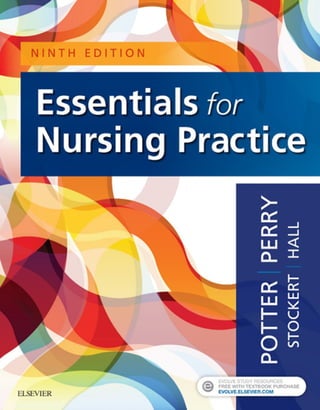
Essentials for nursing practice Ninth Edition
Hall download
https://textbookfull.com/product/essentials-for-nursing-practice-
ninth-edition-hall/
Download more ebook from https://textbookfull.com
We believe these products will be a great fit for you. Click
the link to download now, or visit textbookfull.com
to discover even more!
Mosby s Textbook for Nursing Assistants E Book Ninth
Edition Remmert
https://textbookfull.com/product/mosby-s-textbook-for-nursing-
assistants-e-book-ninth-edition-remmert/
Business Essentials, Ninth Canadian Edition Ronald J.
Ebert
https://textbookfull.com/product/business-essentials-ninth-
canadian-edition-ronald-j-ebert/
GRE for Dummies with Online Practice Ninth Edition Ron
Woldoff
https://textbookfull.com/product/gre-for-dummies-with-online-
practice-ninth-edition-ron-woldoff/
Health Assessment for Nursing Practice Susan F. Wilson
https://textbookfull.com/product/health-assessment-for-nursing-
practice-susan-f-wilson/
Essentials of perioperative nursing Sixth Edition.
Edition Terri Goodman
https://textbookfull.com/product/essentials-of-perioperative-
nursing-sixth-edition-edition-terri-goodman/
Essentials of Nursing Leadership and Management Karen
Grimley
https://textbookfull.com/product/essentials-of-nursing-
leadership-and-management-karen-grimley/
Psychiatric Mental Health Nursing for Canadian Practice
Wendy Austin
https://textbookfull.com/product/psychiatric-mental-health-
nursing-for-canadian-practice-wendy-austin/
Essentials of Nursing Leadership & Management 7th
Edition Sally A. Weiss
https://textbookfull.com/product/essentials-of-nursing-
leadership-management-7th-edition-sally-a-weiss/
We the People An Introduction to American Politics
Ninth Essentials Edition Benjamin Ginsberg
https://textbookfull.com/product/we-the-people-an-introduction-
to-american-politics-ninth-essentials-edition-benjamin-ginsberg/
Evolve Student Resources for Essentials for Nursing
Practice, 9th Edition, include the following:
• 
Review Questions with Answers and Rationales
• 
Answers to QSEN Activity Scenarios
• 
Case Studies with Questions
• Printable Key Points
• 
Video Clips
• 
Skills Performance Checklists
• 
Fluids and Electrolytes Tutorial
• 
Audio Glossary
• 
Concept Map Creator
• 
Conceptual Care Map
• 
Calculation Tutorial
• 
Answers to Student Study Guide
• Content Updates
Activate the complete learning experience that comes with each
textbook purchase by registering at
http://evolve.elsevier.com/Potter/essentials
YOU’VE JUST PURCHASED
MORE THAN
A TEXTBOOK!
REGISTER TODAY!
You can now purchase Elsevier products on Evolve!
Go to evolve.elsevier.com/html/shop-promo.html to search and browse for products.
2015v1.0
i
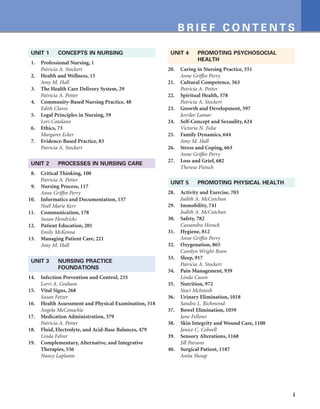
B R I E F C O N T E N T S
UNIT 1 CONCEPTS IN NURSING
1. Professional Nursing, 1
Patricia A. Stockert
2. Health and Wellness, 15
Amy M. Hall
3. The Health Care Delivery System, 29
Patricia A. Potter
4. Community-Based Nursing Practice, 48
Edith Claros
5. Legal Principles in Nursing, 59
Lori Catalano
6. Ethics, 73
Margaret Ecker
7. Evidence-Based Practice, 83
Patricia A. Stockert
UNIT 2 PROCESSES IN NURSING CARE
8. Critical Thinking, 100
Patricia A. Potter
9. Nursing Process, 117
Anne Griffin Perry
10. Informatics and Documentation, 157
Noël Marie Kerr
11. Communication, 178
Susan Hendricks
12. Patient Education, 201
Emily McKenna
13. Managing Patient Care, 221
Amy M. Hall
UNIT 3 NURSING PRACTICE
FOUNDATIONS
14. Infection Prevention and Control, 235
Lorri A. Graham
15. Vital Signs, 268
Susan Fetzer
16. Health Assessment and Physical Examination, 318
Angela McConachie
17. Medication Administration, 379
Patricia A. Potter
18. Fluid, Electrolyte, and Acid-Base Balances, 479
Linda Felver
19. Complementary, Alternative, and Integrative
Therapies, 536
Nancy Laplante
UNIT 4 PROMOTING PSYCHOSOCIAL
HEALTH
20. Caring in Nursing Practice, 551
Anne Griffin Perry
21. Cultural Competence, 563
Patricia A. Potter
22. Spiritual Health, 578
Patricia A. Stockert
23. Growth and Development, 597
Jerrilee Lamar
24. Self-Concept and Sexuality, 624
Victoria N. Folse
25. Family Dynamics, 644
Amy M. Hall
26. Stress and Coping, 663
Anne Griffin Perry
27. Loss and Grief, 682
Theresa Pietsch
UNIT 5 PROMOTING PHYSICAL HEALTH
28. Activity and Exercise, 703
Judith A. McCutchan
29. Immobility, 741
Judith A. McCutchan
30. Safety, 782
Cassandra Horack
31. Hygiene, 812
Anne Griffin Perry
32. Oxygenation, 865
Carolyn Wright Boon
33. Sleep, 917
Patricia A. Stockert
34. Pain Management, 939
Linda Cason
35. Nutrition, 972
Staci McIntosh
36. Urinary Elimination, 1018
Sandra L. Richmond
37. Bowel Elimination, 1059
Jane Fellows
38. Skin Integrity and Wound Care, 1100
Janice C. Colwell
39. Sensory Alterations, 1168
Jill Parsons
40. Surgical Patient, 1187
Anita Shoup
This page intentionally left blank
N I N T H E D I T I O N
Essentials for
Nursing Practice
Patricia A. Potter, RN, MSN, PhD, FAAN
Formerly, Director of Research
Patient Care Services
Barnes-Jewish Hospital
St. Louis, Missouri
Anne Griffin Perry, RN, MSN, EdD, FAAN
Professor Emerita
School of Nursing
Southern Illinois University—Edwardsville
Edwardsville, Illinois
Patricia A. Stockert, RN, BSN, MS, PhD
President, College of Nursing
Saint Francis Medical Center College of Nursing
Peoria, Illinois
Amy M. Hall, RN, BSN, MS, PhD, CNE
Dean, School of Nursing
Franciscan Missionaries of Our Lady University
Baton Rouge, Louisiana
3251 Riverport Lane
St. Louis, Missouri 63043
ESSENTIALS FOR NURSING PRACTICE, NINTH EDITION  ISBN 978-0-323-48184-7
Copyright © 2019, Elsevier Inc. All Rights Reserved.
No part of this publication may be reproduced or transmitted in any form or by any means, electronic or
mechanical, including photocopying, recording, or any information storage and retrieval system, without
permission in writing from the publisher. Details on how to seek permission, further information about the
Publisher’s permissions policies and our arrangements with organizations such as the Copyright Clearance
Center and the Copyright Licensing Agency, can be found at our website: www.elsevier.com/permissions.
This book and the individual contributions contained in it are protected under copyright by the Publisher
(other than as may be noted herein).
Notice
Practitioners and researchers must always rely on their own experience and knowledge in evaluating and
using any information, methods, compounds or experiments described herein. Because of rapid advances
in the medical sciences, in particular, independent verification of diagnoses and drug dosages should be
made. To the fullest extent of the law, no responsibility is assumed by Elsevier, authors, editors or
contributors for any injury and/or damage to persons or property as a matter of products liability,
negligence or otherwise, or from any use or operation of any methods, products, instructions, or ideas
contained in the material herein.
Previous editions copyrighted 2015, 2011, 2007, 2003, 1999, 1995, 1991, 1987.
Herdman, T.H.  Kamitsuru, S. (Eds.) Nursing Diagnoses—Definitions and Classification 2012-2014
Copyright © 2014, 1994-2014 NANDA International. Used by arrangement with John Wiley  Sons, Inc.
In order to make safe and effective judgments using NANDA-I nursing diagnoses, it is essential that nurses
refer to the definitions and defining characteristics of the diagnoses listed in the work.
International Standard Book Number: 978-0-323-48184-7
Director: Tamara Myers
Content Development Manager: Lisa P. Newton
Senior Content Development Specialist: Tina Kaemmerer
Publishing Services Manager: Jeff Patterson
Senior Project Manager: Jodi M. Willard
Design Direction: Paula Catalano
Printed in Canada
Last digit is the print number: 9 8 7 6 5 4 3 2 1
v
CONTRIBUTORS
Carolyn Wright Boon, MSN, BSN
Assistant Professor
Saint Francis Medical Center College of
Nursing
Peoria, Illinois
Linda Cason, DNP, MSN, BSN
Clinical Nurse Specialist
Deaconess Hospital, Inc.
Evansville, Indiana
Lori Catalano, JD, MSN, RN, CCNS, PCCN
Assistant Professor of Clinical Nursing
College of Nursing
University of Cincinnati
Cincinnati, Ohio
Edith Claros, PhD, MSN, RN, APHN-BC
PMHNP Track Coordinator and Associate
Professor
School of Nursing
MCPHS University
Worcester, Massachusetts
Janice C. Colwell, RN, MS, CWOCN, FAAN
Advanced Practice Nurse
Surgery
University of Chicago Medicine
Chicago, Illinois
Margaret Ecker, RN, MS
Nurse Consultant
Los Angeles, California;
Director of Nursing Quality, retired
Kaiser Permanente Los Angeles
Los Angeles, California
Jane Fellows, MSN, CWOCN
Wound/Ostomy CNS
Advanced Clinical Practice
Duke University Health System
Durham, North Carolina
Linda Felver, PhD, RN
Associate Professor
School of Nursing
Oregon Health  Science University
Portland, Oregon
Susan Fetzer, BA, BSN, MSN, MBA, PhD,
CNL
Professor
College of Health and Human Services
University of New Hampshire
Durham, New Hampshire;
Director of Research
Patient Care Services
Southern New Hampshire Medical Center
Nashua, New Hampshire
Victoria N. Folse, PhD, APN, PMHCNS-BC,
LCPC
Director and Professor; Caroline F. Rupert
Endowed Chair of Nursing
School of Nursing
Illinois Wesleyan University
Bloomington, Illinois
Lorri A. Graham, DNP, RN
Associate Professor
Saint Francis Medical Center College of
Nursing
Peoria, Illinois
Susan Hendricks, EdD, MSN, RN, CNE
Associate Dean for Undergraduate Programs
School of Nursing
Indiana University
Indianapolis, Indiana
Cassandra Horack, MS, PSL, BSN
Vice President Quality and Safety
OSF HealthCare Saint Francis Medical
Center
Peoria, Illinois
Noël Marie Kerr, PhD
Assistant Professor
School of Nursing
Illinois Wesleyan University
Bloomington, Illinois
Jerrilee Lamar, PhD, RN, CNE
Associate Professor of Nursing
Dunigan Department of Nursing and
Health Sciences
University of Evansville
Evansville, Indiana
Nancy Laplante, PhD, RN, AHN-BC
Associate Professor
School of Nursing
Widener University
Chester, Pennsylvania
Angela McConachie, FNP, DNP
Assistant Professor
Faculty
Goldfarb School of Nursing at Barnes-
Jewish College
St. Louis, Missouri
Judith A. McCutchan, ASN, BSN, MSN,
PhD
Adjunct Faculty
Nursing
University of Evansville
Evansville, Indiana
Staci McIntosh, MS, RD
Assistant Professor (Lecturer)
Department of Nutrition and Integrative
Physiology
University of Utah
Salt Lake City, Utah
Emily McKenna, APN, CNS
INI Neurology
OSF HealthCare Saint Francis Medical
Center
Peoria, Illinois
Jill Parsons, PhD, RN
Associate Professor
Nursing
MacMurray College
Jacksonville, Illinois
Theresa Pietsch, PhD, RN, CRRN, CNE
Associate Professor
Division of Nursing  Health Sciences
Neumann University
Aston, Pennsylvania
Sandra L. Richmond, DNP, MS, RN, CSN
Dean, School of Nursing and Health
Sciences
Pennsylvania College of Technology
Williamsport, Pennsylvania
Anita Shoup, DNP, RN, CNS-SP, CNOR
Assistant Professor; Coordinator,
Simulation/Experiential Learning
Nursing
Heritage University
Toppenish, Washington
vi Contributors and Reviewers
Michelle Aebersold, PhD, RN, CHSE, FAAN
Clinical Associate Professor and Director of
Simulation
University of Michigan School of Nursing
Ann Arbor, Michigan
Lezley Anderson, MA, MSN, RN
Assistant Professor
Saint Francis Medical Center College of
Nursing
Peoria, Illinois
Colleen Andreoni, DNP, MSN, ANP-BC,
FNP-BC
Advanced Practice Nurse
Board Certified Nurse Practitioner
Northwestern Medicine Regional Medical
Group
Chicago, Illinois
Suzanne L. Bailey, PMHCNS-BC, CNE
Associate Professor of Nursing
University of Evansville
Evansville, Indiana
Leigh Ann Bonney, PhD, RN, CCRN
Associate Professor
Saint Francis Medical Center College of
Nursing
Peoria, Illinois
Denise Branchizio, DNP, MSN, RN
Assistant Professor of Nursing
New Jersey City University
Jersey City, New Jersey
Anna M. Bruch, RN, MSN
Nursing Professor
Illinois Valley Community College
Oglesby, Illinois
Sheryl Buckner, PhD, RN, ANEF
Assistant Professor/Lab Director
University of Oklahoma Earl and Frances
Ziegler College of Nursing
Oklahoma City, Oklahoma
Pat Callard, DNP, RN, CNL
Associate Professor of Nursing
College of Graduate Nursing
Western University of Health Sciences
Pomona, California
Kim Clevenger, EdD, MSN, RN, BC
Associate Professor of Nursing
Morehead State University
Morehead, Kentucky
Tracy Colburn, RN, MSN, C-EFM
Associate Professor of Nursing
Lewis and Clark Community College
Godfrey, Illinois
Barbara A. Coles, PhD, RN-BC, LHRM
Adjunct Professor
American Public University System
Charles Town, West Virginia
Janice C. Colwell, RN, MS, CWOCN, FAAN
Advanced Practice Nurse
Surgery
University of Chicago Medicine
Chicago, Illinois
Pamela Cook, PhD(c), MSN, RN, CNS
Assistant Professor
Bloomsburg University
Bloomsburg, Pennsylvania
Eileen Costantinou, MSN, RN-BC
Practice Specialist, Senior Coordinator
Barnes-Jewish Hospital
St. Louis, Missouri
Graciela Lopez Cox, MSN, RN
Assistant Professor
Samuel Merritt University
Sacramento, California
Pamela A. Dettenmeier, PhD(c), DNP,
ANP-BC
Associate Professor of Medicine
Director CPAP Adherence Clinic
Adult Nurse Practitioner
Division of Pulmonary, Critical Care 
Sleep Medicine
Saint Louis University
St. Louis, Missouri
Holly Johanna Diesel, PhD, RN
Associate Professor and Academic Chair of
the Accelerated and RN to BSN Program
Goldfarb School of Nursing at Barnes-
Jewish College
St. Louis, Missouri
Christine R. Durbin, PhD, JD, RN
Associate Professor and Chair, Primary Care
 Health Systems Department
Southern Illinois University School of
Nursing
Edwardsville, Illinois
Amber Essman, DNP, MSN, FNP-BC, CNE
ARNP
Confluence Health;
Visiting Professor
Chamberlain College of Nursing
Moses Lake, Washington
Kelly L. Fisher, PhD, RN, FNAP
Dean, School of Nursing
Endicott College
Beverly, Massachusetts
Linda R. Garner, PhD, RN, APHN-BC,
CHES
Associate Professor
Southeast Missouri State University
Cape Girardeau, Missouri
Linda Hansen-Kyle, PhD, RN, CCM
Chair (Retired) Second Degree Program
Azusa Pacific University
Azusa, California;
University of San Diego
San Diego, California;
University of Phoenix
Tempe, Arizona
Nicole M. Heimgartner, MSN, RN, COI
Vice President
Connect: RN2ED
Dayton, Ohio
Kathleen C. Jones, MSN, RN, CNS
Associate Professor of Nursing
Walters State Community College
Morristown, Tennessee
Shari Kist, PhD, RN, CNE
Associate Professor
Goldfarb School of Nursing at Barnes-
Jewish College
St. Louis, Missouri
Kimberly Leppert, MSN, RN, ACNS-BC,
CNOR, ONC
Surgery Clinical Supervisor
Swedish Health Services-Ballard
Seattle, Washington
Kathryn A. Lever, RN, MSN, WHNP-BC
Associate Professor of Nursing
Dunigan Family School of Nursing and
Health Sciences
University of Evansville
Evansville, Indiana
Mary M. Lopez, PhD, RN
Associate Dean, Research
Western University of Health Sciences
Pomona, California
Angela McConachie, DNP, FNP
Assistant Professor
Goldfarb School of Nursing at Barnes-
Jewish Hospital
St. Louis, Missouri
Janis Longfield McMillan, RN, MSN, CNE
Associate Clinical Professor
Northern Arizona University
Flagstaff, Arizona
REVIEWERS
vii
Contributors and Reviewers
Pamela Molnar, RN, CEN
Decatur Morgan Hospital
Decatur, Alabama
Katrin Moskowitz, DNP, FNP
Doctor of Nursing Practice
Meriden, Connecticut
Katie Murphy, RN, MSN, PHN
Virtual Nurse Educator
Quintiles/Abbvie
Chicago, Illinois
Wendy R. Ostendorf, RN, MS, EdD, CNE
Professor of Nursing
Neumann University
Aston, Pennsylvania
Veronica (Ronnie) Peterson, BA, BSN, MS
Manager of Clinical Support
UW-Medical Foundation
Madison, Wisconsin
Victoria Plagenz, PhD, MS, BSN
Assistant Professor
University of Great Falls
Great Falls, Montana
Melissa Anne Radecki, MSN, NEd, RN,
PCCN
Nursing Instructor
Florida Southern College
Lakeland, Florida
Cherie R. Rebar, PhD, MBA, RN, COI
Affiliate Faculty
Indiana Wesleyan University
Marion, Indiana;
Consultant
Xavier University School of Nursing
Cincinnati, Ohio
Anita K. Reed, MSN, RN
Chair, Community Health Practice
St. Elizabeth School of Nursing
Saint Joseph’s College
Lafayette, Indiana
Jill R. Reed, PhD, APRN-NP
Assistant Professor
University of Nebraska Medical Center,
College of Nursing
Kearney, Nebraska
Rhonda J. Reed, MSN, RN, CRRN
Learning Resource Center Director—
Technology Coordinator
Indiana State University
Terre Haute, Indiana
Maura C. Schlairet, EdD, MA, MSN, RN,
CNL
Professor of Nursing, Bioethicist
College of Nursing and Health Sciences
Valdosta State University
Valdosta, Georgia
Susan Parnell Scholtz, RN, PhD
Associate Professor of Nursing
Moravian College
Bethlehem, Pennsylvania
Elizabeth Sibson-Tuan, MS, RN
Bay Area Preceptor Coordinator
Samuel Merritt University
Oakland, California
Crystal Slaughter, DNP, APN, ACNS-BC
Associate Professor
Saint Francis Medical Center College of
Nursing
Peoria, Illinois
Emily G. Smith, DNP, RN, CRRN, CNE,
FNAP
Assistant Professor
Endicott College
Beverly, Massachusetts
Mindy Stayner, PhD, MSN, RN
Professor
Northwest State Community College
Chamberlain College of Nursing
Capella University
Archbold, Ohio
Laura M. Streeter, BSN, RN, SCRN, GCPH
Stroke Program Nurse
University of Missouri Health System
Columbia, Missouri
Linda Turchin, RN, MSN, CNE
Associate Professor of Nursing
Fairmont State University
Fairmont, West Virginia
Claudia C. Turner, MSN, RN
Professor of Nursing
Temple College
Temple, Texas
Heidi Tymkew, PT, DPT, MHS, CCS
Clinical Specialist
Barnes-Jewish Hospital
St. Louis, Missouri
Kim Webb, MN, RN
Adjunct Nursing Instructor
Pioneer Technology Center
Ponca City, Oklahoma
Anne M. Welsh, MSN-Ed, RN
Assistant Professor
Lewis and Clark Community College
Godfrey, Illinois
Estella J. Wetzel, MSN, APRN, FNP-C
Family Nurse Practitioner
AANP, OAAPN
Dayton, Ohio
Laura M. Willis, DNP, APRN, FNP-C
Co-President, Connect: RN2ED
Beavercreek, Ohio;
Family Nurse Practitioner
Urbana, Ohio
Paige Wimberley, PhD, APRN, CNS, CNE
Associate Professor of Nursing
Arkansas State University
Jonesboro, Arkansas
Valerie Yancey, PhD, RN
Associate Professor
Southern Illinois University Edwardsville
Edwardsville, Illinois
Jean Yockey, PhD, FNP-BC, CNE
Assistant Professor
University of South Dakota
Vermillion, South Dakota
viii Contributors and Reviewers
CONTRIBUTORS TO PREVIOUS EDITIONS
Jeanette Spain Adams, RN, PhD, CRNI,
APRN
Michelle Aebersold, PhD, RN
Elizabeth A. Ayello, RN, BSN, MS, PhD, CS,
CETN
Marjorie Baier, RN, PhD
Sylvia Baird, RN, BSN, MM
Brenda A. Battle, MBA, BSN, RN
Lois Bentler-Lampe, RN, MS
Peggy Breckenridge, MSN, FNP
Judith C. Brostron, RN, BA, JD, LLM
Victoria M. Brown, RN, BSN, MSN, PhD,
HNC
Jeri Burger, RN, PhD
Gale Carli, MSN, MSHed, BSN, RN
Rhonda Comrie, PhD, RN
Kelly Jo Cone, RN, BSN, MS, PhD
Roslyn Corcoran, RN, BSN
Eileen Costantinou, RN, MSN, BC
Ruth Curchoe, RN, MSN, CIC
Rick Daniels, RN, BSN, MSN, PhD
Carolyn Ruppel D’Avis, RN, BSN, MSN
Christine Durbin, RN, JD, PhD
Sharon J. Edwards, RN, BSN, MSN, PhD
Martha Keene Elkin, RN, MSN, IBCLC
Linda Fasciani, RN, BSN, MSN
Susan J. Fetzer, RN, BA, BSN, MSN, MBA,
PhD
Leah Frederick, MS, RN, CIC
Cynthia S. Goodwin, RN, BSN, MSN
Lois C. Hamel, BS, MS
Janis Waite Hayden, RN, EdD
Maureen Huhmann, MS, RD
Tara Hulsey, RN, PhD, CNE, FAAN
Judith Ann Kilpatrick, RN, MSN, DNSc
Carl A. Kirton, RN-C, BSN, MA, ACRN,
ANP
Lori Klingman, RN, MSN
Kristine L’Ecuyer, RN, MSN, CCNS
Kathryn A. Lever, RNC, MSN, WHNP-BC
Ruth Ludwick, RN, BSN, MSN, PhD, RN-C
Suzanne Lugerner, RN, MS, LN, CNSC,
CNS
Mary Kay Knight Macheca, RN, BSN,
MSN(R), CS, CDE
Deborah L. Marshall, RN, MSN
Carol McGinnis, DNP, RN, CNS, CNSC
Rita G. Mertig, RNC, MS, CNS
Mary Dee Miller, RN, BSN, MS, CIC
Elaine Neel, BSN, MSN
Geralyn A. Ochs, RN, ADN, BSN, MSN
Marsha Evans Orr, RN, MS, CS, CNSN
Wendy R. Ostendorf, MS, EdD
Dula F. Pacquiao, EdD, RN, CTN
Nancy Panthofer, RN, BSN, MSN
Elizabeth S. Pratt, RN, MSN, ACNS-BC
Julia Balzer Riley, RN, MN, AHN-C, CET®
Kristine A. Rose, RN, MSN
Janice J. Rumfelt, BSN, MSN, EdD, RNC
Marilyn Schallom, MSN, CCRN, CCNS
Matthew R. Sorenson, RN, PhD
Sharon Souter, RN, BSN, MSN
Elizabeth Speakman, RN, EdD
Rachel E. Spector, BS, MS, PhD, CTN,
FAAN
Susan Speraw, RN, PHD, CNP
Donna L. Thompson, MSN, CRNP,
FNP-BC, CCCN
Jelena Todic, MSW, LCSW
Riva Touger-Decker, PhD, RD, FADA
Ann Tritak, RN, EdD
Ellen Wathen, PhD, RN, BC
Pamela Becker Weilitz, DNP, APRN,
ANP-BC
Joan Domigan Wentz, MSN, RN
Paige Wimberley, PhD, APN, CNS, CNE
Terry L. Wood, PhD, RN, CNE
Rita Wunderlich, PhD, RN, CNE
Valerie Yancey, RN, PhD
Barbara Yoost, RN, BSN, MSN, CNS
I wish to dedicate this edition of Essentials to the many friends who make up my family. Each one
contributes in so many ways to support and value the work I am able to do. Special thanks to Ruth, a
wonderful listener and advocate; Jim, a valued friend and kind man; Bess, always adding humor and
love to my life; and Anne, a consummate writing colleague and lifelong mentor.
Patricia A. Potter
To all nursing faculty and professional nurses who work each day to advance clinical nursing.
Your commitment to nursing education and nursing practice inspires us all to be the guardians
of the discipline.
I also want to thank my husband Bob for his loving support.
Anne Griffin Perry
I was blessed to have an incredible nursing role model in my life—my mother, Evelyn M. Clark, RN.
Your dedication and service to nursing inspired me to pursue my career as a professional nurse.
Your unwavering support of my endeavors provided a foundation for me to continue to grow in my
nursing role. Your encouragement and pride in my accomplishments was tremendous. Thank you
for starting me on my path to a long and satisfying career in nursing and nursing education.
I love you and miss you!
Patricia A. Stockert
To my family, especially Greg, Jacob, Isaac, and Mom and Dad. Thank you for your love, support, and
patience, without which I would not be able to chase my dreams. Thank you also to the nursing
faculty at Franciscan Missionaries of Our Lady University. Your never-ending compassion and
commitment to nursing education inspires me every day. And finally, to my Varsity Sports running
friends, who keep me grounded and who have helped me integrate into my new community. Despite
all those really hot and long runs, y’all haven’t killed me yet!
Amy M. Hall
x
P R E F A C E T O T H E I N S T R U C T O R
The nursing profession is always responding to dynamic
change and continual challenges. Today’s nurses must be pre-
pared to adapt to the continual changes occurring in health
care. They play a vital role in the delivery of multidisciplinary
health care services. The practice arena is changing—moving
more to the community setting. The focus of care is also
changing, with more emphasis being placed on health pro-
motion and restorative care. Even the patients are chang-
ing—more cultural diversity exists, and the percentage of
older adult patients continues to increase. Patients are far
more involved in and informed about health care.
Despite—or perhaps because of—these changes,it is essen-
tial that the basics of nursing remain the foundation of prac-
tice. Nurses must be knowledgeable and professional. They
must be both technically proficient and personally caring.
And they must be able to synthesize a broad array of knowl-
edge and experience when providing care for their patients.
We continue to cover all of the fundamental nursing con-
cepts, skills, and techniques that students must master before
moving on to other areas of study. In addition, we address
changes in practice that affect how and where nurses use the
skills and knowledge they acquire.
FEATURES
We have designed this text to welcome the new student to
nursing, communicate our own love for the profession, and
promote learning and understanding. We know that today’s
students are busy and, too often, are overwhelmed by all that
they must learn and do. They want their texts to focus on the
most current, factual, and essential content and skills. We
want to ensure that these students are ready to continue with
their education and will ultimately be prepared for all of the
challenges of practice. To this end, we have included the fol-
lowing key features:
• Students will appreciate the clear, engaging writing style.
The narrative actually addresses the reader, making this
textbook more of an active instructional tool than a passive
reference. Students will find that even complex technical
and theoretical concepts are presented in a language that
is easy to understand.
• The attractive, functional design will appeal to today’s
visual learner. The clear, readable type and bold headings
make the content easy to read and follow. Each special
element is consistently color keyed so students can readily
identify important information.
• Hundreds of large, clear, full-color photographs and
drawingsreinforceandclarifykeyconceptsandtechniques.
• The five-step nursing process serves as the organizing
framework for all clinical chapters. This logical, consistent
framework for narrative discussions is further enhanced
by special boxes that highlight assessment, care plans, and
evaluation of outcome achievement.
• Ongoing case studies in each chapter introduce “real-
world” patients, families, and nurses. The chapter follows
the case study through the steps of the nursing process,
helping students see how to apply the process, as well as
critical thinking, to the care of patients. Cases take place
in both acute and community settings and include patients
and nurses from a variety of cultural backgrounds.
• Nursing Care Plans guide students on how to conduct an
assessment and analyze the defining characteristics that
indicate nursing diagnoses. The plans include NIC and
NOC classifications to familiarize students with this
important nomenclature. The evaluation sections of the
plans show students how to evaluate and then determine
the outcomes of care.
• Concept Maps included in clinical chapters show you the
associations among multiple nursing diagnoses for a
patient with a selected medical diagnosis, as well as their
relationship to nursing interventions.
• The implementation narrative consistently addresses
health promotion, acute care, and restorative and continu-
ing care to reflect a focus on community-based nursing
and health promotion.
• Information related to the Quality and Safety Education
for Nurses (QSEN) initiative is highlighted with activities
integrated into each chapter. These activities incorporate
one of the six key competencies and relate back to the
progressive chapter case study scenarios.
• More than 35 nursing skills are presented in a clear, two-
column format with steps and rationales. Skills include
delegation guidelines and clinical decision points that alert
students to steps that require special assessment or specific
technique for safe and effective administration.
• Procedural guidelines provide streamlined step-by-step
instructions for performing very basic skills.
• Care of the older adult and patient teaching are stressed
throughout the narrative and are also highlighted in
special boxes.
• Learning aids to help students identify, review, and apply
important content in each chapter include Objectives, Key
Terms, Key Points, and Review Questions.
• Printed lists on the inside back cover provide information
on locating specific assets in the book, including Skills,
Procedural Guidelines, Nursing Care Plans, and Patient
Teaching boxes.
New to This Edition
• A new chapter on “Complementary, Alternative, and
Integrative Therapies” addresses content that is now
included on the NCLEX® examination.
• A new Reflective Learning section in each chapter helps
students better understand and reflect on their clinical and
simulation experiences as they move through their first
nursing course.
• Evidence-Based Practice boxes have been updated with
new PICO questions. These boxes provide a summary of
nursing research evidence related to that specific topic and
then explain its implications for nursing practice. These
xi
Preface to the Instructor
boxes have been updated to reflect current research topics
and trends.
LEARNING SUPPLEMENTS FOR STUDENTS
• The Evolve Student Resources are available online at
http://evolve.elsevier.com/Potter/essentials and include
the following valuable learning aids organized by chapter:
• Review Questions with Answers and Rationales
• Answers to QSEN Activity Scenarios
• Case Studies with Questions
• Printable Key Points
• Video Clips
• Interactive Skills Performance Checklists
• Fluids and Electrolytes Tutorial
• Audio Glossary
• Concept Map Creator
• Conceptual Care Map
• Calculation Tutorial
• Answers to Student Study Guide
• Content Updates
• A thorough Study Guide by Patricia A. Castaldi provides
students with a wide variety of exercises and activities to
enhance learning and comprehension. This study guide
features case studies with related questions; chapter review
sections with matching, fill-in-the-blank, and multiple-
choice questions; study group questions; and instructions
for creating and using study charts.
• Virtual Clinical Excursions is an exciting workbook
and CD-ROM experience that brings learning to life
in a virtual hospital setting. The workbook guides stu-
dents as they care for patients, providing ongoing chal-
lenges and learning opportunities. Each lesson in Virtual
Clinical Excursions complements the textbook content
and provides an environment for students to practice
what they are learning. This CD/workbook is avail-
able separately or packaged at a special price with the
textbook.
TEACHING SUPPLEMENTS
FOR INSTRUCTORS
• The Evolve Instructor Resources (available online at
http://evolve.elsevier.com/Potter/essentials) are a compre-
hensive collection of the most important tools instructors
need, including the following:
• TEACH for Nurses ties together every chapter resource
you need for the most effective class presentations, with
sections dedicated to objectives, teaching strategies,
nursing curriculum standards (including QSEN/NLN
Competencies, BSN Essentials, and Nursing Concepts),
instructor chapter resources, student chapter resources,
and an in-class case study discussion. Teaching Strate-
gies include relationships between the textbook content
and discussion items. Examples of student activities,
online activities, and large group activities are provided
for more “hands-on” learning.
• The Test Bank contains a revised set of more than 950
questions with answers coded for NCLEX® Client Needs
category,nursing process,and cognitive level.The Exam-
View software allows instructors to create new tests; edit,
add,and delete test questions;sort questions by NCLEX®
category, cognitive level, nursing process step, and ques-
tion type; and administer and grade online tests.
• PowerPoint Presentations include over 1400 slides for
use in lectures. Art is included within the slides, and
progressive case studies include discussion questions
and answers.
• The Image Collection contains hundreds of illustra-
tions from the text for use in lectures.
• Simulation Learning System is an online toolkit that helps
instructors and facilitators effectively incorporate medium-
to high-fidelity simulation into their nursing curriculum.
Detailed patient scenarios promote and enhance the clini-
cal decision-making skills of students at all levels. The
system provides detailed instructions for preparation and
implementation of the simulation experience, debriefing
questions that encourage critical thinking, and learning
resources to reinforce student comprehension. Each sce-
nario in Simulation Learning System complements the text-
book content and helps bridge the gap between lectures
and clinicals. This system provides the perfect environment
for students to practice what they are learning in the text
for a true-to-life, hands-on learning experience.
MULTIMEDIA SUPPLEMENTS FOR
INSTRUCTORS AND STUDENTS
• Nursing Skills Online 4.0 contains 19 modules rich with
animations, videos, interactive activities, and exercises to
help students prepare for their clinical lab experience. The
instructionally designed lessons focus on topics that are
difficult to master and pose a high risk to the patient if
done incorrectly. Lesson quizzes allow students to check
their learning curve and review as needed, and the module
exams feed out to an instructor grade book. Modules cover
Airway Management, Blood Therapy, Bowel Elimination/
Ostomy, Cardiac Care, Closed Chest Drainage Systems,
Enteral Nutrition, Infection Control, Maintenance of IV
Fluid Therapy, IV Fluid Therapy, Administration of Par-
enteral Medications: Injections and IV Medications, Non-
parenteral Medication Administration, Safe Medication
Preparation, Safety, Specimen Collection, Urinary Cathe-
terization, Caring for Central Vascular Access Devices
(CVAD), Vital Signs, and Wound Care. Available alone or
packaged with the text.
• Mosby’s Nursing Video Skills: Basic, Intermediate,
Advanced, 4th edition, provides 126 skills with overview
information covering skill purpose, safety, and delegation
guides;equipment lists;preparation procedures;procedure
videos with printable step-by-step guidelines; appropriate
follow-up care; documentation guidelines; and interactive
review questions. Available online, as a student DVD set,
or as a networkable DVD set for the institution.
xii
A C K N O W L E D G M E N T S
The ninth edition of Essentials for Nursing Practice is the
result of a continued collaboration among all authors, con-
tributors, and editorial team members. Having professional
colleagues to work with, trust, and challenge one another is
a gift—one that ensures a timely and accurate text.
This textbook cannot be created without the support,
guidance, and creative direction from our editorial team,
designer, and production staff. Likewise, no book is successful
without the hard work and dedication of its marketing team.
We are also very fortunate regarding the manner in which
staff from the electronic media division of Elsevier has pro-
duced products that complement the text and ensure its
success. We wish to make special mention of some important
individuals.
Tamara Myers, Director, is a dedicated professional who
continually challenges the author team to create a state-of-
the-art revision. Her enthusiasm and knowledge creates an
environment for the writing, editorial, and production teams
to develop a relevant and creative textbook that reflects con-
temporary nursing practice.
Tina Kaemmerer, Senior Content Development Specialist,
is a dedicated professional whose organizational skills ensure
that this project remains on target. She effectively collaborates
with all members of the writing team in tracking manuscript
through the publication process, in problem solving, and in
being an invaluable resource for authors, contributors, and
the production team.
Paula Catalano, our Book Designer, has developed a visu-
ally distinctive textbook design. Her expertise created a text
that is visually appealing yet easy for our readers to use. Paula
is also credited for her creativity and vision for the design of
the cover art and her direction in implementing the overall
design of the text.
Many thanks and gratitude go to members of the Produc-
tion Team. Jodi Willard, Senior Project Manager, is a tireless
and dedicated professional. As an accomplished project
manager, she keeps us on deadline while ensuring consistency
in formatting, presentation, and style. Her sense of humor
and ability to always remain calm under pressure are invalu-
able attributes. She is one of a kind. Jeff Patterson, Publishing
Services Manager, has contributed support throughout the
editing and final pages.
A tip of the hat must always go to the sales and marketing
team, headed by Julie Burchett and Megan Atencio, who pro-
vided us direction early in the planning stage of Essentials for
Nursing Practice. Their knowledge of market trends and needs
helps us to make revisions of high quality.
Many thanks to our contributors, clinicians, and edu-
cators, who share their experiences and knowledge about
nursing practice in helping to create informative, accu-
rate, and current information. Their knowledge of their
own clinical specialties ensures we have a state-of-the-art
textbook. We are fortunate to be associated with excellent
nurse authors who are able to convey standards of nursing
excellence through the printed word.
A heartfelt thanks to our many reviewers for their exper-
tise, candor, knowledge of the literature, and astute com-
ments that assist us in developing a text with high standards
that reflect professional nursing practice today.
After many years of collaboration, we find ourselves very
fortunate and humble. Essentials for Nursing Practice and the
other textbooks we have been able to develop have made
important contributions to nursing practice. It remains a
work of love.
Patricia A. Potter
Anne Griffin Perry
Patricia A. Stockert
Amy M. Hall
xiii
C O N T E N T S
UNIT 1 CONCEPTS IN NURSING
1 Professional Nursing, 1
Patricia A. Stockert
History of Nursing, 2
Influences on Nursing, 3
Professionalism, 5
Nursing Practice, 7
Standards of Nursing Practice, 7
Responsibilities and Roles of the Nurse, 8
Professional Nursing Organizations, 10
Trends in Nursing, 10
2 Health and Wellness, 15
Amy M. Hall
Definition of Health, 15
Models of Health and Illness, 16
Healthy People Documents, 19
Variables Influencing Health Beliefs and Health
Practices, 19
Health Promotion, Wellness, and Illness
Prevention, 20
Illness, 24
Impact of Illness on Patient and
Family, 25
The Nurse’s Role in Health and
Illness, 26
3 The Health Care Delivery System, 29
Patricia A. Potter
Traditional Levels of Health Care, 30
Health Care Costs and Quality, 40
Issues in Health Care Delivery for
Nursing, 42
4 Community-Based Nursing Practice, 48
Edith Claros
Achieving Healthy Populations and
Communities, 49
Public Health Nursing, 50
Community Health Nursing, 50
Community-Based Nursing, 51
Competency in Community-Based
Nursing, 53
Community Assessment, 55
Changing Patients’ Health, 56
5 Legal Principles in Nursing, 59
Lori Catalano
Legal Limits of Nursing, 60
Standards of Care, 62
Good Samaritan Laws, 64
Consent, 65
Other Legal Issues in Nursing
Practice, 68
6 Ethics, 73
Margaret Ecker
Ethics, 73
Ethical Theory, 77
How to Process an Ethical Dilemma, 78
Ethical Issues in Nursing, 79
Conclusion, 80
7 Evidence-Based Practice, 83
Patricia A. Stockert
A Case for Evidence-Based Practice, 84
Evidence-Based Practice Steps, 85
Nursing Research, 93
Quality Improvement and Performance
Improvement, 95
Relationship Between Evidence-Based Practice,
Research, and Quality Improvement, 96
UNIT 2 PROCESSES IN
NURSING CARE
8 Critical Thinking, 100
Patricia A. Potter
Clinical Judgment in Nursing Practice, 101
Levels of Critical Thinking in Nursing, 103
Critical Thinking Competencies, 105
Critical Thinking Model, 108
Critical Thinking Synthesis, 114
9 Nursing Process, 117
Anne Griffin Perry
Introduction, 118
Assessment, 119
Nursing Diagnosis, 126
Planning, 135
Implementation, 146
Evaluation, 151
10 Informatics and Documentation, 157
Noël Marie Kerr
Health Care Informatics, 158
Nursing Information Systems, 159
Confidentiality of Medical Record and Patient
Information, 160
Interprofessional Communication Within the
Health Care Team, 162
Purposes of Records, 163
Guidelines and Standards for Quality Nursing
Documentation, 165
Methods of Documentation, 167
Common Record-Keeping Forms, 169
Documentation in Home Care Settings, 172
Documentation in Long-Term Care Settings, 172
Reporting, 173
xiv Contents
11 Communication, 178
Susan Hendricks
The Power of Communication, 179
Basic Elements of the Communication
Process, 179
Levels of Communication, 180
Forms of Communication, 180
Factors Influencing Communication, 182
Communication Within Caring
Relationships, 187
Communication Within the Nursing
Process, 189
12 Patient Education, 201
Emily McKenna
Standards for Patient Education, 202
Purposes of Patient Education, 202
Teaching and Learning, 203
Domains of Learning, 204
Basic Learning Principles, 205
Integrating Nursing and Teaching Processes, 208
Documentation of Patient Teaching, 218
13 Managing Patient Care, 221
Amy M. Hall
Building a Nursing Team, 222
Nursing Care Delivery Models, 223
Decision Making, 224
Leadership Skills for Nursing Students, 227
UNIT 3 NURSING PRACTICE
FOUNDATIONS
14 Infection Prevention and Control, 235
Lorri A. Graham
Scientific Knowledge Base, 236
Nursing Knowledge Base, 241
Critical Thinking, 242
Nursing Process, 242
15 Vital Signs, 268
Susan Fetzer
Guidelines for Measuring Vital Signs, 269
Body Temperature, 270
Pulse, 276
Blood Pressure, 280
Respiration, 288
Measurement of Oxygen Saturation (Pulse
Oximetry), 289
Measurement of End-Tidal Carbon Dioxide, 289
Special Considerations, 290
Documenting Vital Signs, 291
Skill 15.1 Measuring Body Temperature, 292
Skill 15.2 Assessing Radial and Apical
Pulses, 299
Skill 15.3 Blood Pressure Measurement, 303
Skill 15.4 Assessing Respiration, 309
Skill 15.5 Measuring Oxygen Saturation
(Pulse Oximetry), 313
16 Health Assessment and Physical Examination, 318
Angela McConachie
Purposes of Health Assessment and Physical
Examination, 319
Cultural Sensitivity, 319
Integration of Physical Assessment With
Nursing Care, 320
Skills of Physical Examination, 320
Preparation for Examination, 321
Organization of the Examination, 325
Skin, Hair, and Nails, 328
Head and Neck, 333
Thorax and Lungs, 343
Heart, 348
Vascular System, 351
Breasts, 355
Abdomen, 360
Female Genitalia and Reproductive Tract, 363
Male Genitalia, 365
Rectum and Anus, 368
Musculoskeletal System, 369
Neurological System, 371
After the Examination, 375
17 Medication Administration, 379
Patricia A. Potter
Scientific Knowledge Base, 380
Nursing Knowledge Base, 390
Critical Thinking, 400
Nursing Process, 404
Oral Administration, 412
Topical Medication Applications, 413
Parenteral Administration of Medications, 424
Skill 17.1 Administering Oral
Medications, 439
Skill 17.2 Administering Eye (Ophthalmic)
Medications, 445
Skill 17.3 Using Metered-Dose or Dry
Powder Inhalers, 448
Skill 17.4 Preparing Injections From Vials
and Ampules, 453
Skill 17.5 Administering Injections, 457
Skill 17.6 Administering Medications by
Intravenous Bolus, 463
Skill 17.7 Administering Intravenous
Medications by Piggyback,
Intermittent Infusion Sets, and
Mini-Infusion Pumps, 468
18 Fluid, Electrolyte, and Acid-Base Balances, 479
Linda Felver
Scientific Knowledge Base, 480
Nursing Knowledge Base, 489
xv
Contents
Critical Thinking, 489
Nursing Process, 490
Skill 18.1 Initiating Intravenous
Therapy, 509
Skill 18.2 Regulating Intravenous Flow
Rate, 521
Skill 18.3 Changing Intravenous Solution
and Tubing, 526
Skill 18.4 Changing a Peripheral Intravenous
Dressing, 530
19 Complementary, Alternative, and Integrative
Therapies, 536
Nancy Laplante
Complementary, Alternative, and Integrative
Approaches to Health, 537
Nursing-Accessible Therapies, 540
Training-Specific Therapies, 543
Integrative Nursing Role, 548
UNIT 4 PROMOTING
PSYCHOSOCIAL HEALTH
20 Caring in Nursing Practice, 551
Anne Griffin Perry
Theoretical Views on Caring, 552
Patient Satisfaction, 555
Caring in Nursing Practice, 557
The Challenge of Caring, 560
21 Cultural Competence, 563
Patricia A. Potter
Health Disparities, 564
Racial, Ethnic, and Cultural
Identity, 566
World View, 566
Disease and Illness, 567
A Model of Cultural Competence, 568
Cultural Skill, 570
Cultural Encounter, 575
Cultural Desire, 575
22 Spiritual Health, 578
Patricia A. Stockert
Scientific Knowledge Base, 579
Nursing Knowledge Base, 579
The Effect of Illness on Spirituality, 581
Critical Thinking, 583
Nursing Process, 585
23 Growth and Development, 597
Jerrilee Lamar
Scientific Knowledge Base, 597
Nursing Knowledge Base, 600
Critical Thinking, 615
Nursing Process, 616
24 Self-Concept and Sexuality, 624
Victoria N. Folse
Scientific Knowledge Base, 624
Nursing Knowledge Base, 625
Critical Thinking, 632
Nursing Process, 633
25 Family Dynamics, 644
Amy M. Hall
Scientific Knowledge Base, 645
Nursing Knowledge Base, 647
Critical Thinking, 650
Nursing Process, 651
26 Stress and Coping, 663
Anne Griffin Perry
Scientific Knowledge Base, 664
Nursing Knowledge Base, 668
Critical Thinking, 670
Nursing Process, 671
27 Loss and Grief, 682
Theresa Pietsch
Scientific Knowledge Base, 683
Nursing Knowledge Base, 685
Critical Thinking, 687
Nursing Process, 688
UNIT 5 PROMOTING PHYSICAL
HEALTH
28 Activity and Exercise, 703
Judith A. McCutchan
Scientific Knowledge Base, 704
Nursing Knowledge Base, 707
Critical Thinking, 709
Nursing Process, 710
Skill 28.1 Promoting Early Activity and
Exercise, 726
Skill 28.2 Using Safe and Effective Transfer
Techniques, 730
29 Immobility, 741
Judith A. McCutchan
Scientific Knowledge Base, 742
Nursing Knowledge Base, 746
Critical Thinking, 747
Nursing Process, 748
Skill 29.1 Moving and Positioning Patients
in Bed, 771
30 Safety, 782
Cassandra Horack
Scientific Knowledge Base, 785
Nursing Knowledge Base, 787
Critical Thinking, 790
xvi Contents
Nursing Process, 791
Skill 30.1 Applying Physical Restraints, 804
31 Hygiene, 812
Anne Griffin Perry
Scientific Knowledge Base, 813
Nursing Knowledge Base, 815
Critical Thinking, 817
Nursing Process, 817
Skill 31.1 Bathing and Perineal Care, 851
32 Oxygenation, 865
Carolyn Wright Boon
Scientific Knowledge Base, 866
Nursing Knowledge Base, 874
Critical Thinking, 876
Nursing Process, 877
Skill 32.1 Suctioning, 898
Skill 32.2 Care of Patients With Chest
Tubes, 907
33 Sleep, 917
Patricia A. Stockert
Scientific Knowledge Base, 917
Nursing Knowledge Base, 921
Critical Thinking, 924
Nursing Process, 925
34 Pain Management, 939
Linda Cason
Scientific Knowledge Base, 940
Nursing Knowledge Base, 944
Critical Thinking, 946
Nursing Process, 947
Skill 34.1 Patient-Controlled Analgesia, 965
35 Nutrition, 972
Staci McIntosh
Scientific Knowledge Base, 973
Nursing Knowledge Base, 976
Critical Thinking, 980
Nursing Process, 980
Skill 35.1 Aspiration Precautions, 1000
Skill 35.2 Inserting a Nasogastric or
Nasointestinal Feeding Tube, 1003
Skill 35.3 Administering Enteral Nutrition
Via Nasoenteric, Gastrostomy, or
Jejunostomy Tubes, 1009
36 Urinary Elimination, 1018
Sandra L. Richmond
Scientific Knowledge Base, 1019
Nursing Knowledge Base, 1024
Critical Thinking, 1024
Nursing Process, 1025
Skill 36.1 Inserting and Removing Straight/
Intermittent or Indwelling
Catheters, 1046
37 Bowel Elimination, 1059
Jane Fellows
Scientific Knowledge Base, 1059
Nursing Knowledge Base, 1061
Critical Thinking, 1065
Nursing Process, 1067
Skill 37.1 Inserting and Maintaining a
Nasogastric Tube for Gastric
Decompression, 1084
Skill 37.2 Administering a Cleansing
Enema, 1091
Skill 37.3 Pouching an Ostomy, 1095
38 Skin Integrity and Wound Care, 1100
Janice C. Colwell
Scientific Knowledge Base, 1101
Nursing Knowledge Base, 1108
Critical Thinking, 1108
Nursing Process, 1112
Skill 38.1 Assessment of Patient for
Pressure Injury: Risk and Skin
Assessment, 1138
Skill 38.2 Treating Pressure Injuries, 1144
Skill 38.3 Negative-Pressure Wound
Therapy, 1150
Skill 38.4 Applying Dressings: Dry,
Damp-to-Dry, and
Transparent, 1154
Skill 38.5 Performing Wound
Irrigation, 1161
39 Sensory Alterations, 1168
Jill Parsons
Scientific Knowledge Base, 1168
Nursing Knowledge Base, 1170
Critical Thinking, 1172
Nursing Process, 1173
40 Surgical Patient, 1187
Anita Shoup
Scientific Knowledge Base, 1188
Nursing Knowledge Base, 1191
Critical Thinking, 1192
PREOPERATIVE SURGICAL PHASE, 1192
Nursing Process, 1193
INTRAOPERATIVE SURGICAL PHASE, 1209
Nurse’s Role During Surgery, 1209
Nursing Process, 1210
POSTOPERATIVE SURGICAL PHASE, 1214
Recovery, 1214
Postanesthesia Care in Ambulatory
Surgery, 1214
Recovery Phase, 1214
Nursing Process, 1215
Skill 40.1 Teaching Postoperative
Exercises, 1228
1
C H A P T E R
1
Professional Nursing
MEDIA RESOURCES
http://evolve.elsevier.com/Potter/essentials
• Audio Glossary • QSEN Activity and Review Questions Answers
O B J E C T I V E S
• Discuss the characteristics of professionalism in nursing.
• Discuss the importance of education in professional
nursing practice.
• Describe the purpose of professional standards of
nursing practice.
• Describe the roles and career opportunities for nurses.
• Discuss the influence of social, political, and economic
changes on nursing practices.
K E Y T E R M S
advanced practice registered nurse
(APRN), p. 9
American Nurses Association
(ANA), p. 2
caregiver, p. 8
certified nurse-midwife (CNM), p. 9
certified registered nurse anesthetist
(CRNA), p. 9
clinical nurse specialist (CNS), p. 9
code of ethics, p. 6
continuing education, p. 6
genomics, p. 11
in-service education, p. 6
International Council of Nurses
(ICN), p. 10
licensed practical nurse (LPN), p. 5
licensed vocational nurse (LVN), p. 5
National League for Nursing
(NLN), p. 10
nurse administrator, p. 10
nurse educator, p. 9
nurse practitioner (NP), p. 9
nurse researcher, p. 10
nursing, p. 2
patient advocate, p. 8
professional organization, p. 10
Quality and Safety Education for
Nurses (QSEN), p. 10
registered nurse (RN), p. 5
Nursing is an art and a science. As a professional nurse,
you learn to deliver care artfully with compassion,
caring, and respect for each patient’s dignity and person-
hood. As a science, nursing practice is based on a body of
knowledge that is continually changing with new discoveries
and innovations. When you integrate the science and art
of nursing into your practice, the quality of care you provide
to your patients is at a level of excellence that benefits
patients and their families. Your patients’ health care needs
are multidimensional. Thus, your care reflects patients’
needs as well as the needs and values of society and pro-
fessional standards of care. In addition, your care should
integrate evidence-based practices to provide the highest
level of care.
The patient is the center of your practice. The patient
includes the individual, family, and/or community. Patients
have a wide variety of health care needs, experiences, vulner-
abilities, and expectations; this is what makes nursing both
challenging and rewarding. Making a difference in your
patients’ lives is fulfilling. For example, you help a dying
patient find relief from pain, help a young mother learn par-
enting skills, or find ways for older adults to remain indepen-
dent in their homes. Nursing offers personal and professional
rewards every day.
2 UNIT 1 Concepts in Nursing
clinical experience. Your ability to interpret clinical situations
and make complex decisions is the foundation for your
nursing care and the basis for the advancement of nursing
practice and the development of nursing science (Benner,
1984; Benner et al., 1997; Benner et al., 2010). Clinical exper-
tise takes time and commitment. Critical thinking skills are
essential to nursing (see Chapter 8). When providing nursing
care, you need to make clinical judgments and decisions
about your patients’ health care needs based on knowledge,
experience, and standards of care. Critical thinking and
reflection help you gain and interpret scientific knowledge,
integrate knowledge from clinical experiences, and become a
lifelong learner (Benner et al., 2010). This includes integrat-
ing knowledge from basic science and nursing knowledge
bases, applying knowledge from past and present experiences,
applying critical thinking attitudes to a clinical situation, and
implementing intellectual and professional standards (see
Chapter 8). When you provide well-thought-out care with
compassion and caring, you provide each of your patients the
best of the science and art of nursing care (see Chapter 7).
HISTORY OF NURSING
Since the beginning of the profession, nurses have studied
and tested new and better ways to help patients. Patients are
most vulnerable when they are injured, sick, or dying. Today
nurses are active in determining the best practices for patient
care related to problems such as skin care management, pain
control, nutritional management, and care of older adults.
Nurse researchers are leaders in expanding knowledge in
nursing and other health care disciplines. Their work pro-
vides evidence for practice to ensure that we have the best
available evidence to support our practices (see Chapter 7).
Nurses are also active in social policy and political arenas.
With their professional organizations, they lobby for health
care legislation. For example, nurses have lobbied for laws
promoting smoke-free environments and stronger anti-
tobacco laws, setting up anti-gang coalitions, establishing
safer environments for walking and physical fitness in
their communities, and advocating for breastfeeding (Mason
et al., 2016).
Knowledge of the history of the nursing profession
increases your ability to understand the social and intellectual
origins of the discipline. Although it is not practical to
describe all the historical aspects of professional nursing,
some of the more significant milestones are described in the
following paragraphs.
Florence Nightingale
In Notes on Nursing: What It Is and What It Is Not, Florence
Nightingale established the first nursing philosophy based on
health maintenance and restoration (Nightingale, 1860). She
saw the role of nursing as having “charge of somebody’s
health” based on the knowledge of “how to put the body in
such a state to be free of disease or to recover from disease”
(Nightingale, 1860). She developed the first organized train-
ing program for nurses in 1860, the Nightingale Training
As a nurse, you can choose a variety of career paths includ-
ingclinicalpractice,education,research,management,admin-
istration, and entrepreneurship. As a student, it is important
for you to understand the scope of nursing practice and how
nursing influences the lives of your patients. You are required
to provide nursing care according to standards of practice and
follow a code of ethics (ANA, 2015a; Fowler, 2015b). Profes-
sional practice includes knowledge from social and behavioral
sciences, biological and physiological sciences, and nursing
theories.Inaddition,nursingpracticeincorporatesethicaland
social values, professional autonomy, and a sense of commit-
ment and community. The American Nurses Association
(ANA) defines nursing as the protection, promotion, and opti-
mization of health and abilities; prevention of illness and injury;
facilitation of healing; alleviation of suffering through the diag-
nosis and treatment of human response; and advocacy in the
care of individuals, families, groups, communities, and popula-
tions (ANA, 2015a). The International Council of Nurses
(ICN) (2016) has another definition: Nursing encompasses
autonomous and collaborative care of individuals of all ages,
families, groups and communities, sick or well and in all settings.
Nursing includes the promotion of health; prevention of illness;
and the care of ill, disabled, and dying people. Advocacy, promo-
tion of a safe environment, research, participation in shaping
health policy and in patient and health systems management,
and education are also key nursing roles. Both definitions
support the importance that nursing holds in providing safe,
patient-centered health care to the global community.
Expert clinical nursing practice is a commitment to the
application of knowledge, ethics, standards of practice, and
Lucas is a nursing student assigned to provide care for a
52-year-old patient, Mr. Thompson, at the residential hospice
home. Mr. Thompson came to the hospice home with meta-
static pancreatic cancer. Lucas focused his nursing care plan
on comfort care for Mr. Thompson. Mrs. Thompson told
Lucas that she was worried that her husband would be
experiencing pain. This morning Lucas is participating in the
interdisciplinary team meeting to discuss Mr. Thompson’s
care management.
CASE STUDY Lucas
Copyright © sturti/Getty Images.
3
CHAPTER 1 Professional Nursing
(AORN), Infusion Nurses Society (INS), and Emergency
Nurses Association (ENA) created. In 1990 the ANA estab-
lished the Center for Ethics and Human Rights (see Chapter
6). The Center provides a forum to address the complex
ethical and human rights issues confronting nurses and
designs programs to increase ethical competence in nurses
(Fowler, 2015b).
Twenty-First Century
Today the nursing profession faces multiple challenges.
Nurses and nurse educators are revising nursing practice
and school curricula to meet the ever-changing needs of
society including bioterrorism, emerging infections, and
disaster management. Advances in technology and informat-
ics (see Chapter 10), the aging population, the high-acuity
level of care of hospitalized patients, and early discharge
from health care institutions require nurses in all settings
to have a strong and current knowledge base. In addition,
nursing and the Robert Wood Johnson Foundation are
taking a leadership role in developing standards and policies
for end-of-life care through the Last Acts Campaign (see
Chapter 27). The End-of-Life Nursing Education Consor-
tium (ELNEC) offered collaboratively by the American
Association of Colleges of Nursing (AACN) and the City
of Hope Medical Center has brought end-of-life care and
practices into nursing curricula and professional continuing
education programs for practicing nurses (AACN, 2016).
INFLUENCES ON NURSING
Multiple external forces affect nursing today including health
care reform and costs, demographic changes of the popula-
tion, increasing numbers of medically underserved individu-
als, need for emergency preparedness, workplace issues, and
the nursing shortage.
Health Care Reform and Costs
Health care reform affects how health care is paid for and
delivered. In the future there will be greater emphasis on
health promotion, disease prevention, and illness manage-
ment. More services will be provided in community-based
care settings. As a result, more nurses will be needed to prac-
tice in community care centers, patients’ homes, schools, and
senior centers. This will require expert nurses to assess for
resources, service gaps, and how patients adapt to return to
their communities. Nursing needs to respond by assessing for
resources, changing nursing education, helping patients
adapt to new health care delivery methods, and providing
care to safely return patients to their homes.
Skyrocketing health care costs present challenges to the
profession, consumer, and health care delivery system. As a
nurse you are responsible for providing the patient with the
best-quality care in an efficient and economically sound
manner including following established protocols, exercising
timely well-planned patient discharge from a care setting, and
judiciously using supplies and equipment. The challenge is
to use health care and patient resources wisely. Chapter 3
School for Nurses at St. Thomas’ Hospital in London.
Nightingale volunteered during the Crimean War in 1853 and
traveled the battlefield hospitals at night carrying her lamp;
thus she was known as the “lady with the lamp.” As a result
of Nightingale’s organization and improvement of the sanita-
tion facilities at the battlefield hospitals, the mortality rate at
the Barracks Hospital in Scutari, Turkey, was reduced from
42.7% to 2.2% in 6 months (Donahue, 2011). Perhaps one of
Nightingale’s greatest contributions was the maintenance of
statistics to show the efficacy of her strategies.
The Civil War to the Beginning of
the Twentieth Century
The Civil War (1860–1865) stimulated the growth of nursing
in the United States. Clara Barton, founder of the American
Red Cross, cared for soldiers on the battlefields, cleansing
their wounds, meeting their basic needs, and comforting
them in death. Dorothea Lynde Dix, Mary Ann Ball (Mother
Bickerdyke), and Harriet Tubman also influenced nursing
during the Civil War (Donahue, 2011). Dix and Bickerdyke
organized hospitals and ambulances, appointed nurses, cared
for the wounded soldiers,and managed supplies.Tubman was
active in the Underground Railroad movement and helped
lead more than 300 slaves to freedom (Donahue, 2011).
The first professionally educated African-American nurse
was Mary Mahoney. She was concerned with relationships
between cultures and races. As a nursing leader, she brought
forth an awareness of cultural diversity and respect for the
individual, regardless of background, race, color, or religion.
Isabel Hampton Robb helped found the Nurses’ Associ-
ated Alumnae of the United States and Canada in 1896. This
organization became the ANA in 1911. She authored many
nursing textbooks and was one of the original founders of the
American Journal of Nursing (Donahue, 2011).
Nursing in hospitals expanded in the late nineteenth
century. However, nursing in the community did not increase
significantly until 1893, when Lillian Wald and Mary Brewster
opened the Henry Street Settlement, which focused on the
health needs of poor people who lived in tenements in New
York City (Donahue, 2011).
Twentieth Century
In the early twentieth century, nursing evolved toward devel-
oping a scientific, research-based defined body of nursing
knowledge and practice. Nurses began to assume expanded
and advanced practice roles to meet society’s needs. Mary
Adelaide Nutting, the first professor of nursing at Columbia
University Teachers College, was instrumental in the affilia-
tion of nursing education with universities (Donahue, 2011).
In addition, the Goldmark Report concluded that nursing
education needed increased financial support.
As nursing education developed, nursing practice also
expanded, and the Army and Navy Nurse Corps were
established. By the 1920s nursing specialization started to
develop. The last half of the century saw specialty-nursing
organizations such as the American Association of Criti-
cal Care Nurses, Association of Operating Room Nurses
4 UNIT 1 Concepts in Nursing
Workplace Issues
Nurses are faced with multiple issues and hazards in the
workplace. For example, they are at risk for ergonomic
hazards that result in musculoskeletal injuries such as back
injury and repetitive motion disorders (ANA, 2016). When
looking for a new position, evaluate the workforce protection
and safety plan that the hospital or health care organization
has in place (Zerwekh and Garneau, 2015).
Another issue facing nurses is workplace violence. Work-
place violence takes the form of bullying and acts of verbal
or nonverbal aggression or harassment from co-workers and
sometimes patients and families. Nurses who experience
workplace violence often develop anger, fear, anxiety, post-
traumatic stress disorder symptoms, guilt, or shame (Huber,
2014). Respect for the dignity and rights of all co-workers
is an ethical responsibility for all nurses (NCSBN, 2016).
The ANA calls for “zero tolerance” to violence of any kind
within the workplace. The ANA recommends evidence-
based interventions to prevent violence and to promote
the health and safety of nurses (ANA, 2015c). Know the
policies of your institution on prevention or response to
workplace violence.
Nursing Shortage
There is an ongoing nursing shortage in the United States,
which results from insufficient qualified registered nurses
(RNs) to fill vacant positions, the aging population of nurses,
and a growing need for health care services (AACN, 2014).
An increased number of nurses are retiring; 55% of nurses
are aged 50 or older (AACN, 2014; NCSBN, 2016). This
shortage affects all nursing care settings, including hospitals,
long-term care facilities, administration, and nursing educa-
tion (AACN, 2014); it also represents challenges and oppor-
tunities for the profession. Many dollars are invested in
strategies aimed at increasing student enrollment in nursing
programs and recruiting a well-educated, critically thinking,
motivated, and dedicated nursing workforce (Benner et al.,
2010; AACN, 2014). At the same time hospitals, the largest
employer of nurses, seek ways to improve nurse retention.
There is a direct link between RN staffing and nursing care
with positive patient outcomes including reduced complica-
tion rates and a more rapid return of the patient to an optimal
functional status (Box 1.1) (Choi and Staggs, 2014; Giuliano
et al., 2016).
With fewer nurses in the workplace, it is important for you
to learn to use your patient contact time efficiently and pro-
fessionally. Time management, therapeutic communication,
patient education, and compassionate implementation of
psychomotor skills are just a few of the essential skills you
need. Most important, ensure your patients leave the health
care setting with a positive image of nursing and a feeling that
they received quality care. Your patient should never feel
rushed or that he or she was unimportant. If a certain aspect
of patient care requires 15 minutes of contact, it takes the
same amount of time to deliver the care in an organized
manner as it would in a rushed, harried manner.
summarizes reasons for the rise in health care costs and its
implications for nursing.
Demographic Changes
The U.S. Census Bureau (2015) predicts that between 2014
and 2060, there will be a steady rise in the population,
although this increase will slow in future decades as fertility
rates decline over these years. This change requires expanded
health care resources. Add to the population change a steady
increase in the percentage of the population of people 65
years of age and older. By 2030 it is estimated that one in
five persons will be 65 years of age or older (U.S. Census
Bureau, 2015). It is also predicted that by 2044 more than
half of the U.S. population will be part of a minority group
(U.S. Census Bureau, 2015). To effectively meet all the
health care needs of the expanding minority and aging
populations, changes in how care is provided are needed,
especially in the area of public health. The population is
shifting from rural areas to urban centers, and more people
are living with chronic and long-term illness (RWJF, 2014).
Outpatient settings are expanding, and more people want
to receive outpatient and community-based care and remain
in their homes or community (see Chapters 3 and 4).
Medically Underserved Population
Unemployment, underemployment and low-paying jobs,
mental illness, poor health care access in rural areas, home-
lessness, and health care costs all contribute to increases in
the medically underserved population. Caring for this popu-
lation is a global issue; the social, political, and economic
factors of a country affect both access to care and resources
to provide and pay for these services. In the United States,
some of the medically underserved population are individu-
als who are poor and on Medicaid. Others are part of the
working poor (e.g., they cannot afford their own insurance,
but they make too much money to qualify for Medicaid and
as a result do not receive any health care). Patients who are
medically underserved and who have low health literacy are
less likely to participate in decision making regarding their
care often because they do not understand the medical infor-
mation provided (Seo et al., 2016). Today nurses and schools
of nursing are developing partnerships to improve health
outcomes in underserved communities. Nurses work in these
community-based settings providing health promotion and
disease prevention.
Need for Emergency Preparedness
The world is a changing place; the threats of terrorism are
continuous. Many health care agencies, schools, and com-
munities have educational programs to prepare for nuclear,
chemical, or biological attacks and other types of disasters.
Nurses play an active role in emergency preparedness ranging
from participation in vaccine research, to decontamination
in times of biological attack, to triage for mass casualty, to
participation in crisis response units. Nurses provide emer-
gency preparedness education and prepare for disasters at the
local, state, and federal levels (Zerwekh and Garneau, 2015).
5
CHAPTER 1 Professional Nursing
direct patient care. The LPN/LVN is a nurse who completes
a practical nursing program and passes a licensure examina-
tion (NCLEX-PN®). The LPN/LVN practices under the
supervision of an RN or other licensed person. The respon-
sibilities and scope of practice are set by each state board of
nursing. An LPN/LVN, or in Canada an RN assistant (RNA),
generally receives 1 year of education and clinical preparation
in a community college or other agency. Some RN programs
allow an LPN to enter the program at an advanced level.
Registered Nurse Education
As a profession nursing requires that its members possess a
significant amount of education. There are various educa-
tional routes for becoming a registered nurse (RN). Cur-
rently in the United States an individual becomes an RN by
earning an associate degree, diploma, or baccalaureate degree
program in nursing and by passing the NCLEX-RN® exami-
nation. The baccalaureate degree is required as the entry to
practice standard for RNs in all provinces of Canada except
Quebec (Canadian Nurses Association [CAN], 2016a).
Nursing education provides the solid foundation for practice,
and it responds to changes in health care created by scientific
and technological advances.
Advanced Education
Some roles for RNs require advanced graduate degrees. A
graduate degree provides the advanced clinician with strong
skills in nursing science and theory, with an emphasis on the
basic sciences and research-based clinical practice related to
a specialty. A master’s degree in nursing (e.g., Master of Arts
in Nursing [MA], Master of Nursing [MN], or Master of
Science in Nursing [MSN]) is for RNs seeking roles such as
nurse educator, nurse administrator, clinical nurse leader,
nursing informatics specialist, or advanced practice registered
nurse (APRN). Some programs require the RN to have a
Bachelor of Science in Nursing (BSN) degree before entry;
other programs offer entrance to associate degree–prepared
nurses who take bachelor’s level courses as they progress
through the curriculum toward the master’s degree.
Some roles within nursing require doctoral degrees. There
are two doctorate degree in nursing options for nurses. The
Doctor of Philosophy (PhD) has a focus on research, and the
Doctor of Nursing Practice (DNP) has a focus on advanced
clinical practice. The health care industry needs nurses pre-
pared at the doctorate level with advanced academic and
clinical preparation to educate nursing students and partici-
pate as members of the interdisciplinary health care team to
provide evidence-based, competent, safe patient care (IOM,
2010). Nurses with doctorates advance the profession by pro-
moting evidence-based practice, developing practice guide-
lines, conducting and disseminating research, developing
and testing theory, educating future nurses, and influencing
public policy and health care planning.
Continuing and In-Service Education
Continuing education programs are one way to promote
and maintain current nursing skills, gain new knowledge
PROFESSIONALISM
Nursing is a profession. A person who acts professionally is
conscientious in actions, knowledgeable in the subject, and
responsible to self and others. This means that as a nurse you
administer patient-centered care in a safe, conscientious, and
knowledgeable manner. Professions possess the following
characteristics:
• An extended education of members and a basic liberal
education foundation
• A theoretical body of knowledge leading to defined
skills, abilities, and norms
• Provision of a specific service
• Autonomy in decision making and practice
• A code of ethics for practice
Nursing shares each of these characteristics, offering an
opportunityforthegrowthandenrichmentof allitsmembers.
Licensed Practical Nurse/Licensed
Vocational Nurse Education
A licensed practical nurse (LPN) or licensed vocational
nurse (LVN) is educated in basic nursing techniques and
PICO Question: Are patient outcomes improved in hos-
pitals with adequate nursing staffing versus hospitals
with lower nursing staffing?
SUMMARY OF EVIDENCE
There is a growing body of research that shows that nurse
staffing does impact patient outcomes, patient survival, and
the occurrence of adverse events. A secondary data analysis
from 661 hospitals showed that there was a significantly
lower 30-day readmission rate for patients with heart failure
in hospitals that had high nurse staffing, thus reducing health
care costs (Giuliano et al., 2016). Higher nurse staffing was
also found to significantly increase the survival of patients in
an intensive care unit (West et al., 2014). Patients experienc-
ing an in-hospital cardiac arrest were more likely to survive
when there was a decreased patient-to-nurse ratio (McHugh
et al., 2016). Cho et al. (2016) found that larger numbers of
patients assigned to a nurse increased the occurrence of
medication errors, pressure injury formation, and falls with
injuries. Studies demonstrating the positive impact that
nurse-to-patient ratios have on outcomes provide nursing
administrators with evidence to support hiring of qualified
professional nurses.
APPLICATION TO NURSING PRACTICE
• Consider the nurse-to-patient ratio when looking at a hos-
pital or unit for employment.
• Adequate nursing levels help to improve the nursing work
environment (Cho et al., 2016).
• Improved working conditions increase the likelihood of
patient survival in emergency events (McHugh et al.,
2016).
• Continuing research needs to be conducted to study the
economic impact of nurse staffing and improved patient
outcomes (Giuliano et al., 2016).
BOX 1.1 EVIDENCE-BASED PRACTICE
6 UNIT 1 Concepts in Nursing
education, and the support of an organization that values
the independent role of the nurse. With increased autonomy
comes greater responsibility and accountability for the per-
formance of nursing care activities. Accountability means
that you are professionally and legally responsible for the
type and quality of nursing care provided. To be autono-
mous and accountable carries the responsibility to keep
current and competent in nursing and scientific knowledge
and skills.
Code of Ethics
Nursing’s code of ethics defines the principles that nurses
use to provide patient-centered care (see Chapter 6). In
addition, nurses incorporate their own values and ethics into
practice. The ANA’s Code of Ethics for Nurses: With Interpre-
tive Statements (2015b) provides a guide for carrying out
nursing responsibilities to ensure high-quality nursing care
and provide for the ethical obligations of the profession.
Developing Professionalism in Your Career
It is important that you work to develop professionalism
early in your nursing career. Professionalism in appearance
and behaviors is critical to earning recognition and respect
as a nurse (Splendore et al., 2016). The use of social media
is prevalent with both nursing students and professional
nurses (Mamocha et al., 2015). You need to be very aware
of your use of social media and practice e-professionalism
(Westrick, 2016). Social media has positive uses for provid-
ing patient education, providing communication, and fos-
tering professional connections (NCSBN, 2011). However,
inappropriate use of social media violates legal, ethical, and
professional standards. Research has shown that there are
an increasing number of incidents of nursing students and
practicing nurses posting unprofessional content, such as
patients’ personal health information (PHI), on social media
sites (Westrick, 2016). Cyberbullying was also found to have
occurred against both peers and faculty (Mamocha et al.,
2015). As a nurse you must be aware of social media ethical
and professional standards that you need to follow. Be aware
of both personal and professional information that you
share on social media sites. You will violate state and federal
laws if you share patient health information on social media
sites (NCSBN, 2011). Check your agency or school policy
on use of social media to ensure that you are acting profes-
sionally when using social media (Brown, 2016). To protect
yourself and your patients, follow the guidelines on use of
social media established by the ANA and National Council
of State Boards of Nursing (ANA, 2011; NCSBN, 2011;
Westrick, 2016).
It is important that you display professionalism when
applying for nursing positions. Professional communication
dictates that you send a cover letter when submitting your
resume, a thank-you letter for the interview opportunity, and
a resignation letter if you are leaving your position (Yoder-
Wise, 2014). The professional letter and resume that you
submit is often the first impression you make on the indi-
vidual who is hiring nurses. Make sure that your letters are
about the latest research and practice developments, gain
certification credits to specialize in a specific practice area,
meet requirements for continuing licensure as a nurse, and
obtain new skills and techniques reflecting the changes
in the health care delivery system. Continuing education
involves formal, organized educational programs offered
by universities, hospitals, state nurses associations, profes-
sional nursing organizations, and educational and health care
institutions. Examples include a program on caring for older
adults with dementia offered by a university or a program on
safe medication practices offered by a hospital. Often these
programs provide attendees with some type of continuing
education credit.
In-service education programs contain instruction or
training provided by a health care agency or institution
designed to increase the knowledge, skills, and competencies
of nurses and other health care professionals employed by the
institution. Often in-service programs focus on new tech-
nologies or fulfill required competencies of the organization.
For example, a hospital offers an in-service program on safe
principles for administering chemotherapy or a program on
cultural sensitivity.
Theory
Professional nursing practice and knowledge have developed
in part through nursing theories (global views that help to
describe, predict, or prescribe activities for the practice of
nursing). Theoretical models provide frameworks for how
nurses practice. Some nursing school curricula integrate a
theoretical model. Some nursing organizations adopt a
nursing theory as the foundation for their standards of
nursing care. Examples of theories used in education and
practice are Orem’s self-care deficit theory, Benner’s primacy
of caring, and Watson’s Theory of Human Caring. The
ongoing development of nursing theory or nursing science
involves generating knowledge to advance and support
nursing practice and health care (Alligood, 2014).
Service
Nursing is a service profession and a vital and indispensable
part of the health care delivery system. Nurses in practice
maintain a consumer-based and service-based focus. Patients
are more knowledgeable about their health care problems,
options, and rights. As a nurse you work with patients and
families individualizing care while incorporating their prefer-
ences and expectations. Show respect by providing care on
time, displaying a caring attitude, and considering patients’
cultural and social differences. Collaborate with necessary
health care providers to ensure continuation of care from one
setting to the next.
Autonomy and Accountability
Autonomy is essential to professional nursing and involves
the initiation of independent nursing interventions without
medical orders. Autonomy means that a person is reason-
ably independent and self-governing in decision making and
practice. You reach autonomy through experience, advanced
7
CHAPTER 1 Professional Nursing
individual State Boards of Nursing to obtain a nursing
license. Regardless of educational preparation, the exami-
nation for RN licensure is exactly the same in every state
in the United States to provide a standardized minimum
knowledge base for nurses. As of January 2015, new gradu-
ates of Canada’s 10 provinces/territories must also pass the
NCLEX-RN® to become an RN (CNA, 2016b). Whether
nurses are able to practice in a state or province other than
their own depends on the agreement between the states or
provinces involved.
Certification. Beyond the NCLEX-RN®, some nurses
work toward certification in a specific area of nursing prac-
tice. Minimum practice requirements are set based on the
certification. National nursing organizations such as the
American Nurses Credentialing Center (ANCC) have many
types of certification to enhance your career such as certifica-
tion in medical-surgical or geriatric nursing. After passing
the initial examination, you maintain your certification by
ongoing continuing education and clinical or administrative
practice.
STANDARDS OF NURSING PRACTICE
Nursing is a helping, independent profession that provides
services that contribute to the health of people. Three essen-
tial components of professional nursing are care, cure, and
coordination. The care aspect is more than “to take care of”;
it is also “caring about.” Caring is relational and requires you
as a nurse to understand a patient’s needs so that you can
individualize nursing therapies (see Chapter 20). When you
promote health and healing, you are practicing the cure aspect
of professional nursing. To cure is to help patients understand
their health problems, manage their symptoms and cope. The
cure aspect involves the administration of treatments and the
use of clinical nursing judgment in determining, on the basis
of patient outcomes, whether the plan of care is effective.
Coordination of care involves organizing and timing medical
and other professional and technical services to meet the
holistic needs of a patient. Often a patient requires many
services simultaneously for care to be effective. A professional
nurse also supervises, teaches, and directs all individuals
involved in nursing care.
As an independent profession, nursing sets its own stan-
dards for practice. These standards define competent nursing
care and how nurses exercise the care, cure, and coordination
aspects of nursing. Clinical, academic, and administrative
nurse experts develop standards of nursing practice. As an
example, the ANA has published Nursing: Scope and Stan-
dards of Practice (2015a).Within this document are Standards
of Professional Performance and Standards of Practice
for professional nurses (see http://www.nursingworld.org/
scopeandstandardsofpractice).
In the practice setting it is important to have objective
guidelines for providing and evaluating nursing care. Stan-
dards of nursing care are developed and established on the
basis of strong scientific research and the work of clinical
professional in appearance, using appropriate paper and
good grammar with no misspellings. Your resume should be
typed, printed on high-quality paper, accurate, error-free, and
grammatically correct (Yoder-Wise, 2014).
For your interview, dress in professional clothing. Do not
wear scrubs. Be prepared for the interview and be prepared
to answer questions that are related to “how you handled a
challenging situation” or discussing your strengths and
opportunities for improvement. Other questions may focus
on how your education has prepared you for the position for
which you are interviewing. Turn off and put away all your
electronic devices so that you are not distracted by them
during the interview. Avoid eating, drinking, and chewing
gum during the interview.
The first impression that you make on patients is often
related to your appearance. Your uniform is a form of non-
verbal communication with patients (Splendore et al., 2016).
Your uniform should be clean, be odor-free, and fit appropri-
ately conveying a professional appearance. Make sure that
you follow your agency dress code so that you are professional
in your appearance when providing care to patients. Nursing
uniforms have a positive impact on the patient experience
(Splendore et al., 2016).
NURSING PRACTICE
You will have an opportunity to practice in a variety of set-
tings, in many roles within those settings, and with caregivers
in other related health professions. State and provincial Nurse
Practice Acts (NPAs) establish specific legal regulations for
practice. The ANA is concerned with nursing practice, public
recognition of the significance of nursing practice to health
care, and implications for nursing practice regarding trends
in health care. The ANA definition of nursing illustrates the
consistent need for nurses to promote the well-being of their
patients individually or in groups and communities (Fowler,
2015a). State and provincial NPAs establish specific legal
regulations for nursing practice. Professional organizations
such as the ANA establish professional standards for practice.
Nurse Practice Acts
In the United States each State Board of Nursing oversees its
NPA. The NPA regulates the scope of nursing practice for
the state and protects public health, safety, and welfare. This
includes protecting the public from unqualified and unsafe
nurses. Although each state has its own NPA that defines
the scope of nursing practice, most NPAs are similar. The
definition of nursing practice published by the ANA is repre-
sentative of the scope of nursing practice as defined in most
states. During the last decade, many states have revised their
NPAs to reflect the growing autonomy of nursing, minimum
education requirements, certification requirements, and the
expanded roles and scope of practice of APRNs.
Licensure and Certification
Licensure. In the United States RN candidates must
pass the NCLEX-RN® examination administered by the
8 UNIT 1 Concepts in Nursing
nurse experts. A standard of care describes the common
level of professional nursing care to achieve quality nursing
practice. An organization sometimes adopts a general set
of standards for nursing care such as organizational proto-
cols, policies, or procedures. For example, an organization
has a written nasogastric tube protocol based on research
findings. This protocol spells out the expected nursing
care for patients with nasogastric tubes in that organiza-
tion. Individual nursing units or work groups also establish
standards of care to address the unique needs of patients
in their care. For example, an oncology nursing unit devel-
ops standards of care for pain management and palliative
care for patients with cancer. More important, standards of
care establish the guidelines for nursing excellence within
an organization.
RESPONSIBILITIES AND ROLES OF
THE NURSE
As a nurse you are responsible for obtaining and maintain-
ing specific knowledge and skills for a variety of profes-
sional roles and responsibilities. Nurses provide care and
comfort for patients in all health care settings. Their concern
for meeting patients’ needs remains the same whether
care focuses on health promotion and illness prevention,
disease and symptom management, family support, or
end-of-life care.
Caregiver
As caregiver you help patients maintain and regain health,
manage disease and symptoms, and attain a maximal level
function and independence through the healing process.
You provide evidence-based nursing care to promote healing
through both physical and interpersonal skills. Healing
involves more than achieving improved physical well-
being. You need to meet all health care needs of a patient
by providing measures that restore the patient’s emo-
tional, spiritual, and social well-being. As a caregiver you
help the patient and family set goals and assist them with
meeting these goals with minimal financial cost, time, and
energy.
Most nurses provide direct patient care in an acute care
setting, whereas some pursue a specific area of specialty prac-
tice such as pediatrics, critical care, or emergency care. Many
specialty care areas require some experience as a medical-
surgical nurse and certification in advanced cardiac life
support and critical care, emergency nursing, or trauma
nursing.
As health care returns to the home care setting, there are
increased opportunities for you to provide direct care in a
patient’s home or community. Use the nursing process
and critical thinking skills to provide care that is restorative,
curative, and evidence-based. Educate your patients and
families to promote health maintenance and self-care. In col-
laboration with other health care team members, focus
your care on returning patients to their home at an optimal
functional status.
Lucas participates in a team meeting to
help plan care for Mr. Thompson.
• To be an effective team member,
which competencies should Lucas
use to promote teamwork and collab-
oration during the planning process?
Answers to QSEN Activities can be found
on the Evolve website.
QSEN ACTIVITY Teamwork and
Collaboration
Copyright © sturti/
Getty Images.
Advocate
As a patient advocate you protect your patient’s human and
legal rights and provide assistance in asserting these rights if
the need arises. As an advocate you act on behalf of your
patient, securing and standing up for your patient’s health
care rights (Kowalski, 2016). For example, you provide infor-
mation to help a patient decide whether or not to accept a
treatment, or you find an interpreter to help family caregivers
communicate their concerns. You sometimes need to defend
patients’ rights in a general way by speaking out against poli-
cies or actions that put patients in danger or conflict with
their rights.
Educator
As an educator you explain concepts and facts about health,
describe the reason for routine care activities, demonstrate
procedures such as self-care activities, reinforce learning or
patient behavior, and evaluate patients’ progress in learning.
Sometimes patient teaching is unplanned and informal (see
Chapter 12). For example, during a casual conversation you
respond to questions about the reason for an intravenous
infusion, a health issue such as smoking cessation, or neces-
sary lifestyle changes. Other teaching activities are planned
and more formal such as when you teach your patient to self-
administer insulin injections. Always use teaching methods
that match your patient’s capabilities and needs, and incor-
porate other resources such as family members or caregivers
in teaching plans (see Chapter 25).
Communicator
Your effectiveness as a communicator is central to the nurse-
patient relationship. It allows you to know your patients,
including their strengths and weaknesses and their needs; and
when possible, to know the family’s concerns and needs.
Communication is essential for all nursing roles and activi-
ties. You routinely communicate with patients and families,
other nurses and health care professionals, resource persons,
and the community. Without clear communication it is
impossible to give comfort and emotional support, give
care effectively, make decisions with patients and families,
protect patients from threats to well-being, coordinate and
manage patient care, assist patients in rehabilitation, or
provide patient education. The quality of communication is
9
CHAPTER 1 Professional Nursing
area of practice (AACN, 2006, 2011). In 2008, the APRN
Consensus Work Group and the National Council of State
Boards of Nursing APRN Advisory Committee developed the
Consensus Model for APRN Regulation: Licensure, Accredi-
tation, Certification and Education. The Consensus model
identified that the title of APRN is for nurses with advanced
graduate–level knowledge prepared in one of four roles: clini-
cal nurse specialist (CNS), nurse practitioner (NP), certified
nurse-midwife (CNM), and certified registered nurse anes-
thetist (CRNA). The educational preparation for the four
roles is in at least one of the following six populations: adult-
gerontology, pediatrics, neonatology, women’s health/gender
related, family/individual across life span, and psychiatric
mental health. APRNs function within their area of practice
to plan or improve the quality of nursing care for patients
and their families.
Clinical Nurse Specialist. The clinical nurse specialist
(CNS) is an APRN who is an expert clinician in a specialized
area of practice. The specialty may be identified by a popula-
tion (e.g., geriatrics), setting (e.g., critical care), disease spe-
cialty (e.g., diabetes), type of care (e.g., rehabilitation), or
type of problem (e.g., pain) (NACNS, 2016). The CNS prac-
tices in all health care settings.
Nurse Practitioner. The nurse practitioner (NP) is an
APRN who provides health care to a group of patients,usually
in an outpatient, ambulatory care, or community-based
setting. The major NP categories are acute care, adult, family,
pediatric, women’s, psychiatric mental health, and geriatric.
The NP provides comprehensive care, directly managing the
medical care of patients who are healthy or have chronic
conditions, and establishes a collaborative provider-patient
relationship, working with a specific group of patients or with
patients of all ages and health care needs.
Certified Nurse-Midwife. The certified nurse-midwife
(CNM) is an APRN who is educated in midwifery and is
certified by the American College of Nurse-Midwives. The
practice of nurse-midwifery involves providing independent
care for women during normal pregnancy, labor, and delivery
and care for the newborn. It includes providing some gyne-
cological services such as routine Papanicolaou (Pap) tests,
family planning, and treatment for minor vaginal infections.
Certified Registered Nurse Anesthetist. A certified regis-
tered nurse anesthetist (CRNA) is an APRN with advanced
education earned in a nurse anesthesia accredited program.
Nurse anesthetists provide surgical anesthesia under the
guidance and supervision of an anesthesiologist, who is a
physician with advanced knowledge of surgical anesthesia.
Nurse Educator. A nurse educator works primarily in
schools or programs of nursing, staff development depart-
ments of health care agencies, and patient education depart-
ments. They usually have a specific clinical, administrative, or
research specialty and advanced clinical and educational
experience. A faculty member in a school of nursing is
responsible for teaching current nursing practice, trends,
theory, and necessary skills in laboratories and clinical set-
tings to educate students to become professional nurses.
a critical factor in meeting the needs of individuals, families,
and communities (see Chapter 11).
Leader
Leaders are found in all areas of nursing and at all levels,
functioning in both formal and informal settings. As a leader,
you will work with others to create a vision and then make
decisions and take action to achieve this vision.You will assess
the situation, identify strategies using the best evidence, and
guide others toward the vision (Yoder-Wise, 2014). Your
behaviors and attitudes will impact those that you lead. As
a leader, you must inspire others. A good leader should have
the skills of self-awareness, self-management, social aware-
ness, and relationship management (Huber, 2014). Effective
leadership requires you to grow through ongoing personal
development and good communication skills. One strategy
to develop your leadership skills is to select a mentor who
models effective leadership. Your mentor can be your role
model, coach, and teacher (Yoder-Wise, 2014).
Manager
Today’s health care environment is fast paced and complex.
Nurse managers need to establish an environment for col-
laborative patient-centered care to provide safe, quality care
with positive patient outcomes. A manager coordinates the
activities of members of the nursing staff in delivering nursing
care and has personnel, policy, and budgetary responsibility
for a specific nursing unit or agency. The manager uses
appropriate leadership styles to create a nursing environment
for the patients and staff that reflects the mission and values
of the health care organization (see Chapter 13).
Career Development
Innovations in health care, expanding health care systems and
practice settings, and the increasing needs of patients have
created new nursing roles. Today most nurses practice in
hospital settings, community-based care, ambulatory care,
and nursing homes or extended care settings.
Nursing allows you to commit to lifelong learning and
career development to provide patients the state-of-the-art
care they need. Career roles are specific employment posi-
tions or paths. Because of increasing educational opportuni-
ties for nurses, the growth of nursing as a profession, and a
greater concern for job enrichment, the nursing profession
offers expanded roles and different kinds of career opportu-
nities. Your career path is limitless. You will probably switch
career roles more than once. Take advantage of the different
clinical practice and professional opportunities. These career
opportunities include APRNs, nurse educators, nurse admin-
istrators, and nurse researchers.
Advanced Practice Registered Nurse. The advanced
practice registered nurse (APRN) is the most independently
functioning nurse. An APRN has a master’s degree or Doctor
of Nursing Practice (DNP) degree in nursing; advanced
education in pathophysiology, pharmacology, and physical
assessment; and certification and expertise in a specialized
10 UNIT 1 Concepts in Nursing
nurse researcher often works in an academic setting, hospital,
or independent professional or community service agency.
The preferred educational requirement is a doctoral degree,
with at least a master’s degree in nursing.
PROFESSIONAL NURSING ORGANIZATIONS
A professional organization deals with issues of concern to
individuals practicing in the profession. In North America
twomajorprofessionalnursingorganizationsaretheNational
League for Nursing (NLN) and the ANA. The NLN advances
excellence in nursing education to prepare nurses to meet the
needs of a diverse population in a changing health care
environment.
The purposes of the ANA are to improve standards of
health and the availability of health care, foster high standards
for nursing, and promote the professional development and
general and economic welfare of nurses. The ANA is part of
the International Council of Nurses (ICN). The objectives
of the ICN parallel those of the ANA: promoting national
associations of nurses, improving standards of nursing prac-
tice, seeking a higher status for nurses, and providing an
international power base for nurses. The ANA is active in
political, professional, and financial issues affecting health
care and the nursing profession. It is a strong lobbyist in
professional practice issues.
Nursing students may take part in organizations such as
the National Student Nurses’ Association (NSNA) in the
United States and the Canadian Student Nurses’ Association
(CSNA) in Canada. These organizations consider issues of
importance to nursing students such as career development
and preparation for licensing. The NSNA often cooperates in
activities and programs with the professional organizations.
Some professional organizations focus on specific areas
such as critical care, nursing administration, nursing research,
or nurse-midwifery. These organizations seek to improve the
standards of practice, expand nursing roles, and foster the
welfare of nurses within the specialty areas. In addition, pro-
fessional organizations present educational programs and
publish journals.
TRENDS IN NURSING
Nursing is a dynamic profession that grows and evolves as
society and lifestyles change, as health care priorities and
technologies change, and as nurses themselves change. The
current philosophies and definitions of nursing have a holis-
tic focus, which addresses the needs of the whole person in
all dimensions, in health and illness, and in interaction with
the family and community. Additionally, there is a definitive
focus on patient safety in all care settings.
Quality and Safety Education for Nurses
The Robert Wood Johnson Foundation sponsored the
Quality and Safety Education for Nurses (QSEN) initiative
to respond to reports about safety and quality patient care
by the Institute of Medicine (IOM) (QSEN Institute, 2014a).
Nurse educators in educational programs of nursing usually
have graduate degrees in nursing and additional education
such as a doctorate or an advanced degree in nursing,
education, or administration such as a Master of Business
Administration (MBA).
Nurse educators in staff development departments of
health care institutions provide educational programs for
nurses within their institutions. These programs include
orientation of new personnel, critical care nursing courses,
assisting with clinical skill competency, safety training,
instruction about new equipment or procedures, and partici-
pation in developing nursing policies and procedures.
The primary focus of the nurse educator in a patient edu-
cation department of an agency is to teach patients and their
families how to self-manage their illness or disability. These
nurse educators are usually specialized and certified such as
a Certified Diabetes Educator (CDE) or an ostomy care nurse
and see only a specific population of patients.
Nurse Administrator. A nurse administrator manages
patient care and the delivery of specific nursing services
within a health care agency. Nursing administration often
begins with positions such as the assistant nurse manager.
Experience and additional education sometimes lead to a
middle-management position such as nurse manager of a
specific patient care area or house supervisor or an upper-
management position such as assistant or associate director
or director of nursing services.
Nurse manager positions usually require at least a bacca-
laureate degree in nursing, and director and nurse executive
positions generally require a master’s degree. Chief nurse
executives and vice president positions in large health care
organizations often require preparation at the doctoral level.
Nurse administrators frequently have advanced degrees such
as Master of Nursing Administration, MBA, Master of Hos-
pitalAdministration (MHA),Master of Public Health (MPH),
or Master of Health Service Administration.
In today’s health care organizations directors may have
responsibility for more than nursing units or manage a par-
ticular service or product line such as medicine or cardiology.
Management of a service line often includes directing sup-
portive functions and the health care personnel within areas
such as medicine clinics, diagnostic departments, or outpa-
tient care settings.
Vice presidents of nursing or chief nurse executives often
have responsibilities for all clinical functions within a hospi-
tal. This may include all ancillary personnel who provide and
support patient care services. The nurse administrator needs
to be skilled in business and management and understand
all aspects of nursing and patient care. Functions of admin-
istrators include budgeting, staffing, strategic planning of
programs and services, employee evaluation, and employee
development.
Nurse Researcher. The nurse researcher investigates
problems to improve nursing care and further define and
expand the scope of nursing practice (see Chapter 7). The
11
CHAPTER 1 Professional Nursing
method to document and manage patient health care infor-
mation (see Chapter 10). Computerized physician/provider
order entry (CPOE) is a critical patient safety initiative
(Houston, 2014). Additionally, the availability and use of
telehealth and telemedicine functions to provide health care
are increasing (NCSBN, 2016). Genomic information com-
bined with technology can improve health outcomes, quality,
and safety and reduce health care costs (McCormick and
Calzone, 2016). Technological innovations help family care-
givers monitor and manage home environments of older
adults, enable older adults to stay in their homes but stay
connected to their support systems, and help with decision
support and care coordination (Andruszkiewicz and Fike,
2015–2016). Younger nurses entering the workforce today
have a high aptitude for technology. When surveyed, these
nurses indicated that they would like to receive their health
care through mobile devices and telehealth (NCSBN, 2016).
Genomics
Genetics is the study of inheritance, or the way traits are
passed down from one generation to another. Genes carry
the instructions for making proteins, which direct the activi-
ties of cells and functions of the body that influence traits
such as hair and eye color. Genomics is the study of all the
genes in a person and interactions of these genes with one
another and with that person’s environment (McCormick
and Calzone, 2016). Using genomic information allows
QSEN addresses the challenge to prepare nurses with the
competencies needed to continuously improve the quality
of care in their work environments (Table 1.1). The QSEN
initiative encompasses the competencies of patient-centered
care, teamwork and collaboration, evidence-based practice,
quality improvement, safety, and informatics (QSEN Insti-
tute, 2014a). For each competency there are targeted knowl-
edge, skills, and attitudes (KSAs). Different KSAs apply
for nursing students in prelicensure as well as graduate
nursing programs (QSEN Institute, 2014b; Sherwood and
Zomorodi, 2014).
As you gain experience in clinical practice, you encounter
situations in which your education helps you to make a dif-
ference in improving patient care. Whether that difference in
care is to provide evidence for implementing care at the
bedside, identify a safety issue, or study patient data to iden-
tify trends in outcomes, each of these situations requires com-
petence in patient-centered care, safety, or informatics.
Emerging Technologies
As a nurse you will be affected by emerging technologies
found in today’s health care environment. These technologies
have the potential to change nursing practice. New technolo-
gies provide more accurate, noninvasive assessment tools;
help you to implement evidence-based practices; collect and
trend patient outcome data; and use clinical decision support
systems. The electronic health record (EHR) is an efficient
TABLE 1.1 QUALITY AND SAFETY EDUCATION FOR NURSES
COMPETENCY DEFINITION WITH EXAMPLES
Patient-centered care Recognize the patient or designee as the source of control and full partner in providing
compassionate and coordinated care based on respect for patient’s preferences, values, and
needs. Examples: Involve family and friends in care. Elicit patient’s values and preferences.
Provide care with respect for diversity of the human experience.
Teamwork and collaboration Function effectively within nursing and interprofessional teams, fostering open
communication, mutual respect, and shared decision making to achieve quality patient care.
Examples: Recognize the contributions of other health team members and patient’s family
members. Discuss effective strategies for communicating and resolving conflict. Participate
in designing methods to support effective teamwork.
Evidence-based practice Integrate best current evidence with clinical expertise and patient and/or family preferences
and values for delivery of optimal health care. Examples: Demonstrate knowledge of basic
scientific methods. Appreciate strengths and weaknesses of scientific bases for practice.
Appreciate the importance of regularly reading relevant journals.
Quality improvement Use data to monitor the outcomes of care processes, and use improvement methods to
design and test changes to continuously improve the quality and safety of health care
systems. Examples: Use tools such as flow charts and diagrams to make process of care
explicit. Appreciate how unwanted variation in outcomes affects care. Identify gaps between
local and best practices.
Safety Minimize risk of harm to patients and providers through both system effectiveness and
individual performance. Examples: Examine human factors, basic safety design principles,
and commonly used unsafe practices. Value own role in preventing errors.
Informatics Use information and technology to communicate, manage knowledge, mitigate error, and
support decision making. Examples: Navigate an electronic health record. Protect
confidentiality of protected health information in electronic health records.
Adapted from QSEN Institute: Pre-licensure KSAs, 2014, http://qsen.org/competencies/pre-licensure-ksas/.
Another Random Scribd Document
with Unrelated Content
unsatisfactory, 18;
held Non-Ens inadmissible, ib.;
the relative and absolute, 19;
infers original aqueous state of earth from prints of shells and fishes,
ib.;
censured by Herakleitus, 26;
scepticism, 18;
popular mythology censured, 16;
religious element in, ib., 18;
the Universe God, 119 n.
Xenophon, date of, i. 207;
Sokratic element an accessory in, 206;
essentially a man of action, ib.;
personal history, 207-12, 215, 220;
alleged enmity between Plato and, iii. 22 n., iv. 146 n., 312 n.;
antipathy to Aristippus, i. 182 n.;
enlarges the influence claimed by Sokrates, 418;
Sokrates of Plato and, 178, 199;
Sokrates on the Holy, different from Platonic Sokrates, 454;
and Plato compared, on Sokrates’ reply to Melêtus, 456, ii. 420 n.;
Sokrates’ character one-sided, iii. 423;
discussion of law, ii. 86;
the ideal the only real, 88 n.;
Sokrates on friendship, 186;
natural causes of friendship, 341 n.;
view of Eros, iii. 25;
παιδεραστία, 20 n.;
Sokrates’ identification of Good with pleasure, ii. 305;
Sokrates’ doctrine of good, iii. 365;
motive to practice of virtue, iv. 99, 101 n., 135 n.;
immortality of soul, ii. 420 n.;
on filial ingratitude, iv. 399 n.;
Sokrates on qualities for war, i. 133 n.;
Sokrates’ view of rhetoric, ii. 371 n.;
relation of mind to kosmos, iii. 368;
the gods’ jealousy, iv. 165 n.;
change in old age, Plato compared, i. 244;
contrasted with Plato in Timæus, iv. 219;
works, i. 213;
analogy with Alkibiadês I. and II. , ii. 21;
Sokrates’ order of problems not observed, i. 230;
Symposion of, 152;
date, iii. 26 n.;
compared with Plato’s, 22;
Memorabilia compared with Alkibiadês II. , ii. 29;
debate of Sokrates and Hippias, 34, 37, 49, 66;
Œkonomikus, ideal of an active citizen, i. 214;
Hieron, contents, 216-20;
Sokrates not introduced in Hieron and Cyropædia, 216;
Hieron compared with Gorgias, 221;
why Syracusan despot taken for subject, 220-2;
interior life of despot, 218, 220;
Sokratic ideal of government differently worked out by Plato, and, iii.
273;
idéal, citizens willing to be ruled, iv. 283 n., i. 215, 218, 225;
love of subjects obtainable by good government, 220;
Cyropædia, a romance, blending Persian and Spartan customs, 222;
compared with Leges, iv. 319;
contents, i. 223-35;
his experience of younger Cyrus, 222;
education of Cyrus the Great, 223;
scientific ruler best, 224;
Cyropædia does not solve the problem, 225;
Cyrus, of heroic genius, ib.;
biography, 232;
generous and amiable qualities, 234;
scheme of government, a wisely arranged Oriental despotism, ib.;
position of the Demos, iv. 183;
ideal state wants unity, 186 n.;
training of citizens, i. 226;
Plato’s training of guardians compared, iv. 141-7;
idéal of character is Spartan, Plato’s is Athenian, 147, 151, 182, 276,
280 n., 403;
Persian training, 278 n.;
details of education, i. 227;
its good effects, 228;
tuition in justice, 229;
definition of justice unsatisfactory, 231;
Sokrates on justice, iv. 3 n.;
music omitted in education, 305, i. 229;
theoretical and practical geometry, iii. 395;
relation of sexes, iv. 194 n.;
division of labour, 139 n.;
inexperienced in finance and commerce, i. 236;
admires active commerce and variety of pursuits, ib.;
formation of treasury funds, 238;
encouragement of Metics, ib.;
distribution among citizens, three oboli each, daily, 239;
its purpose and principle, 240, 241 n.;
visionary anticipations, 241;
financial scheme, Boeckh on, 242 n.;
exhortation to peace, 243.
Xerxes, iv. 7.
Y.
Yxem, on Kleitophon, iii. 419 n.;
Hipparchus, ii. 97;
Erastæ, 121.
Z.
Zaleukus, laws of, iv. 323 n.
Zeller, on Plato, iii. 245 n.;
Parmenidês, 84 n.;
Leges, i. 338 n., iv. 274 n., 325 n., 389 n., 431-3;
Ideas, i. 120 n.;
Eukleides, 127 n.;
Megarics, 131 n.;
Sophists, 389 n.
Zeno of Elea, i. 93;
contrasted with earlier philosophers, 105;
modern critics on, 101;
defended Parmenidean doctrine, 93, 98, iii. 8;
the relative alone knowable, i. 98;
two worlds, impugned by Sokrates, iii. 59;
arguments in regard to space, i. 95;
motion, 97;
not denied as a phenomenal and relative fact, 102;
Sorites, 135 n.;
reductiones ad absurdum, 94, 121 n.;
not contradictions of data generalised from experience, 100;
no systematic theory of scepticism, iii. 93;
dialectic, 107;
purpose and result, i. 98;
carried out by Sokrates, 371;
compared with Platonic Parmenidês, 100.
Zeno the Stoic, i. 160;
attracted to Athens by perusal of Apology, 418;
eclectic, 174;
communism of wives, 189 n.
Zenodotus, Alexandrine librarian, i. 274 n.
Zeus conferred social art on men, ii. 268.
ABERDEEN UNIVERSITY PRESS.
Transcriber’s Note
This HTML version was prepared initially for the on-line Grote
Project by Ed Brandon from volumes in the Internet Archive. It owes
a very great deal (its style sheet) to the Project Gutenberg versions
of the 1911 Encyclopedia Britannica produced by Don Kretz and
others. Don provided a revised style for the side-notes to
accommodate Grote’s predilection for very long notes. (Even so
there are a few occasions where the appearance may yet be bad in
some browsers because the side-note extends over more lines than
its accompanying paragraph. If there are also footnotes in the
paragraph I have had to guess at how much blank space should be
inserted for the footnote not to overlap the side-note.) I have
modified it in one respect to permit Grote’s use of italics in some
side-notes.
*** END OF THE PROJECT GUTENBERG EBOOK PLATO AND THE
OTHER COMPANIONS OF SOKRATES, 3RD ED. VOLUME 4 ***
Updated editions will replace the previous one—the old editions will
be renamed.
Creating the works from print editions not protected by U.S.
copyright law means that no one owns a United States copyright in
these works, so the Foundation (and you!) can copy and distribute it
in the United States without permission and without paying
copyright royalties. Special rules, set forth in the General Terms of
Use part of this license, apply to copying and distributing Project
Gutenberg™ electronic works to protect the PROJECT GUTENBERG™
concept and trademark. Project Gutenberg is a registered trademark,
and may not be used if you charge for an eBook, except by following
the terms of the trademark license, including paying royalties for use
of the Project Gutenberg trademark. If you do not charge anything
for copies of this eBook, complying with the trademark license is
very easy. You may use this eBook for nearly any purpose such as
creation of derivative works, reports, performances and research.
Project Gutenberg eBooks may be modified and printed and given
away—you may do practically ANYTHING in the United States with
eBooks not protected by U.S. copyright law. Redistribution is subject
to the trademark license, especially commercial redistribution.
START: FULL LICENSE
THE FULL PROJECT GUTENBERG LICENSE
PLEASE READ THIS BEFORE YOU DISTRIBUTE OR USE THIS WORK
To protect the Project Gutenberg™ mission of promoting the free
distribution of electronic works, by using or distributing this work (or
any other work associated in any way with the phrase “Project
Gutenberg”), you agree to comply with all the terms of the Full
Project Gutenberg™ License available with this file or online at
www.gutenberg.org/license.
Section 1. General Terms of Use and
Redistributing Project Gutenberg™
electronic works
1.A. By reading or using any part of this Project Gutenberg™
electronic work, you indicate that you have read, understand, agree
to and accept all the terms of this license and intellectual property
(trademark/copyright) agreement. If you do not agree to abide by all
the terms of this agreement, you must cease using and return or
destroy all copies of Project Gutenberg™ electronic works in your
possession. If you paid a fee for obtaining a copy of or access to a
Project Gutenberg™ electronic work and you do not agree to be
bound by the terms of this agreement, you may obtain a refund
from the person or entity to whom you paid the fee as set forth in
paragraph 1.E.8.
1.B. “Project Gutenberg” is a registered trademark. It may only be
used on or associated in any way with an electronic work by people
who agree to be bound by the terms of this agreement. There are a
few things that you can do with most Project Gutenberg™ electronic
works even without complying with the full terms of this agreement.
See paragraph 1.C below. There are a lot of things you can do with
Project Gutenberg™ electronic works if you follow the terms of this
agreement and help preserve free future access to Project
Gutenberg™ electronic works. See paragraph 1.E below.
1.C. The Project Gutenberg Literary Archive Foundation (“the
Foundation” or PGLAF), owns a compilation copyright in the
collection of Project Gutenberg™ electronic works. Nearly all the
individual works in the collection are in the public domain in the
United States. If an individual work is unprotected by copyright law
in the United States and you are located in the United States, we do
not claim a right to prevent you from copying, distributing,
performing, displaying or creating derivative works based on the
work as long as all references to Project Gutenberg are removed. Of
course, we hope that you will support the Project Gutenberg™
mission of promoting free access to electronic works by freely
sharing Project Gutenberg™ works in compliance with the terms of
this agreement for keeping the Project Gutenberg™ name associated
with the work. You can easily comply with the terms of this
agreement by keeping this work in the same format with its attached
full Project Gutenberg™ License when you share it without charge
with others.
1.D. The copyright laws of the place where you are located also
govern what you can do with this work. Copyright laws in most
countries are in a constant state of change. If you are outside the
United States, check the laws of your country in addition to the
terms of this agreement before downloading, copying, displaying,
performing, distributing or creating derivative works based on this
work or any other Project Gutenberg™ work. The Foundation makes
no representations concerning the copyright status of any work in
any country other than the United States.
1.E. Unless you have removed all references to Project Gutenberg:
1.E.1. The following sentence, with active links to, or other
immediate access to, the full Project Gutenberg™ License must
appear prominently whenever any copy of a Project Gutenberg™
work (any work on which the phrase “Project Gutenberg” appears,
or with which the phrase “Project Gutenberg” is associated) is
accessed, displayed, performed, viewed, copied or distributed:
This eBook is for the use of anyone anywhere in the United
States and most other parts of the world at no cost and with
almost no restrictions whatsoever. You may copy it, give it away
or re-use it under the terms of the Project Gutenberg License
included with this eBook or online at www.gutenberg.org. If you
are not located in the United States, you will have to check the
laws of the country where you are located before using this
eBook.
1.E.2. If an individual Project Gutenberg™ electronic work is derived
from texts not protected by U.S. copyright law (does not contain a
notice indicating that it is posted with permission of the copyright
holder), the work can be copied and distributed to anyone in the
United States without paying any fees or charges. If you are
redistributing or providing access to a work with the phrase “Project
Gutenberg” associated with or appearing on the work, you must
comply either with the requirements of paragraphs 1.E.1 through
1.E.7 or obtain permission for the use of the work and the Project
Gutenberg™ trademark as set forth in paragraphs 1.E.8 or 1.E.9.
1.E.3. If an individual Project Gutenberg™ electronic work is posted
with the permission of the copyright holder, your use and distribution
must comply with both paragraphs 1.E.1 through 1.E.7 and any
additional terms imposed by the copyright holder. Additional terms
will be linked to the Project Gutenberg™ License for all works posted
with the permission of the copyright holder found at the beginning
of this work.
1.E.4. Do not unlink or detach or remove the full Project
Gutenberg™ License terms from this work, or any files containing a
part of this work or any other work associated with Project
Gutenberg™.
1.E.5. Do not copy, display, perform, distribute or redistribute this
electronic work, or any part of this electronic work, without
prominently displaying the sentence set forth in paragraph 1.E.1
with active links or immediate access to the full terms of the Project
Gutenberg™ License.
1.E.6. You may convert to and distribute this work in any binary,
compressed, marked up, nonproprietary or proprietary form,
including any word processing or hypertext form. However, if you
provide access to or distribute copies of a Project Gutenberg™ work
in a format other than “Plain Vanilla ASCII” or other format used in
the official version posted on the official Project Gutenberg™ website
(www.gutenberg.org), you must, at no additional cost, fee or
expense to the user, provide a copy, a means of exporting a copy, or
a means of obtaining a copy upon request, of the work in its original
“Plain Vanilla ASCII” or other form. Any alternate format must
include the full Project Gutenberg™ License as specified in
paragraph 1.E.1.
1.E.7. Do not charge a fee for access to, viewing, displaying,
performing, copying or distributing any Project Gutenberg™ works
unless you comply with paragraph 1.E.8 or 1.E.9.
1.E.8. You may charge a reasonable fee for copies of or providing
access to or distributing Project Gutenberg™ electronic works
provided that:
• You pay a royalty fee of 20% of the gross profits you derive
from the use of Project Gutenberg™ works calculated using the
method you already use to calculate your applicable taxes. The
fee is owed to the owner of the Project Gutenberg™ trademark,
but he has agreed to donate royalties under this paragraph to
the Project Gutenberg Literary Archive Foundation. Royalty
payments must be paid within 60 days following each date on
which you prepare (or are legally required to prepare) your
periodic tax returns. Royalty payments should be clearly marked
as such and sent to the Project Gutenberg Literary Archive
Foundation at the address specified in Section 4, “Information
about donations to the Project Gutenberg Literary Archive
Foundation.”
• You provide a full refund of any money paid by a user who
notifies you in writing (or by e-mail) within 30 days of receipt
that s/he does not agree to the terms of the full Project
Gutenberg™ License. You must require such a user to return or
destroy all copies of the works possessed in a physical medium
and discontinue all use of and all access to other copies of
Project Gutenberg™ works.
• You provide, in accordance with paragraph 1.F.3, a full refund of
any money paid for a work or a replacement copy, if a defect in
the electronic work is discovered and reported to you within 90
days of receipt of the work.
• You comply with all other terms of this agreement for free
distribution of Project Gutenberg™ works.
1.E.9. If you wish to charge a fee or distribute a Project Gutenberg™
electronic work or group of works on different terms than are set
forth in this agreement, you must obtain permission in writing from
the Project Gutenberg Literary Archive Foundation, the manager of
the Project Gutenberg™ trademark. Contact the Foundation as set
forth in Section 3 below.
1.F.
1.F.1. Project Gutenberg volunteers and employees expend
considerable effort to identify, do copyright research on, transcribe
and proofread works not protected by U.S. copyright law in creating
the Project Gutenberg™ collection. Despite these efforts, Project
Gutenberg™ electronic works, and the medium on which they may
be stored, may contain “Defects,” such as, but not limited to,
incomplete, inaccurate or corrupt data, transcription errors, a
copyright or other intellectual property infringement, a defective or
damaged disk or other medium, a computer virus, or computer
codes that damage or cannot be read by your equipment.
1.F.2. LIMITED WARRANTY, DISCLAIMER OF DAMAGES - Except for
the “Right of Replacement or Refund” described in paragraph 1.F.3,
the Project Gutenberg Literary Archive Foundation, the owner of the
Project Gutenberg™ trademark, and any other party distributing a
Project Gutenberg™ electronic work under this agreement, disclaim
all liability to you for damages, costs and expenses, including legal
fees. YOU AGREE THAT YOU HAVE NO REMEDIES FOR
NEGLIGENCE, STRICT LIABILITY, BREACH OF WARRANTY OR
BREACH OF CONTRACT EXCEPT THOSE PROVIDED IN PARAGRAPH
1.F.3. YOU AGREE THAT THE FOUNDATION, THE TRADEMARK
OWNER, AND ANY DISTRIBUTOR UNDER THIS AGREEMENT WILL
NOT BE LIABLE TO YOU FOR ACTUAL, DIRECT, INDIRECT,
CONSEQUENTIAL, PUNITIVE OR INCIDENTAL DAMAGES EVEN IF
YOU GIVE NOTICE OF THE POSSIBILITY OF SUCH DAMAGE.
1.F.3. LIMITED RIGHT OF REPLACEMENT OR REFUND - If you
discover a defect in this electronic work within 90 days of receiving
it, you can receive a refund of the money (if any) you paid for it by
sending a written explanation to the person you received the work
from. If you received the work on a physical medium, you must
return the medium with your written explanation. The person or
entity that provided you with the defective work may elect to provide
a replacement copy in lieu of a refund. If you received the work
electronically, the person or entity providing it to you may choose to
give you a second opportunity to receive the work electronically in
lieu of a refund. If the second copy is also defective, you may
demand a refund in writing without further opportunities to fix the
problem.
1.F.4. Except for the limited right of replacement or refund set forth
in paragraph 1.F.3, this work is provided to you ‘AS-IS’, WITH NO
OTHER WARRANTIES OF ANY KIND, EXPRESS OR IMPLIED,
INCLUDING BUT NOT LIMITED TO WARRANTIES OF
MERCHANTABILITY OR FITNESS FOR ANY PURPOSE.
1.F.5. Some states do not allow disclaimers of certain implied
warranties or the exclusion or limitation of certain types of damages.
If any disclaimer or limitation set forth in this agreement violates the
law of the state applicable to this agreement, the agreement shall be
interpreted to make the maximum disclaimer or limitation permitted
by the applicable state law. The invalidity or unenforceability of any
provision of this agreement shall not void the remaining provisions.
1.F.6. INDEMNITY - You agree to indemnify and hold the Foundation,
the trademark owner, any agent or employee of the Foundation,
anyone providing copies of Project Gutenberg™ electronic works in
accordance with this agreement, and any volunteers associated with
the production, promotion and distribution of Project Gutenberg™
electronic works, harmless from all liability, costs and expenses,
including legal fees, that arise directly or indirectly from any of the
following which you do or cause to occur: (a) distribution of this or
any Project Gutenberg™ work, (b) alteration, modification, or
additions or deletions to any Project Gutenberg™ work, and (c) any
Defect you cause.
Section 2. Information about the Mission
of Project Gutenberg™
Project Gutenberg™ is synonymous with the free distribution of
electronic works in formats readable by the widest variety of
computers including obsolete, old, middle-aged and new computers.
It exists because of the efforts of hundreds of volunteers and
donations from people in all walks of life.
Volunteers and financial support to provide volunteers with the
assistance they need are critical to reaching Project Gutenberg™’s
goals and ensuring that the Project Gutenberg™ collection will
remain freely available for generations to come. In 2001, the Project
Gutenberg Literary Archive Foundation was created to provide a
secure and permanent future for Project Gutenberg™ and future
generations. To learn more about the Project Gutenberg Literary
Archive Foundation and how your efforts and donations can help,
see Sections 3 and 4 and the Foundation information page at
www.gutenberg.org.
Section 3. Information about the Project
Gutenberg Literary Archive Foundation
The Project Gutenberg Literary Archive Foundation is a non-profit
501(c)(3) educational corporation organized under the laws of the
state of Mississippi and granted tax exempt status by the Internal
Revenue Service. The Foundation’s EIN or federal tax identification
number is 64-6221541. Contributions to the Project Gutenberg
Literary Archive Foundation are tax deductible to the full extent
permitted by U.S. federal laws and your state’s laws.
The Foundation’s business office is located at 809 North 1500 West,
Salt Lake City, UT 84116, (801) 596-1887. Email contact links and up
to date contact information can be found at the Foundation’s website
and official page at www.gutenberg.org/contact
Section 4. Information about Donations to
the Project Gutenberg Literary Archive
Foundation
Project Gutenberg™ depends upon and cannot survive without
widespread public support and donations to carry out its mission of
increasing the number of public domain and licensed works that can
be freely distributed in machine-readable form accessible by the
widest array of equipment including outdated equipment. Many
small donations ($1 to $5,000) are particularly important to
maintaining tax exempt status with the IRS.
The Foundation is committed to complying with the laws regulating
charities and charitable donations in all 50 states of the United
States. Compliance requirements are not uniform and it takes a
considerable effort, much paperwork and many fees to meet and
keep up with these requirements. We do not solicit donations in
locations where we have not received written confirmation of
compliance. To SEND DONATIONS or determine the status of
compliance for any particular state visit www.gutenberg.org/donate.
While we cannot and do not solicit contributions from states where
we have not met the solicitation requirements, we know of no
prohibition against accepting unsolicited donations from donors in
such states who approach us with offers to donate.
International donations are gratefully accepted, but we cannot make
any statements concerning tax treatment of donations received from
outside the United States. U.S. laws alone swamp our small staff.
Please check the Project Gutenberg web pages for current donation
methods and addresses. Donations are accepted in a number of
other ways including checks, online payments and credit card
donations. To donate, please visit: www.gutenberg.org/donate.
Section 5. General Information About
Project Gutenberg™ electronic works
Professor Michael S. Hart was the originator of the Project
Gutenberg™ concept of a library of electronic works that could be
freely shared with anyone. For forty years, he produced and
distributed Project Gutenberg™ eBooks with only a loose network of
volunteer support.
Project Gutenberg™ eBooks are often created from several printed
editions, all of which are confirmed as not protected by copyright in
the U.S. unless a copyright notice is included. Thus, we do not
necessarily keep eBooks in compliance with any particular paper
edition.
Most people start at our website which has the main PG search
facility: www.gutenberg.org.
This website includes information about Project Gutenberg™,
including how to make donations to the Project Gutenberg Literary
Archive Foundation, how to help produce our new eBooks, and how
to subscribe to our email newsletter to hear about new eBooks.
Welcome to our website – the ideal destination for book lovers and
knowledge seekers. With a mission to inspire endlessly, we offer a
vast collection of books, ranging from classic literary works to
specialized publications, self-development books, and children's
literature. Each book is a new journey of discovery, expanding
knowledge and enriching the soul of the reade
Our website is not just a platform for buying books, but a bridge
connecting readers to the timeless values of culture and wisdom. With
an elegant, user-friendly interface and an intelligent search system,
we are committed to providing a quick and convenient shopping
experience. Additionally, our special promotions and home delivery
services ensure that you save time and fully enjoy the joy of reading.
Let us accompany you on the journey of exploring knowledge and
personal growth!
textbookfull.com

Essentials for nursing practice Ninth Edition Hall

  • 1.
    Essentials for nursingpractice Ninth Edition Hall download https://textbookfull.com/product/essentials-for-nursing-practice- ninth-edition-hall/ Download more ebook from https://textbookfull.com
  • 2.
    We believe theseproducts will be a great fit for you. Click the link to download now, or visit textbookfull.com to discover even more! Mosby s Textbook for Nursing Assistants E Book Ninth Edition Remmert https://textbookfull.com/product/mosby-s-textbook-for-nursing- assistants-e-book-ninth-edition-remmert/ Business Essentials, Ninth Canadian Edition Ronald J. Ebert https://textbookfull.com/product/business-essentials-ninth- canadian-edition-ronald-j-ebert/ GRE for Dummies with Online Practice Ninth Edition Ron Woldoff https://textbookfull.com/product/gre-for-dummies-with-online- practice-ninth-edition-ron-woldoff/ Health Assessment for Nursing Practice Susan F. Wilson https://textbookfull.com/product/health-assessment-for-nursing- practice-susan-f-wilson/
  • 3.
    Essentials of perioperativenursing Sixth Edition. Edition Terri Goodman https://textbookfull.com/product/essentials-of-perioperative- nursing-sixth-edition-edition-terri-goodman/ Essentials of Nursing Leadership and Management Karen Grimley https://textbookfull.com/product/essentials-of-nursing- leadership-and-management-karen-grimley/ Psychiatric Mental Health Nursing for Canadian Practice Wendy Austin https://textbookfull.com/product/psychiatric-mental-health- nursing-for-canadian-practice-wendy-austin/ Essentials of Nursing Leadership & Management 7th Edition Sally A. Weiss https://textbookfull.com/product/essentials-of-nursing- leadership-management-7th-edition-sally-a-weiss/ We the People An Introduction to American Politics Ninth Essentials Edition Benjamin Ginsberg https://textbookfull.com/product/we-the-people-an-introduction- to-american-politics-ninth-essentials-edition-benjamin-ginsberg/
  • 5.
    Evolve Student Resourcesfor Essentials for Nursing Practice, 9th Edition, include the following: • Review Questions with Answers and Rationales • Answers to QSEN Activity Scenarios • Case Studies with Questions • Printable Key Points • Video Clips • Skills Performance Checklists • Fluids and Electrolytes Tutorial • Audio Glossary • Concept Map Creator • Conceptual Care Map • Calculation Tutorial • Answers to Student Study Guide • Content Updates Activate the complete learning experience that comes with each textbook purchase by registering at http://evolve.elsevier.com/Potter/essentials YOU’VE JUST PURCHASED MORE THAN A TEXTBOOK! REGISTER TODAY! You can now purchase Elsevier products on Evolve! Go to evolve.elsevier.com/html/shop-promo.html to search and browse for products. 2015v1.0
  • 6.
    i B R IE F C O N T E N T S UNIT 1 CONCEPTS IN NURSING 1. Professional Nursing, 1 Patricia A. Stockert 2. Health and Wellness, 15 Amy M. Hall 3. The Health Care Delivery System, 29 Patricia A. Potter 4. Community-Based Nursing Practice, 48 Edith Claros 5. Legal Principles in Nursing, 59 Lori Catalano 6. Ethics, 73 Margaret Ecker 7. Evidence-Based Practice, 83 Patricia A. Stockert UNIT 2 PROCESSES IN NURSING CARE 8. Critical Thinking, 100 Patricia A. Potter 9. Nursing Process, 117 Anne Griffin Perry 10. Informatics and Documentation, 157 Noël Marie Kerr 11. Communication, 178 Susan Hendricks 12. Patient Education, 201 Emily McKenna 13. Managing Patient Care, 221 Amy M. Hall UNIT 3 NURSING PRACTICE FOUNDATIONS 14. Infection Prevention and Control, 235 Lorri A. Graham 15. Vital Signs, 268 Susan Fetzer 16. Health Assessment and Physical Examination, 318 Angela McConachie 17. Medication Administration, 379 Patricia A. Potter 18. Fluid, Electrolyte, and Acid-Base Balances, 479 Linda Felver 19. Complementary, Alternative, and Integrative Therapies, 536 Nancy Laplante UNIT 4 PROMOTING PSYCHOSOCIAL HEALTH 20. Caring in Nursing Practice, 551 Anne Griffin Perry 21. Cultural Competence, 563 Patricia A. Potter 22. Spiritual Health, 578 Patricia A. Stockert 23. Growth and Development, 597 Jerrilee Lamar 24. Self-Concept and Sexuality, 624 Victoria N. Folse 25. Family Dynamics, 644 Amy M. Hall 26. Stress and Coping, 663 Anne Griffin Perry 27. Loss and Grief, 682 Theresa Pietsch UNIT 5 PROMOTING PHYSICAL HEALTH 28. Activity and Exercise, 703 Judith A. McCutchan 29. Immobility, 741 Judith A. McCutchan 30. Safety, 782 Cassandra Horack 31. Hygiene, 812 Anne Griffin Perry 32. Oxygenation, 865 Carolyn Wright Boon 33. Sleep, 917 Patricia A. Stockert 34. Pain Management, 939 Linda Cason 35. Nutrition, 972 Staci McIntosh 36. Urinary Elimination, 1018 Sandra L. Richmond 37. Bowel Elimination, 1059 Jane Fellows 38. Skin Integrity and Wound Care, 1100 Janice C. Colwell 39. Sensory Alterations, 1168 Jill Parsons 40. Surgical Patient, 1187 Anita Shoup
  • 7.
  • 8.
    N I NT H E D I T I O N Essentials for Nursing Practice Patricia A. Potter, RN, MSN, PhD, FAAN Formerly, Director of Research Patient Care Services Barnes-Jewish Hospital St. Louis, Missouri Anne Griffin Perry, RN, MSN, EdD, FAAN Professor Emerita School of Nursing Southern Illinois University—Edwardsville Edwardsville, Illinois Patricia A. Stockert, RN, BSN, MS, PhD President, College of Nursing Saint Francis Medical Center College of Nursing Peoria, Illinois Amy M. Hall, RN, BSN, MS, PhD, CNE Dean, School of Nursing Franciscan Missionaries of Our Lady University Baton Rouge, Louisiana
  • 9.
    3251 Riverport Lane St.Louis, Missouri 63043 ESSENTIALS FOR NURSING PRACTICE, NINTH EDITION  ISBN 978-0-323-48184-7 Copyright © 2019, Elsevier Inc. All Rights Reserved. No part of this publication may be reproduced or transmitted in any form or by any means, electronic or mechanical, including photocopying, recording, or any information storage and retrieval system, without permission in writing from the publisher. Details on how to seek permission, further information about the Publisher’s permissions policies and our arrangements with organizations such as the Copyright Clearance Center and the Copyright Licensing Agency, can be found at our website: www.elsevier.com/permissions. This book and the individual contributions contained in it are protected under copyright by the Publisher (other than as may be noted herein). Notice Practitioners and researchers must always rely on their own experience and knowledge in evaluating and using any information, methods, compounds or experiments described herein. Because of rapid advances in the medical sciences, in particular, independent verification of diagnoses and drug dosages should be made. To the fullest extent of the law, no responsibility is assumed by Elsevier, authors, editors or contributors for any injury and/or damage to persons or property as a matter of products liability, negligence or otherwise, or from any use or operation of any methods, products, instructions, or ideas contained in the material herein. Previous editions copyrighted 2015, 2011, 2007, 2003, 1999, 1995, 1991, 1987. Herdman, T.H. Kamitsuru, S. (Eds.) Nursing Diagnoses—Definitions and Classification 2012-2014 Copyright © 2014, 1994-2014 NANDA International. Used by arrangement with John Wiley Sons, Inc. In order to make safe and effective judgments using NANDA-I nursing diagnoses, it is essential that nurses refer to the definitions and defining characteristics of the diagnoses listed in the work. International Standard Book Number: 978-0-323-48184-7 Director: Tamara Myers Content Development Manager: Lisa P. Newton Senior Content Development Specialist: Tina Kaemmerer Publishing Services Manager: Jeff Patterson Senior Project Manager: Jodi M. Willard Design Direction: Paula Catalano Printed in Canada Last digit is the print number: 9 8 7 6 5 4 3 2 1
  • 10.
    v CONTRIBUTORS Carolyn Wright Boon,MSN, BSN Assistant Professor Saint Francis Medical Center College of Nursing Peoria, Illinois Linda Cason, DNP, MSN, BSN Clinical Nurse Specialist Deaconess Hospital, Inc. Evansville, Indiana Lori Catalano, JD, MSN, RN, CCNS, PCCN Assistant Professor of Clinical Nursing College of Nursing University of Cincinnati Cincinnati, Ohio Edith Claros, PhD, MSN, RN, APHN-BC PMHNP Track Coordinator and Associate Professor School of Nursing MCPHS University Worcester, Massachusetts Janice C. Colwell, RN, MS, CWOCN, FAAN Advanced Practice Nurse Surgery University of Chicago Medicine Chicago, Illinois Margaret Ecker, RN, MS Nurse Consultant Los Angeles, California; Director of Nursing Quality, retired Kaiser Permanente Los Angeles Los Angeles, California Jane Fellows, MSN, CWOCN Wound/Ostomy CNS Advanced Clinical Practice Duke University Health System Durham, North Carolina Linda Felver, PhD, RN Associate Professor School of Nursing Oregon Health Science University Portland, Oregon Susan Fetzer, BA, BSN, MSN, MBA, PhD, CNL Professor College of Health and Human Services University of New Hampshire Durham, New Hampshire; Director of Research Patient Care Services Southern New Hampshire Medical Center Nashua, New Hampshire Victoria N. Folse, PhD, APN, PMHCNS-BC, LCPC Director and Professor; Caroline F. Rupert Endowed Chair of Nursing School of Nursing Illinois Wesleyan University Bloomington, Illinois Lorri A. Graham, DNP, RN Associate Professor Saint Francis Medical Center College of Nursing Peoria, Illinois Susan Hendricks, EdD, MSN, RN, CNE Associate Dean for Undergraduate Programs School of Nursing Indiana University Indianapolis, Indiana Cassandra Horack, MS, PSL, BSN Vice President Quality and Safety OSF HealthCare Saint Francis Medical Center Peoria, Illinois Noël Marie Kerr, PhD Assistant Professor School of Nursing Illinois Wesleyan University Bloomington, Illinois Jerrilee Lamar, PhD, RN, CNE Associate Professor of Nursing Dunigan Department of Nursing and Health Sciences University of Evansville Evansville, Indiana Nancy Laplante, PhD, RN, AHN-BC Associate Professor School of Nursing Widener University Chester, Pennsylvania Angela McConachie, FNP, DNP Assistant Professor Faculty Goldfarb School of Nursing at Barnes- Jewish College St. Louis, Missouri Judith A. McCutchan, ASN, BSN, MSN, PhD Adjunct Faculty Nursing University of Evansville Evansville, Indiana Staci McIntosh, MS, RD Assistant Professor (Lecturer) Department of Nutrition and Integrative Physiology University of Utah Salt Lake City, Utah Emily McKenna, APN, CNS INI Neurology OSF HealthCare Saint Francis Medical Center Peoria, Illinois Jill Parsons, PhD, RN Associate Professor Nursing MacMurray College Jacksonville, Illinois Theresa Pietsch, PhD, RN, CRRN, CNE Associate Professor Division of Nursing Health Sciences Neumann University Aston, Pennsylvania Sandra L. Richmond, DNP, MS, RN, CSN Dean, School of Nursing and Health Sciences Pennsylvania College of Technology Williamsport, Pennsylvania Anita Shoup, DNP, RN, CNS-SP, CNOR Assistant Professor; Coordinator, Simulation/Experiential Learning Nursing Heritage University Toppenish, Washington
  • 11.
    vi Contributors andReviewers Michelle Aebersold, PhD, RN, CHSE, FAAN Clinical Associate Professor and Director of Simulation University of Michigan School of Nursing Ann Arbor, Michigan Lezley Anderson, MA, MSN, RN Assistant Professor Saint Francis Medical Center College of Nursing Peoria, Illinois Colleen Andreoni, DNP, MSN, ANP-BC, FNP-BC Advanced Practice Nurse Board Certified Nurse Practitioner Northwestern Medicine Regional Medical Group Chicago, Illinois Suzanne L. Bailey, PMHCNS-BC, CNE Associate Professor of Nursing University of Evansville Evansville, Indiana Leigh Ann Bonney, PhD, RN, CCRN Associate Professor Saint Francis Medical Center College of Nursing Peoria, Illinois Denise Branchizio, DNP, MSN, RN Assistant Professor of Nursing New Jersey City University Jersey City, New Jersey Anna M. Bruch, RN, MSN Nursing Professor Illinois Valley Community College Oglesby, Illinois Sheryl Buckner, PhD, RN, ANEF Assistant Professor/Lab Director University of Oklahoma Earl and Frances Ziegler College of Nursing Oklahoma City, Oklahoma Pat Callard, DNP, RN, CNL Associate Professor of Nursing College of Graduate Nursing Western University of Health Sciences Pomona, California Kim Clevenger, EdD, MSN, RN, BC Associate Professor of Nursing Morehead State University Morehead, Kentucky Tracy Colburn, RN, MSN, C-EFM Associate Professor of Nursing Lewis and Clark Community College Godfrey, Illinois Barbara A. Coles, PhD, RN-BC, LHRM Adjunct Professor American Public University System Charles Town, West Virginia Janice C. Colwell, RN, MS, CWOCN, FAAN Advanced Practice Nurse Surgery University of Chicago Medicine Chicago, Illinois Pamela Cook, PhD(c), MSN, RN, CNS Assistant Professor Bloomsburg University Bloomsburg, Pennsylvania Eileen Costantinou, MSN, RN-BC Practice Specialist, Senior Coordinator Barnes-Jewish Hospital St. Louis, Missouri Graciela Lopez Cox, MSN, RN Assistant Professor Samuel Merritt University Sacramento, California Pamela A. Dettenmeier, PhD(c), DNP, ANP-BC Associate Professor of Medicine Director CPAP Adherence Clinic Adult Nurse Practitioner Division of Pulmonary, Critical Care Sleep Medicine Saint Louis University St. Louis, Missouri Holly Johanna Diesel, PhD, RN Associate Professor and Academic Chair of the Accelerated and RN to BSN Program Goldfarb School of Nursing at Barnes- Jewish College St. Louis, Missouri Christine R. Durbin, PhD, JD, RN Associate Professor and Chair, Primary Care Health Systems Department Southern Illinois University School of Nursing Edwardsville, Illinois Amber Essman, DNP, MSN, FNP-BC, CNE ARNP Confluence Health; Visiting Professor Chamberlain College of Nursing Moses Lake, Washington Kelly L. Fisher, PhD, RN, FNAP Dean, School of Nursing Endicott College Beverly, Massachusetts Linda R. Garner, PhD, RN, APHN-BC, CHES Associate Professor Southeast Missouri State University Cape Girardeau, Missouri Linda Hansen-Kyle, PhD, RN, CCM Chair (Retired) Second Degree Program Azusa Pacific University Azusa, California; University of San Diego San Diego, California; University of Phoenix Tempe, Arizona Nicole M. Heimgartner, MSN, RN, COI Vice President Connect: RN2ED Dayton, Ohio Kathleen C. Jones, MSN, RN, CNS Associate Professor of Nursing Walters State Community College Morristown, Tennessee Shari Kist, PhD, RN, CNE Associate Professor Goldfarb School of Nursing at Barnes- Jewish College St. Louis, Missouri Kimberly Leppert, MSN, RN, ACNS-BC, CNOR, ONC Surgery Clinical Supervisor Swedish Health Services-Ballard Seattle, Washington Kathryn A. Lever, RN, MSN, WHNP-BC Associate Professor of Nursing Dunigan Family School of Nursing and Health Sciences University of Evansville Evansville, Indiana Mary M. Lopez, PhD, RN Associate Dean, Research Western University of Health Sciences Pomona, California Angela McConachie, DNP, FNP Assistant Professor Goldfarb School of Nursing at Barnes- Jewish Hospital St. Louis, Missouri Janis Longfield McMillan, RN, MSN, CNE Associate Clinical Professor Northern Arizona University Flagstaff, Arizona REVIEWERS
  • 12.
    vii Contributors and Reviewers PamelaMolnar, RN, CEN Decatur Morgan Hospital Decatur, Alabama Katrin Moskowitz, DNP, FNP Doctor of Nursing Practice Meriden, Connecticut Katie Murphy, RN, MSN, PHN Virtual Nurse Educator Quintiles/Abbvie Chicago, Illinois Wendy R. Ostendorf, RN, MS, EdD, CNE Professor of Nursing Neumann University Aston, Pennsylvania Veronica (Ronnie) Peterson, BA, BSN, MS Manager of Clinical Support UW-Medical Foundation Madison, Wisconsin Victoria Plagenz, PhD, MS, BSN Assistant Professor University of Great Falls Great Falls, Montana Melissa Anne Radecki, MSN, NEd, RN, PCCN Nursing Instructor Florida Southern College Lakeland, Florida Cherie R. Rebar, PhD, MBA, RN, COI Affiliate Faculty Indiana Wesleyan University Marion, Indiana; Consultant Xavier University School of Nursing Cincinnati, Ohio Anita K. Reed, MSN, RN Chair, Community Health Practice St. Elizabeth School of Nursing Saint Joseph’s College Lafayette, Indiana Jill R. Reed, PhD, APRN-NP Assistant Professor University of Nebraska Medical Center, College of Nursing Kearney, Nebraska Rhonda J. Reed, MSN, RN, CRRN Learning Resource Center Director— Technology Coordinator Indiana State University Terre Haute, Indiana Maura C. Schlairet, EdD, MA, MSN, RN, CNL Professor of Nursing, Bioethicist College of Nursing and Health Sciences Valdosta State University Valdosta, Georgia Susan Parnell Scholtz, RN, PhD Associate Professor of Nursing Moravian College Bethlehem, Pennsylvania Elizabeth Sibson-Tuan, MS, RN Bay Area Preceptor Coordinator Samuel Merritt University Oakland, California Crystal Slaughter, DNP, APN, ACNS-BC Associate Professor Saint Francis Medical Center College of Nursing Peoria, Illinois Emily G. Smith, DNP, RN, CRRN, CNE, FNAP Assistant Professor Endicott College Beverly, Massachusetts Mindy Stayner, PhD, MSN, RN Professor Northwest State Community College Chamberlain College of Nursing Capella University Archbold, Ohio Laura M. Streeter, BSN, RN, SCRN, GCPH Stroke Program Nurse University of Missouri Health System Columbia, Missouri Linda Turchin, RN, MSN, CNE Associate Professor of Nursing Fairmont State University Fairmont, West Virginia Claudia C. Turner, MSN, RN Professor of Nursing Temple College Temple, Texas Heidi Tymkew, PT, DPT, MHS, CCS Clinical Specialist Barnes-Jewish Hospital St. Louis, Missouri Kim Webb, MN, RN Adjunct Nursing Instructor Pioneer Technology Center Ponca City, Oklahoma Anne M. Welsh, MSN-Ed, RN Assistant Professor Lewis and Clark Community College Godfrey, Illinois Estella J. Wetzel, MSN, APRN, FNP-C Family Nurse Practitioner AANP, OAAPN Dayton, Ohio Laura M. Willis, DNP, APRN, FNP-C Co-President, Connect: RN2ED Beavercreek, Ohio; Family Nurse Practitioner Urbana, Ohio Paige Wimberley, PhD, APRN, CNS, CNE Associate Professor of Nursing Arkansas State University Jonesboro, Arkansas Valerie Yancey, PhD, RN Associate Professor Southern Illinois University Edwardsville Edwardsville, Illinois Jean Yockey, PhD, FNP-BC, CNE Assistant Professor University of South Dakota Vermillion, South Dakota
  • 13.
    viii Contributors andReviewers CONTRIBUTORS TO PREVIOUS EDITIONS Jeanette Spain Adams, RN, PhD, CRNI, APRN Michelle Aebersold, PhD, RN Elizabeth A. Ayello, RN, BSN, MS, PhD, CS, CETN Marjorie Baier, RN, PhD Sylvia Baird, RN, BSN, MM Brenda A. Battle, MBA, BSN, RN Lois Bentler-Lampe, RN, MS Peggy Breckenridge, MSN, FNP Judith C. Brostron, RN, BA, JD, LLM Victoria M. Brown, RN, BSN, MSN, PhD, HNC Jeri Burger, RN, PhD Gale Carli, MSN, MSHed, BSN, RN Rhonda Comrie, PhD, RN Kelly Jo Cone, RN, BSN, MS, PhD Roslyn Corcoran, RN, BSN Eileen Costantinou, RN, MSN, BC Ruth Curchoe, RN, MSN, CIC Rick Daniels, RN, BSN, MSN, PhD Carolyn Ruppel D’Avis, RN, BSN, MSN Christine Durbin, RN, JD, PhD Sharon J. Edwards, RN, BSN, MSN, PhD Martha Keene Elkin, RN, MSN, IBCLC Linda Fasciani, RN, BSN, MSN Susan J. Fetzer, RN, BA, BSN, MSN, MBA, PhD Leah Frederick, MS, RN, CIC Cynthia S. Goodwin, RN, BSN, MSN Lois C. Hamel, BS, MS Janis Waite Hayden, RN, EdD Maureen Huhmann, MS, RD Tara Hulsey, RN, PhD, CNE, FAAN Judith Ann Kilpatrick, RN, MSN, DNSc Carl A. Kirton, RN-C, BSN, MA, ACRN, ANP Lori Klingman, RN, MSN Kristine L’Ecuyer, RN, MSN, CCNS Kathryn A. Lever, RNC, MSN, WHNP-BC Ruth Ludwick, RN, BSN, MSN, PhD, RN-C Suzanne Lugerner, RN, MS, LN, CNSC, CNS Mary Kay Knight Macheca, RN, BSN, MSN(R), CS, CDE Deborah L. Marshall, RN, MSN Carol McGinnis, DNP, RN, CNS, CNSC Rita G. Mertig, RNC, MS, CNS Mary Dee Miller, RN, BSN, MS, CIC Elaine Neel, BSN, MSN Geralyn A. Ochs, RN, ADN, BSN, MSN Marsha Evans Orr, RN, MS, CS, CNSN Wendy R. Ostendorf, MS, EdD Dula F. Pacquiao, EdD, RN, CTN Nancy Panthofer, RN, BSN, MSN Elizabeth S. Pratt, RN, MSN, ACNS-BC Julia Balzer Riley, RN, MN, AHN-C, CET® Kristine A. Rose, RN, MSN Janice J. Rumfelt, BSN, MSN, EdD, RNC Marilyn Schallom, MSN, CCRN, CCNS Matthew R. Sorenson, RN, PhD Sharon Souter, RN, BSN, MSN Elizabeth Speakman, RN, EdD Rachel E. Spector, BS, MS, PhD, CTN, FAAN Susan Speraw, RN, PHD, CNP Donna L. Thompson, MSN, CRNP, FNP-BC, CCCN Jelena Todic, MSW, LCSW Riva Touger-Decker, PhD, RD, FADA Ann Tritak, RN, EdD Ellen Wathen, PhD, RN, BC Pamela Becker Weilitz, DNP, APRN, ANP-BC Joan Domigan Wentz, MSN, RN Paige Wimberley, PhD, APN, CNS, CNE Terry L. Wood, PhD, RN, CNE Rita Wunderlich, PhD, RN, CNE Valerie Yancey, RN, PhD Barbara Yoost, RN, BSN, MSN, CNS
  • 14.
    I wish todedicate this edition of Essentials to the many friends who make up my family. Each one contributes in so many ways to support and value the work I am able to do. Special thanks to Ruth, a wonderful listener and advocate; Jim, a valued friend and kind man; Bess, always adding humor and love to my life; and Anne, a consummate writing colleague and lifelong mentor. Patricia A. Potter To all nursing faculty and professional nurses who work each day to advance clinical nursing. Your commitment to nursing education and nursing practice inspires us all to be the guardians of the discipline. I also want to thank my husband Bob for his loving support. Anne Griffin Perry I was blessed to have an incredible nursing role model in my life—my mother, Evelyn M. Clark, RN. Your dedication and service to nursing inspired me to pursue my career as a professional nurse. Your unwavering support of my endeavors provided a foundation for me to continue to grow in my nursing role. Your encouragement and pride in my accomplishments was tremendous. Thank you for starting me on my path to a long and satisfying career in nursing and nursing education. I love you and miss you! Patricia A. Stockert To my family, especially Greg, Jacob, Isaac, and Mom and Dad. Thank you for your love, support, and patience, without which I would not be able to chase my dreams. Thank you also to the nursing faculty at Franciscan Missionaries of Our Lady University. Your never-ending compassion and commitment to nursing education inspires me every day. And finally, to my Varsity Sports running friends, who keep me grounded and who have helped me integrate into my new community. Despite all those really hot and long runs, y’all haven’t killed me yet! Amy M. Hall
  • 15.
    x P R EF A C E T O T H E I N S T R U C T O R The nursing profession is always responding to dynamic change and continual challenges. Today’s nurses must be pre- pared to adapt to the continual changes occurring in health care. They play a vital role in the delivery of multidisciplinary health care services. The practice arena is changing—moving more to the community setting. The focus of care is also changing, with more emphasis being placed on health pro- motion and restorative care. Even the patients are chang- ing—more cultural diversity exists, and the percentage of older adult patients continues to increase. Patients are far more involved in and informed about health care. Despite—or perhaps because of—these changes,it is essen- tial that the basics of nursing remain the foundation of prac- tice. Nurses must be knowledgeable and professional. They must be both technically proficient and personally caring. And they must be able to synthesize a broad array of knowl- edge and experience when providing care for their patients. We continue to cover all of the fundamental nursing con- cepts, skills, and techniques that students must master before moving on to other areas of study. In addition, we address changes in practice that affect how and where nurses use the skills and knowledge they acquire. FEATURES We have designed this text to welcome the new student to nursing, communicate our own love for the profession, and promote learning and understanding. We know that today’s students are busy and, too often, are overwhelmed by all that they must learn and do. They want their texts to focus on the most current, factual, and essential content and skills. We want to ensure that these students are ready to continue with their education and will ultimately be prepared for all of the challenges of practice. To this end, we have included the fol- lowing key features: • Students will appreciate the clear, engaging writing style. The narrative actually addresses the reader, making this textbook more of an active instructional tool than a passive reference. Students will find that even complex technical and theoretical concepts are presented in a language that is easy to understand. • The attractive, functional design will appeal to today’s visual learner. The clear, readable type and bold headings make the content easy to read and follow. Each special element is consistently color keyed so students can readily identify important information. • Hundreds of large, clear, full-color photographs and drawingsreinforceandclarifykeyconceptsandtechniques. • The five-step nursing process serves as the organizing framework for all clinical chapters. This logical, consistent framework for narrative discussions is further enhanced by special boxes that highlight assessment, care plans, and evaluation of outcome achievement. • Ongoing case studies in each chapter introduce “real- world” patients, families, and nurses. The chapter follows the case study through the steps of the nursing process, helping students see how to apply the process, as well as critical thinking, to the care of patients. Cases take place in both acute and community settings and include patients and nurses from a variety of cultural backgrounds. • Nursing Care Plans guide students on how to conduct an assessment and analyze the defining characteristics that indicate nursing diagnoses. The plans include NIC and NOC classifications to familiarize students with this important nomenclature. The evaluation sections of the plans show students how to evaluate and then determine the outcomes of care. • Concept Maps included in clinical chapters show you the associations among multiple nursing diagnoses for a patient with a selected medical diagnosis, as well as their relationship to nursing interventions. • The implementation narrative consistently addresses health promotion, acute care, and restorative and continu- ing care to reflect a focus on community-based nursing and health promotion. • Information related to the Quality and Safety Education for Nurses (QSEN) initiative is highlighted with activities integrated into each chapter. These activities incorporate one of the six key competencies and relate back to the progressive chapter case study scenarios. • More than 35 nursing skills are presented in a clear, two- column format with steps and rationales. Skills include delegation guidelines and clinical decision points that alert students to steps that require special assessment or specific technique for safe and effective administration. • Procedural guidelines provide streamlined step-by-step instructions for performing very basic skills. • Care of the older adult and patient teaching are stressed throughout the narrative and are also highlighted in special boxes. • Learning aids to help students identify, review, and apply important content in each chapter include Objectives, Key Terms, Key Points, and Review Questions. • Printed lists on the inside back cover provide information on locating specific assets in the book, including Skills, Procedural Guidelines, Nursing Care Plans, and Patient Teaching boxes. New to This Edition • A new chapter on “Complementary, Alternative, and Integrative Therapies” addresses content that is now included on the NCLEX® examination. • A new Reflective Learning section in each chapter helps students better understand and reflect on their clinical and simulation experiences as they move through their first nursing course. • Evidence-Based Practice boxes have been updated with new PICO questions. These boxes provide a summary of nursing research evidence related to that specific topic and then explain its implications for nursing practice. These
  • 16.
    xi Preface to theInstructor boxes have been updated to reflect current research topics and trends. LEARNING SUPPLEMENTS FOR STUDENTS • The Evolve Student Resources are available online at http://evolve.elsevier.com/Potter/essentials and include the following valuable learning aids organized by chapter: • Review Questions with Answers and Rationales • Answers to QSEN Activity Scenarios • Case Studies with Questions • Printable Key Points • Video Clips • Interactive Skills Performance Checklists • Fluids and Electrolytes Tutorial • Audio Glossary • Concept Map Creator • Conceptual Care Map • Calculation Tutorial • Answers to Student Study Guide • Content Updates • A thorough Study Guide by Patricia A. Castaldi provides students with a wide variety of exercises and activities to enhance learning and comprehension. This study guide features case studies with related questions; chapter review sections with matching, fill-in-the-blank, and multiple- choice questions; study group questions; and instructions for creating and using study charts. • Virtual Clinical Excursions is an exciting workbook and CD-ROM experience that brings learning to life in a virtual hospital setting. The workbook guides stu- dents as they care for patients, providing ongoing chal- lenges and learning opportunities. Each lesson in Virtual Clinical Excursions complements the textbook content and provides an environment for students to practice what they are learning. This CD/workbook is avail- able separately or packaged at a special price with the textbook. TEACHING SUPPLEMENTS FOR INSTRUCTORS • The Evolve Instructor Resources (available online at http://evolve.elsevier.com/Potter/essentials) are a compre- hensive collection of the most important tools instructors need, including the following: • TEACH for Nurses ties together every chapter resource you need for the most effective class presentations, with sections dedicated to objectives, teaching strategies, nursing curriculum standards (including QSEN/NLN Competencies, BSN Essentials, and Nursing Concepts), instructor chapter resources, student chapter resources, and an in-class case study discussion. Teaching Strate- gies include relationships between the textbook content and discussion items. Examples of student activities, online activities, and large group activities are provided for more “hands-on” learning. • The Test Bank contains a revised set of more than 950 questions with answers coded for NCLEX® Client Needs category,nursing process,and cognitive level.The Exam- View software allows instructors to create new tests; edit, add,and delete test questions;sort questions by NCLEX® category, cognitive level, nursing process step, and ques- tion type; and administer and grade online tests. • PowerPoint Presentations include over 1400 slides for use in lectures. Art is included within the slides, and progressive case studies include discussion questions and answers. • The Image Collection contains hundreds of illustra- tions from the text for use in lectures. • Simulation Learning System is an online toolkit that helps instructors and facilitators effectively incorporate medium- to high-fidelity simulation into their nursing curriculum. Detailed patient scenarios promote and enhance the clini- cal decision-making skills of students at all levels. The system provides detailed instructions for preparation and implementation of the simulation experience, debriefing questions that encourage critical thinking, and learning resources to reinforce student comprehension. Each sce- nario in Simulation Learning System complements the text- book content and helps bridge the gap between lectures and clinicals. This system provides the perfect environment for students to practice what they are learning in the text for a true-to-life, hands-on learning experience. MULTIMEDIA SUPPLEMENTS FOR INSTRUCTORS AND STUDENTS • Nursing Skills Online 4.0 contains 19 modules rich with animations, videos, interactive activities, and exercises to help students prepare for their clinical lab experience. The instructionally designed lessons focus on topics that are difficult to master and pose a high risk to the patient if done incorrectly. Lesson quizzes allow students to check their learning curve and review as needed, and the module exams feed out to an instructor grade book. Modules cover Airway Management, Blood Therapy, Bowel Elimination/ Ostomy, Cardiac Care, Closed Chest Drainage Systems, Enteral Nutrition, Infection Control, Maintenance of IV Fluid Therapy, IV Fluid Therapy, Administration of Par- enteral Medications: Injections and IV Medications, Non- parenteral Medication Administration, Safe Medication Preparation, Safety, Specimen Collection, Urinary Cathe- terization, Caring for Central Vascular Access Devices (CVAD), Vital Signs, and Wound Care. Available alone or packaged with the text. • Mosby’s Nursing Video Skills: Basic, Intermediate, Advanced, 4th edition, provides 126 skills with overview information covering skill purpose, safety, and delegation guides;equipment lists;preparation procedures;procedure videos with printable step-by-step guidelines; appropriate follow-up care; documentation guidelines; and interactive review questions. Available online, as a student DVD set, or as a networkable DVD set for the institution.
  • 17.
    xii A C KN O W L E D G M E N T S The ninth edition of Essentials for Nursing Practice is the result of a continued collaboration among all authors, con- tributors, and editorial team members. Having professional colleagues to work with, trust, and challenge one another is a gift—one that ensures a timely and accurate text. This textbook cannot be created without the support, guidance, and creative direction from our editorial team, designer, and production staff. Likewise, no book is successful without the hard work and dedication of its marketing team. We are also very fortunate regarding the manner in which staff from the electronic media division of Elsevier has pro- duced products that complement the text and ensure its success. We wish to make special mention of some important individuals. Tamara Myers, Director, is a dedicated professional who continually challenges the author team to create a state-of- the-art revision. Her enthusiasm and knowledge creates an environment for the writing, editorial, and production teams to develop a relevant and creative textbook that reflects con- temporary nursing practice. Tina Kaemmerer, Senior Content Development Specialist, is a dedicated professional whose organizational skills ensure that this project remains on target. She effectively collaborates with all members of the writing team in tracking manuscript through the publication process, in problem solving, and in being an invaluable resource for authors, contributors, and the production team. Paula Catalano, our Book Designer, has developed a visu- ally distinctive textbook design. Her expertise created a text that is visually appealing yet easy for our readers to use. Paula is also credited for her creativity and vision for the design of the cover art and her direction in implementing the overall design of the text. Many thanks and gratitude go to members of the Produc- tion Team. Jodi Willard, Senior Project Manager, is a tireless and dedicated professional. As an accomplished project manager, she keeps us on deadline while ensuring consistency in formatting, presentation, and style. Her sense of humor and ability to always remain calm under pressure are invalu- able attributes. She is one of a kind. Jeff Patterson, Publishing Services Manager, has contributed support throughout the editing and final pages. A tip of the hat must always go to the sales and marketing team, headed by Julie Burchett and Megan Atencio, who pro- vided us direction early in the planning stage of Essentials for Nursing Practice. Their knowledge of market trends and needs helps us to make revisions of high quality. Many thanks to our contributors, clinicians, and edu- cators, who share their experiences and knowledge about nursing practice in helping to create informative, accu- rate, and current information. Their knowledge of their own clinical specialties ensures we have a state-of-the-art textbook. We are fortunate to be associated with excellent nurse authors who are able to convey standards of nursing excellence through the printed word. A heartfelt thanks to our many reviewers for their exper- tise, candor, knowledge of the literature, and astute com- ments that assist us in developing a text with high standards that reflect professional nursing practice today. After many years of collaboration, we find ourselves very fortunate and humble. Essentials for Nursing Practice and the other textbooks we have been able to develop have made important contributions to nursing practice. It remains a work of love. Patricia A. Potter Anne Griffin Perry Patricia A. Stockert Amy M. Hall
  • 18.
    xiii C O NT E N T S UNIT 1 CONCEPTS IN NURSING 1 Professional Nursing, 1 Patricia A. Stockert History of Nursing, 2 Influences on Nursing, 3 Professionalism, 5 Nursing Practice, 7 Standards of Nursing Practice, 7 Responsibilities and Roles of the Nurse, 8 Professional Nursing Organizations, 10 Trends in Nursing, 10 2 Health and Wellness, 15 Amy M. Hall Definition of Health, 15 Models of Health and Illness, 16 Healthy People Documents, 19 Variables Influencing Health Beliefs and Health Practices, 19 Health Promotion, Wellness, and Illness Prevention, 20 Illness, 24 Impact of Illness on Patient and Family, 25 The Nurse’s Role in Health and Illness, 26 3 The Health Care Delivery System, 29 Patricia A. Potter Traditional Levels of Health Care, 30 Health Care Costs and Quality, 40 Issues in Health Care Delivery for Nursing, 42 4 Community-Based Nursing Practice, 48 Edith Claros Achieving Healthy Populations and Communities, 49 Public Health Nursing, 50 Community Health Nursing, 50 Community-Based Nursing, 51 Competency in Community-Based Nursing, 53 Community Assessment, 55 Changing Patients’ Health, 56 5 Legal Principles in Nursing, 59 Lori Catalano Legal Limits of Nursing, 60 Standards of Care, 62 Good Samaritan Laws, 64 Consent, 65 Other Legal Issues in Nursing Practice, 68 6 Ethics, 73 Margaret Ecker Ethics, 73 Ethical Theory, 77 How to Process an Ethical Dilemma, 78 Ethical Issues in Nursing, 79 Conclusion, 80 7 Evidence-Based Practice, 83 Patricia A. Stockert A Case for Evidence-Based Practice, 84 Evidence-Based Practice Steps, 85 Nursing Research, 93 Quality Improvement and Performance Improvement, 95 Relationship Between Evidence-Based Practice, Research, and Quality Improvement, 96 UNIT 2 PROCESSES IN NURSING CARE 8 Critical Thinking, 100 Patricia A. Potter Clinical Judgment in Nursing Practice, 101 Levels of Critical Thinking in Nursing, 103 Critical Thinking Competencies, 105 Critical Thinking Model, 108 Critical Thinking Synthesis, 114 9 Nursing Process, 117 Anne Griffin Perry Introduction, 118 Assessment, 119 Nursing Diagnosis, 126 Planning, 135 Implementation, 146 Evaluation, 151 10 Informatics and Documentation, 157 Noël Marie Kerr Health Care Informatics, 158 Nursing Information Systems, 159 Confidentiality of Medical Record and Patient Information, 160 Interprofessional Communication Within the Health Care Team, 162 Purposes of Records, 163 Guidelines and Standards for Quality Nursing Documentation, 165 Methods of Documentation, 167 Common Record-Keeping Forms, 169 Documentation in Home Care Settings, 172 Documentation in Long-Term Care Settings, 172 Reporting, 173
  • 19.
    xiv Contents 11 Communication,178 Susan Hendricks The Power of Communication, 179 Basic Elements of the Communication Process, 179 Levels of Communication, 180 Forms of Communication, 180 Factors Influencing Communication, 182 Communication Within Caring Relationships, 187 Communication Within the Nursing Process, 189 12 Patient Education, 201 Emily McKenna Standards for Patient Education, 202 Purposes of Patient Education, 202 Teaching and Learning, 203 Domains of Learning, 204 Basic Learning Principles, 205 Integrating Nursing and Teaching Processes, 208 Documentation of Patient Teaching, 218 13 Managing Patient Care, 221 Amy M. Hall Building a Nursing Team, 222 Nursing Care Delivery Models, 223 Decision Making, 224 Leadership Skills for Nursing Students, 227 UNIT 3 NURSING PRACTICE FOUNDATIONS 14 Infection Prevention and Control, 235 Lorri A. Graham Scientific Knowledge Base, 236 Nursing Knowledge Base, 241 Critical Thinking, 242 Nursing Process, 242 15 Vital Signs, 268 Susan Fetzer Guidelines for Measuring Vital Signs, 269 Body Temperature, 270 Pulse, 276 Blood Pressure, 280 Respiration, 288 Measurement of Oxygen Saturation (Pulse Oximetry), 289 Measurement of End-Tidal Carbon Dioxide, 289 Special Considerations, 290 Documenting Vital Signs, 291 Skill 15.1 Measuring Body Temperature, 292 Skill 15.2 Assessing Radial and Apical Pulses, 299 Skill 15.3 Blood Pressure Measurement, 303 Skill 15.4 Assessing Respiration, 309 Skill 15.5 Measuring Oxygen Saturation (Pulse Oximetry), 313 16 Health Assessment and Physical Examination, 318 Angela McConachie Purposes of Health Assessment and Physical Examination, 319 Cultural Sensitivity, 319 Integration of Physical Assessment With Nursing Care, 320 Skills of Physical Examination, 320 Preparation for Examination, 321 Organization of the Examination, 325 Skin, Hair, and Nails, 328 Head and Neck, 333 Thorax and Lungs, 343 Heart, 348 Vascular System, 351 Breasts, 355 Abdomen, 360 Female Genitalia and Reproductive Tract, 363 Male Genitalia, 365 Rectum and Anus, 368 Musculoskeletal System, 369 Neurological System, 371 After the Examination, 375 17 Medication Administration, 379 Patricia A. Potter Scientific Knowledge Base, 380 Nursing Knowledge Base, 390 Critical Thinking, 400 Nursing Process, 404 Oral Administration, 412 Topical Medication Applications, 413 Parenteral Administration of Medications, 424 Skill 17.1 Administering Oral Medications, 439 Skill 17.2 Administering Eye (Ophthalmic) Medications, 445 Skill 17.3 Using Metered-Dose or Dry Powder Inhalers, 448 Skill 17.4 Preparing Injections From Vials and Ampules, 453 Skill 17.5 Administering Injections, 457 Skill 17.6 Administering Medications by Intravenous Bolus, 463 Skill 17.7 Administering Intravenous Medications by Piggyback, Intermittent Infusion Sets, and Mini-Infusion Pumps, 468 18 Fluid, Electrolyte, and Acid-Base Balances, 479 Linda Felver Scientific Knowledge Base, 480 Nursing Knowledge Base, 489
  • 20.
    xv Contents Critical Thinking, 489 NursingProcess, 490 Skill 18.1 Initiating Intravenous Therapy, 509 Skill 18.2 Regulating Intravenous Flow Rate, 521 Skill 18.3 Changing Intravenous Solution and Tubing, 526 Skill 18.4 Changing a Peripheral Intravenous Dressing, 530 19 Complementary, Alternative, and Integrative Therapies, 536 Nancy Laplante Complementary, Alternative, and Integrative Approaches to Health, 537 Nursing-Accessible Therapies, 540 Training-Specific Therapies, 543 Integrative Nursing Role, 548 UNIT 4 PROMOTING PSYCHOSOCIAL HEALTH 20 Caring in Nursing Practice, 551 Anne Griffin Perry Theoretical Views on Caring, 552 Patient Satisfaction, 555 Caring in Nursing Practice, 557 The Challenge of Caring, 560 21 Cultural Competence, 563 Patricia A. Potter Health Disparities, 564 Racial, Ethnic, and Cultural Identity, 566 World View, 566 Disease and Illness, 567 A Model of Cultural Competence, 568 Cultural Skill, 570 Cultural Encounter, 575 Cultural Desire, 575 22 Spiritual Health, 578 Patricia A. Stockert Scientific Knowledge Base, 579 Nursing Knowledge Base, 579 The Effect of Illness on Spirituality, 581 Critical Thinking, 583 Nursing Process, 585 23 Growth and Development, 597 Jerrilee Lamar Scientific Knowledge Base, 597 Nursing Knowledge Base, 600 Critical Thinking, 615 Nursing Process, 616 24 Self-Concept and Sexuality, 624 Victoria N. Folse Scientific Knowledge Base, 624 Nursing Knowledge Base, 625 Critical Thinking, 632 Nursing Process, 633 25 Family Dynamics, 644 Amy M. Hall Scientific Knowledge Base, 645 Nursing Knowledge Base, 647 Critical Thinking, 650 Nursing Process, 651 26 Stress and Coping, 663 Anne Griffin Perry Scientific Knowledge Base, 664 Nursing Knowledge Base, 668 Critical Thinking, 670 Nursing Process, 671 27 Loss and Grief, 682 Theresa Pietsch Scientific Knowledge Base, 683 Nursing Knowledge Base, 685 Critical Thinking, 687 Nursing Process, 688 UNIT 5 PROMOTING PHYSICAL HEALTH 28 Activity and Exercise, 703 Judith A. McCutchan Scientific Knowledge Base, 704 Nursing Knowledge Base, 707 Critical Thinking, 709 Nursing Process, 710 Skill 28.1 Promoting Early Activity and Exercise, 726 Skill 28.2 Using Safe and Effective Transfer Techniques, 730 29 Immobility, 741 Judith A. McCutchan Scientific Knowledge Base, 742 Nursing Knowledge Base, 746 Critical Thinking, 747 Nursing Process, 748 Skill 29.1 Moving and Positioning Patients in Bed, 771 30 Safety, 782 Cassandra Horack Scientific Knowledge Base, 785 Nursing Knowledge Base, 787 Critical Thinking, 790
  • 21.
    xvi Contents Nursing Process,791 Skill 30.1 Applying Physical Restraints, 804 31 Hygiene, 812 Anne Griffin Perry Scientific Knowledge Base, 813 Nursing Knowledge Base, 815 Critical Thinking, 817 Nursing Process, 817 Skill 31.1 Bathing and Perineal Care, 851 32 Oxygenation, 865 Carolyn Wright Boon Scientific Knowledge Base, 866 Nursing Knowledge Base, 874 Critical Thinking, 876 Nursing Process, 877 Skill 32.1 Suctioning, 898 Skill 32.2 Care of Patients With Chest Tubes, 907 33 Sleep, 917 Patricia A. Stockert Scientific Knowledge Base, 917 Nursing Knowledge Base, 921 Critical Thinking, 924 Nursing Process, 925 34 Pain Management, 939 Linda Cason Scientific Knowledge Base, 940 Nursing Knowledge Base, 944 Critical Thinking, 946 Nursing Process, 947 Skill 34.1 Patient-Controlled Analgesia, 965 35 Nutrition, 972 Staci McIntosh Scientific Knowledge Base, 973 Nursing Knowledge Base, 976 Critical Thinking, 980 Nursing Process, 980 Skill 35.1 Aspiration Precautions, 1000 Skill 35.2 Inserting a Nasogastric or Nasointestinal Feeding Tube, 1003 Skill 35.3 Administering Enteral Nutrition Via Nasoenteric, Gastrostomy, or Jejunostomy Tubes, 1009 36 Urinary Elimination, 1018 Sandra L. Richmond Scientific Knowledge Base, 1019 Nursing Knowledge Base, 1024 Critical Thinking, 1024 Nursing Process, 1025 Skill 36.1 Inserting and Removing Straight/ Intermittent or Indwelling Catheters, 1046 37 Bowel Elimination, 1059 Jane Fellows Scientific Knowledge Base, 1059 Nursing Knowledge Base, 1061 Critical Thinking, 1065 Nursing Process, 1067 Skill 37.1 Inserting and Maintaining a Nasogastric Tube for Gastric Decompression, 1084 Skill 37.2 Administering a Cleansing Enema, 1091 Skill 37.3 Pouching an Ostomy, 1095 38 Skin Integrity and Wound Care, 1100 Janice C. Colwell Scientific Knowledge Base, 1101 Nursing Knowledge Base, 1108 Critical Thinking, 1108 Nursing Process, 1112 Skill 38.1 Assessment of Patient for Pressure Injury: Risk and Skin Assessment, 1138 Skill 38.2 Treating Pressure Injuries, 1144 Skill 38.3 Negative-Pressure Wound Therapy, 1150 Skill 38.4 Applying Dressings: Dry, Damp-to-Dry, and Transparent, 1154 Skill 38.5 Performing Wound Irrigation, 1161 39 Sensory Alterations, 1168 Jill Parsons Scientific Knowledge Base, 1168 Nursing Knowledge Base, 1170 Critical Thinking, 1172 Nursing Process, 1173 40 Surgical Patient, 1187 Anita Shoup Scientific Knowledge Base, 1188 Nursing Knowledge Base, 1191 Critical Thinking, 1192 PREOPERATIVE SURGICAL PHASE, 1192 Nursing Process, 1193 INTRAOPERATIVE SURGICAL PHASE, 1209 Nurse’s Role During Surgery, 1209 Nursing Process, 1210 POSTOPERATIVE SURGICAL PHASE, 1214 Recovery, 1214 Postanesthesia Care in Ambulatory Surgery, 1214 Recovery Phase, 1214 Nursing Process, 1215 Skill 40.1 Teaching Postoperative Exercises, 1228
  • 22.
    1 C H AP T E R 1 Professional Nursing MEDIA RESOURCES http://evolve.elsevier.com/Potter/essentials • Audio Glossary • QSEN Activity and Review Questions Answers O B J E C T I V E S • Discuss the characteristics of professionalism in nursing. • Discuss the importance of education in professional nursing practice. • Describe the purpose of professional standards of nursing practice. • Describe the roles and career opportunities for nurses. • Discuss the influence of social, political, and economic changes on nursing practices. K E Y T E R M S advanced practice registered nurse (APRN), p. 9 American Nurses Association (ANA), p. 2 caregiver, p. 8 certified nurse-midwife (CNM), p. 9 certified registered nurse anesthetist (CRNA), p. 9 clinical nurse specialist (CNS), p. 9 code of ethics, p. 6 continuing education, p. 6 genomics, p. 11 in-service education, p. 6 International Council of Nurses (ICN), p. 10 licensed practical nurse (LPN), p. 5 licensed vocational nurse (LVN), p. 5 National League for Nursing (NLN), p. 10 nurse administrator, p. 10 nurse educator, p. 9 nurse practitioner (NP), p. 9 nurse researcher, p. 10 nursing, p. 2 patient advocate, p. 8 professional organization, p. 10 Quality and Safety Education for Nurses (QSEN), p. 10 registered nurse (RN), p. 5 Nursing is an art and a science. As a professional nurse, you learn to deliver care artfully with compassion, caring, and respect for each patient’s dignity and person- hood. As a science, nursing practice is based on a body of knowledge that is continually changing with new discoveries and innovations. When you integrate the science and art of nursing into your practice, the quality of care you provide to your patients is at a level of excellence that benefits patients and their families. Your patients’ health care needs are multidimensional. Thus, your care reflects patients’ needs as well as the needs and values of society and pro- fessional standards of care. In addition, your care should integrate evidence-based practices to provide the highest level of care. The patient is the center of your practice. The patient includes the individual, family, and/or community. Patients have a wide variety of health care needs, experiences, vulner- abilities, and expectations; this is what makes nursing both challenging and rewarding. Making a difference in your patients’ lives is fulfilling. For example, you help a dying patient find relief from pain, help a young mother learn par- enting skills, or find ways for older adults to remain indepen- dent in their homes. Nursing offers personal and professional rewards every day.
  • 23.
    2 UNIT 1Concepts in Nursing clinical experience. Your ability to interpret clinical situations and make complex decisions is the foundation for your nursing care and the basis for the advancement of nursing practice and the development of nursing science (Benner, 1984; Benner et al., 1997; Benner et al., 2010). Clinical exper- tise takes time and commitment. Critical thinking skills are essential to nursing (see Chapter 8). When providing nursing care, you need to make clinical judgments and decisions about your patients’ health care needs based on knowledge, experience, and standards of care. Critical thinking and reflection help you gain and interpret scientific knowledge, integrate knowledge from clinical experiences, and become a lifelong learner (Benner et al., 2010). This includes integrat- ing knowledge from basic science and nursing knowledge bases, applying knowledge from past and present experiences, applying critical thinking attitudes to a clinical situation, and implementing intellectual and professional standards (see Chapter 8). When you provide well-thought-out care with compassion and caring, you provide each of your patients the best of the science and art of nursing care (see Chapter 7). HISTORY OF NURSING Since the beginning of the profession, nurses have studied and tested new and better ways to help patients. Patients are most vulnerable when they are injured, sick, or dying. Today nurses are active in determining the best practices for patient care related to problems such as skin care management, pain control, nutritional management, and care of older adults. Nurse researchers are leaders in expanding knowledge in nursing and other health care disciplines. Their work pro- vides evidence for practice to ensure that we have the best available evidence to support our practices (see Chapter 7). Nurses are also active in social policy and political arenas. With their professional organizations, they lobby for health care legislation. For example, nurses have lobbied for laws promoting smoke-free environments and stronger anti- tobacco laws, setting up anti-gang coalitions, establishing safer environments for walking and physical fitness in their communities, and advocating for breastfeeding (Mason et al., 2016). Knowledge of the history of the nursing profession increases your ability to understand the social and intellectual origins of the discipline. Although it is not practical to describe all the historical aspects of professional nursing, some of the more significant milestones are described in the following paragraphs. Florence Nightingale In Notes on Nursing: What It Is and What It Is Not, Florence Nightingale established the first nursing philosophy based on health maintenance and restoration (Nightingale, 1860). She saw the role of nursing as having “charge of somebody’s health” based on the knowledge of “how to put the body in such a state to be free of disease or to recover from disease” (Nightingale, 1860). She developed the first organized train- ing program for nurses in 1860, the Nightingale Training As a nurse, you can choose a variety of career paths includ- ingclinicalpractice,education,research,management,admin- istration, and entrepreneurship. As a student, it is important for you to understand the scope of nursing practice and how nursing influences the lives of your patients. You are required to provide nursing care according to standards of practice and follow a code of ethics (ANA, 2015a; Fowler, 2015b). Profes- sional practice includes knowledge from social and behavioral sciences, biological and physiological sciences, and nursing theories.Inaddition,nursingpracticeincorporatesethicaland social values, professional autonomy, and a sense of commit- ment and community. The American Nurses Association (ANA) defines nursing as the protection, promotion, and opti- mization of health and abilities; prevention of illness and injury; facilitation of healing; alleviation of suffering through the diag- nosis and treatment of human response; and advocacy in the care of individuals, families, groups, communities, and popula- tions (ANA, 2015a). The International Council of Nurses (ICN) (2016) has another definition: Nursing encompasses autonomous and collaborative care of individuals of all ages, families, groups and communities, sick or well and in all settings. Nursing includes the promotion of health; prevention of illness; and the care of ill, disabled, and dying people. Advocacy, promo- tion of a safe environment, research, participation in shaping health policy and in patient and health systems management, and education are also key nursing roles. Both definitions support the importance that nursing holds in providing safe, patient-centered health care to the global community. Expert clinical nursing practice is a commitment to the application of knowledge, ethics, standards of practice, and Lucas is a nursing student assigned to provide care for a 52-year-old patient, Mr. Thompson, at the residential hospice home. Mr. Thompson came to the hospice home with meta- static pancreatic cancer. Lucas focused his nursing care plan on comfort care for Mr. Thompson. Mrs. Thompson told Lucas that she was worried that her husband would be experiencing pain. This morning Lucas is participating in the interdisciplinary team meeting to discuss Mr. Thompson’s care management. CASE STUDY Lucas Copyright © sturti/Getty Images.
  • 24.
    3 CHAPTER 1 ProfessionalNursing (AORN), Infusion Nurses Society (INS), and Emergency Nurses Association (ENA) created. In 1990 the ANA estab- lished the Center for Ethics and Human Rights (see Chapter 6). The Center provides a forum to address the complex ethical and human rights issues confronting nurses and designs programs to increase ethical competence in nurses (Fowler, 2015b). Twenty-First Century Today the nursing profession faces multiple challenges. Nurses and nurse educators are revising nursing practice and school curricula to meet the ever-changing needs of society including bioterrorism, emerging infections, and disaster management. Advances in technology and informat- ics (see Chapter 10), the aging population, the high-acuity level of care of hospitalized patients, and early discharge from health care institutions require nurses in all settings to have a strong and current knowledge base. In addition, nursing and the Robert Wood Johnson Foundation are taking a leadership role in developing standards and policies for end-of-life care through the Last Acts Campaign (see Chapter 27). The End-of-Life Nursing Education Consor- tium (ELNEC) offered collaboratively by the American Association of Colleges of Nursing (AACN) and the City of Hope Medical Center has brought end-of-life care and practices into nursing curricula and professional continuing education programs for practicing nurses (AACN, 2016). INFLUENCES ON NURSING Multiple external forces affect nursing today including health care reform and costs, demographic changes of the popula- tion, increasing numbers of medically underserved individu- als, need for emergency preparedness, workplace issues, and the nursing shortage. Health Care Reform and Costs Health care reform affects how health care is paid for and delivered. In the future there will be greater emphasis on health promotion, disease prevention, and illness manage- ment. More services will be provided in community-based care settings. As a result, more nurses will be needed to prac- tice in community care centers, patients’ homes, schools, and senior centers. This will require expert nurses to assess for resources, service gaps, and how patients adapt to return to their communities. Nursing needs to respond by assessing for resources, changing nursing education, helping patients adapt to new health care delivery methods, and providing care to safely return patients to their homes. Skyrocketing health care costs present challenges to the profession, consumer, and health care delivery system. As a nurse you are responsible for providing the patient with the best-quality care in an efficient and economically sound manner including following established protocols, exercising timely well-planned patient discharge from a care setting, and judiciously using supplies and equipment. The challenge is to use health care and patient resources wisely. Chapter 3 School for Nurses at St. Thomas’ Hospital in London. Nightingale volunteered during the Crimean War in 1853 and traveled the battlefield hospitals at night carrying her lamp; thus she was known as the “lady with the lamp.” As a result of Nightingale’s organization and improvement of the sanita- tion facilities at the battlefield hospitals, the mortality rate at the Barracks Hospital in Scutari, Turkey, was reduced from 42.7% to 2.2% in 6 months (Donahue, 2011). Perhaps one of Nightingale’s greatest contributions was the maintenance of statistics to show the efficacy of her strategies. The Civil War to the Beginning of the Twentieth Century The Civil War (1860–1865) stimulated the growth of nursing in the United States. Clara Barton, founder of the American Red Cross, cared for soldiers on the battlefields, cleansing their wounds, meeting their basic needs, and comforting them in death. Dorothea Lynde Dix, Mary Ann Ball (Mother Bickerdyke), and Harriet Tubman also influenced nursing during the Civil War (Donahue, 2011). Dix and Bickerdyke organized hospitals and ambulances, appointed nurses, cared for the wounded soldiers,and managed supplies.Tubman was active in the Underground Railroad movement and helped lead more than 300 slaves to freedom (Donahue, 2011). The first professionally educated African-American nurse was Mary Mahoney. She was concerned with relationships between cultures and races. As a nursing leader, she brought forth an awareness of cultural diversity and respect for the individual, regardless of background, race, color, or religion. Isabel Hampton Robb helped found the Nurses’ Associ- ated Alumnae of the United States and Canada in 1896. This organization became the ANA in 1911. She authored many nursing textbooks and was one of the original founders of the American Journal of Nursing (Donahue, 2011). Nursing in hospitals expanded in the late nineteenth century. However, nursing in the community did not increase significantly until 1893, when Lillian Wald and Mary Brewster opened the Henry Street Settlement, which focused on the health needs of poor people who lived in tenements in New York City (Donahue, 2011). Twentieth Century In the early twentieth century, nursing evolved toward devel- oping a scientific, research-based defined body of nursing knowledge and practice. Nurses began to assume expanded and advanced practice roles to meet society’s needs. Mary Adelaide Nutting, the first professor of nursing at Columbia University Teachers College, was instrumental in the affilia- tion of nursing education with universities (Donahue, 2011). In addition, the Goldmark Report concluded that nursing education needed increased financial support. As nursing education developed, nursing practice also expanded, and the Army and Navy Nurse Corps were established. By the 1920s nursing specialization started to develop. The last half of the century saw specialty-nursing organizations such as the American Association of Criti- cal Care Nurses, Association of Operating Room Nurses
  • 25.
    4 UNIT 1Concepts in Nursing Workplace Issues Nurses are faced with multiple issues and hazards in the workplace. For example, they are at risk for ergonomic hazards that result in musculoskeletal injuries such as back injury and repetitive motion disorders (ANA, 2016). When looking for a new position, evaluate the workforce protection and safety plan that the hospital or health care organization has in place (Zerwekh and Garneau, 2015). Another issue facing nurses is workplace violence. Work- place violence takes the form of bullying and acts of verbal or nonverbal aggression or harassment from co-workers and sometimes patients and families. Nurses who experience workplace violence often develop anger, fear, anxiety, post- traumatic stress disorder symptoms, guilt, or shame (Huber, 2014). Respect for the dignity and rights of all co-workers is an ethical responsibility for all nurses (NCSBN, 2016). The ANA calls for “zero tolerance” to violence of any kind within the workplace. The ANA recommends evidence- based interventions to prevent violence and to promote the health and safety of nurses (ANA, 2015c). Know the policies of your institution on prevention or response to workplace violence. Nursing Shortage There is an ongoing nursing shortage in the United States, which results from insufficient qualified registered nurses (RNs) to fill vacant positions, the aging population of nurses, and a growing need for health care services (AACN, 2014). An increased number of nurses are retiring; 55% of nurses are aged 50 or older (AACN, 2014; NCSBN, 2016). This shortage affects all nursing care settings, including hospitals, long-term care facilities, administration, and nursing educa- tion (AACN, 2014); it also represents challenges and oppor- tunities for the profession. Many dollars are invested in strategies aimed at increasing student enrollment in nursing programs and recruiting a well-educated, critically thinking, motivated, and dedicated nursing workforce (Benner et al., 2010; AACN, 2014). At the same time hospitals, the largest employer of nurses, seek ways to improve nurse retention. There is a direct link between RN staffing and nursing care with positive patient outcomes including reduced complica- tion rates and a more rapid return of the patient to an optimal functional status (Box 1.1) (Choi and Staggs, 2014; Giuliano et al., 2016). With fewer nurses in the workplace, it is important for you to learn to use your patient contact time efficiently and pro- fessionally. Time management, therapeutic communication, patient education, and compassionate implementation of psychomotor skills are just a few of the essential skills you need. Most important, ensure your patients leave the health care setting with a positive image of nursing and a feeling that they received quality care. Your patient should never feel rushed or that he or she was unimportant. If a certain aspect of patient care requires 15 minutes of contact, it takes the same amount of time to deliver the care in an organized manner as it would in a rushed, harried manner. summarizes reasons for the rise in health care costs and its implications for nursing. Demographic Changes The U.S. Census Bureau (2015) predicts that between 2014 and 2060, there will be a steady rise in the population, although this increase will slow in future decades as fertility rates decline over these years. This change requires expanded health care resources. Add to the population change a steady increase in the percentage of the population of people 65 years of age and older. By 2030 it is estimated that one in five persons will be 65 years of age or older (U.S. Census Bureau, 2015). It is also predicted that by 2044 more than half of the U.S. population will be part of a minority group (U.S. Census Bureau, 2015). To effectively meet all the health care needs of the expanding minority and aging populations, changes in how care is provided are needed, especially in the area of public health. The population is shifting from rural areas to urban centers, and more people are living with chronic and long-term illness (RWJF, 2014). Outpatient settings are expanding, and more people want to receive outpatient and community-based care and remain in their homes or community (see Chapters 3 and 4). Medically Underserved Population Unemployment, underemployment and low-paying jobs, mental illness, poor health care access in rural areas, home- lessness, and health care costs all contribute to increases in the medically underserved population. Caring for this popu- lation is a global issue; the social, political, and economic factors of a country affect both access to care and resources to provide and pay for these services. In the United States, some of the medically underserved population are individu- als who are poor and on Medicaid. Others are part of the working poor (e.g., they cannot afford their own insurance, but they make too much money to qualify for Medicaid and as a result do not receive any health care). Patients who are medically underserved and who have low health literacy are less likely to participate in decision making regarding their care often because they do not understand the medical infor- mation provided (Seo et al., 2016). Today nurses and schools of nursing are developing partnerships to improve health outcomes in underserved communities. Nurses work in these community-based settings providing health promotion and disease prevention. Need for Emergency Preparedness The world is a changing place; the threats of terrorism are continuous. Many health care agencies, schools, and com- munities have educational programs to prepare for nuclear, chemical, or biological attacks and other types of disasters. Nurses play an active role in emergency preparedness ranging from participation in vaccine research, to decontamination in times of biological attack, to triage for mass casualty, to participation in crisis response units. Nurses provide emer- gency preparedness education and prepare for disasters at the local, state, and federal levels (Zerwekh and Garneau, 2015).
  • 26.
    5 CHAPTER 1 ProfessionalNursing direct patient care. The LPN/LVN is a nurse who completes a practical nursing program and passes a licensure examina- tion (NCLEX-PN®). The LPN/LVN practices under the supervision of an RN or other licensed person. The respon- sibilities and scope of practice are set by each state board of nursing. An LPN/LVN, or in Canada an RN assistant (RNA), generally receives 1 year of education and clinical preparation in a community college or other agency. Some RN programs allow an LPN to enter the program at an advanced level. Registered Nurse Education As a profession nursing requires that its members possess a significant amount of education. There are various educa- tional routes for becoming a registered nurse (RN). Cur- rently in the United States an individual becomes an RN by earning an associate degree, diploma, or baccalaureate degree program in nursing and by passing the NCLEX-RN® exami- nation. The baccalaureate degree is required as the entry to practice standard for RNs in all provinces of Canada except Quebec (Canadian Nurses Association [CAN], 2016a). Nursing education provides the solid foundation for practice, and it responds to changes in health care created by scientific and technological advances. Advanced Education Some roles for RNs require advanced graduate degrees. A graduate degree provides the advanced clinician with strong skills in nursing science and theory, with an emphasis on the basic sciences and research-based clinical practice related to a specialty. A master’s degree in nursing (e.g., Master of Arts in Nursing [MA], Master of Nursing [MN], or Master of Science in Nursing [MSN]) is for RNs seeking roles such as nurse educator, nurse administrator, clinical nurse leader, nursing informatics specialist, or advanced practice registered nurse (APRN). Some programs require the RN to have a Bachelor of Science in Nursing (BSN) degree before entry; other programs offer entrance to associate degree–prepared nurses who take bachelor’s level courses as they progress through the curriculum toward the master’s degree. Some roles within nursing require doctoral degrees. There are two doctorate degree in nursing options for nurses. The Doctor of Philosophy (PhD) has a focus on research, and the Doctor of Nursing Practice (DNP) has a focus on advanced clinical practice. The health care industry needs nurses pre- pared at the doctorate level with advanced academic and clinical preparation to educate nursing students and partici- pate as members of the interdisciplinary health care team to provide evidence-based, competent, safe patient care (IOM, 2010). Nurses with doctorates advance the profession by pro- moting evidence-based practice, developing practice guide- lines, conducting and disseminating research, developing and testing theory, educating future nurses, and influencing public policy and health care planning. Continuing and In-Service Education Continuing education programs are one way to promote and maintain current nursing skills, gain new knowledge PROFESSIONALISM Nursing is a profession. A person who acts professionally is conscientious in actions, knowledgeable in the subject, and responsible to self and others. This means that as a nurse you administer patient-centered care in a safe, conscientious, and knowledgeable manner. Professions possess the following characteristics: • An extended education of members and a basic liberal education foundation • A theoretical body of knowledge leading to defined skills, abilities, and norms • Provision of a specific service • Autonomy in decision making and practice • A code of ethics for practice Nursing shares each of these characteristics, offering an opportunityforthegrowthandenrichmentof allitsmembers. Licensed Practical Nurse/Licensed Vocational Nurse Education A licensed practical nurse (LPN) or licensed vocational nurse (LVN) is educated in basic nursing techniques and PICO Question: Are patient outcomes improved in hos- pitals with adequate nursing staffing versus hospitals with lower nursing staffing? SUMMARY OF EVIDENCE There is a growing body of research that shows that nurse staffing does impact patient outcomes, patient survival, and the occurrence of adverse events. A secondary data analysis from 661 hospitals showed that there was a significantly lower 30-day readmission rate for patients with heart failure in hospitals that had high nurse staffing, thus reducing health care costs (Giuliano et al., 2016). Higher nurse staffing was also found to significantly increase the survival of patients in an intensive care unit (West et al., 2014). Patients experienc- ing an in-hospital cardiac arrest were more likely to survive when there was a decreased patient-to-nurse ratio (McHugh et al., 2016). Cho et al. (2016) found that larger numbers of patients assigned to a nurse increased the occurrence of medication errors, pressure injury formation, and falls with injuries. Studies demonstrating the positive impact that nurse-to-patient ratios have on outcomes provide nursing administrators with evidence to support hiring of qualified professional nurses. APPLICATION TO NURSING PRACTICE • Consider the nurse-to-patient ratio when looking at a hos- pital or unit for employment. • Adequate nursing levels help to improve the nursing work environment (Cho et al., 2016). • Improved working conditions increase the likelihood of patient survival in emergency events (McHugh et al., 2016). • Continuing research needs to be conducted to study the economic impact of nurse staffing and improved patient outcomes (Giuliano et al., 2016). BOX 1.1 EVIDENCE-BASED PRACTICE
  • 27.
    6 UNIT 1Concepts in Nursing education, and the support of an organization that values the independent role of the nurse. With increased autonomy comes greater responsibility and accountability for the per- formance of nursing care activities. Accountability means that you are professionally and legally responsible for the type and quality of nursing care provided. To be autono- mous and accountable carries the responsibility to keep current and competent in nursing and scientific knowledge and skills. Code of Ethics Nursing’s code of ethics defines the principles that nurses use to provide patient-centered care (see Chapter 6). In addition, nurses incorporate their own values and ethics into practice. The ANA’s Code of Ethics for Nurses: With Interpre- tive Statements (2015b) provides a guide for carrying out nursing responsibilities to ensure high-quality nursing care and provide for the ethical obligations of the profession. Developing Professionalism in Your Career It is important that you work to develop professionalism early in your nursing career. Professionalism in appearance and behaviors is critical to earning recognition and respect as a nurse (Splendore et al., 2016). The use of social media is prevalent with both nursing students and professional nurses (Mamocha et al., 2015). You need to be very aware of your use of social media and practice e-professionalism (Westrick, 2016). Social media has positive uses for provid- ing patient education, providing communication, and fos- tering professional connections (NCSBN, 2011). However, inappropriate use of social media violates legal, ethical, and professional standards. Research has shown that there are an increasing number of incidents of nursing students and practicing nurses posting unprofessional content, such as patients’ personal health information (PHI), on social media sites (Westrick, 2016). Cyberbullying was also found to have occurred against both peers and faculty (Mamocha et al., 2015). As a nurse you must be aware of social media ethical and professional standards that you need to follow. Be aware of both personal and professional information that you share on social media sites. You will violate state and federal laws if you share patient health information on social media sites (NCSBN, 2011). Check your agency or school policy on use of social media to ensure that you are acting profes- sionally when using social media (Brown, 2016). To protect yourself and your patients, follow the guidelines on use of social media established by the ANA and National Council of State Boards of Nursing (ANA, 2011; NCSBN, 2011; Westrick, 2016). It is important that you display professionalism when applying for nursing positions. Professional communication dictates that you send a cover letter when submitting your resume, a thank-you letter for the interview opportunity, and a resignation letter if you are leaving your position (Yoder- Wise, 2014). The professional letter and resume that you submit is often the first impression you make on the indi- vidual who is hiring nurses. Make sure that your letters are about the latest research and practice developments, gain certification credits to specialize in a specific practice area, meet requirements for continuing licensure as a nurse, and obtain new skills and techniques reflecting the changes in the health care delivery system. Continuing education involves formal, organized educational programs offered by universities, hospitals, state nurses associations, profes- sional nursing organizations, and educational and health care institutions. Examples include a program on caring for older adults with dementia offered by a university or a program on safe medication practices offered by a hospital. Often these programs provide attendees with some type of continuing education credit. In-service education programs contain instruction or training provided by a health care agency or institution designed to increase the knowledge, skills, and competencies of nurses and other health care professionals employed by the institution. Often in-service programs focus on new tech- nologies or fulfill required competencies of the organization. For example, a hospital offers an in-service program on safe principles for administering chemotherapy or a program on cultural sensitivity. Theory Professional nursing practice and knowledge have developed in part through nursing theories (global views that help to describe, predict, or prescribe activities for the practice of nursing). Theoretical models provide frameworks for how nurses practice. Some nursing school curricula integrate a theoretical model. Some nursing organizations adopt a nursing theory as the foundation for their standards of nursing care. Examples of theories used in education and practice are Orem’s self-care deficit theory, Benner’s primacy of caring, and Watson’s Theory of Human Caring. The ongoing development of nursing theory or nursing science involves generating knowledge to advance and support nursing practice and health care (Alligood, 2014). Service Nursing is a service profession and a vital and indispensable part of the health care delivery system. Nurses in practice maintain a consumer-based and service-based focus. Patients are more knowledgeable about their health care problems, options, and rights. As a nurse you work with patients and families individualizing care while incorporating their prefer- ences and expectations. Show respect by providing care on time, displaying a caring attitude, and considering patients’ cultural and social differences. Collaborate with necessary health care providers to ensure continuation of care from one setting to the next. Autonomy and Accountability Autonomy is essential to professional nursing and involves the initiation of independent nursing interventions without medical orders. Autonomy means that a person is reason- ably independent and self-governing in decision making and practice. You reach autonomy through experience, advanced
  • 28.
    7 CHAPTER 1 ProfessionalNursing individual State Boards of Nursing to obtain a nursing license. Regardless of educational preparation, the exami- nation for RN licensure is exactly the same in every state in the United States to provide a standardized minimum knowledge base for nurses. As of January 2015, new gradu- ates of Canada’s 10 provinces/territories must also pass the NCLEX-RN® to become an RN (CNA, 2016b). Whether nurses are able to practice in a state or province other than their own depends on the agreement between the states or provinces involved. Certification. Beyond the NCLEX-RN®, some nurses work toward certification in a specific area of nursing prac- tice. Minimum practice requirements are set based on the certification. National nursing organizations such as the American Nurses Credentialing Center (ANCC) have many types of certification to enhance your career such as certifica- tion in medical-surgical or geriatric nursing. After passing the initial examination, you maintain your certification by ongoing continuing education and clinical or administrative practice. STANDARDS OF NURSING PRACTICE Nursing is a helping, independent profession that provides services that contribute to the health of people. Three essen- tial components of professional nursing are care, cure, and coordination. The care aspect is more than “to take care of”; it is also “caring about.” Caring is relational and requires you as a nurse to understand a patient’s needs so that you can individualize nursing therapies (see Chapter 20). When you promote health and healing, you are practicing the cure aspect of professional nursing. To cure is to help patients understand their health problems, manage their symptoms and cope. The cure aspect involves the administration of treatments and the use of clinical nursing judgment in determining, on the basis of patient outcomes, whether the plan of care is effective. Coordination of care involves organizing and timing medical and other professional and technical services to meet the holistic needs of a patient. Often a patient requires many services simultaneously for care to be effective. A professional nurse also supervises, teaches, and directs all individuals involved in nursing care. As an independent profession, nursing sets its own stan- dards for practice. These standards define competent nursing care and how nurses exercise the care, cure, and coordination aspects of nursing. Clinical, academic, and administrative nurse experts develop standards of nursing practice. As an example, the ANA has published Nursing: Scope and Stan- dards of Practice (2015a).Within this document are Standards of Professional Performance and Standards of Practice for professional nurses (see http://www.nursingworld.org/ scopeandstandardsofpractice). In the practice setting it is important to have objective guidelines for providing and evaluating nursing care. Stan- dards of nursing care are developed and established on the basis of strong scientific research and the work of clinical professional in appearance, using appropriate paper and good grammar with no misspellings. Your resume should be typed, printed on high-quality paper, accurate, error-free, and grammatically correct (Yoder-Wise, 2014). For your interview, dress in professional clothing. Do not wear scrubs. Be prepared for the interview and be prepared to answer questions that are related to “how you handled a challenging situation” or discussing your strengths and opportunities for improvement. Other questions may focus on how your education has prepared you for the position for which you are interviewing. Turn off and put away all your electronic devices so that you are not distracted by them during the interview. Avoid eating, drinking, and chewing gum during the interview. The first impression that you make on patients is often related to your appearance. Your uniform is a form of non- verbal communication with patients (Splendore et al., 2016). Your uniform should be clean, be odor-free, and fit appropri- ately conveying a professional appearance. Make sure that you follow your agency dress code so that you are professional in your appearance when providing care to patients. Nursing uniforms have a positive impact on the patient experience (Splendore et al., 2016). NURSING PRACTICE You will have an opportunity to practice in a variety of set- tings, in many roles within those settings, and with caregivers in other related health professions. State and provincial Nurse Practice Acts (NPAs) establish specific legal regulations for practice. The ANA is concerned with nursing practice, public recognition of the significance of nursing practice to health care, and implications for nursing practice regarding trends in health care. The ANA definition of nursing illustrates the consistent need for nurses to promote the well-being of their patients individually or in groups and communities (Fowler, 2015a). State and provincial NPAs establish specific legal regulations for nursing practice. Professional organizations such as the ANA establish professional standards for practice. Nurse Practice Acts In the United States each State Board of Nursing oversees its NPA. The NPA regulates the scope of nursing practice for the state and protects public health, safety, and welfare. This includes protecting the public from unqualified and unsafe nurses. Although each state has its own NPA that defines the scope of nursing practice, most NPAs are similar. The definition of nursing practice published by the ANA is repre- sentative of the scope of nursing practice as defined in most states. During the last decade, many states have revised their NPAs to reflect the growing autonomy of nursing, minimum education requirements, certification requirements, and the expanded roles and scope of practice of APRNs. Licensure and Certification Licensure. In the United States RN candidates must pass the NCLEX-RN® examination administered by the
  • 29.
    8 UNIT 1Concepts in Nursing nurse experts. A standard of care describes the common level of professional nursing care to achieve quality nursing practice. An organization sometimes adopts a general set of standards for nursing care such as organizational proto- cols, policies, or procedures. For example, an organization has a written nasogastric tube protocol based on research findings. This protocol spells out the expected nursing care for patients with nasogastric tubes in that organiza- tion. Individual nursing units or work groups also establish standards of care to address the unique needs of patients in their care. For example, an oncology nursing unit devel- ops standards of care for pain management and palliative care for patients with cancer. More important, standards of care establish the guidelines for nursing excellence within an organization. RESPONSIBILITIES AND ROLES OF THE NURSE As a nurse you are responsible for obtaining and maintain- ing specific knowledge and skills for a variety of profes- sional roles and responsibilities. Nurses provide care and comfort for patients in all health care settings. Their concern for meeting patients’ needs remains the same whether care focuses on health promotion and illness prevention, disease and symptom management, family support, or end-of-life care. Caregiver As caregiver you help patients maintain and regain health, manage disease and symptoms, and attain a maximal level function and independence through the healing process. You provide evidence-based nursing care to promote healing through both physical and interpersonal skills. Healing involves more than achieving improved physical well- being. You need to meet all health care needs of a patient by providing measures that restore the patient’s emo- tional, spiritual, and social well-being. As a caregiver you help the patient and family set goals and assist them with meeting these goals with minimal financial cost, time, and energy. Most nurses provide direct patient care in an acute care setting, whereas some pursue a specific area of specialty prac- tice such as pediatrics, critical care, or emergency care. Many specialty care areas require some experience as a medical- surgical nurse and certification in advanced cardiac life support and critical care, emergency nursing, or trauma nursing. As health care returns to the home care setting, there are increased opportunities for you to provide direct care in a patient’s home or community. Use the nursing process and critical thinking skills to provide care that is restorative, curative, and evidence-based. Educate your patients and families to promote health maintenance and self-care. In col- laboration with other health care team members, focus your care on returning patients to their home at an optimal functional status. Lucas participates in a team meeting to help plan care for Mr. Thompson. • To be an effective team member, which competencies should Lucas use to promote teamwork and collab- oration during the planning process? Answers to QSEN Activities can be found on the Evolve website. QSEN ACTIVITY Teamwork and Collaboration Copyright © sturti/ Getty Images. Advocate As a patient advocate you protect your patient’s human and legal rights and provide assistance in asserting these rights if the need arises. As an advocate you act on behalf of your patient, securing and standing up for your patient’s health care rights (Kowalski, 2016). For example, you provide infor- mation to help a patient decide whether or not to accept a treatment, or you find an interpreter to help family caregivers communicate their concerns. You sometimes need to defend patients’ rights in a general way by speaking out against poli- cies or actions that put patients in danger or conflict with their rights. Educator As an educator you explain concepts and facts about health, describe the reason for routine care activities, demonstrate procedures such as self-care activities, reinforce learning or patient behavior, and evaluate patients’ progress in learning. Sometimes patient teaching is unplanned and informal (see Chapter 12). For example, during a casual conversation you respond to questions about the reason for an intravenous infusion, a health issue such as smoking cessation, or neces- sary lifestyle changes. Other teaching activities are planned and more formal such as when you teach your patient to self- administer insulin injections. Always use teaching methods that match your patient’s capabilities and needs, and incor- porate other resources such as family members or caregivers in teaching plans (see Chapter 25). Communicator Your effectiveness as a communicator is central to the nurse- patient relationship. It allows you to know your patients, including their strengths and weaknesses and their needs; and when possible, to know the family’s concerns and needs. Communication is essential for all nursing roles and activi- ties. You routinely communicate with patients and families, other nurses and health care professionals, resource persons, and the community. Without clear communication it is impossible to give comfort and emotional support, give care effectively, make decisions with patients and families, protect patients from threats to well-being, coordinate and manage patient care, assist patients in rehabilitation, or provide patient education. The quality of communication is
  • 30.
    9 CHAPTER 1 ProfessionalNursing area of practice (AACN, 2006, 2011). In 2008, the APRN Consensus Work Group and the National Council of State Boards of Nursing APRN Advisory Committee developed the Consensus Model for APRN Regulation: Licensure, Accredi- tation, Certification and Education. The Consensus model identified that the title of APRN is for nurses with advanced graduate–level knowledge prepared in one of four roles: clini- cal nurse specialist (CNS), nurse practitioner (NP), certified nurse-midwife (CNM), and certified registered nurse anes- thetist (CRNA). The educational preparation for the four roles is in at least one of the following six populations: adult- gerontology, pediatrics, neonatology, women’s health/gender related, family/individual across life span, and psychiatric mental health. APRNs function within their area of practice to plan or improve the quality of nursing care for patients and their families. Clinical Nurse Specialist. The clinical nurse specialist (CNS) is an APRN who is an expert clinician in a specialized area of practice. The specialty may be identified by a popula- tion (e.g., geriatrics), setting (e.g., critical care), disease spe- cialty (e.g., diabetes), type of care (e.g., rehabilitation), or type of problem (e.g., pain) (NACNS, 2016). The CNS prac- tices in all health care settings. Nurse Practitioner. The nurse practitioner (NP) is an APRN who provides health care to a group of patients,usually in an outpatient, ambulatory care, or community-based setting. The major NP categories are acute care, adult, family, pediatric, women’s, psychiatric mental health, and geriatric. The NP provides comprehensive care, directly managing the medical care of patients who are healthy or have chronic conditions, and establishes a collaborative provider-patient relationship, working with a specific group of patients or with patients of all ages and health care needs. Certified Nurse-Midwife. The certified nurse-midwife (CNM) is an APRN who is educated in midwifery and is certified by the American College of Nurse-Midwives. The practice of nurse-midwifery involves providing independent care for women during normal pregnancy, labor, and delivery and care for the newborn. It includes providing some gyne- cological services such as routine Papanicolaou (Pap) tests, family planning, and treatment for minor vaginal infections. Certified Registered Nurse Anesthetist. A certified regis- tered nurse anesthetist (CRNA) is an APRN with advanced education earned in a nurse anesthesia accredited program. Nurse anesthetists provide surgical anesthesia under the guidance and supervision of an anesthesiologist, who is a physician with advanced knowledge of surgical anesthesia. Nurse Educator. A nurse educator works primarily in schools or programs of nursing, staff development depart- ments of health care agencies, and patient education depart- ments. They usually have a specific clinical, administrative, or research specialty and advanced clinical and educational experience. A faculty member in a school of nursing is responsible for teaching current nursing practice, trends, theory, and necessary skills in laboratories and clinical set- tings to educate students to become professional nurses. a critical factor in meeting the needs of individuals, families, and communities (see Chapter 11). Leader Leaders are found in all areas of nursing and at all levels, functioning in both formal and informal settings. As a leader, you will work with others to create a vision and then make decisions and take action to achieve this vision.You will assess the situation, identify strategies using the best evidence, and guide others toward the vision (Yoder-Wise, 2014). Your behaviors and attitudes will impact those that you lead. As a leader, you must inspire others. A good leader should have the skills of self-awareness, self-management, social aware- ness, and relationship management (Huber, 2014). Effective leadership requires you to grow through ongoing personal development and good communication skills. One strategy to develop your leadership skills is to select a mentor who models effective leadership. Your mentor can be your role model, coach, and teacher (Yoder-Wise, 2014). Manager Today’s health care environment is fast paced and complex. Nurse managers need to establish an environment for col- laborative patient-centered care to provide safe, quality care with positive patient outcomes. A manager coordinates the activities of members of the nursing staff in delivering nursing care and has personnel, policy, and budgetary responsibility for a specific nursing unit or agency. The manager uses appropriate leadership styles to create a nursing environment for the patients and staff that reflects the mission and values of the health care organization (see Chapter 13). Career Development Innovations in health care, expanding health care systems and practice settings, and the increasing needs of patients have created new nursing roles. Today most nurses practice in hospital settings, community-based care, ambulatory care, and nursing homes or extended care settings. Nursing allows you to commit to lifelong learning and career development to provide patients the state-of-the-art care they need. Career roles are specific employment posi- tions or paths. Because of increasing educational opportuni- ties for nurses, the growth of nursing as a profession, and a greater concern for job enrichment, the nursing profession offers expanded roles and different kinds of career opportu- nities. Your career path is limitless. You will probably switch career roles more than once. Take advantage of the different clinical practice and professional opportunities. These career opportunities include APRNs, nurse educators, nurse admin- istrators, and nurse researchers. Advanced Practice Registered Nurse. The advanced practice registered nurse (APRN) is the most independently functioning nurse. An APRN has a master’s degree or Doctor of Nursing Practice (DNP) degree in nursing; advanced education in pathophysiology, pharmacology, and physical assessment; and certification and expertise in a specialized
  • 31.
    10 UNIT 1Concepts in Nursing nurse researcher often works in an academic setting, hospital, or independent professional or community service agency. The preferred educational requirement is a doctoral degree, with at least a master’s degree in nursing. PROFESSIONAL NURSING ORGANIZATIONS A professional organization deals with issues of concern to individuals practicing in the profession. In North America twomajorprofessionalnursingorganizationsaretheNational League for Nursing (NLN) and the ANA. The NLN advances excellence in nursing education to prepare nurses to meet the needs of a diverse population in a changing health care environment. The purposes of the ANA are to improve standards of health and the availability of health care, foster high standards for nursing, and promote the professional development and general and economic welfare of nurses. The ANA is part of the International Council of Nurses (ICN). The objectives of the ICN parallel those of the ANA: promoting national associations of nurses, improving standards of nursing prac- tice, seeking a higher status for nurses, and providing an international power base for nurses. The ANA is active in political, professional, and financial issues affecting health care and the nursing profession. It is a strong lobbyist in professional practice issues. Nursing students may take part in organizations such as the National Student Nurses’ Association (NSNA) in the United States and the Canadian Student Nurses’ Association (CSNA) in Canada. These organizations consider issues of importance to nursing students such as career development and preparation for licensing. The NSNA often cooperates in activities and programs with the professional organizations. Some professional organizations focus on specific areas such as critical care, nursing administration, nursing research, or nurse-midwifery. These organizations seek to improve the standards of practice, expand nursing roles, and foster the welfare of nurses within the specialty areas. In addition, pro- fessional organizations present educational programs and publish journals. TRENDS IN NURSING Nursing is a dynamic profession that grows and evolves as society and lifestyles change, as health care priorities and technologies change, and as nurses themselves change. The current philosophies and definitions of nursing have a holis- tic focus, which addresses the needs of the whole person in all dimensions, in health and illness, and in interaction with the family and community. Additionally, there is a definitive focus on patient safety in all care settings. Quality and Safety Education for Nurses The Robert Wood Johnson Foundation sponsored the Quality and Safety Education for Nurses (QSEN) initiative to respond to reports about safety and quality patient care by the Institute of Medicine (IOM) (QSEN Institute, 2014a). Nurse educators in educational programs of nursing usually have graduate degrees in nursing and additional education such as a doctorate or an advanced degree in nursing, education, or administration such as a Master of Business Administration (MBA). Nurse educators in staff development departments of health care institutions provide educational programs for nurses within their institutions. These programs include orientation of new personnel, critical care nursing courses, assisting with clinical skill competency, safety training, instruction about new equipment or procedures, and partici- pation in developing nursing policies and procedures. The primary focus of the nurse educator in a patient edu- cation department of an agency is to teach patients and their families how to self-manage their illness or disability. These nurse educators are usually specialized and certified such as a Certified Diabetes Educator (CDE) or an ostomy care nurse and see only a specific population of patients. Nurse Administrator. A nurse administrator manages patient care and the delivery of specific nursing services within a health care agency. Nursing administration often begins with positions such as the assistant nurse manager. Experience and additional education sometimes lead to a middle-management position such as nurse manager of a specific patient care area or house supervisor or an upper- management position such as assistant or associate director or director of nursing services. Nurse manager positions usually require at least a bacca- laureate degree in nursing, and director and nurse executive positions generally require a master’s degree. Chief nurse executives and vice president positions in large health care organizations often require preparation at the doctoral level. Nurse administrators frequently have advanced degrees such as Master of Nursing Administration, MBA, Master of Hos- pitalAdministration (MHA),Master of Public Health (MPH), or Master of Health Service Administration. In today’s health care organizations directors may have responsibility for more than nursing units or manage a par- ticular service or product line such as medicine or cardiology. Management of a service line often includes directing sup- portive functions and the health care personnel within areas such as medicine clinics, diagnostic departments, or outpa- tient care settings. Vice presidents of nursing or chief nurse executives often have responsibilities for all clinical functions within a hospi- tal. This may include all ancillary personnel who provide and support patient care services. The nurse administrator needs to be skilled in business and management and understand all aspects of nursing and patient care. Functions of admin- istrators include budgeting, staffing, strategic planning of programs and services, employee evaluation, and employee development. Nurse Researcher. The nurse researcher investigates problems to improve nursing care and further define and expand the scope of nursing practice (see Chapter 7). The
  • 32.
    11 CHAPTER 1 ProfessionalNursing method to document and manage patient health care infor- mation (see Chapter 10). Computerized physician/provider order entry (CPOE) is a critical patient safety initiative (Houston, 2014). Additionally, the availability and use of telehealth and telemedicine functions to provide health care are increasing (NCSBN, 2016). Genomic information com- bined with technology can improve health outcomes, quality, and safety and reduce health care costs (McCormick and Calzone, 2016). Technological innovations help family care- givers monitor and manage home environments of older adults, enable older adults to stay in their homes but stay connected to their support systems, and help with decision support and care coordination (Andruszkiewicz and Fike, 2015–2016). Younger nurses entering the workforce today have a high aptitude for technology. When surveyed, these nurses indicated that they would like to receive their health care through mobile devices and telehealth (NCSBN, 2016). Genomics Genetics is the study of inheritance, or the way traits are passed down from one generation to another. Genes carry the instructions for making proteins, which direct the activi- ties of cells and functions of the body that influence traits such as hair and eye color. Genomics is the study of all the genes in a person and interactions of these genes with one another and with that person’s environment (McCormick and Calzone, 2016). Using genomic information allows QSEN addresses the challenge to prepare nurses with the competencies needed to continuously improve the quality of care in their work environments (Table 1.1). The QSEN initiative encompasses the competencies of patient-centered care, teamwork and collaboration, evidence-based practice, quality improvement, safety, and informatics (QSEN Insti- tute, 2014a). For each competency there are targeted knowl- edge, skills, and attitudes (KSAs). Different KSAs apply for nursing students in prelicensure as well as graduate nursing programs (QSEN Institute, 2014b; Sherwood and Zomorodi, 2014). As you gain experience in clinical practice, you encounter situations in which your education helps you to make a dif- ference in improving patient care. Whether that difference in care is to provide evidence for implementing care at the bedside, identify a safety issue, or study patient data to iden- tify trends in outcomes, each of these situations requires com- petence in patient-centered care, safety, or informatics. Emerging Technologies As a nurse you will be affected by emerging technologies found in today’s health care environment. These technologies have the potential to change nursing practice. New technolo- gies provide more accurate, noninvasive assessment tools; help you to implement evidence-based practices; collect and trend patient outcome data; and use clinical decision support systems. The electronic health record (EHR) is an efficient TABLE 1.1 QUALITY AND SAFETY EDUCATION FOR NURSES COMPETENCY DEFINITION WITH EXAMPLES Patient-centered care Recognize the patient or designee as the source of control and full partner in providing compassionate and coordinated care based on respect for patient’s preferences, values, and needs. Examples: Involve family and friends in care. Elicit patient’s values and preferences. Provide care with respect for diversity of the human experience. Teamwork and collaboration Function effectively within nursing and interprofessional teams, fostering open communication, mutual respect, and shared decision making to achieve quality patient care. Examples: Recognize the contributions of other health team members and patient’s family members. Discuss effective strategies for communicating and resolving conflict. Participate in designing methods to support effective teamwork. Evidence-based practice Integrate best current evidence with clinical expertise and patient and/or family preferences and values for delivery of optimal health care. Examples: Demonstrate knowledge of basic scientific methods. Appreciate strengths and weaknesses of scientific bases for practice. Appreciate the importance of regularly reading relevant journals. Quality improvement Use data to monitor the outcomes of care processes, and use improvement methods to design and test changes to continuously improve the quality and safety of health care systems. Examples: Use tools such as flow charts and diagrams to make process of care explicit. Appreciate how unwanted variation in outcomes affects care. Identify gaps between local and best practices. Safety Minimize risk of harm to patients and providers through both system effectiveness and individual performance. Examples: Examine human factors, basic safety design principles, and commonly used unsafe practices. Value own role in preventing errors. Informatics Use information and technology to communicate, manage knowledge, mitigate error, and support decision making. Examples: Navigate an electronic health record. Protect confidentiality of protected health information in electronic health records. Adapted from QSEN Institute: Pre-licensure KSAs, 2014, http://qsen.org/competencies/pre-licensure-ksas/.
  • 33.
    Another Random ScribdDocument with Unrelated Content
  • 34.
    unsatisfactory, 18; held Non-Ensinadmissible, ib.; the relative and absolute, 19; infers original aqueous state of earth from prints of shells and fishes, ib.; censured by Herakleitus, 26; scepticism, 18; popular mythology censured, 16; religious element in, ib., 18; the Universe God, 119 n. Xenophon, date of, i. 207; Sokratic element an accessory in, 206; essentially a man of action, ib.; personal history, 207-12, 215, 220; alleged enmity between Plato and, iii. 22 n., iv. 146 n., 312 n.; antipathy to Aristippus, i. 182 n.; enlarges the influence claimed by Sokrates, 418; Sokrates of Plato and, 178, 199; Sokrates on the Holy, different from Platonic Sokrates, 454; and Plato compared, on Sokrates’ reply to Melêtus, 456, ii. 420 n.; Sokrates’ character one-sided, iii. 423; discussion of law, ii. 86; the ideal the only real, 88 n.; Sokrates on friendship, 186; natural causes of friendship, 341 n.; view of Eros, iii. 25; παιδεραστία, 20 n.; Sokrates’ identification of Good with pleasure, ii. 305; Sokrates’ doctrine of good, iii. 365; motive to practice of virtue, iv. 99, 101 n., 135 n.;
  • 35.
    immortality of soul,ii. 420 n.; on filial ingratitude, iv. 399 n.; Sokrates on qualities for war, i. 133 n.; Sokrates’ view of rhetoric, ii. 371 n.; relation of mind to kosmos, iii. 368; the gods’ jealousy, iv. 165 n.; change in old age, Plato compared, i. 244; contrasted with Plato in Timæus, iv. 219; works, i. 213; analogy with Alkibiadês I. and II. , ii. 21; Sokrates’ order of problems not observed, i. 230; Symposion of, 152; date, iii. 26 n.; compared with Plato’s, 22; Memorabilia compared with Alkibiadês II. , ii. 29; debate of Sokrates and Hippias, 34, 37, 49, 66; Œkonomikus, ideal of an active citizen, i. 214; Hieron, contents, 216-20; Sokrates not introduced in Hieron and Cyropædia, 216; Hieron compared with Gorgias, 221; why Syracusan despot taken for subject, 220-2; interior life of despot, 218, 220; Sokratic ideal of government differently worked out by Plato, and, iii. 273; idéal, citizens willing to be ruled, iv. 283 n., i. 215, 218, 225; love of subjects obtainable by good government, 220; Cyropædia, a romance, blending Persian and Spartan customs, 222; compared with Leges, iv. 319; contents, i. 223-35; his experience of younger Cyrus, 222;
  • 36.
    education of Cyrusthe Great, 223; scientific ruler best, 224; Cyropædia does not solve the problem, 225; Cyrus, of heroic genius, ib.; biography, 232; generous and amiable qualities, 234; scheme of government, a wisely arranged Oriental despotism, ib.; position of the Demos, iv. 183; ideal state wants unity, 186 n.; training of citizens, i. 226; Plato’s training of guardians compared, iv. 141-7; idéal of character is Spartan, Plato’s is Athenian, 147, 151, 182, 276, 280 n., 403; Persian training, 278 n.; details of education, i. 227; its good effects, 228; tuition in justice, 229; definition of justice unsatisfactory, 231; Sokrates on justice, iv. 3 n.; music omitted in education, 305, i. 229; theoretical and practical geometry, iii. 395; relation of sexes, iv. 194 n.; division of labour, 139 n.; inexperienced in finance and commerce, i. 236; admires active commerce and variety of pursuits, ib.; formation of treasury funds, 238; encouragement of Metics, ib.; distribution among citizens, three oboli each, daily, 239; its purpose and principle, 240, 241 n.; visionary anticipations, 241;
  • 37.
    financial scheme, Boeckhon, 242 n.; exhortation to peace, 243. Xerxes, iv. 7. Y. Yxem, on Kleitophon, iii. 419 n.; Hipparchus, ii. 97; Erastæ, 121. Z. Zaleukus, laws of, iv. 323 n. Zeller, on Plato, iii. 245 n.; Parmenidês, 84 n.; Leges, i. 338 n., iv. 274 n., 325 n., 389 n., 431-3; Ideas, i. 120 n.; Eukleides, 127 n.; Megarics, 131 n.; Sophists, 389 n. Zeno of Elea, i. 93; contrasted with earlier philosophers, 105; modern critics on, 101; defended Parmenidean doctrine, 93, 98, iii. 8; the relative alone knowable, i. 98; two worlds, impugned by Sokrates, iii. 59; arguments in regard to space, i. 95; motion, 97; not denied as a phenomenal and relative fact, 102;
  • 38.
    Sorites, 135 n.; reductionesad absurdum, 94, 121 n.; not contradictions of data generalised from experience, 100; no systematic theory of scepticism, iii. 93; dialectic, 107; purpose and result, i. 98; carried out by Sokrates, 371; compared with Platonic Parmenidês, 100. Zeno the Stoic, i. 160; attracted to Athens by perusal of Apology, 418; eclectic, 174; communism of wives, 189 n. Zenodotus, Alexandrine librarian, i. 274 n. Zeus conferred social art on men, ii. 268.
  • 39.
    ABERDEEN UNIVERSITY PRESS. Transcriber’sNote This HTML version was prepared initially for the on-line Grote Project by Ed Brandon from volumes in the Internet Archive. It owes a very great deal (its style sheet) to the Project Gutenberg versions of the 1911 Encyclopedia Britannica produced by Don Kretz and others. Don provided a revised style for the side-notes to accommodate Grote’s predilection for very long notes. (Even so there are a few occasions where the appearance may yet be bad in some browsers because the side-note extends over more lines than its accompanying paragraph. If there are also footnotes in the paragraph I have had to guess at how much blank space should be inserted for the footnote not to overlap the side-note.) I have modified it in one respect to permit Grote’s use of italics in some side-notes.
  • 40.
    *** END OFTHE PROJECT GUTENBERG EBOOK PLATO AND THE OTHER COMPANIONS OF SOKRATES, 3RD ED. VOLUME 4 *** Updated editions will replace the previous one—the old editions will be renamed. Creating the works from print editions not protected by U.S. copyright law means that no one owns a United States copyright in these works, so the Foundation (and you!) can copy and distribute it in the United States without permission and without paying copyright royalties. Special rules, set forth in the General Terms of Use part of this license, apply to copying and distributing Project Gutenberg™ electronic works to protect the PROJECT GUTENBERG™ concept and trademark. Project Gutenberg is a registered trademark, and may not be used if you charge for an eBook, except by following the terms of the trademark license, including paying royalties for use of the Project Gutenberg trademark. If you do not charge anything for copies of this eBook, complying with the trademark license is very easy. You may use this eBook for nearly any purpose such as creation of derivative works, reports, performances and research. Project Gutenberg eBooks may be modified and printed and given away—you may do practically ANYTHING in the United States with eBooks not protected by U.S. copyright law. Redistribution is subject to the trademark license, especially commercial redistribution. START: FULL LICENSE
  • 41.
    THE FULL PROJECTGUTENBERG LICENSE
  • 42.
    PLEASE READ THISBEFORE YOU DISTRIBUTE OR USE THIS WORK To protect the Project Gutenberg™ mission of promoting the free distribution of electronic works, by using or distributing this work (or any other work associated in any way with the phrase “Project Gutenberg”), you agree to comply with all the terms of the Full Project Gutenberg™ License available with this file or online at www.gutenberg.org/license. Section 1. General Terms of Use and Redistributing Project Gutenberg™ electronic works 1.A. By reading or using any part of this Project Gutenberg™ electronic work, you indicate that you have read, understand, agree to and accept all the terms of this license and intellectual property (trademark/copyright) agreement. If you do not agree to abide by all the terms of this agreement, you must cease using and return or destroy all copies of Project Gutenberg™ electronic works in your possession. If you paid a fee for obtaining a copy of or access to a Project Gutenberg™ electronic work and you do not agree to be bound by the terms of this agreement, you may obtain a refund from the person or entity to whom you paid the fee as set forth in paragraph 1.E.8. 1.B. “Project Gutenberg” is a registered trademark. It may only be used on or associated in any way with an electronic work by people who agree to be bound by the terms of this agreement. There are a few things that you can do with most Project Gutenberg™ electronic works even without complying with the full terms of this agreement. See paragraph 1.C below. There are a lot of things you can do with Project Gutenberg™ electronic works if you follow the terms of this agreement and help preserve free future access to Project Gutenberg™ electronic works. See paragraph 1.E below.
  • 43.
    1.C. The ProjectGutenberg Literary Archive Foundation (“the Foundation” or PGLAF), owns a compilation copyright in the collection of Project Gutenberg™ electronic works. Nearly all the individual works in the collection are in the public domain in the United States. If an individual work is unprotected by copyright law in the United States and you are located in the United States, we do not claim a right to prevent you from copying, distributing, performing, displaying or creating derivative works based on the work as long as all references to Project Gutenberg are removed. Of course, we hope that you will support the Project Gutenberg™ mission of promoting free access to electronic works by freely sharing Project Gutenberg™ works in compliance with the terms of this agreement for keeping the Project Gutenberg™ name associated with the work. You can easily comply with the terms of this agreement by keeping this work in the same format with its attached full Project Gutenberg™ License when you share it without charge with others. 1.D. The copyright laws of the place where you are located also govern what you can do with this work. Copyright laws in most countries are in a constant state of change. If you are outside the United States, check the laws of your country in addition to the terms of this agreement before downloading, copying, displaying, performing, distributing or creating derivative works based on this work or any other Project Gutenberg™ work. The Foundation makes no representations concerning the copyright status of any work in any country other than the United States. 1.E. Unless you have removed all references to Project Gutenberg: 1.E.1. The following sentence, with active links to, or other immediate access to, the full Project Gutenberg™ License must appear prominently whenever any copy of a Project Gutenberg™ work (any work on which the phrase “Project Gutenberg” appears, or with which the phrase “Project Gutenberg” is associated) is accessed, displayed, performed, viewed, copied or distributed:
  • 44.
    This eBook isfor the use of anyone anywhere in the United States and most other parts of the world at no cost and with almost no restrictions whatsoever. You may copy it, give it away or re-use it under the terms of the Project Gutenberg License included with this eBook or online at www.gutenberg.org. If you are not located in the United States, you will have to check the laws of the country where you are located before using this eBook. 1.E.2. If an individual Project Gutenberg™ electronic work is derived from texts not protected by U.S. copyright law (does not contain a notice indicating that it is posted with permission of the copyright holder), the work can be copied and distributed to anyone in the United States without paying any fees or charges. If you are redistributing or providing access to a work with the phrase “Project Gutenberg” associated with or appearing on the work, you must comply either with the requirements of paragraphs 1.E.1 through 1.E.7 or obtain permission for the use of the work and the Project Gutenberg™ trademark as set forth in paragraphs 1.E.8 or 1.E.9. 1.E.3. If an individual Project Gutenberg™ electronic work is posted with the permission of the copyright holder, your use and distribution must comply with both paragraphs 1.E.1 through 1.E.7 and any additional terms imposed by the copyright holder. Additional terms will be linked to the Project Gutenberg™ License for all works posted with the permission of the copyright holder found at the beginning of this work. 1.E.4. Do not unlink or detach or remove the full Project Gutenberg™ License terms from this work, or any files containing a part of this work or any other work associated with Project Gutenberg™. 1.E.5. Do not copy, display, perform, distribute or redistribute this electronic work, or any part of this electronic work, without prominently displaying the sentence set forth in paragraph 1.E.1
  • 45.
    with active linksor immediate access to the full terms of the Project Gutenberg™ License. 1.E.6. You may convert to and distribute this work in any binary, compressed, marked up, nonproprietary or proprietary form, including any word processing or hypertext form. However, if you provide access to or distribute copies of a Project Gutenberg™ work in a format other than “Plain Vanilla ASCII” or other format used in the official version posted on the official Project Gutenberg™ website (www.gutenberg.org), you must, at no additional cost, fee or expense to the user, provide a copy, a means of exporting a copy, or a means of obtaining a copy upon request, of the work in its original “Plain Vanilla ASCII” or other form. Any alternate format must include the full Project Gutenberg™ License as specified in paragraph 1.E.1. 1.E.7. Do not charge a fee for access to, viewing, displaying, performing, copying or distributing any Project Gutenberg™ works unless you comply with paragraph 1.E.8 or 1.E.9. 1.E.8. You may charge a reasonable fee for copies of or providing access to or distributing Project Gutenberg™ electronic works provided that: • You pay a royalty fee of 20% of the gross profits you derive from the use of Project Gutenberg™ works calculated using the method you already use to calculate your applicable taxes. The fee is owed to the owner of the Project Gutenberg™ trademark, but he has agreed to donate royalties under this paragraph to the Project Gutenberg Literary Archive Foundation. Royalty payments must be paid within 60 days following each date on which you prepare (or are legally required to prepare) your periodic tax returns. Royalty payments should be clearly marked as such and sent to the Project Gutenberg Literary Archive Foundation at the address specified in Section 4, “Information
  • 46.
    about donations tothe Project Gutenberg Literary Archive Foundation.” • You provide a full refund of any money paid by a user who notifies you in writing (or by e-mail) within 30 days of receipt that s/he does not agree to the terms of the full Project Gutenberg™ License. You must require such a user to return or destroy all copies of the works possessed in a physical medium and discontinue all use of and all access to other copies of Project Gutenberg™ works. • You provide, in accordance with paragraph 1.F.3, a full refund of any money paid for a work or a replacement copy, if a defect in the electronic work is discovered and reported to you within 90 days of receipt of the work. • You comply with all other terms of this agreement for free distribution of Project Gutenberg™ works. 1.E.9. If you wish to charge a fee or distribute a Project Gutenberg™ electronic work or group of works on different terms than are set forth in this agreement, you must obtain permission in writing from the Project Gutenberg Literary Archive Foundation, the manager of the Project Gutenberg™ trademark. Contact the Foundation as set forth in Section 3 below. 1.F. 1.F.1. Project Gutenberg volunteers and employees expend considerable effort to identify, do copyright research on, transcribe and proofread works not protected by U.S. copyright law in creating the Project Gutenberg™ collection. Despite these efforts, Project Gutenberg™ electronic works, and the medium on which they may be stored, may contain “Defects,” such as, but not limited to, incomplete, inaccurate or corrupt data, transcription errors, a copyright or other intellectual property infringement, a defective or
  • 47.
    damaged disk orother medium, a computer virus, or computer codes that damage or cannot be read by your equipment. 1.F.2. LIMITED WARRANTY, DISCLAIMER OF DAMAGES - Except for the “Right of Replacement or Refund” described in paragraph 1.F.3, the Project Gutenberg Literary Archive Foundation, the owner of the Project Gutenberg™ trademark, and any other party distributing a Project Gutenberg™ electronic work under this agreement, disclaim all liability to you for damages, costs and expenses, including legal fees. YOU AGREE THAT YOU HAVE NO REMEDIES FOR NEGLIGENCE, STRICT LIABILITY, BREACH OF WARRANTY OR BREACH OF CONTRACT EXCEPT THOSE PROVIDED IN PARAGRAPH 1.F.3. YOU AGREE THAT THE FOUNDATION, THE TRADEMARK OWNER, AND ANY DISTRIBUTOR UNDER THIS AGREEMENT WILL NOT BE LIABLE TO YOU FOR ACTUAL, DIRECT, INDIRECT, CONSEQUENTIAL, PUNITIVE OR INCIDENTAL DAMAGES EVEN IF YOU GIVE NOTICE OF THE POSSIBILITY OF SUCH DAMAGE. 1.F.3. LIMITED RIGHT OF REPLACEMENT OR REFUND - If you discover a defect in this electronic work within 90 days of receiving it, you can receive a refund of the money (if any) you paid for it by sending a written explanation to the person you received the work from. If you received the work on a physical medium, you must return the medium with your written explanation. The person or entity that provided you with the defective work may elect to provide a replacement copy in lieu of a refund. If you received the work electronically, the person or entity providing it to you may choose to give you a second opportunity to receive the work electronically in lieu of a refund. If the second copy is also defective, you may demand a refund in writing without further opportunities to fix the problem. 1.F.4. Except for the limited right of replacement or refund set forth in paragraph 1.F.3, this work is provided to you ‘AS-IS’, WITH NO OTHER WARRANTIES OF ANY KIND, EXPRESS OR IMPLIED,
  • 48.
    INCLUDING BUT NOTLIMITED TO WARRANTIES OF MERCHANTABILITY OR FITNESS FOR ANY PURPOSE. 1.F.5. Some states do not allow disclaimers of certain implied warranties or the exclusion or limitation of certain types of damages. If any disclaimer or limitation set forth in this agreement violates the law of the state applicable to this agreement, the agreement shall be interpreted to make the maximum disclaimer or limitation permitted by the applicable state law. The invalidity or unenforceability of any provision of this agreement shall not void the remaining provisions. 1.F.6. INDEMNITY - You agree to indemnify and hold the Foundation, the trademark owner, any agent or employee of the Foundation, anyone providing copies of Project Gutenberg™ electronic works in accordance with this agreement, and any volunteers associated with the production, promotion and distribution of Project Gutenberg™ electronic works, harmless from all liability, costs and expenses, including legal fees, that arise directly or indirectly from any of the following which you do or cause to occur: (a) distribution of this or any Project Gutenberg™ work, (b) alteration, modification, or additions or deletions to any Project Gutenberg™ work, and (c) any Defect you cause. Section 2. Information about the Mission of Project Gutenberg™ Project Gutenberg™ is synonymous with the free distribution of electronic works in formats readable by the widest variety of computers including obsolete, old, middle-aged and new computers. It exists because of the efforts of hundreds of volunteers and donations from people in all walks of life. Volunteers and financial support to provide volunteers with the assistance they need are critical to reaching Project Gutenberg™’s goals and ensuring that the Project Gutenberg™ collection will
  • 49.
    remain freely availablefor generations to come. In 2001, the Project Gutenberg Literary Archive Foundation was created to provide a secure and permanent future for Project Gutenberg™ and future generations. To learn more about the Project Gutenberg Literary Archive Foundation and how your efforts and donations can help, see Sections 3 and 4 and the Foundation information page at www.gutenberg.org. Section 3. Information about the Project Gutenberg Literary Archive Foundation The Project Gutenberg Literary Archive Foundation is a non-profit 501(c)(3) educational corporation organized under the laws of the state of Mississippi and granted tax exempt status by the Internal Revenue Service. The Foundation’s EIN or federal tax identification number is 64-6221541. Contributions to the Project Gutenberg Literary Archive Foundation are tax deductible to the full extent permitted by U.S. federal laws and your state’s laws. The Foundation’s business office is located at 809 North 1500 West, Salt Lake City, UT 84116, (801) 596-1887. Email contact links and up to date contact information can be found at the Foundation’s website and official page at www.gutenberg.org/contact Section 4. Information about Donations to the Project Gutenberg Literary Archive Foundation Project Gutenberg™ depends upon and cannot survive without widespread public support and donations to carry out its mission of increasing the number of public domain and licensed works that can be freely distributed in machine-readable form accessible by the widest array of equipment including outdated equipment. Many
  • 50.
    small donations ($1to $5,000) are particularly important to maintaining tax exempt status with the IRS. The Foundation is committed to complying with the laws regulating charities and charitable donations in all 50 states of the United States. Compliance requirements are not uniform and it takes a considerable effort, much paperwork and many fees to meet and keep up with these requirements. We do not solicit donations in locations where we have not received written confirmation of compliance. To SEND DONATIONS or determine the status of compliance for any particular state visit www.gutenberg.org/donate. While we cannot and do not solicit contributions from states where we have not met the solicitation requirements, we know of no prohibition against accepting unsolicited donations from donors in such states who approach us with offers to donate. International donations are gratefully accepted, but we cannot make any statements concerning tax treatment of donations received from outside the United States. U.S. laws alone swamp our small staff. Please check the Project Gutenberg web pages for current donation methods and addresses. Donations are accepted in a number of other ways including checks, online payments and credit card donations. To donate, please visit: www.gutenberg.org/donate. Section 5. General Information About Project Gutenberg™ electronic works Professor Michael S. Hart was the originator of the Project Gutenberg™ concept of a library of electronic works that could be freely shared with anyone. For forty years, he produced and distributed Project Gutenberg™ eBooks with only a loose network of volunteer support.
  • 51.
    Project Gutenberg™ eBooksare often created from several printed editions, all of which are confirmed as not protected by copyright in the U.S. unless a copyright notice is included. Thus, we do not necessarily keep eBooks in compliance with any particular paper edition. Most people start at our website which has the main PG search facility: www.gutenberg.org. This website includes information about Project Gutenberg™, including how to make donations to the Project Gutenberg Literary Archive Foundation, how to help produce our new eBooks, and how to subscribe to our email newsletter to hear about new eBooks.
  • 52.
    Welcome to ourwebsite – the ideal destination for book lovers and knowledge seekers. With a mission to inspire endlessly, we offer a vast collection of books, ranging from classic literary works to specialized publications, self-development books, and children's literature. Each book is a new journey of discovery, expanding knowledge and enriching the soul of the reade Our website is not just a platform for buying books, but a bridge connecting readers to the timeless values of culture and wisdom. With an elegant, user-friendly interface and an intelligent search system, we are committed to providing a quick and convenient shopping experience. Additionally, our special promotions and home delivery services ensure that you save time and fully enjoy the joy of reading. Let us accompany you on the journey of exploring knowledge and personal growth! textbookfull.com