HAPPY
NEW YEAR!
Nikkeisians!
Rolen Sensei
How are you
today?
How was celebrating the new year?
A New Year’s Resolution is a promise that
you make to yourself to start doing
something good or stop doing something
bad on the first day of the year.
Do you know what is a New
Year’s Resolution?
Is it important to have a new year’s resolution?
1. It will help you become who you want to be
Why do we give importance on having a
New Year’s Resolution?
It’s important that you set yourself a New Year’s
resolution to help you become that person you want for
this year. Setting yourself a resolution is a good way to
help you reflect on what’s important to you, clear your
mind and focus on who you want to become.
2. It can provide stability
Why do we give importance on having a
New Year’s Resolution?
Having some idea of where you want to be can help you
make the right decisions in life. Make a New Year’s
resolution for 2023, just a small one, and you can use it
to help guide you along the right path when you’re
struggling to make a decision.
3. It can drive you
Why do we give importance on having a
New Year’s Resolution?
Just think, if you set yourself the goal in not to do the
bad things that you had last year! – at the same time
that everybody else is setting their personal goals, you’ll
have the support and encouragement of everyone
around you to help drive you to achieve yours!
So what is your new year’s resolution?
Lesson Objectives
defend a stand on an issue by presenting
reasonable arguments supported by
properly cited factual pieces of evidence
through a position paper
recall the meaning of
position paper and
debate
utilize the information
on how to conduct a
debate
understand that writing
academic papers requires
diligence and endurance
01
03
02
04
Understanding Remembering
Creating Analyzing
The thesis statement is the sentence that states the main idea of a writing
assignment and helps control the ideas within the paper. It is not merely a
topic. It often reflects an opinion or judgment that a writer has made about a reading
or personal experience.
The "topic sentence" is the sentence in which the main idea of the paragraph
is stated. It is unquestionably the most important sentence in the paragraph. The
topic sentence generally is composed of two parts: (a) the topic itself and (b) the
controlling idea. The Topic. The topic is the subject of the paragraph
Thesis Statement
Topic Sentence
Vocabulary
Example: “World hunger has many causes and effects.”
Example: “People are experiencing severe food insecurity.
World hunger is when people spend entire day of nothing to eat…”
Transition sentences are the sentences that show the relationship between two
or more ideas. Think of them as bridges, tunnels, and merges that connect
different sections of your work, with specific words and phrases acting as road
signs.
In academic writing, an argument is usually a main idea, often called a “claim”
or “thesis statement,” backed up with evidence that supports the idea.
Transition Sentences
Argument
Vocabulary
In an essay, a paragraph discusses one idea in detail that supports the thesis
of the essay. Each paragraph in the body of the paper should include a topic
sentence, supporting details to support the topic sentence, and a concluding
sentence.
Paragraph
Recall the
meaning of
position paper
and debate
01
What is position paper and debate?
A position paper presents an arguable opinion
about an issue. The goal of a position paper is to
convince the audience that your opinion is valid and
worth listening to. Ideas that you are considering
need to be carefully examined in choosing a topic,
developing your argument, and organizing your
paper.
Define an position
paper…
Is position paper arguable or debatable?
Argumentative essays are also known as
“persuasive essays,” “opinion essays,” or
“position papers.” In an argumentative essay, the
author adopts a position on a debatable issue and
uses reason and evidence to convince the reader of
his/her opinion.
Is it?
How will you know that your writing is an essay?
1. Are there any topics? Or issues
that we are not allowed to talk?
What should we not
debate about?
Support your thoughts!
A debate is a discussion or structured contest about
an issue or a resolution. A formal debate involves
two sides: one supporting a resolution and one
opposing it. Such a debate is bound by rules
previously agreed upon.
What is a debate?
1
Debates may be judged in order to declare a
winning side. Debates, in one form or
another, are commonly used in democratic
societies to explore and resolve issues and
problems. .
What is a debate?
2
Decisions at a board meeting, public hearing,
legislative assembly, or local organization are often
reached through discussion and debate. Indeed, any
discussion of a resolution is a form of debate,
which may or may not follow formal rules (such as
Robert’s Rules of Order).
What is a debate?
3
In the context of a classroom, the topic for
debate will be guided by the knowledge, skill,
and value outcomes in the curriculum.
What is a debate?
4
A formal debate usually involves three groups:
one supporting a resolution (affirmative team),
one opposing the resolution (opposing team), and
those who are judging the quality of the evidence
and arguments and the performance in the debate.
Structure of A Debate
The affirmative and opposing teams usually consist of
three members each, while the judging may be done by
the teacher, a small group of students, or the class as a
whole. In addition to the three specific groups, there may
an audience made up of class members not involved in
the formal debate. A specific resolution is developed and
rules for the debate are established.
Structure of A Debate
• Develop the resolution to be debated.
• Organize the teams.
• Establish the rules of the debate,
including timelines.
• Research the topic and prepare logical
arguments.
• Gather supporting evidence and examples
for position taken.
• Anticipate counter arguments and prepare
rebuttals.
• Team members plan order and content of
speaking in debate.
• Prepare room for debate.
• Establish expectations, if any, for
assessment of debate.
Debate
Preparation
Debate opens with the affirmative team (the team that supports the
resolution) presenting their arguments, followed by a member of
the opposing team. This pattern is repeated for the second speaker
in each team. Finally, each team gets an opportunity for rebutting
the arguments of the opponent. Speakers should speak slowly and
clearly. The judges and members of the audience should be taking
notes as the debate proceeds. A typical sequence for debate, with
suggested timelines, is as follows:
Conducting Debate
• the first speaker on the affirmative team presents arguments in
support of the resolution. (5 – 10 minutes)
• The first speaker on the opposing team presents arguments
opposing the resolution. (5 – 10 minutes)
• The second speaker on the affirmative team presents further
arguments in support of the resolution, identifies areas of conflict,
and answers questions that may have been raised by the opposition
speaker. (5 – 10 minutes)
Conducting Debate
The second speaker on the opposing team presents further
arguments against the resolution, identifies further areas of conflict,
and answers questions that may have been raised by the previous
affirmative speaker. (5 – 10 minutes)
• The rules may include a short recess for teams to prepare their
rebuttals. (5 minutes)
• The opposing team begins with the rebuttal, attempting to defend
the opposing arguments and to defeat the supporting arguments
without adding any new information. (3 – 5 minutes).
Conducting Debate
• First rebuttal of the affirmative team (3 – 5 minutes)
• Each team gets a second rebuttal for closing statements with the
affirmative team having the last opportunity to speak. (3 – 5
minutes each)
• There cannot be any interruptions. Speakers must wait their
turns.
Conducting Debate
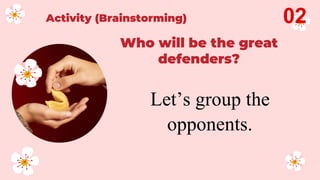
Who will be the great
defenders?
Let’s group the
opponents.
Activity (Brainstorming) 02
Values
Part in the Writing
Process that
Challenged My
Diligence and
Endurance
DEBATING ON A POSITION PAPER
The teacher will conduct a debate and make an arrangement
with the group's opponents accordingly. There will be a time limit for
the speakers, as it will be presented only for two days, January 16
and 18, 2023. The debate will be part of their final exam.
(Performance Exam.)
Each team should follow the ways on how to conduct debate,
as what has been discussed. Each of the speakers will be given 2-3
minutes to oppose or affirm the claims and must only consume 15-20
minutes to complete the round and prove their claims from their
position papers. The group must follow the given rubric.
Wrap up
Questions!
Raise your thumbs
up, if you can answer
the questions…
FUN FACTS ABOUT NEW
YEAR’S RESOLUTION
An average of 44% of Americans make a
New Year's resolution before the night is
over. Only 31% of people stick with the
promises they made to themselves the
prior year. A whopping 81% fail by
February. The four most popular types of
goals people set are to exercise, eat well,
lose weight, and save money.
JANUARY 2023
MON TUE WED THU FRI SAT SUN
1
2 3 4 5 6 7 8
9 10 11 12 13 14 15
16 17 18 19 20 21 22
23 24 25 26 27 28 29
EVENTS OF THE MONTH
English Week
Jan 9-13
Written Examination Week
Jan 19-20
NOTES
Please submit all your
assignments and other written
works before January 30 for your
2nd quarter compliance.
JANUARY 2023
MON TUE WED THU FRI SAT SUN
1
2 3 4 5 6 7 8
9 10 11 12 13 14 15
16 17 18 19 20 21 22
23 24 25 26 27 28 29
EVENTS OF THE MONTH
English Week
Jan 9-13
Position Paper Debate
Jan 16 and 18
NOTES
Please submit all your
assignments and other written
works before January 30 for your
2nd quarter compliance.
CREDITS: This presentation template was created by
Slidesgo, and includes icons by Flaticon, and
infographics & images by Freepik
THANKS!
DO YOU HAVE ANY QUESTIONS?
lachicar04@pnjkis.edu.ph
Please be generous by your kindness for the entire year!

EAPP Lesson: 014 - Conducting Debate.pdf

  • 1.
  • 2.
    How are you today? Howwas celebrating the new year?
  • 3.
    A New Year’sResolution is a promise that you make to yourself to start doing something good or stop doing something bad on the first day of the year. Do you know what is a New Year’s Resolution? Is it important to have a new year’s resolution?
  • 4.
    1. It willhelp you become who you want to be Why do we give importance on having a New Year’s Resolution? It’s important that you set yourself a New Year’s resolution to help you become that person you want for this year. Setting yourself a resolution is a good way to help you reflect on what’s important to you, clear your mind and focus on who you want to become.
  • 5.
    2. It canprovide stability Why do we give importance on having a New Year’s Resolution? Having some idea of where you want to be can help you make the right decisions in life. Make a New Year’s resolution for 2023, just a small one, and you can use it to help guide you along the right path when you’re struggling to make a decision.
  • 6.
    3. It candrive you Why do we give importance on having a New Year’s Resolution? Just think, if you set yourself the goal in not to do the bad things that you had last year! – at the same time that everybody else is setting their personal goals, you’ll have the support and encouragement of everyone around you to help drive you to achieve yours! So what is your new year’s resolution?
  • 7.
    Lesson Objectives defend astand on an issue by presenting reasonable arguments supported by properly cited factual pieces of evidence through a position paper recall the meaning of position paper and debate utilize the information on how to conduct a debate understand that writing academic papers requires diligence and endurance 01 03 02 04 Understanding Remembering Creating Analyzing
  • 8.
    The thesis statementis the sentence that states the main idea of a writing assignment and helps control the ideas within the paper. It is not merely a topic. It often reflects an opinion or judgment that a writer has made about a reading or personal experience. The "topic sentence" is the sentence in which the main idea of the paragraph is stated. It is unquestionably the most important sentence in the paragraph. The topic sentence generally is composed of two parts: (a) the topic itself and (b) the controlling idea. The Topic. The topic is the subject of the paragraph Thesis Statement Topic Sentence Vocabulary Example: “World hunger has many causes and effects.” Example: “People are experiencing severe food insecurity. World hunger is when people spend entire day of nothing to eat…”
  • 9.
    Transition sentences arethe sentences that show the relationship between two or more ideas. Think of them as bridges, tunnels, and merges that connect different sections of your work, with specific words and phrases acting as road signs. In academic writing, an argument is usually a main idea, often called a “claim” or “thesis statement,” backed up with evidence that supports the idea. Transition Sentences Argument Vocabulary In an essay, a paragraph discusses one idea in detail that supports the thesis of the essay. Each paragraph in the body of the paper should include a topic sentence, supporting details to support the topic sentence, and a concluding sentence. Paragraph
  • 10.
    Recall the meaning of positionpaper and debate 01 What is position paper and debate?
  • 11.
    A position paperpresents an arguable opinion about an issue. The goal of a position paper is to convince the audience that your opinion is valid and worth listening to. Ideas that you are considering need to be carefully examined in choosing a topic, developing your argument, and organizing your paper. Define an position paper… Is position paper arguable or debatable?
  • 12.
    Argumentative essays arealso known as “persuasive essays,” “opinion essays,” or “position papers.” In an argumentative essay, the author adopts a position on a debatable issue and uses reason and evidence to convince the reader of his/her opinion. Is it? How will you know that your writing is an essay?
  • 13.
    1. Are thereany topics? Or issues that we are not allowed to talk? What should we not debate about? Support your thoughts!
  • 14.
    A debate isa discussion or structured contest about an issue or a resolution. A formal debate involves two sides: one supporting a resolution and one opposing it. Such a debate is bound by rules previously agreed upon. What is a debate? 1
  • 15.
    Debates may bejudged in order to declare a winning side. Debates, in one form or another, are commonly used in democratic societies to explore and resolve issues and problems. . What is a debate? 2
  • 16.
    Decisions at aboard meeting, public hearing, legislative assembly, or local organization are often reached through discussion and debate. Indeed, any discussion of a resolution is a form of debate, which may or may not follow formal rules (such as Robert’s Rules of Order). What is a debate? 3
  • 17.
    In the contextof a classroom, the topic for debate will be guided by the knowledge, skill, and value outcomes in the curriculum. What is a debate? 4
  • 18.
    A formal debateusually involves three groups: one supporting a resolution (affirmative team), one opposing the resolution (opposing team), and those who are judging the quality of the evidence and arguments and the performance in the debate. Structure of A Debate
  • 19.
    The affirmative andopposing teams usually consist of three members each, while the judging may be done by the teacher, a small group of students, or the class as a whole. In addition to the three specific groups, there may an audience made up of class members not involved in the formal debate. A specific resolution is developed and rules for the debate are established. Structure of A Debate
  • 20.
    • Develop theresolution to be debated. • Organize the teams. • Establish the rules of the debate, including timelines. • Research the topic and prepare logical arguments. • Gather supporting evidence and examples for position taken. • Anticipate counter arguments and prepare rebuttals. • Team members plan order and content of speaking in debate. • Prepare room for debate. • Establish expectations, if any, for assessment of debate. Debate Preparation
  • 21.
    Debate opens withthe affirmative team (the team that supports the resolution) presenting their arguments, followed by a member of the opposing team. This pattern is repeated for the second speaker in each team. Finally, each team gets an opportunity for rebutting the arguments of the opponent. Speakers should speak slowly and clearly. The judges and members of the audience should be taking notes as the debate proceeds. A typical sequence for debate, with suggested timelines, is as follows: Conducting Debate
  • 22.
    • the firstspeaker on the affirmative team presents arguments in support of the resolution. (5 – 10 minutes) • The first speaker on the opposing team presents arguments opposing the resolution. (5 – 10 minutes) • The second speaker on the affirmative team presents further arguments in support of the resolution, identifies areas of conflict, and answers questions that may have been raised by the opposition speaker. (5 – 10 minutes) Conducting Debate
  • 23.
    The second speakeron the opposing team presents further arguments against the resolution, identifies further areas of conflict, and answers questions that may have been raised by the previous affirmative speaker. (5 – 10 minutes) • The rules may include a short recess for teams to prepare their rebuttals. (5 minutes) • The opposing team begins with the rebuttal, attempting to defend the opposing arguments and to defeat the supporting arguments without adding any new information. (3 – 5 minutes). Conducting Debate
  • 24.
    • First rebuttalof the affirmative team (3 – 5 minutes) • Each team gets a second rebuttal for closing statements with the affirmative team having the last opportunity to speak. (3 – 5 minutes each) • There cannot be any interruptions. Speakers must wait their turns. Conducting Debate
  • 25.
    Who will bethe great defenders? Let’s group the opponents. Activity (Brainstorming) 02
  • 26.
    Values Part in theWriting Process that Challenged My Diligence and Endurance
  • 27.
    DEBATING ON APOSITION PAPER The teacher will conduct a debate and make an arrangement with the group's opponents accordingly. There will be a time limit for the speakers, as it will be presented only for two days, January 16 and 18, 2023. The debate will be part of their final exam. (Performance Exam.) Each team should follow the ways on how to conduct debate, as what has been discussed. Each of the speakers will be given 2-3 minutes to oppose or affirm the claims and must only consume 15-20 minutes to complete the round and prove their claims from their position papers. The group must follow the given rubric.
  • 28.
    Wrap up Questions! Raise yourthumbs up, if you can answer the questions…
  • 29.
    FUN FACTS ABOUTNEW YEAR’S RESOLUTION An average of 44% of Americans make a New Year's resolution before the night is over. Only 31% of people stick with the promises they made to themselves the prior year. A whopping 81% fail by February. The four most popular types of goals people set are to exercise, eat well, lose weight, and save money.
  • 30.
    JANUARY 2023 MON TUEWED THU FRI SAT SUN 1 2 3 4 5 6 7 8 9 10 11 12 13 14 15 16 17 18 19 20 21 22 23 24 25 26 27 28 29 EVENTS OF THE MONTH English Week Jan 9-13 Written Examination Week Jan 19-20 NOTES Please submit all your assignments and other written works before January 30 for your 2nd quarter compliance.
  • 31.
    JANUARY 2023 MON TUEWED THU FRI SAT SUN 1 2 3 4 5 6 7 8 9 10 11 12 13 14 15 16 17 18 19 20 21 22 23 24 25 26 27 28 29 EVENTS OF THE MONTH English Week Jan 9-13 Position Paper Debate Jan 16 and 18 NOTES Please submit all your assignments and other written works before January 30 for your 2nd quarter compliance.
  • 32.
    CREDITS: This presentationtemplate was created by Slidesgo, and includes icons by Flaticon, and infographics & images by Freepik THANKS! DO YOU HAVE ANY QUESTIONS? lachicar04@pnjkis.edu.ph Please be generous by your kindness for the entire year!