B Y : A N S H I K A S I N G H
External Sources of Funds In
Corporates / MNCs
Introduction to Multinational Companies
 International fund raising used to be the domain of
multinational companies. MNCs not only source raw material
across the world or sell products at many geographical
regions, they are also scouting for capital all over the world
and raise capital where it is cheaper. However with
globalization and increased cross-border capital flows, smaller
companies are enjoying the benefits of raising capital in the
international market.
 Cross listing of shares through issuance of depository receipts
have become a common occurrence. Investors’ appetite for
foreign company shares have also increased manifold and
internationalization of equity market across globe is
happening at a faster speed.
Classification of sources of funds
American Depository Receipts and Global
Depository Receipts
 American Depository Receipt (ADR) is a certified negotiable
instrument issued by an American bank suggesting the number of
shares of a foreign company that can be traded in U.S. financial
markets.
 American Depository Receipts provide US investors with an
opportunity to trade in shares of a foreign company. When the ADRs
did not exist, it was very difficult for an American investor to trade in
shares of foreign companies as they had to go through many rules
and regulation. To ease such hardship faced by American investors,
the regulatory body Securities Exchange Commission (SEC)
introduced the concept of ADR which made it easier for an American
investor to trade in shares of foreign companies.
 Global Depository Receipt (GDR) is an instrument in which a
company located in domestic country issues one or more of its shares
or convertibles bonds outside the domestic country.
 In GDR, an overseas depository bank i.e. bank outside the domestic
territory of a company, issues shares of the company to residents
outside the domestic territory. Such shares are in the form of
depository receipt or certificate created by overseas the depository
bank. Issue of Global Depository Receipt is one of the most popular
ways to tap the global equity markets. A company can raise foreign
currency funds by issuing equity shares in a foreign country
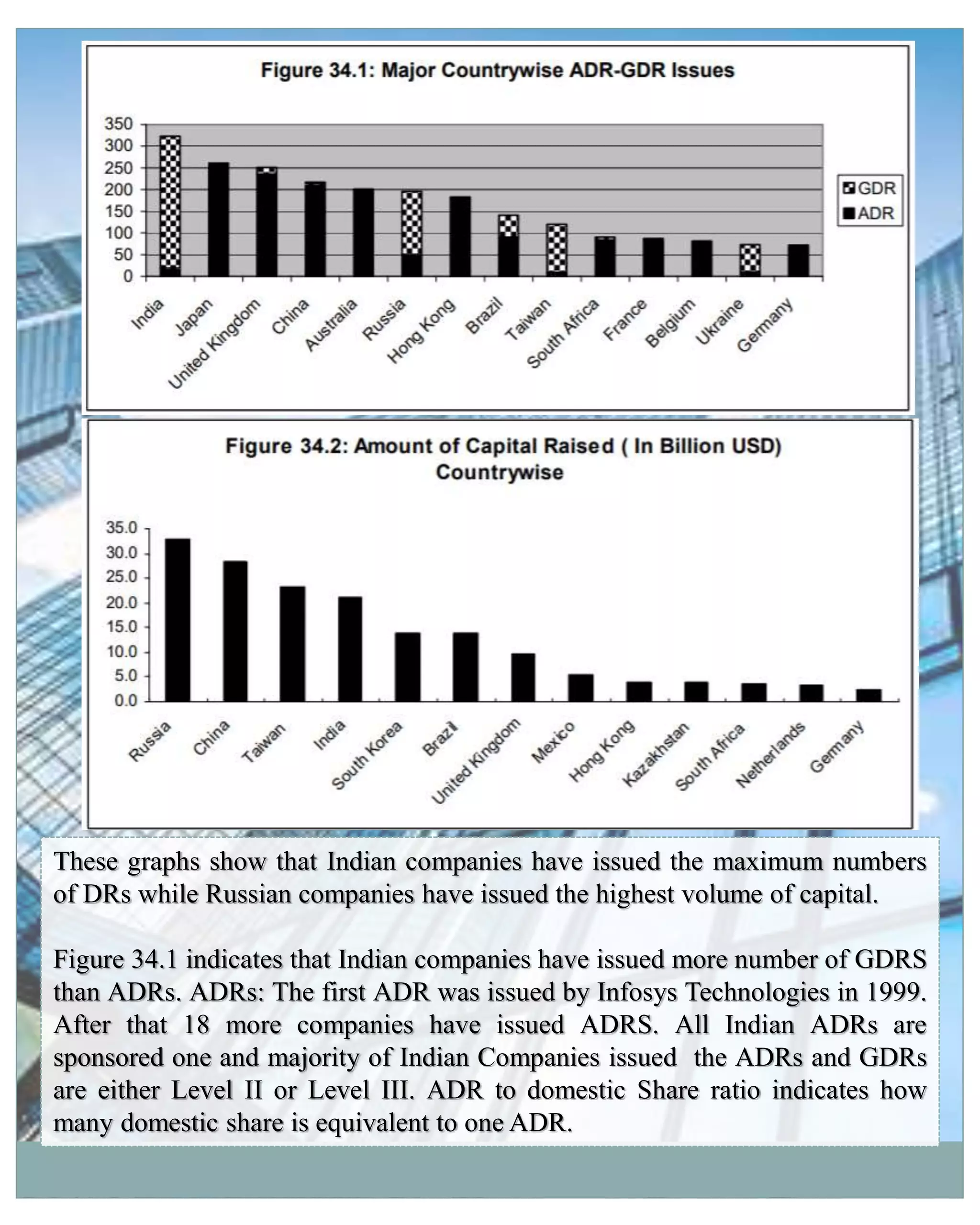
These graphs show that Indian companies have issued the maximum numbers
of DRs while Russian companies have issued the highest volume of capital.
Figure 34.1 indicates that Indian companies have issued more number of GDRS
than ADRs. ADRs: The first ADR was issued by Infosys Technologies in 1999.
After that 18 more companies have issued ADRS. All Indian ADRs are
sponsored one and majority of Indian Companies issued the ADRs and GDRs
are either Level II or Level III. ADR to domestic Share ratio indicates how
many domestic share is equivalent to one ADR.
Reasons for increase in ADRs / GDRs in India
 Like ADR, most of Indian GDRs are sponsored ones. Barring few, all
Indian GDRs have been listed in either London or Luxembourg stock
exchanges. Compared to the total number of ADRs issued by Indian
companies, GDR numbers are substantially high. This is due to easier
listing and accounting reporting requirements set by London and
Luxembourg stock exchanges.
 As both shares and DR receipts trade in different market denominated
in Indian Rupees and USD respectively, it gives rise to arbitrage
opportunity
 During the initial days of ADRs and GDRs, Govt. of India only
allowed DRs to be converted to underlying shares and not the other
way around – this was known as “one way fungibility”. But in 2009, it
permitted the “two way fungibility” thus paving the path for
exploiting arbitrage opportunity in a more realistic way.
 Companies prefer the GDR route compared to an ADR because
the disclosure, accounting and compliance requirements in the
USA are far more stringent and onerous as compared to those in
the case of a GDR issue, say in Luxembourg. But several well
managed companies, such as Infosys, HDFC Bank, etc., prefer the
ADR route. Since the USA is the world’s single largest capital
market, it goes without saying that viewed from an investment
perspective it makes more sense to list in the USA. However,
concerns of compliance and costs also prevail.
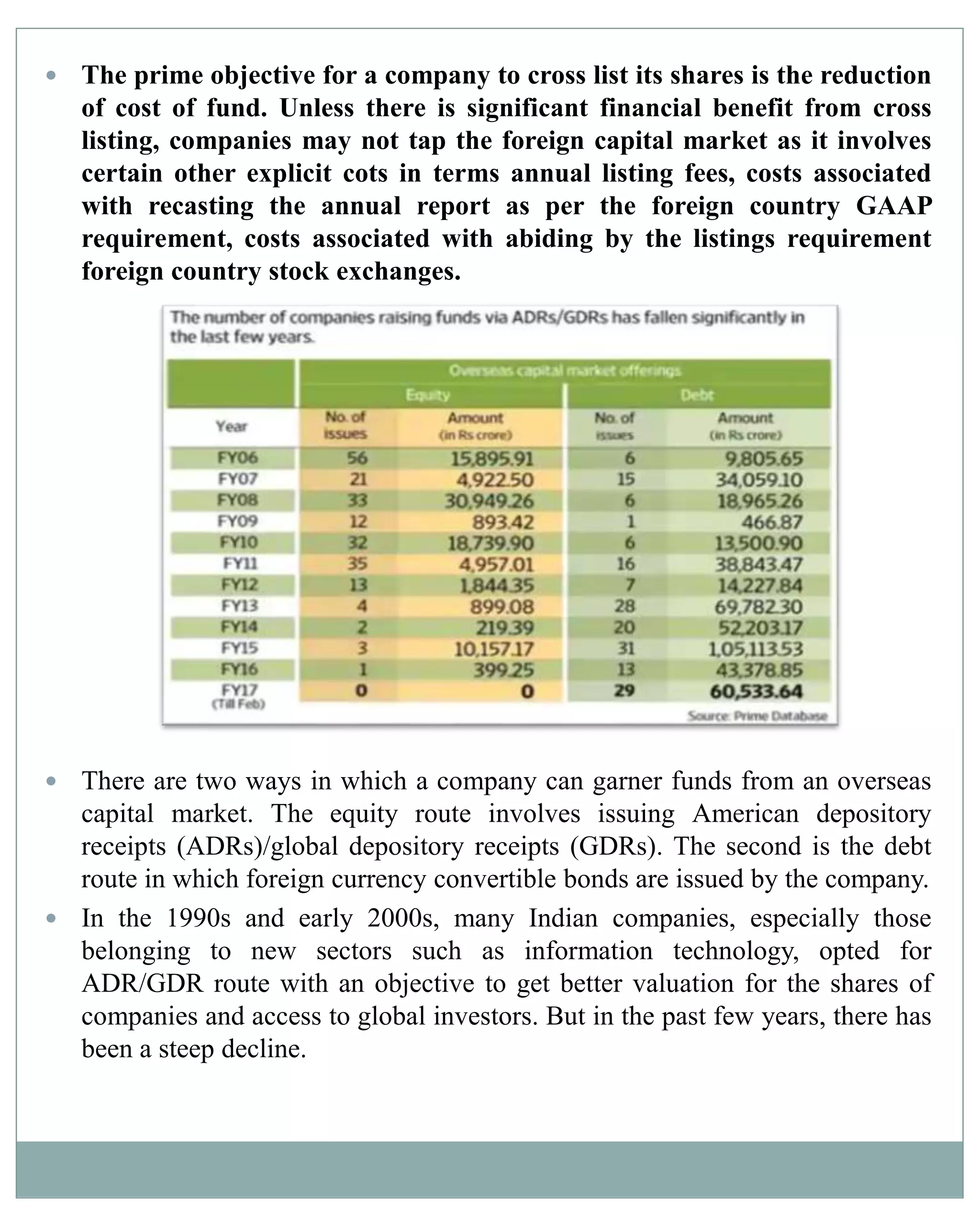
 The prime objective for a company to cross list its shares is the reduction
of cost of fund. Unless there is significant financial benefit from cross
listing, companies may not tap the foreign capital market as it involves
certain other explicit cots in terms annual listing fees, costs associated
with recasting the annual report as per the foreign country GAAP
requirement, costs associated with abiding by the listings requirement
foreign country stock exchanges.
 There are two ways in which a company can garner funds from an overseas
capital market. The equity route involves issuing American depository
receipts (ADRs)/global depository receipts (GDRs). The second is the debt
route in which foreign currency convertible bonds are issued by the company.
 In the 1990s and early 2000s, many Indian companies, especially those
belonging to new sectors such as information technology, opted for
ADR/GDR route with an objective to get better valuation for the shares of
companies and access to global investors. But in the past few years, there has
been a steep decline.
Reasons for decline in issue of AGRs / GDRs
 First and foremost is the development of the domestic qualified institutional
placement (QIP) market, which is a more convenient and cheaper method for
both the issuer and investor; also one has been seeing lot of foreign participation
there.
 The next key factor is the movement in the rupee. “ADR/GDR route was
popular at the time when the rupee was weaker and investors were more
confident of investing in dollar or pound/euro-denominated instruments. But
now the scenario has changed. The rupee has been stable or has strengthened
over the past few years
 From the taxation perspective too, it has become an unattractive option.
As per the guidelines proposed in 2015, conversion of ADRs/GDRs into equity
may attract capital gains tax, which was not the case earlier. It should also be
noted that in 2011, changes were announced to the Takeover Code which states
that an investor may acquire as much as 25% in an Indian company without
triggering an open offer; since an investor cannot directly acquire 24.99% in a
company, the demand for GDRs, which were used to acquire shares in excess of
15%, has reduced. After the GDR debacle of Pan Asia Advisors Ltd in 2015,
authorities became more vigilant and stringent.
 The alleged need for round tripping by some promoters through ADR/GDR
issues is also on the wane with the crackdown on black money globally. So,
these are some factors which have led to companies refraining from taking the
ADR/GDR route lately
 In September 2013, the government allowed unlisted Indian companies to list
abroad without having to do an initial public offering in India. However, the
move failed to get the desired response due to lack of clarity on the taxation
treatment
Advantages Disadvantages
 American investor can
invest in foreign
companies which can fetch
him higher returns.
 The companies located in
foreign countries can get
registered on American
Stock Exchange and have
it’s shares trades in two
different countries.
 The benefit of currency
fluctuation can be availed.
 They are exposed to the
risk associated with
foreign exchange
fluctuation.
 The number of options to
invest in foreign
companies is limited.
 Any violation of
compliance can lead to
strict action by Securities
Exchange Commission.
American Depository Receipt
ADR is a certified negotiable instrument issued by an American
bank suggesting the number of shares of a foreign company that
can be traded in U.S Financial Markets
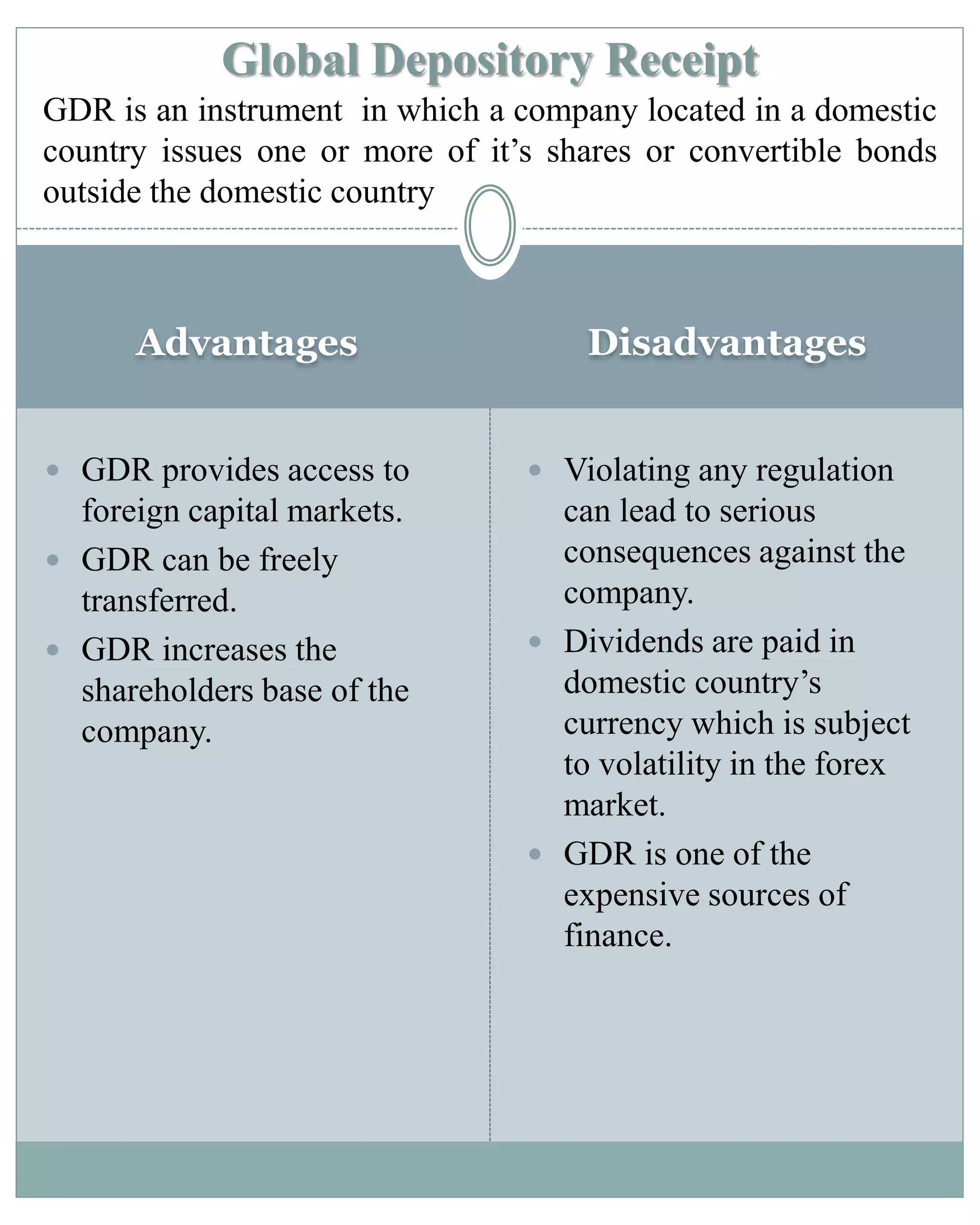
Advantages Disadvantages
 GDR provides access to
foreign capital markets.
 GDR can be freely
transferred.
 GDR increases the
shareholders base of the
company.
 Violating any regulation
can lead to serious
consequences against the
company.
 Dividends are paid in
domestic country’s
currency which is subject
to volatility in the forex
market.
 GDR is one of the
expensive sources of
finance.
Global Depository Receipt
GDR is an instrument in which a company located in a domestic
country issues one or more of it’s shares or convertible bonds
outside the domestic country
Working Mechanism
 AMERICAN DEPOSITORY
RECEIPT (ADR)
 GLOBAL DEPOSITORY
RECEIPT (GDR)
The domestic company, already listed in its
local stock exchange, sells its shares in bulk
to a U.S. bank to get itself listed on U.S.
exchange
The U.S. bank accepts the shares of the
issuing company. The bank keeps the shares
in its security and issues certificates (ADRs)
to the interested investors through the
exchange.
Investors set the price of the ADRs through
bidding process in U.S. dollars. The buying
and selling in ADR shares by the investors is
possible only after the major U.S. stock
exchange lists the bank certificates for
trading.
The U.S. stock exchange is regulated by
Securities Exchange Commission, which
keeps a check on necessary compliances that
need to be complied by the foreign
company.
The domestic company enters into an
agreement with the overseas depository
bank for the purpose of issue of GDR.
The overseas depository bank then
enters into a custodian agreement with
the domestic custodian of such company.
The domestic custodian holds the equity
shares of the company.
On the instruction of domestic
custodian, the overseas depository bank
issues shares to foreign investors.
The whole process is carried out under
strict guidelines.GDRs are usually
denominated in U.S. dollars
Regulatory framework of ADRs/GDRs
Issuance Guidelines: Regular Issue
 An issue of ADRs/ GDRs is governed by the FEMA Regulations as well as the
Issue of Foreign Currency Convertible Bonds and Ordinary Shares (Through
Depository Receipt Mechanism) Scheme, 1993 (“Scheme”) issued by the Central
Government. This Scheme is the main legislation which governs the issue of
ADRs/ GDRs. The important steps and conditions involved are as follows:
 If the company is eligible under the Scheme to float an issue then it does not
require the prior permission of the Finance Ministry.
 The company is not ineligible to issue shares to foreign investors under the FDI
policy since ADR/ GDR are treated as part of FDI.
 Now companies do not require the prior approval of the Finance Ministry as it has
been put on an automatic route. Private placement of ADRs/ GDRs are also put on
this route. RBI has also allowed such issues on an automatic route.
 An Indian company which is restrained from accessing the securities market by the
SEBI is not eligible to float an ADR / GDR issue.
 Issue pricing norms, which till September, 2005 were free, have now been laid
down. The minimum price in case of a listed company must be the higher of the
following two averages: Average weekly high and low of the closing prices of the
share quoted on the stock exchange during the 6 months preceding the relevant
date; Average weekly high and low of the closing prices of the share quoted on
the stock exchange during the 2 weeks preceding the relevant date; The relevant
date for this purpose means a date 30 days prior to the date on which a
shareholders’ meeting is called for passing a Special Resolution u/s. 81(1A) of the
Companies Act, 1956. Thus, now the pricing of ADRs/ GDRs has been put on par
with the preferential issue pricing norms.
 In case an unlisted company wishes to float an ADR/ GDR issue, then it must also
take steps for prior or simultaneous listing in India.
ADRs and GDRs in India
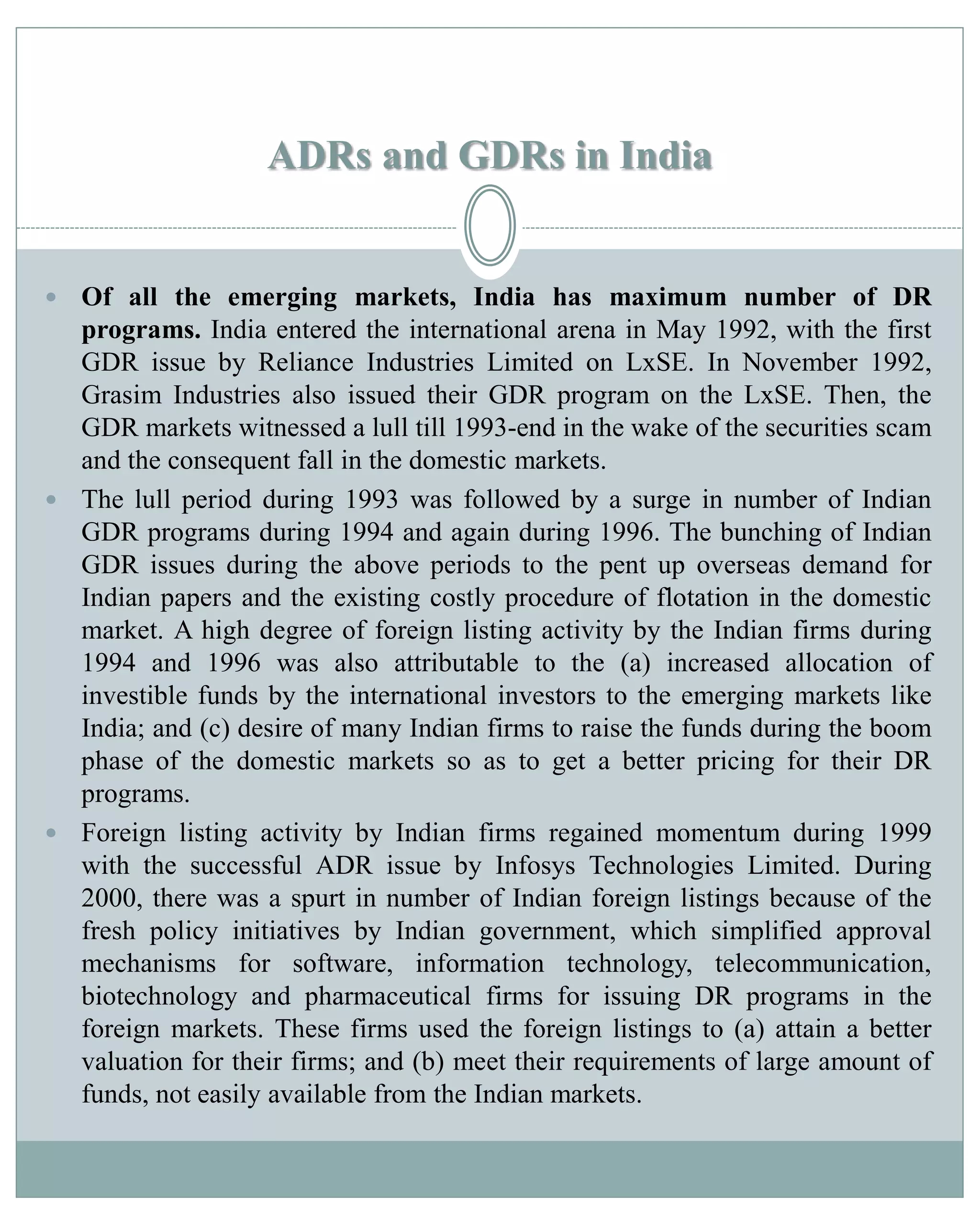
 Of all the emerging markets, India has maximum number of DR
programs. India entered the international arena in May 1992, with the first
GDR issue by Reliance Industries Limited on LxSE. In November 1992,
Grasim Industries also issued their GDR program on the LxSE. Then, the
GDR markets witnessed a lull till 1993-end in the wake of the securities scam
and the consequent fall in the domestic markets.
 The lull period during 1993 was followed by a surge in number of Indian
GDR programs during 1994 and again during 1996. The bunching of Indian
GDR issues during the above periods to the pent up overseas demand for
Indian papers and the existing costly procedure of flotation in the domestic
market. A high degree of foreign listing activity by the Indian firms during
1994 and 1996 was also attributable to the (a) increased allocation of
investible funds by the international investors to the emerging markets like
India; and (c) desire of many Indian firms to raise the funds during the boom
phase of the domestic markets so as to get a better pricing for their DR
programs.
 Foreign listing activity by Indian firms regained momentum during 1999
with the successful ADR issue by Infosys Technologies Limited. During
2000, there was a spurt in number of Indian foreign listings because of the
fresh policy initiatives by Indian government, which simplified approval
mechanisms for software, information technology, telecommunication,
biotechnology and pharmaceutical firms for issuing DR programs in the
foreign markets. These firms used the foreign listings to (a) attain a better
valuation for their firms; and (b) meet their requirements of large amount of
funds, not easily available from the Indian markets.
While most GDR listings were accomplished during 1994 and 1996 i.e.,
when the domestic market was in a boom phase, most ADR listings
were accomplished during 2000 to 2001 i.e., when the domestic market
was in a bearish phase. Therefore, the initial Indian GDR listings
depicted the opportunistic conduct of the Indian firms.
A comparison of ADR listing Indian firms with GDR listing Indian
firms provides following interesting insights. First, Indian firms
listing their DR programs on US exchanges seem to be young,
innovative and have operations in knowledge-based industries like
computers, telecommunications and pharmaceuticals
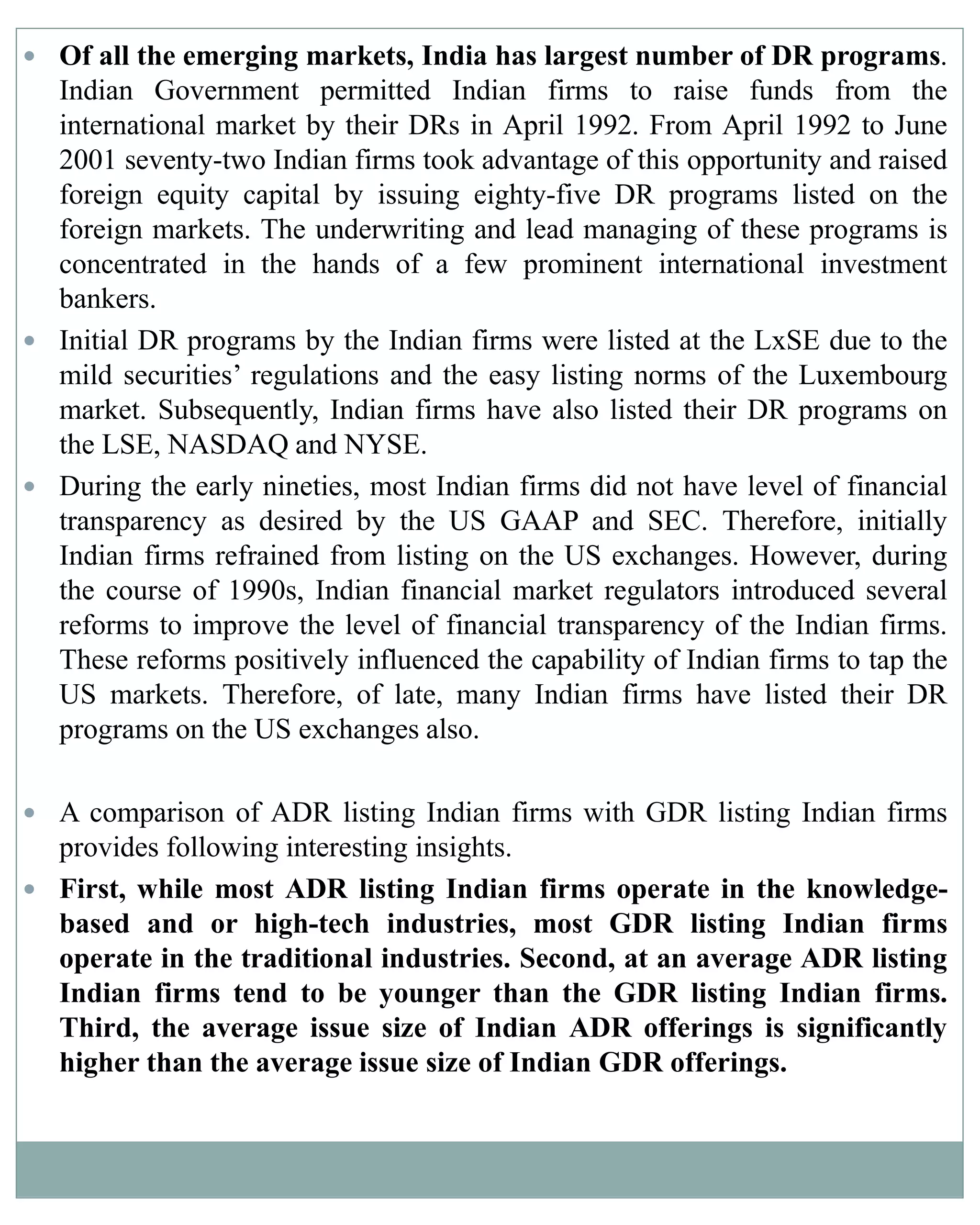
 Of all the emerging markets, India has largest number of DR programs.
Indian Government permitted Indian firms to raise funds from the
international market by their DRs in April 1992. From April 1992 to June
2001 seventy-two Indian firms took advantage of this opportunity and raised
foreign equity capital by issuing eighty-five DR programs listed on the
foreign markets. The underwriting and lead managing of these programs is
concentrated in the hands of a few prominent international investment
bankers.
 Initial DR programs by the Indian firms were listed at the LxSE due to the
mild securities’ regulations and the easy listing norms of the Luxembourg
market. Subsequently, Indian firms have also listed their DR programs on
the LSE, NASDAQ and NYSE.
 During the early nineties, most Indian firms did not have level of financial
transparency as desired by the US GAAP and SEC. Therefore, initially
Indian firms refrained from listing on the US exchanges. However, during
the course of 1990s, Indian financial market regulators introduced several
reforms to improve the level of financial transparency of the Indian firms.
These reforms positively influenced the capability of Indian firms to tap the
US markets. Therefore, of late, many Indian firms have listed their DR
programs on the US exchanges also.
 A comparison of ADR listing Indian firms with GDR listing Indian firms
provides following interesting insights.
 First, while most ADR listing Indian firms operate in the knowledge-
based and or high-tech industries, most GDR listing Indian firms
operate in the traditional industries. Second, at an average ADR listing
Indian firms tend to be younger than the GDR listing Indian firms.
Third, the average issue size of Indian ADR offerings is significantly
higher than the average issue size of Indian GDR offerings.
SAMURAI BONDS
 Samurai bonds are issued by non-Japanese companies,
mainly in Tokyo, Japan. The bonds are denominated in the
Japanese currency – Yen.
 A business enterprise can invade the foreign markets if it
receives a higher interest rate. A company also seeks to
explore foreign financial market to earn foreign currency
as well. A company can issue foreign bonds for tapping
global financial markets. The foreign bonds issued are
denominated in the targeted market’s currency. This is a
way to raise capital from another financial market.
 Foreign business enterprises/corporate firms issue Samurai
bonds in Japan. To do so, the issuing company or the
government has to follow the rules and regulations of
Japanese market. These companies issue their bond in the
Japanese market for acquiring the local currency. For
investors in Japan, financial samurai bonds are an
attractive instrument as there is no risk of currency
variation. The issuing company can use the proceeds from
samurai bond issuance for various purposes.
History Of Samurai Bond Market
 The Samurai Bond Market came into existence in 1970. It was the
first time when the Ministry of Finance allowed supranational
entities and international government organizations to issue Samurai
Bonds. However, there were terms and conditions about the size of
issue and tenor. The reason to open the Samurai bond market was to
deal with the excessive reserve of foreign currency in Japan. It was
in the late 1960s when one US dollar worth 360 Yen. To reduce the
pressure on the financial and monetary market of Japan, the
government opened the gates for foreign organizations to invest in
its market by issuing Yen-denominated bonds.
Advantages Limitations
 Opportunities of sources of
finances.
 Investment in MNCs.
 Lower coupon rate.
 Capital is found easily.
 Uncertainty about co. and
financial policies.
 High admin pressures and
tax.
 Stagnant growth, lengthy
issuing process.
Samurai Bonds
PURPOSE
 Conversion to domestic / other currency.
 Investing in Japanese market.
 Protection against Risk.
 Rules and Regulations to be followed.
Reasons for Increase and Decline of Samurai
Bonds
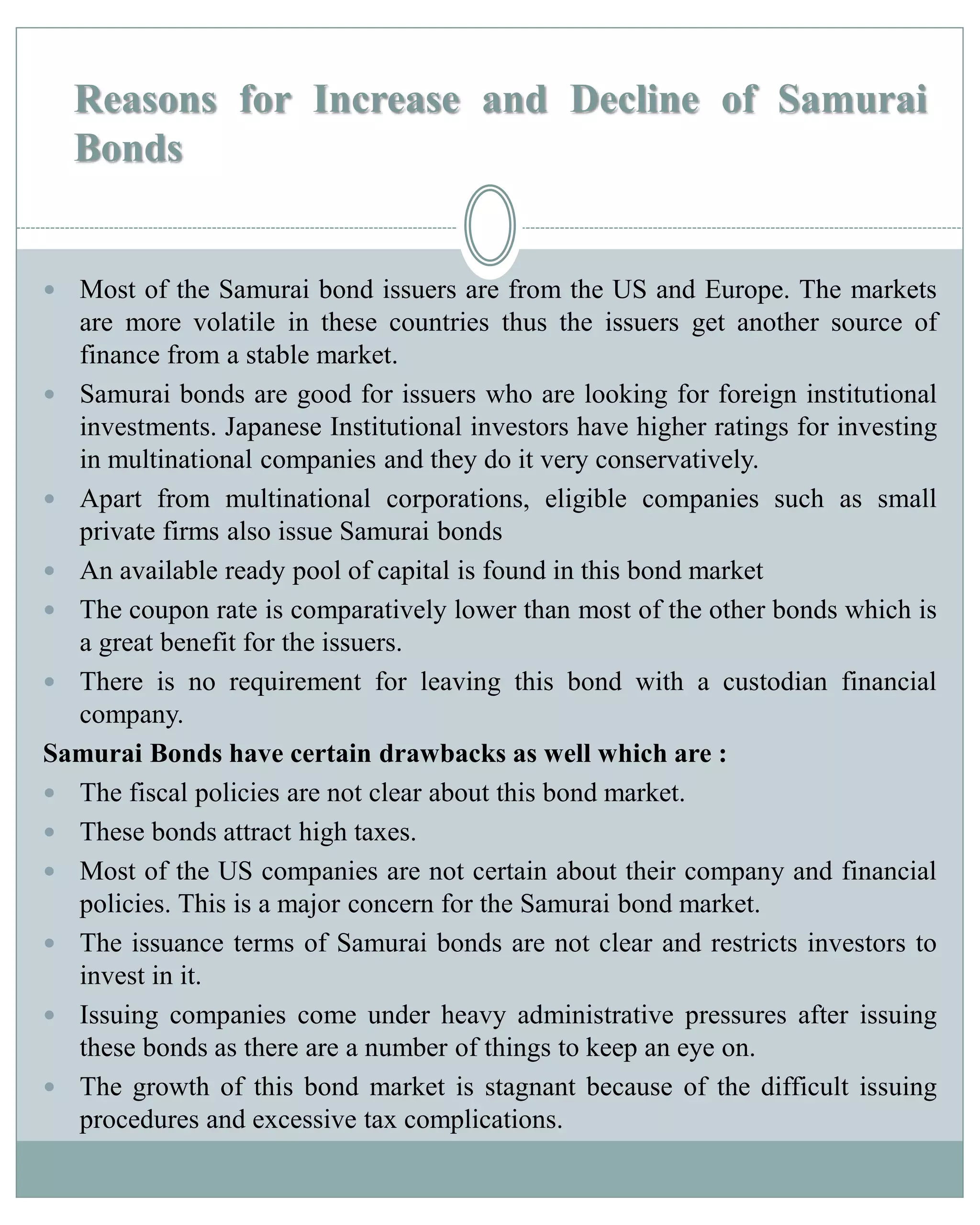
 Most of the Samurai bond issuers are from the US and Europe. The markets
are more volatile in these countries thus the issuers get another source of
finance from a stable market.
 Samurai bonds are good for issuers who are looking for foreign institutional
investments. Japanese Institutional investors have higher ratings for investing
in multinational companies and they do it very conservatively.
 Apart from multinational corporations, eligible companies such as small
private firms also issue Samurai bonds
 An available ready pool of capital is found in this bond market
 The coupon rate is comparatively lower than most of the other bonds which is
a great benefit for the issuers.
 There is no requirement for leaving this bond with a custodian financial
company.
Samurai Bonds have certain drawbacks as well which are :
 The fiscal policies are not clear about this bond market.
 These bonds attract high taxes.
 Most of the US companies are not certain about their company and financial
policies. This is a major concern for the Samurai bond market.
 The issuance terms of Samurai bonds are not clear and restricts investors to
invest in it.
 Issuing companies come under heavy administrative pressures after issuing
these bonds as there are a number of things to keep an eye on.
 The growth of this bond market is stagnant because of the difficult issuing
procedures and excessive tax complications.
Scope of Samurai Bonds in India
 For improvement of functions of the Indian bond markets
・Corporate bond market of India has many areas to be
improved, and we can support the efforts of the Indian authorities
to improve the functions of market by sharing with the them
knowledge and experience of Japanese investors on the
development of the Japanese corporate bond market.
 Promotion of cross-border investment
・Japanese investment in Indian securities can be encouraged
through implementing such measures as liberalization of
exchange transactions related to bond trading, abolition of margin
requirement, tax agency system on government bond trading as
well as removal of limit on bond investment and capital gain tax
on foreign investors.
・If the Indian government bonds should be adopted in the
major bond indices, it will contribute to expand an array of
foreign investors, leading to stable capital inflows.
・On the bond investment between two countries, mutual
listing of debt ETFs should also be considered.
・In order to expand the number of Indian issuing entities of
Samurai bonds, sharing of Japanese knowledge and experience
on the Samurai bond market coupled with the partial guarantee
by JBIC to the issuance of the Indian governmental agencies that
issue Samurai bonds would be helpful.
 The Samurai Bond Market is important to monitor in the context of the
Global Financial Crisis, as it funded many of the excesses in the periods
leading to the collapse in the markets. It continues to be relevant today.
 Samurai Issues from 1990 to 2015
 Since 1990, there have been almost 3000 issues, totaling over $210BB,
by approximately 132 issuers
Samurai Issues from 2000 to September 2008 (Lehman Bankruptcy)
 From 2000 till the Lehman bankruptcy, there were over 1300 issues, totaling
over $136BB. The size of the deals issues grew as did the number of issuers
and their frequency of issuance, to 77, along with the number of sectors
participating. Financials dominated, with over 77% of all the volume
 “Masala Bonds” are the 10 year off-shore rupee
bonds issued by International Finance
Corporation (IFC), a member of the World
Bank group, in the international capital market
in 2014, to raise funds for supporting private
sector infrastructure development initiatives in
India.
 'Masala' refers to spices and it evokes the
culture and cuisines of India. These bonds
can be issued by Indian corporates only. No
bank is allowed to issue Masala bonds
 Masala bonds are listed in London Stock
Exchange. The term Masala bonds now extends
to any rupee denominated bonds issued to
overseas buyers even though RBI has not
resorted to the use of this name in their
guidelines. The major component of Masala
Bond is its hedging costs
 Their rationale – they are like any other off-
shore bonds, are intended for those foreign
investors who want to take exposure to Indian
assets, yet constrained from doing it directly in
the Indian market or prefer to do so from their
offshore locations.
Advantages to the
Investor
Advantages for
Borrowers
 Less documentation- No
need to register as foreign
portfolio investment in India.
 Lower Tax- The Finance
Ministry has cut the
withholding tax [a tax
deducted at source on
residents outside the
country] on interest income
of such bonds to 5% to 20%
making it attractive for
investors.
 Operational convenience-
The masala bonds can be
settled in foreign currency
through the international
custodians.
 Cheaper cost of funds- If
the company issues any
bond of 7.5% to 9%
whereas, Masala bonds
outside India is issued
below 7% interest rate.
 No currency risk-
Companies issuing Masala
Bonds do not have to
worry about rupee
depreciation, which is
usually a big worry while
raising money in overseas
markets.
Advantages of Masala Bonds
Reasons of Increase and Decrease in Masala Bonds
 Rupee-denominated bonds (Masala bonds) Borrowing by issuing rupee-
denominated bonds (RDB) overseas can be expected to give issuers such
advantages as to mitigate exchange rate risk and its hedging cost.
 For investors, higher yields and exchange profits from appreciation of the rupee, and
simpler procedures for investment compared to investment to Indian domestic bonds
would be attractive advantages.
 In October 2013, IFC launched a program to sell Masala bonds in overseas markets.
During the phase I period to April 2014 (for a total of Rs 62 billion or equivalent to
$1 billion), IFC issued 7 tranches with tenors of 3 to 7 years9 . During the phase II
period (for a total of $2 billion equivalent), in addition to the masala bonds (Rs 10
billion with a tenor of 10 years) issued in November 2014 on the London Stock
Exchange (LSE) for the purpose of infrastructure development support, it
successfully floated the Rs 2 billion of bonds with the then longest maturity of 15
years on offshore rupee market. Moreover, IFC issued Rs 300 million of green masala
bonds and Masala Uridashi bonds directed toward Japanese personal investors. The
bonds with maturities of less than 10 years were oversubscribed and it is evaluated
that these issuances had achieved a certain result in establishing a benchmark yield
curve and grasping investor demands.
 Also, as the masala bonds issued by IFC have yields by 100-190 bps lower than the
Indian government bonds with corresponding tenors, they are expected to reduce
financing costs.
How Masala Bonds help in supporting the rupee
 The bonds are directly pegged to the Indian currency. So, investors will directly take
the currency risk or exchange rate risks. If the value of Indian currency falls, the
foreign investor will have to bear the losses, not the issuer which is an Indian entity
or a corporate. If foreign investors eagerly invest in Masala Bonds or bring money
into India, this would help in supporting the rupee.
 The issuer of these bonds is shielded against the risk of currency fluctuation, typically
associated with borrowing in foreign currency. Besides helping in diversifying funding
sources, the costs of borrowing via masala bonds could also turn out to be lower than
domestic markets.
 On the other hand, it is also pointed out as a problem that investors tend to hold the 10
year- and 15 year- Masala Uridashi bonds to maturity, causing a low liquidity. After
these experiences, in September 2015 the RBI issued a guideline arrowing domestic
corporations to issue masala bonds overseas10. At the beginning, there were restrictions
on the eligible borrowers (REIT, infrastructure investment trusts), minimum maturity
period, and amount ($750 million per annum under the automatic route), but later some
of the conditions on maturity period and all-in-cost ceiling and recognized investors
were eased11. Following the first issuance of Rs 30 billion by HDFC in July 2016,
issuance of masala bonds by NBFCs and SOEs increased, bringing the total financing
amount to about $300 billion in the fiscal 2016.
 Currently, issuance on the Singapore Exchange (SGX) in addition to the LSE has
become a mainstream, with asset management companies, private banks, and
commercial banks joining as investors. At present, the growth of funding has slowed
reflecting a declining demand for funds due to economic slowdown in India and
weakening appetite for investment by foreign investors
WHAT DOES THE ISSUE MEAN?
 Issuances in overseas financial centres such as London give countries like
India a chance to tap global investors for funding investment needs.
 The IFC Masala bonds are a boost for Indian rupee-denominated issuances as
listing on LSE will provide visibility, and set a benchmark for yields in future
issuances. It could also increase demand for similar products later as liquidity
of these bonds goes up. This also shows the confidence of international
investors in the Indian economy and its currency
 This is a 10-year bond with a yield of 6.3% and a AAA benchmark rating.
Though there are other offshore rupee bonds, this issuance will be the first to
be listed on a stock exchange.
 The proceeds will be used for infrastructure investment in India through
infrastructure bonds issued by Axis Bank Ltd.
 IFC will support private investment in the infrastructure sector and sectors
that contribute to economic growth and job creation. Hence, future Masala
bond issuances may support other kinds of related private sector investments.
 Things have changed and currency volatility is now common, more so as
advanced economies are tightening money.
 To shield local companies from the vagaries of volatility, India introduced a
scheme of Rupee denominated bonds in September 2015, popularly known as
‘masala bonds‘ (masala is a mix of Indian spices). Indian corporations have
mobilized more than $8 billion through these bonds. The bonds enabled the
Indian corporations to borrow in the international markets by linking the
interest and principal payments to the Rupee. The exchange rate risk of masala
bonds are borne by lenders, not by borrowers. The data suggest that
international lenders do have an appetite for these bonds. And the scheme
helps India’s macroeconomic stability since it reduces foreign currency
denominated debt of the nation.

External / Overseas sources of funds for MNCs by Anshika Singh

  • 1.
    B Y :A N S H I K A S I N G H External Sources of Funds In Corporates / MNCs
  • 2.
    Introduction to MultinationalCompanies  International fund raising used to be the domain of multinational companies. MNCs not only source raw material across the world or sell products at many geographical regions, they are also scouting for capital all over the world and raise capital where it is cheaper. However with globalization and increased cross-border capital flows, smaller companies are enjoying the benefits of raising capital in the international market.  Cross listing of shares through issuance of depository receipts have become a common occurrence. Investors’ appetite for foreign company shares have also increased manifold and internationalization of equity market across globe is happening at a faster speed.
  • 3.
  • 4.
    American Depository Receiptsand Global Depository Receipts  American Depository Receipt (ADR) is a certified negotiable instrument issued by an American bank suggesting the number of shares of a foreign company that can be traded in U.S. financial markets.  American Depository Receipts provide US investors with an opportunity to trade in shares of a foreign company. When the ADRs did not exist, it was very difficult for an American investor to trade in shares of foreign companies as they had to go through many rules and regulation. To ease such hardship faced by American investors, the regulatory body Securities Exchange Commission (SEC) introduced the concept of ADR which made it easier for an American investor to trade in shares of foreign companies.  Global Depository Receipt (GDR) is an instrument in which a company located in domestic country issues one or more of its shares or convertibles bonds outside the domestic country.  In GDR, an overseas depository bank i.e. bank outside the domestic territory of a company, issues shares of the company to residents outside the domestic territory. Such shares are in the form of depository receipt or certificate created by overseas the depository bank. Issue of Global Depository Receipt is one of the most popular ways to tap the global equity markets. A company can raise foreign currency funds by issuing equity shares in a foreign country
  • 5.
    These graphs showthat Indian companies have issued the maximum numbers of DRs while Russian companies have issued the highest volume of capital. Figure 34.1 indicates that Indian companies have issued more number of GDRS than ADRs. ADRs: The first ADR was issued by Infosys Technologies in 1999. After that 18 more companies have issued ADRS. All Indian ADRs are sponsored one and majority of Indian Companies issued the ADRs and GDRs are either Level II or Level III. ADR to domestic Share ratio indicates how many domestic share is equivalent to one ADR.
  • 6.
    Reasons for increasein ADRs / GDRs in India  Like ADR, most of Indian GDRs are sponsored ones. Barring few, all Indian GDRs have been listed in either London or Luxembourg stock exchanges. Compared to the total number of ADRs issued by Indian companies, GDR numbers are substantially high. This is due to easier listing and accounting reporting requirements set by London and Luxembourg stock exchanges.  As both shares and DR receipts trade in different market denominated in Indian Rupees and USD respectively, it gives rise to arbitrage opportunity  During the initial days of ADRs and GDRs, Govt. of India only allowed DRs to be converted to underlying shares and not the other way around – this was known as “one way fungibility”. But in 2009, it permitted the “two way fungibility” thus paving the path for exploiting arbitrage opportunity in a more realistic way.  Companies prefer the GDR route compared to an ADR because the disclosure, accounting and compliance requirements in the USA are far more stringent and onerous as compared to those in the case of a GDR issue, say in Luxembourg. But several well managed companies, such as Infosys, HDFC Bank, etc., prefer the ADR route. Since the USA is the world’s single largest capital market, it goes without saying that viewed from an investment perspective it makes more sense to list in the USA. However, concerns of compliance and costs also prevail.
  • 7.
     The primeobjective for a company to cross list its shares is the reduction of cost of fund. Unless there is significant financial benefit from cross listing, companies may not tap the foreign capital market as it involves certain other explicit cots in terms annual listing fees, costs associated with recasting the annual report as per the foreign country GAAP requirement, costs associated with abiding by the listings requirement foreign country stock exchanges.  There are two ways in which a company can garner funds from an overseas capital market. The equity route involves issuing American depository receipts (ADRs)/global depository receipts (GDRs). The second is the debt route in which foreign currency convertible bonds are issued by the company.  In the 1990s and early 2000s, many Indian companies, especially those belonging to new sectors such as information technology, opted for ADR/GDR route with an objective to get better valuation for the shares of companies and access to global investors. But in the past few years, there has been a steep decline.
  • 8.
    Reasons for declinein issue of AGRs / GDRs  First and foremost is the development of the domestic qualified institutional placement (QIP) market, which is a more convenient and cheaper method for both the issuer and investor; also one has been seeing lot of foreign participation there.  The next key factor is the movement in the rupee. “ADR/GDR route was popular at the time when the rupee was weaker and investors were more confident of investing in dollar or pound/euro-denominated instruments. But now the scenario has changed. The rupee has been stable or has strengthened over the past few years  From the taxation perspective too, it has become an unattractive option. As per the guidelines proposed in 2015, conversion of ADRs/GDRs into equity may attract capital gains tax, which was not the case earlier. It should also be noted that in 2011, changes were announced to the Takeover Code which states that an investor may acquire as much as 25% in an Indian company without triggering an open offer; since an investor cannot directly acquire 24.99% in a company, the demand for GDRs, which were used to acquire shares in excess of 15%, has reduced. After the GDR debacle of Pan Asia Advisors Ltd in 2015, authorities became more vigilant and stringent.  The alleged need for round tripping by some promoters through ADR/GDR issues is also on the wane with the crackdown on black money globally. So, these are some factors which have led to companies refraining from taking the ADR/GDR route lately  In September 2013, the government allowed unlisted Indian companies to list abroad without having to do an initial public offering in India. However, the move failed to get the desired response due to lack of clarity on the taxation treatment
  • 9.
    Advantages Disadvantages  Americaninvestor can invest in foreign companies which can fetch him higher returns.  The companies located in foreign countries can get registered on American Stock Exchange and have it’s shares trades in two different countries.  The benefit of currency fluctuation can be availed.  They are exposed to the risk associated with foreign exchange fluctuation.  The number of options to invest in foreign companies is limited.  Any violation of compliance can lead to strict action by Securities Exchange Commission. American Depository Receipt ADR is a certified negotiable instrument issued by an American bank suggesting the number of shares of a foreign company that can be traded in U.S Financial Markets
  • 10.
    Advantages Disadvantages  GDRprovides access to foreign capital markets.  GDR can be freely transferred.  GDR increases the shareholders base of the company.  Violating any regulation can lead to serious consequences against the company.  Dividends are paid in domestic country’s currency which is subject to volatility in the forex market.  GDR is one of the expensive sources of finance. Global Depository Receipt GDR is an instrument in which a company located in a domestic country issues one or more of it’s shares or convertible bonds outside the domestic country
  • 11.
    Working Mechanism  AMERICANDEPOSITORY RECEIPT (ADR)  GLOBAL DEPOSITORY RECEIPT (GDR) The domestic company, already listed in its local stock exchange, sells its shares in bulk to a U.S. bank to get itself listed on U.S. exchange The U.S. bank accepts the shares of the issuing company. The bank keeps the shares in its security and issues certificates (ADRs) to the interested investors through the exchange. Investors set the price of the ADRs through bidding process in U.S. dollars. The buying and selling in ADR shares by the investors is possible only after the major U.S. stock exchange lists the bank certificates for trading. The U.S. stock exchange is regulated by Securities Exchange Commission, which keeps a check on necessary compliances that need to be complied by the foreign company. The domestic company enters into an agreement with the overseas depository bank for the purpose of issue of GDR. The overseas depository bank then enters into a custodian agreement with the domestic custodian of such company. The domestic custodian holds the equity shares of the company. On the instruction of domestic custodian, the overseas depository bank issues shares to foreign investors. The whole process is carried out under strict guidelines.GDRs are usually denominated in U.S. dollars
  • 12.
    Regulatory framework ofADRs/GDRs Issuance Guidelines: Regular Issue  An issue of ADRs/ GDRs is governed by the FEMA Regulations as well as the Issue of Foreign Currency Convertible Bonds and Ordinary Shares (Through Depository Receipt Mechanism) Scheme, 1993 (“Scheme”) issued by the Central Government. This Scheme is the main legislation which governs the issue of ADRs/ GDRs. The important steps and conditions involved are as follows:  If the company is eligible under the Scheme to float an issue then it does not require the prior permission of the Finance Ministry.  The company is not ineligible to issue shares to foreign investors under the FDI policy since ADR/ GDR are treated as part of FDI.  Now companies do not require the prior approval of the Finance Ministry as it has been put on an automatic route. Private placement of ADRs/ GDRs are also put on this route. RBI has also allowed such issues on an automatic route.  An Indian company which is restrained from accessing the securities market by the SEBI is not eligible to float an ADR / GDR issue.  Issue pricing norms, which till September, 2005 were free, have now been laid down. The minimum price in case of a listed company must be the higher of the following two averages: Average weekly high and low of the closing prices of the share quoted on the stock exchange during the 6 months preceding the relevant date; Average weekly high and low of the closing prices of the share quoted on the stock exchange during the 2 weeks preceding the relevant date; The relevant date for this purpose means a date 30 days prior to the date on which a shareholders’ meeting is called for passing a Special Resolution u/s. 81(1A) of the Companies Act, 1956. Thus, now the pricing of ADRs/ GDRs has been put on par with the preferential issue pricing norms.  In case an unlisted company wishes to float an ADR/ GDR issue, then it must also take steps for prior or simultaneous listing in India.
  • 13.
    ADRs and GDRsin India  Of all the emerging markets, India has maximum number of DR programs. India entered the international arena in May 1992, with the first GDR issue by Reliance Industries Limited on LxSE. In November 1992, Grasim Industries also issued their GDR program on the LxSE. Then, the GDR markets witnessed a lull till 1993-end in the wake of the securities scam and the consequent fall in the domestic markets.  The lull period during 1993 was followed by a surge in number of Indian GDR programs during 1994 and again during 1996. The bunching of Indian GDR issues during the above periods to the pent up overseas demand for Indian papers and the existing costly procedure of flotation in the domestic market. A high degree of foreign listing activity by the Indian firms during 1994 and 1996 was also attributable to the (a) increased allocation of investible funds by the international investors to the emerging markets like India; and (c) desire of many Indian firms to raise the funds during the boom phase of the domestic markets so as to get a better pricing for their DR programs.  Foreign listing activity by Indian firms regained momentum during 1999 with the successful ADR issue by Infosys Technologies Limited. During 2000, there was a spurt in number of Indian foreign listings because of the fresh policy initiatives by Indian government, which simplified approval mechanisms for software, information technology, telecommunication, biotechnology and pharmaceutical firms for issuing DR programs in the foreign markets. These firms used the foreign listings to (a) attain a better valuation for their firms; and (b) meet their requirements of large amount of funds, not easily available from the Indian markets.
  • 14.
    While most GDRlistings were accomplished during 1994 and 1996 i.e., when the domestic market was in a boom phase, most ADR listings were accomplished during 2000 to 2001 i.e., when the domestic market was in a bearish phase. Therefore, the initial Indian GDR listings depicted the opportunistic conduct of the Indian firms. A comparison of ADR listing Indian firms with GDR listing Indian firms provides following interesting insights. First, Indian firms listing their DR programs on US exchanges seem to be young, innovative and have operations in knowledge-based industries like computers, telecommunications and pharmaceuticals
  • 15.
     Of allthe emerging markets, India has largest number of DR programs. Indian Government permitted Indian firms to raise funds from the international market by their DRs in April 1992. From April 1992 to June 2001 seventy-two Indian firms took advantage of this opportunity and raised foreign equity capital by issuing eighty-five DR programs listed on the foreign markets. The underwriting and lead managing of these programs is concentrated in the hands of a few prominent international investment bankers.  Initial DR programs by the Indian firms were listed at the LxSE due to the mild securities’ regulations and the easy listing norms of the Luxembourg market. Subsequently, Indian firms have also listed their DR programs on the LSE, NASDAQ and NYSE.  During the early nineties, most Indian firms did not have level of financial transparency as desired by the US GAAP and SEC. Therefore, initially Indian firms refrained from listing on the US exchanges. However, during the course of 1990s, Indian financial market regulators introduced several reforms to improve the level of financial transparency of the Indian firms. These reforms positively influenced the capability of Indian firms to tap the US markets. Therefore, of late, many Indian firms have listed their DR programs on the US exchanges also.  A comparison of ADR listing Indian firms with GDR listing Indian firms provides following interesting insights.  First, while most ADR listing Indian firms operate in the knowledge- based and or high-tech industries, most GDR listing Indian firms operate in the traditional industries. Second, at an average ADR listing Indian firms tend to be younger than the GDR listing Indian firms. Third, the average issue size of Indian ADR offerings is significantly higher than the average issue size of Indian GDR offerings.
  • 16.
    SAMURAI BONDS  Samuraibonds are issued by non-Japanese companies, mainly in Tokyo, Japan. The bonds are denominated in the Japanese currency – Yen.  A business enterprise can invade the foreign markets if it receives a higher interest rate. A company also seeks to explore foreign financial market to earn foreign currency as well. A company can issue foreign bonds for tapping global financial markets. The foreign bonds issued are denominated in the targeted market’s currency. This is a way to raise capital from another financial market.  Foreign business enterprises/corporate firms issue Samurai bonds in Japan. To do so, the issuing company or the government has to follow the rules and regulations of Japanese market. These companies issue their bond in the Japanese market for acquiring the local currency. For investors in Japan, financial samurai bonds are an attractive instrument as there is no risk of currency variation. The issuing company can use the proceeds from samurai bond issuance for various purposes.
  • 17.
    History Of SamuraiBond Market  The Samurai Bond Market came into existence in 1970. It was the first time when the Ministry of Finance allowed supranational entities and international government organizations to issue Samurai Bonds. However, there were terms and conditions about the size of issue and tenor. The reason to open the Samurai bond market was to deal with the excessive reserve of foreign currency in Japan. It was in the late 1960s when one US dollar worth 360 Yen. To reduce the pressure on the financial and monetary market of Japan, the government opened the gates for foreign organizations to invest in its market by issuing Yen-denominated bonds.
  • 18.
    Advantages Limitations  Opportunitiesof sources of finances.  Investment in MNCs.  Lower coupon rate.  Capital is found easily.  Uncertainty about co. and financial policies.  High admin pressures and tax.  Stagnant growth, lengthy issuing process. Samurai Bonds PURPOSE  Conversion to domestic / other currency.  Investing in Japanese market.  Protection against Risk.  Rules and Regulations to be followed.
  • 19.
    Reasons for Increaseand Decline of Samurai Bonds  Most of the Samurai bond issuers are from the US and Europe. The markets are more volatile in these countries thus the issuers get another source of finance from a stable market.  Samurai bonds are good for issuers who are looking for foreign institutional investments. Japanese Institutional investors have higher ratings for investing in multinational companies and they do it very conservatively.  Apart from multinational corporations, eligible companies such as small private firms also issue Samurai bonds  An available ready pool of capital is found in this bond market  The coupon rate is comparatively lower than most of the other bonds which is a great benefit for the issuers.  There is no requirement for leaving this bond with a custodian financial company. Samurai Bonds have certain drawbacks as well which are :  The fiscal policies are not clear about this bond market.  These bonds attract high taxes.  Most of the US companies are not certain about their company and financial policies. This is a major concern for the Samurai bond market.  The issuance terms of Samurai bonds are not clear and restricts investors to invest in it.  Issuing companies come under heavy administrative pressures after issuing these bonds as there are a number of things to keep an eye on.  The growth of this bond market is stagnant because of the difficult issuing procedures and excessive tax complications.
  • 20.
    Scope of SamuraiBonds in India  For improvement of functions of the Indian bond markets ・Corporate bond market of India has many areas to be improved, and we can support the efforts of the Indian authorities to improve the functions of market by sharing with the them knowledge and experience of Japanese investors on the development of the Japanese corporate bond market.  Promotion of cross-border investment ・Japanese investment in Indian securities can be encouraged through implementing such measures as liberalization of exchange transactions related to bond trading, abolition of margin requirement, tax agency system on government bond trading as well as removal of limit on bond investment and capital gain tax on foreign investors. ・If the Indian government bonds should be adopted in the major bond indices, it will contribute to expand an array of foreign investors, leading to stable capital inflows. ・On the bond investment between two countries, mutual listing of debt ETFs should also be considered. ・In order to expand the number of Indian issuing entities of Samurai bonds, sharing of Japanese knowledge and experience on the Samurai bond market coupled with the partial guarantee by JBIC to the issuance of the Indian governmental agencies that issue Samurai bonds would be helpful.
  • 21.
     The SamuraiBond Market is important to monitor in the context of the Global Financial Crisis, as it funded many of the excesses in the periods leading to the collapse in the markets. It continues to be relevant today.  Samurai Issues from 1990 to 2015  Since 1990, there have been almost 3000 issues, totaling over $210BB, by approximately 132 issuers
  • 22.
    Samurai Issues from2000 to September 2008 (Lehman Bankruptcy)  From 2000 till the Lehman bankruptcy, there were over 1300 issues, totaling over $136BB. The size of the deals issues grew as did the number of issuers and their frequency of issuance, to 77, along with the number of sectors participating. Financials dominated, with over 77% of all the volume
  • 23.
     “Masala Bonds”are the 10 year off-shore rupee bonds issued by International Finance Corporation (IFC), a member of the World Bank group, in the international capital market in 2014, to raise funds for supporting private sector infrastructure development initiatives in India.  'Masala' refers to spices and it evokes the culture and cuisines of India. These bonds can be issued by Indian corporates only. No bank is allowed to issue Masala bonds  Masala bonds are listed in London Stock Exchange. The term Masala bonds now extends to any rupee denominated bonds issued to overseas buyers even though RBI has not resorted to the use of this name in their guidelines. The major component of Masala Bond is its hedging costs  Their rationale – they are like any other off- shore bonds, are intended for those foreign investors who want to take exposure to Indian assets, yet constrained from doing it directly in the Indian market or prefer to do so from their offshore locations.
  • 24.
    Advantages to the Investor Advantagesfor Borrowers  Less documentation- No need to register as foreign portfolio investment in India.  Lower Tax- The Finance Ministry has cut the withholding tax [a tax deducted at source on residents outside the country] on interest income of such bonds to 5% to 20% making it attractive for investors.  Operational convenience- The masala bonds can be settled in foreign currency through the international custodians.  Cheaper cost of funds- If the company issues any bond of 7.5% to 9% whereas, Masala bonds outside India is issued below 7% interest rate.  No currency risk- Companies issuing Masala Bonds do not have to worry about rupee depreciation, which is usually a big worry while raising money in overseas markets. Advantages of Masala Bonds
  • 25.
    Reasons of Increaseand Decrease in Masala Bonds  Rupee-denominated bonds (Masala bonds) Borrowing by issuing rupee- denominated bonds (RDB) overseas can be expected to give issuers such advantages as to mitigate exchange rate risk and its hedging cost.  For investors, higher yields and exchange profits from appreciation of the rupee, and simpler procedures for investment compared to investment to Indian domestic bonds would be attractive advantages.  In October 2013, IFC launched a program to sell Masala bonds in overseas markets. During the phase I period to April 2014 (for a total of Rs 62 billion or equivalent to $1 billion), IFC issued 7 tranches with tenors of 3 to 7 years9 . During the phase II period (for a total of $2 billion equivalent), in addition to the masala bonds (Rs 10 billion with a tenor of 10 years) issued in November 2014 on the London Stock Exchange (LSE) for the purpose of infrastructure development support, it successfully floated the Rs 2 billion of bonds with the then longest maturity of 15 years on offshore rupee market. Moreover, IFC issued Rs 300 million of green masala bonds and Masala Uridashi bonds directed toward Japanese personal investors. The bonds with maturities of less than 10 years were oversubscribed and it is evaluated that these issuances had achieved a certain result in establishing a benchmark yield curve and grasping investor demands.  Also, as the masala bonds issued by IFC have yields by 100-190 bps lower than the Indian government bonds with corresponding tenors, they are expected to reduce financing costs. How Masala Bonds help in supporting the rupee  The bonds are directly pegged to the Indian currency. So, investors will directly take the currency risk or exchange rate risks. If the value of Indian currency falls, the foreign investor will have to bear the losses, not the issuer which is an Indian entity or a corporate. If foreign investors eagerly invest in Masala Bonds or bring money into India, this would help in supporting the rupee.
  • 26.
     The issuerof these bonds is shielded against the risk of currency fluctuation, typically associated with borrowing in foreign currency. Besides helping in diversifying funding sources, the costs of borrowing via masala bonds could also turn out to be lower than domestic markets.  On the other hand, it is also pointed out as a problem that investors tend to hold the 10 year- and 15 year- Masala Uridashi bonds to maturity, causing a low liquidity. After these experiences, in September 2015 the RBI issued a guideline arrowing domestic corporations to issue masala bonds overseas10. At the beginning, there were restrictions on the eligible borrowers (REIT, infrastructure investment trusts), minimum maturity period, and amount ($750 million per annum under the automatic route), but later some of the conditions on maturity period and all-in-cost ceiling and recognized investors were eased11. Following the first issuance of Rs 30 billion by HDFC in July 2016, issuance of masala bonds by NBFCs and SOEs increased, bringing the total financing amount to about $300 billion in the fiscal 2016.  Currently, issuance on the Singapore Exchange (SGX) in addition to the LSE has become a mainstream, with asset management companies, private banks, and commercial banks joining as investors. At present, the growth of funding has slowed reflecting a declining demand for funds due to economic slowdown in India and weakening appetite for investment by foreign investors
  • 27.
    WHAT DOES THEISSUE MEAN?  Issuances in overseas financial centres such as London give countries like India a chance to tap global investors for funding investment needs.  The IFC Masala bonds are a boost for Indian rupee-denominated issuances as listing on LSE will provide visibility, and set a benchmark for yields in future issuances. It could also increase demand for similar products later as liquidity of these bonds goes up. This also shows the confidence of international investors in the Indian economy and its currency  This is a 10-year bond with a yield of 6.3% and a AAA benchmark rating. Though there are other offshore rupee bonds, this issuance will be the first to be listed on a stock exchange.  The proceeds will be used for infrastructure investment in India through infrastructure bonds issued by Axis Bank Ltd.  IFC will support private investment in the infrastructure sector and sectors that contribute to economic growth and job creation. Hence, future Masala bond issuances may support other kinds of related private sector investments.  Things have changed and currency volatility is now common, more so as advanced economies are tightening money.  To shield local companies from the vagaries of volatility, India introduced a scheme of Rupee denominated bonds in September 2015, popularly known as ‘masala bonds‘ (masala is a mix of Indian spices). Indian corporations have mobilized more than $8 billion through these bonds. The bonds enabled the Indian corporations to borrow in the international markets by linking the interest and principal payments to the Rupee. The exchange rate risk of masala bonds are borne by lenders, not by borrowers. The data suggest that international lenders do have an appetite for these bonds. And the scheme helps India’s macroeconomic stability since it reduces foreign currency denominated debt of the nation.