Presenter
Abdulkarim M Khanapuri
MB161001
Depository receipts
•Depository receipts are negotiable financial instrument
issued outside India by overseas Depository bank.
•DR represents the interest in the shares of the issuer company
•Shares are held by a domestic custodian on behalf of the
issuer company
•The overseas depository banks issues the depository receipts
in foreign country which entitles the ownership of shares held
in the form of depository receipts.
•DR’s are traded on stock exchanges in the US, Singapore,
Luxembourg, London, etc
•DR’s listed and traded in the US markets are known as ADR’s
•DR’s listed and traded elsewhere are known as GDR’s
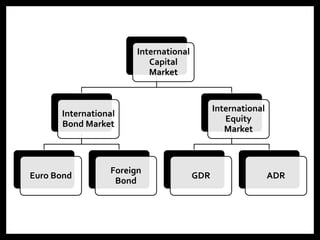
International
Capital
Market
International
Bond Market
Euro Bond
Foreign
Bond
International
Equity
Market
GDR ADR
AMERICAN DEPOSITORY RECEIPTS
•ADR’s is a dollar- denominated negotiable certificate.
•Represents non- US company’s publicly traded equity.
•Introduced in late 1920’s to enable Americans invest in overseas
securities and non US companies to have their stock traded in the
American Markets.
•Introduced as a result of the complexities involved in buying
shares in foreign countries.
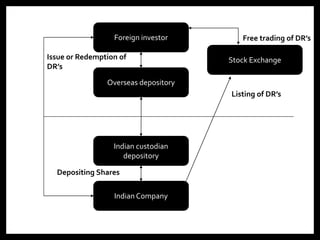
Foreign investor
Overseas depository
Indian custodian
depository
Indian Company
Stock Exchange
Depositing Shares
Issue or Redemption of
DR’s
Free trading of DR’s
Listing of DR’s
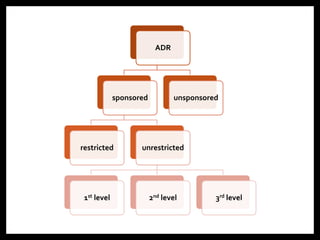
ADR
sponsored
restricted unrestricted
1st level 2nd level 3rd level
unsponsored
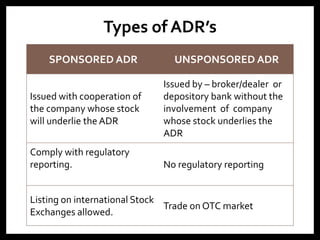
Types of ADR’s
SPONSORED ADR UNSPONSORED ADR
Issued with cooperation of
the company whose stock
will underlie the ADR
Issued by – broker/dealer or
depository bank without the
involvement of company
whose stock underlies the
ADR
Comply with regulatory
reporting. No regulatory reporting
Listing on international Stock
Exchanges allowed.
Trade on OTC market
Levels of ADR’s
•Level 1- Depository receipts are the lowest level of sponsored
ADRs that can be issued. When a company issues sponsored
ADRs, it has one designated depository who also acts as its
transfer agent.
• Level 1 shares can only be traded on the OTC market and the
company has minimal reporting requirements with the U.S.
[SEC].
• Level 2- Depository receipt programs are more complicated for
a foreign company. When a foreign company wants to set up a
Level 2 program, it must file a registration statement with the
U.S. SEC and is under SEC regulation.
The advantage that the company has by upgrading their
program to Level 2 is that the shares can be listed on a U.S. stock
exchange. These exchanges include the New York Stock
Exchange (NYSE), NASDAQ, and the American Stock Exchange
(AMEX).
Level 3- American depository Receipt program is the highest
level a foreign company can sponsor. Because of this distinction,
the company is required to adhere to stricter rules that are
similar to those followed by U.S. companies.
• Foreign companies with Level 3 programs will often issue
materials that are more informative and are more
accommodating to their U.S. shareholders because they rely on
them for capital

American depository receipts

  • 1.
  • 2.
    Depository receipts •Depository receiptsare negotiable financial instrument issued outside India by overseas Depository bank. •DR represents the interest in the shares of the issuer company •Shares are held by a domestic custodian on behalf of the issuer company •The overseas depository banks issues the depository receipts in foreign country which entitles the ownership of shares held in the form of depository receipts. •DR’s are traded on stock exchanges in the US, Singapore, Luxembourg, London, etc •DR’s listed and traded in the US markets are known as ADR’s •DR’s listed and traded elsewhere are known as GDR’s
  • 3.
  • 4.
    AMERICAN DEPOSITORY RECEIPTS •ADR’sis a dollar- denominated negotiable certificate. •Represents non- US company’s publicly traded equity. •Introduced in late 1920’s to enable Americans invest in overseas securities and non US companies to have their stock traded in the American Markets. •Introduced as a result of the complexities involved in buying shares in foreign countries.
  • 5.
    Foreign investor Overseas depository Indiancustodian depository Indian Company Stock Exchange Depositing Shares Issue or Redemption of DR’s Free trading of DR’s Listing of DR’s
  • 6.
    ADR sponsored restricted unrestricted 1st level2nd level 3rd level unsponsored
  • 7.
    Types of ADR’s SPONSOREDADR UNSPONSORED ADR Issued with cooperation of the company whose stock will underlie the ADR Issued by – broker/dealer or depository bank without the involvement of company whose stock underlies the ADR Comply with regulatory reporting. No regulatory reporting Listing on international Stock Exchanges allowed. Trade on OTC market
  • 8.
    Levels of ADR’s •Level1- Depository receipts are the lowest level of sponsored ADRs that can be issued. When a company issues sponsored ADRs, it has one designated depository who also acts as its transfer agent. • Level 1 shares can only be traded on the OTC market and the company has minimal reporting requirements with the U.S. [SEC]. • Level 2- Depository receipt programs are more complicated for a foreign company. When a foreign company wants to set up a Level 2 program, it must file a registration statement with the U.S. SEC and is under SEC regulation. The advantage that the company has by upgrading their program to Level 2 is that the shares can be listed on a U.S. stock exchange. These exchanges include the New York Stock Exchange (NYSE), NASDAQ, and the American Stock Exchange (AMEX).
  • 9.
    Level 3- Americandepository Receipt program is the highest level a foreign company can sponsor. Because of this distinction, the company is required to adhere to stricter rules that are similar to those followed by U.S. companies. • Foreign companies with Level 3 programs will often issue materials that are more informative and are more accommodating to their U.S. shareholders because they rely on them for capital