The Contracting Process ADLT 610 – Class 4 Fall 2009
Agenda Questions, discussion to this point Overview of Contracting Who is the Client? Exercise in Schein Locating your consultation site
Process Consulting
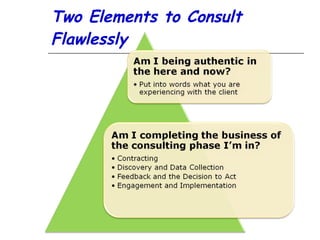
Two Elements to Consult Flawlessly
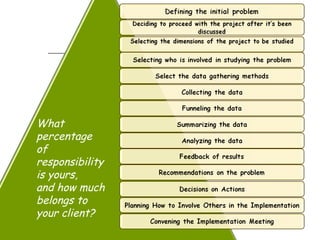
What  percentage of  responsibility  is yours,  and how much belongs to your client?
Possible Reactions of Client  to Being Helped  Resentment, defensiveness Relief Dependency, subordination Transference
Reactions of Consultant  to Client  Use of power and authority Accept, overreact to client’s dependence on you Meet defensiveness with more pressure, rational discussion Resist entering the relationship, esp. when it means giving up the “One Up” position. Counter transference
Engage in Active Inquiry to Keep the Client in the “Driver’s Seat” Use active inquiry Remember the psychological dynamics involved in helping Distinguish between three levels of inquiry: Pure inquiry  concentrates on the client’s telling of her story Exploratory diagnostic inquiry  brings in the client’s feelings, reactions, and reasons in response to the consultant’s questions about how, what, and why Confrontative inquiry  engages the client in considering the consultant’s ideas about how, what, and why
Schein’s Basic Principles 1-6 Always try to be helpful Always stay in touch with current reality Access your ignorance Everything you do is an intervention It is the client who owns the problem and the solution Go with the flow
Schein’s Basic Principles 7 -10 7 .  Timing is crucial. Be constructively opportunistic with  confrontative interventions. Everything is data; errors are inevitable – learn from them.  When in doubt, share the problem.
Questions to Ponder How do you reconcile "going with the flow" (Schein) with following the consulting stages linearly (Block)? … Is it necessary to follow Block's stages literally, or is there a chance that they can be mixed up or be iterative?   What do you think?
Thoughts about the  initial client meeting… Explore the nature of the client’s issue / problem that you are considering  Listen carefully and ask questions for clarification – but be careful not to cause defensiveness. Move the client from “what’s wrong” to “what would you like to see as a result?” Explore the readiness for change.
Thoughts about the  initial client meeting (cont.) Explore potential for working together. Convey information about what you do and how you work. Build trust and confidence. Learn about the organization from their perspective. (You should have already researched the company before 1st meeting.)   (Lippitts; Rothwell, et al.)
Some contract items… The boundaries of your analysis Objectives of the project The kind of information you will look for Your role in the project – how you want to work with the client
Some contract items (cont.) The product you will deliver Support and involvement you need from the client Time schedule Confidentiality  Feedback to you later
Questions Clients Ask What are the deliverables? What will the final product look like? What are the critical milestones? How will progress be monitored? How can you help me with the kick-off of this project? How will we communicate? How many employees will need to be involved?
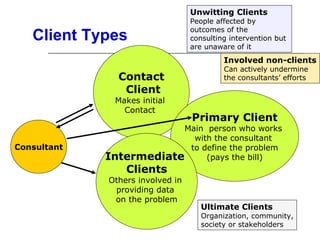
Client Types Consultant Contact Client Makes initial  Contact  Primary Client Main  person who works  with the consultant  to define the problem (pays the bill) Intermediate  Clients Others involved in  providing data  on the problem Ultimate Clients Organization, community, society or stakeholders Unwitting Clients   People affected by  outcomes of the  consulting intervention but  are unaware of it  Involved non-clients Can actively undermine  the consultants’ efforts
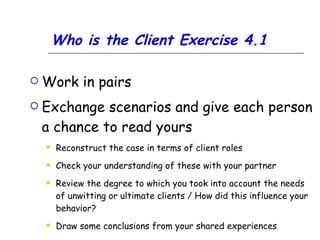
Who is the Client Exercise 4.1 Work in pairs Exchange scenarios and give each person a chance to read yours Reconstruct the case in terms of client roles Check your understanding of these with your partner Review the degree to which you took into account the needs of unwitting or ultimate clients / How did this influence your behavior? Draw some conclusions from your shared experiences
References Beich, E. (1999). The business of consulting: The basics and beyond. San Francisco: Jossey-Bass. Rothwell, W.J., Sullivan, R., & McLean, G.N. (1995). Practicing organization development: A guide for consultants. San Francisco: Jossey-Bass.

Adlt 610 The Contracting Process Class 4

  • 1.
    The Contracting ProcessADLT 610 – Class 4 Fall 2009
  • 2.
    Agenda Questions, discussionto this point Overview of Contracting Who is the Client? Exercise in Schein Locating your consultation site
  • 3.
  • 4.
    Two Elements toConsult Flawlessly
  • 5.
    What percentageof responsibility is yours, and how much belongs to your client?
  • 6.
    Possible Reactions ofClient to Being Helped Resentment, defensiveness Relief Dependency, subordination Transference
  • 7.
    Reactions of Consultant to Client Use of power and authority Accept, overreact to client’s dependence on you Meet defensiveness with more pressure, rational discussion Resist entering the relationship, esp. when it means giving up the “One Up” position. Counter transference
  • 8.
    Engage in ActiveInquiry to Keep the Client in the “Driver’s Seat” Use active inquiry Remember the psychological dynamics involved in helping Distinguish between three levels of inquiry: Pure inquiry concentrates on the client’s telling of her story Exploratory diagnostic inquiry brings in the client’s feelings, reactions, and reasons in response to the consultant’s questions about how, what, and why Confrontative inquiry engages the client in considering the consultant’s ideas about how, what, and why
  • 9.
    Schein’s Basic Principles1-6 Always try to be helpful Always stay in touch with current reality Access your ignorance Everything you do is an intervention It is the client who owns the problem and the solution Go with the flow
  • 10.
    Schein’s Basic Principles7 -10 7 . Timing is crucial. Be constructively opportunistic with confrontative interventions. Everything is data; errors are inevitable – learn from them. When in doubt, share the problem.
  • 11.
    Questions to PonderHow do you reconcile "going with the flow" (Schein) with following the consulting stages linearly (Block)? … Is it necessary to follow Block's stages literally, or is there a chance that they can be mixed up or be iterative? What do you think?
  • 12.
    Thoughts about the initial client meeting… Explore the nature of the client’s issue / problem that you are considering Listen carefully and ask questions for clarification – but be careful not to cause defensiveness. Move the client from “what’s wrong” to “what would you like to see as a result?” Explore the readiness for change.
  • 13.
    Thoughts about the initial client meeting (cont.) Explore potential for working together. Convey information about what you do and how you work. Build trust and confidence. Learn about the organization from their perspective. (You should have already researched the company before 1st meeting.) (Lippitts; Rothwell, et al.)
  • 14.
    Some contract items…The boundaries of your analysis Objectives of the project The kind of information you will look for Your role in the project – how you want to work with the client
  • 15.
    Some contract items(cont.) The product you will deliver Support and involvement you need from the client Time schedule Confidentiality Feedback to you later
  • 16.
    Questions Clients AskWhat are the deliverables? What will the final product look like? What are the critical milestones? How will progress be monitored? How can you help me with the kick-off of this project? How will we communicate? How many employees will need to be involved?
  • 17.
    Client Types ConsultantContact Client Makes initial Contact Primary Client Main person who works with the consultant to define the problem (pays the bill) Intermediate Clients Others involved in providing data on the problem Ultimate Clients Organization, community, society or stakeholders Unwitting Clients People affected by outcomes of the consulting intervention but are unaware of it Involved non-clients Can actively undermine the consultants’ efforts
  • 18.
    Who is theClient Exercise 4.1 Work in pairs Exchange scenarios and give each person a chance to read yours Reconstruct the case in terms of client roles Check your understanding of these with your partner Review the degree to which you took into account the needs of unwitting or ultimate clients / How did this influence your behavior? Draw some conclusions from your shared experiences
  • 19.
    References Beich, E.(1999). The business of consulting: The basics and beyond. San Francisco: Jossey-Bass. Rothwell, W.J., Sullivan, R., & McLean, G.N. (1995). Practicing organization development: A guide for consultants. San Francisco: Jossey-Bass.