BEING INNOVATIVE
Andrew Maxwell Ph.D.
Feb 11th, 2015
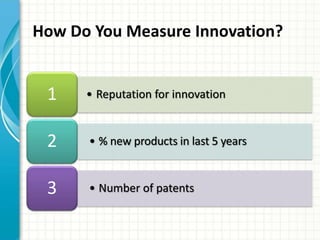
• Reputation for innovation1
• % new products in last 5 years2
• Number of patents3
How Do You Measure Innovation?
Output measures don’t guide
performance improvement
Improvements in performance require changes in the
way people behave and make decisions, including:
• Changing current procedures
• Developing new organizational structures
• Abandoning existing customers and suppliers, and
working with new ones
• Modifying incentives, compensation and
recruitment
• Changing the company culture (and attitude to risk)
What is the barrier to innovation?
Innovation killers
1. The accepted wisdom of annual budgets –
opportunities don’t arrive according to a plan
2. The need to clearly specify anticipated outcomes –
innovation is really about incomplete contracts
3. Quality improvement process applied to everything –
innovation is about doing different things
4. Lean systems with no slack –
innovation require experimentation (and failure)
5. Clearly defined roles and responsibilities –
innovation happens with cross functional teams
This is not what you learn in Business School
5
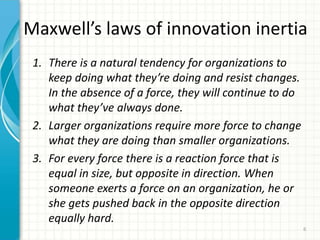
Maxwell’s laws of innovation inertia
1. There is a natural tendency for organizations to
keep doing what they’re doing and resist changes.
In the absence of a force, they will continue to do
what they’ve always done.
2. Larger organizations require more force to change
what they are doing than smaller organizations.
3. For every force there is a reaction force that is
equal in size, but opposite in direction. When
someone exerts a force on an organization, he or
she gets pushed back in the opposite direction
equally hard.
6
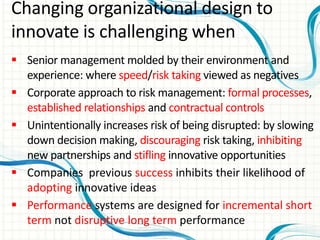
 Senior management molded by their environment and
experience: where speed/risk taking viewed as negatives
 Corporate approach to risk management: formal processes,
established relationships and contractual controls
 Unintentionally increases risk of being disrupted: by slowing
down decision making, discouraging risk taking, inhibiting
new partnerships and stifling innovative opportunities
 Companies previous success inhibits their likelihood of
adopting innovative ideas
 Performance systems are designed for incremental short
term not disruptive long term performance
Changing organizational design to
innovate is challenging when
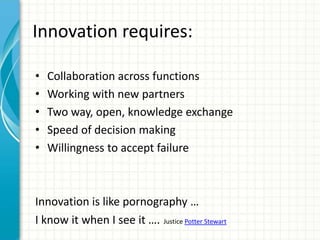
Innovation requires:
• Collaboration across functions
• Working with new partners
• Two way, open, knowledge exchange
• Speed of decision making
• Willingness to accept failure
Innovation is like pornography …
I know it when I see it …. Justice Potter Stewart
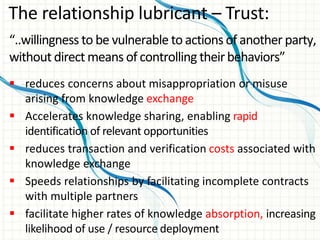
“..willingness to be vulnerable to actions of another party,
without direct means of controlling theirbehaviors”
 reduces concerns about misappropriation or misuse
arising from knowledge exchange
 Accelerates knowledge sharing, enabling rapid
identification of relevant opportunities
 reduces transaction and verification costs associated with
knowledge exchange
 Speeds relationships by facilitating incomplete contracts
with multiple partners
 facilitate higher rates of knowledge absorption, increasing
likelihood of use / resource deployment
The relationship lubricant – Trust:
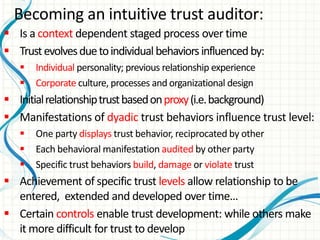
 Is a context dependent staged process over time
 Trustevolvesduetoindividualbehaviorsinfluencedby:
 Individual personality; previous relationship experience
 Corporate culture, processes and organizational design
 Initialrelationshiptrustbasedonproxy(i.e.background)
 Manifestations of dyadic trust behaviors influence trust level:
 One party displays trust behavior, reciprocated by other
 Each behavioral manifestation audited by other party
 Specific trust behaviors build, damage or violate trust
 Achievement of specific trust levels allow relationship to be
entered, extended and developed over time…
 Certain controls enable trust development: while others make
it more difficult for trust to develop
Becoming an intuitive trust auditor:
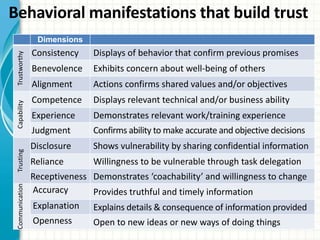
Behavioral manifestations that build trust
Dimensions
Trustworthy
Consistency Displays of behavior that confirm previous promises
Benevolence Exhibits concern about well-being of others
Alignment Actions confirms shared values and/or objectives
Dimensions
Trustworthy
Consistency Displays of behavior that confirm previous promises
Benevolence Exhibits concern about well-being of others
Alignment Actions confirms shared values and/or objectives
Capability
Competence Displays relevant technical and/or business ability
Experience Demonstrates relevant work/training experience
Judgment Confirms ability to make accurate and objective decisions
Dimensions
Trustworthy
Consistency Displays of behavior that confirm previous promises
Benevolence Exhibits concern about well-being of others
Alignment Actions confirms shared values and/or objectives
Capability
Competence Displays relevant technical and/or business ability
Experience Demonstrates relevant work/training experience
Judgment Confirms ability to make accurate and objective decisions
Trusting
Disclosure Shows vulnerability by sharing confidential information
Reliance Willingness to be vulnerable through task delegation
Receptiveness Demonstrates ‘coachability’ and willingness to change
Dimensions
Trustworthy
Consistency Displays of behavior that confirm previous promises
Benevolence Exhibits concern about well-being of others
Alignment Actions confirms shared values and/or objectives
Capability
Competence Displays relevant technical and/or business ability
Experience Demonstrates relevant work/training experience
Judgment Confirms ability to make accurate and objective decisions
Trusting
Disclosure Shows vulnerability by sharing confidential information
Reliance Willingness to be vulnerable through task delegation
Receptiveness Demonstrates ‘coachability’ and willingness to change
Communication
Accuracy Provides truthful and timely information
Explanation Explains details & consequence of information provided
Openness Open to new ideas or new ways of doing things
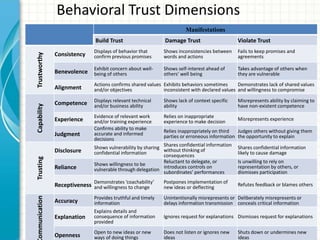
Manifestations
Build Trust Damage Trust Violate TrustTrustworthy
Consistency
Displays of behavior that
confirm previous promises
Shows inconsistencies between
words and actions
Fails to keep promises and
agreements
Benevolence
Exhibit concern about well-
being of others
Shows self-interest ahead of
others’ well being
Takes advantage of others when
they are vulnerable
Alignment
Actions confirms shared values
and/or objectives
Exhibits behaviors sometimes
inconsistent with declared values
Demonstrates lack of shared values
and willingness to compromise
Capability
Competence Displays relevant technical
and/or business ability
Shows lack of context specific
ability
Misrepresents ability by claiming to
have non-existent competence
Experience
Evidence of relevant work
and/or training experience
Relies on inappropriate
experience to make decision Misrepresents experience
Judgment
Confirms ability to make
accurate and informed
decisions
Relies inappropriately on third
parties or erroneous information
Judges others without giving them
the opportunity to explain
Trusting
Disclosure
Shows vulnerability by sharing
confidential information
Shares confidential information
without thinking of
consequences
Shares confidential information
likely to cause damage
Reliance
Shows willingness to be
vulnerable through delegation
Reluctant to delegate, or
introduces controls on
subordinates’ performances
Is unwilling to rely on
representation by others, or
dismisses participation
Receptiveness
Demonstrates ‘coachability’
and willingness to change
Postpones implementation of
new ideas or deflecting
Refutes feedback or blames others
ommunication
Accuracy
Provides truthful and timely
information
Unintentionally misrepresents or
delays information transmission
Deliberately misrepresents or
conceals critical information
Explanation
Explains details and
consequence of information
provided
Ignores request for explanations Dismisses request for explanations
Openness
Open to new ideas or new
ways of doing things
Does not listen or ignores new
ideas
Shuts down or undermines new
ideas
Behavioral Trust Dimensions
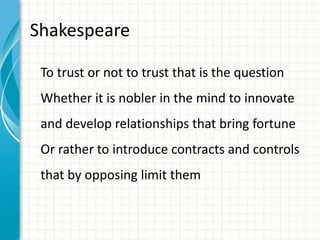
Shakespeare
To trust or not to trust that is the question
Whether it is nobler in the mind to innovate
and develop relationships that bring fortune
Or rather to introduce contracts and controls
that by opposing limit them
Becoming
Innovative
One Behavior
at a time
Why is innovation like porn
• Porn stimulates innovation: it brought us
streaming video, credit-card verification, Web
referral rings and Flash technology
• The internet is 95 percent porn and spam”
― Margaret Atwood
• Its fun and involves
Quotes
• M. A. Rosanoff: "Mr. Edison, please tell me what laboratory
rules you want me to observe."
Edison: "There ain't no rules around here. We're trying to
accomplish something!” — Thomas Edison
• "It's easy to come up with new ideas; the hard part is letting go
of what worked for you two years ago, but will soon be out of
date.” — Roger von Oech
• "Creativity is not the finding of a thing, but the making
something out of it after it is found.” — James Russell Lowell
• "There is no use trying,” said Alice. “One can’t believe
impossible things.” “I daresay you haven’t had much practice,”
said the Queen. “When I was your age, I always did it for half
an hour a day. Why, sometimes I’ve believed as many as six
impossible things before breakfast.” — Lewis Carroll

Iaoip - maxwell

  • 1.
    BEING INNOVATIVE Andrew MaxwellPh.D. Feb 11th, 2015
  • 2.
    • Reputation forinnovation1 • % new products in last 5 years2 • Number of patents3 How Do You Measure Innovation?
  • 3.
    Output measures don’tguide performance improvement Improvements in performance require changes in the way people behave and make decisions, including: • Changing current procedures • Developing new organizational structures • Abandoning existing customers and suppliers, and working with new ones • Modifying incentives, compensation and recruitment • Changing the company culture (and attitude to risk)
  • 4.
    What is thebarrier to innovation?
  • 5.
    Innovation killers 1. Theaccepted wisdom of annual budgets – opportunities don’t arrive according to a plan 2. The need to clearly specify anticipated outcomes – innovation is really about incomplete contracts 3. Quality improvement process applied to everything – innovation is about doing different things 4. Lean systems with no slack – innovation require experimentation (and failure) 5. Clearly defined roles and responsibilities – innovation happens with cross functional teams This is not what you learn in Business School 5
  • 6.
    Maxwell’s laws ofinnovation inertia 1. There is a natural tendency for organizations to keep doing what they’re doing and resist changes. In the absence of a force, they will continue to do what they’ve always done. 2. Larger organizations require more force to change what they are doing than smaller organizations. 3. For every force there is a reaction force that is equal in size, but opposite in direction. When someone exerts a force on an organization, he or she gets pushed back in the opposite direction equally hard. 6
  • 7.
     Senior managementmolded by their environment and experience: where speed/risk taking viewed as negatives  Corporate approach to risk management: formal processes, established relationships and contractual controls  Unintentionally increases risk of being disrupted: by slowing down decision making, discouraging risk taking, inhibiting new partnerships and stifling innovative opportunities  Companies previous success inhibits their likelihood of adopting innovative ideas  Performance systems are designed for incremental short term not disruptive long term performance Changing organizational design to innovate is challenging when
  • 8.
    Innovation requires: • Collaborationacross functions • Working with new partners • Two way, open, knowledge exchange • Speed of decision making • Willingness to accept failure Innovation is like pornography … I know it when I see it …. Justice Potter Stewart
  • 9.
    “..willingness to bevulnerable to actions of another party, without direct means of controlling theirbehaviors”  reduces concerns about misappropriation or misuse arising from knowledge exchange  Accelerates knowledge sharing, enabling rapid identification of relevant opportunities  reduces transaction and verification costs associated with knowledge exchange  Speeds relationships by facilitating incomplete contracts with multiple partners  facilitate higher rates of knowledge absorption, increasing likelihood of use / resource deployment The relationship lubricant – Trust:
  • 10.
     Is acontext dependent staged process over time  Trustevolvesduetoindividualbehaviorsinfluencedby:  Individual personality; previous relationship experience  Corporate culture, processes and organizational design  Initialrelationshiptrustbasedonproxy(i.e.background)  Manifestations of dyadic trust behaviors influence trust level:  One party displays trust behavior, reciprocated by other  Each behavioral manifestation audited by other party  Specific trust behaviors build, damage or violate trust  Achievement of specific trust levels allow relationship to be entered, extended and developed over time…  Certain controls enable trust development: while others make it more difficult for trust to develop Becoming an intuitive trust auditor:
  • 11.
    Behavioral manifestations thatbuild trust Dimensions Trustworthy Consistency Displays of behavior that confirm previous promises Benevolence Exhibits concern about well-being of others Alignment Actions confirms shared values and/or objectives Dimensions Trustworthy Consistency Displays of behavior that confirm previous promises Benevolence Exhibits concern about well-being of others Alignment Actions confirms shared values and/or objectives Capability Competence Displays relevant technical and/or business ability Experience Demonstrates relevant work/training experience Judgment Confirms ability to make accurate and objective decisions Dimensions Trustworthy Consistency Displays of behavior that confirm previous promises Benevolence Exhibits concern about well-being of others Alignment Actions confirms shared values and/or objectives Capability Competence Displays relevant technical and/or business ability Experience Demonstrates relevant work/training experience Judgment Confirms ability to make accurate and objective decisions Trusting Disclosure Shows vulnerability by sharing confidential information Reliance Willingness to be vulnerable through task delegation Receptiveness Demonstrates ‘coachability’ and willingness to change Dimensions Trustworthy Consistency Displays of behavior that confirm previous promises Benevolence Exhibits concern about well-being of others Alignment Actions confirms shared values and/or objectives Capability Competence Displays relevant technical and/or business ability Experience Demonstrates relevant work/training experience Judgment Confirms ability to make accurate and objective decisions Trusting Disclosure Shows vulnerability by sharing confidential information Reliance Willingness to be vulnerable through task delegation Receptiveness Demonstrates ‘coachability’ and willingness to change Communication Accuracy Provides truthful and timely information Explanation Explains details & consequence of information provided Openness Open to new ideas or new ways of doing things
  • 12.
    Manifestations Build Trust DamageTrust Violate TrustTrustworthy Consistency Displays of behavior that confirm previous promises Shows inconsistencies between words and actions Fails to keep promises and agreements Benevolence Exhibit concern about well- being of others Shows self-interest ahead of others’ well being Takes advantage of others when they are vulnerable Alignment Actions confirms shared values and/or objectives Exhibits behaviors sometimes inconsistent with declared values Demonstrates lack of shared values and willingness to compromise Capability Competence Displays relevant technical and/or business ability Shows lack of context specific ability Misrepresents ability by claiming to have non-existent competence Experience Evidence of relevant work and/or training experience Relies on inappropriate experience to make decision Misrepresents experience Judgment Confirms ability to make accurate and informed decisions Relies inappropriately on third parties or erroneous information Judges others without giving them the opportunity to explain Trusting Disclosure Shows vulnerability by sharing confidential information Shares confidential information without thinking of consequences Shares confidential information likely to cause damage Reliance Shows willingness to be vulnerable through delegation Reluctant to delegate, or introduces controls on subordinates’ performances Is unwilling to rely on representation by others, or dismisses participation Receptiveness Demonstrates ‘coachability’ and willingness to change Postpones implementation of new ideas or deflecting Refutes feedback or blames others ommunication Accuracy Provides truthful and timely information Unintentionally misrepresents or delays information transmission Deliberately misrepresents or conceals critical information Explanation Explains details and consequence of information provided Ignores request for explanations Dismisses request for explanations Openness Open to new ideas or new ways of doing things Does not listen or ignores new ideas Shuts down or undermines new ideas Behavioral Trust Dimensions
  • 13.
    Shakespeare To trust ornot to trust that is the question Whether it is nobler in the mind to innovate and develop relationships that bring fortune Or rather to introduce contracts and controls that by opposing limit them
  • 14.
  • 15.
    Why is innovationlike porn • Porn stimulates innovation: it brought us streaming video, credit-card verification, Web referral rings and Flash technology • The internet is 95 percent porn and spam” ― Margaret Atwood • Its fun and involves
  • 16.
    Quotes • M. A.Rosanoff: "Mr. Edison, please tell me what laboratory rules you want me to observe." Edison: "There ain't no rules around here. We're trying to accomplish something!” — Thomas Edison • "It's easy to come up with new ideas; the hard part is letting go of what worked for you two years ago, but will soon be out of date.” — Roger von Oech • "Creativity is not the finding of a thing, but the making something out of it after it is found.” — James Russell Lowell • "There is no use trying,” said Alice. “One can’t believe impossible things.” “I daresay you haven’t had much practice,” said the Queen. “When I was your age, I always did it for half an hour a day. Why, sometimes I’ve believed as many as six impossible things before breakfast.” — Lewis Carroll