Managing Up:
Engaging your supervisor
in productive ways
Presented by: Jennifer Gould, M.B.A.
              Joshua Hettrick, Ed.D.
NEACUHO Fall Drive-In, October 5, 2012
Managing Up


“Managing up is the process of consciously working with
your boss to obtain the best possible results for you, your
boss, and your organization. This is not a political
maneuver or kissing up. Rather it is a deliberate effort to
bring understanding and cooperation to a relationship
between individuals who often have different perspectives.”


              ~Thomas Zuber & Erica James
Isn’t this manipulation?


 No! It’s a way to create a win-win-win situation (the
  people, the organization and the project at hand!).
 Failure to manage the boss can result in
  misunderstandings and wasted time and effort.
 Don’t forget to manage down as well-only managing the
  boss and paying no attention to the staff team can result
  in looking a little bit like a suck-up! (And none of us
  want that!)
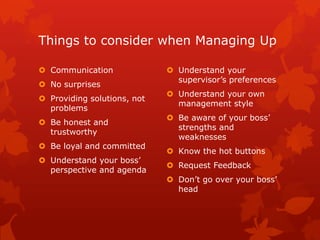
Things to consider when Managing Up

 Communication               Understand your
                               supervisor’s preferences
 No surprises
                              Understand your own
 Providing solutions, not
                               management style
  problems
                              Be aware of your boss’
 Be honest and
                               strengths and
  trustworthy
                               weaknesses
 Be loyal and committed
                              Know the hot buttons
 Understand your boss’
                              Request Feedback
  perspective and agenda
                              Don’t go over your boss’
                               head
Communicate
 You know this is a two-way street!
 Good communication skills are the basis for success in
  almost every situation.
 Brush up all of the skills-verbal and written (and know
  which way your supervisor likes to get things).
    Readers will prefer notes or emails before hearing you say
     things to give them time to digest
    Listeners often need to hear the information before
     consuming the written version
 If you want to be heard, make it easy by using your
  supervisor’s preferred method
 Ask questions to understand wants and decisions
No Surprises!


 No, not even the good ones. Those can backfire on you
  too!
 Keep your supervisor in the loop regularly about what is
  going on with specific projects and the staff team
    Stop by the office daily
    Send regular email updates if you can’t connect in person
 Use your scheduled one-on-ones and office hours
  effectively to discuss important issues
Provide Solutions, Not Problems


 Yes, problems will happen, they always do…
 When letting your supervisor know about something
  that’s gone wrong, be ready to propose at least 2-3
  solutions to go with it
 It’s okay to push an issue-some of us like to avoid
  problems, but they’ll need to be confronted in the end,
  so help with that.
Be Honest and Trustworthy


 Things that will hurt you: dishonesty, covering up
  problems or failures, sweeping issues under the rug
 The truth will come out eventually, and unlike a fine
  wine, it doesn’t get any better with age!
 Maintain your honesty and dependability by honoring
  your commitments, project schedules and constraints
Be Loyal and Committed


 Loyalty and commitment shows support
 This extends beyond your supervisor…think about your
  hall staff, maintenance staff, central staff, etc
 If you don’t demonstrate these things to a boss, don’t
  expect them in return (not a good place to be!)
Understand your Boss’s
Perspective and Agenda


 Put yourself in his shoes and align your priorities
 Many people think they understand the boss’s goals and
  pressures, but don’t always understand strengths,
  weaknesses, aspirations or work styles, or the
  constraints they are under
 Explore these things to help identify commonalities and
  gain insight on how to better interact effectively
Understand your Supervisor’s
Preferences

 …and try to conform to them!
 Does your supervisor want a daily update? To get the big
  picture and not the details?
 Use tact when suggesting different methods for
  completing tasks
 Don’t assume you know what your boss wants-ask
  questions if you’re unsure to clarify his/her needs and
  expectations
 Don’t set standards for yourself that you can’t
  consistently meet
Understand your own
management style


 …and take responsibility for it’s effect on others
 Recognize your own strengths, weaknesses, goals and
  personal needs; how you respond to being managed;
  how others respond to you
 Know the effect you have on others and how they react
  to you (especially your staff)
Be Aware of your Boss’s
Strengths and Weaknesses


 Use your boss’s strengths to your advantage! Go to your
  supervisor for his/her expertise.
 Compensate for the weaknesses.
    Nobody is good at everything-provide support in those
     areas
 Chances are you won’t be great and terrible at all of the
  same things, so find ways to work as a team to get
  things achieved
Know the Hot Buttons


 What are your supervisor’s triggers and pet peeves?
 Find out what these things are and avoid them!
 Ignoring items that are hot buttons for your supervisor
  will likely sour your relationship and can lead to
  unsuccessful projects or negative evaluations.
Request Feedback


 And learn to accept the feedback that you request
 Ask periodically if you aren’t sure how you’re doing-don’t
  wait until end of semester evaluations
 If you get negative feedback, discuss concerns, but do
  so maturely, not emotionally or confrontationally
 Listen to what is being said and act on it appropriately
Don’t Go Over the Boss’s Head

 Don’t go behind the boss’s back either
 Go to your supervisor first with any concerns-you’d want
  the same courtesy
 IF something is VERY serious and not being addressed,
  or if you supervisor IS the problem and can’t be
  confronted, go up the chain
 If you do need to go over the supervisor, keep the
  information as private as possible, discussing only with
  people that need to know and be willing to document
  what you are reporting
Case Study

Your department is currently in the process of collecting
spring intention forms from students in the residence halls.
This form is completed by all students in housing during the
fall semester to determine if they will be returning to
housing for the spring semester. The due date for these
forms to be turned in to the Assistant Director for Housing
is Monday, October 8th. It is now Thursday, October 11th.
The Director of Residential Life is waiting for results to pass
on to the VP of Student Affairs so he is prepared for his
cabinet meeting. The ADH realized late Wednesday that an
entire section was missing from one of the halls. The RA in
the section has already been given a written warning for
paperwork this semester by their RD. The Assistant Director
for Staff Development who supervises the RD and RA staff
has been made aware of the problem as well. Placing
yourself in this situation based on your current role, what is
the process you take to help bring a resolution to this
problem?
Managing up sounds simple, but
  managers, and everyone else
need to learn this basic concept.
    If we want someone to
understand what we have to say,
  we must learn to speak their
language, rather than expecting
      them to learn ours.
                                   ~Richard L. Knowdell
   Building a Career Development Program: Nine Steps for
                                Effective Implementation
Resources


 Turk, W., (2007). The art of managing up. Defense AT&L,
       March & April, 2007.

Managing Up: Engaging your supervisor in productive ways

  • 1.
    Managing Up: Engaging yoursupervisor in productive ways Presented by: Jennifer Gould, M.B.A. Joshua Hettrick, Ed.D. NEACUHO Fall Drive-In, October 5, 2012
  • 2.
    Managing Up “Managing upis the process of consciously working with your boss to obtain the best possible results for you, your boss, and your organization. This is not a political maneuver or kissing up. Rather it is a deliberate effort to bring understanding and cooperation to a relationship between individuals who often have different perspectives.” ~Thomas Zuber & Erica James
  • 3.
    Isn’t this manipulation? No! It’s a way to create a win-win-win situation (the people, the organization and the project at hand!).  Failure to manage the boss can result in misunderstandings and wasted time and effort.  Don’t forget to manage down as well-only managing the boss and paying no attention to the staff team can result in looking a little bit like a suck-up! (And none of us want that!)
  • 4.
    Things to considerwhen Managing Up  Communication  Understand your supervisor’s preferences  No surprises  Understand your own  Providing solutions, not management style problems  Be aware of your boss’  Be honest and strengths and trustworthy weaknesses  Be loyal and committed  Know the hot buttons  Understand your boss’  Request Feedback perspective and agenda  Don’t go over your boss’ head
  • 5.
    Communicate  You knowthis is a two-way street!  Good communication skills are the basis for success in almost every situation.  Brush up all of the skills-verbal and written (and know which way your supervisor likes to get things).  Readers will prefer notes or emails before hearing you say things to give them time to digest  Listeners often need to hear the information before consuming the written version  If you want to be heard, make it easy by using your supervisor’s preferred method  Ask questions to understand wants and decisions
  • 6.
    No Surprises!  No,not even the good ones. Those can backfire on you too!  Keep your supervisor in the loop regularly about what is going on with specific projects and the staff team  Stop by the office daily  Send regular email updates if you can’t connect in person  Use your scheduled one-on-ones and office hours effectively to discuss important issues
  • 7.
    Provide Solutions, NotProblems  Yes, problems will happen, they always do…  When letting your supervisor know about something that’s gone wrong, be ready to propose at least 2-3 solutions to go with it  It’s okay to push an issue-some of us like to avoid problems, but they’ll need to be confronted in the end, so help with that.
  • 8.
    Be Honest andTrustworthy  Things that will hurt you: dishonesty, covering up problems or failures, sweeping issues under the rug  The truth will come out eventually, and unlike a fine wine, it doesn’t get any better with age!  Maintain your honesty and dependability by honoring your commitments, project schedules and constraints
  • 9.
    Be Loyal andCommitted  Loyalty and commitment shows support  This extends beyond your supervisor…think about your hall staff, maintenance staff, central staff, etc  If you don’t demonstrate these things to a boss, don’t expect them in return (not a good place to be!)
  • 10.
    Understand your Boss’s Perspectiveand Agenda  Put yourself in his shoes and align your priorities  Many people think they understand the boss’s goals and pressures, but don’t always understand strengths, weaknesses, aspirations or work styles, or the constraints they are under  Explore these things to help identify commonalities and gain insight on how to better interact effectively
  • 11.
    Understand your Supervisor’s Preferences …and try to conform to them!  Does your supervisor want a daily update? To get the big picture and not the details?  Use tact when suggesting different methods for completing tasks  Don’t assume you know what your boss wants-ask questions if you’re unsure to clarify his/her needs and expectations  Don’t set standards for yourself that you can’t consistently meet
  • 12.
    Understand your own managementstyle  …and take responsibility for it’s effect on others  Recognize your own strengths, weaknesses, goals and personal needs; how you respond to being managed; how others respond to you  Know the effect you have on others and how they react to you (especially your staff)
  • 13.
    Be Aware ofyour Boss’s Strengths and Weaknesses  Use your boss’s strengths to your advantage! Go to your supervisor for his/her expertise.  Compensate for the weaknesses.  Nobody is good at everything-provide support in those areas  Chances are you won’t be great and terrible at all of the same things, so find ways to work as a team to get things achieved
  • 14.
    Know the HotButtons  What are your supervisor’s triggers and pet peeves?  Find out what these things are and avoid them!  Ignoring items that are hot buttons for your supervisor will likely sour your relationship and can lead to unsuccessful projects or negative evaluations.
  • 15.
    Request Feedback  Andlearn to accept the feedback that you request  Ask periodically if you aren’t sure how you’re doing-don’t wait until end of semester evaluations  If you get negative feedback, discuss concerns, but do so maturely, not emotionally or confrontationally  Listen to what is being said and act on it appropriately
  • 16.
    Don’t Go Overthe Boss’s Head  Don’t go behind the boss’s back either  Go to your supervisor first with any concerns-you’d want the same courtesy  IF something is VERY serious and not being addressed, or if you supervisor IS the problem and can’t be confronted, go up the chain  If you do need to go over the supervisor, keep the information as private as possible, discussing only with people that need to know and be willing to document what you are reporting
  • 17.
    Case Study Your departmentis currently in the process of collecting spring intention forms from students in the residence halls. This form is completed by all students in housing during the fall semester to determine if they will be returning to housing for the spring semester. The due date for these forms to be turned in to the Assistant Director for Housing is Monday, October 8th. It is now Thursday, October 11th. The Director of Residential Life is waiting for results to pass on to the VP of Student Affairs so he is prepared for his cabinet meeting. The ADH realized late Wednesday that an entire section was missing from one of the halls. The RA in the section has already been given a written warning for paperwork this semester by their RD. The Assistant Director for Staff Development who supervises the RD and RA staff has been made aware of the problem as well. Placing yourself in this situation based on your current role, what is the process you take to help bring a resolution to this problem?
  • 18.
    Managing up soundssimple, but managers, and everyone else need to learn this basic concept. If we want someone to understand what we have to say, we must learn to speak their language, rather than expecting them to learn ours. ~Richard L. Knowdell Building a Career Development Program: Nine Steps for Effective Implementation
  • 19.
    Resources  Turk, W.,(2007). The art of managing up. Defense AT&L, March & April, 2007.

Editor's Notes

  • #2 IntroductionsJosh - Why we are doing this presentation
  • #3 Jen - Engage the audience about what they believe “Managing Up” meansShow quote following the discussion
  • #4 Jen – Asks audience about perception of “Managing Up” being manipulationShow information regarding what this is INTENDED to be about
  • #5 Josh – quick overview
  • #6 Josh
  • #7 Jen
  • #8 Josh – personal anecdote regarding facilities concerns being handled by the RD
  • #9 Jen – has a few personal anecdotes from spouse and a fire alarm to missing duty
  • #10 Josh -
  • #11 Jen – personal anecdote about the nature of Jon’s position (micro vs. macro level of thinking)
  • #12 Josh – personal anecdote about when I first started working at WSU
  • #13 Jen -
  • #14 Josh – (Jen’s lack of computer knowledge)
  • #15 Jen -
  • #16 Josh -
  • #17 Jen -
  • #19 Jen