Partical Coating:
DEFINITION:
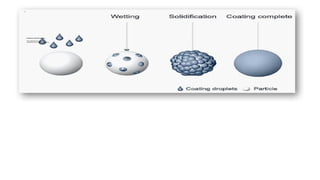
• When a thin layer of a substance is placed around a core particle it is
called coating of the particle.
• Coating alters:
• Surface Properties &/or Functionality
of fine particles or powders.

Coating layer is generally applied as:
Film resulting from the spraying &
Subsequent drying of solutions or dispersions
Purpose of Coating:
Improvement to powder Flowability.
Protection of Unstable/Reactive Substances (from Air, Humidity, Light
& Oxidation etc.)
Enhancement of Mechanical Properties (Abrasion Resistance &
Compressibility)
Improvement of Aesthetic Appeal (Texture, Appearance, Odor or
Taste Masking)
Controlled Release / Dissolution of APIs.
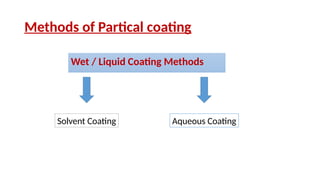
Methods of Partical coating
Wet / Liquid Coating Methods
Solvent Coating Aqueous Coating
1. Solvent Coating:
 Coating polymers & other excipients are dissolved into an
organic solvent to form a coating solution
 Coating solution is sprayed onto the surface of the solid dosage
forms to form a coating film by evaporating the organic solvent.
 Evaporation is done by drying process resulting in uniform film
formation.
• Disadvantages:
Toxicity and environmental concerns due to presence of
organic solvents
• TECHNOLOGIES:
o Microencapsulation
o Fluidized bed coating techniques
o Solvent evaporation
o Coacervation & phase separation techniques
o Spray drying
o Interfacial polymerization
o Pan coating
2. Aqueous Coating
• A preferred approach over solvent coating
 For water soluble polymers:
• The coating process & film formation mechanism
are SAME as organic solvent coating.
 For water-insoluble polymers:
• The coating process & film formation mechanism
are DIFFERENT.
• Advantages:
 No toxicity
 No environment related problems
• LIMITATIONS:
Water is more difficult to be evaporated compared to the organic
solvents.
Much longer processing time
Much higher energy consumption
Hot air handling
Not appropriate for the moisture sensitive drugs
Solvent-less Coating Methods
Purpose:
Solventless Coating Technologies can overcome following
disadvantages associated with use of solvent/water in coating
process:
Organic solvents used in liquid coating are Flammable & Toxic.
Solvent vapors causes hazards to coating operators,
Solvent residue in the formulation.
High cost of solvents
Strict Environmental & Occupational Safety Regulations.
Heat & water involved in coating process can degrade the drug
Validation of coating dispersion for controlling microbial presence
Solvent removal processes is time consuming
Extreme energy consumption in solvent removal process.
Solvent less Coating Methods
• No drying or liquid/solvent evaporation step
A. Photocurable Coating
B. Compression Coating
C. Hot-melt Coating
D. Magnetically assisted impaction Coating
E. Powder/Dry Coating
F. Supercritical Fluid Coating
A. Photocuring Coating
• PHOTOCURING:
• A process of rapid conversion of specially formulated
(usually liquid) solventless compositions into solid
films by irradiation with UV or Visible Light
• UV-more energetic, Visible light is preferred due to
safety & ease.
• The only chemical approach to form coating film.
• Advantages:
 This process can be performed at or below room
temperature with an extremely rapid rate.
 Coating can be done in open systems i. e. Pan Coating.
• Disadvantages:
 Not suitable for photosensitive drugs
 Use is limited by specific photocurable materials and
coating equipment.
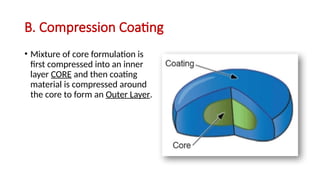
B. Compression Coating
• Mixture of core formulation is
first compressed into an inner
layer CORE and then coating
material is compressed around
the core to form an Outer Layer.
•
Advantages:
Two incompatible drugs within same Dosage Form (Physically separated)
Disadvantages:
Mechanically complex method; requires specially designed equipment.
Coating thickness is not uniform; issues of placement of core in the centre
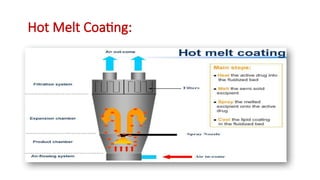
C. Hot Melt Coating:
• Coating materials are applied over the Substrate in their Molten state
& then solidified upon cooling.
• Coating Materials: Lipids, Waxes & Fatty bases.
• Weight gain with lipid materials are less than those commonly
applied with polymers to achieve same effect.
Hot Melt Coating:
• Advantages:
 Necessity of solvent application is fully eliminated.
 Cost effective
• Disadvantages:
 Only suitable for the drugs with stable properties at or
below congealing point of coating materials.
 Operational safety: high temperature close to 2000 ˚C.
D. Magnetically Assisted Impaction Coating:
•Soft coating method(s)
• That attach the Guest particles (Coating material) on the host particles
(material to be coat) with a minimum degradation of particle size, shape
and composition caused by the build up of heat.
• Advantages:
 Rise in temperature is negligible.
 Most suitable for temperature sensitive particles
• MAIC Device:
• It can coat soft organic host and guest particles without causing
major changes in material shape & size.
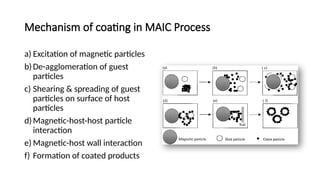
Mechanism of coating in MAIC Process
a) Excitation of magnetic particles
b)De-agglomeration of guest
particles
c) Shearing & spreading of guest
particles on surface of host
particles
d)Magnetic-host-host particle
interaction
e) Magnetic-host wall interaction
f) Formation of coated products
E. Powder/Dry Coating:
•Dry coating refers to the technique where the core materials are
strongly surrounded by fine particles simply by collision or by the use of
non-aqueous plasticizer
•Dry Coating Techniques
I. Plasticizer Dry Coating
II. Heat Dry Coating
III.Electrostatic Dry Coating
F. Supercritical Fluid Coating:
• Used to coat small particles uniformly by encapsulating each core with coating materials
uniformly under Supercritical Conditions.
• Advantages:
Mild processing conditions
Allows microencapsulation of sensitive ingredients e.g Albumin.
Prevent agglomeration of fine particles during coating.
• Disadvantages:
Application is limited due to the poor solubility of most of coating materials in
supercritical fluid.
Requirement of the core to be insoluble.
THANKS

Partical Coating.pptx Partical Coating.pptx

  • 1.
  • 2.
    DEFINITION: • When athin layer of a substance is placed around a core particle it is called coating of the particle. • Coating alters: • Surface Properties &/or Functionality of fine particles or powders.
  • 3.
     Coating layer isgenerally applied as: Film resulting from the spraying & Subsequent drying of solutions or dispersions
  • 4.
    Purpose of Coating: Improvementto powder Flowability. Protection of Unstable/Reactive Substances (from Air, Humidity, Light & Oxidation etc.) Enhancement of Mechanical Properties (Abrasion Resistance & Compressibility) Improvement of Aesthetic Appeal (Texture, Appearance, Odor or Taste Masking) Controlled Release / Dissolution of APIs.
  • 5.
    Methods of Particalcoating Wet / Liquid Coating Methods Solvent Coating Aqueous Coating
  • 6.
    1. Solvent Coating: Coating polymers & other excipients are dissolved into an organic solvent to form a coating solution  Coating solution is sprayed onto the surface of the solid dosage forms to form a coating film by evaporating the organic solvent.  Evaporation is done by drying process resulting in uniform film formation. • Disadvantages: Toxicity and environmental concerns due to presence of organic solvents
  • 7.
    • TECHNOLOGIES: o Microencapsulation oFluidized bed coating techniques o Solvent evaporation o Coacervation & phase separation techniques o Spray drying o Interfacial polymerization o Pan coating
  • 8.
    2. Aqueous Coating •A preferred approach over solvent coating  For water soluble polymers: • The coating process & film formation mechanism are SAME as organic solvent coating.  For water-insoluble polymers: • The coating process & film formation mechanism are DIFFERENT.
  • 9.
    • Advantages:  Notoxicity  No environment related problems • LIMITATIONS: Water is more difficult to be evaporated compared to the organic solvents. Much longer processing time Much higher energy consumption Hot air handling Not appropriate for the moisture sensitive drugs
  • 10.
    Solvent-less Coating Methods Purpose: SolventlessCoating Technologies can overcome following disadvantages associated with use of solvent/water in coating process: Organic solvents used in liquid coating are Flammable & Toxic. Solvent vapors causes hazards to coating operators, Solvent residue in the formulation. High cost of solvents Strict Environmental & Occupational Safety Regulations.
  • 11.
    Heat & waterinvolved in coating process can degrade the drug Validation of coating dispersion for controlling microbial presence Solvent removal processes is time consuming Extreme energy consumption in solvent removal process.
  • 12.
    Solvent less CoatingMethods • No drying or liquid/solvent evaporation step A. Photocurable Coating B. Compression Coating C. Hot-melt Coating D. Magnetically assisted impaction Coating E. Powder/Dry Coating F. Supercritical Fluid Coating
  • 13.
    A. Photocuring Coating •PHOTOCURING: • A process of rapid conversion of specially formulated (usually liquid) solventless compositions into solid films by irradiation with UV or Visible Light • UV-more energetic, Visible light is preferred due to safety & ease. • The only chemical approach to form coating film.
  • 14.
    • Advantages:  Thisprocess can be performed at or below room temperature with an extremely rapid rate.  Coating can be done in open systems i. e. Pan Coating. • Disadvantages:  Not suitable for photosensitive drugs  Use is limited by specific photocurable materials and coating equipment.
  • 15.
    B. Compression Coating •Mixture of core formulation is first compressed into an inner layer CORE and then coating material is compressed around the core to form an Outer Layer.
  • 16.
    • Advantages: Two incompatible drugswithin same Dosage Form (Physically separated) Disadvantages: Mechanically complex method; requires specially designed equipment. Coating thickness is not uniform; issues of placement of core in the centre
  • 17.
    C. Hot MeltCoating: • Coating materials are applied over the Substrate in their Molten state & then solidified upon cooling. • Coating Materials: Lipids, Waxes & Fatty bases. • Weight gain with lipid materials are less than those commonly applied with polymers to achieve same effect.
  • 18.
  • 19.
    • Advantages:  Necessityof solvent application is fully eliminated.  Cost effective • Disadvantages:  Only suitable for the drugs with stable properties at or below congealing point of coating materials.  Operational safety: high temperature close to 2000 ˚C.
  • 20.
    D. Magnetically AssistedImpaction Coating: •Soft coating method(s) • That attach the Guest particles (Coating material) on the host particles (material to be coat) with a minimum degradation of particle size, shape and composition caused by the build up of heat. • Advantages:  Rise in temperature is negligible.  Most suitable for temperature sensitive particles • MAIC Device: • It can coat soft organic host and guest particles without causing major changes in material shape & size.
  • 21.
    Mechanism of coatingin MAIC Process a) Excitation of magnetic particles b)De-agglomeration of guest particles c) Shearing & spreading of guest particles on surface of host particles d)Magnetic-host-host particle interaction e) Magnetic-host wall interaction f) Formation of coated products
  • 22.
    E. Powder/Dry Coating: •Drycoating refers to the technique where the core materials are strongly surrounded by fine particles simply by collision or by the use of non-aqueous plasticizer •Dry Coating Techniques I. Plasticizer Dry Coating II. Heat Dry Coating III.Electrostatic Dry Coating
  • 23.
    F. Supercritical FluidCoating: • Used to coat small particles uniformly by encapsulating each core with coating materials uniformly under Supercritical Conditions. • Advantages: Mild processing conditions Allows microencapsulation of sensitive ingredients e.g Albumin. Prevent agglomeration of fine particles during coating. • Disadvantages: Application is limited due to the poor solubility of most of coating materials in supercritical fluid. Requirement of the core to be insoluble.
  • 24.