COATING METHOD
In Association with SVCH-Technologii, Moscow (Russia)
www.kerone.com
Vision
• Turn into world leader in providing
specialized, top-notch quality and
ecological industrial heating, cooling and
drying solution across the globe.
• To attain global recognition as best of
quality and environment friendly
engineering solution company.
Mission
• To enhance the value of customer
operation through our customer need
centric engineering solution.
• We are committed to provide our
customers, unique and best in class
products in Industrial heating, drying and
cooling segment, with strategic tie-up for
the technical know-how with renowned
leader in the industry specific segment.
• We are company that believes in strong
ethics and timely commitment helps to
build long term relationship.
About KERONE
KERONE now renowned name in serving specialized need of customers
with best quality and economical process Heating /cooling and drying
products, manufactured in high quality environment by well trained and
qualified workforce(special purpose machineries) .
KERONE is pioneer in application and implementation engineering with
its vast experience and team of professionals. KERONE is devoted to
serve the industry to optimize their operations both economically and
environmentally with its specialized heating and drying solutions.
KERONE Engineering Solutions Pvt. Ltd. 3
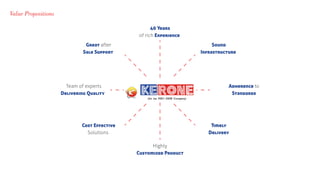
Highly
Customized Product
40 Years
of rich Experience
Timely
Delivery
Cost Effective
Solutions
Adherence to
Standards
Team of experts
Delivering Quality
Sound
Infrastructure
Great after
Sale Support
Value Propositions
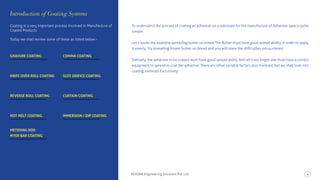
Coating is a very Important process involved in Manufacture of
Coated Products
Today we shall review some of these as listed below:-
KERONE Engineering Solutions Pvt. Ltd. 4
Introduction of Coating Systems
IMMERSION / DIP COATING
COMMA COATING
SLOT ORIFICE COATING
CURTAIN COATING
HOT MELT COATING
METERING ROD
MYER BAR COATING
GRAVURE COATING
KNIFE OVER ROLL COATING
REVERSE ROLL COATING
To undersatnd the process of coating an adhesive on a substrate for the manufacture of Adhesive tape is quite
simple.
Let’s quote the example spreading butter on bread. The Butter must have good spread ability in order to apply
it evenly. Try spreading frozen butter on bread and you will learn the difficulties encountered.
Similarly, the adhesive to be coated must have good spread ablity. And let’s not forget one must have a correct
equipment to spread or coat the adhesive. There are other variable factors also involved, but we shall look into
coating methods Exclusively.
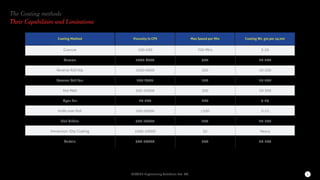
The Coating methods
Their Capabilities and Limitations
Coating Method
Gravure
Comma
Reverse Roll Nip
Reverse Roll Pan
Hot Melt
Myer Bar
Knife over Roll
Slot Orifice
Immersion /Dip Coating
Curtain
100-200
1000-6000
1000-6000
200-6000
500-20000
10-200
100-20000
500-20000
1000-10000
500-20000
700 Mtrs
300
300
100
300
200
1500
200
50
200
3-20
10-200
10-200
10-200
10-300
3-25
3-15
20-100
Heavy
20-100
Viscosity in CPS Max Speed per Min Coating Wt. gm per sq.mtr
KERONE Engineering Solutions Pvt. Ltd. 5
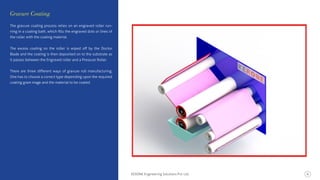
The gravure coating process relies on an engraved roller run-
ning in a coating bath, which fills the engraved dots or lines of
the roller with the coating material.
The excess coating on the roller is wiped off by the Doctor
Blade and the coating is then deposited on to the substrate as
it passes between the Engraved roller and a Pressure Roller.
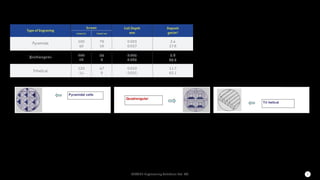
There are three different ways of gravure roll manufacturing.
One has to choose a correct type depending upon the required
coating gram mage and the material to be coated
Gravure Coating
KERONE Engineering Solutions Pvt. Ltd. 6
KERONE Engineering Solutions Pvt. Ltd. 7
Type of Engraving
Pyramidal
Quadrangular
Trihellcal
200
40
0.003
0.037
200
16
0.005
0.065
120
14
79
16
79
6
47
9
0.010
0.055
2.4
27.6
3.6
49.5
11.7
63.1
Screen
Lines/ in Lines/ cm
Cell Depth
mm
Deposit
gm/m²
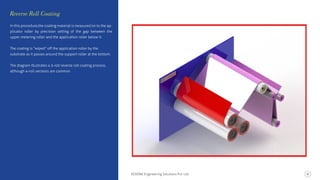
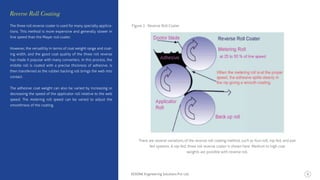
In this procedure,the coating material is measured on to the ap-
plicator roller by precision setting of the gap between the
upper metering roller and the application roller below it.
The coating is “wiped” off the application roller by the
substrate as it passes around the support roller at the bottom.
The diagram illustrates a 3-roll reverse roll coating process,
although 4-roll versions are common.
Reverse Roll Coating
KERONE Engineering Solutions Pvt. Ltd. 8
There are several variations of the reverse roll coating method, such as four-roll, nip fed, and pan
fed systems. A nip-fed, three roll reverse coater is shown here. Medium to high coat
weights are possible with reverse roll.
Figure 2 : Reverse Roll CoaterThe three roll reverse coater is used for many specially applica-
tions. This method is more expensive and generally slower in
line speed than the Mayer rod coater.
However, the versatility in terms of coat weight range and coat-
ing width, and the good coat quality of the three roll reverse
has made it popular with many converters. In this process, the
middle roll is coated with a precise thickness of adhesive, is
then transferred as the rubber backing roll brings the web into
contact.
The adhesive coat weight can also be varied by increasing or
decreasing the speed of the applicator roll relative to the web
speed. The metering roll speed can be varied to adjust the
smoothness of the coating.
Reverse Roll Coating
KERONE Engineering Solutions Pvt. Ltd. 9
The market for wire-wound rods has grown rapidly during the past few decades, because they provide predict-
able, accurate coatings time after time, at a minimal cost. Although the technology goes back almost a century,
today’s high quality materials, multi-wire designs and special wire surfaces have made this system more pop-
ular than ever before.
Rods give users the ability to fine-tune coating thickness quickly and easily, without altering the chemistry of
their coating material, and without time-consuming and expensive changeovers.
Wire-wound rods were first used in coating machines built by Charles Mayer in the 1900’s to manufacture
waxed paper and carbon paper. They are still called “Mayer Bars” by many coaters.
Wet coating thickness can be accurately predicted within one tenth of a mil(.0001”). Rod selection tables
allow coaters to consider coat weight and percent of solids in choosing the proper rod size for each produc-
tion run. Bottom-line profits hae encouraged many coaters to modify existing machines, in order to take ad-
vantage of the flexibility, the ease of use and the dollar saving associated with rod coating.
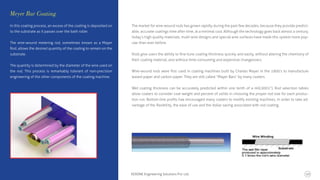
In this coating process, an excess of the coating is deposited on
to the substrate as it passes over the bath roller.
The wire-wound metering rod, sometimes known as a Mayer
Rod, allows the desired quantity of the coating to remain on the
substrate.
The quantity is determined by the diameter of the wire used on
the rod. This process is remarkably tolerant of non-precision
engineering of the other components of the coating machine.
Meyer Bar Coating
KERONE Engineering Solutions Pvt. Ltd. 10
Meyer Bar Coating
KERONE Engineering Solutions Pvt. Ltd. 11
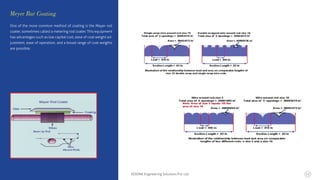
One of the more common method of coating is the Mayer rod
coater, sometimes called a metering rod coater. This equipment
has advantages such as low capital cost, ease of coat weight ad-
justment, ease of operation, and a broad range of coat weights
are possible.
Meyer Bar Coating
KERONE Engineering Solutions Pvt. Ltd. 12
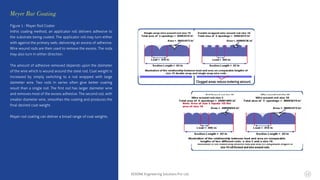
Figure 1 : Mayer Rod Coater
Inthis coating method, an applicator roll delivers adhesive to
the substrate being coated. The applicator roll may turn either
with against the primary web, delivering an excess of adhesive.
Wire wound rods are then used to remove the excess. The roda
may also turn in either direction.
The amount of adhesive removed depends upon the daimeter
of the wire which is wound around the steel rod. Coat weight is
increased by simply switching to a rod wrapped with large
daimeter wire. Two rods in series often give better coating
result than a single rod. The first rod has larger daimeter wire
and removes most of the excess adhesive. The second rod, with
smaller diameter wire, smoothes the coating and produces the
final desired coat weight.
Mayer rod coating can deliver a broad range of coat weights.
Meyer Bar Coating
KERONE Engineering Solutions Pvt. Ltd. 13
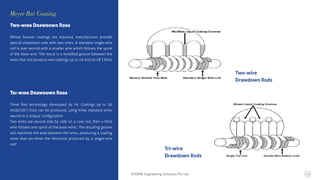
Two-wire Drawdown Rods
Where heavier coatings are required, manufactures provide
special drawdown rods with two wires. A standard single-wire
rod is over wound with a smaller wire which follows the spiral
of the base wire. The result is a modified groove between the
wires that will produce wet coatings up to 19 mils (0.19”) thick.
Tri-wire Drawdown Rods
Three Rod technology developed by for Coatings up to 56
mils(0.56”) thick can be produced, using three standard wires
wound in a unique configuration.
Two wires are wound side by side on a core rod, then a third
wire follows one spiral of the base wires. The resulting groove
will maximize the area between the wires, producing a coating
more than six times the thickness produced by a single-wire
rod!
Tri-wire
Drawdown Rods
Two-wire
Drawdown Rods
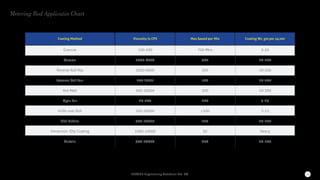
Metering Rod Applicatin Chart
Coating Method
Gravure
Comma
Reverse Roll Nip
Reverse Roll Pan
Hot Melt
Myer Bar
Knife over Roll
Slot Orifice
Immersion /Dip Coating
Curtain
100-200
1000-6000
1000-6000
200-6000
500-20000
10-200
100-20000
500-20000
1000-10000
500-20000
700 Mtrs
300
300
100
300
200
1500
200
50
200
3-20
10-200
10-200
10-200
10-300
3-25
3-15
20-100
Heavy
20-100
Viscosity in CPS Max Speed per Min Coating Wt. gm per sq.mtr
KERONE Engineering Solutions Pvt. Ltd. 14
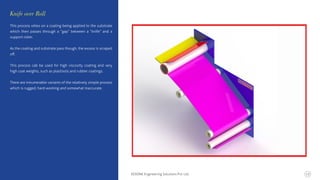
This process relies on a coating being applied to the substrate
which then passes through a “gap” between a “knife” and a
support roller.
As the coating and substrate pass though, the excess is scraped
off.
This process cab be used for high viscosity coating and very
high coat weights, such as plastisols and rubber coatings.
There are innumerable variants of the relatively simple process
which is rugged, hard-working and somewhat inaccurate.
Knife over Roll
KERONE Engineering Solutions Pvt. Ltd. 15
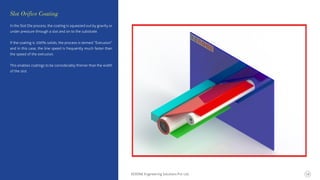
In the Slot Die process, the coating is squeezed out by gravity or
under pressure through a slot and on to the substrate.
If the coating is 100% solids, the process is termed “Extrusion”
and in this case, the line speed is frequently much faster than
the speed of the extrusion.
This enables coatings to be considerably thinner than the width
of the slot.
Slot Orifice Coating
KERONE Engineering Solutions Pvt. Ltd. 16
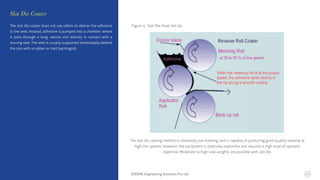
The slot die coater does not use rollers to deliver the adhesive
to the web. Instead, adhesive is pumped into a chamber, where
it exits through a long, narrow slot directly in contact with a
moving web. The web is usually supported immediately behind
the slot with a rubber or stell backingroll.
Slot Die Coater
KERONE Engineering Solutions Pvt. Ltd. 17
The slot die coating method is inherently low foaming, and is capable of producing good quality material at
high line speeds. However, the equipment is relatively expensive and requires a high level of operator
expertise. Moderate to high coat weights are possible with slot die.
Figure 4 : Slot Die Head Set-Up
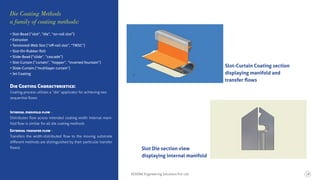
Slot Die section view
displaying internal manifold
Slot-Curtain Coating section
displaying manifold and
transfer flows
• Slot-Bead (“slot”, “die”, “on-roll slot”)
• Extrusion
• Tensioned-Web Slot (“off-roll slot”, “TWSC”)
• Slot-On-Rubber Roll
• Slide-Bead (“slide”, “cascade”)
• Slot-Curtain (“curtain”, “hopper”, “inverted fountain”)
• Slide-Curtain (“multilayer curtain”)
• Jet Coating
Die Coating Characteristics:
Coating process utilizes a “die” applicator for achieving two
sequential flows:
Internal manifold flow -
Distributes flow across intended coating width internal mani-
fold flow is similar for all die coating methods
External transfer flow -
Transfers the width-distributed flow to the moving substrate
different methods are distinguished by their particular transfer
flowst
Die Coating Methods
a family of coating methods:
KERONE Engineering Solutions Pvt. Ltd. 18
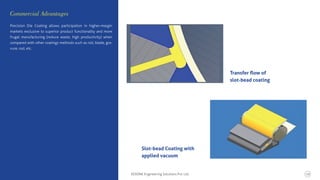
Slot-bead Coating with
applied vacuum
Transfer flow of
slot-bead coating
Precision Die Coating allows participation in higher-margin
markets exclusive to superior product functionality and more
frugal manufacturing (reduce waste, high productivity) when
compared with other coatings methods such as roll, blade, gra-
vure, rod, etc.
Commercial Advantages
KERONE Engineering Solutions Pvt. Ltd. 19
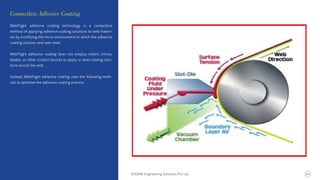
WebFlight adhesive coating technology is a contactless
method of applying adhesive coating solutions to web materi-
als by modifying the micro-environment in which the adhesive
coating solution and web meet.
WebFlight adhesive coating does not employ rollers, knives,
blades, or other contact devices to apply or level coating solu-
tions across the web.
Instead, WebFlight adhesive coating uses the following meth-
ods to optimize the adhesive coating process:
Contactless Adhesive Coating
KERONE Engineering Solutions Pvt. Ltd. 20
Trusted Partner
Our Clients
B/10,Marudhar Industrial Estate, Goddev Fatak
road, Bhayander(E), Mumbai-401105
Phone : +91-22-28150612/13/14
UNIT I
Plot No. B-47, Addl. MIDC Anandnagar,
Ambernath (East), Dist. Thane- 421506
Phone : +91-251-2620542/43/44/45/46
UNIT II
EMAIL
info@kerone.com | sales@kerone.com | unit2@kerone.com
WEBSITE
www.kerone.com | www.kerone.net | www.keroneindia.com
www.kerone.com

Coating Machine

  • 1.
    COATING METHOD In Associationwith SVCH-Technologii, Moscow (Russia) www.kerone.com
  • 2.
    Vision • Turn intoworld leader in providing specialized, top-notch quality and ecological industrial heating, cooling and drying solution across the globe. • To attain global recognition as best of quality and environment friendly engineering solution company. Mission • To enhance the value of customer operation through our customer need centric engineering solution. • We are committed to provide our customers, unique and best in class products in Industrial heating, drying and cooling segment, with strategic tie-up for the technical know-how with renowned leader in the industry specific segment. • We are company that believes in strong ethics and timely commitment helps to build long term relationship. About KERONE KERONE now renowned name in serving specialized need of customers with best quality and economical process Heating /cooling and drying products, manufactured in high quality environment by well trained and qualified workforce(special purpose machineries) . KERONE is pioneer in application and implementation engineering with its vast experience and team of professionals. KERONE is devoted to serve the industry to optimize their operations both economically and environmentally with its specialized heating and drying solutions.
  • 3.
    KERONE Engineering SolutionsPvt. Ltd. 3 Highly Customized Product 40 Years of rich Experience Timely Delivery Cost Effective Solutions Adherence to Standards Team of experts Delivering Quality Sound Infrastructure Great after Sale Support Value Propositions
  • 4.
    Coating is avery Important process involved in Manufacture of Coated Products Today we shall review some of these as listed below:- KERONE Engineering Solutions Pvt. Ltd. 4 Introduction of Coating Systems IMMERSION / DIP COATING COMMA COATING SLOT ORIFICE COATING CURTAIN COATING HOT MELT COATING METERING ROD MYER BAR COATING GRAVURE COATING KNIFE OVER ROLL COATING REVERSE ROLL COATING To undersatnd the process of coating an adhesive on a substrate for the manufacture of Adhesive tape is quite simple. Let’s quote the example spreading butter on bread. The Butter must have good spread ability in order to apply it evenly. Try spreading frozen butter on bread and you will learn the difficulties encountered. Similarly, the adhesive to be coated must have good spread ablity. And let’s not forget one must have a correct equipment to spread or coat the adhesive. There are other variable factors also involved, but we shall look into coating methods Exclusively.
  • 5.
    The Coating methods TheirCapabilities and Limitations Coating Method Gravure Comma Reverse Roll Nip Reverse Roll Pan Hot Melt Myer Bar Knife over Roll Slot Orifice Immersion /Dip Coating Curtain 100-200 1000-6000 1000-6000 200-6000 500-20000 10-200 100-20000 500-20000 1000-10000 500-20000 700 Mtrs 300 300 100 300 200 1500 200 50 200 3-20 10-200 10-200 10-200 10-300 3-25 3-15 20-100 Heavy 20-100 Viscosity in CPS Max Speed per Min Coating Wt. gm per sq.mtr KERONE Engineering Solutions Pvt. Ltd. 5
  • 6.
    The gravure coatingprocess relies on an engraved roller run- ning in a coating bath, which fills the engraved dots or lines of the roller with the coating material. The excess coating on the roller is wiped off by the Doctor Blade and the coating is then deposited on to the substrate as it passes between the Engraved roller and a Pressure Roller. There are three different ways of gravure roll manufacturing. One has to choose a correct type depending upon the required coating gram mage and the material to be coated Gravure Coating KERONE Engineering Solutions Pvt. Ltd. 6
  • 7.
    KERONE Engineering SolutionsPvt. Ltd. 7 Type of Engraving Pyramidal Quadrangular Trihellcal 200 40 0.003 0.037 200 16 0.005 0.065 120 14 79 16 79 6 47 9 0.010 0.055 2.4 27.6 3.6 49.5 11.7 63.1 Screen Lines/ in Lines/ cm Cell Depth mm Deposit gm/m²
  • 8.
    In this procedure,thecoating material is measured on to the ap- plicator roller by precision setting of the gap between the upper metering roller and the application roller below it. The coating is “wiped” off the application roller by the substrate as it passes around the support roller at the bottom. The diagram illustrates a 3-roll reverse roll coating process, although 4-roll versions are common. Reverse Roll Coating KERONE Engineering Solutions Pvt. Ltd. 8
  • 9.
    There are severalvariations of the reverse roll coating method, such as four-roll, nip fed, and pan fed systems. A nip-fed, three roll reverse coater is shown here. Medium to high coat weights are possible with reverse roll. Figure 2 : Reverse Roll CoaterThe three roll reverse coater is used for many specially applica- tions. This method is more expensive and generally slower in line speed than the Mayer rod coater. However, the versatility in terms of coat weight range and coat- ing width, and the good coat quality of the three roll reverse has made it popular with many converters. In this process, the middle roll is coated with a precise thickness of adhesive, is then transferred as the rubber backing roll brings the web into contact. The adhesive coat weight can also be varied by increasing or decreasing the speed of the applicator roll relative to the web speed. The metering roll speed can be varied to adjust the smoothness of the coating. Reverse Roll Coating KERONE Engineering Solutions Pvt. Ltd. 9
  • 10.
    The market forwire-wound rods has grown rapidly during the past few decades, because they provide predict- able, accurate coatings time after time, at a minimal cost. Although the technology goes back almost a century, today’s high quality materials, multi-wire designs and special wire surfaces have made this system more pop- ular than ever before. Rods give users the ability to fine-tune coating thickness quickly and easily, without altering the chemistry of their coating material, and without time-consuming and expensive changeovers. Wire-wound rods were first used in coating machines built by Charles Mayer in the 1900’s to manufacture waxed paper and carbon paper. They are still called “Mayer Bars” by many coaters. Wet coating thickness can be accurately predicted within one tenth of a mil(.0001”). Rod selection tables allow coaters to consider coat weight and percent of solids in choosing the proper rod size for each produc- tion run. Bottom-line profits hae encouraged many coaters to modify existing machines, in order to take ad- vantage of the flexibility, the ease of use and the dollar saving associated with rod coating. In this coating process, an excess of the coating is deposited on to the substrate as it passes over the bath roller. The wire-wound metering rod, sometimes known as a Mayer Rod, allows the desired quantity of the coating to remain on the substrate. The quantity is determined by the diameter of the wire used on the rod. This process is remarkably tolerant of non-precision engineering of the other components of the coating machine. Meyer Bar Coating KERONE Engineering Solutions Pvt. Ltd. 10
  • 11.
    Meyer Bar Coating KERONEEngineering Solutions Pvt. Ltd. 11 One of the more common method of coating is the Mayer rod coater, sometimes called a metering rod coater. This equipment has advantages such as low capital cost, ease of coat weight ad- justment, ease of operation, and a broad range of coat weights are possible.
  • 12.
    Meyer Bar Coating KERONEEngineering Solutions Pvt. Ltd. 12 Figure 1 : Mayer Rod Coater Inthis coating method, an applicator roll delivers adhesive to the substrate being coated. The applicator roll may turn either with against the primary web, delivering an excess of adhesive. Wire wound rods are then used to remove the excess. The roda may also turn in either direction. The amount of adhesive removed depends upon the daimeter of the wire which is wound around the steel rod. Coat weight is increased by simply switching to a rod wrapped with large daimeter wire. Two rods in series often give better coating result than a single rod. The first rod has larger daimeter wire and removes most of the excess adhesive. The second rod, with smaller diameter wire, smoothes the coating and produces the final desired coat weight. Mayer rod coating can deliver a broad range of coat weights.
  • 13.
    Meyer Bar Coating KERONEEngineering Solutions Pvt. Ltd. 13 Two-wire Drawdown Rods Where heavier coatings are required, manufactures provide special drawdown rods with two wires. A standard single-wire rod is over wound with a smaller wire which follows the spiral of the base wire. The result is a modified groove between the wires that will produce wet coatings up to 19 mils (0.19”) thick. Tri-wire Drawdown Rods Three Rod technology developed by for Coatings up to 56 mils(0.56”) thick can be produced, using three standard wires wound in a unique configuration. Two wires are wound side by side on a core rod, then a third wire follows one spiral of the base wires. The resulting groove will maximize the area between the wires, producing a coating more than six times the thickness produced by a single-wire rod! Tri-wire Drawdown Rods Two-wire Drawdown Rods
  • 14.
    Metering Rod ApplicatinChart Coating Method Gravure Comma Reverse Roll Nip Reverse Roll Pan Hot Melt Myer Bar Knife over Roll Slot Orifice Immersion /Dip Coating Curtain 100-200 1000-6000 1000-6000 200-6000 500-20000 10-200 100-20000 500-20000 1000-10000 500-20000 700 Mtrs 300 300 100 300 200 1500 200 50 200 3-20 10-200 10-200 10-200 10-300 3-25 3-15 20-100 Heavy 20-100 Viscosity in CPS Max Speed per Min Coating Wt. gm per sq.mtr KERONE Engineering Solutions Pvt. Ltd. 14
  • 15.
    This process relieson a coating being applied to the substrate which then passes through a “gap” between a “knife” and a support roller. As the coating and substrate pass though, the excess is scraped off. This process cab be used for high viscosity coating and very high coat weights, such as plastisols and rubber coatings. There are innumerable variants of the relatively simple process which is rugged, hard-working and somewhat inaccurate. Knife over Roll KERONE Engineering Solutions Pvt. Ltd. 15
  • 16.
    In the SlotDie process, the coating is squeezed out by gravity or under pressure through a slot and on to the substrate. If the coating is 100% solids, the process is termed “Extrusion” and in this case, the line speed is frequently much faster than the speed of the extrusion. This enables coatings to be considerably thinner than the width of the slot. Slot Orifice Coating KERONE Engineering Solutions Pvt. Ltd. 16
  • 17.
    The slot diecoater does not use rollers to deliver the adhesive to the web. Instead, adhesive is pumped into a chamber, where it exits through a long, narrow slot directly in contact with a moving web. The web is usually supported immediately behind the slot with a rubber or stell backingroll. Slot Die Coater KERONE Engineering Solutions Pvt. Ltd. 17 The slot die coating method is inherently low foaming, and is capable of producing good quality material at high line speeds. However, the equipment is relatively expensive and requires a high level of operator expertise. Moderate to high coat weights are possible with slot die. Figure 4 : Slot Die Head Set-Up
  • 18.
    Slot Die sectionview displaying internal manifold Slot-Curtain Coating section displaying manifold and transfer flows • Slot-Bead (“slot”, “die”, “on-roll slot”) • Extrusion • Tensioned-Web Slot (“off-roll slot”, “TWSC”) • Slot-On-Rubber Roll • Slide-Bead (“slide”, “cascade”) • Slot-Curtain (“curtain”, “hopper”, “inverted fountain”) • Slide-Curtain (“multilayer curtain”) • Jet Coating Die Coating Characteristics: Coating process utilizes a “die” applicator for achieving two sequential flows: Internal manifold flow - Distributes flow across intended coating width internal mani- fold flow is similar for all die coating methods External transfer flow - Transfers the width-distributed flow to the moving substrate different methods are distinguished by their particular transfer flowst Die Coating Methods a family of coating methods: KERONE Engineering Solutions Pvt. Ltd. 18
  • 19.
    Slot-bead Coating with appliedvacuum Transfer flow of slot-bead coating Precision Die Coating allows participation in higher-margin markets exclusive to superior product functionality and more frugal manufacturing (reduce waste, high productivity) when compared with other coatings methods such as roll, blade, gra- vure, rod, etc. Commercial Advantages KERONE Engineering Solutions Pvt. Ltd. 19
  • 20.
    WebFlight adhesive coatingtechnology is a contactless method of applying adhesive coating solutions to web materi- als by modifying the micro-environment in which the adhesive coating solution and web meet. WebFlight adhesive coating does not employ rollers, knives, blades, or other contact devices to apply or level coating solu- tions across the web. Instead, WebFlight adhesive coating uses the following meth- ods to optimize the adhesive coating process: Contactless Adhesive Coating KERONE Engineering Solutions Pvt. Ltd. 20
  • 21.
  • 22.
  • 23.
    B/10,Marudhar Industrial Estate,Goddev Fatak road, Bhayander(E), Mumbai-401105 Phone : +91-22-28150612/13/14 UNIT I Plot No. B-47, Addl. MIDC Anandnagar, Ambernath (East), Dist. Thane- 421506 Phone : +91-251-2620542/43/44/45/46 UNIT II EMAIL info@kerone.com | sales@kerone.com | unit2@kerone.com WEBSITE www.kerone.com | www.kerone.net | www.keroneindia.com www.kerone.com