See discussions, stats, and author profiles for this publication at: https://www.researchgate.net/publication/318227292
Chemical composition of the raw fruit coat, seed and pulp of passion fruit
(Passiflora edulis)
Article · April 2017
CITATIONS
4
READS
2,032
2 authors:
Some of the authors of this publication are also working on these related projects:
Environmental Microbiology View project
CHEMICAL COMPOSTION (PROXIMATE, MINERALS, VITAMINS), MINERAL RATIOS AND MINERAL SATETY INDEX OF THE INNARDS OF MALE AND FEMALE
NEOPETROLISTHES MACULATUS View project
Emmanuel Adeyeye
Ekiti State University, Ado Ekiti
248 PUBLICATIONS   2,899 CITATIONS   
SEE PROFILE
Matthew Olaleke Aremu
Federal University Wukari, Taraba State -Nigeria
138 PUBLICATIONS   1,798 CITATIONS   
SEE PROFILE
All content following this page was uploaded by Matthew Olaleke Aremu on 07 July 2017.
The user has requested enhancement of the downloaded file.
FUW Trends in Science & Technology Journal, www.ftstjournal.com
e-ISSN: 24085162; p-ISSN: 20485170; April, 2017: Vol. 2 No. 1B pp 334 – 341
334
CHEMICAL COMPOSITION OF THE RAW FRUIT COAT, SEED AND
PULP OF PASSION FRUIT (Passiflora edulis)
Emmanuel Ilesanmi Adeyeye1
* and Matthew Olaleke Aremu2
1
Department of Chemistry (Analytical Unit), Ekiti State University, PMB 5363, Ado – Ekiti, Nigeria
2
Department of Chemical Sciences, Federal University Wukari, PMB 1020, Taraba State, Nigeria
*Corresponding author: eiadeyeye@yahoo.com; adeyeyeilesanmi2012@gmail.com
Received: January 17, 2017 Accepted: March 26, 2017
Abstract: This study determined the chemical composition of the various parts of the Passiflora edulis fruit. The various
parts were separated and analyzed for –chemical composition and antinutrient contents. Calculated were mineral
safety index (MSI) and mineral ratios of some minerals; regression analyses in mineral and proximate values
between seed/juice and between inner coat/outer coat; the contribution of energy due to fat, carbohydrate and
protein to the total energy. The results showed that the most concentrated values were seen as follows: ash (seed),
moisture (juice), protein (seed), fat (outer coat), fibre (seed), carbohydrate (seed) juice (vitamin C) and outer coat
(vitamin A). Highest total energy was contributed by the seed and the least by the juice. The followings were
observed as the most concentrated values: Na (outer coat), K (seed), Ca (seed), Mg (seed), Zn (outer coat), Fe
(outer coat), Cu (seed), Mn (outer coat), Co (juice) and P (seed). No mineral met the ideal ratio as they were either
too low or too high from the ideal. No mineral had deleterious value in the MSI. All the sugar were of low levels
except maltose was greater than 1.0 in the inner coat. The rc were greater than rr in proximate composition (only in
inner coat/outer coat), (both in seed/juice and inner coat/outer coat) but rr were less than rr (seed/juice only) and in
sugar content (inner coat/outer coat).
Keywords: Analysis, composition, morphology, nutrition, Passiflora edulis
Introduction
Of the estimated 500 cultivars of Passiflora, in the family
Passifloraceae only one, P. edulis Sims, has the exclusive
designation of passion fruit, without qualification. [The
passion fruit is so called because it is one of the species of
passion flower, leading to the English translation of the Latin
genus name, Passiflora (Morton, 1987).] Within this specie,
there are two distinct forms, the standard purple, and the
yellow (Golden Passion Fruit), distinguished as P. edulis, f.
flavicarpa Deg., and differing not only in colour but in certain
other features. General names for both in Spanish are
granadilla, parcha, parchita maracuyá, or ceibey (Cuba); in
Portuguese, maracujáperoba; in French, grenadille, or
couzou. The purple form may be called purple, red, or black
granadilla, or, in Hawaii, lilikói; in Jamaica, mountain sweet
cup; in Thailand, linmangkon. The yellow form is widely
known as yellow passion fruit, is called yellow lilikoi in
Hawaii; golden passion fruit in Australia; parcha amarilla in
Venezuela. Purple passion fruit (Passiflora edulis) is
subtropical, important in some countries, while the more
tropical yellow passion fruit excels in others. Both yield
delicious juice (Morton, 1987). Some think the yellow is a
chance mutant that occurred in Australia. However, P. edulis
in its natural range is having purple or yellow fruits. Brazil
has long had a well-established passion fruit industry with
large-scale juice extraction plants. The purple passion fruit is
there preferred for consuming fresh; the yellow for juice
processing and the making of preserves. The passion fruit
name was given by Spanish missionaries to South America as
an expository aid while trying to convert the indigenous
inhabitants to Christianity (Morton, 1987).
The fruit is reported to be delicious, rich source of
antioxidants, minerals, vitamins and fibre (Morton, 1987).
The objective of this study was to determine the chemical
composition of the anatomical parts of passion fruit (seed,
juice, inner coat and outer coat). The antinutrients and sugar
contents the various parts of passion fruits were also
determined. The information would improve the existing
information on the food composition table of Passiflora edulis
F. flavicarpa Deg.
Materials and Methods
Collection of samples
Samples were collected from Ado – Ekiti in Ekiti State,
Nigeria. The fruits were washed with distilled water to
remove any adhering contaminant and then drained through
folded filter paper. The samples were identified in the
laboratory and preserved in the refrigerator prior to analysis
within two days.
Sample treatment
In the laboratory, the passion fruits (three in number) were
dissected and the pulp (juice), seeds, the outer and inner coats
(epicarp and endocarp) were separated. The coats were
separated ground in mortar with pestle. The seeds were treated
in similar way.
Sample digestion
Samples that ranged from 0.2278 to 0.9720 g were weighed
accurately prior to digestion. Two millilitres of concentrated
nitric acid was added to each sample in a beaker, covered with
watch glass and allowed to stand overnight in a fume
cupboard. The beakers were heated gently on a hot plate until
frothing stopped and no visible solid material was observed.
Heating was continued at 75o
C to near dryness. The digests
were removed and covered with glasses. Two millilitres of 50
gl-1
lanthanum chloride solution was added and the beakers
were heated for the second time until dryness. Each of the
final solutions was washed into a 25 ml standard flask with
0.1M HNO3 (10 ml) and made up to the mark with distilled
de-ionised water (Varian Techtron, 1975; Harper et al., 1989).
All the digested samples were sub-sampled into pre-cleaned
borosilicate glass containers for mineral analysis using atomic
absorption spectrophotometer.
Sample analysis
Moisture, total ash, fibre and ether extract of the samples were
determined by the methods of the AOAC (2006) Nitrogen was
determined by micro-Kjeldahl method (Pearson, 1976) and
the crude protein content was calculated as N x 6.25.
Standards of Na, K, Ca, Mg, Zn, Fe, Cu, Mn, Pb and Co
solutions of 0.2, 0.4, 0.6, 0.8 and 1.0 mgl-1
were prepared
from each of the metal solutions of 1000 mgl-1
stock
solutions. The filtrates of the digested samples were analysed
by Atomic Absorption Spectrophotometer (AAS). The
detection limit of the metals in the sample was 0.0001 mgl-1
by means of the UNICAM 929, London, atomic absorption
spectrophotometer powered by the solar software. The
Supported by
Chemical Composition of the Raw Fruit Coat, Seed and Pulp
FUW Trends in Science & Technology Journal, www.ftstjournal.com
e-ISSN: 24085162; p-ISSN: 20485170; April, 2017: Vol. 2 No. 1B pp 334 – 341
335
optimal analytical range was 0.1 to 0.5 absorbance units with
coefficient of variation from 0.9% to 2.21%. Phosphorus was
determined colorimetrically (Pearson, 1976) using a
Spectronic 20 (Gallenkamp, London, UK) instrument, with
KH2PO4 as a standard.
The titration method of Wheeler and Ferrel (1971) was
followed to determine phytate.
Tannin was determined as described by the method of Makker
and Goodchild (1996).Oxalate was determined according to
the method of Day and Underwood (1986). Alkaloid
determination was carried out following the procedure of
Harbone (1973). saponin, the method used was that of
Obadoni and Ochuko (2001). The method of Boham and
Kocipai-Abyazan (1974) was followed in the determination of
flavonoid.
Polyphenol determination was done by the methods described
by Singleton et al. (1999).Vitamin A determination was done
by AOAC (2006) method.
The ascorbic acid was determined as described by Barakat et
al. (1955). The determination of the various sugar contents
was carried out as described by Lane and Eynon’s method
(Usoro et al., 1982). All chemicals used were of analytical
grade, and were obtained from British Drug Houses (BDH,
London, UK). All results were on wet weight basis.
Statistical analysis
Data obtained were subjected to statistical evaluation (Oloyo,
2001). Parameters evaluated for were correlation coefficient
(rxy), variance (rxy
2
), regression coefficient (Rxy), coefficient
of alienation (CA) and index of forecasting efficiency (IFE).
Standard deviations and coefficient of variation (percent) were
calculated.
Results and Discussion
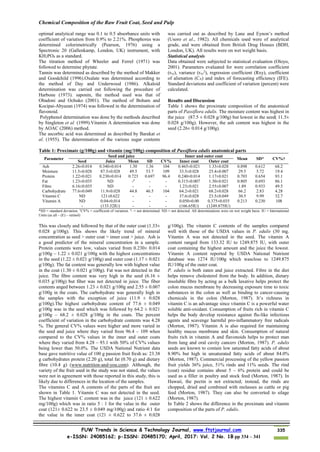
Table 1 shows the proximate composition of the anatomical
parts of Passiflora edulis. The moisture content was highest in
the juice (87.5 ± 0.028 g/100g) but lowest in the seed( 11.5±
0.028 g/100g). However, the ash content was highest in the
seed (2.26± 0.014 g/100g).
Table 1: Proximate (g/100g) and vitamin (mg/100g) composition of Passiflora edulis anatomical parts
Parameter
Seed and juice Inner and outer coat
Mean SD* CV%†
Seed Juice Mean SD CV% Inner coat Outer coat
Ash 2.26±0.014 0.340±0.014 1.30 1.36 104 0.465±0.021 1.33±0.028 0.898 0.612 68.2
Moisture 11.5±0.028 87.5±0.028 49.5 53.7 109 33.5±0.028 25.4±0.007 29.5 5.72 19.4
Protein 1.22±0.021 0.230±0.014 0.723 0.697 96.4 0.240±0.014 1.17±0.021 0.703 0.654 93.1
Fat 1.23±0.035 ND -#
- - 0.315±0.007 1.30±0.021 0.805 0.693 86.1
Fibre 6.16±0.035 ND - - - 1.23±0.021 2.55±0.007 1.89 0.933 49.5
Carbohydrate 77.6±0.049 11.9±0.028 44.8 46.5 104 64.2±0.021 68.2±0.028 66.2 2.83 4.28
Vitamin C ND 121±0.622 - - - 37.6±0.028 23.5±0.049 30.5 9.99 32.7
Vitamin A ND 0.04±0.014 - - - 0.050±0.00 0.375±0.035 0.213 0.230 108
- (133.32IU) - - - (166.65IU) (1249.875IU)
*SD = standard deviation. †
CV% = coefficient of variation. #
- = not determined. ND = not detected. All determinations were on wet weight basis. IU = International
Units (as all – (E) – retinol)
This was closely and followed by that of the outer coat (1.33±
0.028 g/100g). This shows the likely trend of mineral
concentration as seed > outer coat > inner coat > juice. Ash is
a good predictor of the mineral concentration in a sample.
Protein contents were low, values varied from 0.230± 0.014
g/100g – 1.22 ± 0.021 g/100g with the highest concentrations
in the seed (1.22 ± 0.021 g/100g) and outer coat (1.17 ± 0.021
g/100g). The fat content was generally low with highest value
in the coat (1.30 ± 0.021 g/100g). Fat was not detected in the
juice. The fibre content was very high in the seed (6.16 ±
0.035 g/100g) but fiber was not detected in juice. The fiber
contents anged between 1.23 ± 0.021 g/100g and 2.55 ± 0.007
g/100g in the coats. The carbohydrate was generally high in
the samples with the exception of juice (11.9 ± 0.028
g/100g).The highest carbohydrate content of 77.6 ± 0.049
g/100g was in the seed which was followed by 64.2 ± 0.021
g/100g – 68.2 ± 0.028 g/100g in the coats. The percent
coefficient of variation in the carbohydrate contents was 4.28
%. The general CV% values were higher and more varied in
the seed and juice where they varied from 96.4 – 109 when
compared to the CV% values in the inner and outer coats
where they varied from 4.28 – 93.1 with 50% of CV% values
being lower than 50.0%. The USDA National Nutrient data
base gave nutritive value of 100 g passion fruit fresh as: 23.38
g carbohydrates protein (2.20 g), total fat (0.70 g) and dietary
fibre (10.4 g) (www.nutrition-and-you.com). Although, the
variety of the fruit used in the study was not stated, the values
were not in agreement with those reported in this study, this is
likely due to differences in the location of the samples.
The vitamins C and A contents of the parts of the fruit are
shown in Table 1. Vitamin C was not detected in the seed.
The highest vitamin C content was in the juice (121 ± 0.622
mg/100g) which was in ratio 5 : 1 for the value in the outer
coat (121± 0.622 to 23.5 ± 0.049 mg/100g) and ratio 4:1 for
the value in the inner coat (121 ± 0.622 to 37.6 ± 0.028
g/100g). The vitamin C contents of the samples compared
well with those of the USDA values in P. edulis (30 mg.
Vitamin A was not detected in the seed. The vitamin A
content ranged from 133.32 IU to 1249.875 IU, with outer
coat containing the highest amount and the juice the lowest.
Vitamin A content reported by USDA National Nutrient
database was 1274 IU/100g which wasclose to 1249.875
IU/100g of the outer coat.
P. edulis is both eaten and juice extracted. Fibre in the diet
helps remove cholesterol from the body. In addition, dietary
insoluble fibre by acting as a bulk laxative helps protect the
colon mucus membrane by decreasing exposure time to toxic
substances in the colon as well as binding to cancer-causing
chemicals in the colon (Morton, 1987). It’s richness in
vitamin C is an advantage since vitamin C is a powerful water
soluble anti-oxidant. Consumption of fruits rich in vitamin C
helps the body develop resistance against flu-like infectious
agents and scavenge harmful pro-inflammatory free radicals
(Morton, 1987). Vitamin A is also required for maintaining
healthy mucus membrane and skin. Consumption of natural
fruits rich in vitamin A and flavonoids helps to protect man
from lung and oral cavity cancers (Morton, 1987). P. edulis
seeds are known to contain low saturated fatty acids of about
8.90% but high in unsaturated fatty acids of about 84.0%
(Morton, 1987). Commercial processing of the yellow passion
fruit yields 36% juice, 51% rinds and 11% seeds. The rind
(coat) residue contains about 5 – 6% protein and could be
used as a filler in poultry and stock feed (Morton, 1987). In
Hawaii, the pectin is not extracted; instead, the rinds are
chopped, dried and combined with molasses as cattle or pig
feed (Morton, 1987). They can also be converted to silage
(Morton, 1987).
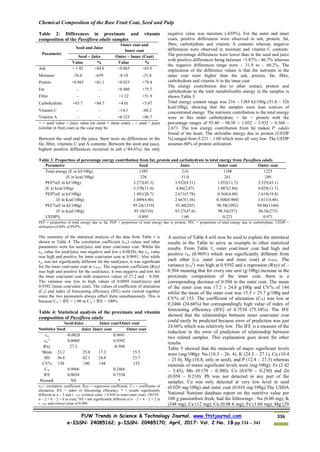
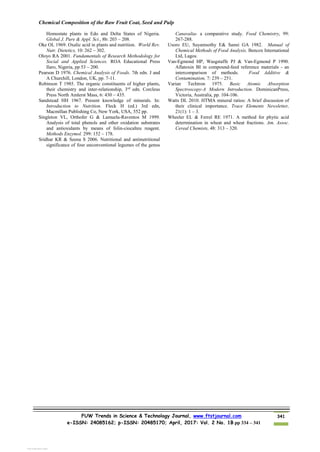
In Table 2 shows the difference in the proximate and vitamin
composition of the parts of P. edulis.
Chemical Composition of the Raw Fruit Coat, Seed and Pulp
FUW Trends in Science & Technology Journal, www.ftstjournal.com
e-ISSN: 24085162; p-ISSN: 20485170; April, 2017: Vol. 2 No. 1B pp 334 – 341
336
Table 2: Differences in proximate and vitamin
composition of the Passiflora edulis samples
Parameter
Seed and Juice
Outer coat and
Inner coat
Seed – Juice Outer – Inner (Coat)
Value % Value %
Ash + 1.92 +84.6 +0.865 +65.0
Moisture -76.0 -659 -8.10 -31.8
Protein +0.985 +81.1 +0.925 +79.4
Fat - - +0.980 +75.7
Fibre - - +1.32 +51.9
Carbohydrate +65.7 +84.7 +4.01 +5.87
Vitamin C - - -14.1 -60.2
Vitamin A - - +0.325 +86.7
+ = seed value > juice value (or outer > inner coat); - = seed < juice
(similar in fruit coat) as the case may be
Between the seed and the juice, there were no differences in the
fat, fibre, vitamins C and A contente. Between the seed and juice,
highest positive differences occurred in ash (+84.6%); the only
negative value was moisture (-659%). For the outer and inner
coats, positive differences were observed in ash, protein, fat,
fibre, carbohydrate and vitamin A contents whereas negative
differences were observed in moisture and vitamin C contents.
The percentage differences were lower than in the seed and juice
with positive differences being between +5.87% - 86.7% whereas
the negative differences range were – 31.8 to – 60.2%. The
implication of the difference values is that the nutrients in the
outer coat were higher than the ash, protein, fat, fibre,
carbohydrate and vitamin A in the inner coat
The energy contribution due to ether extract, protein and
carbohydrate to the total metabolizable energy in the samples is
shown Table 3.
Total energy content range was 216 – 1385 kJ/100g (51.0 – 326
kcal/100g), showing that the samples were lean sources of
concentrated energy. The nutrients contribution to the total energy
were in this order carbohydrate > fat > protein with the
percentage ranges of 93.40 – 98.58 > 1.052 – 3.932 > 0.368 –
2.671. The low energy contribution from fat makes P. edulis
friend of the heart. The utilizable energy due to protein (UEDP
%) ranged from 0.221 – 1.60 which were all very low. The UEDP
assumes 60% of protein utilization.
Table 3: Proportion of percentage energy contribution from fat, protein and carbohydrate to total energy from Passiflora edulis
Parameter Seed Juice Inner coat Outer coat
Total energy (E in kJ/100g) 1385 216 1108 1223
(E in kcal/100g) 326 51.0 261 289
PEF%(E in kJ/100g) 3.272(45.3) 3.932(8.51) 1.052(11.7) 3.525(43.1)
(E in kcal/100g) 3.378(11.0) 4.06(2.07) 1.087(2.84) 4.029(11.7)
PEP%(E in kJ/100g) 1.491(20.7) 2.671(5.78) 0.368(4.08) 1.619(19.8)
(E in kcal/100g) 1.489(4.86) 2.667(1.36) 0.368(0.960) 1.611(4.66)
PEC%(E in kJ/100g) 95.24(1319) 93.40(202) 98.58(1092) 94.86(1160)
(E in kcal/100g) 95.10(310) 93.27(47.6) 98.54(257) 94.36(273)
UEDP% 0.895 1.60 0.221 0.971
PEF = proportion of total energy due to fat. PEP = proportion of total energy due to protein. PEC = proportion of total energy due to carbohydrate. UEDP =
utilization of 60% of PEP%.
The summary of the statistical analysis of the data from Table 1 is
shown in Table 4. The correlation coefficient (rxy) values and other
parameters were for seed/juice and inner coat/outer coat. Whilst the
rxy value for seed/juice was negative and low (-0.0828), the rxy value
was high and positive for inner coat/outer coat at 0.9691. Also while
rxy was not significantly different for the seed/juice, it was significant
for the inner coat/outer coat at r=0.01. The regression coefficient (Rxy)
was high and positive for the seed/juice, it was negative and low for
the inner coat/outer coat with respective values of 27.2 and – 0.504.
The variance was low to high values of 0.0069 (seed/juice) and
0.9392 (inner coat/outer coat). The values of coefficient of alienation
(CA) and index of forecasting efficiency (IFE) were viewed together
since the two parameters always affect them simultaneously. This is
because CA + IFE = 1.00 or CA + IFE = 100%.
Table 4: Statistical analysis of the proximate and vitamin
composition of Passiflora edulis
Statistics
Seed/Juice Inner coat/Outer coat
Seed Juice Inner coat Outer coat
rxy -0.0828 0.9691
rxy
2
0.0069 0.9392
Rxy 27.2 -0.504
Mean 23.2 25.0 17.2 15.5
SD 36.6 42.1 24.8 23.7
CV% 158 180 144 153
CA 0.9966 0.2466
IFE 0.0034 0.7534
Remark NS *
rxy= correlation coefficient; Rxy = regression coefficient; CA = coefficient of
alienation; IFE = index of forecasting efficiency; * = results significantly
different at n – 2 and r = 0.01 (critical value = 0.834 in inner/outer coat). (NOTE:
n – 2 = 8 – 2 = 6 in coat). NS = not significantly different at n – 2 = 4 – 2 = 2 at
r = 0.01 and critical value of 0.990.
A section of Table 4 will now be used to explain the statistical
results in the Table to serve as example to other statistical
results. From Table 1, outer coat/inner coat had high and
positive rxy (0.9691) which was significantly different from
each other (i.e. outer coat and inner coat) at r=0.01. The
variance (rxy
2
) was high at 0.9392 and a regression (Rxy) of –
0.504 meaning that for every one unit (g/100g) increase in the
proximate composition of the inner coat, there is a
corresponding decrease of 0.504 in the outer coat. The mean
of the inner coat was 17.2 ± 24.8 g/100g and CV% of 144
whilst the mean of the outer coat was 15.5 ± 23.7 g/100g and
CV% of 153. The coefficient of alienation (CA) was low at
0.2466 (24.66%) but correspondingly high value of index of
forecasting efficiency (IFE) of 0.7534 (75.34%). The IFE
showed that the relationships between inner coat/outer coat
could easily be predicted because error of prediction was just
24.66% which was relatively low. The IFE is a measure of the
reduction in the error of prediction of relationship between
two related samples. This explanation goes down for other
results.
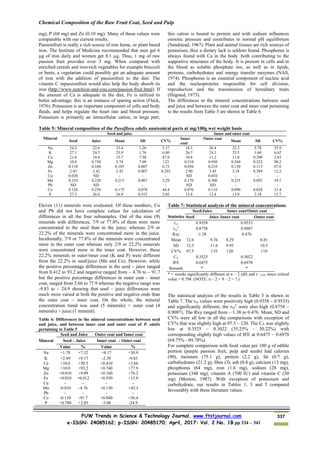
Table 5 showed that the minerals of major significant levels
were (mg/100g): Na (18.3 – 26. 4), K (24.3 – 27.1), Ca (10.4
– 21.0), Mg (10.8, only in seed), and P (12.4 – 27.3) whereas
minerals of minor significant levels were (mg/100g): Fe (2.42
– 3.45), Mn (0.170 – 0.300), Co (0.070 – 0.230) and Zn
(0.050 – 0.210). Pb was not detected in any part of the
samples. Cu was only detected at very low level in seed
(0.020 mg/100g) and outer coat (0.010 mg/100g).The USDA
National Nutrient database report on the nutritive value per
100 g passionfruit fresh, had the followings : Na (0.00 mg), K
(348 mg), Ca (12 mg), Cu (0.08 6 mg), Fe (1.60 mg), Mg (29
Chemical Composition of the Raw Fruit Coat, Seed and Pulp
FUW Trends in Science & Technology Journal, www.ftstjournal.com
e-ISSN: 24085162; p-ISSN: 20485170; April, 2017: Vol. 2 No. 1B pp 334 – 341
337
mg), P (68 mg) and Zn (0.10 mg). Many of these values were
comparable with our current results.
Passionfruit is really a rich source of non heme, or plant based
iron. The Institute of Medicine recommended that men get 6
µg of iron daily and women get 8.1 µg. Thus, 1 mg of raw
passion fruit provides over 3 mg. When compared with
enriched cereals and iron-rich vegetables for example broccoli
or beets, a vegetarian could possibly get an adequate amount
of iron with the addition of passionfruit to the diet. The
vitamin C inpassionfruit would also help the body absorb its
iron (http://www.nutrition-and-you.com/passion-fruit.html). If
the amount of Ca is adequate in the diet, Fe is utilized to
better advantage; this is an instance of sparing action (Fleck,
1976). Potassium is an important component of cells and body
fluids, and helps regulate the heart rate and blood pressure.
Potassium is primarily an intracellular cation, in large part;
this cation is bound to protein and with sodium influences
osmotic pressure and contributes to normal pH equilibrium
(Sandstead, 1967). Plant and animal tissues are rich sources of
potassium, thus a dietary lack is seldom found. Phosphorus is
always found with Ca in the body .both contributing to the
supportive structures of the body. It is present in cells and in
the blood as soluble phosphate ion, as well as in lipids,
proteins, carbohydrates and energy transfer enzymes (NAS,
1974). Phosphorus is an essential component of nucleic acid
and the nucleoproteins responsible for cell division,
reproduction and the transmission of hereditary traits
(Hegsted, 1973).
The differences in the mineral concentrations between seed
and juice and between the outer coat and inner coat pertaining
to the results from Table 5 are shown in Table 6.
Table 5: Mineral composition of the Passiflora edulis anatomical parts at mg/100g wet weight basis
Mineral
Seed and juice Inner and outer coat
Seed Juice Mean SD CV%
Inner
coat
Outer coat
Mean SD CV%
Na 24.3 22.6 23.4 1.26 5.37 18.3 26.4 22.3 5.78 25.9
K 27.1 24.7 25.9 1.76 6.80 26.7 24.3 25.5 1.69 6.62
Ca 21.0 10.4 15.7 7.50 47.8 10.8 11.2 11.0 0.290 2.63
Mg 10.8 0.730 5.74 7.09 123 0.210 0.950 0.580 0.523 90.2
Zn 0.110 0.100 0.105 0.007 6.73 0.050 0.210 0.130 0.113 87.0
Fe 2.43 2.42 2.43 0.007 0.292 2.90 3.45 3.18 0.389 12.2
Cu 0.020 ND - - - ND 0.010 - - -
Mn 0.210 0.220 0.215 0.007 3.29 0.170 0.300 0.235 0.092 39.1
Pb ND ND - - - ND ND - - -
Co 0.120 0.230 0.175 0.078 44.4 0.070 0.110 0.090 0.028 31.4
P 27.3 26.6 26.9 0.552 2.05 15.4 12.4 13.9 2.18 15.7
Eleven (11) minerals were evaluated. Of these numbers, Cu
and Pb did not have complete values for calculation of
differences in all the four subsamples. Out of the nine (9)
minerals with differences, 7/9 or 77.8% of them were more
concentrated in the seed than in the juice; whereas 2/9 or
22.2% of the minerals were concentrated more in the juice.
Incidentally, 7/9 or 77.8% of the minerals were concentrated
more in the outer coat whereas only 2/9 or 22.2% minerals
were concentrated more in the inner coat. However, these
22.2% minerals in outer/inner coat (K and P) were different
from the 22.2% in seed/juice (Mn and Co). However, while
the positive percentage differences in the seed – juice ranged
from 0.412 to 93.2 and negative ranged from – 4.76 to – 91.7
but the positive percentage differences in outer coat – inner
coat, ranged from 3.66 to 77.9 whereas the negative range was
-9.83 to – 24.9 showing that seed – juice differences were
much more varied at both the positive and negative ends than
the outer coat – inner coat. On the whole, the mineral
concentration trend was seed (5 minerals) > outer coat (4
minerals) > juice (1 mineral).
Table 6: Differences in the mineral concentrations between seed
and juice, and between inner coat and outer coat of P. edulis
pertaining to Table 5
Mineral
Seed and Juice Outer coat and Inner coat
Seed – Juice Inner coat – Outer coat
Value % Value %
Na +1.78 +7.32 +8.17 +30.9
K +2.49 +9.17 -2.39 -9.83
Ca +10.6 +50.5 +0.410 +3.66
Mg +10.0 +93.2 +0.740 +77.9
Zn +0.010 +9.09 +0.160 +76.2
Fe +0.010 +0.412 +0.550 +15.9
Cu - - - -
Mn -0.010 -4.76 +0.130 +43.3
Pb - - - -
Co -0.110 -91.7 +0.040 +36.4
P +0.780 +2.85 -3.08 -24.9
Table 7: Statistical analysis of the mineral concentrations
Statistics
Seed/Juice Inner coat/Outer coat
Seed Juice Inner coat Outer coat
rxy 0.9358 0.9533
rxy
2
0.8758 0.9087
Rxy -1.38 0.476
Mean 12.6 9.76 8.29 8.81
SD 12.3 11.6 9.95 10.5
CV% 97.5 119 120 119
CA 0.3525 0.3022
IFE 0.6475 0.6978
Remark * *
* = results significantly different at n – 2 (df) and r = 0.01 since critical
value = 0.798. (NOTE: n – 2 = 9 – 2 = 7.)
The statistical analysis of the results in Table 5 is shown in
Table 7. The rxy values were positively high (0.9358 – 0.9533)
and significantly different; the rxy
2
were also high (0.8758 –
0.9087). The Rxy ranged from – 1.38 to 0.476. Mean, SD and
CV% were all low in all the comparisons with exception of
CV% that was slightly high at 97.5 – 120. The CA was slightly
low at 0.3525 – 0.3022 (35.25% - 30.22%) with
corresponding slightly high values of IFE at 0.6475 – 0.6978
(64.75% - 69.78%).
For complete comparison with food value per 100 g of edible
portion (purple passion fruit, pulp and seeds) had calories
(90), moisture (75.1 g), protein (2.2 g), fat (0.7 g),
carbohydrates (21.2 g), fibre (ʔ), ash (0.8 g), calcium (13 mg),
phosphorus (64 mg), iron (1.6 mg), sodium (28 mg),
potassium (348 mg), vitamin A (700 IU) and vitamin C (30
mg) (Morton, 1987). With exception of potassium and
carbohydrate, our results in Tables 1, 3 and 5 compared
favourably with these literature values.
Chemical Composition of the Raw Fruit Coat, Seed and Pulp
FUW Trends in Science & Technology Journal, www.ftstjournal.com
e-ISSN: 24085162; p-ISSN: 20485170; April, 2017: Vol. 2 No. 1B pp 334 – 341
338
Table 8: Calculated mineral ratios inP. edulis
Parameter Ideal Seed Juice Inner coat Outer coat
Ca/Mg 7.00 1.95 14.2 51.4 11.8
Na/K 2.40 0.896 0.915 0.683 1.09
Ca/K 4.20 0.774 0.422 0.404 0.461
Na/Mg 4.00 2.26 30.9 86.9 27.8
Zn/Cu 8.00 5.50 - - 21.0
Ca/P 2.60 0.769 0.392 0.700 0.908
Fe/Cu 0.90 122 - - 345
Ca/Pb 84.0 - - - -
Fe/Pb 4.40 - - - -
Zn/Cd 500 - - - -
[K(Ca + Mg)] 2.20 1.71 4.43 4.85 4.00
The various calculated mineral ratios are depicted in Table 8.
Three categories of results were obtained. These were those
without ratio values because of incomplete data for ratio
calculation, those ratios lower than the ideal and those ratios
greater than the ideal. Mineral ratios without values were Ca/Pb,
Fe/Pb (Pb was not detected) and Zn/Cd (Cd was not determined).
The following ratios were less than the ideal ratios: Ca/P [ideal
(id) = 2.60, values = 0.392 – 0.908], Zn/Cu [id = 8.00, value =
5.50 in seed], Ca/K [id = 4.20, values = 0.404 – 0.774] and Na/K
[id = 2.40, values = 0.683 – 1.09]. Others in this category were
Ca/Mg [id = 7.00, value of 1.95 only in seed], Na/Mg [id = 4.00,
value of 2.26 only in seed] and [K(Ca + Mg)] [id = 2.20, value of
1.71 only in seed]. Ratio values greater than the ideal were Ca/Mg
(juice, inner coat and outer coat), Na/Mg (juice, inner coat and
outer coat), Zn/Cu (outer coat only), Fe/Cu (seed and outer coat)
and finally in [K(Ca + Mg)] (juice, inner coat and outer coat).
Balance in all phases of life is critically important to maintain
health. A mineral ratio is a pure number consisting of one mineral
level divided by a second mineral level. Mineral ratios are often
more important in determining nutritional deficiencies and
excesses than mineral levels alone, although both are important
and should be considered together. The importance of ratios had
been enumerated (ARL, 2012). Ratios are often more important
than levels; ratios represent homeostatic balances; ratios are
indicative of disease trends; ratios are frequently predictive of
future metabolic dysfunction or hidden metabolic dysfunctions
(Watts, 2010). Calcium and magnesium should always be in a
proper balance to one another. If this normal equilibrium is upset,
one mineral will become dominant relative to the other. In this
case, calcium was high relative to magnesium (see high Ca/Mg
ratio), which may be indicative of abnormal calcium metabolism,
this will lead to increased need for magnesium in the diet. The
mineral calcium antagonizes the retention of potassium within the
cell. Since potassium is necessary in sufficient quantity to
sensitize the tissues to the effects of thyroid hormones, a high
Ca/K ratio would suggest reduced thyroid function and/or cellular
response to thyroxine (Watts, 2010). The Ca/K ratios in this study
were low. Phosphorus is involved in all of the cellular energy
production cycles within the body. Adequate protein intake is
essential in providing needed phosphorus for increased energy
production, and reducing excess tissue calcium retention (see low
Ca/P ratio). The ratio of Na/Mg was below the normal range only
in the seed. The adrenal glands play an essential role in regulating
sodium retention and excretion. The sodium-magnesium profile is
indicative of reduced adrenal cortical function only in the seed but
not in the three subunits. Zinc and copper are intricately related to
the hormones, progesterone and estrogens, respectively. When
zinc and copper are not in normal balance with one another,
certain emotional and physical changes related to hormonal
imbalance may occur near the menstrual cycles, such as excessive
cramping, emotional mood swings, food cravings, water retention
skin, skin rashes and viral infections
(http://www.spectrumhealth.biz/hairanalysis/samplereport/minera
l ra...). The milliequivalent ratio [K/(Ca+Mg)] was less than 2.2
only in the seed (1.71). This value will not promote
hypomagnesaemia in man (NRC, 1989). The toxic minerals ratios
in samples were Ca/Pb and Fe/Pb. However, no ratio results were
observed for them because Pb was not detected.
The mineral safety index (MSI) values of Na, Mg, P, Ca, Fe,
Zn and Cu of P. edulis are shown in Table 9.
The standard mineral safety index values for the elements are
Na (4.8), Mg (15), P (10), Ca (10), Fe (6.7), Zn (33) and Cu
(33) (Hathcock, 1985). The explanation of the MSI can be
understood as follows taking Ca as example: the
recommended adult intake (RAI) of Ca is 1,200 mg; its
minimum toxic dose (MTD) is 12,000 mg or 10 times the
recommended daily average (RDA) which is equivalent to
MSI of Ca (Hathcock, 1985). This explanation goes for the
other minerals whose MSI were determined. All the minerals
have their table value (TV) > calculated value (CV) giving
positive differences with corresponding low percentage
differences. The TV > CV had been observed in Fe, Cu, Zn,
Na, Mg, P and Ca in two types of Lagos lagoon fish
(Acanthurus monroviae and Lutjanus goreensis) (Adeyeye et
al., 2014). The MSI values gave an indication that none of the
minerals was high enough to the deleterious levels when
consumed in P. edulis.
Table 9: Mineral safety index (MSI) of Na, Mg, P, Ca, Fe, Zn and Cu in P. edulis
Mineral RAI (mg) TV of MSI
Calculated CV values
Seed Juice Inner coat Outer coat
Na 500 4.8 0.234 0.217 0.175 0.254
Mg 400 15 0.403 0.027 0.008 0.036
P 1200 10 0.227 0.220 0.128 0.103
Ca 1200 10 0.174 0.086 0.090 0.093
Fe 15 6.7 1.08 1.08 1.30 1.54
Zn 15 33 0.242 0.220 0.110 0.462
Cu 3 33 0.220 - - 0.110
RAI = recommended adult intake; CV = calculated MSI value; TV = Table (standard) MSI value. No MSI standard for K, Mn, Co and Pb.
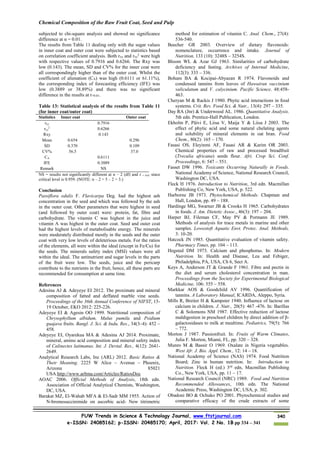
Table 10: Antinutrients composition of P. edulis anatomical parts (wet weight basis)
Parameter
Seed and Juice Inner and outer coat
Seed Juice Mean SD CV(%) Inner coat Outer coat Mean SD CV(%)
Tannin (mg/100g) 2.35 0.080 1.22 1.61 132 0.650 1.33 0.990 0.481 48.6
Polyphenol (mg/100g) 1.21 0.050 0.630 0.820 130 0.550 1.23 0.890 0.481 54.0
Phytate (mg/100g) 3.54 1.21 2.38 1.65 69.4 2.10 2.57 2.34 0.332 14.2
Oxalate (mg/100g) 1.07 0.430 0.750 0.453 60.3 0.670 1.09 0.880 0.297 33.7
Saponin (g/100g) 0.380 ND - - - 0.220 0.270 0.245 0.035 14.4
Alkaloids (g/100g) 0.240 ND - - - 0.100 0.220 0.160 0.085 53.0
Flavonoid (g/100g) 0.150 0.010 0.080 0.099 124 0.020 0.040 0.030 0.014 47.1
No evidence of statistical analysis that could show differences
Chemical Composition of the Raw Fruit Coat, Seed and Pulp
FUW Trends in Science & Technology Journal, www.ftstjournal.com
e-ISSN: 24085162; p-ISSN: 20485170; April, 2017: Vol. 2 No. 1B pp 334 – 341
320
The antinutrients contents are shown in Table 10. The tannin
content was highest in the seed (2.35 mg/100g) but lowest in
the juice (0.080 mg/100g). Nowadays, tannin is attracting
much influence due to it’s antioxidant activity as a potential
health benefit (Sridhar and Seena, 2006). Tannins interfere
with digestion by displaying anti-trypsin and anti-amylase
activity (Van-Egmond et al., 1990; Wheeler and Ferrel, 1971),
form complexes with vitamin B12 and interfere with the
bioavailability of protein through complexing reaction with
proteins (Van-Egmond et al., 1990; Wheeler and Ferrel,
1971). The oxalate levels in the sample (0.430 – 1.09
mg/100g) were much lower than 36 mg/100g DM considered
to be lethal to man (Munro and Bassir, 1969; Oke, 1969).
Excess consumption of oxalate or oxalic acid can cause
corrosive gastroenteritis (Fasset, 1996; Adesina and Adeyeye,
2012). Oxalates bind to calcium and prevent its absorption in
human body (Adesina and Adeyeye, 2012). However, the risk
of calcium deficiency due to the consumption of oxalate-rich
plants has been reported to be very minor (Fasasi et al., 2003).
This is because humans are able to effectively use very low
amounts of calcium in food (Robinson, 1985). Flavonoids (of
low concentration in the samples, 0.101 – 0.150 mg/100g) are
a group of polyphenolic compounds (Beecher, 2003). These
compounds chelate metals such as iron and zinc and reduce
the absorption of these nutrients, but they also inhibit
digestive enzymes and may also precipitate proteins (Beecher,
2003). Saponin was detected at low levels (0.220 – 0.380
mg/100g) in the seed, inner coat and outer coat. Saponins in
plants may serve as anti-feedants
(http://en.m.wikipedia.org/wiki/Antinutrient). The phytate
levels in each of the samples had the highest concentration of
all the antinutrients ranging from 1.21 – 3.54 mg/100g.
Phytate acts as a strong chelator, forming protein and mineral
phytic acid complexes thereby reducing protein and mineral
availability (Robinson, 1985). It chelates metal ions such as
Ca, Mg, Zn, Cu and Fe to form insoluble complexes that are
not readily absorbed from the gastrointestinal tract (Robinson,
1985). Phytate renders many essential minerals unavailable
(especially Ca and Mg), leading to a prevalence of
osteomalacia and osteoporosis in test animals (Robinson,
1985). The strong binding affinity of phytate to minerals such
as Ca, Mg, Fe, Cu and Zn results in precipitation, making the
minerals unavailable for absorption in the intestines (Ekholm
et al., 2003; Cheryan and Rackis, 1980). Phytic acids are
common in the hulls of nuts, seeds and grains Table 10).
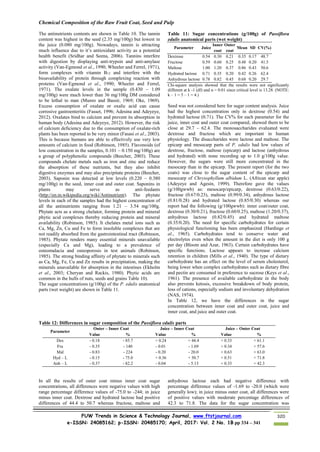
The sugar concentrations (g/100g) of the P. edulis anatomical
parts (wet weight) are shown in Table 11.
Table 11: Sugar concentrations (g/100g) of Passiflora
edulis anatomical parts (wet weight)
Parameter Juice
Inner
coat
Outer
coat
Mean SD CV(%)
Dextrose 0.54 0.30 0.21 0.35 0.17 48.7
Fructose 0.59 0.60 0.25 0.48 0.20 41.5
Maltose 1.00 1.20 0.37 0.86 0.43 50.6
Hydrated lactose 0.71 0.35 0.20 0.42 0.26 62.4
Anhydrous lactose 0.78 0.82 0.45 0.68 0.20 29.7
Chi-square analysis showed that the results were not significantly
different at k -1 (df) and α = 0.01 since critical level is 13.28. (NOTE:
k – 1 = 5 – 1 = 4.)
Seed was not considered here for sugar content analysis. Juice
had the highest concentration only in dextrose (0.54) and
hydrated lactose (0.71). The CV% for each parameter for the
juice, inner coat and outer coat compared, showed them to be
close at 29.7 – 62.4. The monosaccharides evaluated were
dextrose and fructose which are important in human
physiology. The disaccharides were lactose and maltose. The
epicarp and mesocarp parts of P. edulis had low values of
dextrose, fructose, maltose (epicarp) and lactose (anhydrous
and hydrated) with none recording up to 1.0 g/100g value.
However, the sugars were still more concentrated in the
mesocarp than in the epicarp. The present report (for the two
coats) was close to the sugar content of the epicarp and
mesocarp of Chrysophyllum albidum L. (African star apple)
(Adeyeye and Agesin, 1999). Therefore gave the values
(g/100gwwb) as: mesocarp/epicarp, dextrose (0.63/0.22),
fructose (0.67/0.23), maltose (0.99/0.34), anhydrous lactose
(0.81/0.28) and hydrated lactose (0.85/0.30) whereas our
report had the following (g/100gwwb): inner coat/outer coat,
dextrose (0.30/0.21), fructose (0.60/0.25), maltose (1.20/0.37),
anhydrous lactose (0.82/0.45) and hydrated maltose
(0.35/0.20). The need for specific carbohydrates for certain
physiological functioning has been emphasized (Hardinge et
al., 1965). Carbohydrates tend to conserve water and
electrolytes even when the amount in the diet is only 100 g
per day (Bloom and Azar, 1963). Certain carbohydrates have
specific functions. Lactose appears to increase calcium
retention in children (Mills et al., 1940). The type of dietary
carbohydrate has an effect on the level of serum cholesterol,
being lower when complex carbohydrates such as dietary fibre
and pectin are consumed in preference to sucrose (Keys et al.,
1961). The presence of available carbohydrate in the body
also prevents ketosis, excessive breakdown of body protein,
loss of cations, especially sodium and involuntary dehydration
(NAS, 1974).
In Table 12, we have the differences in the sugar
concentration between inner coat and outer coat, juice and
inner coat, and juice and outer coat.
Table 12: Differences in sugar composition of the Passiflora edulis parts
Parameter
Outer – Inner Coat Juice – Inner Coat Juice – Outer Coat
Value % Value % Value %
Dex - 0.18 - 85.7 + 0.24 + 44.4 + 0.33 + 61.1
Fru - 0.35 - 140 - 0.01 - 1.69 + 0.34 + 57.6
Mal - 0.83 - 224 - 0.20 - 20.0 + 0.63 + 63.0
Hyd – L - 0.15 - 75.0 + 0.36 + 50.7 + 0.51 + 71.8
Anh – L - 0.37 - 82.2 - 0.04 - 5.13 + 0.33 + 42.3
In all the results of outer coat minus inner coat sugar
concentrations, all differences were negative values with high
range percentage difference values of -75.0 to -244; in juice
minus inner coat. Dextrose and hydrated lactose had positive
differences of 44.4 to 50.7 whereas fructose, maltose and
anhydrous lactose each had negative difference with
percentage difference values of -1.69 to -20.0 (which were
generally low); in juice minus outer coat, all differences were
of positive values with moderate percentage differences of
42.3 to 71.8. The data for the sugar concentration was
320
Chemical Composition of the Raw Fruit Coat, Seed and Pulp
FUW Trends in Science & Technology Journal, www.ftstjournal.com
e-ISSN: 24085162; p-ISSN: 20485170; April, 2017: Vol. 2 No. 1B pp 334 – 341
340
subjected to chi-square analysis and showed no significance
difference at α = 0.01.
The results from Table 11 dealing only with the sugar values
in inner coat and outer coat were subjected to statistics based
on correlation coefficient analysis. Both rxy and rxy
2
were high
with respective values of 0.7916 and 0.6266. The Rxy was
low (0.143). The mean, SD and CV% for the inner coat were
all correspondingly higher than of the outer coat. Whilst the
coefficient of alienation (CA) was high (0.6111 or 61.11%),
the corresponding index of forecasting efficiency (IFE) was
low (0.3889 or 38.89%) and there was no significant
difference in the results at r=0.01.
Table 13: Statistical analysis of the results from Table 11
(for inner coat/outer coat)
Statistics Inner coat Outer coat
rxy 0.7916
rxy
2
0.6266
Rxy 0.143
Mean 0.654 0.296
SD 0.370 0.109
CV% 56.5 37.0
CA 0.6111
IFE 0.3889
Remark NS
NS = results not significantly different at n – 2 (df) and r = 0.01 since
critical level is 0.959. (NOTE: n – 2 = 5 – 2 = 3.)
Conclusion
Passiflora edulis F. Flavicarpa Deg. had the highest ash
concentration in the seed and which was followed by the ash
in the outer coat. Other parameters that were highest in seed
(and followed by outer coat) were: protein, fat, fibre and
carbohydrate. The vitamin C was highest in the juice and
vitamin A was highest in the outer coat. Seed and outer coat
had the highest levels of metabolisable energy. The minerals
were moderately distributed mostly in the seeds and the outer
coat with very low levels of deleterious metals. For the ratios
of the elements, all were within the ideal (except in Fe/Cu) for
the seeds. The minerals safety index (MSI) values were all
within the ideal. The antinutrient and sugar levels in the parts
of the fruit were low. The seeds, juice and the pericarp
contribute to the nutrients in the fruit, hence, all these parts are
recommended for consumption at same time.
References
Adesina AJ & Adeyeye EI 2012. The proximate and mineral
composition of fatted and deffated marble vine seeds.
Proceedings of the 36th Annual Conference of NIFST, 15-
19 October, EKO 2012: 225-226.
Adeyeye EI & Agesin OO 1999. Nutritional composition of
Chrysophyllum albidum, Malus pumila and Psidium
guajava fruits. Bangl. J. Sci. & Indu. Res., 34(3–4): 452 –
458.
Adeyeye EI, Oyarekua MA & Adesina AJ 2014. Proximate,
mineral, amino acid composition and mineral safety index
of Calinectes latimanus. Int. J. Devtal. Res., 4(12): 2641-
2649.
Analytical Research Labs, Inc (ARL) 2012. Basic Ratios &
Their Meaning. 2225 W Alice – Avenue – Phoenix,
Arizona 85021
USA.http://www.arltma.com/Articles/RatiosDoc
AOAC 2006. Official Methods of Analysis, 18th edn.
Association of Official Analytical Chemists, Washington,
DC, USA.
Barakat MZ, El-Wahab MFA & El-Sadr MM 1955. Action of
N-bromosuccinimide on ascorbic acid- New titrimetric
method for estimation of vitamin C. Anal. Chem., 27(4):
536-540.
Beecher GR 2003. Overview of dietary flavonoids:
nomenclature, occurrence and intake. Journal of
Nutrition, 133 (10): 3248S – 3254S.
Bloom WL & Azar GJ 1963. Similarities of carbohydrate
deficiency and fasting. Archives of Internal Medicine,
112(3): 333 – 336.
Boham BA & Kocipai-Abyazan R 1974. Flavonoids and
condensed tannins from leaves of Hawairan vaccinium
valiculatum and V. calycinium. Pacific Science. 48:458-
463.
Cheryan M & Rackis J 1980. Phytic acid interactions in food
systems. Crit. Rev. Food Sci. & Nutr., 13(4): 297 – 335.
Day RA (Jnr) & Underwood AL. 1986. Quantitative Analysis.
5th edn. Prentice-Hall Publication, London.
Ekholm P, Päivi E, Liisa V, Maija Y & Liisa J 2003. The
effect of phytic acid and some natural chelating agents
and solubility of mineral elements in oat bran. Food
Chem., 80(2): 165 – 170.
Fasasi OS, Eleyinmi AF, Fasasi AR & Karim OR 2003.
Chemical properties of raw and processed breadfruit
(Treculia africana) seeds flour. Afri. Crop Sci. Conf.
Proceedings, 6: 547 – 551.
Fasset DW 1996. Toxicants Occurring Naturally in Foods.
National Academy of Science, National Research Council,
Washington DC, USA.
Fleck H 1976. Introduction to Nutrition, 3rd edn. Macmillan
Publishing Co, New York, USA, p. 522.
Harborne JB 1973. Phytochemical Methods. Chapman and
Hall, London, pp. 49 – 188.
Hardinge MG, Swarner JB & Crooks H 1965. Carbohydrates
in foods. J. Am. Dietetic Assoc., 46(3): 197 – 204.
Harper BJ, Fileman CF, May PV & Pormann JE 1989.
Methods of analysis for trace metals in marine and other
samples. Lowestoft Aquatic Envt. Protec. Anal. Methods,
3: 10-20.
Hatcock JN 1985. Quantitative evaluation of vitamin safety.
Pharmacy Times, pp. 104 – 113.
Hegsted DM 1973. Calcium and phosphorus. In: Modern
Nutrition. In: Health and Disease, Lea and Febiger,
Philadelphia, PA, USA, Ch 6, Sect A.
Keys A, Anderson JT & Grande F 1961. Fibre and pectin in
the diet and serum cholesterol concentration in man.
Proceedings from the Society for Experimental Biological
Medicine, 106: 555 – 558.
Markkar AOS & Goodchild AV 1996. Quantification of
tannins. A Laboratory Manual, ICARDA, Aleppo, Syria.
Mills R, Breiter H & Kampster 1940. Influence of lactose on
calcium in children. J. Nutr., 20(5): 467 -476. In: Barillas
C & Solomons NM 1987. Effective reduction of lactose
maldigestion in preschool children by direct addition of β-
galactosidases to milk at mealtime. Pediatrics, 79(5): 766
– 772.
Morton J 1987. Passionfruit. In: Fruits of Warm Climates,
Julia F. Morton, Miami, FL, pp. 320 – 328.
Munro M & Bassir O 1969. Oxalate in Nigeria vegetables.
West Afr. J. Bio. Appl. Chem., 12: 14 – 18.
National Academy of Science (NAS) 1974. Food Nutrition
Board; Zinc in human nutrition. In: Introduction to
Nutrition. Fleck H (ed.) 3rd
edn, Macmillan Publishing
Co., New York, USA, pp. 11 – 17.
National Research Council (NRC) 1989. Food and Nutrition
Recommended Allowances, 10th edn. The National
Academic Press, Washington DC, USA, p. 302.
Obadoni BO & Ochuko PO 2001. Phytochemical studies and
comparative efficacy of the crude extracts of some
Chemical Composition of the Raw Fruit Coat, Seed and Pulp
FUW Trends in Science & Technology Journal, www.ftstjournal.com
e-ISSN: 24085162; p-ISSN: 20485170; April, 2017: Vol. 2 No. 1B pp 334 – 341
341
Homostate plants in Edo and Delta States of Nigeria.
Global J. Pure & Appl. Sci., 8b: 203 – 208.
Oke OL 1969. Oxalic acid in plants and nutrition. World Rev.
Nutr. Dietetics, 10: 262 – 302.
Oloyo RA 2001. Fundamentals of Research Methodology for
Social and Applied Sciences. ROA Educational Press
Ilaro, Nigeria, pp 53 – 200.
Pearson D 1976. Chemical Analysis of Foods. 7th edn. J and
A Churchill, London, UK, pp. 7-11.
Robinson T 1985. The organic constituents of higher plants,
their chemistry and inter-relationship, 3rd
edn. Corcleus
Press North Amlerst Mass, 6: 430 – 435.
Sandstead HH 1967. Present knowledge of minerals. In:
Introduction to Nutrition. Fleck H (ed.) 3rd edn,
Macmillan Publishing Co, New York, USA, 552 pp.
Singleton VL, Orthofer G & Lamuela-Raventos M 1999.
Analysis of total phenols and other oxidation substrates
and antioxidants by means of folin-ciocalteu reagent.
Methods Enzymol. 299: 152 – 178.
Sridhar KR & Seena S 2006. Nutritional and antinutritional
significance of four unconventional legumes of the genus
Canavalia- a comparative study. Food Chemistry, 99:
267-288.
Usoro EU, Suyamsothy E& Sanni GA 1982. Manual of
Chemical Methods of Food Analysis. Bencox International
Ltd, Lagos.
Van-Egmond HP, Wasgstaffe PJ & Van-Egmond P 1990.
Aflatoxin BI in compound-feed reference materials - an
intercomparison of methods. Food Additive &
Contamination, 7: 239 – 251.
Varian Techtron 1975. Basic Atomic Absorption
Spectroscopy-A Modern Introduction. DominicanPress,
Victoria, Australia, pp. 104-106.
Watts DL 2010. HTMA mineral ratios: A brief discussion of
their clinical importance. Trace Elements Newsletter,
21(1): 1 – 3.
Wheeler EL & Ferrel RE 1971. A method for phytic acid
determination in wheat and wheat fractions. Am. Assoc.
Cereal Chemists, 48: 313 – 320.
View publication stats

Adeyeyeand aremu

  • 1.
    See discussions, stats,and author profiles for this publication at: https://www.researchgate.net/publication/318227292 Chemical composition of the raw fruit coat, seed and pulp of passion fruit (Passiflora edulis) Article · April 2017 CITATIONS 4 READS 2,032 2 authors: Some of the authors of this publication are also working on these related projects: Environmental Microbiology View project CHEMICAL COMPOSTION (PROXIMATE, MINERALS, VITAMINS), MINERAL RATIOS AND MINERAL SATETY INDEX OF THE INNARDS OF MALE AND FEMALE NEOPETROLISTHES MACULATUS View project Emmanuel Adeyeye Ekiti State University, Ado Ekiti 248 PUBLICATIONS   2,899 CITATIONS    SEE PROFILE Matthew Olaleke Aremu Federal University Wukari, Taraba State -Nigeria 138 PUBLICATIONS   1,798 CITATIONS    SEE PROFILE All content following this page was uploaded by Matthew Olaleke Aremu on 07 July 2017. The user has requested enhancement of the downloaded file.
  • 2.
    FUW Trends inScience & Technology Journal, www.ftstjournal.com e-ISSN: 24085162; p-ISSN: 20485170; April, 2017: Vol. 2 No. 1B pp 334 – 341 334 CHEMICAL COMPOSITION OF THE RAW FRUIT COAT, SEED AND PULP OF PASSION FRUIT (Passiflora edulis) Emmanuel Ilesanmi Adeyeye1 * and Matthew Olaleke Aremu2 1 Department of Chemistry (Analytical Unit), Ekiti State University, PMB 5363, Ado – Ekiti, Nigeria 2 Department of Chemical Sciences, Federal University Wukari, PMB 1020, Taraba State, Nigeria *Corresponding author: eiadeyeye@yahoo.com; adeyeyeilesanmi2012@gmail.com Received: January 17, 2017 Accepted: March 26, 2017 Abstract: This study determined the chemical composition of the various parts of the Passiflora edulis fruit. The various parts were separated and analyzed for –chemical composition and antinutrient contents. Calculated were mineral safety index (MSI) and mineral ratios of some minerals; regression analyses in mineral and proximate values between seed/juice and between inner coat/outer coat; the contribution of energy due to fat, carbohydrate and protein to the total energy. The results showed that the most concentrated values were seen as follows: ash (seed), moisture (juice), protein (seed), fat (outer coat), fibre (seed), carbohydrate (seed) juice (vitamin C) and outer coat (vitamin A). Highest total energy was contributed by the seed and the least by the juice. The followings were observed as the most concentrated values: Na (outer coat), K (seed), Ca (seed), Mg (seed), Zn (outer coat), Fe (outer coat), Cu (seed), Mn (outer coat), Co (juice) and P (seed). No mineral met the ideal ratio as they were either too low or too high from the ideal. No mineral had deleterious value in the MSI. All the sugar were of low levels except maltose was greater than 1.0 in the inner coat. The rc were greater than rr in proximate composition (only in inner coat/outer coat), (both in seed/juice and inner coat/outer coat) but rr were less than rr (seed/juice only) and in sugar content (inner coat/outer coat). Keywords: Analysis, composition, morphology, nutrition, Passiflora edulis Introduction Of the estimated 500 cultivars of Passiflora, in the family Passifloraceae only one, P. edulis Sims, has the exclusive designation of passion fruit, without qualification. [The passion fruit is so called because it is one of the species of passion flower, leading to the English translation of the Latin genus name, Passiflora (Morton, 1987).] Within this specie, there are two distinct forms, the standard purple, and the yellow (Golden Passion Fruit), distinguished as P. edulis, f. flavicarpa Deg., and differing not only in colour but in certain other features. General names for both in Spanish are granadilla, parcha, parchita maracuyá, or ceibey (Cuba); in Portuguese, maracujáperoba; in French, grenadille, or couzou. The purple form may be called purple, red, or black granadilla, or, in Hawaii, lilikói; in Jamaica, mountain sweet cup; in Thailand, linmangkon. The yellow form is widely known as yellow passion fruit, is called yellow lilikoi in Hawaii; golden passion fruit in Australia; parcha amarilla in Venezuela. Purple passion fruit (Passiflora edulis) is subtropical, important in some countries, while the more tropical yellow passion fruit excels in others. Both yield delicious juice (Morton, 1987). Some think the yellow is a chance mutant that occurred in Australia. However, P. edulis in its natural range is having purple or yellow fruits. Brazil has long had a well-established passion fruit industry with large-scale juice extraction plants. The purple passion fruit is there preferred for consuming fresh; the yellow for juice processing and the making of preserves. The passion fruit name was given by Spanish missionaries to South America as an expository aid while trying to convert the indigenous inhabitants to Christianity (Morton, 1987). The fruit is reported to be delicious, rich source of antioxidants, minerals, vitamins and fibre (Morton, 1987). The objective of this study was to determine the chemical composition of the anatomical parts of passion fruit (seed, juice, inner coat and outer coat). The antinutrients and sugar contents the various parts of passion fruits were also determined. The information would improve the existing information on the food composition table of Passiflora edulis F. flavicarpa Deg. Materials and Methods Collection of samples Samples were collected from Ado – Ekiti in Ekiti State, Nigeria. The fruits were washed with distilled water to remove any adhering contaminant and then drained through folded filter paper. The samples were identified in the laboratory and preserved in the refrigerator prior to analysis within two days. Sample treatment In the laboratory, the passion fruits (three in number) were dissected and the pulp (juice), seeds, the outer and inner coats (epicarp and endocarp) were separated. The coats were separated ground in mortar with pestle. The seeds were treated in similar way. Sample digestion Samples that ranged from 0.2278 to 0.9720 g were weighed accurately prior to digestion. Two millilitres of concentrated nitric acid was added to each sample in a beaker, covered with watch glass and allowed to stand overnight in a fume cupboard. The beakers were heated gently on a hot plate until frothing stopped and no visible solid material was observed. Heating was continued at 75o C to near dryness. The digests were removed and covered with glasses. Two millilitres of 50 gl-1 lanthanum chloride solution was added and the beakers were heated for the second time until dryness. Each of the final solutions was washed into a 25 ml standard flask with 0.1M HNO3 (10 ml) and made up to the mark with distilled de-ionised water (Varian Techtron, 1975; Harper et al., 1989). All the digested samples were sub-sampled into pre-cleaned borosilicate glass containers for mineral analysis using atomic absorption spectrophotometer. Sample analysis Moisture, total ash, fibre and ether extract of the samples were determined by the methods of the AOAC (2006) Nitrogen was determined by micro-Kjeldahl method (Pearson, 1976) and the crude protein content was calculated as N x 6.25. Standards of Na, K, Ca, Mg, Zn, Fe, Cu, Mn, Pb and Co solutions of 0.2, 0.4, 0.6, 0.8 and 1.0 mgl-1 were prepared from each of the metal solutions of 1000 mgl-1 stock solutions. The filtrates of the digested samples were analysed by Atomic Absorption Spectrophotometer (AAS). The detection limit of the metals in the sample was 0.0001 mgl-1 by means of the UNICAM 929, London, atomic absorption spectrophotometer powered by the solar software. The Supported by
  • 3.
    Chemical Composition ofthe Raw Fruit Coat, Seed and Pulp FUW Trends in Science & Technology Journal, www.ftstjournal.com e-ISSN: 24085162; p-ISSN: 20485170; April, 2017: Vol. 2 No. 1B pp 334 – 341 335 optimal analytical range was 0.1 to 0.5 absorbance units with coefficient of variation from 0.9% to 2.21%. Phosphorus was determined colorimetrically (Pearson, 1976) using a Spectronic 20 (Gallenkamp, London, UK) instrument, with KH2PO4 as a standard. The titration method of Wheeler and Ferrel (1971) was followed to determine phytate. Tannin was determined as described by the method of Makker and Goodchild (1996).Oxalate was determined according to the method of Day and Underwood (1986). Alkaloid determination was carried out following the procedure of Harbone (1973). saponin, the method used was that of Obadoni and Ochuko (2001). The method of Boham and Kocipai-Abyazan (1974) was followed in the determination of flavonoid. Polyphenol determination was done by the methods described by Singleton et al. (1999).Vitamin A determination was done by AOAC (2006) method. The ascorbic acid was determined as described by Barakat et al. (1955). The determination of the various sugar contents was carried out as described by Lane and Eynon’s method (Usoro et al., 1982). All chemicals used were of analytical grade, and were obtained from British Drug Houses (BDH, London, UK). All results were on wet weight basis. Statistical analysis Data obtained were subjected to statistical evaluation (Oloyo, 2001). Parameters evaluated for were correlation coefficient (rxy), variance (rxy 2 ), regression coefficient (Rxy), coefficient of alienation (CA) and index of forecasting efficiency (IFE). Standard deviations and coefficient of variation (percent) were calculated. Results and Discussion Table 1 shows the proximate composition of the anatomical parts of Passiflora edulis. The moisture content was highest in the juice (87.5 ± 0.028 g/100g) but lowest in the seed( 11.5± 0.028 g/100g). However, the ash content was highest in the seed (2.26± 0.014 g/100g). Table 1: Proximate (g/100g) and vitamin (mg/100g) composition of Passiflora edulis anatomical parts Parameter Seed and juice Inner and outer coat Mean SD* CV%† Seed Juice Mean SD CV% Inner coat Outer coat Ash 2.26±0.014 0.340±0.014 1.30 1.36 104 0.465±0.021 1.33±0.028 0.898 0.612 68.2 Moisture 11.5±0.028 87.5±0.028 49.5 53.7 109 33.5±0.028 25.4±0.007 29.5 5.72 19.4 Protein 1.22±0.021 0.230±0.014 0.723 0.697 96.4 0.240±0.014 1.17±0.021 0.703 0.654 93.1 Fat 1.23±0.035 ND -# - - 0.315±0.007 1.30±0.021 0.805 0.693 86.1 Fibre 6.16±0.035 ND - - - 1.23±0.021 2.55±0.007 1.89 0.933 49.5 Carbohydrate 77.6±0.049 11.9±0.028 44.8 46.5 104 64.2±0.021 68.2±0.028 66.2 2.83 4.28 Vitamin C ND 121±0.622 - - - 37.6±0.028 23.5±0.049 30.5 9.99 32.7 Vitamin A ND 0.04±0.014 - - - 0.050±0.00 0.375±0.035 0.213 0.230 108 - (133.32IU) - - - (166.65IU) (1249.875IU) *SD = standard deviation. † CV% = coefficient of variation. # - = not determined. ND = not detected. All determinations were on wet weight basis. IU = International Units (as all – (E) – retinol) This was closely and followed by that of the outer coat (1.33± 0.028 g/100g). This shows the likely trend of mineral concentration as seed > outer coat > inner coat > juice. Ash is a good predictor of the mineral concentration in a sample. Protein contents were low, values varied from 0.230± 0.014 g/100g – 1.22 ± 0.021 g/100g with the highest concentrations in the seed (1.22 ± 0.021 g/100g) and outer coat (1.17 ± 0.021 g/100g). The fat content was generally low with highest value in the coat (1.30 ± 0.021 g/100g). Fat was not detected in the juice. The fibre content was very high in the seed (6.16 ± 0.035 g/100g) but fiber was not detected in juice. The fiber contents anged between 1.23 ± 0.021 g/100g and 2.55 ± 0.007 g/100g in the coats. The carbohydrate was generally high in the samples with the exception of juice (11.9 ± 0.028 g/100g).The highest carbohydrate content of 77.6 ± 0.049 g/100g was in the seed which was followed by 64.2 ± 0.021 g/100g – 68.2 ± 0.028 g/100g in the coats. The percent coefficient of variation in the carbohydrate contents was 4.28 %. The general CV% values were higher and more varied in the seed and juice where they varied from 96.4 – 109 when compared to the CV% values in the inner and outer coats where they varied from 4.28 – 93.1 with 50% of CV% values being lower than 50.0%. The USDA National Nutrient data base gave nutritive value of 100 g passion fruit fresh as: 23.38 g carbohydrates protein (2.20 g), total fat (0.70 g) and dietary fibre (10.4 g) (www.nutrition-and-you.com). Although, the variety of the fruit used in the study was not stated, the values were not in agreement with those reported in this study, this is likely due to differences in the location of the samples. The vitamins C and A contents of the parts of the fruit are shown in Table 1. Vitamin C was not detected in the seed. The highest vitamin C content was in the juice (121 ± 0.622 mg/100g) which was in ratio 5 : 1 for the value in the outer coat (121± 0.622 to 23.5 ± 0.049 mg/100g) and ratio 4:1 for the value in the inner coat (121 ± 0.622 to 37.6 ± 0.028 g/100g). The vitamin C contents of the samples compared well with those of the USDA values in P. edulis (30 mg. Vitamin A was not detected in the seed. The vitamin A content ranged from 133.32 IU to 1249.875 IU, with outer coat containing the highest amount and the juice the lowest. Vitamin A content reported by USDA National Nutrient database was 1274 IU/100g which wasclose to 1249.875 IU/100g of the outer coat. P. edulis is both eaten and juice extracted. Fibre in the diet helps remove cholesterol from the body. In addition, dietary insoluble fibre by acting as a bulk laxative helps protect the colon mucus membrane by decreasing exposure time to toxic substances in the colon as well as binding to cancer-causing chemicals in the colon (Morton, 1987). It’s richness in vitamin C is an advantage since vitamin C is a powerful water soluble anti-oxidant. Consumption of fruits rich in vitamin C helps the body develop resistance against flu-like infectious agents and scavenge harmful pro-inflammatory free radicals (Morton, 1987). Vitamin A is also required for maintaining healthy mucus membrane and skin. Consumption of natural fruits rich in vitamin A and flavonoids helps to protect man from lung and oral cavity cancers (Morton, 1987). P. edulis seeds are known to contain low saturated fatty acids of about 8.90% but high in unsaturated fatty acids of about 84.0% (Morton, 1987). Commercial processing of the yellow passion fruit yields 36% juice, 51% rinds and 11% seeds. The rind (coat) residue contains about 5 – 6% protein and could be used as a filler in poultry and stock feed (Morton, 1987). In Hawaii, the pectin is not extracted; instead, the rinds are chopped, dried and combined with molasses as cattle or pig feed (Morton, 1987). They can also be converted to silage (Morton, 1987). In Table 2 shows the difference in the proximate and vitamin composition of the parts of P. edulis.
  • 4.
    Chemical Composition ofthe Raw Fruit Coat, Seed and Pulp FUW Trends in Science & Technology Journal, www.ftstjournal.com e-ISSN: 24085162; p-ISSN: 20485170; April, 2017: Vol. 2 No. 1B pp 334 – 341 336 Table 2: Differences in proximate and vitamin composition of the Passiflora edulis samples Parameter Seed and Juice Outer coat and Inner coat Seed – Juice Outer – Inner (Coat) Value % Value % Ash + 1.92 +84.6 +0.865 +65.0 Moisture -76.0 -659 -8.10 -31.8 Protein +0.985 +81.1 +0.925 +79.4 Fat - - +0.980 +75.7 Fibre - - +1.32 +51.9 Carbohydrate +65.7 +84.7 +4.01 +5.87 Vitamin C - - -14.1 -60.2 Vitamin A - - +0.325 +86.7 + = seed value > juice value (or outer > inner coat); - = seed < juice (similar in fruit coat) as the case may be Between the seed and the juice, there were no differences in the fat, fibre, vitamins C and A contente. Between the seed and juice, highest positive differences occurred in ash (+84.6%); the only negative value was moisture (-659%). For the outer and inner coats, positive differences were observed in ash, protein, fat, fibre, carbohydrate and vitamin A contents whereas negative differences were observed in moisture and vitamin C contents. The percentage differences were lower than in the seed and juice with positive differences being between +5.87% - 86.7% whereas the negative differences range were – 31.8 to – 60.2%. The implication of the difference values is that the nutrients in the outer coat were higher than the ash, protein, fat, fibre, carbohydrate and vitamin A in the inner coat The energy contribution due to ether extract, protein and carbohydrate to the total metabolizable energy in the samples is shown Table 3. Total energy content range was 216 – 1385 kJ/100g (51.0 – 326 kcal/100g), showing that the samples were lean sources of concentrated energy. The nutrients contribution to the total energy were in this order carbohydrate > fat > protein with the percentage ranges of 93.40 – 98.58 > 1.052 – 3.932 > 0.368 – 2.671. The low energy contribution from fat makes P. edulis friend of the heart. The utilizable energy due to protein (UEDP %) ranged from 0.221 – 1.60 which were all very low. The UEDP assumes 60% of protein utilization. Table 3: Proportion of percentage energy contribution from fat, protein and carbohydrate to total energy from Passiflora edulis Parameter Seed Juice Inner coat Outer coat Total energy (E in kJ/100g) 1385 216 1108 1223 (E in kcal/100g) 326 51.0 261 289 PEF%(E in kJ/100g) 3.272(45.3) 3.932(8.51) 1.052(11.7) 3.525(43.1) (E in kcal/100g) 3.378(11.0) 4.06(2.07) 1.087(2.84) 4.029(11.7) PEP%(E in kJ/100g) 1.491(20.7) 2.671(5.78) 0.368(4.08) 1.619(19.8) (E in kcal/100g) 1.489(4.86) 2.667(1.36) 0.368(0.960) 1.611(4.66) PEC%(E in kJ/100g) 95.24(1319) 93.40(202) 98.58(1092) 94.86(1160) (E in kcal/100g) 95.10(310) 93.27(47.6) 98.54(257) 94.36(273) UEDP% 0.895 1.60 0.221 0.971 PEF = proportion of total energy due to fat. PEP = proportion of total energy due to protein. PEC = proportion of total energy due to carbohydrate. UEDP = utilization of 60% of PEP%. The summary of the statistical analysis of the data from Table 1 is shown in Table 4. The correlation coefficient (rxy) values and other parameters were for seed/juice and inner coat/outer coat. Whilst the rxy value for seed/juice was negative and low (-0.0828), the rxy value was high and positive for inner coat/outer coat at 0.9691. Also while rxy was not significantly different for the seed/juice, it was significant for the inner coat/outer coat at r=0.01. The regression coefficient (Rxy) was high and positive for the seed/juice, it was negative and low for the inner coat/outer coat with respective values of 27.2 and – 0.504. The variance was low to high values of 0.0069 (seed/juice) and 0.9392 (inner coat/outer coat). The values of coefficient of alienation (CA) and index of forecasting efficiency (IFE) were viewed together since the two parameters always affect them simultaneously. This is because CA + IFE = 1.00 or CA + IFE = 100%. Table 4: Statistical analysis of the proximate and vitamin composition of Passiflora edulis Statistics Seed/Juice Inner coat/Outer coat Seed Juice Inner coat Outer coat rxy -0.0828 0.9691 rxy 2 0.0069 0.9392 Rxy 27.2 -0.504 Mean 23.2 25.0 17.2 15.5 SD 36.6 42.1 24.8 23.7 CV% 158 180 144 153 CA 0.9966 0.2466 IFE 0.0034 0.7534 Remark NS * rxy= correlation coefficient; Rxy = regression coefficient; CA = coefficient of alienation; IFE = index of forecasting efficiency; * = results significantly different at n – 2 and r = 0.01 (critical value = 0.834 in inner/outer coat). (NOTE: n – 2 = 8 – 2 = 6 in coat). NS = not significantly different at n – 2 = 4 – 2 = 2 at r = 0.01 and critical value of 0.990. A section of Table 4 will now be used to explain the statistical results in the Table to serve as example to other statistical results. From Table 1, outer coat/inner coat had high and positive rxy (0.9691) which was significantly different from each other (i.e. outer coat and inner coat) at r=0.01. The variance (rxy 2 ) was high at 0.9392 and a regression (Rxy) of – 0.504 meaning that for every one unit (g/100g) increase in the proximate composition of the inner coat, there is a corresponding decrease of 0.504 in the outer coat. The mean of the inner coat was 17.2 ± 24.8 g/100g and CV% of 144 whilst the mean of the outer coat was 15.5 ± 23.7 g/100g and CV% of 153. The coefficient of alienation (CA) was low at 0.2466 (24.66%) but correspondingly high value of index of forecasting efficiency (IFE) of 0.7534 (75.34%). The IFE showed that the relationships between inner coat/outer coat could easily be predicted because error of prediction was just 24.66% which was relatively low. The IFE is a measure of the reduction in the error of prediction of relationship between two related samples. This explanation goes down for other results. Table 5 showed that the minerals of major significant levels were (mg/100g): Na (18.3 – 26. 4), K (24.3 – 27.1), Ca (10.4 – 21.0), Mg (10.8, only in seed), and P (12.4 – 27.3) whereas minerals of minor significant levels were (mg/100g): Fe (2.42 – 3.45), Mn (0.170 – 0.300), Co (0.070 – 0.230) and Zn (0.050 – 0.210). Pb was not detected in any part of the samples. Cu was only detected at very low level in seed (0.020 mg/100g) and outer coat (0.010 mg/100g).The USDA National Nutrient database report on the nutritive value per 100 g passionfruit fresh, had the followings : Na (0.00 mg), K (348 mg), Ca (12 mg), Cu (0.08 6 mg), Fe (1.60 mg), Mg (29
  • 5.
    Chemical Composition ofthe Raw Fruit Coat, Seed and Pulp FUW Trends in Science & Technology Journal, www.ftstjournal.com e-ISSN: 24085162; p-ISSN: 20485170; April, 2017: Vol. 2 No. 1B pp 334 – 341 337 mg), P (68 mg) and Zn (0.10 mg). Many of these values were comparable with our current results. Passionfruit is really a rich source of non heme, or plant based iron. The Institute of Medicine recommended that men get 6 µg of iron daily and women get 8.1 µg. Thus, 1 mg of raw passion fruit provides over 3 mg. When compared with enriched cereals and iron-rich vegetables for example broccoli or beets, a vegetarian could possibly get an adequate amount of iron with the addition of passionfruit to the diet. The vitamin C inpassionfruit would also help the body absorb its iron (http://www.nutrition-and-you.com/passion-fruit.html). If the amount of Ca is adequate in the diet, Fe is utilized to better advantage; this is an instance of sparing action (Fleck, 1976). Potassium is an important component of cells and body fluids, and helps regulate the heart rate and blood pressure. Potassium is primarily an intracellular cation, in large part; this cation is bound to protein and with sodium influences osmotic pressure and contributes to normal pH equilibrium (Sandstead, 1967). Plant and animal tissues are rich sources of potassium, thus a dietary lack is seldom found. Phosphorus is always found with Ca in the body .both contributing to the supportive structures of the body. It is present in cells and in the blood as soluble phosphate ion, as well as in lipids, proteins, carbohydrates and energy transfer enzymes (NAS, 1974). Phosphorus is an essential component of nucleic acid and the nucleoproteins responsible for cell division, reproduction and the transmission of hereditary traits (Hegsted, 1973). The differences in the mineral concentrations between seed and juice and between the outer coat and inner coat pertaining to the results from Table 5 are shown in Table 6. Table 5: Mineral composition of the Passiflora edulis anatomical parts at mg/100g wet weight basis Mineral Seed and juice Inner and outer coat Seed Juice Mean SD CV% Inner coat Outer coat Mean SD CV% Na 24.3 22.6 23.4 1.26 5.37 18.3 26.4 22.3 5.78 25.9 K 27.1 24.7 25.9 1.76 6.80 26.7 24.3 25.5 1.69 6.62 Ca 21.0 10.4 15.7 7.50 47.8 10.8 11.2 11.0 0.290 2.63 Mg 10.8 0.730 5.74 7.09 123 0.210 0.950 0.580 0.523 90.2 Zn 0.110 0.100 0.105 0.007 6.73 0.050 0.210 0.130 0.113 87.0 Fe 2.43 2.42 2.43 0.007 0.292 2.90 3.45 3.18 0.389 12.2 Cu 0.020 ND - - - ND 0.010 - - - Mn 0.210 0.220 0.215 0.007 3.29 0.170 0.300 0.235 0.092 39.1 Pb ND ND - - - ND ND - - - Co 0.120 0.230 0.175 0.078 44.4 0.070 0.110 0.090 0.028 31.4 P 27.3 26.6 26.9 0.552 2.05 15.4 12.4 13.9 2.18 15.7 Eleven (11) minerals were evaluated. Of these numbers, Cu and Pb did not have complete values for calculation of differences in all the four subsamples. Out of the nine (9) minerals with differences, 7/9 or 77.8% of them were more concentrated in the seed than in the juice; whereas 2/9 or 22.2% of the minerals were concentrated more in the juice. Incidentally, 7/9 or 77.8% of the minerals were concentrated more in the outer coat whereas only 2/9 or 22.2% minerals were concentrated more in the inner coat. However, these 22.2% minerals in outer/inner coat (K and P) were different from the 22.2% in seed/juice (Mn and Co). However, while the positive percentage differences in the seed – juice ranged from 0.412 to 93.2 and negative ranged from – 4.76 to – 91.7 but the positive percentage differences in outer coat – inner coat, ranged from 3.66 to 77.9 whereas the negative range was -9.83 to – 24.9 showing that seed – juice differences were much more varied at both the positive and negative ends than the outer coat – inner coat. On the whole, the mineral concentration trend was seed (5 minerals) > outer coat (4 minerals) > juice (1 mineral). Table 6: Differences in the mineral concentrations between seed and juice, and between inner coat and outer coat of P. edulis pertaining to Table 5 Mineral Seed and Juice Outer coat and Inner coat Seed – Juice Inner coat – Outer coat Value % Value % Na +1.78 +7.32 +8.17 +30.9 K +2.49 +9.17 -2.39 -9.83 Ca +10.6 +50.5 +0.410 +3.66 Mg +10.0 +93.2 +0.740 +77.9 Zn +0.010 +9.09 +0.160 +76.2 Fe +0.010 +0.412 +0.550 +15.9 Cu - - - - Mn -0.010 -4.76 +0.130 +43.3 Pb - - - - Co -0.110 -91.7 +0.040 +36.4 P +0.780 +2.85 -3.08 -24.9 Table 7: Statistical analysis of the mineral concentrations Statistics Seed/Juice Inner coat/Outer coat Seed Juice Inner coat Outer coat rxy 0.9358 0.9533 rxy 2 0.8758 0.9087 Rxy -1.38 0.476 Mean 12.6 9.76 8.29 8.81 SD 12.3 11.6 9.95 10.5 CV% 97.5 119 120 119 CA 0.3525 0.3022 IFE 0.6475 0.6978 Remark * * * = results significantly different at n – 2 (df) and r = 0.01 since critical value = 0.798. (NOTE: n – 2 = 9 – 2 = 7.) The statistical analysis of the results in Table 5 is shown in Table 7. The rxy values were positively high (0.9358 – 0.9533) and significantly different; the rxy 2 were also high (0.8758 – 0.9087). The Rxy ranged from – 1.38 to 0.476. Mean, SD and CV% were all low in all the comparisons with exception of CV% that was slightly high at 97.5 – 120. The CA was slightly low at 0.3525 – 0.3022 (35.25% - 30.22%) with corresponding slightly high values of IFE at 0.6475 – 0.6978 (64.75% - 69.78%). For complete comparison with food value per 100 g of edible portion (purple passion fruit, pulp and seeds) had calories (90), moisture (75.1 g), protein (2.2 g), fat (0.7 g), carbohydrates (21.2 g), fibre (ʔ), ash (0.8 g), calcium (13 mg), phosphorus (64 mg), iron (1.6 mg), sodium (28 mg), potassium (348 mg), vitamin A (700 IU) and vitamin C (30 mg) (Morton, 1987). With exception of potassium and carbohydrate, our results in Tables 1, 3 and 5 compared favourably with these literature values.
  • 6.
    Chemical Composition ofthe Raw Fruit Coat, Seed and Pulp FUW Trends in Science & Technology Journal, www.ftstjournal.com e-ISSN: 24085162; p-ISSN: 20485170; April, 2017: Vol. 2 No. 1B pp 334 – 341 338 Table 8: Calculated mineral ratios inP. edulis Parameter Ideal Seed Juice Inner coat Outer coat Ca/Mg 7.00 1.95 14.2 51.4 11.8 Na/K 2.40 0.896 0.915 0.683 1.09 Ca/K 4.20 0.774 0.422 0.404 0.461 Na/Mg 4.00 2.26 30.9 86.9 27.8 Zn/Cu 8.00 5.50 - - 21.0 Ca/P 2.60 0.769 0.392 0.700 0.908 Fe/Cu 0.90 122 - - 345 Ca/Pb 84.0 - - - - Fe/Pb 4.40 - - - - Zn/Cd 500 - - - - [K(Ca + Mg)] 2.20 1.71 4.43 4.85 4.00 The various calculated mineral ratios are depicted in Table 8. Three categories of results were obtained. These were those without ratio values because of incomplete data for ratio calculation, those ratios lower than the ideal and those ratios greater than the ideal. Mineral ratios without values were Ca/Pb, Fe/Pb (Pb was not detected) and Zn/Cd (Cd was not determined). The following ratios were less than the ideal ratios: Ca/P [ideal (id) = 2.60, values = 0.392 – 0.908], Zn/Cu [id = 8.00, value = 5.50 in seed], Ca/K [id = 4.20, values = 0.404 – 0.774] and Na/K [id = 2.40, values = 0.683 – 1.09]. Others in this category were Ca/Mg [id = 7.00, value of 1.95 only in seed], Na/Mg [id = 4.00, value of 2.26 only in seed] and [K(Ca + Mg)] [id = 2.20, value of 1.71 only in seed]. Ratio values greater than the ideal were Ca/Mg (juice, inner coat and outer coat), Na/Mg (juice, inner coat and outer coat), Zn/Cu (outer coat only), Fe/Cu (seed and outer coat) and finally in [K(Ca + Mg)] (juice, inner coat and outer coat). Balance in all phases of life is critically important to maintain health. A mineral ratio is a pure number consisting of one mineral level divided by a second mineral level. Mineral ratios are often more important in determining nutritional deficiencies and excesses than mineral levels alone, although both are important and should be considered together. The importance of ratios had been enumerated (ARL, 2012). Ratios are often more important than levels; ratios represent homeostatic balances; ratios are indicative of disease trends; ratios are frequently predictive of future metabolic dysfunction or hidden metabolic dysfunctions (Watts, 2010). Calcium and magnesium should always be in a proper balance to one another. If this normal equilibrium is upset, one mineral will become dominant relative to the other. In this case, calcium was high relative to magnesium (see high Ca/Mg ratio), which may be indicative of abnormal calcium metabolism, this will lead to increased need for magnesium in the diet. The mineral calcium antagonizes the retention of potassium within the cell. Since potassium is necessary in sufficient quantity to sensitize the tissues to the effects of thyroid hormones, a high Ca/K ratio would suggest reduced thyroid function and/or cellular response to thyroxine (Watts, 2010). The Ca/K ratios in this study were low. Phosphorus is involved in all of the cellular energy production cycles within the body. Adequate protein intake is essential in providing needed phosphorus for increased energy production, and reducing excess tissue calcium retention (see low Ca/P ratio). The ratio of Na/Mg was below the normal range only in the seed. The adrenal glands play an essential role in regulating sodium retention and excretion. The sodium-magnesium profile is indicative of reduced adrenal cortical function only in the seed but not in the three subunits. Zinc and copper are intricately related to the hormones, progesterone and estrogens, respectively. When zinc and copper are not in normal balance with one another, certain emotional and physical changes related to hormonal imbalance may occur near the menstrual cycles, such as excessive cramping, emotional mood swings, food cravings, water retention skin, skin rashes and viral infections (http://www.spectrumhealth.biz/hairanalysis/samplereport/minera l ra...). The milliequivalent ratio [K/(Ca+Mg)] was less than 2.2 only in the seed (1.71). This value will not promote hypomagnesaemia in man (NRC, 1989). The toxic minerals ratios in samples were Ca/Pb and Fe/Pb. However, no ratio results were observed for them because Pb was not detected. The mineral safety index (MSI) values of Na, Mg, P, Ca, Fe, Zn and Cu of P. edulis are shown in Table 9. The standard mineral safety index values for the elements are Na (4.8), Mg (15), P (10), Ca (10), Fe (6.7), Zn (33) and Cu (33) (Hathcock, 1985). The explanation of the MSI can be understood as follows taking Ca as example: the recommended adult intake (RAI) of Ca is 1,200 mg; its minimum toxic dose (MTD) is 12,000 mg or 10 times the recommended daily average (RDA) which is equivalent to MSI of Ca (Hathcock, 1985). This explanation goes for the other minerals whose MSI were determined. All the minerals have their table value (TV) > calculated value (CV) giving positive differences with corresponding low percentage differences. The TV > CV had been observed in Fe, Cu, Zn, Na, Mg, P and Ca in two types of Lagos lagoon fish (Acanthurus monroviae and Lutjanus goreensis) (Adeyeye et al., 2014). The MSI values gave an indication that none of the minerals was high enough to the deleterious levels when consumed in P. edulis. Table 9: Mineral safety index (MSI) of Na, Mg, P, Ca, Fe, Zn and Cu in P. edulis Mineral RAI (mg) TV of MSI Calculated CV values Seed Juice Inner coat Outer coat Na 500 4.8 0.234 0.217 0.175 0.254 Mg 400 15 0.403 0.027 0.008 0.036 P 1200 10 0.227 0.220 0.128 0.103 Ca 1200 10 0.174 0.086 0.090 0.093 Fe 15 6.7 1.08 1.08 1.30 1.54 Zn 15 33 0.242 0.220 0.110 0.462 Cu 3 33 0.220 - - 0.110 RAI = recommended adult intake; CV = calculated MSI value; TV = Table (standard) MSI value. No MSI standard for K, Mn, Co and Pb. Table 10: Antinutrients composition of P. edulis anatomical parts (wet weight basis) Parameter Seed and Juice Inner and outer coat Seed Juice Mean SD CV(%) Inner coat Outer coat Mean SD CV(%) Tannin (mg/100g) 2.35 0.080 1.22 1.61 132 0.650 1.33 0.990 0.481 48.6 Polyphenol (mg/100g) 1.21 0.050 0.630 0.820 130 0.550 1.23 0.890 0.481 54.0 Phytate (mg/100g) 3.54 1.21 2.38 1.65 69.4 2.10 2.57 2.34 0.332 14.2 Oxalate (mg/100g) 1.07 0.430 0.750 0.453 60.3 0.670 1.09 0.880 0.297 33.7 Saponin (g/100g) 0.380 ND - - - 0.220 0.270 0.245 0.035 14.4 Alkaloids (g/100g) 0.240 ND - - - 0.100 0.220 0.160 0.085 53.0 Flavonoid (g/100g) 0.150 0.010 0.080 0.099 124 0.020 0.040 0.030 0.014 47.1 No evidence of statistical analysis that could show differences
  • 7.
    Chemical Composition ofthe Raw Fruit Coat, Seed and Pulp FUW Trends in Science & Technology Journal, www.ftstjournal.com e-ISSN: 24085162; p-ISSN: 20485170; April, 2017: Vol. 2 No. 1B pp 334 – 341 320 The antinutrients contents are shown in Table 10. The tannin content was highest in the seed (2.35 mg/100g) but lowest in the juice (0.080 mg/100g). Nowadays, tannin is attracting much influence due to it’s antioxidant activity as a potential health benefit (Sridhar and Seena, 2006). Tannins interfere with digestion by displaying anti-trypsin and anti-amylase activity (Van-Egmond et al., 1990; Wheeler and Ferrel, 1971), form complexes with vitamin B12 and interfere with the bioavailability of protein through complexing reaction with proteins (Van-Egmond et al., 1990; Wheeler and Ferrel, 1971). The oxalate levels in the sample (0.430 – 1.09 mg/100g) were much lower than 36 mg/100g DM considered to be lethal to man (Munro and Bassir, 1969; Oke, 1969). Excess consumption of oxalate or oxalic acid can cause corrosive gastroenteritis (Fasset, 1996; Adesina and Adeyeye, 2012). Oxalates bind to calcium and prevent its absorption in human body (Adesina and Adeyeye, 2012). However, the risk of calcium deficiency due to the consumption of oxalate-rich plants has been reported to be very minor (Fasasi et al., 2003). This is because humans are able to effectively use very low amounts of calcium in food (Robinson, 1985). Flavonoids (of low concentration in the samples, 0.101 – 0.150 mg/100g) are a group of polyphenolic compounds (Beecher, 2003). These compounds chelate metals such as iron and zinc and reduce the absorption of these nutrients, but they also inhibit digestive enzymes and may also precipitate proteins (Beecher, 2003). Saponin was detected at low levels (0.220 – 0.380 mg/100g) in the seed, inner coat and outer coat. Saponins in plants may serve as anti-feedants (http://en.m.wikipedia.org/wiki/Antinutrient). The phytate levels in each of the samples had the highest concentration of all the antinutrients ranging from 1.21 – 3.54 mg/100g. Phytate acts as a strong chelator, forming protein and mineral phytic acid complexes thereby reducing protein and mineral availability (Robinson, 1985). It chelates metal ions such as Ca, Mg, Zn, Cu and Fe to form insoluble complexes that are not readily absorbed from the gastrointestinal tract (Robinson, 1985). Phytate renders many essential minerals unavailable (especially Ca and Mg), leading to a prevalence of osteomalacia and osteoporosis in test animals (Robinson, 1985). The strong binding affinity of phytate to minerals such as Ca, Mg, Fe, Cu and Zn results in precipitation, making the minerals unavailable for absorption in the intestines (Ekholm et al., 2003; Cheryan and Rackis, 1980). Phytic acids are common in the hulls of nuts, seeds and grains Table 10). The sugar concentrations (g/100g) of the P. edulis anatomical parts (wet weight) are shown in Table 11. Table 11: Sugar concentrations (g/100g) of Passiflora edulis anatomical parts (wet weight) Parameter Juice Inner coat Outer coat Mean SD CV(%) Dextrose 0.54 0.30 0.21 0.35 0.17 48.7 Fructose 0.59 0.60 0.25 0.48 0.20 41.5 Maltose 1.00 1.20 0.37 0.86 0.43 50.6 Hydrated lactose 0.71 0.35 0.20 0.42 0.26 62.4 Anhydrous lactose 0.78 0.82 0.45 0.68 0.20 29.7 Chi-square analysis showed that the results were not significantly different at k -1 (df) and α = 0.01 since critical level is 13.28. (NOTE: k – 1 = 5 – 1 = 4.) Seed was not considered here for sugar content analysis. Juice had the highest concentration only in dextrose (0.54) and hydrated lactose (0.71). The CV% for each parameter for the juice, inner coat and outer coat compared, showed them to be close at 29.7 – 62.4. The monosaccharides evaluated were dextrose and fructose which are important in human physiology. The disaccharides were lactose and maltose. The epicarp and mesocarp parts of P. edulis had low values of dextrose, fructose, maltose (epicarp) and lactose (anhydrous and hydrated) with none recording up to 1.0 g/100g value. However, the sugars were still more concentrated in the mesocarp than in the epicarp. The present report (for the two coats) was close to the sugar content of the epicarp and mesocarp of Chrysophyllum albidum L. (African star apple) (Adeyeye and Agesin, 1999). Therefore gave the values (g/100gwwb) as: mesocarp/epicarp, dextrose (0.63/0.22), fructose (0.67/0.23), maltose (0.99/0.34), anhydrous lactose (0.81/0.28) and hydrated lactose (0.85/0.30) whereas our report had the following (g/100gwwb): inner coat/outer coat, dextrose (0.30/0.21), fructose (0.60/0.25), maltose (1.20/0.37), anhydrous lactose (0.82/0.45) and hydrated maltose (0.35/0.20). The need for specific carbohydrates for certain physiological functioning has been emphasized (Hardinge et al., 1965). Carbohydrates tend to conserve water and electrolytes even when the amount in the diet is only 100 g per day (Bloom and Azar, 1963). Certain carbohydrates have specific functions. Lactose appears to increase calcium retention in children (Mills et al., 1940). The type of dietary carbohydrate has an effect on the level of serum cholesterol, being lower when complex carbohydrates such as dietary fibre and pectin are consumed in preference to sucrose (Keys et al., 1961). The presence of available carbohydrate in the body also prevents ketosis, excessive breakdown of body protein, loss of cations, especially sodium and involuntary dehydration (NAS, 1974). In Table 12, we have the differences in the sugar concentration between inner coat and outer coat, juice and inner coat, and juice and outer coat. Table 12: Differences in sugar composition of the Passiflora edulis parts Parameter Outer – Inner Coat Juice – Inner Coat Juice – Outer Coat Value % Value % Value % Dex - 0.18 - 85.7 + 0.24 + 44.4 + 0.33 + 61.1 Fru - 0.35 - 140 - 0.01 - 1.69 + 0.34 + 57.6 Mal - 0.83 - 224 - 0.20 - 20.0 + 0.63 + 63.0 Hyd – L - 0.15 - 75.0 + 0.36 + 50.7 + 0.51 + 71.8 Anh – L - 0.37 - 82.2 - 0.04 - 5.13 + 0.33 + 42.3 In all the results of outer coat minus inner coat sugar concentrations, all differences were negative values with high range percentage difference values of -75.0 to -244; in juice minus inner coat. Dextrose and hydrated lactose had positive differences of 44.4 to 50.7 whereas fructose, maltose and anhydrous lactose each had negative difference with percentage difference values of -1.69 to -20.0 (which were generally low); in juice minus outer coat, all differences were of positive values with moderate percentage differences of 42.3 to 71.8. The data for the sugar concentration was 320
  • 8.
    Chemical Composition ofthe Raw Fruit Coat, Seed and Pulp FUW Trends in Science & Technology Journal, www.ftstjournal.com e-ISSN: 24085162; p-ISSN: 20485170; April, 2017: Vol. 2 No. 1B pp 334 – 341 340 subjected to chi-square analysis and showed no significance difference at α = 0.01. The results from Table 11 dealing only with the sugar values in inner coat and outer coat were subjected to statistics based on correlation coefficient analysis. Both rxy and rxy 2 were high with respective values of 0.7916 and 0.6266. The Rxy was low (0.143). The mean, SD and CV% for the inner coat were all correspondingly higher than of the outer coat. Whilst the coefficient of alienation (CA) was high (0.6111 or 61.11%), the corresponding index of forecasting efficiency (IFE) was low (0.3889 or 38.89%) and there was no significant difference in the results at r=0.01. Table 13: Statistical analysis of the results from Table 11 (for inner coat/outer coat) Statistics Inner coat Outer coat rxy 0.7916 rxy 2 0.6266 Rxy 0.143 Mean 0.654 0.296 SD 0.370 0.109 CV% 56.5 37.0 CA 0.6111 IFE 0.3889 Remark NS NS = results not significantly different at n – 2 (df) and r = 0.01 since critical level is 0.959. (NOTE: n – 2 = 5 – 2 = 3.) Conclusion Passiflora edulis F. Flavicarpa Deg. had the highest ash concentration in the seed and which was followed by the ash in the outer coat. Other parameters that were highest in seed (and followed by outer coat) were: protein, fat, fibre and carbohydrate. The vitamin C was highest in the juice and vitamin A was highest in the outer coat. Seed and outer coat had the highest levels of metabolisable energy. The minerals were moderately distributed mostly in the seeds and the outer coat with very low levels of deleterious metals. For the ratios of the elements, all were within the ideal (except in Fe/Cu) for the seeds. The minerals safety index (MSI) values were all within the ideal. The antinutrient and sugar levels in the parts of the fruit were low. The seeds, juice and the pericarp contribute to the nutrients in the fruit, hence, all these parts are recommended for consumption at same time. References Adesina AJ & Adeyeye EI 2012. The proximate and mineral composition of fatted and deffated marble vine seeds. Proceedings of the 36th Annual Conference of NIFST, 15- 19 October, EKO 2012: 225-226. Adeyeye EI & Agesin OO 1999. Nutritional composition of Chrysophyllum albidum, Malus pumila and Psidium guajava fruits. Bangl. J. Sci. & Indu. Res., 34(3–4): 452 – 458. Adeyeye EI, Oyarekua MA & Adesina AJ 2014. Proximate, mineral, amino acid composition and mineral safety index of Calinectes latimanus. Int. J. Devtal. Res., 4(12): 2641- 2649. Analytical Research Labs, Inc (ARL) 2012. Basic Ratios & Their Meaning. 2225 W Alice – Avenue – Phoenix, Arizona 85021 USA.http://www.arltma.com/Articles/RatiosDoc AOAC 2006. Official Methods of Analysis, 18th edn. Association of Official Analytical Chemists, Washington, DC, USA. Barakat MZ, El-Wahab MFA & El-Sadr MM 1955. Action of N-bromosuccinimide on ascorbic acid- New titrimetric method for estimation of vitamin C. Anal. Chem., 27(4): 536-540. Beecher GR 2003. Overview of dietary flavonoids: nomenclature, occurrence and intake. Journal of Nutrition, 133 (10): 3248S – 3254S. Bloom WL & Azar GJ 1963. Similarities of carbohydrate deficiency and fasting. Archives of Internal Medicine, 112(3): 333 – 336. Boham BA & Kocipai-Abyazan R 1974. Flavonoids and condensed tannins from leaves of Hawairan vaccinium valiculatum and V. calycinium. Pacific Science. 48:458- 463. Cheryan M & Rackis J 1980. Phytic acid interactions in food systems. Crit. Rev. Food Sci. & Nutr., 13(4): 297 – 335. Day RA (Jnr) & Underwood AL. 1986. Quantitative Analysis. 5th edn. Prentice-Hall Publication, London. Ekholm P, Päivi E, Liisa V, Maija Y & Liisa J 2003. The effect of phytic acid and some natural chelating agents and solubility of mineral elements in oat bran. Food Chem., 80(2): 165 – 170. Fasasi OS, Eleyinmi AF, Fasasi AR & Karim OR 2003. Chemical properties of raw and processed breadfruit (Treculia africana) seeds flour. Afri. Crop Sci. Conf. Proceedings, 6: 547 – 551. Fasset DW 1996. Toxicants Occurring Naturally in Foods. National Academy of Science, National Research Council, Washington DC, USA. Fleck H 1976. Introduction to Nutrition, 3rd edn. Macmillan Publishing Co, New York, USA, p. 522. Harborne JB 1973. Phytochemical Methods. Chapman and Hall, London, pp. 49 – 188. Hardinge MG, Swarner JB & Crooks H 1965. Carbohydrates in foods. J. Am. Dietetic Assoc., 46(3): 197 – 204. Harper BJ, Fileman CF, May PV & Pormann JE 1989. Methods of analysis for trace metals in marine and other samples. Lowestoft Aquatic Envt. Protec. Anal. Methods, 3: 10-20. Hatcock JN 1985. Quantitative evaluation of vitamin safety. Pharmacy Times, pp. 104 – 113. Hegsted DM 1973. Calcium and phosphorus. In: Modern Nutrition. In: Health and Disease, Lea and Febiger, Philadelphia, PA, USA, Ch 6, Sect A. Keys A, Anderson JT & Grande F 1961. Fibre and pectin in the diet and serum cholesterol concentration in man. Proceedings from the Society for Experimental Biological Medicine, 106: 555 – 558. Markkar AOS & Goodchild AV 1996. Quantification of tannins. A Laboratory Manual, ICARDA, Aleppo, Syria. Mills R, Breiter H & Kampster 1940. Influence of lactose on calcium in children. J. Nutr., 20(5): 467 -476. In: Barillas C & Solomons NM 1987. Effective reduction of lactose maldigestion in preschool children by direct addition of β- galactosidases to milk at mealtime. Pediatrics, 79(5): 766 – 772. Morton J 1987. Passionfruit. In: Fruits of Warm Climates, Julia F. Morton, Miami, FL, pp. 320 – 328. Munro M & Bassir O 1969. Oxalate in Nigeria vegetables. West Afr. J. Bio. Appl. Chem., 12: 14 – 18. National Academy of Science (NAS) 1974. Food Nutrition Board; Zinc in human nutrition. In: Introduction to Nutrition. Fleck H (ed.) 3rd edn, Macmillan Publishing Co., New York, USA, pp. 11 – 17. National Research Council (NRC) 1989. Food and Nutrition Recommended Allowances, 10th edn. The National Academic Press, Washington DC, USA, p. 302. Obadoni BO & Ochuko PO 2001. Phytochemical studies and comparative efficacy of the crude extracts of some
  • 9.
    Chemical Composition ofthe Raw Fruit Coat, Seed and Pulp FUW Trends in Science & Technology Journal, www.ftstjournal.com e-ISSN: 24085162; p-ISSN: 20485170; April, 2017: Vol. 2 No. 1B pp 334 – 341 341 Homostate plants in Edo and Delta States of Nigeria. Global J. Pure & Appl. Sci., 8b: 203 – 208. Oke OL 1969. Oxalic acid in plants and nutrition. World Rev. Nutr. Dietetics, 10: 262 – 302. Oloyo RA 2001. Fundamentals of Research Methodology for Social and Applied Sciences. ROA Educational Press Ilaro, Nigeria, pp 53 – 200. Pearson D 1976. Chemical Analysis of Foods. 7th edn. J and A Churchill, London, UK, pp. 7-11. Robinson T 1985. The organic constituents of higher plants, their chemistry and inter-relationship, 3rd edn. Corcleus Press North Amlerst Mass, 6: 430 – 435. Sandstead HH 1967. Present knowledge of minerals. In: Introduction to Nutrition. Fleck H (ed.) 3rd edn, Macmillan Publishing Co, New York, USA, 552 pp. Singleton VL, Orthofer G & Lamuela-Raventos M 1999. Analysis of total phenols and other oxidation substrates and antioxidants by means of folin-ciocalteu reagent. Methods Enzymol. 299: 152 – 178. Sridhar KR & Seena S 2006. Nutritional and antinutritional significance of four unconventional legumes of the genus Canavalia- a comparative study. Food Chemistry, 99: 267-288. Usoro EU, Suyamsothy E& Sanni GA 1982. Manual of Chemical Methods of Food Analysis. Bencox International Ltd, Lagos. Van-Egmond HP, Wasgstaffe PJ & Van-Egmond P 1990. Aflatoxin BI in compound-feed reference materials - an intercomparison of methods. Food Additive & Contamination, 7: 239 – 251. Varian Techtron 1975. Basic Atomic Absorption Spectroscopy-A Modern Introduction. DominicanPress, Victoria, Australia, pp. 104-106. Watts DL 2010. HTMA mineral ratios: A brief discussion of their clinical importance. Trace Elements Newsletter, 21(1): 1 – 3. Wheeler EL & Ferrel RE 1971. A method for phytic acid determination in wheat and wheat fractions. Am. Assoc. Cereal Chemists, 48: 313 – 320. View publication stats View publication stats