RHEOLOGICAL PROPERTIES OF CHEMICALLY MODIFIED
RICE STARCH MODEL SOLUTIONS
C.S. RAINA1,3
, S. SINGH1
, A.S. BAWA2
and D.C. SAXENA1
1
Department of Food Technology
Sant Longowal Institute of Engineering and Technology
Longowal, Sangrur, Punjab-148 106, India
2
Defence Food Research Laboratory
Kamataka, Mysore, India
Accepted for Publication October 24, 2005
ABSTRACT
Native rice starches have poor resistance to shear, and fair stability to
retrogradation with soft texture, which can be altered through chemical modi-
fications. Starch from broken pieces of rice of three rice cultivars (PUSA-44,
PR-106 and PR-114) was chemically modified by etherification and esterifi-
cation reactions by different combinations of modification reagents to inves-
tigate the effect of modification on the rheological properties of rice starches.
The modification resulted in shear stable gel with apparent pseudoplastic
characteristics. The viscosity of starches increased upon acetylation and dual
modification as a result of increase in solubility. However, cross-linking had
shown the reverse effect. The flow behavior index (n) and consistency coeffi-
cient (k) were significantly (P ⱕ 0.05) improved upon modification in acety-
lated and dual-modified starches. The effect of modification on the rheological
properties was observed in similar pattern in all the three rice cultivars but
varied significantly in variety PUSA-44 may be because of its relatively higher
amylose content.
INTRODUCTION
In industrial processes, slurry suspensions frequently require rheological
characterization for flow equipment design and new formulations. Fully
cooked and molecularly dispersed starches are used to provide viscosity and
thickening and to impart texture. Native rice starches have poor resistance to
shear and fair stability to retrogradation with soft texture (Zhang and Jackson
3
Corresponding author. TEL: 91-1672-284977; FAX: 91-1672-280057; EMAIL: craina71@
yahoo.co.in
Journal of Food Process Engineering 29 (2006) 134–148. All Rights Reserved.
© 2006, The Author(s)
Journal compilation © 2006, Blackwell Publishing
134
1992). The performance and properties of starch solution can be altered
through chemical modifications by adding nonionic or charged substituents to
the polysaccharides backbone, such as cross-linking and hydrophobic substi-
tution (Wurzburg 1964; Rutenberg 1980; Liu et al. 1999). Acetylation of
starches is an important substitution method to impart the thickening needed in
food application. Introduction of the acetyl group (AG) has improved proper-
ties over its native form and has been used for its stability and resistance to
retrogradation and shear. Acetylation of starches decreases gelatinization tem-
perature, increases solubility, good cooking and storage stability, and increases
viscosity (De-Graaf et al. 1998; Wang and Wang 2000). Lii et al. (1996)
concluded that the major influencing factor on the rheological properties was
the amount of amylose leached out in the process.
Many researchers have used rheological methods to study gelatinization
for suspension of a variety of starches (Svegmark and Hermansson 1990; Tsai
et al. 1997), as well as to determine viscoelastic properties of starch pastes
(Evans and Lips 1992; Reddy et al. 1994). Heat-induced viscoelasticity
may affect the contribution of starch to texture in food systems and is of
considerable importance to the acceptability of foods that contain starch
(Paraskevopoulou and Kiosseoglou 1997).
Modification of starch and the amount of amylose in starch has a pro-
found effect on the viscosity and structural rearrangements of starch. Studies
on the flow properties of modified rice starches are scanty and therefore, the
present study has been undertaken to evaluate the effect of modifications on
rheological characteristics of starch isolated from Indian rice cultivars. More-
over, the starting raw material in this study, which is the starch obtained from
rice brokens, a cheaper raw material, is also adventurous.
MATERIALS AND METHODS
Three cultivars of paddy (Oryzae sativa) viz., PR-114, PR-106 and
PUSA-44 were procured from the Agricultural Research Center (PAU,
Ludhiana, Punjab, India) and milled in the lab model Sheller and Polisher
(Indosaw Industries Private Ltd, Ambala, India). The broken pieces of rice
were separated, cleaned and stored at ambient temperature in a closed con-
tainer for further use. The broken pieces were milled in a disk mill (Indosaw
Industries Private Ltd) and passed through a 75-mm sieve and the throughs
were used as flour. Analyses of rice flour were carried out for moisture, crude
protein (%N ¥ 5.90), crude fiber and ash content as per official methods 15-A,
8-12, 46-13 and 32-10 of AACC (2000). Crude fat, solubility and swelling
power (%) were determined using the method of Schoch (1964). Starch
content was determined using the method of Chiang and Johnson (1977).
135
RHEOLOGICAL PROPERTIES OF RICE STARCH MODEL SOLUTIONS
Amylose content was determined using the method described by Scott et al.
(1998). The chemicals used for analysis were of analytical grade and were
procured from M/s. Brightways Chemicals, Chandigarh, India.
Isolation of Starch
Isolation of starch was carried out by a method described by Al-Bayati
and Lorenz (1975) and Grant (1998) with slight modification. The rice brokens
were steeped in demineralized water overnight at 4C followed by grinding in
a wet grinder. The starch paste was then steeped in 0.25% alkali solution
containing 0.12% Na2S2O5 overnight at 4C followed by decanting the super-
natant. The procedure was repeated thrice. Then, the paste neutralized with
0.5 N HCl was washed thrice with distilled water to remove the salt content
and filtered through a Buckner funnel under vacuum. The cake was dried at
50C to about 12% moisture content, ground, passed through a 75-mm sieve and
stored in an airtight container at ambient temperature until further use.
Starch Modification
Seven model solutions (combinations of modifying reagents) have been
used for rice starch modifications as shown in Table 1. The concentrations and
combinations of these modifying reagents were selected based on their utili-
zation in food applications, their permissible limits and previous studies. The
formulations were structured in order to investigate the effect of acetylation
(models M1–M3), followed by modification by bifunctional agents such as
epichlorohydrin (EPH) and adipic acid anhydride (M4 and M5), and further by
dual modification (M6 and M7) using vinyl acetate in addition to the agents
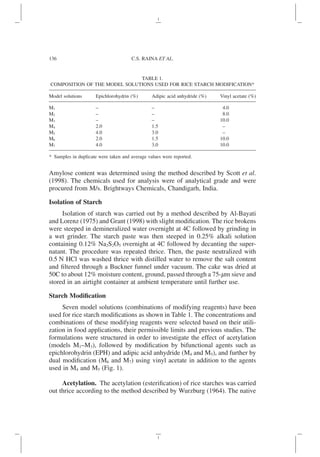
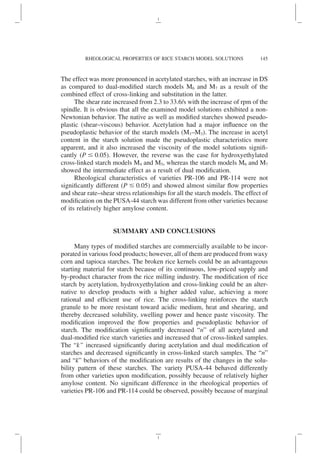
used in M4 and M5 (Fig. 1).
Acetylation. The acetylation (esterification) of rice starches was carried
out thrice according to the method described by Wurzburg (1964). The native
TABLE 1.
COMPOSITION OF THE MODEL SOLUTIONS USED FOR RICE STARCH MODIFICATION*
Model solutions Epichlorohydrin (%) Adipic acid anhydride (%) Vinyl acetate (%)
M1 – – 4.0
M2 – – 8.0
M3 – – 10.0
M4 2.0 1.5 –
M5 4.0 3.0 –
M6 2.0 1.5 10.0
M7 4.0 3.0 10.0
* Samples in duplicate were taken and average values were reported.
136 C.S. RAINA ET AL.
starches (162 g, dry basis [db]) were placed in a 500-mL beaker and then
220 mL distilled water was added at 25C to obtain a 42.4% w/w (db) starch
suspension. The mixture was stirred using a magnetic stirrer until homoge-
neous slurry was obtained. The pH was adjusted to 8.0 by adding dropwise
3% aqueous sodium hydroxide solution. Then, the required amount of vinyl
acetate (4, 8 and 10%, on dry starch basis [dsb]) was added dropwise, while
simultaneously, 3% sodium hydroxide was also added to maintain the pH at
8.0–8.4 with continuous stirring. When the addition of vinyl acetate was
completed, the pH was adjusted to 4.5 with 0.5 N HCl to terminate the
reaction. The slurry was filtered under vacuum through a Buckner funnel. The
filtered cake was washed with 5 vol of distilled water. The resultant cake was
dried at 45C for about 8 h to bring moisture content to less than 12%. The
acetylated starch was ground, passed through a 75-mm sieve and stored in an
airtight container for further use.
Hydroxyethylation Cross-linking. The modification of starch was
carried out using the method of Wurzburg (1964) and Suwanliwong (1998) by
first reacting starch with EPH followed by adipic acid anhydride and vinyl
a
b
c
FIG. 1. SUGGESTED POSSIBLE STRUCTURE OF (a) ACETYLATED STARCH; (b)
HYDROXYETHYLATED STARCH; AND (c) ACETYLATED DISTARCH ADIPATE
137
RHEOLOGICAL PROPERTIES OF RICE STARCH MODEL SOLUTIONS
acetate. The etherification reaction was done at 40 ± 2C for 24 h using EPH in
a 40% w/w (db) starch slurry at pH 10.5 containing 15% sodium sulfate (db)
(to restrict starch swelling during modification) and 5% sodium hydroxide (to
maintain pH). Following etherification, the modified starch was cross-linked
for 2 h using adipic acid anhydride and vinyl acetate.
Sodium sulfate (30 g, 15% dsb) was added into water (300 mL) and
stirred. When the salt was dissolved, rice starch (200 g dsb, equivalent to 40%
starch solids in slurry) was added and the mixture was stirred to make a
uniform slurry. Then, 5% sodium hydroxide solution was added to slurry with
vigorous stirring to maintain the pH at 10.5. The EPH was added and the slurry
was stirred for 30 min at room temperature using a magnetic shaker. The slurry
was then transferred to glass bottles, contained in a shaking incubator at a
temperature of 40 ± 2C with shaking rate at 200 rpm and held for 24 h. The pH
(8.0–8.5) of the slurry was noted and maintained, and then cross-linking
reagent was added with vigorous shaking for 30 min. After that, the slurry was
again transferred to glass bottles and the reaction was allowed to proceed for
120 min at 40 ± 2C in an incubator shaker at 200 rpm. The starch slurry was
then adjusted to pH 5.5 with 10% HCl to terminate the reaction. The starch
was recovered under vacuum through the Buckner funnel. The filtered cake
was washed with 5 vol of distilled water. The resultant cake was dried at 45C
for about 8 h to bring moisture content to less than 12%. The modified starch
was ground, passed through a 75-mm sieve and stored in airtight containers for
further use.
Acetyl Content
The AG (%, db) and degree of substitution (DS) of rice starch were
determined according to Smith (1967). A 5-g sample of starch was weighed,
transferred to a 250-mL conical flask and dispersed in 50 mL of distilled water.
A few drops of phenolphthalein indicator were added and titrated with sodium
hydroxide 0.1 N to a permanent pink color. Then, 25.0 mL of 0.45 N NaOH
was added to it and was shaken vigorously for half an hour. The stopper and
neck of the flask was flushed with a little distilled water, and then the excess
alkali was titrated with 0.2 N HCl to the disappearance of the pink color.
Twenty-five milliliters of 0.45 N NaOH was titrated as a blank. AG and DS
were calculated as follows:
Acetyl group %
( ) =
−
( ) × ×
[ ]×
b s N
W
0 043 100
.
where b is the volume of 0.2 N HCl used to titrate the blank (mL); s is the
volume of 0.2 N HCl used to titrate the sample (mL); N is the normality of
0.2 N HCl; and W is the mass of the sample (g, db).
138 C.S. RAINA ET AL.
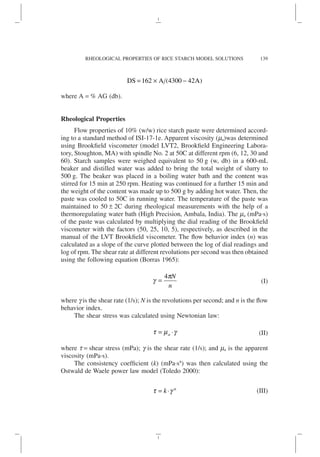
DS A A
= × −
( )
162 4300 42
where A = % AG (db).
Rheological Properties
Flow properties of 10% (w/w) rice starch paste were determined accord-
ing to a standard method of ISI-17-1e. Apparent viscosity (ma)was determined
using Brookfield viscometer (model LVT2, Brookfield Engineering Labora-
tory, Stoughton, MA) with spindle No. 2 at 50C at different rpm (6, 12, 30 and
60). Starch samples were weighed equivalent to 50 g (w, db) in a 600-mL
beaker and distilled water was added to bring the total weight of slurry to
500 g. The beaker was placed in a boiling water bath and the content was
stirred for 15 min at 250 rpm. Heating was continued for a further 15 min and
the weight of the content was made up to 500 g by adding hot water. Then, the
paste was cooled to 50C in running water. The temperature of the paste was
maintained to 50 ± 2C during rheological measurements with the help of a
thermoregulating water bath (High Precision, Ambala, India). The ma (mPa·s)
of the paste was calculated by multiplying the dial reading of the Brookfield
viscometer with the factors (50, 25, 10, 5), respectively, as described in the
manual of the LVT Brookfield viscometer. The flow behavior index (n) was
calculated as a slope of the curve plotted between the log of dial readings and
log of rpm. The shear rate at different revolutions per second was then obtained
using the following equation (Borras 1965):
g
p
=
4 N
n
(I)
where g is the shear rate (1/s); N is the revolutions per second; and n is the flow
behavior index.
The shear stress was calculated using Newtonian law:
t m g
= ⋅
a (II)
where t = shear stress (mPa); g is the shear rate (1/s); and ma is the apparent
viscosity (mPa·s).
The consistency coefficient (k) (mPa·sn
) was then calculated using the
Ostwald de Waele power law model (Toledo 2000):
t g
= ⋅
k n
(III)
139
RHEOLOGICAL PROPERTIES OF RICE STARCH MODEL SOLUTIONS
Statistical Analyses
Microsoft Excel spreadsheet of Windows XP was used for data analysis.
Analysis of variance was performed to examine the effect of modification on
various physicochemical and rheological properties of rice starches. Samples
in duplicate were used and the data were analyzed at the significance level of
P ⱕ 0.05.
RESULTS AND DISCUSSION
Analysis of Rice Flours and Rice Starches
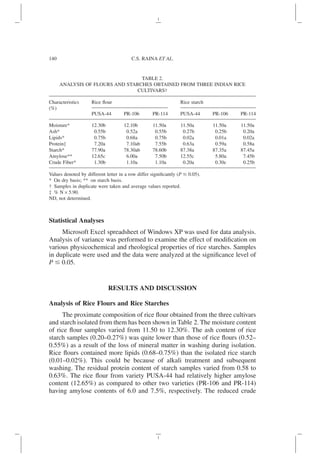
The proximate composition of rice flour obtained from the three cultivars
and starch isolated from them has been shown in Table 2. The moisture content
of rice flour samples varied from 11.50 to 12.30%. The ash content of rice
starch samples (0.20–0.27%) was quite lower than those of rice flours (0.52–
0.55%) as a result of the loss of mineral matter in washing during isolation.
Rice flours contained more lipids (0.68–0.75%) than the isolated rice starch
(0.01–0.02%). This could be because of alkali treatment and subsequent
washing. The residual protein content of starch samples varied from 0.58 to
0.63%. The rice flour from variety PUSA-44 had relatively higher amylose
content (12.65%) as compared to other two varieties (PR-106 and PR-114)
having amylose contents of 6.0 and 7.5%, respectively. The reduced crude
TABLE 2.
ANALYSIS OF FLOURS AND STARCHES OBTAINED FROM THREE INDIAN RICE
CULTIVARS†
Characteristics
(%)
Rice flour Rice starch
PUSA-44 PR-106 PR-114 PUSA-44 PR-106 PR-114
Moisture* 12.30b 12.10b 11.50a 11.50a 11.50a 11.50a
Ash* 0.55b 0.52a 0.55b 0.27b 0.25b 0.20a
Lipids* 0.75b 0.68a 0.75b 0.02a 0.01a 0.02a
Protein‡ 7.20a 7.10ab 7.55b 0.63a 0.59a 0.58a
Starch* 77.90a 78.30ab 78.60b 87.38a 87.35a 87.45a
Amylose** 12.65c 6.00a 7.50b 12.55c 5.80a 7.45b
Crude Fiber* 1.30b 1.10a 1.10a 0.20a 0.30c 0.25b
Values denoted by different letter in a row differ significantly (P ⱕ 0.05).
* On dry basis; ** on starch basis.
† Samples in duplicate were taken and average values reported.
‡ % N ¥ 5.90.
ND, not determined.
140 C.S. RAINA ET AL.
fiber content (0.2–0.3%) in isolated starches of three varieties from that of their
parent flour (1.1–1.3%) is because of the alkali treatment and subsequent
washings.
Acetyl Contents and DS
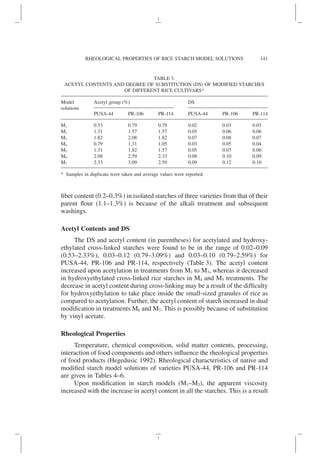
The DS and acetyl content (in parentheses) for acetylated and hydroxy-
ethylated cross-linked starches were found to be in the range of 0.02–0.09
(0.53–2.33%), 0.03–0.12 (0.79–3.09%) and 0.03–0.10 (0.79–2.59%) for
PUSA-44, PR-106 and PR-114, respectively (Table 3). The acetyl content
increased upon acetylation in treatments from M1 to M3, whereas it decreased
in hydroxyethylated cross-linked rice starches in M4 and M5 treatments. The
decrease in acetyl content during cross-linking may be a result of the difficulty
for hydroxyethylation to take place inside the small-sized granules of rice as
compared to acetylation. Further, the acetyl content of starch increased in dual
modification in treatments M6 and M7. This is possibly because of substitution
by vinyl acetate.
Rheological Properties
Temperature, chemical composition, solid matter contents, processing,
interaction of food components and others influence the rheological properties
of food products (Hegedusic 1992). Rheological characteristics of native and
modified starch model solutions of varieties PUSA-44, PR-106 and PR-114
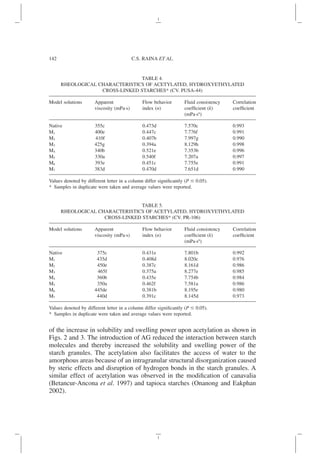
are given in Tables 4–6.
Upon modification in starch models (M1–M3), the apparent viscosity
increased with the increase in acetyl content in all the starches. This is a result
TABLE 3.
ACETYL CONTENTS AND DEGREE OF SUBSTITUTION (DS) OF MODIFIED STARCHES
OF DIFFERENT RICE CULTIVARS*
Model
solutions
Acetyl group (%) DS
PUSA-44 PR-106 PR-114 PUSA-44 PR-106 PR-114
M1 0.53 0.79 0.79 0.02 0.03 0.03
M2 1.31 1.57 1.57 0.05 0.06 0.06
M3 1.82 2.08 1.82 0.07 0.08 0.07
M4 0.79 1.31 1.05 0.03 0.05 0.04
M5 1.31 1.82 1.57 0.05 0.07 0.06
M6 2.08 2.59 2.33 0.08 0.10 0.09
M7 2.33 3.09 2.59 0.09 0.12 0.10
* Samples in duplicate were taken and average values were reported.
141
RHEOLOGICAL PROPERTIES OF RICE STARCH MODEL SOLUTIONS
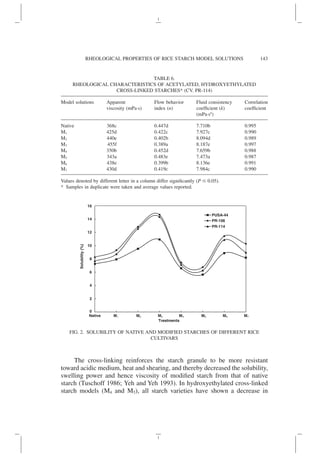
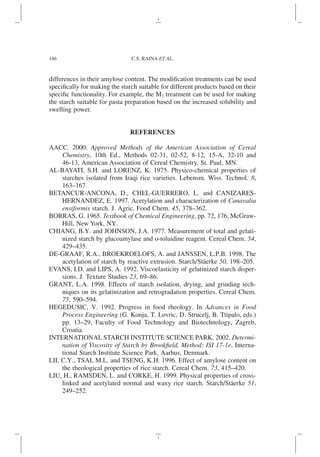
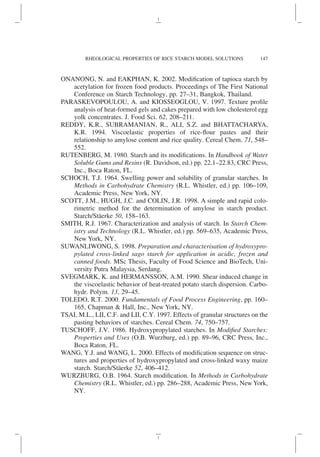
of the increase in solubility and swelling power upon acetylation as shown in
Figs. 2 and 3. The introduction of AG reduced the interaction between starch
molecules and thereby increased the solubility and swelling power of the
starch granules. The acetylation also facilitates the access of water to the
amorphous areas because of an intragranular structural disorganization caused
by steric effects and disruption of hydrogen bonds in the starch granules. A
similar effect of acetylation was observed in the modification of canavalia
(Betancur-Ancona et al. 1997) and tapioca starches (Onanong and Eakphan
2002).
TABLE 4.
RHEOLOGICAL CHARACTERISTICS OF ACETYLATED, HYDROXYETHYLATED
CROSS-LINKED STARCHES* (CV. PUSA-44)
Model solutions Apparent
viscosity (mPa·s)
Flow behavior
index (n)
Fluid consistency
coefficient (k)
(mPa·sn
)
Correlation
coefficient
Native 355c 0.473d 7.570c 0.993
M1 400e 0.447c 7.776f 0.991
M2 410f 0.407b 7.997g 0.990
M3 425g 0.394a 8.129h 0.998
M4 340b 0.521e 7.353b 0.996
M5 330a 0.540f 7.207a 0.997
M6 393e 0.451c 7.755e 0.991
M7 383d 0.470d 7.651d 0.990
Values denoted by different letter in a column differ significantly (P ⱕ 0.05).
* Samples in duplicate were taken and average values were reported.
TABLE 5.
RHEOLOGICAL CHARACTERISTICS OF ACETYLATED, HYDROXYETHYLATED
CROSS-LINKED STARCHES* (CV. PR-106)
Model solutions Apparent
viscosity (mPa·s)
Flow behavior
index (n)
Fluid consistency
coefficient (k)
(mPa·sn
)
Correlation
coefficient
Native 375c 0.431e 7.801b 0.992
M1 435d 0.408d 8.020c 0.976
M2 450e 0.387c 8.161d 0.986
M3 465f 0.375a 8.277e 0.985
M4 360b 0.435e 7.754b 0.984
M5 350a 0.462f 7.581a 0.986
M6 445de 0.381b 8.195e 0.980
M7 440d 0.391c 8.145d 0.973
Values denoted by different letter in a column differ significantly (P ⱕ 0.05).
* Samples in duplicate were taken and average values were reported.
142 C.S. RAINA ET AL.
The cross-linking reinforces the starch granule to be more resistant
toward acidic medium, heat and shearing, and thereby decreased the solubility,
swelling power and hence viscosity of modified starch from that of native
starch (Tuschoff 1986; Yeh and Yeh 1993). In hydroxyethylated cross-linked
starch models (M4 and M5), all starch varieties have shown a decrease in
TABLE 6.
RHEOLOGICAL CHARACTERISTICS OF ACETYLATED, HYDROXYETHYLATED
CROSS-LINKED STARCHES* (CV. PR-114)
Model solutions Apparent
viscosity (mPa·s)
Flow behavior
index (n)
Fluid consistency
coefficient (k)
(mPa·sn
)
Correlation
coefficient
Native 368c 0.447d 7.710b 0.995
M1 425d 0.422c 7.927c 0.990
M2 440e 0.402b 8.094d 0.989
M3 455f 0.389a 8.187e 0.997
M4 350b 0.452d 7.659b 0.988
M5 343a 0.483e 7.473a 0.987
M6 438e 0.399b 8.136e 0.991
M7 430d 0.419c 7.984c 0.990
Values denoted by different letter in a column differ significantly (P ⱕ 0.05).
* Samples in duplicate were taken and average values reported.
0
2
4
6
8
10
12
14
16
Native
Treatments
Solubility
(%)
PUSA-44
PR-106
PR-114
M1 M2 M3 M4 M5 M6 M7
FIG. 2. SOLUBILITY OF NATIVE AND MODIFIED STARCHES OF DIFFERENT RICE
CULTIVARS
143
RHEOLOGICAL PROPERTIES OF RICE STARCH MODEL SOLUTIONS
viscosity from that of native starch, and the decrease was more with an
increase in cross-linking. This may be because of the decrease in solubility of
starch as a result of cross-linking. However, in dual-modified starches M6
and M7, because of the substitution of vinyl acetate the starch solubility and
swelling power increased, causing the viscosity to increase from that of native
starch, but the increase was restricted because of the cross-linking effect.
Among the varieties, the native starch of PUSA-44 having relatively
higher amylose content showed the lowest solubility, swelling power and
hence paste viscosity as compared to the other two varieties. Yang et al. (1988)
also reported that the solubility and viscosity decreased as the amylose content
of the variety increased. However, there was no significant difference in the
rheological properties in varieties PR-106 and PR-114.
Rheological properties of examined model solutions were adequately
described by the Ostwald de Waele power law model. A decrease in the value
of “n” upon an increase in acetyl contents was observed from M1 to M3 starch
models as compared to its native starches upon acetylation. This may be
because of the bulky nature of the AG that increased the hydration power upon
acetylation, which results in an increased solubility and apparent viscosity.
Increase in flow behavior in starch models M4 and M5 was a result of the
cross-linking effect. This could be because of the decrease in hydration and
solubility in cross-linked starch solutions, which was reverted in dual-modified
starch models M6 and M7 as a result of the interaction of AG.
Acetylation and dual modification resulted in a shear stable gel as
observed in the flow behavior and fluid consistency pattern of these starches.
0
5
10
15
20
25
30
Native M1 M2 M3 M4 M5 M6 M7
Treatments
Swelling
power
(%)
PUSA-44
PR-106
PR-114
FIG. 3. SWELLING POWER OF NATIVE AND MODIFIED STARCHES OF DIFFERENT
RICE CULTIVARS
144 C.S. RAINA ET AL.
The effect was more pronounced in acetylated starches, with an increase in DS
as compared to dual-modified starch models M6 and M7 as a result of the
combined effect of cross-linking and substitution in the latter.
The shear rate increased from 2.3 to 33.6/s with the increase of rpm of the
spindle. It is obvious that all the examined model solutions exhibited a non-
Newtonian behavior. The native as well as modified starches showed pseudo-
plastic (shear–viscous) behavior. Acetylation had a major influence on the
pseudoplastic behavior of the starch models (M1–M3). The increase in acetyl
content in the starch solution made the pseudoplastic characteristics more
apparent, and it also increased the viscosity of the model solutions signifi-
cantly (P ⱕ 0.05). However, the reverse was the case for hydroxyethylated
cross-linked starch models M4 and M5, whereas the starch models M6 and M7
showed the intermediate effect as a result of dual modification.
Rheological characteristics of varieties PR-106 and PR-114 were not
significantly different (P ⱕ 0.05) and showed almost similar flow properties
and shear rate–shear stress relationships for all the starch models. The effect of
modification on the PUSA-44 starch was different from other varieties because
of its relatively higher amylose content.
SUMMARY AND CONCLUSIONS
Many types of modified starches are commercially available to be incor-
porated in various food products; however, all of them are produced from waxy
corn and tapioca starches. The broken rice kernels could be an advantageous
starting material for starch because of its continuous, low-priced supply and
by-product character from the rice milling industry. The modification of rice
starch by acetylation, hydroxyethylation and cross-linking could be an alter-
native to develop products with a higher added value, achieving a more
rational and efficient use of rice. The cross-linking reinforces the starch
granule to be more resistant toward acidic medium, heat and shearing, and
thereby decreased solubility, swelling power and hence paste viscosity. The
modification improved the flow properties and pseudoplastic behavior of
starch. The modification significantly decreased “n” of all acetylated and
dual-modified rice starch varieties and increased that of cross-linked samples.
The “k” increased significantly during acetylation and dual modification of
starches and decreased significantly in cross-linked starch samples. The “n”
and “k” behaviors of the modification are results of the changes in the solu-
bility pattern of these starches. The variety PUSA-44 behaved differently
from other varieties upon modification, possibly because of relatively higher
amylose content. No significant difference in the rheological properties of
varieties PR-106 and PR-114 could be observed, possibly because of marginal
145
RHEOLOGICAL PROPERTIES OF RICE STARCH MODEL SOLUTIONS
differences in their amylose content. The modification treatments can be used
specifically for making the starch suitable for different products based on their
specific functionality. For example, the M3 treatment can be used for making
the starch suitable for pasta preparation based on the increased solubility and
swelling power.
REFERENCES
AACC. 2000. Approved Methods of the American Association of Cereal
Chemistry, 10th Ed., Methods 02-31, 02-52, 8-12, 15-A, 32-10 and
46-13, American Association of Cereal Chemistry, St. Paul, MN.
AL-BAYATI, S.H. and LORENZ, K. 1975. Physico-chemical properties of
starches isolated from Iraqi rice varieties. Lebensm. Wiss. Technol. 8,
163–167.
BETANCUR-ANCONA, D., CHEL-GUERRERO, L. and CANIZARES-
HERNANDEZ, E. 1997. Acetylation and characterization of Canavalia
ensiformis starch. J. Agric. Food Chem. 45, 378–362.
BORRAS, G. 1965. Textbook of Chemical Engineering, pp. 72, 176, McGraw-
Hill, New York, NY.
CHIANG, B.Y. and JOHNSON, J.A. 1977. Measurement of total and gelati-
nized starch by glucoamylase and o-toluidine reagent. Cereal Chem. 54,
429–435.
DE-GRAAF, R.A., BROEKROELOFS, A. and JANSSEN, L.P.B. 1998. The
acetylation of starch by reactive extrusion. Starch/Stäerke 50, 198–205.
EVANS, I.D. and LIPS, A. 1992. Viscoelasticity of gelatinized starch disper-
sions. J. Texture Studies 23, 69–86.
GRANT, L.A. 1998. Effects of starch isolation, drying, and grinding tech-
niques on its gelatinization and retrogradation properties. Cereal Chem.
75, 590–594.
HEGEDUSIC, V. 1992. Progress in food rheology. In Advances in Food
Process Engineering (G. Konja, T. Lovric, D. Strucelj, B. Ttipalo, eds.)
pp. 13–29, Faculty of Food Technology and Biotechnology, Zagreb,
Croatia.
INTERNATIONAL STARCH INSTITUTE SCIENCE PARK. 2002. Determi-
nation of Viscosity of Starch by Brookfield, Method: ISI 17-1e, Interna-
tional Starch Institute Science Park, Aarhus, Denmark.
LII, C.Y., TSAI, M.L. and TSENG, K.H. 1996. Effect of amylose content on
the rheological properties of rice starch. Cereal Chem. 73, 415–420.
LIU, H., RAMSDEN, L. and CORKE, H. 1999. Physical properties of cross-
linked and acetylated normal and waxy rice starch. Starch/Stäerke 51,
249–252.
146 C.S. RAINA ET AL.
ONANONG, N. and EAKPHAN, K. 2002. Modification of tapioca starch by
acetylation for frozen food products. Proceedings of The First National
Conference on Starch Technology, pp. 27–31, Bangkok, Thailand.
PARASKEVOPOULOU, A. and KIOSSEOGLOU, V. 1997. Texture profile
analysis of heat-formed gels and cakes prepared with low cholesterol egg
yolk concentrates. J. Food Sci. 62, 208–211.
REDDY, K.R., SUBRAMANIAN, R., ALI, S.Z. and BHATTACHARYA,
K.R. 1994. Viscoelastic properties of rice-flour pastes and their
relationship to amylose content and rice quality. Cereal Chem. 71, 548–
552.
RUTENBERG, M. 1980. Starch and its modifications. In Handbook of Water
Soluble Gums and Resins (R. Davidson, ed.) pp. 22.1–22.83, CRC Press,
Inc., Boca Raton, FL.
SCHOCH, T.J. 1964. Swelling power and solubility of granular starches. In
Methods in Carbohydrate Chemistry (R.L. Whistler, ed.) pp. 106–109,
Academic Press, New York, NY.
SCOTT, J.M., HUGH, J.C. and COLIN, J.R. 1998. A simple and rapid colo-
rimetric method for the determination of amylose in starch product.
Starch/Stäerke 50, 158–163.
SMITH, R.J. 1967. Characterization and analysis of starch. In Starch Chem-
istry and Technology (R.L. Whistler, ed.) pp. 569–635, Academic Press,
New York, NY.
SUWANLIWONG, S. 1998. Preparation and characterisation of hydroxypro-
pylated cross-linked sago starch for application in acidic, frozen and
canned foods. MSc Thesis, Faculty of Food Science and BioTech, Uni-
versity Putra Malaysia, Serdang.
SVEGMARK, K. and HERMANSSON, A.M. 1990. Shear induced change in
the viscoelastic behavior of heat-treated potato starch dispersion. Carbo-
hydr. Polym. 13, 29–45.
TOLEDO, R.T. 2000. Fundamentals of Food Process Engineering, pp. 160–
165, Chapman & Hall, Inc., New York, NY.
TSAI, M.L., LII, C.F. and LII, C.Y. 1997. Effects of granular structures on the
pasting behaviors of starches. Cereal Chem. 74, 750–757.
TUSCHOFF, J.V. 1986. Hydroxypropylated starches. In Modified Starches:
Properties and Uses (O.B. Wurzburg, ed.) pp. 89–96, CRC Press, Inc.,
Boca Raton, FL.
WANG, Y.J. and WANG, L. 2000. Effects of modification sequence on struc-
tures and properties of hydroxypropylated and cross-linked waxy maize
starch. Starch/Stäerke 52, 406–412.
WURZBURG, O.B. 1964. Starch modification. In Methods in Carbohydrate
Chemistry (R.L. Whistler, ed.) pp. 286–288, Academic Press, New York,
NY.
147
RHEOLOGICAL PROPERTIES OF RICE STARCH MODEL SOLUTIONS
YANG, C., LAI, H.M. and LII, C.Y. 1988. The pasting behaviour of some rice
starches and flour in different media. Food Sci. Chinas 13(3/4), 212–221.
YEH, A.I. and YEH, S.L. 1993. Some characteristics of hydroxypropylated
and crosslinked rice starch. Cereal Chem. 70, 596–601.
ZHANG, W. and JACKSON, D.S. 1992. Retrogradation behavior of wheat
starch gels with differing molecules profiles. J. Food Sci. 57, 1428–1432.
148 C.S. RAINA ET AL.

J.1745 4530.2006.00053.x

  • 1.
    RHEOLOGICAL PROPERTIES OFCHEMICALLY MODIFIED RICE STARCH MODEL SOLUTIONS C.S. RAINA1,3 , S. SINGH1 , A.S. BAWA2 and D.C. SAXENA1 1 Department of Food Technology Sant Longowal Institute of Engineering and Technology Longowal, Sangrur, Punjab-148 106, India 2 Defence Food Research Laboratory Kamataka, Mysore, India Accepted for Publication October 24, 2005 ABSTRACT Native rice starches have poor resistance to shear, and fair stability to retrogradation with soft texture, which can be altered through chemical modi- fications. Starch from broken pieces of rice of three rice cultivars (PUSA-44, PR-106 and PR-114) was chemically modified by etherification and esterifi- cation reactions by different combinations of modification reagents to inves- tigate the effect of modification on the rheological properties of rice starches. The modification resulted in shear stable gel with apparent pseudoplastic characteristics. The viscosity of starches increased upon acetylation and dual modification as a result of increase in solubility. However, cross-linking had shown the reverse effect. The flow behavior index (n) and consistency coeffi- cient (k) were significantly (P ⱕ 0.05) improved upon modification in acety- lated and dual-modified starches. The effect of modification on the rheological properties was observed in similar pattern in all the three rice cultivars but varied significantly in variety PUSA-44 may be because of its relatively higher amylose content. INTRODUCTION In industrial processes, slurry suspensions frequently require rheological characterization for flow equipment design and new formulations. Fully cooked and molecularly dispersed starches are used to provide viscosity and thickening and to impart texture. Native rice starches have poor resistance to shear and fair stability to retrogradation with soft texture (Zhang and Jackson 3 Corresponding author. TEL: 91-1672-284977; FAX: 91-1672-280057; EMAIL: craina71@ yahoo.co.in Journal of Food Process Engineering 29 (2006) 134–148. All Rights Reserved. © 2006, The Author(s) Journal compilation © 2006, Blackwell Publishing 134
  • 2.
    1992). The performanceand properties of starch solution can be altered through chemical modifications by adding nonionic or charged substituents to the polysaccharides backbone, such as cross-linking and hydrophobic substi- tution (Wurzburg 1964; Rutenberg 1980; Liu et al. 1999). Acetylation of starches is an important substitution method to impart the thickening needed in food application. Introduction of the acetyl group (AG) has improved proper- ties over its native form and has been used for its stability and resistance to retrogradation and shear. Acetylation of starches decreases gelatinization tem- perature, increases solubility, good cooking and storage stability, and increases viscosity (De-Graaf et al. 1998; Wang and Wang 2000). Lii et al. (1996) concluded that the major influencing factor on the rheological properties was the amount of amylose leached out in the process. Many researchers have used rheological methods to study gelatinization for suspension of a variety of starches (Svegmark and Hermansson 1990; Tsai et al. 1997), as well as to determine viscoelastic properties of starch pastes (Evans and Lips 1992; Reddy et al. 1994). Heat-induced viscoelasticity may affect the contribution of starch to texture in food systems and is of considerable importance to the acceptability of foods that contain starch (Paraskevopoulou and Kiosseoglou 1997). Modification of starch and the amount of amylose in starch has a pro- found effect on the viscosity and structural rearrangements of starch. Studies on the flow properties of modified rice starches are scanty and therefore, the present study has been undertaken to evaluate the effect of modifications on rheological characteristics of starch isolated from Indian rice cultivars. More- over, the starting raw material in this study, which is the starch obtained from rice brokens, a cheaper raw material, is also adventurous. MATERIALS AND METHODS Three cultivars of paddy (Oryzae sativa) viz., PR-114, PR-106 and PUSA-44 were procured from the Agricultural Research Center (PAU, Ludhiana, Punjab, India) and milled in the lab model Sheller and Polisher (Indosaw Industries Private Ltd, Ambala, India). The broken pieces of rice were separated, cleaned and stored at ambient temperature in a closed con- tainer for further use. The broken pieces were milled in a disk mill (Indosaw Industries Private Ltd) and passed through a 75-mm sieve and the throughs were used as flour. Analyses of rice flour were carried out for moisture, crude protein (%N ¥ 5.90), crude fiber and ash content as per official methods 15-A, 8-12, 46-13 and 32-10 of AACC (2000). Crude fat, solubility and swelling power (%) were determined using the method of Schoch (1964). Starch content was determined using the method of Chiang and Johnson (1977). 135 RHEOLOGICAL PROPERTIES OF RICE STARCH MODEL SOLUTIONS
  • 3.
    Amylose content wasdetermined using the method described by Scott et al. (1998). The chemicals used for analysis were of analytical grade and were procured from M/s. Brightways Chemicals, Chandigarh, India. Isolation of Starch Isolation of starch was carried out by a method described by Al-Bayati and Lorenz (1975) and Grant (1998) with slight modification. The rice brokens were steeped in demineralized water overnight at 4C followed by grinding in a wet grinder. The starch paste was then steeped in 0.25% alkali solution containing 0.12% Na2S2O5 overnight at 4C followed by decanting the super- natant. The procedure was repeated thrice. Then, the paste neutralized with 0.5 N HCl was washed thrice with distilled water to remove the salt content and filtered through a Buckner funnel under vacuum. The cake was dried at 50C to about 12% moisture content, ground, passed through a 75-mm sieve and stored in an airtight container at ambient temperature until further use. Starch Modification Seven model solutions (combinations of modifying reagents) have been used for rice starch modifications as shown in Table 1. The concentrations and combinations of these modifying reagents were selected based on their utili- zation in food applications, their permissible limits and previous studies. The formulations were structured in order to investigate the effect of acetylation (models M1–M3), followed by modification by bifunctional agents such as epichlorohydrin (EPH) and adipic acid anhydride (M4 and M5), and further by dual modification (M6 and M7) using vinyl acetate in addition to the agents used in M4 and M5 (Fig. 1). Acetylation. The acetylation (esterification) of rice starches was carried out thrice according to the method described by Wurzburg (1964). The native TABLE 1. COMPOSITION OF THE MODEL SOLUTIONS USED FOR RICE STARCH MODIFICATION* Model solutions Epichlorohydrin (%) Adipic acid anhydride (%) Vinyl acetate (%) M1 – – 4.0 M2 – – 8.0 M3 – – 10.0 M4 2.0 1.5 – M5 4.0 3.0 – M6 2.0 1.5 10.0 M7 4.0 3.0 10.0 * Samples in duplicate were taken and average values were reported. 136 C.S. RAINA ET AL.
  • 4.
    starches (162 g,dry basis [db]) were placed in a 500-mL beaker and then 220 mL distilled water was added at 25C to obtain a 42.4% w/w (db) starch suspension. The mixture was stirred using a magnetic stirrer until homoge- neous slurry was obtained. The pH was adjusted to 8.0 by adding dropwise 3% aqueous sodium hydroxide solution. Then, the required amount of vinyl acetate (4, 8 and 10%, on dry starch basis [dsb]) was added dropwise, while simultaneously, 3% sodium hydroxide was also added to maintain the pH at 8.0–8.4 with continuous stirring. When the addition of vinyl acetate was completed, the pH was adjusted to 4.5 with 0.5 N HCl to terminate the reaction. The slurry was filtered under vacuum through a Buckner funnel. The filtered cake was washed with 5 vol of distilled water. The resultant cake was dried at 45C for about 8 h to bring moisture content to less than 12%. The acetylated starch was ground, passed through a 75-mm sieve and stored in an airtight container for further use. Hydroxyethylation Cross-linking. The modification of starch was carried out using the method of Wurzburg (1964) and Suwanliwong (1998) by first reacting starch with EPH followed by adipic acid anhydride and vinyl a b c FIG. 1. SUGGESTED POSSIBLE STRUCTURE OF (a) ACETYLATED STARCH; (b) HYDROXYETHYLATED STARCH; AND (c) ACETYLATED DISTARCH ADIPATE 137 RHEOLOGICAL PROPERTIES OF RICE STARCH MODEL SOLUTIONS
  • 5.
    acetate. The etherificationreaction was done at 40 ± 2C for 24 h using EPH in a 40% w/w (db) starch slurry at pH 10.5 containing 15% sodium sulfate (db) (to restrict starch swelling during modification) and 5% sodium hydroxide (to maintain pH). Following etherification, the modified starch was cross-linked for 2 h using adipic acid anhydride and vinyl acetate. Sodium sulfate (30 g, 15% dsb) was added into water (300 mL) and stirred. When the salt was dissolved, rice starch (200 g dsb, equivalent to 40% starch solids in slurry) was added and the mixture was stirred to make a uniform slurry. Then, 5% sodium hydroxide solution was added to slurry with vigorous stirring to maintain the pH at 10.5. The EPH was added and the slurry was stirred for 30 min at room temperature using a magnetic shaker. The slurry was then transferred to glass bottles, contained in a shaking incubator at a temperature of 40 ± 2C with shaking rate at 200 rpm and held for 24 h. The pH (8.0–8.5) of the slurry was noted and maintained, and then cross-linking reagent was added with vigorous shaking for 30 min. After that, the slurry was again transferred to glass bottles and the reaction was allowed to proceed for 120 min at 40 ± 2C in an incubator shaker at 200 rpm. The starch slurry was then adjusted to pH 5.5 with 10% HCl to terminate the reaction. The starch was recovered under vacuum through the Buckner funnel. The filtered cake was washed with 5 vol of distilled water. The resultant cake was dried at 45C for about 8 h to bring moisture content to less than 12%. The modified starch was ground, passed through a 75-mm sieve and stored in airtight containers for further use. Acetyl Content The AG (%, db) and degree of substitution (DS) of rice starch were determined according to Smith (1967). A 5-g sample of starch was weighed, transferred to a 250-mL conical flask and dispersed in 50 mL of distilled water. A few drops of phenolphthalein indicator were added and titrated with sodium hydroxide 0.1 N to a permanent pink color. Then, 25.0 mL of 0.45 N NaOH was added to it and was shaken vigorously for half an hour. The stopper and neck of the flask was flushed with a little distilled water, and then the excess alkali was titrated with 0.2 N HCl to the disappearance of the pink color. Twenty-five milliliters of 0.45 N NaOH was titrated as a blank. AG and DS were calculated as follows: Acetyl group % ( ) = − ( ) × × [ ]× b s N W 0 043 100 . where b is the volume of 0.2 N HCl used to titrate the blank (mL); s is the volume of 0.2 N HCl used to titrate the sample (mL); N is the normality of 0.2 N HCl; and W is the mass of the sample (g, db). 138 C.S. RAINA ET AL.
  • 6.
    DS A A =× − ( ) 162 4300 42 where A = % AG (db). Rheological Properties Flow properties of 10% (w/w) rice starch paste were determined accord- ing to a standard method of ISI-17-1e. Apparent viscosity (ma)was determined using Brookfield viscometer (model LVT2, Brookfield Engineering Labora- tory, Stoughton, MA) with spindle No. 2 at 50C at different rpm (6, 12, 30 and 60). Starch samples were weighed equivalent to 50 g (w, db) in a 600-mL beaker and distilled water was added to bring the total weight of slurry to 500 g. The beaker was placed in a boiling water bath and the content was stirred for 15 min at 250 rpm. Heating was continued for a further 15 min and the weight of the content was made up to 500 g by adding hot water. Then, the paste was cooled to 50C in running water. The temperature of the paste was maintained to 50 ± 2C during rheological measurements with the help of a thermoregulating water bath (High Precision, Ambala, India). The ma (mPa·s) of the paste was calculated by multiplying the dial reading of the Brookfield viscometer with the factors (50, 25, 10, 5), respectively, as described in the manual of the LVT Brookfield viscometer. The flow behavior index (n) was calculated as a slope of the curve plotted between the log of dial readings and log of rpm. The shear rate at different revolutions per second was then obtained using the following equation (Borras 1965): g p = 4 N n (I) where g is the shear rate (1/s); N is the revolutions per second; and n is the flow behavior index. The shear stress was calculated using Newtonian law: t m g = ⋅ a (II) where t = shear stress (mPa); g is the shear rate (1/s); and ma is the apparent viscosity (mPa·s). The consistency coefficient (k) (mPa·sn ) was then calculated using the Ostwald de Waele power law model (Toledo 2000): t g = ⋅ k n (III) 139 RHEOLOGICAL PROPERTIES OF RICE STARCH MODEL SOLUTIONS
  • 7.
    Statistical Analyses Microsoft Excelspreadsheet of Windows XP was used for data analysis. Analysis of variance was performed to examine the effect of modification on various physicochemical and rheological properties of rice starches. Samples in duplicate were used and the data were analyzed at the significance level of P ⱕ 0.05. RESULTS AND DISCUSSION Analysis of Rice Flours and Rice Starches The proximate composition of rice flour obtained from the three cultivars and starch isolated from them has been shown in Table 2. The moisture content of rice flour samples varied from 11.50 to 12.30%. The ash content of rice starch samples (0.20–0.27%) was quite lower than those of rice flours (0.52– 0.55%) as a result of the loss of mineral matter in washing during isolation. Rice flours contained more lipids (0.68–0.75%) than the isolated rice starch (0.01–0.02%). This could be because of alkali treatment and subsequent washing. The residual protein content of starch samples varied from 0.58 to 0.63%. The rice flour from variety PUSA-44 had relatively higher amylose content (12.65%) as compared to other two varieties (PR-106 and PR-114) having amylose contents of 6.0 and 7.5%, respectively. The reduced crude TABLE 2. ANALYSIS OF FLOURS AND STARCHES OBTAINED FROM THREE INDIAN RICE CULTIVARS† Characteristics (%) Rice flour Rice starch PUSA-44 PR-106 PR-114 PUSA-44 PR-106 PR-114 Moisture* 12.30b 12.10b 11.50a 11.50a 11.50a 11.50a Ash* 0.55b 0.52a 0.55b 0.27b 0.25b 0.20a Lipids* 0.75b 0.68a 0.75b 0.02a 0.01a 0.02a Protein‡ 7.20a 7.10ab 7.55b 0.63a 0.59a 0.58a Starch* 77.90a 78.30ab 78.60b 87.38a 87.35a 87.45a Amylose** 12.65c 6.00a 7.50b 12.55c 5.80a 7.45b Crude Fiber* 1.30b 1.10a 1.10a 0.20a 0.30c 0.25b Values denoted by different letter in a row differ significantly (P ⱕ 0.05). * On dry basis; ** on starch basis. † Samples in duplicate were taken and average values reported. ‡ % N ¥ 5.90. ND, not determined. 140 C.S. RAINA ET AL.
  • 8.
    fiber content (0.2–0.3%)in isolated starches of three varieties from that of their parent flour (1.1–1.3%) is because of the alkali treatment and subsequent washings. Acetyl Contents and DS The DS and acetyl content (in parentheses) for acetylated and hydroxy- ethylated cross-linked starches were found to be in the range of 0.02–0.09 (0.53–2.33%), 0.03–0.12 (0.79–3.09%) and 0.03–0.10 (0.79–2.59%) for PUSA-44, PR-106 and PR-114, respectively (Table 3). The acetyl content increased upon acetylation in treatments from M1 to M3, whereas it decreased in hydroxyethylated cross-linked rice starches in M4 and M5 treatments. The decrease in acetyl content during cross-linking may be a result of the difficulty for hydroxyethylation to take place inside the small-sized granules of rice as compared to acetylation. Further, the acetyl content of starch increased in dual modification in treatments M6 and M7. This is possibly because of substitution by vinyl acetate. Rheological Properties Temperature, chemical composition, solid matter contents, processing, interaction of food components and others influence the rheological properties of food products (Hegedusic 1992). Rheological characteristics of native and modified starch model solutions of varieties PUSA-44, PR-106 and PR-114 are given in Tables 4–6. Upon modification in starch models (M1–M3), the apparent viscosity increased with the increase in acetyl content in all the starches. This is a result TABLE 3. ACETYL CONTENTS AND DEGREE OF SUBSTITUTION (DS) OF MODIFIED STARCHES OF DIFFERENT RICE CULTIVARS* Model solutions Acetyl group (%) DS PUSA-44 PR-106 PR-114 PUSA-44 PR-106 PR-114 M1 0.53 0.79 0.79 0.02 0.03 0.03 M2 1.31 1.57 1.57 0.05 0.06 0.06 M3 1.82 2.08 1.82 0.07 0.08 0.07 M4 0.79 1.31 1.05 0.03 0.05 0.04 M5 1.31 1.82 1.57 0.05 0.07 0.06 M6 2.08 2.59 2.33 0.08 0.10 0.09 M7 2.33 3.09 2.59 0.09 0.12 0.10 * Samples in duplicate were taken and average values were reported. 141 RHEOLOGICAL PROPERTIES OF RICE STARCH MODEL SOLUTIONS
  • 9.
    of the increasein solubility and swelling power upon acetylation as shown in Figs. 2 and 3. The introduction of AG reduced the interaction between starch molecules and thereby increased the solubility and swelling power of the starch granules. The acetylation also facilitates the access of water to the amorphous areas because of an intragranular structural disorganization caused by steric effects and disruption of hydrogen bonds in the starch granules. A similar effect of acetylation was observed in the modification of canavalia (Betancur-Ancona et al. 1997) and tapioca starches (Onanong and Eakphan 2002). TABLE 4. RHEOLOGICAL CHARACTERISTICS OF ACETYLATED, HYDROXYETHYLATED CROSS-LINKED STARCHES* (CV. PUSA-44) Model solutions Apparent viscosity (mPa·s) Flow behavior index (n) Fluid consistency coefficient (k) (mPa·sn ) Correlation coefficient Native 355c 0.473d 7.570c 0.993 M1 400e 0.447c 7.776f 0.991 M2 410f 0.407b 7.997g 0.990 M3 425g 0.394a 8.129h 0.998 M4 340b 0.521e 7.353b 0.996 M5 330a 0.540f 7.207a 0.997 M6 393e 0.451c 7.755e 0.991 M7 383d 0.470d 7.651d 0.990 Values denoted by different letter in a column differ significantly (P ⱕ 0.05). * Samples in duplicate were taken and average values were reported. TABLE 5. RHEOLOGICAL CHARACTERISTICS OF ACETYLATED, HYDROXYETHYLATED CROSS-LINKED STARCHES* (CV. PR-106) Model solutions Apparent viscosity (mPa·s) Flow behavior index (n) Fluid consistency coefficient (k) (mPa·sn ) Correlation coefficient Native 375c 0.431e 7.801b 0.992 M1 435d 0.408d 8.020c 0.976 M2 450e 0.387c 8.161d 0.986 M3 465f 0.375a 8.277e 0.985 M4 360b 0.435e 7.754b 0.984 M5 350a 0.462f 7.581a 0.986 M6 445de 0.381b 8.195e 0.980 M7 440d 0.391c 8.145d 0.973 Values denoted by different letter in a column differ significantly (P ⱕ 0.05). * Samples in duplicate were taken and average values were reported. 142 C.S. RAINA ET AL.
  • 10.
    The cross-linking reinforcesthe starch granule to be more resistant toward acidic medium, heat and shearing, and thereby decreased the solubility, swelling power and hence viscosity of modified starch from that of native starch (Tuschoff 1986; Yeh and Yeh 1993). In hydroxyethylated cross-linked starch models (M4 and M5), all starch varieties have shown a decrease in TABLE 6. RHEOLOGICAL CHARACTERISTICS OF ACETYLATED, HYDROXYETHYLATED CROSS-LINKED STARCHES* (CV. PR-114) Model solutions Apparent viscosity (mPa·s) Flow behavior index (n) Fluid consistency coefficient (k) (mPa·sn ) Correlation coefficient Native 368c 0.447d 7.710b 0.995 M1 425d 0.422c 7.927c 0.990 M2 440e 0.402b 8.094d 0.989 M3 455f 0.389a 8.187e 0.997 M4 350b 0.452d 7.659b 0.988 M5 343a 0.483e 7.473a 0.987 M6 438e 0.399b 8.136e 0.991 M7 430d 0.419c 7.984c 0.990 Values denoted by different letter in a column differ significantly (P ⱕ 0.05). * Samples in duplicate were taken and average values reported. 0 2 4 6 8 10 12 14 16 Native Treatments Solubility (%) PUSA-44 PR-106 PR-114 M1 M2 M3 M4 M5 M6 M7 FIG. 2. SOLUBILITY OF NATIVE AND MODIFIED STARCHES OF DIFFERENT RICE CULTIVARS 143 RHEOLOGICAL PROPERTIES OF RICE STARCH MODEL SOLUTIONS
  • 11.
    viscosity from thatof native starch, and the decrease was more with an increase in cross-linking. This may be because of the decrease in solubility of starch as a result of cross-linking. However, in dual-modified starches M6 and M7, because of the substitution of vinyl acetate the starch solubility and swelling power increased, causing the viscosity to increase from that of native starch, but the increase was restricted because of the cross-linking effect. Among the varieties, the native starch of PUSA-44 having relatively higher amylose content showed the lowest solubility, swelling power and hence paste viscosity as compared to the other two varieties. Yang et al. (1988) also reported that the solubility and viscosity decreased as the amylose content of the variety increased. However, there was no significant difference in the rheological properties in varieties PR-106 and PR-114. Rheological properties of examined model solutions were adequately described by the Ostwald de Waele power law model. A decrease in the value of “n” upon an increase in acetyl contents was observed from M1 to M3 starch models as compared to its native starches upon acetylation. This may be because of the bulky nature of the AG that increased the hydration power upon acetylation, which results in an increased solubility and apparent viscosity. Increase in flow behavior in starch models M4 and M5 was a result of the cross-linking effect. This could be because of the decrease in hydration and solubility in cross-linked starch solutions, which was reverted in dual-modified starch models M6 and M7 as a result of the interaction of AG. Acetylation and dual modification resulted in a shear stable gel as observed in the flow behavior and fluid consistency pattern of these starches. 0 5 10 15 20 25 30 Native M1 M2 M3 M4 M5 M6 M7 Treatments Swelling power (%) PUSA-44 PR-106 PR-114 FIG. 3. SWELLING POWER OF NATIVE AND MODIFIED STARCHES OF DIFFERENT RICE CULTIVARS 144 C.S. RAINA ET AL.
  • 12.
    The effect wasmore pronounced in acetylated starches, with an increase in DS as compared to dual-modified starch models M6 and M7 as a result of the combined effect of cross-linking and substitution in the latter. The shear rate increased from 2.3 to 33.6/s with the increase of rpm of the spindle. It is obvious that all the examined model solutions exhibited a non- Newtonian behavior. The native as well as modified starches showed pseudo- plastic (shear–viscous) behavior. Acetylation had a major influence on the pseudoplastic behavior of the starch models (M1–M3). The increase in acetyl content in the starch solution made the pseudoplastic characteristics more apparent, and it also increased the viscosity of the model solutions signifi- cantly (P ⱕ 0.05). However, the reverse was the case for hydroxyethylated cross-linked starch models M4 and M5, whereas the starch models M6 and M7 showed the intermediate effect as a result of dual modification. Rheological characteristics of varieties PR-106 and PR-114 were not significantly different (P ⱕ 0.05) and showed almost similar flow properties and shear rate–shear stress relationships for all the starch models. The effect of modification on the PUSA-44 starch was different from other varieties because of its relatively higher amylose content. SUMMARY AND CONCLUSIONS Many types of modified starches are commercially available to be incor- porated in various food products; however, all of them are produced from waxy corn and tapioca starches. The broken rice kernels could be an advantageous starting material for starch because of its continuous, low-priced supply and by-product character from the rice milling industry. The modification of rice starch by acetylation, hydroxyethylation and cross-linking could be an alter- native to develop products with a higher added value, achieving a more rational and efficient use of rice. The cross-linking reinforces the starch granule to be more resistant toward acidic medium, heat and shearing, and thereby decreased solubility, swelling power and hence paste viscosity. The modification improved the flow properties and pseudoplastic behavior of starch. The modification significantly decreased “n” of all acetylated and dual-modified rice starch varieties and increased that of cross-linked samples. The “k” increased significantly during acetylation and dual modification of starches and decreased significantly in cross-linked starch samples. The “n” and “k” behaviors of the modification are results of the changes in the solu- bility pattern of these starches. The variety PUSA-44 behaved differently from other varieties upon modification, possibly because of relatively higher amylose content. No significant difference in the rheological properties of varieties PR-106 and PR-114 could be observed, possibly because of marginal 145 RHEOLOGICAL PROPERTIES OF RICE STARCH MODEL SOLUTIONS
  • 13.
    differences in theiramylose content. The modification treatments can be used specifically for making the starch suitable for different products based on their specific functionality. For example, the M3 treatment can be used for making the starch suitable for pasta preparation based on the increased solubility and swelling power. REFERENCES AACC. 2000. Approved Methods of the American Association of Cereal Chemistry, 10th Ed., Methods 02-31, 02-52, 8-12, 15-A, 32-10 and 46-13, American Association of Cereal Chemistry, St. Paul, MN. AL-BAYATI, S.H. and LORENZ, K. 1975. Physico-chemical properties of starches isolated from Iraqi rice varieties. Lebensm. Wiss. Technol. 8, 163–167. BETANCUR-ANCONA, D., CHEL-GUERRERO, L. and CANIZARES- HERNANDEZ, E. 1997. Acetylation and characterization of Canavalia ensiformis starch. J. Agric. Food Chem. 45, 378–362. BORRAS, G. 1965. Textbook of Chemical Engineering, pp. 72, 176, McGraw- Hill, New York, NY. CHIANG, B.Y. and JOHNSON, J.A. 1977. Measurement of total and gelati- nized starch by glucoamylase and o-toluidine reagent. Cereal Chem. 54, 429–435. DE-GRAAF, R.A., BROEKROELOFS, A. and JANSSEN, L.P.B. 1998. The acetylation of starch by reactive extrusion. Starch/Stäerke 50, 198–205. EVANS, I.D. and LIPS, A. 1992. Viscoelasticity of gelatinized starch disper- sions. J. Texture Studies 23, 69–86. GRANT, L.A. 1998. Effects of starch isolation, drying, and grinding tech- niques on its gelatinization and retrogradation properties. Cereal Chem. 75, 590–594. HEGEDUSIC, V. 1992. Progress in food rheology. In Advances in Food Process Engineering (G. Konja, T. Lovric, D. Strucelj, B. Ttipalo, eds.) pp. 13–29, Faculty of Food Technology and Biotechnology, Zagreb, Croatia. INTERNATIONAL STARCH INSTITUTE SCIENCE PARK. 2002. Determi- nation of Viscosity of Starch by Brookfield, Method: ISI 17-1e, Interna- tional Starch Institute Science Park, Aarhus, Denmark. LII, C.Y., TSAI, M.L. and TSENG, K.H. 1996. Effect of amylose content on the rheological properties of rice starch. Cereal Chem. 73, 415–420. LIU, H., RAMSDEN, L. and CORKE, H. 1999. Physical properties of cross- linked and acetylated normal and waxy rice starch. Starch/Stäerke 51, 249–252. 146 C.S. RAINA ET AL.
  • 14.
    ONANONG, N. andEAKPHAN, K. 2002. Modification of tapioca starch by acetylation for frozen food products. Proceedings of The First National Conference on Starch Technology, pp. 27–31, Bangkok, Thailand. PARASKEVOPOULOU, A. and KIOSSEOGLOU, V. 1997. Texture profile analysis of heat-formed gels and cakes prepared with low cholesterol egg yolk concentrates. J. Food Sci. 62, 208–211. REDDY, K.R., SUBRAMANIAN, R., ALI, S.Z. and BHATTACHARYA, K.R. 1994. Viscoelastic properties of rice-flour pastes and their relationship to amylose content and rice quality. Cereal Chem. 71, 548– 552. RUTENBERG, M. 1980. Starch and its modifications. In Handbook of Water Soluble Gums and Resins (R. Davidson, ed.) pp. 22.1–22.83, CRC Press, Inc., Boca Raton, FL. SCHOCH, T.J. 1964. Swelling power and solubility of granular starches. In Methods in Carbohydrate Chemistry (R.L. Whistler, ed.) pp. 106–109, Academic Press, New York, NY. SCOTT, J.M., HUGH, J.C. and COLIN, J.R. 1998. A simple and rapid colo- rimetric method for the determination of amylose in starch product. Starch/Stäerke 50, 158–163. SMITH, R.J. 1967. Characterization and analysis of starch. In Starch Chem- istry and Technology (R.L. Whistler, ed.) pp. 569–635, Academic Press, New York, NY. SUWANLIWONG, S. 1998. Preparation and characterisation of hydroxypro- pylated cross-linked sago starch for application in acidic, frozen and canned foods. MSc Thesis, Faculty of Food Science and BioTech, Uni- versity Putra Malaysia, Serdang. SVEGMARK, K. and HERMANSSON, A.M. 1990. Shear induced change in the viscoelastic behavior of heat-treated potato starch dispersion. Carbo- hydr. Polym. 13, 29–45. TOLEDO, R.T. 2000. Fundamentals of Food Process Engineering, pp. 160– 165, Chapman & Hall, Inc., New York, NY. TSAI, M.L., LII, C.F. and LII, C.Y. 1997. Effects of granular structures on the pasting behaviors of starches. Cereal Chem. 74, 750–757. TUSCHOFF, J.V. 1986. Hydroxypropylated starches. In Modified Starches: Properties and Uses (O.B. Wurzburg, ed.) pp. 89–96, CRC Press, Inc., Boca Raton, FL. WANG, Y.J. and WANG, L. 2000. Effects of modification sequence on struc- tures and properties of hydroxypropylated and cross-linked waxy maize starch. Starch/Stäerke 52, 406–412. WURZBURG, O.B. 1964. Starch modification. In Methods in Carbohydrate Chemistry (R.L. Whistler, ed.) pp. 286–288, Academic Press, New York, NY. 147 RHEOLOGICAL PROPERTIES OF RICE STARCH MODEL SOLUTIONS
  • 15.
    YANG, C., LAI,H.M. and LII, C.Y. 1988. The pasting behaviour of some rice starches and flour in different media. Food Sci. Chinas 13(3/4), 212–221. YEH, A.I. and YEH, S.L. 1993. Some characteristics of hydroxypropylated and crosslinked rice starch. Cereal Chem. 70, 596–601. ZHANG, W. and JACKSON, D.S. 1992. Retrogradation behavior of wheat starch gels with differing molecules profiles. J. Food Sci. 57, 1428–1432. 148 C.S. RAINA ET AL.