RELAPSE PREVENTION STRATEGIES
PRESENTER: Akanksha
CHAIRPERSON: ANOOP SIR
OUTLINE OF PRESENTATION
 DEPENDENCE CRITERIA
 MODELS OF ADDICTION
 RELAPSE AND WARNING SIGNS OF AN
RELAPSE
 RELAPSE CYCLE AND CYCLE OF CHANGE
 FOUNDATION OF RP MODEL
 RELAPSE PREVENTION STRATEGIES
DEPENDENCE CRITERIA-ICD10
 The Tenth Revision of the International Classification of Diseases and
Health Problems (ICD-10) defines the dependence syndrome as being a
cluster of physiological, behavioural, and cognitive phenomena in which:
 Craving;
 Salience;
 Loss of control
 Tolerance;
 Withdrawal- physiological and psychological;
 Use despite harm
 ICD-10 Diagnostic criteria for research
Three or more of the following symptoms should have occurred
together for at least 1 month or, if persisting for periods of less than 1
month, should have occurred together repeatedly within a 12-month
period
DEPENDENCE CRITERIA-DSM-V
 A new version of the DSM, DSM-5 was released in May 2013, which
did away with the separate diagnoses of substance "dependence"
and substance "abuse" and replaced them with a single
diagnosis, substance "use disorder" based on nearly the same
criteria combined.
 A minimum of 2-3 criteria is required for a mild substance use
disorder diagnosis, while 4-5 is moderate, and 6-7 is severe (APA,
2013).
 Tolerance;
 Withdrawal;
 Use despite harm;
 The substance is often taken in larger amounts or over a longer
period
 Loss of control;
 A great deal of time is spent in activities necessary to obtain the
substance , use the substance , or recover from its effects;
 Impaired socio-occupational functioning
 THE DISEASE MODEL OF ADDICTION
by Dr. E.M.
Jellinek,
 The Disease Model of addiction states that addiction involves
pathological changes in the brain that result in overpowering
urges.
 The disease model of addiction describes an addiction as a
disease with biological, neurological, genetic, and
environmental sources of origin. The traditional medical model
of disease requires only that an abnormal condition be
present that causes discomfort, dysfunction, or distress to the
individual afflicted.
 The contemporary medical model attributes addiction, in part,
to changes in the brain's mesolimbic pathway. The medical
model also takes into consideration that such disease may be
the result of other biologic, psychological, or sociologic
entities despite an incomplete understanding of the
mechanisms of these entities.
 Neurotransmitters (chemicals in the brain) play an
important role in behaviour.
The neurotransmitter dopamine plays a major role
in addiction.
Increased levels of dopamine are associated with
pleasure. The desire for the rewarding pleasurable
feeling may account for the initiation and
maintenance of addictive behaviour.
Rewarding experiences, such as drug taking,
trigger the release of dopamine and effectively
telling the brain ‘to do it again.’
PUBLIC HEALTH MODEL
 The public health model emphasizes the overall
health of the public. In contrast, traditional healthcare
focuses on the health of one individual.
 Public health uses a three-prong approach to
prevention and intervention. This is known as "the
agent, the host, and the environment."
 1) a susceptible host (e.g., a person) 2) an infectious
agent, and 3) a supportive environment (meaning
an environment that makes the spread of infection
possible such as unsanitary or unsafe living
conditions).
 The public health model originally developed his 3-
sided triangular model for infectious disease. The
model now includes addictions.
MORAL MODEL OF ADDICTION
According to the moral model, a moral failure (a
failure to do what is right) causes addiction.
Therefore, recovery consists of strengthening one's
will or motivation to behave in an upright manner.
The moral model is prominent in traditional
approaches to recovery. "He just needs to
strengthen his willpower to resist temptation and get
on with his life." The criminal justice system also
approaches addiction from this perspective.
Punishments for addiction related crimes (e.g.,
public intoxication) are intended to motivate people
to behave better. Trying to persuade someone to
behave better is also a technique associated with
this model.
PSYCHOLOGICAL MODEL
 Psychodynamic model
 Psychodynamic treatment is based on Freud's work
in discovering the importance of unconscious
phenomena; the development of a theory of the
relationship between id, ego, and superego, with an
emphasis on resistance, defences, and conflict; and
the use of techniques such as free association,
clarification, and interpretation.
 trauma-related developmental issues—including
orality, regression toward infantile fixations, defences
against homosexuality, sexual and social inferiority,
emotional immaturity, depressive tendencies, and
insecurity—as psychopathological pathways leading
to substance abuse
OTHER MODELS OF ADDICTION
 The behavioral model of addiction sees it as the
result of a learned conditioned response. Treatment
focuses on the association of the addictive behavior
with negative consequences (e.g., a noxious odor
that results in nausea and vomiting) or a reward for
non-addictive behavior (e.g., buying oneself a CD for
not having a drink);
 The Dry Moral Model: Person with Substance
Abuse lack fait in God, succumbing to temptation;
 The Wet Moral Model: Person with Substance
Abuse are immature, irresponsible and weak willed;
BIO-PSYCHO-SOCIAL MODEL
 The model was theorized by psychiatrist George Engel in 1977
at the University of Rochester.
 The bio psychosocial model is a general model or approach
positing that biological, psychological (which entails thoughts,
emotions, and behaviours), and social (socio-economical,
socio-environmental, and cultural) factors, all play a significant
role in human functioning in the context of disease or illness.
Indeed, health is best understood in terms of a combination of
biological, psychological, and social factors rather than purely
in biological terms. Furthermore, critics of this model have
further proposed that spiritual constructs also effect an
individuals disease or illness.
Co-morbid psychiatric disorders in substance dependence
patients: A control study)
 Author: K. Shantna, S. Chaudhury, A. N. Verma, and A. R. Singh
 Materials and Methods:
Comprehensive data was collected from inpatients with substance
abuse/dependence and co-morbidity of mental disorders at the
Ranchi Institute of Neuropsychiatry and Allied Sciences (RINPAS)
and from normal controls from the general population during the
period January 2007 to May 2007.
 Results:
Schizophrenia- 11%, bipolar disorder in 16%, personality and
adjustment disorders in 9% and 13%, Anxiety disorders were found
in 6% of the cases.
 Conclusions:
The majority of substance dependence patients suffered from co-
morbid mental disorders. Co-morbidity needs to be taken into
account when analyzing the relationship between substance
dependence and depression and in planning treatment strategies
for co-morbid conditions.
 Clinical Audit of Women with Substance Use Disorders: Findings and
Implications
 Author: Kanika Malik, Vivek Benegal, Pratima Murthy, Prabhat Chand, K.
Arun, and L. N. Suman
 Materials and Methods:
The psychiatric case records of 40 women with SUDs who sought
consultation between the year 2012 and 2013 were analysed.
 Results:
Alcohol (80%);benzodiazepines (20%), opioid (10%) and cannabis (5%),
nicotine dependence syndrome(54%). Axis I psychiatric disorders were
present in 62.5% of the patients with depression being the most common
(30%), followed by psychotic disorders (15%) and anxiety disorders (12.5%).
Comorbid Axis II diagnosis of emotionally unstable personality disorder
(EUPD) was present in 10% of the patients.
Psycho-social issues: marital discord and interpersonal conflicts (70%),
influence of significant others (66%), death of a family members (10%) and
other stressful life events (25%).
Major consequences of substance use were substance-induced physical
problems (62.5%) and interpersonal conflicts (40%). Data analysis indicated
poor follow up and relapse rate of 50%.
Conclusions: The study has implications for planning gender sensitive,
multi-dimensional treatment programmes for women seeking treatment for
RELAPSE
 It came from Latin word ‘relabi’ i.e. to slip back,
from re-+labi to slip, slide
 Relapse – vb
To lapse back into a former state or condition, esp.
one involving bad habits
 To become ill again after apparent recovery- n
TERENCE T. GORSKI ON RELAPSE
 “Relapse is more than just using alcohol or
drugs. It is the progressive process of
becoming so dysfunctional in recovery that
self-medication with alcohol or drugs seems
like a reasonable choice. ”
WARNING SIGNS OF RELAPSE- TERENCE T.
GORSKI
Sign 1: Addictive thinking which is particularly dangerous:
 Euphoric Recall
 Awful zing Abstinence
 Magical thinking about use- positive expectancy
Sign 2: Believing you can use again without falling back
into addiction;
Sign 3: Starting to reconnect with old friends from your
addiction days;
Sign 4: Becoming defensive and beginning the pattern of
denial you had while using.
WARNING SIGNS OF AN RELAPSE- TERENCE
T. GORSKI
Sign 4: Becoming defensive and beginning the pattern
of denial you had while using;
Sign 5: Changes in attitude or behavior;
Sign 6: Breaking down of social relationships:
 Arguing more with friends.
 Lying to your loved ones.
 Spending less time with family.
 Resenting those who are trying to help
Sign 7. Loss of interest in hobbies and activities;
Sign 8. Sudden appearance of withdrawal symptoms;
Sign 9: Loss of belief in addiction recovery program
Relapse Does Not Equal Failure
 According to the National Institute on Drug Abuse 2011,
approximately 60 percent of all recovering addicts experience a
relapse at some point in their lives. Drug addiction relapse rates
are similar to relapse rates of other chronic illnesses, such
as:
 Asthma;
 High blood pressure;
 Diabetes.
Dry Relapse vs. Wet Relapse
 Dry Relapse: the process of becoming increasingly
dysfunctional while abstinent.
 Wet Relapse: actual use of chemicals (or bottom line
behaviors like addiction to exercise, eating, sex,
shopping etc.) by a formally recovered person
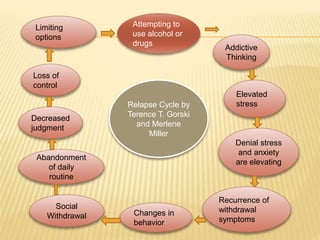
Addictive
Thinking
Denial stress
and anxiety
are elevating
Recurrence of
withdrawal
symptoms
Social
Withdrawal
Decreased
judgment
Abandonment
of daily
routine
Changes in
behavior
Elevated
stress
Relapse Cycle by
Terence T. Gorski
and Merlene
Miller
Loss of
control
Limiting
options
Attempting to
use alcohol or
drugs
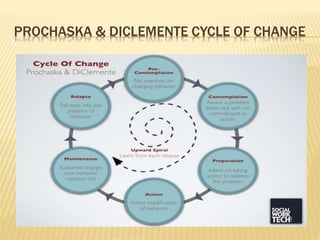
PROCHASKA & DICLEMENTE CYCLE OF CHANGE
FOUNDATION OF RELAPSE PREVENTION MODEL:
MARLATT AND GORDON, 1980
 Conceptualization of addiction as a set of habit patterns that
have been reinforced by social reinforcement .
 A second important issue discussed by Marlatt and Gordon is
the nature of relapse. Relapse has clear antecedents and
warning signs has provided and relapse process can be
systematically studied.
 Marlatt and Gordon emphasized the value of using education
and information in the treatment process. As part of this
educational process, they suggested using metaphors for
explaining addiction and recovery-related concepts;
 Recovery from addiction is conceptualized as a type of life-
style modification in which achieving balance and developing
alternative behaviors are key ingredients;
RELAPSE PREVENTION STRATEGIES:
Title: Relapse prevention strategies in outpatient substance
abuse treatment
Author: Rawson, Richard A.; Obert, Jeanne L.; McCann,
Michael J.; Marinelli-Casey, Patricia.
Matrix Institute on Addictions, Los Angeles, and
Department of Psychiatry, University of California, Los
Angeles
1. Psycho-education:
 Brain chemistry and addiction; conditioned cues and
craving; drug and alcohol effects, addiction as a biological
disorder; drug use and, acquired immunodeficiency
syndrome; addiction, and the family; need for life-style
change; and relationships between substance abuse and
co-morbid condition
CONTI…
2. Identification of High-Risk Situations for Relapse and
Warning Signs for Relapse:
 High-risk states: certain times of day, being around drug-
using friends, bars, the presence of money, idle time
 Behavioral warning signs: impulsive behavior, time with
drug users, stopping recovery activities, returning to old
pattern of behavior
 Cognitive warning signs: euphoric recall, relapse
justification, drug dreams, rationalizations to discontinue
new recovery behaviors
 Affective warning signs: periods of emotionality
previously associated with drug use (positive affective
states, e.g., excitement, arousal, celebration; negative
affective states, e.g., depression, loneliness, anger,
boredom)
CONTI…
3. Development of Coping Skills:
 Options are explored, and in some cases, new skills are
role played or homework assignments are given to
practice the new coping response.
 Examples of these coping skills include how to say "no"
to an offer of drug or alcohol use; types of alternative
behaviors to engage in during high-risk periods (e.g.,
exercising rather than going to a bar for happy hour);
methods of expressing affective states rather than using
drugs or alcohol; new cognitive strategies, such as
thought stopping, to avoid drug thoughts and craving.
CONTI…
4. Development of New Life-Style Behaviors:
 Group discussions and homework assignments are used
to assist drug and alcohol users in acquiring and
maintaining new leisure, recreational, and employment
activities;
 Ex- exercise, hobbies, family activities, community
activities
5. Increased Self-Efficacy:
 To facilitate the development of the self-perception of
competence, clients are given homework assignments
that involve entering high-risk situations and using new
responses;
 This method is typically used in group settings, with
homework assignments , rehearsal and role plaving are
used to prepare the client.
CONTI…
6. Dealing With Relapse—Avoiding the Abstinence
Violation Effect:
 Clients are taught to view a return to drug or alcohol use
as "slips" or "lapses" that need not lead back to full-
blown relapse and re-addiction. This cognitive reframing
of a lapse from a catastrophe into an opportunity to learn
how to improve the treatment plan reduces the shame
and failure often experienced in the event of a slip or
lapse;
7. Drug and Alcohol Monitoring:
 Urine and breath testing of client to monitor drug and
alcohol use. These techniques are viewed as critical for
promoting client accountability, and they serve as a
dependent measure of program effectiveness.
 Title: Relapse Prevention in Alcohol Dependence: A Family –
Based Approach
 Author: Prasanthi Nattala, Assistant Professor of Nursing;
Pratima Murthy, Professor of Psychiatry; CAM
 Year: 2013
 Components of Relapse Prevention:
1. Stabilization: medical assistance may be necessary to ease
withdrawal symptoms and help the client become drug-free
again. As the first step in recovery, the client needs help to
deal with the immediate crisis;
2. Insight into Relapse Pattern
Clients are helped to:
 identify the relapse triggers;
 recognize the relapse warning signs;
 some common myths and facts about alcohol
 understand the relapse process.
CONTI…
 Develop a Recovery Plan:
1. Handling craving an Managing high-risk situations:
o Remember the withdrawal symptoms;
o 4 D’s: Delay, distract, drink water and deep breathing;
o Have low-calorie food
o Calling up sober friends
o Change old routines;
o Think positively;
o Stay busy! Never stay idle;
o Go to place of worship;
o Cheer yourself by buying something special for yourself
o Resist drinking at social events by avoiding such places
CONTI…
2. Assertiveness Training: effective communication in social
settings.
Drink refusal skills:
o Say ‘no’ first;
o Respond rapidly, maintain eye contact,
o Do not prolong the conversation;
o If the other person continues to insist, leave the situation
quickly.
Techniques used: role play and home work asignments
which patient need to bring for review to the follow up
session.
CONTI…
3. Recovery calendar separately by patient and caregiver
following discharge ( brief not on trigger and action taken to
overcome it)
4. Medication compliance calendar ( tick mark that patient
had taken medication as prescribed for that day)
5. Dealing with faulty cognitions :
Cognition 1: I stopped drinking, but still my life is so bad.
Alternate thought: If I don’t drink, at least my life will not
become worse, even if nothing else improves.
Cognition 2: Though I stopped drinking. They still suspect. Why
should I bear all this? I may as well drink again.
Alternate thought: They have been patient f so long, so let me
be a patient now, till they begin to trust me again. And even if
they don’t, is it really worth starting to drink again?
CONTI…
6. Stress Management: mediate, exercise, eat balance
food, sleep well pursue a hobby;
7. Effective time management: maintain a daily diary,
make a to-do list every day.
8. Anger control: breathing deeply, counting numbers,
leaving the place immediately, exercise, meditation,
maintaining anger record, alternatives to striking to other
people like punch a pillow, kicking into air
9. Sleep hygiene: Some rules
Avoid drinking tea or coffee, avoid smoking in the
evening, regular exercise pattern, avoid excessive fluid
before bedtime, do not go to bed until really sleepy, not
taking naps during day time, maintain the same time
schedule for getting up and going for sleep everyday.
REFERENCES:
 Alexander, B. K. (1988). Models Of Addiction: A Framework Evaluation. Visions of
addiction: Major contemporary perspectives on addiction and alcoholism, 45.
 Gorski, T. T. (1986). Relapse prevention planning: A new recovery tool. Alcohol health
and research world-National Institute on Alcohol Abuse and Alcoholism.
 Gorski, T. T., & Miller, M. (1986). Staying sober.
 Malik, K., Benegal, V., Murthy, P., Chand, P., Arun, K., & Suman, L. N. (2015). Clinical
audit of women with substance use disorders: Findings and implications. Indian
journal of psychological medicine, 37(2), 195.
 Marlatt, G. A., & George, W. H. (1984). Relapse prevention: Introduction and
overview of the model. British journal of addiction, 79(3), 261-273.
 Prochaska, J. O., & DiClemente, C. C. (1986). Toward a comprehensive model of
change (pp. 3-27). Springer US.
 Rawson, R. A., Obert, J. L., McCann, M. J., & Marinelli-Casey, P. (1993). Relapse
prevention strategies in outpatient substance abuse treatment. Psychology of
Addictive Behaviors, 7(2), 85.
 Shantna, K., Chaudhury, S., Verma, A. N., & Singh, A. R. (2009). Comorbid
psychiatric disorders in substance dependence patients: A control study. Industrial
psychiatry journal, 18(2), 84.
 Volkow, N. D., Wang, G. J., Fowler, J. S., Tomasi, D., & Telang, F. (2011). Addiction:
beyond dopamine reward circuitry. Proceedings of the National Academy of Sciences,
108(37), 15037-15042.

Relapse Prevention Strategies.pptx

  • 1.
    RELAPSE PREVENTION STRATEGIES PRESENTER:Akanksha CHAIRPERSON: ANOOP SIR
  • 2.
    OUTLINE OF PRESENTATION DEPENDENCE CRITERIA  MODELS OF ADDICTION  RELAPSE AND WARNING SIGNS OF AN RELAPSE  RELAPSE CYCLE AND CYCLE OF CHANGE  FOUNDATION OF RP MODEL  RELAPSE PREVENTION STRATEGIES
  • 3.
    DEPENDENCE CRITERIA-ICD10  TheTenth Revision of the International Classification of Diseases and Health Problems (ICD-10) defines the dependence syndrome as being a cluster of physiological, behavioural, and cognitive phenomena in which:  Craving;  Salience;  Loss of control  Tolerance;  Withdrawal- physiological and psychological;  Use despite harm  ICD-10 Diagnostic criteria for research Three or more of the following symptoms should have occurred together for at least 1 month or, if persisting for periods of less than 1 month, should have occurred together repeatedly within a 12-month period
  • 4.
    DEPENDENCE CRITERIA-DSM-V  Anew version of the DSM, DSM-5 was released in May 2013, which did away with the separate diagnoses of substance "dependence" and substance "abuse" and replaced them with a single diagnosis, substance "use disorder" based on nearly the same criteria combined.  A minimum of 2-3 criteria is required for a mild substance use disorder diagnosis, while 4-5 is moderate, and 6-7 is severe (APA, 2013).  Tolerance;  Withdrawal;  Use despite harm;  The substance is often taken in larger amounts or over a longer period  Loss of control;  A great deal of time is spent in activities necessary to obtain the substance , use the substance , or recover from its effects;  Impaired socio-occupational functioning
  • 5.
     THE DISEASEMODEL OF ADDICTION by Dr. E.M. Jellinek,  The Disease Model of addiction states that addiction involves pathological changes in the brain that result in overpowering urges.  The disease model of addiction describes an addiction as a disease with biological, neurological, genetic, and environmental sources of origin. The traditional medical model of disease requires only that an abnormal condition be present that causes discomfort, dysfunction, or distress to the individual afflicted.  The contemporary medical model attributes addiction, in part, to changes in the brain's mesolimbic pathway. The medical model also takes into consideration that such disease may be the result of other biologic, psychological, or sociologic entities despite an incomplete understanding of the mechanisms of these entities.
  • 6.
     Neurotransmitters (chemicalsin the brain) play an important role in behaviour. The neurotransmitter dopamine plays a major role in addiction. Increased levels of dopamine are associated with pleasure. The desire for the rewarding pleasurable feeling may account for the initiation and maintenance of addictive behaviour. Rewarding experiences, such as drug taking, trigger the release of dopamine and effectively telling the brain ‘to do it again.’
  • 7.
    PUBLIC HEALTH MODEL The public health model emphasizes the overall health of the public. In contrast, traditional healthcare focuses on the health of one individual.  Public health uses a three-prong approach to prevention and intervention. This is known as "the agent, the host, and the environment."  1) a susceptible host (e.g., a person) 2) an infectious agent, and 3) a supportive environment (meaning an environment that makes the spread of infection possible such as unsanitary or unsafe living conditions).  The public health model originally developed his 3- sided triangular model for infectious disease. The model now includes addictions.
  • 8.
    MORAL MODEL OFADDICTION According to the moral model, a moral failure (a failure to do what is right) causes addiction. Therefore, recovery consists of strengthening one's will or motivation to behave in an upright manner. The moral model is prominent in traditional approaches to recovery. "He just needs to strengthen his willpower to resist temptation and get on with his life." The criminal justice system also approaches addiction from this perspective. Punishments for addiction related crimes (e.g., public intoxication) are intended to motivate people to behave better. Trying to persuade someone to behave better is also a technique associated with this model.
  • 9.
    PSYCHOLOGICAL MODEL  Psychodynamicmodel  Psychodynamic treatment is based on Freud's work in discovering the importance of unconscious phenomena; the development of a theory of the relationship between id, ego, and superego, with an emphasis on resistance, defences, and conflict; and the use of techniques such as free association, clarification, and interpretation.  trauma-related developmental issues—including orality, regression toward infantile fixations, defences against homosexuality, sexual and social inferiority, emotional immaturity, depressive tendencies, and insecurity—as psychopathological pathways leading to substance abuse
  • 10.
    OTHER MODELS OFADDICTION  The behavioral model of addiction sees it as the result of a learned conditioned response. Treatment focuses on the association of the addictive behavior with negative consequences (e.g., a noxious odor that results in nausea and vomiting) or a reward for non-addictive behavior (e.g., buying oneself a CD for not having a drink);  The Dry Moral Model: Person with Substance Abuse lack fait in God, succumbing to temptation;  The Wet Moral Model: Person with Substance Abuse are immature, irresponsible and weak willed;
  • 11.
    BIO-PSYCHO-SOCIAL MODEL  Themodel was theorized by psychiatrist George Engel in 1977 at the University of Rochester.  The bio psychosocial model is a general model or approach positing that biological, psychological (which entails thoughts, emotions, and behaviours), and social (socio-economical, socio-environmental, and cultural) factors, all play a significant role in human functioning in the context of disease or illness. Indeed, health is best understood in terms of a combination of biological, psychological, and social factors rather than purely in biological terms. Furthermore, critics of this model have further proposed that spiritual constructs also effect an individuals disease or illness.
  • 12.
    Co-morbid psychiatric disordersin substance dependence patients: A control study)  Author: K. Shantna, S. Chaudhury, A. N. Verma, and A. R. Singh  Materials and Methods: Comprehensive data was collected from inpatients with substance abuse/dependence and co-morbidity of mental disorders at the Ranchi Institute of Neuropsychiatry and Allied Sciences (RINPAS) and from normal controls from the general population during the period January 2007 to May 2007.  Results: Schizophrenia- 11%, bipolar disorder in 16%, personality and adjustment disorders in 9% and 13%, Anxiety disorders were found in 6% of the cases.  Conclusions: The majority of substance dependence patients suffered from co- morbid mental disorders. Co-morbidity needs to be taken into account when analyzing the relationship between substance dependence and depression and in planning treatment strategies for co-morbid conditions.
  • 13.
     Clinical Auditof Women with Substance Use Disorders: Findings and Implications  Author: Kanika Malik, Vivek Benegal, Pratima Murthy, Prabhat Chand, K. Arun, and L. N. Suman  Materials and Methods: The psychiatric case records of 40 women with SUDs who sought consultation between the year 2012 and 2013 were analysed.  Results: Alcohol (80%);benzodiazepines (20%), opioid (10%) and cannabis (5%), nicotine dependence syndrome(54%). Axis I psychiatric disorders were present in 62.5% of the patients with depression being the most common (30%), followed by psychotic disorders (15%) and anxiety disorders (12.5%). Comorbid Axis II diagnosis of emotionally unstable personality disorder (EUPD) was present in 10% of the patients. Psycho-social issues: marital discord and interpersonal conflicts (70%), influence of significant others (66%), death of a family members (10%) and other stressful life events (25%). Major consequences of substance use were substance-induced physical problems (62.5%) and interpersonal conflicts (40%). Data analysis indicated poor follow up and relapse rate of 50%. Conclusions: The study has implications for planning gender sensitive, multi-dimensional treatment programmes for women seeking treatment for
  • 14.
    RELAPSE  It camefrom Latin word ‘relabi’ i.e. to slip back, from re-+labi to slip, slide  Relapse – vb To lapse back into a former state or condition, esp. one involving bad habits  To become ill again after apparent recovery- n
  • 15.
    TERENCE T. GORSKION RELAPSE  “Relapse is more than just using alcohol or drugs. It is the progressive process of becoming so dysfunctional in recovery that self-medication with alcohol or drugs seems like a reasonable choice. ”
  • 16.
    WARNING SIGNS OFRELAPSE- TERENCE T. GORSKI Sign 1: Addictive thinking which is particularly dangerous:  Euphoric Recall  Awful zing Abstinence  Magical thinking about use- positive expectancy Sign 2: Believing you can use again without falling back into addiction; Sign 3: Starting to reconnect with old friends from your addiction days; Sign 4: Becoming defensive and beginning the pattern of denial you had while using.
  • 17.
    WARNING SIGNS OFAN RELAPSE- TERENCE T. GORSKI Sign 4: Becoming defensive and beginning the pattern of denial you had while using; Sign 5: Changes in attitude or behavior; Sign 6: Breaking down of social relationships:  Arguing more with friends.  Lying to your loved ones.  Spending less time with family.  Resenting those who are trying to help Sign 7. Loss of interest in hobbies and activities; Sign 8. Sudden appearance of withdrawal symptoms; Sign 9: Loss of belief in addiction recovery program
  • 18.
    Relapse Does NotEqual Failure  According to the National Institute on Drug Abuse 2011, approximately 60 percent of all recovering addicts experience a relapse at some point in their lives. Drug addiction relapse rates are similar to relapse rates of other chronic illnesses, such as:  Asthma;  High blood pressure;  Diabetes. Dry Relapse vs. Wet Relapse  Dry Relapse: the process of becoming increasingly dysfunctional while abstinent.  Wet Relapse: actual use of chemicals (or bottom line behaviors like addiction to exercise, eating, sex, shopping etc.) by a formally recovered person
  • 19.
    Addictive Thinking Denial stress and anxiety areelevating Recurrence of withdrawal symptoms Social Withdrawal Decreased judgment Abandonment of daily routine Changes in behavior Elevated stress Relapse Cycle by Terence T. Gorski and Merlene Miller Loss of control Limiting options Attempting to use alcohol or drugs
  • 20.
    PROCHASKA & DICLEMENTECYCLE OF CHANGE
  • 21.
    FOUNDATION OF RELAPSEPREVENTION MODEL: MARLATT AND GORDON, 1980  Conceptualization of addiction as a set of habit patterns that have been reinforced by social reinforcement .  A second important issue discussed by Marlatt and Gordon is the nature of relapse. Relapse has clear antecedents and warning signs has provided and relapse process can be systematically studied.  Marlatt and Gordon emphasized the value of using education and information in the treatment process. As part of this educational process, they suggested using metaphors for explaining addiction and recovery-related concepts;  Recovery from addiction is conceptualized as a type of life- style modification in which achieving balance and developing alternative behaviors are key ingredients;
  • 22.
    RELAPSE PREVENTION STRATEGIES: Title:Relapse prevention strategies in outpatient substance abuse treatment Author: Rawson, Richard A.; Obert, Jeanne L.; McCann, Michael J.; Marinelli-Casey, Patricia. Matrix Institute on Addictions, Los Angeles, and Department of Psychiatry, University of California, Los Angeles 1. Psycho-education:  Brain chemistry and addiction; conditioned cues and craving; drug and alcohol effects, addiction as a biological disorder; drug use and, acquired immunodeficiency syndrome; addiction, and the family; need for life-style change; and relationships between substance abuse and co-morbid condition
  • 23.
    CONTI… 2. Identification ofHigh-Risk Situations for Relapse and Warning Signs for Relapse:  High-risk states: certain times of day, being around drug- using friends, bars, the presence of money, idle time  Behavioral warning signs: impulsive behavior, time with drug users, stopping recovery activities, returning to old pattern of behavior  Cognitive warning signs: euphoric recall, relapse justification, drug dreams, rationalizations to discontinue new recovery behaviors  Affective warning signs: periods of emotionality previously associated with drug use (positive affective states, e.g., excitement, arousal, celebration; negative affective states, e.g., depression, loneliness, anger, boredom)
  • 24.
    CONTI… 3. Development ofCoping Skills:  Options are explored, and in some cases, new skills are role played or homework assignments are given to practice the new coping response.  Examples of these coping skills include how to say "no" to an offer of drug or alcohol use; types of alternative behaviors to engage in during high-risk periods (e.g., exercising rather than going to a bar for happy hour); methods of expressing affective states rather than using drugs or alcohol; new cognitive strategies, such as thought stopping, to avoid drug thoughts and craving.
  • 25.
    CONTI… 4. Development ofNew Life-Style Behaviors:  Group discussions and homework assignments are used to assist drug and alcohol users in acquiring and maintaining new leisure, recreational, and employment activities;  Ex- exercise, hobbies, family activities, community activities 5. Increased Self-Efficacy:  To facilitate the development of the self-perception of competence, clients are given homework assignments that involve entering high-risk situations and using new responses;  This method is typically used in group settings, with homework assignments , rehearsal and role plaving are used to prepare the client.
  • 26.
    CONTI… 6. Dealing WithRelapse—Avoiding the Abstinence Violation Effect:  Clients are taught to view a return to drug or alcohol use as "slips" or "lapses" that need not lead back to full- blown relapse and re-addiction. This cognitive reframing of a lapse from a catastrophe into an opportunity to learn how to improve the treatment plan reduces the shame and failure often experienced in the event of a slip or lapse; 7. Drug and Alcohol Monitoring:  Urine and breath testing of client to monitor drug and alcohol use. These techniques are viewed as critical for promoting client accountability, and they serve as a dependent measure of program effectiveness.
  • 27.
     Title: RelapsePrevention in Alcohol Dependence: A Family – Based Approach  Author: Prasanthi Nattala, Assistant Professor of Nursing; Pratima Murthy, Professor of Psychiatry; CAM  Year: 2013  Components of Relapse Prevention: 1. Stabilization: medical assistance may be necessary to ease withdrawal symptoms and help the client become drug-free again. As the first step in recovery, the client needs help to deal with the immediate crisis; 2. Insight into Relapse Pattern Clients are helped to:  identify the relapse triggers;  recognize the relapse warning signs;  some common myths and facts about alcohol  understand the relapse process.
  • 28.
    CONTI…  Develop aRecovery Plan: 1. Handling craving an Managing high-risk situations: o Remember the withdrawal symptoms; o 4 D’s: Delay, distract, drink water and deep breathing; o Have low-calorie food o Calling up sober friends o Change old routines; o Think positively; o Stay busy! Never stay idle; o Go to place of worship; o Cheer yourself by buying something special for yourself o Resist drinking at social events by avoiding such places
  • 29.
    CONTI… 2. Assertiveness Training:effective communication in social settings. Drink refusal skills: o Say ‘no’ first; o Respond rapidly, maintain eye contact, o Do not prolong the conversation; o If the other person continues to insist, leave the situation quickly. Techniques used: role play and home work asignments which patient need to bring for review to the follow up session.
  • 30.
    CONTI… 3. Recovery calendarseparately by patient and caregiver following discharge ( brief not on trigger and action taken to overcome it) 4. Medication compliance calendar ( tick mark that patient had taken medication as prescribed for that day) 5. Dealing with faulty cognitions : Cognition 1: I stopped drinking, but still my life is so bad. Alternate thought: If I don’t drink, at least my life will not become worse, even if nothing else improves. Cognition 2: Though I stopped drinking. They still suspect. Why should I bear all this? I may as well drink again. Alternate thought: They have been patient f so long, so let me be a patient now, till they begin to trust me again. And even if they don’t, is it really worth starting to drink again?
  • 31.
    CONTI… 6. Stress Management:mediate, exercise, eat balance food, sleep well pursue a hobby; 7. Effective time management: maintain a daily diary, make a to-do list every day. 8. Anger control: breathing deeply, counting numbers, leaving the place immediately, exercise, meditation, maintaining anger record, alternatives to striking to other people like punch a pillow, kicking into air 9. Sleep hygiene: Some rules Avoid drinking tea or coffee, avoid smoking in the evening, regular exercise pattern, avoid excessive fluid before bedtime, do not go to bed until really sleepy, not taking naps during day time, maintain the same time schedule for getting up and going for sleep everyday.
  • 32.
    REFERENCES:  Alexander, B.K. (1988). Models Of Addiction: A Framework Evaluation. Visions of addiction: Major contemporary perspectives on addiction and alcoholism, 45.  Gorski, T. T. (1986). Relapse prevention planning: A new recovery tool. Alcohol health and research world-National Institute on Alcohol Abuse and Alcoholism.  Gorski, T. T., & Miller, M. (1986). Staying sober.  Malik, K., Benegal, V., Murthy, P., Chand, P., Arun, K., & Suman, L. N. (2015). Clinical audit of women with substance use disorders: Findings and implications. Indian journal of psychological medicine, 37(2), 195.  Marlatt, G. A., & George, W. H. (1984). Relapse prevention: Introduction and overview of the model. British journal of addiction, 79(3), 261-273.  Prochaska, J. O., & DiClemente, C. C. (1986). Toward a comprehensive model of change (pp. 3-27). Springer US.  Rawson, R. A., Obert, J. L., McCann, M. J., & Marinelli-Casey, P. (1993). Relapse prevention strategies in outpatient substance abuse treatment. Psychology of Addictive Behaviors, 7(2), 85.  Shantna, K., Chaudhury, S., Verma, A. N., & Singh, A. R. (2009). Comorbid psychiatric disorders in substance dependence patients: A control study. Industrial psychiatry journal, 18(2), 84.  Volkow, N. D., Wang, G. J., Fowler, J. S., Tomasi, D., & Telang, F. (2011). Addiction: beyond dopamine reward circuitry. Proceedings of the National Academy of Sciences, 108(37), 15037-15042.

Editor's Notes

  • #20 Researchers Terence T. Gorski and Merlene Miller have identified 11 steps that lead a person towards relapse.
  • #28 Myths: alcohol relieves cold and cough, relieves body aches and pains, alcohol makes a shy person interact beteer with others or brave, keeps us warm, induces good sleep