Accommodation Part II: Mental Health and Addiction 3:00 – 4:00 pm Dec 7th, 2010  Infonex  951 Whitehorse By Chris Hylton, MA CG Hylton & Associates Inc.  800 449-5866  [email_address]
Agenda Defining mental health and mental disability Identifying problems with addiction: know the early warning signs Psychological disability management process: identification, assessment, treatment K ey indicators of substance abuse EAP,  D&A Testing Guarding Minds
Do you have any workplace issues we can try and solve for you in this session?
What is Mental Health? World Health Organization  defines mental health as "a state of well-being in which the individual realizes his or her own abilities, can cope with the normal stresses of life, can work productively and fruitfully, and is able to make a contribution to his or her community”
What is Mental Health? People learning and be able to cope with: Stress Changes in life and the workplace Demands in the workplace Home life  Work life
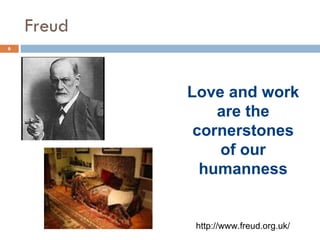
Freud Love and work are the cornerstones of our humanness http://www.freud.org.uk/
and you wonder why we work? “ No other technique for the conduct of life attaches the individual so firmly to reality as the emphasis on work; for his work at least gives him a secure place in a portion of reality ,  in the human community”
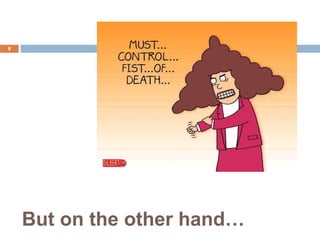
But on the other hand…
“ Therein we have one of the fundamental paradoxes we face today: Work is good for your mental health and work can make you crazy” Out of the Shadows at Last: Transforming Mental Health, Mental Illness and Addiction Services in Canada (2006),  Standing Senate Committee on Social Affairs, Science and Technology, Honourable Michael J. L. Kirby, Chair
Why does this matter to  Canadian employers? Making the case
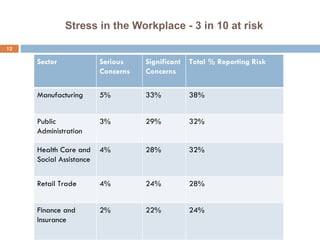
Stress in the Workplace - 3 in 10 at risk Sector  Serious Concerns Significant Concerns Total % Reporting Risk Manufacturing 5% 33% 38% Public Administration  3% 29% 32% Health Care and Social Assistance  4% 28% 32% Retail Trade 4% 24% 28% Finance and Insurance 2% 22% 24%
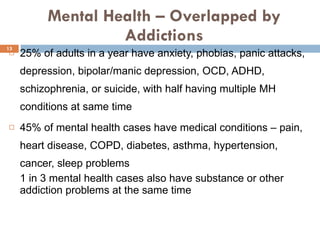
Mental Health – Overlapped by Addictions 25% of adults in a year have anxiety, phobias, panic attacks, depression, bipolar/manic depression, OCD, ADHD, schizophrenia, or suicide, with half having multiple MH conditions at same time  45% of mental health cases have medical conditions – pain, heart disease, COPD, diabetes, asthma, hypertension, cancer, sleep problems 1 in 3 mental health cases also have substance or other addiction problems at the same time
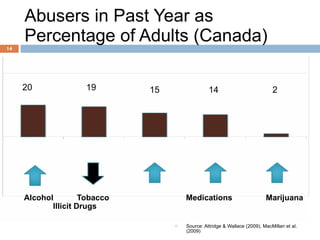
Abusers in Past Year as Percentage of Adults (Canada) 20   19 15   14  2 Alcohol   Tobacco   Medications   Marijuana  Illicit Drugs Source: Attridge & Wallace (2009), MacMillan et al. (2009)
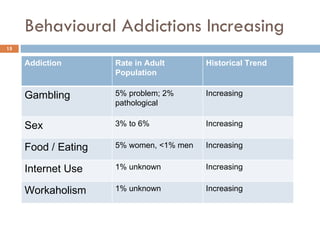
Behavioural Addictions Increasing Addiction Rate in Adult Population Historical Trend Gambling 5% problem; 2% pathological Increasing Sex 3% to 6% Increasing Food / Eating 5% women, <1% men Increasing Internet Use 1% unknown Increasing Workaholism 1% unknown Increasing
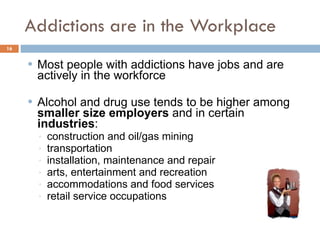
Addictions are in the Workplace Most people with addictions have jobs and are actively in the workforce  Alcohol and drug use tends to be higher among  smaller size employers  and in certain  industries :  construction and oil/gas mining transportation  installation, maintenance and repair arts, entertainment and recreation accommodations and food services retail service occupations
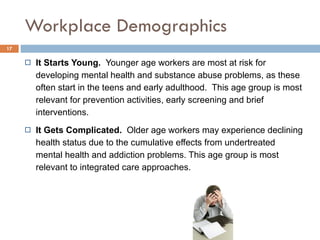
Workplace Demographics It Starts Young.  Younger age workers are most at risk for developing mental health and substance abuse problems, as these often start in the teens and early adulthood.  This age group is most relevant for prevention activities, early screening and brief interventions.  It Gets Complicated.  Older age workers may experience declining health status due to the cumulative effects from undertreated mental health and addiction problems. This age group is most relevant to integrated care approaches.
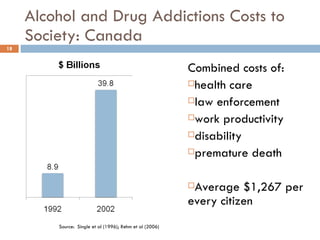
Alcohol and Drug Addictions Costs to Society: Canada Combined costs of:  health care law enforcement work productivity  disability premature death Average $1,267 per every citizen Source:  Single et al (1996); Rehm et al (2006)
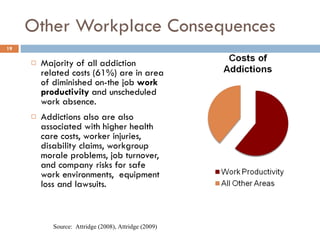
Other Workplace Consequences Majority of all addiction related costs (61%) are in area of diminished on-the job  work productivity  and unscheduled work absence. Addictions also are also associated with higher health care costs, worker injuries, disability claims, workgroup morale problems, job turnover, and company risks for safe work environments,  equipment loss and lawsuits.  Source:  Attridge (2008), Attridge (2009)
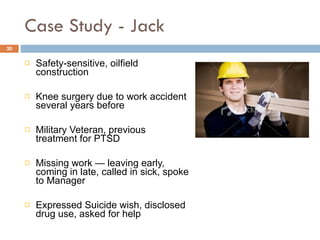
Case Study - Jack Safety-sensitive, oilfield construction Knee surgery due to work accident several years before Military Veteran, previous treatment for PTSD Missing work — leaving early, coming in late, called in sick, spoke to Manager Expressed Suicide wish, disclosed drug use, asked for help
Response to Jack Immediate appointment to assess safety and stabilize Immediate EAP or substance abuse specialist Employer input to counsellor Observations of behaviour Performance Previous assessments/testing Any other pertinent work history
In cooperation with EAP Program Set schedule of counselling appointments over 24 months Review and monitoring of compliance with substance abuse recommendations, e.g. inpatient treatment, abstinence, & 12-step programming Regular reporting of attendance Option to coordinate on-going substance testing  Two-Year  Relapse Prevention Program
Why is the problem to difficult and complicated? ANY IDEA WHAT CAUSES ADDICTIONS?
What “Causes” Addictions Moral Model –  only a “bad person” gets addicted and can’t quit Disease Model –  what are the genetic and neurobiological factors involved? Behavioural Model –  what is rewarding to the person about their addiction? Early Environment Stress –  what kinds of toxic stress (abuse, trauma, low SES) was experienced as a youth or in past?
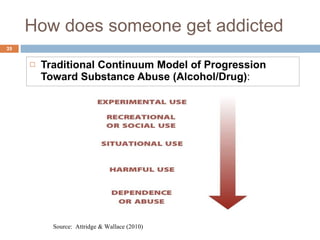
How does someone get addicted Traditional Continuum Model of Progression Toward Substance Abuse (Alcohol/Drug) : Source:  Attridge & Wallace (2010)
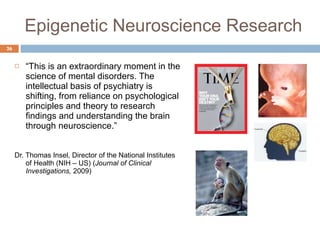
Epigenetic Neuroscience Research “ This is an extraordinary moment in the science of mental disorders. The intellectual basis of psychiatry is shifting, from reliance on psychological principles and theory to research findings and understanding the brain through neuroscience.”  Dr. Thomas Insel, Director of the National Institutes of Health (NIH – US) ( Journal of Clinical Investigations,  2009)
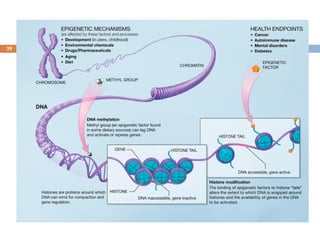
New Research - Epigenetics Links Addictions to a Combination of Genetic and Biological Factors that Interact with Early Child Development Experiences The Greek prefix  epi-  in  epigenetics  implies features that are &quot;on top of&quot; or &quot;in addition to&quot; genetics; thus  epigenetic  traits exist on top of or in addition to the traditional molecular basis for inheritance.
development in utero and in childhood, environmental chemicals, drugs and pharmaceuticals, aging, and diet Results in cancer, autoimmune disease, mental disorders, or diabetes among other illnesses. National Institute of Health Source Wikipedia: National Institute of Health
So what have we learned so far? Source:  Suomi (2010)
Care and Prevention Can the problem be treated or prevented?
Range of Treatments self-help (often multiple failed attempts) =  weak evidence group-based peer-support programs (AA) =  modest evidence talk therapy - cognitive behavioral therapy (CBT) =  best evidence brief residential detox with counseling =  good evidence for severe cases Rx medications and general medical care =  mixed evidence harm avoidance programs =  emerging good evidence TRENDS = Gender differences & Holistic treatment model best
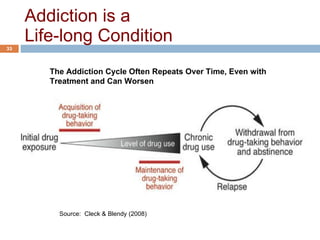
Addiction is a  Life-long Condition Source:  Cleck & Blendy (2008) The Addiction Cycle Often Repeats Over Time, Even with Treatment and Can Worsen
Rx Treatments for Addictions - Limited & Often Ineffective Effective treatments for drug abuse involve both behavioral therapy and medication. However - the list of medications approved for treatment of addiction is quite limited.  Many of the medication treatments available are only given when the addict is actively using the addictive substance.  Thus, very few treatments are prescribed during the critical withdrawal period when needed to prevent relapse. No medications for addictions are available for prevention. Source:  Cleck & Blendy 2008
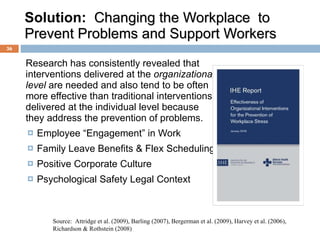
Solution Screening Brief intervention Referral for treatment Study by Institute for Health Economics and Alberta Health last year Organizational Interventions for the prevention of Workplace Stress  Jan 2009  http://www.ihe.ca/documents/Interventions_for_prevention_of_workplace_stress.pdf
Solution:  Changing the Workplace  to Prevent Problems and Support Workers Research has consistently revealed that interventions delivered at the  organizational level  are needed and also tend to be often more effective than traditional interventions delivered at the individual level because they address the prevention of problems.  Employee “Engagement” in Work Family Leave Benefits & Flex Scheduling Positive Corporate Culture Psychological Safety Legal Context Source:  Attridge et al. (2009), Barling (2007), Bergerman et al. (2009), Harvey et al. (2006),  Richardson & Rothstein (2008)
Workplace Solutions - Morale Make the work place a positive place! Celebrate birthdays Celebrate holidays Team building exercises: staff day at the movies, staff day in the park, etc  Sit fighting co-workers down and help solve the issues between them  Teambuilding workshops Have a zero tolerance policy
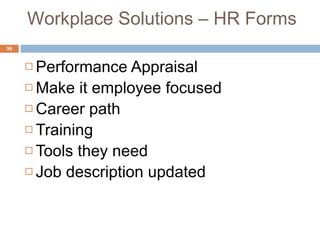
Performance Appraisal Make it employee focused Career path Training Tools they need Job description updated Workplace Solutions – HR Forms
NO BULLYING! Bullying any co-worker on or off the workplace is still an offense Creates low self-esteem and toxic work environment Workplace Solutions – HR Policies
Absenteeism Management Establish average absentee rate Place those x% above, in an Absenteeism Management Program Workplace Solutions – HR Policies
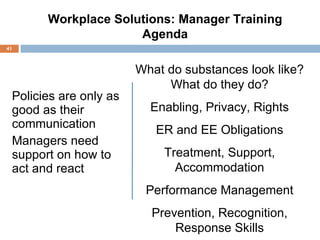
Policies are only as good as their communication Managers need support on how to act and react Workplace Solutions: Manager Training Agenda What do substances look like? What do they do? Enabling, Privacy, Rights ER and EE Obligations Treatment, Support, Accommodation Performance Management Prevention, Recognition, Response Skills
What is an “Employer of Choice”? Workplace Solutions –  Employer of Choice
What is an  “Employer of Choice”? Any employer of any size in the public, private or not-for-profit sector that attracts, optimizes and retains top talent… because the employees choose to be there
Which results in Employees choosing to work or continue to work for your organization… even when presented with other and more enticing employment opportunities
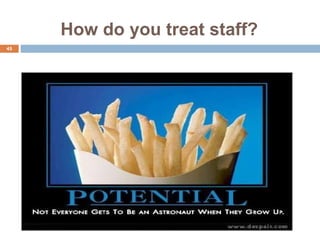
How do you treat staff?
Corporate programs - EAP A program that offers: short-term, professional counselling and referral services support in dealing with a wide range of stressful situations (personal/work related) assistance and advise  Services are free and confidential
What is an EAP? Mental health assistance for EEs and their families So EEs may concentrate on work Short service model Coordinates response to critical incidents in the workplace Deals tangentially with addictions
Typical EAP Usage 8-12% (2007) (avg range from 2 of 3 major Canadian EAP providers) 11% in 1997 (Can Federal Public Service) 25% in a mine, where the counsellor was a former miner who just hung out for coffee with the miners
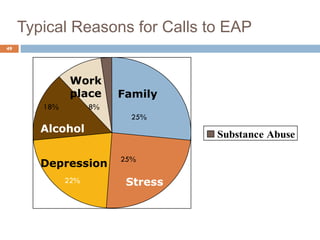
Typical Reasons for Calls to EAP Family Stress Depression Alcohol Workplace 25% 22% 25% 18% 8%
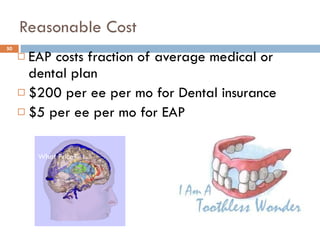
Reasonable Cost   EAP costs fraction of average medical or dental plan  $200 per ee per mo for Dental insurance $5 per ee per mo for EAP   What Price?
Stitch in time If mentally, employees believe “I am disabled” is their natural state = difficult to cure  “ I am temporarily having some difficulties that I with help of the EAP I will be able to overcome!” = easy to cure Prevention key
EAP Cost We offer an EAP No cost to set up $125 per hour cost For more info contact me
Drug & Alcohol Testing Discrimination rules No pre-employment testing No random drug testing No alcohol testing for non-safety sensitive positions Safety sensitive position is one where impairment due to drug or alcohol use could result in injury to self or others
When can you test? Random alcohol testing for safety sensitive positions ok Drug or alcohol testing for “reasonable cause” or “post-accident” is ok
How nice should you be? Consider: is it better to fight discrimination suit than injury or death claim caused by a drunk or impaired employee?
Face to face Therapy Research conclusively shows that traditional face-to-face (FTF) psychotherapy is generally effective for mental health issues Mental health and addiction problems are common to the workforce, overlap with many medical conditions and have negative consequences for the person and the company Source: Lipsey & Wilson (1993), NICE (2008), Seeling & Katon (2008)
Access not always possible But, access to and use of FTF treatment is problematic. Less than 1 in 3 people affected get quality care FTF care also is not uniformly effective for all patients even when received
Telephonic therapy for mental health has been tested in more than 30 research studies. The general conclusion is that telephonic therapy is effective or at least promising in most of the empirical tests conducted. Cognitive Behavioral Therapy (CBT) has been the most commonly used form of intervention. Telephonic therapy services are effective for many conditions: Anxiety, depression, panic disorders, substance abuse, trauma, PTSD, and others.
Summary of Research  Internet Counselling Internet-based forms of psychotherapy (e-mail and web tools) also shows initial support in over 20 research studies; many with RCT study designs.  Online therapy services and tools appear to work best for certain kinds of patients, when used to support other ongoing therapy, and for use as self-care and relapse prevention.  Positive clinical outcomes have also been obtained with therapist use of the Internet to interact via e-mail for patients with depression, anxiety, social phobias, PTSD, eating disorders, and panic disorder. Source: Griffiths & Christensen (2006), Reger & Gahm (2009)
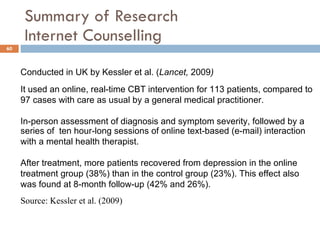
Summary of Research  Internet Counselling Conducted in UK by Kessler et al. ( Lancet,  2009 ) It used an online, real-time CBT intervention for 113 patients, compared to 97 cases with care as usual by a general medical practitioner.  In-person assessment of diagnosis and symptom severity, followed by a series of  ten hour-long sessions of online text-based (e-mail) interaction with a mental health therapist.  After treatment, more patients recovered from depression in the online treatment group (38%) than in the control group (23%). This effect also was found at 8-month follow-up (42% and 26%). Source: Kessler et al. (2009)
Selecting and Strengthening  Employee Assistance Programs:  A Purchaser’s Guide     EASNA’s 2009 Purchaser’s Guide to EAPs
W
Resources America’s Health Insurance Plans -  www.ahiphiwire.org/wellbeing   Centers for Disease Control -  www.cdc.gov/nchs/fastats/hinsure.htm   Canadian Institute for Health Information -  www.cihi.ca   EASNA  www.easna.org/purchasers.php   Gallup-Healthways Well-Being Index™  -  www.well-beingindex.com   Health Canada – Healthy Living -  www.hc-sc.gc.ca/hl-vs/index-eng.php   Health Promotion Advocates  http://healthpromotionadvocates.org/sources_detail_documents.htm   IHPM - Institute for Health and Productivity Management -  www.ihpm.org   Mental Health Commission of Canada -  www.mentalhealthcommission.ca   National Wellness Institute -  www.nationalwellness.org   WorldatWork:  global human resources association focused on compensation, benefits, work-life and integrated total rewards  -  www.worldatwork.org
My offer to you Please call if you have any HR, or workplace issue that you are overwhelmed with We can help you
Thank you for the opportunity to meet today! Tel 403 264 5288   or 800 449 5866  (800 4hylton) [email_address]
CG Hylton - Services HR Consulting Job Descriptions Salary Grids Classification System - free & easy to understand (NOC) Wellness at Work Staff Morale Training Benefits, Pensions, EAP Strategic Planning Drug and Alcohol programs Dept re-orgs Leadership compensation Tel 403 264 5288 [email_address]

Addictions in the Workplace

  • 1.
    Accommodation Part II:Mental Health and Addiction 3:00 – 4:00 pm Dec 7th, 2010 Infonex 951 Whitehorse By Chris Hylton, MA CG Hylton & Associates Inc. 800 449-5866 [email_address]
  • 2.
    Agenda Defining mentalhealth and mental disability Identifying problems with addiction: know the early warning signs Psychological disability management process: identification, assessment, treatment K ey indicators of substance abuse EAP, D&A Testing Guarding Minds
  • 3.
    Do you haveany workplace issues we can try and solve for you in this session?
  • 4.
    What is MentalHealth? World Health Organization defines mental health as &quot;a state of well-being in which the individual realizes his or her own abilities, can cope with the normal stresses of life, can work productively and fruitfully, and is able to make a contribution to his or her community”
  • 5.
    What is MentalHealth? People learning and be able to cope with: Stress Changes in life and the workplace Demands in the workplace Home life Work life
  • 6.
    Freud Love andwork are the cornerstones of our humanness http://www.freud.org.uk/
  • 7.
    and you wonderwhy we work? “ No other technique for the conduct of life attaches the individual so firmly to reality as the emphasis on work; for his work at least gives him a secure place in a portion of reality , in the human community”
  • 8.
    But on theother hand…
  • 9.
    “ Therein wehave one of the fundamental paradoxes we face today: Work is good for your mental health and work can make you crazy” Out of the Shadows at Last: Transforming Mental Health, Mental Illness and Addiction Services in Canada (2006), Standing Senate Committee on Social Affairs, Science and Technology, Honourable Michael J. L. Kirby, Chair
  • 10.
    Why does thismatter to Canadian employers? Making the case
  • 12.
    Stress in theWorkplace - 3 in 10 at risk Sector Serious Concerns Significant Concerns Total % Reporting Risk Manufacturing 5% 33% 38% Public Administration 3% 29% 32% Health Care and Social Assistance 4% 28% 32% Retail Trade 4% 24% 28% Finance and Insurance 2% 22% 24%
  • 13.
    Mental Health –Overlapped by Addictions 25% of adults in a year have anxiety, phobias, panic attacks, depression, bipolar/manic depression, OCD, ADHD, schizophrenia, or suicide, with half having multiple MH conditions at same time 45% of mental health cases have medical conditions – pain, heart disease, COPD, diabetes, asthma, hypertension, cancer, sleep problems 1 in 3 mental health cases also have substance or other addiction problems at the same time
  • 14.
    Abusers in PastYear as Percentage of Adults (Canada) 20 19 15 14 2 Alcohol Tobacco Medications Marijuana Illicit Drugs Source: Attridge & Wallace (2009), MacMillan et al. (2009)
  • 15.
    Behavioural Addictions IncreasingAddiction Rate in Adult Population Historical Trend Gambling 5% problem; 2% pathological Increasing Sex 3% to 6% Increasing Food / Eating 5% women, <1% men Increasing Internet Use 1% unknown Increasing Workaholism 1% unknown Increasing
  • 16.
    Addictions are inthe Workplace Most people with addictions have jobs and are actively in the workforce Alcohol and drug use tends to be higher among smaller size employers and in certain industries : construction and oil/gas mining transportation installation, maintenance and repair arts, entertainment and recreation accommodations and food services retail service occupations
  • 17.
    Workplace Demographics ItStarts Young. Younger age workers are most at risk for developing mental health and substance abuse problems, as these often start in the teens and early adulthood. This age group is most relevant for prevention activities, early screening and brief interventions. It Gets Complicated. Older age workers may experience declining health status due to the cumulative effects from undertreated mental health and addiction problems. This age group is most relevant to integrated care approaches.
  • 18.
    Alcohol and DrugAddictions Costs to Society: Canada Combined costs of: health care law enforcement work productivity disability premature death Average $1,267 per every citizen Source: Single et al (1996); Rehm et al (2006)
  • 19.
    Other Workplace ConsequencesMajority of all addiction related costs (61%) are in area of diminished on-the job work productivity and unscheduled work absence. Addictions also are also associated with higher health care costs, worker injuries, disability claims, workgroup morale problems, job turnover, and company risks for safe work environments, equipment loss and lawsuits. Source: Attridge (2008), Attridge (2009)
  • 20.
    Case Study -Jack Safety-sensitive, oilfield construction Knee surgery due to work accident several years before Military Veteran, previous treatment for PTSD Missing work — leaving early, coming in late, called in sick, spoke to Manager Expressed Suicide wish, disclosed drug use, asked for help
  • 21.
    Response to JackImmediate appointment to assess safety and stabilize Immediate EAP or substance abuse specialist Employer input to counsellor Observations of behaviour Performance Previous assessments/testing Any other pertinent work history
  • 22.
    In cooperation withEAP Program Set schedule of counselling appointments over 24 months Review and monitoring of compliance with substance abuse recommendations, e.g. inpatient treatment, abstinence, & 12-step programming Regular reporting of attendance Option to coordinate on-going substance testing Two-Year Relapse Prevention Program
  • 23.
    Why is theproblem to difficult and complicated? ANY IDEA WHAT CAUSES ADDICTIONS?
  • 24.
    What “Causes” AddictionsMoral Model – only a “bad person” gets addicted and can’t quit Disease Model – what are the genetic and neurobiological factors involved? Behavioural Model – what is rewarding to the person about their addiction? Early Environment Stress – what kinds of toxic stress (abuse, trauma, low SES) was experienced as a youth or in past?
  • 25.
    How does someoneget addicted Traditional Continuum Model of Progression Toward Substance Abuse (Alcohol/Drug) : Source: Attridge & Wallace (2010)
  • 26.
    Epigenetic Neuroscience Research“ This is an extraordinary moment in the science of mental disorders. The intellectual basis of psychiatry is shifting, from reliance on psychological principles and theory to research findings and understanding the brain through neuroscience.” Dr. Thomas Insel, Director of the National Institutes of Health (NIH – US) ( Journal of Clinical Investigations, 2009)
  • 27.
    New Research -Epigenetics Links Addictions to a Combination of Genetic and Biological Factors that Interact with Early Child Development Experiences The Greek prefix epi- in epigenetics implies features that are &quot;on top of&quot; or &quot;in addition to&quot; genetics; thus epigenetic traits exist on top of or in addition to the traditional molecular basis for inheritance.
  • 28.
    development in uteroand in childhood, environmental chemicals, drugs and pharmaceuticals, aging, and diet Results in cancer, autoimmune disease, mental disorders, or diabetes among other illnesses. National Institute of Health Source Wikipedia: National Institute of Health
  • 30.
    So what havewe learned so far? Source: Suomi (2010)
  • 31.
    Care and PreventionCan the problem be treated or prevented?
  • 32.
    Range of Treatmentsself-help (often multiple failed attempts) = weak evidence group-based peer-support programs (AA) = modest evidence talk therapy - cognitive behavioral therapy (CBT) = best evidence brief residential detox with counseling = good evidence for severe cases Rx medications and general medical care = mixed evidence harm avoidance programs = emerging good evidence TRENDS = Gender differences & Holistic treatment model best
  • 33.
    Addiction is a Life-long Condition Source: Cleck & Blendy (2008) The Addiction Cycle Often Repeats Over Time, Even with Treatment and Can Worsen
  • 34.
    Rx Treatments forAddictions - Limited & Often Ineffective Effective treatments for drug abuse involve both behavioral therapy and medication. However - the list of medications approved for treatment of addiction is quite limited. Many of the medication treatments available are only given when the addict is actively using the addictive substance. Thus, very few treatments are prescribed during the critical withdrawal period when needed to prevent relapse. No medications for addictions are available for prevention. Source: Cleck & Blendy 2008
  • 35.
    Solution Screening Briefintervention Referral for treatment Study by Institute for Health Economics and Alberta Health last year Organizational Interventions for the prevention of Workplace Stress Jan 2009 http://www.ihe.ca/documents/Interventions_for_prevention_of_workplace_stress.pdf
  • 36.
    Solution: Changingthe Workplace to Prevent Problems and Support Workers Research has consistently revealed that interventions delivered at the organizational level are needed and also tend to be often more effective than traditional interventions delivered at the individual level because they address the prevention of problems. Employee “Engagement” in Work Family Leave Benefits & Flex Scheduling Positive Corporate Culture Psychological Safety Legal Context Source: Attridge et al. (2009), Barling (2007), Bergerman et al. (2009), Harvey et al. (2006), Richardson & Rothstein (2008)
  • 37.
    Workplace Solutions -Morale Make the work place a positive place! Celebrate birthdays Celebrate holidays Team building exercises: staff day at the movies, staff day in the park, etc Sit fighting co-workers down and help solve the issues between them Teambuilding workshops Have a zero tolerance policy
  • 38.
    Performance Appraisal Makeit employee focused Career path Training Tools they need Job description updated Workplace Solutions – HR Forms
  • 39.
    NO BULLYING! Bullyingany co-worker on or off the workplace is still an offense Creates low self-esteem and toxic work environment Workplace Solutions – HR Policies
  • 40.
    Absenteeism Management Establishaverage absentee rate Place those x% above, in an Absenteeism Management Program Workplace Solutions – HR Policies
  • 41.
    Policies are onlyas good as their communication Managers need support on how to act and react Workplace Solutions: Manager Training Agenda What do substances look like? What do they do? Enabling, Privacy, Rights ER and EE Obligations Treatment, Support, Accommodation Performance Management Prevention, Recognition, Response Skills
  • 42.
    What is an“Employer of Choice”? Workplace Solutions – Employer of Choice
  • 43.
    What is an “Employer of Choice”? Any employer of any size in the public, private or not-for-profit sector that attracts, optimizes and retains top talent… because the employees choose to be there
  • 44.
    Which results inEmployees choosing to work or continue to work for your organization… even when presented with other and more enticing employment opportunities
  • 45.
    How do youtreat staff?
  • 46.
    Corporate programs -EAP A program that offers: short-term, professional counselling and referral services support in dealing with a wide range of stressful situations (personal/work related) assistance and advise Services are free and confidential
  • 47.
    What is anEAP? Mental health assistance for EEs and their families So EEs may concentrate on work Short service model Coordinates response to critical incidents in the workplace Deals tangentially with addictions
  • 48.
    Typical EAP Usage8-12% (2007) (avg range from 2 of 3 major Canadian EAP providers) 11% in 1997 (Can Federal Public Service) 25% in a mine, where the counsellor was a former miner who just hung out for coffee with the miners
  • 49.
    Typical Reasons forCalls to EAP Family Stress Depression Alcohol Workplace 25% 22% 25% 18% 8%
  • 50.
    Reasonable Cost EAP costs fraction of average medical or dental plan $200 per ee per mo for Dental insurance $5 per ee per mo for EAP What Price?
  • 51.
    Stitch in timeIf mentally, employees believe “I am disabled” is their natural state = difficult to cure “ I am temporarily having some difficulties that I with help of the EAP I will be able to overcome!” = easy to cure Prevention key
  • 52.
    EAP Cost Weoffer an EAP No cost to set up $125 per hour cost For more info contact me
  • 53.
    Drug & AlcoholTesting Discrimination rules No pre-employment testing No random drug testing No alcohol testing for non-safety sensitive positions Safety sensitive position is one where impairment due to drug or alcohol use could result in injury to self or others
  • 54.
    When can youtest? Random alcohol testing for safety sensitive positions ok Drug or alcohol testing for “reasonable cause” or “post-accident” is ok
  • 55.
    How nice shouldyou be? Consider: is it better to fight discrimination suit than injury or death claim caused by a drunk or impaired employee?
  • 56.
    Face to faceTherapy Research conclusively shows that traditional face-to-face (FTF) psychotherapy is generally effective for mental health issues Mental health and addiction problems are common to the workforce, overlap with many medical conditions and have negative consequences for the person and the company Source: Lipsey & Wilson (1993), NICE (2008), Seeling & Katon (2008)
  • 57.
    Access not alwayspossible But, access to and use of FTF treatment is problematic. Less than 1 in 3 people affected get quality care FTF care also is not uniformly effective for all patients even when received
  • 58.
    Telephonic therapy formental health has been tested in more than 30 research studies. The general conclusion is that telephonic therapy is effective or at least promising in most of the empirical tests conducted. Cognitive Behavioral Therapy (CBT) has been the most commonly used form of intervention. Telephonic therapy services are effective for many conditions: Anxiety, depression, panic disorders, substance abuse, trauma, PTSD, and others.
  • 59.
    Summary of Research Internet Counselling Internet-based forms of psychotherapy (e-mail and web tools) also shows initial support in over 20 research studies; many with RCT study designs. Online therapy services and tools appear to work best for certain kinds of patients, when used to support other ongoing therapy, and for use as self-care and relapse prevention. Positive clinical outcomes have also been obtained with therapist use of the Internet to interact via e-mail for patients with depression, anxiety, social phobias, PTSD, eating disorders, and panic disorder. Source: Griffiths & Christensen (2006), Reger & Gahm (2009)
  • 60.
    Summary of Research Internet Counselling Conducted in UK by Kessler et al. ( Lancet, 2009 ) It used an online, real-time CBT intervention for 113 patients, compared to 97 cases with care as usual by a general medical practitioner. In-person assessment of diagnosis and symptom severity, followed by a series of ten hour-long sessions of online text-based (e-mail) interaction with a mental health therapist. After treatment, more patients recovered from depression in the online treatment group (38%) than in the control group (23%). This effect also was found at 8-month follow-up (42% and 26%). Source: Kessler et al. (2009)
  • 61.
    Selecting and Strengthening Employee Assistance Programs: A Purchaser’s Guide EASNA’s 2009 Purchaser’s Guide to EAPs
  • 62.
  • 64.
    Resources America’s HealthInsurance Plans - www.ahiphiwire.org/wellbeing Centers for Disease Control - www.cdc.gov/nchs/fastats/hinsure.htm Canadian Institute for Health Information - www.cihi.ca EASNA www.easna.org/purchasers.php Gallup-Healthways Well-Being Index™ - www.well-beingindex.com Health Canada – Healthy Living - www.hc-sc.gc.ca/hl-vs/index-eng.php Health Promotion Advocates http://healthpromotionadvocates.org/sources_detail_documents.htm IHPM - Institute for Health and Productivity Management - www.ihpm.org Mental Health Commission of Canada - www.mentalhealthcommission.ca National Wellness Institute - www.nationalwellness.org WorldatWork: global human resources association focused on compensation, benefits, work-life and integrated total rewards - www.worldatwork.org
  • 65.
    My offer toyou Please call if you have any HR, or workplace issue that you are overwhelmed with We can help you
  • 66.
    Thank you forthe opportunity to meet today! Tel 403 264 5288 or 800 449 5866 (800 4hylton) [email_address]
  • 67.
    CG Hylton -Services HR Consulting Job Descriptions Salary Grids Classification System - free & easy to understand (NOC) Wellness at Work Staff Morale Training Benefits, Pensions, EAP Strategic Planning Drug and Alcohol programs Dept re-orgs Leadership compensation Tel 403 264 5288 [email_address]

Editor's Notes

  • #5 What does this mean for the workplace?
  • #7 Freud said some funny things but he did make some astute observations: “ No other technique for the conduct of life attaches the individual so firmly to reality as the emphasis on work; for his work at least gives him a secure place in a portion of reality, in the human community” Marie Jahoda, positive mental health movement, pointed out that work Provides structure, Provides social meaning, Provides opportunity for social interaction , Provides an identity…. Not to mention- provides an income However, multiple studies have demonstrated increasing rates of workplace distress, demoralization and disability e.g. 2002: Health Canada study suggest that there is a work/life imbalance- that the lack of balance is getting worse, especially for middle managers and public sector.
  • #9 Work can be very supportive for most people – but for others it can be a source of stress
  • #10 Does this mean work or the workplace causes mental illness? Not really, as we do not know the exact cause of any disorders, likely a combination of biogenetic and psychosocial factors which will vary from person to person. But, a psychologically unhealthy work environment can contribute to the onset and severity of a disorder While at the same time, a psychologically healthy environment can prevent the likelihood and minimize the severity of a disorder
  • #34 The cycle of addiction. Following the initial exposure to an addictive sub- stance, acquisition of drug taking occurs, in which infrequent drug taking escalates into chronic drug use. Periods of chronic drug use are followed by intervals of withdrawal. These periods of abstinence from the addictive drug can last days, weeks, months, or years. However, most addicts do not remain drug free and relapse back into drug use, creating a vicious cycle. Stress can exacerbate drug taking throughout this process facilitating initial drug exposure, increasing acquisition of drug taking, and causing a relapse to drug-taking behavior during withdrawal. Source: Attridge PNWER presentation
  • #36 Institute for Health Economics and Alberta Health, Jan 2009
  • #46 Effective Compensation Planning &amp; Benefits Administration CG Hylton &amp; Associates Inc
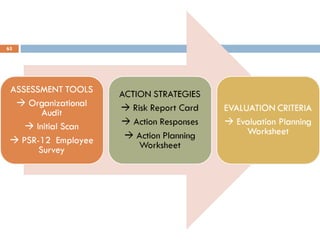
  • #63 GM@W provides an evidence-based process that employers can easily and quickly implement to protect psychological safety and promote psychological health in their workplace.