An Examination of Holistic Treatment for Substance AbuseLiterature Review PresentationRobert JensenArgosy University, Seattle
IntroductionAs understanding of addictive disorders shifted from moral weakness to medical condition, and again to a disease that affects all aspects of the addict and their loved ones lives treatment styles have also shifted.In today’s addiction treatment field professionals have learned the importance of approaching recovery in all aspects of the addicts life and relationships. It is from this understanding that holistic treatment first began to grow.
Why is this important?It is important to understand the current state of the addiction treatment field, its history, and the direction it is headed. Gaining an understanding of models of addiction gives us an appreciation for this disorder. As research progresses in the field holistic treatment models become more relevant. Understanding the current state of those models gives us a good foundation of how to improve treatment. Improving treatment allows us to give the client the best opportunity to enter and continue with recovery.
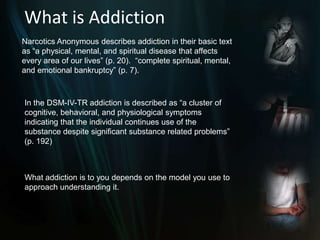
What is AddictionNarcotics Anonymous describes addiction in their basic text as “a physical, mental, and spiritual disease that affects every area of our lives” (p. 20). “complete spiritual, mental, and emotional bankruptcy” (p. 7). In the DSM-IV-TR addiction is described as “a cluster of cognitive, behavioral, and physiological symptoms indicating that the individual continues use of the substance despite significant substance related problems” (p. 192) What addiction is to you depends on the model you use to approach understanding it.
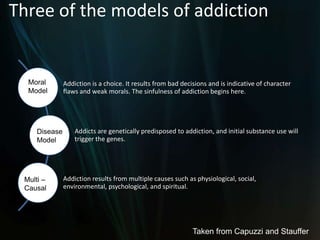
Three of the models of addictionMoralModelDiseaseModelMulti – CausalTaken from Capuzzi and Stauffer
Addictions are not limited to alcohol or other substances. There is a  classification of process addiction which includes activities that become an addiction in themselves with the same symptoms.Process addictions can include anything from running to other forms of exercise,  gambling, shopping, or even sex.There is still a lot of debate surrounding process addictions among professionals, especially when it comes to sex. The important thing to remember in those cases is that it would not be considered an addiction until it becomes an obsession that overrules everything else in the life of the addict. Taken from Capuzzi and Stauffer
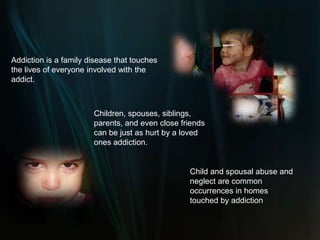
Addiction is a family disease that touches the lives of everyone involved with the addict.Children, spouses, siblings, parents, and even close friends can be just as hurt by a loved ones addiction. Child and spousal abuse and neglect are common occurrences in homes touched by addiction.
Co-Occurring DisordersCo-occurring disorders have become more prevalent lately. This is not due to an actual rise in the disorder as much as a rise in its recognition, and an understanding between the mental health and substance abuse fields.Originally considered primary and secondary conditions
Then came Dual-Diagnosis
Shift to co-occurring in recognition of the number of conditions usually found in this population.Taken from G. Woody
What makes a successful treatment program?Duration of programThe longer the program the more successful the client isAccess to multiple servicesAccess to medical, dental, and other types of services outside of counseling have increase success ratios.Exposure to materialThe more frequently the client is exposed to the material in some form the higher the success rates have been.MotivationThe ability of a treatment program to increase internal motivation, and internalize the external motivation is important to treatment retention and success. (Connor, Longshore, & Anglin, 2009)Taken from  Walker
What is Holistic TreatmentHolistic treatment encourages growth through self-exploration and appropriate expression of feelings, recognition of different emotional states, and learning more adaptive ways to soothe and comfort the mind, body, and spirit. (Breslin, Reed, & Malone, 2003, p. 247)These holistic treatment models  combine counseling, psycho-education, medical care, healthy lifestyle education and promotion, and social and environmental development.
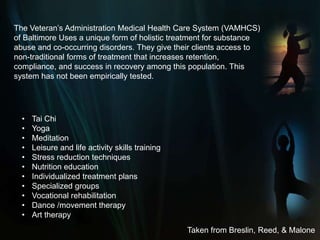
The Veteran’s Administration Medical Health Care System (VAMHCS) of Baltimore Uses a unique form of holistic treatment for substance abuse and co-occurring disorders. They give their clients access to non-traditional forms of treatment that increases retention, compliance, and success in recovery among this population. This system has not been empirically tested.Tai Chi
Yoga
Meditation

Litreviewpresentation

  • 1.
    An Examination ofHolistic Treatment for Substance AbuseLiterature Review PresentationRobert JensenArgosy University, Seattle
  • 2.
    IntroductionAs understanding ofaddictive disorders shifted from moral weakness to medical condition, and again to a disease that affects all aspects of the addict and their loved ones lives treatment styles have also shifted.In today’s addiction treatment field professionals have learned the importance of approaching recovery in all aspects of the addicts life and relationships. It is from this understanding that holistic treatment first began to grow.
  • 3.
    Why is thisimportant?It is important to understand the current state of the addiction treatment field, its history, and the direction it is headed. Gaining an understanding of models of addiction gives us an appreciation for this disorder. As research progresses in the field holistic treatment models become more relevant. Understanding the current state of those models gives us a good foundation of how to improve treatment. Improving treatment allows us to give the client the best opportunity to enter and continue with recovery.
  • 4.
    What is AddictionNarcoticsAnonymous describes addiction in their basic text as “a physical, mental, and spiritual disease that affects every area of our lives” (p. 20). “complete spiritual, mental, and emotional bankruptcy” (p. 7). In the DSM-IV-TR addiction is described as “a cluster of cognitive, behavioral, and physiological symptoms indicating that the individual continues use of the substance despite significant substance related problems” (p. 192) What addiction is to you depends on the model you use to approach understanding it.
  • 5.
    Three of themodels of addictionMoralModelDiseaseModelMulti – CausalTaken from Capuzzi and Stauffer
  • 6.
    Addictions are notlimited to alcohol or other substances. There is a classification of process addiction which includes activities that become an addiction in themselves with the same symptoms.Process addictions can include anything from running to other forms of exercise, gambling, shopping, or even sex.There is still a lot of debate surrounding process addictions among professionals, especially when it comes to sex. The important thing to remember in those cases is that it would not be considered an addiction until it becomes an obsession that overrules everything else in the life of the addict. Taken from Capuzzi and Stauffer
  • 7.
    Addiction is afamily disease that touches the lives of everyone involved with the addict.Children, spouses, siblings, parents, and even close friends can be just as hurt by a loved ones addiction. Child and spousal abuse and neglect are common occurrences in homes touched by addiction.
  • 8.
    Co-Occurring DisordersCo-occurring disordershave become more prevalent lately. This is not due to an actual rise in the disorder as much as a rise in its recognition, and an understanding between the mental health and substance abuse fields.Originally considered primary and secondary conditions
  • 9.
  • 10.
    Shift to co-occurringin recognition of the number of conditions usually found in this population.Taken from G. Woody
  • 11.
    What makes asuccessful treatment program?Duration of programThe longer the program the more successful the client isAccess to multiple servicesAccess to medical, dental, and other types of services outside of counseling have increase success ratios.Exposure to materialThe more frequently the client is exposed to the material in some form the higher the success rates have been.MotivationThe ability of a treatment program to increase internal motivation, and internalize the external motivation is important to treatment retention and success. (Connor, Longshore, & Anglin, 2009)Taken from Walker
  • 12.
    What is HolisticTreatmentHolistic treatment encourages growth through self-exploration and appropriate expression of feelings, recognition of different emotional states, and learning more adaptive ways to soothe and comfort the mind, body, and spirit. (Breslin, Reed, & Malone, 2003, p. 247)These holistic treatment models combine counseling, psycho-education, medical care, healthy lifestyle education and promotion, and social and environmental development.
  • 13.
    The Veteran’s AdministrationMedical Health Care System (VAMHCS) of Baltimore Uses a unique form of holistic treatment for substance abuse and co-occurring disorders. They give their clients access to non-traditional forms of treatment that increases retention, compliance, and success in recovery among this population. This system has not been empirically tested.Tai Chi
  • 14.
  • 15.

Editor's Notes

  • #5 There are many models of addiction. Three are important to understand how we got to our current state.
  • #6 Moral model no longer used in the field though still influences public opinion and some policy makersDisease model forms the basis of NA/AA beliefs and it is here where the chronic illness with no cure began.Multi-causal forms a bridge between many different perspectives and is the current perspective used today.
  • #9 Debate between mental health and substance abuse professionalsOpposite ends of a continuumToday both sides have compromised and meet in the middleSometimes primary sometimes secondary sometimes they develop independently
  • #11 Treats the whole person.Must incorporate mental health treatment, medical care, substance abuse treatment, as well as teach habits to improve physical health, mental health, and spiritual and social development to improve chances of recovery.
  • #12 On top of traditional services such as family, regular groups, individual counseling, and Twelve step facilitation.
  • #13 RecoveryBalanced healthy lifestyle, environmental changes, daily attention to a life long recovery program.Drake et al. ask for inclusion of non-traditional services. They list many that the VAMHCS of baltimore already include in their treatment plans.
  • #14 Rogers and Cobia noticed the negativity related to powerlessness and surrender of NA/AA philosophy and suggest existentinalism as an alternative.