Adaptive Modulation
&
Coding Technique
A s h r a f u r R a h m a n
I D : 1 4 3 0 0 1 5 1 0
S a y e d u r R a h a m a n F a r u q i e
I D : 1 4 3 0 0 1 1 1 0Team Members
 Introduction
 Development Roadmap
 Modulation techniques
 Evolution of broadband
Wireless technology
 Advantages
 Challenges
Overview
Link adaptation, or adaptive
coding and modulation
(ACM), is a term used in
wireless communications to
denote the matching of the
modulation, coding and other
signal and protocol
parameters to the conditions
on the radio link
The pathloss, the
interference due to signals
coming from other
transmitters, the
sensitivity of the receiver,
the available transmitter
power margin, etc.
Introduction
BWA
DEVELOPMENT
ROADMAP
The current WiMAX revision is based upon IEEE802.16e-
2005, approved in December 2005.
• Adding support for mobility
• Scaling of the Fast Fourier transform (FFT) to the
channel bandwidth in order to keep the carrier
spacing constant across different channel bandwidths
(typically 1.25 MHz, 5 MHz, 10 MHz or 20
MHz
• Advanced antenna diversity schemes, and hybrid
automatic repeat-request (HARQ)
• Adaptive Antenna Systems (AAS) and MIMO
technology
• Denser sub-channelization, thereby improving indoor
penetration
• Introducing Turbo Coding and Low-Density Parity
Check (LDPC)
• Introducing downlink sub-channelization, allowing
administrators to trade coverage for capacity
or vice versa
• Adding an extra QoS class for real time applications
MODULATION
TECHNIQUES Both QAM and QPSK are modulation techniques used in IEEE (Wi-
Fi*), IEEE(WiMAX*) and 3G (WCDMA/HSDPA)wireless
technologies.
The modulated signals are then demodulated at the receiver
where the original digital message can be recovered.
The use of adaptive modulation allows wireless technologies to
optimize throughput, yielding higher throughputs while also
covering long distances.
EVOLUTION
OF
BROADBAND
WIRELESS
TECHNOLOGY
SYSTEM DESIGN
MODULATION/CODING SCHEMES
SUPPORTED BY WIMAX
System Architecture
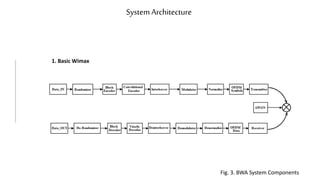
Fig. 3. BWA System Components
1. Basic Wimax
System Architecture
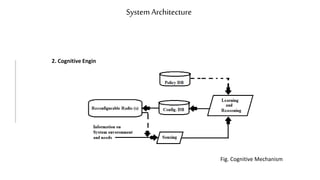
Fig. Cognitive Mechanism
2. Cognitive Engin
ADAPTIVE
COMMUNICATION
SYSTEM
1. AMC Architecture
2. AMC System Performance
1. Channel Quality Estimation
2. Parameter adaptation
3. Feedback Mechanism
ADVANTAGES
Adaptive modulation systems improve rate of
transmission, and/or bit error rates, by exploiting the
channel state information that is present at the
transmitter.
Especially over fading channels which model wireless
propagation environments, adaptive modulation
systems exhibit great performance enhancements
compared to systems that do not exploit channel
knowledge at the transmitter.
.
CHALLENGES
AMC is sensitive to measurement error and
delay. In order to select the appropriate
modulation, the scheduler must be aware of
the channel quality
Errors in the channel estimate will cause the
scheduler to select the wrong data rate and either
transmit at too high a power, wasting system
capacity, or too low a power, raising the block error
rate.
.
QUESTIONS?
?
.
THANK YOU

Adaptive Modulation & Coding Technique

  • 1.
  • 2.
    A s hr a f u r R a h m a n I D : 1 4 3 0 0 1 5 1 0 S a y e d u r R a h a m a n F a r u q i e I D : 1 4 3 0 0 1 1 1 0Team Members
  • 3.
     Introduction  DevelopmentRoadmap  Modulation techniques  Evolution of broadband Wireless technology  Advantages  Challenges Overview
  • 4.
    Link adaptation, oradaptive coding and modulation (ACM), is a term used in wireless communications to denote the matching of the modulation, coding and other signal and protocol parameters to the conditions on the radio link The pathloss, the interference due to signals coming from other transmitters, the sensitivity of the receiver, the available transmitter power margin, etc. Introduction
  • 5.
    BWA DEVELOPMENT ROADMAP The current WiMAXrevision is based upon IEEE802.16e- 2005, approved in December 2005. • Adding support for mobility • Scaling of the Fast Fourier transform (FFT) to the channel bandwidth in order to keep the carrier spacing constant across different channel bandwidths (typically 1.25 MHz, 5 MHz, 10 MHz or 20 MHz • Advanced antenna diversity schemes, and hybrid automatic repeat-request (HARQ) • Adaptive Antenna Systems (AAS) and MIMO technology • Denser sub-channelization, thereby improving indoor penetration • Introducing Turbo Coding and Low-Density Parity Check (LDPC) • Introducing downlink sub-channelization, allowing administrators to trade coverage for capacity or vice versa • Adding an extra QoS class for real time applications
  • 6.
    MODULATION TECHNIQUES Both QAMand QPSK are modulation techniques used in IEEE (Wi- Fi*), IEEE(WiMAX*) and 3G (WCDMA/HSDPA)wireless technologies. The modulated signals are then demodulated at the receiver where the original digital message can be recovered. The use of adaptive modulation allows wireless technologies to optimize throughput, yielding higher throughputs while also covering long distances.
  • 7.
  • 8.
  • 9.
    System Architecture Fig. 3.BWA System Components 1. Basic Wimax
  • 10.
    System Architecture Fig. CognitiveMechanism 2. Cognitive Engin
  • 11.
    ADAPTIVE COMMUNICATION SYSTEM 1. AMC Architecture 2.AMC System Performance 1. Channel Quality Estimation 2. Parameter adaptation 3. Feedback Mechanism
  • 12.
    ADVANTAGES Adaptive modulation systemsimprove rate of transmission, and/or bit error rates, by exploiting the channel state information that is present at the transmitter. Especially over fading channels which model wireless propagation environments, adaptive modulation systems exhibit great performance enhancements compared to systems that do not exploit channel knowledge at the transmitter. .
  • 13.
    CHALLENGES AMC is sensitiveto measurement error and delay. In order to select the appropriate modulation, the scheduler must be aware of the channel quality Errors in the channel estimate will cause the scheduler to select the wrong data rate and either transmit at too high a power, wasting system capacity, or too low a power, raising the block error rate. .
  • 14.
  • 15.