Dr. Riyad Banayot & Dr. Nick Sargent
for SJEH (January 2011)
ļ‚—Chemical injuries can have far
reaching medico-legal consequences
especially:
ļ‚— Poor immediate treatment
ļ‚— Proper documentation
ļ‚— Suboptimal removal of the
chemical agent
ļ‚— It is important to adhere to this
protocol
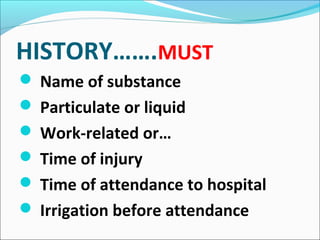
HISTORY…….MUST
ļ‚— Name of substance
ļ‚— Particulate or liquid
ļ‚— Work-related or…
ļ‚— Time of injury
ļ‚— Time of attendance to hospital
ļ‚— Irrigation before attendance
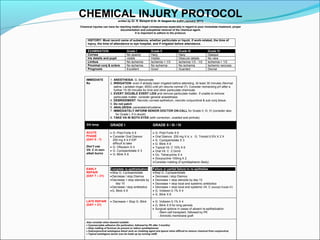
CHEMICAL INJURY PROTOCOLwritten by Dr. R. Banayot & Dr. N. Sargent for SJEH (January 2011)
Chemical injuries can have far reaching medico-legal consequences especially in regard to poor immediate treatment, proper
documentation and suboptimal removal of the chemical agent.
It is important to adhere to the protocol.
HISTORY: Must record name of substance, whether particulate or liquid, if work-related, the time of
injury, the time of attendance to eye hospital, and if irrigated before attendance.
EXAMINATION Grade I Grade II Grade III Grade IV
Cornea No opacity Hazy Hazy Opaque
Iris details and pupil visible Visible Obscure details No view
Limbus No ischemia Ischemia < 1/3 Ischemia 1/3 - 1/2 Ischemia > 1/2
Proximal conj & sclera No ischemia No ischemia No ischemia Ischemic necrosis
Prognosis Excellent Good Guarded Dismal
IMMEDIATE
Rx
1. ANESTHESIA: G. Benoxinate
2. IRRIGATION: even if already been irrigated before attending. At least 30 minutes (Normal
saline, Lactated ringer, BSS) until pH returns normal (7). Consider rechecking pH after a
further 15-30 minutes for lime and other particulate chemicals
3. EVERT /DOUBLE EVERT LIDS and remove particulate matter. If unable to remove
particulate matter, consider general anaesthesia
4. DEBRIDEMENT: Necrotic corneal epithelium, necrotic conjunctival & sub-conj tissue.
5. Do not patch
6. ANALGESIA: paracetamol/codeine
7. IMMEDIATELY INFORM SENIOR DOCTOR ON-CALL for Grade II, III, IV (consider also
for Grade I, if in doubt)
8. TAKE VA IN BOTH EYES (with correction, unaided and pinhole)
Slit lamp GRADE I GRADE II / III / IV
ACUTE
PHASE
(DAY 0 - 7)
Don’t use
Vit. C in non-
alkali burns
• G. Pred Forte X 8
• Consider Oral Diamox
250 mg X 4 if IOP
difficult to take
• G. Ofloxacin X 4
• G. Cyclopentolate X 3
• G. Blink X 8
• G. Pred Forte X 8
• Oral Diamox 250 mg X 4; ± G. Timolol 0.5% X 2 X
• G. Cyclopentolate X 3
• G. Blink X 8
• Topical Vit. C 10% X 6
• Oral Vit. C 2 Gm/d
• Oc. Tetracycline X 4
• Doxycycline 100mg X 2
•Consider rodding (if symblepharon likely)
EARLY
REPAIR
(DAY 7 – 21)
Complete re-epithelisation
•Stop G. Cyclopentolate
•Decrease / stop Diamox
•Decrease + stop steroids by
day 10
•Decrease / stop antibiotics
•G. Blink X 6
Failure or partial failure to re-epithelise
•Stop G. Cyclopentolate
• Decrease / stop Diamox
• Decrease + stop steroids by day 10
• Decrease + stop local and systemic antibiotics
• Decrease + stop local and systemic Vit. C (except Grade IV)
• G. Voltaren 0.1% X 4
• G. Blink X 6
LATE REPAIR
(DAY > 21)
• Decrease + Stop G. Blink • G. Voltaren 0.1% X 4
• G. Blink X 6 for long periods
• Surgical options in cases of absent re-epithelization:
-Stem-cell transplant, followed by PK
- Amniotic membrane graft
Also consider when deemed suitable:
• Cyanoacrylate adhesive (for perforation, followed by PK after 3 months)
• Daily rodding of fornices (to prevent or relieve symblepharon)
• Subconjunctival autologous blood (acts as chelating agent and spacer when difficult to remove chemical from conjunctiva)
• Topical autologous serum (can be made up by nursing staff)
STEP ONE IMMEDIATELY
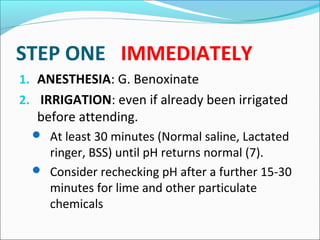
1. ANESTHESIA: G. Benoxinate
2. IRRIGATION: even if already been irrigated
before attending.
ļ‚— At least 30 minutes (Normal saline, Lactated
ringer, BSS) until pH returns normal (7).
ļ‚— Consider rechecking pH after a further 15-30
minutes for lime and other particulate
chemicals
STEP ONE IMMEDIATELY
3. EVERT /DOUBLE EVERT LIDS and remove
particulate matter.
ļ‚— If unable to remove particulate matter,
consider general anaesthesia
3. DEBRIDEMENT: Necrotic corneal epithelium,
necrotic conjunctival & sub-conj tissue.
STEP ONE IMMEDIATELY
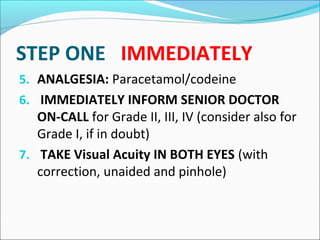
5. ANALGESIA: Paracetamol/codeine
6. IMMEDIATELY INFORM SENIOR DOCTOR
ON-CALL for Grade II, III, IV (consider also for
Grade I, if in doubt)
7. TAKE Visual Acuity IN BOTH EYES (with
correction, unaided and pinhole)
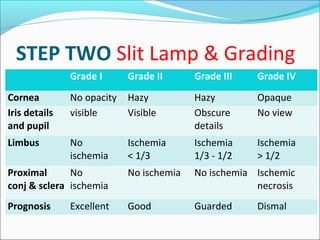
STEP TWO Slit Lamp & Grading
Grade I Grade II Grade III Grade IV
Cornea No opacity Hazy Hazy Opaque
Iris details
and pupil
visible Visible Obscure
details
No view
Limbus No
ischemia
Ischemia
< 1/3
Ischemia
1/3 - 1/2
Ischemia
> 1/2
Proximal
conj & sclera
No
ischemia
No ischemia No ischemia Ischemic
necrosis
Prognosis Excellent Good Guarded Dismal
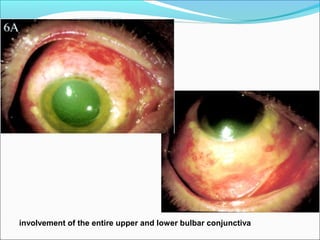
Limbal ischemia
involvement of the entire upper and lower bulbar conjunctiva
The entire corneal surface and 12 clock hours of the limbus are involved
severe conjunctival reaction and stromal opacification blurring iris
details inferiorly
ACUTE PHASE (DAY 0 - 7)
GRADE IGRADE I
ļ‚—G. Pred Forte X 8
ļ‚—Consider Oral Diamox 250 mg X 4
if IOP is difficult to take
ļ‚—G. Ofloxacin X 4
ļ‚—G. Cyclopentolate X 3
ļ‚—G. Blink X 8
Do NOT
patch
Do NOT use Vit. C
in non-alkali
burns
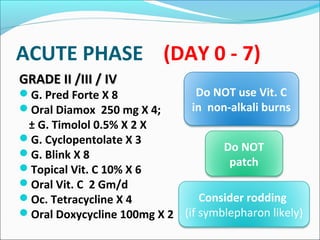
ACUTE PHASE (DAY 0 - 7)
GRADE II /III / IVGRADE II /III / IV
ļ‚—G. Pred Forte X 8
ļ‚—Oral Diamox 250 mg X 4;
± G. Timolol 0.5% X 2 X
ļ‚—G. Cyclopentolate X 3
ļ‚—G. Blink X 8
ļ‚—Topical Vit. C 10% X 6
ļ‚—Oral Vit. C 2 Gm/d
ļ‚—Oc. Tetracycline X 4
ļ‚—Oral Doxycycline 100mg X 2
Consider rodding
(if symblepharon likely)
Do NOT
patch
Do NOT use Vit. C
in non-alkali burns
EARLY REPAIR (DAY 7 - 21)
GRADE IGRADE I
ļ‚—Stop G. Cyclopentolate
ļ‚—Decrease / stop Diamox
ļ‚—Decrease + stop steroids by
ļ‚—Decrease / stop antibiotics
ļ‚—G. Blink X 6
CompleteComplete
re-epithelisationre-epithelisation
DAY 10DAY 10
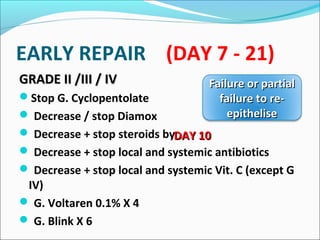
EARLY REPAIR (DAY 7 - 21)
GRADE II /III / IVGRADE II /III / IV
ļ‚—Stop G. Cyclopentolate
ļ‚— Decrease / stop Diamox
ļ‚— Decrease + stop steroids by
ļ‚— Decrease + stop local and systemic antibiotics
ļ‚— Decrease + stop local and systemic Vit. C (except G
IV)
ļ‚— G. Voltaren 0.1% X 4
ļ‚— G. Blink X 6
Failure or partialFailure or partial
failure to re-failure to re-
epitheliseepithelise
DAY 10DAY 10
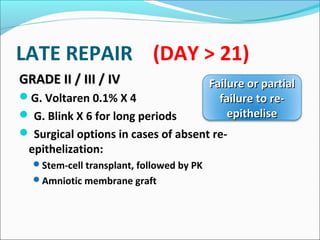
LATE REPAIR (DAY > 21)
GRADE IGRADE I
ļ‚—Decrease + stop G. Blink
CompleteComplete
re-epithelisationre-epithelisation
LATE REPAIR (DAY > 21)
GRADE II / III / IVGRADE II / III / IV
ļ‚—G. Voltaren 0.1% X 4
ļ‚— G. Blink X 6 for long periods
ļ‚— Surgical options in cases of absent re-
epithelization:
ļ‚—Stem-cell transplant, followed by PK
ļ‚—Amniotic membrane graft
Failure or partialFailure or partial
failure to re-failure to re-
epitheliseepithelise
Consider when suitable
ļ‚—Cyanoacrylate adhesive (for perforation, followed by
PK after 3 months)
ļ‚—Daily rodding of fornices (to prevent or relieve
symblepharon)
ļ‚—Subconjunctival autologous blood (acts as chelating
agent and spacer when difficult to remove chemical from
conjunctiva)
ļ‚—Topical autologous serum (can be made up by nursing
staff)
Reading
ļ‚—Survey of Ophthalmology
ļ‚—Major Review
ļ‚—Chemical Injuries of the Eye: Current Concepts in
Pathophysiology and Therapy
ļ‚—Michael D. Wagoner, MD
ļ‚—VOLUME 41 NUMBER 4 January-February 1997
ļ‚—Page: 275 - 313

Chemical injury protocol

  • 1.
    Dr. Riyad Banayot& Dr. Nick Sargent for SJEH (January 2011)
  • 2.
    ļ‚—Chemical injuries canhave far reaching medico-legal consequences especially: ļ‚— Poor immediate treatment ļ‚— Proper documentation ļ‚— Suboptimal removal of the chemical agent ļ‚— It is important to adhere to this protocol
  • 3.
    HISTORY…….MUST ļ‚— Name ofsubstance ļ‚— Particulate or liquid ļ‚— Work-related or… ļ‚— Time of injury ļ‚— Time of attendance to hospital ļ‚— Irrigation before attendance
  • 4.
    CHEMICAL INJURY PROTOCOLwrittenby Dr. R. Banayot & Dr. N. Sargent for SJEH (January 2011) Chemical injuries can have far reaching medico-legal consequences especially in regard to poor immediate treatment, proper documentation and suboptimal removal of the chemical agent. It is important to adhere to the protocol. HISTORY: Must record name of substance, whether particulate or liquid, if work-related, the time of injury, the time of attendance to eye hospital, and if irrigated before attendance. EXAMINATION Grade I Grade II Grade III Grade IV Cornea No opacity Hazy Hazy Opaque Iris details and pupil visible Visible Obscure details No view Limbus No ischemia Ischemia < 1/3 Ischemia 1/3 - 1/2 Ischemia > 1/2 Proximal conj & sclera No ischemia No ischemia No ischemia Ischemic necrosis Prognosis Excellent Good Guarded Dismal IMMEDIATE Rx 1. ANESTHESIA: G. Benoxinate 2. IRRIGATION: even if already been irrigated before attending. At least 30 minutes (Normal saline, Lactated ringer, BSS) until pH returns normal (7). Consider rechecking pH after a further 15-30 minutes for lime and other particulate chemicals 3. EVERT /DOUBLE EVERT LIDS and remove particulate matter. If unable to remove particulate matter, consider general anaesthesia 4. DEBRIDEMENT: Necrotic corneal epithelium, necrotic conjunctival & sub-conj tissue. 5. Do not patch 6. ANALGESIA: paracetamol/codeine 7. IMMEDIATELY INFORM SENIOR DOCTOR ON-CALL for Grade II, III, IV (consider also for Grade I, if in doubt) 8. TAKE VA IN BOTH EYES (with correction, unaided and pinhole) Slit lamp GRADE I GRADE II / III / IV ACUTE PHASE (DAY 0 - 7) Don’t use Vit. C in non- alkali burns • G. Pred Forte X 8 • Consider Oral Diamox 250 mg X 4 if IOP difficult to take • G. Ofloxacin X 4 • G. Cyclopentolate X 3 • G. Blink X 8 • G. Pred Forte X 8 • Oral Diamox 250 mg X 4; ± G. Timolol 0.5% X 2 X • G. Cyclopentolate X 3 • G. Blink X 8 • Topical Vit. C 10% X 6 • Oral Vit. C 2 Gm/d • Oc. Tetracycline X 4 • Doxycycline 100mg X 2 •Consider rodding (if symblepharon likely) EARLY REPAIR (DAY 7 – 21) Complete re-epithelisation •Stop G. Cyclopentolate •Decrease / stop Diamox •Decrease + stop steroids by day 10 •Decrease / stop antibiotics •G. Blink X 6 Failure or partial failure to re-epithelise •Stop G. Cyclopentolate • Decrease / stop Diamox • Decrease + stop steroids by day 10 • Decrease + stop local and systemic antibiotics • Decrease + stop local and systemic Vit. C (except Grade IV) • G. Voltaren 0.1% X 4 • G. Blink X 6 LATE REPAIR (DAY > 21) • Decrease + Stop G. Blink • G. Voltaren 0.1% X 4 • G. Blink X 6 for long periods • Surgical options in cases of absent re-epithelization: -Stem-cell transplant, followed by PK - Amniotic membrane graft Also consider when deemed suitable: • Cyanoacrylate adhesive (for perforation, followed by PK after 3 months) • Daily rodding of fornices (to prevent or relieve symblepharon) • Subconjunctival autologous blood (acts as chelating agent and spacer when difficult to remove chemical from conjunctiva) • Topical autologous serum (can be made up by nursing staff)
  • 5.
    STEP ONE IMMEDIATELY 1.ANESTHESIA: G. Benoxinate 2. IRRIGATION: even if already been irrigated before attending. ļ‚— At least 30 minutes (Normal saline, Lactated ringer, BSS) until pH returns normal (7). ļ‚— Consider rechecking pH after a further 15-30 minutes for lime and other particulate chemicals
  • 6.
    STEP ONE IMMEDIATELY 3.EVERT /DOUBLE EVERT LIDS and remove particulate matter. ļ‚— If unable to remove particulate matter, consider general anaesthesia 3. DEBRIDEMENT: Necrotic corneal epithelium, necrotic conjunctival & sub-conj tissue.
  • 7.
    STEP ONE IMMEDIATELY 5.ANALGESIA: Paracetamol/codeine 6. IMMEDIATELY INFORM SENIOR DOCTOR ON-CALL for Grade II, III, IV (consider also for Grade I, if in doubt) 7. TAKE Visual Acuity IN BOTH EYES (with correction, unaided and pinhole)
  • 8.
    STEP TWO SlitLamp & Grading Grade I Grade II Grade III Grade IV Cornea No opacity Hazy Hazy Opaque Iris details and pupil visible Visible Obscure details No view Limbus No ischemia Ischemia < 1/3 Ischemia 1/3 - 1/2 Ischemia > 1/2 Proximal conj & sclera No ischemia No ischemia No ischemia Ischemic necrosis Prognosis Excellent Good Guarded Dismal
  • 9.
  • 10.
    involvement of theentire upper and lower bulbar conjunctiva
  • 11.
    The entire cornealsurface and 12 clock hours of the limbus are involved
  • 12.
    severe conjunctival reactionand stromal opacification blurring iris details inferiorly
  • 13.
    ACUTE PHASE (DAY0 - 7) GRADE IGRADE I ļ‚—G. Pred Forte X 8 ļ‚—Consider Oral Diamox 250 mg X 4 if IOP is difficult to take ļ‚—G. Ofloxacin X 4 ļ‚—G. Cyclopentolate X 3 ļ‚—G. Blink X 8 Do NOT patch Do NOT use Vit. C in non-alkali burns
  • 14.
    ACUTE PHASE (DAY0 - 7) GRADE II /III / IVGRADE II /III / IV ļ‚—G. Pred Forte X 8 ļ‚—Oral Diamox 250 mg X 4; ± G. Timolol 0.5% X 2 X ļ‚—G. Cyclopentolate X 3 ļ‚—G. Blink X 8 ļ‚—Topical Vit. C 10% X 6 ļ‚—Oral Vit. C 2 Gm/d ļ‚—Oc. Tetracycline X 4 ļ‚—Oral Doxycycline 100mg X 2 Consider rodding (if symblepharon likely) Do NOT patch Do NOT use Vit. C in non-alkali burns
  • 15.
    EARLY REPAIR (DAY7 - 21) GRADE IGRADE I ļ‚—Stop G. Cyclopentolate ļ‚—Decrease / stop Diamox ļ‚—Decrease + stop steroids by ļ‚—Decrease / stop antibiotics ļ‚—G. Blink X 6 CompleteComplete re-epithelisationre-epithelisation DAY 10DAY 10
  • 16.
    EARLY REPAIR (DAY7 - 21) GRADE II /III / IVGRADE II /III / IV ļ‚—Stop G. Cyclopentolate ļ‚— Decrease / stop Diamox ļ‚— Decrease + stop steroids by ļ‚— Decrease + stop local and systemic antibiotics ļ‚— Decrease + stop local and systemic Vit. C (except G IV) ļ‚— G. Voltaren 0.1% X 4 ļ‚— G. Blink X 6 Failure or partialFailure or partial failure to re-failure to re- epitheliseepithelise DAY 10DAY 10
  • 17.
    LATE REPAIR (DAY> 21) GRADE IGRADE I ļ‚—Decrease + stop G. Blink CompleteComplete re-epithelisationre-epithelisation
  • 18.
    LATE REPAIR (DAY> 21) GRADE II / III / IVGRADE II / III / IV ļ‚—G. Voltaren 0.1% X 4 ļ‚— G. Blink X 6 for long periods ļ‚— Surgical options in cases of absent re- epithelization: ļ‚—Stem-cell transplant, followed by PK ļ‚—Amniotic membrane graft Failure or partialFailure or partial failure to re-failure to re- epitheliseepithelise
  • 19.
    Consider when suitable ļ‚—Cyanoacrylateadhesive (for perforation, followed by PK after 3 months) ļ‚—Daily rodding of fornices (to prevent or relieve symblepharon) ļ‚—Subconjunctival autologous blood (acts as chelating agent and spacer when difficult to remove chemical from conjunctiva) ļ‚—Topical autologous serum (can be made up by nursing staff)
  • 20.
    Reading ļ‚—Survey of Ophthalmology ļ‚—MajorReview ļ‚—Chemical Injuries of the Eye: Current Concepts in Pathophysiology and Therapy ļ‚—Michael D. Wagoner, MD ļ‚—VOLUME 41 NUMBER 4 January-February 1997 ļ‚—Page: 275 - 313