AJITH C B.P.T.
Student-K.M.C.H. College Of Physiotherapy,
Coimbatore.
 Bed rest also reffered to as the REST-CURE
,it is a medical treatement in which a person
lies in bed for most of the time to try to cure
on illness
 IMMOBILIZATION-Physical restriction of
movement to body (or) a body segment
 DECONDITIONING-Decreased functional
capacity of multiple organ system
 Physical
 Psychological
 Environmental
 MUSCULO SKELETAL DISORDERS
Arthritis
Osteoporosis
Fractures (especially hip and femur)
Podiatric problem
Others(e.g. Paget”s diseases)
 NEUROLOGICAL DISORDERS
Stroke
Parkinsonism diseases
Others
 CARDIO VASCULAR DISEASES
Congestive heart failure(severe)
Coronary heart diseases(frequent angina)
Peripheral vascular diseases
 PULMONARY DISEASES
Chronic obstructive lung diseases(severe)
Acute and chronic pain
Malnutrition
Drug side effects
Sensory factors impairment of vision
 Fear(from instability and fear of falling)
 Depression
 Forced immobility(in hospitals and nursing
home)
 Inadequate aids for immobility
 Poor lightening
Decreased mobility and
increased bed rest adversely
affect almost every system of
the body
Prolonged inactivity (or) bed rest
has adverse physical and
physiological consequences
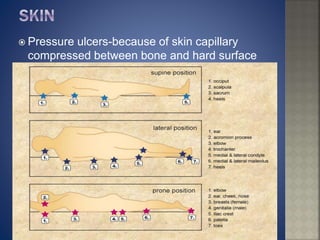
 Pressure ulcers-because of skin capillary
compressed between bone and hard surface
 Muscle: disuse atrophy “if you don’t use it
,you’ll lose it,”
loss of muscle strength ,muscle atrophy
(begins after 1 day of immobilization.1-
3%/day muscles may loss half of their bulk
after 2 months)
 Bone: increased bone resorption
(Osteoporosis) increased risk of fracture,
dorsal kyphosis, and chronic back pain 1%
loss of vertebral mineral content per week)
 Immobilization can induce cartilage degeneration.
The body attempts ton repair joints through
cartilage proliferation ,osteophyte formation ,and
fibrofatty infiltration of the joint cavity.
 Contractures (contributing factors include
spasticity ,improper bed positioning and
maintaining the limb in a shortened position)
Muscles ,CT that cross two joints are at increased
risk factor contractures, further impaired mobility,
resulting in more joints tightness and
contractures.
 Joints stiffness and pain: if joints are not given
adequate full range of motion. The stiffness is due
to tightness of the muscles and tissues
surrounding the joints.
Decreased Voiding (stasis)
 Increased post-void residual volume
,retention
 Increased risk of urinary tract infections
 Increased risk of calculus formation
 Venous stasis + increased blood coagulated +
decreased plasma volume
 heart rate (1 beat/minute every 2 days)
1) Decreased coronary blood flow and
decreased O2 available to cardiac muscle
a) CO,SV
Orthostatic hypotension (begins after
3 weeks of bed rest ) due to:
Excessive pooling of blood in the
lower limb
Decreased circulating blood volume
(20 days of bed rest may lead to a 25%
of decreased STROKE VOLUME and
a 20% increased in HEART RATE).
 Constipation
 Weakening of Abdominal wall muscles
,leading to difficulty in raising the intra-
abdominal pressure sufficiently for
defecation .
 Loss of privacy and embarrassment if toilet
assistance is needed.
 Bowel irregularity may produce Abdominal
discomfort ,as well as cause loss of
appetite.
 Decreased BMR
 Hypercalcemia
 Decreased parathyroid hormone
 Increased plasma renin activity
 Increased aldosterone secretion
 Altered growth hormone production
 Altered spermatogenesis and androgen
secretion
 Altered circadian rhythm
URINORY loss of:
Nitrogen-(begins day 5-6,peaks at 2
weeks)
Calcium –(begins day 2-3,peaks at 4-
6 weeks)
Phosphorus
o Reversible post mobilization
Decreased strength of respiratory
muscles- decreased tidal volume
,minute volume, respiratory capacity
Increased respiratory rate to
compensate for decreased
respiratory capacity
Decreased ability clear secretion
(cough reflex)
(Accumulation of secretion in the lower bronchial
tree ,which can block airways ,cause Atelectasis
and increased the risk of pneumonia)
Immobility (Bed Rest Complications)

Immobility (Bed Rest Complications)

  • 1.
    AJITH C B.P.T. Student-K.M.C.H.College Of Physiotherapy, Coimbatore.
  • 2.
     Bed restalso reffered to as the REST-CURE ,it is a medical treatement in which a person lies in bed for most of the time to try to cure on illness
  • 4.
     IMMOBILIZATION-Physical restrictionof movement to body (or) a body segment  DECONDITIONING-Decreased functional capacity of multiple organ system
  • 5.
  • 6.
     MUSCULO SKELETALDISORDERS Arthritis Osteoporosis Fractures (especially hip and femur) Podiatric problem Others(e.g. Paget”s diseases)  NEUROLOGICAL DISORDERS Stroke Parkinsonism diseases Others
  • 7.
     CARDIO VASCULARDISEASES Congestive heart failure(severe) Coronary heart diseases(frequent angina) Peripheral vascular diseases  PULMONARY DISEASES Chronic obstructive lung diseases(severe) Acute and chronic pain Malnutrition Drug side effects Sensory factors impairment of vision
  • 8.
     Fear(from instabilityand fear of falling)  Depression
  • 9.
     Forced immobility(inhospitals and nursing home)  Inadequate aids for immobility  Poor lightening
  • 10.
    Decreased mobility and increasedbed rest adversely affect almost every system of the body Prolonged inactivity (or) bed rest has adverse physical and physiological consequences
  • 11.
     Pressure ulcers-becauseof skin capillary compressed between bone and hard surface
  • 13.
     Muscle: disuseatrophy “if you don’t use it ,you’ll lose it,” loss of muscle strength ,muscle atrophy (begins after 1 day of immobilization.1- 3%/day muscles may loss half of their bulk after 2 months)  Bone: increased bone resorption (Osteoporosis) increased risk of fracture, dorsal kyphosis, and chronic back pain 1% loss of vertebral mineral content per week)
  • 15.
     Immobilization caninduce cartilage degeneration. The body attempts ton repair joints through cartilage proliferation ,osteophyte formation ,and fibrofatty infiltration of the joint cavity.  Contractures (contributing factors include spasticity ,improper bed positioning and maintaining the limb in a shortened position) Muscles ,CT that cross two joints are at increased risk factor contractures, further impaired mobility, resulting in more joints tightness and contractures.  Joints stiffness and pain: if joints are not given adequate full range of motion. The stiffness is due to tightness of the muscles and tissues surrounding the joints.
  • 17.
    Decreased Voiding (stasis) Increased post-void residual volume ,retention  Increased risk of urinary tract infections  Increased risk of calculus formation
  • 18.
     Venous stasis+ increased blood coagulated + decreased plasma volume
  • 20.
     heart rate(1 beat/minute every 2 days) 1) Decreased coronary blood flow and decreased O2 available to cardiac muscle a) CO,SV
  • 21.
    Orthostatic hypotension (beginsafter 3 weeks of bed rest ) due to: Excessive pooling of blood in the lower limb Decreased circulating blood volume (20 days of bed rest may lead to a 25% of decreased STROKE VOLUME and a 20% increased in HEART RATE).
  • 22.
     Constipation  Weakeningof Abdominal wall muscles ,leading to difficulty in raising the intra- abdominal pressure sufficiently for defecation .  Loss of privacy and embarrassment if toilet assistance is needed.  Bowel irregularity may produce Abdominal discomfort ,as well as cause loss of appetite.
  • 23.
     Decreased BMR Hypercalcemia  Decreased parathyroid hormone  Increased plasma renin activity  Increased aldosterone secretion  Altered growth hormone production  Altered spermatogenesis and androgen secretion  Altered circadian rhythm
  • 24.
    URINORY loss of: Nitrogen-(beginsday 5-6,peaks at 2 weeks) Calcium –(begins day 2-3,peaks at 4- 6 weeks) Phosphorus o Reversible post mobilization
  • 25.
    Decreased strength ofrespiratory muscles- decreased tidal volume ,minute volume, respiratory capacity Increased respiratory rate to compensate for decreased respiratory capacity Decreased ability clear secretion (cough reflex) (Accumulation of secretion in the lower bronchial tree ,which can block airways ,cause Atelectasis and increased the risk of pneumonia)