

MGT 2067Y (3) Business Ethics and Good GovernancePresentation on Gifts by:SoujataRughoobur
JasbeerAlladin 
NawsheenWoozeer 
RakshaMunbodh 
AsheshRamjeeawonBSc (Hons) Management with Information Systems Level III23 April 2010
AgendaIntroductionVideo surveyLiterature ReviewCasesRole PlayConclusionRecommendations
introductionGifts“Gifts are frequently perceived as indicators of friendship, trust and goodwill, intended to further relationships. Gifts are often reciprocated and may not in themselves create any expectation of preferential treatment. To avoid any possible problems in this area, most companies set strict guidelines on what can be accepted or given, their value, frequency and timing. It is recommended that such gifts should be openly declared as company policy. ” (Discuss this statement)“A problem well-defined is a problem half-solved”
Gift GivingA Gift is something given voluntarily without payment in return, as to show favor towards someone, honor an occasion, or make a gesture of assistance – dictionary.com def.Examples of popular business gifts:Company branded items like pen, mug, t-shirts, umbrella etc.Business card holder for company’s clients, paperweightWine or fine liquorTickets Books
Motivation behind giving giftIn some business cultures, gifts are means of cimenting relations and are given without influencing decision-making. companies offer gifts to their customers in order to acknowledge their loyalty to the company and ultimately to enhance relationship between customers.
BriberyBribery is anything that the jobholder is prepared to accept knowing that he is not morally entitled to do soEffects of BriberyThe giving of gifts to influence outcomes and without transparency of your intent ultimately undermines trust in business relationships Bribery violates the rules of fidelity and upon the discovery, good business climate and confidence in contracts are undermined.
Video SurveyAccepting a gift at work is morally acceptable? Do you think a company should practice a no-gift policy (banning gifts giving and receiving) Do you think having guidelines on gifts in a contract of employment would be appropriate? Have you ever been tempted to bribe?
Literature reviewGifts"There's no such thing as a free lunch”
Code of EthicsCode of ethics: set of principles of behavior within an organization that guide decision making and behavior.Purpose: To improve ethical culture in an organisation
To prevent fraudulent behavior within the organisation
To provide members of the organisation and other interested persons, to make ethical choices in the way they carry out their work.UtilitarianismUtilitarianism has its roots in 18th and 19th century social and political philosophyDecide what to do by considering the consequences of our actions.(Consequentialism) Under this philosophy, by making a costs and benefits analysis and decisions that promote the greatest amount of values for the greatest number of people is the most reasonable decision from an ethical point of view.
Act and Rule utilitarianismIn Act utilitarianism, a person performs the acts that benefit the most people, regardless of personal feelings or the societal constraints such as laws.Rule utilitarianism, however, considers the law and is concerned with justice.The difference is that act utilitarianism is concerned with the consequences while rule utilitarianism is concerned with the consequences that fallout of following a rule of conduct
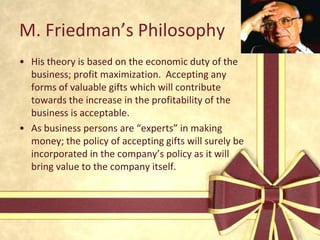
M. Friedman’s PhilosophyHis theory is based on the economic duty of the business; profit maximization.  Accepting any forms of valuable gifts which will contribute towards the increase in the profitability of the business is acceptable.As business persons are “experts” in making money; the policy of accepting gifts will surely be incorporated in the company’s policy as it will bring value to the company itself.
DeontologyDeontology refers to the science of duty and also a non-consequentialist moral conception; it observes MORAL RULES without any regard of consequences of actions. The idea of gifts must be inline with the company policy for it to be accepted within the organisation
Kantian EthicsUniversal law which puts emphasis on whatever is right for one must be right for everybody; categorical imperative. Rule is rule under any circumstances; if company policy does not allow gifts it must be applicable for every individual.
Theory of RelativismWhether or not the practice of bribery is accepted or tolerated in a country depends on the prevailing culture and on personal valuesWhat constitutes bribery in a particular setting may be the norm in another one
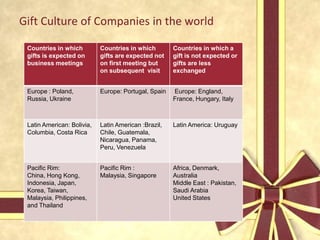
Gift Culture of Companies in the world
casesGifts“To receive gifts is to lose freedom. ” - Sandi
Obtaining building permitOffering speed money  to local authorities to hasten procedures and stimulate officials.The bribe-payer wants to speed up the process of movement of files and communicationPublic officials develop the habit of not fulfilling their basic duties until they are suitably persuaded to do so. They expect extra money in form of gratuities to do their work.
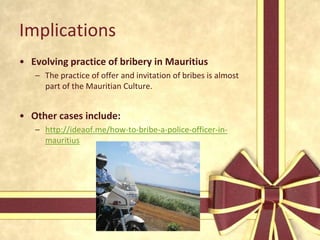
ImplicationsEvolving practice of bribery in MauritiusThe practice of offer and invitation of bribes is almost part of the Mauritian Culture.Other cases include:http://ideaof.me/how-to-bribe-a-police-officer-in-mauritius
Wedding GiftA business person gave an excessive amount of money as a wedding gift to the son of one of the most influential government officials. His money was literally a wedding gift. However, shortly after the wedding, the business person informs this government dignitary indirectly that he needs a permit to expand his business. Gift or bribe?
ImplicationsGiftCulture of the society to offer gift, to strengthen relationshipBriberyMoney was a gift but informally it may be interpreted  as bribe
Multinational company with over 20 branchesGood reputation of reasonable dealings and ethical conduct of employeesEmployees should use good judgment & moderation when giving or receiving social amenities.This would help to avoid situations that would compromise an employee’s impartiality
Rinnai Gift Policy continued..According to the company’s policy gift is never unsuitable in the business world.Promotional gifts such as t-shirts, mugs and caps can be received from other parties but it should not exceed $500.Do you think that all the employees follow this rule?
Rinnai Gift Policy continued..Another policy is that employees can get recourse to entertainment with the customers only if it advances the company’s profit.For e.g.: accompany a client to a cultural show, attend a supplier’s holiday function.Is this act not benefitting the employee also?
Role PlayGifts“ Gift Policy at a Fictitious Company”
conclusionGifts“A gift consists not in what is done or given, but in the intention of the giver or doer.”

Presentation on Gifts

  • 1.
    MGT 2067Y (3)Business Ethics and Good GovernancePresentation on Gifts by:SoujataRughoobur
  • 2.
  • 3.
  • 4.
  • 5.
    AsheshRamjeeawonBSc (Hons) Managementwith Information Systems Level III23 April 2010
  • 6.
  • 7.
    introductionGifts“Gifts are frequentlyperceived as indicators of friendship, trust and goodwill, intended to further relationships. Gifts are often reciprocated and may not in themselves create any expectation of preferential treatment. To avoid any possible problems in this area, most companies set strict guidelines on what can be accepted or given, their value, frequency and timing. It is recommended that such gifts should be openly declared as company policy. ” (Discuss this statement)“A problem well-defined is a problem half-solved”
  • 8.
    Gift GivingA Giftis something given voluntarily without payment in return, as to show favor towards someone, honor an occasion, or make a gesture of assistance – dictionary.com def.Examples of popular business gifts:Company branded items like pen, mug, t-shirts, umbrella etc.Business card holder for company’s clients, paperweightWine or fine liquorTickets Books
  • 9.
    Motivation behind givinggiftIn some business cultures, gifts are means of cimenting relations and are given without influencing decision-making. companies offer gifts to their customers in order to acknowledge their loyalty to the company and ultimately to enhance relationship between customers.
  • 10.
    BriberyBribery is anythingthat the jobholder is prepared to accept knowing that he is not morally entitled to do soEffects of BriberyThe giving of gifts to influence outcomes and without transparency of your intent ultimately undermines trust in business relationships Bribery violates the rules of fidelity and upon the discovery, good business climate and confidence in contracts are undermined.
  • 11.
    Video SurveyAccepting agift at work is morally acceptable? Do you think a company should practice a no-gift policy (banning gifts giving and receiving) Do you think having guidelines on gifts in a contract of employment would be appropriate? Have you ever been tempted to bribe?
  • 12.
    Literature reviewGifts"There's nosuch thing as a free lunch”
  • 13.
    Code of EthicsCodeof ethics: set of principles of behavior within an organization that guide decision making and behavior.Purpose: To improve ethical culture in an organisation
  • 14.
    To prevent fraudulentbehavior within the organisation
  • 15.
    To provide membersof the organisation and other interested persons, to make ethical choices in the way they carry out their work.UtilitarianismUtilitarianism has its roots in 18th and 19th century social and political philosophyDecide what to do by considering the consequences of our actions.(Consequentialism) Under this philosophy, by making a costs and benefits analysis and decisions that promote the greatest amount of values for the greatest number of people is the most reasonable decision from an ethical point of view.
  • 16.
    Act and RuleutilitarianismIn Act utilitarianism, a person performs the acts that benefit the most people, regardless of personal feelings or the societal constraints such as laws.Rule utilitarianism, however, considers the law and is concerned with justice.The difference is that act utilitarianism is concerned with the consequences while rule utilitarianism is concerned with the consequences that fallout of following a rule of conduct
  • 17.
    M. Friedman’s PhilosophyHistheory is based on the economic duty of the business; profit maximization. Accepting any forms of valuable gifts which will contribute towards the increase in the profitability of the business is acceptable.As business persons are “experts” in making money; the policy of accepting gifts will surely be incorporated in the company’s policy as it will bring value to the company itself.
  • 18.
    DeontologyDeontology refers tothe science of duty and also a non-consequentialist moral conception; it observes MORAL RULES without any regard of consequences of actions. The idea of gifts must be inline with the company policy for it to be accepted within the organisation
  • 19.
    Kantian EthicsUniversal lawwhich puts emphasis on whatever is right for one must be right for everybody; categorical imperative. Rule is rule under any circumstances; if company policy does not allow gifts it must be applicable for every individual.
  • 20.
    Theory of RelativismWhetheror not the practice of bribery is accepted or tolerated in a country depends on the prevailing culture and on personal valuesWhat constitutes bribery in a particular setting may be the norm in another one
  • 21.
    Gift Culture ofCompanies in the world
  • 22.
    casesGifts“To receive giftsis to lose freedom. ” - Sandi
  • 23.
    Obtaining building permitOfferingspeed money to local authorities to hasten procedures and stimulate officials.The bribe-payer wants to speed up the process of movement of files and communicationPublic officials develop the habit of not fulfilling their basic duties until they are suitably persuaded to do so. They expect extra money in form of gratuities to do their work.
  • 24.
    ImplicationsEvolving practice ofbribery in MauritiusThe practice of offer and invitation of bribes is almost part of the Mauritian Culture.Other cases include:http://ideaof.me/how-to-bribe-a-police-officer-in-mauritius
  • 25.
    Wedding GiftA businessperson gave an excessive amount of money as a wedding gift to the son of one of the most influential government officials. His money was literally a wedding gift. However, shortly after the wedding, the business person informs this government dignitary indirectly that he needs a permit to expand his business. Gift or bribe?
  • 26.
    ImplicationsGiftCulture of thesociety to offer gift, to strengthen relationshipBriberyMoney was a gift but informally it may be interpreted as bribe
  • 27.
    Multinational company withover 20 branchesGood reputation of reasonable dealings and ethical conduct of employeesEmployees should use good judgment & moderation when giving or receiving social amenities.This would help to avoid situations that would compromise an employee’s impartiality
  • 28.
    Rinnai Gift Policycontinued..According to the company’s policy gift is never unsuitable in the business world.Promotional gifts such as t-shirts, mugs and caps can be received from other parties but it should not exceed $500.Do you think that all the employees follow this rule?
  • 29.
    Rinnai Gift Policycontinued..Another policy is that employees can get recourse to entertainment with the customers only if it advances the company’s profit.For e.g.: accompany a client to a cultural show, attend a supplier’s holiday function.Is this act not benefitting the employee also?
  • 30.
    Role PlayGifts“ Gift Policyat a Fictitious Company”
  • 31.
    conclusionGifts“A gift consistsnot in what is done or given, but in the intention of the giver or doer.”