Passive, Semi-Active and Active
Suspension System
Definition:
Suspension system: a mechanical system of
springs and shock absorbers that connect the
wheels and axles to the chassis of a wheeled
vehicle
The Function of suspension system:
The job of a car suspension are:
- to carry the static weight of the vehicle
- to maximize the friction between the tires
and the road surface,
- to provide steering stability with good
handling (minimize body roll)
- to ensure the comfort of the passengers
(ability to smooth out a bumpy road).
The Function of Spring and Shock
Absorber
The Function of Spring: to absorb shock energy from road bump and convert it into
potential energy of spring
The Function of Shock Absorber: to dissipate shock energy from road bump without
causing undue oscillation in the vehicle.
Classification of Suspension System
• Passive
• Semi-Active
- Orifice Based Damper
- MR fluid based Damper
• Active
– Slow Active
– Active
– Fully Active
Passive Suspension
The damping value (Cs) of a passive
damper is determined by the total orifice
area (the number of hole) in the piston
head.
Orifice based Semi-Active Suspension
MR fluid based Semi-Active
Suspension
MR Fluid
- Magnetorheological fluid is composed of oil
and varying percentages of ferrous particles
(20-50 microns in diameter) that have been
coated with an anti-coagulant material.
- Varying the magnetic field strength has the
effect of changing the viscosity of the
magnetorheological fluid.
Force – velocity relationship
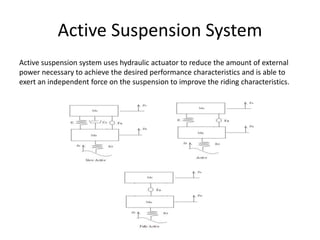
Active Suspension System
Active suspension system uses hydraulic actuator to reduce the amount of external
power necessary to achieve the desired performance characteristics and is able to
exert an independent force on the suspension to improve the riding characteristics.
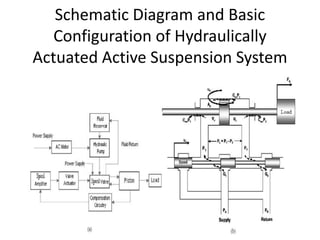
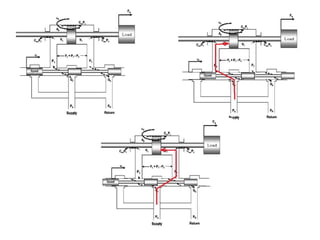
Schematic Diagram and Basic
Configuration of Hydraulically
Actuated Active Suspension System
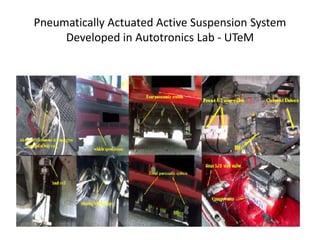
Pneumatically Actuated Active Suspension System
Developed in Autotronics Lab - UTeM
Active VS Semi-Active
• Semi-Active:
– Lower implementation cost
– Lower power consumption
– Easier to control
– Simpler design
– Easy to install
Disadvantage: damper constraint, the force range is
limited, performance is not as good as active
system
Active VS Semi-Active
• Active System:
– Wider range of force
– No force-velocity constraint
– Can achieve better performance (vehicle
dynamics)
Disadvantages: power consumption is high, higher
weight to power ratio, expensive, major
modification should be made before installing
active system into the existing vehicle

passive-semi-active-and-active-suspension-system.pptx

  • 1.
    Passive, Semi-Active andActive Suspension System
  • 2.
    Definition: Suspension system: amechanical system of springs and shock absorbers that connect the wheels and axles to the chassis of a wheeled vehicle
  • 3.
    The Function ofsuspension system: The job of a car suspension are: - to carry the static weight of the vehicle - to maximize the friction between the tires and the road surface, - to provide steering stability with good handling (minimize body roll) - to ensure the comfort of the passengers (ability to smooth out a bumpy road).
  • 4.
    The Function ofSpring and Shock Absorber The Function of Spring: to absorb shock energy from road bump and convert it into potential energy of spring The Function of Shock Absorber: to dissipate shock energy from road bump without causing undue oscillation in the vehicle.
  • 5.
    Classification of SuspensionSystem • Passive • Semi-Active - Orifice Based Damper - MR fluid based Damper • Active – Slow Active – Active – Fully Active
  • 6.
    Passive Suspension The dampingvalue (Cs) of a passive damper is determined by the total orifice area (the number of hole) in the piston head.
  • 7.
  • 8.
    MR fluid basedSemi-Active Suspension
  • 9.
    MR Fluid - Magnetorheologicalfluid is composed of oil and varying percentages of ferrous particles (20-50 microns in diameter) that have been coated with an anti-coagulant material. - Varying the magnetic field strength has the effect of changing the viscosity of the magnetorheological fluid.
  • 10.
    Force – velocityrelationship
  • 11.
    Active Suspension System Activesuspension system uses hydraulic actuator to reduce the amount of external power necessary to achieve the desired performance characteristics and is able to exert an independent force on the suspension to improve the riding characteristics.
  • 12.
    Schematic Diagram andBasic Configuration of Hydraulically Actuated Active Suspension System
  • 14.
    Pneumatically Actuated ActiveSuspension System Developed in Autotronics Lab - UTeM
  • 16.
    Active VS Semi-Active •Semi-Active: – Lower implementation cost – Lower power consumption – Easier to control – Simpler design – Easy to install Disadvantage: damper constraint, the force range is limited, performance is not as good as active system
  • 17.
    Active VS Semi-Active •Active System: – Wider range of force – No force-velocity constraint – Can achieve better performance (vehicle dynamics) Disadvantages: power consumption is high, higher weight to power ratio, expensive, major modification should be made before installing active system into the existing vehicle