Loans and mortgages:
from different views (customer
and bank), responsability
DOTT. STEFANO BLANCO
DOTT. MASSIMILIANO FONTANA
1
Definition of Loan
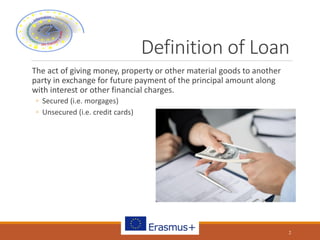
The act of giving money, property or other material goods to another
party in exchange for future payment of the principal amount along
with interest or other financial charges.
◦ Secured (i.e. morgages)
◦ Unsecured (i.e. credit cards)
2
Interest rate
Interest rates have a huge effect on loans.
Loans with high interest rates have higher monthly payments or
take longer to pay off than loans with low interest rates.
◦ i.e. if a person borrows €5,000:
◦ with a 4.5% interest rate  monthly payment of €93.22 for the next five years
◦ with a 9% interest rate  monthly payment of €103.79 for the next five years
◦ i.e. if a person owes €10,000 on a credit card with :
◦ a 6% interest rate and pays €200 each month  58 months to pay off the
balance
◦ a 20% interest rate, and pays €200 each month  108 months to pay off the
balance.
3
Why a company
should need a loan?
«You have to spend money to make money»
◦ Expansion
◦ Inventory
◦ Cash Flow
◦ Equipment
◦ To improve terms on a langer loan
4
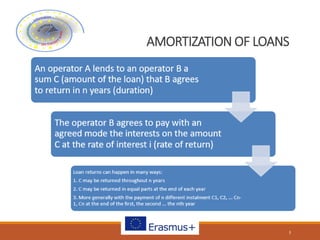
AMORTIZATION OF LOANS
5
AMORTIZATION OF LOANS
The sum of capital part and interest part is
called annuity or installment.
The payback is called immediate if starts
immediately, otherwise it is said deferred.
Now let's see classical type of amortization
6
AMORTIZATION OF LOANS
Progressive amortization with same installments (French way of
amortization)
◦ The installments are all the same, with worth R
◦ The debtor must pay an immediate constant annual deferred annuity
7
t=
0
t=
n
0
t=1 t=2
R R R
OPENING A BANK CREDIT
"The opening of bank credit is a contract under
which the bank agrees to make available to the
other party a sum of money for a given period of
time or indefinitely."
"If it is not agreed otherwise, the accredited can use
the credit in more times, according to the forms of
use, and can restore its availability with subsequent
payments . Unless otherwise agreed, withdrawals
and payments are carried out at the headquarters
of the bank where it consists the relationship "
8
OPENING A CREDIT VIA
CURRENT ACCOUNT (C/C)
The opening of credit in c/c is a consensual contract
whereby the bank agrees to make available on a c/c
of the client a sum of money for a given period of
time or indefinitely.
Effects:
Immediate: making available the sum from the bank;
Later: Any use according to the customer.
This way of financing, together with the simple credit, if not guaranteed by
deposits or securities, is the only form of short-term loan that does not affect or
is related to active assets
9
OPENING A CREDIT VIA C/C
The opening of credit (apercredito) in c / c can be:
ordinary, where you set a credit limit within which
the entrusted, without preconditioning, can
withdraw and restore the lower debt situations or
the c/c credit;
guaranteed, when the award is normally secured
by a savings or securities deposit. The warranty in
these cases is given above all to obtain a lowest
interest rate level
10
BANK CREDIT
Bank credit approval is dependent upon a borrower’s credit rating and
income or other factors such as assets, collateral or total existing debt
obligations
Bank credit comes at a cost
Many businesses need business funding to pay startup costs, to pay for
goods and services or supplement cash flow
The Central Credit Register is an information system on the debt of the
customers of the banks and financial companies supervised by the Bank
of Italy. In every country, a similar register exists
11
CREDIT COMMITMENTS
They are the commitments made by the Bank on behalf of
clients that do not involve cash outlays, unless honored the
pledge made by the customer.
Essentially consist of:
credit commitments by acceptance, when the Bank accepts
an excerpt issued by customers in his order;
credit commitments by warranty, where the Bank with the
endorsement guarantees required promissory note;
surety loans, where the bank guarantees an obligation to
"give", "do", not "do" that a customer has taken with a
third. Signature loans are generated or as a substitute for
financing transactions or to provide a customer's operation.
12
THE BANK GUARANTEE
Act by which the Bank, working directly towards the
creditor, guarantees the fulfillment of an obligation to do,
not to do or give assumed by the customer.
The bank guarantee is given with a letter of guarantee.
The warranty is given:
◦ to obtain advances on future supplies;
◦ in procurement, especially international ones in place of
cash collateral or securities;
◦ to provide buyers with certain characteristics of products
sold;
◦ to free goods in the absence of documents;
◦ to fund the client on the market (commercial paper).
13
THE BANK GUARANTEE IN
INTERNATIONAL TENDERS
International auctions usually provide for guarantees apply
with reference to the stage of the contract.
◦ The bid bond, with which the bank guarantees that the offer
made at the auction session will not be withdrawn.
◦ The performance bond to ensure the proper performance of the
work, normally higher than before, guarantees that the company
will carry out the work according to the quality provided for in the
contract.
◦ The advance payment bond, issued when they granted advances
in relations to States of play, ensuring that in the event of
interruption of work the bank guarantees refund of amounts paid
in advance.
◦ The retention money guarantee, for unlock any amounts that the
contract should be immobilized to ensure their existence.
14
MORTGAGE CONTRACT
The mortgage contract is the one by
which a real right in immovable
property or movable warranty
registered, which is constituted by entry
in public registers.
15
LEASING
Leasing includes contracts characterized
by the transfer in lease to another
company for a period of time, of one or
more movable or immovable property,
subject to payment of a specified fee.
Leasing can be expected to pay the
opportunity to redeem the goods on
payment of a sum agreed. Leasing is
distinguished in:
16
LEASING
operating lease, normally for a period of time
less than the physical life of the asset, an asset
already in the availability of the lessee and
standardized and broad-market type;
Financial lease, characterized by coincidence
of the physical life of the asset with the
duration of the lease and by non-existence of
the right in the availability of the lessee
17
LEASING
In financial leasing fees basically pay the depreciation of the
asset and the profit of the lessor. In both cases there is no
financing of goods but the lease. The risks of obsolescence
and asset management expenses in operating leases are
charged to the lessor; While in financial leasing are borne by
the lessee
In an operating lease the lease cost for the period of stay
for good at the individual lessee not necessarily pays back
the cost of the asset. In a finance lease the sum of the fees
exceeds the cost of the asset. In an operating lease the
asset is standardized and market (cars, computers, printer,
photocopier, etc.), in financial leasing, however, normally,
the well is individualized in relation to the company
(machine in production line).
18
REAL ESTATE LEASE–BACK
Definition: purchase of business properties from other industrial
companies through financing and bank loans that are made by other
companies which together leased the same goods to the same recede
operating companies.
19

Loans and mortgages

  • 1.
    Loans and mortgages: fromdifferent views (customer and bank), responsability DOTT. STEFANO BLANCO DOTT. MASSIMILIANO FONTANA 1
  • 2.
    Definition of Loan Theact of giving money, property or other material goods to another party in exchange for future payment of the principal amount along with interest or other financial charges. ◦ Secured (i.e. morgages) ◦ Unsecured (i.e. credit cards) 2
  • 3.
    Interest rate Interest rateshave a huge effect on loans. Loans with high interest rates have higher monthly payments or take longer to pay off than loans with low interest rates. ◦ i.e. if a person borrows €5,000: ◦ with a 4.5% interest rate  monthly payment of €93.22 for the next five years ◦ with a 9% interest rate  monthly payment of €103.79 for the next five years ◦ i.e. if a person owes €10,000 on a credit card with : ◦ a 6% interest rate and pays €200 each month  58 months to pay off the balance ◦ a 20% interest rate, and pays €200 each month  108 months to pay off the balance. 3
  • 4.
    Why a company shouldneed a loan? «You have to spend money to make money» ◦ Expansion ◦ Inventory ◦ Cash Flow ◦ Equipment ◦ To improve terms on a langer loan 4
  • 5.
  • 6.
    AMORTIZATION OF LOANS Thesum of capital part and interest part is called annuity or installment. The payback is called immediate if starts immediately, otherwise it is said deferred. Now let's see classical type of amortization 6
  • 7.
    AMORTIZATION OF LOANS Progressiveamortization with same installments (French way of amortization) ◦ The installments are all the same, with worth R ◦ The debtor must pay an immediate constant annual deferred annuity 7 t= 0 t= n 0 t=1 t=2 R R R
  • 8.
    OPENING A BANKCREDIT "The opening of bank credit is a contract under which the bank agrees to make available to the other party a sum of money for a given period of time or indefinitely." "If it is not agreed otherwise, the accredited can use the credit in more times, according to the forms of use, and can restore its availability with subsequent payments . Unless otherwise agreed, withdrawals and payments are carried out at the headquarters of the bank where it consists the relationship " 8
  • 9.
    OPENING A CREDITVIA CURRENT ACCOUNT (C/C) The opening of credit in c/c is a consensual contract whereby the bank agrees to make available on a c/c of the client a sum of money for a given period of time or indefinitely. Effects: Immediate: making available the sum from the bank; Later: Any use according to the customer. This way of financing, together with the simple credit, if not guaranteed by deposits or securities, is the only form of short-term loan that does not affect or is related to active assets 9
  • 10.
    OPENING A CREDITVIA C/C The opening of credit (apercredito) in c / c can be: ordinary, where you set a credit limit within which the entrusted, without preconditioning, can withdraw and restore the lower debt situations or the c/c credit; guaranteed, when the award is normally secured by a savings or securities deposit. The warranty in these cases is given above all to obtain a lowest interest rate level 10
  • 11.
    BANK CREDIT Bank creditapproval is dependent upon a borrower’s credit rating and income or other factors such as assets, collateral or total existing debt obligations Bank credit comes at a cost Many businesses need business funding to pay startup costs, to pay for goods and services or supplement cash flow The Central Credit Register is an information system on the debt of the customers of the banks and financial companies supervised by the Bank of Italy. In every country, a similar register exists 11
  • 12.
    CREDIT COMMITMENTS They arethe commitments made by the Bank on behalf of clients that do not involve cash outlays, unless honored the pledge made by the customer. Essentially consist of: credit commitments by acceptance, when the Bank accepts an excerpt issued by customers in his order; credit commitments by warranty, where the Bank with the endorsement guarantees required promissory note; surety loans, where the bank guarantees an obligation to "give", "do", not "do" that a customer has taken with a third. Signature loans are generated or as a substitute for financing transactions or to provide a customer's operation. 12
  • 13.
    THE BANK GUARANTEE Actby which the Bank, working directly towards the creditor, guarantees the fulfillment of an obligation to do, not to do or give assumed by the customer. The bank guarantee is given with a letter of guarantee. The warranty is given: ◦ to obtain advances on future supplies; ◦ in procurement, especially international ones in place of cash collateral or securities; ◦ to provide buyers with certain characteristics of products sold; ◦ to free goods in the absence of documents; ◦ to fund the client on the market (commercial paper). 13
  • 14.
    THE BANK GUARANTEEIN INTERNATIONAL TENDERS International auctions usually provide for guarantees apply with reference to the stage of the contract. ◦ The bid bond, with which the bank guarantees that the offer made at the auction session will not be withdrawn. ◦ The performance bond to ensure the proper performance of the work, normally higher than before, guarantees that the company will carry out the work according to the quality provided for in the contract. ◦ The advance payment bond, issued when they granted advances in relations to States of play, ensuring that in the event of interruption of work the bank guarantees refund of amounts paid in advance. ◦ The retention money guarantee, for unlock any amounts that the contract should be immobilized to ensure their existence. 14
  • 15.
    MORTGAGE CONTRACT The mortgagecontract is the one by which a real right in immovable property or movable warranty registered, which is constituted by entry in public registers. 15
  • 16.
    LEASING Leasing includes contractscharacterized by the transfer in lease to another company for a period of time, of one or more movable or immovable property, subject to payment of a specified fee. Leasing can be expected to pay the opportunity to redeem the goods on payment of a sum agreed. Leasing is distinguished in: 16
  • 17.
    LEASING operating lease, normallyfor a period of time less than the physical life of the asset, an asset already in the availability of the lessee and standardized and broad-market type; Financial lease, characterized by coincidence of the physical life of the asset with the duration of the lease and by non-existence of the right in the availability of the lessee 17
  • 18.
    LEASING In financial leasingfees basically pay the depreciation of the asset and the profit of the lessor. In both cases there is no financing of goods but the lease. The risks of obsolescence and asset management expenses in operating leases are charged to the lessor; While in financial leasing are borne by the lessee In an operating lease the lease cost for the period of stay for good at the individual lessee not necessarily pays back the cost of the asset. In a finance lease the sum of the fees exceeds the cost of the asset. In an operating lease the asset is standardized and market (cars, computers, printer, photocopier, etc.), in financial leasing, however, normally, the well is individualized in relation to the company (machine in production line). 18
  • 19.
    REAL ESTATE LEASE–BACK Definition:purchase of business properties from other industrial companies through financing and bank loans that are made by other companies which together leased the same goods to the same recede operating companies. 19