Active Listening
Objectives
§To define active listening
§Identify common myths about listening
§Identify common listening problems
§Recognize and use active listening techniques
§Identify the benefits of active listening
The Three Basic Listening Modes
Modes
Basic Listening Modes
§Competitive or Combative Listening
§Passive or attentive Listening
§Active or Reflective Listening
Active listening is an interactive process
for improving the degree of
understanding between two or more
people. It takes effort, attention and
intervention.
What is AWhat is Active Listening?
ctive Listening?
What is Active Listening?
Active listening
presumes
“You are important to
me.”
Common Myths
§Listening is the same as hearing.
§Listening is a passive action.
§Listening is only done through the ears.
§Listening is easy to do.
Sources of Difficulty by the Speaker
f Difficulty by the Speaker
ces of Difficulty by the Speaker
§ Voice volume too low to be heard.
§ Making the message too complex, either by including too many
unnecessary details or too many issues.
§ Getting lost, forgetting your point or the purpose of the interaction
§ Body language or nonverbal elements contradicting or interfering with
the verbal message, such as smiling when anger or hurt is being
expressed.
§ Paying too much attention to how the other person is taking the
message, or how the person might react.
§ Using a very unique code or unconventional method for delivering the
message.
Sources of Difficulty by the
Listener
§ Being preoccupied and not listening.
§ Being so interested in what you have to say that you
listen mainly to find an opening to get the floor.
§ Formulating and listening to your own rebuttal to what the
speaker is saying.
§ Evaluating and making judgments about the speaker or
the message.
§ Not asking for clarification when you know that you do not
understand.
Common Listening Problems
§Interruptions
§Stress
§Own opinions, prejudices
§Jumping to conclusions
§Information is uninteresting
§Difficulty in understanding the other
person
EffeEffective Listening Tips
ctive Listening Tips
 Listen for ideas, not facts – ask yourself what they
mean
 Listen optimistically – don't lose interest straight
away
 Do not jump to conclusions
 Be flexible, adjust your note-taking to the speaker
 Concentrate – don't start dreaming – and keep eye
contact
 Do not think ahead of the speaker – you will lose
track
 Work at listening – be alert and alive
 Keep emotions under control when listening
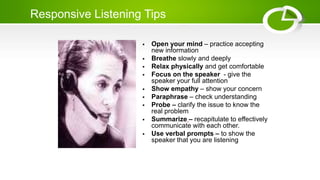
Responsive Listening Tips
 Open your mind – practice accepting
new information
 Breathe slowly and deeply
 Relax physically and get comfortable
 Focus on the speaker - give the
speaker your full attention
 Show empathy – show your concern
 Paraphrase – check understanding
 Probe – clarify the issue to know the
real problem
 Summarize – recapitulate to effectively
communicate with each other.
 Use verbal prompts – to show the
speaker that you are listening
At Its Best Listening Involves…§Hearing
§Understanding the information
§Understanding the emotions
§Checking your understanding
§Seeing it from the person's viewpoint, without necessarily
agreeing
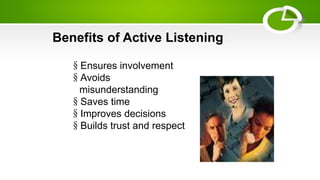
Benefits of Active Listening
§Ensures involvement
§Avoids
misunderstanding
§Saves time
§Improves decisions
§Builds trust and respect

Active listening

  • 1.
  • 2.
    Objectives §To define activelistening §Identify common myths about listening §Identify common listening problems §Recognize and use active listening techniques §Identify the benefits of active listening
  • 3.
    The Three BasicListening Modes Modes Basic Listening Modes §Competitive or Combative Listening §Passive or attentive Listening §Active or Reflective Listening
  • 4.
    Active listening isan interactive process for improving the degree of understanding between two or more people. It takes effort, attention and intervention. What is AWhat is Active Listening? ctive Listening? What is Active Listening?
  • 5.
  • 6.
    Common Myths §Listening isthe same as hearing. §Listening is a passive action. §Listening is only done through the ears. §Listening is easy to do.
  • 7.
    Sources of Difficultyby the Speaker f Difficulty by the Speaker ces of Difficulty by the Speaker § Voice volume too low to be heard. § Making the message too complex, either by including too many unnecessary details or too many issues. § Getting lost, forgetting your point or the purpose of the interaction § Body language or nonverbal elements contradicting or interfering with the verbal message, such as smiling when anger or hurt is being expressed. § Paying too much attention to how the other person is taking the message, or how the person might react. § Using a very unique code or unconventional method for delivering the message.
  • 8.
    Sources of Difficultyby the Listener § Being preoccupied and not listening. § Being so interested in what you have to say that you listen mainly to find an opening to get the floor. § Formulating and listening to your own rebuttal to what the speaker is saying. § Evaluating and making judgments about the speaker or the message. § Not asking for clarification when you know that you do not understand.
  • 9.
    Common Listening Problems §Interruptions §Stress §Ownopinions, prejudices §Jumping to conclusions §Information is uninteresting §Difficulty in understanding the other person
  • 10.
    EffeEffective Listening Tips ctiveListening Tips  Listen for ideas, not facts – ask yourself what they mean  Listen optimistically – don't lose interest straight away  Do not jump to conclusions  Be flexible, adjust your note-taking to the speaker  Concentrate – don't start dreaming – and keep eye contact  Do not think ahead of the speaker – you will lose track  Work at listening – be alert and alive  Keep emotions under control when listening
  • 11.
    Responsive Listening Tips Open your mind – practice accepting new information  Breathe slowly and deeply  Relax physically and get comfortable  Focus on the speaker - give the speaker your full attention  Show empathy – show your concern  Paraphrase – check understanding  Probe – clarify the issue to know the real problem  Summarize – recapitulate to effectively communicate with each other.  Use verbal prompts – to show the speaker that you are listening
  • 12.
    At Its BestListening Involves…§Hearing §Understanding the information §Understanding the emotions §Checking your understanding §Seeing it from the person's viewpoint, without necessarily agreeing
  • 13.
    Benefits of ActiveListening §Ensures involvement §Avoids misunderstanding §Saves time §Improves decisions §Builds trust and respect