Active Listening Skills - D3 (Class 11 &12) Chapter Plan.docx
1.
Active Listening Skills
Inthis Chapter, we will learn:
Understanding the Active Listening
Verbal & Non-Verbal Signs of Active Listening
Types of Active Listening Skills
Do’s & Don’ts in Active Listening
Strategies to become an Active Listener
Story-Time
Self-Check
3.1 Understanding the Active Listening -
Active listening requires the listener to fully concentrate, understand, respond and then remember what is
being said. You make a conscious effort to hear and understand the complete message being spoken,
rather than just passively hearing the message of the speaker.
Active listening is a way of listening and responding to another person that improves mutual
understanding. It is an important first step to defuse the situation and seek solutions to problems.
Benefits of active listening:
Builds deep trust - As you cultivate the habit of listening sincerely, you invite people to open
up. They can sense that you will not be jumping to conclusions based on superficial details. They
also realize that you care enough about them to listen attentively. While building trust takes time,
it leads to great benefits such as lifelong friendships and a promise of help in difficult times.
Broadens your perspective - Your own perspective in life is not the complete truth or how
everyone else sees it. The way you understand life from your beliefs and thinking is only one way
to look at it – listening to other people’s perspectives allows you to look at life from different
perspectives, some of which you may not have thought of before.
2.
Strengthens yourpatience - The ability to be a good listener takes time and you need to
develop it with regular efforts over time. But as you gradually get better and better at listening, an
automatic benefit is that you develop patience. Patience to let the other person express his or her
feelings and thoughts honestly while you don’t judge.
Makes you approachable - As you present yourself as a patient listener, people feel more
naturally inclined to communicate with you. By being there for them, you give them the freedom
to express their feelings.
Increases competence and knowledge - Great listening skills makes a person more
competent and capable, regardless of their position. The more an individual can get information
out of the meetings, the instructions, and reports provided to him, the more efficient and
successful they will be at completing the task. Listening also builds knowledge and helps fulfill
work requirements through progressive learning.
Saves time and money - Effective listening not only reduces risks of misunderstanding and
mistakes that could be very damaging to the business or personal life, it saves time and money by
avoiding starting a task or a project over again.
Helps detect and solve problems - As a leader, they should always be attentive to what
employees have to say. In the workplace, they are the first ones to spot flaws and come up with
suggestions for improvements. Listening to colleagues will help you understand what needs to be
changed and worked on to retain talent and make improvements.
Examples of Active-Listening:
3.2 Verbal & Non-Verbal Signs of Active Listening :
Non-verbal Signs of
active listening:
Smile - small smiles
can be used to show
that the listener is
paying attention to
what is being said or
as a way of agreeing
or being happy about
the messages being
received. Combined
3.
with nods ofthe head, smiles can be powerful in affirming that messages are being listened to and
understood.
Eye Contact - it is normal and usually encouraging for the listener to look at the speaker. Eye
contact can however be intimidating, especially for more shy speakers – gauge how much eye
contact is appropriate for any given situation. Combine eye contact with smiles and other non-
verbal messages to encourage the speaker.
Posture - can tell a lot about the sender and receiver in interpersonal interactions. The attentive
listener tends to lean slightly forward or sideways whilst sitting. Other signs of active listening
may include a slight slant of the head or resting the head on one hand.
Distraction - the active listener will not be distracted and therefore will refrain from fidgeting,
looking at a clock or watch, doodling, playing with their hair or picking their fingernails.
Verbal Signs of active listening:
Positive Reinforcement - this can be a strong signal of attentiveness, however too much use
can be annoying for the speaker. Occasional words and phrases, such as: ‘very good’, ‘yes’ or
‘indeed’ will indicate that you are paying attention.
Remembering - try to remembering a few key points, such as the name of the speaker. It can
help to reinforce that what is being said has been understood. Remembering details, ideas and
concepts from previous conversations proves that attention was kept and is likely to encourage
the speaker to continue.
Questioning - the listener can demonstrate that they have been paying attention by asking
relevant questions and/or making statements that build or help to clarify what the speaker has
said. By asking relevant questions the listener also helps to reinforce that they have an interest in
what the speaker has been saying.
Clarification - this involves asking questions of the speaker to ensure that the correct message
has been received. Clarification usually involves the use of open questions which enables the
speaker to expand on certain points as necessary.
3.3 Types of Active Listening Skills:
Four types of active listening are paraphrasing, reflecting feelings, reflecting
meaning and summative reflection:-
Paraphrasing - It occurs when the listener repeats the essence of the
message spoken by the communicator but in different words. As an active
listening strategy, paraphrasing is important because it demonstrates that the
listener is concentrating upon the message offered by the speaker.
Reflecting Feelings - Active listeners reflect the feelings of the
communicator in their consideration of the message and their response to the
speaker. The communicator will feel validated by the emotional response of the
listener and the listener will feel that the message is personal and relevant. At times, reflecting feelings
can obfuscate the communication process by interjecting emotion into a rational discussion. However,
this active listening type establishes an emotional rapport between the communicator and the listener.
Reflecting Meaning - Like the reflection of emotions, reflecting meaning establishes a rapport between
the speaker and the listener. However, reflecting meaning is distinguished from reflecting emotions
through its concentration upon the factual message of the speaker. Reflecting meaning allows the listener
to confirm understanding with the speaker. You can practice reflecting meaning by using the general
phrase "When this occurs, you feel this way and want to do this" and applying this sentence to the
specifics defining the communication.
Fun-Fact
We listen at 125-250
words per minute, but
think at 1000-3000
words per minute.
4.
Summative Reflection -Summative reflection involves the confirmation of the message content. It
combines the elements of paraphrasing, reflecting meaning and reflecting emotion to illustrate the
speaker's considered evaluation of the speaker's message. Unlike paraphrasing, summative reflection
requires the listener to incorporate personal views in the description of the speaker's message. Summative
reflection can be the most difficult type of active learning to exercise, but accurate summative reflection
can promote efficiency in the communication process and strengthen interpersonal ties.
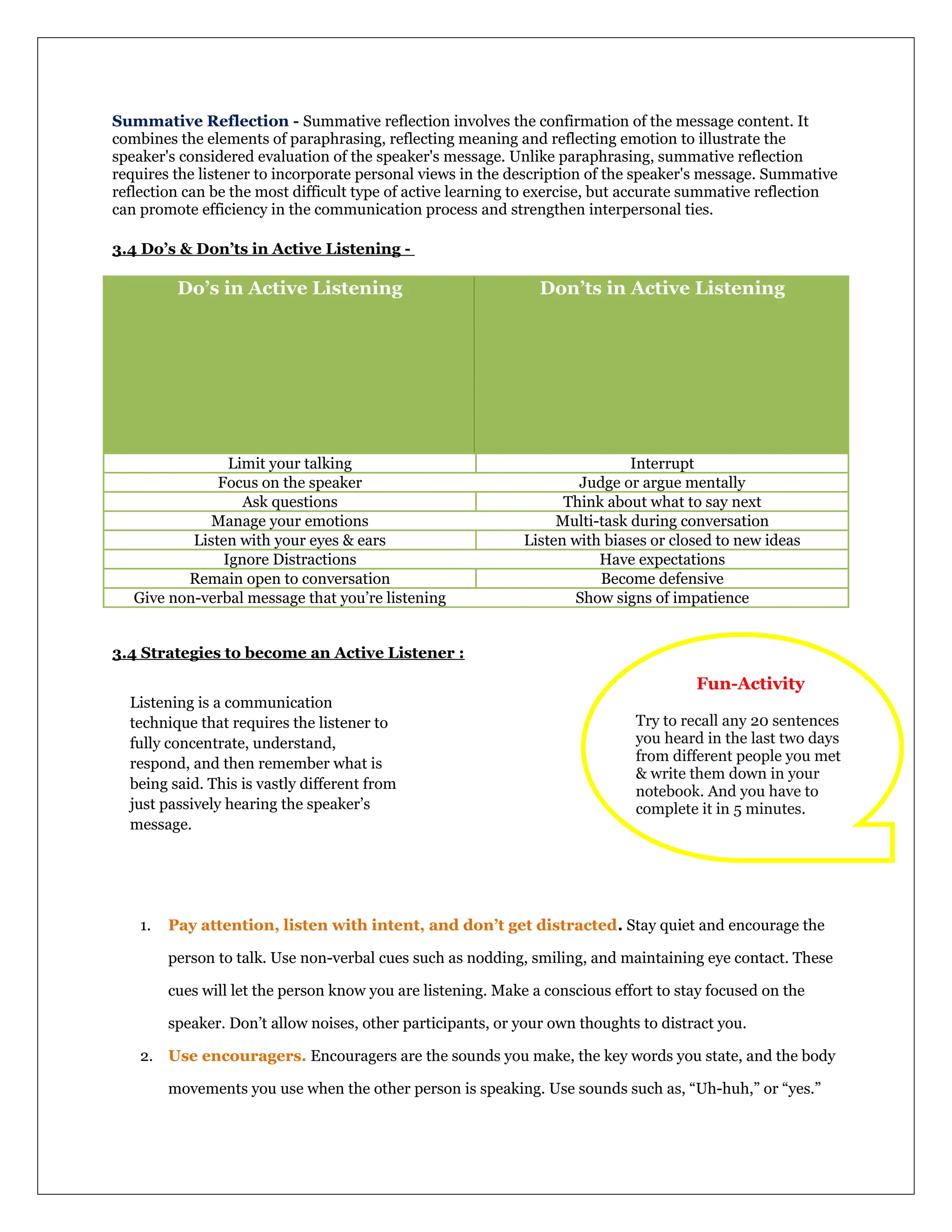
3.4 Do’s & Don’ts in Active Listening -
Do’s in Active Listening Don’ts in Active Listening
Limit your talking Interrupt
Focus on the speaker Judge or argue mentally
Ask questions Think about what to say next
Manage your emotions Multi-task during conversation
Listen with your eyes & ears Listen with biases or closed to new ideas
Ignore Distractions Have expectations
Remain open to conversation Become defensive
Give non-verbal message that you’re listening Show signs of impatience
3.4 Strategies to become an Active Listener :
1. Pay attention, listen with intent, and don’t get distracted. Stay quiet and encourage the
person to talk. Use non-verbal cues such as nodding, smiling, and maintaining eye contact. These
cues will let the person know you are listening. Make a conscious effort to stay focused on the
speaker. Don’t allow noises, other participants, or your own thoughts to distract you.
2. Use encouragers. Encouragers are the sounds you make, the key words you state, and the body
movements you use when the other person is speaking. Use sounds such as, “Uh-huh,” or “yes.”
Fun-Activity
Try to recall any 20 sentences
you heard in the last two days
from different people you met
& write them down in your
notebook. And you have to
complete it in 5 minutes.
Listening is a communication
technique that requires the listener to
fully concentrate, understand,
respond, and then remember what is
being said. This is vastly different from
just passively hearing the speaker’s
message.
5.
3. Avoid sendingnon-verbal cues that communicate inattentiveness, disinterest, or
lack of understanding. In other words, keep your feelings and attitudes in check. Show
understanding and acceptance with your tone of voice, facial expressions, gestures, posture, and
eye contact.
4. Listen before you plan your response. Fully listening before planning your response may be
the most critical step towards your success as an active listener. Stay focused on understanding
and remembering what the speaker is communicating.
5. Ask questions to clarify and convey interest. When you do reply, reflect on what you heard
and ask for clarification by using open-ended, probing, or other relevant questions. For example,
ask, “Can you tell me more about what you mean by…?”
6. Don’t interrupt the speaker. Give the speaker time to communicate his or her ideas and
thoughts. Don’t interrupt or try to finish the speaker’s sentences.
7. Paraphrase what was said. State the essence of what you heard to the speaker in your own
words. Use an opening phrase that shows you are paying attention. For example, “It looks like you
are saying…” or “Let me see if I understand…” Include a confirming statement at the end of your
paraphrase such as, “Am I on the right track?” or “Is that correct?”
3.5 Story-Time:
3.6 Self-Check:
Aptitude Class
Once in a quantitative aptitude class my teacher
asked us a question: "If an electric train runs at a
speed of 50km/hr in the south direction, the wind
blows 10km/hr north and a person drives parallel to
the train at 60km/hr north, in which direction will
he see the smoke blow?" Everybody in the class was
solving the question using concepts of physics when
somebody from the back of the class answered:
"Electric engine doesn't generate smoke."
What did you learn from the story? And share your
personal experience if something like it happened
in your life.
watch?v=H6n3iNh4XLI
Watch-Time
Watch the Video from the
shared link
& answer the following
question.
What did you learn from
the video?
6.
Answer the followingquestions to check your learning’s of lesson:
1. What are the different ways to become an Active Listener?
2. What is the right way to clarify your doubts in between the conversation?
3. How being judgmental affects our listening skills?
4. How active listening develops a sense of trust? Share an experience of your life.






![Reading Techniques [Autosaved].pptxReading Techniques [Autosaved].pptx](https://cdn.slidesharecdn.com/ss_thumbnails/readingtechniquesautosaved-251211193055-b8821f9d-thumbnail.jpg?width=640&height=640&fit=bounds)