ACTIVATED SLUDGE PROCESS
• It provides an excellent method of treating either raw sewage or more generally
the settled sewage.
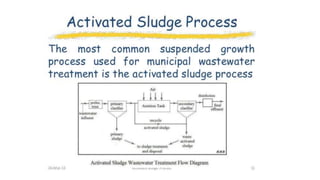
• Sewage effluent from primary sedimentation tank which is normally utilized in
this process, is mixed with 20 to 30 percent of own volume of activated sludge,
which contains a large concentration of highly active aerobic micro organisms.
• The mixture enters an aeration tank where the micro organisms and sewage are
intimately mixed together with large qty of air for about 4 to 8 hrs.
• Under these conditions the organisms will oxidize the organic matter, and the
suspended and colloidal matter tend to coagulate and form a precipitate, which
settles down readily in the secondary settling tank..
• The effluent obtained from a properly operated activated sludge plant is of high quality.
• It having low BOD than that of a trickling filter.
• Bod removal is up to 80-95%
• Bacterial removal is up to 90-95%.
• Land area required is less.
• Ample supply of oxygen is present.
• There is intimate and continuous mixing of sewage and activated sludge.
• The ratio of volume of activated sludge added to the volume of sewage being treated is kept
practically constant.
• When a new plant is put in to operation a period of about 4 weeks my be required to form a
suitable return sludge.
• During this period almost all the sludge from the secondary sedimentation tank will returned
through the aeration tank.
• From the primary sedimentation tank the sewage flows to the aeration tank and
is mixed with the activated sludge.
• The aeration tanks are normally rectangular in shape 3 to 4.5 m deep. And about
4 to 6 m wide.
• The length may vary between 20 to 200m
• The detention period between 4 to 8 hrs for municipal sewages.
Methods of Aeration
•Diffused air Aeration (or) Air Aeration
•Mechanical Aeration
•Combined Aeration
Diffused Air Aeration
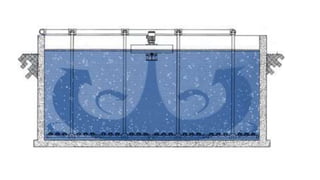
• Compressed air under a pressure of 35 to 70 kN/m2(035 to 0.70kg/cm2) is
introduces into the aeration chamber through diffusion plates or other devices
called diffusers.
• It should capable of diffusing air in small bubbles, so as to provide the greatest
possible efficiency of aeration.
• Porous plates or porous tubes made of quartz or crystalline alumina are
generally used as diffusers.
• Plates are square in shape with dimensions of 30cm x 30cm they are usually
25mm thick.
• These plates are fixed at the bottom of aeration tanks.
• Tube diffusers are generally 60cm long with internal dia of 75 mm thickness of
wall equal to 15mm.
• These tubes are suspended in the aeration tank and can be taken out for
cleaning without emptying the tank.
• Effective areas for plate and tube diffusers are 780 cm2 and 1160 cm2.
• Two types of aeration tanks are generally used.
• First, the tank is formed into a succession of ridge and furrows.
• It is called ridge and furrow type of aeration tank.
• Another type is spiral flow type of aeration tank.
• In this tank air is introduced near the side of tank in such a way that spiral flow
results in tank.
• Compressed air in tank can be supplied either through plate diffuser or a tube
diffuser although tube diffusers are widely used.
• This type requires small qty of air at low pressure.
• 4000 to 8000m3 of free air will be required per million litres of sewage being
treated.
• BOD removal is 100m3/day of air per kg of BOD removed.
Mechanical Aeration:
• In air-diffusion method a lot of compressed air gets(90 to 95% ) wasted, as it
simply escapes through the tank without giving oxygen to sewage.
• The sewage is stirred up by means of mechanical devices like paddles, so as to
introduce air into it from the atmosphere by continuously changing the surface of
sewage by circulation of sewage from bottom to top.
• It gives agitation of sewage.
• Detention period varies between 6 to 8 hrs.
• Qty of returned sludge in mechanically aerated aeration tanks is usually about 25
to 30 percent of flow of sewage.
Types of mechanical aeration:
•Haworth system
•Hartley system
•Simplex aeration system
•Kessener system of Aeration
•Link Belt system of Aeration
Haworth system
• 1m deep aeration tank is divided by thin walls in a series of long and
comparatively narrow channels(70m x 1.5m plan area).
• Total travel of about 1.5km.
• At about mid-way of its length two rows of paddles revolving at 1.5 rpm are
provided with horizontal shaft crossing each channel for the aeration of
sewage.
• Detention period is 15 hrs.
• Returned sludge varies between 15 to 20 % of sewage flow.
• Generally used at Sheffield in England hence it s called Sheffield system.
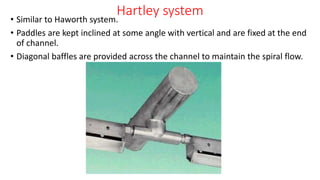
Hartley system
• Similar to Haworth system.
• Paddles are kept inclined at some angle with vertical and are fixed at the end
of channel.
• Diagonal baffles are provided across the channel to maintain the spiral flow.
Simplex aeration system
• Square tank in plan with hopper bottom is used.
• Sometimes rectangular tank also used.
• At the center of the tank a hollow uptake tube is suspended from the top with a
distance of about 15cm from the bottom of the tank.
• A steel cone with spiral vanes is provided at the top of uptake tube and it is
driven by a motor placed at the top of tank.
• The cone is revolved at a high speed 60rpm, which sucks the mixed liquor
through the uptake tube by creating suction at the bottom and sprays it at the
surface towards the sides of the tank.
• Numerous air bubbles are formed in this process which brings about satisfactory
aeration
Kessener system
• Adopted for small installations.
• Tank is long and the flow of sewage takes place from one end to other.
• Agitating device is in the form of a stainless steel comb
• It is fixed longitudinally and is partially submerged to a depth of about 5 mm to
40mm.
• It rotates at a speed of about 40 to 50 rpm and causes wave action in the sewage
to bring out the required aeration.
Link Belt system
• Aeration tank is rectangular and revolving surface aerators and fixed near one
side
• The surface aerators or paddles rotate at a sped of about 45 to 50 rpm.
• a lift channel; of width of about 450 mm is formed near the aerator by
constructing a longitudinal vertical baffle wall.
• Rotation of paddles causes the required agitation of sewage.
Combined Aeration
• Dorroco aerator is an one-type of combined aerator.
• Aeration of sewage is achieved by diffusing air through bottom diffuser plates
and by rotating paddles at a speed of about 10 to 12 rpm.
• Spiral motion brings out the required aeration.
• Smaller detention period of 3 to 4 hrs.
• It requires less amount of compressed air than diffused air aeration method.
Filters and Filtration Process
•Contact Beds
•Intermittent sand filters
•Trickling filters
•Other filters
Contact Beds
• Also known as contact filters, a sewage is kept in contact with the filtering media
for a certain period.
• The sewage percolates through the filtering media, fine colloidal organic matter is
trapped in the voids between the particles of filtering media.
• Due to this, a film of organic matter is formed around the particles of the filtering
media.
• A large number of aerobic bacteria present in the sewage will get attached to the
filter sand, and will be present in this biofilm.
• The stabilized organic matter in the first cycle will be wash away by the fresh
sewage in the next cycle of operation.
Construction Details
• It is water tight rectangular tank, fitted with a filtering media, consisting of gravel
ballast or broken bricks or stones.
• Size of the media particles may vary between 20 to 40mm.
• Depth of filtering media varies between 1 to 1.8 m
• These tanks are generally dug below the G.L and are provided with water-tight
concrete lining.
• A siphonic dosing tank is generally provided to serve two or three contact beds
• Dosing tank will receive sewage from primary settling tanks and will supply it to
different contact beds.
• Ordinary tanks without siphons and operated manually by valves may also used.
• Sewage percolating through the filtering media is collected at the bottom by a
system of suitably laid open-jointed under-drains.
operation
• Sewage is first allowed from the dosing tank to fill the bed completely to a depth
of 5 to 10cm.
• While doing outlet valve is closed.
• It takes about at least one hour.
• Then dosing tank is closed and the sewage is left over the bed it for about two
hours.
• The colloidal matters present in sewage will be transferred to filter voids during
this period.
• Then outlet valve is opened and the sewage is removed slowly.
• During this period the organic matter trapped in the voids gets oxidized by
aerobic bacteria in the presence of free oxygen that rushes into the filter voids
from the atmosphere.
Performance and Rate of loading
• Effluent obtained from contact beds is slightly turbid and odourless.
• It removes 80% of S.S
• It removes 60 to 75% of B.O.D
• Due to intermittent operation the rate of loading is very low.
• It should not exceed 100 liters per day per sq.m of the filter for beds of 1.2 to 1m.
• 4 to 5 years the beds become almost fully clogged and are removed, washed and
dried.
• The under-drains are also washed and the beds reinstated
Intermittent sand filters
•Earlier forms of biological units of sewage treatment and
are now rarely used because of their large area
requirement.
•It s more or less like contact beds, with difference that the
contact media here is finer that contact beds.
• No concrete lining around the filtering media.
Construction and Operation
• Underground rectangular tank 1 to 1.25m deep, 1000 to 4000 sq.m in plan and
made by excavating the earth without lining on sides or bottom.
• Sand is filled in this tank to a depth of about 0.75 to 1.05m.
• Bottom of tank is made sloping gently towards the under-drains which are placed
at about 9m apart in trenches below the bottom of sand.
• Hydraulic loading ranges between 80 to 110 lit/day/m2
• To apply sewage dose for 24 hrs on one bed and then to apply it on the second
bed, keeping the first bed at rest.
• Cleaning should be done of 1 to 4 weeks
• Effluent obtained from an intermittent sand filter is of excellent quality with S.S
<10 ppm and BOD<5ppm.
TRICKLING FILTERS
FIXED MEDIA TREATMENT SYSTEM
WASTE WATER IS DISTRIBUTED OVER MEDIA COLONISED BY MICRO-ORGANISMS
CONSISTS OF A BED OF HIGHLY PERMEABLE MEDIA
AN UNDERDRAINAGE SYSTEM IMPORTANT BOTH AS A COLLECTION UNIT & AS
POROUS STRUCTURE
BIOLOGICAL COMMUNITY:
AEROBIC
ANAEROBIC
FACULTATIVE
FUNGI
ALGAE
VIEW OF A TRICKLING FILTER
PROCESS
ORGANIC MATERIAL FROM LIQUID IS ADSORBED ONTO THE SLIME LAYER WHOSE OUTER
PORTIONS DEGRADED BY AEROBIC MICRO-ORGANISMS
AS THEY GROW THICKNESS OF SLIME LAYER INCREASES & OXYGEN IS CONSUMED
BEFORE IT PENETRATES FULL DEPTH
HENCE MICRO-ORGANISMS ENTER INTO AN ENDOGENOUS PHASE OF GROWTH & LOSE
ABILITY TO CLING TO THE MEDIA SURFACE
LIQUID THEN WASHES THE SLIME OFF THE MEDIA & A NEW SLIME LAYER BEGINS TO
GROW
LOSING OF SLIME LAYER IS KNOWN AS “SLOUGHING”
BIOLOGICAL SLIME
FACTORS CONSIDERED IN DESIGN
DOSING CHARACTERISTICS OF THE DISTRIBUTION SYSTEM
CHOOSING THE RIGHT PACKING / MEDIA
CONFIGURATION OF THE UNDERDRAIN SYSTEM
PROVISION FOR ADEQUATE VENTILATION
DISTRIBUTION SYSTEM
CONSISTS OF DISTRIBUTOR ARMS MOUNTED ON A PIVOT IN THE CENTRE,
THESE ARE HOLLOW THROUGH WHICH WATER IS DISCHARGED OVER THE FILTER BED
FOR UNIFORM DISTRIBUTION THE FLOWRATE PER UNIT OF LENGTH SHOULD BE PROPORTIONAL TO THE
RADIUS FROM THE CENTRE
HEAD LOSS IS IN THE RANGE OF (0.6 –1.5 M)
DOSING TANKS MUST ENSURE THAT MINIMUM FLOW IS SUFFICIENT TO ROTATE THE DISTRIBUTOR &
DISCHARGE ALL WATES FROM NOZZLES
FILTER MEDIA
A MATERIAL HAVING HIGH SURFACE AREA PER UNIT
VOLUME , DOES NOT CLOG EASILY
MEDIA CAN BE ROCK , PLASTIC , PVC
STONES LESS THAN 25MM NOT BE USED AS THEY DO NOT
PROVIDE SUFFICIENT PORE SPACE
• CALCULATION OF MEDIA DEPTH
UNDERDRAINS & AIRFLOW
THESE ARE WASTE WATER COLLECTION SYSTEMS THAT COLLECTS THE FILTERED WASTE
WATER & SOLIDS DISCHARGED FROM THE FILTER PACKING
THEY VENTILATE THE FILTER BY PROVIDING AIR FOR THE MICRO-ORGANISMS BY BEING
OPEN ATLEAST TO A CIRCUMFERENCIAL CHANNEL
SHOULD BE DESIGNED SUCH THAT FORCED AIR VIBRATIONS CAN BE ADDED LATER
AIR FLOW:
NATURAL DRAFT
FORCED AIR VENTILATOR
ADVANTAGES
BECAUSE OF THEIR LARGE AIR-WATER INTERFACE CAN REMOVE CO2,H2S, N2 & OTHER
GASES
A PORTION OF LIQUID IN UNDERDRAIN SYSTEM IS RECYCLED:
IT IMPROVES THE TREATMENT EFFICIENCY
TO DILUTE STRENGTH OF INCOMING WASTEWATER
TO MAINTAIN ENOUGH WETTING OF SLIME LAYER
PREVENTS PONDING IN FILTER
SUITABLE FOR SHOCK LOADS
LOW RUNNING COST
PROBLEMS
• ODOR FROM PLANT
Excessive organic loading
• PONDING OF TRICKLING FILTER
Excessive biological growth
• ICING
Low temperature of waste water
Types of Trickling filter
•Conventional or Ordinary or standard rate or low
rate trickling filters
•High rate filters

Activated Sludge process

  • 1.
    ACTIVATED SLUDGE PROCESS •It provides an excellent method of treating either raw sewage or more generally the settled sewage. • Sewage effluent from primary sedimentation tank which is normally utilized in this process, is mixed with 20 to 30 percent of own volume of activated sludge, which contains a large concentration of highly active aerobic micro organisms. • The mixture enters an aeration tank where the micro organisms and sewage are intimately mixed together with large qty of air for about 4 to 8 hrs. • Under these conditions the organisms will oxidize the organic matter, and the suspended and colloidal matter tend to coagulate and form a precipitate, which settles down readily in the secondary settling tank..
  • 2.
    • The effluentobtained from a properly operated activated sludge plant is of high quality. • It having low BOD than that of a trickling filter. • Bod removal is up to 80-95% • Bacterial removal is up to 90-95%. • Land area required is less. • Ample supply of oxygen is present. • There is intimate and continuous mixing of sewage and activated sludge. • The ratio of volume of activated sludge added to the volume of sewage being treated is kept practically constant. • When a new plant is put in to operation a period of about 4 weeks my be required to form a suitable return sludge. • During this period almost all the sludge from the secondary sedimentation tank will returned through the aeration tank.
  • 4.
    • From theprimary sedimentation tank the sewage flows to the aeration tank and is mixed with the activated sludge. • The aeration tanks are normally rectangular in shape 3 to 4.5 m deep. And about 4 to 6 m wide. • The length may vary between 20 to 200m • The detention period between 4 to 8 hrs for municipal sewages.
  • 5.
    Methods of Aeration •Diffusedair Aeration (or) Air Aeration •Mechanical Aeration •Combined Aeration
  • 6.
    Diffused Air Aeration •Compressed air under a pressure of 35 to 70 kN/m2(035 to 0.70kg/cm2) is introduces into the aeration chamber through diffusion plates or other devices called diffusers. • It should capable of diffusing air in small bubbles, so as to provide the greatest possible efficiency of aeration. • Porous plates or porous tubes made of quartz or crystalline alumina are generally used as diffusers. • Plates are square in shape with dimensions of 30cm x 30cm they are usually 25mm thick. • These plates are fixed at the bottom of aeration tanks. • Tube diffusers are generally 60cm long with internal dia of 75 mm thickness of wall equal to 15mm. • These tubes are suspended in the aeration tank and can be taken out for cleaning without emptying the tank. • Effective areas for plate and tube diffusers are 780 cm2 and 1160 cm2.
  • 7.
    • Two typesof aeration tanks are generally used. • First, the tank is formed into a succession of ridge and furrows. • It is called ridge and furrow type of aeration tank. • Another type is spiral flow type of aeration tank. • In this tank air is introduced near the side of tank in such a way that spiral flow results in tank. • Compressed air in tank can be supplied either through plate diffuser or a tube diffuser although tube diffusers are widely used. • This type requires small qty of air at low pressure. • 4000 to 8000m3 of free air will be required per million litres of sewage being treated. • BOD removal is 100m3/day of air per kg of BOD removed.
  • 11.
    Mechanical Aeration: • Inair-diffusion method a lot of compressed air gets(90 to 95% ) wasted, as it simply escapes through the tank without giving oxygen to sewage. • The sewage is stirred up by means of mechanical devices like paddles, so as to introduce air into it from the atmosphere by continuously changing the surface of sewage by circulation of sewage from bottom to top. • It gives agitation of sewage. • Detention period varies between 6 to 8 hrs. • Qty of returned sludge in mechanically aerated aeration tanks is usually about 25 to 30 percent of flow of sewage.
  • 12.
    Types of mechanicalaeration: •Haworth system •Hartley system •Simplex aeration system •Kessener system of Aeration •Link Belt system of Aeration
  • 13.
    Haworth system • 1mdeep aeration tank is divided by thin walls in a series of long and comparatively narrow channels(70m x 1.5m plan area). • Total travel of about 1.5km. • At about mid-way of its length two rows of paddles revolving at 1.5 rpm are provided with horizontal shaft crossing each channel for the aeration of sewage. • Detention period is 15 hrs. • Returned sludge varies between 15 to 20 % of sewage flow. • Generally used at Sheffield in England hence it s called Sheffield system.
  • 15.
    Hartley system • Similarto Haworth system. • Paddles are kept inclined at some angle with vertical and are fixed at the end of channel. • Diagonal baffles are provided across the channel to maintain the spiral flow.
  • 17.
    Simplex aeration system •Square tank in plan with hopper bottom is used. • Sometimes rectangular tank also used. • At the center of the tank a hollow uptake tube is suspended from the top with a distance of about 15cm from the bottom of the tank. • A steel cone with spiral vanes is provided at the top of uptake tube and it is driven by a motor placed at the top of tank. • The cone is revolved at a high speed 60rpm, which sucks the mixed liquor through the uptake tube by creating suction at the bottom and sprays it at the surface towards the sides of the tank. • Numerous air bubbles are formed in this process which brings about satisfactory aeration
  • 19.
    Kessener system • Adoptedfor small installations. • Tank is long and the flow of sewage takes place from one end to other. • Agitating device is in the form of a stainless steel comb • It is fixed longitudinally and is partially submerged to a depth of about 5 mm to 40mm. • It rotates at a speed of about 40 to 50 rpm and causes wave action in the sewage to bring out the required aeration.
  • 21.
    Link Belt system •Aeration tank is rectangular and revolving surface aerators and fixed near one side • The surface aerators or paddles rotate at a sped of about 45 to 50 rpm. • a lift channel; of width of about 450 mm is formed near the aerator by constructing a longitudinal vertical baffle wall. • Rotation of paddles causes the required agitation of sewage.
  • 23.
    Combined Aeration • Dorrocoaerator is an one-type of combined aerator. • Aeration of sewage is achieved by diffusing air through bottom diffuser plates and by rotating paddles at a speed of about 10 to 12 rpm. • Spiral motion brings out the required aeration. • Smaller detention period of 3 to 4 hrs. • It requires less amount of compressed air than diffused air aeration method.
  • 25.
    Filters and FiltrationProcess •Contact Beds •Intermittent sand filters •Trickling filters •Other filters
  • 26.
    Contact Beds • Alsoknown as contact filters, a sewage is kept in contact with the filtering media for a certain period. • The sewage percolates through the filtering media, fine colloidal organic matter is trapped in the voids between the particles of filtering media. • Due to this, a film of organic matter is formed around the particles of the filtering media. • A large number of aerobic bacteria present in the sewage will get attached to the filter sand, and will be present in this biofilm. • The stabilized organic matter in the first cycle will be wash away by the fresh sewage in the next cycle of operation.
  • 27.
    Construction Details • Itis water tight rectangular tank, fitted with a filtering media, consisting of gravel ballast or broken bricks or stones. • Size of the media particles may vary between 20 to 40mm. • Depth of filtering media varies between 1 to 1.8 m • These tanks are generally dug below the G.L and are provided with water-tight concrete lining. • A siphonic dosing tank is generally provided to serve two or three contact beds • Dosing tank will receive sewage from primary settling tanks and will supply it to different contact beds. • Ordinary tanks without siphons and operated manually by valves may also used. • Sewage percolating through the filtering media is collected at the bottom by a system of suitably laid open-jointed under-drains.
  • 28.
    operation • Sewage isfirst allowed from the dosing tank to fill the bed completely to a depth of 5 to 10cm. • While doing outlet valve is closed. • It takes about at least one hour. • Then dosing tank is closed and the sewage is left over the bed it for about two hours. • The colloidal matters present in sewage will be transferred to filter voids during this period. • Then outlet valve is opened and the sewage is removed slowly. • During this period the organic matter trapped in the voids gets oxidized by aerobic bacteria in the presence of free oxygen that rushes into the filter voids from the atmosphere.
  • 29.
    Performance and Rateof loading • Effluent obtained from contact beds is slightly turbid and odourless. • It removes 80% of S.S • It removes 60 to 75% of B.O.D • Due to intermittent operation the rate of loading is very low. • It should not exceed 100 liters per day per sq.m of the filter for beds of 1.2 to 1m. • 4 to 5 years the beds become almost fully clogged and are removed, washed and dried. • The under-drains are also washed and the beds reinstated
  • 32.
    Intermittent sand filters •Earlierforms of biological units of sewage treatment and are now rarely used because of their large area requirement. •It s more or less like contact beds, with difference that the contact media here is finer that contact beds. • No concrete lining around the filtering media.
  • 33.
    Construction and Operation •Underground rectangular tank 1 to 1.25m deep, 1000 to 4000 sq.m in plan and made by excavating the earth without lining on sides or bottom. • Sand is filled in this tank to a depth of about 0.75 to 1.05m. • Bottom of tank is made sloping gently towards the under-drains which are placed at about 9m apart in trenches below the bottom of sand. • Hydraulic loading ranges between 80 to 110 lit/day/m2 • To apply sewage dose for 24 hrs on one bed and then to apply it on the second bed, keeping the first bed at rest. • Cleaning should be done of 1 to 4 weeks • Effluent obtained from an intermittent sand filter is of excellent quality with S.S <10 ppm and BOD<5ppm.
  • 34.
    TRICKLING FILTERS FIXED MEDIATREATMENT SYSTEM WASTE WATER IS DISTRIBUTED OVER MEDIA COLONISED BY MICRO-ORGANISMS CONSISTS OF A BED OF HIGHLY PERMEABLE MEDIA AN UNDERDRAINAGE SYSTEM IMPORTANT BOTH AS A COLLECTION UNIT & AS POROUS STRUCTURE BIOLOGICAL COMMUNITY: AEROBIC ANAEROBIC FACULTATIVE FUNGI ALGAE
  • 35.
    VIEW OF ATRICKLING FILTER
  • 36.
    PROCESS ORGANIC MATERIAL FROMLIQUID IS ADSORBED ONTO THE SLIME LAYER WHOSE OUTER PORTIONS DEGRADED BY AEROBIC MICRO-ORGANISMS AS THEY GROW THICKNESS OF SLIME LAYER INCREASES & OXYGEN IS CONSUMED BEFORE IT PENETRATES FULL DEPTH HENCE MICRO-ORGANISMS ENTER INTO AN ENDOGENOUS PHASE OF GROWTH & LOSE ABILITY TO CLING TO THE MEDIA SURFACE LIQUID THEN WASHES THE SLIME OFF THE MEDIA & A NEW SLIME LAYER BEGINS TO GROW LOSING OF SLIME LAYER IS KNOWN AS “SLOUGHING”
  • 37.
  • 38.
    FACTORS CONSIDERED INDESIGN DOSING CHARACTERISTICS OF THE DISTRIBUTION SYSTEM CHOOSING THE RIGHT PACKING / MEDIA CONFIGURATION OF THE UNDERDRAIN SYSTEM PROVISION FOR ADEQUATE VENTILATION
  • 39.
    DISTRIBUTION SYSTEM CONSISTS OFDISTRIBUTOR ARMS MOUNTED ON A PIVOT IN THE CENTRE, THESE ARE HOLLOW THROUGH WHICH WATER IS DISCHARGED OVER THE FILTER BED FOR UNIFORM DISTRIBUTION THE FLOWRATE PER UNIT OF LENGTH SHOULD BE PROPORTIONAL TO THE RADIUS FROM THE CENTRE HEAD LOSS IS IN THE RANGE OF (0.6 –1.5 M) DOSING TANKS MUST ENSURE THAT MINIMUM FLOW IS SUFFICIENT TO ROTATE THE DISTRIBUTOR & DISCHARGE ALL WATES FROM NOZZLES
  • 40.
    FILTER MEDIA A MATERIALHAVING HIGH SURFACE AREA PER UNIT VOLUME , DOES NOT CLOG EASILY MEDIA CAN BE ROCK , PLASTIC , PVC STONES LESS THAN 25MM NOT BE USED AS THEY DO NOT PROVIDE SUFFICIENT PORE SPACE • CALCULATION OF MEDIA DEPTH
  • 41.
    UNDERDRAINS & AIRFLOW THESEARE WASTE WATER COLLECTION SYSTEMS THAT COLLECTS THE FILTERED WASTE WATER & SOLIDS DISCHARGED FROM THE FILTER PACKING THEY VENTILATE THE FILTER BY PROVIDING AIR FOR THE MICRO-ORGANISMS BY BEING OPEN ATLEAST TO A CIRCUMFERENCIAL CHANNEL SHOULD BE DESIGNED SUCH THAT FORCED AIR VIBRATIONS CAN BE ADDED LATER AIR FLOW: NATURAL DRAFT FORCED AIR VENTILATOR
  • 42.
    ADVANTAGES BECAUSE OF THEIRLARGE AIR-WATER INTERFACE CAN REMOVE CO2,H2S, N2 & OTHER GASES A PORTION OF LIQUID IN UNDERDRAIN SYSTEM IS RECYCLED: IT IMPROVES THE TREATMENT EFFICIENCY TO DILUTE STRENGTH OF INCOMING WASTEWATER TO MAINTAIN ENOUGH WETTING OF SLIME LAYER PREVENTS PONDING IN FILTER SUITABLE FOR SHOCK LOADS LOW RUNNING COST
  • 43.
    PROBLEMS • ODOR FROMPLANT Excessive organic loading • PONDING OF TRICKLING FILTER Excessive biological growth • ICING Low temperature of waste water
  • 44.
    Types of Tricklingfilter •Conventional or Ordinary or standard rate or low rate trickling filters •High rate filters