Computer Assisted Language Learning (CALL)
Universidad Autónoma del Carmen
Act. 1.9
By: Rosa Angélica Sánchez Pérez
Degree: English Language
Third Semester
Computer-assisted language learning (CALL) was a topic of relevance mostly to those with a special interest in
that area. Recently, though, computers have become so widespread in schools and homes and their uses have
expanded so dramatically that the majority of language teachers must now begin to think about the implications
of computers for language learning.
This development can be categorized in terms of three
somewhat distinct phases:
Computer Assisted Language Learning (CALL)
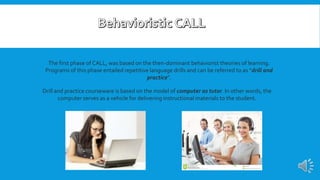
The first phase of CALL, was based on the then-dominant behaviorist theories of learning.
Programs of this phase entailed repetitive language drills and can be referred to as “drill and
practice”.
Drill and practice courseware is based on the model of computer as tutor. In other words, the
computer serves as a vehicle for delivering instructional materials to the student.
 Repeated exposure to the same material is beneficial or even essential to learning.
 A computer is ideal for carrying out repeated drills, since the machine does not get bored with presenting the
same material and since it can provide immediate non-judgmental feedback.
 A computer can present such material on an individualized basis, allowing students to proceed at their own
pace and freeing up class time for other activities.
The rationale behind drill and practice was not totally
Spurious, which explains in part the fact that CALL
drills are still used today. Briefly put, that rationale is as follow:
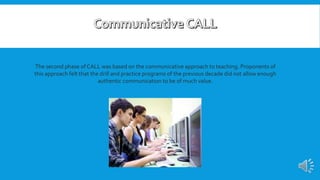
The second phase of CALL was based on the communicative approach to teaching. Proponents of
this approach felt that the drill and practice programs of the previous decade did not allow enough
authentic communication to be of much value.
 focuses more on using forms rather than on the forms themselves;
 teaches grammar implicitly rather than explicitly;
 allows and encourages students to generate original utterances rather than just manipulate
prefabricated language;
 does not judge and evaluate everything the students nor reward them with congratulatory
messages, lights, or bells;
 avoids telling students they are wrong and is flexible to a variety of student responses;
 uses the target language exclusively and creates an environment in which using the target
language feels natural, both on and off the screen; and
 will never try to do anything that a book can do just as well.
One of the main advocates of this new approach was John Underwood, who in
1984 proposed a series of "Premises for 'Communicative' CALL“. According to
Underwood, communicative CALL:
Steps toward integrative CALL: multimedia
Integrative approaches to CALL are based on two important technological developments of the last
decade - multimedia computers and the Internet. Multimedia technology - exemplified today by the
CD-ROM - allows a variety of media (text, graphics, sound, animation, and video) to be accessed on a
single machine.What makes multimedia even more powerful is that it also entails hypermedia. That
means that the multimedia resources are all linked together and that learners can navigate their own
path simply by pointing and clicking a mouse.
Steps toward integrative CALL: the Internet
Computer Mediated Communication (CMC), which has existed in primitive form since the 1960s but
has only became wide-spread in the last five years, is probably the single computer application to date
with the greatest impact on language teaching.
The history of CALL suggests that the computer can serve a variety of uses for
language teaching. It can be a tutor which offers language drills or skill practice; a
stimulus for discussion and interaction; or a tool for writing and research. With the
advent of the Internet, it can also be a medium of global communication and a
source of limitless authentic materials.
• http://www.ict4lt.org/en/warschauer.htm
• Ahmad K., Corbett G., Rogers M., & Sussex R. (985) Computers, language learning and
language teaching, Cambridge: Cambridge University Press.

Act. 1.9 Computer Assisted Language Learning

  • 1.
    Computer Assisted LanguageLearning (CALL) Universidad Autónoma del Carmen Act. 1.9 By: Rosa Angélica Sánchez Pérez Degree: English Language Third Semester
  • 2.
    Computer-assisted language learning(CALL) was a topic of relevance mostly to those with a special interest in that area. Recently, though, computers have become so widespread in schools and homes and their uses have expanded so dramatically that the majority of language teachers must now begin to think about the implications of computers for language learning. This development can be categorized in terms of three somewhat distinct phases: Computer Assisted Language Learning (CALL)
  • 3.
    The first phaseof CALL, was based on the then-dominant behaviorist theories of learning. Programs of this phase entailed repetitive language drills and can be referred to as “drill and practice”. Drill and practice courseware is based on the model of computer as tutor. In other words, the computer serves as a vehicle for delivering instructional materials to the student.
  • 4.
     Repeated exposureto the same material is beneficial or even essential to learning.  A computer is ideal for carrying out repeated drills, since the machine does not get bored with presenting the same material and since it can provide immediate non-judgmental feedback.  A computer can present such material on an individualized basis, allowing students to proceed at their own pace and freeing up class time for other activities. The rationale behind drill and practice was not totally Spurious, which explains in part the fact that CALL drills are still used today. Briefly put, that rationale is as follow:
  • 5.
    The second phaseof CALL was based on the communicative approach to teaching. Proponents of this approach felt that the drill and practice programs of the previous decade did not allow enough authentic communication to be of much value.
  • 6.
     focuses moreon using forms rather than on the forms themselves;  teaches grammar implicitly rather than explicitly;  allows and encourages students to generate original utterances rather than just manipulate prefabricated language;  does not judge and evaluate everything the students nor reward them with congratulatory messages, lights, or bells;  avoids telling students they are wrong and is flexible to a variety of student responses;  uses the target language exclusively and creates an environment in which using the target language feels natural, both on and off the screen; and  will never try to do anything that a book can do just as well. One of the main advocates of this new approach was John Underwood, who in 1984 proposed a series of "Premises for 'Communicative' CALL“. According to Underwood, communicative CALL:
  • 7.
    Steps toward integrativeCALL: multimedia Integrative approaches to CALL are based on two important technological developments of the last decade - multimedia computers and the Internet. Multimedia technology - exemplified today by the CD-ROM - allows a variety of media (text, graphics, sound, animation, and video) to be accessed on a single machine.What makes multimedia even more powerful is that it also entails hypermedia. That means that the multimedia resources are all linked together and that learners can navigate their own path simply by pointing and clicking a mouse. Steps toward integrative CALL: the Internet Computer Mediated Communication (CMC), which has existed in primitive form since the 1960s but has only became wide-spread in the last five years, is probably the single computer application to date with the greatest impact on language teaching.
  • 8.
    The history ofCALL suggests that the computer can serve a variety of uses for language teaching. It can be a tutor which offers language drills or skill practice; a stimulus for discussion and interaction; or a tool for writing and research. With the advent of the Internet, it can also be a medium of global communication and a source of limitless authentic materials.
  • 9.
    • http://www.ict4lt.org/en/warschauer.htm • AhmadK., Corbett G., Rogers M., & Sussex R. (985) Computers, language learning and language teaching, Cambridge: Cambridge University Press.