Computer Assisted Language Learning
(CALL)
“The search for and study of applications of the
computer in language teaching and learning”
- Levy, 1997
PRESENTED BY
Fairuz Sharika Tasnim
Roll: 19-02-04-102
Section: B2
Department: CSE
Course Title: English Language
Sessional
Course Code: HUM1108
2
CONTENTS
 CALL- An Introduction
 Phases of CALL
 Types of CALL Programs
 Roles of Computer in Language
Learning Classroom
 Advantages and Disadvantages of
CALL
 The Future of CALL
 Conclusion
CALL
An
Introduction
CALL is influenced by
traditional language teaching
and learning. Although they
have different method and
approach, but the goal is
same; to develop the
learners’ abilities as the same
as native speakers. CALL has
come to encompass issues of
materials, designs,
technologies, pedagogical
theories, and modes of
instruction.
4
“
CALL is a process in
which; a learner use a
computer and, as a
result, improves his or
her language.
– Beatty, 2003
5
6
Phases of CALL
Computers being used for language
learning since 1960’s. There are three
phases of CALL. Such as
▹ Behaviorist CALL
▹ Communicative CALL
▹ Integrative CALL
Phases of CALL
Behaviorist CALL (1960
- 1970)
▹ The first form of
CALL
▹ Repetitive language
drills
▹ Based on the
behaviorist language
model
▹ First designed and
implemented in the
era of PLATO System
▹ Mainly used for drills
and tests.
CommunicativeCALL
(1970 – 1980)
▹ Reaction to the
behaviorist approach
to language learning
▹ Focused more on using
forms
▹ Corresponds to
cognitive theories
▹ Grammar should be
tought implicitly
Integrative CALL (1980 –
Present)
▹ The most recent
stage of CALL
▹ Multimedia-
networked
computers
▹ Teachers shifted
from cognitive view
of communicative
language teaching to
socio-cognitive view
▹ Criticized
communitive CALL as
disconnected fashion
7
8
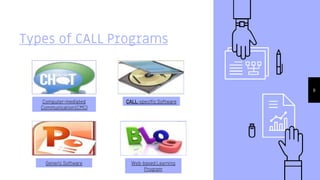
Types of CALL Programs
▹ CALL-specific Software
▹ Generic Software
▹ Web-based Learning Program
▹ Computer-mediated
Communication (CMC)
9
Types of CALL Programs
Computer-mediated
Communication (CMC)
CALL-specific Software
Generic Software Web-based Learning
Program
10
Roles of Computer in
Language Learning Classroom
▹ Computer as tutor for language drills and
skill practice
▹ Computer as a tool for writing,
presenting, and researching
▹ Computer as a medium of global
communication
Advantages
▹ Appropiate learning style
▹ Effective use of learning
time
▹ Error analysis
▹ Guided and repetitive
practice
▹ Being able to get
materials that would not
be reached in real life
Advantages and
Disadvantages of CALL
Disadvantages
▹ Economical factors
▹ Less-handy equipment
▹ Lack of trained teachers
▹ The student must be
motivated and disciplined
to complete a learning
program on his own
11
12
The Future of CALL
Human Language Technologies (HLT) is likely to make an
increasing impact on CALL. Concretely, this impact
comes from the work on:
▹ Natural Language Processing
▹ Machine Translator
▹ Corpus Linguistics
▹ Speech Technology
13
Conclusion
The history of Computer Assisted Language
Learning suggests that the computer can serve a
variety of uses for language teaching and
learning. It can be a tutor which offers language
drills or skill practice; a stimulus for discussion
and interaction; or a tool for writing and
researching. With the advent of the internet, it
can also be a medium of global communication
and a source of limitless authentic materials.
“The aim of developing
CALL is not to provide
language with novelty,
but it is to improve the
quality of language
teaching.
- Cameron, 1989
14
THANKS!
Any questions?
15

Computer Assisted Language Learning (CALL)

  • 1.
    Computer Assisted LanguageLearning (CALL) “The search for and study of applications of the computer in language teaching and learning” - Levy, 1997
  • 2.
    PRESENTED BY Fairuz SharikaTasnim Roll: 19-02-04-102 Section: B2 Department: CSE Course Title: English Language Sessional Course Code: HUM1108 2
  • 3.
    CONTENTS  CALL- AnIntroduction  Phases of CALL  Types of CALL Programs  Roles of Computer in Language Learning Classroom  Advantages and Disadvantages of CALL  The Future of CALL  Conclusion
  • 4.
    CALL An Introduction CALL is influencedby traditional language teaching and learning. Although they have different method and approach, but the goal is same; to develop the learners’ abilities as the same as native speakers. CALL has come to encompass issues of materials, designs, technologies, pedagogical theories, and modes of instruction. 4
  • 5.
    “ CALL is aprocess in which; a learner use a computer and, as a result, improves his or her language. – Beatty, 2003 5
  • 6.
    6 Phases of CALL Computersbeing used for language learning since 1960’s. There are three phases of CALL. Such as ▹ Behaviorist CALL ▹ Communicative CALL ▹ Integrative CALL
  • 7.
    Phases of CALL BehavioristCALL (1960 - 1970) ▹ The first form of CALL ▹ Repetitive language drills ▹ Based on the behaviorist language model ▹ First designed and implemented in the era of PLATO System ▹ Mainly used for drills and tests. CommunicativeCALL (1970 – 1980) ▹ Reaction to the behaviorist approach to language learning ▹ Focused more on using forms ▹ Corresponds to cognitive theories ▹ Grammar should be tought implicitly Integrative CALL (1980 – Present) ▹ The most recent stage of CALL ▹ Multimedia- networked computers ▹ Teachers shifted from cognitive view of communicative language teaching to socio-cognitive view ▹ Criticized communitive CALL as disconnected fashion 7
  • 8.
    8 Types of CALLPrograms ▹ CALL-specific Software ▹ Generic Software ▹ Web-based Learning Program ▹ Computer-mediated Communication (CMC)
  • 9.
    9 Types of CALLPrograms Computer-mediated Communication (CMC) CALL-specific Software Generic Software Web-based Learning Program
  • 10.
    10 Roles of Computerin Language Learning Classroom ▹ Computer as tutor for language drills and skill practice ▹ Computer as a tool for writing, presenting, and researching ▹ Computer as a medium of global communication
  • 11.
    Advantages ▹ Appropiate learningstyle ▹ Effective use of learning time ▹ Error analysis ▹ Guided and repetitive practice ▹ Being able to get materials that would not be reached in real life Advantages and Disadvantages of CALL Disadvantages ▹ Economical factors ▹ Less-handy equipment ▹ Lack of trained teachers ▹ The student must be motivated and disciplined to complete a learning program on his own 11
  • 12.
    12 The Future ofCALL Human Language Technologies (HLT) is likely to make an increasing impact on CALL. Concretely, this impact comes from the work on: ▹ Natural Language Processing ▹ Machine Translator ▹ Corpus Linguistics ▹ Speech Technology
  • 13.
    13 Conclusion The history ofComputer Assisted Language Learning suggests that the computer can serve a variety of uses for language teaching and learning. It can be a tutor which offers language drills or skill practice; a stimulus for discussion and interaction; or a tool for writing and researching. With the advent of the internet, it can also be a medium of global communication and a source of limitless authentic materials.
  • 14.
    “The aim ofdeveloping CALL is not to provide language with novelty, but it is to improve the quality of language teaching. - Cameron, 1989 14
  • 15.