'COMPUTER ASSISTED
LANGUAGE LEARNING'.
INFORMATION AND COMMUNICATION TECHNOLOGY
MARIA CONCHITA MONZON CANCINO
TEACHER RAFAEL FERRER
ACTIVITY 1.8
SEPTEMBER 15, 2015
UNIVERSIDAD AUTÓNOMA DEL CARMEN
Though CALL has developed gradually over the last 30 years,
this development can be categorized in terms of three
somewhat distinct phases which I will refer to as behavioristic
CALL, communicative CALL, and integrative CALL.
THREE PHASES OF CALL
The first phase of CALL, conceived in the 1950s and implemented
in the 1960s and '70s, was based on the then-dominant
behaviorist theories of learning. Programs of this phase entailed
repetitive language drills and can be referred to as "drill and
practice" (or, more pejoratively, as "drill and kill").
 Repeated exposure to the same material is beneficial or even
essential to learning
 A computer is ideal for carrying out repeated drills, since the
machine does not get bored with presenting the same material
and since it can provide immediate non-judgmental feedback
 A computer can present such material on an individualized basis,
allowing students to proceed at their own pace and freeing up
class time for other activities
BEHAVIORISTIC CALL
The second phase of CALL was based on the communicative
approach to teaching which became prominent in the 1970s
and 80s. Proponents of this approach felt that the drill and
practice programs of the previous decade did not allow enough
authentic communication to be of much value.
COMMUNICATIVE CALL
Integrative approaches to CALL are based on two important technological
developments of the last decade - multimedia computers and the
Internet. Multimedia technology - exemplified today by the CD-ROM -
allows a variety of media (text, graphics, sound, animation, and video) to
be accessed on a single machine. What makes multimedia even more
powerful is that it also entails hypermedia. That means that the
multimedia resources are all linked together and that learners can
navigate their own path simply by pointing and clicking a mouse
STEPS TOWARD INTEGRATIVE CALL:
MULTIMEDIA
Computer Mediated Communication allows users to share not only
brief messages, but also lengthy (formatted or unformatted)
documents - thus facilitating collaborative writing - and also
graphics, sounds, and video. Using the World Wide Web (WWW),
students can search through millions of files around the world
within minutes to locate and access authentic materials (e.g.
newspaper and magazine articles, radio broadcasts, short videos,
movie reviews, book excerpts) exactly tailored to their own
personal interests. They can also use the Web to publish their texts
or multimedia materials to share with partner classes or with the
general public.
STEPS TOWARD INTEGRATIVE CALL: THE
INTERNET
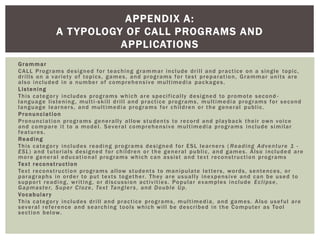
Grammar
CALL Programs designed for teaching grammar include drill and practice on a single topic,
drills on a variety of topics, games, and programs for test preparation, Grammar units are
also included in a number of comprehensive multimedia packages.
Listening
This category includes programs which are specifically designed to promote second -
language listening, multi-skill drill and practice programs, multimedia programs for second
language learners, and multimedia programs for children or the general public.
Pronunciation
Pronunciation programs generally allow students to record and playback their own voice
and compare it to a model. Several comprehensive multimedia programs include similar
features.
Reading
This category includes reading programs designed for ESL learners ( Reading Adventure 1 -
ESL) and tutorials designed for children or the general public, and games. Also included are
more general educational programs which can assist and text reconstruction programs
Text reconstruction
Text reconstruction programs allow students to manipulate letters, words, sentences, or
paragraphs in order to put texts together. They are usually inexpensive and can be used to
support reading, writing, or discussion activities. Popular examples include Eclipse,
Gapmaster, Super Cloze, Text Tanglers, and Double Up.
Vocabulary
This category includes drill and practice programs, multimedia, and games. Also useful are
several reference and searching tools which will be described in the Computer as Tool
section below.
APPENDIX A:
A TYPOLOGY OF CALL PROGRAMS AND
APPLICATIONS
 Dunkel P. (ed.) (1991) Computer-assisted language learning and testing: research
issues and practice, New York, NY: Newbury House
 Kenning M.-M. & Kenning M. J. (1990) Computers and language learning: Current
theory and practice. New York: Ellis Horwood
 Taylor M.B. & Perez L.M. (1989) Something to do on Monday, La Jolla, CA:
Athelstan.
 Tribble C. & Jones G. (1990) Concordances in the classroom, Harlow: Longman
REFERENCE

Activity 1.8

  • 1.
  • 2.
    INFORMATION AND COMMUNICATIONTECHNOLOGY MARIA CONCHITA MONZON CANCINO TEACHER RAFAEL FERRER ACTIVITY 1.8 SEPTEMBER 15, 2015 UNIVERSIDAD AUTÓNOMA DEL CARMEN
  • 3.
    Though CALL hasdeveloped gradually over the last 30 years, this development can be categorized in terms of three somewhat distinct phases which I will refer to as behavioristic CALL, communicative CALL, and integrative CALL. THREE PHASES OF CALL
  • 4.
    The first phaseof CALL, conceived in the 1950s and implemented in the 1960s and '70s, was based on the then-dominant behaviorist theories of learning. Programs of this phase entailed repetitive language drills and can be referred to as "drill and practice" (or, more pejoratively, as "drill and kill").  Repeated exposure to the same material is beneficial or even essential to learning  A computer is ideal for carrying out repeated drills, since the machine does not get bored with presenting the same material and since it can provide immediate non-judgmental feedback  A computer can present such material on an individualized basis, allowing students to proceed at their own pace and freeing up class time for other activities BEHAVIORISTIC CALL
  • 5.
    The second phaseof CALL was based on the communicative approach to teaching which became prominent in the 1970s and 80s. Proponents of this approach felt that the drill and practice programs of the previous decade did not allow enough authentic communication to be of much value. COMMUNICATIVE CALL
  • 6.
    Integrative approaches toCALL are based on two important technological developments of the last decade - multimedia computers and the Internet. Multimedia technology - exemplified today by the CD-ROM - allows a variety of media (text, graphics, sound, animation, and video) to be accessed on a single machine. What makes multimedia even more powerful is that it also entails hypermedia. That means that the multimedia resources are all linked together and that learners can navigate their own path simply by pointing and clicking a mouse STEPS TOWARD INTEGRATIVE CALL: MULTIMEDIA
  • 7.
    Computer Mediated Communicationallows users to share not only brief messages, but also lengthy (formatted or unformatted) documents - thus facilitating collaborative writing - and also graphics, sounds, and video. Using the World Wide Web (WWW), students can search through millions of files around the world within minutes to locate and access authentic materials (e.g. newspaper and magazine articles, radio broadcasts, short videos, movie reviews, book excerpts) exactly tailored to their own personal interests. They can also use the Web to publish their texts or multimedia materials to share with partner classes or with the general public. STEPS TOWARD INTEGRATIVE CALL: THE INTERNET
  • 8.
    Grammar CALL Programs designedfor teaching grammar include drill and practice on a single topic, drills on a variety of topics, games, and programs for test preparation, Grammar units are also included in a number of comprehensive multimedia packages. Listening This category includes programs which are specifically designed to promote second - language listening, multi-skill drill and practice programs, multimedia programs for second language learners, and multimedia programs for children or the general public. Pronunciation Pronunciation programs generally allow students to record and playback their own voice and compare it to a model. Several comprehensive multimedia programs include similar features. Reading This category includes reading programs designed for ESL learners ( Reading Adventure 1 - ESL) and tutorials designed for children or the general public, and games. Also included are more general educational programs which can assist and text reconstruction programs Text reconstruction Text reconstruction programs allow students to manipulate letters, words, sentences, or paragraphs in order to put texts together. They are usually inexpensive and can be used to support reading, writing, or discussion activities. Popular examples include Eclipse, Gapmaster, Super Cloze, Text Tanglers, and Double Up. Vocabulary This category includes drill and practice programs, multimedia, and games. Also useful are several reference and searching tools which will be described in the Computer as Tool section below. APPENDIX A: A TYPOLOGY OF CALL PROGRAMS AND APPLICATIONS
  • 9.
     Dunkel P.(ed.) (1991) Computer-assisted language learning and testing: research issues and practice, New York, NY: Newbury House  Kenning M.-M. & Kenning M. J. (1990) Computers and language learning: Current theory and practice. New York: Ellis Horwood  Taylor M.B. & Perez L.M. (1989) Something to do on Monday, La Jolla, CA: Athelstan.  Tribble C. & Jones G. (1990) Concordances in the classroom, Harlow: Longman REFERENCE