Aetiopathogenesis
Vaibhav Shriya
VII Semester
Aetiologic Agent
• family – human retroviriadae
• subfamily – lentivirus
• 2 types: HIV-1, HIV-2
• m/c throughout the world = HIV-1
• Both HIV-1, HIV-2 are zoonotic infections
• Natural reservoir of HIV-1 = Pan troglodytes
troglodytes {Chimps} (most likely source of original
human infection)
• HIV-2 more close to SIV (Simian Immunodeficiency
Virus) than HIV-1 (about 40% resemblance to HIV-1
phylogenetically)
Morphology of HIV
MoT
A. Sexual Transmission
• Predominantly STD worldwide
• m/c MoT worldwide – heterosexual
transmission (2nd m/c MoT in dvlpd. nations)
• HIV demonstrated in semen w/i infected
mononuc. cells (particularly high in
epididymitis, urethritis), cell-free material
• Increased risk with (+) of STD’s  genital ulcern
(HSV, T. pallidum, H. ducreyi); nonulcerative
infl. (C. trachomatis, N. gonorrhoeae, T.
vaginalis)
• Vaginal intercourse – more MF than FM
(?)
• Strong asso. with receptive anal intercourse
(?)
• Extremely low asso. with oral intercourse (not
100% safe)
• OCP’s  induces cervical mucosal change 
more chances of viral penetration
• Circumcision  lowers risk of inf. in men (?)
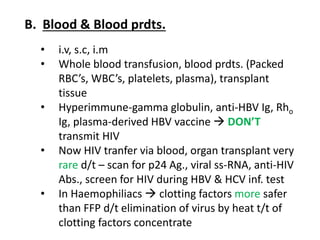
B. Blood & Blood prdts.
• i.v, s.c, i.m
• Whole blood transfusion, blood prdts. (Packed
RBC’s, WBC’s, platelets, plasma), transplant
tissue
• Hyperimmune-gamma globulin, anti-HBV Ig, Rho
Ig, plasma-derived HBV vaccine  DON’T
transmit HIV
• Now HIV tranfer via blood, organ transplant very
rare d/t – scan for p24 Ag., viral ss-RNA, anti-HIV
Abs., screen for HIV during HBV & HCV inf. test
• In Haemophiliacs  clotting factors more safer
than FFP d/t elimination of virus by heat t/t of
clotting factors concentrate
C. Occupational (Health care workers &
settings, Lab)
• Transmission of HIV by sharps = 0.3% (USA)
• Transmission of HIV by contact of mucosa or
non-intact skin to HIV containing paraphernalia =
0.09%
• Transmission of HIV by intact skin  not
documented
• Transmission of HIV by human biting other
human at least 4 cases reported
• Risk of transmission of HIV by blood > other
bodily fluids (tears, saliva, urine, CSF, serous fluids,
sputum, faeces, vomitus, etc.)
D. MTCT
• m/c in perinatal pd. (50-60% risk of transmitting HIV)
• can be transmitted as early as during I, II trimester
• Higher MTCT correlated with closer HLA match
between mother, child
• control:-
1. Universal voluntary HIV test, counseling of preg.
female
2. HAART with >=1 drugs {lami.(NRTI’s),
ZDV(NRTI’s)}
3. Reduce foet. exposure to mat. blood, gemital
secretions
4. Avoid breast feeding
** In dvlping. nations  Nevirapine is cheap alter of
ZDV, lami.
E. Bodily fluids
• HIV (+) in LOW titres in saliva  no evidence to
be transmitted by kiss
• (+) of anti-HIV IgA, M, G in saliva of infected
person
• (+) of SLPI in saliva  cleaves CD4 receptors
• former USSR  children infected with HIV (by
transfusion)  had bleeding oral sore  breast
feeding  laceration, abrasion around nipple by
biting (breast feeding was continued until children
were older)  mother contracted HIV
Replication Cycle
HIV Provirus Genome
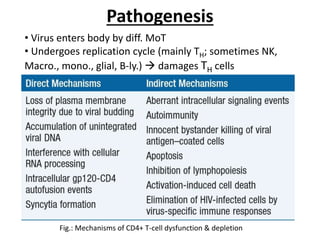
Pathogenesis
• Virus enters body by diff. MoT
• Undergoes replication cycle (mainly TH; sometimes NK,
Macro., mono., glial, B-ly.)  damages TH cells
Fig.: Mechanisms of CD4+ T-cell dysfunction & depletion
A. 1o inf., viral dissemination
Fig.: Summary of early events in HIV infection
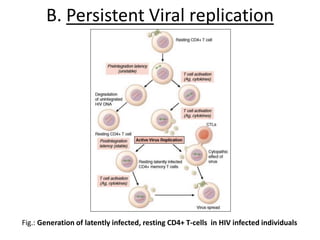
B. Persistent Viral replication
Fig.: Generation of latently infected, resting CD4+ T-cells in HIV infected individuals
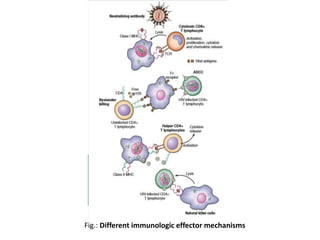
Fig.: Different immunologic effector mechanisms
C. Evasion of immune control
Mainly foll. mechs. –
1.Sustained replication with high rate of mutn.
& recombi. (RTase, gag encoded prots.)
{1:104 bases copied}
2.Exhaustion of CD8+ CTL’s d/t (+) of PD-1
mol. on activated cells
3.Extensive N-linked Glycosylation of envelope
(k/a GLYCAN shield)
4.Conformational masking of neutralizing
epitopes
5. Sequestration of inftd. Cells in sites like CNS
Fig.: Elements of the immune response to HIV
D. Advanced HIV dz
Fig.: Events that transpire from primary HIV infection
Destruction of immunity by HIV
1. Opportunistic
infns.
2. Autoimmunity
3. Neoplasms
(esp. KS)
• angioprolif. dz, not true
sarcoma (at least initially)
• excess prolif. of spindle
cells of vasc. origin
• 4 diff. epidem. forms: 2
are opportunistic infns.
• interplay of R/F’s – HIV-
1, HHV-8, immune actvn.,
cytokines
• in HIV, % prev. of HHV-8
in KS in M:F = 35:4
• HHV-8 is aetio. agent of
KS
• mol. mimicry by viral
components
• Abs. to WBC’s, platelets,
s. prots. (albumin, Ig, tgb)
• cross-rxn. b/w gp120,41
& MHC-II
• dzs like psoriasis, ITP,
APAS, Grave’s dz, 1o biliary
cirrhosis (+)
• TB (pul./extra-pul.)
• P. jiroveci pnuemonia
• Recurr. Salmonella
septicaemia
•CMV retinits
• Oral hairy leukoplakia
• Candida: oropx.
thrush, vulvovaginitis
• PID
• Periph. neuropathy
• HSV-1 infn.
• Toxoplasmosis – brain
• Cx – dysplasia
• HZV (shingles)

HIV Aetiology & Pathogenesis

  • 1.
  • 2.
    Aetiologic Agent • family– human retroviriadae • subfamily – lentivirus • 2 types: HIV-1, HIV-2 • m/c throughout the world = HIV-1 • Both HIV-1, HIV-2 are zoonotic infections • Natural reservoir of HIV-1 = Pan troglodytes troglodytes {Chimps} (most likely source of original human infection) • HIV-2 more close to SIV (Simian Immunodeficiency Virus) than HIV-1 (about 40% resemblance to HIV-1 phylogenetically)
  • 3.
  • 4.
    MoT A. Sexual Transmission •Predominantly STD worldwide • m/c MoT worldwide – heterosexual transmission (2nd m/c MoT in dvlpd. nations) • HIV demonstrated in semen w/i infected mononuc. cells (particularly high in epididymitis, urethritis), cell-free material • Increased risk with (+) of STD’s  genital ulcern (HSV, T. pallidum, H. ducreyi); nonulcerative infl. (C. trachomatis, N. gonorrhoeae, T. vaginalis)
  • 6.
    • Vaginal intercourse– more MF than FM (?) • Strong asso. with receptive anal intercourse (?) • Extremely low asso. with oral intercourse (not 100% safe) • OCP’s  induces cervical mucosal change  more chances of viral penetration • Circumcision  lowers risk of inf. in men (?)
  • 7.
    B. Blood &Blood prdts. • i.v, s.c, i.m • Whole blood transfusion, blood prdts. (Packed RBC’s, WBC’s, platelets, plasma), transplant tissue • Hyperimmune-gamma globulin, anti-HBV Ig, Rho Ig, plasma-derived HBV vaccine  DON’T transmit HIV • Now HIV tranfer via blood, organ transplant very rare d/t – scan for p24 Ag., viral ss-RNA, anti-HIV Abs., screen for HIV during HBV & HCV inf. test • In Haemophiliacs  clotting factors more safer than FFP d/t elimination of virus by heat t/t of clotting factors concentrate
  • 8.
    C. Occupational (Healthcare workers & settings, Lab) • Transmission of HIV by sharps = 0.3% (USA) • Transmission of HIV by contact of mucosa or non-intact skin to HIV containing paraphernalia = 0.09% • Transmission of HIV by intact skin  not documented • Transmission of HIV by human biting other human at least 4 cases reported • Risk of transmission of HIV by blood > other bodily fluids (tears, saliva, urine, CSF, serous fluids, sputum, faeces, vomitus, etc.)
  • 9.
    D. MTCT • m/cin perinatal pd. (50-60% risk of transmitting HIV) • can be transmitted as early as during I, II trimester • Higher MTCT correlated with closer HLA match between mother, child • control:- 1. Universal voluntary HIV test, counseling of preg. female 2. HAART with >=1 drugs {lami.(NRTI’s), ZDV(NRTI’s)} 3. Reduce foet. exposure to mat. blood, gemital secretions 4. Avoid breast feeding ** In dvlping. nations  Nevirapine is cheap alter of ZDV, lami.
  • 10.
    E. Bodily fluids •HIV (+) in LOW titres in saliva  no evidence to be transmitted by kiss • (+) of anti-HIV IgA, M, G in saliva of infected person • (+) of SLPI in saliva  cleaves CD4 receptors • former USSR  children infected with HIV (by transfusion)  had bleeding oral sore  breast feeding  laceration, abrasion around nipple by biting (breast feeding was continued until children were older)  mother contracted HIV
  • 11.
  • 12.
  • 13.
    Pathogenesis • Virus entersbody by diff. MoT • Undergoes replication cycle (mainly TH; sometimes NK, Macro., mono., glial, B-ly.)  damages TH cells Fig.: Mechanisms of CD4+ T-cell dysfunction & depletion
  • 14.
    A. 1o inf.,viral dissemination Fig.: Summary of early events in HIV infection
  • 15.
    B. Persistent Viralreplication Fig.: Generation of latently infected, resting CD4+ T-cells in HIV infected individuals
  • 16.
    Fig.: Different immunologiceffector mechanisms
  • 17.
    C. Evasion ofimmune control Mainly foll. mechs. – 1.Sustained replication with high rate of mutn. & recombi. (RTase, gag encoded prots.) {1:104 bases copied} 2.Exhaustion of CD8+ CTL’s d/t (+) of PD-1 mol. on activated cells 3.Extensive N-linked Glycosylation of envelope (k/a GLYCAN shield) 4.Conformational masking of neutralizing epitopes 5. Sequestration of inftd. Cells in sites like CNS
  • 18.
    Fig.: Elements ofthe immune response to HIV
  • 19.
    D. Advanced HIVdz Fig.: Events that transpire from primary HIV infection
  • 20.
    Destruction of immunityby HIV 1. Opportunistic infns. 2. Autoimmunity 3. Neoplasms (esp. KS) • angioprolif. dz, not true sarcoma (at least initially) • excess prolif. of spindle cells of vasc. origin • 4 diff. epidem. forms: 2 are opportunistic infns. • interplay of R/F’s – HIV- 1, HHV-8, immune actvn., cytokines • in HIV, % prev. of HHV-8 in KS in M:F = 35:4 • HHV-8 is aetio. agent of KS • mol. mimicry by viral components • Abs. to WBC’s, platelets, s. prots. (albumin, Ig, tgb) • cross-rxn. b/w gp120,41 & MHC-II • dzs like psoriasis, ITP, APAS, Grave’s dz, 1o biliary cirrhosis (+) • TB (pul./extra-pul.) • P. jiroveci pnuemonia • Recurr. Salmonella septicaemia •CMV retinits • Oral hairy leukoplakia • Candida: oropx. thrush, vulvovaginitis • PID • Periph. neuropathy • HSV-1 infn. • Toxoplasmosis – brain • Cx – dysplasia • HZV (shingles)