welcome
to
AcornSolar
What is Solar Energy
• Originates with the thermonuclear fusion reactions occurring in
the sun.
• Represents the entire electromagnetic radiation (visible light,
infrared, ultraviolet, x-rays, and radio waves).
• All chemical and radioactive polluting byproducts of the
thermonuclear reactions remain behind on the sun, while only
pure radiant energy reaches the Earth.
• Energy reaching the earth is incredible. By one calculation, 30
days of sunshine striking the Earth have the energy equivalent of
the total of all the planet’s fossil fuels, both used and unused
Why Solar?
• It is free.
• It is clean. Environmentally friendly.
• It is infinitely renewable
• It reduces our utility costs.
• We can sell back to utility service provider.
• It increase energy self reliance.
• It is reliable.
Solar Cell Background
• 1839 - French physicist A. E. Becquerel first recognized the photovoltaic effect.
• Photo+voltaic = convert light to electricity
• 1883 - first solar cell built, by Charles Fritts, coated semiconductor selenium with an
extremely thin layer of gold to form the junctions.
• 1954 - Bell Laboratories, experimenting with semiconductors, accidentally found that
silicon doped with certain impurities was very sensitive to light. Daryl Chapin, Calvin
Fuller and Gerald Pearson, invented the first practical device for converting sunlight into
useful electrical power. Resulted in the production of the first practical solar cells with a
sunlight energy conversion efficiency of around 6%.
• 1958 - First spacecraft to use solar panels was US satellite Vanguard 1
PV Solar for Electricity
• For the 2 billion people without access to electricity, it would be cheaper to install solar
panels than to extend the electrical grid. (The Fund for Renewable Energy Everywhere)
• Providing power for villages in developing countries is a fast-growing market for
photovoltaics. The United Nations estimates that more than 2 million villages worldwide
are without electric power for water supply, refrigeration, lighting, and other basic needs,
and the cost of extending the utility grids is prohibitive, $23,000 to $46,000 per kilometer
in 1988.
• A one kilowatt PV system* each month:
– prevents 150 lbs. of coal from being mined
– prevents 300 lbs. of CO2 from entering the atmosphere
– keeps 105 gallons of water from being consumed
– keeps NO and SO2 from being released into the environment
* in Colorado, or an equivalent system that produces 150 kWh per month
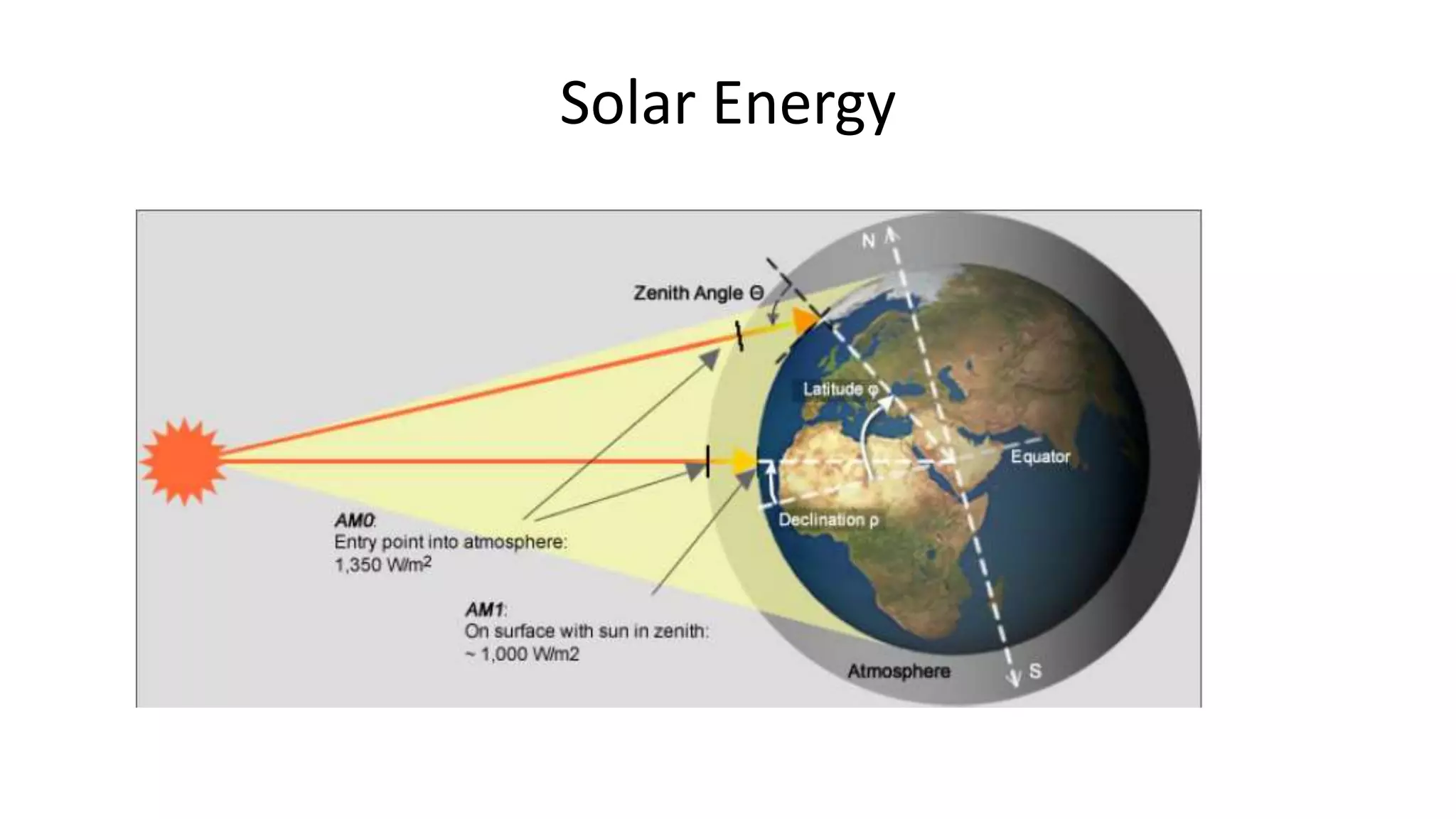
Solar Energy
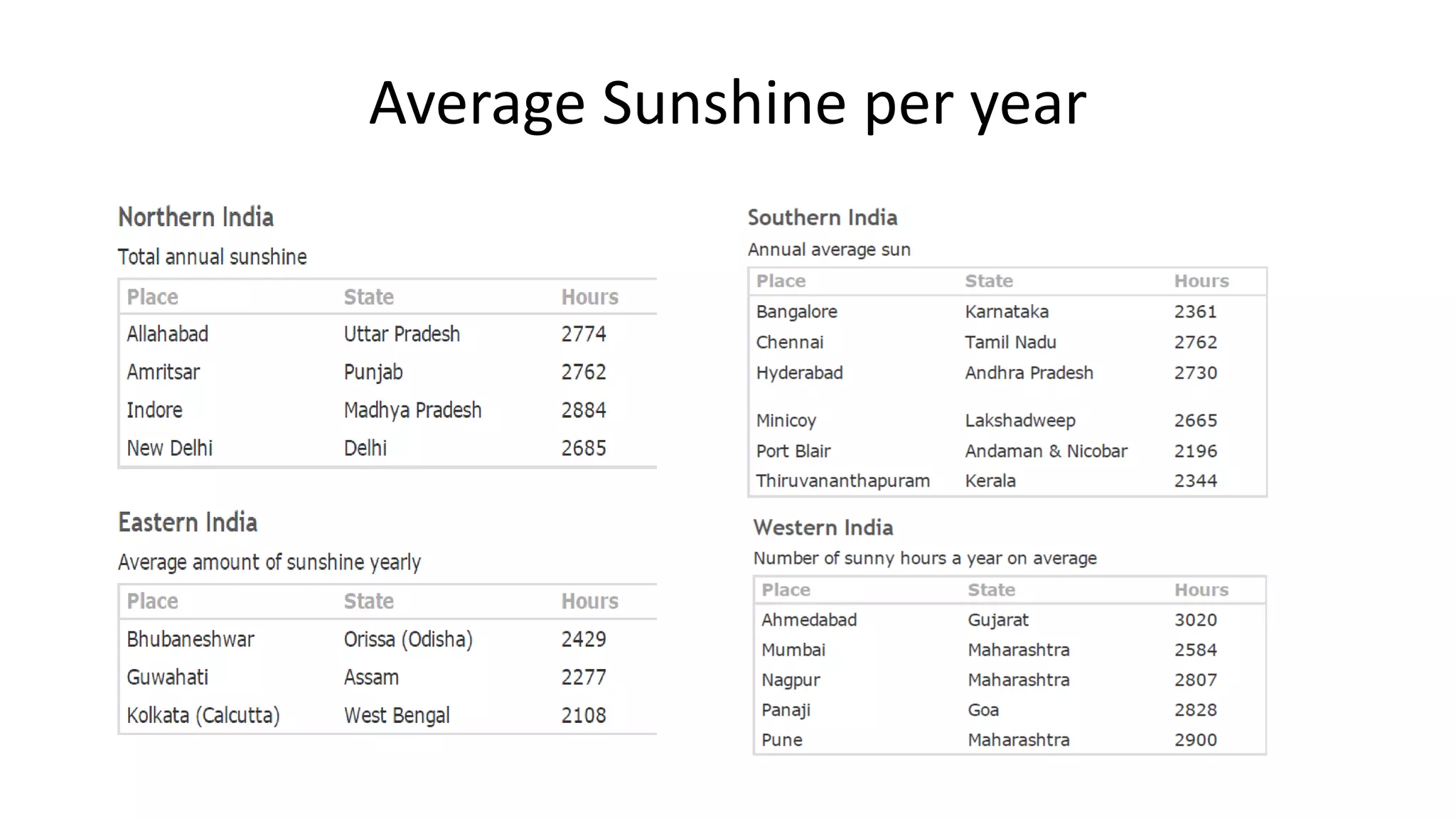
Average Sunshine per year
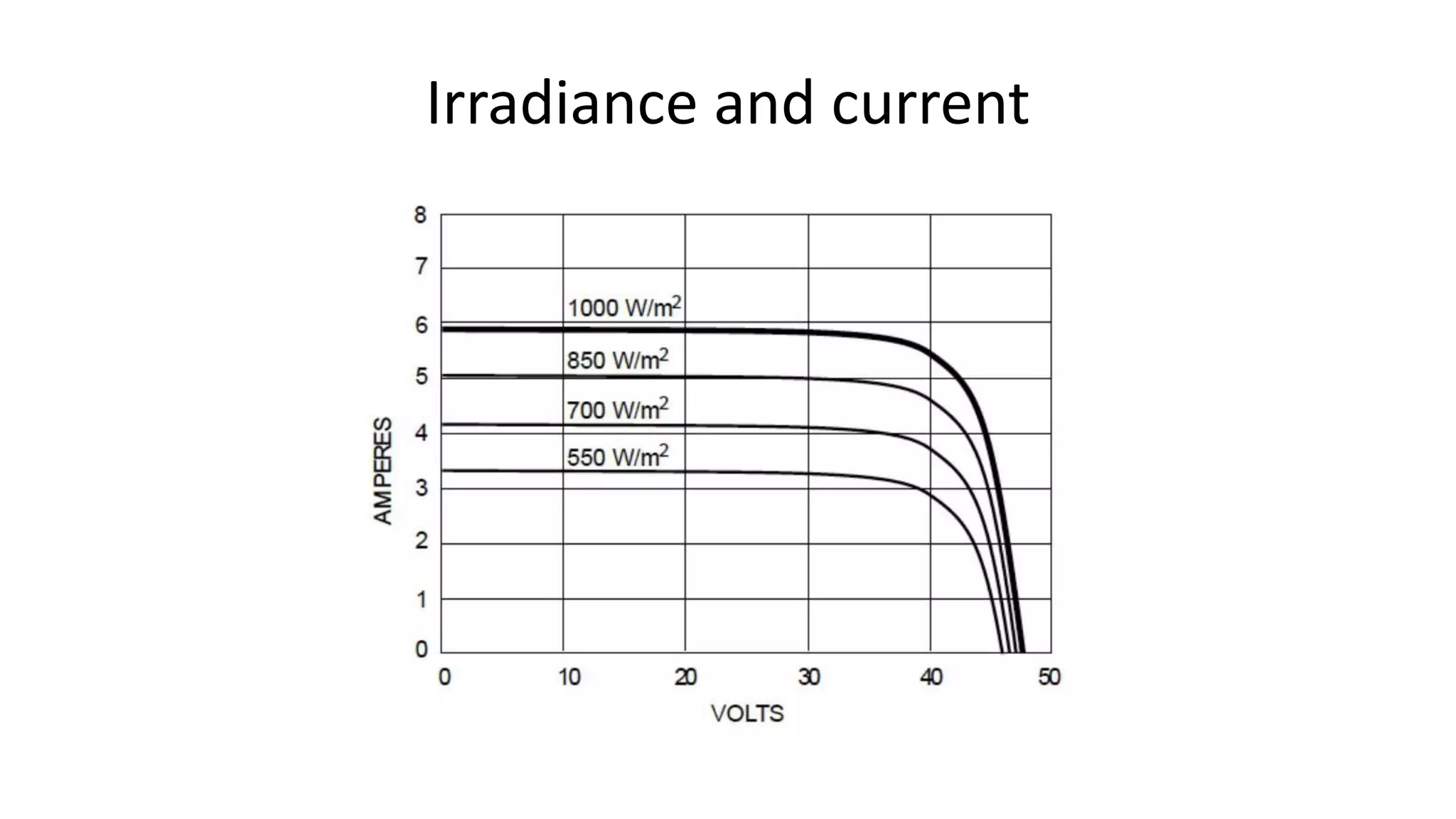
Irradiance and current
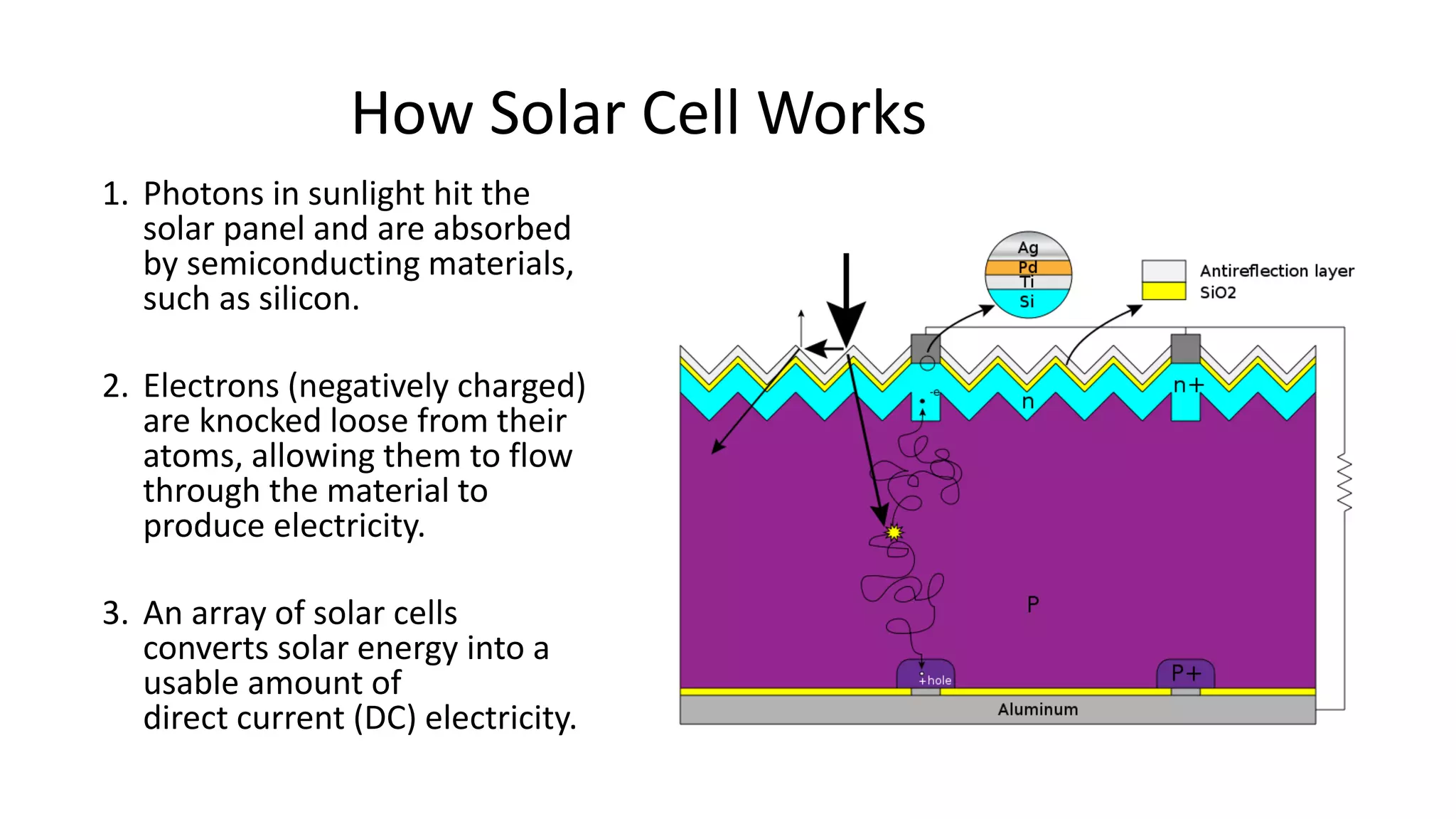
How Solar Cell Works
1. Photons in sunlight hit the
solar panel and are absorbed
by semiconducting materials,
such as silicon.
2. Electrons (negatively charged)
are knocked loose from their
atoms, allowing them to flow
through the material to
produce electricity.
3. An array of solar cells
converts solar energy into a
usable amount of
direct current (DC) electricity.
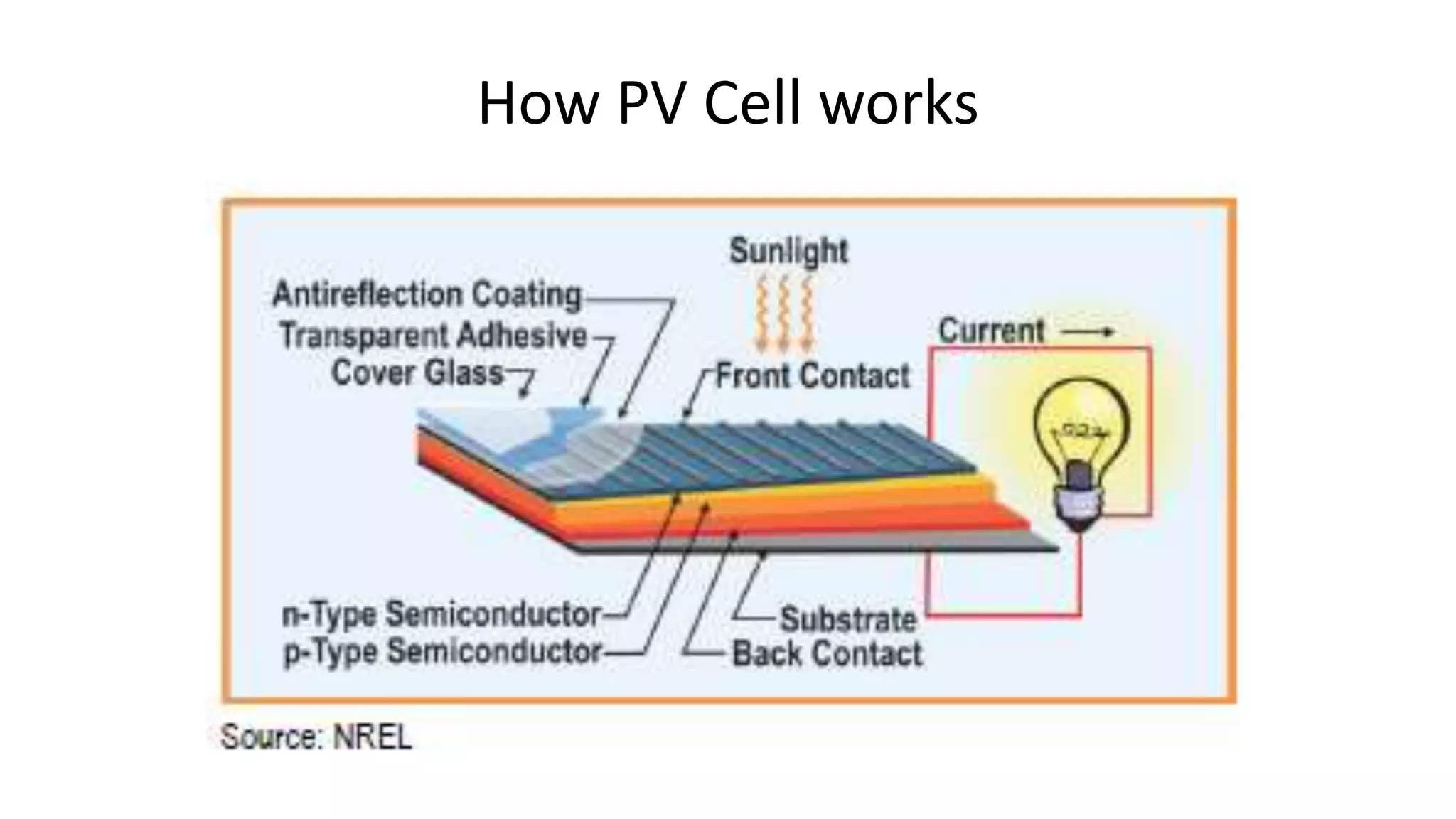
How PV Cell works
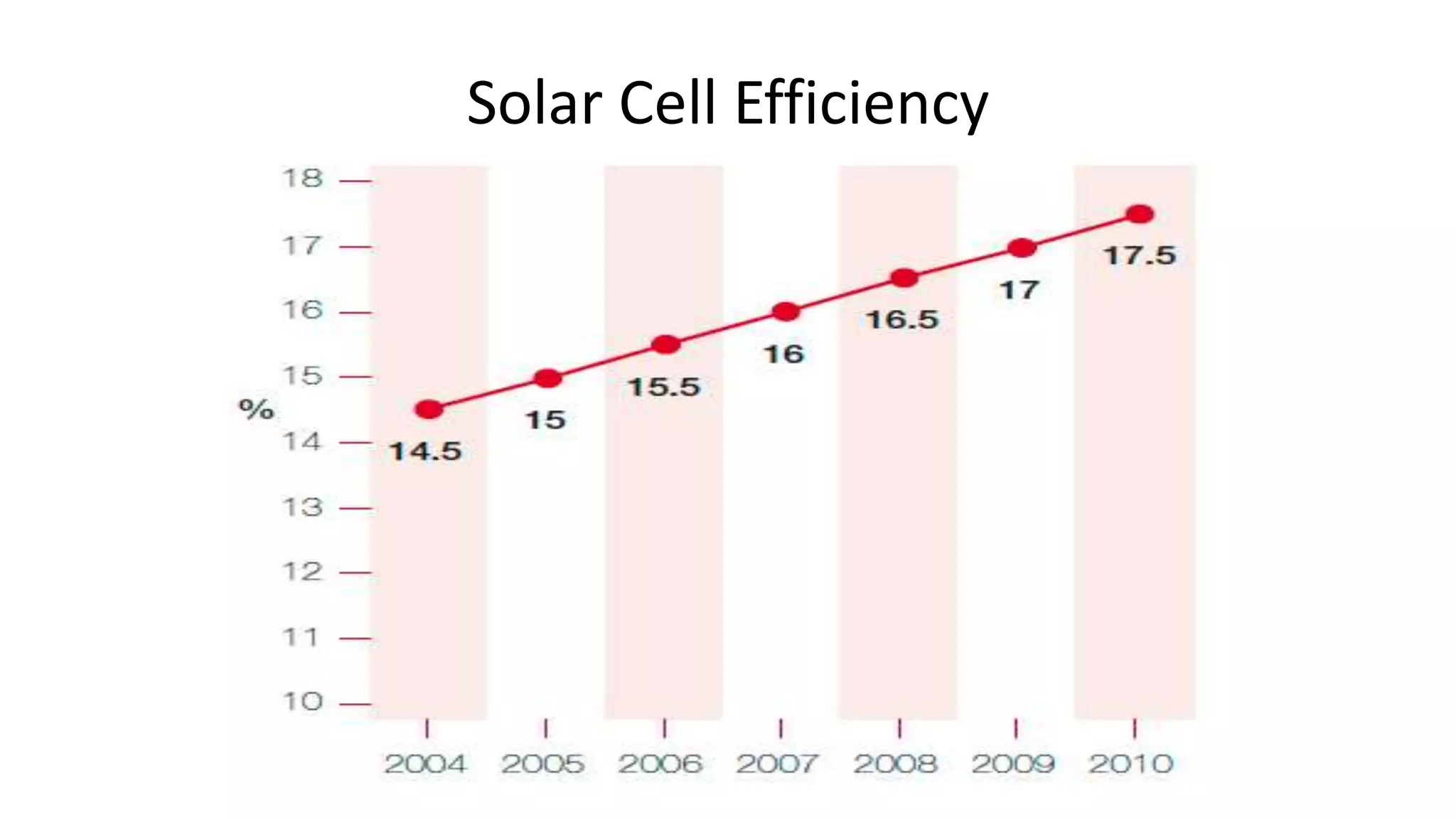
Solar Cell Efficiency
Cell Technology
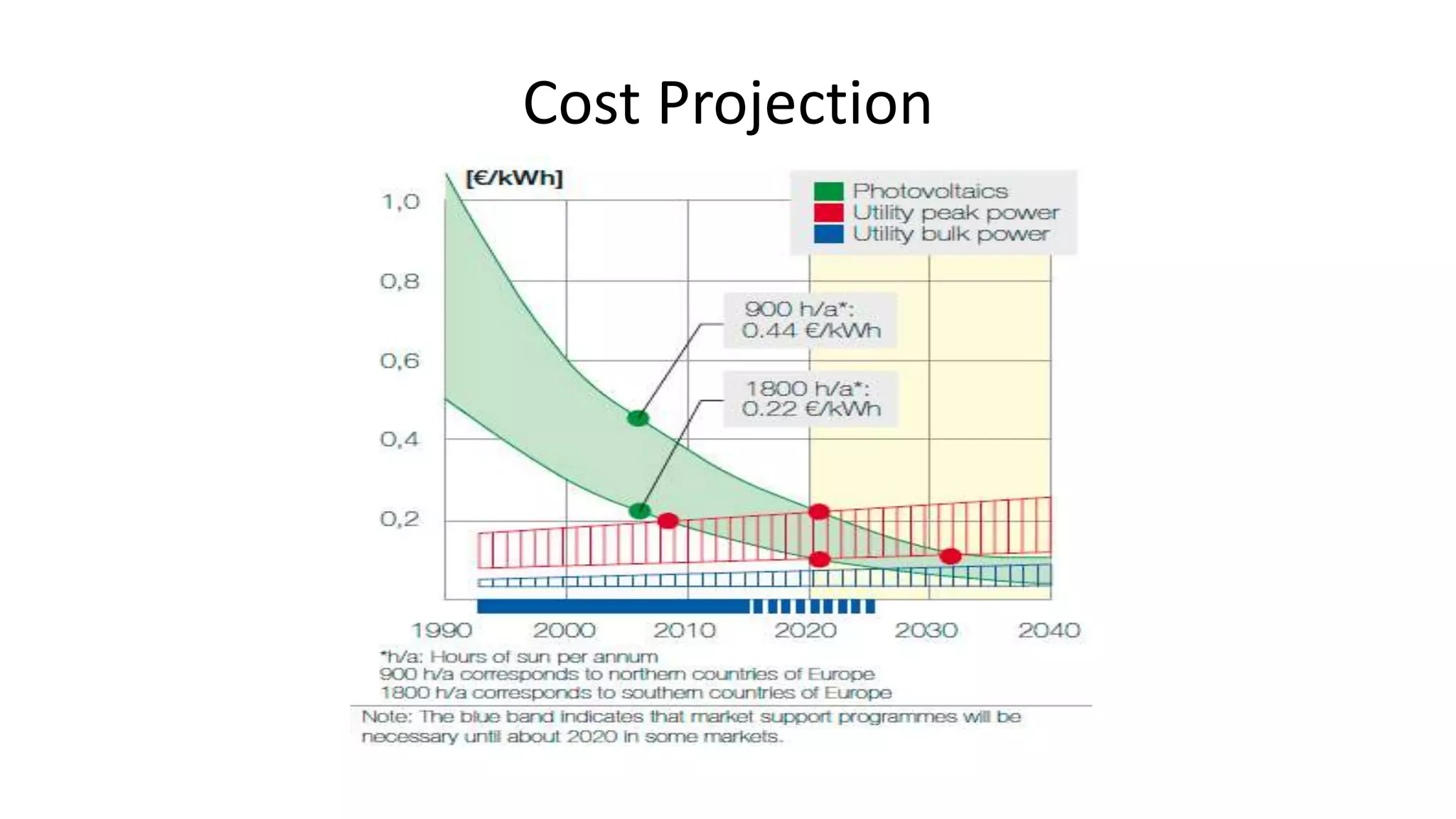
Cost Projection
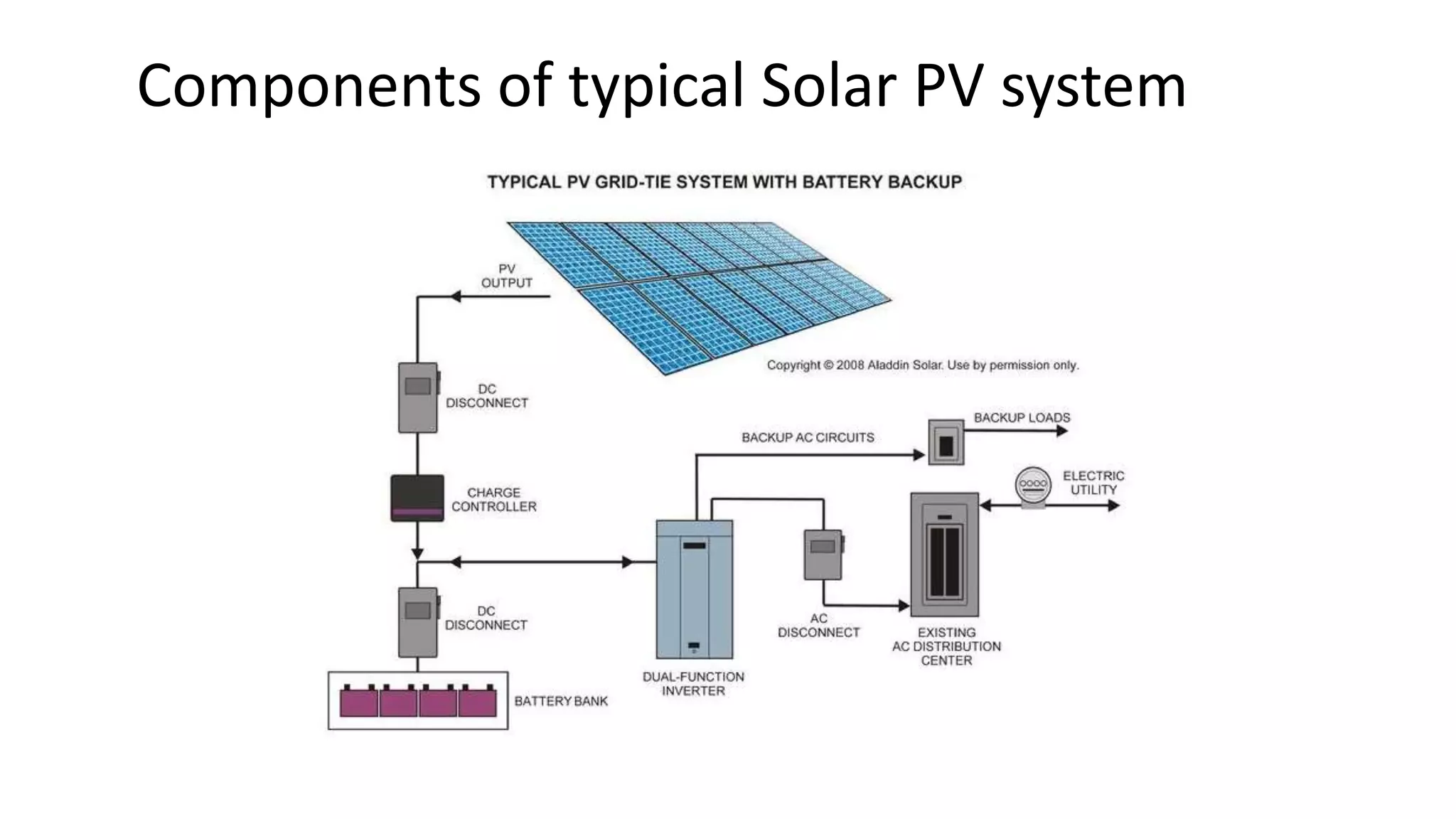
Components of typical Solar PV system
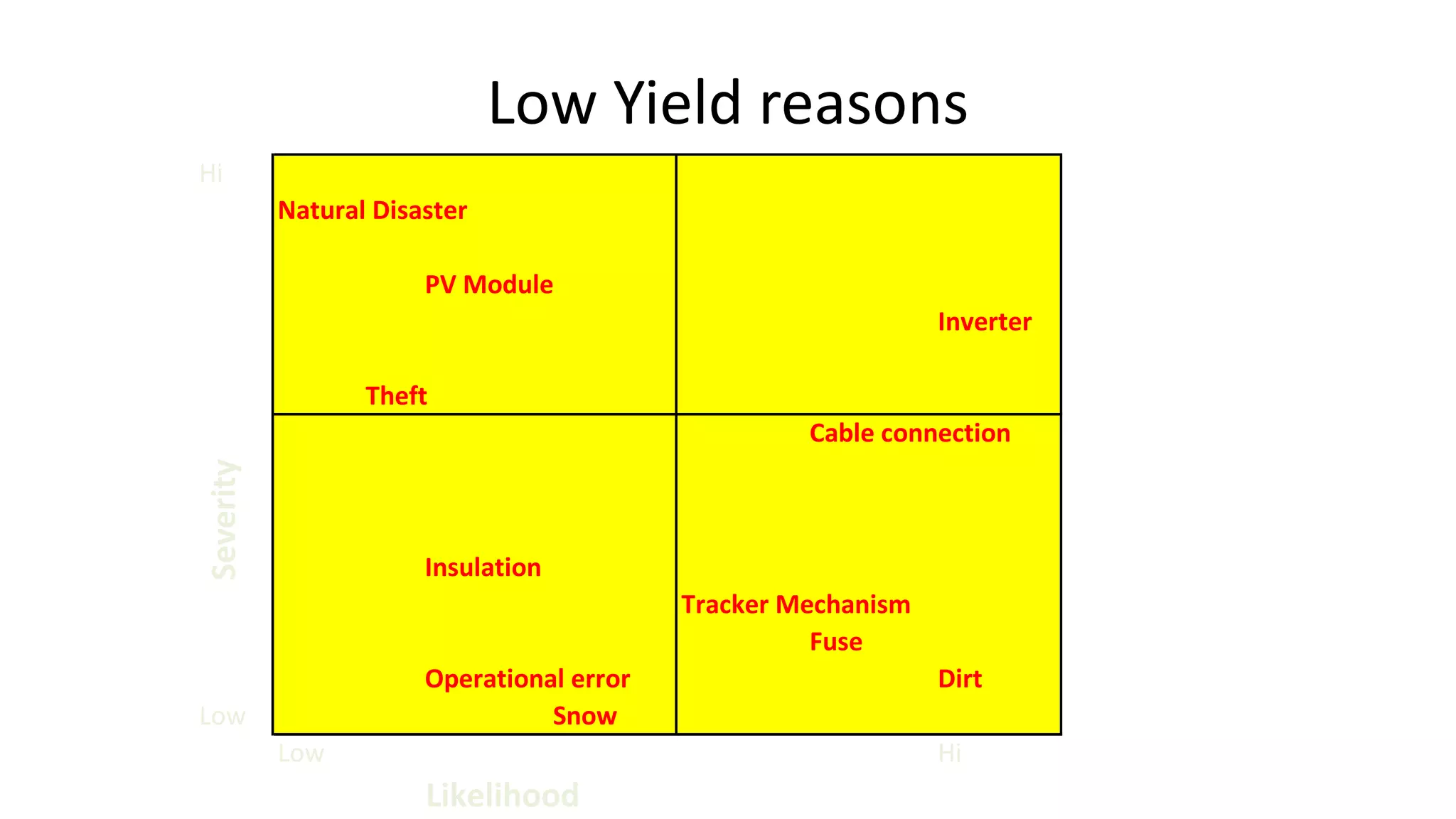
Low Yield reasons
Hi
Natural Disaster
PV Module
Inverter
Theft
Cable connection
Severity
Insulation
Tracker Mechanism
Fuse
Operational error Dirt
Low Snow
Low Hi
Likelihood
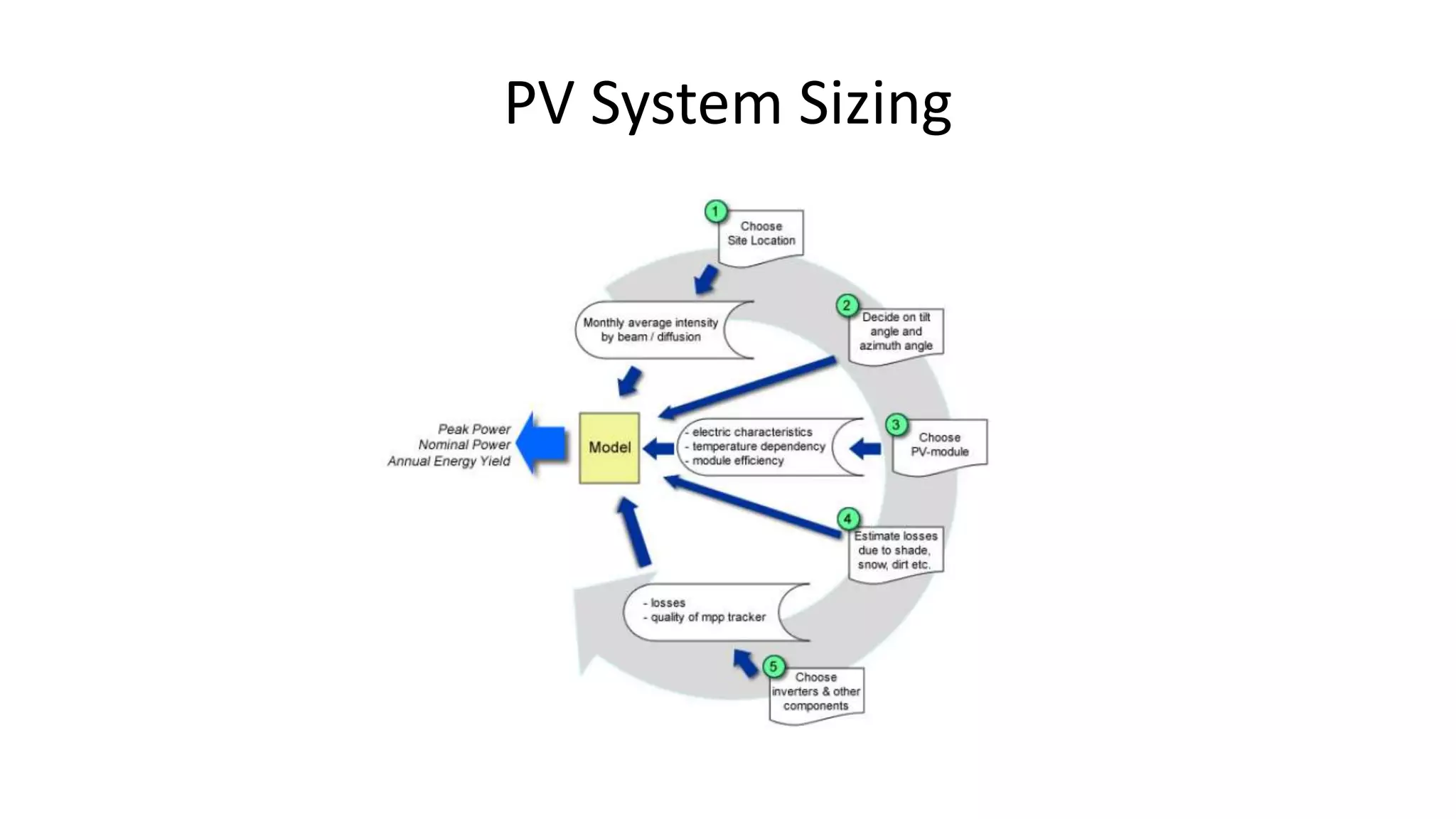
PV System Sizing
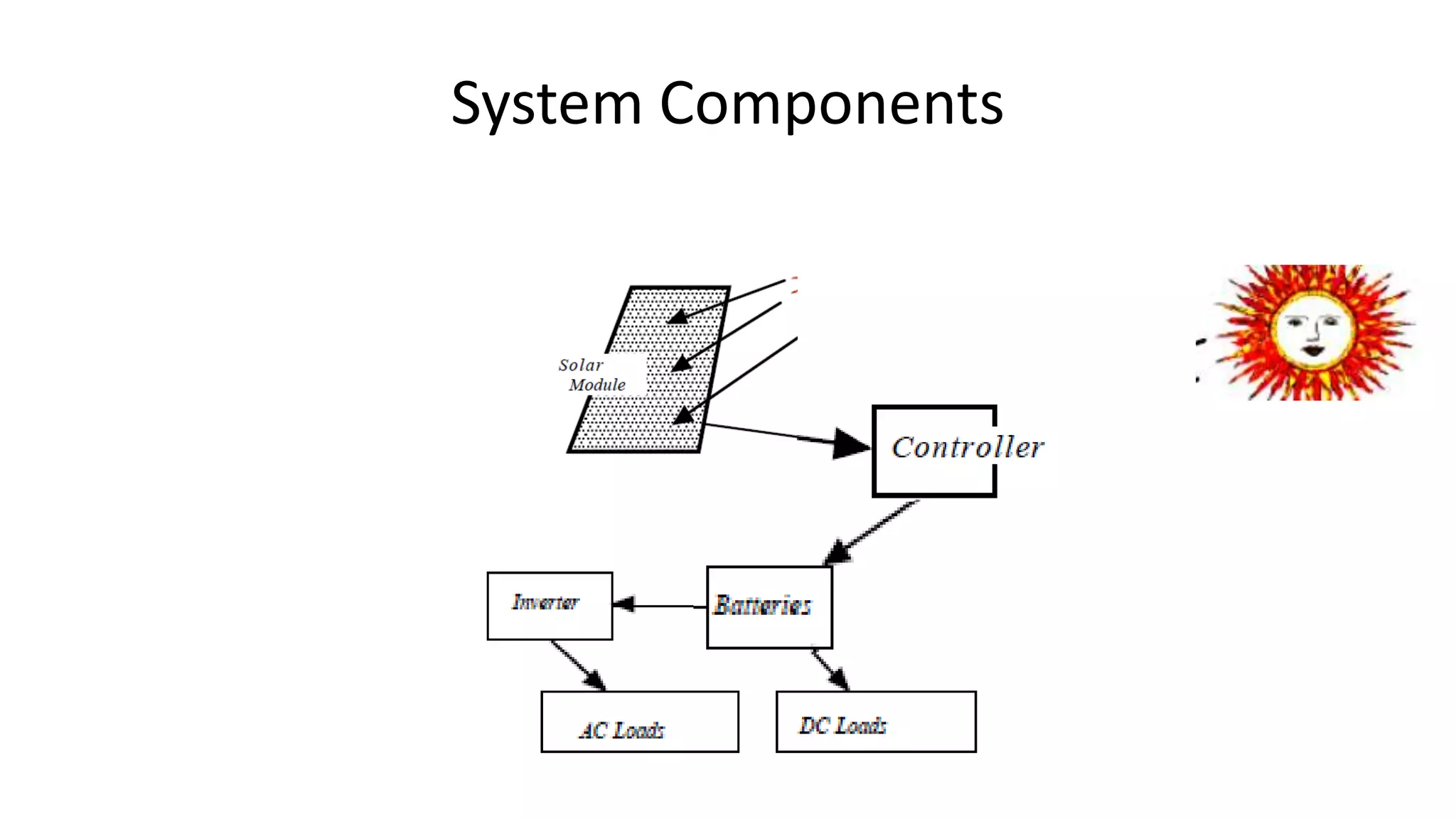
System Components
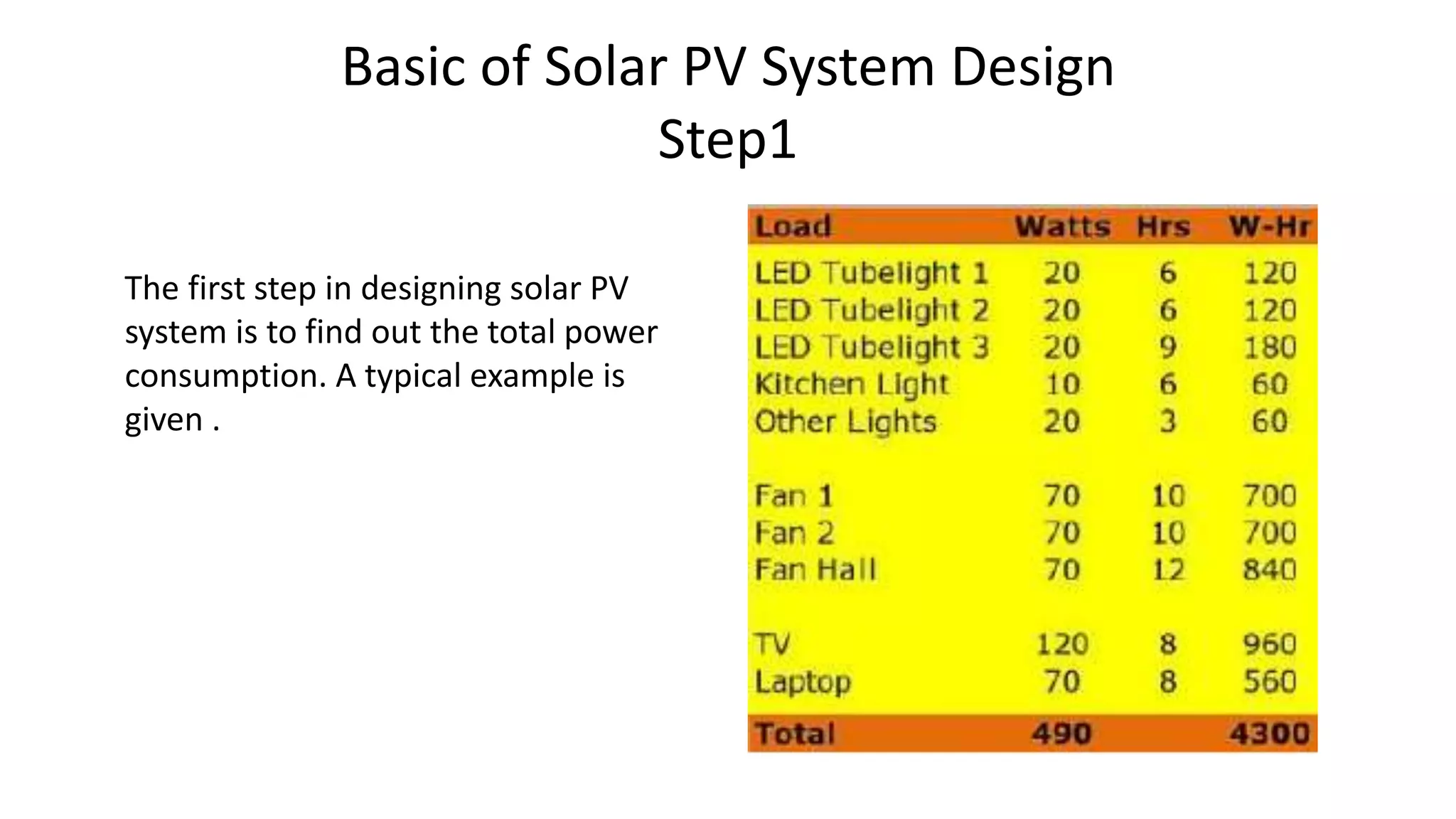
Basic of Solar PV System Design
Step1
The first step in designing solar PV
system is to find out the total power
consumption. A typical example is
given .
Step 2: Optimize
• Optimize your power system demands
• Examine power consumption and reduce it as much as
possible.
• Identify large and variable loads and try to eliminate them or
examine alternative.
• Replace incandescent bulbs with CFL / LED bulbs
Step 3: Size the battery
• Decide how much storage you require
• Apply temperature correction
• Depth of discharge-> Deep discharge batteries preferred
• Rated battery capacity
• Battery life
• Battery maintenance
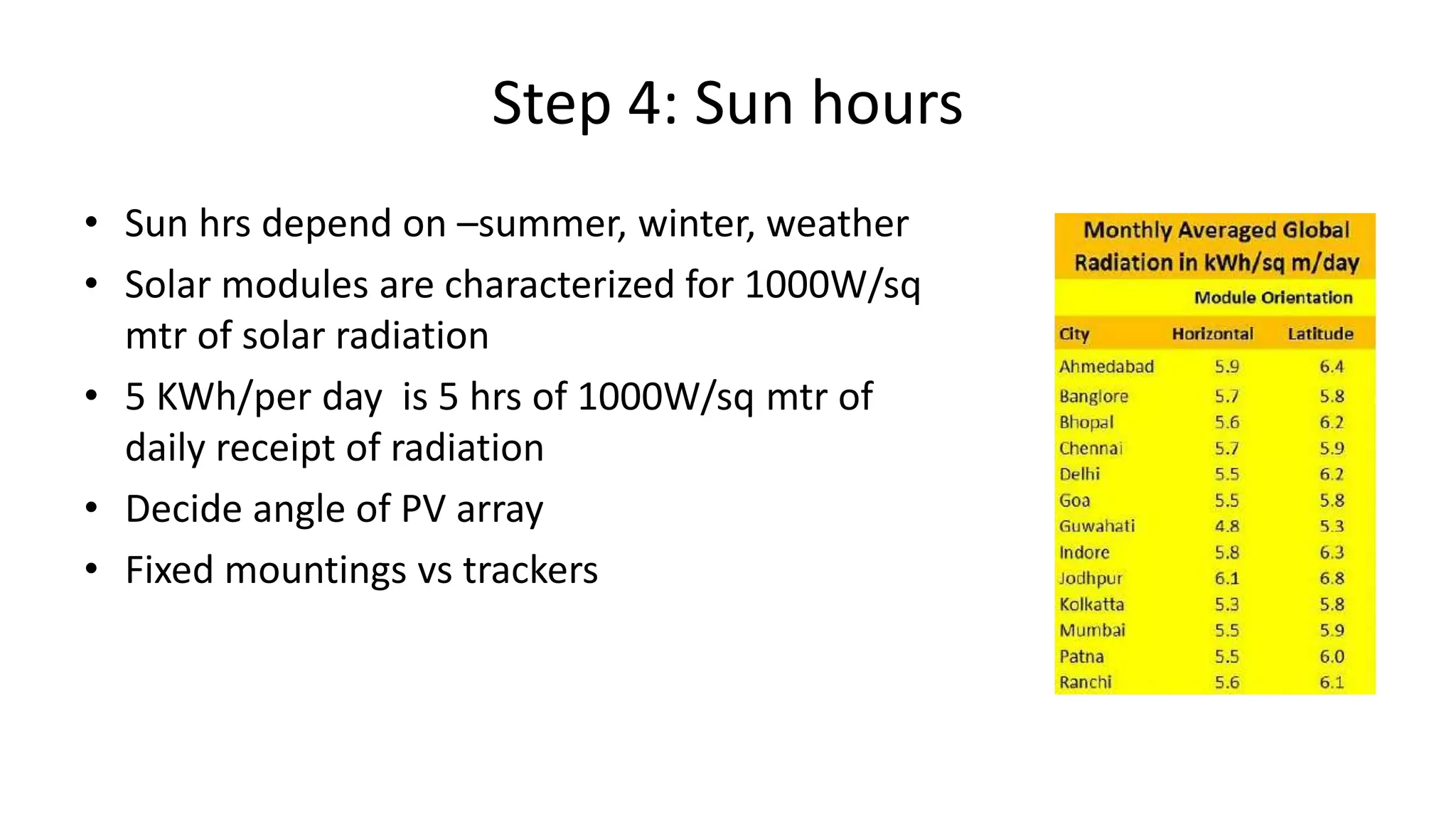
Step 4: Sun hours
• Sun hrs depend on –summer, winter, weather
• Solar modules are characterized for 1000W/sq
mtr of solar radiation
• 5 KWh/per day is 5 hrs of 1000W/sq mtr of
daily receipt of radiation
• Decide angle of PV array
• Fixed mountings vs trackers
Step 5: Array size
• Daily amp-hr requirement- AH/day
• Sun hrs per day- H/day
• Total amperage required from solar array
• Check the peak amperage of the Selected solar module
• Decide number of modules required in parallel
• Decide number of modules in series based on battery voltage
• Decide total number of modules needed in your array
• Check the nominal power output of modules
• We will know now total power output of the system
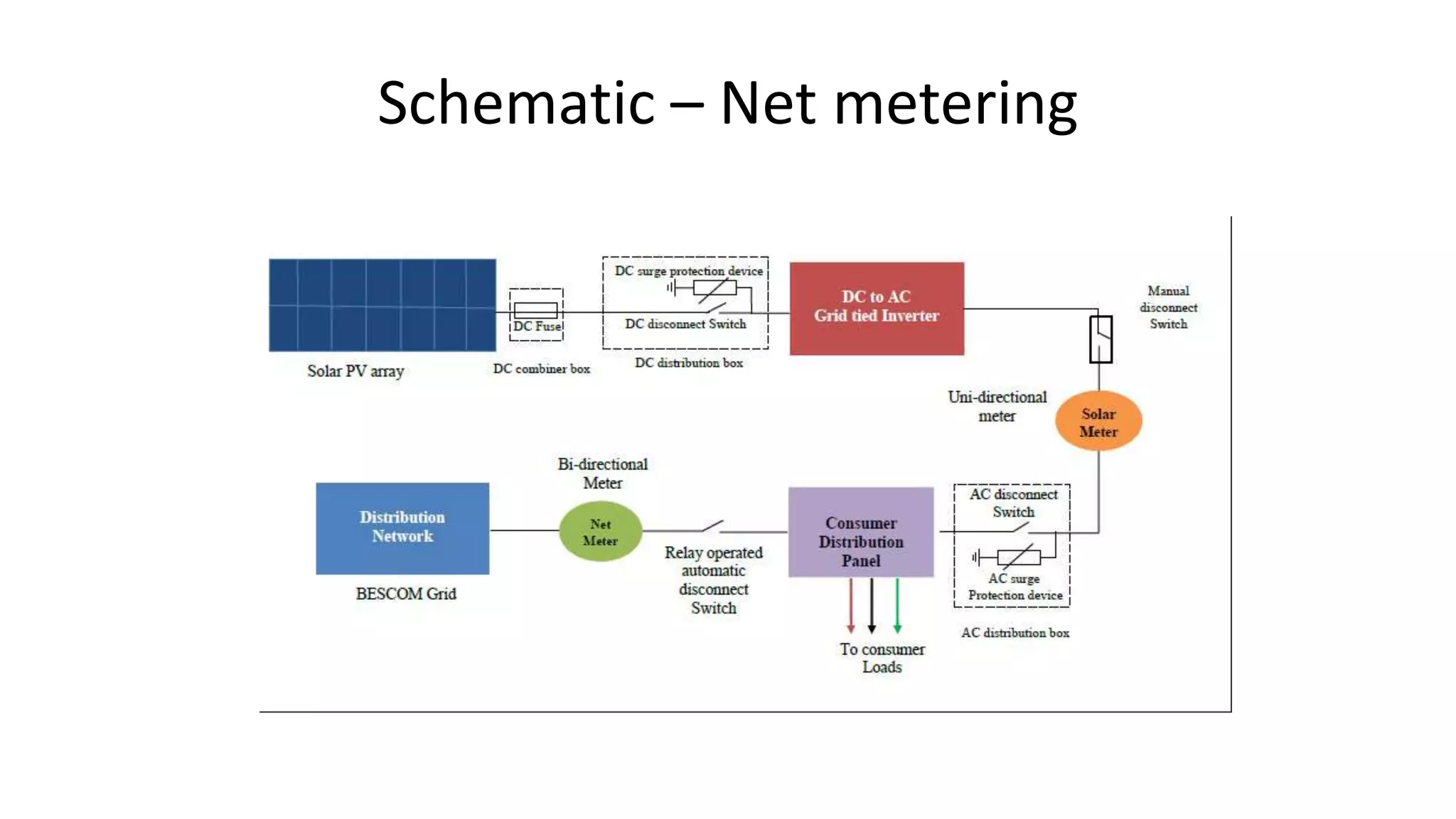
Schematic – Net metering
Why AcornSolar
• Promoters - one energetic young and other highly experienced
• We are technology savvy
• We understand need of the customer
• Our 1st priority is making customer to sync with environment
• We do not want to find ways to compromise the quality and performance of the
installation
• We are transparent with our partners-both customers and vendors.
For more info, plz contact
shanbhag@acornsolar.co.in ,
easwar@acornsolar.co.in MOB : 9880-56-
9880/9483-19-5164 WEB :
www.acornsolar.co.in
Thank You !

Acorn Solar Presentation

  • 1.
  • 2.
    What is SolarEnergy • Originates with the thermonuclear fusion reactions occurring in the sun. • Represents the entire electromagnetic radiation (visible light, infrared, ultraviolet, x-rays, and radio waves). • All chemical and radioactive polluting byproducts of the thermonuclear reactions remain behind on the sun, while only pure radiant energy reaches the Earth. • Energy reaching the earth is incredible. By one calculation, 30 days of sunshine striking the Earth have the energy equivalent of the total of all the planet’s fossil fuels, both used and unused
  • 3.
    Why Solar? • Itis free. • It is clean. Environmentally friendly. • It is infinitely renewable • It reduces our utility costs. • We can sell back to utility service provider. • It increase energy self reliance. • It is reliable.
  • 4.
    Solar Cell Background •1839 - French physicist A. E. Becquerel first recognized the photovoltaic effect. • Photo+voltaic = convert light to electricity • 1883 - first solar cell built, by Charles Fritts, coated semiconductor selenium with an extremely thin layer of gold to form the junctions. • 1954 - Bell Laboratories, experimenting with semiconductors, accidentally found that silicon doped with certain impurities was very sensitive to light. Daryl Chapin, Calvin Fuller and Gerald Pearson, invented the first practical device for converting sunlight into useful electrical power. Resulted in the production of the first practical solar cells with a sunlight energy conversion efficiency of around 6%. • 1958 - First spacecraft to use solar panels was US satellite Vanguard 1
  • 5.
    PV Solar forElectricity • For the 2 billion people without access to electricity, it would be cheaper to install solar panels than to extend the electrical grid. (The Fund for Renewable Energy Everywhere) • Providing power for villages in developing countries is a fast-growing market for photovoltaics. The United Nations estimates that more than 2 million villages worldwide are without electric power for water supply, refrigeration, lighting, and other basic needs, and the cost of extending the utility grids is prohibitive, $23,000 to $46,000 per kilometer in 1988. • A one kilowatt PV system* each month: – prevents 150 lbs. of coal from being mined – prevents 300 lbs. of CO2 from entering the atmosphere – keeps 105 gallons of water from being consumed – keeps NO and SO2 from being released into the environment * in Colorado, or an equivalent system that produces 150 kWh per month
  • 6.
  • 7.
  • 8.
  • 9.
    How Solar CellWorks 1. Photons in sunlight hit the solar panel and are absorbed by semiconducting materials, such as silicon. 2. Electrons (negatively charged) are knocked loose from their atoms, allowing them to flow through the material to produce electricity. 3. An array of solar cells converts solar energy into a usable amount of direct current (DC) electricity.
  • 10.
  • 11.
  • 12.
  • 13.
  • 14.
    Components of typicalSolar PV system
  • 15.
    Low Yield reasons Hi NaturalDisaster PV Module Inverter Theft Cable connection Severity Insulation Tracker Mechanism Fuse Operational error Dirt Low Snow Low Hi Likelihood
  • 16.
  • 17.
  • 18.
    Basic of SolarPV System Design Step1 The first step in designing solar PV system is to find out the total power consumption. A typical example is given .
  • 19.
    Step 2: Optimize •Optimize your power system demands • Examine power consumption and reduce it as much as possible. • Identify large and variable loads and try to eliminate them or examine alternative. • Replace incandescent bulbs with CFL / LED bulbs
  • 20.
    Step 3: Sizethe battery • Decide how much storage you require • Apply temperature correction • Depth of discharge-> Deep discharge batteries preferred • Rated battery capacity • Battery life • Battery maintenance
  • 21.
    Step 4: Sunhours • Sun hrs depend on –summer, winter, weather • Solar modules are characterized for 1000W/sq mtr of solar radiation • 5 KWh/per day is 5 hrs of 1000W/sq mtr of daily receipt of radiation • Decide angle of PV array • Fixed mountings vs trackers
  • 22.
    Step 5: Arraysize • Daily amp-hr requirement- AH/day • Sun hrs per day- H/day • Total amperage required from solar array • Check the peak amperage of the Selected solar module • Decide number of modules required in parallel • Decide number of modules in series based on battery voltage • Decide total number of modules needed in your array • Check the nominal power output of modules • We will know now total power output of the system
  • 23.
  • 24.
    Why AcornSolar • Promoters- one energetic young and other highly experienced • We are technology savvy • We understand need of the customer • Our 1st priority is making customer to sync with environment • We do not want to find ways to compromise the quality and performance of the installation • We are transparent with our partners-both customers and vendors.
  • 25.
    For more info,plz contact shanbhag@acornsolar.co.in , easwar@acornsolar.co.in MOB : 9880-56- 9880/9483-19-5164 WEB : www.acornsolar.co.in Thank You !