© Boardworks Ltd 2008
1 of 31
© Boardworks Ltd 2008
2 of 31
© Boardworks Ltd 2008
3 of 31
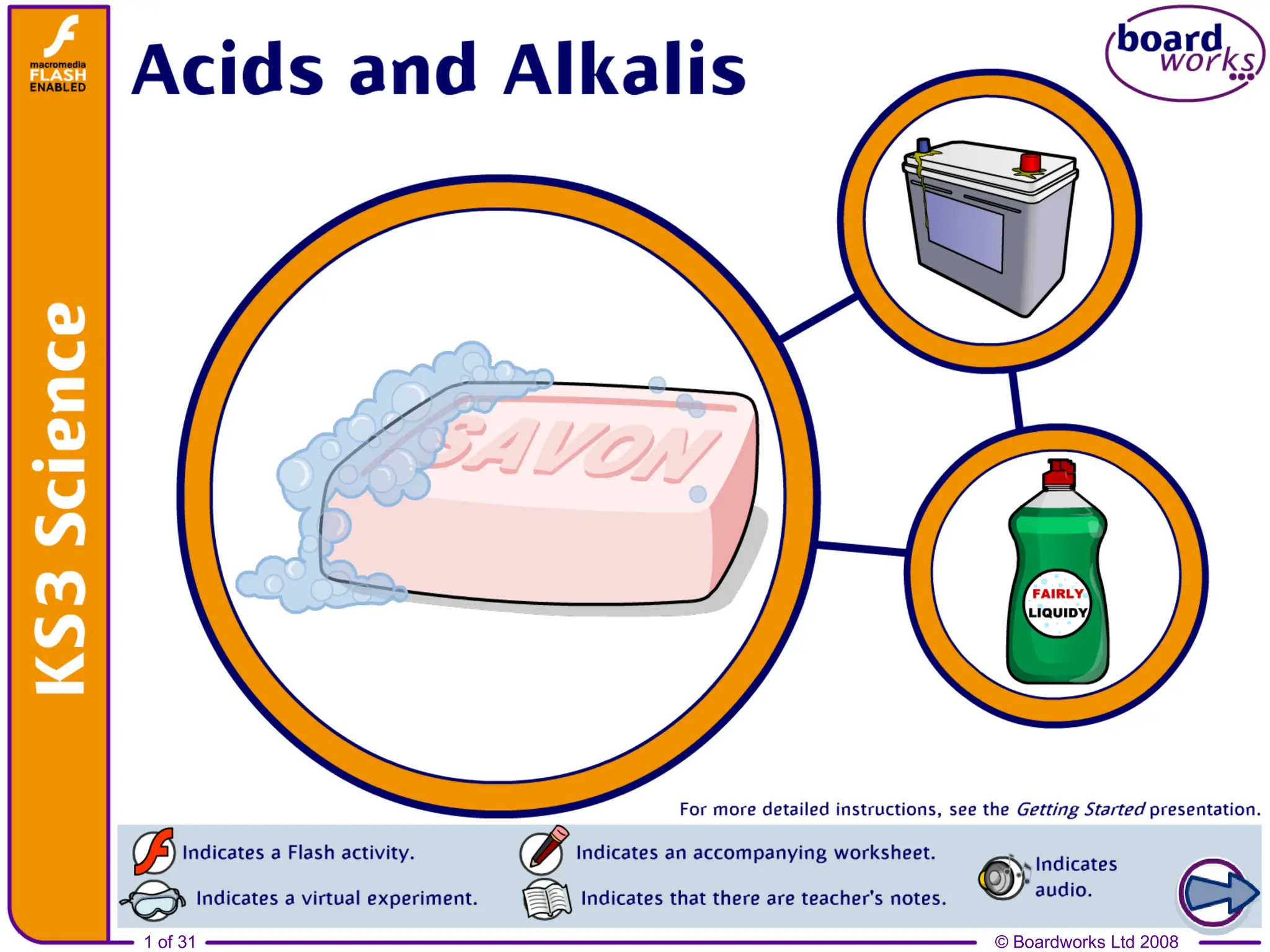
What is an acid?
Acids are a group of soluble chemicals.
What do you know about acids?
Are all acids dangerous?
© Boardworks Ltd 2008
4 of 31
Acid or alkali?
© Boardworks Ltd 2008
5 of 31
What is a weak acid?
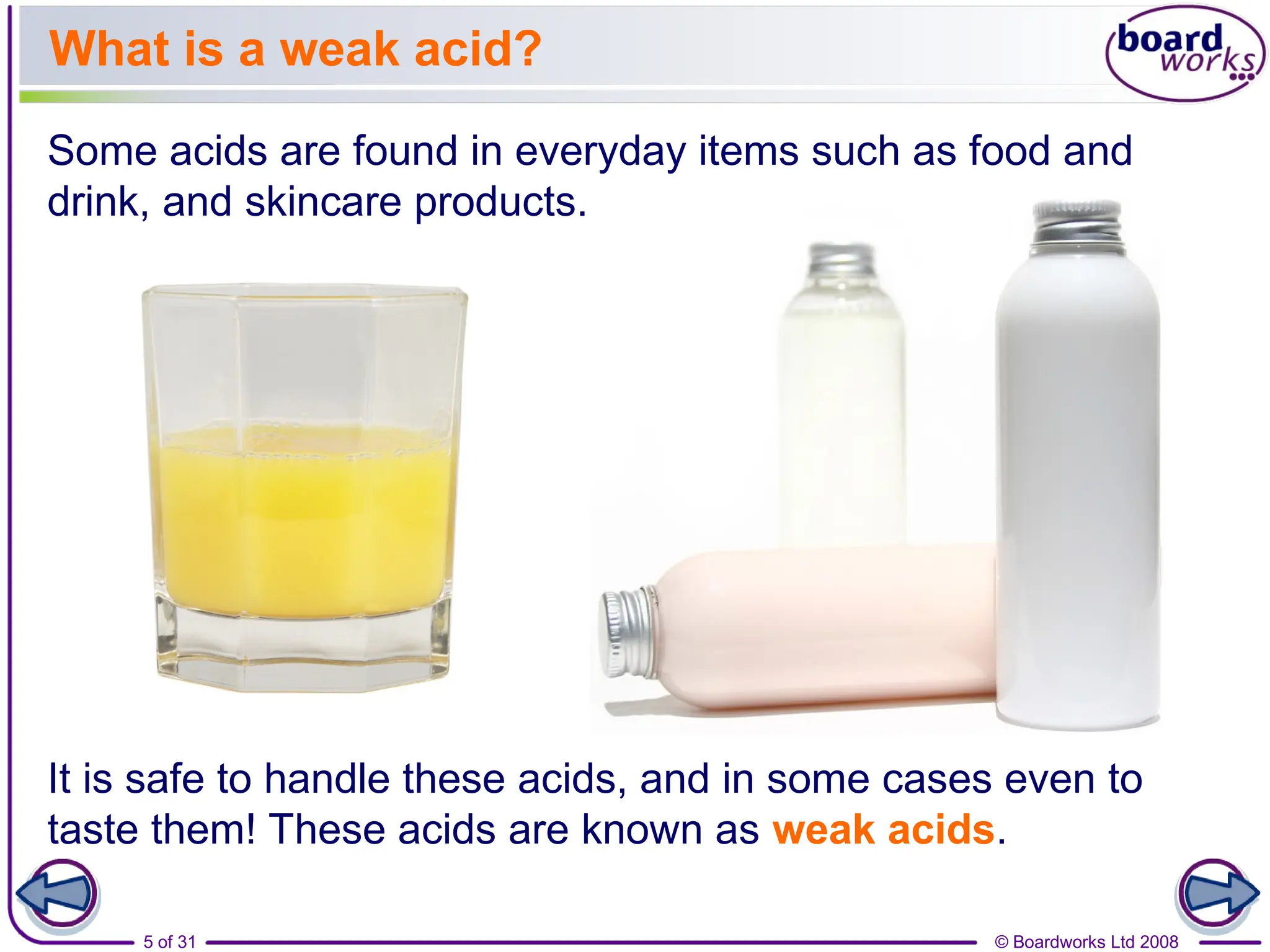
Some acids are found in everyday items such as food and
drink, and skincare products.
It is safe to handle these acids, and in some cases even to
taste them! These acids are known as weak acids.
© Boardworks Ltd 2008
6 of 31
What is a strong acid?
Some acids, like those found in the laboratory or a car
battery, are too dangerous to taste or touch.
These acids are said
to be corrosive as
they can damage
other materials by
wearing them away.
What safety precautions should you take when handling a
strong acid?
These are strong acids.
© Boardworks Ltd 2008
7 of 31
The Acid Bath Murderer
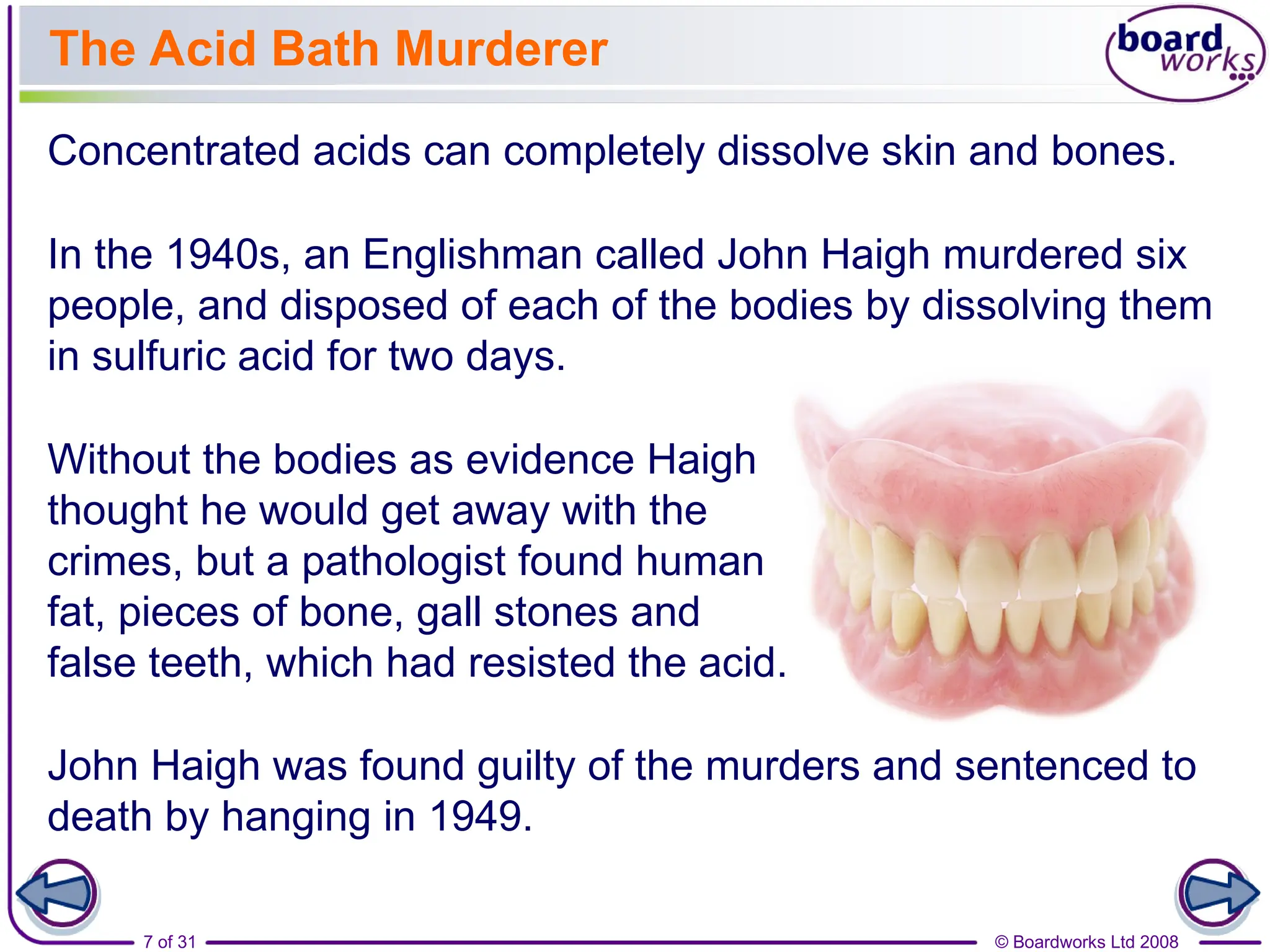
Concentrated acids can completely dissolve skin and bones.
In the 1940s, an Englishman called John Haigh murdered six
people, and disposed of each of the bodies by dissolving them
in sulfuric acid for two days.
Without the bodies as evidence Haigh
thought he would get away with the
crimes, but a pathologist found human
fat, pieces of bone, gall stones and
false teeth, which had resisted the acid.
John Haigh was found guilty of the murders and sentenced to
death by hanging in 1949.
© Boardworks Ltd 2008
8 of 31
What is an alkali?
Alkalis are substances that are chemically the opposite
of acids.
Weak alkalis are found in soaps and other
cleaning materials. They are also used in
antacids to treat indigestion.
It is safe to handle these
alkalis, which often feel soapy.
These alkalis are weak
alkalis.
© Boardworks Ltd 2008
9 of 31
What is a strong alkali?
Some alkalis, like those used
in laboratories, or in cleaning
materials such as bleach, are
too dangerous to touch.
What safety precautions
should you take when
handling a strong alkali?
These alkalis are said to be
caustic because they can
burn skin, and damage other
materials.
These are strong alkalis.
© Boardworks Ltd 2008
10 of 31
What effect do alkalis have on our skin?
Many people suffer from eczema, a condition which can make
the skin itchy and sore.
Sometimes this is caused by
an allergic reaction to soap
or other cleaning materials.
Which chemicals in soap do
you think might cause the
allergic reaction?
How could you find
out what is causing
the allergic reaction?
© Boardworks Ltd 2008
11 of 31
What is a neutral substance?
Neutral substances are neither acidic nor alkaline.
 Pure water is a neutral substance.
What safety precautions should
you take when handling a
neutral substance?
 Saltwater, milk, saliva and
blood may actually be slightly
acidic or alkaline, but are all
very close to neutral.
© Boardworks Ltd 2008
12 of 31
© Boardworks Ltd 2008
13 of 31
Acids, alkalis and plants
Some flowers change colour depending on whether they are
growing in acidic or alkaline soil. Hydrangeas grow blue
flowers in an acidic soil, but pink flowers in an alkaline soil.
The flowers contain compounds called anthocyanins, which
act as indicators.
© Boardworks Ltd 2008
14 of 31
What is an indicator?
An indicator is a chemical that turns a different colour
depending on whether it is added to an acid or an alkali.
Litmus is a commonly used indicator. It can be added to filter
paper, or used as a liquid. Litmus is made from lichen, which
grows on stone and rock.
Litmus can be blue or red.
Blue litmus turns red under
acidic conditions (< pH 4.5),
and red litmus turns blue under
alkaline conditions (> pH 8.3).
What colour do you think litmus
is under neutral conditions?
acid
alkali
neutral
© Boardworks Ltd 2008
15 of 31
The litmus test
© Boardworks Ltd 2008
16 of 31
The litmus test
© Boardworks Ltd 2008
17 of 31
Making indicators from plants
© Boardworks Ltd 2008
18 of 31
© Boardworks Ltd 2008
19 of 31
What is universal indicator?
Universal indicator has a range of colours that show how
weak or strong the acid or alkali is.
What is the colour for a strong alkali?
What is the colour for a weak acid?
Universal indicator is made from a mixture of indicators.
Why do you think it is more useful than litmus?
weak alkali
weak acid
strong acid neutral strong alkali
© Boardworks Ltd 2008
20 of 31
What is the pH scale?
The strength of an acid or alkali is measured by the pH scale.
Each universal indicator colour is given a pH value.
Universal indicator can tell you the pH of a solution.
What is the pH of a strong alkali?
What is the pH of a weak acid?
1 2 3 4 5 6 7 8 9 10 11 12 13 14
strong acid neutral strong alkali
© Boardworks Ltd 2008
21 of 31
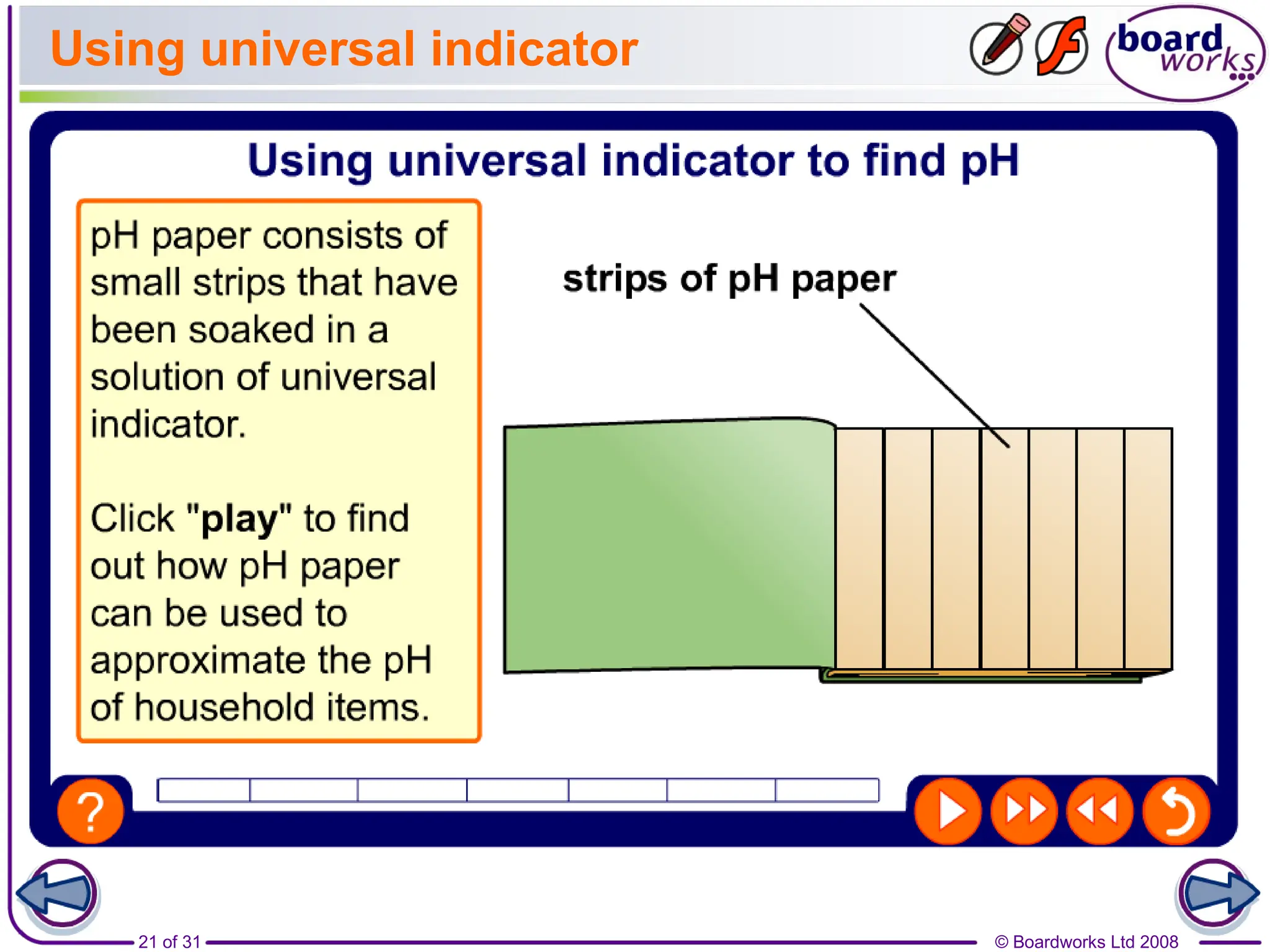
Using universal indicator
© Boardworks Ltd 2008
22 of 31
What is the pH?
© Boardworks Ltd 2008
23 of 31
Soil pH
Different soils have different pH levels. This is because
they are made up of different rocks, and so contain
different chemicals.
The pH of soil affects the
availability of nutrients,
and plants prefer to grow
in soils of a certain pH.
How could you check the pH of the soil in your garden?
For example, strawberries
grow best in acidic soil,
and plums grow best in
alkaline soil.
© Boardworks Ltd 2008
24 of 31
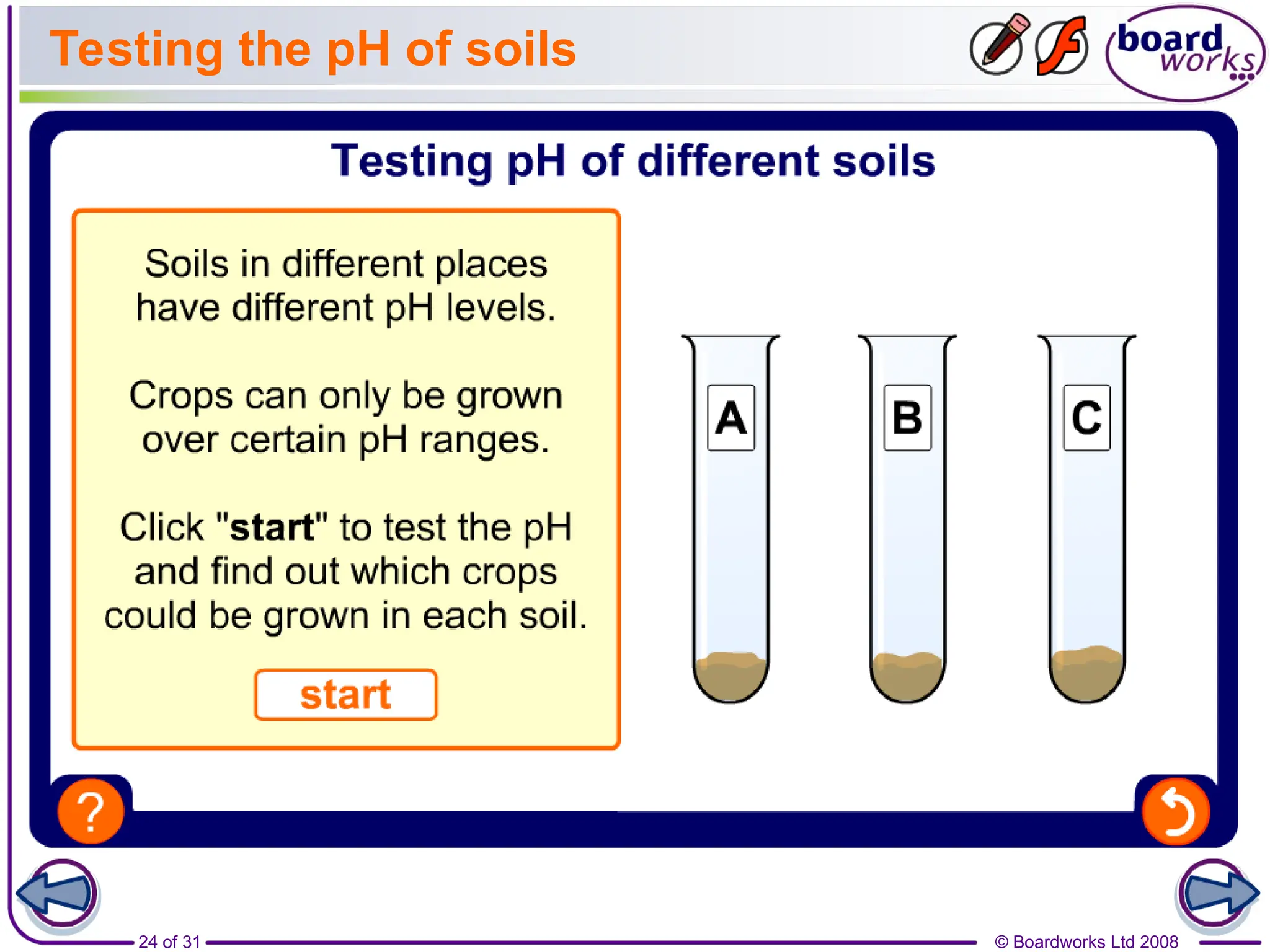
Testing the pH of soils
© Boardworks Ltd 2008
25 of 31
Changing soil pH
If soil is too acidic to grow certain crops, lime can be added.
Lime is an alkali called calcium oxide.
What effect does lime have on the pH of soil?
© Boardworks Ltd 2008
26 of 31
Acid or alkali: true or false?
© Boardworks Ltd 2008
27 of 31
Acid or alkali: summary
© Boardworks Ltd 2008
28 of 31
© Boardworks Ltd 2008
29 of 31
Glossary
© Boardworks Ltd 2008
30 of 31
Anagrams
© Boardworks Ltd 2008
31 of 31
Multiple-choice quiz

acids and bases, chemical properties.ppt

  • 1.
    © Boardworks Ltd2008 1 of 31
  • 2.
    © Boardworks Ltd2008 2 of 31
  • 3.
    © Boardworks Ltd2008 3 of 31 What is an acid? Acids are a group of soluble chemicals. What do you know about acids? Are all acids dangerous?
  • 4.
    © Boardworks Ltd2008 4 of 31 Acid or alkali?
  • 5.
    © Boardworks Ltd2008 5 of 31 What is a weak acid? Some acids are found in everyday items such as food and drink, and skincare products. It is safe to handle these acids, and in some cases even to taste them! These acids are known as weak acids.
  • 6.
    © Boardworks Ltd2008 6 of 31 What is a strong acid? Some acids, like those found in the laboratory or a car battery, are too dangerous to taste or touch. These acids are said to be corrosive as they can damage other materials by wearing them away. What safety precautions should you take when handling a strong acid? These are strong acids.
  • 7.
    © Boardworks Ltd2008 7 of 31 The Acid Bath Murderer Concentrated acids can completely dissolve skin and bones. In the 1940s, an Englishman called John Haigh murdered six people, and disposed of each of the bodies by dissolving them in sulfuric acid for two days. Without the bodies as evidence Haigh thought he would get away with the crimes, but a pathologist found human fat, pieces of bone, gall stones and false teeth, which had resisted the acid. John Haigh was found guilty of the murders and sentenced to death by hanging in 1949.
  • 8.
    © Boardworks Ltd2008 8 of 31 What is an alkali? Alkalis are substances that are chemically the opposite of acids. Weak alkalis are found in soaps and other cleaning materials. They are also used in antacids to treat indigestion. It is safe to handle these alkalis, which often feel soapy. These alkalis are weak alkalis.
  • 9.
    © Boardworks Ltd2008 9 of 31 What is a strong alkali? Some alkalis, like those used in laboratories, or in cleaning materials such as bleach, are too dangerous to touch. What safety precautions should you take when handling a strong alkali? These alkalis are said to be caustic because they can burn skin, and damage other materials. These are strong alkalis.
  • 10.
    © Boardworks Ltd2008 10 of 31 What effect do alkalis have on our skin? Many people suffer from eczema, a condition which can make the skin itchy and sore. Sometimes this is caused by an allergic reaction to soap or other cleaning materials. Which chemicals in soap do you think might cause the allergic reaction? How could you find out what is causing the allergic reaction?
  • 11.
    © Boardworks Ltd2008 11 of 31 What is a neutral substance? Neutral substances are neither acidic nor alkaline.  Pure water is a neutral substance. What safety precautions should you take when handling a neutral substance?  Saltwater, milk, saliva and blood may actually be slightly acidic or alkaline, but are all very close to neutral.
  • 12.
    © Boardworks Ltd2008 12 of 31
  • 13.
    © Boardworks Ltd2008 13 of 31 Acids, alkalis and plants Some flowers change colour depending on whether they are growing in acidic or alkaline soil. Hydrangeas grow blue flowers in an acidic soil, but pink flowers in an alkaline soil. The flowers contain compounds called anthocyanins, which act as indicators.
  • 14.
    © Boardworks Ltd2008 14 of 31 What is an indicator? An indicator is a chemical that turns a different colour depending on whether it is added to an acid or an alkali. Litmus is a commonly used indicator. It can be added to filter paper, or used as a liquid. Litmus is made from lichen, which grows on stone and rock. Litmus can be blue or red. Blue litmus turns red under acidic conditions (< pH 4.5), and red litmus turns blue under alkaline conditions (> pH 8.3). What colour do you think litmus is under neutral conditions? acid alkali neutral
  • 15.
    © Boardworks Ltd2008 15 of 31 The litmus test
  • 16.
    © Boardworks Ltd2008 16 of 31 The litmus test
  • 17.
    © Boardworks Ltd2008 17 of 31 Making indicators from plants
  • 18.
    © Boardworks Ltd2008 18 of 31
  • 19.
    © Boardworks Ltd2008 19 of 31 What is universal indicator? Universal indicator has a range of colours that show how weak or strong the acid or alkali is. What is the colour for a strong alkali? What is the colour for a weak acid? Universal indicator is made from a mixture of indicators. Why do you think it is more useful than litmus? weak alkali weak acid strong acid neutral strong alkali
  • 20.
    © Boardworks Ltd2008 20 of 31 What is the pH scale? The strength of an acid or alkali is measured by the pH scale. Each universal indicator colour is given a pH value. Universal indicator can tell you the pH of a solution. What is the pH of a strong alkali? What is the pH of a weak acid? 1 2 3 4 5 6 7 8 9 10 11 12 13 14 strong acid neutral strong alkali
  • 21.
    © Boardworks Ltd2008 21 of 31 Using universal indicator
  • 22.
    © Boardworks Ltd2008 22 of 31 What is the pH?
  • 23.
    © Boardworks Ltd2008 23 of 31 Soil pH Different soils have different pH levels. This is because they are made up of different rocks, and so contain different chemicals. The pH of soil affects the availability of nutrients, and plants prefer to grow in soils of a certain pH. How could you check the pH of the soil in your garden? For example, strawberries grow best in acidic soil, and plums grow best in alkaline soil.
  • 24.
    © Boardworks Ltd2008 24 of 31 Testing the pH of soils
  • 25.
    © Boardworks Ltd2008 25 of 31 Changing soil pH If soil is too acidic to grow certain crops, lime can be added. Lime is an alkali called calcium oxide. What effect does lime have on the pH of soil?
  • 26.
    © Boardworks Ltd2008 26 of 31 Acid or alkali: true or false?
  • 27.
    © Boardworks Ltd2008 27 of 31 Acid or alkali: summary
  • 28.
    © Boardworks Ltd2008 28 of 31
  • 29.
    © Boardworks Ltd2008 29 of 31 Glossary
  • 30.
    © Boardworks Ltd2008 30 of 31 Anagrams
  • 31.
    © Boardworks Ltd2008 31 of 31 Multiple-choice quiz

Editor's Notes

  • #5 Photo credit (left): © 2008 Jupiterimages Corporation Photo credit (right): Matthew Bowden
  • #7 Photo credit: © 2008 Jupiterimages Corporation
  • #9 Photo credit (left): © 2008 Jupiterimages Corporation
  • #10 Photo credit (left): © 2008 Jupiterimages Corporation
  • #11 Photo credit (left): © 2008 Jupiterimages Corporation
  • #13 Photo credit (left and right): Sanja Gjenero
  • #15 Teacher notes A is alkaline B is acidic C is neutral
  • #21 Acids and Alkalis Worksheet 1 accompanies this slide.
  • #24 Acids and Alkalis Worksheet 2 accompanies this slide.
  • #29 Glossary acid – A chemical that has a pH less than 7. alkali – A chemical that has a pH greater than 7 and which dissolves in water. indicator – A special chemical that changes its colour in acidic or alkaline solutions. neutral – A chemical with a pH of 7 that is neither an acid nor an alkali. pH scale – The range of values that shows how strong or weak an acid or alkali is. universal indicator – An indicator that shows the pH value of a chemical.