Chapter 24 Acid-Base Balance Anatomy & Physiology:  The Unity of Form and Function , 5th Edition.  By, Kenneth S. Saladin.
Acid-Base Balance Normal blood pH  = 7.35-7.45 Arterial blood  pH =  7.4 Venous blood  pH =  7.35 Alkalosis :  arterial blood pH rises above 7.45 Acidosis:   arterial pH drops below 7.35 (physiological acidosis)
Hydrogen Ion Regulation Concentration of hydrogen ions is regulated sequentially by: Chemical buffer systems  – act within seconds e.g. Bicarbonate Buffer System (H 2 CO 3 /HCO 3 - ) e.g. Proteins (hemoglobin) The respiratory system  – acts within 1-3 minutes The renal (urinary) system  – require hours to days to affect pH changes
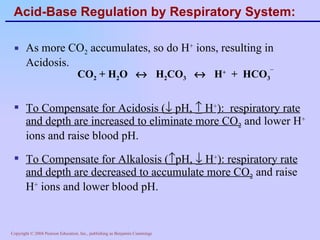
Acid-Base Regulation by Respiratory System: As more CO 2  accumulates, so do H +  ions, resulting in Acidosis. To Compensate for Acidosis (   pH,    H + ):  respiratory rate and depth are increased to eliminate more CO 2  and lower H +  ions and raise blood pH. To Compensate for Alkalosis (  pH,    H + ): respiratory rate and depth are decreased to accumulate more CO 2  and raise H +  ions and lower blood pH. CO 2  + H 2 O     H 2 CO 3      H +   +  HCO 3 ¯
Acid-Base Regulation by the Renal System: Chemical buffers  can tie up excess acids or bases, but they  cannot  eliminate  them from the body The  lungs  can eliminate carbonic acid by  eliminating carbon dioxide Only the kidneys can rid the body of hydrogen ions as well as metabolic acids (phosphoric, uric, and lactic acids and ketones). The ultimate acid-base regulatory organs are the  kidneys
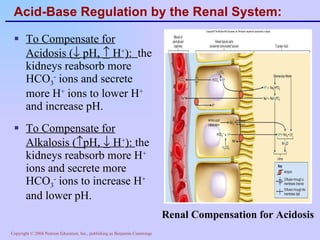
Acid-Base Regulation by the Renal System: To Compensate for Acidosis (   pH,    H + ):  the kidneys reabsorb more HCO 3 -  ions and secrete more H +  ions to lower H +  and increase pH. To Compensate for Alkalosis (  pH,    H + ):  the kidneys reabsorb more H +  ions and secrete more HCO 3 -  ions to increase H +  and lower pH. Renal Compensation for Acidosis
Respiratory Acidosis: Blood pH is below 7.35 Due to  decreased CO 2  elimination  (hypoventilation) Occurs when a person  breathes shallowly , or gas exchange is hampered by diseases such as  pneumonia, cystic fibrosis, or emphysema Can be due to depressed respiration due to  narcotic or barbiturate overdose
Respiratory Alkalosis: Blood pH is above 7.45 Due to  increased CO 2  elimination  (hyperventilation) Occurs when a person  breathes quickly   and/or shallowly, usually due to pain, anxiety, or asthma .
Metabolic Acidosis: Blood pH is below 7.35 Due to  increased bicarbonate loss  or  increased acid accumulation. Typical causes of  acid accumulation  are ingestion of excess  alcohol , excess  asprin  intake, excessive  exercise , untreated  diabetes mellitis , and  starvation  diets. Typical causes of  bicarbonate loss  are excessive  diarrhea  and  vomiting from the lower GI .
Metabolic Alkalosis: Blood pH is above 7.45 Due to  increased reabsorption of bicarbonate ion  or  increased hydrogen ion loss . Typical causes of  bicarbonate ion reabsorption  include excessive  antacid  ingestion and  constipation . Typical causes of  hydrogen ion loss  include excessive  vomiting from upper GI  (stomach);  aldosterone hypersecretion .
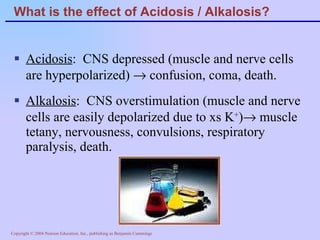
What is the effect of Acidosis / Alkalosis? Acidosis :  CNS depressed (muscle and nerve cells are hyperpolarized)    confusion, coma, death. Alkalosis :  CNS overstimulation (muscle and nerve cells are easily depolarized due to xs K + )   muscle tetany, nervousness, convulsions, respiratory paralysis, death.

Acid base lecture (shortened)

  • 1.
    Chapter 24 Acid-BaseBalance Anatomy & Physiology: The Unity of Form and Function , 5th Edition. By, Kenneth S. Saladin.
  • 2.
    Acid-Base Balance Normalblood pH = 7.35-7.45 Arterial blood pH = 7.4 Venous blood pH = 7.35 Alkalosis : arterial blood pH rises above 7.45 Acidosis: arterial pH drops below 7.35 (physiological acidosis)
  • 3.
    Hydrogen Ion RegulationConcentration of hydrogen ions is regulated sequentially by: Chemical buffer systems – act within seconds e.g. Bicarbonate Buffer System (H 2 CO 3 /HCO 3 - ) e.g. Proteins (hemoglobin) The respiratory system – acts within 1-3 minutes The renal (urinary) system – require hours to days to affect pH changes
  • 4.
    Acid-Base Regulation byRespiratory System: As more CO 2 accumulates, so do H + ions, resulting in Acidosis. To Compensate for Acidosis (  pH,  H + ): respiratory rate and depth are increased to eliminate more CO 2 and lower H + ions and raise blood pH. To Compensate for Alkalosis (  pH,  H + ): respiratory rate and depth are decreased to accumulate more CO 2 and raise H + ions and lower blood pH. CO 2 + H 2 O  H 2 CO 3  H + + HCO 3 ¯
  • 5.
    Acid-Base Regulation bythe Renal System: Chemical buffers can tie up excess acids or bases, but they cannot eliminate them from the body The lungs can eliminate carbonic acid by eliminating carbon dioxide Only the kidneys can rid the body of hydrogen ions as well as metabolic acids (phosphoric, uric, and lactic acids and ketones). The ultimate acid-base regulatory organs are the kidneys
  • 6.
    Acid-Base Regulation bythe Renal System: To Compensate for Acidosis (  pH,  H + ): the kidneys reabsorb more HCO 3 - ions and secrete more H + ions to lower H + and increase pH. To Compensate for Alkalosis (  pH,  H + ): the kidneys reabsorb more H + ions and secrete more HCO 3 - ions to increase H + and lower pH. Renal Compensation for Acidosis
  • 7.
    Respiratory Acidosis: BloodpH is below 7.35 Due to decreased CO 2 elimination (hypoventilation) Occurs when a person breathes shallowly , or gas exchange is hampered by diseases such as pneumonia, cystic fibrosis, or emphysema Can be due to depressed respiration due to narcotic or barbiturate overdose
  • 8.
    Respiratory Alkalosis: BloodpH is above 7.45 Due to increased CO 2 elimination (hyperventilation) Occurs when a person breathes quickly and/or shallowly, usually due to pain, anxiety, or asthma .
  • 9.
    Metabolic Acidosis: BloodpH is below 7.35 Due to increased bicarbonate loss or increased acid accumulation. Typical causes of acid accumulation are ingestion of excess alcohol , excess asprin intake, excessive exercise , untreated diabetes mellitis , and starvation diets. Typical causes of bicarbonate loss are excessive diarrhea and vomiting from the lower GI .
  • 10.
    Metabolic Alkalosis: BloodpH is above 7.45 Due to increased reabsorption of bicarbonate ion or increased hydrogen ion loss . Typical causes of bicarbonate ion reabsorption include excessive antacid ingestion and constipation . Typical causes of hydrogen ion loss include excessive vomiting from upper GI (stomach); aldosterone hypersecretion .
  • 11.
    What is theeffect of Acidosis / Alkalosis? Acidosis : CNS depressed (muscle and nerve cells are hyperpolarized)  confusion, coma, death. Alkalosis : CNS overstimulation (muscle and nerve cells are easily depolarized due to xs K + )  muscle tetany, nervousness, convulsions, respiratory paralysis, death.