Dr. Saif Ababneh
outlines
 Blood pH and buffering systems
 Anion gap
 Normal ABG vs VBG
 Types of acid-base disorders
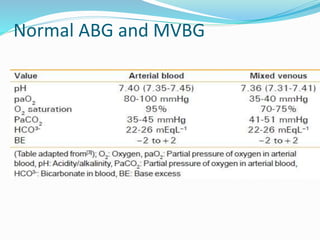
 Normal arterial blood pH range from 7.35-7.45.
 Blood pH inversely related to [H+], the more [H+] the lower the pH
 Blood pH is maintained by the balance between acid production in the
body and the function of the buffering systems, kidneys & lung.
 Buffering systems inculde: bicarbonate, phosphate, negative charged
proteins, ammonia  (any – charged molecule act as a buffering molecule
that bind’s H+)
 CO2 is considered acidic, we lose it by ventilation, (hyper ventilation =
more CO2 washout, hypoventilation = more CO2 retention in the body)
 The kidneys also control acid-base balance, through absorption or
secretion of HCO3- & H+.
Acidosis vs Alkalosis
 Acidosis : decrease pH of the blood (<7.4):
- Etiology of acidosis:
1- respiratory acidosis (due to CO2 retention “hypoventilation”)
2- metabolic acidosis due to increase acid production or bicarbonate loss
 Alkalosis: increase pH of blood (>7.4):
- Etiology of alkalosis:
1-respiratory alkalosis (due to hyperventilation)
2-metabolic alkalosis (due to increase bicarbonate absorption or increase
acid loss)
Normal ABG and MVBG
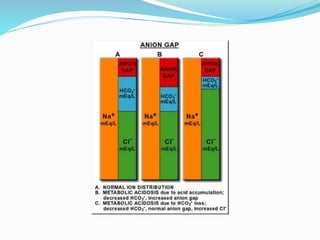
Anion gap (AG)
 Anion gap = [Na+] – ([HCO3-] + [Cl-])
 AG represents the anions “other than Cl- and HCO3
-” that are necessary to
counterbalance Na+ electrically
 Normal anion gap is 12 ± 2, any increase in AG > 14 is called wide anion
gap.
 AG is only important in metabolic acidosis.
Arterial blood gases ABG
• Arterial blood gases include the measurement of arterial PaCO2, PaO2,
blood pH, [HCO3-], O2 saturation “O sat”.
• Mixed venous blood gases include the measurement of PvCO2, PvO2,
venous blood pH, [HCO3-], O2 saturation
Metabolic acidosis
 Metaolic acidosis: decrease in blood PH due to increase acid production or increase bicarbonate loss
 Wide AG metabolic acidosis :
- Increased acid production:
1-Diabetic Ketoacidosis.
2-Alcoholic.
3-Starvation .
4-Lactic acidosis. (mesenteric ischemia, septic shock, hemorrhage)
5-Toxic ingestion (salicylates, ethylene glycol, methanol).
6- Renal failure.
 Aspirin (salisylic acid)  will cause mixed disorder (both respiratory alkalosis and metabolic acidosis)
 Normal AG metabolic acidosis :
- Renal tubular dysfunction:
1- Renal tubular acidosis
2- Hypoaldosteronism
3- Potassium-sparing diuretics, carbonic anhydrase inhibitors (acetazolamide).
- Loss of alkali
1- Diarrhea
2- GI fistula: pancreatic fistula, biliary fistula,
- Administration of acids that contain chloride (HCl, ammonium chloride, cationic amino acids)
- Excessive rehydration with normal saline (due to dissociation of H2CO3)
Metabolic alkalosis
- most commonly results from either diuretic use or gastrointestinal losses, such
as in vomiting or with Cushing syndrome, Primary aldosteronism, Bartter
syndrome.
- If the etiology of the alkalosis is unclear from the examination, a urinary
chloride concentration may be measured. Gastrointestinal losses are noted to
have low urinary chloride levels (< 20 mEq/L), while patients currently on
diuretic therapy present with high urinary chloride levels (>20 mEq/L).
- Associated with extracellular fluid volume (chloride) depletion
Vomiting or gastric drainage
Diuretic therapy (loop diuretics, thiazide diuretics).
Posthypercapnic alkalosis
- Associated with mineralocorticoid excess
Cushing syndrome
Primary aldosteronism
Bartter syndrome
- Severe K+ depletion
- Excessive alkali intake
Respiratory acidosis
 Ventilation depends on two factors: respiratory rate and tidal volume.
 Respiratory acidosis is an acid-base balance disturbance due to alveolar
hypoventilation (decrease CO2 exchange) or increase CO2 production.
 The hallmark of respiratory acidosis is increase in PCO2.
1- decrease CO2 exchange :
- COPD (emphysema), obesity, pleuritic chest pain, morphine, hypnotics,
disease affectinig NMJ or motor neurons of the diaphragm ( botulism,
GBS), Chest wall disorders Severe kyphoscoliosis, flail chest, and, less
commonly, ankylosing spondylitis, pectus excavatum, or pectus carinatum.
 Steroids  will cause mixed disorder (both respiratory acidosis and
metabolic alkalosis)
2- increase in CO2 production: in case of malignant hyperthermia
Respiratory alkalosis
 is the result of acute or chronic hyperventilation.
 The causes of respiratory alkalosis include:
1- acute hypoxia (e.g., pneumonia, pneumothorax, pulmonary embolism,
pulmonary edema, bronchospasm),
2- chronic hypoxia (e.g., cyanotic heart disease, anemia),
3- respiratory center stimulation (e.g., anxiety, pain, fever, Gram-negative
sepsis, salicylate intoxication, central nervous system disease, cirrhosis,
pregnancy).
4- Excessive ventilation may also cause respiratory alkalosis in the
mechanically ventilated patient.
 Clinical findings are noanspecific  Carpopedal spasm maight occur??
 the only effective treatment is correction of the underlying disorder.
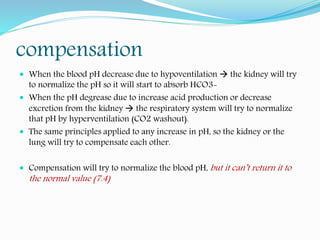
compensation
 When the blood pH decrease due to hypoventilation  the kidney will try
to normalize the pH so it will start to absorb HCO3-
 When the pH degrease due to increase acid production or decrease
excretion from the kidney  the respiratory system will try to normalize
that pH by hyperventilation (CO2 washout).
 The same principles applied to any increase in pH, so the kidney or the
lung will try to compensate each other.
 Compensation will try to normalize the blood pH, but it can’t return it to
the normal value (7.4)
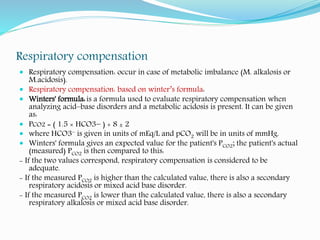
Respiratory compensation
 Respiratory compensation: occur in case of metabolic imbalance (M. alkalosis or
M.acidosis).
 Respiratory compensation: based on winter’s formula:
 Winters' formula:is a formula used to evaluate respiratory compensation when
analyzing acid–base disorders and a metabolic acidosis is present. It can be given
as:
 PCO2 = ( 1.5 × HCO3− ) + 8 ± 2
 where HCO3− is given in units of mEq/L and pCO2 will be in units of mmHg.
 Winters' formula gives an expected value for the patient's PCO2; the patient's actual
(measured) PCO2 is then compared to this:
- If the two values correspond, respiratory compensation is considered to be
adequate.
- If the measured PCO2 is higher than the calculated value, there is also a secondary
respiratory acidosis or mixed acid base disorder.
- If the measured PCO2 is lower than the calculated value, there is also a secondary
respiratory alkalosis or mixed acid base disorder.
Metabolic compensation
 Occur in case of respiratory imbalance (R.acidosis or R.alkalosis).
How to read ABG
 Check the pH  7.4 normal, (>7.4 alkalosis), (<7.4 acidosis)
 Check [HCO3-]: is it directly related to pH or not?
- yes  metabolic
no  respiratory
normal  check pCO2  if normal then normal ABG
 is there appropriate compensation or not?
- yes  pure metabolic or respiratory cause
no  mixed condition (both respiratory and metabolic problem together)
 if there is metabolic acidosis  check the AG (wide or normal)
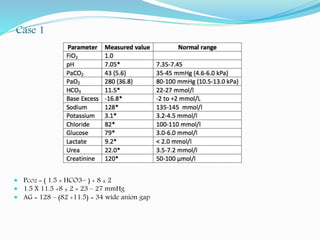
Case 1
 PCO2 = ( 1.5 × HCO3− ) + 8 ± 2
 1.5 X 11.5 +8 ± 2 = 23 – 27 mmHg
 AG = 128 – (82 +11.5) = 34 wide anion gap
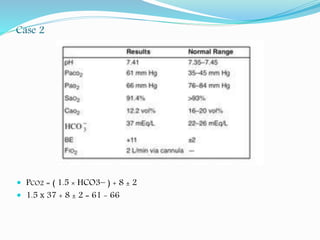
Case 2
 PCO2 = ( 1.5 × HCO3− ) + 8 ± 2
 1.5 x 37 + 8 ± 2 = 61 - 66
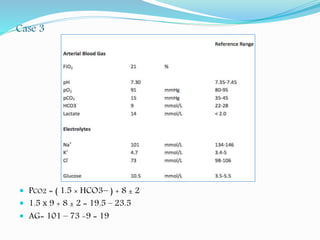
Case 3
 PCO2 = ( 1.5 × HCO3− ) + 8 ± 2
 1.5 x 9 + 8 ± 2 = 19.5 – 23.5
 AG= 101 – 73 -9 = 19
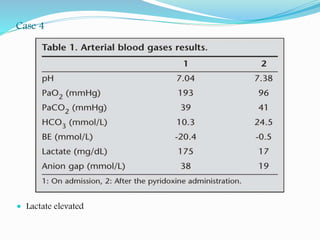
Case 4
 Lactate elevated
Answers:
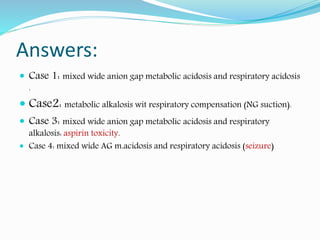
 Case 1: mixed wide anion gap metabolic acidosis and respiratory acidosis
.
 Case2: metabolic alkalosis wit respiratory compensation (NG suction).
 Case 3: mixed wide anion gap metabolic acidosis and respiratory
alkalosis: aspirin toxicity.
 Case 4: mixed wide AG m.acidosis and respiratory acidosis (seizure)

Acid-base disorders

  • 1.
  • 2.
    outlines  Blood pHand buffering systems  Anion gap  Normal ABG vs VBG  Types of acid-base disorders
  • 3.
     Normal arterialblood pH range from 7.35-7.45.  Blood pH inversely related to [H+], the more [H+] the lower the pH  Blood pH is maintained by the balance between acid production in the body and the function of the buffering systems, kidneys & lung.  Buffering systems inculde: bicarbonate, phosphate, negative charged proteins, ammonia  (any – charged molecule act as a buffering molecule that bind’s H+)  CO2 is considered acidic, we lose it by ventilation, (hyper ventilation = more CO2 washout, hypoventilation = more CO2 retention in the body)  The kidneys also control acid-base balance, through absorption or secretion of HCO3- & H+.
  • 4.
    Acidosis vs Alkalosis Acidosis : decrease pH of the blood (<7.4): - Etiology of acidosis: 1- respiratory acidosis (due to CO2 retention “hypoventilation”) 2- metabolic acidosis due to increase acid production or bicarbonate loss  Alkalosis: increase pH of blood (>7.4): - Etiology of alkalosis: 1-respiratory alkalosis (due to hyperventilation) 2-metabolic alkalosis (due to increase bicarbonate absorption or increase acid loss)
  • 5.
  • 6.
    Anion gap (AG) Anion gap = [Na+] – ([HCO3-] + [Cl-])  AG represents the anions “other than Cl- and HCO3 -” that are necessary to counterbalance Na+ electrically  Normal anion gap is 12 ± 2, any increase in AG > 14 is called wide anion gap.  AG is only important in metabolic acidosis. Arterial blood gases ABG • Arterial blood gases include the measurement of arterial PaCO2, PaO2, blood pH, [HCO3-], O2 saturation “O sat”. • Mixed venous blood gases include the measurement of PvCO2, PvO2, venous blood pH, [HCO3-], O2 saturation
  • 8.
    Metabolic acidosis  Metaolicacidosis: decrease in blood PH due to increase acid production or increase bicarbonate loss  Wide AG metabolic acidosis : - Increased acid production: 1-Diabetic Ketoacidosis. 2-Alcoholic. 3-Starvation . 4-Lactic acidosis. (mesenteric ischemia, septic shock, hemorrhage) 5-Toxic ingestion (salicylates, ethylene glycol, methanol). 6- Renal failure.  Aspirin (salisylic acid)  will cause mixed disorder (both respiratory alkalosis and metabolic acidosis)  Normal AG metabolic acidosis : - Renal tubular dysfunction: 1- Renal tubular acidosis 2- Hypoaldosteronism 3- Potassium-sparing diuretics, carbonic anhydrase inhibitors (acetazolamide). - Loss of alkali 1- Diarrhea 2- GI fistula: pancreatic fistula, biliary fistula, - Administration of acids that contain chloride (HCl, ammonium chloride, cationic amino acids) - Excessive rehydration with normal saline (due to dissociation of H2CO3)
  • 9.
    Metabolic alkalosis - mostcommonly results from either diuretic use or gastrointestinal losses, such as in vomiting or with Cushing syndrome, Primary aldosteronism, Bartter syndrome. - If the etiology of the alkalosis is unclear from the examination, a urinary chloride concentration may be measured. Gastrointestinal losses are noted to have low urinary chloride levels (< 20 mEq/L), while patients currently on diuretic therapy present with high urinary chloride levels (>20 mEq/L). - Associated with extracellular fluid volume (chloride) depletion Vomiting or gastric drainage Diuretic therapy (loop diuretics, thiazide diuretics). Posthypercapnic alkalosis - Associated with mineralocorticoid excess Cushing syndrome Primary aldosteronism Bartter syndrome - Severe K+ depletion - Excessive alkali intake
  • 10.
    Respiratory acidosis  Ventilationdepends on two factors: respiratory rate and tidal volume.  Respiratory acidosis is an acid-base balance disturbance due to alveolar hypoventilation (decrease CO2 exchange) or increase CO2 production.  The hallmark of respiratory acidosis is increase in PCO2. 1- decrease CO2 exchange : - COPD (emphysema), obesity, pleuritic chest pain, morphine, hypnotics, disease affectinig NMJ or motor neurons of the diaphragm ( botulism, GBS), Chest wall disorders Severe kyphoscoliosis, flail chest, and, less commonly, ankylosing spondylitis, pectus excavatum, or pectus carinatum.  Steroids  will cause mixed disorder (both respiratory acidosis and metabolic alkalosis) 2- increase in CO2 production: in case of malignant hyperthermia
  • 11.
    Respiratory alkalosis  isthe result of acute or chronic hyperventilation.  The causes of respiratory alkalosis include: 1- acute hypoxia (e.g., pneumonia, pneumothorax, pulmonary embolism, pulmonary edema, bronchospasm), 2- chronic hypoxia (e.g., cyanotic heart disease, anemia), 3- respiratory center stimulation (e.g., anxiety, pain, fever, Gram-negative sepsis, salicylate intoxication, central nervous system disease, cirrhosis, pregnancy). 4- Excessive ventilation may also cause respiratory alkalosis in the mechanically ventilated patient.  Clinical findings are noanspecific  Carpopedal spasm maight occur??  the only effective treatment is correction of the underlying disorder.
  • 12.
    compensation  When theblood pH decrease due to hypoventilation  the kidney will try to normalize the pH so it will start to absorb HCO3-  When the pH degrease due to increase acid production or decrease excretion from the kidney  the respiratory system will try to normalize that pH by hyperventilation (CO2 washout).  The same principles applied to any increase in pH, so the kidney or the lung will try to compensate each other.  Compensation will try to normalize the blood pH, but it can’t return it to the normal value (7.4)
  • 13.
    Respiratory compensation  Respiratorycompensation: occur in case of metabolic imbalance (M. alkalosis or M.acidosis).  Respiratory compensation: based on winter’s formula:  Winters' formula:is a formula used to evaluate respiratory compensation when analyzing acid–base disorders and a metabolic acidosis is present. It can be given as:  PCO2 = ( 1.5 × HCO3− ) + 8 ± 2  where HCO3− is given in units of mEq/L and pCO2 will be in units of mmHg.  Winters' formula gives an expected value for the patient's PCO2; the patient's actual (measured) PCO2 is then compared to this: - If the two values correspond, respiratory compensation is considered to be adequate. - If the measured PCO2 is higher than the calculated value, there is also a secondary respiratory acidosis or mixed acid base disorder. - If the measured PCO2 is lower than the calculated value, there is also a secondary respiratory alkalosis or mixed acid base disorder.
  • 14.
    Metabolic compensation  Occurin case of respiratory imbalance (R.acidosis or R.alkalosis).
  • 15.
    How to readABG  Check the pH  7.4 normal, (>7.4 alkalosis), (<7.4 acidosis)  Check [HCO3-]: is it directly related to pH or not? - yes  metabolic no  respiratory normal  check pCO2  if normal then normal ABG  is there appropriate compensation or not? - yes  pure metabolic or respiratory cause no  mixed condition (both respiratory and metabolic problem together)  if there is metabolic acidosis  check the AG (wide or normal)
  • 16.
    Case 1  PCO2= ( 1.5 × HCO3− ) + 8 ± 2  1.5 X 11.5 +8 ± 2 = 23 – 27 mmHg  AG = 128 – (82 +11.5) = 34 wide anion gap
  • 17.
    Case 2  PCO2= ( 1.5 × HCO3− ) + 8 ± 2  1.5 x 37 + 8 ± 2 = 61 - 66
  • 18.
    Case 3  PCO2= ( 1.5 × HCO3− ) + 8 ± 2  1.5 x 9 + 8 ± 2 = 19.5 – 23.5  AG= 101 – 73 -9 = 19
  • 19.
  • 20.
    Answers:  Case 1:mixed wide anion gap metabolic acidosis and respiratory acidosis .  Case2: metabolic alkalosis wit respiratory compensation (NG suction).  Case 3: mixed wide anion gap metabolic acidosis and respiratory alkalosis: aspirin toxicity.  Case 4: mixed wide AG m.acidosis and respiratory acidosis (seizure)