ABG
INTERPRETATION
Reza Nejat, M.D.,
Anesthesiologist, FCCM,
Former Assistant Professor, SBMU
Bazarganan Hospital
ABG INTERPRETATION
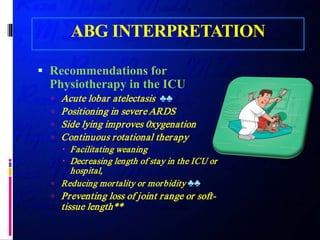
 Recommendations for
Physiotherapy in the ICU
 Acute lobar atelectasis ♣♣
 Positioning in severe ARDS
 Side lying improves 0xygenation
 Continuous rotational therapy
 Facilitating weaning
 Decreasing length of stay in the ICU or
hospital,
 Reducing mortality or morbidity ♣♣
 Preventing loss of joint range or soft-
tissue length**
ABG INTERPRETATION
 Physiotherapy at ICU
 Positioning
 Mobilisation
 Manual hyperinflation (MHI)
 Percussion, manual or
mechanical vibration
 Airway suctioning
 Coughing
 Breathing exercise
ABG INTERPRETATION
 The physiotherapy treatment
prevents and reduces potential
pulmonary complications:
 Hypoventilation,
 Hypoxemia,
 Infection in order to restore
muscular and pulmonary function as
fast as possible.
ABG INTERPRETATION
 The side effects of
physiotherapy:
 Metabolic
 Hemodynamic
 ICP↑
ABG INTERPRETATION
𝒑𝒑𝒑𝒑𝒑𝒑𝒑𝒑𝒑𝒑𝒑𝒑𝒑𝒑𝒑𝒑𝒑𝒑𝒑𝒑𝒑𝒑𝒑𝒑𝒑𝒑 = ↑ 𝒎𝒎𝒎𝒎𝒎𝒎𝒎𝒎𝒎𝒎𝒎𝒎𝒎𝒎𝒎𝒎𝒎𝒎 𝒅𝒅𝒅𝒅𝒅𝒅𝒅𝒅𝒅𝒅𝒅𝒅
physiotherapist should have knowledge about:
𝒐𝒐𝒐𝒐𝒐𝒐𝒐𝒐𝒐𝒐𝒐𝒐 𝒅𝒅𝒅𝒅𝒅𝒅𝒅𝒅𝒅𝒅𝒅𝒅𝒅𝒅𝒅𝒅 𝒕𝒕𝒕𝒕 𝒕𝒕𝒕𝒕𝒕𝒕 𝒄𝒄𝒄𝒄𝒄𝒄𝒄𝒄
𝒄𝒄𝒄𝒄𝒄𝒄𝒄𝒄 𝒐𝒐𝒐𝒐𝒐𝒐𝒐𝒐𝒐𝒐𝒐𝒐 𝒄𝒄𝒄𝒄𝒄𝒄𝒄𝒄𝒄𝒄𝒄𝒄𝒄𝒄𝒄𝒄𝒄𝒄𝒄𝒄𝒄𝒄
ABG INTERPRETATION
During invasive ventilation
 Physiotherapy might be associated with:
𝑽𝑽𝑽𝑽𝑽𝑽 ↑↑
𝑺𝑺𝑺𝑺𝑺𝑺𝑺𝑺𝑺𝑺𝑺𝑺𝑺𝑺𝑺𝑺𝑺𝑺𝑺𝑺𝑺𝑺 𝒔𝒔𝒔𝒔𝒔𝒔𝒔𝒔𝒔𝒔𝒔𝒔𝒔𝒔𝒔𝒔𝒔𝒔𝒔𝒔𝒔𝒔 ↑
𝑾𝑾𝑾𝑾𝑾𝑾 ↑
ABG INTERPRETATION
 The metabolic and cardiovascular effects of
turning a patient into a side lying position are
greater than the physiological stress incurred
by the addition of physiotherapy treatment.
 Berney S and Denehy L (2003): Australian Journal of Physiotherapy 49: 99-105
ABG INTERPRETATION
 What should be done during
physiotherapy:
 Monitor hemodynamic status
 Sedation before physiotherapy
 Preoxygenation, sedation, and
reassurance before suction
 Monitor ICP and CPP
ABG INTERPRETATION
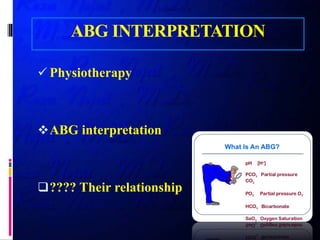
 Physiotherapy
ABG interpretation
???? Their relationship
ABG INTERPRETATION
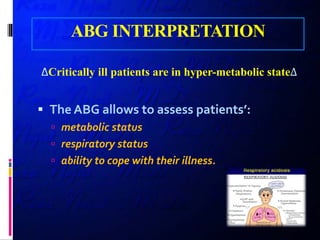
∆Critically ill patients are in hyper-metabolic state∆
 The ABG allows to assess patients’:
 metabolic status
 respiratory status
 ability to cope with their illness.
ABG INTERPRETATION
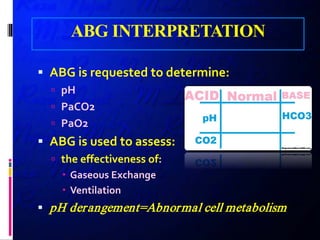
 ABG is requested to determine:
 pH
 PaCO2
 PaO2
 ABG is used to assess:
 the effectiveness of:
 Gaseous Exchange
 Ventilation
 pH derangement=Abnormal cell metabolism
ABG INTERPRETATION
 when mobilization should be done:
 Physiotherapist should review medical
background
 Hemodynamic indices should be stable:
𝐻𝐻𝐻𝐻𝑟𝑟𝑟𝑟𝑟𝑟𝑟𝑟 < 𝐻𝐻𝐻𝐻𝑚𝑚𝑚𝑚𝑚𝑚50%
𝑆𝑆𝑆𝑆𝑆𝑆 100 – 140 𝑚𝑚𝑚𝑚𝑚𝑚𝑚𝑚
𝐷𝐷𝐷𝐷𝐷𝐷 80 − 105 𝑚𝑚𝑚𝑚𝑚𝑚𝑚𝑚
𝑣𝑣𝑣𝑣𝑣𝑣𝑣𝑣𝑣𝑣𝑣𝑣𝑣𝑣𝑣𝑣𝑣𝑣𝑣𝑣𝑣𝑣 𝑟𝑟𝑟𝑟𝑟𝑟𝑟𝑟𝑟𝑟𝑟𝑟𝑟𝑟𝑟𝑟 < 20%
𝑁𝑁𝑁𝑁𝑁𝑁𝑁𝑁𝑁𝑁𝑁𝑁 𝐸𝐸𝐸𝐸𝐸𝐸
 Respiratory stability:
𝑃𝑃𝑃𝑃𝑃𝑃2/𝐹𝐹𝐹𝐹𝐹𝐹2 > 150 – 𝑠𝑠𝑠𝑠𝑠𝑠𝑠𝑠𝑠𝑠𝑠𝑠𝑠𝑠 𝑖𝑖𝑖𝑖 𝑐𝑐ℎ𝑎𝑎𝑎𝑎𝑎𝑎
𝑃𝑃𝑃𝑃𝑃𝑃2/𝐹𝐹𝐹𝐹𝐹𝐹2 > 300 (30𝑚𝑚 𝑤𝑤𝑤𝑤𝑤𝑤𝑤𝑤𝑤𝑤𝑤𝑤𝑤𝑤)
𝑆𝑆𝑆𝑆𝑆𝑆2 > 90 𝑎𝑎𝑎𝑎𝑎𝑎 𝑟𝑟𝑟𝑟𝑟𝑟𝑟𝑟𝑟𝑟𝑟𝑟 𝑑𝑑𝑑𝑑𝑑𝑑𝑑𝑑𝑑𝑑𝑑𝑑𝑑𝑑𝑒𝑒 𝑖𝑖𝑖𝑖 𝑆𝑆𝑆𝑆𝑆𝑆2 < 4%
ABG INTERPRETATION
 Accurate and timely
interpretation of ABG and an
acid–base disorder can be
lifesaving,
 The establishment of a correct
diagnosis may be challenging
ABG INTERPRETATION
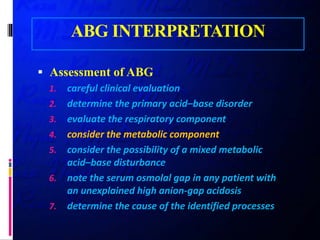
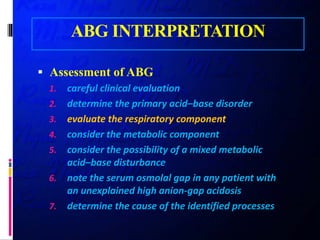
 Assessment of ABG
1. careful clinical evaluation
2. determine the primary acid–base disorder
3. evaluate the respiratory component
4. consider the metabolic component
5. consider the possibility of a mixed metabolic
acid–base disturbance
6. note the serum osmolal gap in any patient with
an unexplained high anion-gap acidosis
7. determine the cause of the identified processes
ABG INTERPRETATION
 Assessment of ABG
1. careful clinical evaluation
2. determine the primary acid–base disorder
3. evaluate the respiratory component
4. consider the metabolic component
5. consider the possibility of a mixed metabolic
acid–base disturbance
6. note the serum osmolal gap in any patient with
an unexplained high anion-gap acidosis
7. determine the cause of the identified processes
ABG INTERPRETATION
 Assessment of ABG
1. careful clinical evaluation
2. determine the primary acid–base disorder
3. evaluate the respiratory component
4. consider the metabolic component
5. consider the possibility of a mixed metabolic
acid–base disturbance
6. note the serum osmolal gap in any patient with
an unexplained high anion-gap acidosis
7. determine the cause of the identified processes
ABG INTERPRETATION
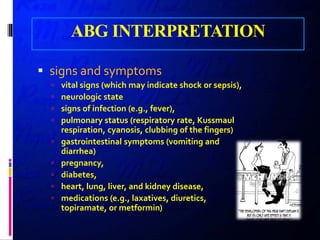
 signs and symptoms
 vital signs (which may indicate shock or sepsis),
 neurologic state
 signs of infection (e.g., fever),
 pulmonary status (respiratory rate, Kussmaul
respiration, cyanosis, clubbing of the fingers)
 gastrointestinal symptoms (vomiting and
diarrhea)
 pregnancy,
 diabetes,
 heart, lung, liver, and kidney disease,
 medications (e.g., laxatives, diuretics,
topiramate, or metformin)
ABG INTERPRETATION
 Assessment of ABG
1. careful clinical evaluation
2. determine the primary acid–base disorder
3. evaluate the respiratory component
4. consider the metabolic component
5. consider the possibility of a mixed metabolic
acid–base disturbance
6. note the serum osmolal gap in any patient with
an unexplained high anion-gap acidosis
7. determine the cause of the identified processes
ABG INTERPRETATION
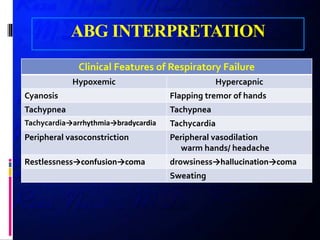
Clinical Features of Respiratory Failure
Hypoxemic Hypercapnic
Cyanosis Flapping tremor of hands
Tachypnea Tachypnea
Tachycardia→arrhythmia→bradycardia Tachycardia
Peripheral vasoconstriction Peripheral vasodilation
warm hands/ headache
Restlessness→confusion→coma drowsiness→hallucination→coma
Sweating
ABG INTERPRETATION
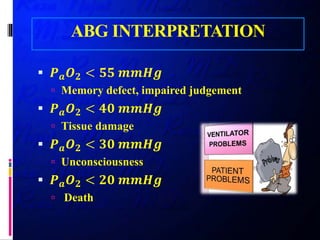
 𝑷𝑷𝒂𝒂 𝑶𝑶𝟐𝟐 < 𝟓𝟓𝟓𝟓 𝒎𝒎𝒎𝒎𝒎𝒎𝒎𝒎
 Memory defect, impaired judgement
 𝑷𝑷𝒂𝒂 𝑶𝑶𝟐𝟐 < 𝟒𝟒𝟒𝟒 𝒎𝒎𝒎𝒎𝒎𝒎𝒎𝒎
 Tissue damage
 𝑷𝑷𝒂𝒂 𝑶𝑶𝟐𝟐 < 𝟑𝟑𝟑𝟑 𝒎𝒎𝒎𝒎𝒎𝒎𝒎𝒎
 Unconsciousness
 𝑷𝑷𝒂𝒂 𝑶𝑶𝟐𝟐 < 𝟐𝟐𝟐𝟐 𝒎𝒎𝒎𝒎𝒎𝒎𝒎𝒎
 Death
ABG INTERPRETATION
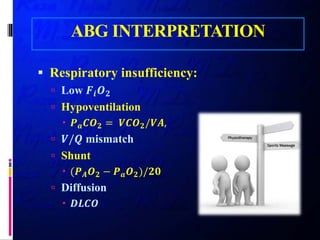
 Respiratory insufficiency:
 Low 𝑭𝑭𝒊𝒊 𝑶𝑶𝟐𝟐
 Hypoventilation
 𝑷𝑷𝒂𝒂 𝑪𝑪𝑪𝑪𝟐𝟐 = 𝑽𝑽𝑪𝑪𝑪𝑪𝟐𝟐/𝑽𝑽𝑽𝑽,
 𝑽𝑽/𝑸𝑸 mismatch
 Shunt
 (𝑷𝑷𝑨𝑨 𝑶𝑶𝟐𝟐 − 𝑷𝑷𝒂𝒂 𝑶𝑶𝟐𝟐)/𝟐𝟐𝟐𝟐
 Diffusion
 𝑫𝑫𝑫𝑫𝑫𝑫𝑫𝑫
ABG INTERPRETATION
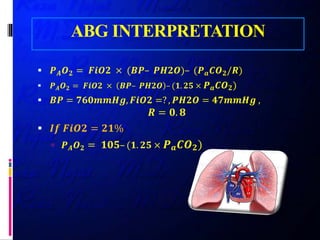
 𝑷𝑷𝑨𝑨 𝑶𝑶𝟐𝟐 = 𝑭𝑭𝑭𝑭𝑭𝑭𝑭𝑭 × (𝑩𝑩𝑩𝑩– 𝑷𝑷𝑷𝑷𝑷𝑷𝑷𝑷)– (𝑷𝑷𝒂𝒂 𝑪𝑪𝑪𝑪𝟐𝟐/𝑹𝑹)
 𝑷𝑷𝑨𝑨 𝑶𝑶𝟐𝟐 = 𝑭𝑭𝑭𝑭𝑭𝑭𝑭𝑭 × 𝑩𝑩𝑩𝑩– 𝑷𝑷𝑷𝑷𝑷𝑷𝑷𝑷 – (𝟏𝟏. 𝟐𝟐𝟐𝟐 × 𝑷𝑷𝒂𝒂 𝑪𝑪𝑶𝑶𝟐𝟐)
 𝑩𝑩𝑩𝑩 = 𝟕𝟕𝟕𝟕𝟕𝟕𝟕𝟕𝟕𝟕𝟕𝟕𝟕𝟕, 𝑭𝑭𝑭𝑭𝑭𝑭𝑭𝑭 =? , 𝑷𝑷𝑷𝑷𝑷𝑷𝑷𝑷 = 𝟒𝟒𝟒𝟒𝟒𝟒𝟒𝟒𝟒𝟒𝟒𝟒 ,
𝑹𝑹 = 𝟎𝟎. 𝟖𝟖
 𝑰𝑰𝑰𝑰 𝑭𝑭𝑭𝑭𝑭𝑭𝑭𝑭 = 𝟐𝟐𝟐𝟐𝟐
 𝑷𝑷𝑨𝑨 𝑶𝑶𝟐𝟐 = 𝟏𝟏𝟏𝟏𝟏𝟏– (𝟏𝟏. 𝟐𝟐𝟐𝟐 × 𝑷𝑷𝒂𝒂 𝑪𝑪𝑪𝑪𝟐𝟐)
ABG INTERPRETATION
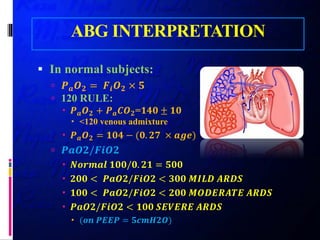
 In normal subjects:
 𝑷𝑷𝒂𝒂 𝑶𝑶𝟐𝟐 = 𝑭𝑭𝒊𝒊 𝑶𝑶𝟐𝟐 × 𝟓𝟓
 120 RULE:
 𝑷𝑷𝒂𝒂 𝑶𝑶𝟐𝟐 + 𝑷𝑷𝒂𝒂 𝑪𝑪𝑪𝑪𝟐𝟐=𝟏𝟏𝟏𝟏𝟏𝟏 ± 𝟏𝟏𝟏𝟏
 <120 venous admixture
 𝑷𝑷𝒂𝒂 𝑶𝑶𝟐𝟐 = 𝟏𝟏𝟏𝟏𝟏𝟏 − (𝟎𝟎. 𝟐𝟐𝟐𝟐 × 𝒂𝒂𝒂𝒂𝒂𝒂)
 𝑷𝑷𝑷𝑷𝑷𝑷𝑷𝑷/𝑭𝑭𝑭𝑭𝑭𝑭𝑭𝑭
 𝑵𝑵𝑵𝑵𝑵𝑵𝑵𝑵𝑵𝑵𝑵𝑵 𝟏𝟏𝟏𝟏𝟏𝟏/𝟎𝟎. 𝟐𝟐𝟐𝟐 = 𝟓𝟓𝟓𝟓𝟓𝟓
 𝟐𝟐𝟐𝟐𝟐𝟐 < 𝑷𝑷𝑷𝑷𝑷𝑷𝑷𝑷/𝑭𝑭𝑭𝑭𝑭𝑭𝑭𝑭 < 𝟑𝟑𝟑𝟑𝟑𝟑 𝑴𝑴𝑴𝑴𝑴𝑴𝑴𝑴 𝑨𝑨𝑨𝑨𝑨𝑨𝑨𝑨
 𝟏𝟏𝟏𝟏𝟏𝟏 < 𝑷𝑷𝑷𝑷𝑷𝑷𝑷𝑷/𝑭𝑭𝑭𝑭𝑭𝑭𝑭𝑭 < 𝟐𝟐𝟐𝟐𝟐𝟐 𝑴𝑴𝑴𝑴𝑴𝑴𝑴𝑴𝑴𝑴𝑴𝑴𝑴𝑴𝑴𝑴 𝑨𝑨𝑨𝑨𝑨𝑨𝑨𝑨
 𝑷𝑷𝑷𝑷𝑷𝑷𝑷𝑷/𝑭𝑭𝑭𝑭𝑭𝑭𝑭𝑭 < 𝟏𝟏𝟏𝟏𝟏𝟏 𝑺𝑺𝑺𝑺𝑺𝑺𝑺𝑺𝑺𝑺𝑺𝑺 𝑨𝑨𝑨𝑨𝑨𝑨𝑨𝑨
 (𝒐𝒐𝒐𝒐 𝑷𝑷𝑷𝑷𝑷𝑷𝑷𝑷 = 𝟓𝟓𝟓𝟓𝟓𝟓𝟓𝟓𝟓𝟓𝟓𝟓)
ABG INTERPRETATION
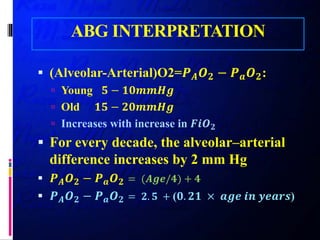
 (Alveolar-Arterial)O2=𝑷𝑷𝑨𝑨 𝑶𝑶𝟐𝟐 − 𝑷𝑷𝒂𝒂 𝑶𝑶𝟐𝟐:
 Young 𝟓𝟓 − 𝟏𝟏𝟏𝟏𝟏𝟏𝟏𝟏𝟏𝟏𝟏𝟏
 Old 𝟏𝟏𝟏𝟏 − 𝟐𝟐𝟐𝟐𝟐𝟐𝟐𝟐𝟐𝟐𝟐𝟐
 Increases with increase in 𝑭𝑭𝑭𝑭 𝑶𝑶𝟐𝟐
 For every decade, the alveolar–arterial
difference increases by 2 mm Hg
 𝑷𝑷𝑨𝑨 𝑶𝑶𝟐𝟐 − 𝑷𝑷𝒂𝒂 𝑶𝑶𝟐𝟐 = (𝑨𝑨𝑨𝑨𝑨𝑨/𝟒𝟒) + 𝟒𝟒
 𝑷𝑷𝑨𝑨 𝑶𝑶𝟐𝟐 − 𝑷𝑷𝒂𝒂 𝑶𝑶𝟐𝟐 = 𝟐𝟐. 𝟓𝟓 + (𝟎𝟎. 𝟐𝟐𝟐𝟐 × 𝒂𝒂𝒂𝒂𝒂𝒂 𝒊𝒊𝒊𝒊 𝒚𝒚𝒚𝒚𝒚𝒚𝒚𝒚𝒚𝒚)
ABG INTERPRETATION
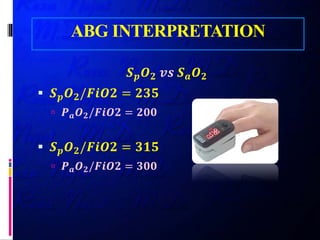
𝑺𝑺𝒑𝒑 𝑶𝑶𝟐𝟐 𝒗𝒗𝒗𝒗 𝑺𝑺𝒂𝒂 𝑶𝑶𝟐𝟐
 𝑺𝑺𝒑𝒑 𝑶𝑶𝟐𝟐/𝑭𝑭𝑭𝑭𝑭𝑭𝑭𝑭 = 𝟐𝟐𝟐𝟐𝟐𝟐
 𝑷𝑷𝒂𝒂 𝑶𝑶𝟐𝟐/𝑭𝑭𝑭𝑭𝑭𝑭𝑭𝑭 = 𝟐𝟐𝟐𝟐𝟐𝟐
 𝑺𝑺𝒑𝒑 𝑶𝑶𝟐𝟐/𝑭𝑭𝑭𝑭𝑭𝑭𝑭𝑭 = 𝟑𝟑𝟑𝟑𝟑𝟑
 𝑷𝑷𝒂𝒂 𝑶𝑶𝟐𝟐/𝑭𝑭𝑭𝑭𝑭𝑭𝑭𝑭 = 𝟑𝟑𝟑𝟑𝟑𝟑
ABG INTERPRETATION
 Assessment of ABG
1. careful clinical evaluation
2. determine the primary acid–base disorder
3. consider the metabolic component
4. consider the possibility of a mixed metabolic
acid–base disturbance
5. note the serum osmolal gap in any patient with
an unexplained high anion-gap acidosis
6. evaluate the respiratory component
7. determine the cause of the identified processes
ABG INTERPRETATION
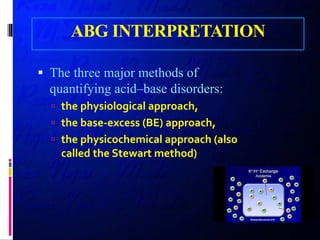
 The three major methods of
quantifying acid–base disorders:
 the physiological approach,
 the base-excess (BE) approach,
 the physicochemical approach (also
called the Stewart method)
ABG INTERPRETATION
 Based on the iso-hydric
principle,
 Acid: hydrogen-ion donor
 Base: hydrogen-ion acceptor
 Changes in [𝑯𝑯+
] alter virtually
all cellular function
ABG INTERPRETATION
 the normal plasma [𝑯𝑯+
]:
 very low 𝟒𝟒𝟒𝟒 𝒏𝒏𝒏𝒏𝒏𝒏𝒏𝒏/𝑳𝑳
 the pH
 −𝒍𝒍𝒍𝒍𝒍𝒍𝟏𝟏𝟏𝟏[𝑯𝑯+] = 𝒍𝒍𝒍𝒍𝒍𝒍𝟏𝟏𝟏𝟏
𝟏𝟏
[𝑯𝑯+]
 is generally used in clinical medicine to
indicate acid–base status.
 “acidemia”
 Plasma pH is abnormally low (acidic)
 “alkalemia”
 Plasma pH is abnormally high (alkaline)
ABG INTERPRETATION
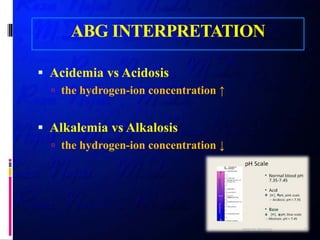
 Acidemia vs Acidosis
 the hydrogen-ion concentration ↑
 Alkalemia vs Alkalosis
 the hydrogen-ion concentration ↓
ABG INTERPRETATION
the Henderson–Hasselbalch equation
𝒑𝒑𝒑𝒑 = 𝒑𝒑𝒑𝒑 + 𝒍𝒍𝒍𝒍𝒍𝒍𝟏𝟏𝟏𝟏(
𝑯𝑯𝑯𝑯𝑯𝑯𝑯𝑯−
𝟎𝟎. 𝟎𝟎𝟎𝟎 × 𝑷𝑷𝒂𝒂 𝑪𝑪𝑶𝑶𝟐𝟐
)
𝑯𝑯𝑯𝑯𝑯𝑯𝑯𝑯−
= proton acceptor = BASE (KIDNEY)
𝑪𝑪𝑪𝑪𝟐𝟐 = proton donor = ACID (LUNG)
𝒑𝒑𝒑𝒑 = 𝒑𝒑𝒑𝒑 + 𝒍𝒍𝒍𝒍𝒍𝒍𝟏𝟏𝟏𝟏([𝑩𝑩𝑩𝑩𝑩𝑩𝑩𝑩] / [𝑨𝑨𝑨𝑨𝑨𝑨𝑨𝑨])
𝒑𝒑𝒑𝒑 = 𝒑𝒑𝒑𝒑 + 𝒍𝒍𝒍𝒍𝒍𝒍𝟏𝟏𝟏𝟏([𝒌𝒌𝒌𝒌𝒌𝒌𝒌𝒌𝒌𝒌𝒌𝒌] / [𝒍𝒍𝒍𝒍𝒍𝒍𝒍𝒍])
ABG INTERPRETATION
 Assessment of ABG
1. careful clinical evaluation
2. determine the primary acid–base disorder
3. evaluate the respiratory component
4. consider the metabolic component
5. consider the possibility of a mixed metabolic
acid–base disturbance
6. note the serum osmolal gap in any patient with
an unexplained high anion-gap acidosis
7. determine the cause of the identified processes
ABG INTERPRETATION
 pH = pK + log10 ([kidney] / [lung])
 ACIDOSIS:
 Respiratory
 Metabolic
 ALKALOSIS:
 Respiratory
 Metabolic
ABG INTERPRETATION
 Metabolic acidosis
 𝒑𝒑𝒑𝒑 < 𝟕𝟕. 𝟑𝟑𝟑𝟑 and [𝑯𝑯𝑯𝑯𝑯𝑯𝑯𝑯−
] < 𝟐𝟐𝟐𝟐 𝒎𝒎𝒎𝒎𝒎𝒎𝒎𝒎/𝒍𝒍𝒍𝒍𝒍𝒍𝒍𝒍𝒍𝒍
𝑩𝑩𝑩𝑩 < −𝟐𝟐 𝒎𝒎𝒎𝒎𝒎𝒎𝒎𝒎/𝒍𝒍𝒍𝒍𝒍𝒍𝒍𝒍𝒍𝒍
 Secondary (respiratory) response:
 𝑷𝑷𝒂𝒂 𝑪𝑪𝑶𝑶𝟐𝟐 = 𝟏𝟏. 𝟓𝟓 × [𝑯𝑯𝑯𝑯𝑯𝑯𝑯𝑯−] + 𝟖𝟖 ± 𝟐𝟐 𝒎𝒎𝒎𝒎 𝑯𝑯𝑯𝑯
or
 𝑷𝑷𝒂𝒂 𝑪𝑪𝑶𝑶𝟐𝟐 = [𝑯𝑯𝑯𝑯𝑯𝑯𝑯𝑯−] + 𝟏𝟏𝟏𝟏 𝒎𝒎𝒎𝒎 𝑯𝑯𝑯𝑯
 Complete secondary adaptive response within 12–24 hr
ABG INTERPRETATION
 Metabolic alkalosis
 𝒑𝒑𝒑𝒑 > 𝟕𝟕. 𝟒𝟒𝟒𝟒 and [𝑯𝑯𝑯𝑯𝑯𝑯𝑯𝑯−] > 𝟐𝟐𝟐𝟐 𝒎𝒎𝒎𝒎𝒎𝒎𝒎𝒎/𝒍𝒍𝒍𝒍𝒍𝒍𝒍𝒍𝒍𝒍
𝑩𝑩𝑩𝑩 > +𝟐𝟐 𝒎𝒎𝒎𝒎𝒎𝒎𝒎𝒎/𝒍𝒍𝒍𝒍𝒍𝒍𝒍𝒍𝒍𝒍
 Secondary (respiratory) response:
 𝑷𝑷𝒂𝒂 𝑪𝑪𝑶𝑶𝟐𝟐 = 𝟎𝟎. 𝟕𝟕 × ([𝑯𝑯𝑯𝑯𝑯𝑯𝑯𝑯−] − 𝟐𝟐𝟐𝟐) + 𝟒𝟒𝟒𝟒 ± 𝟐𝟐 𝒎𝒎𝒎𝒎 𝑯𝑯𝑯𝑯
or
 𝑷𝑷𝒂𝒂 𝑪𝑪𝑶𝑶𝟐𝟐 = [𝑯𝑯𝑯𝑯𝑯𝑯𝑯𝑯−
] + 𝟏𝟏𝟏𝟏 𝒎𝒎𝒎𝒎 𝑯𝑯𝑯𝑯
or
 𝑷𝑷𝒂𝒂 𝑪𝑪𝑶𝑶𝟐𝟐 = 𝟎𝟎. 𝟕𝟕 × [𝑯𝑯𝑯𝑯𝑯𝑯𝑯𝑯−
] + 𝟐𝟐𝟐𝟐 𝒎𝒎𝒎𝒎 𝑯𝑯𝑯𝑯
 Complete secondary adaptive response within 24–36 hr
ABG INTERPRETATION
 Respiratory acidosis
 𝒑𝒑𝒑𝒑 < 𝟕𝟕. 𝟑𝟑𝟑𝟑 𝒂𝒂𝒂𝒂𝒂𝒂 𝑷𝑷𝑷𝑷𝑷𝑷𝑷𝑷𝑷𝑷 > 𝟒𝟒𝟒𝟒 𝒎𝒎𝒎𝒎 𝑯𝑯𝑯𝑯
 Secondary (metabolic) response
 Acute:
 ∆𝑷𝑷𝒂𝒂 𝑪𝑪𝑶𝑶𝟐𝟐 = ↑ 𝟏𝟏𝟏𝟏 𝒎𝒎𝒎𝒎 𝑯𝑯𝑯𝑯 𝒂𝒂𝒂𝒂𝒂𝒂𝒂𝒂𝒂𝒂 𝟒𝟒𝟒𝟒 𝒎𝒎𝒎𝒎 𝑯𝑯𝑯𝑯
→ ∆ 𝑯𝑯𝑯𝑯𝑯𝑯𝑯𝑯−
= ↑ 𝟏𝟏
𝒎𝒎𝒎𝒎𝒎𝒎𝒎𝒎
𝑳𝑳
 Chronic:
 ∆𝑷𝑷𝒂𝒂 𝑪𝑪𝑶𝑶𝟐𝟐 = ↑ 𝟏𝟏𝟏𝟏 𝒎𝒎𝒎𝒎 𝑯𝑯𝑯𝑯 𝒂𝒂𝒂𝒂𝒂𝒂𝒂𝒂𝒂𝒂 𝟒𝟒𝟒𝟒 𝒎𝒎𝒎𝒎 𝑯𝑯𝑯𝑯
→ ∆ 𝑯𝑯𝑯𝑯𝑯𝑯𝑯𝑯−
= ↑ 𝟐𝟐 − 𝟒𝟒
𝒎𝒎𝒎𝒎𝒎𝒎𝒎𝒎
𝑳𝑳
 Complete secondary adaptive response within 2–5 days
ABG INTERPRETATION
 Respiratory alkalosis
 𝒑𝒑𝒑𝒑 > 𝟕𝟕. 𝟒𝟒𝟒𝟒 𝒂𝒂𝒂𝒂𝒂𝒂 𝑷𝑷𝑷𝑷𝑷𝑷𝑷𝑷𝑷𝑷 < 𝟑𝟑𝟑𝟑 𝒎𝒎𝒎𝒎 𝑯𝑯𝑯𝑯
 Secondary (metabolic) response
 Acute:
 ∆𝑷𝑷𝒂𝒂 𝑪𝑪𝑶𝑶𝟐𝟐 = ↓ 𝟏𝟏𝟏𝟏 𝒎𝒎𝒎𝒎 𝑯𝑯𝑯𝑯 𝒃𝒃𝒃𝒃𝒃𝒃𝒃𝒃𝒃𝒃 𝟒𝟒𝟒𝟒 𝒎𝒎𝒎𝒎 𝑯𝑯𝑯𝑯
→ ∆ 𝑯𝑯𝑯𝑯𝑯𝑯𝑯𝑯−
= ↓ 𝟐𝟐
𝒎𝒎𝒎𝒎𝒎𝒎𝒎𝒎
𝑳𝑳
 Chronic:
 ∆𝑷𝑷𝒂𝒂 𝑪𝑪𝑶𝑶𝟐𝟐 = ↓ 𝟏𝟏𝟏𝟏 𝒎𝒎𝒎𝒎 𝑯𝑯𝑯𝑯 𝒃𝒃𝒃𝒃𝒃𝒃𝒃𝒃𝒃𝒃 𝟒𝟒𝟒𝟒 𝒎𝒎𝒎𝒎 𝑯𝑯𝑯𝑯
→ ∆ 𝑯𝑯𝑯𝑯𝑯𝑯𝑯𝑯−
= ↓ 𝟒𝟒 − 𝟓𝟓
𝒎𝒎𝒎𝒎𝒎𝒎𝒎𝒎
𝑳𝑳
 Complete secondary adaptive response within 2–5 days
ABG INTERPRETATION
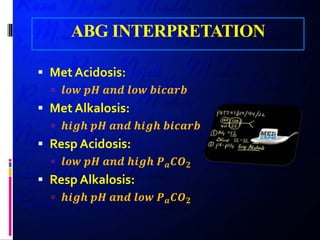
 Met Acidosis:
 𝒍𝒍𝒍𝒍𝒍𝒍 𝒑𝒑𝒑𝒑 𝒂𝒂𝒂𝒂𝒂𝒂 𝒍𝒍𝒍𝒍𝒍𝒍 𝒃𝒃𝒃𝒃𝒃𝒃𝒃𝒃𝒃𝒃𝒃𝒃
 Met Alkalosis:
 𝒉𝒉𝒉𝒉𝒉𝒉𝒉𝒉 𝒑𝒑𝒑𝒑 𝒂𝒂𝒂𝒂𝒂𝒂 𝒉𝒉𝒉𝒉𝒉𝒉𝒉𝒉 𝒃𝒃𝒃𝒃𝒃𝒃𝒃𝒃𝒃𝒃𝒃𝒃
 Resp Acidosis:
 𝒍𝒍𝒍𝒍𝒍𝒍 𝒑𝒑𝒑𝒑 𝒂𝒂𝒂𝒂𝒂𝒂 𝒉𝒉𝒉𝒉𝒉𝒉𝒉𝒉 𝑷𝑷𝒂𝒂 𝑪𝑪𝑶𝑶𝟐𝟐
 Resp Alkalosis:
 𝒉𝒉𝒉𝒉𝒉𝒉𝒉𝒉 𝒑𝒑𝒑𝒑 𝒂𝒂𝒂𝒂𝒂𝒂 𝒍𝒍𝒍𝒍𝒍𝒍 𝑷𝑷𝒂𝒂 𝑪𝑪𝑶𝑶𝟐𝟐
ABG INTERPRETATION
 Assessment of ABG
1. careful clinical evaluation
2. determine the primary acid–base disorder
3. evaluate the respiratory component
4. consider the metabolic component
5. consider the possibility of a mixed metabolic
acid–base disturbance
6. note the serum osmolal gap in any patient with
an unexplained high anion-gap acidosis
7. determine the cause of the identified processes
ABG INTERPRETATION
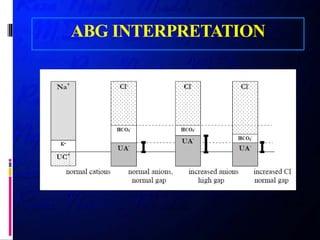
 Calculation of the anion gap:
 [𝑵𝑵𝑵𝑵+
] + [𝑲𝑲+
] + [𝑪𝑪𝑪𝑪𝟐𝟐+
] + [𝑴𝑴𝑴𝑴𝟐𝟐+
] + + [𝑯𝑯+
]
+ 𝒖𝒖𝒖𝒖𝒖𝒖𝒖𝒖𝒖𝒖𝒖𝒖𝒖𝒖𝒖𝒖𝒖𝒖𝒖𝒖 𝒄𝒄𝒄𝒄𝒄𝒄𝒄𝒄𝒄𝒄𝒄𝒄𝒄𝒄 = [𝑪𝑪𝑪𝑪−
] + [𝑯𝑯𝑪𝑪𝑪𝑪𝟑𝟑
−
]
+ [𝑪𝑪𝑪𝑪𝟑𝟑
𝟐𝟐−
] + [𝑶𝑶𝑶𝑶−
] + 𝒂𝒂𝒂𝒂𝒂𝒂𝒂𝒂𝒂𝒂𝒂𝒂𝒂𝒂
+ 𝒑𝒑𝒑𝒑𝒑𝒑𝒑𝒑𝒑𝒑𝒑𝒑𝒑𝒑𝒑𝒑𝒑𝒑 + 𝒔𝒔𝒔𝒔𝒔𝒔𝒔𝒔𝒔𝒔𝒔𝒔𝒔𝒔 + 𝒍𝒍𝒍𝒍𝒍𝒍𝒍𝒍𝒍𝒍𝒍𝒍𝒍𝒍
+ 𝒖𝒖𝒖𝒖𝒖𝒖𝒖𝒖𝒖𝒖𝒖𝒖𝒖𝒖𝒖𝒖𝒖𝒖𝒖𝒖 𝒂𝒂𝒂𝒂𝒂𝒂𝒂𝒂𝒂𝒂𝒂𝒂
 𝑨𝑨𝑨𝑨𝑨𝑨𝑨𝑨𝑨𝑨 𝑮𝑮𝑮𝑮𝑮𝑮 = [𝑵𝑵𝑵𝑵+
] − ([𝑪𝑪𝑪𝑪−
] + [𝑯𝑯𝑪𝑪𝑪𝑪𝟑𝟑
−
])
 = 𝑼𝑼𝑼𝑼 − 𝑼𝑼𝑼𝑼
 = 𝟏𝟏𝟏𝟏 − 𝟏𝟏𝟏𝟏𝟏𝟏𝟏𝟏𝟏𝟏/𝑳𝑳
ABG INTERPRETATION
ABG INTERPRETATION
 High anion-gap metabolic acidosis
 GOLD MARRK
 Glycols [ethylene and propylene],
 5-oxoproline [pyroglutamic acid],
 l-lactate,
 d-lactate,
 methanol,
 aspirin,
 renal failure,
 rhabdomyolysis,
 ketoacidosis
ABG INTERPRETATION
 Normal Anion Gap Acidosis:
 GI or Urinary HCO3- loss
 Urinary Anion GAP:
 ( 𝑵𝑵𝑵𝑵+
+ 𝑲𝑲+
)– [𝑪𝑪𝑪𝑪−
]
 neGUTive GI (diarrhea), PRTA
 Positive in RF, DRTA, Hypoaldosteronism
ABG INTERPRETATION
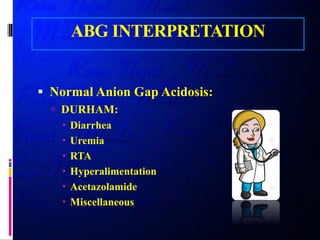
 Normal Anion Gap Acidosis:
 DURHAM:
 Diarrhea
 Uremia
 RTA
 Hyperalimentation
 Acetazolamide
 Miscellaneous
ABG INTERPRETATION
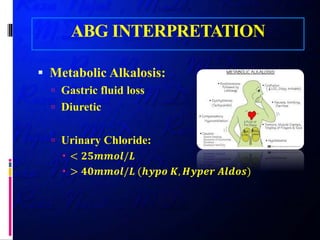
 Metabolic Alkalosis:
 Gastric fluid loss
 Diuretic
 Urinary Chloride:
 < 𝟐𝟐𝟐𝟐𝟐𝟐𝟐𝟐𝟐𝟐𝟐𝟐/𝑳𝑳
 > 𝟒𝟒𝟒𝟒𝟒𝟒𝟒𝟒𝟒𝟒𝟒𝟒/𝑳𝑳 (𝒉𝒉𝒉𝒉𝒉𝒉𝒉𝒉 𝑲𝑲, 𝑯𝑯𝑯𝑯𝑯𝑯𝑯𝑯𝑯𝑯 𝑨𝑨𝑨𝑨𝑨𝑨𝑨𝑨𝑨𝑨)
ABG INTERPRETATION
 Physiotherapy is safe and efficient in critically
ill patients
 During mechanical ventilation chest
physiotherapy with positioning is very useful
in pulmonary diseases
 Early and safe mobilization is important in
intubated and critically ill patients
 The volume therapy/NIPPV with positioning
and manual therapy is efficient in the weaning
process
 Hemodynamic & ABG monitoring is necessary
ABG INTERPRETATION
 Case1: 57 year old lady, day 3 post-
cholecystectomy, complaining of
breathlessness.
 Her ABG:
 𝒑𝒑𝒑𝒑: 𝟕𝟕. 𝟒𝟒𝟒𝟒 (𝟕𝟕. 𝟑𝟑𝟑𝟑 − 𝟕𝟕. 𝟒𝟒𝟒𝟒)
 𝑷𝑷𝒂𝒂 𝑶𝑶𝟐𝟐: 𝟓𝟓𝟓𝟓𝟓𝟓𝟓𝟓𝟓𝟓𝟓𝟓 (𝟖𝟖𝟖𝟖 − 𝟏𝟏𝟏𝟏𝟏𝟏)
 𝑷𝑷𝒂𝒂 𝑪𝑪𝑶𝑶𝟐𝟐: 𝟑𝟑𝟑𝟑𝟑𝟑𝟑𝟑𝟑𝟑𝟑𝟑 (𝟑𝟑𝟑𝟑 − 𝟒𝟒𝟒𝟒)
 𝑯𝑯𝑯𝑯𝑯𝑯𝑯𝑯: 𝟐𝟐𝟐𝟐𝟐𝟐𝟐𝟐𝟐𝟐𝟐𝟐/𝒍𝒍 (𝟐𝟐𝟐𝟐 − 𝟐𝟐𝟐𝟐)
 𝑩𝑩𝑩𝑩: −𝟏𝟏𝟏𝟏𝟏𝟏𝟏𝟏𝟏𝟏/𝒍𝒍 (−𝟐𝟐 𝒕𝒕𝒕𝒕 + 𝟐𝟐)
 Other values within normal range
ABG INTERPRETATION
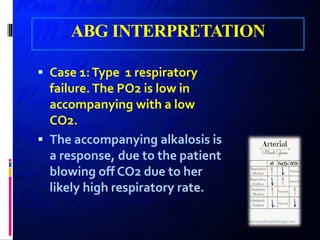
 Case 1:Type 1 respiratory
failure.The PO2 is low in
accompanying with a low
CO2.
 The accompanying alkalosis is
a response, due to the patient
blowing off CO2 due to her
likely high respiratory rate.
ABG INTERPRETATION
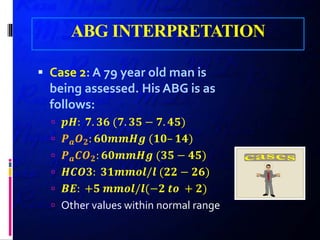
 Case 2: A 79 year old man is
being assessed. His ABG is as
follows:
 𝒑𝒑𝒑𝒑: 𝟕𝟕. 𝟑𝟑𝟑𝟑 (𝟕𝟕. 𝟑𝟑𝟑𝟑 − 𝟕𝟕. 𝟒𝟒𝟒𝟒)
 𝑷𝑷𝒂𝒂 𝑶𝑶𝟐𝟐: 𝟔𝟔𝟔𝟔𝟔𝟔𝟔𝟔𝟔𝟔𝟔𝟔 (𝟏𝟏𝟏𝟏– 𝟏𝟏𝟏𝟏)
 𝑷𝑷𝒂𝒂 𝑪𝑪𝑶𝑶𝟐𝟐: 𝟔𝟔𝟔𝟔𝟔𝟔𝟔𝟔𝟔𝟔𝟔𝟔 (𝟑𝟑𝟑𝟑 − 𝟒𝟒𝟒𝟒)
 𝑯𝑯𝑯𝑯𝑯𝑯𝑯𝑯: 𝟑𝟑𝟑𝟑𝟑𝟑𝟑𝟑𝟑𝟑𝟑𝟑/𝒍𝒍 (𝟐𝟐𝟐𝟐 − 𝟐𝟐𝟐𝟐)
 𝑩𝑩𝑩𝑩: +𝟓𝟓 𝒎𝒎𝒎𝒎𝒎𝒎𝒎𝒎/𝒍𝒍(−𝟐𝟐 𝒕𝒕𝒕𝒕 + 𝟐𝟐)
 Other values within normal range
ABG INTERPRETATION
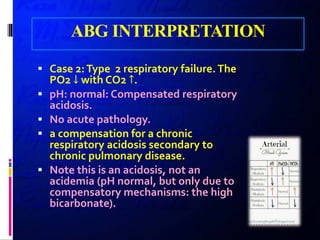
 Case 2:Type 2 respiratory failure.The
PO2 ↓ with CO2 ↑.
 pH: normal: Compensated respiratory
acidosis.
 No acute pathology.
 a compensation for a chronic
respiratory acidosis secondary to
chronic pulmonary disease.
 Note this is an acidosis, not an
acidemia (pH normal, but only due to
compensatory mechanisms: the high
bicarbonate).
ABG INTERPRETATION
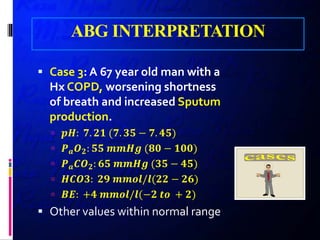
 Case 3: A 67 year old man with a
Hx COPD, worsening shortness
of breath and increased Sputum
production.
 𝒑𝒑𝒑𝒑: 𝟕𝟕. 𝟐𝟐𝟐𝟐 (𝟕𝟕. 𝟑𝟑𝟑𝟑 − 𝟕𝟕. 𝟒𝟒𝟒𝟒)
 𝑷𝑷𝒂𝒂 𝑶𝑶𝟐𝟐: 𝟓𝟓𝟓𝟓 𝒎𝒎𝒎𝒎𝒎𝒎𝒎𝒎 (𝟖𝟖𝟖𝟖 − 𝟏𝟏𝟏𝟏𝟏𝟏)
 𝑷𝑷𝒂𝒂 𝑪𝑪𝑶𝑶𝟐𝟐: 𝟔𝟔𝟔𝟔 𝒎𝒎𝒎𝒎𝒎𝒎𝒎𝒎 (𝟑𝟑𝟑𝟑 − 𝟒𝟒𝟒𝟒)
 𝑯𝑯𝑯𝑯𝑯𝑯𝑯𝑯: 𝟐𝟐𝟐𝟐 𝒎𝒎𝒎𝒎𝒎𝒎𝒎𝒎/𝒍𝒍(𝟐𝟐𝟐𝟐 − 𝟐𝟐𝟐𝟐)
 𝑩𝑩𝑩𝑩: +𝟒𝟒 𝒎𝒎𝒎𝒎𝒎𝒎𝒎𝒎/𝒍𝒍(−𝟐𝟐 𝒕𝒕𝒕𝒕 + 𝟐𝟐)
 Other values within normal range
ABG INTERPRETATION
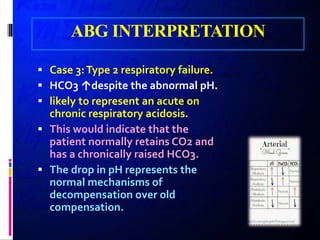
 Case 3:Type 2 respiratory failure.
 HCO3 ↑despite the abnormal pH.
 likely to represent an acute on
chronic respiratory acidosis.
 This would indicate that the
patient normally retains CO2 and
has a chronically raised HCO3.
 The drop in pH represents the
normal mechanisms of
decompensation over old
compensation.
ABG INTERPRETATION
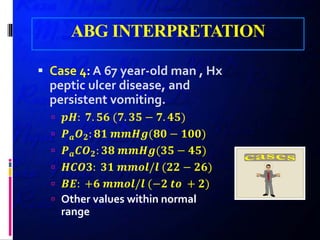
 Case 4: A 67 year-old man , Hx
peptic ulcer disease, and
persistent vomiting.
 𝒑𝒑𝒑𝒑: 𝟕𝟕. 𝟓𝟓𝟓𝟓 (𝟕𝟕. 𝟑𝟑𝟑𝟑 − 𝟕𝟕. 𝟒𝟒𝟒𝟒)
 𝑷𝑷𝒂𝒂 𝑶𝑶𝟐𝟐: 𝟖𝟖𝟖𝟖 𝒎𝒎𝒎𝒎𝒎𝒎𝒎𝒎(𝟖𝟖𝟖𝟖 − 𝟏𝟏𝟏𝟏𝟏𝟏)
 𝑷𝑷𝒂𝒂 𝑪𝑪𝑶𝑶𝟐𝟐: 𝟑𝟑𝟑𝟑 𝒎𝒎𝒎𝒎𝒎𝒎𝒎𝒎(𝟑𝟑𝟑𝟑 − 𝟒𝟒𝟒𝟒)
 𝑯𝑯𝑯𝑯𝑯𝑯𝑯𝑯: 𝟑𝟑𝟑𝟑 𝒎𝒎𝒎𝒎𝒎𝒎𝒎𝒎/𝒍𝒍 (𝟐𝟐𝟐𝟐 − 𝟐𝟐𝟐𝟐)
 𝑩𝑩𝑩𝑩: +𝟔𝟔 𝒎𝒎𝒎𝒎𝒎𝒎𝒎𝒎/𝒍𝒍 (−𝟐𝟐 𝒕𝒕𝒕𝒕 + 𝟐𝟐)
 Other values within normal
range
ABG INTERPRETATION
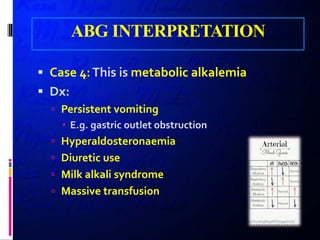
 Case 4:This is metabolic alkalemia
 Dx:
 Persistent vomiting
 E.g. gastric outlet obstruction
 Hyperaldosteronaemia
 Diuretic use
 Milk alkali syndrome
 Massive transfusion
ABG INTERPRETATION
www.rezanejat.com

Acid base heart congress 96 final

  • 1.
    ABG INTERPRETATION Reza Nejat, M.D., Anesthesiologist,FCCM, Former Assistant Professor, SBMU Bazarganan Hospital
  • 2.
    ABG INTERPRETATION  Recommendationsfor Physiotherapy in the ICU  Acute lobar atelectasis ♣♣  Positioning in severe ARDS  Side lying improves 0xygenation  Continuous rotational therapy  Facilitating weaning  Decreasing length of stay in the ICU or hospital,  Reducing mortality or morbidity ♣♣  Preventing loss of joint range or soft- tissue length**
  • 3.
    ABG INTERPRETATION  Physiotherapyat ICU  Positioning  Mobilisation  Manual hyperinflation (MHI)  Percussion, manual or mechanical vibration  Airway suctioning  Coughing  Breathing exercise
  • 4.
    ABG INTERPRETATION  Thephysiotherapy treatment prevents and reduces potential pulmonary complications:  Hypoventilation,  Hypoxemia,  Infection in order to restore muscular and pulmonary function as fast as possible.
  • 5.
    ABG INTERPRETATION  Theside effects of physiotherapy:  Metabolic  Hemodynamic  ICP↑
  • 6.
    ABG INTERPRETATION 𝒑𝒑𝒑𝒑𝒑𝒑𝒑𝒑𝒑𝒑𝒑𝒑𝒑𝒑𝒑𝒑𝒑𝒑𝒑𝒑𝒑𝒑𝒑𝒑𝒑𝒑 =↑ 𝒎𝒎𝒎𝒎𝒎𝒎𝒎𝒎𝒎𝒎𝒎𝒎𝒎𝒎𝒎𝒎𝒎𝒎 𝒅𝒅𝒅𝒅𝒅𝒅𝒅𝒅𝒅𝒅𝒅𝒅 physiotherapist should have knowledge about: 𝒐𝒐𝒐𝒐𝒐𝒐𝒐𝒐𝒐𝒐𝒐𝒐 𝒅𝒅𝒅𝒅𝒅𝒅𝒅𝒅𝒅𝒅𝒅𝒅𝒅𝒅𝒅𝒅 𝒕𝒕𝒕𝒕 𝒕𝒕𝒕𝒕𝒕𝒕 𝒄𝒄𝒄𝒄𝒄𝒄𝒄𝒄 𝒄𝒄𝒄𝒄𝒄𝒄𝒄𝒄 𝒐𝒐𝒐𝒐𝒐𝒐𝒐𝒐𝒐𝒐𝒐𝒐 𝒄𝒄𝒄𝒄𝒄𝒄𝒄𝒄𝒄𝒄𝒄𝒄𝒄𝒄𝒄𝒄𝒄𝒄𝒄𝒄𝒄𝒄
  • 7.
    ABG INTERPRETATION During invasiveventilation  Physiotherapy might be associated with: 𝑽𝑽𝑽𝑽𝑽𝑽 ↑↑ 𝑺𝑺𝑺𝑺𝑺𝑺𝑺𝑺𝑺𝑺𝑺𝑺𝑺𝑺𝑺𝑺𝑺𝑺𝑺𝑺𝑺𝑺 𝒔𝒔𝒔𝒔𝒔𝒔𝒔𝒔𝒔𝒔𝒔𝒔𝒔𝒔𝒔𝒔𝒔𝒔𝒔𝒔𝒔𝒔 ↑ 𝑾𝑾𝑾𝑾𝑾𝑾 ↑
  • 8.
    ABG INTERPRETATION  Themetabolic and cardiovascular effects of turning a patient into a side lying position are greater than the physiological stress incurred by the addition of physiotherapy treatment.  Berney S and Denehy L (2003): Australian Journal of Physiotherapy 49: 99-105
  • 9.
    ABG INTERPRETATION  Whatshould be done during physiotherapy:  Monitor hemodynamic status  Sedation before physiotherapy  Preoxygenation, sedation, and reassurance before suction  Monitor ICP and CPP
  • 10.
    ABG INTERPRETATION  Physiotherapy ABGinterpretation ???? Their relationship
  • 11.
    ABG INTERPRETATION ∆Critically illpatients are in hyper-metabolic state∆  The ABG allows to assess patients’:  metabolic status  respiratory status  ability to cope with their illness.
  • 12.
    ABG INTERPRETATION  ABGis requested to determine:  pH  PaCO2  PaO2  ABG is used to assess:  the effectiveness of:  Gaseous Exchange  Ventilation  pH derangement=Abnormal cell metabolism
  • 13.
    ABG INTERPRETATION  whenmobilization should be done:  Physiotherapist should review medical background  Hemodynamic indices should be stable: 𝐻𝐻𝐻𝐻𝑟𝑟𝑟𝑟𝑟𝑟𝑟𝑟 < 𝐻𝐻𝐻𝐻𝑚𝑚𝑚𝑚𝑚𝑚50% 𝑆𝑆𝑆𝑆𝑆𝑆 100 – 140 𝑚𝑚𝑚𝑚𝑚𝑚𝑚𝑚 𝐷𝐷𝐷𝐷𝐷𝐷 80 − 105 𝑚𝑚𝑚𝑚𝑚𝑚𝑚𝑚 𝑣𝑣𝑣𝑣𝑣𝑣𝑣𝑣𝑣𝑣𝑣𝑣𝑣𝑣𝑣𝑣𝑣𝑣𝑣𝑣𝑣𝑣 𝑟𝑟𝑟𝑟𝑟𝑟𝑟𝑟𝑟𝑟𝑟𝑟𝑟𝑟𝑟𝑟 < 20% 𝑁𝑁𝑁𝑁𝑁𝑁𝑁𝑁𝑁𝑁𝑁𝑁 𝐸𝐸𝐸𝐸𝐸𝐸  Respiratory stability: 𝑃𝑃𝑃𝑃𝑃𝑃2/𝐹𝐹𝐹𝐹𝐹𝐹2 > 150 – 𝑠𝑠𝑠𝑠𝑠𝑠𝑠𝑠𝑠𝑠𝑠𝑠𝑠𝑠 𝑖𝑖𝑖𝑖 𝑐𝑐ℎ𝑎𝑎𝑎𝑎𝑎𝑎 𝑃𝑃𝑃𝑃𝑃𝑃2/𝐹𝐹𝐹𝐹𝐹𝐹2 > 300 (30𝑚𝑚 𝑤𝑤𝑤𝑤𝑤𝑤𝑤𝑤𝑤𝑤𝑤𝑤𝑤𝑤) 𝑆𝑆𝑆𝑆𝑆𝑆2 > 90 𝑎𝑎𝑎𝑎𝑎𝑎 𝑟𝑟𝑟𝑟𝑟𝑟𝑟𝑟𝑟𝑟𝑟𝑟 𝑑𝑑𝑑𝑑𝑑𝑑𝑑𝑑𝑑𝑑𝑑𝑑𝑑𝑑𝑒𝑒 𝑖𝑖𝑖𝑖 𝑆𝑆𝑆𝑆𝑆𝑆2 < 4%
  • 14.
    ABG INTERPRETATION  Accurateand timely interpretation of ABG and an acid–base disorder can be lifesaving,  The establishment of a correct diagnosis may be challenging
  • 15.
    ABG INTERPRETATION  Assessmentof ABG 1. careful clinical evaluation 2. determine the primary acid–base disorder 3. evaluate the respiratory component 4. consider the metabolic component 5. consider the possibility of a mixed metabolic acid–base disturbance 6. note the serum osmolal gap in any patient with an unexplained high anion-gap acidosis 7. determine the cause of the identified processes
  • 16.
    ABG INTERPRETATION  Assessmentof ABG 1. careful clinical evaluation 2. determine the primary acid–base disorder 3. evaluate the respiratory component 4. consider the metabolic component 5. consider the possibility of a mixed metabolic acid–base disturbance 6. note the serum osmolal gap in any patient with an unexplained high anion-gap acidosis 7. determine the cause of the identified processes
  • 17.
    ABG INTERPRETATION  Assessmentof ABG 1. careful clinical evaluation 2. determine the primary acid–base disorder 3. evaluate the respiratory component 4. consider the metabolic component 5. consider the possibility of a mixed metabolic acid–base disturbance 6. note the serum osmolal gap in any patient with an unexplained high anion-gap acidosis 7. determine the cause of the identified processes
  • 18.
    ABG INTERPRETATION  signsand symptoms  vital signs (which may indicate shock or sepsis),  neurologic state  signs of infection (e.g., fever),  pulmonary status (respiratory rate, Kussmaul respiration, cyanosis, clubbing of the fingers)  gastrointestinal symptoms (vomiting and diarrhea)  pregnancy,  diabetes,  heart, lung, liver, and kidney disease,  medications (e.g., laxatives, diuretics, topiramate, or metformin)
  • 19.
    ABG INTERPRETATION  Assessmentof ABG 1. careful clinical evaluation 2. determine the primary acid–base disorder 3. evaluate the respiratory component 4. consider the metabolic component 5. consider the possibility of a mixed metabolic acid–base disturbance 6. note the serum osmolal gap in any patient with an unexplained high anion-gap acidosis 7. determine the cause of the identified processes
  • 20.
    ABG INTERPRETATION Clinical Featuresof Respiratory Failure Hypoxemic Hypercapnic Cyanosis Flapping tremor of hands Tachypnea Tachypnea Tachycardia→arrhythmia→bradycardia Tachycardia Peripheral vasoconstriction Peripheral vasodilation warm hands/ headache Restlessness→confusion→coma drowsiness→hallucination→coma Sweating
  • 21.
    ABG INTERPRETATION  𝑷𝑷𝒂𝒂𝑶𝑶𝟐𝟐 < 𝟓𝟓𝟓𝟓 𝒎𝒎𝒎𝒎𝒎𝒎𝒎𝒎  Memory defect, impaired judgement  𝑷𝑷𝒂𝒂 𝑶𝑶𝟐𝟐 < 𝟒𝟒𝟒𝟒 𝒎𝒎𝒎𝒎𝒎𝒎𝒎𝒎  Tissue damage  𝑷𝑷𝒂𝒂 𝑶𝑶𝟐𝟐 < 𝟑𝟑𝟑𝟑 𝒎𝒎𝒎𝒎𝒎𝒎𝒎𝒎  Unconsciousness  𝑷𝑷𝒂𝒂 𝑶𝑶𝟐𝟐 < 𝟐𝟐𝟐𝟐 𝒎𝒎𝒎𝒎𝒎𝒎𝒎𝒎  Death
  • 22.
    ABG INTERPRETATION  Respiratoryinsufficiency:  Low 𝑭𝑭𝒊𝒊 𝑶𝑶𝟐𝟐  Hypoventilation  𝑷𝑷𝒂𝒂 𝑪𝑪𝑪𝑪𝟐𝟐 = 𝑽𝑽𝑪𝑪𝑪𝑪𝟐𝟐/𝑽𝑽𝑽𝑽,  𝑽𝑽/𝑸𝑸 mismatch  Shunt  (𝑷𝑷𝑨𝑨 𝑶𝑶𝟐𝟐 − 𝑷𝑷𝒂𝒂 𝑶𝑶𝟐𝟐)/𝟐𝟐𝟐𝟐  Diffusion  𝑫𝑫𝑫𝑫𝑫𝑫𝑫𝑫
  • 23.
    ABG INTERPRETATION  𝑷𝑷𝑨𝑨𝑶𝑶𝟐𝟐 = 𝑭𝑭𝑭𝑭𝑭𝑭𝑭𝑭 × (𝑩𝑩𝑩𝑩– 𝑷𝑷𝑷𝑷𝑷𝑷𝑷𝑷)– (𝑷𝑷𝒂𝒂 𝑪𝑪𝑪𝑪𝟐𝟐/𝑹𝑹)  𝑷𝑷𝑨𝑨 𝑶𝑶𝟐𝟐 = 𝑭𝑭𝑭𝑭𝑭𝑭𝑭𝑭 × 𝑩𝑩𝑩𝑩– 𝑷𝑷𝑷𝑷𝑷𝑷𝑷𝑷 – (𝟏𝟏. 𝟐𝟐𝟐𝟐 × 𝑷𝑷𝒂𝒂 𝑪𝑪𝑶𝑶𝟐𝟐)  𝑩𝑩𝑩𝑩 = 𝟕𝟕𝟕𝟕𝟕𝟕𝟕𝟕𝟕𝟕𝟕𝟕𝟕𝟕, 𝑭𝑭𝑭𝑭𝑭𝑭𝑭𝑭 =? , 𝑷𝑷𝑷𝑷𝑷𝑷𝑷𝑷 = 𝟒𝟒𝟒𝟒𝟒𝟒𝟒𝟒𝟒𝟒𝟒𝟒 , 𝑹𝑹 = 𝟎𝟎. 𝟖𝟖  𝑰𝑰𝑰𝑰 𝑭𝑭𝑭𝑭𝑭𝑭𝑭𝑭 = 𝟐𝟐𝟐𝟐𝟐  𝑷𝑷𝑨𝑨 𝑶𝑶𝟐𝟐 = 𝟏𝟏𝟏𝟏𝟏𝟏– (𝟏𝟏. 𝟐𝟐𝟐𝟐 × 𝑷𝑷𝒂𝒂 𝑪𝑪𝑪𝑪𝟐𝟐)
  • 24.
    ABG INTERPRETATION  Innormal subjects:  𝑷𝑷𝒂𝒂 𝑶𝑶𝟐𝟐 = 𝑭𝑭𝒊𝒊 𝑶𝑶𝟐𝟐 × 𝟓𝟓  120 RULE:  𝑷𝑷𝒂𝒂 𝑶𝑶𝟐𝟐 + 𝑷𝑷𝒂𝒂 𝑪𝑪𝑪𝑪𝟐𝟐=𝟏𝟏𝟏𝟏𝟏𝟏 ± 𝟏𝟏𝟏𝟏  <120 venous admixture  𝑷𝑷𝒂𝒂 𝑶𝑶𝟐𝟐 = 𝟏𝟏𝟏𝟏𝟏𝟏 − (𝟎𝟎. 𝟐𝟐𝟐𝟐 × 𝒂𝒂𝒂𝒂𝒂𝒂)  𝑷𝑷𝑷𝑷𝑷𝑷𝑷𝑷/𝑭𝑭𝑭𝑭𝑭𝑭𝑭𝑭  𝑵𝑵𝑵𝑵𝑵𝑵𝑵𝑵𝑵𝑵𝑵𝑵 𝟏𝟏𝟏𝟏𝟏𝟏/𝟎𝟎. 𝟐𝟐𝟐𝟐 = 𝟓𝟓𝟓𝟓𝟓𝟓  𝟐𝟐𝟐𝟐𝟐𝟐 < 𝑷𝑷𝑷𝑷𝑷𝑷𝑷𝑷/𝑭𝑭𝑭𝑭𝑭𝑭𝑭𝑭 < 𝟑𝟑𝟑𝟑𝟑𝟑 𝑴𝑴𝑴𝑴𝑴𝑴𝑴𝑴 𝑨𝑨𝑨𝑨𝑨𝑨𝑨𝑨  𝟏𝟏𝟏𝟏𝟏𝟏 < 𝑷𝑷𝑷𝑷𝑷𝑷𝑷𝑷/𝑭𝑭𝑭𝑭𝑭𝑭𝑭𝑭 < 𝟐𝟐𝟐𝟐𝟐𝟐 𝑴𝑴𝑴𝑴𝑴𝑴𝑴𝑴𝑴𝑴𝑴𝑴𝑴𝑴𝑴𝑴 𝑨𝑨𝑨𝑨𝑨𝑨𝑨𝑨  𝑷𝑷𝑷𝑷𝑷𝑷𝑷𝑷/𝑭𝑭𝑭𝑭𝑭𝑭𝑭𝑭 < 𝟏𝟏𝟏𝟏𝟏𝟏 𝑺𝑺𝑺𝑺𝑺𝑺𝑺𝑺𝑺𝑺𝑺𝑺 𝑨𝑨𝑨𝑨𝑨𝑨𝑨𝑨  (𝒐𝒐𝒐𝒐 𝑷𝑷𝑷𝑷𝑷𝑷𝑷𝑷 = 𝟓𝟓𝟓𝟓𝟓𝟓𝟓𝟓𝟓𝟓𝟓𝟓)
  • 25.
    ABG INTERPRETATION  (Alveolar-Arterial)O2=𝑷𝑷𝑨𝑨𝑶𝑶𝟐𝟐 − 𝑷𝑷𝒂𝒂 𝑶𝑶𝟐𝟐:  Young 𝟓𝟓 − 𝟏𝟏𝟏𝟏𝟏𝟏𝟏𝟏𝟏𝟏𝟏𝟏  Old 𝟏𝟏𝟏𝟏 − 𝟐𝟐𝟐𝟐𝟐𝟐𝟐𝟐𝟐𝟐𝟐𝟐  Increases with increase in 𝑭𝑭𝑭𝑭 𝑶𝑶𝟐𝟐  For every decade, the alveolar–arterial difference increases by 2 mm Hg  𝑷𝑷𝑨𝑨 𝑶𝑶𝟐𝟐 − 𝑷𝑷𝒂𝒂 𝑶𝑶𝟐𝟐 = (𝑨𝑨𝑨𝑨𝑨𝑨/𝟒𝟒) + 𝟒𝟒  𝑷𝑷𝑨𝑨 𝑶𝑶𝟐𝟐 − 𝑷𝑷𝒂𝒂 𝑶𝑶𝟐𝟐 = 𝟐𝟐. 𝟓𝟓 + (𝟎𝟎. 𝟐𝟐𝟐𝟐 × 𝒂𝒂𝒂𝒂𝒂𝒂 𝒊𝒊𝒊𝒊 𝒚𝒚𝒚𝒚𝒚𝒚𝒚𝒚𝒚𝒚)
  • 26.
    ABG INTERPRETATION 𝑺𝑺𝒑𝒑 𝑶𝑶𝟐𝟐𝒗𝒗𝒗𝒗 𝑺𝑺𝒂𝒂 𝑶𝑶𝟐𝟐  𝑺𝑺𝒑𝒑 𝑶𝑶𝟐𝟐/𝑭𝑭𝑭𝑭𝑭𝑭𝑭𝑭 = 𝟐𝟐𝟐𝟐𝟐𝟐  𝑷𝑷𝒂𝒂 𝑶𝑶𝟐𝟐/𝑭𝑭𝑭𝑭𝑭𝑭𝑭𝑭 = 𝟐𝟐𝟐𝟐𝟐𝟐  𝑺𝑺𝒑𝒑 𝑶𝑶𝟐𝟐/𝑭𝑭𝑭𝑭𝑭𝑭𝑭𝑭 = 𝟑𝟑𝟑𝟑𝟑𝟑  𝑷𝑷𝒂𝒂 𝑶𝑶𝟐𝟐/𝑭𝑭𝑭𝑭𝑭𝑭𝑭𝑭 = 𝟑𝟑𝟑𝟑𝟑𝟑
  • 27.
    ABG INTERPRETATION  Assessmentof ABG 1. careful clinical evaluation 2. determine the primary acid–base disorder 3. consider the metabolic component 4. consider the possibility of a mixed metabolic acid–base disturbance 5. note the serum osmolal gap in any patient with an unexplained high anion-gap acidosis 6. evaluate the respiratory component 7. determine the cause of the identified processes
  • 28.
    ABG INTERPRETATION  Thethree major methods of quantifying acid–base disorders:  the physiological approach,  the base-excess (BE) approach,  the physicochemical approach (also called the Stewart method)
  • 29.
    ABG INTERPRETATION  Basedon the iso-hydric principle,  Acid: hydrogen-ion donor  Base: hydrogen-ion acceptor  Changes in [𝑯𝑯+ ] alter virtually all cellular function
  • 30.
    ABG INTERPRETATION  thenormal plasma [𝑯𝑯+ ]:  very low 𝟒𝟒𝟒𝟒 𝒏𝒏𝒏𝒏𝒏𝒏𝒏𝒏/𝑳𝑳  the pH  −𝒍𝒍𝒍𝒍𝒍𝒍𝟏𝟏𝟏𝟏[𝑯𝑯+] = 𝒍𝒍𝒍𝒍𝒍𝒍𝟏𝟏𝟏𝟏 𝟏𝟏 [𝑯𝑯+]  is generally used in clinical medicine to indicate acid–base status.  “acidemia”  Plasma pH is abnormally low (acidic)  “alkalemia”  Plasma pH is abnormally high (alkaline)
  • 31.
    ABG INTERPRETATION  Acidemiavs Acidosis  the hydrogen-ion concentration ↑  Alkalemia vs Alkalosis  the hydrogen-ion concentration ↓
  • 32.
    ABG INTERPRETATION the Henderson–Hasselbalchequation 𝒑𝒑𝒑𝒑 = 𝒑𝒑𝒑𝒑 + 𝒍𝒍𝒍𝒍𝒍𝒍𝟏𝟏𝟏𝟏( 𝑯𝑯𝑯𝑯𝑯𝑯𝑯𝑯− 𝟎𝟎. 𝟎𝟎𝟎𝟎 × 𝑷𝑷𝒂𝒂 𝑪𝑪𝑶𝑶𝟐𝟐 ) 𝑯𝑯𝑯𝑯𝑯𝑯𝑯𝑯− = proton acceptor = BASE (KIDNEY) 𝑪𝑪𝑪𝑪𝟐𝟐 = proton donor = ACID (LUNG) 𝒑𝒑𝒑𝒑 = 𝒑𝒑𝒑𝒑 + 𝒍𝒍𝒍𝒍𝒍𝒍𝟏𝟏𝟏𝟏([𝑩𝑩𝑩𝑩𝑩𝑩𝑩𝑩] / [𝑨𝑨𝑨𝑨𝑨𝑨𝑨𝑨]) 𝒑𝒑𝒑𝒑 = 𝒑𝒑𝒑𝒑 + 𝒍𝒍𝒍𝒍𝒍𝒍𝟏𝟏𝟏𝟏([𝒌𝒌𝒌𝒌𝒌𝒌𝒌𝒌𝒌𝒌𝒌𝒌] / [𝒍𝒍𝒍𝒍𝒍𝒍𝒍𝒍])
  • 33.
    ABG INTERPRETATION  Assessmentof ABG 1. careful clinical evaluation 2. determine the primary acid–base disorder 3. evaluate the respiratory component 4. consider the metabolic component 5. consider the possibility of a mixed metabolic acid–base disturbance 6. note the serum osmolal gap in any patient with an unexplained high anion-gap acidosis 7. determine the cause of the identified processes
  • 34.
    ABG INTERPRETATION  pH= pK + log10 ([kidney] / [lung])  ACIDOSIS:  Respiratory  Metabolic  ALKALOSIS:  Respiratory  Metabolic
  • 35.
    ABG INTERPRETATION  Metabolicacidosis  𝒑𝒑𝒑𝒑 < 𝟕𝟕. 𝟑𝟑𝟑𝟑 and [𝑯𝑯𝑯𝑯𝑯𝑯𝑯𝑯− ] < 𝟐𝟐𝟐𝟐 𝒎𝒎𝒎𝒎𝒎𝒎𝒎𝒎/𝒍𝒍𝒍𝒍𝒍𝒍𝒍𝒍𝒍𝒍 𝑩𝑩𝑩𝑩 < −𝟐𝟐 𝒎𝒎𝒎𝒎𝒎𝒎𝒎𝒎/𝒍𝒍𝒍𝒍𝒍𝒍𝒍𝒍𝒍𝒍  Secondary (respiratory) response:  𝑷𝑷𝒂𝒂 𝑪𝑪𝑶𝑶𝟐𝟐 = 𝟏𝟏. 𝟓𝟓 × [𝑯𝑯𝑯𝑯𝑯𝑯𝑯𝑯−] + 𝟖𝟖 ± 𝟐𝟐 𝒎𝒎𝒎𝒎 𝑯𝑯𝑯𝑯 or  𝑷𝑷𝒂𝒂 𝑪𝑪𝑶𝑶𝟐𝟐 = [𝑯𝑯𝑯𝑯𝑯𝑯𝑯𝑯−] + 𝟏𝟏𝟏𝟏 𝒎𝒎𝒎𝒎 𝑯𝑯𝑯𝑯  Complete secondary adaptive response within 12–24 hr
  • 36.
    ABG INTERPRETATION  Metabolicalkalosis  𝒑𝒑𝒑𝒑 > 𝟕𝟕. 𝟒𝟒𝟒𝟒 and [𝑯𝑯𝑯𝑯𝑯𝑯𝑯𝑯−] > 𝟐𝟐𝟐𝟐 𝒎𝒎𝒎𝒎𝒎𝒎𝒎𝒎/𝒍𝒍𝒍𝒍𝒍𝒍𝒍𝒍𝒍𝒍 𝑩𝑩𝑩𝑩 > +𝟐𝟐 𝒎𝒎𝒎𝒎𝒎𝒎𝒎𝒎/𝒍𝒍𝒍𝒍𝒍𝒍𝒍𝒍𝒍𝒍  Secondary (respiratory) response:  𝑷𝑷𝒂𝒂 𝑪𝑪𝑶𝑶𝟐𝟐 = 𝟎𝟎. 𝟕𝟕 × ([𝑯𝑯𝑯𝑯𝑯𝑯𝑯𝑯−] − 𝟐𝟐𝟐𝟐) + 𝟒𝟒𝟒𝟒 ± 𝟐𝟐 𝒎𝒎𝒎𝒎 𝑯𝑯𝑯𝑯 or  𝑷𝑷𝒂𝒂 𝑪𝑪𝑶𝑶𝟐𝟐 = [𝑯𝑯𝑯𝑯𝑯𝑯𝑯𝑯− ] + 𝟏𝟏𝟏𝟏 𝒎𝒎𝒎𝒎 𝑯𝑯𝑯𝑯 or  𝑷𝑷𝒂𝒂 𝑪𝑪𝑶𝑶𝟐𝟐 = 𝟎𝟎. 𝟕𝟕 × [𝑯𝑯𝑯𝑯𝑯𝑯𝑯𝑯− ] + 𝟐𝟐𝟐𝟐 𝒎𝒎𝒎𝒎 𝑯𝑯𝑯𝑯  Complete secondary adaptive response within 24–36 hr
  • 37.
    ABG INTERPRETATION  Respiratoryacidosis  𝒑𝒑𝒑𝒑 < 𝟕𝟕. 𝟑𝟑𝟑𝟑 𝒂𝒂𝒂𝒂𝒂𝒂 𝑷𝑷𝑷𝑷𝑷𝑷𝑷𝑷𝑷𝑷 > 𝟒𝟒𝟒𝟒 𝒎𝒎𝒎𝒎 𝑯𝑯𝑯𝑯  Secondary (metabolic) response  Acute:  ∆𝑷𝑷𝒂𝒂 𝑪𝑪𝑶𝑶𝟐𝟐 = ↑ 𝟏𝟏𝟏𝟏 𝒎𝒎𝒎𝒎 𝑯𝑯𝑯𝑯 𝒂𝒂𝒂𝒂𝒂𝒂𝒂𝒂𝒂𝒂 𝟒𝟒𝟒𝟒 𝒎𝒎𝒎𝒎 𝑯𝑯𝑯𝑯 → ∆ 𝑯𝑯𝑯𝑯𝑯𝑯𝑯𝑯− = ↑ 𝟏𝟏 𝒎𝒎𝒎𝒎𝒎𝒎𝒎𝒎 𝑳𝑳  Chronic:  ∆𝑷𝑷𝒂𝒂 𝑪𝑪𝑶𝑶𝟐𝟐 = ↑ 𝟏𝟏𝟏𝟏 𝒎𝒎𝒎𝒎 𝑯𝑯𝑯𝑯 𝒂𝒂𝒂𝒂𝒂𝒂𝒂𝒂𝒂𝒂 𝟒𝟒𝟒𝟒 𝒎𝒎𝒎𝒎 𝑯𝑯𝑯𝑯 → ∆ 𝑯𝑯𝑯𝑯𝑯𝑯𝑯𝑯− = ↑ 𝟐𝟐 − 𝟒𝟒 𝒎𝒎𝒎𝒎𝒎𝒎𝒎𝒎 𝑳𝑳  Complete secondary adaptive response within 2–5 days
  • 38.
    ABG INTERPRETATION  Respiratoryalkalosis  𝒑𝒑𝒑𝒑 > 𝟕𝟕. 𝟒𝟒𝟒𝟒 𝒂𝒂𝒂𝒂𝒂𝒂 𝑷𝑷𝑷𝑷𝑷𝑷𝑷𝑷𝑷𝑷 < 𝟑𝟑𝟑𝟑 𝒎𝒎𝒎𝒎 𝑯𝑯𝑯𝑯  Secondary (metabolic) response  Acute:  ∆𝑷𝑷𝒂𝒂 𝑪𝑪𝑶𝑶𝟐𝟐 = ↓ 𝟏𝟏𝟏𝟏 𝒎𝒎𝒎𝒎 𝑯𝑯𝑯𝑯 𝒃𝒃𝒃𝒃𝒃𝒃𝒃𝒃𝒃𝒃 𝟒𝟒𝟒𝟒 𝒎𝒎𝒎𝒎 𝑯𝑯𝑯𝑯 → ∆ 𝑯𝑯𝑯𝑯𝑯𝑯𝑯𝑯− = ↓ 𝟐𝟐 𝒎𝒎𝒎𝒎𝒎𝒎𝒎𝒎 𝑳𝑳  Chronic:  ∆𝑷𝑷𝒂𝒂 𝑪𝑪𝑶𝑶𝟐𝟐 = ↓ 𝟏𝟏𝟏𝟏 𝒎𝒎𝒎𝒎 𝑯𝑯𝑯𝑯 𝒃𝒃𝒃𝒃𝒃𝒃𝒃𝒃𝒃𝒃 𝟒𝟒𝟒𝟒 𝒎𝒎𝒎𝒎 𝑯𝑯𝑯𝑯 → ∆ 𝑯𝑯𝑯𝑯𝑯𝑯𝑯𝑯− = ↓ 𝟒𝟒 − 𝟓𝟓 𝒎𝒎𝒎𝒎𝒎𝒎𝒎𝒎 𝑳𝑳  Complete secondary adaptive response within 2–5 days
  • 39.
    ABG INTERPRETATION  MetAcidosis:  𝒍𝒍𝒍𝒍𝒍𝒍 𝒑𝒑𝒑𝒑 𝒂𝒂𝒂𝒂𝒂𝒂 𝒍𝒍𝒍𝒍𝒍𝒍 𝒃𝒃𝒃𝒃𝒃𝒃𝒃𝒃𝒃𝒃𝒃𝒃  Met Alkalosis:  𝒉𝒉𝒉𝒉𝒉𝒉𝒉𝒉 𝒑𝒑𝒑𝒑 𝒂𝒂𝒂𝒂𝒂𝒂 𝒉𝒉𝒉𝒉𝒉𝒉𝒉𝒉 𝒃𝒃𝒃𝒃𝒃𝒃𝒃𝒃𝒃𝒃𝒃𝒃  Resp Acidosis:  𝒍𝒍𝒍𝒍𝒍𝒍 𝒑𝒑𝒑𝒑 𝒂𝒂𝒂𝒂𝒂𝒂 𝒉𝒉𝒉𝒉𝒉𝒉𝒉𝒉 𝑷𝑷𝒂𝒂 𝑪𝑪𝑶𝑶𝟐𝟐  Resp Alkalosis:  𝒉𝒉𝒉𝒉𝒉𝒉𝒉𝒉 𝒑𝒑𝒑𝒑 𝒂𝒂𝒂𝒂𝒂𝒂 𝒍𝒍𝒍𝒍𝒍𝒍 𝑷𝑷𝒂𝒂 𝑪𝑪𝑶𝑶𝟐𝟐
  • 40.
    ABG INTERPRETATION  Assessmentof ABG 1. careful clinical evaluation 2. determine the primary acid–base disorder 3. evaluate the respiratory component 4. consider the metabolic component 5. consider the possibility of a mixed metabolic acid–base disturbance 6. note the serum osmolal gap in any patient with an unexplained high anion-gap acidosis 7. determine the cause of the identified processes
  • 41.
    ABG INTERPRETATION  Calculationof the anion gap:  [𝑵𝑵𝑵𝑵+ ] + [𝑲𝑲+ ] + [𝑪𝑪𝑪𝑪𝟐𝟐+ ] + [𝑴𝑴𝑴𝑴𝟐𝟐+ ] + + [𝑯𝑯+ ] + 𝒖𝒖𝒖𝒖𝒖𝒖𝒖𝒖𝒖𝒖𝒖𝒖𝒖𝒖𝒖𝒖𝒖𝒖𝒖𝒖 𝒄𝒄𝒄𝒄𝒄𝒄𝒄𝒄𝒄𝒄𝒄𝒄𝒄𝒄 = [𝑪𝑪𝑪𝑪− ] + [𝑯𝑯𝑪𝑪𝑪𝑪𝟑𝟑 − ] + [𝑪𝑪𝑪𝑪𝟑𝟑 𝟐𝟐− ] + [𝑶𝑶𝑶𝑶− ] + 𝒂𝒂𝒂𝒂𝒂𝒂𝒂𝒂𝒂𝒂𝒂𝒂𝒂𝒂 + 𝒑𝒑𝒑𝒑𝒑𝒑𝒑𝒑𝒑𝒑𝒑𝒑𝒑𝒑𝒑𝒑𝒑𝒑 + 𝒔𝒔𝒔𝒔𝒔𝒔𝒔𝒔𝒔𝒔𝒔𝒔𝒔𝒔 + 𝒍𝒍𝒍𝒍𝒍𝒍𝒍𝒍𝒍𝒍𝒍𝒍𝒍𝒍 + 𝒖𝒖𝒖𝒖𝒖𝒖𝒖𝒖𝒖𝒖𝒖𝒖𝒖𝒖𝒖𝒖𝒖𝒖𝒖𝒖 𝒂𝒂𝒂𝒂𝒂𝒂𝒂𝒂𝒂𝒂𝒂𝒂  𝑨𝑨𝑨𝑨𝑨𝑨𝑨𝑨𝑨𝑨 𝑮𝑮𝑮𝑮𝑮𝑮 = [𝑵𝑵𝑵𝑵+ ] − ([𝑪𝑪𝑪𝑪− ] + [𝑯𝑯𝑪𝑪𝑪𝑪𝟑𝟑 − ])  = 𝑼𝑼𝑼𝑼 − 𝑼𝑼𝑼𝑼  = 𝟏𝟏𝟏𝟏 − 𝟏𝟏𝟏𝟏𝟏𝟏𝟏𝟏𝟏𝟏/𝑳𝑳
  • 42.
  • 43.
    ABG INTERPRETATION  Highanion-gap metabolic acidosis  GOLD MARRK  Glycols [ethylene and propylene],  5-oxoproline [pyroglutamic acid],  l-lactate,  d-lactate,  methanol,  aspirin,  renal failure,  rhabdomyolysis,  ketoacidosis
  • 44.
    ABG INTERPRETATION  NormalAnion Gap Acidosis:  GI or Urinary HCO3- loss  Urinary Anion GAP:  ( 𝑵𝑵𝑵𝑵+ + 𝑲𝑲+ )– [𝑪𝑪𝑪𝑪− ]  neGUTive GI (diarrhea), PRTA  Positive in RF, DRTA, Hypoaldosteronism
  • 45.
    ABG INTERPRETATION  NormalAnion Gap Acidosis:  DURHAM:  Diarrhea  Uremia  RTA  Hyperalimentation  Acetazolamide  Miscellaneous
  • 46.
    ABG INTERPRETATION  MetabolicAlkalosis:  Gastric fluid loss  Diuretic  Urinary Chloride:  < 𝟐𝟐𝟐𝟐𝟐𝟐𝟐𝟐𝟐𝟐𝟐𝟐/𝑳𝑳  > 𝟒𝟒𝟒𝟒𝟒𝟒𝟒𝟒𝟒𝟒𝟒𝟒/𝑳𝑳 (𝒉𝒉𝒉𝒉𝒉𝒉𝒉𝒉 𝑲𝑲, 𝑯𝑯𝑯𝑯𝑯𝑯𝑯𝑯𝑯𝑯 𝑨𝑨𝑨𝑨𝑨𝑨𝑨𝑨𝑨𝑨)
  • 47.
    ABG INTERPRETATION  Physiotherapyis safe and efficient in critically ill patients  During mechanical ventilation chest physiotherapy with positioning is very useful in pulmonary diseases  Early and safe mobilization is important in intubated and critically ill patients  The volume therapy/NIPPV with positioning and manual therapy is efficient in the weaning process  Hemodynamic & ABG monitoring is necessary
  • 48.
    ABG INTERPRETATION  Case1:57 year old lady, day 3 post- cholecystectomy, complaining of breathlessness.  Her ABG:  𝒑𝒑𝒑𝒑: 𝟕𝟕. 𝟒𝟒𝟒𝟒 (𝟕𝟕. 𝟑𝟑𝟑𝟑 − 𝟕𝟕. 𝟒𝟒𝟒𝟒)  𝑷𝑷𝒂𝒂 𝑶𝑶𝟐𝟐: 𝟓𝟓𝟓𝟓𝟓𝟓𝟓𝟓𝟓𝟓𝟓𝟓 (𝟖𝟖𝟖𝟖 − 𝟏𝟏𝟏𝟏𝟏𝟏)  𝑷𝑷𝒂𝒂 𝑪𝑪𝑶𝑶𝟐𝟐: 𝟑𝟑𝟑𝟑𝟑𝟑𝟑𝟑𝟑𝟑𝟑𝟑 (𝟑𝟑𝟑𝟑 − 𝟒𝟒𝟒𝟒)  𝑯𝑯𝑯𝑯𝑯𝑯𝑯𝑯: 𝟐𝟐𝟐𝟐𝟐𝟐𝟐𝟐𝟐𝟐𝟐𝟐/𝒍𝒍 (𝟐𝟐𝟐𝟐 − 𝟐𝟐𝟐𝟐)  𝑩𝑩𝑩𝑩: −𝟏𝟏𝟏𝟏𝟏𝟏𝟏𝟏𝟏𝟏/𝒍𝒍 (−𝟐𝟐 𝒕𝒕𝒕𝒕 + 𝟐𝟐)  Other values within normal range
  • 49.
    ABG INTERPRETATION  Case1:Type 1 respiratory failure.The PO2 is low in accompanying with a low CO2.  The accompanying alkalosis is a response, due to the patient blowing off CO2 due to her likely high respiratory rate.
  • 50.
    ABG INTERPRETATION  Case2: A 79 year old man is being assessed. His ABG is as follows:  𝒑𝒑𝒑𝒑: 𝟕𝟕. 𝟑𝟑𝟑𝟑 (𝟕𝟕. 𝟑𝟑𝟑𝟑 − 𝟕𝟕. 𝟒𝟒𝟒𝟒)  𝑷𝑷𝒂𝒂 𝑶𝑶𝟐𝟐: 𝟔𝟔𝟔𝟔𝟔𝟔𝟔𝟔𝟔𝟔𝟔𝟔 (𝟏𝟏𝟏𝟏– 𝟏𝟏𝟏𝟏)  𝑷𝑷𝒂𝒂 𝑪𝑪𝑶𝑶𝟐𝟐: 𝟔𝟔𝟔𝟔𝟔𝟔𝟔𝟔𝟔𝟔𝟔𝟔 (𝟑𝟑𝟑𝟑 − 𝟒𝟒𝟒𝟒)  𝑯𝑯𝑯𝑯𝑯𝑯𝑯𝑯: 𝟑𝟑𝟑𝟑𝟑𝟑𝟑𝟑𝟑𝟑𝟑𝟑/𝒍𝒍 (𝟐𝟐𝟐𝟐 − 𝟐𝟐𝟐𝟐)  𝑩𝑩𝑩𝑩: +𝟓𝟓 𝒎𝒎𝒎𝒎𝒎𝒎𝒎𝒎/𝒍𝒍(−𝟐𝟐 𝒕𝒕𝒕𝒕 + 𝟐𝟐)  Other values within normal range
  • 51.
    ABG INTERPRETATION  Case2:Type 2 respiratory failure.The PO2 ↓ with CO2 ↑.  pH: normal: Compensated respiratory acidosis.  No acute pathology.  a compensation for a chronic respiratory acidosis secondary to chronic pulmonary disease.  Note this is an acidosis, not an acidemia (pH normal, but only due to compensatory mechanisms: the high bicarbonate).
  • 52.
    ABG INTERPRETATION  Case3: A 67 year old man with a Hx COPD, worsening shortness of breath and increased Sputum production.  𝒑𝒑𝒑𝒑: 𝟕𝟕. 𝟐𝟐𝟐𝟐 (𝟕𝟕. 𝟑𝟑𝟑𝟑 − 𝟕𝟕. 𝟒𝟒𝟒𝟒)  𝑷𝑷𝒂𝒂 𝑶𝑶𝟐𝟐: 𝟓𝟓𝟓𝟓 𝒎𝒎𝒎𝒎𝒎𝒎𝒎𝒎 (𝟖𝟖𝟖𝟖 − 𝟏𝟏𝟏𝟏𝟏𝟏)  𝑷𝑷𝒂𝒂 𝑪𝑪𝑶𝑶𝟐𝟐: 𝟔𝟔𝟔𝟔 𝒎𝒎𝒎𝒎𝒎𝒎𝒎𝒎 (𝟑𝟑𝟑𝟑 − 𝟒𝟒𝟒𝟒)  𝑯𝑯𝑯𝑯𝑯𝑯𝑯𝑯: 𝟐𝟐𝟐𝟐 𝒎𝒎𝒎𝒎𝒎𝒎𝒎𝒎/𝒍𝒍(𝟐𝟐𝟐𝟐 − 𝟐𝟐𝟐𝟐)  𝑩𝑩𝑩𝑩: +𝟒𝟒 𝒎𝒎𝒎𝒎𝒎𝒎𝒎𝒎/𝒍𝒍(−𝟐𝟐 𝒕𝒕𝒕𝒕 + 𝟐𝟐)  Other values within normal range
  • 53.
    ABG INTERPRETATION  Case3:Type 2 respiratory failure.  HCO3 ↑despite the abnormal pH.  likely to represent an acute on chronic respiratory acidosis.  This would indicate that the patient normally retains CO2 and has a chronically raised HCO3.  The drop in pH represents the normal mechanisms of decompensation over old compensation.
  • 54.
    ABG INTERPRETATION  Case4: A 67 year-old man , Hx peptic ulcer disease, and persistent vomiting.  𝒑𝒑𝒑𝒑: 𝟕𝟕. 𝟓𝟓𝟓𝟓 (𝟕𝟕. 𝟑𝟑𝟑𝟑 − 𝟕𝟕. 𝟒𝟒𝟒𝟒)  𝑷𝑷𝒂𝒂 𝑶𝑶𝟐𝟐: 𝟖𝟖𝟖𝟖 𝒎𝒎𝒎𝒎𝒎𝒎𝒎𝒎(𝟖𝟖𝟖𝟖 − 𝟏𝟏𝟏𝟏𝟏𝟏)  𝑷𝑷𝒂𝒂 𝑪𝑪𝑶𝑶𝟐𝟐: 𝟑𝟑𝟑𝟑 𝒎𝒎𝒎𝒎𝒎𝒎𝒎𝒎(𝟑𝟑𝟑𝟑 − 𝟒𝟒𝟒𝟒)  𝑯𝑯𝑯𝑯𝑯𝑯𝑯𝑯: 𝟑𝟑𝟑𝟑 𝒎𝒎𝒎𝒎𝒎𝒎𝒎𝒎/𝒍𝒍 (𝟐𝟐𝟐𝟐 − 𝟐𝟐𝟐𝟐)  𝑩𝑩𝑩𝑩: +𝟔𝟔 𝒎𝒎𝒎𝒎𝒎𝒎𝒎𝒎/𝒍𝒍 (−𝟐𝟐 𝒕𝒕𝒕𝒕 + 𝟐𝟐)  Other values within normal range
  • 55.
    ABG INTERPRETATION  Case4:This is metabolic alkalemia  Dx:  Persistent vomiting  E.g. gastric outlet obstruction  Hyperaldosteronaemia  Diuretic use  Milk alkali syndrome  Massive transfusion
  • 56.