Arterial Blood Gas
(ABG)
Prepared by / Esraa Abdou Saad
Ass. Lecturer, Chest Department, Faculty of medicine, Sohag
University
It is a diagnostic procedure in which a blood is obtained from
an artery directly by an arterial puncture or accessed by a
way of indwelling arterial catheter
What is ABG ?
-Assessment of ventilation, Assessment of oxygenation, Assessment of acid
base balance so help in diagnoses and assess the complication of certain
disease
-Modification of treatment plan
-Follow up
Why do you need ABG?!
ABG
Sampling
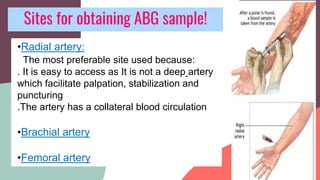
Sites for obtaining ABG sample!
•Radial artery:
The most preferable site used because:
. It is easy to access as It is not a deep artery
which facilitate palpation, stabilization and
puncturing
.The artery has a collateral blood circulation
•Brachial artery
•Femoral artery
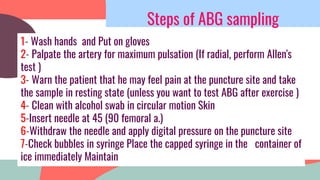
1- Wash hands and Put on gloves
2- Palpate the artery for maximum pulsation (If radial, perform Allen's
test )
3- Warn the patient that he may feel pain at the puncture site and take
the sample in resting state (unless you want to test ABG after exercise )
4- Clean with alcohol swab in circular motion Skin
5-Insert needle at 45 (90 femoral a.)
6-Withdraw the needle and apply digital pressure on the puncture site
7-Check bubbles in syringe Place the capped syringe in the container of
ice immediately Maintain
Steps of ABG sampling
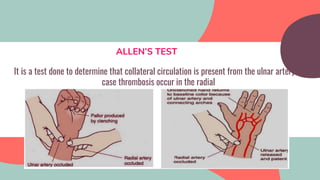
It is a test done to determine that collateral circulation is present from the ulnar artery in
case thrombosis occur in the radial
ALLEN’S TEST
ALLEN’S test video
ABG Sampling video
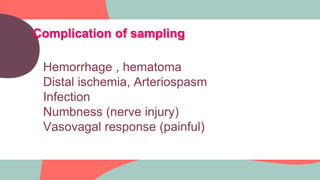
Complication of sampling
Hemorrhage , hematoma
Distal ischemia, Arteriospasm
Infection
Numbness (nerve injury)
Vasovagal response (painful)
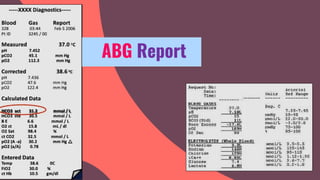
ABG Report
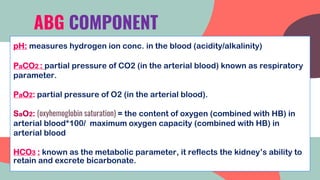
pH: measures hydrogen ion conc. in the blood (acidity/alkalinity)
PaCO2 : partial pressure of CO2 (in the arterial blood) known as respiratory
parameter.
PaO2: partial pressure of O2 (in the arterial blood).
SaO2: (oxyhemoglobin saturation) = the content of oxygen (combined with HB) in
arterial blood*100/ maximum oxygen capacity (combined with HB) in
arterial blood
HCO3 : known as the metabolic parameter, it reflects the kidney’s ability to
retain and excrete bicarbonate.
ABG COMPONENT
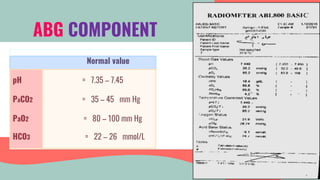
Normal value
pH = 7.35 – 7.45
PaCO2 = 35 – 45 mm Hg
PaO2 = 80 – 100 mm Hg
HCO3 = 22 – 26 mmol/L
ABG COMPONENT
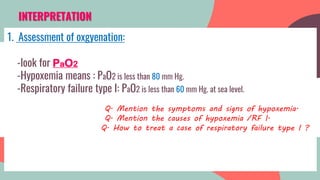
1. Assessment of oxgyenation:
-look for PaO2
-Hypoxemia means : PaO2 is less than 80 mm Hg.
-Respiratory failure type I: PaO2 is less than 60 mm Hg. at sea level.
…………………………………………Q. Mention the symptoms and signs of hypoxemia.
…………………………………………Q. Mention the causes of hypoxemia /RF I.
Q. How to treat a case of respiratory failure type I ?
INTERPRETATION
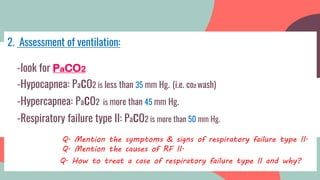
2. Assessment of ventilation:
-look for PaCO2
-Hypocapnea: PacO2 is less than 35 mm Hg. (i.e. co2 wash)
-Hypercapnea: PacO2 is more than 45 mm Hg.
-Respiratory failure type II: PacO2 is more than 50 mm Hg.
………………………Q. Mention the symptoms & signs of respiratory failure type II.
………………………Q. Mention the causes of RF II.
Q. How to treat a case of respiratory failure type II and why?
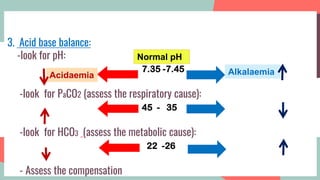
3. Acid base balance:
-look for pH:
7.35 -7.45
-look for PaCO2 (assess the respiratory cause):
45 - 35
-look for HCO3 (assess the metabolic cause):
22 -26
- Assess the compensation
Acidaemia Alkalaemia
Normal pH
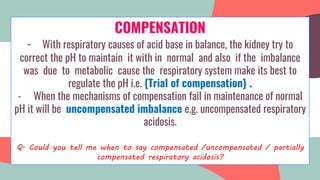
COMPENSATION
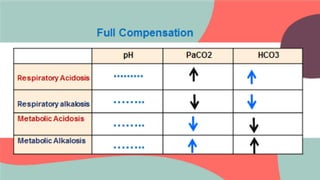
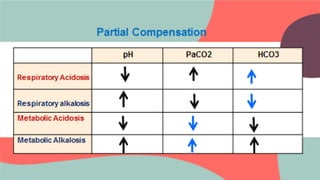
- With respiratory causes of acid base in balance, the kidney try to
correct the pH to maintain it with in normal and also if the imbalance
was due to metabolic cause the respiratory system make its best to
regulate the pH i.e. {Trial of compensation} .
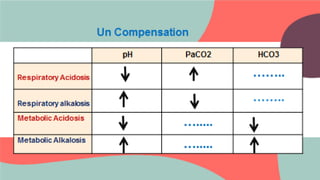
- When the mechanisms of compensation fail in maintenance of normal
pH it will be uncompensated imbalance e.g. uncompensated respiratory
acidosis.
Q. Could you tell me when to say compensated /uncompensated / partially
compensated respiratory acidosis?
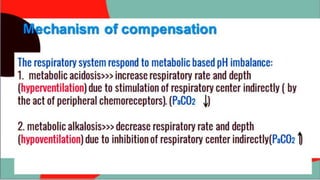
The respiratory system respond to metabolic based pH imbalance:
1. metabolic acidosis>>> increase respiratory rate and depth
(hyperventilation) due to stimulation of respiratory center indirectly ( by
the act of peripheral chemoreceptors). (PaCO2 )
2. metabolic alkalosis>>> decrease respiratory rate and depth
(hypoventilation) due to inhibition of respiratory center indirectly(PaCO2 )
Mechanism of compensation
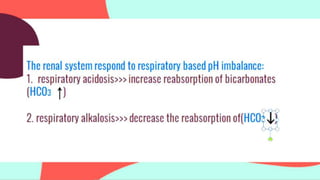
The renal system respond to respiratory based pH imbalance:
1. respiratory acidosis>>> increase reabsorption of bicarbonates
(HCO3 )
2. respiratory alkalosis>>> decrease the reabsorption of(HCO3 )
HCO3
PaCO2
pH
.........
Respiratory Acidosis
……..
Respiratory alkalosis
……..
Metabolic Acidosis
……..
Metabolic Alkalosis
Full Compensation
HCO3
PaCO2
pH
Respiratory Acidosis
Respiratory alkalosis
Metabolic Acidosis
Metabolic Alkalosis
Partial Compensation
HCO3
PaCO2
pH
……..
Respiratory Acidosis
Respiratory alkalosis
….....
Metabolic Acidosis
….....
Metabolic Alkalosis
Un Compensation
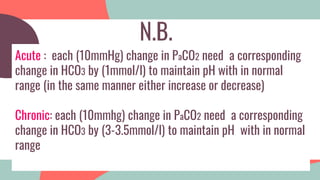
N.B.
Acute : each (10mmHg) change in PaCO2 need a corresponding
change in HCO3 by (1mmol/l) to maintain pH with in normal
range (in the same manner either increase or decrease)
Chronic: each (10mmhg) change in PaCO2 need a corresponding
change in HCO3 by (3-3.5mmol/l) to maintain pH with in normal
range
EXAMPLE
NORMAL ABG
PH 7.36
PaCO2 60 mmHg
PaO2 50 mmHg
HCO3 30 mmol/l
Respiratory failure type
2,fully compensated
Respiratory acidosis
1. Decreased PaO2 [hypoxemia]
2. Increased(hypercapnea i.e respiratory cause)
3. Normal pH (corrected)
4. increased HCO3 (compensation)
INTERPRETATION OF ABG RESULTS:
Exp.1 : ABG sample for a patient in ER diagnosed as acute
exacerbation COPD :
N.B. Even if pH was normal
look for PaCO2 and HCO3
to exclude compensated
acid base imbalance
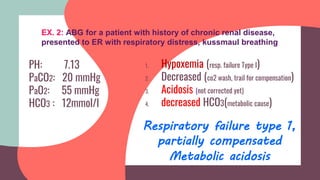
PH: 7.13
PaCO2: 20 mmHg
PaO2: 55 mmHg
HCO3 : 12mmol/l
1. Hypoxemia (resp. failure Type I)
2. Decreased (co2 wash, trail for compensation)
3. Acidosis (not corrected yet)
4. decreased HCO3(metabolic cause)
Respiratory failure type 1,
partially compensated
Metabolic acidosis
EX. 2: ABG for a patient with history of chronic renal disease,
presented to ER with respiratory distress, kussmaul breathing
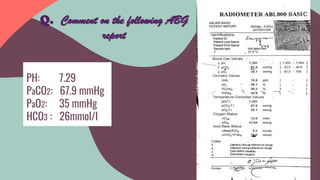
Q. Comment on the following ABG
report
PH: 7.29
PaCO2: 67.9 mmHg
PaO2: 35 mmHg
HCO3 : 26mmol/l
THANKS

ABG test

  • 1.
    Arterial Blood Gas (ABG) Preparedby / Esraa Abdou Saad Ass. Lecturer, Chest Department, Faculty of medicine, Sohag University
  • 2.
    It is adiagnostic procedure in which a blood is obtained from an artery directly by an arterial puncture or accessed by a way of indwelling arterial catheter What is ABG ?
  • 3.
    -Assessment of ventilation,Assessment of oxygenation, Assessment of acid base balance so help in diagnoses and assess the complication of certain disease -Modification of treatment plan -Follow up Why do you need ABG?!
  • 4.
  • 5.
    Sites for obtainingABG sample! •Radial artery: The most preferable site used because: . It is easy to access as It is not a deep artery which facilitate palpation, stabilization and puncturing .The artery has a collateral blood circulation •Brachial artery •Femoral artery
  • 6.
    1- Wash handsand Put on gloves 2- Palpate the artery for maximum pulsation (If radial, perform Allen's test ) 3- Warn the patient that he may feel pain at the puncture site and take the sample in resting state (unless you want to test ABG after exercise ) 4- Clean with alcohol swab in circular motion Skin 5-Insert needle at 45 (90 femoral a.) 6-Withdraw the needle and apply digital pressure on the puncture site 7-Check bubbles in syringe Place the capped syringe in the container of ice immediately Maintain Steps of ABG sampling
  • 7.
    It is atest done to determine that collateral circulation is present from the ulnar artery in case thrombosis occur in the radial ALLEN’S TEST
  • 8.
  • 9.
  • 10.
    Complication of sampling Hemorrhage, hematoma Distal ischemia, Arteriospasm Infection Numbness (nerve injury) Vasovagal response (painful)
  • 11.
  • 12.
    pH: measures hydrogenion conc. in the blood (acidity/alkalinity) PaCO2 : partial pressure of CO2 (in the arterial blood) known as respiratory parameter. PaO2: partial pressure of O2 (in the arterial blood). SaO2: (oxyhemoglobin saturation) = the content of oxygen (combined with HB) in arterial blood*100/ maximum oxygen capacity (combined with HB) in arterial blood HCO3 : known as the metabolic parameter, it reflects the kidney’s ability to retain and excrete bicarbonate. ABG COMPONENT
  • 13.
    Normal value pH =7.35 – 7.45 PaCO2 = 35 – 45 mm Hg PaO2 = 80 – 100 mm Hg HCO3 = 22 – 26 mmol/L ABG COMPONENT
  • 14.
    1. Assessment ofoxgyenation: -look for PaO2 -Hypoxemia means : PaO2 is less than 80 mm Hg. -Respiratory failure type I: PaO2 is less than 60 mm Hg. at sea level. …………………………………………Q. Mention the symptoms and signs of hypoxemia. …………………………………………Q. Mention the causes of hypoxemia /RF I. Q. How to treat a case of respiratory failure type I ? INTERPRETATION
  • 15.
    2. Assessment ofventilation: -look for PaCO2 -Hypocapnea: PacO2 is less than 35 mm Hg. (i.e. co2 wash) -Hypercapnea: PacO2 is more than 45 mm Hg. -Respiratory failure type II: PacO2 is more than 50 mm Hg. ………………………Q. Mention the symptoms & signs of respiratory failure type II. ………………………Q. Mention the causes of RF II. Q. How to treat a case of respiratory failure type II and why?
  • 16.
    3. Acid basebalance: -look for pH: 7.35 -7.45 -look for PaCO2 (assess the respiratory cause): 45 - 35 -look for HCO3 (assess the metabolic cause): 22 -26 - Assess the compensation Acidaemia Alkalaemia Normal pH
  • 17.
    COMPENSATION - With respiratorycauses of acid base in balance, the kidney try to correct the pH to maintain it with in normal and also if the imbalance was due to metabolic cause the respiratory system make its best to regulate the pH i.e. {Trial of compensation} . - When the mechanisms of compensation fail in maintenance of normal pH it will be uncompensated imbalance e.g. uncompensated respiratory acidosis. Q. Could you tell me when to say compensated /uncompensated / partially compensated respiratory acidosis?
  • 18.
    The respiratory systemrespond to metabolic based pH imbalance: 1. metabolic acidosis>>> increase respiratory rate and depth (hyperventilation) due to stimulation of respiratory center indirectly ( by the act of peripheral chemoreceptors). (PaCO2 ) 2. metabolic alkalosis>>> decrease respiratory rate and depth (hypoventilation) due to inhibition of respiratory center indirectly(PaCO2 ) Mechanism of compensation
  • 19.
    The renal systemrespond to respiratory based pH imbalance: 1. respiratory acidosis>>> increase reabsorption of bicarbonates (HCO3 ) 2. respiratory alkalosis>>> decrease the reabsorption of(HCO3 )
  • 20.
  • 21.
    HCO3 PaCO2 pH Respiratory Acidosis Respiratory alkalosis MetabolicAcidosis Metabolic Alkalosis Partial Compensation
  • 22.
  • 23.
    N.B. Acute : each(10mmHg) change in PaCO2 need a corresponding change in HCO3 by (1mmol/l) to maintain pH with in normal range (in the same manner either increase or decrease) Chronic: each (10mmhg) change in PaCO2 need a corresponding change in HCO3 by (3-3.5mmol/l) to maintain pH with in normal range
  • 24.
  • 25.
  • 26.
    PH 7.36 PaCO2 60mmHg PaO2 50 mmHg HCO3 30 mmol/l Respiratory failure type 2,fully compensated Respiratory acidosis 1. Decreased PaO2 [hypoxemia] 2. Increased(hypercapnea i.e respiratory cause) 3. Normal pH (corrected) 4. increased HCO3 (compensation) INTERPRETATION OF ABG RESULTS: Exp.1 : ABG sample for a patient in ER diagnosed as acute exacerbation COPD : N.B. Even if pH was normal look for PaCO2 and HCO3 to exclude compensated acid base imbalance
  • 27.
    PH: 7.13 PaCO2: 20mmHg PaO2: 55 mmHg HCO3 : 12mmol/l 1. Hypoxemia (resp. failure Type I) 2. Decreased (co2 wash, trail for compensation) 3. Acidosis (not corrected yet) 4. decreased HCO3(metabolic cause) Respiratory failure type 1, partially compensated Metabolic acidosis EX. 2: ABG for a patient with history of chronic renal disease, presented to ER with respiratory distress, kussmaul breathing
  • 28.
    Q. Comment onthe following ABG report PH: 7.29 PaCO2: 67.9 mmHg PaO2: 35 mmHg HCO3 : 26mmol/l
  • 29.