AMPUTATIONS
Dr. M. AZHAR QURESHI
Consultant General Surgeon
KKMC HOSPITAL
DEFINITION
Removal of the whole or part of an arm/hand or leg/foot
• Primary Amputation.
Amputation performed without an attempt at
limb salvage.
• Secondary Amputation.
Amputation performed following a failed
attempt at limb salvage.
• Traumatic amputation.
Amputation occurring at the time of injury.
INCIDENCE
vascular/
diabetes
83%
trauma
10%
tumors
3%
infections
1%
Neurological/
congenital
3%
Other
4%
INCIDENCE
(contd..)
Age
Non Traumatic-common in 50-75 yrs of age
Traumatic- common in young age
Sex
Approx. 75% male
25% female
Limb
Approx. 85% - lower limb
15% -- upper limb
INDICATIONS
3 ‘Ds’
• Three main groups:
a. Dead : Due to arterial occlusive disease causing gangrene
b. Deadly : This is seen in moist gangrene when putrefaction and
infection spreads to involve adjacent healthy tissues.
c. Dead Loss: When due to relentless ischemic pain, paralysis, trauma or
deformity the limb can not be used or it hinders its normal
function
GENERAL PRINCIPLES OF
AMPUTATIONS
• Treat the cause if possible and try to save the limb
• The patient should be given time to come to terms with
inevitability of amputation and then get informed consent.
• Discuss the level with experts in regional limb fitting center
• General anesthesia is preferable
• Try to preserve joints
• Try to preserve epiphysis in children
• For tumors confirm the diagnosis with tissue biopsy
7
LEVEL OF AMPUTATION
8
Certain tests are designed to measure the blood flow which
help in deciding the exact level of amputation. They are:
1. Doppler Studies,DSA,MRA,CT angiography of the limb.
2. Xenon 133 studies. It uses radiopharmaceutical material.
3. Transcutaneous Oxygen ( TcPO2 ) mapping with oxygen
electrode
4. Laser Doppler measurements of the microcirculation of skin
5. Skin Fluorescent Studies to measure skin microcirculation
6. Skin perfusion measurements with BP cuff & photoelectric
detector
7. Infrared measurements of skin temperature
STUMP LENGTH
• In the upper arm and fore arm a 20 cm stump is
recommended
• In an above knee amputation a 25 to 30 cm
stump is optimum
• For lower leg a 14 cm tibial stump is ideal
• A stump a less than 8 cm below knee and 20 cm
above is difficult to secure in a prosthesis
• Stump should not be too long to hinder the
mobility of artificial joint
9
PREPARATION
• Prophylactic antibiotics
• Clean the limb and seal off infected or necrotic area
• Arrange for disposal of amputated limb according
to religious and cultural customs
• Clearly mark the affected limb
10
OPERATIVE PROCEDURE
1. Flaps
2. Division of skin and muscles
3. Nerves
4. Blood vessels
5. Bone
6. Closure
11
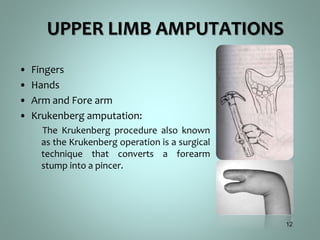
UPPER LIMB AMPUTATIONS
• Fingers
• Hands
• Arm and Fore arm
• Krukenberg amputation:
The Krukenberg procedure also known
as the Krukenberg operation is a surgical
technique that converts a forearm
stump into a pincer.
12
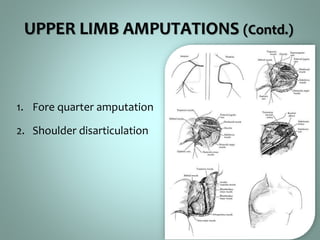
UPPER LIMB AMPUTATIONS (Contd.)
1. Fore quarter amputation
2. Shoulder disarticulation
13
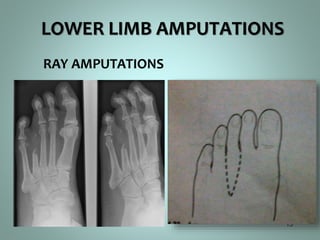
LOWER LIMB AMPUTATIONS
1. End bearing : pressure born at the end of the
amputated limb
a. Through knee
b. Gritti Stokes
c. Syme’s Amputation
2. Cone bearing : pressure born elsewhere
proximal to the amputated cite (by prosthesis)
a. Above Knee amputation
b. Below knee amputation
14
LOWER LIMB AMPUTATIONS
15
RAY AMPUTATIONS
TRANSMETATARSAL-
AMPUTATION
16
LISFRANC-AMPUTATION
17
• Amputation of the foot between the metatarsus and tarsus.
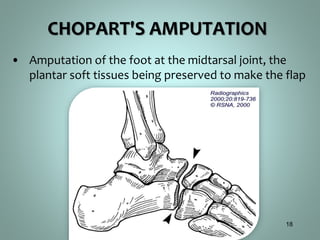
CHOPART'S AMPUTATION
• Amputation of the foot at the midtarsal joint, the
plantar soft tissues being preserved to make the flap
18
PIROGOFF’S AMPUTATION
19
Pre-Operative Post Operative
SYME-AMPUTATION
20
• Disarticulation of the foot with removal of both malleoli.
BELOW KNEE AMPUTATION
21
GRITTI-STOKES AMPUTATION
22
ABOVE KNEE AMPUTATION
23
HINDQUARTER AMPUTATION
24
• An operation involving removal of an entire leg and
part or all of the pelvis associated with it.
GOALS OF POST OP
MANAGEMENT
25
Prompt, uncomplicated wound healing
Control of edema
Control of Postoperative pain
Prevention of joint contractures
Rapid rehabilitation
RISK FACTORS
• Diabetes & other co-morbidities
• Poor Blood Supply
• Malnutrition & Anemia
• Immuno-compromised states
• Clotting disorders
• Pre-existing infection
• Obesity
26
COMPLICATIONS
General
• DVT & Cardio-vascular accidents
• Atelectasis and pneumonia
• New onset renal failure
• Psychological
Local
• Bleeding / Hematoma
• Flap Necrosis
• Neuromas
• Joint contracture
• Phantom limb / Phantom Pain
• Infection
27
VACUUM ASSISTED DRESSING
(VAC)
First described by Fleischmann et al in 1993,
Vacuum Assisted Closure (also called vacuum
therapy, vacuum sealing or topical negative pressure
therapy) is a sophisticated development for chronic,
discharging non-healing wound.
28
29
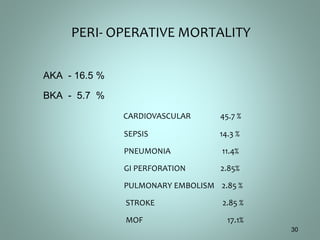
PERI- OPERATIVE MORTALITY
AKA - 16.5 %
BKA - 5.7 %
CARDIOVASCULAR 45.7 %
SEPSIS 14.3 %
PNEUMONIA 11.4%
GI PERFORATION 2.85%
PULMONARY EMBOLISM 2.85 %
STROKE 2.85 %
MOF 17.1%
30
31
PROGNOSIS
(AKA Vs BKA)
32
PROGNOSIS
(Renal Dysfunction)
33
PROGNOSIS
(Diabetes)
CONCLUSION
34
• Always try to treat the cause in order to avoid
amputation
• If inevitable then don’t delay it
• With proper rehabilitation and well fitted prosthesis
patient can lead a normal life.
Thank You
35
QUESTIONS ??
36

AMPUTATIONS-PRESENTATION.pptx

  • 2.
    AMPUTATIONS Dr. M. AZHARQURESHI Consultant General Surgeon KKMC HOSPITAL
  • 3.
    DEFINITION Removal of thewhole or part of an arm/hand or leg/foot • Primary Amputation. Amputation performed without an attempt at limb salvage. • Secondary Amputation. Amputation performed following a failed attempt at limb salvage. • Traumatic amputation. Amputation occurring at the time of injury.
  • 4.
  • 5.
    INCIDENCE (contd..) Age Non Traumatic-common in50-75 yrs of age Traumatic- common in young age Sex Approx. 75% male 25% female Limb Approx. 85% - lower limb 15% -- upper limb
  • 6.
    INDICATIONS 3 ‘Ds’ • Threemain groups: a. Dead : Due to arterial occlusive disease causing gangrene b. Deadly : This is seen in moist gangrene when putrefaction and infection spreads to involve adjacent healthy tissues. c. Dead Loss: When due to relentless ischemic pain, paralysis, trauma or deformity the limb can not be used or it hinders its normal function
  • 7.
    GENERAL PRINCIPLES OF AMPUTATIONS •Treat the cause if possible and try to save the limb • The patient should be given time to come to terms with inevitability of amputation and then get informed consent. • Discuss the level with experts in regional limb fitting center • General anesthesia is preferable • Try to preserve joints • Try to preserve epiphysis in children • For tumors confirm the diagnosis with tissue biopsy 7
  • 8.
    LEVEL OF AMPUTATION 8 Certaintests are designed to measure the blood flow which help in deciding the exact level of amputation. They are: 1. Doppler Studies,DSA,MRA,CT angiography of the limb. 2. Xenon 133 studies. It uses radiopharmaceutical material. 3. Transcutaneous Oxygen ( TcPO2 ) mapping with oxygen electrode 4. Laser Doppler measurements of the microcirculation of skin 5. Skin Fluorescent Studies to measure skin microcirculation 6. Skin perfusion measurements with BP cuff & photoelectric detector 7. Infrared measurements of skin temperature
  • 9.
    STUMP LENGTH • Inthe upper arm and fore arm a 20 cm stump is recommended • In an above knee amputation a 25 to 30 cm stump is optimum • For lower leg a 14 cm tibial stump is ideal • A stump a less than 8 cm below knee and 20 cm above is difficult to secure in a prosthesis • Stump should not be too long to hinder the mobility of artificial joint 9
  • 10.
    PREPARATION • Prophylactic antibiotics •Clean the limb and seal off infected or necrotic area • Arrange for disposal of amputated limb according to religious and cultural customs • Clearly mark the affected limb 10
  • 11.
    OPERATIVE PROCEDURE 1. Flaps 2.Division of skin and muscles 3. Nerves 4. Blood vessels 5. Bone 6. Closure 11
  • 12.
    UPPER LIMB AMPUTATIONS •Fingers • Hands • Arm and Fore arm • Krukenberg amputation: The Krukenberg procedure also known as the Krukenberg operation is a surgical technique that converts a forearm stump into a pincer. 12
  • 13.
    UPPER LIMB AMPUTATIONS(Contd.) 1. Fore quarter amputation 2. Shoulder disarticulation 13
  • 14.
    LOWER LIMB AMPUTATIONS 1.End bearing : pressure born at the end of the amputated limb a. Through knee b. Gritti Stokes c. Syme’s Amputation 2. Cone bearing : pressure born elsewhere proximal to the amputated cite (by prosthesis) a. Above Knee amputation b. Below knee amputation 14
  • 15.
  • 16.
  • 17.
    LISFRANC-AMPUTATION 17 • Amputation ofthe foot between the metatarsus and tarsus.
  • 18.
    CHOPART'S AMPUTATION • Amputationof the foot at the midtarsal joint, the plantar soft tissues being preserved to make the flap 18
  • 19.
  • 20.
    SYME-AMPUTATION 20 • Disarticulation ofthe foot with removal of both malleoli.
  • 21.
  • 22.
  • 23.
  • 24.
    HINDQUARTER AMPUTATION 24 • Anoperation involving removal of an entire leg and part or all of the pelvis associated with it.
  • 25.
    GOALS OF POSTOP MANAGEMENT 25 Prompt, uncomplicated wound healing Control of edema Control of Postoperative pain Prevention of joint contractures Rapid rehabilitation
  • 26.
    RISK FACTORS • Diabetes& other co-morbidities • Poor Blood Supply • Malnutrition & Anemia • Immuno-compromised states • Clotting disorders • Pre-existing infection • Obesity 26
  • 27.
    COMPLICATIONS General • DVT &Cardio-vascular accidents • Atelectasis and pneumonia • New onset renal failure • Psychological Local • Bleeding / Hematoma • Flap Necrosis • Neuromas • Joint contracture • Phantom limb / Phantom Pain • Infection 27
  • 28.
    VACUUM ASSISTED DRESSING (VAC) Firstdescribed by Fleischmann et al in 1993, Vacuum Assisted Closure (also called vacuum therapy, vacuum sealing or topical negative pressure therapy) is a sophisticated development for chronic, discharging non-healing wound. 28
  • 29.
  • 30.
    PERI- OPERATIVE MORTALITY AKA- 16.5 % BKA - 5.7 % CARDIOVASCULAR 45.7 % SEPSIS 14.3 % PNEUMONIA 11.4% GI PERFORATION 2.85% PULMONARY EMBOLISM 2.85 % STROKE 2.85 % MOF 17.1% 30
  • 31.
  • 32.
  • 33.
  • 34.
    CONCLUSION 34 • Always tryto treat the cause in order to avoid amputation • If inevitable then don’t delay it • With proper rehabilitation and well fitted prosthesis patient can lead a normal life.
  • 35.
  • 36.

Editor's Notes

  • #27 Amputation of a limb is a very personal loss and in many patients can feel like a bereavement. The emotional loss can be like losing a relative and it will take time to adapt to such a loss. Phantom pain-- massage , cold packs, exercise and neuromuscular stimulation -TENS ( trans cutaneous electric nerve stimulation) : incorporated in a prosthesis
  • #28 Amputation of a limb is a very personal loss and in many patients can feel like a bereavement. The emotional loss can be like losing a relative and it will take time to adapt to such a loss. Phantom pain-- massage , cold packs, exercise and neuromuscular stimulation -TENS ( trans cutaneous electric nerve stimulation) : incorporated in a prosthesis
  • #29 Amputation of a limb is a very personal loss and in many patients can feel like a bereavement. The emotional loss can be like losing a relative and it will take time to adapt to such a loss. Phantom pain-- massage , cold packs, exercise and neuromuscular stimulation -TENS ( trans cutaneous electric nerve stimulation) : incorporated in a prosthesis
  • #31 Amputation of a limb is a very personal loss and in many patients can feel like a bereavement. The emotional loss can be like losing a relative and it will take time to adapt to such a loss. Phantom pain-- massage , cold packs, exercise and neuromuscular stimulation -TENS ( trans cutaneous electric nerve stimulation) : incorporated in a prosthesis
  • #32 Amputation of a limb is a very personal loss and in many patients can feel like a bereavement. The emotional loss can be like losing a relative and it will take time to adapt to such a loss. Phantom pain-- massage , cold packs, exercise and neuromuscular stimulation -TENS ( trans cutaneous electric nerve stimulation) : incorporated in a prosthesis
  • #33 Amputation of a limb is a very personal loss and in many patients can feel like a bereavement. The emotional loss can be like losing a relative and it will take time to adapt to such a loss. Phantom pain-- massage , cold packs, exercise and neuromuscular stimulation -TENS ( trans cutaneous electric nerve stimulation) : incorporated in a prosthesis
  • #34 Amputation of a limb is a very personal loss and in many patients can feel like a bereavement. The emotional loss can be like losing a relative and it will take time to adapt to such a loss. Phantom pain-- massage , cold packs, exercise and neuromuscular stimulation -TENS ( trans cutaneous electric nerve stimulation) : incorporated in a prosthesis