Dr. Rehmah Sarfraz
MBBS, M.Phil (Anatomy), MHPE
Professor of Anatomy
Head Department of Medical Education
Islamabad Medical & Dental College (IM&DC), Islamabad
Email Address: rehmah.sarfraz@imdcollege.edu.pk
drrehmahsarfraz-chpe@szabmu.edu.pk
Integrated
Curriculum
19th November, 2020
SZABMU CHPE 3rd Contact Session
• Objectives
• History of curriculum
• Curricular Models
• What is integration?
• Types of integration
• SPICES
• Principles
• Integration ladder
• Issues
• Activity
• Twelve tips for development of integrated curriculum
• Take home message
Ground Rules
• Keep the cell phone on silent mode.
• Switch on the camera.
Objectives
By the end of this session all participants will be able to:
• Outline the salient features of curricular models.
• Differentiate between vertical and horizontal integration.
• Distinguish between different levels of integration.
• Identify the principles of integrated curriculum.
• Use tips to develop an integrated curriculum.
History of Curriculum
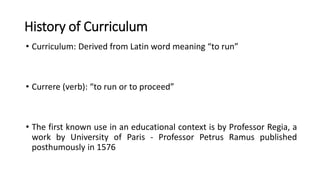
• Curriculum: Derived from Latin word meaning “to run”
• Currere (verb): “to run or to proceed”
• The first known use in an educational context is by Professor Regia, a
work by University of Paris - Professor Petrus Ramus published
posthumously in 1576
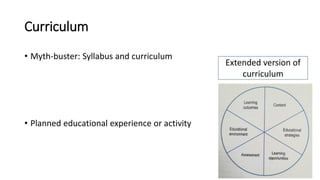
Curriculum
• Myth-buster: Syllabus and curriculum
• Planned educational experience or activity
Extended version of
curriculum
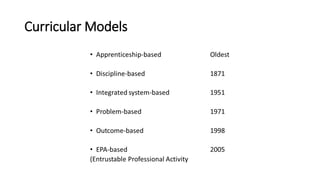
Curricular Models
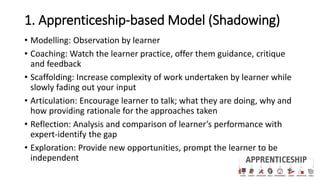
1. Apprenticeship-based Model (Shadowing)
• Modelling: Observation by learner
• Coaching: Watch the learner practice, offer them guidance, critique
and feedback
• Scaffolding: Increase complexity of work undertaken by learner while
slowly fading out your input
• Articulation: Encourage learner to talk; what they are doing, why and
how providing rationale for the approaches taken
• Reflection: Analysis and comparison of learner’s performance with
expert-identify the gap
• Exploration: Provide new opportunities, prompt the learner to be
independent
2. Outcome-based Model (OBE):
• Broad learning outcomes are clearly defined
• Decisions related to curriculum are based on specified learning
outcomes (e.g. content, strategies, assessment)
• Shift from process product
• Top bottom approach
3. EPA-based Model
(Entrustable Professional Activity):
• Tasks or responsibilities to be entrusted to the unsupervised
execution by a trainee once he or she has attained sufficient specific
competence:
-Observation but no execution by the trainee, even with direct
supervision
-Execution with direct, proactive supervision
-Execution with reactive supervision, i.e., on request and quickly
available
-Supervision at a distance
-Supervision provided by the trainee to more junior colleagues
What is ?
“Integration is the organization of teaching matter to
interrelate or unify subjects frequently taught in
separate academic courses or departments.”
Harden et al., 1984
“Information in isolation is inert and unhelpful.”
Regehr and Norman, 1996
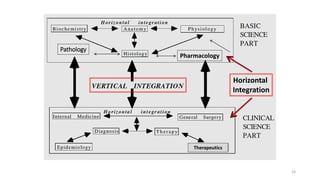
Types of Integration
1. Horizontal:
Information during same curricular
phase/year is taught together
Organized into blocks or units
corresponding to body systems
Basic
Sciences
Clinical
Sciences
Example of horizontal integration:
Musculoskeletal
Gastrointestinal
Cardiovascular
Renal
Reproductive
Anatomy, Physiology, Biochemistry along with their applied aspects
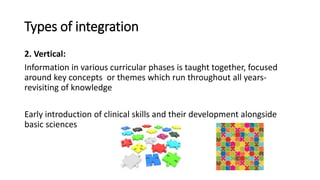
2. Vertical:
Information in various curricular phases is taught together, focused
around key concepts or themes which run throughout all years-
revisiting of knowledge
Early introduction of clinical skills and their development alongside
basic sciences
Types of integration
• Clinical and communication skills
• Basic and clinical sciences
• Social, community and population health
• Law, ethics and professionalism
Example of vertical integration:
18
Horizontal
Integration
Pathology
Pharmacology
Therapeutics
Example
An excess loss of water and electrolytes because of diarrhea can
result in changes in other body systems such as conservation of water
and electrolytes by the kidneys, a thirst response in the brain triggered
by hormones & a stress response by the cardiovascular system to
maintain adequate blood pressure.
Some facts about integration…
• Bridges the practice-theory gap.
• Teaching and learning methods will facilitate this process.
• Curriculum organization plays a vital role.
• Integration is within the brain of learner.
21
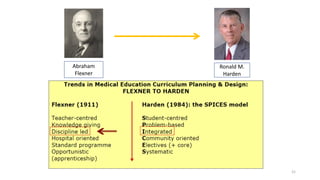
Abraham
Flexner
Ronald M.
Harden
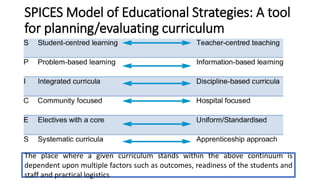
SPICES Model of Educational Strategies: A tool
for planning/evaluating curriculum
The place where a given curriculum stands within the above continuum is
dependent upon multiple factors such as outcomes, readiness of the students and
staff and practical logistics
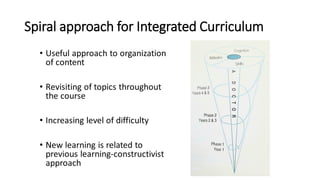
Spiral approach for Integrated Curriculum
“When students learn complex tasks in an integrated manner, it will be
easier for them to transfer what they have learned to the reality of
day-to-day work settings.”
Janssen-Noordman et al-2006
Principles of Integration
1. Focus on key issues:
• Promotes learning in context
• Adopts holistic approach
• Focuses around core curriculum
2. Enhances construction of knowledge:
• Integration
• Deep understanding of new concepts
• Identification of gaps
• Problem-solving approach
3. Promotes application of knowledge in real life situation:
• Learning through problems
• Using the knowledge gained to solve new problems /new situations
• Getting feedback and improving the learning
4. Fosters critical thinking and life long thinking skills:
• Interpreting data
• Searching evidence
• Making decisions
• Finding relationships
5. Enforces staff development:
• Improving teaching skills
• Mastering new techniques
• Giving constructive feedback
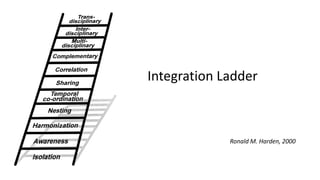
Integration Ladder
Ronald M. Harden, 2000
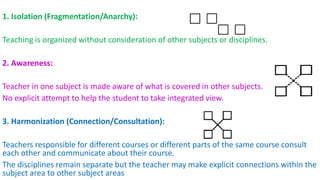
1. Isolation (Fragmentation/Anarchy):
Teaching is organized without consideration of other subjects or disciplines.
2. Awareness:
Teacher in one subject is made aware of what is covered in other subjects.
No explicit attempt to help the student to take integrated view.
3. Harmonization (Connection/Consultation):
Teachers responsible for different courses or different parts of the same course consult
each other and communicate about their course.
The disciplines remain separate but the teacher may make explicit connections within the
subject area to other subject areas
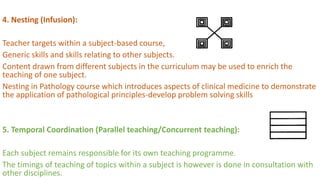
4. Nesting (Infusion):
Teacher targets within a subject-based course,
Generic skills and skills relating to other subjects.
Content drawn from different subjects in the curriculum may be used to enrich the
teaching of one subject.
Nesting in Pathology course which introduces aspects of clinical medicine to demonstrate
the application of pathological principles-develop problem solving skills
5. Temporal Coordination (Parallel teaching/Concurrent teaching):
Each subject remains responsible for its own teaching programme.
The timings of teaching of topics within a subject is however is done in consultation with
other disciplines.
6. Sharing (Joint teaching):
Two disciplines may agree to plan and jointly implement a
teaching programme.
Involvement of two disciplines with overlapping concepts.
Community child health programme run jointly by Community Medicine and
Paediatrics departments
7. Correlation (Concomitant programme/Democratic programme):
An integrated teaching session is introduced in addition to
subject-based teaching.
The emphasis remains on subjects.
8. Complementary (Mixed programme):
Integrated sessions represent a major feature of
Curriculum.
Subject-based curriculum still exists.
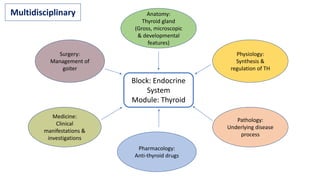
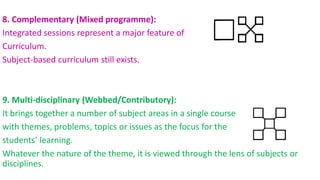
9. Multi-disciplinary (Webbed/Contributory):
It brings together a number of subject areas in a single course
with themes, problems, topics or issues as the focus for the
students’ learning.
Whatever the nature of the theme, it is viewed through the lens of subjects or
disciplines.
Block: Endocrine
System
Module: Thyroid
Anatomy:
Thyroid gland
(Gross, microscopic
& developmental
features)
Physiology:
Synthesis &
regulation of TH
Pathology:
Underlying disease
process
Pharmacology:
Anti-thyroid drugs
Surgery:
Management of
goiter
Medicine:
Clinical
manifestations &
investigations
Multidisciplinary
10. Inter-disciplinary (Monolithic):
A study of a phenomenon that involves the use of two or
more academic disciplines simultaneously.
Content of all or most subjects combined into a new course with a new menu.
There may be no reference to individual disciplines/subjects.
Subjects are not identified in the time table.
11. Trans-disciplinary (Fusion/Immersion/Authentic):
There is only one subject-LIFE
The teacher provides a structure/framework of learning opportunities but
integration is done in the mind of student, based on hi-fidelity situations in the real
world of clinical care.
• Dundee model (1-3 years of integrated around body systems, 4-5
years students are attached for periods of time to a range of
specialties in the hospital & community, 113 clinical problems/tasks
with guide).
• Authentic: Learning occurs in real world
• Fusion: Complete integration with mastery of competencies related to
tasks
• Immersion: Disciplines become part of learner’s experience
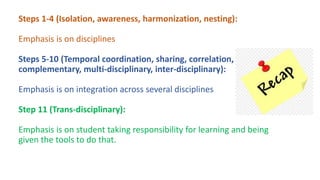
Steps 1-4 (Isolation, awareness, harmonization, nesting):
Emphasis is on disciplines
Steps 5-10 (Temporal coordination, sharing, correlation,
complementary, multi-disciplinary, inter-disciplinary):
Emphasis is on integration across several disciplines
Step 11 (Trans-disciplinary):
Emphasis is on student taking responsibility for learning and being
given the tools to do that.
• Leader
• Vision
• Build on the status quo
• Clarity of stake holders
• Faculty involvement
• Logistics
• Journey which needs a long-term strategic approach
Twelve Tips for Developing an Integrated
Curriculum
Alam Sher Malik & Rukhsana Hussain Malik, 2011
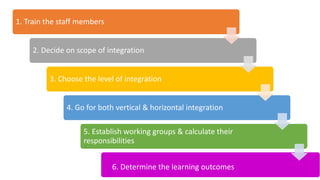
1. Train the staff members
2. Decide on scope of integration
3. Choose the level of integration
4. Go for both vertical & horizontal integration
5. Establish working groups & calculate their
responsibilities
6. Determine the learning outcomes
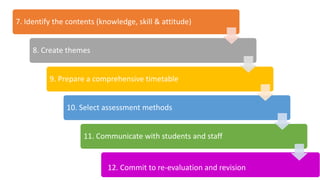
7. Identify the contents (knowledge, skill & attitude)
8. Create themes
9. Prepare a comprehensive timetable
10. Select assessment methods
11. Communicate with students and staff
12. Commit to re-evaluation and revision
Integrated Curriculum-Dr.Rehmah (1).pdf

Integrated Curriculum-Dr.Rehmah (1).pdf

  • 2.
    Dr. Rehmah Sarfraz MBBS,M.Phil (Anatomy), MHPE Professor of Anatomy Head Department of Medical Education Islamabad Medical & Dental College (IM&DC), Islamabad Email Address: rehmah.sarfraz@imdcollege.edu.pk drrehmahsarfraz-chpe@szabmu.edu.pk Integrated Curriculum 19th November, 2020 SZABMU CHPE 3rd Contact Session
  • 3.
    • Objectives • Historyof curriculum • Curricular Models • What is integration? • Types of integration • SPICES • Principles • Integration ladder • Issues • Activity • Twelve tips for development of integrated curriculum • Take home message
  • 4.
    Ground Rules • Keepthe cell phone on silent mode. • Switch on the camera.
  • 5.
    Objectives By the endof this session all participants will be able to: • Outline the salient features of curricular models. • Differentiate between vertical and horizontal integration. • Distinguish between different levels of integration. • Identify the principles of integrated curriculum. • Use tips to develop an integrated curriculum.
  • 6.
    History of Curriculum •Curriculum: Derived from Latin word meaning “to run” • Currere (verb): “to run or to proceed” • The first known use in an educational context is by Professor Regia, a work by University of Paris - Professor Petrus Ramus published posthumously in 1576
  • 7.
    Curriculum • Myth-buster: Syllabusand curriculum • Planned educational experience or activity Extended version of curriculum
  • 8.
  • 9.
    1. Apprenticeship-based Model(Shadowing) • Modelling: Observation by learner • Coaching: Watch the learner practice, offer them guidance, critique and feedback • Scaffolding: Increase complexity of work undertaken by learner while slowly fading out your input • Articulation: Encourage learner to talk; what they are doing, why and how providing rationale for the approaches taken • Reflection: Analysis and comparison of learner’s performance with expert-identify the gap • Exploration: Provide new opportunities, prompt the learner to be independent
  • 10.
    2. Outcome-based Model(OBE): • Broad learning outcomes are clearly defined • Decisions related to curriculum are based on specified learning outcomes (e.g. content, strategies, assessment) • Shift from process product • Top bottom approach
  • 11.
    3. EPA-based Model (EntrustableProfessional Activity): • Tasks or responsibilities to be entrusted to the unsupervised execution by a trainee once he or she has attained sufficient specific competence: -Observation but no execution by the trainee, even with direct supervision -Execution with direct, proactive supervision -Execution with reactive supervision, i.e., on request and quickly available -Supervision at a distance -Supervision provided by the trainee to more junior colleagues
  • 12.
    What is ? “Integrationis the organization of teaching matter to interrelate or unify subjects frequently taught in separate academic courses or departments.” Harden et al., 1984 “Information in isolation is inert and unhelpful.” Regehr and Norman, 1996
  • 13.
    Types of Integration 1.Horizontal: Information during same curricular phase/year is taught together Organized into blocks or units corresponding to body systems Basic Sciences Clinical Sciences
  • 14.
    Example of horizontalintegration: Musculoskeletal Gastrointestinal Cardiovascular Renal Reproductive Anatomy, Physiology, Biochemistry along with their applied aspects
  • 15.
    2. Vertical: Information invarious curricular phases is taught together, focused around key concepts or themes which run throughout all years- revisiting of knowledge Early introduction of clinical skills and their development alongside basic sciences Types of integration
  • 16.
    • Clinical andcommunication skills • Basic and clinical sciences • Social, community and population health • Law, ethics and professionalism Example of vertical integration:
  • 17.
  • 18.
    Example An excess lossof water and electrolytes because of diarrhea can result in changes in other body systems such as conservation of water and electrolytes by the kidneys, a thirst response in the brain triggered by hormones & a stress response by the cardiovascular system to maintain adequate blood pressure.
  • 19.
    Some facts aboutintegration… • Bridges the practice-theory gap. • Teaching and learning methods will facilitate this process. • Curriculum organization plays a vital role. • Integration is within the brain of learner.
  • 20.
  • 21.
    SPICES Model ofEducational Strategies: A tool for planning/evaluating curriculum The place where a given curriculum stands within the above continuum is dependent upon multiple factors such as outcomes, readiness of the students and staff and practical logistics
  • 22.
    Spiral approach forIntegrated Curriculum
  • 23.
    “When students learncomplex tasks in an integrated manner, it will be easier for them to transfer what they have learned to the reality of day-to-day work settings.” Janssen-Noordman et al-2006
  • 24.
    Principles of Integration 1.Focus on key issues: • Promotes learning in context • Adopts holistic approach • Focuses around core curriculum 2. Enhances construction of knowledge: • Integration • Deep understanding of new concepts • Identification of gaps • Problem-solving approach
  • 25.
    3. Promotes applicationof knowledge in real life situation: • Learning through problems • Using the knowledge gained to solve new problems /new situations • Getting feedback and improving the learning 4. Fosters critical thinking and life long thinking skills: • Interpreting data • Searching evidence • Making decisions • Finding relationships 5. Enforces staff development: • Improving teaching skills • Mastering new techniques • Giving constructive feedback
  • 26.
  • 27.
    1. Isolation (Fragmentation/Anarchy): Teachingis organized without consideration of other subjects or disciplines. 2. Awareness: Teacher in one subject is made aware of what is covered in other subjects. No explicit attempt to help the student to take integrated view. 3. Harmonization (Connection/Consultation): Teachers responsible for different courses or different parts of the same course consult each other and communicate about their course. The disciplines remain separate but the teacher may make explicit connections within the subject area to other subject areas
  • 28.
    4. Nesting (Infusion): Teachertargets within a subject-based course, Generic skills and skills relating to other subjects. Content drawn from different subjects in the curriculum may be used to enrich the teaching of one subject. Nesting in Pathology course which introduces aspects of clinical medicine to demonstrate the application of pathological principles-develop problem solving skills 5. Temporal Coordination (Parallel teaching/Concurrent teaching): Each subject remains responsible for its own teaching programme. The timings of teaching of topics within a subject is however is done in consultation with other disciplines.
  • 29.
    6. Sharing (Jointteaching): Two disciplines may agree to plan and jointly implement a teaching programme. Involvement of two disciplines with overlapping concepts. Community child health programme run jointly by Community Medicine and Paediatrics departments 7. Correlation (Concomitant programme/Democratic programme): An integrated teaching session is introduced in addition to subject-based teaching. The emphasis remains on subjects.
  • 30.
    8. Complementary (Mixedprogramme): Integrated sessions represent a major feature of Curriculum. Subject-based curriculum still exists. 9. Multi-disciplinary (Webbed/Contributory): It brings together a number of subject areas in a single course with themes, problems, topics or issues as the focus for the students’ learning. Whatever the nature of the theme, it is viewed through the lens of subjects or disciplines.
  • 31.
    Block: Endocrine System Module: Thyroid Anatomy: Thyroidgland (Gross, microscopic & developmental features) Physiology: Synthesis & regulation of TH Pathology: Underlying disease process Pharmacology: Anti-thyroid drugs Surgery: Management of goiter Medicine: Clinical manifestations & investigations Multidisciplinary
  • 32.
    10. Inter-disciplinary (Monolithic): Astudy of a phenomenon that involves the use of two or more academic disciplines simultaneously. Content of all or most subjects combined into a new course with a new menu. There may be no reference to individual disciplines/subjects. Subjects are not identified in the time table. 11. Trans-disciplinary (Fusion/Immersion/Authentic): There is only one subject-LIFE The teacher provides a structure/framework of learning opportunities but integration is done in the mind of student, based on hi-fidelity situations in the real world of clinical care.
  • 33.
    • Dundee model(1-3 years of integrated around body systems, 4-5 years students are attached for periods of time to a range of specialties in the hospital & community, 113 clinical problems/tasks with guide). • Authentic: Learning occurs in real world • Fusion: Complete integration with mastery of competencies related to tasks • Immersion: Disciplines become part of learner’s experience
  • 34.
    Steps 1-4 (Isolation,awareness, harmonization, nesting): Emphasis is on disciplines Steps 5-10 (Temporal coordination, sharing, correlation, complementary, multi-disciplinary, inter-disciplinary): Emphasis is on integration across several disciplines Step 11 (Trans-disciplinary): Emphasis is on student taking responsibility for learning and being given the tools to do that.
  • 35.
    • Leader • Vision •Build on the status quo • Clarity of stake holders • Faculty involvement • Logistics • Journey which needs a long-term strategic approach
  • 36.
    Twelve Tips forDeveloping an Integrated Curriculum Alam Sher Malik & Rukhsana Hussain Malik, 2011
  • 37.
    1. Train thestaff members 2. Decide on scope of integration 3. Choose the level of integration 4. Go for both vertical & horizontal integration 5. Establish working groups & calculate their responsibilities 6. Determine the learning outcomes
  • 38.
    7. Identify thecontents (knowledge, skill & attitude) 8. Create themes 9. Prepare a comprehensive timetable 10. Select assessment methods 11. Communicate with students and staff 12. Commit to re-evaluation and revision