Financial feasibility
A financial feasibility study
looks at how much cash is
needed, where it will come
from, and how it will be
spent.
 A financial feasibility study is an assessment
of the financial aspects of something. If this
case, for starting and running a business. It
considers many things including
1. Expenses &Revenues.
2. Assets &liabilities
3. Cash in & cash out.
Other portions of a complete feasibility study
will also contribute data to your basic
financial study.
 A financial feasibility study can focus on one
particular project or area, or on a group of
projects (such as advertising campaigns).
However, for the purpose of establishing a
business or attracting investors, you should
include at least three key things in your
comprehensive financial feasibility study:
1. Start-Up Capital Requirements,
2. Start-Up Capital Sources, and
3. Potential Returns for Investors.
 Investors can be a friends, family members,
client, partners, share holders, or investment
institutions. Any business or individual willing
to give you cash can be a potential investor.
Investors give you money with the
understanding that they will receive “returns”
on their investment, that is, in addition to the
amount that is invested they will get a
percentage of profits.
 Financial statements provide an overview of a
business or person's financial condition in
both short and long term. All the relevant
financial information of a business enterprise,
presented in a structured manner and in a
form easy to understand, are called the
financial statements. There are three basic
financial statements:
1. Balance sheet
2. Income statement
3. Statement of cash flow
 The objective of financial statements is to
provide information about the financial
position, performance and changes in
financial position of an enterprise that is
useful to a wide range of users in making
economic decisions."Financial statements
should be understandable, relevant, reliable
and comparable.
7
 Balance sheet: referred to as statement of
financial position or condition, reports on a
company's assets, liabilities, and net equity as of
a given point in time.
 Another definition: is an accountant snapshot of
the firms accounting value on a particular date, as
through the firm stood momentarily still.
 The balance sheet shows what assets the firm
controls at a point in time and how it financed the
assets.
 Assets= Liabilities + owners equity
 Notes receivable – This account is similar in nature to
accounts receivable but it is supported by more formal
agreements such as a "promissory notes" (usually a short
term-loan that carries interest). Furthermore, the maturity
of notes receivable is generally longer than accounts
receivable but less than a year. Notes receivable is reported
at its net realizable value (what will be collected).
 Inventory – This represents raw materials and items that
are available for sale or are in the process of being made
ready for sale. These items can be valued individually by
several different means - at cost or current market value -
and collectively by FIFO (first in, first out), LIFO (last in, first
out) or average-cost method. Inventory is valued at the
lower of the cost or market price to preclude overstating
earnings and assets.
 2. Long-term assets – These are assets that
may not be converted into cash, sold or
consumed within a year or less. The heading
"Long-Term Assets" is usually not displayed
on a company's consolidated balance sheet.
However, all items that are not included in
current assets are long-term Assets.
These are:
 Fixed assets – These are durable physical
properties used in operations that have a useful
life longer than one year. This includes:
Land – The land owned by the company
on which the company's buildings or
plants are sitting on. Land is valued at
historical cost and the only fixed asset
that has no depreciation.
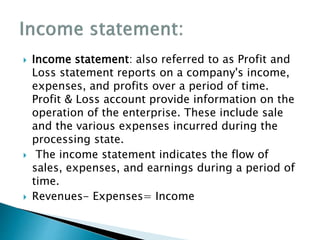
 Income statement: also referred to as Profit and
Loss statement reports on a company's income,
expenses, and profits over a period of time.
Profit & Loss account provide information on the
operation of the enterprise. These include sale
and the various expenses incurred during the
processing state.
 The income statement indicates the flow of
sales, expenses, and earnings during a period of
time.
 Revenues- Expenses= Income
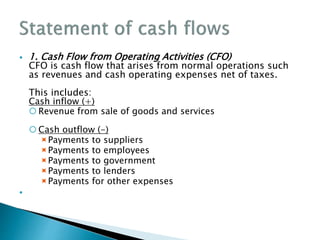
 1. Cash Flow from Operating Activities (CFO)
CFO is cash flow that arises from normal operations such
as revenues and cash operating expenses net of taxes.
This includes:
Cash inflow (+)
 Revenue from sale of goods and services
 Cash outflow (-)
Payments to suppliers
Payments to employees
Payments to government
Payments to lenders
Payments for other expenses

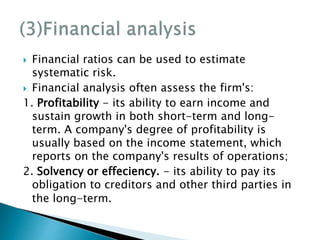
 Financial ratios can be used to estimate
systematic risk.
 Financial analysis often assess the firm's:
1. Profitability - its ability to earn income and
sustain growth in both short-term and long-
term. A company's degree of profitability is
usually based on the income statement, which
reports on the company's results of operations;
2. Solvency or effeciency. - its ability to pay its
obligation to creditors and other third parties in
the long-term.
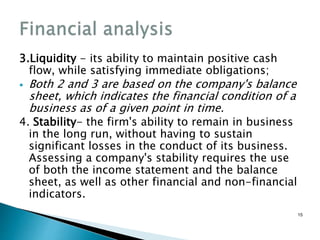
3.Liquidity - its ability to maintain positive cash
flow, while satisfying immediate obligations;
 Both 2 and 3 are based on the company's balance
sheet, which indicates the financial condition of a
business as of a given point in time.
4. Stability- the firm's ability to remain in business
in the long run, without having to sustain
significant losses in the conduct of its business.
Assessing a company's stability requires the use
of both the income statement and the balance
sheet, as well as other financial and non-financial
indicators.
15
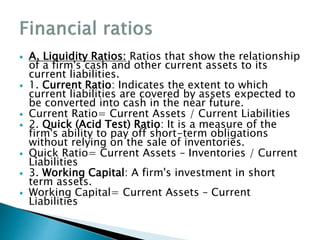
 A. Liquidity Ratios: Ratios that show the relationship
of a firm's cash and other current assets to its
current liabilities.
 1. Current Ratio: Indicates the extent to which
current liabilities are covered by assets expected to
be converted into cash in the near future.
 Current Ratio= Current Assets / Current Liabilities
 2. Quick (Acid Test) Ratio: It is a measure of the
firm's ability to pay off short-term obligations
without relying on the sale of inventories.
 Quick Ratio= Current Assets – Inventories / Current
Liabilities
 3. Working Capital: A firm's investment in short
term assets.
 Working Capital= Current Assets – Current
Liabilities
1. Pay back period
2. Net present value
3. Internal rate of return
 The payback, also called pay-off period, is
defined as the period required to recover the
original investment outlay through the
accumulated net cashflow earned by the
project.
 Year+ cumulative net cash flow in previous
period Net cash flow in the next period
 The net present value of a project is defined
as the value obtained by discounting, at a
constant interest rate and separately for each
year, the differences of all annual cash
outflows and inflows accruing throughout the
life of a project.
 NPV= ∑NCFn (1 + r)n
 Accept a project if the NPV is greater than
Zero
 Reject a project if the NPV is less than Zero
 The internal rate of return is the discount rate
at which the present value of cash inflows is
equal to the present value of cash outflows.

Financial feasibility

  • 1.
  • 2.
    A financial feasibilitystudy looks at how much cash is needed, where it will come from, and how it will be spent.
  • 3.
     A financialfeasibility study is an assessment of the financial aspects of something. If this case, for starting and running a business. It considers many things including 1. Expenses &Revenues. 2. Assets &liabilities 3. Cash in & cash out. Other portions of a complete feasibility study will also contribute data to your basic financial study.
  • 4.
     A financialfeasibility study can focus on one particular project or area, or on a group of projects (such as advertising campaigns). However, for the purpose of establishing a business or attracting investors, you should include at least three key things in your comprehensive financial feasibility study: 1. Start-Up Capital Requirements, 2. Start-Up Capital Sources, and 3. Potential Returns for Investors.
  • 5.
     Investors canbe a friends, family members, client, partners, share holders, or investment institutions. Any business or individual willing to give you cash can be a potential investor. Investors give you money with the understanding that they will receive “returns” on their investment, that is, in addition to the amount that is invested they will get a percentage of profits.
  • 6.
     Financial statementsprovide an overview of a business or person's financial condition in both short and long term. All the relevant financial information of a business enterprise, presented in a structured manner and in a form easy to understand, are called the financial statements. There are three basic financial statements: 1. Balance sheet 2. Income statement 3. Statement of cash flow
  • 7.
     The objectiveof financial statements is to provide information about the financial position, performance and changes in financial position of an enterprise that is useful to a wide range of users in making economic decisions."Financial statements should be understandable, relevant, reliable and comparable. 7
  • 8.
     Balance sheet:referred to as statement of financial position or condition, reports on a company's assets, liabilities, and net equity as of a given point in time.  Another definition: is an accountant snapshot of the firms accounting value on a particular date, as through the firm stood momentarily still.  The balance sheet shows what assets the firm controls at a point in time and how it financed the assets.  Assets= Liabilities + owners equity
  • 9.
     Notes receivable– This account is similar in nature to accounts receivable but it is supported by more formal agreements such as a "promissory notes" (usually a short term-loan that carries interest). Furthermore, the maturity of notes receivable is generally longer than accounts receivable but less than a year. Notes receivable is reported at its net realizable value (what will be collected).  Inventory – This represents raw materials and items that are available for sale or are in the process of being made ready for sale. These items can be valued individually by several different means - at cost or current market value - and collectively by FIFO (first in, first out), LIFO (last in, first out) or average-cost method. Inventory is valued at the lower of the cost or market price to preclude overstating earnings and assets.
  • 10.
     2. Long-termassets – These are assets that may not be converted into cash, sold or consumed within a year or less. The heading "Long-Term Assets" is usually not displayed on a company's consolidated balance sheet. However, all items that are not included in current assets are long-term Assets. These are:
  • 11.
     Fixed assets– These are durable physical properties used in operations that have a useful life longer than one year. This includes: Land – The land owned by the company on which the company's buildings or plants are sitting on. Land is valued at historical cost and the only fixed asset that has no depreciation.
  • 12.
     Income statement:also referred to as Profit and Loss statement reports on a company's income, expenses, and profits over a period of time. Profit & Loss account provide information on the operation of the enterprise. These include sale and the various expenses incurred during the processing state.  The income statement indicates the flow of sales, expenses, and earnings during a period of time.  Revenues- Expenses= Income
  • 13.
     1. CashFlow from Operating Activities (CFO) CFO is cash flow that arises from normal operations such as revenues and cash operating expenses net of taxes. This includes: Cash inflow (+)  Revenue from sale of goods and services  Cash outflow (-) Payments to suppliers Payments to employees Payments to government Payments to lenders Payments for other expenses 
  • 14.
     Financial ratioscan be used to estimate systematic risk.  Financial analysis often assess the firm's: 1. Profitability - its ability to earn income and sustain growth in both short-term and long- term. A company's degree of profitability is usually based on the income statement, which reports on the company's results of operations; 2. Solvency or effeciency. - its ability to pay its obligation to creditors and other third parties in the long-term.
  • 15.
    3.Liquidity - itsability to maintain positive cash flow, while satisfying immediate obligations;  Both 2 and 3 are based on the company's balance sheet, which indicates the financial condition of a business as of a given point in time. 4. Stability- the firm's ability to remain in business in the long run, without having to sustain significant losses in the conduct of its business. Assessing a company's stability requires the use of both the income statement and the balance sheet, as well as other financial and non-financial indicators. 15
  • 16.
     A. LiquidityRatios: Ratios that show the relationship of a firm's cash and other current assets to its current liabilities.  1. Current Ratio: Indicates the extent to which current liabilities are covered by assets expected to be converted into cash in the near future.  Current Ratio= Current Assets / Current Liabilities  2. Quick (Acid Test) Ratio: It is a measure of the firm's ability to pay off short-term obligations without relying on the sale of inventories.  Quick Ratio= Current Assets – Inventories / Current Liabilities  3. Working Capital: A firm's investment in short term assets.  Working Capital= Current Assets – Current Liabilities
  • 17.
    1. Pay backperiod 2. Net present value 3. Internal rate of return
  • 18.
     The payback,also called pay-off period, is defined as the period required to recover the original investment outlay through the accumulated net cashflow earned by the project.  Year+ cumulative net cash flow in previous period Net cash flow in the next period
  • 19.
     The netpresent value of a project is defined as the value obtained by discounting, at a constant interest rate and separately for each year, the differences of all annual cash outflows and inflows accruing throughout the life of a project.  NPV= ∑NCFn (1 + r)n  Accept a project if the NPV is greater than Zero  Reject a project if the NPV is less than Zero
  • 20.
     The internalrate of return is the discount rate at which the present value of cash inflows is equal to the present value of cash outflows.