• The Accounting Standard Council
(ASC) defines accounting as:
“It is service activity. Its function is to
provide quantitative information,
primarily financial in nature, about
economic entities, that is intended to
be useful in making economic
decisions.”
The American Accounting Associations
(AAA) defines accounting as:
“It is the process of identifying, measuring and
communicating economic information to permit
informed judgments and decisions by users of
the information.”
The American Institute of Certified Public
Accountants (AICPA) defines accounting
as:
“It is an art of recording, classifying,
summarizing in a significant manner and in
terms of money, transactions, and events
which are, in part at least, of a financial
character, and interpreting the results thereof.”
1. Recording – involves the routine and
mechanical process of writing down the
business transactions and events on the
books of accounts in a chronological
manner called journalizing.
2. Classifying – involves sorting or grouping
of similar transaction or events into their
respective classes. In short, this is the
process of transferring from the journal to
the ledger called posting
3. Summarizing – involves the completion
of the financial statements and the
accounting requirements as well. This
involves the process from the trial
balance, adjusting entries, financial
statements, closing entries, post-closing
trial balance, and reversing entries
4. Interpreting – involves the “analytical
and interpretative” works.
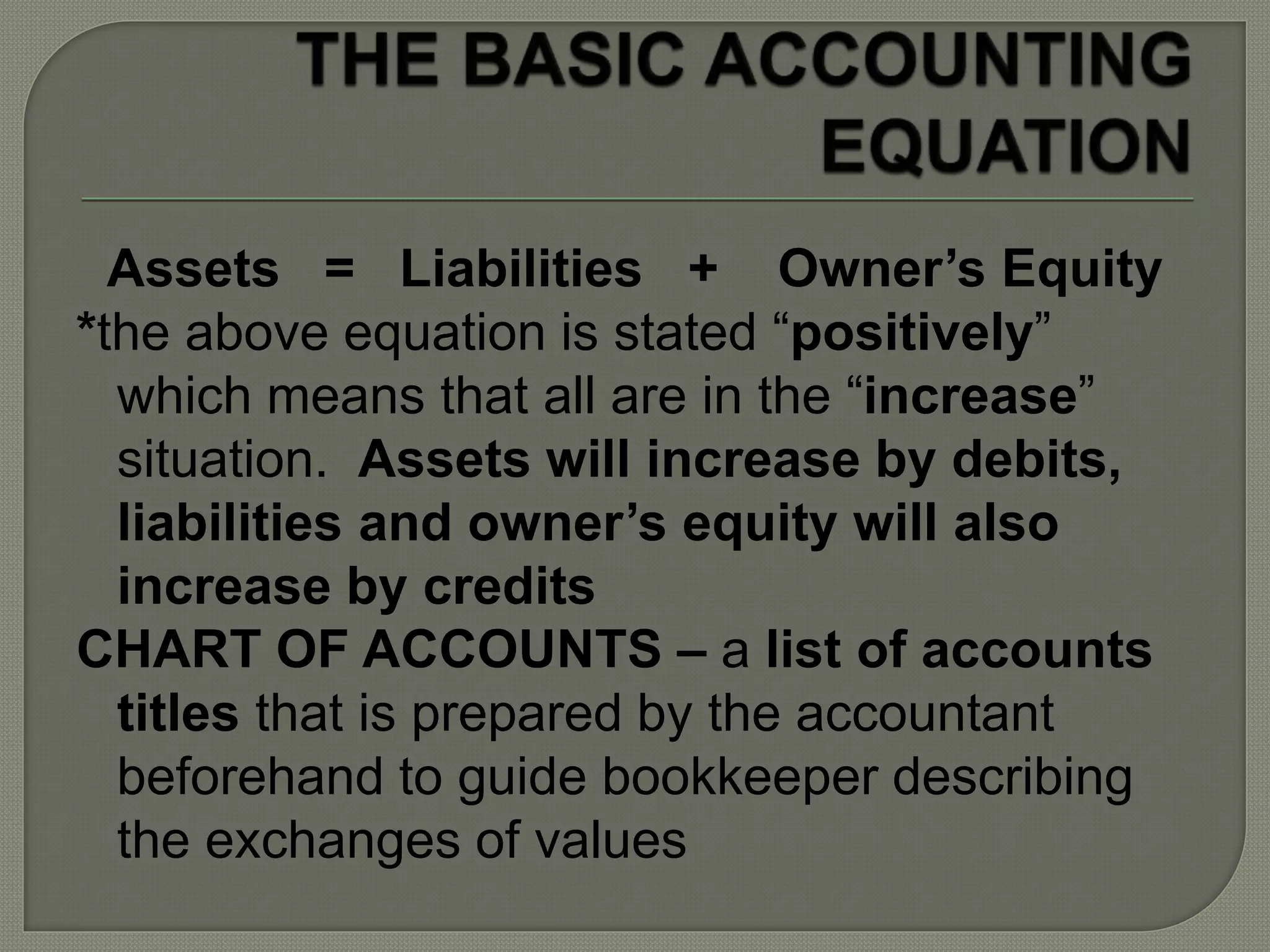
Assets = Liabilities + Owner’s Equity
*the above equation is stated “positively”
which means that all are in the “increase”
situation. Assets will increase by debits,
liabilities and owner’s equity will also
increase by credits
CHART OF ACCOUNTS – a list of accounts
titles that is prepared by the accountant
beforehand to guide bookkeeper describing
the exchanges of values
1. ASSETS are cash, properties, or
things of values owned by the
business
2. LIABILITIES are amounts the
business owes to creditors.
3. OWNER’S EQUITY is the owner’s
investment or net worth.
4. REVENUES consists of amounts earned by
a business, such as fees earned for
performing services, income from selling
merchandise, rent income for the use of
property, or interest earned for lending
money
5. EXPENSES are the costs of earning
revenue—that is, of doing business—such
as wages expense, rent expense, interest
expense, and advertising expense.
1. Calendar Year – begins on January 1 and
ends on December 31 of the same year
2. Fiscal Year – accounting period will begin
on the first day of any month of the year
except January and will end on the last day
of the twelfth month completing the one year
period.
 Financial statements prepared are being
referred to as “Interim Financial
Statements”
3. Natural Business Year – e.g. in hotel
industry it start from the point of slack in
visitors and ends up at its peak season.
1. Principle of Relevance – that the
resulting information is meaningful and
useful to those who need to know
something about the status of a certain
organization
2. Principle of Objectivity – connotes
reliability and trustworthiness, further
connotes verifiability , which means that
there is some way of finding out whether
the information is true and correct.
3. Principle of Feasibility – it can be
implemented without undue complexity or
cost
UNDERLYING ACCOUNTING ASSUMPTIONS
1. Accounting Entity Concept or Separate
Entity Assumption – an entity that is
separate and distinct from the owners or
management
2. Going Concern or Continuity Concept or
Assumption – the business is assumed to
have a continuous life of existence. Unless,
it suffered a tremendous or persistent losses
from its operations
3. Time-Period Assumption – “accounting
periods” or “periodicity concept” in
accounting: monthly basis, quarterly
basis, semi-annual basis, and the
annual or yearly basis.
4. Unit of Measure Assumption
(Monetary Convention) – In the
Philippines, we use the “peso” as unit of
measure
5. Accrual Basis Assumption – Under
accrual basis, income is recognized when
earned regardless of when received and
expenses is recognized when incurred
regardless of when paid
The recognition of accounts
receivable, accounts payable,
prepaid expenses, accrued
expenses, deferred income and
accrued income
In contrast, cash basis of
accounting recognizes income only
when actual cash is received and
recognizes expenses only when
actual cash is paid
Gathers data which are financial in
character
Stores data in the books of accounts
Transforms data into a more
meaningful source of information
(financial position, performance and
cash flows of the business operation)
 Financial statements are communicated
to various users (investors, employees,
lenders, suppliers and other trade
creditors, customers, government and
their agencies and public
 Analyzed and interpreted through
accountants – expert & knowledgeable
professional in this field.
1. Statement of Financial Position or
Balance Sheet
Measures and evaluates in terms of the
enterprises’ liquidity, solvency, financial
structure and capacity for adaptation.
-liquidity is the ability of the enterprise to meet
currently maturing obligations
-solvency is the availability of cash over the
longer term to meet maturing obligations.
-financial structure is the source of financing
for the assets of the enterprise (borrowed
capital & equity capital)
-Capacity for adaptation is the financial
flexibility of the enterprise to use its available
cash for unexpected requirements and
investment opportunities.
Two Forms of Balance Sheet:
1. Account Form – “horizontal order” and is
used when there are plenty of accounts
involved
2. Report Form – “vertical order” and is used
when there are a few accounts involved
2. Statement of Comprehensive Income or
Income Statement
-shows the performance of the enterprise for a
given period of time
 The performance of the enterprise is primarily
measured in the level of income earned by the
enterprise through effective and efficient
utilization of its resources.
3. Statement of Changes in Equity –
summarized the changes in equity for a given
period of time.
• The beginning equity of the owner is increased
by the additional investment and profit.
Correspondingly, it is decreased by withdrawal
and loss
4. Statement of Cash Flows – provides
information about the details of changes in cash
position of the business during a given period
In its simplest description, this is the
statement of cash receipts and cash
disbursements.
The statement of cash flows are classified
into three activities: Operating, Investing,
Financing
Enterprises are encouraged to report cash
flows from operating activities using the
direct method although the indirect
method is also acceptable

Basic Accounting Concepts

  • 2.
    • The AccountingStandard Council (ASC) defines accounting as: “It is service activity. Its function is to provide quantitative information, primarily financial in nature, about economic entities, that is intended to be useful in making economic decisions.”
  • 3.
    The American AccountingAssociations (AAA) defines accounting as: “It is the process of identifying, measuring and communicating economic information to permit informed judgments and decisions by users of the information.” The American Institute of Certified Public Accountants (AICPA) defines accounting as: “It is an art of recording, classifying, summarizing in a significant manner and in terms of money, transactions, and events which are, in part at least, of a financial character, and interpreting the results thereof.”
  • 4.
    1. Recording –involves the routine and mechanical process of writing down the business transactions and events on the books of accounts in a chronological manner called journalizing. 2. Classifying – involves sorting or grouping of similar transaction or events into their respective classes. In short, this is the process of transferring from the journal to the ledger called posting
  • 5.
    3. Summarizing –involves the completion of the financial statements and the accounting requirements as well. This involves the process from the trial balance, adjusting entries, financial statements, closing entries, post-closing trial balance, and reversing entries 4. Interpreting – involves the “analytical and interpretative” works.
  • 6.
    Assets = Liabilities+ Owner’s Equity *the above equation is stated “positively” which means that all are in the “increase” situation. Assets will increase by debits, liabilities and owner’s equity will also increase by credits CHART OF ACCOUNTS – a list of accounts titles that is prepared by the accountant beforehand to guide bookkeeper describing the exchanges of values
  • 7.
    1. ASSETS arecash, properties, or things of values owned by the business 2. LIABILITIES are amounts the business owes to creditors. 3. OWNER’S EQUITY is the owner’s investment or net worth.
  • 8.
    4. REVENUES consistsof amounts earned by a business, such as fees earned for performing services, income from selling merchandise, rent income for the use of property, or interest earned for lending money 5. EXPENSES are the costs of earning revenue—that is, of doing business—such as wages expense, rent expense, interest expense, and advertising expense.
  • 9.
    1. Calendar Year– begins on January 1 and ends on December 31 of the same year 2. Fiscal Year – accounting period will begin on the first day of any month of the year except January and will end on the last day of the twelfth month completing the one year period.  Financial statements prepared are being referred to as “Interim Financial Statements” 3. Natural Business Year – e.g. in hotel industry it start from the point of slack in visitors and ends up at its peak season.
  • 10.
    1. Principle ofRelevance – that the resulting information is meaningful and useful to those who need to know something about the status of a certain organization 2. Principle of Objectivity – connotes reliability and trustworthiness, further connotes verifiability , which means that there is some way of finding out whether the information is true and correct.
  • 11.
    3. Principle ofFeasibility – it can be implemented without undue complexity or cost UNDERLYING ACCOUNTING ASSUMPTIONS 1. Accounting Entity Concept or Separate Entity Assumption – an entity that is separate and distinct from the owners or management 2. Going Concern or Continuity Concept or Assumption – the business is assumed to have a continuous life of existence. Unless, it suffered a tremendous or persistent losses from its operations
  • 12.
    3. Time-Period Assumption– “accounting periods” or “periodicity concept” in accounting: monthly basis, quarterly basis, semi-annual basis, and the annual or yearly basis. 4. Unit of Measure Assumption (Monetary Convention) – In the Philippines, we use the “peso” as unit of measure 5. Accrual Basis Assumption – Under accrual basis, income is recognized when earned regardless of when received and expenses is recognized when incurred regardless of when paid
  • 13.
    The recognition ofaccounts receivable, accounts payable, prepaid expenses, accrued expenses, deferred income and accrued income In contrast, cash basis of accounting recognizes income only when actual cash is received and recognizes expenses only when actual cash is paid
  • 14.
    Gathers data whichare financial in character Stores data in the books of accounts Transforms data into a more meaningful source of information (financial position, performance and cash flows of the business operation)
  • 15.
     Financial statementsare communicated to various users (investors, employees, lenders, suppliers and other trade creditors, customers, government and their agencies and public  Analyzed and interpreted through accountants – expert & knowledgeable professional in this field.
  • 16.
    1. Statement ofFinancial Position or Balance Sheet Measures and evaluates in terms of the enterprises’ liquidity, solvency, financial structure and capacity for adaptation. -liquidity is the ability of the enterprise to meet currently maturing obligations -solvency is the availability of cash over the longer term to meet maturing obligations. -financial structure is the source of financing for the assets of the enterprise (borrowed capital & equity capital)
  • 17.
    -Capacity for adaptationis the financial flexibility of the enterprise to use its available cash for unexpected requirements and investment opportunities. Two Forms of Balance Sheet: 1. Account Form – “horizontal order” and is used when there are plenty of accounts involved 2. Report Form – “vertical order” and is used when there are a few accounts involved 2. Statement of Comprehensive Income or Income Statement -shows the performance of the enterprise for a given period of time
  • 18.
     The performanceof the enterprise is primarily measured in the level of income earned by the enterprise through effective and efficient utilization of its resources. 3. Statement of Changes in Equity – summarized the changes in equity for a given period of time. • The beginning equity of the owner is increased by the additional investment and profit. Correspondingly, it is decreased by withdrawal and loss 4. Statement of Cash Flows – provides information about the details of changes in cash position of the business during a given period
  • 19.
    In its simplestdescription, this is the statement of cash receipts and cash disbursements. The statement of cash flows are classified into three activities: Operating, Investing, Financing Enterprises are encouraged to report cash flows from operating activities using the direct method although the indirect method is also acceptable