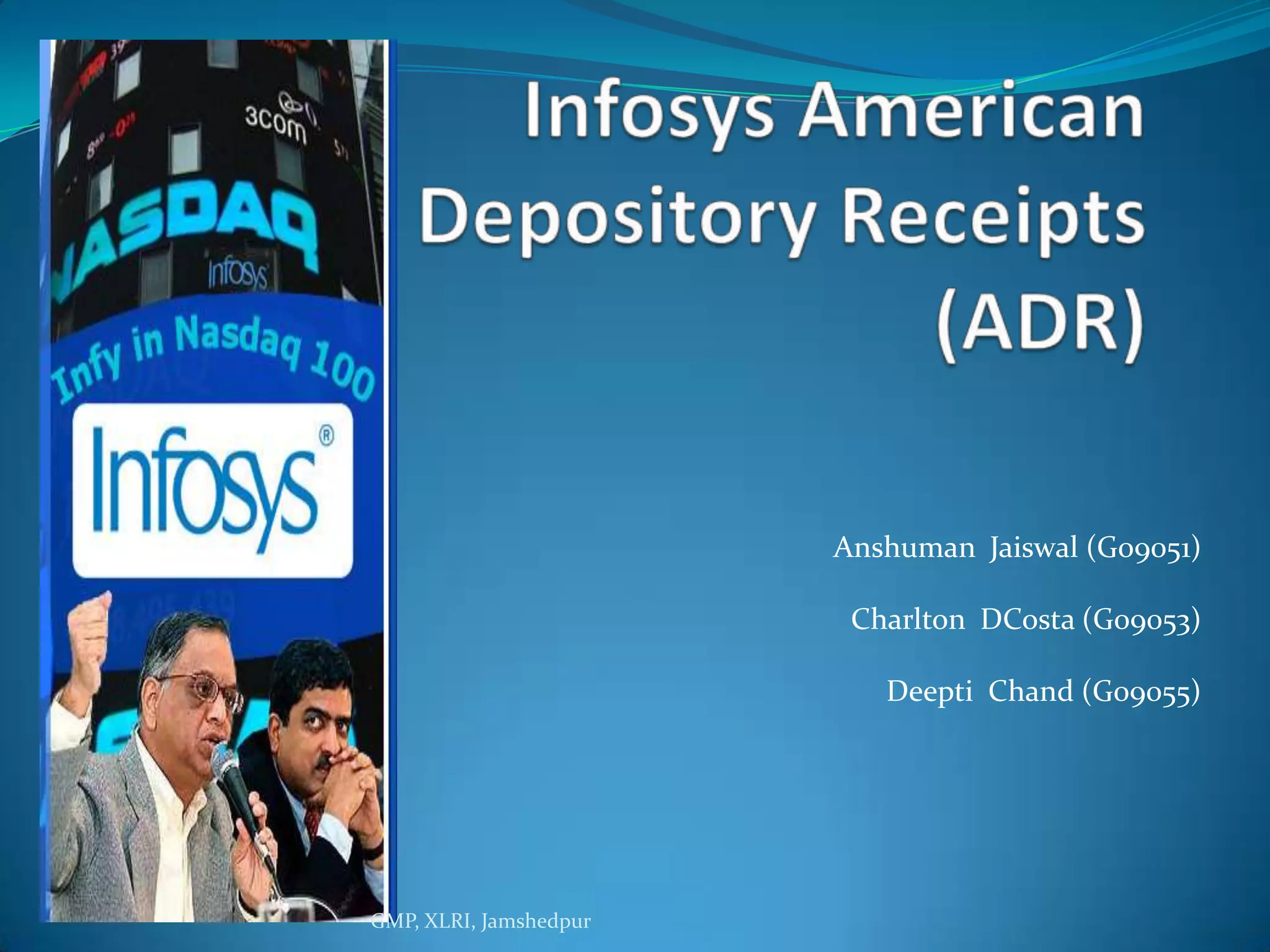

Infosys American Depository Receipts (ADR)Anshuman  Jaiswal (G09051)Charlton  DCosta (G09053)Deepti  Chand (G09055)GMP, XLRI, Jamshedpur
What is ADRCertificates that represent shares of a foreign stock owned and issued by a U.S bankThey buy up shares of the foreign stock and repackage them into securities which can be traded on the NYSE, NASDAQ or AMEX.The foreign shares are usually held in custody overseas, but the certificates trade in the U.S. They provide easy access to gaining international equities exposure without actually having to exchange currencies and open additional accounts to transact in overseasGMP, XLRI, Jamshedpur
TYPES OF ADRLevel 1 – Basic, common, traded on OTC, least regulation, no US accounting standard, no annual reportsLevel 2 – Listed on stock exchange, higher trading volumesLevel 3 – Most rigorous regulations, go as far as raising capital from US investorsIf the depository receipt is traded in the United States of America (USA), it is called an American Depository Receipt, or an ADR. GMP, XLRI, Jamshedpur
GDRs and IDRSIf the depository receipt is traded in a country other than USA, it is called a Global Depository Receipt GDR gives access to two or more marketsADRs and GDRs are an excellent means of investment for NRIs & foreign nationals wanting to invest in India IDR is instrument in form of Depository Receipt created by the Indian depository in India against the underlying equity of investing company.Foreign companies  Issue shares, to Indian Depository  Issue depository receipts.The actual shares underlying the IDRs held by Overseas Custodian.GMP, XLRI, Jamshedpur
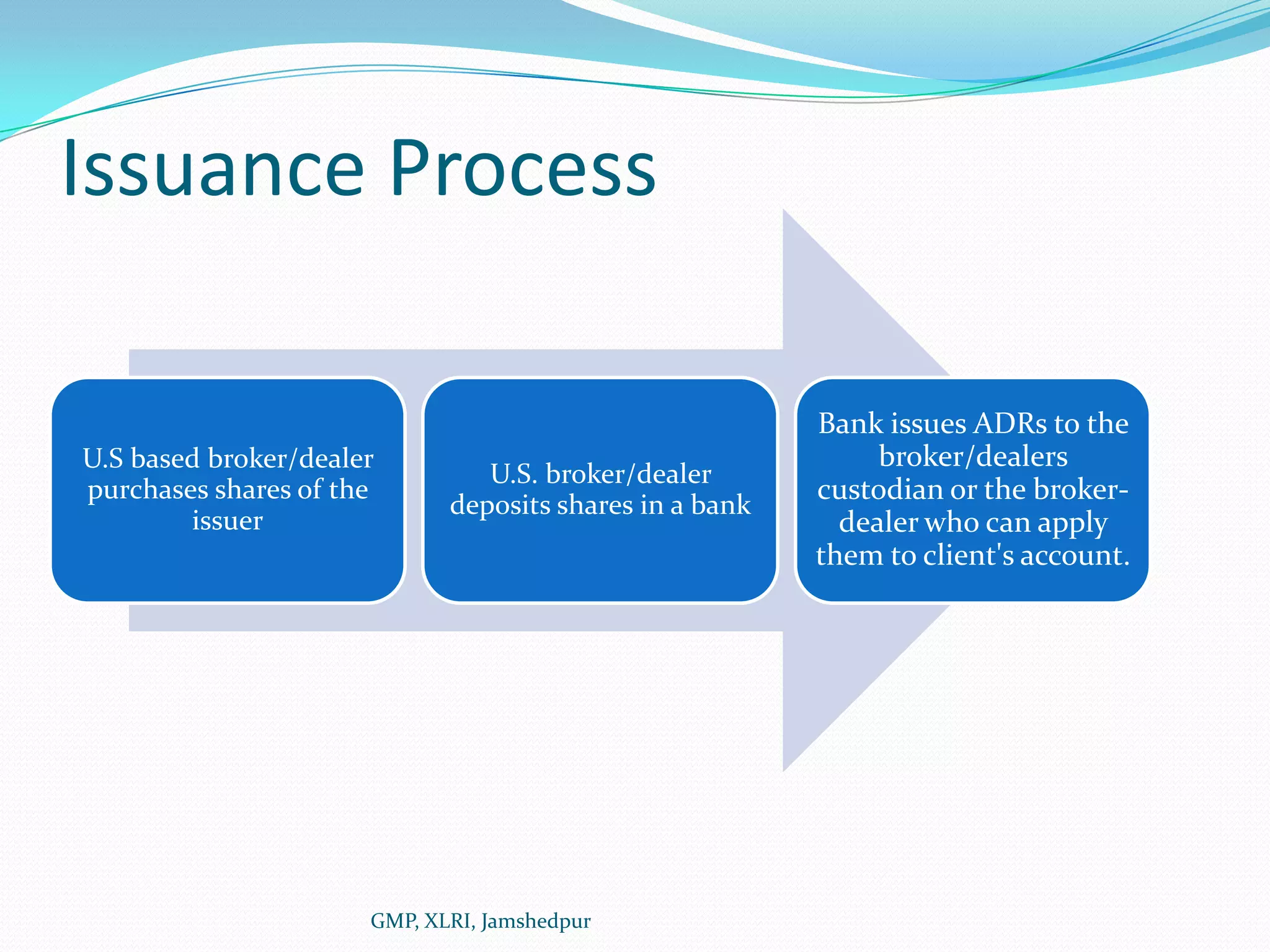
Issuance ProcessGMP, XLRI, Jamshedpur
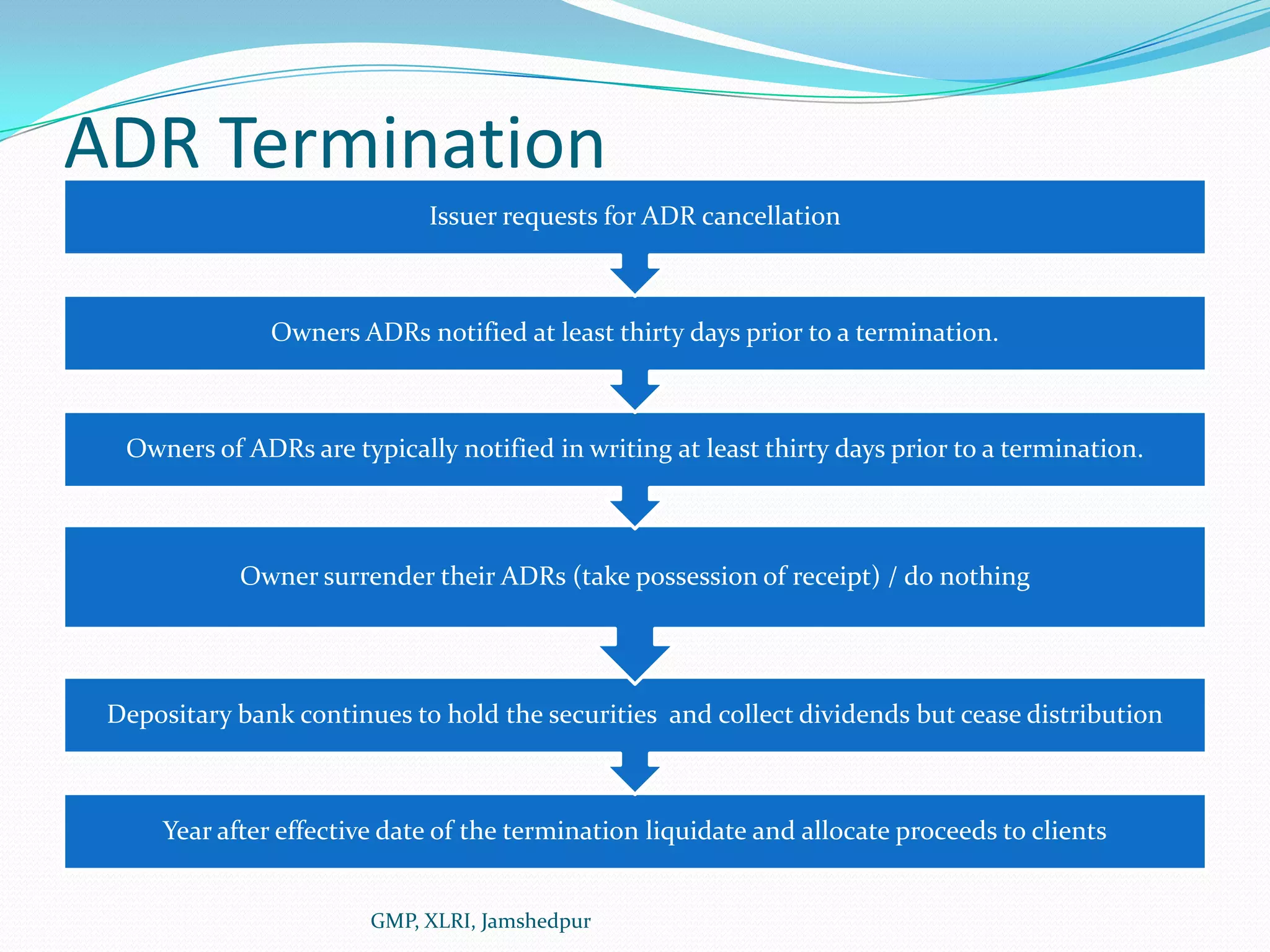
ADR TerminationGMP, XLRI, Jamshedpur
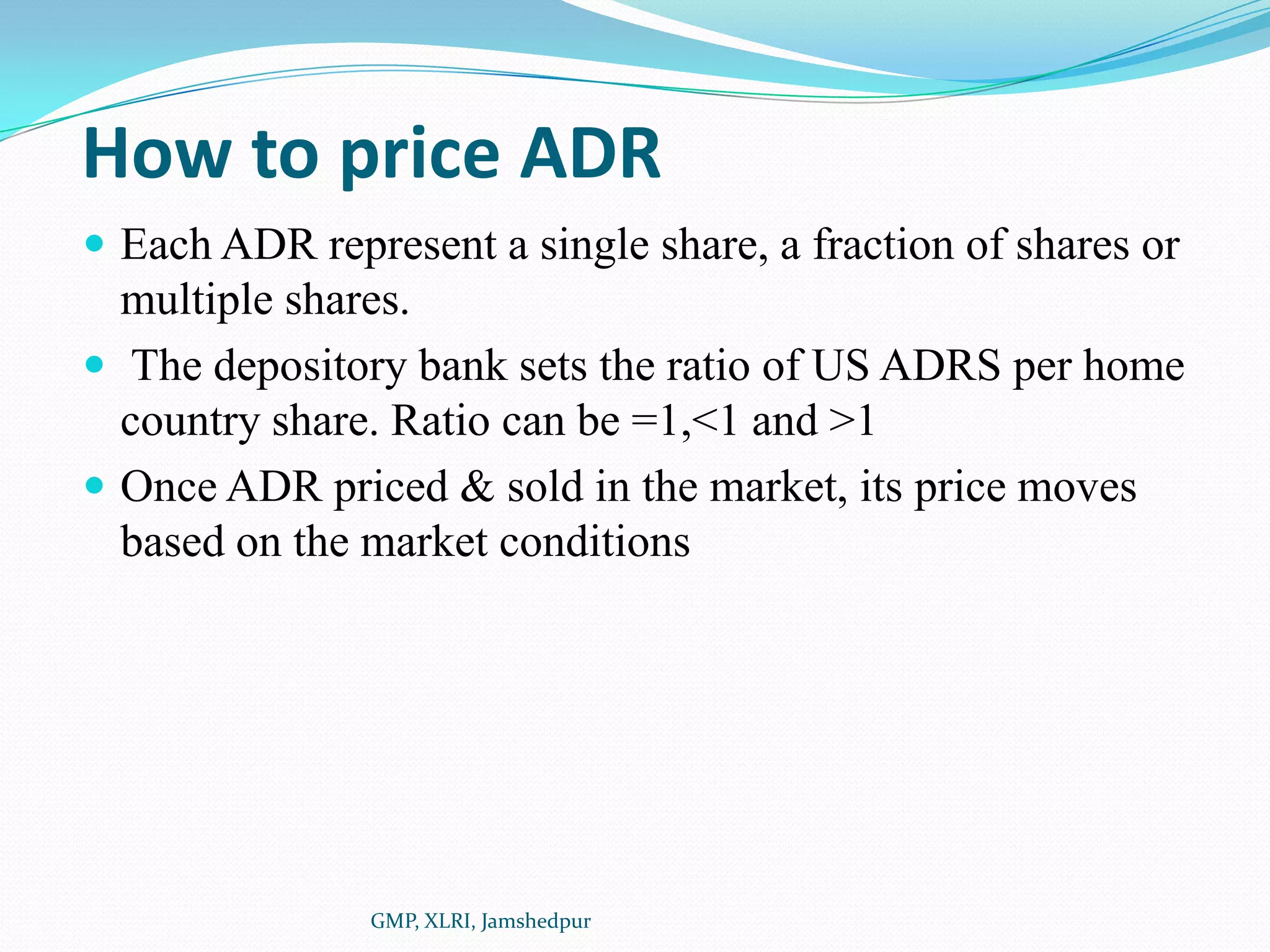
 How to price ADR Each ADR represent a single share, a fraction of shares or multiple shares. The depository bank sets the ratio of US ADRS per home country share. Ratio can be =1,<1 and >1Once ADR priced & sold in the market, its price moves based on the market conditions GMP, XLRI, Jamshedpur
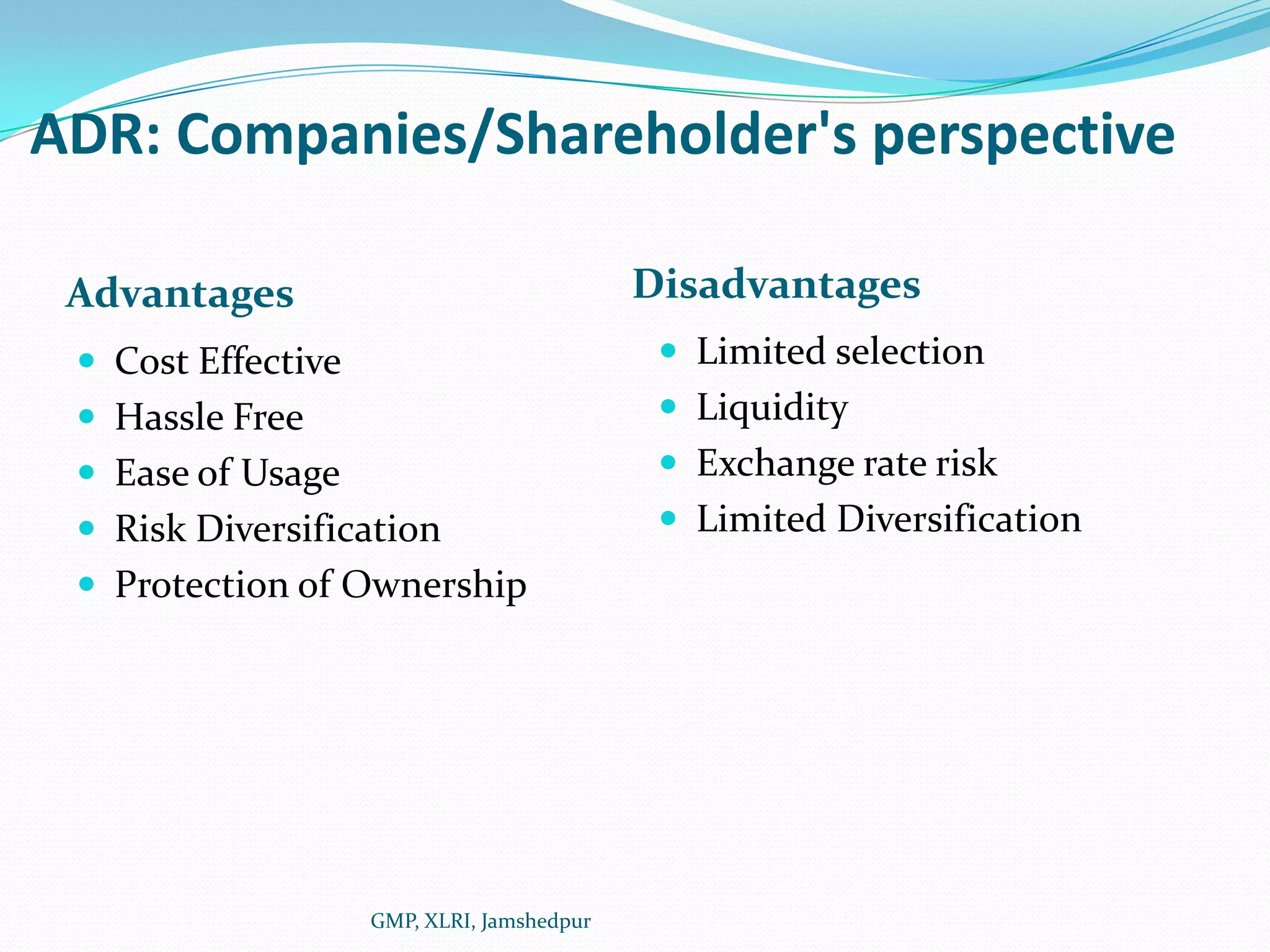
ADR: Companies/Shareholder's perspectiveDisadvantagesAdvantagesLimited selectionLiquidityExchange rate riskLimited DiversificationCost EffectiveHassle Free Ease of UsageRisk DiversificationProtection of OwnershipGMP, XLRI, Jamshedpur
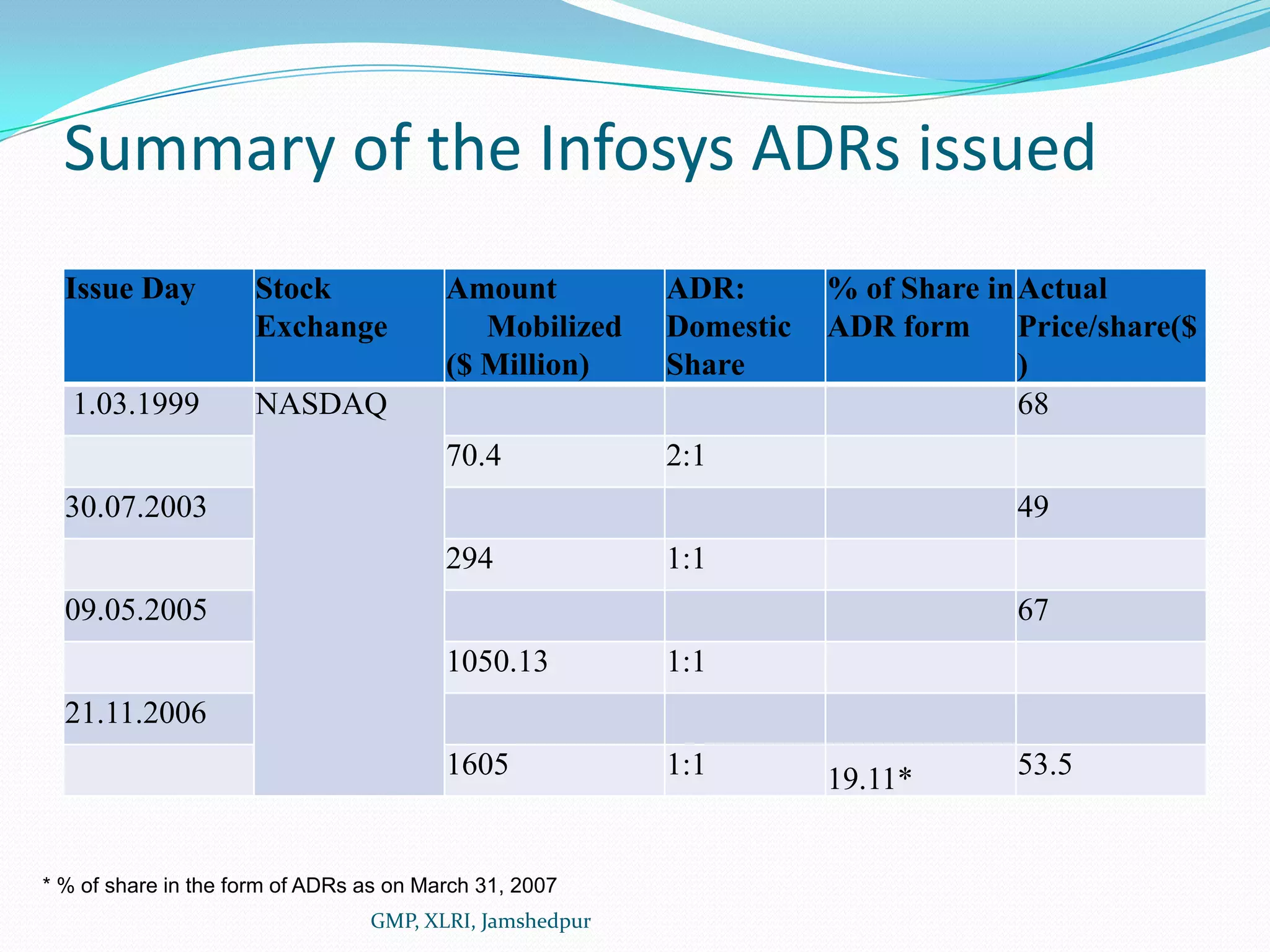
Summary of the Infosys ADRs issued* % of share in the form of ADRs as on March 31, 2007GMP, XLRI, Jamshedpur
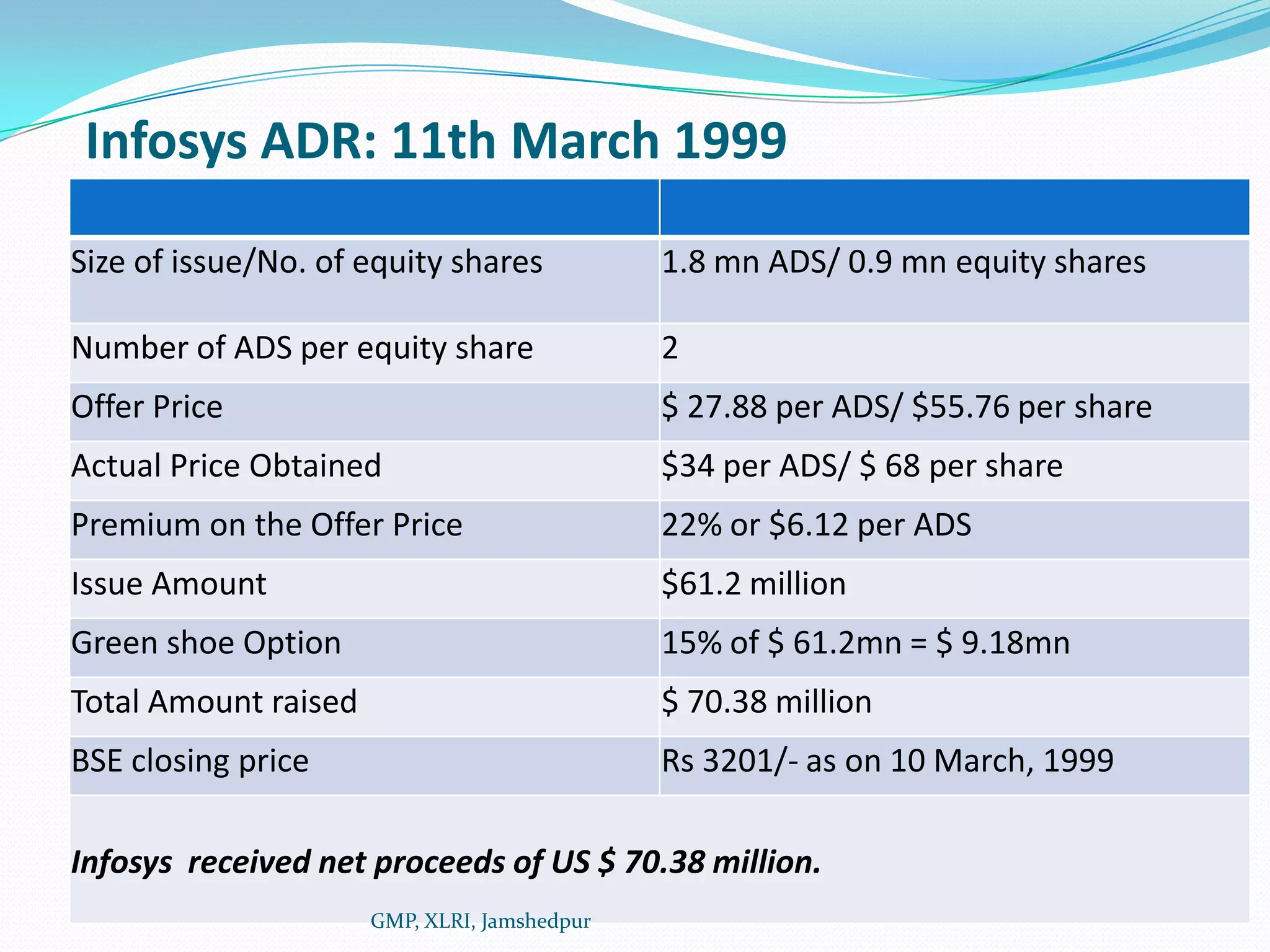
Infosys ADR: 11th March 1999GMP, XLRI, Jamshedpur
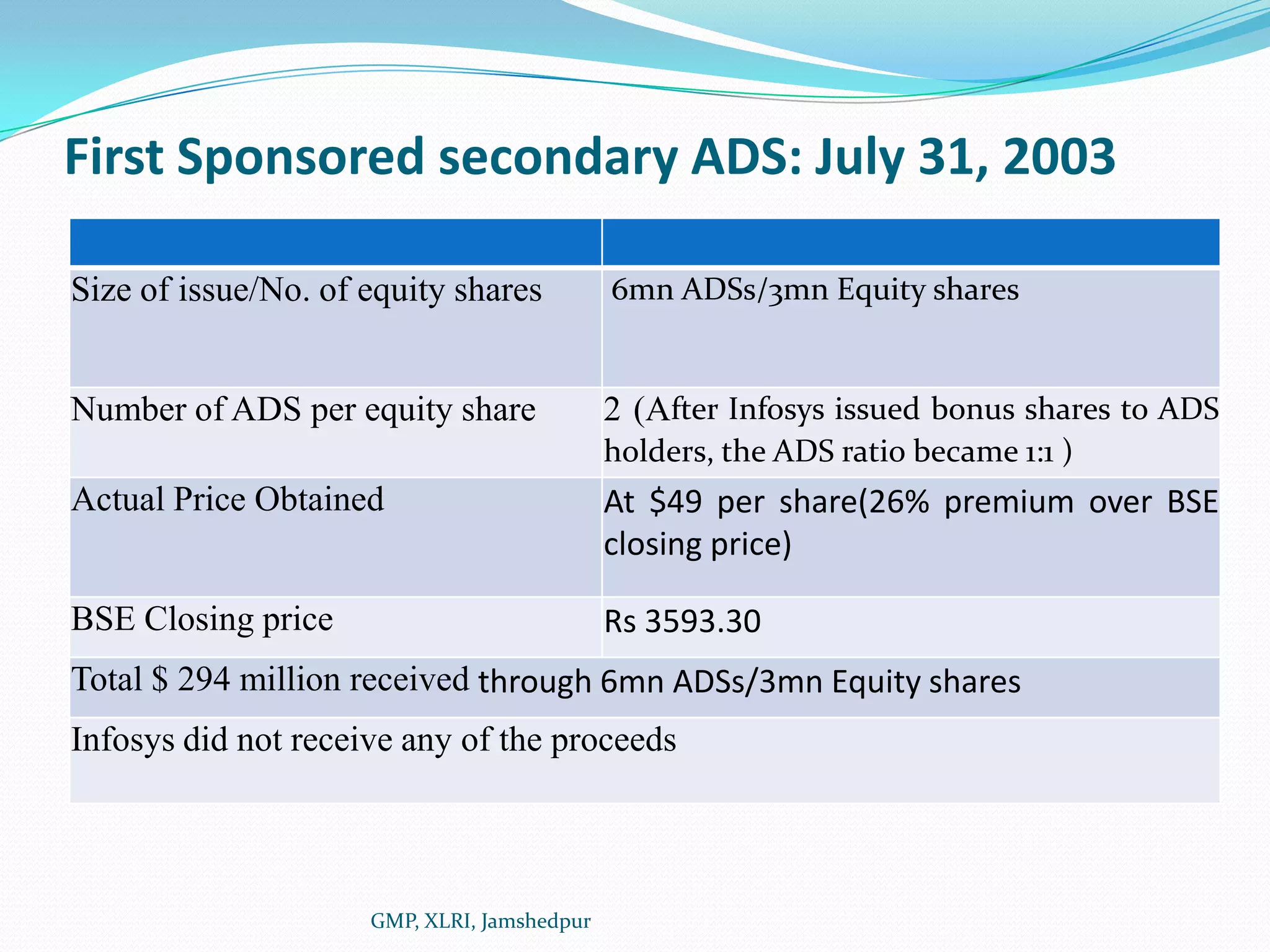
First Sponsored secondary ADS: July 31, 2003GMP, XLRI, Jamshedpur
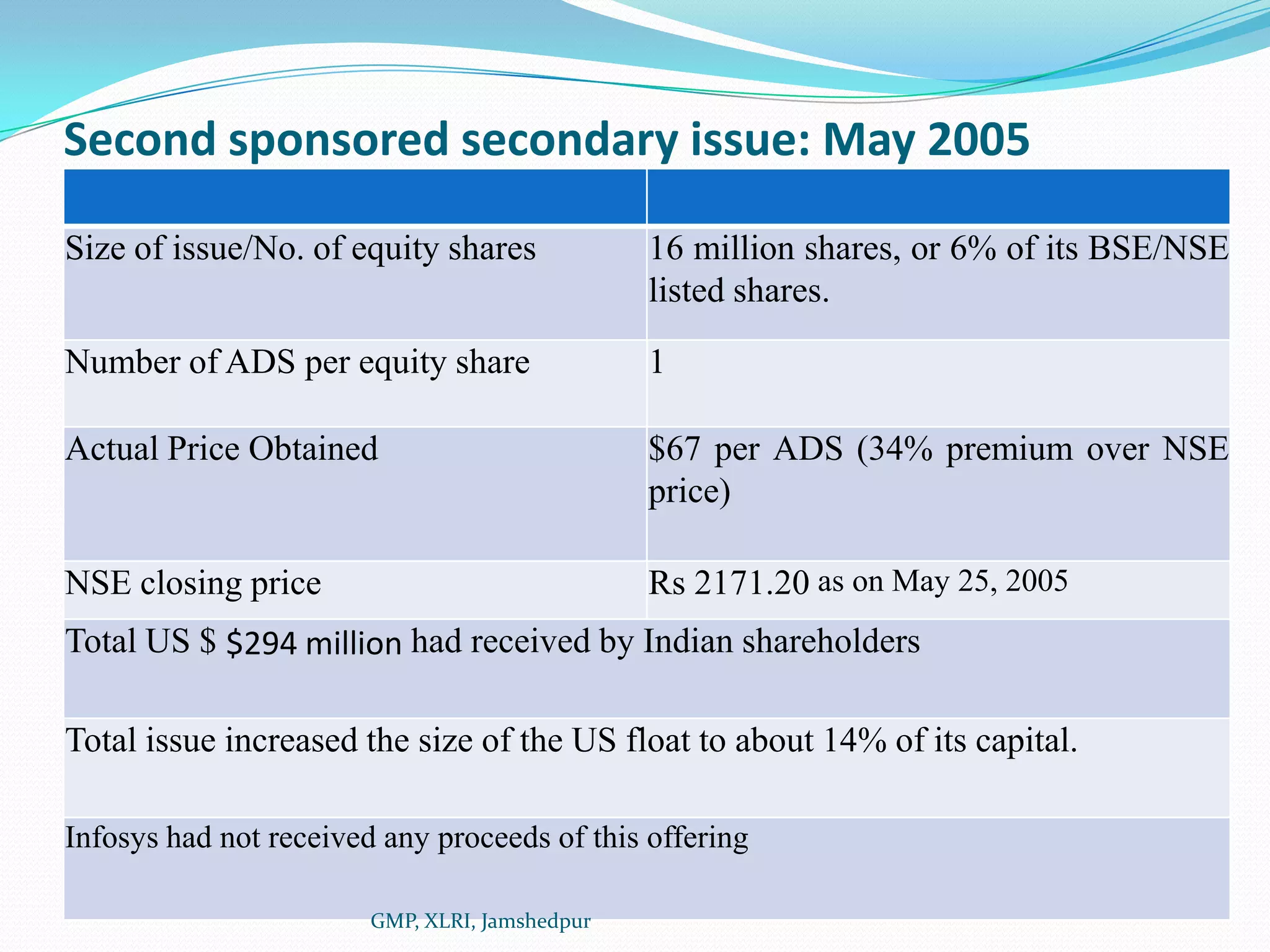
Second sponsored secondary issue: May 2005GMP, XLRI, Jamshedpur
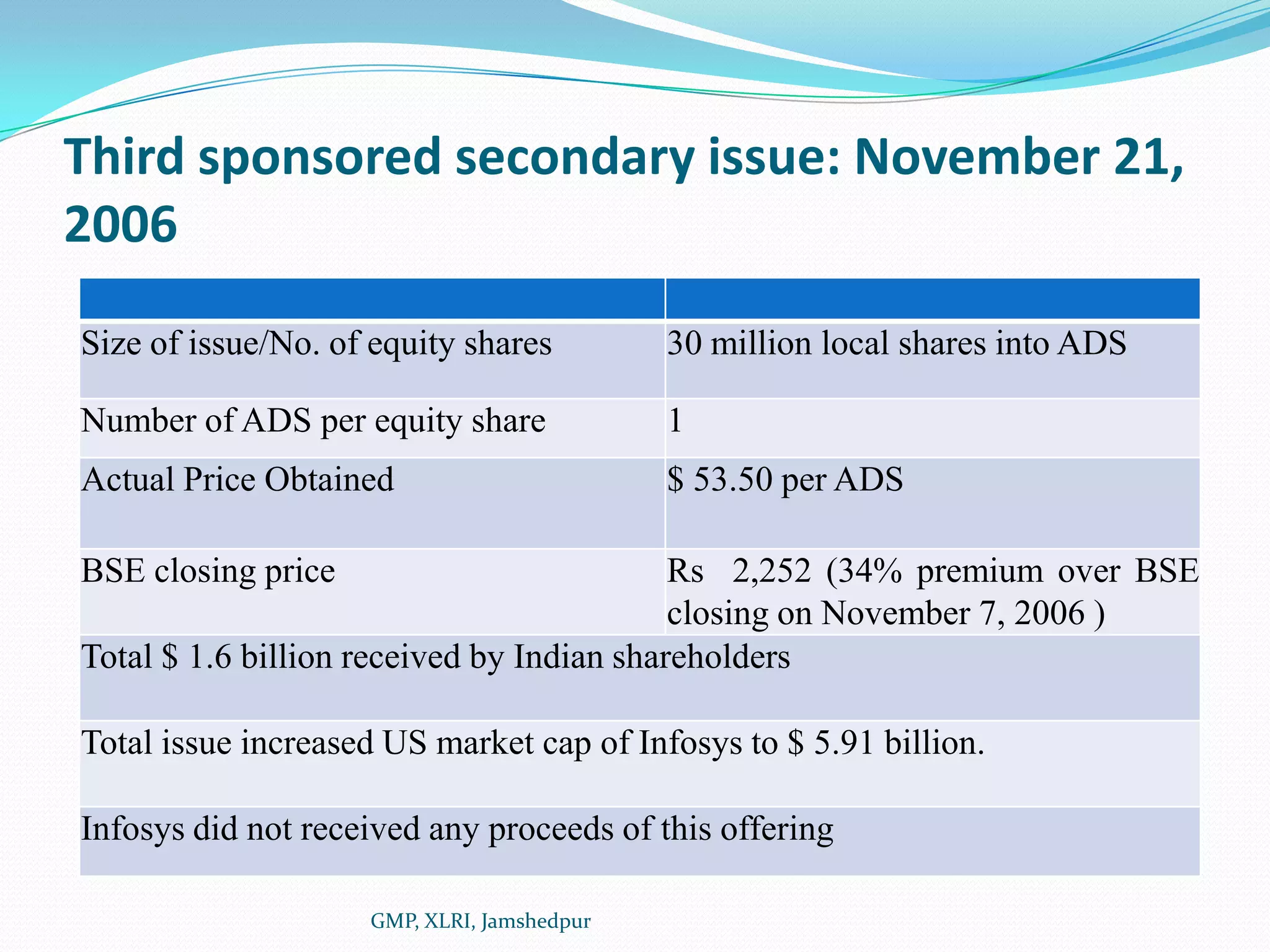
Third sponsored secondary issue: November 21, 2006GMP, XLRI, Jamshedpur
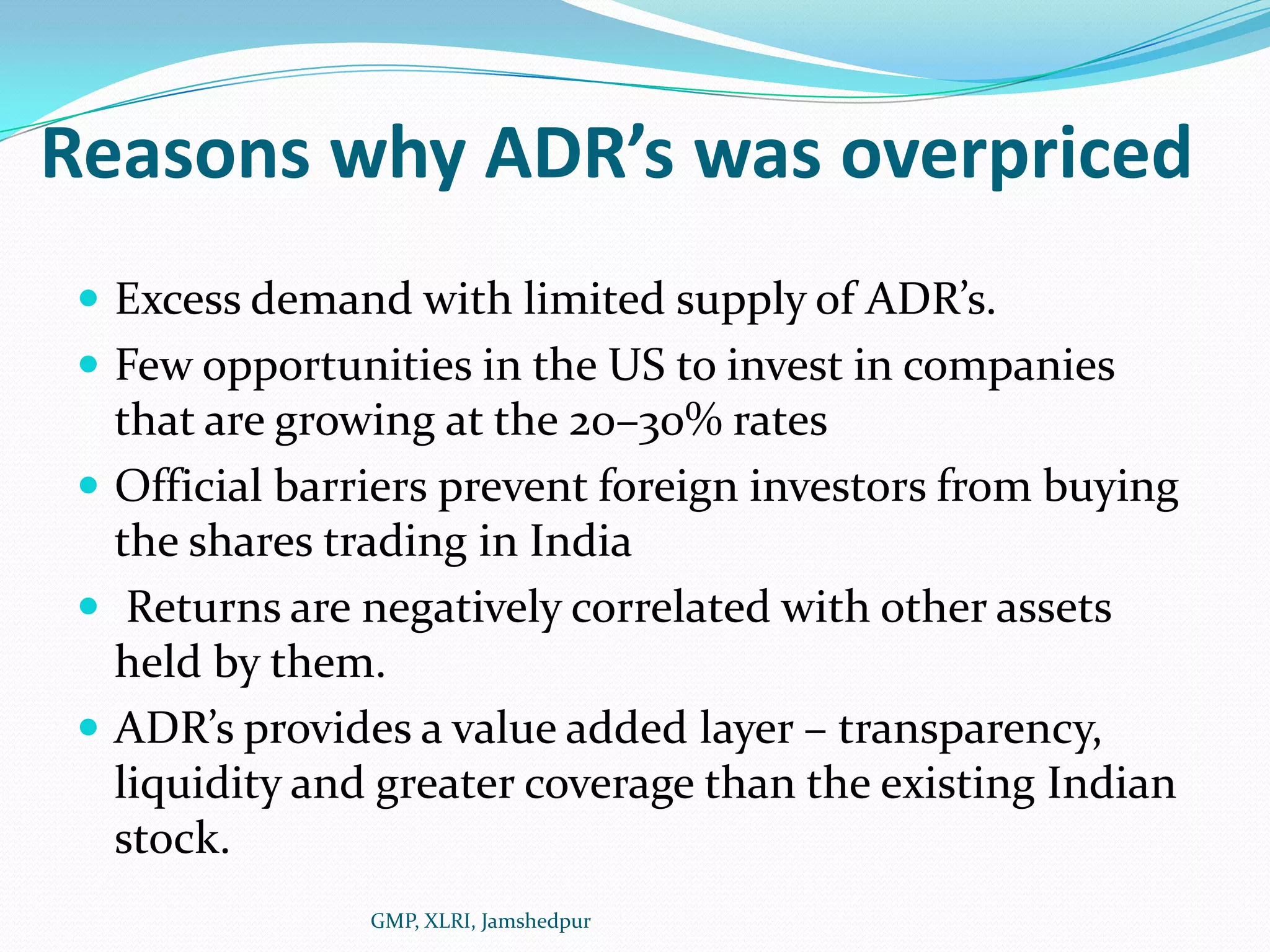
Reasons why ADR’s was overpricedExcess demand with limited supply of ADR’s. Few opportunities in the US to invest in companies that are growing at the 20–30% ratesOfficial barriers prevent foreign investors from buying the shares trading in India Returns are negatively correlated with other assets held by them.ADR’s provides a value added layer – transparency, liquidity and greater coverage than the existing Indian stock.GMP, XLRI, Jamshedpur
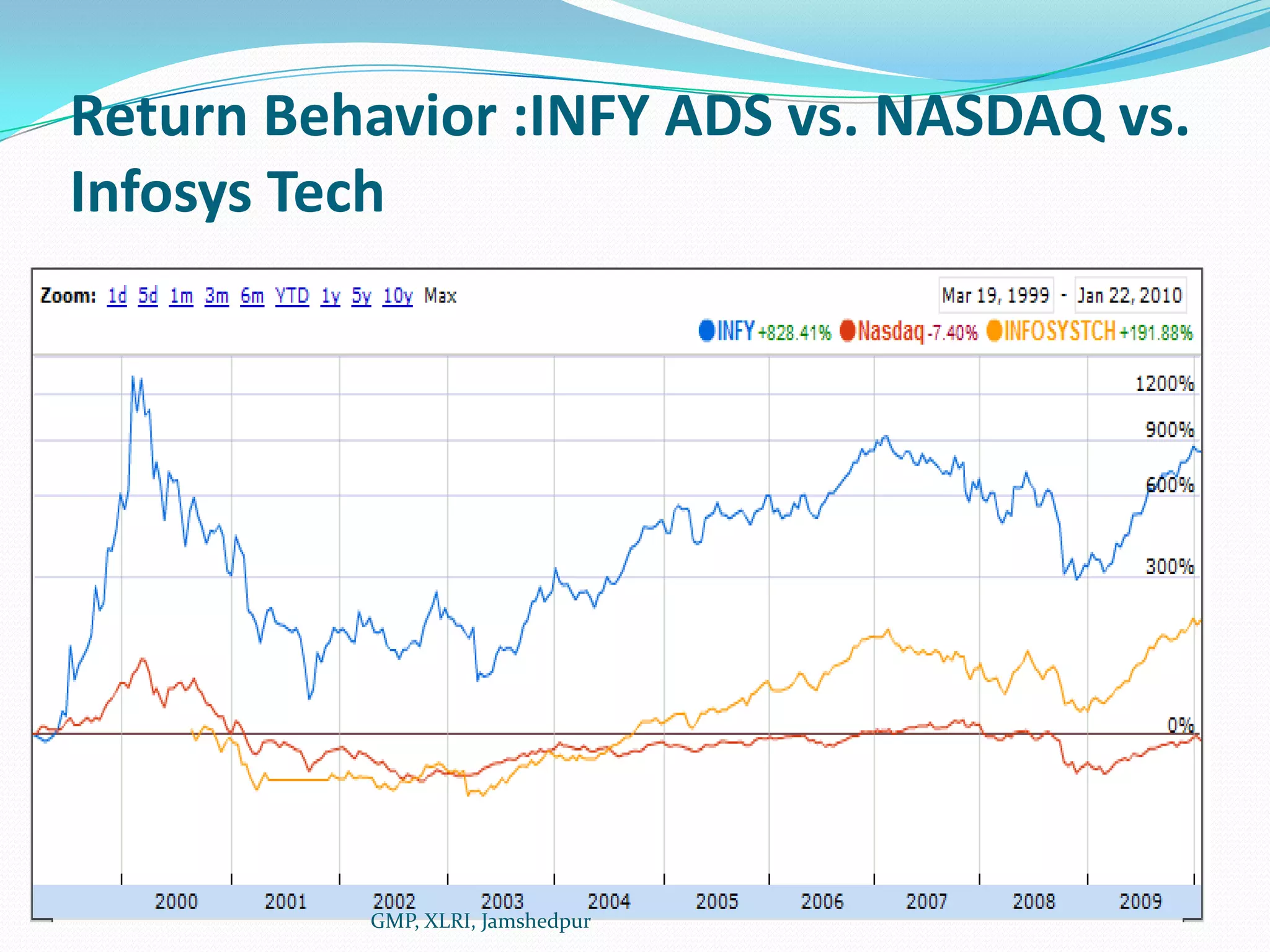
Return Behavior :INFY ADS vs. NASDAQ vs. Infosys TechGMP, XLRI, Jamshedpur
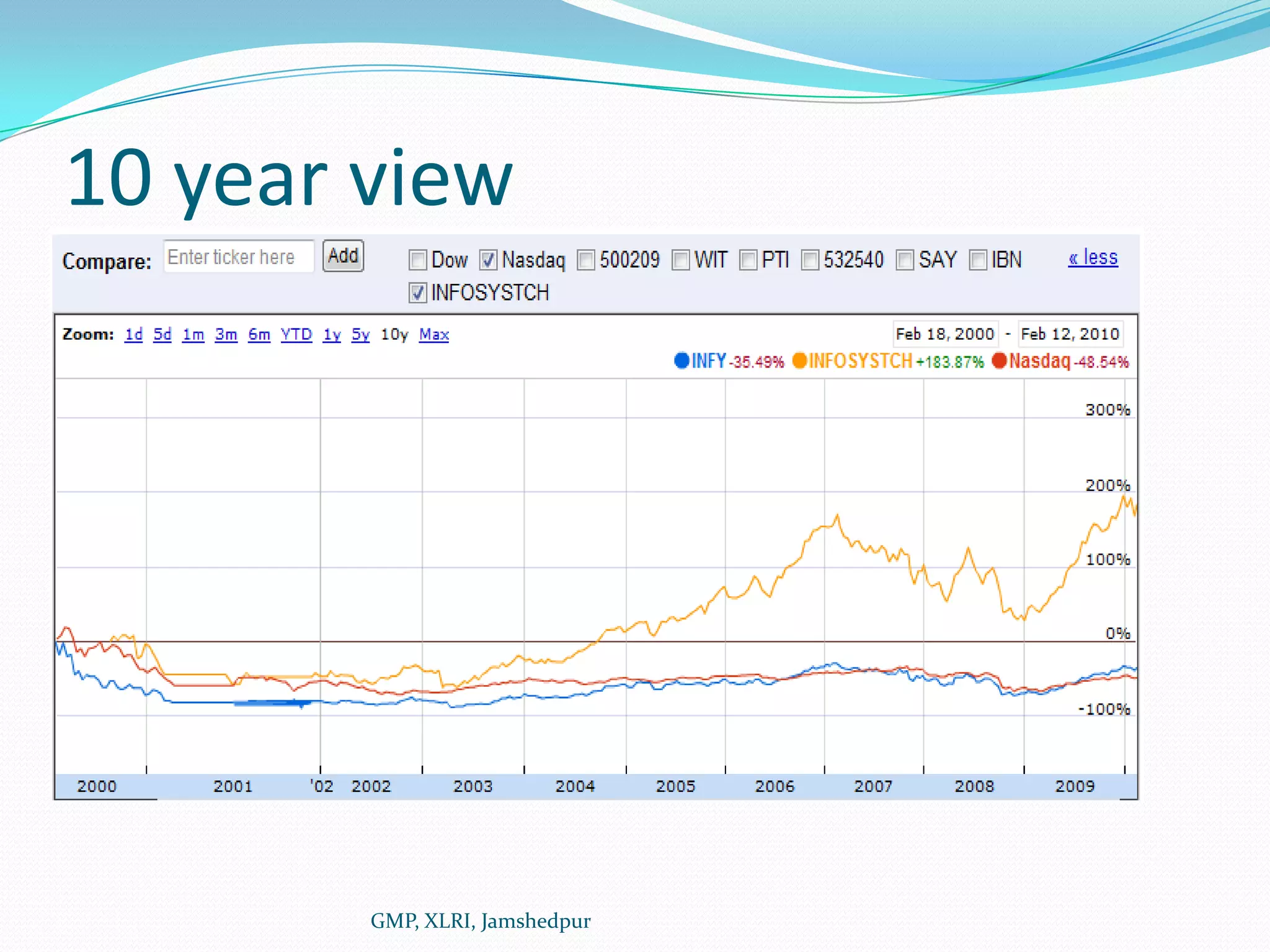
10 year viewGMP, XLRI, Jamshedpur
Factors Inducing Differences in Returns between Domestic Shares and ADRsTime Difference Exchange RatesMarket Friction and Trading Restrictions Macro Events GMP, XLRI, Jamshedpur
THANK YOU!!GMP, XLRI, Jamshedpur

Infosys American Depository Receipts (Adr) Final

  • 1.
    Infosys American DepositoryReceipts (ADR)Anshuman Jaiswal (G09051)Charlton DCosta (G09053)Deepti Chand (G09055)GMP, XLRI, Jamshedpur
  • 2.
    What is ADRCertificatesthat represent shares of a foreign stock owned and issued by a U.S bankThey buy up shares of the foreign stock and repackage them into securities which can be traded on the NYSE, NASDAQ or AMEX.The foreign shares are usually held in custody overseas, but the certificates trade in the U.S. They provide easy access to gaining international equities exposure without actually having to exchange currencies and open additional accounts to transact in overseasGMP, XLRI, Jamshedpur
  • 3.
    TYPES OF ADRLevel1 – Basic, common, traded on OTC, least regulation, no US accounting standard, no annual reportsLevel 2 – Listed on stock exchange, higher trading volumesLevel 3 – Most rigorous regulations, go as far as raising capital from US investorsIf the depository receipt is traded in the United States of America (USA), it is called an American Depository Receipt, or an ADR. GMP, XLRI, Jamshedpur
  • 4.
    GDRs and IDRSIfthe depository receipt is traded in a country other than USA, it is called a Global Depository Receipt GDR gives access to two or more marketsADRs and GDRs are an excellent means of investment for NRIs & foreign nationals wanting to invest in India IDR is instrument in form of Depository Receipt created by the Indian depository in India against the underlying equity of investing company.Foreign companies  Issue shares, to Indian Depository  Issue depository receipts.The actual shares underlying the IDRs held by Overseas Custodian.GMP, XLRI, Jamshedpur
  • 5.
  • 6.
  • 7.
    How toprice ADR Each ADR represent a single share, a fraction of shares or multiple shares. The depository bank sets the ratio of US ADRS per home country share. Ratio can be =1,<1 and >1Once ADR priced & sold in the market, its price moves based on the market conditions GMP, XLRI, Jamshedpur
  • 8.
    ADR: Companies/Shareholder's perspectiveDisadvantagesAdvantagesLimitedselectionLiquidityExchange rate riskLimited DiversificationCost EffectiveHassle Free Ease of UsageRisk DiversificationProtection of OwnershipGMP, XLRI, Jamshedpur
  • 9.
    Summary of theInfosys ADRs issued* % of share in the form of ADRs as on March 31, 2007GMP, XLRI, Jamshedpur
  • 10.
    Infosys ADR: 11thMarch 1999GMP, XLRI, Jamshedpur
  • 11.
    First Sponsored secondaryADS: July 31, 2003GMP, XLRI, Jamshedpur
  • 12.
    Second sponsored secondaryissue: May 2005GMP, XLRI, Jamshedpur
  • 13.
    Third sponsored secondaryissue: November 21, 2006GMP, XLRI, Jamshedpur
  • 14.
    Reasons why ADR’swas overpricedExcess demand with limited supply of ADR’s. Few opportunities in the US to invest in companies that are growing at the 20–30% ratesOfficial barriers prevent foreign investors from buying the shares trading in India Returns are negatively correlated with other assets held by them.ADR’s provides a value added layer – transparency, liquidity and greater coverage than the existing Indian stock.GMP, XLRI, Jamshedpur
  • 15.
    Return Behavior :INFYADS vs. NASDAQ vs. Infosys TechGMP, XLRI, Jamshedpur
  • 16.
    10 year viewGMP,XLRI, Jamshedpur
  • 17.
    Factors Inducing Differencesin Returns between Domestic Shares and ADRsTime Difference Exchange RatesMarket Friction and Trading Restrictions Macro Events GMP, XLRI, Jamshedpur
  • 18.