Introduction
to
Financial
Accounting
What is Accounting?
Accounting is an art of recording, classifying and
summarizing all financial transactions and
interpreting the results.
Groups interested in
Accounting Information
●
●
●
●
●
●
●
●

Owners/Proprietors
Management
Potential Investors
Creditors
Employees
Government
Researchers
Citizens / communities
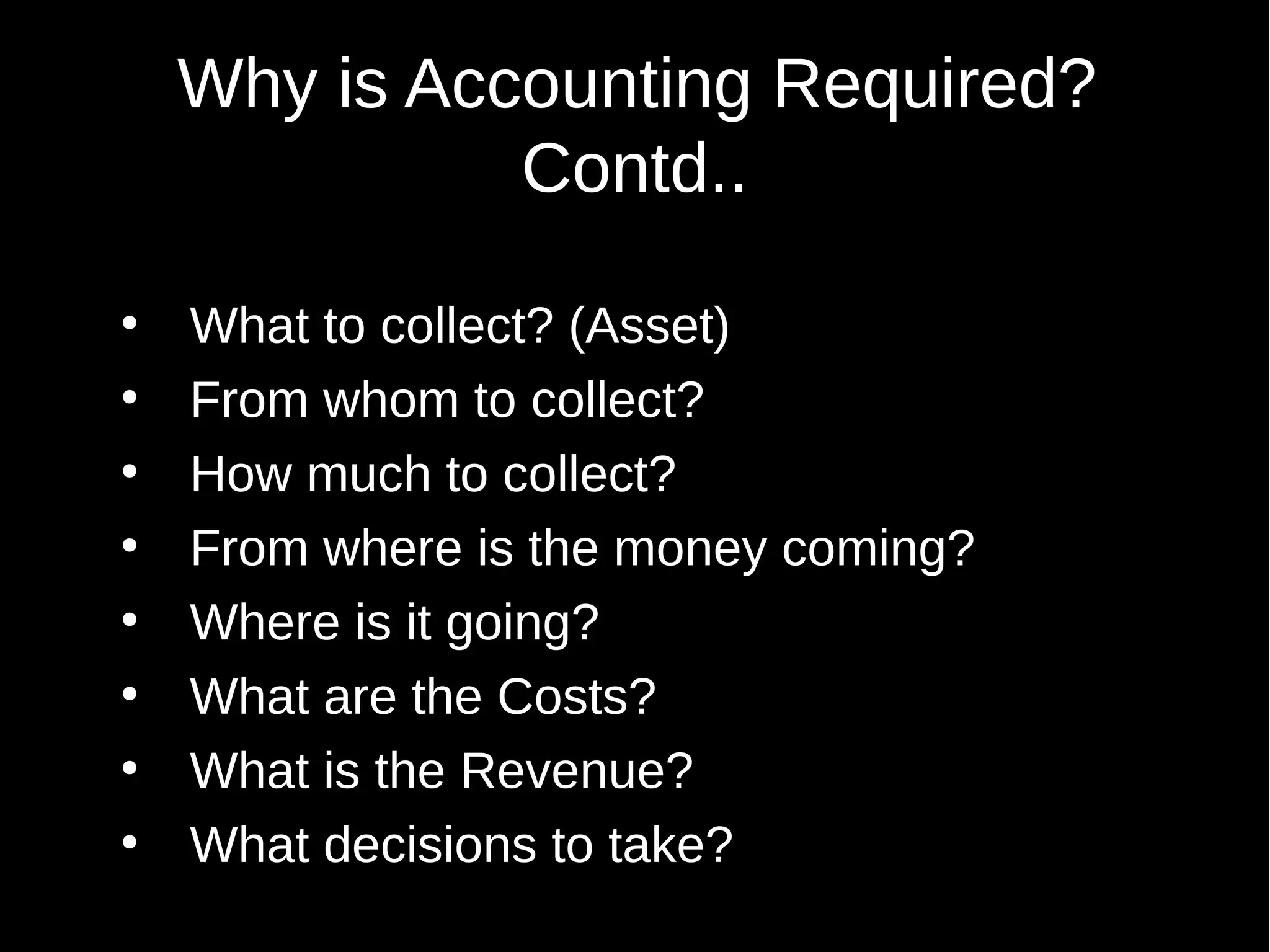
Why is Accounting Required?
To Know ●
Whether business is making a profit or loss (for
a non-profit institution this would be surplus /
deficit of income over expenditure)
●
The financial position of business / institution
●
What to pay ? (Liability)
●
Whom to pay?
●
How much to pay?
Why is Accounting Required?
Contd..
●
●
●
●
●
●
●
●

What to collect? (Asset)
From whom to collect?
How much to collect?
From where is the money coming?
Where is it going?
What are the Costs?
What is the Revenue?
What decisions to take?
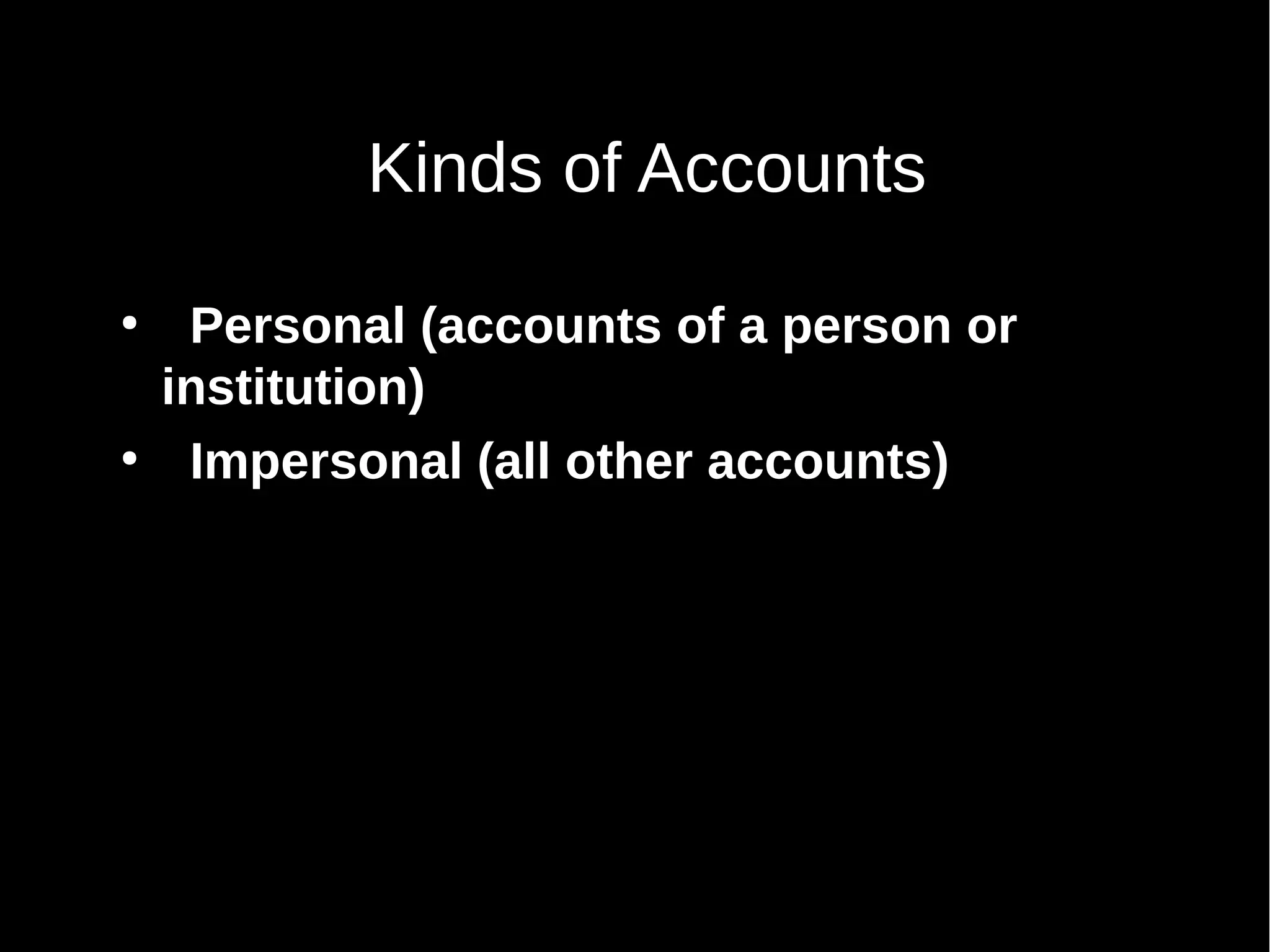
Kinds of Accounts
●

●

Personal (accounts of a person or
institution)
Impersonal (all other accounts)
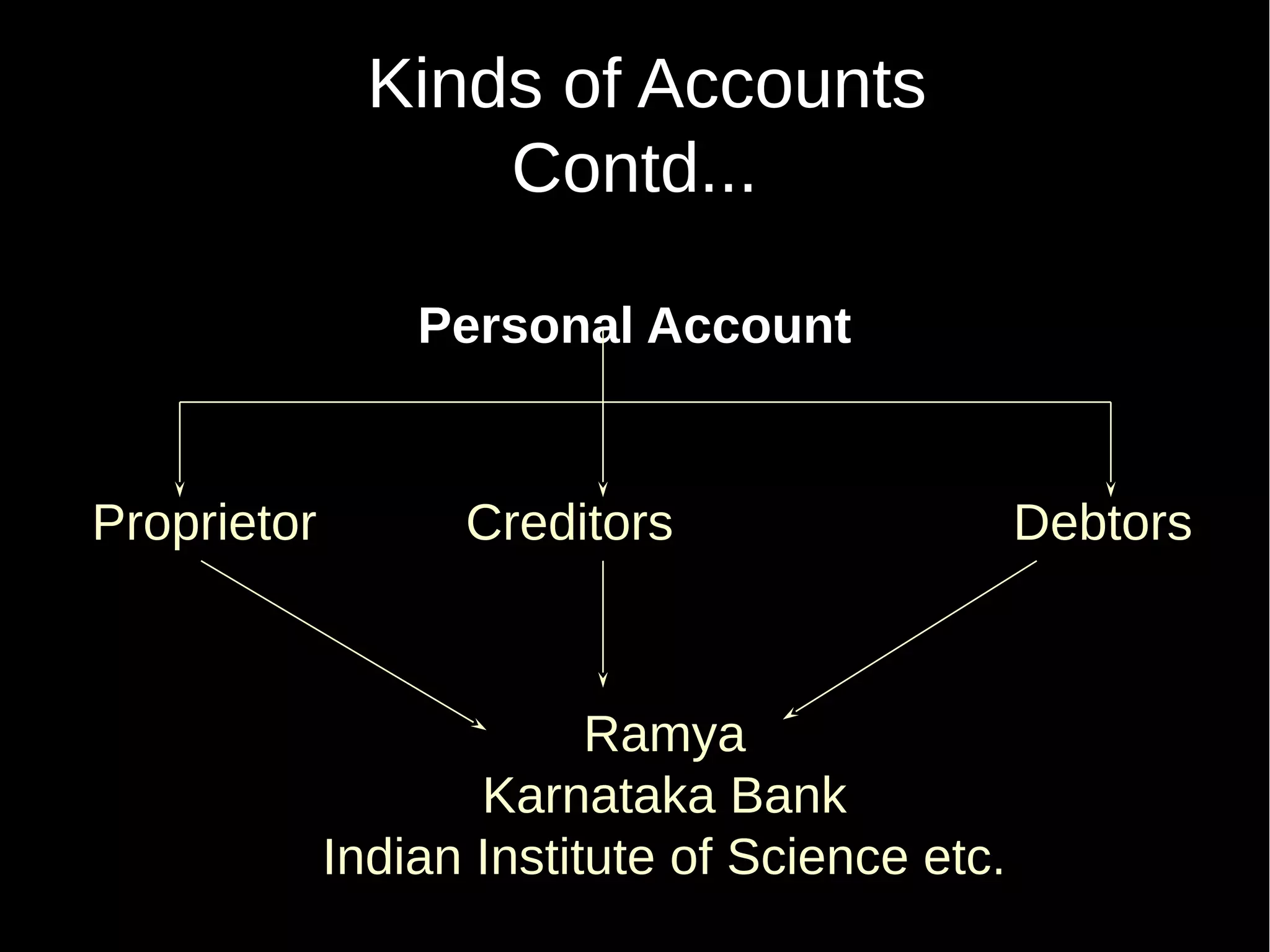
Kinds of Accounts
Contd...
Personal Account

Proprietor

Creditors

Ramya
Karnataka Bank
Indian Institute of Science etc.

Debtors
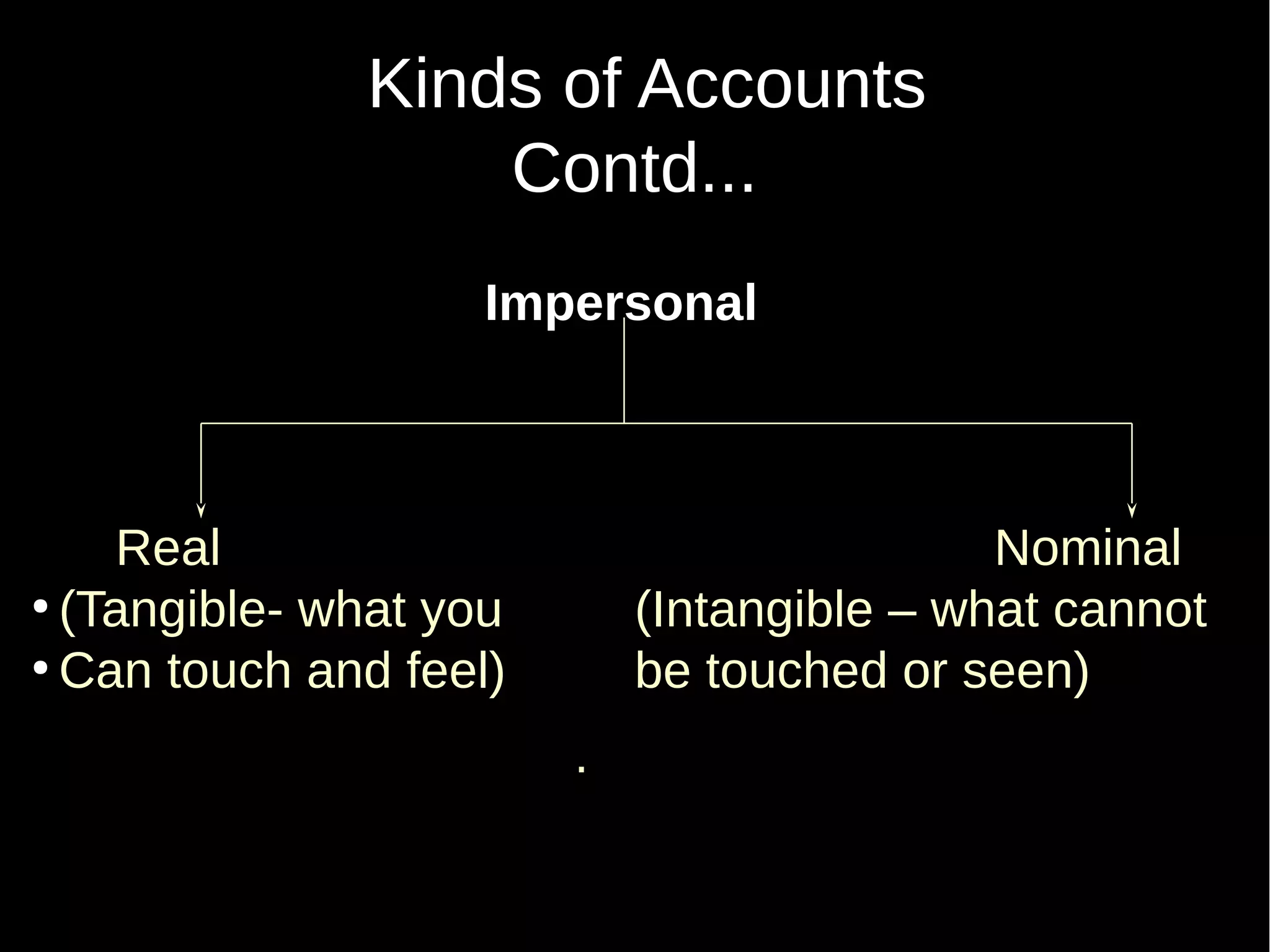
Kinds of Accounts
Contd...
Impersonal

Real
●
(Tangible- what you
●
Can touch and feel)

Nominal
(Intangible – what cannot
be touched or seen)
.
Kinds of Accounts
Contd...
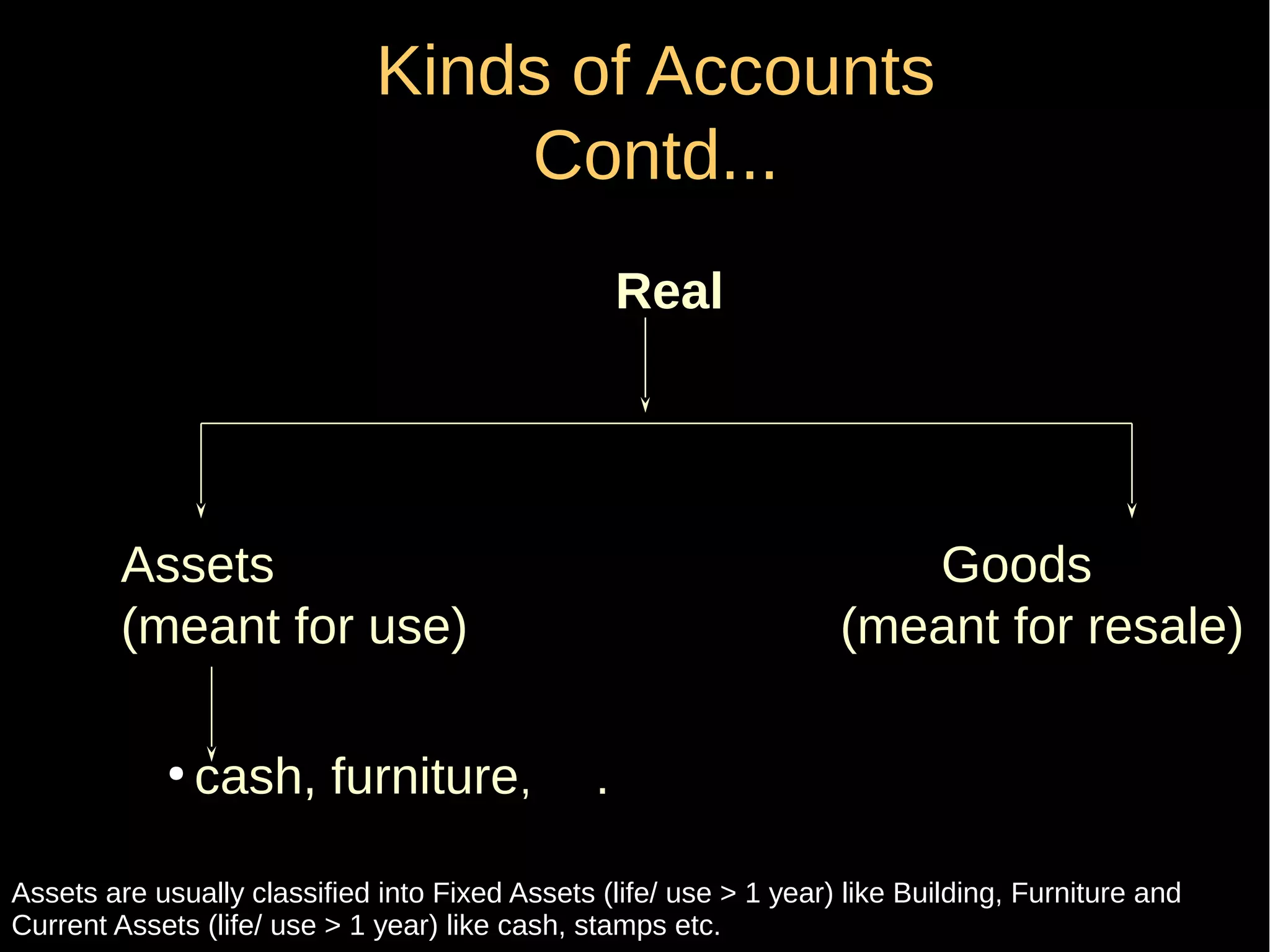
Real

Assets
(meant for use)
●

cash, furniture,

Goods
(meant for resale)
.

Assets are usually classified into Fixed Assets (life/ use > 1 year) like Building, Furniture and
Current Assets (life/ use > 1 year) like cash, stamps etc.
Kinds of Accounts
Contd...
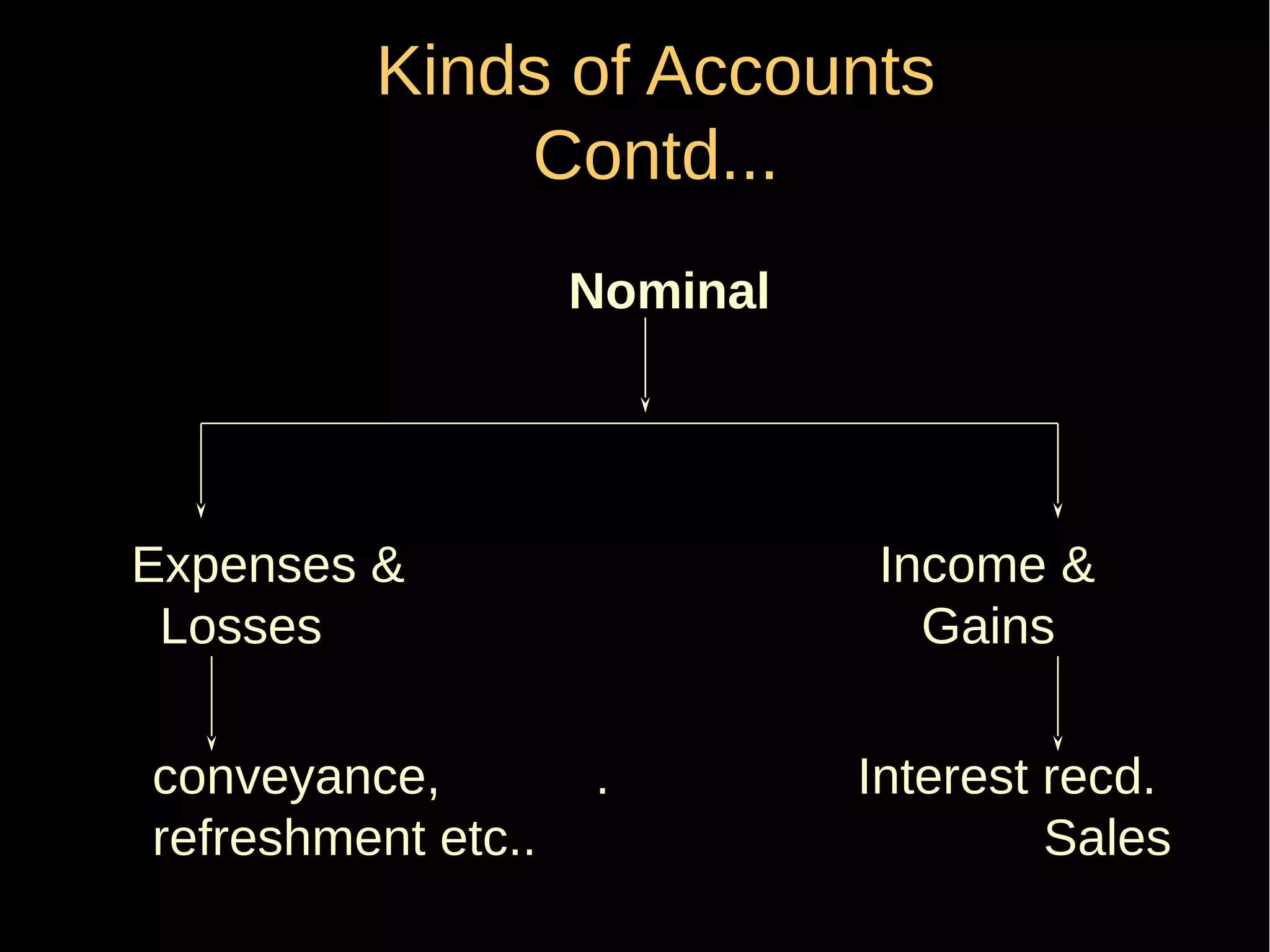
Nominal

Expenses &
Losses
conveyance,
refreshment etc..

Income &
Gains
.

Interest recd.
Sales
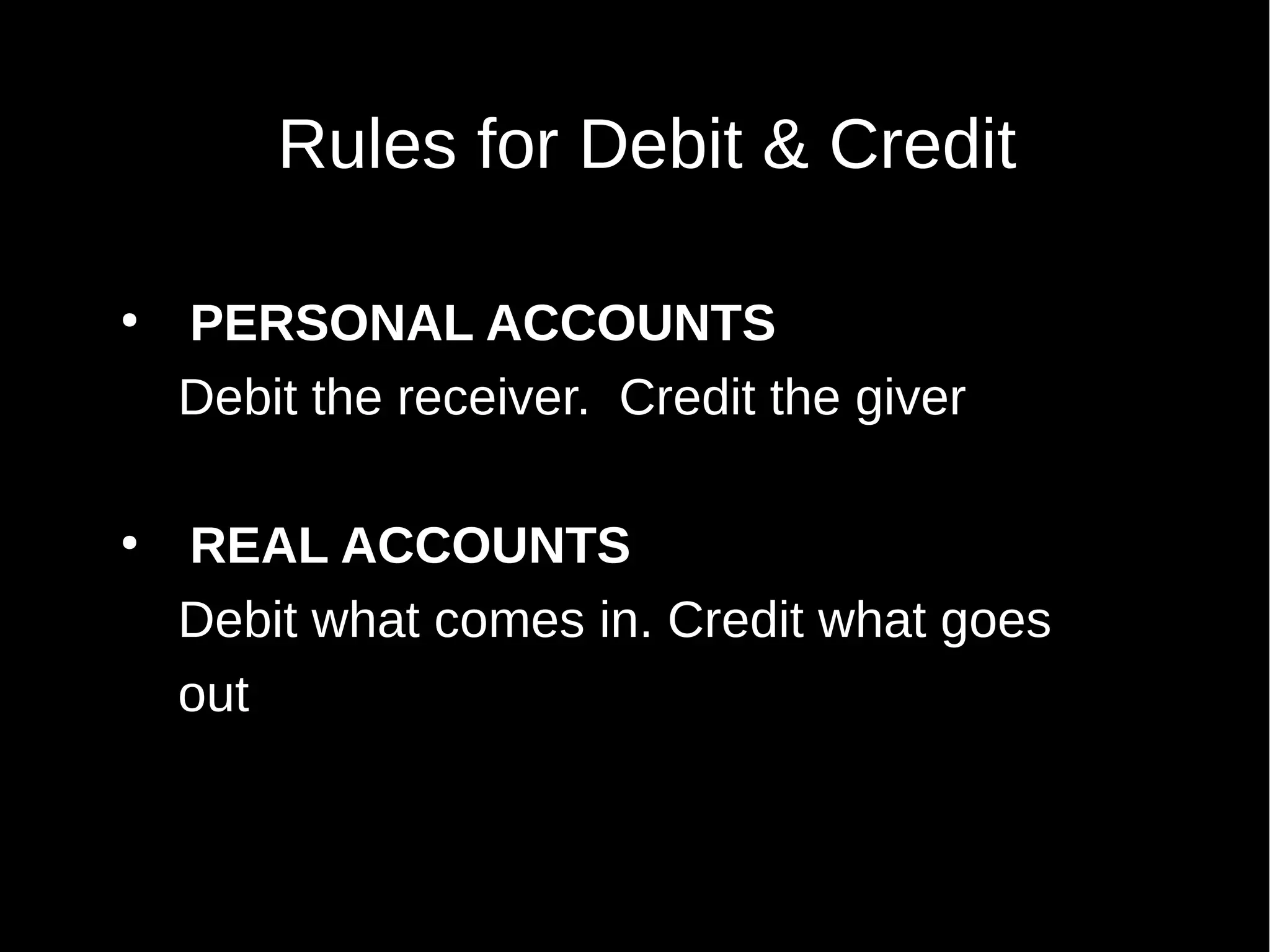
Rules for Debit & Credit
●

●

PERSONAL ACCOUNTS
Debit the receiver. Credit the giver
REAL ACCOUNTS
Debit what comes in. Credit what goes
out
Rules for Debit & Credit
Contd...
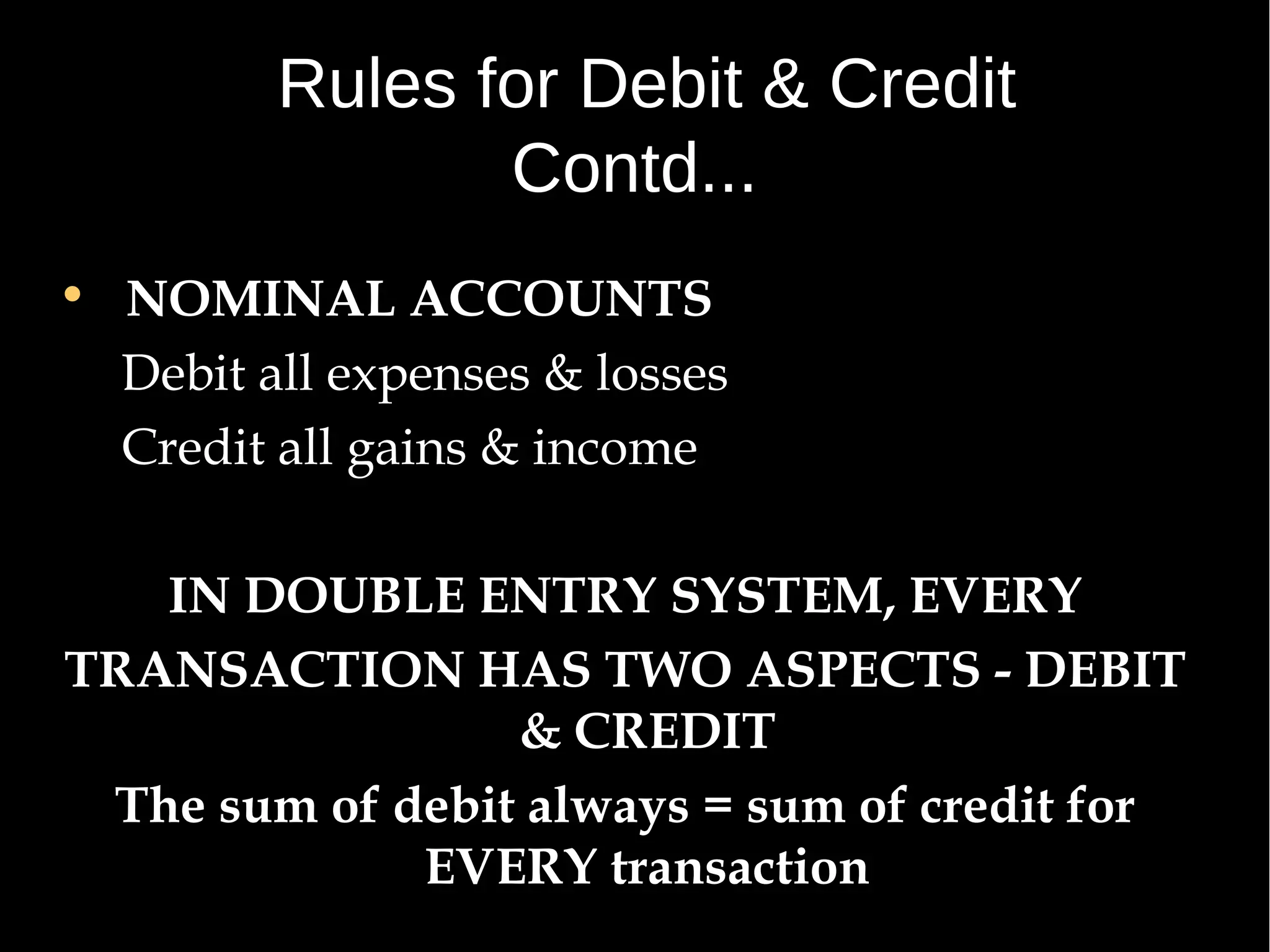
• NOMINAL ACCOUNTS
Debit all expenses & losses
Credit all gains & income
IN DOUBLE ENTRY SYSTEM, EVERY
TRANSACTION HAS TWO ASPECTS - DEBIT
& CREDIT
The sum of debit always = sum of credit for
EVERY transaction
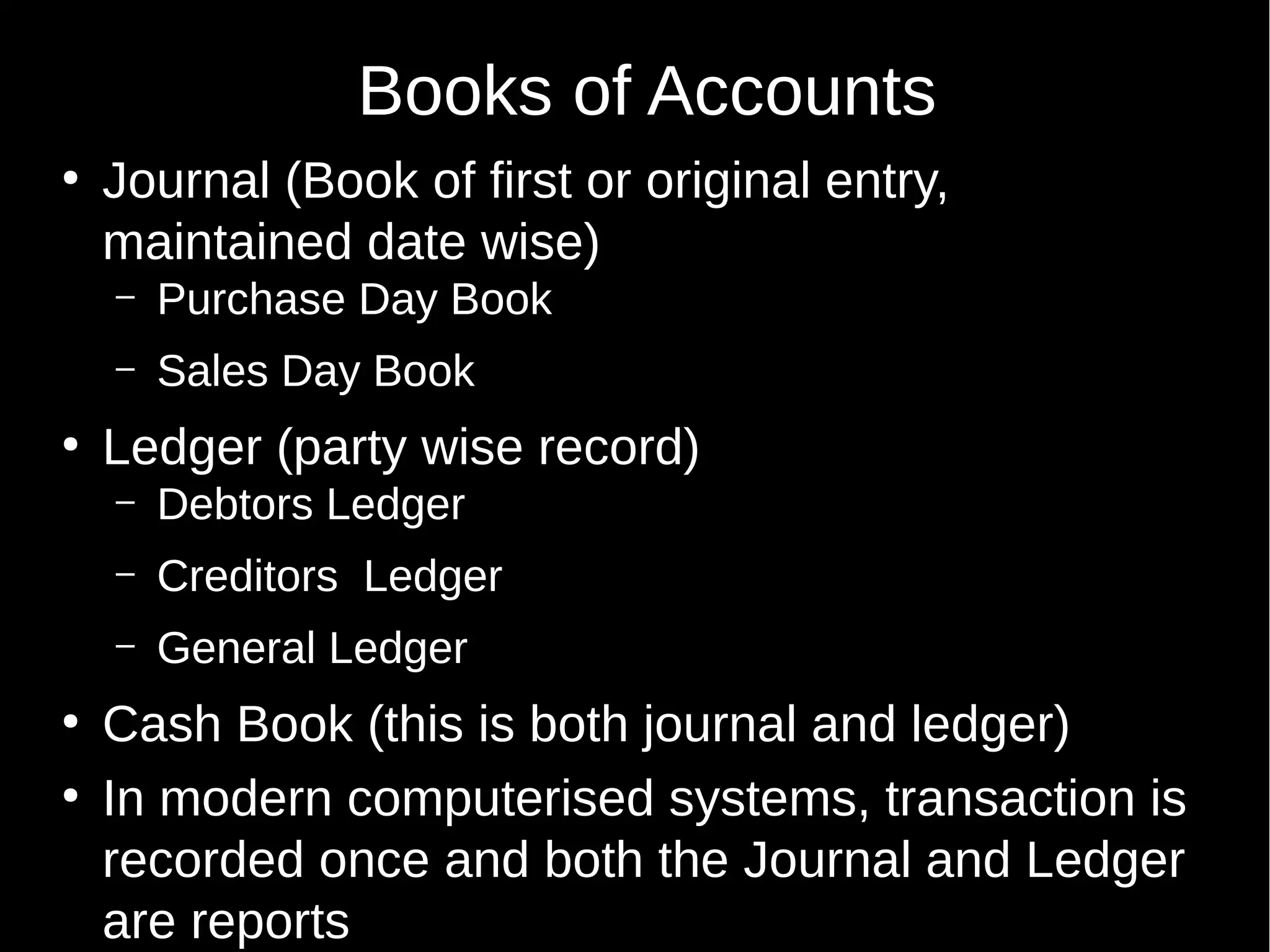
Books of Accounts
●

Journal (Book of first or original entry,
maintained date wise)
–
–

●

Purchase Day Book
Sales Day Book

Ledger (party wise record)
–
–

●

Creditors Ledger

–
●

Debtors Ledger
General Ledger

Cash Book (this is both journal and ledger)
In modern computerised systems, transaction is
recorded once and both the Journal and Ledger
are reports
The Accounting Transaction
Moves from the Source
Document to Books of
Accounts
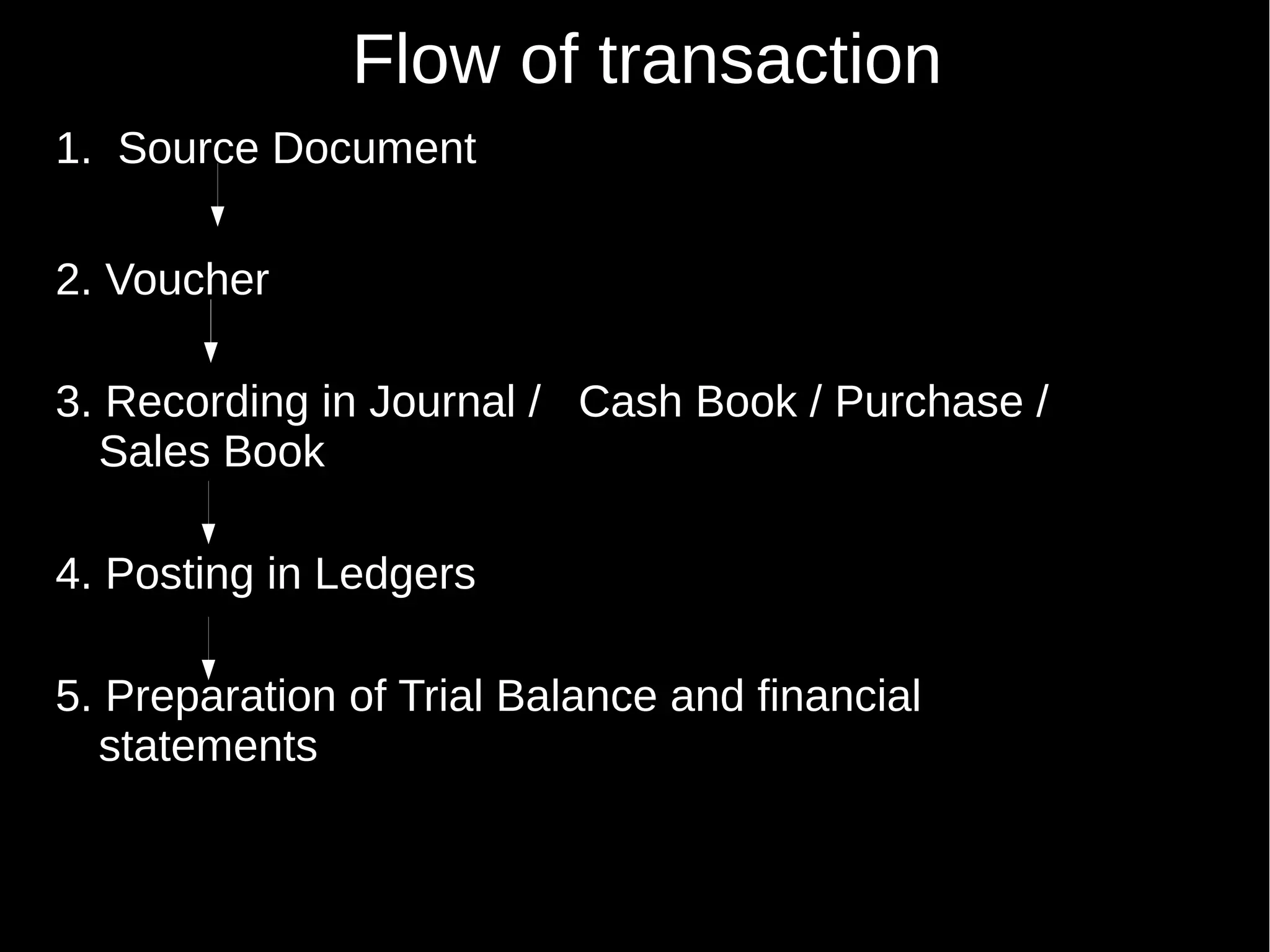
Flow of transaction
1. Source Document
2. Voucher
3. Recording in Journal / Cash Book / Purchase /
Sales Book
4. Posting in Ledgers
5. Preparation of Trial Balance and financial
statements
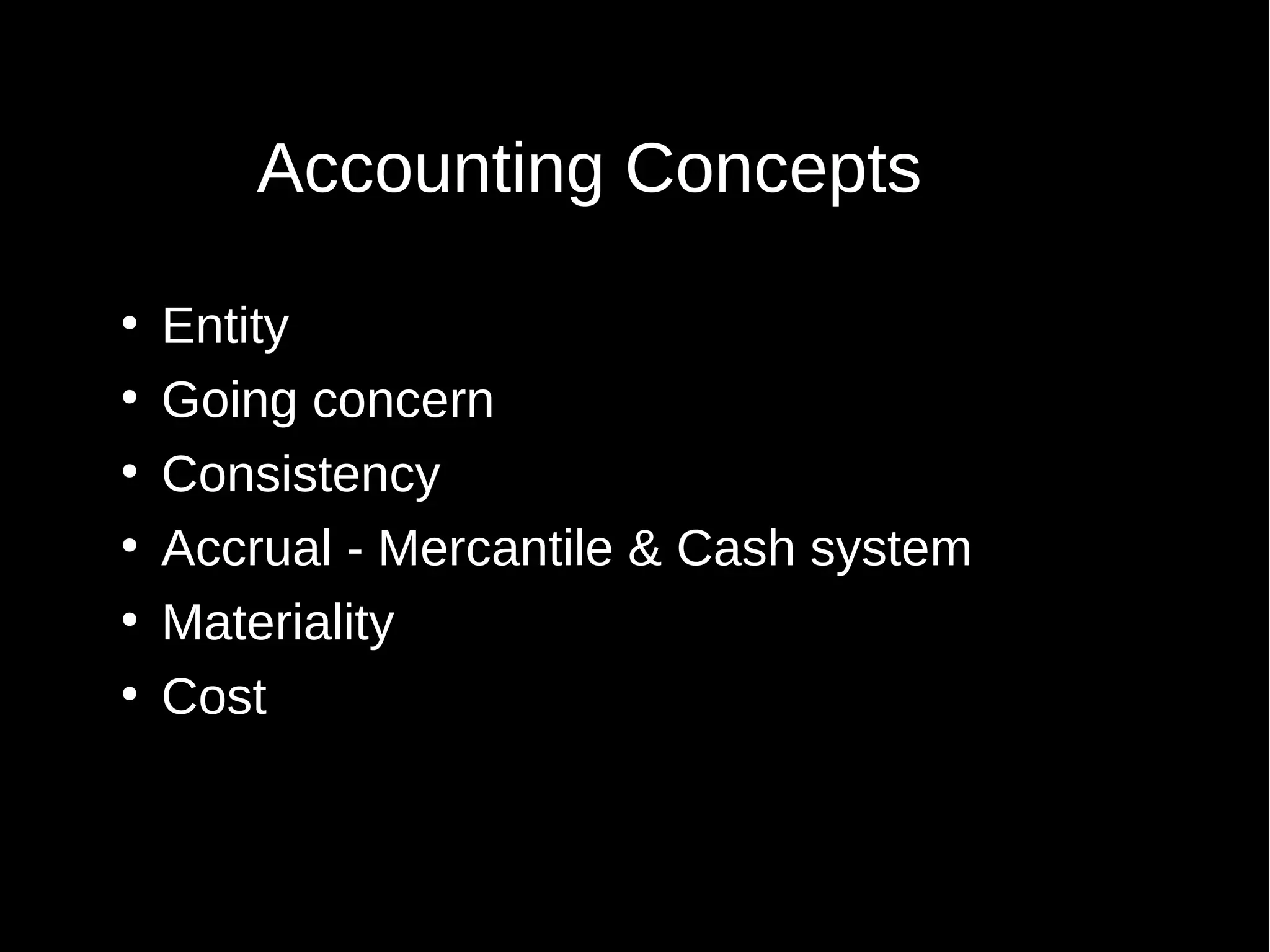
Accounting Concepts
●
●
●
●
●
●

Entity
Going concern
Consistency
Accrual - Mercantile & Cash system
Materiality
Cost
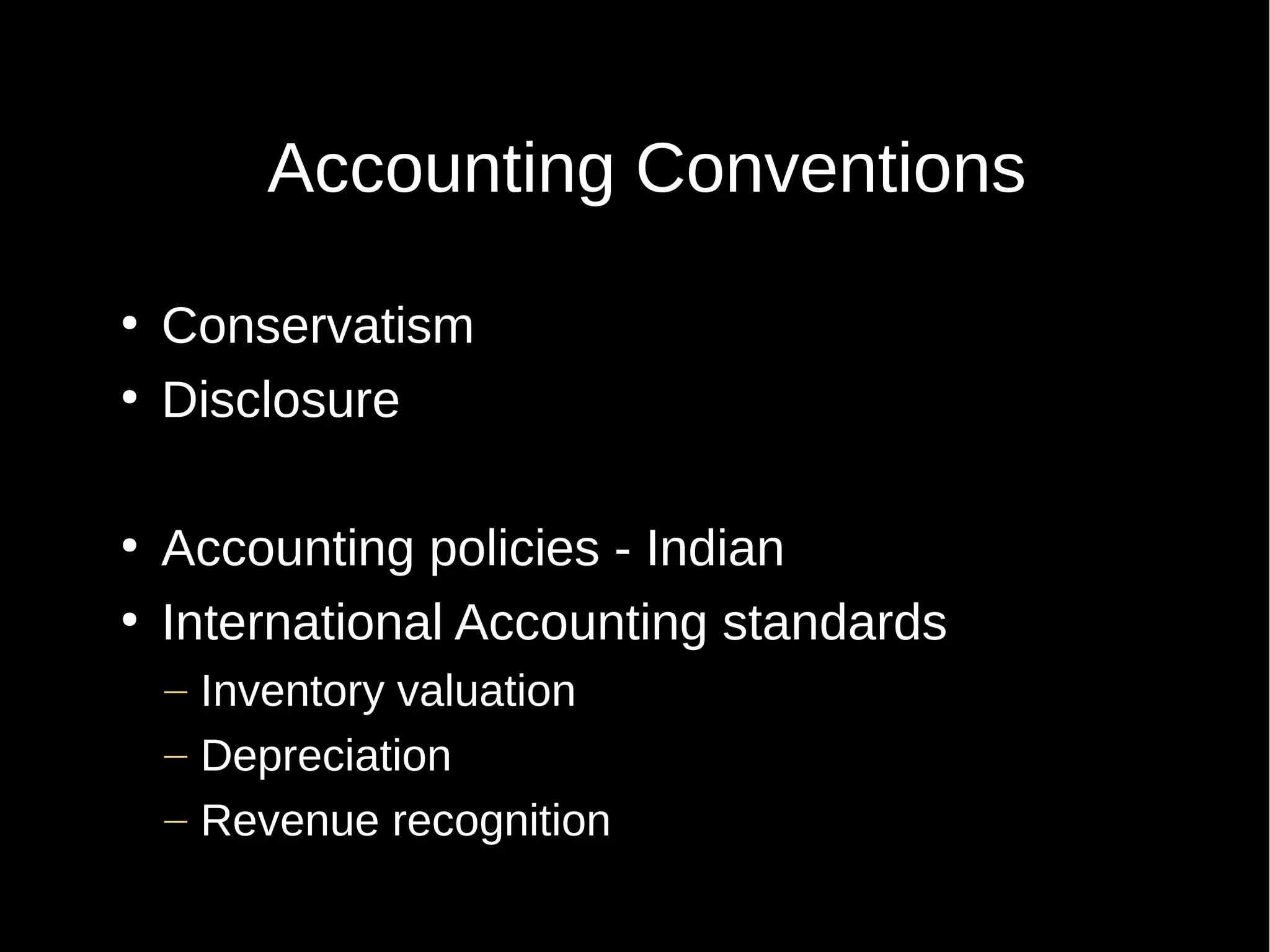
Accounting Conventions
●
●

●
●

Conservatism
Disclosure
Accounting policies - Indian
International Accounting standards
– Inventory valuation
– Depreciation
– Revenue recognition
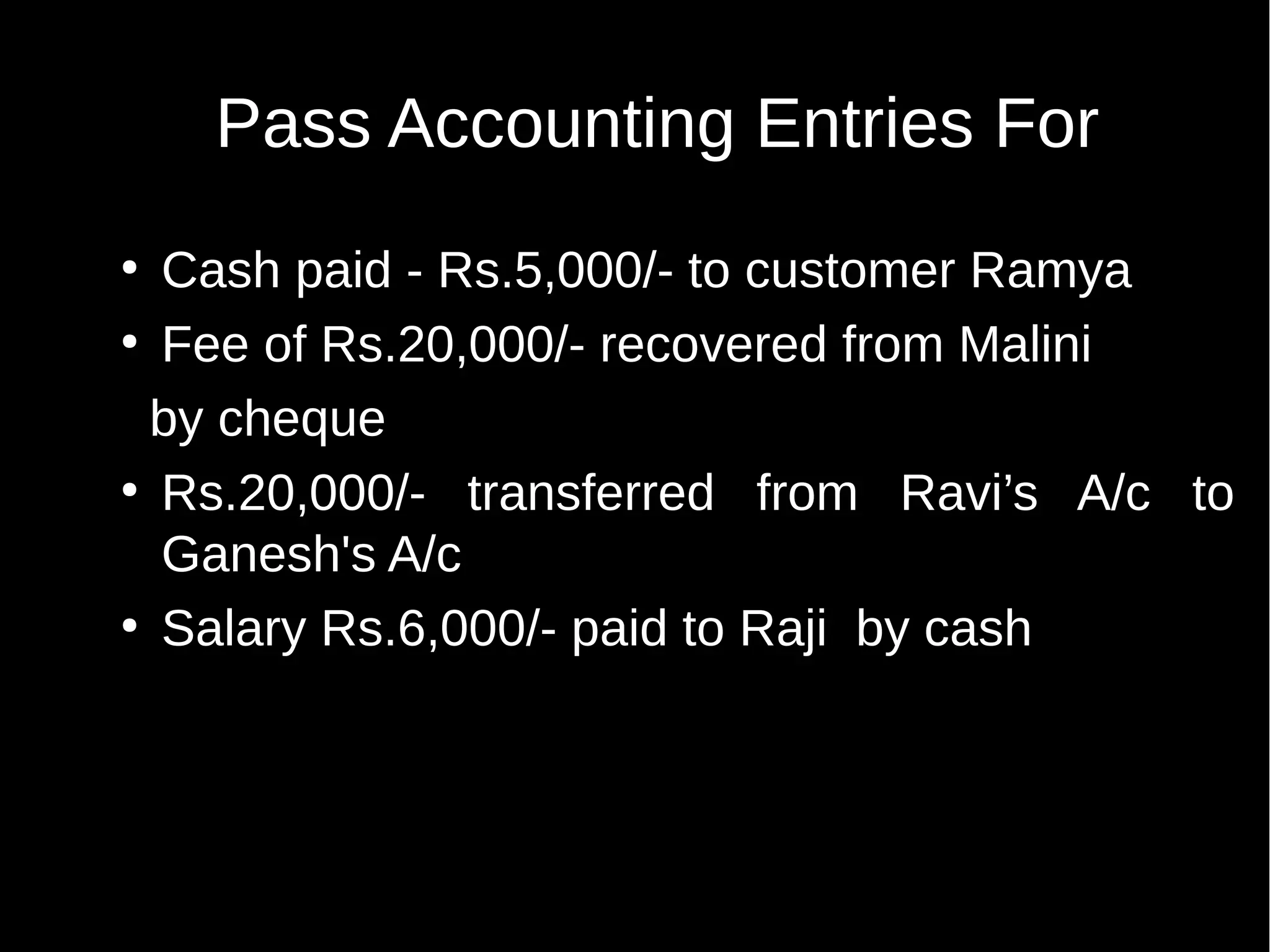
Pass Accounting Entries For
Cash paid - Rs.5,000/- to customer Ramya
●
Fee of Rs.20,000/- recovered from Malini
by cheque
●
Rs.20,000/- transferred from Ravi’s A/c to
Ganesh's A/c
●
Salary Rs.6,000/- paid to Raji by cash
●
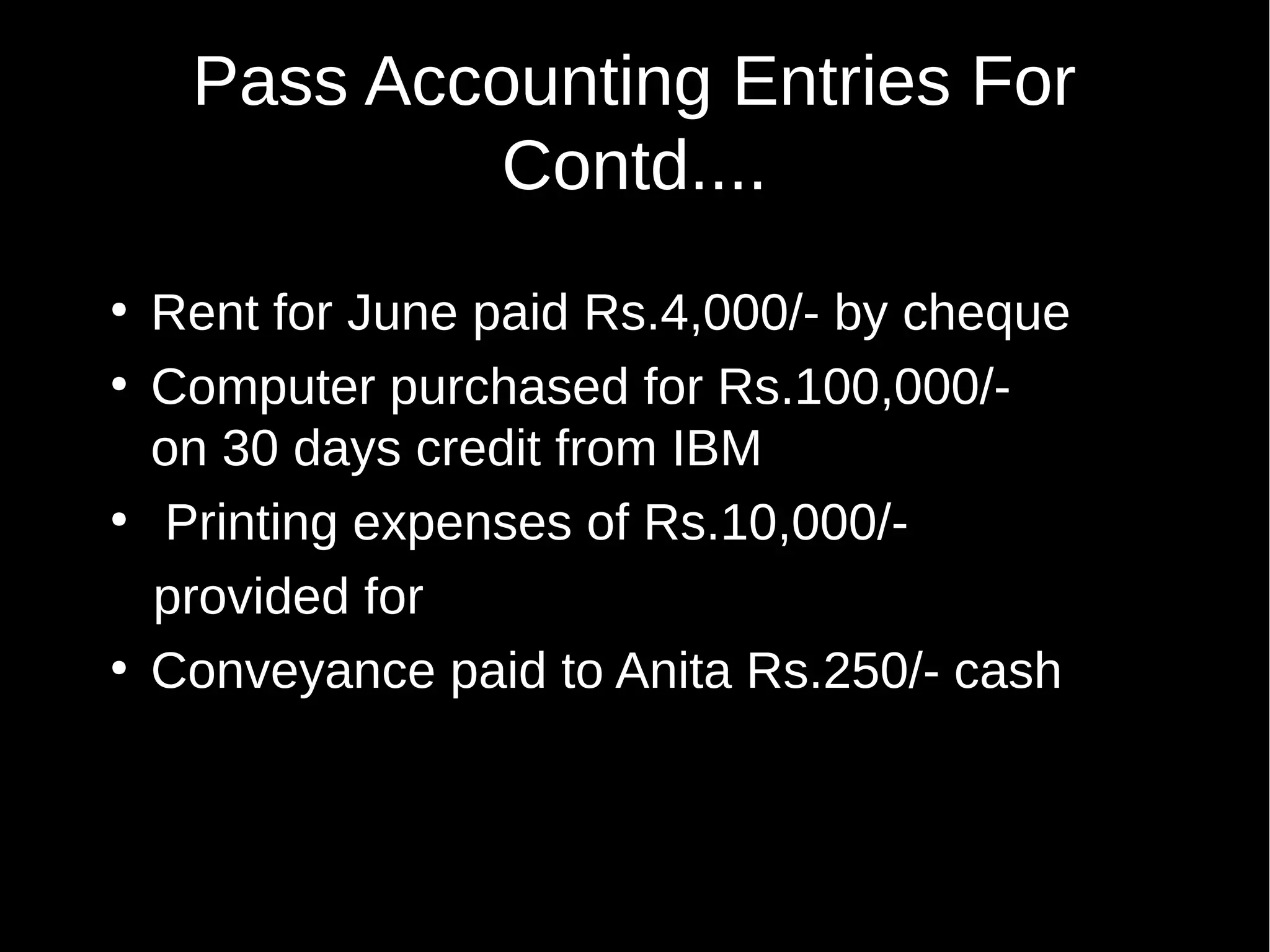
Pass Accounting Entries For
Contd....
●
●

●

●

Rent for June paid Rs.4,000/- by cheque
Computer purchased for Rs.100,000/on 30 days credit from IBM
Printing expenses of Rs.10,000/provided for
Conveyance paid to Anita Rs.250/- cash
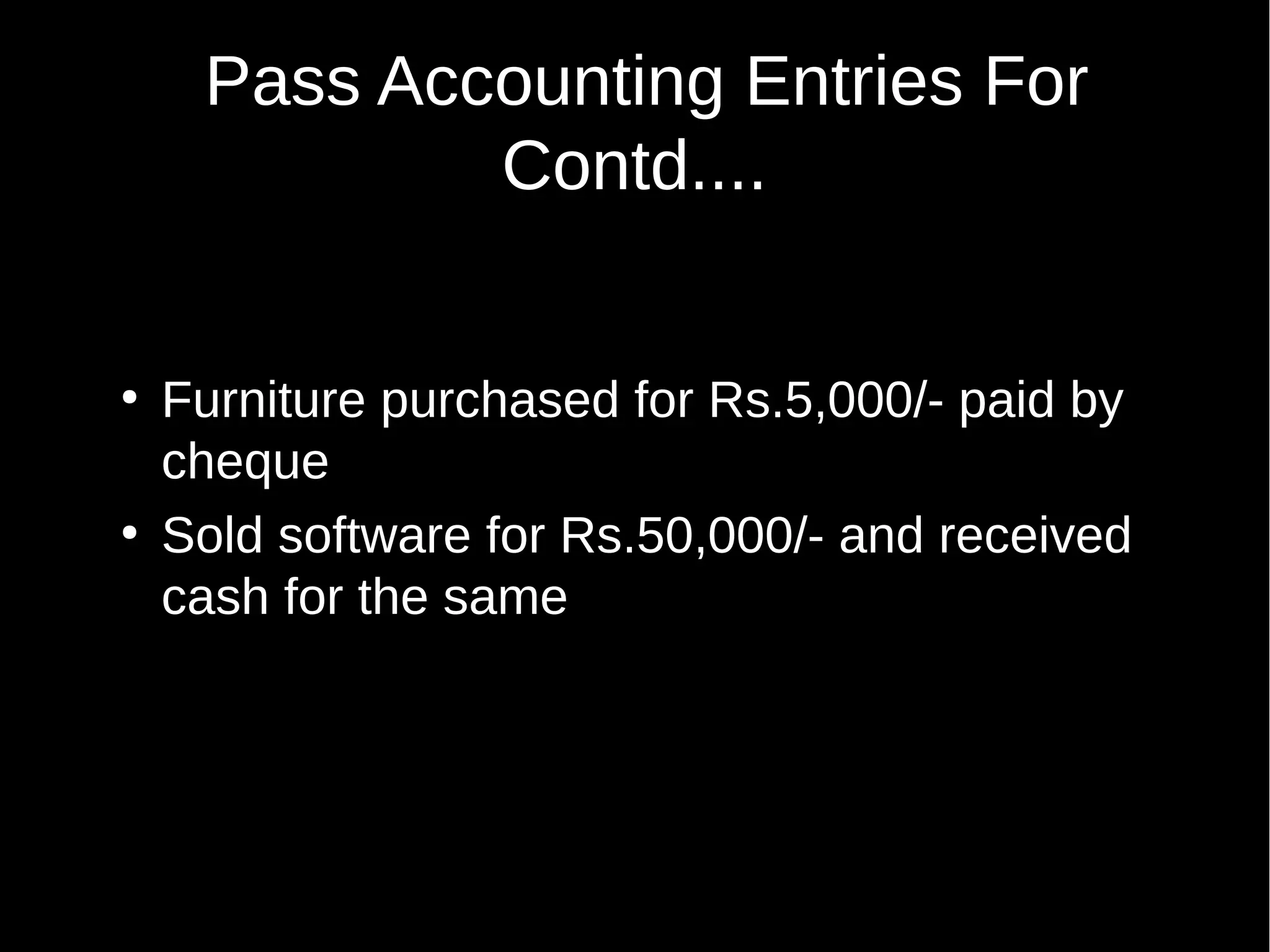
Pass Accounting Entries For
Contd....

●

●

Furniture purchased for Rs.5,000/- paid by
cheque
Sold software for Rs.50,000/- and received
cash for the same
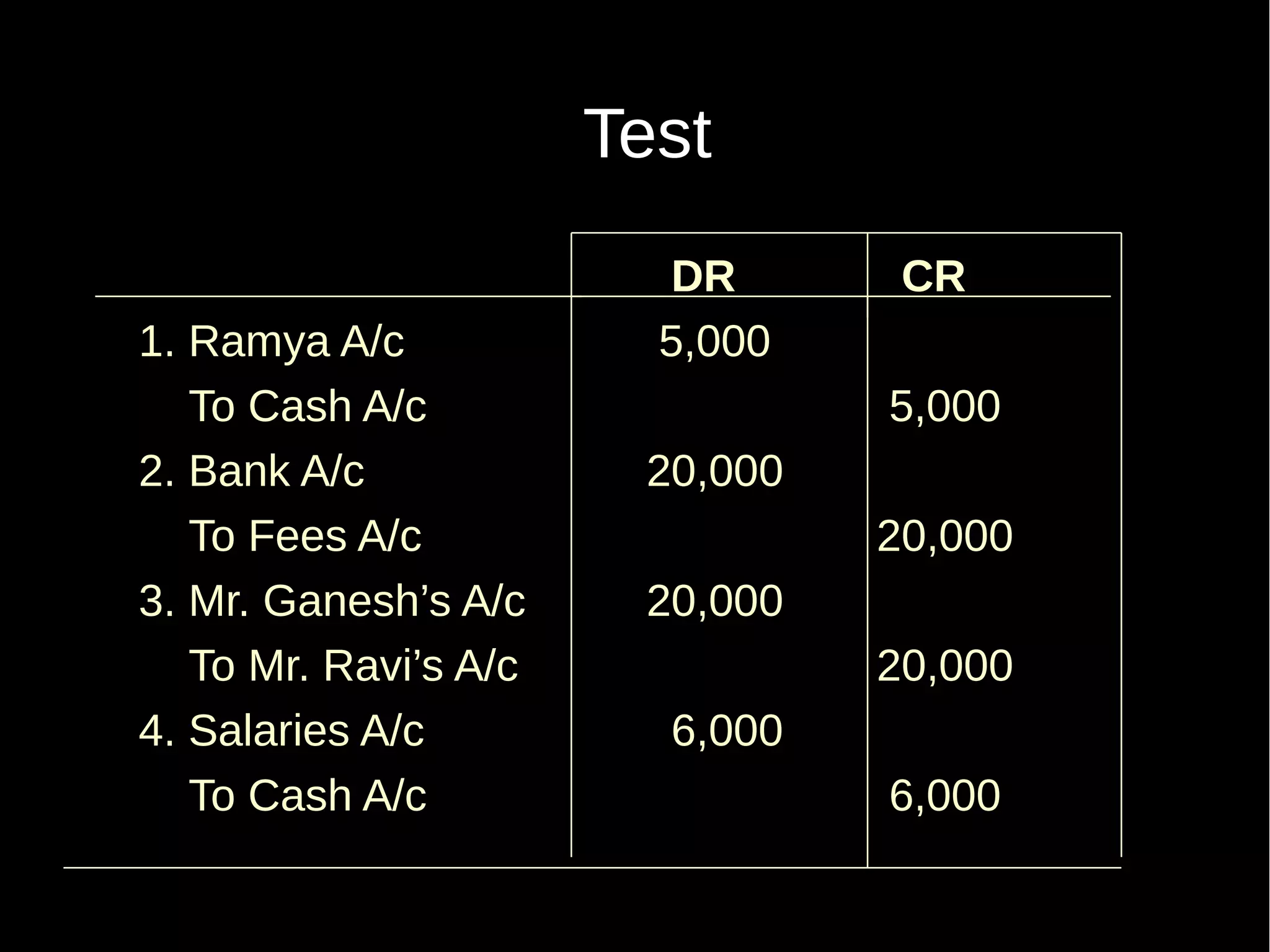
Test
1. Ramya A/c
To Cash A/c
2. Bank A/c
To Fees A/c
3. Mr. Ganesh’s A/c
To Mr. Ravi’s A/c
4. Salaries A/c
To Cash A/c

DR
5,000

CR
5,000

20,000
20,000
20,000
20,000
6,000
6,000
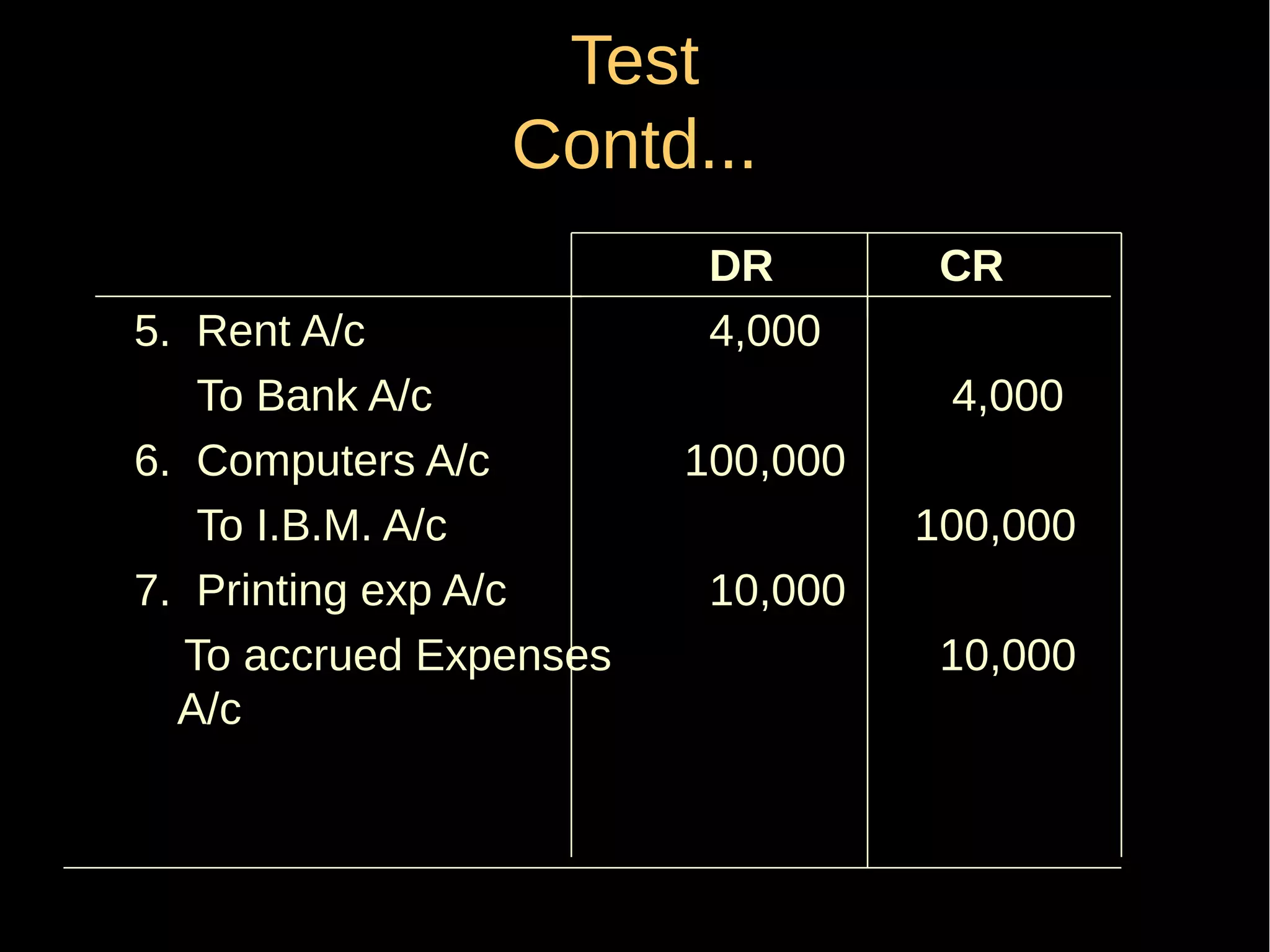
Test
Contd...
5. Rent A/c
To Bank A/c
6. Computers A/c
To I.B.M. A/c
7. Printing exp A/c
To accrued Expenses
A/c

DR
4,000

CR
4,000

100,000
100,000
10,000
10,000
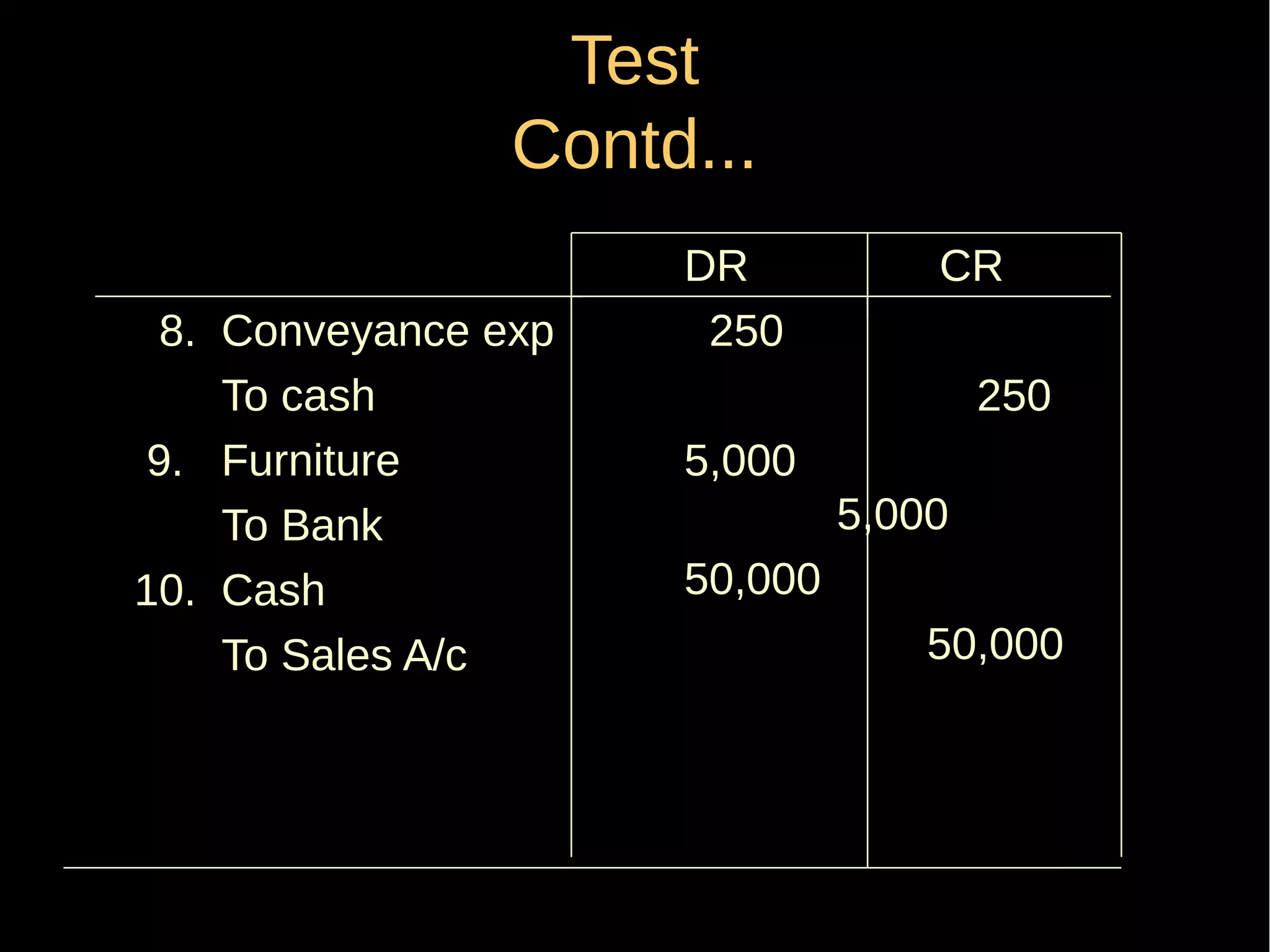
Test
Contd...
8. Conveyance exp
To cash
9. Furniture
To Bank
10. Cash
To Sales A/c

DR
250

CR
250

5,000
5,000
50,000
50,000
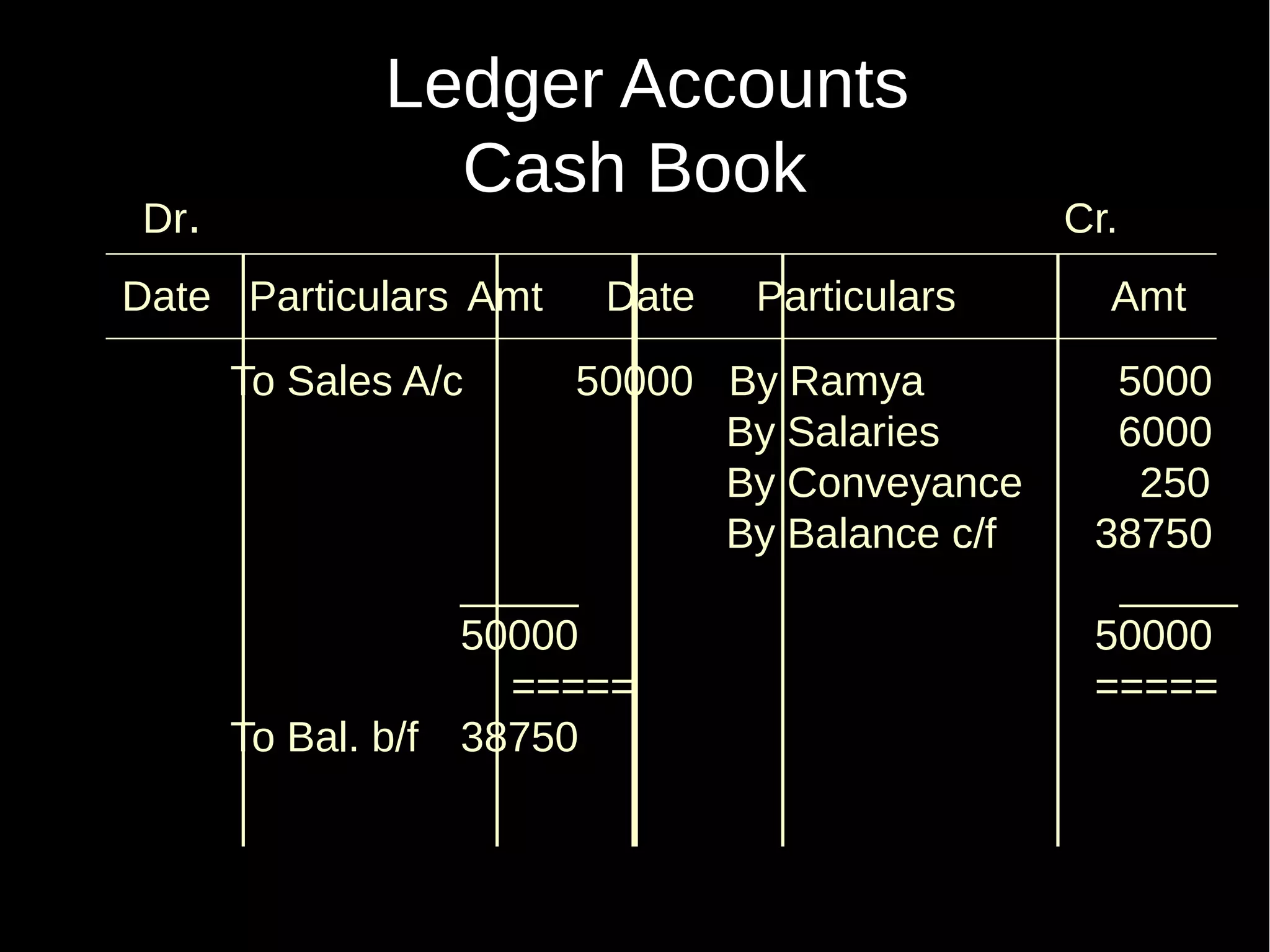
Dr.

Ledger Accounts
Cash Book

Date Particulars Amt
To Sales A/c

Date

Particulars

50000 By Ramya
By Salaries
By Conveyance
By Balance c/f
_____
50000
=====
To Bal. b/f 38750

Cr.
Amt
5000
6000
250
38750
_____
50000
=====
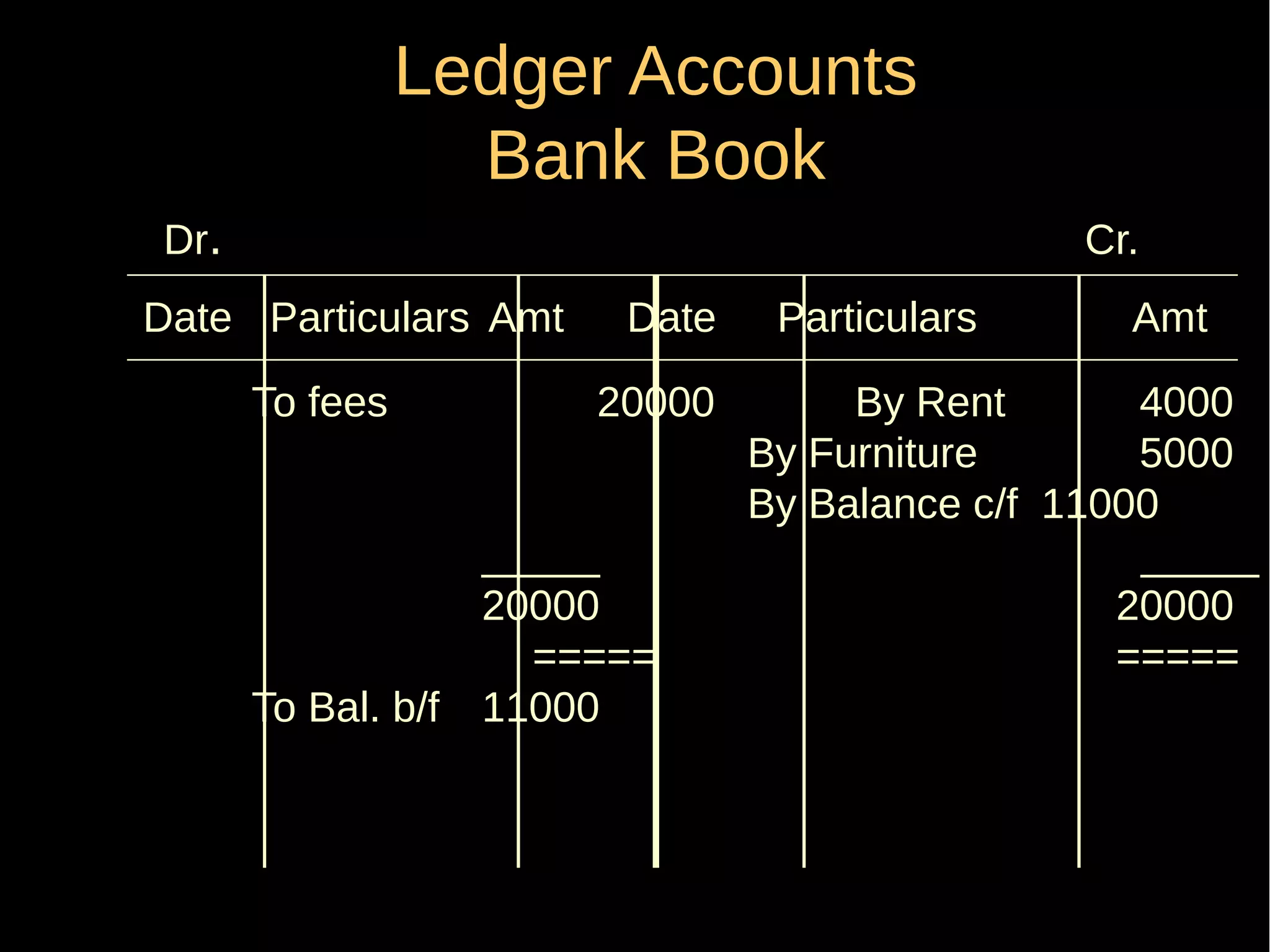
Ledger Accounts
Bank Book
Dr.

Cr.

Date Particulars Amt
To fees

Date
20000

_____
20000
=====
To Bal. b/f 11000

Particulars

Amt

By Rent
4000
By Furniture
5000
By Balance c/f 11000
_____
20000
=====
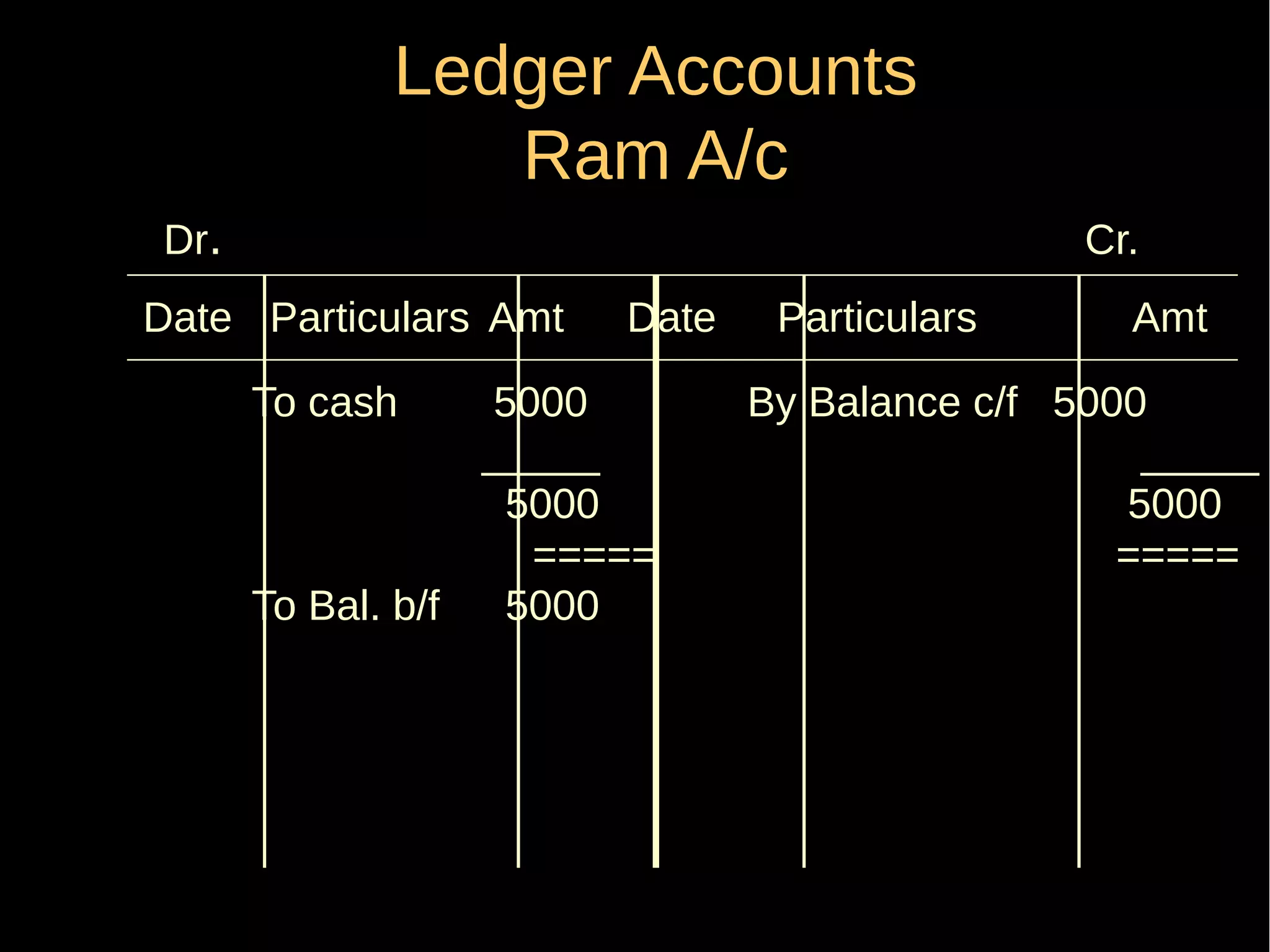
Ledger Accounts
Ram A/c
Dr.

Cr.

Date Particulars Amt
To cash

Date

5000
_____
5000
=====
To Bal. b/f
5000

Particulars

Amt

By Balance c/f 5000
_____
5000
=====
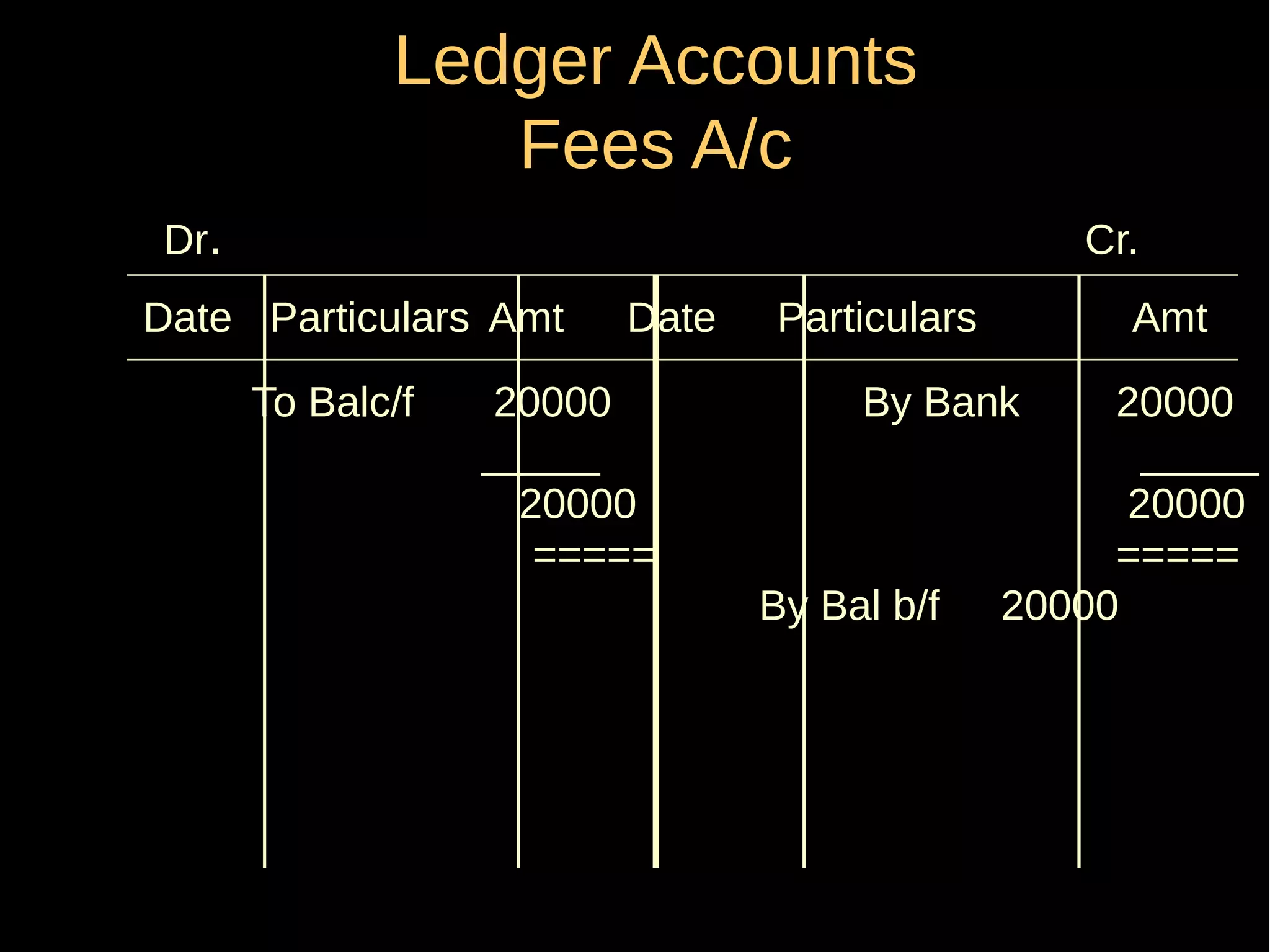
Ledger Accounts
Fees A/c
Dr.

Cr.

Date Particulars Amt
To Balc/f

Date

20000
_____
20000
=====

Particulars

Amt

By Bank

By Bal b/f

20000
_____
20000
=====
20000
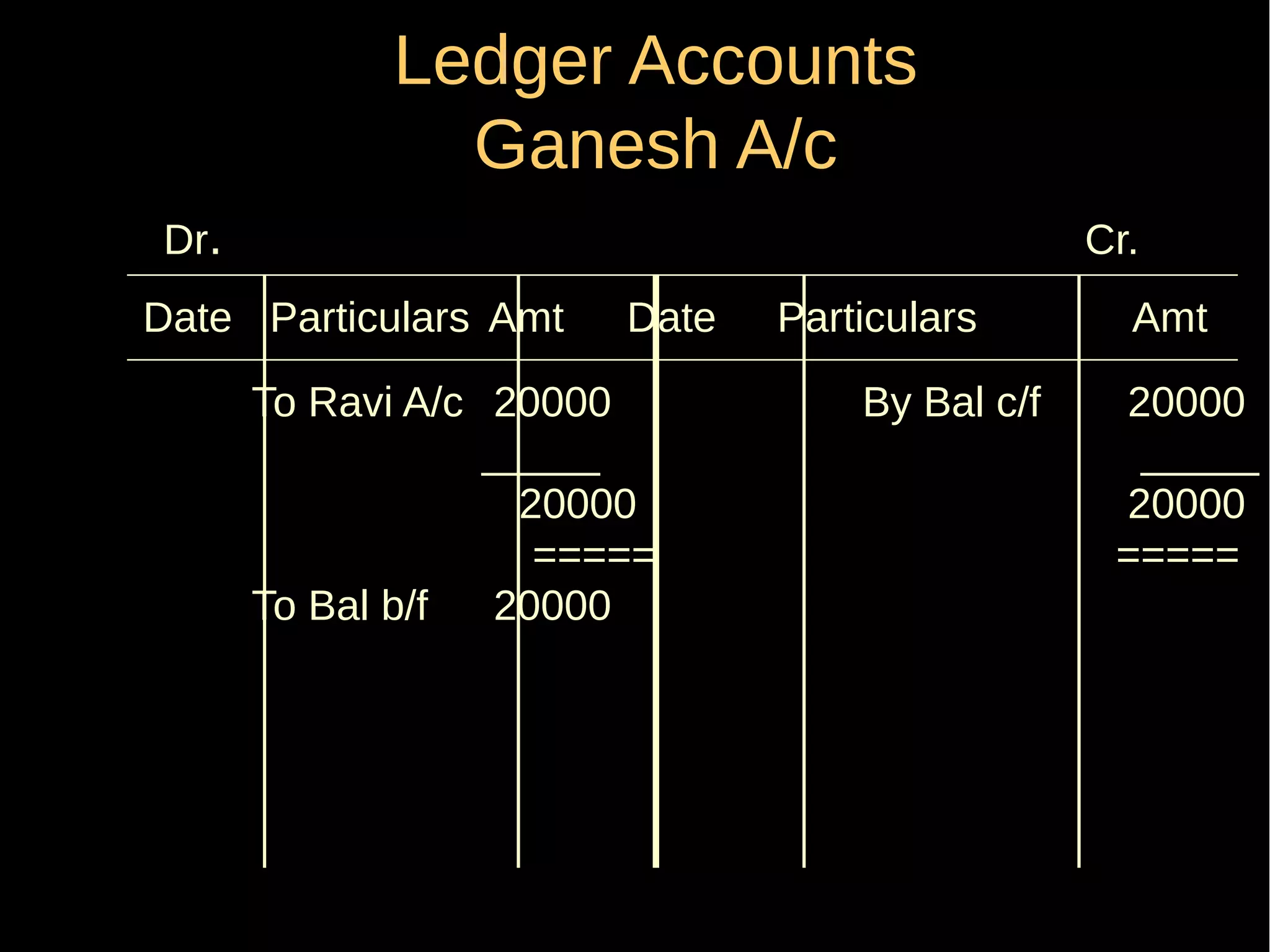
Ledger Accounts
Ganesh A/c
Dr.

Cr.

Date Particulars Amt

Date

To Ravi A/c 20000
_____
20000
=====
To Bal b/f
20000

Particulars
By Bal c/f

Amt
20000
_____
20000
=====
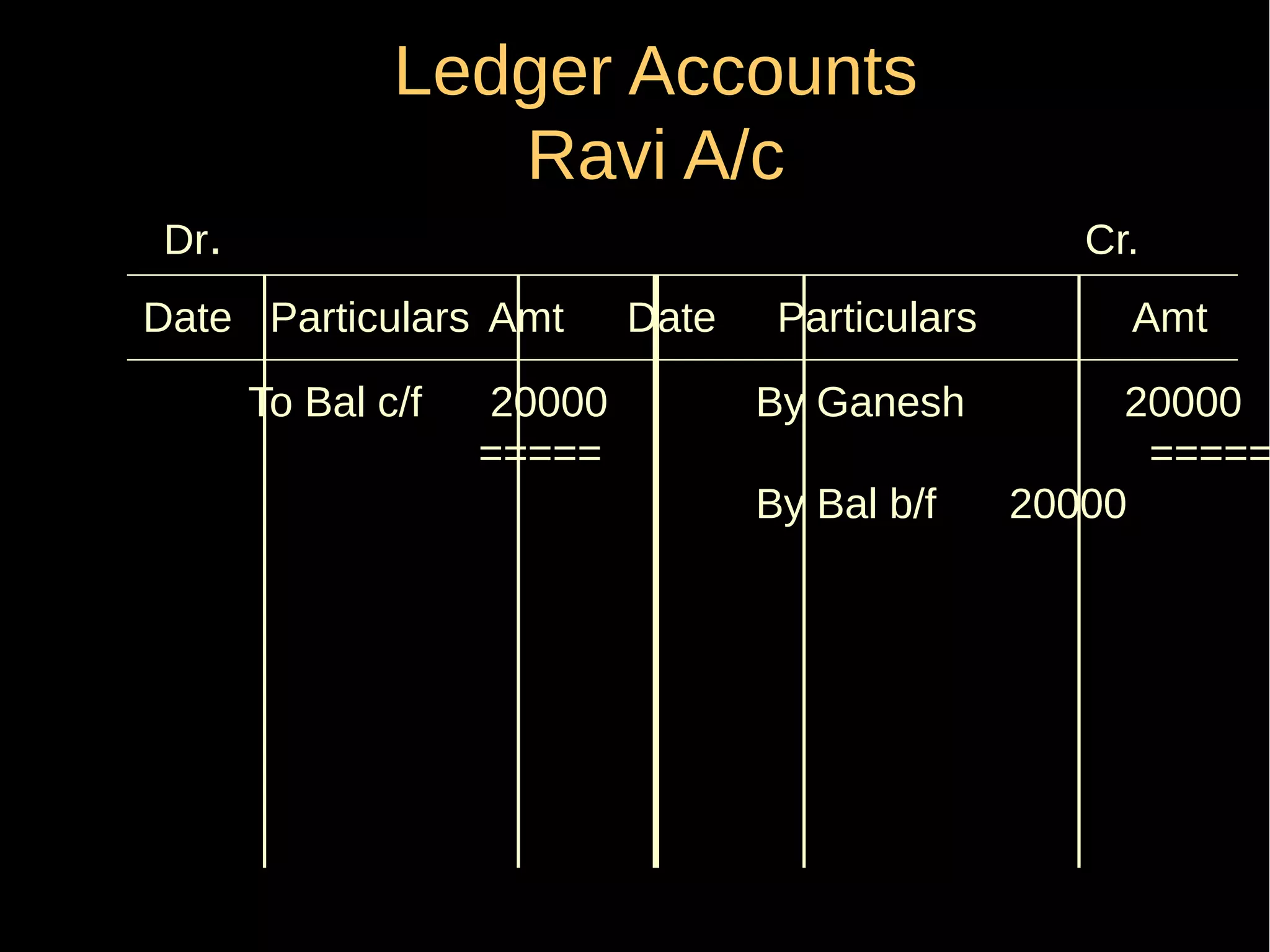
Ledger Accounts
Ravi A/c
Dr.

Cr.

Date Particulars Amt
To Bal c/f

20000
=====

Date

Particulars
By Ganesh
By Bal b/f

Amt

20000
=====
20000
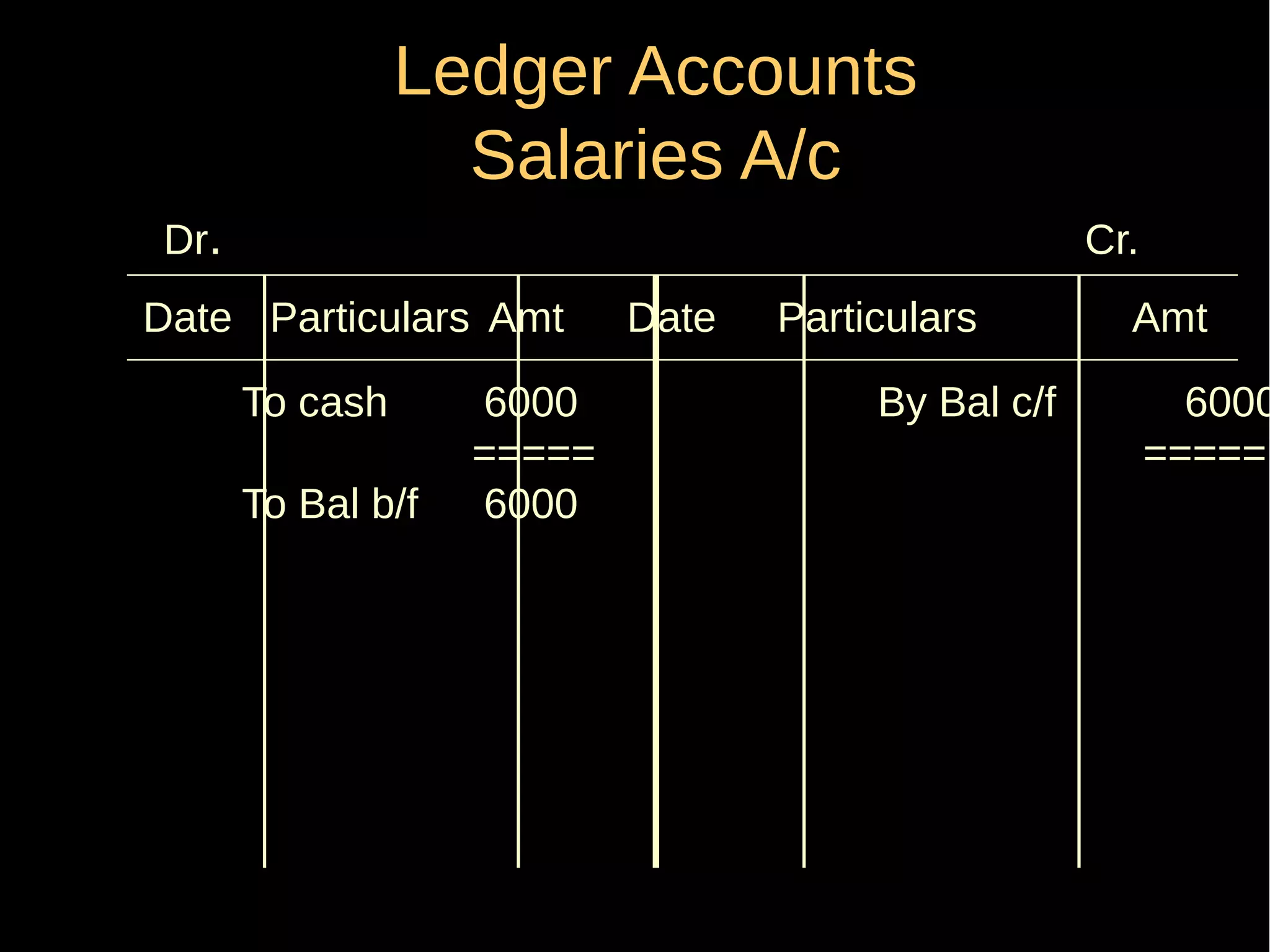
Ledger Accounts
Salaries A/c
Dr.

Cr.

Date Particulars Amt
To cash
To Bal b/f

6000
=====
6000

Date

Particulars
By Bal c/f

Amt

6000
=====
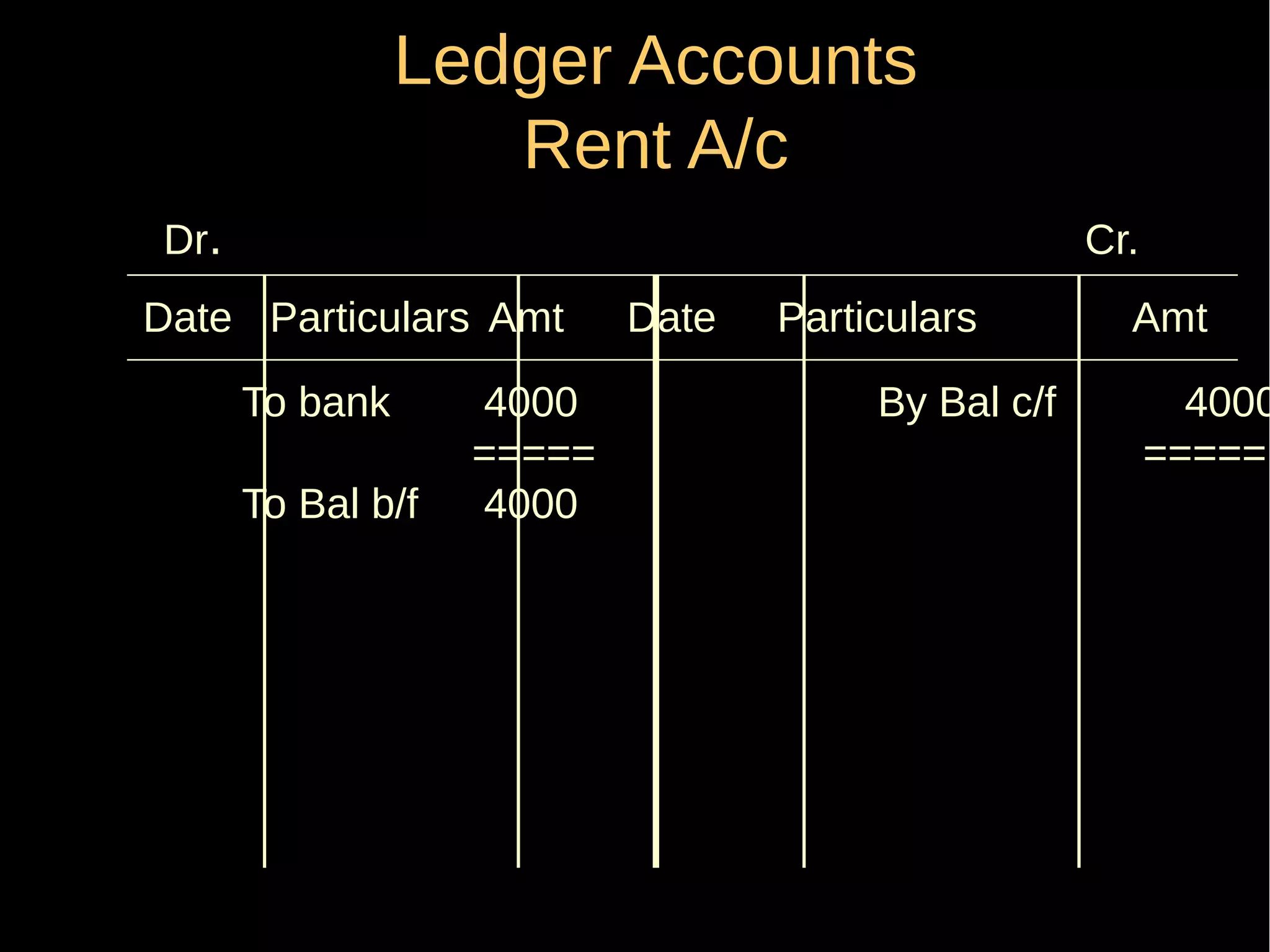
Ledger Accounts
Rent A/c
Dr.

Cr.

Date Particulars Amt
To bank
To Bal b/f

4000
=====
4000

Date

Particulars
By Bal c/f

Amt

4000
=====
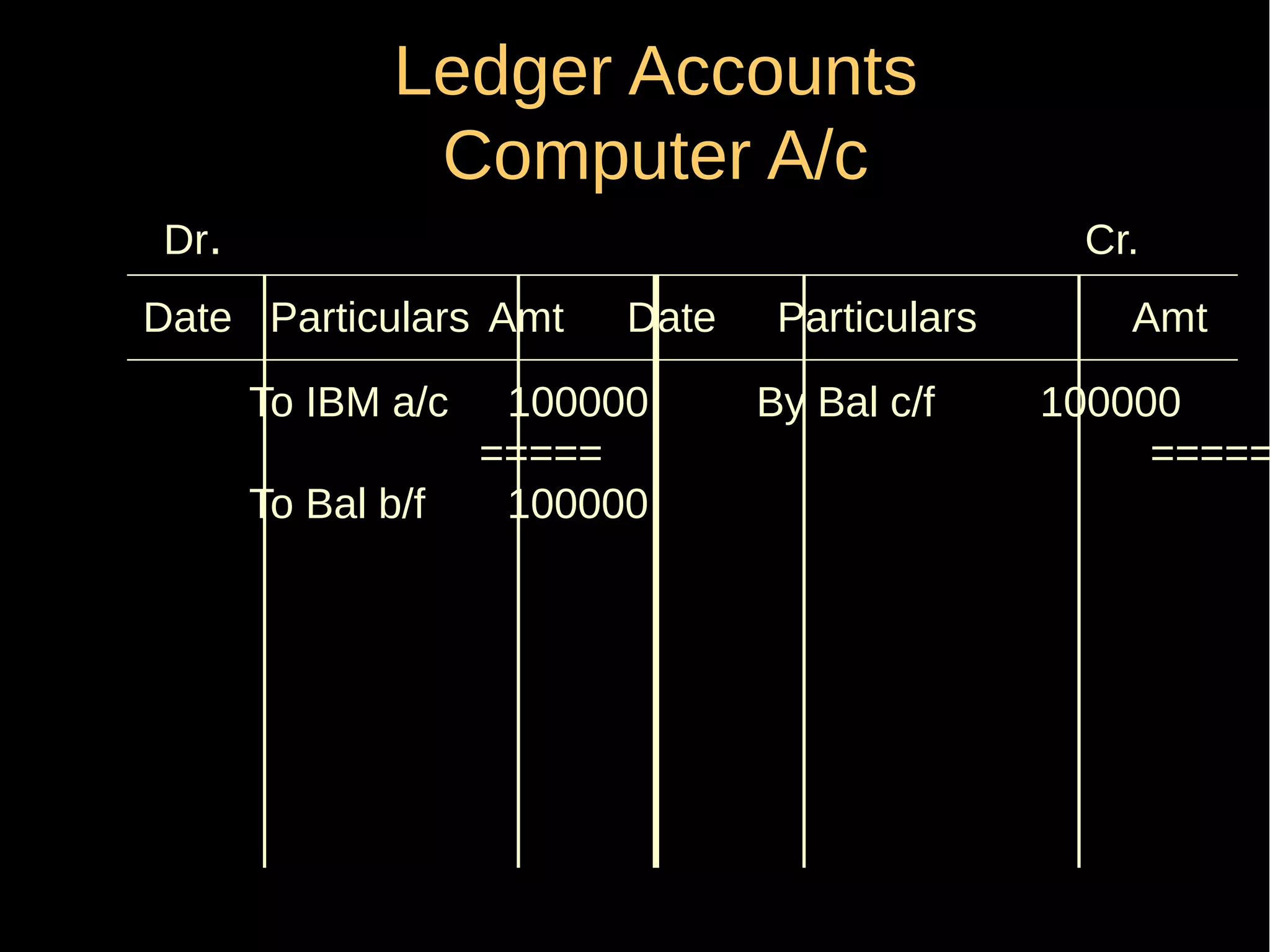
Ledger Accounts
Computer A/c
Dr.

Cr.

Date Particulars Amt
To IBM a/c
To Bal b/f

Date

100000
=====
100000

Particulars
By Bal c/f

Amt

100000
=====
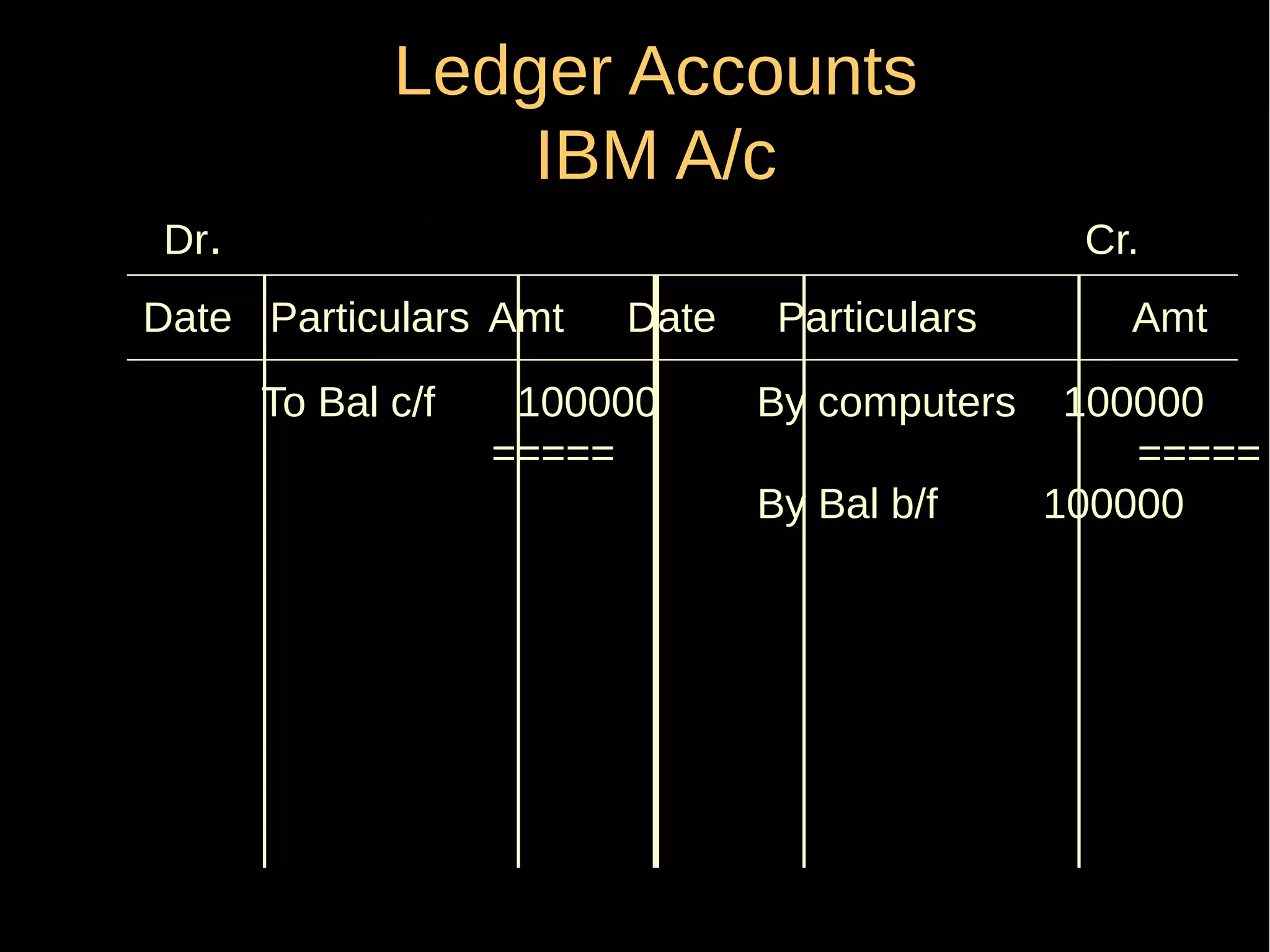
Ledger Accounts
IBM A/c
Dr.

Cr.

Date Particulars Amt
To Bal c/f

Date

100000
=====

Particulars
By computers
By Bal b/f

Amt
100000
=====
100000
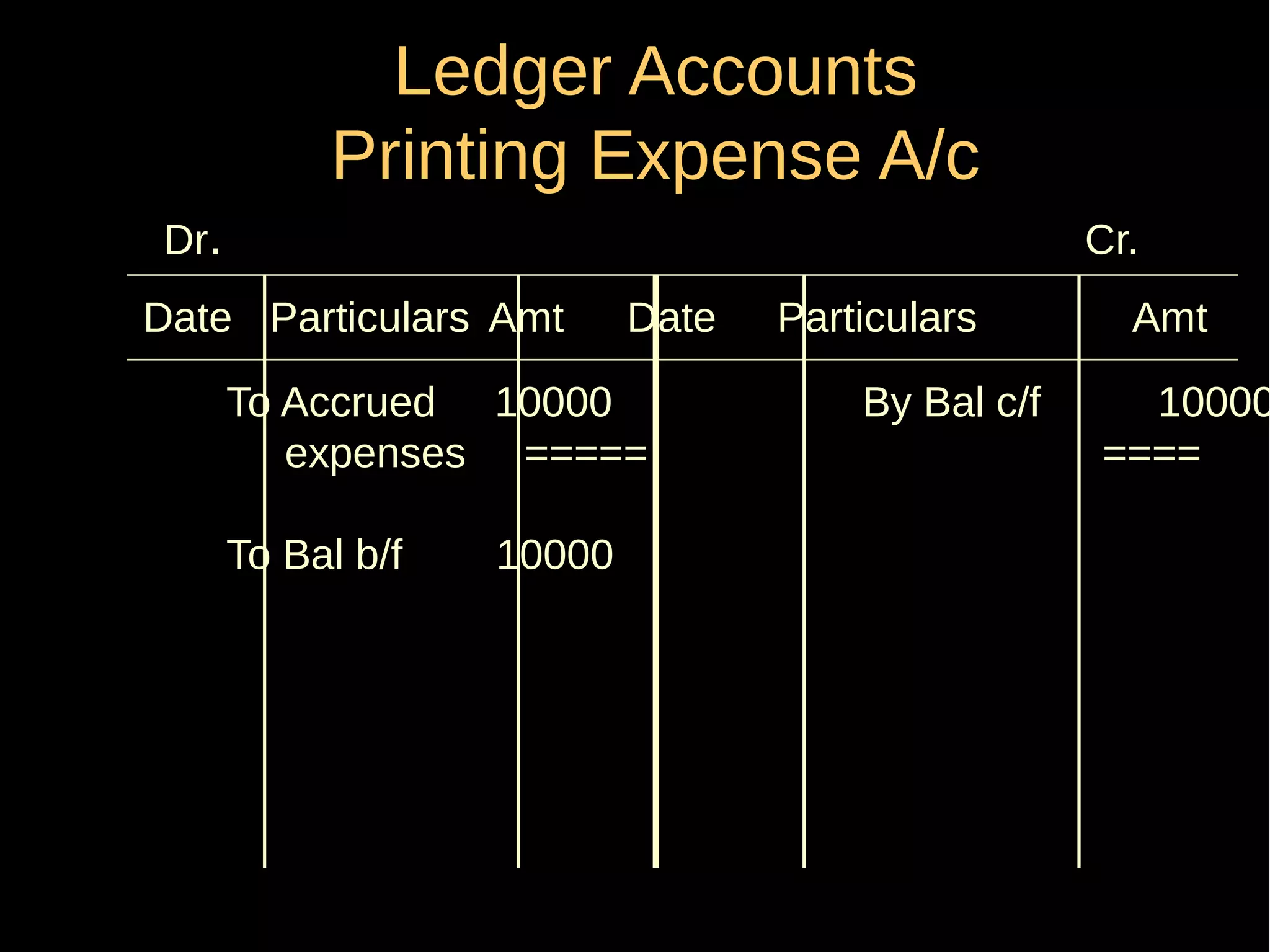
Ledger Accounts
Printing Expense A/c
Dr.

Cr.

Date Particulars Amt

Date

To Accrued 10000
expenses =====
To Bal b/f

10000

Particulars
By Bal c/f

Amt

10000
====
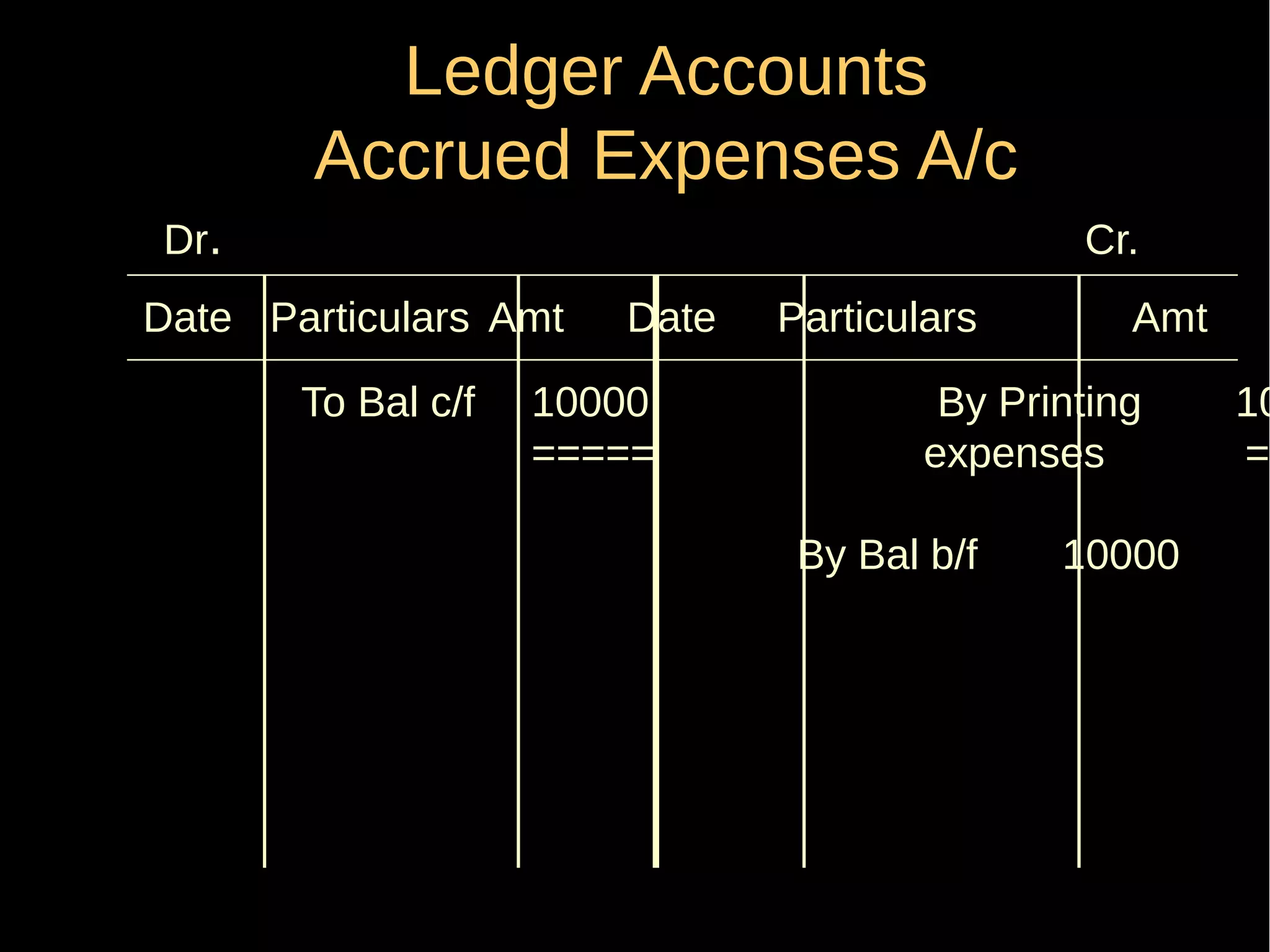
Ledger Accounts
Accrued Expenses A/c
Dr.

Cr.

Date Particulars Amt
To Bal c/f

Date

10000
=====

Particulars

Amt

By Printing
expenses
By Bal b/f

10000

10
==
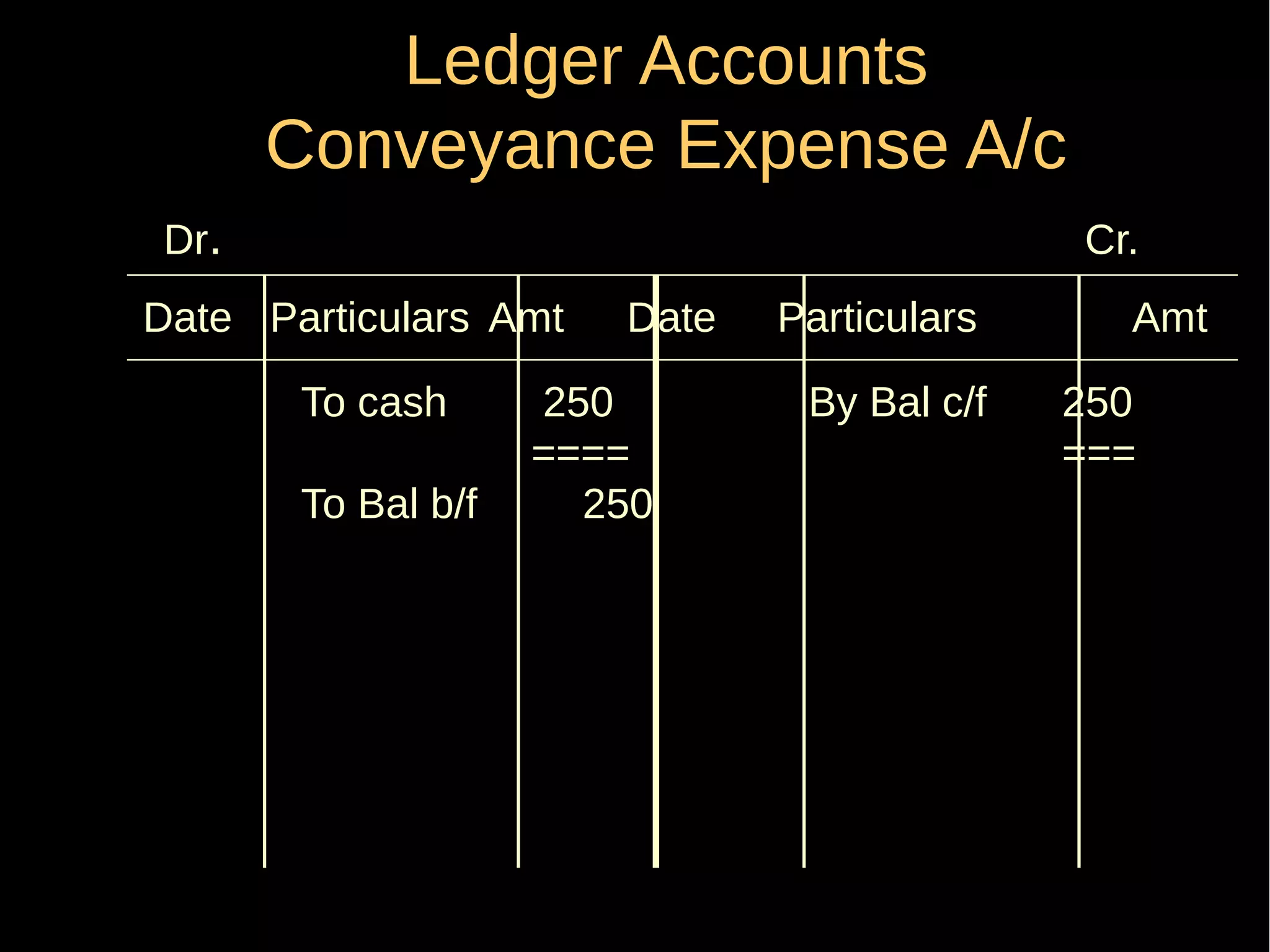
Ledger Accounts
Conveyance Expense A/c
Dr.

Cr.

Date Particulars Amt
To cash
To Bal b/f

Date

250
====
250

Particulars
By Bal c/f

Amt
250
===
Ledger Accounts
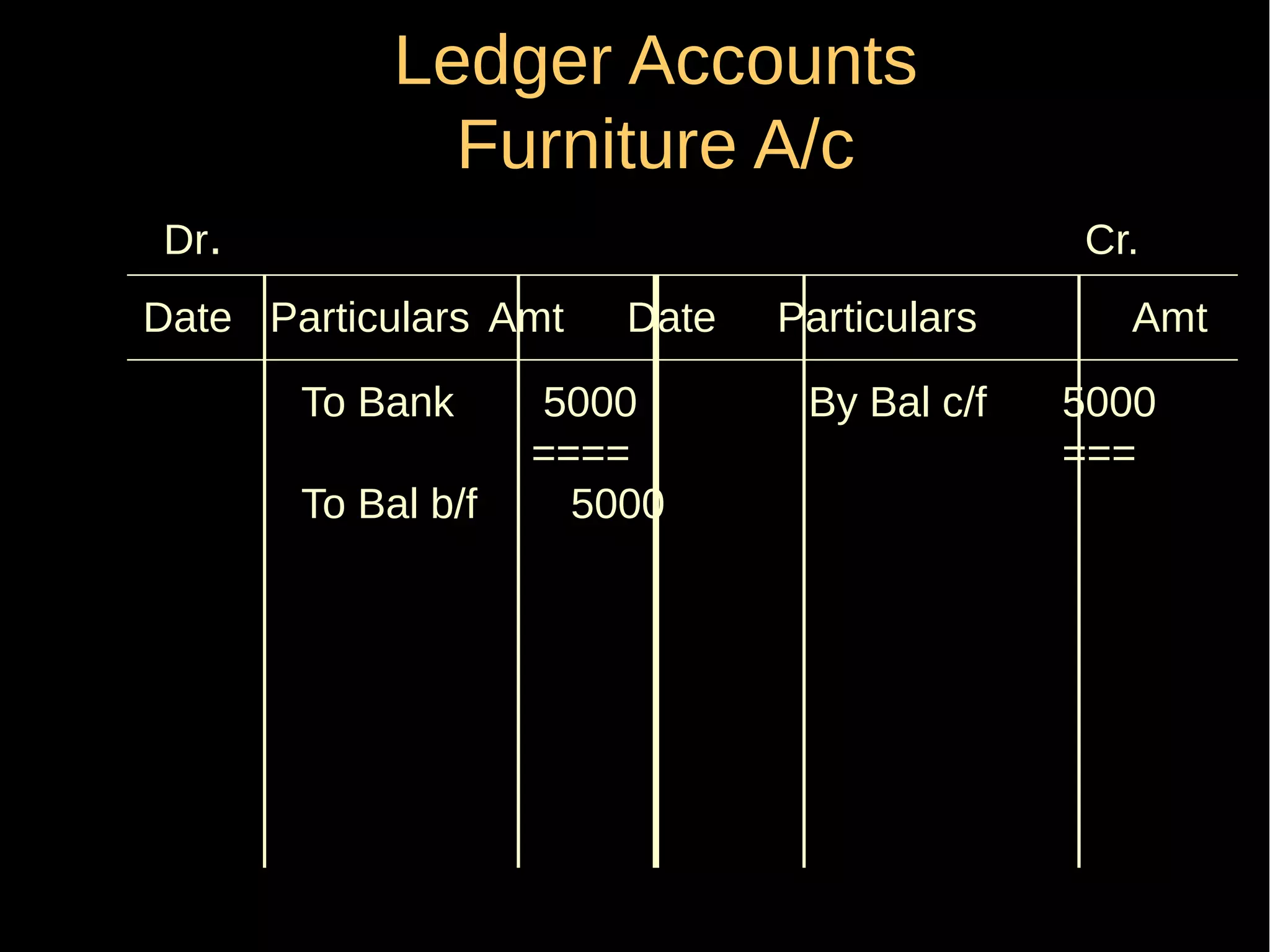
Furniture A/c
Dr.

Cr.

Date Particulars Amt
To Bank
To Bal b/f

Date

5000
====
5000

Particulars
By Bal c/f

Amt
5000
===
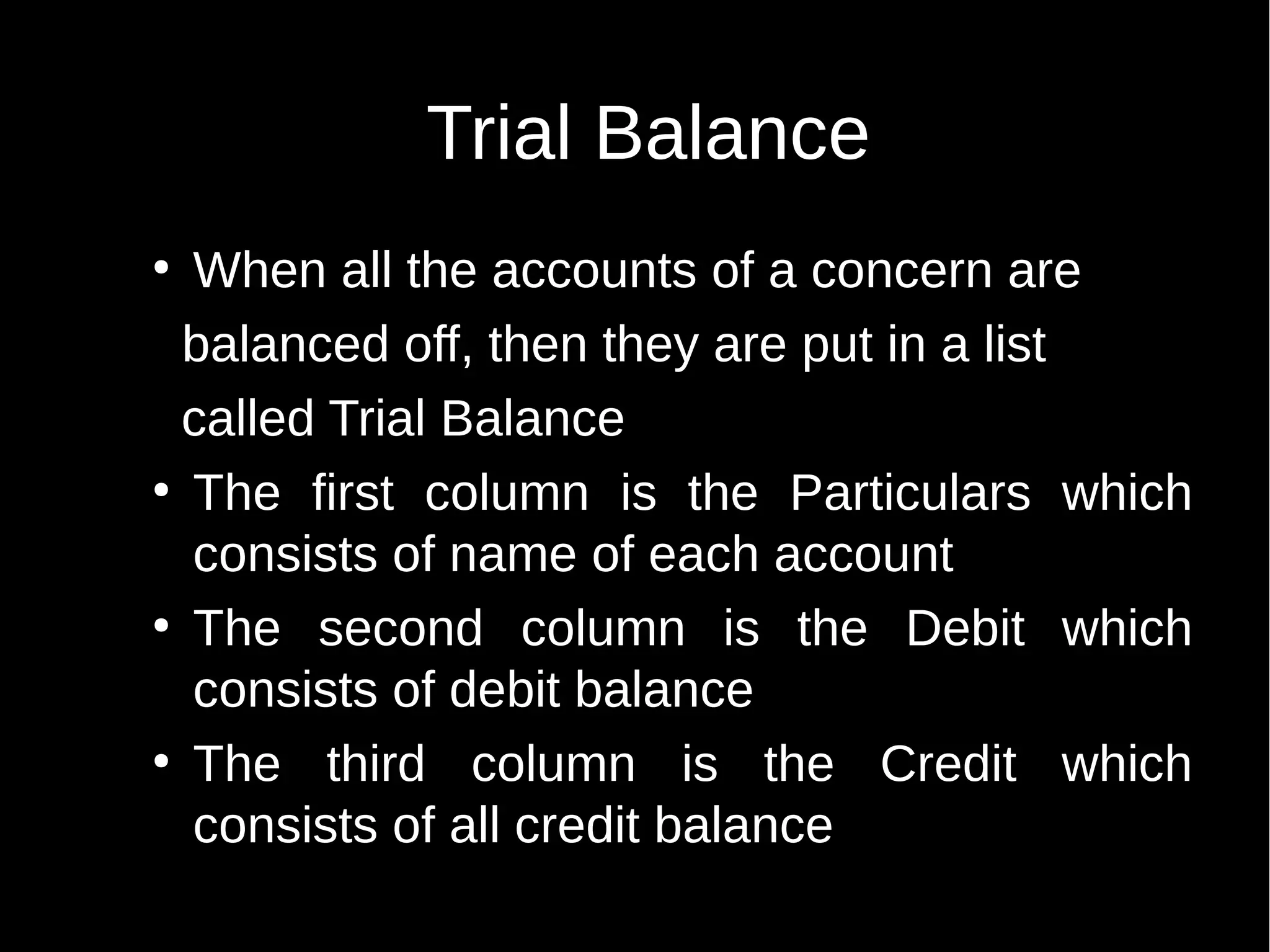
Trial Balance
When all the accounts of a concern are
balanced off, then they are put in a list
called Trial Balance
●
The first column is the Particulars which
consists of name of each account
●
The second column is the Debit which
consists of debit balance
●
The third column is the Credit which
consists of all credit balance
●
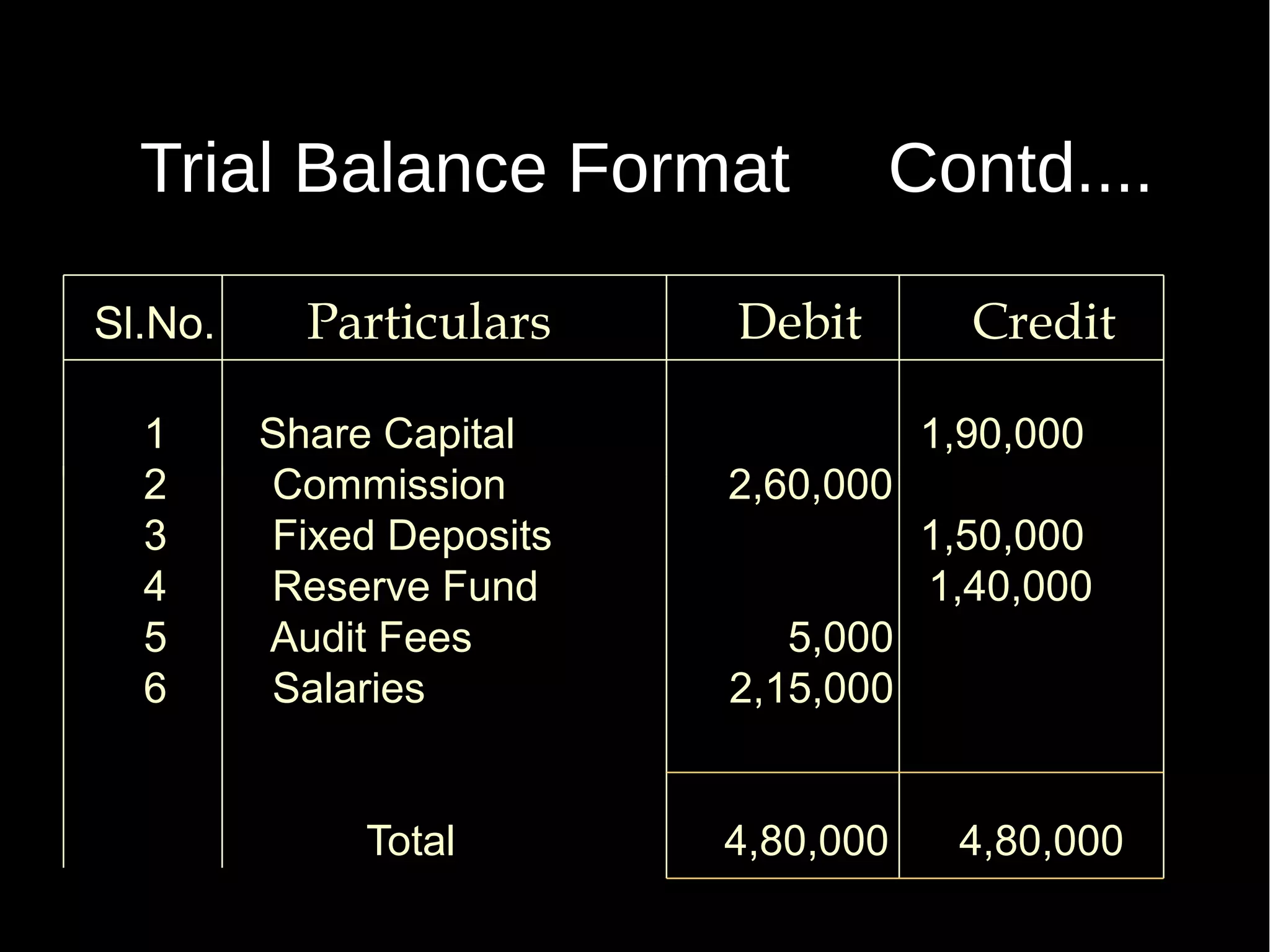
Trial Balance Format
Sl.No.
1
2
3
4
5
6

Particulars
Share Capital
Commission
Fixed Deposits
Reserve Fund
Audit Fees
Salaries
Total

Contd....

Debit

Credit
1,90,000

2,60,000
1,50,000
1,40,000
5,000
2,15,000
4,80,000

4,80,000
Trial Balance
●

●

●

Contd....

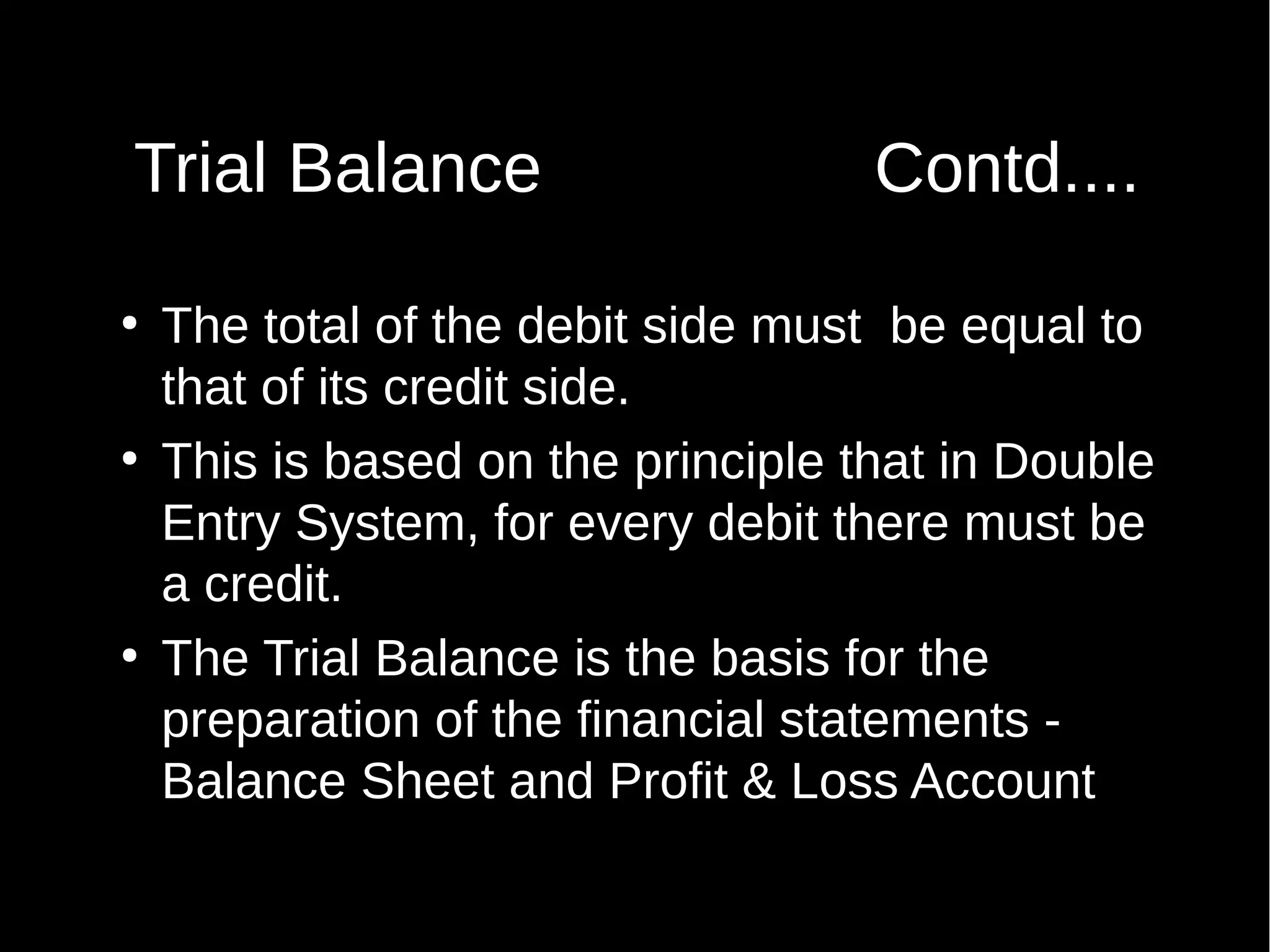
The total of the debit side must be equal to
that of its credit side.
This is based on the principle that in Double
Entry System, for every debit there must be
a credit.
The Trial Balance is the basis for the
preparation of the financial statements Balance Sheet and Profit & Loss Account
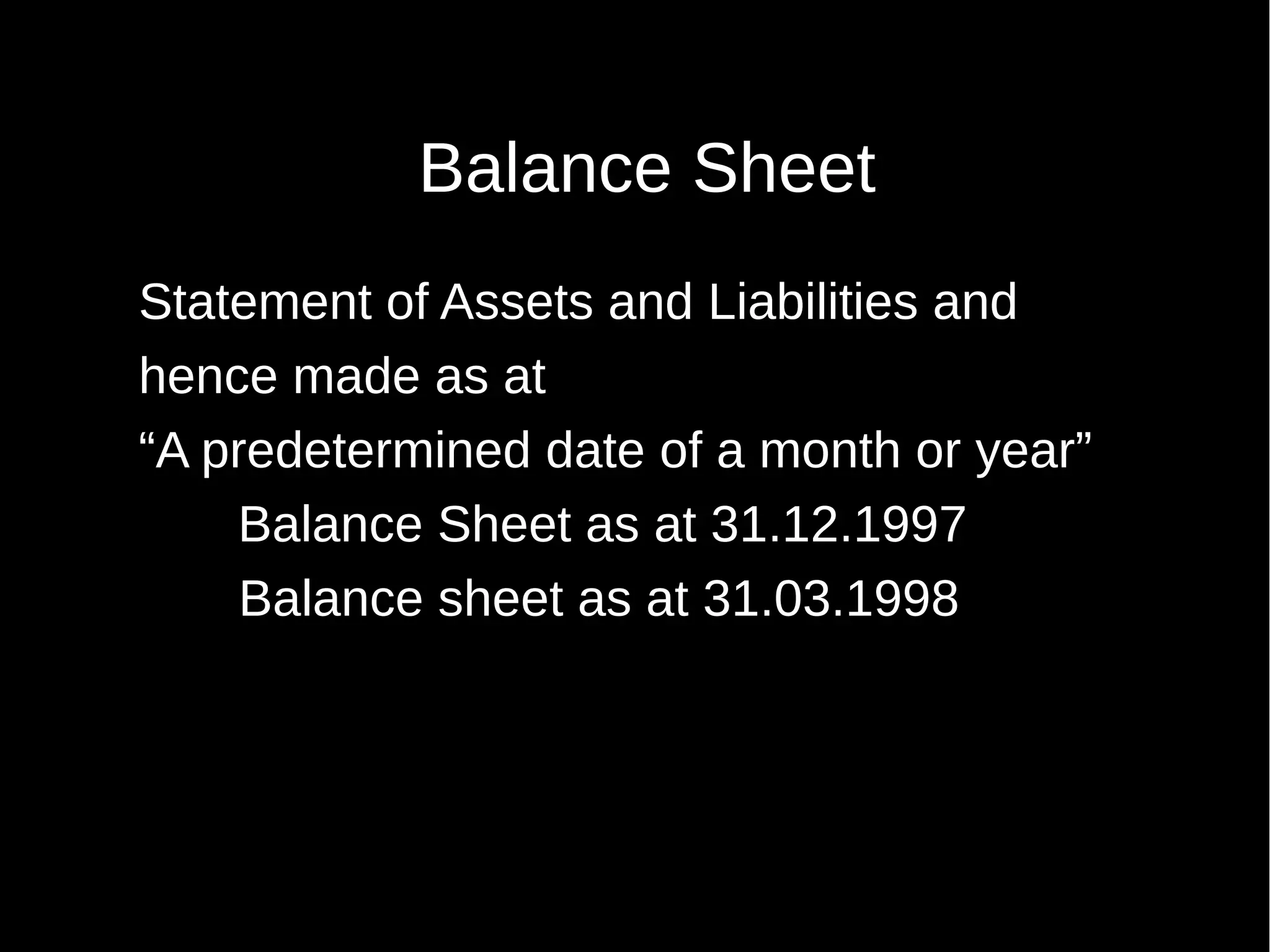
Balance Sheet
Statement of Assets and Liabilities and
hence made as at
“A predetermined date of a month or year”
Balance Sheet as at 31.12.1997
Balance sheet as at 31.03.1998
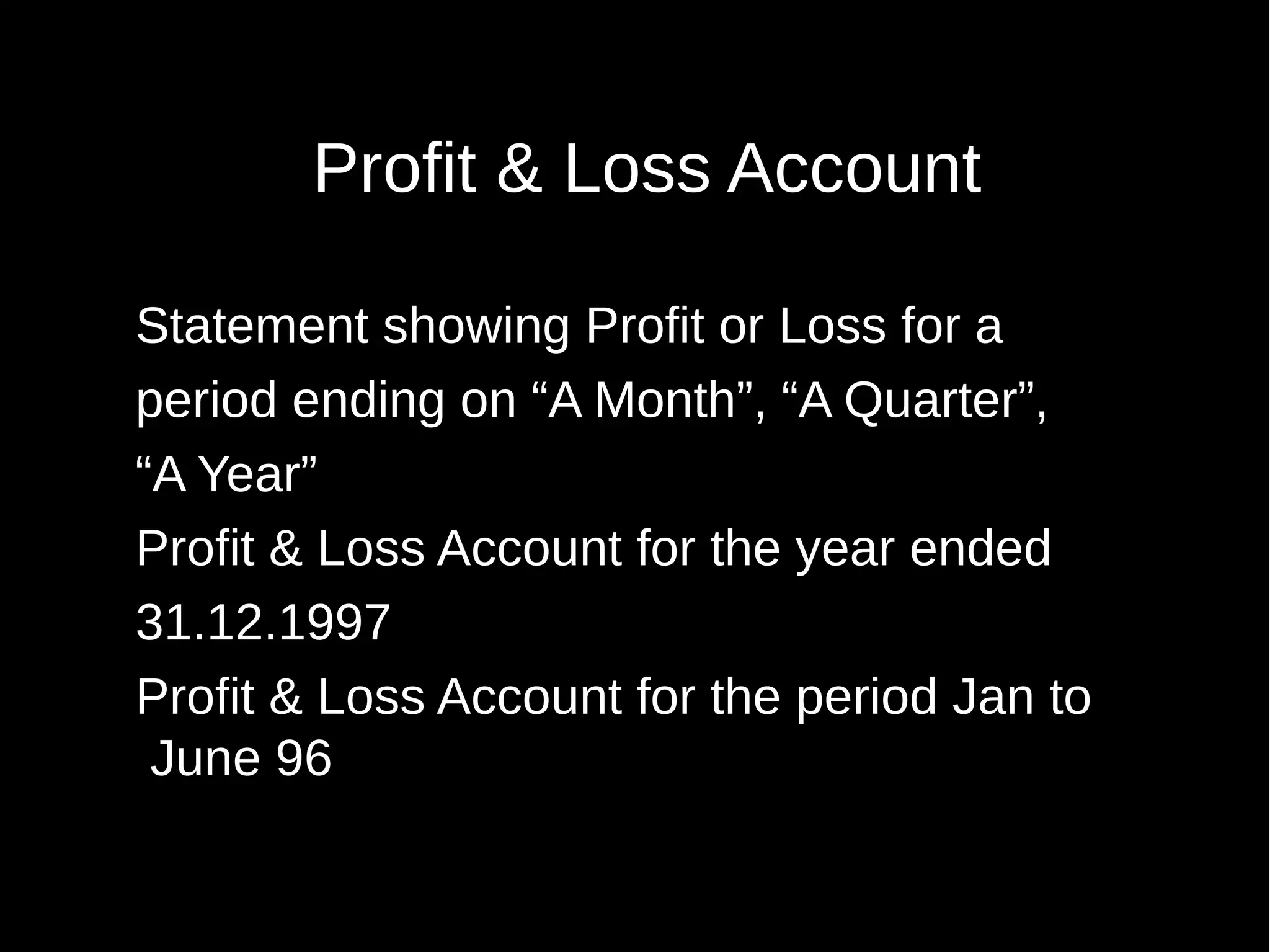
Profit & Loss Account
Statement showing Profit or Loss for a
period ending on “A Month”, “A Quarter”,
“A Year”
Profit & Loss Account for the year ended
31.12.1997
Profit & Loss Account for the period Jan to
June 96
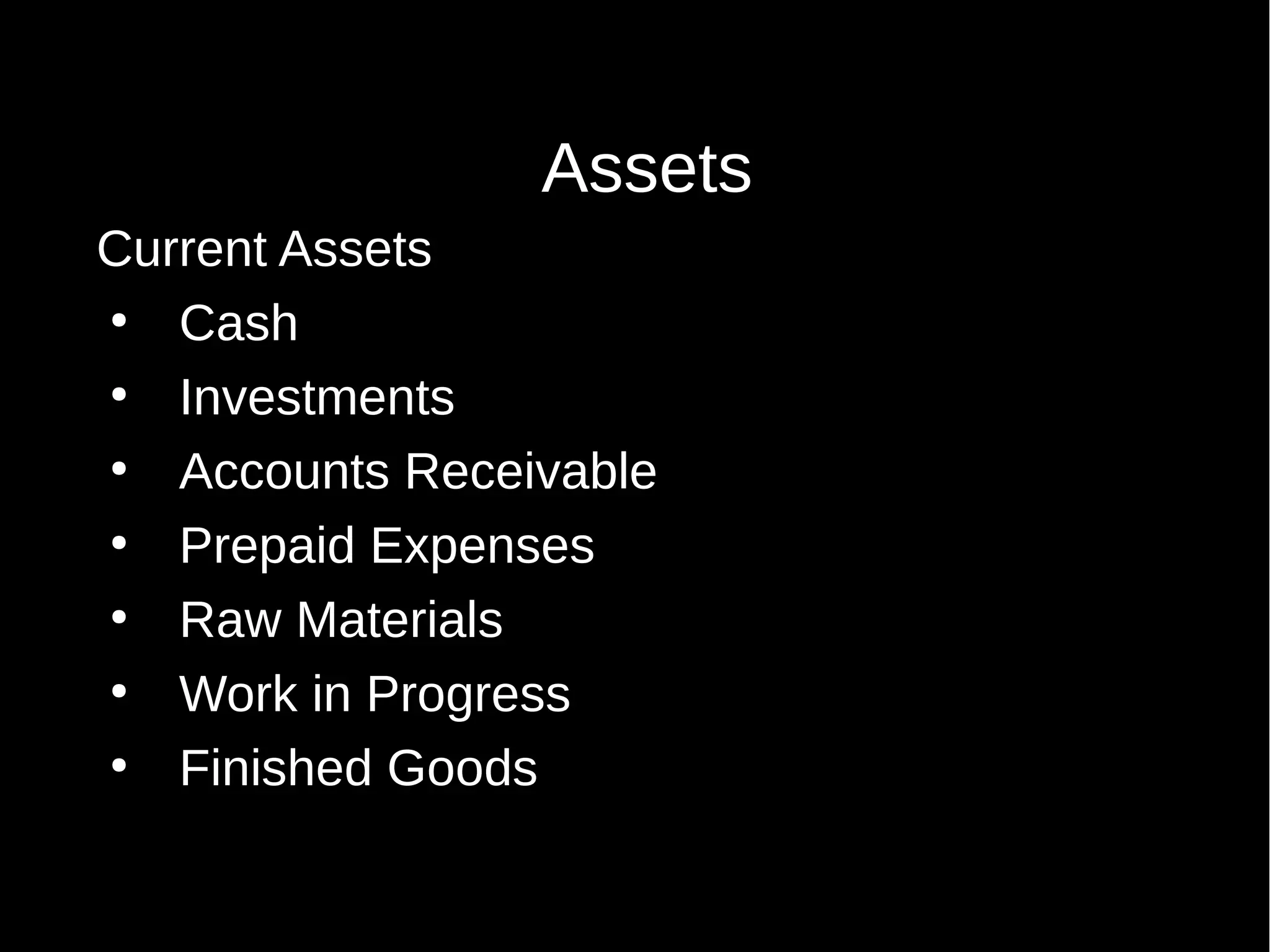
Assets
Current Assets
●
Cash
●
Investments
●
Accounts Receivable
●
Prepaid Expenses
●
Raw Materials
●
Work in Progress
●
Finished Goods
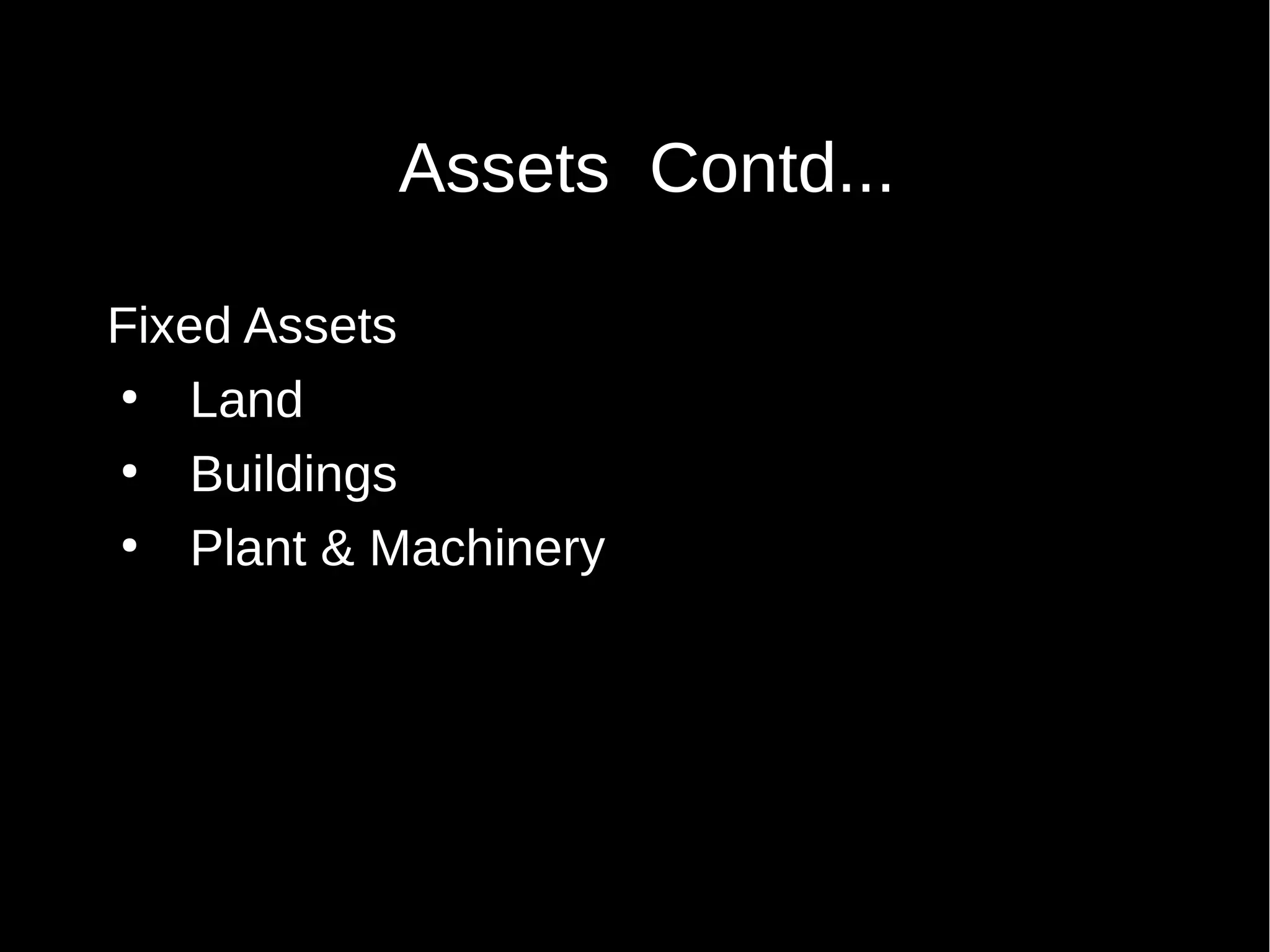
Assets Contd...
Fixed Assets
●
Land
●
Buildings
●
Plant & Machinery
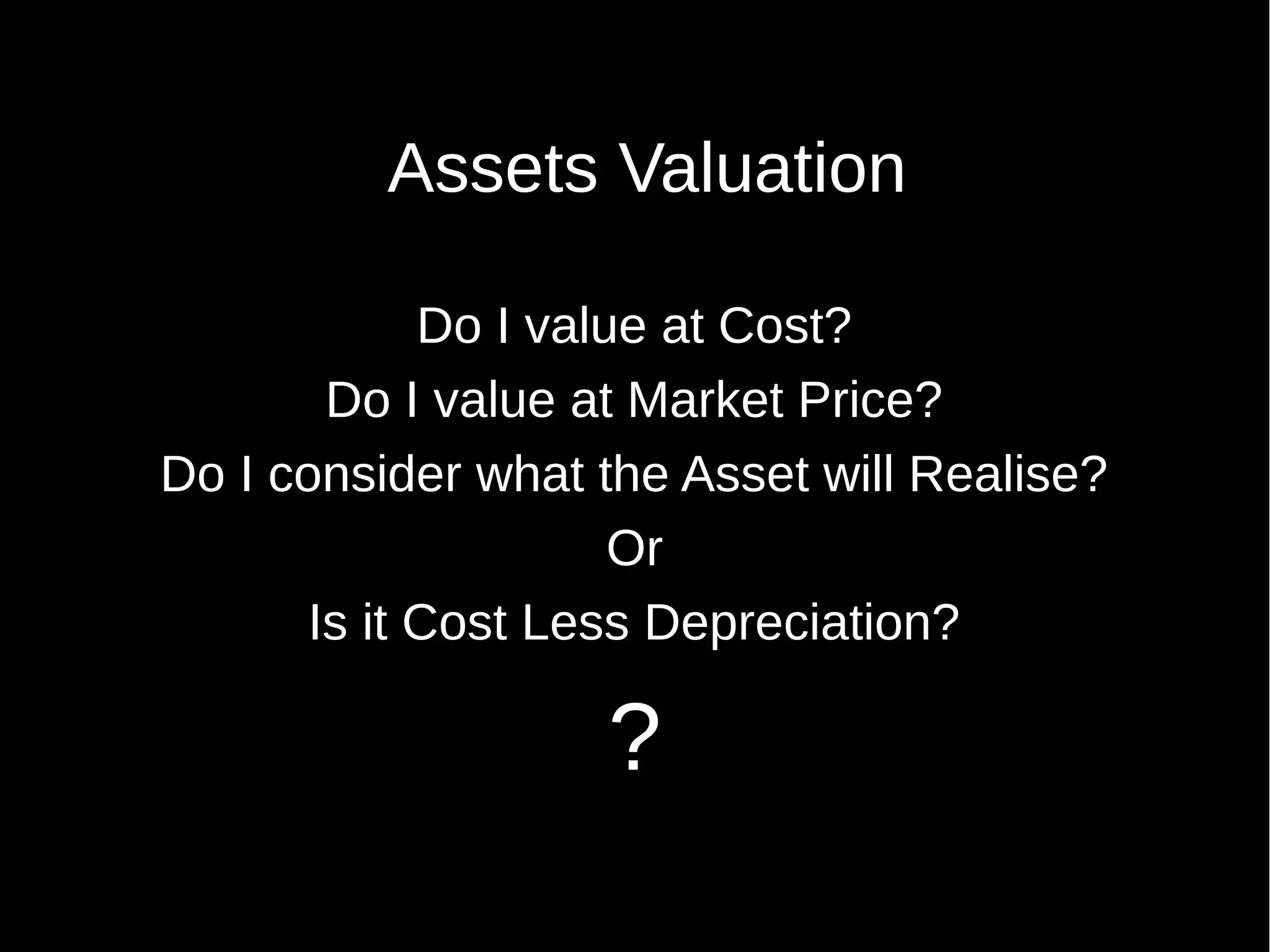
Assets Valuation
Do I value at Cost?
Do I value at Market Price?
Do I consider what the Asset will Realise?
Or
Is it Cost Less Depreciation?

?
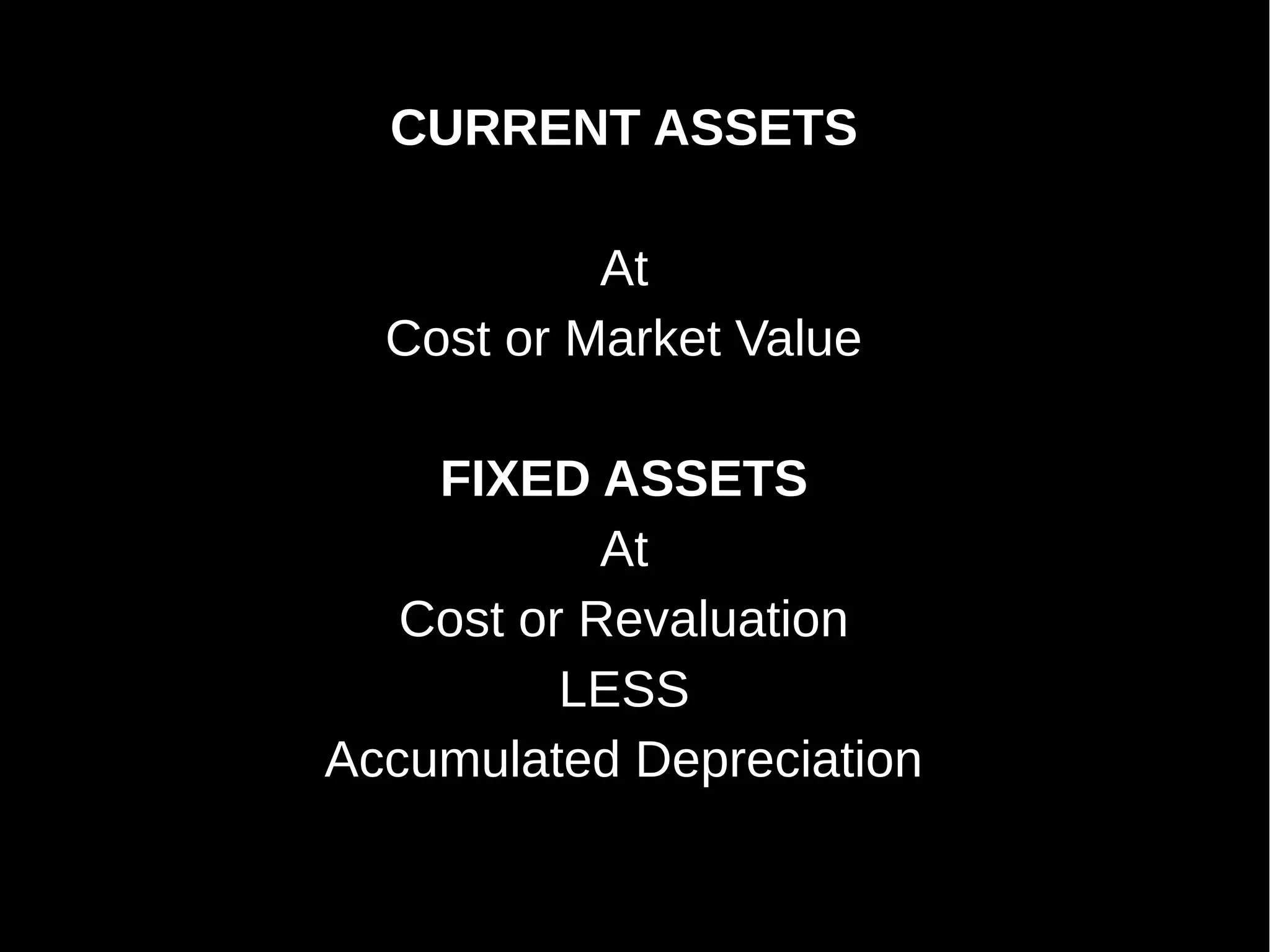
CURRENT ASSETS
At
Cost or Market Value
FIXED ASSETS
At
Cost or Revaluation
LESS
Accumulated Depreciation
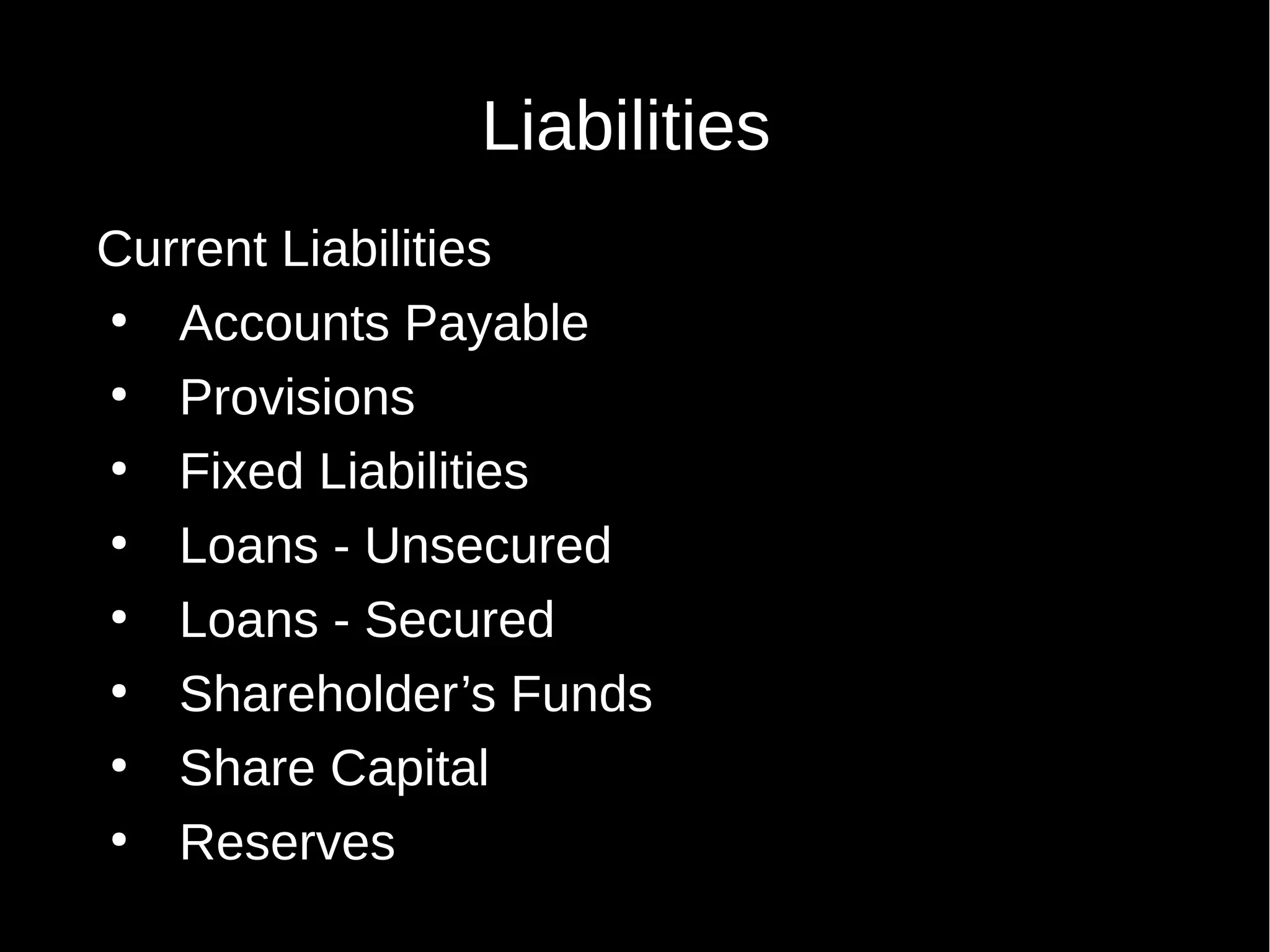
Liabilities
Current Liabilities
●
Accounts Payable
●
Provisions
●
Fixed Liabilities
●
Loans - Unsecured
●
Loans - Secured
●
Shareholder’s Funds
●
Share Capital
●
Reserves
Shareholders Funds
Owners Funds
●
Initial Investment
●
Profits from Business

Introduction to financial accounting jan 2014