ACCOUNTS
5
This presentation is owned by
ABUL KALAM AZAD PATWARY
“for class 9-10[accounting]”
Financial transactions change the financial position of the business. By
transaction sometime cash received sometime paid, sometime income
earned sometime expense incurred, sometime asset increase
sometime decrease, and again sometime liability
increase sometime decrease. Income, Expense, Asset and Liability are
not a particular type, there are different types of many such items in
business organization. In a particular table/chart the income, the
expense, the asset or the liability that is affected by transaction are
recorded as per double entry system and it
calculates the gross & net amount of that particular item. Accounts are
prepared to know the continuous change and the net amount of each
item
Concept of Accounts:
The main objective of business organizations is to
calculate financial result and
financial position. It’s required to record the
transactions in disciplined & proper
way to achieve this objective. Because of transactions
continuous increase –
decrease happen to assets, liabilities, incomes,
expenses and to equity. It’s needed to record this
serially and to know the net amount of each item at an
interval of
specific time.
EVENTS
Mr. Shagor is an employee. In march 2012 he gets salary tk.15,000; sold old furniture
for tk.3,000 and loan taken from bank tk.5,000. He spent tk.8,000 for house rent;
tk.5,000 for food; tk.1,000 for gas & electric bill; tk.500 for conveyance; tk.3,000 for
treatment and tk.2000 for children’s education.
All cash receipts and all cash payments are mentioned above of Mr. Shagor for
the month march 2012. How much cash balance will leave in hand? To know the
balance following way can be applied-
Total Receipts = (15,000+3,000+5,000) = tk.23,000
Total Payments= (8,000+5,000+1,000+500+3,000+2,000)= tk.19,500
Balance = (23,000-19,500) = tk.3,500
What Is An Account?
To keep a company's financial data organized, accountants developed a system that sorts
transactions into records called accounts. When a company's accounting system is set up,
the accounts most likely to be affected by the company's transactions are identified and
listed out. This list is referred to as the company's chart of accounts. Depending on the size
of a company and the complexity of its business operations, the chart of accounts may list as
few as thirty accounts or as many as thousands. A company has the flexibility of tailoring its
chart of accounts to best meet its needs.
Within the chart of accounts the balance sheet accounts are listed first, followed by the
income statement accounts. In other words, the accounts are organized in the chart of
accounts as follows:
Assets
Liabilities
Owner's (Stockholders') Equity
Revenues or Income
Expenses
Gains
Losses
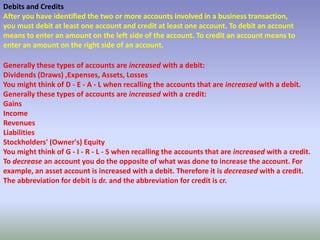
Debits and Credits
After you have identified the two or more accounts involved in a business transaction,
you must debit at least one account and credit at least one account. To debit an account
means to enter an amount on the left side of the account. To credit an account means to
enter an amount on the right side of an account.
Generally these types of accounts are increased with a debit:
Dividends (Draws) ,Expenses, Assets, Losses
You might think of D - E - A - L when recalling the accounts that are increased with a debit.
Generally these types of accounts are increased with a credit:
Gains
Income
Revenues
Liabilities
Stockholders' (Owner's) Equity
You might think of G - I - R - L - S when recalling the accounts that are increased with a credit.
To decrease an account you do the opposite of what was done to increase the account. For
example, an asset account is increased with a debit. Therefore it is decreased with a credit.
The abbreviation for debit is dr. and the abbreviation for credit is cr.
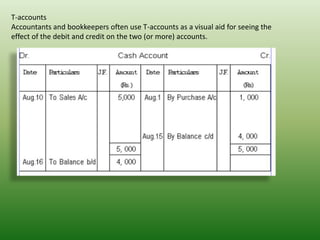
T-accounts
Accountants and bookkeepers often use T-accounts as a visual aid for seeing the
effect of the debit and credit on the two (or more) accounts.
Features of ‘T’- Table
There will be a title of Account
The table will be divided into two parts Debit & Credit
Four columns both side total eight columns
Balance of accounts(Difference between total Debit & total Credit) should be
calculated after an interval of specific time period
Should have a code number for each account
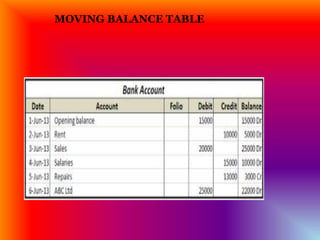
MOVING BALANCE TABLE
Features of ‘Moving Balance’- Table
There will be a title of Account
Should have a code number for each account
One column each for date, description & journal folio(J.F.)
Total four columns for amount (Taka)
Debit & Credit amount column situated side by side
Balance of accounts is calculated after each posting of transaction
Accounting chapter-5

Accounting chapter-5

  • 2.
    ACCOUNTS 5 This presentation isowned by ABUL KALAM AZAD PATWARY “for class 9-10[accounting]”
  • 3.
    Financial transactions changethe financial position of the business. By transaction sometime cash received sometime paid, sometime income earned sometime expense incurred, sometime asset increase sometime decrease, and again sometime liability increase sometime decrease. Income, Expense, Asset and Liability are not a particular type, there are different types of many such items in business organization. In a particular table/chart the income, the expense, the asset or the liability that is affected by transaction are recorded as per double entry system and it calculates the gross & net amount of that particular item. Accounts are prepared to know the continuous change and the net amount of each item
  • 4.
    Concept of Accounts: Themain objective of business organizations is to calculate financial result and financial position. It’s required to record the transactions in disciplined & proper way to achieve this objective. Because of transactions continuous increase – decrease happen to assets, liabilities, incomes, expenses and to equity. It’s needed to record this serially and to know the net amount of each item at an interval of specific time.
  • 5.
    EVENTS Mr. Shagor isan employee. In march 2012 he gets salary tk.15,000; sold old furniture for tk.3,000 and loan taken from bank tk.5,000. He spent tk.8,000 for house rent; tk.5,000 for food; tk.1,000 for gas & electric bill; tk.500 for conveyance; tk.3,000 for treatment and tk.2000 for children’s education. All cash receipts and all cash payments are mentioned above of Mr. Shagor for the month march 2012. How much cash balance will leave in hand? To know the balance following way can be applied- Total Receipts = (15,000+3,000+5,000) = tk.23,000 Total Payments= (8,000+5,000+1,000+500+3,000+2,000)= tk.19,500 Balance = (23,000-19,500) = tk.3,500
  • 6.
    What Is AnAccount? To keep a company's financial data organized, accountants developed a system that sorts transactions into records called accounts. When a company's accounting system is set up, the accounts most likely to be affected by the company's transactions are identified and listed out. This list is referred to as the company's chart of accounts. Depending on the size of a company and the complexity of its business operations, the chart of accounts may list as few as thirty accounts or as many as thousands. A company has the flexibility of tailoring its chart of accounts to best meet its needs. Within the chart of accounts the balance sheet accounts are listed first, followed by the income statement accounts. In other words, the accounts are organized in the chart of accounts as follows: Assets Liabilities Owner's (Stockholders') Equity Revenues or Income Expenses Gains Losses
  • 7.
    Debits and Credits Afteryou have identified the two or more accounts involved in a business transaction, you must debit at least one account and credit at least one account. To debit an account means to enter an amount on the left side of the account. To credit an account means to enter an amount on the right side of an account. Generally these types of accounts are increased with a debit: Dividends (Draws) ,Expenses, Assets, Losses You might think of D - E - A - L when recalling the accounts that are increased with a debit. Generally these types of accounts are increased with a credit: Gains Income Revenues Liabilities Stockholders' (Owner's) Equity You might think of G - I - R - L - S when recalling the accounts that are increased with a credit. To decrease an account you do the opposite of what was done to increase the account. For example, an asset account is increased with a debit. Therefore it is decreased with a credit. The abbreviation for debit is dr. and the abbreviation for credit is cr.
  • 8.
    T-accounts Accountants and bookkeepersoften use T-accounts as a visual aid for seeing the effect of the debit and credit on the two (or more) accounts.
  • 9.
    Features of ‘T’-Table There will be a title of Account The table will be divided into two parts Debit & Credit Four columns both side total eight columns Balance of accounts(Difference between total Debit & total Credit) should be calculated after an interval of specific time period Should have a code number for each account
  • 10.
  • 11.
    Features of ‘MovingBalance’- Table There will be a title of Account Should have a code number for each account One column each for date, description & journal folio(J.F.) Total four columns for amount (Taka) Debit & Credit amount column situated side by side Balance of accounts is calculated after each posting of transaction