Copyright © 2012 Pearson Education
Chapter 2
1
Copyright © 2012 Pearson Education
2
Explain accounts, journals, and ledgers as
they relate to recording transactions and
describe common accounts
Define debits, credits, and normal account
balances and use double-entry accounting
and T-accounts
List the steps of the transaction recording
process
Copyright © 2012 Pearson Education
3
Journalize and post sample transactions to
the ledger
Prepare the trial balance from the
T-accounts
Copyright © 2012 Pearson Education
Explain accounts, journals, and ledgers as they
relate to recording transactions and describe
common accounts
4
1
Copyright © 2012 Pearson Education
5
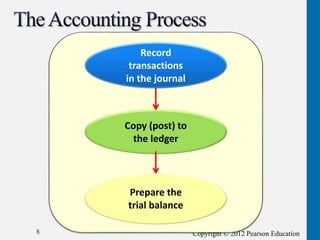
Record
transactions
in the journal
Copy (post) to
the ledger
Prepare the
trial balance
Copyright © 2012 Pearson Education
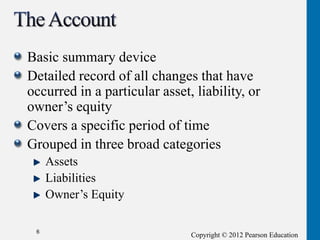
Basic summary device
Detailed record of all changes that have
occurred in a particular asset, liability, or
owner’s equity
Covers a specific period of time
Grouped in three broad categories
Assets
Liabilities
Owner’s Equity
6
Copyright © 2012 Pearson Education
Journal
Chronological record of transactions
Organized by date
Ledger
The book holding all the accounts and their
balances
Organized by account
7
Copyright © 2012 Pearson Education
Listing of all accounts and their balances
8
Copyright © 2012 Pearson Education
9
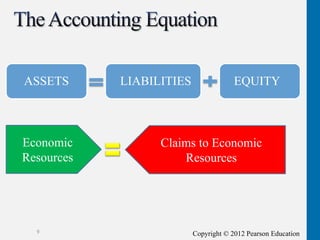
ASSETS LIABILITIES EQUITY
Economic
Resources
Claims to Economic
Resources
Copyright © 2012 Pearson Education
Economic resources that will benefit the business in the
future:
Cash
Accounts receivable
Notes receivable
Prepaid expenses
Land
Building
Equipment, Furniture, Fixtures
10
Copyright © 2012 Pearson Education
A debt (something owed):
Accounts payable
Notes payable
Accrued liabilities
11
Copyright © 2012 Pearson Education
Owner’s claim to the assets:
Capital
Drawing
Revenues
Expenses
12
Copyright © 2012 Pearson Education
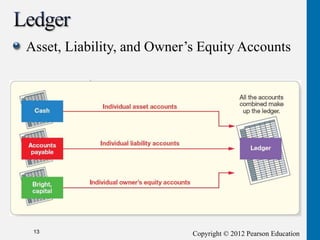
Asset, Liability, and Owner’s Equity Accounts
13
Copyright © 2012 Pearson Education
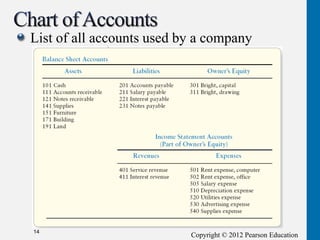
List of all accounts used by a company
14
Copyright © 2012 Pearson Education
Define debits, credits, and normal account
balances and use double-entry accounting and
T-accounts
15
2
Copyright © 2012 Pearson Education
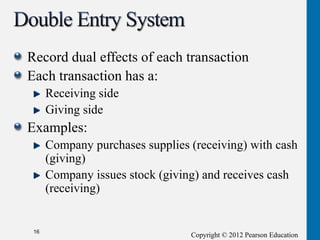
Record dual effects of each transaction
Each transaction has a:
Receiving side
Giving side
Examples:
Company purchases supplies (receiving) with cash
(giving)
Company issues stock (giving) and receives cash
(receiving)
16
Copyright © 2012 Pearson Education
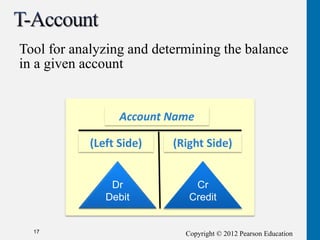
17
Tool for analyzing and determining the balance
in a given account
Account Name
(Left Side) (Right Side)
Dr
Debit
Cr
Credit
Copyright © 2012 Pearson Education
Whether an account is increased by debit or a
credit is determined by the account type
Asset, liability, or equity
Debits are not good or bad
Neither are credits
18
Copyright © 2012 Pearson Education
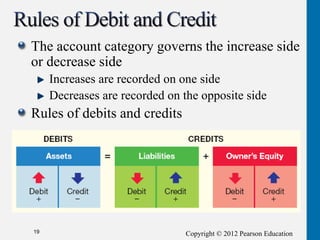
19
The account category governs the increase side
or decrease side
Increases are recorded on one side
Decreases are recorded on the opposite side
Rules of debits and credits
Copyright © 2012 Pearson Education
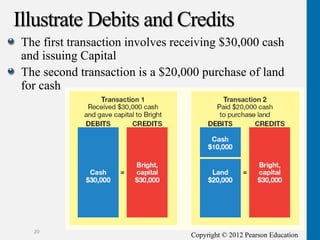
Illustrate Debits and Credits
The first transaction involves receiving $30,000 cash
and issuing Capital
The second transaction is a $20,000 purchase of land
for cash
20
Copyright © 2012 Pearson Education
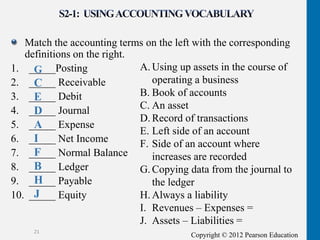
Match the accounting terms on the left with the corresponding
definitions on the right.
1. _____Posting
2. _____ Receivable
3. _____ Debit
4. _____ Journal
5. _____ Expense
6. _____ Net Income
7. _____ Normal Balance
8. _____ Ledger
9. _____ Payable
10. _____ Equity
21
A. Using up assets in the course of
operating a business
B. Book of accounts
C. An asset
D. Record of transactions
E. Left side of an account
F. Side of an account where
increases are recorded
G. Copying data from the journal to
the ledger
H. Always a liability
I. Revenues – Expenses =
J. Assets – Liabilities =
G
C
E
D
A
I
F
B
H
J
Copyright © 2012 Pearson Education
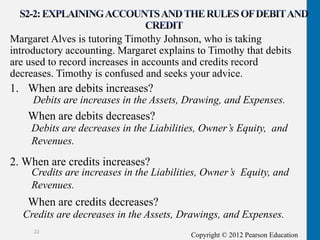
Margaret Alves is tutoring Timothy Johnson, who is taking
introductory accounting. Margaret explains to Timothy that debits
are used to record increases in accounts and credits record
decreases. Timothy is confused and seeks your advice.
1. When are debits increases?
When are debits decreases?
2. When are credits increases?
When are credits decreases?
22
Debits are increases in the Assets, Drawing, and Expenses.
Debits are decreases in the Liabilities, Owner’s Equity, and
Revenues.
Credits are decreases in the Assets, Drawings, and Expenses.
Credits are increases in the Liabilities, Owner’s Equity, and
Revenues.
Copyright © 2012 Pearson Education
List the steps of the transaction recording
process
23
3
Copyright © 2012 Pearson Education
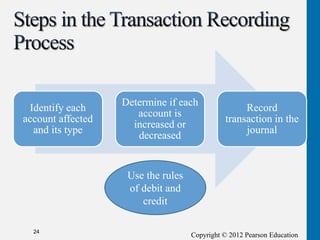
Identify each
account affected
and its type
Determine if each
account is
increased or
decreased
Record
transaction in the
journal
24
Use the rules
of debit and
credit
Copyright © 2012 Pearson Education
Journalize the first transaction of Smart Touch—
the receipt of $30,000 cash and issuance of
Capital.
The accounts affected are Cash and Capital. Cash is
an asset. Capital is equity.
Both accounts increase by $30,000. Assets increase
with debits. Equity increases with credits.
25
Copyright © 2012 Pearson Education
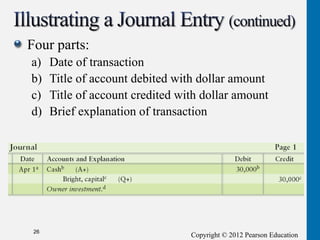
Four parts:
a) Date of transaction
b) Title of account debited with dollar amount
c) Title of account credited with dollar amount
d) Brief explanation of transaction
26
Copyright © 2012 Pearson Education
27
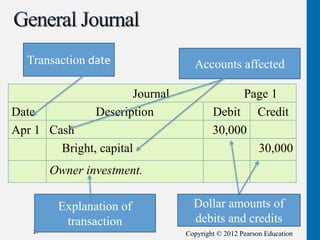
Journal Page 1
Date Description Debit Credit
Apr 1 Cash 30,000
Bright, capital 30,000
Owner investment.
Transaction date Accounts affected
Dollar amounts of
debits and credits
Explanation of
transaction
Copyright © 2012 Pearson Education
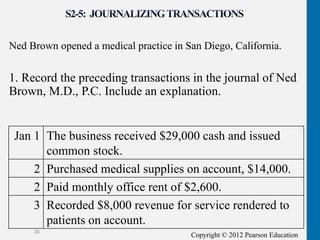
Ned Brown opened a medical practice in San Diego, California.
1. Record the preceding transactions in the journal of Ned
Brown, M.D., P.C. Include an explanation.
28
Jan 1 The business received $29,000 cash and issued
common stock.
2 Purchased medical supplies on account, $14,000.
2 Paid monthly office rent of $2,600.
3 Recorded $8,000 revenue for service rendered to
patients on account.
Copyright © 2012 Pearson Education
Jan. 1: The business received $29,000 cash and
issued common stock.
Cash received indicates cash increases.
Cash is an Asset, Assets increase with debits
Issued common stock, indicates equity is increasing
Increase equity with credits
29
GENERAL JOURNAL
DATE DESCRIPTION REF DEBIT CREDIT
Jan 1 Cash 29,000
Brown, capital 29,000
Issued stock.
Copyright © 2012 Pearson Education
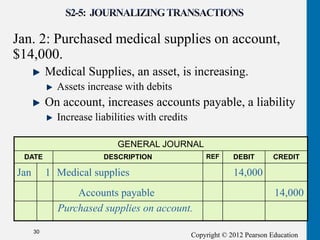
Jan. 2: Purchased medical supplies on account,
$14,000.
Medical Supplies, an asset, is increasing.
Assets increase with debits
On account, increases accounts payable, a liability
Increase liabilities with credits
30
GENERAL JOURNAL
DATE DESCRIPTION REF DEBIT CREDIT
Jan 1 Medical supplies 14,000
Accounts payable 14,000
Purchased supplies on account.
Copyright © 2012 Pearson Education
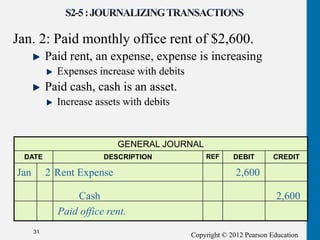
Jan. 2: Paid monthly office rent of $2,600.
Paid rent, an expense, expense is increasing
Expenses increase with debits
Paid cash, cash is an asset.
Increase assets with debits
31
GENERAL JOURNAL
DATE DESCRIPTION REF DEBIT CREDIT
Jan 2 Rent Expense 2,600
Cash 2,600
Paid office rent.
Copyright © 2012 Pearson Education
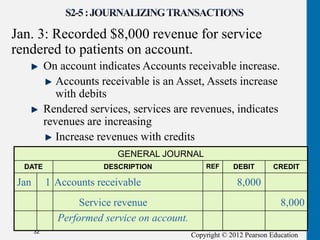
Jan. 3: Recorded $8,000 revenue for service
rendered to patients on account.
On account indicates Accounts receivable increase.
Accounts receivable is an Asset, Assets increase
with debits
Rendered services, services are revenues, indicates
revenues are increasing
Increase revenues with credits
32
GENERAL JOURNAL
DATE DESCRIPTION REF DEBIT CREDIT
Jan 1 Accounts receivable 8,000
Service revenue 8,000
Performed service on account.
Copyright © 2012 Pearson Education
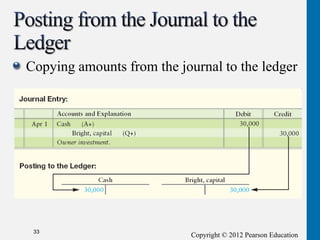
Copying amounts from the journal to the ledger
33
Copyright © 2012 Pearson Education
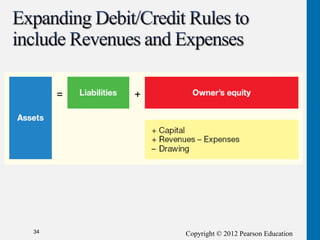
34
Copyright © 2012 Pearson Education
35
Copyright © 2012 Pearson Education
36
Copyright © 2012 Pearson Education
37
Copyright © 2012 Pearson Education
Origin of accounting transactions
Examples:
Bank deposit tickets
Invoices
Checks
Stock certificates
38
Copyright © 2012 Pearson Education
Journalize and post sample transactions to the
ledger
39
4
Copyright © 2012 Pearson Education
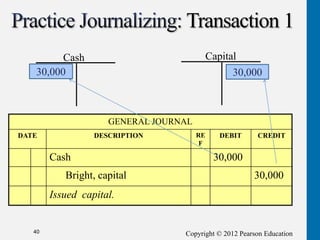
40
Cash Capital
GENERAL JOURNAL
DATE DESCRIPTION RE
F
DEBIT CREDIT
Cash 30,000
Bright, capital 30,000
Issued capital.
30,000 30,000
Transaction 1
Copyright © 2012 Pearson Education
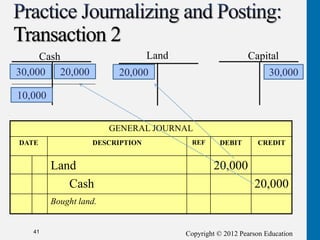
Transaction 2
41
Cash Capital
Land
GENERAL JOURNAL
DATE DESCRIPTION REF DEBIT CREDIT
Land 20,000
Cash 20,000
Bought land.
30,000 30,000
20,000 20,000
10,000
Copyright © 2012 Pearson Education
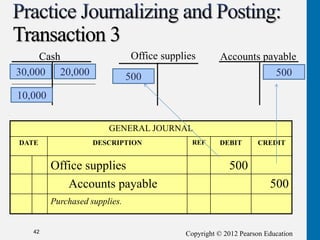
Transaction 3
42
Cash Accounts payable
Office supplies
GENERAL JOURNAL
DATE DESCRIPTION REF DEBIT CREDIT
Office supplies 500
Accounts payable 500
Purchased supplies.
30,000 20,000
Cash
30,000 20,000
10,000
500
500
Copyright © 2012 Pearson Education
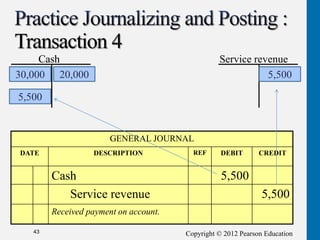
Transaction 4
43
Cash Service revenue
GENERAL JOURNAL
DATE DESCRIPTION REF DEBIT CREDIT
Cash 5,500
Service revenue 5,500
Received payment on account.
30,000 20,000
Cash
30,000 20,000
5,500
5,500
Copyright © 2012 Pearson Education
44
Copyright © 2012 Pearson Education
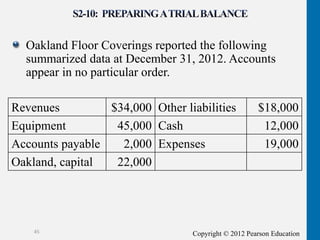
Oakland Floor Coverings reported the following
summarized data at December 31, 2012. Accounts
appear in no particular order.
45
Revenues $34,000 Other liabilities $18,000
Equipment 45,000 Cash 12,000
Accounts payable 2,000 Expenses 19,000
Oakland, capital 22,000
Copyright © 2012 Pearson Education
46
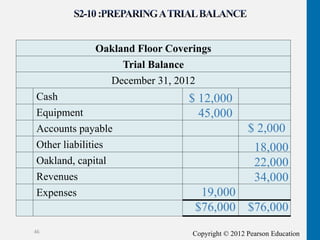
Oakland Floor Coverings
Trial Balance
December 31, 2012
Cash
Equipment
Accounts payable
Other liabilities
Oakland, capital
Revenues
Expenses
$ 12,000
45,000
$ 2,000
18,000
22,000
34,000
19,000
$76,000 $76,000
Copyright © 2012 Pearson Education
Texas Sales Consultants completed the following
transactions during the latter part of January:
47
Jan 22 Performed service for customers on account,
$8,000.
30 Received cash on account from customers,
$7,000.
31 Received a utility bill, $180, which will be
paid during February.
31 Paid monthly salary to salesman, $2,000.
31 Paid advertising expense of $700.
Copyright © 2012 Pearson Education
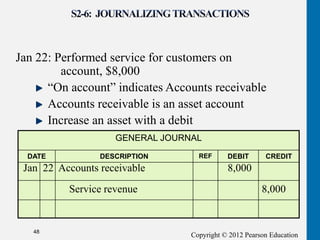
Jan 22: Performed service for customers on
account, $8,000
“On account” indicates Accounts receivable
Accounts receivable is an asset account
Increase an asset with a debit
48
GENERAL JOURNAL
DATE DESCRIPTION REF DEBIT CREDIT
Service revenue 8,000
Jan 22 Accounts receivable 8,000
Copyright © 2012 Pearson Education
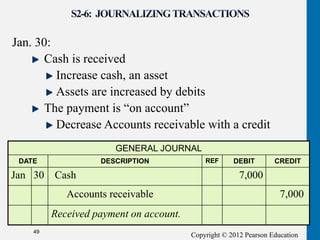
Jan. 30:
Cash is received
Increase cash, an asset
Assets are increased by debits
The payment is “on account”
Decrease Accounts receivable with a credit
49
GENERAL JOURNAL
DATE DESCRIPTION REF DEBIT CREDIT
Accounts receivable 7,000
Received payment on account.
Jan 30 Cash 7,000
Copyright © 2012 Pearson Education
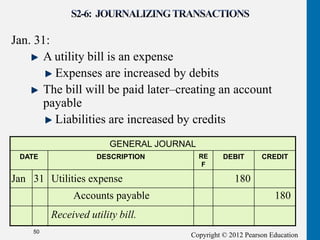
Jan. 31:
A utility bill is an expense
Expenses are increased by debits
The bill will be paid later–creating an account
payable
Liabilities are increased by credits
50
GENERAL JOURNAL
DATE DESCRIPTION RE
F
DEBIT CREDIT
Received utility bill.
Jan 31 Utilities expense 180
Accounts payable 180
Copyright © 2012 Pearson Education
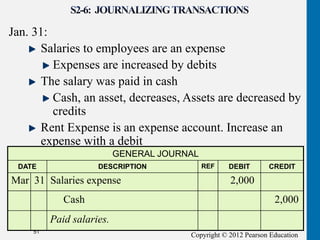
Jan. 31:
Salaries to employees are an expense
Expenses are increased by debits
The salary was paid in cash
Cash, an asset, decreases, Assets are decreased by
credits
Rent Expense is an expense account. Increase an
expense with a debit
51
GENERAL JOURNAL
DATE DESCRIPTION REF DEBIT CREDIT
Cash 2,000
Paid salaries.
Mar 31 Salaries expense 2,000
Copyright © 2012 Pearson Education
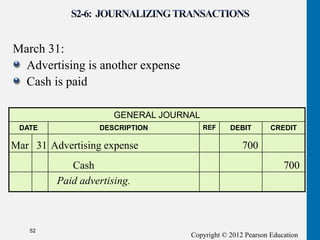
March 31:
Advertising is another expense
Cash is paid
52
GENERAL JOURNAL
DATE DESCRIPTION REF DEBIT CREDIT
Mar 31 Advertising expense 700
Cash 700
Paid advertising.
Copyright © 2012 Pearson Education
Prepare the trial balance from the T-accounts
53
5
Copyright © 2012 Pearson Education
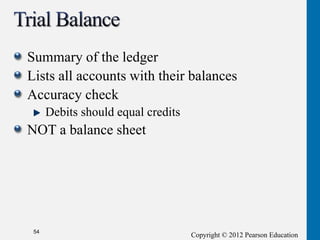
Summary of the ledger
Lists all accounts with their balances
Accuracy check
Debits should equal credits
NOT a balance sheet
54
Copyright © 2012 Pearson Education
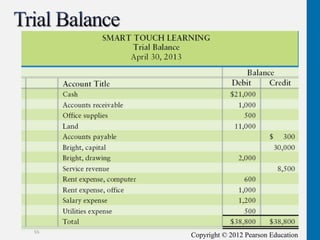
55
Copyright © 2012 Pearson Education
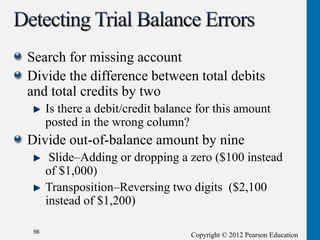
Search for missing account
Divide the difference between total debits
and total credits by two
Is there a debit/credit balance for this amount
posted in the wrong column?
Divide out-of-balance amount by nine
Slide–Adding or dropping a zero ($100 instead
of $1,000)
Transposition–Reversing two digits ($2,100
instead of $1,200)
56
Copyright © 2012 Pearson Education
57
Copyright © 2012 Pearson Education
58
Copyright © 2012 Pearson Education
Think of the account, journal, ledger (T-account),
and chart as matching tools. Businesses are just
matching the business transaction to the account
description that best captures the specific event
that occurred.
The accounting equation must always balance
after each transaction is recorded. To achieve this
balance, we record transactions using a double
entry accounting system. In that system, debits
are on the left and credits are on the right. Debits
always equal credits.
59
Copyright © 2012 Pearson Education
A transaction occurs and is recorded on a
source document. Then, we identify the
account names affected by the transaction and
determine whether the accounts increased or
decreased using the rules of debit and credit
for the six main account types. Next, we record
the transaction in the journal, listing the debits
first. We then post all transactions to the ledger
(T-account).
60
Copyright © 2012 Pearson Education
Once the ledger (T-account) balances are
calculated, the ending balance for each account
is transferred to the trial balance. Recall that the
trial balance is a listing of all accounts and their
balances on a specific date. Total debits must
always equal total credits on the trial balance. If
they do not, then review the correcting trial
balance errors section on Page 81 of the
textbook.
61
Copyright © 2012 Pearson Education
62
Copyright © 2012 Pearson Education
63
Copyright
All rights reserved. No part of this publication may be reproduced,
stored in a retrieval system, or transmitted, in any form or by any
means, electronic, mechanical, photocopying, recording, or
otherwise, without the prior written permission of the publisher.
Printed in the United States of America.

hho_acctg09GE_inppt02_ppt (1).ppt

  • 1.
    Copyright © 2012Pearson Education Chapter 2 1
  • 2.
    Copyright © 2012Pearson Education 2 Explain accounts, journals, and ledgers as they relate to recording transactions and describe common accounts Define debits, credits, and normal account balances and use double-entry accounting and T-accounts List the steps of the transaction recording process
  • 3.
    Copyright © 2012Pearson Education 3 Journalize and post sample transactions to the ledger Prepare the trial balance from the T-accounts
  • 4.
    Copyright © 2012Pearson Education Explain accounts, journals, and ledgers as they relate to recording transactions and describe common accounts 4 1
  • 5.
    Copyright © 2012Pearson Education 5 Record transactions in the journal Copy (post) to the ledger Prepare the trial balance
  • 6.
    Copyright © 2012Pearson Education Basic summary device Detailed record of all changes that have occurred in a particular asset, liability, or owner’s equity Covers a specific period of time Grouped in three broad categories Assets Liabilities Owner’s Equity 6
  • 7.
    Copyright © 2012Pearson Education Journal Chronological record of transactions Organized by date Ledger The book holding all the accounts and their balances Organized by account 7
  • 8.
    Copyright © 2012Pearson Education Listing of all accounts and their balances 8
  • 9.
    Copyright © 2012Pearson Education 9 ASSETS LIABILITIES EQUITY Economic Resources Claims to Economic Resources
  • 10.
    Copyright © 2012Pearson Education Economic resources that will benefit the business in the future: Cash Accounts receivable Notes receivable Prepaid expenses Land Building Equipment, Furniture, Fixtures 10
  • 11.
    Copyright © 2012Pearson Education A debt (something owed): Accounts payable Notes payable Accrued liabilities 11
  • 12.
    Copyright © 2012Pearson Education Owner’s claim to the assets: Capital Drawing Revenues Expenses 12
  • 13.
    Copyright © 2012Pearson Education Asset, Liability, and Owner’s Equity Accounts 13
  • 14.
    Copyright © 2012Pearson Education List of all accounts used by a company 14
  • 15.
    Copyright © 2012Pearson Education Define debits, credits, and normal account balances and use double-entry accounting and T-accounts 15 2
  • 16.
    Copyright © 2012Pearson Education Record dual effects of each transaction Each transaction has a: Receiving side Giving side Examples: Company purchases supplies (receiving) with cash (giving) Company issues stock (giving) and receives cash (receiving) 16
  • 17.
    Copyright © 2012Pearson Education 17 Tool for analyzing and determining the balance in a given account Account Name (Left Side) (Right Side) Dr Debit Cr Credit
  • 18.
    Copyright © 2012Pearson Education Whether an account is increased by debit or a credit is determined by the account type Asset, liability, or equity Debits are not good or bad Neither are credits 18
  • 19.
    Copyright © 2012Pearson Education 19 The account category governs the increase side or decrease side Increases are recorded on one side Decreases are recorded on the opposite side Rules of debits and credits
  • 20.
    Copyright © 2012Pearson Education Illustrate Debits and Credits The first transaction involves receiving $30,000 cash and issuing Capital The second transaction is a $20,000 purchase of land for cash 20
  • 21.
    Copyright © 2012Pearson Education Match the accounting terms on the left with the corresponding definitions on the right. 1. _____Posting 2. _____ Receivable 3. _____ Debit 4. _____ Journal 5. _____ Expense 6. _____ Net Income 7. _____ Normal Balance 8. _____ Ledger 9. _____ Payable 10. _____ Equity 21 A. Using up assets in the course of operating a business B. Book of accounts C. An asset D. Record of transactions E. Left side of an account F. Side of an account where increases are recorded G. Copying data from the journal to the ledger H. Always a liability I. Revenues – Expenses = J. Assets – Liabilities = G C E D A I F B H J
  • 22.
    Copyright © 2012Pearson Education Margaret Alves is tutoring Timothy Johnson, who is taking introductory accounting. Margaret explains to Timothy that debits are used to record increases in accounts and credits record decreases. Timothy is confused and seeks your advice. 1. When are debits increases? When are debits decreases? 2. When are credits increases? When are credits decreases? 22 Debits are increases in the Assets, Drawing, and Expenses. Debits are decreases in the Liabilities, Owner’s Equity, and Revenues. Credits are decreases in the Assets, Drawings, and Expenses. Credits are increases in the Liabilities, Owner’s Equity, and Revenues.
  • 23.
    Copyright © 2012Pearson Education List the steps of the transaction recording process 23 3
  • 24.
    Copyright © 2012Pearson Education Identify each account affected and its type Determine if each account is increased or decreased Record transaction in the journal 24 Use the rules of debit and credit
  • 25.
    Copyright © 2012Pearson Education Journalize the first transaction of Smart Touch— the receipt of $30,000 cash and issuance of Capital. The accounts affected are Cash and Capital. Cash is an asset. Capital is equity. Both accounts increase by $30,000. Assets increase with debits. Equity increases with credits. 25
  • 26.
    Copyright © 2012Pearson Education Four parts: a) Date of transaction b) Title of account debited with dollar amount c) Title of account credited with dollar amount d) Brief explanation of transaction 26
  • 27.
    Copyright © 2012Pearson Education 27 Journal Page 1 Date Description Debit Credit Apr 1 Cash 30,000 Bright, capital 30,000 Owner investment. Transaction date Accounts affected Dollar amounts of debits and credits Explanation of transaction
  • 28.
    Copyright © 2012Pearson Education Ned Brown opened a medical practice in San Diego, California. 1. Record the preceding transactions in the journal of Ned Brown, M.D., P.C. Include an explanation. 28 Jan 1 The business received $29,000 cash and issued common stock. 2 Purchased medical supplies on account, $14,000. 2 Paid monthly office rent of $2,600. 3 Recorded $8,000 revenue for service rendered to patients on account.
  • 29.
    Copyright © 2012Pearson Education Jan. 1: The business received $29,000 cash and issued common stock. Cash received indicates cash increases. Cash is an Asset, Assets increase with debits Issued common stock, indicates equity is increasing Increase equity with credits 29 GENERAL JOURNAL DATE DESCRIPTION REF DEBIT CREDIT Jan 1 Cash 29,000 Brown, capital 29,000 Issued stock.
  • 30.
    Copyright © 2012Pearson Education Jan. 2: Purchased medical supplies on account, $14,000. Medical Supplies, an asset, is increasing. Assets increase with debits On account, increases accounts payable, a liability Increase liabilities with credits 30 GENERAL JOURNAL DATE DESCRIPTION REF DEBIT CREDIT Jan 1 Medical supplies 14,000 Accounts payable 14,000 Purchased supplies on account.
  • 31.
    Copyright © 2012Pearson Education Jan. 2: Paid monthly office rent of $2,600. Paid rent, an expense, expense is increasing Expenses increase with debits Paid cash, cash is an asset. Increase assets with debits 31 GENERAL JOURNAL DATE DESCRIPTION REF DEBIT CREDIT Jan 2 Rent Expense 2,600 Cash 2,600 Paid office rent.
  • 32.
    Copyright © 2012Pearson Education Jan. 3: Recorded $8,000 revenue for service rendered to patients on account. On account indicates Accounts receivable increase. Accounts receivable is an Asset, Assets increase with debits Rendered services, services are revenues, indicates revenues are increasing Increase revenues with credits 32 GENERAL JOURNAL DATE DESCRIPTION REF DEBIT CREDIT Jan 1 Accounts receivable 8,000 Service revenue 8,000 Performed service on account.
  • 33.
    Copyright © 2012Pearson Education Copying amounts from the journal to the ledger 33
  • 34.
    Copyright © 2012Pearson Education 34
  • 35.
    Copyright © 2012Pearson Education 35
  • 36.
    Copyright © 2012Pearson Education 36
  • 37.
    Copyright © 2012Pearson Education 37
  • 38.
    Copyright © 2012Pearson Education Origin of accounting transactions Examples: Bank deposit tickets Invoices Checks Stock certificates 38
  • 39.
    Copyright © 2012Pearson Education Journalize and post sample transactions to the ledger 39 4
  • 40.
    Copyright © 2012Pearson Education 40 Cash Capital GENERAL JOURNAL DATE DESCRIPTION RE F DEBIT CREDIT Cash 30,000 Bright, capital 30,000 Issued capital. 30,000 30,000 Transaction 1
  • 41.
    Copyright © 2012Pearson Education Transaction 2 41 Cash Capital Land GENERAL JOURNAL DATE DESCRIPTION REF DEBIT CREDIT Land 20,000 Cash 20,000 Bought land. 30,000 30,000 20,000 20,000 10,000
  • 42.
    Copyright © 2012Pearson Education Transaction 3 42 Cash Accounts payable Office supplies GENERAL JOURNAL DATE DESCRIPTION REF DEBIT CREDIT Office supplies 500 Accounts payable 500 Purchased supplies. 30,000 20,000 Cash 30,000 20,000 10,000 500 500
  • 43.
    Copyright © 2012Pearson Education Transaction 4 43 Cash Service revenue GENERAL JOURNAL DATE DESCRIPTION REF DEBIT CREDIT Cash 5,500 Service revenue 5,500 Received payment on account. 30,000 20,000 Cash 30,000 20,000 5,500 5,500
  • 44.
    Copyright © 2012Pearson Education 44
  • 45.
    Copyright © 2012Pearson Education Oakland Floor Coverings reported the following summarized data at December 31, 2012. Accounts appear in no particular order. 45 Revenues $34,000 Other liabilities $18,000 Equipment 45,000 Cash 12,000 Accounts payable 2,000 Expenses 19,000 Oakland, capital 22,000
  • 46.
    Copyright © 2012Pearson Education 46 Oakland Floor Coverings Trial Balance December 31, 2012 Cash Equipment Accounts payable Other liabilities Oakland, capital Revenues Expenses $ 12,000 45,000 $ 2,000 18,000 22,000 34,000 19,000 $76,000 $76,000
  • 47.
    Copyright © 2012Pearson Education Texas Sales Consultants completed the following transactions during the latter part of January: 47 Jan 22 Performed service for customers on account, $8,000. 30 Received cash on account from customers, $7,000. 31 Received a utility bill, $180, which will be paid during February. 31 Paid monthly salary to salesman, $2,000. 31 Paid advertising expense of $700.
  • 48.
    Copyright © 2012Pearson Education Jan 22: Performed service for customers on account, $8,000 “On account” indicates Accounts receivable Accounts receivable is an asset account Increase an asset with a debit 48 GENERAL JOURNAL DATE DESCRIPTION REF DEBIT CREDIT Service revenue 8,000 Jan 22 Accounts receivable 8,000
  • 49.
    Copyright © 2012Pearson Education Jan. 30: Cash is received Increase cash, an asset Assets are increased by debits The payment is “on account” Decrease Accounts receivable with a credit 49 GENERAL JOURNAL DATE DESCRIPTION REF DEBIT CREDIT Accounts receivable 7,000 Received payment on account. Jan 30 Cash 7,000
  • 50.
    Copyright © 2012Pearson Education Jan. 31: A utility bill is an expense Expenses are increased by debits The bill will be paid later–creating an account payable Liabilities are increased by credits 50 GENERAL JOURNAL DATE DESCRIPTION RE F DEBIT CREDIT Received utility bill. Jan 31 Utilities expense 180 Accounts payable 180
  • 51.
    Copyright © 2012Pearson Education Jan. 31: Salaries to employees are an expense Expenses are increased by debits The salary was paid in cash Cash, an asset, decreases, Assets are decreased by credits Rent Expense is an expense account. Increase an expense with a debit 51 GENERAL JOURNAL DATE DESCRIPTION REF DEBIT CREDIT Cash 2,000 Paid salaries. Mar 31 Salaries expense 2,000
  • 52.
    Copyright © 2012Pearson Education March 31: Advertising is another expense Cash is paid 52 GENERAL JOURNAL DATE DESCRIPTION REF DEBIT CREDIT Mar 31 Advertising expense 700 Cash 700 Paid advertising.
  • 53.
    Copyright © 2012Pearson Education Prepare the trial balance from the T-accounts 53 5
  • 54.
    Copyright © 2012Pearson Education Summary of the ledger Lists all accounts with their balances Accuracy check Debits should equal credits NOT a balance sheet 54
  • 55.
    Copyright © 2012Pearson Education 55
  • 56.
    Copyright © 2012Pearson Education Search for missing account Divide the difference between total debits and total credits by two Is there a debit/credit balance for this amount posted in the wrong column? Divide out-of-balance amount by nine Slide–Adding or dropping a zero ($100 instead of $1,000) Transposition–Reversing two digits ($2,100 instead of $1,200) 56
  • 57.
    Copyright © 2012Pearson Education 57
  • 58.
    Copyright © 2012Pearson Education 58
  • 59.
    Copyright © 2012Pearson Education Think of the account, journal, ledger (T-account), and chart as matching tools. Businesses are just matching the business transaction to the account description that best captures the specific event that occurred. The accounting equation must always balance after each transaction is recorded. To achieve this balance, we record transactions using a double entry accounting system. In that system, debits are on the left and credits are on the right. Debits always equal credits. 59
  • 60.
    Copyright © 2012Pearson Education A transaction occurs and is recorded on a source document. Then, we identify the account names affected by the transaction and determine whether the accounts increased or decreased using the rules of debit and credit for the six main account types. Next, we record the transaction in the journal, listing the debits first. We then post all transactions to the ledger (T-account). 60
  • 61.
    Copyright © 2012Pearson Education Once the ledger (T-account) balances are calculated, the ending balance for each account is transferred to the trial balance. Recall that the trial balance is a listing of all accounts and their balances on a specific date. Total debits must always equal total credits on the trial balance. If they do not, then review the correcting trial balance errors section on Page 81 of the textbook. 61
  • 62.
    Copyright © 2012Pearson Education 62
  • 63.
    Copyright © 2012Pearson Education 63 Copyright All rights reserved. No part of this publication may be reproduced, stored in a retrieval system, or transmitted, in any form or by any means, electronic, mechanical, photocopying, recording, or otherwise, without the prior written permission of the publisher. Printed in the United States of America.

Editor's Notes

  • #2 Chapter 2 describes the purpose of accounting in the business environment.
  • #3 The objectives for this chapter include to: 1. Explain accounts, journals, and ledgers as they relate to recording transactions and describe common accounts. 2. Define debits, credits, and normal account balances and use double-entry accounting and T-accounts. 3. List the steps of the transaction recording process.
  • #4 Additional objectives include to: 4. Journalize and post sample transactions to the ledger. 5. Prepare the trial balance from the T-accounts.
  • #5 The first objective is to explain accounts, journals, and ledgers and how they relate to recording transactions. In addition, common accounts will be described.
  • #6 This diagram summarizes the accounting process covered in this chapter. Accountants record transactions first in a journal, which is the chronological record of transactions. Accountants then post (copy) the data to the book of accounts called the ledger. A list of all the ledger accounts and their balances is called a trial balance. The third step is to prepare a trial balance. This is a listing of all the accounts and their amounts. All of these steps and terms will be explained later in this presentation.
  • #7 The Account is a detailed record of all the changes that have occurred in a particular asset, liability, or owner’s equity. Accounts are grouped in three broad categories, according to the accounting equation: Assets = Liabilities + Owner’s equity.
  • #8 Accountants first record transactions in a journal, which is the chronological record of transactions. The transactions are posted to the appropriate accounts in the ledger – the “book” where account balances are maintained. The journal is organized by date and the ledger is organized by account. If you want to see a particular transaction, you would look in the journal. If you want to look at the activity in a particular account, such as Cash, you would go to the ledger.
  • #9 A list of all the ledger accounts and their balances is called a trial balance. It is shown in order of account types: Assets, Liabilities, Equity, Dividends, Revenues, and Expenses.
  • #10 The basic tool of accounting is the accounting equation. It measures the resources of a business and the claims to those resources. Assets will always equal liabilities plus equity.
  • #11 Assets are economic resources that will benefit the business in the future, or simply, something that the business owns that has value. Most firms use the following asset accounts: 1. Cash: This account is a record of the cash effects of transactions. Cash includes money, such as a bank balance, paper currency, coins, and checks. 2. Accounts Receivable: Most businesses sell goods or services in exchange for a promise of future cash receipts. Such sales are made on credit (“on account”), and Accounts receivable is the account that holds these amounts. 3. Notes Receivable: A business may sell goods or services and receive a note receivable, also called a promissory note. A note receivable is a written pledge that the customer will pay a fixed amount of money by a certain date. 4. Prepaid Expenses: A business often pays certain expenses, such as rent and insurance, in advance. A prepaid expense is an asset because the prepayment provides a future benefit. Prepaid rent, Prepaid insurance, and Office supplies are separate prepaid expense accounts. 5. Land: This account shows the cost of land a business holds for use in operations. 6. Building: The cost of buildings—an office or a warehouse—appears in this account. 7. Equipment, Furniture, and Fixtures: A business has a separate asset account for each type of equipment—Computer equipment, Office equipment, and Store equipment, for example. The Furniture account shows the cost of this asset. Similarly, the Fixtures account shows the cost of light fixtures and shelving, for example.
  • #12 Liabilities are debts owed to outsiders. Shown here are common liability accounts: 1. Accounts payable is the opposite of Accounts receivable. The promise to pay a debt arising from a credit purchase is an Account payable. Such a purchase is said to be made on account. 2. Notes payable is the opposite of Notes receivable. Notes payable represents debts the business owes because it signed promissory notes to borrow money or to purchase something. 3. An accrued liability is an expense for which the business knows the amount owed but the bill has not been paid. Taxes payable, Interest payable, and Salary payable are accrued liability accounts.
  • #13 The owner’s claim to the assets of the business is called owner’s equity. The capital account represents the net investment of the owner in the business. It holds the accumulation of owner’s investment, drawings and net income (loss) of the business over the life of the business. The increase in equity created by delivering goods or services to customers is called revenue. The ledger contains as many revenue accounts as needed. If a company lends money to an outsider, it needs an Interest revenue account for the interest earned on the loan. If the business rents out a building to a tenant, it needs a Rent revenue account. Expenses use up assets or create liabilities in the course of operating a business. Expenses have the opposite effect of revenues. Expenses decrease equity. A business needs a separate account for each type of expense, such as Salary expense, Rent expense, Advertising expense, and Utilities expense. Businesses strive to minimize their expenses in order to maximize net income.
  • #14 The ledger is the book holding all the accounts with their balances. Each individual account has a “page” in the ledger.
  • #15 Companies use a chart of accounts to list all their accounts along with the account numbers. Account numbers are just shorthand versions of the account names. Account numbers usually have two or more digits. Assets are often numbered beginning with 1, liabilities with 2, equity with 3, revenues with 4, and expenses with 5. The second and third digits in an account number indicate where the account fits within the category. The chart of accounts contains the list of account names you might use to record a transaction.
  • #16 Learning objective two is two-pronged. First, we will define debits, credits, and normal account balances. Then, we will use double entry accounting and T-accounts.
  • #17 Accounting uses the double-entry system, which means that we record the dual effects of each transaction. As a result, every transaction affects at least two accounts. It would be incomplete to record only the giving side, or only the receiving side, of a transaction. For example, a company purchases supplies (which represents receiving) and pays cash (which represents giving). Or, the company issues, or gives, stock and receives cash.
  • #18 A shortened form of the general ledger account is called the T-account because it takes the form of the capital letter T. The vertical line divides the account into its left and right sides, with the title at the top. The left side of the account is called the Debit (dr) side, and the right side is called the Credit (cr) side. The account category (asset, liability, equity) determines how to record increases and decreases. For any given account, increases are recorded on one side, and decreases are recorded on the opposite side. To become comfortable using these terms, remember the following: Debit = Left, Credit = Right. The words debit and credit abbreviate the Latin terms debitum and creditum.
  • #19 Whether an account is increased or decreased by a debit or a credit depends on the type of account. Debits are not "good" or "bad." Neither are credits. Debits are not always increases or–neither are credits. Remember, we create accounts as needed. The process of creating a new account is called opening the account.
  • #20 Assets are on the left side of the accounting equation, and debits are on the left side of a T-account. Therefore, assets are increased by debits. Liabilities and equity are on the right side of the equation, and credits are on the right side of a T-Account. Therefore, liabilities and equity are increased by credits.
  • #21 To illustrate the idea of debits and credits, let us look at a transaction. The first transaction involves receiving $30,000 cash and issuing Bright, capital. The business’s assets and equity would increase by $30,000. The second transaction is a $20,000 purchase of land for cash. Cash has a $10,000 debit balance from decreasing cash for the $20,000 and Land has a debit balance of $20,000, and Capital has a $30,000 credit balance. Both assets, cash and land are equal to the capital account. The accounting equation must always balance after each transaction is recorded. To achieve this balance, we record transactions using a double entry accounting system. In that system, debits are on the left and credits are on the right. Debits ALWAYS equal credits.
  • #22 Short Exercise 2-1 involves defining specific accounting vocabulary.
  • #23 Short Exercise 2-2 reviews accounts and the rules of debit and credit.
  • #24 The third learning objective is to list the steps of the transaction recording process.
  • #25 In practice, accountants record transactions in a journal. The journalizing process has three steps: Identify each account affected and its type (Asset, Liability, or Stockholders’ equity). Determine whether each account is increased or decreased. Use the rules of debit and credit. 3. Record the transaction in the journal, including a brief explanation. The debit side of the entry is entered first. Total debits should always equal total credits. This step is also called “making the journal entry” or “journalizing the transaction.” These steps are the same whether done by computer or manually.
  • #26 Let’s journalize the first transaction of Smart Touch Learning—the receipt of $30,000 cash and issuance of Capital. The accounts affected by the receipt of cash and issuance of stock are Cash and Capital. Cash is an asset. Capital is equity. Both accounts increase by $30,000. Assets increase with debits. Therefore, we debit Cash because it is an asset. Equity increases in the business because Capital was issued. To increase equity, we credit. Therefore, we credit the Capital account.
  • #27 The journal entry includes four parts: Date of the transaction Title of the account debited, along with the dollar amount Title of the account credited, along with the dollar amount Brief explanation of the transaction Dollar signs are omitted because it is understood that the amounts are in dollars.
  • #28 Here is an example of a journal entry. A company issues Capital for cash. Capital is an owner’s equity account. Equity accounts are increased by credits. Cash is an asset. Assets are increased by debits. The date is indicated in the first column. The account debited is written first, “Cash” and the amount is placed in the left column. The Capital account is credited. Notice how the account title is indented. The amount is written in the right column. A brief explanation is written below the credit row.
  • #29 In Short Exercise 2-5, we post the journal entries from a previous exercise to T-accounts.
  • #30 Jan. 1 - The business received $29,000 cash and issued common stock. Cash received indicates cash increases. Cash is an Asset, Assets increase with debits Issued common stock, indicates equity is increasing Increase equity with credits
  • #31 Jan. 2 - Purchased medical supplies on account, $14,000. Medical Supplies, an asset, is increasing. Assets increase with debits On account, increases accounts payable, a liability Increase liabilities with credits
  • #32 Jan. 2 - Paid monthly office rent of $2,600. Paid rent, an expense, expense is increasing Expenses increase with debits Paid cash, cash is an asset. Increase assets with debits
  • #33 Jan. 3 - Recorded $8,000 revenue for service rendered to patients on account. On account indicates Accounts receivable increase. Accounts receivable is an Asset, Assets increase with debits Rendered services, services are revenues, indicates revenues are increasing Increase revenues with credits
  • #34 Journalizing a transaction records the data only in the journal—but not in the ledger. The data must also be copied to the ledger. The process of copying from the journal to the ledger is called posting. Debits in the journal are posted as debits in the ledger and credits as credits—no exceptions.
  • #35 As we have noted, revenues are increases in equity that result from providing goods or services for customers. Expenses are decreases in equity that result from using up assets or increasing liabilities in the course of operations. Revenues are earned. Expenses are incurred. Therefore, we must expand the accounting equation to include revenues and expenses. There are several elements of capital equity.
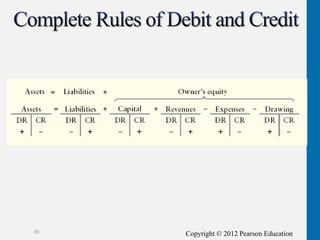
  • #36 We can now express the rules of debit and credit in complete form as shown. Note that the accounting equation now includes revenues and expenses.
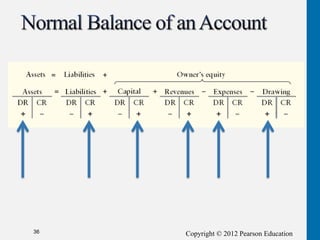
  • #37 An account’s normal balance appears on the side—either debit or credit—where we record an increase (+) in the account’s balance. To summarize the debit and credit rules, remember that the normal balance of assets, dividends, and expenses are debits. The normal balance of liabilities, retained earnings, Capital, and revenues are credits. The normal balance is also what increases the account.
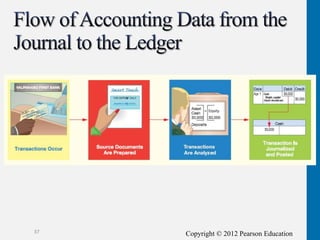
  • #38 A transaction occurs and is recorded on a source document. Then, we identify the account names affected by the transaction and determine whether the accounts increased or decreased using the rules of debit and credit for the six main account types. We then record in the journal, listing the debits first. Debits must equal credits. We then post all transactions to the ledger in the T-account.
  • #39 Accounting data come from source documents. There are many different types of source documents in business. For example, the bank deposit ticket is the document that shows the amount of cash received by the business, and the stock certificate issued by the company shows the number of stock shares issued. When a business buys supplies on account, the vendor sends an invoice requesting payment. The purchase invoice is the source document that tells the business to pay the vendor.
  • #40 The fourth learning objective is to journalize and post sample transactions to the ledger.
  • #41 Transaction 1: Smart Touch received $30,000 cash on April 1 from Sheena Bright and issued capital to her. The business deposited the money in its bank account, as shown in the text in the following deposit ticket: To post the transaction, the amounts are transferred to the appropriate T-account by debiting Cash for $30,000 and crediting Capital for $30,000.
  • #42 In Transaction 2, we see that on April 2, Smart Touch paid $20,000 cash for land. The purchase decreased cash. Therefore, we credit Cash. The asset–land–increased, so we debit the Land account. This transaction is also posted to the appropriate T-accounts. Cash and Capital each have one transaction posted to their T-accounts. Therefore, that amount is their current balance. Now post the new transaction. Debit Land for $20,000 and credit Cash for $20,000. To determine the balance of Cash, use the rules of debit and credit. Since Cash is an asset, the balance is calculated as +30,000 – 20,000 = 10,000. The balance in Cash after the two transactions is $10,000.
  • #43 In Transaction 3, Smart Touch purchased $500 of office supplies on account on April 3, as shown on the purchase invoice provided in the text. On account means to charge it to an account and pay it later. To post the transaction, the amounts are transferred to the appropriate T-account by debiting Office supplies for $500 and crediting Accounts payable for $500.
  • #44 In Transaction 4, we see that on April 8, Smart Touch collected cash of $5,500 for service revenue that the business earned by providing e-learning services for clients. The source document is Smart Touch’s sales invoice in the text. Debit cash for $5,500 and credit Service revenue $5,500. The rest of the transactions are found in the text.
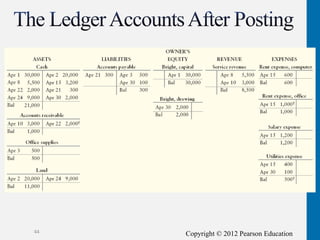
  • #45 The ledger accounts after posting all of the transactions is shown here and on Page 79 in the text.
  • #46 Short Exercise 2-10 reviews preparation of a trial balance.
  • #47 The exercise continues on this slide.
  • #48 Short Exercise 2-6 focuses on journalizing transactions.
  • #49 The exercise continues on this slide.
  • #50 The exercise continues.
  • #51 The exercise continues on this slide.
  • #52 The exercise continues.
  • #53 The exercise concludes on this slide.
  • #54 The fifth learning objective is to prepare the trial balance from the T-accounts.
  • #55 A trial balance summarizes the ledger by listing all the accounts with their balances—assets first, followed by liabilities, and then stockholders' equity. In a manual accounting system, the trial balance provides an accuracy check by showing whether total debits equal total credits. In all types of systems, the trial balance is a useful summary of the accounts and their balances because it shows the balances on a specific date for all accounts in a company's accounting system. Do not confuse the trial balance with the balance sheet. A trial balance is an internal document used only by company insiders. Outsiders see only the company’s financial statements, not the trial balance.
  • #56 Shown is the trial balance of Smart Touch at April 30, 2013, the end of the first month of operations, created from the balances calculated after all transactions have been posted. Notice the debit total equals the credit total.
  • #57 Throughout the accounting process, total debits should always equal total credits. If they don't, there is an error. Errors can be detected by computing the difference between total debits and total credits on the trial balance. Then perform one or more of the following actions: Search the trial balance for a missing account. Trace each account from the ledger to the trial balance, and you will locate the missing account. Divide the difference between total debits and total credits by 2. A debit treated as a credit, or vice versa, doubles the amount of error. Suppose the accountant mistakenly posted a $500 credit as a debit. Total debits contain the $500, and total credits omit the $500. The out-of-balance amount is $1,000. Dividing the difference by 2 identifies the $500 amount of the transaction. Then search the trial balance for a $500 transaction and trace to the account affected. Divide the out-of-balance amount by 9. If the result is evenly divisible by 9, the error may be a slide (example: writing $1,000 as $100 or writing $100 as $1,000) or a transposition (example: treating $1,200 as $2,100). Total debits can equal total credits on the trial balance; however, there still could be errors in individual account balances because an incorrect account might have been selected in an individual journal entry.
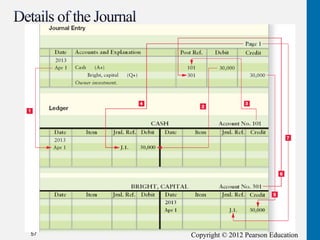
  • #58 The journal and the ledger provide details to create a “trail” through the records. The journal should always have the following parts—the date of the transaction, the accounts and the amounts debited and credited, and the posting reference. This indicates whether or not the entry has been posted to the ledger. Posting means copying information from the journal to the ledger. This diagram shows the posting process.
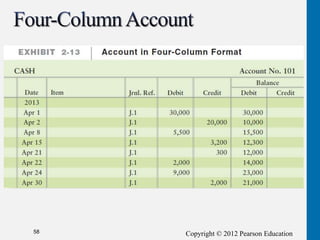
  • #59 The ledger accounts illustrated previously appear as T-accounts, with the debit on the left and the credit on the right. The T-account clearly separates debits from credits and is used for teaching, where there isn't much detail. Another account format has four amount columns, as illustrated here. The first pair of Debit/Credit columns is for transaction amounts posted to the account from the journal, such as the $30,000 debit. The second pair of amount columns shows the balance of the account as of each date. For this reason, the four-column format is used more often in practice than the T-account. Cash has a debit balance of $30,000 after the first transaction and a $10,000 balance after the second transaction.
  • #60 Think of the account, journal, ledger (T-account), and chart as matching tools. Businesses are just matching the business transaction to the account description that best captures the specific event that occurred. The accounting equation must always balance after each transaction is recorded. To achieve this balance, we record transactions using a double entry accounting system. In that system, debits are on the left and credits are on the right. Debits always equal credits.
  • #61 A transaction occurs and is recorded on a source document. Then, we identify the account names affected by the transaction and determine whether the accounts increased or decreased using the rules of debit and credit for the six main account types. Next, we record the transaction in the journal, listing the debits first. We then post all transactions to the ledger (T-account).
  • #62 Once the ledger (T-account) balances are calculated, the ending balance for each account is transferred to the trial balance. Recall that the trial balance is a listing of all accounts and their balances on a specific date. Total debits must always equal total credits on the trial balance. If they do not, then review the correcting trial balance errors section on Page 81 of the textbook.

  • #63 Are there any questions?