WEEK 1 DAY 4
MODULE IN BOOKKEEPING NC III
WEEK 1/ DAY 4
• SECTOR: HEALTH, SOCIAL AND OTHER COMMUNITY DEVELOPMENT
SERVICES
•
• OBJECTIVE: The trainees demonstrate, and understanding of the
following:
• Chart of accounts
• T-account
• Rules of Debit and Credit
INTRODUCTION TO CHART OF ACCOUNTS
• A chart of accounts is a listing of the names of the accounts that a company has
identified and made available for recording transactions in its general ledger. A
company has the flexibility to tailor its chart of accounts to best suit its needs,
including adding accounts as needed.
• Within the chart of accounts, you will find that the accounts are typically listed in
the following order:
•
Example of Chart of Accounts
The T-Account
The Account
•Daily business transactions always cause
changes in the values of Assets, Liabilities, and
Capital.
•Due to lack of space, these changes are not
recorded in the Balance Sheet. A ledger is used
instead.
•The T-Account
•An account is a record showing changes in
similar items. Because the design of an account
basically resembles the letter “T”, it is commonly
referred to as “T-account”.
•
T- ACCOUNT HAS TWO SIDES: A LEFT SIDE CALLED THE DEBIT SIDE
AND A RIGHT SIDE CALLED THE CREDIT
SIDE.
ANY AMOUNT WRITTEN ON THE LEFT SIDE OF A T-ACCOUNT IS
CALLED A DEBIT ENTRY; AND ANY AMOUNT WRITTEN ON THE
RIGHT SIDE IS CALLED A CREDIT ENTRY.
INCREASES AND DECREASES OF AN ACCOUNT
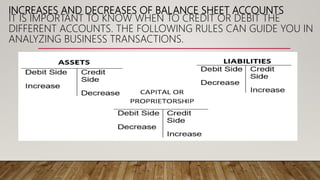
INCREASES AND DECREASES OF BALANCE SHEET ACCOUNTS
IT IS IMPORTANT TO KNOW WHEN TO CREDIT OR DEBIT THE
DIFFERENT ACCOUNTS. THE FOLLOWING RULES CAN GUIDE YOU IN
ANALYZING BUSINESS TRANSACTIONS.
Notice in the above illustrations that increases or decreases may appear
on either the debit or credit side of any given “T-account”. This suggests
that the terms “debit” and “credit” may either refer to an increase or
decrease depending on the nature of the account. The nature of
accounts is discusses in the following pages.
• For clarity, the rules of debit and credit for Balance Sheet Accounts
and for Income Statement Accounts are discussed separately. The
nature of a Balance Sheet account can be an Asset, a Liability or
Capital. The nature of an Income Statement account can be Income
or Expense.Let us first discuss the rules of debit and credit for
Balance Sheet accounts, namely:
• 1.) Assets
• 2.) Liabilities
• 3.) Capital
•
REMEMBER: DETERMINE THE FOLLOWING WHEN ANALYZING
TRANSACTIONS:
1.) WHAT INCREASED IN YOUR BUSINESS?
2.) WHAT DECREASED IN YOUR BUSINESS?
3.) ACCOUNTS AFFECTED (INCREASES OR DECREASES) IN YOUR BUSINESS
4.) THE NATURE OF ACCOUNTS AFFECTED
Type of Account Increase Decrease Normal Balance
Asset Debit Credit Debit
Liability Credit Debit Credit
Capital
Capital Drawing Credit Debit Debit Credit Credit Debit
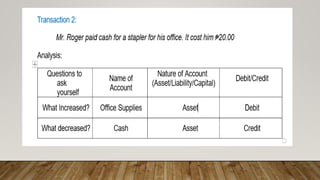
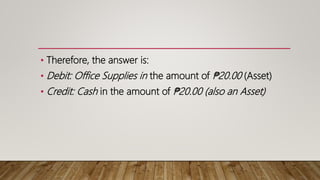
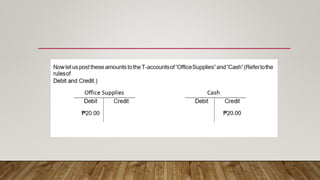
• Therefore, the answer is:
• Debit: Office Supplies in the amount of ₱20.00 (Asset)
• Credit: Cash in the amount of ₱20.00 (also an Asset)
• Therefore, the answer is:
DEBIT CREDIT
Office Supplies 20.00 (Asset)
Cash 20.00 (also an Asset)
To record payment for office supplies
• Therefore, the answer is:
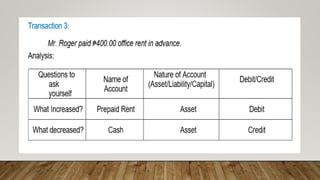
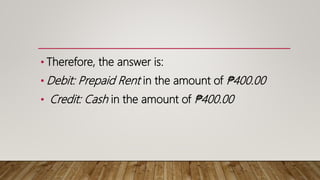
• Debit: Prepaid Rent in the amount of ₱400.00
• Credit: Cash in the amount of ₱400.00
• Therefore, the answer is:
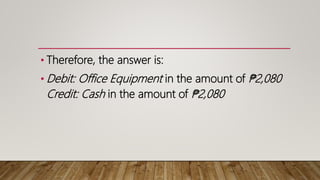
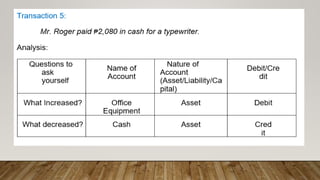
• Debit: Office Equipment in the amount of ₱2,080
Credit: Cash in the amount of ₱2,080
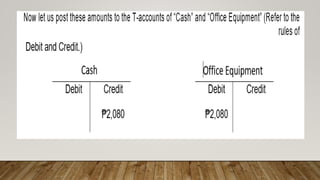
•Therefore, the answer is:
•Debit: Office Equipment in the amount of
₱2,080 Credit: Cash in the amount of ₱2,080
THE INCOME STATEMENT ACCOUNTS AND THE T-
ACCOUNT
• Try to master the Income Statement accounts.
Familiarity with the Income Statement Accounts will help you
understand more clearly the applications of the rules of debit
and credit. It will be easier for you to know when to debit or
credit.
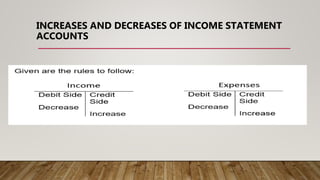
INCREASES AND DECREASES OF INCOME STATEMENT
ACCOUNTS
TO HELP YOU UNDERSTAND THE RULES OF DEBIT AND
CREDIT FOR INCOME STATEMENT ACCOUNTS, THE
FOLLOWING TRANSACTIONS ARE ANALYZED.
THEREFORE, THE ANSWER IS:
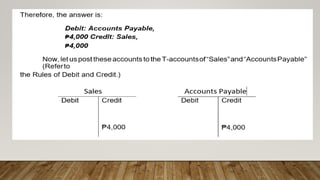
DEBIT: ACCOUNTS PAYABLE, ₱4,000
CREDIT: SALES, ₱4,000
THEREFORE, THE ANSWER IS:
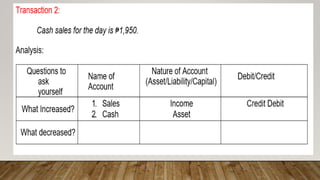
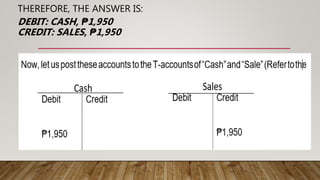
DEBIT: CASH, ₱1,950
CREDIT: SALES, ₱1,950
THEREFORE, THE ANSWER IS:
DEBIT: CASH, ₱2,500 CREDIT: SALES, ₱2,500
THEREFORE, THE ANSWER IS:
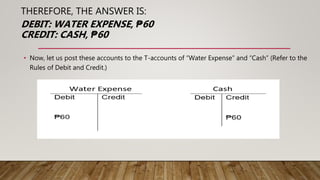
DEBIT: WATER EXPENSE, ₱60
CREDIT: CASH, ₱60
• Now, let us post these accounts to the T-accounts of “Water Expense” and “Cash” (Refer to the
Rules of Debit and Credit.)
THEREFORE, THE ANSWER IS:
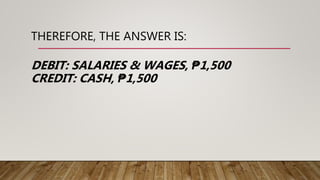
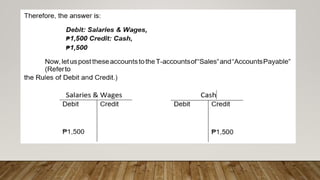
DEBIT: SALARIES & WAGES, ₱1,500
CREDIT: CASH, ₱1,500
TRANSACTION 6:
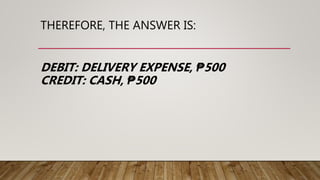
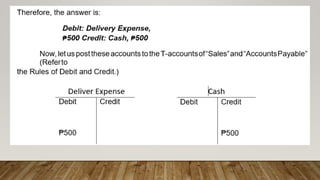
DELIVERY EXPENSES TOTALED ₱500
THEREFORE, THE ANSWER IS:
DEBIT: DELIVERY EXPENSE, ₱500
CREDIT: CASH, ₱500
• Therefore, the answer is:
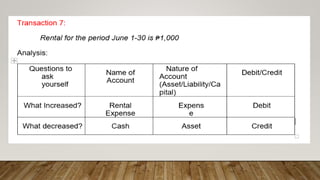
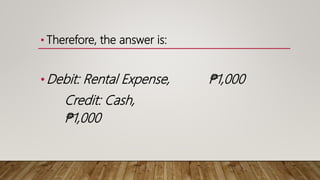
•Debit: Rental Expense, ₱1,000
Credit: Cash,
₱1,000
NOW, LET US POST THESE ACCOUNTS TO THE T-
ACCOUNTS OF “RENTAL EXPENSE” AND “CASH” (REFER
TO
THE RULES OF DEBIT AND CREDIT.)
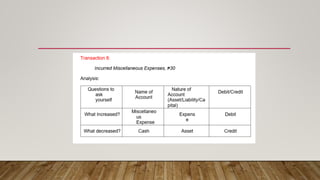
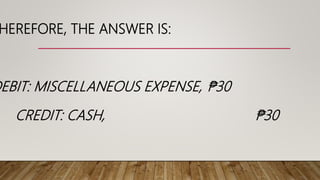
HEREFORE, THE ANSWER IS:
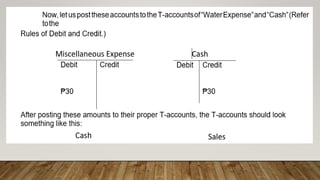
DEBIT: MISCELLANEOUS EXPENSE, ₱30
CREDIT: CASH, ₱30
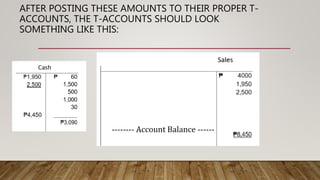
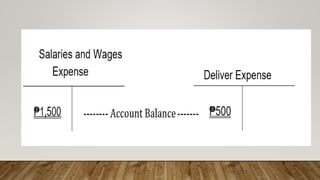
AFTER POSTING THESE AMOUNTS TO THEIR PROPER T-
ACCOUNTS, THE T-ACCOUNTS SHOULD LOOK
SOMETHING LIKE THIS:
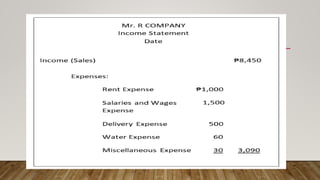
THESE ACCOUNTS SHOULD APPEAR IN THE INCOME
STATEMENT AS FOLLOWS:
week 1 day 4.pptx
week 1 day 4.pptx

week 1 day 4.pptx

  • 1.
  • 2.
    MODULE IN BOOKKEEPINGNC III WEEK 1/ DAY 4 • SECTOR: HEALTH, SOCIAL AND OTHER COMMUNITY DEVELOPMENT SERVICES • • OBJECTIVE: The trainees demonstrate, and understanding of the following: • Chart of accounts • T-account • Rules of Debit and Credit
  • 3.
    INTRODUCTION TO CHARTOF ACCOUNTS • A chart of accounts is a listing of the names of the accounts that a company has identified and made available for recording transactions in its general ledger. A company has the flexibility to tailor its chart of accounts to best suit its needs, including adding accounts as needed. • Within the chart of accounts, you will find that the accounts are typically listed in the following order: •
  • 5.
    Example of Chartof Accounts
  • 6.
    The T-Account The Account •Dailybusiness transactions always cause changes in the values of Assets, Liabilities, and Capital. •Due to lack of space, these changes are not recorded in the Balance Sheet. A ledger is used instead.
  • 7.
    •The T-Account •An accountis a record showing changes in similar items. Because the design of an account basically resembles the letter “T”, it is commonly referred to as “T-account”. •
  • 8.
    T- ACCOUNT HASTWO SIDES: A LEFT SIDE CALLED THE DEBIT SIDE AND A RIGHT SIDE CALLED THE CREDIT SIDE. ANY AMOUNT WRITTEN ON THE LEFT SIDE OF A T-ACCOUNT IS CALLED A DEBIT ENTRY; AND ANY AMOUNT WRITTEN ON THE RIGHT SIDE IS CALLED A CREDIT ENTRY. INCREASES AND DECREASES OF AN ACCOUNT
  • 9.
    INCREASES AND DECREASESOF BALANCE SHEET ACCOUNTS IT IS IMPORTANT TO KNOW WHEN TO CREDIT OR DEBIT THE DIFFERENT ACCOUNTS. THE FOLLOWING RULES CAN GUIDE YOU IN ANALYZING BUSINESS TRANSACTIONS.
  • 10.
    Notice in theabove illustrations that increases or decreases may appear on either the debit or credit side of any given “T-account”. This suggests that the terms “debit” and “credit” may either refer to an increase or decrease depending on the nature of the account. The nature of accounts is discusses in the following pages.
  • 11.
    • For clarity,the rules of debit and credit for Balance Sheet Accounts and for Income Statement Accounts are discussed separately. The nature of a Balance Sheet account can be an Asset, a Liability or Capital. The nature of an Income Statement account can be Income or Expense.Let us first discuss the rules of debit and credit for Balance Sheet accounts, namely: • 1.) Assets • 2.) Liabilities • 3.) Capital •
  • 13.
    REMEMBER: DETERMINE THEFOLLOWING WHEN ANALYZING TRANSACTIONS: 1.) WHAT INCREASED IN YOUR BUSINESS? 2.) WHAT DECREASED IN YOUR BUSINESS? 3.) ACCOUNTS AFFECTED (INCREASES OR DECREASES) IN YOUR BUSINESS 4.) THE NATURE OF ACCOUNTS AFFECTED Type of Account Increase Decrease Normal Balance Asset Debit Credit Debit Liability Credit Debit Credit Capital Capital Drawing Credit Debit Debit Credit Credit Debit
  • 15.
    • Therefore, theanswer is: • Debit: Office Supplies in the amount of ₱20.00 (Asset) • Credit: Cash in the amount of ₱20.00 (also an Asset)
  • 16.
    • Therefore, theanswer is: DEBIT CREDIT Office Supplies 20.00 (Asset) Cash 20.00 (also an Asset) To record payment for office supplies
  • 19.
    • Therefore, theanswer is: • Debit: Prepaid Rent in the amount of ₱400.00 • Credit: Cash in the amount of ₱400.00
  • 25.
    • Therefore, theanswer is: • Debit: Office Equipment in the amount of ₱2,080 Credit: Cash in the amount of ₱2,080
  • 27.
    •Therefore, the answeris: •Debit: Office Equipment in the amount of ₱2,080 Credit: Cash in the amount of ₱2,080
  • 29.
    THE INCOME STATEMENTACCOUNTS AND THE T- ACCOUNT • Try to master the Income Statement accounts. Familiarity with the Income Statement Accounts will help you understand more clearly the applications of the rules of debit and credit. It will be easier for you to know when to debit or credit.

  • 30.
    INCREASES AND DECREASESOF INCOME STATEMENT ACCOUNTS
  • 32.
    TO HELP YOUUNDERSTAND THE RULES OF DEBIT AND CREDIT FOR INCOME STATEMENT ACCOUNTS, THE FOLLOWING TRANSACTIONS ARE ANALYZED.
  • 34.
    THEREFORE, THE ANSWERIS: DEBIT: ACCOUNTS PAYABLE, ₱4,000 CREDIT: SALES, ₱4,000
  • 37.
    THEREFORE, THE ANSWERIS: DEBIT: CASH, ₱1,950 CREDIT: SALES, ₱1,950
  • 39.
    THEREFORE, THE ANSWERIS: DEBIT: CASH, ₱2,500 CREDIT: SALES, ₱2,500
  • 41.
    THEREFORE, THE ANSWERIS: DEBIT: WATER EXPENSE, ₱60 CREDIT: CASH, ₱60 • Now, let us post these accounts to the T-accounts of “Water Expense” and “Cash” (Refer to the Rules of Debit and Credit.)
  • 43.
    THEREFORE, THE ANSWERIS: DEBIT: SALARIES & WAGES, ₱1,500 CREDIT: CASH, ₱1,500
  • 45.
  • 46.
    THEREFORE, THE ANSWERIS: DEBIT: DELIVERY EXPENSE, ₱500 CREDIT: CASH, ₱500
  • 49.
    • Therefore, theanswer is: •Debit: Rental Expense, ₱1,000 Credit: Cash, ₱1,000
  • 50.
    NOW, LET USPOST THESE ACCOUNTS TO THE T- ACCOUNTS OF “RENTAL EXPENSE” AND “CASH” (REFER TO THE RULES OF DEBIT AND CREDIT.)
  • 52.
    HEREFORE, THE ANSWERIS: DEBIT: MISCELLANEOUS EXPENSE, ₱30 CREDIT: CASH, ₱30
  • 54.
    AFTER POSTING THESEAMOUNTS TO THEIR PROPER T- ACCOUNTS, THE T-ACCOUNTS SHOULD LOOK SOMETHING LIKE THIS:
  • 58.
    THESE ACCOUNTS SHOULDAPPEAR IN THE INCOME STATEMENT AS FOLLOWS: