CREDIT AND
COLLECTION
BEA CARMONA
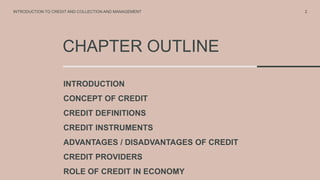
CHAPTER OUTLINE
INTRODUCTION TO CREDIT AND COLLECTION AND MANAGEMENT 2
INTRODUCTION
CONCEPT OF CREDIT
CREDIT DEFINITIONS
CREDIT INSTRUMENTS
ADVANTAGES / DISADVANTAGES OF CREDIT
CREDIT PROVIDERS
ROLE OF CREDIT IN ECONOMY
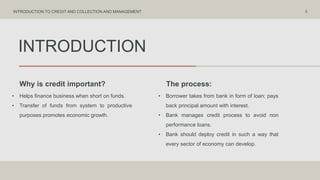
INTRODUCTION
Why is credit important? The process:
• Helps finance business when short on funds.
• Transfer of funds from system to productive
purposes promotes economic growth.
• Borrower takes from bank in form of loan; pays
back principal amount with interest.
• Bank manages credit process to avoid non
performance loans.
• Bank should deploy credit in such a way that
every sector of economy can develop.
3
INTRODUCTION TO CREDIT AND COLLECTION AND MANAGEMENT
INTRODUCTION Credit Management Aspects
• Distribute credit among all sectors of economy
so all sectors can develop; banks get profit.
• Grant credit to various sectors, individual, and
individual to avoid credit risk
• Maximize efficiency in terms of productivity and
profitability to achieve preferable economic
growth
4
INTRODUCTION TO CREDIT AND COLLECTION AND MANAGEMENT
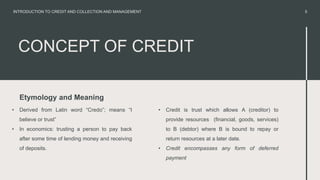
CONCEPT OF CREDIT
Etymology and Meaning
• Derived from Latin word “Credo”; means “I
believe or trust”
• In economics: trusting a person to pay back
after some time of lending money and receiving
of deposits.
• Credit is trust which allows A (creditor) to
provide resources (financial, goods, services)
to B (debtor) where B is bound to repay or
return resources at a later date.
• Credit encompasses any form of deferred
payment
5
INTRODUCTION TO CREDIT AND COLLECTION AND MANAGEMENT
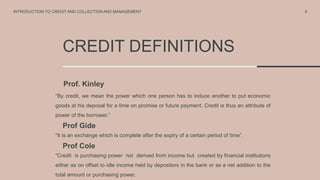
CREDIT DEFINITIONS
Prof. Kinley
“By credit, we mean the power which one person has to induce another to put economic
goods at his deposal for a time on promise or future payment. Credit is thus an attribute of
power of the borrower.”
Prof Gide
“It is an exchange which is complete after the expiry of a certain period of time”.
6
INTRODUCTION TO CREDIT AND COLLECTION AND MANAGEMENT
Prof Cole
“Credit is purchasing power not derived from income but created by financial institutions
either as on offset to idle income held by depositors in the bank or as a net addition to the
total amount or purchasing power.
CREDIT
DEFINITIO
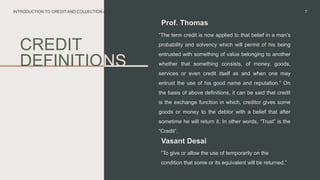
Prof. Thomas
“The term credit is now applied to that belief in a man’s
probability and solvency which will permit of his being
entrusted with something of value belonging to another
whether that something consists, of money, goods,
services or even credit itself as and when one may
entrust the use of his good name and reputation.” On
the basis of above definitions, it can be said that credit
is the exchange function in which, creditor gives some
goods or money to the debtor with a belief that after
sometime he will return it. In other words, “Trust” is the
“Credit”.
7
INTRODUCTION TO CREDIT AND COLLECTION AND MANAGEMENT
NS
Vasant Desai
”To give or allow the use of temporarily on the
condition that some or its equivalent will be returned.”
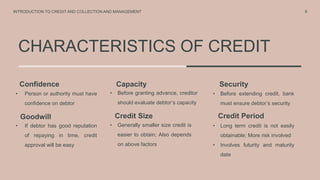
CHARACTERISTICS OF CREDIT
8
Confidence
Goodwill
Capacity
• Person or authority must have
confidence on debtor
Security
• Before extending credit, bank
must ensure debtor’s security
INTRODUCTION TO CREDIT AND COLLECTION AND MANAGEMENT
Credit Size Credit Period
• If debtor has good reputation
of repaying in time, credit
approval will be easy
• Long term credit is not easily
obtainable; More risk involved
• Involves futurity and maturity
date
• Before granting advance, creditor
should evaluate debtor’s capacity
• Generally smaller size credit is
easier to obtain; Also depends
on above factors
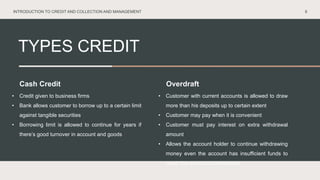
TYPES CREDIT
9
Cash Credit Overdraft
• Credit given to business firms
• Bank allows customer to borrow up to a certain limit
against tangible securities
• Borrowing limit is allowed to continue for years if
there’s good turnover in account and goods
• Customer with current accounts is allowed to draw
more than his deposits up to certain extent
• Customer may pay when it is convenient
• Customer must pay interest on extra withdrawal
amount
• Allows the account holder to continue withdrawing
money even the account has insufficient funds to
cover the amount of withdrawal
INTRODUCTION TO CREDIT AND COLLECTION AND MANAGEMENT
TYPES OF
CREDIT
Demand Loans
• Has no stated maturity period
• May be asked to pay on demand
• Silent feature is, entire amount of sanctioned loan
is paid to debtor at one time.
• Interest is charged on the debit balance.
• Allows the lender to recall a loan on short notice-
once notified the borrower must repay the full
amount of loan
Term Loans
• Advance for fixed period to person engaged in
industry, business or trade to meet requirement
(acquisition of fixed assets, etc)
• Maturity period depends on debtor’s future earnings
• a monetary loan that is repaid in regular payments
over a set period of time.
10
INTRODUCTION TO CREDIT AND COLLECTION AND MANAGEMENT
TYPES OF CREDIT
Bill Purchased
• a process where the unpaid invoices are sold to a third party (also known as factors) in
exchange for a discounted final settlement. Here, the credit-control and responsibility of
collection of the dues is transferred to the factor.
11
INTRODUCTION TO CREDIT AND COLLECTION AND MANAGEMENT
Bill Discounted
• Banker loans funds by receiving promissory note or bill payable at future date and
deducting that from the interest on the amount of the instrument
• Main feature of is the interest is received by the banker in advance.
• More or less a clean advance; banks rely mainly on the creditworthiness of the parties.
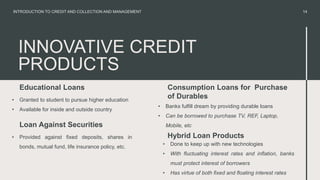
INNOVATIVE CREDIT PRODUCTS
Credit Cards Debit Cards
• Alternative to cash
• Banks allow customer to buy goods and
services on credit
• Different facilities and features are based on
annual income of holder
• Can be used as credit card for purchasing
products and drawing money from ATMs
• Upon swiping, money is debited from account
12
INTRODUCTION TO CREDIT AND COLLECTION AND MANAGEMENT
INNOVATIVE
CREDIT
PRODUCTS
Housing Loans
• Various type are offered for purchasing or
renovating a house
• Amount given depends on lending policies and
repayment capacity of customer
• Usually granted for a long period
13
INTRODUCTION TO CREDIT AND COLLECTION AND MANAGEMENT
Auto Loans
• Granted for purchase of vehicle
Personal Loans
• Excellent service provided by banks
• Granted to individuals to satisfy personal
requirements without any substantial security
• Usually with simple procedure; grants loan In
every short period with minimum documents
INNOVATIVE CREDIT
PRODUCTS
Educational Loans
• Granted to student to pursue higher education
• Available for inside and outside country
• Banks fulfill dream by providing durable loans
• Can be borrowed to purchase TV, REF, Laptop,
Mobile, etc
14
INTRODUCTION TO CREDIT AND COLLECTION AND MANAGEMENT
Loan Against Securities
• Provided against fixed deposits, shares in
bonds, mutual fund, life insurance policy, etc.
Consumption Loans for Purchase
of Durables
• Done to keep up with new technologies
• With fluctuating interest rates and inflation, banks
must protect interest of borrowers
• Has virtue of both fixed and floating interest rates
Hybrid Loan Products
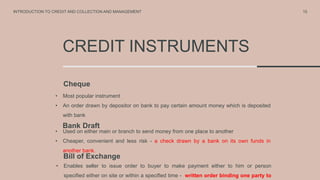
CREDIT INSTRUMENTS
Cheque
• Most popular instrument
• An order drawn by depositor on bank to pay certain amount money which is deposited
with bank
Bank Draft
• Used on either main or branch to send money from one place to another
• Cheaper, convenient and less risk - a check drawn by a bank on its own funds in
another bank.
15
INTRODUCTION TO CREDIT AND COLLECTION AND MANAGEMENT
Bill of Exchange
• Enables seller to issue order to buyer to make payment either to him or person
specified either on site or within a specified time - written order binding one party to
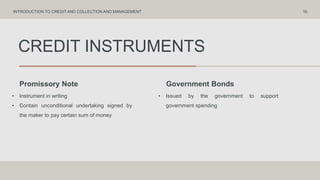
CREDIT INSTRUMENTS
Promissory Note Government Bonds
• Instrument in writing
• Contain unconditional undertaking signed by
the maker to pay certain sum of money
• Issued by the government to support
government spending
16
INTRODUCTION TO CREDIT AND COLLECTION AND MANAGEMENT
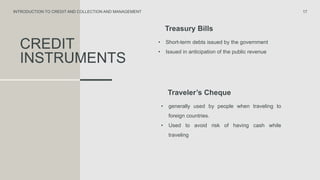
CREDIT
INSTRUMENTS
Treasury Bills
• Short-term debts issued by the government
• Issued in anticipation of the public revenue
17
INTRODUCTION TO CREDIT AND COLLECTION AND MANAGEMENT
Traveler’s Cheque
• generally used by people when traveling to
foreign countries.
• Used to avoid risk of having cash while
traveling
ADVANTAGES OF CREDIT
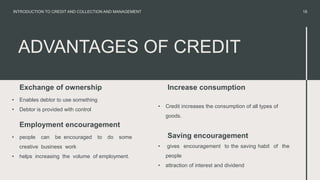
Exchange of ownership
• Enables debtor to use something
• Debtor is provided with control
• Credit increases the consumption of all types of
goods.
18
INTRODUCTION TO CREDIT AND COLLECTION AND MANAGEMENT
Employment encouragement
• people can be encouraged to do some
creative business work
• helps increasing the volume of employment.
Increase consumption
• gives encouragement to the saving habit of the
people
• attraction of interest and dividend
Saving encouragement
ADVANTAGES OF
CREDIT
Capital formation
• makes available huge funds from able people to unable people to use some things
Development of entrepreneurs
• helped different entrepreneurs to fight with difficult periods of financial crisis
• One can borrow money and grow business at a greater return
19
INTRODUCTION TO CREDIT AND COLLECTION AND MANAGEMENT
Easy payment
• Credit instrument helped people pay without much difficulty and botheration
ADVANTAGES OF CREDIT
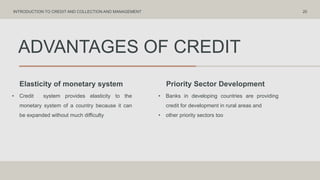
Elasticity of monetary system Priority Sector Development
• Credit system provides elasticity to the
monetary system of a country because it can
be expanded without much difficulty
• Banks in developing countries are providing
credit for development in rural areas and
• other priority sectors too
20
INTRODUCTION TO CREDIT AND COLLECTION AND MANAGEMENT
DISADVANTAGES
OF CREDIT
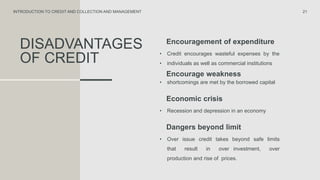
Encouragement of expenditure
• Credit encourages wasteful expenses by the
• individuals as well as commercial institutions
21
INTRODUCTION TO CREDIT AND COLLECTION AND MANAGEMENT
Encourage weakness
• shortcomings are met by the borrowed capital
Economic crisis
• Recession and depression in an economy
Dangers beyond limit
• Over issue credit takes beyond safe limits
that result in over investment, over
production and rise of prices.
DISADVANTAGES OF CREDIT
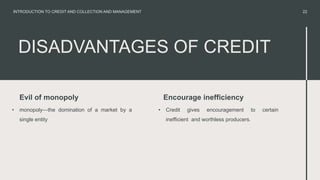
Evil of monopoly
• monopoly—the domination of a market by a
single entity
• Credit gives encouragement to certain
inefficient and worthless producers.
22
INTRODUCTION TO CREDIT AND COLLECTION AND MANAGEMENT
Encourage inefficiency
CREDIT PROVIDERS
Building Societies (Savings and Loan Companies)
provides banking and other financial services to its members.
Finance Houses
broad range of lending institutions licensed to provide consumer credit.
23
INTRODUCTION TO CREDIT AND COLLECTION AND MANAGEMENT
Credit Unions
they are member-owned, and funds contributed by members are used to provide credit
services to other members
Bank
an organization licensed to take deposits and extend loans
CREDIT PROVIDERS
24
Utility Companies Pawnbrokers
• most utility supplies (water, gas, electricity and
telecoms) are provided on a credit basis, with bills
being issued in arrear at regular intervals, usually
monthly or quarterly.
• Pawnshop
• secured loans to people, with items of personal
property used as collateral.
INTRODUCTION TO CREDIT AND COLLECTION AND MANAGEMENT
CREDIT
PROVIDERS
Government Agencies
• federal government offers several types of loans,
including: Student loans. Housing loans, including
disaster and home improvement loans.
Unlicensed Moneylenders
• Loan shark
25
INTRODUCTION TO CREDIT AND COLLECTION AND MANAGEMENT
Licensed Moneylenders
• Any individual or organization who has obtained a
credit license
ROLE OF CREDIT IN
ECONOMY
• Bank credit provides assistance to production and business process.
• Credit provides financial ability to use advanced technology in the production.
• Credit makes it easy and convenient for the consumers to purchase or hire durable
goods.
• Enables the entrepreneurs to run their business and day to day transactions very
smoothly
• It makes possible the financing of the agricultural, industrial and commercial activities of
the country
26
INTRODUCTION TO CREDIT AND COLLECTION AND MANAGEMENT
THANK
YOU

CREDIT AND COLLECTION.pptx

  • 1.
  • 2.
    CHAPTER OUTLINE INTRODUCTION TOCREDIT AND COLLECTION AND MANAGEMENT 2 INTRODUCTION CONCEPT OF CREDIT CREDIT DEFINITIONS CREDIT INSTRUMENTS ADVANTAGES / DISADVANTAGES OF CREDIT CREDIT PROVIDERS ROLE OF CREDIT IN ECONOMY
  • 3.
    INTRODUCTION Why is creditimportant? The process: • Helps finance business when short on funds. • Transfer of funds from system to productive purposes promotes economic growth. • Borrower takes from bank in form of loan; pays back principal amount with interest. • Bank manages credit process to avoid non performance loans. • Bank should deploy credit in such a way that every sector of economy can develop. 3 INTRODUCTION TO CREDIT AND COLLECTION AND MANAGEMENT
  • 4.
    INTRODUCTION Credit ManagementAspects • Distribute credit among all sectors of economy so all sectors can develop; banks get profit. • Grant credit to various sectors, individual, and individual to avoid credit risk • Maximize efficiency in terms of productivity and profitability to achieve preferable economic growth 4 INTRODUCTION TO CREDIT AND COLLECTION AND MANAGEMENT
  • 5.
    CONCEPT OF CREDIT Etymologyand Meaning • Derived from Latin word “Credo”; means “I believe or trust” • In economics: trusting a person to pay back after some time of lending money and receiving of deposits. • Credit is trust which allows A (creditor) to provide resources (financial, goods, services) to B (debtor) where B is bound to repay or return resources at a later date. • Credit encompasses any form of deferred payment 5 INTRODUCTION TO CREDIT AND COLLECTION AND MANAGEMENT
  • 6.
    CREDIT DEFINITIONS Prof. Kinley “Bycredit, we mean the power which one person has to induce another to put economic goods at his deposal for a time on promise or future payment. Credit is thus an attribute of power of the borrower.” Prof Gide “It is an exchange which is complete after the expiry of a certain period of time”. 6 INTRODUCTION TO CREDIT AND COLLECTION AND MANAGEMENT Prof Cole “Credit is purchasing power not derived from income but created by financial institutions either as on offset to idle income held by depositors in the bank or as a net addition to the total amount or purchasing power.
  • 7.
    CREDIT DEFINITIO Prof. Thomas “The termcredit is now applied to that belief in a man’s probability and solvency which will permit of his being entrusted with something of value belonging to another whether that something consists, of money, goods, services or even credit itself as and when one may entrust the use of his good name and reputation.” On the basis of above definitions, it can be said that credit is the exchange function in which, creditor gives some goods or money to the debtor with a belief that after sometime he will return it. In other words, “Trust” is the “Credit”. 7 INTRODUCTION TO CREDIT AND COLLECTION AND MANAGEMENT NS Vasant Desai ”To give or allow the use of temporarily on the condition that some or its equivalent will be returned.”
  • 8.
    CHARACTERISTICS OF CREDIT 8 Confidence Goodwill Capacity •Person or authority must have confidence on debtor Security • Before extending credit, bank must ensure debtor’s security INTRODUCTION TO CREDIT AND COLLECTION AND MANAGEMENT Credit Size Credit Period • If debtor has good reputation of repaying in time, credit approval will be easy • Long term credit is not easily obtainable; More risk involved • Involves futurity and maturity date • Before granting advance, creditor should evaluate debtor’s capacity • Generally smaller size credit is easier to obtain; Also depends on above factors
  • 9.
    TYPES CREDIT 9 Cash CreditOverdraft • Credit given to business firms • Bank allows customer to borrow up to a certain limit against tangible securities • Borrowing limit is allowed to continue for years if there’s good turnover in account and goods • Customer with current accounts is allowed to draw more than his deposits up to certain extent • Customer may pay when it is convenient • Customer must pay interest on extra withdrawal amount • Allows the account holder to continue withdrawing money even the account has insufficient funds to cover the amount of withdrawal INTRODUCTION TO CREDIT AND COLLECTION AND MANAGEMENT
  • 10.
    TYPES OF CREDIT Demand Loans •Has no stated maturity period • May be asked to pay on demand • Silent feature is, entire amount of sanctioned loan is paid to debtor at one time. • Interest is charged on the debit balance. • Allows the lender to recall a loan on short notice- once notified the borrower must repay the full amount of loan Term Loans • Advance for fixed period to person engaged in industry, business or trade to meet requirement (acquisition of fixed assets, etc) • Maturity period depends on debtor’s future earnings • a monetary loan that is repaid in regular payments over a set period of time. 10 INTRODUCTION TO CREDIT AND COLLECTION AND MANAGEMENT
  • 11.
    TYPES OF CREDIT BillPurchased • a process where the unpaid invoices are sold to a third party (also known as factors) in exchange for a discounted final settlement. Here, the credit-control and responsibility of collection of the dues is transferred to the factor. 11 INTRODUCTION TO CREDIT AND COLLECTION AND MANAGEMENT Bill Discounted • Banker loans funds by receiving promissory note or bill payable at future date and deducting that from the interest on the amount of the instrument • Main feature of is the interest is received by the banker in advance. • More or less a clean advance; banks rely mainly on the creditworthiness of the parties.
  • 12.
    INNOVATIVE CREDIT PRODUCTS CreditCards Debit Cards • Alternative to cash • Banks allow customer to buy goods and services on credit • Different facilities and features are based on annual income of holder • Can be used as credit card for purchasing products and drawing money from ATMs • Upon swiping, money is debited from account 12 INTRODUCTION TO CREDIT AND COLLECTION AND MANAGEMENT
  • 13.
    INNOVATIVE CREDIT PRODUCTS Housing Loans • Varioustype are offered for purchasing or renovating a house • Amount given depends on lending policies and repayment capacity of customer • Usually granted for a long period 13 INTRODUCTION TO CREDIT AND COLLECTION AND MANAGEMENT Auto Loans • Granted for purchase of vehicle Personal Loans • Excellent service provided by banks • Granted to individuals to satisfy personal requirements without any substantial security • Usually with simple procedure; grants loan In every short period with minimum documents
  • 14.
    INNOVATIVE CREDIT PRODUCTS Educational Loans •Granted to student to pursue higher education • Available for inside and outside country • Banks fulfill dream by providing durable loans • Can be borrowed to purchase TV, REF, Laptop, Mobile, etc 14 INTRODUCTION TO CREDIT AND COLLECTION AND MANAGEMENT Loan Against Securities • Provided against fixed deposits, shares in bonds, mutual fund, life insurance policy, etc. Consumption Loans for Purchase of Durables • Done to keep up with new technologies • With fluctuating interest rates and inflation, banks must protect interest of borrowers • Has virtue of both fixed and floating interest rates Hybrid Loan Products
  • 15.
    CREDIT INSTRUMENTS Cheque • Mostpopular instrument • An order drawn by depositor on bank to pay certain amount money which is deposited with bank Bank Draft • Used on either main or branch to send money from one place to another • Cheaper, convenient and less risk - a check drawn by a bank on its own funds in another bank. 15 INTRODUCTION TO CREDIT AND COLLECTION AND MANAGEMENT Bill of Exchange • Enables seller to issue order to buyer to make payment either to him or person specified either on site or within a specified time - written order binding one party to
  • 16.
    CREDIT INSTRUMENTS Promissory NoteGovernment Bonds • Instrument in writing • Contain unconditional undertaking signed by the maker to pay certain sum of money • Issued by the government to support government spending 16 INTRODUCTION TO CREDIT AND COLLECTION AND MANAGEMENT
  • 17.
    CREDIT INSTRUMENTS Treasury Bills • Short-termdebts issued by the government • Issued in anticipation of the public revenue 17 INTRODUCTION TO CREDIT AND COLLECTION AND MANAGEMENT Traveler’s Cheque • generally used by people when traveling to foreign countries. • Used to avoid risk of having cash while traveling
  • 18.
    ADVANTAGES OF CREDIT Exchangeof ownership • Enables debtor to use something • Debtor is provided with control • Credit increases the consumption of all types of goods. 18 INTRODUCTION TO CREDIT AND COLLECTION AND MANAGEMENT Employment encouragement • people can be encouraged to do some creative business work • helps increasing the volume of employment. Increase consumption • gives encouragement to the saving habit of the people • attraction of interest and dividend Saving encouragement
  • 19.
    ADVANTAGES OF CREDIT Capital formation •makes available huge funds from able people to unable people to use some things Development of entrepreneurs • helped different entrepreneurs to fight with difficult periods of financial crisis • One can borrow money and grow business at a greater return 19 INTRODUCTION TO CREDIT AND COLLECTION AND MANAGEMENT Easy payment • Credit instrument helped people pay without much difficulty and botheration
  • 20.
    ADVANTAGES OF CREDIT Elasticityof monetary system Priority Sector Development • Credit system provides elasticity to the monetary system of a country because it can be expanded without much difficulty • Banks in developing countries are providing credit for development in rural areas and • other priority sectors too 20 INTRODUCTION TO CREDIT AND COLLECTION AND MANAGEMENT
  • 21.
    DISADVANTAGES OF CREDIT Encouragement ofexpenditure • Credit encourages wasteful expenses by the • individuals as well as commercial institutions 21 INTRODUCTION TO CREDIT AND COLLECTION AND MANAGEMENT Encourage weakness • shortcomings are met by the borrowed capital Economic crisis • Recession and depression in an economy Dangers beyond limit • Over issue credit takes beyond safe limits that result in over investment, over production and rise of prices.
  • 22.
    DISADVANTAGES OF CREDIT Evilof monopoly • monopoly—the domination of a market by a single entity • Credit gives encouragement to certain inefficient and worthless producers. 22 INTRODUCTION TO CREDIT AND COLLECTION AND MANAGEMENT Encourage inefficiency
  • 23.
    CREDIT PROVIDERS Building Societies(Savings and Loan Companies) provides banking and other financial services to its members. Finance Houses broad range of lending institutions licensed to provide consumer credit. 23 INTRODUCTION TO CREDIT AND COLLECTION AND MANAGEMENT Credit Unions they are member-owned, and funds contributed by members are used to provide credit services to other members Bank an organization licensed to take deposits and extend loans
  • 24.
    CREDIT PROVIDERS 24 Utility CompaniesPawnbrokers • most utility supplies (water, gas, electricity and telecoms) are provided on a credit basis, with bills being issued in arrear at regular intervals, usually monthly or quarterly. • Pawnshop • secured loans to people, with items of personal property used as collateral. INTRODUCTION TO CREDIT AND COLLECTION AND MANAGEMENT
  • 25.
    CREDIT PROVIDERS Government Agencies • federalgovernment offers several types of loans, including: Student loans. Housing loans, including disaster and home improvement loans. Unlicensed Moneylenders • Loan shark 25 INTRODUCTION TO CREDIT AND COLLECTION AND MANAGEMENT Licensed Moneylenders • Any individual or organization who has obtained a credit license
  • 26.
    ROLE OF CREDITIN ECONOMY • Bank credit provides assistance to production and business process. • Credit provides financial ability to use advanced technology in the production. • Credit makes it easy and convenient for the consumers to purchase or hire durable goods. • Enables the entrepreneurs to run their business and day to day transactions very smoothly • It makes possible the financing of the agricultural, industrial and commercial activities of the country 26 INTRODUCTION TO CREDIT AND COLLECTION AND MANAGEMENT
  • 27.