Accounting standards (AS) ,
International Financial
Reporting Standards (IFRS),
Indian Accounting Standards (Ind AS)
Submitted By-
Aatur Porwal (01)
Aayushee vyas (02)
Abhishek Mishra(03)
Aditi Randhar (04)
 Accounting Standards (ASs) are written policy
documents issued by expert accounting body or by
Government or regulatory body.
 Accounting Standards (ASs) are aspects of
Recognition , Measurement , Treatment , Presentation &
Discloser of accounting transaction in the financial
statements.
 In India , Accounting Standards (ASs) are issued by
Accounting Standard Board (ASB) which is formed by
Institute of Chartered Accountants of India (ICAI).
OBJECTIVES
1. To harmonise different accounting policies & practices
use in a country.
2. To standarize accounting methods & procedures.
3. To reduce the accounting alternatives in the preparation
of financial statements.
4. To lay down principles for preparation & presentation.
5. To establish benchmark for evaluating the quality of
financial statements.
CONTD…
6. To ensure the users of financial statements get
creditable financial information .
7. To facilitate inter-firm comparison.
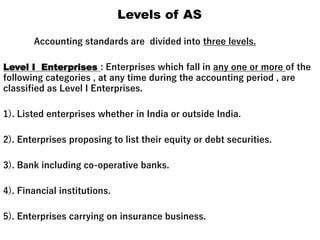
Levels of AS
Accounting standards are divided into three levels.
Level I Enterprises : Enterprises which fall in any one or more of the
following categories , at any time during the accounting period , are
classified as Level I Enterprises.
1). Listed enterprises whether in India or outside India.
2). Enterprises proposing to list their equity or debt securities.
3). Bank including co-operative banks.
4). Financial institutions.
5). Enterprises carrying on insurance business.
CONTD….
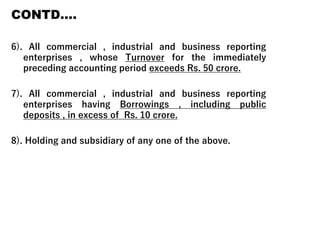
6). All commercial , industrial and business reporting
enterprises , whose Turnover for the immediately
preceding accounting period exceeds Rs. 50 crore.
7). All commercial , industrial and business reporting
enterprises having Borrowings , including public
deposits , in excess of Rs. 10 crore.
8). Holding and subsidiary of any one of the above.
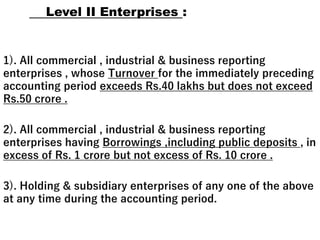
Level II Enterprises :
1). All commercial , industrial & business reporting
enterprises , whose Turnover for the immediately preceding
accounting period exceeds Rs.40 lakhs but does not exceed
Rs.50 crore .
2). All commercial , industrial & business reporting
enterprises having Borrowings ,including public deposits , in
excess of Rs. 1 crore but not excess of Rs. 10 crore .
3). Holding & subsidiary enterprises of any one of the above
at any time during the accounting period.
Level III Enterprises :
Enterprises which are not covered under Level I and II are
considered as Level III enterprises .
Recognition of Accounting Standard
Accounting Standards(ASs) issued by the ICAI have legal
recognition through Companies Act,2013.
1). Section 129(1) : The financial statements of every
company shall comply with the accounting standards.
2). Section 129(5) : Where the P&L A/c & the balance sheet
do not comply with the accounting standards, such
companies shall disclose, the following:
(a) The deviation from the AS
(b) The reasons for such deviation.
(c) The financial effect due to such deviation.
CONTD ….
3). Section 134(5) : The Board’s report shall also include a
Director’s Responsibility Statement indicating therein that in
preparation of annual accounts, the applicable AS had been
followed along with proper explanation relating to material
departure.
List Of AS -
The council of ICAI has issued 32 Accounting Standards .
However , AS-8 has been withdrawn .
Thus , effectively there are 31 Accounting Standards
Some of them are namely :
 AS 1- Disclosure of Accounting policies.
 AS 2- Valuation of inventories.
 AS 3- Cash flow Statements.
 AS 4- Contingencies & Events Occurring after the B/S
IFRS is a set of international accounting standards stating how
particular types of transactions & other events should be reported in
financial statements.
IFRS are principle-based standards, interpretations & the framework
adopted by the International Accounting Standards Board(IASB).
IFRS comprise of:
 9-IFRS-standards issued after 2001 by IASB.
 29-International Accounting Standards (IAS)-standards issued
before 2001 by IASC which are still valid.
 16-Interpretations issued by International Financial Reporting
Interpretations committee (IFRIC) after 2001.
 11-interpretations issued by Standing Interpretations Committee
(SIC) before 2001.
Advantages
 Increased comparability of financial information .
 The financial reporting process would become more transparent.
 The standardization of accounting methodology provides creditors &
investors with the ability to analyze businesses around the world using
the same financial methods.
 Permit international capital to flow more freely.
 Provide better understanding to financial statements .
 Assess the investment opportunities .
List of IFRS
The following International Accounting Standards (IAS)/International
Financial Reporting Standards (IFRS) issued by the IASB which are in
force:
 IAS-1 Presentation of Financial Statements
 IAS-2 Inventories
 IAS-7 Cash Flow Statements
 IAS-8 Accounting Policies, Changes in Accounting Estimates &
Errors.
 IAS-10 Events After The Balance Sheet Date.
Cont…
 IFRS-1 First-time Adoption of International Financial Reporting
Standards
 IFRS-2 Share-based Payment
 IFRS-3 Business Combinations
 IFRS-4 Insurance Contracts
 IFRS-5 Non-current Assets held for Sale & Discounted Operations
 IFRS-6 Exploration for & Evaluation of Mineral Resources
 IFRS-7 Financial Instrument: Disclosures
IND AS -
Ministry of Corporate Affairs (MCA) has
notified Companies (Indian Accounting
Standards) Rules , 2015 prescribing the new
Indian Accounting Standards (Ind AS)
applicable to companies /classes of
companies in contrast with applicability of
Accounting standard specified in Companies
(Accounting Standards ) Rules , 2006
List of IND AS-
 IND AS-1 Presentation of Financial Statements.
 IND AS-2 Inventories.
 IND AS-7 Statement of Cash Flows.
 IND AS-8 Accounting Policies , Changes in Accounting Estimates
& Errors
 IND AS-10 Events after the Reporting Period.
 IND AS-11 Construction Contracts.
 IND AS-12 Income Taxes.

Accountig Standard (AS),IFRS , (Ind AS)

  • 1.
    Accounting standards (AS), International Financial Reporting Standards (IFRS), Indian Accounting Standards (Ind AS) Submitted By- Aatur Porwal (01) Aayushee vyas (02) Abhishek Mishra(03) Aditi Randhar (04)
  • 2.
     Accounting Standards(ASs) are written policy documents issued by expert accounting body or by Government or regulatory body.  Accounting Standards (ASs) are aspects of Recognition , Measurement , Treatment , Presentation & Discloser of accounting transaction in the financial statements.  In India , Accounting Standards (ASs) are issued by Accounting Standard Board (ASB) which is formed by Institute of Chartered Accountants of India (ICAI).
  • 3.
    OBJECTIVES 1. To harmonisedifferent accounting policies & practices use in a country. 2. To standarize accounting methods & procedures. 3. To reduce the accounting alternatives in the preparation of financial statements. 4. To lay down principles for preparation & presentation. 5. To establish benchmark for evaluating the quality of financial statements.
  • 4.
    CONTD… 6. To ensurethe users of financial statements get creditable financial information . 7. To facilitate inter-firm comparison.
  • 5.
    Levels of AS Accountingstandards are divided into three levels. Level I Enterprises : Enterprises which fall in any one or more of the following categories , at any time during the accounting period , are classified as Level I Enterprises. 1). Listed enterprises whether in India or outside India. 2). Enterprises proposing to list their equity or debt securities. 3). Bank including co-operative banks. 4). Financial institutions. 5). Enterprises carrying on insurance business.
  • 6.
    CONTD…. 6). All commercial, industrial and business reporting enterprises , whose Turnover for the immediately preceding accounting period exceeds Rs. 50 crore. 7). All commercial , industrial and business reporting enterprises having Borrowings , including public deposits , in excess of Rs. 10 crore. 8). Holding and subsidiary of any one of the above.
  • 7.
    Level II Enterprises: 1). All commercial , industrial & business reporting enterprises , whose Turnover for the immediately preceding accounting period exceeds Rs.40 lakhs but does not exceed Rs.50 crore . 2). All commercial , industrial & business reporting enterprises having Borrowings ,including public deposits , in excess of Rs. 1 crore but not excess of Rs. 10 crore . 3). Holding & subsidiary enterprises of any one of the above at any time during the accounting period.
  • 8.
    Level III Enterprises: Enterprises which are not covered under Level I and II are considered as Level III enterprises .
  • 9.
    Recognition of AccountingStandard Accounting Standards(ASs) issued by the ICAI have legal recognition through Companies Act,2013. 1). Section 129(1) : The financial statements of every company shall comply with the accounting standards. 2). Section 129(5) : Where the P&L A/c & the balance sheet do not comply with the accounting standards, such companies shall disclose, the following: (a) The deviation from the AS (b) The reasons for such deviation. (c) The financial effect due to such deviation.
  • 10.
    CONTD …. 3). Section134(5) : The Board’s report shall also include a Director’s Responsibility Statement indicating therein that in preparation of annual accounts, the applicable AS had been followed along with proper explanation relating to material departure.
  • 11.
    List Of AS- The council of ICAI has issued 32 Accounting Standards . However , AS-8 has been withdrawn . Thus , effectively there are 31 Accounting Standards Some of them are namely :  AS 1- Disclosure of Accounting policies.  AS 2- Valuation of inventories.  AS 3- Cash flow Statements.  AS 4- Contingencies & Events Occurring after the B/S
  • 12.
    IFRS is aset of international accounting standards stating how particular types of transactions & other events should be reported in financial statements. IFRS are principle-based standards, interpretations & the framework adopted by the International Accounting Standards Board(IASB). IFRS comprise of:  9-IFRS-standards issued after 2001 by IASB.  29-International Accounting Standards (IAS)-standards issued before 2001 by IASC which are still valid.  16-Interpretations issued by International Financial Reporting Interpretations committee (IFRIC) after 2001.  11-interpretations issued by Standing Interpretations Committee (SIC) before 2001.
  • 13.
    Advantages  Increased comparabilityof financial information .  The financial reporting process would become more transparent.  The standardization of accounting methodology provides creditors & investors with the ability to analyze businesses around the world using the same financial methods.  Permit international capital to flow more freely.  Provide better understanding to financial statements .  Assess the investment opportunities .
  • 14.
    List of IFRS Thefollowing International Accounting Standards (IAS)/International Financial Reporting Standards (IFRS) issued by the IASB which are in force:  IAS-1 Presentation of Financial Statements  IAS-2 Inventories  IAS-7 Cash Flow Statements  IAS-8 Accounting Policies, Changes in Accounting Estimates & Errors.  IAS-10 Events After The Balance Sheet Date.
  • 15.
    Cont…  IFRS-1 First-timeAdoption of International Financial Reporting Standards  IFRS-2 Share-based Payment  IFRS-3 Business Combinations  IFRS-4 Insurance Contracts  IFRS-5 Non-current Assets held for Sale & Discounted Operations  IFRS-6 Exploration for & Evaluation of Mineral Resources  IFRS-7 Financial Instrument: Disclosures
  • 16.
    IND AS - Ministryof Corporate Affairs (MCA) has notified Companies (Indian Accounting Standards) Rules , 2015 prescribing the new Indian Accounting Standards (Ind AS) applicable to companies /classes of companies in contrast with applicability of Accounting standard specified in Companies (Accounting Standards ) Rules , 2006
  • 17.
    List of INDAS-  IND AS-1 Presentation of Financial Statements.  IND AS-2 Inventories.  IND AS-7 Statement of Cash Flows.  IND AS-8 Accounting Policies , Changes in Accounting Estimates & Errors  IND AS-10 Events after the Reporting Period.  IND AS-11 Construction Contracts.  IND AS-12 Income Taxes.