ACCOMMODATIVE
VISION THERAPY
PRESENTED BY J@$M!#
IMPORTANCE
•Accommodative therapy Is directed towards improving accommodative amplitude ,facility and
sustaining ability in addition to reducing response time
•The accommodative demand altered by the use of plus and minus lenses or a change a fixation
distance.
CONTEXT
Anaglyphs, Polaroids, and Liquid Crystal Filters
Lenses, Prisms, and Mirrors
Paper, Pencil, and Miscellaneous Tasks
Computer home therapy systems
Anaglyphs, Polaroids, and Liquid
Crystal Filters
RED–RED ROCK
Objectives
Red–red rock is an example of an anaglyphic procedure whose objectives are to improve
accommodative amplitude and facility. Although both eyes are open for this task,
The conditions are not truly binocular because central fusion is not possible
Equipment
Needed Cheiroscope with red–red rock attachmentc
Red–red rock tiles
Red/green glasses
Halberg-type clips Trial lenses
DESCRIPTION AND SET UP
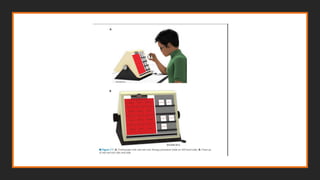
The setup for this procedure is illustrated in Figure 7.1A.
 The therapist selects white tiles and a matching red transparent slide with black lettering. The tiles and
slide are shown in Figure 7.1B.
The red transparent slide with black lettering is attached to the rear-illuminated screen of a cheiroscope.
The patient wears red/ green glasses with the red lens over his or her right eye and the green lens over the
left.
Give the patient a set of white tiles that have words printed on them in red.
On the transparent red slide (40 cm in front of the patient), these same words appear in black lettering.
The eye with the red lens sees only the words on the red slide, whereas the eye with the green lens
sees only the words on the white opaque tiles. The patient looks at the first white tile and clears the
print (eye with green lens) in order to identify the word that must be found on the red slide. The
patient then tries to find the matching word on the red slide.
To do so, the patient must use his or her right eye with the red filter. Thus, although both eyes are
open, central fusion is not possible. Rather, to perform the task, the patient alternates from the right
to the left eye.
The addition of clip-on lenses over the red/green glasses introduces the
accommodative component to the task. A plus lens is placed before the right eye
and a minus lens before the left. As the patient shifts from Anaglyphs,
the tiles to the red slide and back to the next tile, he or she must alternately
inhibit and stimulate accommodation. The power of these lenses is increased in
small increments, until the patient can perform the task through +2.50 and
−6.00.
• Level 1: Ask the patient to complete the matching task with no time consideration. The plus and
minus lenses can be alternated from visit to visit so that the right eye is sometimes viewing the target
through plus lenses and, at other times, through minus lenses.
• Level 2: To increase the level of difficulty of the task, add the variable of time. Important factors to
consider and methods of increasing and decreasing the level of the task are listed in Tables 7.1 and
7.2.
Endpoint For patients younger than 20 years, discontinue this therapy technique when the patient is
able to successfully clear +2.50 and −6.00, 20 cpm. For patients older than 20 years, the endpoint
depends on the amplitude of accommodation. Discontinue this procedure when the patient is able to

clear minus lenses equal to one half the amplitude of accommodation.

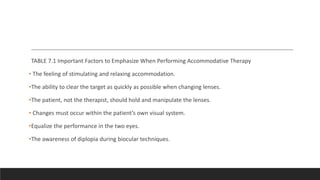
TABLE 7.1 Important Factors to Emphasize When Performing Accommodative Therapy
• The feeling of stimulating and relaxing accommodation.

•The ability to clear the target as quickly as possible when changing lenses.
•The patient, not the therapist, should hold and manipulate the lenses.
• Changes must occur within the patient’s own visual system.
•Equalize the performance in the two eyes.
•The awareness of diplopia during biocular techniques.
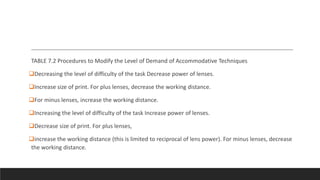
TABLE 7.2 Procedures to Modify the Level of Demand of Accommodative Techniques
Decreasing the level of difficulty of the task Decrease power of lenses.
Increase size of print. For plus lenses, decrease the working distance.
For minus lenses, increase the working distance.
Increasing the level of difficulty of the task Increase power of lenses.
Decrease size of print. For plus lenses,
increase the working distance (this is limited to reciprocal of lens power). For minus lenses, decrease
the working distance.
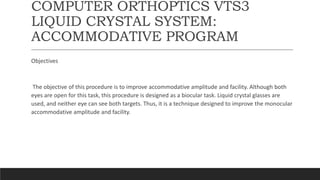
COMPUTER ORTHOPTICS VTS3
LIQUID CRYSTAL SYSTEM:
ACCOMMODATIVE PROGRAM
Objectives
The objective of this procedure is to improve accommodative amplitude and facility. Although both
eyes are open for this task, this procedure is designed as a biocular task. Liquid crystal glasses are
used, and neither eye can see both targets. Thus, it is a technique designed to improve the monocular
accommodative amplitude and facility.
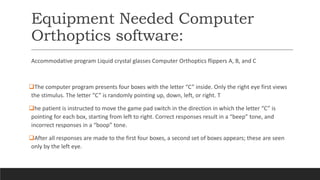
Equipment Needed Computer
Orthoptics software:
Accommodative program Liquid crystal glasses Computer Orthoptics flippers A, B, and C
The computer program presents four boxes with the letter “C” inside. Only the right eye first views
the stimulus. The letter “C” is randomly pointing up, down, left, or right. T
he patient is instructed to move the game pad switch in the direction in which the letter “C” is
pointing for each box, starting from left to right. Correct responses result in a “beep” tone, and
incorrect responses in a “boop” tone.
After all responses are made to the first four boxes, a second set of boxes appears; these are seen
only by the left eye.
While the patient is viewing the targets, accommodative flippers (supplied with the software) are
held before the patient’s eyes.
One eye views the target through a minus lens, while the other views the target through a plus lens.
For example, the level 1 accommodative flipper has a +0.75 D lens before one eye and a −1.50 D lens
before the other eye,
whereas the level 6 accommodative flipper has a +2.50 D lens and a −5.00 D lens.
Endpoint For patients younger than 20 years, the endpoint is completing the program using the level
6 accommodative flippers.
Lenses ,Prisms & Mirrors
Lens sorting is a monocular accommodative technique designed to develop an awareness of
the ability to relax and stimulate accommodation. A second objective is to teach the patient to

voluntarily accommodate or relax accommodation.

Equipment Needed
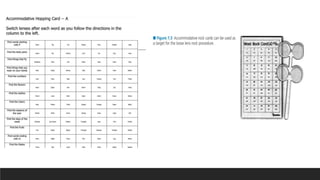
Loose uncut lenses Accommodative Hopping cards (Fig. 7.2)
Accommodative rock cards (Fig. 7.3) or other age-appropriate reading material in various print sizes
from 20/80 to 20/30 Eye patch
LENS SORTING
The actual lenses used for this procedure depend on the age of the patient. In all instances, care should
be taken to select minus lenses that are less than one half of the patient’s amplitude of accommodation.

 When working with a 30-year-old patient with an amplitude of accommodation equal to 8 D, the highest
minus lens used would be 4 D. For the example below, we assume the patient is younger than 20 years.
With one eye occluded, the patient is instructed to view age-appropriate reading material with about
20/30-size print. A moderate-power minus lens (−3.00 to −5.00) is placed before the patient’s right eye,
and he or she is asked to clear the print. The minus lens is removed and is replaced by a low plus lens
(+1.00 to +1.50).
 The patient is again asked to clear the print through the plus lens. After repeating this several times, the
patient is asked to describe the differences he or she experiences through the minus and plus lenses.
The questions should be open-ended initially. If the patient is unable to describe any differences, ask
the following questions:
• With which lens is the print larger or smaller?
• With which lens do you feel more strain or effort?
• Does this lens make you look close or far?
The objective is for the patient to realize that he or she can either stimulate or relax the
accommodative system and learn to do this voluntarily. Any other questions that will lead the patient
to this objective would be appropriate
Once the patient can consistently describe that the print becomes smaller with the minus lenses and
appears either closer or farther away, the second objective is to help the patient develop a kinesthetic
awareness of accommodation.
Wants to need stimulate or relaxing accommodation
The following is an example of such an explanation:
“Does it feel like you are working harder or straining your eyes now?
That is the feeling of focusing.
If you cannot see clearly through this lens, try to get the feeling of straining, looking close, or focusing
your eyes.” (Conversely, with plus lenses you would ask the patient to get the feeling of looking far away,
relaxing the eyes, or drifting off to sleep
Once the patient can appreciate the differences between looking through a plus and minus
lens, he or she is ready to begin the actual procedure of lens sorting. The therapist now places
six to eight unmarked uncut lenses on the table in front of the patient.
 The patient is asked to sort the lenses from strongest to weakest—the strongest being the lens
that makes him or her focus the most,
the weakest being the lens that causes the greatest relaxation. Begin with large increments,
such as +2.50, +1.25, −1.00, −2.00, −3.00, or −4.00. As the patient’s ability to feel and distinguish
the difference between stimulation and relaxation of accommodation improves, use smaller and
smaller increments.
Ultimately, the objective is for the patient to be so sensitive that he or she will be able to
recognize very small, barely noticeable differences such as a 0.5 D increment
Important Factors When performing this procedure,
one must stress the following issues (Table 7.1)
• The feeling of stimulating and relaxing accommodation
• The ability to work with smaller and smaller increments
• The ability to sort the lenses as quickly as possible
Changing the Level of Difficulty of
the Task
Decreasing the Level of Difficulty of the Task
For a patient with accommodative excess
if the patient has an accommodative excess problem and cannot clear even low levels of plus, use only minus lenses. Here
the goal would be for the patient to be able to differentiate between low and high degrees of minus lenses. As therapy
proceeds and accommodative ability improves, plus lenses can be gradually introduced. Another way to overcome this
obstacle is to use the lenses that the patient has difficulty with, but with larger print size.
For a patient with accommodative infacility
difficulty with both plus and minus lenses, the best method for making the task easier is to use larger print size. The therapist
must proceed slowly with this procedure; as the patient begins to show improvement in accommodative facility, the print size
can be made smaller and the standard technique utilized
Increasing the Level of Difficulty of the
Task To make this task more difficult,
the increments can be made as small as 0.25 D.
Another approach is to introduce the variable of speed and determine how quickly the patient can
sort eight lenses.
Endpoint
Discontinue this therapy technique when the patient is able to successfully sort eight lenses with 0.5
D increments in order from most minus to most plus.
ACCOMMODATIVE VISION THERAPY Jasmin modi

ACCOMMODATIVE VISION THERAPY Jasmin modi

  • 1.
  • 2.
    IMPORTANCE •Accommodative therapy Isdirected towards improving accommodative amplitude ,facility and sustaining ability in addition to reducing response time •The accommodative demand altered by the use of plus and minus lenses or a change a fixation distance.
  • 3.
    CONTEXT Anaglyphs, Polaroids, andLiquid Crystal Filters Lenses, Prisms, and Mirrors Paper, Pencil, and Miscellaneous Tasks Computer home therapy systems
  • 4.
    Anaglyphs, Polaroids, andLiquid Crystal Filters RED–RED ROCK
  • 5.
    Objectives Red–red rock isan example of an anaglyphic procedure whose objectives are to improve accommodative amplitude and facility. Although both eyes are open for this task, The conditions are not truly binocular because central fusion is not possible Equipment Needed Cheiroscope with red–red rock attachmentc Red–red rock tiles Red/green glasses Halberg-type clips Trial lenses
  • 6.
    DESCRIPTION AND SETUP The setup for this procedure is illustrated in Figure 7.1A.  The therapist selects white tiles and a matching red transparent slide with black lettering. The tiles and slide are shown in Figure 7.1B. The red transparent slide with black lettering is attached to the rear-illuminated screen of a cheiroscope. The patient wears red/ green glasses with the red lens over his or her right eye and the green lens over the left. Give the patient a set of white tiles that have words printed on them in red. On the transparent red slide (40 cm in front of the patient), these same words appear in black lettering.
  • 7.
    The eye withthe red lens sees only the words on the red slide, whereas the eye with the green lens sees only the words on the white opaque tiles. The patient looks at the first white tile and clears the print (eye with green lens) in order to identify the word that must be found on the red slide. The patient then tries to find the matching word on the red slide. To do so, the patient must use his or her right eye with the red filter. Thus, although both eyes are open, central fusion is not possible. Rather, to perform the task, the patient alternates from the right to the left eye.
  • 9.
    The addition ofclip-on lenses over the red/green glasses introduces the accommodative component to the task. A plus lens is placed before the right eye and a minus lens before the left. As the patient shifts from Anaglyphs, the tiles to the red slide and back to the next tile, he or she must alternately inhibit and stimulate accommodation. The power of these lenses is increased in small increments, until the patient can perform the task through +2.50 and −6.00.
  • 10.
    • Level 1:Ask the patient to complete the matching task with no time consideration. The plus and minus lenses can be alternated from visit to visit so that the right eye is sometimes viewing the target through plus lenses and, at other times, through minus lenses. • Level 2: To increase the level of difficulty of the task, add the variable of time. Important factors to consider and methods of increasing and decreasing the level of the task are listed in Tables 7.1 and 7.2. Endpoint For patients younger than 20 years, discontinue this therapy technique when the patient is able to successfully clear +2.50 and −6.00, 20 cpm. For patients older than 20 years, the endpoint depends on the amplitude of accommodation. Discontinue this procedure when the patient is able to clear minus lenses equal to one half the amplitude of accommodation.
  • 11.
    TABLE 7.1 ImportantFactors to Emphasize When Performing Accommodative Therapy • The feeling of stimulating and relaxing accommodation. •The ability to clear the target as quickly as possible when changing lenses. •The patient, not the therapist, should hold and manipulate the lenses. • Changes must occur within the patient’s own visual system. •Equalize the performance in the two eyes. •The awareness of diplopia during biocular techniques.
  • 12.
    TABLE 7.2 Proceduresto Modify the Level of Demand of Accommodative Techniques Decreasing the level of difficulty of the task Decrease power of lenses. Increase size of print. For plus lenses, decrease the working distance. For minus lenses, increase the working distance. Increasing the level of difficulty of the task Increase power of lenses. Decrease size of print. For plus lenses, increase the working distance (this is limited to reciprocal of lens power). For minus lenses, decrease the working distance.
  • 13.
    COMPUTER ORTHOPTICS VTS3 LIQUIDCRYSTAL SYSTEM: ACCOMMODATIVE PROGRAM Objectives The objective of this procedure is to improve accommodative amplitude and facility. Although both eyes are open for this task, this procedure is designed as a biocular task. Liquid crystal glasses are used, and neither eye can see both targets. Thus, it is a technique designed to improve the monocular accommodative amplitude and facility.
  • 14.
    Equipment Needed Computer Orthopticssoftware: Accommodative program Liquid crystal glasses Computer Orthoptics flippers A, B, and C The computer program presents four boxes with the letter “C” inside. Only the right eye first views the stimulus. The letter “C” is randomly pointing up, down, left, or right. T he patient is instructed to move the game pad switch in the direction in which the letter “C” is pointing for each box, starting from left to right. Correct responses result in a “beep” tone, and incorrect responses in a “boop” tone. After all responses are made to the first four boxes, a second set of boxes appears; these are seen only by the left eye.
  • 15.
    While the patientis viewing the targets, accommodative flippers (supplied with the software) are held before the patient’s eyes. One eye views the target through a minus lens, while the other views the target through a plus lens. For example, the level 1 accommodative flipper has a +0.75 D lens before one eye and a −1.50 D lens before the other eye, whereas the level 6 accommodative flipper has a +2.50 D lens and a −5.00 D lens. Endpoint For patients younger than 20 years, the endpoint is completing the program using the level 6 accommodative flippers.
  • 16.
    Lenses ,Prisms &Mirrors Lens sorting is a monocular accommodative technique designed to develop an awareness of the ability to relax and stimulate accommodation. A second objective is to teach the patient to voluntarily accommodate or relax accommodation. Equipment Needed Loose uncut lenses Accommodative Hopping cards (Fig. 7.2) Accommodative rock cards (Fig. 7.3) or other age-appropriate reading material in various print sizes from 20/80 to 20/30 Eye patch
  • 18.
    LENS SORTING The actuallenses used for this procedure depend on the age of the patient. In all instances, care should be taken to select minus lenses that are less than one half of the patient’s amplitude of accommodation.  When working with a 30-year-old patient with an amplitude of accommodation equal to 8 D, the highest minus lens used would be 4 D. For the example below, we assume the patient is younger than 20 years. With one eye occluded, the patient is instructed to view age-appropriate reading material with about 20/30-size print. A moderate-power minus lens (−3.00 to −5.00) is placed before the patient’s right eye, and he or she is asked to clear the print. The minus lens is removed and is replaced by a low plus lens (+1.00 to +1.50).  The patient is again asked to clear the print through the plus lens. After repeating this several times, the patient is asked to describe the differences he or she experiences through the minus and plus lenses.
  • 19.
    The questions shouldbe open-ended initially. If the patient is unable to describe any differences, ask the following questions: • With which lens is the print larger or smaller? • With which lens do you feel more strain or effort? • Does this lens make you look close or far? The objective is for the patient to realize that he or she can either stimulate or relax the accommodative system and learn to do this voluntarily. Any other questions that will lead the patient to this objective would be appropriate
  • 20.
    Once the patientcan consistently describe that the print becomes smaller with the minus lenses and appears either closer or farther away, the second objective is to help the patient develop a kinesthetic awareness of accommodation. Wants to need stimulate or relaxing accommodation The following is an example of such an explanation: “Does it feel like you are working harder or straining your eyes now? That is the feeling of focusing. If you cannot see clearly through this lens, try to get the feeling of straining, looking close, or focusing your eyes.” (Conversely, with plus lenses you would ask the patient to get the feeling of looking far away, relaxing the eyes, or drifting off to sleep
  • 21.
    Once the patientcan appreciate the differences between looking through a plus and minus lens, he or she is ready to begin the actual procedure of lens sorting. The therapist now places six to eight unmarked uncut lenses on the table in front of the patient.  The patient is asked to sort the lenses from strongest to weakest—the strongest being the lens that makes him or her focus the most, the weakest being the lens that causes the greatest relaxation. Begin with large increments, such as +2.50, +1.25, −1.00, −2.00, −3.00, or −4.00. As the patient’s ability to feel and distinguish the difference between stimulation and relaxation of accommodation improves, use smaller and smaller increments. Ultimately, the objective is for the patient to be so sensitive that he or she will be able to recognize very small, barely noticeable differences such as a 0.5 D increment
  • 22.
    Important Factors Whenperforming this procedure, one must stress the following issues (Table 7.1) • The feeling of stimulating and relaxing accommodation • The ability to work with smaller and smaller increments • The ability to sort the lenses as quickly as possible
  • 23.
    Changing the Levelof Difficulty of the Task Decreasing the Level of Difficulty of the Task For a patient with accommodative excess if the patient has an accommodative excess problem and cannot clear even low levels of plus, use only minus lenses. Here the goal would be for the patient to be able to differentiate between low and high degrees of minus lenses. As therapy proceeds and accommodative ability improves, plus lenses can be gradually introduced. Another way to overcome this obstacle is to use the lenses that the patient has difficulty with, but with larger print size. For a patient with accommodative infacility difficulty with both plus and minus lenses, the best method for making the task easier is to use larger print size. The therapist must proceed slowly with this procedure; as the patient begins to show improvement in accommodative facility, the print size can be made smaller and the standard technique utilized
  • 24.
    Increasing the Levelof Difficulty of the Task To make this task more difficult, the increments can be made as small as 0.25 D. Another approach is to introduce the variable of speed and determine how quickly the patient can sort eight lenses. Endpoint Discontinue this therapy technique when the patient is able to successfully sort eight lenses with 0.5 D increments in order from most minus to most plus.