
Back Injury Prevention Basics Risk Factors and Primary Causes of Back Pain
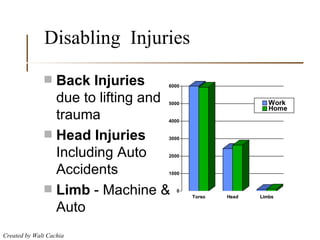
Disabling  Injuries Back Injuries  due to lifting and trauma Head Injuries  Including Auto Accidents Limb  - Machine & Auto
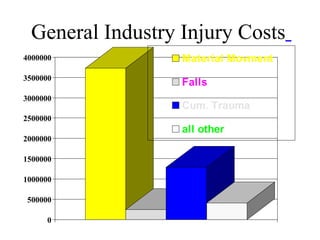
General Industry Injury Costs
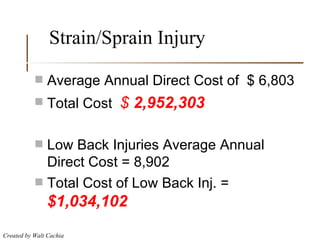
Strain/Sprain Injury  Average Annual Direct Cost of  $ 6,803 Total Cost  $  2,952,303 Low Back Injuries Average Annual Direct Cost = 8,902 Total Cost of Low Back Inj. =  $1,034,102
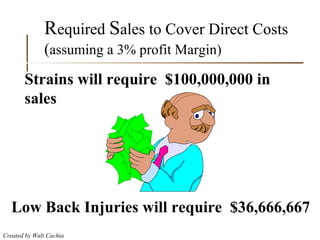
R equired  S ales to Cover Direct Costs ( assuming a 3% profit Margin) Strains will require  $100,000,000 in sales Low Back Injuries will require  $36,666,667
Required Sales  to Cover Direct & Hidden Costs $400,000,000 for Strains $122,666,668 for Low Back Injuries alone
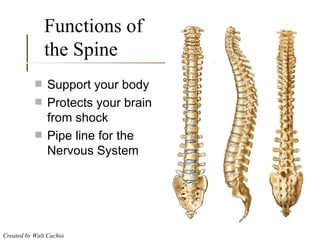
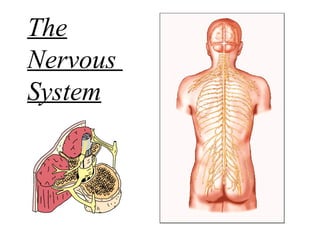
Functions of  the Spine Support your body Protects your brain from shock Pipe line for the Nervous System
TYPES of INJURIES STRAINS & SPRAINS - Ligaments stretched or torn MUSCLE SPASM - stress, weather or strain related NEUROLOGICAL - nerve involvement HERNIATED DISK - protrusion of a disk
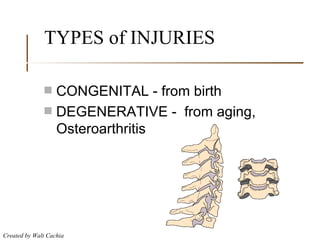
TYPES of INJURIES CONGENITAL - from birth DEGENERATIVE -  from aging, Osteroarthritis
Primary Causes of  Low  Back Pain 65% DISC DEGENERATION Including Aging & Lifting Stress 20 % INFLAMMATION - cold - spasm 10 % TRAUMA - falls - whip lash 5 % MISCELLANEOUS  CAUSES
 
Some Common Terms SCIATICA: Pressure on the Sciatic Nerve (L5 - S1) SLIPPED DISK:  Herniation of a disc and protrusion of  the disc material OSTEOPOROSIS:  calcium degeneration of bone SPONDYLOLISTHESIS: constricted disc space and fusion of vertebrae
The Nervous  System
 
 
Major Chest Muscles
Risk Factors Staying in one position for long periods Excessive vibrations Cigarette smoking Overweight increases disk pressure Sedentary Lifestyle Improper Footwear
STEPS to SAFER LIFTING KNOW YOUR LIMIT ESTIMATE THE WEIGHT - lift a corner, read a label etc....... MAKE SURE YOU HAVE FIRM FOOTING GET A GOOD GRIP BEND YOUR KNEES
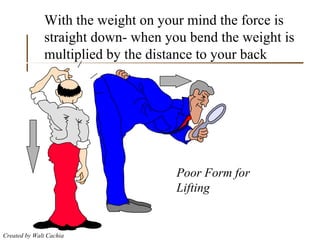
With the weight on your mind the force is straight down- when you bend the weight is multiplied by the distance to your back Poor Form for Lifting
MORE HINTS BRING THE WEIGHT CLOSE TO YOUR CENTER OF GRAVITY TIGHTEN YOUR STOMACH MUSCLES KEEP YOUR BACK IN A STRAIGHT  COMFORTABLE POSITION LIFT WITH YOUR LEGS TURN YOUR BODY  -  DON’T  TWIST
TWO PERSON LIFTS Follow the steps for Safe Lifting & Plan Your Moves Before You Start (doorways, steps, obstacles etc...) Chose a Partner about the Same Size COORDINATE YOUR ACTIONS
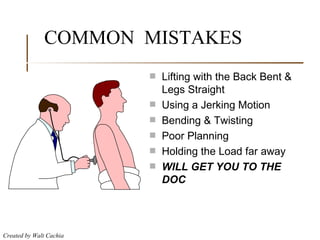
COMMON  MISTAKES Lifting with the Back Bent & Legs Straight Using a Jerking Motion Bending & Twisting Poor Planning Holding the Load far away WILL GET YOU TO THE DOC
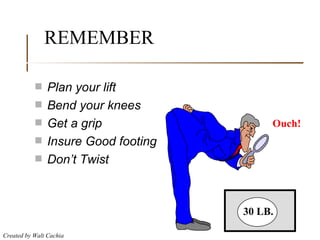
REMEMBER Plan your lift Bend your knees Get a grip Insure Good footing Don’t Twist 30 LB. Ouch!

Back Injury Prevention

  • 1.
    Back Injury PreventionBasics Risk Factors and Primary Causes of Back Pain
  • 2.
    Disabling InjuriesBack Injuries due to lifting and trauma Head Injuries Including Auto Accidents Limb - Machine & Auto
  • 3.
  • 4.
    Strain/Sprain Injury Average Annual Direct Cost of $ 6,803 Total Cost $ 2,952,303 Low Back Injuries Average Annual Direct Cost = 8,902 Total Cost of Low Back Inj. = $1,034,102
  • 5.
    R equired S ales to Cover Direct Costs ( assuming a 3% profit Margin) Strains will require $100,000,000 in sales Low Back Injuries will require $36,666,667
  • 6.
    Required Sales to Cover Direct & Hidden Costs $400,000,000 for Strains $122,666,668 for Low Back Injuries alone
  • 7.
    Functions of the Spine Support your body Protects your brain from shock Pipe line for the Nervous System
  • 8.
    TYPES of INJURIESSTRAINS & SPRAINS - Ligaments stretched or torn MUSCLE SPASM - stress, weather or strain related NEUROLOGICAL - nerve involvement HERNIATED DISK - protrusion of a disk
  • 9.
    TYPES of INJURIESCONGENITAL - from birth DEGENERATIVE - from aging, Osteroarthritis
  • 10.
    Primary Causes of Low Back Pain 65% DISC DEGENERATION Including Aging & Lifting Stress 20 % INFLAMMATION - cold - spasm 10 % TRAUMA - falls - whip lash 5 % MISCELLANEOUS CAUSES
  • 11.
  • 12.
    Some Common TermsSCIATICA: Pressure on the Sciatic Nerve (L5 - S1) SLIPPED DISK: Herniation of a disc and protrusion of the disc material OSTEOPOROSIS: calcium degeneration of bone SPONDYLOLISTHESIS: constricted disc space and fusion of vertebrae
  • 13.
  • 14.
  • 15.
  • 16.
  • 17.
    Risk Factors Stayingin one position for long periods Excessive vibrations Cigarette smoking Overweight increases disk pressure Sedentary Lifestyle Improper Footwear
  • 18.
    STEPS to SAFERLIFTING KNOW YOUR LIMIT ESTIMATE THE WEIGHT - lift a corner, read a label etc....... MAKE SURE YOU HAVE FIRM FOOTING GET A GOOD GRIP BEND YOUR KNEES
  • 19.
    With the weighton your mind the force is straight down- when you bend the weight is multiplied by the distance to your back Poor Form for Lifting
  • 20.
    MORE HINTS BRINGTHE WEIGHT CLOSE TO YOUR CENTER OF GRAVITY TIGHTEN YOUR STOMACH MUSCLES KEEP YOUR BACK IN A STRAIGHT COMFORTABLE POSITION LIFT WITH YOUR LEGS TURN YOUR BODY - DON’T TWIST
  • 21.
    TWO PERSON LIFTSFollow the steps for Safe Lifting & Plan Your Moves Before You Start (doorways, steps, obstacles etc...) Chose a Partner about the Same Size COORDINATE YOUR ACTIONS
  • 22.
    COMMON MISTAKESLifting with the Back Bent & Legs Straight Using a Jerking Motion Bending & Twisting Poor Planning Holding the Load far away WILL GET YOU TO THE DOC
  • 23.
    REMEMBER Plan yourlift Bend your knees Get a grip Insure Good footing Don’t Twist 30 LB. Ouch!

Editor's Notes

  • #3 four out of five persons in the workforce will have a back injury in their working life near $600,000,000 in GNP lost annually due to back injuries Most Disabling Type of Industrial Injury Most predictive factor for permanent disability is previous back injuries
  • #5 Vertabre
  • #8 Functions of spine
  • #9 Types of injuries
  • #10 more types
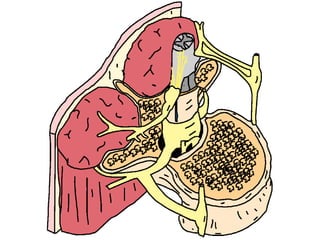
  • #12 close ou look at facet joints / nerve
  • #14 nervous system
  • #15 sketal system
  • #16 back muscles
  • #17 chest
  • #19 steps to safer lifting
  • #21 more lifting guidelines
  • #22 two person lifts
  • #23 Common mistakes
  • #24 Review basic points